编辑: 王曼
A8 Tuesday, Sept. 1, 2026
W
hen
Christopher
Nolan
first
announced
in
December 2024 that he was writing a film
adaptation of Homer’s ancient Greek tale, The
Odyssey, it made sense that he could elegantly tackle the epic
after the success of his 2023 Academy Award-winning
Oppenheimer (《奥本海默》).
Anticipation for the new film grew as the cast was
announced, including Matt Damon, Anne Hathaway, Robert
Pattinson, Tom Holland, and Zendaya. With a reported budget
of $250 million, Universal Pictures revealed that the film would
be the first to be shot entirely in IMAX, making it one of the
most eagerly awaited films of 2026. And, quite honestly, it
deserves the hype (大肆宣传).
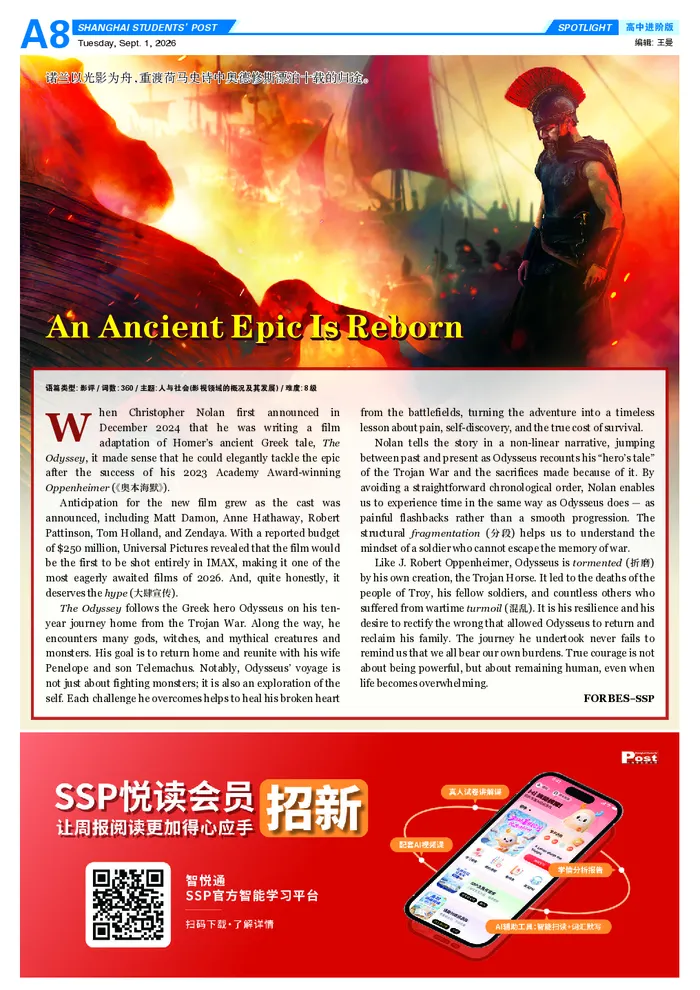
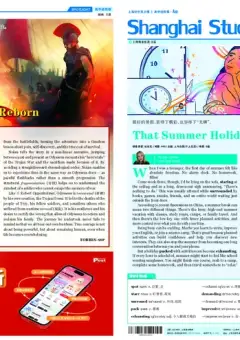
The Odyssey follows the Greek hero Odysseus on his ten-
year journey home from the Trojan War. Along the way, he
encounters many gods, witches, and mythical creatures and
monsters. His goal is to return home and reunite with his wife
Penelope and son Telemachus. Notably, Odysseus’ voyage is
not just about fighting monsters; it is also an exploration of the
self. Each challenge he overcomes helps to heal his broken heart
from the battlefields, turning the adventure into a timeless
lesson about pain, self-discovery, and the true cost of survival.
Nolan tells the story in a non-linear narrative, jumping
between past and present as Odysseus recounts his “hero’s tale”
of the Trojan War and the sacrifices made because of it. By
avoiding a straightforward chronological order, Nolan enables
us to experience time in the same way as Odysseus does — as
painful flashbacks rather than a smooth progression. The
structural fragmentation (分段) helps us to understand the
mindset of a soldier who cannot escape the memory of war.
Like J. Robert Oppenheimer, Odysseus is tormented (折磨)
by his own creation, the Trojan Horse. It led to the deaths of the
people of Troy, his fellow soldiers, and countless others who
suffered from wartime turmoil (混乱). It is his resilience and his
desire to rectify the wrong that allowed Odysseus to return and
reclaim his family. The journey he undertook never fails to
remind us that we all bear our own burdens. True courage is not
about being powerful, but about remaining human, even when
life becomes overwhelming.
FORBES-SSP
语篇类型: 影评 / 词数: 360 / 主题: 人与社会(影视领域的概况及其发展) / 难度: 8级
高中进阶版
SHANGHAI STUDENTS’ POST
SPOTLIGHT
诺兰以光影为舟
诺兰以光影为舟,重渡荷马史诗中奥德修斯漂泊十载的归途
重渡荷马史诗中奥德修斯漂泊十载的归途。
An Ancient Epic Is Reborn
An Ancient Epic Is Reborn
An Ancient Epic Is Reborn
An Ancient Epic Is Reborn
An Ancient Epic Is Reborn
An Ancient Epic Is Reborn
An Ancient Epic Is Reborn
An Ancient Epic Is Reborn
An Ancient Epic Is Reborn
An Ancient Epic Is Reborn
An Ancient Epic Is Reborn
An Ancient Epic Is Reborn
An Ancient Epic Is Reborn
An Ancient Epic Is Reborn
An Ancient Epic Is Reborn
An Ancient Epic Is Reborn
An Ancient Epic Is Reborn
An Ancient Epic Is Reborn
An Ancient Epic Is Reborn
An Ancient Epic Is Reborn
An Ancient Epic Is Reborn
An Ancient Epic Is Reborn
An Ancient Epic Is Reborn
An Ancient Epic Is Reborn
An Ancient Epic Is Reborn
An Ancient Epic Is Reborn
An Ancient Epic Is Reborn
An Ancient Epic Is Reborn
An Ancient Epic Is Reborn
An Ancient Epic Is Reborn
An Ancient Epic Is Reborn
W
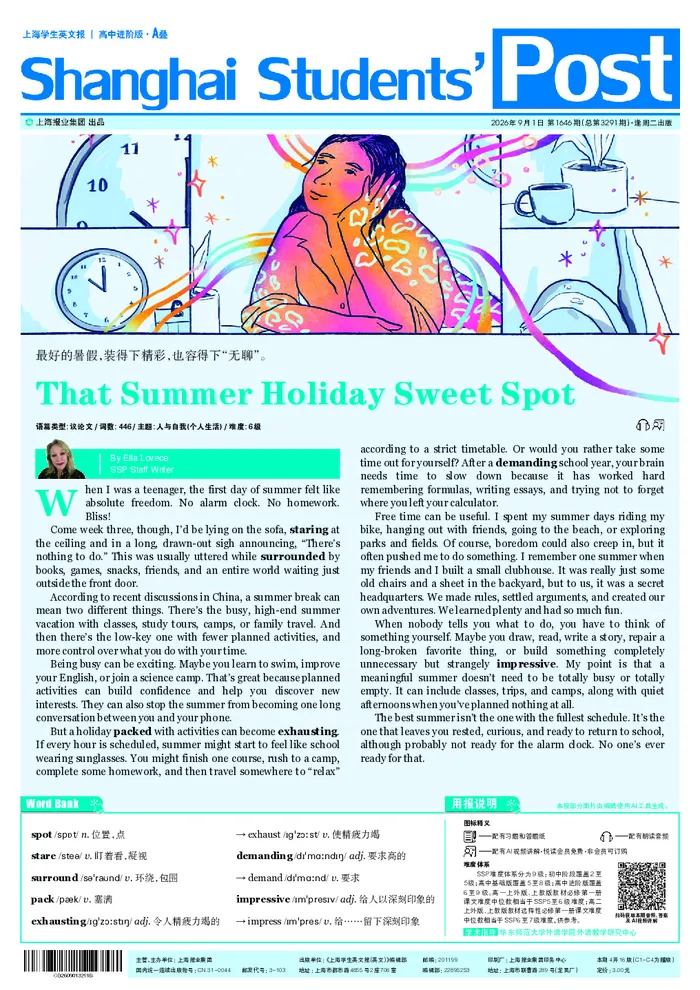
hen I was a teenager, the first day of summer felt like
absolute freedom. No alarm clock. No homework.
Bliss!
Come week three, though, I’d be lying on the sofa, staring at
the ceiling and in a long, drawn-out sigh announcing, “There’s
nothing to do.” This was usually uttered while surrounded by
books, games, snacks, friends, and an entire world waiting just
outside the front door.
According to recent discussions in China, a summer break can
mean two different things. There’s the busy, high-end summer
vacation with classes, study tours, camps, or family travel. And
then there’s the low-key one with fewer planned activities, and
more control over what you do with your time.
Being busy can be exciting. Maybe you learn to swim, improve
your English, or join a science camp. That’s great because planned
activities can build confidence and help you discover new
interests. They can also stop the summer from becoming one long
conversation between you and your phone.
But a holiday packed with activities can become exhausting.
If every hour is scheduled, summer might start to feel like school
wearing sunglasses. You might finish one course, rush to a camp,
complete some homework, and then travel somewhere to “relax”
according to a strict timetable. Or would you rather take some
time out for yourself? After a demanding school year, your brain
needs time to slow down because it has worked hard
remembering formulas, writing essays, and trying not to forget
where you left your calculator.
Free time can be useful. I spent my summer days riding my
bike, hanging out with friends, going to the beach, or exploring
parks and fields. Of course, boredom could also creep in, but it
often pushed me to do something. I remember one summer when
my friends and I built a small clubhouse. It was really just some
old chairs and a sheet in the backyard, but to us, it was a secret
headquarters. We made rules, settled arguments, and created our
own adventures. We learned plenty and had so much fun.
When nobody tells you what to do, you have to think of
something yourself. Maybe you draw, read, write a story, repair a
long-broken favorite thing, or build something completely
unnecessary but strangely impressive. My point is that a
meaningful summer doesn’t need to be totally busy or totally
empty. It can include classes, trips, and camps, along with quiet
afternoons when you’ve planned nothing at all.
The best summer isn’t the one with the fullest schedule. It’s the
one that leaves you rested, curious, and ready to return to school,
although probably not ready for the alarm clock. No one’s ever
ready for that.
That Summer Holiday Sweet Spot
That Summer Holiday Sweet Spot
That Summer Holiday Sweet Spot
That Summer Holiday Sweet Spot
That Summer Holiday Sweet Spot
That Summer Holiday Sweet Spot
That Summer Holiday Sweet Spot
That Summer Holiday Sweet Spot
That Summer Holiday Sweet Spot
That Summer Holiday Sweet Spot
That Summer Holiday Sweet Spot
That Summer Holiday Sweet Spot
That Summer Holiday Sweet Spot
That Summer Holiday Sweet Spot
That Summer Holiday Sweet Spot
That Summer Holiday Sweet Spot
That Summer Holiday Sweet Spot
That Summer Holiday Sweet Spot
That Summer Holiday Sweet Spot
That Summer Holiday Sweet Spot
That Summer Holiday Sweet Spot
That Summer Holiday Sweet Spot
That Summer Holiday Sweet Spot
That Summer Holiday Sweet Spot
That Summer Holiday Sweet Spot
That Summer Holiday Sweet Spot
That Summer Holiday Sweet Spot
That Summer Holiday Sweet Spot
That Summer Holiday Sweet Spot
That Summer Holiday Sweet Spot
That Summer Holiday Sweet Spot
2026年9月1日 第1646期(总第3291期)·逢周二出版
spot /sp^t/ n. 位置,点
stare /ste=/ v. 盯着看,凝视
surround /s='raUnd/ v. 环绕,包围
pack /p7k/ v. 塞满
exhausting /IG'z6:stI9/ adj. 令人精疲力竭的
→ exhaust /IG'z6:st/ v. 使精疲力竭
demanding /dI'm1:ndI9/ adj. 要求高的
→ demand /dI'm1:nd/ v. 要求
impressive /Im'presIv/ adj. 给人以深刻印象的
→ impress /Im'pres/ v. 给……留下深刻印象
图标释义
——配有习题和答题纸
——配有朗读音频
——配有AI视频讲解·悦读会员免费·非会员可订购
难度体系
SSP 难度体系分为9 级:初中阶段覆盖2 至
5 级;高中基础版覆盖5 至8 级;高中进阶版覆盖
6 至9 级。高一上外版、上教版教材必修第一册
课文难度中位数相当于SSP5 至6 级难度;高二
上外版、上教版教材选择性必修第一册课文难度
中位数相当于SSP6至7级难度,供参考。
学术指导 华东师范大学外语学院外语教学研究中心
扫码获取本期音频、答案
及AI视频讲解
用报说明
主管、主办单位: 上海报业集团
出版单位: 《上海学生英文报(英文)》编辑部
邮编: 201199
印刷厂: 上海报业集团印务中心
本期4开16版(C1-C4为赠版)
国内统一连续出版物号: CN 31-0044 邮发代号: 3-103
地址: 上海市都市路4855号2座706室
编辑部: 22895253
地址: 上海市联曹路289号(龙吴厂)
定价: 3.00元
By Ella Lovece
SSP Staff Writer
最好的暑假,装得下精彩,也容得下“无聊”。
语篇类型: 议论文 / 词数: 446 / 主题: 人与自我(个人生活) / 难度: 6级
Word Bank
本报部分图片由编辑使用AI工具生成。
A2 Tuesday, Sept. 1, 2026
编辑: 张雅丽 (A1版) 洪伟良 (本版)
Two Chinese Win World’s Top Maths Prize
历史性突破:中国籍数学家邓煜、王虹获2026年菲尔兹奖。
语篇类型: 新闻报道 / 词数: 378 / 主题: 人与社会(对社会有突出贡献的人物) / 难度: 7级
The World’s
Oldest Football
This round-looking object has a
fantastic tale to tell. It is in fact the
world’s oldest football at almost 500
years old. It was found in a bedroom once
used by Mary, Queen of Scots, and is now
one of Scotland’s most cherished historical
items. The football is roughly the size of a
small melon, not nearly as large as the
footballs in use today. It is made from
thick leather panels which have been
stitched ( 缝合) together and then turned
inside
out,
making
it
much
more
aerodynamic (符合空气动力学的). It had
its own moment of glory this summer, as
it was spotlighted at the World Cup game
between
Brazil
and
Scotland.
That
marked the first time that
the ball, which is five
times the age of the
tournament itself, was
present at a FIFA
World Cup game.
高中进阶版
SHANGHAI STUDENTS’ POST
NEWS
O
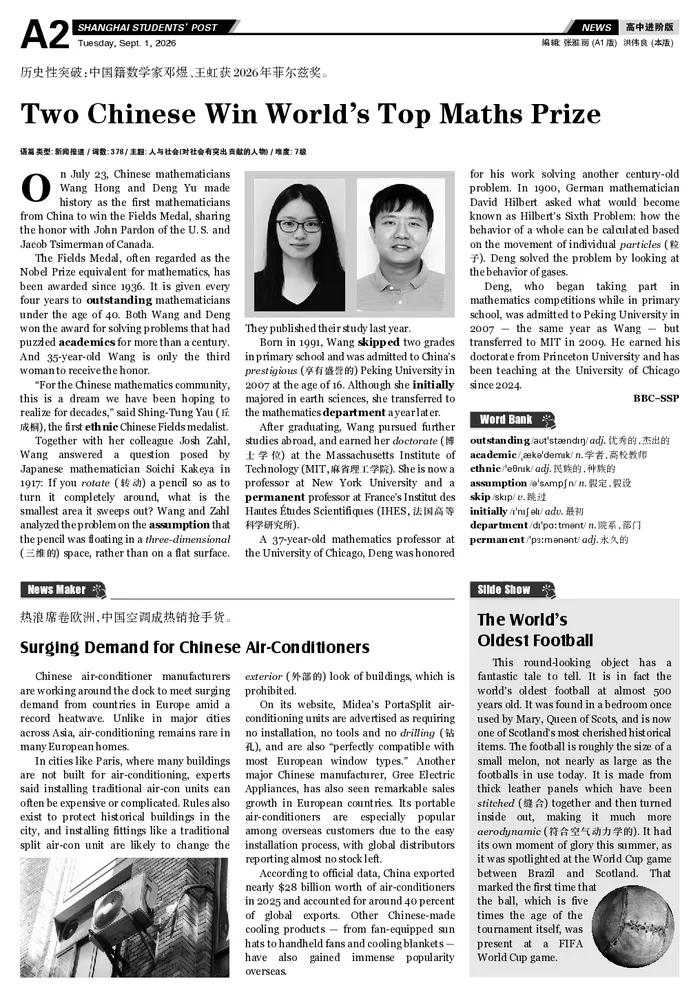
n July 23, Chinese mathematicians
Wang Hong and Deng Yu made
history as the first mathematicians
from China to win the Fields Medal, sharing
the honor with John Pardon of the U.S. and
Jacob Tsimerman of Canada.
The Fields Medal, often regarded as the
Nobel Prize equivalent for mathematics, has
been awarded since 1936. It is given every
four years to outstanding mathematicians
under the age of 40. Both Wang and Deng
won the award for solving problems that had
puzzled academics for more than a century.
And 35-year-old Wang is only the third
woman to receive the honor.
“For the Chinese mathematics community,
this is a dream we have been hoping to
realize for decades,” said Shing-Tung Yau (丘
成桐), the first ethnic Chinese Fields medalist.
Together with her colleague Josh Zahl,
Wang
answered
a
question
posed
by
Japanese mathematician Soichi Kakeya in
1917: If you rotate ( 转动) a pencil so as to
turn it completely around, what is the
smallest area it sweeps out? Wang and Zahl
analyzed the problem on the assumption that
the pencil was floating in a three-dimensional
(三维的) space, rather than on a flat surface.
They published their study last year.
Born in 1991, Wang skipped two grades
in primary school and was admitted to China’s
prestigious (享有盛誉的) Peking University in
2007 at the age of 16. Although she initially
majored in earth sciences, she transferred to
the mathematics department a year later.
After graduating, Wang pursued further
studies abroad, and earned her doctorate (博
士学位) at the Massachusetts Institute of
Technology (MIT,麻省理工学院). She is now a
professor at New York University and a
permanent professor at France’s Institut des
Hautes Études Scientifiques (IHES,法国高等
科学研究所).
A 37-year-old mathematics professor at
the University of Chicago, Deng was honored
for his work solving another century-old
problem. In 1900, German mathematician
David Hilbert asked what would become
known as Hilbert’s Sixth Problem: how the
behavior of a whole can be calculated based
on the movement of individual particles ( 粒
子). Deng solved the problem by looking at
the behavior of gases.
Deng,
who
began
taking
part
in
mathematics competitions while in primary
school, was admitted to Peking University in
2007 — the same year as Wang — but
transferred to MIT in 2009. He earned his
doctorate from Princeton University and has
been teaching at the University of Chicago
since 2024.
BBC-SSP
outstanding /aUt'st7ndI9/ adj. 优秀的,杰出的
academic /;7k='demIk/ n. 学者,高校教师
ethnic /'e0nIk/ adj. 民族的,种族的
assumption /='s2mp5n/ n. 假定,假设
skip /skIp/ v. 跳过
initially /I'nI5=lI/ adv. 最初
department /dI'p1:tm=nt/ n. 院系,部门
permanent /'p+:m=n=nt/ adj. 永久的
Surging Demand for Chinese Air-Conditioners
热浪席卷欧洲,中国空调成热销抢手货。
Chinese air-conditioner manufacturers
are working around the clock to meet surging
demand from countries in Europe amid a
record heatwave. Unlike in major cities
across Asia, air-conditioning remains rare in
many European homes.
In cities like Paris, where many buildings
are not built for air-conditioning, experts
said installing traditional air-con units can
often be expensive or complicated. Rules also
exist to protect historical buildings in the
city, and installing fittings like a traditional
split air-con unit are likely to change the
exterior ( 外部的) look of buildings, which is
prohibited.
On its website, Midea’s PortaSplit air-
conditioning units are advertised as requiring
no installation, no tools and no drilling ( 钻
孔), and are also “perfectly compatible with
most European window types.” Another
major Chinese manufacturer, Gree Electric
Appliances, has also seen remarkable sales
growth in European countries. Its portable
air-conditioners
are
especially
popular
among overseas customers due to the easy
installation process, with global distributors
reporting almost no stock left.
According to official data, China exported
nearly $28 billion worth of air-conditioners
in 2025 and accounted for around 40 percent
of global exports. Other Chinese-made
cooling products — from fan-equipped sun
hats to handheld fans and cooling blankets —
have
also
gained
immense
popularity
overseas.
News Maker
Slide Show
Word Bank
Jingdezhen Gains UNESCO World Heritage Status
语篇类型: 新闻报道 / 词数: 299 / 主题: 人与社会(物质与非物质文化遗产) / 难度: 9级
“景德镇手工瓷业遗存”成功列入《世界遗产名录》。
A7
Tuesday, Sept. 1, 2026
编辑: 洪伟良
文旅融合风正劲,千年瓷都焕新颜。
On July 25, China’s Jingdezhen Handicraft
Porcelain Industry Sites were inscribed on
the United Nations Educational, Scientific
and Cultural Organization (UNESCO) World
Heritage List, bringing the country’s total
number of listed sites to 61.
Located in Jiangxi Province, these sites
are China’s first industrial heritage nomination
and the world’s first UNESCO site centered
on porcelain. They showcase the Jingdezhen
handicraft porcelain industry system, which
was developed from the 10th to 19th centuries.
According
to
the
World
Heritage
Committee,
the
sites
demonstrate
the
evolution of China’s handicraft porcelain-
making techniques and artistry. They also
reveal the profound impact that China’s
porcelain production has had on the global
ceramics industry, as well as on cultural
exchanges and mutual learning among
civilizations.
Today, as a still-thriving ( 依旧兴旺的)
“porcelain capital,” Jingdezhen is home to
more than 3,200 inheritors of intangible
cultural heritage (非物质文化遗产传承人) in
ceramic making. Inheritance and innovation
are everywhere in Jingdezhen, said Oriol
Calvo Vergés, president of the International
Academy of Ceramics.
Tradition and innovation in Jingdezhen
are not contradictory but complementary
(互补的). In recent years, China has proven to
the world that ceramics are far more than a
heritage to be preserved. Notably, they can
also serve as a powerful engine for urban
renewal, education, tourism, innovation,
artistic creation and international dialogue,
Vergés added.
Over the past decade, Jingdezhen has
attracted more than 130,000 new residents.
Around 80 percent of them are under the age
of 35. Many of them come from overseas to
pursue opportunities in ceramics and related
creative fields.
This enduring appeal has also led to
significant economic growth. The city is now
home to more than 58,000 handcrafted
ceramic workshops and over 100,000 people
working in the ceramic industry. Last year,
the sector’s annual output value exceeded
100 billion yuan, with its products reaching
dozens of countries and regions worldwide.
XINHUA-SSP
Porcelain Capital Jingdezhen Reinvents Itself
语篇类型: 说明文 / 词数: 409 / 主题: 人与社会(物质与非物质文化遗产) / 难度: 7级
T
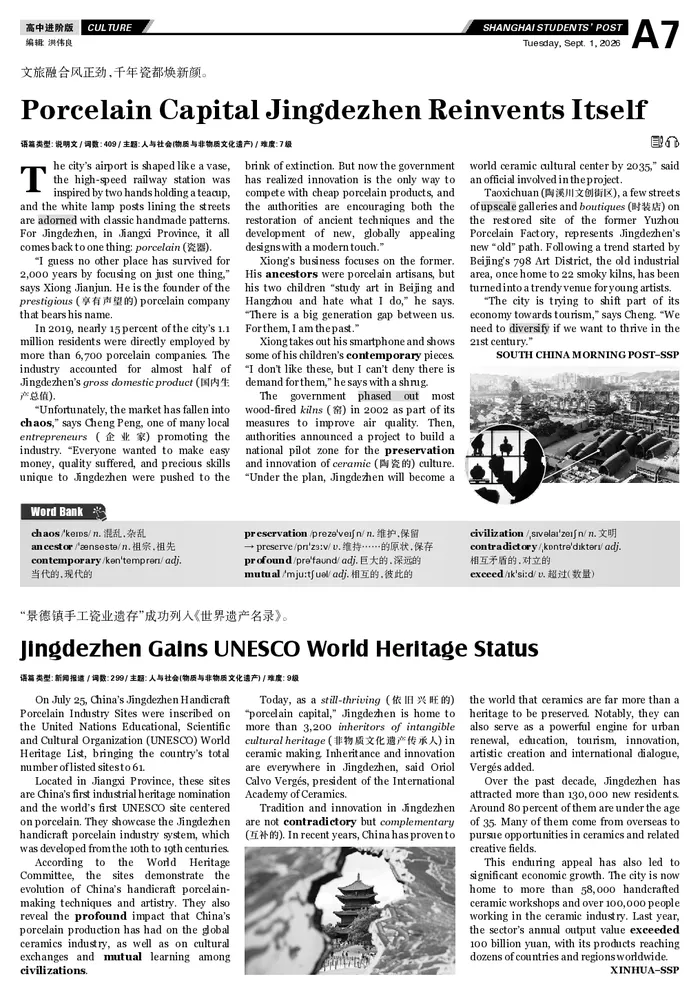
he city’s airport is shaped like a vase,
the high-speed railway station was
inspired by two hands holding a teacup,
and the white lamp posts lining the streets
are adorned with classic handmade patterns.
For Jingdezhen, in Jiangxi Province, it all
comes back to one thing: porcelain (瓷器).
“I guess no other place has survived for
2,000 years by focusing on just one thing,”
says Xiong Jianjun. He is the founder of the
prestigious (享有声望的) porcelain company
that bears his name.
In 2019, nearly 15 percent of the city’s 1.1
million residents were directly employed by
more than 6,700 porcelain companies. The
industry accounted for almost half of
Jingdezhen’s gross domestic product (国内生
产总值).
“Unfortunately, the market has fallen into
chaos,” says Cheng Peng, one of many local
entrepreneurs ( 企业家) promoting the
industry. “Everyone wanted to make easy
money, quality suffered, and precious skills
unique to Jingdezhen were pushed to the
brink of extinction. But now the government
has realized innovation is the only way to
compete with cheap porcelain products, and
the authorities are encouraging both the
restoration of ancient techniques and the
development of new, globally appealing
designs with a modern touch.”
Xiong’s business focuses on the former.
His ancestors were porcelain artisans, but
his two children “study art in Beijing and
Hangzhou and hate what I do,” he says.
“There is a big generation gap between us.
For them, I am the past.”
Xiong takes out his smartphone and shows
some of his children’s contemporary pieces.
“I don’t like these, but I can’t deny there is
demand for them,” he says with a shrug.
The
government
phased
out
most
wood-fired kilns ( 窑) in 2002 as part of its
measures to improve air quality. Then,
authorities announced a project to build a
national pilot zone for the preservation
and innovation of ceramic ( 陶瓷的) culture.
“Under the plan, Jingdezhen will become a
world ceramic cultural center by 2035,” said
an official involved in the project.
Taoxichuan (陶溪川文创街区), a few streets
of upscale galleries and boutiques (时装店) on
the restored site of the former Yuzhou
Porcelain Factory, represents Jingdezhen’s
new “old” path. Following a trend started by
Beijing’s 798 Art District, the old industrial
area, once home to 22 smoky kilns, has been
turned into a trendy venue for young artists.
“The city is trying to shift part of its
economy towards tourism,” says Cheng. “We
need to diversify if we want to thrive in the
21st century.”
SOUTH CHINA MORNING POST-SSP
chaos /'keI^s/ n. 混乱;杂乱;紊乱
ancestor /'7nsest=/ n. 祖宗;祖先
contemporary /k=n'tempr=rI/ adj.
当代的;现代的
chaos /'keI^s/ n. 混乱,杂乱
ancestor /'7nsest=/ n. 祖宗,祖先
contemporary /k=n'tempr=rI/ adj.
当代的,现代的
preservation /prez='veI5n/ n. 维护,保留
→ preserve /prI'z+:v/ v. 维持……的原状,保存
profound /pr='faUnd/ adj. 巨大的,深远的
mutual /'mju:t5u=l/ adj. 相互的,彼此的
civilization /;sIv=laI'zeI5n/ n. 文明
contradictory /;k^ntr='dIkt=rI/ adj.
相互矛盾的,对立的
exceed /Ik'si:d/ v. 超过(数量)
Word Bank
高中进阶版
CULTURE
SHANGHAI STUDENTS’ POST
丁丁丁丁丁丁丁丁丁丁丁丁丁丁丁丁丁丁丁丁丁丁丁丁丁丁丁丁丁丁丁丁丁丁丁丁丁丁丁丁丁丁丁丁丁丁丁丁丁丁丁丁丁丁丁丁丁丁丁丁丁
丁丁丁丁丁丁丁丁丁丁丁丁丁丁丁丁丁丁丁丁丁丁丁丁丁丁丁丁丁丁丁丁丁丁丁丁丁丁丁丁丁丁丁丁丁丁丁丁丁丁丁丁丁丁丁丁丁丁丁丁丁
丁丁丁丁丁丁丁丁丁丁丁丁丁丁丁丁丁丁丁丁丁丁丁丁丁丁丁丁丁丁丁丁丁丁丁丁丁丁丁丁丁丁丁丁丁丁丁丁丁丁丁丁丁丁丁丁丁丁丁丁丁
丁丁丁丁丁丁丁丁丁丁丁丁丁丁丁丁丁丁丁丁丁丁丁丁丁丁丁丁丁丁丁丁丁丁丁丁丁丁丁丁丁丁丁丁丁丁丁丁丁丁丁丁丁丁丁丁丁丁丁丁丁
丁丁丁丁丁丁丁丁丁丁丁丁丁丁丁丁丁丁丁丁丁丁丁丁丁丁丁丁丁丁丁丁丁丁丁丁丁丁丁丁丁丁丁丁丁丁丁丁丁丁丁丁丁丁丁丁丁丁丁丁丁
丁丁丁丁丁丁丁丁丁丁丁丁丁丁丁丁丁丁丁丁丁丁丁丁丁丁丁丁丁丁丁丁丁丁丁丁丁丁丁丁丁丁丁丁丁丁丁丁丁丁丁丁丁丁丁丁丁丁丁丁丁
丁丁丁丁丁丁丁丁丁丁丁丁丁丁丁丁丁丁丁丁丁丁丁丁丁丁丁丁丁丁丁丁丁丁丁丁丁丁丁丁丁丁丁丁丁丁丁丁丁丁丁丁丁丁丁丁丁丁丁丁丁
丁丁丁丁丁丁丁丁丁丁丁丁丁丁丁丁丁丁丁丁丁丁丁丁丁丁丁丁丁丁丁丁丁丁丁丁丁丁丁丁丁丁丁丁丁丁丁丁丁丁丁丁丁丁丁丁丁丁丁丁丁
丁丁丁丁丁丁丁丁丁丁丁丁丁丁丁丁丁丁丁丁丁丁丁丁丁丁丁丁丁丁丁丁丁丁丁丁丁丁丁丁丁丁丁丁丁丁丁丁丁丁丁丁丁丁丁丁丁丁丁丁丁
丁丁丁丁丁丁丁丁丁丁丁丁丁丁丁丁丁丁丁丁丁丁丁丁丁丁丁丁丁丁丁丁丁丁丁丁丁丁丁丁丁丁丁丁丁丁丁丁丁丁丁丁丁丁丁丁丁丁丁丁丁
丁丁丁丁丁丁丁丁丁丁丁丁丁丁丁丁丁丁丁丁丁丁丁丁丁丁丁丁丁丁丁丁丁丁丁丁丁丁丁丁丁丁丁丁丁丁丁丁丁丁丁丁丁丁丁丁丁丁丁丁丁
丁丁丁丁丁丁丁丁丁丁丁丁丁丁丁丁丁丁丁丁丁丁丁丁丁丁丁丁丁丁丁丁丁丁丁丁丁丁丁丁丁丁丁丁丁丁丁丁丁丁丁丁丁丁丁丁丁丁丁丁丁
丁丁丁丁丁丁丁丁丁丁丁丁丁丁丁丁丁丁丁丁丁丁丁丁丁丁丁丁丁丁丁丁丁丁丁丁丁丁丁丁丁丁丁丁丁丁丁丁丁丁丁丁丁丁丁丁丁丁丁丁丁
丁丁丁丁丁丁丁丁丁丁丁丁丁丁丁丁丁丁丁丁丁丁丁丁丁丁丁丁丁丁丁丁丁丁丁丁丁丁丁丁丁丁丁丁丁丁丁丁丁丁丁丁丁丁丁丁丁丁丁丁丁
丁丁丁丁丁丁丁丁丁丁丁丁丁丁丁丁丁丁丁丁丁丁丁丁丁丁丁丁丁丁丁丁丁丁丁丁丁丁丁丁丁丁丁丁丁丁丁丁丁丁丁丁丁丁丁丁丁丁丁丁丁
丁丁丁丁丁丁丁丁丁丁丁丁丁丁丁丁丁丁丁丁丁丁丁丁丁丁丁丁丁丁丁丁丁丁丁丁丁丁丁丁丁丁丁丁丁丁丁丁丁丁丁丁丁丁丁丁丁丁丁丁丁
丁丁丁丁丁丁丁丁丁丁丁丁丁丁丁丁丁丁丁丁丁丁丁丁丁丁丁丁丁丁丁丁丁丁丁丁丁丁丁丁丁丁丁丁丁丁丁丁丁丁丁丁丁丁丁丁丁丁丁丁丁
丁丁丁丁丁丁丁丁丁丁丁丁丁丁丁丁丁丁丁丁丁丁丁丁丁丁丁丁丁丁丁丁丁丁丁丁丁丁丁丁丁丁丁丁丁丁丁丁丁丁丁丁丁丁丁丁丁丁丁丁丁
丁丁丁丁丁丁丁丁丁丁丁丁丁丁丁丁丁丁丁丁丁丁丁丁丁丁丁丁丁丁丁丁丁丁丁丁丁丁丁丁丁丁丁丁丁丁丁丁丁丁丁丁丁丁丁丁丁丁丁丁丁
丁丁丁丁丁丁丁丁丁丁丁丁丁丁丁丁丁丁丁丁丁丁丁丁丁丁丁丁丁丁丁丁丁丁丁丁丁丁丁丁丁丁丁丁丁丁丁丁丁丁丁丁丁丁丁丁丁丁丁丁丁
丁丁丁丁丁丁丁丁丁丁丁丁丁丁丁丁丁丁丁丁丁丁丁丁丁丁丁丁丁丁丁丁丁丁丁丁丁丁丁丁丁丁丁丁丁丁丁丁丁丁丁丁丁丁丁丁丁丁丁丁丁
丁丁丁丁丁丁丁丁丁丁丁丁丁丁丁丁丁丁丁丁丁丁丁丁丁丁丁丁丁丁丁丁丁丁丁丁丁丁丁丁丁丁丁丁丁丁丁丁丁丁丁丁丁丁丁丁丁丁丁丁丁
丁丁丁丁丁丁丁丁丁丁丁丁丁丁丁丁丁丁丁丁丁丁丁丁丁丁丁丁丁丁丁丁丁丁丁丁丁丁丁丁丁丁丁丁丁丁丁丁丁丁丁丁丁丁丁丁丁丁丁丁丁
丁丁丁丁丁丁丁丁丁丁丁丁丁丁丁丁丁丁丁丁丁丁丁丁丁丁丁丁丁丁丁丁丁丁丁丁丁丁丁丁丁丁丁丁丁丁丁丁丁丁丁丁丁丁丁丁丁丁丁丁丁
丁丁丁丁丁丁丁丁丁丁丁丁丁丁丁丁丁丁丁丁丁丁丁丁丁丁丁丁丁丁丁丁丁丁丁丁丁丁丁丁丁丁丁丁丁丁丁丁丁丁丁丁丁丁丁丁丁丁丁丁丁
Smart chip
A 500 Hertz motion sensor is equipped in the
inner surface of the ball. It delivers data to the VAR team
in real time about the ball’s speed, acceleration, and rotation.
Three waves
Trionda means “three waves”
in Spanish, which celebrates the
three host nations of the
World Cup.
F
or the first time, the 2026 World Cup featured 48 teams, with games being broadcast across 16 host
cities in the United States, Canada, and Mexico. Every goal in each of the 104 matches was the
result of more than just talent and teamwork. National teams are now turning to cutting-edge
technologies to prepare for the tournament. Read on to find out about some of the innovations that are
transforming the training methods of the world’s best football players!
编辑: 张雅丽
A6 Tuesday, Sept. 1, 2026
How Technology Is
Changing Football Training
足球训练中隐藏着哪些高新科技?
语篇类型: 说明文 / 词数: 441 / 主题: 人与社会(科技发展与信息技术创新) / 难度: 7级
Meet Trionda: the 2026 World Cup Match Ball
语篇类型: 说明文 / 词数: 255 / 主题: 人与社会(科技发展与信息技术创新) / 难度: 6级
2026世界杯专用足球:设计与科技的完美融合
Trionda strikes the right balance: It celebrates
places and people, showcases craftsmanship, and
combines
elegant
design
with
advanced
technology. Luxurious in appearance and reliable
in performance, it tells the story of three countries
coming together for a shared celebration.
Triangle center
Where the panels connect, triangles form
in the center of the ball, reflecting the ball’s
name and the three hosts coming together.
Color significance
The ball is red, green, and blue to match
the colors of the host countries’ flags.
GPS and AI
The smart chip system uses AI and GPS to
identify the exact moment the ball is kicked
or touched. Combined with player tracking,
officials can make informed decisions about
offside and handball offenses. An attacking
player is offside if they are closer to the
opponent’s goal line than both the ball and
the second-to-last defender at the exact
moment the ball is passed to them.
HOW IT WORKS-SSP
VR training
Some national teams incorporate
virtual reality (VR) into their
football practice. VR training mostly
involves
refining
skills,
often
repeatedly performing drills that
test a player’s mental processes
without
tiring
the
body
out
physically. This can include running
virtual match scenarios (情景) and
testing the athlete on what the best
next move would be. One VR
software platform, called Be Your
Best, trains players by hosting 700
interactive scenarios taken from
real events in previous matches.
⑤Players can view the scenarios
from different positions and in a
first-person perspective before
deciding the best tactic to perform.
VR also allows players to experience
a World Cup atmosphere before
they’re immersed in the tournament
for real. The technology can recreate
high-pressure scenarios, with loud
crowds reacting appropriately.
GPS tracking vests
Many teams use tracking
vests as part of their football
training. The vests contain an
accelerometer and magnetometer.
The accelerometer records the
speed and acceleration of a player’s
movements; the magnetometer
measures
precise
player
positioning as they turn their
bodies and change direction. As
the players move around, a built-in
advanced receiver communicates
with global satellites to map exact
coordinates during the training
session. The GPS devices capture
over 1,250 data points per second,
giving coaches detailed data
about performance. These include
total
distance
traveled,
top
speeds, sprint distance, and the
intensity of their efforts. This
helps keep track of training loads,
prevents injury or overtraining,
and tracks an athlete’s progress
and improvements.
Digital pills
The England football team
used digital pills during training.
The athletes swallowed the
ingestible biometric pills, which
are heat-tracking capsules ( 胶
囊). Once in the digestive tract,
the capsules measure internal
body temperatures and cooling
rates. After taking the pills, the
team took part in a bike exercise
in heated tents that recreated
the hot conditions of some host
cities. Following the bike session,
analysts could scan the tablet
from outside the body and view
the data. This included the
internal body temperature and
how quickly the players cooled
down afterwards. ⑥This data
gave the coach valuable insight
into
how
different
players
would cope in the heat and
how long they could perform at
the best level.
HOW IT WORKS-SSP
virtual reality (VR) 虚拟现实
tournament n.
(通常有多轮淘汰赛的)大赛
GPS tracking vest 追踪背心
accelerometer n. 加速度计
acceleration n. 加速度
magnetometer n. 磁力计
sprint distance 冲刺距离
ingestible biometric pill
可摄入式生物识别胶囊
panel n. 皮面
seam n. 接缝
VAR team 视频助理裁判团队
rotation n. 旋转
chip n. 芯片
offside n. 越位
handball offense 手球犯规
defender n. 后卫
virtual /'v+:t5U=l/ adj.
虚拟的,实质上的
interactive /;Int=r'7ktIv/ adj.
互动的
perspective /p='spektIv/ n.
视角
analyst /'7n=lIst/ n. 分析师
cope /k=Up/ v. 处理,应付
strike /straIk/ v. 击打,达成
interruption /;Int='r2p5n/ n.
中断处
identify /aI'dentIfaI/ v. 识别
Four panels
The Trionda ball has just four panels, the
lowest number of panels used on a World Cup ball.
Minimal seams
With only four panels, there are fewer seam
interruptions. The seams are deep to create
cleaner airflow around the ball and improve
accuracy when the ball is kicked.
Word Bank
Topic Vocabulary
高中进阶版
SHANGHAI STUDENTS’ POST
SCIENCE & TECH
Tuesday, Sept. 1, 2026 A3
明启中学将组织学生开展为期三天的研学活动,现有三个主题,分别为:
“访问友校”
“走进大学”
“深入企业”。假如你是该校学生李华,请写一封
申请信给负责人,报名参加其中一项活动,内容须包括:
(1)你选择的主题;
(2)你希望学到的内容;
(3)你想学这些内容的理由。
主题写作坊(一)
Dear Director,
I’m glad to hear that the school is going to organize a three-day study tour for
students, and I would like to sign up to participate in “University Campus Tour.”
I believe that university is a palace of knowledge. By participating in this
activity, I hope to gain three aspects of content. Firstly, I would like to
understand the various majors offered by major universities and have a clear
understanding of the learning focus and corresponding future employment
direction for each major. Secondly, I hope to have the opportunity to interact
with college students, inquire about their daily study arrangements, and
understand the basic situation of school life. In addition, I hope to be able to
visit some classrooms on campus. For example, visiting a university library
allows one to personally experience the strong academic atmosphere. Visiting
science labs can enhance our understanding of scientific research.
The main reason why I chose this topic is that I’m about to face a crucial
decision in college applications. Entering the University can help me identify
my own interests, set clearer goals for university studies, and motivate me to do
my best to be admitted to my ideal university. I’m also curious about college
life, and I hope to have a basic understanding of it. Thus, I can get prepared
when I enter the university in the future.
I really hope to participate in the study tour, and I wish it a complete success.
Yours sincerely,
Li Hua 刘宸莹
点评
作文内容优秀,主要问题是句式过于单调。除个别句子外,几乎每一句话都是
以“I”开头的“主谓宾”结构,少了些变化与节奏感。在接下来的写作中,建议把重
点放在句式多样性的提升上,多尝试使用不同的结构,例如:①使用形式主语;②
使用无生命事物作为主语;③使用被动语态;④使用强调句或倒装句;⑤尝试使用
非谓语动词或介词短语开头。通过丰富句式变化,文章会更加生动流畅。
Dear Director,
Upon learning⑤ that the school is organizing a three-day
study tour for students, I would like to sign up for the
program “University Campus Tour” with great enthusiasm.
To me⑤, university has always been regarded as③ a
palace of knowledge. Through this meaningful activity⑤, I
anticipate achieving three main goals. First of all, a
comprehensive understanding of various majors②, including
their
academic
focuses
and
corresponding
career
prospects, may provide me with insight into my ideal
profession.
Furthermore,
interacting
with
college
students⑤ will offer me a precious opportunity to learn
about their daily schedules and campus life. In addition,
visits② to campus facilities, such as the library, will allow
me to personally experience the academic atmosphere,
while touring science labs⑤ is sure to enhance my
appreciation of scientific research.
I chose this program mainly because of the upcoming
crucial
decisions
regarding
college
applications.
Participating in⑤ “Entering the University” will not only
help me identify my true interests but also enable me to set
clearer academic goals, which will definitely motivate me
to strive for my dream university. Driven by⑤ curiosity
about college life, I hope to gain a basic understanding of it
so as to be well-prepared for the future.
It is my most sincere hope that① the application will be
considered③, and I wish the study tour a complete success.
Yours sincerely,
Li Hua
编辑: 洪伟良
高中进阶版
STUDENT VOICES
SHANGHAI STUDENTS’ POST
Dear Teacher,
I’m writing to apply for the three-day educational excursion themed
“University Campus Tour,” as I believe it best serves our immediate concern
as senior-three students to make informed choices about our future majors.
Here’s what I hope to gain from the excursion.
First, I hope to have direct exposure to the latest academic frontiers, which I
can access through lectures in colleges, some even delivered by scholars
returning from overseas. Attending such events would allow me to keep pace
with cutting-edge developments in both science and the humanities, thus
broadening my horizons and improving my ability to tackle more innovative
questions in exams.
Second, I hope to learn about the authentic college experience and vibrant
student life, which would give me a vivid sense of what lies ahead. The
abundant extracurricular activities that appeal to my interests can in turn
inspire me to set higher academic goals and work diligently toward them.
Third, I hope to learn from college students. Communication with students
who have recently gone through the Gaokao may provide practical advice on
what to prioritize at this critical stage. Meanwhile, soaking up the atmosphere
of a university library with self-disciplined readers would not only deepen my
appreciation for scholarly pursuit but also strengthen my intrinsic motivation
to learn proactively.
I would be grateful if you consider my application. And I believe whichever
option is finally chosen, I will find the excursion rewarding.
Yours,
Li Hua 檀欣
点评
作文架构优秀,但内容还可以更鲜活些。比如:①听讲座与其泛谈“开阔眼
界”,不如写写大学课堂与高中的不同,以及哪些新奇学科让你眼前一亮、心生向
往;②描写校园生活时,可以聊聊社团、体育馆或宿舍日常,展现大学如何让兴趣
真正开花结果;③与学长学姐交流时,不妨跳出考试技巧,请他们分享成长规划,
再自然过渡到图书馆场景——在书香与专注的身影中,感受那份让人沉下心来的
求知氛围,让文字更具画面感。
Dear Teacher,
I’m writing to apply for the “University Campus Tour,”
as I believe it best addresses our immediate concern as
senior-three students to make informed choices about our
future majors. Here’s what I hope to gain from the excursion.
First, I hope to have direct exposure to college lectures.
By attending a seminar or lecture, I can experience
firsthand the differences between college and high school
teaching. This will also introduce me to new academic
disciplines never covered in high school, thereby sparking
my yearning to explore new fields of knowledge.①
Second, I hope to gain a concrete understanding of the
vibrant student life, such as diverse club activities and
sports. Universities often provide art clubs with excellent
platforms and abundant resources, including well-equipped
sports centers and performance venues, where they can
showcase their talents. Seeing how these platforms enable
students to turn their interests into achievements will
surely inspire me to strive for my own goals.②
Third, I hope to interact with university students. Having
recently experienced the transition to college themselves,
they will be able to offer valuable advice on study planning
and personal growth. Furthermore, I would find a tour of
the university library deeply inspiring. Beholding the vast
collection of books will allow me to feel the immensity of
knowledge, and strengthen my motivation to learn
proactively.③
I would be grateful if you consider my application. And
I believe whichever option is chosen in the end, I will find
the excursion rewarding.
Yours,
Li Hua
改进稿 (基于上述批注完成)
初稿二
改进稿 (基于上述批注完成)
初稿一
CLASSROOM PLUS
高中进阶版
Born in a small Italian village in 1452, Leonardo da Vinci
received little formal education. Yet throughout his long career, he
made remarkable contributions to a wide range of fields, from art
to engineering.
Behind these achievements was a lifelong quest for knowledge.
Leonardo believed in the importance of developing diverse but
complementary (互补的) skills and abilities. But what is even more
remarkable is that Leonardo was largely self-taught. Through
observation, he was able to understand complex phenomena and
the relationships between them.
An example is his contributions to geology (地质学). He was one
of the first scientists to recognize that fossils were in fact the
imprinted remains of animals. He wrote in his notebook: “... among
one and another rock layer, there are the traces of the worms that
crawled in them when they were not yet dry.”
This broad knowledge enabled Leonardo to make connections
between ideas from different fields. For example, he never viewed
art and engineering as separate disciplines. Instead, he constantly
combined his artistic skills with his scientific knowledge. While
painting, he thought like a scientist, developing new colors,
materials, and techniques. Conversely, he approached engineering
with the creativity of an artist, as shown by his detailed sketches.
Leonardo’s spirit of experimentation was partly responsible for the
poor condition of some of his works. For example, The Last Supper,
a 15th-century mural ( 壁画), was painted on dry plaster ( 灰泥)
rather than wet plaster, and the paint began to flake off only about
20 years after it was completed.
His interdisciplinary approach extended far beyond the
combination of art and engineering. Perhaps the clearest example is
The Vitruvian Man (《维特鲁威人》). In this masterpiece, Leonardo
integrated ideas from mathematics, anatomy (解剖学), and design
into a single human figure, creating a unique visual link between the
sciences. This way of thinking was also reflected in his studies of
physics, which were influenced by his knowledge of anatomy and
human psychology.
Leonardo was also adept at bringing his ideas to life. His ability
to gain the support of patrons (赞助人) such as the Medicis and the
Sforzas* enabled him to take on projects across a variety of fields.
These included military devices, architecture, paintings, and even
bat-inspired flying machines. He approached these projects like a
modern project manager: securing funding, organizing resources,
and coordinating (协调) people with different skills.
More than 500 years after Leonardo’s death, an important
question shows up: How can we inspire the same qualities in
students today? One answer is to encourage interdisciplinary
learning. Engineers should learn to draw, architects should learn to
manage projects, business leaders should understand biology, and
biologists should explore the mechanics of robots.
THE CONVERSATION-SSP
*the Medicis and the Sforzas:佛罗伦萨的美第奇家族与米兰的斯福尔
扎家族,在文艺复兴时期,这两家族通过资助艺术家和学者,推动了
文化与科学的发展。
Y
ou meet someone at a party. His name is James. You smile,
repeat it to yourself, and even say, “Nice to meet you,
James,” hoping it will stay in your memory. Three minutes
later, you introduce him to a friend, but your mind goes blank.
You hesitate: “This is ... my new friend!” The name is gone.
Remembering More b
Remembering More b
Remembering More b
Remembering More b
Remembering More b
Remembering More b
Remembering More b
Remembering More b
Remembering More b
Remembering More b
Remembering More b
Remembering More b
Remembering More b
Remembering More b
Remembering More b
Remembering More b
Remembering More b
Remembering More b
Remembering More b
Remembering More b
Remembering More b
Remembering More b
Remembering More b
Remembering More b
Remembering More b
Remembering More b
Remembering More b
Remembering More b
Remembering More b
Remembering More b
Remembering More b
背了忘、忘了背,如何利用遗忘曲线更好地学习?
语篇类型: 说明文 / 词数: 364 / 主题: 人与自我(善于学习) / 难度: 6级
remarkable /rI'm1:k=bl/ adj. 令人惊叹的
combine /k=m'baIn/ v. 把……结合
integrate /'IntIGreIt/ v. 使结合
secure /sI'kjU=/ v. 争取,获得
blank /bl79k/ adj. 茫然的
defeat /dI'fi:t/ n. 失败
recall /rI'k6:l/ v. 回忆
preserve /prI'z+:v/ v. 保存
在画布与解剖台之间:达·芬奇跨越学科边界的创作人生
Learning Like Leonardo
A4
语篇类型: 说明文 / 词数: 436 / 主题: 人与自我(终身学习) / 难度: 8级
The forgetting curve
The forgetting curve shows that without revisiting information,
we quickly forget much of what we have learned. However,
forgetting is not necessarily a weakness. Rather, it is the brain’s
way of deciding what information is worth keeping. By filtering out
( 过滤掉) less important details, our brains can focus on what
matters most. If forgetting is the brain’s filter, then learning should
follow its rules. That’s where spaced repetition comes in.
Spaced repetition
Spaced repetition is a learning technique based on strategically
timed reviews.
❷Spaced repetition works because it tells the brain that certain
information matters. Each time you struggle to recall something,
your brain interprets that effort as a signal to strengthen the
memory.
Spacing does more than preserve memories; it changes how
they are stored. Over time, these traces move from the
hippocampus ( 海马体) (for short-term and fast learning) to the
neocortex (新皮层) (for long-term and stable storage).
That is why spaced repetition feels harder than cramming (突击
学习). The effort involved in recalling information indicates that the
memory is being rebuilt, not just replayed. This challenge is where
the learning happens.
Leitner system
So how do you actually do spaced repetition? Most people use
flashcard* apps that rely on systems like Leitner, where cards are
reviewed and moved up based on how well they are remembered.
But don’t forget that you can use spaced repetition with any
kind of retrieval ( 回忆) practice. Even without an app, you can
follow this golden rule: After each successful review, you can
usually double the interval before revisiting the information again.
Word Bank
教材链接: 上外版选择性必修1 Unit 1 Learning for Life
*flashcard:闪卡,即一种学习卡片,正面写问题、单词或图片,背面写答案
SHANGHAI STUDENTS’ POST
A week later, you run into James again on the street. You admit
defeat: “Sorry, I completely forgot your name.” He looks annoyed.
“It’s James.” Embarrassing? Definitely. But this time, the name is
likely to stay.
This is more than an awkward social moment. ❶It offers a
glimpse into how human memory really works.
by Forgetting Better
by Forgetting Better
by Forgetting Better
by Forgetting Better
by Forgetting Better
by Forgetting Better
by Forgetting Better
by Forgetting Better
by Forgetting Better
by Forgetting Better
by Forgetting Better
by Forgetting Better
by Forgetting Better
by Forgetting Better
by Forgetting Better
by Forgetting Better
by Forgetting Better
by Forgetting Better
by Forgetting Better
by Forgetting Better
by Forgetting Better
by Forgetting Better
by Forgetting Better
by Forgetting Better
by Forgetting Better
by Forgetting Better
by Forgetting Better
by Forgetting Better
by Forgetting Better
by Forgetting Better
by Forgetting Better
In a 2023 TED Talk, American educator Sal Khan declared
that AI was about to deliver “probably the biggest positive
transformation that education has ever seen.” The founder
and CEO of Khan Academy was touting the company’s new
chatbot, Khanmigo. He claimed it promised to be an “amazing
personal tutor” to “every student on the planet.”
___1___ ❸Although access exploded, from reaching
40,000 students in 2023 to nearly one million this year, actual
uptake has stagnated (停滞).
A tool designed to respond to questions and ask follow-ups
can’t help a student who doesn’t engage or know what to ask.
Khanmigo, like so many other ed-tech tools, has struggled because
it hasn’t solved the challenge at the center of education: motivating
students to face the difficulties of learning something new.
The issue becomes clearer in the data. According to U.S.
census data, only about one in three students is highly engaged
in school, and this share has remained stable over the past
decade. ___2___ But a motivated minority will not produce a
revolution. Even among them, only a few use ed-tech tools such
as Khanmigo enough to see any gains.
Despite the great promise personalized systems and adaptive
algorithms held, the reality has been disappointing. Apparently,
no amount of animation or gamification (游戏化) will convince a
student to care about learning if they don’t already. Khan has lately
avoided any talk of a digital transformation. “I think our biggest
lever is really investing in the human systems,” he said in April.
Essentially, these ed-tech experiments have driven home
what educators have long insisted: Learning is a largely social
and relational enterprise. ___3___ That’s not only because
strong ones know how to push kids to learn new things, but also
because education works best when it happens in a group.
Ron Ferguson, a Harvard researcher, has found that
successful teachers motivate students to “think rigorously (严谨
地) and persist in the face of difficulty.” In doing so, they create
moments of fruitful collaboration along the way. Students have a
deeper understanding of thorny concepts when they discuss
and debate them together. ___4___
This is not surprising. ❹People who hate exercise are more
likely to push themselves and hold themselves accountable in
group fitness classes than they are on their own.
“We are social beings,” said Mary Burns, an educational
technology researcher. “We want to learn with and from other
people.”
THE ATLANTIC-SSP
AI Can’t Fix
the Student-Motivation Problem
语篇类型: 议论文 / 词数: 452 / 主题: 人与自我(乐于学习) / 难度: 7级
AI知道你哪里不会,却不知道你为什么不想学。
的,空白的
存
motivation /;m=UtI'veI5n/ n. 动机
transformation /;tr7nsf='meI5n/ n. 转变
claim /kleIm/ v. 声称
engage /In'GeId3/ v. 参与,投入
concept /'k^nsept/ n. 概念
A5
编辑: 张雅丽
KOGNITIVO.NET-SSP
How much do you remember?
100%
75%
50%
25%
0%
0 1 2 3 4 5 6
You learned some new
information on day 0.
Days after learning
If you do nothing, your brain
will naturally forget the
information after some days.
How much do you remember?
100%
75%
50%
25%
0%
0 1 2 3 4 5 6 7
Days after learning
If you space out your reviews
strategically, you can slow down the
process of forgetting.
Answered incorrectly? Back to the first set!
Flashcards you answer correctly move forward.
Set 1 is reviewed in every study session at spaced intervals,
set 2 every 2nd session, set 3 every 3rd session, etc.
1
2
3
4
5
Tuesday, Sept. 1, 2026
案或解释,用来帮助记忆。