Lesson 2 Beijing Roast Duck北京烤鸭
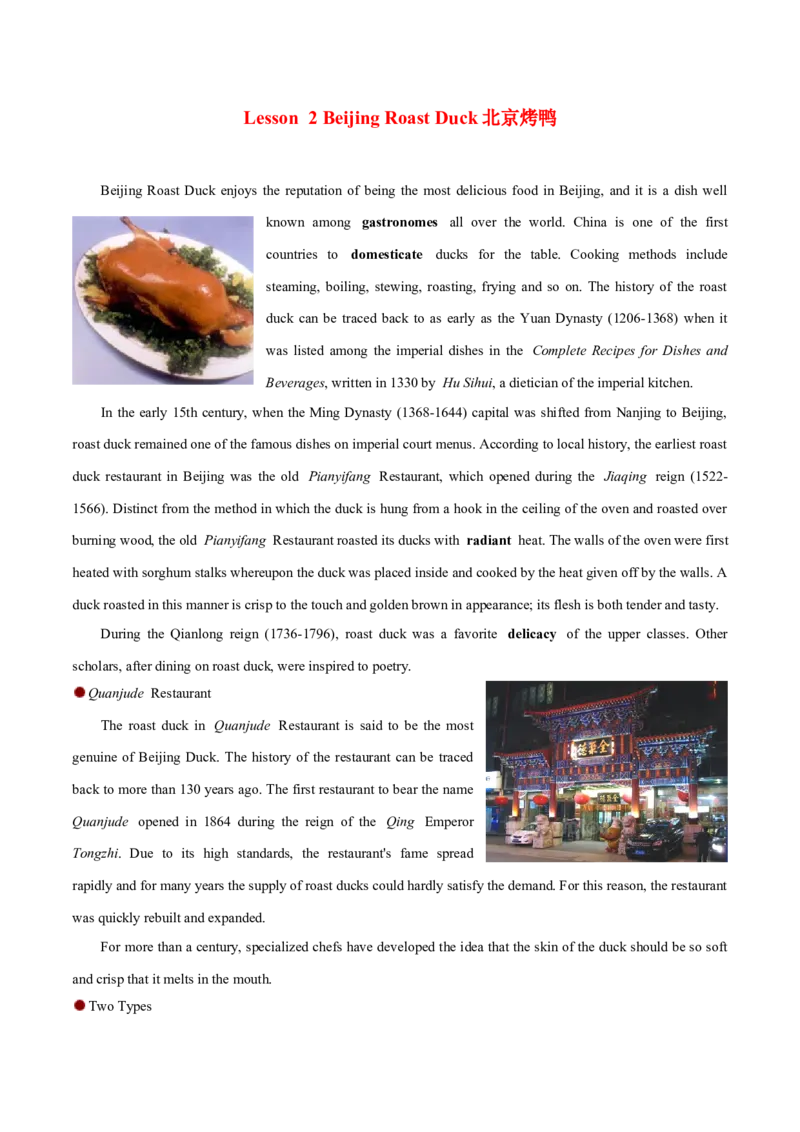
Beijing Roast Duck enjoys the reputation of being the most delicious food in Beijing, and it is a dish well
known among gastronomes all over the world. China is one of the first
countries to domesticate ducks for the table. Cooking methods include
steaming, boiling, stewing, roasting, frying and so on. The history of the roast
duck can be traced back to as early as the Yuan Dynasty (1206-1368) when it
was listed among the imperial dishes in the Complete Recipes for Dishes and
Beverages, written in 1330 by Hu Sihui, a dietician of the imperial kitchen.
In the early 15th century, when the Ming Dynasty (1368-1644) capital was shifted from Nanjing to Beijing,
roast duck remained one of the famous dishes on imperial court menus. According to local history, the earliest roast
duck restaurant in Beijing was the old Pianyifang Restaurant, which opened during the Jiaqing reign (1522-
1566). Distinct from the method in which the duck is hung from a hook in the ceiling of the oven and roasted over
burning wood, the old Pianyifang Restaurant roasted its ducks with radiant heat. The walls of the oven were first
heated with sorghum stalks whereupon the duck was placed inside and cooked by the heat given off by the walls. A
duck roasted in this manner is crisp to the touch and golden brown in appearance; its flesh is both tender and tasty.
During the Qianlong reign (1736-1796), roast duck was a favorite delicacy of the upper classes. Other
scholars, after dining on roast duck, were inspired to poetry.
Quanjude Restaurant
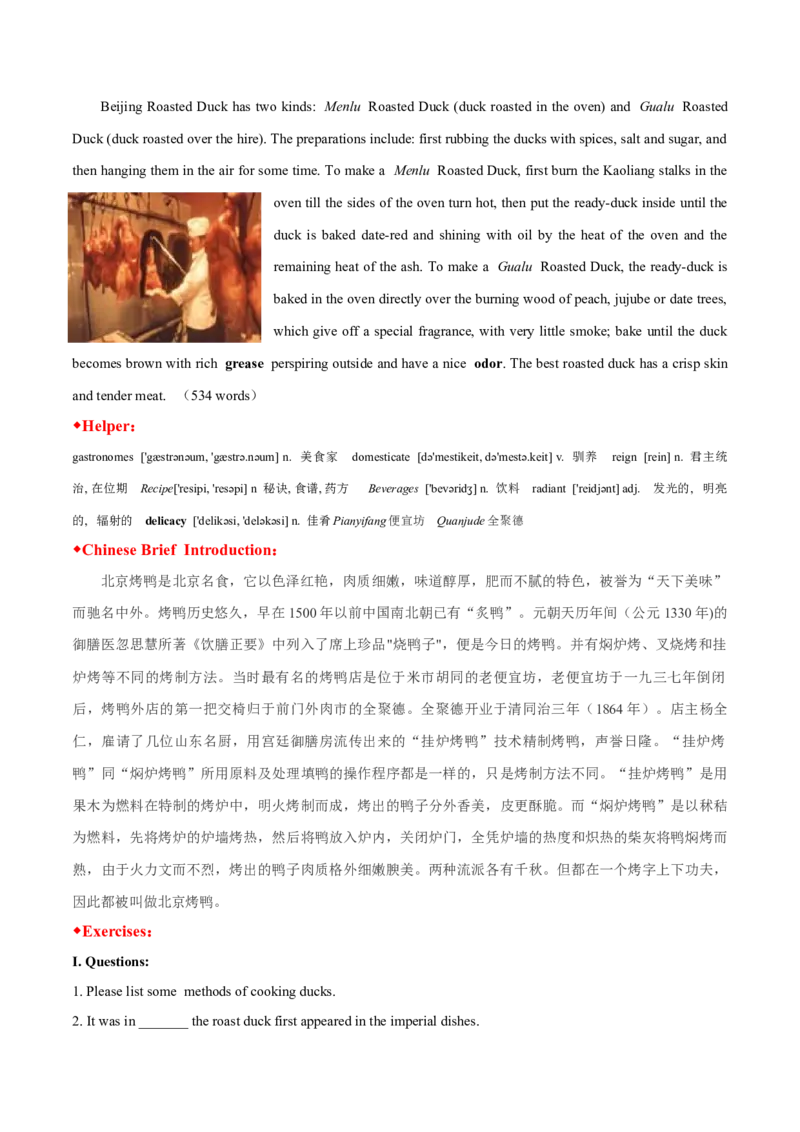
The roast duck in Quanjude Restaurant is said to be the most
genuine of Beijing Duck. The history of the restaurant can be traced
back to more than 130 years ago. The first restaurant to bear the name
Quanjude opened in 1864 during the reign of the Qing Emperor
Tongzhi. Due to its high standards, the restaurant's fame spread
rapidly and for many years the supply of roast ducks could hardly satisfy the demand. For this reason, the restaurant
was quickly rebuilt and expanded.
For more than a century, specialized chefs have developed the idea that the skin of the duck should be so soft
and crisp that it melts in the mouth.
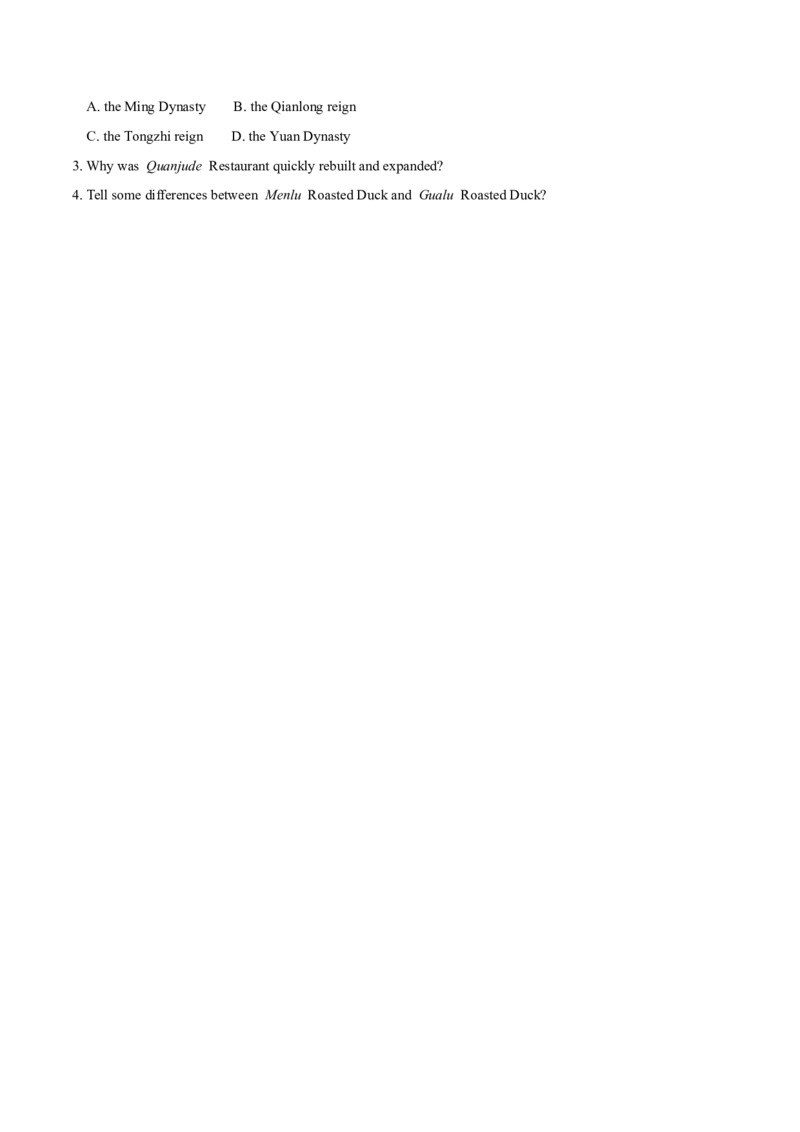
Two TypesBeijing Roasted Duck has two kinds: Menlu Roasted Duck (duck roasted in the oven) and Gualu Roasted
Duck (duck roasted over the hire). The preparations include: first rubbing the ducks with spices, salt and sugar, and
then hanging them in the air for some time. To make a Menlu Roasted Duck, first burn the Kaoliang stalks in the
oven till the sides of the oven turn hot, then put the ready-duck inside until the
duck is baked date-red and shining with oil by the heat of the oven and the
remaining heat of the ash. To make a Gualu Roasted Duck, the ready-duck is
baked in the oven directly over the burning wood of peach, jujube or date trees,
which give off a special fragrance, with very little smoke; bake until the duck
becomes brown with rich grease perspiring outside and have a nice odor. The best roasted duck has a crisp skin
and tender meat. (534 words)
◆Helper:
gastronomes ['gæstrənəum, 'gæstrə.nəum] n. 美食家 domesticate [də'mestikeit, də'mestə.keit] v. 驯养 reign [rein] n. 君主统
治, 在位期 Recipe['resipi, 'resəpi] n 秘诀, 食谱, 药方 Beverages ['bevəridʒ] n. 饮料 radiant ['reidjənt] adj. 发光的, 明亮
的, 辐射的 delicacy ['delikəsi, 'deləkəsi] n. 佳肴Pianyifang便宜坊 Quanjude全聚德
◆Chinese Brief Introduction:
北京烤鸭是北京名食,它以色泽红艳,肉质细嫩,味道醇厚,肥而不腻的特色,被誉为“天下美味”
而驰名中外。烤鸭历史悠久,早在1500年以前中国南北朝已有“炙鸭”。元朝天历年间(公元1330年)的
御膳医忽思慧所著《饮膳正要》中列入了席上珍品"烧鸭子",便是今日的烤鸭。并有焖炉烤、叉烧烤和挂
炉烤等不同的烤制方法。当时最有名的烤鸭店是位于米市胡同的老便宜坊,老便宜坊于一九三七年倒闭
后,烤鸭外店的第一把交椅归于前门外肉市的全聚德。全聚德开业于清同治三年(1864年)。店主杨全
仁,雇请了几位山东名厨,用宫廷御膳房流传出来的“挂炉烤鸭”技术精制烤鸭,声誉日隆。“挂炉烤
鸭”同“焖炉烤鸭”所用原料及处理填鸭的操作程序都是一样的,只是烤制方法不同。“挂炉烤鸭”是用
果木为燃料在特制的烤炉中,明火烤制而成,烤出的鸭子分外香美,皮更酥脆。而“焖炉烤鸭”是以秫秸
为燃料,先将烤炉的炉墙烤热,然后将鸭放入炉内,关闭炉门,全凭炉墙的热度和炽热的柴灰将鸭焖烤而
熟,由于火力文而不烈,烤出的鸭子肉质格外细嫩腴美。两种流派各有千秋。但都在一个烤字上下功夫,
因此都被叫做北京烤鸭。
◆Exercises:
I. Questions:
1. Please list some methods of cooking ducks.
2. It was in _______ the roast duck first appeared in the imperial dishes.A. the Ming Dynasty B. the Qianlong reign
C. the Tongzhi reign D. the Yuan Dynasty
3. Why was Quanjude Restaurant quickly rebuilt and expanded?
4. Tell some differences between Menlu Roasted Duck and Gualu Roasted Duck?Lesson 3 Complete Manchu-Han Banquet
满汉全席
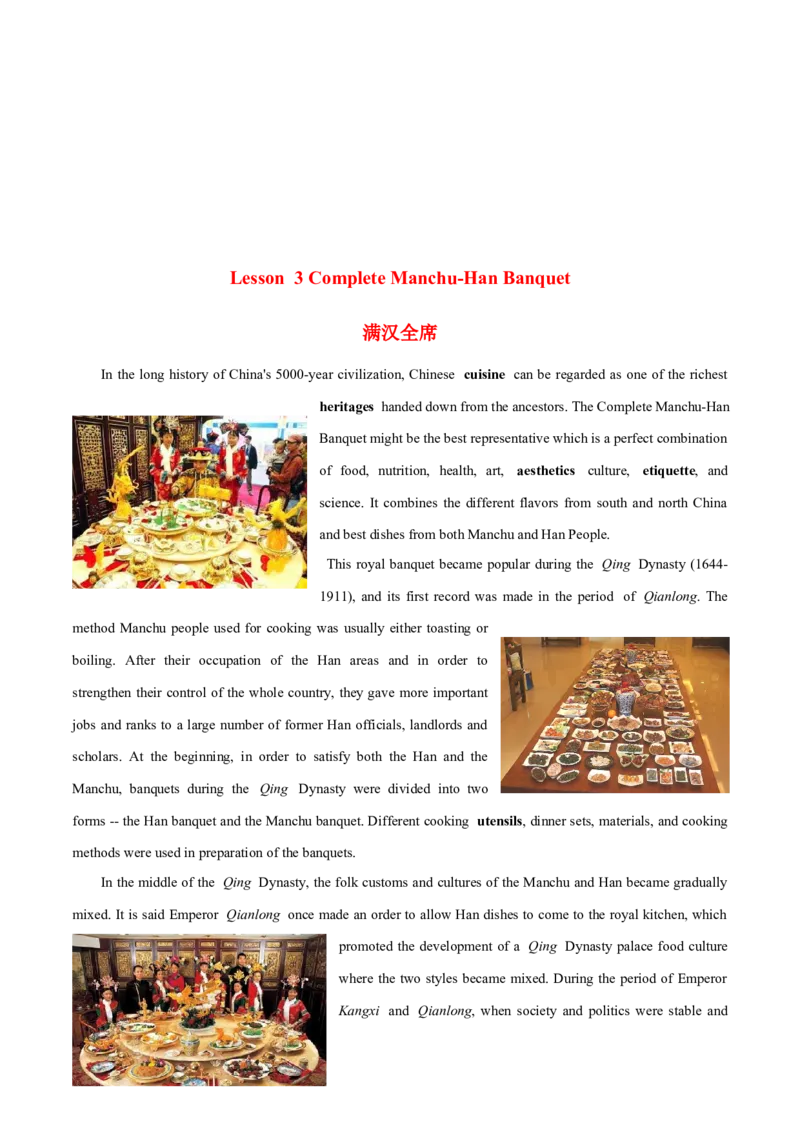
In the long history of China's 5000-year civilization, Chinese cuisine can be regarded as one of the richest
heritages handed down from the ancestors. The Complete Manchu-Han
Banquet might be the best representative which is a perfect combination
of food, nutrition, health, art, aesthetics culture, etiquette, and
science. It combines the different flavors from south and north China
and best dishes from both Manchu and Han People.
This royal banquet became popular during the Qing Dynasty (1644-
1911), and its first record was made in the period of Qianlong. The
method Manchu people used for cooking was usually either toasting or
boiling. After their occupation of the Han areas and in order to
strengthen their control of the whole country, they gave more important
jobs and ranks to a large number of former Han officials, landlords and
scholars. At the beginning, in order to satisfy both the Han and the
Manchu, banquets during the Qing Dynasty were divided into two
forms -- the Han banquet and the Manchu banquet. Different cooking utensils, dinner sets, materials, and cooking
methods were used in preparation of the banquets.
In the middle of the Qing Dynasty, the folk customs and cultures of the Manchu and Han became gradually
mixed. It is said Emperor Qianlong once made an order to allow Han dishes to come to the royal kitchen, which
promoted the development of a Qing Dynasty palace food culture
where the two styles became mixed. During the period of Emperor
Kangxi and Qianlong, when society and politics were stable andeconomy was flourishing, luxurious customs became popular. It is said that when Emperor Kangxi first tasted
the complete Manchu-Han banquet, and wrote down the four characters -- Man Han Quan Xi (The Complete
Manchu-Han Banquet), the banquet therefore became popular among the imperial family as well as the nobles and
officials.
The materials used to cook the food were varied, and a characteristic of the food was that it looked very
beautiful and tasted delicious. As time went on, Mongolian, Hui and Tibetan foods were added in this banquet, so
the Complete Manchu-Han Banquet has actually become a multi-ethnic banquet. The exquisite appearance of the
food had never been seen before and it became the most colorful and luxurious banquet in Chinese history.
Following the development of cooking methods, courses in the
Manchu-Han banquet have experienced considerable changes. Its
contents have become richer, its appearance has further improved,
and today there are more than 200 kinds of courses, including varied
materials from the mountains and sea. Indeed this banquet has
become a symbol of traditional Chinese culture. Due to the fact that
its courses are very rich, it is impossible to eat all the courses at the same sitting, therefore such a banquet is usually
eaten at several sittings. It can be eaten for lunch, dinner and supper or some people eat it over a two-day period,
others over a three-day period.
The Complete Manchu-Han Banquet fully shows the majesty
and elegance of the emperors. The utensils are all in the traditional
imperial style. During the banquet, the guests are served by
waitress in "Qing" Dynasty customs. The dishes are put in adequate
containers, like pieces of art. Further for the glittering golden
tableware, the dishes taste delicious, smell fragrant and look fine. The antique and elegant decoration, the typical
emperor's eating procedures and court service, together with singing and dancing, create a historical and cultural
atmosphere.(580 words)
◆Helper:
cuisine [kwɪˈzi:n] 烹饪,烹调法, 菜肴 heritage ['herɪtɪdʒ] 遗产, 继承物 aesthetics [i:s'θetɪks] 美学 etiquette
[ˈetɪket] 礼仪,礼节, 规矩 utensil [juː'tensl] 器具;用具 flourishing ['flɜ:ɪʃɪŋ] 繁荣的 luxurious [lʌɡˈzjuəriəs] 奢侈的;
豪华的 exquisite [ɪkˈskwɪzɪt] 精致的, 优美的 majesty [ˈmædʒisti] 庄严 elegance ['elɪɡəns] 高雅,优雅 glittering[ˈglɪtərɪŋ] 闪闪发光的 tableware [ˈteɪblweə(r)] 餐具,食具 fragrant [ˈfreɪgrənt] 芳香的,愉快的
◆Chinese Brief Introduction:
满汉全席起兴于清代,是集满族与汉族菜点之精华而形成的历史上最著名的中华大宴。既有宫廷菜肴
之特色,又有地方风味之精华。满汉全席原是官场中举办宴会时满人和汉人合坐的一种全席。满汉全席上
菜一般起码一百零八种,分三天吃完。满汉全席取材广泛,用料精细,山珍海味无所不包。烹饪技艺精
湛,富有地方特色。突出满族菜点特殊风味,烧烤、火锅、涮锅几乎是不可缺少的菜点;同时又展示了汉
族烹调的特色,扒、炸、炒、熘、烧等兼备,实乃中华菜系文化的瑰宝。满汉全席菜点精美,礼仪讲究,
形成了引人注目的独特风格。合用全套粉彩万寿餐具,配以银器,富贵华丽,用餐环境古雅庄重。席间专
请名师奏古乐伴宴,沿典雅遗风,礼仪严谨庄重,承传统美德,侍膳奉敬校宫廷之周,令客人留连忘返。
全席食毕,可使您领略中华烹饪之博精,饮食文化之渊源,尽享万物之灵之至尊。
◆Exercise:
I. Questions:
1. Why did Qianlong allow former Han officials hold important positions?
2. When was it that the folk customs and cultures of the Manchu and Han became gradually mixed?
3. Describe the main characteristics of the Complete Manchu-Han Banquet.
II. Written work
假如你们学校“英语爱好者俱乐部”将对“良好饮食习惯”这一话题进行讨论。 请根据下列提示,
用英语写一篇发言稿。 内容要点应包括:
部分同学的饮食习惯 良好的饮食习惯 个人看法
不吃早餐;爱吃零食 饮食多样化 重要性:有助于身体健
偏食;饮食过量 饮食定时定量 康
注意:1.发言稿必须包括所有内容要点,可适当发挥;
2.发言稿开头与结尾已为你写好,不计入总词数;
3.词数:100左右。
4.参考词汇:偏食be particular about food 零食snack
饮食多样化 have various healthy diets 有规则地 regularly
Dear friends,
As we all know, we are what we eat. Therefore, it's very important for us to form healthy eating habits.
____________________________________________________________________________________________
__________________________________________________________________
That's all. Thank you!Suggested Answers
3. Complete Manchu-Han Banquet
II. Written work
Dear friends,
As we all know, we are what we eat. Therefore, it’s a very important for us to form healthy eating habits.
However, bad eating habits are still very common among us students. Some of us often go to school without
breakfast; some like to have snacks; some others are particular about food and still some eat or drink too much. All
these bad habits will surely do harm to our health.
To keep fit, we should have various healthy diets, which generally include proper amounts of fish, meat,
vegetables, fruit as well as main food. Besides, we’d better have meals regularly.
In my opinion, we should try to develop healthy eating habits to build up a strong body. Only in this way can
we have enough energy to study better.
That’s all. Thank you!