义
务
教
育
教
科
书
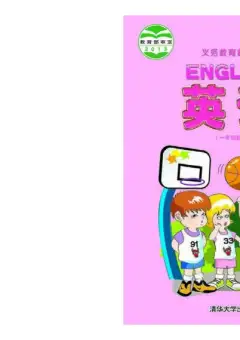
三年级 下册
(三年级起点)
Name ( 姓名): Class ( 班级): School ( 学校):
三年级 下册
(三年级起点)
主 编:
副主编:
陈 琳 Printha Ellis (英)
鲁子问
义
务
教
育
教
科
书
前 言
各位同学,你们好!欢迎大家学习本套英语教材!
2000年,外语教学与研究出版社与麦克米伦出版(中国)有限公司依据
国家《义务教育 英语课程标准(实验稿)》共同组织开发了本套教材;作为
我国第一套中小学“一条龙”英语教材,本套教材已出版使用十余年。2011
年,基于新颁布的国家《义务教育 英语课程标准(2011年版)》,我们对教
材进行了认真修订。
在修订后的小学教材中,我们为同学们保留了大家熟悉并喜爱的四个小
伙伴—中国学生大明和玲玲、英国学生Sam和Amy,还增加了其他一些人物
和小动物。他们会带领大家在一系列有趣的故事、对话、游戏、活动和歌曲中
学习英语。
修订后的教材每册包括10个学习模块(Module)、一个复习模块
(Review Module)、四个单词表、一个补充阅读(Reading for Pleasure)
版块以及一个综合运用实践项目(Project)。每个学习模块分两个单元
(Unit),一般情况下,第一单元呈现本模块所要学习的语言内容,第二单元
提供若干任务型(Task-based)活动,包括一首歌曲、歌谣或韵句。学习模
块的课文中呈现了一些语法内容,但不要求老师做理论的讲解,更不要求大家
孤立地、脱离语境地掌握,只希望大家初步学会在恰当的语境中运用包含这些
语法的句子。这一原则也希望老师在教学过程中以及家长在辅导孩子学习的
时候注意。复习模块对前面10个模块所学的内容进行综合和融合性复习,使
大家的语言知识和相应的语言技能得到进一步的巩固与提高。教材有四个单词
表,包括:分模块按出现顺序收录的单词,按字母顺序收录的全书单词,歌
曲、歌谣或韵句中出现的单词以及人名、地名。在歌曲、歌谣或韵句中出现的
新词,只要求理解,不要求学会运用。补充阅读为大家选用了篇幅短小、内容
丰富、形式多样的材料。教材最后设计了一个综合运用实践项目,供同学们根
据兴趣自由选择使用。
本套教材同时还配有对应的网络教材,可供同学们在线学习使用。
同学们,希望大家积极尝试,大胆实践,主动学做教材中的英语活动,
努力学唱英语歌曲、歌谣和韵句。相信你们会在参与活动、完成任务的过程中
体会到学习英语的乐趣,实现英语的灵活运用和自由交际。
…………………………………………………… 2
…………………………………… 5
…………………………………………………… 8
………………………………………………… 11
……………………………………………………… 14
……………………………………… 17
………………………………………………… 20
…………………………………… 23
……………………………… 26
………………… 29
………………………………… 32
………………………… 35
…………………………………………… 38
…………………………………………………… 41
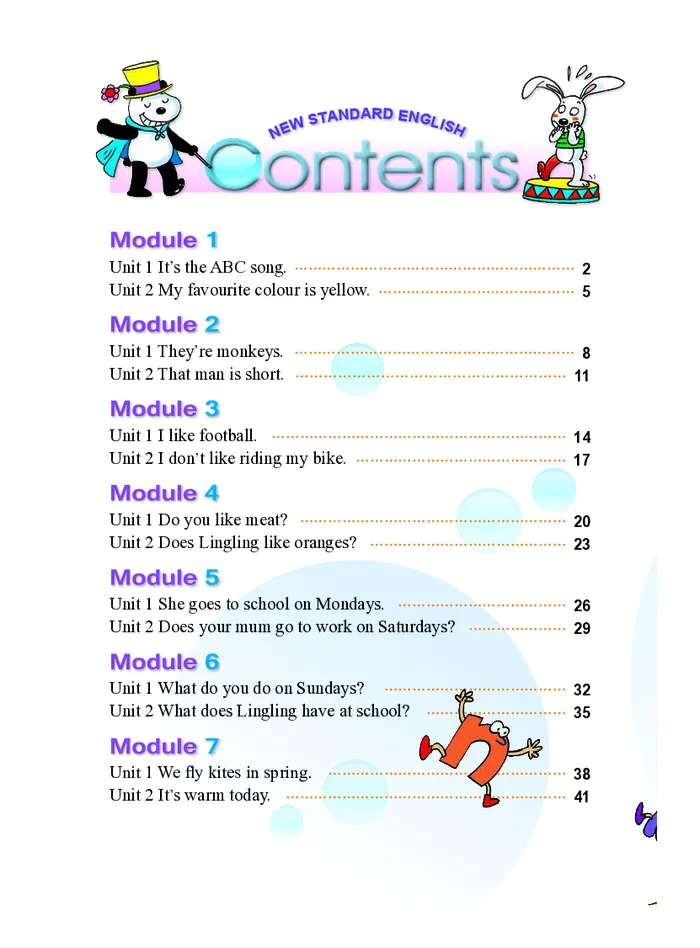
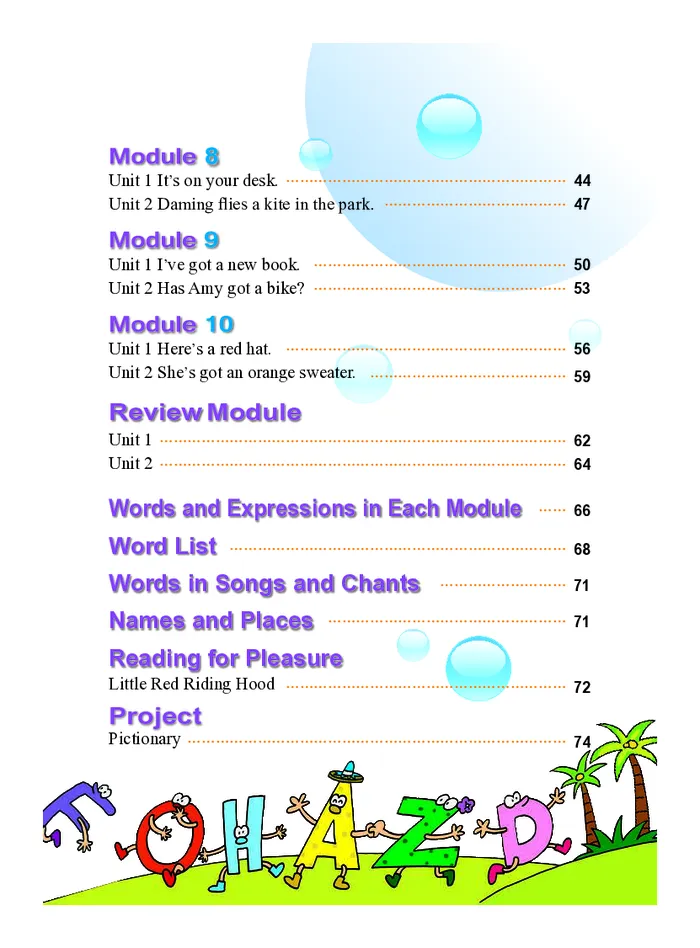
Unit 1 It’s the ABC song.
Unit 2 My favourite colour is yellow.
Unit 1 They’re monkeys.
Unit 2 That man is short.
Unit 1 I like football.
Unit 2 I don’t like riding my bike.
Unit 1 Do you like meat?
Unit 2 Does Lingling like oranges?
Unit 1 She goes to school on Mondays.
Unit 2 Does your mum go to work on Saturdays?
Unit 1 What do you do on Sundays?
Unit 2 What does Lingling have at school?
Unit 1 We fly kites in spring.
Unit 2 It’s warm today.
N
E
W
S
TA
N
DA
RD
E
N
G
LI
S
H
Review Module
Words and Expressions in Each Module
Word List
Words in Songs and Chants
Names and Places
Reading for Pleasure
Unit 1
Unit 2
…………………………………………………… 44
………………………………… 47
……………………………………………… 50
……………………………………………… 53
…………………………………………………… 56
…………………………………… 59
…………………………………………………………………………… 62
…………………………………………………………………………… 64
…… 66
……………………………………………………………… 68
……………………… 71
…………………………………………… 71
…………………………………………………… 72
……………………………………………………………………… 74
Project
Pictionary
Little Red Riding Hood
Unit 1 It’s on your desk.
Unit 2 Daming flies a kite in the park.
Unit 1 I’ve got a new book.
Unit 2 Has Amy got a bike?
Unit 1 Here’s a red hat.
Unit 2 She’s got an orange sweater.
8
2
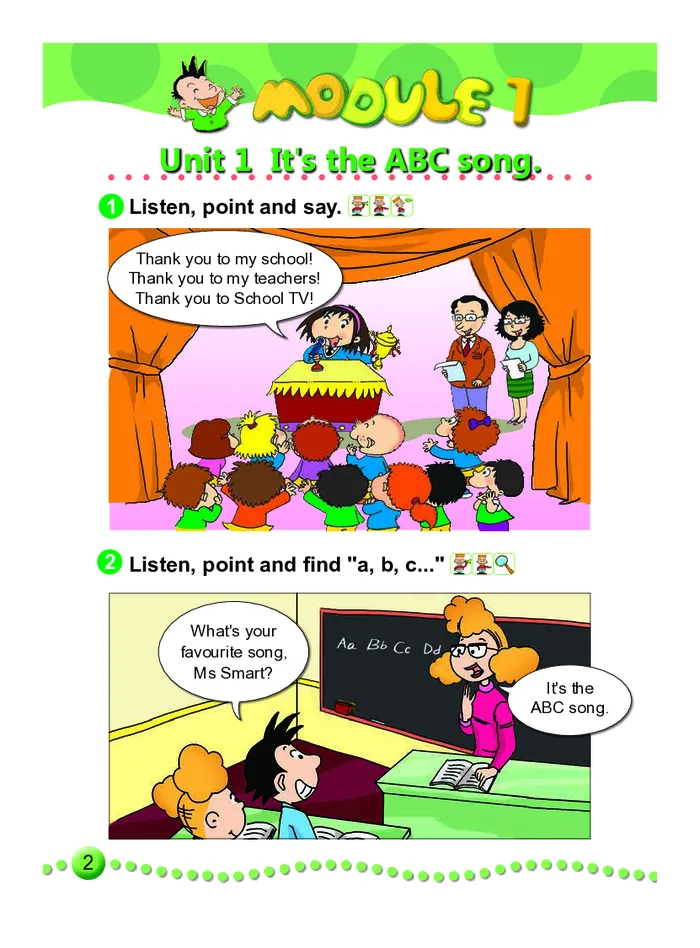
Listen, point and find "a, b, c..."
Unit 1 It's the ABC song.
Listen, point and say.
1
2
2
1
It's the
ABC song.
What's your
favourite song,
Ms Smart?
Thank you to my school!
Thank you to my teachers!
Thank you to School TV!
3
1
t
i
n
U
3
1
4
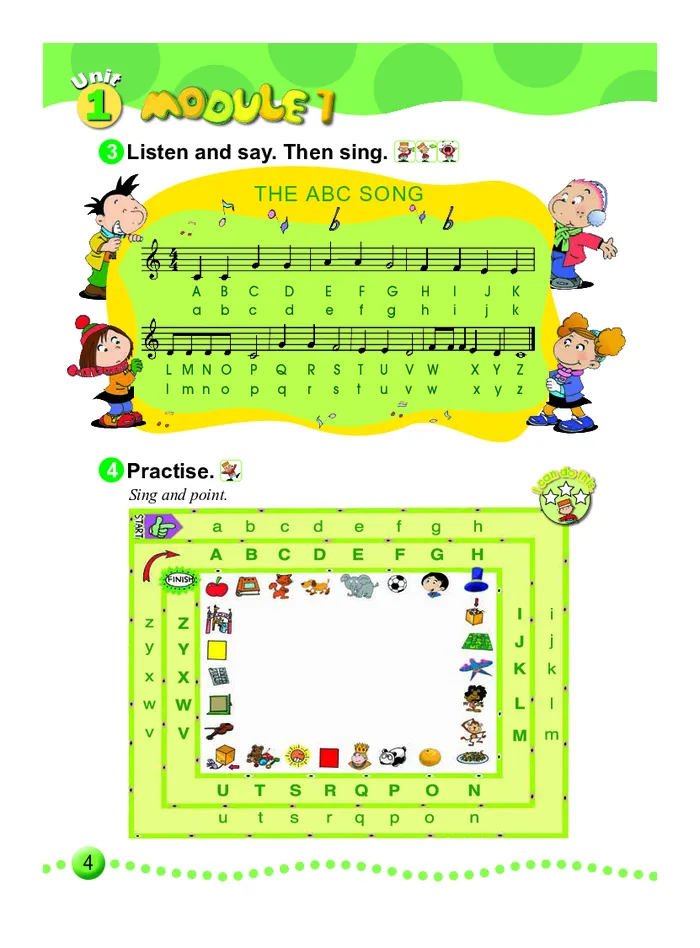
Listen and say. Then sing.
Practise.
1
t
i
n
U
3
4
1
A
B
C
D
E
F
G
H
5
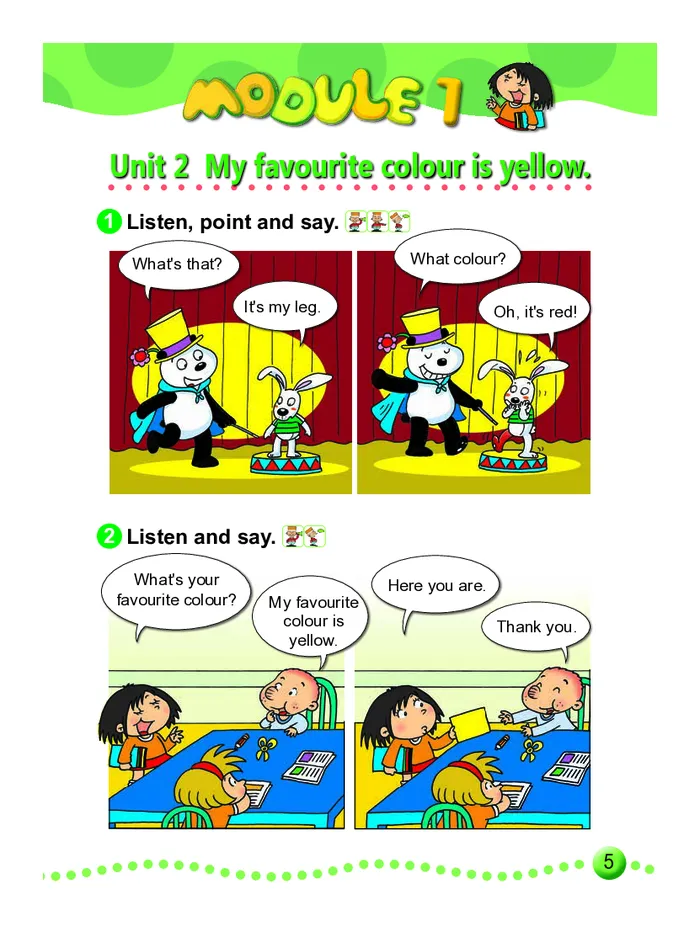
Unit 2 My favourite colour is yellow.
Listen and say.
1
2
1
Listen, point and say.
What's that?
It's my leg.
What colour?
Oh, it's red!
My favourite
colour is
yellow.
Thank you.
Here you are.
What's your
favourite colour?
6
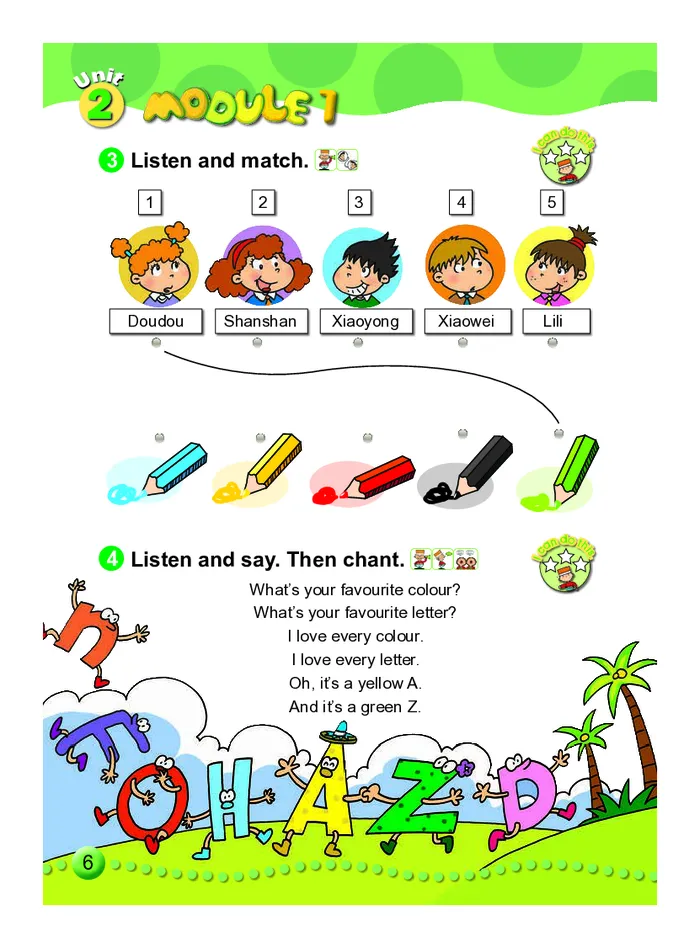
Listen and say. Then chant.
Listen and match.
6
2
t
i
n
U
3
4
1
6
What’s your favourite colour?
What’s your favourite letter?
I love every colour.
I love every letter.
Oh, it’s a yellow A.
And it’s a green Z.
Doudou
Shanshan
Xiaoyong
Xiaowei
Lili
7
Play the game. Look and do.
Make and do.
7
2
t
i
n
U
5
6
1
Go!
Make your name card and line up.
Go!
8
1
Listen, point and find "They're..."
Listen and chant.
Unit 1 They're monkeys.
2
Here is a monkey,
a father monkey.
Here is a monkey,
a mother monkey.
Here is a monkey,
a baby monkey.
They are all in the zoo.
Hello, boys and girls.
Hello, Mr Li.
2
9
1
t
i
n
U
2
What's this?
They're lions.
It's a tiger.
What are they?
What's this?
It's an
elephant.
What are
they?
They're
monkeys.
Look!
It's a panda.
It's fat!
10
Listen and say.
Practise.
2
1
t
i
n
U
What are they?
They're monkeys.
Mime, ask and answer.
3
4
It's a lion.
What are they?
What's this?
They're tigers.
I
c
a
n
d
o
t
h
i
s
.
I
c
a
n
d
o
t
h
i
s
.
11
Listen and say.
Unit 2 That man is short.
2
Listen, point and say.
1
2
Oh, he's
short!
He's tall.
Look! This
man is tall.
That man is
short.
This monkey is
small and thin.
That monkey
is big and fat.
12
Look and say.
Listen and say. Then sing.
2
2
t
i
n
U
OLD MACDONALD
HAS A ZOO
tall
short
big
small
fat
13
Play the game. Do and say.
Listen, repeat and trace the letters.
2
2
t
i
n
U
Do and say.
This panda is fat. That panda is thin.
5
6
7
They're monkeys.
They're small.
I
c
a
n
d
o
t
h
i
s
.
I
c
a
n
d
o
t
h
i
s
.
14
Lions are big,
cats are small.
Monkeys are short,
elephants are tall.
Pandas are fat.
I like them all.
Unit 1 I like football.
3
Listen and chant.
Listen, point and find "I like..., I don't like..."
I like football.
Ouch! I don't
like football.
15
1
t
i
n
U
3
I like
morning exercises.
I like basketball.
Ouch! I don't
like basketball.
I like table tennis.
Ouch! I don't like
table tennis.
16
1
t
i
n
U
3
Listen and say.
Practise.
I like… / I don’t like…
I like football.
I like
basketball.
I don't like
basketball.
3
4
football
basketball
morning
exercises
table tennis
I
c
a
n
d
o
t
h
i
s
.
I
c
a
n
d
o
t
h
i
s
.
17
Unit 2 I don't like riding my bike.
3
Listen and say.
Listen, point and say.
I like swimming.
I don't
like swimming.
1
2
I like swimming.
I don't like skipping.
I like skipping.
I don't like riding my bike.
18
Point and say.
Listen and say. Then chant.
3
I don't like football. I like morning exercises.
3
4
football
morning exercises
riding my bike
swimming
basketball
table tennis
I like coffee.
I like tea.
I like cats
and they like me.
I like coffee.
I like tea.
I don't like lions
and they don't like me.
2
t
i
n
U
I
c
a
n
d
o
t
h
i
s
.
I
c
a
n
19
Play the game. Follow and say.
3
Listen, repeat and trace the letters.
Do and report.
5
6
7
I like football
and basketball.
I like football.
I like football,
basketball...
I like football.
I don't like basketball...
2
t
i
n
U
I
c
a
n
d
o
t
h
i
s
.
I
c
a
n
d
o
20
Unit 1 Do you like meat?
4
1
2
Listen and chant.
Listen, point and find "Do you like...?"
I like yellow.
I like blue.
I like green.
Do you like them too?
Here you are,
Mum.
Thank you,
Sam.
Please pass me the rice.
21
4
But I like meat.
No, I don't.
Do you like meat, Lingling?
Yes, I do.
I like noodles.
Do you like fish,
Amy?
I like milk. Mm.
1
t
i
n
U
22
4
3
4
Listen and say.
Practise.
Do you like
rice?
Do you like
fish?
Yes, I do.
No, I don't.
1
t
i
n
U
Yes, I do. /
No, I don't.
Do you like...?
I
c
a
n
d
o
t
h
i
s
.
I
c
a
n
d
o
t
h
i
s
.
23
4
1
2
Unit 2 Does Lingling like oranges?
Listen and say.
Listen, point and say.
Do you like milk?
Yes, I do.
Yes, I do.
Yes, I do.
Do you like meat?
Do you like apples?
Do you like noodles?
Yes, I do.
Yes, I do.
Do you like
pears?
Yes, I do.
No,
I don't.
No,
I don't.
Do you like
apples?
Lingling, do you
like oranges?
Sam, do you like
bananas?
Does Lingling
like oranges?
Does Sam like
pears?
No, he doesn't.
Yes, she does.
24
4
Ask and answer.
Listen and say. Then chant.
2
t
i
n
U
3
4
Noodles and rice
are very, very nice.
Mm, mm, mm!
Very, very nice.
Ginger and spice
are not very nice.
No, no, no!
Not very nice!
Does your
mother like...?
Yes, she does. /
No, she doesn't.
I
c
a
n
d
o
t
h
i
s
.
I
c
a
n
d
o
t
h
i
s
.
25
4
Play the game. Guess, ask and answer.
Listen, repeat and trace the letters.
Ask and answer. Then do.
Make a lunch menu.
2
t
i
n
U
5
6
7
Do you like
bananas?
Do you like
apples?
Yes, I do!
No, I don't.
Do you like
pears?
No, I don't.
Do you
like rice?
Yes, I do.
Here you are.
Do you like
apples?
No, I don't.
Thank you!
I
c
a
n
d
o
t
h
i
s
.
I
26
1
5
2
Listen, point and say.
Listen, point and find "goes, does".
Do you like
football?
Do you play football
on Mondays?
No, she isn't.
She goes to school
on Mondays.
Is Amy at
home?
Ms Smart is on the phone with her friend.
Unit 1 She goes to school on Mondays.
Oh, you don't!
27
1
t
i
n
U
5
Who's that?
It's Tom.
Does Tom
go to school on
Mondays?
No, he
doesn't. He's only
two years old!
Ha ha...
Is Sam at
home?
No, he isn't.
He goes to school
on Mondays too.
28
5
3
4
1
t
i
n
U
Practise.
Listen and say.
Amy goes to school on
Mondays.
Tom doesn't go to school
on Mondays.
I play football on
Mondays.
She plays football
on Mondays.
Do and say.
I
c
a
n
d
o
t
h
i
s
.
I
c
a
n
d
o
t
h
i
s
.
29
5
1
2
Listen, point and say.
Listen and say.
Unit 2 Does your mum go to work on Saturdays?
The dog likes meat.
The cat likes fish.
Does the cat
like meat?
Yes, she does.
No,
she doesn't.
She goes shopping
on Saturdays.
Does your dad go to
work on Saturdays?
No, he doesn't.
He plays football on
Saturdays.
Does your
mum go to work on
Saturdays?
30
Point, ask and answer.
Listen and say. Then chant.
Does Amy go
to school on
Saturdays?
No, she doesn't.
I go to school on Mondays.
My sister goes too.
She goes to school on Tuesdays.
And so do you.
Mum goes to work on Mondays.
And Dad goes too.
He goes to work on Tuesdays.
But not you.
Monday
Saturday
Saturday
5
3
4
2
t
i
n
U
I
c
a
n
d
o
t
h
i
s
.
I
c
a
n
d
o
t
h
i
s
.
31
Play the game. Guess, ask and answer.
Listen, repeat and trace the letters.
Do and say.
No, he
doesn't.
Xiaoyong,
do you play football
on Saturdays?
Yes, I do.
Make a poster of your family members’ Saturday activities.
5
5
6
7
2
t
i
n
U
On Saturdays, my
mum goes shopping...
Yes,
he does.
Does Xiaoyong
play football on
Saturdays?
I
c
a
n
d
o
t
h
i
s
.
I
c
a
n
d
o
t
32
Unit 1 What do you do on Sundays?
1
2
6
Listen, point and say.
Listen, point and find "What do you do...?"
Do you go
swimming on
Mondays?
No, I don't.
Hello!
Hi!
What do you do
on Mondays?
I eat meat.
Ha ha...
Do you
ride a bike on
Mondays?
Oh no!
No,
I don't.
I go swimming.
And I play
football.
What do you do
on Sundays, Sam?
33
1
t
i
n
U
6
What do you do
in the morning?
I sleep in the
morning.
No, I don't.
I play football in
the afternoon.
Do you play football
in the morning?
What do you do
in the afternoon?
I ride my bike in
the morning.
I watch TV in
the afternoon.
What do you do
in the morning?
34
Listen and say.
Practise.
What do you do
on Sundays?
I ride my bike
on Sundays.
1
t
i
n
U
3
4
6
I watch TV in
the afternoon.
What do you do in
the afternoon?
What do you do
on Sundays?
I...
on Sundays
on Mondays
in the morning
in the afternoon
I
c
a
n
d
o
t
h
i
s
.
I
c
a
n
d
o
t
h
i
s
.
35
Unit 2 What does Lingling have at school?
Listen, point and say.
Listen and say.
1
2
6
In the morning, she has
Chinese, English…
And she
has Maths!
What do you
do at school?
I have
classes.
What do you
have at school
today?
I have Music.
In the afternoon,
she has Art, PE…
And she has
Science!
What does Lingling
have at school today,
Daming?
36
Ask and answer.
Listen and say. Then sing.
S-C-H-O-O-L. School, school, school. S-C-H-O-O-L. We like school.
Teachers and pupils go to school. School, school,school. We like school.
School in the morning and in the afternoon. School, school,school. We like school.
S-C-H-O-O-L. School, school, school. S-C-H-O-O-L. We like school.
37
Play the game. Follow and say.
Listen, repeat and trace the letters.
Do and say.
What do you have
at school today?
I have Chinese,
English and Maths in the
morning...
Make a timetable.
2
t
i
n
U
5
6
7
6
On Sundays,
Lili plays basketball.
She goes swimming
and...
On Sundays, Lili plays
basketball and she goes
swimming.
On Sundays,
Lili plays basketball.
I
c
a
n
d
o
t
h
i
s
.
I
c
a
n
d
o
t
h
i
38
Spring
Listen and chant.
It's spring!
It's warm in spring.
We fly kites in spring.
Listen, point and find "We..."
Unit 1 We fly kites in spring.
1
2
7
I like summer,
it's my favourite season.
I go swimming
in this nice season.
39
It's summer!
It's hot in summer.
We go swimming in summer.
It's autumn!
It's cool in autumn.
We play football in autumn.
It's winter!
It's cold in winter.
We go skating in winter.
Summer
Autumn
Winter
1
t
i
n
U
7
40
Listen and say.
Practise.
What do you do
in spring?
I...
7
1
t
i
n
U
3
4
It's spring.
We fly kites in spring.
It's summer.
We go swimming in summer.
I
c
a
n
d
o
t
h
i
s
.
I
c
a
n
d
o
t
h
i
s
.
41
Listen, point and say.
Listen and say.
In Harbin, it's cold in winter.
We play in the snow in winter.
In Sanya, it's warm in winter.
We go swimming in winter.
It's cool and windy today.
It's warm today, but it's raining.
It's hot and sunny today.
It's snowing today. It's very cold.
Unit 2 It's warm today.
7
1
2
42
Think and draw. Then say.
Listen and say. Then sing.
In Guilin, it's warm in spring.
I fly a kite in spring...
RAIN, RAIN, GO AWAY
Rain,
rain, go
away.
Come again another day.
Little Polly wants to play. Come again another day.
2
t
i
n
U
7
3
4
Guilin
43
Play the game. Make funny sentences.
Talk about your favourite season.
Spring is
my favourite season. It's warm in
spring. I play football at
school.
2
t
i
n
U
7
Listen, repeat and trace the letters.
Do and say.
5
6
7
It's cold in summer.
We go swimming in summer.
Ha ha...
I
c
a
n
d
o
t
h
i
s
.
I
c
a
44
Listen, point and say.
�Listen, point and find "in, on, behind, under".
Unit 1 It's on your desk.
1
2
8
Where is my toy?
Where is the bag?
Oh! It's under
the cat.
It's in the bag.
Oh, what's this?
A present for
you. It's in the
box.
45
1
t
i
n
U
8
It's under your chair.
It's behind the
door.
Wow! Ha ha...
Happy birthday
to you!
It's in your
bedroom.
It's on your
desk.
46
Listen and say.
Practise.
The panda is in the cap.
8
1
t
i
n
U
3
4
It's behind
the door.
It's under the
chair.
One, two,
three... ten!
I
c
a
n
d
o
t
h
i
s
.
I
c
a
n
d
o
t
h
i
s
.
47
Listen, point and say.
Unit 2 Daming flies a kite in the park.
Listen and say.
The cat is under
the tree.
The monkey is
behind the tree.
The dog
is in the lake.
8
1
2
In spring, Daming flies
a kite in the park.
In autumn, he goes
fishing under the tree.
In summer, he
swims in the lake.
In winter, he walks
in the snow.
48
2
t
i
n
U
3
4
8
Look, ask and answer.
Listen and say. Then sing.
TEN BIG BANANAS
A: Where's the apple?
B: It's on the chair.
A: Where's the orange?
B: It's on the desk.
A: …
B: …
Ten big bananas up there on the wall.
Ten big bananas up there on the wall.
Eight big bananas up there on the wall.
Eight big bananas up there on the wall.
Two for the monkey up in the tree. Now
Two for the monkey up in the tree. Now
only eight bananas up there on the wall.
only six bananas up there on the wall.
49
2
t
i
n
U
5
6
7
8
Play the game. Act and guess.
Listen, repeat and trace the letters.
Look and say.
In Bedroom A, the pen is on the desk.
In Bedroom B, the pen is under the desk.
Bedroom A
Bedroom B
Yes, it is.
Where's the pen?
It's under the book.
I
c
a
n
d
o
t
h
i
s
.
I
50
It isn't on the
bed.
It isn't under
the chair.
Oh, it's on the
line.
Listen, point and find "I've got..."
Listen, point and say.
Unit 1 I‘ve got a new book.
9
1
2
Where's my
sweater?
It isn't in the
bag.
I've got a new
book. It's about
animals.
It's a good book.
Have you got a new
book too, Daming?
It's a nice book.
Yes, I have.
Look, it's about sport.
51
9
1
t
i
n
U
Yes, I have.
No, I haven't.
I've got a new dress
and a new coat.
Have you
got a new book,
Amy?
Have you
got a new sweater,
Sam?
Ha ha...
Tom, have you got a
new sweater too?
No, I haven't.
I've got a blue
T-shirt.
52
1
t
i
n
U
9
3
4
Listen and say.
Practise.
A: Have you got a pen?
B: Yes, I have. / No, I haven't.
Have you got a
new sweater?
No, I haven't. I've
got a new book.
Yes, I have.
Have you got a new
sweater too?
I
c
a
n
d
o
t
h
i
s
.
I
c
a
n
d
o
t
h
i
s
.
53
9
Unit 2 Has Amy got a bike?
1
2
Listen and chant.
Listen and say.
Ms Smart
hasn't got a car. She
walks to school.
Mr Smart has
got a car. He goes to
work by car.
Has Amy got
a bike?
Has Sam got
a bike?
No, he hasn't.
He goes to school
by bus.
Yes, she has.
She goes to school
by bike.
He's got a bike.
It's a nice bike.
She's got a kite.
It's a nice kite.
54
Look and say.
My father goes
to work by bus. My
mother...
9
2
t
i
n
U
Listen and say. Then chant.
3
4
I go to school by bike.
Ting, ting, ting, ting.
I go to school by bike.
55
Ask and answer. Then tick (√).
She goes to
school by bus. I go to
school by bike.
I go to school
by bus.
Your friend
His/Her mother
His/Her father
She goes to
school by bus. He goes
to school by bike.
I...
Play the game. Follow and say.
Does your
father go to work
by car?
No,
he doesn't.
9
2
t
i
n
U
Listen, repeat and trace the letters.
5
6
7
I
c
a
n
d
o
t
h
i
s
56
Unit 1 Here's a red hat.
10
10
1
2
Listen, point and say.
Listen, point and find "Here's..."
And I've got
a blue cap!
Come back!
They're my
clothes.
Look! I've got a
green sweater.
OK. What
clothes have we
got?
Look! Here's a
red hat.
I've got a
brown hat.
Open the box.
Let's put on funny
clothes for the party.
57
10
10
1
t
i
n
U
And here's an
orange shirt!
It's your turn
now!
Oh, I can't
walk!
Wow! I've got a
green sweater.
It's green
and yellow!
Look at my
big shoes!
I've got funny
trousers.
58
Practise.
Listen and say.
Here's an
orange hat.
A green coat.
Here's a
green coat.
1
t
i
n
U
10
10
3
4
Here's a
black hat.
Here's an
orange shirt.
I
c
a
n
d
o
t
h
i
s
.
I
c
a
n
d
o
t
h
i
s
.
59
Listen, point and say.
Listen and say.
I've got a
white shirt. It's for
the class photo.
Oh no! Now my
shirt is black and
white.
Unit 2 She's got an orange sweater.
10
10
1
2
No, she hasn't.
She's got an orange
sweater.
And a blue
skirt.
Has she
got a white
coat?
Yes, he has.
He's got brown
trousers.
It's very nice.
Has he got
trousers?
Look! He's got
a green sweater.
Oh! A nice
panda!
60
Listen and say. Then chant.
Listen and draw √ or ×.
2
t
i
n
U
10
10
3
4
Red, blue, white, black.
Have you got a yellow cap?
Yes, I have. Yes, I have.
I've got a yellow cap.
Green, brown, black, white.
Have you got an orange kite?
No, I haven't. No, I haven't.
But I've got an orange bike.
60
1
4
2
5
3
6
I
c
a
n
61
Draw and say.
Listen, repeat and trace the letters.
Play the game. Guess and say.
2
t
i
n
U
10
10
5
6
7
Has he got green
trousers?
Yes, he's got
green trousers.
62
Do and say.
Play the game. Look and do.
It's "s".
1
t
i
n
U
1
2
I
c
a
n
d
o
t
h
i
s
.
I
c
a
n
d
o
t
h
i
s
.
I
c
a
n
d
o
t
h
63
What do you have at school?
What do you do on Sundays?
5
6
Have you got a bike?
Do you go to school...?
3
4
�Do a survey.
Tell other friends about your friend.
Find out about your friend.
1
t
i
n
U
3
4
What's your favourite colour?
Do you like cats?
1
2
I
c
a
n
d
o
t
h
i
s
.
I
c
a
n
d
o
t
h
i
s
.
64
Look, ask and guess.
Make funny sentences.
What has it got?
Is it the tiger?
It's got green
shoes.
Yes, it is.
2
t
i
n
U
1
2
The boy is
behind the tiger.
The boy is on
the tiger.
Ha ha...
I
c
a
n
d
o
t
h
i
s
.
I
c
a
n
d
o
t
h
i
s
.
65
Listen and point.
Now point and say.
Look and say.
He's on the bus. He goes to school by bus.
I'm on the bus. I go to school by bus.
2
t
i
n
U
3
4
5
It's cool in autumn.
We play football in
autumn.
I
c
a
n
d
o
t
h
i
s
.
I
c
a
n
d
o
t
h
i
s
.
66
Words and Expressions
in Each Module
Words and Expressions
in Each Module
66
Module 1
song 歌曲
TV 电视台
favourite 最喜欢的
colour 颜色
Here you are. 给你。
Module 2
they 他(她/它)们
they’re = they are 他(她/它)们是
monkey 猴子
baby 幼兽,幼畜
all 每个;全体
zoo 动物园
tiger 老虎
lion 狮子
elephant 大象
fat 胖的
man 人,男人
short 矮的
tall 高的
small 小的
thin 瘦的
big 大的
Module 3
like 喜欢
football 足球
them 他(她/它)们
ouch 哎哟
basketball 篮球
table tennis 乒乓球
morning exercises 早操
ride 骑
bike 自行车
swim 游泳
*skip 跳绳
Module 4
meat 肉
pass 传递
rice 米饭;米
mum 妈妈
noodles (常复)面条
fish 鱼肉;鱼
but 但是
milk 牛奶
mm 呣
does do的第三人称单数形式
orange 橙;柑;橘
apple 苹果
banana 香蕉
pear 梨
doesn’t = does not 不
Module 5
goes (go的第三人称单数形式)去,到
go to school 上学
on 在⋯⋯的时候;通过⋯⋯,以⋯⋯的方式
Monday 星期一
play 参加(体育活动、比赛等)
phone 电话;电话机
on the phone 通电话
with 与⋯⋯在一起,同,跟,和
friend 朋友
at 在⋯⋯
home 家
at home 在家
who 谁
only 只,仅仅
year 年龄,岁数
work 工作地点
go to work 上班
Saturday 星期六
shopping 购物
go shopping 去购物
dad 爸爸
Module 6
do 做,干
Sunday 星期日
swimming 游泳(运动)
go swimming 去游泳
eat 吃
in 在⋯⋯期间,在⋯⋯时候
sleep 睡觉
watch 观看
TV 电视节目
watch TV 看电视
have 做;进行,从事
class 课;班级
today 今天
music 音乐
67
67
has (have的第三人称单数形式)做;进
行,从事
Chinese 语文,汉语
maths 数学
art 美术
PE = physical education 体育
science 科学
Module 7
we 我们
fly 放(风筝)
spring 春天
summer 夏天
season 季节
nice 迷人的,令人愉快的
warm 暖和的
hot 热的
autumn 秋天
cool 凉爽的
winter 冬天
cold 寒冷的
skating 滑冰
go skating 去滑冰
play 玩,玩耍
snow 雪;下雪
rain 雨;下雨
sunny 晴朗的,阳光充足的
windy 有风的,刮风的
very 很,非常
Module 8
toy 玩具
under 在⋯⋯下面
for 为,给,对
box 盒子
behind 在⋯⋯后面
bedroom 卧室
flies (fly的第三人称单数形式) 放(风
筝)
park 公园
lake 湖
tree 树
fishing 捕鱼,钓鱼
go fishing 去钓鱼
walk 行走,步行
Module 9
have got 有
sweater 毛线衫
bed 床
line 线,绳,金属丝
about 关于
animal 动物
sport 运动
haven’t (got) = have not (got) 没有
dress 连衣裙
coat 外套
T-shirt T恤衫
has got (have got的第三人称单数形
式)有
hasn’t (got) = has not (got) 没有
by 乘(交通工具)
bus 公共汽车
car 汽车,轿车
Module 10
hat 帽子
come 来,来到
back 回到,返回
come back 回来
clothes (常复)衣
open 打开
let’s = let us 让我们
put on 穿上,戴上
funny 滑稽的
party 聚会
OK 好的
brown 褐色的,棕色的
trousers (常复)裤子
orange 橙色的,橘黄色的
shirt 衬衫
look at 看,朝……看
shoe 鞋子
can’t = cannot 不能
turn (多人依次轮流时)轮到的机会
white 白色的
photo 照片
skirt 女裙,裙子
注:黑体词为义务教育英语课程标准二级词汇,标有* 的词为五级词汇表外的词汇
68
Word List
Word List
68
Aa
about 关于
all 每个;全体
animal 动物
apple 苹果
art 美术
at 在……
autumn 秋天
Bb
baby 幼兽,幼畜
back 回到,返回
banana 香蕉
basketball 篮球
bed 床
bedroom 卧室
behind 在……后面
big 大的
bike 自行车
box 盒子
brown 褐色的,棕色的
bus 公共汽车
but 但是
by 乘(交通工具)
Cc
can’t = cannot 不能
car 汽车,轿车
Chinese 语文,汉语
class 课;班级
clothes (常复)衣
coat 外套
cold 寒冷的
colour 颜色
come 来,来到
come back 回来
cool 凉爽的
Dd
dad 爸爸
do 做,干
does do的第三人称单数形式
doesn’t = does not 不
dress 连衣裙
Ee
eat 吃
elephant 大象
Ff
fat 胖的
favourite 最喜欢的
fish 鱼肉;鱼
fishing 捕鱼,钓鱼
go fishing 去钓鱼
flies (fly的第三人称单数形式) 放
(风筝)
fly 放(风筝)
football 足球
for 为,给,对
friend 朋友
funny 滑稽的
Gg
goes (go的第三人称单数形式)去,到
go to school 上学
69
69
Hh
has (have的第三人称单数形式) 做;
进行,从事
has got (have got的第三人称单数形
式) 有
hasn’t (got) = has not (got) 没有
hat 帽子
have 做;进行,从事
have got 有
haven’t (got) = have not (got) 没有
Here you are. 给你。
home 家
at home 在家
hot 热的
Ii
in 在……期间,在……时候
Ll
lake 湖
let’s = let us 让我们
like 喜欢
line 线,绳,金属丝
lion 狮子
look at 看,朝……看
Mm
man 人,男人
maths 数学
meat 肉
milk 牛奶
mm 呣
Monday 星期一
monkey 猴子
morning exercises 早操
mum 妈妈
music 音乐
Nn
nice 迷人的,令人愉快的
noodles (常复)面条
Oo
OK 好的
on 在……的时候;通过……,以……
的方式
only 只,仅仅
open 打开
orange 橙;柑;橘;橙色的,橘黄
色的
ouch 哎哟
Pp
park 公园
party 聚会
pass 传递
PE = physical education 体育
pear 梨
phone 电话;电话机
on the phone 通电话
photo 照片
play 参加(体育活动、比赛等);
玩,玩耍
put on 穿上,戴上
Rr
rain 雨;下雨
rice 米饭;米
ride 骑
Ss
Saturday 星期六
science 科学
season 季节
shirt 衬衫
70
70
shoe 鞋子
shopping 购物
go shopping 去购物
short 矮的
skating 滑冰
go skating 去滑冰
*skip 跳绳
skirt 女裙,裙子
sleep 睡觉
small 小的
snow 雪;下雪
song 歌曲
sport 运动
spring 春天
summer 夏天
Sunday 星期日
sunny 晴朗的,阳光充足的
sweater 毛线衫
swim 游泳
swimming 游泳(运动)
go swimming 去游泳
Tt
table tennis 乒乓球
tall 高的
them 他(她/它)们
they 他(她/它)们
they’re = they are 他(她/它)
们是
thin 瘦的
tiger 老虎
today 今天
toy 玩具
tree 树
trousers (常复)裤子
T-shirt T恤衫
turn (多人依次轮流时)轮到的机会
TV 电视台;电视节目
Uu
under 在……下面
Vv
very 很,非常
Ww
walk 行走,步行
warm 暖和的
watch 观看
watch TV 看电视
we 我们
white 白色的
who 谁
windy 有风的,刮风的
winter 冬天
with 与……在一起,同,跟,和
work 工作地点
go to work 上班
Yy
year 年龄,岁数
Zz
zoo 动物园
71
another 又一个,再一个
away 向远处,远离
coffee 咖啡
day 天
each 每个的
every 每个,每一
everywhere 各处,到处
ginger 姜
letter 字母
little 年幼的
love 非常喜欢
old 年老的
roar (狮子的)吼叫声
school 上学
Names
MacDonald 麦克唐纳
Polly 波莉
Places
Harbin 哈尔滨
so 同样,也
some 一些
spice 香料,调味品
step 脚步声
tea 茶
there 在那里
ting 叮当声,丁零声
Tuesday 星期二
up 在高处,在较高处
vroom (车辆快速行驶时发出的)
呜呜声
wall 墙
want 想要
with 伴随
Words in Songs and Chants
Words in Songs and Chants
Names and Places
71
72
Little Red Riding Hood
Reading for Pleasure
This is a little girl.
Her name is Little Red
Riding Hood.
In the forest,
a wolf watches
Little Red
Riding Hood.
Please go to
your grandma's
house.
Yes, Mother.
HELP!
Look,
Little Red Riding Hood!
I like little girls for dinner. She's
going to her grandma's house.
Mm!
Hello,
Grandma. This is
Little Red Riding
Hood.
73
Word List
Little Red Riding Hood 小红帽
house 房子
forest 森林
dinner 正餐,主餐
Hello,
Little Red Riding
Hood.
Hello,
Grandma!
Now
I've got Grandma's
glasses. I've got her
sweater. And I've got her
hat. I'm in her bed.
Yes, I eat little girls
with my big mouth.
A man helps
Little Red
Riding Hood.
HELP!
glasses (常复)眼镜
with 用
help 帮助
Word List
You've got
big ears!
You've got
big eyes!
You've got a
big mouth!
And a big
nose!
Reading for Pleasure
74
Write each letter on a large piece of paper.
�Find words beginning with each letter and
copy them on the paper.
Draw or stick a picture for each word.
Pictionary
1
2
3
75
Make a pictionary.
Display your pictionary.
Look!
This is my pictionary.
This is A. It's an apple. It's
red. I like apples. Do you
like apples?
4
5
图例对照说明
ask
chant
act/display/do/
make/practise
answer
listen
match
guess
look
play
copy/draw/tick/
trace/write
find
follow/
repeat
colour
report/
say/tell
sing
think
point
stick
既名为“后记”,一般应该是本教材使用完毕后才看到的吧。
那么,同学们,你们喜欢这套教材吗?大明、玲玲以及他们的小
伙伴们是否让你们喜爱上了英语,并且帮助你们掌握了一定的英语运
用能力呢?如果是这样,那就太好啦!希望你们在以后的英语学习中
继续大胆地开口说英语——课上说、课下说;继续积极地参与各项语
言活动。一句话,你们要尽量主动使用英语来表达意思和做事情,这
样才能把英语学好。
可敬的老师们,感谢你们的辛勤劳动,以及你们为国家英语课程
改革付出的努力和做出的贡献。在修订本套教材的过程中,我们也充
分考虑了英语课程改革以及一线教学的需求。修订后的教材更加突出
了英语课程工具性和人文性的统一,优化了各册的结构设计和内容安
排,以使教学脉络更加清晰、梯度更加合理。
为了在最大程度上保证教材与课程标准的契合,便于一线教学使
用,所有参与本套教材编写的人员均付出了艰辛的努力。在此我想特
别感谢我的编写团队,没有他们的努力与付出,就没有本教材的问世。
本册教材的主要编写人员如下:
Naomi Simmons( 英) Carlos Barcenas( 英)
Maureen Ellis( 英) Printha Ellis( 英)
Judy West( 英) Diana Pye( 英)
张 琦 兰 虹 褚献华 张琪珊
你们的
二〇一二年春日
后 记
后 记