义
务
教
育
教
科
书
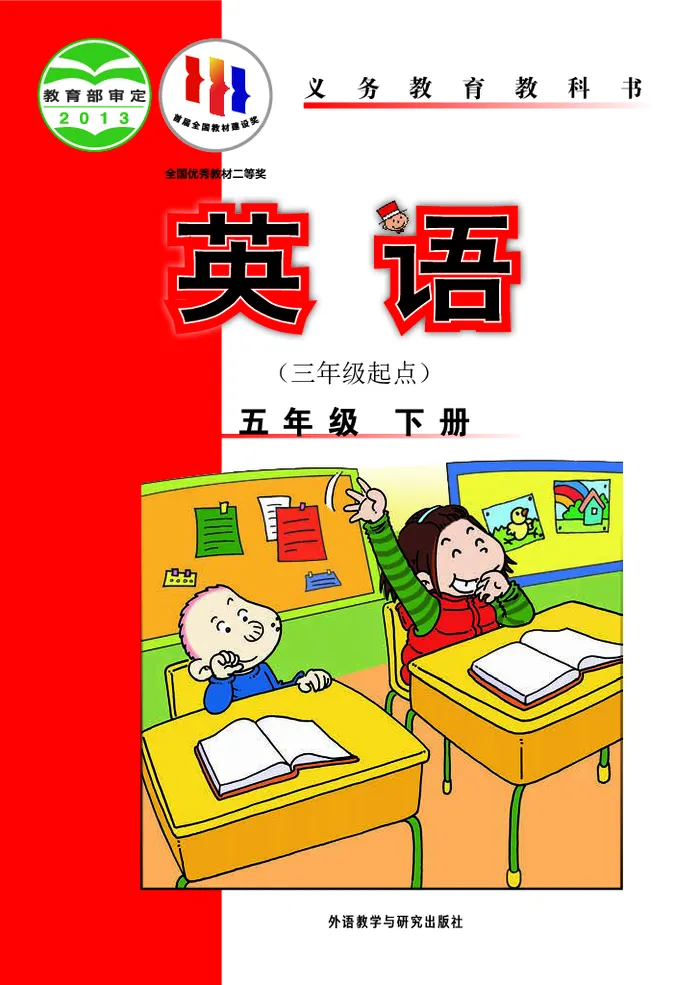
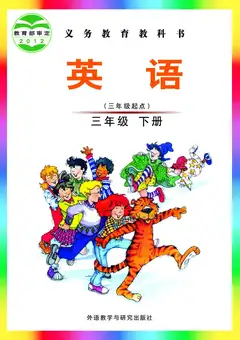
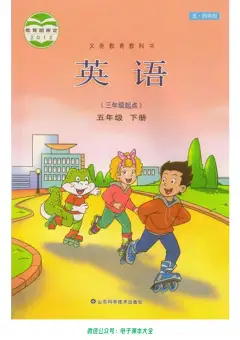
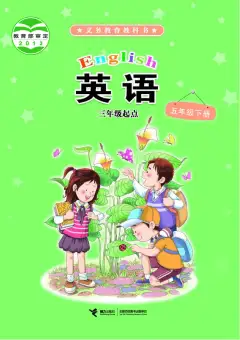
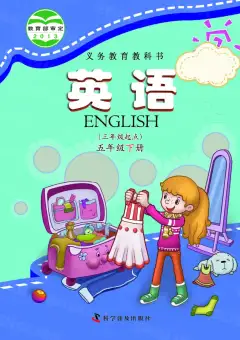
五年级 下册
(三年级起点)
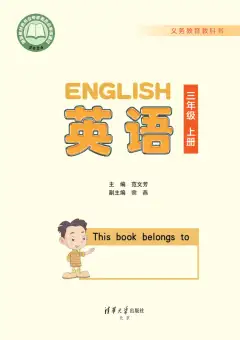
Name ( 姓名): Class ( 班级): School ( 学校):
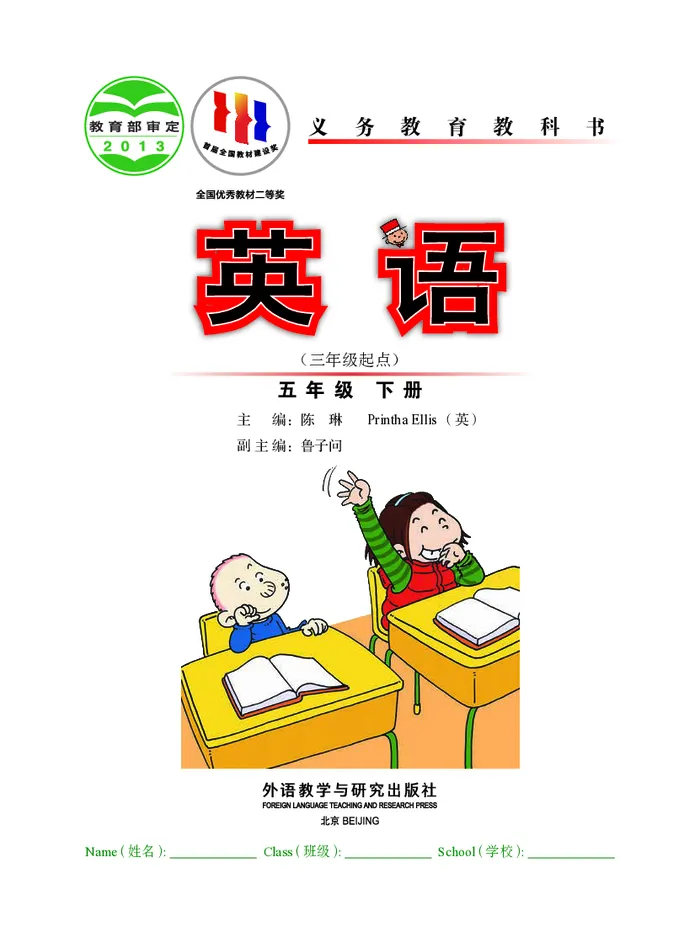
五年级 下册
(三年级起点)
主 编:
副主编:
陈 琳 Printha Ellis (英)
鲁子问
义
务
教
育
教
科
书
前 言
各位同学,你们好!欢迎大家学习本套英语教材!
2000年,外语教学与研究出版社与麦克米伦出版(中国)有限公司依据
国家《义务教育 英语课程标准(实验稿)》共同组织开发了本套教材;作为
我国第一套中小学“一条龙”英语教材,本套教材已出版使用十余年。2011
年,基于新颁布的国家《义务教育 英语课程标准(2011年版)》,我们对教
材进行了认真修订。
在修订后的小学教材中,我们为同学们保留了大家熟悉并喜爱的四个小
伙伴—中国学生大明和玲玲、英国学生Sam和Amy,还增加了其他一些人物
和小动物。他们会带领大家在一系列有趣的故事、对话、游戏、活动和歌曲中
学习英语。
修订后的教材每册包括10个学习模块(Module)、一个复习模块
(Review Module)、四个单词表、一个补充阅读(Reading for Pleasure)
版块以及一个综合运用实践项目(Project)。每个学习模块分两个单元
(Unit),一般情况下,第一单元呈现本模块所要学习的语言内容,第二单元
提供若干任务型(Task-based)活动,包括一首歌曲、歌谣或韵句。学习模
块的课文中呈现了一些语法内容,但不要求老师做理论的讲解,更不要求大家
孤立地、脱离语境地掌握,只希望大家初步学会在恰当的语境中运用包含这些
语法的句子。这一原则也希望老师在教学过程中以及家长在辅导孩子学习的
时候注意。复习模块对前面10个模块所学的内容进行综合和融合性复习,使
大家的语言知识和相应的语言技能得到进一步的巩固与提高。教材有四个单词
表,包括:分模块按出现顺序收录的单词,按字母顺序收录的全书单词,歌
曲、歌谣或韵句中出现的单词以及人名、地名。在歌曲、歌谣或韵句中出现的
新词,只要求理解,不要求学会运用。补充阅读为大家选用了篇幅短小、内容
丰富、形式多样的材料。教材最后设计了一个综合运用实践项目,供同学们根
据兴趣自由选择使用。
本套教材同时还配有对应的网络教材,可供同学们在线学习使用。
同学们,希望大家积极尝试,大胆实践,主动学做教材中的英语活动,
努力学唱英语歌曲、歌谣和韵句。相信你们会在参与活动、完成任务的过程中
体会到学习英语的乐趣,实现英语的灵活运用和自由交际。
………………………………………… 2
……………………………………… 5
………………………………………………… 8
……………………………………………… 11
……………………………………… 14
……………………………………… 17
……………………………………… 20
…………… 23
…………………………………………………… 26
………………………………………………… 29
…………………………………………… 32
…………………………………… 35
… 38
…………………………………… 41
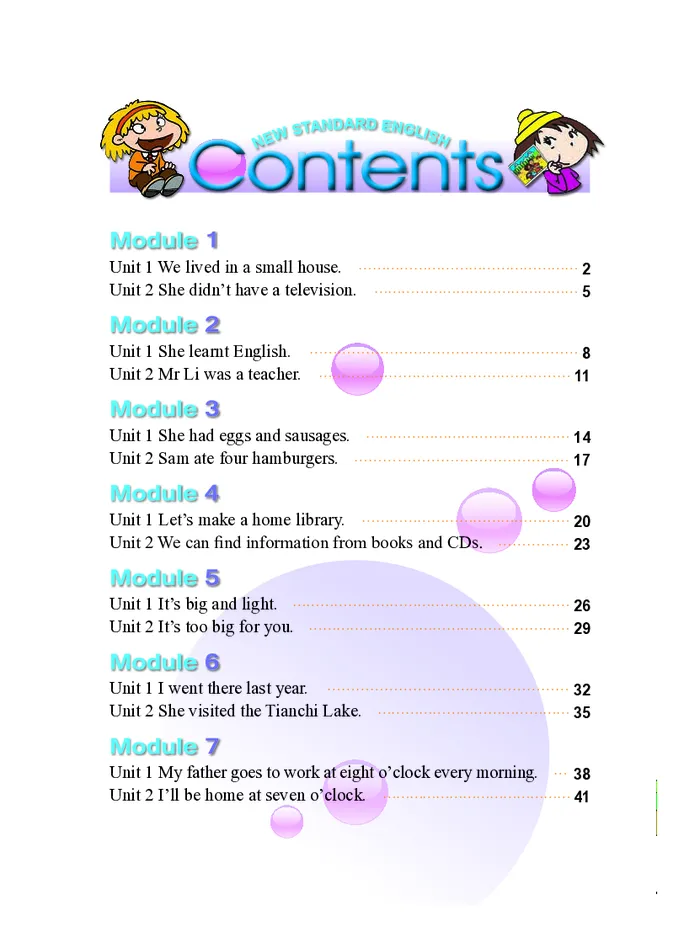
Unit 1 We lived in a small house.
Unit 2 She didn’t have a television.
Unit 1 She learnt English.
Unit 2 Mr Li was a teacher.
Unit 1 She had eggs and sausages.
Unit 2 Sam ate four hamburgers.
Unit 1 Let’s make a home library.
Unit 2 We can find information from books and CDs.
Unit 1 It’s big and light.
Unit 2 It’s too big for you.
Unit 1 I went there last year.
Unit 2 She visited the Tianchi Lake.
Unit 1 My father goes to work at eight o’clock every morning.
Unit 2 I’ll be home at seven o’clock.
N
E
W
S
TA
N
DA
RD
E
N
G
LI
S
H
Review Module
Words and Expressions in Each Module
Word List
Words and Expressions in Songs,
Chants and Poems
Proper Nouns
Reading for Pleasure
Unit 1
Unit 2
………………………………………………… 44
………………………………………………………… 47
…………………………………………………… 50
…………………………… 53
…………………………………………… 56
…………………………………………… 59
…………………………………………………………………………… 62
…………………………………………………………………………… 64
…… 66
……………………………………………………………… 70
………………………………………… 75
…………………………………………………… 75
…………………………………………………… 76
……………………………………………………………………………… 80
Project
Jobs
The Girl in the Pagoda
Unit 1 Will you help me?
Unit 2 I made a kite.
Unit 1 We laughed a lot.
Unit 2 Mum bought new T-shirts for you.
Unit 1 Where are you going?
Unit 2 I’m in New York now.
8
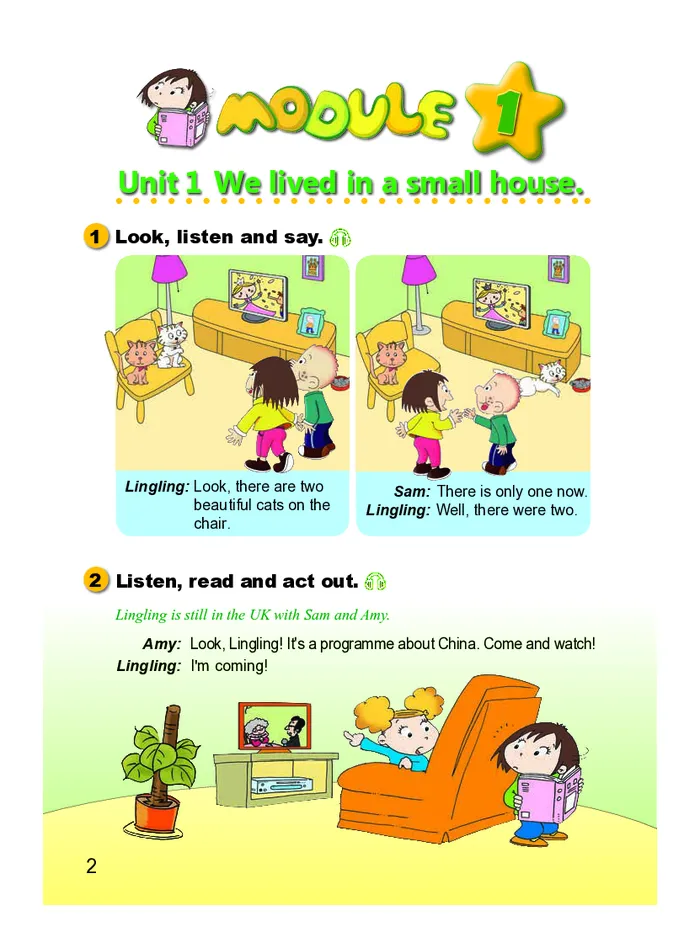
Look, listen and say.
Listen, read and act out.
Amy: �Look, Lingling! It's a programme about China. Come and watch!
Lingling: I'm coming!
Lingling is still in the UK with Sam and Amy.
Lingling: Look, there are two
beautiful cats on the
chair.
Sam: There is only one now.
Lingling: Well, there were two.
Unit 1 We lived in a small house.
1
1
2
2
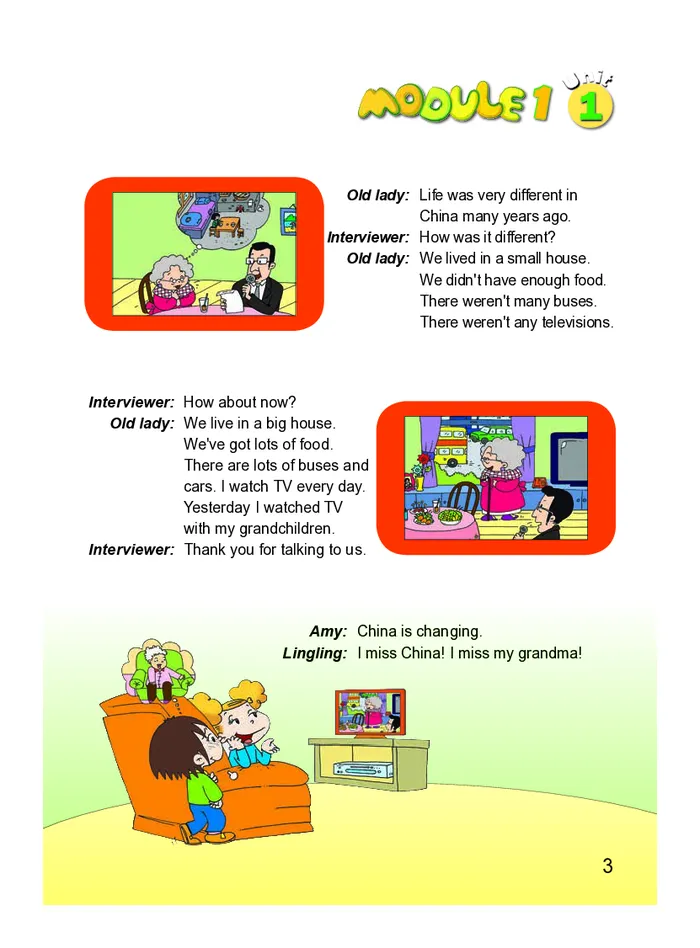
Old lady: �Life was very different in
China many years ago.
Interviewer: How was it different?
Old lady: � �We lived in a small house.
We didn't have enough food.
There weren't many buses.
There weren't any televisions.
Amy: China is changing.
Lingling: I miss China! I miss my grandma!
Interviewer: How about now?
Old lady: �We live in a big house.
We've got lots of food.
There are lots of buses and
cars. I watch TV every day.
Yesterday I watched TV
with my grandchildren.
Interviewer: �Thank you for talking to us.
1
1
t
i
n
U
3
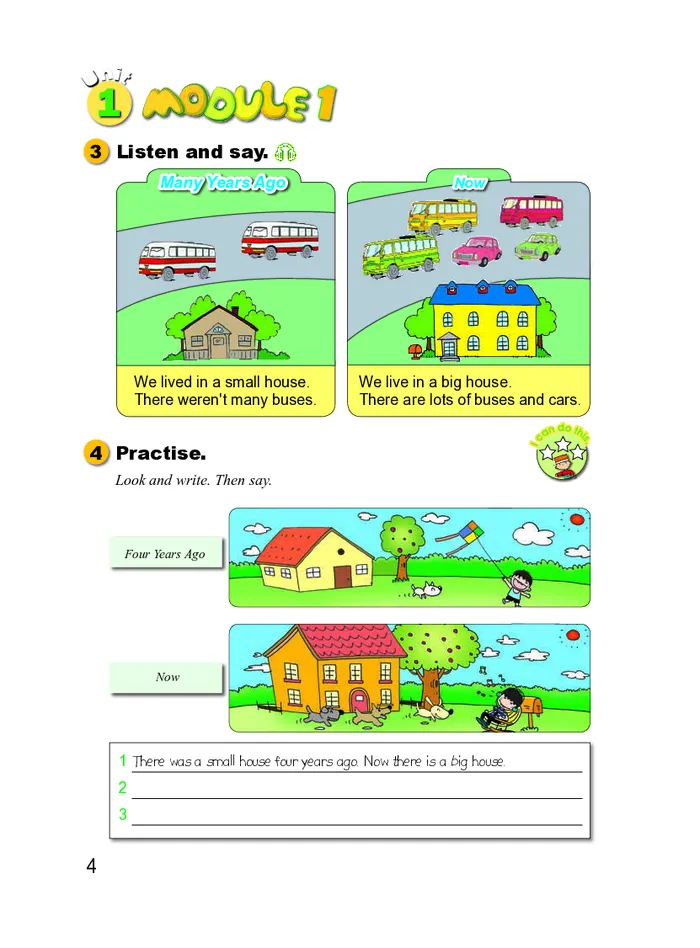
1 There was a small house four years ago. Now there is a big house.
2
3
Listen and say.
Practise.
Four Years Ago
Now
1
t
i
n
U
1
3
4
We live in a big house.
There are lots of buses and cars.
Many Years Ago
We lived in a small house.
There weren't many buses.
Now
Look and write. Then say.
4
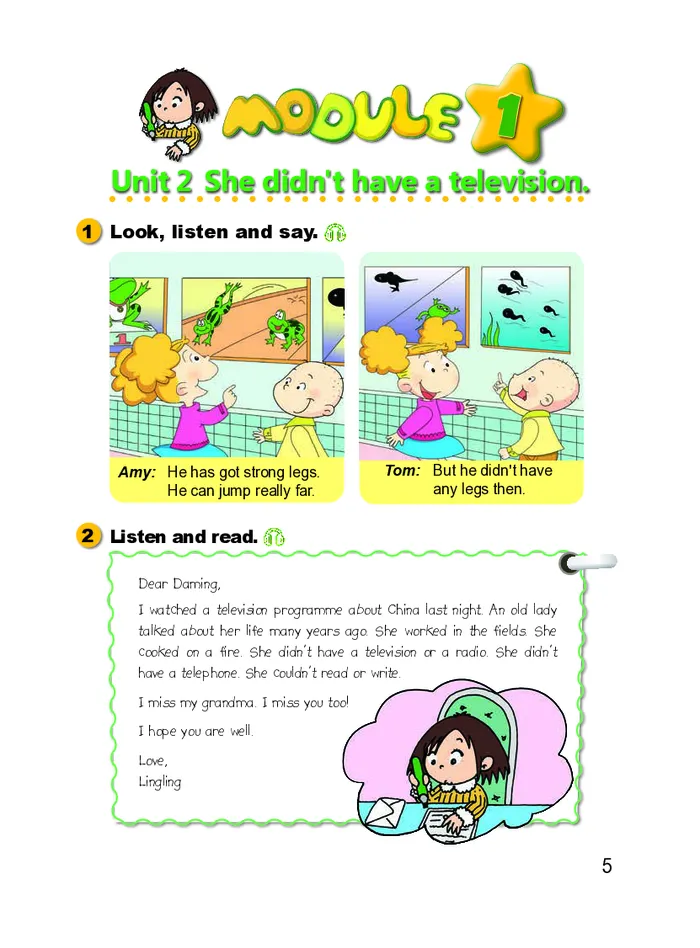
Dear Daming,
I watched a television programme about China last night. An old lady
talked about her life many years ago. She worked in the fields. She
cooked on a fire. She didn't have a television or a radio. She didn't
have a telephone. She couldn't read or write.
I miss my grandma. I miss you too!
I hope you are well.
Love,
Lingling
Look, listen and say.
Listen and read.
Amy: He has got strong legs.
He can jump really far.
Tom: But he didn't have
any legs then.
Unit 2 She didn't have a television.
1
2
1
5
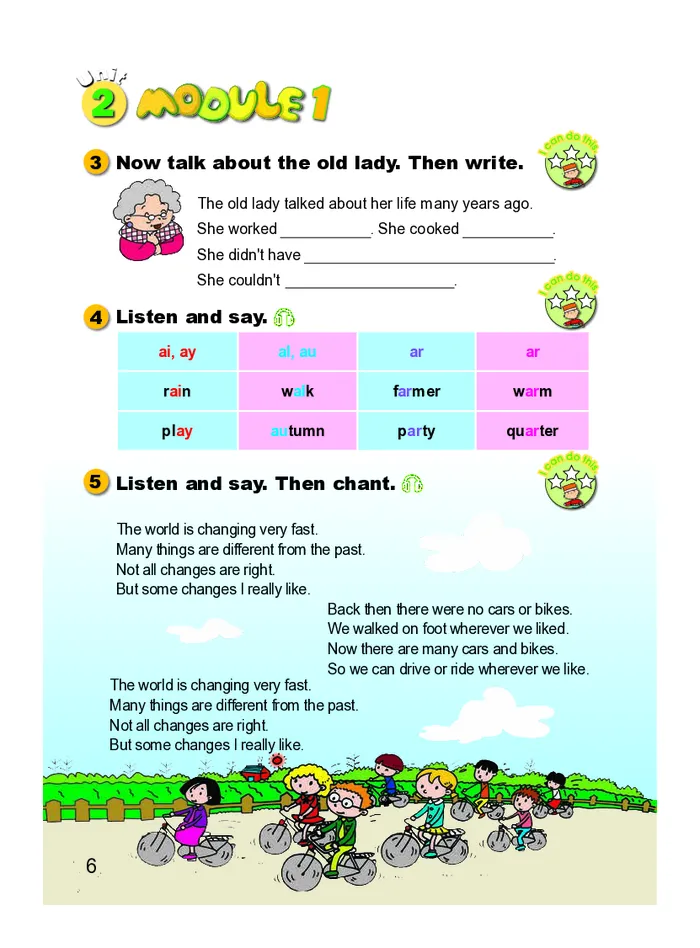
The world is changing very fast.
Many things are different from the past.
Not all changes are right.
But some changes I really like.
Back then there were no cars or bikes.
We walked on foot wherever we liked.
Now there are many cars and bikes.
So we can drive or ride wherever we like.
The world is changing very fast.
Many things are different from the past.
Not all changes are right.
But some changes I really like.
Now talk about the old lady. Then write.
Listen and say.
Listen and say. Then chant.
ai, ay
al, au
ar
ar
rain
walk
farmer
warm
play
autumn
party
quarter
The old lady talked about her life many years ago.
She worked . She cooked .
She didn't have .
She couldn't .
2
t
i
n
U
1
3
4
5
6
A: Where were you three days ago?
B: I was...
A: What did you do there?
B: I...
Do, ask and answer.
Do and say.
Interview a teacher and tell your friends about the interview.
A
B
1
2
t
i
n
U
6
7
Where
did you live ten
years ago?
I lived in a small
village. There weren't
any supermarkets.
How about
now?
I live in a big city.
There are many
supermarkets.
Ten years ago,
my teacher lived in a small
village. There weren't any
supermarkets. Now...
days
weeks
hours
months
years
7
Sam: Who are they,
Lingling?
Lingling: They're my
grandparents.
Listen, read and act out.
Listen and chant.
Unit 1 She learnt English.
1
2
2
She learnt to dance.
She learnt to cook.
She taught languages
and wrote a book.
8
2
1
t
i
n
U
Sam: Who's this?
Lingling: It's my grandma. She was a dancer.
She danced in lots of Chinese cities.
Amy: �Did she learn any foreign
languages?
Lingling: Yes, she learnt English.
Amy: Is this your grandpa?
Lingling: Yes, it is. He was a
driver.
Amy: Did he learn
English too?
Lingling: �No, he didn't.
But he's learning
English now!
9
2
1
t
i
n
U
Listen and say.
Practise.
Amy: Did your grandma learn
any foreign languages?
Lingling: Yes, she learnt English.
He's learning English now.
She didn't make a cake yesterday.
3
4
A: Did she make a cake yesterday?
B: No, she didn't.
Look, ask and answer. Then write.
10
Unit 2 Mr Li was a teacher.
Li Wei was six then.
He liked going to school.
He learnt Maths and Science,
and Art and Chinese too.
Listen and chant.
Listen and read.
Now Mr Li doesn't work.
He's learning English.
Chen Hai is an English
teacher. He's teaching
Mr Li.
Twenty years ago, Mr Li
was a teacher. He taught
Chinese. Chen Hai was in
his class. He was a good
pupil. He studied very hard.
Li Wei is thirty now.
He likes working at school.
He teaches Maths and Science,
and Art and Chinese too.
1
2
2
11
2
2
t
i
n
U
A: Five years ago, he walked to school.
B: Now he goes to school by school bus.
Listen and read. Then say the poem.
Look and say.
Listen and say.
aw
air
ass
draw
chair
class
saw
hair
pass
3
4
5
Five Years Ago
Now
Who saw the wind?
Not I or you.
But when the leaves are moving,
the wind is passing through.
Who saw the wind?
Not you or I.
But when the trees are shaking,
the wind is passing by.
12
2
2
t
i
n
U
Look, ask and answer.
Do and say.
Write about a famous person and tell the class about him/her.
6
7
He drank some water.
What did she do?
What did he do?
She danced.
This is Yao Ming.
I like him very
much. He was a
basketball star.
He played in China
and the US...
13
Daming: �Look! I've got an email from Lingling.
It's about English food.
Fanfan: What does it say?
Listen and chant.
Listen, read and act out.
What did you have for dinner?
Bread, meat and a hamburger.
What did you have for dinner?
Fish, eggs and a hamburger.
1
2
Unit 1 She had eggs and sausages.
3
14
3
1
t
i
n
U
Daming: �Yesterday she had an English
breakfast.
Fanfan: What did she have?
Daming: She had eggs and
sausages.
Fanfan: �And what did she have
for lunch?
Daming: She had sandwiches.
Fanfan: �What did she have for dinner?
Daming: She had fish and chips.
Fanfan: Fish and chips?
Daming: �Yes. It's a traditional English
dish.
Fanfan: �Does Lingling like English food?
Daming: �Yes, she does. She says
it's delicious!
15
3
1
t
i
n
U
Fanfan: What did she
have for dinner?
Daming: She had fish and
chips.
Listen and say.
Practise.
I had...
What did you
have for breakfast
yesterday?
breakfast
lunch
dinner
3
4
Fanfan: What did she have
for breakfast?
Daming: She had eggs and
sausages.
16
Look, listen and say.
Listen and read.
So he has got
no food now.
Dear Daming,
Today Sam ate four hamburgers at school! He likes hamburgers very much.
Lingling had a sandwich because she doesn't like hamburgers. She gave her
hamburgers to Sam.
I miss Chinese food. Tonight Mum is going to cook Chinese food for us.
Love,
Amy
1
2
He ate all the fish
and he ate all
the meat.
3
Unit 2 Sam ate four hamburgers.
17
3
2
t
i
n
U
I like fish and I like chips.
I like toast and jam.
But the very best - it's really nice -
is my mum's Chinese rice.
I like noodles and I like meat.
I like apples and pears.
But the very best - it's really nice -
is my mum's Chinese rice.
1 Who ate four hamburgers at school today?
2 Who had a sandwich?
3 Does Amy miss Chinese food?
4 What is Ms Smart going to cook tonight?
5 Who wrote this letter to Daming?
Now answer the questions.
Listen and say.
Listen and say. Then chant.
ea, ee
ea
ear
ear
ere, eir
teacher
head
ear
bear
where
see
bread
hear
pear
their
3
4
5
18
3
2
t
i
n
U
Pick a card and tell a story.
Do a survey. Then write and tell the class about it.
What did you have for
breakfast yesterday?
Do and say.
Do, write and say.
Mum bought some
apples yesterday.
They were red
and big.
I gave one apple
to my friend.
I ate two apples
last night.
6
7
Feifei had a hamburger and milk
for breakfast yesterday…
19
Ms Smart: A friend sent these
books and CDs to us.
Let's make a home
library.
Lingling: That's a good idea.
Look, listen and say.
Listen, read and act out.
We've got books
for students.
We've got books
for teachers.
1
2
Sorry, we
haven't got
books for you.
Woof! Woof!
4
Unit 1 Let's make a home library.
20
4
1
t
i
n
U
Amy: These are all books about science.
Lingling: Let's put them on this shelf.
Amy: Here you are. Let's put
them with the CDs.
Lingling: OK.
Amy: What are these big books?
They're heavy.
Lingling: They're dictionaries. We can
put them here.
Amy: These are the library cards
for our friends.
Lingling: Great! Now we can ask them
to come.
Sam: Where are the books about
sports, please?
Lingling: They are on Shelf C.
Sam: No, they aren't. These books
are about art.
Lingling: What? Oh, they're in the wrong
place.
John: Where are the books about
animals?
Lingling: They're on Shelf B.
John: I can't find them. The books on
Shelf B are about computers.
Lingling: Oh dear!
21
Listen and say.
Practise.
Amy: Let's make a home
library!
Lingling: That's a good idea.
Lingling: These are all books
about science.
Sam: Let's put them on this
shelf.
Here's a book
about science.
Let's read it.
4
1
t
i
n
U
3
4
22
We are going to do a science project about animals. This is a guide for
us to get information from the school library. We can find information from
books and CDs. We can find information from films and e-books as well.
There are lots of different ways to find information on this topic.
Look, listen and say.
Listen and read.
I want a Maths
book. Where can I
find it?
They're all here.
They're e-books.
I want a Chinese
book. Where can I
find it?
I want an English book.
Where can I find it?
1
2
4
Unit 2 We can find information
from books and CDs.
23
Now talk about your school library.
Then write.
Listen and say.
Listen and say. Then chant.
ie
igh
ir
pie
light
girl
lie
night
skirt
Let's go to the library.
There's a lot to enjoy.
Books, CDs and computers.
You can read, listen and play!
Let's go to the library.
There's a lot to enjoy.
Maps, photos and newspapers.
You can have a great day!
4
2
t
i
n
U
3
4
5
We can find books about animals in our school library...
24
A book?
Say and guess.
Do and say.
Who can be the librarian?
Yes, you're right.
A CD?
You can find it
in the library.
No, you can use it
with a computer.
Where can
I find books about
science?
You can find them
on Shelf B.
4
2
t
i
n
U
6
7
25
Listen and chant.
Ms Smart: Lingling, look at your bag! It's
broken. You can't take it to
China. I'll buy you a
new one.
Lingling: Thank you.
Listen, read and act out.
It's big. It's light.
It's hard to fly a kite.
It's blue. It's white.
It's nice to ride a bike.
1
2
Unit 1 It's big and light.
5
26
Ms Smart: Look at this blue one. It's big and light.
Lingling: Oh yes!
Sales assistant: And it's got four wheels. It'll be easy for you to carry.
Ms Smart: Great! We'll take it.
Lingling: Thank you very much.
At the Department Store
5
1
t
i
n
U
Lingling: This black bag is nice.
It's big!
Ms Smart: But it's heavy. This green
one is light. And it's got
two pockets. You can put
your umbrella there.
Lingling: But it's small.
27
Listen and say.
Practise.
This black bag is nice. It's big!
The yellow pencils are broken.
The blue pencils are new.
Look at this blue one. It's big
and light.
5
1
t
i
n
U
3
4
Look, listen and say.
Listen and read.
Amy: But it's too big for you!
Lingling: Have you got a small
one, please?
Sales assistant: Try this white one.
Amy: That's lovely! You can
take it to China.
Amy: Look at this blue T-shirt.
It's nice.
Lingling: It has got a panda on it.
It's too big for you.
It's too big for
you too.
It's nice for me.
Look! My new hat.
1
2
5
Unit 2 It's too big for you.
29
It's easy for him.
It's hard for him.
My nice white kite.
My nice white kite.
It's light and it's right.
It's light and it's right.
It's not too big and it's not too small.
It's not too heavy, not at all.
My white kite is so nice.
Come and fly it. Don't let it fall!
Look and write. Then point and say.
Listen and say.
Listen and read. Then say the poem.
oa
oy
oo
oo
boat
boy
school
book
coat
toy
afternoon
good
5
2
t
i
n
U
3
4
5
easy
heavy
hard
big
light
small
A: Is it white?
B: No, it isn't. It's yellow.
A: Is it light?
B: No, it's heavy.
A: Is it small?
B: Yes, it is.
A: It's the small box.
B: Yes, you're right.
Ask and find.
Do and say.
Choose a present for your friend’s birthday.
5
2
t
i
n
U
6
7
Let's make a birthday
card for him too.
This bag is big and
nice. Let's take this
one.
This bag is big,
but it looks old.
31
32
Amy: Mum, look! Lingling has got some interesting photos.
Ms Smart: Can I see them, Lingling?
Lingling: Of course.
Look, listen and say.
Listen, read and act out.
1
2
6
Unit 1 I went there last year.
Where did you go
for the holidays?
I went to
the moon.
The moon?
How did you get
there?
I used my
computer.
Ha ha...
33
6
1
t
i
n
U
Lingling: They are photos of me
and my family in China.
This is Xinjiang. It's in the
west of China. I went
there last year.
Amy: Did you go with your
parents?
Lingling: Yes, I did. We stayed with
my grandma for a week
in July.
Ms Smart: The mountains are really
beautiful.
Lingling: This is Hainan. It's in the south of China.
Amy: Who is this?
Lingling: It's my uncle. He lives there with his three children.
My cousins visit Beijing every year.
Ms Smart: Oh yes, I remember! I met them in June!
They're Li people.
34
3
4
Look and write. Then say.
Last year she went to
Qingdao and visited
her friend.
Listen and say.
Practise.
Lingling: This is Xinjiang. I went there last year.
Amy: Did you go with your parents?
Lingling: Yes, I did.
1
t
i
n
U
6
35
Last July Lingling went to Xinjiang with her parents. Xinjiang
is in the west of China. She rode a horse. She climbed the
Tianshan Mountains. She visited the Tianchi Lake. It was very
beautiful. She had a lovely time there.
Listen and chant.
Listen and read.
1
2
East and west,
home is the best.
North and south,
let's have a rest.
6
Unit 2 She visited the Tianchi Lake.
36
Look, ask and answer.
Listen and say.
Listen and say. Then sing.
MY HOME IS THE PLACE
2
t
i
n
U
6
3
4
5
Where is
Yinchuan?
I went to
Yinchuan.
It's in
the north of
China.
Where did
you go for the
holidays?
37
Do and say.
Do and say.
Write about your trip and tell the class about it.
I went to
Hainan in July
and I bought a
hat.
Three.
South.
6
2
t
i
n
U
6
7
Last year I went
to Chengdu with my family. It's in
the west of China. We went to the
zoo and saw some pandas. They
were cute. I took many photos. I
had a lovely time there.
Daming: My father goes to work at
eight o'clock every morning.
Fangfang: What does he do?
Daming: He's a policeman.
Amy: Dad, will you take us
to the park tomorrow
morning?
Mr Smart: Yes. I'll take you there
at half past seven.
Amy: Half past eleven?
Ms Smart: Half past seven.
Look, listen and say.
Listen, read and act out.
1
2
7
Unit 1 My father goes to work at
eight o'clock every morning.
38
Fangfang: My father goes to work at
six o'clock every evening.
Daming: That's late. What does he do?
Fangfang: He's a worker in a factory.
Daming: My mother goes to work at
eleven o'clock every night.
Fangfang: That's very, very late. What
does she do?
Daming: She's a nurse.
Fangfang: My mother goes to work at
half past five every morning.
Daming: That's very early. What does
she do?
Fangfang: She's a taxi driver.
7
1
t
i
n
U
Fangfang: Look! Here's my mother!
Fangfang's mother: Hello, children. I'll take you to school.
Fangfang and Daming: Thank you!
39
My uncle...
My father...
My mother...
teacher
doctor
nurse
Practise.
Look and say.
Listen and say.
7
1
t
i
n
U
3
4
My father goes to work at
eight o'clock every morning.
He's a policeman.
My father goes to work at
six o'clock every evening.
He's a worker in a factory.
40
Look, listen and say.
1
Listen and read.
Ms Smart: It's a quarter to seven. What time will
you be home?
Mr Smart: I'll be home at seven o'clock.
Amy: It's half past six. Are you going to
be late, Dad?
Mr Smart: Don't worry! I'll be home at seven o'clock.
Why?
Amy: It's seven o'clock. Here he is.
All: Happy birthday!
Mr Smart: Thank you!
Sam: Dad, it’s six o'clock now. Will you be
home at seven o'clock?
Mr Smart: Yes, I will.
2
7
Unit 2 I'll be home at seven o'clock.
Oh no!
It's a quarter to eight now.
School starts at eight
o'clock. I'll be late.
It's half past eight
now. I'm late and
I'm tired.
41
Mum goes to work at half past six,
half past six, half past six.
Mum goes to work at half past six.
She's a busy woman.
It's nine o'clock in the morning
now. Dad will be home at
seven o'clock in the evening.
Listen and say.
Listen and say. Then chant.
I go to school at eight o'clock,
eight o'clock, eight o'clock.
I go to school at eight o'clock.
And we'll all be home at six.
Look and write.
7
2
t
i
n
U
3
4
5
Dad goes to work at seven o'clock,
seven o'clock, seven o'clock.
Dad goes to work at seven o'clock.
He's a busy man.
ch,tch
ck
kn
children
black
know
watch
back
knife
42
Say and guess.
Ask and answer. Then write.
My mum gets up at half past six. Xiaowei's mum gets up at seven o'clock...
get up
have breakfast
go to school
have lunch
go home
have dinner
go to bed
What time does
your mum get up?
She gets up at
seven o'clock.
I do it at seven
o'clock every
morning.
Yes, I do.
Do you get up
at seven o'clock
every morning?
7
2
t
i
n
U
6
7
43
44
Daming: �I'm going to visit my cousin
in New York. His name is
Simon. What present
can I take?
Fangfang: What about a toy
panda?
Daming: �I think he's got a toy
panda. His mother
and grandma are
Chinese.
Listen, read and act out.
Look, listen and say.
Tomorrow is my
cat's birthday.
It will be a
great present.
I'll make a
paper fish for
her.
1
2
8
Unit 1 Will you help me?
44
45
Fangfang: �Daming, your cousin will
love this kite. It's a Chinese
dragon.
Daming: �Thank you for your help.
It will be a great present.
Fangfang: �You can write the Chinese
word for "dragon" on it.
Daming: That's a great idea!
Fangfang: �What about a kite?
Daming: �Good idea! I'll make
a kite!
Fangfang: �But will it be windy
in New York?
Daming: I think so.
Daming: Will you help me?
Fangfang: Of course I will.
8
1
t
i
n
U
45
46
M
A: Will you... tomorrow?
B: Yes, I will. / No, I won’t.
Practise.
Look, ask and answer.
Listen and say.
Daming: �I'll make a kite!
Daming: Will you help me?
Fangfang: Of course I will.
8
1
t
i
n
U
3
4
46
47
I drew a dragon.
I cut the paper.
I made a kite
for my sister.
Listen and chant.
Listen and read.
I drew a dragon on a piece of
yellow paper.
I painted it.
I cut the paper.
I put sticks on it.
I tied strings to it.
Then I could fly my kite.
I made a kite
1
2
8
Unit 2 I made a kite.
47
Look and say.
Listen and say.
Listen and say. Then sing.
What did Lingling do?
1
2
3
Fly, fly in the sky. Beautiful kite flying so high. Above
the clouds, my dragon kite goes.
Beautiful kite flying so high.
4
FLY, FLY IN THE SKY
8
2
t
i
n
U
3
4
5
Where is it going? Nobody knows. Fly, fly in the sky.
II
ng
ng
nk
tell
along
English
think
will
sing
angry
drink
48
49
How do you make a dragon kite?
Draw a dragon on a piece of paper.
Do and say.
Look, do and write.
8
2
t
i
n
U
6
7
What will you do
tomorrow?
I'll go swimming
tomorrow.
49
50
Look, listen and say.
Daming: Wow! I've got two letters in
English! One is from the UK
and one is from the US.
Amy: I saw a dog. It wore a coat.
Lingling: I saw a man. He wore a skirt.
Sam: I saw a dog. It wore a hat.
Listen and read.
1
2
9
Unit 1 We laughed a lot.
51
15 Marling Street
London, NW2
UK
Dear Daming,
Last week we went to a children's theatre. The men wore
women's clothes. The women wore men's clothes. The
actors told lots of jokes. It was very funny. We laughed
a lot. Children here love the theatre.
After the show we went to a restaurant. We all ate
hamburgers and chips.
Are you ready for your trip to the US?
Love,
Lingling
9
1
t
i
n
U
3
4
52
Look, ask and answer.
A: What did they do last week?
B: They played football.
We went to a children’s
theatre.
Listen and say.
Practise.
9
1
t
i
n
U
9
2
t
i
n
U
9
1
t
i
n
U
The actors told lots of jokes.
We laughed a lot.
53
He borrowed some books.
And he read them all.
He bought some books.
But he didn't read at all.
Dear Daming,
How are you? We are going to see you in three weeks. Dad's
going to put another bed in my room. Mum bought new T-shirts
for you. Dad read a book about Chinese history. He is going to
ask you some questions. And we borrowed a bike for you.
Don't forget to bring some CDs of Chinese
songs. We can listen to them
in the evening.
See you soon!
Simon
Listen and chant.
Listen and read.
1
2
Unit 2 Mum bought new T-shirts for you.
9
54
54
Yesterday
Now
Tomorrow
Listen and say.
Listen and say. Then sing.
He played football
yesterday.
Look and write.
9
2
t
i
n
U
3
4
5
POSTMAN, POSTMAN
qu
sh
th
th
queen
she
this
thank
quarter
English
with
mouth
55
55
A: I've got a letter from a friend.
He saw the London Eye.
B: Is the letter from the UK?
A: Yes, it is.
Say and guess.
Read Lily's story and help her write a letter to her cousin Mary.
Read and do.
Dear Mary,
I went to...
Love,
Lily
She had a good time.
She ate hamburgers and
chips. She liked them.
Lily went to Hong Kong
with her parents in July.
She visited Disneyland.
9
2
t
i
n
U
6
7
55
Grandma: Hello, Daming.
Daming: Hello, Grandma.
Grandma: Are you ready for your trip
tomorrow?
Daming: I think so. But I feel nervous.
Grandma: It will be all right. I'm going to
meet you in New York.
Look, listen and say.
Listen, read and act out.
Sam: Mum, what did you say
to me?
Ms Smart: I don't know!
Ms Smart: Where are you going
this weekend, Sam?
Sam: I don't know.
Ms Smart: When are you going
to get up?
Sam: I don't know.
1
2
10
Unit 1 Where are you going?
56
10
1
t
i
n
U
Grandma: Who's going to the airport
with you?
Daming: Who? Mum!
Grandma: Great! Safe trip, Daming!
Grandma: You can make a list of things to do.
Daming: That's a good idea!
Grandma: Where are you going?
Daming: To the airport.
Grandma: What are you going to take?
Daming: Clothes, shoes, presents,
the ticket, my passport...
Grandma: When are you going to
the airport?
Daming: At seven o'clock tomorrow
morning.
57
A: Where are you going?
B: I'm going to the airport.
A: When are you going to the airport?
B: At seven o'clock tomorrow
morning.
A: What are you going to take?
B: Clothes, shoes, presents,
the ticket and my passport.
A: Who's going to the airport
with you?
B: Who? Mum!
Where are you going this weekend?
When are you going there?
What are you going to do there?
Who's going with you?
Listen and say.
Practise.
1
t
i
n
U
10
3
4
Ask and answer.
58
Dear Mum and Dad,
I'm in New York now. I arrived here yesterday. I'm
very happy. Grandma and Cousin Simon met me
at the airport. We took a yellow taxi to their home.
New York is very beautiful. There are lots of tall
buildings, cars and people.
Grandma made Chinese food for me. But I want to
try American food. I want to find out more about
the US. I will write again soon.
Love,
Daming
Look, listen and say.
Listen and read.
Nihao! Nihao!
Wow! It speaks
Chinese too.
Hello! Hello!
1
2
This is my new pet.
It speaks English.
10
Unit 2 I'm in New York now.
59
M
Now answer the questions.
Listen and say.
Listen and say. Then sing.
I'm in the sky. I'm flying high. It's a big exciting
world. There's new food to eat, new people to meet. It's a big exciting world. I will
travel by plane, again and again. It's a
big exciting world.
1 Where is Daming now?
2 When did Daming arrive there?
3 Who met Daming at the airport?
4 What food did Grandma make for Daming?
IT'S A BIG EXCITING WORLD
2
t
i
n
U
10
3
4
5
Follow and say.
Do, write and say.
Make a plan for the weekend. Then write and tell the class about it.
We're going to
have a party. I'm going
to sing a song.
We're going to
have a party. He's going
to sing a song. I'm going
to play a game.
We're going to
have a party. He's
going to sing a song.
She's going to
play a game.
I...
10
2
t
i
n
U
6
7
I'm going to the zoo this Saturday. I'm
going to take bread and juice. There
are some funny animals at the zoo. I
want to take lots of photos.
61
Say three
sports.
Say the
three meals
of the day.
Say five
places.
Say eight
types of
food.
Say six
colours.
Say the four
seasons.
Say six
animals.
1
t
i
n
U
2
Ask and answer. Then write.
Look, ask and answer.
Where did you go last summer?
When did you go there?
What did you do there?
Who did you meet there?
Where will you go this summer?
When will you go there?
What will you do there?
Who will you meet there?
What will you do at
seven o'clock tomorrow
morning?
I will have breakfast.
1
2
where
when
who
what
2
t
i
n
U
64
Listen and match.
Look and write. Then make suggestions.
Now say and guess.
It's the
blue bag.
It's small. It has
got wheels.
3
4
5
1
2
3
4
A: I'm tired.
B: Go to bed.
A:
B:
A:
B:
A:
B:
tired
hungry
thirsty
hot
2
t
i
n
U
65
Words and Expressions
in Each Module
Module 1
still 还,仍然
programme (电视或广播)节目
lady 女士,夫人
life 生活
different 不同的
ago 以前
interviewer 采访者
enough 足够的
television 电视机
*grandchildren (grandchild的复数
形式)(外)孙子;(外)孙女
change 改变,变化
night 夜晚,夜间
work 工作;劳动;干活儿
field 田地
fire 火,炉火
or (用于否定句中)也不,也没
radio 收音机
telephone 电话
couldn't = could not 不能
write 写
hope 希望
Module 2
learnt (learn的过去式) 学习
taught (teach的过去式) 教,讲授
language 语言
wrote (write的过去式) 写
dancer 舞蹈演员
foreign 外国的
studied (study的过去式)学习
hard 努力地
Module 3
hamburger 汉堡包
English 英国(式)的
breakfast 早餐,早饭
lunch 午餐,午饭
sandwich 三明治
fish and chips 炸鱼加炸薯条
traditional 传统的
66
dish 食品;菜肴
very much 很,非常
gave (give的过去式)给
tonight 今夜,今晚
Module 4
library 图书馆
student 学生
sent (send的过去式)发送,寄
*CD 激光唱片,光盘
idea 主意,想法
put 放,安放
*shelf 架子
heavy 重的,沉的
dictionary 词典;字典
card 卡片
library card 图书卡,借书证
ask 邀请
wrong 错误的
dear 哎呀
information 信息
*e-book 电子书
project 项目
guide 介绍,指南,手册
film 电影
as well 又,还,也
way 方法,方式
on 关于
*topic 话题
Module 5
light 轻的
hard 困难的,费力的
*broken 坏的,破的
department store 百货商店
pocket 口袋,兜
umbrella 雨伞
sales assistant 售货员,营业员
wheel 轮子
easy 容易的,不费力的
take 选择要;选择购买
too 太,过于
try 试,尝试
lovely 美丽的,可爱的;令人
愉快的
67
Module 6
moon 月亮,月球
get 到达
west 西,西部,西方;向西方
parent 母亲;父亲;家长
stay 停留
July 七月
south 南,南部,南方;向南方
remember 记得
June 六月
east 东,东部,东方;向东方
best 最好的
north 北,北部,北方;向北方
rest 休息
have a rest 休息一下
rode (ride 的过去式)骑
Module 7
evening 傍晚,晚上
late 近日暮的;近深夜的;时间
不早的
worker 工人
factory 制造厂;工厂
early 早的
taxi 出租车,计程车
quarter 一刻钟
to (距整点)差……
worry 焦虑,担心
Module 8
paper 纸
Chinese 中国人的
so 如此,这样
word 词,字
drew (draw的过去式)画
cut (cut的过去式)剪,切,割
piece 张,片,块
paint (用颜料)绘画,着色
put (put的过去式)放,安放
stick 小木棍,小木条
tied (tie的过去式)扎上,系上
*string 线,绳子
68
Module 9
laugh 笑
wore (wear的过去式)穿
letter 信,书信
theatre 剧院
women (woman的复数形式)
女性,妇女
actor 演员
told (tell的过去式)口述,讲
(故事等)
joke 笑话
after 在……后
show (尤指剧院的)演出,表演
restaurant 饭店,餐馆
ready 准备好的
borrow 借入,借来
read (read的过去式)读
at all 一点都
in 在(将来一段时间)之后
another 另一个
history 历史
ask 问,询问
question 问题
forget 忘,忘记
bring 带来,拿来
soon 不久,很快
Module 10
when 在什么时候
end 结束,终止
nervous 紧张的,情绪不安的
all right 没事,没问题
airport 机场
ticket 票
passport 护照
safe 安全的,平安的
pet 宠物
speak 说,讲
building 建筑物
American 美国的;美国人的;美国人
find out 发现,弄清
more 更多的(量),较多的(量)
注:黑体词为义务教育英语课程标准二级词汇,标有* 的词为五级词汇表外的词汇
69
Aa
actor 演员
after 在……后
ago 以前
airport 机场
all right 没事,没问题
American 美国的;美国人的;
美国人
another 另一个
as well 又,还,也
ask 邀请;问,询问
at all 一点都
Bb
best 最好的
borrow 借入,借来
breakfast 早餐,早饭
bring 带来,拿来
*broken 坏的,破的
building 建筑物
Cc
card 卡片
library card 图书卡,借书证
*CD 激光唱片,光盘
change 改变,变化
Chinese 中国人的
couldn't = could not 不能
cut (cut的过去式)剪,切,割
Dd
dancer 舞蹈演员
dear 哎呀
department store 百货商店
dictionary 词典;字典
different 不同的
dish 食品;菜肴
drew (draw的过去式)画
Word List
70
Ee
early 早的
east 东,东部,东方;向东方
easy 容易的,不费力的
*e-book 电子书
end 结束,终止
English 英国(式)的
enough 足够的
evening 傍晚,晚上
Ff
factory 制造厂;工厂
field 田地
film 电影
find out 发现,弄清
fire 火,炉火
fish and chips 炸鱼加炸薯条
foreign 外国的
forget 忘,忘记
Gg
gave (give的过去式)给
get 到达
*grandchildren (grandchild的
复数形式)(外)孙子;
(外)孙女
guide 介绍,指南,手册
Hh
hamburger 汉堡包
hard 努力地;困难的,费力的
heavy 重的,沉的
history 历史
hope 希望
Ii
idea 主意,想法
in 在(将来一段时间)之后
71
information 信息
interviewer 采访者
Jj
joke 笑话
July 七月
June 六月
Ll
lady 女士,夫人
language 语言
late 近日暮的;近深夜的;
时间不早的
laugh 笑
learnt (learn的过去式)学习
letter 信,书信
library 图书馆
life 生活
light 轻的
lovely 美丽的,可爱的;
令人愉快的
lunch 午餐,午饭
Mm
moon 月亮,月球
more 更多的(量),
较多的(量)
Nn
nervous 紧张的,情绪不安的
night 夜晚,夜间
north 北,北部,北方;
向北方
Oo
on 关于
or (用于否定句中)也不,
也没
72
Pp
paint (用颜料)绘画,着色
paper 纸
parent 母亲;父亲;家长
passport 护照
pet 宠物
piece 张,片,块
pocket 口袋,兜
programme (电视或广播)节目
project 项目
put 放,安放
put (put的过去式)放,安放
Qq
quarter 一刻钟
question 问题
Rr
radio 收音机
read (read的过去式)读
ready 准备好的
remember 记得
rest 休息
have a rest 休息一下
restaurant 饭店,餐馆
rode (ride的过去式)骑
Ss
safe 安全的,平安的
sales assistant 售货员,营业员
sandwich 三明治
sent (send的过去式)发送,寄
*shelf 架子
show (尤指剧院的)演出,表演
so 如此,这样
soon 不久,很快
south 南,南部,南方;向南方
speak 说,讲
stay 停留
stick 小木棍,小木条
73
still 还,仍然
*string 线,绳子
student 学生
studied (study的过去式)学习
Tt
take 选择要;选择购买
taught (teach的过去式)教,
讲授
taxi 出租车,计程车
telephone 电话
television 电视机
theatre 剧院
ticket 票
tied (tie的过去式)扎上,系上
to (距整点)差……
told (tell的过去式)口述,
讲(故事等)
tonight 今夜,今晚
too 太,过于
*topic 话题
traditional 传统的
try 试,尝试
Uu
umbrella 雨伞
Vv
very much 很,非常
Ww
way 方法,方式
west 西,西部,西方;向西方
wheel 轮子
when 在什么时候
women (woman的复数形式)
女性,妇女
word 词,字
wore (wear的过去式)穿
work 工作;劳动;干活儿
worker 工人
worry 焦虑,担心
write 写
wrong 错误的
wrote (write的过去式)写
74
Names
Mary 玛丽
Simon 西蒙
Places
Australia 澳大利亚
Disneyland 迪斯尼乐园
Spain 西班牙
Tianchi Lake 天山天池
Tianshan Mountains 天山山脉
again and again 一次又一次,一次次
away 离……有一定距离
cloud 云,云雾
different from 与……不同,不同于
drive 驾驶,驾车
exciting 令人激动的,使人兴奋的
jam 果酱
leaves (leaf的复数形式)叶子,
树叶
map 地图
newspaper 报纸
nobody 没有人
on foot 步行
pass by 经过
pass through 经过,路过
postman 邮递员
right 正确的;合适的
shake 摇动,抖动
toast 烤面包,吐司
understand 懂得,明白
way 路程,距离
wherever 无论什么地方
wind 风
world 世界
75
Words and Expressions
in Songs, Chants and Poems
Proper Nouns
The Girl in the Pagoda
Reading for Pleasure
A beautiful girl lived in a village near
Luoyang. There was a very tall pagoda in
the village. One day, it was very hot. The
girl sat under a big tree.
Suddenly a big wind came and blew her
into the sky.
The girl's family was very sad.
76
Reading for Pleasure
When the girl opened her eyes, she was at the top of the pagoda. A
young man was in front of her.
"Will you marry me?" asked the young man. "No, I won't," said the
girl. "I want to go home."
The young man was angry. "Then you will stay in this pagoda," he said.
Every day the young man visited the girl. But the girl still didn't want to
marry him.
77
One day the window of the pagoda was open. The girl looked out. The
young man was now a monster! The girl was very frightened.
Later the girl saw a man at the foot of the pagoda. "Help! Help!" she
shouted. The man didn't hear her. So the girl threw her clothes out of the
window. The man saw the clothes. Then he looked up and saw the girl at
the top of the pagoda. He ran for help.
Reading for Pleasure
78
Word List
Word List
pagoda 宝塔
sat (sit的过去式)坐
suddenly 突然
blew (blow的过去式)(风)
吹动,刮走
top 顶端,顶部
in front of 在……的前面
marry 娶,嫁,和……结婚
then 既然是这样,那么
frightened 害怕的
later 后来,以后
foot (山坡、楼梯等的)
底部,脚
threw (throw的过去式)扔
hit (hit的过去式)打,击
flew (fly的过去式)飞
save 搭救,救助
everyone 人人,每人
The next day people in the village went to the pagoda to help the
girl. When the girl's brother saw the monster, he hit it with a big stick.
The monster flew away.
The girl was saved. "I missed you so much!" said
the girl to her brother. Everyone in the village
sang and danced for many days.
Reading for Pleasure
79
A: This is a doctor.
B: And this is a farmer.
�Cut out or draw pictures of six different jobs
you like to do.
Write sentences for each job.
1
2
Jobs
What do they do?
Where do they work?
80
�Stick the pictures and sentences on a large
piece of paper.
3
4 Decorate your poster.
81
Display your poster.
A: This is a teacher.
B: She works at a school.
C: She teaches English.
D: I want to be a
teacher too.
5
6
Present your poster to the class.
82
83
既名为“后记”,一般应该是本教材使用完毕后才看到的吧。
那么,同学们,你们喜欢这套教材吗?大明、玲玲以及他们的小伙
伴们是否让你们喜爱上了英语,并且帮助你们掌握了一定的英语运用能
力呢?如果是这样,那就太好啦!希望你们在以后的英语学习中继续大
胆地开口说英语——课上说、课下说;继续积极地参与各项语言活动。
一句话,你们要尽量主动使用英语来表达意思和做事情,这样才能把英
语学好。
可敬的老师们,感谢你们的辛勤劳动,以及你们为国家英语课程改
革付出的努力和做出的贡献。在修订本套教材的过程中,我们也充分考
虑了英语课程改革以及一线教学的需求。修订后的教材更加突出了英语
课程工具性和人文性的统一,优化了各册的结构设计和内容安排,以使
教学脉络更加清晰、梯度更加合理。
为了在最大程度上保证教材与课程标准的契合,便于一线教学使用,
所有参与本套教材编写的人员均付出了艰辛的努力。在此我想特别感谢
我的编写团队,没有他们的努力与付出,就没有本教材的问世。
本册教材的主要编写人员如下:
你们的
二〇一二年春日
后 记
后 记
Naomi Simmons(英) Judy West(英) Printha Ellis(英)
Carlos Barcenas(英) Diana Pye(英)
张 琦 兰 虹 褚献华 张琪珊