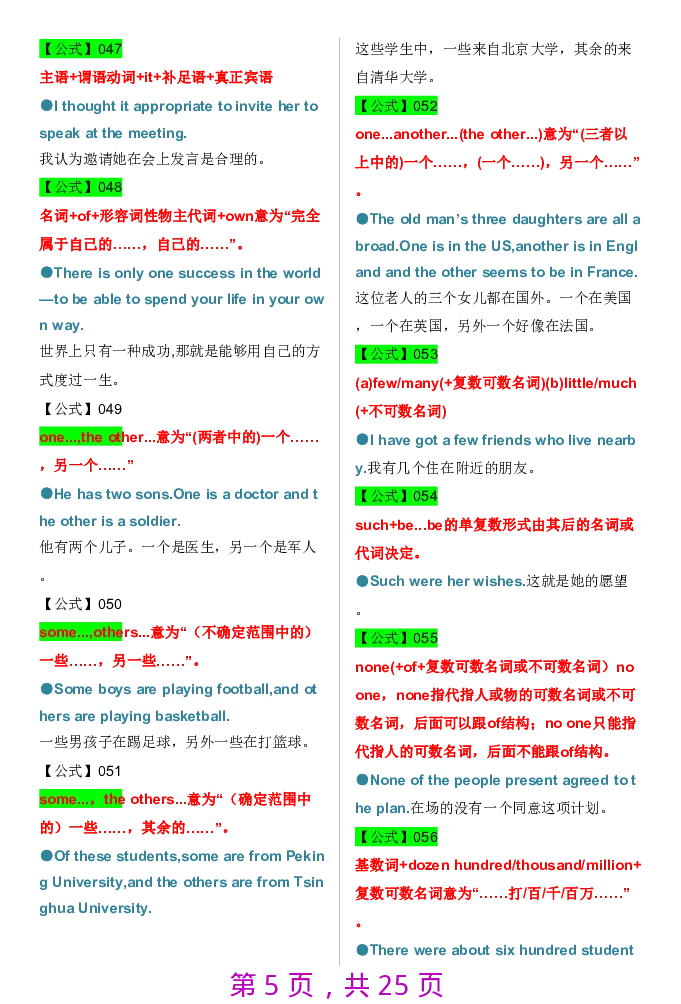
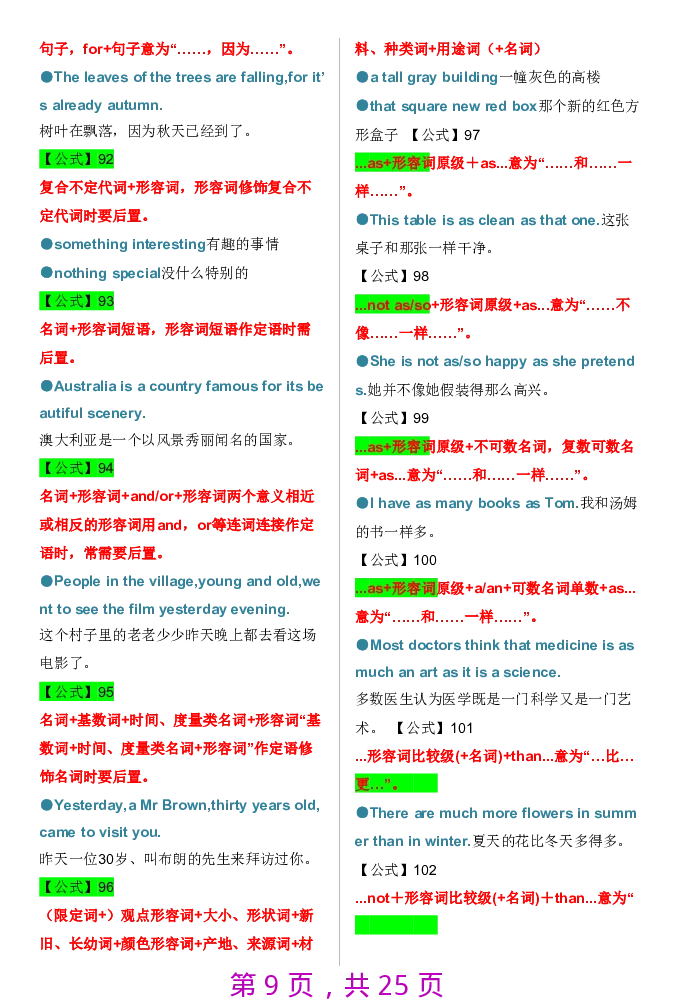
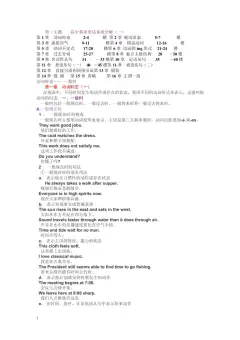
400个英语语法公式
囊括《小学、初中、高中》全部语法
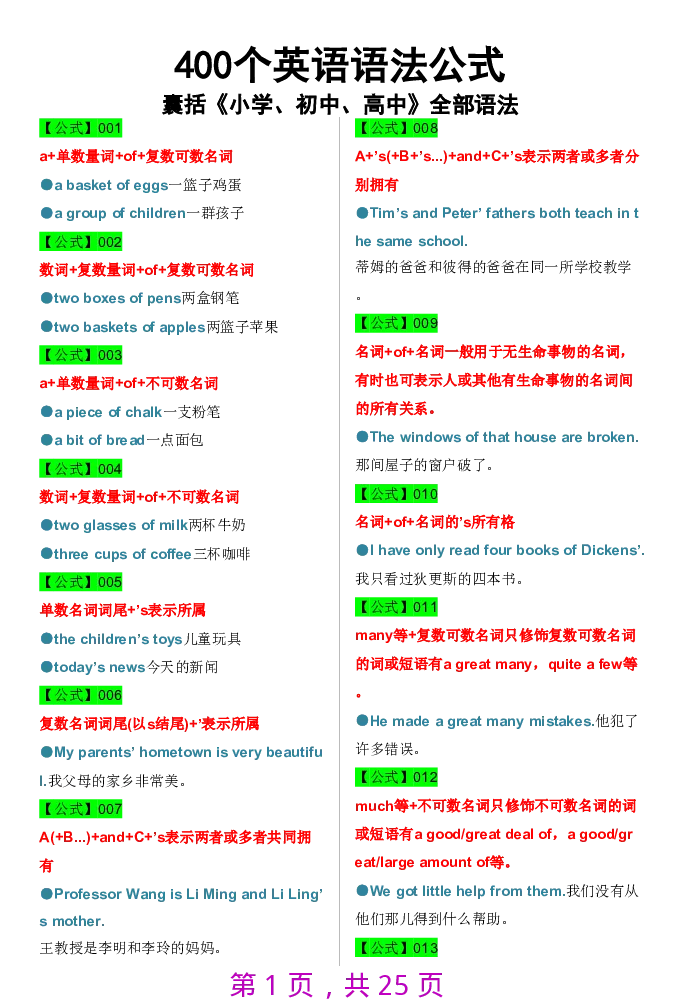
【公式】001
a+单数量词+of+复数可数名词
●a basket of eggs一篮子鸡蛋
●a group of children一群孩子
【公式】002
数词+复数量词+of+复数可数名词
●two boxes of pens两盒钢笔
●two baskets of apples两篮子苹果
【公式】003
a+单数量词+of+不可数名词
●a piece of chalk一支粉笔
●a bit of bread一点面包
【公式】004
数词+复数量词+of+不可数名词
●two glasses of milk两杯牛奶
●three cups of coffee三杯咖啡
【公式】005
单数名词词尾+’s表示所属
●the children’s toys儿童玩具
●today’s news今天的新闻
【公式】006
复数名词词尾(以s结尾)+’表示所属
●My parents’ hometown is very beautifu
l.我父母的家乡非常美。
【公式】007
A(+B...)+and+C+’s表示两者或多者共同拥
有
●Professor Wang is Li Ming and Li Ling’
s mother.
王教授是李明和李玲的妈妈。
【公式】008
A+’s(+B+’s...)+and+C+’s表示两者或多者分
别拥有
●Tim’s and Peter’ fathers both teach in t
he same school.
蒂姆的爸爸和彼得的爸爸在同一所学校教学
。
【公式】009
名词+of+名词一般用于无生命事物的名词,
有时也可表示人或其他有生命事物的名词间
的所有关系。
●The windows of that house are broken.
那间屋子的窗户破了。
【公式】010
名词+of+名词的’s所有格
●I have only read four books of Dickens’.
我只看过狄更斯的四本书。
【公式】011
many等+复数可数名词只修饰复数可数名词
的词或短语有a great many,quite a few等
。
●He made a great many mistakes.他犯了
许多错误。
【公式】012
much等+不可数名词只修饰不可数名词的词
或短语有a good/great deal of,a good/gr
eat/large amount of等。
●We got little help from them.我们没有从
他们那儿得到什么帮助。
【公式】013
第 1 页,共 25 页
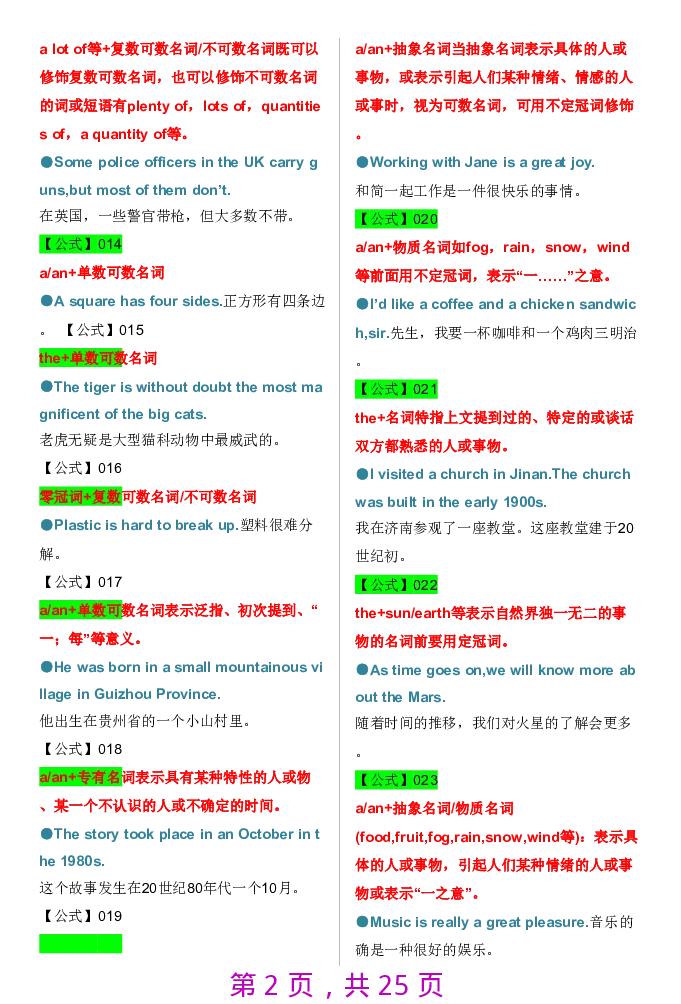
a/an+抽象名词当抽象名词表示具体的人或
事物,或表示引起人们某种情绪、情感的人
或事时,视为可数名词,可用不定冠词修饰
。
●Working with Jane is a great joy.
和简一起工作是一件很快乐的事情。
【公式】020
a/an+物质名词如fog,rain,snow,wind
等前面用不定冠词,表示“一……”之意。
●I’d like a coffee and a chicken sandwic
h,sir.先生,我要一杯咖啡和一个鸡肉三明治
。
【公式】021
the+名词特指上文提到过的、特定的或谈话
双方都熟悉的人或事物。
●I visited a church in Jinan.The church
was built in the early 1900s.
我在济南参观了一座教堂。这座教堂建于20
世纪初。
【公式】022
the+sun/earth等表示自然界独一无二的事
物的名词前要用定冠词。
●As time goes on,we will know more ab
out the Mars.
随着时间的推移,我们对火星的了解会更多
。
【公式】023
a/an+抽象名词/物质名词
(food,fruit,fog,rain,snow,wind等):表示具
体的人或事物,引起人们某种情绪的人或事
物或表示“一之意”。
●Music is really a great pleasure.音乐的
确是一种很好的娱乐。
【公式】019
这个故事发生在20世纪80年代一个10月。
he 1980s.
●The story took place in an October in t
、某一个不认识的人或不确定的时间。
a/an+专有名词表示具有某种特性的人或物
【公式】018
他出生在贵州省的一个小山村里。
llage in Guizhou Province.
●He was born in a small mountainous vi
一;每”等意义。
a/an+单数可数名词表示泛指、初次提到、“
【公式】017
解。
●Plastic is hard to break up.塑料很难分
零冠词+复数可数名词/不可数名词
【公式】016
老虎无疑是大型猫科动物中最威武的。
gnificent of the big cats.
●The tiger is without doubt the most ma
the+单数可数名词
。 【公式】015
●A square has four sides.正方形有四条边
a/an+单数可数名词
【公式】014
在英国,一些警官带枪,但大多数不带。
uns,but most of them don’t.
●Some police officers in the UK carry g
s of,a quantity of等。
的词或短语有plenty of,lots of,quantitie
修饰复数可数名词,也可以修饰不可数名词
a lot of等+复数可数名词/不可数名词既可以
第 2 页,共 25 页
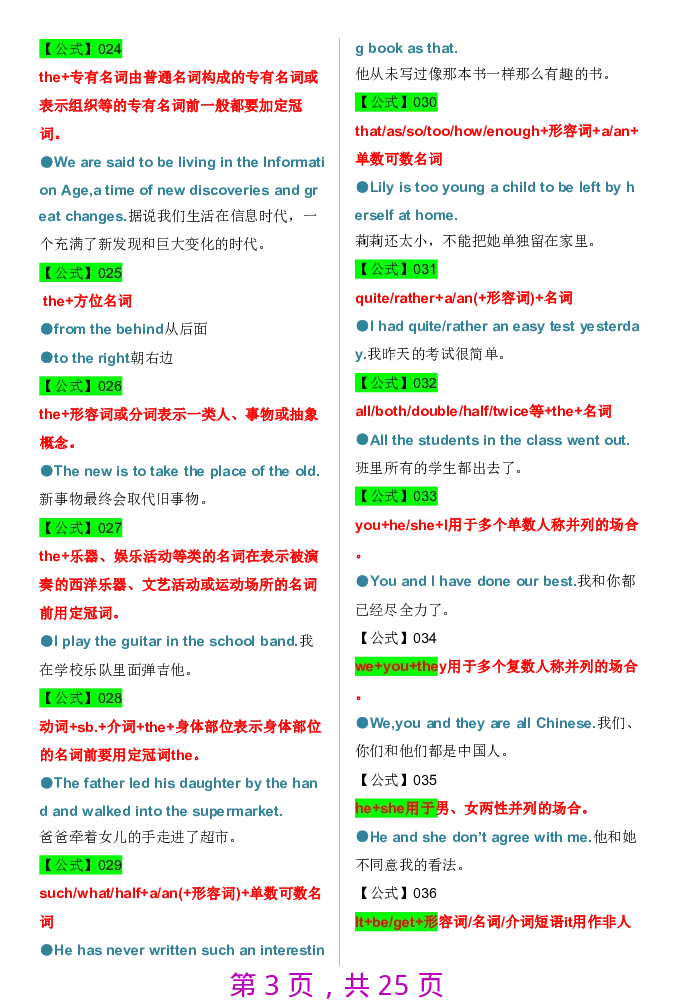
【公式】024
the+专有名词由普通名词构成的专有名词或
表示组织等的专有名词前一般都要加定冠
词。
●We are said to be living in the Informati
on Age,a time of new discoveries and gr
eat changes.据说我们生活在信息时代,一
个充满了新发现和巨大变化的时代。
【公式】025
the+方位名词
●from the behind从后面
●to the right朝右边
【公式】026
the+形容词或分词表示一类人、事物或抽象
概念。
●The new is to take the place of the old.
新事物最终会取代旧事物。
【公式】027
the+乐器、娱乐活动等类的名词在表示被演
奏的西洋乐器、文艺活动或运动场所的名词
前用定冠词。
●I play the guitar in the school band.我
在学校乐队里面弹吉他。
【公式】028
动词+sb.+介词+the+身体部位表示身体部位
的名词前要用定冠词the。
●The father led his daughter by the han
d and walked into the supermarket.
爸爸牵着女儿的手走进了超市。
【公式】029
such/what/half+a/an(+形容词)+单数可数名
词
●He has never written such an interestin
It+be/get+形容词/名词/介词短语it用作非人
【公式】036
不同意我的看法。
●He and she don’t agree with me.他和她
he+she用于男、女两性并列的场合。
【公式】035
你们和他们都是中国人。
●We,you and they are all Chinese.我们、
。
we+you+they用于多个复数人称并列的场合
【公式】034
已经尽全力了。
●You and I have done our best.我和你都
。
you+he/she+I用于多个单数人称并列的场合
【公式】033
班里所有的学生都出去了。
●All the students in the class went out.
all/both/double/half/twice等+the+名词
【公式】032
y.我昨天的考试很简单。
●I had quite/rather an easy test yesterda
quite/rather+a/an(+形容词)+名词
【公式】031
莉莉还太小,不能把她单独留在家里。
erself at home.
●Lily is too young a child to be left by h
单数可数名词
that/as/so/too/how/enough+形容词+a/an+
【公式】030
他从未写过像那本书一样那么有趣的书。
g book as that.
第 3 页,共 25 页
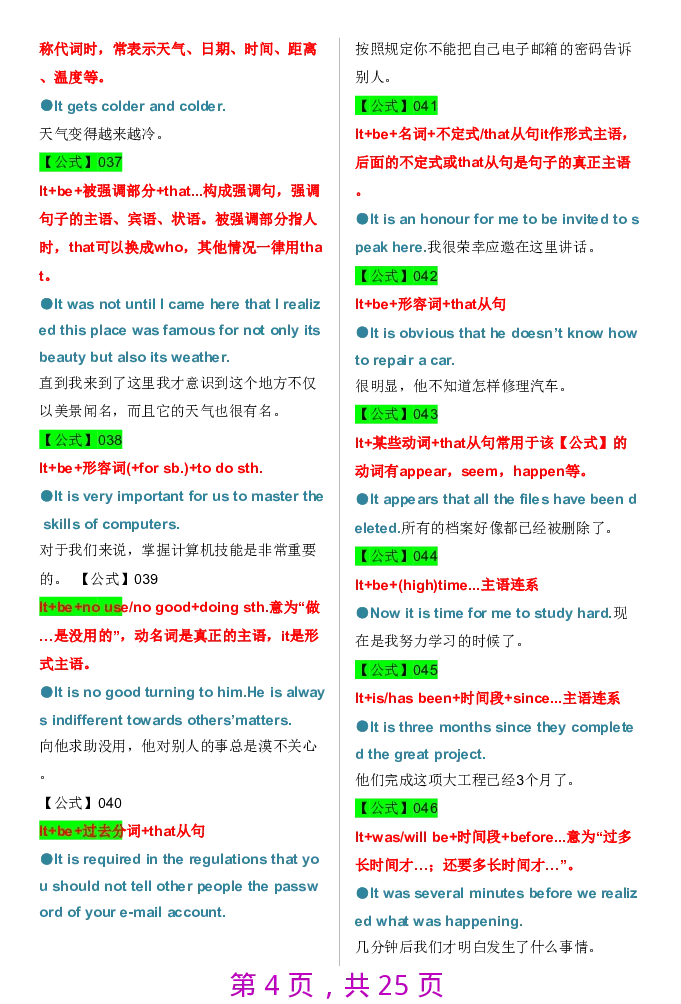
按照规定你不能把自己电子邮箱的密码告诉
别人。
【公式】041
It+be+名词+不定式/that从句it作形式主语,
后面的不定式或that从句是句子的真正主语
。
●It is an honour for me to be invited to s
peak here.我很荣幸应邀在这里讲话。
【公式】042
It+be+形容词+that从句
●It is obvious that he doesn’t know how
to repair a car.
很明显,他不知道怎样修理汽车。
【公式】043
It+某些动词+that从句常用于该【公式】的
动词有appear,seem,happen等。
●It appears that all the files have been d
eleted.所有的档案好像都已经被删除了。
【公式】044
It+be+(high)time...主语连系
●Now it is time for me to study hard.现
在是我努力学习的时候了。
【公式】045
It+is/has been+时间段+since...主语连系
●It is three months since they complete
d the great project.
他们完成这项大工程已经3个月了。
【公式】046
It+was/will be+时间段+before...意为“过多
长时间才…;还要多长时间才…”。
●It was several minutes before we realiz
ed what was happening.
几分钟后我们才明白发生了什么事情。
ord of your e-mail account.
u should not tell other people the passw
●It is required in the regulations that yo
It+be+过去分词+that从句
【公式】040
。
向他求助没用,他对别人的事总是漠不关心
s indifferent towards others’matters.
●It is no good turning to him.He is alway
式主语。
…是没用的”,动名词是真正的主语,it是形
It+be+no use/no good+doing sth.意为“做
的。 【公式】039
对于我们来说,掌握计算机技能是非常重要
skills of computers.
●It is very important for us to master the
It+be+形容词(+for sb.)+to do sth.
【公式】038
以美景闻名,而且它的天气也很有名。
直到我来到了这里我才意识到这个地方不仅
beauty but also its weather.
ed this place was famous for not only its
●It was not until I came here that I realiz
t。
时,that可以换成who,其他情况一律用tha
句子的主语、宾语、状语。被强调部分指人
It+be+被强调部分+that...构成强调句,强调
【公式】037
天气变得越来越冷。
●It gets colder and colder.
、温度等。
称代词时,常表示天气、日期、时间、距离
第 4 页,共 25 页
这些学生中,一些来自北京大学,其余的来
自清华大学。
【公式】052
one...another...(the other...)意为“(三者以
上中的)一个……,(一个……),另一个……”
。
●The old man’s three daughters are all a
broad.One is in the US,another is in Engl
and and the other seems to be in France.
这位老人的三个女儿都在国外。一个在美国
,一个在英国,另外一个好像在法国。
【公式】053
(a)few/many(+复数可数名词)(b)little/much
(+不可数名词)
●I have got a few friends who live nearb
y.我有几个住在附近的朋友。
【公式】054
such+be...be的单复数形式由其后的名词或
代词决定。
●Such were her wishes.这就是她的愿望
。
【公式】055
none(+of+复数可数名词或不可数名词)no
one,none指代指人或物的可数名词或不可
数名词,后面可以跟of结构;no one只能指
代指人的可数名词,后面不能跟of结构。
●None of the people present agreed to t
he plan.在场的没有一个同意这项计划。
【公式】056
基数词+dozen hundred/thousand/million+
复数可数名词意为“……打/百/千/百万……”
。
●There were about six hundred student
ghua University.
g University,and the others are from Tsin
●Of these students,some are from Pekin
的)一些……,其余的……”。
some...,the others...意为“(确定范围中
【公式】051
一些男孩子在踢足球,另外一些在打篮球。
hers are playing basketball.
●Some boys are playing football,and ot
一些……,另一些……”。
some...,others...意为“(不确定范围中的)
【公式】050
。
他有两个儿子。一个是医生,另一个是军人
he other is a soldier.
●He has two sons.One is a doctor and t
,另一个……”
one...,the other...意为“(两者中的)一个……
【公式】049
式度过一生。
世界上只有一种成功,那就是能够用自己的方
n way.
—to be able to spend your life in your ow
●There is only one success in the world
属于自己的……,自己的……”。
名词+of+形容词性物主代词+own意为“完全
【公式】048
我认为邀请她在会上发言是合理的。
speak at the meeting.
●I thought it appropriate to invite her to
主语+谓语动词+it+补足语+真正宾语
【公式】047
第 5 页,共 25 页
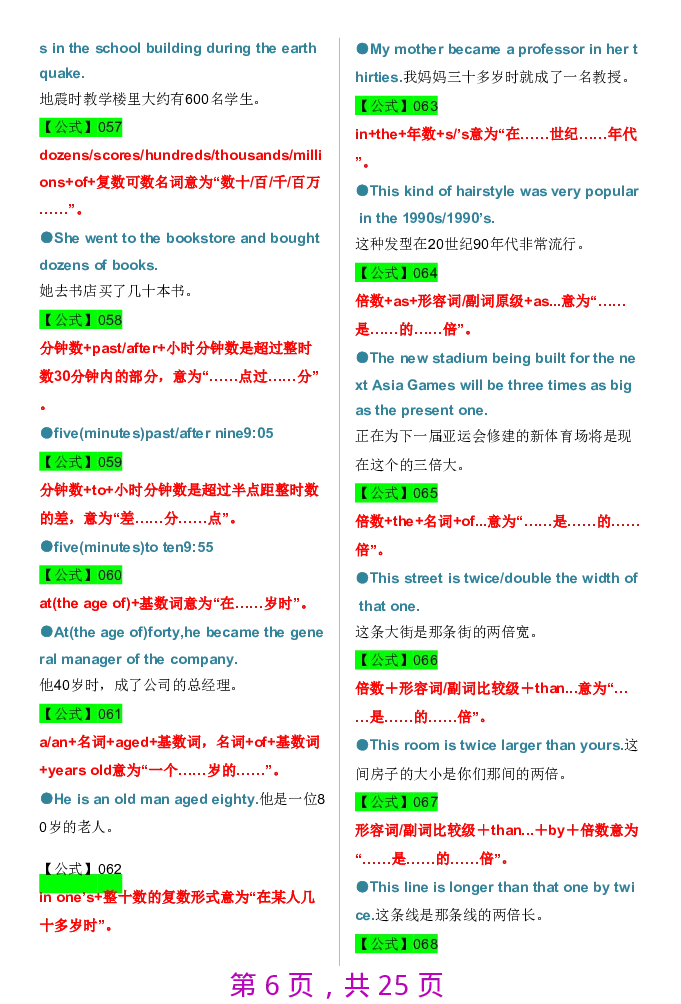
●My mother became a professor in her t
hirties.我妈妈三十多岁时就成了一名教授。
【公式】063
in+the+年数+s/’s意为“在……世纪……年代
”。
●This kind of hairstyle was very popular
in the 1990s/1990’s.
这种发型在20世纪90年代非常流行。
【公式】064
倍数+as+形容词/副词原级+as...意为“……
是……的……倍”。
●The new stadium being built for the ne
xt Asia Games will be three times as big
as the present one.
正在为下一届亚运会修建的新体育场将是现
在这个的三倍大。
【公式】065
倍数+the+名词+of...意为“……是……的……
倍”。
●This street is twice/double the width of
that one.
这条大街是那条街的两倍宽。
【公式】066
倍数+形容词/副词比较级+than...意为“…
…是……的……倍”。
●This room is twice larger than yours.这
间房子的大小是你们那间的两倍。
【公式】067
形容词/副词比较级+than...+by+倍数意为
“……是……的……倍”。
●This line is longer than that one by twi
ce.这条线是那条线的两倍长。
【公式】068
十多岁时”。
in one’s+整十数的复数形式意为“在某人几
【公式】062
0岁的老人。
●He is an old man aged eighty.他是一位8
+years old意为“一个……岁的……”。
a/an+名词+aged+基数词,名词+of+基数词
【公式】061
他40岁时,成了公司的总经理。
ral manager of the company.
●At(the age of)forty,he became the gene
at(the age of)+基数词意为“在……岁时”。
【公式】060
●five(minutes)to ten9:55
的差,意为“差……分……点”。
分钟数+to+小时分钟数是超过半点距整时数
【公式】059
●five(minutes)past/after nine9:05
。
数30分钟内的部分,意为“……点过……分”
分钟数+past/after+小时分钟数是超过整时
【公式】058
她去书店买了几十本书。
dozens of books.
●She went to the bookstore and bought
……”。
ons+of+复数可数名词意为“数十/百/千/百万
dozens/scores/hundreds/thousands/milli
【公式】057
地震时教学楼里大约有600名学生。
quake.
s in the school building during the earth
第 6 页,共 25 页
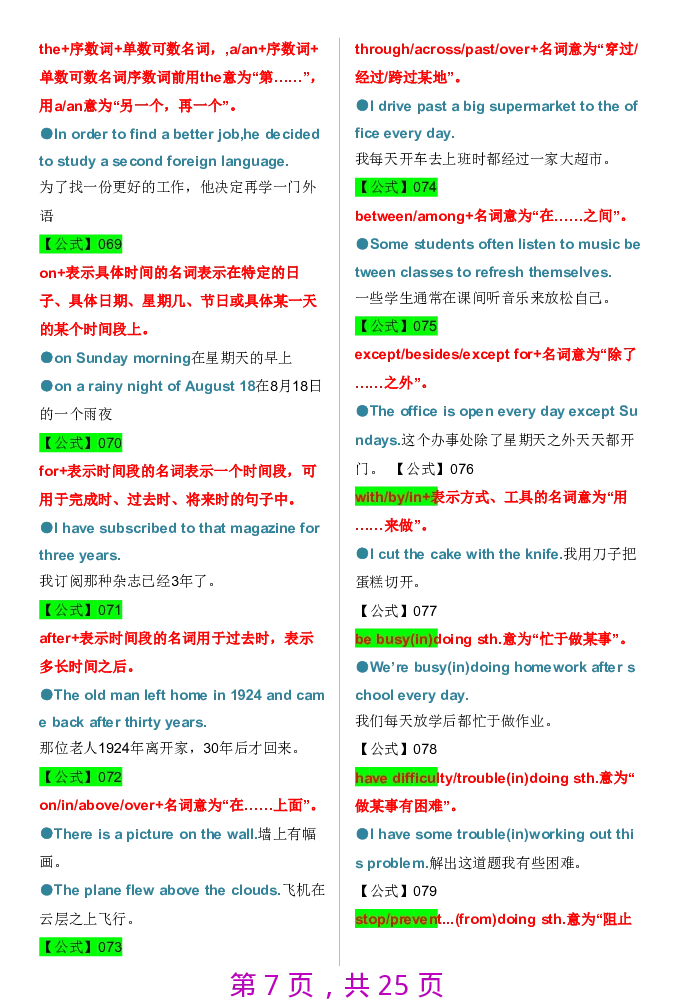
the+序数词+单数可数名词,,a/an+序数词+
单数可数名词序数词前用the意为“第……”,
用a/an意为“另一个,再一个”。
●In order to find a better job,he decided
to study a second foreign language.
为了找一份更好的工作,他决定再学一门外
语
【公式】069
on+表示具体时间的名词表示在特定的日
子、具体日期、星期几、节日或具体某一天
的某个时间段上。
●on Sunday morning在星期天的早上
●on a rainy night of August 18在8月18日
的一个雨夜
【公式】070
for+表示时间段的名词表示一个时间段,可
用于完成时、过去时、将来时的句子中。
●I have subscribed to that magazine for
three years.
我订阅那种杂志已经3年了。
【公式】071
after+表示时间段的名词用于过去时,表示
多长时间之后。
●The old man left home in 1924 and cam
e back after thirty years.
那位老人1924年离开家,30年后才回来。
【公式】072
on/in/above/over+名词意为“在……上面”。
●There is a picture on the wall.墙上有幅
画。
●The plane flew above the clouds.飞机在
云层之上飞行。
【公式】073
stop/prevent...(from)doing sth.意为“阻止
【公式】079
s problem.解出这道题我有些困难。
●I have some trouble(in)working out thi
做某事有困难”。
have difficulty/trouble(in)doing sth.意为“
【公式】078
我们每天放学后都忙于做作业。
chool every day.
●We’re busy(in)doing homework after s
be busy(in)doing sth.意为“忙于做某事”。
【公式】077
蛋糕切开。
●I cut the cake with the knife.我用刀子把
……来做”。
with/by/in+表示方式、工具的名词意为“用
门。 【公式】076
ndays.这个办事处除了星期天之外天天都开
●The office is open every day except Su
……之外”。
except/besides/except for+名词意为“除了
【公式】075
一些学生通常在课间听音乐来放松自己。
tween classes to refresh themselves.
●Some students often listen to music be
between/among+名词意为“在……之间”。
【公式】074
我每天开车去上班时都经过一家大超市。
fice every day.
●I drive past a big supermarket to the of
经过/跨过某地”。
through/across/past/over+名词意为“穿过/
第 7 页,共 25 页
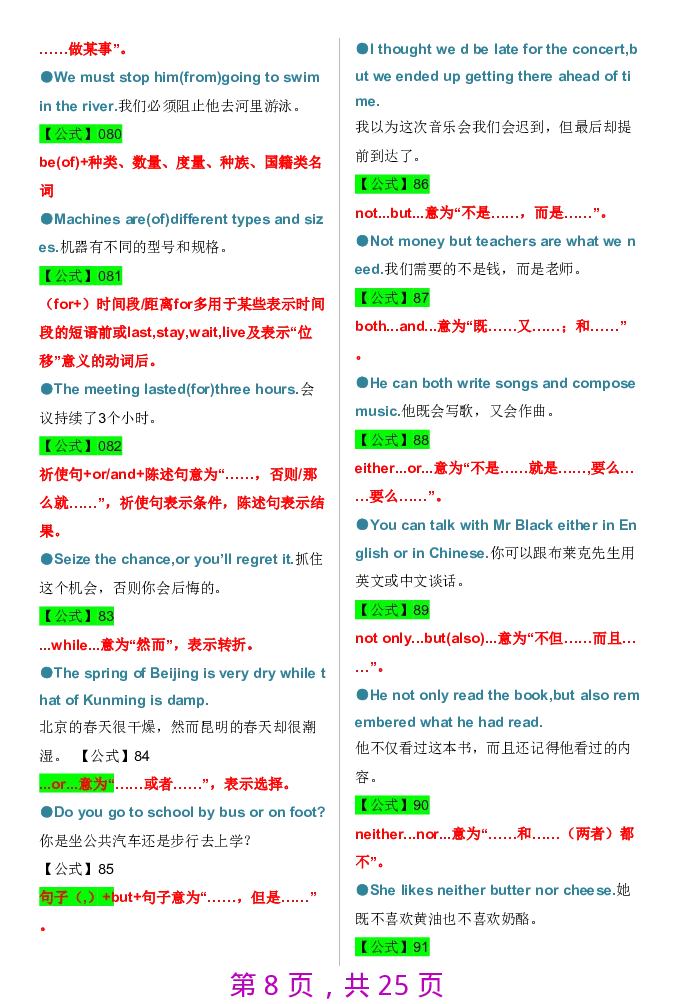
●I thought we d be late for the concert,b
ut we ended up getting there ahead of ti
me.
我以为这次音乐会我们会迟到,但最后却提
前到达了。
【公式】86
not...but...意为“不是……,而是……”。
●Not money but teachers are what we n
eed.我们需要的不是钱,而是老师。
【公式】87
both...and...意为“既……又……;和……”
。
●He can both write songs and compose
music.他既会写歌,又会作曲。
【公式】88
either...or...意为“不是……就是……,要么…
…要么……”。
●You can talk with Mr Black either in En
glish or in Chinese.你可以跟布莱克先生用
英文或中文谈话。
【公式】89
not only...but(also)...意为“不但……而且…
…”。
●He not only read the book,but also rem
embered what he had read.
他不仅看过这本书,而且还记得他看过的内
容。
【公式】90
neither...nor...意为“……和……(两者)都
不”。
●She likes neither butter nor cheese.她
既不喜欢黄油也不喜欢奶酪。
【公式】91
。
句子(,)+but+句子意为“……,但是……”
【公式】85
你是坐公共汽车还是步行去上学?
●Do you go to school by bus or on foot?
...or...意为“……或者……”,表示选择。
湿。 【公式】84
北京的春天很干燥,然而昆明的春天却很潮
hat of Kunming is damp.
●The spring of Beijing is very dry while t
...while...意为“然而”,表示转折。
【公式】83
这个机会,否则你会后悔的。
●Seize the chance,or you’ll regret it.抓住
果。
么就……”,祈使句表示条件,陈述句表示结
祈使句+or/and+陈述句意为“……,否则/那
【公式】082
议持续了3个小时。
●The meeting lasted(for)three hours.会
移”意义的动词后。
段的短语前或last,stay,wait,live及表示“位
(for+)时间段/距离for多用于某些表示时间
【公式】081
es.机器有不同的型号和规格。
●Machines are(of)different types and siz
词
be(of)+种类、数量、度量、种族、国籍类名
【公式】080
in the river.我们必须阻止他去河里游泳。
●We must stop him(from)going to swim
……做某事”。
第 8 页,共 25 页
句子,for+句子意为“……,因为……”。
●The leaves of the trees are falling,for it’
s already autumn.
树叶在飘落,因为秋天已经到了。
【公式】92
复合不定代词+形容词,形容词修饰复合不
定代词时要后置。
●something interesting有趣的事情
●nothing special没什么特别的
【公式】93
名词+形容词短语,形容词短语作定语时需
后置。
●Australia is a country famous for its be
autiful scenery.
澳大利亚是一个以风景秀丽闻名的国家。
【公式】94
名词+形容词+and/or+形容词两个意义相近
或相反的形容词用and,or等连词连接作定
语时,常需要后置。
●People in the village,young and old,we
nt to see the film yesterday evening.
这个村子里的老老少少昨天晚上都去看这场
电影了。
【公式】95
名词+基数词+时间、度量类名词+形容词“基
数词+时间、度量类名词+形容词”作定语修
饰名词时要后置。
●Yesterday,a Mr Brown,thirty years old,
came to visit you.
昨天一位30岁、叫布朗的先生来拜访过你。
【公式】96
(限定词+)观点形容词+大小、形状词+新
旧、长幼词+颜色形容词+产地、来源词+材
形盒子 【公式】97
●that square new red box那个新的红色方
●a tall gray building一幢灰色的高楼
料、种类词+用途词(+名词)
...not+形容词比较级(+名词)+than...意为“
【公式】102
er than in winter.夏天的花比冬天多得多。
●There are much more flowers in summ
更…”。
...形容词比较级(+名词)+than...意为“…比…
术。 【公式】101
多数医生认为医学既是一门科学又是一门艺
much an art as it is a science.
●Most doctors think that medicine is as
意为“……和……一样……”。
...as+形容词原级+a/an+可数名词单数+as...
【公式】100
的书一样多。
●I have as many books as Tom.我和汤姆
词+as...意为“……和……一样……”。
...as+形容词原级+不可数名词,复数可数名
【公式】99
s.她并不像她假装得那么高兴。
●She is not as/so happy as she pretend
像……一样……”。
...not as/so+形容词原级+as...意为“……不
【公式】98
桌子和那张一样干净。
●This table is as clean as that one.这张
样……”。
...as+形容词原级+as...意为“……和……一
第 9 页,共 25 页
…不比…更…;不超过”。
●His French is not better than yours.他
的法语不比你的好。
【公式】103
...no+形容词比较级+than...意为“…和…一
样都不…;仅仅”。
●His French is no better than yours.他的
法语和你的一样差。
【公式】104
...形容词比较级+and+形容词比较级...意为
“越来越…”。
●The computer is cheaper and cheaper.
电脑越来越便宜了。
【公式】105
the+形容词比较级...,the+形容词比较级...
意为“越…,(就)越…”
●The shorter the speech is,the better it i
s.演讲越简短越好。
【公式】106
...表示程度等的词+形容词比较级+than...表
示程度等的词用以说明两者相比时的差距。
●You are an inch taller than him.你比他
高一英寸。
【公式】107
...the+形容词比较级(+one/of the two)...
意为“两者之中较…的一个”。
●—Which one of those two houses woul
d you buy?那两套房子你会买哪一套?
—I would buy the larger one,because I have
a big family.我会买那套大一点的,因为我家
人多。
【公式】108
Which is+形容词比较级,...or...?意为“哪一
个更…,…还是…?ℽ
●Which is cheaper,this computer or that
one?这台电脑和那台电脑哪一台更便宜?
【公式】109
...besenior/junior/superior/inferior to...意
为“……比……大/小/好/差”。
●This photo is inferior to that one.这张照
片比那张差。
【公式】110
...the+形容词最高级(+名词)(+比较范围)意
为“(…中)最…的(…)”。
●Hangzhou Bay Cross-Sea Bridge is the
Long est cross-sea bridge in the world.杭
州湾跨海大桥是世界上最长的跨海大桥。
【公式】111
...one of the+形容词最高级(+名词复数)+范
围意为“最…之一”。
●Jim is one of the cleverest in his class.
吉姆是他班里最聪明的学生之一。
【公式】112
Which/Who is the+形容词最高级,...,...or...?
意为“…,…和…哪一个/谁最…?ℽ
●Which is the most beautiful,rose,jasmi
ne or tulip?玫瑰、茉莉、郁金香三种花哪种
最漂亮?
【公式】113
Nothing/No one/No(other)...+is/was+形容
词比较级+that…表示最高级意义。
●Nothing is more precious than time.没
有比时间更宝贵的东西。
【公式】114
形容词比较级+than any other+单数可数名
第 10 页,共 25 页
词表示最高级意义。
●China is larger than any other country/
all other countries in Asia.中国是亚洲最大
的国家。
【公式】115
否定词+...(+a/an)+形容词比较级+名词...形
容词比较级用于否定句式中表示最高级意义
。
●I haven’t heard a better voice than hers.
我还没有听过比她更好听的嗓音。
【公式】116
...(a/an+)形容词最高级(+名词)...意为“非常
,很”的意思。
●This is a most difficult question to ans
wer.这是一个很难回答的问题。
【公式】117
...as+副词原级+as...意为“…和…一样…”
。
●In ancient times,people rarely travel le
d long
distances and most farmers only travelle
d as far as the local market.在古代,人们
很少进行长途跋涉,大多数农民所到的最远
的地方就是当地市场。
【公式】118
...not...+as/so+副词原级+as...意为“…不如
…”。
●It doesn’t rain as/so often here as it do
es in my country.这里不如我们国家下雨频
繁。
【公式】119
...副词比较级+than...意为“…比…更…”。
●Usually the paperback book is more
widely accepted than the hardcover one.
通常来说,平装书要比精装书更容易被接受
。
【公式】120
...not+副词比较级+than...意为“前者不比后
者更…”(侧重后者)。
●He arrived at the office not earlier than
to day.他今天没有我到办公室早。
【公式】121
...no+副词比较级+than...意为“前者和后者
一样都不…”(侧重前者)。
●Lily speaks Chinese no more fluently t
han
her younger brother.莉莉汉语说得和她弟
弟一样不流利。
【公式】122
...副词比较级+and+副词比较级...意为“越
来越…”。
●With time going on,we are getting on
better and better with each other.随着时
间的流逝,我们之间相处得越来越融洽。
【公式】123
the+副词比较级...,the+副词比较级...意为“
越…,(就)越…”。
●The longer the war lasts,the more the
people there will suffer.战争持续得越久,
那里的人们受苦就越多。
【公式】124
like...better(than...)意为“和…比起来,更喜
欢…”。
●I like movies better than TV plays.比起
电视剧,我更喜欢电影。
【公式】125
第 11 页,共 25 页
...(the+)副词最高级+比较范围...意为“…中
最…”。
●The children loved their day trip,and
they enjoyed the horse ride most.孩子们
很喜欢这次一日游,其中他们最喜欢的活动
是骑马。
【公式】126
...too...to...意为“太…而不…”,to后用动词原
形,表示结果。
●He got up too late to catch the first trai
n.他起床太晚了,没有赶上第一趟火车。
【公式】127
...enough to...意为“…足以…”,to后用动词
原形,表示结果。
●The ice was thick enough to walk on.冰
厚得可以在上面行走。
【公式】128
so+主语+be/助动词/情态动词意为“…确实如
此”,说明对前者观点的赞同。
●—It was very cold yesterday.昨天很冷
。—So it was.确实很冷。
【公式】129
程度副词+状态副词+地点副词+频率副词+时
间副词多个副词同时在句子中作状语时一般
按此顺序排列。
●The man runs slowly along the river at
six every morning.这个男人每天早晨6点钟
沿着河慢跑。
【公式】130
地点副词+时间副词地点副词和时间副词同
时出现时,地点在前、时间在后,可同时在
句末,也可一个在句首一个在句末,但不能
同时在句首。
●They played fairly well there yesterday.
昨天他们在那里玩得很好。
【公式】131
介词形式的副词+其他副词
●You know that I usually get up very
early every day.你知道我经常每天起床很早
。
【公式】132
强调副词+其他副词在强调某一动作的具体
方式、状态、程度时,一般将被强调的副词
置于强调副词之后。
●Very carefully,the doctor examined the
patient’s chest.医生非常仔细地检查了病人
的胸部。
【公式】133
短方式副词+and/but+长方式副词方式副词
短的在前,长的在后,并常用and或but等连
词连接。
●He answered his mother angrily and im
patiently.他生气并且不耐烦地回答了他妈妈
。
【公式】134
主语+谓语+副词表示时间、地点、程度、方
式、频度等的副词在修饰动词时一般位于动
词之后。
●It snowed heavily during the holidays.
Many people had to stay at home instead
of going travelling.放假期间雪下得很大。
许多人没能出去旅游,不得不待在家里。
【公式】135
主语+谓语+宾语+副词如果动词有宾语,副
词一般位于宾语之后。
第 12 页,共 25 页
●I study English very hard.我非常努力地
学习英语。
【公式】136
(be/助动词/情态动词+)频度副词+实义动词表
示频率的副词一般位于实义动词之前,be动
词、助动词或情态动词之后。
●Susan is so careful that she seldom m
akesmistakes in her homework.苏珊很认
真,所以她很少在作业中出错。
【公式】137
程度副词+形容词/副词/介词短语
●The Japanese grammar is quite differe
nt from that of the Chinese grammar.日语
语法与汉语语法有很大的不同。
【公式】138
主语+动词(短语)这类动词(短语)主要是不
及物动词(短语),后面不能直接跟宾语。
●The teachers and the students all laug
hed.老师们和学生们都笑了。
【公式】139
be+现在分词构成进行时态或系表结构。
●The story book is interesting.这本故事
书很有趣。
【公式】140
be+过去分词构成被动语态或系表结构。
●This coastal area was named a nationa
l
wildlife reserve last year.这个沿海地区去
年被命名为全国野生动物保护区。
【公式】141
have/has/had+过去分词构成各种完成时态
。
●It took me a long time before I was able
to fully appreciate what they had done fo
r me.我花了很长时间才完全弄明白他们为我
做的一切。
【公式】142
(...)do/does/did(+not...)+实义动词助动词
do/does/did帮助实义动词构成否定句、疑
问句,或在一般现在时和一般过去时的肯定
句中,置于动词原形前起强调作用。
●He doesn’t do his homework in the eve
ning.他不在晚上做作业。
【公式】143
will/shall/would/should+实义动词助动词wi
ll,shall用于构成一般将来时,would,sho
uld用于构成过去将来时。
●We shall help him to finish the work.我
们要帮助他完成这项工作。
【公式】144
be/look/keep/remain+表语表语说明主语的
状况、性质、特征等
●He always keeps silent at meeting.开会
时他总是保持沉默。
【公式】145
Shall/Will+主语+do...?该句式表示征求他人
的意见,shall用在主语是第一、三人称的问
句中;will用在主语是第二人称的问句中。
●Shall we go for a walk after dinner?晚
饭后咱们出去散散步好吗?
【公式】146
would like...意为“想要……”。
●It’s so cold today.I would like a cup of
hot water.今天太冷了,我想要一杯热水。
【公式】147
would rather do...would rather do...than
第 13 页,共 25 页
do...,would do...rather than do...是常见的
两种变化形式。表示“宁愿…,也不…”。
●To enjoy the scenery,Sally would rathe
r spend long hours on the train than trav
el by air.为了欣赏风景,萨莉旅行时宁愿坐
几个小时的火车也不愿乘飞机。
【公式】148
cannot but do...意为“只好做……”,but后的
不定式要省略to。
●We cannot but admire his determinatio
n.我们不得不佩服他的决心。
【公式】149
can’t help doing.../can’t help but do...意为
“禁不住做……”。
●I can’t help laughing seeing this pictur
e.看到这张照片我禁不住笑了。
【公式】150
cannot/can never...too...意为“再…也不为
过;越…越好”。
●You cannot be too careful to cross the
road.过马路时再怎么小心都不为过。
【公式】151
主语+used to/would+do...意为“过去常常…
”。
●He used to live in a small village,but no
w he has been used to living in the big ci
ty.他以前住在一个小村子里,但是现在他已
经习惯了住在大城市里。
【公式】152
had better(not)do...意为“最好(不)做…”
。
●You had better leave now if you want t
o arrive on time.如果你想准时到达,最好
现在走。
【公式】153
must have done...意为“一定/准是做过……
”,表示对过去情况的推测,只用于肯定句中
。
●She knows the story very well.She mu
st have read the book.她对这个故事很熟悉
,她一定读过这本书。
【公式】154
could(not)have done...表示对过去情况的
推测或与过去事实相反的情况。
●My English-Chinese dictionary has dis
appeared.Who could have taken it?我的
英汉词典不见了,谁可能拿走它了呢?
【公式】155
should(not)have done...表示与过去事实相
反的情况,意为“过去本(不)该做某事”。
●They should have arrived at lunchtime
but their flight was delayed.他们本应该在
午饭时间到达的,但是他们的航班延迟了。
【公式】156
need not have done...表示与过去事实相反
的情况,意为“过去本不必做某事”。
●Mark needn’t have hurried.After drivin
g at top speed,he arrived half an hour ear
ly.马克本没必要那么匆忙。他以最快的速度
开车,结果提前半小时到了。
【公式】157
主语+am/is/are...肯定句
●I am a student.我是一名学生。
【公式】158
主语+am/is/are+not...否定句
●I am not a student.我不是一名学生。
第 14 页,共 25 页
【公式】159
Am/Is/Are+主语...?一般疑问句
●Are you out of work?你们失业了吗?
【公式】160
特殊疑问词+am/is/are+主语...?特殊疑问句(
特殊疑问词作主语或修饰主语时不用倒装语
序)
●Where are you from?你从哪里来?
【公式】161
主语+动词原形/动词的第三人称单数形式...
肯定句
●He enjoys playing computer games aft
er finishing a whole day’s work.完成一整
天的工作后,他喜欢玩电脑游戏。
【公式】162
主语+do/does+not+动词原形...否定句
●I don’t play football very well.我足球踢
得不太好。
【公式】163
Do/Does+主语+动词原形...?一般疑问句
●Do you often go to school by bike?你
经常骑自行车去上学吗?
【公式】164
特殊疑问词+do/does+主语+动词原形...?特
殊疑问句(疑问词作主语或修饰主语时不用倒
装语序)
●Where do they often go in their holiday
s?他们假期都经常去哪里?
【公式】165
主语+am/is/are+现在分词...肯定句
●I am sitting on a rock near the river wit
h my friends.我正和我的朋友们坐在河边的
一块大石块上。
【公式】166
主语+am/is/are+not+现在分词...否定句
●I’m not working in the company now.我
现在不在这家公司上班。
【公式】167
Is/Are+主语+现在分词...?一般疑问句
●Are they playing tennis now?他们现在
正在打网球吗?
【公式】168
特殊疑问词+is/are+主语+现在分词...?特殊
疑问句(特殊疑问词作主语或修饰主语时不
用倒装语序)
●Where is he making speech now?他现
在在哪里演讲呢?
【公式】169
主语+shall/will+动词原形...肯定句(第一人称
可用shall或will,其他人称一般用will)
●They will make a tour in London this s
ummer vacation.今年暑假他们要去伦敦旅
游。
【公式】170
主语+shall/will+not+动词原形...否定句
●He will not participate in the party.他将
不参加派对。
【公式】171
Shall/Will+主语+动词原形...?一般疑问句
●Will he telephone you at six o clock to
night?今晚6点他会给你打电话吗?
【公式】172
特殊疑问词+shall/will+主语+动词原形...?特
殊疑问句(特殊疑问词作主语或修饰主语时不
第 15 页,共 25 页
用倒装语序)
●What will they do to celebrate the Chri
stmas Day?为了庆祝圣诞节他们会做些什么
呢?
【公式】173
主语+am/is/are+现在分词...现在进行时表将
来。
●I am meeting my father at the station at
five o’clock.我5点要去车站接我爸爸。
【公式】174
主语+am/is/are going to+动词原形...
●I am going to attend an important meet
ing this afternoon.我今天下午要参加一个
重要的会
议。
【公式】175
主语+am/is/are to+动词原形...表示计划中约
定的或按职责、义务、要求必须做的事或即
将发生的动作。
●We are to see our English teacher next
Sunday.我们下个星期天要去看我们的英语
老师。
【公式】176
主语+am/is/are about to+动词原形...表示马
上就要发生的事,不强调主观意志。
●Sit down,everyone.The film is about to
start.大家坐好,电影马上就要开始了。
【公式】177
主语+动词原形/动词的第三人称单数形式...
一般现在时表将来。
●The final exam takes place next week.
期末考试下周举行。
【公式】178
主语+have/has+过去分词...肯定句
●His first novel has received good
reviews since it came out last month.他
的第一部小说自上个月出版以来受到了好评
。
【公式】179
主语+have/has+not/never+过去分词...否定
句
●I am calling because we have not recei
ved aresponse.我打电话是因为我们还没收
到回复。
【公式】180
Have/Has+主语+过去分词...?一般疑问句
●Has your brother already done his hom
ework?你弟弟已经做完他的作业了吗?
【公式】181
特殊疑问词+have/has+主语+过去分词...?
特殊疑问句(特殊疑问词作主语或修饰主语时
不用倒装语序)
●How long have you had this nice car?
你买了这辆漂亮的汽车多久了?
【公式】182
主语+was/were...肯定句
●You were absent from school two days
ago.两天前你没到校。
【公式】183
主语+was/were+not...否定句
●Our original plan wasn’t very good.我
们最初的计划不太好。
【公式】184
Was/Were+主语...?一般疑问句
第 16 页,共 25 页
●Was he busy yesterday afternoon?他昨
天下午忙吗?
【公式】185
特殊疑问词+was/were+主语...?特殊疑问句
(特殊疑问词作主语或修饰主语时不用倒装语
序)
●Who was in the office then?那时谁在办
公室?
【公式】186
主语+动词过去式...肯定句
●If you don’t like the drink you ordered,j
ustleave it and try a different one.如果你
不喜欢你点的饮料,把它放在一边,尝试不
同的饮料。
【公式】187
主语+did+not+动词原形...否定句
●We did not have a good time yesterday.
昨天我们玩得不开心。
【公式】188
Did+主语+动词原形...?一般疑问句
●Did he know the secret then?那时他知
道这个秘密吗?
【公式】189
特殊疑问词+did+主语+动词原形...?特殊疑
问句(特殊疑问词作主语或修饰主语时不用倒
装语序)
●When did they go there?他们什么时候
去的那里?
【公式】190
主语+was/were+现在分词...肯定句
●The manager was worried about the pr
ess conference his assistant was giving i
n his
Place but,luckily,everything was going o
n smoothly.经理很担心助理代替他举办的新
闻发布会,但幸运的是,一切都进行得很顺
利。
【公式】191
主语+was/were+not+现在分词...否定句
●We weren’t holding a meeting between
8:00 and9:00 last Sunday morning.上周
日上午8:00至9:00之间我们没在开会。
【公式】192
Was/Were+主语+现在分词...?一般疑问句
●Were they playing football all the
whole afternoon?他们一整个下午都在踢足
球吗?
【公式】193
特殊疑问词+was/were+主语+现在分词...?
特殊疑问句(特殊疑问词作主语或修饰主语时
不用倒装语序)
●What was he doing at the time of the
fire yesterday?昨天起火的时候,他正在做
什么?
【公式】194
主语+would/should+动词原形...肯定句
●They were confident that they would
reach their aim.他们有信心实现他们的目标
。
【公式】195
主语+would/should+not+动词原形...否定句
●They said they would not give up easil
y.他们说他们不会轻易放弃。
【公式】196
主语+had+过去分词...肯定句
●—What a mistake!错了!
第 17 页,共 25 页
—Yes.I had suggested his doing it another
way,but without success.是的,我曾建议他
用另一种方法做,但是没成功。
【公式】197
主语+had+not+过去分词...否定句
●By nine o’clock yesterday evening he
had not got home.昨天,直到晚上9点他还
没到家。
【公式】198
Had+主语+过去分词...?一般疑问句
●Had you received her message before
you left for Beijing?你去北京前收到她的信
息了吗?
【公式】199
特殊疑问词+had+主语+过去分词...?特殊疑
问句(特殊疑问词作主语或修饰主语时不用倒
装语序)
●How long had he studied French by th
e time he was sixteen?到16岁时,他已经
学了多长时间的法语了?
【公式】200
主语+have/has+been+现在分词...肯定句
●I’m sure you will do better in the test b
ecause you have been studying so hard t
his year.我敢肯定你将在这次考试中取得更
好的成绩,因为今年你一直在努力地学习。
【公式】201
主语+have/has+not+been+现在分词...否定
句
●He has not been watching TV all the da
y.他并不是一整天都在看电视。
【公式】202
Have/Has+主语+been+现在分词...?一般疑
问句
●Have you been waiting long for me?你
等我很久了吗?
【公式】203
特殊疑问词+have/has+主语+been+现在分
词...?特殊疑问句(特殊疑问词作主语或修
饰主语时,不用倒装语序)
●Who has been eating my apples?谁一
直在吃我的苹果?
【公式】204
主语+be+过去分词(+by...)...肯定句
●The students were asked to stay in the
classroom because of the storm.因为暴风
雨,学生们被要求待在教室里。
【公式】205
主语+be+not+过去分词(+by...)...否定句
●He was not told when the meeting was
held.没有人告诉他会议什么时间召开。
【公式】206
Be+主语+过去分词(+by...)...?一般疑问句
●—Is this kite made by Li Ming?这个风筝
是李明做的吗?
【公式】207
特殊疑问词+be+主语+过去分词(+by...)...?
特殊疑问句(特殊疑问词作主语或修饰主语时
不用倒装语序)
●What was stolen last night?昨晚什么东
西被偷了?
【公式】208
一般现在时:主语+am/is/are+过去分词(+b
y...)...
●Class meeting is held every Thursday.
第 18 页,共 25 页
每周四都举行班会。
【公式】209
一般过去时:主语+was/were+过去分词(+by..
.)...
●I was offered a better position at IBM.
因为IBM公司给我提供了一个更好的职位。
【公式】210
一般将来时:主语+shall/will+be+过去分词(+
by...)...
●The speech will be given at the lecture
hall this evening.今晚的讲座将在演讲厅举
行。
【公式】211
过去将来时:主语+should/would+be+过去
分词(+by...)...
●They were told that they would be sent
to the army when they finished training.
他们被告知训练结束时他们将被派往部队。
【公式】212
现在进行时:主语+am/is/are+being+过去分
词(+by...)...
●The bridge to it is being repaired.通往
那的桥正在维修当中。
【公式】213
过去进行时:主语+was/were+being+过去分
词(+by...)...
●He was being operated on at that time.
那时他正在接受手术。
【公式】214
现在完成时:主语+has/have+been+过去分
词(+by...)...
●No permission has been given to anyb
ody to enter the building.不允许任何人进
入这栋大楼。
【公式】215
过去完成时:主语+had+been+过去分词(+by..
.)...
●Before he told us,the timetable had be
en
changed.在他告诉我们之前,时间表已经改
了。
【公式】216
主语+情态动词+be+过去分词(+by...)...肯定
句
●I think aliens might be found in space.
我认为太空中或许能找到外星人。
【公式】217
主语+情态动词+not+be+过去分词(+by...)...
否定句
●Such mistakes can’t be made again.这
种错误不能再犯了。
【公式】218
情态动词+主语+be+过去分词(+by...)...?一
般疑问句
●Must these young trees be watered eve
ry day?必须每天给这些小树浇水吗?
【公式】219
特殊疑问词+情态动词+主语+be+过去分词(
+by...)...?特殊疑问句(特殊疑问词作主语或
修饰主语时不用倒装语序)
●Where can the book be bought?这本书
在什么地方能买到?
【公式】220
“主语+谓语+宾语”结构变被动语态:
主语(原宾语)+be+过去分词+by+宾语(原主
语的宾格)
第 19 页,共 25 页
●They are cleaning the house.→The hou
se is being cleaned(by them).他们正在打
扫房子。
【公式】221
“主语+谓语+宾语”结构变被动语态:
a.主语(原间接宾语)+be+过去分词+宾语(原
直接宾语)(+by...)
●My aunt gave me an apple.→I was give
n an apple(by my aunt).
b.主语(原直接宾语)+be+过去分词+to/for+宾
语(原间接宾语)(+by...)
●An apple was given to me(by my aunt).
姑姑给了我一个苹果。
【公式】222
“主语+谓语+宾语+补足语”结构变被动语态:
主语(原宾语)+be+过去分词+补足语(原宾语
补足语)(+by...)
●He made the baby laugh.→The baby
was made to laugh(by him).那个婴儿被(他)
逗笑了。
【公式】223
短语动词的被动语态形式:
主语+be+短语动词的过去分词(+by...)
●We have sent for a doctor.→A doctor h
as been sent for(by us).(我们)已经派人去
请医生了。
【公式】224
主动形式表示被动意义:主语+系动词+表语
●These oranges taste nice.这些橘子尝起
来不错。
【公式】225
need/want/require doing...作“需要”讲的ne
ed,want,require等后的动名词的主动形
式表示被动意义,相当于不定式的被动式。
●The flowers want watering.这些花需要
浇水。
【公式】226
形容词+不定式的主动形式
●What life will be like in the future is diff
icult
to predict.未来生活是什么样子,这很难预
测。
【公式】227
get+过去分词...此结构是一种被动形式,get
与be一样起助动词作用,一般用来谈论突然
发生的动作。
●Be careful not to get burnt by the sun.
小心不要被太阳晒伤。
【公式】228
To do...+be+形容词/名词...不定式作主语常
指具体的、将要发生的动作。
●To help the poor is his duty.帮助穷人是
他的责任。
不定式作主语时常用it作形式主语,而把不定
式置于句末。(=It is his duty to help the poor.
)
【公式】229
Sb./Sth.+be+to do...不定式作表语可以表示
主语的具体内容、目的等,一般是将要发生
的动作。
●My goal is to be a great writer.我的目标
是成为一名优秀的作家。
【公式】230
主语+及物动词+to do...不定式作宾语
●They determined to start early.他们决定
早点出发。
第 20 页,共 25 页
【公式】231
主语+及物动词+what/when/how...+to do...
●He can tell you where to get the book.
他可以告诉你从哪里得到这本书。
【公式】232
主语+及物动词+宾语+to do...带to的不定式
作宾语补足语
●We advised him to buy the cheaper co
mputer.我们劝他买那一台比较便宜的电脑
。
【公式】233
名词/代词+to do...不定式作定语
●The last one to arrive pays the meal.最
后到的人买单。
【公式】234
(not)+to do...in order(not)+to do...
so as(not)+to do...不定式作目的状语
●In order not to be late,she cut across t
he fields.为了不迟到,她抄近路穿过了田野
。
【公式】235
so+形容词/副词+as+to do...
too+形容词/副词+to do...
形容词/副词+enough+to do...不定式作结果
状语
●The box is too heavy to carry.这个箱子
太重了搬不动。
●The book is cheap enough to buy.这本
书很便宜可以买。
【公式】234
感官动词/使役动词+宾语+省略to的不定式
●They heard him sing a song in the
meeting room.他们听见他在会议室唱了一
首歌。
【公式】235
Doing+be+名词/形容词...动名词作主语表示
一般性、抽象性的行为
●Getting up early is a good habit.早起是
个好习惯。
动名词作主语有时可用it作形式主语。这种用
法常见于It is/was no use/good doing sth.或It
is/was useful/useless doing sth.句式中。
●It is no use talking to the man like him.
和他那样的人交谈没用。
【公式】236
主语+be+doing...动名词作表语,说明主语
的内容
●Seeing is believing.(=To see is to belie
ve.)眼见为实。
【公式】237
主语+及物动词+doing...动名词作宾语。
●I insist on leaving him alone at home.
我坚持把他一个人留在家里。
【公式】238
stop doing...停止原有的动作
●To protect the environment,most
supermarket sin China stopped providin
g free plastic bags.为了保护环境,中国的
大部分超市不再免费提供塑料袋。
【公式】239
stop to do...停下来去做另一件事
●Let’s stop to begin our class.我们停下
来开始上课吧。
【公式】240
forget/remember doing...忘记/记得做过
●He forgot telling her about the final exa
第 21 页,共 25 页
m.他不记得已告诉过她关于期末考试的事了
。
【公式】241
forget/remember to do...忘记/记得要做
●Don’t forget to send me a message wh
en you get home.到家后,不要忘记给我发
信息。
【公式】242
mean doing...意味着做……
●My new job will mean travelling all ove
r the world.我的新工作需要在世界各地到处
跑。
【公式】243
mean to do...打算做……
●I didn’t mean to upset you.我并不是要
让你不高兴。
【公式】244
regret doing...后悔以前曾做过……
How often I have regretted not taking his
advice!我经常后悔没听从他的建议!
【公式】245
regret to do...很遗憾要做……
●I regret to inform you that your contrac
t will not be renewed.我很遗憾地通知你,
你的合同不予续签。
【公式】246
try doing...试着做……
●Susan wanted to be independent of he
r parents.She tried living alone,but she di
dn’t like it and moved back home.苏珊不
想再依赖父母,她尝试着一个人生活,但并
不喜欢这样,于是又搬回家了。
【公式】247
try to do...努力去做……
●He tried to stand up,but failed.他试图站
起来,但没有成功。
【公式】248
mean to do表示“打算做……”
●I mean to go,but my father would not al
low me to.我想去,但是我父亲不肯让我去
。
【公式】249
mean doing表示“意味着做……”
●Doing that means wasting time.那样做
意味着浪费时间。
【公式】250
go on to do表示“继续做……(非同一件事
)ℽ
●He went on to speak of his war experie
nces.他转而谈到了他的战争经历。
【公式】251
go on doing表示“继续做……(同一件事)
”。
●Go on doing the other exercise after yo
u have finished this one.做完这个练习后
,接着做其他的练习。
【公式】252
祈使句:Be/动词原形+其他主语一般是第二
人称you,但往往省略。
●Be here on time next time,or you’ll be
punished.下次按时到,否则你将会受到惩
罚。
【公式】253
祈使句:Let+第一、三人称代词+动词原形+
其他
第 22 页,共 25 页
●Let me tell you the answer.让我告诉你
答案。
【公式】254
Don’t/Never+动词原形+其他祈使句的否定
式
●Don’t let the water run into the room.不
要让水流进屋里。
【公式】255
一般疑问句:Be动词/助动词/情态动词+主语
+其他?
●Are you Lily’s new classmates?你们是
莉莉的新同学吗?
一般疑问句常用yes/no来回答,但在具体语
境中也可用其他表示肯定或否定的词或短
语,如certainly,surely,of course,I think so,all
right,not at all,never,sorry,not yet,I’m afraid
not等来回答。
【公式】256
特殊疑问句:特殊疑问词+be动词/助动词/情
态动词+主语+其他?特殊疑问词作主语或修
饰主语时不用倒装语序。
●How long has Bob been collecting sta
mps?鲍勃收集邮票多长时间了?
【公式】257
选择疑问句:一般疑问句/特殊疑问句,供选
择项+or+供选择项?
●Did you put the book in the box or on t
he shelf?你把书放在箱子里了还是放在书架
上了?
【公式】258
反意疑问句:(陈述部分)肯定,(附加问句
)否定?
●I told them not everybody could run as
fast as you did,didn’t I?我告诉他们不是每
个人都像你跑得那么快的,不是吗?(重庆)
【公式】259
反意疑问句:(陈述部分)否定,(附加问句
)肯定?
●—She can’t swim,can she?她不会游泳
,对吗?
—Yes,she can.不,她会。/No,she can’t.是
的,她不会。
【公式】260
反意疑问句:No one/Nobody...+谓语...,
谓语+they/he?
陈述部分主语为指人的不定代词,强调整体
时,附加问句的主语用they;强调个体时,
附加问句的主语用he。
●No one was there that day,was he/were
they?那天没有人在那里,是吗?
【公式】261
反意疑问句:Everything/Anything...+谓语..
.,谓语+it?
陈述部分主语是指物的不定代词时,附加问
句的主语用it。
●Everything that he said is true,isn’t it?
他说的都是真的,是吗?
【公式】262
反意疑问句:This/That+谓语...,谓语+it?
陈述部分的主语是指示代词时,附加问句的
主语要用相应的人称代词。
●That’s a wonder,isn’t it?那是一个奇迹,
不是吗?
【公式】263
反意疑问句:These/Those+谓语...,谓语+t
第 23 页,共 25 页
hey?
陈述部分的主语是指示代词时,附加问句的
主语要用相应的人称代词。
●Those are yours,aren’t they?那些是你
的,是不是?
【公式】264
反意疑问句:There be...,谓语+there?
陈述部分为There be句式时,其反意疑问句
的附加问句仍用“...there”。
●There is a wonderful power in steam,
isn’t there?水蒸气有一种惊人的力量,是吗
?
【公式】265
反意疑问句:祈使句,will you/won’t you?
肯定祈使句的反意疑问句,附加问句用will y
ou,won’t you均可;
否定祈使句只能用will you。
●Come and play football with us,will
you/won’t you?过来和我们一起踢足球,好
吗?
●Don’t play Ping Pong in the classroom,
will you?不要在教室里打乒乓球,好吗?
【公式】266
反意疑问句:Let’s...,shall we?Let us/Let
me...,will you?
●Let’s have lunch together,shall we?我
们一起吃午饭吧,好吗?
●Let us solve the problem in private,will
you?我们私下里解决这个问题吧,好吗?
【公式】267
反意疑问句:(陈述部分)主从复合句,附加
问句(主语、谓语与主句一致)?
●It’s the first time that he has been to A
ustralia,isn’t it?这是他第一次去澳大利亚,
是吗?
【公式】268
I don’t think/suppose/expect/imagine/beli
eve等+宾语从句,肯定的附加问句(主语、
谓语与从句一致)?
●I don’t think he will come,will he?我认
为他不会来,对吗?
【公式】269
what引导的感叹句:What(+a/an)+形容词+
名词+(主语+谓语)!
●What a foolish mistake I have made!我
犯了一个多么愚蠢的错误啊!
【公式】270
how引导的感叹句:How+形容词/副词(+
主语+谓语)!
●Look at the picture.How beautiful Sany
a is!I’ll go there this summer holiday.看这
幅照片,三亚真漂亮啊!今年暑假我要去那
里。
【公式】271
How+主语+谓语!
●How time flies!时间过得真快啊!
【公式】272
S+vi.:主语+不及物动词(短语)
●Birds can fly.鸟会飞。
【公式】273
S+vt.+O:主语+及物动词(短语)+宾语
●I put the newspapers on the table.我把
报纸放在了桌上。
【公式】273
S+link.v.+P:主语+系动词+表语
●These flowers are very beautiful.这些花
第 24 页,共 25 页
非常漂亮。
【公式】274
S+vt.+Oi+Od:主语+及物动词+间接宾语+
直接宾语
●My parents bought me a nice
Christmas present.我父母给我买了一件精
美的圣诞礼物。
【公式】275
S+vt.+O+C:主语+及物动词+宾语+宾语补
足语
●They painted the door red.他们把门漆成
了红色。
【公式】276
并列句:简单句+and等+简单句表示并列关
系,常用连词and,notonly...but also...等。
●Falling in love is one thing and getting
married is another.恋爱是一回事,结婚是
另一回事。
【公式】277
并列举:简单句+or等+简单句表示选择关系
,常用连词or,either...or...等。
●Shall we go out to the cinema or stay a
t home?我们是出去看电影还是待在家里?
【公式】278
并列举:简单句+but等+简单句表示转折关
系,常用连词but,yet,while等。
●He has a lot of money but he does not
have many friends.他有很多钱但是没有多
少朋友。
【公式】279
并列举:简单句+for/so等+简单句表示因果
关系。
●Our cases were heavy,so we took a tax
i.我们的箱子很重,因此我们坐的出租车。
【公式】280
主语从句:引导词+主语从句+谓语...
●Whether she will join us does not matt
er too much.她是否会加入到我们中来并不
太重要。
【公式】281
主语从句:It(形式主语)+谓语...+引导词+主
语从句
●It is a pity that you missed such a goo
d lecture.你错过了一场这么好的讲座真是可
惜。
引导词可以是连词that,whether等,也可以是
连接代词what,who,which或连接副词when,w
here,how等。
【公式】282
that引导的宾语从句:主句+that引导的宾语
从句
●I thought that 13 May would be the dat
e of the election.我以为5月13日是选举的日
子。
【公式】283
that引导的宾语从句:主语+系动词
+afraid/sorry/sure/glad/angry等+that引导
的宾语从句
●I am afraid that you can’t take photos h
ere.恐怕你不能在这里拍照。
【公式】284
主句+what/who/whom/whose/which等引
导的宾语从句what,who,whom,whose,whi
ch等连接代词在从句中作主语、宾语、表语
第 25 页,共 25 页