高中英语语法详解(讲义)chapter 11 虚拟语气
■

一、语气
■

二、条件句的种类
■

三、虚拟条件句
■

四、错综时间条件句
■

五、含蓄条件句
■

六、含蓄结果句
■

七、虚拟条件句的其他表示法
■

八、虚拟语气在一些从句中的应用
一、语气
用动词的形式变化来表示说话人对谓语动词所叙述的一项行为或
一件事情的态度或看法,叫作语气。
(一)陈述语气
陈述的事实可以是肯定的、否定的、也可以是疑问的。英语大多
数句子都是用陈述语气。
Knowledge itself is power. (Francis Bacon)(肯定)知识本身就是
力量。
The days of his youth appeared like dreams before him. (John
Ruskin)青春的岁月如梦幻般浮现在他的眼前。
A man in love is easily deceived.(Aesop)恋爱中的人容易受骗。
He ought not to have said that.(否定)他不应该说那种话。
I can't help myself.(W.S.Maugham)我已经身不由己了。
He did not answer for a minute.他没有立刻回答。
Has ever such a thing happened in the world?(疑问)世界上有这
样的事吗?
Will he have his own way?他坚持要一意孤行吗?
(二)祈使语气
提出请求、命令、劝告、给予指示等。(祈使语气所表示的事情
在说话时还没有实现,但说话人正是用这种语气促使这些事情实现
的。)祈使语气由动词原形构成。
Be quick, for goodness sake!(第二人称)求求你,快点!
Don't you forget it!不要忘记这件事!
Come back, my early days! Come back! (John Ruskin)(第三人称)
回来吧,我那逝去的年华!回来吧!
Let her stand half an hour longer on that stool.让她在那凳子上再站
半个钟头。
Do let's go to the theatre.(第一人称)咱们去看戏吧。
Let me have another go.让我再试一次。
Come in, and let us sit on the bench.(第一、二人称)进来吧,我
们坐在板凳上。
(三)虚拟语气
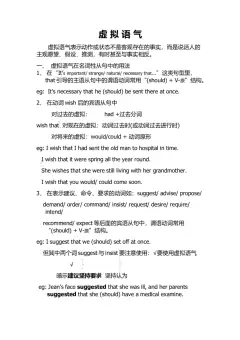
当要表示与实际情况不符(与现实相反)的假设、猜测或者无十
分把握实现的愿望、建议时,句子的谓语动词往往用一种特殊的表
达形式,即虚拟语气的形式。多用在条件句中(包括带条件从句的
复合句和带条件状语的简单句)。
If I were you, I would not go there.(现在式)如果我是你,就不会
去那里了。【事实上我不可能是你,我已经去了那里了。】
If it were not for hopes, the heart would break.(Thomas Fuller)假
如没有希望,心灵就会破碎。
Supposing I accepted this offer, what would you say?要是我接受这
个建议,你会有什么意见?
If the sea were to rise 500 feet, India would become an island.(将来
式)如果海洋升高500 英尺,印度会成为一个岛。
If I had seen him yesterday, I would have asked him about it.(过去
式)如果昨天我见到了他,我会问及他此事了。
二、条件句的种类
条件句根据客观事实,分两类:
(一)真实条件句
如果假设的情况是有可能发生的,就是真实条件句。这种条件
句中的谓语,都用陈述语气。例如:
If I have time, I shall go to see you.如果我有时间,我会去看你
的。
If you push yourself into his life, you'll ruin everything.如果你硬要
插足他的生活,你会毁灭一切的。
Don't hesitate if you want to see me, or just to talk.你如果想见我,
或者只是想聊聊天,千万别犹豫。
If he places stress on reading, he is right.如果他重视阅读,那他是
对的。
If we can't do as we would, we must do as we can.如果我们不能如
愿以偿,也应该尽力而为。
If a man's life was useful, they considered that he had a right to enjoy
it; but if his life brought harm to his fellow men, he must die.如果一个人
的生命是有益的,他们就认为他有权利享受它;如果他活着危及同
伴,那么他就得去死。
(二)虚拟条件句
如果纯粹是假设或是发生的可能性不大的情况,则是虚拟条件
句。虚拟条件句中,谓语要用虚拟语气。
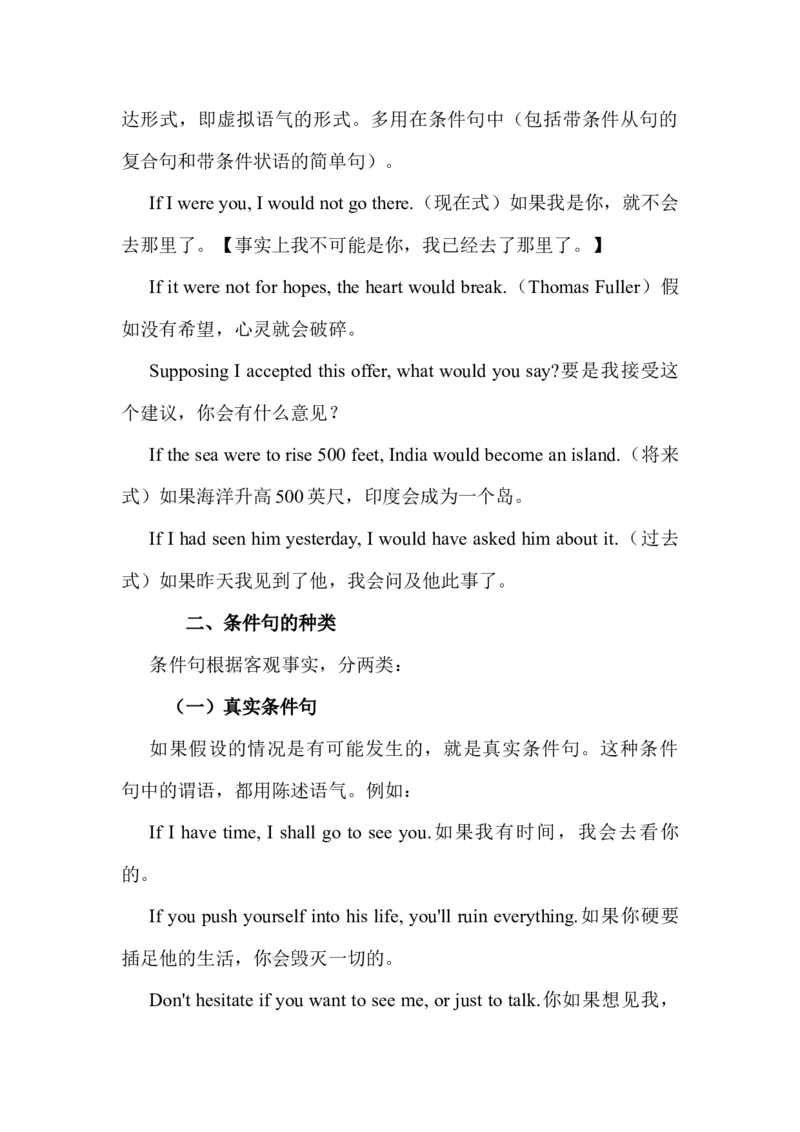
三、虚拟条件句
主要有下面两类:

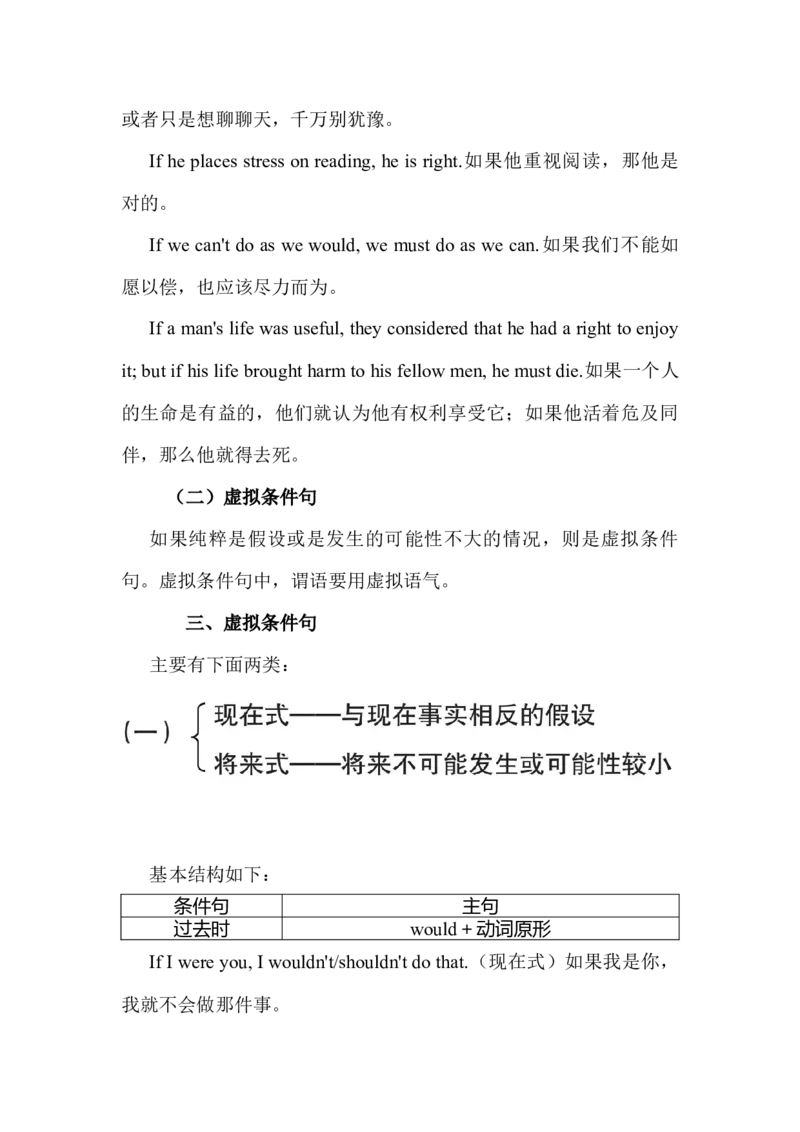
基本结构如下:
条件句
主句
过去时
would+动词原形
If I were you, I wouldn't/shouldn't do that.(现在式)如果我是你,
我就不会做那件事。
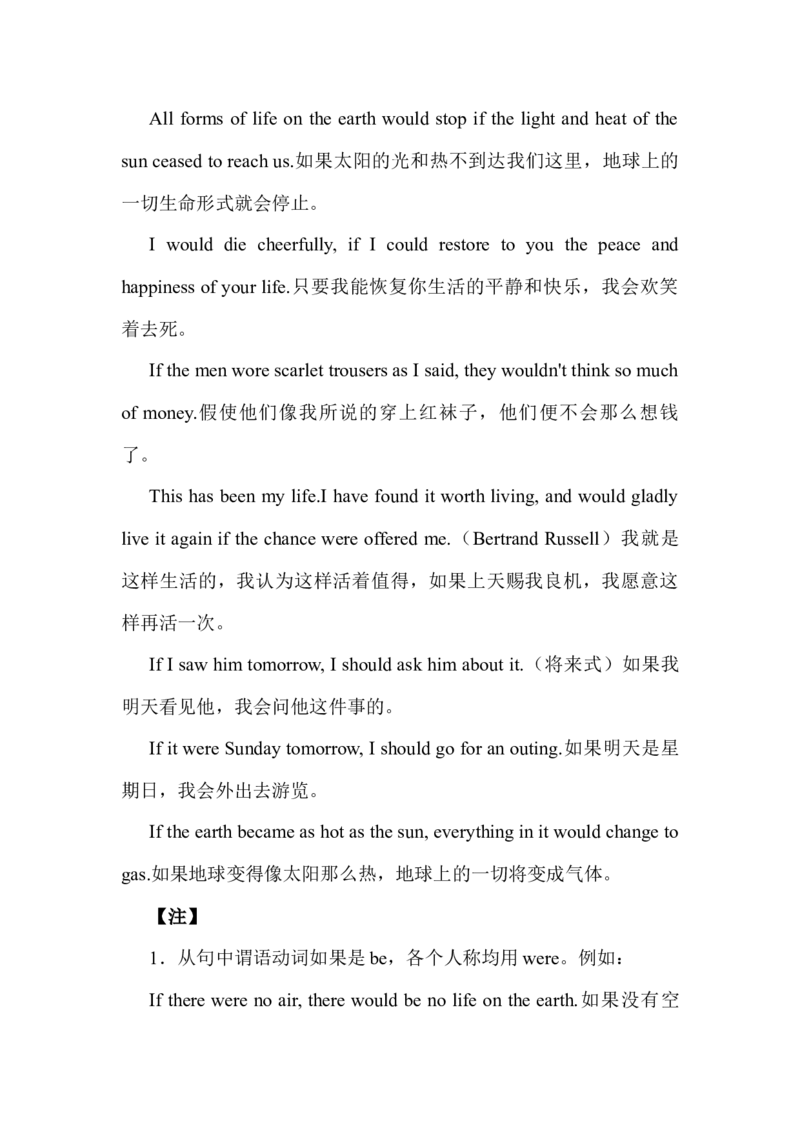
All forms of life on the earth would stop if the light and heat of the
sun ceased to reach us.如果太阳的光和热不到达我们这里,地球上的
一切生命形式就会停止。
I would die cheerfully, if I could restore to you the peace and
happiness of your life.只要我能恢复你生活的平静和快乐,我会欢笑
着去死。
If the men wore scarlet trousers as I said, they wouldn't think so much
of money.假使他们像我所说的穿上红袜子,他们便不会那么想钱
了。
This has been my life.I have found it worth living, and would gladly
live it again if the chance were offered me.(Bertrand Russell)我就是
这样生活的,我认为这样活着值得,如果上天赐我良机,我愿意这
样再活一次。
If I saw him tomorrow, I should ask him about it.(将来式)如果我
明天看见他,我会问他这件事的。
If it were Sunday tomorrow, I should go for an outing.如果明天是星
期日,我会外出去游览。
If the earth became as hot as the sun, everything in it would change to
gas.如果地球变得像太阳那么热,地球上的一切将变成气体。
【注】
1.从句中谓语动词如果是be,各个人称均用were。例如:
If there were no air, there would be no life on the earth.如果没有空
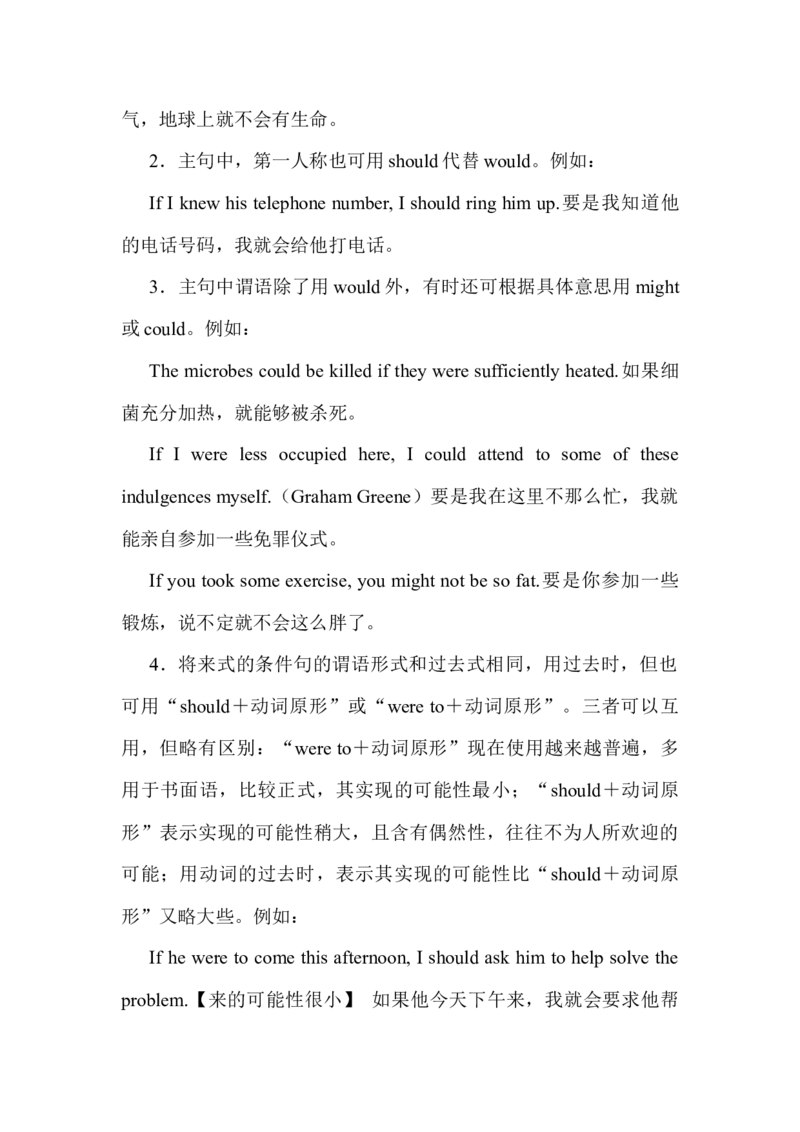
气,地球上就不会有生命。
2.主句中,第一人称也可用should 代替would。例如:
If I knew his telephone number, I should ring him up.要是我知道他
的电话号码,我就会给他打电话。
3.主句中谓语除了用would 外,有时还可根据具体意思用might
或could。例如:
The microbes could be killed if they were sufficiently heated.如果细
菌充分加热,就能够被杀死。
If I were less occupied here, I could attend to some of these
indulgences myself.(Graham Greene)要是我在这里不那么忙,我就
能亲自参加一些免罪仪式。
If you took some exercise, you might not be so fat.要是你参加一些
锻炼,说不定就不会这么胖了。
4.将来式的条件句的谓语形式和过去式相同,用过去时,但也
可用“should+动词原形”或“were to+动词原形”。三者可以互
用,但略有区别:“were to+动词原形”现在使用越来越普遍,多
用于书面语,比较正式,其实现的可能性最小;“should+动词原
形”表示实现的可能性稍大,且含有偶然性,往往不为人所欢迎的
可能;用动词的过去时,表示其实现的可能性比“should+动词原
形”又略大些。例如:
If he were to come this afternoon, I should ask him to help solve the
problem.【来的可能性很小】 如果他今天下午来,我就会要求他帮
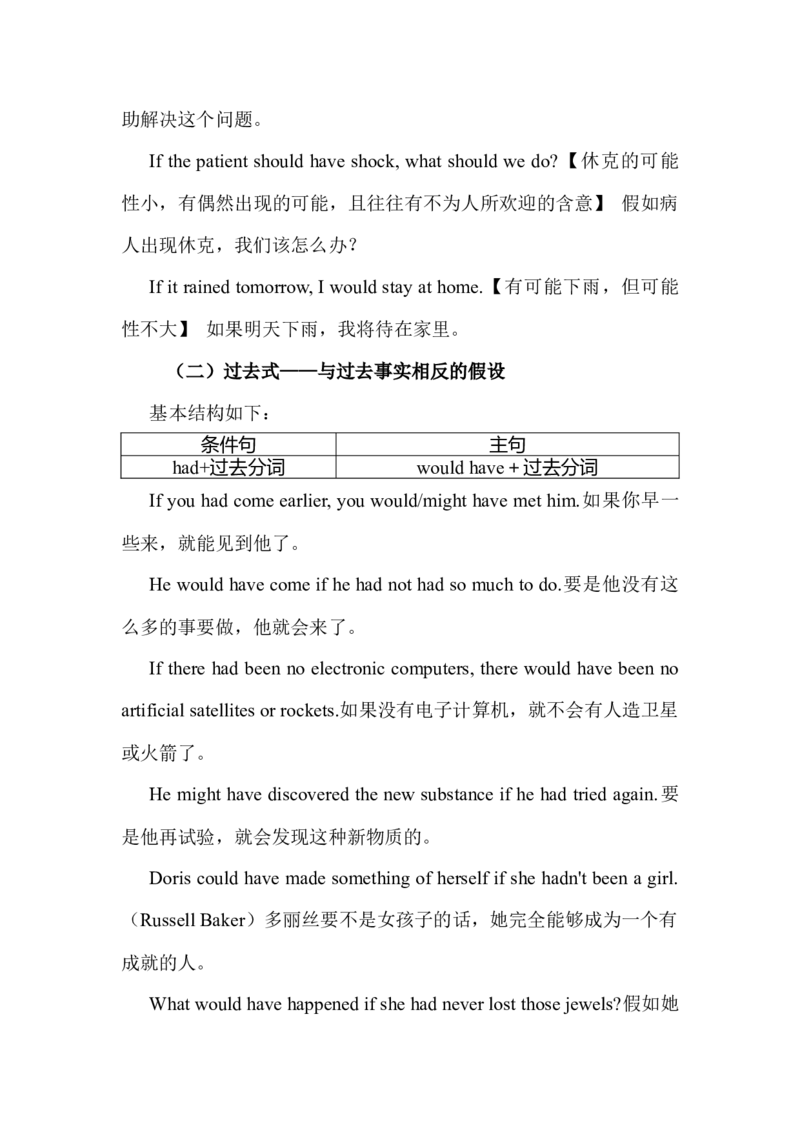
助解决这个问题。
If the patient should have shock, what should we do?【休克的可能
性小,有偶然出现的可能,且往往有不为人所欢迎的含意】 假如病
人出现休克,我们该怎么办?
If it rained tomorrow, I would stay at home.【有可能下雨,但可能
性不大】 如果明天下雨,我将待在家里。
(二)过去式——与过去事实相反的假设
基本结构如下:
条件句
主句
had+过去分词
would have+过去分词
If you had come earlier, you would/might have met him.如果你早一
些来,就能见到他了。
He would have come if he had not had so much to do.要是他没有这
么多的事要做,他就会来了。
If there had been no electronic computers, there would have been no
artificial satellites or rockets.如果没有电子计算机,就不会有人造卫星
或火箭了。
He might have discovered the new substance if he had tried again.要
是他再试验,就会发现这种新物质的。
Doris could have made something of herself if she hadn't been a girl.
(Russell Baker)多丽丝要不是女孩子的话,她完全能够成为一个有
成就的人。
What would have happened if she had never lost those jewels?假如她
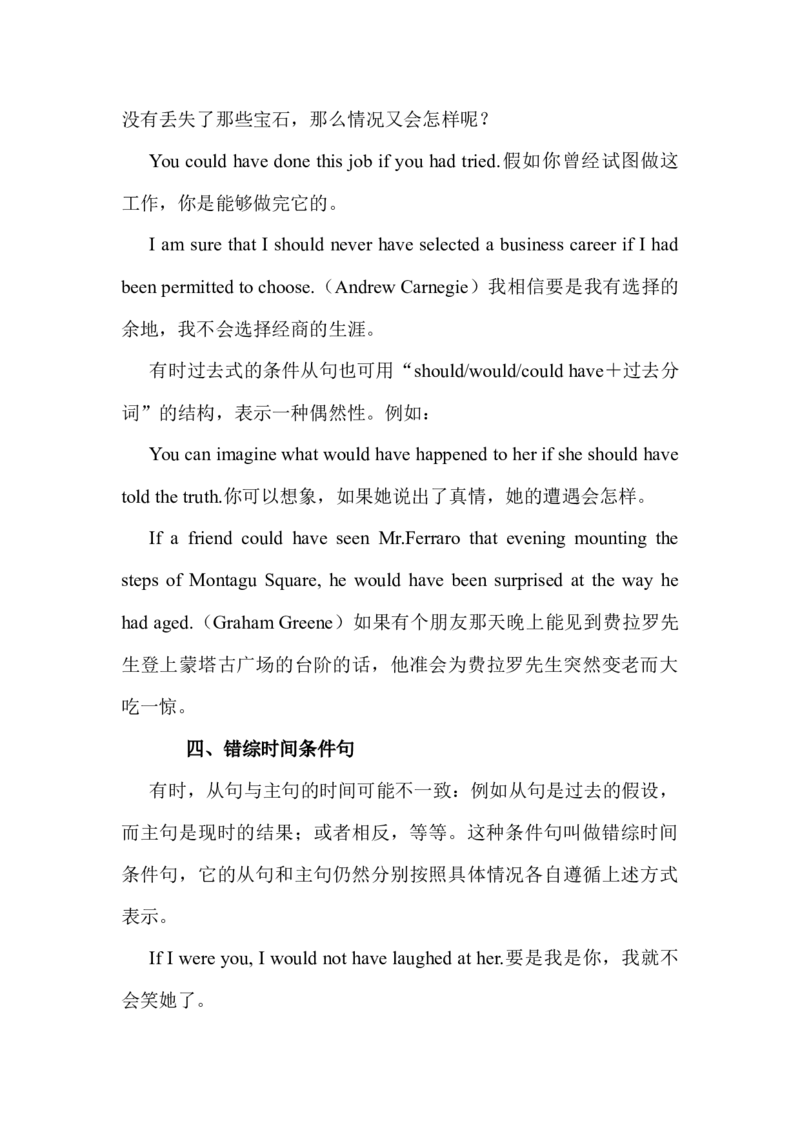
没有丢失了那些宝石,那么情况又会怎样呢?
You could have done this job if you had tried.假如你曾经试图做这
工作,你是能够做完它的。
I am sure that I should never have selected a business career if I had
been permitted to choose.(Andrew Carnegie)我相信要是我有选择的
余地,我不会选择经商的生涯。
有时过去式的条件从句也可用“should/would/could have+过去分
词”的结构,表示一种偶然性。例如:
You can imagine what would have happened to her if she should have
told the truth.你可以想象,如果她说出了真情,她的遭遇会怎样。
If a friend could have seen Mr.Ferraro that evening mounting the
steps of Montagu Square, he would have been surprised at the way he
had aged.(Graham Greene)如果有个朋友那天晚上能见到费拉罗先
生登上蒙塔古广场的台阶的话,他准会为费拉罗先生突然变老而大
吃一惊。
四、错综时间条件句
有时,从句与主句的时间可能不一致:例如从句是过去的假设,
而主句是现时的结果;或者相反,等等。这种条件句叫做错综时间
条件句,它的从句和主句仍然分别按照具体情况各自遵循上述方式
表示。
If I were you, I would not have laughed at her.要是我是你,我就不
会笑她了。
If you were older, I would have allowed you to go there yesterday.如
果你年纪大一些,昨天我会允许你去那儿了。
If you had worked at English harder last year, you could now read
engineering books in English.假如你去年学英语用功一些,现在你就
能阅读工程学方面的英语书籍了。
Sometimes I think how grateful I would be today if I had learned
more back then about what really matters.(Carl Sagan)有时我想,那
时我要是能多学点真正重要的东西,今天我就会真的谢天谢地了。
How could he operate the machine if he hadn't learned the technique a
few days ago?要是几天前他没有学过操作技巧,他怎能开动了机器
呢?
If this machine should fail to give satisfaction, we guarantee to refund
the purchase money.如果这台机器不能令人满意,我们保证退款。
If my grandfather were alive, he would have been 100 next year.假如
我祖父活着的话,他明年就有100 岁了。
If he has finished his work by six o'clock, they will be able to take
him with them.如果他到六点钟做完工作,他们就能带他一起走。
五、含蓄条件句
有时,句中没有明显的虚拟条件句,而是利用其他手段来暗示存
在虚拟条件,这类句子叫含蓄条件句。
(一)条件暗含在词组、短语中
常见的词(组)有without, with, in, under, but for 等。例如:
Without their obstruction, the problem could have been easily settled.
(=If it had not been for their obstruction, …)没有他们的妨碍,这个
问题就能够轻易地解决了。
He could certainly do better under favourable conditions. (=…if
conditions were favourable.)假如条件有利,他一定能做得更好。
With concerted effort we could have brought it off.如果齐心协力,
我们本来是可以成功的。
It would be a mistake not to help him.(=It would be a mistake if we
did not help him.)不帮助他就是个错误。
In the case of being a physicist, I should devote myself to the study of
atomic energy.如果我是个物理学家,我将致力于原子能的研究。
Without the difficulties to conquer, without enigmas to solve, without
mysteries to be penetrated, nothing would interest me.(Pablo Picasso)
如果没有需要克服的困难,没有需要解答的谜,没有需要洞察的奥
秘,那么任何事物都不能引起我的兴趣。
But for the storm, we should have arrived earlier.要是没有暴风雨,
我们就早些到达了。
(二)条件暗含在上下文中
常用的词(组)有or, but, otherwise 和各类短语、从句等。例
如:
I was seriously ill that day, or I should have come to see you.(=If I
were not seriously ill that day, I should have come to see you.)那天我病
得很厉害,否则我就会来看你了。
I only received your letter this morning, or I would have replied
sooner.今天早晨我才收到你的信,否则我早就复信了。
It's perfectly harmless; otherwise I wouldn't have done it.这件事完全
无害,不然我就不会干了。
The doctor would have given you some medical advice, but I am
sorry he was not there. (=The doctor would have given you some
medical advice if he had been there.)医生本来会给你一些忠告的,可
是很抱歉,他没有在那儿。
You should have seen him dance: that would have made you laugh.
(=If you had seen him dance, it would have made you laugh.)你应该
看看他跳舞:要是看了,那会使你发笑的。
Alone, he would have been terrified.如果是单独一个人,他会感到
害怕的。
A man of less courage would not have dared to go.要是换一个胆子
小一点的人是不敢去的。
It would be more difficult to investigate it by yourself.要是你一个人
去调查,就更困难了。
This same thing, happening in wartime, would mount to disaster.同样
的事如果发生在战争期间,就会酿成灾难。
He would be a rash man who should venture to forecast the remotest
results.(G.L.Dickinson)要是有人冒昧预言最遥远的结果,他就是
一个鲁莽的人。
(三)条件暗含在省略了的从句中
这时只剩下主句。例如:
I would gladly go with you.(可能暗含if I had time)我会高兴地
同你去的。
It would be very nice.(可能暗含If you could go with us.)那太好
了。
You might have fulfilled the work earlier.(可能暗含if you hadn't
been ill)你本来可以早一些完成这工作的。
I would have bought it.(可能暗含if I had the money)我会买下它
的。
Who but a fool would believe that hypocrite? (=Who would believe
that hypocrite if he were not a fool?)如果不是傻瓜,谁会相信那个伪君
子呢?
六、含蓄结果句
只有条件的从句,省略了主句:这种句子叫含蓄结果句。这种句
子表示一种不可能实现的愿望,常用于“If only…”句型。例如:
If only I knew! (=If only I knew, I should be satisfied.)要是我知道就
好了!
If only I had known! (=If only I had known, I should have been
satisfied.)要是我早知道就好了。
Oh, if I were only 10 years younger! (=If only I were 10 years
younger!)啊,要是我年轻10 岁就好了!
Oh, if my death could make you happy again.啊!但愿我的死能使
你们重新得到幸福。
If one had but two heads and neither required sleep.(T.H.Huxley)
如果一个人有两个脑袋而且都不需要睡眠,那该多好呀!
If I had never married.要是我不结婚就好了。
If only the photo weren't missing.但愿这张相片没丢失就好了。
Had I but taken your advice!我要是听了你的劝告就好了。
Oh, if I could only fall on your neck and describe with a thousand
joyous tears all the emotions that are storming in my heart.啊,但愿我能
扑到你的怀里,喜泪纵横,向你倾诉我心里那暴风雨般的感情。
七、虚拟条件句的其他表示法
(一)连词if 的省略
虚拟条件句中,从句如果有系动词were 和助动词had, should,
could 等,可以把它们放到主语的前面,形成部分倒装,省去if。
(这种用法口语中不常用。)
Were it not for your help, I couldn't have got over the difficulties.要不
是有你的帮助,我克服不了这些困难。
Were there no gravitation, there would be no air around the earth.如果
没有引力,地球的周围就不会有空气。
Had I been there, I would have seen you.要是我在那里,就会看见
你了。
The sun and the moon and the stars would have disappeared long ago
had they happened to be within the reach of predatory human hands.
(H.Ellis)假如日月星辰位于人类掠夺之手的范围内,它们早已经
绝迹了。
Should I do the operation, I would do it in some other way.如果我做
这手术,我就会用另一样方法做。
Should this be true, it would be silly to argue any longer.假如那是真
的,再辩论下去就无聊了。
Could he have foreseen it, his iron soul must not have been shaken.要
是他能够预见到此事,他的坚强意志就不会动摇的了。
Could he lend us a helping hand, he would do so.要是他能助我们一
臂之力,他会这么做的。
偶尔would, did 也可用于这种用法。例如:
Would space allow, I should like to quote the notice in full. 如有篇
幅,我会引用通知全文的。
Did I see him, I would blame him for it.如果我见到他,我就会为那
件事责备他。
(二)“but that+从句”结构
表示虚拟条件从句的否定式。but that(要不是为了,除了):
The production would not have been finished but that we made a
good preparation.(=…if we hadn't made a good preparation.)要不是
我们作了充分的准备,生产就完成不了。
He would have helped us but that he was short of money at that time.
要不是他那时没有钱,他会帮助我们的。
She would have fallen but that I caught her.如果不是我拉住她,她
就跌倒了。
八、虚拟语气在一些从句中的应用
虚拟语气还可以用来表示愿望、建议、命令、惊奇等感情以及重
要性等,因此,它可用在某些类型从句中。这时,该从句的谓语动
词要用虚拟语气的形式。
(一)在主语从句中的用法
1.在“It is/was necessary…"句型中,主句表示说话人的态度或
愿望,即说话人认为从句的内容是必需的、希望实现的,等等。that
引导的主语从句的谓语动词用虚拟语气形式,即“should+动词原
形”或“be 型”结构,should 常省略。用于这一句型作表语的形容
词或过去分词常见的有:advisable, appropriate, best, better,
compulsory 等。例如:
It is necessary that the work (should) start at once.必须马上开始工
作。
It is very important that a scientific worker (should) know foreign
languages.一个科学工作者懂得外国语是非常重要的。
It is the light, of course, but it is necessary that the place be clean and
pleasant.(E.Hemingway)灯光当然重要,地方也得干净,令人惬意
才行。
It is decided that the meeting (should) be postponed till next Monday.
已经决定会议延期到下星期一举行。
It is requested that Prof.Smith (should) give a lecture next week.有人
请求史密斯教授下周作一次学术讲演。
如果主句的表语是表示“可能性”的形容词如likely, possible,
probable 等,从句表达的意义是客观事实,并且整个句子又是肯定
句,则从句的谓语动词用陈述语气。例如:
It's likely that there will be rain before evening.傍晚前可能会下雨。
It's probable that Maria may have missed the plane.玛丽亚可能没赶
上飞机。
2.在“It is/was strange…"句型中,主句表达说话人对从句内容
的某种感情如惊奇、喜悦、悔恨、失望等,并且强调这种感情色
彩,则that 引导的主语从句的谓语动词要用虚拟语气形式,即
“should+动词原形”或“be 型”结构,should 常省略。用于这一句
型作表语的词有annoying, curious, disappointing, disastrous, dreadful,
fortunate, frightening, funny, incredible 等。例如:
It is strange that she (should) have left with the light still on.奇怪的是
她离开了,灯却开着。
It is disappointing that he should fall again.他又失败了,真令人失
望。
It's odd/Odd that they should have left without saying goodbye.真 奇
怪,他们竟不辞而别了。
【注】 这类句子如果主语从句的意义是叙述客观事实,可用陈
述语气。
(二)在表语从句和同位语从句中的用法
1.主句的主语如果是表示命令、建议、计划、愿望、主张、请
示的名词时,由that 引导的表语从句,以及在这些名词后接的、由
that 引导的同位语从句,其谓语动词用should be 型或be 型虚拟形式
(美国英语常用be 型)。这些名词常见的有:advice, aim,
arrangement, decision, desire, idea, motion, order, plan, policy, proposal,
recommendation, regulation, requirement, suggestion, wish 等。例如:
Our idea is that the discussion (should) be put off.(表语从句)我们
的想法是讨论应该延期。
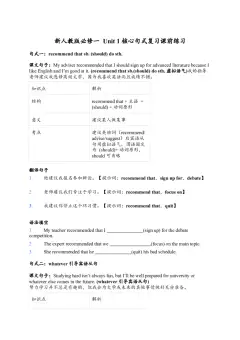
My suggestion is that we (should) do the experiment all over again.我
的建议是我们应该重新做实验。
The order is that they (should) try to cut down on the pollution of the
atmosphere.给他们的命令是应当设法减少对大气层的污染。
Our only request is that this should be settled as soon as possible.我们
唯一的要求是此事应当尽快解决。
His insistence that we (should) take up the matter at the meeting is
rational.(同位语从句)他坚持我们在会上讨论这问题是合理的。
I second Martin's motion that we (should) set up a special board to
examine the problem.我赞成马丁的提议,即我们应该成立一个特别
委员会来研究这个问题。
What do you think of our plan that the production (should) rise at the
rate of ten percent a year?你对我们计划每年生产增长百分之十有什么
想法?
【注】 这类表语从句或同位语从句如主句主语或本位语虽然是
上述名词,但如果表达的并不是说话人的主观看法,而是客观事
实,则从句用陈述语气。例如:
The order is that we must set out for the frontline without any delay.
(表语从句)命令要求我们必须奔赴前线,不能有任何耽搁。
I had a feeling that it was impossible to explain the thing.
(S.Leacoak)(同位语从句)我感到不可能说清楚这件事了。
2.主句的谓语是系动词如be, feel, look, seem 等,通常用as
if/though 引导表语从句,从句的谓语动词要用虚拟语气。如果从句
的动作和主句的动作同时发生,用were 型虚拟形式(即现在式);
如果从句的动作发生在主句的动作之前,则用had been 型虚拟形式
(即过去式)。例如:
She looked as though she were fainting.她看起来好像要晕过去似
的。
After two days and nights, I felt as if I had lived there for a year.
(C.Dickens)两天两夜以后,我感到好像我已经在那里住了一年
了。
It seems to me as if you had been lying all the time.我似乎觉得你一
直在说谎。
【注】 这类表语从句如果表达的是可能会实现的事实,可用陈
述语气。例如:
His thought here was that after all Clyde was a full cousin.
(T.Dreiser)他这时的想法是:克莱德毕竟是亲表弟。
(三)在宾语从句中的用法
1.主句的谓语动词是表示说话人的主观要求、命令、建议、劝
告、遗憾或惊奇等感情时,由that 引导的宾语从句的谓语动词要用
should be 型或be 型虚拟形式(美国英语常用be 型)。主句常见的
谓语动词有advise, arrange, ask, beg, command, decide,  demand,
desire 等。例如:
The teacher proposed that the question (should) be discussed at once.
这位教师提议该问题应该马上讨论。
Experiments demand that accurate measurements be made.实验要求
作准确的测量。
The law requires that everyone take a test for a driver's license.法律
要求人人都要经过考试才能取得驾驶执照。
I suggest that a consultation be held as soon as possible.我提议尽快
进行会诊。
They urged that the library be kept open during the vacation.他们极
力主张图书馆假期开放。
In a 1982 letter to her attorney, she had requested that her remains be
cremated and her ashes scattered at Roseman Bridge.她在1982 年的一
封给律师的信中要求死后把遗体火化,骨灰撒在罗斯曼桥。
The doctor ordered that the wounded soldiers be moved to safety at
once.医生下令伤员立即撤往安全处。
I regret that he should be so stubborn.他这么固执,我很遗憾。
I think it advisable that he (should) have his car serviced.我觉得他请
人检修一下汽车是明智的。
【注】 在日常口语中,这类宾语从句的谓语动词也可用陈述语
气。例如:
They insist that John will speak at the meeting.他们坚持要约翰在会
上发言。
2.主句的谓语动词是wish 时,后面接的宾语从句表达的是一种
不能实现或未曾实现的愿望,或是对过去所做的事感到后悔。如果
从句的动作与主句的动作同时发生,从句的谓语动词用现在式,即
were 型虚拟语气;如果从句的动作发生在主句的动作之前,从句的
谓语动词用过去式,即had been 型虚拟形式;如果从句的主语与主
句的主语不相同,从句的谓语动词用“would+动词原形”形式,表
示对方或第三者现在或将来不大可能实现的动作。例如:
I wish (that) he were here.【与现在事实相反】 但愿他在这里。
(可惜他不在这里)
I wish I knew English well.我精通英语就好了。
How I wish you loved me!我多么希望你爱我!
We wish we could afford to buy a new car.但愿我们能买得起一辆新
汽车。
We wish/wished we had done better in our work.【与过去事实相
反】 我们真后悔过去没把工作做得更好些。
I wish you had come to our New Year's party.真希望你来参加我们
的新年晚会。(但你没来)
They wish they had not lost the chance.他们为失去这个机会感到惋
惜。
I wish the rain would stop!(指将来)雨要是停下来多好!
Oh, I wished you would bury me by the wayside or in a remote valley,
where priest and Levite may pass by the marked stone…啊,我希望你
们将我葬在大路边,或是葬在偏僻的山谷,以便牧师和辅祭们能路
过我的墓碑……
I wish prices would come down.但愿物价能降下来。
I wish he might go with us to the theatre.但愿他可以跟我们一起去
看戏。
有时,动词wish 可用would rather, would sooner, had rather, would
just as soon"宁愿、宁可”替代。例如:
I would rather you came tomorrow.我宁愿你明天来。
I'd just as soon we didn't go tonight.我倒希望我们今晚不要走。
I'd rather you hadn't done that.我真希望你没做过那件事。
【注】 如该希望有可能实现,则用动词hope,并在宾语从句中
改用陈述语气。例如:
I hope you can come.我希望你能来。
(四)在定语从句中的用法
在“It is (high) time (that)…”句型后的定语从句中,谓语动词常用
过去式或“should+动词原形”,关系词that 常省略。high 起着强调
time 意义的作用。
It is time we left.(=It is time we should leave.)我们该走了。
It's time we sent the kids to bed.是我们该让孩子们睡觉的时候了。
It's high time the weather improved.天气该好起来了。
It is time he were gone.是他该走的时候了。
有时,从句的主语是单数,可用was 代替were。例如:
It's time this was put an end to.是结束这件事的时候了。
如果从句的主语是单数第一人数,习惯上只能用was。例如:
It is high time I was going.我该走了。
(五)在状语从句中的用法
1.用在表示惊奇、喜悦、怀疑、不满等意义的形容词后,由
that 引导的原因状语从句中,有时用“ should+动词原形”或
“should+have been”型虚拟形式。例如:
I am ashamed that you should see me in this state.在这种情况下被你
看见,我很惭愧。
He was surprised that she should be so ill.她竟病得这么严重,他感
到惊异。
We are surprised that John should have made a mess of that work.我
们很惊奇约翰把那个工作搞得一团糟。
I am sorry that he should think otherwise.我很遗憾,他是另外一种
想法。
I was glad that he should go.他走,我很高兴。
2.在目的状语从句中的用法有两种情况:
(1)用在由lest, for fear (that)“恐怕,免得”,in case (that)“恐
怕,万一”引导的目的状语从句中,多用“should+动词原形”或动
词原形的虚拟形式。例如:
He hurried to the station for fear/lest he should miss the train.他急忙
地赶到车站,怕误了火车。
In case the wall should collapse, they evacuated the building.为了怕
墙壁倒塌,他们撤离了这幢楼房。
I shall ring you up lest you should forget to come.我会给你打电话,
以免你忘了来。
(2)用在that, so that, in order that"为了,为的是”引导的目的状
语从句中,常用“may/might+动词原形”表示虚拟意义(主句的谓
语动词是指现在或将来,从句可用may 或might;主句的谓语动词是
指过去,则用might)。口语中也常用“can/could+动词原形”。例
如:
She opens/will open the window that she may/might get a breath of
fresh air.她(将)打开窗子,以便呼吸新鲜空气。
They climbed higher that/so that/in order that they might get a better
view.他们爬得更高一些,以便视野更开阔。
We took a taxi so that we could get there in time.我们叫了出租车,
以便能准时到达那里。
3.用在由as if, as though 引导的方式状语从句中,谓语动词通常
用虚拟语气。从句和主句的动作同时发生,从句用were 型,即一般
过去时;从句的动作发生在主句的动作之前,用had been 型,即过
去完成时态。例如:
The mountain in the setting sun appears as if it were covered with  red
flowers.夕阳下的山峰好像盖了一层红花。
Things far off look as if they were smaller than they really are.远处的
物体看起来仿佛比它们真正的体积小。
He talks about Africa as if he had been there.他谈论非洲,好像他到
过那儿似的。
He smiled, as if he had read my thoughts.他微笑着,仿佛早已猜透
了我的想法。
从句中也可用表示虚拟的情态动词。例如:
She cried as if her heart would break.她哭了,好像她的心要碎似
的。
4.用在让步状语从句中。虚拟语气在让步状语从句中的用法有
下面三种情况:
(1)从句由even if, even though 引导。主句和从句都用虚拟语
气,如果是现在时和将来时,从句的谓语动词用were 型,主句用
should/would/could be 型;如果是过去时,从句的谓语动词用had
been 型,主句用should/would/could have been 型。例如:
Even if he were here, he could not solve the problem at once, either.
即使他在这儿,他也不能立刻解决这个问题。
No smuggler would dare to cheat him even if he wished to. (E.
L.Voynich)没有任何走私者敢欺骗他,即使走私者想这么干。
Even though she had been very busy, she would have helped us.虽然
她很忙,她也会帮助我们的。
【注】 有时,根据具体情况,这类句子也可用陈述语气。
(2)用though 或although 引导。如果表达的是说话人的主观看
法,从句用were 句型或(should)be 型,主句用陈述语气。例如:
Though everyone desert you, we will not.即使人人抛弃你,我们不
会。
I'll come down to them for a day at Christmas, though it be only  for a
day.我将在圣诞节时到他们这里待一天,虽然只有一天。
Though it rain incessantly tomorrow, we shall go on with the work.纵
使明天雨下个不停,我们也要继续干下去。
这类让步状语从句,有时可把作表语的名词或形容词置于句首。
例如:
Cold though it may be, we shall go to the skating-rink.虽然天气寒
冷,我们仍然要去溜冰场。
(3)用疑问词+-ever 构成的复合连词或whether…or 引导。从句
用be 型虚拟形式,主句用陈述语气。例如:
Whichever be the case, her sister's situation remained the same.
(J.Austen)无论是哪一种情况,她妹妹的处境都一样。
Whenever he meet with difficulties, he will come for help.每逢碰到
困难,他会来这里寻求帮助。
Whether this succeed or fail, it will not matter to him.无论此事成败
与否,对他都无关紧要。
【注】 上述各种类型让步状语从句,如果从句的内容表达的是
客观事实,则主句和从句均可用陈述语气。例如:
Though he is dead, yet he will live forever in the minds of the people.
他虽然死了,但是他永远活在人们的心里。
(六)在简单句中的用法
1.表示委婉的请求、建议,或提出问题、陈述看法,谓语动词
多用“would/should/could/might+动词原形”。例如:
Would you like me to go with you to the spot?你要我和你一起到现
场去吗?
Might I ask your name?请问大名?
2.表示祝愿。谓语用动词原形或may+动词原形。例如:
May all go well with you!祝你万事如意!
May I never see such a sight again!但愿我永远不再见到这种情
景!
May he return soon!愿他早日归来!
Long live the people!人民万岁!
God preserve us all!上帝保佑我们全体!
3.常用be 型虚拟形式,be 经常被省略。例如:
So be it.(=Let it be so.=Be it so.)但愿如此。
God (be) with you forever!上帝永远与你同在!