题
专
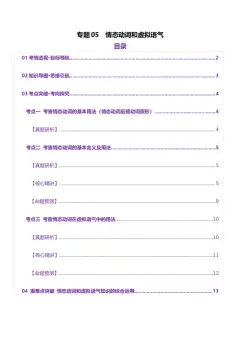
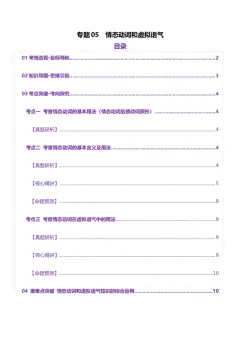
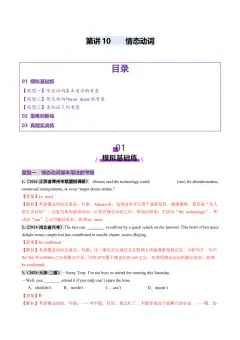
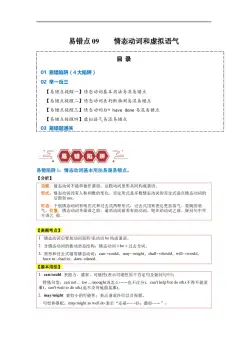
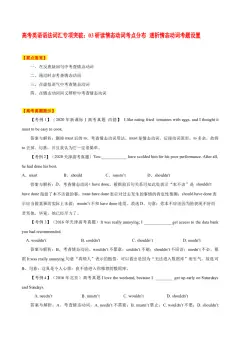
10 情态动词和虚拟语气
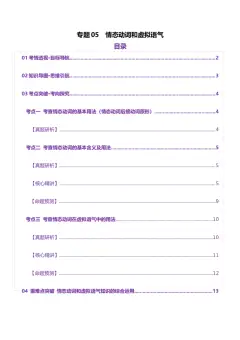
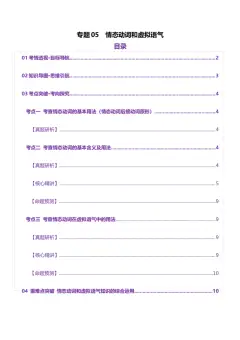
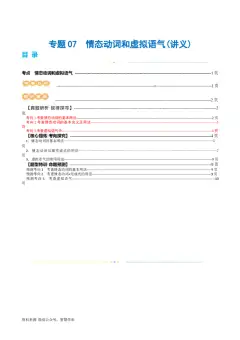
目录
01 析·考情精解..................................................................................................................................................2
02 构·知能架构..................................................................................................................................................3
03 破·考点攻坚.............................................................................................................................................................4
考点一   考查情态动词的基本含义及用法..........................................................................................................4
真题动向
在具体情境中考查情态动词基本含义的用法
必备知识
知识1 情态动词的基本用法   知识2 情态动词后跟完成式的用法
关键能力
能力1 根据语境,准确判断情境内容的语气进而判断使用那个与之相适应的情态动
词。能力2 根据语境,准确判断情态动词+完成式表示推断的用法。
命题预测
考向1 考查情态动词的基本含义及用法 考向2 根据语境,准确判断情态动词+完成
式表示推断的用法。
考点二 考查情态动词的基本用法(情态动词后接动词原形)........................................................................10
真题动向
在具体情境中考情态动词的用法
必备知识
知识1 情态动词的基本用法:情态动词+动词原形  2 含有情态动词的被动语态要注
意:情态动词+be done
命题预测
考向 1 考查情态动词+动词原形  2 含有情态动词的被动语态要注意:情态动词+be
done
考点三 考查情态动词在虚拟语气中的用法........................................................................................................12
考点四 情态动词和虚拟语气考点知识的综合运用............................................................................................15
命题轨
迹透视
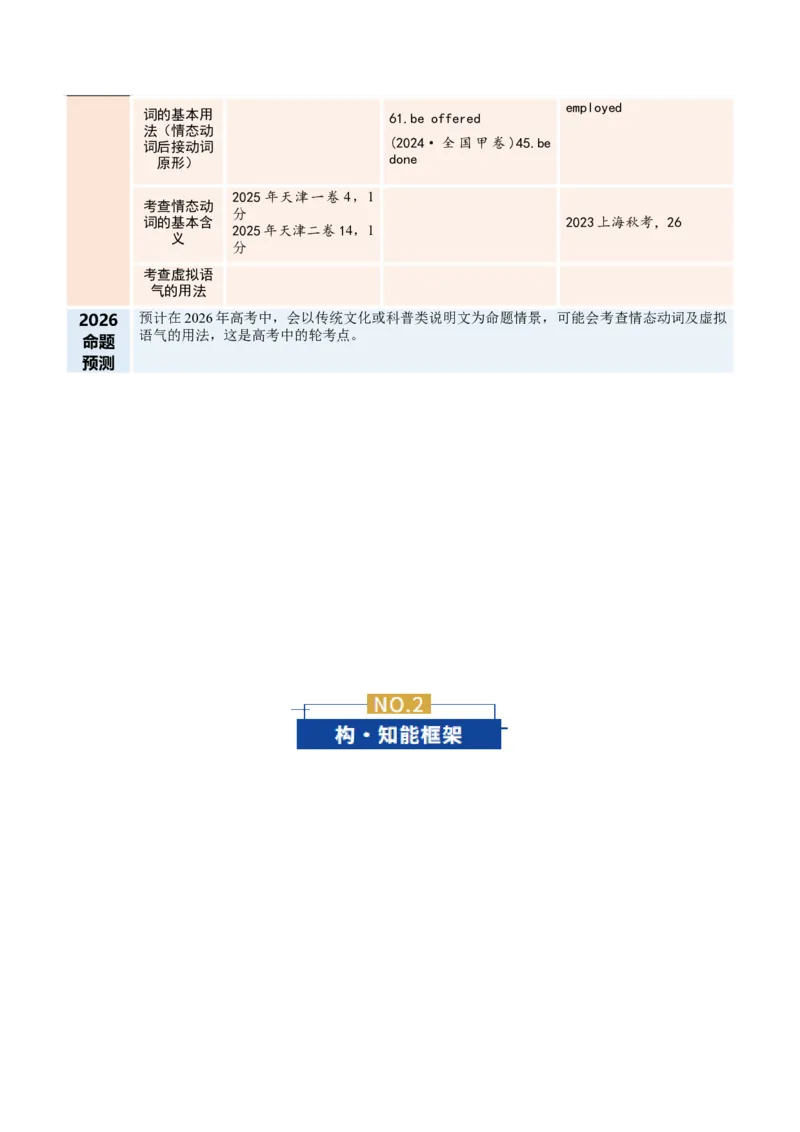
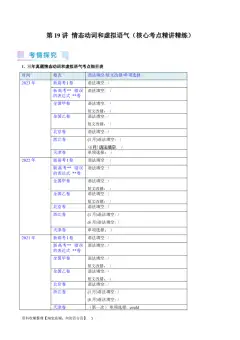
从近三年高考试题来看,试题以语法填空为主,题目难度较小。命题趋势:在语篇中考查学生
对有关情态动词及虚拟语气知识的掌握情况,强化语言知识的运用能力和语境理解。在书面表
达和读后续写中考查学生的准确使用虚拟语气,让自己语言表达丰富多彩。
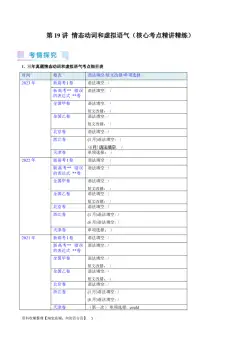
考点频
次总结
考点
2025 年
2024 年
2023 年
考查情态动
(2024 年1 月浙江高考卷) (2023 年全国甲卷) be
词的基本用
法(情态动
词后接动词
原形)
61.be offered
(2024· 全国甲卷)45.be
done
employed
考查情态动
词的基本含
义
2025 年天津一卷4,1
分
2025 年天津二卷14,1
分
2023 上海秋考,26
考查虚拟语
气的用法
2026
命题
预测
预计在2026 年高考中,会以传统文化或科普类说明文为命题情景,可能会考查情态动词及虚拟
语气的用法,这是高考中的轮考点。
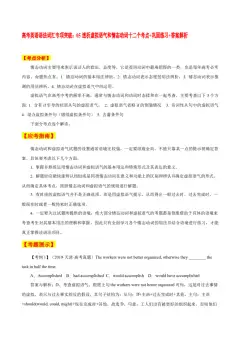
考点一   考查情态动词的基本含义及用法
1.
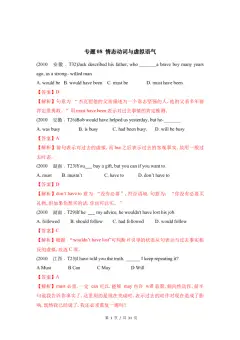
(2025 年天津一卷)4.You________ rush to finish the report. The deadline has been extended.
A.couldn’t
B.mustn’t
C.needn’t
D.wouldn’t
【答案】C
【解析】考查情态动词辨析。句意:你不必急于完成这份报告。截止日期已经延长了。A. couldn’t 不能;
B. mustn’t 禁止;C. needn’t 不必;D. wouldn’t 不会。根据后文“The deadline has been extended.”可知,截止
日期已经延长了,不必急于完成这份报告。故选C。
2.
(2025 年天津二卷)14.No reader________remove a book from the library without permission.
A.would
B.might
C.shall
D.need
【答案】C
【解析】考查情态动词。句意:未经图书馆管理员允许,任何读者不得将书带出图书馆。考查情态动词。
A. would 将会;    B. might 可能;C. shall 将要,将会;D. need 需要。shall 用于第二、三人称表示命令、威
胁、许诺、警告、规定等。故选C。
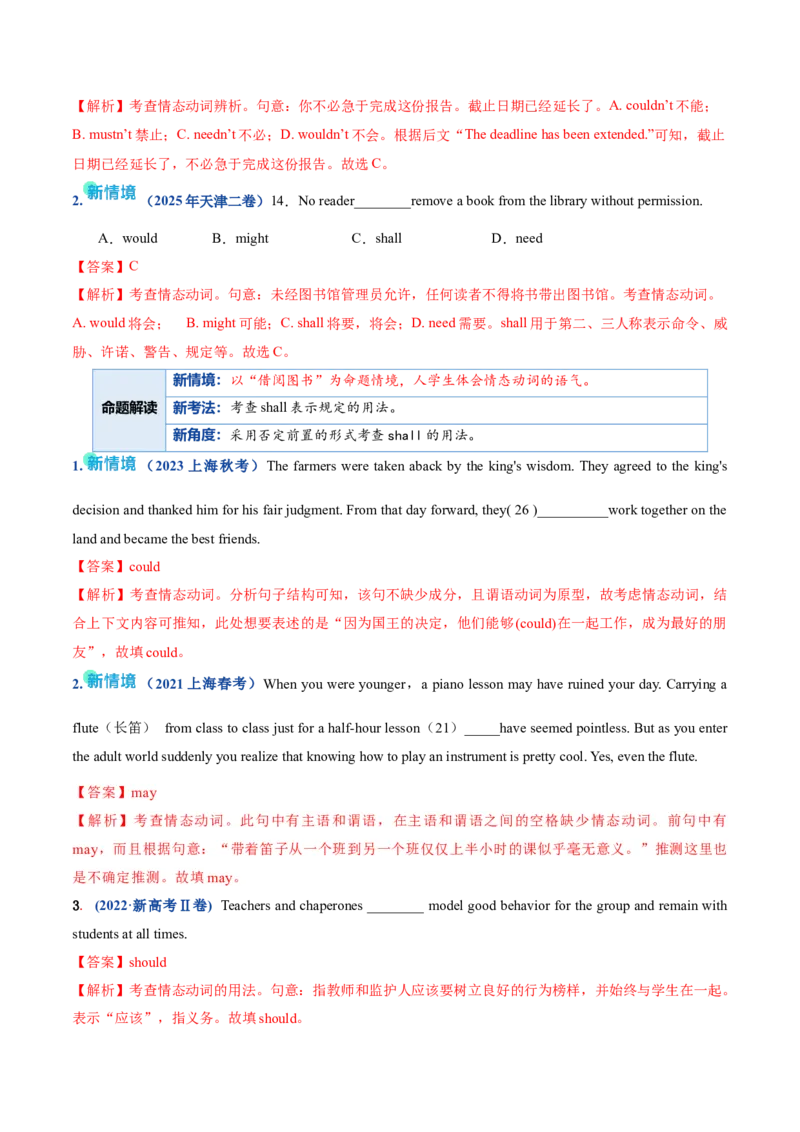
命题解读
新情境:以“借阅图书”为命题情境,人学生体会情态动词的语气。
新考法:考查shall 表示规定的用法。
新角度:采用否定前置的形式考查shall 的用法。
1.
(2023 上海秋考)The farmers were taken aback by the king's wisdom. They agreed to the king's
decision and thanked him for his fair judgment. From that day forward, they( 26 )__________work together on the
land and became the best friends.
【答案】could
【解析】考查情态动词。分析句子结构可知,该句不缺少成分,且谓语动词为原型,故考虑情态动词,结
合上下文内容可推知,此处想要表述的是“因为国王的决定,他们能够(could)在一起工作,成为最好的朋
友”,故填could。
2.
(2021 上海春考)When you were younger,a piano lesson may have ruined your day. Carrying a
flute(长笛) from class to class just for a half-hour lesson(21)_____have seemed pointless. But as you enter
the adult world suddenly you realize that knowing how to play an instrument is pretty cool. Yes, even the flute.
【答案】may
【解析】考查情态动词。此句中有主语和谓语,在主语和谓语之间的空格缺少情态动词。前句中有
may,而且根据句意:“带着笛子从一个班到另一个班仅仅上半小时的课似乎毫无意义。”推测这里也
是不确定推测。故填may。
3. (2022·新高考Ⅱ卷) Teachers and chaperones ________ model good behavior for the group and remain with
students at all times.
【答案】should
【解析】考查情态动词的用法。句意:指教师和监护人应该要树立良好的行为榜样,并始终与学生在一起。
表示“应该”,指义务。故填should。
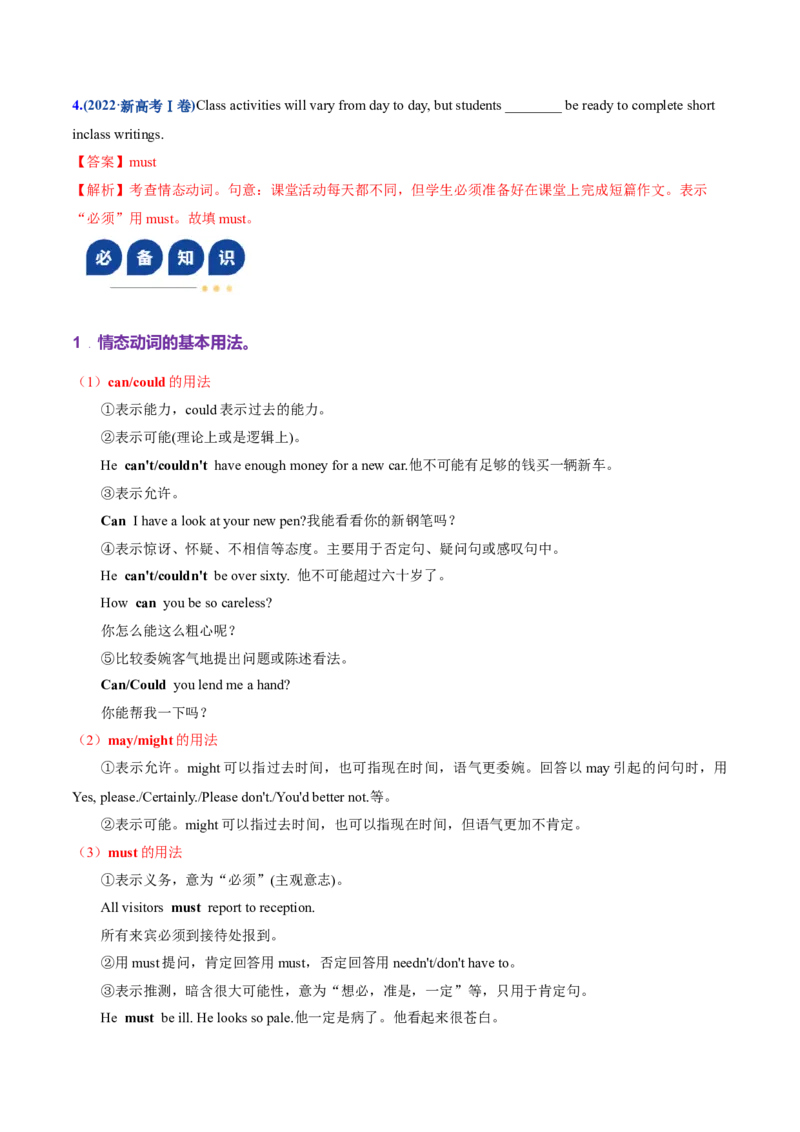
4.(2022·新高考Ⅰ卷)Class activities will vary from day to day, but students ________ be ready to complete short
inclass writings.
【答案】must
【解析】考查情态动词。句意:课堂活动每天都不同,但学生必须准备好在课堂上完成短篇作文。表示
“必须”用must。故填must。
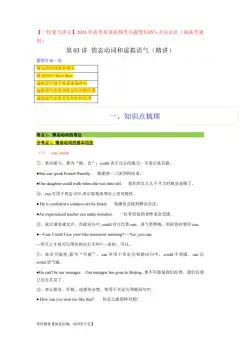
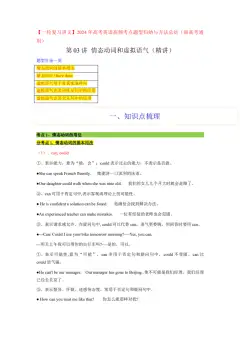
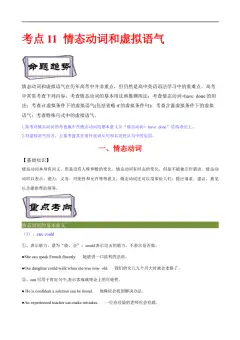
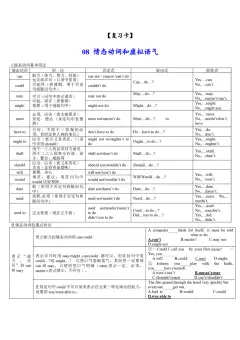
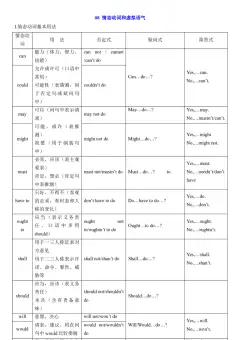
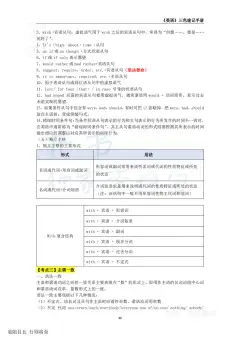
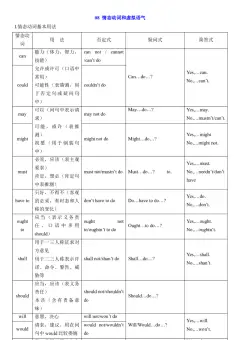
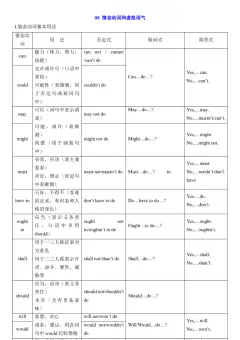
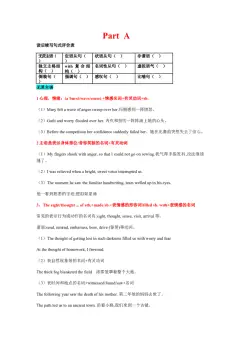
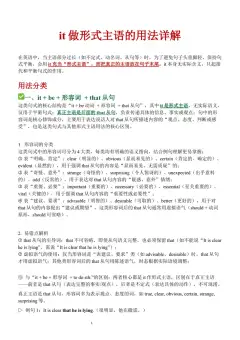
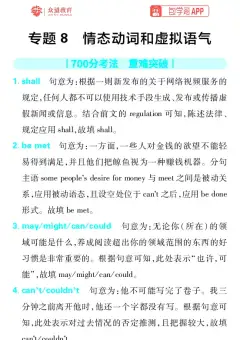
1.情态动词的基本用法。
(1)can/could 的用法
①表示能力,could 表示过去的能力。
②表示可能(理论上或是逻辑上)。
He can't/couldn't have enough money for a new car.他不可能有足够的钱买一辆新车。
③表示允许。
Can I have a look at your new pen?我能看看你的新钢笔吗?
④表示惊讶、怀疑、不相信等态度。主要用于否定句、疑问句或感叹句中。
He can't/couldn't be over sixty. 他不可能超过六十岁了。
How can you be so careless?
你怎么能这么粗心呢?
⑤比较委婉客气地提出问题或陈述看法。
Can/Could you lend me a hand?
你能帮我一下吗?
(2)may/might 的用法
①表示允许。might 可以指过去时间,也可指现在时间,语气更委婉。回答以may 引起的问句时,用
Yes, please./Certainly./Please don't./You'd better not.等。
②表示可能。might 可以指过去时间,也可以指现在时间,但语气更加不肯定。
(3)must 的用法
①表示义务,意为“必须”(主观意志)。
All visitors must report to reception.
所有来宾必须到接待处报到。
②用must 提问,肯定回答用must,否定回答用needn't/don't have to。
③表示推测,暗含很大可能性,意为“想必,准是,一定”等,只用于肯定句。
He must be ill. He looks so pale.他一定是病了。他看起来很苍白。
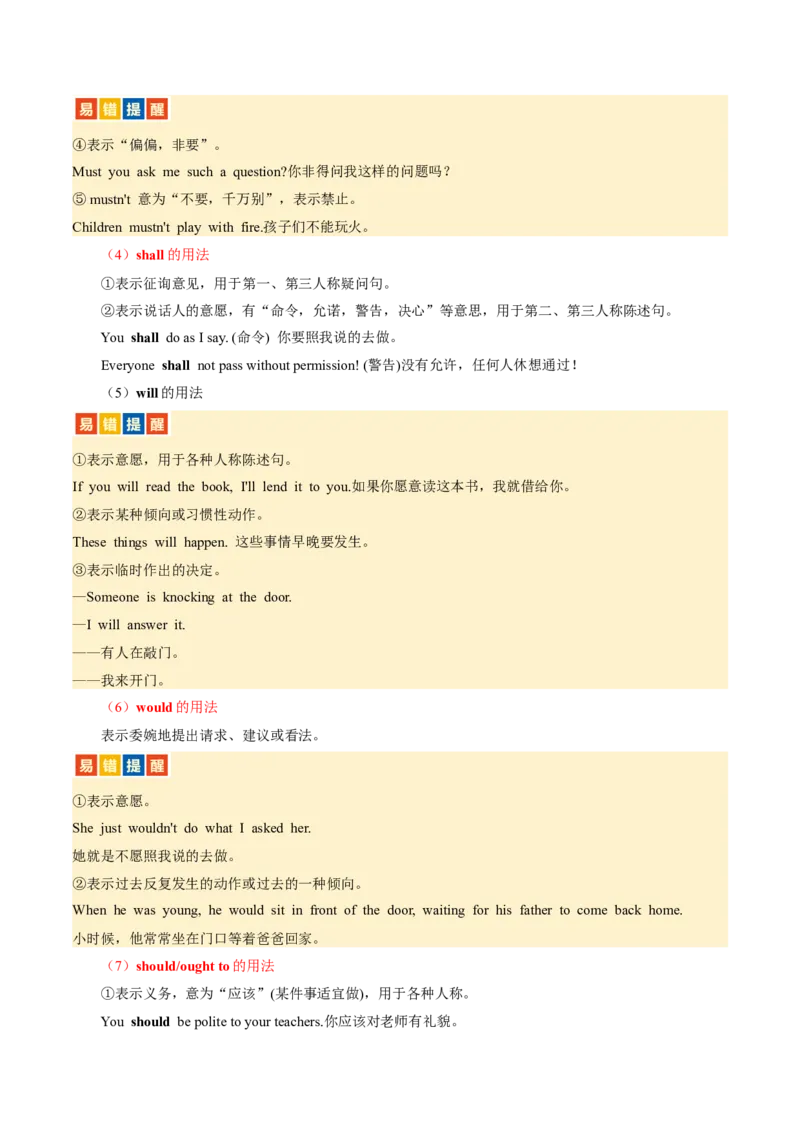
④表示“偏偏,非要”。
Must you ask me such a question?你非得问我这样的问题吗?
⑤mustn't 意为“不要,千万别”,表示禁止。
Children mustn't play with fire.孩子们不能玩火。
(4)shall 的用法
①表示征询意见,用于第一、第三人称疑问句。
②表示说话人的意愿,有“命令,允诺,警告,决心”等意思,用于第二、第三人称陈述句。
You shall do as I say. (命令) 你要照我说的去做。
Everyone shall not pass without permission! (警告)没有允许,任何人休想通过!
(5)will 的用法
①表示意愿,用于各种人称陈述句。
If you will read the book, I'll lend it to you.如果你愿意读这本书,我就借给你。
②表示某种倾向或习惯性动作。
These things will happen. 这些事情早晚要发生。
③表示临时作出的决定。
—Someone is knocking at the door.
—I will answer it.
——有人在敲门。
——我来开门。
(6)would 的用法
表示委婉地提出请求、建议或看法。
①表示意愿。
She just wouldn't do what I asked her.
她就是不愿照我说的去做。
②表示过去反复发生的动作或过去的一种倾向。
When he was young, he would sit in front of the door, waiting for his father to come back home.
小时候,他常常坐在门口等着爸爸回家。
(7)should/ought to 的用法
①表示义务,意为“应该”(某件事适宜做),用于各种人称。
You should be polite to your teachers.你应该对老师有礼貌。
Such things ought to be banned.这种事应该禁止。
②表示推测,意为“想必,一定,照说应该,估计”等。
They should be home by now.他们现在应该在家。
If he started out at nine, he ought to be here by now.他如果九点出发,现在应该到这里了。
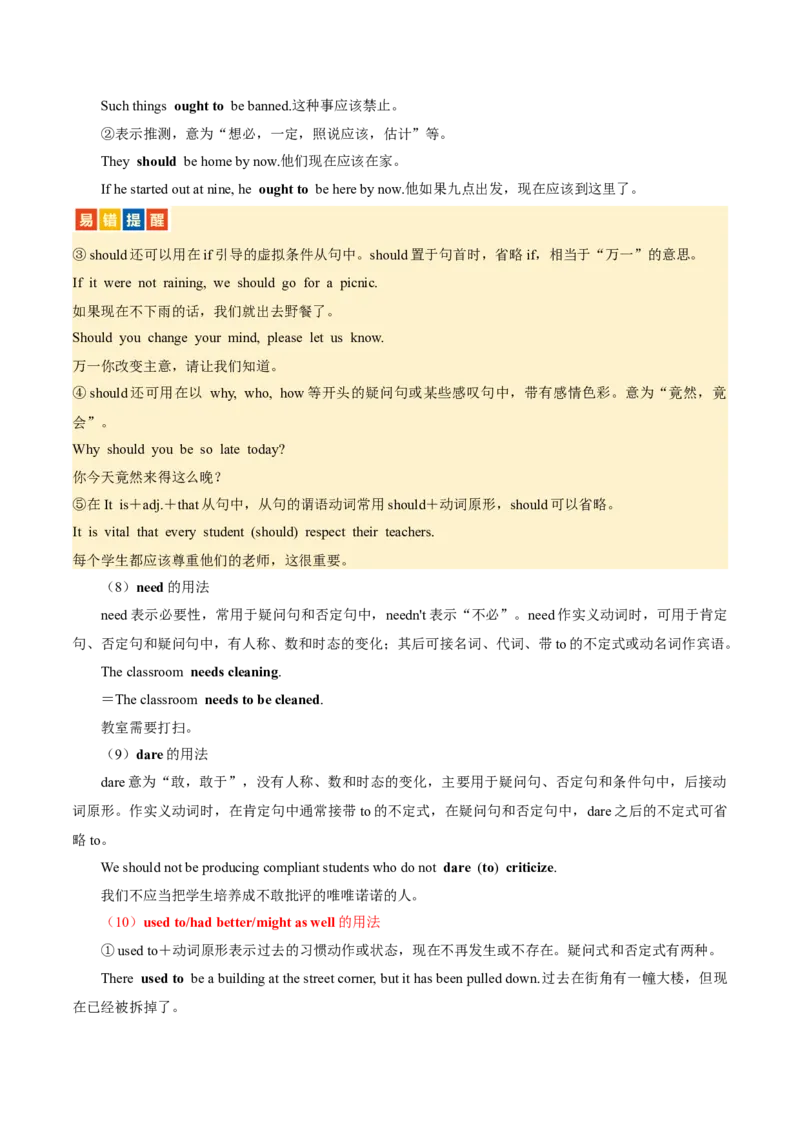
③should 还可以用在if 引导的虚拟条件从句中。should 置于句首时,省略if,相当于“万一”的意思。
If it were not raining, we should go for a picnic.
如果现在不下雨的话,我们就出去野餐了。
Should you change your mind, please let us know.
万一你改变主意,请让我们知道。
④should 还可用在以 why, who, how 等开头的疑问句或某些感叹句中,带有感情色彩。意为“竟然,竟
会”。
Why should you be so late today?
你今天竟然来得这么晚?
⑤在It is+adj.+that 从句中,从句的谓语动词常用should+动词原形,should 可以省略。
It is vital that every student (should) respect their teachers.
每个学生都应该尊重他们的老师,这很重要。
(8)need 的用法
need 表示必要性,常用于疑问句和否定句中,needn't 表示“不必”。need 作实义动词时,可用于肯定
句、否定句和疑问句中,有人称、数和时态的变化;其后可接名词、代词、带to 的不定式或动名词作宾语。
The classroom needs cleaning.
=The classroom needs to be cleaned.
教室需要打扫。
(9)dare 的用法
dare 意为“敢,敢于”,没有人称、数和时态的变化,主要用于疑问句、否定句和条件句中,后接动
词原形。作实义动词时,在肯定句中通常接带to 的不定式,在疑问句和否定句中,dare 之后的不定式可省
略to。
We should not be producing compliant students who do not dare (to) criticize.
我们不应当把学生培养成不敢批评的唯唯诺诺的人。
(10)used to/had better/might as well 的用法
①used to+动词原形表示过去的习惯动作或状态,现在不再发生或不存在。疑问式和否定式有两种。
There used to be a building at the street corner, but it has been pulled down.过去在街角有一幢大楼,但现
在已经被拆掉了。
I used not/didn't use to like opera. 我过去不喜欢歌剧。
Used you/Did you use to go to school on foot?你过去常常步行去上学吗?
②had better 意为“最好”,后面接动词原形,否定式为had better not do。【高频再现】
We had better take an umbrella in case it rains.
以防下雨,我们最好带把伞。
③might as well 意为“倒不如……,还是做……好”。 【高频再现】
The heavy rain ruined our trip. We might as well have stayed at home.
大雨毁了我们的旅行。我们还不如待在家里。
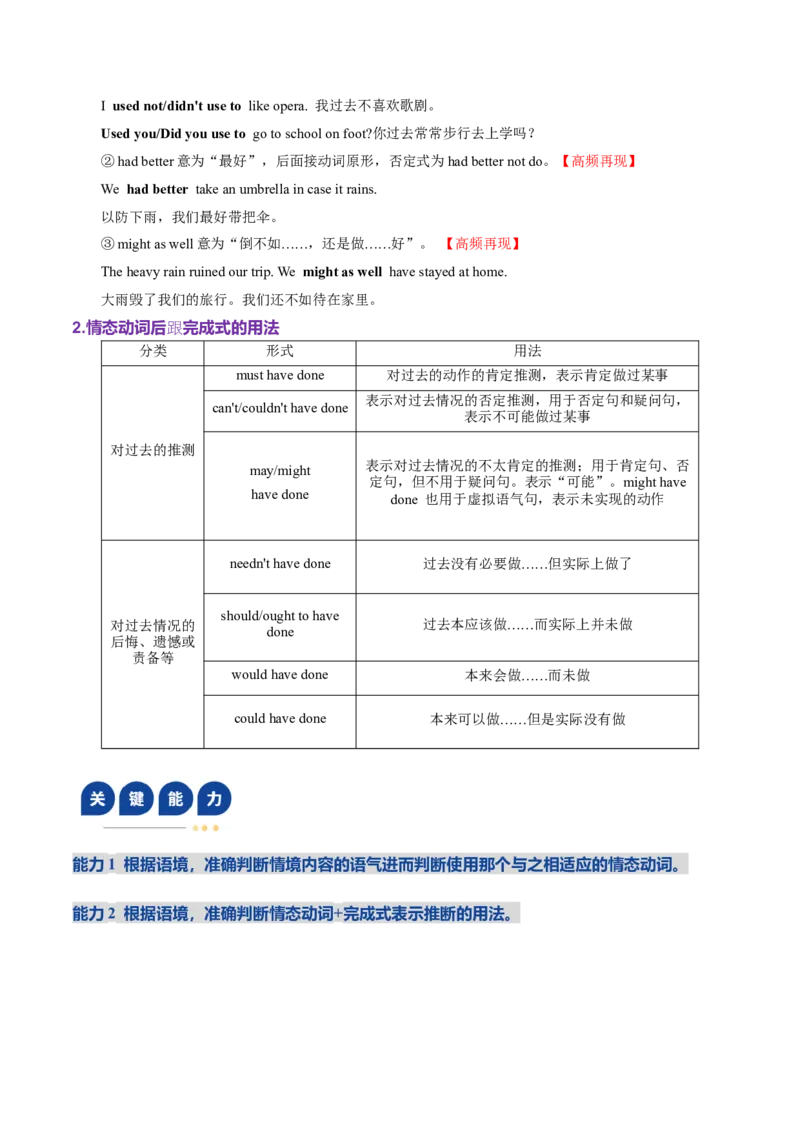
2.情态动词后
完成式的用法
跟
分类
形式
用法
对过去的推测
must have done
对过去的动作的肯定推测,表示肯定做过某事
can't/couldn't have done
表示对过去情况的否定推测,用于否定句和疑问句,
表示不可能做过某事
may/might
have done
表示对过去情况的不太肯定的推测;用于肯定句、否
定句,但不用于疑问句。表示“可能”。might have
done 也用于虚拟语气句,表示未实现的动作
对过去情况的
后悔、遗憾或
责备等
needn't have done
过去没有必要做……但实际上做了
should/ought to have
done
过去本应该做……而实际上并未做
would have done
本来会做……而未做
could have done
本来可以做……但是实际没有做
能力1 根据语境,准确判断情境内容的语气进而判断使用那个与之相适应的情态动词。
能力2 根据语境,准确判断情态动词+完成式表示推断的用法。
考向1 考查情态动词的基本含义及用法
1.
(2026·上海市松江二中高三月考)Many years ago, I left my own comfort zone in Canada and
moved to China. I wanted to test myself to see if I          survive and eventually thrive in a country with a
radically different language and culture.
【答案】can
【解析】考查情态动词。句意:我想测试一下自己,看看我是否能在一个语言和文化截然不同的国家生存
下来,并最终蓬勃发展。此处指“能够”生存下来,应用情态动词could 表示“能够”。故填could。
2.
(2026·上海市卢湾高级中学高三期中)In group work, teachers          assign the students
particular roles, for example one student might be a scribe (抄写员) and another one might be in charge of a
particular device.
【答案】should
【解析】考查情态动词。句意:在小组合作中,老师应该给学生分配特定的角色,例如,一个学生可以是
抄写员,另一个学生可以负责一种特定的设备。根据语境,这里是在提出建议,表达“应该”的意思,所
以用情态动词should。故填should。
能力2 根据语境,准确判断情态动词+完成式表示推断的用法。
3.
Using supercomputer, many labs are now conducting experiments that couldn’t          (be)
possible in the past.
【答案】have been
【解析】考查情态动词。句意:许多实验室现在使用超级计算机进行过去不可能实现的实验。根据
couldn’t 和in the past 可知,这里是对过去情况的否定推测,应用couldn’t have done,意思是“过去不可
能
”。故填
……
have been。
4.
5Jack described his father, who          have been a brave boy many years ago, as a strong-willed
man.
【答案】must
【解析】考查情态动词。句意:杰克形容他的父亲是一个意志坚强的人,他的父亲多年前一定是个勇敢的
男孩。由句中的many years ago 可知,句子是对过去的推测,根据a strong-willed man,句子是对过去的肯
定推测,对过去的肯定推测使用must have done 结构。故填must。
5.
Susan hasn’t arrived yet. She          (miss) the train, as there’s usually heavy traffic at this time.
【答案】may have missed
【解析】考查情态动词表推测。 句意:苏珊还没到。她可能没赶上火车,因为这个时间通常交通很拥堵。
 根据前句 “Susan hasn’t arrived yet”和后句“as there’s usually heavy traffic at this time”的语境,此处是对过
去发生事情的可能性推测,用may have done 的结构。 故填may have missed。
6.
He          have finished writing the paper. He hadn’t written a single word when I left him fifty
minutes ago.
【答案】can’t
【解析】考查情态动词。句意:他不可能写完论文。50 分钟前我离开他时,他一个字也没写。分析句子结
构可知,空后为动词原形have,由此可知,此处应为情态动词,根据下文中的“He hadn’t written a single
word when I left him fifty minutes ago.”可知,50 分钟前离开时,
 考点二 考查情态动词的基本用法(情态动词后接动词原形)
1.
(2024 年1 月浙江高考卷) However, though it’s nice to get a few cents off a pack of sausages, it
would help even more if they could sometimes     61     (offer) in smaller packs. Even the biggest sausage fan
doesn’t want to eat them every day.
【答案】be offered
【解析】考查含有情态动词的被动语态。句意:然而,虽然一包香肠能便宜几美分是件好事,但如果有时
能以小包装出售,那就更好了。动词offer 意为“提供”,和主语构成被动关系,主语they 代指前文中的
sausages。在情态动词could 后动词应用原形。故填be offered。
2.(2024·全国甲卷)What should     45    (do)with such a beautiful place?
【答案】be done
【解析】考查被动语态。句意:对于这样一个美丽的地方,我们应该做些什么呢?主语what 指物,与谓语
动词do 是被动关系,情态动词should 后接be done 构成被动语态,故填be done。
3.
(2023 年全国甲卷) Carson proves that a simple literary form that has been passed down
through the ages can still ______ (employ) today to draw attention to important truths.
【答案】be employed
【解析】考查情态动词和动词语态。句意:Carson 证明了一种被传承了多年的简单的文学形式依然能在今天
被利用以引起人们对重要真理的注意。此处从句的主语是a simple literary form,这里指这种文学形式被利
用。又因为空处在情态动词can 后面。故填be employed。
情态动词后接动词原形这个考点虽然简单,但考题显现它还是有可能考的,解题关键是理解句意和时
态语态知识的综合考查不可忽视。
1
情态动词的基本用法:情态动词
.
+动词原形
2
含
情态动词的
动语态
:情态动词
.
有
被
要注意
+be done
1.
(2026·辽宁省海城市育才学校高三期中)For me, riding to Shanghai by train was especially
fascinating since I could       (expose) to different kinds of beautiful scenery and towns along the way through
the spacious windows.
【答案】be exposed
【解析】考查语态。句意:对我来说,乘火车去上海特别迷人,因为我可以通过宽敞的窗户看到沿途各种
美丽的风景和城镇。expose 作谓语,主语I 和expose 之间是动宾关系,情态动词后接be done 构成被动语态,
故填be exposed。
2.(2026·陕西省陕西师范大学附属中学高三上学期期中)There will be four performances presented in
Urumqi by the folk artists per day. Meanwhile, professional opera troupes (表演团) will also          (bright) the
activities by virtue of artistic performance involving some classic operas such as Kunqu: The Peony Pavilion.
【答案】brighten
【解析】考查动词。句意:同时,专业戏曲剧团也将通过艺术表演(包括昆曲《牡丹亭》等一些经典剧
目)为活动增添光彩。助动词will 后面接动词原形。故填brighten。
3.
(2026·山东省菏泽市校联考高三期中)Those with high openness sometimes seek new experiences,
so they might         (draw) to novel volunteering opportunities.
【答案】be drawn
【解析】考查动词时态和语态。句意:那些开放性得分高的人有时会寻求新的体验,因此他们可能会被新
颖的志愿服务机会所吸引。此处主语they(指代those with high openness)与draw(吸引)之间是被动关系,
应用被动语态;情态动词might 后接be 动词原形,draw 的过去分词为drawn,故填be drawn。
 考点三 考查情态动词在虚拟语气中的用法
1.
(2020 江苏卷)If I hadn’t been faced with so many barriers, I ______________(be) where I am.
【答案】wouldn’t be
【解析】考查虚拟语气。句意:如果我没有面对那么多的障碍,我现在就不会在这里。分析句子成分可知,
此处是错综时间虚拟语气,根据空后where I am 可知,此处是与现在事实相反的假设,主句谓语动词应使
用would/could/might/should + do。故填wouldn’t be。
2.
 (2019 天津卷)The workers were not better organized, otherwise they ____________(accomplish)
the task in half the time.
【答案】would have accomplished
【解析】考查虚拟语气。句意:工人们没有被更好的组织起来,否则他们用一半的时间就能完成任务。根
据上句the workers were not better organized 可知,这是对过去事情的虚拟。与过去事实相反的假设。其
句子结构为:从句:If+主语+过去完成时+其他,主句:主语+should(would, could, might)+现在完成时+其
他,故填would have accomplished。
3.(2018 江苏卷)There is a good social life in the village, and I wish I  _______(have) a second chance to
become more involved.
【答案】had
【解析】考查虚拟语气。句意:在这个村里有很好的社交生活,并且我希望我再有机会去更多的参与。本
题考查wish 引导的宾语从句,表示与现在事实相反的愿望,所以从句用一般过去时。故填had。
4.
(2018 北京卷)They might have found a better hotel if they _________(drive) a few more kilometers.
【答案】had driven
【解析】考查虚拟语气。句意:如果他们多开几公里的话,他们也许会找到一个更好的旅馆。由“they
might have found a better hotel”可知,该句是表示对过去的虚拟。if ____ a few more kilometers 是条件
句部分,表示对过去的虚拟,条件句部分要用过去完成时态,故填had driven。
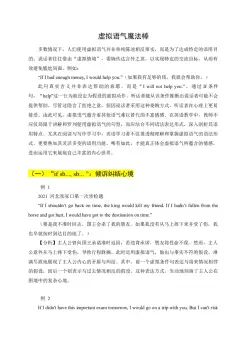
虚拟语气的
用用法
常
 (1)if 虚拟条件句的用法
场合
从句谓语动词形式
主句谓语形式
与现在事实相反
动词过去式(be 用were)
would / could / should / might+ 动词原形
与过去事实相反
had +动词过去分词
would/ could / should / might have done
与将来事实相反
1.动词过去式(be 用were)
2.were to + 动词原形
3.should + 动词原形
would / could / should / might + 动词原形
(2)从句谓语用“(should)+动词原形”的情况
① (坚持insist 命令order, command 建议advise, suggest, recommend 要求demand, desire, require, request)
接从句谓语用should+动词原形,且should 可以省略。但应注意insist 表示“坚持说”,suggest 表示“暗示,
表明”时,后接宾语从句应用陈述语气。
It is suggested that the meeting should be put off till next week.
②名词(order, command, advice, suggestion, requirement 等)后接从句,该从句谓语动词用should+动词原形,
且should 可以省略。
We agreed to the order that the task (should) be completed at 5 o'clock.
It is necessary/strange/ impossible..that..
③
从句谓语用should+动词原形,且should 可以省略。若从句涉及已
经发生的动作,则应用should have done。
It is strange that he should have acted toward his parents like that.
(3)特殊句型中虚拟语气的用法
I wish that…
①
从句与过去、现在、将来事实相反,分别用had done, did, would/could do。
I wish
从句结构
示例
与现在事实相反
一般过去式
I wish it were autumn now.
与过去事实相反
过去完成式
He wished he had not lost the chance.
与将来事实相反
would+动词原形
I wish you would come soon.
if only
②
表示“如果
该多好”,
……
as if/though 表示“好像”,从句虚拟用法同上。
I would rather that…
③
从句与过去事实相反用过去完成时,与现在、将来相反用一般过去时。
It is high/about time that..
④
后面常用did 或should do, should 不能省,意为“早该
”。
……
(4)情态动词后跟完成式虚拟语气的用法
分类
形式
用法
对过去情况的
后悔、遗憾或
责备等
needn't have done
过去没有必要做……但实际上做了
should/ought to have
done
过去本应该做……而实际上并未做
would have done
本来会做……而未做
could have done
本来可以做……但是实际没有做
1.
(2026·上海月考)My suggestion is that the problem                  (discuss) at the meeting
as soon as possible.
【答案】(should) be discussed
【解析】考查虚拟语气和被动语态。句意:我的建议是这个问题应该尽快在会议上讨论。分析句子结构可
知,“suggestion(建议)”后接表语从句时,从句需用虚拟语气,其结构为“(should) + 动词原形”,其中
should 可省略。再结合语义,the problem 与discuss 之间是被动关系,因此需用被动语态(should) be
discussed。故填 (should) be discussed。
2.
The expert suggested that if students          (pay) more attention to accumulating English
vocabulary in daily life, their reading comprehension ability would improve significantly.
【答案】paid
【解析】考查虚拟语气。句意:专家建议,如果学生在日常生活中能更加注重积累英语词汇,他们的阅读
理解能力将会显著提高。that 后的内容为宾语从句,是expert 当时所建议的具体内容。该宾语从句又是一
个含条件状语从句的主从复杂句,其主句中使用了would do 结构,且其所表述的内容是一个假设性的、与
现在事实(专家提建议时)相反的情况,空处应使用一般过去时,表示对现在的虚拟。pay 的过去式为
paid。故填paid。
3.
I           have worried before I came to the new school, for my classmates here are very friendly to
me.
【答案】needn’t
【解析】考查情态动词。句意:在我来到新学校之前,我本不需要担心,因为我的同学对我很友好。此处
考查needn’t have done,意为“本不必做(却做了)”。设空处应填情态动词的否定形式needn’t。故填
needn’t。
4.
But for the abundant English reading materials provided by the school library, the students
         (broaden) their horizons and improved their reading speed significantly last semester.
【答案】 wouldn’t have broadened
【解析】考查虚拟语气用法。句意:上个学期,如果不是学校图书馆提供的丰富的英语阅读资料,学生们
的视野不会有很大的开阔,阅读速度也不会有很大的提高。分析句子可知,该句“but for”(要不是、若
非)是虚拟语气的标志词,后接名词短语(此处“the abundant English reading materials”),表示“与事实
相反的假设”(即“如果没有学校图书馆提供的丰富英语阅读材料”);时间状语“last semester”(上学
期)明确表示 与过去事实相反的虚拟语气场景。虚拟语气句式结构(与过去事实相反)。主句结构为主
语 + could/would/should/might + have + 过去分词,此处主句谓语需用“wouldn’t have broadened”表示“不
会扩大”,语义成立。故填wouldn’t have broadened。
6.
(2026·陕西省西安高新第一中学月考)It is desired that accurate and timely weather warnings

(transmit) to all coastal communities before the storm arrives.
【答案】should be transmitted/be transmitted
【解析】考查虚拟语气。句意:希望在风暴到来之前,准确及时的天气警报能被传送到所有沿海社区。
“It is desired that...”是固定句型,意为“希望
”,其中
……
that 引导的主语从句要用虚拟语气,即谓语动词
用“(should)+动词原形”;transmit(传送)是主语从句中谓语,与主语weather warnings 之间是被动关系,用
虚拟语气,即(should) be transmitted。故填(should) be transmitted。
考点四 情态动词和虚拟语气考点知识的综合运用
情态动词和虚拟语气考点的
能力:
关键
1.熟练掌握情态动词的基本用法:情态动词+动词原形。
2.根据具体的语境判断使用相应的情态动词。
3.注意情态动词的特殊用法。例如should“竟然”。
4.近年来情态动词与动词时态、语态联考是重点。
5.根据具体语境恰当使用虚拟语气表达自己的思想感情,尤其是在写作中。
语法填空  体裁:记叙文    词数:265     考点专练
Tom and Peter are twins. They look as if they  1.__________ (be) the same person. Both the two boys are
smart, but Tom is hard-working while Peter is lazy. Tom always wins the first place in the exams while Peter
doesn't. However, people believe if Peter 2.__________ (work) as hard as Tom, he would do as well as his brother
in his study.
At home, their parents suggest that they 3.__________ (finish) their homework before playing computer
games. But Peter insists that it 4.__________ (be) OK to play games first as long as he can hand in his homework
in time. Their mother gives in in the end.
One day, when doing his homework, Tom found he made a serious mistake. So he put his exercise book aside
and used another one. When Peter found the previous exercise book, he struck out Tom's name and signed his name
on its cover happily, and handed it in as his own homework the next day.
When the teacher told the truth to the twins' mother, She was very angry and shouted at Peter, “How I wish
you 5.__________ (be) as diligent as your brother! Now it's time that I 6.__________ (give) you a good lesson.
And you 7.__________ play any computer games for a month!”
“Oh, no! Mom. 8.__________ a computer for such a long time, I would die. I would rather you  9.__________
(ask) me to do the dishes for a month alone.” Peter was upset.
“If you 10.__________ (finish) your homework on time yesterday, you wouldn't be punished now,” said
the mother.
【解析】本文是一篇记叙文。文章讲述了一对双胞胎的故事。
1.were 考查虚拟语气。句意:他们看起来好像是同一个人。此处应用虚拟语气,主句谓语动词look 与
as if 从句谓语动词be 没有先后顺序,故填were。
2.worked 考查虚拟语气。句意:人们认为如果彼得像汤姆那样努力学习,在学习上他会和汤姆一样好。
根据句意可知if 从句为表示与现在事实相反的虚拟语气,故填worked。
3.(should)finish 考查虚拟语气。句意:在家里,他们的父母建议他们在玩电脑游戏之前完成家庭作业。
suggest 作“建议”讲,后面宾语从句的谓语动词需用“should+动词原形”,其中should 可以省略。
4.is 考查虚拟语气。句意:但彼得坚持认为,可以先玩游戏,只要他能及时交出家庭作业。本句中的
insist 意为“坚持认为”,故用陈述语气。当insist 作“坚决要求”讲时才用虚拟语气,即其宾语从句的谓
语动词为“should+动词原形”,should 可以省略。
5.were 考查虚拟语气。句意:我多么希望你像你哥哥一样勤奋!wish 后的宾语从句是与现在事实相反的
虚拟语气,故填were。
6.gave/should give 考查虚拟语气。句意:现在是时候让我给你上一节好课了。 “It is time+that 从句”,
that 从句的谓语动词用过去式或should+动词原形。
7.mustn't 考查情态动词。句意:你不准玩任何电脑游戏一个月。此处表示“禁止”,故填mustn't。
8.Without 考查虚拟语气。句意:如果那么长时间不玩电脑,我会死掉的。故填Without。
9.asked 考查虚拟语气。句意:我宁愿你让我独自做一个月的菜。由would rather sb did sth 可知填
asked。
10.had finished 考查虚拟语气。句意:如果你昨天用按时完成家庭作业,你现在就不会受到惩罚了。本
句中的if 从句表示与过去事实相反的虚拟语气,故填had finished。