专题 10 情态动词和虚拟语气
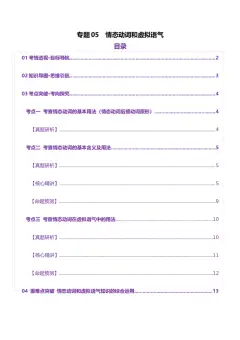
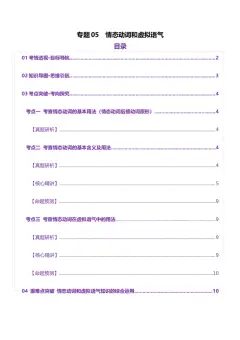
目录
一、考情解读............................................................................................................................................1
二、命题分析预测....................................................................................................................................1
三、考点必备知识通关............................................................................................................................1
四、考法解题能力提升..........................................................................................................................16
五、精选考点题型专练..........................................................................................................................17
一、考情解读
1.考生应掌握can,could,may,might,must,will,would,shall,should,
need等情态动词的基本用法。
2.考生应掌握虚拟语气在非真实条件句、名词性从句及其他句型中的应用。
二、命题分析预测
1.高考语法填空对情态动词和虚拟语气考查很少,考查点集中在情态动词后要跟动词原形
上。
2.情态动词和虚拟语气在语篇阅读中很常见,因此正确掌握情态动词和虚拟语气,以及它们的
联系,对于理解语篇非常重要。
三、考点必备知识通关
考点1 情态动词
知识1 情态动词概述
1.情态动词的类型
(1)只作情态动词的有:must, can/could, may/might, ought to
(2)既可作情态动词也可作实义动词的有:need, dare(3)既可作情态动词也可作助动词的有:shall/should, will/would
(4)具有情态动词的某些特征的有:have to, used to
2.情态动词的特征
(1)有一定的词义,但不能单独作谓语,要和动词原形一起构成谓语。在形式上,没有人称和数
的变化(have to除外)。
►We/He/You must study hard. 我们/他/你一定要努力学习。
He has to walk home. 他得步行回家。
(2)具有助动词的作用,可用来构成否定句、疑问句和简略答语。
►—I can't swim. Can you swim? 我不会游泳,你会游泳吗?
—No, I can't, either. 不,我也不会。
知识2 常见情态动词的用法
1.shall与should的用法
情态动词 用法 例句
征求对方意见。用于主语是 Shall we meet in the evening?
第一人称的疑问句中 咱们晚上见面好吗?
shall
表示命令、警告、许诺或威 You shall be punished for what
胁等。用于主语是第二人称 you've done. 你会为你所做
或第三人称的陈述句中 的事情受到惩罚。
Tell Jerry he shall get a gift if
he behaves well. 告诉杰里,如
果他守规矩的话,他会得到一
份礼物。
在条约、规定、法令等文件 Those belonging to our club
中表示规定或义务等 shall wear uniforms. 我们俱
乐部的成员应该穿制服。
续表
情态动词 用法 例句
表示责任、义务、劝告、建 You should learn to respect the
议等,意为"应该" elder. 你应该学会尊敬长
should
辈。
表示意外、惊讶、忧虑、惋 I'm sorry that she should be so
惜等情绪,意为"竟然" selfish. 我很难过,她竟如此
自私。
Why should anyone want to
marry Tony?怎么竟然还有人
想和托尼结婚?
表示推测,意为"应该",根据常 Today is Sunday, and our
规或经验作出的合理推断 teacher should be at home.今
天是周日,我们的老师应该在家。
It wasn't right for me that such near neighbors _______ not know one another.
【解析】 句意:如此近的邻居竟然互相不认识,这对我来说不正常。should"居然,竟然",符
合句意。
2.will与would的用法
用法 例句
表示请求,would比will语气委婉 Would you please let me have a look?你让我看
一下好吗?
表示主观愿望或意志,意为"愿意" I will do my best to help you.我愿意尽全力帮
你。
表示习惯或倾向。will表示一般的习 She'll listen to music, alone in her room, for
惯,would用于描述过去的习惯或例行的活动, hours.她总是独自一人在房间里听音乐,一听
表示"总是,总会" 就是几个小时。
In the past, he would come to help us when he
was free. 过去,他有空时总是来帮我们。
My former colleague Nick was helpful, and he _______ give us a hand at work.
【解析】 句意:我前同事Nick很乐于助人,在工作中经常帮助我们。由语境及空后的动词
原形give可知,此处表示过去经常发生的动作,故填would。
3.can与could的用法
用法 例句
表示能力,意为"能,会"(could为can 的过去 Can you lift this heavy box? 你能举起这个重
式,表示过去的能力) 箱子吗?
表示请求或许可,意为"可以",通常用于疑问 —Could I borrow the book?我可以借那本书
句中(could语气上比can委婉,肯定回答时一 吗?
般用can)
—Of course, you can.当然可以。
can表示人或物的特征、倾向、经常态势,意 Children can be noisy.孩子们有时会很吵闹。
为"有时会,时而可能",多用于肯定句
It can be very hot here.这里有时会很热。
can表示推测,通常用于否定句(还可用于疑问 That can't be Mary, because she is in hospital.
句),can't(不可能)表示有把握的否定推测。 那不可能是玛丽,因为她在住院。Can she be
with Nancy now? 她现在可能同南希在一起
吗?
特别提醒 can/could构成的特殊结构:
1.cannot/can't...too/enough"无论怎样……都不过分,越……越好",有时cannot/can't可用cannever替代。
►You cannot be too careful (=cannot be careful enough) when crossing the road.你过马路时怎
么小心都不过分。
►You can never do the work too excellently.这项工作你做得越出色越好。
►The movie is so funny that I can't help laughing.这部电影如此好笑,我禁不住大笑起来。
►I can't help (to) wash dishes because I am busy preparing for the exam.我不能帮忙洗碗,因为
我在忙着准备考试。
►I cannot help but obey the order.我不得不听从命令。
►We can't choose but accept the fact.我们不得不接受事实。
4.cannot, could not与比较级连用,表示最高级含义。
►It couldn't be better.没有比这更好的了。
Traveling by subway _______sometimes be quite a choice, especially during the rush hours.
【解析】 句意:乘地铁旅行有时是一种很好的选择,尤其是在交通高峰期。此处表示经常
的态势,故填can。
4.may与might的用法
用法 例句
在肯定句中可表示允许,在疑问句中表示请求 —Might I go fishing with you tomorrow? 我明
天可以和你一起去钓鱼吗?
对might的"请求"作肯定回答时用may/can
—Yes, you may/can.是的,你可以去。
may表示祝愿 May you be happy forever! 祝你永远快乐!
表示推测,用于肯定句和否定句中均可,意 Life is unpredictable; even the poorest
为"可能"。与may相比,might表示的可能性 may/might become the richest.人生难以预料,
要小一些。may/might not"可能不" 即使最穷的人也有可能成为最富有的人。
特别提醒 may/might构成的特殊结构:
may well表示"很可能", may/might as well表示"还是……好,不妨",两者后都跟动词原形。
►You may well get confused.你很可能被搞糊涂了。
►We may/might as well stay where we are.我们还是留在原地为好。Since we can do nothing about it, we _______ as well consult Mr. Smith about the matter.
【解析】 句意:既然我们无能为力,关于此事我们不妨咨询史密斯先生。固定短
语may/might as well"不妨,还是……好"符合句意。故填may/might。
5.must的用法
用法 例句
表示"必须,一定",强调必要性及说话人的主 You must finish your homework this afternoon.
观态度。在回答由must引起的一般疑问句 今天下午你必须完成家庭作业。
时,若为否定回答,通常用needn't或don't have
—Must I hand in my paper now?我现在必须
to
交卷吗?
—Yes, you must./No, you needn't(=don't have
to).是的,你必须。/不,你不必。
mustn't表示"不许,禁止",是强制的命令 You mustn't smoke here. 你不能在这儿吸
烟。
表示很有把握的肯定推测,通常用于肯定句 You must be hungry after a long walk.长途步
中,意为"准是,肯定是" 行之后你一定饿了。
表示"偏偏,非要",表示说话者对主语发出的 Must you make her cry?你偏要把她弄哭吗?
动作是不满的,甚至是生气的
Passengers _______ talk to the driver while the bus is moving, because it will take his focus off
the road.
【解析】 句意:在公共汽车行进过程中,乘客不能与司机交谈,因为这会把司机的注意力从
路上转移开。根据句意可知,此处表示"不许,禁止",故填mustn't。
知识3 特殊情态动词的用法
1.need与dare的用法
情态动词 用法 例句
need 表示必要性,常用于疑问句和 This is a free service; you
否定句中,needn't 表示"不 needn't pay for it.这是免费服
必";对need引出的一般疑问 务,你不必为此付款。
句作肯定回答时用must,作否
—Need I hand in the
定回答时用needn't
application now? 我需要现在
交申请吗?
—Yes, you must./ No, you
needn't. 是的,你必须。/ 不,
你不必。
dare 意为"敢,胆敢",作情态动词时 How dare she do things like
后跟动词原形,主要用于疑问 that? 她怎么敢做那种事?句、否定句和条件句中 —Dare you catch the mouse?
你敢抓老鼠吗?
—No, I daren't. 不,我不敢。
I've prepared all kinds of food for the picnic. You_______ bring anything when you
come.
【解析】 句意:我已经为野餐准备了各种食物。你们来的时候不必带任何东西。
needn't"不必,不需要",符合句意。故填needn't。
2.ought to与have to的用法
3.used to的用法
表示"过去常常……",言外之意是"现在已不再……"。
►While I was in college, I used to get up at 5 am to practice oral English.上大学时,我常常早上
五点起床练英语口语。
情态动词 用法 例句
ought to 表示理所当然,意为"理应,应 Humans ought to stop
该" polluting nature.人类应该停
止污染大自然。
表推测时同should
have to 表示客观需要,意为"必须,不 You have to be back before 10
得不",强调客观上的必要性 o'clock because the train
leaves at 10:05.你必须在10
点前回来,因为火车10:05
开。
知识4 情态动词表示推测
态度 情态动词 形式 例句
主观推测 绝对肯定 must(一定) do/be doing/have He must be in the
done library now. 他
现在一定在图书
馆。
绝对否定 can't(不可能) do/be doing/ He
can't(=couldn't)
have done
have gone
abroad. 他不可
能出国了。
客观推测 相对肯定/否定 may/might (not) do/be doing/have Your mother may
done be waiting for
(可能/可能不)
you at home. 你
妈妈可能正在家
等你呢。
理应 ought to/ do/be doing It's already 7
o'clock. Jimshould(应该) should be doing
his homework.
已经七点了,吉
姆应该正在做作
业。
情态动词+do: 表示对目前的动作或状态的推测;情态动词+be doing: 表示对正在发生的事情
的推测;情态动词+have done: 表示对已经发生的事情的推测。
Harry is feeling uncomfortable. He _______ have drunk too much at the party last night.
【解析】 句意:Harry觉得不舒服,他昨晚在聚会上肯定喝太多了。由last night及语境可
知,此处表示对过去情况把握很大的肯定推测。must have done"一定做了(某事)",符合句意。
故填must。
—I left my handbag on the train, but luckily someone gave it to a railway official.
—How unbelievable it is to get it back! I mean, someone _______ have stolen it.
【解析】 从对话情景可知,此处是对过去情况的推测:手提包落在火车上后有可能被偷
走。may/might have done意为"可能已经做了某事",符合语境。故填may/might。
知识5 "情态动词+have done"表示虚拟
结构 含义 例句
should have done 本该做某事(而实际上未做) Yesterday was the deadline,
and he should have completed
his work.昨天是最后期限,他
本该完成工作的。
shouldn't have done 本不该做某事(而实际上做 Tom shouldn't have told me
了) your secret.汤姆本不该把你
的秘密告诉我的。
could have done 本能够做某事(而实际上未 He could have walked out of
做) the desert.他本能够走出沙漠
的。
might have done 本可以做某事(而实际上未 He might have helped you.他
做) 本可以帮助你的。
needn't have done 本不必做某事(而实际上做 Thanks. You needn't have done
了) it. I could manage it. 谢谢,你
本不必做的,我能够应付。
—What's wrong with you?
—Oh, I am sick. I _______ (eat) so much ice cream just now.【解析】 根据语境可知,此处表示"我刚才本不应该吃那么多冰激凌的",故用shouldn't
have eaten。
结构 含义 例句
would rather have done 宁愿当时做了某事(后悔未 I would rather have refused his
做) invitation. 我宁愿当时拒绝
了他的邀请。
would like/love to have done 过去本想做某事(而实际上未 I would like to have gone to
做) the cinema last night,but I had
to do my homework. 我本想
着昨晚去看电影的,但是我得
做作业。
考点2 虚拟语气
知识1 非真实条件句表达虚拟语气
1.虚拟条件句的基本形式(注:此处3d=would/could/should)
对事实的假设 if从句的谓语动词 主句的谓语动词
与现在事实相反的假设 过去式(be用were) 3d/might+动词原形
与过去事实相反的假设 had+过去分词 3d/might+have+过去分词
与将来事实相反的假设 过去式(be用were)were to+动 3d/might+动词原形
词原形should+动词原形
►If I were 10 years younger, I would start all over again.如果我年轻10岁,我会再从头开始。
(虚拟现在)
►If you had warned him of the danger, he would not have been seriously injured.如果你警告过
他有危险,他就不会伤得这么严重。(虚拟过去)
►If you succeeded/should succeed/were to succeed, everything would be all right.如果你成功的
话,一切都会好起来的。(虚拟将来)
—Did George pass the interview?
—I'm afraid not. If so, he _______ (inform) me.
【解析】 句意:——乔治通过面试了吗?——恐怕没有。如果通过了的话,他就通知我了。
题干中的If so是If he had passed the interview的省略形式。结合语境可知,答语第二句说的
是非真实情况,而且是与过去事实相反的假设,因此主句谓语的形式应would/should/could/
might have done。故填would/should/could/might have informed。
2.错综时间条件句
在错综时间条件句中,条件从句和结果主句的谓语动作发生的时间背景不同,因此,条件从句和结果主句的谓语要根据各自谓语动作发生的时间背景选用不同的形式(参见上面表格中的
谓语动词形式)。
►If he had followed the doctor's advice, he would recover now. 如果他听了医生的劝告,他现在
就康复了。(过去→现在)
►If you hesitated at this moment, you might suffer in the future. 如果你此刻犹豫不决,你以后
会吃苦头的。(现在→将来)
If he had spent more time practising speaking English before, he _______ (be) able to speak it
much better now.
【解析】 句意:如果他以前多花点儿时间练习说英语的话,现在他就能说得好得多。题干
为错综时间条件句,从句是与过去事实相反的假设;而根据主句中的now可知,主句是与现在
情况相反的假设,故主句谓语的形式应为"would/should/could/might+动词原形"。故填would/
should/could/might be。
3.含蓄条件句
在含蓄条件句中,其虚拟条件通常由without,but for,otherwise等引出或表示,有些情况下,虚拟
条件需要我们从上下文中来推断。without…,but for…,otherwise等可转换为if引导的条件从
句。不同虚拟条件下,含蓄条件句谓语的形式:
►But for your help, we couldn't have succeeded. 要是没有你的帮助,我们不会成功。(虚拟过
去)
►Without your help, I wouldn't finish it.如果没有你的帮助,我将无法完成此事。(推测将来)
I _______ (go) to my cousin's birthday party last night, but I was not available.
【解析】 句意:要不是抽不出时间,我昨晚就去参加我堂弟的生日聚会了。结合句意和句
中的"but I was not available"可知,题干前半句表示含蓄条件;由last night可知,该含蓄条件句
表示与过去事实相反的假设,故填would/should/could/might have gone。
4.虚拟条件句的倒装
►Were I you, I would find a chance to make up with him.如果我是你,我会找机会与他和好。►Had you had a heart-to-heart talk with your mother, she would have supported you.如果你与你
的妈妈推心置腹地谈过,她就会支持你。
►Should I have time, I would go and watch the football game.要是我有时间,我就会去看足球
赛。
特别提醒 如果条件状语从句的谓语为否定式,其中的否定词not应置于主语之后,而不能随
were, should, had置于句首。
►如果不是我提醒你,你可能已经错过这个节目了。
【正】 If I hadn't reminded you, you could have missed the program.
【正】 Had I not reminded you, you could have missed the program.
【误】 Hadn't I reminded you, you could have missed the program.
_______ (be) there no modern telecommunications, we would have to wait for weeks to get news
from around the world.
【解析】 句意:如果没有现代化的电讯,要想收到来自世界各地的消息,我们就不得不等几
个星期。本题考查虚拟条件句的倒装。本题中,从句中使用了there be句型,表示与现在事实
相反的假设,be动词应用were;当if省略的时候,要使用部分倒装,即Were there no modern
telecommunications。故填Were。
知识2 表示"命令、建议、要求、愿望等"的动词或名词后名词性从句中的虚
拟语气
在command,demand,insist(坚决要求),suggest(建议)等表示命令、要求、建议等的动词后的宾
语从句和主语从句,以及advice,suggestion,proposal,request,requirement,order,demand,
desire等表示建议、要求、命令、愿望等的名词后的主语从句、表语从句和同位语从句中,
常用虚拟语气,即从句的谓语形式为"(should+)动词原形"。
1.宾语从句
下列动词后接宾语从句时,从句常用虚拟语气。
►She insisted that we (should) book some seats in advance.
她执意要我们提前订些座位。
►Mother suggested that I (should) go and apologize to my teacher.妈妈建议我去向老师道歉。一个坚持 insist
两个命令 order, command
四个建议 suggest, advise, propose, recommend
六个要求 require, request, demand, desire, urge, ask
特别提醒
1.insist作"坚决要求"讲时,用来表示一种要求、请求,其后的宾语从句用虚拟语气;而insist
作"坚持认为,坚持说"讲时,用于陈述一种看法、实情,其后的从句用陈述语气。
►He insisted that he was innocent.他坚持认为他是无辜的。
2.suggest作"建议"讲时,用来表示一种意见,其后的宾语从句用虚拟语气;而suggest作"表明,
暗示"讲时,用于陈述一种实际情况,从句用陈述语气。
►What he said suggested that he was a fraud. 他说的话表明他是个骗子。
The government required that every effort _______ (make) to bring down house prices.
【解析】 句意:政府要求要尽一切努力降低房价。require"要求"后跟宾语从句时,从句用
虚拟语气,即从句的谓语形式为"(should+)动词原形";effort与make之间为动宾关系,应用被动
语态,故填(should) be made。
2.主语从句
►It is required that middle school students (should) take exercise for at least one hour every day.
中学生被要求每天至少进行一个小时的锻炼。
3.表语从句
►His suggestion is that we (should) persuade her to stay here first.他的建议是我们首先说服她
待在这儿。
►My desire is that we (should) not quarrel over such things again.我的愿望是我们不要再为这
样的事情争吵了。
My suggestion was that necessary measures _______(take) to keep the children away from
dangerous classrooms.
【解析】 句意:我的建议是采取必要措施来保护孩子们远离危险的教室。that在此引导表
语从句,suggestion(建议)后的表语从句通常用虚拟语气,从句的谓语形式为"(should+)动词原
形",又measures与take之间为动宾关系,故应填(should) be taken。4.同位语从句
►We agreed to his suggestion that we (should) go to Beijing for sightseeing.我们同意他提出的
去北京观光的建议。
►He issued the order that the troops(should) withdraw at once.他命令部队马上撤退。
知识3 as if/as though和wish后从句的虚拟语气
as if/as though引导的方式状语从句/表语从句和wish后的宾语从句用虚拟语气时,从句的谓
语在不同虚拟条件下的形式:
1.as if/as though引导的方式状语从句/表语从句表示与现在或过去的事实相反的情况或推测
将来时,从句用虚拟语气。
►He speaks as if/as though he knew all about it.他说起话来就好像他完全知道这件事似的。
(与现在事实相反)
►He talked about pyramids as if/as though he had seen them himself.他谈论起金字塔来就好像
他亲眼见过似的。(与过去事实相反)
Don't handle the vase as if it _______(be) made of steel.
【解析】 句意:别这么拿这只花瓶,好像它是钢做的一样。as if表示"似乎,好像",在此引导
方式状语从句。主句为祈使句,此处as if引导的方式状语从句表示对现在情况的虚拟,故从
句的be动词应该用were。故填were。
特别提醒 as if/as though引导表语从句时,常位于look, seem, feel, taste,smell,sound等系动词
之后;引导方式状语从句时,常位于behave, act,talk等行为动词之后。若从句叙述的情况是真
实的或出现的可能性很大,从句用陈述语气;若从句叙述的情况是非真实的或出现的可能性很
小,则从句用虚拟语气。
2.wish后的宾语从句
wish后的宾语从句一般用虚拟语气,表示一种没有把握或不太可能实现的愿望。►I wish I hadn't made such a promise to him.我希望(当初)我没有向他许下那样的承诺。
►I wish it were a sunny day today.我希望今天是个晴天。
I wish I _______(be)at my sister's wedding last Tuesday, but I was on a business trip in New
York then.
【解析】 句意:我希望上周二参加了我姐姐的婚礼,但那时我在纽约出差。
wish后的宾语从句应用虚拟语气;再由从句中的时间状语"last Tuesday"可知,此处表示与过去
事实相反的假设,故从句的谓语形式应为"had+过去分词"。故填had been。
知识4 特殊句式中的虚拟语气
1.would rather后的宾语从句
would rather(宁愿)后的宾语从句用虚拟语气,不同虚拟条件下,从句谓语的形式:
►I would rather you came to see me tomorrow.我宁愿你明天来看我。
►I would rather you hadn't told me the truth.我宁愿你没有告诉我实情。
2.It's (high/about)time (that)…
It's (high/about)time (that)…[(现在/差不多)是……的时候了]句型中,that从句通常用虚拟语
气,此时从句中谓语动词用过去式或"should+动词原形",必须注意的是should不能省略。
►It is about time that we were off.我们该离开了。
►It is high time that you should teach him a lesson.你该教训一下他了。
Jack is a great talker. It's high time that he _______(do) something instead of just talking.
【解析】 句意:杰克总是夸夸其谈,他该做点事了,而不是仅仅空谈。空处所在句是"It's
high time that…"句型,其中从句的谓语动词用过去式或"should+动词原形",且should不能省
略。故填did或should do。
3.if only后的句子
if only(要是……就好了)后的句子常用虚拟语气,句子谓语用一般过去时表示当前没有实现的
愿望,用过去完成时表示过去没有实现的愿望。
►If only she had known where to find you.她(当时)要是知道去哪儿找你就好了。►If only I could speak several foreign languages.我要是能说几门外语就好了。
4.It is +形容词+that…
在"It is +形容词(important, necessary, essential, natural, strange, urgent等)+that..."句型中,that
引导的主语从句用虚拟语气,即从句的谓语形式为"(should+)动词原形"。
►It is necessary that we (should) clean the room every day.我们每天打扫房间是有必要的。
四、考法解题能力提升
考法1 考查情态动词
命题透视 高考通常在具体语境中考查情态动词的基本含义:
1.表示推测(must,may,might,can,could,should等)。
2.表示必要性、义务、责任等(need,must,shall,should等)。
3.表示请求、建议、命令、允许、禁止等(can/could,may/might,must,shall等)。
方法点拨 根据语境去准确体会说话者的态度和语气,然后结合各情态动词的具体用法,筛
选出最适合语境的情态动词。
You _______ be Carol. You haven't changed a bit after all these years.
【解析】 根据语境可知,此处应该用情态动词表示推测,由"这么多年你一点都没变"可推
知,此处为非常有把握的肯定推测(你"一定"是Carol),故填must。
考法总结 空后为动词原形,故此处只能填助动词或情态动词;根据第二句可知此处是说话
人的推测,因为有"据"可循,所以非常肯定,故填语气最为强烈的情态动词must。
考法2 考查虚拟语气
命题透视 高考语法填空中可能会考查:
1.if非真实条件句表示虚拟时,从句或主句谓语的形式。
2.虚拟语气用于名词性从句(主语从句、宾语从句、表语从句和同位语从句)中时,从句谓语
的形式。
3.without,but for,or等引出虚拟条件时,句子谓语的形式。
方法点拨 虚拟语气的应用非常灵活,有时省略连词if,把从句中的were, had或should提
前;有时无条件从句,而用without,otherwise等词引出虚拟条件;有些用在特殊动词或名词后的
名词性从句中或其他特殊句式中。解答虚拟语气类的题目时,要先判断其应用形式, 再根据
句中给出的时间 (或通过语境暗示出的时间)或谓语动词形式,确定所需要填的谓语动词形式。
If the new safety system _______(put) to use, the accident would never have happened.
【解析】 句意:如果这套新的安全系统(当初)投入使用了,这次事故绝对不会发生。由
would never have happened 可知本句用了虚拟语气,表示对过去情况的虚拟,主句谓语形式
用"would/should/could/might+ have+过去分词",从句谓语应用"had+过去分词",且此处system
和put之间是动宾关系,故用过去完成时的被动语态。故填had been put。
考法总结 根据主句中的would never have happened 可快速确定此题考查的是对过去事实
的虚拟;if引导的条件状语从句中,用过去完成时表示和过去事实相反的假设;同时要考虑到
从句主语和动词put之间是动宾关系。
五、精选考点题型专练
1. It’s a rule that students ________ bring mobile phones to our school.
A. mustn’t B, wouldn’t C. needn’t D. couldn’t
2. —Is the woman Miss Zhao?
—It _______ be her. She has gone to Qingdao for a meeting.
A. can’t B. needn’t C. must D. may
3. You ________ worry about her too much. She will get well soon.
A. can’t B. mustn’t C. needn’t D. shouldn’t
4. —______ I have a word with you, Mr. Green? It won’t take long.
—Okay.
A. Should B. May C. Need D. Must
5. —I’ve got a toothache, mom.
—Oh, you _____ eat too much candy.
A. shouldn’t B. needn’t C. should D. need
6. We ______ pay to get into the concert, because it’s free.
A. mustn’t B. can’t C. don’t need to D. might not
7.—Some people don’t show their talents at the very beginning.
—I agree. Even Einstein ________ read until he was seven.
A. can’t B. mustn’t C. couldn’t D. needn’t8. — Mum, it’s too hot. _______ I swim in the lake?
— No, you _______. That’s too dangerous!
A. Should; can’t B. Need; mustn’t C. Must; needn’t D. Could; mustn’t
9. —Is that Tom over there?
—It ______ be him. He is on the plane to Chengdu now.
A. can’t B. might not C. must
10. —Look, Linda. The flowers in our classroom came out in one night.
—I can’t believe it. They are beautiful and colorful. They ________ great.
A. sound B. smell C. taste
11. You ______ walk on the wet hill path because you ______ fall and hurt yourself.
A must; might not B. mustn’t; might
C. needn’t; need D. must; must
12. —______ I take the magazine out of the reading room?
—I’m sorry you _______.
A. Could; couldn’t B. Must; couldn’t C. Will; can’t D. May; can’t
13. — _______ I keep the book for a week?
— Sorry, I’m afraid you ________.
A. Need; couldn’t B. Need; can’t
C. May; couldn’t D. May; can’t
14. —Kangkang, I saw your English teacher in the office just now.
—It _______ be him. He ________ to Shanghai on business.
A. must; has gone B. must; has been C. can’t; has been D. can’t; has gone
15. —A little bird entered through the open window to join us for dinner last night.
—Wow, the unexpected guest _________ welcomed.
A. will be B. must be C. won’t be D. mustn’t be
16.—Is that boy Scott?
—No, it ________ be Scott. Scott is much taller.
A. can B. can’t C. mustn’t
17.—Yuan Longping, a famous Chinese scientist, is now doing research on sea rice.
—If farmers start planting rice in salty water, China’s food supply will surely rise.
A. can B. can’t C. must D. mustn’t
18..—Can we walk across the road now?—No, we _______. We have to wait until the light turns green.
A. couldn't B. needn't C. shouldn't D. mustn't
19. — If I want to be an astronaut, how will I get to be one?
— You ____ do well in school and tame your fears,
A. mayB. can C. must D. could
20.—Look!The woman at the school gate ______ be our headmaster.
—No,it ______ be her.She is holding a meeting in the office now.
A.must;can’t B.must;mustn’t C.can;needn’t D.may;mustn’t
21.—Look at the man standing at the school gate. Is he your math teacher Mr. Brown?
—No, it be him, He has gone to Chengdu on business.
A. needn’t B. can’t C. may not D. mustn’t
22.(2020浙江1月,64)However, greater attention should (place) on longevity(长
寿).
23.(2019江苏,31)What a pity! You missed the sightseeing, or we (have)a good time
together.
24.(2018 江苏,27)There is a good social life in the village, and I wish I (have)a
second chance to become more involved.
25.(2017北京,21)Samuel, the tallest boy in our class, easily reach the books on the
top shelf.
26.(2016天津,15)I was wearing a seatbelt. If I hadn’t been wearing one, I (injure).
27.It was sad to me that they,so poor themselves,_______ bring me food.
28.I have worried before I came to the new school, for my classmates here are very
friendly to me.
29.It is required by law that a driving test (take)before a man gets a license.
30.How I wish I (begin) to learn French when I was ten.
31.Traffic safety is related to thousands of households. We stress the importance of it
enough.
32.If the new safety system had been _______ (put) to use, the accident would never have
happened.
33.—Do you have Betty's phone number?
—Yes. Otherwise, I wouldn't ______ (be) able to reach her yester-day.34.I was wearing a seat belt then; if I hadn't been wearing one, I would have been
______ (injure).
35.Harry is feeling uncomfortable and he _____have drunk too much at the party last night.
36.One of our rules is that every student wear school uniforms while at school.
37.(2021四川成都摸底测试, 64)The term risk means that the result can’t (know).
38.(2021广东深圳外国语学校考试,15)The doctor insisted that I a high fever and
that I a rest for a few days.(have)
39.(2021 天津八校期中联考,24)We didn’t sleep well last night because of the test. But it
turned out to be easy so we have been worried about it.
40.(2020江苏扬州高三期中调研,27)I (abandon)my dream of becoming a pianist,
but for the encouragement from that music teacher.
41.(2020黑龙江大庆铁人中学期中,1)Eye doctors recommend that a child’s first eye exam
(be) at the age of six months.
42.(2020 江苏无锡期中,32)—How impressive China’s 70th anniversary of National Day
parade is!—Definitely. If only I (be)on the scene!
43.(2019江苏天一中学调研,23)—Did you go to the party last night?
—Yes, but I’d rather I (go) there. It was so boring.
44.(2018天津,10)I can’t find my purse. I (leave)it in the supermarket yesterday, but
I’m not sure.
45.(2018 天津,15)If we (catch) the flight yesterday, we would be enjoying our
holiday on the beach now.
46.(2017天津,15)—Do you have Betty’s phone number?
—Yes. Otherwise, I (be) able to reach her yesterday.
47.(2017天津,2)My room is a mess, but I clean it before I go out tonight. I can do it
in the morning.
48.(2016 天津,5)It was really annoying; I get access to the data bank you had
recommended.
A专项语篇型填空(情态动词和虚拟语气)
Rain or shine, Tom is always the first to arrive at the office. His home 1 be very near the
office, or he 2 be always in time for work. How I wish that I 3 (live)close to work, so that
I 4 not get up so early every day. Yesterday, for example, I would 5 (arrive) in time forwork as usual if I hadn’t been caught in a traffic jam. The boss was so angry with me that he
demanded I 6 arrive at work early enough later on, saying that should I be caught being late
again, he 7 (punish)me.
I 8 stop doing everything and go to bed now. Anyhow, it’s time that I 9 (go) to sleep,
and I hope I 10 arrive at work on time tomorrow. It will be bad to be caught arriving late
again.
B语法填空
(2020安徽示范高中名校联考)Have you ever wondered where Lego(乐高)comes from?
Like many other great inventions,the story is not only one of a great idea, 1 one of tons of
hard work and perseverance(毅力).
The story started in Denmark. Ole Christiansen was a carpenter 2 was struggling with
his small business. His wife died 3 (short) after his fourth son was born. He had to work hard
to support his family alone. He started making wooden toys,but they didn’t sell well. He thought
his toys needed a name,and he chose 4 name "Lego".
Unfortunately, several years later, his workshop 5 (burn) to the ground. Soon,he started
to make a few plastic toys. He got the idea of creating a "system" of toys that would build up kids’
6 (imagine) and creativity. He decided to stop 7 (make) wooden toys and focus only on
the connected plastic toys. Then he started to build more and more kinds of 8 (model). Each
one had to be of the 9 (high) quality, which can be reflected in Lego’s motto — "Only the
best is good enough. "
Thanks to his perseverance, kids can enjoy Lego toys, movies, amusement parks and
clothing. But none of this would have existed at that time if he 10 (give) up when times
were hard.