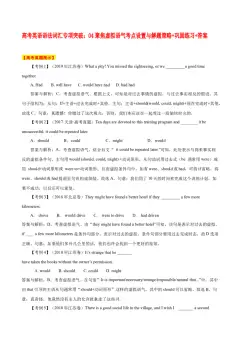
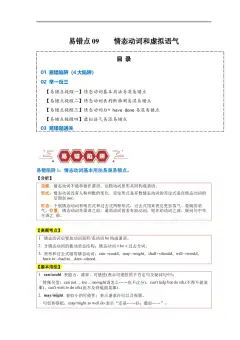
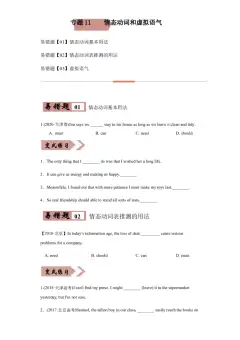
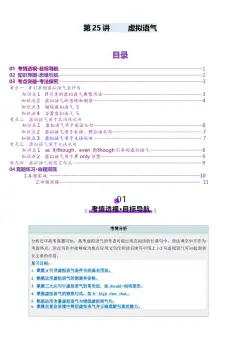
08 情态动词和虚拟语气
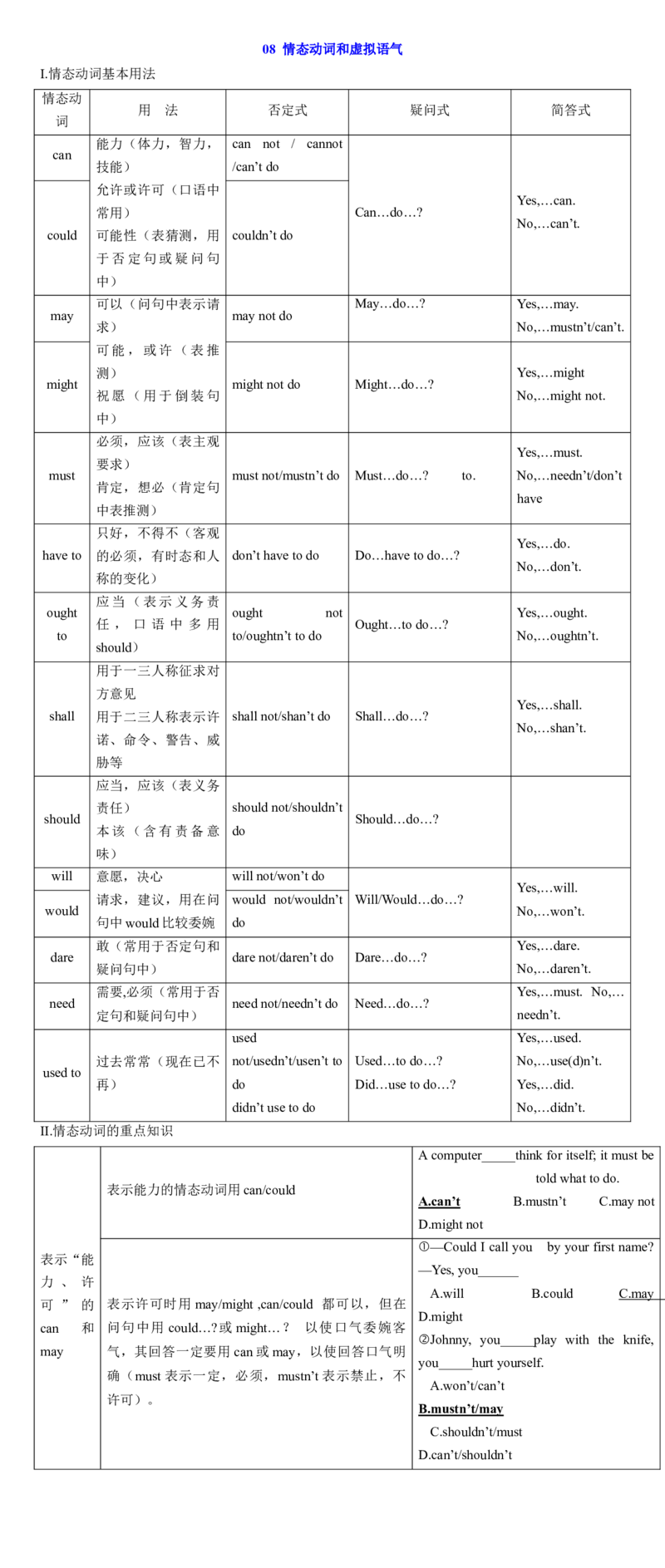
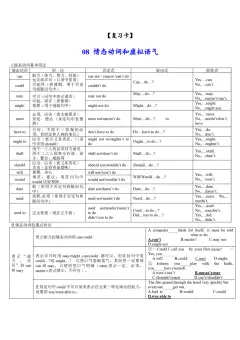
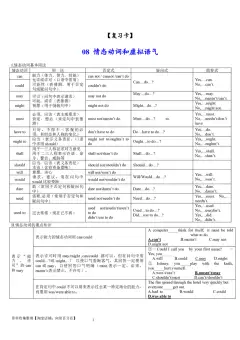
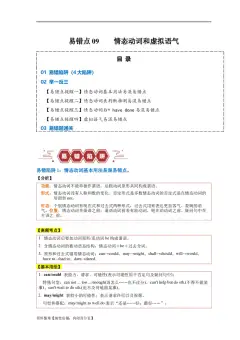
I.情态动词基本用法
情态动
用 法 否定式 疑问式 简答式
词
能力(体力,智力, can not / cannot
can
技能) /can’t do
允许或许可(口语中
Yes,…can.
常用) Can…do…?
No,…can’t.
could 可能性(表猜测,用 couldn’t do
于否定句或疑问句
中)
可以(问句中表示请 May…do…? Yes,…may.
may may not do
求) No,…mustn’t/can’t.
可能,或许(表推
测) Yes,…might
might might not do Might…do…?
祝愿(用于倒装句 No,…might not.
中)
必须,应该(表主观
Yes,…must.
要求)
must must not/mustn’t do Must…do…? to. No,…needn’t/don’t
肯定,想必(肯定句
have
中表推测)
只好,不得不(客观
Yes,…do.
have to 的必须,有时态和人 don’t have to do Do…have to do…?
No,…don’t.
称的变化)
应当(表示义务责
ought ought not Yes,…ought.
任 , 口 语 中 多 用 Ought…to do…?
to to/oughtn’t to do No,…oughtn’t.
should)
用于一三人称征求对
方意见
Yes,…shall.
shall 用于二三人称表示许 shall not/shan’t do Shall…do…?
No,…shan’t.
诺、命令、警告、威
胁等
应当,应该(表义务
责任) should not/shouldn’t
should Should…do…?
本该(含有责备意 do
味)
will 意愿,决心 will not/won’t do
Yes,…will.
请求,建议,用在问 would not/wouldn’t Will/Would…do…?
would No,…won’t.
句中would比较委婉 do
敢(常用于否定句和 Yes,…dare.
dare dare not/daren’t do Dare…do…?
疑问句中) No,…daren’t.
需要,必须(常用于否 Yes,…must. No,…
need need not/needn’t do Need…do…?
定句和疑问句中) needn’t.
used Yes,…used.
过去常常(现在已不 not/usedn’t/usen’t to Used…to do…? No,…use(d)n’t.
used to
再) do Did…use to do…? Yes,…did.
didn’t use to do No,…didn’t.
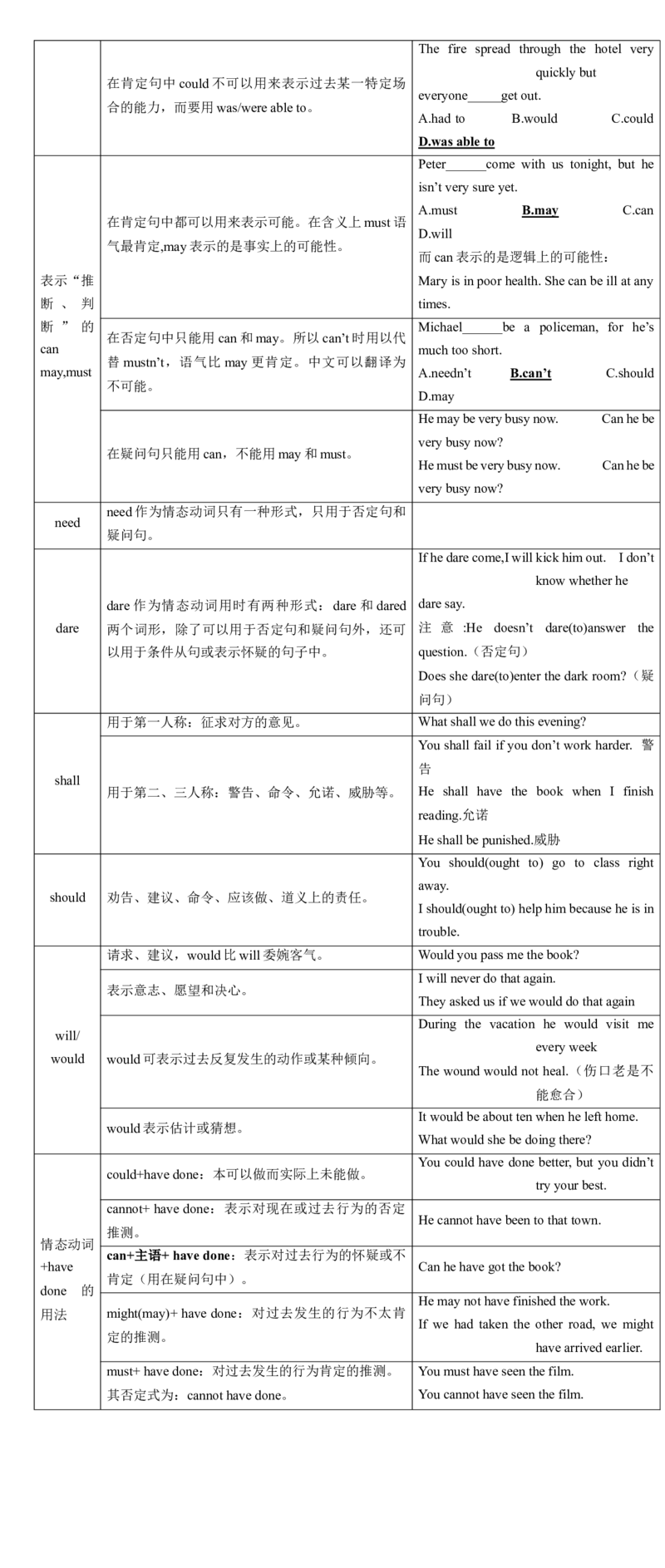
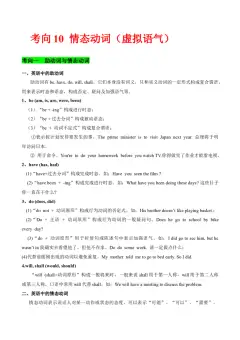
II.情态动词的重点知识
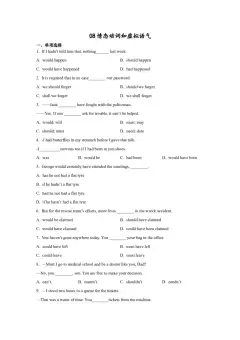
A computer_____think for itself; it must be
told what to do.
表示能力的情态动词用can/could
A.can’t B.mustn’t C.may not
D.might not
①—Could I call you by your first name?
表示“能
—Yes, you______
力 、 许
A.will B.could C.may
可 ” 的 表示许可时用 may/might ,can/could 都可以,但在
D.might
can 和 问句中用 could…?或 might…? 以使口气委婉客
②Johnny, you_____play with the knife,
may 气,其回答一定要用can或may,以使回答口气明
you_____hurt yourself.
确(must 表示一定,必须,mustn’t 表示禁止,不
A.won’t/can’t
许可)。
B.mustn’t/may
C.shouldn’t/must
D.can’t/shouldn’tThe fire spread through the hotel very
quickly but
在肯定句中could不可以用来表示过去某一特定场
everyone_____get out.
合的能力,而要用was/were able to。
A.had to B.would C.could
D.was able to
Peter______come with us tonight, but he
isn’t very sure yet.
A.must B.may C.can
在肯定句中都可以用来表示可能。在含义上must语
D.will
气最肯定,may表示的是事实上的可能性。
而can表示的是逻辑上的可能性:
表示“推 Mary is in poor health. She can be ill at any
断 、 判 times.
断 ” 的 Michael______be a policeman, for he’s
在否定句中只能用can和may。所以can’t时用以代
can much too short.
替 mustn’t,语气比 may 更肯定。中文可以翻译为
may,must A.needn’t B.can’t C.should
不可能。
D.may
He may be very busy now. Can he be
very busy now?
在疑问句只能用can,不能用may和must。
He must be very busy now. Can he be
very busy now?
need作为情态动词只有一种形式,只用于否定句和
need
疑问句。
If he dare come,I will kick him out. I don’t
know whether he
dare 作为情态动词用时有两种形式:dare 和 dared dare say.
dare 两个词形,除了可以用于否定句和疑问句外,还可 注 意 :He doesn’t dare(to)answer the
以用于条件从句或表示怀疑的句子中。 question.(否定句)
Does she dare(to)enter the dark room?(疑
问句)
用于第一人称:征求对方的意见。 What shall we do this evening?
You shall fail if you don’t work harder. 警
告
shall
用于第二、三人称:警告、命令、允诺、威胁等。 He shall have the book when I finish
reading.允诺
He shall be punished.威胁
You should(ought to) go to class right
away.
should 劝告、建议、命令、应该做、道义上的责任。
I should(ought to) help him because he is in
trouble.
请求、建议,would比will委婉客气。 Would you pass me the book?
I will never do that again.
表示意志、愿望和决心。
They asked us if we would do that again
During the vacation he would visit me
will/
every week
would would可表示过去反复发生的动作或某种倾向。
The wound would not heal.(伤口老是不
能愈合)
It would be about ten when he left home.
would表示估计或猜想。
What would she be doing there?
You could have done better, but you didn’t
could+have done:本可以做而实际上未能做。
try your best.
cannot+ have done:表示对现在或过去行为的否定
He cannot have been to that town.
推测。
情态动词
can+主语+ have done:表示对过去行为的怀疑或不
+have Can he have got the book?
肯定(用在疑问句中)。
done 的
He may not have finished the work.
用法 might(may)+ have done:对过去发生的行为不太肯
If we had taken the other road, we might
定的推测。
have arrived earlier.
must+ have done:对过去发生的行为肯定的推测。 You must have seen the film.
其否定式为:cannot have done。 You cannot have seen the film.You needn’t have watered the flowers,for it
is going to rain.
注意:didn’t need to(have to)do:
needn’t+ have done:本来不必要做的而实际上又做
没有必要做而实际上也没有做
了。
I didn’t need to clean the windows.My
sister did it 2 hours
ago.
You should have started earlier, but you
didn’t.
should(ought to)+ have done:本来应该做而实际上 She shouldn’t have taken away my
又没有做。其否定形式表示某中行为不该发生却发 measuring tape,
生了。 for I worked to use it.
注意:He should have finished the work
by now.(表推测)
易混知识:
易混1 对情态动词表示推测的误用
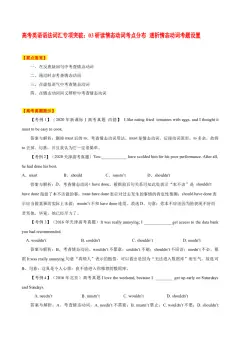
高考对情态动词表示推测的考查集中在must,may, might, can, could的用法上。
must用于肯定的陈述句中,表示肯定的推测,语气最强;may,might用于肯定和否定的陈述句
中,表示可能性不大的推测,语气较弱;can 用于肯定的陈述句中,表示对客观可能性的推测;
can,could 用于否定的陈述句和疑问句中,表推测,语气比may/might强。
We may go to the cinema tonight, but we are not sure yet.今晚我们可能去看电影,但还没确定。(可
能性不大的推测)
Accidents can happen on such rainy days.
在这样多雨的日子可能会发生事故。(对客观可能性的推测)
She can't have left school, for her bike is still here.她不可能离开学校了,因为她的自行车还在这里。
(对过去的推测,语气强)
易混2 不同句式或不同时间的虚拟语气的混淆情态动词表虚拟是英语语法中的一个难点,
不同句式及不同时间的表达形式不尽相同,所以在平时学习中要熟记不同句式的虚拟形式。做题
时,根据题干中的时间信息,正确判断句子表示与何时的事实相反,从而作出正确的选择。
He would lose weight, but he eats too much.他本来要减肥的,但是他吃得太多了。(根据 he eats
too much 可知是对现在的虚拟,根据对现在虚拟的形式可知,第一个分句谓语用“would+动词原
形”)
I would rather you had seen the film yesterday.我倒希望你昨天就看了这部电影。(由yesterday 以及
would rather后的从句用虚拟语气可知,从句谓语用“had+过去分词”,表示对过去的虚拟)
The workers' requirement was that their working conditions be improved.工人们的要求是他们的工作条
件要得到改善。(requirement后的表语从句中谓语应用“should+动词原形”,should可以省略)
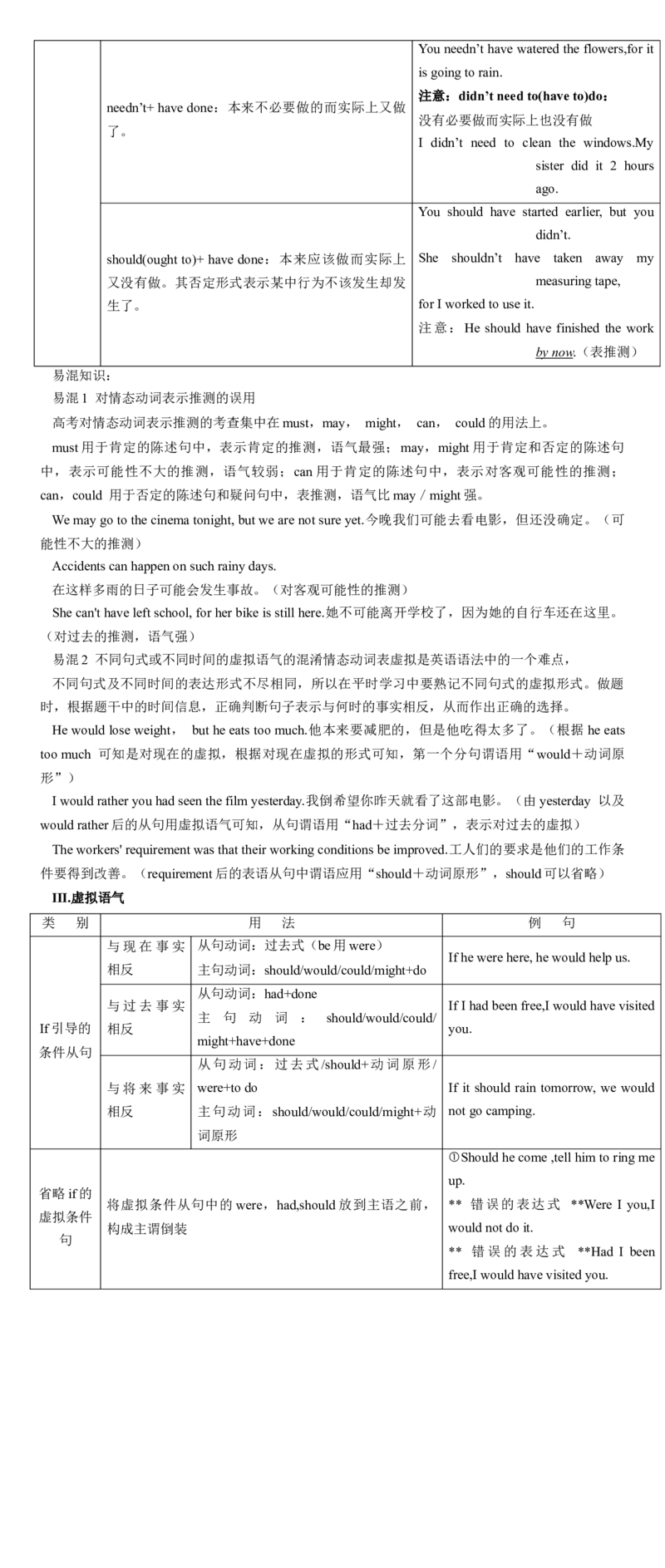
III.虚拟语气
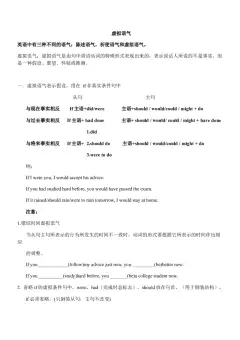
类 别 用 法 例 句
与现在事实 从句动词:过去式(be用were)
If he were here, he would help us.
相反 主句动词:should/would/could/might+do
从句动词:had+done
与过去事实 If I had been free,I would have visited
主 句 动 词 : should/would/could/
If引导的 相反 you.
might+have+done
条件从句
从句动词:过去式/should+动词原形/
与将来事实 were+to do If it should rain tomorrow, we would
相反 主句动词:should/would/could/might+动 not go camping.
词原形
①Should he come ,tell him to ring me
up.
省略if的
将虚拟条件从句中的 were,had,should 放到主语之前, ** 错误的表达式 **Were I you,I
虚拟条件
构成主谓倒装 would not do it.
句
** 错误的表达式 **Had I been
free,I would have visited you.①If he had listened to me, he would
not be in trouble now.
** 错误的表达式 **If he had told
me yesterday,I should know what to
不同时间的虚拟:各遵守各的规则
do now.
** 错误的表达式 **If I were you, I
混合虚拟
would have gone to her birthday
条件句
party.
①He could have passed the exam,but
he wasn’t careful enough.
虚拟与陈述的混合:各遵守各的规则 ** 错误的表达式 **You should
have come earlier.The bus left a
moment ago.
---But for your timely warning,we
______ into great trouble.
---You know we’re friends.
but for+名词表示虚拟条件 A. would get B. must
have got
C. would have got D. can’t have
got
Without the air to hold some of the
without+名词表示虚拟条件 sun's heat, the earth at night would be
freezing cold.
It would be only partly right to follow
动词不定式表示虚拟条件 in this way.
如果用这种方式,仅仅对了一半。
句子或主句中的谓语动
Having known in time ,we might have
含蓄虚拟 词的形式视具体情况而
现在分词表示虚拟条件 prevented the accident.要是及时得知
条件句 定。这是考查考生应变
的话,我们也许能阻止这场事故。
能力的最佳试题。
Given more attention, the tree could
have grown better.
过去分词表示虚拟条件
如果多留心的话,这树本来可以长
的更好。
I was too busy at that
time.Otherwise,I would have called
副词otherwise表示虚拟条件
you.我当时太忙,否则我就给你打
电话了。
He _____fatter but he eats too little .
A. would become B. would have
连词but连接的句子表示虚拟
become
条件
C. must become D. must have
become
①与现在事实相反
as if/as though引导的状语从句中动词用did或had+done He talks as if he knew where she
或would/could/might+do。 was.
注意:as if/as though引导的状语从句中也可以用陈述语 ** 错误的表达式 **与过去事实相
气: 反
当说话者认为所述的是真实的或极有可能发生或存在的 He talks about Rome as if he had been
其它
事实时: there before.
状语从句
It sounds as if it is raining.听起来像是在下雨。 ** 错误的表达式 **与将来事实相
He talks as if he is drunk.从他谈话的样子来看他是醉 反
了。 He opened his mouth as if he would
say something.
in order that/so that 引 导 的 状 语 从 句 中 动 词 Turn on the light so that we can see it
用can/could/may/ might/ would等+do clearly.
demand, suggest, order, insist 后 接 的 从 句 中 动 词 为 He suggested that we not change our
宾语从句
should+do mind.
I wish I could be a pop singer.
wish 后的从句中分别用过去式,过去完成式和 should/
I wish I would have gone to Shanghai
would+do表示与现在,过去和将来情况相反
last month.在It is necessary / important / strange that…
It is suggested / demanded/ ordered / requested that…等从句 It is strange that such a person should
主语从句
中, be our friends.
谓语动词用should+do
It’s high time that we left/should
It is time that…句型中动词用过去式或should+do
leave.
其它 I would rather you stayed at home
would rather所接的从句中动词用过去式或者过去完成式
句型中 now.
If only句型中动词常用过去式或者过去完成式,表示强
If only our dream had come true!
烈的愿望
特别注意:
(1)在if引导的虚拟条件状语从句中,谓语动词含有 had,were,should时,可以把if省略,将
had,were,should提到句首,变为倒装句。
Had you (=If you had) come earlier, you would have caught the early bus.如果你早点来,就能赶上早班车
了。
Were I you were you), I would try it again.如果我是你,我会再试一试。
Should he come should come),tell him to ring me up.他要是来了,让他给我打个电话。
(2)当条件状语从句和主句表示的动作或行为所发生的时间不一致时,该条件句就被称为“错综时
间条件句”,动词的形式要根据它所表示的时间作出相应的调整。
If you had followed the doctor's advice, you would be better now.如果你当时遵循医生的建议的话,你现
在就会好多了。
(3)有时假设的条件不通过条件状语从句表达出来,而是隐含在某些词或短语中,或隐含在上下文
中,这叫“含蓄条件句”。常用的这类词或短语有:
without(要是)没有 in case 如果,假使
but for要不是 for fear that 唯恐
otherwise 否则 or 否则
I couldn't have gone through that bitter period without your generous help.
如果没有你慷慨相助的话,我不可能熬过那段艰苦的日子。
We lost our way in that small village, otherwise we would have visited more places of interest yesterday.
我们在那个小村庄迷路了,要不然昨天我们就能参观更多的名胜了。
巩固练习:
单句填空
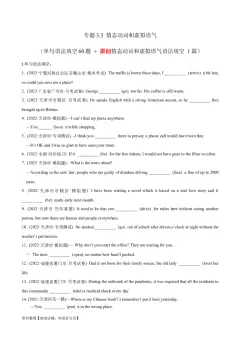
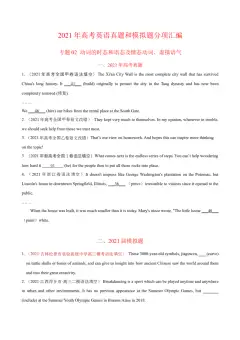
1._________you make so much noise, Jimmy? Your little sister is still sleeping.
2.Using supercomputer, many labs are now conducting experiments that couldn't__________ (be)possible in
the past.
3.At the routine office meeting, the headmaster insisted the problems referred to ________(pay)special
attention to.
4.I wish I_________(attend) the meeting yesterday so that I didn't have to make it up later.
5.He talked about the Eiffel Tower as if he___________ (see) it for himself.
6.The firefighters failed to save the dog's owner because if they_________(walk) onto the mud,they would
have sunk,too.
7.Children must_____________(teach) how to deal with dangerous situations.
8.If I____________(be) at home in Cambodia, I would have to go outdoors.
9.I am sorry I am very busy now.If I ____________(have) time,I would certainly go to the movies with you.
10.According to the local law, no one ____________enter the building site without permission.
语法填空:
Keeping a diary in English is an 1________(effect) way to improve our English writing abilities. 2
___________(compare) with other forms of writing, it is shorter and takes less time. It can help us to
develop the habit of thinking in English.If we persist in this practice, 3________(gradual) we will learn how
to express ourselves in English. In keeping a diary in English, we certainly run up against many
difficulties.In the first place, 4___________ happens that we have trouble 5_________ (express) our minds
with appropriate words and phrases. Second,there exist Chinese idiomatic 6____________(phrase) but it is
extremely hard for us to put them in English properly.
My suggestion is that a notebook 7__________ (keep)and a Chinese-English dictionary be 8________
our reach.Whenever something beats us, we can first put it down in our notebook 9__________ consult our
dictionary then. In short, I firmly believe that keeping a diary 10_________ (contribute) a lot to the
development of our writing skills.