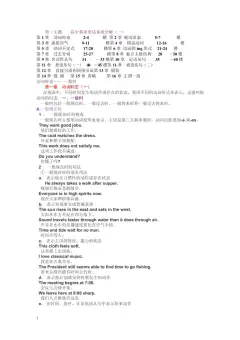
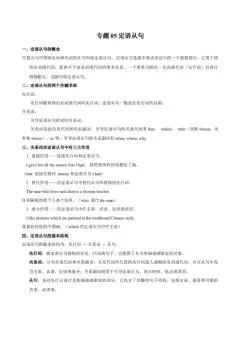
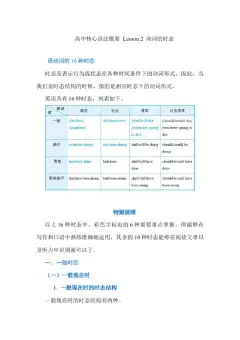
高中英语语法详解(讲义)chapter 10 状语从句
■

一、时间状语从句
■

二、地点状语从句
■

三、原因状语从句
■

四、目的状语从句
■

五、结果状语从句
■

六、方式状语从句
■

七、比较状语从句
■

八、让步状语从句
■

九、条件状语从句
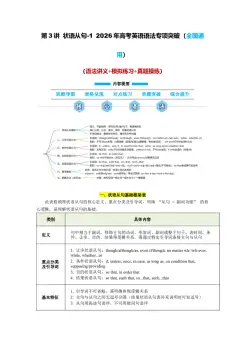
在复合句中作状语,修饰主句中的动词、形容词或副词等。状语
从句可放在主句之前(通常用逗号分开),也可放在主句之后。
状语从句根据它表达的意思的不同,可分为时间、地点、原因、
目的、结果、比较、方式、让步和条件等状语从句。
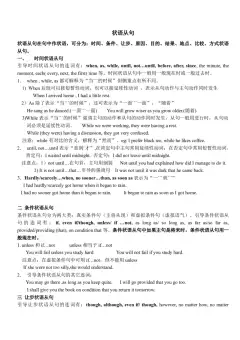
一、时间状语从句
说明主句中谓语动词动作发生的时间。
主句中的动词与从句中的关系有两种:时间的同时性和先后性。
常用的连词有when, as, while, whenever, as soon as, before, after,
until/till, once, as/so long as, by the time, each time, the moment, the
instant, immediately (that), directly, now (that), scarcely/hardly…when,
no sooner…than。
1.用when 时,表示从句中的动作与主句中的动作同时发生,或
先于主句中的动作。例如:
When they came downstairs, the radio was still on.他们下楼时,收
音机还开着。
A liar will not be believed, even when he speaks the true.(Aesop)
说谎者甚至在说真话时,别人也不会相信。
Money poisons you when you've got it, and starves you when you
haven't.钱是当你有的时候,它毒害你;当你没有时,它饿死你。
When a dog bites a man that is not news, but when a man bites a dog
that is news.(C.A.Dana)狗咬人不是新闻,人咬狗才是新闻。
when 引导的从句有时表示“突然”、“忽然”或“(正在)这
时”的意思,这时when=and then, just then。从句通常置于句末。从
句中的谓语动词通常用一般过去时;主句一般用过去进行时、过去
完成时或be about to。例如:
I was about to leave the room when the telephone rang.我正要离开房
间,这时电话铃响了。
We discussed the shipping date till 3 o'clock, when the customer
called on us.我们讨论装运日期直到三点钟,这时客户前来拜访。
I was making the contract, when the manager came.我正在签订合
同,这时经理来到了。
when 前没有逗号,主句的谓语动词往往表示“即将”或“正
在”的意义。例如:
We were about to start when it began to rain.我们正想出发就下起雨
来了。
I was about to give up when I saw a pile of small stones jammed
under a boulder.(Arnold Berwick)我正打算放弃寻找,忽然间看见
一堆小石头塞在一块大石头下。
2.用while 引导从句时,表示主句和从句中的动作同时发生,并
且持续一段时间。例如:
Never get on or off a bus while it is in motion.当公共汽车开动时,
千万不要上下车。
While she is reading, she always makes notes. 她阅读时总是做笔
记。
While she arranged the coffee, he opened the bottle and poured just
the right amount into each glass.她准备咖啡时,他打开瓶子,给两只
杯子斟上酒,斟得恰到好处。
when, while 引导的时间状语从句中的主语,如果与主句中的主语
相同,或为it/they,而其谓语又含有be 时,则从句的主语和be 常常
可省略。例如:
When (he was) asked about the matter, he said he hadn't any idea of
it.问起他这件事时,他说他一点也不知道。
While (we were) checking the lines, we often found places that badly
needed repairing.在我们检查线路过程中,往往发现有些地方急需修
理。
Turn out the light when (you are) leaving the room.你离开房间时要
把灯关上。
3.用as 引导从句时,表示从句的动作与主句中的动作“同时发
生”或“随着……”、“一边……一边……”。例如:
As the rubber industry developed, more and more rubber was
required.随着橡胶工业的发展,需要越来越多的橡胶。
As I knelt by the window looking down on the flower gardens, the
happening of the day before seemed far away and quite unreal.我跪在窗
边,望着下面的花园,昨天发生的事似乎已很遥远,不像是真的。
Relieved that my mother had guessed my pain, I started to cry as I
told her what had happened.(Suzanne Chazin)母亲猜到了我的苦
恼,这使我感到宽慰,我哭了起来,把事情的经过告诉了她。
As I cradled the boat, I felt my grandfather's presence. (Arnold
Berwick)我抱着小船,觉得外公就在身旁。
I thought of that one evening as I was driving.(M.E.Potter)一天晚
上,在驱车(回家)的途中,我想起了这件事。
The volume varies as the temperature increases.体积随着温度增加
而增加。
As spring warms the good earth, all flowers begin to bloom.随着大地
回春,百花齐放。
just as 连在一起用时,表示从句的谓语动词的动作跟主句谓语的
动作在时间上很接近。例如:
Just as he fired the shutter, something caught his eye.正当他拉扳机
时忽然见到一样东西。
The shower shut off upstairs just as the phone rang.楼上沐浴停止
时,刚好电话铃响了。
Just as I was going upstairs, there was another knock at the door.正当
我上楼时,敲门声又响了。
as 引导的从句有省略形式。例如:
As a young man, he joined the army.他年轻时就参军了。
Banneker as a child, had a rare aptitude for maths and soon
progressed beyond the ability of his teacher.班纳克在童年时期在数学方
面就有很高的天赋,很快他的才能就超过了他的老师。
4.when, as 和while 的用法异同。
(1)从句谓语动词的动作跟主句谓语动词的动作是“同时发
生”时,when, as, while 可以互相替换。例如:
When/As/While they were studying, the teacher came in.当他们正在
学习的时候,老师进来了。
(2)同样是“同时发生”,但as 强调从句动作正在进行或发
生,多用于口语;并且主句和从句的谓语动词或者都是持续动词,
或者其中一个是持续动词。例如:
We saw him as he was getting off the bus.在他下公共汽车的时候,
我们看见了他。
The price will become higher as time goes.价格将随着时间的推移
变得越来越高。
(3)when 强调“特定的时间”,从句谓语的动作先于主句谓语
的动作。例如:
When your family comes home, I'll simply talk with your husband
and explain how it lies.你家里人回来后,我就直接跟你丈夫谈,向他
说清楚现在的局面。
(4)同样是“同时发生”,但while 强调一段时间,一个过程,
主句谓语的动作发生在从句所表示的时间内。例如:
I was mopping the floor while he was cleaning the window.他擦窗,
我拖地板。
He wrote his greatest novel while (he was) working on a freighter.他
在货船上工作时写出了他的伟大作品。
5.before 引导的时间状语从句表示主句谓语的动作发生在从句
谓语的动作之前。从句不能用否定式谓语。例如:
I'll have to get the survey first, before I can make you an offer.我得首
先调查,才能给你一个报价。
I wouldn't mind another beer before I eat. Will you have one with me?
吃饭之前我想再喝一杯啤酒。你愿意陪我喝一杯吗?
An electronic computer must be programmed before it can work.电脑
要先编制程序,然后才能工作。
I had not waited long before she came.我没等多久她就来了。
They arrived before I expected.没想到他们已经到达了。
I'll do it now before I forget it.我现在就做,不然我会忘记。
It was not long before I spoke to Marian of my love.没过多久,我便
把我的爱情告诉了玛丽安。
As a matter of routine, a contract must be signed by the two parties
concerned before it comes into force.按照常规,合同要在有关双方签
字后才能生效。
6.after 引导的时间状语从句,表示主句的谓语动词的动作发生
在从句的谓语动词的动作之后。例如:
The sun came out after the storm ceased.暴风雨停止后,太阳出来
了。
After the old man had placed his hat and stick in a corner, he sat down
in the armchair.老人把帽子和手杖放到角落后,在扶手椅上坐了下
来。
Earlier in the day, after he called, she had driven the forty miles into
Des Moines and went to the state liquor store.当天早些时候他来过电话
之后,她曾驱车四十英里到得梅因去,进了一家卖酒的商店。
7.since, ever since 引导的时间状语从句:since 表示自过去的 一
个起点时间到目前为止的一段持续时间。主句一般用现在完成时或
现在完成进行时,从句用过去时。例如:
More than twenty years have gone by since war ended.战争结束以
后,二十多年过去了。
Since mother died he was very lonely.自从母亲去世后,他很孤
独。
She'd been thinking about just that since they'd talked earlier.自从上
次他们通话之后,她也一直在想这个问题。
since 引导的从句如果谓语是持续性动词或状态动词,用现在完
成时,表示从句的动作或状态延续至今;若用一般过去时,则表示
从句动作或状态的结束,其含义译成汉语恰好跟该动词的词义相
反。例如:
I haven't written to him since he lived in Paris.【lived 是持续性动词
一般过去时】 自从他离开巴黎以来,我没给他写过信。
(比较:I haven't written to him since he has lived in Paris. 【has
lived 是持续性动词现在完成时】 自从他住在巴黎以来,我没给他
写过信。)
It is five weeks since he smoked.【smoked 是持续性动词一般过去
时】 他戒烟已经五个星期了。
(比较:It is five weeks since he has smoked.【has smoked 是持续
性动词现在完成时】 他抽烟已经五个星期了。)
ever since 引导的从句,即使谓语是持续性动词或状态动词用一
般过去时,仍然表示从句的动作或状态延续至今。例如:
The man has lived in this old house ever since he was born.这个人一
生下来就一直住在这所旧房子里。
Ever since, as a little boy, I read Gulliver's Travels , I have longed for
adventure in distant countries.我自小孩时读了《格里佛游记》以来,
就一直憧憬到遥远的地方去冒险。
8.till 和until 引导的时间状语从句:主句是肯定句,till 的意思
是“直到……为止”;主句是否定句,till 的意思是“直到……才开
始”。例如:
He likes to dress sharp and pressed his mother until she bought him a
$200 bomber jacket.(Time)他穿衣服喜欢赶时髦,逼着母亲给他
买了件价值200 美元的皮夹克。
She could see his silhouette at the other end until he disappeared
down the incline toward the stream.她可以看见桥那头他的影子,直到
那影子消失在通向小溪的斜坡下。
Health is not valued till sickness comes.(Anonymous)患病才知健
康之宝贵。
The plastic industry did not become an important industry till plastics
was invented.塑料发明后,塑料工业才成为一门重要的工业。
这类句型,主句用肯定式或否定式取决于主句中的谓语动词是不
是持续性动词:如果是持续性动词,用肯定式,也可用否定式;否
则用否定式。例如:
I'll wait for her here until she comes back.我将在这里等到她回来为
止。【wait for 是持续性动词】
I did not work till she came back.我直到她回来了才开始工作。
I'll not leave until she comes back.她回来后我才离开。【leave 是非
持续性动词】
主句是否定式,until 或till 可用before 替换。例如:
People do not know the value of health till (=before) they lose it.人们
直到失去了健康才知道健康之可贵。
主句是否定式将来时态时,until 或till 可用unless 替换。例如:
The conference will not commence until (=unless) everyone is here.
会议直到大家到齐才会开始。(除非大家都到齐,否则会议不会开
始。)
until 用于句首引导从句时,其主句一定是否定式。例如:
Until we know the facts, we can do nothing further.我们直到知道事
实真相才能采取进一步的措施。
not until/till 引导的从句位于句首时,其后面的主句谓语要用部分
倒装。例如:
Not until/till the child fell asleep did the mother leave the room.直到
孩子睡着后,母亲才离开房间。
not…until/till 的含义也可由下列各种形式表达:
no…until/till nothing…until never…until
seldom…until few…until
Nothing definite was known of the new world until Columbus
discovered it in 1492.直到1492 年哥伦布发现新大陆后,该地的真实
情况才为人所知。
Few people had any faith in Columbus' projects until he returned from
his voyage.直到哥伦布航海归来前,对他的计划有信心的人寥寥无
几。
A good student will never stop his study until he has thoroughly
mastered his lessons.一个好学生直到把功课掌握透彻才停止学习。
从句的主语如果和主句中的主语相同,从句主语可省略。例如:
Little Judd, don't speak until (you are) spoken to.小贾德,不跟你说
话别讲话。
(These letters are) To be left till (they are) called for.(这些信件)存
(邮)局候领。
【注】 till 和until 的意义相同,但till 语气较强,用得普遍;在
句首,多用until,多用于正式文体中。在美国口语中也往往用until
代替till。
9.as soon as(一……就),as/so long as(在……期间,……之
久)引导的时间状语从句。例如:
As soon as I got into the house again I decided to move.我再次进 屋
子便决定搬家。
I'll ring you up as soon as the director comes back.主任一回来,我
会给你打电话。
What was the past to me as soon as I met you?我一遇到你,对我来
说,过去的事算得了什么呢?
I will let you know where I go as soon as I know myself.我一知道自
己要去什么地方,我就会马上告诉你。
You may stay here as long as you wish.你希望在这里待多久就待多
久吧。
I will work as long as I live.我一息尚存,就要工作。
So long as the poor Baroness lived, I did not feel that I had the right
to come between you.只要可怜的男爵夫人还活着,我觉得我没有权
利跟你接近。
【注】 so long as 较常用,语气比as long as 强些。
10.no sooner…than, hardly/scarcely/barely…when/before 引导的
时间状语从句,表示从句谓语的动作紧接着主句谓语的动作发生,
意思是“刚刚……就”“立即”。从句多用一般过去时,主句常用
过去完成时。例如:
We had no sooner reached the station than the train was off.我们刚到
达车站,火车就开走了。
I had no sooner done it than I regretted it.我做了这事就立刻感到后
悔了。
The customer had no sooner arrived at the Fair than he attended a
negotiation.这个客户一到达交易会就参加谈判。
I had hardly stepped out the house when I heard a shot within.我一走
出这间房子就听到里面一声枪响。
The doctor had scarcely got into bed when he was called out again.
医生一上床睡觉,又有人叫他了。
No sooner had I reached home than a storm broke out.我一到家,暴
风雨就来了。
Hardly/scarcely did they appear when/before the auditorium echoed
with a thunderous applause.他们一到来,大礼堂就响起了雷鸣般的掌
声。
Barely had he arrived when he had to leave again.他一来到又要离
开。
【注】 hardly/scarcely/barely…when/before 中hardly…when 较常
用,barely 或before 罕用。
11.once(that)(一旦,一……便)引导的时间状语从句。例
如:
Once you hesitate, you are lost.你一踌躇,就错过了机会。
Once you sign a contract, you must execute it.你一签订了合同,就
应执行。
Once the machines are tested, they may be put into service.一旦这些
机器试验了,就可以投入使用。
Once her words started, they kept on coming.她一旦开了口,话就
不断地讲出来。
No nation may survive in freedom once its people become the
servants of the state.(D.Macarthur)任何一个民族,一旦它的人民成
了政府的奴仆,便无从继续维持其自由。
12.副词immediately, directly, instantly 和名词词组the moment, the
minute, the instant, the day, the year, every time, next time, each time, the
first/second/last time 以及by the time, all the time 等引导的时间状语从
句。例如:
I handed my laboratory report immediately the assistant master came.
助教一来,我就把实验报告交给他。
We met him directly the customer came.客户一到我们就会见 了
他。
I asked them to take the delivery instantly I got the fax.我一接到传真
就让他们去提货。
He got ill the day he got home.他到家的那天就病了。
Each time a nation has been able to save a war, it has won a victory.一
个国家避免了一次战争,就等于赢得了一次胜利。
Stormy applause broke forth the moment she appeared on the stage.她
在舞台上一出现,就响起了暴风雨般的掌声。
The instant she saw him she knew he was her brother.她一看见他,
就认出他是自己的兄弟。
二、地点状语从句
说明主句谓语动词动作发生的场所或动作的方向。由where,
wherever, wheresoever(书面语)引导。wherever 语气比where 强,
wheresoever 语气最强。
Put the book where it was.把这本书放回原来的地方。
Corn flourishes best where the ground is rich.土壤肥沃的地方,谷
物生长得最好。
Let me take you where you live.让我带你到你住的地方去吧。
And his soul could not leave her, wherever his mother was.不管他的
母亲身在何方,他的灵魂永远不能和她分离。
Wherever he may be, he will be happy.他无论在什么地方都是快乐
的。
where 还可以表示“某点或情况”。例如:
Persistent people begin their success where (=the point) others end in
failure.意志坚强的人从别人失败的地方开始成功。
Science and technology have put the world where (=conditions in
which) it is today.科学技术使得世界有今天。
Hatred is something peculiar.You will always find it strongest and
most violent where there is the lowest degree of culture.(Goethe)仇恨
是一种奇特的东西。文明程度最低之处,仇恨情绪往往最强烈。
where 还可以表示“条件”,作“只要”解;这时,主句有时可
用there 引导。例如:
Where there is a will, there is a way.只要有志气,就有大道可走。
(有志者事竟成)
Where there is no water, there is no life.哪里没有水,哪里就没有生
命。
Where our goods are sold, there they are warmly welcomed.我们的货
物销售到哪里都受到热烈欢迎。
Where there's marriage without love, there will be love without
marriage.(Benjamin Flanklin)哪里有没有爱情的婚姻,哪里就会有
没有婚姻的爱情。
由-where 构成的复合词如anywhere, everywhere, nowhere 等也可
引导地点状语从句。例如:
You can sit anywhere you like.你喜欢坐在哪里就坐在哪里。
Everywhere they went, they found the same things.他们每到一处,
都发现了同样的情况。
where 或wherever 引导的从句有时可用省略句型。例如:
Where possible, all conductors should be placed in conduit.在有可能
的地方,所有的导线都应装在管道内。
Put in articles where necessary in the following passages.请在下段文
字中加上所需要的冠词。
Wherever needed, he will go and work.哪里需要,他就去哪里工
作。
三、原因状语从句
由because, as, since, now that(既然),in that(由于,因为),
seeing(that)(由于),considering that(考虑到),in view of the
fact that(鉴于),owing to the fact that, on account of the fact that,
inasmuch as(因为,由于)等引导。
(一)由because 引导
because 比since 和as 语气重,because 表示的原因意味最强,一
般表示说话者的对方不知道的原因,回答以why 开首的问句。从句
是全句的重点,表示结果的主句反而是次要的。主句是肯定句时,
because 从句一般不需用逗号跟主句隔开;主句是否定句时,句末
because 从句需用逗号跟主句隔开。
I am happy because I want nothing from anyone.(A.Einstein)因为
我对他人无所求,所以我快乐。
The operation was put off because the patient ran a high fever.因为病
人发高烧,手术推迟了。
Health is certainly more valuable than money, because it is by health
that money is procured.(Samuel Johnson)健康当然比金钱更为可
贵,因为我们赖以获得金钱的,就是健康。
because 之前可加only, just, merely, simply 等强调词。例如:
I am not apt to shrink from that which is my duty merely because it is
painful.我不会只因怕吃苦而逃避自己的义务。
Just because he doesn't complain, you must not suppose that he is
satisfied.你不可只因他不抱怨就以为他满足了。
Don't do anything simply because other people are doing it.不能只因
为别人做某事而跟随去做。
(二)because 和for 的用法区别
because 是从属连词,引导的是原因状语从句,表示因果关系,
回答why 的问句。because 前可加only, just, merely, simply, not 等
词;because 从句可用于强调结构。for 是并列连词,引导的是并列
分句,只能后置,并且用逗号分开。for 前不能加only, just, merely,
simply 等词;for 引导的分句不能用于强调结构。for 有时表示因果关
系,有时不表示因果关系:
1.for 表示因果关系,可以跟because 换用。例如:
He could not have seen me, for (because) I was not there.他没能见到
我,因为我不在那里。
Modesty is a virtue not often found among poets, for almost every
one of them thinks himself the greatest in the world.(Gervantes)谦逊
这种美德,不大常见于诗人之间,因为差不多每个诗人都认为自己
是世界上最伟大的诗人。
2.for 不表示因果关系,只对前面分句的内容加以解释或推断;
这时for 不能用because 代替。例如:
The evenings were getting chilly, for it was late in September.晚上天
气渐渐变凉,因为现在已是九月底了。
It will rain, for/as the barometer is falling.天要下雨,因为晴雨的指
度在下降。
It must have been him, for she heard his truck coming up the lane just
after she arrived.那一定是他,因为她刚到家就听到他的车驶进小
巷。
(三)由as 引导
as 表示“原因”时一般放在主句前面,语气较弱,常用于日常谈
话中;放在主句之后时,表示的原因是对方知道的。并且所说明 的
原因或理由只是顺便提到的。例如:
As the price is too high, you'd better cut it down.因为价格太高,你
最好减价。
As I can't be certain, I won't be positive.因为我没有把握,我不敢肯
定。
As everything remained quiet, he did not pay further attention to the
shot.由于一切依然寂静,他就再没有留意这枪声。
As effective measures had been taken, the patient's condition took a
turn for the better.由于采取了有效的措施,病人的情况已经好转。
as 引导的原因状语从句有时可把状语或谓语一部分移到句首,表
示强调。例如:
Clever as the boy was, he found little difficulty in solving the
problem.这男孩因为很聪明,所以解答这习题不觉得有多大困难。
Fool as he was, John completely ruined the dinner.因为约翰是个笨
蛋,所以把这顿饭都毁了。
Hard as his daughter studied, she got good marks in school.他的女儿
由于努力学习,在学校里获得好分数。
Situated as I am, I cannot accept the offer.由于我的处境,我不能接
受这个建议。
(四)由since 引导
since 表示经过稍加分析、推测出来的原因,而且多半是对方已
知道的,语气稍弱,相当于汉语的“既然”。这种从句多置于主句
之前。例如:
Since no one is against it, we'll adopt the proposal.既然没人反对这
个提议,我们就要采纳它。
Price increasing is a useless proposal, since it is impossible.那个加价
的提议没有用处,因为它行不通。
Since the director was not there, I discussed the case with a visiting
doctor.由于主任不在那里,我就跟一位主治医生讨论了这个病例。
Since light travels faster than sound, we see lightning before we hear
the thunder.因为光传播比声音快,我们先看见闪电然后才听到雷
声。
在since 引导的原因状语从句中,当从句的表语是形容词时,可
用省略形式。例如:
That is a more dangerous, since (he is) unknown, foe.因为是隐蔽的
敌人,那就更危险了。
since 和as 引导的原因状语从句,不能用于强调结构;在since 和
as 前也不能加only, just, simply 等强调词和否定词not。
(五)由that 引导
that 从句用在一些表示喜怒哀乐情感的形容词和过去分词后,说
明这种情感产生的原因或理由。that 在口语中常可省略。这种从句
的that 可用because 替换。这种形容词和分词常用的有:afraid,
annoyed, amazed, ashamed, astonished, content, contented, delighted,
disappointed, excited, glad, hurt, pleased, proud, satisfied, sorry,
surprised, thankful 等。
I'm glad it cannot happen twice, the fever of first love.我很高兴,初
恋的狂热不会发生第二次。
I feel disappointed that they can't come.他们不能来,我感到失望。
I am proud that our country is forging ahead at such a speed.我感到
自豪,因为我们国家正在飞速前进。
He was ashamed that he could not give an answer.他因答不出来觉得
惭愧。
I was surprised that he disagreed.他不同意,我感到惊奇。
We are very sorry that we cannot avail ourselves of your offer.我方
抱歉难以接受你方报价。
She was pleased that he noticed her legs, and he did.她很高兴他注意
到了她的腿。他的确注意到了。
that 从句也可用在一些表示情感的不及物动词之后,说明这种情
感产生的原因。例如:
I rejoice that she is well.她身体好,我很高兴。
I grieve that he has lost his dear child.他失去了亲爱的孩子很悲
痛。
I nodded, pleased that I had won her over.(Suzanne Chazin)我点
了点头,很高兴,因为我总算说服了她。
(六)由复合连词或短语引导
1.复合连词。
in that 因为:(多指某一方面的原因或理由,范围比较窄。)
This law did more harm than good in that it made progress
impossible.这条法律的坏处比好处多,因为它阻碍进步。
This item is not welcome in that its quality is unacceptable.这种商品
不受欢迎,因为它的质量不尽如人意。
The suggestion is acceptable in that it is practicable.这个建议之所以
可以接受,在于它切实可行。
now(that)既然:
Now that she has regained her health, let her take on the work
gradually.既然她已经恢复健康,让她逐步承担工作吧。
You ought to write now that you know the address.你既然已知道地
址,就该写信了。
seeing(that)鉴于,看到(表示明显的原因或理由):
Seeing that you have come, let us discuss how to treat the patient.
既然你来了,让我们讨论如何医治这个病人。
Seeing that he refuses, there is nothing more to be done.他既然拒绝
了,那就没办法了。
Seeing (that) the price is reasonable, I'd like to accept this item.因为
价格合理,我愿意接受此品种。
considering(that)考虑到,鉴于,就……而论(多表示一种推测
的原因或理由):
The fault is excusable, considering that he had no previous
experience.这过失可以原谅,因为他过去没有经验。
We agree to postpone the shipping date, considering (that) there is no
steamer recently.考虑到最近无船,我们同意延迟装运日期。
Considering that I have told you three times, you must know it.既然
我已经对你说过三次了,你应该知道此事。
not that…but that 不是因为……而是因为(肯定一个原因,否定
另一原因):
Not that I dislike this item, but that I don't need it.不是我不喜欢这个
品种,实在是我不需要。
I can not take a trip with you not that I am unwilling, but that I am
rather busy now.我不能和你去旅行,不是因为我不愿意,而是因为我
现在比较忙。
2.介词词组+that。
on the ground(s) that; for the reason that; by reason that:
He left on the ground that he was ill.他因病离去了。
For reasons (that) I can't tell I don't want to see him.由于我不能说的
原因,我不想见他。
3.复合介词+the fact that。
on account of the fact that; owing to fact that; in view of the fact that;
due to the fact that; because of the fact that:
On account of the fact that all the trains were delayed, the station was
crowded with people.因为所有的火车误点,车站挤满了人。
Her plan failed due to the fact that she lacked experience.由于她缺乏
经验,她的计划失败了。
Owing to the fact that I had lost his address, I did not know where I
could find him.由于丢失了她的地址,我不知道哪里能找到她。
He will surely succeed in view of the fact he works very hard.由于他
勤奋工作,他肯定会成功。
四、目的状语从句
说明主句中谓语动词的动作发生的目的。常由that, so that, in
order that, for fear that, in case 等引导。
(一)由so that(以便,为了),that(以便,为了)引导
从句常用情态动词may, might, should 以表示委婉语气;偶尔也可
用can, could 或will, 但很少见。美国英语中,so that 往往省略that,
只用so。从句通常在主句之后。例如:
A scientist constantly takes notes so that he may always know what he
did a minute ago.科学家经常做笔记,以便他总是能够知道他一分钟
前所做过的事。
The parts must be very strong (so) that they may not break in use.零
件必须坚固,以便使用时不会破损。
The patient should be X-rayed so that the diagnosis may be
confirmed.病人必须进行X 光透视,以便确诊。
Man does not live that he may eat, but eats that he may live.人活着不
是为了吃,但吃是为了生存。
He urged us time and again so that we might not postpone the
delivery.他反复催促我方,以免我方延期交货。
They have died that liberty might live.他们是为自由的生存而死
的。
They hurried so they wouldn't miss the train.他们急急忙忙的,以便
赶上火车。
so that 中的so,常和that 隔开,跟主句谓语动词结合,明确表示
“in such a way that”的意思。例如:
So live your life that old age will bring you no regrets.人活着,要使
自己年老时无所悔恨。
(二)由in order that, to the end that, in the hope that, for the
purpose that 等引导
in order that(为了,使……)比that, so that 更明确地表示“目
的”,从句中谓语常用情态动词may, might, should;从句一般置于
主句之后,但为了强调,也可置于句首。例如:
We sent the letter by air mail in order that it might reach them in good
time.我们用航空邮件寄去这封信,以便它按时到达。
Some people seem to live in order that they may eat.有些人活着似乎
是为了吃。
We should do our utmost in order that we may be able to overfulfil
the task.我们应该尽全力,以便能够超额完成任务。
We took off our shoes upon entering, in order not to soil the soft white
mats.(Carpenter)进门时我们脱去皮鞋,以免弄脏柔软的白色地
毯。
In order that there should be no misunderstanding, we propose to hold
a meeting.为了不发生误解,我们建议开一次会。
to the end that 等引导的从句置于主句之后,从句谓语动词常用情
态动词may, might 或should。例如:
The steamboat was fully furnished with life preservers, to the end
that the passengers might be saved in case of accident.汽船装备了足够
的救生圈,以便乘客在发生事故时能够得救。
Nature has given us two ears, two eyes, and but one tongue, to the end
that we should hear and see more than we speak.(Socrates)造物主给
我们两个耳朵、两只眼睛,而有一个舌头,为的是要我们多听、多
看、少说。
I am sending you this book in the hope that it may be of use to you.我
现在寄这本书给你,希望它对你有用处。
(三)由for fear that, in case, lest 引导
表示反面的目的,表示“担心害怕”,“想避免”, 常译作“唯
恐”、“以免”。在从句中不能加not 等否定词,相当于in order
that…not 或so that…not。从句用虚拟式(should+动词原形),还可
用情态动词may, might 或would。lest 是书面语,口头上常用in case
代替。例如:
I checked all the results time and again for fear that there should be
any mistakes.我反复检查全部结果,怕的是会出现错误。
The captain didn't let him go alone, for fear some misfortune might
overtake him.(C.Lamb)船长不让他单独外出,为的是怕他遭遇不
幸。
High in the mountain, I hesitated to speak lest I disturb our tranquility.
(Arnold Berwick)在高高的山上,我迟迟不说话,唯恐搅乱了我们
的宁静。
The doctors ran all the way lest/for fear that they should fail to get to
the patient's home in time.医生一路跑去,唯恐不能够及时赶到病人的
家里。
We tried to produce a substitute lest supplies should be stopped.我们
设法生产代用品,以防供应中断。
He makes a note of the assignments lest he forget it.他把要完成的任
务记了下来,以免忘记。
in case 引导的从句一般用虚拟语气;有时表示可能性大,也可用
陈述语气。例如:
Take an umbrella with you, in case it rains.随身带上雨伞,以防下
雨。
Take warm clothes in case the weather is cold.带上暖和的衣服,以
防天气冷。
有时in case, just in case 单独使用,省略从句:这是一种省略句型
的用法。例如:
I'll take my umbrella, just in case (=in case it rains).我会带上雨伞,
以防下雨。
五、结果状语从句
用来表示由主句内容所产生的结果。通常主句是因,从句是果,
从句总是在主句之后。从句中的谓语动词一般用陈述语气。由that
(结果,因而),so that(结果,因而),so…that(如此……以
致),such…that(这样……以致)等引导。
(一)由so that 引导
He worried so that he couldn't fall asleep.他很焦急,以致睡不着。
His hand was shaking and there were tears in his eyes, so that he
could see nothing but a blur.(Liam O'Flaherty)他的手发颤,泪水盈
眶,眼前只见一片模糊。
Bacteria can not make their own food, so that they must live on living
or dead animals and plants.细菌不能自己制造食物,因此它们必须寄
生于活着的或死的动植物身上。
It has cleared up beautiful, so that he may come after all.天气晴 朗
了,他终于可以来了。
(二)由so, that 引导
这是so that 的省略式。so 或that 的意义和用法和so that 一样。例
如:
He violated the regulation, so (that) he was punished.他违反了规章
制度,所以受了处分。
Have you another sweetheart hidden somewhere that you leave me in
the cold?你是否暗中有了情人因而冷落了我?
Something may be wrong that the machine has stopped running.机器
可能出了毛病,停止转动了。
He must have hurt your feelings that you were so angry with him.他
一定伤害了你的感情,所以你对他这么生气。
(三)由so…that(这么……以致)引导
1.句型:主语+谓语+so+形容词或副词+that 从句。
He was so homesick that he could hardly endure the misery of it.他非
常想家,简直有些受不了这种痛苦。
I was so tired that I sat down on a milestone to rest.(E.M.Foster)我
太累了,只好在里程标石上坐下休息。
Sometimes you are so evasive I think you don't want to marry me at
all.(Graham Greene)有时候,你讲话吞吞吐吐,我真以为你根本就
不想跟我结婚。
2.句型:主语+谓语+so+分词或其他结构+that 从句。
The book is so written that it gives a quite wrong idea of the facts.这
本书写得完全歪曲事实。
There was so much ink in the bottle that I spilled it. 这瓶墨水这么
多,以致我把它溅了出来。
当为了强调,so 位于句首时,主句的语序需要倒装。例如:
So badly was he injured that he had to go to the hospital.他伤得这么
重,不得不去医院。
So terrible was the storm that whole roofs were ripped off.暴风雨很
凶猛,整个屋顶都刮掉了。
(四)由such (a)…that 引导
China is such a large country that it has a great variety of climate.
中国这么大,所以有各种气候。
He is such a skillful surgeon that he can perform the most
complicated operations.他是个熟练的外科医生,能做最复杂的手术。
Some elements exist in such small quantities that it is difficult to get
them.有些元素非常稀少,很难得到。
Our manager made such an excellent market report, that every one
admired him.我们的经理作了一个非常好的市场报告,大家都赞赏
他。
Oil is such an important form of energy that modern industry cannot
develop without it.石油是能量的一个重要形式,没有它,现代工业便
不能发展。
当为了强调,such 位于句首时,主句语序需要倒装。例如:
Such fine weather is it that we decide to go for an outing.天气这么
好,我们决定去郊游。
Such was his anxiety that he couldn't stop trembling.他这么忧虑,所
以一直发抖。
【注1】 so…that 和such…that 的区别:
so…that 中的so 是副词,后面需接形容词或副词。例如:
An atom is so small that we cannot see it.原子这么小,我们看不到
它。
such…that 中的such 是形容词,后面需接名词或带修饰语的名
词,名词如果是单数,则用such a (n)…that。例如:
He was such a selfish man that nobody would help him.他是一个这
么自私的人,因此没人愿意帮助他。
He showed such courage that everybody respected him.他表现出这
么大的勇气,人人尊敬他。
【注2】 “so…that”和“such…that”引导的结果状语从句,that
在口语中可省略。例如:
The sound is so weak (that) you cannot hear it.声音这么微弱,听不
见。
It's so hot (that) I can't sleep.天气这么热,我睡不着。
Yesterday was such a beautiful day (that) we decided to go on a
picnic.昨天天气晴朗,我们决定了出去野餐。
such that 用在一起,可根据上下文,用so great (bad, cold, hot,
rapid etc.)代替,念的时候要在such 后面稍停,以便加重such 的语
气。这时such 是代词。例如:
The difference is such (=so great) that all will perceive it.差异这么
大,大家都能看出来。
The weather was such (=so bad) that we had to postpone the shipping
date.天气这么坏,我们只好延迟装运日期。
The situation was such (=so serious) that political observers found it
difficult to predict.形势这么严峻,以致政治观察家也觉得难以预料。
当such 置于句首时,主句的语序需要倒装。例如:
Such was the charm of this item that it was warmly welcomed so
soon.这个品种很有魅力,很快就受到热烈欢迎。
Such was his joy that he could not sleep.他高兴得睡不着觉。
(五)由so…but, such…but 引导
主句用否定式;but 含有否定意义,相当于that…not,因此从句
要用肯定式。例如:
No task is so difficult but we can accomplish it.没有什么任务困难到
我们完成不了的。
No man is so old but he may learn.活到老,学到老。
I am not such a fool but I understand you.我并非傻到连你也不了
解。
(六)由with the result that 引导
The customer refused to accept the price, with the result that the deal
come to nothing.客户拒绝接受这个价钱,结果生意没做成。
They refused to pay the higher rent when an increase was announced,
with the result that they were evicted from their apartment.(R.Quirk)
接到增加房租的通知时,他们拒绝支付涨价的房租,结果被赶出了
出租房。
(七)由so much…that, so much so that 引导
I feel so much better today that I intend to go out.今天我感觉好些,
很想出去。
He is poor—so much so that he can hardly get enough to eat.他很穷
——穷得几乎吃不饱肚子。
Sometimes, the cold was intense, so much so that raw eggs were
frozen as hard as if boiled.有时候天气很寒冷,以致生蛋冻得好像煮过
似的。
(八)so that, so, that 引导的结果状语从句和目的状语从句的
区别
除了要根据上下文意思判定外,还可以从结构形式上进行判别。
1.从句之前有逗号(或停顿),为结果状语从句;否则为目的
状语从句。例如:
Miller slammed the door, so (that) he awakened his sister.(结果)米
勒砰地关上门,结果把他妹妹惊醒了。
Miller slammed the door so (that) his sister would know he was
home.(目的)米勒砰地关上门,以便使他妹妹知道他在家里。
2.有时,由so that 引导的结果状语从句之前并没有逗号,这时
就要看从句中表达的是意图或可能性:有can, may, might, could,
should, will, would 等情态动词,则多半为目的状语从句;如果表达
的是事实或客观现实,没有上述情态动词,则多半为结果状语从
句。例如:
He got up early so that he caught the first bus.(结果)他早早地起
了床,结果赶上了首班公共汽车。
He got up early so that he might catch the first bus.(目的)他早早
地起了床,以便赶上首班公共汽车。
3.目的状语从句可以移至句首,而结果状语从句只能位于主句
之后。例如:
We turned the radio up so that everyone could hear the
announcement.(结果)我们开大收音机音量,结果大家都能听到通
知。
So that everyone could hear the announcement, we turned up the
radio.(目的)为了大家都能听到通知,我们开大了收音机音量。
4.能用too…to 或enough to…结构代替so that 从句,便是结果状
语从句;能用in order to 代替so that,或so that 从句能转换为in
order to 或so as to+动词原形或不定式短语,则为目的状语从句。例
如:
He walks fast so that we can't catch up with him.(结果)(这句可
以转换为:He walks too far for us to catch up with.)他走得很快,我
们赶不上他。
I am saving money so that I can buy a house.(目的)(这句可以转
换为:I am saving money in order to/so as to buy a house.)我在省钱以
便买一所房子。
六、方式状语从句
表示主句中动作或状态的方式或方法,多是用比喻说明主句内容
或原物,使被说明的人、事物形象具体化。常由as, just as, as if, as
though, according as 等引导。
(一)由as(如,像)引导
The moon has no light of its own as the sun has.月球不像太阳那
样,它本身不发光。
I will do as you told me.我将会按照你告诉我的那样去做。
Air is to man as water is to fish.空气之于人,犹如水之于鱼。
Let a man avoid evil deeds as a man who loves life avoids poison.
(Buddha)一个人应该避免恶行,就像爱惜生命的人避免毒物一
样。
Bee gathers honey as a soul gathers light.(Hugo)蜜蜂采蜜,正如
灵魂吸取阳光。
as 之前可用just 或exactly 加强语气。例如:
Most plants need air just as they need water.大部分的植物需要空
气,正如它们需要水一样。
as 引导的从句位于句首时,主句常由so 引出。例如:
As you treat me, so I shall treat you.你怎样对待我,我也将怎样对
待你。
As a well-spent day brings happy sleep, so a life well spent brings
happy death.(Da Vinci)就像被充分利用的一天可以为人带来幸福的
睡眠一样,没有虚度的一生也能为人带来幸福的死亡。
Just as men sow, so will they also reap.种瓜得瓜,种豆得豆。
Just as there are different forms of matter, so there are different forms
of energy.
正像有各种形式的物质一样,也有各种形式的能。
(二)as 引导的从句的省略形式
从句的主语、谓语有时可以省略。
1.省略主语——不论从句和主句的主语是否一致,从句的主语
可以省略。例如:
English is not difficult to learn, as (it) is generally supposed.(主语一
致)英语并不像一般人想象的那样难学。
He wrote as (it) follows.(主语不一致)他写的如下。
2.省略谓语或谓语中的表意动词。例如:
The study of science needs time, as any other subject (does).学科学
像学其他学科一样,需要时间。
The electricity does not move through the insulator as it would
through a conductor.电不会像通过导体一样通过这个绝缘体。
3.主、谓语全省略。例如:
He worked as usual (=…as it was usual).他像平时那样工作。
Economize time in reading as (you economize) in everything else.像
做别的事情一样,读书也要节省时间。
(三)句型
“A…to B+what/as+C…to D”(A……对于B 好比C……对于D 一
样);“What C… to D, that A… to B”(C 对于D 恰似A 对于B 一
样)。例如:
A manager is to the company as/what a locomotive is to a train.经理
对于公司,犹如火车头对于火车一样。
Personality is to man what perfume is to a flower. (C.M.Schwab) 一
个人的品格,犹如一朵花的香气。
Reading is to the mind what exercise is to the body.(R.Steele)读书
之于心灵,犹如锻炼之于身体。
Absence is to love what wind is to fire…离别之于爱,犹如风之于
火……
What blood vessel is to a man's body, that railway is to transportation.
铁路对于运输,好比血脉对于人的身体一样。
(四)用as if, as though 引导
as if 用得较广泛。从句多用虚拟语气。从句谓语如果是系动词,
则不论从句主语是单、复数,均用were。例如:
John blinked a few times and looked at me as if I might, indeed, be
loony.(Mary E.Potter)约翰眨巴眨巴眼睛,盯着我看,仿佛我真的
发疯了一样。
It's all, all covered with blots the same as if she were crying on the
paper.(Liam O'Flaherty)到处,到处都是泪痕,像是她趴在信纸上
哭过。
She hadn't done anything or said anything, but she felt as if/though
she had.她什么也没做,什么也没说,但是自己觉得好像是做了,说
了。
He heard the words he whispered to her, as if/though a voice other
than his own were saying them.他听到自己向她耳语,好像是一个不属
于他自己的声音在说话。
They were talking as if they had met by accident.他们正在谈话,像
是偶然碰到似的。
如果从句所叙述的情况实现的可能性较大,或在口语中,也可用
陈述语气。例如:
It seems as if it is going to rain.似乎要下雨。
He talks as if he knows all about it.他谈话的口气似乎对此事了如
指掌。
He acts as if he is in love with her.他的一举一动似乎他爱上了她。
as if, as though 引导的从句常用省略形式,往往从句中只剩下介
词短语、不定式短语、分词短语或形容词短语。例如:
He opened his lips as if (he were going) to say something.(不定式
短语)他张开嘴唇,好像要说什么。
He walked forward as if (he were) making a speech.(分词短语)他
向前走了几步,似乎要说什么。
The clouds had disappeared as if (they had done) by magic.(介词短
语)云彩好像变魔术似的消失了。
Then he said loudly to his mother as if in defiance. (Liam
O'Flaherty)接着他像是存心作对似的冲着母亲大声说。
He fell off his horse as if (he had been) shot.(过去分词被动语态)
他从马上跌下来,好像被射中了。
She hurriedly left the room as though (she were) angry.(形容词短
语)她匆忙地离开了房间,好像生气的样子。
(五)由the way (that), how 引导
用于口语或非正式文体中。The way=the way that, the way in
which 或in the way;how=in whatever manner。例如:
He doesn't speak the way I do.他说话的方式和我的不一样。
Do it the way you were taught.要按照教导你的那样去做。
This steak is cooked just how I like it.这牛排正是按照我喜欢的那
样去做的。
(六)由like 引导
在口语或非正式文体中,有时可用like 代替as 或as if,相当于in
the same way as。例如:
I wish I could paint like (=as) he did.我希望我能像他那样画画。
It rained like (=as if) the sky were falling.下着大雨,好像天要塌下
来似的。
七、比较状语从句
表达人或事物的属性或特征的不同程度。表示比较、类比或比例
的句子称为比较句。有等比句、差比句和比例句。从句常由as…as
(和……一样),not as/so…as(不像……那样),than(比),
the…the…(越……越……)等引导。
(一)等比句
表示人或物的性质、特征等方面有某些近似或相等的句子,叫等
比句。句型有:
1.as+原级+as(第一个as 是副词,含“如此”的意思,在主
句中说明所比内容的程度;第二个as 是连词,含“比”或“如同”
的意思,引导从句)。例如:
Our classroom is as big as theirs.我们的教室跟他们的一样大。
Henry is as good as Peter (is).亨利像彼得一样好。
Three removes are as bad as a fire.(Benjamin Franklin)搬三次
家,等于闹一次火灾。
Look to your wife if you do love her as much as she do love you.如果
你爱你太太像她爱你那样,那你就好好保护她。
在这种结构中,比较成分的前面常用表示倍数的词(…
times“……倍”,twice“两倍”等)来表示相比较的两个成分相差的
倍数,通常译成“像……几倍那样多”,“是……的几倍”。例
如:
The speed of sounds in water is about four times as great as in air.声
音在水中的速度是空气中的四倍左右。
This book is twice as thin as that one.这本书的厚度是那本书的二
分之一。
2.“no+比较级+than”“不比……(多)”,“不少于”。no
是副词,在主句中作状语,修饰形容词或副词的比较级;than 是连
词,引导从句。例如:
The material is no more elastic than that one.这种材料不比那种更有
弹性。
One minute too late is no more in time than half an hour (is).迟到一
分钟跟迟到半小时同样是不准时。
Tom is no less diligent than Peter.汤姆用功不比彼得差。(汤姆和
彼得同样用功。)
He feels no better today than he did yesterday.他今天的感觉不比昨
天好。(他今天的感觉跟昨天同样不好。)
(二)差比句
表示两个人或事物的性质特征有差别的句子,叫差比句。句型
有:“not so/as…as”和“比较级+than”。
1.“not so/as…as”(“不像……那样”,“不如”)。由“否
定词not+等比句(as…as)”构成,即“as…as”结构的否定式。第
一个as 或so 是副词,在主句中作状语,修饰其后的形容词或副词;
第二个as 是连词,引导从句。not so…as 比not as…as 用得较普遍。
例如:
Man uses some non-metals not so widely as metals.人类使用一些非
金属不如使用金属那么广泛。
The project was not completed as early as we had expected.这项工程
完成得不如我们预计的早。
It is not so/as easy as you think.事情并不像你想的那么容易。
Perhaps there is no happiness in life so perfect as the martyr's.
(O.Henry)人生中的任何快乐,也许都不如烈士的快乐那样完美。
He is not as ill as he makes out.他没有病到像他装的那个样子。
The weather is not so cold as it was last winter.天气不如去年冬天那
么冷。
The work did not go so smoothly as we hoped.这工作并不像我们希
望的那样顺利。
He is not so wise as he is witty.他为人风趣,但稍欠明智。
2.“形容词/副词的比较级+ than+被比较的对象”。表示两个
人或事物在某(些)方面的差别。than 是连词,引导从句。后面被
比较对象如果是名词,多用省略形式,省去与主句中相同的部分。
例如:
The material is more elastic than that one.这种材料比那种更有弹
性。
The universe is much more complicated than you think.宇宙比你认
为的要复杂得多。
No men living are more worthy to be trusted than those who toil up
from poverty.(Abraham Lincoln)世间最值得信赖的人,莫过于那些
从贫苦中艰苦奋斗出来的人。
Man grows cold faster than the planet he inhabits.(A.Einstein)人
类成长的速度远比他所居住的星球快得多。
Humanity is more important than national citizenship.人性远比国籍
更为重要。
You have caused me more misery than you can think.你已经给我带
来了你意料不到的痛苦。
This flower is less beautiful than that one but sweeter than that one.这
朵花不如那朵花好看,但比它香。
从句中的主语(名词)如果跟主句中的主语一致,为了避免重
复,常用that 代替不可数或某些可数名词,用those 代替可数复数名
词,用one 或ones 代替可数名词。例如:
The result of this experiment is better than that of the last one.这次实
验的结果要比上次好。
The students in our class are more diligent than those in their class.我
们班的学生比他们班的学生用功。
This novel is more interesting than the ones we have read.这本小说
比我们读过的小说更有趣。
比较状语从句的动词如果跟主句的谓语动词一致,且为行为动词
时,常用do(does, did)代替,以免重复。例如:
We have produced even more coal this year than we did last year.我们
今年出产煤要比去年出产得更多。
You seemed to understand human nature as well as do science.你不但
通晓科学,而且似乎也同样洞察人性。
She drives better than her husband does.她开车开得比她丈夫好。
3.as…as, not as/as…as, than 引导的比较状语从句的省略形式。
(1)省略主语(这时as 可看作是关系代词)。例如:
I read as many pages as (they) are required (to be read).【主、从句
的主语不一致】 我读了我该读的页数。
The winters in Hangzhou are not so mild as (they) are in Guangzhou.
【主、从句主语一致】 杭州的冬天没有广州的那么暖和。
He eats more than is good for him.他吃得太多,对身体没好处。
There were more casualties than was reported.伤亡人数比所报道的
要多。
(2)省略谓语。例如:
She is more highly regarded than he.【主、从句主语不一致】 她
比他受到更高的重视。
Sometimes it is as hard as rock.有时它和岩石一样硬。
(3)省略主语和(部分)谓语。例如:
Work is as necessary for sound mind as (it is necessary) for sound
body.【主、从句主语一致】 健全的精神需要工作,就像健全的身
体需要工作一样。
Mother loves me as dearly as her.母亲爱我也爱她。
When I spoke to him on the phone this morning, he was more
agreeable than (he was) last night.【省略主语和部分谓语】 今天早晨
我在电话里跟他讲话时,他比昨晚要随和。
(4)省略宾语。例如:
That's as good a place as I can find.【此句as 可看作是关系代词】
那是我所能找到的一个好地方。
(三)比例句
表示前者与后者在程度上同样增加或同样减少,好像比例一样。
句型有the…the…(越……越……)。即:
从句the+比较级,+主句the+比较级
(关系副词) (指示副词)
The more I live, the more I realize what strange creatures human
beings are.我活得越长,就越意识到人类是多么奇怪的生物。
The more things a man is ashamed of, the more respectable he is.
(G.B.Shaw)一个人感到羞愧的事情越多,越令人尊敬。
The more we study, the more we discover our ignorance.
(P.B.Shelley)我们越学习,就越发现自己无知。
The more readily a person is able to make these adjustments, the more
meaningful his own private world becomes.(Robert G.Allman)一个人
愈能及时地进行自我调整,他的个人世界便愈有意义。
The filthier a nation is, the tougher it is.(A.Einstein)一个国家越是
肮脏,就越残暴。
主句如果是将来时,从句可以用现在时代替将来时。例如:
The longer the treatment is delayed, the worse the prognosis will be.
延误治疗的时间越长,预后越差。
“the…the…”句型通常是从句在前,主句在后;这时,主句和从
句均用倒装语序。有时,主句在前,从句在后;这时,主句不必用
倒装语序,分句之间通常不用逗号。例如:
An object draws the harder, the more matter it contains.物体含有的
物质越多,它的引力就越大。
I like you (the) more the more I know you.我越了解你,就越喜欢
你。
主句的主、谓语有时可用半倒装语序,以保持句子的平衡。例
如:
The more you read, the better will you write.你读得愈多,写得就愈
好。
The longer we dwell on our misfortunes, the greater is their power to
harm us.(Voltaire)我们对自己的不幸想得越多,它们对我们的伤害
也越大。
“the…the…”这种句型的句子如果意思明显,用省略句的很多:
主句的主语和动词可以省略,有时主句和从句的主语和动词都可以
省略。例如:
The higher the temperature (is),the greater the pressure (is).温度越
高,压力越大。
The longer you stay, the better (it will be).你停留的时间越长越好。
The smaller the mind (is), the greater the conceit (is).心胸愈狭隘,
愈自大。
The greater the power (is) ,the more dangerous the abuse (is).
(Edmund Burke)权力越大,滥用权力的危险性也越大。
The more, the better.越多越好。
另外,由according as(随着……而),in proportion as(按……
比例) 引导的从句,也可表示一种比例关系。例如:
The thermometer rises or falls according as the air is hot or cold.温度
表随空气的冷热而升降。
You will be paid according as you work.你将根据你的工作得到相
应的报酬。
Man is arrogant in proportion as he is ignorant.人越无知就越妄自尊
大。
Prices vary in proportion as demand varies.物价随着需求的变化而
变化。
八、让步状语从句
从句是“退让”,主句是“前进”。即主句中的动作或状态跟从
句的动作或状态有部分矛盾,但这种矛盾并不影响事实的进行。常
由though, although(虽然),as(尽管),even if, even though(即
使),no matter how(不管怎样),no matter what(不管什么),
however(不管怎样),whether…or(不管是……还是……)等引
导。
(一)(al) though, even though/if, however 等从属连词引导的
让步状语从句
1.由though, although(虽然,纵使)引导。
这类句子主句中不能用but, 但可用still, yet, nevertheless。例如:
(Al) though he had been ill for a month, he was never absent from
school.虽然他病了一个月,但他从来没缺过课。
There is no anger between us, though there is that something which I
find too painful.尽管有一些我感到非常痛苦的事情,但是我们之间并
不存在任何的怨恨。
Though he is poor, he is happy.他虽然贫穷,但很快乐。
Though his family grew to include 13 children, he managed to  keep
them all clothed, warm and fed.虽然他的家庭人口不断增多,有13 个
孩子,他却设法使全家人有衣穿,穿得暖,吃得饱。
Neither of them could make it home again this year for her birthday,
though it was her sixty-seventh.他们今年还是不能回家给她过生日,
虽然这已是她六十七岁生日了。
(Al) though the pain was bad, still he did not complain.虽然痛得很厉
害,可是他不抱怨。
2.although 和though 的用法区别。
(1)although 多用于正式场合、各种文体中,语气较强,通常
用于句首;though 多用于非正式的口语或书面语中,可用于句首、
句中、句末。
(2)although 引导的从句,多指事实,不指设想,故不用虚拟
语气;though 引导的从句,可指事实,也可指设想,因此,可用陈
述语气,也可用虚拟语气。例如:
Although air is light, it has weight.【指的是事实,用陈述语气。】
虽然空气很轻,但是有重量。
Though all the world were against me, I would still hold to my
opinion.【指的是假设,用虚拟语气】 即使全世界的人都反对我,
我仍然要坚持我的意见。
Though I am fond of music, I cannot play any instrument.【指的是事
实,用陈述语气】 我虽然喜欢音乐,但是我不会弹奏任何乐器。
(3)当从句的主语与主句的主语相同,从句的谓语又是be 时,
从句可用省略结构,即省略从句的主语和be:这时多用though 引
导。
The girl, though plain, had a good, kind face.这个女孩虽然衣着朴
素,但和蔼可亲。
Though beaten, we were not disgraced.虽然输了,我们并不丢脸。
(4)though 可作副词,置于句末,用逗号隔开,这时though 表
示“但是”、“可是”的意思;而although 无此用法。例如:
The drug is good for your health; it is a little bitter, though.这药对你
的健康有好处,只是它有点苦。
3.用if(即使,虽然)引导。
if 等于(al)though 或even if,但语气较轻。例如:
If he is wrong, you are at least not absolutely right.即使他错了,至
少你也不是绝对正确。
If he is little, he is strong.他人虽小,但身体强壮。
If I die, mourn not over my fate.即使我死了,也不要为我的命运而
悲伤。
If life there was full of hardships, it was also full of joy and
excitement.虽然那里生活很艰苦,但也充满了欢乐和激情。
I shall just go on the same, and wait for you here, if I wait for fifty
years.我将会继续这样,在这里一直等你,就是等50 年也行。
表示让步的if 从句,常以省略式(省略主语和谓语动词)出现,
且多用作插入语;并且常与否定词little, seldom, few, rarely 等连用。
例如:
It is one of the most spacious, if (it is) not the most spacious, of
salons.这间客厅即使算不上最宽敞,也是最宽敞的客厅之一。
Her salary was good, if (it was) not up to her expectations.她的工资
尽管没有达到预期的要求,但还是不错的。
There are little, if any, hope.即使有希望,也是渺茫的。
They rarely, if ever, used imported material.他们几乎从来不用任何
进口原料。
She seldom, if at all, goes to the cinema.她即使去电影院的话,也
绝无仅有。
【注】 辨别if 从句是表示让步还是条件,主要是根据上下文。
主、从句意义相反的是让步,否则是条件。在if any, if ever, if at all
这类省略式中,如主句有否定词时,则表示让步;否则表示条件。
例如:
There is little, if any, difference between them.(让步)它们之间即
使有差异也是很少的。
Correct the errors, if any, in the following sentences.(条件)下面的
句子如果有错,请改正。
4.用even if, even though(即使,纵使)引导。
由if, though 之前加上强调语气的even 构成。所引导的从句是不
完全的“让步”或不十分愿意的“让步”,说话人所姑且认可的只
是一种可能性,有时还含有推测的意味,多用于书面语中。两者可
以互用,但even if 更常见。谓语可根据具体情况用陈述语气或虚拟
语气。例如:
I wouldn't lose courage even if I should fall ten times.我即使失败十
次也不灰心。
You frighten me, even though you're gentle with me.尽管你对我很温
柔,但是你使我害怕。
She would not, I know, agree to it, even if I wished to have you.我知
道,就是我愿意嫁你,她也不会同意的。
She waved, too, even though she knew he couldn't see it.她也向他挥
手,虽然明知他看不见。
5.由wh-词+ever 引导。
强调语气的词ever 作为后缀加在疑问词之后,构成复合词如
whatever, whoever, whomever, whichever, whosever, whenever,
wherever, however ,具有“让步”意义,表示“ 无论”或“不
管……”的含意。这些复合词均可引导让步状语从句,从句通常在
句首。这种从句过去多用虚拟语气,但在现代英语中可用陈述语气
或用情态动词may ;may 表示“可能性”。例如:
Whatever you do, you need courage.(R.W.Emerson)不论你做什
么事,都需要勇气。
Whichever book you borrow, you must return it in a week.不论你 借
哪一本书,一个星期后必须归还。
However hard I have tried, I cannot find the answer.无论我多么努
力,我也不能找到答案。
Whosesoever hat this is, I wish he would come and claim.不论这是
谁的帽子,但愿他来领走。
Whenever it rains, this river is flooded.无论什么时候下雨,这条河
总是泛滥。
这种让步状语从句常用虚拟语气,即从句的谓语用动词原形,而
主句用陈述语气。例如:
Wherever he go, no one will welcome him.无论他去哪里,没人会
欢迎他。
这种让步状语从句有时谓语可用“may+动词原形”。例如:
Whomever you may ask, he will say so.不管你问谁,他也会这么说
的。
For first love is a fever, and a misery too, whatever the poets may say.
因为初恋是狂热,也是痛苦,不管诗人是怎么说的。
在however 引导的从句中,however 后必须紧跟形容词或副词。
例如:
However often you ring, no one will answer.无论你打多少次电话,
都没人接。
However talented a man may be, the collective will always be wiser
and stronger.一个人再有才能,也比不上集体的力量和智慧。
6.用no matter+疑问词引导。
no matter“不要紧,没有关系”。no matter+疑问词=疑问词
+ever,意为“无论……”,“不管……”。两者可以互相换用,但
前者引导的从句语气更强烈,口语中也常用前者,这种结构也等于
It does not matter+疑问词。例如:
No matter what (=Whatever) I did, no one paid any attention.无 论我
做什么,没人会注意。
No matter where (=Wherever) you work, you can always find time to
study.不管你在哪里工作,你都能找到时间学习。
No matter who (=Whoever) takes up the matter for me, I shall be very
grateful.无论谁为我处理这件事,我都将非常感激。
7.用whether…or, whether…or not 引导。
Whether he succeeds or fails, we shall have to do our part.不管他成
功还是失败,我们都要尽我们的责任。
Whether he is sitting or lying, he feels the pain in the leg.无论他坐着
还是躺着,他都感到腿痛。
Whether you believe it or not, it's truth.不管你相信它还是不相信,
但是它是事实。
A Frenchman must be always talking, whether he knows anything of
the matter or not.(Samuel Johnson)法国人不论对某事懂得与否,总
是非讲话不可。
这种从句有时用虚拟语气。例如:
My grandfather taught me that we should accept and be grateful for
what we have — whether it be much or little.(Arnold Berwick)我的外
公教导我应该随遇而安,知足常乐——不论是多是少。
We are all willing to sacrifice and serve where can, whether it be in
Europe or at home.我们大家愿意做出牺牲,到我们能为之服务的地方
去,不管是到欧洲还是在国内。
当从句的谓语是虚拟语气时,省略whether,从句的主、谓语用
倒装形式。例如,上一句可改为:
We are all willing to sacrifice and serve where can, be it in Europe or
at home.
又如:
All substances, be it gas, liquid or solid, are made up of atoms.所有的
物质,无论是气体、液体还是固体,都是由原子组成。
省略whether,只剩下or 连接两个并列成分:
Sick or well, he is always cheerful.不管是病了还是健康的时候,他
总是愉快的。
Sink or swim, I will try.无论成败如何,我都要试一试。
8.由while 引导。
while 相当于although。while-从句位于句首,主句不能用but。
while 也能引导时间状语从句和并列分句,但当从句和主句的意思相
互矛盾时,便表示“让步”。例如:
While I understand what you say, I can't agree with you.虽然我明白
你说的话,但是我不能同意。
While men and women are equal, they should play different social
roles.男人和女人虽然地位平等,但是他(她)们在社会上应起不同
的作用。
While he loves his students, he is very strict with them.虽然他热爱他
的学生,但是他对他们很严格。
While I had plenty of frozen assets, I was hard pressed for cash.虽然
我有许多冻结的资产,但是现金短缺。
9.用granting/granted(that)“假定,就算”(用于辩论),for
all(that)“尽管,虽然”等引导。例如:
Granting/Granted that you've made some progress, you should not be
conceited.就算你有了一些进步,也不应该骄傲。
Granting that he had said so, he might not keep his promise.他虽然这
么说了,但也可能不遵守诺言。
He was very hardworking, for all he was not in good health.他身体虽
然不好,却很用功。
For all you say, I still like her.尽管你这么说,我仍然喜欢她。
(二)倒装式让步状语从句
1.用as, though, that 引导。
as 作为从属连词,意思是“虽然,尽管”。as 从句用倒装形式,
将表语(形容词或名词)或动词原形、副词放在从句之首。名词如
放在句首,一律不用冠词。as 之后的主、谓语的顺序是:主语是名
词,谓语有系动词时,主语置于谓语之后;主语是代词时,主语则
置于谓语之前。本用法比(al)though(在从句之首)引导的从句在
语气上更为强烈。这种as 引导的从句可表示原因或让步;如果从句
的意思跟主句的意思有矛盾,便是让步状语从句。例如:
Simple as was the idea, the then scientific world would have none of
it.【从句的主语是名词,主语置于be 之后】 虽然这个概念很简单,
但是当时的科学界却不知道这一点。
Complicated as is the equation, an electronic computer can work it
out in a few seconds.这个方程式虽然复杂,但是电子计算机几秒钟就
能把它解出来。
Manager as he is, he is very modest.【从句的主语是代词,主语置
于谓语之前】 他虽然是经理,但很谦虚。
Much as I like it, I will not buy it.尽管我很喜欢它,但我不会买
它。
Rashly as he acted, he had some excuse.虽然他的举止鲁莽,但也不
是没有理由的。
有时,当从句有情态动词may, might, will, would 等时,可把动词
原形置于从句句首。例如:
Call him as you may, he will not come.即使你给他打电话,他也不
会来。
Try as we might, we could not solve the problem at once.不管我们怎
样努力,但是仍然不能立刻解答这问题。
Search as I would, I could find no sign of him.无论我怎么寻找,也
没能找到他的踪影。
though 跟as 一样,也可以用于这种句型,表示强调的让步意
义。
Inexperienced though I was, I knew he was not a man to be trusted.虽
然我没有经验,但是我也知道他不是个可信赖的人。
Lose money though I did, I got a lot of experience.尽管钱丢了,但
是我得到了不少经验。
Child though he was, he knew something of electricity.他虽然是孩
子,却懂得一些电的知识。
Depressed and sad though he was, he nevertheless gave his sixth
order.他虽然沮丧难受,但仍然发出第六次指令。
as 引导的倒装式让步状语从句如果含有表语时(美国英语表语只
限于用名词表示,英国英语表语可以用名词,也可以用形容词表
示),则可用that 替代as。例如:
Fool that I am, I know better than to do that.我虽愚蠢,也不至于做
那样的事。
Old that he was, he continued writing.他年纪虽高,但仍继续写
作。
Poor that paper is in conductivity, it is by no means a perfect
insulator.尽管纸的导电性很差,但绝不是良好的绝缘体。
一种比较特殊的由that 引导的让步状语从句,句型是:
“It(He)is a(an)+形容词+名词+that 从句”(that 有时可省
略或换作who)。
这是一种习惯的反语用法。that 的前面部分是主句,表示“让
步”的意思,译作“无论怎样……的”、“再……”、“即使
是……”;that 后面的部分是从句。从句若是否定,反译为肯定;
从句若是肯定、 反译为否定。例如:
It is a wise man that never makes mistakes.无论怎样聪明的人也会
犯错误。
It is a bold mouse that nestles in cat's ear.再胆大的老鼠也不敢在猫
耳朵里做窝。
It is a silly goose that comes to the fox's sermon.再傻的鹅也不会去
听狐狸说教。
It is a sad heart that never rejoices.再伤心的人也会有快活的时候。
He is a proud tod that will not scrape his own hole.再高傲的狐狸也
得自己打洞。
It is an ill horse (that) can neither whinny nor wag his tail.无论怎样
不好的马也会嘶鸣、摆尾。
He is an ill husband who is not missed.再坏的丈夫也会有妻子挂
念。
2.句型:Were(Had, Should)+主语+其他+主句(虚拟式谓
语)。
如果从句中有were, had, should 等词,可省略连词,将这些词置
于从句之首,形成倒装。这种从句可以表示条件,也可以表示让
步。如果从句的意思跟主句意思有矛盾,则便是让步状语从句。
Even had she been alive, we shouldn't have seen her.(Jespersen)即
使她还活在人间,我们也见不到她了。
Had Johnson left nothing but his Dictionary, one might have traced
there a great intellect, a genuine man.(Carlyle)即使约翰逊给后人仅
仅留下一部辞典,人们在他的文字里也能领略到他那伟大的智慧和
真诚的人格。
Had I known where he was, I could not have told you.即使我知道他
在哪里,我也不能告诉你。
(三)由动词命令式构成的让步状语从句

这是一种习惯用法,从句的谓语动词用倒装。两式区别不大,可
以换用。这种用法所表示的让步意义比较强烈。
We will support them, cost what it may (=no matter what it may cost).
不论代价如何,我们一定会支持他们。
I shall have to buy the coat, cost what it may.(Curme)不管要多少
钱,我非买下这件上衣不可。
Say what you will, I shall stick to my opinion.不管你说什么,我还
是坚持我的意见。
Be what the topic of your paper will, keep two things in mind.不管你
的论文题目是什么,你要记住两点。
Call when you will, you will find her in the sound lab.不论你什么时
候叫她,她总是在语音室。
We cannot receive him, let him be who he may (=be he who he may).
不管他是什么人,我们不能接纳他。
Let him be who he may, he shall fulfil a contract after signing it.无论
他是什么人,只要签了合同,就应执行。
Let the weather be what it may, I will go out.无论天气如何,我一定
要出去。

本句型和上面的句型相似,意义相同。让步意义是通过从句中的
形容词及其前面的强调词语来表示。
Be the rain ever so (=Let the rain be ever so) heavy, we must  ship out
the goods.不管下多大的雨,我们也必须把货物装出去。
Home is home, be it ever so homely.家虽然简陋,毕竟是家。
He is the happiest, be he king or peasant, who finds peace in his
home.(Goethe)无论是国王还是农民,家庭和睦才是最幸福的。
Let a child be ever so clever, if he does not learn, he falls behind.一个
孩子不管怎么聪明,不学习就会落后。
Let a product be ever so inexpensive, if its quality is not good, it
cannot be sold out.一种产品不管怎样便宜,质量不好也卖不出去。
九、条件状语从句
条件状语从句通常修饰整个主句,表示主句的动作发生的条件。
分真实条件状语从句和非真实条件状语从句。
真实条件状语从句所表示的条件是事实或在说话人看来有可能实
现的事情。引导这种从句的连词有:if, only if, only…can, as/so long
as, as/so far as, unless, but that, in case (that), provided (that), on
condition that, suppose (that), supposing (that), given (that), granted
(that), granting (that), assuming that 等。
由上述从属连词引导的从句多用陈述语气。常用现在时、过去
时、现在完成时等时态,不能用将来时;主句常用将来时或现在
时。
(一)由if(如果,要是)引导
1.句型:if+从句,(then)+主句。
if 是引导条件状语从句最常用的从属连词,它所引导的从句要用
一般时态代替将来时态,主句中的then 可用可不用。then 强调从句
与主句的依赖关系,语气略强一些;如主句在从句之前,则不能用
then。
If you'd know the Value of Money, go and borrow some.
(B.Franklin)如果你想知道金钱的价值,就去向别人借些看看。
Life is long if you know how to use it.(Seneca)珍惜生命的人,生
命才能长久。
If the blind lead the blind, both shall fall into the ditch.(Matthew)
如果由盲人带领盲人,两者将同坠深渊。
下列四例,主句的谓语用将来时态,从句用一般现在时态代替将
来时态。
A man will die if he is cut off from fresh supply of oxygen.如果断绝
氧气供应,人就会憋死。
We'll stay at home if it rains tomorrow.如果明天下雨,我们就留在
家里。
If we do not hear from you before that time we shall consider that you
do not to compromise the matter in any way and act accordingly.如阁下
届时仍不答复,本律师认为阁下无任何和解的诚意,即将依法提出
诉讼。
If you watch people carefully, you'll be surprised to find how like hate
is to love.(G.B.Shaw)如果你细心观察人们,你会很惊奇地发现爱
和恨是多么相似。
如果if 引导的从句中有will, would,这并不是表示将来,而是表
示从句主语现在的意愿、决心或强调动作的结果。例如:
If he will do the work quickly, give him the contract.如果他愿意快点
干这份工作,就给他这个合同。
If you will wait (=Please wait) a moment, I'll go and tell the manager
that you are here.(Hornby)请阁下等一下,我去告诉经理你来了。
If it will make any difference, I'll gladly lend you some money.我乐
意借钱给你,如果这能起点作用的话。
If you would come, I could die in your arms!要是你愿意回来,我情
愿死在你的怀里。
If 引导的从句有时并不真正表示条件,而是表示委婉的客套话或
加强语气,不少已成为插入语。例如:if you please(请,对不
起),if you don't mind(对不起,如果你不介意的话),if you
follow me(我说),if I know it(确实),if I dare say so(请原谅)
等。又如:
I'd rather stay here if you don't mind.如果你不介意的话,我就会待
在这儿。
Wait over there, if you would.请你在那里等一下。
I want to ask you a question if I may.如果可以的话,我想问你一个
问题。
If you don't mind, tell me a little about your life in Italy.要是你不介
意的话,请你给我讲讲你在意大利的生活。
2.if 引导的从句的省略形式。
(1)从句省略与主句相同的部分,或省略主语和系动词。例
如:
Send the goods now if (they are) ready.货物如已准备好,请即送
来。
She will come if (she is) invited.她如被邀请就会来。
I am sure you would act in the same way if (you were) in his place.我
相信如果你处在他的地位,也会这么干的。
(2)用省略形式if necessary, if possible, if so, if not 等。例如:
If (it is) necessary, ring me at home.必要时可打电话到我家找我。
I'll go there again if necessary.如有必要,我将再去那里。
I wanted to bring hundreds of people, thousands if possible, to City
Hall.我想带数百人去市政厅,如有可能,就带数千人去。
Go to bed.If not, I'll tell father.睡觉去吧。你要是不去,我就告诉
父亲。
Her great natural beauty was, if not increased, made more  obvious by
her clothes.在她那身衣服的衬托下,她的天生丽质如果说没有增添姿
韵,也是显得更加炫目了。
(3)if 常和某些不定代词构成省略结构。例如:
Smith can do it, if anybody.只要有人能做,史密斯就做得了。
You will find it in London if anywhere.只要别处有的东西,在伦敦
就能找到。
She was as horrified as he was and, if anything, her misery seemed
greater than his.她和他同样恐惧;要说有什么不同,她似乎比他更痛
苦。
All the profits, if any, will be used to buy a new machine.所有的利
润,如果有的话,都将用来购买一台新机器。
(二)由if only, only if 引导

only 是加强语气,加在if 从句构成强调语气的条件从句,强调
“只有”在某种条件下才能得出某种结果。两式中的only 和if 可以
分开用。通常用陈述语气,有时也可用虚拟语气。
If only it clears up, we'll go.只要天一放晴,我们就去。
I am sure you will succeed if only you try hard.我确信,只要你努
力,一定会成功。
She'll go only if I go.除非我去她才去。
We'll honour our draft when it becomes due, only if all contract
stipulations have been duly implemented by you.只有当你方按时履行了
合同条款,我方到期才兑付期票。
They will only conclude the transaction if you fix a good price.只有
你把价格定得合理,他们才会成交。
(三)用unless(如果不,除非)引导
相当于if…not,但语气较强,表示反面的、唯一的条件。这种句
子的意思是:如果从句表示的动作没有实现,就会出现主句所说的
情况。通常译作“除非……否则就会……”、“如果不……就”。
unless 本身具有否定意义,所以从句不用否定式;而主句则多用否
定式。有时,主、从句的谓语均用虚拟语气。
Unless you start at once (=If you do not start at once), you will miss
the train.除非你立刻出发,否则就赶不上火车。
We shall leave for New York next Monday, unless we are otherwise
informed (=if we are not informed otherwise).除非另有通知,否则我们
下星期一就出发去纽约。
Electricity can be dangerous unless it is kept under control.如果不控
制好电,就会发生危险。
He never knew quite what to say, unless the talk was serious.除非谈
严肃的事,他总是不知说什么好。
I am very little inclined on any occasion to say anything unless I hope
to produce some good by it.(Abraham Lincoln)我在任何场合都不大
想讲任何话,除非我希望自己所讲的话能带来一些好处。
Unless I'm mistaken, I've seen that man before.如果我没有弄错,我
以前见过那个人。
unless 从句有时可用省略形式。例如:
It has no taste, unless (it is) hot.除了辣味儿外,它没有什么味儿。
Here the word is used in its original sense unless otherwise stated.在
这里,这个词是按它的本义用的,除非另有说明。
(四)用so/as long as(只要……就)引导
so/as long as 表示条件是从表示时间转义而来,强调主句和从句
的情况并存。所引导的从句是指在某一段时间里的事情,因此从句
的谓语动词要用持续性动词或系动词。so long as 比as long as 常用。
He need not step down so long as they support him. 只要他们支持
他,他就不必辞职。
So long as we love we serve; so long as we are loved by others, I
would almost say we are indispensable.(R.L. Stevenson)只要我们爱
人,我们就能有所贡献;只要我们被人所爱,我几乎可以说我们就
是不可缺少的。
As long as war is regarded as wicked it will always have its
fascination.(Oscar Wilde)只要战争被认为是邪恶的,它便永远具有
魔力。
But a career is like an open balloon.It remains inflated only as long as
you keep pumping.(Suzanne Chazin)可是工作好比是开了口的气
球。你只要不停地充气,它就能鼓着劲。
(五)用in case(在……的情况下,如若,万一),in the
event that(如果,倘若)引导
in case 除在英国英语中表示“目的”外,在美国英语中可表示
“条件”,多指偶然遇到的情况,主要表示将来的可能性。
In case a new attack begins, take this medicine immediately.万一再发
作,立刻吃下这药。
All workers will leave the building, in case the fire spreads to the
chemicals.万一大火蔓延到化学药品,全体工人要离开这座大楼。
The meeting will be put off in case it rains.如遇下雨,会议延期举
行。
Send us a message in case you have any difficulty. 万一有什么困
难,请给我们发一个信息。
In the event (that) she has not been informed, I will tell her.如果 没
人通知她,我会告诉她的。
In the event that a fire should break out in this densely build-up area,
many lives would be lost.在这种住宅密集区万一发生火灾,将会有很
多人丧生。

provided 和providing 是provide(规定)的过去分词和现在分
词,作连词用,表示说话人规定某种特定的条件,在符合这种条件
下才能实现主句所表示的内容,可译作“倘若,如果,以……为条
件”。从句谓语通常用陈述语气。通常多用provided。从句放在主
句之后,但也可置于主句之前。that 有时可省略。
on condition that(以……为条件,如果)也是表示“在某种特定
条件下”,语气较严肃。例如:
We'll visit Europe next year, provided/providing (that) we have the
money.倘若我们有钱的话,我们明年去游览欧洲。
I will come provided (that) I am well enough.要是我身体好,我一
定来。
I'll come provided/providing you let me know in good time.只要你及
时让我知道,我会来的。
This design is likely to be accepted, on condition (that) the cost is
reasonable.只要费用合理,这项设计是可以采纳的。
You can use the bicycle on condition that you return it tomorrow.自行
车可以借给你,条件是明天归还。
provided/providing that 引导的从句都可用if 代替,但并不是所有
if 引导的条件从句都可用provided/providing(that)代替。由于
provided/providing 的真正含义的缘故,如果从句的条件不是说话人
规定的,就不能用此二词,而要用if。例如,下面三例不能用
provided/providing (that):
What will happen if they see us?如果他们看见我们,会发生什么事
呢?
My parents will worry if they don't hear from me.我的父母亲收不到
我的信,就会担忧。
If we succeed, what will the world say?如果我们成功,世人将会说
些什么呢?

suppose(that)是祈使语气,表示一种假设的条件,接近于if 的
含义;supposing(that)是分词形式,用来强调推测的意义,成为连
词,转义为“假设”,“倘若”;(Let's)say 转义为“假设说”。
三者的共同点多半用于表示条件的疑问句中。
Suppose (that) he does not come, shall we go without him?假如他不
来,我们自己去吗?
Suppose it rains, what's to be done?假使下雨了,怎么办?
Supposing no unforeseen delays occur, how long would the work
take?如果不发生意外的拖延,这工作要多久可以完成?
Supposing this to be true, you are certainly guilty.(J.Galsworthy)
假设这是真的,你当然有罪了。
Let's say/Supposing the weather was bad, where would you go?假如
天气不好,我们去哪里呢?
Say your plan fails, then what do we do?假如说你的计划失败了,
我们怎么办?
Say the plane doesn't arrive on time, we'll have to postpone the
meeting.要是班机不能准时到达,会议只好延期。
(八)用过去分词given, granted 和现在分词assuming,
presuming 引导
这四个分词在大多数情况下可以互换,意思是“假定”,“设
想”,“假设”。后接that 从句,that 可省略。
Given that they're inexperienced, they've done a good job.假设考虑
到他们没有经验的话,他们算是干得不错的了。
Given that the voters approve the funds, we'll have a new parking in
our town.假如投票人同意批这笔款,我们城里就会多一个新停车
场。
Granted/Granting that it is so, what follows?假如情况如此,下一步
将如何呢?
Assuming (that) you are a teacher, what do you have to say about it?
假如你是个教师,你对这件事怎么看?
Assuming that it rains tomorrow, what shall we do?如果明天下雨,
我们该怎么办?
Presuming that he is innocent, he must be set free.假如他是无罪的,
应当释放他。
【注】 这四个分词引导的从句也可以表示“让步”;如果从句
内容和主句的内容有矛盾,便是让步状语从句。例如下面三例便
是:
Granted that you've made some progress, you should not be
conceited.即使你有了一些进步,你也不应该骄傲。
Granting that they weren't doing it in the right way, you weren't right
taking everything on yourself.即使他们做的方式不对,你包办代替也
不好。
Assuming it is difficult, we shall do it.虽然此事很难,我们还是要
做。
(九)由so/as far as, in so far as(至于,尽……,就……而
言)引导
所引导的从句表明在时间的延续、范围的广度等方面进行限制。
so/as far as 是连词,so far as 语气比as far as 强。这类从句,有的学
者看作是限制状语从句。
In so far as we reason, we are using logic.只要我们进行推理,我们
就是在运用逻辑。
I think it is better that we trust each other in so far as we can while
our business association lasts.我以为我们应当在我们的企业协会存续
期间尽可能相互信任。
They will try to sabotage us as far as they can.他们会尽其所能暗中
破坏我们。
so/as far as 引导的从句,谓语动词多是go, see, know 或be
concerned 等。例如:
As/So far as mortality of this disease is concerned it is extremely
high.此病的死亡率是非常高的。
As far as the quality of tones is concerned, this radio set is quite up to
the standard.就音质而论,这台收音机完全达到标准。
So/As far as I know, there is no such word in Chinese.据我所知,汉
语没有这么的一个单词。
What he says is true as far as it goes.他说的话如果就其本身来说是
对的。
That's all very well as far as it goes.就目前情况而言,一切良好。
She didn't walk that far, as/so far as I can see.据我看来,她没有走
得那么远。
(十)句型:“从句(带有must 等)+ before+主句(带有
can 等)”
before 原意是“在……之前”,这里转用作连接唯一条件,可译
作“只有……才能”。“必须先……才能”。这是before 的一种特
殊用法:before 放在主句之前。
One must sow before one can reap.只有播种才有收获。
A great effort must still be made before the ideals can be turned into
reality.只有经过巨大努力,理想才能变成现实。
The price must be fixed before we can have a further discussion.只有
先定好价格,我们才能进行进一步的讨论。
He felt that people had to be inspired with the idea of nationhood
before they could be organized.他认为只有先激励人民的民族意识,才
能把他们组织起来。
(十一)某些并列句表示“条件”
1.不带连词的并列句。
句型:“第一分句(用动词命令式)+主句”。
第一分句用祈使语气,相当于条件从句,后用逗号。前后两个分
句常用省略形式,有时甚至没有谓语。这种用法多见于谚语格言
中。例如:
Nothing venture, nothing have. (=If you do not venture, you will
have nothing.)不入虎穴,焉得虎子。
Small pains, small gains.(=If you take small pains, you will make
small gains.)少劳少得。
Sound in body, sound in mind.有健全的身体,才有健全的精神。
Out of sight, out of mind.眼不见,心不烦。
Grasp all, lose all.样样都要,全部失掉。
2.带连词的并列句。
(1)句型:“第一分句(用动词命令式)+ and+主句”。
第一分句用祈使语气,表示条件;第二分句表示结果。全句表示
“条件和结果并存”,译作“如果……就……”。例如:
Set your alarm clock, and you won't oversleep. (=If you set your
alarm clock, you won't oversleep.)如果你设置好闹钟,你就不会睡过
头。
Cease to struggle and you cease to live.(T.Carlyle)奋斗不息,生
命不止。
Take proper exercise everyday, and I am sure you will become
healthy.如果你每天进行适当的身体锻炼,我确信你会健康。
Show me the man you honor, and I will know what kind of a man you
are.你如果把你所敬重的人告诉我,我就能知道你的为人。
Proceed and you may succeed.(J.Hutchinson)坚持下去,你就可
能成功。
(2)句型:“第一分句(用动词命令式),+ or/else, otherwise,
or else, or otherwise+主句”。
or 是最常用的词;otherwise 比较正式;else 常和or 连用,多用于
口语。这些词语可以互用。第一分句表示条件,第二分句表示“在
相反情况下的结果”:全句表示“条件与结果不能并立”。译作
“如果不……就……”、“……否则”、“不然的话,就……”。
例如:
Set your alarm clock, or (else) you'll oversleep.设置好你的闹钟,否
则,你就会睡过头。
Faith must have adequate evidence, else it is mere superstition.
(A.Hodge)信仰若无充分的证据,那就会成为迷信。
We must conscientiously study democracy and science otherwise
we'll fail.我们要认真学习民主和科学,否则就会失败。
Hurry, else she will leave.赶快,不然的话她就要离开了。