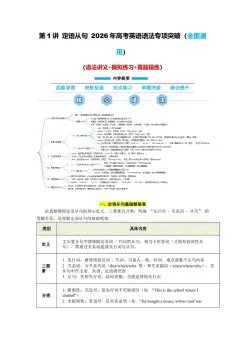
第3 讲 状语从句-1 2026 年高考英语语法专项突破(全国通
用)
(语法讲义+模拟练习+真题操练)
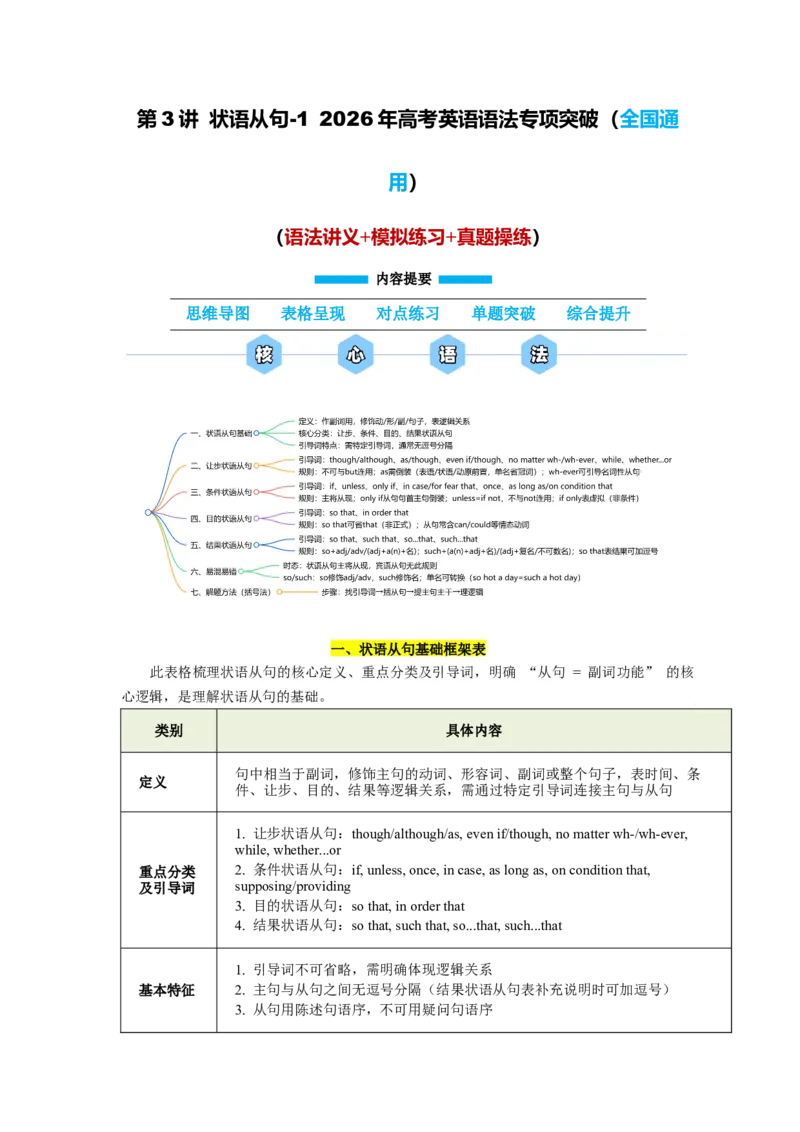
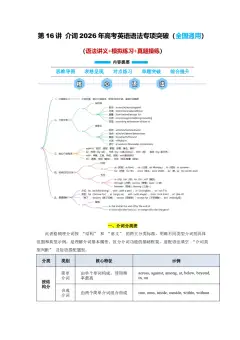
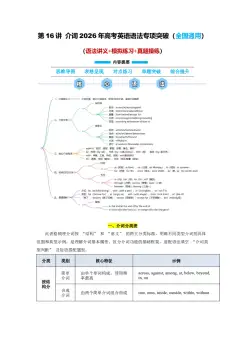
 内容提要
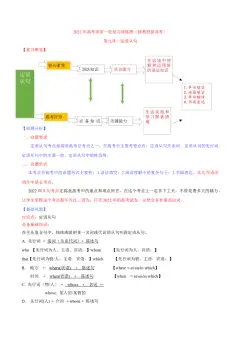
思维导图
表格呈现
对点练习
单题突破
综合提升
一、状语从句基础框架表
此表格梳理状语从句的核心定义、重点分类及引导词,明确 “从句 = 副词功能” 的核
心逻辑,是理解状语从句的基础。
类别
具体内容
定义
句中相当于副词,修饰主句的动词、形容词、副词或整个句子,表时间、条
件、让步、目的、结果等逻辑关系,需通过特定引导词连接主句与从句
重点分类
及引导词
1. 让步状语从句:though/although/as, even if/though, no matter wh-/wh-ever,
while, whether...or
2. 条件状语从句:if, unless, once, in case, as long as, on condition that,
supposing/providing
3. 目的状语从句:so that, in order that
4. 结果状语从句:so that, such that, so...that, such...that
基本特征
1. 引导词不可省略,需明确体现逻辑关系
2. 主句与从句之间无逗号分隔(结果状语从句表补充说明时可加逗号)
3. 从句用陈述句语序,不可用疑问句语序
注意事项:
1. 不可混淆状语从句与其他从句:状语从句修饰 “动作 / 状态的逻辑关系”(如时间、条
件),定语从句修饰 “名词”,名词性从句充当 “名词成分”,需通过功能判断;
2. 引导词需精准匹配逻辑:如表 “让步” 不可用 “if”(条件引导词),表 “目的” 不
可用 “though”(让步引导词)(错误:He studied hard though he could pass the exam;正确:
He studied hard so that he could pass the exam)。
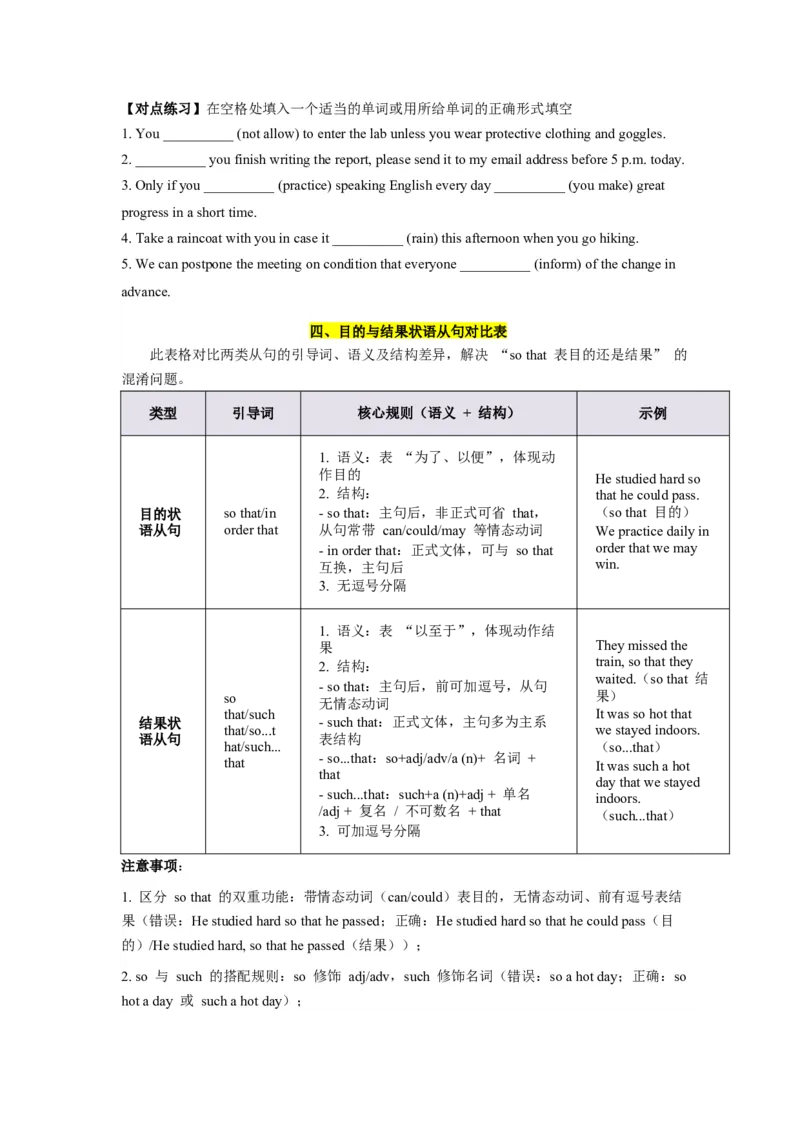
【对点练习】在空格处填入一个适当的单词或用所给单词的正确形式填空
1. __________ the government takes effective measures to protect the environment, the air quality
will continue to worsen in some industrial areas.
2. The volunteers are working day and night __________ they can provide enough food and water
for the people affected by the flood.
3. __________ he has little work experience, he has shown great enthusiasm and quick learning
ability in the new job.
4. The scientist has made a new discovery __________ will help solve the problem of water shortage
in desert areas.
5. The company will offer a bonus to all employees __________ they complete the annual sales
target ahead of schedule.
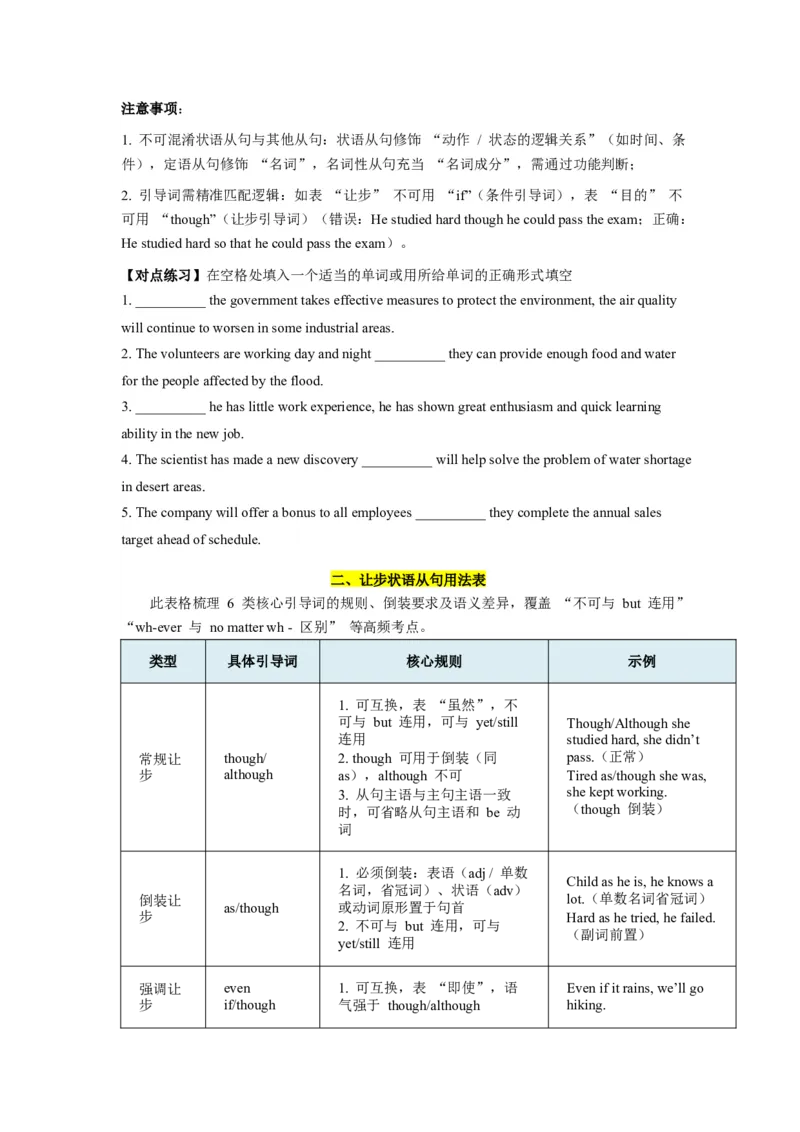
二、让步状语从句用法表
此表格梳理 6 类核心引导词的规则、倒装要求及语义差异,覆盖 “不可与 but 连用”
“wh-ever 与 no matter wh - 区别” 等高频考点。
类型
具体引导词
核心规则
示例
常规让
步
though/
although
1. 可互换,表 “虽然”,不
可与 but 连用,可与 yet/still
连用
2. though 可用于倒装(同
as),although 不可
3. 从句主语与主句主语一致
时,可省略从句主语和 be 动
词
Though/Although she
studied hard, she didn’t
pass.(正常)
Tired as/though she was,
she kept working.
(though 倒装)
倒装让
步
as/though
1. 必须倒装:表语(adj / 单数
名词,省冠词)、状语(adv)
或动词原形置于句首
2. 不可与 but 连用,可与
yet/still 连用
Child as he is, he knows a
lot.(单数名词省冠词)
Hard as he tried, he failed.
(副词前置)
强调让
步
even
if/though
1. 可互换,表 “即使”,语
气强于 though/although
Even if it rains, we’ll go
hiking.
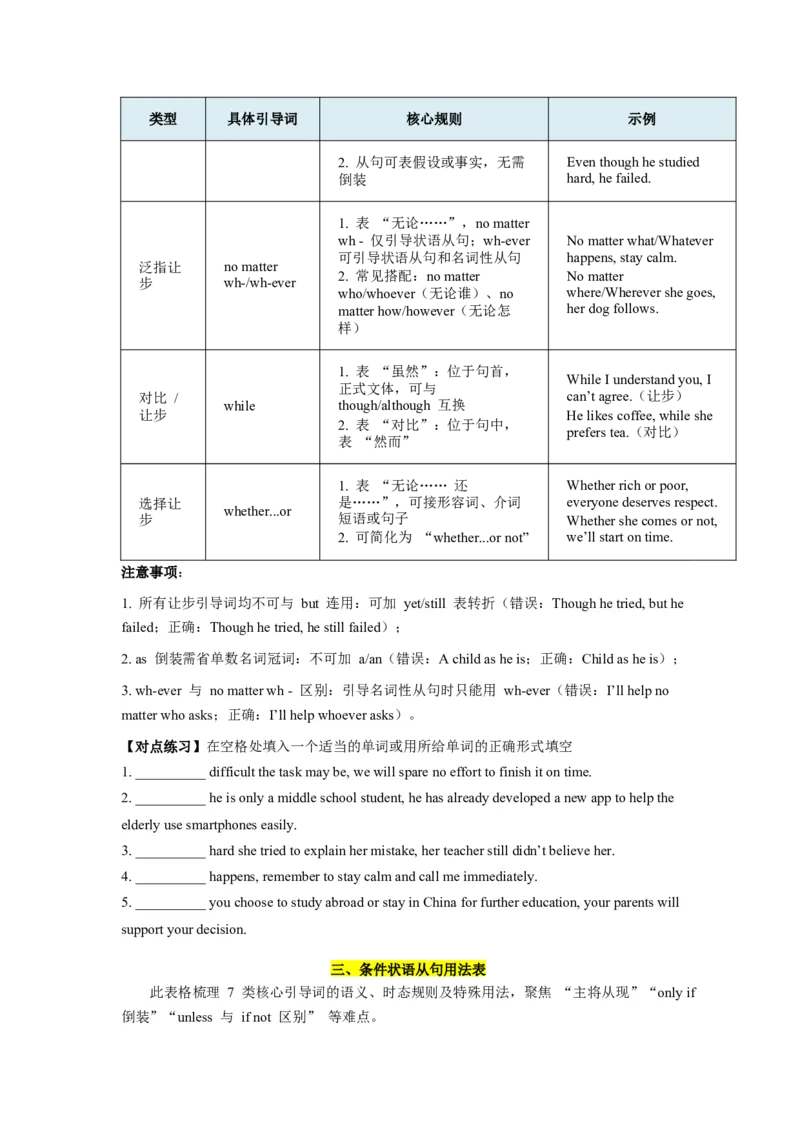
类型
具体引导词
核心规则
示例
2. 从句可表假设或事实,无需
倒装
Even though he studied
hard, he failed.
泛指让
步
no matter
wh-/wh-ever
1. 表 “无论……”,no matter
wh - 仅引导状语从句;wh-ever
可引导状语从句和名词性从句
2. 常见搭配:no matter
who/whoever(无论谁)、no
matter how/however(无论怎
样)
No matter what/Whatever
happens, stay calm.
No matter
where/Wherever she goes,
her dog follows.
对比 /
让步
while
1. 表 “虽然”:位于句首,
正式文体,可与
though/although 互换
2. 表 “对比”:位于句中,
表 “然而”
While I understand you, I
can’t agree.(让步)
He likes coffee, while she
prefers tea.(对比)
选择让
步
whether...or
1. 表 “无论…… 还
是……”,可接形容词、介词
短语或句子
2. 可简化为 “whether...or not”
Whether rich or poor,
everyone deserves respect.
Whether she comes or not,
we’ll start on time.
注意事项:
1. 所有让步引导词均不可与 but 连用:可加 yet/still 表转折(错误:Though he tried, but he
failed;正确:Though he tried, he still failed);
2. as 倒装需省单数名词冠词:不可加 a/an(错误:A child as he is;正确:Child as he is);
3. wh-ever 与 no matter wh - 区别:引导名词性从句时只能用 wh-ever(错误:I’ll help no
matter who asks;正确:I’ll help whoever asks)。
【对点练习】在空格处填入一个适当的单词或用所给单词的正确形式填空
1. __________ difficult the task may be, we will spare no effort to finish it on time.
2. __________ he is only a middle school student, he has already developed a new app to help the
elderly use smartphones easily.
3. __________ hard she tried to explain her mistake, her teacher still didn’t believe her.
4. __________ happens, remember to stay calm and call me immediately.
5. __________ you choose to study abroad or stay in China for further education, your parents will
support your decision.
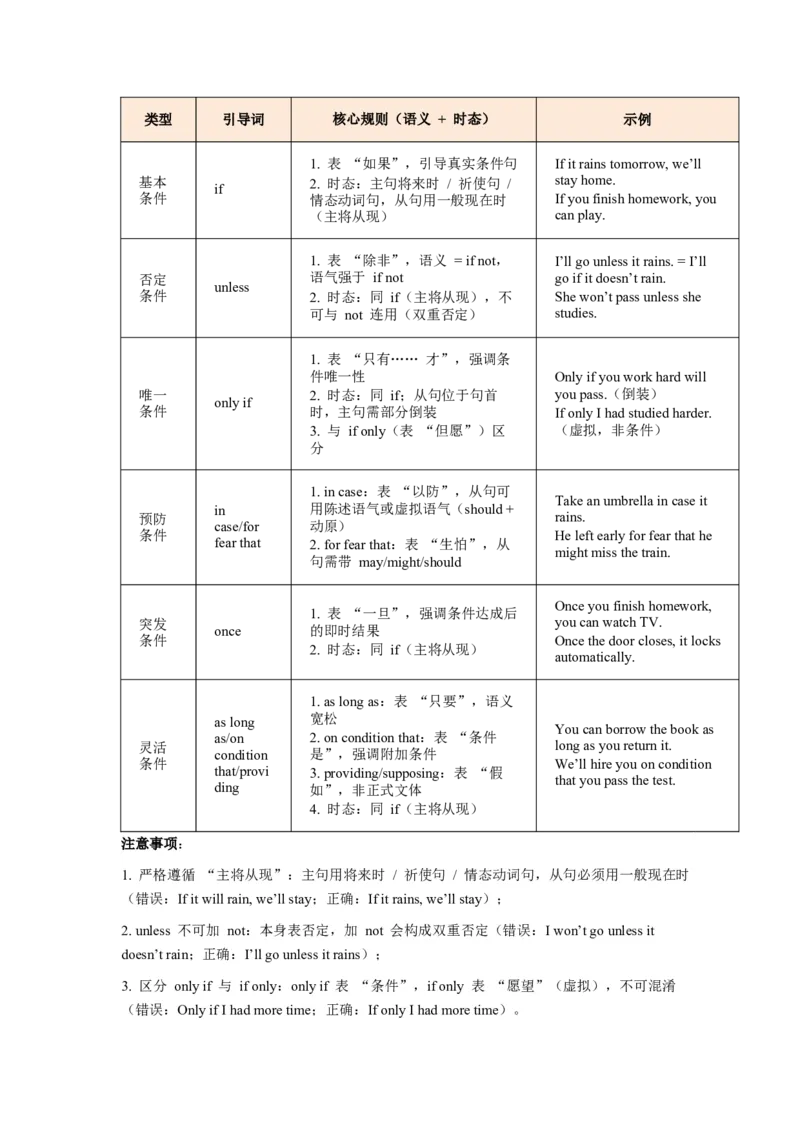
三、条件状语从句用法表
此表格梳理 7 类核心引导词的语义、时态规则及特殊用法,聚焦 “主将从现”“only if
倒装”“unless 与 if not 区别” 等难点。
类型
引导词
核心规则(语义 + 时态)
示例
基本
条件
if
1. 表 “如果”,引导真实条件句
2. 时态:主句将来时 / 祈使句 /
情态动词句,从句用一般现在时
(主将从现)
If it rains tomorrow, we’ll
stay home.
If you finish homework, you
can play.
否定
条件
unless
1. 表 “除非”,语义 = if not,
语气强于 if not
2. 时态:同 if(主将从现),不
可与 not 连用(双重否定)
I’ll go unless it rains. = I’ll
go if it doesn’t rain.
She won’t pass unless she
studies.
唯一
条件
only if
1. 表 “只有…… 才”,强调条
件唯一性
2. 时态:同 if;从句位于句首
时,主句需部分倒装
3. 与 if only(表 “但愿”)区
分
Only if you work hard will
you pass.(倒装)
If only I had studied harder.
(虚拟,非条件)
预防
条件
in
case/for
fear that
1. in case:表 “以防”,从句可
用陈述语气或虚拟语气(should +
动原)
2. for fear that:表 “生怕”,从
句需带 may/might/should
Take an umbrella in case it
rains.
He left early for fear that he
might miss the train.
突发
条件
once
1. 表 “一旦”,强调条件达成后
的即时结果
2. 时态:同 if(主将从现)
Once you finish homework,
you can watch TV.
Once the door closes, it locks
automatically.
灵活
条件
as long
as/on
condition
that/provi
ding
1. as long as:表 “只要”,语义
宽松
2. on condition that:表 “条件
是”,强调附加条件
3. providing/supposing:表 “假
如”,非正式文体
4. 时态:同 if(主将从现)
You can borrow the book as
long as you return it.
We’ll hire you on condition
that you pass the test.
注意事项:
1. 严格遵循 “主将从现”:主句用将来时 / 祈使句 / 情态动词句,从句必须用一般现在时
(错误:If it will rain, we’ll stay;正确:If it rains, we’ll stay);
2. unless 不可加 not:本身表否定,加 not 会构成双重否定(错误:I won’t go unless it
doesn’t rain;正确:I’ll go unless it rains);
3. 区分 only if 与 if only:only if 表 “条件”,if only 表 “愿望”(虚拟),不可混淆
(错误:Only if I had more time;正确:If only I had more time)。
【对点练习】在空格处填入一个适当的单词或用所给单词的正确形式填空
1. You __________ (not allow) to enter the lab unless you wear protective clothing and goggles.
2. __________ you finish writing the report, please send it to my email address before 5 p.m. today.
3. Only if you __________ (practice) speaking English every day __________ (you make) great
progress in a short time.
4. Take a raincoat with you in case it __________ (rain) this afternoon when you go hiking.
5. We can postpone the meeting on condition that everyone __________ (inform) of the change in
advance.
四、目的与结果状语从句对比表
此表格对比两类从句的引导词、语义及结构差异,解决 “so that 表目的还是结果” 的
混淆问题。
类型
引导词
核心规则(语义 + 结构)
示例
目的状
语从句
so that/in
order that
1. 语义:表 “为了、以便”,体现动
作目的
2. 结构:
- so that:主句后,非正式可省 that,
从句常带 can/could/may 等情态动词
- in order that:正式文体,可与 so that
互换,主句后
3. 无逗号分隔
He studied hard so
that he could pass.
(so that 目的)
We practice daily in
order that we may
win.
结果状
语从句
so
that/such
that/so...t
hat/such...
that
1. 语义:表 “以至于”,体现动作结
果
2. 结构:
- so that:主句后,前可加逗号,从句
无情态动词
- such that:正式文体,主句多为主系
表结构
- so...that:so+adj/adv/a (n)+ 名词 +
that
- such...that:such+a (n)+adj + 单名
/adj + 复名 / 不可数名 + that
3. 可加逗号分隔
They missed the
train, so that they
waited.(so that 结
果)
It was so hot that
we stayed indoors.
(so...that)
It was such a hot
day that we stayed
indoors.
(such...that)
注意事项:
1. 区分 so that 的双重功能:带情态动词(can/could)表目的,无情态动词、前有逗号表结
果(错误:He studied hard so that he passed;正确:He studied hard so that he could pass(目
的)/He studied hard, so that he passed(结果));
2. so 与 such 的搭配规则:so 修饰 adj/adv,such 修饰名词(错误:so a hot day;正确:so
hot a day 或 such a hot day);
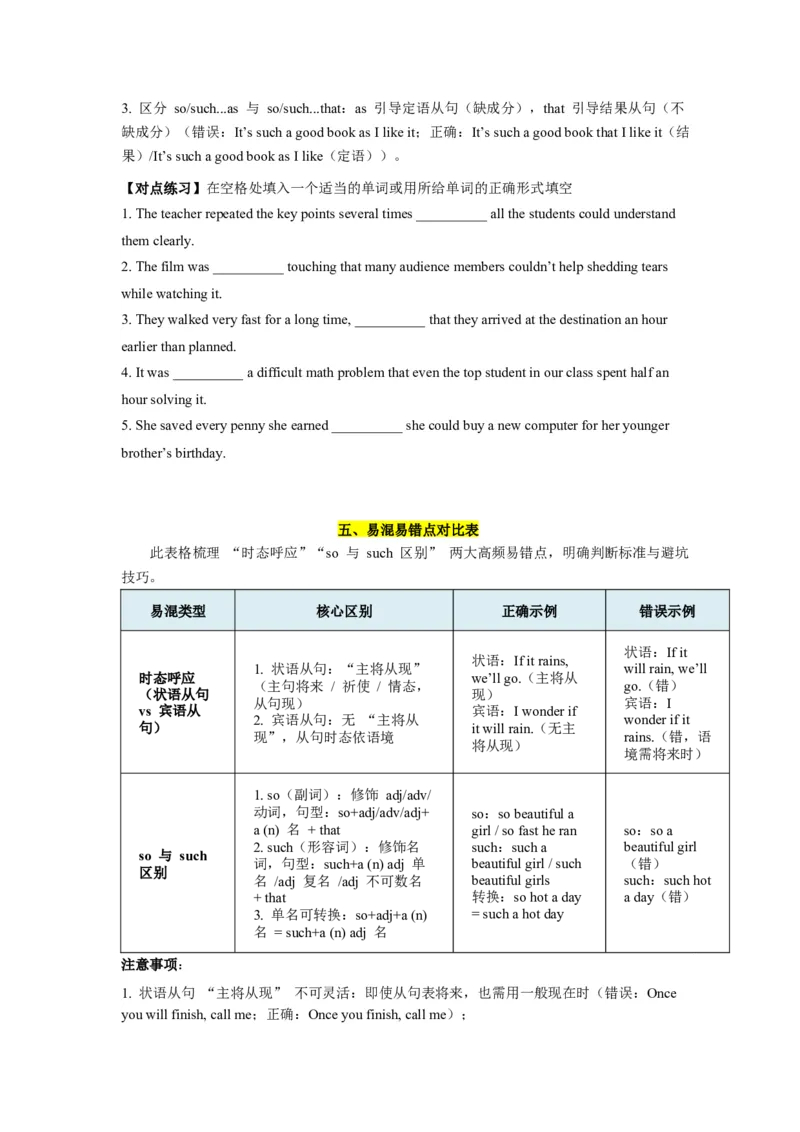
3. 区分 so/such...as 与 so/such...that:as 引导定语从句(缺成分),that 引导结果从句(不
缺成分)(错误:It’s such a good book as I like it;正确:It’s such a good book that I like it(结
果)/It’s such a good book as I like(定语))。
【对点练习】在空格处填入一个适当的单词或用所给单词的正确形式填空
1. The teacher repeated the key points several times __________ all the students could understand
them clearly.
2. The film was __________ touching that many audience members couldn’t help shedding tears
while watching it.
3. They walked very fast for a long time, __________ that they arrived at the destination an hour
earlier than planned.
4. It was __________ a difficult math problem that even the top student in our class spent half an
hour solving it.
5. She saved every penny she earned __________ she could buy a new computer for her younger
brother’s birthday.
五、易混易错点对比表
此表格梳理 “时态呼应”“so 与 such 区别” 两大高频易错点,明确判断标准与避坑
技巧。
易混类型
核心区别
正确示例
错误示例
时态呼应
(状语从句
vs 宾语从
句)
1. 状语从句:“主将从现”
(主句将来 / 祈使 / 情态,
从句现)
2. 宾语从句:无 “主将从
现”,从句时态依语境
状语:If it rains,
we’ll go.(主将从
现)
宾语:I wonder if
it will rain.(无主
将从现)
状语:If it
will rain, we’ll
go.(错)
宾语:I
wonder if it
rains.(错,语
境需将来时)
so 与 such
区别
1. so(副词):修饰 adj/adv/
动词,句型:so+adj/adv/adj+
a (n) 名 + that
2. such(形容词):修饰名
词,句型:such+a (n) adj 单
名 /adj 复名 /adj 不可数名
+ that
3. 单名可转换:so+adj+a (n)
名 = such+a (n) adj 名
so:so beautiful a
girl / so fast he ran
such:such a
beautiful girl / such
beautiful girls
转换:so hot a day
= such a hot day
so:so a
beautiful girl
(错)
such:such hot
a day(错)
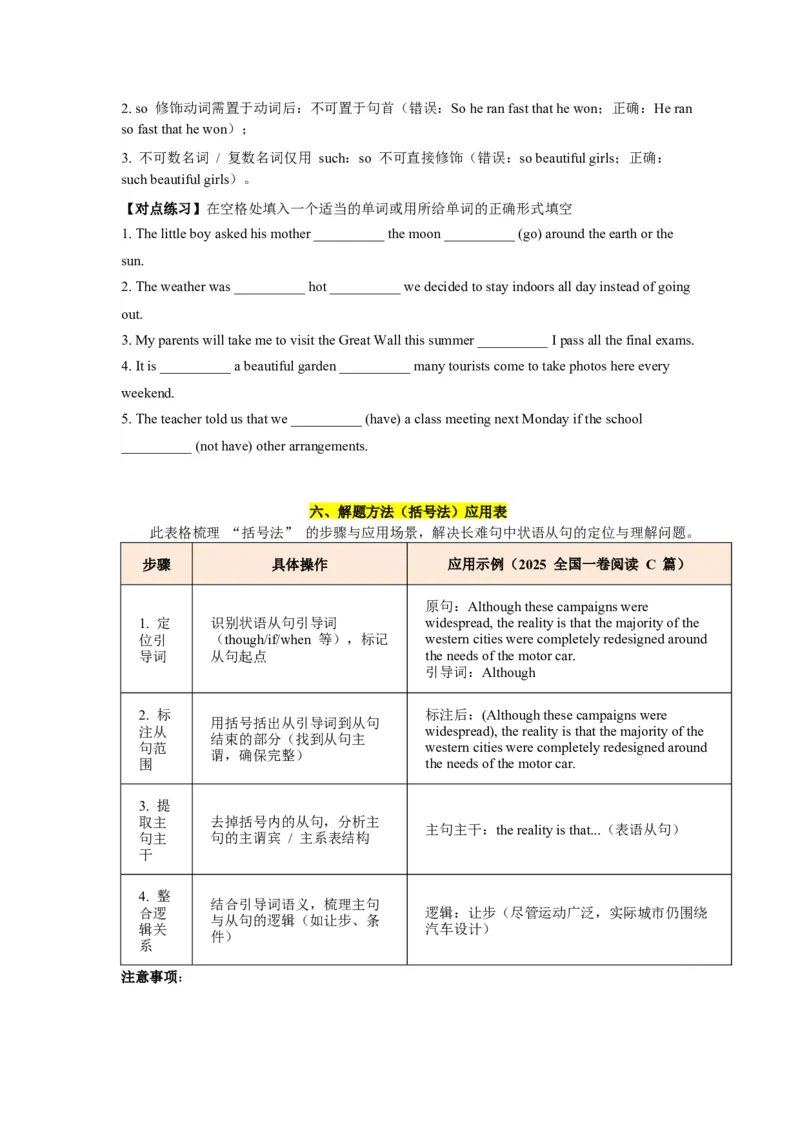
注意事项:
1. 状语从句 “主将从现” 不可灵活:即使从句表将来,也需用一般现在时(错误:Once
you will finish, call me;正确:Once you finish, call me);
2. so 修饰动词需置于动词后:不可置于句首(错误:So he ran fast that he won;正确:He ran
so fast that he won);
3. 不可数名词 / 复数名词仅用 such:so 不可直接修饰(错误:so beautiful girls;正确:
such beautiful girls)。
【对点练习】在空格处填入一个适当的单词或用所给单词的正确形式填空
1. The little boy asked his mother __________ the moon __________ (go) around the earth or the
sun.
2. The weather was __________ hot __________ we decided to stay indoors all day instead of going
out.
3. My parents will take me to visit the Great Wall this summer __________ I pass all the final exams.
4. It is __________ a beautiful garden __________ many tourists come to take photos here every
weekend.
5. The teacher told us that we __________ (have) a class meeting next Monday if the school
__________ (not have) other arrangements.
六、解题方法(括号法)应用表
此表格梳理 “括号法” 的步骤与应用场景,解决长难句中状语从句的定位与理解问题。
步骤
具体操作
应用示例(2025 全国一卷阅读 C 篇)
1. 定
位引
导词
识别状语从句引导词
(though/if/when 等),标记
从句起点
原句:Although these campaigns were
widespread, the reality is that the majority of the
western cities were completely redesigned around
the needs of the motor car.
引导词:Although
2. 标
注从
句范
围
用括号括出从引导词到从句
结束的部分(找到从句主
谓,确保完整)
标注后:(Although these campaigns were
widespread), the reality is that the majority of the
western cities were completely redesigned around
the needs of the motor car.
3. 提
取主
句主
干
去掉括号内的从句,分析主
句的主谓宾 / 主系表结构
主句主干:the reality is that...(表语从句)
4. 整
合逻
辑关
系
结合引导词语义,梳理主句
与从句的逻辑(如让步、条
件)
逻辑:让步(尽管运动广泛,实际城市仍围绕
汽车设计)
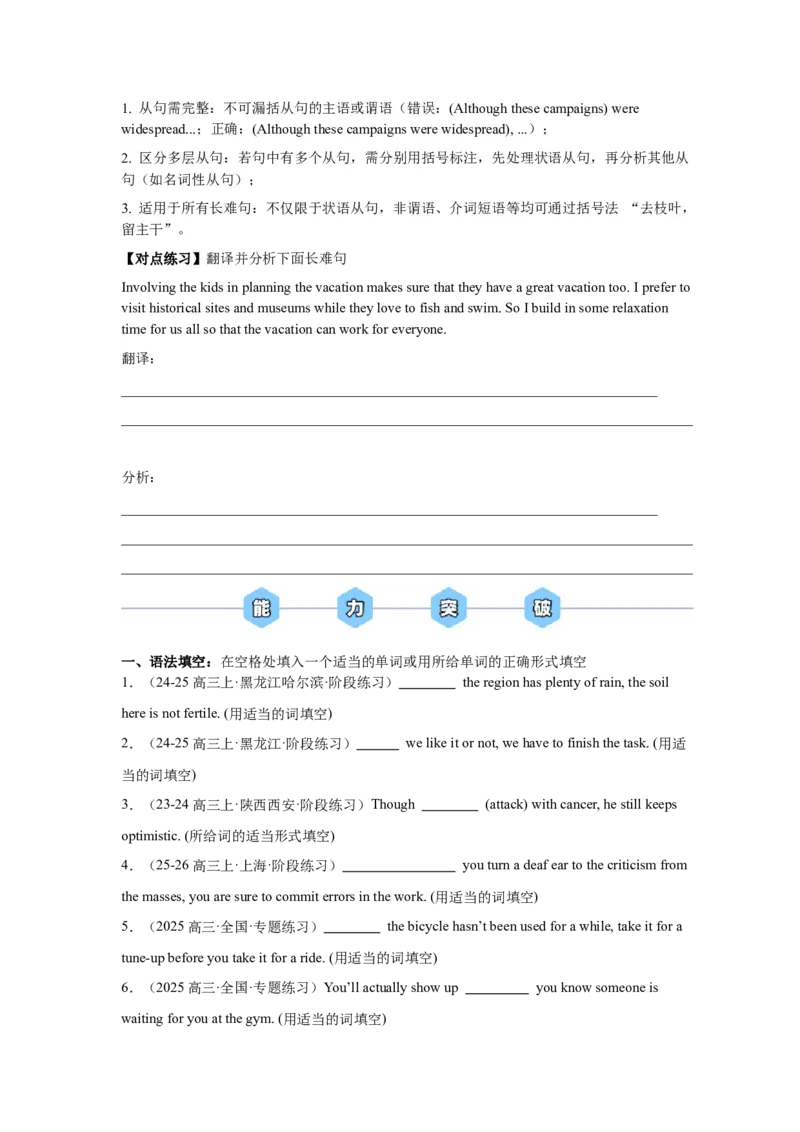
注意事项:
1. 从句需完整:不可漏括从句的主语或谓语(错误:(Although these campaigns) were
widespread...;正确:(Although these campaigns were widespread), ...);
2. 区分多层从句:若句中有多个从句,需分别用括号标注,先处理状语从句,再分析其他从
句(如名词性从句);
3. 适用于所有长难句:不仅限于状语从句,非谓语、介词短语等均可通过括号法 “去枝叶,
留主干”。
【对点练习】翻译并分析下面长难句
Involving the kids in planning the vacation makes sure that they have a great vacation too. I prefer to
visit historical sites and museums while they love to fish and swim. So I build in some relaxation
time for us all so that the vacation can work for everyone.
翻译:
____________________________________________________________________________
_________________________________________________________________________________
分析:
____________________________________________________________________________
_________________________________________________________________________________
_________________________________________________________________________________
一、语法填空:在空格处填入一个适当的单词或用所给单词的正确形式填空
1.(24-25 高三上·黑龙江哈尔滨·阶段练习)         the region has plenty of rain, the soil
here is not fertile. (用适当的词填空)
2.(24-25 高三上·黑龙江·阶段练习)       we like it or not, we have to finish the task. (用适
当的词填空)
3.(23-24 高三上·陕西西安·阶段练习)Though          (attack) with cancer, he still keeps
optimistic. (所给词的适当形式填空)
4.(25-26 高三上·上海·阶段练习)                 you turn a deaf ear to the criticism from
the masses, you are sure to commit errors in the work. (用适当的词填空)
5.(2025 高三·全国·专题练习)         the bicycle hasn’t been used for a while, take it for a
tune-up before you take it for a ride. (用适当的词填空)
6.(2025 高三·全国·专题练习)You’ll actually show up           you know someone is
waiting for you at the gym. (用适当的词填空)
7.(2023 高三·上海·专题练习)Involving the kids in planning the vacation makes sure that they
have a great vacation too. I prefer to visit historical sites and museums while they love to fish and
swim. So I build in some relaxation time for us all            the vacation can work for everyone.
(用适当的词填空)
8.(2023 高三·上海·专题练习)Strasser said Lowell got in through the back door, which he kept
open at night so that Bonnie        get into the backyard. (用适当的词填空)
9.(2022 高三上·浙江·专题练习)Let's not pick these peaches until this weekend          that
they get sweet enough to be eaten.(用适当的词填空)
10.(2024 高三·全国·专题练习)They have          a special relationship with fire that they
call themselves the “fire nationality”. (用适当的词填空)
11.(2022 高三上·浙江·专题练习)He liked it          much that he quickly walked into the
shop.(用适当的词填空)
12.(21-22 高三上·吉林长春·开学考试)His plan was such a good one          we all agreed
to accept it. (用适当的词填空)
13.(20-21 高三上·福建厦门·阶段练习)The Xiamen of today is still changing, so rapidly, in
fact,                 maps of the city become outdated almost as soon as they

(publish). (用适当的单词和所给词的适当形式填空)
14.(25-26 高三上·福建厦门·开学考试)       wealthy we may be, we can never find enough
hours in the day to do everything we want. (用适当的词填空)
15.(2025 高三·全国·专题练习)          I was thrilled that he was an animal lover, I worried
that three dogs were perhaps too many, and my dogs might attack Flora, the cat. (用适当的词填空)
一、阅读理解:完成下面选择题,翻译并分析文中划线的句子
Passage 1
(2025·全国一卷·高考真题)While safety improvements might have been made to our
streets in recent years, transport studies also show declines in pedestrian (行人) mobility, especially
among young children. Many parents say there’s too much traffic on the roads for their children to
walk safely to school, so they pack them into the car instead.
Dutch authors Thalia Verkade and Marco te Brömmelstroet are bothered by facts like these. In
their new book Movement: How to Take Back Our Streets and Transform Our Lives, they call for a
rethink of our streets and the role they play in our lives.
Life on city streets started to change decades ago. Whole neighbourhoods were destroyed to
make way for new road networks and kids had to play elsewhere. Some communities fought back.
Most famously, a Canadian journalist who had moved her family to Manhattan in the early 1950s led
a campaign to stop the destruction of her local park. Describing her alarm at its proposed replacement
with an expressway, Jane Jacobs called on her mayor ( 市长) to champion “New York as a decent
place to live, and not just rush through.” Similar campaigns occurred in Australia in the late 1960s
and 1970s as well.
Although these campaigns were widespread, the reality is that the majority of the western
cities were completely redesigned around the needs of the motor car. The number of cars on roads
has been increasing rapidly. In Australia we now have over twenty million cars for just over twenty-
six million people, among the highest rate of car ownership in the world.
We invest a lot in roads that help us rush through, but we fail to account for the true costs. Do
we really recognise what it costs us as a society when children can’t move safely around our
communities? The authors of Movement have it right: it’s time to think differently about that street
outside your front door.
1.What phenomenon does the author point out in paragraph 1?
A.Cars often get stuck on the road.
B.Traffic accidents occur frequently.
C.People walk less and drive more.
D.Pedestrians fail to follow the rules.
2.What were the Canadian journalist and other campaigners trying to do?
A.Keep their cities livable.
B.Promote cultural diversity.
C.Help the needy families.
D.Make expressways accessible.
3.What can be inferred about the campaigns in Australia in the late 1960s and 1970s?
A.They boosted the sales of cars.
B.They turned out largely ineffective.
C.They won government support.
D.They advocated building new parks.
4.What can be a suitable title for the text?
A.Why the Rush?
B.What’s Next?
C.Where to Stay?
D.Who to Blame?
5. 分析语句:Although these campaigns were widespread, the reality is that the majority of the
western cities were completely redesigned around the needs of the motor car.
翻译:
____________________________________________________________________________
_________________________________________________________________________________
分析:
____________________________________________________________________________
_________________________________________________________________________________
_________________________________________________________________________________
Passage 2
(2025·北京·高考真题)The call to “know yourself” has been there since ancient times, but
our sense of self doesn’t always match what others perceive. Considering the stories we tell about
ourselves can help us to change our minds for better.
For many years, psychologists saw identity as a combination of someone’s values, beliefs,
goals and social roles. Then, in the 1980s, Bob Johnson created the life story model of identity, in
which he proposes that, as we go through life, these core features are built in with our memories to
create a personal story through which we understand our lives.
Our life story is something that starts coming together in our teenage years, when we begin to
organise our lives into chapters around key events or life changes, and begin to see ourselves as both
the central character and, to a varying extent, the story’s author. People with more consistent stories
tend to have a stronger sense of identity, and they feel their life has more meaning, direction and
sense of purpose. Such people show greater overall life satisfaction, too.
Johnson has also investigated the link between well-being and certain story themes. He
discovered that whether someone describes having had some control over events in their past is an
important predictor of a person’s mental health. Another key theme involves finding some kind of
positive meaning after stressful events. “People could talk about gaining knowledge or personal
growth,” says Johnson. His research shows that this is often missing for people with mental health
conditions. The good news is that there is evidence we can learn to change our own story.
Lisa Green, another researcher, sounds a few notes of caution (谨慎). For instance, hearing
about the power of redemptive (拯救性的) stories, many people may feel forced to find a positive
angle on horrible events. She says that Western culture already pushes people to look for the silver
lining behind every cloud.
If you want to turn over a new leaf, though, one top tip is that it helps to choose a significant
date that signals the start of a new “chapter”. Contrary to popular doubt, resolutions made on I
January are more effective for this reason. So, whether your goal is saving money or getting fit, there
is no better time to become the author of our own destiny (命运).
1. What can be inferred about personal stories?
A.They are unrelated to health.
B.Consistent ones lead to stress.
C.They are relevant to happiness.
D.Thematic ones hold back change.
2. What can we learn from this passage?
A.Talking about gains from failure is negative.
B.New Year resolutions are well received.
C.The West tends to overvalue optimism.
D.Social roles fail to be highlighted.
3. What does the author mainly do in this passage?
A.Clarify a goal.
B.Analyse an event.
C.Make a comparison.
D.Illustrate an approach.
4. What is the passage mainly about?
A.How self-identity works.
B.How story-tellers are made.
C.How personal stories raise doubts.
D.How timing affects personal identity.
5. 分析语句:If you want to turn over a new leaf, though, one top tip is that it helps to choose a
significant date that signals the start of a new “chapter”.
翻译:
____________________________________________________________________________
_________________________________________________________________________________
分析:
____________________________________________________________________________
_________________________________________________________________________________
_________________________________________________________________________________
Passage 3
(2025·北京·高考真题)What is adulthood? Societies all over the world view the concept of
an adult as self-supporting and self-directed, because it identifies a point in the life cycle.
As Alice Black points out, today’s parents’ fear of letting kids do more housework has added
to their inability to feel competent and, thus, confident in themselves. Psychologist Robert Turner
wrote about this in his book, The Life Cycle, mentioning a stage when kids learn self-direction and
mastery.     1
But Turner’s other cycles are just as important.     2     If these life cycles are delayed,
interrupted, or denied, you feel incapable of accessing your states of self, controlling unpleasant
feelings, and manipulating (

 操控

 ) the energy that puts together the fabric of your inner world.


Turner wisely said that “doing well” psychologically is being able to roll with the flow of
emotions, manage them, communicate clearly and well with others, and master various skills. This
requires an internal locus (核心) of control, which implies self-control of your thoughts, feelings, and
actions.     3     You’re self-directed and not reliant on the world to tell you who you are. And
you know who you are within all this.
So, being an adult isn’t just holding a job. Being an adult is about having a rooted sense of self
while being capable of identifying and managing your emotions and actions.     4     We are a
social species, so this is important.
While raising an adult is a parent’s job, it’s also our responsibility as a society to ensure that
we support schools that nurture (培养) emotional and identity development.     5
A.It’s also our job to support adults who need help repairing incomplete life cycles.
B.They talk about someone’s inability to support themselves through work.
C.It’s being able to show understanding when communicating with others.
D.In other words, you’re playing the game of life — life isn’t playing you.
E.They teach emotional awareness and management as well as identity.
F.You feel like an 18-year old, especially when playing 80s music.
G.When this stage is denied it creates a sense of insecurity.
6.分析语句: If these life cycles are delayed, interrupted, or denied, you feel incapable of accessing
your states of self, controlling unpleasant feelings, and manipulating ( 操控) the energy that puts
together the fabric of your inner world.
翻译:
____________________________________________________________________________
_________________________________________________________________________________
分析:
____________________________________________________________________________
_________________________________________________________________________________
_________________________________________________________________________________
Passage 4
(2025· 全国二卷· 高考真题)When Sonja Detrinidad opened her online shop selling
houseplants, she didn’t have high hopes for it. But the opposite happened: She was flooded, shipping
out 1,200 orders in June of 2020 alone. In the past year, Detrinidad sent out more than 70,000 plants.
Her success is just one example of increased time at home leading to an explosion in the houseplant
industry.
“Plants are in fashion right now,” says Dr. Melinda Knuth, a researcher from the University of
Florida. “People who live in plant-rich environments report a higher life satisfaction rating, ” she
says. “Adding more nature to our environment can change our mood and how we think.” Plants can
improve our state of mind in a few ways but the biggest is by decreasing our level of cortisol, the
stress hormone (激素) in our body.
“Students who are around plants perform better academically than students who are in a
classroom without plants,” says Knuth. “This productivity also translates into the workplace for
adults. Our study showed that there was a 30% decrease in sick leave for people who were in plant-
rich workplaces.”
If you’re among the groups of people who are enjoying the mental and physical health benefits
of surrounding yourself with plants, don’t beat yourself up if one (or a few!) doesn’t make it.
“Doctors practice medicine and lawyers practice law and you should allow yourself the practice it
takes to sustain a plant. Tending to plants is an exercise in patience and learning. Be invested in
taking care of it, but if it dies, go get another one,” Detrinidad says.
1. How was Detrinidad’s business when it started?
A.It faced tough competition.
B.It suffered a great loss.
C.It got lots of financial support.
D.It went surprisingly well.
2. What is one of Knuth’s findings about plants?
A.They appeal more to students.
B.They purify the environment.
C.They raise the cortisol level.
D.They enhance productivity.
3. What does Detrinidad try to explain by mentioning doctors and lawyers?
A.The necessity of social skills.
B.The meaning of sustainability.
C.The importance of repeated efforts.
D.The value of professional opinions.
4. What can be a suitable title for the text?
A.Time to Replace Houseplants
B.Plants Boost Your Mood
C.Tips on Choosing Houseplants
D.Plants Brighten Your Home
5. 分析语句:If you’re among the groups of people who are enjoying the mental and physical
health benefits of surrounding yourself with plants, don’t beat yourself up if one (or a few!) doesn’t
make it.
翻译:
____________________________________________________________________________
_________________________________________________________________________________
分析:
____________________________________________________________________________
_________________________________________________________________________________
_________________________________________________________________________________