文档文本内容
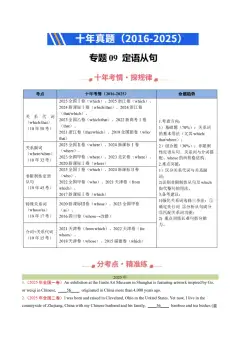
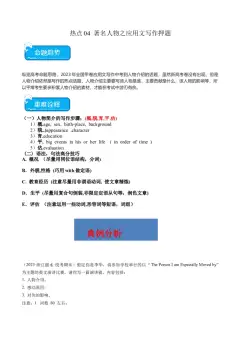
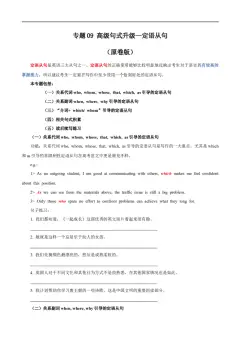
专题07   巧用定语从句
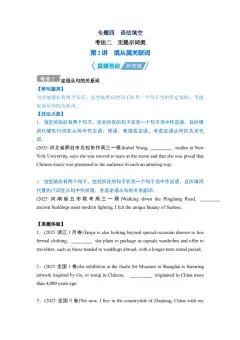
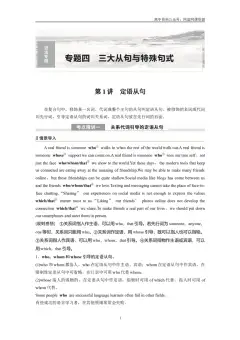
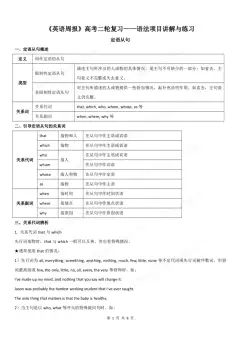
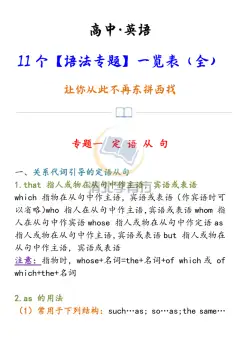
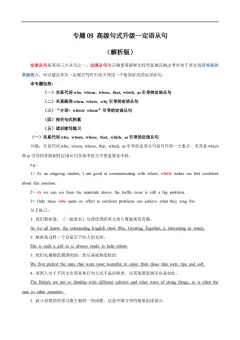
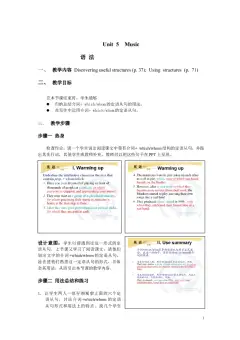
核心概念:什么是定语从句?
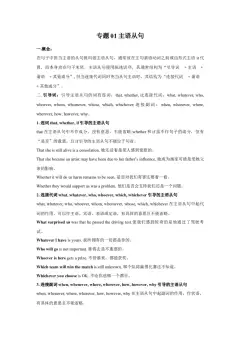
定语从句,就是一个句子充当“定语”,用来修饰一个名词或代词(即先行词)。
· 简单句: I know the boy. (我认识那个男孩。)
· 含定语从句的复合句: I know the boy who is playing basketball. (我认识那个正在打篮球的男
孩。)
· 先行词: the boy
· 定语从句: who is playing basketball
· 关系词: who (指代the boy,并在从句中作主语)
1. 定语从句的“骨架”:两大要素
一个完整的定语从句必须包含两个部分:
· 先行词: 被修饰的那个名词或代词。
· 关系词: 连接主句和从句的词语,它同时指代先行词,并在从句中充当一个成分(如主语、宾语、
状语等)。
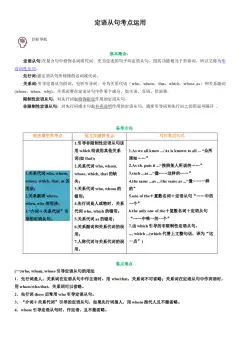
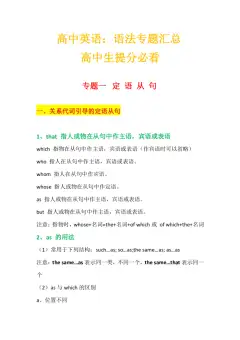
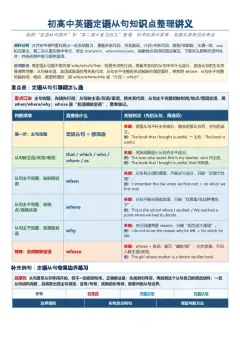
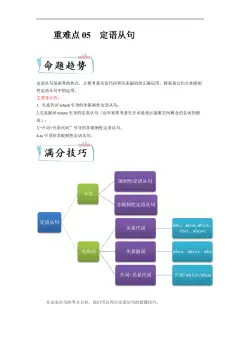
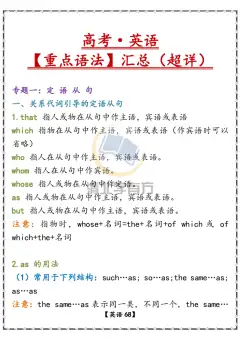
2. 关系词的选用
who 人 主语 或 宾语 The girl who won the prize is my sister. (作主语)   The man who you met
is our principal. (作宾语)
whom 人 宾语 (通常可被who 替代或省略) The lady (whom/who) I admire most is my mother. (作宾
语,可省略)
whose 人或物 定语 (表示“...的”) That's the artist whose paintings are famous.   I live in a room
whose window faces south.
which 物 / 事 主语 或 宾语 The book which is on the table is mine. (作主语)   The movie
(which) we saw yesterday was great. (作宾语,可省略)
that 人或物 主语 或 宾语 He is the greatest man that I have ever seen. (作宾语)   Anything that
can go wrong will go wrong. (作主语)
when 时间名词 (time, day 等) 时间状语 I'll never forget the day when we first met.
where 地点名词 (place, city 等) 地点状语 This is the house where I was born.
why 原因名词 (reason) 原因状语 That is the reason why I was late.
特殊考点:只用 that 的情况(口诀:不定代,序数最高级;人&物,全与唯一)
1. 先行词是不定代词时,如 all, much, anything, something, nothing, everything, little, none 等。
   · I am willing to do anything that might be helpful.
识写作指导
2. 先行词被序数词或最高级修饰时。
   · This is the best movie that I have ever seen.
   · He was the first person that arrived.
3. 先行词同时包含人和物时。
   · We talked about the people and the things that we remembered.
4. 先行词被 the only, the very, the same, the last 等修饰时。
   · He is the only friend that I have.
技巧一:化零为整,提升句子层次感
写作中最忌讳的是通篇简单句。定语从句可以将两个相关的简单句合并成一个逻辑紧密的复合句。
· 平淡表达 (两个简单句):I have a friend. She loves collecting stamps.
· 升级表达 (定语从句):I have a friend who loves collecting stamps.
· 平淡表达:We visited a city last summer. The city is famous for its history.
· 升级表达:Last summer, we visited a city which/that is famous for its history.
技巧二:提供关键信息,使表达更具体
定语从句可以为抽象名词(如reason, way, feeling)或泛指名词提供具体内容,让读者一目了然。
· 模糊表达:I don't know the reason.
· 具体表达:I don't know the reason why he was so angry.
· 模糊表达:That was a wonderful experience.
· 具体表达:That was a wonderful experience that I will cherish forever.
技巧三:使用“非限制性定语从句”,增加补充信息
非限制性定语从句是对主句的补充说明,如果去掉,主句意思依然完整。书写时用逗号与主句隔开。
关系词不能用that。
· 功能: 相当于一个插入语,使文章信息量更丰富,读起来更流畅。
· 例句:
  · My father, who is a doctor, will go abroad next month. (我父亲下个月要出国,他是一名医生。)
  · I passed the exam, which made my parents very happy. (我通过了考试,这让我父母很高兴。)
  · He went to Shanghai, where his grandparents live. (他去了上海,他的祖父母住在那里。)
技巧四:避免“头重脚轻”,学会使用分隔式定语从句
有时,为了保持句子平衡,避免主语部分过长(头重脚轻),会将定语从句与它所修饰的先行词分隔
开。
· 头重脚轻:The day when we finally achieved our goal came.
· 平衡优美:The day came when we finally achieved our goal.
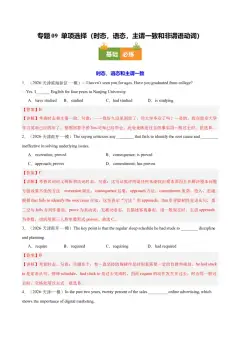
练专项练习
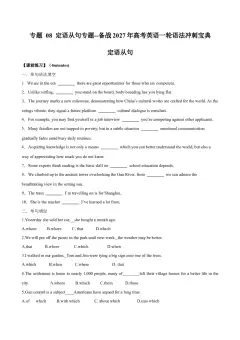
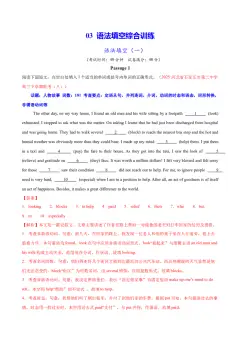
一、单句语法填空30 题
1. This is the girl ______ helped me with my English yesterday.
2. The book ______ cover is blue is mine.
3. I still remember the day ______ we first met in the park.
4. This is the factory ______ my father has worked for 20 years.
5. He is the man ______ son won the first prize in the competition.
6. The reason ______ he was late for school is that he missed the bus.
7. We visited the city ______ many historical buildings are located.
8. She likes music ______ she can dance to.
9. The student ______ homework was not finished was criticized by the teacher.
10. I don’t know the person ______ you are talking about.
11. This is the place ______ I spent my childhood.
12. The film ______ we watched last night was very exciting.
13. He gave me a pen ______ writes very smoothly.
14. The teacher ______ teaches us math is very strict but kind.
15. The time ______ we can spend together is limited.
16. This is the museum ______ we visited during our trip.
17. The girl with ______ I went shopping yesterday is my cousin.
18. The story ______ he told us was very interesting.
19. This is the house ______ Lu Xun once lived in.
20. The reason ______ he explained to us was not convincing.
21. We will never forget the years ______ we studied in high school.
22. The book ______ I borrowed from the library is very useful.
23. He is the scientist ______ inventions have changed the world.
24. The city ______ I was born is a beautiful coastal city.
25. I know a boy ______ father is a famous doctor.
26. The song ______ we sang at the party was very popular.
27. This is the problem ______ we need to solve immediately.
28. The teacher ______ class we attended yesterday is from Beijing.
29. I will never forget the moment ______ I won the first prize.
30. The tree ______ leaves turn red in autumn is a maple tree.
二、长句翻译20 题
1. 那个在操场上打篮球的男孩是我的同桌。(who/that)
2. 我们应该尊敬那些为社会做出贡献的人。(who/that)
3. 你认识那个正在给学生们上课的女老师吗?(who/that)
4. 这是我昨天从书店买的那本英语词典。(which/that)
5. 他送给我的礼物是一个精美的笔记本。(which/that)
6. 能解决这个难题的方法很少。(which/that)
7. 我永远记得我第一次去北京的那一天。(when)
8. 这是我们去年夏天度假的地方。(where)
9. 他没有告诉我们他拒绝邀请的原因。(why)
10. 我的哥哥是一名医生,他在一家大型医院工作。(who)
11. 我们参观了长城,它是世界七大奇迹之一。(which)
12. 李明通过了考试,这让他的父母非常高兴。(which)
13. 我出生在1998 年,那一年发生了很多重大事件。(when)
14. 杭州是一座美丽的城市,很多游客都想去那里游览。(where)
15. 这就是我们讨论了很长时间的问题。(about which)
16. 他就是我刚才和你提到的那位教授。(to whom)
17. 我们应该学习那些古人留下的宝贵经验。(from which)
18. 正如我们所预料的那样,他在比赛中获得了第一名。(as)
19. 那个父母都是工程师的女孩学习非常努力。(whose)
20. 这是一座屋顶是红色的古老建筑。(whose)
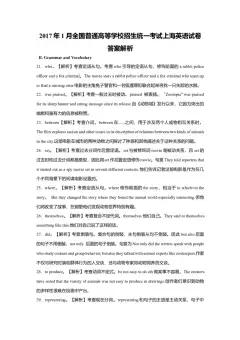
答案:
一、单句语法填空30 题
1. who/that(先行词the girl 指人,从句缺主语,用who/that 引导)
2. whose(先行词the book 指物,从句缺定语“……的封面”,whose 表“……的”,可修饰人或
物)
3. when(先行词the day 指时间,从句缺时间状语,用when 引导)
4. where/in which(先行词the factory 指地点,从句缺地点状语,“在工厂工作”用work in the
factory,故可填where 或in which)
5. whose(先行词the man 指人,从句缺定语“……的儿子”,用whose 表所属关系)
6. why/for which(先行词the reason 指原因,从句缺原因状语,用why 或for which 引导)
7. where/in which(先行词the city 指地点,从句缺地点状语“在城市里”,用where 或in which)
8. that/which(先行词music 指物,从句缺宾语(dance to music),用that/which 引导,可省略)
9. whose(先行词the student 指人,从句缺定语“……的作业”,用whose 表所属)
10. whom/that/who(先行词the person 指人,从句缺宾语(talk about sb.),用whom/that/who 引导,
可省略)
11. where/in which(先行词the place 指地点,从句缺地点状语“在地方度过”,用where 或in
which)
12. that/which(先行词the film 指物,从句缺宾语(watched the film),用that/which 引导,可省
略)
13. which/that(先行词a pen 指物,从句缺主语(pen writes),用which/that 引导)
14. who/that(先行词the teacher 指人,从句缺主语(teaches us),用who/that 引导)
15. that/which(先行词the time 指时间,但从句缺宾语(spend the time),用that/which 引导,而非
when)
16. that/which(先行词the museum 指物,从句缺宾语(visited the museum),用that/which 引导,可
省略)
17. whom(先行词the girl 指人,从句缺宾语(went shopping with the girl),介词with 后用
whom)
18. that/which(先行词the story 指物,从句缺宾语(told us the story),用that/which 引导,可省
略)
19. that/which(先行词the house 指物,从句缺宾语(lived in the house),用that/which 引导,可省
略)
20. that/which(先行词the reason 指原因,但从句缺宾语(explained the reason),用that/which 引导,
而非why)
21. when/in which(先行词the years 指时间,从句缺时间状语(studied in the years),用when 或in
which)
22. that/which(先行词the book 指物,从句缺宾语(borrowed the book),用that/which 引导,可省
略)
23. whose(先行词the scientist 指人,从句缺定语“……的发明”,用whose 表所属)
24. where/in which(先行词the city 指地点,从句缺地点状语“在城市出生”,用where 或in which)
25. whose(先行词a boy 指人,从句缺定语“……的父亲”,用whose 表所属)
26. that/which(先行词the song 指物,从句缺宾语(sang the song),用that/which 引导,可省略)
27. that/which(先行词the problem 指物,从句缺宾语(solve the problem),用that/which 引导,可
省略)
28. whose(先行词the teacher 指人,从句缺定语“……的课”,whose class=the teacher’s class)
29. when/at which(先行词the moment 指时间,从句缺时间状语,用when 或at which)
30. whose(先行词the tree 指物,从句缺定语“……的叶子”,用whose 表所属)
二、长句翻译20 题
1. 译文:The boy who/that is playing basketball on the playground is my deskmate.
优化思路:先行词the boy 指人,从句用现在进行时(is playing)强调动作正在进行,who/that 在从句
中作主语,不可省略。
2. 译文:We should respect those who/that have made contributions to society.
优化思路:先行词those(指代人)后用who/that 引导,“make contributions to”(为……做贡献)是
地道搭配,从句用现在完成时表动作已完成。
3. 译文:Do you know the woman teacher who/that is giving a lesson to the students?
优化思路:先行词the woman teacher 指人,从句用现在进行时,who/that 作主语,“give a lesson to
sb.”(给某人上课)符合英文表达习惯。
4. 译文:This is the English dictionary which/that I bought from the bookstore yesterday.
优化思路:先行词the English dictionary 指物,从句用一般过去时(bought),which/that 作宾语,可
省略,“buy sth. from...”(从……买某物)是固定搭配。
5. 译文:The gift which/that he gave me is a beautiful notebook.
优化思路:先行词the gift 指物,从句用一般过去时(gave),which/that 作宾语,可省略,主句用一
般现在时表客观事实。
6. 译文:There are few methods which/that can solve this difficult problem.
优化思路:先行词methods 指物,从句用情态动词can 表“能够”,which/that 作主语,不可省略,
“solve the problem”(解决问题)是常用短语。
7. 译文:I will never forget the day when I first went to Beijing.
优化思路:先行词the day 指时间,when 在从句中作时间状语,从句用一般过去时(went),“first
went to”(第一次去)符合语境。
8. 译文:This is the place where we spent our holiday last summer.
优化思路:先行词the place 指地点,where 在从句中作地点状语,从句用一般过去时
(spent),“spend one’s holiday”(度假)是固定搭配。
9. 译文:He didn’t tell us the reason why he refused the invitation.
优化思路:先行词the reason 指原因,why 在从句中作原因状语,从句用一般过去时
(refused),“refuse the invitation”(拒绝邀请)符合表达。
10. 译文:My elder brother, who is a doctor, works in a large hospital.
优化思路:非限定性定语从句用逗号隔开,先行词my elder brother 指人,who 在从句中作主语,不可
省略,补充说明哥哥的职业。
11. 译文:We visited the Great Wall, which is one of the Seven Wonders of the world.
优化思路:先行词the Great Wall 指物,非限定性从句用which 引导(不用that),补充说明长城的身
份,“Seven Wonders of the world”(世界七大奇迹)是固定表达。
12. 译文:Li Ming passed the exam, which made his parents very happy.
优化思路:which 指代前面整个句子(“通过考试”这件事),在从句中作主语,非限定性从句补充
说明事件的结果。
13. 译文:I was born in 1998, when many important events happened.
优化思路:先行词1998 指时间,非限定性从句用when 引导,补充说明那一年的情况,从句用一般过
去时(happened)。
14. 译文:Hangzhou is a beautiful city, where many tourists want to visit.
优化思路:先行词Hangzhou 指地点,非限定性从句用where 引导,补充说明城市的吸引力,“want
to visit”(想去游览)符合语境。
15. 译文:This is the problem about which we discussed for a long time.
优化思路:“讨论问题”是discuss about the problem,介词about 提前,关系代词用which(指代
物),不可用that。
16. 译文:He is the professor to whom I referred to you just now.
优化思路:“提到某人”是refer to sb.,介词to 提前,关系代词用whom(指代人),“just now”
(刚才)提示从句用一般过去时(referred)。
17. 译文:We should learn from the valuable experience which the ancient people left.
优化思路:“从……学习”是learn from sth.,介词from 提前,关系代词用which(指代
experience),“ancient people”(古人)是地道表达。
18. 译文:As we expected, he won the first prize in the competition.
优化思路:as 引导非限定性定语从句,指代整个主句内容,“正如……”,可置于句首(which 不
可),“as we expected”(正如我们所预料)是固定搭配。
19. 译文:The girl whose parents are both engineers studies very hard.
优化思路:whose 表“……的”,修饰先行词the girl,从句中“parents are both engineers”(父母都
是工程师)作定语,逻辑清晰。
20. 译文:This is an ancient building whose roof is red.
优化思路:whose 修饰先行词ancient building,表“建筑的屋顶”,比“the roof of which”更简洁,
符合书面表达习惯。