高中英语必备核心短语与句型(讲义)
必备句型UNIT 14
疑问词+ever 引导的让步状语从句
用于该句型的引导词有:whatever, whoever, whichever,
whenever, wherever, however 等。
用 可转换为no matter 和what, who, which, when, where, how 连用的
形式。
例 Whatever (=No matter what) may happen, we shall not lose hope.
无论发生什么事,我们都不能失去希望。
However rich some people are, they always want more.
有些人无论有多富裕,他们总还是想要更多。
拓 however 后直接加形容词/副词,再加主语,加谓语动词。
考 ______ you may have, you should gather your courage to face the
challenge.(上海高考)
A. However a serious problem
B. What a serious problem
C. However serious a problem
D. What serious a problem
选C。句意:无论你有多么严重的问题,你都应该鼓起勇气面对挑
战。however 表示让步时其顺序应是:however+形容词+主语+谓语,
故本题应选C。
注:however 做连接副词,相当于no matter how,后接形容词或副词,
意为“无论、不管” ,引导让步状语从句,其顺序为“however+形
容词/副词+主语+谓语”。
EXERCISE
1.You should try to get a good night sleep ______ much work you have to
do.
A. however
B. whatever
C. no matter
D. although
2.______ hard you try, it is difficult to lose weight without cutting down
the amount you eat.
A. Whichever
B. Whatever
C. However
D. Whoever
3.______, his mother will wait for him to have dinner together.
A. However late is he
B. However he is late
C. However is he late
D. However late he is
4.Nobody believes him ______ what he says.
A. even though
B. in spite
C. no matter
D. No matter
5.______ we gave him something to eat, he would save it up for his little
sister.
A. Whatever
B. However
C. Whenever
D. Whichever
6.—Don’t you think the new job is a real challenge for Jack?
—Well, ______ difficulties he meets, I believe he will never lose heart.
A. whenever
B. however
C. whichever
D. whatever
答案
01-06 ACDCCD
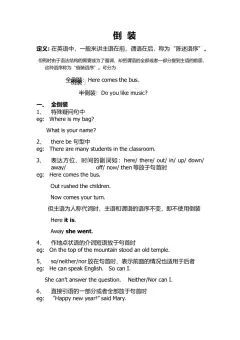
几种重要的倒装句型
1.表示“某人(物)也/也不……”时的倒装
1 “so+be 动词/助动词/情态动词等+主语”意为“……也……”(表
示肯定意思)
2 “neither/nor+be 动词/助动词/情态动词等+主语”意为“……也
不……”(表示否定意思)
用 so 表示前者怎么样,后者也怎么样,前面的句子是肯定句;
neither/nor 表示前者不怎么样,后者也不怎么样,前面的句子是否定
句。谓语动词和前面句子的谓语动词保持一致。
例 In the past 20 years, our society has changed a lot and so have our
eating habits. 在过去20 年里,我们的社会发生了很大的变化,而我
们的饮食习惯也同样如此。
Tom didn’t attend the meeting last night; nor/neither did Mary. 汤姆没来
参加昨晚的会议,玛丽也没来。
2.表示方位地点的状语放在句首构成的倒装
用 谓语动词多为be, lie, stand, sit, come, walk, run, stop 等。
例 Under the tree sat a boy of about ten. 在树下坐着一个大约10 岁的
男孩。
At the center of the square stands a monument in black marble. 在广场
中央耸立着一座黑色大理石纪念碑。
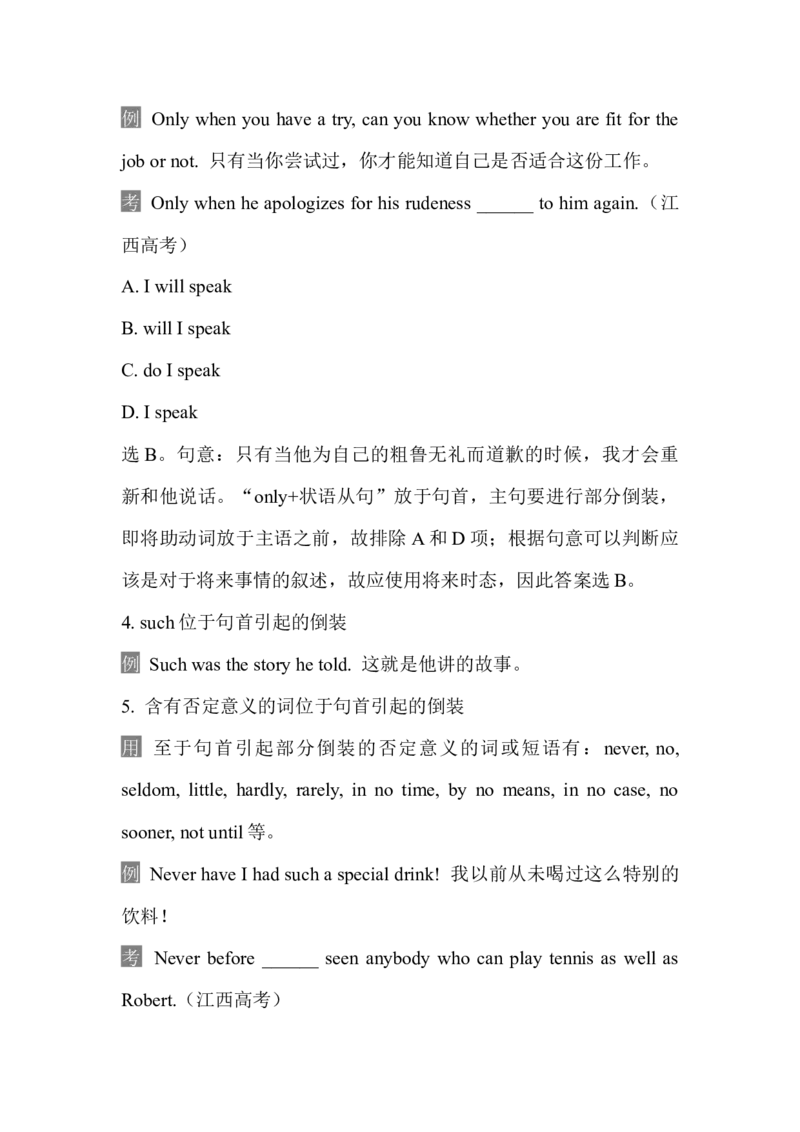
3.only 修饰状语(或状语从句)位于句首引起的倒装
1 Only+介词短语+情态动词/助动词+主语+动词原形
例 Only in this way can we make our future much brighter. 唯有如此,
我们的前途才会更加光明。
2 Only+状语从句+情态动词/助动词+主语+动词原形
例 Only when you have a try, can you know whether you are fit for the
job or not. 只有当你尝试过,你才能知道自己是否适合这份工作。
考 Only when he apologizes for his rudeness ______ to him again.(江
西高考)
A. I will speak
B. will I speak
C. do I speak
D. I speak
选B。句意:只有当他为自己的粗鲁无礼而道歉的时候,我才会重
新和他说话。“only+状语从句”放于句首,主句要进行部分倒装,
即将助动词放于主语之前,故排除A 和D 项;根据句意可以判断应
该是对于将来事情的叙述,故应使用将来时态,因此答案选B。
4. such 位于句首引起的倒装
例 Such was the story he told. 这就是他讲的故事。
5. 含有否定意义的词位于句首引起的倒装
用 至于句首引起部分倒装的否定意义的词或短语有:never, no,
seldom, little, hardly, rarely, in no time, by no means, in no case, no
sooner, not until 等。
例 Never have I had such a special drink! 我以前从未喝过这么特别的
饮料!
考 Never before ______ seen anybody who can play tennis as well as
Robert.(江西高考)
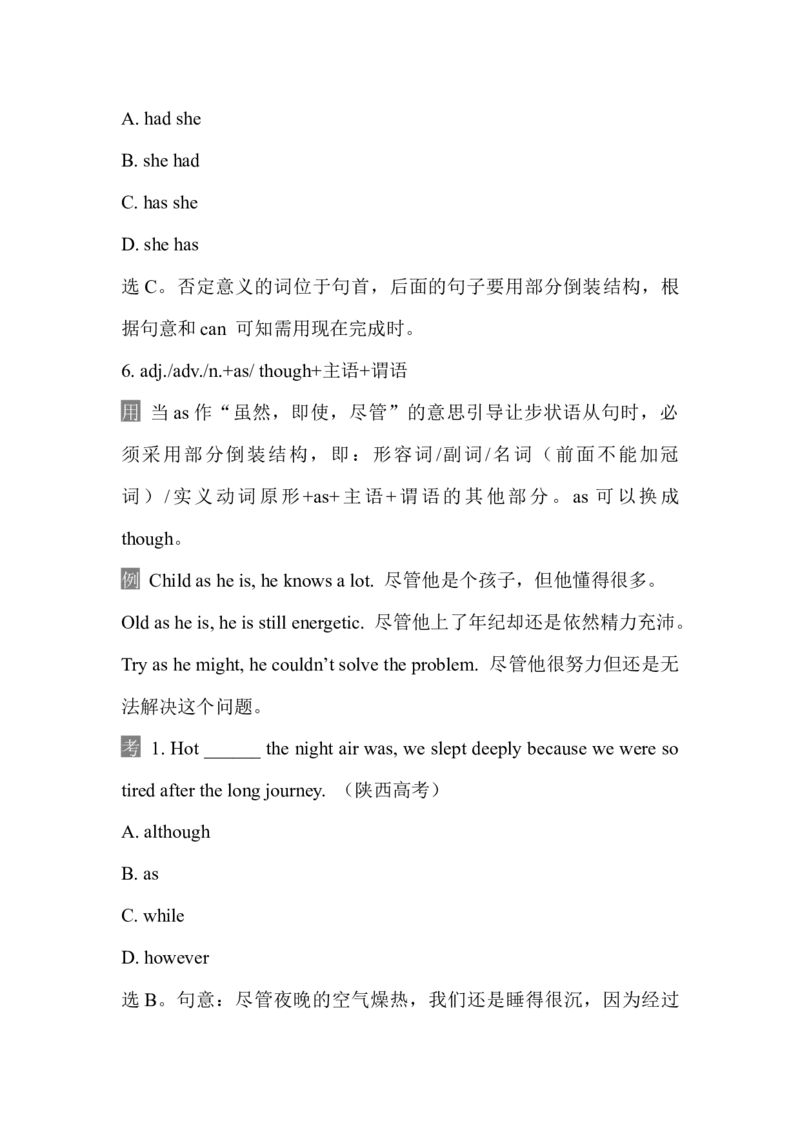
A. had she
B. she had
C. has she
D. she has
选C。否定意义的词位于句首,后面的句子要用部分倒装结构,根
据句意和can 可知需用现在完成时。
6. adj./adv./n.+as/ though+主语+谓语
用 当as 作“虽然,即使,尽管”的意思引导让步状语从句时,必
须采用部分倒装结构,即:形容词/副词/名词(前面不能加冠
词)/ 实义动词原形+as+ 主语+ 谓语的其他部分。as 可以换成
though。
例 Child as he is, he knows a lot. 尽管他是个孩子,但他懂得很多。
Old as he is, he is still energetic. 尽管他上了年纪却还是依然精力充沛。
Try as he might, he couldn’t solve the problem. 尽管他很努力但还是无
法解决这个问题。
考 1. Hot ______ the night air was, we slept deeply because we were so
tired after the long journey. (陕西高考)
A. although
B. as
C. while
D. however
选B。句意:尽管夜晚的空气燥热,我们还是睡得很沉,因为经过
长途跋涉之后我们都很疲倦了。结合句意,分析题干可知,逗号前
为让步状语从句,四个选项均可引导这一从句,而hot 实际上是句
子的表语,却提到了句首,即形成倒装,因此可判断只有as 符合题
意,故本题应选B。
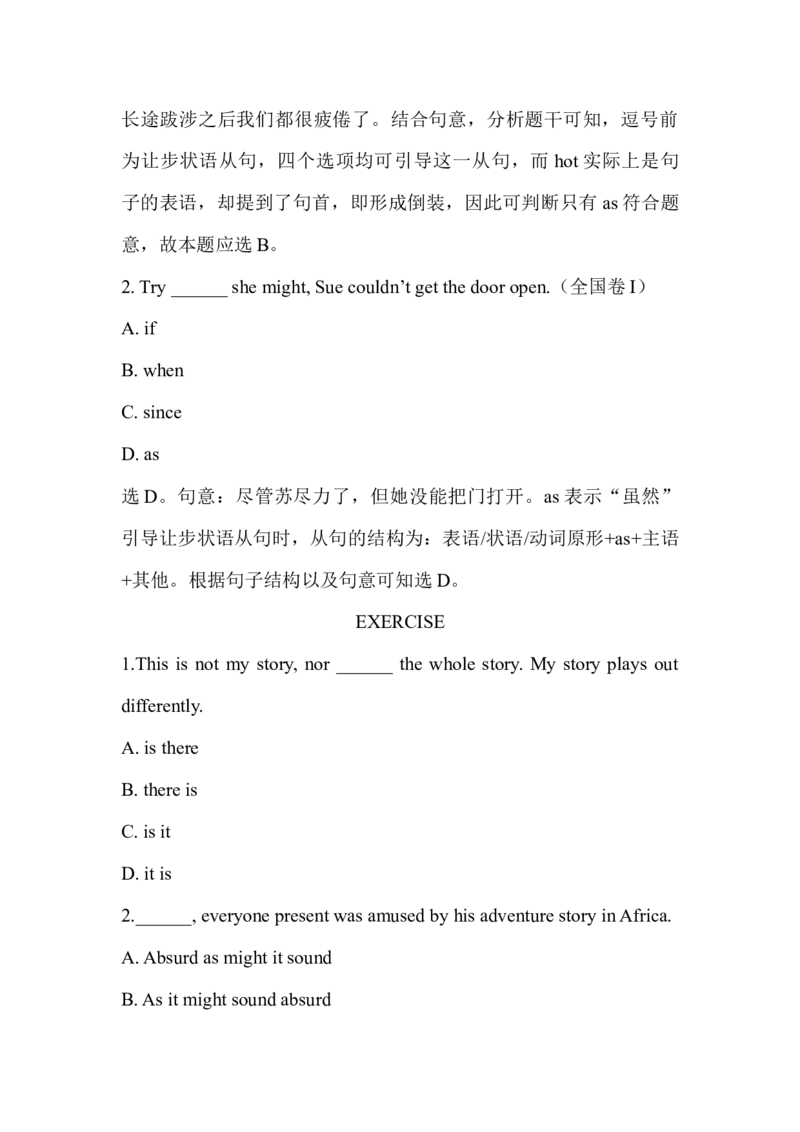
2. Try ______ she might, Sue couldn’t get the door open.(全国卷I)
A. if
B. when
C. since
D. as
选D。句意:尽管苏尽力了,但她没能把门打开。as 表示“虽然”
引导让步状语从句时,从句的结构为:表语/状语/动词原形+as+主语
+其他。根据句子结构以及句意可知选D。
EXERCISE
1.This is not my story, nor ______ the whole story. My story plays out
differently.
A. is there
B. there is
C. is it
D. it is
2.______, everyone present was amused by his adventure story in Africa.
A. Absurd as might it sound
B. As it might sound absurd
C. As absurd it might sound
D. Absurd as it might sound
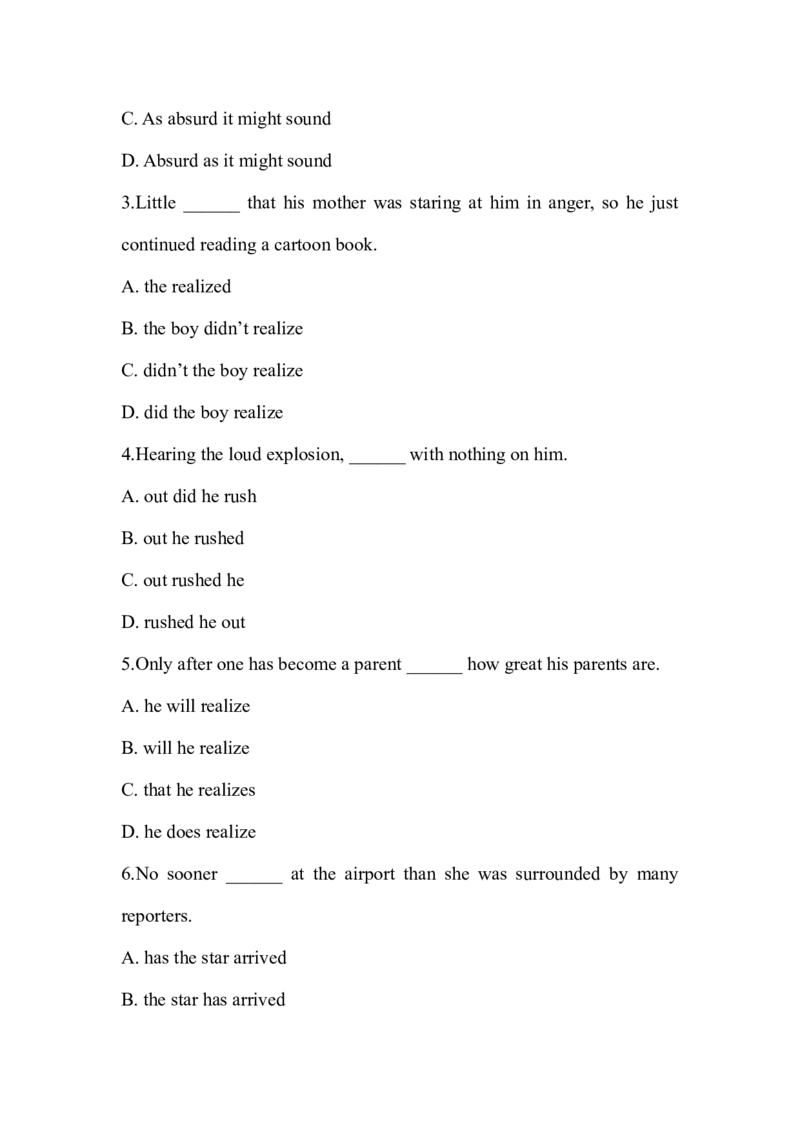
3.Little ______ that his mother was staring at him in anger, so he just
continued reading a cartoon book.
A. the realized
B. the boy didn’t realize
C. didn’t the boy realize
D. did the boy realize
4.Hearing the loud explosion, ______ with nothing on him.
A. out did he rush
B. out he rushed
C. out rushed he
D. rushed he out
5.Only after one has become a parent ______ how great his parents are.
A. he will realize
B. will he realize
C. that he realizes
D. he does realize
6.No sooner ______ at the airport than she was surrounded by many
reporters.
A. has the star arrived
B. the star has arrived
C. the star had arrived
D. had the star arrived
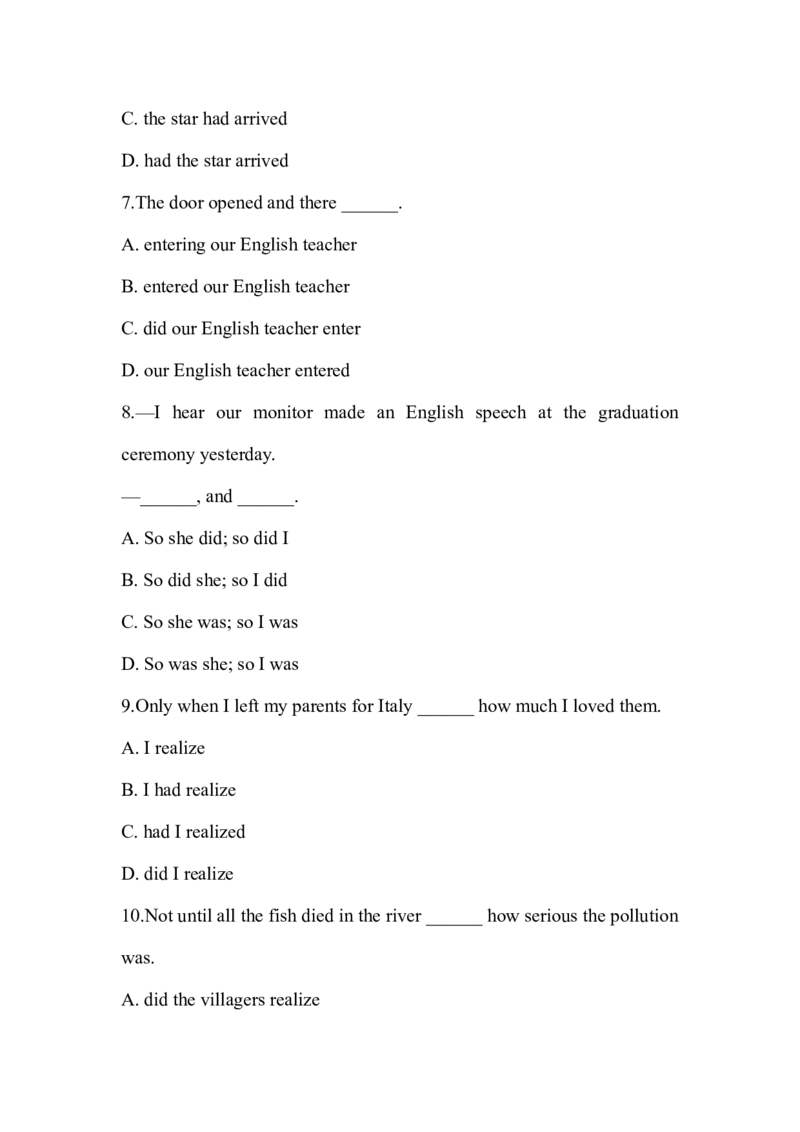
7.The door opened and there ______.
A. entering our English teacher
B. entered our English teacher
C. did our English teacher enter
D. our English teacher entered
8.—I hear our monitor made an English speech at the graduation
ceremony yesterday.
—______, and ______.
A. So she did; so did I
B. So did she; so I did
C. So she was; so I was
D. So was she; so I was
9.Only when I left my parents for Italy ______ how much I loved them.
A. I realize
B. I had realize
C. had I realized
D. did I realize
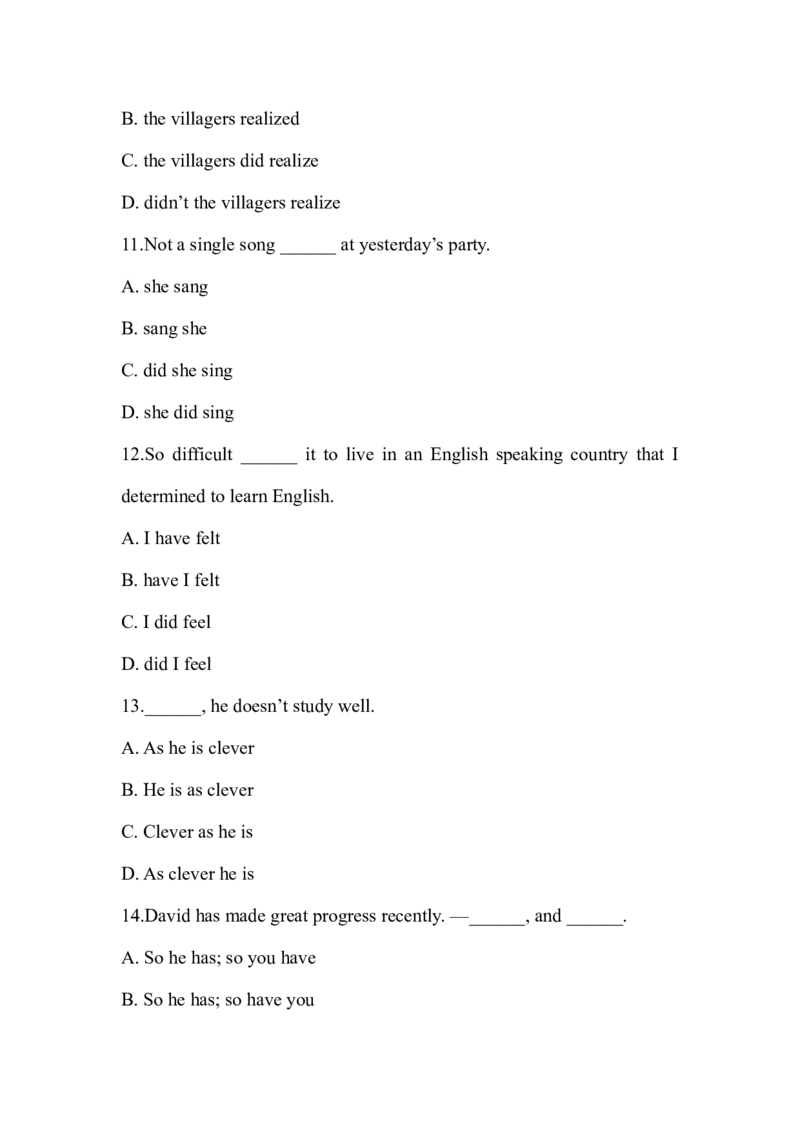
10.Not until all the fish died in the river ______ how serious the pollution
was.
A. did the villagers realize
B. the villagers realized
C. the villagers did realize
D. didn’t the villagers realize
11.Not a single song ______ at yesterday’s party.
A. she sang
B. sang she
C. did she sing
D. she did sing
12.So difficult ______ it to live in an English speaking country that I
determined to learn English.
A. I have felt
B. have I felt
C. I did feel
D. did I feel
13.______, he doesn’t study well.
A. As he is clever
B. He is as clever
C. Clever as he is
D. As clever he is
14.David has made great progress recently. —______, and ______.
A. So he has; so you have
B. So he has; so have you
C. So has he; so have you
D. So has he; so you have
15.—My room gets very cold at night.
—______.
A. So is mine
B. So mine is
C. So does mine
D. So mine does
答案
01-05 CDDBB
06-10 DBADA
11-15 CDCBC
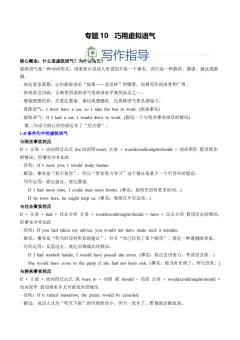
几种重要的虚拟语气句型
1.if 虚拟条件句
1 与现在事实相反,if 条件从句谓语动词用一般过去时,主句用
would/could/should+do
例 If I were in your position, I would call the police immediately. 如果
我处在你的位置,我会立即打电话报警。
2 与过去事实相反,if 条件从句谓语动词用过去完成时,主句用
would/could/should+have done
例 We would have missed our flight yesterday if John hadn’t offered us a
lift. 昨天要不是约翰让我们搭车,我们就会错过航班了。
3 与将来事实相反,if 条件从句谓语动词用一般过去式或should do
或were to do,主句用would/could/should+do
例 If I had (should have) time tomorrow, I would certainly help you. 如
果我明天有空的话,我当然会帮助你的。
考 We ______ back in the hotel now if you didn’t lose the map.(北京
高考)
A. are
B. were
C. will be
D. would be
选D。句意:要是你没弄丢地图的话,我们现在就回到宾馆了。根
据条件状语从句中if we didn’t lose the map 可知,主从句都是对现在
情况的假设,所以选D。
2. wish 句型
1 wish that sb. did sth. 希望某人现在做某事
例 I wish I were as strong as you. 我希望和你一样强壮。
考 — Where are the children? The dinner’s going to be completely
ruined.
—I wish they ______ always late.(北京高考)
A. weren’t
B. hadn’t been
C. wouldn’t be
D. wouldn’t have been
选A。句意:——孩子们在哪儿?这顿饭就要彻底泡汤了。——但
愿他们永远都不要迟到。考查虚拟语气。根据句意表示的是现在的
愿望,所以用一般过去时,故选A。
2 wish that sb. had done sth. 希望某人过去做某事
例 I wish you had told me earlier. 要是你早点告诉我就好了。
3 wish that sb. would/could do sth. 希望某人将来做某事
例 I wish you would succeed this time. 我希望你这次会成功。
3.It is high time that sb. did (should do) sth. 该……的时候了
例 It is high time that we went to the classroom. 该我们进教室的时候
了。
4.but for, without 要不是……,要是没有……
用 由but for 和without 构成的虚拟语气,相当于if... not...引导的虚
拟语气句式。
例 But for your advice, I would have failed. 要不是你的建议,我就失
败了。
=If I hadn’t taken your advice, I would have failed.
Without your help, I would not have accomplished this task. 要不是你的
帮助,我就完成不了这项任务了。
=If I hadn’t got your help, I would not have accomplished this task.
5.if only 要是……就好了
例 If only I had another chance! 要是我再有一次机会就好了!
6.as if/though 好像,似乎
用 以as if/though 引导的方式状语从句或表语从句,有时用虚拟语气,
若表示与现在事实相反,谓语动词用一般过去时;若表示与过去事
实相反,用过去完成时;表示将来的可能性不大,用would (might,
could)+动词原形:
例 They treat me as though I were a stranger. 他们待我如同陌生人。
考 It was John who broke the window. Why are you talking to me as if I
______ it?(重庆高考)
A. had done
B. have done
C. did
D. am doing
选A。考查虚拟语气的用法。as if 后的句子若表示与事实相反,须
用虚拟语气。根据前一句中谓语动词用一般过去时可知,as if 后的
句子表示的是与过去事实相反的假设,谓语动词需用过去完成时。
故选A。
7.用于表示过去未实现的希望和计划的句型
1 动词expect, intend, hope, mean, plan, promise, suppose, think, want,
wish 等的过去完成时态,或者用一般过去时态后面接不定式的完成
形式表示过去未曾实现的愿望,常意为“本来希望、计划、打
算……做……但实际没做到”。
例 I had planned to go abroad after graduation, but my mother was ill。
我本来计划毕业后出国的,但是我母亲生病了。
2 情态动词should, could, might, ought to 等后接完成时,表示过去本
该做、打算做、想做而未做的事情。结构如下:
should have done=ought to have done 本应该做而没做
could have done 本可以做某事而没做
might have done 本可以做而没做
例 They ought to have apologized. 他们本该道歉的。
I missed the important meeting. You should have reminded me of
attending the meeting yesterday. 我错过了这次重要会议。你昨天本该
提醒我参加这次会议的。
EXERCISE
1.______ your timely help, I couldn’t have finished the work on time. I
can’t thank you too much.
A. Rather than
B. Except for
C. In addition to
D. But for
2.I ______ to send him a gift to congratulate him on his marriage, but I
______ it.
A. hoped; hadn’t managed
B. hoped; didn’t manage
C. hope; don’t manage
D. had hoped; didn’t manage
3.—How did you do in the test?
—Not so well. I ______ much better but I misread the directions for Part
D.
A. could have done
B. could do
C. must have done
D. should do
4.It’s a pity you were late, otherwise you ______ the film star Rain from
Korea.
A. would have seen
B. must have seen
C. may have seen
D. can have seen
5.—Do you think George has passed the driving test?
—No. If so, he ______ his car to our college yesterday.
A. would drive
B. must have driven
C. would have driven
D. had driven
6.The printer is of good quality. If it ______ break down within the first
year, we would repair it at our expense.
A. would
B. should
C. could
D. might
7.—Is the manager available tomorrow afternoon?
—No, he is busy. Otherwise he ______ the meeting.
A. had attended
B. would have attended
C. would attend
D. could have attended
8.He was fired. If he ______ my advice, he wouldn’t have lost his job.
A. followed
B. should follow
C. had followed
D. follows
9.—Why wasn’t John hired for the job?
—I don’t know, but he ______.
A. was
B. had been
C. should have
D. should have been
答案
01-05 DDAAC
06-09 BCCD
情态动词表示推测的句型
1.肯定推测
能用于肯定推测的情态动词:must, may, might, could
语气强弱程度:must 表示“一定”,语气最强;may 和might 表示
“有可能,大概”, 相当于perhaps,其中might 语气比may 稍弱;
could 语气最弱,表示“或许”,相当于possibly
1 对现在或将来事情的推测,结构为:must/may/might/could+动词原
形
例 You have worked hard all day. You must be tired. 你辛苦干一整天,
一定累了。
Jack knows her. He may/might know her address. 杰克认识她。他可能
知道她的地址。
That could be harmful. 那或许是有害的。
考 —What are you doing this Saturday?
—I’m not sure, but I ______ go to the Rolling Stones concert.(重庆高
考)
A. must
B. would
C. should
D. might
选D。句意:——本周六你打算做什么?——说不准,不过或许我
会去滚石乐队演唱会。本题考查情态动词的用法。根据答语中“I’m
not sure”可知是对将来不太肯定的推测,故选D 项。must 表示推测
时,语气最强,意为“肯定,一定”;would 表过去将来或表意愿;
should 意为“应该”。
2 对现在正在发生的事情的推测,结构为:must/may/might/could be
doing sth.
例 The lights in his office are on. He must be working there. 他办公室
的灯亮着,他一定在办公室工作呢。
3 对过去事情的推测,结构为:must/may/might/could have+动词原
形
例 The ground is all wet. It must have rained last night. 地面全湿了。
昨天晚上一定是下雨了。
2.否定推测
能用于否定推测的情态动词:can, may, might, could
语气强弱程度:can’t 表示“不可能”,语气最强;may not 和might
not 表示“可能不会”,语气较弱;could not 语气最弱,表示“或
许不会”
1 对现在或将来事情的推测,结构为:can’t/may not/might not/could
not+动词原形
例 Your answer can’t be right. 你的答案不可能是对的。
2 对现在正在发生的事情的推测,结构为:can’t/may not/might
not/could not be doing sth.
例 I saw her go downstairs just now. She can’t be studying in her room.
我刚刚看见她下楼了,所以现在她不可能在房间里学习。
3 对过去事情的推测,结构为:can’t/may not/might not/could not
have done sth.
例 He has gone abroad. He can’t have attended the meeting last Friday.
他已经出国了,不可能出席上周五的会议。
3.疑问推测
能用于疑问推测的情态动词:can, could
1 对现在或将来事情的推测,结构为:can/could+主语+动词原形
例 Can he be an engineer? 他会是一个工程师吗?
2 对现在正在发生的事情的推测,结构为:can/could+主语+be doing
sth.
例 Can she be watching TV at home? 她会在家里面看电视吗?
3 对过去事情的推测,结构为:can/could+主语+have done
例 Can they have won the football games last Sunday? 他们会赢了上周
五的足球比赛吗?
情态动词用于推测语气的助记顺口溜:
“肯不肯, 妈妈肯,妹不问”。即:can(谐音“肯”)不用于肯
定式; must(谐音“妈”)仅用于肯定句; may/might(谐音
“妹”)不用于疑问句,仅用于否定句和肯定句。
EXERCISE
1.You haven’t eaten anything since this morning; you ______ be hungry.
A. can
B. may
C. must
D. could
2.—Hi, Tom. Any idea where Jane is?
—She ______ be in the classroom. I saw her on the playground just now.
A. mustn’t
B. can’t
C. may not
D. might not
3.David ______ Beijing now. He has gone abroad.
A. can’t tour
B. couldn’t tour
C. can’t be touring
D. mustn’t be touring
4.My book has disappeared. Who ______ it?
A. must take
B. could take
C. must have taken
D. could have taken
5.He ______ the test again, because he looks upset.
A. must fail
B. must have failed
C. can’t fail
D. can’t have failed
答案
01-05 CBCDB
用比较级表示最高级意义的句型
1.否定词+比较级
例 It can’t be worse. 这是最糟的。
I can’t agree any more. 我非常同意。
考 I ______ myself more—it was a perfect day.(浙江高考)
A. shouldn’t have enjoyed
B. needn’t have enjoyed
C. wouldn’t have enjoyed
D. couldn’t have enjoyed
选D。此处情态动词否定式couldn’t 与比较级more 搭配表达最高级
的意义;couldn’t 此处表示推测,意为“不可能”。答案为D。
2.Nothing is+比较级+than to do sth.
例 Nothing is more important than to receive education. 没有比受教育
更重要的事。
3.比较级+than+any other+名词单数
比较级+than+anything(anyone) else
比较级+than+any of the others
例 Bamboo probably has more uses than any other plant in the world. 竹
子可能比世界上任何其他一种植物用途都多。
4.be the last
例 This is the last thing I want to do. 这是我最不想干的事。
EXERCISE
1.How ______ she sings! I have never heard ______.
A. beautiful; a better voice
B. beautifully; a better voice
C. beautiful; the better voice
D. beautifully; the better voice
2.—Shall I give you a ride as you live so far away?
—Thank you, ______.
A. it couldn’t be better
B. of course you can
C. if you like
D. it’s up to you
3.—Do you think that the 11th Chinese National Games were a success?
—Yes, ______! It couldn’t be ______.
A. relatively; better
B. approximately; worse
C. absolutely; better
D. fortunately; worse
4.—Are you satisfied with her answer?
—Not at all. It couldn’t have been ______.
A. worse
B. so bad
C. better
D. the worst
5.Jimmy is the oldest boy and is taller than ______ boy in the class.
A. the other
B. any other
C. each
D. all
答案
01-05 BACAB
be of+抽象名词/表达做某事有困难句型/否定前移句型
1. 在“ be of+ 抽象名词” 句型中,常见的抽象名词有value,
importance, use, interest, significance;在这些抽象名词前面可以加
little, some, any, no, great 等限定语。
例 This invention is of great value to mankind. 这项发明对人类很有价
值。
The decision is of great importance. 这个决定很重要。
拓 be of+抽象名词= be+抽象名词的形容词:
The decision is of great importance.=The decision is greatly important.
这个决定很重要。
2....have difficulty (trouble/a hard time) (in) doing sth. 做某事有困难
例 People from the two countries do not have any difficulty in
understanding each other. 来自那两个国家的人们在相互理解上是没
有任何困难的。
考 I had great difficulty ______ the suitable food on the menu in that
restaurant.(上海高考)
A. find
B. found
C. to find
D. finding
选D。句意:我在那家餐馆的菜单上很难找出适合的食物。此处考
查have difficulty (in) doing sth.这一句型,difficulty 后面应该使用动
名词形式,故本题应选D。
3.含有宾语从句的主句的谓语动词为think, believe, imagine, suppose,
consider, expect, guess 等,并且主句的主语是第一人称而且为一般现
在时,从句的否定词一般要转移到主句上来,其反义疑问句一般与
宾语从句一致。
例 I don’t think he will come this afternoon. 我认为他今天下午不会来。
I don’t believe that man is killed by Jim, is he? 我认为那个人不是吉姆
所杀的,是不是?
EXERCISE
1.The suits are ______ and are worth ______.
A. of great quality; to buy
B. great quality; to buy
C. of great quality; buying
D. great quality; buying
2.The two rooms are ______ the same size.
A. at
B. for
C. on
D. of
3.I wonder what trouble he had ______ the plan.
A. to carry out
B. carrying out
C. carried out
D. with carrying out
4.I don’t think David could have done such a stupid thing last night,
______?
A. did he
B. didn’t he
C. do I
D. don’t I
5.Mrs. Black doesn’t believe her son is able to design a digital camera,
______?
A. is she
B. isn’t she
C. doesn’t she
D. does she
答案
01-05 CDBAD