2026 高考全国卷英语写作
板块二:3 大核心话题背诵素材包(高分★必备)
核心说明:全考纲词汇,保留核心短语,无超纲词、无冗余标注,结构清晰可直接背
诵,适配全国卷写作评分标准,遵循“押题精准、素材极简、训练高效”原则。
一、得分核心(满分25 分)
内容(6-7 分)+ 表达(7-8 分)+ 逻辑(6-7 分)+ 发展(3-4 分),考纲内语块+规范
句型+热点适配 占85%得分,无需生僻词与复杂长句,优先保证表达准确、逻辑连贯。
二、实用使用原则
•背:聚焦“语块+固定搭配”,拒绝孤立记词(如记set AI limits 而非单独记limit);
•套:固定框架不变,仅替换考题热点关键词(如“AI 使用”→“digital skills”);
•拿分:先稳“内容完整、表达无误、逻辑清晰”三大基础分,再用“具体细节、主题升华”冲击
发展分。
核心话题一:青少年成长与数字素养(热点:AI 伦理/数字自律)
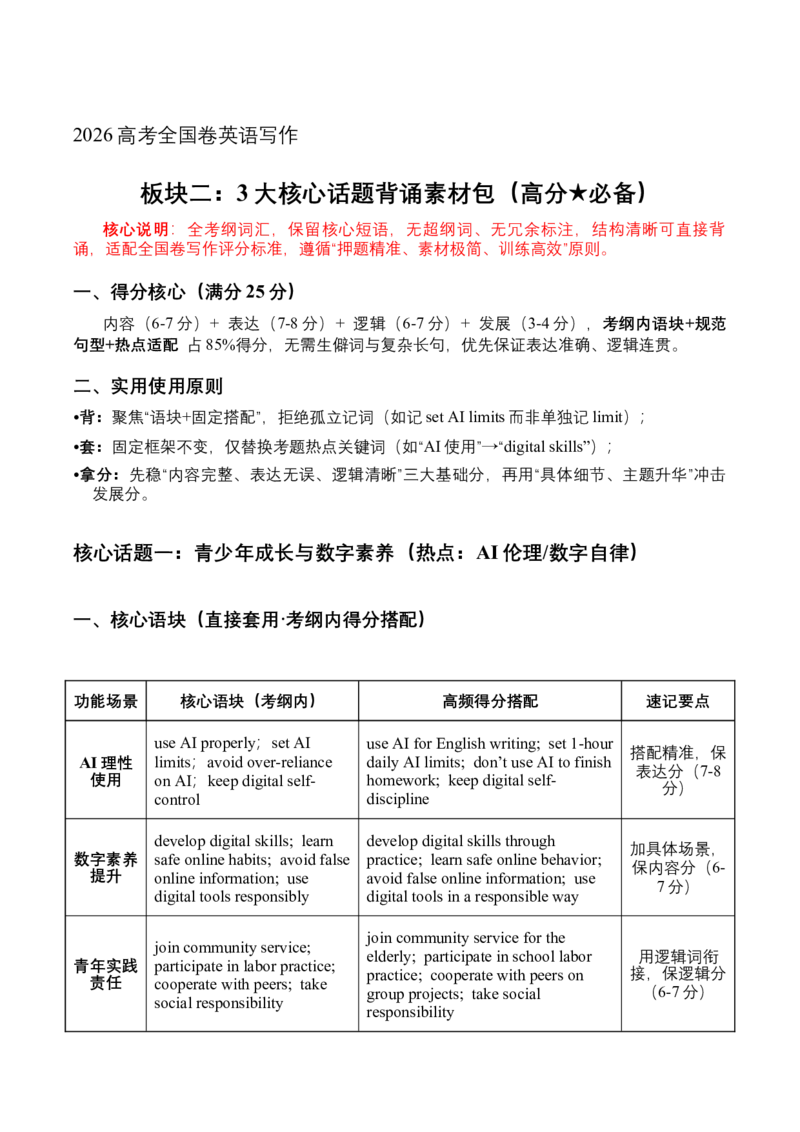
一、核心语块(直接套用·考纲内得分搭配)
功能场景
核心语块(考纲内)
高频得分搭配
速记要点
AI 理性
使用
use AI properly;set AI
limits;avoid over-reliance
on AI;keep digital self-
control
use AI for English writing; set 1-hour
daily AI limits; don’t use AI to finish
homework; keep digital self-
discipline
搭配精准,保
表达分(7-8
分)
数字素养
提升
develop digital skills; learn
safe online habits; avoid false
online information; use
digital tools responsibly
develop digital skills through
practice; learn safe online behavior;
avoid false online information; use
digital tools in a responsible way
加具体场景,
保内容分(6-
7 分)
青年实践
责任
join community service;
participate in labor practice;
cooperate with peers; take
social responsibility
join community service for the
elderly; participate in school labor
practice; cooperate with peers on
group projects; take social
responsibility
用逻辑词衔
接,保逻辑分
(6-7 分)
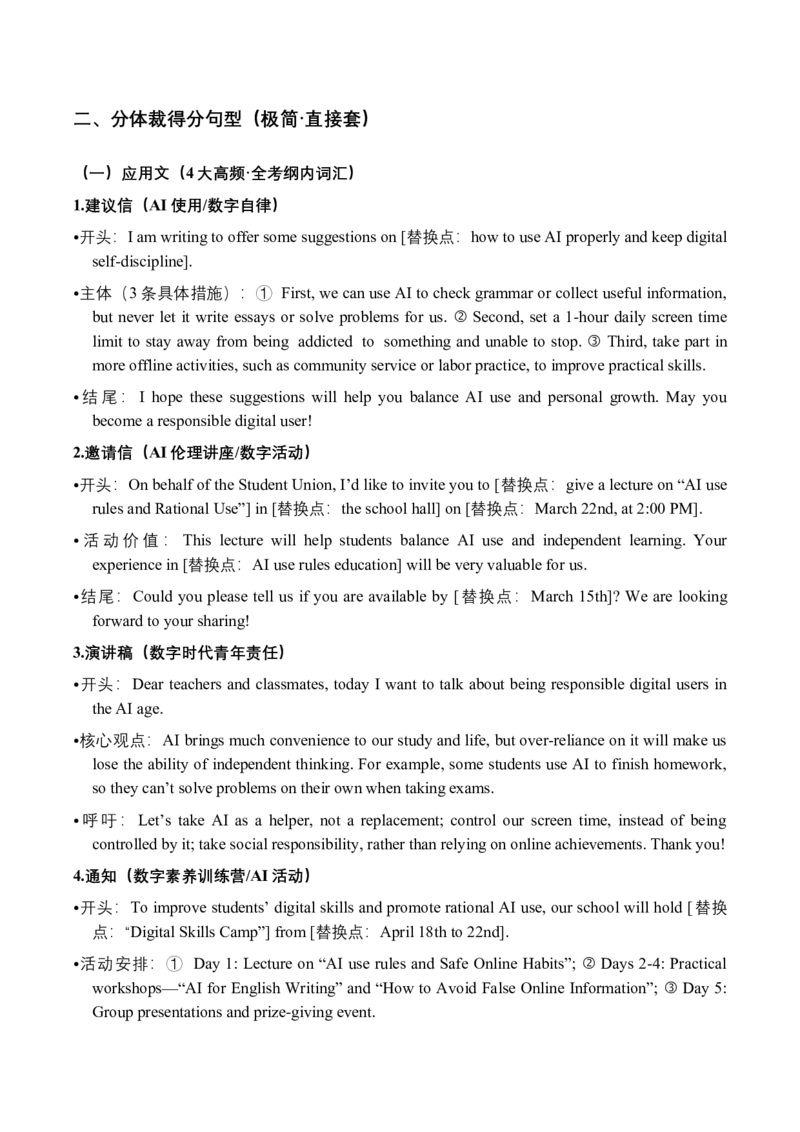
二、分体裁得分句型(极简·直接套)
(一)应用文(4 大高频·全考纲内词汇)
1.建议信(AI 使用/数字自律)
•开头:I am writing to offer some suggestions on [替换点:how to use AI properly and keep digital
self-discipline].
•主体(3 条具体措施):① First, we can use AI to check grammar or collect useful information,
but never let it write essays or solve problems for us.
 Second, set a 1-hour daily screen time
②

limit to stay away from being addicted to something and unable to stop.
 Third, take part in
③

more offline activities, such as community service or labor practice, to improve practical skills.
• 结尾:I hope these suggestions will help you balance AI use and personal growth. May you
become a responsible digital user!
2.邀请信(AI 伦理讲座/数字活动)
•开头:On behalf of the Student Union, I’d like to invite you to [替换点:give a lecture on “AI use
rules and Rational Use”] in [替换点:the school hall] on [替换点:March 22nd, at 2:00 PM].
• 活动价值:This lecture will help students balance AI use and independent learning. Your
experience in [替换点:AI use rules education] will be very valuable for us.
•结尾:Could you please tell us if you are available by [替换点:March 15th]? We are looking
forward to your sharing!
3.演讲稿(数字时代青年责任)
•开头:Dear teachers and classmates, today I want to talk about being responsible digital users in
the AI age.
•核心观点:AI brings much convenience to our study and life, but over-reliance on it will make us
lose the ability of independent thinking. For example, some students use AI to finish homework,
so they can’t solve problems on their own when taking exams.
• 呼吁:Let’s take AI as a helper, not a replacement; control our screen time, instead of being
controlled by it; take social responsibility, rather than relying on online achievements. Thank you!
4.通知(数字素养训练营/AI 活动)
•开头:To improve students’ digital skills and promote rational AI use, our school will hold [替换
点:“Digital Skills Camp”] from [替换点:April 18th to 22nd].
•活动安排:① Day 1: Lecture on “AI use rules and Safe Online Habits”;
 Days 2-4: Practical
②

workshops—“AI for English Writing” and “How to Avoid False Online Information”;
 Day 5:
③

Group presentations and prize-giving event.
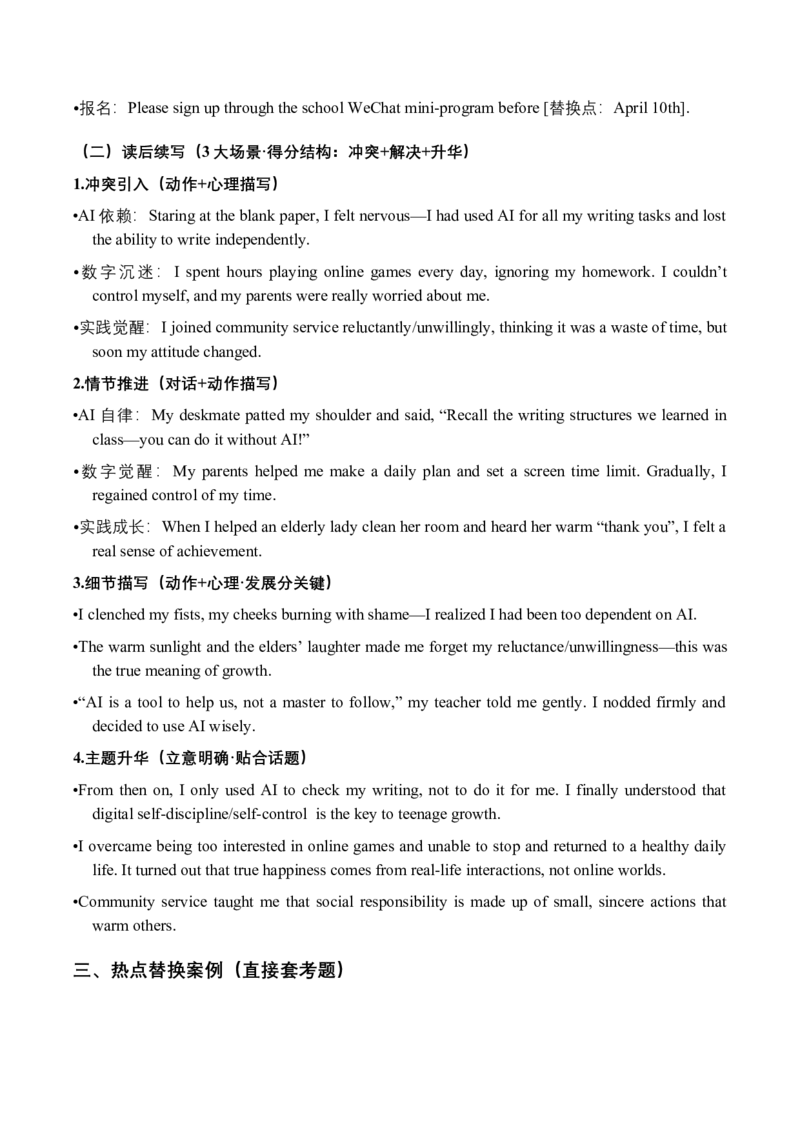
•报名:Please sign up through the school WeChat mini-program before [替换点:April 10th].
(二)读后续写(3 大场景·得分结构:冲突+解决+升华)
1.冲突引入(动作+心理描写)
•AI 依赖:Staring at the blank paper, I felt nervous—I had used AI for all my writing tasks and lost
the ability to write independently.
• 数字沉迷:I spent hours playing online games every day, ignoring my homework. I couldn’t
control myself, and my parents were really worried about me.
•实践觉醒:I joined community service reluctantly/unwillingly, thinking it was a waste of time, but
soon my attitude changed.
2.情节推进(对话+动作描写)
•AI 自律:My deskmate patted my shoulder and said, “Recall the writing structures we learned in
class—you can do it without AI!”
•数字觉醒:My parents helped me make a daily plan and set a screen time limit. Gradually, I
regained control of my time.
•实践成长:When I helped an elderly lady clean her room and heard her warm “thank you”, I felt a
real sense of achievement.
3.细节描写(动作+心理·发展分关键)
•I clenched my fists, my cheeks burning with shame—I realized I had been too dependent on AI.
•The warm sunlight and the elders’ laughter made me forget my reluctance/unwillingness—this was
the true meaning of growth.
•“AI is a tool to help us, not a master to follow,” my teacher told me gently. I nodded firmly and
decided to use AI wisely.
4.主题升华(立意明确·贴合话题)
•From then on, I only used AI to check my writing, not to do it for me. I finally understood that
digital self-discipline/self-control is the key to teenage growth.
•I overcame being too interested in online games and unable to stop and returned to a healthy daily
life. It turned out that true happiness comes from real-life interactions, not online worlds.
•Community service taught me that social responsibility is made up of small, sincere actions that
warm others.
三、热点替换案例(直接套考题)
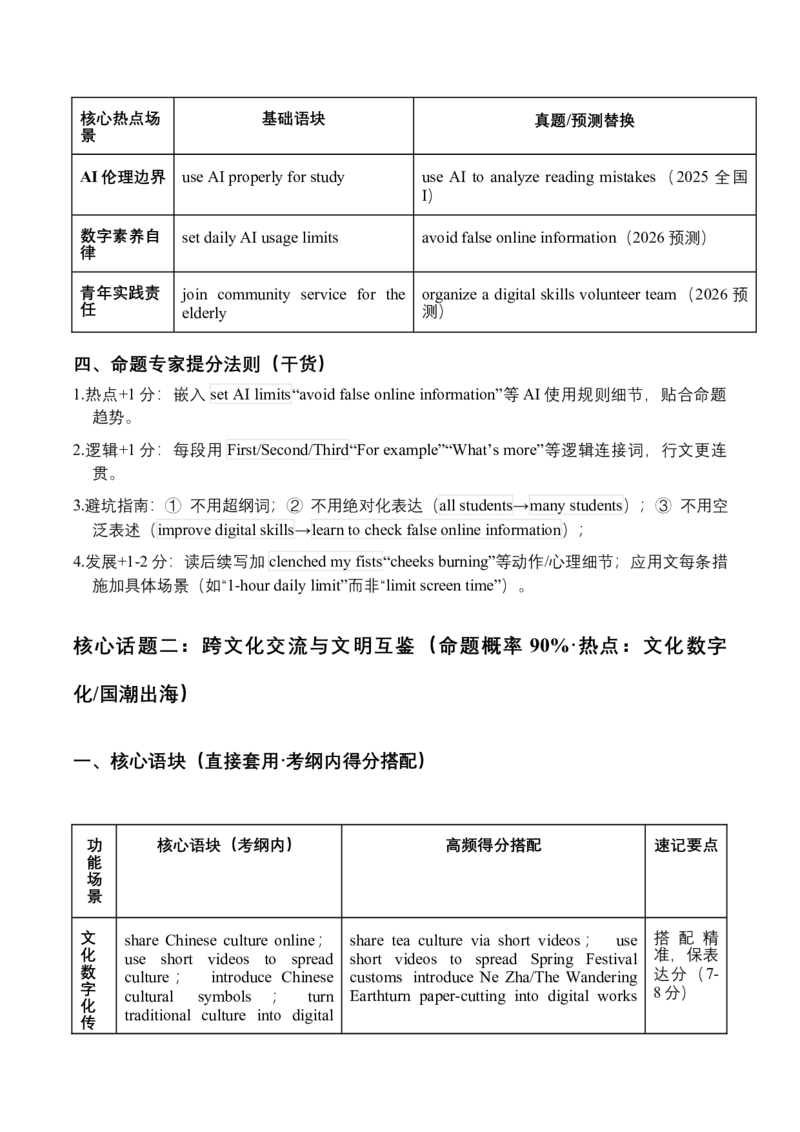
核心热点场
景
基础语块
真题/预测替换
AI 伦理边界
use AI properly for study
use AI to analyze reading mistakes (2025 全国
I)
数字素养自
律
set daily AI usage limits
avoid false online information(2026 预测)
青年实践责
任
join community service for the
elderly
organize a digital skills volunteer team(2026 预
测)
四、命题专家提分法则(干货)
1.热点+1 分:嵌入set AI limits“avoid false online information”等AI 使用规则细节,贴合命题
趋势。
2.逻辑+1 分:每段用First/Second/Third“For example”“What’s more”等逻辑连接词,行文更连
贯。
3.避坑指南:① 不用超纲词;② 不用绝对化表达(all students→many students);③ 不用空
泛表述(improve digital skills→learn to check false online information);
4.发展+1-2 分:读后续写加clenched my fists“cheeks burning”等动作/心理细节;应用文每条措
施加具体场景(如“1-hour daily limit”而非“limit screen time”)。
核心话题二:跨文化交流与文明互鉴(命题概率90%·热点:文化数字
化/国潮出海)
一、核心语块(直接套用·考纲内得分搭配)
功
能
场
景
核心语块(考纲内)
高频得分搭配
速记要点
文
化
数
字
化
传
share Chinese culture online ;
use short videos to spread
culture ; introduce Chinese
cultural symbols
;
turn
traditional culture into digital
share tea culture via short videos ; use
short videos to spread Spring Festival
customs introduce Ne Zha/The Wandering
Earthturn paper-cutting into digital works
搭配精
准,保表
达分(7-
8 分)
播
forms
for global audience
跨
文
化
沟
通
communicate with foreign
friends ;
respect cultural
difference ; slearn from each
other; break language barriers
communicate with foreign peers through
social media ; respect different cultural
traditions ; learn from foreign festival
cultures ; use translation apps to break
language barriers
加文化内
涵,保内
容分(6-
7 分)
非
遗
国
潮
introduce traditional Chinese art
experience traditional cultural
skills ;
promote Chinese
cultural symbols ;
share
cultural stories
introduce calligraphy and paper-cutting ;
experience lion dance and dumpling-
making ; promote dragon and phoenix
symbols ;share stories behind traditional
festivals
用逻辑词
衔接,保
逻辑分
(
6-7
分)
二、分体裁得分句型(极简·直接套)
(一)应用文(4 大高频·全考纲内词汇)
1.介绍信(国潮IP/文化数字化)
•开头:I am writing to introduce you to [替换点:Ne Zha], a popular Chinese cultural symbol that
shows traditional Chinese values.
•核心介绍:Ne Zha tells a story of a boy who fights against his fate, which stands for the Chinese
spirit of never giving up. Digital technology has made this traditional story more vivid and
popular among young people around the world.
•推荐理由:I suggest you watch the original film with English subtitles. It will help you understand
Chinese traditional stories and how traditional culture is shared through digital ways.
2.邀请信(非遗数字化/国潮活动)
•开头:I’d like to invite you to [替换点:“Experience Traditional Chinese Culture Digitally”] in
[替换点:the school art room] on [替换点:April 14th, at 9:00 AM].
•活动亮点:① A teacher will give a talk on digital cultural spread;
 You can create digital paper-
②
cutting or calligraphy works with a tablet;
 We will share our works online to let more people
③

know about Chinese culture.
•结尾:Could you please confirm if you can come by [替换点:April 7th]? I am looking forward to
your participation!
3.邮件(文化交流/国潮分享)
•开头:I was very happy to receive your email asking about [替换点:traditional Chinese culture
and its digital spread].
• 解答疑问:Traditional Chinese art, such as paper-cutting and calligraphy, has a long history.
Digital technology helps us share these cultural treasures with the world through short videos,
breaking language and distance barriers.
•互动延伸:If you have more questions about Chinese culture, feel free to ask me. And if you come
to China someday, I will take you to a digital cultural exhibition!
4.倡议信(文化使者/国潮出海)
•开头:In the digital age, we teenagers can be messengers of Chinese culture and help spread it to
the world.
•倡议措施:① First, share real Chinese culture (like festivals, food and art) through short videos to
change wrong ideas about China;
 Second, turn traditional cultural skills (such as paper-cutting
②

and calligraphy) into digital works;
 Third, communicate with foreign friends using translation
③

apps and respect their cultural differences.
•结尾呼吁:Let’s take action right now! With digital tools, we can build bridges between different
cultures and make Chinese culture shine around the world!
(二)读后续写(3 大场景·得分结构:冲突+解决+升华)
1.冲突引入(文化差异+疑问)
•国潮传播:My foreign friend Lisa asked me, “What does the hero Ne Zha stand for?” I wanted to
explain clearly, so I took out my translation app.
•非遗数字化:Mary looked confused when she saw digital paper-cutting: “How can traditional art
be made with a tablet?”
•文明互鉴:We argued about the theme of our video—some wanted to show cultural differences,
but I thought family love, a universal value, would be better.
2.情节推进(对话+动作描写)
•国潮传播:I used the translation app to say, “Ne Zha stands for courage to fight against fate, which
is an important Chinese value.” Lisa nodded slowly and listened carefully.
•非遗数字化:I showed Mary how to draw on the tablet. She tried again and again, and finally
succeeded in making a digital “fu” (happiness) pattern.
•文明互鉴:I said to my classmates, “Family love is something everyone cares about, no matter
where we are from.” My foreign classmates agreed with me.
3.细节描写(动作+情感·发展分关键)
•I held the tablet gently, guiding Mary to draw the “fu” character. Her hand shook a little at first, but
she kept trying. When she finished, she clapped her hands and smiled brightly.
•The soft light of the tablet lit up our faces as we created digital cultural works. The beauty of
traditional Chinese art made us forget all differences.
•“Digital tools make cultural exchange easier,” I said with a smile. My classmates nodded and added,
“We can share our works online with more people!”
4.主题升华(文化数字化/互鉴·立意深刻)
•Lisa fell in love with Ne Zha after my explanation—digital technology is a powerful bridge for
cultural communication around the world.
•Digital paper-cutting brought Mary closer to Chinese culture—combining tradition with technology
makes cultural treasures lively and popular.
•Our video about family love got warm comments online—shared values can connect people from
different cultures.
三、热点替换案例(直接套考题)
四、命题专家提分法则(干货)
1.热点+1 分:加入“digital cultural works”“share culture through short videos”等文化数字化细
节,贴合命题热点;
2.文化+1-2 分:介绍文化必补内涵(如“Ne Zha stands for courage”“paper-cutting shows Chinese
people’s love for beauty”),避免空泛;
3.逻辑+1 分:用First/Second/Third“For example”“What’s more”等连接词,条理清晰;
4.避坑指南:① 不用刻板印象(all Chinese like tea→many Chinese people enjoy drinking
tea);② 不用超纲词;③ 不用空泛表述(Chinese culture is great→paper-cutting shows
Chinese people’s wisdom);
核心热点场景
基础语块
真题/预测替换
国潮IP 传播
introduce Ne Zha to foreign
friends
introduce The Wandering Earth (2024 全国
II)
非遗数字化体
验
create digital paper-cutting works
learn digital calligraphy(2026 预测)
跨文化交流
share Chinese culture via short
videos
share Chinese poetry with translations(2026
预测)
5.发展+1-2 分:读后续写加clapped her hands“smiled brightly”等动作/情感细节;应用文加具体
文化体验(如“make digital calligraphy”而非“learn Chinese art”)。
核心话题三:科技赋能绿色发展(命题概率88%·热点:双碳校园/智能环
保)
一、核心语块(直接套用·考纲内得分搭配)
功能场
景
核心语块(考纲内)
高频得分搭配
速记要点
双碳智
能环保
use AI to save energy;save water
with taps that turn off
automatically;use solar energy;
reduce carbon release
use AI to check energy waste in
classrooms ;save water with taps that
turn off automatically ; use solar
energy for streetlights ;
reduce
personal carbon release
搭配精准,
保表达分
(7-8 分)
绿色校
园建设
build a green campus; sort waste
correctly ; plant trees ;hold
environmental activities
build a green campus with smart
technology; sort waste into different
bins ;plant trees on campus ; hold
environmental protection competitions
加具体措
施,保内容
分
(
6-7
分)
青年环
保责任
take

environmental
responsibility;protect the natural
environment around us ;promote
low-carbon life ;use technology
for environmental protection
take environmental responsibility as
teenagers protect the campus natural
environment with technology;promote
low-carbon life among peers ;use
technology to save energy and reduce
waste
用逻辑词衔
接,保逻辑
分
(
6-7
分)
二、分体裁得分句型(极简·直接套)
(一)应用文(4 大高频·全考纲内词汇)
1.倡议信(双碳生活/智能环保)
•开头:Achieving the goal of reducing carbon release and protecting the environment is our shared
responsibility. With the help of technology, we can live a low-carbon life easily. Let’s take action
together!
•倡议措施:① First, use AI tools to check energy waste—turn off lights and electrical machines
when they are not in use.
 Second, install taps that turn off automatically to save water.
②
③
Third, choose green transportation like bikes or buses to reduce air pollution and carbon release.
•结尾呼吁:Every small effort can make a big difference! Let’s use technology to build a greener
world!
2.建议信(双碳校园/智能环保)
•开头:I would like to suggest that our school use technology to build a low-carbon and carbon-
reduction green campus. At present, we still have problems like wasting water and electricity.
•建议理由:① Install smart water and electricity checking systems—they can find waste in real
time, helping us save 30% of water and electricity every month.
 Replace streetlights with solar-
②
powered ones—solar energy is clean energy that can be used again, which can reduce carbon
release.
 Hold a “Low-carbon and Carbon-reduction Technology Competition” to encourage
③

students to create energy-saving inventions.
•结尾:I hope my suggestions will be taken into consideration. A green campus will help us develop
a sense of environmental responsibility.
3.通知(环保科技大赛/双碳活动)
•开头:To promote the goal of reducing carbon release and protecting the environment through
technology, our school will hold [替换点:“Low-carbon and Carbon-reduction & Environmental
Technology Competition”] on [替换点:June 5th].
•活动要求:Students need to design practical inventions, such as
 smart water-saving devices;
①
②
AI energy monitors;
 technology-based waste sorting plans.
③
•报名:Please sign up with your class teacher before [替换点:May 20th]. The best works will win
prizes and be shown to all students.
4.感谢信(环保设备捐赠/双碳指导)
•开头:I am writing to thank your company for donating [替换点:taps that turn off automatically]
to our school. These devices are very helpful for building our green campus.
•受益情况:Before, our school used about 50 tons of water every month. Now, with the new taps,
we only use 30 tons—saving 240 tons of water a year. We also learned how to use technology to
protect the environment.
•结尾:Thank you again for your kindness! We will make good use of these devices and teach more
students to care for the environment.
(二)读后续写(3 大场景·得分结构:冲突+解决+升华)
1.冲突引入(环保问题+科技困境)
•双碳环保:Our AI energy monitor stopped working suddenly. We didn’t know how to set it up
again, and we felt worried because we couldn’t check energy waste.
•绿色校园:We planted many young trees on campus, but we didn’t have efficient tools to water
them. We were afraid the trees would die without regular watering.
•低碳实践:Few people in our community wanted to join our low-carbon transport activity—they
thought bikes and buses were not convenient.
2.情节推进(解决+科技+动作描写)
•双碳环保:Our science teacher taught us how to set the monitor up again. After several tries, the
monitor started working, and we could check energy waste in real time.
• 绿色校园:We made automatic watering devices with plastic bottles and hoses. The devices
watered the trees on time, and the young trees grew well.
•低碳实践:We made colorful posters to explain the benefits of low-carbon transport and gave out
reusable bags to people. Soon, more residents agreed to join us.
3.细节描写(动作+情感·发展分关键)
•I operated the AI app carefully, turning off a light that was left on in the classroom. At that moment,
I felt proud of saving energy for the school.
•The young trees sprouted green leaves, swaying gently in the wind. We knew our hard work for the
environment was worthwhile.
•“Technology can make environmental protection easier and more effective,” our teacher said. We
nodded and decided to check the energy monitor every day.
4.主题升华(双碳/环保·立意明确)
•Simple technological tools can play an important role in reducing carbon release and protecting the
environment—technology is a good helper for building a green world.
•The young trees will grow into big ones, cleaning the air and making our campus more beautiful.
We are glad to do our part for the environment.
•More and more residents chose green transport, and the air in our community became fresher. It
shows that small actions supported by technology can bring great changes to the environment.
三、热点替换案例(直接套考题)
核心热
点场景
基础语块
真题/预测替换
双碳智
use AI to monitor campus energy use AI to calculate personal carbon release(2026
能环保
waste
预测)
绿色校
园建设
install smart water and electricity
taps
install solar-powered phone chargers in classrooms
(2026 预测)
青年环
保责任
promote low-carbon life among
peers
design small solar lamps for the community(2026
预测)
四、命题专家提分法则(干货)
1. 热点+1 分:嵌入“ smart energy monitors”“solar-powered devices”“taps that turn off
automatically”等双碳/智能环保细节,贴合命题热点;
2. 内容+2 分:写环保必加具体措施/ 数据(如“ save 30% water monthly”“plant 50 young
trees”),比空说“protect the environment”更得分;
3.逻辑+1 分:用First/Second/Third“What’s more”“As a result”等连接词,逻辑清晰;
4.避坑指南:① 不用超纲词;② 不用错误数据(reduce 38% energy→save a lot of energy);
③ 不用空泛表述(protect the earth→save water and electricity in daily life);
5.发展+1-2 分:读后续写加felt proud“grew green leaves”等细节;应用文加具体行动(如“make
automatic watering devices”而非“protect trees”)。
使用提示:
1.建议按“话题+体裁”拆分背诵,每天1 个话题+1 类体裁,7 天完成全素材背诵;
2.背诵时重点记核心语块和句型框架,替换点留空,结合考题灵活填充;
3 读后续写重点记冲突引入+细节描写+主题升华的固定结构,适配不同情节。