高中英语语法核心知识点详解(讲义)
Part 19 句式篇——名词性从句
19.1 名词性从句 Noun Clauses
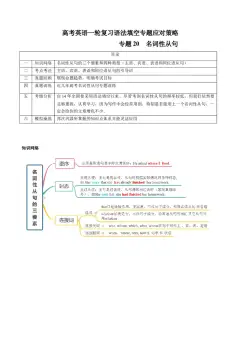
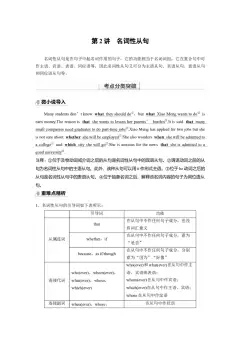
在句子中起名词作用的句子叫名词性从句。名词性从句的功能相
当于名词词组,它在复合句中能担任主语, 宾语, 表语, 同位语, 介
词宾语等。根据在句中不同的语法功能,名词性从句又可分为主语
从句, 宾语从句, 表语从句和同位语从句。
1. 主语从句
(1) 主语从句概念
在复合句中用作主语的从句叫主语从句。主语从句通常由连词
that 和whether,连接代词或连接副词以及关系代词what 来引导。1)
that 引导:That he is still alive is sheer luck.
他还活着全靠运气。
That you have cheated me is certain.
你欺骗了我是肯定的。
2) whether 引导:
Whether the plan is feasible remains to be proved.
这一计划是否可行还有待证实。
3) 关系代词what 引导:
What he wants to tell us is not clear.
他要跟我们说什么,还不清楚。
What I am finding is a nail.
我正在找的是个钉子。
4) 连接代词引导:
Whatever I do is wrong.
我做什么都错。
Whichever you want is available.
你想要什么都有。
5) 连接副词引导:
How we find it is unknown.
我们如何找到它还不知道。
Why he left here was a secret.
他为什么离开这里是个秘密。
(2) 主语从句和it 形式主语
为了保持句子平衡,主语从句常用it 作形式主语,大部分主语从
句都可以用it 作形式主语,将主语从句后置。这里分为以下几种情
况:
1) 对于用连词that 引导的主语从句,通常可以用形式主语it 代
替主语从句。
It's necessary that you take an umbrella.
你带把伞很有必要。
It's a pity that you lost it.
你把它弄丢了很可惜。
2) 对于关系代词what 引导的主语从句,通常直接把主语从句放
在句首,有时也可用形式主语it。What you want is time.
你想要的是时间。
What they tell is the truth.
他们所说的是事实。
It is obvious what we must do.
我们该做什么是很明显的。
3) 对于用连接代词或副词引导的主语从句,可以用形式主语it
代替主语从句,也可直接在句首用主语从句。
Whether he would accept this is a question.
=It's a question that whether he would accept this.
他们是否会接受是个问题。
4) 如果句子是疑问句,一定要用形式主语it 的结构。
Is it true that he was fired?
他被炒鱿鱼了是真的吗?
How is it that they didn't come?
他们为什么没来?
5) 用形式主语it 引导的主语从句相当多,有些已形成固定的搭
配。常见的有:
① It + be + 名词 + that 从句
It is a fact that... 事实是……
It is common knowledge that... ……是常识
It is a surprise that... 令人惊奇的是……
② It + be + 形容词 + that 从句
It is important that... 重要的是……
It is necessary that... 有必要……
It is obvious that... 很明显……
③ It + 不及物动词 + that 分句
It occurred to me that... 我突然想起……
It appears that... 似乎……
It happens that... 碰巧……
④ It + be + -ed 分词 + that 从句
It has been decided that... 已决定……
It is said that... 据说……
It is reported that... 据报道……
It is believed that... 人们相信……
It is known to all that... 众所周知……
It is thought that... 人们认为……
It is understood that... 据了解……
It is well-known that... 众所周知……
It is announced that... 据宣布……
It must be admitted that... 必须承认……
It must be pointed out that... 必须指出……
引导主语从句的that,有时可以省略,有时则不可以省略,其原
则是:that 引导从句在句首,that 不可省略;若that 引导从句位于句
中,用it 作形式主语,则可省略。
That you are the winner is the best news.(that 不可省略)
It is the best news (that) you are the winner.(that 可省略)
最好的消息是你是冠军。
2. 宾语从句
(1) 宾语从句的概念
在句子中起宾语作用的从句叫做宾语从句,即在复合句中作主句
的宾语。
语序:从句用陈述语序(主 + 谓)
连接词:根据不同的句式选择不同的连接词
时态:从句的时态应根据主句的时态变化而变化
(2) 宾语从句的语序
无论主句是陈述句还是疑问句,宾语从句都要用陈述语序,即主
句 + 连词 + 宾语从句的句式。
尤其要注意当从句是特殊疑问句或一般疑问句时,一定要把它还
原成陈述句的语序。
I told you (that) I could get high marks in English.
我告诉你我的英语成绩会拿高分的。
I believe (that) you can beat him.
我相信你能打败他。
We must never think (that) we are good in everything while others are
good in nothing.
我们决不能认为自己什么都好,别人什么都不好。
Please tell me if you have a problem.
你有问题就告诉我。
(3) 宾语从句的连接词
1) 由从属连词引导的宾语从句。
引导宾语从句的从属连词有:that(无词义), whether 和if(是
否)。从属连词只起连接主句与从句的作用,在从句中不充当句子
成分。由that 引导的宾语从句中,that 可省略。
I am not sure if/whether I can catch up with you.
我不确定是否能赶上你。
Our teacher said that you are a good student.
我们老师说你是个好学生。
whether 和if 的用法:
一般疑问句充当宾语从句,通常用if 或whether 引导,意为“是
否”, 但在以下情况只能用whether:
① 引导词置于句首时,只能用whether,不能用if。
Whether he is right or not, I can't say.
我不敢说他是否是对的。
② 引导词具有选择意义,又和or 或or not 连接,往往用whether
(有时也用if)。
I wonder whether or not it is true.
我不知道是不是真的。
③ 在介词之后用whether。
I am not interested in whether you are a singer.
对你是否是个歌手我不感兴趣。
④ 在不定式前用whether。
I don't know whether to buy it.
我不知道是否要买。
⑤ 引导主语从句和表语从句时宜用whether。
The problem is whether you understand.
问题是你是否理解。
⑥ 当用if 引起歧义时,则用whether。
Please tell me if you have made a decision. 可理解为:
Please tell me whether you have made a decision.
请告诉我你是否已经做决定了。
If you have made a decision, please tell me.
如果你已经做了决定,请告诉我。
2) 由连接代词引导的宾语从句。
引导宾语从句的连接代词有who (whom, whose), what, which 等。
连接代词有词义,它们除起到连接主句与从句的作用外,还在从句
中充当句子成分,作主语, 宾语, 表语或定语等。
I want to know whose that is.
我想知道那是谁的。
Do you know who the man is?
你知道这人是谁吗?
I want to know what he has told you.
我想知道他告诉了你什么。
She always asks which gate she has to go to.
她问她应该走哪个门。
3) 由连接副词引导的宾语从句。
引导宾语从句的连接副词有where, when, how, why 等。连接副词
有词义,它们除了起连接主句与从句的作用外,还在从句中作状
语。
Do you know how to get there?
你知道如何去那里吗?
(4) 宾语从句的时态
宾语从句的时态是学习宾语从句的重点,其主从句的时态必须呼
应,具体要求如下:
1) 如果主句时态为现在时态,宾语从句的时态不受主句时态的
限制,可用所需的任何时态(现在,将来或过去时态)。
I guess that you are going to school.
我猜你正要去上学。
I believe that it will be a fine day tomorrow.
我相信明天天气很好。
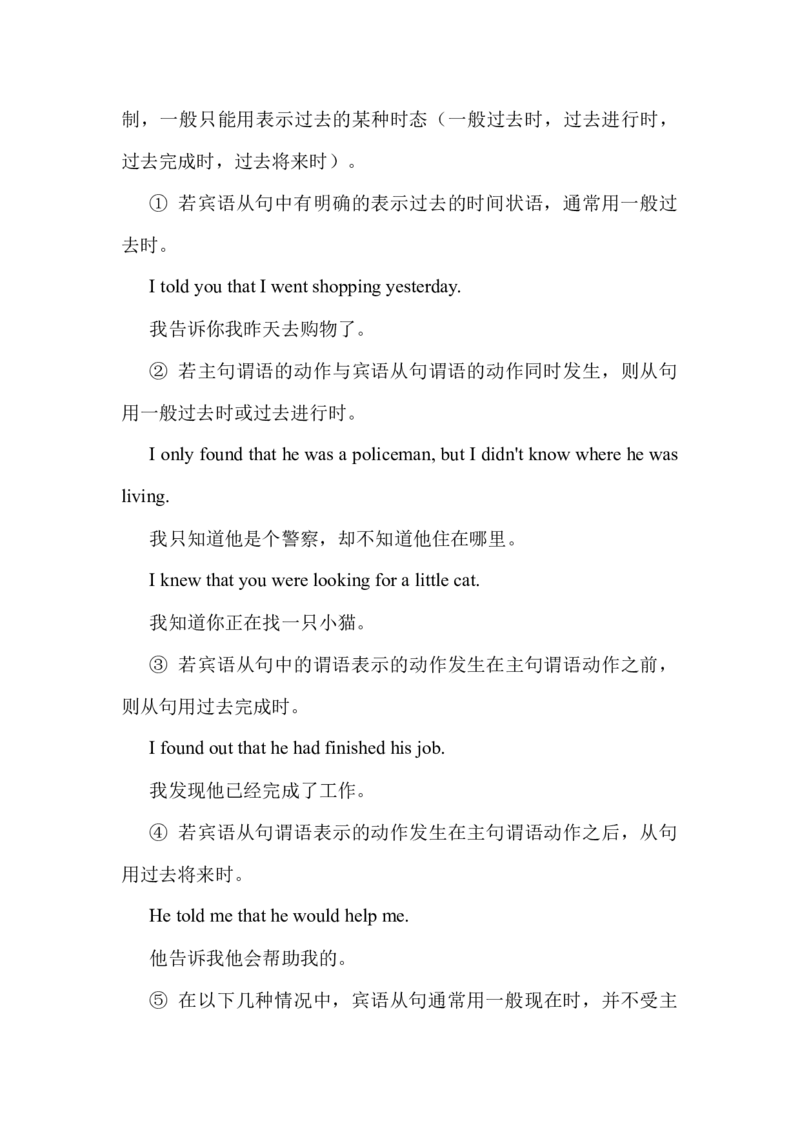
2) 如果主句时态为过去时,宾语从句的时态要受主句时态的限
制,一般只能用表示过去的某种时态(一般过去时,过去进行时,
过去完成时,过去将来时)。
① 若宾语从句中有明确的表示过去的时间状语,通常用一般过
去时。
I told you that I went shopping yesterday.
我告诉你我昨天去购物了。
② 若主句谓语的动作与宾语从句谓语的动作同时发生,则从句
用一般过去时或过去进行时。
I only found that he was a policeman, but I didn't know where he was
living.
我只知道他是个警察,却不知道他住在哪里。
I knew that you were looking for a little cat.
我知道你正在找一只小猫。
③ 若宾语从句中的谓语表示的动作发生在主句谓语动作之前,
则从句用过去完成时。
I found out that he had finished his job.
我发现他已经完成了工作。
④ 若宾语从句谓语表示的动作发生在主句谓语动作之后,从句
用过去将来时。
He told me that he would help me.
他告诉我他会帮助我的。
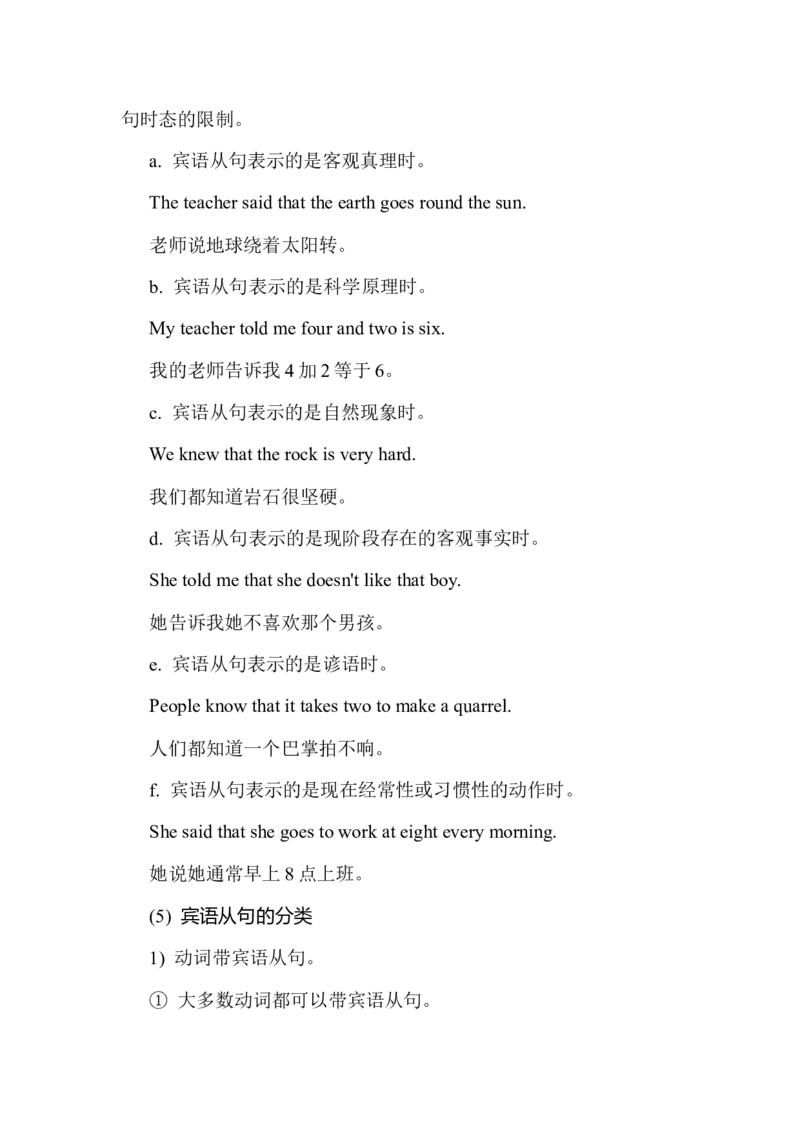
⑤ 在以下几种情况中,宾语从句通常用一般现在时,并不受主
句时态的限制。
a. 宾语从句表示的是客观真理时。
The teacher said that the earth goes round the sun.
老师说地球绕着太阳转。
b. 宾语从句表示的是科学原理时。
My teacher told me four and two is six.
我的老师告诉我4 加2 等于6。
c. 宾语从句表示的是自然现象时。
We knew that the rock is very hard.
我们都知道岩石很坚硬。
d. 宾语从句表示的是现阶段存在的客观事实时。
She told me that she doesn't like that boy.
她告诉我她不喜欢那个男孩。
e. 宾语从句表示的是谚语时。
People know that it takes two to make a quarrel.
人们都知道一个巴掌拍不响。
f. 宾语从句表示的是现在经常性或习惯性的动作时。
She said that she goes to work at eight every morning.
她说她通常早上8 点上班。
(5) 宾语从句的分类
1) 动词带宾语从句。
① 大多数动词都可以带宾语从句。
I think that he loves me.
我认为他爱我。
② 部分“动词 + 副词”结构也可以带宾语从句。
Could you find out how many problems we have?
你能找出我们有多少问题吗?
③ 动词短语也可以带宾语从句,常见的这些动词短语有:
make sure 确保, make up one's mind 下决心, keep in mind 牢记
Make sure that you get there on time.
一定要准时赶到。
④ 可用形式宾语it 代替的宾语从句。
a. 动词fin, feel, consider, make sure, believe 等后面有宾语补足语
的时候,则需要用it 作形式宾语,而将that 宾语从句后置。
She believes it a truth that she will be alone.
她将会是一个人,她相信那是事实。
b. 有些动词带宾语从句时,要在宾语从句前加it。
这类动词主要有:take, hate, have, owe, see to
I have got it that our task is very difficult.
我明白我们的任务很艰巨。
I hate it when you tell a lie to me.
我讨厌你说谎话。
c. 若宾语从句是wh-类,则不可用it 代替。
They all think that what he did unwise.
他们都认为他所做的是不明智的。
2) 介词引导的宾语从句。
①wh-类的介词宾语从句
We are talking about who should go there.
我们在讨论谁应该去那里。
They are finding out where the problem lies.
他们正在找问题出在哪儿。
② that, if 引导的介词宾语从句,多用于except, but, besides 之
后。
He said nothing except that he was all right.
他除了说他很好以外,别的什么也没说。
3) 形容词引导的宾语从句。
常用来引导宾语从句的形容词有:
glad, pleased, sure, certain, happy, sorry, afraid, satisfie, surprised
I am glad that you invite me to come here.
很高兴你邀请我来这儿。
It is certain that you will miss the train.
你肯定会错过火车。
(6) 宾语从句的否定转移
当主句的主语为第一人称,且主句的及物动词为表示感知的
believe, think, expect, suppose 等时,常把对从句的否定放在主句中。
They don't expect he visits me.
他们希望他不要来拜访我。
We don't believe that you can manage it.
我们相信你没法完成。
宾语从句进行否定转移时,它的反意疑问句的时态和人称要和从
句保持一致,且后面的动词只能用肯定形式。
They don't believe that the man is a professor, is he?
他们认为那个人不是教授,是不是?
如果宾语从句中有某个含有否定意义的形容词或副词,其反意疑
问句要用肯定形式。
I find that he hardly listens to me, does he?
我发现他几乎不听我的,是不是?
但在以下情况中,否定词不转移(不前置):
1) 主句是疑问句时,否定词不转移。
Do you believe he won't help us?
你相信他不会帮助我们吗?
2) 主句的主语不是I 时,否定词可以不转移。
They think you aren't a student.
他们认为你不是一个学生。
3) 从句中含有no, hardly, never, nothing, nobody, little, few 或是
not a little, not at all, not a few,can't help doing 等词和词组时,否定词
不转移。
I think that there is little time left.
我认为没有时间了。
He thinks there is nothing wrong with his leg.
他认为他的腿没有问题。
4) 在think, believe, suppose, expect 等动词前有副词修饰或有强调
词do, does, did 时,否定词不转移。
We do believe she isn't our teacher.
我们确实相信她不是我们的老师。
I really think he isn't a good driver.
我真的认为他不是个好司机。
(7) 相同的词引导宾语从句和状语从句的比较
if 既可以引导宾语从句又可以引导条件状语从句;when 既可以
引导宾语从句又可以引导时间状语从句;whoever 既可引导宾语从
句,也可引导让步状语从句。
当它们引导状语从句时,从句的谓语动词时态不能用将来时态或
进行时态,且从句的位置较灵活;而当它们引导宾语从句时只要遵
循主从句时态一致性原则就行了,可使用包括将来时态, 进行时态
在内的各种时态形式,但只能位于主句的及物动词, 复合谓语或介
词之后。试比较:
1) I don't know when he will leave school.
我不知道他什么时候会离开学校。(when 引导宾语从句)
When he leaves school, I will tell you.
当他离开学校时,我会告诉你的。(when 引导时间状语从句)
2) We don't know if she will buy the book.
我们不知道她是否会买这本书。(if 引导宾语从句)
If she buys the book tomorrow, I'll call you.
如果她明天买这本书了,我会给你打电话。(if 引导条件状语从
句)
3) I will give my hand to whoever needs it.
我会帮助任何需要帮助的人。(whoever 引导宾语从句)
Whoever breaks the rules will have to be punished.
不管谁违反规则,都会受到惩罚。(whoever 引导让步状语从
句)
3. 表语从句
(1) 表语从句概念
表语是一个句子,说明主语是什么或者怎么样的句子叫表语从
句。表语由名词, 形容词或相当于名词或形容词的词或短语充当,
和连系动词一起构成谓语。表语从句放在连系动词之后,充当复合
句中的表语。
My opinion is that her advice should be practical.
我的意见是她的建议是可行的。
The question is that we have no money.
问题是我们没有钱。
(2) 表语从句的分类
1) 连系动词引导的表语从句,常见的连系动词有be, look, seem,
sound, appear 等。
It seems we have made a progress.
看起来似乎我们已经有进步了。
2) as, as if, though 引导的表语从句。
It looks as if he were sleeping.
似乎他正在睡觉。
3) because, why 引导的表语从句。
That is because I practiced a lot.
那是我拼命练习的结果。(That's because 强调原因)
That is why he came.
那就是他来的原因。(That's why 强调结果)
4) 使用虚拟语气的表语从句
在表示劝告, 建议, 命令等含义的名词后的表语从句,谓语动词
需用“should + 动词原形”表示,should 可省略。常见的词有:
plan, advice, suggestion, order, proposal, idea 等。
My idea is that we should do it in this way.
我的意见是我们应该这样做。
His proposal was that we should hold a meeting.
他的提议是我们应该开个会。
(3) 表语从句注意事项
1) 表语从句一定要用陈述语序。
The question is where you are from.
问题是你来自哪儿。
2) 表语从句不可以用if 连接,而用whether 连接(as if 例外)。
引导宾语从句时if/whether 可以互换,位于句首时要用whether,
引导表语从句,主语从句,同位语从句时要用whether。
The question is whether he can do it.
问题是他能不能做。
It looked as if things went well.
看来事情进展很顺利。
3) 有表语从句的复合句中,主句时态和从句时态可以不一致。
The question is who had accepted my advice.
问题是谁接受了我的建议。
The problem is where he had gone.
问题是他去哪里了。
4) “That is why...”句型
“That is why...” 是常用句型,意为“ 那就是… … 的原因/ 因
此……”,其中why 引导的名词性从句在句中作表语,该句型通常
用于针对前面已经说明过的原因进行总结。
That is why I am here.
那就是我来这儿的原因。(前面讲述了原因之后,用这一句来进
行概括)
That is why I cry.
那就是我哭的原因。
下面是两个与“That is why...”形式相似的结构,但是又有区别:
① “That is why...”与“That is the reason why...”同义,只不过从语
法结构上讲,“That is the reason why...”中why 引导的是—个定语从
句,将其中的the reason 去掉则与“That is why...”结构一样。
That is (the reason) why I was angry.
那就是我生气的理由。
② “That is because...”句型中从属连词because 引导的名词性从句
在此作表语, 这也是个常用句型,意为“那就是为什么…… /因
为……”。“That is because...”与“That is why...”之间的不同在于
“That is because...”指原因或理由,“That is why...”则指由于各种原
因所造成的后果。
You make a progress. That is because you have made a good decision.
你取得了进步,那是因为你做了个正确的决定。(第一句说明结
果,第二句说明原因)
She has a good husband. That is why she is so happy.
她有个好丈夫,那就是她如此幸福的原因。(第一句话说明原
因,第二句话说明结果)
4. 同位语从句
(1) 同位语从句概念
同位语从句用于对其所修饰的名词作进一步解释,说明名词的具
体内容。也就是说,同位语从句和所修饰的名词在内容上为同一关
系,对其内容作进一步说明。
同位语从句一般跟在如下抽象名词之后:
hope 希望, wish 愿望, answer 答案, fact 事实, belief 信仰, news
消息, idea 主意/观念, promise 承诺, information 信息, conclusion 结
论, order 命令, suggestion 建议, problem 问题, thought 想法, word 言
语
(2) 同位语从句的引导词
同位语从句一般用that, whether, what, which, who, when, where,
why, how 等词引导。
1) 同位语从句意义完整,应用that 引导。(即that 不充当任何成
分,只起连接作用,不可省略)。We received the order that we
should finish this task at once.
我们收到了立即完成任务的命令。
注 we should finish this task at once 是the order 的全部内容,且意
义完整。2) 同位语从句意义不完整,需增加“是否”的含义,应用
whether 引导同位语从句。(if 不能引导同位语从句)。
We are talking about the problem whether we should buy a new car.
我们在讨论是否应该买辆新车。
注 we should buy a new car 意义表达不完整,应加“是否”的含
义才能表达the problem 的全部内容,因此应用whether 引导同位语
从句。
3) 同位语从句意义不完整,需增加“什么时候”, “什么地点”,
“什么方式”等含义,应用when,where, how 等词引导同位语从句。
I have no impression how we met each other at first.
我们如何相遇的我没有印象了。
注 we met each other at first 意义不完整,应加“如何”的含义才
能表达impression 的全部内容,因此应用how 引导同位语从句。
I have no idea when I can get my book.
我不知道什么时候能拿到我的书。
注 I can get my book 意义不完整,应加“什么时候”的含义才能
表达idea 的全部内容,因此应用when 引导同位语从句。
4) 当主句的谓语较短,而同位语从句较长时,同位语从句常后
置。
The idea came to his mind that he had put his key in the drawer.
他突然想起来他把钥匙放在抽屉里了。
(3) 同位语从句的语气
在suggestion, advice, request, order 等意为“建议;命令;要求”
的名词后,同位语从句中的谓语动词通常用“should + 动词原形”
的虚拟语气结构,句中的should 可以省略。
He gave me some suggestions how I (should) use the microscope.
他给了我一些如何使用显微镜的建议。
My teacher gave us some advice that I (should) read English every
day.
老师建议我们每天都读英语。
The boss gave the order that all the task (should) be finished in three
days.
老板命令3 天内所有的工作都要完成。
(4) 同位语从句与定语从句的区别
同位语从句和定语从句相似,都放在某一名词或代词后面,但同
位语从句不同于定语从句。我们可以从以下几个方面区分:
1) 从性质上区别。
定语从句是从句对其先行词的修饰或限制,属于形容词性从句的
范畴;而同位语从句与前面的名词之间是同位关系,同位语从句是
从句对前面的抽象名词的进一步的说明和解释,属于名词性从句的
范畴。
The idea that he told me just now is impractical.
他刚才告诉我的主意是不切实际的。(定语从句,从句对前面名
词起修饰限制作用。)
The news that you will go abroad is true.
你要出国的消息是真的。(同位语从句,即从句所表达的意思就
是前面名词的内容。)
The news that I read in the newspaper is shocking.
我在报纸上看的新闻令人震惊。(定语从句,news 在从句中作
read 的宾语)
The news that you will get promoted is true.
你要升职的消息是真的。(同位语从句,补充说明news 到底是
个什么消息)
I made a decision that changed all the situation.
我做了个改变全局的决定。(定语从句,decision 在从句中作
changed 的主语)
I made a decision that if you love me I would marry you.
我决定如果你爱我,我就嫁给你。(同位语从句,补充说明
decision 到底是个什么决定)
2) 从先行词区别。
定语从句的先行词可以是名词,代词,主句的一部分或是整个主
句,而同位语从句前面的名词只能是:fact, idea, hope, news,
suggestion, belief, proposal, word, thought, doubt, truth,possibility,
promise, order 等有一定内涵的名词。
The girl whom you are looking for is in the shop.
你正在找的那个女孩在商店里。(定语从句)
We will get married, which made us very happy.
我们要结婚了,这让我们很高兴。(定语从句)
He did all he could to help his wife with her housework.
他尽最大的努力帮助妻子干家务。(定语从句,代词all 作先行
词)
The possibility that this method will work is being discussed now.
这个方法的可行性正在被讨论。(同位语从句)
Word came that he divorced.
据说他离婚了。(同位语从句)
We are talking about the question whether she should be punished.
我们正在讨论她是否应该受到惩罚。(同位语从句)
3) 从引导词及其在句子中的成分上区别。
定语从句的引导词在从句中作成分,而同位语从句的引导词不在
从句中作成分。
The idea that he gave just now was wonderful.
他刚才给的主意很棒。(定语从句,that 在从句中作gave 的宾
语。)
The idea that the earth is flat has long been discredited.
地球是方的这种说法早已不为人们所相信了。(同位语从句,
that 在从句中不作任何成分。)
有些引导词如whether, how, what 可以引导同位语从句,但不能
引导定语从句。
I have no idea what I should do to help her.
我不知道该做什么来帮助她。(同位语从句)
引导词that 引导定语从句时,在从句中一般作主语或宾语(指物
时还可以用which 代替),并且作宾语时常常省略,而that 在引导
同位语从句时,仅起连接作用,不充当任何成分,并且不能省略,
也不能用which 来代替。
The order that we should lock the doors was given by him.
我们应该锁上门的命令是他给的。
(同位语从句,是对order 的具体解释,that 虽不作成分,但不
能省略。)
The order that he gave us was that we should lock the doors.
他给我们的命令是我们应该锁上门。
(定语从句,是名词order 的修饰语,that 在从句中作gave 的宾
语,可以省略。)
4) 看从句是否有疑问的意义。
I have asked the question when you will come back.
我已经问了你什么时候回来。(when 引导的从句表示疑问,是
同位语从句。)
Do you remember the day when we bought the house?
你记得我们买房子的那天吗?(when 引导的从句不表示疑问,
是定语从句。)