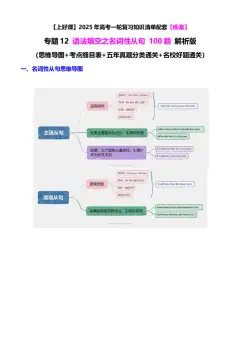
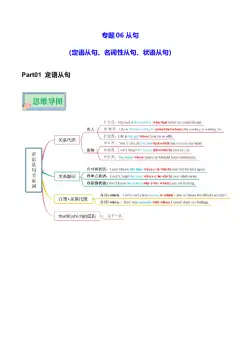
名词性从句考点运用
目标导航
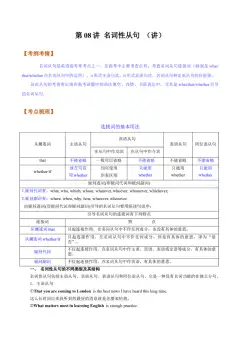
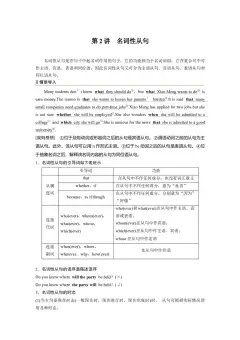
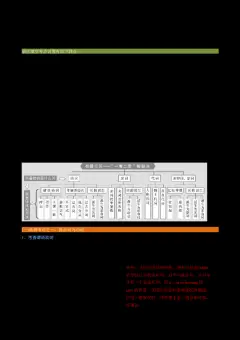
在复合句中起名词作用的从句叫做名词性从句。名词可以充当句子的主语、宾语、表语和同位语,因
此,名词性从句包括主语从句,宾语从句,表语从句和同位语从句。
①What was most important to her was her family.(主语从句)
②I don’t know what you want to say.(宾语从句)
③The good news is that we have won the game.(表语从句)
④The news that we have won the game is true.(同位语从句)
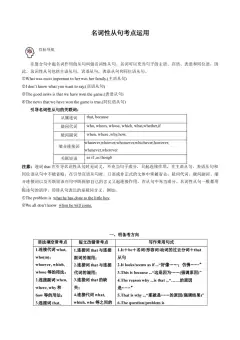
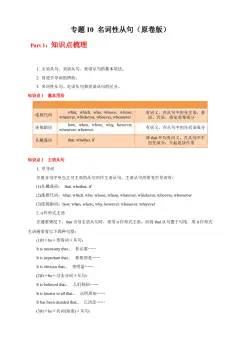
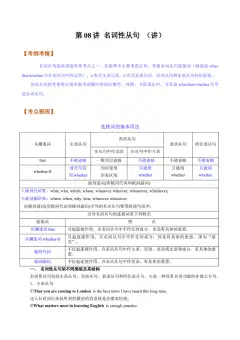
引导名词性从句的关联词:
从属连词 that, because
疑问代词 who, whom, whose, which, what,whether,if
疑问副词 when, where ,why,how,
whatever,whoever,whomever,whichever,however,
缩合连接词
whenever,wherever
关联短语 as if ,as though
注意:连词that在引导名词性从句时无词义,不充当句子成分,只起连接作用,在主语从句、表语从句和
同位语从句中不能省略,在引导宾语从句时,口语或非正式的文体中常被省去;疑问代词、疑问副词、缩
合连接词以及关联短语在句中既保留自己的含义又起连接作用,在从句中充当成分。名词性从句一般都用
陈述句的语序,即使从句表达的是疑问含义。例如:
①The problem is what he has done to the little boy.
②We all don’t know when he will come.
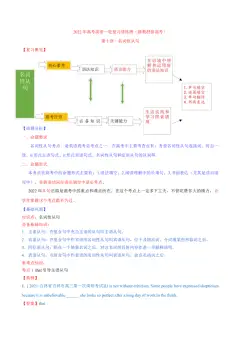
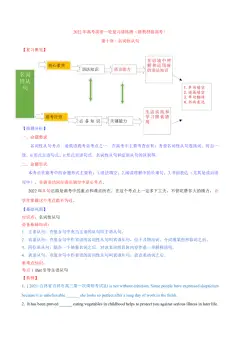
一、明备考方向
语法填空常考点 短文改错常考点 写作常用句式
1.连接代词what, 1.连接词that与连接 1.It+be+名词/形容词/动词的过去分词+that
who(m), 副词的混用; 从句
whoever, which, 2.连接词that与连接 2.It looks/seems as if ...“好像……;仿佛……”
whose等的用法; 代词的混用; 3.This is because ...“这是因为……(强调原因)”
2.连接副词when, 3.连接词that的缺 4.The reason why ...is that ...“……的原因
where, why和 失; 是……”
how等的用法; 4.连接代词what, 5.That is why ...“那就是……的原因(强调结果)”
3.连接词that, which, who等之间的 6.The question/problem iswhether/when/where ...“问题是……”
混用;
whether和if的用 7.His dream/suggestion/aim/purpose is that ...
5.连接代词与连接副
法。 “他的梦想/建议/目标/目的是……”
词的混用。
8.What从句+be+that从句
1. 主语从句
在复合句中作主语的句子叫主语从句
主语从句通常由从属连词 that,whether 和连接代词 what, who,which,whatever, whoever 以及连接副词
how,when,where, why等词引导。例如:
①That he stole a bike was true.
②What he wants to tell us is not clear.
③Who will win the match is still unknown.
④Where the English evening will be held has not yet been announced.
⑤Whether he can pass the exam depends on whether he study hard or not.
⑥Whatever you do is none of my business.
⑦Whoever comes to our library will be welcome.
单个的主语从句作主语时,谓语动词用单数形式。如果是两个或两个以上的主语从句作主语,谓语动词则
用复数形式。例如:
①Where and when he was born has not been found.
②When the person was murdered and why he was murdered are still unknown.
主语从句比较长的时候,为避免句子头重脚轻,常用 it 代替主语从句作形式主语放于句首,而把主语从句
置于句末。主句的谓语动词一般用单数形式。常用句型如下:
(1)It + be + 名词 + 主语从句。例如:
①It is a fact that he has gone abroad.
②It is a pity that you missed the sports meeting last week.
(2)It + be + 形容词 + 主语从句。例如:
①It is obvious that he told a lie.
②It is certain that he will win the game.
(3)It + be + 过去分词 + 主语从句。例如:
①It is said that she will come to the party tomorrow.
②It has not been announced when the plane are to take off.
(4)It + 不及物动词 + 主语从句。例如:
①It happened that the meeting was canceled that day.
②It occurred to me that I had forgotten to bring my wallet.
注意:在主语从句中用来表示惊奇、不相信、惋惜、理应如此等语气时,谓语动词要用虚拟语气 (should)
+do,常用的句型是:
It is necessary/important/natural/strange/essential, etc.) that … 例如:①It’s necessary that you should study hard.
②It is strange that he should say that.
③It is essential that a college student should master at least a foreign language.
2. 宾语从句
在复合句中作宾语的从句叫宾语从句。
引导宾语从句的关联词与引导主语从句表语从句的关联词大致一样,在句中可以作谓语动词或介词及非谓
语动词的宾语。例如:
①I want to know what he has told you.
②She always thinks of how she can work well.
③She will give whoever needs help a warm support.
1).由连接词that引导的宾语从句
由连接词that引导宾语从句时,that在句中不担任任何成分,在口语或非正式的文体中常被省去。但如从
句是并列句时,第二个分句前的that不可省。例如:
He has told me (that) he will leave Wuhan and that he will go to Shanghai tomorrow.
注意:在insist,suggest, advise,decide, demand, desire,require, request,order, command等表示“坚持、建议、决
定、要求、命令”(“坚决要命”)等意义的动词后,宾语从句中谓语部分常用 虚拟语气,即should+ 动
词原形。例如:
①I insist that she (should) do her work alone.
②The commander ordered that troops (should) set off at once.
但是, 如果suggest作“表明、暗示”讲, insist作“坚持说、坚持认为”讲,则其后的宾语从句中用陈述语
气。例如:
①The smile on his face suggested that he had passed the examination.
②The boy insisted that he had not stolen the money.
2).用whether或if引导的宾语从句
whether和if均可引导动词后的宾语从句,常可互换。但从句中有or not时或介词后的宾语从句中只能用
whether连接。其它名词性从句,如主语从句、表语从句、同位语从句中表示“是否”只用 whether. 介词
后的宾语从句一般不用which和if引导,要用whether和what。that也很少引导介词宾语从句,只在except,
but, besides等之后才用。例如:
①I don’t care about whether you have money or not.
②Everything depends on whether we have enough money.
③He seldom loses his temper except that you make a fool of him.
3).宾语从句中的时态呼应
宾语从句的谓语动词时态受主句谓语动词的影响,如果主句的谓语动词是一般现在时,从句中的谓语动词
可以用各种时态。 例如:
①I know that he studies English every day.
②I know that he studied English last term.
③I know (that) he will study English next year.
④We all know that he has studied English since 1998.如果主句中的谓语动词用了一般过去时,则从句中的语动只能用过去时的某种形式,如一般过去时,过去
进行时,过去将来时等。 例如:
①We believed that he had earned enough money to build a house.
②The teacher told us that Tom had left us for America.
当从句表示的是客观真理,科学原理,自然现象,则从句仍用现在时态。 例如:
The teacher told us that the sun rises in the east.
4).当主句是I/ We think (suppose, expect, believe, guess, imagine) 时,其后的宾语从句如果是否定形式,常把
否定词not从从句中转移到主句中成为否定的转移。例如:
①We don’t believe that he will win the game.
②I don’t think he will do so.
注意:doubt用于肯定结构时,后面用whether/ if 引导名词性从句;用于否定结构或疑问结构时,后面用
that 引导名词性从句。be sure 用于肯定句或疑问句时,后接 that 引导的名词性从句;用于否定句时,后
接whether/if 引导的名词性从句。例如:
①I doubt whether he will come tomorrow.
②There is no doubt that he will come tomorrow.
③I am sure that he will win the game.
④I am not sure whether he will win the game.
3. 表语从句
在复合句中作表语的句子叫表语从句。表语从句常放在系动词之后。
引导表语从句的关联词与引导主语从句的关联词大致一样,表语从句位于连系动词后,有时用 as if,
because引导。其基本结构为: 主语 + 系动词 + 表语从句 。 例如:
①The fact is that we have lost the game.
②That’s just what I want.
③This is where our problem lies.
④That is why he didn’t come to the meeting.
⑤It looks as if it is going to rain.
⑥This is because he missed the train by one minute.
注意:当主语是reason 时,表语从句要用that引导而不是because。例如:
The reason why he was late was that he missed the train by one minute this morning.
4. 同位语从句
在复合句中作同位语的从句叫同位语从句。同位语从句用于解释说明其前面的名词的具体内容。
同位语从句一般跟在某些表示抽象概念的名词后,如 news, idea, information, fact, hope,thought, belief 等,用
来说明名词所表示的具体内容,引导同位语从句的连接词通常有that, whether和连接副词when, where, why,
how;连接代词who,what,whose,which也可以引导同位语从句。例如:
①The news that he won the first place was true.
②It is a question how he did it.
③The problem whether we should continue to do the experiment has been solved.
④We haven’t settled the question where we are going to spend our summer vacation.⑤I have no idea when she will be back.
⑥The question who should do the work requires consideration.
同位语从句一般紧跟在被解释的名词之后,但有时候也可以分开,将从句放在句末。例如:
①The suggestion came from the chairman that the new rule should be adopted.
②Word came that Mr. President would come and inspect our school.
5.同位语从句与定语从句的区别
(1)定语从句修饰限定先行词,它与先行词是修饰关系;同位语从句解释说明先行词的具体内容,它与
先行词是同位关系。
①The plane that has just taken off is for Paris. (定语从句)
②The fact that he has died is quite clear. (同位语从句)
(2)定语从句由关系代词或关系副词引导,关系词在从句中担当相应的句子成分,关系代词在从句中作
宾语时经常可省略。同位语从句主要由连词 that 引导,在从句中不充当句子成分;where, when, how, who,
whether, what 等连词也可以引导同位语从句,这些连词则在从句中担当成分。
①The news that he told me is true. (定语从句)
②The news that he has just died is true. (同位语从句)
③The problem that we’re facing now is how we can collect so much money. (定语从句)
④The problem how we can collect so much money is hard to solve. (同位语从句)
⑤The question that he raised puzzled all of us. (定语从句)
⑥The question whether he is sure to win the game is hard to answer.(同位语从句)
(3)同位语从句与先行词一般可以用be动词发展成一个完整的句子, 而定语从句则不能。如:
①The idea that we can ask the teacher for advice is wonderful.(同位语从句)
→The idea is that we can ask the teacher for advice.
②The fact that the earth moves around the sun is known to all. (同位语从句)
→The fact is that the earth moves around the sun.
③Pay attention to the problem how we can protect the wild animals . (同位语从句)
→The problem is how we can protect the wild animals.
1.We now realize ________ important family is and how important to be near them, especially when you’re raising
children.
2.Members leave books on park benches and buses, in train stations and coffee shops.________ finds their book
will go to the site and record where they found it.
3.The journey was intended to achieve more than ________Captain Robert Falcon Scott had done.
4.The most pleasant thing of the rainy season is________one can be entirely dust.
5.Scientists are still not exactly sure ________genes influence aging, but they believe that they do.
6.It is often the case________anything is possible for those who hang on to hope.
7.You have to know ________ you're going if you are to plan the best way of getting there.
8.I truly believe ________ beauty comes from within.
9.We must find out ________ Karl is coming, so we can book a room for him.10.The exhibition tells us________we should do something to stop air pollution.
11.A ship in harbor is safe, but that's not________ships are built for.
12.Exactly ________ the potato was introduced into Europe is uncertain,but it was probably around 1565.
二、攻重点难点
(一)引导名词性从句的连接代词(如what),连接副词(如when),连接词(that, if, whether)的用法和区别
解答名词性从句中连接词的选用题目时,可采用“句子翻译法”,即看空缺处在句中是什么意思,充当什
么成分。若在从句中不作成分只起引导作用,用 that;若表达“是否”意义,用if/whether;若充当主
语、宾语、表语或定语,用连接代词;若充当状语,则用连接副词。
What he wants to tell us is not clear.
他要跟我们说什么,还不清楚。
Whether there is life on the moon is an interesting question.月球上有没有生命是个有趣的问题。
I have no idea when he will come back home.
我不知道他什么时候回到家。
The thought came to him that Mary had probably fallen ill.他想到玛丽可能生病了。
(二)连接代词who/whom, what, which与whoever/whomever, whatever, whichever的用法和区别
在这两类连接词中,前面三个连接词在引导名词性从句时依然带有疑问的语气和含义,分别表示“谁”
“什么”和“哪一个”。后面三个连接词则表示“无论……”的含义,并带有具体的针对性,不带疑问的
语气和含义。
The problem is who we can get to replace her.
问题是我们找谁去替代她。
Whoever did it should be punished.
无论是谁干的都应当受到惩罚。
(三)虚拟语气在名词性从句中的使用
一般来说,在某些特定动词后的宾语从句中,谓语动词用“should+动词原形”,should可省略。常见的
这类动词有“一个坚持”(insist);“两个命令”(order, command);“三个建议”(suggest, advise,
recommend);“四个要求”(desire, require, demand, request);“外加一个敦促”(urge)。
I insist that she (should) do her work alone.
我坚持她应当单独做她的工作。
The commander ordered that troops (should) set off at once.司令员命令部队马上出发。
(四)同位语从句与定语从句的区别
同位语从句的作用相当于名词,用来解释说明前面名词(短语)的内容,常见的名词(通常是抽象名词)有
idea, thought, fact, evidence, belief, doubt, fear, hope, proposal, truth, news, possibility 等;定语从句的作用
相当于形容词,充当定语用来修饰主句中的某个名词或代词。
The news that our football team won the match was true.(同位语从句)
我们足球队赢了那场比赛的消息是真的。
The news (that) we heard on the radio was true.(定语从句)我们在收音机里听到的那则消息是真的。
三、练高频题点
Ⅰ.语法填空题点全练
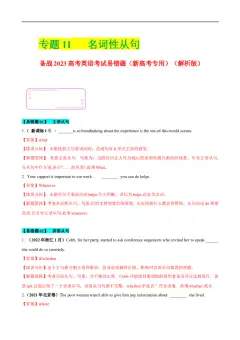
1.I'm not sure is more frightened, me or the female gorilla (大猩猩) that suddenly appears out of
nowhere.
2.This is my father has taught me — to always face difficulties and hope for the best.
3.The gold medal will be awarded to wins the first place in the bicycle race.
4.Earthquakes worry people a lot. The reason is we often do not know when they are coming.
5.Success partially depends on you have the patience to do simple things perfectly.
6.From space, the earth looks blue. This is about 71% of its surface is covered by water.
7.Do not let any failures discourage you, for you can never tell close you may be to victory.
8.The only way to succeed at the highest level is to have total belief you are better than anyone else
on the sports field.
9.Finally, keep in mind there are many things that can't be learnt immediately, and never be
frustrated when you fail in one or two exams.
10.Mr White is opposed to repairing the old building, and that's I don't agree.
Ⅰ.完成句子并改写
1.大家的确都知道的是穷人都喜欢她,因为她总是帮助那些需要钱的人。
All that they did know was that she was loved by poor people because she always helped those who was in need of
money.
→What_they_did_know was that she was loved by poor people because she always helped
whoever_was_in_need_of_money.(用名词性从句改写)
2.她今天早晨来晚了,因为她不得不照顾她生病的女儿。
She came here late this morning, because_she_had_to_look_after her sick daughter.
→The_reason_why she came here late this morning was_that_she_had_to_look_after her sick daughter. (用名词
性从句改写)
3.我姐姐的梦想是拥有自己的商店,在里面她可以做自己最喜欢的蛋糕。
My sister's dream is to have_her_own_shop_in_which_she_can_make_her_favourite _cakes.
→My sister's dream is_that_she_has_her_own_shop_in_which_she_can_make_her _favourite _cakes.(用名词性
从句改写)
4.看到这个女孩,我很吃惊。
I was surprised to see the girl.
→What_surprised_me was to see the girl. (改为主语从句)
→I saw the girl, which_surprised_me. (改为定语从句)
5.众所周知,2020年奥运在东京举行。
As_is_known_to_us_all/As_we_all_know,_the 2020 Olympic Games took place in Tokyo.(用定语从句翻译)
→What_is_known_to_us_all_is_that the 2020 Olympic Games took place in Tokyo.(用主语从句改写)→It_is_known_to_us_all_that the 2020 Olympic Games took place in Tokyo.(用it作形式主语改写)
随堂练习
一
It was a hot summer day 1 found me running down the street with a dollar in my sweaty hand. The 2
(close)I got to Sam & Joe's Stationery Store, the more excited I was. After all, a dollar was a tidy sum for an 11-
year-old boy in 1961.
Out of breath, I swung open the door and got a blast of cold air 3 instantly cooled me off. I was in a
place of pure 4 (happy). I went directly to the bar and ordered a bottle of soda.There I sat, considering my
next move.
Books always came first. I picked out five titles. Next came the candy, rows and rows of it.I chose five candy
bars, 5 brought my total to 25 cents.
I hurried 6 (direct)to my backyard, 7 an apple tree patiently waited for me. There, sitting in the
shade against its strong trunk, I read my books and ate my candy.
As I sat in my own 8 (person)heaven,I started to think about having more. That's 9 a fantastic life-
changing idea popped into my head: 1 0 I could get more money, I could buy anything I wanted. That's how it
all started.
二
It was reported 1 there was an accident at the corner of Roman Street this morning.No one saw 2 on
earth happened then.A car ran into a truck but fortunately,nobody got injured. 3 is responsible for the accident is
still under investigation.The police are uncertain about 4 the driver is guilty. 5 the police should do now is
6 they must find out what led to the accident.They said it was difficult for them to judge because 7 the
accident happened was not clear.Perhaps the reason was 8 the driver was too tired to stop the car in time.The
driver didn’t admit the fact 9 he was driving too fast at the turning.The police doubted 10 what he said was
true and decided to make a further investigation.
1. 2. 3. 4. 5.
6. 7. 8. 9. 10.
三
My doorbell rings at 11 a.m.On the step, I find an elderly Chinese lady holding the hand of a little boy.In her
other hand __1__ (be) a paper bag.She is the little boy's grandmother, and her daughter, Nicole, bought __2__
house next door last October.Nicole has __3__ (obvious) told her mother that I am having a heart operation shortly,
and the result is that her mother has decided __4__ (supply) me with meals.
I know what is inside the paper bag — a bottle of hot soup and a __5__ (contain) with a meal of rice,
vegetables and meat.It's become a daily occurrence.
Communication __6__ us is somewhat difficult because she doesn't speak English and all I can say in Chinese
is hello.Once, she brought an iPad as well as the food.She pointed to the screen, __7__ showed a message from her
daughter telling me that her mother wanted to know __8__ the food was all right for me.
So here we are, two grandmothers, neither of __9__ (we) being able to speak the other's language butcommunicating one way or another (with some help from technology).The doorbell keeps __10__ (ring) and
there is the familiar brown paper bag, handed smilingly to me.