高中英语语法核心知识点详解(讲义)
Part 21
——
句式篇
状语从句
21.1

状语从句Adverbial Clauses
1. 状语从句概念
状语从句指在复合句中作状语的从句。状语从句由从属连词或
起连词作用的词语引出,它可以修饰谓语, 非谓语动词, 定语, 状语
或整个句子。状语从句位于句首或句中时,通常用逗号与主句隔
开;位于句尾时可以不用逗号隔开。
2. 状语从句的用法
(1) 表示时间
在复合句中,由表示时间的连接词引导的状语从句叫做时间状
语从句。
时间状语从句由以下连词引导:when, while, as, after, before, as
soon as, since, till/until, by the time。在时间状语从句中,要注意时态
一致,一般情况下主句是将来时的时候,从句要用一般现在时。
1) 由when, while, as 引导的时间状语从句。
When I lived in the countryside, I used to carry some water for him.
住在农村时,我常常为他担水。
When she came in, I was eating.
她进来时,我在吃饭。
Strike while the iron is hot.
趁热打铁。
While my wife was reading the newspaper, I was watching TV.
当我妻子在读报纸的时候,我在看电视。
She worked in a bank for a while before studying law.
她学法律之前在银行工作过一段时间。
As she left the room she remembered that book.
她离开房间时想起了那本书。
Our headmaster laughed as she spoke.
我们的校长边谈边笑。
when, while 和as 的区别:
①when 引导的从句的谓语动词可以是延续性的动词,又可以是
瞬间动词。并且when
“
”
有时表示就在那时。
When she came in, I stopped reading.
她进来时,我停止读书。(瞬间动词)
When I lived in that city, he used to come to visit me.
当我住在那个城市的时候,他经常来看我。(延续性的动词)
We were about to leave when he came in.
我们就要离开时,他进来了。
②while 引导的从句的谓语动词必须是延续性的,并强调主句和
从句的动作同时发生(或者相对应)。并且while 有时还可以表示对
比。
While my wife was reading the newspaper, I was watching TV.
我妻子在看报纸时,我在看电视。(同时发生)
I like playing football while you like playing basketball.
我喜欢踢足球,而你喜欢打篮球。(对比)
③as
“
……
……”
表示一边
一边
,as 引导的动作是延续性的动作,一
般用于主句和从句动作同时发生;as
“
”
也可以强调一先一后。
We always play as we walk.
我们总是边走边玩。(as
“
……
……”
表示一边
一边
)
As we were going out, it began to rain.
当我们出门时,开始下雨了。
(as 强调句中两个动作紧接着先后发生,而不强调开始下雨的
特定时间)
④有时这三个连词可以互换,有时不可以。
It was raining hard when (as) I got there.
我到那里时,正在下大雨。
(动作同时发生,when 可换为as,但不能换为while,因为get
是瞬间动词)
When I was washing my clothes, he called me.
我正在洗衣服的时候,他给我打了电话。
(从句动作发生在主句之前,注意时态表达,只能用when)
When I got to the cinema, the ticket had been sold out.
当我到了电影院时,门票已经销售一空。
(从句的动作发生在主句之后,只能用when,并注意时态)
He was about to leave, when the telephone rang.
他正要离开,忽然电话响了。
(此时when
“
”
“
不能放在句首。主句动词一般表达正在,即
”
将,while, as 不能代替when)
She thought I was talking about her, while, in fact, I was talking
about the weather.
她以为我在谈论她,然而,实际上我在谈论天气。
(表转折, 对比,when, as 都不能代替while)
While he was buying a souvenir, the girl called the police.
当他正在买纪念品时,那女孩给警察打了电话。
表示主句, 从句的动作同时发生,while 后引导的状语从句的动
词必须是延续动词不能是瞬间动词,因为它表示较长时间。
The mother was worried about her little boy, especially as
(when/while) her father was away.
妈妈很担心她的孩子,特别是他父亲不在家的时候。(此时as,
when, while 可通用)
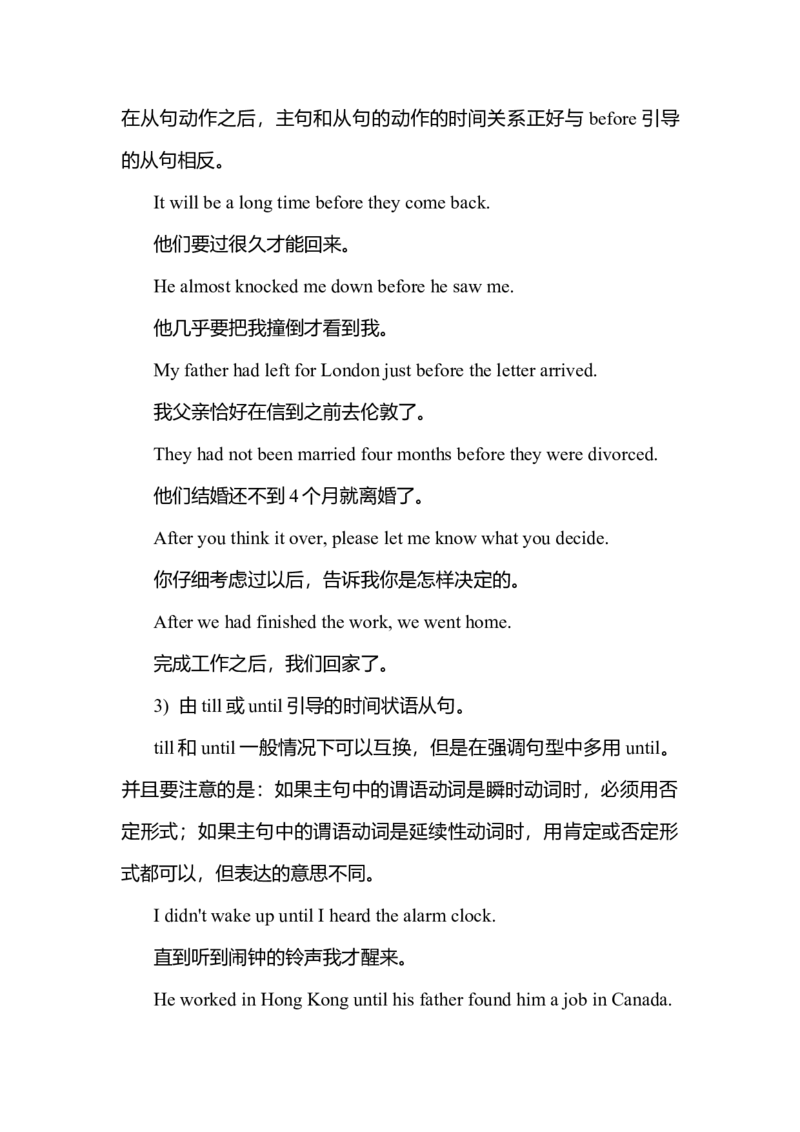
2) 由before 和after 引导的时间状语从句。
before 引导的从句不用否定式的谓语,并且当before 引导的从句
“
”
位于主句之后,有时译成就;才。当主句用将来时,从句总是用
现在时;如果before 引导的从句谓语用的是过去时,则主句动词多
用过去完成时,以便体现动作发生的先后。after 表示主句动作发生
在从句动作之后,主句和从句的动作的时间关系正好与before 引导
的从句相反。
It will be a long time before they come back.
他们要过很久才能回来。
He almost knocked me down before he saw me.
他几乎要把我撞倒才看到我。
My father had left for London just before the letter arrived.
我父亲恰好在信到之前去伦敦了。
They had not been married four months before they were divorced.
他们结婚还不到4 个月就离婚了。
After you think it over, please let me know what you decide.
你仔细考虑过以后,告诉我你是怎样决定的。
After we had finished the work, we went home.
完成工作之后,我们回家了。
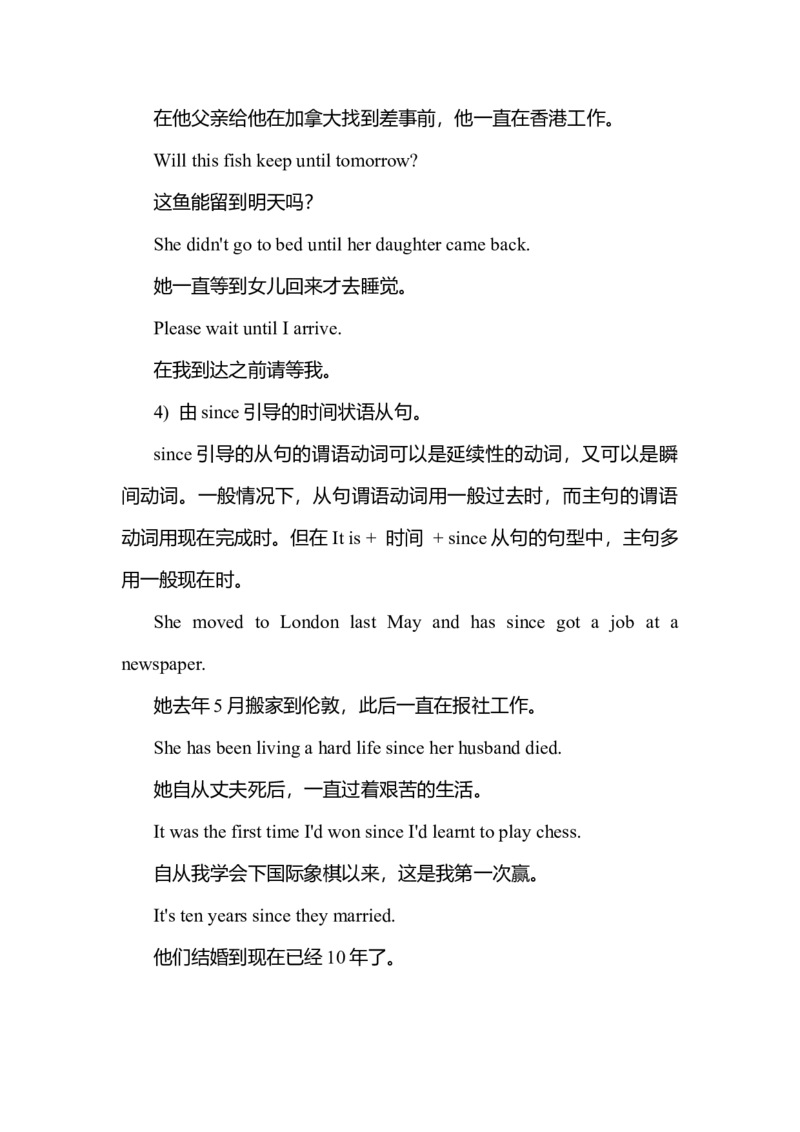
3) 由till 或until 引导的时间状语从句。
till 和until 一般情况下可以互换,但是在强调句型中多用until。
并且要注意的是:如果主句中的谓语动词是瞬时动词时,必须用否
定形式;如果主句中的谓语动词是延续性动词时,用肯定或否定形
式都可以,但表达的意思不同。
I didn't wake up until I heard the alarm clock.
直到听到闹钟的铃声我才醒来。
He worked in Hong Kong until his father found him a job in Canada.
在他父亲给他在加拿大找到差事前,他一直在香港工作。
Will this fish keep until tomorrow?
这鱼能留到明天吗?
She didn't go to bed until her daughter came back.
她一直等到女儿回来才去睡觉。
Please wait until I arrive.
在我到达之前请等我。
4) 由since 引导的时间状语从句。
since 引导的从句的谓语动词可以是延续性的动词,又可以是瞬
间动词。一般情况下,从句谓语动词用一般过去时,而主句的谓语
动词用现在完成时。但在It is +

时间+ since 从句的句型中,主句多
用一般现在时。
She moved to London last May and has since got a job at a
newspaper.
她去年5 月搬家到伦敦,此后一直在报社工作。
She has been living a hard life since her husband died.
她自从丈夫死后,一直过着艰苦的生活。
It was the first time I'd won since I'd learnt to play chess.
自从我学会下国际象棋以来,这是我第一次赢。
It's ten years since they married.
他们结婚到现在已经10 年了。
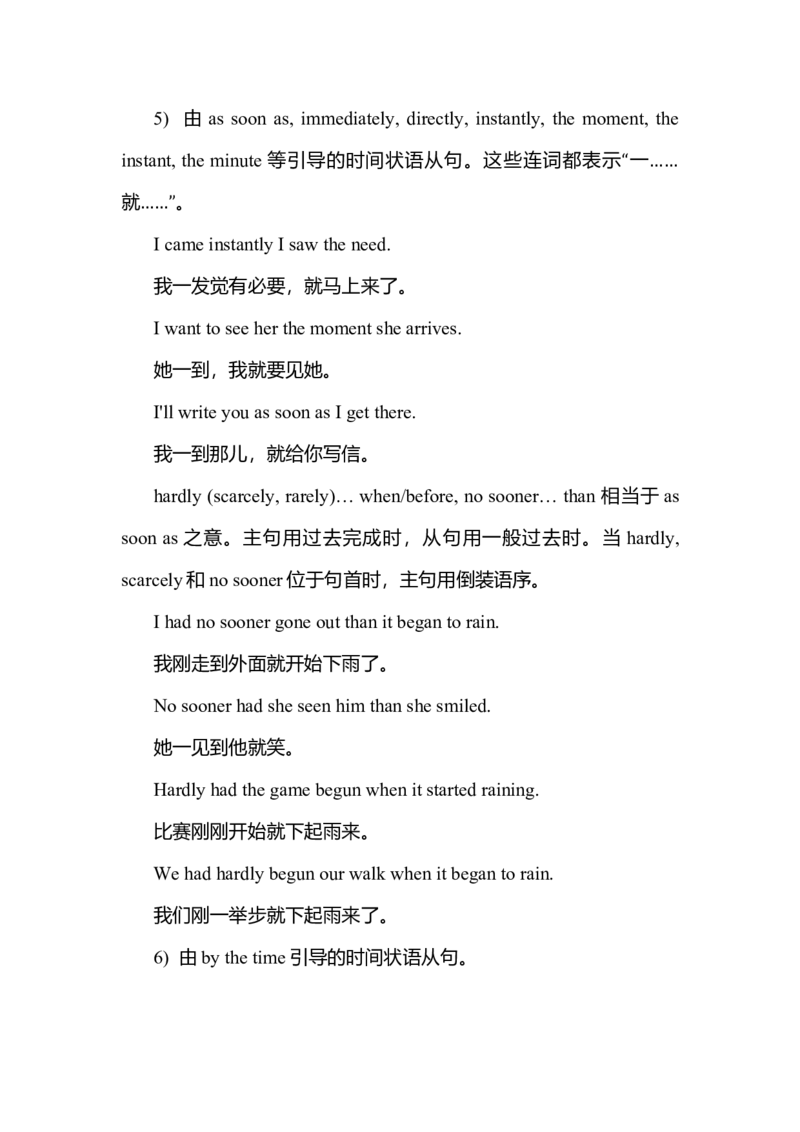
5) 由as soon as, immediately, directly, instantly, the moment, the
instant, the minute
“
……
等引导的时间状语从句。这些连词都表示一
……”
就
。
I came instantly I saw the need.
我一发觉有必要,就马上来了。
I want to see her the moment she arrives.
她一到,我就要见她。
I'll write you as soon as I get there.
我一到那儿,就给你写信。
hardly (scarcely, rarely)… when/before, no sooner… than 相当于as
soon as 之意。主句用过去完成时,从句用一般过去时。当hardly,
scarcely 和no sooner 位于句首时,主句用倒装语序。
I had no sooner gone out than it began to rain.
我刚走到外面就开始下雨了。
No sooner had she seen him than she smiled.
她一见到他就笑。
Hardly had the game begun when it started raining.
比赛刚刚开始就下起雨来。
We had hardly begun our walk when it began to rain.
我们刚一举步就下起雨来了。
6) 由by the time 引导的时间状语从句。
注意时态的变化:在一般情况下,如果从句的谓语动词用一般
过去时,主句的谓语动词用过去完成时;如果从句的谓语动词用一
般现在时,主句的谓语动词用将来完成时。
By the time I got there, the bus had already gone.
我到那里的时候,汽车已经开走了。
By the time you come to see me tomorrow, I would have finished my
job.
明天你来看我的时候,我应该已经做完工作了。
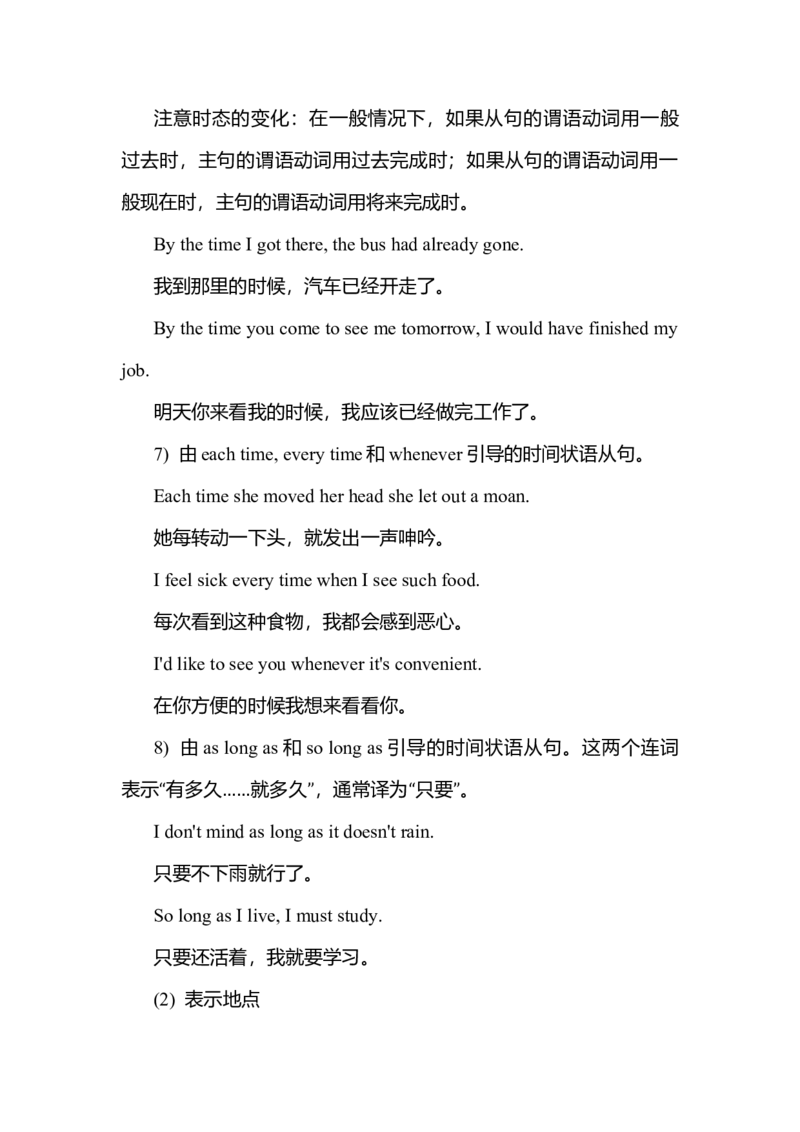
7) 由each time, every time 和whenever 引导的时间状语从句。
Each time she moved her head she let out a moan.
她每转动一下头,就发出一声呻吟。
I feel sick every time when I see such food.
每次看到这种食物,我都会感到恶心。
I'd like to see you whenever it's convenient.
在你方便的时候我想来看看你。
8) 由as long as 和so long as 引导的时间状语从句。这两个连词
“
……
”
“
”
表示有多久
就多久,通常译为只要。
I don't mind as long as it doesn't rain.
只要不下雨就行了。
So long as I live, I must study.
只要还活着,我就要学习。
(2) 表示地点
地点状语从句一般由连接副词where, wherever 等引导。
1) Where + 地点从句,+ (there) + 主句。
“
……
……”
此句型通常译成哪里
哪里就
;主句在从句后面时,there
可用可不用;如果主句在从句的前面时,一般都不用there。
Where there is no rain, farming is difficult or impossible.
在没有雨水的地方,耕作是困难的,或根本不可能的。
Where the mother goes, there the baby can be seen, too.
妈妈去哪里,这小孩也去哪里。
Where there is life, there is hope.
只要有生命就有希望。
Where there is unity, there is victory.
有团结就有胜利。(谚语)
2) anywhere/wherever +

地点从句+,+ 主句。
anywhere 本身是个副词,但是,可以引导地点状语从句,相当
于连词,意思近似于wherever。
anywhere 引导的从句可位于主句之前,也可以位于主句之后。
而wherever
“
”
本身就是个连词,表示在何处;无论何处。
If you want to go anywhere else, let me know.
你如果要到别的地方去,就要告诉我。
We'll go anywhere you like.
你想去哪儿,我们就去哪儿。
Remember I am waiting for you wherever you go.
不论你到哪里,记住我在等着你。
Wherever there is smoke, there is fire.
无风不起浪。(谚语)
(3) 表示方式
方式状语从句通常由as, (just) as... so..., as if, as though 引导。
1) as, as if, as though 引导的方式状语从句通常位于主句后,但
(just) as... so... 结构也可位于句首,这时as 从句带有比喻的含义,意
“
……”
“
……”
思是正如
,就像
,多用于正式文体。
Always do to the others as you would be done by.
你希望人家怎样待你,你就要怎样待人。
As water is to fish, so air is to man.
我们离不开空气,犹如鱼儿离不开水。
Just as we sweep our rooms, so we should sweep backward ideas
from our minds.
正如打扫房屋一样,我们也要扫除我们头脑中落后的东西。
2) as if, as though
两者的意义和用法相同,引出的状语从句谓语多用虚拟语气,
表示与事实相反,有时也用陈述语气,表示所说的情况是事实或实
“
……
”
“
……
”
现的可能性较大。通常翻译为仿佛
似的,好像
似的。
They looked at me as if (as though) I were mad.
他们看着我好像我发疯了似的。(与事实相反,谓语用虚拟语
气。)
He looked as if (as though) he had been hit by lighting.
他那样子就像被雷击了似的。(与事实相反,谓语用虚拟语
气。)
It looks as if the weather may pick up very soon.
看来天气很快就会好起来。(实现的可能性较大,谓语用陈述
语气。)
as if/as though 也可以引导一个分词短语, 不定式短语或无动词短
语。
He pretended as if knowing a lot of knowledge.
他假装知识渊博。
He walks unsteadily as if about to fall.
他走路不稳像是要摔倒一样。
They are united as if by glue.
它们像是被胶水粘在一起一样。
(4) 表示让步
1) though, although 引导的让步状语从句。though, although
“
当虽
”
然讲,都不能和but 连用,但可以同yet (still)连用。
Although she was poor, yet she wanted to buy that dress.
尽管她很贫穷,然而她还是想买那件礼服。
Although it isn't dangerous, the teacher don't allow them to swim.
虽然不危险,老师还是不让他们去游泳。
①though
“
”
可以作副词,指但是,但是although 不行。
He said he would come, he didn't, though.
他说他要来,但是他没有。(句中的though 不能替换成
although。)
②as though 属固定搭配,though 不能替换成although。
③although 要比though 更正式,相对而言,语气比较重,但是
though 的使用更普遍。although 引导的从句,常指实际发生的事
情,而不是假象/设想。
He would not be unhappy though he should have to live alone.
就算要一个人住,他也不会不开心。
He was not unhappy although he had to live alone.
虽然他不得不一个人住,却没有不开心。
④though 和although 都可在从句中用作连词,通常表示相同的意
思,但though 更普遍适用于非正式的表述中。
2) as, though 引导的倒装句
as/though 引导的让步从句表语或状语可以提前(形容词, 副词,
分词, 实义动词提前)。
Child as/though he was, he knew what was the right thing to do.
=Though he was a small child, he knew what was the right thing to
do.
虽然他还是个孩子,但是他知道什么事情该做。
①句首名词不能带任何冠词。
②句首是实义动词,其他助动词放在主语后。如果实义动词有宾
语和状语,随实义动词一起放在主语之前。
Try hard as he will, he never seems able to do the work satisfactorily.
=Though he tries hard, he never seems able to do the work
satisfactorily.
虽然他尽了努力,但他的工作还是做得不尽如人意。
③ever if, even though“
”
即使引导的让步状语从句。
We'll go to travel even though the weather is bad.
即使天气不好,我们也要去旅行。
He will come on time even if it rains.
即使下雨,他还是会准时来的。
④whether… or“
……
”
不管
都引导的让步状语从句。
Whether you believe it or not, it is true.
不管你信不信,那都是真的。
Whether it rains or not, we are playing football on Saturday.
无论下不下雨,我们星期六一定踢足球。
⑤“no matter +
”
“

疑问词或疑问词+ 后缀ever”引导的让步状语从
句。
No matter what the matter may be, we should do our best.
不论事情会成什么样,我们都应当尽最大的努力。
Whatever happened, he would not mind.
不管发生什么,他都不介意。

注no matter who=whoever
no matter what=whatever
no matter where=wherever
no matter when=whenever
no matter how=however
no matter which=whichever
但是,no matter 不能引导主语从句和宾语从句。
(×)No matter what you do is impractical.
(√)Whatever you do is impractical.
你做什么都是不切实际。(Whatever you do 是主语从句)
(×)The students have to remember no matter what they're taught.
(√)The students have to remember whatever they're taught.
教学生什么,他们就要记住什么。(whatever they're taught 是宾
语从句)
(5) 表示比较
比较状语从句主要运用于形容词和副词的原级, 比较级及最高级
的句子之中,并且常常会省略相同的句子成分。
1) 原级:
①as... as“
……
”
和
一样
You know as much about that as I do.
对于这件事,你知道的和我一样多。
This dress is twice as expensive as that one.
这条连衣裙比那件贵一倍。
②not so (as)… as…“
……
”
和
不一样
She is not so (as) outgoing as her sister.
她不如她姐姐外向。
She is not so simple as a child.
她不像小孩那样天真。
2) 比较级:
than“
……
……”
比
更
They work harder than we do.
他们比我们工作更努力。
3) 最高级:
① the most... in/of
Of the three questions, this is the most difficult one.
三个问题中这是最难的。
② the +

形容词+ est... of/in
This road is the busiest street in our city.
这条路是我们城市最繁忙的街道。
知识拓展
1) no more than 只不过(嫌少的意思)
She asked no more than two questions.
她只问了两个问题。
He is no more than a worker.
他仅仅是个工人。
2) not more than
……
不如
;至多(前者不如后者)
He is not more hardworking than I.
他不比我工作努力。
3) one of the + 名词(复数)“……
”
之一(用于最高级)
He is one of the smartest students in my class.
他是我班上最聪明的学生之一。
(6) 表示条件
“
……”
条件状语从句就是用以表示假设条件下会
。一般由连词if
如果, unless (=if not) 除非,as/so long as 只要, on condition that 条件
……
是
, provided/providing that 假如, suppose/supposing 假如, in case
如果, for fear(that)/lest 唯恐/以免, only if 只要/只有, if only 但愿/要
……
是
该多好等引导。
1) if, unless
后者在意义上相当于if... not,而且语气较强,一般也不用于虚
拟语气。
I will come to see you if I have time.
我有时间就来看你。
If the rain stops, I shall go out for a walk.
如果雨停了,我就出去散步。
You can't learn English well unless you work hard.
除非你努力学习,否则你学不好英语。
(=If you don't work hard, you can't learn English well.)
You will be late unless you leave immediately.
如果你不马上走,你将会迟到的。
(=If you don't leave immediately, you will be late.)
2) on condition (that)
……
……
在
条件下;倘若
, as (so) long as 只
……
……
要
就
, in case 以防万一;万一;如果。
You can use my bike on condition that you return it by Friday.
你可以使用我的自行车,条件是你星期五以前还。
As long as it doesn't rain, we can play.
只要天不下雨,我们就能玩。
You'd better take an umbrella in case it rains.
你最好带把雨伞,以防万一下起雨来。
3) suppose/supposing that, provided/providing (that) 假如。
Supposing (that) it rains, can we play the match indoors?
要是下雨的话,我们能在室内比赛吗?
Suppose the news is true, what then?
假定这消息是真的,那又怎样?
Provided we get good weather it will be a successful holiday.
如果天气良好,我们的假日将过得非常好。
4) only if 引导真实条件状语从句,一般用于句首,主句主谓倒
装;if only 一般引导虚拟条件句或感叹句。
Only if the right light comes on is there any danger to employees.
只有红灯亮,才表示有危及职工的险情。(真实条件句)
If only I knew her name.
我要是知道她的名字就好了。(虚拟条件句)
If only I were rich.
但愿我很富。
(7) 表示原因
原因状语从句可以由连词because, since, as 引导,也可由for,
now that 等词引导。
The woolly shrank because it was washed badly.
毛衣因洗得不得法而缩水。
Since it is so hot, let's go swimming.
既然天气这么热,我们去游泳吧。
We didn't know what to do as we were just visiting there.
我们不知道该怎么办,因为当时我们仅仅在那里做访问。
We must start early, for it will take two hours to drive to the airport.
我们得早点动身,因为开车去机场得花两个小时。
because, since, as, for 辨析:
1) because 语气最强,用来说明人所不知的原因,回答why 提出
的问题。当原因是显而易见的或已为人们所知,就用as 或since。
He is absent because he is ill.
他因病缺席。
Since/As the weather is so bad, we have to stay for another day.
因为天气不好,我们不得不多留一天。
2) 由because 引导的从句如果放在句末,且前面有逗号,则可以
用for 来代替。但如果不是说明直接原因,而是多种情况加以推断,
就只能用for。
He looked down, because/for he failed in the exam.
他看起来不开心,因为他考试不及格。
He must be in trouble, for he is absent today.
他一定是有麻烦了,因为他今天没来。
3) as 和for 的区别:
通常情况下,as 引导的从句在主句前,for 引导的从句在主句
后。
As the weather is cold, I stay at home.
I stay at home, for the weather is cold.
因为天很冷,所以我就待在家里。
(8) 表示目的
目的状语从句的引导词可以是so that 以便/以致, in order that 以
便, in case 免得/以防, for fear(that) 唯恐/以免, lest 唯恐/以免/为
……
使
不等。
1) so that, in order that 引导的从句谓语常用can, could, may, might,
shall, will, would 等情态动词。in order that 引导的从句可位于主句前
面或后面,so that 引导的从句只能位于主句之后。
In order to catch up the first bus, I got up at six this morning.
为了赶上第一班车,我今天早上6 点钟就起床了。
We shall let you know the details soon in order that you can/may
make your arrangements.
不久我们很快会告诉你们详情,以便你们能做出安排。
I'll run slowly so that you can catch up with me.
我将慢慢跑,以便你能赶上我。
My sister opened the window so that the fresh air might come in.
我妹妹把窗户打开以使新鲜空气可以进来。
2) in case, for fear (that), lest 引导的从句,谓语动词可用虚拟语
气:should + v. (should 不可省略);
若不用虚拟语气,要用一般现在时或过去时。
He wrote the name down for fear that (lest) he should forget it.
他写下这个名字以免以后忘记。
Better take more clothes in case the weather is cold.
最好多穿点衣服,以防天冷。
They spoke in whisper for fear (that) they might wake the baby.
他们轻声谈话,以免吵醒婴儿。
(9) 表示结果
结果状语从句由连词(so) that, so... that, such... that, so
much/many... that 引导。
1) so... that
……
如此
以致
Nothing more was heard from him so that we began to wonder if he
was dead.
再也没有听到他的消息,因此我们有些怀疑他是否死了。
Suddenly it began to rain heavily, so that it was almost impossible to
carry on driving.
突然下起了大雨,因此几乎无法继续开车。
2) such... that
……
如此
以致
He's such a good person that we mustn't blame him.
他是这样好的人,我们不能怪他。
They are such fine teachers that we all hold them in great respect.
他们是非常好的老师,我们对他们极为尊敬。
3) 比较:so 和such
其规律由so 与such 的不同词性决定。such 是形容词,修饰名词
或名词词组,so 是副词,只能修饰形容词或副词。so 还可以与表示
数量的形容词many, few, much, little 连用,形成固定搭配。
so nice a flower
such a nice flower
so foolish
such a fool
so much/little money
such rapid progress
so many/few flower
such nice flowers
so many people
such a lot of people
so that, such... that, in order that 皆可引导目的状语从句和结果状
语从句,当他们引导目的状语从句时,从句的谓语里常常有can,
could, may, might, will, would 等词。
so + adj./adv. + that,such + n. + that 两种句型都表示结果,其中
so 为副词,后面接形容词或副词原形。
当可数名词前有many, few;不可数名词前有much, little 修饰
时,应采用句型:so many (few/much/little ) + n.。such 为形容词,后
只能接名词。这个名词既可以是可数的,也可以是不可数的。如果
这个名词是单数可数名词,则必须在名词前加冠词a (an)。常见的形
式是:such a(beautiful) garden, such (nice) people。
I've had so many books that I have to sell some.
我有这么多的书,我不得不卖掉一些。
There are so few apples that I can't give you any.
苹果太少了,我一个也给不了你。
It is such a nice shirt that I'd like to buy it.
这么好的衬衫,我想买。
He is such a bad guy that we don't believe him at all.
他这么坏,我们根本不相信他。