#7®i~#MI5
Ali,# " ~- ' „
1 I5
   f# (
Q I /II
f )
1Un ),

( ~Uyj
10
l
*~lli 5' )0 {ii
2023 4F 6 }
_Q
I
o
s
~
,
`' A~ —
i
J
o
  I
F
)U0 i ~`
J~1x~
J 350 Wr'i ,
517 Sc 1
150 k
( —
7
1 - 13017 ,
T 180 I J )o

TJL1`h ~
J f1
1. :
~U
,
2.
i
;
3. iE

3 , ip : f
o
1~
T
J
JC,
I]o
67
( fry ) —i -
x
~7 , *
p
*
J
~,
o

~E
 rt ,
J`—
"*
C J A o
* i
pj
B. "i
„
i 'I
, o
8f
#~zi}p~~'~Iq
,
31~
4
_I
J
,
n i~~
"
'I~YLS~ ,
~I''
o
iX,
iX
i'
,,, o
Y~J
'71
pR'3. ~I'7
Tr#pRS~
t ~7~aR5~o
~yy~
rr
~`{~rr~
'7
t
t~c
1
~LL
J€
1
tt
~ t
yy~I~t*7
t~yy}
P
E
o
ilk
/~7U
t7NlJ o fX
'7~11X
s~L sc
, ~p c`~'i T
~~
~C
/X
i7JI I')l iXL7 J'15'L

C
717
pN5~
J
fkJ' o
T ~U
~ 3
t
o
H
TMPS~
~lL~co
FTI
.titQ7 +4;W
sn~ ( ~
- ~7
5 ) +$i
( i
n~ri t
1
—) +i*, j
2.
$I
A.
p
,
8
f
p
,
~ --~
fly—'
}
~~G
1r
1io31~
~
'
3
I
~~
~(JJ
~~,
NJ i:
1
p~~
p
}
1
!
^
,
JT
~{~
+ ~~1
(
L
~
1~~4,
p
"
y
J
(
L~—~~J~(
Yt ~':—
'o J~
,
p~
1
~/
{{p~J
~ S
{
c
,
,
Y3~, 3i
LIi *
,
iC:IR
7l ~fn~L7
Y L7 o
L~`l
~R ~A ~Jl
~Jli
~a o
B.
~}73#gin`-
®~~#
J~~7~
5 ~ 150
,
~
.; —
?
25
JO
,
150'
W~1~J1
.
T?, —'t—
L
JL
O
U1
"i
"
I5
C. i±aXWJ1
j 1/
o
D.
Tf ,
2
E 11
~1~x~',
nJ
~1 akfJ~~~~~
~1 JfhIX
a
~t,
fJ $1.
f
ct
(2023'
Tr
® I / II
)
Iii F
,
fJ'~Alr~a
Tf
ia
V1
1h~
J
o
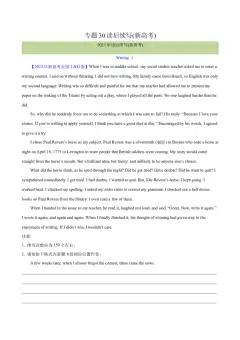
When I was in middle school, my social studies teacher asked me to enter a writing contest. I
said no without thinking. I did not love writing. My family came from Brazil, so English was only
my second language. Writing was so difficult and painful for me that my teacher had allowed me to
present my paper on the sinking* of the Titanic by acting out a play, where I played all the parts.
No one laughed harder than he
.
So, why did he suddenly force me to do something at which I was sure to fail? His reply:
"Because I love your stories. If you're willing to apply* yourself, I think you have a good shot at
this." Encouraged by his words, I agreed to give it a try.
I chose Paul Revere's horse as my subject. Paul Revere was a silversmith (SFr) in Boston
who rode a horse at night on April 18, 1775 to Lexington to warn people that British soldiers were
coming. My story would come straight from the horse's mouth. Not a brilliant* idea, but funny; and
unlikely to be anyone else's choice.
What did the horse think, as he sped through the night? Did he get tired? Have doubts? Did he
want to quit? I sympathized immediately. I got tired. I had doubts. I wanted to quit. But, like
Revere's horse, I kept going. I worked hard. I checked my spelling. I asked my older sister to
correct my grammar. I checked out a half-dozen books on Paul Revere from the library. I even read
a few of them.
4
r
( Mfr
) —i*~
When I handed in the essay to my teacher, he read it, laughed out loud, and said, "Great. Now,
write it again." I wrote it again, and again and again. When I finally finished it, the thought of
winning had riven way to  the enjoyment of writing. If I didn't win, I wouldn't care.
1.
i7 C
150 Jr'i ;
Paragraph 1:
A few weeks later, when I almost forgot the contest, there came the news.
Paragraph 2:
I went to my teacher's office after the award presentation.
1C7
JJ ~~
J ,
.
X7
171
*
,
T
o
r~
:
Nothing is impossible for a willing heart. /Practice makes perfect. /Where there is a will, there is a
way. /Diligence* is the mother of success.
o
I1~"Diligence is the mother of success."{
?~J
---moo
/r,.
p1.
A few weeks later, when I almost forgot the contest, there came the news. + OO (  . IJ f~j'~
(
'7 J f
) +0  u Tn~
° ~L ( Tyr#
r} ) + ®
  i f
)► ( ~
-ten
I
L
I went to my teacher's office after the award presentation. + OO
Ti
(
~1Ji
) +©
l
( T 7
3 ) + OO 'ha
d ,
hA
Ta (
U ~ ~ [] f~7
#►x
~~~
A few weeks later, when I almost forgot the contest, there came the news. OI won the first
prize! Although a little surprised, I knew that I deserved the prize. I had made every effort to make
my writing perfect. ©At the award presentation ceremony, the headmaster presented me with the
award, congratulatini me on winning the first prize. My fellow students applauded* me loudly,
many showinj Qreat admiration. ©3 Overwhelmed* with excitement, I thought of my English
«*„
Fm *„
Jy~iC
~71~(f
'bl~7iC
~' 7i
o
70
"i*~~
' #7®i
#MI5
teacher, without whom I couldn't have won the contest. I decided to thank him in person.
I went to my teacher's office after the award presentation. OO I expressed my gratitude to him
for believing in me and all the help he had given me. ©The teacher smiled, explaining why he was
so strict with me. He pointed out that if we were to succeed in something, we must apply*
ourselves to it because nothing is impossible for a willing heart. ®Leaving his office, I felt more
confident in myself than before, because I had learned the secret of success, that is diligence* is the
mother of success. ( 164 iiJ
11 2•
—~~' ~,~ (2023
h3I i A
)
I was invited to a cookout on an old friend's farm in western Washington. I parked my car
outside the farm and walked past a milking house which had apparently not been used in many
years. A noise at a window caught my attention, so I entered it. It was a hummingbird ('  i),
desperately* trying to escape. She was covered in spider-webs (!1* 17) and was barely able to move
her wines. She ceased her struggle the instant* I picked* her up.
With the bird in my cupped hand, I looked around to see how she had gotten in. The broken
window glass was the likely answer. I stuffed a piece of cloth into the hole and took her outside,
closing the door securely behind me.
When I opened my hand, the bird did not fly away; she sat looking at me with her bright eyes.
I removed the sticky spider-webs that covered her head and wings. Still, she made no attempt to fly.
Perhaps she had been struggling against the window too long and was too tired? Or too thirsty?
As I carried her up the blackberry-

lined* path toward my car where I kept a water bottle, she
began to move. I stopped, and she soon took wing but did not immediately fly away.
Hovering* (
), she approached within six inches of my face. For a very long moment, this
t y creature looked into my eyes, turning her head from side to side. Then she flew quickly out of
sight.
During the cookout, I told my hosts about the hummingbird incident*. They promised to fix
the window. As I was departing*, my friends walked me to my car. I was standing by the car when
a hummingbird flew to the center of our group and began hovering. She turned from person to
person until she came to me. She again looked directly into nz ' eyes, then let out a squeaking call
and was gone. For a moment, all were speechless*. Then someone said, "She must have come to
say goodbye."
1.
5%7 1 1 150 Jy ;
2.
AT
Ea
U~1L f ao
Paragraph 1:
A few weeks later, I went to the farm again.
Paragraph 2:
I was just about to leave when the hummingbird appeared.
A.
L
O
YQ0

  1_,
' a
'*~
 a
?
o
II
A few weeks later, I went to the farm again. + OO
)~' ( .
3
) +OO Ji T
EA (''
) + ®
U
%
,
L
)
I was just about to leave when the hummingbird appeared. +
A few weeks later, I went to the farm again. O Walking past the milking house, I suddenly
remembered the incident*. I couldn't help but push the door open and checked the window. To my
joy, the broken glass had been replaced with a new piece. O When talking with the host, he
mentioned that he often saw a hummingbird flying around here. ®When the host saw me off, I
looked around, hopinj to see the hummingbird, but I  found no sign of it. Somehow*, a sur.ge* of
sadness overwhelmed* me.
I was just about to leave when the hummingbird appeared. O It flew directly towards me. I
72
held out my right hand, on which it slowly settled*. It gave out some squeaks of joy, as if to say
how much it missed me. OO When I had to depart*, it didn't fly away immediately, just hovering*
above us. It wasn't until I slowly drove away that it disappeared in the distance*. ®Always
remember to be grateful to the person who once helped you. Even a bird can. ( 157 ii)
#
#yeu k %]
fE Ji.
(2022
ire
® I / II
)
7%T1W4, *<
: f~J
~fr~aaTr~ia
!1
(zIh
7X~
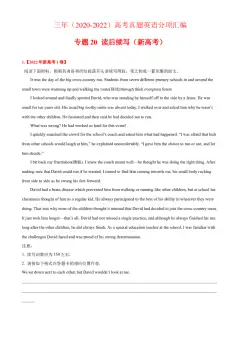
It was the day of the big cross-country run. Students from seven different primary schools in
and around the small town were warming up and walking the route (
) through thick
evergreen forest.
I looked around and finally spotted* David, who was standing by himself off to the side by a
fence. He was small for ten years old. His usual big toothy smile was absent today. I walked over
and asked him why he wasn't with the other children. He hesitated and then said he had decided not
to run.
What was wrong? He had worked so hard for this event!
I quickly searched the crowd for the school's coach and asked him what had happened. "I was
afraid that kids from other schools would laugh at him," he explained uncomfortably. "I gave him
the choice to run or not, and let him decide."
I bit back my frustration* (' ' i ) . I knew the coach meant well — he thought he was doing
the right thing. After making sure that David could run if he wanted, I turned to find him coming
towards me, his small body rocking* from side to side as he swung his feet forward.
David had a brain disease which prevented him from walking or running like other children,
but at school his classmates thought of him as a regular kid. He always participated to the best of
his ability in whatever they were doing. That was why none of the children thought it unusual that
David had decided to join the cross-country team. It just took him longer
that's all. David had
not missed a single practice, and although he always finished his run long after the other children,
he did always finish. As a special education teacher at the school, I was familiar with the challenges
David  faced and was proud of his strong determination.
"*„

«*„ b5~7;C~hit i
( Mfr
) —i~~ 5
1.
150
1 ;
2.
Paragraph 1:
We sat down next to each other, but David wouldn 't look at me.
Paragraph 2:
I watched as David moved up to the starting line with the other runners.
i tL
~C*
 W
: David )
,

T n
1ri
l' J
j
, David
T
O Ill
1i~
~ :
(
4~
'I
J v
David, David
bU
o
~
"tea" , ~
~ o
"i i
„
We sat down next to each other, but David wouldn't look at me. + Di 4th
f
`i (

+©
I
( Tyr#
) + OO 4
~pt~
5~, iT
~
)
I watched as David moved up to the starting line with the other runners. + O  *
( .
'75
pR5~) +
k-f (Tr
~~ ) + ®Tth
r•
i
We sat down next to each other, but David wouldn 't look at me. OO He hung his head low, with
a frown* on his face. He wanted to participate in the big cross-country run badly, but he was afraid
of being laughed at. ©I told him that nobody would care about how he ran. Everyone is born
unique and no one would laugh at him. "Just be yourself and don't care about what others think
about you, "I encouraged him. ®After a quick struggle in his mind, he made up his mind to run.
I watched as David moved up to the starting line with the other runners. OO Just then, the run
started. David tried his best to run as quickly as he could, his small body rocking* from side to
side. But slowly, David fell behind others. ©When almost everyone arrived at the destination, there
was still a distance for him to run. The students who had finished the run potted* David and began
r
to applauded* him loudly, cheering him on. O Eventually*, David passed the finishing line
successfully. Nobody will look down upon you unless you look down upon yourself. ( 160 i7)
L .. _.. _.. _.. _.. _.. _.. _.. _.. _.. _.. _ .. _.. _.. _.. _.. _.. _.. _.. _.. _.. _.. _.. _.. _.. _.. _.. _.. _.. _.. _.. _.. _.. _.. _.. _.. _.. _.. _.. _.. _.. _.. _.. _.. _.. _.. _.. _.. _.. _.. _.. _.. _.. _.. _.. _.. _.. ~.. _.._.._.._.. ~.. ~..
t
2,
(2022
h:I 1 A
)
I ii-FtiW4,
When Dr. Gullickson was assigning project mates for his introduction to experimental
psychology class, I secretly hoped he would pair me with my best friend or at least a classmate I
could have some fun with. Above all, I hoped he wouldn't assign me to work with the intense*,
fiercely* competitive*, singularly serious* fellow who always wore dark clothes and apparently
had a personality to match. As fate would have it, Dr. Gullickson very deliberately* matched
everyone in class and announced that I would be working with the one person in class I wanted to
avoid.
I went up to my new lab mate and introduced myself He looked at me us though I weren't
there. I felt he treated me as though I would hold him back and probably cause his grade-point
average to take a nosedive. He wasn't outright mean or abusive. He just gave me the impression he
could do whatever project we dreamed up better if he did it alone.
Needless to say, I didn't look forward to an entire term of being brushed off, but I tried to
make the best of it and didn't say anything, lest (Lt
) I make things worse.
The project required each lab team to develop a hypothesis, set up an experiment to test the
hypothesis, run the tests, do the statistical analysis and present the findings. Whatever grade the
team received would be shared by both students. When my teammate and I met to discuss our
project, I was uneasy. Here was this challenging student who had a reputation for single-
mindedness and good grades—the exact opposite of me. I was outmatched. I actually wanted to
drop the class at one point, but stopped short (
M
iE)
because I didn't want to give him the
satisfaction of my chickening* out (l
).
After length i' ( Jil -b J) discussions, we somehow* agreed to do a study on the tactile-
kinesthetic perception of space. I wasn't sure what it meant, but at least we had a topic.
1.
i cL Z
150 Fi;
2.
HF
U
1
O
Paragraph 1:
We started to meet regularly to draw up our plans.
75
Paragraph 2:
One day I got word that he was admitted to hospital for a serious disease.
A. ili
~f J
~
~, ~ToJ3ff, ~I
B „
xTl7~,
~r? fJG s , w1
~ ,
1t 'N #cT-1&o
 f
 1t i
,
~ ~k1~~~~ TTW! O
Ut A O
 ,

F T ~k1i7
  i
o
t10
 ~T~kpfri4
~
o J
1~i
~
JI.~JJ , &*
Z1& : W (1~

'f
 o
We started to meet regularly to draw up our plans. + OO
Ihf'Ef~ ,
1th7 f 1  1
I€ R
i
R* *
(
 ) +©
& , 1t
,
( T
SB ) + OO f
I('H~
A,
  #LIi )
One day I got word that he was admitted* to hospital for a serious* disease. + OO & L
JJ
J4to T1 ~ . ►~k I1'~   ,
(
,Ufs5~ ) + OO ~k1i7 1i
~ T A&
('fir#
5~ ) + OO
(1~
1~th~~ ~~
:'f ~lsc  ( MP aRS -,
uj Uj
We started to meet regularly to draw up our plans. OWorking together on the project, I got to
know him better gradually. He wasn't as serious* as he appeared. ©On the contrary, he has a
good sense of humor, which often made me burst out laujihinti. He was committed and devoted
himself to the project. ©When we had to work into deep night in the lab, he always urged* me to
go home early, which was really considerate* of him.
One day I got word that he was admitted* to hospital for a serious disease. OO Shocked* by
the news, I took a taxi to the hospital immediately. Lying in bed and looking very pale, he told me
excitedly that he had found the solution to the problem we had encountered*. O0 Due to our joint*
effort, our project was graded A, at which he was extremely thrilled. I learned a lot from him and it
was then that I realized how lucky I was to work with him. ©The fact that a person has a serious*
personality doesn't necessarily mean he is not warm-hearted. ( 158 i J )
76
"t
_
, _MI5
2t
"i~~
'
~1 5
~91.
~
1. 3`C* )9
I had an interesting childhood. It was filled
with surprise and amusements, all because
of my mother—loving, sweet, yet absent-
minded* and forgetful.
Despite Mom's being absent-minded and
forgetful, she was still a kind and nice mom.
2.
h3
It was summer and my dad wanted to treat
me to a vacation like never before. He
decided to take me on a trip to the Wild
West.
Never had I had such a thrilling yet
dangerous vacation before. The special trip
to the Wild West was deeply engraved in
my mind.
3. ~`C
l
A  funny thing happened to Arthur when he
was on the way to work one day.
What a funny day. Arthur couldn't stop
laughing whenever he looked back on this
hilarious experience.
~J 2.
B 3-F ;
1. It was then I realized that every small
action of kindness can make a big
difference to the world.
2. His kindness to a stranger struck my
heartstrings. Life is not a bed of roses, but
it's love that makes the world go around.
3. Many years have gone, but whenever I look
back on that day, I am still grateful for the
lesson in forgiveness that she taught me.
4. I know for sure that every time I lose
patience in the future, I will always
remember my grandfather's words.
n
o
5. Change the way you look at life, and the
life you look at will change.
"*„ bJi7iC 1
3 ~7 A ,
"k n 6~1i7iL J
3 d9 ~e
77
( Mff
)
6. Just as the saying goes, "God helps those
who help themselves." Now I couldn't
agree more with those words.
1~~Qi1~iA~rTiS~: "
7
J
~"
7. A dream doesn't become reality through
maA'ic. It takes sweat, determination and
hard work.
8. As long as we dare to dream and don't let
difficulties get in our way, anything is
possible.
9. The journey to success is not smooth*. It is
full of challenges and difficulties. We
should face them bravely. As long as we
don't give up and try our best, we will
surely achieve our j oals eventually*.
x~
o ~k417
~~to .Q~~C r
F
10. It dawned* on Aram that:"One should stick
to his/her dream no matter what happens."
11. It was this unique experience that made me
realize whatever difficulty we are faced
with, we mustn't give up our hope.
'7 ~z ~ J
ip ►J JJc 4fl
12. Presence of mind and intelligence can save
one from dangerous situations.
13. I've found that a warm blanket of love is
the best way
~to~~nurture
(
q

~g5?)~~y~arose.
Yom
,
"JN
h
{IID. iXHJ
/X
~b
I-7
%l9 FJJ+tX ~~
+V o
14. What her father said was right. She Mot a
better understandinj of the words that one
should face others' criticism and change
oneself
±t
T "—
15. All this happened a long time ago, but the
memory of it remains fresh and clear. That
was the day when Jill and I learned the joy
of making others happy.
16. Mauro's
story
reminds
us
that
perseverance* can help us push through
just about anything life throws at us!
17. I had proven to myself that I was capable*
anything if I just believed in myself and
pushed myself outside of my comfort zone.
X13.
Th
A
O
i~Eimp
n
a
y
"
~p
f
g
r
qty
JA rtu
iJ " >r~ t
)L

"
HI J 5
o
78
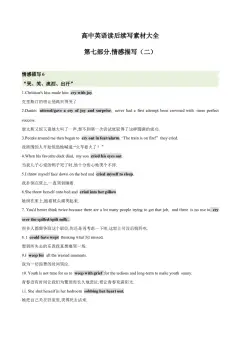
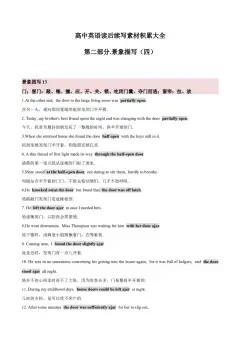
1. At that moment, the sunlight flooded* in
through the window, warming the whole
room. He had never felt so happy.
2. The golden sunlight flooded in Ada's room,
lighting her face as well as the future path
for her to follow to pursue the dream of a
medical career.
3. They hugged each other tightly, the warm
sunlight shining on them and the birds
singing in the sky.
4th1UL .,
4. Many years later, Abe still held this book.
He couldn't forget how his stepmother
loved him.
~~  (~] (
y
~7
{~
I J
,
~Y.. IN VJii~C
Y7
IJo
~L"1)E
5. On the top of the mountain, they are always
seen enjoying the sunrise and the sunset
together.
L> , )
r
tl
fig n H
J
H
O
6. Quietly, I slipped* my hands around Mom's
waist and gently pressed my face against her
chest. The rain pouring outside, I found myself
hugging my mother, tighter than ever.
1. In the evening, Dad came back. I proudly took
out my own money and htnrrier1 it to Dad.
2. Speechless* and happy, she held her son
tightly into her arms, with tears *welling
up in her eyes.
3. With my trembling hands, I opened the
envelope, inside which I found seven
dollars and a note . On the note there were
the words, "It's for your honesty."
4. In the meanwhile, the wolf might feel the
people' s threats around, so it began to step
back slowly. Soon, it ran away off the road
and disappeared in the distance .
rA7ar,
T
j1 A QA1f7
~ ,
Ffr ~ Jr
 Ja j o T :* ,
 i
T
«*„ b517;~ i c
;; «*„
( rte ) —i >o
1. He didn't intend to go home directly.
He had no intention of going home directly.
2. I will visit your school next month.
I will pay a visit to your school next month.
3. She decided not to see him again.
She made a decision not to see him again.
She ►Wade up her mind not to see him again.
4. I'm preparing for the mid-term exams.
I'm making preparations for the mid-term
exams.
5. We should contribute to making
campus more beautiful.
We should make contributions to making
our campus more beautiful.
6. She apologized to me yesterday.
She made a sincere* apology to me
yesterday.
7. Meanwhile, Sam saw a large rock and
shouted, "Tom! Try to get close to that
rock!"
Meanwhile, Sam caught sight of a large
rock and shouted, "Tom! Try to get close to
that rock!"
our
8. Please listen to your teacher carefully in
class.
Please pay attention to your teacher in class.
Th~2•
~
z,~%JTt~ artJio]
'
3
'1
~~TT
  i7 C
o
J
f'Euf
1.
u7'
T h J
, ,
~ p b 171Q c o
The three o'clock bell rang and I grabbed*
my book bag from my desk and shuffled*
out of the door for home.
2.
"&}~
y,~~y y{
,
y
`
y
,
y
„
L ±L. ih ,
1
1
o
"It's okay, Mom," I stammered* as I
reached out and gently touched her hair.
3. "
„
R
A C
,
"Get us out of here!" Tom screamed* to
Sam, "Let's go back!"
"*r
, fi, "*,,
80
b-
"l~).5" ico#EF#xis
I screamed* at her, "How dare you come to
my house and scare* my children!"
5.
T Ott
(
He dashed* in breathlessly.
6.
"I never said any of that to her," he
protested.
7. "~k -±IQ 1(, „
JIE
O
"I'll be back soon," she promised.
She began to sob* again, burying her face
in the pillow/her hands.
Ait
1. Immediately, they rushed him to hospital.
Immediately, he was rushed to a hospital.
2. Then, someone called in the police to stop
the fight.
Then, the police were called in to stop the
fight.
3. They planted millions of trees to stop the wind.
Millions of trees were planted to stop the wind.
4. There are many pictures on the wall.
The wall is covered with pictures.
5. They have planted many trees on each side
of the road.
Each side of the road is lined* with trees.
l~ here, there, out, in, up, down, now,
then, away
i~ iq}j
iJ fj be, come, go, run, walk, rush, fall, follow,
begin, end
iaSZ
i~
1 IJ
1. i7 9F 1
J
The door opened, in came our Enilish
teacher, followed by an ordinary-looking boy.
Then came my turn to make a presentation.
3.
Out of the darkness came a horrible
scream*.
4.
fW*
— '`J X7O
Out rushed his father, with a stick in his
hand.
5.
At the front door stood her parents, who
looked extremely anxious.
6.
~J 7
Early in the morninj came the news that
the missing boy was found.
T5. 1~531J
1.
A. "only + I)
" 41 '7
8
'7~ X13
Only when you smile at the world will the
world smile at you.
Only  when she was in such a helpless*
situation did she realize how much Tom
meant to her.
X717>C
₹ ~j
i - "*"
81
E:Z
( fry ) —i ce
B.
never, never before, not, no, little,
seldom, nowhere, hardly/ scarcely ... when, no
sooner ... than, not only ... but also, not until,
by no means ( ~7f ) , in no case, in no way,
in no time, no longer
A
"
1.
Never did she refer to the subject of singing
again.
2.
TC
A
a
UI
14T0
Never in my wildest dreams could I
imagine these people are living in such poor
conditions.
Never for a second did _I doubt that my
father would come to my rescue.
4.
Little did she care about her own safety,
though she was in great danger herself.
5. 'fth—)FI7,
1th
No sooner had he opened the door than the
cashier told him there was indeed one such
pair as he lost.
6.
Jfl J'J— b ,
TX
 OO
Hardly had we started out when it began to
rain heavily.
7.
  U JFr)I pq
~
~~
Not until he left his home did he bejin to
know how important the family was for him.
8. #trf T ffSC
T
, ~Il
rfrJ q
E
i0
Not only was she exhausted and hungry, but
she was also deeply regretful for her
unreasonable behaviors.
9.
P
1 'f
' 1±
O
In no time did she rush to the rock and
climb onto it.
1.
2.
3.
1.
C.
"... so... that..." KC "... such... that..."
so 0 such
LL
Bt
I
Ei_o
So friMhtened was he that he could not
speak for a long time.
During the exam, so nervous was I that my
mind went blank.
So ashamed* was she that she could feel
blood rush to her face.
D. as/though
I
inn
Afraid as he felt, he still knocked on the
door, waiting breathlessly.
2.
MI'J T~
)I U
T
So delicious was the fish that we ate it up in
no time.
Exhausted as/though he was, he still went
on with his work.
«*„
¢~
*,> 4~7ti~iC~~11Kf
o5~7iC
! %
1~0
82
"ice
"
 5-
I5
7
6.
1.   iJ'f
7 '* 'fthii
It was not until his wife came back that he
went to bed.
2.
It was her advice that made me a better
speaker and full of confidence.
3.
ILL only by working together that we can
achieve our goals.
")
" ~p " ;
j nA ",
  dap .
t J,
I
  5&~:
1. As soon as I saw the river, I remembered
my hometown.
The sight of the river reminds me of my
hometown.
2. I hadn't thought of the idea.
The thought hadn't crossed my mind.
3. He panicked when he heard the news.
4.
1
Z~ ,
~17
~~
It was because of your hard work that we
were able to finish the project on time.
5.
h ~ni i i'Ith T
I did come across him on our way home.
6. 1th1F
1
AO
He is the very man we have been looking
for.
7.
I have never seen a girl more beautiful
than Mary.
A wave of panic  swept over him when he
heard the news.
4. A policeman appeared suddenly, which
scared` the robber away.
The suddenly appearance of a policeman
scared the robber away.
5. He lacked experience, which put him at a
disadvantage.
Lack of experience
put
him
at
a
disadvantage.
6. He failed to pass the exam, making his
parents upset.
His failure to pass the exam made his
parents upset.
7. Seeing the picture, I couldn't help thinking
of the time we spent together.
83
lE:Z;
( ~frr~ ) —i~~ 5
The happy memories of the time we spent
together flooded* back when I saw the
picture.
8. They didn't find him after several minutes'
searching.
Several minutes of anxious searching
turned out to be in vain.
9. As we approached, we saw a sign, which
read: Administration Office.
As we approached, a sijmn came into sic/it,
which read: Administration Office.
10. George came up without hesitation and
asked if they were his, but they said "no".
George came up without hesitation and
asked if they were his, but there came a
disappointinj answer.
2.
~
A.
A
'I~
T7
7'~ , P
A A1'
1--1p,
1A
1
1
I 1JIt1
1.

fl ] ±1 WT~IO
They got to the summit on the fifth day.
The fifth day saw them at the summit.
2.
b i*O
She was choked* for words because of
despair*.
Despair choked her words.
1. The wind is getting stronger and stronger.
2. The Yangtze River is the third longest
river in the world.
K~SL
~ I'c~70
C.
Rio,
 ,
A
 O
1i:
The flowers danced in the gentle breeze*.
1. LA
HtiJ
see, find, witness
 1f 1. %q
'p7
'c~'
~1 I'~ tth
 o #tfl :
1949
A~
fah L10
1949 saw the founding of the People's
Republic of China.
The People's Republic of China was
founded in 1949.
1. The world history has seen more tears than
laughter.
2. The past five centuries witnessed great
development in Chinese drama.
5-
I5
lET
'J
O
3. Shanghai witnessed many great historical
events.
4. Dusk* saw him crying in the street.
5. Thus, the gathering dusk often finds me
hastening home in a hurrying crowd.
/`'NI
o
6. The recent two weeks witnessed our
sincere* communication in study, living,
sports and art, etc.
Txz~ i h~i TTT
Lo
7. That period of time saw his great changes.
8. The past four years has witnessed an
increase in production.
9. The recent decade has witnessed an
explosive growth in the number of teenage
users of social media.
1
0
10. Life had never brought them a gloomier*
hour.
JtliJ—
2. I:IJ`~h
~Jc
a
1. Then came Miss Walker's voice.
2. Whispers* filled the classroom immediately.
3. A storm of applause* broke out in the
classroom.
4. Her  face lit up/brightened when I gave her
the
present.
,1

L 7
Xh 17
± /Jc
GB J J
 a
5. Laughter lingered* around the room.
6. When he saw the familiar handwriting,
tears welled* up in his eyes.
7. Another sound from me might make the
snake strike.
8. Shouts of protest sprang* up from the angry
crowd.
9. His words sent me a quiver* through my
body.
3.
A JP)L J
Of %
sight, thought, glance*,
look, idea, feeling
o
fj
is pJ J
T~
pJ 1'c''h ~xtigaJ>'J:
I was filled with horror* because of the
sight of the scene.
1. The sight of the scene filled me with horror.
2. The thought of his failure in the first exam
gave him the strength to strive.
3. The thought of your departure* for home
pains us.
4
Pi4QI 1, ~k417%,~cT~Lx a
4. The thought of seeing her son very soon
filled her heart with great happiness.
1i
o
5. The idea of going abroad makes me thrilled.
U
'
2 1
O
6. The thought of this conquered* my fear and
anxiety.
U
11: ,
tU
U
JO
HI 1
A
T
Jl t
o
1. Panic seized* her.
2. A great sense of relief  flooded* over him.
3. Fear slowly creeps* up on her.
4. Fear gripped* the village.
5. A chill* of horror* suddenly swept over him.
6. The terrible scene filled him with fear.
7. Anxiety tore her into pieces.
$&L
Vii, t± W
o
8. Despair* seized* him at the thought of his
failing the exam again.
9. Anger and bitterness* had preyed upon me
continually for weeks.
B.
~
i
jur, ~GTc
iA
'3c}'J
. L-I
.7
 Via o
T fl
J'AJ 1 'c''h1
ia "u77J :
She was choked* because of despair*.
1. Despair choked her words.
2. Astonishment* deprived* ({ 1
me of
my power of speech.
:it
J4  T
JO
3. His confidence suddenly deserted
1
) him when he had to speak.
4. Courage deserted him.
1
 1
7 1 is a
A:
His name failed me.
—~I couldn't think of his name then.
1. His name escaped me at the moment.
2.
Hiiss
name slipped* my mind.
TJCi 1 :n J
IU 4JJ~1
0
3. Words fail me when I try to express my
heartfelt gratitude.
4. The days will never fade from my memory.
Q
7~CTl~~1c 1 iz'hz~*
5. A good idea occurred to/struck/ hit him.
86
f#MI5
6. A terrible thought suddenly struck me.
7. The experience/lesson will take root in my
mind.
~xf~II i
J
 o
;j
L~
~J J" ( reverse psychological verb) '
amaze ( if 'Ii 'rq ) ; annoy (
ti i
) ;
astonish ( f t i ) ; bore (
ffc
) ; delight
(1
 ) ; disappoint (1~ ~c
) ; frighten*
( {~ t
) ; satisfy (1
) ; shock* ( {
1. Your letter has amazed me.
tiJJ4A ( ~k
►J'~.j:
2. What he said surprised us.
3. That answer didn't satisfy us.
4. His sudden arrival delighted us greatly.
7. I:l Ofo]AJ J1 1~~7Jf
®
1'~
1. Pollution killed the fish in the river.
2. His wealth enables him to do anything.
3. Bad weather prevented us from starting.
)
&~1 ,
4cI)E
a
4. The rain prevented tourists from enjoying
the full moon.
s. l l
J~J
~'~Tz
Ah~i~71'~
Tc~ta`~Jg
r]
4~Try
o
A.
1. My first day  at the new school made me the
laughingstock of the classroom.
2. A few moments brought them to a cottage
door, at which the owner knocked.
/
`
.I
p
I l
O
B.
A few steps across the lawn brought me to a
large, splendid* hotel.
C.
TJ1`~T77~~~~ti71'~~c
io
1. His acceptance of bribes led to his arrest.
2. His help will ensure my success.
3. His quick adaptation to the study life
overseas removed his parents' worry.
4. That moment's stop cost the U.S. team its
lead.
"*„ 45~7;Ci
~j
fi "* 45i7;Ci
~]s.
( rte )
__i c _
5. The introduction of the new equipment in
the factory has led to a steady* increase in
production.
6. Too much reliance on mouse clicking
makes us lazier both mentally and physically.
1. Constant* dropping wears a stone.
2. Reading
supplies
him
with
endless
entertainment.
1
E t: o
1. Sickness robbed her of the confidence in
accomplishing the task.
2. His absence of mind during the driving
nearly caused an accident.
1th' T L
)LLB 1
O
3. My absence from your activity makes me
regretful these days.
jJA
41 ]`J
J
~1c~
T~l a'I
4. The availability to cellphones on campus
will distract our attention from study.
5. His carelessness cost him the first place in
the test.
F.
%oe$ti7
1. A few drinks loosened his tongue.
JL WF~t, 1~h
 1 T)f T O
2. Further experiments brought us some
exciting results.
1. Night approaching, darkness ruled the
forest.
2. Smile crumpled his face.
3. The thick fog blanketed the field.
4. Dead* silence suddenly fell.
a~A—Fr
O
5. Eagerness to match you has always been
haunting us.
6. By now optimism had given way to doubt.
When I was young, I was shy. At 14
years old, it was my turn to give a
presentation in class. Seeing so many
classmates, I was fearful. Although having
well prepared, I suddenly lost my courage. I
forgot all the words absolutely*. After class,
my teacher encouraged me to be courageous
and not to hide away. From then on, I
became more confident instead of being shy,
and I would remember the experience
forever.
q
7N.
1.
Shyness took over my life when I was
young. At 14 years old, it was my turn to
give a presentation in class. The sight of so
many classmates filled me with fear. My
courage deserted me suddenly despite full
preparations. All the words slipped* in
The young mother saw her baby fall to the
ground, which brought her heart to her
mouth.
/ FO
The flowers, which were planted last spring,
are now in full bloom*.
3.
,
?Ei1
1
0
The dog, which was wagging its tail happily,
greeted us at the door.
The teacher, who taught me Chinese in
junior high school, inspired me to pursue
my passion for writing.
5.
~
1~~~
F
k1, 1 f7~~
The flowers, which were picked* from the
garden, filled the room with a sweet
fragrance*.
mind absolutely*. After class, my teacher
encouraged me to be courageous and not to
hide away. From then on, my shyness gave
way to my courage and the experience
would take root in my mind forever.
He won the first prize in the writing
competition, which was beyond his wildest
dream.
7.
X~*
— Q JthZ1',
Scene after scene, where Mum worked day
in and day out and the whole family
struggled to make* ends meet, came
flooding* in my mind.
2.
1.
It suddenly occurred to me that she might
be lying.
2.
h117tih fit-%
Harry doesn't have the slightest idea what
they are talking about.
3. ~c
c
~
It suddenly dawned* on me that I had
caught the wrong bus.
`.*„ a5i


4. "*„
89
( fn )
4._w,
The thought that we might have got lost in
down my spine
7.
Father made a promise that if I passed the
exam he would buy me a bike.
IV`rJ\Ut), 4
th )TI
After what seems like hours, he left,
such darkness sent shivers
(u)
.
disappointed.
8. 1
1 U1O
What a different man he is from what he
It struck me that I might use the pocket
was four years ago.
money to buy some
mother's birthday.
flowers for my
9.
#~cr1~7~~~E~o
The city is no longer what it used to be.
6.
10.
h
I don't believe whatever he says now. He is
a cheat.
mfi ±
rn ir i i-i-.i ~
I,J IJ Rx 1J
1 J 3* i t
I.~. Q O f T
%J
4' U ,
~'JiJ
h1
0 ,a
1.
t
DJ
o
J
o
George, calm on the outside but nervous
inside, re-entered the store.
You see, when you were very little, you got
into a terrible accident, as a result of which
you lost one of your precious eyes.
3.
  fJ3F
With delight that had been absent for
months,
we
started
to
decorate
the
Christmas tree with the things we bought
from the supermarket.
4. #tL
~h~'c
Jl7l~, ~kT7
,
Overwhelmed* with intense* anger at her
sudden appearance in my doorway, I cast
her
an
angry
glance*,
ignored
her
pleading* look and uttered* no word.
5. ] J
O
Arefreshing* breeze* is blowing gently.
2.
1 tL
®1%Jf10±1 tf I5J
1.
Then my mother did something completely
unexpected.
2.  11J
~~J
f
`J1~cUt
o
We are particularly grateful to him for his
timely* help.
3.
He is hopelessly* addicted to video games.
4.
He{/
took ~the criticism surprisingly well.
5•
I I
GNX I
~~
IC71IJ~~
o
Everything has become unbelievably hard.
1.
i~7
itt*,
E
0
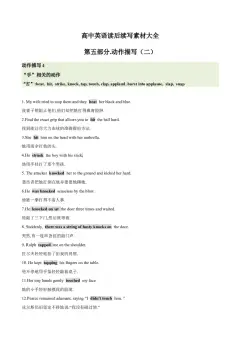
The man expressed gratitude, collected his
suitcase, and headed towards his car.
2. 1th
1
K,
±LA
~-L J
Z o
, Its ~
p 1 f 7 0
Feeling very nervous, he stood before the
door, wondering how the old man would
react. At last, he gathered all his courage
and knocked on the door.
3.
h1t~JEJtLh,
We  fell hard to the ground, and my gift box
flew from my hands and landed on the
ground with a thump*.
J
4.
gt
tffl
tJ
With his head bowed*, John reluctantly*
turned around, and slowly inched his way to
his room.
2.
11iJ J
Timidly*, the boy stretched out his hands
and put them into the old man's hand.
A
Rose coldly nodded and went back to
checking name tags.
4. "14t
?
7 ~ ? „ " T , T ,
"What do you mean? Is it late?" "No. it
isn't late," he said defensively.
5.
C
~
~o
I've completely forgotten her name.
6. ~k
ttpfr ~J~ l`~tQ~l~ko
I distinctly* heard someone calling me.
5.
*1 t
J%J
1. 1 p
pQ
7Ji~3~'
t
i
'~' ~
o
In a sobbing* voice, he admitted and
regretted having cheated in the test.
As soon as he spoke in his magnetic* voice,
heads turned towards him in admiration and
curiosity.
3. W f Wh17 ,
T ^ fl
tX , R
Ith
ii
a
91
He gave money to the homeless man out of
pity, even though he knew it wouldn't solve
his long-term problems.
4.
iJ ~,
  1 ~Cs~fr l
O
After the reunion, I went to the old house
just out of curiosity.
5.   T~Q
~
Q'
rtu
#4
My chin trembled with a mixture of
heartbreak and anger.
6.
h
flJhu~Z~ Q
He sighed* with disappointment.
He lay there for a long time, shivering
with fear.
Some students looked at each other with
expressions of surprise.
9. "~k
4 ?
"How much do I owe you?" "Nothing," she
replied with a warm smile.
10.
U pfrT
-
They listened to the story with great
interest.
?
6.
*
*t
with
J
o fa
Without hesitation, I elbowed* my way
through the crowd in the direction of Lego
section* and kept calling my brother's name,
a note* of uneasiness in my voice.
2.
"
`1,
"Yes, that's it!" he whispered* to himself,
his lips curving* into a beaming* smile.
1t 1, T) 4ZJJ, H~~
1
7J(,
J;
4o
"It isn't fair! Why did that happen?" He
cried, his lower lip trembling, his eves
filled with tears and his hands shaking.
4. ~'~l`TJS~'r tan
J~f fll
U fl
JNY,
h
t
4t o
Some could hardly wait to tell their
seatmates about their holiday trips, eves
alining and faces glowing* with joy.
5. U
it
B
E T T )1 , #tL
iq
Tears trickling* down her cheeks, she
murmured* ,
"How come such an
important moment slipped* from my
memory?"
"For me?" asked the man, confusion
registering on his face.
7. "i iU~, "  l`i , U~
fi 1 X71(O
"Thank you," uttered* the old man, his
eves red-rimmed* with tears.
8.
1MO
With tears streaming* down her face, she
thanked him again and again.
"i*>o!
" _#MI5
With his chin in his cupped hand, he sat
there motionlessly, all his mind on where
to spend the long-expected holiday.
She sank* in the chair near my bed with
sorrow and regret, her head bowing* over
her arms and her body shaking with sob*.
Eyes lingering* on the figurine, the man's
face softened, and, much to the boy's
astonishment*, it creased into a faint*
smile.
12.
,
L~~~'c
~l~j]
o
She ran in my direction, her long hair
flowing in the breeze*.
The old couple took a walk after supper in
the park, their pet dog following them.
14.
  111
attth±,
4
o
The old sick goat lay on the ground, its eyes
closed and its legs trembling.
1~*o
She stared at him with tears welling* up in
her ej,e.s.
16.
*
~ t J
,
%
]O O
He turned away embarrassed, his face
flushing* red.
His mind went blank, his face burning with
embarrassment.
1.
Tom looked at Jenny, eyes full of tears, and
shouted the words hidden in his heart for
years.
~th1il%  Te
o
With all the things bought, they headed for
the nursing home.
With the boy leading the way, we had no
trouble
finding
the
way
leading
to
Zhongshan Park.
7.
(
bo ) 1 ir1]t1
pTlJ1Io
Anxiously straining* my eyes, I scanned*
the toy store, but he was nowhere to be
found.
Feeling a lump* in the throat, I clapped*
my hands even more loudly.
3.
1t fl
' IRT~T~T7p7~~
He held his breath, n•yi,r
not to make the
slightest noise that might betray ( lB
;
fiL
) his presence.
4.
Gasping* with pain, he forced himself to
his feet and with slow, shaky steps, began to
walk.
s.
Y
O
She sobbed*, burying her face in her hands.
«*„
93
(W~ ) —ice 5
6. 1~xL
E 1,
A 1
_
His parents went to work, leaving him alone
at home.
The next morning, he woke up only to find
himself lying in hospital.
8.
JLJj,
h4t
JL
Tom took a taxi to the airport, only to find
his plane high up in the sky.
9.  1iJ'Ji~thTTThIT
We were astonished* to find our baggage
was gone.
iJ,
►J
Dressed in a Santa Claus costume, she
slipped* into the room without being
noticed.

th LT1
7k o
Scolded* by the teacher unfairly, he burst
into bitter* tears.
12
7
#t faJx4-
~~iXo
Faced with/Facing such a challenging
problem, she sought advice from her
parents.
Having wandered* aimlessly in the street
for hours, she felt a little hungry and wished
for something to eat.
14.
~zfh T

U ,
Having experienced so many failures one
after another, she decided to try again.
?
8.
J11E 4
q,
Tt
L17J
~1no
w J Te
o
1.
Depressed* and exhausted, he burst into
tears.
2. #t
#
tl{J
R
* T 4% ,
Curious to know what was happening
inside, she gently pushed the door open and
slipped* into the house quietly.
3.
Q alfi~`Jrp7
J
z
Unable to answer the teacher's question,
he felt his face burning with embarrassment.
Lost in thought, he nearly knocked into a
car.
5.
Afraid of being scolded*, he was afraid to
go to school.
6.
i'
h pJr
, * iR J 1~ 47 ~ iJ t~ i'
They listened in silence, aware that any
attempt to calm her down would only make
her angrier.
7.
h T LU] , ~prwip ~₹,
C M OE
He finally made it to the top of the
mountain, breathless and thrilled.
8.
T~1
~~~
,
W
—
'Y'J T,
iVTJ
T , .'~L1
«*„
. '*,>
Lost in the forest, she lay under a tree,
seized* with fear and despair*.
Jack paced* up and down in his room, deep
in thought.
They agreed never to quarrel again,
determined to live the life to the fullest.
I turned over and faced her, ready to let her
see the anger and disappointment in my
eyes.
12.~k)~JtL~#
z,
I shook my head helplessly*, unsure of
what to do or say.
13.
1
„
yu
j
7
~L'i J
J —~
y,
o
"I have a flat tire but don't have a spare," I
psifl 1 ~1
said, relieved* to see him.
Overwhelmed* with anxiety, I was on the
verge* of tears and stood rooted in darkness,
hopeless* and helpless*.
1.
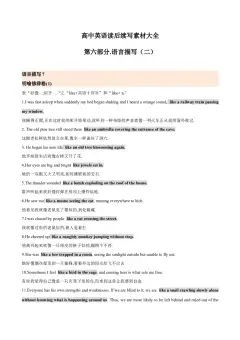
1. HO (Simile)
"Like"
~
Losing this favorite possession was almost
4. After he heard this news, he is like a cat on
hot bricks (
) .
~ pff ►J ~
f
.~, ; c Q
,E J4
like losing a child to him.
4 / J `yam o
1. The little girl is as timid* as a hare, shy in
2. I tried to find my lost key on the sandy
beach, but it was like trying to find a needle
the presence of strangers.
in a haystack.
2. The snow was as thick as a blanket.
3. Life is like riding a bicycle. To keep your
3. I'm as poor as a church mouse.
balance, you must keep moving.
YV1LLl
~.N'J
C
—
w
o
T~lfaJ~oo
,
(~fr~ ) —i >o- 5
4. The country, covered with cherry tree
flowers, looks as though it is covered with
pink snow.
5. I couldn't move my legs. It was as if they
were stuck to the floor.
4~ J o
6. Diagnosed with cancer, he felt as if the
world was at an end.
~
T
Q
~J 1
"What"
~
1. Reading s to the mind what food is to the
body.
(AistoBwhatCistoD"AFB
1(p f J C Z 1 D")
2. Water is to fish what air is to man.
"Than" ~
1. A home without love is no more than a
body without a soul.
—~~
~`J
fih
—^~~
'J
fro
2. Spending too much time with him is worse
than swimming in a sea of sharks.
o
2. Ba D ( Metaphor )
f
o
$1$j
( A is B )
1. Time is money.
2. The man's face is a
map
o
f
f time.
3. Laughter is the best medicine.
1. He doesn't have any idea of his own. He
just parrots what other people say.
2. I'm drowning in a sea of grief*.
3. You light up my life.
4. The clouds sailed across the sky.
5. His impatience to get started was written on
his face.
Jf e i i
The mountainous waves swallowed* the ship.
of~%o~
1. She's going through a roller coaster of
emotions.
t
5
'tW
J'`' (~ o
2. The immense* square was a sea of flowers.
A ( Personification )
1. The stars danced playfully in the moonlit sky.
96
" i ~-
"
 15
2. The moon winked* at me through the clouds
above.
3. The moon played hide and seek with the
clouds.
4. The sky was full of dancing stars.
~u
I~7x, ~1`1
0
5. The first rays of morning tiptoed* through
the meadow.
6. The flowers danced in the gentle breeze*.
7. The candle flame danced in the dark.
8. The sunflowers nodded in the wind.
9. The breeze* gently kissed her cheeks.
10. The flowers were blooming*, and the bees
kissed them every now and then.
11. Snow had wrapped a white blanket over the city.
~1
To
12. The wind screamed* as it raced around the
house.
LH
13. The wind whispered* softly in the night.
14. Trees bowed* to the ground.
JJ
O
15. The Saturday afternoon  Hera by and before
we knew it, it was over.
i.~l'1~f K
rfrJ'
4~ ATl %ti C~a 1
16. My stomach* was punishing me for not
eating on time.
17. Then, opportunity knocked on the door.
18. The mist swallowed* him up soon.
T~ h
Ah
1
19. What kept us company was the chill* wind
that ruthlessly whipped my face, gradually
devouring the last bit of the remaining hope
in my heart.
fl ,
ft
1
J —
K ( Exaggeration )
1. They turned into an endless street.
2. I was so hungry that I could eat a horse.
3. He was so sad that he was drowning in tears.
4. I'm dying* for a cup of tea.
5. She takes ages to make up in the mornings.
6. I've told you a million times.
7. What a shame*! He has been waiting for
this day for ages.
8. I almost laughed my head off.
9. She cried her eyes out.
O
( Wig ) —ice ;
10. It brought her heart into her mouth.
5.
~
( Double negation)
1. I never went by her house without waving or
stopping to chat if I saw her outside.
2. She never goes anywhere without her laptop
computer.
«* ;
"*" 4517>C ~~]Fit
x'4`117>C ~ i>
.
~. rn
, "i J
" z %
*a
 *
( fir
n
Q I
p ff n
Q II I" i~
iaj ) o T
2023  F 6

A
1•
(2016.10 'r'#fr t
)
One weekend in July, Jane and her husband, Tom, had driven three hours to camp overnight by
a lake in the forest. Unfortunately, on the way an unpleasant subject came up and they started to
quarrel. By the time they reached the lake, Jane was so angry that she said to Tom. "I'm going to
find a better spot* for us to camp," and walked away.
With no path to follow, Jane just walked on for quite a long time. After she had climbed to a
high place, she turned around, hoping to see the lake. To her surprise, she saw nothing but forest
and, far beyond, a snowcapped mountain top. She suddenly realized that she was lost.
"Tom!" she cried. "Help!"
No reply. If only she had not left her mobile phone in that bag with Toni . Jane kept moving,
but the farther she walked, the more confused she became. As night was beginning to tall, Jane
was so tired that she had to stop for the night. Lying awake in the dark, Jane wanted very much to
be with Tom and her family. She wanted to hold him and tell him how much she loved him.
Jane rose at the break of day, hungry and thirsty. She could hear water trickling* (III'/ )
somewhere at a distance*. Quickly she  followed the sound to a stream*. To her great joy, she also
saw some berry bushes. She drank and ate a few berries. Never in her life had she tasted anything
better. Feeling stronger now, Jane began to walk along the stream and hope it would lead her to the
taIre.
As she picked' her way carefully along the stream*, Jane heard a helicopter. Is that for me?
Unfortunately, the trees made it impossible for people to see her from above. A few minutes later,
another helicopter flew overhead. Jane took off her yellow blouse, thinking that she should go to an
open area and flag them if they came back again.
1. ~rT
k Ji~~ C ZYj 150
;
lE
z
(~fr~ )
2.
5
 T
J~A ;
3.
~} i`~ ~JfJ
,
~'J~F
iA ~,fJ'GJ~
# ;
4.
h1R,
Paragraph 1:
But no more helicopters came and it was getting dark again.
Paragraph 2:
It was daybreak when Jane woke up.
  Jane
I
15
Tom

A , a

  L Jane
r ~ ffll *
,
B.
/h/.-
IL
But no more helicopters came and it was getting dark again. + OO
~
~
'(~ (
~71 i
+©f
(
 ) + ®A,•:
It was daybreak when Jane woke up. + ©fl
t
I }J (

faJ J
3- ) +©
( 7
) + ©J
Tom,
7
W (
J
,
~1~L~, If~7'C~' II$I
t LE
)
L~_XjI Jl
r
But no more helicopters came and it was getting dark again. © Looking through the thick
darkness, she felt a strong sense of regret and scare surging" through her body. "If only I had
not quarreled with Tom," she thought to herself regretfully. © "They're sure to come again
tomorrow. I have to guide them." Gathering up her courage and stumbling* in the darkness, she
managed to find a shelter* and lay down. ©Shortly after, she barely kept her eyes open and fell
asleep, sweetly dreaming of seeing Tom.
It was daybreak when Jane woke up. ©Feeling starved to death, she managed to find some
berries to comfort* her growling* stomach*. Then she set out* and found an open area. © When
the helicopter came, Jane waved her yellow blouse violently, her heart thumping* wildly.
Fortunately, the helicopter caught sight of her and she was saved eventually. © When she saw
Tom again, they hugged each other tightly, tears of regret welling* up in their eyes. It was that
moment that they decided they would never quarrel again. (156 i J)
100
2.
(2017.6 - i5I
)
I5~J1T~W1~
'"lx
S~YJ~Fl
p~~giX1A
1q
—Y
7
fX~
15Cc 1'"J/~X~7G
C1JF~~~
On a bright, warm July afternoon, Mac Hollan, a primary school teacher, was cycling from his
home to Alaska with his friends. One of his friends had stopped to make a bicycle repair, but they
had encouraged Mac to carry on, and they would catch up with him soon. As Mac pedaled* (' p7 f7)
along alone, he thought fondly of his wife and two young daughters at home. He hoped to show
them this beautiful place someday.
Then Mac heard quick and loud breathing behind him. "Man ( "*AQ" ,
'~5 ), that's a
big dog!" he thought. But when he looked to the side, he saw rristantly* that it wasn't a dog at all,
but a wolf, quickly catching up with him.
Mac's heart jumped. He found out his can O
of bear spray. With one hand on the bars, he
fired the spray* at the wolf. A bright red cloud enveloped ii a animal, and to Mac's relief , it fell
back, shaking its head. But a minute later, it was by his side again. Then it attacker the back of
Mac's bike, tearing* open his tent bag. He fired at the wolf a second time, and again, it fell back
only to quickly restart the chase (I f ).
Mac was pedaling* hard now. He waved and yelled* at passing cars, but was careful not to
slow down. He saw a steep uphill climb before him. He knew that once he hit the hill, he'd be
easily caught up and the wolf's teeth would be tearing* into his flesh.
At this moment, Paul and Becky were driving their car on their way to Alaska. They didn't
think* much of it when they saw two cyclists repairing their bike on the side of the road. A bit later,
they spotted* what they, too, assumed was a dog running alongside a man on a bike. As they got
closer, they realized that the dog was a wolf. Mac heard a large vehicle behind him. He pulled* in
front of it as the wolf was catching up fast, just a dozen yards away now.
E, :
1.
150
;
2.   k!f 5 ^
~ T~ T

J ;
3.
f1 7
x'
Tf
ia
4.
T1
T
(
Jigo
Paragraph 1:
The car abruptly* stopped in front of him.
Paragraph 2:
A few minutes later, the other two cyclists arrived.
«*,>
 ; . «*„
101
n~9~ia1'E:Z7
( hr~ )
A. it b ~f J
~7 ,
o ~ ff ,
:z
«
B „
X
Mac *af ~Atx~
ar~t
a7 ,l
±,
~T ~4~~
T►
O 4~4f JiJ1 Mac
Mac
cif i±*J,
B.
"tea " ,
 "M
"
The car abruptly stopped in front of him. + OO Mac
EL  (

mix 3) +©
I
~F ('
) + OO ~ ~IJ '~~T~ a
(
-
J u~
5~ , ~T
J
'7 ± )
t
A few minutes later, the other two cyclists arrived. + ©1J

+Q2
( f~J r`
~ ) + ©
ij
r•
i
The car abruptly* stopped in front of him. O Suddenly, a door opened and out held a woman's
hand. "Get in!" shouted the woman anxiously. Mac gabbed* her hand without hesitation, jumped
into the car and slammed* the door closed quickly. O The wolf walked around the car, howling*
furiously* at them, but just in vain. Realizing there was little chance that it could catch Mac, the
wolf reluctantly* gave up and walked away disappointedly. ©Watching the wolf disappearing in
the distance*, Mac, soaked in sweat, gave a sigh* of relief, sinking* into his seat.
A few minutes later, the other two cyclists arrived. OO Seeing Mac still shivering* with a pale
face, they wondered what had happened in confusion. Hearing the horrifying story, they  felt a,
shudder run through their veins. OO Though scared* themselves, they couldn't resist the
temptation* of the picturesque (adj. j j J, )XI
 fl
J) landscape of Alaska, so they made up
their minds to continue their trip. O After expressing their sincere* gratitude to Paul and Becky,
and waving good-bye until their car disappear in the distance*, the three friends got on their bikes
and pedaled* on. (165 iJ )
3•
(2017.11 1fi I
)
A Vacation with My Mother
I had an interesting childhood: It i'as filled with surprise and amusements, all because of my
102
fi «*~
Q~. «*>, b5~7;C~n~tt
~h~5i7C
~h
i %
o
mother—loving, sweet, and yet absent-minded* and forgetful. One strange family trip we took
when I was eleven tells a lot about her.
My two sets of grandparents lived in Colorado and North Dakota, and my parents decided to
spend a few weeks driving to those states and seeing all the sights along the way. As the first day
of our trip approached, David, my eight-year-old brother, and I unwillingly said good-bye to all of
our friends. Who knew if we'd ever seen them again? Finally, the moment of our departure*
arrived, and we loaded suitcases, books, games, camping equipment, and a tent into the car and
bravely drove off. We bravely drove off again two hours later after we'd returned home to get the
purse and traveler's checks Mom had forgotten.
David and I were always a little nervous when using gas station bathrooms if Mom was
driving while Dad slept: "You stand outside the door and play lookout(h~CF1 ) while I go, and I'll
stand outside the door and play lookout while you go." I had terrible pictures in my mind: "Honey,
where are the kids?" "What?! Oh, Gosh... I thought they were being awfully quiet." We were never
actually left behind in a strange city, but we weren't about to take* any chances
take< a
chance).
On the fourth or fifth night, we had trouble finding a hotel with a vacancy (i'(1.). After
driving in vain for some time, Mom suddenly got a great idea: Why didn't we find a house with a
likely-looking backyard and ask if we could set up atent there? David and I became nervous. To
our great relief`, Dad turned down the idea. Mom never could understand our objections O . 1). If
a strange family showed up on her front doorsteps, Mom would have been delighted. She thinks
everyone in the world is as nice as she is. We finally found a vacancy in the next town.
1.
150
;
2.
5
l` iJ ;
4.
Paragraph 1:
The next day we remembered the brand-new tent we had brought with us.
Paragraph 2:
We drove through several states and saw lots of great sights along the way.
%1/
( rte ) —i
_ c

"loving, sweet, absent-minded* and forgetful"o
-~
" a " ,

"M
„
The next day we remembered the brand-new tent we had brought with us. + OO ~k f17
C—
^

(
) + O#c T WJ --'` thh ,
#~
p
~ F
'J f )
We drove through several states and saw lots of great sights along the way. +
The next day we remembered the brand-new tent we had brought with us. Mom insisted that
we should make full use of it since we had brought it. Picturing the starry night, refreshing*
breeze*, we couldn't contain* our excitement and agreed enthusiastically*. Before night fell, we
found an appropriate* spot* for camping near a lake. Dad went to the car to  fetch the tent, but he
couldn't find it anywhere. All of a sudden, Mom let out a cry of surprise. "Oh, gosh! I left the tent
in the hotel!" Frustrated* as we were, we headed back to take it with great patience.
We drove through several states and saw lots of great sights along the way. Eventually*, we
arrived at my grandparents' home safely, no one lost on the trip, for which David and I felt
extremely lucky and relieved*. After dinner, Mom opened the suitcase eagerly, intending to take
out the carefully selected gifts to present them to Grandparents. "Oh, no!" She cried out loudly, her
mouth hanging open. Seeing this, we all burst out laughing, realizing what had happened. It was
my loving and absent-minded* mom that made this journey more enjoyable*. (168 iJ)
4.
)1,3
3, (2018.6 h I
)
*~
JtCJ
p~fr~x~F
iA
l 7x, (z1h
—
J3xo
It was summer, and my dad wanted to treat me to a vacation like never before. He decided to
take me on a trip to the Wild West.
«.r
4. a* n
104
We took a plane to Albuquerque, a big city in the state of New Mexico. We reached
Albuquerque in the late afternoon. Uncle Paul, my dad's friend, picked* us up from the airport and
drove us up to his farm in Pecos.
His wife Tina cooked us a delicious dinner and we got to know his sons Ryan and Kyle. My
dad and I spent the night in the guestroom of the farm house listening to the frogs and water rolling
down the river nearby. Very early in the morning, Uncle Paul woke us up to have breakfast. "The
day starts at dawn * on my farm," he said. After breakfast, I went to help Aunt Tina feed the
chickens, while my dad went with Uncle Paul to take the sheep out to graze* (F
). I was
impressed to see my dad and Uncle Paul riding horses. They looked really cool.
In the afternoon, I asked Uncle Paul if I could take a horse ride, and he said yes, as long as my
dad went with me. I wasn't going to take a horse ride by myself anyway*. So, my dad and I put on
our new cowboy hats, got on our horses, and headed slowly towards the mountains. "Don't be late
for supper," Uncle Paul cried, "and keep to the track* so that you don't get lost!" "OK!" my dad
cried back. After a while Uncle Paul and his farm house were out of sight. It was so peaceful and
quiet and the colors of the brown rocks, the deep green pine trees, and the late afternoon sun mixed
to create a magic scene. It looked like a beautiful woven (
 I J) blanket spread out upon the
ground just for us.
1.
150
;
2.   J
Ffl 5
T
Jl. i~J ;
3.
4~1~ #t ;
4.
T
Jiao
Paragraph 1:
Suddenly a little rabbit jumped out in front of my horse.
Paragraph 2:
We had no idea where we were and it was getting dark.
B.
"fie",
Suddenly a little rabbit jumped out in front of my horse. + OO
T ~I?JI (
J t
I3
)
+O
i
-
('ter#
3) + OO
~,` ( M-
 ,
F
1 x '7 LIl )
«*„ 4!717>C 1 G
~7
~. «*„
j
1O5
( rte ) —i
_
/
IL
We had no idea where we were and it was getting dark. + © ~
+ (
 AJ
Suddenly a little rabbit jumped out in front of my horse. @Startled* by our unexpected arrival,
it ran away like mad*, disappearing in the forest in a flash*. ©Having never seen such a cute
reature, I begged Dad to ride in the direction where the rabbit fled*, and Dad agreed reluctantly*.
O Before we knew it, we were miles away into the mountain, having lost track* of the rabbit and
of course, the track Uncle Paul had asked us to keep to. But we just kept riding along,  feasting* our
eyes on the beautiful scenery around.
We had no idea where we were and it was getting dark. ©We got stuck in the forest. And an
unexpected shower added to the difficulty of us finding a way home, for all the tracks* we had
made disappeared because of the rain. OI was almost on the edge* of breaking down when my
father proposed we find the river first, along which we could find the farm house easily.
®Fortunately, we found the river soon and got back to my uncle's house successfully, where the
whole family were waiting for us impatiently at the table. ( 169 iiJ )
s. IJ\ A
c t
,
95J1
1 (2020.1 ' 15I )
1~ik F~
ft ~7 ap~fr~Ax
ia
~zPubC~i
`IX~
"I'm going to miss you so much, Poppy," said the tall, thin teenager. He bent* down to hug his
old friend goodbye. He stood up, hugged his parents, and smiled, trying not to let his emotions ('t*
) gets the better of him.
His parents were not quite able to keep theirs under control. They had driven their son several
hours out of town to the university where he would soon be living and studying. It was time to say
goodbye for now at least. The family hugged and smiled through misty eyes and then laughed.
The boy lifted the last bag onto his shoulder, and  flashed* a bright smile. "I guess this is it,"
he said. "I'll see you back home in a month, okay?" His parents nodded, and they watched as he
walked out of sight into the crowds of hundreds of students and parents. The boy's mother turned
to the dog, "Okay, Poppy, time to go back home."
106
The house seemed quiet as a tomb without the boy living there. All that week, Poppy didn't
seem interested in her dinner, her favorite toy, or even in her daily walk. Her owners were sad too,
but they knew their son would be back to visit. Poppy didn't.
They offered the dog some of her favorite peanut butter treats. They even let her sit on the sofa,
but the old girl just wasn't her usual cheerful self Her owners started to get worried. "What should
we do to cheer Poppy up?" asked Dad. "We've tried everything."
"I have an idea, but it might be a little crazy," smiled Mom. "Without anybody left in the house
but us, this place could use a bit of fun. Let's get a little dog for Poppy."
It didn't take long before they walked through the front door carrying a big box. Poppy
welcomed them home as usual but when she saw the box, she stopped. She put her nose on it. Her
tail began wagging ( rJ) ever so slowly, then faster as she caught the smell.
1.
&bZYJ 150
;
2.
5
 T
iKJ
;
4.
h~, iITJ
r GJ~~fr~J7~
i7iA
Paragraph 1:
Dad opened the box and a sweet little dog appeared.
Paragraph 2:
A few weeks later, the boy arrived home from university.
Poppy
,
:•
4th
X~ c X4±~G
T~

o
 Poppy
1
'j JI
,
k to IL
A ^
11k k
*O
1T
: Poppy

1~ Ju~W*R ,
j4
0
5
Z:
Dad opened the box and a sweet little dog appeared. + OO Poppy
  /i i (

+O0 ICJ„'aJ'rR'~Rri
~T (47
) + OO V7/A`RJ
►c
3%~~Tr
107
077 t
101
( zTn
)
l lo
A few weeks later, the boy arrived home from university. + OO WI1 Poppy
1~
j
(
S~)+O
►1 ~
j
('fir
5~)+OhpLl
,
JrR
Dad opened the box and a sweet little dog appeared. O Covered with bushy ('
) brown
hair, it looked from here to there, eyes sparkling* with curiosity and a little uneasiness (
c, 4fiJ
5k). Poppy cast a dance* at it with excitement, and then moved her eyes away, as if remembering
something. ©As there was no other thing that could arouse her interest, Poppy  forced herself to
play with the newcomer. O Several days slipped* by and a firm bond slowly developed between
them. They were often seen playing toys and exploring the community together.
A few weeks later, the boy arrived home from university. O For several weeks he had been
picturing Poppy's lonely and miserable life and excitement upon seeing him. Entering the house,
however, he was surprised—playing so cheerfully on the floor were no other than his Poppy and
another dog, completely absorbed in their happy world! OO Instantly*, moments of loneliness in the
university  flashed* across his mind. OO "I should also learn to get along with others and adapt to
new environment, just like them," he murmured*. (156 iiJ)
b•
(2020.7h>I )
!7
T
I1Z1"l/~X~
7G
[7J
_
o
One fall, my wife Elli and I had a single goal: to photograph polar bears. We were staying at a
research camp outside "the polar bear capital of the world"—the town of Churchill in Manitoba,
Canada.
Taking pictures of polar bears is amazing but also dangerous. Polar bears—like all wild
animals—should be photographed from a safe distance. When I'm face to face with a polar bear, I
like it to be through a camera with a telephoto lens. But sometimes, that is easier said than done.
This was one of those times.
As Elli and I cooked dinner, a young male polar bear who was playing in a nearby lake sniffed
(
4~ ), and smelled our garlic bread.
The hungry bear followed his nose to our camp, which was surrounded by a high wire fence.
He pulled and bit (bite
the wire. He stood on his back leis and pushed at the wooden
fence posts.
u*„
fi «*„ b`7~7>C
n~if
`{'67i7;C
7>
$1 0
108
Terrified, Elli and I tried all the bear defense actions we knew. We yelled* at the bear, hit pots
hard, and fired blank shotgun shells into the air. Sometimes loud noises like these will scare* bears
off. Not this polar bear though—he just kept trying to tear* down the fence with his massive* paws
()TT).
I radioed the camp manager for help. He told me a helicopter was on its way, but it would be
30 minutes before it arrived. Making the best of this close encounter* (t
), I took some pictures
of the bear.
Elli and I feared the fence wouldn't last through 30 more minutes of the bear's punishment.
The camp manager suggested I use pepper sprav*. The spray bums the bear's eyes, but doesn't hurt
them. So I approached our uninvited juest slowly and, through the fence, sprayed* him in the face.
With an angry roar* ( LF1L1), the bear ran to the lake to wash his eyes.
1.
150
;
2.
3.
4.
Paragraph 1:
A few minutes later, the bear headed back to our camp.
Paragraph 2:
At that very moment, the helicopter arrived.
A. i 1 ~f ~J
oJ, 4To'T)ff, ~1
~~ «
B„
B. 'Loo
A few minutes later, the bear headed back to our camp. + OO
X T1 RY~C J1 Q 1 (

+®
i
1i (Tr# R35~`) + ©
J
SCT
( -
At that very moment, the helicopter arrived. + OO
I kI I
(
 J
-) +0 '
7th
('r
) +

W
E up alp
«*,>

; ; «*>'
109
( ~fr~ ) —ice
L.
LL~LiA
r
A few minutes later, the bear headed back to our camp. OO Then we realized that the spray* had
only anjered him even more, for he seemed much fiercer* this time and violently pushed the fence
with his massive paws like mad*. O0 My heart raced wildly, rooted on the spot*, not knowing what
to do. At this critical moment, Elli grabbed* several pieces of garlic bread and threw them over the
fence. It worked! The bear stopped the attack and ran to the bread. OO But it wasn't long before he
ate up all the bread and came back again.
At that very moment, the helicopter arrived. OO Although my heart was thumpinJ* wildly
inside my chest, I reached into my backpack, pulled* out my camera quickly and snapped one last
shot of the ferocious ([Xl
j) bear. O The rangers got out of the helicopter in time and drove away
the angry bear in no time. OI got the best picture that I had always lonXed* to capture, but I know
how dangerous it was to take it. (157 i 1)
7•
\ 2O2Ongj
I
 >
The Meredith family lived in a small community. As the economy was in decline, some people
in the town had lost their jobs. Many of their families were struggling to make* ends meet. People
were trying to help each other meet the challenges.
Mrs. Meredith was a most kind and thouxhtful woman. She spent a great deal of time visiting
the poor. She knew they had problems, and they needed all kinds of help. When she had time, she
would bring food and medicine to them.
One morning she told her children about a family she had visited the day before. There was a
man sick in bed, his wife, who took care of him and could not go out to work, and their little boy.
The little boy—his name was Bernard—had interested her very much.
"I wish you could see him," she said to her own children, John, Harry, and Clara. "He is such a
help to his mother. He wants very much to earn some money, but I don't see what he can do."
After their mother left the room, the children sat thinking about Bernard. "I wish we could help
him to earn money," said Clara. "His family is suffering so much."
"So do I," said Harry. "We really should do something to assist them."
For some moments, John said nothing, but, suddenly, he sprani * (
spring) to his  feet and
cried, "I have a great idea! I have a solution that we can all help accomplish ( chi)."
The other children also jumped up all attention. When John had an idea, it was sure to be a
good one. "I tell you what we can do," said John. "You know that big box of corn Uncle John sent
«*„
Q . «*„ ~5~7;c~n~it
~pp5i7>c
p
>
i
a
110
us? Well, we can make popcorn (
>K
), and put it into paper bags, and Bernard can take it
around to the houses and sell it."
I]E .
1.
i~ C LYJ 150 !
;
Paragraph 1:
When Mrs. Meredith heard of Johns idea, she thought it was a good one, too.
Paragraph 2:
With everything ready, Bernard started out on his new business.
7
  "Small
actions of kindness can make a big difference.", 1JJ
"Roses given, fragrance'` in hand. "o
B.
0 5Z
"fie",
When Mrs. Meredith heard of Johns idea, she thought it was a good one, too. + OO ~'i
Lf~
+OO Alk3 Bernard (
 ) + OO ~Ijf1E (
5FJ
4P2:
With everything ready, Bernard started out on his new business. + ©Bernard

T
-1(
,
U ~
( x pJ
U
) +OO
*
T
  4) 5 (' r pfs3 ) + ©
When Mrs. Meredith heard of John's idea, she thought it was a good one, too. OO Immediately,
the children started to work. Clara volunteered to get the big box of corn and set up the popcorn
machine, John went to purchase some paper bags and arranged all the other stuff in place. ©At
the same time, Harry ran to Bernard's and dragged him to the scene. After hearing the explanation,
Bernard was overwhelmed* with excitement and gratitude. ®They could hardly wait. Time went
by swiftly, and the children laughed.
With everything ready, Bernard started out on his new business. ©He took the popcorn around
to the houses and sold all of it. OO He used some of the money he earned to buy some food and
medicine and the rest to buy some corn and other necessities to make popcorn at his own home.
Now, there being enough money to treat his father's illness, his father has got better now. As a
«*„ 4517 C I
~7
; . «*,>
111
result, his mother is able to go to work to support the family. ®Bernard's family are very grateful to
the three children, who are quite happy too, because it also gave them the sweet taste of Izelping
others. (173 tit )
8.
(2021
I
)
A MOTHER'S DAY SURPRISE
The twins were filled with excitement as they thought of the surprise they were planning for
Mother's Day. How pleased and proud Mother would be when they brought her breakfast in bed.
They planned to make French toast and chicken porridge. They had watched their mother in the
kitchen. There was nothing to it (
1t%k'1 A J). Jenna and Jeff knew exactly what to do.
The big day came at last. The alarm rang at 6 a.m. The pair went down the stairs quietly to the
kitchen. They decided to boil* the porrid5e first. They put some rice into a pot of water and left it
to boil while they made the French toast. Jeff broke two eggs into a plate and added in some milk.
Jenna found the bread and put two slices into the egg mixture. Next, Jeff turned on the second
stove burner to heat up the flying pan. Everything was goinf smoothly* until Jeff started frying the
bread. The pan was too hot and the bread turned black within seconds. Jenna threw the burnt piece
into the sink * (7lKh) and put in the other slice of bread. This time, she turned down the fire so it
cooked nicely.
Then Jeff noticed steam O
shooting out of the pot and the lid starting to shake. The next
minute, the porridge boiled over and put out the fire. Jenna panicked. Thankfully, Jeff stayed calm
and turned off the gas quickly. But the stove was a mess* now. Jenna told Jeff to clean it up so they
could continue to cook the rest of the porridge. But Jeff's hand touched the hot burner and he gave a
cry of pain. Jenna made him put his hand in cold water. Then she caught the smell of burning. Oh
dear! The piece of bread in the pan had turned black as well.
1.
i~~lc~
150
;
2.
Paragraph 1:
As the twins looked around them in disappointment, their father appeared.
Paragraph 2:
The twins carried the breakfast upstairs and woke their mother up.
r
~ *~
A.
tff,
J «B„
tJ
o
B.
"tea",
v
As the twins looked around them in disappointment, their father appeared. +
F9 7
+ox   :
91)4
J ( T #
) + ©tN{ c T , )
The twins carried the breakfast upstairs and woke their mother up. + OO
5 ) +O0
( fi r#
) +
)f
i (
5 ,
L )
As the twins looked around them in disappointment, their father appeared. OO Having smelt
something burning, he came downstairs to check out. After learning what was going on, feeling
proud of the kids and greatly moved, he determined to help them make the meal a Qreat success.
©He told them some practical* tips as to how to make tasty French toast and delicious chicken
porridge. Under his.guidance, the twins had no trouble fnishini their work. ©Ten minutes later,
the French toast and the chicken porridge were ready, which looked really invitinji and the delicious
smell permeated the whole kitchen.
The twins carried the breakfast upstairs and woke their mother up. OO Smelling something
delicious, she scanned* the room, looking confused. Then she spotted* the delicious food.
OO "Happy Mother's Day," said Jeff with a broad smile on his face. "Thank you for what you have
done for us. We hope you can have a good rest today," said Jenna, presentinj( the food to her
mother. ® Moved deeply, Mother broke into tears. It is caring about each other that contributes to
making a happy family. (160 i J)
9.
fl fJ
I (2021.1 '' I5I )
I~iT
4
p~h~paJl
ia
1
fz#Ih~
ll'7x~
Pumpkin ( F JL ) carving at Halloween is a family tradition. We visit a local farm every October.
In the pumpkin field, I compete with my three brothers and sister to seek out (
Q J) the
113
bijij'est pumpkin. My dad has a rule that we have to carry our pumpkins back home, and as the
eldest child I have an advantage
I carried an 85-pounder back last year.
This year, it was hard to tell whether my prize or the one chosen by my 14-year-old brother,
Jason, was the winner. Unfortunately, we forgot to weigh them before taking out their insides, but I
was determined to prove my point. All of us were hard at work at the kitchen table, with my mom
flminj the annual event. I'm unsure now why I thought forcinj my head inside the pumpkin
would settle* the matter, but it seemed to make perfect sense (-
, i I
) at the time.
With the pumpkin resting on the table, hole uppermost (±ice), I bent* over and pressed my
head against the openinj (J I q). At first I got jammed ( Fib,
) just above my eyes and then,
as I went on with my task, unwillinj to quit, my nose briefly prevented entry. Finally I managed to
put my whole head into it, like a cork (7)
forced into a bottle. I was able to straighten up (,
c) with the huge pumpkin resting on my shoulders.
My excitement was short-lived. The pumpkin was heavy. "I'm going to set it down, now," I
said, and with Jason helping to support its weight, I bent* back over the table to give it somewhere
to rest. It was only when I tried to remove my head that I realized getting out was going to be less
straightforward ( 7
jI
J) than getting in. When I pulled hard, my nose dot in the way (4
). I
got into a panic as I pressed firmly against the table and moved my head around trying to find the
right angle, but it was no use. "I can't get it out!" I shouted, my voice sounding unnaturally loud in
the enclosed space.
1.
150
'ri;
2.
5
T
1
;
3.
357~~
4.
~,
Paragraph 1:
It was five or six minutes though it felt much longer.
Paragraph 2:
The video was posted online the Monday before Halloween.
X  1
T1E

aA~tJ
1
o Efr x*t
~
L
«*»
a
«*,> 457>~
n~Tt
€~h17>~
i>
a
114
L±1-
p
ia
It was five or six minutes though it felt much longer +


1~ q;?,
E  (

h
JL
The video was posted online the Monday before Halloween. +
k*
(

( Tr
aRSJ" ) + ®Ti
,
tJ
( MPs -,
E
rk1'~ ux
i  L
)
It was five or six minutes though it felt much longer. ©Overwhelmed* with frustration* and
I anxiety, I began to sob* bitterly*. Mom just giggled*, which made me even more furious*.
O Sensing something unusual, Dad came in. He had me seated on a chair, instructed me to put my
head on the table and try to relax. With his help, I got my head out of the hollow pumpkin
eventually*. I breathed a sigh of relief*. ®Just then, I noticed Mom was still filming with a silly
grin*. Overcome with anger, I just looked away and ignored her.
The video was posted online the Monday before Halloween. O Unexpectedly, it went viral* on
the Internet, and even a TV station called us for an interview. ©You can imagine how embarrassed
and annoyed* I was. I didn't ever dare to go out. O At last, I gathered my courage to see what
people thought of it. However, after seeing some comments, I  felt relieved*, knowing that many of
them thanked me for bringing amusement to them. Although I haven't  found out whose pumpkin
was the bigger even now, that Halloween was no doubt  the most unforgettable one. (172 iJ )
10.
(2021.6 'fl5 )
1~71T
4,
~;C1'~a~fr~a
)I
~A~
, fzJh~C~
IX
My dad, George, only had an eighth-grade education. A quiet man, he didn't understand my
world of school activities. From age 14, he worked. And his dad, Albert, took the money my dad
earned and used it to pay family expenses.
I didn't really understand his world either. He was a livestock trucker, and I thought that I
would surpass (r i) anything he had accomplished* by the time I walked across the stage at high
school graduation.
«*„

«*„ 45~7C
~7
115
Summers in the mid-70s were spent at home shooting baskets, hitting a baseball, or throwing a
football, preparing for my future as a quarterback on a football team. In poor weather, I read about
sports or practiced my trombone (-t
').
The summer before my eighth grade I was one of a group of boys that a neighboring farmer
hired to work in his field. He explained our basic task, the tractor fired up and we were off, riding
down the field looking for weeds to spray* with chemicals. After a short way, the farmer stopped
and pointed at a weed which we missed. Then we began again. This happened over and over, but we
soon learned to identify different grasses like cockleburs, lambs' quarters, foxtails, and the king of
weeds, the pretty purple thistle. It was tiring work, but I looked forward to the pay, even though I
wasn't sure how much it would amount to.
At home, my dad said, "A job's a big step to growing up. I'm glad you will be contributing to
the household*." My dad's words made me realize that my earnings might not be mine to do with
as I wished.
My labors lasted about two weeks, and the farmer said there might be more work, but I wasn't
interested. I decided it was not fair that I had to contribute my money.
1.
 C L' 150 i
;
2.   1~
U 5
 T ~J
7): i~]ia;
4.
T
iJ
O
Paragraph 1:
The pay day arrived at last.
Paragraph 2:
I understood immediately what my parents were worried about.
/-~j.4L'~~.I.
,
1lV~

/T
~1~►
~~
~.1
~~(~~-
...
~~~--
--~...
,
~y
~. ..
~ ~~Jln`I
I
C
I
`J
'C~~,j~ ~.
.
,
'F
i
[
~~
]
y
.{
~~~~y~x
~ij/.~
E
H
H
JJ
*M.l
~/V H.I
°
IV~1'N
/~'y"
~
1L..~UiHJW
,
~I
H
/H
n
~
H
~HJ/J
~l./~
I 'J O
The pay day arrived at last. + OO 4J Jz 1~n3Vs-, (f IJ
Lx.~ n T 1 (

5} ) +OO
H -
L --
( ~1r pR~} ) + O Q J
1x 4
r 1
116
®
!
r S JE
I understood immediately what my parents were worried about. + OO 4
i
I 1 ( .
' )
+O
(
 ) +
( ~aF~
i._XLJl
The pay day arrived at last. OO I carefully counted the money again and again. It was 80
dollars—exactly a  fortune! My eyes sparkled* but soon my heart sank* at the thought of having to
hand it over. OO Suddenly an idea flashed* through my mind. When I got home, I found my parents
sighing heavily, their faces full of gloom*. Instead of asking why, I handed them 40 dollars and
said it was my two weeks' pay. "Great! Your tuition fee is settled*," my dad exclaimed*.
I understood immediately what my parents were worried about. OO Every year, my school
tuition was a big financial burden* for the family. OO "I'm proud of you," said my dad excitedly.
My face blushed* for my selfishness. I took out another 40 dollars and confessed the truth. ©"Just
keep it to buy whatever you want," he said, patting* me on the shoulder. At that moment, I realized
that I had grown up and should share more responsibility for the family. I made up my mind I
would go to the farm for more work the next day. (167 i J)
«*,, 4517iC 7 G

«*„
E

,
117
~
kt
JI~ 5 0
( i
 o i
)
1l'
II
uXk`YI
0 *~rT7
1`7
~ ',
5
~~
'~`
~
~`7,
11
i Ut
  JptL
2022
~'
~
3ffl
It was the first day of our new grade. Everyone in the classroom was chatting happily, excited
to see each other again after the long holidays. When the door slid open, all of us stopped talking
and turned to look. In came our teacher Ms. Sullivan, followed by an ordinary-looking boy.
"This boy's name is Rafael," Ms. Sullivan announced. "He's a transfer student (
*), and
he's going to be in our class starting from today. Make sure all of you welcome him warmly."
The class clapped*. But I didn't want to have a second look at the newcomer, for he had no
outstanding qualities considering his small figure and casual*T-shirt.
"Oh, I forgot to mention one thing," Ms. Sullivan spoke up. "Rafael actually has hearing
problems. Normally he would have hearing aids on, but his old ones have just been broken. His
doctor suggested that he stay at home until he got his new ones. However, Rafael insisted on
attendinA' his first day of school. So if you want to communicate with him, you have to write it on a
piece of paper."
This single speech sent the whole class up into an uproar(
,~t.). Some students looked at
each other with expressions of surprise. Others voiced cries of concern out of pity.
Ms. Sullivan calmed everyone down. "I'd like someone to personally help him out throughout
the day. Do I have any volunteers?"
"How can a disabled person be intelligent?" I thought to myself. I refused to raise my hand,
expecting someone else would. But nobody did or said anything. Dead* silence spread across the
classroom.
It was by total bad luck that my eyes happened to meet Ms. Sullivan's.
"*
"* b5~7>Ct
~llt
~l'b`J~7>L
`l' 7> $
0
"How about you, James?" She asked me. "Is it okay for you to take care of Rafael just for
today?"
It is difficult to refuse a request by someone, especially if that person is a teacher. I sighed*
and nodded slightly. Ms. Sullivan gestured for Rafael to sit beside me and then asked us to share
our holiday stories with the class.
1.
k "LYi 150 k i ;
2.
Paragraph 1:
Immediately, the class became excited.
Paragraph 2:
Then Rafael rose and walked onto the platform.
L
fR
Immediately, the class became excited. Some could hardly wait to tell their seatmates about
their holiday trips, eyes shining and faces glowing* with joy. Those who hadn't been anywhere
bombarded ( [ bnm'ba:did ] v.
fr J ; X
if W) them with inquiring questions.
Enormous exultation ( [ ,egznl'teifn]
welled* up in every corner of the classroom.
Obviously bewildered ( [ bi'wildad ]
Vt. 1' 11
;
~
~',. ) at the sudden commotion
( [ ka' maofn ]
n.
~J as I J ;
J) around, Rafael turned to me for reasons in written
words. Surprisingly,m ex lanation  put a smile on his face. "An volunteer to share our story?"
my
p
p

Y
Y
Y
asked Ms. Sullivan, whose words I set down on paper for Rafael.
Then Rafael rose and walked onto the platform. Greeting us with a confident smile, Rafael
shared his story in a magnetic * voice, which left me stunned. I felt more ashamed* to learn that
he ran a website to help children with hearing problems than guilty about stupidly thinking
disabled people couldn't be intelligent. Then his voice was lost in a thunderous outburst of
applause*. Feeling a lump* in the throat, I clapped* my hands even more loudly, and determined
never to judge a book by its cover.
`•
~
Jb
7k~ ,
X~TJI
i J
F~W4,
R
1tf~J A pFfr~a x 7T
iA
x, f z ~h —
X o
It was a rainy November morning. Overcome with anger, I knew if I didn't leave the house
soon I would lose my temper with my husband, Joe. As rain came down in sheets(f1J TT T~ k),
«*„ b417>C i
~7
~ «*„
n~ia1 ~
7~
(ffn
)
Joe offered to take me to work. I struggled into my jacket, seized* my bag and teaching plans and
ignored him.
He insisted and reached for his boots. I looked at the piles of newspapers and the dirty dishes
still on the table. "Don't you have enough to do? I can take care of myself." I stormed* out, not
even ':is.sing him .food-bve. Joe shouted after me not to take the shortcut
Joe and I had been eagerly looking forward to our retirement when a heart attack that past
spring forced him to leave his job earlier than we had planned. As the medical bills ,mounted* we
realized I would have to continue working full-tune while Joe stayed home and took over the
housework.
The new arrangement was rt disaster. Exhausted after a day of full work, all I wanted was a hot
homecooked meal and a good night's sleep. However, what greeted me at the table was a
microwave package. Sometimes he would serve oatmeal (~ r
) for several nights in * a row. One
night when I dragged* myself to bed, I was terrified to discover Joe had turned our white sheets
blue. He told me he had found out how to save on water, soap and electricity. He patted* his blue
trousers and announced proudly washing everything together was just the secret.
Ten minutes later, ignoring Joe's warning I turned off the main route. I thought it hadn't
rained enough to flood* the road, but as I rounded the corner, water rushed across my path. After a
few feet, the car got stuck. I opened the door and water poured in. I hurriedly closed the door. I
couldir't risk walking in this. Almost 20 minutes passed. The car began to shake. I mot frightened*
to death when I heard three long honks ( l p/l
).
1.
150
/n;
2.
T
a
*U L
A
Paragraph 1:
Looking over my shoulder, I stared into the flashing* lights of a truck.
Paragraph 2:
I screamed* that I couldn 't make it.
L. XLli/c.':.
Looking over my shoulder, I stared into the flashing lights of a truck. A familiar figure
leaped* ( J~ ;
{1 ) out, rushed towards me and waded ('~% 7h , > 7h) into the water. Thank
goodness, it was Joe who came to my rescue. However, the water was running so rapidly that he
had to go back. Frightened* and a little angry, I could hardly help shedding* tears. How I wished
that my husband were like a superman who could save me from disaster. But, after a while, it turned
out that Joe returned with one end of a rope in his hand and the other end tied to the truck. He
*.. ,
. ,_*„ 4]17 iC ~~71Nf
~67~7 ~C
$' 7i Kfio
I
#~#~;liJ L iz 50) 'g o i
)
struggled to throw the rope to me and shouted, "Catch! Open the door!"
I screamed that I couldn 't make it. At that moment, the sound of the raging water outside grew
y (
t~,). Worse still, the water came up to
louder, and the car rocked* more violently
~7f~;
~
 ~~~
Joe's waist and he almost lost his footing in the water. After several vain attempts, Joe realized that
there was no chance to make it. He put every ounce (
J) of strength into getting close to me and
said soothingly ( Z
;
), "Don't panic, honey! I'm here." With Joe's help, I burst* the
door open, and Joe immediately tied the rope around my waist. The moment we pulled ourselves
out of the water, the car was washed away. What a narrow escape*! I hugged Joe tightly,
happiness and love welling* up (~±ji.) inside me.
~Z) L
As I sat in the second-floor window of our school house that afternoon, my heart began to
sink* further with each passing car. This was a day I'd looked forward to for weeks: Miss Pace's
fourth-grade, end-of-the-year party.
I had happily volunteered my mother when Miss Pace requested cookie volunteers. But two
o'clock passed, and there was no sign of her. Most of the other mothers had already come and gone,
dropping off their offerings of chips and cupcakes.
"Don't worry, Robbie, she'll be along soon," Miss Pace said as I ga4ed* down at the street,
holding out hope that my mother would carry with a tin of her famous cookies.
The three o'clock bell rang and I grabbed* my book bag from my desk and shuf/led*(
~p
) out of the door for home.
On the four-block walk to our house, I plotted (plot [plot] v.
'J~t±Jth) my
revenge ( I iL). I would slam* the front door upon entering, refuse to return her hug when she
rushed over to me, and vow* never to speak to her again.
The house was empty when I arrived and I looked for a note on the refrigerator that might
explain my mother's absence, but found none. My chin trembled with a mixture of heartbreak and
anger. For the first time in my life, my mother had let me down.
I was lying  face-down on my bed upstairs when I heard her come through the front door.
"Robbie," she called out a bit urgently, "where are you?"
I remained silent. When she entered my room and sat beside me on my bed, I didn't move but
instead stared blankly into my pillow refusing to acknowledge her presence.
"I'm so sorry, honey," she said. "I just forgot. I got busy and forgot plain and simple."
I still didn't move. "Don't forgive her," I told myself.
kit. "*"
121
( fry ) —i
l
o

Then my mother did something completely unexpected. She began to laugh. I was skeptical.
How could she laugh at a time like this? I rolled over and faced her, ready to let her see the anger
and disappointment in my eyes.
1.
150 k ;
2.
T
R -I;
 L
a

Paragraph 1:
Surprisingly my mother wasn't laughing at all, but she was crying.
Paragraph 2:
"It's okay, Mom, "I stammered *(E, G) as I reached out and gently touched her hair.
Surprisingly my mother wasn't laughing at all, but she was crying. Tears trickling* down her
cheeks, she murmured*,
"How come such important moment slip* from my memory? How
should I have been so careless? I'm so sorry to have let you down." She sank* in the chair near my
bed with sorrow and regret, her head bowing* over her arms and her body shaking with sob*.
Never had I seen my mother cry. I was  frozen* with shock*. I desperately* rack my brains to seek
for a few words of comfort*, but the sight of tearful mother dumbed the words in my throat,
making me utterly` speechless*.
"It's okay, Mom, " I stammered* as I reached out and gently touched her hair. "I'm sorry to
have gotten you wrong. The party went smoothly* and nobody was aware of your absence. Don't
take it so seriously*. It's no bid deal." My words, too powerless to express my heart, prompted*
my mother to sit up and wipe off her tears. A slijiht smile began to crease* her tear-stained*
cheeks. Awkward*, I rewarded her with a smile. Pulling me to her, she held me in a long and silent
hug. My hug could mean a gesture of forxiveness. I decided that I would hold on just a little bit
longer.
*R4U.
The Make-Up Guy
Dave was a make-up artist('f4 &Jfi) who regularly held make-up artistry( z,) classes at the
local community college. He was well-known as an excellent trainer and enjoyed treat popularity.
122
3 a
1'#1
k Z 50 J() I l5 )
Usually, the majority of his students were middle-aged housewives who wanted to fine-tune
(iJ
) their make-up skills so as to make themselves more attractive. But this time, it was beyond
him (~th
l
) that a man attended his class as well.
The new student was a gentleman in his best years with seemingly boundless () ElL
J)
interest in make-up artistry. He was keen* to learn as much as he possibly could and asked
questions whenever and wherever possible. He was so absorbed in learning that he wouldn't stop
until he was satisfied with the result of his work.
Understandably, the man was the number one subject of conversation when the other women
gathered together.
Speculations (
ii!!J) quickly started to spread. Why did he learn make-up? Was he to seek for a
woman to be his life partner? How about my neighbor's youngest daughter? Why on earth ( FIJI )
would he attend such a women's class? Who could it be?
Doubts like these were crowding in.
The community college was located in a remote rural area, which was why the other
participants were quite doubtful about the man's intentions (
J).
Throughout the lessons, ignoring the curious women around him, the man carefully listened
and wrote everything down he learned, leaving the women more and more curious and puzzled.
When the day and class were slowly coming to an end, the gossiping* women simply could
not hide their curiosity any longer, for they knew it was time to remove their doubts, otherwise...
Finally, one of them couldn't resist her curiosity, so she plucked* up the courage to ask him
why he was so interested in make-up artistry.
What followed the question was a dead* silence. It seemed as if a century had passed, and he
slowly opened his mouth and here came the most inspiring and beautiful reply.
1.
Si~J&"YJ150L
;
2.
Paragraph 1:
He said his beloved wife partially lost her eyesight because of diabetes(~KYi) and she was
no longer able to apply * her make-up.
Paragraph 2:
So he decided to take the course to surprise his wife.
He said his beloved wife partially ( 3ii}-J-th) lost her eyesight because of diabetes and she
was no longer able to apply* (',. ~
Cam) her make-up. Fearing being laughed at, she locked
L . _.._.._.._.._.._.._.._.._.._.._.._.._.._.._.._.._.._.._.. _.._.._.._.._.._.._. _.._.._.._.._.._.._.._.._.._.._.._.._.._.._.._.._.._.._.._.._.._..-..-..-.._.._.._.._.._.._.._.._.._.._.._.._..
b5~7>Ci c₹~
*n 45i7;C
~
o
123
( ~T
)
herself in her room, abandoning* herself to Great grief*. She was absolutely* beautiful even
without make-up. But what upset her was that she simply felt not comfortable to leave the home
without make-up. "Sensing her loneliness in a dark world, I was also at a loss as to what to do.
Once informed of this class, I determined to learn make-up without hesitation, hoping to make a
difference."
So he decided to take the course to surprise his wife. Without a pause, he shared his story. He
mastered a wide range of practical* skills, allowing him to help her take on a new look. Surely,
being enveloped* in an atmosphere of love, his beloved wife at present was deeply affected. "I not
only want to learn how to make her up, but want her to wear the most beautiful make-up so her
inner beauty also shines on the outside," he announced. "It is her smile that touches my heart most,
not the make-up."
U
A
While driving, I sensed something wrong with my car. Pulling* into the first parkin, lot I
found, I stopped it and climbed out to assess the situation. My heart sank* as I discovered that one
of my rear
tires was flat
I'd bought the secondhand car several months before, but it didn't include a spare tire ( & ).
Although I knew I needed to purchase one, my schedule was so tight that I hadn't done it yet.
Because I was working full-time in the emergency room at a local hospital and taking evening
classes at a university fifty miles away.
Now here I was, alone forty miles from home. In those days, cell phones were a luxury*. I
had no way to call for assistance.
My spirits* Qrew darker the minute I checked the place where I had pulled* over. No one
was around, except a rusty ('
4
J), red truck. It was getting dark. I had two options: stay in my
car until morning or start walking in hopes of finding a convenience store with a pay phone.
Neither option appealed to me.
I was about to grab* my purse and set* off on foot when a man came out  from what seemed to
be a law office. Pulling a set of keys from his pocket, he locked the office door, and then turned and
saw me standing next to my car. I must have looked scared* and confused as he headed straight
toward me.
"Can I help you with anything?" he asked.
Jrrd;in; from,► his appearance, I decided I could trust him.
"I have a flat tire but don't have :spare," I said, relieved* to see him.
124
~, ,.~,. ~o;fi, :.*„
~j`717iC.~~~7~(f~'~'b`•]17iC~`~~] i~~o
50
(
J )
"I can help you remove the flat and then drive you to a tire shop to get it fixed," he said.
I remembered the cautionary(a i3l
) words my parents had drilled into my head (1
UII
A;
Never get in a car with a stranger.
"That's okay," I said. "Thanks anyway*."
1.
150
' ;
2.
Paragraph 1:
The man shrugged*, walked to his truck and drove away.
Paragraph 2:
Half an hour later, he was back.
)L_,..x..IIA
The man shru~,ged*, walked to his truck and drove away. My heart sank* as I watched him
pull* out of the parkinj' lot and onto the street. Regretting bitterly*, I set out* on foot to find the
nearest convenience store. I'd barely walked ten steps when the truck pulled* back into the parkinji
lot. The man got out and walked over to me. "I can't leave you alone like this. I'll take the flat to the
tire shop and ,et it fixed  for you."
Half an hour later, he was back. "The tire store was closing just as I pulled* in," he said,
coming over to my car. "I told them you were alone, and they agreed to stay and fix it for you."
"Thank you so much," I said, watching as he replaced the wheel. "How much do I owe you?" "It
cost eighty-five dollars because they had to replace the tire itself. The hole was too big to repair."
Eighty-five dollars! That wouldput a serious burden* on my budjiet. Yet I was grateful for all he'd
done to help a stranger.
Ix~lT[1W4,
C~J'aq~ff~A
~ 7I~~a~l
I was in my room, unwilling to head to the community theatre with "my brother" Henry. He
was just adopted (L&
) by my parents recently. I was not in the mood for being onstage( q ±.
`+1)
with him.
"Kirstie, come here," my mom called. Followinji her voice, I found her outside the bathroom,
holding a wet book. She gave the book a shake. "Henry's book was in the bathtub. Did you put it
there?" She glared* at me, something she never did before Henry came to our home. I didn't wet
125
( ~f~ ) —i~~ 5
his book on purpose. Tears of hurt clouded my eyes. Worse still, she promised to buy him a new
copy. My heart ached. Henry was stealing my mother's love. He was ruining my life.
Meanwhile, Henry was just nearby, absorbed in working on a complicated* rope knot ( q)
as usual. Why did a boy like him do the girly work? Far from manly
Soon, it was time to have to set off* to the community theatre. As Henry walked ahead of us to
the car, my mom took me aside and said in a low voice, "It's the first time for Henry to be onstage.
Be kind to him, honey". I nodded but sighed. Being kind didn't use to be hard. But after Henry
moved in, everything felt different. The theatre used to be a special place for my parents and me.
With Henry involved, it didn't seem so special any more.
Finally, it was our stage time. My heart beat wildly. I forgot my annoyance* at Henry for a
while. As we kids lined up (
 I k), ready to act out our short play, I realized how loosely (
 tb lh)
I had tied the drawstring (5k fi') on my skirt. Sure enough, my skirt began to drop. Laughter from
the audience could be heard, and even though I was wearing shorts ( 3l
) under my skirt, I could
feel my face burst* into flames. However, my hands were full. If only someone could help me out!
t.
1.
SC Z' ~ 150 J
;
2.
T*
U
O
A r
l`J
~T1
T'~ a
Paragraph 1:
Right then, Henry sensed my embarrassment.
Paragraph 2:
After the performance, I found Henry and tapped * him on the arm gratefully.
r••
Right then, Henry sensed my embarrassment. He immediately came to my aid. He pulled up
my skirt and skillfully* tied the drawstring with a beautiful knot. Seeing what Henry did for me,
something deep in my mind began to change. It seemed as if my cold heart began to melt slowly
and my annoyance* at him gradually gave way to guilt. I regretted having treated him as a
stranger. While my mind was wandering*, our performance time came. It turned out a great
success, thunderous applause* filling the whole theatre.
After the performance, I found Henry and tapped* him on the arm gratefully. "Thanks," I said
with a grateful smile on my face. I had to admit that but for his timely* help, I would have been
extremely embarrassed. Without his knotting skill, the performance would have been quite
different. "KNOT a problem. You are my sister," he grinned* innocently*(x J ±th), saying
humorously. Surrounded by the cheerful atmosphere, I felt a flood* of warmth of a big family
sweep through my body. Maybe it wouldn't be so bad to have a new person in my corner of the
«*,,
«*e' 47z7~C~n~ftc~'47i7;C
$' j > r
126
i
50
(oil
)
world after all.
I
TW
4
<J
When
When I arrived at 6 a.m. in the large hospital kitchen, Rose was already checking name tags
( T' ) on the trays ( f
). "Hi, I'm Janet." I tried to sound cheerful, although I already knew
Rose's reputation for being impossible to work with. "I'm scheduled to work with you this week."
Rose stopped what she was doing and peered* over her reading glasses. I could tell from her
expression ( c't ) she wasn't pleased to see a student worker. "What do you want me to do? Start
the coffee?" I asked.
Rose coldly nodded and went back to checking the name tags.
I filled the 40-cup pot with water and began making the coffee when Rose yelled*, "That's not
the way to make coffee." She stepped in and took over.
Nothing I did pleased her. All morning, her eagle eyes missed nothing and her sharp words
hurt.
Totally exhausted, I trudged* the six blocks home late that June afternoon. As a third year
university student working my way through school, I had never before met anyone like Rose.
Fighting back tears, I wrestled* with my dilemma* alone in my room. "What shall I do?" The
answer caught me completely by surprise
I needed to love Rose.
Working with Rose the next morning, I ignored the hurtful remarks* thrown in my direction
and did things Rose's way as much as possible. As I worked, I silently began to surround Rose with
a warm blanket of love.
Over the next few days, an amazing thing began to happen. My focus shifted ( *i,
''~)
from what she was doing to me and I started seeing Rose as the hurting person she was. Then her
icy tension began to melt away (
l1-!
C).
Throughout the rest of the summer, we had numerous opportunities to work together. Each
time, she seemed truly happy to see me. Her bitterness (
'h~) * gave way as she started opening
~. As I worked with this lonely woman, I listened to her, something no one else had done. I learned
that she was burdened* by elderly parents who needed her care and her own health problems.
The days slipped* by quickly as I finished the last several weeks of my summer job. I soon
would be returning as a full-time university student and say goodbye to Rose.
1.
i~~ CSC  Y7 15 0
;
2. ET
LJ1E
O
«*„ fi5i7>C i
~7
~
"*„
127
( ~fr~ ) —i~~ 5
Paragraph 1:
One day, while 1 was working alone in one of the hospital kitchens, Rose entered the room.
Paragraph 2:
Although I never saw Rose again, I still remember her vividly*.
h
One day, while I was working alone in one of the hospital kitchens, Rose entered the room.
Instead of her blue uniform (niJ
, Z f'
), she was wearing street clothes. I looked at her in
surprise. "Aren't you working today?" "I've got another job and won't be working here anymore,"
she said as she walked over and gave me a quick hug. "I just come here to say goodbye. You are the
one person I will truly miss. You are the one person I wish I could take with me." Then she turned
abruptly* and walked out of the door.
Although I never saw Rose again, I still remember her vividly*. That summer, I learned a
lesson I've never forgotten. The world is full of people like Rose: annoying, demanding* (
~
~), unlovable on the outside, yet hurting inside. Just as the saying goes, every rose has its thorn,
and every man's character has a part that you can't stand. I've found that a warm blanket of love is
the best way to nurture [ 'ns:tfa(r) ] O
a rose.
It was a hot July day in Philadelphia. The five boys I was with had been sick of (itF ) playing
marbles and burning holes in dry leaves. So when little Ned suggested climbing the cliff (' F), the
rest of kids all agreed excitedly, except me. I hesitated. I longed* to be brave and active, like them,
but I'd been a sickly
I J) child most of my eight years and I actually wasn't as
strong as the other boys.
"Come on!" called Jerry, my best friend. "Just being sick is no reason to be a coward*." "I'm
coming!" I gelled*, and ran along after them. Through the park and into the woods we went, and
finally we stood beneath the near vertical (
1
) wall of the cliff, about 60 feet high. To me it
looked like the very symbol of the Forbidden and Impossible (**l~*U
~J
TiE).
One by one, the other boys climbed upward,  finding handholds and toeholds on rocks. I hung
back until the others were partway (4
; H) up; then trembling and sweating, I began to
climb. A hand here, a foot there, my heart pounding* in my skinny chest (~~~z), I made my way
up and up. At some point, I looked back and was horrified (
H
J). The ground at the base of
128
#~;lla
i 50
(
obF~ )
the cliff seemed very far below; one slip and I would fall. But the boys were talking loudly and
happily above me. In a few minutes they started up to the top while I still struggled and
crawled* j1 ), far behind.
"Hey, wait," I begged. Sadly, they ignored my request  and continued their way to the top, from
where they would walk home by an easier route. Before they left, they glanced* down at me. "You
can stay if you want to," teased* (~Z
) Ned. Jerry looked concerned, but he went with the others.
I looked down and was overcome by dizziness*; a nameless force seemed to be dragging me to
fall off. I grasped the rock as the world spun (T
spin*) around. I could never climb back down.
It was much too far to go, too dangerous.
:
1.
SC " Y 150 Ear ;
2.
Paragraph 1:
However the way up to the top was even worse—higher, steeper, more challenging.
Paragraph 2:
I didn't know how long it had passed until a familiar voice came below.
>L.J_XZ(rA
.'
However the way up to the top was even worse—higher steeper more challenging. I would
never make it. I heard someone sobbing* and moaning*; I wondered who it was and realized that it
was me. The other boys must have been home. Time dragged*. And with each passing minute, my
legs and arms grew sore*/numb ( i,
/J 7l
J ) . Something rolled down my cheeks. It was
tears or sweat, or both. The shadows gradually lengthened, the sun disappeared from the treetops
beyond the clearing (~Fi
i) below, and dusk* (
) began to gather. The ground below the
cliff became dim ( U I J). Can you imagine how desperate* I was at that time?
I didn't know how long it had passed until a familiar voice came below. I glanced* down! It
was my dad with a  flashlight (T F
). But what could he do? It was impossible for him to climb
up here and carry me down. "Come on down, my brave boy. Dinner is ready." His comforting*
tone seemed to have a magic power. Somehow*, following his light, I struggled to inch (n.
v.
i
'r
J) over one step. And then another. That's how it went. Finally I took the last step down
onto the bottom and into my father's strong arms, sobbing* a little, and then, surprisingly, feeling a
sense of immense* accomplishment and something like pride.
129
5
1E:9: ( ff~ ) —i ce
—RUR6
r;
A Mother's Love
My mom only had one eye. I hated her. She was such an embarrassment. She cooked for
students and teachers to support the family. There was one day during elementary school (/j\ ')
when my mom came over to say hello to me. I was so embarrassed.
How could she do this to me? I ignored her, threw her a hateful look and ran out. The next
day at school one of my classmates said, "Your mom only has one eye!"
I wanted to bury myself I also wanted my mom to just disappear. I confronted her (~C,
die) that day and said, "If you're only going to make me a laughingstock (i),why don't you just
die?"
My mom did not respond. I didn't even stop to think for a second about what I had said,
because I was  full of anger. I took no notice of her feelings at all. I wanted to be out of that house,
and have nothing to do with her. So I studied really hard, and got a chance to go abroad for
further education.
Then, I got married. I bought a house of my own. I had kids of my own. I was happy with my
life, my kids and the comforts*. Then one day, my mother came to visit me. She hadn't seen me in
years and she didn't even meet her grandchildren.
When she stood by the door, my children laughed at her, and I shouted at her for coming over
uninvited. I screamed* at her, "How dare you come to my house and scare* my children! GET
OUT OF HERE! NOW!! !"
And to this, my mother quietly answered, "OH, I'm so sorry. I may have gotten the wrong
address." And she was soon out of sight.
One day, a letter regarding (X±) a school reunion (n
) came to my house. So I lied to
my wife that I was going on a business trip. After the reunion, I went to the old house just out of
curiosity. My neighbors said that she had died. I did not shed* a single tear. They handed me a
letter that she had wanted me to have.
1.
150
' ;
2.
Paragraph 1:
My dearest son,
I think of you all the time and I'm sorry that
Paragraph 2:
130
j
You see, when you were very little,
With all my love to you.
Your mother
~~~
r• My dearest son,
I think of you all the time and I'm sorry that I came to your house and scared* your children. I
had never thought my visit would bring so much unhappiness to you. However, I was really so
happy when I heard you were coming for the reunion. I missed you day and night. But I may not be
able to even get out of bed to see you. I'm terribly sorry that I was a constant* embarrassment to
you when you were growing up.
You see, when you were very little, you got into a terrible accident, as a result of which you lost
one of your precious eyes. As a mother, I couldn't stand  watching you having to grow up with just
one eye. It was too much for you
a young soul to endure* such a cruel fact and a possible future
full of challenges. So I gave you mine. I was so proud of my son who was seeing a whole new
world for me, in my place, with that eye.
With all my love to you.
Your mother
#
1o.
When there was news that a storm was coming, Sarah didn't think* much about it. She simply
shrugged* it off like any other normal day. When she went to the grocery store and saw that it was
full, she still didn't worry.
People ran like mad* between aisles, grabbing* what they could. Bare shelves and long lines
made Sarah chuckle*
chuckle) . They must be overreacting( J
J
), she thought.
On her way home, she looked overhead. Dark clouds were indeed forming. And they seemed
to be moving quickly across the sky. Still, Sarah was not bothered*. The rain would be nice since it
had been warm lately.
When she got home, Sarah made popcorn, sat on the sofa with her dog, Cooper, and got ready
to watch a movie. Just as she hit play on the remote, she heard the thunder. Rain started to come
down hard, making it almost impossible to see the trees in her front yard through the window.
Cooper immediately jumped from the sofa, barking in fear in the corner.
131
"It's OK," Sarah said. She moved to one side and saw Cooper looked a bit nervous. Sarah
turned off the movie and instead skipped to the local news station. The storm was much more
serious than she had thought. People in a nearby city even said they spotted* a tornado (J~
J~).
The reporter advised people to stay inside and secure (iii ~"~ ; fI
) all of the doors and windows.
Sarah got up and began making her way around the house. Cooper followed close behind as
she checked all of the windows to make sure they were all fully closed. By the time she got back to
her sofa, the rain had stopped. "That wasn't so bad," Sarah said aloud. "Just a nice shower."
She turned to Cooper, who had gone back to the corner and still looked a bit frightened*. She
looked outside. It was actually very calm, but she could see that the wind was picking* up (J1E'
X). The branches of the trees were swinging*(
) and the garbage bin had tipped over (ii
1.
12O
;
2.
LWu1E
O
Paragraph 1:
Obviously, a storm was on its way.
Paragraph 2:
Trapped* at home, Sarah wondered how she could survive.
Obviously, a storm was on its way. Sarah saw something like a gray funnel (4)
moving in
the distance*. Tornado! In a flash*(
J), with a burst of thunder, rain poured down once again,
beating heavily against the windows. The wind was roaring* and many trees were uprooted (i
). The storm lasted days, which made Sarah increasingly nervous. Cold and hungry, she
regretted she had made no preparations for the terrible weather!
Trapped* at home, Sarah wondered how she could survive. Just then, she thought of the
community helpline. She telephoned to state her difficulties. An hour later, Sarah heard a knock at
the door and in came the community workers with food and necessities. She was really grateful for
their timely* help. It is the true kindness and love in the community that helped her survive the
terrible weather.
132
"Tickets, please." I heard, as I stared blankly ('nth
) out of the window at the passing
darkness. I fumbled for my ticket and gave it to the guard when he approached. He stamped (.±.
EP
) it, but then just stood there looking at me. I'd been crying, had red eyes and must have looked
frightened.
"Are you okay?" he asked.
"Course I'm okay," I said. "And what's it got to do with you in any case ( F1f ''f

"You look awful (
_h
?R
)," he said. "Is there anything I can do?"
"You could get lost and mind your own business," I said. "That'd be a big help." I wasn't in
the mood for talking.
He must have read the danger signals in my body language and tone (i ~) of voice, but he sat
down opposite me anyway* and continued to engage* me.
"If there's a problem, I'm here to help. That's what I'm paid for."
I was going through all the stages (~Ji
) of grief* at once: denial, anger, guilt( F
),
withdrawal (JUI, I if ), everything but acceptance. I was reaching a breaking point and he had
placed himself in my line of fire ( JK)
). The only other thing I could think of to get rid* of him
was to tell him my story.
"Look, my mum's in hospital, dying, she won't survive the night... this train was going as far
as Peterborough, but I would miss the connection by twenty minutes. I'm not sure how I'm going to
get home. It's tonight or never. I won't get another chance. I'm a bit upset; I don't really feel like
talking. I'd be grateful if you'd leave me alone (r
G). Okay?"
"Okay," he said,  finally getting up.
1.
j
1
150
 ;
2.
T4
i
r
Paragraph 1:
Ten minutes later, he was back again.
Paragraph 2:
I was at my mother's side when she died in the early hours of the morning.
Ten minutes later, he was back again. "Listen, when we get to Peterborough, shoot
straight over to Platform One as quickly as you can. The Leeds train will be there." I looked at him
dumbfounded (t *(1`J
D
`J). "Come again," I said stupidly. "What do you mean? Is it
( ern ) —i~~
late?" "No. it isn't late," he said defensively. "I've just radioed Peterborough. They're going to hold
the tram up for you." Wild joy seized* me and before I could say a word, he waved and walked
away.
I was at my mother's side when she died in the early hours of the morning. I finally jnade it to
accompany my mum to the end of her life. Even now, I can't think of her without remembering
the Good Conductor on that late-night train and to this day, I won't hear a bad word said about
British Rail. My meeting with the Good Conductor changed me from a selfish, potentially violent
youngster('f 4 A) into an honorable man.
Deep in the forest, my husband and I had fun climbing over and crawling* under the downed
trees that blocked the dirt path (±)
before us. It was May, yet we walked up a snow-covered hill.
When we noticed our jeans were wet up to our knees, it did not dampen our spirits* (+1
  f I 1
~X). Not once did we say, "Let's turn around." This was our vacation, and we were on an adventure.
Little did we know this was the beginning of many more surprises.
The trail* was marked as an easy one-kilometer hike, yet we were already walking a long
distance. Our lightheartedness (
$~i'h ) stopped when we came out into a clearing ('f'
!ttb)
and saw a parking lot without our rental car in it. As my eyes scanned* the surroundings, nothing
looked familiar. My heart raced. I realized we were lost in a national park that did not officially
open for another week.
Usually, I am the calm one in the relationship, but my husband surprised me with his calmness.
This did not comfort* me; in fact, it heightened my fear. As we walked, I asked my husband to call
for help, but there was no cell phone signal in this isolated
J) area.
It was awfully quiet except for our footsteps hitting the road, and my heavy breathing. My
husband suggested we conserve* energy and walk slower. With each step on the road, my feet and
thighs t k
) hurt while my mind raced with thoughts about people who got lost in the Canadian
woods for days.
My vision sharpened (~k
 U(5~ 1). I noticed everything around me: the trees, rocks and
snow. I thought we could eat the snow on the ground in case we needed water. For the first time in
my life, I was ready and willing to get a ride, but we did not find a single car on the road. We
focused on each other, made joint* Ct
I J
J ) decisions and connected through gratitude. We
managed to stay on the main road and walked straight on.
«*
«*„ 45i~>C~~]Bff
`'~717iC
`~' 7i
mr,
1
134
I]E ~l :
1.

Y
150 E
;
2.
Paragraph 1:
My husband suddenly spotted* a small building on a hill in the distance*.
Paragraph 2:
Just then, a friendly woman appeared, saying, "Hello."
My husband suddenly spotted ^ a small building on a hill in the distance*. In no time did we
find ourselves heading for it. We were filled with hope and excitement to find such a building in
the middle of nowhere. We climbed up the hill at a faster pace* as if all the pains were gone. As we
approached, a sign came into sight, which read: Administration Office. However, it was not open
for business. The empty hall made us nervous all at once. We stood there helplessly*, wondering
what to do next.
Just then, a friendly woman appeared, saying, "Hello." I could barely hold back my
enthusiasm* and blurted* out (~5`Z la [(U !f',), "We're lost! "She comforted* us and opened a room
for us to take a break. Seeing we were cold and hungry, she treated us to hot chocolate. After
studying the map, we  fjured out that our car was parked over three kilometers away. She offered
us a ride back to our car and we accepted gladly. I  felt relieved* to see our rental car again. What a
blessinj' to have such an unforgettable experience!
7i~~1~
~.r~1 a'pfr~pxa~F
~a
]x, f Z
It was a Saturday afternoon. The color of the sky was changing, first light gray, then dark gray,
and finally dark and dense ( w I]J)• The wind was blowing heavily, and the trees were swayinLj*
(
r>J) in the strong wind. It began to rain cats and dogs (1E
J). Soon, the road was
filled with puddles (7h
) from the rain.
On such a stormy afternoon, my mother took my five-year-old brother, Christopher, and me to
a new big toy store she had read about in the newspaper. "So many toys," the advertisement had
shouted in full and flashy (≥U~IJ) color, "that we had to get a huge warehouse (~J~) to j
*
I '
them all! "
Christopher and I couldn't have been more excited. We ran across the parking lot, through the
cold and biting (
z``1
J
J) rain, as fast as our little leis could carry us. We left our mother
«*„ b5i~iL 7
3 d7
; , «*,,
135
outside to battle* with the frustrating* umbrella, which never worked when she wanted it to.
"Christine! Take care of your young brother! "Mother shouted at the top of her voice.
"Christine! I'm going to find the Lego section*
There's a new pirate ship (

)t') I want, and I have four dollars! Maybe I can buy it! "Christopher exclaimed* and ran off
excitedly. I only half heard him. I took a right turn and, to my wide-eyed delight, found myself in
the midst* of the Barbie (
 EL) World.
I was studying a Barbie and doing some simple math in my head when suddenly an
earthshaking clap* of thunder roared* from the storm outside. I jumped at the noise, dropping the
doll to the floor. The lights flickered (2J J) once and died, covering everything in a blanket of
blackness. Thunder continued to shake the sky and lightning illuminated the store for seconds,
casting frightening shadows on my mind.
1. `. 5i~~
!~~'~ 150 Eli
2.
Paragraph 1:
"Oh no, "I thought, "Where's Christopher?"
Paragraph 2:
"Christine, I'm here."
L~IA'~'
"Oh no, "I thought, "Where's Christopher? "Scared and frozen* on the spot*, I felt the
need to see, hug my brother and make sure he was all right. My stomach* twisted* (
, f.
). I
ran up and down the aisles (%
) in the dark, panic filling my small chest and making it difficult
to breathe. I knocked into (±)
displays of candies and tripped* over toys, while calling my
brother's name like mad*/crazy. Anxious as I was, I could not find him. Tears of frustration* and
fear trickled* down my face, but I continued to run.
"Christine, I'm here." Excitement took my breath away — there in the Lego aisle I found
Christopher. He was standing alone, perfectly still, next to the pirate ship set. I began to cry in
relief'`, throwing my arms around him and hugged him tightly. He hugged me back, saying, "I
knew if I waited here, Christine, you would be able to find me." Then, I took his hand in mine and
we went to look for our mother, who must be desperately* searching the store for us.
«*„
Q
'.*„
136
50
(i
 o i J )
Dannis was waiting at the airline ticket counter when he first noticed the young woman with
shiny black hair pulled tightly into a knot( A ). She wore black boots of soft leather. Dannis
struggled to see her face, she was ahead of him in line, but it was not until she bought her ticket and
turned to walk away that he realized her beauty, which was fair-skinned
lEI
J) and big-
eyed. She seemed aware that he was staring at her and lowered her gaze* abruptly*.
His flight was leaving in an hour. To kill time, Dannis stepped into an airport bar and ordered a
Scotch
While sipping* (/1\ 111 R) it, he watched the flow of travelers through the
terminal (}L1r$
) until he caught sight of the black-haired girl in the leather coat again, deep in
conversation with a blonde girl  (~
&
). "Invite her for a drink?" Dannis hesitated. In another
instant*, the two women separated, neither of whose directions was toward him.
When next he saw her, Dannis was buying a magazine and became aware someone was
pushing him. At first he was startled*
`'~5',
p
g
(~
fl1 I) that anyone would be so close as to touch him,
but when he saw who it was, he smiled.
"Busy place," Dannis said.
She looked up at him and blushed*. Wordlessly
fi b J; ii
J), she moved away and
joined the crowds in the terminal.
Dannis was at the counter with his magazine, but when he reached into his pocket for his
wallet, the pocket was empty. Where could I have left it? His mind was racing, the credit cards, the
cash, the identification card... His stomach* stirred with something very like fear. "The girl who
was so near to me!" he said to himself All at once he understood she had picked* his pocket. What
shall he do?
First, find a policeman, and tell him what has happened. He would probably never see his
wallet again. Dannis gritted his teeth (
;
When dancing* around for the
police, suddenly, he spotted* the black-haired girl, seated against a front window of the terminal.
She seemed absorbed in a book.
1.
J&JZ
150/ziu;
2.
uT
t A
-
U
f1 a
Paragraph 1:
A seat beside her was empty, and Dannis occupied it.
Paragraph 2:
The girl ran and Dannis ran after her.
«*„

~ «*„ 65 7>C i
Fl
o
A seat beside her was empty, and Dannis occupied it. He felt a wave of anger swept over him.
"Where is my wallet?" he yelled*. The black-haired girl glanced* up from her reading, with a
confused look on her face. Dannis stood up, glared* at her and shouted, "You stole my wallet!"
The crowds began to gossip*(
*
). The girl turned deadly* (adv.*I!eM
1-*±th; adj.JZ n
~J) pale, looking so restless* that words failed her. A strange silence hung in the air. Abruptly*,
she leaped* from the seat.
;
The girl ran and Dannis ran after her. After a while, Dannis finally grabbed* her by the arm.
At exactly that moment, a policeman approached them and asked about what happened. Dannis
hastened (hasten ['heisn] v. .1t) to explain it while the girl gowned* with a shake of her head.
After further enquiries, the policeman took out a wallet and handed it to Dannis, adding that
someone had found it in the toilet. What a mistake he had made! Overwhelmed* by guilt, Dannis
made an apology to the girl.
-
13#
- p ( *2,JL
*
)
Pi a
p fr~p x ~f is
► x, ~ z #J c-
`J 3X
A poor boy tried to pay his way through school by selling goods door to door. Wanderin * on
the street on a cold windy day, he was not a successful seller. What's worse, he found that he only
had one dime (~
f) left. His empty stomach* reminded him constantly* that for days he
hadn't eaten anything. He had no choice but to beg for a meal at the next house. Hesitantly he
knocked at the door, thinking about what to say when it opened. However, he lost his nerve
I
) when a lovely young woman opened the door. "What can I do for you?" she asked. The
boy paused (W
( ) for a while, "Excuse me, ... a drink of water?" The boy dared not to look
directly into her eyes. She looked at the bony/skinny (
d tltJ
J) boy and thought he might need
something to drink so she brought him a glass of milk. His head rising and small hands taking the
cup, he drank it up slowly, and then asked. "How much do I owe you?" "Nothing," she replied with
a warm smile. "My mother has taught me never to accept pay for a kindness." Deeply moved, he
thanked her sincerely*. As Howard Kelly left, he not only felt stronger physically, but the
kindness also increased his faith in the whole human race, which actually he was about to quit
before that point.
Years later, the young woman became critically ill. However, the local doctors were unable to
give the effective medical treatment. Finally, they sent her to a hospital in the big city, where
specialists can be called in to cure her rare disease. Among those famous specialists, Dr. Howard
Kelly was called in for the consultation (i i t ,
ilJ). When he heard the name of the town she
138
#~liart
i 50
(
of i
)
came from, a strange light filled his eyes. Immediately, he rose and went down through the hospital
hall into her room.
a E) :
1.
c LYi 150
i;
2.
Paragraph 1:
Dressed in his doctor's gown (/( N) he went in to see her.
Paragraph 2:
The bill was sent to her room.
L XJI c
.
Dressed in his doctor's gown he went in to see her. The moment he saw her lying on the bed,
with her pale but familiar face, he recognized her at once. Going back to the consultation room, he
determined to spare no effort to save her life. From that day on, he gave special attention to her
case. Luckily, after a lorry struggle, the battle* was won. Dr. Kelly requested the business office to
pass the final bill to him for approval. Having looked at it, he then wrote something down on the
side.
The bill was sent to her room. Hesitantly she took it. She was afraid to open it because she was
sure that it would take the rest of her life to pay it off: Finally, she gathered her courage and
opened it, on the side of which a note caught her attention, saying, "Paid in full with a glass of
milk. Dr. Howard Kelly." Tears of joy flooded* her eyes as she prayed silently, "Thank you from
the bottom of nr_y heart."
Ll1
On Sunday, Nicholas, a teenager, went skiing with his father at Sugarloaf Mountain in Maine.
They had a wonderful day and decided to drive home to Massachusetts after a final run. They
took a chairlift ( g LLI i
) to the top of the mountain, where they split* up to go down in different
trails*. When the father finished his run, he headed to the parking lot to wait for his son. However,
Nicholas never showed up.
It turned out that a fierce* snowstorm had swept into the area as Nicholas was on his way
down. Unable to see far, he accidentally turned off the path and ventured* down the west side of
the mountain. Before he knew it, Nicholas was lost and all alone. His way back to the ski trails was
«*„

i . «*,>
139
blocked. What's worse, he didn't have any food or water with him, let alone (7T f i ) his cell
phone or other supplies. The sun bean to sink* and he was getting colder by the minute ( '1-~3
t
htt)fh).
Nicholas had no idea where he was. He tried not to panic. He thought about Bear Grylls'
survival show Man vs. Wild that he used to watch on TV. In the show, Grylls is abandoned* in a
wild area and has to help himself out. It was time to put the tips he had learned to use.
He decided to stop moving around. He needed the energy, and the winds weren't as strong in
the valley where he stood as they were up on the mountain. Plus, there was a better chance of
someone findinj him if he stayed put  (J J ! 7f i). The first thing he did was seek shelter* from
the freezing* wind and snow. Using his skis, Nicholas built a snow cave. He gathered a huge
mass* of snow and dug out a hole in the middle. Then he piled branches on top of himself, like a
blanket, to stay as warm as he could.
When evening came, Nicholas was really hungry. He ate some snow and drank some water
from a nearby stream* so that he wouldn't dehydrate ($J 7<.). Then he returned to his cave and slept.
1.
%RJ ( ZY 150 k t;
2.
U 1I
O
Paragraph 1:
When Nicholas didn't show up, his father realized there must be something wrong.
Paragraph 2:
The next day, Nicholas heard the sound of a snowmobile (
tth *JL i
) .
)(IIA
When Nicholas didn't show up, his father realized there must be something wrong. The father
contacted the police and a search team was gathered to look for the missing teenager. Although the
weather condition was poor and the wind was still  fierce*, they didn't lose hope of finding Nicholas
alive. However, they knew the clock was ticking* and Nicholas stood a better chance of survival
the earlier they found him. The team split up* and one of the searchers who knew the area better
decided to sweep a mountain trail* he used to hike up.
The next day, Nicholas heard the sound of a snowmobile. He went out and  followed the sound
to Jind help. He had walked for about a mile when he heard someone callinM his name. He moved
towards the sound and sure enough, a few minutes later, he came face to face with the searcher.
Despite feelinj weak, Nicholas was generally in a ,good condition and he was really happy as he
was carried back to the ski resort* to reunite with his family.
140
t
i 50
( of i )
Lungs nearly bursting*, I struggled to lift my head out of the water. Inch by inch, my tired
body reached for the end of the pool.
The extent of my swimming career was purely recreational*, while the competitive*
swimmers nearby thought* nothing of the seemingly simple task of a 500-meter swim test.
Pushing myself to finish what I had started, I could only think: Why not take the easy way out?
Earlier that week, I had turned in my first  job application at a local pool. Overqualified ( fiJfi
J), I was hired on the spot*. However, the tasks were boring: helping confused visitors and
measuring the height of children before they went down the slide (
s), those sorts of things. I
was capable* of more.
So a swim test was required, establishing the mere fact that  was not completely helpless* in
a pool. Midway through, the manager administering (
) the test remarked*, "This looks really
easy for you. Why aren't you applying* to become a guard?"
"The thought hadn't crossed my mind."
"Well, lifeguarding demands more responsibility, strength and respect. Thus the position pays
$2 more per hour. Your swimming skills are strong enough. All you need to do is complete a
certification* class."
Inside I was unsure of myself, but his words inspired me. You never know what you are
capable* of until you force yourself to do it.
Soon I passed the swim test. All that was left was to practice and learn first aid, CPR (i
1
Jj ), and procedures* for different land and water-based emergencies.
Work started soon. A well-intentioned (I
t7 J) yet anxious feeling in me soon passed. Days,
weeks, and months went by without incident*; emergencies were rare. The skills and training I had
so carefully studied and acquired seemed unnecessary.
Today appeared to be another uneventful ( E
IJ
 J) day. However, shortly after the
other guards signaled to the children to exit the pool, I noticed one boy was still in the middle while
the others had climbed up.
1.
~  Z
150 /s ;;
2.
Paragraph 1:
"Something must have gone wrong with him, "I thought to myself
Paragraph 2:
141
r~~p i~1X7~ (frra) —i io
Having the boy on the floor, I put my ear to his mouth and my fingers at his neck.
)L..X..h
'~i
"Something must have gone wrong with him, "I thought to myself. Sure enough, with a closer
look, I found the boy waving his hands desperately*. I quickly dived into the water, swimming
towards the boy at full speed. By the time I reached him, he had sunk to the bottom of the pool, his
head hanging down, which filled my heart with fright and concern. I picked* the boy up and
headed to the poolside, keeping his head above the water.
Having the boy on the floor I put my ear to his mouth and my fingers at his neck. I could tell
he had no heartbeat and wasn't breathing. Every second counted! Without hesitation, I did first
aid, giving him mouth-to-mouth breathing and doing CPR as trained. Other guards watching
anxiously, I carried on, sweating. Suddenly, a stream* of water burst* out of his mouth and the
boy coughed intensely*. Seeing the boy regain consciousness, those around broke into cheers.
Exhausted, I sighed* with relier. I thought had I accepted that easy position, I would have been
nothing but a bystander. I'm happy I didn't take the easy way out.
O18. ~ZJLi
li
As the mother of an eleven-year-old girl, I have read several books that tell parents how to
bring up (ri)
a girl to be beautiful, elegant* ()
i`J), confident, and rich. However, I have
always believed that girls need to be brave above all else, but this is easier said than done.
I still remember I couldn't see the screen directly when my daughter switched to the animal
channel, which was broadcasting a show about snakes. I stood as far away from the TV as possible,
too scared* to open my eyes. However, my little angel was not scared of the snakes. In fact, she
watched the show with a keen* interest. I was relieved* that my daughter didn't get too many
genetic phobias
Even to this day, she is still obsessed* with challenging herself
with new things.
This year, I got a chance to study in Singapore for six months. After the novelty (,f ) of the
first few days had gone, I found myself missing my family. With the summer vacation
approaching, my husband agreed to make good use of the fact that I was staying in Singapore. He
brought our daughter out to visit me and to enjoy the new experience in a new country.
The reunion day finally came. My husband and my daughter arrived in the second week of
July. I was so looking forward to seeing them. I had made many preparations for their visit. On the
first day, I arranged to see gardens by the bay (
). When we walked out of the MRT station, we
142
~1
~lst
3 50
(
ol~f~ )
were amazed by the sight of the Supertrees. When my daughter saw lots of people walking on the
Skyway, she couldn't help shouting excitedly that she wanted to have a try. The Skyway is a 22-
meter-high suspension bridge ( t
i&i) from which you can enjoy a bird's eye view. Last time I came
here with my friends, I  firmly rejected their repeated attempts to challenge* me to go up there. It
was like the day with the snakes all over again. But could I really reject my little angel?
1.
i7xLYJ 150
;
2.
Paragraph 1:
My daughter was waiting for my reply.
Paragraph 2:
Hatay across the bridge, I had to stop.
~~h
My daughter was waiting for my reply. I was secretly very worried. But my daughter kept
begging me and I could not bear to reject her. Bravery was the most significant* quality that I
wanted her to possess. Her curiosity was so strong that I couldn't resist. I nodded slightly, and
daughter's frowning* face broke into a smile. My response surprised my husband, who reacted
with the wildest excitement as we walked towards the Skyway. When I stepped on it, I found
myself horrified by the height. I grabbed* the railing (t ff ), almost unable to move.
Halfway across the bridge, I had to stop. My heart beat wildly when I cast scared* glances*
down the bridge. My husband and daughter held my hands tightly. I walked as though I had been
drunk. But their firm gaze* built up my confidence and we kept going together. "Mom, look, it's so
beautiful." What I saw there filled my heart with joy. The bay spread out far below me. Beyond it
stood the tall and beautiful skyscrapers ()X).
I looked down at my little girl who taught her
mother how to be brave, and breathed a sigh of relief*.
19.
(
fa
lcA
)
i~ T[ lW4,
R C~7
p~fT~a'xTI
~A ~J
~z1h~J
`JX
It was somewhere between spring and summer, and my mom and I were driving through the
countryside. Back then, I was 13 years old and always felt unhappy with Mom. But little did I
know that this trip was going to be a special one.
«*„ ~i7i7≥C
~7
«*„ bh~7
i
O
143
A pot of flowers sat in the back seat, whose heavenly (~c Q iJ ;
scent* filled
the car.
Suddenly, in the middle of nowhere, my mom pulled* over. "What are you doing?" I cried,
fearing that the car had broken down and we'd be stuck there, so far from home. But that wasn't
the case. My mom hopped* out of the car, grabbing* the flowers from the back seat. "It'll just be a
minute," she called back through the open windows.
My eyes impatiently skimmed* the edge* of the road before settling* on a little sign showing
that it was a nursing home. I looked back to the building, somewhat* annoyed*, as my mom
reappeared, empty-handed.
Before she started the car, curiosity drove me to ask, "Do you know someone there?" She
shook her head. "Then what did you do with the flowers?" She smiled slightly, "I gave them to the
receptionist (
)." "What?" She laughed at my confusion. "I told the receptionist to give the
flowers to whoever needed them, especially who hasn't gotten any in a while."
I kept silent for a moment. Not long after we continued our driving, I spoke again, "Did you
leave your name?" To this she answered instantly*, "No. Leaving flowers there for someone who
will appreciate them makes me feel good, which is enough of a thank you for me."
Suddenly, still thinking about Mom's deeds*, I heard something burst* loudly. It was our car
that broke down! Nothing could be worse, because neither my mom nor I understood how to repair
it, and we didn't know where the garage was. It also seemed impossible to wait for any passer-by,
since we had seen so few along the way.
1.
150 E I ;
2.
W'(1a
Paragraph 1:
We were worrying about what could be done.
Paragraph 2:
As we drove along, a flower shop came into sight on the road.
)~
L' ~ li/c.
We were worrying about what could be done. But after waiting in vain for a considerable*
time, Mom and I decided to walk back the road to the nursing home and seek help. God knows how
far we had driven! When we arrived, the receptionist was surprised, but warmly helped us contact
the garage. There, the old men who had received the flowers were excited to meet us, talking about
how great that day was. It amazed me what random actions of kindness could mean to the people
who received it. While we were laughing and talking merrily, the garage got our car repaired.
fi «*„
u
«*„
~~;~
n~ft
~'b5~7;~
i;
o
144 I
As we drove along, a flower shop came into sight on the road. I paced* quickly into the flower
shop, where a bunch of flowers glowing* red in full bloom* caught my eves. Having witnessed
I the effect of kindness, I decided to send Mom the sweet flowers. Soon, the heavenly scent* filled
the car again. Mom tried to conceal* her excitement, but the glittering* tears failed her. Through
this trip, I discovered that, despite my occasional anger towards her, I actually felt proud of her.
o This was the trip of my life.
Ii JlT.
F
'l
_
o
One spring morning many years ago, I had been prospecting (mr;
for gold along
Coho Creek. As I emerged# from a forest, I  froze* in my tracks*. No more than 20 paces* away in
the bog (q
) was a huge Alaskan timber wolf—caught in one of Trapper George's traps*.
Old George had died the previous week of a heart attack, so the wolf was lucky. Confused
and frightened at my approach, the wolf backed away, pulling hard on the trap* chain. Then I
noticed something else: It was a female, and her teats (ALL) were full of milk. Somewhere there
was a den O
of hungry pups waiting for their mother.
From her appearance, I guessed that she had been trapped* only a few days. That meant her
pups were probably still alive. But I suspected that if I tried to release the wolf, she would turn
aggressive* and try to tear me to pieces.
So I decided to search for her pups instead and began to look for incoming tracks* that might
lead me to her den. Fortunately, there were still a few remaining patches ('1~Fi ) of snow.
The tracks* led a half mile through the forest, and I finally spotted* the den. There wasn't a
sound inside. Wolf pups are shy and cautious*, and I didn't have much hope of tricking them
outside. But I had to try. So I began copying the squeak ( F! ) of a mother wolf calling her
young (n.)1 . , J1
;
& n J ). No response. A few moments later, after I tried again, four
tiny pups appeared. I extended my hands, and they tentatively (i 4 t IEith) sucked (atJk; A1&; p1)
at my fingers. Perhaps hunger had helped overcome their natural fear. Then, one by one, I placed
them in a bag and headed back.
When the mother wolf spotted* me, she stood straight. Possibly picking* up the scent* of her
young, she let out a sorrow-stricken cry. I released the pups, and they raced to her. Within seconds,
they were slurping (
hF) at her belly (
).
1.
iJ C 1 ij 150 E
;
2.
145
2:
( frr, ) —i~~
Paragraph 1:
What next? I wondered.
Paragraph 2:
Four years later, I returned to Coho Creek.
What next? I wondered. I could see the trap's steel jaws (~ L; Z~-~~Il
~`J~~t A13~}') had
imprisoned only two toes. They were swollen (4 f `J, swell* ] f
ib), but she wouldn't lose
the paw (JP. 7)
if I could free her. "OK," I said. "Just a minute and you will be free." I applied*
pressure, the trap* opened, and the wolf pulled itself free. Reaching the far side, I looked back. The
mother and her pups were sitting where I had left them, watching me. I waved. At the same time,
the mother wolf sent a lonj howl* into the air.
Four years later, I returned to Coho Creek. Standing on the edge* of a hill, I gave out a wolf
call. An echo* came and a wolf call followed. Then I saw a dark shape movinx in my direction.
"Hello, old girl," I called jently. The wolf moved closer, her tail waji.'inj (1 ) slijhtly. Moments u.
later, the wolf left. But the memory she left with me will always be there, a reminder that there are
thinjgs in nature that exist outside the laws and understanding of man.
I'7i F
4,
RI
I always prided myself on being a wise shopper and having a good nose for (A
h
J7) barxains. So when I came across a sporting goods store with a sign "Going Out of Business
Sale", I marched* into the crowded store. Up and down the aisles (
), I wandered*, hummin'
(hum v. U Qs) to myself and enioyinQ the enemy and excitement of a sale.
All of a sudden, there, at the back of the store sat a canoe (7*)
exactly like my husband's
dream Supremo Numero-Uno, whose picture had been stuck on the bathroom mirror for years.
My heart beat wildly. I pushed my way through the crowds, and nearly fell into the canoe looking
for the price tag (T
). There it was, with the manufacturer's suggested price at $6,750 plus tax
crossed out (u , Jib ) and a handwritten TO CLEAR $750 AS IS. Must be a mistake. $6,000
off? Salesman. I had to talk to a salesman. I spotted* a young fellow with a "Hi. I'm Mathew".
"Mathew. Tell me about this El Supremo canoe. What's wrong with it? Why is it only $750?"
146
"Oh. There's nothing wrong with it. It's brand new. We're closing the store. It's on clearance
( ' ) like everything else. I'll go check." A few minutes later he came back and said, "I'm sorry
ma'am. Someone made a mistake on the sale tag. It should be $4,750 for the whole package."
I felt tears well* up in my eyes. "Oh well," I said sadly. "Of course, it was too good to be true.
This is exactly like my husband's dream boat. I guess I started to dream myself when I saw that
price tag. He's going to be 62 years old Friday. Had to retire early for his health. It's been hard on
just the pension (~ If   1
) but the stubborn* (1)
.I J) old fool has been saving $10 every
week for years to buy one just like this. I promise I won't buy anything, but it's just an old man's
silly dream, you know. Always said he wanted to fish in a canoe after he retired," my voice lowered
and I turned and walked away.
1.
150
i ;
2.
U
L
O
4 a
Paragraph 1:
I was already at the mall door when Mathew caught up with me. "Do you have $750 plus $25
for delivery, ma 'am ?"
Paragraph 2:
"Ma'am. There's something you should know. This store was my Grandpa's and the canoe had
been ordered by him.
)LL..x.fIA:
I was already at the mall door when Mathew caught up with me. "Do you have $750 plus $25
for delivery, ma'am?" "Yes. Yes. That's about all I have." "Well then, you just have your husband
sittinj at the front gate on Friday morning around 10 o'clock so he can be there when my Dad and
I come to unload his new canoe. We'll even put a bow on it for his birthday." I started to cry. My
old hand shook as I wrote out my cheque (f1 iNIE check, n.I )
"Ma'am. There's something you should know. This store was my Grandpa's and the canoe had
been ordered by him. He always promised to retire one day. He wanted to spend time relaxing and
out fishing in a canoe." He swallowed* hard. "My Grandpa died, sudden-like, just last week. He
was only 68 years old. I think he'd be mighty (1I ' ) happy that your husband will get this canoe.
You just have to make sure he uses it a lot, okay? Promise?" "I promise," I said as I dashed* off to
look for my dear sweet husband.
"*„ bS~~iCj L 3 d7
"*" 45i7iCl
d7
>
147
:Z
( Mm ) -i~~
5
#I;(
22.
#
 lJO-~
It was time to go home. "Remember to work on your class speeches for homework," Miss
Walker called as everyone started talking and packing their school bags. Jenny felt sick. She
hated having to read aloud in class. She was sure everyone got really bored listening to her. Once,
when Jenny was reading out her holiday diary, Lee was even looking at his watch, a silver and blue
one which seemed just magical.
Jenny watched Lee walk ahead of her as they left school. He seemed so clever, and he had a
certain sort of shining confidence. He was just one of those people who were good at everything.
Jenny sighed. As she turned the corner, she saw Lee's watch lying right in the middle of the path.
Jenny knew she should just pick* it up and return it to him, but she didn't want to run after
him. Jenny bent* down quickly, picked up the watch and ran home. On arriving home, Jenny put it
on almost without thinking. She was surprised it fitted so well. She walked to the mirror and started
practicing her speech. Words just flooded* out of her. "I'm going to talk about swimming. I have
been lucky. I've won lots of competitions. But when I'm in a race, I'm not really thinking about
winning. I'm just loving the feeling of being in the water..." Jenny laughed with excitement. She
walked across the room. She suddenly seemed to have a certain sort of confidence. Turning back to
the mirror, Jenny saw a flash* of light from the watch in the glass. The flashes* of silver seemed
almost magical. So maybe Lee's watch really did have something magic about it.
The next day, as the lesson began, Miss Walker asked who was going to be brave and go first.
Nobody moved. Jenny slowly raised her arm. Before Miss Walker could say anything, there was a
shout from behind. "She's stolen my watch!" Lee said angrily, "It went missing at school yesterday."
Fes.
1.
J5ZJ 150 /~ ;
2.
UT
E
Paragraph 1:
Everybody was faxing their eyes on Jenny, waiting for an explanation.
Paragraph 2:
Miss Walker smiled and asked the class to listen to Jenny's speech first.
Everybody was fixing their eves on Jenny, waiting for an explanation. Jenny didn't answer.
How could she explain about the watch and its magic? No one could understand. No one could
believe. "But I saw you wearing it yesterday," Miss Walker gently reminded him. For a moment Lee
remained silent and then he apologized he had just remembered that. Jenny was relieved* saying
«*„ ~A'I'•
"k"
148
50
( oi~ )
she had found it on the way home and decided to return it after the speech. Everybody was puzzled
and asked why. Jenny again was speechless*.
Miss Walker smiled and asked the class to listen to Jenny's speech first. Jenny walked slowly
to the front. She couldn't think properly*. All round her, a sea of faces was watching. She felt so
frightened and the watch didn't seem magical at all. Suddenly she saw Miss Walker's encouraging
eves. Jenny took a deep breath. "I'm going to talk about swimming..." Ten minutes later the whole
class stood up applauding* Jenny's wonderful speech. Jenny smiled as she eventually* realized
the real source of confidence.
#
23.
I lik F1~~1~ ,
: f1 ap~fr~
i~F
ia
x, (zJh~
'1Xo
Thanks to my conservative ({
J) Jewish ( G) 1) background, I didn't believe in (fU f
;
fa'fEE) angels. That is, not until Christmas Eve of 1979, when an angel brought unexpected joy to
my home.
After the divorce, my two daughters not only lost the security of the family, but also tearfully
left neighborhood friends, a familiar school, and a large house behind. This had all been replaced
with the narrow two-bedroom apartment in a poorer part of the town.
I arranged to take my vacation during my children's winter school holiday. We spent evenings
planning activities, cookie baking, games, a pizza night, and evening car rides to view
neighborhood holiday lights. With expectation, they seemed to be in good spirits*.
The week before the school break, however, terrible news of family disasters arrived. By
Christmas Eve, our vacation plans were clouded by gloom*. An afternoon outing (ice) for a
movie did little to improve our mood.
On returning to our apartment, we were astonished* to see a beautiful, six-foot Christmas tree
propped (
) against our front door. In silent wonder, we look back and forth, from the tree to
one another and around the empty street. Excitement built and the girls begged to keep the tree.
"Maybe it's for us," insisted my older daughter.
"Ieah, " echoed* my younger child "I bet* an angel brought it to us!"
I laughed aloud at the idea of an angel bringing a Christmas tree to a Jewish family. Caught
up in their happiness, I pronounce the tree "ours".
We dragged* it inside and headed out to the only supermarket in our small town open on that
late Christmas Eve. With holiday goods marked down to half price, I gave a lot of approval to a tree
stand (J )) and two boxes of multicolored balls, a package of six Santa figurines ('JAI
), a
100-foot string* of mini lights, and one paper angel.
«*„ b`7~7 Chi
~7
. . «*„
149
_3~7c
( fry: )
1.
SC ZYi 150 E'1 ;
2.
f T%
a
-
(l j1E b
Paragraph 1:
Back home, we moved "our" tree into our tiny living room.
Paragraph 2:
The annual winter holiday became a family tradition.
'L~flAv'
Back home, we moved "our" tree into our tiny living room. Cheerfully, the girls painted some
paper decorations. With delight that had been absent for months, we started to decorate the
I Christmas tree with the things we bought from the supermarket. We strung the lights, hung the
multicolored balls and placed the paper angel on top. Finally, with a girl in each of my arms, we sat
in the darkness, attracted by the twinkling* lights on the Christmas tree. Our new home was full of
joy at the moment.
The annual winter holiday became a family tradition. We'd feel complete with a "Jewish
Angel" Christmas tree in memory of our heaven-sent gift. For many years, we held our breath and
experienced the familiar feeling when we placed the original paper angel on the top of each tree.
Still, every Christmas Eve, my daughters and I talked about the unexpected joy that the Christmas
tree had brought us and about the special childhood memories at that time.
#x.1
24.
Ah31~
JIh
ITh~Tt  4,
  11
I have been in the teaching profession* more than thirty years and one of the best teachers I
have ever known was Mr. Rowe. I was lucky enough to co-teach fourth grade with him. Mr. Rowe
had infinite ( )E
) patience and understanding and I learned so much from him. He could
perform miracles*, like the one he performed with Steven, one of the unhappiest kids I had ever
seen. Steven couldn't stand school. He didn't like the kids who raised their hands and knew all the
answers, and most importantly, he didn't like himself
The first day he walked into Mr. Rowe's classroom, he ignored the other students, looking
angry and annoyed*, and slid into his chair, knocking a couple of textbooks onto the floor. Mr.
Rowe walked over to him and touched Steven's shoulder, but Steven pulled away. Nevertheless*,
Mr. Rowe welcomed him, "Hi, Steven. I'm happy you are in my class. We are going to have a great
50 ( joi J )
year." Steven looked around the room as if Mr. Rowe must be mistaken. No teacher in his right
mind would want Steven to be part of his classroom. So, while Mr. Rowe seemed cheerful and
relaxed that day of school, it seemed that Steven was angry and confused.
That day after class, Mr. Rowe chose Steven to pitch the kickball (
3l ) at recess (I iii] '1* W).
"Hey, Steven," Mr. Rowe commented, "You are good at pitching things. Let me show you y
secret trick." Mr. Rowe taught Steven one of the tricks that not a single kid could perform. Steven
learned fast and did quite well! Everyone cheered for him.
After the kickball, Steven sat as close to Mr. Rowe in class as he could. When a question was
asked, Steven lit up; he knew the answer! He raised his hand. When he answered the question, his
voice shook. However, he got the right answer! He said, with Mr. Rowe, his days of fourth grade
promised wonderful.
That is not to say that every day went smoothly*, but it was evident that Steven grew to love
Mr. Rowe more and more with each passing day.
1.
Sc ZYJ 150 E'fi ;
2.
Paragraph 1:
Time passed quickly that year, and before we all knew it, it was the last day of school.
Paragraph 2:
Many years later, Mr. Rowe and I were surprised
Time passed quickly that year, and before we all knew it, it was the last day of school. Our
school had a very special tradition on the last day. All the teachers filled the sidewalk, waving
goodbye to the kids as the buses pulled* out with their horns ( !IfA) honking (u ). But on that
particular* day, Steven walked slowly to the bus, his head down, tears in his eyes. He boarded the
bus reluctantly*, hesitated and then ran back off the bus to hug Mr. Rowe. "I don't want to leave
you." He sobbed* with red-rimmed* eyes. Mr. Rowe comforted* him, "I will miss you, too."
Many years later, Mr. Rowe and I were surprised when a handsome* young man walked into
our classroom, dressed in the Marine Corps uniform. The young man stood* tall and proud. It was
Steven! Mr. Rowe and I couldn't believe our eyes. He saluted ( [sa'lu:t]
iL) and
hugged Mr. Rowe tightly! "I have come back to school today just to say thanks to you!" It is my
hope that every teacher is blessed with such an experience of a former student coming back to say,
simply to say a very simple word of THANKS.
«*„

"* k`Ji7)LJ
d7 6
151
#x:1$25.
Ili F * 4, t 1:
AFfr~p a JY
iA
r 7
1 z ~~t~
gx o
The event that stands out in Tom's memory happened one morning when Tom was only ten
years old. He was at home with his elder sister Jane. Tom was doing his homework when he heard
raised voices. At first he thought* nothing of it since customers in the motorcycle shop directly
below their flat often became loud, but he soon realized this time it was different. "Quick! Quick!
Remove the motorcycles from the shop." Someone yelled*. Then a thick burning smell filled the
air. When Tom opened the front door of their flat to investigate*, a thick cloud of smoke greeted
him. The motorcycle shop had caught fire and people were running and crying. Jane, who had been
playing the violin in her room, hurried to the living room. They rushed out of the door and along
the corridor (t) ii) through the smoke. They were heading towards the stairway at the far end of
the corridor when Jane stopped in her track*. She turned around and headed back the way they
came. Tom had no idea what she was doing, but he followed suit*. Jane had suddenly remembered
the lady in her 70s who lived next door to them, who they called Makcik. Jane began banging* on
Makcik's door, but got no answer. As the smoke thickened around them, Tom could see many of
their neighbors—some still in their pajamas—running for safety. The thought of fear crossed his
mind. "She would have run for safety like everyone else!" Tom cried. However, Jane refused to
give up. "I know Makcik's still inside." She said she was familiar with Makcik's daily routine and
was certain she would still be sleeping. She pounded* the door. "Go downstairs. Go now! Go!"
1.
iJ cbl
150 E' ;
2.
H L 1u EA
Paragraph 1:
Tom noticed the flame was reaching up.
Paragraph 2:
Luckily, some neighbors passing by stopped and offered help.
r
Tom noticed the flame was reaching up. Frozen* with fear, he stood rooted to the spot*. He
understood the gravity ( [ ' grevati ] n.
JJ ; ILY J l) of the situation and held Jane's hand tightly.
By then, both of them were coughing and their eyes were stinging*. Time seemed to stand still,
though they were probably there for only two or three minutes. Tom begged Jane to run for safety as
quickly as possible. Jane tried to shield ( [fi:ld] n.) v. 'ui; I
)~) her nose from the choking*
smoke and shook her head. She kept pounding* against the door. Tom burst out crying.
Luckily, some neighbors passing by stopped and offered help. A sense of strength immediately
152
replaced the mounting* fear and anxiety in Jane's mind. She told them Ms. Makcik must be still in
the room. They forced the door open with all their might*. Sure enough, Makcik was lying in bed,
unconscious. She was carried downstairs and then rushed to hospital, where she finally came to
herself. People in the neighborhood  felt relieved* and Jane and Tom's joy was immense*.
gh
4L'J
I~Jl T~
5 4 ,
I was a single mother in my 30s who lived down and out ( , ~1
I ;
E ft ) with my
daughter Peggy in a small apartment, struggling hard to make our needs meet
One day, I headed to the downtown ( I1 't' I ) for an interview. I sat down in the streetcar, and
there against the seat was a beautiful silk umbrella with a silver handle decorated with gold scrolls
among which there was a name carved
On impulse*({I
J) I determined to find the owner myself. I got off the streetcar in the heavy
rain and thankfully opened the umbrella to protect myself. Then I searched a telephone book for the
name. I found it immediately and called it, waiting patiently, and then a lady answered.
"Yes," she said in surprise, with extreme excitement. "It was my umbrella which had been
stolen a year ago."
So appealing (U,k~I Ai) was her pleasure that I forgot I was looking for a job and went
directly to her small house. She took the umbrella, with teary eves (
explaining with a
choking* voice that the umbrella was given by her parents, now dead. Her happiness at retrieving
( Q 1 ) this special possession was such that to have accepted her reward would have spoiled (4l±4)
something, so I refused her offer and left.
The following months were hard. I can only obtain (k
) temporary employment, for a small
salary. What was worse, I had just lost my last job before Christmas, with only fifteen dollars left.
Unless a miracle* ( a
) happened, I would be homeless in January, foodless and jobless. I had
prayed steadily for weeks, and there had been no answer but this coldness and darkness.
The air was full of Christmas merriment (j~,'~j
~
), with the bells ringing and children
shouting in the bitter* dusk* of the evening (
Jxl J J
). But there should be no
Christmas for me, I knew, no gifts, no remembrance
J'IZ) whatsoever*.
Thinking of this, I couldn't control my tears on my way home, but I managed a smile so I
could greet my little daughter. She opened the door for me and threw herself in my arms,
screaming* joyously* and demanding desirably for her Christmas gift. There I stood, frozen*,
overwhelmed* by misery  (
).
153
1.
i~~ Sc  Yi 150
;
2.
pi
&
A1EA
Paragraph 1:
Suddenly, the doorbell rang and Peggy rushed to answer it, calling that it must be Santa Claus.
Paragraph 2:
Suddenly, a note attached to one package caught my eye.
Suddenly, the doorbell rang and Peggy rushed to answer it, calling that it must be Santa
Claus. Then I heard a man talking heartily* to her and went to the door. He was a delivery man, and
his arms were full of parcels. "This is a mistake," I said, but he read the name on the parcels and
they were for me. When he had gone, I didn't know what to do. Later, Peggy and I sat on the floor
looking at each other. What a surprise! I looked for the name of the sender.
Suddenly, a note attached* to one package caught my eve. I picked* up the note, which read,
"Thanks for returning of the umbrella. Merry Christmas!" It was sent by the lady. Holding the note
tightly, I was on the verge* of tears, with a stream* of warmth spreading through my body. On
that cold Christmas, I forgot I had no money for the rent and only fifteen dollars in my pocket. We
just sat in our small apartment unwrapping the gifts one by one in happiness. A sweet peace
flooded* me like a blessing which made me hopeful again.
J/1~
Vhk T ~
*
,
At first, Michael Surrell didn't see the black smoke or  flames shooting from the windows of
his neighbors' home. He and his wife had just parked around the corner from their own house in
Allentown, Pennsylvania, when they got a call from one of his daughters, "The house next door is
on fire!" He went to investigate*. That's when he saw a woman crying desperately* on the porch*.
"The baby's in there!" the woman cried. Though the fire department had been called, Surrell,
then 64, instinctively* (
instinctive) ran inside. "The baby" was 8-year-old Tiara Roberts, the
woman's granddaughter.
Entering the burning house was like "running into a bucket (
) of black paint," Surrell says.
The thick smoke caused him to stumble* blindly around, burned his eyes, and made it impossible
154
to breathe. The conditions would have been dangerous to anyone, but for Surrell, who has chronic
obstructive pulmonary disease ('r 'h t F H
t Mf15
), they were life-threatening.
After a few minutes in the smoke-filled house, he retreated (retreat [ri'tri:t] vi. Q
pkl
T
r(u (±) outside to catch his breath. Surrell knew he couldn't hold his breath for long. Taking
a deep breath, he went in a second time. The darkness was overwhelming*. Yet because the house
had a similar layout (4 )j) to his, he found the stairs and made it to the second floor. He turned to
the right and was met by intense* heat. He was already out of breath.
His throat and lungs burned as if he'd breathed in fire instead of the smoke and soot (}1k)
in the air. Every blink*(
~I *) stung* his eyes. All he could hear was the crackling (P fl4lL ) and
popping(
) of burning wood. Then a soft but distinct* moan* emerged*. Still unable to see,
Surrell fell to his knees on the hot wood floor. He crawled* toward the sound, feeling(~!il
)
around for any sign of the girl.
1.
J&JiZY 150 %fir ;
2.
1LA
O
Paragraph 1:
Finally, he touched something—a shoe, then an ankle.
Paragraph 2:
Surrell woke up in the hospital a couple of days later.
)~~
Finally, he touched something—a shoe, then an ankle. He pulled Tiara toward him. Her body
was weak and she wasn't breathing. He hugged her into his arms and stood. He felt the heat of the
flames on his cheeks. Turning, he fought through the smoke and ran blindly into the blackness.
Surrell put Tiara down on the porch*. He started CPR — the first time he'd ever done so. Soon she
opened her eyes and took a breath on her own. Surrel's throat closed off
Surrell woke up in the hospital a couple of days later. He suffered severe* burns to his
windpipe (
) and the upper portion ( i1%)
  of his lungs. He spent over a week in the hospital.
The fire worsened Surrell 's pulmonary condition, and he feels the effects even two years later. As a
result, he takes extra medication that helps open his airways. "It's a small price to pay," he says.
"I'd do it again in a heartbeat (3~p). Wouldn't give it a second thought*."
*„

~,; «*„
1
155
"/J\
E" fi3 JI
Jenny was a pretty eight-year-old girl.
One day when she and her mother were checking out  ('it
) at the grocery store, Jenny saw a
plastic pearl (
) necklace, by which she was totally defeated. How eagerly* she wanted it! But
when she saw the price, her heart sank* a little. She gathered up her courage and asked her
mother if she would buy it for her. Her mother said, "Well, it is a pretty necklace, but it costs an
awful lot of money. I can buy you the necklace, but when we get home, we should make up a list of
housework that you can do to pay for the necklace." Jenny agreed immediately,  feeling a burst* of
joy. So her mother bought the pearl necklace for her. Jenny worked on her housework determinedly
and earnestly every day. Soon Jenny paid off the pearls.
Jenny had a very loving daddy. When Jenny went to bed, he would read Jenny her favorite
story. One night when he finished the story, he said, "Jenny, do you love me?" "Oh, yes, Daddy, you
know I love you," the little girl said delightedly, with a broad smile on her face. "Well, then, give
me your pearls." Hearing that, Jenny froze* there, an anxious expression twisting* her face. "Oh!
Daddy, not my pearls! But you can have Rosy, my favorite doll. Remember her? You gave her to me
last year for my birthday. And you can have her tea party outfit, too. Okay?" "Oh no, darling, that's
okay." Her father brushed her cheek with a kiss, gently and calmly. "Good night, little one."
A week later, her father once again asked Jenny after her story, "Do you love me?" "Oh yes,
Daddy, you know I love you," the little girl murmured* softly, trying to escape from her father's
eyes. "Well, then, give me your pearls." "Oh, Daddy, not my pearls! But you can have Ribbons, my
toy horse. Do you remember her? She is my favorite." The little girl begged. "No, that's okay," her
father said, smiling broadly and sweetly and brushed her cheek again with a kiss. "God bless you,
little one. Sweet dreams."
1.
C
150 ki ;
2.
LA1E
O
Paragraph 1:
Several days later, when Jenny's father came in to read her story, Jenny was waiting anxiously
for him on the bed.
Paragraph 2:
Holding the plastic pearl his daughter offered, the father pulled out a blue box.
156
Several days later when Jenny's father came in to read her story, Jenny was waiting anxiously
for him on the bed. When listening to the story, Jenny was totally absent-minded,* with her hands
holding the necklace tijhtly and firmly. When the story came to an end, unexpectedly, Jenny
offered her beloved necklace to her father, with her finjers tremblinji unconsciously*. No one
knew what the necklace meant to her. She whispered* to her father, softly and Mently, "Daddy, you
know I love you more than the necklace." Then, the necklace slid into her father's hands
determinedly.
Holding the plastic pearl his daughter offered, the father pulled out a blue box. Much to
Jenny's amazement, a beautiful real pearl necklace lay peacefully in the box, which set her heart
racinj. Jenny  froze* there, a thrilled expression twistinjl* her face. Before Jenny was able to say
something, her father brushed a warm kiss on her face and gathered her into his arms. Holding the
genuine* necklace in her hand, Jenny lifted her lip, tears be'inninj! to blur* (
) her vision.
#x,1 29.
LWJ#*
I
T Il
IUA
In 1945, a twelve-year-old boy saw something through a shop window that set his heart racing.
But the price—five dollars—was far beyond a Reuben Earle's means*. Five dollars would buy
almost a week's jiroceries for his family. Reuben couldn't ask his father for the money. Everything
his father made through fishing went to his mother, Dora, who struggled to feed and clothe their
five children.
Nevertheless*, he opened the shop's weathered
'(-F J) door and went inside. Standing
proud and straight in his flour-sack shirt (
Vin` 1 ) I J t * ) and washed-out
I
J)
trousers, he told the shopkeeper what he wanted, adding, "But I don't have the money right now.
Can you please hold it for me for some time?"
"I'll try," the shopkeeper smiled.
Reuben respectfully touched his worn cap and walked out. He could raise  money to buy the
gift for his mother and not tell anybody. On hearing the sound of hammering (hammer n. I v.
T) from a side street, Reuben suddenly had an idea. People built their own homes in Bay Roberts,
using nails ( T
) purchased in sacks (!J J
; icy ) from a local factory. Sometimes the used
sacks were disposed* of at the construction site, and Reuben knew he could sell them back to the
factory for five cents a piece.
That day, he found two sacks which he sold to the man in charge of packing nails.
fi «*,>
t. «*„ 65
1 .
157
The boy's hand tightly clutched* (v.J1
; i , ) the five-cent pieces as he ran two kilometers
home. Near his house stood an ancient barn (' -
;
). Reuben found a rusty (41 i i) soda ( $
:T,
7J() tin ( ;
J
; can thV
and dropped his coins inside.
Then he climbed into the barn and hid the tin beneath a pile of hay f
).
It was dinner time when Reuben got home. His father was ready to serve dinner as Robert took
his place at the table. He looked at his mother and smiled. Slim* (M3, i i) and beautiful, she was
the center of the home, the glue* that held it together. Her chores* ( c { ) were never ending,
but she was happy as her family and their well-being ( '
J
;
,'—},) were her highest priority*.
1.
i~~c !~L'~ 150
;
2.
T
~1 (1 a
Paragraph 1:
Soon summer vacation came, and no student was more delighted than Reuben.
Paragraph 2:
Racing home, Reuben burst through the house, where his mother was busy in the kitchen.
Soon summer vacation came, and no student was more delighted than Reuben. All summer
long, despite chores* at home, Reuben kept to his secret task. Every day, he would scout (v.
;
(„ n. t
) the town, collecting the nail sacks. Then soon fall arrived, and the winds from the
bay were cold and gusty (I
J
J;
J). Reuben wandered* around the streets, diligently*
searching for his treasures. Often he was cold, tired and hungry, but the thought of the object in the
shop window sustained him. Finally, clutching* (' ,
; ,,1 ) the tin can, he headed for the shop,
where the shopkeeper placed the parcel (~L
package) in Reuben s hands.
Racing home, Reuben burst* through the house, where his mother was busy in the kitchen.
"Here, Mum! Here!" Reuben exclaimed* as he ran to her side. He placed a small box in her work-
roughened hand. She unwrapped it carefully. A blue velvet jewel box appeared. Dora lifted the lid,
tears beginning to blur* her eyes. In gold lettering (EP IJ
►J~J
) on a small, almond ( R
f T) -shaped brooch ( l
) was the word "Mother". It was Mother's Day! Dora had never received
such finery besides her wedding ring. Speechless*, she smiled radiantly* and hugged her son
tightly.
UUL*ii 50
(
o i~J )
' fl LL f ,
*fl
Sam Watts was a 37-year-old fisherman living and working in Canada. One day, Sam planned
to head out into the Pacific at 9 a.m. and work straight through until 5 p.m. the next day. Joining
Sam would be his crewman, 24-year-old Tom Buck.
Although Sam had been warned that a storm was coming, there was little that would keep him
from going. As he sailed through the waves some 120 kilometers from land, Sam let out his three-
kilometer-long fishing line. The storm was gaining strength  on land but had yet to reach the men
far offshore (i
J). That changed around 1 a.m. Waves rocked* the small boat, which began to
turn sideways like an amusement park ride. "Get us out of here!" Tom screamed* to Sam. "Let's
go back!"
With the winds and waves kicking up, the boat began to  fill with water. Sam and Tom tried to
pull in the fishing line together, but the high waves  filled the boat with water,  forcing Sam to make
a hard decision. He cut the line, losing thousands of dollars' worth of equipment and fish in the sea.
He then pointed the boat toward a port five hours away. Sam then called his boss, William Fox, to
report his position.
With dawn* coming, Sam spotted* the rise of the mountains on the horizon (J1"
). He
was figuring out a route through the dangerous waters (7Jd ) when suddenly the motor stopped. "I
couldn't believe it," Sam said. "We were 24 kilometers off the coast, and the motor died.*" High
waves raised and dropped the boat, sending the men crashing into the sides. "William, William!"
Sam yelled* into the radio. "If you're coming to get me, come now!"
"We're coming!" William shouted back.
1.
150 i;
2.
T
L
1
O
Paragraph 1:
Shortly after, the radio died* and the wind continued to blow straight offshore, driving the men
farther out to sea.
Paragraph 2:
The next morning, Sam spotted* a fishing boat in the distance*.
L I
Shortly after, the radio died* and the wind continued to blow straight offshore, driving the men
farther out to sea. With the outline of the coast  fading in the storm, the boat was losing its route.
Suddenly, a large wind nearly turned the boat over. Dizziness * washed over Tom, but he  forced
159
v:2:7
( V
)
himself to stay balanced. Meanwhile, Sam caught sight of a large rock and shouted, "Tom! Try to
get close to that rock!" Sam picked* up the anchor and threw it at the rock. The anchor caught hold
Q[the rock. Fortunately, the storm died down.
The next morning, Sam spotted* a fishing boat in the distance. He cut the anchor away and '•,
paddled toward the boat. Onboard, the kind captain of the boat agreed to take them to the coast. On
the way, they met William, who had searched for them the whole night. "Thank God, you are
alive! shouted William. Yes, we are alive! said Sam. But... I'm so sorry for losing your ,
equipment." "It's doesn't matter. You are still alive. Welcome home!"
I
160
I
1~#~~%~
)Z 50
of
)
2 0 . 'tJf 2024 1t& ii
&
J
4,
A Foothold in Life
A dozen children ran around laughing and playing in my friend's yard, while we parents sat
chatting and sipping* cool summer drinks. The barbecue had been cleared away when our host
announced a surprise. A huge movable rock wall was loaded in, which was about twelve feet wide,
made of gray molded plastic with indented footholds (iL) L) that stretched straight up for what
looked like at least a hundred feet. The enthusiastic* kids swiftly lined*  up to give it a try, and
with the complete  fearlessness most children possess, scrambled ( f
) to the top and rang the
bell that hung at the highest point. There wasn't really anything to be afraid of since they were
belted into place. Three people could climb side by side and talk to each other, so gradually the
adults tried it, too.
"Come on; let's go get in line," my husband Neil urged*. "No, you go ahead without me." I
had all sorts of good excuses: I don't have the right shoes; I forgot my sunglasses; I have to help
the hostess. I have a unique talent for seeing unthinkable danger in almost every situation, and this
scene seemed dangerous to me. I watched everyone else having fun, though, and finally convinced
myself to try it.
With all the nerve I could gather, I started the climb. The belt wrapped around me like a
diaper (
t') so there was no way to fall. Yes, I thought, this is fun and safe! Concentrating on
each foothold, I slowly made my way up. I avoided looking down to prevent any sudden panic, and
within a few minutes I made it to the top and proudly rang the bell.
"Woo hoo!" my daughters called up to me. "Way* to go, cool!" Neil yelled*.
I enjoyed my success and the enjoyable* view of fields and farmland until I realized there was
a line below me waiting for a turn. It was time to go down.
1.
150
1;
2. i~
#~p F
t
~T
4 b
Paragraph 1:
It was one thing to look out at the world in the distance, but it was a whole other thing to look
straight down.
Paragraph 2:
«*„ 65~I
«*„
7iE
*1
.
161
(fry ) —i~~
Finally, the two of us reached the ground.
U~ftl~'
It was one thing to look out at the world in the distance, but it was a whole other thing to look
straight down. My legs were shaking uncontrollably and my grip* on the handholds was slipping*.
I could hear my family calling up recommendations to me. Closing my eyes and taking a deep
breath, I tried to calm myself down. And then, I felt a gentle hand on my back. "It's okay," a kind
voice said. "I'm here to help you down." I turned to see a friendly face, someone I had only met
briefly before, but who had clearly seen my distress and come to my aid. With her support, I was
able to climb down, slowly but surely.
Finally, the two of us reached the ground. I was overwhelmed* with gratitude, and as I hugged
my rescuer, I realized that sometimes it's okay to admit when we need help. It's okay to be afraid,
and it's okay to lean* on others when we're feeling unsure. On my drive home, I couldn't stop
thinking about the rock wall. It had been a symbol of my own self-doubt and fear, but I had
conquered* it. I felt like I had a new foothold in life, a new sense of confidence that I could take on
whatever challenges came my way.
As a college student majoring in engineering, Tom was in bad need of an advanced
computer, which would cost* him an arm and a leg. Tom chose not to upset his parents with this
issue because he didn't want to be dependent on them all the time. After careful consideration,
Tom decided that a second-hand computer of high quality would also do and he could afford one
with the money he had earned by taking part-time jobs.
One Saturday morning, Tom went into a second-hand computer shop. Luckily for him, he
came across a computer of the exact model he wanted. Better still, it was nearly brand new and
was sold at just a third of its original price. It meant that if Tom bought it, he would still have 300
dollars left. It seemed too ood to be true! Out of curiosity, Tom asked the shop owner why the
computer was sold at such a low price. "Oh, it's a sad story," replied the owner, adding that it was
from a college student called Steven who was diagnosed with some type of cancer last month and
now was badly in need of money for his treatment.
Hearing this, Tom felt truly sorry for the young man who was supposed to have a promising
future. But at the same time, he also felt lucky to have this ideal computer for his college life.
Without hesitation, he paid the shop keeper, took the computer and went back to his dorm (?*).
1 162
~
\j '-19 'I'
'*50
j
oi
f~ )
He couldn't wait to show his computer to his roommates. Everyone in the dorm thought Tom was
lucky to have got the computer.
;n
1.
iJ c LYJ 150 k'!, ;
2.
i1i
L
1
O
Paragraph 1:
But deep in his heart, he knew something was not going right.
Paragraph 2:
With the phone number given by the shop owner, Tom contacted Steven and paid him a visit.
r•
i
But deep in his heart, he knew something was not goinJ right. When he began using the
computer to complete his assignment, he just couldn't stay calm and peaceful in mind, even  feelinj
a sense of wilt. Of course he didn't do anything wrong, but an inner voice kept echoin g in his
mind: "There's something else you can do." Tom thought it over and an idea  flashed* across his
mind. The next day, he went back to the shop and asked the shop owner how he could get in touch
with Steven.
With the phone number given by the shop owner Tom contacted Steven and paid him a visit.
Handing over the computer to its original owner, Tom said: "I do believe you will need it after you
beat the disease." Before Steven could say a word, Tom added: "And I also have 300 dollars for
you. I can take more odd* lobs and will get a new computer before long." Moved into tears, Steven
replied: "Thank you so much my friend! You can keep the computer until I go back to campus, by
which time I think you will have saved enough for a new computer." Inner peace came back to Tom
when he used the computer again.
My knees started shaking, yet my body froze*. It felt as though my soul left my body and I had
no control over it. Anxiously, I looked through the announcement posted on the wall of the locker
room; my heart was beating harder and harder as I slowly saw all my friends' names on that list but
could not fmd mine. I just couldn't accept that all my friends were on the team but I was not.
I was so convinced there was a mistake that I went and found the coach. But the coach just
said, "There is always next year." I could feel the hot, bitter* tears buildinji in my eyes, and I ran
out of the room as fast as I could. As soon as I walked out, I saw my friends crowding into the
fi «*„
fi. «*,, 4h17>C jit ii
a
163
( fry ) —i
_
locker room to look at the finalized team list. I heard them shouting and laughing as I slowly
walked away, every one of them jumping around with excitement after seeing that they made the
team. I felt dead inside, like nothing mattered.
After school, as I walked to the parking lot to get picked* up, I saw all my friends gathered
near the lot, celebrating and joking around. I detoured ( M ) around the side of the school to
avoid them, trying not to think about being the only one in my friend group not to make the team.
I saw my father's familiar red Mazda pull up* near the school lot, and I walked up to the car
and got in. He smiled at me, turned on the radio, and started driving home. Then when we got home,
he noticed my heavy steps and long face, and asked me what was wrong.
"Nothing. Well, it's just that all my friends made the school team. Everyone! Except me!" I
said, not knowing how he would react.
"Well, what are you going to do about it? Are you just going to sit there and wait?" he asked.
1.
iYy 15O
;
2.
U~T1
~A
Paragraph 1:
Surprised, I didn't know what to say, and I just shook my head and went into my room.
Paragraph 2:
After almost a year of practicing and training, I tried out for the team again.
r•
Surprised, I didn't know what to say, and I just shook my head and went into my room. I
thought hard and realized that nobody was going to give me a spot on that team. I would have to
earn it. Having decided to work toward my goal of making the team, I biked to the gynr near my
school every day after school and trained for two hours. There were moments when I didn't think I
could keep on going, but I powered through it. After all, I thought, hard work beats talent when
talent doesn't work hard.
After almost a year of practicing and training, I tried out for the team again. "Believe in
yourself," I said to myself. "Hard work pays off" After the tryout, I felt confident and
congratulated myself. Regardless of the outcome, I knew that I had worked hard and learned
something about mental toughness. The next day, I found out I made the team. Seeing my name
printed in large bold letters, I felt as though all my dreams came true. The greater the effort, the
sweeter the reward, and by making the team, I had made a turnaround (J)
''I ).
«*„
. «*„ ~yz7>C~nt
b5i7>G
i>
o
164
50
(oi~f~ )
I'7iT
4,
~7
pfr ^~'xiJl
ia
x, fzJh~
7gX~
"Sun, sun, sun, here it comes..."
Danny sang while his fingers pressed and pulled skillfully* at the guitar strings*, delivering a
slow and peaceful tune. A circle of audience had formed, nodding and moving slowly to the song.
Lying at the feet of the street performer was his most adoring fan: One-Eyed, a white stray ( L
) dog with pieces of brown. Danny felt the name was suitable* considering its physical disability.
Usually, One-Eyed would bark loudly as Danny performed. Much to his annoyance, people often
mistook the pair as owner and pet. At this time, Danny would reply, "My dog? No!", eyes rolling
at the idea. How he wished the dog would leave him alone instead!
On a snowy night, while Danny was performing, a bird flew downward, landing into the
midst* of the crowd. It cooed happily as if to harmonize with Danny. Unfortunately, that did not sit
well with (
A) One-Eyed, which immediately bounced (
~) at it and the bird  flew away
desperately*.
The unexpected chaos upturned Danny's hat, which could have been  filled with notes* (
~r )
and coins  from his appreciative audience, leaving it ignored on the ground. "Argh! The hateful
dog!" Danny broke down, thinking to himself, "Either the dog goes or I go!"
On the next night, Danny tried to find a new place and chanced upon the park. For a while his
earnings were good unsurprisingly as there was a steady* flow of visitors. However, that didn't last
long. One-Eyed came along and appointed itself as Danny's guardian. "Argh! Here comes the
hateful dog again!" That night, Danny hadn't made enough money he should have, all thanks to the
troublesome* dog.
Danny was almost mad with One-Eyed. "What should I do? Call an animal shelter*?" Torn*
by this problem, he walked aimlessly by the lake of the park. With all his mind focused on how to
get rid* of the dog, Danny didn't watch his steps. Suddenly, he slipped* and fell into the lake
accidentally. Struggling in the icy water, he cried for help desperately*, almost choking* to death.
Sensing the approach of death, Danny got into overwhelming* panic.
1. ~
i~~ C ZY 1501.
;
2.
1LUO
Paragraph 1:
Just then, a familiar barking was heard in the distance.
Paragraph 2:
«*„ 4'717 Cj
Fl
o
165
"My hero! Thank you for saving me, "Danny said gratefully with watery eyes.
L~~L~'j
Just then, a familiar barking was heard in the distance. In a split* second, a splash of brown,
out of breath, quickly jumped into the lake. It was One-Eyed! It barked, swimming toward Danny
with all its might*. On spotting* One-Eyed, Danny seemed to see a ray of hope, attempting to
move towards it instantly*. Instinctively*, Danny grabbed* the tail of One-Eyed. Ultimately, they
manajied to climb ashore, exhausted. Gazing* at One-Eyed in disbelief, Danny patted* it tenderly
in return. One-Eyed was no longer troublesome*; instead, it became a "hero" in his heart.
"My hero! Thank you for saving me," Danny said gratefully with watery eyes. "You're my
brave guardian'"` angel!" Since that night, "One-Eyed" was nonexistent while "Hero", as the dog
was re-named, became a part of Danny's performance. So attached* were they to each other that
they became genuine* partners. Danny would include his pet as he engaged* the audience. Hero
also had its own place to lie on
the feet of Danny. While Danny played the guitar, Hero would
bark happily to harmonize with his owner. What a perfect match!
*A~~r~ax
)l
, (z~Jh~i
`1
~Co
Pride and Defeat
I had always prided myself on my talent in debates and ar.guments. Thus, when I was selected
to represent the school in the national debate series, I was naturally confident of my readiness  for
the task. Little did I know that this would turn out to be one of the most important lessons in my life.
The run-up to the finals was a breeze* for my team. Our teacher was very experienced and we
were all good speakers. My teammates were open to communicate so we showed perfect teamwork.
But I was undoubtedly the most outstanding. In each round, the  judges had always selected me as
the best speaker. This means that my confidence was at an all-time hij'h by the time we found
ourselves with one week to train before the finals. I had no reason to even think that I would not be
voted the overall best speaker for the debate series.
Unfortunately, I began to get self-focused about the whole business and started puttinj on airs
(
'1E
) with my teammates. I saw myself as the natural debater who would be let down by their
bad performance. I became so dissatisfied that I began missing practices, which disappointed my
kind teammates and teacher. They had no choice but to continue their training schedule.
The day of the finals dawned* bright and fine. Actually, I just passed my teammates to enter
the hall of the debate finals, feeling the excitement of being able to finally show off my debating
166
I
4 -II
2
)Z 50
(
power. But the reality was something quite different. My absence from the practices had created a
gap between my teammates and me. We could not work perfectly as we did previously. Instead, our
teamwork was so bad that even our school supporters were shamed* into silence. When it was my
turn to conclude as the last speaker of the team, the hall was quiet. Everyone knew that I was the
most likely to win the overall best speaker for the series.
1.
&JZf1 150 kA► ;
2.
Paragraph 1:
But as I launched into my speech, I knew that things were very wrong.
Paragraph 2:
Suddenly, one of my teammates came up and patted"' me on the shoulder
r•
i
But as I launched into my speech, I knew that things were very wrong. Due to lack of training,
I failed to get the key point of my speech, for which I wasn't well prepared. I didn't know what to
say and my mind just went blank. I was so nervous that I just stood there. I felt all the people
present were looking at me with strange eyes. I was very embarrassed and shed* big sweat.
Suddenly, one of my teammates came up and patted* me on the shoulder. He whispered* to
me, "Don't be nervous and don't be afraid. All of us are here to support you and cheer you up. I'm
here to help you." At this time, I realized the mistakes I had made before. I shouldn't be too
confident in myself. I should have humbly trained more with my teammates. At the moment, I was
forgiven by my teammates. I pulled* myself together, quickly straightened out my ideas and
finished my speech. I saw all my teammates applaud* for me and I was moved to tears.
1Th T~iW4,

"What will we be singing for the contest this year?" A student from my high school choir
asked eagerly*.
I worried about this moment. "I was thinking," I said, "maybe we would skip the contest and
just work hard on the concerts this year."
"No!" the kids protested.
"We've got to go to the contest!"
"It's a tradition!"
«*„

~
u*n 4hz7>c i
.
167
Indeed, award plaques() lined* the front wall of the music room from the past successes
of large, talented classes. But a change in educational policies, with an emphasis on academics had
reduced* my choir to a mere thirty-two young, inexperienced kids who could sing only a simple
melody.
"I'll have to think about it," I said, hoping their enthusiasm* would die off in a couple of
weeks. Quite on the contrary, more determined, they begged and insisted every day. To protect
their pride, I couldn't tell them they weren't good enough. But I wasn't a miracle* worker. And so
I hesitated about this dilemma*.
Finally one morning I stepped into class. "Look at the clock!" I demanded. "We've wasted two
full minutes because some of you don't have your music ready. If we are entering the contest..."
The rest of my sentence was lost in cheers of delight and applause*.
`'From now on," I continued when the noise weakened, "you will find the day's lesson plan on
the board. Make full preparations for each class and  follow my instructions absolutely*. You will
work much harder than you've ever worked in any class before. And if one of these rules is broken,
we will not go to the contest."
I was certain they would fail to keep this contract, and no one would be embarrassed. But the
kids remained focused, following the rules strictly. Each morning witnessed their diligence*:
working on sight-reading, learning musical terms, rehearsing, etc. Their progress was so
remarkable* that even P began believing in their dream.
When the contest day finally arrived, the kids felt ready and confident to take on the world!
Their eyes, however, opened wide when the Madison choir marched* in seventy-five members
strong. My kids' jaws* dropped when 125 students from King School arrived. Two private schools
came with fifty members each, and finally forty-five members from Milwaukee School of Art.
1.
150 EE
;
2.
Paragraph 1:
Then came the turn for my choir.
Paragraph 2:
After all the choirs had performed; we waited in our assigned room for the results.
L
fi9
Then came the turn for my choir. Extremely confident, they mounted on the stage as we
rehearsed. "Smile!" I mouthed*. I took a deep breath and we began. Having performed
masterfully, we finished our three songs, and I wanted to scream* at the top of my lungs, "YOU
168
5I
~ ~la~ 2 k Z 50 j
DID IT!" What delighted me more was that they fully enjoyed their performance without getting
panicked, winning storms of cheers and applause*. M,_heart swelled* with pride for this little
group as they realized their dream with the same bravery they had shown from day one.
After all the choirs had performed; we waited in our assigned room for the results. Sensing
their worries about the group size, I reassured* them: it was the performance rather than the size
that mattered and most importantly, we enjoyed it. Time ticking*, kids waited anxiously.
Eventually*, there came the news that we got the highest marks of all. All kids were screaming*
and embracing*. Warm tears wetting my cheeks, I stood frozen*, staring at the list in disbelief: It
was a blessing that I was surrounded by kids who had a dream, who refused to give up, who taught
me never to doubt the possibility of success for any student ever again.
I.iF~~d
~,
f~7
Rfr~px~F
ip
Vx, ~Z1h
—
`JX
The whole class burst out laughing as Mohi rushed into the classroom. He was a strange sight.
His half-buttoned white shirt revealed a red striped („ 3Y J) loose-fitting pajama( •
) top
underneath, and instead of white school shoes, he had on a pair of bright green sandals  (*)
that
were two sizes too big. The physics teacher's hand  froze* in the middle of writing a formula (
on the blackboard.
Mohi said in a quiet voice, "Sorry, teacher," and ran with quick short steps to his seat. Mr. Tan
glared* at the rest of the students. The laughter quickly died down. Mohi's classmates always
looked forward to Mondays. Nine times out of ten, they would be entertained by Mohi's_ late
arrival and his odd* appearance which usually included inappropriate clothing. That day, it was
the loose-fitting pajama top and green sandals.
Mohi lived just a street away from the school. He walked to school daily. Students passing by
in buses would yell* his name together just to see him jump and stop in his tracks`. When he
spotted* the merry bunch in the bus, he would wave good-naturedly (
#c it) . Although Mohi
was likable, he was too lost in his own thoughts to make friends. His classmates found him
amusing but they ignored him most of the time. Only Hamed, who sat next to Mohi, tried to be his
friend.
The following Monday, Mohi did not turn up at school. His classmates were a little
disappointed but quickly forgot about him. After school, Hamed decided to walk over to Mohi's
house to check on him. As he approached the gate, he could hear violin music. Mohi must be
listening to music, he thought. The gate was not locked. Hamed let himself in. He called Mohi's
name a few times but there was no response.
«*,>

.
«*„ X517>C i
~l
o
1.
i~~
C i )J 150
  ;
2.
Paragraph 1:
The music played on.
Paragraph 2:
Before Teacher's Day concert, Hamed convinced the class to let Mohi perform.
~S7~lJ
The music played on. Hamed peered* in through a window. His eyes widened in surprise. In
the middle of the living room, Mohi was playing the violin. His eyes were closed in concentration
as he drew the bow over the strings* expertly*. He played  flawlessly so much so that it sounded like
a recording. Then an idea hit Hamed. It was the tradition of the school to have a concert for the
teachers. Every class had to contribute an item. It was a good chance for Mohi to show his talent
and be accepted by his classmates. Thinking of that, Hamed left quietly.
Before Teacher's Day concert, Hamed convinced the class to let Mohi perform. Short of ideas,
the class agreed. On the day of the concert, both the teachers and students were surprised to see the
school's clumsiest student walking on stage with a violin. When he started to play, the audience fell
silent. Jaws* dropped. As the last note* ended, there was a moment of silence. Then the audience •
erupted into thunderous applause*. Mohi became a sensationand had many fans in his final year
of school. Mohi and Hamed became the best of friends eventually*.
I could  feel the excitement rising in me as I held the beautifully wrapped present in my hands.
I  fumbled with the string* and then, unable to contain* my curiosity any longer, I opened it. It
was a shiny, brand new laptop. I had scored straight A's for my O level examination and this was
my reward. I had always envied* my friends who were exchanging news about "chat rooms"
"instant* messaging" and "e-mailing", all of which I knew nothing about. Now I was going to find
out.
It started out simply enough. I was searching for some information online when I chanced
upon a social networking site. Soon I became glued* to my new-found electronic friend. I began to
spend more and more time on YouTube and became trapped* by Facebook and Twitter. I had never
imagined that the day would come when I would be addicted to the glowing* screen before me.
«*
a
«*,> 4517>C~n~it
~pb517>C
~' i>
o
170
~
~t t
*
50
( t
F~ )
Whenever I was not glued to these social networking sites, I would be going through gossip* or
fashion websites.
As time passed, I realized that I was hooked ( hook J
hooked
3) on the Internet.
During weekends, when I had more time on my hands, I could easily spend a few hours on my
laptop. It came to a point where I chose to lock myself in my room, refusing to come out and take
part in family discussions. I preferred to stay connected to the people I befriended in cyberspace
although I had never met them. Soon I was spending the small hours of the morning Glued to the
Internet. Sleep was no longer complete and continuous but divided into small pieces. My jrades at
school also began worsen ink.
1.
—li7fC`~~~ 150
1;
2.
Paragraph 1:
It was about this time that my parents started voicing their disapproval.
Paragraph 2:
Then one day, my father took away my laptop.
H
It was about this time that my parents started voicinj their disapproval. It became obvious to
them that I was spending too much time on the Internet. I was asked to tone down my usage of the
Internet. Yet, however hard I tried, I was unable to pull myself away, unable to terminate (
)
my chat sessions and unable to concentrate on my lessons. I was desperate* for just another click,
just another look at my e-mail or message board.
Then one day, my father took away my laptop. I sputtered (
*ithi ) and fumed ('I'ii
)() but to no avail. Dad had made up his mind. Over time I realized that Dad and Mum had
always wanted the best for me. That was when I decided to take the big step—to conquer* my
u. Internet addiction. Quitting was harder than I expected. But with dogged determination I knew
that I would be able to do it and promised my parents that I would turn over a new leaf:
Iii T
4,
Light a lamp and we can warm a heart. Terry was a middle-ajied leather trader whose repeated
failure in career made him a depressed* man, often complaining that he had been cheated by
others and cursed* his own misfortune. Having stayed in the city for years, he thought he
«*„ 45 i7>E3i' 4
1 , t
u*e' b5~7>C
X7
0
171
( srra ) — i~~ 5
accomplished nothing.
One day, he told his wife he was so disappointed with the city that he had to leave it
immediately. So, his family moved to another city, which he thought would brine good fortune to
him. However, it was not easy for people to move to another place, for they had to handle
quantities of stuff and encounter* many strangers. The whole family reached there in the evening
of a weekend, with their clothes almost wet. It was a tough rainy night. The wind was howling*
dreadfully* and the rain was pouring from the heaven, beating against the branches of lined*
trees on the road. The world was swallowed* with a sea of darkness. Tired and wet, they didn't
have time to have supper. Terry and his wife were busily tidying up their new home when the light
suddenly went out. Worse still, the sudden darkness scared* his children to cry immediately.
Terry's wife hurried to hug them to ease their tension. Terry was regretful to have forgotten to
brine alone candles and had to wait helplessly* in a low mood.
Just then, he heard heavy but hesitant knocks on his door that could be clearly heard in the
thundering night. Instantly*, all the family were totally silent, for they were all curious about the
knocks. "Who's it?" Terry asked, since they were newcomers to this city there must be nobody who
knew them. Tired and busy, he especially hated to be disturbed at the moment, so he dragged* his
legs slowly to the door and opened it impatiently. Actually, Terry didn't realize his negative
behavior would have a bad effect on his children at all! Outside the window, the wind and the
thundering ruled the world entirely in their power.
1.
J
150   ;
2.
T
t b
L{ f1
b
Paragraph 1:
At the door was a little girl with a wet raincoat and sparkling eyes.
Paragraph 2:
After a while, the door was knocked again.
At the door was a little girl with a wet raincoat and sparkling* eyes. She shyly asked, "Sir, do
you have candles? I'm your neighbor." "No, I had nothing," answered Terry in anger and shut the
door violently. "What an annoying* person!" he complained over it that no sooner had he settled*
down than the neighbor came to borrow things. His wife and children just stood by the door, not
daring to say a word or open the door. Then, they heard the girl running away.
After a while, the door was knocked again. He opened it and found the same girl outside. But
this time she was holding two candles, saying, "I thought you might need candles so I'm here to
172
50
( o i J)
give you these." All the family were very surprised by what they saw and heard. At that moment,
Terry suddenly realized what caused his failure in life. It was his coldness and indifference with
others. The person who had cheated him in life was nobody else but himself, for his eyes had been
ruled by his unsympathetic mind. Guilty, he was determined to be always generous to others  and
teach his children to be so from then on.
#I;(
1O.
i~L Si n
I iT~*4,
~7 'AFfrA
7T
iA
1
fzJh~
kJxo
A Christmas Goose Kept Them Warm
This late in December, my younger brother, Buddy Earl, and I were on an important mission:
Go to Uncle Tommie's place and get a goose. The hike over Little Mountain and back to get there
would be worth it. Uncle Tommie raised the best geese around, and he'd offered to give us one for
Christmas dinner.
Dark clouds were gathering in the sky above and a cold wind came in from the north. The
snow would be falling soon enough. Uncle Tommie met us at the door with a worried expression.
"I'm not rushing you boys off, "he said, "but the way the wind is picking* up, you better get the
goose and head for home."
I didn't argue. Having scooped ( i4Tt ) up a goose in the yard and held him tightly under
my arm, I said a quick thank you and goodbye. Buddy and I had what we came for: the best
Christmas dinner ever. A light snow started as we began climbing up Little Mountain. We didn't talk
for a while. The snow came down harder and the wind seemed to blow straight through my coat. I
stroked* (
T ) the goose's head and said , "I wish we had feathers to keep us warm like you, or
heavier coats."
The goose hid his head closer to his feathered body. By the time we reached the top of the
mountain, both Buddy Earl and I were in horror*. We could barely see through the snow spinning*
(
) around us. Thunder crashed and flashes of lightning made the trees appear as giant
monsters ('rya ) reaching out with fingers.
"Doug, I'm freezing*," Buddy Earl said. "I think we should go back." But we were closer to
home than to Uncle Tommie's house. We had to push on. I was so cold, my legs getting so stiff. I
honestly wondered if we would make it.
I grasped Uncle Tommie' s goose closer to my chest. That bird was the only thing warm about
me.
1.
iKJ
c Y 150 /r
;
fi "*„ b7i7>Cj C
~j R ,
173
n~1o~
( grrn
) —
ice
2.
nT*
b "-~
 T1 b
Paragraph 1:
With an idea occurring to me, I stepped to my brother and asked him to open his coat.
Paragraph 2:
Settled* in front of the warm stove, we explained how the goose had kept us from freezing*.
r•
With an idea occurring to me, I stepped to my brother and asked him to open his coat. "Are
you crazy?" he was con/used. When he saw I was serious he slowly unzipped his coat and opened
it. I placed the warm goose inside his coat and zipped* _it back up. "Keep the goose's head out so he
can breathe," Buddy Earl sighed* happily. My plan was working. We passed the goose back and
forth between us all the way down. He didn't complain about it either. At the foot of the mountain,
we left the wind and whirring snow behind. When Mum met us with her open arms, I showed
Mum the goose inside my coat.
Settled* in front of the warm stove, we explained how the goose had kept us from freezin  *.
"We can't have time for dinner," Buddy Earl and I said in chorus*. This goose might have saved
our lives. We had to save his! Mama agreed and promised not to eat him either. I don't remember
what we ate. I just know it wasn't goose. Charley, as we named him, lived out his life piddling(
i
Pik) around the yard and pond, bossing around the chickens we kept for eggs. Daddy even bought a
couple more geese to keep Charley company. A life as the most important bird this side of Little
Mountain was fitting for our hero and the answer to my prayer.
*
j4:
These days, Marathon des Sables runners carry a GPS tracking* device and helicopters
monitor (ice
) their path to make sure no one gets lost, but when Mauro, a police officer,
participated for the first time in 1994, there were no such safeguards in place. When you're
running through the largest desert on Earth, one wrong turn can cost you your life. Mauro Prosperi
did just that during the Marathon des Sables, a six-day ultramarathon that many regard as the
toughest foot race in the world.
The race was almost 156 miles long, taking runners across sand dunes (% F) with few natural
sources of water. Temperatures in the Sahara could reach as high as 122 degrees Fahrenheit, and
«*„
«*„
`7z7>C~~ilsit
`1'~+`7i7iC
`1'
7
o
l #Ili
i 50 ~
go% ~ )
each runner carried over 20 pounds of food, water, and emergency supplies on their backs. Most of
these runners wouldn't end up finishing the race, which was about the same length as six regular
marathons.
That was how, on the fourth and longest days of the race, the runner Mauro encountered* a
severe* sandstorm that turned him around and sent him wildly off course.
He spent eight hours waiting out the storm, huddled  (4i
) in a sand dune. The next morning,
he expected to see rescuers heading his way. Instead, all he saw was desert in all directions. "After
mining for about four hours, I climbed up a dune and still couldn't see anything," he said. "That's
when I knew I had a big problem."
A search party was organized to find Mauro, but rescuers had no idea he had been so far off
course. Twice a helicopter circled over his head, and twice they didn't see him wildly waving at
them from below. He sent up his only flare (,P
and even set his backpack on fire hoping to
catch their attention, but it was no use.
When Mauro's water ran out, he began drinking his own urine. He found a marabout shrine,
an ancient building that once served as a tomb. He took shelter* from the sun's rays there, drinking
the blood of bats.
1.
iKJ c ZYi 150 ';
2.
Paragraph 1:
With his energy running out, he thought, "I am bound* to die here."
Paragraph 2:
After being treated in the hospital for weakness, he made a full recovery!
With his energy running out, he thought "I am bound* to die here." Feeling exhausted and
desperate*, Mauro left a goodbye note to his wife on the wall of the tomb and prepared to meet his
untimely end. But at the thought of his family in the remote city, he woke up with new resolve
( { ~L ) and decided to face the challenge himself. So Mauro set off once more and hunted for
insects and snakes to eat. By coincidence, Mauro walked into the camp of a nomadic tribe (
`I
. They took him in and gave him goat's milk and mint tea, eventually* delivering him to
safety.
After being treated in the hospital for weakness, he made a full recovery! His survival story is
a journey of desperation and almost superhuman endurance*! Most people would never set foot
in the desert again after such an experience, but not Mauro. Incredibly*, he has now run the
175
r
•i
Marathon des Sables more than six times! Mauro 's story reminds us that perseverance* can help
us push through just about anythin life throws at us! In spite of the bad situation, he found a way
to carry on.
I ikT[~1W~~,
C~J
A~~Ax
)I
ia
J
fZ~Jh~J
`7X~
Oh no. Coach Cafferty just said my name. For that event. The two-hundred-metre breaststroke
(
O for the coming meet! Not the backstroke (~ ) O I had wished and practiced for so long!
Beads of sweat popped out over my upper lip. Morgan pressed her elbow* into my side,
t,1vjng to offer me moral support. But it didn't help. My stomach* sank* to my knees like a brick
in water. Morgan tried to convince me it would be fine. "Maybe Coach has more confidence in you
than you think. Or maybe Coach Cafferty just want to give the rest a laugh when I sink to the
bottom of the pool," I thought desperately*. I walked towards Coach Cafferty and told her about my
inability and my desire to quit this event. She  frowned* and asked if it was what I really wanted.
I hesitated. Placing her hand on my shoulder, she started smiling and encouraged me to push
myself outside of m_y comfort zone.
The first practice was a disaster. I lost rhythm on my strokes*. I messed* up my turns. I even
had to stop and catch my breath a few times. I felt everyone was laughing at me and my stomach*
twisted*. How could I make it within just two weeks? But once I dragged* myself out of the water,
exhausted and frustrated*, Coach Cafferty thumbed up to me, saying I did really well and just
needed more confidence in myself and more time to practice.
On the way back home, Morgan comforted* me, "Dear, just ignore others. Race against
yourself Count your own strokes. Prove to yourself that you can do it." With these words said to
me almost every day, before or after each practice, something gradually changed: both how I
swam the breaststroke and how I felt about the event as well as myself.
The meet finally came. I arrived at the pool hall, still a little bit worried. As each event clicked
closer to mine, lily knees shook. I bit my lip and looked out over the other swimmers. Morgan
leaned* forward. "Just swim your race. Remember, you can!"
1.
i~~C ~~ ~7 150
;
2.
Paragraph 1:
Then the two-hundred-milestone breaststroke was announced.
Paragraph 2:
«*„
«*„ 4`717>C~~n~ft
~'45T7;C
j>
,
176
There was only SO metres to go.
L~~ll 0
Then the two-hundred-milestone breaststroke was announced. My heart sank* as I took my
place at the starting block, surrounded by experienced swimmers who had been practicing for
months. The whistle blew and we were off, the water chuming(
I
) around me as I plunged (,~~~
A) forward. For the first half of the race, I struggled to keep up with the others. Suddenly, I saw
Morgan sitting in the spectator ( J9 k) seating area, and I remembered her words: "Just swim your
race." I focused on my own strokes, counting each one as I pulled myself through the water.
There was only SO metres to go. My arms and lej's burned with exhaustion, but I refused to
give up. I pushed myself harder than ever before, counting my strokes and focusing on my
technique. As I approached the finish line, I gave one final burst of energy and touched the wall. I
looked up at the scoreboard, and my heart beat with joy. I had done it! I had not only completed
the race but had also beaten my personal best time. Tears of happiness streamed* down my face as
I hugged my family and friends. I had proven to myself that I was capable* of anything if I just
believed in myself and pushed myself outside of my comfort zone.
Isl
Fr t4,
I grew up in a large family of twelve siblinjs. We weren't poor by most standards, but thins
were definitely* hard for us. My parents never shared their financial worries, choosing to let us
have a carefree childhood instead. But despite their consideration, I knew, as children often do,
that there were times they went without and that certain things my friends had wouldn't be
available to me.
Back in those days, hot lunch was a luxury* for the wealthier kids, and hot lunch buyers sat
separately from the students who brought cold lunch. My siblings and I brought lunch from home
every day: thick slices of homemade bread, three cookies and a small apple. We would look on
lonQinMly* as the rich kids proudly sat down with their steaming plates of fried chicken, cold milk,
peaches and a slice of cake.
I never said anything, but my first-grade teacher, Mrs. Caruso, must have seen the desire in my
eyes. One day she quietly pressed a note into my hand and whispered*, "Give this to your mother."
I hurried home and gave my mom the note. She read it and smiled. "Well, Mrs. Caruso said
because of all your hard work, she wants to buy your lunch tomorrow." The next day, I proudly
carried my tray of chicken across the cafeteria and took my seat at the hot-lunch table. Honestly, the
177
( ~lr~ )
food wasn't as great as I had imagined, but I was pleased to be there and  felt honored to be a part
of the group.
On a rainy day, Mrs. Caruso asked me to stay after school. My stomach* instantly* dropped to
the floor. Did she know I hadn't finished my math sheet? After the other students had left, Mrs.
Caruso said she was going to finish her work and then drive me home. It was raining, and she knew
I had a long walk. We pulled up* to my house and she got out, putting a few bags on the porch*.
"Tell your mom I had a few extra things she might want," she said. Then she drove away. Inside the
bags were clothes, toys, and books.
aE .
1.
150
;
2.
H
'~
Paragraph 1:
That summer day, Mrs. Caruso invited me and my siblings to her home.
Paragraph 2:
The experiences made a great difference in my life.
.~
L
Ivc
.._.._.._.._.._.._.._.._.._.._.._.._.._.._.._.._.._.._.._.._.._.._.._.._.._.._.._.._.._.._.._.._.._.._.._.._.._.._.._.._.._.._.._.._.._.._.._.._.._.._.._.._.._.._.._.._.._.._.._.._.._.._.._..~
That summer day, Mrs. Caruso invited me and my siblings to her home. As we stepped into her
cozy house, the scent* of freshly baked cookies filled the air, instantly* making us feel at
home. Mrs. Caruso welcomed us with a beaming* smile and served a mouthwatering lunch that
we relished with gratitude. Over the meal, Mrs. Caruso shared heartwarming stories of her
childhood, emphasizing the importance of empathy, kindness, and reaching out to others in need,
especially those who might be less fortunate and struggling with financial worries. Her words
resonated* deeply with me, and I realized that she wasn't just a teacher; she was a true role model
and a caring mentor.
The experiences made a great difference in my life. From that day on, I vowed* to be there for
anyone in need, just as she had been there for my family. Fueled by her belief in my potential*, I
dedicated myself to excelling in my studies and pursuing my dreams with determination. Even
until today, I have never forgotten the bag of clothes, toys, and books she left on our porch* that
rainy day, along with the hot lunch she bought for me. Mrs. Caruso's legacy continues to shine
brightly, illuminating* the path for me to make a positive difference in the lives of others, just as
she did in mine. Our bond has become a lifelong connection of respect, guidance, and gratitude.
rt i'
«*,> blti7iC t~~A~lf
`'4`J17iC
#' 7 >
,
178
L14. i ;s ± :r t
I was sure everyone in my junior-high drama class saw the paper in my hands shaking when I
stood up to audition(i
) for a lead role in the annual Christmas play. I was there, not by choice,
but because teacher Alice wanted each of us to try out for a part.
As a "good" student, I did what I was asked, even if it was scary*. I was small for my are,
wore secondhand clothes and cried easily. At school, I was often the object of jokes and laughter
and had few friends. I wanted desperately* to shrink (ft
1
i
) back into my seat and be
invisible. But there I was, on stage. Reading was, at least, something I loved. So, I read.
I finished reading and rushed back to my seat. The spell (1-iiq ; Tin ) was broken. I wanted to
curl up (
)t() and disappear. When the teacher read the cast list (
ma c) and called my
name, I wasn't paying attention. No one ever chose me for anything.
"Patty," she repeated, "you are Star. Come and get your script."
This is impossible! How can it be? With a pounding* heart and cold, sweaty hands, I felt
nearly dizzv*, but incredibly* happy. I walked up unsteadily to get the papers. On returning to my
desk, I felt regretful. I should have refused. I felt as if everyone else were looking at and laughing
at me. I buried my head in my arms. Gently patting* my shoulder, teacher Alice said, "Be
confident, Patty. You can do this. I know you can. I'll help you." With tears in my eyes, I raised my
head and nodded firmly.
So, I practiced every day — while walking to school, at lunchtime, before bedtime, even on
weekends. At first, I was worried about forgetting parts of a long monologue (
) that took
place in one scene, but I managed to memorize it. I felt more confident after that. At last, it was the
day for the show.
1.
i~J SC L  150lr ;
2.
Paragraph 1:
Everything went smoothly* until it was my turn to give the long monologue.
Paragraph 2:
Fighting back tears, I continued my performance.
Everything went smoothly* until it was my turn to give the long monologue. Out of
nervousness, I forgot the first word. I stood there, my mind blank. A loud noise sounded from the
audience, followed by loud laughter. I became the target of laughter again. I lowered my head,
«*,>

fi «*,> b`117>C
~j
o
:Z
(frr~ ) —i~~
r
with tears welling* up in my eyes. I was about to dash* down the stage when suddenly I felt gentle
hands on my arms. I looked up to see teacher Alice's concerned face. She gave me an encouraging
look.
Fighting back tears, I continued my performance. To my great surprise, the first word of the
long monologue came to my mind. I spoke loudly and clearly without any mistake. I finished the
show with no further interruptions. The audience even applauded* in the middle of the play after
my monologue! I was flying, dancing,  filled with the greatest joy you could imagine. I remember
forever that I was once a fallen star who managed to rise and sparkle*, through my own efforts,
with the loving guidance of a great teacher.
School was over, the day was fading and it started to rain. I stood at the school gate, with a
loaded backpack on my shoulders. It was Friday again
a weekend of joy with unlimited sleeping
hours and dinner courses O
specially made to my taste. I waved goodbye to my friends as they
jumped into their fathers' warm and comfortable cars. Curiously, this gave rise to a disturbing
feeling in me. It was not exactly what they called jealousy* O,
but something like depression.
I knew all I could expect was an old bike Mom would ride along on, with the badly-oiled chain
creaking
against the wheel to announce her arrival.
Every Friday when Mom came to pick* me up, it was a moment full of great expectation and
great unease. I always  felt my face burning as we rode our way in and out of the cars and saw my
friends' faces sticking out of the car windows. It was like stepping into a ballroom with beautifully
dressed ladies and finding yourself in a smelly* T-shirt.
To tell you the truth, Mom is quite a headache occasionally. She looks like a homely
middle-aged housewife. She knits(
R) most of my sweaters, chiefly in old styles.
Whenever caught by some curious classmates asking what brand my sweaters are, I'd  force a smile
and reply in a half-joking manner: homemade. She simply doesn't seem to understand what's in
fashion; Chanel or Gucci means nothing to her.
I couldn't remember when I started to find her such an embarrassment. As a little boy, I
relied on her so much. She had been working at home, cooking in the kitchen, knitting by the lamp,
or riding across town to buy me a book I badly needed. It had always been fun riding with her. I
had enjoyed watching our shadows growing longer and shorter in an alternate fashion C
'
by the light of the streetlamps along the road. Just now there seemed to be something
standing between us, something that made her so strange to me and me to her.
1 #5lla
i 50
(
 F~ )
1.
J&JL
150
1i;
2.
Paragraph 1:
Today Mom showed up in a raincoat.
Paragraph 2:
Mom tried to cover me with the raincoat again as a storm set in.
GL~I
Today Mom showed up in a raincoat. Once she saw me, Mom called my name excitedly.
Almost everybody present looked in her direction. I swallowed* hard and  fixed my stare on the
middle of the road, sweat forming in tiny droplets ('Ni ) on my forehead. When she tried to cover
me with the back of her raincoat, I simply threw it aside. In silence, I shot her a blaming glance*
and threw my backpack heavily into the  front basket of the bike. Without a single word, I jumped
onto the backseat.
Mom tried to cover me with the raincoat again as a storm set in. Reluctantly*, I pulled* it
over. With the wind roaring* angrily and the raincoat dancing, I felt warm and secure inside. Mom
bent* forward and pedaled* with all her strength, her waist twitching with tension. I started to jeel
guilty of my coldness, tears welling* up in my eyes. Quietly, I slipped* my hands around Mom's
waist and gently pressed my face against her back. In the crying wind and pouring rain, I found
myself hugging my mother, tighter than ever.
#x:1 16.
I
T
121
One morning on my way to school, I noticed an elderly woman dressed in a yellow vest ( i
)
carrying a garbage bag and one of those rubbish claws (J
). "What's that lady doing?" I
asked Mum. "Vest Lady. She just picks* up rubbish around here for fun," Mum said. "Why would
someone think picking up rubbish looking like a construction worker is fun?" I puzzled.
For several years I'd witnessed this mysterious Vest Lady—rain or shine
on my way to
school. I had thought she was crazy for picking up rubbish. Eventually* I smiled and waved at her
each time I saw her. Later, I moved to high school. The time I saw rubbish here and there I felt
really annoyed*. Then I'd think, "Why isn't anyone picking up this rubbish? People are so
inconsiderate!" However, shortly after, I realized picking up the rubbish was not someone else's
problem.
~ «*„ b5i7>~
Fl
o
181
( fries )
-
-
Now I couldn't walk past litter without feeling guilt'. I volunteered to clean up rubbish
around our school. Strange as it might sound, picking up litter was kind of a thrill for me! In fact,
I was so determined that for my 17th birthday I bought myself a rubbish claw, reusable gloves and a
reflective safety yellow vest with my own name on it.
During my first attempt in my stylish equipment, I met with unfriendly looks  from others as if
I were a criminal doing community service. One day, I had an epiphany (
tA ) : "I'm acting just
like Vest Lady!"
But there was too much rubbish around, cigarette ends littered about, cans rolling on the
street, pieces of paper and plastic hidden in the grass. Cleaning up alone was too weak. How
would Iget more volunteers involved in rubbish removal? A smart idea flashed* into my mind.
SS
1.
150
;
2.
T
t a
~ ~ 41 1 a
Paragraph 1:
Soon I created my website gopickingup.com.
Paragraph 2:
More and more people put on vests with their own names.
)L x nn
Soon I created my website gopickingup.com. On the website I launched a rubbish removal
': campaign. I described my purpose—calling on volunteers to pick up rubbish. I posted pictures of
rubbish littered about on the website, which could not only illustrate (
M
) the severe*
situation but also show that a large number of volunteers were in great need. Besides, I shared the
story of Vest Lady who influenced me so much. Surprisingly, my website gradually became a bid
hit on the Internet.
More and more people put on vests with their own names. Volunteers could be seen picking
lip rubbish in their spare time. The yellow vests made beautiful scenery in the park or on the
street. With our joint* efforts, the environment became better and better. What delighted me most
was that people's awareness of environmental protection was improved. The rubbish removal
campaign was a big success. Thanks to Vest Lady who rooted the sense of environmental protection
in my mind, more people became Vest Lady.
7i _r
4, *
1
182
The Christmas Spirit Strikes Again
I always dreamed of makinA' a biy surprise of a lifetime. Thanks to a little determination,
some luck, and a . enerous helpinj of Christmas Spirit, my dream became a reality.
My family is Canadian, although my sister moved down to Australia a few years ago to study.
She was graduating just before Christmas, but due to my own scholarly schedule back home, I
would be unable to make it down in time for her graduation. She was understandably
disappointed, and I felt guilty that I wasn't able to be there for her on this special occasion.
While I was talking to my professor the week before my sister's graduation, she commented,
"Well, if you want to go, just go ahead!" I couldn't believe my luck! I nearly jumped for joy. "Just
make sure you get permission from the administrator (TTJC  -1
)," she added. My heart sank*. The
administration at my school was infamous
J) for denyin' any sort of time-off requests.
I almost didn't bother* asking, because I knew it would be a waste of time. But something in me
decided to try, just in case. Maybe it was the hope that the Christmas Spirit would somehow*
affects the administrator at this time of year. When I returned home to check the reply in my inbox,
I steeled myself for disappointment. I held my breath, opened the e-mail, and started to read. And
re-read, just to make sure I'd understood. Approval? I couldn't believe my luck!
Immediately, I called the airline. Unexpectedly, even during the busy Christmas season, I was
able to change my ticket to arrive the day before my sister's graduation. With news this fantastic*, I
was bursting to tell my sister. But, fingers on the dial  (
  .), I paused. Wouldn't it be much
more fantastic if I could surprise her? What a state of shock* she would be in! Slowly a great idea
came to my mind. I decided a much more dramatic* arrival than just a ring of the doorbell. What if
I couldn't arrive in a box?
.
1.
i*~J
C zYJ 150 E
;
2.
Paragraph 1:
I started to plot.
Paragraph 2:
I, hidden in the big box, heard the mailmen ringing my sister's doorbell.
I started to plot. Then, a great idea occurred to me: getting delivered in a box to my sister's
house! I knew if I pulled* this off, my grand arrival would be the best Christmas present I could
ever give my sister. I frantically started googling mail companies. Fortunately, I came across a mail
company named Couriers Please and to my great amazement their manager agreed to help me to
fi
*» b7i7>C~i
d7
«*„ 4517>Ci
₹~7
0
183
n~h ifl1'~ 7C
( Ji
)
fulfill my dream! The next day, they found a box big enough for me to hide in. The Christmas Spirit
strikes again!
I, hidden in the big box, heard the mailmen ringing my sister's doorbell. They announced they
had a delivers' for her. When the box was opened and she saw me sitting inside smiling up at her,
my sister was at a complete loss for words and burst into tears. I would never forget the look on
her face. It was such a gift to be able to attend my sister's graduation to show her my love, and it
was a memory that both of us would cherish * forever. So never underestimate the power of the
Christmas Spirit.
I i F[~
4,
IJ
p~fr~A
i 7T
ip
7
Tz~1h -
'7x
Every girl dreamed when she was young and Cindy was no exception. Her favorite ballet was
Swan Lake and she had read dozens of books from the library or in the bookstore on how to become
a ballerina. She anxiously hoped that one day her dream would come true. She had taken ballet
lessons and all her teachers confirmed that she was a good student and  full of potential*, which
made her look forward to the future.
One day she saw an advertisement that a famous ballet troupe ( !J Q) would be performing in
her hometown. Her thou'hts ran wild. "I must meet up with the leader of the troupe and show him
my skills," she murmured* to herself. She dressed herself in her ballerina costume and managed to
avoid the guards and hid in the dressinj room waiting, with her heart pounding*. It was uncertain
whether she could see the leader.
Luckily, the leader entered and she timidly*  knocked at the door.
She bravely approached him and handed him a bunch of red roses. And in her excitement, the
thorns pricked ( Ii) her fingers but she did not make a big thing of the pain. The leader observed her
action, noddinj his head slightly, as she told him her dream. "All right, you dance and I will give
you my judgment," said the leader.
But half way through the dance he stopped her and said with an impish (;L. ('
tJ J) smile
Cindy didn't notice, "I'm sorry you're not good enough!" On hearing this, Cindy was too
ashamed* to ask the leader the reason and ran away as fast as her lejis could carry her without a
brief stay. Shaking his head in disappointment, the leader said to himself, "Persistence matters
more than talent."
Three years later, she was still chasinj her dream. Then one day she heard that the same ballet
troupe was performing in her town again. Bitter* memories of the leader's harsh words came
tloodin~* back to her. This time she was determined to find out why the leader had told her she
184
~
lSI1
50 j (
was not good enough when all her teachers thought otherwise.
1.
i
h
15O
;
2.i~
q F
tA "
k`I
~fl
(b
Paragraph 1:
The leader glanced* at Cindy in peace and said,
Paragraph 2:
At the thought, she ran after the leader immediately.
~~
The leader glanced * at Cindy in peace and said, "I remember how the thorns had pricked your
fmgers but you carried on bravely." "So what? "Cindy asked anxiously,. The leader continued, "I
just wondered if you could treat ballet like that. However, you let me down. Actually, if you did not
give up so easily, you still deserve my further judgment!" With these words the leader went away,
leaving Cindy frozen* there chewing (pfU ) over his words. Cindy felt a breath of fire burning in
her body, "Did he just test my loyalty to ballet on purpose? "
At the thought, she ran after the leader immediately. "God helps those who help themselves. I
am still crazy about ballet and young enough..." she talked to herself. Then she found the leader in
the rehearsal hall. It seemed as if the leader was waiting for her. Cindy gathered courage and came
up, begging for another opportunity. This time, her graceful* dancing won the leader's
applause*, which was beyond her expectation. "It is your devotion and persistence* that makes
your talent more brilliant* and impressive*," the leader smiled.
I' i T   4,
As a single mother, I've never doubted my daughter Jane's dream to be a singer on the stage.
At an early age, she was crazy about singing. Whenever she had a chance, she would sing to her
heart's contenf*. Her sweet and charming voice tended to get people around attracted to her songs.
Living in a small city, I took several odd* jobs, determined to do everything in my power to
support her. Soon after Jane attended school, her music teacher Mary noticed her talent by chance
and volunteered to give her some guidance on how to sing. Jane practiced so hard that before long
she made great progress in singing.
Unfortunately, one noon a year later, Jane was crossing the street when a careless driver
knocked her down. She was rushed to hospital. When I hurried there, the doctor told me that my
«*„ 457>ci
~
;f; «*„
185
daughter would probably not stand on her own feet. I  froze* with shock*,  feeling as if! had been
thrown into a dark world. Weak and dizzy*, I was about to fall to the ground when someone took
hold of me.
It was Mary who got the news and raced there. She comforted* me, saying firmly, "Grace,
Jane needs you. You must stay calm and strong." I nodded. Having calmed down, I entered the
ward with Mary.
That night, Jane recovered her consciousness (~qj ) and opened her eyes. Holding her hand,
I said, "My dear, everything would be fine." Mary comforted* her gently, "I know you are a strong
girl, Jane. Don't worry. We'll be standing by you." I was heartbroken to see tears streaming*
down Jane's cheeks.
After two months, we returned home from hospital. Her teachers and friends  frequently visited
her. Jane eventually* accepted the fact that she would have to get around in a wheelchair. Never
did she refer to the subject of singing again. I knew she was a nice and understanding ( Q A
J) girl, who was afraid that talking about her original dream would upset the two of us.
1.
150
;
2.
Paragraph 1:
One day, however, Mary came with good news.
Paragraph 2:
When the host announced it was Jane's turn, she was wheeled onto the stage.
One day, however, Mary came with good news. She told Jane the school music festival was to
be held the next month and that her classmates all expected her to sing on behalf of her class.
Jane's eyes sparkled* but responded doubtfully*, "Can I...? "Mary and I immediately assured*
her that she could make it. In the following month, with the help of Mary, Jane kept on practicing
singing. Beautiful songs echoed* in our house again and smiles began to appear on her face.
Finally the big day came when she could present herself.
When the host announced it was Jane's turn, she was wheeled onto the stage. Jane was greeted
with warm applause*. As she began to sing, the audience got absorbed in her beautiful voice.
Seconds after her performance, all the audience rose with thunderous cheers. When wheeled off
stage, Jane received praise and bunches of flowers from her teachers and classmates. Jane was
moved to tears. The kindness and encouragement from her teachers and classmates stimulated
Jane's enthusiasm* for life, making her regain confidence in pursuing her original dream, which
186
50
(
o i
)
I would support wholeheartedly
In my twenties, I went far from home to study in America. Due to limited financial resources
from my parents, I worked part-dine on campus to pay for my bills. In addition, I did cleaning
every Friday for an American family. If I was lucky enough, I could occasionally babysit a child
for extra money.
Like most poor people, I had to be careful with every penny I spent, from food and clothing to
rent and transportation. Because of a tight grocery budget, I couldn't afford to buy fish, beef or
certain other nutritious food. Due to an imbalanced diet, I would easily  feel weak and listless
As soon as Dai Mom realized that I was encountering* financial hardship, she lovingly
invited me to her home for dinner every Friday and weekend. In addition, whenever it was time to
return home, she would always prepare some homemade dessert or food for me to take home. Her
kind actions, like the seeds of love planted in my heart, profoundly
J) change my life. In
particular, there was one event that I would always remember.
One early evening, while I was walking out of the library, I felt my blood sugar running low. I
started to feel dizzy*, and my hands started to shake a little. Searching my pockets, I found that I
only had a few dollars left. I was dying* for a free and tasty dinner. Without a second thought*, I
quickly headed for Dai Mom's home, rather than go back to my apartment.
As I got to the door, Dai Mom immediately noticed my  fatigue (
, ). She seated me at the
dining table, and before long, a plate of food was set in front of me on the table. "Have dinner.
Don't make yourself work so hard," she said to me with a nice smile.
Staring at the meat, vegetables, and fish on my plate, I suddenly felt so spoiled that tears
started welling* up in my eyes, rolling down my face, and dripping ('I'i ) to the food on the plate. I
gobbled (
IRAQ) up all the food with indescribably bitter-sweet feelings.
1.
i~JJ' Sc ZYJ 150 !r
;
2.
Paragraph 1:
To be specific, during that period of time, my extremely tight financial difficulties only allowed
me $10 for my weekly groceries.
Paragraph 2:
«*„ 45i7iCi
~]
«*„ 4517~Ci
~7
.
187
Dai Mom was an angel to be my guardian".
To be specific, during that period of time, my extremely tight financial difficulties only allowed
me $10 for my weekly groceries. So, when the food was brought to me, it was just like a Christmas
gift from Heaven; to this day, I remember it as the best and most delicious dinner that I have ever
had. Not only did the food satisfy my physical hunjer, but also it deeply  filled my spirit with
genuine* love. I was deeply moved by her.
Dai Mom was an angel to be my guardian. She came by my side, not for a day, not for a
month, but for many years. She gave me the considerate* love that a mother gave to her own child.
She let me know what the true love is. How lucky I am! A small act
o
f

love can make a great
difference. In particular, because
o
f

her, I have now become a person who can pass her love to
others in need
o
f

help.
188