1
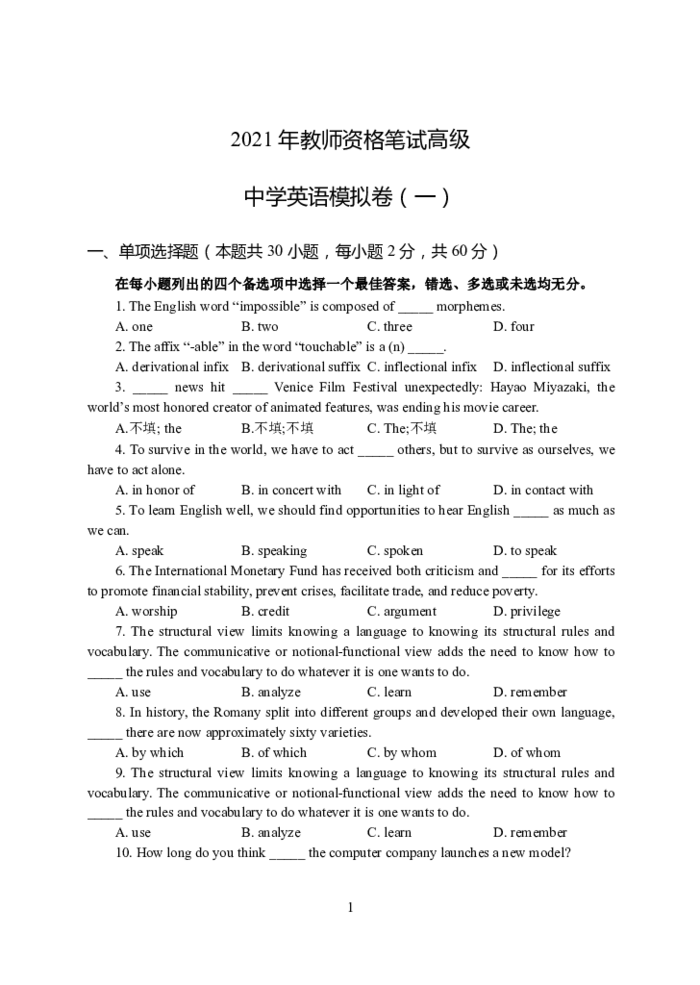
2021 年教师资格笔试高级
中学英语模拟卷(一)
一、单项选择题(本题共30 小题,每小题2 分,共60 分)
在每小题列出的四个备选项中选择一个最佳答案,错选、多选或未选均无分。
1. The English word “impossible” is composed of _____ morphemes.
A. one
B. two
C. three
D. four
2. The affix “-able” in the word “touchable” is a (n) _____.
A. derivational infix
B. derivational suffix C. inflectional infix
D. inflectional suffix
3. _____ news hit _____ Venice Film Festival unexpectedly: Hayao Miyazaki, the
world’s most honored creator of animated features, was ending his movie career.
A.不填; the
B.不填;不填
C. The;不填
D. The; the
4. To survive in the world, we have to act _____ others, but to survive as ourselves, we
have to act alone.
A. in honor of
B. in concert with
C. in light of
D. in contact with
5. To learn English well, we should find opportunities to hear English _____ as much as
we can.
A. speak
B. speaking
C. spoken
D. to speak
6. The International Monetary Fund has received both criticism and _____ for its efforts
to promote financial stability, prevent crises, facilitate trade, and reduce poverty.
A. worship
B. credit
C. argument
D. privilege
7. The structural view limits knowing a language to knowing its structural rules and
vocabulary. The communicative or notional-functional view adds the need to know how to
_____ the rules and vocabulary to do whatever it is one wants to do.
A. use
B. analyze
C. learn
D. remember
8. In history, the Romany split into different groups and developed their own language,
_____ there are now approximately sixty varieties.
A. by which
B. of which
C. by whom
D. of whom
9. The structural view limits knowing a language to knowing its structural rules and
vocabulary. The communicative or notional-functional view adds the need to know how to
_____ the rules and vocabulary to do whatever it is one wants to do.
A. use
B. analyze
C. learn
D. remember
10. How long do you think _____ the computer company launches a new model?
2
A. it will be before
B. will it be until
C. will it be when
D. it will be that
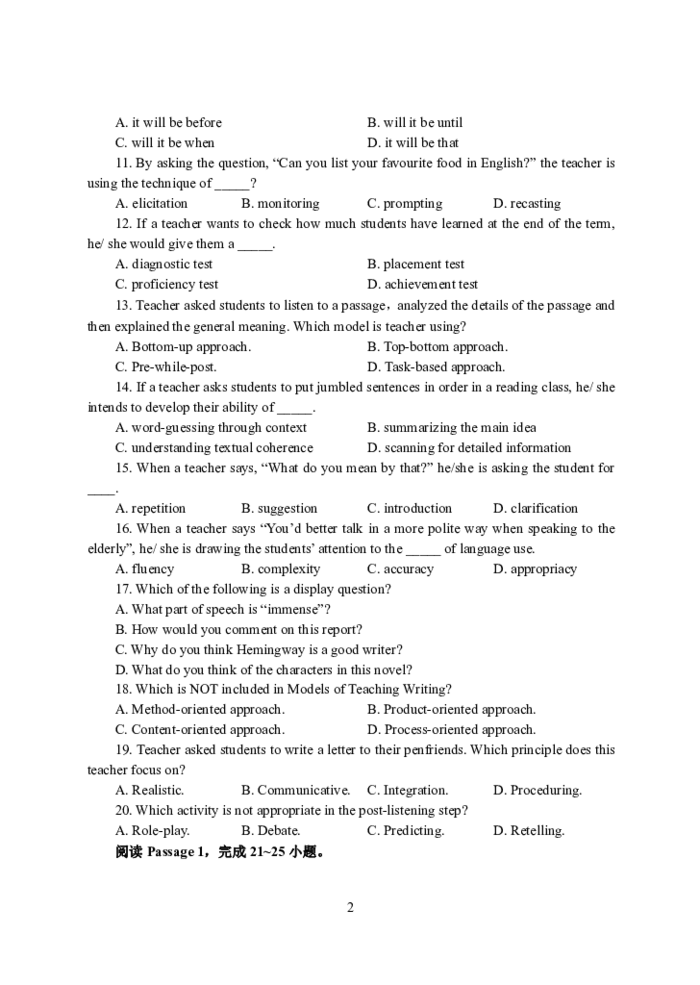
11. By asking the question, “Can you list your favourite food in English?” the teacher is
using the technique of _____?
A. elicitation
B. monitoring
C. prompting
D. recasting
12. If a teacher wants to check how much students have learned at the end of the term,
he/ she would give them a _____.
A. diagnostic test
B. placement test
C. proficiency test
D. achievement test
13. Teacher asked students to listen to a passage,analyzed the details of the passage and
then explained the general meaning. Which model is teacher using?
A. Bottom-up approach.
B. Top-bottom approach.
C. Pre-while-post.
D. Task-based approach.
14. If a teacher asks students to put jumbled sentences in order in a reading class, he/ she
intends to develop their ability of _____.
A. word-guessing through context
B. summarizing the main idea
C. understanding textual coherence
D. scanning for detailed information
15. When a teacher says, “What do you mean by that?” he/she is asking the student for
____.
A. repetition
B. suggestion
C. introduction
D. clarification
16. When a teacher says “You’d better talk in a more polite way when speaking to the
elderly”, he/ she is drawing the students’ attention to the _____ of language use.
A. fluency
B. complexity
C. accuracy
D. appropriacy
17. Which of the following is a display question?
A. What part of speech is “immense”?
B. How would you comment on this report?
C. Why do you think Hemingway is a good writer?
D. What do you think of the characters in this novel?
18. Which is NOT included in Models of Teaching Writing?
A. Method-oriented approach.
B. Product-oriented approach.
C. Content-oriented approach.
D. Process-oriented approach.
19. Teacher asked students to write a letter to their penfriends. Which principle does this
teacher focus on?
A. Realistic.
B. Communicative.
C. Integration.
D. Proceduring.
20. Which activity is not appropriate in the post-listening step?
A. Role-play.
B. Debate.
C. Predicting.
D. Retelling.
阅读Passage 1,完成21~25 小题。
3
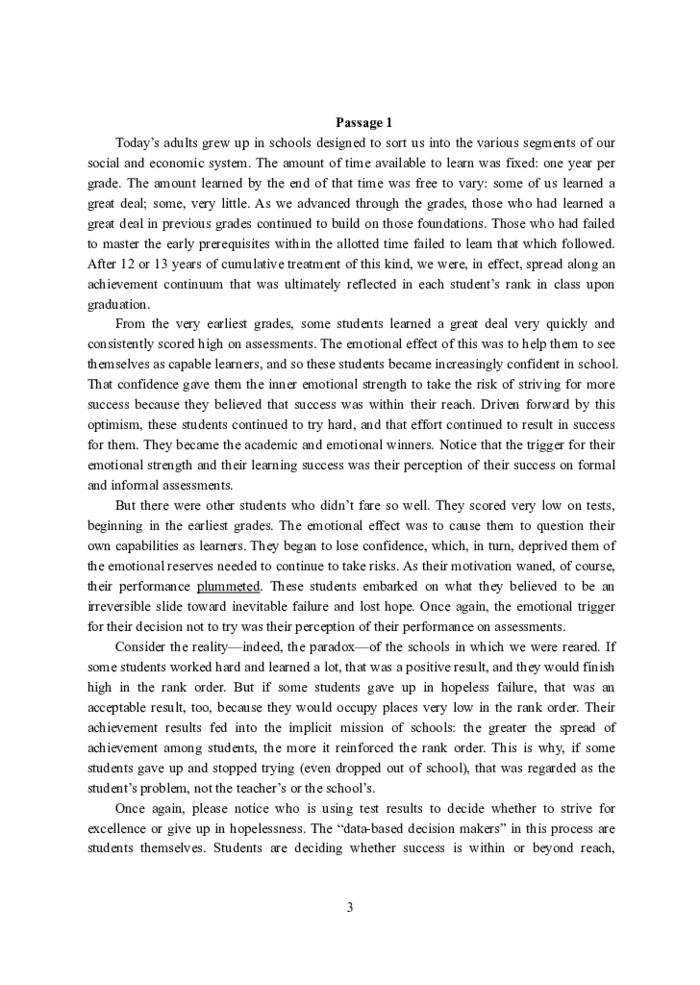
Passage 1
Today’s adults grew up in schools designed to sort us into the various segments of our
social and economic system. The amount of time available to learn was fixed: one year per
grade. The amount learned by the end of that time was free to vary: some of us learned a
great deal; some, very little. As we advanced through the grades, those who had learned a
great deal in previous grades continued to build on those foundations. Those who had failed
to master the early prerequisites within the allotted time failed to learn that which followed.
After 12 or 13 years of cumulative treatment of this kind, we were, in effect, spread along an
achievement continuum that was ultimately reflected in each student’s rank in class upon
graduation.
From the very earliest grades, some students learned a great deal very quickly and
consistently scored high on assessments. The emotional effect of this was to help them to see
themselves as capable learners, and so these students became increasingly confident in school.
That confidence gave them the inner emotional strength to take the risk of striving for more
success because they believed that success was within their reach. Driven forward by this
optimism, these students continued to try hard, and that effort continued to result in success
for them. They became the academic and emotional winners. Notice that the trigger for their
emotional strength and their learning success was their perception of their success on formal
and informal assessments.
But there were other students who didn’t fare so well. They scored very low on tests,
beginning in the earliest grades. The emotional effect was to cause them to question their
own capabilities as learners. They began to lose confidence, which, in turn, deprived them of
the emotional reserves needed to continue to take risks. As their motivation waned, of course,
their performance plummeted. These students embarked on what they believed to be an
irreversible slide toward inevitable failure and lost hope. Once again, the emotional trigger
for their decision not to try was their perception of their performance on assessments.
Consider the reality—indeed, the paradox—of the schools in which we were reared. If
some students worked hard and learned a lot, that was a positive result, and they would finish
high in the rank order. But if some students gave up in hopeless failure, that was an
acceptable result, too, because they would occupy places very low in the rank order. Their
achievement results fed into the implicit mission of schools: the greater the spread of
achievement among students, the more it reinforced the rank order. This is why, if some
students gave up and stopped trying (even dropped out of school), that was regarded as the
student’s problem, not the teacher’s or the school’s.
Once again, please notice who is using test results to decide whether to strive for
excellence or give up in hopelessness. The “data-based decision makers” in this process are
students themselves. Students are deciding whether success is within or beyond reach,
4
whether the learning is worth the required effort, and so whether to try or not. The critical
emotions underpinning the decision-making process include anxiety, fear of failure,
uncertainty, and unwillingness to take risks—all triggered by students’ perceptions of their
own capabilities as reflected in assessment results.
Some students responded to the demands of such environments by working hard and
learning a great deal. Others controlled their anxiety by giving up and not caring. The result
for them is exactly the opposite of the one society wants. Instead of leaving no child behind,
these practices, in effect, drove down the achievement of at least as many students as they
successfully elevated. And the evidence suggests that the downside victims are more
frequently members of particular socioeconomic and ethnic minorities.
21. What had made students spread along an achievement continuum according to the
passage?
A. The allotted time to learn.
B. Social and economic system.
C. The early prerequisites students mastered.
D. Performance on formal and informal assessments.
22. What is the author’s attitude towards the old mission of assessment?
A. Supportive.
B. Indifferent.
C. Negative.
D. Neutral.
23. Which of the following is closest in meaning to the underlined word “plummeted” in
Paragraph 3?
A. Finished timely.
B. Spread widely.
C. Continued gradually.
D. Dropped sharply.
24. Which of following describes the paradox of the schools?
A. Discrepancy between what they say and what they do.
B. Differences between teachers’ problems and schools’ problems.
C. Advantages and disadvantages of students’ learning opportunities.
D. Students’ perception and the reality of their performance on assessments.
25. Which of the following will be triggered by the assessment results according to the
passage?
A. Students’ learning efforts.
B. Leaving-no-child-behind policy.
C. Socioeconomic and ethnic ranking.
D. Social disapproval of schools’ mission.
请阅读Passage 2,完成第26-30 小题。
Passage 2
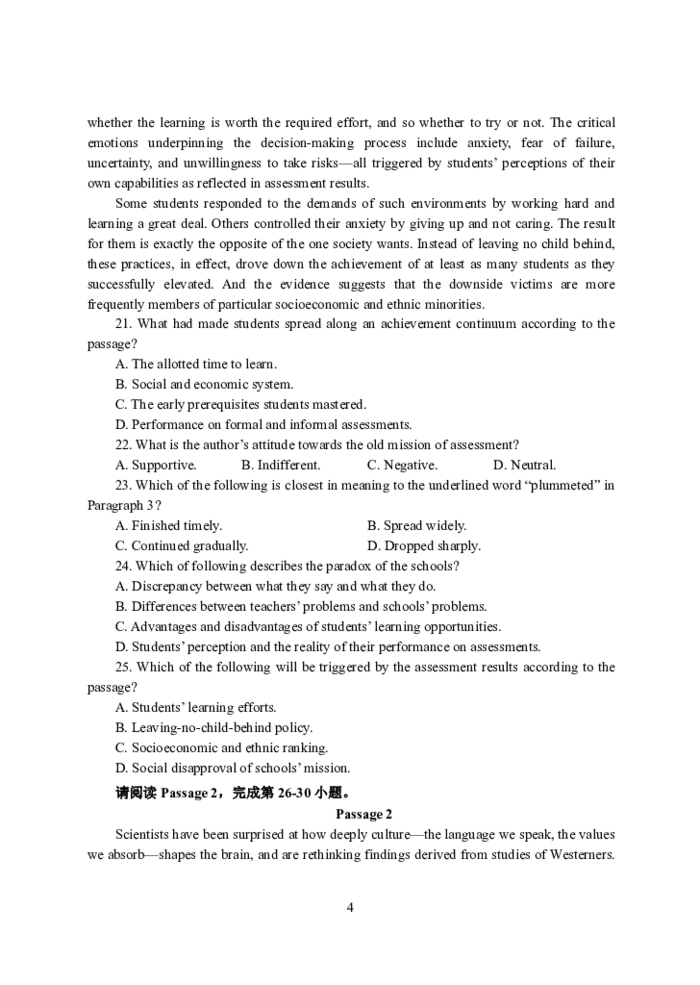
Scientists have been surprised at how deeply culture—the language we speak, the values
we absorb—shapes the brain, and are rethinking findings derived from studies of Westerners.
5
To take one recent example, a region behind the forehead called the medial prefrontal cortex
supposedly represents the self: it is active when we (“we” being the Americans in the study)
think of our own identity and traits. But with Chinese volunteers, the results were strikingly
different. The “me” circuit hummed not only when they thought whether a particular
adjective described themselves, but also when they considered whether it described their
mother. The Westerners showed no such overlap between self and mom. Depending whether
one lives in a culture that views the self as autonomous and unique or as connected to and
part of a larger whole, this neural circuit takes on quite different functions.
“Cultural neuroscience,” as this new field is called, is about discovering such differences.
Some of the findings, as with the “me/ mom” circuit, buttress longstanding notions of
cultural differences. For instance, it is a cultural cliché that Westerners focus on individual
objects while East Asians pay attention to context and background (another manifestation of
the individualism-collectivism split). Sure enough, when shown complex, busy scenes,
Asian-Americans and non-Asian-Americans recruited different brain regions. The Asians
showed more activity in areas that process figure-ground relations—holistic context—while
the Americans showed more activity in regions that recognize objects.
Psychologist Nalini Ambady of Tufts found something similar when she and colleagues
showed drawings of people in a submissive pose (head down, shoulders hunched) or a
dominant one (arms crossed, face forward) to Japanese and Americans. The brain’s
dopamine-fueled reward circuit became most active at the sight of the stance—dominant for
Americans, submissive for Japanese—that each volunteer’s culture most values, they
reported in 2009. This raises an obvious chicken-and-egg question, but the smart money is on
culture shaping the brain, not vice versa. Cultural neuroscience wouldn’t be making waves if
it found neurobiological bases only for well-known cultural differences. It is also uncovering
the unexpected. For instance, a 2006 study found that native Chinese speakers use a different
region of the brain to do simple arithmetic (3 + 4) or decide which number is larger than
native English speakers do, even though both use Arabic numerals. The Chinese use the
circuits that process visual and spatial information and plan movements (the latter may be
related to the use of the abacus). But English speakers use language circuits. It is as if the
West conceives numbers as just words, but the East imbues them with symbolic, spatial
freight. (Insert cliché about Asian math geniuses.) “One would think that neural processes
involving basic mathematical computations are universal,” says Ambady, but they “seem to
be culture-specific.”
Not to be the skunk at this party, but I think it’s important to ask whether neuroscience
reveals anything more than we already know from, say, anthropology. For instance, it’s well
known that East Asian cultures prize the collective over the individual, and that Americans do
the opposite. Does identifying brain correlates of those values offer any extra insight? After
6
all, it’s not as if anyone thought those values are the result of something in the liver.
Ambady thinks cultural neuro-science does advance understanding. Take the me/mom
finding, which, she argues, “attests to the strength of the overlap between self and people
close to you in collectivistic cultures and the separation in individualistic cultures. It is
important to push the analysis to the level of the brain.” Especially when it shows how
fundamental cultural differences are—so fundamental, perhaps, that “universal” notions such
as human rights, democracy, and the like may be no such thing.
26. Which of the following is closest in meaning to the underlined phrase “making
waves” in Paragraph 3?
A. Drawing criticism.
B. Receiving suspicion.
C. Attracting attention.
D. Causing disagreement.
27. Why does the author cite the findings of previous studies in Paragraph 3?
A. To introduce a new topic.
B. To place a topic in a larger context.
C. To discuss a solution to a certain problem.
D. To provide empirical data to confirm a prior belief.
28. Which of the following can be inferred from the passage?
A. Neural processes are likely to be culturally neutral.
B. The brain is believed to be influenced by different cultures.
C. Westerners focus on individualism while East Asians on collectivism.
D. Neuroscience reveals nothing more than we know from anthropology.
29. Which of the following is a significant breakthrough achieved by cultural
neuroscience according to the passage?
A. It proves that some values are deeply rooted in human liver.
B. It correlates cultural differences with different brain activities.
C. It suggests that some universal concepts are shared across cultures.
D. It disputes our usual understanding of fundamental cultural differences.
30. Which of the following may best describe the author’s attitude towards universal
cultural concepts in the last paragraph?
A. Doubtful.
B. Positive.
C. Negative.
D. Neutral.
二、简答题(本题共1 小题,共20 分)
31.在写作教学过程中,写前、写中、写后是三个重要的教学环节,简述每个环节
中的一个教学活动(12 分);列出教师在写作教学过程中需要注意的四个事项(8 分)。
7
三、教学情境分析题(本题共1 小题,共30 分)
32.下面是某教师的课堂教学活动:
Step 1 Warming up
Before class, teacher plays a song and then ask students some questions.
(1) Do you know the name of the song? (Five Hundred Miles)
(2) Do you like the song? Why or why not? Students answer all these questions.
Step 2 Pre-reading
Teacher asks a question: Did you ever leave home for a long time? Where did you go
and how is your feeling? Students share their ideas in front of class.
Step 3 While-reading
Students read the passage quickly and carefully and get the general idea and specific
information.
Step 4 Post-reading
8
Students work in groups of four and discuss when you miss your home, what will you
do and how can we love our families? Students express their opinions freely.
...
请根据材料回答下列3 个问题。
(1)此语段教师采用什么教学方法?请具体分析目的。(10 分)
(2)此语段教师使用了什么方法进行读前活动?请简述其他的读前活动。(10 分)
(3)阅读课程的教学原则是什么?(10 分)
四、教学设计题(本题共1 小题,共40 分)
33.设计任务:阅读下面学生信息和语言素材,设计20 分钟的阅读教学方案。教案
没有固定格式,但须包含下列要点:
●Teaching objectives
●Teaching contents
●Key and different points
●Major steps and time allocation
9
●Activities and justifications
学生概况:
某城镇普通中学一年级第一学期学生,共40 人,多数学生已达《普通高中英语课
程标准(实验)》五级水平,学生课堂参与积极性一般。
语言素材:
The Life of Mark Twain
Often the lives of writers resemble the lives of the characters they create. Mark Twain,
who wrote The Adventures of Huckleberry Finn and The Adventures of Tom Sawyer, was no
exception. To start with, the author’s name, Mark Twain, is itself an invention, or “pen name”.
Twain’s real name was Samuel Clemens. “Mark Twain”, which means “watermark two” was
a call used by sailors on the Mississippi to warn shipmates that they were coming into
shallow water. Like Huck, Mark Twain led an adventurous life. He left school early, and as
an adolescent, determined to make his fortune in South America, set off from his home in
Hannibal, Missouri, for New Orleans. He wanted to take a boat to the Amazon, where he
thought he could get rich quickly. He arrived in New Orleans without a penny in his pocket
only to find that there were no boats for South America.
Forced to change his plans, he worked for several years as a pilot on a steamboat, taking
passengers up and down the Mississippi, the great river which flows from the north of the US
near the Canadian border, down to the Gulf of Mexico. Later he became a journalist.