1
2021 年下教师资格笔试高中英语模拟卷一
参考答案及解析
一、单项选择题
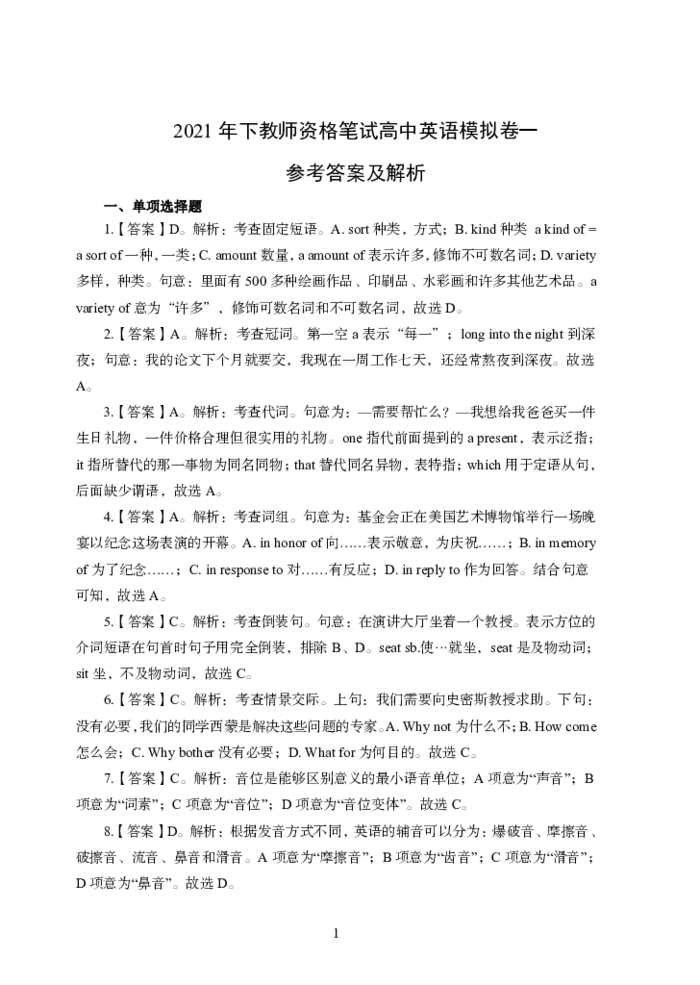
1.【答案】D。解析:考查固定短语。A. sort 种类,方式;B. kind 种类a kind of =
a sort of 一种,一类;C. amount 数量,a amount of 表示许多,修饰不可数名词;D. variety
多样,种类。句意:里面有500 多种绘画作品、印刷品、水彩画和许多其他艺术品。a
variety of 意为“许多”,修饰可数名词和不可数名词,故选D。
2.【答案】A。解析:考查冠词。第一空a 表示“每一”;long into the night 到深
夜;句意:我的论文下个月就要交,我现在一周工作七天,还经常熬夜到深夜。故选
A。
3.【答案】A。解析:考查代词。句意为:—需要帮忙么?—我想给我爸爸买一件
生日礼物,一件价格合理但很实用的礼物。one 指代前面提到的a present,表示泛指;
it 指所替代的那一事物为同名同物;that 替代同名异物,表特指;which 用于定语从句,
后面缺少谓语,故选A。
4.【答案】A。解析:考查词组。句意为:基金会正在美国艺术博物馆举行一场晚
宴以纪念这场表演的开幕。A. in honor of 向……表示敬意,为庆祝……;B. in memory
of 为了纪念……;C. in response to 对……有反应;D. in reply to 作为回答。结合句意
可知,故选A。
5.【答案】C。解析:考查倒装句。句意:在演讲大厅坐着一个教授。表示方位的
介词短语在句首时句子用完全倒装,排除B、D。seat sb.使···就坐,seat 是及物动词;
sit 坐,不及物动词,故选C。
6.【答案】C。解析:考查情景交际。上句:我们需要向史密斯教授求助。下句:
没有必要,我们的同学西蒙是解决这些问题的专家。A. Why not 为什么不;B. How come
怎么会;C. Why bother 没有必要;D. What for 为何目的。故选C。
7.【答案】C。解析:音位是能够区别意义的最小语音单位;A 项意为“声音”;B
项意为“词素”;C 项意为“音位”;D 项意为“音位变体”。故选C。
8.【答案】D。解析:根据发音方式不同,英语的辅音可以分为:爆破音、摩擦音、
破擦音、流音、鼻音和滑音。A 项意为“摩擦音”;B 项意为“齿音”;C 项意为“滑音”;
D 项意为“鼻音”。故选D。
2
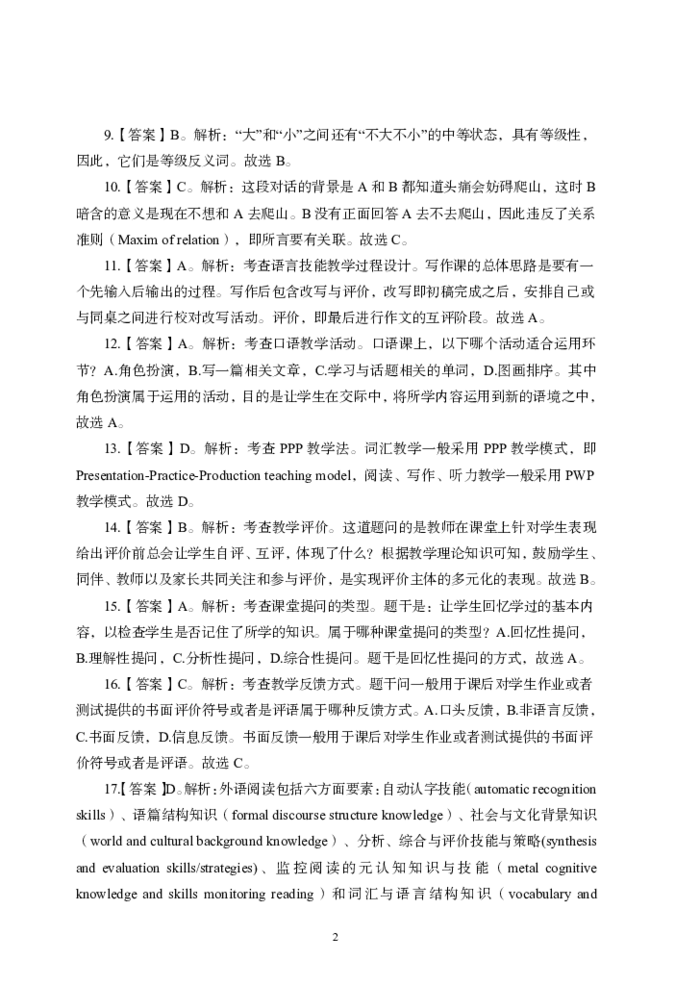
9.【答案】B。解析:“大”和“小”之间还有“不大不小”的中等状态,具有等级性,
因此,它们是等级反义词。故选B。
10.【答案】C。解析:这段对话的背景是A 和B 都知道头痛会妨碍爬山,这时B
暗含的意义是现在不想和A 去爬山。B 没有正面回答A 去不去爬山,因此违反了关系
准则(Maxim of relation),即所言要有关联。故选C。
11.【答案】A。解析:考查语言技能教学过程设计。写作课的总体思路是要有一
个先输入后输出的过程。写作后包含改写与评价,改写即初稿完成之后,安排自己或
与同桌之间进行校对改写活动。评价,即最后进行作文的互评阶段。故选A。
12.【答案】A。解析:考查口语教学活动。口语课上,以下哪个活动适合运用环
节?A.角色扮演,B.写一篇相关文章,C.学习与话题相关的单词,D.图画排序。其中
角色扮演属于运用的活动,目的是让学生在交际中,将所学内容运用到新的语境之中,
故选A。
13.【答案】D。解析:考查PPP 教学法。词汇教学一般采用PPP 教学模式,即
Presentation-Practice-Production teaching model,阅读、写作、听力教学一般采用PWP
教学模式。故选D。
14.【答案】B。解析:考查教学评价。这道题问的是教师在课堂上针对学生表现
给出评价前总会让学生自评、互评,体现了什么?根据教学理论知识可知,鼓励学生、
同伴、教师以及家长共同关注和参与评价,是实现评价主体的多元化的表现。故选B。
15.【答案】A。解析:考查课堂提问的类型。题干是:让学生回忆学过的基本内
容,以检查学生是否记住了所学的知识。属于哪种课堂提问的类型?A.回忆性提问,
B.理解性提问,C.分析性提问,D.综合性提问。题干是回忆性提问的方式,故选A。
16.【答案】C。解析:考查教学反馈方式。题干问一般用于课后对学生作业或者
测试提供的书面评价符号或者是评语属于哪种反馈方式。A.口头反馈,B.非语言反馈,
C.书面反馈,D.信息反馈。书面反馈一般用于课后对学生作业或者测试提供的书面评
价符号或者是评语。故选C。
17.【答案】D。解析:外语阅读包括六方面要素:自动认字技能(automatic recognition
skills)、语篇结构知识(formal discourse structure knowledge)、社会与文化背景知识
(world and cultural background knowledge)、分析、综合与评价技能与策略(synthesis
and evaluation skills/strategies) 、监控阅读的元认知知识与技能(metal cognitive
knowledge and skills monitoring reading )和词汇与语言结构知识(vocabulary and
3
structure knowledge)。故选D。
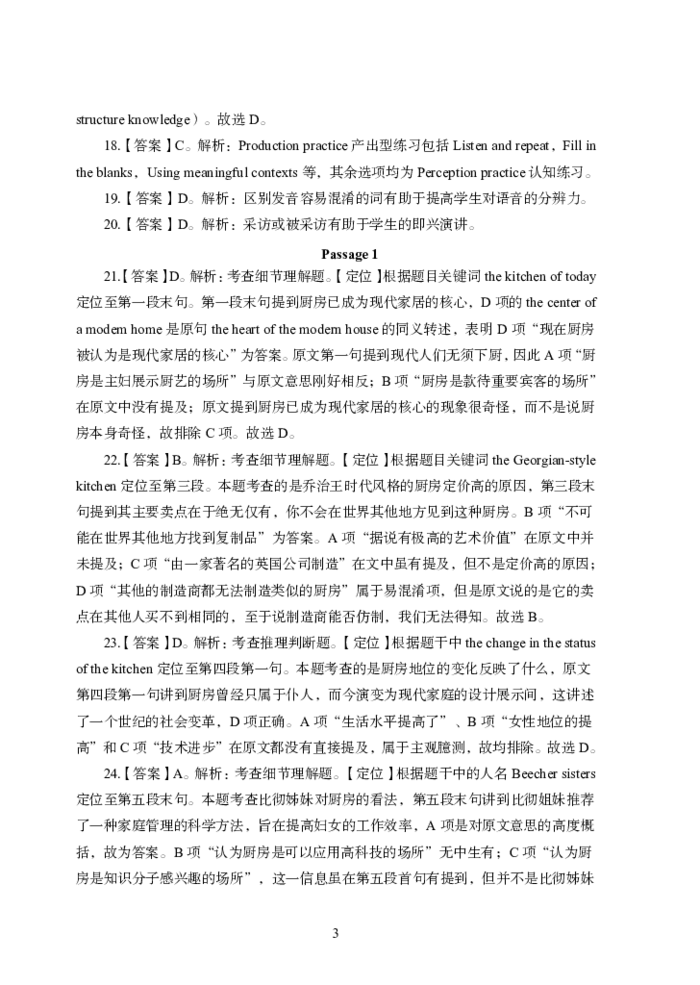
18.【答案】C。解析:Production practice 产出型练习包括Listen and repeat,Fill in
the blanks,Using meaningful contexts 等,其余选项均为Perception practice 认知练习。
19.【答案】D。解析:区别发音容易混淆的词有助于提高学生对语音的分辨力。
20.【答案】D。解析:采访或被采访有助于学生的即兴演讲。
Passage 1
21.【答案】D。解析:考查细节理解题。【定位】根据题目关键词the kitchen of today
定位至第一段末句。第一段末句提到厨房已成为现代家居的核心,D 项的the center of
a modem home 是原句the heart of the modern house 的同义转述,表明D 项“现在厨房
被认为是现代家居的核心”为答案。原文第一句提到现代人们无须下厨,因此A 项“厨
房是主妇展示厨艺的场所”与原文意思刚好相反;B 项“厨房是款待重要宾客的场所”
在原文中没有提及;原文提到厨房已成为现代家居的核心的现象很奇怪,而不是说厨
房本身奇怪,故排除C 项。故选D。
22.【答案】B。解析:考查细节理解题。【定位】根据题目关键词the Georgian-style
kitchen 定位至第三段。本题考查的是乔治王时代风格的厨房定价高的原因,第三段末
句提到其主要卖点在于绝无仅有,你不会在世界其他地方见到这种厨房。B 项“不可
能在世界其他地方找到复制品”为答案。A 项“据说有极高的艺术价值”在原文中并
未提及;C 项“由一家著名的英国公司制造”在文中虽有提及,但不是定价高的原因;
D 项“其他的制造商都无法制造类似的厨房”属于易混淆项,但是原文说的是它的卖
点在其他人买不到相同的,至于说制造商能否仿制,我们无法得知。故选B。
23.【答案】D。解析:考查推理判断题。【定位】根据题干中the change in the status
of the kitchen 定位至第四段第一句。本题考查的是厨房地位的变化反映了什么,原文
第四段第一句讲到厨房曾经只属于仆人,而今演变为现代家庭的设计展示间,这讲述
了一个世纪的社会变革,D 项正确。A 项“生活水平提高了”、B 项“女性地位的提
高”和C 项“技术进步”在原文都没有直接提及,属于主观臆测,故均排除。故选D。
24.【答案】A。解析:考查细节理解题。【定位】根据题干中的人名Beecher sisters
定位至第五段末句。本题考查比彻姊妹对厨房的看法,第五段末句讲到比彻姐妹推荐
了一种家庭管理的科学方法,旨在提高妇女的工作效率,A 项是对原文意思的高度概
括,故为答案。B 项“认为厨房是可以应用高科技的场所”无中生有;C 项“认为厨
房是知识分子感兴趣的场所”,这一信息虽在第五段首句有提到,但并不是比彻姊妹
4
的看法,而是作者的观点;第五段第二句提到该姊妹中的一人以激进的新方式对厨房
进行思考,她思考的是怎样提高家务效率,而不是试验新想法,因此D 项“认为厨房
是实验新想法的场所”错误。故选A。
25.【答案】B。解析:考查主旨大意题。【定位】根据题干可知本题考查的是对
文章的整体感知理解能力,定位到全文。原文提到20 世纪20 年代由玛格丽特设计的
第一个配备齐全的厨房中,许多元素依然是今日厨房的中心特色,说明现代厨房的许
多核心特色和20 世纪20 年代都具有相似性,因此B 项“现代厨房的许多核心特色和
20 世纪20 年代相比并无差别”正确。A 项“现代厨房象征人们日常生活中快速的技
术进步”和C 项“现代厨房变得面目全非”在原文中均无提及。D 项“现代厨房的许
多功能有很大改变”与原文最后一段末句意思刚好相反。故选B。
Passage 2
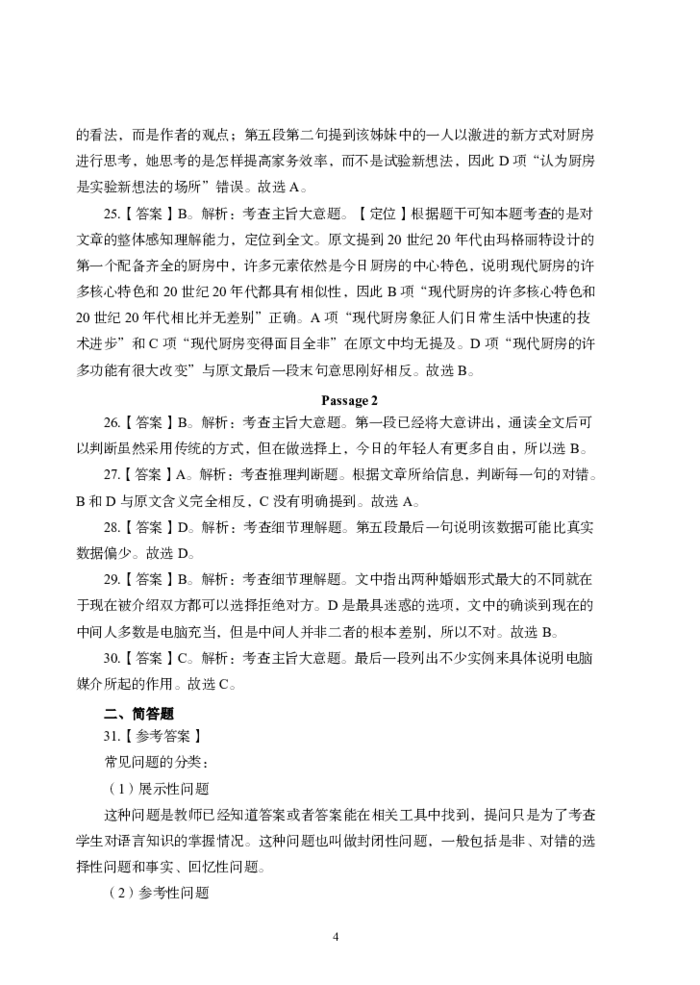
26.【答案】B。解析:考查主旨大意题。第一段已经将大意讲出,通读全文后可
以判断虽然采用传统的方式,但在做选择上,今日的年轻人有更多自由,所以选B。
27.【答案】A。解析:考查推理判断题。根据文章所给信息,判断每一句的对错。
B 和D 与原文含义完全相反,C 没有明确提到。故选A。
28.【答案】D。解析:考查细节理解题。第五段最后一句说明该数据可能比真实
数据偏少。故选D。
29.【答案】B。解析:考查细节理解题。文中指出两种婚姻形式最大的不同就在
于现在被介绍双方都可以选择拒绝对方。D 是最具迷惑的选项,文中的确谈到现在的
中间人多数是电脑充当,但是中间人并非二者的根本差别,所以不对。故选B。
30.【答案】C。解析:考查主旨大意题。最后一段列出不少实例来具体说明电脑
媒介所起的作用。故选C。
二、简答题
31.【参考答案】
常见问题的分类:
(1)展示性问题
这种问题是教师已经知道答案或者答案能在相关工具中找到,提问只是为了考查
学生对语言知识的掌握情况。这种问题也叫做封闭性问题,一般包括是非、对错的选
择性问题和事实、回忆性问题。
(2)参考性问题
5
参考性问题是指教师所提的问题没有预设的答案,提问的目的在于发散思维寻求
信息,又称为开放性问题,一般包括推理、评价性的问题和批判、创造性的问题。
(3)低要求问题和高要求问题
低要求问题是指那些需要回忆信息和熟记知识方面的问题;高要求的问题则需要
更多的推理、分析和评估。
重要性:
(1)增进学生对教学的参与;
(2)启发学生的思维活动;
(3)获得教与学的反馈信息;
(4)提示学习重点;
(5)提高交际能力。
三、教学情境分析题
32.【参考答案】
(1)学生1 所犯的错误是搞混了定语从句中关系代词that 和关系副词when 的用
法,这属于知识性的理解错误。学生2 犯的是口误错误,他误将“he”说成了“she”,这
种错误是偶然的。
(2)对于学生1 和学生2,老师分别采用了启发法和强调法来帮助他们改错。
学生1 在回答第一个句子时,没有完全搞清楚that 和when 的区别。老师就他的
错误部分提问,让学生注意先行词和其在从句中担任的成分,这一方式有助于启发学
生重新思考。同时,教师放慢语速,并以目光示意学生继续作答,这体现了启发纠错
法。
学生2 在回答第三个句子时,误将“he”说成“she”。老师则重复了他的回答,有意
重读学生出错的地方以表示强调,帮助学生2 发现这一明显的错误,从而及时自我纠
错。
(3)该教师遵循了合理把握纠错时机、区别对待系统性差错和局部性差错的纠错
原则。
对于学生1 来说,他所犯的错误是由于尚未完全掌握定语从句中关系词的用法所
导致的错误。学生本人一般很难发现并改正这类错误,他很容易在运用语言的过程中,
反复犯错。该教师在正确区分学生的错误类别后,及时打断学生,采取了即时纠错,
帮助学生认识到问题,并加以纠正。
6
学生2 所犯的错误则是典型的语误错误。这种错误可能是由于学生粗心或注意力
分散导致的,它是偶然的。这种错误不影响目标语的输出和理解。因此,教师没有像
对学生1 一样直接打断,而是合理把握纠错时机。学生回答所有问题后,以强调的方
式帮助学生延缓纠错。
四、教学设计题
33.【参考设计】
Teaching Plan
Teaching type: Grammar class
Teaching contents: This lesson is from senior high school. Students will learn the
structure and usage of the Indirect Speech.
Teaching objectives:
Knowledge objectives:
·Students can understand the Indirect Speech including its structure and usage.
·Students will master the rules to change the sentence in direct speech into indirect
speech properly.
Ability objectives:
·Students can quote other people’s words by using the Indirect Speech.
·Students will be able to retell a dialogue with the Indirect Speech.
Emotional objectives:
·Students can cultivate their interest and improve their confidence in learning English
grammar.
·Students will work with their teammates to complete various class activities and
become the real host of the class.
Teaching key and difficult points:
Teaching Key Points:
·Students can understand the Indirect Speech including its structure and usage.
·Students can change the sentence from direct speech into indirect speech properly.
Teaching Difficult Points:
·How to master the grammatical rules and retell a dialogue with the Indirect Speech.
·How to become more interested in learning English grammar.
Teaching procedures:
Step 1: Warming up and lead-in(2 mins)
Greet the students.
The teacher will play a short video about an interview between the reporter and the
interviewee, and students are asked to say what they are talking about. The teacher will lead
in the new class with a question, “You are using the direct speech to quote other’s words. Do
7
you know how to use the Indirect Speech to report?
(Justification: Watching video and answering questions are a good way to review the
direct speech and lead in the Indirect Speech through which students’ learning interests and
curiosities for a grammar class can be aroused; their attention can be attracted to the new
class as well.)
Step 2: Presentation (7 mins)
Task 1: Students will work in pairs to look at and read these sentences from the
listening part. Then, they will be asked to find out who says the sentences and share their
results in class.
I’m still working because there is a lot to do.
Eleven thousand people live here and six thousand left last week.
Does this mean that the danger is over?
They can’t go back to their houses.
When will people be able to return home?
Task 2: Students will be asked to read and compare these sentences and answer the
following questions.
He said that he was still working because there was a lot to do.
He said that eleven thousand people lived there and six thousand had left.
He asked if this meant that the danger was over.
He said that they couldn’t go back to their houses.
The reporter asked when people would be able to return home.
Q1: What are the tense changes in indirect speech?
Q2: How do other words change?
Q3: Which word is added when a yes/no question is reported?
Suggested answers:
a. Tense change in Indirect Speech.
Direct Speech (Tense)
Indirect Speech (Tense)
present simple (do)
past simple (did)
past simple (did)
past perfect (had done)
future simple (will)
past future (would)
present perfect (have/has done)
past perfect (had done)
present continuous (am/is/are doing)
past continuous (was/were doing)
past perfect (had done)
past perfect (had done)
b. Time/place phrases change, such as: here—there, last week—the week before.
Type
Direct Speech
Indirect Speech
Demonstrative
pronoun
this, these
that, those
Adverbial of time
now, today, this week,
then, that day, that week,
8
last week, two days
ago,
next week
the week before,
two days before,
the next week
Adverbial of place
here
there
c. “If” is added, such as: He asked if this meant that the danger was over.
Declarative sentence: change into the object clause with “that”
She said, “Our train will arrive in five minutes.”
She said (that) their train would arrive in five minutes.
General questions: change into the object clause with “if”
He asked, “Can you swim, John?”
He asked John if he could swim.
Special questions: change into the object clause with “who”, “what”, “when…”
He asked, “Where are you going?”
He asked where I was going.
(Justification: Students will discover and summarize the grammatical rules of the
Indirect Speech and grasp the correct way to change the sentences from direct into indirect
speech. Students can also master proper learning strategy to learn grammar and boost
confidence in learning grammar.)
Step3: Practice (5 mins)
The teacher will ask students to finish two groups of exercise. For the first group,
students need to change the following sentences into indirect speech. For the second group,
students are required to rewrite the sentences using the reporting expressions. After that,
students will be invited to share their answers with the classmates.
Group 1: Change the following sentences into indirect speech.
1. “You should be more careful next time,” his father said to him.
2. Mr. Wang said, “I will leave for Shanghai on business next month, children.”
3. “I haven’t heard from my parents these days,” said Mary.
4. Zhang Hong said to me, “Doctor Wang passed away in 1948.”
5. John said to his parents, “I had learned 500 Chinese words by the end of last term.”
6. He asked, “Are you a student?”
7. “Where are you going?” the father asked his son.
8. She asked, “Did you meet this man at the station two hours ago, Mr. Li?”
Group 2: Rewrite the sentences using the reporting expressions.
1. Volcanic eruptions don’t happen very often on the island.
A scientist said that ________________________.
2. No one was on the island during the volcanic eruption.
A local journalist said that ____________________.
3. The thunderstorm will put out the fires.
Local people said that ________________________.
9
4. The residents can go back to their homes.
The governor said that ________________________.
5. Several eruptions have taken place in the last twenty years.
A local radio station said that ___________________.
6. The residents will travel back to the island when the danger is over.
A local journalist said that _______________________.
(Justification: These mechanical drills can help students to practice and consolidate the
grammar point of the Indirect Speech. Students can also change and rewrite sentences from
direct into indirect speech.)
Step 4: Production(5 mins)
Students will be divided into five groups of four and do a role-play game. Each group
should choose a situation to make some dialogues and retell them in indirect speech.
(Situation showing in the PPT: in a classroom, in a restaurant, in the supermarket…). After
the preparation, some group members will be invited to share their performance in front.
The teacher will give some positive comments on that.
(Justification: This activity can help students to put the grammatical rules of the
Indirect Speech into practice and enhance students’ ability to communicate with each other.
Besides, doing a role-play game in groups can encourage students to learn cooperation and
gain confidence in expressing their ideas in public.)
Step 5 Summary and homework (1 min)
·Summary: Invite one student to work as a little teacher to summarize what they’ve
learned today, and then make a conclusion together.
·Homework: Ask students to compare the changes between direct speech and indirect
speech and draw a mind map for all the rules.
(Justification: The purpose of this step is to help students recall and review what they
have learnt today, and deepen their impressions about the important rules of the Indirect
Speech. Homework can help students to discover more rules independently and learn the
grammar point in a systematical way.)
Blackboard design:
The Indirect Speech
Declarative sentence: change into the object clause with “that”
She said, “Our train will arrive in five minutes.”
She said (that) their train would arrive in five minutes.
General questions: change into the object clause with “if”
He asked, “Can you swim, John?”
He asked John if he could swim.
Special questions: change into the object clause with “who”, “what”, “when…”
He asked, “Where are you going?”
He asked where I was going.
10