ARTICLE · 1206714
2027届模拟试卷速递28:202610广州市属十校顶尖联考适应性训练+答案
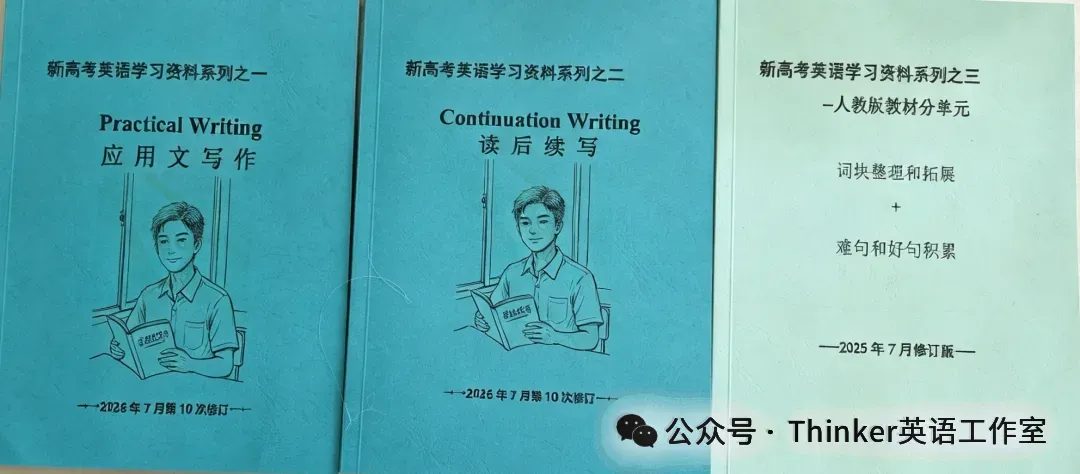
开学了,推荐高中英语学习必备书:最新2026版应用文写作和读后续写:
2026年7月第10版《新高考英语应用文写作+读后续写+人教版单元词块整理三驾马车》来啦!
20262027 学年上学期高三年级10月适应性训练 英 语
第一部分阅读(共两节;满分 50 分)
第一节(共 15 小题;每小题 2.5 分,满分 37.5 分)
阅读下列短文,从每题所给的 A、B、C、D 四个选项选出最佳选项。
A
Start Birding Where You Are
Birding begins the moment you pause to notice a bird. NPR’s Life Kit says the hobby can happen almost anywhere: at a kitchen window, on a city street or in a small green space you visit regularly.
For beginners, a nearby watching spot is particularly ideal. Returning to the same place repeatedly helps you learn which birds stay all year and which ones arrive during migration. Besides, different times of day offer different viewing experiences: mornings feature birdsong, while dawn and dusk are better for birds active at night. Birds living near water, by contrast, can be seen throughout the day.
Birding requires no expensive equipment. Simply observing a bird’s outline, flight pattern or familiar call is enough to get started. A notebook can be a handy tool, as quick notes about location, time and bird behavior make later comparison much easier. Listening opens another route into the hobby. Instead of relying only on sight, you can identify birds by their calls, even when they are hidden behind thick leaves. You can observe the rhythm, pitch and pauses of bird songs and create short memory phrases to remember them. The apps below offer further help with identification and recordkeeping。
App | Cost at publication | Main use |
eBird | Free | Record and compare sightings |
Merlin Bird ID | Free | Identify birds from photos or recordings |
iBird Pro | $14.99 | Use a detailed identification guide |
Sibley Birds | $19.99 | Consult another full field guide |
When identifying a bird by sight, note its size first, then its shape and structure, habitat and behavior, and finally color. Sound matters too: a memory phrase can turn an unfamiliar call into something recognizable. Whatever method you use, respect posted rules and the people sharing the space. A common bird is still worth studying, and learning its habits can make an ordinary walk feel newly detailed.
21.Why is revisiting the same birding spot useful?
A. It keeps water birds in sight all day.
B. It shows seasonal patterns in local birds.
C. It provides a quiet space for close observation.
D. It makes morning birdsong easier to recognize.
22.Which app can help a birder identify birds by their calls at no cost?
A. Merlin Bird ID. B. iBird Pro.
C. Sibley Birds. D. eBird.
23.Which feature should be considered first when identifying a bird by sight?
A. Where it lives. B. What it is doing.
C. How large it is. D. What color it is.
B
For Shu Yang, a materials scientist at the University of Pennsylvania, ideas are everywhere. Sometimes nature generates inspiration. Other times, a problem causes Yang to see a solution that already exists in the natural world. While trying to create a “building envelope” that could reflect sunlight and collect water to passively heat and cool buildings, she looked to the dry, deeply lined skin of the African elephant, which helped her envision a new kind of material that would keep temperatures down in regions experiencing lifethreatening heat waves.
Yang grew up in a small village, where she learnt to find inspiration from nature when she looked outside for entertainment. “Nature was my greatest playground and classroom to explore,” Yang says. Later, she noticed that drug companies rely on biology to develop medicine. “Why shouldn’t engineers do the same?” she wondered. “Could I build the way nature builds?”
While many scientists hesitate to speak about developing theories or unpublished work, Yang isn’t protective of her ideas. “I have tons of ideas,” she says. This open attitude allows her to collaborate with people who have expertise in other fields: biologists, materials scientists, and textile engineers. “I don’t think I’m a supersmart person, but I bring the smart people together,” she explains.
One fruitful result of such crossdisciplinary teamwork is 3Dprinted concrete, which originated with the U.S. Department of Energy. The design draws on a naturally occurring structure with similar strength and tiny holes: honeycomb (蜂巢). Yang’s concrete is made in part from a sandbased frame that absorbs carbon dioxide throughout the life of the material. “It’s really a wonderful choice,” Yang says with a smile. The technique significantly reduces the environmental impact of producing concrete and cement (水泥), which is responsible for about eight percent of all humanmade carbon emissions.
For Yang, learning from nature is far more than solving isolated engineering puzzles. By turning the wisdom of the natural world into sustainable technologies, she and her team are helping build a greener future.
24.What drove Yang to study the African elephant?
A. The need to protect elephants from heatwaves.
B. The plan to design buildings that collect water.
C. The desire to examine how elephant skin works.
D. The attempt to develop a cooling building material.
25.Why did Yang mention drug companies?
A. To show the value of medicine.
B. To criticize engineers’ lack of creativity.
C. To justify learning from nature in engineering.
D. To promote cooperation across different industries.
26.What is special about Yang’s 3Dprinted concrete?
A. It requires much less sand to produce. B. It is stronger than natural honeycomb.
C. It shapes buildings like honeycomb cells. D. It keeps absorbing carbon during its use.
27.Which of the following words best describes Yang?
A. Generous and cautious. B. Modest and cooperative.
C. Independent and proud. D. Ambitious and demanding.
C
Visit any antique store and you’ll encounter artifacts from the past: photographs, letters and even a brochure from the 196465 World’s Fair. These objects have managed to survive for decades or even centuries. Why? One of the reasons is that they’re physical.
But what about the life cycle of nonphysical formats, like digital information? For thousands of years, we’ve known about history from the artifacts that have survived. They serve as the media that deliver the information. At the time of creation, no attempts were made at intentional preservation, yet physical materials have a chance of surviving and acting as the historical record that writers of biographies, historians, and novelists rely on. Traditionally, libraries have shouldered the responsibility of organization, preservation, and access to information. They digitize the physical materials so that researchers can quickly search and access the resources conveniently. However, such selfless devotion may result in an embarrassment for librarians.
Many people claim libraries are less vital now. They hold up a cell phone, saying, “It’s all in here.” But how was that universality of access made possible and, perhaps more importantly, how is it maintained? Who is managing what is preserved? When it comes to digital information, the terrifying answer can be: if not librarians, then no one. Unlike stable tangible (有形的) materials, digital information needs constant professional care. Without librarians’ careful preservation, plenty of the digital content will disappear completely.
Even when a digital object is preserved, it may face a hidden problem: the information inside may be lost. As technology develops, old storage formats will become obsolete, making saved digital files useless. Without regular digital data migration, future historical records may come to an abrupt end when digital formats replace traditional ones.
As a librarian whose day job involves managing special collections and digital assets, I share the same worry. I’d be lying if I said a comprehensive solution currently exists. Fortunately, numerous librarians are dedicated to discovering, sorting and preserving digital information. Their efforts ensure that future researchers may find the digital world a challenging place to do their work, but not an impossible one.
28.What gives tangible materials an advantage over digital ones?
A. They are better protected by librarians.
B. They make information more accessible.
C. They provide more reliable historical records.
D. They can survive without intentional protection.
29.What can we learn about librarians in the digital age?
A. Their crucial efforts are often underestimated.
B. Their traditional responsibilities are disappearing.
C. They focus primarily on special physical collections.
D. They have found a universal solution to digital crisis.
30.What does the underlined word “obsolete” in Paragraph 4 probably mean?
A. Easy to use. B. Out of date. C. Hard to find. D. High in price.
31.What is the main idea of the text?
A. Efforts are needed to save tangible cultural artifacts.
B. Librarians play a key role in digitizing ancient materials.
C. Digital information requires continuing care to remain usable.
D. Digital resources have made libraries unnecessary for research.
D
Have you ever found your focus slipping halfway through a challenging exam? This kind of mental tiredness is common. In a recent study, researchers found evidence that the ability to sustain mental effort over time, known as “cognitive endurance (认知耐力),” may be trainable, somewhat like physical fitness. Just as athletes train to exercise for longer, students may strengthen their capacity for sustained thinking through practice.
While analyzing standardized test results worldwide, scientists noticed a consistent pattern: students performed worse on questions that appeared later in exams, even after the difficulty of the questions was considered. Notably, the decline was greater among students who typically spend their school days in passive activities such as listening to lectures and copying from the board. Those who more often read silently or worked through problems on their own—activities that demand sustained, independent focus—showed less decline.
Could the school experience itself be shaping students’ cognitive endurance? To find out, the researchers ran an experiment with 1,636 elementary school students in India. During study hall periods, the students were randomly divided into three groups. The control group continued its usual routine, which involved minimal mental effort. One treatment group spent 20 minutes solving math problems on tablets, using a plain application without game features. The other played cognitively demanding games, such as puzzles and tangrams (七巧板), which contained no academic content. Both programs adapted to each student’s level, keeping the tasks challenging.
The results were striking. In listening, reasoning and math assessments, the performance of trained students showed 22 percent less decline than that of the control group. It made little difference whether they had practiced math or played puzzles: the benefits were nearly identical. What mattered, it seemed, was sustained concentration rather than the specific content of the activity. The gains also spread beyond tests: teachers reported that the trained students were less restless and followed multistep instructions better, and their grades across several subjects rose accordingly.
The findings carry a hopeful message in an age when shortform media often encourages rapid shifts of attention. Cognitive endurance is not fixed. Like physical fitness, it may be built through activities such as reading, puzzles or playing a musical instrument, as long as they require sustained, focused mental effort.
32.What can be learned from the test results in Paragraph 2?
A. Later test questions were more difficult.
B. Physical strength determined students’ concentration.
C. Daily learning activities affected cognitive endurance.
D. Passive school activities lowered students’ test scores.
33.What is a feature of the experiment’s design?
A. Participants were required to finish tasks in groups.
B. Tasks of equal difficulty were assigned to all groups.
C. Participants randomly chose their experimental tasks.
D. Tasks for treatment groups were tailored to students’ level.
34.What was a key finding of the experiment?
A. The act of focusing outweighs the content.
B. The practice time determines the test results.
C. Math problems build mental endurance better.
D. Nonacademic games lead to mental tiredness.
35.What do the findings suggest about improving cognitive endurance?
A. Choosing academic tasks over games.
B. Doing intensive physical workouts regularly.
C. Avoiding daily exposure to shortform media.
D. Doing activities requiring lasting concentration.
第二节(共 5 小题;每小题 2.5 分,满分 12.5 分)
阅读下面短文,从短文后的选项中选出可以填入空白处的最佳选项。选项中有两项为多余选项。
When someone you care about is suffering, your first instinct is often to help them get through hard times. However, many people fall into a common trap: offering advice too quickly. 36 Experts note that rushed solutions often make people feel unvalued and misunderstood instead of comforted. Here is how you can offer genuine support without rushing to give advice.
37 Many people tend to give advice mainly to ease their own anxiety rather than help others. Seeing loved ones struggle brings uncertainty and discomfort, which explains the strong urge to fix problems immediately. In fact, most difficulties are impossible for outsiders to solve. Instead of trying to fix everything for them, a more helpful approach is to support them as they work through their difficulties.
Creating a sense of connection is another key to effective support. 38 Simple and sincere responses like “That sounds hard” often work better than immediate suggestions. These plain words let people know their feelings are recognized and that they are not alone in the struggle. It is more important to stay with them patiently than to fix their troubles in a hurry.
Respect other people’s right to make their own decisions. Everyone knows their own situation and feelings best. 39 When communicating with people in pain, keep a curious and humble attitude. Use empathetic sentences to recognize their feelings and let them take the lead in the conversation. Never act like an expert who has all the answers to their life problems.
Finally, practical help can sometimes matter more than words. When people are trapped in hardship, daily chores can become huge burdens. Small voluntary acts, including delivering meals or helping with everyday tasks, can greatly reduce their pressure. 40 The essence of support is not perfect words, but sincere and consistent care.
A. Ask yourself what is driving your urge to help.
B. Rushed positive comments should also be avoided.
C. This typical behavior actually hurts more than it helps.
D. Never take others’ problems as your own responsibility.
E. What you do for them may matter more than what you promise.
F. The first response they need is not a solution but an acknowledgment.
G. If you decide everything for them, they may feel their voice is ignored.
第二部分语言运用(共两节;满分 30 分)
第一节(共 15 小题;每小题 1 分,满分 15 分)
阅读下面短文,从每题所给的 A、B、C、D 四个选项中选出可以填入空白处的最佳选项。
Twenty years ago, Virginia Squier was on a tour of England with her 8yearold daughter Chambers. While they were waiting at a crowded underground station, a train41 . Suddenly, Chambers let go of her mother’s hand, jumped on, and the doors began to close.
As the train gathered speed, Squier ran alongside, trying to force the door open, but in vain. Through the glass, she saw her daughter’s42 face. The last thing she saw was Chambers crying and43 her small fists against the glass. Behind her, a young man in a black leather jacket44 from his seat and moved toward Chambers. The sight terrified Squier.
She immediately45 help from a station employee, but the chaos made46 difficult. Minutes passed and she became more47 . Just as she was losing hope, she suddenly heard a voice: “Mom!” Squier turned around and saw her daughter standing there, safe and sound. She48 toward her and pulled her into her arms.
It turned out that the man, whom Squier had49 feared, had witnessed the incident and stepped in to help. Instead of being a threat, he50 the terrified girl and led her off the train at the next stop. He then51 another train with her to take her back to her mother. Before Squier could thank him, he had52 into the crowd.
For weeks afterward, Squier remained deeply53 by what could have happened. The stranger did not just rescue her daughter; he taught her to be a more54 person. Even twenty years later, she still remembers that55 often hides behind unexpected faces.
41.A. raced by B. pulled up C. broke down D. sped up
42.A. puzzled B. familiar C. panicked D. satisfied
43.A. resting B. pounding C. leaning D. tapping
44.A. rose B. fell C. slipped D. turned
45.A. demanded B. received C. sought D. expected
46.A. response B. guidance C. connection D. communication
47.A. curious B. desperate C. annoyed D. relaxed
48.A. rushed B. pointed C. waved D. stepped
49.A. gradually B. constantly C. suddenly D. initially
50.A. caught B. comforted C. praised D. questioned
51.A. approached B. drove C. boarded D. changed
52.A. wandered B. escaped C. returned D. disappeared
53.A. shaken B. surprised C. embarrassed D. confused
54.A. careful B. accepting C. patient D. generous
55.A. honesty B. courage C. kindness D. wisdom
第二节(共 10 小题;每小题 1.5 分,满分 15 分)
阅读下面短文,在空白处填入 1 个适当的单词或括号内单词的正确形式。
In Shuxin Town near Shanghai, a quiet village is becoming lively again, thanks to 56._______(it) furry friends. 57._______(bet) on the fastgrowing pet economy, local officials hope to bring new energy to rural areas. A former village office has been turned 58._______a petfriendly cafe with resting spaces for dogs, and a nearby pet boarding facility is often fully booked.
This change reflects a new situation 59._______more and more people are keeping pets, creating a market worth hundreds of billions of yuan. Experts note that rural areas have unique advantages for this new business: they offer more space, lower costs and a more natural environment than crowded cities. Shuxin’s economy once 60._______(rely) mostly on farming. Today, however, the pet industry brings 61._______(high) value and attracts more customers. The town has introduced special policies to support pet businesses, and over thirty companies have moved in. One businessman, Sun Ruowang, uses locally grown rice 62._______(make) fresh pet food and turns some farmland into play areas for animals.
Despite rapid 63._______(grow), challenges remain, especially in finding skilled workers, as many graduates prefer city jobs. To address this problem, Shuxin is working with local schools, where free training in pet care and styling 64._______ (offer) to young villagers every year. Officials emphasize that rural development should not simply copy city models, 65._______focus on ecology, use local resources wisely and keep costs reasonable. Across China, the pet economy is emerging as a new source of development for rural communities.
第三部分写作(共两节;满分 40 分)
第一节(满分 15 分)
假定你是李华,你的英国笔友 Leslie 打算选修一门中文课程,他的学校有《汉语会话》(Conversational Chinese) 和《寓言故事读写》(Chinese Fables: Reading and Writing) 两门课可供选择,他想征求你的意见。请你给他回复一封电子邮件,内容包括:1.你的建议;2.你的理由。
注意:1.写作词数应为 80 左右;2.请按如下格式在答题卡的相应位置作答。
Dear Leslie,
Yours,
Li Hua
第二节(满分 25 分)
阅读下面材料,根据其内容和所给段落开头语续写两段,使之构成一篇完整的短文。
What Seeds Want
On a pleasant spring afternoon, Tom and his little sister Amy wandered into the backyard. The garden bed lay bare and forgotten, still buried under last autumn’s dead leaves. Dry weeds grew in patches across the yard, leaving the old garden looking grey and lifeless.
“I wish we could bring it back to life,” Amy said.
Tom nodded. He wanted to see green shoots and bright colors in the yard again.
They found some old seed packets in the kitchen. There were sunflowers, peas, carrots, and tomatoes. Amy grabbed the sunflower seeds, while Tom took the tomato seeds. They rushed outside, eager to get started. A wooden fence ran along one side of the garden, and an old shovel and a watering can lay nearby. Amy scattered her seeds across the open bed in the middle, pressing them gently into the soil. Tom pushed his seeds into the ground near the big apple tree. Then they watered the earth and watched it darken. Smiling, they imagined bright flowers and juicy red tomatoes.
But days passed, and nothing went as they had hoped. The sunflower seeds never came up. The tomato plants under the big apple tree grew weak and pale. Tom and Amy crouched by the garden, disappointed and confused.
Just then, Dad came out. He knelt down beside them and asked what was wrong. After listening, he reminded them that not every seed wanted the same thing. Sunflowers wouldn’t grow if their feet were cold. They would have to be planted later, when the ground warmed up. Tomatoes did best in full sun, while peas needed something to climb on. Carrots, meanwhile, were happiest in cool, moist soil.
“I get it!” Tom said. “You have to give the seeds what they want, and they don’t all want the same things. They’re picky! It’s like when I want bananas on my cereal and Amy wants blueberries.”
“That’s right,” said Dad. “With the right sunshine, water, and soil, a plant is a happy camper.”
注意:1.续写词数应为 150 左右;2.请按如下格式在答题卡的相应位置作答。
With their new knowledge, they set to work.
Weeks later, the garden began to change.
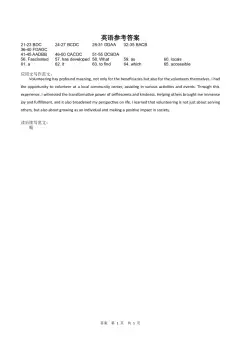
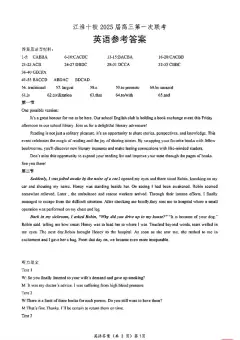
20262027 学年上学期高三年级 10 月适应性训练 英语参考答案
2123 BAC 2427 DCDB 2831 DABC 3235 CDAD3640 CAFGE
4145 BCBAC 4650 DBADB 5155 CDABC
56.its57.Betting58.into59.where60.relied61.higher62.to make
63.growth64.is offered65.but
第四部分写作 (共两节,满分 40 分)
第一节 (满分 15 分)
参考范文 1
Dear Leslie,
I’m glad to know from your letter that you intend to learn Chinese. As for the question about which course to take, I’d like to offer my recommendations.
Having weighed both options, I strongly recommend Conversational Chinese. As a beginner, it makes sense to prioritize listening and speaking first. Centered on daily conversations, it enables you to pick up practical expressions for everyday communication and build confidence quickly. Designed with plenty of interactive activities, this course immerses you in an authentic language environment, laying a solid foundation for your future study. By contrast, the Chinese Fables: Reading and Writing course is more suited to learners seeking literary appreciation, which may not be the ideal starting point for you right now.
I hope my advice will be of some help. Wish you a pleasant journey of Chinese learning.
Yours,
Li Hua
参考范文 2
Dear Leslie,
I’m glad to know you’re planning to learn Chinese. Concerning your hesitation between the two courses, I’d like to offer my advice.
If you aim to gain a deeper understanding of the language, Chinese Fables: Reading and Writing would be your ideal choice. Chinese fables are usually short and interesting, so they can provide you with plenty of useful language in meaningful contexts. Through reading them, you can build your vocabulary and see how Chinese is actually used in complete texts. The writing tasks will also give you chances to express your own ideas in Chinese. More importantly, many fables reflect traditional Chinese values and ways of thinking, which can help you understand the culture behind the language.
I hope my advice will be helpful. Wish you every success in your Chinese study.
Yours,
Li Hua
第二节 (满分 25 分)
参考范文 1
With their new knowledge, they set to work. Equipped with Dad’s practical guidance, the two kids patiently redesigned their little garden. First, they cleared away dry weeds and dead leaves to loosen the hard soil. They moved the weak tomato seedlings to a sunexposed spot free from the apple tree’s shade, ensuring they could soak up adequate sunlight. Meanwhile, they reserved a cool, damp corner for carrots and set up the wooden fence for peas to climb on. Aware that the soil was still too cold for sunflowers, they stored the seeds properly for later planting. They watered each area gently and carefully, adjusting their methods to suit different plants’ needs, no longer acting blindly as before.
Weeks later, the garden began to change. Green shoots steadily pushed through the dark earth, turning the oncegrey yard into a lively, colorful garden full of life. The pea vines climbed steadily up the wooden fence, heavy with fresh green pods, while the tomato plants they had relocated grew thick and strong, dotted with cheerful yellow flowers. Standing beside Dad on a golden afternoon, Amy plucked a sweet cherry tomato and popped it into her mouth with a triumphant grin. Looking at the thriving garden, Tom realized that caring for living things wasn’t about giving them all the same treatment, but about giving each what it truly needed to flourish.
参考范文 2
With their new knowledge, they set to work. Together, they pulled out the dry weeds and turned over the soil with the old shovel. The sunflower seeds that had never come up were mixed into the earth, and the garden soon looked neat and soft. Then they divided the work. Amy set the sunflower seeds aside because the ground was still too cold. Instead, she chose the peas and pressed them along the wooden fence, so the vines would have something to climb on. Tom gently lifted the weak tomato plants and moved them to the sunny corner near the fence. In the middle, they planted a few carrot seeds. After watering the soil with the old can, they stood back and smiled, no longer guessing, but listening to what the seeds needed.
Weeks later, the garden began to change. Green shoots appeared one after another. The pea vines climbed the wooden fence just as Amy had hoped. The tomato plants grew taller and stronger in the warm sunlight. In the middle, the carrots sent up soft green leaves. The whole yard, once grey and lifeless, was now full of color and life. Tom and Amy often stood by the garden, watching the bees and butterflies come and go. Dad stepped into the yard, a broad smile spreading across his face as he watched the children marvel at the thriving paradise. Tom looked at Amy and then at the green garden around them. He understood that every seed had its own needs, and so did every person. With patience, care, and understanding, even a forgotten garden could come back to life.