ARTICLE · 1255712
2026年下半年全国大学英语六级考试(CET6)笔试全真模拟试卷(含答案解析)·考前冲刺必刷题

2026年全国大学英语四、六级考试(CET)将于2026年12月12日举行,本文为星蓝海学习网依据历年真题命题规律编写的《六级》模拟试卷,覆盖写作题、长对话、听力篇章、讲座讲话、选词填空、长篇阅读等710分核心题型。建议考生收藏并限时自测,检验备考效果。试卷答案解析请添加星蓝海学习网刘老师VX:up0005,备注CET六级试卷答案。点击阅读原文发现更多完整备考资料。
2026年下半年全国大学英语六级考试(CET6)
笔试模拟试卷
卷面:写作15%+听力35%(长对话8×1+篇章7×1+讲座10×2)+阅读35%(选词10×0.5+匹配10×1+仔细10×2)+翻译15%,55客观+2主观 / 130分钟
满分 710分(报道分) | 合格标准 425分及以上为通行合格线(四级425分方可报考六级) | 130分钟
考试时间:2026年12月12日(四级上午 9:00—11:20 / 六级下午 15:00—17:25) | 命题依据:《全国大学英语四、六级考试大纲(2016年版)》· 教育部教育考试院(2026年下半年沿用,2026年12月12日笔试)
| 试卷说明 |
本试卷按教育部教育考试院《全国大学英语四、六级考试大纲(2016年版)》(2026年下半年沿用,2026年12月12日笔试)编制(考试日期:2026年12月12日 15:00—17:25)。
本卷为 2026 年下半年全国大学英语六级考试(CET6)笔试全真演练卷,按官方卷面结构编制:
写作 15%+听力理解 35%+阅读理解 35%+翻译(汉译英段落)15%,合计 55 道客观题+2 道主观题,
考试时间 130 分钟;总分按 710 分报道分制折算(本卷按 100 分标准化呈现),
听力较四级增加讲座/讲话题型、语速与词汇难度同步提升。本卷听力部分以文字材料呈现,供精听复盘使用。
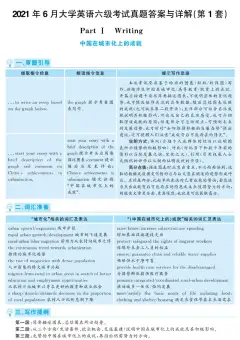
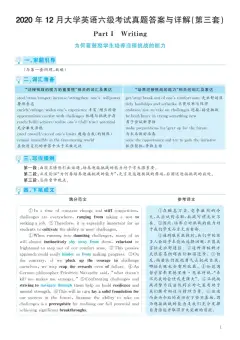
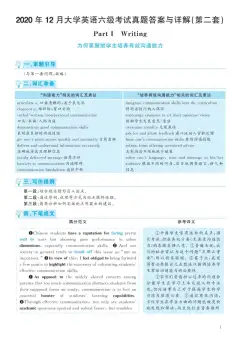
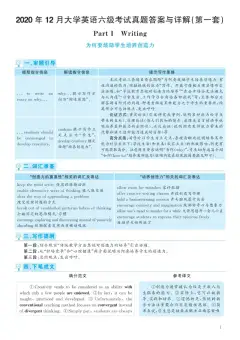
| 一、写作题(共1题,共15分) |
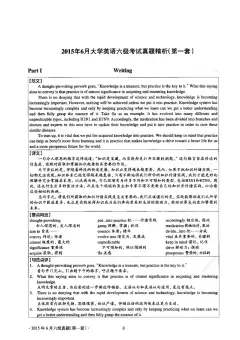
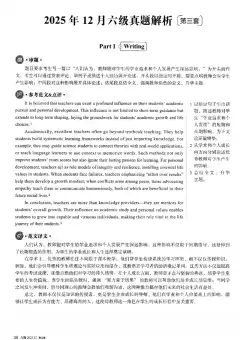
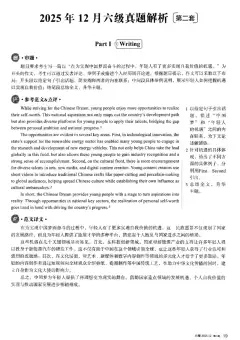
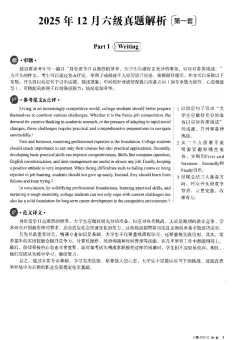
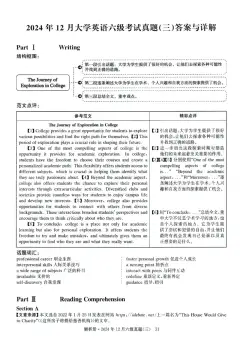
1.写作题(15分)
**Directions:** For this part, you are allowed 30 minutes to write an essay on the following topic. You should write at least 150 words but no more than 200 words.
Topic: Practical Skills vs. Theoretical Knowledge in University Education
Some people believe that universities should focus primarily on practical, career-related skills, while others hold that theoretical knowledge is the foundation of true learning. Write an essay to state your own view. You should:
① 简述这场争论的背景与双方观点;
② 给出你的立场,并用两至三个理由加以论证;
③ 总结全文并提出建议。
| 二、长对话(共8题,每题1分,共8分) |
In this section, you will hear two long conversations. At the end of each conversation, some questions will be asked about what was said. Both the conversation and the questions will be spoken only once. After each question there will be a pause. During the pause, read the questions and the choices marked A, B, C and D, and decide which is the best answer.
Conversation One
W: Good morning, Mr. Blake. I'm Linda Chen, the HR manager. Thanks for coming in for the interview.
M: Good morning. Thank you for having me. I've been looking forward to this since I received your email.
W: I see from your resume that you're majoring in marketing. Why did you choose our company for your internship?
M: Honestly, your company's social media campaigns impressed me a lot. The one you ran for recycled packaging increased product sales by thirty percent, according to your annual report.
W: That's true. It took us almost a year to design. Now, an internship here isn't easy. You'd be expected to handle market research, write weekly reports, and sometimes attend client meetings. Can you manage all that alongside your studies?
M: I believe so. I've organized my timetable so that all my classes end by Wednesday afternoon, and I can work full days from Thursday to Saturday.
W: Impressive. One more thing: we may ask you to travel to our branch in another city for a week in July. Would that be a problem?
M: Not at all. In fact, I spent last summer volunteering in a different province, so I'm quite used to being away from home.
W: Wonderful. We'll inform all candidates of the result by email next Friday. Any questions for us?
M: Yes, just one. Could you tell me whether interns here receive formal training at the beginning?
W: Certainly. Every intern is assigned a senior mentor and attends two orientation sessions in the first week.
Questions 2 to 5 are based on the conversation you have just heard.
2.Why did the man apply for the internship at this company?
A.He wanted to learn packaging design.
B.He was attracted by its marketing campaigns.
C.A friend of his recommended the company.
D.He hoped to work with the HR manager.
3.What does the man say about his weekly schedule?
A.He is free only at weekends.
B.He has classes every morning.
C.He plans to quit his part-time job.
D.All his classes finish by Wednesday afternoon.
4.What does the man say about the possible trip to the branch?
A.He is used to being away from home.
B.He will ask his tutor for permission first.
C.He cannot make it in July.
D.He has never travelled alone before.
5.What does the man want to know at the end of the interview?
A.When the result will be announced.
B.Who will be his mentor.
C.Whether interns receive formal training.
D.How long the orientation sessions last.
Conversation Two
W: Professor Hayes, do you have a minute? I'm thinking about applying for the exchange program in Australia next spring.
M: Of course, Maria. Sit down. The program is popular, but frankly, I think you're a strong candidate. Your grades in the last two semesters were excellent.
W: Thank you. My main concern is the cost. The brochure says students still pay tuition to our university, but accommodation overseas can be expensive.
M: That's true. However, the university offers travel grants of up to two thousand dollars for students with financial need, and the application is included in the exchange form.
W: I didn't know that. I'll definitely apply for one. What about the courses? Will the credits I earn there count toward my degree?
M: Yes, but you must get them approved before you leave. Choose courses from the list our department has agreed on, and submit the form to the academic office by the end of October.
W: The end of October — that's less than three weeks away. One last question: how do students usually find accommodation?
M: Most of them live in student halls for the first semester, which saves a lot of trouble, and then share private apartments with local students later. I'd suggest starting with the halls.
Questions 6 to 9 are based on the conversation you have just heard.
6.What is the woman's main concern about the exchange program?
A.Her language proficiency.
B.The difficulty of the courses.
C.The length of the application process.
D.The expenses it involves.
7.What does the man say about the travel grants?
A.They are worth up to two thousand dollars.
B.They require a separate application form.
C.They are reserved for top students only.
D.They must be repaid after graduation.
8.What must the woman do to have her credits transferred?
A.Retake similar courses at her home university.
B.Get her chosen courses approved before departure.
C.Submit the form by the end of November.
D.Pay additional tuition to the host university.
9.What does the man suggest the woman do about accommodation?
A.Stay with a local host family.
B.Rent a private apartment immediately.
C.Start with the student halls.
D.Wait until she arrives to look around.
| 三、听力篇章(共7题,每题1分,共7分) |
In this section, you will hear two passages. At the end of each passage, some questions will be asked about what was said. Both the passage and the questions will be spoken only once. After each question there will be a pause. During the pause, read the questions and the choices marked A, B, C and D, and decide which is the best answer.
Passage One
For decades, doctors have warned that teenagers need more sleep than they usually get. Recent research from a university in Finland adds a new piece of evidence. Scientists followed more than three thousand adolescents aged between thirteen and sixteen for two years and recorded their sleeping habits through wrist devices.
The findings were striking. Teenagers who regularly slept fewer than seven hours performed worse in memory tests and were more likely to catch colds. Interestingly, the quality of sleep mattered as much as the quantity. Those who used electronic devices in bed took, on average, forty minutes longer to fall asleep, even when their total sleeping time was the same. The researchers suggest that the blue light from screens delays the release of melatonin, the hormone that makes us feel sleepy.
Based on these results, several schools in Helsinki have moved their first lessons from eight o'clock to half past nine, and teachers report that students are noticeably more attentive in the morning. However, experts caution that a later school start is not a complete solution. Teenagers themselves, they say, should also develop a regular routine and avoid caffeine in the evening. As one researcher put it, technology is a wonderful servant but a terrible master, especially when it follows you into bed.
Questions 10 to 12 are based on the passage you have just heard.
10.What does the new research find about the amount of sleep teenagers get?
A.It affects both their memory and their health.
B.It matters less than the quality of sleep.
C.It has no effect on school performance.
D.It changes greatly between the ages of thirteen and sixteen.
11.What do we learn about teenagers who use electronic devices in bed?
A.They sleep fewer hours in total.
B.They wake up more often during the night.
C.They take longer to fall asleep.
D.They rarely feel sleepy in morning classes.
12.Why have some schools in Helsinki delayed their first lessons?
A.Teachers also needed more rest.
B.Students are more attentive later in the morning.
C.Bus services start later in winter.
D.Parents requested the change.
Passage Two
The City Maritime Museum has launched a program that turns local teenagers into tour guides for a day. Twice a month, twenty students from nearby secondary schools take over the galleries, guiding visitors and telling stories about the ships, sailors and trade routes that shaped the city.
The idea came from a retired teacher who noticed that young visitors quickly lost interest in traditional exhibits. She believed children would listen more willingly to guides of their own age. The museum's director agreed to test the plan during last year's summer holiday, and the response was beyond expectation: visitor numbers rose by a quarter, and surveys showed that families stayed almost twice as long as before.
This year the program has been extended to weekends, and participants receive a certificate and a small payment for transportation. Not every volunteer becomes a guide. Some prefer to work behind the scenes, restoring old photographs or translating exhibition notes into other languages. Whatever their role, all the students attend a four-week training course, where museum staff teach them both history and communication skills.
Several previous volunteers say the experience changed their career plans, and two of them are now studying history at university. The museum plans to publish a handbook next spring so that other cities can copy the model.
Questions 13 to 16 are based on the passage you have just heard.
13.What gave rise to the museum's program?
A.A shortage of professional guides in summer.
B.A survey on family spending habits.
C.An invitation from nearby secondary schools.
D.Young visitors' lack of interest in traditional exhibits.
14.What do we learn about last year's summer trial?
A.It lasted longer than the museum expected.
B.It attracted far more visitors than usual.
C.It was opposed by the museum's director.
D.It recruited students from all over the country.
15.What do volunteers who work behind the scenes do?
A.They restore old photographs and translate exhibition notes.
B.They design posters for special exhibitions.
C.They train new guides in communication skills.
D.They collect stories from retired sailors.
16.What does the museum intend to do next spring?
A.Extend the program to secondary schools nationwide.
B.Offer the volunteers full-time positions.
C.Publish a handbook for other cities to copy the model.
D.Open a new gallery designed by the volunteers.
| 四、讲座讲话(共10题,每题2分,共20分) |
In this section, you will hear three lectures or talks. At the end of each lecture or talk, some questions will be asked about what was said. Both the material and the questions will be spoken only once. After each question there will be a pause. During the pause, read the questions and the choices marked A, B, C and D, and decide which is the best answer.
Lecture One
Good afternoon, everyone. Today I want to talk about how artificial intelligence has quietly entered our kitchens, offices and classrooms.
When people hear the term AI, they often imagine robots from science fiction films. The reality is far less dramatic but far more widespread. Consider the software that filters unwanted emails: it reads millions of messages every hour and learns continuously from the choices users make. Or think about the maps on your phone: every time you drive home, the application analyses traffic data collected from thousands of other drivers and adjusts your route within seconds.
These systems do not think the way humans do. They recognize patterns in enormous quantities of information and make predictions. This is why they sometimes fail in surprising ways. A translation program may handle a newspaper article perfectly but struggle with a poem, because poetry depends on cultural knowledge that no database fully records.
Understanding this limitation matters for education. If a machine can already summarize a chapter or solve standard exercises, then simply memorizing facts loses value. What remains valuable, and what employers increasingly demand, is the ability to ask good questions, to judge whether an answer makes sense, and to combine ideas from different fields. In other words, AI raises the reward for exactly those skills that are hardest to automate.
Let me close with a piece of practical advice. Rather than fearing these tools, students should learn to work with them critically: check the sources behind an answer, test it against what you already know, and never accept a confident-sounding response without evidence. Machines are becoming better assistants, but the responsibility for sound judgement remains, for the foreseeable future, entirely human.
Questions 17 to 19 are based on the lecture you have just heard.
17.What does the speaker say about AI systems in everyday life?
A.They operate mostly inside science fiction films.
B.They think in the same way as human beings.
C.They make predictions by recognizing patterns in data.
D.They replace teachers in classrooms and offices.
18.Why does a translation program struggle with poems?
A.Poems rely on cultural knowledge that no database fully records.
B.Poems are too short for machines to process.
C.Poems contain too many spelling mistakes.
D.Poets refuse to share their works with software companies.
19.What does the speaker advise students to do?
A.Give up using AI tools in their studies.
B.Memorize more facts to compete with machines.
C.Design better translation programs themselves.
D.Work with AI tools critically and check their answers.
Lecture Two
Today's lecture examines why cities around the world are investing heavily in parks, rooftop gardens and green corridors.
The traditional view treated urban greenery as decoration — pleasant, but expensive. Modern research tells a different story. First, vegetation cools cities. On hot summer days, a large park can be two to four degrees cooler than the streets around it, and this difference reduces the energy buildings consume for air conditioning. Second, green spaces act like sponges. When heavy rain falls, soil and plants absorb water that would otherwise overwhelm the drainage system; after one European city replaced a concrete square with a garden, flood damage there fell by half. Third, and perhaps most surprising, greenery affects public finances. Studies in several countries show that apartments overlooking parks sell for noticeably more, which increases local tax income, while hospital records indicate that residents with easy access to nature suffer less from anxiety and depression.
Of course, creating green space is not without difficulties. Land in city centres is scarce and costly, and some projects have been criticized because rising property values eventually pushed lower-income residents out — a process planners call green gentrification. The most successful schemes therefore combine new parks with affordable housing rules.
To sum up: urban greenery is no longer a luxury. It is infrastructure, as essential as roads or pipes, and the cities that treat it that way are likely to be both cooler and fairer in the decades ahead.
Questions 20 to 22 are based on the lecture you have just heard.
20.According to the traditional view, urban greenery was ______.
A.as essential as roads and pipes
B.pleasant but costly decoration
C.a tool for raising property values
D.a solution to summer heat
21.What happened after one European city turned a concrete square into a garden?
A.Flood damage there dropped by half.
B.Air-conditioning costs rose sharply.
C.The drainage system was renewed.
D.Two to four new parks were built nearby.
22.What problem does "green gentrification" refer to?
A.Parks consuming too much scarce land.
B.New housing rules raising taxes sharply.
C.Higher property values driving out poorer residents.
D.Hospitals lacking access to natural surroundings.
Lecture Three
Have you ever spent an hour choosing a film to watch and then felt too tired to enjoy it? Psychologists call this decision fatigue — the way the quality of our choices declines after we have made many decisions in a row.
In one well-known experiment, judges reviewed prisoners' requests for early release. The researchers found that the proportion of favourable rulings started high in the morning and dropped steadily, rising again only after meal breaks. The prisoners' cases were similar; what changed was the judges' mental energy. Decision fatigue affects ordinary life too. Shoppers buy more impulsively in the evening, and students make poorer choices about food and study plans late in the day. The reason lies in how the brain works: self-control and careful reasoning draw on limited mental resources that deplete with use, at least within a single day.
Fortunately, there are practical remedies. Successful people often reduce the number of small decisions they face. Some executives wear nearly identical clothes; some writers plan the next day's tasks the night before, so the morning starts with action rather than deliberation. Another strategy is to make important decisions early in the day, when mental energy is highest. Finally, remember that a short walk or a proper meal restores some of what is lost.
The goal is not to avoid decisions but to spend your limited decision-making budget on what truly deserves it.
Questions 23 to 26 are based on the lecture you have just heard.
23.What is decision fatigue according to the lecture?
A.A fear of making any decision at all.
B.The decline in decision quality after many choices.
C.The exhaustion caused by physical exercise.
D.The habit of delaying important decisions.
24.What did the experiment with judges reveal?
A.Judges favoured prisoners who were polite.
B.Morning cases were more complicated than afternoon ones.
C.Meal breaks made judges less sympathetic.
D.Favourable rulings dropped steadily before meal breaks.
25.Why do some executives wear nearly identical clothes?
A.They want to build a public image.
B.They follow fashion trends set by their companies.
C.They wish to reduce small daily decisions.
D.They are advised to do so by psychologists in hospitals.
26.What does the speaker suggest people do with important decisions?
A.Make them early in the day.
B.Postpone them until the weekend.
C.Leave them to professional consultants.
D.Break them into many smaller ones.
| 五、选词填空(共10题,每题0.5分,共5分) |
In this section, there is a passage with ten blanks. You are required to select one word for each blank from a list of choices given in a word bank. Each word in the word bank can be used only once.
备选项:A.abundant B.adapt C.confronted D.decline E.efficiency F.increasingly G.infrastructure H.innovation I.monitoring J.productivity K.reluctant L.roughly M.substantial N.transform O.widespread
The smart city, once a futuristic idea, is (27)______ present in our daily lives. From London to Shenzhen, local governments are investing heavily in digital (28)______ such as sensor networks and traffic-control platforms. Yet the path to smarter cities is far from smooth. Many municipal governments are (29)______ to replace legacy systems that still function reasonably well, and the cost of full digital upgrades can be enormous. (30)______ with tight budgets, some cities have adopted a step-by-step approach, upgrading one district at a time and measuring the results before moving on. Planners also emphasize that technology alone cannot solve urban problems; cities must encourage (31)______ in the way public services are designed and delivered. A sensor can reveal where traffic jams form, but only good policy can improve the (32)______ of the public transport network that causes them. Citizens, meanwhile, want tools that (33)______ their relationship with local government, making it easier to report a broken streetlight or track a building permit. Younger residents (34)______ to new applications quickly, but older generations often need patient guidance and offline alternatives. Privacy is another concern: the (35)______ adoption of cameras and location tracking has prompted heated debate about how much surveillance a free society should accept. Despite these challenges, most experts remain optimistic, noting that smart projects already absorb a (36)______ share of municipal investment and deliver measurable benefits in energy use, road safety and emergency response.
答题栏:
27.Blank(27)
28.Blank(28)
29.Blank(29)
30.Blank(30)
31.Blank(31)
32.Blank(32)
33.Blank(33)
34.Blank(34)
35.Blank(35)
36.Blank(36)
| 六、长篇阅读(共10题,每题1分,共10分) |
In this section, you are going to read a passage with ten statements attached to it. Each statement contains information given in one of the paragraphs. Identify the paragraph from which the information is derived. Each paragraph is marked with a letter.
The Four-Day Week: Experiment or Answer?
[A] The five-day week we now take for granted was itself once a radical experiment. In 1926 the American industrialist Henry Ford closed his car factories on both Saturdays and Sundays, although competitors kept running. Output did not fall; it rose, and within a decade the two-day weekend had become an industrial standard across much of the Western world. Reformers today cite the episode to argue that shorter hours and higher productivity can go hand in hand.
[B] The modern four-day week, by contrast, is strikingly simple: employees work roughly thirty hours instead of forty, yet receive exactly the same pay. Rather than compressing five days of tasks into four, participating firms are asked to cut meetings, shorten email chains and drop low-value busywork. Advocates describe the model as trading old habits for time, not money for time.
[C] Britain has run the largest formal trial so far. Sixty-one companies covering around 2,900 employees shifted to the shorter week for six months in 2022. At the end of the trial, combined revenues had barely changed compared with the previous period, while the number of staff leaving fell by more than half. Over ninety percent of the firms said they would keep the arrangement.
[D] Economists remain divided. Sceptics point out that keeping full pay while cutting a fifth of working time is, in effect, a substantial wage increase; if the gains in productivity fall short, labour costs rise and prices follow. They note that the firms volunteering for trials are unusually enthusiastic, so average results across the whole economy could look far less impressive.
[E] For employees, the early evidence is remarkably consistent. Surveys after the British trial found that workers reported sleeping better, exercising more and experiencing markedly lower burnout. Parents particularly valued an extra free day for childcare, and several respondents said the arrangement had reduced the need for paid leave, since errands no longer crowded out the weekend.
[F] Whether the model can spread is another matter. Hospitals, schools, restaurants and customer-service centres must be staffed continuously; shortening their week means either hiring more people or cutting service hours. Manufacturing faces a similar constraint, because production lines rarely pause. For such sectors, advocates propose staggered rotas, though critics reply that this merely redistributes rather than removes the burden.
[G] Politicians have started to pay attention. Spain announced a three-year, government-funded pilot for interested small and medium-sized firms, while Iceland's earlier public-sector experiments were judged so successful that many municipal workers there kept the shorter hours permanently. Lawmakers in several other countries have proposed similar studies, though none has yet made the four-day week a legal entitlement.
[H] Inside companies, managers often voice the most practical worry: coordination. With every employee away on a different day, arranging meetings, covering urgent calls and handing over work between colleagues becomes genuinely harder. Some firms therefore impose a common day off, or require core hours in the middle of the week, so that clients and teammates are never left without support.
[I] Trade unions have watched the debate with cautious interest. Their historical struggle — eight hours for work, eight for rest, eight for what we will — delivered the weekend a century ago, and union representatives now sit on the advisory boards of several national trials. They generally welcome shorter hours but insist that any new model must not be paired with lower pay or weakened job protection.
[J] Technology cuts both ways in this debate. Collaboration software, shared calendars and video calls make it easier than ever to hand work over smoothly, which is precisely what a compressed week demands. Yet the same tools allow managers to monitor keystrokes and online status, and labour groups warn that some firms may answer shorter hours not with smarter work but with closer surveillance.
[K] Perhaps the deepest change is conceptual. When hours are scarce, firms stop asking how long you worked and start asking what you delivered. Several companies in the British trial redesigned their targets around quarterly outcomes instead of weekly attendance. Whatever happens to the four-day week itself, that shift — from measuring presence to measuring output — looks likely to endure.
37.Some economists regard keeping full pay while reducing working time as effectively a big wage rise that may push costs and prices upward.
38.One practical worry inside companies is arranging timetables so that clients and teammates are never left without support.
39.In most current trials, employees continue to receive their full salary although they work fewer hours.
40.The very technologies that enable smooth handover of work can also allow managers to keep staff under closer surveillance.
41.Industries that must be staffed continuously find it hard to shorten their working week.
42.A century ago, a famous industrialist helped establish the two-day weekend by closing his factories on Saturdays even though rivals did not.
43.The debate has already pushed some companies to evaluate staff by results rather than by attendance.
44.In a large British experiment, companies' income remained roughly stable while staff departures fell by more than half.
45.Workers in the trials report that they sleep better, exercise more and feel far less burned out.
46.One European government plans to fund a three-year trial of shorter working hours for interested smaller firms.
| 七、仔细阅读(共10题,每题2分,共20分) |
In this section, there are two passages followed by some questions or unfinished statements. For each of them there are four choices marked A, B, C and D. You should decide on the best choice.
Passage One
Questions 47 to 51 are based on the following passage.
Every student knows the feeling of reading a textbook chapter three times until the words feel familiar, only to forget most of it a week later. Cognitive psychologists have a name for the trap: the illusion of fluency. When material is easy to process — because we have just read it or because the teacher has repeated it — we mistake that ease for lasting knowledge.
Two older techniques turn out to be far more effective, although both feel uncomfortable. The first is spaced practice. In a classic study, two groups of language learners studied the same vocabulary for the same total time. One group crammed in a single long session; the other spread the same minutes across four shorter sessions on different days. On a test immediately afterwards the two groups looked similar. One month later the difference was dramatic: the spaced group remembered roughly twice as much. Forgetting, it seems, is not always the enemy. Each time we make an effort to retrieve a half-forgotten item, the memory is strengthened more than it would be by another painless reading.
The second technique is retrieval practice — in plain terms, self-testing. Rather than rereading notes, students should close the book and try to write down what they remember, then check the gaps. Surveys repeatedly show that most learners rank rereading and highlighting as their favourite methods and rate self-testing as one of the least pleasant. Yet the evidence points the other way: testing is not merely a measurement of learning but a powerful way of producing it.
Teachers bear some responsibility for the gap between research and practice, since textbooks still provide far more exercises asking students to recognize information than to produce it from memory. The message for learners, however, is clear. Struggling to recall is not a sign of failure; it is the very feeling of learning taking place.
47.Why does the author mention the habit of reading a chapter three times?
A.To praise students' diligence in reviewing lessons.
B.To show a common but ineffective way of studying.
C.To prove that textbooks have become too difficult.
D.To explain why teachers repeat key points in class.
48.What do we learn about the two groups in the classic study?
A.The cramming group made fewer mistakes at first.
B.The two groups studied different amounts of vocabulary.
C.The spaced group felt more comfortable while learning.
D.The spaced group did far better in the test a month later.
49.What does the passage say about forgetting?
A.Effort to recall a half-forgotten item strengthens memory.
B.It can be completely avoided by spaced practice.
C.It proves that repeated reading is the best method.
D.It only happens to learners with poor memories.
50.What do surveys reveal about learners' preferences?
A.They enjoy self-testing more than any other method.
B.They rely mainly on teachers' summaries.
C.They prefer rereading although it is less effective.
D.They refuse to do exercises in textbooks.
51.What responsibility do teachers bear, according to the author?
A.They give students too many difficult tests.
B.They emphasize recognition-style exercises over recall from memory.
C.They fail to teach the illusion of fluency.
D.They spend too little time on vocabulary.
Passage Two
Questions 52 to 56 are based on the following passage.
Wearable devices that count steps and track heartbeats were once novelty gadgets for runners. They have quietly become something closer to medical instruments. Modern smartwatches can detect irregular heart rhythms, estimate blood-oxygen levels, and alert wearers when their pulse becomes dangerously high or low. Cardiologists have welcomed one unexpected consequence: some people visit hospitals because of a watch warning rather than a symptom, and early treatment in such cases can prevent strokes.
Yet the technology also raises difficult questions. The sensors are impressively accurate at counting steps, but less reliable for the measures that matter most in medicine. Sleep staging, for instance, still falls well short of the recordings used in sleep clinics, and stress estimates depend on indirect signals such as heart-rate variability, which exercise, caffeine and even an exciting film can distort. Doctors therefore urge users to treat the numbers as hints rather than diagnoses.
There is also the question of what happens to the data. Unlike a conversation with a physician, the streams collected by consumer devices are usually governed by commercial privacy policies rather than medical confidentiality. In several countries, insurers have offered discounts to customers who share their activity data, a practice that critics say may quietly penalize those who cannot, or will not, wear a tracker. Regulators have begun to respond: new rules now require manufacturers to prove that any feature marketed as a health function actually works.
Despite these concerns, few researchers would return to the age of ignorance. Large-scale studies using wearable data have already revealed how little most office workers move, and how strongly a single brisk half-hour walk is associated with lower risks of heart disease. The wrist, it turns out, can indeed tell us useful things — provided we remember that the final judgement belongs to professionals, not to a gadget.
52.What do cardiologists welcome about wearable devices?
A.Their low price compared with hospital equipment.
B.Early warnings that can lead to timely treatment.
C.Their popularity among professional runners.
D.Their ability to replace regular medical check-ups.
53.What is said about sleep staging on smartwatches?
A.It depends on signals distorted by caffeine only.
B.It works better than recordings in sleep clinics.
C.It is the most reliable medical measure they offer.
D.It is much less accurate than clinical recordings.
54.What concern is raised about the data collected by consumer devices?
A.They are governed by commercial rules instead of medical confidentiality.
B.They are usually sold to advertising companies illegally.
C.They cannot be shared with physicians at all.
D.They have caused the spread of false health information.
55.Why do critics dislike insurers' data-sharing discounts?
A.Insurers charge higher premiums for smartwatch users.
B.The discounts are too small to be attractive.
C.Governments have forbidden insurers to collect data.
D.They may quietly disadvantage people without trackers.
56.What conclusion does the author draw about wearable devices?
A.Researchers should return to the age of ignorance.
B.Their data is useful if the final judgement is left to professionals.
C.They will soon replace doctors in primary care.
D.Their health features should be marketed more aggressively.
| 八、翻译题(共1题,共15分) |
57.翻译题(15分)
**Directions:** For this part, you are allowed 30 minutes to translate a passage from Chinese into English.
请将下面这段话翻译成英文:
中国书法是一门拥有三千多年历史的独特艺术,以方块汉字为载体,借助毛笔的提按顿挫和墨色的浓淡变化来抒发书写者的情感与审美追求。历代书法家留下了无数珍贵作品,东晋王羲之的《兰亭序》更被后人誉为"天下第一行书"。自古以来,书法就是文人修身养性的重要方式,它讲究心手合一、持之以恒。如今,书法已进入中国中小学课堂,成为美育的重要组成部分;各类书法展览和国际交流活动也频繁举办,吸引着越来越多的海外爱好者。
📝 试卷答案获取方式
答案请添加星蓝海学习网刘老师VX:up0005,备注CET六级试卷答案
如需更多2026年职业资格考试备考资料(英语四级、英语六级、CET4、CET6等),欢迎关注星蓝海学习网,获取全国大学英语四、六级考试(CET)最新动态与免费题库。
#大学英语四六级 #CET #六级
星蓝海学习网 · 为考研考证学子提供12万+备考资料与真题题库
xlh.100xuexi.com