 夜雨聆风
夜雨聆风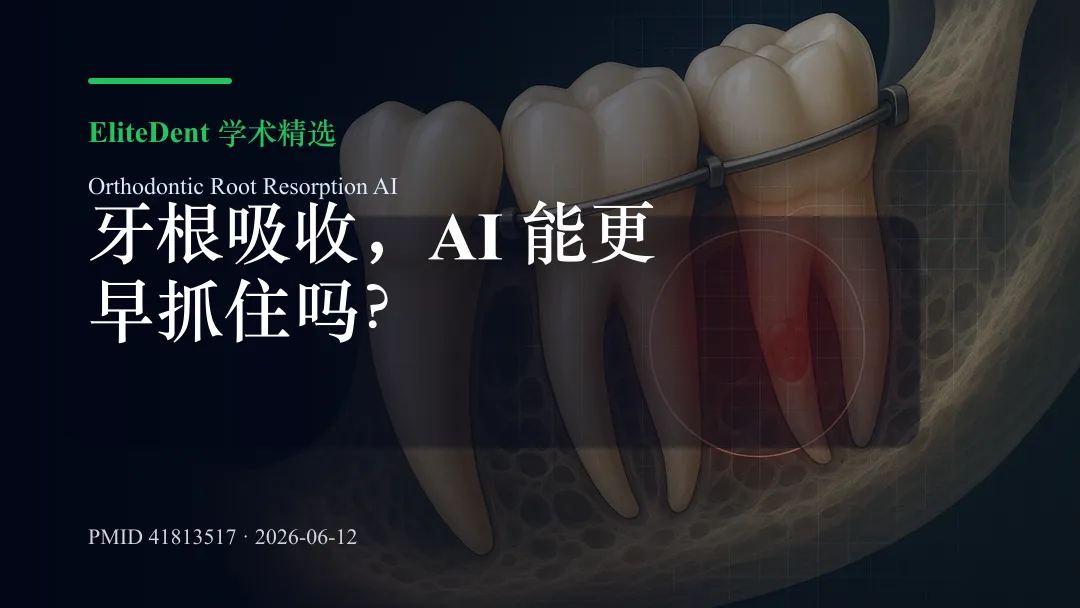
Karla N. Matos 与 Heloisa H. dos Santos Dantas Guimarães 分别来自 University of São Paulo 与 Federal University of Minas Gerais。论文发表于 Journal of the World Federation of Orthodontists,PMID: 41813517,DOI: 10.1016/j.ejwf.2026.02.001。
为什么值得读
这篇系统综述与 Meta 分析提示:AI 在正畸相关牙根吸收识别上已经表现出很强准确率,但距离稳定常规化使用,还差多中心外部验证和更统一的阈值标准。
外吸收和颈部吸收并不总会在早期被肉眼稳定识别,但一旦拖晚,后果往往不可逆。作者把问题放在正畸影像场景里,直接评估 AI 对 ERR/ECR 的诊断准确性,而不是泛泛谈“AI 很有前景”。
The review focused on diagnostic accuracy of AI for external root and cervical resorption in orthodontic imaging.
纳入的 5 项研究共 1089 张影像,合并后敏感性约 90.7%,特异性约 91.8%。尤其在 CBCT 场景下,模型表现优于全景片,这对高风险病例的复核策略很有参考价值。
Across five studies, pooled sensitivity reached 90.7% and specificity 91.8%, with CBCT-based models performing better than panoramic models.
作者也明确指出,研究数量少、样本地域有限、外部验证缺失,异质性也不低。换句话说,现在更像是“值得部署在复核链路里”,而不是“可以替代医生判断”。
Limited study count, moderate heterogeneity, and missing external validation still constrain generalizability.
如果诊所本来就会在复杂病例中用 CBCT 复核,AI 的价值是更早提醒高风险区域,减少漏看,而不是帮你省掉判断。真正提高安全性的,是把 AI 放进标准化影像复核流程,而不是单独摆成卖点。
The near-term value is early flagging inside a structured CBCT review workflow, not autonomous diagnosis.
这篇文章适合所有做数字正畸和复杂病例随访的团队。牙根吸收的竞争优势,不在于谁先买 AI,而在于谁先把“早识别、早解释、早干预”做成稳定流程。
Competitive advantage comes from workflow discipline around earlier detection and intervention.
Sam的思考延展
AI 在正畸里最值得先用的,往往不是花哨模拟,而是这种能减少不可逆损伤漏判的场景。
参考信息
参考信息|Artificial intelligence for detecting orthodontic root resorption: A systematic review and meta-analysis of diagnostic accuracy. J World Fed Orthod. 2026;15(3):197-204. PMID: 41813517. DOI: 10.1016/j.ejwf.2026.02.001.
EliteDent 学术精选
中文主阅读 · 英文辅助阅读 · Sam 译编