年 全 国 教 师 资 格
2 0 2 4
理 论 精 讲 -教 学 设 计 2
讲师:李婉君
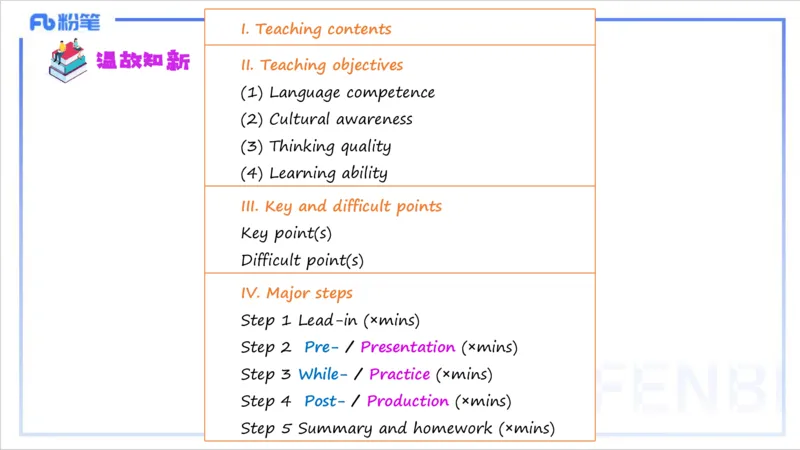
更多干货关注 粉笔教师教育 粉笔教师I. Teaching contents
温 故知 新
II. Teaching objectives
(1) Language competence
(2) Cultural awareness
(3) Thinking quality
(4) Learning ability
III. Key and difficult points
Key point(s)
Difficult point(s)
IV. Major steps
×
Step 1 Lead-in ( mins)
×
Step 2 Pre- / Presentation ( mins)
×
Step 3 While- / Practice ( mins)
×
Step 4 Post- / Production ( mins)
×
Step 5 Summary and homework ( mins)温 故知 新温 故知 新写 作 课 (读 写 课 )
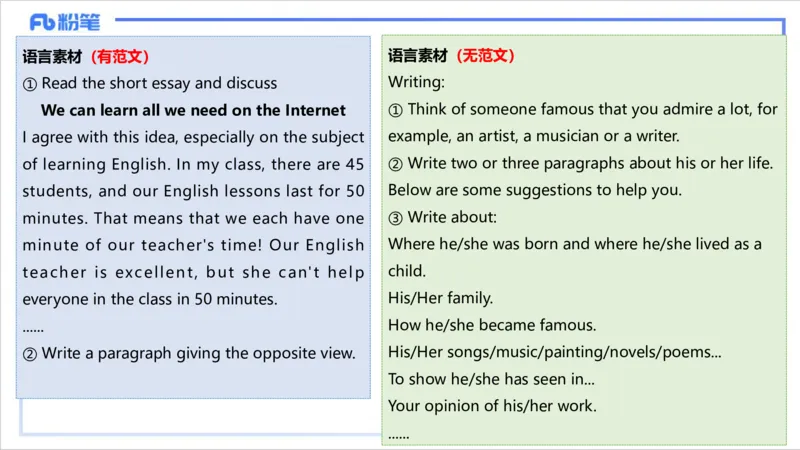
writing lesson语言素材(有范文) 语言素材(无范文)
① Read the short essay and discuss Writing:
We can learn all we need on the Internet ① Think of someone famous that you admire a lot, for
I agree with this idea, especially on the subject example, an artist, a musician or a writer.
of learning English. In my class, there are 45 ② Write two or three paragraphs about his or her life.
students, and our English lessons last for 50 Below are some suggestions to help you.
minutes. That means that we each have one ③ Write about:
minute of our teacher's time! Our English Where he/she was born and where he/she lived as a
teacher is excellent, but she can't help child.
everyone in the class in 50 minutes. His/Her family.
...... How he/she became famous.
② Write a paragraph giving the opposite view. His/Her songs/music/painting/novels/poems...
To show he/she has seen in...
Your opinion of his/her work.
......看 课件
有 范 文
无 范 文写 前 模板
有范文
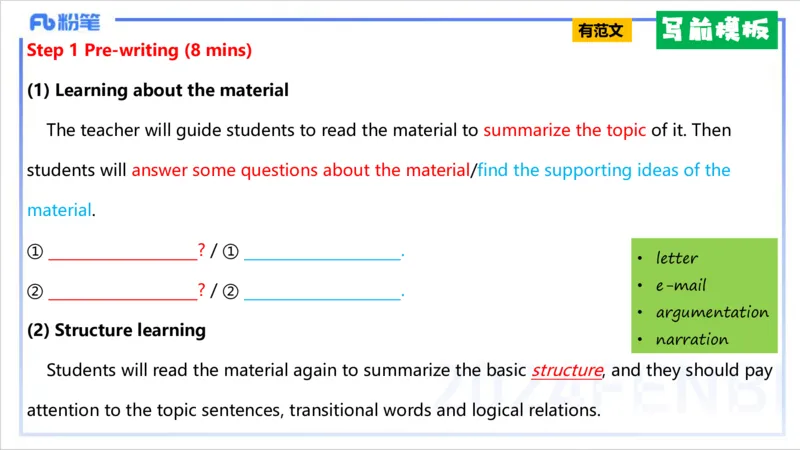
Step 1 Pre-writing (8 mins)
(1) Learning about the material
The teacher will guide students to read the material to summarize the topic of it. Then
students will answer some questions about the material/find the supporting ideas of the
material.
① ____________________? / ① _____________________.
•
letter
•
② ____________________? / ② _____________________. e-mail
•
argumentation
(2) Structure learning
•
narration
Students will read the material again to summarize the basic structure, and they should pay
attention to the topic sentences, transitional words and logical relations.写 前 模板
有范文
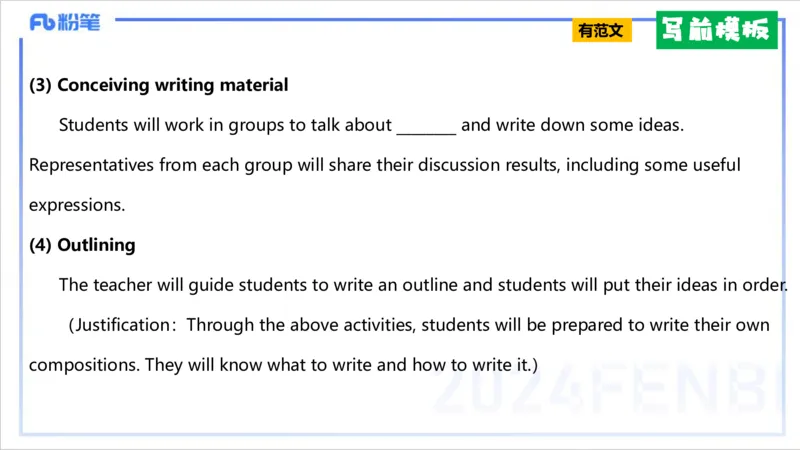
(3) Conceiving writing material
Students will work in groups to talk about ________ and write down some ideas.
Representatives from each group will share their discussion results, including some useful
expressions.
(4) Outlining
The teacher will guide students to write an outline and students will put their ideas in order.
(Justification:Through the above activities, students will be prepared to write their own
compositions. They will know what to write and how to write it.)小 练习
语言素材:(有范文)
In some countries in western Europe, such as France, Spain and Britain, the countryside is changing.
Life has become difficult for many villages, and some are disappearing. There are a number of
reasons for this. Firstly, young people from villages usually want to live somewhere livelier and they
often move to the towns and do not return. Secondly, people move to the cities to find work, as there
are very few jobs in the countryside. Sometimes villages still remain because people from the cities have
bought a “second home” in the village, where they come and stay at weekends. The price of the
homes goes up and people from the area cannot afford to buy a house there. Another problem is that it
is becoming more and more difficult for farmers to make money from their farms. So they sell their land
and find another job.
All these things mean that many villages in western Europe are fighting to survive. We can only
hope that they will remain. The countryside would be a sadder and uglier place without them.Step 1 Pre-writing (8 mins)
(1) Learning about the material
The teacher will guide students to read the material to summarize the topic of it. Then
students will find the supporting ideas of the material.
①young people from villages usually want to live somewhere livelier
②people move to the cities to find work, as there are very few jobs in the countryside
(2) Structure learning
Students will read the material again to summarize the basic structure, and they should pay
attention to the topic sentences, transitional words and logical relations.小 练习
(3) Conceiving writing material
Students will work in groups to talk about Do you like the city life or the country life? and
write down some ideas. Representatives from each group will share their discussion results,
including some useful expressions.
(4) Outlining
The teacher will guide students to write an outline and students will put their ideas in order.
(Justification:Through the above activities, students will be prepared to write their own
compositions. They will know what to write and how to write it.)写 前 模板
无范文
Step 1 Pre-writing (8 mins)
(1) Do a brainstorming
Let students do a brainstorming. The topic is “When it refers to'_________', I can think of...”
Students will be given several minutes to work in groups to talk about it and write down
some ideas. After that, representatives from each group will share their results, including
some useful phrases, sentences and so on. Each answer will get positive feedback.写 前 模板
无范文
(2) Structure learning
The teacher will guide students to define the basic structure. Students should also pay
attention to the topic sentences, transitional words, logical relations and so on.
(3) Outlining
The teacher will guide students to write an outline and students will put their ideas in
order.
(Justification:Through the above activities, students will be prepared to write their own
compositions. They will know what to write and how to write it.)小 练习
Step 1 Pre-writing (8 mins)
(1) Do a brainstorming
Let students do a brainstorming. The topic is “When it refers to'city life or the country life',
I can think of...”. Students will be given several minutes to work in groups to talk about it and
write down some ideas. After that, representatives from each group will share their results,
including some useful phrases, sentences and so on. Each answer will get positive feedback.小 练习
(2) Structure learning
The teacher will guide students to define the basic structure. Students should also pay
attention to the topic sentences, transitional words, logical relations and so on.
(3) Outlining
The teacher will guide students to write an outline and students will put their ideas in
order.
(Justification:Through the above activities, students will be prepared to write their own
compositions. They will know what to write and how to write it.)写 中 模板
Step 2 While-writing (7 mins)
Drafting
Students will write their own compositions, and the teacher will walk around to offer help
and remind students to pay attention to the spelling, grammar, punctuation and so on.
(Justification: Through the activity, students will finish their writing and their writing ability
will be improved.)写 后 模板
Step 3 Post-writing (5 mins)
(1) Editing
① Self-editing
The teacher will give students a short time to go through their compositions to correct the
mistakes in spelling and grammar.
② Peer-editing
Students will exchange their compositions with each other and correct the mistakes in
spelling and grammar. They can also make suggestions about polishing their writings.写 后 模板
(2) Displaying and evaluating
The teacher will invite some students to share their compositions with the whole class
and guide other students to evaluate these compositions, and then the teacher will make a
conclusion.
(Justification: Through these activities, students will regulate their language and work out
better ideas or expressions, and they will improve their writing skills. Besides, they will be
more willing to share their ideas in public.)口 语 课 ( )
speaking lesson PWP说 前 模板
Step 1 Pre-speaking (8 mins)
(1) Listening to the conversation/Reading the passage
Students will listen to the conversation/read the passage to get the main idea, and then answer some
questions/fill in the chart.
A X
_____________?
_____________? OR
(2) Learning expressions
The teacher will explain the meaning and usage of the new words and sentences about the situation,
including _________and invite students to do some exercises about the new knowledge.
(Justification: With those activities, students will be familiar with the situation, and accumulate many
expressions which can be used in this situation, making good preparations for the speaking activities.)说 中 模板
Step 2 While-speaking (7 mins)
(1) Reading after the audio
The teacher will play the audio and lead students to read after it. Students should pay
attention to the pronunciation and intonation.
(2) Group discussion/Make a conversation/Do a survey
Ask students to work in groups and have a discussion/make a conversation/do a survey
about . They should try to use the words and sentence structures they have learned
today.
(Justification: Students will have a deeper understanding of the topic and usage of the
new knowledge, and they can also have more opportunities to express themselves.)说 后 模板
Step 3 Post-speaking (5 mins)
Sharing and evaluating
The teacher will invite some students to share their dialogues/results with the whole class
and guide other students to evaluate their performance, and then the teacher will make a
conclusion.
(Justification: Through these activities, students will improve their speaking skills. Besides,
they will be more willing to share their ideas in public and learn from each other.)小 练习
语言素材:(口语课)
Frank: Hi, Bob. How’s your day?
Bob: It’s OK. I like Monday because I have P. E. and history. They’re my favorite subjects.
Frank: Who’s your P. E. teacher?
Bob: Mr. Hu. He always plays games with US.
Frank: That’s great! But why do you like history? It’s boring.
Bob: Oh, I think history is interesting. What’s your favorite day?
Frank: Friday.
Bob: Why?
Frank: Because the next day is Saturday!
Bob: Haha! That’s for sure. I like Friday, too.小 练习
Step 1 Pre-speaking (8 mins)
(1) Listening to the conversation
Students will listen to the conversation to get the main idea, and then answer some questions.
Why does Bob like Monday?
What does Frank think of history?
What’s Frank’s favorite day and why?小 练习
(2) Learning expressions
The teacher will explain the meaning and usage of the new sentence structures about the
situation, including “—What’s your favorite day? —I like... because...” and invite students to
do some exercises about the new knowledge.
(Justification: With these activities, students will be familiar with the situation, and
accumulate many expressions which can be used in this situation, making good preparations
for the speaking activities.)小 练习
Step 2 While-speaking (7 mins)
(1) Reading after the tape
The teacher will play the tape and lead students to read after it. Students should pay
attention to the pronunciation and intonation.
(2) Group work
The teacher will ask students to work in groups of four and have a discussion about their
favorite days and why they like them. They should try to use the sentence structures they have
learned today.
(Justification: Students will have a deeper understanding of the topic and usage of the new
knowledge, and they can also have more opportunities to express themselves.)小 练习
Step 3 Post-speaking (5 mins)
Displaying and evaluating
The teacher will invite some students to share their dialogues with the whole class and
guide other students to evaluate the performance, and then the teacher will make a conclusion.
(Justification: Through these activities, students will regulate their language and work out
better ideas or expressions, and they will improve their speaking skills. Besides, they will be
more willing to share their ideas in public and learn from each other.)了解即可
口语课 speaking lesson(PPP)呈 现
Presentation
Step 1 Presentation (10 mins)
(1) Listening to the conversation/Reading the passage
Students will listen to the conversation/read the passage to get the main idea, and then answer some
questions/fill in the chart.
XX XX
_____________?
_____________? OR
(2) Learning expressions
The teacher will explain the meaning and usage of the new words and sentences about the situation,
including _________.
(Justification: With those activities, students will be familiar with the situation, and accumulate many
expressions which can be used in this situation, making good preparations for the speaking activities.)Practice 练习
Step 2 Practice (6 mins)
1. Invite students to do some exercises about the new knowledge, such as matching
pictures with correct words, making sentences and so on.
2. The teacher will play the audio and lead students to read after it. Students should pay
attention to the pronunciation and intonation.
(Justification: This activity can help students practice the sentence patterns and increase
their interest in learning English. Besides, their abilities of speaking can be improved.)Production 产 出
Step 3 Production (4 mins)
Make a conversation/Group discussion/Do a survey
Ask students to work in groups and make a conversation/discuss/do a survey about
_______ by using the target language. Several minutes will be given. When time is up, students
need to share their conversations/results with the whole class. The teacher should observe
students’ performance, give them help and positive evaluations.
(Justification: Through the group work, students can gradually become proficient in using
the sentence patterns they have learned and apply them into daily life. In addition, their
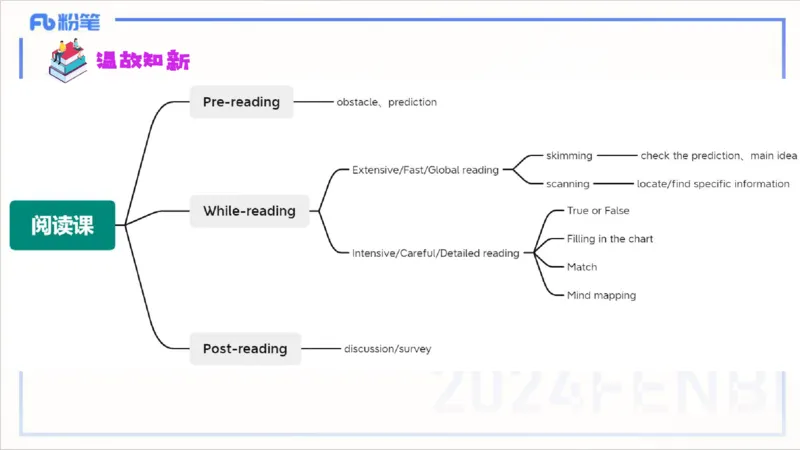
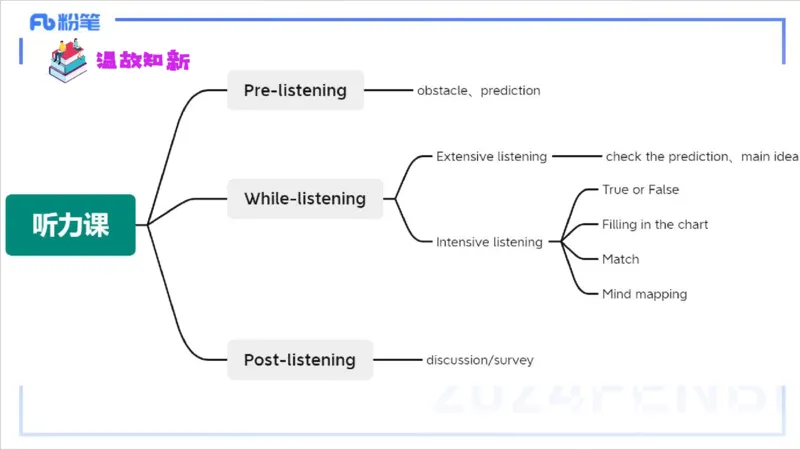
confidence of speaking and learning English can be cultivated.)课型 Pre-listening/reading While-listening/reading Post-listening/reading
1. Obstacle 1. Extensive listening/reading
听力/阅读课 Discussion/Survey
2. Prediction 2. Intensive listening/reading
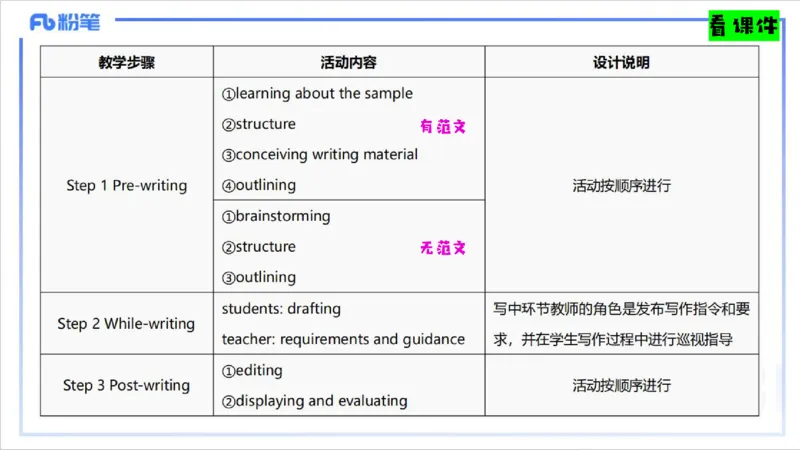
课型 Pre-writing While-writing Post-writing
1. Learning
about the
material 1. Brainstorming
1. Editing
2. Structure 2. Structure
写作课 Drafting 2. Sharing
learning learning
3. Evaluation
3. Conceiving 3. Outlining
writing material
4. Outlining
课型 Pre-speaking While-speaking Post-speaking
1. Listening/Reading 1. Reading after the audio 1. Sharing
口语课
2. Learning expressions 2. Discussion/survey 2. Evaluating