大学英语六级考试 2025 年 12 月真题(第一套)
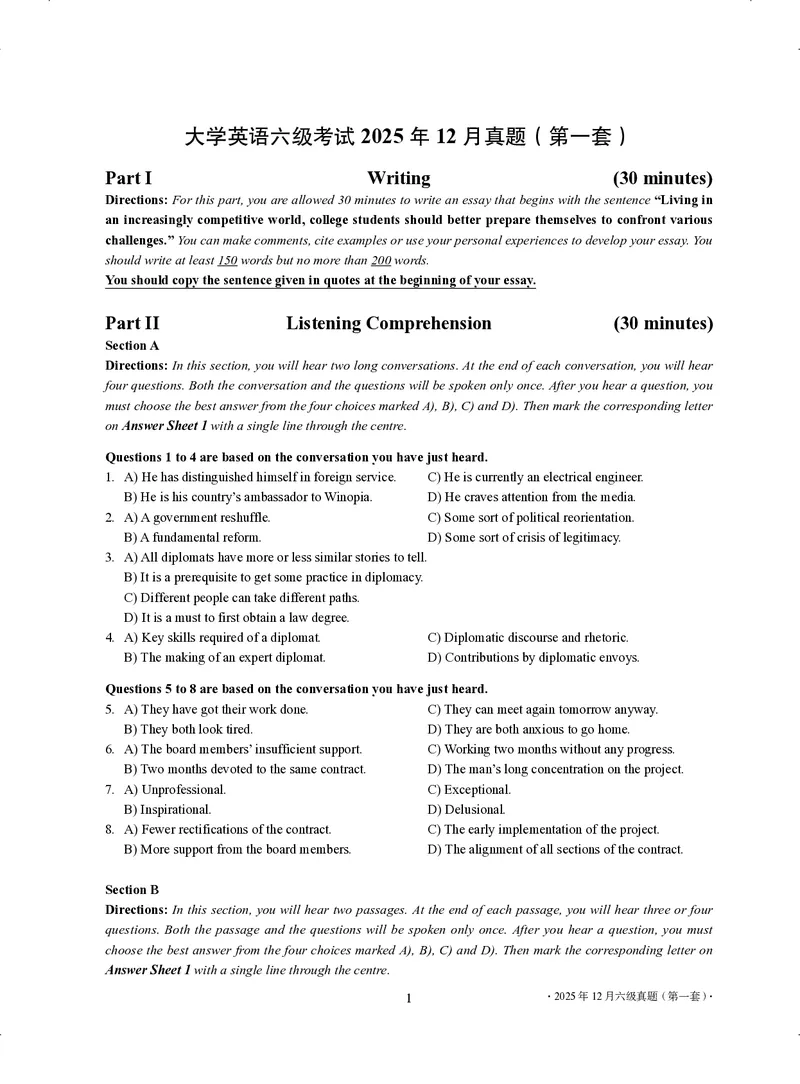
Part I Writing (30 minutes)
Directions: For this part, you are allowed 30 minutes to write an essay that begins with the sentence “Living in
an increasingly competitive world, college students should better prepare themselves to confront various
challenges.” You can make comments, cite examples or use your personal experiences to develop your essay. You
should write at least 150 words but no more than 200 words.
You should copy the sentence given in quotes at the beginning of your essay.
Part II Listening Comprehension (30 minutes)
Section A
Directions: In this section, you will hear two long conversations. At the end of each conversation, you will hear
four questions. Both the conversation and the questions will be spoken only once. After you hear a question, you
must choose the best answer from the four choices marked A), B), C) and D). Then mark the corresponding letter
on Answer Sheet 1 with a single line through the centre.
Questions 1 to 4 are based on the conversation you have just heard.
1. A) He has distinguished himself in foreign service. C) He is currently an electrical engineer.
B) He is his country’s ambassador to Winopia. D) He craves attention from the media.
2. A) A government reshuffle. C) Some sort of political reorientation.
B) A fundamental reform. D) Some sort of crisis of legitimacy.
3. A) All diplomats have more or less similar stories to tell.
B) It is a prerequisite to get some practice in diplomacy.
C) Different people can take different paths.
D) It is a must to first obtain a law degree.
4. A) Key skills required of a diplomat. C) Diplomatic discourse and rhetoric.
B) The making of an expert diplomat. D) Contributions by diplomatic envoys.
Questions 5 to 8 are based on the conversation you have just heard.
5. A) They have got their work done. C) They can meet again tomorrow anyway.
B) They both look tired. D) They are both anxious to go home.
6. A) The board members’ insufficient support. C) Working two months without any progress.
B) Two months devoted to the same contract. D) The man’s long concentration on the project.
7. A) Unprofessional. C) Exceptional.
B) Inspirational. D) Delusional.
8. A) Fewer rectifications of the contract. C) The early implementation of the project.
B) More support from the board members. D) The alignment of all sections of the contract.
Section B
Directions: In this section, you will hear two passages. At the end of each passage, you will hear three or four
questions. Both the passage and the questions will be spoken only once. After you hear a question, you must
choose the best answer from the four choices marked A), B), C) and D). Then mark the corresponding letter on
Answer Sheet 1 with a single line through the centre.
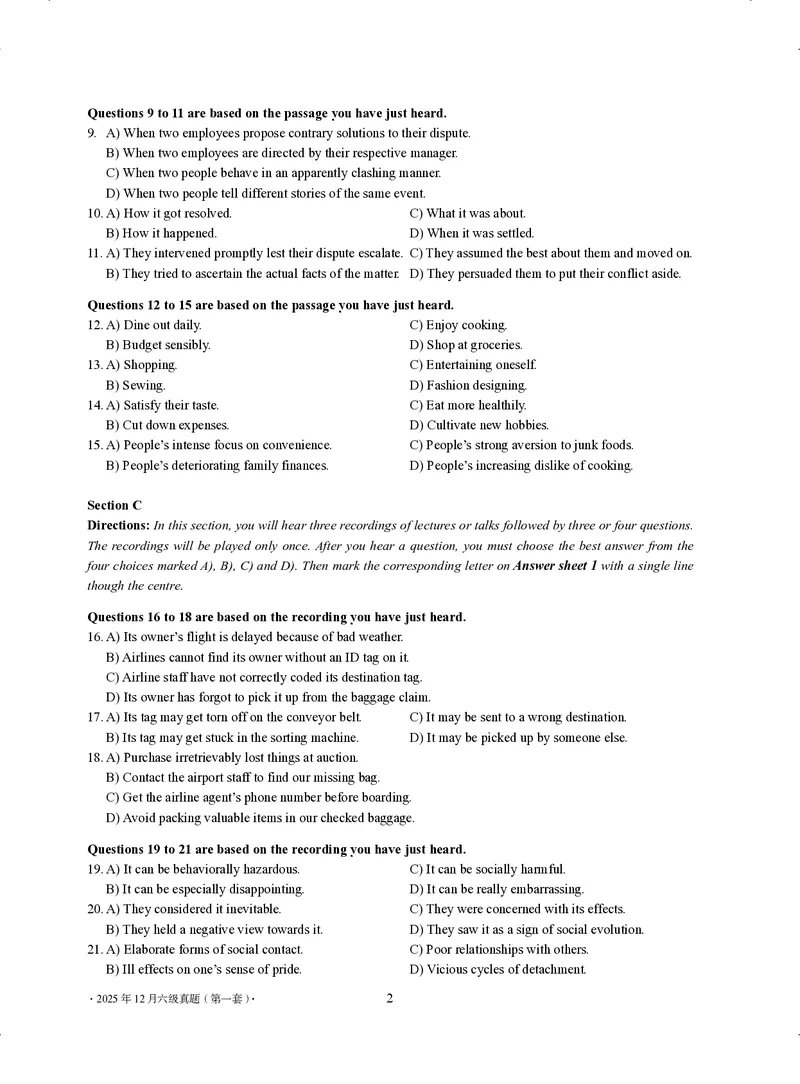
1 ·2025年12月六级真题(第一套)·Questions 9 to 11 are based on the passage you have just heard.
9. A) When two employees propose contrary solutions to their dispute.
B) When two employees are directed by their respective manager.
C) When two people behave in an apparently clashing manner.
D) When two people tell different stories of the same event.
10. A) How it got resolved. C) What it was about.
B) How it happened. D) When it was settled.
11. A) They intervened promptly lest their dispute escalate. C) They assumed the best about them and moved on.
B) They tried to ascertain the actual facts of the matter. D) They persuaded them to put their conflict aside.
Questions 12 to 15 are based on the passage you have just heard.
12. A) Dine out daily. C) Enjoy cooking.
B) Budget sensibly. D) Shop at groceries.
13. A) Shopping. C) Entertaining oneself.
B) Sewing. D) Fashion designing.
14. A) Satisfy their taste. C) Eat more healthily.
B) Cut down expenses. D) Cultivate new hobbies.
15. A) People’s intense focus on convenience. C) People’s strong aversion to junk foods.
B) People’s deteriorating family finances. D) People’s increasing dislike of cooking.
Section C
Directions: In this section, you will hear three recordings of lectures or talks followed by three or four questions.
The recordings will be played only once. After you hear a question, you must choose the best answer from the
four choices marked A), B), C) and D). Then mark the corresponding letter on Answer sheet 1 with a single line
though the centre.
Questions 16 to 18 are based on the recording you have just heard.
16. A) Its owner’s flight is delayed because of bad weather.
B) Airlines cannot find its owner without an ID tag on it.
C) Airline staff have not correctly coded its destination tag.
D) Its owner has forgot to pick it up from the baggage claim.
17. A) Its tag may get torn off on the conveyor belt. C) It may be sent to a wrong destination.
B) Its tag may get stuck in the sorting machine. D) It may be picked up by someone else.
18. A) Purchase irretrievably lost things at auction.
B) Contact the airport staff to find our missing bag.
C) Get the airline agent’s phone number before boarding.
D) Avoid packing valuable items in our checked baggage.
Questions 19 to 21 are based on the recording you have just heard.
19. A) It can be behaviorally hazardous. C) It can be socially harmful.
B) It can be especially disappointing. D) It can be really embarrassing.
20. A) They considered it inevitable. C) They were concerned with its effects.
B) They held a negative view towards it. D) They saw it as a sign of social evolution.
21. A) Elaborate forms of social contact. C) Poor relationships with others.
B) Ill effects on one’s sense of pride. D) Vicious cycles of detachment.
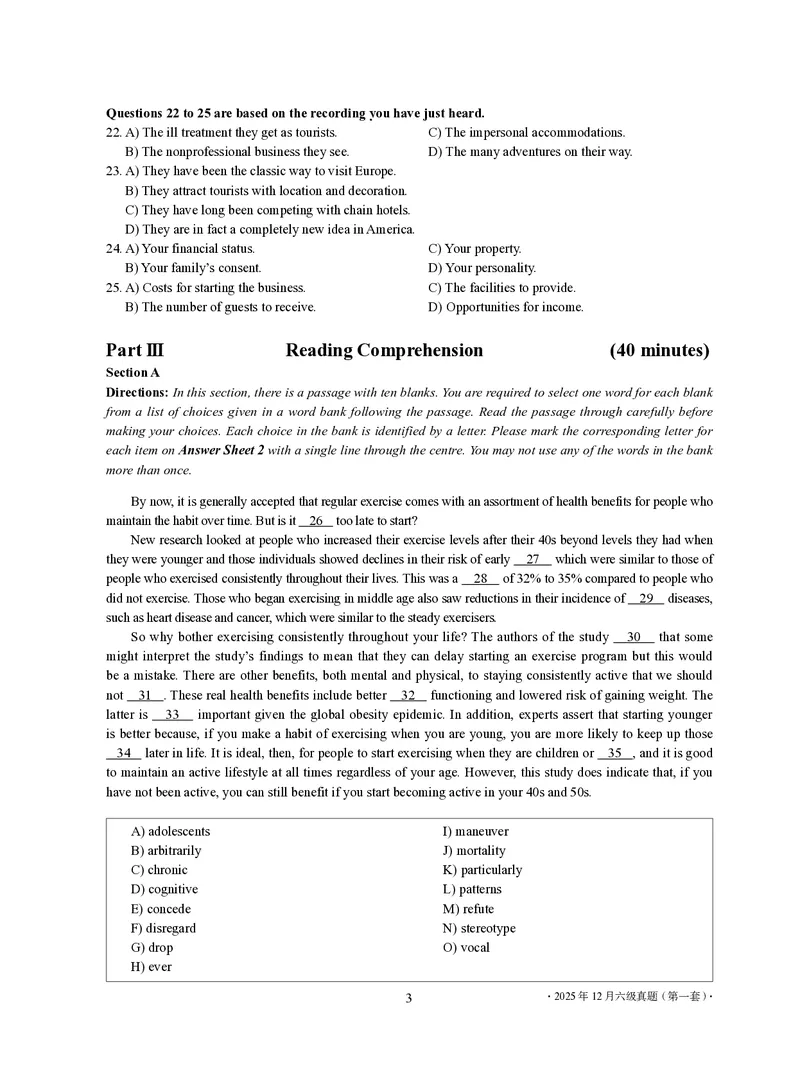
·2025年12月六级真题(第一套)· 2Questions 22 to 25 are based on the recording you have just heard.
22. A) The ill treatment they get as tourists. C) The impersonal accommodations.
B) The nonprofessional business they see. D) The many adventures on their way.
23. A) They have been the classic way to visit Europe.
B) They attract tourists with location and decoration.
C) They have long been competing with chain hotels.
D) They are in fact a completely new idea in America.
24. A) Your financial status. C) Your property.
B) Your family’s consent. D) Your personality.
25. A) Costs for starting the business. C) The facilities to provide.
B) The number of guests to receive. D) Opportunities for income.
Part III Reading Comprehension (40 minutes)
Section A
Directions: In this section, there is a passage with ten blanks. You are required to select one word for each blank
from a list of choices given in a word bank following the passage. Read the passage through carefully before
making your choices. Each choice in the bank is identified by a letter. Please mark the corresponding letter for
each item on Answer Sheet 2 with a single line through the centre. You may not use any of the words in the bank
more than once.
By now, it is generally accepted that regular exercise comes with an assortment of health benefits for people who
maintain the habit over time. But is it 26 too late to start?
New research looked at people who increased their exercise levels after their 40s beyond levels they had when
they were younger and those individuals showed declines in their risk of early 27 which were similar to those of
people who exercised consistently throughout their lives. This was a 28 of 32% to 35% compared to people who
did not exercise. Those who began exercising in middle age also saw reductions in their incidence of 29 diseases,
such as heart disease and cancer, which were similar to the steady exercisers.
So why bother exercising consistently throughout your life? The authors of the study 30 that some
might interpret the study’s findings to mean that they can delay starting an exercise program but this would
be a mistake. There are other benefits, both mental and physical, to staying consistently active that we should
not 31 . These real health benefits include better 32 functioning and lowered risk of gaining weight. The
latter is 33 important given the global obesity epidemic. In addition, experts assert that starting younger
is better because, if you make a habit of exercising when you are young, you are more likely to keep up those
34 later in life. It is ideal, then, for people to start exercising when they are children or 35 , and it is good
to maintain an active lifestyle at all times regardless of your age. However, this study does indicate that, if you
have not been active, you can still benefit if you start becoming active in your 40s and 50s.
A) adolescents I) maneuver
B) arbitrarily J) mortality
C) chronic K) particularly
D) cognitive L) patterns
E) concede M) refute
F) disregard N) stereotype
G) drop O) vocal
H) ever
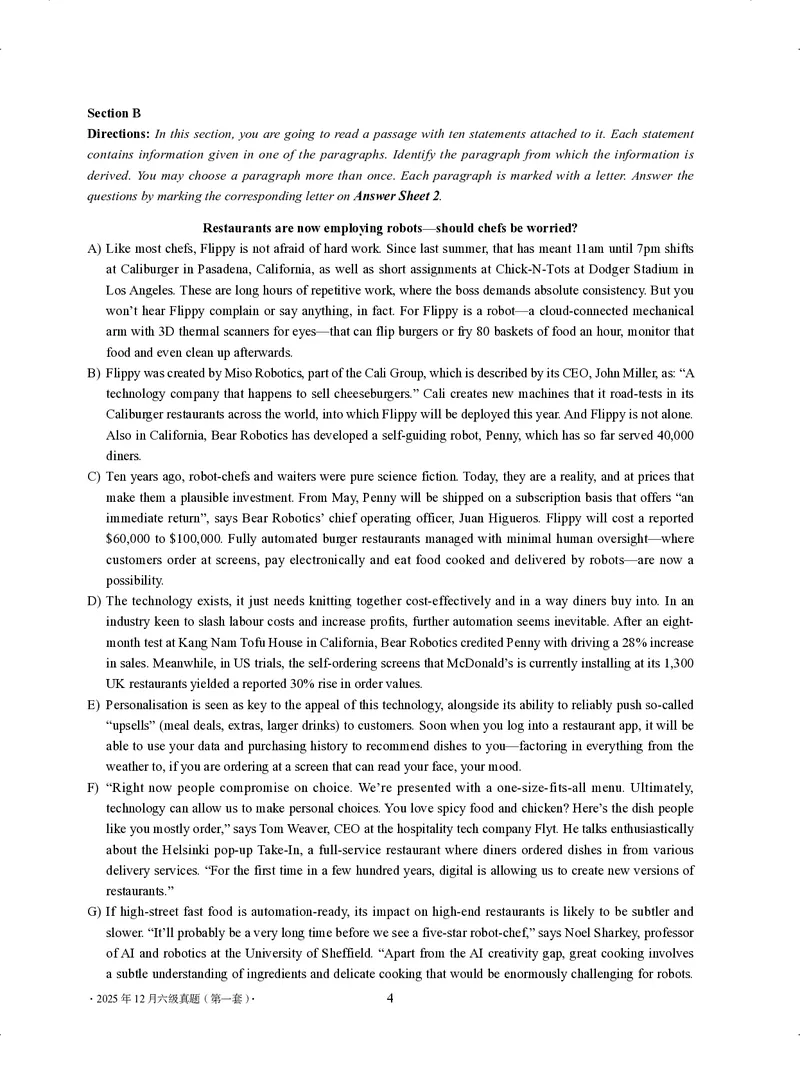
3 ·2025年12月六级真题(第一套)·Section B
Directions: In this section, you are going to read a passage with ten statements attached to it. Each statement
contains information given in one of the paragraphs. Identify the paragraph from which the information is
derived. You may choose a paragraph more than once. Each paragraph is marked with a letter. Answer the
questions by marking the corresponding letter on Answer Sheet 2.
Restaurants are now employing robots—should chefs be worried?
A) Like most chefs, Flippy is not afraid of hard work. Since last summer, that has meant 11am until 7pm shifts
at Caliburger in Pasadena, California, as well as short assignments at Chick-N-Tots at Dodger Stadium in
Los Angeles. These are long hours of repetitive work, where the boss demands absolute consistency. But you
won’t hear Flippy complain or say anything, in fact. For Flippy is a robot—a cloud-connected mechanical
arm with 3D thermal scanners for eyes—that can flip burgers or fry 80 baskets of food an hour, monitor that
food and even clean up afterwards.
B) Flippy was created by Miso Robotics, part of the Cali Group, which is described by its CEO, John Miller, as: “A
technology company that happens to sell cheeseburgers.” Cali creates new machines that it road-tests in its
Caliburger restaurants across the world, into which Flippy will be deployed this year. And Flippy is not alone.
Also in California, Bear Robotics has developed a self-guiding robot, Penny, which has so far served 40,000
diners.
C) Ten years ago, robot-chefs and waiters were pure science fiction. Today, they are a reality, and at prices that
make them a plausible investment. From May, Penny will be shipped on a subscription basis that offers “an
immediate return”, says Bear Robotics’ chief operating officer, Juan Higueros. Flippy will cost a reported
$60,000 to $100,000. Fully automated burger restaurants managed with minimal human oversight—where
customers order at screens, pay electronically and eat food cooked and delivered by robots—are now a
possibility.
D) The technology exists, it just needs knitting together cost-effectively and in a way diners buy into. In an
industry keen to slash labour costs and increase profits, further automation seems inevitable. After an eight-
month test at Kang Nam Tofu House in California, Bear Robotics credited Penny with driving a 28% increase
in sales. Meanwhile, in US trials, the self-ordering screens that McDonald’s is currently installing at its 1,300
UK restaurants yielded a reported 30% rise in order values.
E) Personalisation is seen as key to the appeal of this technology, alongside its ability to reliably push so-called
“upsells” (meal deals, extras, larger drinks) to customers. Soon when you log into a restaurant app, it will be
able to use your data and purchasing history to recommend dishes to you—factoring in everything from the
weather to, if you are ordering at a screen that can read your face, your mood.
F) “Right now people compromise on choice. We’re presented with a one-size-fits-all menu. Ultimately,
technology can allow us to make personal choices. You love spicy food and chicken? Here’s the dish people
like you mostly order,” says Tom Weaver, CEO at the hospitality tech company Flyt. He talks enthusiastically
about the Helsinki pop-up Take-In, a full-service restaurant where diners ordered dishes in from various
delivery services. “For the first time in a few hundred years, digital is allowing us to create new versions of
restaurants.”
G) If high-street fast food is automation-ready, its impact on high-end restaurants is likely to be subtler and
slower. “It’ll probably be a very long time before we see a five-star robot-chef,” says Noel Sharkey, professor
of AI and robotics at the University of Sheffield. “Apart from the AI creativity gap, great cooking involves
a subtle understanding of ingredients and delicate cooking that would be enormously challenging for robots.
·2025年12月六级真题(第一套)· 4Placing fragile foods on plates would be incredibly slow.”
H) Currently, robots have limited functionality. A human needs to load Penny with plates that diners lift off
themselves. At the robot-powered US pizza-delivery company Zume, the more difficult jobs, such as topping
pizzas, are still done by humans. But Moley, which will launch soon, offers an idea of the sophistication to
come. Modelled on the movements of a MasterChef contest winner, Tim Anderson, its robotic arms are fixed
over a stove and programmed to prepare dishes from raw ingredients. It is designed for domestic use, but a
commercial version is planned that opens up the possibility of restaurant kitchens automating even highly
technically challenging tasks.
I) For now, the kitchen technology that QSR Automations supplies to Mitchells & Butlers’ pubs or KFC is less
glamorous. Rather than having a chef shouting out diners’ orders, the QSR system automatically distributes
those orders across screens. The kitchen screens then tell chefs when to start cooking each dish, so that your
plate of fish, chips and peas comes together at the right time.
J) The restaurant industry is currently suffering a severe shortage of skilled chefs—a deficit of 11,000,
according to the skills agency People 1st. “Automation systems designed to make the process more idiot-
proof are trying to bridge that gap,” says Stefan Chomka, the editor of Restaurant magazine.
K) In terms of simplifying or enhancing the customer experience, online restaurant booking has been the easily-
won success of the internet age. Automated at-table ordering and payment is seen as the next landmark. Until
then, early adopters, such as the Manchester bar owner Andy Smith, who uses the Ordoo app at his venue 33
Oldham Street, may well experience growing but “lower than expected” acceptance.
L) Embarrassing failures in restaurant tech frequently hit the headlines. The TGI Fridays drone (无人机) that
injured a Brooklyn Daily photographer; US burger chain Shake Shack having to retreat from plans for entirely
cashless ordering sites. But, says Chomka, such technology could miss the mark if it only offers “solutions to
problems that don’t really exist”. “Payments being automatic” could be useful, he adds. But, in an expensive
restaurant, “how quick do you need dinner to be?”
M) That attachment to the human art of hospitality will be heartening for staff who see automation as a threat to
jobs. “Unite is concerned that without safeguards, any benefits will bypass workers in low-paying jobs, such
as waiters,” says the union’s London regional officer, Dave Turnbull. “We’re urging Members of Parliament
to ensure automation does not just benefit a wealthy few like previous industrial revolutions.”
N) The industry principle is that automation will allow it to redeploy staff more effectively. Jobs will change, if
not immediately decrease in number. “Self-order screens mean more demand for people front-of-house. Last
year, we recruited 1,000 new managers,” says McDonald’s COO, Jason Clark. Caliburger has a programme
to retrain staff as robot engineers or “chef techs”.
O) But ultimately the chance to reduce overheads (管理费用) by employing fewer people or at lower rates will
be what attracts big brands to technology. Invariably, over the next 10 years, jobs will go in conventional
bricks-built restaurants, not least because automation will boost their rapidly growing rival: delivery.
Companies such as Domino and Just Eat have both experimented with robot and drone delivery, which is
already legal in Reykjavik, Iceland. “Robot food deliveries are the future,” says Noel Sharkey. “Small, 4mph
ground robots are safe and will work 24 hours a day.”
P) Combined with machine learning of anticipated order volumes and the minute-by-minute cooking data
generated by systems such as QSR, that robot fleet could deliver almost instantly. “Restaurants will prepare
food ahead of orders coming in,” predicts Just Eat’s director of engineering, Daniel Richardson. “I’ll be able
to say ‘Let’s have pizza’ to my family, my intelligent assistant will hear and 10 minutes later the food will be
5 ·2025年12月六级真题(第一套)·at my door.” No one is putting an exact date on it yet. But in the dining room and on your doorstep, the robots
are coming.
36. It is now possible to fully automate a burger restaurant with little human supervision.
37. At a robot-powered US company, complicated tasks still have to be performed by humans.
38. More automation appears to be a certainty in industries eager to cut labour costs and raise profits.
39. There are often front-page reports of failures in technological innovation of the restaurant industry.
40. Robot-chef Flippy does not fear laborious work, nor does it make any complaints.
41. Digital technology makes it possible for businesses to innovate restaurant models.
42. Fondness for human warmth in catering to customers will give hope to employees who are afraid of losing
jobs to robots.
43. There is an acute shortage of experienced chefs in the catering industry and automated cooking is expected to
fill the gap.
44. Over the coming decade, many jobs in traditional restaurants will disappear due to robot delivery.
45. According to an expert in AI and robotics, it may be quite some time before a master robot-chef appears.
Section C
Directions: There are 2 passages in this section. Each passage is followed by some questions or unfinished
statements. For each of them there are four choices marked A), B), C) and D). You should decide on the best
choice and mark the corresponding letter on Answer Sheet 2 with a single line through the centre.
Passage One
Questions 46 to 50 are based on the following passage.
Many see friendships as a comfort blanket: a shoulder to cry on, a reliable soul to confide in. However, more
often than not, in our eagerness to seek individual success, we lose friends along the way and that has become
part of the process.
The chaos and never-ending turmoil that accompanies everyday life is an aggressive obstacle in the pursuit
of stable friendships. As students, we use this excuse to shrug off losing people who we once thought to be loved
ones.
Instead of viewing our lives as a race, where everyone is on their own path to some form of success, we must
relearn to value the connections we make along the track. We must reevaluate the harm of radical, individual
freedom.
Radical individualism elevates the freedom of the individual over the collective. It argues, for instance, that
universal healthcare, an example of collectivism, threatened the dream of many Americans.
Many of us have fallen victim to an individualistic culture. Society tends to celebrate personal achievement
and commend it based on the assumption that winning or succeeding is a consequence of working harder than
the next person.
As a society, we idolize the concept of “losing friends on the road to success.” I remember hearing in high
school, “Don’t worry about losing friendships, just focus on study and getting into college. That’s all that will
matter in the long run,” a sentiment that is not unique to my experience. It’s preached in many success stories,
and it’s embedded in the way we see growth. Motivational speakers will push their audience to be complacent to
the inevitable end of losing friends. Spend too much time with friends? You’re losing time better utilized on your
achievements. Invest time in your relationships? Invest time in your work instead.
·2025年12月六级真题(第一套)· 6This constant need to succeed has blinded us from seeing through the whirlwind of change that accompanies
our everyday lives. We are expected to tangibly succeed, earn awards, get higher positions, earn better grades. In
order to succeed, we lose friends, and that has sadly become normalized.
We cannot be complacent with losing friendships because they are our anchors.
Yes, pursue success. Challenge yourself. Push limits. But contrary to all the self-proclaimed success experts,
doing it alone does not make you more successful or any better than someone who achieved it with the help of
others.
Put effort into fostering healthy relationships, and maintaining them through your busy schedule that seems
like it leaves no time for anyone else. Although we may be living in a society that treasures the independent
pursuit of achievement, having people to support and love you on the way is far more important than any end
result.
46. What often happens when people are eager to pursue individual success?
A) They lack a shoulder to cry on. C) They cannot find reliable friends.
B) They have no soul to confide in. D) They ignore their ties with friends.
47. What does the author advise people to do in their pursuit of radical individualism?
A) Reexamine its detrimental effects. C) Avoid the chaos and turmoil involved.
B) Shrug off the loss of their loved ones. D) Remove aggressive obstacles in the way.
48. What is American society’s assumption of personal achievement?
A) It is to be duly celebrated and highly commended. C) It revolves around an individualistic culture.
B) It is a sure way to fulfill a person’s dream. D) It reflects a person’s exceptional endeavor.
49. What is preached in many success stories?
A) Attaching importance to academic gains on the road to success.
B) Investing one’s time in work instead of connecting with friends.
C) Trying to strengthen friendships in one’s pursuit of personal success.
D) Excelling in academic performance to get into a prestigious college.
50. What can we infer from the passage regarding the pursuit of success?
A) No one can succeed without pushing limits. C) Collectivism is superior to individualism.
B) No one can afford to neglect close friends. D) Success experts often lead people to ruin.
Passage Two
Questions 51 to 55 are based on the following passage.
During his acceptance speech for the Nobel Peace Prize, Martin Luther King Jr. said, “I believe that unarmed
truth and unconditional love will have the final word in reality.”
More than five decades later, our society is still struggling to separate truth from fantasy, fact from fiction.
From disputes over the climate change to debates about how slavery is taught, America is at a crossroads. And
the battle for equity is at the heart of these vital conversations.
Study after study shows that inequity has had appalling consequences. A 2020 report by Citi indicated that
“Black students could have increased their lifetime incomes $90-$113 billion” if equity issues related to higher
education had been adequately addressed over the past two decades.
This statistic represents a flood of issues we’ve failed to confront as a nation. It also highlights one truth:
We’re missing out on valuable opportunities to bridge the differences that divide us. However, by honoring
King’s legacy, we can get our country back on the path toward true equity.
7 ·2025年12月六级真题(第一套)·Students—and adults for that matter—simply cannot understand the conflicts we have today without
understanding what caused them in the first place. That means we have a responsibility to help them make
connections between U.S. history and current events. It also means giving them the tools they need to address
inequity and bias in their own lives. Adherence to these principles, along with a commitment to truthful dialogue,
can help every student better appreciate how far we’ve come and more clearly see the roads we have yet to
travel.
With more truthful analysis of the need for more qualified, diverse educators, we can improve our recruiting,
training, and retention strategies for schools across the country.
Unfortunately, our deeply rooted divisions are delaying these advancements. A recent survey found that 77
percent of Americans believe the nation is “more divided than ever before”. But reports of increased polarization
shouldn’t persuade us to look away from one another. Instead, they should compel us to address our shared issues
head-on.
We are not, as some would suggest, living in a “post-racial society”. We simply cannot afford to keep our
heads buried in the sand when it comes to racial inequity. Unless we get honest about intolerance, bias, and how
these social diseases impact the ways we treat one another, injustice will continue to haunt us. But our children
and our grandchildren deserve better.
On this Martin Luther King Day and beyond, let’s commit to working together to disrupt the status quo.
Let’s continue to build a better, more inclusive nation; and in the words of Martin Luther King Jr., “A society at
peace with itself, a society that can live with its conscience.”
51. What does the author think about today’s America?
A) It is struggling to transform fiction into reality.
B) It has been the focus of many vital conversations.
C) It still has a long way to go before equity can be truly realized.
D) It has got to a point where people disagree on nearly every issue.
52. What do we learn from the passage about black students in the past 20 years?
A) They have been unfairly treated regarding higher education.
B) They have been battling hard to address equity issues.
C) They have boosted their lifetime incomes by billions of dollars.
D) They have come to see the consequences of racial discrimination.
53. How can Americans bridge the differences that divide them?
A) By dealing with the thorny issues confronting them.
B) By seizing every chance to enhance racial harmony.
C) By continuing to pursue Martin Luther King Jr.’s cause.
D) By striving to identify exceedingly valuable opportunities.
54. How do most Americans view America as a nation according to a recent survey?
A) It is compelled to address its historical social issues.
B) It is delaying advancements toward racial equality.
C) It has kept itself from polarization.
D) It has become increasingly split.
·2025年12月六级真题(第一套)· 855. What does the author suggest Americans do?
A) Ensure the wellbeing of their children and grandchildren.
B) Make joint efforts to tackle the nation’s equity issues.
C) Restrain their intolerance and discrimination.
D) Restore social order for a harmonious nation.
Part IV Translation (30 minutes)
Directions: For this part, you are allowed 30 minutes to translate a passage from Chinese into English. You
should write your answer on Answer Sheet 2.
尊老是中华民族的传统美德,深深植根于中国人的思想和行为中,是人们普遍遵守的行为规范和
社会准则。在当今的中国,这种美德得到广泛传承。社会各界积极营造敬老助老的社会氛围。为老年
人提供便利服务已成为社会共识,例如社区专门开设长者食堂,公共场所配置优先座位。政府还出台
了一系列政策,为老年人的权益提供有力保障。尊老是社会和谐与发展的重要基石,有助于培育良好
的社会氛围,推动整个社会文明进步。
9 ·2025年12月六级真题(第一套)·