普
通普
®
高
通
中
高
课
程中
标
教
准
科
教
科书
英语
书
英
语 选择性必修
PUTONG GAOZHONG JIAOKESHU
选
择
YINGYU 第四册
性
必
修
第
四
册
绿绿色色印印刷刷产产品品
定价: 元
11223300--ookk人人教教教教材材封封面面 高高中中英英语语 选选择择性性必必修修44 ..iinndddd 11 22002200//1122//3300 下下午午44::3300英语
普 通 高 中 教 科 书
ENGLISH
选择性必修
第四册
人民教育出版社 课程教材研究所
(中国)
英语课程教材研究开发中心 编著
(美国)圣 智 学 习 集 团
·北京·主 编:刘道义 郑旺全
副 主 编:吴 欣 张献臣
编写人员: Patrick Wallace Tim Gibbs Simon McCue Jacqueline Eu
陆锡钦 辜翔宇 生 平 常 贞
责任编辑:陆锡钦 辜翔宇 马小洁
美术编辑:胡白珂
普通高中教科书 英语 选择性必修 第四册
人民教育出版社 课程教材研究所
(中国)
英语课程教材研究开发中心 编著
(美国)圣 智 学 习 集 团
出 版
(北京市海淀区中关村南大街17号院1号楼 邮编:100081)
网 址 http://www.pep.com.cn
重 印 ×××出版社
发 行 ×××新华书店
印 刷 ×××印刷厂
版 次 2020年8月第1版
印 次 年 月第 次印刷
开 本 890毫米×1240毫米 1/16
印 张 8
字 数 220千字
书 号 ISBN 978-7-107-35096-2
定 价 9.30元
定价批号:××号
版权所有·未经许可不得采用任何方式擅自复制或使用本产品任何部分·违者必究
如发现内容质量问题,请登录中小学教材意见反馈平台:jcyjfk.pep.com.cn
如发现印、装质量问题,影响阅读,请与×××联系调换。电话:×××-××××××××前 言
《普通高中教科书 英语》是为了适应新时代的发展需要,依据《普通高中英语课程标
准(2017年版)》的精神,充分征求广大师生的反馈意见,在《普通高中课程标准实验教科
书 英语》的基础上精心修订而成。此次教材修订的主要目的是:全面落实立德树人根本任
务,培育社会主义核心价值观,弘扬中华优秀文化,充分体现英语课程工具性和人文性的统
一,发展学生的语言能力、文化意识、思维品质和学习能力等英语学科核心素养,充分体现
英语学科特殊的育人价值,培养具有中国情怀、国际视野和跨文化沟通能力的社会主义建设
者和接班人。
修订后的教材主要具有以下特点:
注重思想引领 教材融入了社会主义核心价值观的基本内容和要求,注重培养学生良好
的政治素质、道德品质和健全人格,弘扬中华优秀文化,增强文化自信,引导学生形成正确
的世界观、人生观和价值观。
反映时代要求 教材充分反映当代社会发展新变化、科技进步新成果,展示新时代中国
特色社会主义新成就,将先进的教育思想和理念融入教材之中,同时紧密结合学生的学习和
生活实际,关注信息化环境下学生的发展需求。
强调语言实践 教材以英语学习活动观为指导,以主题为引领,以语篇为依托,通过板
块式设计将语言知识与听、说、读、看、写等技能有机整合,强调学习过程和学习策略,突
出活动目标,让学生用语言做事情,在实践中培养语言运用能力和创新思维。
突出文化意识 教材通过展示多姿多彩的中外文化来培养学生对中华文化的认同和传承,
加深对人类优秀文化的学习和鉴赏;通过让学生分析中外文化异同,发展其多元思维和批判
性思维,增强学生跨文化理解和跨文化沟通能力,构建人类命运共同体意识。
激发学习动机 教材以真实性、趣味性、规范性和经典性作为内容选编原则,主题覆盖
面广,语篇题材和体裁丰富,活动呈现形式多样,版式设计生动活泼且富有美感,力求激发
学生的学习兴趣和动机,引发他们积极思考、主动参与语言实践活动,提升英语学习效率。
满足不同需求 教材编排内容和活动设计既充分考虑学生的共同基础,又兼顾学生不同
的能力水平和学习需求,提供了拓展性的教学内容,为教师灵活使用教材进行教学提供了便利,
也切实促进学生的个性发展。
本套教材为高中英语教学提供了丰富的教学资源。希望教材能够帮助同学们打下坚实的
语言基础,提高英语水平,获得全面发展;同时也希望老师们能够充分利用教材,在实践中
不断完善教学,取得良好的教学效果。
编者
2019年4月CONTENTS
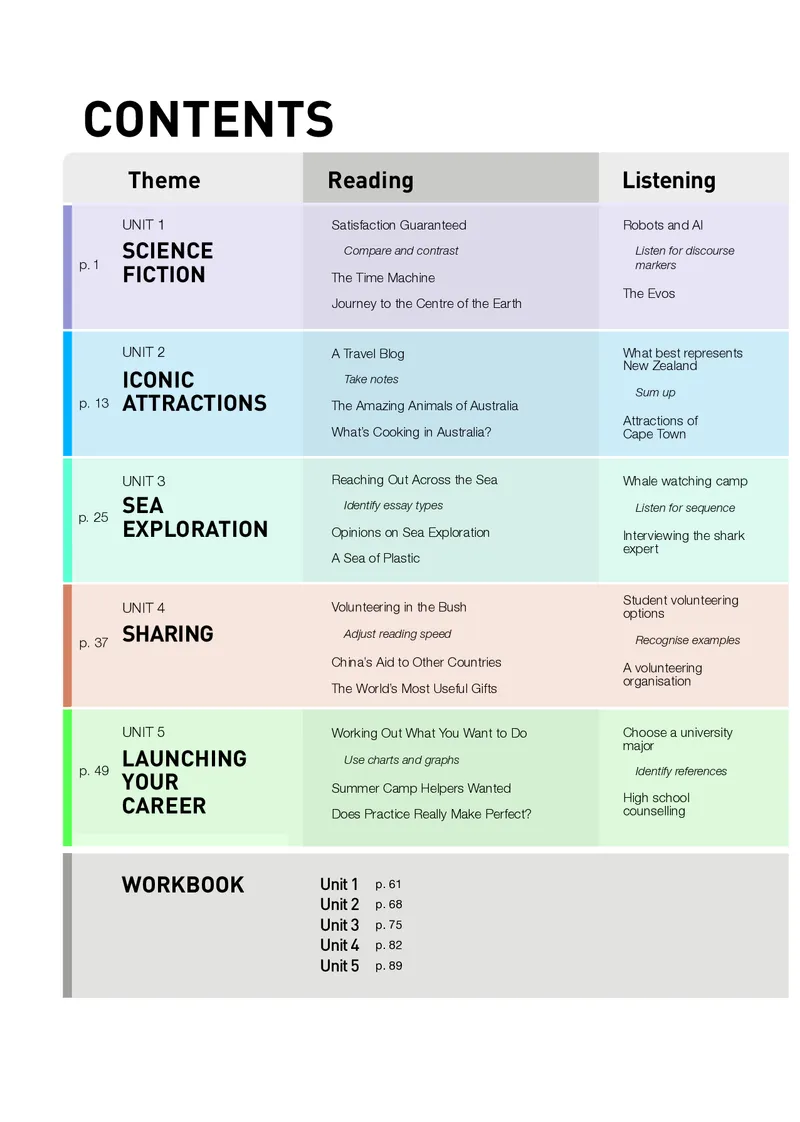
Theme Reading Listening
UNIT 1 Satisfaction Guaranteed Robots and AI
SCIENCE
Compare and contrast Listen for discourse
p. 1 FICTION markers
The Time Machine
The Evos
Journey to the Centre of the Earth
UNIT 2 A Travel Blog What best represents
New Zealand
ICONIC
Take notes
Sum up
ATTRACTIONS
p. 13 The Amazing Animals of Australia
Attractions of
What’s Cooking in Australia? Cape Town
UNIT 3 Reaching Out Across the Sea Whale watching camp
SEA
Identify essay types Listen for sequence
p. 25
EXPLORATION
Opinions on Sea Exploration Interviewing the shark
expert
A Sea of Plastic
Student volunteering
UNIT 4 Volunteering in the Bush
options
SHARING
Adjust reading speed
p. 37 Recognise examples
China’s Aid to Other Countries
A volunteering
organisation
The World’s Most Useful Gifts
UNIT 5 Working Out What You Want to Do Choose a university
major
LAUNCHING
Use charts and graphs
p. 49 Identify references
YOUR
Summer Camp Helpers Wanted
CAREER High school
Does Practice Really Make Perfect? counselling
WORKBOOK Unit 1
p. 61
Unit 2
p. 68
Unit 3
p. 75
Unit 4
p. 82
Unit 5
p. 89Speaking Writing Structure *Project *Video Time
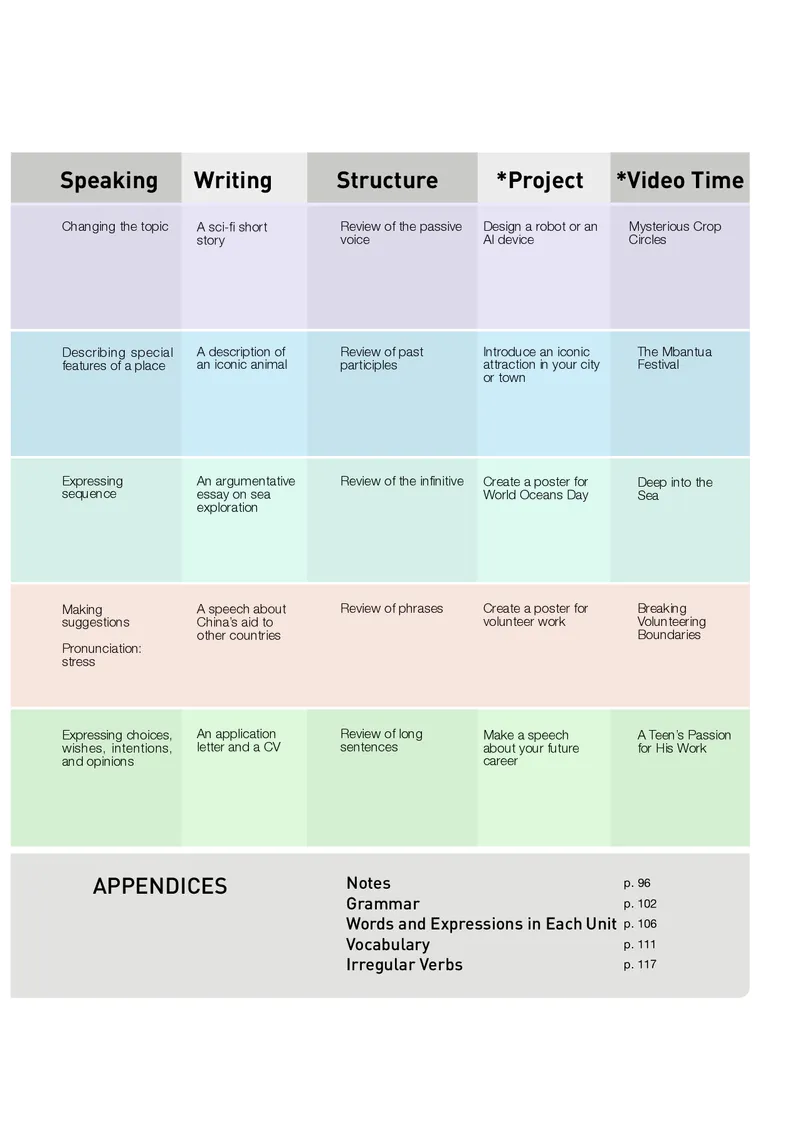
Changing the topic A sci-fi short Review of the passive Design a robot or an Mysterious Crop
story voice AI device Circles
Describing special A description of Review of past Introduce an iconic The Mbantua
features of a place an iconic animal participles attraction in your city Festival
or town
Expressing An argumentative Review of the infinitive Create a poster for Deep into the
sequence essay on sea World Oceans Day Sea
exploration
Making A speech about Review of phrases Create a poster for Breaking
suggestions China’s aid to volunteer work Volunteering
other countries Boundaries
Pronunciation:
stress
Expressing choices, An application Review of long Make a speech A Teen’s Passion
wishes, intentions, letter and a CV sentences about your future for His Work
and opinions career
APPENDICES Notes
p. 96
Grammar
p. 102
Words and Expressions in EachUnit
p. 106
Vocabulary
p. 111
Irregular Verbs
p. 117UNIT 1
SCIENCE FICTION
1 SCIENCE
FICTION
UNIT
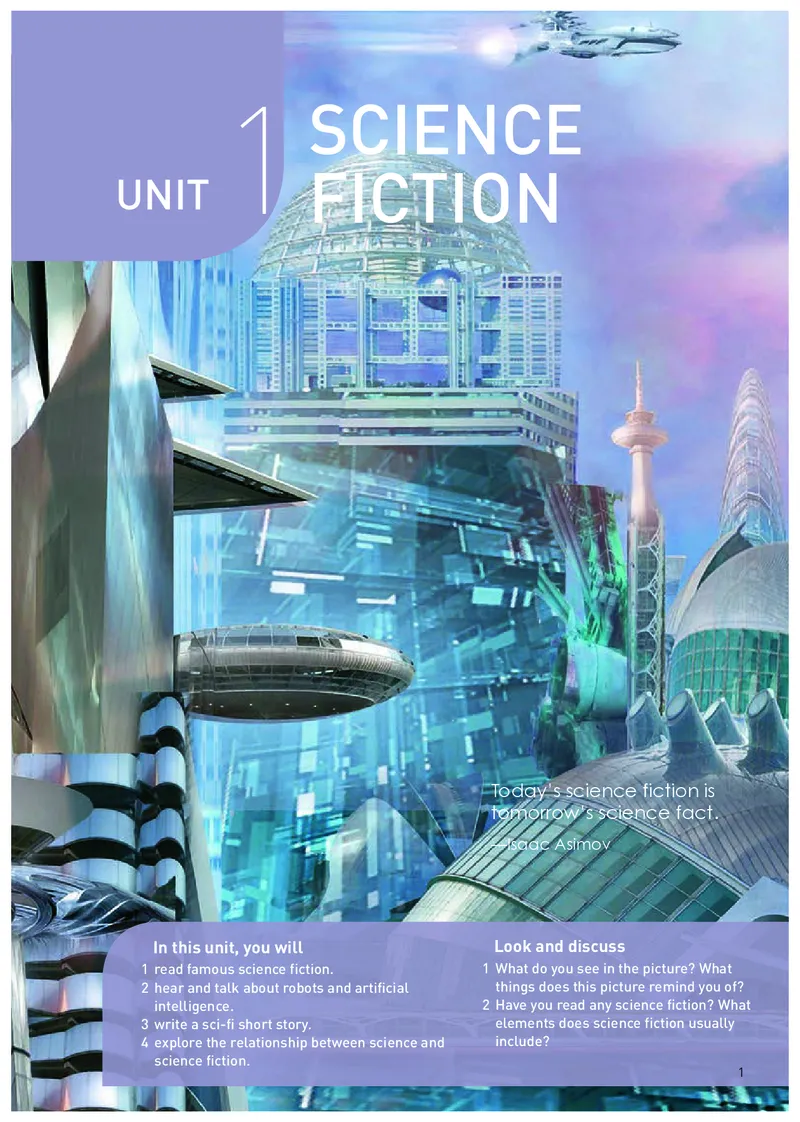
Today’s science fiction is
tomorrow’s science fact.
—Isaac Asimov
In this unit, you will Look and discuss
1 read famous science fiction. 1 What do you see in the picture? What
2 hear and talk about robots and artificial things does this picture remind you of?
intelligence. 2 Have you read any science fiction? What
3 write a sci-fi short story. elements does science fiction usually
4 explore the relationship between science and include?
science fiction.
1Reading and Thinking
Explore the relationship between humans and robots
1 How do robots already help humans in their lives today? What do you think a
domestic robot could do for a family in the future?
2 Read the story below, which was originally written by famous science
fiction writer Isaac Asimov. Take notes on who these people are and their
relationships to each other.
Larry Belmont Claire
Tony Gladys Claffern Compare and contrast
Some words and phrases are often used
to compare and contrast information. It is
SATISFACTION GUARANTEED
easier to understand two separate things by
describing their similarities and differences.
(Adapted)
Larry Belmont worked for a company unhappy that her home wasn’t elegant
that made robots. Recently it had enough for Larry, who wanted to improve
begun experimenting with a his social position with a bigger salary. She
household robot. It was going wasn’t like Gladys Claffern, one of the
to be tested out by Larry’s richest and most powerful women around.
wife, Claire.
As a favour, Tony promised to help Claire
Claire didn’t want the robot make herself more beautiful and her home
in her house, especially as more elegant. So Claire borrowed some
her husband would be away library books for him to read, or rather, scan.
on a business trip for three weeks, She looked at his fingers with wonder as
but Larry persuaded her that the robot they turned each page. How absurd, she
wouldn’t harm her or allow her to be thought. He was just a machine.
harmed. It would be a bonus. However,
Tony gave Claire a new hairstyle and
when she first saw the robot, she felt
improved her makeup. As he was not
alarmed. His name was Tony. He seemed
allowed to accompany her to the shops,
more like a human than a machine. He was
he wrote out a list of things that he would
tall and handsome with smooth hair and a
need for his work on the house. Claire went
deep voice, although his facial expression
downtown and bought these things. She
never changed.
had an appointment to paint her nails, then
On the second morning, Tony brought her she went into an expensive clothes shop.
breakfast and then asked her whether she The saleswoman there was rude to her, so
needed help dressing. She felt embarrassed she rang Tony and told him she was being
and quickly told him to go. Now she was treated badly. He spoke to the woman,
being looked after by a robot that looked who immediately changed her attitude.
so human, and it was disturbing. Claire thanked Tony, telling him that he
was a “dear”. As she turned around, there
One day, Claire mentioned that she didn’t
stood Gladys Claffern. How awful to be
think she was clever. Tony said that she
discovered by her, Claire thought. By the
must feel very unhappy to say that. Claire
look on her face, Claire knew that Gladys
thought it was ridiculous that she was being
thought they were in a relationship. After
offered sympathy by a robot, but she
all, she knew Claire’s husband’s name was
gradually admired his wisdom and integrity
Larry, not Tony. Although it was completely
and began to trust him. He always treated
innocent, Claire felt guilty.
her with dignity. She told him how she was
2 UNIT 1 SCIENCE FICTIONWhen Claire got home, she wept. Gladys the next room, he managed to catch her in
was everything Claire wished to be. Tony time. As he held her, she felt the warmth of
told her she was being sensitive and was his body. She screamed, pushed him away,
just as good as Gladys. He suggested that and ran to her room.
she invite Gladys and her friends to the
The night of the party arrived. The clock
house the night before he was to leave
struck eight. The guests would be arriving
and Larry was to return. By that time, Tony
soon, so Claire dismissed Tony for the rest of
expected that the house, which was being
the night. At that moment, Tony took her in
completely transformed, would be ready.
his arms, bringing his face close to hers. She
Tony worked steadily on the improvements. heard him declare that he did not want
Claire tried to help by working on a light to leave her the next day, and that he felt
suspended from the ceiling, but she fell off more than just the desire to please her. Then
the ladder. Even though Tony had been in the front door bell rang.
3 How do you think this story will end? Work in groups and come up with an ending.
Then listen to the rest of the story. How different is it from your ending?
4 Claire’s feelings towards Tony changed as the story developed. Review the
story, and then complete the chart.
Occasion Claire … Occasion Claire …
1 before he arrived disliked him 5 called him a dear
2 was alarmed 6 felt his warmth
3 felt embarrassed 7 felt being envied
4 admired him 8 cried all night
5 Complete the diagram with the similarities and differences between Tony and
a human being. Then use the words in the boxes to describe the similarities
and differences.
Tony Human being
Comparison
the same as similar to
similarly more like
just as in comparison
facial expression facial expression
in the same way
never changes changes often
smooth
Contrast hair
different from but
while whereas
although however
on the other hand
in contrast
EXAMPLE
A human being’s facial expression changes often, whereas Tony’s never changes.
6 Discuss the questions in pairs.
1 Do you think it is possible for a person to love a robot? Why?
2 What relationship do you think will develop between humans and robots in the future?
UNIT 1 SCIENCE FICTION 3Learning About Language
Build up your vocabulary
1 Replace the underlined parts with words of similar meanings from the text.
Rewrite the sentences if necessary.
1 We believe he is a man of absolute honesty, and trust his words completely.
2 Henry told me that he was in a hurry as he had arranged to see the dentist at 10:00 a.m.
3 Rumours are like sharp knives, cutting one’s self-respect into pieces. We should be aware
of this and not spread unkind news around.
4 Because of the holiday, the students were allowed to go home early.
5 Whoever is charged with a crime should be presumed innocent until proven otherwise.
2 Match each word with the proper definition below.
1 income A money that someone is paid regularly, usually monthly, by the
organisation he or she is working for
2 fee B money given for work done, goods received, etc.
3 fare C money paid for work or services, typically on a daily or weekly basis
4 payment D extra amount of money added to somebody’s wages as a reward for
hard work or good performance
5 salary E money received from work, investments and so on
6 bonus F money paid to a professional person or organisation for advice or
services
7 saving G money paid for a journey on public transport, such as the bus, train,
or taxi
8 wage H money saved for a special purpose
3 Complete the passage using the correct forms of the words in the box. Then
in pairs share your opinion on AI development.
fascinating test out dismiss science fiction more like dignity intelligent
It would not be surprising if we found it difficult to distinguish between reality and
in the future. For example, robots first appeared in sci-fi novels, but now robot soldiers have
already been in war. Robot experts have also built robots that can see, talk, and
do other things like humans. Although a robot that looks a human than a machine
could make many people a bit uncomfortable, we have to admit that it is a
possibility. Sophia, currently said to be the most advanced AI robot in the world, is a great
example. She has been interviewed many times, appeared on the covers of magazines,
and become the first non-human in the world to be given citizenship by a country. When it
comes to games, 2017 became a year in which AI defeated humans in so many games that
AI researchers say that it will not be long before AI can win at almost everything. So have we
lost the of being the most intelligent creature? Maybe in the future, as AI becomes
even more , it will become a major threat to humans. However, some people
this fear. They believe if AI can handle tasks like calculating and driving for us, we
will have more time for creating, thinking, and “being human”.
4 UNIT 1 SCIENCE FICTIONReview useful structures
1 Scan the reading text and underline all the verbs in the passive voice. Then
discuss with a partner why the passive voice is used.
2 Complete the sentences with appropriate forms of the verbs in brackets.
Then try to translate these sentences into Chinese.
1 What is done cannot . (undo)
2 Janet chairwoman of the student union last month. (elect)
3 Two hundred grammes of flour should to the cake mix. (add)
4 A 3,000-seat venue for the circus performance in November. (build)
5 Working efficiency since this new software was adopted. (improve)
6 Only one piece of carry-on luggage for each economy class passenger. (allow)
7 It is a great honour for me to to address this international AI conference. (invite)
8 When I entered the room, I found that the salesman’s salary at the meeting.
(discuss)
9 With exams being adapted into Braille, a blind senior high school student scored 630
points out of 650 in the College Entrance Examination. He is expected to to a
top university. (admit)
3 Read the introduction to a science fiction novel and complete the passage
using the correct forms of the words in the box.
explore translate discover regard represent
set up recruit write get caught up connect
Science fiction by many people as a mirror through which our future can be freely
imagined and . The Three-Body Problem, by Chinese writer Liu Cixin,
is one of those astonishing predictions about the future. The work was first published in a
Chinese sci-fi magazine in 2006 and printed as a three-volume book in 2008. When the first
volume into English by Chinese-American author Ken Liu, it attracted attention
around the world, becoming the first Asian winner of the Hugo Award for Best Novel. The
book many themes such as space exploration, alien contact, AI, and the future of
humans.
The Three-Body Problem begins with the stories of two unrelated people, Ye Wenjie and Wang
Miao. Ye to join a secret project in a remote area of China, which
to contact alien life forms. In the other story, set 20 years later, Wang Miao
in a popular online game called “Three Body”, in which people live on an unknown planet
with three suns. But Wang discovers it is more than a game—it uncovers a great danger
threatening human existence. How are these two people’s stories ? And how will
their behaviour change Earth’s future and the civilisations of other planets? Answers to all these
questions are waiting to when you go on reading.
5Using Language
Voice your opinions on robots and AI
1 Look at the pictures and discuss the questions in pairs.
1 What jobs are these robots doing? What are the pros and cons of robots doing these jobs?
2 What kinds of robots or AI developments do you hope for?
2 Listen to an interview and put these statements in the correct order.
1 The host introduces the guest, a sci-fi expert.
The expert has robots in his home.
As robots become more intelligent, they may also become more dangerous.
The host mentions Asimov’s Three Laws of Robotics.
The expert says robots will have occupations such as teaching and nursing.
The line between humans and robots will be more blurred in the future.
The host asks about benefits and problems.
The host asks if there are robots in the expert’s home.
In sci-fi stories, robots often become superior and take over.
3 Listen to the interview again and
Listen for discourse markers
write down the discourse markers
that you hear. Make a note of how Discourse markers are used to
each discourse marker is used in organise a text by marking sequence,
contrast, opinion, purpose, and so
the interview. Then compare your
on. Listening for discourse markers
answers with a partner. can help you understand a text more
easily. For example, first, however,
above all, in order to, etc.
6 UNIT 1 SCIENCE FICTIONListening and Speaking
4 I n groups, discuss what the expert thinks of the questions and exchange your
own views. You may use the following expressions to help you.
Changing the topic
Oh, by the way, … Oh, I remember, … I nearly forgot! …
What I meant to tell/ask you is … …, but (perhaps) that’s beside the point.
That reminds me of … The next item on the agenda is …
I think we ought to move on to … On the one hand … On the other hand …
Oh, there was something I meant to tell you. Could I change the subject?
1 What do you know about robot technology? What can robots do?
2 What benefits do you think robots or AI will bring? Do you think they will cause problems as
well?
3 Do you know anything about Isaac Asimov and his famous Three Laws of Robotics? What
do you think of these laws?
THREE LAWS OF ROBOTICS
LAW 1 LAW 2
A ROBOT MAY NOT INJURE A A ROBOT MUST OBEY THE ORDERS
HUMAN BEING, OR, THROUGH GIVEN IT BY HUMAN BEINGS EXCEPT
INACTION, ALLOW A HUMAN WHERE SUCH ORDERS WOULD
BEING TO COME TO HARM. CONFLICT WITH THE FIRST LAW.
LAW 3
A ROBOT MUST PROTECT ITS OWN
EXISTENCE AS LONG AS SUCH
PROTECTION DOES NOT CONFLICT
WITH THE FIRST OR SECOND LAW.
EXAMPLE
A: Oh, by the way, I saw a programme about robot doctors last night. It was very interesting.
Do you think robots will do more of these important jobs in the future?
B: Certainly. They will probably do most of our labour for us.
C: Maybe, but that’s beside the point. In my opinion, robots are dangerous! They are much
stronger than we are and may be superior to us in the future.
…
7Using Language
Write a sci-fi short story
1 In groups, discuss what you would do if you could time travel.
2 The Time Machine was written in 1895 by famous science fiction writer H.G.
Wells. Read an extract from this story, and find out how many times the Time
Traveller started the machine.
THE TIME MACHINE (Adapted)
It was at ten o’clock today that the first of all Time Machines
began its career. I gave it a last check, and sat myself in the
leather seat. I pushed the starting lever on the main panel
forwards an inch then immediately backwards again. Looking
around, I saw my laboratory exactly as before. Had anything
happened? I thought my mind had tricked me. Then I saw the
clock. A moment before, it was a minute or so past ten; now it was
nearly half past three!
I drew a breath, gripped the lever and pushed it forwards. The laboratory went hazy
around me. My niece came in to fetch something, maybe her handkerchief, apparently
without seeing me. It probably took her a minute, but to me she moved like a rocket! I
pushed the lever further. Night came as if a lamp was being turned out, and in another
moment came the day. Tomorrow night came, then skipped to day, again and again,
faster and faster still.
It is hard to explain the strange and unpleasant feeling of time travelling. It felt like I was
being driven fast on a winding road. As my pace grew faster, the walls of the laboratory
fell away, and I was left in the open air. The sun and moon looked as if they were being
thrown across the sky, but soon there was division between night and day. Around me
I saw trees growing like puffs of smoke; they grew, spread, and died in moments. I saw
huge buildings rise up, then
disappear like in a dream.
The whole surface of the
earth was being changed,
melting and flowing before
my eyes. I calculated that I
was being pushed through
time at hundreds of years a
minute.
I had a strong urge to look
at the random things that
were being flashed before
my eyes! I had thought
about the risk of stopping
8 UNIT 1 SCIENCE FICTIONthe Time Machine many times. So long as I travelled at maximum speed, it didn’t
matter. But if I stopped and the same space was being occupied by something
else, we would be forced together and explode like a bomb! Like an impatient
fool, I pulled the lever backwards hard. With a sudden jolt, the Time Machine was
flipped on its side, and I was thrown through the air.
I was stunned for a moment, and then heard the sound of thunder. I was sitting in
the rain in some mud next to the machine. “A fine welcome,” I said, “for a man
who has travelled thousands of years to be here!”
3 Read the text again and answer the questions.
1 How does the Time Traveller first know he has travelled through time?
2 How does the Time Traveller feel when travelling through time? What rhetorical devices
does the writer use to describe his feelings?
3 Why is the Time Traveller worried about stopping the machine?
4 Where does the Time Machine arrive when the man finally stops it?
4 Work in groups. Discuss what might happen next in the story. Use the following
questions to help you and make brief notes. Then present your story to the class.
• What date do you think it is when the Time Traveller finally stops?
• What do you think is different about that time from the time he left?
• Who or what do you think the Time Traveller will meet?
• What adventures do you think he will have in the future?
• Do you think he will ever return to his own time?
5 Imagine and write your own story about a time machine you will invent, and your
journey through time. Use the story and the guide below to help you.
1 Think about what your machine will look like. Is it a vehicle or
a machine?
2 How does your time machine work? What do you have to
do to make it work?
3 What period in time do you want to travel to? Think about
interesting things and people you would like to see there.
4 Imagine what it might feel like to travel through time. Think
of words to describe this and make your story as vivid as
possible.
5 Include rhetorical devices in your story, like metaphors, similes,
overstatements, etc.
6 Exchange your draft with a partner and
revise the draft using your partner’s
comments.
7 Share your story with the rest of the class.
UNIT 1 SCIENCE FICTION 9Assessing Your Progress
1 Complete the following sentences using the correct forms of the words in
the box.
fetch superior to calculate have an urge to
suspend dismiss explode pace
1 Batteries are not allowed by airlines in checked luggage, as they might due to
overheating.
2 The new generation of smartphones is greatly older version.
3 Since I don’t have much time, I need to how long it will take me to do the
task.
4 Ordered by its master, the AI dog the book from the bookshelf.
5 I was so pleased to hear the bell ring and our teacher announce, “Class is .”
6 The company has to the space exploration project due to financial problems.
7 City people are experiencing increasing psychological pressure as a result of a faster
of life and rising competition.
8 At one time or another, each of us probably break the routine of daily life and
try something new.
2 Read and complete the following sentences with appropriate forms of the
words in brackets. Then think about why the passive voice is used in these
sentences.
1 Mobile phones must during the concert. (switch off)
2 When I came here at this time last year, the conference hall . (build)
3 Topics like life in the future, AI development, and aliens in sci-fi. (often found)
4 Do you know which country by Italy, Austria, Germany, and France? (border)
5 Continuous research on smart schools, smart homes, and smart cities.
(conduct)
6 It should that the result of your examinations will not . (note;
publicise)
7 It that more species will become extinct if we continue to destroy the
ecosystem. (assume)
8 All members of the audience should smartly, and the wearing of slippers
in the concert hall. (dress; not allow)
REFLECTING
What interesting things about science fiction did you learn in this unit?
What new vocabulary and structures did you learn in this unit? How well can you
use them?
Do you think comparing and contrasting, and listening for discourse markers were
useful strategies for you to understand the texts?
What problems did you have with this unit? How did you solve them?
Overall, I thought this unit was inspiring useful so-so difficult.
10 UNIT 1 SCIENCE FICTION* Project: Design a robot or an AI device
1 In groups, do some research about robots or AI devices in sci-fi films and
novels, and write a list of as many robot characters or AI devices as you can
think of. Use the Internet to help you.
the Star Wars movies Wall·E Big Hero Six
the Transformers movies Pacific Rim the Foundation Series
2 Make a table like the one below and fill in the parts for different robot
characters and AI devices on your list.
Function/
Movie/Novel Name Characteristic Unique quality
Ability
Brave, funny, Co-pilot, hack He speaks in beeps and
Star Wars R2-D2
mischievous computers whistles
3 Create your own robot character or AI device. Consider the following
questions and make notes.
1 What is your robot or AI device called? Why?
2 What does it look like? Why?
3 What can your robot or AI device do? Why and how?
4 Does it have a personality or specific function? If so, what is it like?
5 What makes your robot or AI device unique?
4 Prepare your design for submission to a science fair using the following
guidelines.
• Design a poster or slide presentation showing your creation, including a name, title, and
pictures of your robot or AI device.
• Write a description of the robot or AI device.
• Make a presentation using your poster or slides.
UNIT 1 SCIENCE FICTION 11* Video Time
Mysterious Crop Circles
This video examines a strange phenomenon that
has taken place in the English countryside for many
decades. From time to time, crop circle patterns
have appeared, with people debating for years their
possible causes and meanings.
BEFORE YOU WATCH
Look at the photos from the video and discuss the questions in groups.
1 What do you think these patterns represent?
2 Who or what do you think made these patterns and how?
WHILE YOU WATCH
Answer these questions.
1 Who do some people think the circles are made by?
2 Why did Mr Presley decide to find out more about the circles?
3 Where were other types of circles found?
4 Why do Matthew and his team like making crop circles?
5 What does Matthew think some people use the crop circles for?
AFTER YOU WATCH
Discuss the following questions in groups.
1 Do you believe crop circles are all made by humans or by aliens? What do you think the
crop circles represent?
2 What kind of crop circle would you create? Discuss and decide on its appearance and
meaning. Draw it on a large sheet of paper. Then present it to the rest of the class.
12 UNIT 1 SCIENCE FICTIONUNIT 2
ICONIC ATTRACTIONS
ICONIC
2
ATTRACTIONS
UNIT
Whatever makes an impression
on the heart seems lovely in
the eye.
—Saadi
In this unit, you will Look and discuss
1 read about iconic attractions in different places. 1 What do you know about the place in the
2 hear and talk about what best represents a place. photo?
3 write a description of an iconic animal. 2 What are your impressions of this place?
4 learn more about iconic attractions in a city or 3 Do you know of any other iconic
town. attractions in the world?
13Reading and Thinking
Experience the iconic features of Australia
1 Work in groups and discuss the questions.
1 What is the first thing you think of when you think about Australia?
2 What is your impression of Australia based on your experience and/or what you have seen
in the media?
2 Skim the text. Match the blog entries to the subheadings. Write the blog
entry numbers in the blanks. Two are extra.
The foundation of Australia First impressions
Reflections on multiculturalism Preparing to travel
Political divisions Aborigines and the didgeridoo
25 Sep
Next week I’m travelling to Australia to visit a friend there over the school holidays. I
plan to keep this blog to record my experiences and what I learn. I have already done
some research on the country. Located to the south of the equator, below many other
countries on the globe, it’s often informally referred to as “down under”.
I have also read about some iconic sites, such as the Sydney Opera House and the
Great Ocean Road, and animals like the cute koalas and kangaroos. I can’t wait to see
all of them! However, as I major in social studies, I’m more interested in meeting people
in Australia and experiencing their culture, food, and way of life.
1 Oct
I’m here in Sydney! Since I arrived, my friend has brought me to my first open-air
barbecue and has also shared many different but yummy meals with me, so my first
impressions of Australia have been all about food! A lot
of typical Australian food, such as the Sunday roast, is
originally British. Bakeries, fast-food joints, butcher shops,
cafes, and restaurants everywhere provide some of the
premier food experiences in the world. The influence of
Asian cultures, on the other hand, led to the introduction
of bean curd and Asian herbs, along with Australian
versions of foods like the Chinese-inspired dim sim.
dim sim
3 Oct
My friend and I have arrived in Katherine, a town in Australia’s Northern Territory. We’re
here to learn about the life and customs of the Aborigines, who are native to Australia.
The Aboriginal population might be small, but its influence is still visible. For example,
“Bondi” in “Bondi Beach” is an Aboriginal word meaning “water breaking over rocks”.
To survive in this vast land on the ocean, the Aborigines had to be in close contact
with nature. This shows in their music, too, which celebrates the natural world and the
14 UNIT 2 ICONIC ATTRACTIONSspiritual world around them. Most of their
musical instruments are really just sticks
found on the ground, among which
there is an amazing instrument called the
didgeridoo.
The didgeridoo is made from a tree
branch which is hollow. To play the
didgeridoo, you put your mouth on
one end and blow while vibrating your lips. Unlike a horn, there are no finger holes.
The didgeridoo player has to change the shape of his mouth in order to change pitch.
A skilled player can play for a long time without stopping to breathe. He does this by
continually breathing in through his nose while breathing out through his mouth and into
the didgeridoo. I tried to learn how to play it, but after trying for hours, I was convinced that
I could never make a musical sound with this instrument!
6 Oct
It’s almost time for me to say goodbye to Australia. I’ve enjoyed my time here very much.
After being here for a while, my biggest impression is the complicated mix of peoples and
cultures that make up the nation. Although the main cultural influence since 1788 has been
Western culture, minority cultures have also played a part in shaping the unique Australian
culture, with many of the new cultural influences contributed by immigrants. It is said that
now nearly half of all Australian citizens were either born overseas or have parents who
were born overseas.
Personally speaking, what I like most about Australia is the people themselves. They have a
straightforward and free-and-easy attitude towards life, and their friendliness and warmth
made me feel at home wherever I went.
Take notes
After experiencing Australia, I have to say that I agree with the
tourism slogan: “There’s nothing like Australia.” When you read a passage,
sometimes it helps to take
notes so that you can better
3 Read the text again and take notes. Then use your remember and understand
what you have learnt. When
notes to answer the following questions.
you take notes, it is good to
write down the important
1 What does “down under” mean?
facts just using key words
2 How has Australian cuisine been influenced by different
and ignore many of the small
cultures? Give two examples. words. You can also use
3 What is the main theme reflected in Aboriginal music and abbreviations, such as “Aus” for
why? “Australia” and “N” for “north”,
and use symbols such as “&”
4 What are the writer’s first and biggest impressions of
for “and”.
Australia? Why?
4 Did you find your notes helpful? Discuss how your notes can be improved.
5 Work in groups. Discuss what iconic Chinese attractions you would like to
introduce to a foreigner and explain why.
UNIT 2 ICONIC ATTRACTIONS 15Learning About Language
Build up your vocabulary
1 Write down the word that matches each definition. Make a sentence with
each word.
1 an imaginary line around the earth at an equal distance from the North
and South Poles
2 an outdoor meal with food cooked on a metal frame over a fire
3 a plant that is used to improve the taste of food, or to make medicine
4 someone who owns or works in a shop that sells meat
5 the establishing of a new institution or organisation
2 Read the following pairs of sentences and find out which underlined word
has the same meaning as the one used in the reading text.
1 A The partners agreed to make a joint effort to meet the project deadlines.
B There are many burger joints in Bondi Beach, one of Australia’s most famous tourist spots.
2 A The premier of the Australian government is called the Prime Minister.
B The Sydney Opera House is a performing arts centre in Sydney. It is one of the 20th
century’s premier buildings.
3 A Australian English is particularly different from other types of English in its pronunciation,
so it is rather straightforward to recognise an Australian accent.
B Many Australians have a straightforward approach to life.
4 A A minority of frogs in the forest are poisonous, and locals extract the poison to use on the
tips of their arrows.
B Ethnic minority groups in China are often entitled to special funds from the government to
help protect their cultural heritage.
3 Read an advertisement on Thailand’s iconic attractions. Fill in the blanks
using the correct forms of the words in brackets.
Thailand is a premier holiday destination, attracting tourists from all over the world. Consisting of
77 provinces that (stretch) all the way down to Malaysia in the south, the country
has a lot to offer and is a great getaway. A major attraction of Thailand is its amazing selection
of islands, each with long sandy beaches and clear blue water. Visitors to the beaches can enjoy
many activities, (include) diving, kayaking, and rock climbing. Finding the islands
is not (complicate), and there are a variety of islands to suit all tastes. Be careful,
however, not to go to popular islands during peak season, unless you want to
(wrestle) with other tourists! Many tourists also enjoy visiting Chiang Mai to see the beautiful
elephants, the national animal and proud (iconic) of Thailand. Unfortunately,
elephants are (endanger) in Thailand, but special parks have been set up to
protect their safety and freedom. Visitors can see these (amaze) creatures in their
natural domain, and also sponsor an elephant to preserve its health and liberty.
16 UNIT 2 ICONIC ATTRACTIONSReview useful structures
1 Work in groups and read the text again to find as many examples of past
participles as possible. Then discuss whether each past participle functions
as an attribute, adverbial, predicative, or object complement.
EXAMPLE
Located to the south of the equator, below many other countries on the globe, it is often
informally referred to as “down under”. (located/adverbial)
2 Fill in the blanks with the help of the beginning letters. Then rewrite the
sentences without using past participles and recognise the difference.
1 D as “the home of golf”, Scotland is a perfect destination for a relaxing holiday.
2 Cuba is just south of America, s from it only by the Straits of Florida. It is a
country k for its exciting music and dancing.
3 With many parts of the world not m yet, researchers have begun a project that
involves travelling around the world and taking sample photographs.
4 I by the first European settlers to Australia, the Sunday roast is now considered
typical Australian food.
5 E to the freezing weather, many brave tourists and scientists still choose to
visit Antarctica.
6 I by Chinese culture, many capital cities now have Chinatowns which are in
themselves popular tourist attractions.
3 Below is a passage about the history of the Eiffel Tower before it was
considered an iconic attraction. The text contains quite a few verb form
mistakes. Correct the mistakes on your own. Then compare your corrections
with a partner.
The Eiffel Tower is the most famous landmark in France, and one of the
most visiting monuments in the world. But it wasn’t always so popular.
In fact, in 1886, just after its construction was first propose, many were
strongly against it. At that time, it would have been the tallest building in
the world, and many claim it would destroy the skyline of Paris, or perhaps
even destroy some historic landmarks. The chief engineer, Gustave Eiffel,
replied say that such a large monument was necessary to symbolise the
great efforts of the French people as well as the great advancements in
modern engineering, industry, and science. The next year, Eiffel gains
approval and the tower was built in time to celebrate the 1889 World Fair
in Paris. If you look carefully at the tower, you can still see the names of the
72 scientists, engineers, and mathematicians who help in its construction.
Originally, the tower was planned to be taken down after 20 years, but it
proved to be too useful as a communications tower, not to mention a giant
advertisement board, before finally becomes the iconic attraction that we
all know today.
UNIT 2 ICONIC ATTRACTIONS 17Using Language
Discuss what best represents a place
1 What do you know about New Zealand? Do some research to find out more about
the following. Which attracts you the most?
1 the Bay of Islands 6 manuka honey
4 a geyser
7 bungee jumping
2 the haka
3 a kiwi bird 5 a sulphuric pool 8 a flock of sheep
2 Listen to a radio programme called Amazing New Zealand. Three speakers
are talking about what they believe to best represent New Zealand. Match the
speakers with their jobs and their choices.
Dave Edmonds writer of the Fantastic Life blog the geothermal parks
Felicity James business journalist the New Zealand experience
Jane Smith editor of World Nature magazine the Bay of Islands
3 Listen again and take notes. List the reasons given by the speakers why these
three things best represent New Zealand.
the Bay of Islands: the geothermal parks: the New Zealand experience:
18 UNIT 2 ICONIC ATTRACTIONSListening and Speaking
4 How do the speakers sum up their opinions?
Sum up
Complete their sentences with the words you hear.
When people talk about the
1 , the Bay of Islands is really what best same subject for a long time,
represents New Zealand. they often end by stating the
main point of their talk. Such
2 , the places that best represent New summaries often begin with
Zealand are the geothermal parks. phrases such as In summary,
To sum up, All in all, In short,
3 , I would like to suggest that tourists not
and so on.
just visit iconic places in New Zealand—they should
experience its culture.
5 In groups, discuss what best represents China. Brainstorm the following topics
and take notes.
• the cultural centre • the economic centre
• the centre(s) of various cuisines • the music centre
• the best place to see nature • the best place to experience history
• the most diverse region • the place with the best quality of life
6 Choose one place to give a presentation on. Use the expressions below to help you.
Describing special features of a place
It’s a leading … It’s home to/of … It’s famous/well-known for …
It has/features … It’s a centre. It’s the centre of …
You can visit/see/enjoy … Some of its attractions include …
It’s one of the top/best … in the world. … allows people to …
It’s celebrated around the world for …
Describe an iconic animal
1 Read the text and then answer the questions on page 21.
THE AMAZING ANIMALS OF AUSTRALIA
Our topic today is “Creatures Unique to Australia”, with questions answered by wildlife
expert, Dr Jim Smith.
Australia has lots of unique animals,
but which animal is a symbol of the country?
It has to be the kangaroo, as it has a wide distribution
throughout the country. It’s a tough animal that has
to survive in a difficult environment. Also, it cannot
walk backwards, so it is always moving forwards. This
expresses the strength and resolve of the Australians
as individuals and as a nation. Baby kangaroos weigh
only two grammes at birth. They then find their way
UNIT 2 ICONIC ATTRACTIONS 19Using Language
into their mother’s pouch—a kind of pocket—to stay safe and warm. They sleep and drink
milk in that temporary, protected environment until they are about seven or eight months
old. After this phase, they go out to try their legs. After they learn to jump, they gradually
spend less time with their mother and learn to be independent. Kangaroos may look cute,
but encounters with them don’t always end so well. Kangaroos can hit and kick very hard, so
please folks, if you see some kangaroos, remember they’re not for petting!
Koalas are cute, and we see so many pictures of people
holding them. But in many places in Australia, it is against the
law to even touch them. Can you clarify that?
They are really quite cute, but the truth is, koalas are very
sensitive creatures who can easily panic because of even
small changes in their environment. They spend quite
a lot of time eating, sleeping, and hanging onto tree
trunks, so interaction with humans can cause them a lot
of stress. Because of this, the government began to make
laws against touching koalas, in the interest of animal
protection, as well as public safety. So, if you see one in
the wild, you shouldn’t approach it to pick it up or even
touch it. If you want to hold a koala, you have to go to
certain licensed zoos where animal experts make sure that
the koalas selected for each session are in a good state
for human contact and that they are handled for only a
limited time and on a limited frequency of occasions.
So, we’ve talked about some cute animals.
What about animals which aren’t so cute?
My favourite is a little creature called the Tasmanian devil.
If you are out camping in Tasmania and come across one,
the experience might scare you! Tasmanian devils hunt
at night, so you won’t usually see them, but you may hear
their loud cries when they are fighting or eating. The noise
they make could wake the dead. Frightening! They are
about the size of small dogs and look like rather large
black rats. They also have a terrible smell! Their diet is
mostly dead animals. Fortunately, despite their name, they
are generally not violent towards people.
20 UNIT 2 ICONIC ATTRACTIONSAustralia also has some animals that many people
have never heard of, for example, the duck-billed
platypus. Is that some kind of bird?
Not at all. While it may lay eggs in a nest like a bird, it’s
really a primitive mammal, with a unique biology. Its eggs
hatch after about ten days, and then the baby platypus
nurses from its mother like all other mammals. Its nose
looks like a duck’s bill, and it has feet like a duck’s so it
can dive under the water, but it’s covered in hair. Do you
know what’s really strange about a platypus? The platypus
doesn’t use its senses of sight or smell to find food. It has
a capacity to find food in the water by using electrical
sensors in its bill. There are only a small handful of animals
in the world that can do that!
1 When do baby kangaroos begin to spend less time with their mothers?
2 Why shouldn’t you try to pet a wild kangaroo?
3 What do koalas spend most of their time doing?
4 Why has the government made it against the law to handle koalas?
5 What two things about Tasmanian devils can bother people most?
6 What do Tasmanian devils like to eat?
7 What makes the way duck-billed platypuses give birth so different from other mammals?
8 What is the unique way used by duck-billed platypuses to find food?
2 Read the text again. How does the writer describe these animals? Find at least
three rhetorical devices the writer uses to arouse the readers’ interest.
3 Write a description of an iconic animal in China.
1 In groups, brainstorm a list of four iconic animals.
2 Do some research and make notes. For example:
• where they live
• what they eat
• what they look like
• how they are different from other animals
• how they interact with people
• any other unusual or interesting facts about them
3 Using your notes, write a description of one of these animals. Remember to use some
rhetorical devices to make your writing vivid and interesting.
4 Exchange your draft with a partner. See whether the writer does a good job of
describing the animal. Take your draft back and revise it using your partner’s
comments.
5 Present your description to the rest of your class.
UNIT 2 ICONIC ATTRACTIONS 21Assessing Your Progress
1 Complete the sentences using the correct forms of the words in the box.
distribution violence frequency herb hatch capacity
1 The iconic Beijing National Stadium, also known as the “Bird’s Nest”, has a
of 80,000.
2 Special tiger reserves with fences have greatly improved the of the wild
tiger population across India, and local police are now entitled to give longer prison
sentences to hunters.
3 The of the boat trips between the islands falls greatly in bad weather when
stormy waves make such journeys especially difficult.
4 The largest native bird of Australia is the emu. Male emus are good fathers—after their
babies are , they take care of them until they are nine months old.
5 are an essential component of traditional Chinese medicine.
6 tornado storms have been known to cause severe damage in America’s
famous “Tornado Alley” area.
2 Fill in the blanks using the appropriate forms of the verbs in brackets. Then
reorder these sentences to make a passage. Find out the link between the
Grand Bazaar and the Silk Road.
A (construct) as part of a larger political plan, the market was established
to improve the city’s overall economy and prosperity.
B By the 17th century, the two markets and their surrounding areas had joined
together to create a giant market that became an important part of the Silk Road,
(link) Europe to Asia.
C As for the future, (inspire) by its own history, the Grand Bazaar (大巴
扎集市) is still growing, with many shops opening nearby, offering cheaper prices that
attract even the locals.
D Today, the Grand Bazaar is extremely iconic, (mix) Turkey’s glorious
trade history with its special brand of modern cultural tourism.
E At first, the Grand Bazaar (sell) mostly textiles, but it soon expanded
into selling books, jewellery, furniture, food, and a lot more.
F The market that was originally built was quite small in comparison to today’s Grand
Bazaar. Some years later, another market (open) nearby.
G The Grand Bazaar in Istanbul, Turkey, has a long history (date) back to
1455.
REFLECTING
Which iconic attractions in this unit have you heard about before? Which are new to
you? Which impressed you the most?
Do you think you are becoming more confident in dealing with longer reading and
listening passages by learning to take notes?
What do you think you are supposed to share when asked to describe a place you
know well?
What rhetorical devices did you learn to use in your writing?
Overall, I thought this unit was interesting useful so-so difficult.
22 UNIT 2 ICONIC ATTRACTIONS* Project: Introduce an iconic attraction in your city or town
1 In groups, brainstorm the kinds of things that people would most like to
experience when they travel to a new place. Examples include:
• foods • buildings • celebrities
• festivals • scenic views • culture
Apart from these, what other kinds of things can you think of?
2 Do some research and come up with three iconic attractions that may best
represent your city or town. Think about what people can experience there.
3 In groups, compare your lists. Discuss which attractions are the most impressive
and representative, and come up with a final list of the top three.
4 Each of you should write about one attraction from the list and explain why it is
worth visiting.
EXAMPLE
DUJIANGYAN
Originally constructed around 256 BCE by the State of Qin as an irrigation and flood
control system, Dujiangyan is a remarkable example of ancient engineering skill and
is still in use today. During the Warring States period, people who lived along the
banks of the Min River were troubled by annual flooding. Qin governor and irrigation
engineer Li Bing investigated the problem thoroughly. He led a team to construct a
levee to redirect a portion of the river’s flow. Then they cut a channel through Mount
Yulei to discharge the excess water. After the system was finished, no more floods
occurred. What’s more, it made Sichuan one of the most productive agricultural
regions in China because the redirected water from the Min River could be used for
irrigation. If you visit Dujiangyan, you will see an unusual construction that resembles
a fish’s mouth. This famous attraction, Yuzui, together with two other important parts,
namely, Feishayan and Baopingkou, was scientifically designed to control the water
flow throughout the year. Recognised as a UNESCO heritage site, Dujiangyan has
irrigated farms while preventing floods for over 2,000 years.
5 Give a presentation in class to introduce the city or town. You could even include a
video of the attraction.
UNIT 2 ICONIC ATTRACTIONS 23* Video Time
The Mbantua Festival
Mbantua means “awakening the desert”. The
Mbantua Festival brings together hundreds
of Aboriginal performers from across central
Australia to celebrate their ceremonies,
culture, and music through theatre, events,
workshops, art, and film screenings.
BEFORE YOU WATCH
Match the following things.
1 Aborigines A “Alice”
2 an Aboriginal group in Alice Springs B good tucker
3 good food C billy cans
4 what the women are carrying on their heads in the race D indigenous groups
5 what a tourist decides to name her animal sculpture E non-indigenous people
6 w hite people F the Aranda people
WHILE YOU WATCH
1 Check your answers in Before You Watch.
2 Circle the best words to complete the sentences below.
1 Independent/Indigenous groups from across Australia’s desert centre have come to
share with one another on the sacred/secret grounds of the Aranda people in Alice
Springs.
2 They might be using billy cans instead of wooden bones/bowls but the activities are
helping keep alive traditions which might otherwise be skipping/slipping.
3 It’s presenting an alternative picture of a national history/story which can look very
apparent/different for black and white Australians.
4 That’s what we are trying to do with this festival—bring non-indigenous people to us,
hear/share our culture with them, and our history, in the hope that they feel like that part
of the nation’s history is part of their own dignity/identity.
5 As night falls in the small object/pocket in the heart of Australia, people have been
brought closer together, at least for a few days/in a few ways.
AFTER YOU WATCH
Discuss the following questions in pairs.
1 W hy do you think this festival is important to Aborigines? What about non-indigenous
people?
2 What interested you most in the video? Why?
3 What opportunities do you have to experience and learn about different cultures in China?
24 UNIT 2 ICONIC ATTRACTIONSUNIT 3
SEA EXPLORATION
3 SEA
EXPLORATION
UNIT
They (oceans) provide a
breeding ground for life,
connect the world and
promote development.
—Xi Jinping
In this unit, you will Look and discuss
1 read about sea exploration in the past and now. 1 What do you think of when you see the photo?
2 hear and talk about protecting life in the sea. 2 What sea animals and plants do you know?
3 write an argumentative essay about sea exploration. 3 What words would you use to describe the
4 Appreciate the sea through poetry. sea?
25Reading and Thinking
Learn about sea exploration
1 Do you know any stories about sea voyages? Share your story with a partner.
2 Look at the title and skim the text. Decide what
Identify essay types
type of essay it is.
There are four major types of
essay: narrative, descriptive,
expository, and argumentative.
REACHING OUT ACROSS THE SEA A narrative essay is a story with
a beginning, middle, and end.
A descriptive essay describes
a subject and lists interesting
Trade and curiosity have often formed the foundation of
details. An expository essay
mankind’s greatest achievements. To complete the great is factual, giving information
on a subject. Finally, an
map of the world was a strong passion for the people of early
argumentative essay aims to
civilisations. Marco Polo’s tales inspired European explorers to convince the reader.
search for sea routes from west to east. However, merchants
and explorers from the East set sail from east to west many years before Columbus first did.
In ancient times, silk from China found its way overland to India, the Middle East, and
Rome, along what became known as the Silk Road. A trading route across the sea was also
extended along the coasts of the Indian Ocean, centred around Ceylon (now Sri Lanka).
Here, merchants from China and many other places met to negotiate trade deals, which
also led to more awareness of each other’s cultures. Over the centuries, further trading
allowed more exploration of the regions to the west of China, as recorded in Du Huan’s
Record of My Travels in the eighth century.
Later, the Ming Dynasty further developed relations with these regions. Between 1405 and
1433, seven large fleets sailed west on voyages of trade and exploration. These fleets were
a sight to behold and were in a league of their own at that time. Under the command of
Zheng He, they set sail from the South China Sea across the Indian Ocean to the mouth
of the Red Sea, and then to the east coast of Africa. African royal families sent gifts such
as giraffes as gestures of friendship in return for gold, silk, and spices. Although China
withdrew from further expeditions after
1433, these land and sea routes remained
active channels between other cultures for
centuries.
To reach out across the sea remains a
strong desire today. The ancient sea routes
travelled by Zheng He are being revisited
with the 21st Century Maritime Silk Road,
which is part of the Belt and Road Initiative.
26The aim of this initiative is to encourage cooperation and trade across the historic Silk
Road areas, and strengthen the bonds between China and the rest of the world. Trading
has grown greatly in recent years, and will continue to do so in years to come. China has
invested billions in systems and services along these routes, which will help to greatly
develop the whole area for the benefit of future trade and cultural exchange.
China has also joined its friends across the sea on other important projects. Although the
ancient sea routes of Zheng He have been travelled many times, there are still many other
places left to explore. In recent years, China has joined other nations on several expeditions
to explore the Arctic. From a scientific point of view, there is an urgent need to study the
Arctic in order to understand climate change and its effects.
Hundreds of years on, and with the latest technology in hand, the need to trade and the desire
to enhance relationships will drive China to reach out across the sea far into the future.
3 Read the text again. Write down the main idea of each paragraph.
4 Scan the text and fill in the table with the correct names.
Name Description
The name of the trade route between China and the West
Its kings sent gifts such as giraffes to China
An area currently being explored for scientific reasons
A destination of silk and a major European capital
The modern country name for Ceylon
The historical period when China expanded maritime exploration to other regions
The author of Record of My Travels
The commander of the seven fleets
The person who wrote stories that inspired European explorers
5 In groups, discuss the following questions. Make notes under two columns:
Facts and Opinions.
• Which countries reached out across the sea in the past and why?
• What benefits and problems did those countries get from doing this?
• What effects did reaching out across the sea in the past have on the world?
• What do you think is the significance of the Belt and Road Initiative?
UNIT 3 SEA EXPLORATION 27Learning About Language
Build up your vocabulary
1 Write down the word that matches each definition. Then find the sentences
containing these words in the text.
1 an imaginary story or an exciting description of an event
2 related to the king or queen of a country
3 to reach an agreement by discussion
4 to stop taking part in an activity
5 to make something longer or larger
6 a connection between people
7 a level of quality, ability, etc.
8 a deep passage of water used as a route for ships
Choose the appropriate words from above to complete the following sentences.
1 Their common experience created a strong between them.
2 As a major figure in British politics, Churchill was in a of his own.
3 The deadline has been by two days.
4 I’m reading a book about folk and ancient legends.
2 Complete the sentences with the correct forms of the phrases in the box.
a sight to behold in hand withdraw from in return
1 Henry Norman Bethune devoted his life and profession to helping people without
expecting anything .
2 Last summer we visited an island in the Indian Ocean, whose rocky coastline and long
golden beaches were .
3 The tennis player several tournaments due to injury.
4 With lots of food and drink , they set off for their picnic.
3 Complete the passage below with the correct forms of the words in the box.
find one’s way boredom reach out across the sea
set sail form the foundation tale motivate
In 1519, Ferdinand Magellan, a Portuguese adventurer, made the first voyage around the
world. On 14 June 2008, nearly 500 years later, a 16-year-old American boy, Zac Sunderland,
on a similar journey. After 13 months, he returned with a new world record: the
youngest person ever to sail around the world.
Zac grew up on a boat and learnt how to sail when he was four, which of his
success. As a child, Zac read a book about Robin Lee Graham who had sailed around the
world alone as a teenager in 1965. Zac was greatly inspired by Graham’s . After
his 16th birthday, Zac started making plans for his journey. Using his own money, Zac bought a
boat and set off.
is often a mixture of danger and . Zac had to
through heavy storms and get by on little sleep on his journey. It was boring to stay on a boat
all day, so Zac read lots of books! He also emailed his family using his laptop, telling them
about his experiences around the world.
When the journey ended, Zac’s adventure received widespread media coverage. At his press
conference, he talked about how passion and courage made his dream come true. In his
opinion, there’s so much that people can achieve with the right and ambition.
Just go for it!
28 UNIT 3 SEA EXPLORATIONReview useful structures
1 Find all the sentences containing infinitives in the reading passage. Then mark
their functions.
1 As the subject (S) 2 As the predicative (P) 3 As the object (O)
4 As the object complement (OC) 5 As the attributive (Attr) 6 As the adverbial (Ad)
2 Join the words to make sentences using infinitives. Then decide the function of
each infinitive.
EXAMPLE
It is fun / visit an aquarium / in summer
It is fun to visit an aquarium in summer. ( S )
1 He / encouraged me / participate in the surfing competition
2 The storm / seems / be getting closer
3 Magellan / was the first person / sail around the world
4 The UN peacekeeping force / aims / maintain peace and prevent armed conflicts
5 The crowd / stood / applaud / scientists / for their important ocean research work
6 It is a good idea / tax / plastic bottles / so that people use them less
7 The Jiaolong manned submersible / is said / be able / reach 7 km underwater
8 It remains / be seen / whether or not his capsule can work
3 Read the beginning of The Little Mermaid and use the proper forms of the
verbs in brackets to fill in the blanks. What do you think happens next?
Far out in the ocean, where the water is as clear as glass, lives the Sea King. The ocean
is too deep (measure). We may imagine there is nothing except yellow sand
under the sea, but actually it is not rare (see) the most unique flowers and
plants (dance) in the fast-moving water. In the deepest spot of all stands the
Sea King’s castle, which has walls of coral and a roof (form) of beautiful shells.
The mother of the king, a wise woman who is proud (be) born into the royal
family, takes care of his six daughters. Among the six sea-princesses, the youngest is
the prettiest. Although she has delicate skin like a rose-leaf and eyes as blue as the
deepest sea, she has no feet but a fish tail just like her sisters. The most common way for
the princesses (play) all day
long is (swim) in the halls of
the castle or among the flowers growing
out of the walls, feeding and touching
the fish (swim) up to their
hands through the windows. They seem
(not worry) about anything,
except for the youngest, who …
UNIT 3 SEA EXPLORATION 29Using Language
Get to know about whales and other sea animals
1 Read the poster below and discuss the questions.
1 W hat aspect of the camp would you like best?
2 Do you think it is important to carry out research on whales and other sea creatures?
Do not miss this opportunity to learn all about these
amazing animals and see them at close range on their
annual migration south to the Antarctic.
Come to our whale watching camp and learn more
about these intelligent creatures! Listen to whales
WHALE singing, watch them leaping out of the water, and
observe them with our special video cameras. And to
WATCHING
help us with important research, you can even become
a member of our team.
CAMP
2 Listen to the head researcher talking to the
campers at the end of the day. What three things Listen for sequence
were the campers asked to do? When people talk about a series
of actions or events happening
in sequence of time, they often
1
use certain words and phrases,
2 such as first, next, then, after that,
later, and finally.
3
3 Listen to Luke’s part of the conversation again. Number the following sentences in
the correct order. Then work out what they have done at the camp.
After that, we gave the group of whales a name, and each member a number.
They will be added to the directory so we can identify them in the future.
Most whales have slightly different fins and marks, which can help us to tell them
apart.
Meanwhile, we also noted their location, so we can track their movements and plot
their migration path.
Then we took pictures of their fins.
Finally, we contacted other whale research groups around the world to share the
information with them.
1 First, we followed a group of whales with the boat.
Later, we created a database of their fins and locations.
30 UNIT 3 SEA EXPLORATION4 Listen to the conversation again and answer the questions.
1 How many species of whales are there?
2 What is the criterion to divide the main types of whales?
3 What do whales use sounds for?
4 Why do the campers take pictures of the whales’ fins?
5 Why do they contact other research groups?
5 Some of the students could not make it to the camp. Imagine you were there. Tell
your partner about what happened, using the expressions in the box below. Your
partner can also ask questions to find out more about what happened.
Expressing sequence
First(ly), … Second(ly), … Third(ly), … First of all, ...
Then/After that/Afterwards/Next/Later on …
In the end/At last, ... At that time …
It began when ... Meanwhile ... Later ... Finally ...
EXAMPLE
A: Today we learnt about whales and whale research. First, we found some information and
facts about whales. We used the library and the Internet.
B: What did you do after that?
…
6 Watch the video Protecting Biodiversity, and then discuss what other sea
animals you would like to see. Talk with your partner and make a plan for a trip to
see the animals. Your plan should include activities you would like to do.
31Using Language
Express your opinions on sea exploration
1 Read the two texts below and find the arguments and evidence in them.
Text 1 Text 2
When people talk of exploring the sea To truly understand our planet, we
more, they usually mean exploiting it. Sea must explore the oceans which
exploration has caused many problems cover most of it. Opponents may
and will continue to cause more. be concerned, but sea exploration
is important for our future. For
More exploration means more
example, scientific research ships
pollution. The Deepwater Horizon
can help address important issues
spilled over 200 million gallons of oil
such as climate change. We need
into the sea in 2010. Plastic pollution
to understand what is happening to
is also bad, killing many birds and fish,
our planet so that we can take action.
and has even been found in our tap
Therefore, more research is necessary.
water.
Understanding more about the sea
Mining for resources is very
will also help us manage its resources
damaging, especially in the Arctic.
better. Logging new species will
Because of climate change, there is
improve our understanding of life on
less ice now, which means we can
the earth. It may help us discover new
look for more fossil fuels further north.
medicines, as well as new sources of
But if we burn these, the ice will melt
food and energy. Accessing the deep
more and this negative cycle will
ocean may also help us to predict
continue. Climate change is warning
events such as earthquakes.
us that something is very wrong.
The population of the world is
Overfishing is another problem.
growing and we need new resources
Whales and dolphins are also
for future development. There are
hunted for their meat or for so-
probably vast amounts of resources
called research. Although this was
under the sea and ice, not just oil and
banned in 1982, some countries are
gas but also valuable minerals.
still “murdering” these intelligent
creatures without mercy. Of course, there are still environmental
risks. However, these should be
The sea is home to life, not human
balanced with economic needs.
beings’ possessions. It is huge, but it
Hopefully, as technology improves, we
is more sensitive than we think. If we
may have more options for managing
do not protect it, future generations
this balance.
will not forgive us.
322 Look at the two charts below and decide which one supports which text.
90
80
80
70
60 45
50
36
40
30
18
20
10
0
1970-1979 1980-1989 1990-1999 2000-2009
Decline in oil spills
3 In groups, discuss the following questions and take notes.
1 What is your opinion about sea exploration? Do you agree with one argument more than
the other?
2 Has your opinion changed after reading the two texts? Why or why not?
3 Are there any other aspects of sea exploration not mentioned that you think are important?
4 Based on your note, write an argumentative essay on sea exploration, expressing
your opinions with supporting facts.
1 The following questions may help you.
• What is the purpose of sea exploration?
• How does sea exploration help us to protect the sea?
• How does sea exploration cause damage to the sea?
• Is there a good balance between protection and exploitation?
2 Use the PEEL method to help structure your argument.
Point What point do you want to make?
What facts and examples can you find to support your point? How
Evidence
reliable are the sources?
Explain how the facts support your opinion and show other opinions to
Explanation
be incorrect.
Connect this point to the next point, or back to the main point of the
Link
essay or paragraph.
3 Write your draft and exchange it with a partner.
4 Get your feedback and revise your draft.
)snot
7
revo(
sllips
lio
fo
rebmuN
100
90
80
70
60
50
40
30
20
10
0
Global trends in the state of world marine
fish stocks
egatnecreP
Overfished
Fully fished
Underfished
1974 1979 1984 1989 1994 1999 2004 2009 2013
UNIT 3 SEA EXPLORATION 33Assessing Your Progress
1 Complete the sentences with the correct forms of the words in the box.
applaud directory opponent murder log
1 After finishing his workout, he updated his fitness .
2 In the final match, his will be stronger and more experienced.
3 In a classical music concert, the audience politely at the end of the performance.
4 I couldn’t find your name in the telephone .
5 A $5 million reward has been announced for information leading to the arrest of those
responsible for the .
2 Complete the passage below with the proper forms of the verbs in brackets.
What do you think happened to the son?
Have you ever seen a seal? It has a round belly with a thick skin (keep) itself
warm. Its big eyes seem (be) those of an innocent child. When you look into its
eyes, you may feel closely (connect) to it.
Actually, people in ancient times did believe seals and human beings (be) the
same. As legend has it, an old couple by the sea once heard a baby (cry). They
hurried to the water, only (find) a baby seal there. They took it back home, fed
it, and raised it as their son. Gradually, the baby seal grew up, (look) just like a
human being. The old couple allowed him (go) anywhere except near the sea.
The son loved his parents so much that he promised (not swim).
One day, the father went (fish) out at sea, when the weather suddenly
changed. The ship struggled on the stormy sea, (roll) with each heavy
wave. His wife watched the horrible scene, (cry) hopelessly. All of
a sudden, the son jumped into the wild sea (save) his father. He
swam as fast as lightning, just like a seal! Finally, the father was pushed
to the shore alive, but this old couple never saw their son again.
REFLECTING
What did you learn about the sea from this unit?
Which aspect about the sea would you like to learn more about?
What different genres of text did you read in this unit?
Did you have problems in studying this unit? If yes, how did you solve them?
Overall, I thought this unit was interesting useful so-so difficult.
34 UNIT 3 SEA EXPLORATION* Project: Create a poster for World Oceans Day
WORLD OCEANS DAY
World Oceans Day takes place on 8 June every year. It is now celebrated in over
100 countries with hundreds of special events broadcast across the globe. The day
is marked in a variety of ways, including the launching of new campaigns and
initiatives, and holding special events, all working to advance ocean conservation
and education.
Young people are an important part of the project. World Oceans Day provides them
with a platform where they can express their concerns and share their ideas.
Each year, World Oceans Day has a theme for the campaigns and events on that
day. For example, in 2016 and 2017 the themes were “Healthy oceans, healthy
planet” and “Our oceans, our future”, respectively.
1 Pick a theme you want the day to be about.
Surf the Internet for stories about the sea to inspire you. You can pick a serious issue, or you
can focus on a theme to show people how amazing the sea is.
overfishing wonders of the sea tourism biodiversity
pollution beautiful beaches coral reefs deep-sea exploration
2 Research your theme.
Find out as much about your theme as you can. Use the Internet and your school library.
3 Come up with a short slogan for your theme.
Choose a short, catchy title. You can also think of ways to promote your theme on social
media.
4 Brainstorm ideas for the design of your poster and what to include.
What do you want it to look like? What design would be most effective? What information do
you want to include? What images do you want to use?
5 Create an event that will take place on the day.
Give a time and date for the event, and some details of what will happen.
Beach/river cleanup activity Zoo/aquarium tour
Art/photography competition A play about the sea
Film festival Presentations by sea scientists
Sustainable seafood lunch Interviews with scientists, explorers, etc.
6 Put everything together to complete your poster. Then give a short
presentation to the class.
UNIT 3 SEA EXPLORATION 35* Video Time
Deep into the Sea
This video is about Kexue, China’s most
sophisticated research vessel, which is
designed to conduct a wide range of tasks.
Based on Kexue, China has taken the lead
in building a world-class platform for marine
research.
BEFORE YOU WATCH
Look at the pictures from the video below. What do you think these people
are doing?
1 2 3
4 5 6
WHILE YOU WATCH
1 Check your answers in Before You Watch.
2 Circle the best words to complete the sentences below.
1 The sea covers over/under two-thirds of our planet.
2 Kexue is regarded as a moving laboratory/factory on the sea.
3 The IOCAS is the Institute/Initiative of Oceanology, Chinese Academy of Sciences/
Scientists.
4 The Faxian vehicle has surveyed more than 3,000/400 sites and has collected
3/3,000 tons of geological samples.
3 Answer the following questions.
1 When was Kexue first put into operation?
2 What is the function of Faxian?
3 What did IOCAS conduct research on the Western Pacific Ocean System for?
4 Why is marine science important for China today?
AFTER YOU WATCH
Discuss the following questions in pairs.
1 Human beings have explored less than 5% of the world’s oceans. Why do you think
we have explored so little of the oceans so far?
2 What do you think is the difference between Zheng He’s voyage 600 years ago and
China’s sea exploration today?
36 UNIT 3 SEA EXPLORATIONUNIT 4
SHARING
4
SHARING
UNIT
As you grow older, you
will discover that you
have two hands, one for
helping yourself, the other
for helping others.
—Sam Levenson
In this unit, you will Look and discuss
1 read about volunteering in Papua New Guinea. 1 What do you think is happening in the photo?
2 hear and talk about types of volunteering and 2 Think about the things you do to help other
organisations. people. Write them down and share with your
3 give a speech about China’s aid to other partner.
countries. 3 Share your experiences as a volunteer, if you
4 learn about volunteers at home and abroad. have any.
37Reading and Thinking
Help the needy
1 A young Australian, Jo, worked for
Adjust reading speed
two years as a volunteer teacher in
Papua New Guinea. What challenges When reading a passage, adjust your speed to
do you think she might have faced? get the most out of it. If the material is easy or
familiar, you can read through it quickly. If it is
2 Read the blog entries by Jo. As you difficult or contains useful details, read it a bit
read, underline the parts of the text slower and try to understand more.
you read slowly. Then compare your
reading pace with a partner.
VOLUNTEERING IN THE BUSH
8 March
I just got a parcel from home! It took about two weeks to arrive, and it was a bit damaged, but it was so
nice to get some sweets and jam from home; I’ve been dying to have some of my favourite sweets, and it’s
always nice to get mail!
So I’ve been here in the jungle for about a month now. My secondary
school is a bush school. The classrooms are made of bamboo, with
clay floors and roofs of grass. It takes me only a few minutes to walk
to school down a dusty track covered in weeds. When I reach the
school grounds, I’m greeted by a chorus of “good morning” from the
boys. Unlike students in our country, these boys do not wear cotton
uniforms, and many of them also have to walk a long way, sometimes
for up to two hours, just to get to school.
There’s no electricity, running water or even textbooks, not to mention
laptops, tablets, or other modern devices! All the students have are pencils, rubbers, and paper. I’m still
trying to adapt to these conditions. I’ve had to become much more imaginative in my teaching. Science is
my most challenging subject as my students have no concept of doing experiments. There is no equipment,
and since there isn’t even a washroom, if I need water I have to carry it from my house in a basin! It’s
important not to be too rigid about rules here, too. The other day I was showing the boys a chemistry
experiment when, before I knew it, the mixture was bubbling out of the test tube spilling everywhere! The
class became a circus as the boys, who had never come across anything like this before, started jumping
out of the windows. Sometimes I wonder how relevant chemistry is to these students—few will ever become
chemists—and most will be going back to their villages after Year 8 anyway. To be honest, I doubt whether I’m
making any difference to these boys’ lives at all.
17 April
Last weekend I made my first visit to a remote village, home to one of our students, Tombe. Another teacher
and I walked for two and a half hours to get there—first, up a mountain from where we had fantastic views,
and then down a shaded path to the valley below. When we arrived at the village, Tombe’s mother, Kiak,
saw us coming and started crying “ieee ieee”. We shook hands with all the villagers. Everyone seemed to be
related to Tombe.
Tombe’s father, Mukap, a man with a strong jaw and a wrinkled forehead, led us to his house, a low, round
38 UNIT 4 SHARINGbamboo hut with no windows, with a door just big enough
to get through, and with grass sticking out of the roof—this
shows it is a man’s house. Such housing is dark inside so
it took time for our eyes to adjust. Fresh grass had been
laid on the floor and there was a platform for Jenny and
me to sleep on. There was a fireplace in the centre of the
hut. The only possessions I could see were one broom, a
few saucers, a kettle, cups, pans, and a couple of jars.
Mukap built a fire outside and laid stones on it to heat. He
then placed the hot stones in an empty oil drum with kau
kau (sweet potato), ripe corn, and greens. He then covered the vegetables with banana leaves and left them
to steam. It smelled delicious. We ate inside the hut sitting round the fire. I loved listening to the family talking
softly to each other in their language, even though I could not participate much in the conversation. Luckily,
Tombe interpreted for us.
Later, I noticed a can standing upside down on the grill over the fire. After a while, Tombe threw it out of the
doorway. Tombe told me that the can was heated to dry out the leftover food. His family believes that leftovers
attract bad spirits in the night, so any leftover food is dried up in a can and the can is then thrown out of the hut.
We left the village the next morning after many goodbyes and firm handshakes. My muscles were aching
and my knees shaking as we dragged ourselves down the mountain towards home. That evening I fell
happily into bed. It was such a privilege to have spent a day with Tombe’s family.
3 Answer the following questions.
1 What do you think “the bush” means?
2 What has been Jo’s most challenging subject to teach? Why?
3 What did Jo notice about the homes in the village she visited?
4 What did Jo notice after the meal?
5 What is Jo’s general impression of the place and people there?
4 Analyse Jo’s impressions of the school and the village.
Positive aspect Negative aspect
The students value education No running water or electricity
5 In groups, discuss these questions.
1 Jo felt it was a privilege to have spent a day with Tombe’s family. If you were Jo, how do
you think you would have felt? Why?
2 What are the differences between the school you go to and the one described in the
passage?
3 Would you like to become a volunteer teacher? Why or why not?
UNIT 4 SHARING 39Learning About Language
Build up your vocabulary
1 Complete the word puzzle with words from the blog entries. Can you find the
hidden message?
A C R A L
S R M J M
P R L K L E
F O E D C O N
C C S T L T
S C D B B
O S I N C R U
Hidden message:
2 Xu Yuan is a volunteer in Ghana. What does she think of the country and
experience? Complete the passage with the words below.
lack secondary housing right drag kettle
Xu Yuan, a 52-year-old Chinese volunteer in Ghana, was interviewed on a TV programme.
According to Xu, the conditions in Ghana are not that bad. However, she admitted
that she once had a memorable experience plugging holes in her roof in order to keep the
rain out. Xu said, “Actually, I don’t really care about my living conditions. The only thing that
has made me uncomfortable has been the of hot water.” She regrets not bringing a
to Ghana to boil the water she needs. Some of the medicine she has brought with
her works better with hot water. But any discomfort is to helping the needy, she
believes. Xu enjoys her volunteer experience and considers it a good opportunity to
herself out of her comfort zone and to explore the world. “One of my dreams is to work in
Africa and continue to help the disabled after I resign from my job. I think everyone deserves
the to be happy,” she said.
3 Divide the following words into groups. Explain how you have grouped them.
Then add more words to the groups.
jam laptop knee bacon textbook tablet paper rubber jaw wrinkle forehead
saucer kettle pan jar grill corn cup leftover pencil muscle sweets
4 Imagine you are going to donate three things to poor children in the
countryside. What will you donate and why?
40 UNIT 4 SHARINGReview useful structures
1 Identify the phrases in the following sentences and state their functions.
Mark noun phrases as NP, verb phrases VP, adverbial phrases AdvP,
adjective phrases AdjP, and prepositional phrases PrepP.
EXAMPLE
My secondary school is a bush school.
NP (subject) NP (predicative)
1 I’ve been dying to have some of my favourite sweets, and it’s always nice to get mail!
2 The mixture was bubbling out of the test tube spilling everywhere!
3 Tombe’s father, Mukap, a man with a strong jaw and a wrinkled forehead, led us to his
house.
4 He then placed the hot stones in an empty oil drum with kau kau (sweet potato), ripe corn,
and greens.
5 Later, I noticed a can standing upside down on the grill over the fire.
6 My muscles were aching and my knees shaking as we dragged ourselves down the
mountain towards home.
2 Complete the passage with the phrases below in their proper forms.
beautiful modern road a chorus of dusty track straight towards
a large amount of investment with dangerous disease
China has offered to many countries in its Belt and Road Initiative. In the Congo,
many have been transformed into since then. Trains run Europe
from China, and to China from Europe, bringing new jobs and opportunities to both ends.
Chinese healthcare workers have also been sent to provide aid to places . Despite all
the difficulties involved in this project, these efforts have been greeted with support
from the locals.
3 Imagine you are an editor of a volunteer website. Add phrases to the
following advertisement to make it more exciting.
Improving Health in Guinea
In order to ease suffering in Guinea, volunteers are needed
to provide healthcare information. As a volunteer, you will
be responsible for organising lectures, preparing posters,
and visiting schools and families. There is no doubt that
these activities will leave you with unforgettable memories.
The programme will last for one year or more, depending
on your performance.
You need to be over 18 and able to communicate in
English. You don’t need to have overseas experience, but
you should be friendly and outgoing.
If you are interested in volunteering, please
speak to our representative online.
UNIT 4 SHARING 41Using Language
Meet student volunteers
1 Have you or someone you know ever worked as a volunteer? Tell your partner
about the experience.
2 Listen to the conversation and complete
the table below.
Recognise examples
An example is a thing, person, or situation
that helps explain or illustrate what one is
talking about. An example is nearly always
introduced by words such as like, such as,
for example, for instance, to illustrate, and to
demonstrate.
Student donations for
suggestions for helping to
spending time with
volunteer project
Volunteer raise
activities at serve
go to
Tony’s school
Final decision for
volunteer project
3 Listen to the conversation again and then answer the following questions.
1 Why does Tony want to join the meeting for student volunteers?
2 What is the objective of the meeting today?
3 What kind of volunteer work did the students do last year?
4 What kind of volunteer work does Tony’s entire school do every year?
5 Who suggests going to the children’s hospital for this year’s volunteer project?
4 Think about the following questions and write down your ideas.
1 Do you think students doing volunteer work is of any use? Why or why not?
2 In your opinion, which is better, giving people things, time, or money? Why do you think so?
5 In groups, talk about ways to help others.
1 What kinds of help do you think people need? How do you think volunteers could help?
Place What are the needs? How could volunteers help?
Neighbourhood
School
City/Town
Country
42 UNIT 4 SHARINGListening and Speaking
2 What kinds of skills and qualities could you offer as a volunteer?
Skill Quality
3 Discuss where and how you can help.
• Where would it be possible for you and your classmates to volunteer?
• What kind of volunteer work could you and your classmates do, based on your group’s
skills and qualities?
Making suggestions
We might try ... Couldn’t you/we ...? Perhaps we could ...
May I suggest that ...? Would you consider ...? My advice would be to ...
Wouldn’t it be better if ...? If I may suggest an idea, ... It might be a good idea to ...
I’d like to suggest/recommend that ... How does the idea of ... appeal to you?
Pronunciation
1 Read the conversation below. Decide which type of stress the words in bold
show: 1) strong emotion; 2) emphasis of important information; 3) correction
of a mistake; 4) contrast or comparison.
Jessie: Hi, Susan! Did you see the animal shelter advertisement? I think it’d be great for
our volunteering project!
Susan: Hello, Jessie. Yes, I did see it. I’d love to help out in a shelter. Think of all those
cute, little animals!
Jessie: Exactly, and it would also look great on our CVs. But maybe it’s too good to be
true …
Susan: Yeah, what if we have to clean out the smelly cages? I’d hate that!
Jessie: Well, we can ask for gloves. How about you clean the outside of the cages, and I’ll
clean the inside?
Susan: Thanks, Jessie, you’re a true friend! Anyway, we should check the timing. Did the
ad say Saturday afternoons? I’m usually busy on Saturday afternoons.
Jessie: No, it said on Sundays, and in the mornings. So let’s not just talk about it—let’s
do it! It’s so exciting—do you like cats best, or dogs?
Susan: Oh, hey wait, Jessie, do you think it matters that I’m allergic to cats? And what if
there are snakes?
2 Listen to the conversation and then practise it with a partner.
UNIT 4 SHARING 43Using Language
Make a speech about China’s aid to other countries
1 Zhan Bingbing took part in an English
speech contest. Read the speech
transcript and answer the questions
on page 45.
Hello! My name is Zhan Bingbing.
Lately, all of us have seen Chinese people on
TV in far-off places in the world, helping other
countries to develop. We see Chinese workers building roads in the Congo, a port in Pakistan,
railways in Panama, and an airport in Sri Lanka. And we see Chinese miners, oil workers,
agricultural experts, mechanics, and doctors working in nearly every corner of the world. And
some people may ask, “Is it worth it? Why help people overseas when China has many areas that
are still in need of development?”
I had the same questions myself. But for me, it was much more personal. You see, my mother is
a medical doctor, and for the last two years, she has been working as a volunteer consultant in
Tanzania, Africa, as a part of a medical team sent by the Chinese government.
To be honest, when my mother first left for Africa, I was upset. My mother cooked me dinner every
night, and she took good care of me. But more importantly, she was my best friend. We talked
together, we spent our leisure time together, and except for school and work, we were never
apart. So I was unhappy about her leaving without even asking for my input.
But then I began to hear about the work she was doing in Tanzania, a country that has many
health problems, and now I am singing a different tune. Many dangerous diseases which are rare
in China are quite commonly contracted in Tanzania. And, while the country is quite beautiful and
has much natural wealth, many of the people are quite poor and live without things we take for
granted, such as electricity, running water, cars and good transport systems, and supermarkets.
One project that my mother worked on was helping to build a cardiac hospital. Prior to this, if a
Tanzanian had a heart condition and needed surgery, they would have to go abroad. Since this
was quite expensive, many people went without medical treatment and some even died. Now, not
only are Tanzanians helped by the hospital, but people in neighbouring countries are helped as
well. It has made a big difference to their lives. My mother also does a circuit of the rural villages
to provide medical treatment, help those with disabilities, and provide consultation and training
for local doctors. In addition, her team has given patients a new malaria treatment invented in
China, and this has saved many lives.
Today, I want to relay to you that I’m proud of the work my mother has done, and I am now
supportive of it. Is her work worth it? Yes, to the lives of the people she is helping, it is worth it.
44 UNIT 4 SHARINGBut by any criteria this work is worth it to us as well, because it shows that we are global citizens
interested in world stability, and that we feel responsible for others and are ready to build a
community with a shared future for mankind. Everyone deserves a fair chance in life. When I think
of all the things that we as Chinese citizens can be most proud of, helping others comes at the top
of this list. Now that I understand how important my mother’s work is, I’ve decided to become a
volunteer myself to help people in other lands. In the future, I pray that you will do the same.
Thank you!
1 What are some examples of the work that Chinese people do to help others overseas?
2 Why was Bingbing upset when her mother went to Tanzania?
3 What are some of the problems people face in Tanzania?
4 What are two things that Bingbing’s mother is helping with?
5 Why is this work worth it?
2 Study the features of the speech to answer the questions below.
1 What is the key rhetorical question used in this speech?
2 What is the answer to this rhetorical question?
3 What does the speaker use to get her message across?
a case study a hypothetical example
a joke a personal story
an analysis of the history and causes of the issue facts and data
4 How did Bingbing’s feelings about the topic change, and what caused this change?
5 How does the speech end?
3 Write a speech about China’s aid to other countries.
1 In groups, brainstorm a list of possible causes that you could talk about.
2 In pairs, go over the list and discuss these points:
• Which, if any, of the causes do you have a personal connection with?
• What personal story could you tell in relation to that cause?
• How did that affect your opinions on the issue?
• What rhetorical question could you use to begin your speech?
• What is the answer to that rhetorical question?
• What action do you want people to take as a result of your speech?
3 Using what you have discussed, write a short speech.
4 Exchange your draft with a partner and revise the draft using your partner’s
comments.
5 Present your speech and listen to your classmates’ speeches. As a class, vote on the
best one.
UNIT 4 SHARING 45Assessing Your Progress
1 Complete a news report using the correct forms of the words in the box. Then
make a news headline for it.
contract disability tune input share mechanic stability criterion consultation
Many of us have worked as volunteers before. Some have experience as , repairing
and maintaining machines. Others are experienced medical workers who have volunteered
to help those with . This summer, one Chinese volunteer, Liu Fei, will serve as a
management for AIDS projects in an African country. Liu has never been there, and
his impression of the country is that it is developing rapidly, but suffers from much
and violence. Many people there have AIDS. Liu will work with a local organisation
engaging in AIDS prevention. Liu’s path to Africa was long and bumpy. Although he had met
the for the volunteer application, his family was opposed to his choice at first. It
took Liu some time to explain the importance of building a future for mankind.
Ultimately, his family decided to sing the same as Liu and respected his right to
choose his own path. Liu is looking forward to sharing his knowledge and skills with needy
communities. He hopes his can make a difference in distant Africa.
2 Expand the following sentences by adding different phrases. Try to make these
sentences more vivid.
1 The chemist is doing an experiment.
2 A rat is chasing a cat.
3 A train is crossing a bridge.
4 Susan placed the cup on the saucer and swallowed the capsule.
5 I drag myself off the bed.
6 A tree shades the farmer.
7 The president is relaying his ambition to the audience.
REFLECTING
What kind of volunteer work have you heard about before? What kind of volunteer
work in this unit impressed you the most?
What story can you tell about China’s contribution to the development of the
world?
What do you think you can contribute to the cause of building a shared future for
mankind?
What can you do to improve your public speaking skills?
Overall, I thought this unit was interesting useful so-so difficult.
46 UNIT 4 SHARING*Project: Create a poster for volunteer work
1 Study the posters below.
CHINA
EXCHANGE
Who are we?
We are an organisation whose goal is to help
people abroad through exchange with China.
What do we do?
Business or organisation employees from
PEOPLE’S SHOES
China and another country trade places for
a period of time. This helps people in both
countries to learn from each other’s expertise,
Who are we? and to broaden their cultural understanding.
People’s Shoes is a company committed to Where do we work?
creating a better world.
We work in Asia, Latin America, and Africa.
What do we do?
How can you help?
For every pair of shoes you buy, we donate
You can suggest an exchange that you want
a pair of shoes to someone in need. We also
to take part in. We will help to arrange and
provide surgery and medical treatment to
pay for it.
people with eye problems, and water systems
to countries with unsafe drinking water.
Where do we work?
We work in 70 countries around the world.
How can you help?
You can buy our products, so we can give to
others.
2 In groups, decide on the volunteer work that you would like to do. Discuss the
following questions.
• In what way could you help others?
• How could others participate in your activities?
• What business could you set up to help others?
3 Create a poster to explain more about your volunteer work, and then present it to
the class.
4 Take a class vote on the best three posters.
UNIT 4 SHARING 47* Video Time
Breaking Volunteering Boundaries
This video is about Most, a charity run by
young people in Budapest, Hungary, a country
in Eastern Europe. One group this charity helps
is the Roma. The Roma (often called “Gypsies”)
are an ethnic group in Europe that is poor and
often discriminated against.
BEFORE YOU WATCH
What kinds of things do you think Most donates to others? Tick the boxes
below.
clothes computers food medicine
money time toilet paper toys
WHILE YOU WATCH
1 Check your answers in Before You Watch.
2 Answer these questions.
1 How far is the Roma Community Centre from Budapest?
2 How many families will be helped by their donations to the Roma Community Centre?
3 How many members does Most currently have?
4 What three things do they plan to do at the refugee centre in Austria?
3 Complete the quotes with words you hear in the video.
1 Domonkos Sera: We feel a lot better if we know that we’re not just
we have in Budapest but also somewhere else in the country.
2 Mark Takats: We feel it’s kind of an obligation to ... to help those but
that we were.
3 Laci Siroki: It’s good to see youngsters from Budapest that feel an obligation to do
something in this country, to , and .
4 Jihan: I would like to be involved also in most of the activities they do ,
like going to different just to help poor people.
AFTER YOU WATCH
Discuss the following questions in groups.
1 What motivates these young people to help others?
2 How do you think their own lives are changed by helping others?
3 In the video, they are helping the Roma and people at a refugee centre. Are there people like this
in your city or town who need help? What can you do to help them?
48 UNIT 4 SHARINGUNIT 5
LAUNCHING YOUR CAREER
5 LAUNCHING
YOUR CAREER
UNIT
The future depends on
what you do today.
— Mahatma Gandhi
In this unit, you will Look and discuss
1 read about how to know yourself better 1 How would you interpret the picture?
through self-assessment. 2 What would you like to be in the future?
2 hear and talk about going to university and What careers interest you?
deciding on a major. 3 What factors will you take into consideration
3 write a letter of application and a CV. when you plan your career?
4 learn about how to make the most of the last
summer break of high school.
49Reading and Thinking
Get a head start on your future career
1 Before you read, discuss these questions in groups.
1 What are some of the ways that can help people decide which career is appropriate for them?
2 Is it essential that teenagers decide on a career before they become adults? Why?
2 Skim the text and find the main advice given to readers.
WORKING OUT WHAT YOU WANT TO DO
As an adult, one of the first questions you are asked
when meeting someone new is, “What do you do?” Use charts and graphs
This is because your career is a very important part Charts and graphs are a great way to
of who you are. The career you have defines your convey a wide range of information in a
limited space. To understand them, first
life, and so taking time to think about it is an essential
read the title and then the labels on the
exercise for young people.
edges of the chart (often called the x-axis,
y-axis, and the key/legend).
The best time to start thinking about possible careers
is while you are still at school, before you make any
choices about your further education. This, however, is not always easy. Some people know
what they want to do from a young age, but many others just have a few ideas bouncing
around in their heads.
One of the most effective ways to get some insight on a possible career path is to complete a
“career aptitude test”. The results of the test will tell you about your strengths and interests, and
some tests also suggest careers that you may be suited to. Having this information will provide
you with a better chance of finding a job you like. There are many free tests online, so give one
a try. Getting a head start in considering your future career may help you for the rest of your life.
You don’t want to look back in years to come and say, “I wish I had thought more about what I
really wanted to do.”
There are many different
kinds of career aptitude
tests. Some ask questions
about your personal interests
and attitudes. Others focus
more on asking you to
rate different kinds of work
scenarios, like working as
a librarian or a lawyer. Of
course, while completing
these sorts of tests, it is very
important to be honest—and
don’t worry—there are no
right or wrong answers.
One popular test asks the
participants to grade their
preferences for a variety of
work tasks. Their answers are
then analysed and divided up between six different types of work personalities. The participant
is then given a chart showing their score for each type of work personality. The top three scores
50 UNIT 5 LAUNCHING YOUR CAREERare used to make a code that
Your test results are below. Your work personality code is A-I-R.
indicates the participant’s overall
work personality. This code is then
R : Hands on, active, technical used to generate a list of career
suggestions.
I : Observant, intellectual
A : Creative, imaginative,
original The career suggestions are also
based on your education and
S : Helpful, people-oriented,
responsible experience level, but you can
E : Persuasive, confident look at higher-level careers as
C : Organised, detail-oriented well, which is very useful for high
school students. For example, you
Work personality types could look at the basic careers
to see what work you might like
now, and then look at the more advanced careers so you know what you may like to aim for in
the future. This is a great tool to help plan your career and let you know what targets you need
to reach to get there.
In conclusion, career aptitude tests are clearly a very useful tool. However, it is important to
remember that they are only meant for guidance. The secret to a good career is finding
something that you are passionate about. So try a few tests online and start thinking about your
future career right now!
3 Read the text again and answer these questions.
1 What is one of the most effective ways of helping you see which careers may be right for
you?
2 What is very important when you are completing the test?
3 According to the participant’s work personality code, what careers would you recommend?
4 Do you agree with the text when it says “The secret to a good career is finding something
that you are passionate about”? Give your reasons.
4 Look at these jobs and then decide on which work personality type they most
closely relate to. Add more jobs to each category.
engineer mechanic dentist biologist surgeon astronomer actor director
detective graphic designer photographer nurse teacher waitress
restaurant manager estate agent accountant police spy librarian secretary
Realistic Investigative Artistic Social Enterprising Conventional
5 Work in groups. Discuss these questions.
1 Would you like to take a career aptitude test? Why or why not?
2 What could be some problems with this sort of test? What other things could you do to
help you decide on possible future careers?
UNIT 5 LAUNCHING YOUR CAREER 51Learning About Language
Build up your vocabulary
1 Complete these sentences with words from the reading text. Then write down
your own dream career and give reasons.
1 The first time I observed the process of water being split into oxygen and , I
was deeply attracted by the charm of chemistry. So I want to become a chemist in the future.
2 My aunt developed cancer three years ago. Seeing her suffering makes
me want to become a doctor to protect people from such diseases.
3 I want to become a because I think fairness and justice is of great
importance to society, and I hope I can make some contribution in that respect.
4 I have always been passionate about books, so I want to be a . By
providing a comfortable reading environment and good books, I hope more people can enjoy
reading.
5 I always feel amazed when I see my grandfather’s huge medicine chest with countless small
that store many herbs. Now I am studying Chinese medicine and I hope I
can be an expert in this field, too.
2 Complete the sentences with the correct forms of the words you have learnt
in this unit. Circle the part of speech. Then think of more words that can be
used in both noun and verb forms.
1 Hearing the news that he had made the school team, David joyfully (n., v.) the
ball against the wall.
2 The old basketball looked very used and had lost its (n., v.).
3 The zoologists set up (n., v.) cameras in the panda reserve.
4 There was a huge debate about whether the reporter should be accused of (n., v.)
on the star couple.
3 Use the words in the box to complete the following excerpt from a student’s speech.
commit bounce around rather than come to a conclusion
define in common radium had a great influence on
Probably everyone dreams of having a great career, but first let’s what this
means. When thinking about what makes a career great, many ideas may
in your head, such as the desire for money, power, or fame. Different people might have
different opinions about this, but wouldn’t it be kind of greedy to focus on money and fame
on something more meaningful? Please close your eyes and think of someone
professional and successful. It could be a famous entrepreneur, a great leader, a scientist or an
artist, or a teacher who you. My choice would be Marie Curie, who discovered
. For me, she is great not just because she was world-famous, but because she
made great contributions to mankind. Being a female scientist was much less common in her
time, but in spite of this she devoted her life to her career. So I that if you want
a great career, you need to yourself to something meaningful. I believe all great
careers have this .
52 UNIT 5 LAUNCHING YOUR CAREERReview useful structures
1 Find the following types of sentences in the reading text.
A compound sentence B complex sentence C compound-complex sentence
2 Change these short sentences into long sentences. Pay attention to the
connectors you need to use.
1 Career guidance ought to be included at high school. The school should also offer a work
experience programme.
2 Dreaming of becoming somebody great is easy. Working to achieve your dream can be
quite hard.
3 You never know where you’ll be working in the future. Learn as much as possible. Study a
foreign language. It is wise to do these things for the sake of your future.
4 Social occupations require communicating with people. This often involves helping or
providing service to other people.
5 AI is developing rapidly. Lawyers, teachers, librarians, drivers, and receptionists may find
their jobs replaced by AI in the future. Many people believe this to be true.
3 Complete the sentences using what, which, that, who, and how. Then put the
sentences into the correct order to make a complete passage.
Advice on Making a Career Plan
A The plan will require you to focus on you want to do and
to achieve it.
1 B A career plan makes you think about your future, including
careers interest you most and skills and trainings you will need to
succeed.
C Of course, the CV should be tailored to match the careers in your plan,
will leave you well prepared to make the most of all opportunities
become available to you.
D Finally, for useful information on to decide on careers and
to put in your CV, find some websites specialise in career advice
or go to someone can help.
E Along with your career plan, you should also think about a CV,
is essential for showing your potential employers your skills and
experiences.
F These two things are you should start thinking about right now,
as they will safeguard your future, is important to everyone.
4 Read the two profiles below. Write a paragraph about one of them or any other
person you admire. Try to make the sentences work together effectively.
Karl Marx; 1818 –1883; born in Germany, died in London; studied law and philosophy; philosopher
and thinker, economist, historian, sociologist, revolutionary socialist; creator of Marxism, founder of
international communism, co-writer of The Communist Manifesto
Zhong Yang; 1964 –2017; botanist, professor at Fudan University; dedicated his life to research on
seeds; travelled to places which no other botanists had ever been to; spent years in remote and
primitive areas searching for and collecting seeds
UNIT 5 LAUNCHING YOUR CAREER 53Using Language
Choose a university major
1 Look at the pictures below. Discuss in pairs which university major each picture
might show.
2 3
1
4 5 6
Bio-medical engineering Computer game design
Cybersecurity Data science
Public health Robotics
2 Listen to the conversation and tick the chart according to what is needed to get
into a good university in each country.
Requirement China UK USA
Get a good grade
Pass the entrance exam
Write an essay
3 Listen to the conversation again, and take notes on what each student would like
to study and why.
Student Chosen major Reason
Liu Ming
Susan
Olivia
54 UNIT 5 LAUNCHING YOUR CAREERListening and Speaking
4 Listen again and answer the questions below.
Identify references
1 What did Liu Ming say about cybersecurity and data When we speak, we often refer to
someone else’s opinion or what
science?
we have heard, read, or been told.
2 What did Susan say she was told? When expressing this in speech,
we use phrases such as I heard/
3 What did Olivia say they need to do to get into good
read that …, according to …, I was
universities? told that …, etc.
5 Work in groups. Discuss these questions.
1 Do you agree with Olivia’s parents when they say that a person’s career might depend on
what university they get into? Why or why not?
2 Do you agree that there is no point studying something that you like but you are not very
good at? Give your reasons.
6 In pairs, tell each other about the major(s) you would like to choose. Use the
expressions below to help you.
Expressing choices, wishes, intentions, and opinions
I’d choose … because … I plan/hope/wish to …
If possible, I’d really like to … My goal/dream is to …
I’m not sure if that suits you, because … I’ve always wanted to …
I think that is really difficult because …
I think you are really suited to that because …
That’s a good choice, but I think you should …
Are you sure that’s a good choice? Have you thought about …?
I’m not sure what I want to study yet, but right now I’m thinking about … because …
Apply for a summer job
1 Read the texts and then answer the questions below.
1 What are these three different texts about? What type of texts are they?
2 What kind of person is required for the job?
3 What experience does the applicant have with foreign languages? How has the applicant
displayed her knowledge of Chinese culture?
Are you an active and outgoing person? Are you passionate about
Chinese culture? Would you like to meet and help young people from
SUMMER other countries?
CAMP The Frog & Fox Summer Camp Council is looking for enthusiastic high
school students to join our team as camp helpers at our summer
HELPERS
camp next year! Our camp is located in a beautiful area near a quiet
WANTED! canal, where you will sleep in tents under the stars.
We are building a team of keen young people to help us attend to
hundreds of students from all over the world. You will be required
to supervise and/or help out in a variety of tasks1 and recreational
activities2.
UNIT 5 LAUNCHING YOUR CAREER 55Using Language
Successful applicants will ideally have the following:
• a good level of English;
• good organisational and teamwork skills;
• a passion for Chinese and international culture;
• experience with animals;
• a friendly, welcoming attitude, and good handwriting!
Send your CV and cover letter to: receptionist@FAFSC.com (FYI: Applications can also
be made on paper or disk.)
1 Keep the parking area clean, guide new guests to the reception area, etc.
2 Camel rides, barbecue & fry, calligraphy, purse sewing, knitting with wool, etc.
Dear Sir/Madam,
I would like to apply for the position of camp helper. Please find my CV attached.
I believe I would be a valuable addition to your team. My English is at an intermediate level,
and I have travelled to several English-speaking countries. I have also helped to organise a
three-day tour of my city for visiting exchange students.
I have experience in working with animals, and I have also volunteered at a local library to
help organise the children’s section. I am a team player and I enjoy working with others. I have
been captain of my school table tennis team for two years, so I know how to lead and decide
on priorities.
With my proficiency in Chinese calligraphy, I could also conduct classes for your visitors to
help them learn more about this beautiful aspect of Chinese culture.
The prospect of welcoming exchange students to our country is very exciting, and I am keen
to use my skills to give them a warm welcome and an experience they will always remember.
I look forward to hearing from you as soon as possible.
Yours faithfully,
Kelly Xu
56 UNIT 5 LAUNCHING YOUR CAREERKelly Xu 16 Xinhua Road
Hangzhou
Mobile: 1XX 6616 5555
Email: kellyxu888@exmail.cn
RELEVANT EXPERIENCE
2019–Present Plan and teach after-school classical calligraphy classes
• Design classroom activities, provide feedback
2018–2019 Worked during holidays at local pet shop
• Cleaned cages, checked and changed flea collars, helped customers
2017 Visited UK on high school exchange programme
• Experienced British culture, demonstrated Chinese culture
2016 Volunteered at local library
• Assisted librarians in organising children’s library section
Helped organise city tour for visiting students from Canada
• Helped manage tour finances and receipts
EDUCATION
09.2018–Present Hangzhou XXX Senior High School
09.2015–07.2018 Hangzhou XXX Junior High School
SKILLS & QUALIFICATIONS
PETS 3 English qualification Certificate in Chinese Calligraphy
INTERESTS & ACTIVITIES
Chinese calligraphy Classical literature Table tennis
Amateur photography Detective novels Programming
2 Find the details of these requirements in the job advertisement, and report your
findings to the class.
• Personality and attitude • Language skills • Experience and skills
3 How does the applicant respond to each of the job requirements? Do you think
she is a good match for the job? Why?
4 Think of a job you like. Write an application letter and a CV. Try to include the
following points.
• Your skills • Your experience • Your personality
• What the job means to you • What special things you can offer or bring to the job
5 In pairs, read your partner’s application letter and CV. Use the checklist to help
him/her improve them.
Did your partner explain clearly how his/her skills/experience/personality relate to
the job?
Did your partner list anything special about himself/herself?
If you were the employer, would you hire your partner? If not, why?
6 Take back your letter and CV and revise them.
UNIT 5 LAUNCHING YOUR CAREER 57Assessing Your Progress
1 Use the correct forms of the words in the box to complete the following sentences.
Then match the sentences with the possible jobs on the right.
estate geometry wrist fry canal council
1 Tom enjoys spending time with middle school students, and he cook
is really interested in .
2 Jane broke her during a competition last week and maths teacher
needed a few months’ rest.
3 John prevents uninvited visitors from entering a business reporter/journalist
.
4 In order to turn the desert into green land that is able to produce athlete
crops, Dr Zhang designed a 50 km .
5 Simon needs to submit his article about the meeting security guard
before midnight tonight.
engineer
6 Jackson’s fish is popular with the restaurant’s regular
customers.
2 The following is a draft of a guide for high school students. Try to improve it and
use long sentences where you think they are required.
Make High School Count!
High school may be the most important experience in your life. You are becoming a
young adult. You are old enough to take on more responsibilities and make very important
choices. Some of these choices could greatly affect your life. Try your best to study hard. It
doesn’t matter whether you will go to a university or college. It doesn’t matter whether you
will go to a vocational school or start work. You have to work hard. It doesn’t matter what
dreams you have for your future. Dreams will not make themselves come true. You need
to try your best and prepare. A wise choice is to prepare yourself with a good education.
You need to make sure your time and energy are not wasted. Remember, the knowledge
you acquire and the diligent attitude you develop in high school will be invaluable in the
real world. Time flies like an arrow! Working hard right now will prepare you well for your life
in the future.
REFLECTING
How can you use the information from this unit in your life?
What other information related to this unit’s topic would you like to learn about?
What parts of this unit were the most interesting? Why?
What difficulties did you or your classmates have in studying this unit? How did
you overcome them? What advice or help did you give each other?
Overall, I thought this unit was interesting useful so-so difficult.
58 UNIT 5 LAUNCHING YOUR CAREER*Project: Make a speech about your future career
1 Think about six careers and write them in the order of their importance. Then in
groups, report to the others and explain why.
Career Why the career is important
1
2
3
4
5
6
2 Think about three careers that interest you most. Complete the chart below and
then introduce your careers to your group.
The career that interests me Why I would like this career
1
2
3
3 Choose one career from above and prepare an outline of a speech about how you
plan to reach that career goal. Start by completing the mind map below.
Skills Hobbies Challenges
Short term
Education Goals
The Career l’d like to have is
& Qualifications
Long term
4 Use your outline to write a speech. Add some pictures to help illustrate your
writing. Use the following expressions to help you.
My chosen/dream career is … This career is important to me because …
For this career, I need/must … I am suited to this career because …
Right now, I do not have …, but I plan to … My short-term/long-term goal is …
I may face some challenges, like …
If I …, then I will …
5 Read your speeches within the group and vote for the best one. Then have the
winner make the speech to the class.
UNIT 5 LAUNCHING YOUR CAREER 59* Video Time
A Teen’s Passion for His Work
Photography is a popular hobby today, and has
become easier as technology has improved.
However, it takes a great deal of patience and hard
work to become a successful photographer. This
video shows how passion and enthusiasm helped
a young man succeed in bringing his work to an
international audience.
BEFORE YOU WATCH
Look at the pictures from the video below. In groups, use the following words and
any other words you can think of to describe what is happening in the photos.
grass camera hide wait well-disguised edit a photograph
give a presentation smart clothes fame
WHILE YOU WATCH
1 Check your responses to BEFORE YOU WATCH.
2 Decide if the following statements are true (T) or false (F).
1 The tent and long grass stop the birds from seeing Mateusz. T F
2 The Natural History Museum in New York recognised his talent with the
award Best Young Wildlife Photographer. T F
3 He took his award-winning photograph of oyster catchers on a beach
in London. T F
4 Mateusz takes up to 1,000 photographs in each session. T F
5 His parents buy meat for him because he gets hungry while taking
photographs. T F
AFTER YOU WATCH
Discuss the following questions in groups.
1 Mateusz loves wildlife photography. Which is your favourite type of photography and why?
2 Why do you think Mateusz has been so successful at such a young age? List three
reasons. How could you apply these to yourself to achieve your own goals and dreams?
60 UNIT 5 LAUNCHING YOUR CAREERWORKBOOK UNIT 1 SCIENCE FICTION
UNIT 1 SCIENCE FICTION
Using Words and Expressions
1 Change the forms of the words 3 三个班级被随机挑选出来参加了翻转课堂的实
below. Then list more pairs of words 验。(at random, flipped classroom)
that have the same word formation. 4 这种7.9英寸迷你版的平板电脑一上市就受到了年
轻人的喜爱。(inch, version)
n. adj.
innocence confidence
4 Complete the passage using the
wisdom freedom
correct forms of the words in the
flour health
box. Do you believe Hawking’s
mud fog
predictions?
superiority inferiority
creation decoration
pros and cons take over
on a scientific basis
2 Complete the passage with the have an urge to superior
words below to learn about bias-free conflict with backwards
language.
Time travel, alien invasions, and artificial
chairman policeman chairperson
intelligence have always been popular themes in
mankind postman salesman
science fiction. However, these were never the
exclusive domains of sci-fi writers. Some
Like humans, language tends to carry biases.
scientists also explore these
Academic writing needs to be objective and
themes . Take time travel as
scientific: neither gender should be preferred.
Historically, writing has reflected a bias towards an example. Many fascinating stories based on
males such as the words time travel go either or
and postman. Now, writers are more careful.
forwards in time. However, the former is not
Many words that included man have been
really an option. World-famous scientist Stephen
replaced. For example, police officer is used
Hawking once explained that travelling into the
instead of ,
past would the basic rule that
instead of chairman, salesperson instead of
, humankind instead of cause comes before effect. But it would be
and postal worker instead possible to travel into the future in a vastly
of . The title Ms is used for
spaceship approaching the
women instead of Miss or Mrs, since it does
speed of light. In addition to the question of time
not show whether a woman is married or not.
travel, Hawking also expressed his opinions on
alien invasions and AI development. When
3 Translate these sentences into
English using the words and many scientists and scholars were still arguing
phrases in brackets. about the of alien existence
and AI development, Hawking said he believed
1 最高时速350公里的高铁使北京和上海之间的
aliens would invade Earth, and that humans
旅行时间从15小时缩短到了四个半小时左右。
(maximum, high-speed railway) would eventually by AI and
2 她从皮夹克的口袋里掏出一块手绢擦了擦眼睛。 robots.
(leather, handkerchief)
61WORKBOOK
Using Structures
Ladies and gentlemen, as we start our
descent, please your seats
1 Make sentences with the words and tray tables are in their full upright position.
in brackets. Pay attention to the Make sure your seat belts
voices of the verbs.
(securely) and all carry-on luggage
underneath the seats in front of you or in the
EXAMPLE
I can’t find my wallet anywhere. (steal) overhead bins. Thank you!
→ It must have been stolen.
3 Complete the following passage
1 I didn’t go to the party last night. (invite)
using the Chinese prompts in
→I .
brackets to help you.
2 Li Fei’s parents sent him to stay with his
grandparents because they had to work in a Dune is a science fiction novel by Frank Herbert.
big city far away. (bring up, grandparents) It won the Nebula Award in 1965 and shared the
→Li Fei . Hugo Award in 1966. It ( 通
3 That guy has been walking behind us for a 常被认为是) one of the best sci-fi novels ever. As
while. (we, follow) → the novel opens, each planet
I think . (正受统治) by a Great House. An emperor has
4 My mother always tells me what I should do. control of a planet called Arrakis, where “spice”
(don’t like, tell) → (可被开采). This “spice”
I . (想要得到) by every planet
5 We can’t work in the office next month. because it gives people amazing abilities. As the
(redecorate) → emperor fears that he (会被挑
Our office . 战 ) by Leto, the ruler of the Atreides House, he
plots a war between Atreides and another house.
2 Complete the announcements with In the end, Paul, Leto’s son, defeats all enemies
the correct forms of the verbs in
with the help of a planet called Fremen.
the box. Then read them aloud.
It (被认为) that Dune reflects
prohibit expect set to make sure our own world. Like the Houses fighting
fasten make stow switch off for “spice”, humans also fight for energy and
resources. Conflicts and problems of this kind
must (得到解决) if we are to
Ladies and gentlemen, welcome onboard
have a prosperous and harmonious civilisation.
Flight SP432 from Beijing to Hong Kong.
We are currently third in line for take-off and
4 List some environmental problems
to be in the air in about ten
and their causes. Then write down
minutes. At this time, your portable electronic
solutions to each problem.
devices must “flight mode”
or until an announcement
EXAMPLE
upon arrival. Smoking Many animals and plants are endangered
throughout the flight. Thank due to loss of habitat. To solve the problem,
you for your cooperation. Enjoy your flight! some measures must be taken to protect them.
… Cutting down trees without permission should
not be allowed. Forests should be well looked
after …
62UNIT 1 SCIENCE FICTION
Reading, Listening, and Acting
1 Before listening to a TV show called The Evos, read the following introduction
and then discuss the questions in pairs.
Previously on The Evos: A breaking news report tells of seven meteors hitting each of the seven
continents, as revealed by a scientist called Dr Evo. Meanwhile, three friends, Seb, Arnie, and
Laura are cycling through woods near their homes. After seeing a flash of light, they follow it.
They discover a hole with a strange glowing rock inside. The news on Seb’s radio is talking
about the meteors, so they realise this must be one of them. Seb says they should take a closer
look. As he gets closer, he suddenly falls asleep, and as the others go to help him, they also
fall asleep. They awake at dusk to the sounds of men searching for the meteor. They escape
and agree to see each other at school the following day, as well as promising not to tell anyone.
Some men, dressed in black protective suits, take the meteor away …
1 Where do you think the meteors came from?
2 Why do you think the friends fell asleep?
2 Now listen to the start of the new episode and match the abilities to the character.
Seb can move things with his/her mind
Laura can stop time
Arnie can move from one place to another
Dr Evo can make himself/herself disappear
3 Listen to the episode again and write down the words and phrases that have
the following meanings and functions.
1 mentioning something they almost didn’t remember to say
2 wanting to talk about something different quickly
3 saying the same thing in a different way than before
4 talking about the most important point
5 adding another point to something already said
4 In groups, act out a scene from The Evos using the instructions below.
1 Discuss what happens next in the scene. Use the following questions to help you make a
script. The scene only needs to be a few minutes long.
• What happens to the characters after they meet Dr Evo?
• Do the men in black also have powers?
• How do the characters use their powers?
2 Decide who will play each character. Choose a narrator to help the audience understand
what is happening.
• Dr Evo • Seb • Arnie • Laura • Narrator
• Men in black suits • Any other new characters you want to add
3 Rehearse a few times. Then act out the scene in front of the class.
63WORKBOOK
Reading and Writing
1 Look at the picture. What do you think is inside the cave? Do some research about
our planet to find the answers to the following questions.
• How old is the earth?
• What is the structure of the earth?
• How deep is the earth’s crust?
• What is at the centre of the earth?
• What is the deepest cave ever found?
2 Read part of a story about an amazing journey to the centre of the earth by famous
writer Jules Verne. Underline the words that describe the unusual environment
the explorers discover. What natural environments does it remind you of?
JOURNEY TO THE CENTRE OF THE EARTH
At first I could hardly see anything. After so long descending deep into the earth
through dark, narrow caves, my eyes were not used to the light. But when I could
focus again, I stood amazed.
“It’s a … sea!” I cried.
“Yes,” my uncle replied, “and I shall give it my name, as it was discovered by me!”
A vast lake or even an ocean, spread far beyond where the eye could see. The shore
was lined with shining sand, and was being softly lapped by waves. It was covered with small
shells which were once inhabited by the first living beings. Around this sea stood a huge rock wall
that was being worn away by the endless action of the waves.
I could see far over this great sea because it was being lit up by a strange light. Not sunlight, of
course, as we were deep below the surface. No; with its bright, clear whiteness, the light must have
been electric. Under the “sky”, if it could be called so, being made of rock, were also vast clouds.
They were being illuminated by this light, but the light gave no heat, so the place felt rather gloomy.
Here we were, shut up inside a cave of a size that could not be estimated. It must have been
several miles high.
Human words cannot describe the discoveries of those who have been deep into the earth. My
imagination was powerless before such wonders. I felt like I was on some distant planet, and was
both amazed and rather scared. However, I was energised by the breezy salty air supplying more
oxygen to my lungs. After many days in much narrower spaces, it was a great relief.
“Ready to walk a little now?” asked my uncle.
“Yes, certainly.”
“Well, let us follow the shore then,” he said, and we began to explore.
64UNIT 1 SCIENCE FICTION
Soon in front of us appeared a tall, dense forest, composed of trees formed
like umbrellas. “Mushrooms!” said my uncle. And he was right! There were
mushrooms in their thousands, and each at least thirty feet high.
“Wonderful!” cried my uncle. “A botanist never had such a feast as this! Now
look under your feet.”
“Oh yes!” I exclaimed.
I hadn’t noticed the many bones, which were being crushed under our feet as
we walked. Suddenly I thought, if once these monsters lived here, might some
still roam through these gloomy forests? I anxiously surveyed the landscape, but
we were the only living creatures in this subterranean world. Thankfully!
Eventually we returned to the cave we had entered from, and I fell asleep with
strange thoughts. Where did this underground sea end? Where did it lead to?
3 Read the text again and answer the questions below.
1 Why could the narrator not see anything at first?
2 Why was the light in the cave strange?
3 Why was the narrator unable to describe what he saw in human words?
4 Why was the narrator scared by the bones?
4 What can you remember of the story? Note down as many things as you can
recall, and then retell the story using your notes.
5 Write a summary of the text in your own words.
6 I magine you are a reporter. Write a newspaper article reporting on the journey to
the centre of the earth.
1 Find the most interesting things worth reporting from the extract.
2 Imagine what happens before and later in the journey and how you want the story to
end. Take notes of your ideas.
3 Decide whether to include:
• Facts about the earth, for example, its size, age, composition, etc.
• Pictures of what the underground world looks like.
4 Think of an interesting headline to get the readers’ attention.
5 Write your article. Use language similar to what journalists use. Look at other news
reports and articles to help you.
65WORKBOOK
*Expanding Your World
SCIENCE FICTION OR
SCIENCE FACT?
Science fiction is one of the most popular
genres of film. Showing us everything from
alien worlds to intelligent robots and time
travel, sci-fi films are extraordinary. But how
much of this science fiction is also scientific
fact? Many sci-fi films are based on fiction: novels, short stories, or comics, which first came from
someone’s imagination and were often influenced by earlier sci-fi works. However, some films try to make
the science they show as realistic and accurate as possible.
The film Interstellar was a box-office success and was praised for how space travel and other
scientific aspects of the plot were represented. The story takes place in the near future when living
conditions on Earth threaten the survival of humanity. A brave team of astronauts and scientists
begin a dangerous mission to find a new planet for humans to live on. Director Christopher Nolan
wanted the film to be as realistic as possible. “Why simply imagine things that might happen in
space or on an interstellar journey? Why not actually look at the real science there?” he said. To
make sure as much of the film as possible was grounded in real science, Nolan and his team
were helped from the start by physicist Kip Thorne, an expert on Albert Einstein’s theories. Thorne
provided the correct mathematics for the special effects team to generate the fantastic computer
simulations that are seen in the film.
In the real world, the search for other habitable planets has been underway for many years. Space
telescopes can identify planets orbiting stars by small changes in the stars’ light as the planets
66UNIT 1 SCIENCE FICTION
pass by. These searches have discovered countless planets. The next challenge is to find one that
is neither too hot nor too cold, where there is water necessary for life forms to develop. Then the
problem is how we would get there. As these stars and planets are many light years away, it would
take hundreds or thousands of years to reach them. Creating a spaceship that could travel at
the speed of light would be one option, but in the film, Earth does not have that much time and a
quicker route must be found. Thus the problem to be overcome is time itself.
Again, real science provided an answer, which was then brought to the screen in the film. As
Einstein famously described, time and space are not two separate things, but exist like a fabric that
our universe is made of, called “space-time”. Objects such as planets and stars bend this fabric,
creating the force we know as gravity. When this force is very large, space-time is bent a great deal,
making it possible for a short cut, known as a “wormhole”, to appear. This would allow one to pass
from one point in the universe to another without having to cross the space in between, therefore
making the journey much quicker. Wormholes are often used in sci-fi stories, appearing as simple
holes to pass through, but what would one actually look like? Science tells us it would actually look
like a sphere, through which we could see through to the other side, and so this is how it appears
in the film.
In the film, such a “wormhole” mysteriously appears near
Saturn. Several astronauts have already been through, with
some reporting back on promising planets they have found.
The team travels through it to another galaxy in the hope
of finding a new home. However, as hours pass on these
distant planets, many years pass on Earth. This is also a
realistic depiction of what such interstellar travel would be
like, as described by Einstein’s theory of relativity. Time
moves differently depending on where you are and whether
you are still or moving.
Of course, sometimes real science has to be ignored to make sure that a film, which is only a few
hours long, is entertaining and that viewers understand what they see. We cannot know exactly
what interstellar travel looks like, but science can give us a good idea. Often, there is a fine line
between science fiction and fact, which is always changing as science and technology progress.
Things that were only being dreamed of years ago are now part of our everyday lives, such as the
Internet, mobile phones, and soon even space travel itself. This is what continues to make sci-fi so
exciting and popular, inspiring generation after generation to imagine our future existence.
67WORKUBONOKIT 2
Using Words and Expressions
1 Choose an adjective and a noun 3 Paraphrase the following sentences
to make a phrase. Complete each using the correct forms of the words
sentence with the correct phrase. in brackets.
1 I have qualifications to work as a surgeon in
straightforward foundation Sydney. (license)
complicated answer 2 Only a small group of people supported the
solid relief
new law. (minority)
final situations
unequal distribution 3 Brazil’s “Big Zero” stadium, located on the
temporary phase
equator, holds 10,000 people. (seating
capacity)
1 You don’t have to say that much. Just give 4 The local government has paid for the
me a . expenses for his university studies. (sponsor)
2 This medicine cannot help you get rid of 5 A new session has begun to discuss an
the disease permanently, but it can give you increase in the crimes that hurt people in
from the pain. popular tourist areas. (violence)
3 The experiment is now in its
4 Use the correct forms of the words
and is expected to be completed
to complete the passage about
next week.
Californians’ love for sport.
4 Don’t be afraid of failure. It can lay a
for your future success.
golf premier temporary
5 There is a risk that the dive frequency citizen
of wealth and the absence of opportunities
may lead to a less stable society.
Sport is an important part of the culture
6 Developing students’ critical thinking
in California. Because of the good climate,
ability can help them deal with problems in
uncertain and . Californians can spend a lot of time outdoors,
so many people play a sport of some kind. The
2 Replace the underlined parts with larger towns and cities have many facilities
the correct forms of the words from for their , such as football
the unit.
fields, swimming pools, and
courses. And for those who like walking,
1 Mr Smith is strict, but always honest about
climbing, surfing, and , there
his feelings and fair.
are the mountains and some of the world’s
2 I find the legal system to be extremely
beaches. Californians also
complex.
enjoy watching sport, so lots of people go to
3 The two men were arrested again only a
live sporting events . The
week after they were released from jail.
excitement and party atmosphere of live sport
4 Life, freedom, and the pursuit of happiness
can make people forget all
are essential to all human beings.
their problems and relax.
5 In order to save time, John bought a hamburger
for lunch at a fast-food restaurant.
68UNIT 2 ICONIC ATTRACTIONS
Using Structures
1 Complete the sentences using the 3 I felt forwards
-ed forms of the verbs below, and when the bus suddenly stopped.
then state the functions of the -ed 4 To be frank, I won’t have
forms. with useless discussion.
5 I cannot bear the smell of
balance astonish expose
on the barbecue.
connect leave introduce
6 A: Timmy, you’d better have
before I get home from
work. It’s in a mess.
1 I was to see so many
B: Sure, Mum.
new inventions in the AI session at the
science and technology expo.
3 Below is an introduction to
2 The room, to the rest of
Australian Aboriginal rock art, but
the house by a long passage, was completely
it contains quite a few verb form
empty.
mistakes. Correct the mistakes.
3 in the sun, the wet carpet
soon dried off and looked brand new again.
4 Even though some of her classmates study
long hours, she is generally able to maintain
a lifestyle.
5 Never touch an electric wire when it is
.
6 by the Chinese
government in 2013, the Belt and
Road Initiative has strongly supported
the economic development of many
Australian Aboriginal rock art is among the most
participating countries.
highly prizing in the world, thanks to its age, detail,
2 Complete the sentences with the freshness, and range of colour. Australia has 100,000
words in the left box and the -ed
known rock art sites. In many areas it’s possible to
forms of the verbs in the right box.
visit this rock art to accompany by an Aboriginal
myself my time burn tidy person who can provide explanations and cultural
her paintings perform throw
interpretations of each work’s complicated
your bedroom take up display
meaning. Many samples of Aboriginal rock art
the play sausage start
their car accurately dated back as far as 28,000 years. Some
sites are among the oldest in the world, estimating
EXAMPLE
to be 40,000 years old.
Lisa was the leading actress! We saw the
play performed on stage yesterday evening.
The rock art is also a record of Aboriginal life
1 The husband was careless enough to leave
many centuries ago. You can admire ancient
the car lights on overnight, and in the
morning his wife couldn’t get figures carry spears, boomerangs, bows and
.
arrows, frogs and other animals, a sailing ship,
2 My cousin dreams of becoming a painter
and a female spirit with four arms.
and wants in a
gallery.
69WORKBOOK
Listening and Speaking
1 The following are photos from Cape Town in South Africa. In groups, describe
the photos and discuss what you think they are about.
B C
A
D E F
2 Listen to a tour guide’s introduction to some of the attractions of Cape Town.
Were your guesses correct? Tick the attractions that are mentioned in the
introduction, and describe them in your own words.
3 Listen again, and then answer the questions below.
1 Where is Cape Town located and how was it described?
2 How old is Table Mountain and what is its “tablecloth”?
3 How was diving with sharks described?
4 Why is Bo-Kaap so special?
5 What do the ducks do during the Duck Parade?
6 How has the African penguin population increased?
4 Discuss in groups how your local city compares to Cape Town.
• the location and geography • the natural icons • the historic places
• the animals • the parks • other
5 Give a presentation as a group. Each of you can focus on one aspect of your city.
Include photos if possible.
70UNIT 2 ICONIC ATTRACTIONS
Reading and Writing
1 Read the text and complete the sentences below.
1 Australian cuisine features a lot of and .
2 Kangaroo is both a popular and Australia’s national .
3 Each region of Australia has its own using the seafood found in its
.
4 If you really want to see the kinds of seafood available, visit the in Sydney
or go .
5 Australians love to eat and cook food on the .
WHAT’S COOKING IN AUSTRALIA?
To fully appreciate Australian cuisine, you have
to consider the unique nature of its wildlife
and geography. For one thing, there are the
wide plains in the interior of the country, which
are home to millions of grazing animals. For
another, there is Australia’s long coastline,
which is next to all the riches of the sea. It
is no wonder then that much of Australian
cuisine centres around red meat and seafood.
One of the most popular red meats in Australia is also unique to the continent: kangaroo. This
may seem strange as the kangaroo is a national symbol of Australia. However, in recent years,
kangaroos have increased in number to around 45 million. These kangaroos wander onto the
roads and into cities, making trouble. Their increased numbers have also harmed plants and
other wildlife. As a consequence, the government is encouraging people to use these animals
as food, and kangaroo has become one of the most popular items on the Australian dinner
table.
As for seafood, many of the first Europeans who came to Australia loved the sea. Perhaps
this is one reason why so many Australians live near the coast. Since the coastline is so long,
each region has its own dishes that are related to the seafood found in its waters. The list of
seafood available at the local fish market is like a tour of the coast: salmon, prawns, oysters,
tuna, shark, crab, and many more. However, if you want to really take in the full experience,
you should go to the fish market in Sydney early in the morning and see the fish being
prepared for sale. Better yet, you can sign up to go deep-sea fishing.
But then, how is all this food cooked? Perhaps the favourite way of cooking food in
Australia is the barbecue, or “barbie”. Given the fine weather, Australians love to eat
71WORKBOOK
outside. Casual friendliness is the key to such meals. It is a
time for friends and relatives to get together and have fun.
Even strangers passing through will be offered a seat, a cold
drink, and something off the grill. Often these barbecues
feature a “mixed grill”, which means cooking all kinds of meat,
seafood, and vegetables. So, at an Australian barbecue, you
don’t have to eat kangaroo—or even eat meat at all—if you
don’t want to.
Beyond this, what is Australian cooking? As Australia is a
diverse country with people from many nations, Australian
cooking now has flavours and cuisines from around the globe. No matter who you are and
no matter what cuisine interests you, you are always sure to find a warm welcome and a full
plate waiting for you in Australia.
2 Read the text again and answer the questions.
1 Why does Australian cuisine centre around red meat and seafood?
2 Why is the Australian government encouraging people to use kangaroos as food?
3 What is probably one reason why many Australians live by the coast?
4 Why do many Australians love barbecues so much?
5 What does the “casual friendliness” of an Australian barbecue mean?
3 Discuss the questions and take notes.
1 What kind of cuisine is typical in your hometown?
2 What geographic or historical reasons make that kind of cuisine popular?
3 What is the most popular dish in your hometown? How is it made?
4 Use your notes to write about the food from your hometown. Include a recipe like
the one below for your favourite dish.
PAVLOVA
By far the favourite dessert in Australia is the pavlova, which was named after the famous
Russian ballet dancer Anna Pavlova, who visited Australia in the 1920s.
INGREDIENTS
4 egg whites a little salt
1 cup sugar 2 teaspoons flour
2/3 teaspoon vinegar 2/3 teaspoon vanilla
2 cups cream fresh fruit
Whisk the egg whites until they are stiff. Add the salt. Add the sugar a little at a time and continue
whisking until you have a meringue. Mix the flour, vinegar, and vanilla together. Add to the meringue.
Spread the meringue on a baking sheet. Put it into a heated oven and cook at 120˚C for 1 hour. Turn off
the oven. Leave the meringue in the oven until it is cool. Whip the cream. Cover the meringue with the
whipped cream. Top the whipped cream with your choice of chopped fresh fruit.
72UNIT 2 ICONIC ATTRACTIONS
*Expanding Your World
THE KIWI
The kiwi is a flightless New Zealand bird of which New Zealanders are very proud. This unusual
bird has become a national symbol of the country. New Zealanders themselves are also known all
over the world as “Kiwis”, a nickname they are very proud of. The bird has also lent its name to a
small, brown, and egg-shaped fruit, the kiwi fruit, though outside New Zealand, this fruit’s name is
often shortened to “kiwi”.
The Fruit
The kiwi fruit is actually native to China and was originally collected
from the wild for use in medicine. In the early 1900s, the fruit
spread from China to New Zealand, where farmers began to
grow them for sale. In the 1940s, the Americans and the British
stationed in New Zealand during the war discovered this amazing
fruit, and soon after that, the kiwi fruit began to be exported to the
UK and later to the US. It was when the fruit began to be sold in the US that it received the nickname
“kiwi fruit”, which was quickly shortened to “kiwi”.
The People
The nickname Kiwi used to refer to the country of New Zealand, but after the First World War, New
Zealanders began to be referred to (and to refer to themselves) by the nickname “Kiwis”. A large part
of the reason was that there were some New Zealand soldier units that put a picture of the kiwi (the
bird) on their badges. Today, the bird’s picture is used on many New Zealand products and is worn
on the sports clothes of many national sporting teams.
The Bird
The kiwi bird is nocturnal, waking up and coming out of its
nest on the ground to feed only at night. It is the only bird in
the world that has its nostrils at the end of its beak. All other
birds have them above their beaks, close to their face. The
female kiwi holds the world record for laying the largest egg
in proportion to its body size. Although the kiwi is only about
the size of a chicken, the female lays a single egg almost as
big as an ostrich egg. The name “kiwi” comes from the Maori
language and is an imitation of the loud cry the male kiwi
makes during the mating season.
Unfortunately, the kiwi is an endangered species. It is threatened by non-native animals, such as
cats and dogs, and by the loss of its habitat. Kiwis (the people) are doing their best to save the kiwi
(the bird) and there are many programmes in place for this purpose. It would, indeed, be sad if New
Zealand’s national symbol were to become extinct.
73WORKBOOK
THE THORN BIRDS (Adapted)
Colleen McCullough
Paddy and the boys loved it. Sometimes they spent days on end riding horses, miles away from
home and camping at night under a sky so vast and filled with stars.
The grey-brown land was full of life. Kangaroos in flocks of thousands streamed leaping through
the trees, taking fences with ease, lovely in their grace and freedom and numbers; emus built their
nests in the middle of the grassy plain and walked like giants about their territorial boundaries,
taking fright at anything strange and running fleeter than horses away from their dark-green,
football-sized eggs; termites built rusty towers like miniature skyscrapers; huge ants with a savage
bite poured in rivers down holes in the ground.
The bird life was so rich and varied there seemed
no end to new kinds, and they lived not in ones
and twos but in thousands upon thousands:
tiny green-and-yellow parakeets Fee used to call
lovebirds, but which the locals called budgerigars;
scarlet-and-blue smallish parrots called rosellas;
big pale-grey parrots with brilliant purplish-pink
breasts, underwings and heads, called galahs; and
the great pure white birds with cheeky yellow
combs called sulphur-crested cockatoos. The
strong brown kingfishers called kookaburras
kookaburra galah
laughed joyfully or dived for snakes, their favourite
food. They were almost human, all these birds, and completely without fear, sitting in hundreds in
the trees looking about with bright intelligent eyes, screaming, talking, laughing, imitating anything
that produced a sound.
Fearsome lizards five or six feet long pounded over the ground and leaped easily for high tree
branches, as at home off the earth as on it; they were goannas. And there were many other lizards,
smaller but some no less frightening, with swollen, bright-blue tongues. Of snakes the variety was
almost endless, and the Clearys learned that the biggest and most dangerous-looking were often
the least dangerous, while a little creature a foot long might be a death adder; carpet snakes, copper
snakes, tree snakes, red-bellied black snakes, brown snakes, lethal tiger snakes.
And insects! Grasshoppers, locusts, crickets, bees, flies of all sizes and sorts, cicadas, gnats, dragonflies,
giant moths and so many butterflies! The spiders were terrible, huge hairy things inches across, or
small but deadly black things hiding in the toilet; some lived in vast wheeling webs hanging between
trees, some rocked inside webs in the grass, others dived into little holes in the ground complete with
lids which shut after them.
This, thought the boys excitedly, was life.
74UNIT 3 UNIT 3 SSEEAA EEXXPPLLOORRAATTIIOONN
Using Words and Expressions
1 Match the words with their meanings. 3 Study the examples and then fill in
Then make a sentence with each word. the third column.
1 laptop 5 mercy Examples Verbs Nouns
2 log 6 opponent
extend
expand
3 possession 7 coverage
expansion
comprehend
4 profession 8 mixture
persuade
include
A a job that needs special training and a good inclusion provide
education
applaud
respond
B the state of owning something
response
defend
C a small computer that can be easily carried
calculate
participate
D a kind attitude towards somebody you have
participation
negotiate
the ability to harm
E someone that you are playing against in a permit submit
competition permission admit
F to record information possess
impress
G a combination of different things impression
express
H reporting in newspapers or on television
paint
gather
2 Complete the following sentences gathering warn
with the words in the box.
entitle
encourage
mixture channel mercy encouragement enjoy
profession politics
refuse
approve
1 Inspired by his teacher, Johnny has decided to approval arrive
enter the teaching .
4 Translate the sentences into
2 Although her major was chemistry, Margaret
English using the words in
Thatcher chose as her brackets.
career in the end.
1 敞开心扉,原谅别人,你会更快乐!(forgive)
3 Small boats on the sea are sometimes at the
2 在比赛的大部分时间里,他们的对手都控制
of violent weather.
住了球。(opponent, possession)
4 If you don’t like this TV programme, you can
3 纳税是公民为社会做贡献的重要途径。(tax)
change .
4 这两个人因为涉嫌抢劫被逮捕。(arrest)
5 This city is a of ancient and 5 今晚有高尔夫球锦标赛的现场直播。
modern buildings.
(coverage, tournament)
75WORKBOOK
Using Structures 3 Complete the news report below
with the appropriate forms of the
verbs in brackets. What else do you
1 Complete the dialogues with the
know about Jiaolong?
correct forms of the words in
brackets.
Named after a mythical dragon, J iaolong is China’s
1 A: Will your parents be back from their holiday first manned deep-sea research submersible. It
tomorrow?
was developed by Chinese designers
B: No, they decided (extend)
(start) from 2002 and entered service in 2010,
their trip.
(make) China the fifth country in the
2 A: Have you got the test result on the new
world with deep-sea exploration technology.
medicine?
B: Yes, it has proved (be) In 2017, during a 138-day expedition that
somewhat effective, but further testing
(start) in February, the submersible’s mother ship,
remains (do).
Xiangyanghong0 9 sailed nearly 34,000 km into the
3 A: Wow! I didn’t expect Pete (be)
South China Sea, the northwestern Indian Ocean,
such a good swimmer!
and the northwestern Pacific Ocean. Jiaolong
B: (spend) the past summer
practising almost every day, he is now conducted 30 dives (make) scientific
able (swim) much faster investigations and (collect) samples.
than before. The submersible made five dives in the Mariana
4 A: What happened? You were supposed Trench and the Yap Trench, both in the western
(be) in Beijing by now!
Pacific Ocean. These operations have enabled
B: I overslept and rushed to the airport,
scientists (better understand)
only (find) that the check-in
geographical and biological conditions deep under
counter had closed.
the oceans.
5 A: Which season do you like most?
B: Winter. Because the city looks very beautiful Right now , Jiaolong is undergoing maintenance
when (cover) with snow.
before (start) its next adventure.
6 A: Who is considered (be) the
In 2020, Jiaolong will begin its first global deep-
father of the computer: Charles Babbage,
sea scientific exploration mission. It will have a
Alan Turing, John Vincent Atanasoff, or
new mother ship, which is (name)
John von Neumann?
Deep Sea No. 1. This grand mission is intended
B: Well, they are all believed
(make) important contributions to (strengthen) China’s capacity in
computer science. (survey) deep-sea environments and
will increase the nation’s influence in this field.
2 Tell the function of the infinitive in
each sentence. Then translate them
into Chinese.
1 To be or not to be, that is the question.
2 It is better to give than to take.
3 You’re never too old to learn.
4 To know everything is to know nothing.
5 To save time is to lengthen life.
76UNIT 3 SEA EXPLORATION
Listening and Speaking
1 Read the news reports about shark attacks. Then write the headlines for the
news reports.
Man Lucky To Be Alive After Shallow-Water Shark Attack
Headline
News A man is recovering at home after being attacked by a shark while standing in about
report 1
60 cm of water at sunset yesterday. He received cuts to his leg and foot. A hospital
spokesman said the injuries were not serious and the man was not admitted to hospital.
Headline
News In Hawaii, a shark bit off the right arm of a 23-year-old surfer while she was on her
report 2
board in clear water. Sherry Wilson lost her right arm just below the shoulder. Daniel
Wilson said his daughter was resting in hospital.
Headline
News
A 31-year-old man was attacked by a 2-metre shark while snorkelling this morning.
report 3
He was bitten on the left side of his body and has been taken by air to hospital.
2 Listen to an interview with shark expert Carl, and number the information in
the correct order.
Shark populations grow at a slow rate.
A lot of sharks are killed because of modern fishing.
People should stop shark fishing.
Shark attacks get a lot of attention.
Shark populations are decreasing rapidly.
The endangered species need to be protected.
The chance of being bitten by a shark is actually very small.
Millions of sharks are killed each year.
3 Listen to the interview again and answer the questions.
1 How many people are killed by sharks each year?
2 Why are so many sharks being killed?
3 How does the shark’s biology affect shark populations?
4 What does Carl think will happen if people don’t stop shark fishing?
5 How long have shark species been in existence?
4 How can humans further improve their relationships with life in the ocean?
Prepare a short speech and present it to the class.
77WORKBOOK
Reading and Writing
1 Look at the title and the photo of the text. Then answer the questions below.
1 What objects can you see on the beach?
2 Where do you think they came from?
3 What words do you think might appear in the article?
2 Read the text and then answer the questions on page 79.
A SEA OF PLASTIC
Scientists visiting tiny Henderson Island in the South Pacific recently made an alarming
discovery. Although it is one of the most remote places on the earth and previously
untouched by humans, the island was covered in plastic waste. They calculated there were
38 million pieces of plastic, weighing almost 18 tons, with thousands of new pieces washing
up each day. “No country has a free pass—we found plastic from everywhere,” said one
scientist. “We all have a responsibility, and we have to sit up and pay attention. This is not an
issue to ignore. We need to do something now to protect the sea.”
Plastic waste in the sea has long been known about, but only now are we discovering the
true extent of the problem. Plastic takes hundreds of years to decompose, so all the plastic
ever produced still exists somewhere. Around 95% of plastics made are not recycled, and
large amounts enter the sea. Currents collect this waste in large circular systems called
“gyres”. One of the largest is in the Pacific Ocean, an area now known as the “Great Pacific
Garbage Patch”.
78UNIT 3 SEA EXPLORATION
The problem gets worse as plastic breaks down into very small pieces, or “micro plastic”. This is
eaten by fish and leads to massive species loss. Humans also eat these fish, and micro plastic
has even been found in tap water around the world. The problem has spread too far to ignore.
The plastic on Henderson Island accounts for just 2 seconds’ worth of global annual plastic
production. That production will more than triple by 2050. Then there will be the same weight of
plastic in the sea as fish.
However, there are some young minds working to clean up and protect the sea for future
generations. While diving in Greece, young Boyan Slat noticed there was more plastic waste than
fish. He decided right then to dedicate his life to solving this problem. Previously the problem was
considered too big to solve; collecting the plastic with boats and nets would be expensive, would
harm sea life, and would take thousands of years! But, Boyan thought, why move through the
sea when the sea can move through you? To work with the currents and gyres would help collect
the waste. So he started The Ocean Cleanup project, which places very long floating barriers in
the Pacific. Currents then concentrate the waste naturally so it can be collected and recycled. He
hopes to reduce the patch by 50% in just five years.
“Many problems today are side effects of things people didn’t think about in the past,” he says.
“Sea plastic is a symbol of the negative effects of our lifestyle and technology. Our aim should be
to create a new lifestyle for this century. Protecting the sea from plastic is a good place to start!”
1 What alarming discovery did the scientists make?
2 What are “gyres”?
3 What is the “Great Pacific Garbage Patch”?
4 Why does “micro plastic” make things even worse?
5 How does The Ocean Cleanup project work?
3 Write an argumentative essay about sea protection.
1 Choose a topic from the box below. You can also choose your own topic.
protecting sea animals preventing oil spills/petrol leaks
preserving sea resources reducing pollution
collecting sea waste promoting better understanding of and respect for the sea
2 Before you write, consider and discuss these questions.
Why is it important to protect the sea? What facts support this?
What is the issue you want to highlight? Why is it happening?
What facts illustrate this issue?
Does everyone agree on the issue? What different opinions are there about it?
What solutions are there already for this issue? Do they work? Are they being used?
What solution do you think would work for this issue? Why? How would it work?
3 Include your opinions on the topic, and find facts to support and prove your point.
79WORKBOOK
*Expanding Your World
SEA FEVER
John Masefield
I must go down to the seas again, to the lonely sea and the sky,
And all I ask is a tall ship and a star to steer her by;
And the wheel’s kick and the wind’s song and the white sail’s shaking,
And a grey mist on the sea’s face, and a grey dawn breaking.
I must go down to the seas again, for the call of the running tide
Is a wild call and a clear call that may not be denied;
And all I ask is a windy day with the white clouds flying,
And the flung spray and the blown spume, and the sea-gulls crying.
I must go down to the seas again, to the vagrant gypsy life,
To the gull’s way and the whale’s way, where the wind’s like a whetted knife;
And all I ask is a merry yarn from a laughing fellow-rover,
And quiet sleep and a sweet dream when the long trick’s over.
80UNIT 3 SEA EXPLORATION
ON THE SEASHORE
Rabindranath Tagore
On the seashore of endless worlds children meet.
The infinite sky is motionless overhead
And the restless water is boisterous.
On the seashore of endless worlds
The children meet with shouts and dances.
They build their houses with sand,
And they play with empty shells.
With withered leaves they weave
Their boats and smilingly float them
On the vast deep.
Children have their play on the
Seashore of worlds.
They know not how to swim,
They know not how to cast nets.
Pearl-fishers dive for pearls,
Merchants sail in their ships,
While children gather pebbles
And scatter them again.
They seek not for hidden treasures,
They know not how to cast nets.
The sea surges up with laughter,
And pale gleams the smile of the sea-beach.
Death-dealing waves sing
Meaningless ballads to the children,
Even like a mother while rocking her baby’s cradle.
The sea plays with children,
And pale gleams the smile of the sea-beach.
On the seashore of endless worlds children meet.
Tempest roams in the pathless sky,
Ships are wrecked in the trackless water,
Death is abroad and children play.
On the seashore of endless worlds is the
Great meeting of children.
81WORKUBONOKIT 4
Using Words and Expressions
1 Match the words with their 4 她在讨论中提供的专业知识非常有用,虽然
meanings. Then make a sentence 我们采取行动的时机还未到。(input, ripe)
with each word.
5 这个老人拖着一个大包裹吃力地走着,盼望
能早点到家。(drag, parcel)
1 chorus 4 shade
2 ripe 5 weed 4 Complete the passage using the
3 secondary 6 circus correct forms of the words in the box.
Then give a title to it.
A a wild plant growing where it is not wanted
B a dark and cool area under or behind taste forehead until mechanic even
stability without uniform deserve rigid
something
C something that is said by a group of people
at the same time
D a group of entertainers, sometimes with
About fifty years ago, I was just a high school
trained animals
E less important than something else graduate when my neighbour introduced
F (of fruit or crops) fully grown and ready to me to my first job at a railway construction
be eaten site. I had never pictured myself putting on a
and being trained to be a
2 Rewrite the sentences by replacing
. Although it was a
the underlined words with the key
words from this unit. job, it was much harder than I had expected,
and there were so many rules
1 Tinned food should be stored in an area
we had to follow. And the mosquitoes at night
without sunlight.
were just terrible, for a native
2 The decision was reached after a discussion
Tanzanian. I got a of just how
with parents and teachers.
3 Teachers who are more flexible in their hard life could be for construction workers,
teaching methods can inspire their students when I had never given them a thought
to be more creative. before in my life. However, my misfortunes
4 The young boy ran home, blocking the hole brought a dear friend into my life: Liu Ming
at the bottom of his jug with his hand to
from China. The man has a
stop the water from pouring out.
as wide as mine, but his eyes and nose are
smaller. At one time I became seriously ill. He
3 Translate the following sentences into
English using the words in brackets. took me to a Chinese clinic, where I received
free medical treatment. He stayed with me
1 如果你感染了该病毒,你应该马上咨询医生
I recovered. Over the years,
是否需要服用这种胶囊。(consult)
I have told my children and grandchildren that
2 每个人都有自己的音乐品味,那该用什么标准
来判断一首歌的曲调是否优美呢?(criteria, China our thanks for the
tune) railway connecting us and Zambia, and that
3 他在巡回演讲中想要传达给观众的是, Liu, they wouldn’t have their
分享是有价值的,而自私导致贫穷。(relay,
father or grandfather around to tell them stories
circuit)
of China.
82UNIT 4 SHARING
Using Structures 4 The Chinese soldiers, who are dressed in
neat green army uniforms, have been making
1 Finish the story with the phrases in a great difference in war-stricken districts,
the box. Then give a title to it. where life has been turned upside down.
Both Jo and I up to in their names 3 Read the poem below and analyse
as well A couple of years pulled out the use of phrases. How do these
pretty seriously in need phrases express feelings?
As I Grew Older
ago, my wife and I
It was a long time ago.
a gift catalogue for people
I have almost forgotten my dream.
and invited each of our kids to choose something But it was there then,
In front of me,
that we could buy . When
Bright like a sun—
we handed the list to our nine-year-old daughter, My dream.
we expected her to choose a toilet or a sewing
And then the wall rose,
machine or something similar. But instead, she Rose slowly,
Slowly,
thought it through and chose
Between me and my dream.
“village development package”, which was worth Rose slowly, slowly,
Dimming,
$5,000.
Hiding,
were surprised and ashamed, as our daughter’s The light of my dream.
Rose until it touched the sky—
generosity really challenged our finances and
The wall.
pushed the limits of our generosity .
Shadow.
I am black.
2 Underline the phrases in the
sentences below. Then delete I lie down in the shadow.
some of the phrases to make the No longer the light of my dream before me,
sentences shorter and see how the Above me.
meanings have changed. Only the thick wall.
Only the shadow.
1 Jenny was a bit nervous when she heard the
My hands!
exciting news that she had been selected as
My dark hands!
an overseas volunteer for the 2020 Tokyo
Break through the wall!
Olympics, since she had no concept of what
Find my dream!
she would be needed to do. Help me to shatter this darkness,
2 Yesterday, the local police announced, To smash this night,
“Suspected of murdering seven people, two To break this shadow
Into a thousand lights of sun,
men at large for almost forty years were
Into a thousand whirling dreams
arrested on Monday at last.”
Of sun!
3 Walking down the dusty track, we
constantly came across elderly people with
by Langston Hughes
wrinkled foreheads working in the fields
without batting an eye at the passers-by.
83WORKBOOK
Listening and Speaking
1 Annie, a member of the Community Care Committee, is talking to students
about The Fred Hollows Foundation. Before you listen, look at the photos,
read the captions, and predict what the speech is about.
Professor Fred Hollows
showing Vietnamese
How things would look doctors how to prepare
if you had cataracts a patient for surgery
Photo courtesy of The Fred
Photo courtesy of Michael
Hollows Foundation
Amendolia
2 Listen to Annie’s speech. Take notes and complete the table below.
Year Event
1985
1992
1993
1994
3 Listen again and fill in the blanks. Then write the correct letter next to each
part of the speech.
A conclusion B hook C problem D organisation’s work E solution
Did you know that somebody in the world ? What is
worse is that do not need to be blind at all.
Do you know what a “cataract” is? It’s when the lens of your eye until
eventually you can’t see anything. That sounds terrible but the treatment .
Cataracts can be removed and replaced by a special Perspex lens. This simple operation
and by the next day the patient . Because blind people
, they cannot pay for the operation, so they have of
seeing again.
An Australian eye doctor named Fred Hollows was determined to find a way to
of this operation. Today, more than people have had their
eyesight restored, thanks to the work of the foundation.
Fred Hollows spent his life in . He believed action was the .
In my opinion, this is the best kind of volunteer work: .
4 What problem would you like to solve? Imagine that you could set up a charity
to help with this problem. Prepare a presentation about your charity. Use the
organisation of the speech above to help you.
84UNIT 4 SHARING
Reading and Writing
1 What do you think the title below is referring to? Read the text and find out if you
are right.
THE WORLD’S MOST USEFUL GIFTS
HOME ABOUT ORDER CONTACT US
Are you looking for a special gift for a special person? Then this
is the site for you. The gift you choose here is not something for a
loved one to keep but a voluntary contribution in his or her name to
people who really need it.
First, choose a truly useful gift for some of the world’s poorest,
giving hope for a better future to a community in need. Then, when
you purchase the item, we will send you an attractive card for you
to send to that loved one. You can use the cards for any special
occasion: weddings, births, anniversaries, Christmas, etc.
GIFTS COST (AUD)
20 tree seedlings $5
A loan to set up a women’s self-help group $8
3 months’ water supply for one person $10
Training in vegetable farming $15
Child vaccinations against 6 killer diseases $20
School books $20
Basic adult education $25
Basic health-care services $30
One year of primary schooling $35
A goat $40
A supply toilet $50
3 months’ water supply for a family $65
A loan to set up a small business $85
A sewing machine $100
Nutritional supplements for a family $130
Oxen for ploughing $180
A set of books on health and medical care $200
Assistance for families headed by children $300
A community primary school $500
A village tractor $1,000
A well and water pump $1,350
85WORKBOOK
Dear ,
To let you know that I am thinking of you on
this special day, I have purchased a gift from
the World’s Most Useful Gifts catalogue in your
name for some of the world’s poorest people.
This gift will train a small community in India,
Kenya, or Bangladesh in new agricultural
methods, and it will provide seeds and simple
agricultural equipment. Just 20% more produce
will mean the difference between sickness and
health, and between families going hungry and
families providing for themselves.
From,
2 Read the text again and answer the questions.
1 Why might someone purchase a gift from this catalogue?
2 How might a women’s self-help group be useful?
3 Which gifts are related to education? How are they useful to the poor?
4 How many gifts are related to health and medical care?
5 Which gifts help to support families? How about a whole community?
3 Discuss the following questions in groups.
1 Is this a good way to provide help to the poor? Why or why not?
2 What other gifts can you think of that might be helpful to poor areas?
4 Think about what students, families, schools, and teachers may need in poor
areas. Create your gift catalogue.
1 Make a list of gifts that would be helpful. Use the mind map below to help you.
2 Write a short description for your gift catalogue.
3 Organise your list and create a nice advertisement for your catalogue.
Help for students Help for schools
•one student’s fees for one year •
•one student’s books for one year •
•one student’s supplies for one year •
GIFT
CATALOGUE
Help for teachers Help for families
• •
• •
• •
86UNIT 4 SHARING
*Expanding Your World
FOR THE CHILDREN
(Adapted)
Audrey Hepburn
Up until just over a year ago, before I was given the great privilege
of becoming a volunteer for UNICEF, I used to be overwhelmed by
a sense of desperation and helplessness when watching television
and reading about the indescribable misery of the developing
world’s children and their mothers. If I feel less helpless today,
it’s because I have seen what can be done and what is being
done by UNICEF, by all the other agencies, by the churches, by
governments and, most of all, by people themselves.
The effect of the monstrous burden of debt has made the poor
even poorer and has fallen most heavily on the neediest, and those
whom it has damaged the most are the mothers and children. We
must do more about the alarming state in which the children in
the developing world are only just surviving, especially when we
know that the finances needed are minimal compared to the global
expenditure of this world; when we know that less than half of one
percent of today’s world economy would be the total required to eradicate the worst aspects of
poverty and would meet basic human needs over the next 10 years. In other words, there is no
deficit in human resources. The deficit is in human will.
The question I’m most frequently asked is: “What do you really do for UNICEF?” Clearly, my task
is to inform, to create awareness of the needs of children. To fully understand the problems of the
state of the world’s children, it would be nice to be an expert on education, economics, politics,
religions, traditions, cultures … I’m none of these things, but I am a mother and will travel.
There is, unhappily, a need for greater advocacy for children—children haunted by malnutrition,
disease, and death, and you don’t have to be a financial whizz to look into so many little faces
with glazed, diseased eyes to know that this is the result of critical malnutrition, one of the worst
symptoms of which is vitamin A deficiency, that causes corneal lesions resulting in partial or total
blindness, followed by death within a few weeks. Every year, there are as many as 500,000 such
cases in countries like Indonesia, Bangladesh, India, the Philippines, and Ethiopia. Today there
are in fact two hundred million children at risk of going blind. Little wonder that I and many other
UNICEF volunteers travel the world to raise funds before it’s too late, but also to raise awareness
and to combat a different kind of darkness—a darkness people find themselves in through lack of
information on how easy it is to reach out and help these children. It costs eighty-four cents a year
to stop a child from going blind—the price of two vitamin A capsules.
I have known UNICEF for a long time. In fact, almost 45 years ago, I was one of the tens of
thousands of children in war-ravaged Europe to receive aid from UNICEF immediately after our
87WORKBOOK
liberation, a liberation that freed us from hunger, repression, and constant violence, and we were
reduced to near total poverty, as is the developing world today. It is poverty that is at the root of
all their suffering—not having the means to help themselves, and that is what UNICEF is all about:
helping people to help themselves, giving them the aid to develop, and thereby allowing them to
become self-reliant and live in dignity.
Unlike droughts, floods, or earthquakes, the tragedy of poverty cannot easily be captured by the
media and brought to the attention of the worldwide public. It is happening not in any one particular
place, but in slums and shanties and neglected rural communities across two continents. It is
happening not at any one particular time but over long years of increasing poverty, which have not
been featured in the nightly news but which have changed the lives of many millions of people.
UNICEF’s business is children, not the workings of the international economy. In its everyday work
in over 100 developing nations, UNICEF is brought up against the face of today’s international
economic problems which is not seen in the corridors of financial power, not reflected in the
statistics of debt service ratios, not seated at the conference tables of debt negotiations. It is in
the face of a child. It is the young child whose growing mind and body is susceptible to permanent
damage from even temporary deprivation. The human brain and body are formed within the first five
years of life and there is no second chance. It is the young child whose individual development today
and whose social contribution tomorrow are being shaped by the economics of now. It is the young
child who is paying the highest of all prices.
If we are meant to “love thy (your) neighbour as thyself”, then surely we should love these children
as our own. Children are our most vital resource, our hope for the future. Children cannot wait. They
are too fragile to wait for an economic crisis to pass. Their time is running out. We must help them
now not only to survive, but to hope and perhaps even to dream. Every child has a right to health, to
tenderness, and to life.
Thank you!
88UNIT 5 UNIT 5 LLAAUUNNCCHHIINNGG YYOOUURR CCAARREEEERR
Using Words and Expressions
1 Replace the underlined parts with
Then I found my new passion was to help
the correct forms of the key words
college graduates society.
and phrases from the unit.
Now I want to be a career coach. I am still an
1 The report concluded that the new enterprise in this field, but I believe
should be started, and the decision was well I have a lot of experience and I think others
supported by all the meeting participants.
could benefit from it.
2 She finally got back her wallet with the help
of the policeman.
3 Translate the sentences into
3 I missed the beginning of the concert English using the words and
because I couldn’t find a place to park my car.
phrases in brackets.
4 With a beautiful style of writing and fluent
English, she beat other applicants and got 1 如果你毕业后想在金融领域工作,作为
the secretary job. 学生,你的首要任务是获得相关的学历。
5 The shirt sewn by the famous tailor is almost (finance industry, priority)
perfect except for the part around the neck. 2 我支持我姐姐选择特殊教育专业,因为她很
有耐心、喜欢小孩,还总是愿意照顾别人的
2 Read and complete an account of a 需要。(attend to)
person who has pursued different
3 因为能够提供更好的职业发展机会,这家
career paths. How much do you
公司每年都能收到几千份简历和求职信。
agree with his/her style of choosing a
(application letter, CV)
career?
4 在中国这样一个社会主义国家,共产党员
attend to fit into debt 应始终把国家和人民的需要放在首位。
amateur priority finance (socialist, communist, priority)
resign apply for
5 侦探通过追踪一张偶然留下的收据,最终破
获了案件。(detective, receipt)
I have never wondered what I should do when
deciding on a career choice. My top
4 Use an English dictionary or check
is finding something that suits my passion. online to find more collocations
I developed a strong interest in information for the words below. Then make
sentences with the phrases.
technology in high school, so I chose a related
university major and studied hard. After I
drawer collar debt fry
graduated, I worked in a(n)
finance bounce priority security
company and was responsible for processing
repayments for about five
Word Partnership drawer
years. Then I wanted to try something new.
As travelling was also one of my passions,
open/pull out a drawer, go/look/
I a job that provided the n.
search through drawers,…
chance to travel around the world. However,
after two years of travelling and always having
I’ve been looking through my drawers
endless business to , I kind
e.g. for my student card, but I can’t find it.
of lost my passion. I decided to take a rest, so
…
I from my job and worked
as a volunteer for an educational organisation.
89WORKBOOK
Using Structures
3 The flight took off from Shanghai Pudong
International Airport and landed back again
80 minutes later. The successful flight was
1 Read the following sentences and
greeted with an outpouring of patriotism
decide what kind of long sentences
and pride.
they are, and then try to translate
them into Chinese. 4 The jet is the work of the Commercial
Aircraft Corporation of China (COMAC).
1 Becoming a novelist is one of my dreams, It’s a state-run company. It was founded in
and I would also like to be a school 2008.
teacher.
5 The government celebrated the symbolic
2 The famous designer released her new line flight as further evidence of China’s rise. It
on Wednesday, which will no doubt start was broadcast live on television.
a new fashion trend this year.
Sentences in order: 2– – – –5
3 June got accepted by her favourite
university, but she decided to postpone
3 Read the passage and match the
her enrollment and applied to do
underlined parts with the meanings
volunteer work in Africa for a year instead.
below. Then write about a job that you
4 While waiting for the paint to dry, Angela are interested in using the passage as
explained to the children what she was a model.
trying to communicate in her painting,
and they all listened attentively with
admiring expressions on their faces.
A working place/usual work environment
5 I joined a music club a couple of months B occupation name
ago and I have been listening to some C advantages and disadvantages
neoclassical music recently, which has D related major
helped me develop a new respect for E work requirements
classical music. F qualifications/skills needed
G working time
6 The teacher divided the students into
pairs, with John and Sarah ending up as
partners for a project, which Sarah wasn’t
Being a reporter is something that interests
happy about.
me. Reporters often work both indoors and
outdoors. Schools, government buildings,
2 Read this information about a new
factories, restaurants, and even community
jet and rewrite the sentences using
long sentences. Then put them in streets are places where they show up
order to make a logical paragraph. to do interviews with different sorts of
people. Reporters ought to be strong in
1 “It was a very smooth take-off,” Fu Song communication, as they need to get first-hand
told the reporter. “We are very proud to see
information and opinions. Once reporters
that it worked.” Fu is a Tsinghua University
obtain what they need, they start to write
engineer. He was involved in the project.
their articles. Therefore, the ability to write
2 C919 is the first Chinese-built passenger
good articles is vital for reporters as well. The
jet. It was designed to compete with major
working hours may not be regular, but the
jetliners.
challenges that go with the job really fascinate
me. I hope that I can major in journalism at
university next year.
90UNIT 5 LAUNCHING YOUR CAREER
Listening and Speaking
1 What kind of questions do you think a high school student would ask a career
counsellor? Write a list of at least five questions you would ask.
2 Listen to a conversation between a high school student and a career
counsellor. Write down the answers to the following questions.
1 What is the student’s problem?
2 Do employers prefer students with specialised majors?
3 What does the counsellor say is most important?
4 What kind of work does the counsellor advise the student to find?
3 Listen to the conversation again and fill in the blanks with the correct
information.
The student’s name is . The
counsellor’s name is . The
student’s favourite subject is
because .
The counsellor advised her to
that has a lot of because that
way she can . The counsellor
also said that is not the most
important thing.
4 In pairs, talk about the following issues. Give your opinions and explain how
any of the issues affect you.
• Students needn’t worry about not knowing what their dream career is.
• Students needn’t choose specialised majors.
• There are many options for students who don’t go to university.
• Money is not as important as happiness at work.
• Whether your work can benefit people is important.
5 Briefly report your opinions to the class.
91WORKBOOK
Reading and Writing
1 Read the title of the text. What do you think the text will talk about? What are your
opinions on the subject?
DOES PRACTICE REALLY MAKE PERFECT?
“Practice makes perfect” is a very popular expression. However, can we take this saying literally?
Many scientific studies have sought to either prove or disprove this idea. So does enough
practice literally lead to perfection, or at least to a level of expertise?
One popular theory is that if a person practises for at least 10,000 hours, they will reach
“perfection”—or, in other words, become an expert in their field. This theory was made famous
by Malcolm Gladwell in his 2008 best-selling book, Outliers: The Story of Success. He claimed
10,000 hours of practice to be “the magic number of greatness”. He gave the examples of the
music group The Beatles and Microsoft co-creator Bill Gates. Although they all seemed to have
lots of natural talent, they also clearly put in over 10,000 hours of practice before they became
successful.
However, Gladwell’s book has been said by many to be too simplistic and generalising.
Gladwell’s work was largely based on research done by Anders Ericsson, who argued that
Gladwell misinterpreted his research. Firstly, Ericsson stated that 10,000 hours was an average
figure. Some people, for example, needed far fewer than 10,000 hours, and others many more.
More importantly, Ericsson said that just practising a lot was not enough; the type and quality of
practice was also essential. He went on to explain the importance of “deliberate practice”, which
is when a person practises a specific part of a skill in depth rather than practising a skill as a
whole. Deliberate practice is said to be much more effective, albeit more tiring.
Despite the theories mentioned above, many other studies argue that practice alone is far
from enough. In fact, a more recent study from Princeton University stated that practice
only accounted for up to 26% of reaching an expert level. So what are the other factors that
contribute to people becoming experts?
92UNIT 5 LAUNCHING YOUR CAREER
Many people say that natural talent has a large influence on becoming an expert. Another natural
factor is physical superiority, which is especially evident in sports. For instance, many baseball
players in America have amazing vision that allows them to see the ball much sooner than others
do. So no matter how much a “normal” person practises, it is very hard for them to be as good as
someone who has natural talent or physical superiority and who also practises.
And how about other factors that go into creating an expert? Many say IQ, personality, attitude, and
starting age are decisive factors, too. It is also important to note that becoming an expert doesn’t
equal instant success. Success also relies on social factors, environmental factors, and even just
being in the right place at the right time!
In conclusion, practice may not make perfect, but deliberate practice has been shown to lead to
significant improvement. Based on Ericsson’s research, here are some tips on how to practise
effectively: be motivated; make specific and realistic goals; work outside your comfort zone; be
consistent and persistent; ask for others’ opinions; and, of course, get plenty of rest! For those
wanting to become an expert in something, remember that being motivated is key—enjoy what you
do and follow your passions.
2 Read the text and answer these questions.
1 What is the rough idea of the 10,000 hours theory? What did Gladwell claim 10,000 hours
to be? What examples did Gladwell use and why?
2 Why did Ericsson disagree with Gladwell? What did he mean by “deliberate practice”?
3 What did a recent study from Princeton University show?
4 What are Ericsson’s tips on practising?
3 What factors can go into making someone an expert? Fill in the chart below with
the ideas from the text. You may also add other factors as necessary.
perfection/expert
practice
4 Think about the following questions and note down your answers.
1 Do you agree with the 10,000 hours theory? Why or why not?
2 How could you use Ericsson’s practice tips to help you become more suited to your
chosen career?
3 What are the factors needed to make someone an expert? List them in order of
importance.
4 What are some of the social and environmental factors that help in creating an expert?
5 What skill have you practised most? How did you practise it and what results did you see?
5 Use your notes to write an essay to express your opinion on what it takes to
become an expert.
93WORKBOOK
*Expanding Your World
THE SUMMER BREAK THAT COULD
CHANGE YOUR LIFE
After finishing high school and before going on to further education or the world of work, there will
be a break over the summer. Using this break wisely can be very beneficial. In fact, it could even
change your life. If used correctly, the break will give you some great experiences and help you think
about what you want to do with your life. So let’s take a look at some summer break options and
some tips on getting it right.
Working The world of work can feel more stressful than school, but it
definitely has its rewards. Many people work during their break to earn
money, often for their further education. Others work to get valuable
work experience. Finding a temporary work placement in a company
will gain you some great experience, and you may even be able to
return to the company in the future. There are also some “fun” choices.
For example, working at a summer camp is a popular way to earn a
little money, gain some experience, and make friends at the same time.
Volunteering Being a volunteer usually means doing important work in
the service of others. Volunteering is often quite challenging, but it’s an
extremely rewarding experience to give something back to society. Take
teaching children in a remote village, for example. Helping the students
learn new things will give you a great sense of achievement. Try to
volunteer in a field that you are interested in, as this may help your future
career and make future employers respect you more. But be careful to
check the details of any voluntary work that is away from home or overseas. Some organisations
provide you with free food and lodgings, but others do not, which means that you may need to pay
to be a volunteer!
Studying Yes, you could go back to school! Not necessarily the same school as before, but a
place where you could take a specialised course in something you’re really interested in. It’s a great
chance to get an extra qualification for your CV. Aside from that, it will give you a better insight into
the subject area and make you more experienced than others.
Travelling Travelling will build your confidence and broaden your horizons. Backpacking is a very
popular and cheap way for young people to travel. There are plenty of helpful websites and travel
guides. Most backpackers stay in international youth hostels—safe, cheap, and friendly places to
stay, which also usually offer food, ticket bookings, and tours.
It’s up to you where you travel, too. You can travel overseas or in your own country, either of which
will bring great experiences. But why is travel so important? For centuries, famous writers and
94UNIT 5 LAUNCHING YOUR CAREER
thinkers have written about the importance of travel.
Travel leads to great stories, photos, and friends. It
also gives you a fresh perspective on where you are
from. Although it does cost money, it is a character-
building experience that gives you time to think
and develop, and you cannot put a price on great
memories.
TOP TIPS
It is very important to use the summer break effectively. The break should be seen as an extended
part of your education. You can learn about the world, adult life, and, most importantly, yourself. You
could also obtain some valuable work experience, and it could possibly lead to great changes in
your life. Good planning is key, so remember these tips:
• Be focused. An effective break should follow your interests or area of study. It will bring you
more satisfaction and help contribute to your future.
• Be organised. Before your break starts, do some research and make a plan. This in itself
develops important life skills. Take travel for example. You have to find out about the
destination, how to get there, where to stay, how much things will cost, and so on and so forth.
• Be smart. You don’t have to choose just one option. For example, perhaps you could find paid
or voluntary work that is away from home, which will also give you lots of travel experience.
• Be money-minded. Will you spend money or save it? Will you need to borrow money?
Budgeting, or controlling how you spend money, is an essential life skill to master.
• Be safe. If you’re going to be away from home, make sure you go to a reputable place. Always
let your parents know where you are. It’s best to travel with friends, too.
• Be happy! Although planning an effective summer break can be stressful, it is essential to
ensure that you have a safe and pleasant time! Remember that it’s important to do something
that interests you, as it will enable you to gain experience and have fun at the same time.
So start thinking and planning now, and make this summer break one that could change your life!
95Appendices Appendices 附录
Notes 注释
Unit 1
1 SATISFACTION GUARANTEED《包你满意》
《包你满意》是科幻作家艾萨克·阿西莫夫(Isaac Asimov)的短篇科幻小说,首次刊载于美国科幻
杂志《惊人的故事》1951年4月期。
艾萨克·阿西莫夫(1920 —1992),20世纪世界著名的科幻小说家之一。他是俄裔美国人,一生
著述多达四五百种。使他声名远扬的是他的科幻小说,特别是《基地》系列和《机器人》系列。
2 Tony told her she was being sensitive and was just as good as Gladys.托尼对克莱尔说,
她这样想有点敏感,其实她就像格拉迪丝一样好。
“be + being + 形容词”常用来表达被陈述对象行为反常(暂时的特点或表现)以及说话人的惊讶、
不满、责备等情绪。如:
Donald is being so quiet; I wonder what he is up to. 唐纳德竟这样安静,我不知道他在搞什么鬼。
Everyone thinks that our boss is being particularly generous. 我们所有人都觉得老板这次格外慷慨。
3 The guests would be arriving soon, so Claire dismissed Tony for the rest of the
night.客人们很快就要到了,克莱尔让托尼结束了当晚的工作。
过去将来进行时由“主语 + would (should) + be + doing”构成,可以表示在过去某一时间之后即
将进行的动作,或表示在过去将来的某一时间正在发生的动作。主要用于宾语从句中,尤其多用于间接
引语中。如:
Tom hurried to tell us that the president would be arriving at any moment. 汤姆匆忙走来告诉大家,
主席随时会到。
George asked Betty what she would be doing at ten o’clock the next day. 乔治问贝蒂她第二天十点
会在干什么。
dismiss的意思是“把某人打发走;遣散;解散”,相当于send somebody away和allow somebody
to leave。如:
After the opening ceremony, the students were dismissed. 开幕式后学生就解散了。
For some unknown reason, Miss Zeng dismissed the class five minutes earlier than usual. 不知什么
原因,曾老师比平常提前了五分钟下课。
dismiss还有“将……免职;解雇;开除”的意思。dismiss somebody (from a position)相当于
remove somebody from a position。如:
The lawyer hoped to meet the workers who had been unfairly dismissed. 律师希望会见被无理解雇
的工人。
4 THREE LAWS OF ROBOTICS 机器人三定律
艾萨克·阿西莫夫提出了“机器人三定律”。这三定律是:
一、机器人不能伤害人类,或因不作为(袖手旁观)使人类受到伤害;
二、机器人必须服从人类的命令,除非这些命令与第一定律相抵触;
三、在不违背第一、第二定律的前提下,机器人必须保护自己不受伤害。
阿西莫夫于1942年在短篇科幻小说中提出了“机器人三定律”,当时世界上还没有出现机器人。
“机器人三定律”对科幻创作产生了较大的影响,此后涌现出了一系列以机器人为题材的科幻小说。
5 THE TIME MACHINE《时间机器》
《时间机器》是英国作家赫伯特·乔治·威尔斯(Herbert George Wells)创作的中篇小说,首次出
96Notes
版于1895年。该书讲述时间旅行者发明了一种机器,能够任意驰骋于过去和未来。小说被多次改编成
电影和电视剧,并衍生出许多漫画作品。《时间机器》也启发了一大批同类题材的科幻作品。
威尔斯(1866 —1946),英国作家,一生创作了许多部作品。其中,科幻小说《莫洛博士岛》《隐
身人》《星际战争》等影响较大。
6 Tomorrow night came, then skipped to day, again and again, faster and faster still.
第二天夜晚降临,接着又跃进到白天。如此反复,越来越快。
still用作副词,可修饰形容词和副词的比较级,表示程度,意为“更;愈”。如:
After careful revision, the report was better still. 经过细心修改,报告更好了。
Mark’s company is hoping to expand its market share in China still further. 马克的公司期望进一步扩
大在中国的市场份额。
Unit 2
1 Located to the south of the equator, below many other countries on the globe, it’s
often informally referred to as“down under”. ( 澳大利亚)位于赤道以南,并在地球上很多
国家的下方,它常被非正式地称为“down under”。
文中down under的字面意思是“底下”,是澳大利亚的一个非正式的别称。down under还可以指
新西兰。在实际使用中,down under还可以用大写,即Down Under。
2 The influence of Asian cultures, on the other hand, led to the introduction of bean
curd and Asian herbs, along with Australian versions of foods like the Chinese-
inspired dim sim. 另一方面,受亚洲文化的影响,除了灵感源自中国的点心等澳大利亚版的食物以
外,还引入了豆腐和(用于调味的)亚洲药草。
在文中,dim sim特指灵感源自中国的、澳大利亚版的点心,通常有肉和蔬菜馅,类似于饺子,烹
饪方式主要是炸或蒸。如果拼写成dim sum,就是通常意义上的中式(尤指广式)点心或茶点。
3 Most of their musical instruments are really just sticks found on the ground, among
which there is an amazing instrument called the didgeridoo.他们绝大多数的乐器其实就
是地上找到的树枝,其中就有一种令人惊叹的、叫作迪吉里杜管的乐器。
迪吉里杜管,又译作“狄洁里都号角”,是澳大利亚土著部落的传统乐器,也是世界上最古老的乐
器之一。它实际上是一根内部被白蚁蛀成空心的枝干。演奏者在使用该乐器时通过嘴唇的颤动和循环换
气的技巧,能够制造出独特的回响效果。迪吉里杜管已经成为土著人文化艺术的瑰宝,从某种意义上来
说,也已经成为澳大利亚文化的一个象征。
4 They sleep and drink milk in that temporary, protected environment until they are
about seven or eight months old.大约七八个月大之前,它们一直待在那个暂时受保护的环境里
睡觉和吃奶。
until用来表示在某个特定的时间之前,谓语的动作一直在延续。因此,until并不总是用于not ...
until ...的结构中。如果谓语动词是延续性动词,就直接用until引导时间状语;如果动词为瞬间动词,则
用not ... until ...。
【思考】 试比较下面两组句子,并将其译成汉语。
He waited until she had finished all her work.
[
He didn’t leave until she had finished all her work.
He kept knocking on the door until his wife let him in.
[
He didn’t stop knocking on the door until his wife let him in.
97Appendices
5 The noise they make could wake the dead.它们发出的声音可以吵醒死人。
wake the dead在这句话中是一种夸张的修辞手法,可以让读者对声音之大有更鲜明的印象。英语
中还有很多使用夸张手法的表达。如:
She wept oceans of tears. 她泪如泉涌。
The money was spent in the blink of an eye. 一眨眼的工夫,钱就花完了。
I have given my last ounce of strength to my work. 我对我的工作已竭尽全力了。
Look at the floor! Mountains of rubbish have been thrown there. 看看地板!扔的垃圾都堆成山了。
在上面的句子中,oceans of tears、in the blink of an eye、last ounce of strength、mountains of
rubbish都是夸张的表达方式,目的是使句子的表达更形象,更有感染力。
6 There are only a small handful of animals in the world that can do that!世界上只有很
少的动物可以那样做!
handful 用来表示“一把(的量);用手抓起的数量;少数人(或物)”。如:
a handful of coins一把硬币 a handful of rice 一把米
City kids can probably see only a handful of stars. 城里的孩子可能只能看到很少的星星。
He published nothing except a handful of short stories. 除了为数不多的几篇短篇小说,他没发表过
什么东西。
There were only a handful of people present at yesterday’s meeting. 昨天的会议只有几个人出席。
Unit 3
1 In ancient times, silk from China found its way overland to India, the Middle East,
and Rome, along what became known as the Silk Road.在古代,中国丝绸经由一条陆路运
到印度、中东和罗马,这条路就是有名的“丝绸之路”。
句中的what引导宾语从句,相当于along the road which became known as the “Silk Road”( what
等同于the road which)。如:
After what seemed a long time, the old man finally woke up. 许久之后,老人终于醒过来了。
2 Du Huan’s Record of My Travels杜环的《经行记》
杜环,中国唐代旅行家。天宝十年(公元751年),他在怛罗斯城(今哈萨克斯坦塔拉兹城附近)
与大食(阿拉伯帝国)军作战时被俘。其后,他游历非洲,成为第一个到过非洲并有著作的中国人。公
元762年,杜环乘船回国,著有《经行记》,可惜已失传,只有杜佑的《通典》引用此书,有1,500余
字保留至今。《经行记》是记录八世纪中叶中外经济文化交流及西亚和中亚风土人情的珍贵资料。
3 These fleets were a sight to behold and were in a league of their own at that time.
这些船队在当时蔚为壮观,独领风骚。
behold意为“目睹;看见”。a sight to behold意思是“壮观的景象”。类似的表达还有a joy/
pleasure/wonder to behold。如:
The beauty of the mountain village is a pleasure to behold. 山村之美让人赏心悦目。
The Great Wall is a wonder to behold. 长城看上去令人惊叹。
be in a league of one’s own 的意思相当于be much better than the rest。如:
As a dancer, she’s always been in a league of her own. 作为舞者,她始终技压群芳。
When it comes to spoken English, I’m not in her league (= she is much better than me). 说到英语口
语,我远不如她。
【思考】 league表示“水平;等级”时,常见的搭配还有out of one’s league。你能猜出下面这句话
的意思吗?
This house costs too much and is way out of my league.
98Notes
4 The ancient sea routes travelled by Zheng He are being revisited with the 21st
Century Maritime Silk Road, which is part of the Belt and Road Initiative. 随着作
为“一带一路”倡议组成部分的“21世纪海上丝绸之路”的提出,郑和航行过的古代航道而今再度
受到关注。
revisit 在句中作“重提”解,也有“再访;重游”的意思。如:
This proposal is worth revisiting at a later date. 这个提案值得以后进一步探讨。
Hangzhou is a city which many people would like to revisit. 杭州是一个很多人愿意再次游览的城市。
Unit 4
1 There’s no electricity or running water and not even textbooks, not to mention
laptops, tablets, or other modern devices!那儿没有电,没有自来水,甚至没有课本,更别提
笔记本电脑、平板电脑或者别的现代化设备!
not to mention 意为“更不必说”。如:
There is not enough water, not to mention food. 水都不够,更不必说食物了。
He is not only intelligent, but also considerate, not to mention (that he is) very handsome. 他既聪明
又体贴人,更不用说他还很英俊。
2 It was such a privilege to have spent a day with Tombe’s family. 和汤贝一家人度过了一天,
真是荣幸。
这里的to have done是动词不定式的完成时。动词不定式的完成时表示动作发生于谓语动词之
前。如:
He seemed to have been told the truth. 他看起来已经得知真相了。(to have been told表示被告诉
真相发生于动词seem之前,相当于It seemed that he had been told the truth.)
There is no need to have bought such a big house. 没有必要买那么大的房子。(to have bought 表
示房子已经买了)
I happened to have read that book before. 我碰巧以前读过那本书。(to have read表示之前就已经
读过那本书了)
3 But then I began to hear about the work she was doing in Tanzania, a country that
has many health problems, and now I am singing a different tune.但是之后我开始听到
她在坦桑尼亚的工作,那里有很多健康问题,(所以)现在我有了不同的看法。
sing a different tune 意为“对某事转变论调或改变看法”。tune是曲调的意思;sing a different tune
字面意思是“唱了一个不同的曲调”,用这个词组可以很形象地表达“对某事有了新的论调和看法”。
如:
They say they’re not worried about money, but once they see how much the new equipment will
cost, they’ll be singing a different tune. 他们说不担心钱的问题,但等他们看到新设备要花多少钱的时
候,就会改变说法了。
During the campaign, he promised to close the factories that caused heavy pollution. Now that he
has been elected governor, he is singing a different tune about them. 在竞选的时候,他承诺要关闭污染
严重的工厂。现在他已经当选为州长,就开始变卦了。
4 Many dangerous diseases which are rare in China are quite commonly contracted
in Tanzania.很多在中国罕见的危险疾病在坦桑尼亚是很容易感染上的。
contract 在句中是“感染(疾病)”的意思。如:
He contracted the flu while he was travelling. 他在旅行的时候感染了流感。
The virus appears to be more easily contracted by humans when they are exposed to diseased
birds. 接触过患病禽类的人好像更容易感染上这种病毒。
99Appendices
【思考】 你知道contract另一个常用的意思吗?你能看懂下面的句子吗?
Tony has just signed a three-year contract with a telephone company.
What are the legal consequences of breaking a contract?
5 Today, I want to relay to you that I’m proud of the work my mother has done, and I
am now supportive of it.今天我想告诉你们的是,我为我妈妈所做的工作感到骄傲,我现在也非
常支持她的工作。
在句中relay ... to someone 表示“向某人传达……”之意。如:
Please relay the message to the others. 请把这条消息转给别人。
As soon as I am updated on what’s happened, I will relay it to you all. 一旦得知最新情况,我就会转
告你们所有人。
【思考】 你知道relay的另一个词性吗?在下面的句子中,relay是什么意思呢?
The final event of the meeting was the 4×400 metres relay.
Unit 5
1 This, however, is not always easy. Some people know what they want to do from a
young age, but many others just have a few ideas bouncing around in their heads.
然而,这并不总是那么容易。有些人年轻时就清楚自己想做什么,但更多的人往往是只有一些想法在脑
子里晃来晃去。
bouncing around in their heads在句中作定语,修饰名词ideas。
bounce 的本意是“弹起;反弹”,bounce around 可指“蹦来蹦去;弹来弹去”,在本句中引申为
“(想法在脑子里)晃来晃去”之意。如:
Some impractical ideas kept bouncing around in my head. 一些不切实际的想法在我的脑子里晃来
晃去。
When you start the game, you will find a ball bouncing around the screen. 当你开始玩游戏时,就会
看到一个球在屏幕上蹦来蹦去。
【思考】 bounce这个词在英语中非常形象,你能看懂下面的句子吗?
She bounced the little baby up and down on her knees.
No matter how many times he failed, he was always able to bounce back pretty quickly.
Hearing the doorbell ring, the boy bounced across the room to open the door.
2 career aptitude test职业能力倾向测验
职业能力倾向测验是能力(倾向)测验的一种。它通过系统的测试过程和评分标准,对被测试者的
组织管理、社会交往、个性特点、职业倾向、发展潜能等多种素质进行综合评估。这种测验旨在发现被
测试者更感兴趣、更有潜力的学习或职业方向,为其在将来学习和工作上的选择提供参考。
3 You don’t want to look back in years to come and say“, I wish I had thought more
about what I really wanted to do.”你也不希望多年之后回顾过去时才说:“我真希望当年能再
多想想自己真正想要做什么。”
in years to come 表示“多年之后;在未来的几年中”。动词不定式 to come 放在名词years之后作
定语,years to come是“接下来几年”的意思。如:
I was hopeful that in years to come, she’d consider this failure as a valuable experience that helped
her grow. 我希望多年之后,她会把这次失败当作帮助她成长的一次宝贵经历。
Some experts predict that housing prices will remain stable for years to come. 一些专家预测在未来
的几年中房价会保持平稳。
wish表示愿望,后面接宾语从句时,从句要用虚拟语气。从句的谓语动词可用过去时表示与现在事
100Notes
实相反;也可用过去完成时,表示与过去事实相反;还可用would + do表示对未来的希望。如:
I wish I were a bit slimmer. 我希望我能再瘦一点儿。(“瘦一点儿”与现在事实相反,所以从句的谓
语动词用过去时。)
I wish I hadn’t eaten that much last night. 我希望我昨天晚上没吃那么多东西。(“没吃多”与过去事
实相反,所以从句动词用过去完成时。)
I wish you would stay longer. 我希望你会多待一会儿。(表示对未来的希望,所以使用了would +
do的结构。)
4 I would like to apply for the position of camp helper. Please find my CV attached.我
想要申请露营助手这个职位。请参看附在后面的简历。
申请信或求职信(application letter),还可用cover letter 或covering letter来表示,这是因为求职
信往往放在简历的第一部分,是在求职时要和简历(CV)一起交给用人单位的重要文书。写申请信的
目的是为了让用人单位了解自己的能力并录用自己,所以申请信的内容要简明扼要,语言要真诚。
一般申请信的第一句话需要明确表明自己写信的目的,即明确自己想要申请的岗位。除了课文提供
的这种表达以外,还有以下常见的表达。如:
I wish to apply for the sales position advertised in the newspaper. 我希望申请(贵公司)刊登在报
纸广告上的销售职位。
I am ..., and I am writing this letter to apply for the position of research assistant working under you.
我是……,我写这封信是为了申请在您手下做一名研究助手。
【思考】 你能通过上网查找资料或者其他方式,了解申请信的主体部分和结尾部分应该包括哪些主
要内容吗?
5 I believe I would be a valuable addition to your team.我相信,我将会成为你们团队中有价
值的一员。
addition 作名词,除了“加法”以外,还可以表示“增加的人(或物);添加物”等。如:
The child just learnt some simple addition and subtraction problems. 这个小孩刚学了一些简单的加
减法的题。
This is an excellent book and it will be a worthy addition to the series. 这是一本极好的书,对于整套
丛书来说是个有价值的添加。
An experienced secretary would be a useful addition to our staff. 一位有经验的秘书对于我们的员工
队伍是有用的新增力量。
101Appendices
Grammar 语法
I The Passive Voice
被动语态
1 语态是动词的一种形式,用来说明主语和谓语动词之间的关系。英语动词有两种语态:主动语态和被动
语态。主动语态表示主语是动作的执行者,被动语态表示主语是动作的承受者。
2 使用被动语态的句子,谓语动词的形式是“be + 动词过去分词”。语义上主语为动作的承受者或对象,
主要用于需要强调动作承受者、不必要指出动作执行者的情况,或出于语篇衔接连贯的需要。一般来说,
只有及物动词才有被动语态。
3 在“be + 动词过去分词”结构中,助动词be有时态、人称和数的变化,变化规则与系动词be相同。
被动语态的时态、人称和数的形式变化列表(以push为例)
时 态 一 般 完 成 进 行
I am being pushed …
I am pushed …
He/She/It has been
pushed … He/She/It is being pushed
He/She/It is pushed …
现 在 …
I/We/You/They have been
We/You/They are pushed
pushed … We/You/They are being
…
pushed …
I/He/She/It was pushed I/He/She/It was being
… pushed …
I/You/He/She/It/We/They
过 去
had been pushed …
We/You/They were We/You/They were being
pushed … pushed …
I/He/She/It/We/You/They
将 来
shall/will be pushed …
使用被动语态的过去进行时的句子,谓语由“was/were + being + 动词过去分词”构成,表达过去
某个时间正在进行的含有被动含义的动作、行为。如:
The last time I went back to my hometown, a big power station was being built there. 上次我回家
乡时,那里正在修建一个大电厂。
She was being looked after by a robot that looked so human, and it was disturbing. 她被一个看起
来很像人的机器人照顾着,这让她不安。
II The Past Participle
过去分词
1 动词的过去分词形式上由“动词原形 + ed”构成。部分动词的过去分词有特殊形式变化(参见附录不规
则动词表)。过去分词不能单独用作谓语,但可用于完成时态(have/had + 动词过去分词)和被动语态
(be + 动词过去分词)中构成谓语。
2 过去分词是非谓语动词(或称非限定动词)的一种。过去分词保留着动词的部分特性,有完成或被动含义,
可带状语构成过去分词短语。在句法功能上,过去分词(短语)与形容词或副词作用类似,在句子中可
充当定语、状语、宾补、表语等成分。
3 作定语用时,过去分词一般位于所修饰的名词之前,而过去分词短语通常位于所修饰的名词之后。如:
When the delayed flight takes off depends mainly on the weather. 延误的航班什么时候起飞,主要
102Grammar
看天气情况。
Can you tell the differences between spoken language and written language? 你能区分口语和书面
语的差别吗?
The players selected from the whole country are expected to bring us honour in this summer’s
games. 从全国选拔出来的运动员预计会在这次夏季比赛中给我们带来荣誉。
4 作状语用时,过去分词修饰谓语,说明动作发生的时间、原因、条件、方式等。分词作状语,用于句首
比在其他位置更为常见。如:
United we stand, divided we fall. 团结带来力量,分裂导致衰败。
Seen from the top of the Tiger Hill, the city of Suzhou was very beautiful. 从虎丘上俯瞰,苏州城
非常美。
Encouraged by her English teacher, Lisa soon caught up with her classmates. 在英语老师的鼓励
下,莉萨很快就赶上了其他同学。
Greatly shocked, Jeff couldn’t speak a word. 由于受到惊吓,杰夫一句话也说不出来。
5 作宾补用时,过去分词常用于使役动词have, get, make, keep和感官动词see, watch, hear等动词的宾
语后面,表达谓语动词引起的宾语的变化,或补充说明宾语的性状。如:
When speaking or writing to someone, do your best to make yourself understood. 说话或写文章时,
应该尽最大努力让别人明白自己的意思。
Owen got his nose hurt when he played football with his teammates. 跟队友踢球时,欧文被弄伤了
鼻子。
I heard the door pulled open. 我听见门被拉开了。
6 作表语用时,过去分词在be, become, get, feel, look, seem等系动词之后,表示主语的特征或性状。如:
She is married. 她已结婚了。
The other children looked neglected. 其他孩子看起来被忽视了。
The quarrel the night before seemed forgotten. 前一天晚上的争吵似乎被忘掉了。
III The Infinitive
不定式
1 动词不定式的形式与功能
不定式是英语动词的非谓语形式之一,形式上由“to + 动词原形”构成。不定式仍保留着动词的部
分特性,可以带宾语和状语构成不定式短语,有时态和语态的变化。句法功能上,动词不定式(短语)
与名词、形容词或副词作用类似,在句子中可以充当主语、表语、宾语、定语、状语、宾补等成分。
(1) 作主语:
To see is to believe. 百闻不如一见。
It’s very important to master a foreign language. 掌握一门外语是很重要的。(it作形式主语)
(2) 作表语:
The most important thing for a doctor is to heal the wounded and save the dying. 医生最重要的职
责是救死扶伤。
The aim of this initiative is to encourage cooperation and trade across the historic Silk Road
areas. 这一倡议旨在促进具有历史意义的丝绸之路周边地区的合作与贸易。
(3) 作宾语:
Would you like to watch a football game with me? 你愿意跟我去看足球赛吗?
He finds it very difficult to stand on one foot for a long time. 他发现长时间单足站立很困难。(it作
形式宾语)
(4) 作定语(通常位于所修饰的词之后):
He is always the last one to leave the office. 他总是最后一个离开办公室。
We are very busy and we all have a lot of work to do on weekends. 我们都很忙,周末也有很多工作
要做。
There is an urgent need to study the Arctic in order to understand climate change and its effects. 为
了解气候变化及其影响,北极研究迫在眉睫。
103Appendices
(5) 作状语:
Many people rush to the new city to look for job opportunities. 很多人涌入这个新城市来寻找就业机
会。
A few years later he came home to find that his hometown had greatly changed. 几年后他回到家
乡发现那里发生了很大变化。
(6) 作宾补:
She often helps her mother (to) do some housework on weekends. 周末她经常帮妈妈做家务。
Miss Li advised us to read some English novels during the summer holiday. 李老师建议我们暑假
读些英语小说。
Marco Polo’s tales inspired European explorers to search for sea routes from west to east. 马可 · 波
罗的故事启发了欧洲探险家寻找由西方通往东方的海上航线。
说明:
某些动词后用不带to的不定式构成复合宾语,但当整个句子变为被动结构时,不定式要加to。如:
The boss made the workers work long hours.
[
The workers were made to work long hours.
I saw you climb through the window.
[
You were seen to climb through the window.
2 动词不定式的时态和语态
(1) 不定式常见时态有三种:一般时(to do)、进行时(to be doing)、完成时(to have done)。在不
同的句子中,我们需要根据不定式动作时间与句子谓语时间的关系来选择不同时态。如:
When we arrived at the riverside, they seemed to be cooking something on the fire. 当我们到达河
边时,他们好像在用火烤东西吃。
I am sorry to have kept you waiting. 抱歉让你久等了。
She seems to have read the book before. 她好像以前读过这本书。
The Dutch may have been the first Europeans to have explored Australia. 荷兰人可能是最早到澳大
利亚探险的欧洲人。
(2) 当句子中的不定式与其所关联的名词在语义上有被动关系时,不定式用被动语态。如:
It was impossible for lost time to be made up.
Can you tell me which car is to be repaired?
I wish to be sent to work in the western region.
There were so many passengers who needed to be transferred.
It’s a great honour for me to be invited to Mary’s birthday party.
IV Phrases
短语
1 英语中的短语是有一定意义但不构成独立从句或句子的一组词。从形式结构角度划分,英语的短语可分
为名词短语、动词短语、形容词短语、副词短语、介词短语等。英语短语的句法功能通常与对应的单词
的句法功能类似,比如,名词短语与名词功能相似,在句子中主要充当主语、宾语;介词短语主要是充
当定语、状语、补语。例如:Most of the boys in my class like playing football. 在这个句子中,most of
the boys 是名词短语,in my class是介词短语,like playing football是动词短语。
2 短语动词(phrasal verbs)是一种固定的词组,一般由动词加介词或副词构成。常用的短语动词有以下
几类。
动词+副词。如:look out, take off, stay up
动词+介词。如:look into, attend to, appeal to
动词+副词+介词。如:get along with, catch up with, do away with
动词+名词+介词。如:take part in, take care of, pay attention to
104Grammar
V Long Sentences
长句
1 英语的长句子之所以长,是因为含有较多较长的修饰成分,或是包含多个并列句或从句。长句子的理解
与一般句子相似,主要包括句法结构、语义逻辑和语篇功能三方面。理解长句的基础是厘清句子的结构
层次,这需要学习者熟悉了解英语的基本句型,在此基础上抓住长句子的主干,即句子的主语和谓语,
然后再逐层梳理分析长句中其他成分的层次关系。如:
Some people know what they want to do from a young age, but many others just have a few ideas
bouncing around in their heads. 有的人年轻时就清楚自己想做什么,但更多的人往往是只有一些想法在
脑子里晃来晃去。
这是由转折连词but连接的并列复合句,表达前后两种情况的对比。前半部分是“主谓宾状”结构,
其中含有what引导的宾语从句;后半部分也是“主谓宾”结构,其中的bouncing around in their heads
作定语修饰ideas。
If you want to hold a koala, you have to go to certain licensed zoos where animal experts make
sure that the koalas selected for each session are in a good state for human contact and that they are
handled for only a limited time and on a limited frequency of occasions. 如果想抱抱考拉,你得去那些有
执照的动物园。那里的动物专家会确保挑选出来的考拉状态良好、适合与人接触,游客爱抚考拉的时长
和频率也有限制。
该句的主干是一个主谓状结构(you have to go to zoos),if引导的是条件状语从句,where后面直
到句尾是个很长的定语从句,修饰zoos。这个定语之所以长,是因为其中含有两个由that引导的宾语从句。
But by any criteria this work is worth it to us as well, because it shows that we are global citizens
interested in world stability, and that we feel responsible for others and are ready to build a community
with a shared future for mankind. 但以任何标准来看,这项工作对我们都是值得的;因为它表明,我们
是关注世界稳定的全球公民,我们对他人负有责任,我们为建立人类命运共同体做好了准备。
这个长句,第一层从because分开,前面的主句为“主系表”结构,because后面直到句尾是一个“主
谓宾”结构的原因状语从句,用来说明“这项工作很有意义”的理由。第二层,原因状语从句内部包含
两个由that引导的宾语从句,作show的宾语。第三层,两个that引导的宾语从句是并列关系,也都是“主
系表”结构。
2 有些长句在语篇中与上下文存在较为紧密的衔接连贯关系,尤其是句中有指代词的时候,除了需要厘清
句子的结构层次和语义逻辑之外,有时还需要结合句子所在的上下文,分析明确长句中指代词的具体所
指。如:
Koalas spend quite a lot of time eating, sleeping, and hanging onto tree trunks, so interaction with
humans can cause them a lot of stress. Because of this, the government began to make laws against
touching koalas, in the interest of animal protection, as well as public safety. So, if you see one in the wild,
you shouldn’t approach it to pick it up or even touch it. 考拉的大量时间都用于吃、睡和抱着树干,与人
类的互动会给它们带来很大的压力。因此,政府已开始制定法律来限制人触摸考拉,这既是为了保护动
物也是为了公众安全。所以,如果你在野外看到考拉,不要为了抱它而接近它,甚至不要去触摸它。
这段文字由三个句子组成,第一句是个并列句,由so连接,它与第二句话在语义上密切关联。准
确理解文中指代词的所指,有助于理解句意。第一句话中的them指代koalas;第二句话中的 this回指
第一句话所描述的情况;第三句话分别用one和it指代koala,与前两句话相衔接。整段文字简洁、语
义连贯。
105Appendices
Words and Expressions in Each Unit
各单元生词和习惯用语
注:黑体部分为课标词和短语;白体部分为非课标词;专有名词在每单元词表后面单独列出。
Unit 1 salesman /selzmn/ n. 售货员;推销员
alien /elin/ n.外星人(生物);外国人
fiction /fkn/ n. 小说;虚构的事 adj. 陌生的;外星的;外国的
science fiction (informal sci–fi) (abbr. SF) pros and cons 事物的利与弊;支持与反对
科幻小说(或影片等) blurred /bld/ adj. 模糊不清的;难以区分的
test out 检验;测试 superior /supri(r); sju-/
bonus /bns/ n. 意外收获;奖金;红利 adj. 更好的;占优势的;(在级别或重要性上)更高的
more like 更像是;更接近 superior to 比……更好;更胜一筹
ridiculous /rdkjls/ adj. 愚蠢的;荒谬的; 荒唐的 take over 占上风;取而代之;接管;接手
integrity /ntegrti/ n. 诚实正直;完整;完好 inaction /nkn/ n. 无行动;不采取措施
dignity /dgnti/ n. 庄重;庄严;尊严 conflict with 与……冲突或抵触
salary /slri/ n. 薪水;薪金 labour /leb(r)/ n.劳动(者);体力劳动
absurd /bsd/ adj. 荒谬的;荒唐的 vi. 奋斗;努力工作
appointment /pntmnt/ n. 预约;约会;委任 leather /le(r)/ n. 皮革;[pl.] 皮衣;皮外套
nail /nel/ n. 指甲;趾甲;钉子 lever /liv(r); NAmE levr/ n. 操纵杆;杠杆
vt.(用钉子)钉牢;固定 panel /pnl/ n. 控制板;仪表盘;专家咨询组
saleswoman /selzwmn/ n. 女售货员;女推销员 inch /nt/ n. 英寸(长度单位,等于2.54厘米)
guilty /glti/ adj. 内疚的;有罪的;有过失的 backwards /bkwdz/ (NAmE backward)
suspend /sspend/ vt. 悬;挂;暂停;暂缓 adv. 向后;倒着;往回
ladder /ld(r)/ n. 梯子;阶梯 grip /grp/ vt. & vi. 紧握;抓紧
dismiss /dsms/ vt. 让(某人)离开;解散; hazy /hezi/ adj. 模糊的;朦胧的;困惑的
解雇;消除 niece /nis/ n. 侄女;外甥女
declare /dkle(r)/ vt. 表明;宣称;公布 fetch /fet/ vt.(去)拿来;(去)请来
whereas /werz/ conj. 然而;但是;尽管 handkerchief /hktf/ n.手帕;纸巾
rumour /rum(r)/ n. 谣言;传闻 lamp /lmp/ n. 灯;台灯
presume /przjum; NAmE -zum/ turn out 关掉;熄灭;在场;使朝外;结果是
vt. & vi. 假设;假定 pace /pes/ n. 速度;步伐;节奏
fare /fe(r)/ n. 车费;船费;飞机票价 vt. & vi.确定速度;调整节奏
weekly /wikli/ adj. 每周的 fall away (逐渐)减少;消失
n. 周刊 division /dvn/ n. 分开;分隔;差异;除(法)
on a … basis 根据;以……的方式(基准) puff /pf/ n. (烟、气等的)一缕;少量;喘息
calculate /klkjulet/ vt. 计算;核算;预测 urge /d/ n. 强烈的欲望;冲动
chairwoman /tewmn/ vt. 催促;力劝;大力推荐
n. 女主席;女董事长;女委员长 have an urge to 有强烈的欲望做某事
gramme (NAmE gram) /grm/ n. 克(重量单位) random /rndm/ adj. 随机的;不可思议的
flour /fla(r)/ n. 面粉;(谷物磨成的)粉 maximum /mksmm/ adj. 最大极限的
venue /venju/ n. 活动场地(如音乐厅、会场等) n. 最大量;最大限度
106Words and Expressions in Each Unit
explode /kspld/ vi. & vt. 爆炸;爆破 frog /frg/ n. 蛙;青蛙
jolt /dlt/ n. 震动;摇晃;颠簸 arrow /r/ n. 箭;箭头
vt. & vi.(使)震动;摇晃 entitle /ntatl/ vt. 给……命名(或题名);使享有权利
flip /flp/ vt. & vi.(使)快速翻转;(用手指)轻抛 getaway /getwe/ n. 适合度假的地方
stun /stn/ vt. 使震惊; 使昏迷 dive /dav/ vi. & n.(dived/dove, dived)
mud /md/ n. 泥;泥浆 潜水;跳水;俯冲
overstatement /vstetmnt/ n. 夸大;夸张 kayaking /kak/ n. 划皮艇
peak season 高峰季节
Isaac Asimov /azk zmf/ 艾萨克·阿西莫夫 freedom /fridm/ n. 自由;不受……影响的状态
Larry Belmont /lri belmnt/ 拉里·贝尔蒙特 domain /dmen; dmen/ n. 领域;领土;范围
Claire /kle(r)/ 克莱尔 sponsor /spns(r); NAmE spnsr/
Gladys Claffern /glds klfn/ vt. 倡议;赞助;主办
格拉迪丝·克拉芬 n.(法案等的)倡议者;赞助者
Braille (also braille) /brel/ liberty /lbti/ n. 自由
布拉耶盲文(凸点符号) golf /glf/ n. 高尔夫球运动
The Three-Body Problem 《三体》 strait /stret/ n. 海峡
Hugo /hjug/ Award 雨果奖 sample /smpl/ n. 样本;样品
monument /mnjumnt/
Unit 2 n. 纪念碑(或馆、堂、像等);历史遗迹
kiwi /kiwi/ n. 几维(新西兰鸟)
iconic /aknk/ adj. 符号的;图标的 geyser /giz(r); gazr/ n. 间歇泉
foundation /fanden/ n. 创建;基础;地基
sulphuric /slfjrk/ pool 硫黄池
political /pltkl/ adj. 政治的
manuka /mnuk/ honey 麦卢卡蜂蜜
didgeridoo /ddridu/ n. 迪吉里杜管
bungee /bndi/ jumping 蹦极跳
located /lketd/ adj. 位于
a flock /flk/ of 一群(羊或鸟)
equator /kwet(r)/ n. 赤道
geothermal /diml/ park 地热公园
barbecue /bbkju/ n. (abbr. BBQ)
distribution /dstrbjun/ n. 分布;分配;分发
户外烧烤;烤架
pouch /pat/ n. 育儿袋;小袋子;荷包
bakery /bekri/ n. 面包(糕饼)店;面包厂
temporary /temprri/ adj. 暂时的;短暂的
joint /dnt/
phase /fez/ n. 阶段;时期
n. 公共场所(尤指价格低廉的饮食和娱乐场所);
trunk /trk/ n. 树干
关节
licensed /lasnst/ adj. 得到正式许可的
adj. 联合的;共同的
license /lasns/ vt. 批准;许可
butcher /bt(r)/ n. 肉贩;屠夫;刽子手
n.(= licence)许可证;执照
premier /premi(r); NAmE prmr/
session /sen/ n. 一场;一段时间;会议
adj. 最著名的;第一的;首要的
frequency /frikwnsi/ n. 发生率;重复率;
n. 总理;首相
(声波或电磁波振动的)频率
herb /hb/ n. 药草;香草;草本
dim sim /dm sm/(特指澳大利亚的)点心 violent /valnt/ adj. 暴力的;猛烈的
hollow /hl/ adj. 中空的;空心的 violence /valns/ n. 暴力;暴行
vibrate /vabret/ vt. & vi.(使)振动 nest /nest/ n. 巢穴;鸟窝;秘密窝点
horn /hn/ n.(乐器)号 mammal /mml/ n. 哺乳动物
pitch /pt/ n. 音高 biology /baldi/ n. 生理;生物学
straightforward /stretfwd/ adj. 坦率的;简单的 hatch /ht/ vi. 孵出;破壳
vt. 使孵出;策划;(尤指)密谋
slogan /slgn/ n. 标语;口号
minister /mnst(r)/ n. 部长;大臣;外交使节 capacity /kpsti/ n. 能力;容量
prime minister 首相;总理 a handful of 少数人(或物);一把(的量)
107Appendices
fence /fens/ n. 栅栏;围栏 coverage /kvrd/ n. 新闻报道;覆盖范围
prison /przn/ n. 监狱;监禁 press conference 记者招待会;新闻发布会
grand /grnd/ adj. 大;宏大的 applaud /pld/ vt. & vi. 鼓掌
vt. 称赞;赞赏
Aborigine /brdni/ 澳大利亚土著 tax /tks/ vt. 对……征税;使纳税
Sydney /sdni/悉尼(澳大利亚城市) n. 税;税款
Bondi /bnda/ Beach 邦迪海滩 manned /mnd/ adj. 有人控制的;需人操纵的
Chiang Mai /tima/ 清迈(泰国城市) submersible /sbmsbl/ n. 潜水器;可潜船
the Bay of Islands 岛屿湾 underwater /ndwt(r)/ adv. 在水下
the haka /hk/ 哈卡舞(传统毛利伴歌战舞) adj. 水下的
Edmonds /edmndz/ 埃德蒙兹 capsule /kpsjul/ n. 胶囊;太空舱
Felicity /flsti/ 费莉西蒂 coral /krl/ n. 珊瑚
Tasmanian /tzmenin/ devil migration /magren/ n. 迁移;迁徙;移居
塔斯马尼亚恶魔;袋獾
directory /drektri/ n. 名录;电话号码簿;
(计算机文件或程序的)目录
Tasmania /tzmeni/ 塔斯马尼亚(澳大利亚州名)
meanwhile /minwal/
duck-billed platypus /pltps/ 鸭嘴兽
adv. 与此同时;(比较两方面)对比之下
exploit /ksplt/ vt. 开发;利用;剥削
Unit 3
gallon /gln/
n. 加仑(容积单位,1英制加仑约等于4.5升)
tale /tel/ n. 故事;叙述
merchant /mtnt/ n. 商人;批发商 murder /md(r)/ vt. 谋杀;凶杀;毁坏
n. 谋杀;凶杀
adj. 海上货运的
mercy /msi/ n. 仁慈;宽恕;恩惠
set sail 起航;开航
possession /pzen/ n. [usually pl.] 个人财产;
extend /kstend/ vt. 扩展;使伸长;延长
拥有;控制
negotiate /ngiet/ vt. 商定;达成(协议)
opponent /pnnt/ n. 反对者;对手;竞争者
vi. 谈判;磋商;协商
log /lg; NAmE lg/ vt. 把……载入正式记录;记录
fleet /flit/ n. 舰队;机群;车队
n. 正式记录;日志;原木
behold /bhld/ vt. (beheld, beheld) 看;看见
marine /mrin/ adj. 海的;海产的;海生的
league /lig/ n. 等级;水平;联合会;联赛
arrest /rest/ n. 逮捕;拘留;中止
in a league of one’s own 独领风骚
vt. 逮捕;拘留;阻止
royal /rl/ adj. 皇家的;王室的;高贵的
spice /spas/ n. (调味)香料
Marco Polo /mk pl/ 马可·波罗
withdraw /wdr/ vi. & vt. (withdrew, withdrawn)
Columbus /klmbs/ 哥伦布
(使)撤回;撤离
Ceylon /sln/ 锡兰(斯里兰卡的旧称)
withdraw from 退出;撤回
Churchill /ttl/ 丘吉尔
channel /tnl/ n. 航道;海峡;频道 Ferdinand Magellan /fdnnd mgeln/
maritime /mrtam/ adj. 海的;海运的;海事的 费迪南德·麦哲伦
bond /bnd/ n. 纽带;关系 Zac Sunderland /zk sndlnd/ 扎克·桑德兰
vt. & vi. 增强信任关系;使牢固结合 Robin Lee Graham /rbn li grem/
in hand 在手头;可供使用 罗宾·李·格雷厄姆
politics /pltks / n. 政治;政治观点
profession /prfen/ n. 职业;行业 Unit 4
tournament /tnmnt/ n. 锦标赛;联赛
mixture /mkst(r)/ n. 混合;结合体;混合物 parcel /psl/ n. 包裹
laptop /lptp/ n. 笔记本电脑;便携式电脑 vt. 裹好;打包
108Words and Expressions in Each Unit
jam /dm/ n. 果酱;堵塞 drag /drg/ vt. 拖;拽
mail /mel/ n. 邮件;信件;邮政 vt. & vi. 缓慢而费力地移动
vt. 邮寄;发电邮给 privilege /prvld/ n. 优惠待遇;特权
secondary /sekndri/ adj. 中学的;次要的 plug /plg/ vt. 封堵;补足
clay /kle/ n. 黏土;陶土 n. 堵塞物;插头;插座
dust /dst/ n. 沙土;灰尘 disabled /dsebld/ adj. 有残疾的;丧失能力的
vi. & vt. 擦灰 resign /rzan/ vi. & vt. 辞职;辞去
dusty /dsti/ adj. 布满灰尘的 deserve /dzv/ vt. 值得;应得;应受
weed /wid/ n. 杂草;野草 lately /letli/ adv. 最近;不久前;近来
vt. & vi. 除杂草 input /npt/ n. 情况;信息;投入;输入
chorus /krs/ n. 合唱曲;合唱团 vt. 输入
vt. 合唱;齐声说 tune /tjun; NAmE tun/ n. 曲调;曲子
a chorus of齐声;异口同声 vt. 调音;调节;调频道
cotton /ktn/ n. 棉布;棉花 contract /kntrkt/ vt. 感染(疾病);与……订立合
uniform /junfm/ n. 校服;制服 同(或契约)
adj. 一致的;统一的 /kntrkt/ n. 合同;契约
not to mention更不用说;且不说 grant /grnt; NAmE grnt/ vt. 同意;准许
tablet /tblt/ n. 平板电脑;便笺本;药片 n. 拨款
rubber /rb(r)/ n. 橡皮;黑板擦;橡胶 take (…) for granted 认为(……)是理所当然;
washroom /wrum/ n. 洗手间;厕所 对(……)不予重视
rigid /rdd/ adj. 死板的;固执的 cardiac /kdik/ adj. 心脏病的;心脏的
bubble /bbl/ vi. 起泡;沸腾 circuit /skt/ n. 巡回;环形线路
tube /tjub/ n. 管子;管状物 disability /dsblti/ n. 缺陷;障碍
circus /sks/ n. 马戏团 consultation /knslten / n. 咨询;咨询会
chemist /kemst/ n. 化学家;药剂师;药房 relay /rile; rle/ vt. 转发;转播
shade /ed/ n. 接力赛;接班的人
vt. 给……遮挡(光线);加灯罩;把……涂暗 relay to 转达给……;转发给……
n. 阴凉处;灯罩;阴影部分 criterion /kratrin/ n. (pl. criteria /-ri/)
jaw /d/ n. 颌;下巴 标准;准则;原则
wrinkle /rkl/ vt. & vi.(使脸上)起皱纹;皱起 stability /stblti/ n. 稳定(性);稳固(性)
n. 皱纹 pray /pre/ vi. & vt. 企盼;祈祷
forehead /fhed; frd/ n. 额;前额 pray that但愿
hut /ht/ n. 简陋的小房子(或棚、舍) hypothetical /hapetkl/ adj. 假设的;假定的
housing /haz/ n. 住房;住宅
platform /pltfm/ n. 平台;站台;舞台 Papua New Guinea /ppu nju gni/
fireplace /faples/ n. 壁炉 巴布亚新几内亚(国家名)
saucer /ss(r)/ n. 茶碟;杯托 Ghana /gn/ 加纳(国家名)
kettle /ketl/ n.(烧水用的)壶;水壶 Congo /kg/ 刚果(国家名)
pan /pn/ n. 平底锅;烤盘 Panama /pnm/ 巴拿马(国家名)
jar /d(r)/ n. 罐子;坛子
ripe /rap/ adj. 成熟的;时机成熟的
Unit 5
grill /grl/ n. 烤架;烤肉餐馆
doorway /dwe/ n. 门口;出入口;门道 bounce /bans/ vi. & vt.(使)弹起;上下晃动
leftover /leftv(r)/ adj. 吃剩的;残留的 n. 弹性;弹跳;活力
n. 吃剩的食物;遗留物 bounce around 蹦来蹦去;弹来弹去
handshake /hndek/ n. 握手 aptitude /pttjud/ n. 天资;天赋
109Appendices
head start 起步前的优势 canal /knl/ n. 运河;灌溉渠
scenario /snri/ n. 设想;方案;预测 attend to关怀;照料;处理
lawyer /lj(r)/ n. 律师 supervise /supvaz/ vt. & vi. 主管;指导;监督
assemble /sembl/ vt. 组装;装配 handwriting /hndrat/ n. 书法;书写;笔迹
vi. & vt. 收集;聚集;集合 disk (disc) /dsk/ n. 磁盘;盘
drawer /dr(r)/ n. 抽屉 parking /pk/ n. 停车位;停车
a chest of drawers抽屉柜 camel /kml/ n. 骆驼
breast /brest/ n. 乳房;胸部 fry /fra/ n. 油煎的食物
hydrogen /hadrdn/ n. 氢;氢气 vt. & vi. 油炸;油炒;油煎
radium /redim/ n. 镭 purse /ps/ n. 钱包;皮夹子(尤指女用)
wrist /rst/ n. 手腕;腕关节 sew /s/ vi. & vt. (sewed, sewn/sewed)缝制;缝;
做针线活
bridegroom /bradgrum/ n. 新郎
knit /nt/ vt. & vi. 编织;针织;(使)紧密结合
geometry /dimtri/ n. 几何学;几何图形
n. 编织的衣服;针织衫
debt /det/ n. 债务;欠款
wool /wl/ n. 毛;毛线;毛料
categorise /ktgraz/
intermediate /ntmidit/
vt. 把……分类(加以归类)
adj. 中级的;中等的;中间的
profile /prfal/ n. 简介;概述;侧面轮廓
priority /prarti/ n. 优先事项;首要的事;优先
vt. 扼要介绍;概述;写简介
proficiency /prfnsi/ n. 熟练;娴熟;精通
participant /ptspnt/ n. 参与者;参加者
cage /ked/ n. 笼子
code /kd/ n. 代码;密码
vt. 关在笼子里
vt. 编码;把……译成密码
collar /kl(r)/ n. (动物)颈圈;衣领
orient /rient/ vt. 使适应;使面对;确定方向 flea collar灭蚤颈圈
detective /dtektv/ n. 侦探;警探 finance /fanns; fanns/ n. 资金;财政;金融
graphic /grfk/ n. 图表;图形;图画 vt. 提供资金
adj. 绘画的;图案的 receipt /rsit/ n. 收据;接收
estate /stet/ n. 庄园;住宅区;工业区 certificate /stfkt/ n. 合格证书;证明
(real)estate agent 房地产经纪人 employer /mpl(r)/ n. 雇主;老板
accountant /kantnt/ n. 会计;会计师 desert /dezt/ n. 沙漠;荒漠
spy /spa/ n. 密探;间谍 acquire /kwa(r)/ vt. 获得;购得
vi. 从事间谍活动
vt. 突然看见;发现 Marie Curie /mri kjri/ 玛丽·居里(居里夫人)
justice /dsts/ n. 公平;公正;合理 The Communist Manifesto /mnfest/
accuse /kjuz/ vt. 控告;控诉;谴责 《共产党宣言》
come to a conclusion 得出结论 Olivia /lvi/奥利维娅
greedy /gridi/ adj. 贪婪的;贪心的 PETS (Public English Test System)
entrepreneur /ntrprn(r)/ n. 创业者;企业家 全国英语等级考试
receptionist /rsepnst/ n. 接待员
CV /sivi/ (NAmE résumé /rezjume; rezme/)
n. 履历;简历
socialist /slst/ adj. 社会主义的
n. 社会主义者
communist /kmjnst/ adj. 共产主义的
n. 共产主义者
dedicate /dedket/ vt. 把……奉献给
fox /fks/ n. 狐狸;狡猾的人
council /kansl/ n. 委员会;市政服务机构
110Vocabulary
Vocabulary
词汇表
注:黑体部分为课标词和短语;白体部分为非课标词;带△符号的词汇为专有名词。
A bonus /bns/ n. 意外收获;奖金;红利 (1)
bounce /bans/ vi. & vt.(使)弹起;上下晃动
a flock /flk/ of 一群(羊或鸟) (2) n. 弹性;弹跳;活力 (5)
a handful of 少数人(或物);一把(的量) (2) bounce around 蹦来蹦去;弹来弹去 (5)
△Aborigine /brdni/ 澳大利亚土著 (2) △Braille (also braille) /brel/
absurd /bsd/ adj. 荒谬的;荒唐的 (1) 布拉耶盲文(凸点符号) (1)
accountant /kantnt/ n. 会计;会计师 (5) breast /brest/ n. 乳房;胸部 (5)
accuse /kjuz/ vt. 控告;控诉;谴责 (5) bridegroom /bradgrum/ n. 新郎 (5)
acquire /kwa(r)/ vt. 获得;购得 (5) bubble /bbl/ vi. 起泡;沸腾 (4)
alien /elin/ n. 外星人(生物);外国人 bungee /bndi/ jumping 蹦极跳 (2)
adj. 陌生的;外星的;外国的 (1) butcher /bt(r)/ n. 肉贩;屠夫;刽子手 (2)
applaud /pld/ vt. & vi. 鼓掌
vt. 称赞;赞赏 (3)
C
appointment /pntmnt/
n. 预约;约会;委任 (1) cage /ked/ n. 笼子
aptitude /pttjud/ n. 天资;天赋 (5) vt. 关在笼子里 (5)
arrest /rest/ n. 逮捕;拘留;中止 calculate /klkjulet/ vt. 计算;核算;预测 (1)
vt. 逮捕;拘留;阻止 (3) camel /kml/ n. 骆驼 (5)
arrow /r/ n. 箭;箭头 (2) canal /knl/ n. 运河;灌溉渠 (5)
assemble /sembl/ vt. 组装;装配 capacity /kpsti/ n. 能力;容量 (2)
vi. & vt. 收集;聚集;集合 (5) capsule /kpsjul/ n. 胶囊;太空舱 (3)
attend to关怀;照料;处理 (5) cardiac /kdik/ adj. 心脏病的;心脏的 (2)
categorise /ktgraz/
B vt. 把……分类(加以归类) (5)
certificate /stfkt/ n. 合格证书;证明 (5)
backwards /bkwdz/ (NAmE backward) △Ceylon /sln/ 锡兰(斯里兰卡的旧称) (3)
adv. 向后;倒着;往回 (1) chairwoman /tewmn/
bakery /bekri/ n. 面包(糕饼)店;面包厂 (2) n. 女主席;女董事长;女委员长 (1)
barbecue /bbkju/ n. (abbr. BBQ) △Chiang Mai /tima/ 清迈(泰国城市) (2)
户外烧烤;烤架 (2) channel /tnl/ n. 航道;海峡;频道 (3)
behold /bhld/ vt. (beheld, beheld) 看;看见 (3) chemist /kemst/ n. 化学家;药剂师;药房 (4)
biology /baldi/ n. 生理;生物学 (2) chorus /krs/ n. 合唱曲;合唱团
blurred /bld/ adj. 模糊不清的;难以区分的 (1) vt. 合唱;齐声说 (4)
bond /bnd/ n. 纽带;关系 a chorus of齐声;异口同声 (4)
vt. & vi. 增强信任关系;使牢固结合 (3) △Churchill /ttl/ 丘吉尔 (3)
△Bondi /bnda/ Beach 邦迪海滩 (2) circuit /skt/ n. 巡回;环形线路 (4)
111Appendices
circus /sks/ n. 马戏团 (4) division /dvn/ n. 分开;分隔;差异;除(法) (1)
△Claire /kle(r)/ 克莱尔 (1) domain /dmen; dmen/
clay /kle/ n. 黏土;陶土 (4) n. 领域;领土;范围 (2)
code /kd/ n. 代码;密码 doorway /dwe/ n. 门口;出入口;门道 (4)
vt. 编码;把……译成密码 (5) drag /drg/ vt. 拖;拽
collar /kl(r)/ n. (动物)颈圈;衣领 (5) vt. & vi. 缓慢而费力地移动 (4)
flea collar灭蚤颈圈 (5) drawer /dr(r)/ n. 抽屉 (5)
△Columbus /klmbs/ 哥伦布 (3) a chest of drawers抽屉柜 (5)
come to a conclusion 得出结论 (5) △duck-billed platypus /pltps/ 鸭嘴兽 (2)
communist /kmjnst/ adj. 共产主义的 dust /dst/ n. 沙土;灰尘
n. 共产主义者 (5) vi. & vt. 擦灰 (4)
conflict with 与……冲突或抵触 (1) dusty /dsti/ adj. 布满灰尘的 (4)
△Congo /kg/ 刚果(国家名) (4)
consultation /knslten / n. 咨询;咨询会 (4) E
contract /kntrkt/ vt. 感染(疾病);与……订立
合同(或契约) △Edmonds /edmndz/ 埃德蒙兹 (2)
/kntrkt/ n. 合同;契约 (4) employer /mpl(r)/ n. 雇主;老板 (5)
coral /krl/ n. 珊瑚 (3) entitle /ntatl/
cotton /ktn/ n. 棉布;棉花 (4) vt. 给……命名(或题名);使享有权利 (2)
council /kansl/ n. 委员会;市政服务机构 (5) entrepreneur /ntrprn(r)/
coverage /kvrd/ n. 新闻报道;覆盖范围 (3) n. 创业者;企业家 (5)
criterion /kratrin/ n. (pl. criteria /-ri/) equator /kwet(r)/ n. 赤道 (2)
标准;准则;原则 (4) estate /stet/ n. 庄园;住宅区;工业区 (5)
CV /sivi/ (NAmE résumé /rezjume; rezme/) (real)estate agent 房地产经纪人 (5)
n. 履历;简历 (5)
explode /kspld/ vi. & vt. 爆炸;爆破 (1)
exploit /ksplt/ vt. 开发;利用;剥削 (3)
D
exploitation /eksplten/
n. 开发;利用;剥削 (3)
debt /det/ n. 债务;欠款 (5)
extend /kstend/ vt. 扩展;使伸长;延长 (3)
declare /dkle(r)/ vt. 表明;宣称;公布 (1)
dedicate /dedket/ vt. 把……奉献给 (5)
F
desert /dezt/ n. 沙漠;荒漠 (5)
deserve /dzv/ vt. 值得;应得;应受 (4)
fall away (逐渐)减少;消失 (1)
detective /dtektv/ n. 侦探;警探 (5)
fare /fe(r)/ n. 车费;船费;飞机票价 (1)
didgeridoo /ddridu/ n. 迪吉里杜管 (2)
△Felicity /flsti/ 费莉西蒂 (2)
dignity /dgnti/ n. 庄重;庄严;尊严 (1)
fence /fens/ n. 栅栏;围栏 (2)
△dim sim /dm sm/(特指澳大利亚的)点心 (2)
△Ferdinand Magellan /fdnnd mgeln/
directory /drektri/ n. 名录;电话号码簿;
费迪南德·麦哲伦 (3)
(计算机文件或程序的)目录 (3)
disability /dsblti/ n. 缺陷;障碍 (4) fetch /fet/ vt.(去)拿来;(去)请来 (1)
disabled /dsebld/ adj. 有残疾的;丧失能力的 (4) fiction /fkn/ n. 小说;虚构的事 (1)
disk (disc) /dsk/ n. 磁盘;盘 (5) finance /fanns; fanns/ n. 资金;财政;金融
dismiss /dsms/ vt. 让(某人)离开;解散; vt. 提供资金 (5)
解雇;消除 (1) fireplace /faples/ n. 壁炉 (4)
distribution /dstrbjun/ n. 分布;分配;分发 (2) fleet /flit/ n. 舰队;机群;车队 (3)
dive /dav/ vi. & n.(dived/dove, dived) flip /flp/ vt. & vi.(使)快速翻转;(用手指)轻抛 (1)
潜水;跳水;俯冲 (2) flour /fla(r)/ n. 面粉;(谷物磨成的)粉 (1)
112Vocabulary
forehead /fhed; frd/ n. 额;前额 (4) △Hugo /hjug/ Award 雨果奖 (1)
foundation /fanden/ n. 创建;基础;地基 (2) hut /ht/ n. 简陋的小房子(或棚、舍) (4)
fox /fks/ n. 狐狸;狡猾的人 (5) hydrogen /hadrdn/ n. 氢;氢气 (5)
freedom /fridm/ n. 自由;不受……影响的状态 (2) hypothetical /hapetkl/ adj. 假设的;假定的 (4)
frequency /frikwnsi/ n. 发生率;重复率;
(声波或电磁波振动的)频率 (2) I
frog /frg/ n. 蛙;青蛙 (2)
fry /fra/ n. 油煎的食物 iconic /aknk/ adj. 符号的;图标的 (2)
vt. & vi. 油炸;油炒;油煎 (5) in hand 在手头;可供使用 (3)
inaction /nkn/ n. 无行动;不采取措施 (1)
G inch /nt/ n. 英寸(长度单位,等于2.54厘米) (1)
input /npt/ n. 情况;信息;投入;输入
gallon /gln/ n. 加仑 vt. 输入 (4)
(容积单位,1英制加仑约等于4.5升) (3) integrity /ntegrti/ n. 诚实正直;完整;完好 (1)
geometry /dimtri/ n. 几何学;几何图形 (5) intermediate /ntmidit/ adj. 中级的;
geothermal /diml/ park 地热公园 (2) 中等的;中间的 (5)
getaway /getwe/ n. 适合度假的地方 (2) △Isaac Asimov /azk zmf/
△Ghana /gn/ 加纳(国家名) (4) 艾萨克·阿西莫夫 (1)
△Gladys Claffern /glds klfn/
格拉迪丝·克拉芬 (1)
J
golf /glf/ n. 高尔夫球运动 (2)
gramme (NAmE gram) /grm/ jam /dm/ n. 果酱;堵塞 (4)
n. 克(重量单位) (1) △James Cook詹姆斯·库克 (2)
grand /grnd/ adj. 大;宏大的 (2) jar /d(r)/ n. 罐子;坛子 (4)
grant /grnt; NAmE grnt/ vt.同意;准许 jaw /d/ n. 颌;下巴 (4)
n. 拨款 (4) joint /dnt/
graphic /grfk/ n. 图表;图形;图画 n. 公共场所(尤指价格低廉的饮食和娱乐场所);
adj. 绘画的;图案的 (5) 关节
greedy /gridi/ adj. 贪婪的;贪心的 (5) adj. 联合的;共同的 (2)
grill /grl/ n. 烤架;烤肉餐馆 (4) jolt /dlt/ n. 震动;摇晃;颠簸
grip /grp/ vt. & vi. 紧握;抓紧 (1) vt. & vi.(使)震动;摇晃 (1)
guilty /glti/ adj. 内疚的;有罪的;有过失的 (1) justice /dsts/ n. 公平;公正;合理 (5)
H K
handkerchief /hktf/ n.手帕;纸巾 (1) kayaking /kak/ n. 划皮艇 (2)
handshake /hndek/ n. 握手 (4) kettle /ketl/ n.(烧水用的)壶;水壶 (4)
handwriting /hndrat/ n. 书法;书写;笔迹 (5) kiwi /kiwi/ n. 几维(新西兰鸟) (2)
hatch /ht/ vi. 孵出;破壳 knit /nt/ vt. & vi. 编织;针织;(使)紧密结合
vt. 使孵出;策划;(尤指)密谋 (2) n. 编织的衣服;针织衫 (5)
hazy /hezi/ adj. 模糊的;朦胧的;困惑的 (1)
head start 起步前的优势 (5) L
herb /hb/ n. 药草;香草;草本 (2)
hollow /hl/ adj. 中空的;空心的 (2) labour /leb(r)/ n.劳动(者);体力劳动
horn /hn/ n.(乐器)号 (2) vi. 奋斗;努力工作 (1)
housing /haz/ n. 住房;住宅 (4) ladder /ld(r)/ n. 梯子;阶梯 (1)
113Appendices
lamp /lmp/ n. 灯;台灯 (1) mud /md/ n. 泥;泥浆 (1)
laptop /lptp/ n. 笔记本电脑;便携式电脑 (3) murder /md(r)/ vt. 谋杀;凶杀;毁坏
△Larry Belmont /lri belmnt/ n. 谋杀;凶杀 (3)
拉里·贝尔蒙特 (1)
lately /letli/ adv. 最近;不久前;近来 (4) N
lawyer /lj(r)/ n. 律师 (5)
league /lig/ n. 等级;水平;联合会;联赛 (3) nail /nel/ n. 指甲;趾甲;钉子
in a league of one’s own 独领风骚 (3) vt.(用钉子)钉牢;固定 (1)
leather /le(r)/ n. 皮革;[pl.] 皮衣;皮外套 (1) negotiate /ngiet/ vt. 商定;达成(协议)
leftover /leftv(r)/ adj. 吃剩的;残留的 vi. 谈判;磋商;协商 (3)
n. 吃剩的食物;遗留物 (4) nest /nest/ n. 巢穴;鸟窝;秘密窝点 (2)
lever /liv(r); NAmE levr/ n. 操纵杆;杠杆 (1) niece /nis/ n. 侄女;外甥女 (1)
liberty /lbti/ n. 自由 (2) not to mention更不用说;且不说 (4)
license /lasns/ vt. 批准;许可
n.(= licence)许可证;执照 (2) O
licensed /lasnst/ adj. 得到正式许可的 (2)
located /lketd/ adj. 位于 (2) △Olivia /lvi/奥利维娅 (5)
log /lg; NAmE lg/ vt. 把……载入正式记录;记录 on a … basis 根据;以……的方式(基准) (1)
n. 正式记录;日志;原木 (3) opponent /pnnt/ n. 反对者;对手;竞争者 (3)
orient /rient/ vt. 使适应;使面对;确定方向 (5)
M overstatement /vstetmnt/ n. 夸大;夸张 (1)
mail /mel/ n. 邮件;信件;邮政 P
vt. 邮寄;发电邮给 (4)
mammal /mml/ n. 哺乳动物 (2) pace /pes/ n. 速度;步伐;节奏
manned /mnd/ adj. 有人控制的;需人操纵的 (3) vt. & vi.确定速度;调整节奏 (1)
manuka /mnuk/ honey 麦卢卡蜂蜜 (2) pan /pn/ n. 平底锅;烤盘 (4)
△Marco Polo /mk pl/ 马可·波罗 (3) △Panama /pnm/ 巴拿马(国家名) (4)
△Marie Curie /mri kjri/ panel /pnl/ n. 控制板;仪表盘;专家咨询组 (1)
玛丽·居里(居里夫人) (5) △Papua New Guinea /ppu nju gni/
marine /mrin/ adj. 海的;海产的;海生的 (3) 巴布亚新几内亚(国家名) (4)
maritime /mrtam/ adj. 海的;海运的;海事的 (3) parcel /psl/ n. 包裹
maximum /mksmm/ adj. 最大极限的 vt. 裹好;打包 (4)
n. 最大量;最大限度 (1) parking /pk/ n. 停车位;停车 (5)
meanwhile /minwal/ participant /ptspnt/ n. 参与者;参加者 (5)
adv. 与此同时;(比较两方面)对比之下 (3) △PETS (Public English Test System)
merchant /mtnt/ n. 商人;批发商 全国英语等级考试 (5)
adj. 海上货运的 (3) phase /fez/ n. 阶段;时期 (2)
mercy /msi/ n. 仁慈;宽恕;恩惠 (3) pitch /pt/ n. 音高 (2)
migration /magren/ n. 迁移;迁徙;移居 (3) platform /pltfm/ n. 平台;站台;舞台 (4)
minister /mnst(r)/ n. 部长;大臣;外交使节 (2) plug /plg/ vt. 封堵;补足
prime minister 首相;总理 (2) n. 堵塞物;插头;插座 (4)
mixture /mkst(r)/ n. 混合;结合体;混合物 (3) political /pltkl/ adj. 政治的 (2)
monument /mnjumnt/ politics /pltks / n. 政治;政治观点 (3)
n. 纪念碑(或馆、堂、像等);历史遗迹 (2) possession /pzen/ n. [usually pl.] 个人财产;
more like 更像是;更接近 (1) 拥有;控制 (3)
114Vocabulary
pouch /pat/ n. 育儿袋;小袋子;荷包 (2) sample /smpl/ n. 样本;样品 (2)
pray /pre/ vi. & vt. 企盼;祈祷 (4) saucer /ss(r)/ n. 茶碟;杯托 (4)
pray that但愿 (4) scenario /snri/ n. 设想;方案;预测 (5)
premier /premi(r); NAmE prmr/ science fiction (informal sci–fi)
adj. 最著名的;第一的;首要的 (abbr. SF)科幻小说(或影片等) (1)
n. 总理;首相 (2) secondary /sekndri/ adj. 中学的;次要的 (4)
press conference 记者招待会;新闻发布会 (3) session /sen/ n. 一场;一段时间;会议 (2)
presume /przjum; NAmE -zum/ set sail 起航;开航 (3)
vt. & vi. 假设;假定 (1) sew /s/ vi. & vt. (sewed, sewn/sewed)
priority /prarti/ n. 优先事项;首要的事;优先 (5) 缝制;缝;做针线活 (5)
prison /przn/ n. 监狱;监禁 (2) shade /ed/
privilege /prvld/ n. 优惠待遇;特权 (4) vt. 给……遮挡(光线);加灯罩;把……涂暗
profession /prfen/ n. 职业;行业 (3) n. 阴凉处;灯罩;阴影部分 (4)
proficiency /prfnsi/ n. 熟练;娴熟;精通 (5) slogan /slgn/ n. 标语;口号 (2)
profile /prfal/ n. 简介;概述;侧面轮廓 socialist /slst/ adj. 社会主义的
vt. 扼要介绍;概述;写简介 (5) n. 社会主义者 (5)
pros and cons 事物的利与弊;支持与反对 (1) spice /spas/ n. (调味)香料 (3)
puff /pf/ n. (烟、气等的)一缕;少量;喘息 (1) sponsor /spns(r); NAmE spnsr/
purse /ps/ n. 钱包;皮夹子(尤指女用) (5) vt. 倡议;赞助;主办
n.(法案等的)倡议者;赞助者 (2)
R spy /spa/ n. 密探;间谍
vi. 从事间谍活动
radium /redim/ n. 镭 (5) vt. 突然看见;发现 (5)
random /rndm/ adj. 随机的;不可思议的 (1) stability /stblti/ n. 稳定(性);稳固(性) (4)
receipt /rsit/ n. 收据;接收 (5) straightforward /stretfwd/
receptionist /rsepnst/ n. 接待员 (5) adj. 坦率的;简单的 (2)
relay /rile; rle/ vt. 转发;转播 strait /stret/ n. 海峡 (2)
n. 接力赛;接班的人 (4) stun /stn/ vt. 使震惊; 使昏迷 (1)
relay to 转达给……;转发给…… (4) submersible /sbmsbl/ n. 潜水器;可潜船 (3)
resign /rzan/ vi. & vt. 辞职;辞去 (4) sulphuric /slfjrk/ pool 硫黄池 (3)
ridiculous /rdkjls/ adj. 愚蠢的;荒谬的; superior /supri(r); sju-/
荒唐的 (1) adj. 更好的;占优势的;(在级别或重要性上)更高的 (1)
rigid /rdd/ adj. 死板的;固执的 (4) superior to 比……更好;更胜一筹 (1)
ripe /rap/ adj. 成熟的;时机成熟的 (4) supervise /supvaz/ vt. & vi. 主管;指导;监督(5)
△Robin Lee Graham /rbn li grem/ suspend /sspend/ vt. 悬;挂;暂停;暂缓 (1)
罗宾·李·格雷厄姆 (3) △Sydney /sdni/悉尼(澳大利亚城市) (2)
royal /rl/ adj. 皇家的;王室的;高贵的 (3)
rubber /rb(r)/ n. 橡皮;黑板擦;橡胶 (4) T
rumour /rum(r)/ n. 谣言;传闻 (1)
tablet /tblt/ n. 平板电脑;便笺本;药片 (4)
S take (…) for granted 认为(……)是理所当然;
对(……)不予重视 (4)
salary /slri/ n. 薪水;薪金 (1) take over 占上风;取而代之;接管;接手 (1)
salesman /selzmn/ n. 售货员;推销员 (1) tale /tel/ n. 故事;叙述 (3)
saleswoman /selzwmn/ n. 女售货员; △Tasmania /tzmeni/ 塔斯马尼亚
女推销员 (1) (澳大利亚州名) (2)
115Appendices
△Tasmanian /tzmenin/ devil V
塔斯马尼亚恶魔; 袋獾 (2)
tax /tks/ vt. 对……征税;使纳税 venue /venju/ n. 活动场地(如音乐厅、会场等) (1)
n. 税;税款 (3) vibrate /vabret/ vt. & vi.(使)振动 (2)
temporary /temprri/ adj. 暂时的;短暂的 (2) violence /valns/ n. 暴力;暴行 (2)
test out 检验;测试 (1) violent /valnt/ adj. 暴力的;猛烈的 (2)
△the Bay of Islands 岛屿湾 (2)
△The Communist Manifesto W
/mnfest/《共产党宣言》 (5)
the haka /hk/ 哈卡舞(传统毛利伴歌战舞) (2) washroom /wrum/ n. 洗手间;厕所 (4)
△The Three-Body Problem 《三体》 (1) weed /wid/ n. 杂草;野草
tournament /tnmnt/ n. 锦标赛;联赛 (3) vt. & vi. 除杂草 (4)
trunk /trk/ n. 树干 (2) weekly /wikli/ adj. 每周的
tube /tjub/ n. 管子;管状物 (4) n. 周刊 (1)
tune /tjun; NAmE tun/ n. 曲调;曲子 whereas /werz/ conj. 然而;但是;尽管 (1)
vt. 调音;调节;调频道 (4) withdraw /wdr/ vi. & vt. (withdrew, withdrawn)
turn out 关掉;熄灭;在场;使朝外;结果是 (1) (使)撤回;撤离 (3)
withdraw from 退出;撤回 (3)
wool /wl/ n. 毛;毛线;毛料 (5)
U
wrinkle /rkl/ vt. & vi.(使脸上)起皱纹;皱起
underwater /ndwt(r)/ adv. 在水下 n. 皱纹 (4)
adj. 水下的 (3) wrist /rst/ n. 手腕;腕关节 (5)
uniform /junfm/ n. 校服;制服
adj. 一致的;统一的 (4) Z
urge /d/ n. 强烈的欲望;冲动
△Zac Sunderland /zk sndlnd/
vt. 催促;力劝;大力推荐 (1)
have an urge to 有强烈的欲望做某事 (1) 扎克·桑德兰 (3)
116Irregular Verbs
Irregular Verbs 不规则动词
Verb Past tense Past participle Verb Past tense Past participle
arise arose arisen dive dived/dove dived
be (am, is, are) was, were been eat ate eaten
bear bore born, borne fall fell fallen
beat beat beaten feed fed fed
become became become feel felt felt
begin began begun fight fought fought
behold beheld beheld find found found
bend bent bent flee fled fled
bet bet bet fly flew flown
bite bit bitten forget forgot forgotten
bleed bled bled forgive forgave forgiven
blow blew blown freeze froze frozen
break broke broken get got got/gotten
bring brought brought give gave given
go went gone
broadcast/
broadcast broadcast
broadcasted
grow grew grown
build built built hang (悬挂) hung hung
burn burnt/burned burnt/burned have (has) had had
buy bought bought hear heard heard
cast cast cast hide hid hidden
catch caught caught hit hit hit
choose chose chosen hold held held
come came come hurt hurt hurt
cost cost cost keep kept kept
cut cut cut know knew known
deal dealt dealt lay laid laid
dig dug dug lead led led
do (does) did done lean leant/leaned leant/leaned
draw drew drawn leap leapt/leaped leapt/leaped
learn learnt/learned learnt/learned
dreamt/ dreamt/
dream
dreamed dreamed
leave left left
drink drank drunk lend lent lent
drive drove driven let let let
117Appendices
Verb Past tense Past participle Verb Past tense Past participle
lie (躺) lay lain sleep slept slept
light lit/lighted lit/lighted slide slid slid
lose lost lost smell smelt/smelled smelt/smelled
make made made sow sowed sown/sowed
mean meant meant speak spoke spoken
meet met met speed sped/speeded sped/speeded
mistake mistook mistaken spell spelt/spelled spelt/spelled
output output output spend spent spent
overcome overcame overcome spill spilt/spilled spilt/spilled
oversleep overslept overslept spread spread spread
pay paid paid stand stood stood
put put put steal stole stolen
quit quit/quitted quit/quitted stick stuck stuck
read /ri:d/ read /red/ read /red/ strike struck struck/stricken
ride rode ridden string strung strung
ring rang rung sweep swept swept
rise rose risen swell swelled swollen/swelled
run ran run swim swam swum
say said said swing swung swung
see saw seen take took taken
seek sought sought teach taught taught
sell sold sold tell told told
send sent sent think thought thought
set set set throw threw thrown
sew sewed sewn/sewed undergo underwent undergone
shake shook shaken understand understood understood
shine shone shone upset upset upset
shoot shot shot wake woke woken
show showed shown wear wore worn
shut shut shut win won won
sing sang sung withdraw withdrew withdrawn
sit sat sat write wrote written
118后 记
本册教科书是人民教育出版社课程教材研究所英语课程教材研究开发中心与美国圣
智学习集团合作,依据教育部《普通高中英语课程标准(2017年版)》编写的,经国家教
材委员会2019年审查通过。
本册教科书的编写,集中反映了我国十余年来普通高中课程改革的成果,吸取了2004
年版《普通高中课程标准实验教科书 英语》的编写经验,凝聚了参与课改实验的教育专
家、学科专家、教材编写专家、教研人员和一线教师,以及教材设计装帧专家的集体智慧。
本册教科书的执笔者还有Sarah H. Miller、 Edward Yoshioka、Rayne Ngoi、马小洁、游晓霞、
陈力、熊金霞、马晓蕾、赖朝晖、邱玲、贵丽萍、沈玉荣、王焕蒲。为本册书提供整体设
计的是吕旻、胡白珂,绘制插图的是王国栋。为本册书提供图片的还有Joanna Karmel。
我们感谢2004年版《普通高中课程标准实验教科书 英语》的副主编龚亚夫和编写
人员Dodie Brooks、Maggie Aldhamland、Joanna Karmel等。我们感谢为本册书提供专业
支持的自然资源部国际合作司(海洋权益司)、中国科学院海洋研究所。我们感谢所有对
教科书的编写、出版、试教等提供过帮助与支持的同仁和社会各界朋友。
本册教科书出版之前,我们通过多种渠道与教科书选用作品(包括照片、画作)的作
者进行了联系,得到了他们的大力支持。对此,我们表示衷心的感谢!
我们真诚地希望广大教师、学生及家长在使用本册教科书的过程中提出宝贵意见。我
们将集思广益,不断修订,使教科书趋于完善。
联系方式
电话:010-58758866
电子邮箱:jcfk@pep.com.cn
人民教育出版社 课程教材研究所
英 语 课 程 教 材 研 究 开 发 中 心
2019年4月谨向为本书提供照片的单位和人士致谢
新华社图片库(P37一张图);
东方IC(P44一张图);
Getty Images(P13一张图,P71一张图,P87一张图,P88一
张图);
Shutterstock( P14一张图,P64一张图);
iStock(P74两张图,P91一张图)。普
通普
®
高
通
中
高
课
程中
标
教
准
科
教
科书
英语
书
英
语 选择性必修
PUTONG GAOZHONG JIAOKESHU
选
择
YINGYU 第四册
性
必
修
第
四
册
绿绿色色印印刷刷产产品品
定价: 元
11223300--ookk人人教教教教材材封封面面 高高中中英英语语 选选择择性性必必修修44 ..iinndddd 11 22002200//1122//3300 下下午午44::3300