普通高中教科书
选择性必修
第四册普通高中教科书
选择性必修
第四册
主 编:陈 琳
北京主 编:陈 琳
副 主 编:张连仲
编 者:刘 晓 李陆桂 张京生 钱建源 徐 浩 雷传利
(按照姓氏笔画排序)
项目策划:王 芳 王 勇
项目负责:张黎新 郎 崧 张 涛
基础教育出版分社:
地 址:北京市西三环北路19号 外研社大厦 基础教育出版分社(100089)
咨询电话:(010)88819117/88819688
传 真:(010)88819423前 言
本教材是外语教学与研究出版社根据教育部制定的《普通高中英语课程标准(2017年版)》,在充分
调研和科学论证的基础上推出的中小学“一条龙”英语教材——《英语》(新标准)的高中部分。
本教材的主编为北京外国语大学陈琳教授,副主编为张连仲教授,编写团队包括国内高校的知名专家
学者、教研人员和一线教师。陈琳教授秉承周恩来总理提出的“一条龙”外语教学理念,总结自己从事
外语教育工作70年的经验,提出了符合中国外语教育实践的教育理论——辩证实践外语教育途径,并在
《英语》(新标准)教材中贯彻实施。
根据教育部2017年新课程标准的精神,我们启动了《英语》(新标准)高中教材的修订工作。本次
修订全面依托新课程标准要求,坚持陈琳教授的特色理论,由陈琳教授、张连仲教授指导编写团队,在充
分考虑我国英语教育实际学情和教情的前提下,进行了全面的框架重建和内容设计,保证了理论与实践的
紧密结合。
《英语》(新标准)高中教材共分10册:1—3册为必修课程教材,4—7册为选择性必修课程教材,
8—10册为选修课程中的提高类教材。
选择性必修课程教材与必修课程教材形成递进关系,进一步夯实基础,为学生的深度发展与进阶做好
准备,既适应今后高考的普遍要求,也能够适应学生今后人生和职业发展的语言需求。《英语》(新标准)
选择性必修课程教材的主要特色如下:
一、坚持立德树人根本任务。在教材的选材、内容、语言等各个方面突出学科的育人本质,帮助学生更好
地培育中国情怀,坚定文化自信,拓展国际视野,形成正确的世界观、人生观和价值观。
二、突出学科核心素养的重要性,全面培养学生的语言能力、文化意识、思维品质和学习能力,帮助学生
逐步形成正确的价值观念、必备品格和关键能力。
三、坚持理论与实践的辩证关系。从语言实践的角度设计教材的主题架构、内容结构直至每一项具体活
动,确保有实践、可实践,并通过实践促进提升,帮助学生形成素养,发展素养。
四、遵循“理解—发展—实践”的原则,以“主题”为纲设计单元任务,重要题材在各册教材中均得到体
现,且内容逐步扩展加深、螺旋式上升,符合语言教学规律。
五、语篇题材多样、体裁丰富,语言地道鲜活、难度适中,符合学生的兴趣特点,同时能够提升学生的语
篇意识,丰富语言感知与学习体验。
六、活动设计紧密围绕主题语境,更加突出综合技能的整合训练,充分体现了英语学习活动观;同时强调
交际情境的真实性和丰富性,帮助学生掌握语言技能、建构完善的知识基础,在实践中逐步形成交际
能力,培养在获取信息、处理信息、重构信息过程中的逻辑思维、多元思维和批判性思维。
七、强调学习策略的培养,鼓励学生通过体验、实践、讨论、合作、探究等方式,利用各种学习资源完成
学习任务、解决学习中的困难;同时鼓励学生在学习过程中及时进行自我反思和评价,进一步提升自
主学习能力。
八、突出文化意识(尤其是跨文化意识)的建构与发展。通过介绍及比较中外文化,帮助学生更好地理解
文化异同,学会理解和包容不同文化,提升道路自信、文化自信,将文化知识内化为正确的文化价值
观和有利于国家和个人发展的跨文化态度与意识。
九、为教师编写了流程清晰、内容丰富的教师用书,帮助教师快速理解教材内容和相关背景知识,明确教
学目标,掌握教学节奏;同时开发了配套的网络教材和其他多媒体配套资源,丰富课程资源,拓展教
学模式。
我们希望,《英语》(新标准)高中选择性必修课程教材能够进一步培养学生的语言能力、文化意识、
思维品质和学习能力等英语学科核心素养,为他们继续学习英语和终身发展打下坚实的基础。
《英语》(新标准)系列教材
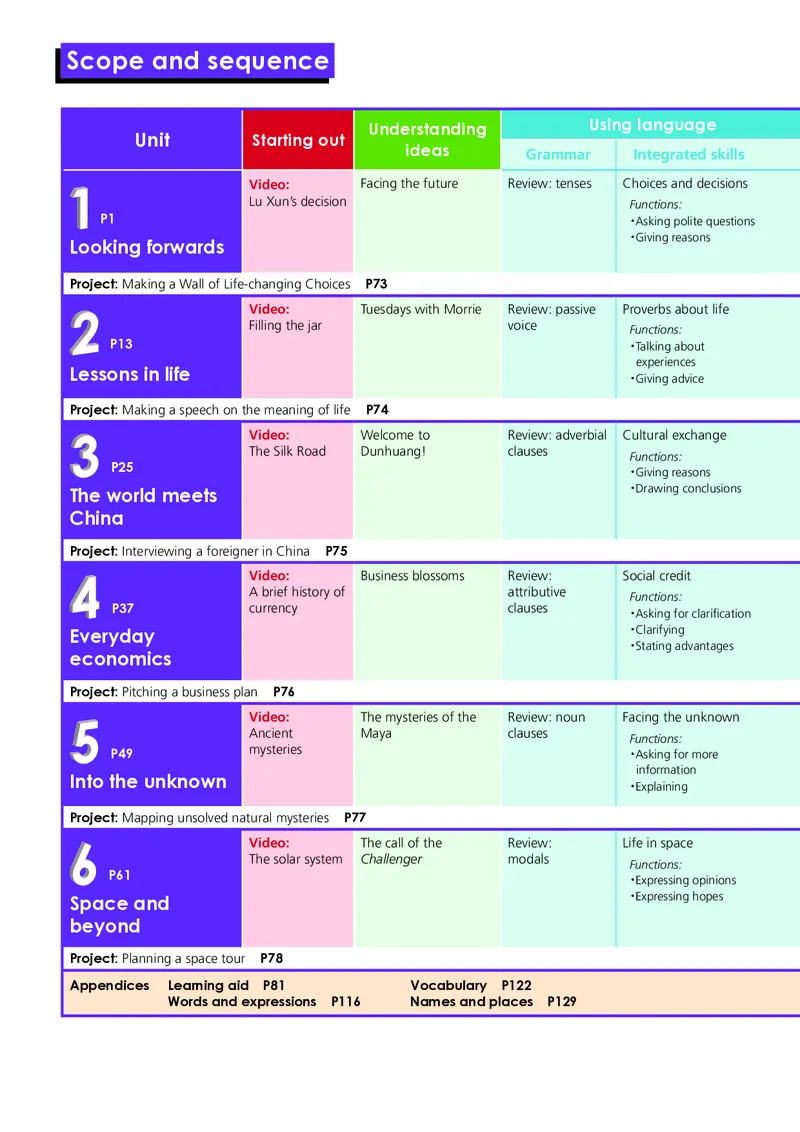
高中阶段编委会Scope and sequence
Using language
Understanding
Unit Starting out
ideas Grammar Integrated skills
Video: Facing the future Review: tenses Choices and decisions
Lu Xun’s decision Functions:
P1 ・Asking polite questions
・Giving reasons
Looking forwards
Project: Making a Wall of Life-changing Choices P73
Video: Tuesdays with Morrie Review: passive Proverbs about life
Filling the jar voice
Functions:
P13 ・Talking about
experiences
Lessons in life
・Giving advice
Project: Making a speech on the meaning of life P74
Video: Welcome to Review: adverbial Cultural exchange
The Silk Road Dunhuang! clauses
Functions:
P25
・Giving reasons
・Drawing conclusions
The world meets
China
Project: Interviewing a foreigner in China P75
Video: Business blossoms Review: Social credit
A brief history of attributive
Functions:
P37 currency clauses
・Asking for clarification
・Clarifying
Everyday
・Stating advantages
economics
Project: Pitching a business plan P76
Video: The mysteries of the Review: noun Facing the unknown
Ancient Maya clauses
Functions:
mysteries
P49 ・Asking for more
information
Into the unknown
・Explaining
Project: Mapping unsolved natural mysteries P77
Video: The call of the Review: Life in space
The solar system Challenger modals
Functions:
P61
・Expressing opinions
・Expressing hopes
Space and
beyond
Project: Planning a space tour P78
Appendices Learning aid P81 Vocabulary P122
Words and expressions P116 Names and places P129Developing ideas
Presenting
Reading Writing ideas
The road not taken Writing an application letter Giving a speech about your
understanding of success
Learning to learn:
Symbolism
The Blue Bird (adaptation) Writing a summary Giving a presentation about a literary
work and its value
Learning to learn: Learning to learn:
Full-length plays How to write a summary
Reading China Recommending cultural Designing an opening ceremony for a
highlights cultural exchange exhibition
Learning to learn:
Answering a big question
What’s mine is yours. Writing an essay about non- Giving a presentation about
cash payments suggestions for better economic
Learning to learn:
development in your home town
Two-sided argumentative essays
Diving deep Writing about the unexplained Giving a speech on the meaning of
exploration
Learning to learn:
Discourse markers
Eyes upon the night Writing a journal entry about Recommending three things
living in space to put on a disc to be sent into space
Learning to learn:
Time sequencing
Reflection致 同 学
同学们,欢迎大家继续《英语》(新标准)高中教材的学习!
经过必修课程教材的学习,大家已经打下了更为扎实的英语基础,达到了高中英语学业质量水
平一的要求。现在大家应根据升学或就业的需要,对自己的学习目标提出更高的要求。由教育部制
定并颁布的《普通高中英语课程标准(2017年版)》明确规定:普通高中英语课程作为一门学习及
运用英语语言的课程,与义务教育阶段的课程相衔接,旨在为学生继续学习英语和终身发展打下良
好基础。普通高中英语课程强调对学生语言能力、文化意识、思维品质和学习能力的综合培养。这
就是同学们在高中阶段学习英语的方向和目标。
要达到这个目标,需要大家的主观努力,也需要一套适应更高更广的语言学习需求的教材。《英
语》(新标准)高中选择性必修课程教材在延续了必修课程教材的基础上,为有升学要求或有个性化
发展需求的学生设计,在话题内容、语言理论、语言技能、跨文化意识、思维能力、学习能力等方
面,都提出了更高的要求,延伸出了如下特点:
一、作为必修课程教材的延续,选择性必修课程教材的话题选择更注意广度和深度,既关注话题的
现实意义,又关注语言学习的思想内涵,充分反映语言的发展和社会的进步,力求培养同学们
的文化意识和思维能力。
二、选择性必修课程教材具体语篇内容的选择将会引导大家进入英语语言学习的较高阶段。课文中
不但会出现更有挑战性的阅读篇章,同时还会根据每个单元的主题补充更多语篇供大家阅读并
赏析,提高语言水平和鉴赏能力。
三、思维方面,选择性必修课程教材对高阶思维做了更多要求,且对思维过程的启动、运行和开展
均做了更多的过程分解与清晰化设计,更强调基于同学们头脑中已有的内容及其再加工,与新
的语言和内容输入相结合,产生更丰富、更复杂的认知互动,深化思维发展活动。
四、在新课标规定的英语学习活动观的指导下,遵循“理解—发展—实践”的原则,对活动的要求
进一步提升,在“功能运用”板块中,将原有的词汇和听力部分整合成综合语言运用活动,通
过创设符合单元主题的话题,设计一系列首尾呼应、前后紧密关联的活动串,灵活融入听、说、
读、看、写等各项技能的训练,兼顾学习策略、功能和文化的引导与思考,帮助大家全方位提
升综合语言运用水平。
五、根据该阶段教学特点、教学内容和教学要求,充分遵循循序渐进的原则,强调对义务教育阶段
和高中必修阶段语言知识的复现、综合练习与重新认识,以形成内化的语用能力。
六、在呈现更为丰富多彩的文化现象的同时,更加强调中外文化对比,尤其是中国文化、中国故事、
中国传统价值观和世界问题的中国视角的介绍,让大家更好地理解文化异同,形成正确的文化
价值观和有利于国家、个人发展的跨文化态度与意识。
七、在单元学习的过程中帮助大家总结学习成果,发现问题并及时解决,最后通过对单元主题、语
言、文化思维等多方面提出问题,帮助大家写出自我反思日志,既完成了对学习目标、语言知
识和技能、思维品质、文化意识等维度的自我评价和总结,更显性体现了学习和思维的过程,
帮助大家进一步培养自主学习和反思总结的能力。
我们衷心希望,同学们能够通过学习本教材,了解到更加丰富的信息,在理解祖国文化、坚定
文化自信的同时,发展跨文化交流能力,更好地适应宽广的世界。愿《英语》(新标准)伴随同学们
度过有意义的高中时代!Looking forwards
1 Watch the video and answer
the questions.
1 Who is mentioned in the video?
What decisions did he make?
2 Why did he change his decision?
2 Look at the picture and answer
the questions.
1 What can you see in the picture?
2 What are the differences between the
three paths?
3 What do you think life’s path looks like?
U
N
I
T
Starting out
1Understanding ideas
1 Complete the questionnaire and share
Facing
your answers with the class.
SENIOR HIGH
QUESTIONNAIRE
the
Now you’ve been at senior high for over a year, I’d
like to know your progress and plans for the future.
Thank you!
Future
Your Form Teacher
➊ How do you feel about your performance over
the previous terms?
satisfied
so-so
1 For many of us, it’s something we already
not satisfied
have experienced. One moment, we are
Why?
lying comfortably in bed, about to fall
into a deep sleep. The next, our eyes are
open and we find ourselves wondering or
➋ What goals have you achieved?
even worrying about possibly the most
important issue of our lives – the future.
Will we get into the school of our choice?
➌ What goals have you yet to achieve?
What will we be doing in ten years’ time?
Can we become the person we really want
➍ What will you do about the goals you want to be? In the face of such questions, how
should we approach the future? Can we
to achieve?
take action to shape it, or should we just
accept whatever comes our way?
➎ How do you plan to achieve these goals?
2 As many of us already know, having plans
in place for the future is no guarantee that
they will become reality. In this respect,
some people are more fortunate than
2 Look at the title and predict what the others, as can be illustrated by comparing
passage is about. the lives of two famous authors, born 40
Different jobs people might do in the future. years apart. Although they shared the same
Stories about different people’s future. ambitious and energetic approach to life,
Various possibilities for future development. their careers unfolded in contrasting ways.
Fixed future for everyone.
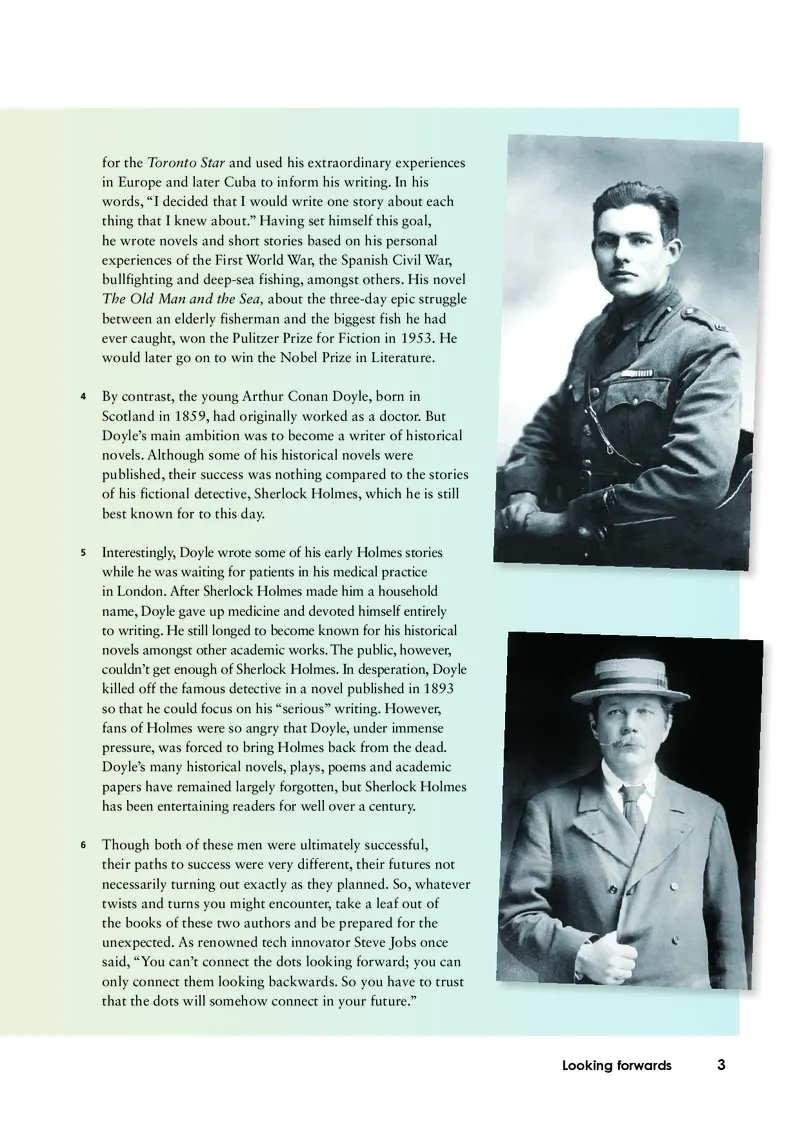
3 The American author, Ernest Hemingway,
born in 1899, was from early boyhood
Now read the passage and check
single-minded in his ambition to write.
your prediction.
On leaving high school, he joined a local
Kansas newspaper as a trainee reporter. He
went on to become foreign correspondent
2 UNIT 1for the Toronto Star and used his extraordinary experiences
in Europe and later Cuba to inform his writing. In his
words, “I decided that I would write one story about each
thing that I knew about.” Having set himself this goal,
he wrote novels and short stories based on his personal
experiences of the First World War, the Spanish Civil War,
bullfighting and deep-sea fishing, amongst others. His novel
The Old Man and the Sea, about the three-day epic struggle
between an elderly fisherman and the biggest fish he had
ever caught, won the Pulitzer Prize for Fiction in 1953. He
would later go on to win the Nobel Prize in Literature.
4 By contrast, the young Arthur Conan Doyle, born in
Scotland in 1859, had originally worked as a doctor. But
Doyle’s main ambition was to become a writer of historical
novels. Although some of his historical novels were
published, their success was nothing compared to the stories
of his fictional detective, Sherlock Holmes, which he is still
best known for to this day.
5 Interestingly, Doyle wrote some of his early Holmes stories
while he was waiting for patients in his medical practice
in London. After Sherlock Holmes made him a household
name, Doyle gave up medicine and devoted himself entirely
to writing. He still longed to become known for his historical
novels amongst other academic works. The public, however,
couldn’t get enough of Sherlock Holmes. In desperation, Doyle
killed off the famous detective in a novel published in 1893
so that he could focus on his “serious” writing. However,
fans of Holmes were so angry that Doyle, under immense
pressure, was forced to bring Holmes back from the dead.
Doyle’s many historical novels, plays, poems and academic
papers have remained largely forgotten, but Sherlock Holmes
has been entertaining readers for well over a century.
6 Though both of these men were ultimately successful,
their paths to success were very different, their futures not
necessarily turning out exactly as they planned. So, whatever
twists and turns you might encounter, take a leaf out of
the books of these two authors and be prepared for the
unexpected. As renowned tech innovator Steve Jobs once
said, “You can’t connect the dots looking forward; you can
only connect them looking backwards. So you have to trust
that the dots will somehow connect in your future.”
Looking forwards 33 Match the questions to the paragraphs and find out the answers.
a What is possibly the most important concern in life?
b What was Doyle’s main writing ambition?
c What can you do when faced with uncertainty about the future?
d What is the relationship between one’s plans and the future?
e Why was Doyle disappointed with the success of his Holmes stories?
f What did Hemingway do to achieve his ambition to become a writer?
4 Organise information from the passage and complete the chart.
Ernest Hemingway Similarities
Arthur Conan Doyle
• He was born in the US in 1899. • They both
• He __________________ __________________. • He was born in Scotland in 1859.
since boyhood. • They shared • He first worked as
• He wrote __________________. __________________. __________________, but
• He won __________________. __________________.
• He created __________________,
Sherlock Holmes.
• He had wanted to be remembered
for __________________, but
__________________.
Now read the sentence from the passage and
Think & Share
answer the questions. 1 What is your
understanding of Steve Jobs’s words at the
So, whatever twists and turns you might end of the passage?
encounter, take a leaf out of the books of 2 What can you learn about facing the
these two authors and be prepared for the future from the two authors?
unexpected. 3 What will you do to prepare yourself for
the future?
1 What is your understanding of “take a leaf out 4 Do you know any stories about Chinese
of the books”? writers and their plans for the future?
2 What effect is the author aiming to achieve by What lessons can you learn from their
using it? experiences? Share your opinions with
3 What other expressions do you know that share the class.
the same meaning?
4 UNIT 1Using language
Review: tenses
1 Look at the sentences from the 2 Complete the blog with the correct form of the verbs
reading passage. Decide which tense in brackets.
each is in and match the tenses to
what they describe.
I woke at dawn again and already the birds
a For many of us, it’s something we
1____________ (sing). In the coming days, we
already have experienced.
2____________ (paint) the iron roof of the toilet block
b What will we be doing in ten
that we had been building over the last two months.
years’ time?
c He would later go on to win the I 3____________ (live) in this Cambodian village
Nobel Prize in Literature. for two months. Despite the hard physical work,
d … the young Arthur Conan Doyle, I 4____________ (not regret) for one moment choosing
born in Scotland in 1859, had to spend my gap year as a volunteer for the Cambodia
originally worked as a doctor. Foundation. It is wonderful to meet such friendly local
e … Doyle wrote some of his early people who are happy to share their lives with us.
Holmes stories while he was
I 5____________ (feel) happy and free of worries. And,
waiting for patients in his medical
of course, I 6____________ (become) fitter. This gap
practice in London.
year has been a fantastic opportunity for my personal
f … but Sherlock Holmes has been
growth, and I surely 7____________ (continue) to learn
entertaining readers for well over
about how other people live their lives after it ends.
a century.
1 An action completed in the past 3 Work in pairs. Read the profile and talk about David’s
before another past action. life using different tenses where appropriate.
2 An action or event taking place over a
PERSONAL INFORMATION
particular period in the future.
Date of Birth 20 June 2001
3 An action that happened in a period Nationality British
of time up to the present. EDUCATION
4 An action that started in the past and 2007–2013 Carson Primary School
2013–2019 Wildwood High School
may still be going on or have just
David Mason EXTRACURRICULAR EXPERIENCE
stopped.
Sept 2017 first prize for school science project
5 An intended future action or event as
Apr–Oct 2018 exchange programme in China
seen from the past. Jul 2019–present gap year in Cambodia
6 An on-going situation at or around a FUTURE PLANS
particular time in the past. • undergraduate study at Newcastle University
• chemical engineer after graduation
• voluntary work to help people in need
Now answer the questions.
1 What other tenses have you learnt? 4 Work in pairs. Interview each other about your past
Find examples in the reading passage. experience and future plans. Share them with the
2 What do these tenses describe? class using different tenses where appropriate.
Looking forwards 5Choices and decisions
5 Read the conversation and answer the questions. Pay 6 Read the statements and complete
attention to the expressions in bold. the sentences with the correct
form of the expressions in Activity 5.
Jenny: What’s up, Li Ling? You
look worried. May: I thought quitting my old job
to work here was the right decision
Li Ling: I’m facing a difficult
to make, but now I’m not sure – the
decision. I’ve been
new job seems too demanding.
recommended for
admission to study physics at my dream university.
Jane: Can I get back to you by the
Jenny: Congratulations! But what do you mean by a
end of the week? I need to read the
difficult decision? I think the course is tailor-made
contract properly before making a
for you!
decision.
Li Ling: Well, it sounds wonderful, but I had already
decided to take the college entrance exam and
Paul: The maths club or debating
apply to the Medical School there. I can’t make
society? The maths club, of course!
up my mind what the right thing to do is.
I’m a big fan of geometry.
Jenny: I think it would be a great pity to pass up the
opportunity to be admitted without taking
Bill: Working as a clerk at my dad's
the exam.
insurance firm? Absolutely not! It’s
Li Ling: I know, but I have always wanted to study medicine too boring!
and become a dentist. Physics is interesting, but it’s
not my preferred major.
Amanda: I need to think about the
Jenny: Then why the indecision? Go for your
advantages and disadvantages of
preferred major. each option they’ve offered.
Li Ling: But what if I don’t do well enough in the exam
to get into the Medical School? I’m really having
Jia Ying: I’ve decided to say no to
second thoughts.
the chance to work as a sailor after
Jenny: Can you put off making a decision until you’ve leaving the navy.
spoken to your high school advisor?
Li Ling: I have already talked to her. She told me that I must
1 May is _______________________
decide what’s right for me now, and then go for it.
_____________________________.
The problem is I don’t know what is right for me.
2 Jane is _______________________
Jenny: Well, I wouldn’t reject anything out of hand.
_____________________________.
Let’s go for lunch. Then we can weigh up the
3 Paul finds it easy to ____________
options and try to come to a decision. Let's put
_____________________________.
the kettle on.
4 Bill is ________________________
_____________________________.
1 What difficult decision is Li Ling facing? Why is she 5 Amanda wants to _____________
feeling worried? _____________________________.
2 What does Jenny suggest to her? 6 Jia Ying has decided to _________
3 What would you do when faced with a difficult decision? _____________________________.
6 UNIT 17 Read the passage and answer the questions. 9 Listen again and complete the notes.
It is crucial for teenagers to develop into
Why did Richard apply for this job?
mature and responsible members of society. In
Because he has always been interested in
addition to participation in school, a part-time
1 .
job – such as working in a café or in an office
administration role – can also be helpful in What did Richard do in his previous holidays?
this transition. It can help them achieve new • He worked in a youth hostel in Vietnam,
accomplishments, learn about society and 2 .
become more independent. • He worked 3 in Bali.
• He 4 in Thailand.
Many countries now have laws to regulate
Why does Richard believe he is suitable for the job?
part-time employment for students. In the UK,
• Because he is a 5 and outgoing
for example, the law states that students aged
person, and feels happy when 6 .
15 and 16 are allowed to work a maximum of • His 7 have made him a flexible
12 hours per week during term time, and 35 individual.
hours per week during school holidays. They are • 8 is relevant.
not allowed to work before 7 am or after 7 pm.
Why did Richard do part-time jobs?
1 What can students achieve via part-time jobs? • Because he 9 his holiday time.
2 What regulations are in place for students • Because the experiences would 10 .
doing part-time jobs in the UK?
3 Have you ever had a part-time job? Why did Now work in pairs. Decide whether Richard
you do it? should get the job and give your reasons.
8 Listen to the interview and choose the job 10 Complete the boxes with the expressions
Richard applied for. from the interview.
Dog walker Flexible hours • Would you mind…? • May I ask why…?
$10 / hour
wanted! • The reason is… • It’s because…
Must love animals.
• Could you tell me…? • I’d say it’s due to…
Part-time HOTEL RECEPTIONIST wanted! • …, if you wouldn’t • Would you explain…?
5 hours per day mind. • It’s a result of…
4 days per week (weekends necessary)
• Must have good people skills. Asking polite questions Giving reasons
• Relevant experience preferred.
BUSY RESTAURANT NEEDS STAFF!
Part-time dish washer wanted at Italian restaurant.
$8.50 / hour 20 hours per week
11 Work in pairs. Choose a part-time job
Free meals
advertisement in Activity 8 and act out an
LIFEGUARDS
Needed! interview using the expressions in this section.
30 hours per week at public pool
Uniform provided
Now consider if you could effectively
First aid certificate essential.
participate in a job interview.
Looking forwards 7Developing ideas
1 Read the short introduction to Robert Frost
and answer the questions.
The Road Not Taken
Two roads diverged in a yellow wood,
And sorry I could not travel both
Robert Frost (1874–1963) was one of
America’s most famous poets. He won the And be one traveler, long I stood
Pulitzer Prize for Poetry four times and was
And looked down one as far as I could
awarded the Congressional Gold Medal for
To where it bent in the undergrowth;
his works. His poetry has been praised for its
natural themes, mostly set in the rural areas
Then took the other, as just as fair,
of New England where Frost lived most of
And having perhaps the better claim,
his life, and for his colloquial approach to
American language. His poetry generally Because it was grassy and wanted wear;
has a regular rhythm and rhyme, and is
Though as for that, the passing there
easy to read aloud and remember. He often
Had worn them really about the same,
used simple settings in his poems to explore
complex personal and social themes. Among
And both that morning equally lay
Frost’s best-known poems are The Road Not
In leaves no step had trodden black.
Taken, Fire and Ice, Stopping by Woods on a
Snowy Evening and Birches. Oh, I kept the first for another day!
Yet knowing how way leads on to way,
I doubted if I should ever come back.
1 What are the special features of Frost’s poetry?
2 Have you read any poems written by Robert I shall be telling this with a sigh
Frost? Share one with the class.
Somewhere ages and ages hence:
Two roads diverged in a wood, and I –
2 Read the passage and find out what it
is about. I took the one less traveled by,
And that has made all the difference.
8 UNIT 11 Lines from the poem The Road Not Taken are to do so. Like the writer, all we can do is look
often quoted in speeches of all kinds. The poem backwards “with a sigh” and imagine what
has been set to music by a number of artists could have been.
and used in numerous television commercials.
It has in fact become one of the most famous 4 This sigh, this wondering whether we made
American poems of all time, not only because the right choice, is understandable. Although
of its natural style, but also because of its we may be free to choose which path to take,
thoughtful insights into human nature. this choice isn’t easy when those two paths
look similar. Presented with two job offers, for
2 When reading The Road Not Taken, one cannot instance, we may wonder exactly what it is
help but see in one’s mind images of a peaceful we’re choosing between. What if, in choosing
wood deep within the countryside. Paths in the one, we are unknowingly turning down other
woods are often used to symbolize how our future opportunities? Will we ever even find
lives progress and change. The lines “Two roads out whether we made the right choice?
diverged in a yellow wood, / And sorry I could
not travel both” give us a visual representation 5 Ultimately, the road ahead – the road through
of the choices that we face and the decisions our lives – is a mixture of choice and chance.
that we need to make. Life throws many And when we are approaching the end of that
alternatives at us on a daily basis. These range road, how will we remember the journey?
from the basic “What should I wear today?” How will we look back on our lives? In the
to the key issues of what subject to study at poem, the writer doubts his choice, thinking
university or what job to do after graduation. that in the future “ages and ages hence”, he
Of course, the greatest dilemmas arise from may claim that he took the “less traveled”
moral problems, when we are uncertain which road. Some of us do take a more unusual path
choice results in doing the right thing. through life, and while it may be a harder one
to follow, it can also lead to new adventures
3 Whether big or small, what all our choices and experiences. Nonetheless, part of the art of
have in common is that they lead to specific decision-making is learning to make the most
consequences. Once we make a decision, in of our decisions. Instead of looking back with
most circumstances, there is no going back. regret, we should be facing our future with
Although the writer of the poem considers energy and optimism, for the choices are ours,
taking the other path another day, he knows it’s and ours only.
unlikely that he will ever have the opportunity
Looking forwards 93 Complete the table with information from the passage. 4 Work in groups. Read another
interpretation of the poem and
Summary of the poem
prepare a report comparing it with
A traveller in the wood comes to a fork in the road
the one in the passage.
and he feels sorry for 1________________________.
After close observation, he decides to choose the
one which 2________________________, though Robert
3________________________. He tells himself that
4________________________ some day, but he doubts The Road Not Taken is one of America’s
5________________________. He imagines that, many best-loved poems, and I think it is a
years in the future, he will tell this story with a sigh, pity that it is generally misunderstood
saying that his choice has 6________________________. as a call for facing the future without
Appreciation and interpretation regret. To me, it is really about accepting
the consequences of our choices many
• It is one of the most famous American poems of all time.
years in the future, when it is too late
• The diverged roads in the poem symbolise
to change them. The two roads in the
7________________________.
wood were “really about the same”, so
• Once we have taken a road, we might wonder
the cause of any indecision is a fear of
8________________________. Instead of looking back
regret. It is, however, acceptable to feel
with regret, we should 9________________________.
regretful, because it serves as a reminder
to live life to the full.
Learning to learn
Symbolism is the use of an object to represent an abstract
1 Discuss the two interpretations from
idea. For example, the rose could represent love and affection,
the following aspects. Do further
and the rainbow could symbolise hope. It allows the poet to
express a certain mood or emotion in a more subtle way, as research if necessary.
opposed to stating it directly. • What points do the two
interpretations share?
• What are the major differences
1 Why do you think the writer looks
Think & Share
between the two interpretations?
back on his decision “with a sigh”? • Which interpretation seems more
2 What are the rhyming words in this poem? What convincing to you? Why?
effect do they have? • Can you think of yet another
3 What is the most difficult choice you have ever had interpretation of the poem?
to make? What did you choose to do? 2 Prepare your report, including your
4 What effect will the poem have on you when you understanding of the poem.
face decisions in the future? Give your reasons. 3 Share your report with the class.
5 In what different ways do the two reading
passages in this unit improve your understanding Now talk about how well your group
of the choices you make and how they impact completed the report and how others’
your future? opinions have helped you better
understand the poem.
10 UNIT 1Writing an application letter
5 Read the job advertisement and the application a Stating relevant past experience
letter. Match the headings to the sections and find b Ending by restating interest, as well as
out how qualified the applicant is for the job. contact information
c Stating qualifications required
Local Tour Guide Wanted
d Formal signing off
• 9 am to 4 pm four days a week.
Part-time
City tours e Formal greeting
Agency
f Stating personal interest and career choice
• Fluency in English and French.
• Knowledge of the city’s history and attractions. g Stating purpose of the letter, including
• Relevant experience preferred. position applied for and how applicant
• Applicants must be 16 and above. came to know about it
Contact:
JaneSmith@HRCITYTOURS.com
6 Read the job advertisement and plan
for your application letter by answering
the questions.
Dear Ms Smith,
Office Assistant Wanted
I wish to apply for the position of a local tour guide as
advertised in the Daily News on 30 June. for part-time work at local council
I’m very familiar with almost every inch of my home city, • An interest in online technology.
and have a passion for history. This role would enable me
• Well-prepared for a variety of tasks,
to help bring our history to life for visitors and promote
including document filing, photocopying,
local culture. As I plan to work in the tourism industry
preparing meeting agendas, arranging
after graduation, I would welcome the opportunity to
refreshments and sorting letters and
gain experience in this field.
parcels.
As stated in my attached CV, I can speak both English
• Working five days per week
and French fluently. English is my native language, and
on morning shift.
I’m majoring in French at university. I also attended an
exchange programme in Paris last year, which further Contact:
carrielee@hitechworx.com
improved my French language skills.
Although I’m not a professional tour guide, I organised 1 What job are you applying for? Where
and conducted a tour of my city for exchange students
did you find the job vacancy?
from Paris. This included trips to a local leather workshop
2 What previous experience makes you
and a flour mill, for which my city is well known. I also
suitable for the job?
put together a directory of useful information for them.
3 What relevant qualifications do you
I received excellent feedback for my work.
have?
I would be delighted to have the opportunity to discuss
my application further with you. I’m contactable via
Now write the application letter.
email at this address or by phone on 6747-9818. Thank
you for your time and consideration.
7 Work in pairs. Make improvements
Yours sincerely, to each other’s application letters,
Josie Davis paying particular attention to the
structure and language.
Looking forwards 11Presenting ideas
1 Look at the pictures and answer 2 Work in groups. Talk about what success means to
the questions. you and give examples. Complete the table.
Meaning of success
Examples
3 Discuss your understanding of success in more detail
and make notes.
What does a successful future mean to you?
Why do you think that way?
What goals do you think you need to achieve to
be successful?
What would you do if you didn’t achieve these goals?
4 Prepare a speech about your understanding of
success. Consider the following:
1 the structure of your speech
2 useful words, expressions and structures
1 What kind of life does each
3 helpful public speaking skills
picture show?
2 What do you consider to be a
5 Give your speech to the class.
successful life? Give your reasons.
Reflection
Write a reflection after completing this unit. Consider the following:
1 What is your understanding of choices, decisions, future plans and future development?
2 What text types have you learnt about? What are their features?
3 What words, expressions and structures have you learnt?
4 What improvement have you made in understanding different cultures?
5 What improvement have you made in using learning strategies and exploring effective ways
of learning?
6 What improvement have you made in analysing and solving problems?
12 UNIT 1Lessons in life
1 Watch the video and answer
the questions.
1 What is life compared to in this story?
2 What do rocks, pebbles, sand and
tea represent?
3 What are the “rocks” in your life?
How much time do you spend on
“rocks”, “pebbles”, “sand” and “tea”?
2 Look at the pictures and choose the
things that can be used as metaphors
for life. Give your reasons.
U
N
I
T
Starting out
13Understanding ideas
1 Read the reviews on the back
cover of the book, Tuesdays with
Morrie, and answer the questions.
Tuesdays with Morrie
When you’ve lost your way
on the path of life, you might
Despite being a sports
notice someone ready to
journalist with a successful
help, watching you kindly
from further along the way. career ahead of him, Mitch
You know them: an older Albom feels that there is
relative, a teacher, a friend,
something missing from
or a neighbour.
his life. This all changes
Older, more patient, kinder when he is reunited with his
and wiser, now they’ll walk favourite college professor,
with you, and tell you what to
Morrie Schwartz. On discovering that Morrie is being
look out for on your journey.
weakened by a severe illness, Mitch starts visiting him
at his house on Tuesdays. The weekly conversations
between Mitch and Morrie result in a series of lessons
on the meaning of life and how best to live it.
X00007UNZH
Arthur K ☆☆☆☆☆
1 What metaphor for life is used in
the reviews?
2 When people are described as This book is about dying, but it is not pessimistic.
“watching you kindly from further Indeed, it was a pleasant surprise to find that this book
along the way”, what does this is filled with joy and hope. Morrie’s bravery towards
mean? the end of his life is inspirational and has made me
value my own life more. In fact, far from being a book
about death, it’s a book about life. As Morrie says,
2 Read the passage and decide
“Once you learn how to die, you learn how to live.”
how many stars the four people
As Morrie anticipates his own death, he observes
would give the book (five being the
everything as though through new eyes – the things
highest rating). Give your reasons.
around him seem more beautiful than ever before and
hold new meanings. From his window, he watches
each season change, knowing it could be his last. This
encourages us to appreciate what we have, and to
make the most of each day.
14 UNIT 2Amy Wang ☆☆☆☆☆
I think this book should be on all school reading lists. After finishing it, I feel I have
been given a deeper insight into the world and can see things from a different point of
view. On the 11th Tuesday, Morrie explains that “… the big things – how we think,
what we value – those you must choose yourself. You can’t let anyone – or any society –
determine those for you”. While we are living, we tend to get distracted by unimportant
things, such as gathering material possessions. I think it’s important for young people
to know that making a lot of money won’t always make them happy, or that looking
different doesn’t make a person abnormal! It’s up to us to find out what is important in
our lives and establish our own values.
Morrie says that most people “seem half-asleep”, even when they’re doing things they
think are important. Reading this book made me feel as if I’d been woken up from
a long sleep and finally opened my eyes to the world!
Marty ☆☆☆☆☆
Despite its widespread recognition, my first impression was that Tuesdays with Morrie
is just made up of a collection of over-emotional thoughts and messages, many of which
are repeated. But thinking back, it did teach me a lesson or two. The book made me
stop and think about how much I am influenced by popular culture and the importance
of creating my own values based on love and open communication. Although it isn’t my
favourite book, I’d still recommend that people read it – after all, it is something that’s
a bit different!
Vivian ☆☆☆☆☆
Warning! A box of tissues will be needed to get through this book! Morrie’s
reflections on love and friendship made me think about my life and all the good
friends that I’ve lost touch with along the way. It made me realise just how much
I miss them.
I guess that’s one of the lessons of the book – always keep in touch with the good
people you meet as you go through life. Like Mitch, Morrie makes you aware
that you want to die feeling that you have lived life to the full, knowing that you
are loved and have loved others as much as you could. As Morrie’s favourite poet
Auden said, “Love each other or perish.”
Lessons in life 153 Choose the topics of the book mentioned in the passage and find the evidence.
joy and hope art friendship love death values power sorrow
4 Organise information from the passage and complete the table.
What they liked or
What lessons they learnt
disliked about the book
As people learn how to die,
It was a pleasant surprise to find that 2_________________. He was encouraged
1_________________. to 3_________________ and make the most
Arthur K
of each day.
People should choose 6_________________
She thinks the book should be on
themselves. She felt as if she had been
4_________________. And she felt she was
woken up from a long sleep and finally
Amy Wang given 5_________________.
7_________________.
His first impression was that the book is
The book made him stop and think about
just 8_________________. Nonetheless,
10_________________ and the importance
he would recommend it because
Marty of 11_________________.
9_________________.
People should always keep in touch
The book made her cry because Morrie’s
14_________________. She was aware that
reflections on 12_________________ made
people want to 15_________________,
Vivian her think about 13_________________.
knowing that 16_________________.
Now go online to find out what other comments have been made on this book.
Do these comments make you want to read the book? Why or why not?
Think & Share
1 According to Morrie, what are “the big things” in life?
2 What is your understanding of Auden’s words: “Love each other or perish”?
3 How do you usually learn lessons about life? Through experience or learning from
other people? Give an example.
4 Can you critically evaluate other people’s opinions and make your own judgements?
16 UNIT 2Using language
Review: passive voice
1 Look at the sentences from the reading passage and 3 Look at the pictures and write the
match them to the reasons why the passive voice is used. story from Aesop’s Fables. Use the
passive voice where appropriate.
a On discovering that Morrie is being weakened by a
1
severe illness, …
b ... Tuesdays with Morrie is just made up of a
collection of over-emotional thoughts and messages, ...
c A box of tissues will be needed to get through
this book!
1 The subject is not known, is unimportant, or is “people in
2
general” and can be omitted.
2 The focus of the sentence is on the recipient of the
action, not on the subject of the sentence.
3 The subject goes with lengthy expressions that are better
put at the end.
Now look for more sentences with the passive voice in
3
the reading passage and talk about why it is used.
2 Rewrite the paragraph using the passive voice where
appropriate.
Since ancient times,
storytelling has been a
way to share and pass on
4
wisdom. One important
early work that did so was
Aesop’s Fables, a collection
of stories that history credits
to Aesop, a Greek storyteller.
People believe that he lived
in Ancient Greece between
One day a little mouse was caught by
620 BC and 564 BC. Most of the characters in his stories
a lion...
are animals, the qualities of which Aesop used to reflect
human traits and wisdom. Each fable teaches a life
4 Work in pairs. Tell each other
lesson that Aesop summarises in a short phrase at the
another fable you know and
end of the story, called a moral. Today, children and
the lesson you have learnt from
adults all around the world still enjoy Aesop’s Fables.
it. Use the passive voice where
appropriate.
Lessons in life 17Proverbs about life
5 Listen and complete the conversations.
1 4
A: Professor Brown, here’s my term paper. A: I’m glad you finally got here.
Sorry for the delay. B: My car had a flat tyre on the way. Anyway,
B: That’s OK. 1__________________, right? 4__________________.
2
A: Maths is really killing me! I’m thinking of
giving it up.
B: 2__________________ You’ll never get
your dream job as a market analyst if you
don’t stick to it.
3
A: If you want to lose weight, you need to
stop eating junk food, and you need to 5
A: With my brother’s help, I finally completed
start exercising.
my biology project!
B: OK. I’ll start tomorrow… maybe.
B: Congratulations! 5__________________
A: Today. Not tomorrow.
3__________________
6
A: I heard that Mary is going to invest all her
money in this programme.
B: That’s not wise. As people usually say,
“6__________________”. I’ll talk to her as
soon as possible.
6 Match the proverbs in Activity 5 to their meanings.
1 ____________: you must face challenges in order to be successful
2 ____________: it is easier to achieve something if you cooperate with someone else
3 ____________: doing something late is better than not doing it at all
4 ____________: you should start things earlier rather than later
5 ____________: do not put all your efforts or resources into doing one thing
6 ____________: problems don’t matter if the final result is good
Now work in groups and think of other proverbs about life. Can you find Chinese
proverbs with similar meanings?
7 Work in pairs. Think of other situations to which these proverbs can be applied.
18 UNIT 2In most countries, the average age for starting university is 18 years old,
but actually there is no upper age limit for starting a university degree.
Recently, there has been an increase in the number of mature students
going to university, after working for a few or many years. The oldest
person to get a Cambridge MA received his law degree at the age of
102. In China, a man from Jiangsu Province graduated from university at
the age of 88, making him the oldest university graduate in the country.
Did You Know ?
8 Listen to the interview and choose the 10 Complete the boxes with the expressions
best headline. from the interview.
1 University Fees Are No Barrier to Grandma!
• I started… back in…
2 Dream Comes True for Graduating Grandma
• After that I…
3 Janet Says: “Family first! That’s what matters!”
• But then five years ago…
4 How the Student Experience Has Changed
• I felt… at first.
with the Centuries
• I suggest that…
• Remember, …
9 Listen again and complete the notes.
Interview with Janet Rose Talking about experiences
Age: 1_______________
First attended university in: 2_______________
Reason for leaving university:
3______________________________________
Reason for going back to university: Giving advice
4______________________________________
Initial feelings on returning to university:
5______________________________________
University major: 6_______________
Feelings on graduation:
7______________________________________ 11 Work in pairs. Tell each other a story about
yourself that can be summarised by a proverb
Advice to others: 8_______________
in this section.
Future plans: 9_______________
Now talk about how effectively you and
Now work in pairs and talk about what you your partner used your own experiences to
can learn from Janet’s story. illustrate your understanding of the proverbs.
Lessons in life 19Developing ideas
THE
1 Read the introduction to The Blue
Bird and answer the questions.
BLUE BIRD
The Blue Bird is a 1908 play by Belgian
playwright Maurice Maeterlinck
(1862–1949), winner of the Nobel
Prize in Literature in 1911. Maeterlinck
ACT IV
wrote many plays, but The Blue Bird
was the most popular and has been
Tyltyl and Mytyl have been searching for the Blue Bird in the
widely translated and adapted all
Land of Memory, the Palace of Night and the Forest. Now, they
over the world. Performed in 1921 in
have arrived at the Palace of Happiness.
Shanghai by Chinese students, it was
the first foreign play staged in China.
SCENE II.—The Palace of Happiness.
(A troop of HAPPINESSES rush into the hall, singing,
The Blue Bird tells the tale of brother
“There they are! They see us!” They dance merrily around the
and sister, Tyltyl and Mytyl, as they
CHILDREN, then the one who appears to be the chief goes
are sent by a fairy to search for the
up to TYLTYL with hand outstretched.)
Blue Bird of Happiness. The children’s
adventure takes them through
THE HAPPINESS How do you do, Tyltyl?
many magical places before
TYLTYL Who are you?
they at last find the Blue Bird
THE HAPPINESS Don’t you recognise me?
in a most unexpected
TYLTYL (a little embarrassed) Why, no... I don’t
place.
remember seeing any of you.
(All the other HAPPINESSES burst out laughing.) Why, we
are the only things you do know! We are always around you!
We eat, drink, wake up, breathe and live with you!
TYLTYL Oh... But I should like to know what your
names are...
THE HAPPINESS I am the chief of the Happinesses of your
home; and all these are the other Happinesses
that live there.
TYLTYL Then there are Happinesses in my home?
(All the HAPPINESSES burst out laughing.)
1 Do you know the symbolic
meaning of the Blue Bird in THE HAPPINESS You heard him! Are there Happinesses in his
Chinese and Western cultures? home! Why, it is crammed with Happinesses!
Let me introduce myself first: the Happiness
Share your understanding of the
of Being Well. I am not the prettiest, but I am
meaning with the class.
the most important. This is the Happiness of
2 Where do you think the children
Pure Air, who is almost transparent. Here is
find the Blue Bird?
the Happiness of Loving One’s Parents. Here
are the Happiness of the Blue Sky, who, of
Now read the play and check your
course, is dressed in blue, and the Happiness
answers.
20 UNIT 2of the Forest: you will see him be! (Kissing TYLTYL.)
every time you go to …
the window...
TYLTYL Excuse me, but do you know (Later, the NEIGHBOUR enters with a little girl
where the Blue Bird is? who carries TYLTYL’S dove in her arms.)
THE HAPPINESS He doesn’t know where the Blue THE NEIGHBOUR Do you see the miracle?
Bird is! (All the HAPPINESSES OF She can run, she can dance, she
THE HOME burst out laughing.) can fly! (Pushing the LITTLE
TYLTYL (vexed) No, I do not know. GIRL into TYLTYL’S arms.)
There’s nothing to laugh at. (Fresh Come along and thank Tyltyl.
bursts of laughter.)
THE HAPPINESS He doesn’t know: well, what do (After TYLTYL kisses the LITTLE GIRL rather
you expect? He is no more absurd awkwardly, the two children look at each other
than the majority of men… without speaking; then TYLTYL strokes the
dove’s head.)
ACT VI
TYLTYL Is he blue enough?
Unable to find the Blue Bird anywhere, the THE LITTLE GIRL Yes, I am so pleased with
children say goodbye to their magical friends and him.
return home. While they are trying to tell their TYLTYL I have seen bluer ones. But those
parents about their adventures, their neighbour which are quite blue, you know,
comes in. Her sick daughter has wanted Tyltyl’s do what you will, you can’t
pet bird for a long time, but until now he has been catch them.
reluctant to give it to her. THE LITTLE GIRL That doesn’t matter; he’s
lovely.
SCENE II.—The Awakening. TYLTYL Has he had anything to eat? I will
(Enter NEIGHBOUR BERLINGOT, a little old show you...
woman leaning on a stick.)
(He moves to take the bird from the LITTLE
MUMMY TYL How is your little girl? GIRL’S hands. She resists instinctively; and, in their
THE NEIGHBOUR Only so-so. She can’t get up. hesitation, the DOVE escapes and flies away.)
But I know what would
cure her. THE LITTLE GIRL (with a cry of despair) He
MUMMY TYL Yes, I know; it’s Tyltyl’s bird. Well, is gone!
Tyltyl, aren’t you going to give it TYLTYL Never mind. Don’t cry. I will catch
at last to that poor little thing? him again. (Stepping to the front
TYLTYL My bird! Why, he’s blue! But it’s of the stage and addressing the
my turtle-dove! But he’s much audience.) If any of you should
bluer than when I went away! find him, would you be so very
Why, that’s the Blue Bird we were kind as to give him back to us?
looking for! We went so far and We need him for our happiness,
he was here all the time! There, later on.
Madame Berlingot, take him to
your little girl. CURTAIN
THE NEIGHBOUR Really? Straight away and
for nothing? How happy she will (Adaptation from The Blue Bird by Maurice Maeterlinck)
Lessons in life 212 Complete the notes with information Learning to learn
from the play.
The Blue Bird is a typical full-length play, which means it has
several acts and each act is composed of several scenes. The
ACT IV SCENE II
whole play depicts actions that take place over a long period
Characters of time. Various characters appear in different acts and scenes,
and the settings and costumes change accordingly. The running
time of a full-length play can last for several hours, even days.
Setting
Think & Share
1 Why cannot Tyltyl recognise any
Plot of the Happinesses?
2 Are there any Happinesses in your home? What
The children come to the Palace of
are they? Where else can you find them?
Happiness and are welcomed by a
3 What does the author want to express by making
troop of Happinesses...
the Blue Bird fly away at the end of the play?
4 What different life lessons can you learn from the
two reading passages in this unit?
3 Work in groups and act out the play.
1 Read the play again and discuss how you might present
ACT VI SCENE II it on stage. Consider the following:
• Plot – Is there anything you will cut from, or add to
Characters
the play?
• Setting – What costumes and props will you need?
• Roles – Will you need a narrator to give the
Setting background to the play and introduce the
new scenes?
• Language – Will you revise the language to make it
Plot
easier to remember?
The children return home without
2 Adapt the play based on your discussion. You may refer
finding the Blue Bird...
to the original play for more ideas if necessary.
3 Decide roles for each group member and practise
performing the play.
4 Act out the play in class.
Now talk about how well your group performed.
Vote for the best performer in the play.
Now work in groups and talk about
how much you like the play. Give
your reasons.
22 UNIT 2Writing a summary
4 Read the summary of The Blue Bird and answer Learning to learn
the questions.
When writing a summary of a long story, your
purpose is to convey the basic ideas of the
The Blue Bird is a six-act fairy play written by
original: what is it about and what does the
Maurice Maeterlinck. It’s a story about Tyltyl and
author want to communicate? First, identify the
Mytyl’s adventures as they search for the Blue Bird
title and author of the piece. Then use your own
of Happiness. As the children of a poor woodcutter, words to describe relevant details that lead to
they are secretly observing a party at the home of the climax of the story. State the central idea of
their wealthy landlords when a fairy appears. She the story but don’t give your own opinion of it.
A good summary needs to be concise, precise
uses a magic diamond to bring animals (their dog
and to the point.
and cat), objects (sugar and bread) and elements
(light, fire, water) in their home to life. Together,
they set off on a dangerous journey in search of the
5 Choose another play you have read and
Blue Bird.
write a summary of it. Organise your
ideas by completing the table.
Tyltyl and Mytyl go to many magical places. They
Title and author of the play
encounter numerous characters such as their
departed grandparents, trees that hate mankind, the
greedy and ugly Luxuries, and children waiting to be
Main character(s)
born. Although they try very hard to find the Blue
Bird, the birds they find either change colour or die.
The children return home at last, and Tyltyl discovers Start of the play
the Blue Bird has been there all the time! He gives
the bird to the neighbour’s
Climax
little girl, curing her illness.
But in the end, the bird flies
away, and Tyltyl asks the
Conclusion
audience to search for it.
The central idea of the play
is that happiness is to be
found not in luxuries such
Now write your summary.
as wealth, but in simple
things that are found in
6 Work in pairs. Make improvements to
family life, and in acts of
each other’s summaries and share them
friendship and kindness.
with the class.
1 Which paragraph introduces the main characters, Now think about how well you used
setting and start of the play? concise and precise language to
2 What is the climax of the play? summarise the play and what you could
3 What is the theme of the play? do to improve.
Lessons in life 23Presenting ideas
1 Look at the book covers and answer the questions.
1 What do you know about these works? Share what you know
with the class.
2 What life lessons can you learn from them? Do more research
if necessary.
2 Think of another literary work from which you have learnt
something and complete the table.
General information
Main idea
Lesson(s) in the work
3 Work in groups. Talk about the work you have chosen.
4 Decide on a literary work you’d like to share with the class and
prepare a presentation about it. Consider the following:
1 the structure of your presentation
2 useful words, expressions and structures
5 Give your presentation to the class.
Reflection
Write a reflection after completing this unit. Consider the following:
1 What is your understanding of lessons in life?
2 What text types have you learnt about? What are their features?
3 What words, expressions and structures have you learnt?
4 What improvement have you made in understanding different cultures?
5 What improvement have you made in using learning strategies and exploring effective ways
of learning?
6 What improvement have you made in analysing and solving problems?
24 UNIT 2The world meets China
1 Watch the video and answer the questions.
1 What is the video about? How did it get
its name?
2 What is remarkable about the road?
2 Look at the pictures and answer the questions.
1 What can you see in these pictures?
2 What message do these pictures convey?
3 In what other areas is China attracting
attention around the world?
U
N
I
T
Starting out
25Understanding ideas
1 Look at the pictures and answer
the questions.
Mogao Grottoes
1 Welcome to Dunhuang! On the old Silk Road, this city
was the gateway to and from Ancient China, a place
where East met West, and a green island in the middle
of the desert. You can only imagine how travellers felt
when they saw the oasis of Dunhuang ahead of them.
murals
2 Dunhuang’s long and glorious history represents its
significance as a centre of cultural and commercial
exchange. Today, Dunhuang is a world-class tourist
destination boasting sites with UNESCO-protected
heritage status. Now, we are going to enter some of the
city’s famous caves, of which there are more than 700.
Known as the Mogao Grottoes, these ancient caves
were carved out of the rock over a period of 1,000
years. If you look up, you can see the paintings and
other artworks that are testimony to how the Silk Road
Mingsha Mountain
brought East and West together. Look at these statues!
You can see elements from Ancient Greece, India and
1 What makes Dunhuang unique?
Iran. Now look around the walls of the cave. Come a
2 What else do you know about
little bit closer so that you can get a better view. Look at
Dunhuang?
them! The murals cover an astonishing area of 45,000
square metres.
2 Read the passage and decide where
it is most probably from. Give your 3 The subjects of the Dunhuang murals vary from
reasons. religious stories to scenes of everyday life. But one
1 A travel brochure. type of mural that is unique to Dunhuang shows the
Apsaras, or “Flying Immortals”. Representations of
2 A tour commentary.
these heavenly musicians, singers and dancers decorate
3 A blog.
the walls of many caves. Take a look at this mural.
4 A lecture.
26 UNIT 3WELCOME TO
DUNHUANG!
The Apsaras are depicted sailing in the bright imported and exported from Dunhuang, such
blue sky, with their scarves flying, as if they as ceramics, medicine, perfumes and fruit, to
are about to fly down to meet us. And here is name just a few. The scrolls also reveal how
another one. Move over here where you can many different communities lived side-by-side
see it in more detail. The Apsaras are holding within this great city. However, the reason why
lotuses, playing musical instruments, dancing the Library Cave was sealed up all those years
and throwing flowers. The painting of Apsaras ago remains a mystery.
reached a peak during the Tang Dynasty; these
images are full of life, reflecting the confidence 5 In the Ming Dynasty, trade routes changed and
and optimism of people from that time. Dunhuang was not as prosperous as it used
to be. Gradually, it faded from memory, even
4 Now, something really extraordinary happened though it was once such a great city.
in 1900, when a Taoist priest made one of
the most important finds of the 20th century. 6 This century is bringing the Silk Road to
In a sealed cave, now known as the famous life once more through the Belt and Road
Library Cave, were hidden thousands of Initiative. Dunhuang has once again become
manuscripts, paintings and scrolls, as well as a global crossroads since it hosted hundreds
silk embroideries. We’ll have a chance to see of representatives from 51 countries for the
some of them shortly – the Library Cave is Silk Road International Cultural Expo in
only a stone’s throw from here. Dating from 2017. Given that the theme of the Expo was
405 AD to 1002 AD, these hidden treasures to promote cultural exchange and strengthen
give us a picture of Dunhuang when it was at mutual cooperation between the countries
the very centre of the Silk Road trade. Thanks along the Silk Road, Dunhuang was the
to this ancient library, we now know that ideal place.
goods arrived in Dunhuang from as far away
as North-east Europe, and that goods were 7 Now let’s move on to the next cave…
also exported from Dunhuang across Asia and
Europe. The scrolls are so detailed that they
describe the vast range of goods that were
The world meets China 273 Choose the best summary of the passage and give your reasons.
1 The Silk Road was an ancient trade route between East and West, which passed
through Dunhuang.
2 The Silk Road city of Dunhuang has a splendid history and is once again a meeting
place for people from around the world.
3 In Dunhuang there are grottoes, murals and other sights that attract tourists from all
over the world.
4 Organise information from the passage and complete the travel webpage.
Caves in Mogao Grottoes:
The caves were carved out of the rock 3__________________.
Statues
The statues include elements from
Location:
4______________________.
Gansu Province
Murals
Significance: • Coverage: 5______________________
• UNESCO-protected heritage sites • Topics: 6______________________
• 1___________________________
• 2___________________________ Apsaras
• Also called 7______________________, they
represent 8______________________.
• Apsaras painted during the Tang Dynasty are
a reflection of the 9______________________
during that time.
Library Cave
• Discovered inside were
Dunhuang has once again become
12__________________________.
10______________________.
• These give us 11______________________.
Now think about what information you would add to the webpage. Do further
research if necessary.
Think & Share
1 What is your understanding of “Dunhuang has once again
become a global crossroads”?
2 In what ways is present-day Dunhuang influenced by its past?
3 What would you most like to see in Dunhuang? Why?
4 What methods can you use to find out information effectively?
28 UNIT 3Using language
Review: adverbial clauses
1 Look at the sentences from the reading passage and answer the questions.
a You can only imagine how travellers felt when they saw the oasis of Dunhuang ahead of them.
b If you look up, you can see the paintings and other artworks…
c … Dunhuang was not as prosperous as it used to be.
d Given that the theme of the Expo was to promote cultural exchange…, Dunhuang was the ideal place.
1 Classify the adverbial clauses in the sentences.
condition comparison reason time
2 What other types of adverbial clause can you think of? Give some examples.
Now look for more sentences with adverbial clauses in the reading passage.
2 Complete the passage with the clauses in the box. 3 Look at the picture and describe
it using adverbial clauses where
no matter what culture it comes from
appropriate. You may use the
so that people can learn about different cultures
information to help you.
as if they are neighbours
that over 15,000 people each year attend them
China’s High Speed Rail (HSR)
as the traditional is mixed with the modern
• In 2008, China’s HSR service started.
Yo-Yo Ma is a French-born Chinese American cellist • In 2015, a major breakthrough
known for his musical talent. In 1998, Ma founded in technology was made, using
Silkroad, an organisation that explores musical independent R&D.
traditions in countries 1_________________. • Now, China cooperates with dozens
of countries in the world to develop
The fundamental purpose of Silkroad is to bring HSR services overseas.
people from across the globe together to play and
listen to music. Instruments and styles are blended
together to create music that is surprising, rich, and
completely original, 2_________________. What’s
more, 3_________________, people can learn about
the development of culture as a whole.
Since HSR service started in China in
The events that Silkroad organises are either
2008, it has undergone rapid growth…
performances, workshops, or mixed musical-artistic
displays. It is so successful 4_________________.
4 Work in pairs. Describe another
People meet as strangers, but they leave
Chinese innovation that has had
5_________________, learning that different cultures
a great impact both at home and
have more in common than they imagined.
abroad. Use adverbial clauses
where appropriate.
Now talk about what types of adverbial clause they are.
The world meets China 29Cultural exchange
5 Read the timeline and find out what contributions 6 Complete the passage with the correct
each person made. Pay attention to the expressions form of the expressions in Activity 5.
in bold.
Qian Zhongshu was
a renowned literary
The second century BC:
scholar and writer.
Zhang Qian, a diplomat, gave a reliable Born in 1910 in
account of the lands of Central Asia for Jiangsu Province,
the Han court.
he showed a strong
interest in books
at a very young age, earning him the
The first century AD:
name “Zhongshu”, which means
Gan Ying, a military envoy, explored the Persian
fondness for books. His translations and
Gulf and became the first Chinese to get
writings 1_________________ of cultural
information on Europe.
exchange between China and the West
that continues to this day.
The 7th century:
In 1929, Qian was accepted into the
Xuanzang, a Chinese monk, scholar and
Department of Foreign Languages at
traveller, translated volumes of scriptures
Tsinghua University. In 1935, he went
from Sanskrit to Chinese. He also wrote
The Great Tang Dynasty Record of the to Europe. He spent two years at
Western Regions, a description of the Oxford University, where he studied and
countries he visited on his travels. 2_________________ English literature.
He also studied in Paris for a year, before
returning to China to teach. In addition
The 8th century:
to studying Western literature, he wrote
After six attempts, over a period of twelve years,
a number of works on Chinese culture.
Chinese monk Jianzhen arrived in Japan, where
he promoted exchange and understanding Qian was an expert in both Chinese
between China and Japan.
and Western languages and culture.This
made him an excellent translator, who
3_________________ between Western
The 13th century:
and Chinese academics. Selected and
Marco Polo travelled from Europe to
Annotated Song Dynasty Poetry was
Asia. The Travels of Marco Polo served to
one of the great quantity of works he
bring knowledge of Asia to the West.
4_________________ Chinese to English.
One of Qian’s great achievements was to
The 15th century: produce comparative studies of classical
Zheng He sailed to South-east Asia, South Asia, Chinese texts, which made these works
West Asia, and East Africa. Some of his voyages more accessible to Western readers.
comprised as many as sixty treasure ships. These These books helped 5_________________
voyages led to a legacy of cultural exchange
Chinese literature to the West.
between China and other countries.
30 UNIT 3The Confucius Institute is a non-profit educational organisation run by the Chinese
Ministry of Education, aiming to promote Chinese language and culture abroad and
to encourage cultural exchange. The first institute opened in 2004, and today there are
over 500 institutes around the world. In addition to Chinese language courses, the
institutes also support activities, such as art exhibitions, conferences and film festivals.
Did You Know ?
7 Listen to the conversation and choose the topics covered. 9 Complete the boxes with the
1 The reason why Liang Ran decided to work for the expressions from the conversation.
Confucius Institute.
• The reason why… is that…
2 The working environment at the Institute.
• That was due to…
3 The troubles he had during teaching.
• On the whole, …
4 A special moment from his time at the Institute.
• To sum up, …
5 What he learnt from his students.
• In short, …
6 The friends he made in New York.
Giving reasons
8 Listen again and complete the passage.
Liang Ran spent 1_____________ abroad working as
a teacher at 2_____________. He said it was a difficult
decision, because it would mean 3_____________. Finally,
he decided to go as he wanted to help foreigners learn
Chinese and learn about China. He also wanted to Drawing conclusions
4_____________.
At first, Liang was surprised at 5_____________, as they
were quite varied. They were all interested in Chinese
culture, however. One challenge they met was that
they 6_____________, so Liang had to give them a lot
of support.
10 Work in pairs. Discuss what you can
Liang’s most memorable experience was at the end do to spread Chinese culture using
of the year when students learnt about traditional the expressions in this section.
Chinese dancing and 7_____________. Liang said their
8_____________ was amazing.
Now think about whether you can
Working there made Liang a better person. Through use the language you have learnt
teaching Chinese, he 9_____________, and through to express your ideas and give
interacting with students, he 10_____________. explanations, and whether you can
understand your partner’s ideas and
comment on them.
Now talk about the role the Confucius Institute plays in
promoting intercultural exchange.
The world meets China 31Developing ideas
1 Work in groups. Look at the list and The world of Chinese literature is one that is familiar
discuss the questions. to us all. But have you ever stopped to wonder what
works are read outside of China and how they are
received? Today, four Sinologists and translators
share their experience of Chinese literature with us.
CHINESE WORKS They are:
POPULAR
Petko, aged 43 from Bulgaria
IN THE WEST
Annelous, aged 34 from the Netherlands
Joachim, aged 25 from France
I Ching Mai, aged 28 from Egypt
The Analects
The Art of War
Journey to the West Q1: _______________________________________
Teahouse
Petko: It all started with a movie I watched when
Legends of the Condor Heroes
I was a boy – The Shaolin Temple. That movie gave
The Three-body Problem
me so many reasons to fall in love with China. I was
…
amazed by Chinese kung fu, of course – everyone
loves kung fu, don’t they? I also thought the Chinese
language sounded so beautiful, and I found that I liked
Chinese music, too – I just loved the movie’s theme
1 What are the Chinese names of tune, Song of the Shepherd.
these works?
2 Why do you think these works are Annelous: I became interested in languages at a young
popular outside of China? age. When I started high school, I began reading books
about Chinese history and culture, and this inspired me
3 What other Chinese works do you
to choose Chinese Studies as my academic major
think people outside of China would
at university.
enjoy? Why?
Joachim: When I was 15 years old, my mother bought
2 Read the passage and write the
me a copy of the classic Shi Ji, or Records of the Grand
questions on the lines.
Historian. Prior to that, the only great historical works I
1 Which works by Chinese writers are had been exposed to were Homer’s epic poems. Records
popular in your country? of the Grand Historian was my first encounter with
2 How did you get interested in Chinese classical literature. After reading it, I realised the
Chinese literature? true genius of China’s “Grand Historian”, Sima Qian.
His writing had a profound effect on me, and I have this
3 How do you select works to translate?
to thank for my passion for Chinese literature.
Mai: I gradually fell in love with Chinese literature
when I started working as a translator. Most of the
translated works of literature in Egypt are from the
English-speaking world, so reading Chinese literature
was a stimulating and inspiring experience.
32 UNIT 3READING
CHINA
Q2: ____________________________________ Q3: ____________________________________
Petko: I particularly like classical Chinese Petko: Thirty-six Stratagems has sold more than
literature, especially works from the Ming and 1,000 copies in Bulgaria. When you consider that
Qing dynasties. I fell in love with Dream of the here the best a writer can usually hope for is to
Red Chamber the first time I read it, and was sell a few hundred copies of their work, Thirty-six
determined to translate it into Bulgarian. Now Stratagems is a best-seller in Bulgaria!
that this dream has come true, my next goal is to
translate The Romance of the Three Kingdoms. Annelous: Each year sees more works by Chinese
writers published in the Netherlands, and they
Annelous: In the Netherlands, the decision as to are well-received. The people that buy and read
which works of Chinese literature get translated these books do so because they want to learn
is largely influenced by the opinions of respected more about Chinese culture and everyday life in
Sinologists. In addition, publishing houses tend China. On the whole, I do have to admit that here,
to look to other countries to see which Chinese people’s knowledge of Chinese literature is rather
works have sold well there. I’ve so far translated limited.
the writings of Han Han, and I am now working
on those of Xu Zechen. Joachim: The novels of Mo Yan and Yu Hua sell
quite well in France. Mo Yan was already hugely
Joachim: I just go with what I like and what I am popular, but became even more so after receiving
interested in. I’ve translated several short stories the Nobel Prize in Literature. Literature has a lot
by Mo Yan. Right now, I’m doing research into of significance to the French, and Chinese literary
popular literature in Shanghai at the start of the works tend to be highly thought of.
20th century.
Mai: Egyptians like literature that reflects human
Mai: I don’t care if a writer is popular or not. nature and experience. A couple of good examples
What interests me most is the work itself. I’ve of this are “Fond Memories of Autumn” by
translated some works by authors such as Shi Tiesheng and “Street Scene” by Zhou Guoping.
Xi Murong and Bi Shumin. I also keep a close I think Egypt and China are closely connected
eye on what’s being self-published online by new, and both have a lot in common. Because of this,
young authors – they have some good ideas. Chinese literary works really strike a chord in the
hearts of Egyptian readers.
The world meets China 333 Match people to their opinions. Find evidence to support your choices.
1 Petko a Studying Chinese language was what first got me interested in its
culture. If only there was greater awareness of Chinese language and
literature in my country.
2 Annelous b I feel that my culture has a lot in common with Chinese culture. I care
more about what writers have to say than who they are.
3 Joachim c I wish that people could learn to love Chinese culture as much as I do,
especially stories from classical literature.
4 Mai d It’s important to read what interests you, not just what is recommended
by other people. The same goes for the literature that I translate.
Think & Share
1 If you had a chance to talk
with the four Sinologists, what would you like to
ask them?
2 What work would you recommend as an
introduction to Chinese literature? Why?
3 Which works of Western literature are popular in
China? What make them popular?
4 In what different ways do the two reading passages
in this unit improve your understanding of China’s
influence on the world?
4 Work in groups. Discuss how to promote Chinese
literature throughout the world.
1 Break the topic into smaller questions. Consider the
following:
• What types of literary works do you think should be
promoted? (eg fiction, drama, poetry) Why?
• By what different methods could this be done?
Learning to learn (eg translation, advertising, film adaptation)
2 Do research to find more information to support
When faced with answering one big
your ideas.
question, start by breaking it down into a
3 Present your ideas to the class.
series of smaller questions. Then consider
how many of these questions you can
answer and what evidence you can give to Now think about what effective measures you have
support these answers. Finally, identify what taken to give an answer to a big question.
you still need to find out and how you will
go about this.
34 UNIT 3Recommending cultural highlights
5 Read the email and answer the questions. 6 Plan your reply to Selena, suggesting
a place she can visit in China and
make notes.
From: Selena
To: Jiang
Subject: Visit to the US
Dear Jiang,
Great to hear you’re coming to the US! I hope I can
convince you to stop by and visit us in New York.
There’re so many things to see and do here in the Big
Apple. It would take a lifetime to list them all! But
knowing you as I do, I’d suggest walking through
Midtown Manhattan. It’s one of the most popular Recommended place:
tourist attractions in the US and just can’t be missed!
Broadway district with its cafés, street performers and
enormous and colorful signs really captures New York’s
loud spirit! As Broadway is the heart of the American
theater industry, it’s at night when it truly comes alive.
What it is like:
Broadway is famous for its big theaters, showing
Shakespeare, modern drama, dance shows or musicals –
take your pick! With your love of singing and interest
in amateur dramatics, I’d recommend a musical. It’s a
moving and intense experience that I’m sure you would
love – a bit like Peking Opera! Quite a few musicals are
Reasons for recommendation:
based on classic stories like Les Misérables or Peter Pan,
and they might even inspire you to read the books, too!
My big news is that we’re all thinking about doing a big
trip in China in the winter vacation. We’re looking for
a combination of fun and traditional culture. Can you
recommend a place of cultural highlights?
Now write your email.
See you soon! (Fist bump!!)
7 Share your email with the class.
Selena
Now think about how well you can use
the language you have learnt in this
1 Which place in New York did Selena recommend that section to introduce Chinese culture in
Jiang should visit? intercultural communication.
2 What is special about it?
The world meets China 35Presenting ideas
1 Work in groups. Read the notice 2 Create a programme of events for the opening ceremony.
and brainstorm events for the
Order Events Descriptions Purposes
opening ceremony.
1
SCHOOL COMMITTEE
NOTICE
We’re going to host an International 2
Cultural Exchange Exhibition for
senior high students. This event will
last for one week, and will involve
overseas students and teachers coming
3
to our school. It will begin with
an opening ceremony to showcase
Chinese culture. The format of the
ceremony is yet to be decided, and
we would like to hear your ideas 4
about the events and performances
that could be included. Contact us at:
cultureclub@bjsh.edu.cn
3 Prepare a presentation about the opening ceremony
events. Consider the following:
1 the structure of your presentation
2 useful words, expressions and structures
4 Present your opening ceremony plan to the class. Vote
for the best plan.
Reflection
Write a reflection after completing this unit. Consider the following:
1 What is your understanding of the relationship and communication between China and the
rest of the world?
2 What text types have you learnt about? What are their features?
3 What words, expressions and structures have you learnt?
4 What improvement have you made in understanding different cultures?
5 What improvement have you made in using learning strategies and exploring effective ways
of learning?
6 What improvement have you made in analysing and solving problems?
36 UNIT 31 Watch the video and answer
the questions.
1 What is the video about?
2 What stages are mentioned in
the video? What are they like?
2 Look at the pictures and answer
the questions.
1 What activities are shown in
the pictures?
2 What do they have in common?
3 What other economic activities
are part of your daily life?
U
N
I
T
Everyday economics
Starting out
37Understanding ideas
1 Look at the charts and answer the questions. 1 As she spoke, Zhang Yue put her hands
behind her back to hide that they were
Career development of
shaking. She couldn’t, however, hide the
Chinese college students in 2017
line of sweat running down her forehead,
(six months after graduation)
which was caused partly by the heat of the
television studio, but more by fear of the
0.4%
four people seated in front of her. They
7.2% stared back, their blank faces giving no clue
as to what they would say next. Feeling
10.8% 78.7% dizzy, Zhang Yue took a deep breath as
she struggled to finish her presentation,
2.9% “And that is why I need your help in
turning my new and exciting business into a
successful one.”
In full-time employment Unemployed
Starting a business Other 2 Now chairwoman of her own company,
Attending graduate school
Zhang Yue is fond of saying, “The early
bird catches the worm.” The place where
Trend of Chinese college graduates this happens is a valley, a world away from
starting a business any television studio. Moving carefully
3.0% through the darkness, she passes row upon
3.0%
row of rose plants. In an hour, these fields
2017
will be full of people, working quickly to
2016
2.5% pick the flowers before sunrise. “It has to201 5 be
2.5%
done then,” says Zhang. “These flow2e01r 4 s are
deli
2
c .0%ate.”
2013
2012
2.0%
3 Z
so
h
m
a
e
n
t
g
h i
n
n
e
g
v
1
e
.
s
5%r
h e
th
w
o
o
u
u
gh
ld
t t
e
h
n
a
2d01
t
0
u
t2h
p
01
i
1
s
d o
w
i
a
n
s
g .
Surrounded by roses
2a00
s
9
she was growing up,
1.0%
1.5% she paid them little attention. It was only
after graduating from university overseas
and returning to visit her parents that
Zhang realised the potential. “Conditions
1.0%
2009 2010 2011 2012 2013 2014 2015 2016 2017
are ideal here,” she says. “This is a place
where roses grow wild.”
1 What options do college students have
after graduation?
4 Zhang therefore decided to return to her
2 What does the second chart tell you about
home town and grow roses, which surprised
the trend of college graduates starting their
many people. “I wanted to experience the
own businesses?
freedom of being my own boss,” she said.
3 What do you think the trend will look like in “But I also wanted to give something back
five years’ time? to my home town. As people say, ‘It takes a
village to raise a child.’”
2 Read the passage and find out what decision
Zhang Yue made to develop her career.
38 UNIT 45 She is not the only young person to have
been bitten by the start-up bug. All over the
world, an increasing number of enterprising
young people are thinking of starting their
own businesses, as the growing economy
creates more opportunities. Like Zhang, they
present their ideas in the hope of getting
investment and advice, and they have the
same passion and devotion. The majority meet
with rejection. A few, like Zhang Yue, find that the locals began to believe me. Now my
themselves lucky enough to get investment and product is one of the best in Asia. This year, I
the all-important input and support from more can pay all my fellow workers a decent bonus.”
experienced business people. The road to their
success is however still a long and difficult one, 7 Seeing her peers who also dream of success
with many challenges along the way. and independence, Zhang has mixed feelings.
Though she welcomes the new entrepreneurial
6 As someone who grew up in the country, spirit, she advises that people be realistic and
Zhang already knew about growing plants. seek guidance from expert consultants before
However, like any entrepreneur who was just rushing into things.
starting out, she still had a lot to learn. She has
overcome a number of obstacles in nursing her 8 “I love running my own business, but it’s not
business to the success it is today. “The biggest for everyone,” says Zhang. “To succeed in
challenge at the initial phase was to persuade business, you need more than a good idea, hard
people to work for me, which was totally work and determination. What really matters
outside my experience. Few in the village is a sound business plan, access to capital, and
believed I could create a multi-million yuan good management and negotiating skills. Most
business from flowers,” says Zhang. “After of all, don’t be too ambitious. You should
I went on TV, a major Asian manufacturer of know your own limits and those of the people
cosmetics was willing to purchase my product you work with. For young people who have
and help with its distribution. It was only then little life experience, that can be a challenge.”
ms
o
s
s
o
l
B
Bu sine s s
Everyday economics 393 Choose the main purpose of the passage and give your reasons.
1 To introduce the main reasons why young people choose to start their own businesses.
2 To analyse the pros and cons of young people starting their own businesses.
3 To encourage all young people to start their own businesses after graduation.
4 To help young people think more realistically before starting their own businesses.
5 To teach young people the correct procedures for starting their own businesses.
4 Organise information from the passage and complete the interview notes.
Interview notes
Young start-ups
Programme
Zhang Yue
Interviewee
Occupation 1______________ of Rose Valley Co., Ltd
26 April
Date
General situation of the company Challenges
• One of the best rose products in Asia. • Getting investment.
• A major Asian manufacturer of cosmetics • 6____________________________
2____________________________.
Reasons for starting a business in her home town Advice for young entrepreneurs
• 3______________ for growing roses. • You need a good idea, hard work, 7______________,
• Experiencing the freedom of 4______________. 8______________, access to capital, and
• 5____________________________ 9______________.
• 10____________________________
• Know your own limits and those of the people you
work with.
Now work in pairs. Act out the interview based on the interview notes.
Think & Share
1 What do you think has contributed to Zhang Yue’s success?
2 What other difficulties do you think young people encounter when starting their
own businesses?
3 Have you ever thought about starting your own business, or would you rather do
a white-collar job in an office? Give your reasons.
4 How well do you understand the characteristics of a feature story? How are
these characteristics reflected in the reading passage?
40 UNIT 4Using language
Review: attributive clauses
1 Look at the sentences from the reading passage and 3 Read the profile and write an
answer the questions. introduction to a Good Deal product
using attributive clauses where
a This is a place where roses grow wild.
appropriate.
b The biggest challenge at the initial phase was to
persuade people to work for me, which was totally
outside my experience. Green Equator Coffee
1 What does “where” refer to in sentence (a)?
2 What does “which” refer to in sentence (b)?
3 Which sentence contains a clause with essential
information about the subject?
4 Which sentence contains a clause with extra
information about the subject?
Now look for more sentences with attributive clauses
Price:
in the reading passage.
$25 per kg
2 Read the passage and rewrite the underlined
Origin:
sentences using attributive clauses.
grown on the Green Equator Estate
Special features:
Good Deal is a local movement in some countries.
• 100% organic
It works to help farmers and workers in less developed
• superior, smooth blend, with
areas receive a better deal for their produce. Good
mild flavour
Deal products may be a little more expensive than
• less than one calorie per cup
regular products, but up to one-third of the sale price
will be given back to the producers. This is more than Good Deal guarantee:
they could get under the conventional trading system. one-third of the sale price returned
to local producers
The movement has proven popular among young
people, and they want to help producers get the
payment they deserve. They have no problem spending Green Equator Coffee is a Good Deal
a bit more on Good Deal products, believing that their product, which sells at...
purchasing of these products will help improve local
people’s welfare. 4 Work in pairs. Write an introduction
to something you have bought
However, some people are less optimistic, and argue recently using attributive clauses
that it discriminates against producers not part of the where appropriate.
Good Deal movement.
Everyday economics 41Social credit
Now answer the questions.
Credit, or the offering of money loans for repayment, has
1 What was the man prohibited from
existed since the Bronze Age. For most of this history,
doing and why?
lenders relied mainly on their subjective judgement when
2 What restrictions are mentioned that
deciding whether or not a borrower was creditworthy.
are caused by a bad social credit record?
With the development of information technology and
3 What could the social credit system
data analysis, more and more
contribute to?
countries are building their own
credit systems with objective credit
7 Complete the boxes with the
rating methods. People’s activities
expressions from the conversation.
such as credit card payments, loan
payments, etc, are recorded and • How did that happen?
scored, and will affect their future • What’s that?
creditworthiness. • Could you tell me more about it?
• Let me explain.
Did You Know ?
• It enables…
• How is that so?
5 Listen to the conversation and choose the
• What does that mean?
topics discussed.
• It means…
1 The tips to book a good hotel.
• It’s definitely an encouragement to…
2 The importance of being creditworthy.
• … an effective way to...
3 The origin of the credit system.
4 The benefits of a social credit system.
Asking for clarification
5 The cost of having a bad social credit record.
6 Listen again and complete the paragraph.
I have been 1__________________ on time,
returning books to the library 2__________________, Clarifying
and using 3__________________ properly.
As a reward, we didn’t have to pay a deposit
when 4__________________ during our trip to
Hangzhou. The hotel is very nice, and it’s quite
near the West Lake. This is just one of the many
benefits of the social credit system which enables Stating advantages
5__________________ to enjoy a more convenient
life 6__________________.
Wang Lin
42 UNIT 48 Read the leaflet and answer the questions. Pay 9 Match the words and expressions
attention to the words and expressions in bold. in Activity 8 to their meanings.
1 ____________: the amount of
Finance
money needed or available for
certain purposes
management
2 ____________: to have just enough
tips for freshmen money to buy what you need to live
3 ____________: to be out of debt
Welcome to Winfield University. While you’re doing your degree or financial difficulty
here, most of you must also handle money on your own for the
4 ____________: money paid to the
first time. You will have to pay bills and handle budgets to make
government, usually a percentage
ends meet. Here are some tips for you to stay afloat.
of personal income or of the cost
of goods
Find the banking services that meet your needs and will 5 ____________: to accumulate the
1
help you save money, such as accounts with free online quality of being creditworthy
banking services. 6 ____________: the maximum
amount of money that may
Building credit is important throughout your life, so be borrowed under a credit
be careful when opening your first credit card account. arrangement
2
Look for a card with good benefits and no annual fees. 7 ____________: to get into the
Always make payments on time, or your credit score will
state of owing money
be affected.
8 ____________: costs automatically
charged once a year to your credit
Start saving now. Save a small amount each week, and
card account
3
increase it each month. This is a widely recognised good
9 ____________: the amount of
habit for personal finance management, and you can
money charged by a bank when
receive interest on your savings.
you borrow money, or paid to you
when you keep money in an account
Making some extra money is an option. But keep two
4
things in mind: make sure that it doesn’t interfere with
Now think about other words
your studies, and pay any tax as required by law.
and expressions associated with
managing personal finances.
Make rational spending choices and never exceed your
5 10 Work in pairs. Give suggestions
agreed credit limit. Avoid luxuries so that you don’t
on how to manage your finances
go into debt.
and maintain a good social credit
record using the words and
expressions in this section.
1 What suggestions are given to help students save money?
2 What do you need to pay attention to when spending money? Now talk about how effectively you
3 What do you need to bear in mind when making and your partner have used the
extra money? words and expressions in this section
and suggest ways to improve.
Everyday economics 43Developing ideas
1 Read Leo’s travel notes and answer
the questions.
Share
8 Aug 2008
• Took a taxi to hostel from airport. Didn’t
know it was that far. Cost me a fortune!
• Got lost on my way to Houhai. Didn’t
know which bus to take. Had to ask the
police for help.
• Mushroom pizza for dinner in the hostel.
Kind of lonely. Don’t know where to have
good Chinese food.
• Watched the Olympic opening at Bird’s
Nest. Absolutely stunning! Pity my
camera battery was flat!
1 We’ve been told since we were toddlers that
“It’s good to share”. Parents and teachers
18 Aug 2018 keep reminding us to share toys, snacks,
books, happy memories, and sometimes
Shared a ride with a nice guy even sorrows with others. When we grow
from airport to a shared flat up, we share photos, life stories and
very close to Houhai. opinions with people around us and with
those we don’t know via social media.
Pedalled along Houhai. Beautiful view. Shared Taking it as an object of study, psychologists
bicycle – two yuan for the whole pm. have published various papers stating that
the behaviour of sharing is beneficial to
setting up positive emotional bonding.
Shared a delicious meal with some other
backpackers at Chef Cui’s restaurant. The Chinese
cabbage was delicious. And I love Beijing Duck! 2 Today, the action of sharing takes on extra
meaning. It’s not just about sharing sweets
or frustration; it has expanded to almost
Spotted shared power banks! No need to bring
every aspect of our lives – the whole world
my own tomorrow!
seems to be into sharing. We are using
technology to reduce the money that we
spend on goods and services, or to make
1 What are the differences between Leo’s
money out of those that we don’t use
two trips?
ourselves all of the time. These vary from
2 Which one do you think was more fun?
car shares to home shares, and even to pet
Give your reasons.
shares. The sharing economy is taking off in
all sorts of areas. It is creating new ways of
2 Look at the title of the passage and talk thinking and is providing services to people
about your understanding of it. when and where they want them.
Now read the passage and check your
understanding.
44 UNIT 4What’s mine is yours.
3 This wealth of ways of sharing is a response abuse of trust. Some people have experienced
to our increasing demand for quality goods damage to their properties whilst renting out
and services at competitive prices, all delivered their homes, and others have found themselves
at the click of a button. Whether it’s an victims of theft or attack while sharing rides.
online shop where we can hire designer Finally, personal data, the heart of the sharing
clothes at rock-bottom prices, or a platform economy, is not yet secure. Sharing platforms
from which we can rent out our flats for a collect personal information about almost
couple of days, it’s out there. Whether we’re a every part of our lives, including our names,
lender or a borrower, it’s a win-win situation; locations, bank information, and individual
everyone makes or saves money. We also make preferences for goods and services. Yet, the
connections and sometimes even make new technology to prevent such information from
friends. What’s more, sharing encourages us leaking or being stolen still needs improvement,
to reuse items, thereby cutting down on waste. and the awareness of potential risks is low
And set-ups such as bike and car sharing do a among both service providers and users.
further favour for the environment by reducing
the number of polluting vehicles on the road. 5 Nonetheless, what is in no doubt is that the
sharing economy is increasingly relevant to our
4 But the sharing economy is not without its daily lives as well as to the global economy.
problems. As is often the case all over the It is expanding at such a rate that we can only
world with new areas of economic activity, imagine what it will comprise in the future.
the sharing economy is developing faster than What will we be sharing next? Who will be
existing regulations or ongoing supervision. sharing and how? And the most interesting
Some companies are taking unfair advantage question of all – what type of society will all
of this situation to expand their share of this sharing take us to?
the market, often at the expense of more
traditional and established companies. In
addition, the sharing economy is subject to
Everyday economics 453 Match the paragraphs to their functions and give your reasons.
a To highlight the key benefits of the sharing economy.
b To explain and elaborate on the sharing economy.
c To lead the topic from sharing in childhood to sharing in economic activities.
d To illustrate various drawbacks of the sharing economy.
e To predict the future of the sharing economy.
4 Think about the structure of the passage and complete the diagram.
The sharing economy
Benefits Problems
• It meets people’s increasing demand for • The sharing economy is developing faster
1________________________. than 6________________________.
• It allows people to make or save money. • The sharing economy is subject to
• It helps people 2________________________ 7________________________.
and even 3________________________. • Personal information about
• It favours the environment by 8________________________ is
4________________________ and 9________________________ in the
5________________________. sharing economy.
Learning to learn 5 Work in groups. Talk about the future of the
sharing economy.
A two-sided argumentative essay investigates
1 Think about what will happen in the next
a topic by presenting collated information and
20 years as the world’s economy becomes
evaluating evidence from both sides. It should close
by wrapping up the argument. It could conclude in ever more global and digital. Consider the
favour of the arguments, or simply stay neutral with following:
no particular preference. • What will people be sharing next?
• How will they be sharing these things?
• What benefits will people get from sharing
Think & Share
1 What is the author’s these things?
attitude towards the sharing economy? • What are the potential problems?
2 What do you think are other benefits and 2 Share your ideas with your group.
problems of the sharing economy? How 3 Present your group’s ideas to the class.
could we address the potential problems?
3 What are your experiences of the sharing Now think about how the other groups’
economy? Share these experiences with ideas were different to your own and
the class. whether you agree with them.
4 How do the two reading passages in this
unit help deepen your understanding of
new economic trends?
46 UNIT 4Writing an essay about non-cash payments
6 Read the posts from an online forum. Complete the Definition of non-cash payments
table with the corresponding information.
Non-cash payments are
becoming increasingly popular,
with fewer and fewer people
using cash. Instead, they are
choosing to make their payments
Benefits
with cards, mobile phones and
other electronic devices. What
do you think of this?
20/10/18
Non-cash payment is the best way to go. Even my
nine-year-old niece and nephew know how to do
Frank
them! And personally, I pay for everything with
Problems
my smartphone. It only takes a blink of the eye –
just scan the barcode and click! And I never have
to carry lots of heavy coins or dirty notes, or worry
about losing my wallet – for the fourth time!
Speaking of “dirty”, do you know that there are
more germs on a coin than on a toilet seat?!
23/10/18 Conclusion
I mainly worry about over-consumption. If I
have $20 in my purse, I can only spend up to
Betty
that amount. But with electronic payments,
I can spend again and again, just as long as
my bank account has money in it! And what
if you’re in a place without Internet access or
your phone battery dies?
7 Write an essay about non-cash
24/10/18
payments using the information
Despite their convenience, electronic payments
can have risks as well. It might not be safe in Activity 6 and the words and
Yang
as you think, as laptops and phones can be expressions in this section to help you.
stolen or hacked easily. Criminals might spy on Do further research if necessary.
our payment records and clone our personal
information for their own use. Perhaps we 8 Work in pairs. Make improvements to
could talk about using money less often, rather each other’s essays and share them with
than replacing it for good?
the class.
Everyday economics 47Presenting ideas
1 Read the headlines and answer 2 Work in groups. Talk about the current economic
the questions. development in your home town and make notes.
Do further research if necessary.
A new Silicon Valley
Current situation of economic development:
city surges ahead with
high-tech development
Problems demanding prompt solutions:
Potential for further development:
Traditional crafts
revive local economy
3 Talk about how to promote economic development
Eco-tourism in your home town. Do further research if necessary.
Consider the following:
takes over as main contributor
to local economy 1 What could be done to help promote economic
development.
2 Why you propose to take such measures.
3 How you plan to implement your suggested measures.
E-commerce provides boon
for sellers of farm products 4 What your goals are and how you will measure them.
in remote areas
4 Prepare a short presentation about your suggestions
1 What is each headline about? for better economic development in your home
2 What do the news items have in town. Consider the following:
common concerning economic 1 the structure of your presentation
development? 2 useful words, expressions and structures
3 What is the current situation regarding
economic development in your 5 Give your presentation to the class.
home town?
Reflection
Write a reflection after completing this unit. Consider the following:
1 What is your understanding of the economic activities around you and their influences?
2 What text types have you learnt about? What are their features?
3 What words, expressions and structures have you learnt?
4 What improvement have you made in understanding different cultures?
5 What improvement have you made in using learning strategies and exploring effective ways
of learning?
6 What improvement have you made in analysing and solving problems?
48 UNIT 4Into the unknown
1 Watch the video and answer the questions.
1 What natural phenomena are mentioned in
the video?
2 How were these explained in the past? What
are the scientific explanations behind them?
2 Look at the pictures and answer the questions.
1 What do you know about these mysteries?
2 What other unsolved mysteries do you
know of?
3 Which of these do you most want
to investigate?
U
N
I
T
Starting out
Atlantis
Nazca Lines
Tunguska event
black hole
49Understanding ideas
1 Look at the pictures and answer 1 Intrigued by Maya civilisation from a very young age,
the questions. Do further research 15-year-old Canadian William Gadoury thought he
had made an incredible discovery from his study of
if necessary.
ancient star charts. Through comparison, he found
that the locations of the 117 known Maya cities
correspond to the positions of the stars. Based on this,
he believed he had spotted an unknown Maya city
buried deep in the jungle. ________________________
_______________________________________________
2 It isn’t difficult to see why. Extending south from
Ancient Greece parts of what we now know as Mexico into Central
America, _____________________________________
___________________________________ The Maya
built impressive palaces and temples, including
their representative step pyramids. What is most
extraordinary about these complex structures is how
they were built without the use of wheels, metal tools
or even animal power. The Maya’s understanding of
mathematics and astronomy was also quite amazing.
They applied this understanding to the Maya calendar,
Ancient Babylon which was accurate to within 30 seconds per year.
On top of all this was an achievement unique in
the Americas at that time: a true writing system.
It contained more than 800 characters, with some
signs representing animals, people and objects and
others representing syllables. It was a writing system
so complicated that, so far, no one has been able to
interpret it completely.
3 The fact that Maya society was technologically
Ancient Egypt primitive makes its achievements all the more
incredible and mysterious. _______________________
1 What do you know about these ______________________________ By 700 AD, Maya
ancient civilisations?
2 What might be the reasons behind
their collapse?
3 What other ancient civilisations
do you know of? Share what you
know with the class.
2 Read the passage and find out the
possible reasons for the disappearance
of Maya civilisation.
50 UNIT 5The Mysteries of
THE MAYA
civilisation was at its peak. Yet, within just a 5 _________________________________________
couple of generations, it began to mysteriously _________________________________________
decline. The cities were left to be taken back by Some recent studies have found that there were
the jungle. When Europeans arrived in Central far fewer tropical cyclones than usual between
America in the early 16th century to claim its 700 AD and 1000 AD. This is likely to have
riches, the remaining Maya people were living led to a series of droughts, each lasting for a
in small settlements. couple of years, including a “megadrought”
around 900 AD. Many scientists believe that
4 Why Maya civilisation collapsed remains a these droughts were the main reason why
mystery. Was it a natural disaster? A deadly Maya civilisation began to collapse at different
disease? Conflicts between cities? Or was it a rates in different places. These droughts would
combination of several different factors? have led to food shortages, conflicts and,
_________________________________________ ultimately, the downfall of the cities.
_________________________________________
They had turned wetlands into fields for 6 Whatever the reasons, Maya civilisation
growing grains, and had dug huge canal largely disappeared within the deep jungle.
systems. As their population expanded, yet Its once-great cities fell into ruin, leaving
more land was needed for agriculture and various mysteries for later people to solve.
more trees for construction. By changing the _________________________________________
landscape in this way, it is possible that the _________________________________________
Maya people unknowingly reduced their ability
to deal with natural disasters.
Into the unknown 513 Choose the topic sentences and write them 5 Complete the cultural comparison with
on the lines to complete the passage. information from the passage.
a Maya civilisation has been surrounded by
mystery since its rediscovery in the 19th century.
b But the greatest mystery of all is what caused
the Maya to abandon most of their great cities.
c Although his theory has been dismissed by
scholars, it shows how powerful the secrets Comparing the highly-sophisticated civilisations
of Ancient Maya civilisation are among people. of the Maya and Ancient China reveals some
d Research also suggests that those natural surprising similarities. They both possessed
disasters may have led to the decline of a detailed understanding of 1_____________
the Maya. and astronomy, which helped them maintain
e Meanwhile, the rise and fall of this civilisation an accurate 2_____________, and a complex
must also leave us thinking about our own past, 3_____________ that used signs to represent
present and future. sounds and meanings. It can therefore be
f Some research seems to indicate that the difficult to explain why, despite their excellent
Maya people themselves may have played a construction skills, the Maya never learnt to
part in their downfall. use 4_____________, while the ancient Chinese
did. Facts such as these add to the mystery
4 Organise information from the passage and surrounding Maya civilisation, driving people to
complete the file of Maya civilisation. find out why it 5_____________ while others,
such as Ancient China, survived and thrived.
MAYA CIVILISATION
Time
around 1800 BC to 1100 AD
Location
Think & Share
from 1________________ to 2_________________ 1 What is the author’s
purpose in starting the passage with the
story about William Gadoury?
Possible reasons for collapse
2 What other things do you think could
1 human causes – reduced the ability to deal
destroy a civilisation? Share an example
with 3___________________
with the class.
• 4______________________
3 What lessons can you learn from the
• 5______________________
collapse of Maya civilisation? How can
• huge expansion of the 6_________________
this information help the development of
2 natural causes – a series of 7_______________
today’s society?
between 700 AD and 1000 AD, each
4 Which of the arguments in the passage
8_____________________
did you find the most convincing? Give
your reasons.
52 UNIT 5Using language
Review: noun clauses
1 Look at the sentences from the reading passage and answer the questions.
a Although his theory has been dismissed by scholars, it shows how powerful the secrets of Ancient
Maya civilisation are among people.
b But the greatest mystery of all is what caused the Maya to abandon most of their great cities.
c Why Maya civilisation collapsed remains a mystery.
1 Which sentence contains a clause that serves as the subject of the sentence?
2 Which sentence contains a clause that serves as the object of the sentence?
3 Which sentence contains a clause that gives further information about the subject in the sentence?
4 What do “how”, “what” and “why” in each sentence refer to?
Now look for more sentences with noun clauses in the reading passage.
2 Complete the passage using noun clauses with words 3 Talk about what caused the
in brackets. disappearance of dinosaurs using
noun clauses where appropriate.
You may use the notes to help you.
What did
DINOSAURS
What caused the disappearance
of dinosaurs:
look like?
1 a huge meteorite hitting Earth
2 ash and gas from erupting volcanoes
There are many mysteries about dinosaurs to which we
3 disease
long to find explanations. You may think that dinosaurs
were big, green and scaly, right? In fact, it seems that
they appeared very different from 1____________ (think).
In recent years, scientists have worked out
Among the many unsolved mysteries
2____________ (look): many of them were small with
about dinosaurs, what really interests
feathers. However, 3____________ (have) feathers still
me is their disappearance. One possible
isn’t clear – it might have been for communicating or
explanation is that...
for staying warm, but not just for flight.
4 Work in pairs. Do research into
Scientists also believe that many dinosaurs had bright
another extinct creature. Share your
colours. It seems 4____________ (depend on) their
ideas about why it disappeared using
habitats. That is, dinosaurs which could fly would have
noun clauses where appropriate. Do
had different colours to those living in the sea.
further research if necessary.
Into the unknown 53Facing the unknown
5 Read the passage and answer the questions. Pay attention to the words and
expressions in bold.
When something strange or unfamiliar happens, the flight instinct
can kick in. Often, making a quick getaway is a sensible and
understandable natural response, dating back to a time when our
ancestors were running for their lives from dangers, such as wild
animals, lightning and fire. So while you may be tempted to check
out a strange object or to test the waters of a new situation, it can
be safer to steer clear of the unfamiliar.
However, not everyone chooses to follow this instinct. Instead of
retreating to their caves, some of our ancestors chose to subdue
their fears and pursue the unknown – and this curiosity led them to,
for instance, discover the use of fire.
In more recent times, Norwegian explorer, Roald Amundsen
endured one of the most hostile environments on Earth when he
set out into uncharted territory to reach the South Pole – a region
of the planet ripe for exploration.
These reactions help humankind delve into the unknown and
advance towards a more progressive and civilised society. Of course,
exploration doesn’t have to mean blindly throwing ourselves into
the unknown, and it’s never wrong to think twice before taking
action. While there is no need for us to shrink from new situations,
we should always look into things first and consider our options.
1 What is the flight instinct? Why do some people react that way in
the face of the unknown?
2 What other reactions could people have when facing the unknown?
6 Put the words and expressions in Activity 5 into the table. Add any more you can
think of.
Avoiding Exploring Overcoming Hesitating
54 UNIT 57 Read the passage and answer 9 Listen again and complete the table.
the questions. Theories Dr Long’s comments
Recent studies prove that
Of all the workings of the human The brain needs time to
our brains 2_____________
body, there is one organ that 1_____________.
during sleep.
produces the most intrigue amongst
scientists. The brain is the centre of There isn’t 5_____________
The brain 3_____________
the nervous system and controls most to confirm this. It might
when we’re awake. It needs
of the body’s activities. Interestingly, not be 6_____________
sleep to 4_____________.
it is the back part of the brain that for sleep.
is involved with our vision. The sides 7_____________ in the
A lot of research has
of the brain are involved in memory, brain while we’re awake,
been conducted, but
speech and rhythm. Although the and the brain reflects on
we still can’t prove that
brain amounts to only about 2% them and 8_____________
9_____________.
of total body weight, it uses up to in our dreams.
20% of the body’s energy – more
Other unanswered questions
than any other organ. Scientists have
• Why do we “see” our dreams?
been conducting research in order
• 10_____________
to seek greater understanding of
the brain, especially since the 1950s.
Now use the information in the table to give a
Nevertheless, there is still a
lecture to the class. Do further research if necessary.
long way to go before
we can completely
10 Complete the boxes with the expressions from
understand the
the interview.
workings of this
complex organ. • Could you tell us • What other reasons
something about…? could there be for it?
• It’s because… • Would you tell us more
1 What functions of the brain are
• … prove that… about…?
mentioned in the passage?
2 What is the current research situation
Asking for more information Explaining
concerning the brain?
3 Do you know any other interesting facts
about the brain? Share them with the class.
11 Work in groups. Talk about the investigations into
8 Listen to the interview and choose
another scientific mystery using the words and
the topic discussed.
expressions in this section. Do further research
1 Methods to keep the brain healthy
if necessary.
and active.
2 Sleep-related mysteries.
Now talk about how effectively you and your group
3 Ways of improving sleep quality.
have used the words and expressions you have learnt
4 Methods of interpreting dreams.
in this section and suggest ways to improve.
Into the unknown 55Developing ideas
1 Work in groups. Look at the
picture and answer the questions.
Do further research if necessary.
1 Lying under waters across the globe are an estimated
three million shipwrecks. All of them represent
attempts over the centuries to explore Earth’s furthest
corners. Among these is the Esmeralda, the earliest
wreck from the age of the European exploration of
Asia. Today, some 500 years after the Esmeralda set
sail, there is little – if any – land on our planet left
unexplored. We have more detailed maps of the Moon,
and even of Venus and Mars, than we do of Earth’s
own sea bed.
2 Given our limited knowledge, it is perhaps no surprise
that exploration of the oceans continues to lead to
discoveries in various scientific fields. As with the
1 What different zones are there in
discovery of the Esmeralda, many archaeological finds
the ocean?
are made in shallow waters near the coast. These may
2 Which parts of the ocean do you sometimes include whole cities buried beneath the
think have been explored? waves. One such find is the ancient Roman city of
3 What do you know about the Neápolis, discovered off the coast of Tunisia. Believed
deepest part of the ocean? to have been buried underwater by a tsunami in the
fourth century AD, the ruins of Neápolis are almost
2,000 years old. The remaining streets and buildings
2 Read the passage and find out
offer a window into a fascinating period in our history.
what has been discovered in the
However, we are only beginning to overcome the
ocean depths.
challenges of pressure, darkness and extreme cold at
vast depths. Fragments of the past lying deep beneath
the oceans are still waiting to be discovered.
3 Amazing biological discoveries are also being made.
The dark zones of the oceans may contain up to
90 per cent of the planet’s fish. In these waters, more
Sunlight
Zone
Twilight
Zone
Midnight
Zone
Abyssal
Zone
56 UNIT 5than 200 metres deep, where light cannot reach, are extraordinary creatures that
appear as if they are straight out of science fiction. Imagine bone-white coral 6,000
metres below the ocean’s surface, growing at the rate of only one or two millimetres
per year. Some of these could be 4,000 years old. Swimming through these black
depths is the barreleye, a strange fish with eyes that can look upwards through its
transparent forehead. In the very deepest ocean trenches that are more than 8,000
metres below the surface, the pressure is equivalent to 50 aeroplanes stacked one
on top of another. Yet there is still life to be found, even around the deep-sea
volcanic openings. These discoveries all help us understand the capacity for life
on our planet, even in the most extreme circumstances.
4 Furthermore, the oceans are a valuable source of natural resources, some of
which are completely new to us. Most notable of these is China’s discovery
of an ice-like substance, known as “fire ice”, under the South China Sea.
In addition, China’s underwater vessels, such as the Jiaolong and Shenhai
Yongshi, have been exploring waters at depths of thousands of metres.
The Jiaolong even holds the record for the deepest dive by a manned
submarine, at 7,062 metres, giving China its place alongside the
world’s top ocean explorers. The research conducted by these
vessels is giving scientists a greater understanding of how the
sea bed was formed, as well as helping identify areas for
deep-sea drilling, taking deep-sea exploration into a
whole new era.
5 Being a tough environment of complete
darkness, enormous pressure and intense
cold, the ocean depths have long
been beyond the reach of human
exploration. However, through
closer international scientific,
economic and cultural
cooperation, we are all
becoming part of a global
mission to open up our
planet’s final frontier.
Humankind is entering
a new age of oceanic
discovery, and the world
beneath the waves may
one day be almost as
familiar to us as the
land we walk
upon today.
Into the unknown 573 Think about the structure of the passage and complete the diagram.
OVER THE CENTURIES: sailing across oceans to explore Earth’s furthest corners
Ocean exploration
MODERN AGE: exploring 1____________________________________
2_____________ exploration 6_____________ exploration Discovery of natural resources
• Finding ancient ruins in • Containing about 90 per cent • Discovering new natural
3__________________. of 7__________________. resources.
• Working to overcome • Helping comprehend • Studying 12__________________.
challenges and 8__________________. • Identifying areas for
make discoveries at 13__________________.
Examples:
4__________________.
• 9__________________ Examples:
Example: • 10__________________ • 14__________________
• 5__________________ • 11__________________ • 15__________________
Learning to learn 4 Work in groups. Give a talk about the influences of
ocean exploration on your daily life.
As you read, notice the discourse markers
1 Look at the diagram below and brainstorm examples
used in the text, eg in addition, also, however,
furthermore, as well as. These markers of how ocean exploration affects your daily life.
function like road signs, helping you connect 2 Organise your talk by completing the diagram with
ideas and understand the writer’s attitude your examples.
and opinions. Cultural
Trade
exchange
and economy
Think & Share
1 Why do you think
the author uses statistics in
Food
the passage?
and natural resources
Influences of
2 What other examples of ocean
ocean exploration
exploration do you know of? Share
one with the class.
Transport
3 What do you think drives the
and travel
Environment
exploration of the oceans?
and conservation
4 What common message do the
two reading passages in this unit
convey? How do they each build
3 Give your talk to the class.
upon this idea?
Now think about how well you contributed to the
group work and what you could do to improve.
58 UNIT 5Writing about the unexplained
5 Read the magazine article and answer the questions. 6 Plan an article about an unexplained
phenomenon. Do further research
if necessary.
What is the unexplained
phenomenon?
A
L
ONG Line OF MYSTERIES
Along a special line of latitude, known as the 30th parallel
Why is it mysterious?
north, lie numerous sites of ancient civilisations and
impressive natural features.
Ancient civilisations appeared on the parallel, including
Babylon, with its famous tower; Egypt, with its pyramids;
China, with its Sanxingdui culture, etc. These civilisations
appeared at a similar time, and all developed advanced
What non-scientific explanations
bronze-making techniques. Were they part of a single
are there?
super-civilisation, as some think?
It’s argued that the 30th parallel north is a line of great natural
energy, with frequent earthquakes and volcanic eruptions.
This creates amazing natural features, including Mount
Qomolangma, the Dead Sea, and rivers, such as the Nile, the
Mississippi and the Yangtze. Lacking any concrete evidence,
How do scientists explain it?
some even claim it was supernatural powers!
Scientists, however, dispute these theories. It’s more likely,
they argue, that civilisations arose on the 30th parallel
north because the climate there is generally warm and
damp. Major tectonic plates meet at this latitude, causing
earthquakes, which helped form the Himalayas. The rest, they
say, is either coincidence or fantasy.
Now write your article.
1 Why is the 30th parallel north mysterious? 7 Work in pairs. Make improvements to
2 What are some unusual explanations for it? each other’s articles and share them
3 What are some possible scientific explanations? with the class.
Into the unknown 59Presenting ideas
1 Work in groups. Read the sentence 2 Share your opinion of this sentence and make notes.
and answer the questions. Do further research if necessary.
What do you think of Proust's view on the way to
The only true voyage of discovery
explore the world?
would be not to visit strange
lands but to possess other eyes,
to look at the universe through
the eyes of another person, or of
a hundred other people, to see
the hundred universes that each
of them sees. What is your way to explore the world? Give an
example.
Remembrance of
Things Past (VOL 5):
The Captive
by Marcel Proust
(adaptation)
1 What is your understanding of the 3 Prepare a speech about what exploration means to you.
sentence? Consider the following:
2 What does Proust mean by “The 1 the structure of your speech
only true voyage of discovery”? 2 useful words, expressions and structures
3 helpful public speaking skills
4 Give your speech to the class.
Reflection
Write a reflection after completing this unit. Consider the following:
1 What is your understanding of the significance of exploration?
2 What text types have you learnt about? What are their features?
3 What words, expressions and structures have you learnt?
4 What improvement have you made in understanding different cultures?
5 What improvement have you made in using learning strategies and exploring effective ways
of learning?
6 What improvement have you made in analysing and solving problems?
60 UNIT 5Space and beyond
U
N
I
T
Starting out 15 September 2016:
China launched its second space lab,
Tiangong-2, into orbit. It is a key element of
1 Watch the video and answer
the nation’s plan for a permanent space station.
the questions.
1 How was the Sun formed? ⬆
2 Where are the Asteroid Belt and
2 December 2013:
the Kuiper Belt in the solar system?
China launched its third unmanned lunar
3 What else do you know about
probe, Chang’e 3, which made a soft landing
the solar system? Share what you
on the Moon and then released a lunar rover.
know with the class.
⬆
2 Look at the timeline and answer
15 October 2003:
the questions.
Shenzhou V blasted off from the Jiuquan
1 Which of these spacecraft had a
Satellite Launch Centre, sending China’s
human on board when launched?
first astronaut into space.
2 What are the recent events in
China’s space programme? Add ⬆
them to the timeline.
24 April 1970:
3 What do you know about China’s
China launched Dongfanghong I,
future plans for space exploration?
becoming the fifth country to send a
satellite into orbit.
61Understanding ideas
1 Complete the quiz and find out how much
you know about space exploration. Try to
guess if you are not sure of the answers. 1 Ever since Neil Armstrong first set foot on
the Moon back on 20 July 1969, people
Do you know these have become accustomed to the notion of
space exploration space travel. Millions watched that first lunar
landing on black and white television sets,
“FIRSTS” ?
their hearts in their mouths, aware of how
arduous and hazardous an undertaking it was,
and of the many things that could go wrong.
With Armstrong’s now famous words “That’s
one small step for man, one giant leap for
mankind”, what had once been considered
1 The first satellite was launched by the USSR impossible had now been achieved. Guided
in __________. by a computer that was much less powerful
than the ones used by today’s average school
a 1945 b 1962 c 1957
students, all three astronauts of the Apollo 11
2 The first person in space was __________.
mission made it safely back to Earth.
a Robert Crippen
b Yuri Gagarin
2 Following the Moon landings, space travel
c Neil Armstrong
rapidly became unexceptional to the public, as
3 The first person to walk in space was
innovations succeeded each other. By the early
__________. 1980s, the great rockets previously used in the
a Alexei Leonov American space programme had been replaced
b William McCool by the space shuttle. When the Challenger space
c Yang Liwei shuttle took off on 28 January 1986, the world
seemed to have lost its wonder at the amazing
4 The first space station was Salyut I, which
achievements of the astronauts involved. But
was launched by __________.
this was going to be no ordinary excursion,
a the USA
and millions of people tuned in to witness the
b the USSR
take-off on TV. It was special because Christa
c the European Space Agency
McAuliffe aged 37, an ordinary teacher and
5 The first spacecraft to leave the solar system
mother, was about to become the first civilian
was __________. in space. She planned to give two 15-minute
a Vostok 1 lessons from orbit: the first to demonstrate
b Discovery the controls of the spacecraft and explain how
c Voyager 1 gravity worked, and the second to describe
the objectives of the Challenger programme.
Christa hoped to communicate a sense of
excitement and rekindle interest in the space
2 Look at the title of the passage and the programme. With the eyes of students across
picture. Predict what the passage is about. the nation upon her, she might have inspired
an entirely new generation of astronauts and
space scientists.
Now read the passage and check
your prediction.
62 UNIT 6The Call of
Challenger
the
3 Tragically, she never returned to her classroom as the shuttle
exploded just over a minute after taking off in Florida, and all seven
astronauts on board were killed. The world went into shock, most
people having assumed that this space flight would be no more
dangerous than travelling in an aeroplane. How wrong they had
been! Instantaneously, excitement and optimism turned into terror
and failure. It was the most disastrous space accident ever, and it
cast a shadow on people’s hearts.
4 “I can remember that day so clearly, watching the take-off on TV
at school,” said one student. “There was an ordinary teacher on
the Challenger, and we were all very excited. We didn’t have much
patience waiting for the launch. We had seen the smiling faces of
the astronauts waving to the world as they stepped into the shuttle.
Then, little more than a minute after take-off, we saw a strange red
and orange light in the sky, followed by a cloud of white smoke. The
Challenger had exploded in mid-air and we all started screaming.”
5 Following the shock of the Challenger disaster, space shuttle flights
were suspended for nearly three years while the cause of the disaster
was investigated, and some of the shuttle’s components were
redesigned. But there was never any doubt that manned flights would
continue, and on 29 September 1988, the space shuttle programme
resumed with the successful launch of Discovery.
6 It has now been over 30 years since the loss of Challenger and
although the lives of its crew were cut tragically short, they take
their place alongside the other heroes of space exploration, such as
Gagarin, Tereshkova, Armstrong and Yang Liwei. The memory of
those seven will live forever, written in the stars, inspiring us to join
them in humanity’s greatest journey of exploration and discovery.
The sacrifice of the Challenger calls to us, reminding us that we must
continue to reach for the stars, no matter how distant they might seem.
Space and beyond 633 Choose the ideas mentioned in the passage and find the evidence.
1 People thought space travel was no longer dangerous.
2 Christa would have inspired lots of people if she hadn’t lost her life on board
the Challenger.
3 People were determined to continue with the space programme after the disaster.
4 The disaster proved we should use robots to explore space instead of people.
5 The shuttle was not reliable and should not have been used.
4 Organise information from the passage and complete the fact file.
SPACE SHUTTLE Time: 1_________________
Place: Space Centre in Florida, USA
CHALLENGER
Crew: 2_________________, including a teacher
DISASTER
What was special about the Challenger launch?
What was the teacher’s mission on board the Challenger?
What was done in the three years following the disaster?
Which shuttle followed the Challenger, and when was it launched?
Now talk about what you can learn from the Challenger disaster.
Think & Share
1 What were people’s feelings before and after the Challenger
disaster? Find evidence in the passage to support your answer.
2 Do you know of any other disasters that have occurred while exploring
space? Share one with the class. Why do you think people continue to
explore space despite the risks?
3 Would you like to go into space? Give your reasons.
4 What language in the passage could you use to describe other events in
space exploration?
64 UNIT 6Using language
Review: modals
1 Look at the sentences from the reading passage and answer the questions.
a Millions watched that first lunar landing… aware… of the many things that could go wrong.
b The world went into shock, most people having assumed that this space flight would be no more
dangerous than travelling in an aeroplane.
c I can remember that day so clearly, watching the take-off on TV at school, ...
d The sacrifice of the Challenger calls to us, reminding us that we must continue to reach for the stars, ...
1 Which sentence talks about ability?
2 Which sentence talks about possibility?
3 Which sentence talks about necessity?
4 Which sentence talks about prediction?
5 What other modals do you know? What do they indicate?
Now look for more sentences with modals in the reading passage.
2 Read the passage and choose the correct modals. 3 Look at the picture and tell a story
using modals where appropriate.
On 15 October 1997, the Cassini spacecraft set out on
a mission to explore the planet Saturn. So great was
the distance from Earth that it would / shall need to
travel for almost six years to reach its destination. When
it reached Saturn, it sent back amazing images of the
planet’s famous rings viewed in ultraviolet light. Cassini
made numerous trips around Saturn so it could / must
collect data. Over the following years, Cassini took some
450,000 images of the planet and its moons. Finally, on
15 September 2017, Cassini was pointed towards Saturn
so that it should / would meet a fiery end. Scientists I couldn’t believe it when I looked into
had decided that Cassini could / must be destroyed this the Martian sky…
way, so it must / would not collide with any of Saturn’s
moons. In its nearly 20-year mission, Cassini provided 4 Work in pairs. Take it in turns to
so much information that scientists could / would not draw a picture of space exploration
process it all. No wonder so many people took to social and ask your partner to tell a story
media to bid it goodbye, saying, “Farewell, dear Cassini! based on it. Use modals where
We shall / should never forget you!” appropriate.
Space and beyond 65Life in space
7 Complete the boxes with the expressions
The Fermi Paradox: according to some
from the interview.
calculations, there should be many other
civilisations out there, but there is no evidence of • I think there definitely is.
these at all. No spacecraft, no radio transmissions, • Since…, it isn’t reasonable to…
nothing. So, as Fermi said, “Where is everybody?” • There’s evidence that…
• It would be wonderful if...
Did You Know ?
• The fact that… means…
• Let’s hope that…
5 Listen to the interview and choose the
questions discussed.
Expressing opinions
1 Is there life on other planets?
2 What would life on other planets look like?
3 Should we use robots to explore space?
4 What is the Fermi Paradox? Expressing hopes
5 Will people ever make contact with life on
other planets?
6 Listen again and complete the table. 8 Work in pairs. Read the passage and answer
Answers the questions.
Sophie: There must be millions of planets
The dramatic scientific developments of recent
like ours, and some could have life
years have brought space exploration back to
1_____________.
public attention. As getting into space is however,
Q1
Eric: You would think it likely that
still not an easy task, more and more space
2_____________. But that’s 3_____________
camps and other places are providing simulated
the Fermi Paradox.
space adventures. The Space Camp, founded
in 1982 under NASA, is an educational camp,
Sophie: Life on other planets won’t look
where children can learn about space travel and
like us because 4_____________.
Q2 astronomy, and even have the chance to have
Eric: Because evolution 5_____________,
lunch with an astronaut! So far, the camp has
life on other planets is likely to look like us.
inspired hundreds of thousands of young people
from the US and from elsewhere around the
Eric: We cannot 6_____________, which
world. What’s more, some of its
means it would take more than a lifetime
ex-students have even grown
to reach planets where there might be life.
up to become astronauts!
Q3 Sophie: Maybe we don’t need to travel in
straight lines. Perhaps we will be able to
7_____________ to make contact with life
on other planets.
1 What is the passage mainly about?
Now work in groups of three and act out
2 Would you like to take part in a space camp?
the interview.
Why or why not?
66 UNIT 69 Read the advertisement for the space camp and find out what students can do there.
Pay attention to the words and expressions in bold.
LOOKING FOR A WAY TO TAKE ONE
GIANT LEAP INTO A FUTURE CAREER
IN SPACE EXPLORATION?
Sign up for our space programme now and give your knowledge of
Can’t wait to join the programme?
aviation and space a boost! Here at the observatory, you can learn Submit a three-minute video
about astronomy and take in a lunar eclipse. You will also have the introducing yourself and saying why
you would be an ideal space candidate.
chance to design and launch a model rocket. Then, join your mission
teammates in our modern flight simulators. Put on a spacesuit, exit
the capsule and go on your incredibly lifelike spacewalk in a world
SPACE AWAITS!
with zero gravity. Scared of being space sick? Don’t worry! Your
special training will take care of this. Make the most of your lunar FREE PLACES AVAILABLE!
exploration adventure before re-entering into the atmosphere on Join now!
your way back to Earth.
10 Complete the email with the correct form of the 11 Imagine you are going to apply for
words and expressions in Activity 9. the programme. Organise your ideas
for the short video by answering
the questions.
Dear Ted,
1 Why do you want to take part in
Remember when I told you I’d signed up for the
the programme?
space programme? Well I just got back from a week
2 What activities would you like
of simulated manned flight activities, and it was
to experience?
awesome!
3 What is it about space that most
We started out with some theory, learning interests you? What have you learnt
about astronomy in the 1___________, and then about it?
2___________ model rockets. After that we tried the
simulator. I put on a 3___________ and went for a walk 12 Present your ideas for the short
in 4___________. It’s strange to float around like that –
video in class using the words and
in fact, a lot of people get 5___________! Luckily, I felt
expressions in this section.
fine. Then I returned to the 6___________ and travelled
to the “Moon” for some lunar exploration. You should
Now think about how well you
join the programme too – you’d love it!
structured your introduction and
Write soon! what you could do to improve.
Yours,
Kim
Space and beyond 67Developing ideas
1 Match the images taken by the
Hubble Space Telescope to their 1 The night sky has been an endless source of
nicknames. Do research online fascination since the start of human history.
to find out more information For example, the mysterious large-eyed, bronze
about them. statues of the ancient Shu Kingdom, discovered
a at the Chinese archeological site at Sanxingdui,
were believed to have been able to look across
great distances into the stars. In reality, humans
can see very little of the night sky with the naked
eye. And, for a long while, people were unable to
understand what they could see. Not knowing
what the stars were, people in ancient times used
their imaginations to create a world in the sky.
b
2 Our power to investigate and thus understand
space changed dramatically when the first telescope
was angled at the night sky, increasing as it did
the power of the human eye and enabling us to
understand that the universe is far larger than was
previously imaginable. The planets were seen to
be worlds similar to our own, many of them even
having their own moons. Soon, it was understood
that the Sun was just one star among billions in
c the galaxy we call the Milky Way. Some 300 years
later, we learnt that the Milky Way itself was just
one galaxy among billions of others, spread across
the blackness of space like great islands of light
and matter floating in a vast cosmic ocean.
3 Almost 400 years after the first Earth-based
telescope was invented, the Hubble Space Telescope
was launched into orbit, giving astronomers –
indeed all of us – the first breathtakingly beautiful
1 The Pillars of Creation images of our universe taken from beyond Earth.
2 The Horsehead Nothing in history has allowed us to see so much
3 The Cat’s Eye over such great distances, from enormous clouds
of gas where stars are being born, to huge black
2 Look at the title of the passage holes, and even to new planets where we might
and predict what “eyes” refers to. conceivably find life. Not only that – it has also
Now read the passage and check
your prediction.
68 UNIT 6EYES UPON THE NIGHT
helped us to work out the age and nature 5 The Hubble and the space telescopes
of the universe, and discover the incredible constructed after it will allow us to see
fact that the universe is expanding at an further and further into space. We will
ever-increasing speed. view stars and galaxies billions of light
years away and look back at a past that
4 To see even further into the universe, many was billions of years ago. Using ever-larger
countries are now engaged in building radio telescopes as our eyes, we will one
ever more advanced telescopes. Currently, day be able to look back to a time in the
China operates the world’s largest and very early universe, before the existence of
most powerful radio telescope, the light. But the human quest for knowledge
FAST telescope, completed in 2016. The reaches even beyond that. So much of the
500-metre dish of the “Eye of Heaven”, as universe remains unexplored that we are
it is known, is being used in the search for still close to the start of this incredible
dark matter, thought to be composed of journey of discovery.
subatomic particles invisible to ordinary
telescopes. This vast dish also has the
ability to explore regions of space billions
of light years away, right at the edge of the
visible universe.
Space and beyond 693 Think about how the author organised the Learning to learn
passage and complete the timeline with
The order in which a series of ideas is conveyed in
information from the passage.
an essay is called “sequencing”. Time sequencing is a
common method to explain how events change and
develop with time. It is often used to discuss changes
Thousands of years ago, people
and developments.
already regarded the night sky as an
1______________. It was believed that the
huge eyes of the large-eyed bronze statues 1 Why do you think people
Think & Share
from the Chinese archeological site at have always been interested in the stars?
Sanxingdui were able to 2______________. 2 Which development in astronomy mentioned
in the passage has made the greatest
impression on you?
Our power to see the sky changed 3 In what different ways do the two reading
dramatically when 3______________. passages in this unit reflect the spirit
It extended 4______________ and caused of exploration?
us to realise that the universe is a far larger 4 Have you ever used a telescope or been to
place than we ever imagined. a planetarium? Share your experience with
the class.
In 1990, the Hubble Space Telescope was
4 Work in groups. Give a talk about the quote.
launched into orbit. For the first time,
people could 5______________. These The more we know, the more we feel our
ranged from 6______________, and even ignorance; the more we feel how much
to new planets. remains unknown.
Humphry Davy
In 2016, 7______________ was built in 1 Talk about the meaning of Humphry Davy’s
China. It is used in the search for dark quote and whether you agree with it.
matter, which cannot be observed by 2 Organise your ideas by completing the notes.
ordinary telescopes. Its 8______________
has the ability to make discoveries beyond Point of view:
our imaginations.
Arguments:
Supporting examples:
3 Share your ideas with the class.
Now think about how well you contributed
to the group discussion and what you could
do to improve.
70 UNIT 6Writing a journal entry about living in space
5 Read the passage and answer the questions.
In space, even the most straightforward, everyday tasks can be quite difficult for
astronauts who are spending months on board a spacecraft. In this zero gravity
world, there is no up or down, and while sleeping on the ceiling might sound
like fun, astronauts need to be strapped to sleeping compartments to protect
themselves from injury.
Although not many people enjoy doing housework, astronauts need to find the
self-discipline to keep the small interior of their spacecraft clean; even using a
vacuum cleaner to stop dust from getting into the air filters. A vacuum cleaner also
comes in handy for fetching items that are floating around out-of-reach!
Astronauts also need to keep themselves clean. To do this, they use special soap
and shampoo which do not need to be rinsed off with water. After brushing their
teeth, they spit into a towel.
With no gravity to push against, astronauts’ bones and muscles can become weak.
In order to stay fit, astronauts have to exercise on a regular basis.
And while some food items, such as cakes and fruit can be eaten in more or less the same way that they are
on Earth, water needs to be added to much of the food that is eaten in space. Nonetheless, a menu for a
hungry astronaut can still be varied and balanced, often including soup, prawn sandwiches, as well as fruit
yoghurt. And as salt and pepper would simply float away, astronauts are provided with these in liquid form.
Carrying out these everyday tasks effectively helps the astronauts stay healthy and focus on their work in
space – after all, imagine what would happen if they caught a cold and started to sneeze!
What you did on the spacecraft:
1 What is the main reason why everyday
How you felt:
tasks are less simple in space?
2 Why is it important for astronauts to
exercise regularly? What you enjoyed most/least:
3 What else do you know about life on
a spacecraft?
Now write your journal entry. Do further research
6 Imagine you have spent 24 hours on if necessary.
board a spacecraft. Use the notes to
organise your journal entry. 7 Work in pairs. Make improvements to each other’s
journal entries and share them with the class.
Space and beyond 71Presenting ideas
1 Read the news report and find out 2 Decide which three things you would put on a disc
what the Voyager 1 spacecraft took to be sent up on the next Voyager mission and
into space. complete the table.
Reasons for
Contents on disc
your choice
A
B
C
3 Work in groups. Share your ideas with your group
and decide on a final list.
Voyager 1 is the spacecraft most
distant from Earth. It contains a record
4 Prepare a short presentation. Consider the following:
called Sounds of Earth, which has
1 the structure of your presentation
recordings of greetings, music and
2 useful words, expressions and structures
sounds from Earth, as well as many
photographs of our world. It is hoped
5 Give your presentation to the class. Vote for the three
that the record will be found by other
things your class would most like to put on the disc.
civilisations on distant planets and
help them learn about us.
Reflection
Write a reflection after completing this unit. Consider the following:
1 What is your understanding of the spirit of space exploration?
2 What text types have you learnt about? What are their features?
3 What words, expressions and structures have you learnt?
4 What improvement have you made in understanding different cultures?
5 What improvement have you made in using learning strategies and exploring effective ways
of learning?
6 What improvement have you made in analysing and solving problems?
72 UNIT 6Making a Wall of Life-changing Choices
UNIT 1 We’ve all been in a situation where we need to decide between doing or not doing
Project something, and have wished we could know for sure which was the right choice
to make. We will, however, never know which choices will dramatically change
our lives. The best way to deal with it is to learn from our experiences of making
them and of the consequences they bring.
1 Work in groups. Brainstorm people who might have made life-changing
Investigate
choices. Consider people, such as:
• family members
• friends
• authors
• inventors
• entrepreneurs
• scientists
2 Do research to find more information on their choices. You may:
• hold interviews
• search online or in the library
1 Share your research with the group.
Plan
2 Choose one of the above categories to focus on.
3 Make a list of the people you have interviewed or researched about their
life-changing choices. Then talk about what you can learn from them. Make
notes about:
• what choices they made
• the consequences of the choices
• what you can learn from their experiences
• how you can apply this to your own lives
Make a poster about the life-changing choices of people that you have
Create
interviewed or researched and what you can learn from them. Include visuals
and consider the layout of your text and which font(s) to use.
1 Present the poster to the class. Give an introduction to the people your group
Present
has interviewed or researched, what life-changing choices they have made
and what you can learn from them.
2 Hang your poster on a Wall of Life-changing Choices.
3 Vote in class for the most inspiring or encouraging posters.
Project 73Making a speech on the meaning of life
UNIT 2 Much has been said about the meaning of life: why we are here, what we should
Project do with our time, what really makes us happy. It can be difficult to define, and as
we go through life we try to understand it – for the more we understand our life,
the better we live it.
Work in groups. Read the quotes and answer the questions.
Investigate
The sole meaning of life is to serve A man who dares to waste one
humanity. hour of time has not discovered the
value of life.
Leo Tolstoy Charles Darwin
Life is without meaning. You bring There is only one meaning of life:
the meaning to it. the act of living itself.
Joseph Campbell Erich Fromm
• What is your understanding of each quote?
• Do you agree with any of them? Give your reasons.
1 Make a list of your ideas about the meaning of life.
Plan
2 Decide on a key theme for a speech on the meaning of life. Think of
examples or details to support your ideas. Do more research if necessary.
Point of view
Arguments
Supporting examples
Write your speech together and practise delivering it. Decide on the speaker(s).
Create
Follow the structure below:
• the topic of your speech
• your understanding of the meaning of life
• examples to support your arguments
• your group’s conclusion
1 Deliver your group’s speech to the class.
Present
2 Vote for the best speech.
74Interviewing a foreigner in China
UNIT 3 People from all over the world come to study and work in China for different
Project reasons. Perhaps they want to further their education or to learn Chinese for
business purposes, or maybe they are simply eager to experience life in a different
culture. Whatever the reasons, they come with expectations.
1 Work in groups. Get in touch with someone from overseas who is visiting or
Investigate
living in China and find out if they would be willing to be interviewed. You
may ask around or contact a local language learning centre to find out if
anyone is willing to volunteer. You could also source potential interviewees
on the Internet and do the interview online.
2 Let your interviewee know the time, date and location of the interview.
1 Design a questionnaire and list the questions you may ask during the interview.
Plan
Name: Age:
Nationality: Occupation:
Questions:
• What made you decide to come to China?
• How long have you been in China?
• What was your impression of China before you came?
• Have you experienced any particularly funny moments or misunderstandings
since you came to China?
…
2 Plan for how you will carry out the interview and prepare all the equipment
you need for the interview.
1 Hold the interview and video it if you have the interviewee’s consent.
Create
2 You may ask some spontaneous questions during the interview based on
their experiences.
Report the results of your interview and show the video to the class. Find out
Present
what they think of your interview and whether they are surprised by anything
that the interviewee says.
Project 75Pitching a business plan
UNIT 4 In the competitive world of business, the keys to success are innovation and
Project creativity. So is the ability to pitch your ideas clearly, quickly and convincingly.
1 Work in groups. Think about ideas for a new business.
Investigate
2 Choose two or three of the best ideas and do research online to find out
what similar businesses are already out there in the market.
3 Share your research and talk about how you might change your business
plan in response.
4 Choose a business plan to pitch.
Develop your chosen business plan. Consider the following:
Plan
• target market • delivery
• branding • customer support
• product differentiation • investment
and placement • potential return
• pricing • other opportunities and risks
1 Prepare a ten-minute pitch for your business idea. Think carefully about the
Create
key information to include, the order in which you will present it, who will
be doing the presentation and how to make the presentation convincing.
2 Look for or create visuals such as charts and diagrams to support your pitch.
3 Rehearse your pitch and adjust it accordingly.
1 As a group, present your business plan to the class. Find out what they
Present
like about your ideas and whether they have found any other potential
opportunities or risks.
2 When all the groups have given their pitch, vote for:
• the most well-delivered pitch
• the most creative business plan
• the pitch most likely to be successful in the real world
76Mapping unsolved natural mysteries
UNIT 5 Humans have been striving to understand the world for thousands of years.
Project Yet despite the vast knowledge that we have accumulated, there are still many
unsolved natural mysteries out there, waiting to capture our imaginations and
drive us to discover the truth behind them.
Do research online or in the library to find out about unsolved mysteries and
Investigate
make a list.
1 Work in groups. Choose one of the mysteries and do further research. Make
Plan
notes on:
• what the mystery is
• when and how it first caught people’s attention
• why it is mysterious
• previous attempts to solve the mystery
• existing explanations
2 Collect pictures, diagrams, maps and other visuals relating to the mystery.
1 Write a fact sheet about your chosen mystery.
Create
2 Add any visuals you have collected.
3 As a class, prepare a large world map and put it up on the classroom wall.
4 Collect all the fact sheets and visuals, and attach them to the correct places
on the world map.
1 Present the map of unsolved natural mysteries in class. Decide which of the
Present
mysteries you would most like to solve in the future and give your reasons.
2 Display the map in the school library for students in other classes to enjoy.
Project 77Planning a space tour
UNIT 6 Not so very long ago, the idea of going on holiday to another planet seemed more
Project than a little far-fetched… But now, space travel looks set to become more than a
dream. Given the opportunity to explore the universe, where would you go?
Work in groups. Go online to find out about space tourism. Make notes on:
Investigate
• where you can go and what you can do there
• how far away the destinations are from Earth and how long it takes to reach them
• what the environment is like at these destinations, for example, terrain, climate,
gravity
Design your space tour. Be as creative as you like! Consider the following:
Plan
• how you will travel
• what you will pack
• the duration and cost of the trip
• where you will stay, what you will do, what you will eat and what clothes you will wear
• potential dangers and problems, and how you plan to deal with them
1 Prepare a slide presentation about your space tour.
Create
2 Include attractive and informative visuals, and accompany these with clear
and useful information.
1 Give your presentation to the class.
Present
2 When each group has presented, decide which space destination you would
most like to visit.
78Appendices
• Learning aid
• Words and expressions
• Vocabulary
• Names and placesU
N
I
T
Learning aid
1 In the face of such questions, how should we approach
the future? Can we take action to shape it, or should we
just accept whatever comes our way?
Key expressions
in the face of
in the face of: to be confronted with
come one’s way
eg They won in the face of stiff competition from
be forced to do
all over the world.
take a leaf out of /
from one’s book
come one’s way: to get or experience something,
insight into
especially by chance
on a daily basis
eg We’re determined to take every opportunity that
arise from comes our way.
turn down
2 By contrast, the young Arthur Conan Doyle, born in
Scotland in 1859, had originally worked as a doctor.
But Doyle’s main ambition was to become a writer of
historical novels.
本段中had originally worked as a doctor是过去完成时。
Q: 过去完成时和现在完成时有哪些不同之处?
A: 过去完成时表示过去某一时间前动作就已发
生,可以说是过去的过去,而现在完成时表示
一个开始于过去的动作,与现在有关系或对现
在有影响。例如:She has just left. If you hurry,
you will catch her. 意为“她刚走,如果你快一
点,就能追上她”,而句子When I arrived she
had just left. 意为“我到的时候,她刚刚离开”。
Q: 过去完成时和一般过去时有哪些不同之处?
A: 一般过去时表示动作在过去某一特定时间结
束,例如:He arrived at two o’clock and
was told to wait here. 意为“他在两点到达并
被告知在这里等候”,而句子 He arrived at
two o’clock and he had been told to wait here.
意为“他在两点到达,来之前已被告知在这里
等候”。
Learning aid 81Learning aid
Background information
Scottish writer Arthur Conan Doyle was born in Edinburgh on 22 May 1859.
Best known for his stories about the fictional detective Sherlock Holmes,
Conan Doyle also wrote many historical novels, poems and plays, for which he
expected to be recognised as a serious author.
3 He still longed to become known for his historical novels amongst other academic
works. The public, however, couldn’t get enough of Sherlock Holmes. In desperation,
Doyle killed off the famous detective in a novel published in 1893 so that he could
focus on his “serious” writing. However, fans of Holmes were so angry that Doyle,
under immense pressure, was forced to bring Holmes back from the dead.
be forced to do: to be made to do something you do not want to do
eg I was forced to get up early this morning.
Background information
The fictional detective, Sherlock Holmes, made his first appearance in the story,
A Study in Scarlet, which was published in Beeton’s Christmas Annual of 1887.
So popular was Holmes with readers that after the character’s death in The
Final Problem, his creator Conan Doyle was forced to bring him back to life in
The Adventure of the Empty House.
4 Doyle’s many historical novels, plays, poems and academic papers have remained
largely forgotten, but Sherlock Holmes has been entertaining readers for well over
a century.
本句中has been entertaining readers是现在完成进行时。
Q: 现在完成进行时和现在完成时有哪些区别?
A: 现在完成进行时表示一个动作持续到现在,这个动作可能刚刚停止或仍在进
行。这个时态常常和how long,since,for连用。例如:How long have you
been waiting here? 意为“你在这里等了多久了?”。现在完成时和现在完成进
行时的主要区别在于现在完成时表示动作已经完成,而现在完成进行时却不
一定如此。例如:I have made a kite. 意为“我做了一个风筝”,表示风筝已
经做好了,而I have been making a kite. 意为“我一直在做风筝”,但风筝不
一定已做好。
825 Though both of these men were ultimately successful, their paths to success were
very different, their futures not necessarily turning out exactly as they planned. So,
whatever twists and turns you might encounter, take a leaf out of the books of these
two authors and be prepared for the unexpected.
take a leaf out of / from one’s book: to copy the way someone else behaves
because you want to be like them or be as successful as they are
eg I should take a leaf out of his book and invest some money in the
stock market.
6 Lines from the poem The Road Not Taken are often quoted in speeches of all kinds.
The poem has been set to music by a number of artists and used in numerous television
commercials. It has in fact become one of the most famous American poems of all
time, not only because of its natural style, but also because of its thoughtful insights
into human nature.
insight into: a clear understanding of something, especially a difficult situation
or idea
eg The article gives us new insights into the way we use language.
Background information
The Road Not Taken is the first poem in Robert Frost’s book Mountain
Interval, which was first published in 1916. Today, it is perhaps the most widely
read and remembered American poem of the century. Although it first appears
to be a poem about making an important decision, its meanings are complex,
and it continues to be interpreted in many different ways.
7 Of course, the greatest dilemmas arise from moral problems, when we are uncertain
which choice results in doing the right thing.
We could also say
Of course, the biggest dilemmas are caused by moral problems, when we are not
sure which choice will help us do the right thing.
Learning aid 83Learning aid
8 Whether big or small, what all our choices have in common is that they lead to
specific consequences. Once we make a decision, in most circumstances, there is no
going back.
We could also say
Whether our choices are big or small, they all cause particular results. From the
moment we do or decide something, it usually cannot be changed.
9 Nonetheless, part of the art of decision-making is learning to make the most of our
decisions. Instead of looking back with regret, we should be facing our future with
energy and optimism, for the choices are ours, and ours only.
We could also say
However, part of the art of decision-making is learning to do whatever we can
to benefit from our decisions. Rather than thinking with regret about things
that have happened in the past, we should be facing our future with energy and
optimism, because the choices are ours, and ours alone.
Supplementary reading
It’s your choice.
Everyone knows that the choices we make affect our future. After all, it is obvious.
Suppose I am an intelligent student with good marks. However, being lazy, I choose
not to work hard at school. My marks plummet; I do badly in my examinations; I am
refused entry to university. After that, I cannot find a good job. The golden future I had
imagined for myself will never be. And all from a bad choice!
However, your choices affect your future in a way that is a lot more complicated than
that. This is because nearly all the choices you make, even the small ones, affect your
character. Your character is displayed through your choices, but it is also formed by
them. Whenever you make a choice, your character is reinforced, or changes, or grows,
or diminishes, depending on whether the decision you made is wise or foolish, good
or bad. Your character is being made by you, bit by bit, choice by choice. And so, you
become the sort of person who will make a certain kind of choice in a certain situation.
84Some will argue this is not true. After all, the field of human choice is a narrow one.
Most of the things that form us in our lives are not subject to choice. We cannot
choose when to be born, or even to be born at all. We cannot choose where to be
born. We cannot choose whether our families will be rich or poor, kind or cruel. We
cannot choose whether we will be healthy or struck by terrible illness. We cannot even
entirely control who we will meet in our lives: a difference of minutes or even seconds
determines random meetings that can change our fate. With so much that we cannot
choose, how can we be said to be responsible for anything?
There is some truth in this. We are thrown into life without any say over the matter, and
have little control over most of it. However, we do have some power of choice, and we
do control the most important thing of all: how we respond to circumstances. We can
choose how to respond to situations that are difficult, or boring, or dangerous. We can
choose to respond bravely or with cowardice, with calm or with rage. We can choose to
keep struggling in hard times, or to give up.
This ability to choose how we behave and respond is a great gift. It is our key to having
confidence in the future. It is human nature to fear the future, as the future is unknown.
You cannot entirely control what will happen to you tomorrow; perhaps you cannot
control what will happen at all. But if you have confidence in your character, formed by
years of making good choices, then you do know one thing for certain about the future:
no matter what happens, you will make a choice that you will be proud of.
At every moment, then, practise forming your character when you make your choices,
no matter how small they are. Remember: your choices form your character. And your
character determines your future.
Learning aid 85Learning aid
U
N
I
T
1 On discovering that Morrie is being weakened by a
severe illness, Mitch starts visiting him at his house
on Tuesdays.
Key expressions
a pleasant surprise
Morrie is being weakened by a severe illness → a
point of view
severe illness is weakening Morrie
get distracted by
本句中is being weakened是现在进行时的被动语态,表
lose touch with
示现阶段或目前这段时间正在进行或发生的被动动作。
live life to the full
rush into Q: 现在进行时的被动语态有哪些用法?
A: 现在进行时的被动语态可以表示此时此刻或
go up to
现阶段正在进行的被动动作,还可以表示一
burst out laughing
种经常性或习惯性的被动行为,常与always,
be crammed with
constantly等连用,往往带有赞扬、责备、厌
no more… than
烦、埋怨等感情色彩。例如:She is always
being praised by the teacher. 除上述用法外,现
在进行时的被动语态还可以与情态动词连用,
表示说话者对正在发生的被动行为的推测。例
如:He may be being interviewed in the office.
Q: 一般现在时的被动语态可以表示正在进行吗?
A: 是的,比如有些表示状态、心理活动、情感等
的动词,常用一般现在时的被动语态表示正在
进行。例如:You are wanted on the phone. 此
外,“be + under / in / on + 名词”这一结构也
可以表示现在进行时被动语态的含义。例如:
The problem is under discussion now. = The
problem is being discussed now. 还需要注意的
是,有些动词进行时的主动形式就可以表示被
动的含义,常见的有print,cook,fry,bake,
burn,hang等。例如:The house is burning.
2 As Morrie anticipates his own death, he observes
everything as though through new eyes – the things
around him seem more beautiful than ever before and
hold new meanings.
86We could also say
As Morrie knows that he is soon going to die, he sees everything as if it is
new. The things around him look even more beautiful than before and have
new meanings.
3 After finishing it, I feel I have been given a deeper insight into the world and can see
things from a different point of view.
We could also say
When I finish it, I feel the book has given me a wider picture of the world and
makes me able to see things from a different perspective.
4 Like Mitch, Morrie makes you aware that you want to die feeling that you have
lived life to the full, knowing that you are loved and have loved others as much as
you could.
We could also say
Like Mitch, Morrie makes you realise that, at the end of your life, you want to
feel that you have fully enjoyed every day, that you are loved and that you have
loved others to the best of your ability.
live life to the full: to fully enjoy one’s life
eg He lived life to the full and was always happy.
5 All the other HAPPINESSES burst out laughing.
burst out laughing: to suddenly start to laugh
eg She looked at him and burst out laughing.
Learning aid 87Learning aid
6 THE HAPPINESS He doesn’t know: well, what do you expect? He is no more
absurd than the majority of men…
no more… than: used to describe someone or something that does not have a
particular quality in comparison to someone or something else
eg He’s no more fit to be a teacher than I am!
7 TYLTYL My bird! Why, he’s blue! But it’s my turtle-dove! But he’s much bluer than
when I went away! Why, that’s the Blue Bird we were looking for! We went so far
and he was here all the time! There, Madame Berlingot, take him to your little girl.
Background information
The Blue Bird is a play about happiness – not pleasure based on material things,
but a more meaningful, spiritual joy. At the end of the play, Tyltyl shows what he
has learnt about happiness. Also, he creates great happiness by giving his pet bird,
which seems much bluer than before, to a sick child.
Supplementary reading
The Old Man and the Sea
After 84 days without catching a single fish, an old fisherman, Santiago, sails far out
to sea without his devoted apprentice, Manolin. The fish he eventually catches is so big
that it pulls the boat for two whole days and two whole nights. Despite being wounded
and exhausted, Santiago battles to hold the line that holds the fish. On the third day,
the fish finally tires, allowing Santiago to kill it with a harpoon. But the blood from
the fish attracts sharks, which Santiago bravely fights throughout the day and all of the
following night. Although he succeeds in killing some of the sharks, yet more of these
predators appear.
The shark closed fast astern and when he hit the fish the old man saw his mouth open
and his strange eyes and the clicking chop of the teeth as he drove forward in the meat
just above the tail. The shark’s head was out of water and his back was coming out
and the old man could hear the noise of skin and flesh ripping on the big fish when
he rammed the harpoon down onto the shark’s head at a spot where the line between
88his eyes intersected with the line that ran straight back from his nose. There were no
such lines. There was only the heavy sharp blue head and the big eyes and the clicking,
thrusting all-swallowing jaws. But that was the location of the brain and the old man
hit it. He hit it with his blood mushed hands driving a good harpoon with all his
strength. He hit it without hope but with resolution and complete malignancy.
The shark swung over and the old man saw his eye was not alive and then he swung
over once again, wrapping himself in two loops of the rope. The old man knew that he
was dead but the shark would not accept it. Then, on his back, with his tail lashing and
his jaws clicking, the shark plowed over the water as a speedboat does. The water was
white where his tail beat it and three-quarters of his body was clear above the water
when the rope came taut, shivered, and then snapped. The shark lay quietly for a little
while on the surface and the old man watched him. Then he went down very slowly.
“He took about forty pounds,” the old man said aloud. He took my harpoon too and
all the rope, he thought, and now my fish bleeds again and there will be others.
He did not like to look at the fish anymore since he had been mutilated. When the fish
had been hit it was as though he himself were hit.
But I killed the shark that hit my fish, he thought. And he was the biggest dentuso that
I have ever seen. And God knows that I have seen big ones.
It was too good to last, he thought. I wish it had been a dream now and that I had
never hooked the fish and was alone in bed on the newspapers.
“But man is not made for defeat,” he said. “A man can be destroyed but not defeated.”
I am sorry that I killed the fish though, he thought. Now the bad time is coming and
I do not even have the harpoon. The dentuso is cruel and able and strong and
intelligent. But I was more intelligent than he was. Perhaps not, he thought. Perhaps
I was only better armed.
“Don’t think, old man,” he said aloud. “Sail on this course and take it when it comes.”
But I must think, he thought. Because it is all I have left. That and baseball. I wonder
how the great DiMaggio would have liked the way I hit him in the brain? It was no
great thing, he thought. Any man could do it. But do you think my hands were as great
a handicap as the bone spurs? I cannot know. I never had anything wrong with my
heel except the time the sting ray stung it when I stepped on him when swimming and
paralyzed the lower leg and made the unbearable pain.
Learning aid 89Learning aid
“Think about something cheerful, old man,” he said. “Every minute now you are closer
to home. You sail lighter for the loss of forty pounds.”
He knew quite well the pattern of what could happen when he reached the inner part
of the current. But there was nothing to be done now.
“Yes there is,” he said aloud. “I can lash my knife to the butt of one of the oars.”
So he did that with the tiller under his arm and the sheet of the sail under his foot.
“Now,” he said. “I am still an old man. But I am not unarmed.”
The breeze was fresh now and he sailed on well. He watched only the forward part of
the fish and some of his hope returned.
(Excerpt from The Old Man and the Sea by Ernest Hemingway)
901 Dunhuang’s long and glorious history represents its
significance as a centre of cultural and commercial
exchange. Today, Dunhuang is a world-class tourist
Key expressions
destination boasting sites with UNESCO-protected
be testimony to
heritage status.
date from
seal up
We could also say
fade from
The long and great history of Dunhuang has made
bring… to life the city an important place for the exchange of
prior to culture and commerce. Today, many tourists from
be exposed to all over the world visit Dunhuang to see its sites,
which are protected by UNESCO.
keep a close eye on
on the whole
Background information
strike a chord
When foreign merchants entered Chinese-
administered territory from the West, Dunhuang
was the first trading town that they reached. The
city is also the site of the famous Mogao Grottoes,
which were added to the list of UNESCO World
Heritage Sites in 1987.
2 If you look up, you can see the paintings and other
artworks that are testimony to how the Silk Road
brought East and West together.
We could also say
If you look up, you can see the paintings and other
artworks that show how the Silk Road brought
East and West together.
这个句子是由if 引导的条件状语从句。
Q: 状语从句有几种类型?
A: 一般来说,根据其作用,状语从句可分为时
间、地点、原因、目的、结果、条件、让步、
方式和比较从句等。
Learning aid 91Learning aid
Q: 能够引导条件状语从句的词或短语有哪些?
A: 条件状语从句可以由if,unless,only if,suppose,supposing,in case,
so / as long as,so far as,on condition (that),provided (that)等引导。
be testimony to: to be the evidence or fact that proves very clearly that
something exists or is true
eg The pyramids are testimony to the Ancient Egyptians’ engineering skills.
3 The Apsaras are depicted sailing in the bright blue sky, with their scarves flying, as if
they are about to fly down to meet us.
We could also say
The Apsaras are portrayed as moving smoothly and gracefully in the bright blue
sky, with their scarves flying, as though they are going to fly down to meet us.
这个句子是由as if 引导的方式状语从句。
Q: 能够引导方式状语从句的词或短语有哪些?
A: 方式状语从句可以由as, as if, as though等引导。
Q: 如何区分方式状语从句和比较状语从句?
A: 这两种状语从句容易混淆,比较状语从句可以由as… as,not so… as,
than,the more… the more等引导。例如:The work is not so difficult as
you imagine.意为“这个工作不像你想的那么难”。但是方式状语从句的
“像”“如同”并不是表示单纯的比较,而是带有依照的含义。例如:Do as I
told you. 意为“按我告诉你的那样做”。
4 The painting of Apsaras reached a peak during the Tang Dynasty; these images are
full of life, reflecting the confidence and optimism of people from that time.
We could also say
The painting of Apsaras was at its highest level during the Tang Dynasty. The
images of Apsaras are lively, showing the confidence and optimism of people
from that time.
925 In a sealed cave, now known as the famous Library Cave, were hidden thousands of
manuscripts, paintings and scrolls, as well as silk embroideries.
Background information
The Library Cave (Cave 17) in the Mogao Grottoes, was originally built
between 851 AD and 862 AD in the Tang Dynasty. It is located off the north
side of the corridor leading to Cave 16, and measures just under 7.8 square
metres. Around the middle of the 11th century, monks hid their precious
collections of manuscripts, ritual objects, prints and paintings in the cave. They
then hid the entrance to this cave by building a wall, on which they painted a
mural. Why they did this remains a mystery, but most people believe it was to
protect their collections in times of war.
6 In the Ming Dynasty, trade routes changed and Dunhuang was not as prosperous
as it used to be. Gradually, it faded from memory, even though it was once such a
great city.
本段中not as prosperous as it used to be由not as… as引导,表示比较,而even though
it was once such a great city由even though引导,表示让步,二者在句中均作状语。
Q: 能够引导让步状语从句的词或短语有哪些?
A: 让步状语从句可以由though,although,no matter,while,whatever,
however,even though,even if等引导。
Q: 用though,although引导状语从句时,主句里能出现but或者yet吗?
A: 主句不能有but,但是 though可以和yet连用。例如:Though the sore be
healed, yet a scar may remain. 意为“伤口虽愈合,伤疤难去掉”。
Q: 用though,although引导状语从句时,从句需要倒装吗?
A: 不必倒装。但as引导状语从句时,通常从句要倒装,而though引导的从句
可以倒装也可以不倒装。例如:
Poor as he was, he was honest.意为“他虽然穷却很诚实”。
Though it may sound strange, I was pleased it was over.意为“虽然事情听起
来有点怪,但让我高兴的是它结束了”。
fade from: to disappear slowly and gradually
eg We watched them fade from view as they walked away.
Learning aid 93Learning aid
7 This century is bringing the Silk Road to life once more through the Belt and
Road Initiative. Dunhuang has once again become a global crossroads since it
hosted hundreds of representatives from 51 countries for the Silk Road International
Cultural Expo in 2017.
bring… to life: to make something real or exciting
eg A gifted teacher can really bring literature to life for their students.
Background information
• The Belt and Road Initiative comprises the Silk Road Economic Belt and
the 21st Century Maritime Silk Road, and is designed to connect Asia
with the rest of the world. Through economic development and enhanced
communication, it aims to bring many benefits to the countries along its routes.
• The Silk Road (Dunhuang) International Cultural Expo (SRDICE) is an
important platform organised by the Chinese government for cultural
cooperation and communication among countries involved in the Belt and
Road Initiative. It’s held annually in Dunhuang, North-west China’s Gansu
Province.
8 When I was 15 years old, my mother bought me a copy of the classic Shi Ji, or
Records of the Grand Historian. Prior to that, the only great historical works I had
been exposed to were Homer’s epic poems.
prior to: before
eg All work should be finished prior to our departure.
be exposed to: to experience something or to be influenced by someone
or something
eg Some children are never exposed to great works of literature.
Background information
• Shi Ji, written by Sima Qian, was the first general history of China ever to be
produced. Considered a masterpiece, it covers major events and personalities
over a period of about 3,000 years. It has 130 chapters and contains more
than 520,000 words.
• The epic poems the Iliad and the Odyssey are the two key works of Ancient
Greek literature. Yet, little is known of Homer, the poet who the Ancient
Greeks believed to have penned them.
949 I particularly like classical Chinese literature, especially works from the Ming and
Qing dynasties. I fell in love with Dream of the Red Chamber the first time I read it,
and was determined to translate it into Bulgarian.
Background information
Cao Xueqin’s Dream of the Red Chamber, or A Dream of Red Mansions
or The Story of the Stone, is considered one of China’s Four Great Classical
Novels. Believed to be semi-autobiographical, documenting the rise and fall of
the writer’s family during the Qing Dynasty, it provides a fascinating insight into
the life of Chinese society in the 18th century.
10 I don’t care if a writer is popular or not. What interests me most is the work itself. I’ve
translated some works by authors such as Xi Murong and Bi Shumin. I also keep a
close eye on what’s being self-published online by new, young authors – they have
some good ideas.
keep a close eye on: to observe very carefully, especially for changes
or developments
eg We keep a close eye on the quality of life for the elderly in our community.
11 I think Egypt and China are closely connected and both have a lot in common.
Because of this, Chinese literary works really strike a chord in the hearts of
Egyptian readers.
We could also say
In my opinion, Egypt and China are closely related and they are similar in
many aspects. Because of this, Chinese literary works evoke strong and familiar
feelings in the hearts of Egyptian readers.
strike a chord: to produce an emotion such as sympathy in someone
eg Her comments about this new book will strike a chord with other
young readers.
Learning aid 95Learning aid
Supplementary reading
Understanding China
China’s relationship with the world is evolving, and greater mutual knowledge is
essential to improve understanding and cooperation.
China is embracing the world with enthusiasm. Learning English has become very popular,
with 20 million more people starting to learn English every year. The 2008 Olympics
in Beijing were a great motivator, attracting even taxi-drivers and homemakers to learn
English. The language barrier can be an obstacle to understanding. I can give you an
example. There is a Chinese proverb “taoguangyanghui”, which means to stay away
from the limelight and keep a low profile.
The transition from the 1980s to the 1990s was a time of great change in the world,
and the Chinese were in danger of being dragged into a confusing debate about the
rights and wrongs of the Cold War. By quoting this ancient proverb as a precept for
China’s diplomacy, Deng Xiaoping wanted to emphasise that we should focus on our
economic development instead of becoming distracted. This is still a guiding principle
for China’s diplomacy.
But for whatever reason, some American scholar translated it as “gritting the teeth and
waiting till the time comes”. You don’t need much imagination to see how this would
fuel the idea of a “China plot”.
Many misconceptions about China are to some extent the result of miscommunication.
When US President Barack Obama was visiting China, some in the international media
completely ignored the active online and media discussions across the country about
China’s relations with the US and the world.
In China, there are over 2,000 newspapers and more than 9,000 magazines, along with
230,000 book titles which are published every year. There are 360 million Internet users,
half of whom are also bloggers. We see lively debates on almost everything by the public
and media, and the views expressed are sometimes positive and other times not. Very few
people outside of China can follow such a huge information flow in our country.
Generally speaking, the average Chinese are better informed about the West than
a typical Westerner is about China. Since the early 1900s, many Western works of
literature and science have been translated into Chinese, and now even more than ever.
These translations have a large following in China.
96It is unlikely that a Chinese student who is entering university does not know about
British literature or the history of industrialisation. As more and more Chinese
now read English, you can find shelves and shelves of original English books in the
bookshops of cities like Beijing and Shanghai.
However, there is not much of a balance, as you can only find a few books about modern
China in the libraries of schools and universities here in the UK, let alone in the bookshops.
As time goes by, we are seeing an older generation of language experts fading away.
David Hawkes, an Oxford Sinologist who translated the Chinese classic The Story of
the Stone, passed away last summer. When I visited him at his home last spring, I could
not help noticing his loneliness. His great work is little known here, if at all.
In China, Yang Xianyi, a well-known Chinese translator who turned many Chinese
classics and poems into English, also passed away recently.
We urgently need a new generation of Chinese-English translators who can match the
calibre of these two great men.
China has reached out to the world. There are now 282 Confucius Institutes and 241
Confucius Classrooms set up in 87 countries, including the UK. We are glad that the
world is taking China’s extended hand.
(Adaptation made by Ambassador Fu Ying from her speech at the English Speaking Union on
10 December 2009 in the United Kingdom)
Learning aid 97Learning aid
U
N
I
T
1 She couldn’t, however, hide the line of sweat running
down her forehead, which was caused partly by the heat
of the television studio, but more by fear of the four
Key expressions
people seated in front of her. They stared back, their
as to
blank faces giving no clue as to what they would
a world away from
say next.
row upon row
be bitten by the… bug
We could also say
start out However, she couldn’t hide the line of sweat that
response to was dripping down her forehead. She was sweating
at rock-bottom prices partly because of the heat of the television studio,
but mostly because of her fear of the four people
do a further favour
seated in front of her. They stared back and their
as is often the case
faces showed no clue that could help her know
be subject to
what they were going to say next.
as to: concerning; with respect to
eg His expressionless face gave her no clue as to
what he was thinking.
2 The place where this happens is a valley, a world away
from any television studio. Moving carefully through the
darkness, she passes row upon row of rose plants.
We could also say
The place where this happens is a valley that is
completely different from any television studio. She
moves carefully through the darkness and passes
many rows of rose plants.
本段中where this happens是定语从句,修饰前面的
the place。
Q: where引导的定语从句和状语从句有何区别?
A: 当where引导定语从句时,where前有表示地
点的先行词。例如:place,room,house, street,
area等。where引导的从句修饰先行词,where
是关系副词,在从句中作地点状语。例如:
98This is the place where he once lived. 中the place是先行词,其后是where
引导的定语从句,where在从句中作地点状语。当where引导状语从句时,
where前没有表示地点的先行词,where是从属连词,where引导的从句修饰
主句的谓语动词。例如:She found her passport where she lost it. 中passport
是found的宾语,并不是从句中丢失护照的地点,因此where引导的是地点
状语从句,从属连词where引导的从句修饰主句的谓语动词found。
a world away from: completely different from
eg It was a world away from the grand hotels she was used to.
3 Surrounded by roses as she was growing up, she paid them little attention. It was
only after graduating from university overseas and returning to visit her parents that
Zhang realised the potential.
We could also say
Zhang paid little attention to roses even though she grew up with them all
around her. After graduating from university overseas, Zhang went back to visit
her parents. It was at that point that she became aware of the potential.
4 She is not the only young person to have been bitten by the start-up bug. All over the
world, an increasing number of enterprising young people are thinking of starting
their own businesses, as the growing economy creates more opportunities.
We could also say
She is not the only young person that has become very interested in starting a
new business. Around the world, an increasing number of active and creative
young people are thinking of starting their own businesses because the growing
economy provides them with more opportunities.
be bitten by the… bug: to develop a very strong interest in something
eg I’ve definitely been bitten by the gardening bug.
Learning aid 99Learning aid
5 As someone who grew up in the country, Zhang already knew about growing plants.
However, like any entrepreneur who was just starting out, she still had a lot to learn.
She has overcome a number of obstacles in nursing her business to the success it
is today.
We could also say
Zhang grew up in the country, so she already knew something about growing
plants. However, like anyone who was starting a new business, she still had
many things to learn. She has dealt with many difficulties while developing her
business into the success it is today.
start out: to begin a career or journey
eg She started out as an associate.
6 This wealth of ways of sharing is a response to our increasing demand for quality
goods and services at competitive prices, all delivered at the click of a button.
We could also say
This large supply of ways of sharing is a reaction to our increasing need for
goods and services at lower prices but still of good quality. We also want all
these goods and services to be delivered at the click of a button.
response to: reaction to something that has happened or has been said
eg This is the public’s response to our appeal for support.
7 Whether it’s an online shop where we can hire designer clothes at rock-bottom
prices, or a platform from which we can rent out our flats for a couple of days, it’s
out there.
We could also say
Whether we want to hire designer clothes at extremely low prices or rent out
our flats for a couple of days, there are ways of sharing available for us to do so.
100at rock-bottom prices: at prices as low as they can possibly be
eg We bought these books at rock-bottom prices in a second-hand bookshop.
8 What’s more, sharing encourages us to reuse items, thereby cutting down on waste.
And set-ups such as bike and car sharing do a further favour for the environment by
reducing the number of polluting vehicles on the road.
do a further favour: to do something to improve or help someone or something,
in addition to what you have already done
eg The current economy does a further favour for the development of
small businesses.
9 As is often the case all over the world with new areas of economic activity, the sharing
economy is developing faster than existing regulations or ongoing supervision.
We could also say
All over the world, it is common for new areas of economic activity, for example
the sharing economy, to develop faster than existing official rules or the means
to manage and control them.
as is often the case: with regard to a common or usual situation
eg As is often the case, people stare at their phones while waiting for buses.
Background information
The sharing economy is a way to meet the common needs of consumers and
providers within a community or wider market. Via the Internet, assets are
exchanged and resources are pooled, providing products, services, knowledge
and skills. The sharing economy has great economy-boosting potential, and
operates with the understanding that there exists a mutual trust between
those involved.
Learning aid 101Learning aid
10 Some companies are taking unfair advantage of this situation to expand their share
of the market, often at the expense of more traditional and established companies.
In addition, the sharing economy is subject to abuse of trust.
be subject to: to be affected or can be affected by something unpleasant
eg All flights are subject to delay.
Supplementary reading
Eugénie Grandet
Eugénie Grandet is a novel with the dual themes of greed and social ambition at its
core. The main character, Felix Grandet, is a man so mean that he oversees the small
portions of his family’s meals each day. He even moderates the amount of sugar that
guests have in their tea, going so far as to cut up the cubes into smaller pieces in his
spare time. Dominated by her father, Eugénie falls in love with her adventuring cousin,
Charles. Having given him all her money, she then waits seven years for him to make
his fortune and return to France. Things do not turn out quite as she hopes – or as the
reader might think.
Five years passed away without a single event to relieve the monotonous existence of
Eugénie and her father. The same actions were performed daily with the automatic
regularity of clockwork. The deep sadness of Mademoiselle Grandet was known
to every one; but if others surmised the cause, she herself never uttered a word that
justified the suspicions which all Saumur entertained about the state of the rich heiress’s
heart. Her only society was made up of the three Cruchots and a few of their particular
friends whom they had, little by little, introduced into the Grandet household. They
had taught her to play whist, and they came every night for their game. During the year
1827 her father, feeling the weight of his infirmities, was obliged to initiate her still
further into the secrets of his landed property, and told her that in case of difficulty she
was to have recourse to Maitre Cruchot, whose integrity was well known to him.
Towards the end of this year the old man, then eighty-two, was seized by paralysis,
which made rapid progress. Dr Bergerin gave him up. Eugénie, feeling that she was
about to be left alone in the world, came, as it were, nearer to her father, and clasped
more tightly this last living link of affection. To her mind, as in that of all loving
women, love was the whole of life. Charles was not there, and she devoted all her care
and attention to the old father, whose faculties had begun to weaken, though his avarice
102remained instinctively acute. The death of this man offered no contrast to his life. In
the morning he made them roll him to a spot between the chimney of his chamber and
the door of the secret room, which was filled, no doubt, with gold. He asked for an
explanation of every noise he heard, even the slightest; to the great astonishment of the
notary, he even heard the watch-dog yawning in the court-yard. He woke up from his
apparent stupor at the day and hour when the rents were due, or when accounts had to
be settled with his vine-dressers, and receipts given. At such times he worked his chair
forward on its castors until he faced the door of the inner room. He made his daughter
open it, and watched while she placed the bags of money one upon another in his secret
receptacles and relocked the door. Then she returned silently to her seat, after giving
him the key, which he replaced in his waistcoat pocket and fingered from time to time.
His old friend the notary, feeling sure that the rich heiress would inevitably marry his
nephew the president, if Charles Grandet did not return, redoubled all his attentions; he
came every day to take Grandet’s orders, went on his errands to Froidfond, to the farms
and the fields and the vineyards, sold the vintages, and turned everything into gold and
silver, which found their way in sacks to the secret hiding-place.
At length the last struggle came, in which the strong frame of the old man slowly
yielded to destruction. He was determined to sit at the chimney-corner facing the door
of the secret room. He drew off and rolled up all the coverings which were laid over
him, saying to Nanon, “Put them away, lock them up, for fear they should be stolen.”
So long as he could open his eyes, in which his whole being had now taken refuge, he
turned them to the door behind which lay his treasures, saying to his daughter, “Are
they there? Are they there?” in a tone of voice which revealed a sort of panic fear.
“Yes, my father,” she would answer.
“Take care of the gold – put gold before me.”
Eugénie would then spread coins on a table before him, and he would sit for hours
together with his eyes fixed upon them, like a child who, at the moment it first begins
to see, gazes in stupid contemplation at the same object, and like the child, a distressful
smile would flicker upon his face.
“It warms me!” he would sometimes say, as an expression of beatitude stole across
his features.
(Excerpt from Eugénie Grandet by Honoré de Balzac, translated by Katharine Prescott Wormeley)
Learning aid 103Learning aid
1 Intrigued by Maya civilisation from a very young age,
15-year-old Canadian William Gadoury thought he had
made an incredible discovery from his study of ancient
Key expressions
star charts. Through comparison, he found that the
correspond to
locations of the 117 known Maya cities correspond to the
apply… to
positions of the stars. Based on this, he believed he had
on top of spotted an unknown Maya city buried deep in the jungle.
all the more
at something’s peak We could also say
fall into ruin William Gadoury, a 15-year-old Canadian boy, had
set sail been interested in ancient civilisation from a very
young age. He thought he had made an amazing
continue to do
discovery by studying ancient star charts. By
offer a window into
comparison, he discovered that the locations of the
be equivalent to
117 known Maya cities match the positions of the
hold a record
stars, and he believed he had found the exact position
beyond the reach of of an unknown Maya city buried deep in the jungle.
final frontier
本段中he had spotted an unknown Maya city buried
deep in the jungle是省略了that的宾语从句,在句中作
believed的宾语,buried deep in the jungle在宾语从句
中作定语修饰city。
Q: 名词性从句的连接词有哪几类?
A: 名词性从句的连接词可以分为三类。从属连词
that,whether,if等,其中that没有实际意义,
不充当任何句子成分,只起连接作用;whether
和if有“是否”之意,但同样不充当句子成
分。连接代词what,whatever,who,whoever,
whom,whomever,whose,which,whichever等
不但起连接作用,而且均有实际意义,在从句中
可作主语、宾语、表语或定语。连接副词when,
whenever,where,wherever,how,however,
why也均有实际意义,在从句中作状语。
Q: 如何选择名词性从句的连接词?
A: 首先需要判断并分析从句,看一看从句的成分
和句意是否完整。如果从句不缺成分且句意完
整,则选择that;如果从句不缺成分但句意不
完整,表示“是否”的意思,则选择whether
或if;如果从句缺少成分,则需根据句意选择
连接代词或连接副词。
1042 Although his theory has been dismissed by scholars, it shows how powerful the
secrets of Ancient Maya civilisation are among people.
We could also say
Although scholars have refused to accept Gadoury’s theory, it proves how
Ancient Maya civilisation can motivate people to find and reveal its secrets.
3 What is most extraordinary about these complex structures is how they were built
without the use of wheels, metal tools or even animal power.
We could also say
The most extraordinary thing about these complex structures is the way they
were built. They were built without the use of wheels, metal tools or even
animal power.
本句中What is most extraordinary about these complex structures是what引导的主语从
句,在句子中作主语。
Q: what引导的主语从句,从句的谓语动词用单数还是复数?
A: 如果what在主语从句中不充当主语,则从句的谓语动词应该根据主语的数来
决定。例如:What he says is not important. What you need is more practice.
如果what在主语从句中充当主语,则从句的谓语动词用单数。例如:What
is most important in life isn’t money.
Q: that和what均可引导名词性从句,如何区分二者?
A: that引导名词性从句时只起连接作用,在从句中无实际意义,不充当任何成
分;what引导名词性从句时,除了起连接作用外,还在从句中充当成分,可
作从句的主语、宾语和表语。例如:That he told a lie hurt me.中that只起连
接作用,不充当任何成分,而What he said hurt me.中what不仅起连接作
用,还充当从句的宾语。
4 The fact that Maya society was technologically primitive makes its achievements all
the more incredible and mysterious. But the greatest mystery of all is what caused the
Maya to abandon most of their great cities.
Learning aid 105Learning aid
We could also say
The achievements of the Maya are particularly amazing and difficult to
explain because they were made without the use of modern tools or advanced
technology. But the greatest mystery of all is the reason why the Maya left most
of their great cities.
5 By 700 AD, Maya civilisation was at its peak. Yet, within just a couple of
generations, it began to mysteriously decline. The cities were left to be taken back by
the jungle. When Europeans arrived in Central America in the early 16th century to
claim its riches, the remaining Maya people were living in small settlements.
Background information
The Ancient Maya civilisation reached its peak between 250 AD and 900 AD.
Archaeologists refer to this time when numerous Maya cities flourished
throughout much of Central America as the Classic Period. But by the time the
Spanish arrived in Central America in the 16th century, they found the Maya
living in small groups, without any central organisation. The once-powerful Maya
civilisation had long since collapsed.
6 Among these is the Esmeralda, the earliest wreck from the age of the European
exploration of Asia. Today, some 500 years after the Esmeralda set sail, there is little –
if any – land on our planet left unexplored.
set sail: to begin a journey by boat or ship
eg Last week the ship set sail for South America.
Background information
More than 500 years after it was lost in a storm, the Esmeralda was discovered off
the coast of Oman. The ship is believed to be part of a voyage led by Portuguese
explorer, Vasco da Gama during his second voyage to India (1502–1503).
Although the Esmeralda was first located in 1998, it was explored by marine
archaeologists between 2013 and 2015. Researchers used advanced technology to
examine some of the objects on the ship. For example, CT scanning was used to
identify two silver coins and a bell.
1067 In the very deepest ocean trenches that are more than 8,000 metres below the
surface, the pressure is equivalent to 50 aeroplanes stacked one on top of another.
Yet there is still life to be found, even around the deep-sea volcanic openings.
We could also say
In the very deepest ocean trenches more than 8,000 metres down, the pressure is
equal to 50 aeroplanes piled on top of each other. Even there, life exists around
the deep-sea volcanic openings.
be equivalent to: to have the same value, amount, importance, purpose, etc as
something else
eg Eight kilometres is roughly equivalent to five miles.
8 In addition, China’s underwater vessels, such as the Jiaolong and Shenhai Yongshi,
have been exploring waters at depths of thousands of metres. The Jiaolong even
holds the record for the deepest dive by a manned submarine, at 7,062 metres, giving
China its place alongside the world’s top ocean explorers.
hold a record: to have the best achievement so far in a particular activity or field
eg He holds the record for the longest consecutive amount of time spent
in space.
Background information
• The Jiaolong, China’s manned deep-sea vessel, is named after a mythical
Chinese sea dragon. At roughly 8.2 metres long, 3 metres wide and 3.4
metres high, it weighs almost 22 metric tons. In 2012, it set the record for
the deepest dive after reaching a depth of 7,062 metres in the Pacific Ocean’s
Mariana Trench. Thousands of metres beneath the waves, its crew took
incredible photos and videos and collected important samples from the ocean
floor for research in oceanography.
• The Shenhai Yongshi, or Deep Sea Warrior, is China’s deep-sea submersible,
which can reach a depth of 4,500 metres. The submersible took 8 years
and involved over 90 Chinese organisations and companies, with all of its
core parts being made in China. The Shenhai Yongshi has since been used to
complete deep-sea diving missions in order to collect exact data on natural
gas sources.
Learning aid 107Learning aid
9 Being a tough environment of complete darkness, enormous pressure and intense
cold, the ocean depths have long been beyond the reach of human exploration.
However, through closer international scientific, economic and cultural cooperation,
we are all becoming part of a global mission to open up our planet’s final frontier.
We could also say
Deep in the ocean, the environment is tough because of the complete darkness,
enormous pressure and intense cold. Human exploration is limited by it.
However, through closer international scientific, economic and cultural
cooperation, we are all becoming involved in a global mission to learn about the
last unexplored place on Earth.
final frontier: a part of a country, region, etc that is the last to be settled,
explored or developed
eg Real-time interactions with the ocean could be the breakthrough we need
to explore our planet’s final frontier.
Supplementary reading
Sea serpents and lake monsters: legends, myths or reality?
The majority of Earth’s oceans and remote inland lakes are unexplored so there may
be creatures which have rarely been seen or identified by humans. Over the centuries,
sailors have told stories of strange creatures in the oceans. Many of these descriptions
are very similar to creatures that we thought were extinct. An ancient fish called
coelacanth was once only known from fossils and was thought to have become extinct
along with the dinosaurs about 65 million years ago. However, in 1938, the scientific
world was shocked by the discovery of a living coelacanth. Living things previously
unknown to science have since been found in other parts of the world.
Who knows what other finds may yet be made? It may be that the monsters we’ve read
about in legends are in fact rare species that are yet to be discovered.
And sometimes, these monsters leap off the pages of legends and into the news.
Lake Storsjon in Sweden is alleged to be home to a sea monster called Storsie, which
people have reported seeing since 1635. Some say Storsie has a head like a horse while
others claim it is a big snake-like creature. It might be a huge sturgeon, a fish with a
108long head and pointed fins on its back. These fish can grow up to about 6 metres long
and weigh over 800 kilogrammes!
For years in the swampy jungles of Central Africa, people have reported seeing a
strange creature known as Mokele-Mbembe. The creature may be a kind of dinosaur.
Several expeditions have set out to find the monster in the remote lakes and swamps
but they have all failed so far.
Back in 1609 in the United States, French explorer Samuel de Champlain reported
seeing a strange serpent in a lake which later took his name – Lake Champlain.
Since then many others have seen “Champ”, as the monster has become known. One
suggestion is that people may really just have seen logs pushed to the surface by a
powerful underwater current.
As many of the descriptions of lake monsters are so similar to each other, some people
believe that they might belong to the same species. But it’s also possible that people may
have invented the stories just to attract attention – and of course, tourists!
Learning aid 109Learning aid
1 Millions watched that first lunar landing on black and
white television sets, their hearts in their mouths, aware
of how arduous and hazardous an undertaking it was,
Key expressions
and of the many things that could go wrong.
become accustomed to
one’s heart in one’s mouth
one’s heart in one’s mouth: a state of feeling very
take off
afraid or nervous
tune in
eg With his heart in his mouth, John moved
cast a shadow on / over towards the strange sounds.
call to
reach for the stars
be composed of
quest for
2 With Armstrong’s now famous words “That’s one small
step for man, one giant leap for mankind”, what had
once been considered impossible had now been achieved.
Background information
With “man” referring to all of humanity in the same
way as “mankind”, Neil Armstrong’s quote should
have been “That’s one small step for a man, one
giant leap for mankind.” Speaking to the press after
the Apollo 11 mission, he was however adamant that
he had included the missing article – it was just that
no listeners back on Earth had been able to hear it.
3 But this was going to be no ordinary excursion, and
millions of people tuned in to witness the take-off on TV.
tune in: to watch or listen to a broadcast on radio
or television
eg People get their information by tuning in to
foreign radio stations.
1104 With the eyes of students across the nation upon her, she might have inspired an
entirely new generation of astronauts and space scientists.
本句中might have inspired表示对过去行为的推测。
Q: might have done只能表示对过去行为的推测吗?
A: might have done除了可以表示对过去行为的推测外,还可以表示对现在以及
将来某一时间之前情况的推测。例如:She might have got up now. 意为“现
在她可能已经起床了”;又如He might have left when you get there. 意为“等
你到达时,他可能已经离开了”。
5 The world went into shock, most people having assumed that this space flight would
be no more dangerous than travelling in an aeroplane.
We could also say
The event shocked the world – as most people had supposed that this space
flight would not be any more dangerous than travelling in an aeroplane.
本句中would是一个情态动词,表示预测、估计、猜想。
Q: would是will的过去式,二者皆可表示预测、意愿、邀请、请求、不满,具
体有什么区别吗?
A: 表示预测和意愿时,would是will的过去式。表示邀请或请求时,would是
比will更礼貌的形式。表示不满时,will用于描述某人令人厌烦的习惯。例
如:He will keep asking silly questions. 意为“他老是不停地问愚蠢的问题”,
而would表示某行为很典型或在意料之中,往往含有贬义。例如:She would
say that, wouldn’t she? 意为“她会那么说,是不是?”。此外,will表示总是
会发生的事。例如:Oil will float on water.而would则表示过去的习惯。例
如:On summer evenings we would sit out in the garden. 另外,would还可以
表示过去本要发生但未发生的事情。例如:I would have called you, but there
wasn’t time.
Learning aid 111Learning aid
6 It was the most disastrous space accident ever, and it cast a shadow on people’s hearts.
cast a shadow on / over: to make something seem less enjoyable, attractive,
or impressive
eg Her father’s illness cast a shadow over the wedding celebrations.
7 The sacrifice of the Challenger calls to us, reminding us that we must continue to
reach for the stars, no matter how distant they might seem.
We could also say
The sacrifice of the Challenger gives us the strong feeling that we must continue
to do what we can for space exploration, no matter how difficult it might seem.
call to: to make someone feel strongly that they should do something
eg The new era calls to us, saying that we should strive to achieve more and
do better.
reach for the stars: to have high or ambitious aims
eg She always encouraged her students to reach for the stars.
8 For example, the mysterious large-eyed, bronze statues of the ancient Shu Kingdom,
discovered at the Chinese archeological site at Sanxingdui, were believed to have
been able to look across great distances into the stars.
Background information
Sanxingdui site was the capital of the ancient Shu Kingdom more than 3,000
years ago. It is one of the largest and most well-preserved cities of the era,
covering an area of 12 square kilometres. Dozens of cultural relics have
been found within the city, including city walls, two sacrificial pits, building
foundations, jade ware pits and a burial area, as well as several thousand fine
artefacts such as bronze statues and masks.
1129 Not knowing what the stars were, people in ancient times used their imaginations to
create a world in the sky.
We could also say
People in ancient times didn’t know what the stars were, so they imagined that
there was another world in the sky.
10 Nothing in history has allowed us to see so much over such great distances, from
enormous clouds of gas where stars are being born, to huge black holes, and even to
new planets where we might conceivably find life.
本句中might是情态动词,表示可能性。
Q: 表示“可能”的情态动词有哪些?
A: 表示“可能”的情态动词有might,may,could,can,should,ought to,would,
will,must。但由于should和ought to还表示“本应该”,所以并非经常用来
表示“可能”。例如:He should / ought to have arrived yesterday.可以理解为
“我想他昨天大概到了”,也可以理解为“他昨天应该到,但没有到”。
Q: 表示有根据的“推论”的情态动词有哪些?
A: 有根据的“推论”往往用must be和can’t be表示,近乎“肯定”。例如:
Jane’s light is on. She must be at home. She can’t be out. 意为“简的房间里
开着灯。她一定在家,不会出去的” 。需注意must be的否定式是 can’t be,
不是mustn’t be。
如果认为其依据几乎可以肯定的话,也可以用will和won’t。例如:That will
be Rolland. I can hear him coughing. 意为“那一定是罗兰。我听到他在咳嗽”。
11 The 500-metre dish of the “Eye of Heaven”, as it is known, is being used in the
search for dark matter, thought to be composed of subatomic particles invisible to
ordinary telescopes.
We could also say
The 500-metre dish, known as the “Eye of Heaven”, is used for looking for dark
matter. Dark matter is possibly made up of subatomic particles. They cannot be
identified and observed by ordinary telescopes.
Learning aid 113Learning aid
Background information
“Eye of Heaven”, or the Five-hundred-metre Aperture Spherical Telescope
(FAST), is the largest and most sensitive radio telescope in the world. Situated in
Guizhou Province, South-west China, it enables us to gaze into the depths of the
universe. As a major breakthrough for China in the field of astronomy, its key
functions are to survey neutral hydrogen in space, observe pulsars and track and
communicate with spacecraft.
12 Using ever-larger radio telescopes as our eyes, we will one day be able to look back
to a time in the very early universe, before the existence of light. But the human
quest for knowledge reaches even beyond that.
quest for: a long search for something that is difficult to find
eg World leaders are now united in their quest for peace.
Supplementary reading
The Reining Age
Humankind’s migration would undergo five stages. First, the Earth Engines would
be used to stop the rotation of the Earth, with all the jets set to counter the planet’s
movement. Second, the Engines would be set at full power to accelerate the Earth
into “escape velocity”, thus propelling it away from the Sun. Third, the Earth would
continue to accelerate through space towards Proxima Centauri. Fourth, when the
Earth was on track, its rotation would be restarted and the jets would be redirected to
commence the deceleration process. Fifth, the Earth would be set in a new obit around
Proxima Centauri, becoming its planet. These five stages were also known as the
“Reining Age”, the “Escape Age”, the “First Wandering Age” (during acceleration), the
“Second Wandering Age” (during deceleration), and the “New Sun Age”.
From start to finish, the migration would take 2,500 years – so around one hundred
generations.
We sailed on, into the Earth’s night. Here, there was no visible light from the Sun or
from the Earth Engines. But as we looked up, with the cool Atlantic wind on our face,
we children saw the starry sky for the first time in our lives.
114How breathtakingly beautiful it was!
Ms Xing put an arm around those of us who were closest to her while pointing at
the sky with her other hand. She said, “Look, children! That is Centaurus and that
is Proxima Centauri, our new home!” With these words, tears ran slowly down her
face. Her crying affected us deeply. Before long, we were all in tears. No one who was
present could hold back the tears – even the captain and crew, who were all men of
iron. Crying, we all looked in the direction that Ms Xing was pointing. There we saw
twinkling stars, the tears in our eyes making them distorted. There was only one point
of light that did not flicker. It was a celestial lighthouse on the far-off coast of the
untamed ocean of the night, a faint guiding light for cold and lonely voyagers in the
cosmic wilderness: the star we loved, Proxima Centauri. It was the only source of hope
and comfort for a hundred future generations, setting on a voyage through an abyss of
adversity.
On our way back, we saw the first sign that Earth had begun its journey. In the night
sky, a huge comet had appeared. It was the Moon, abandoned by humankind. Lunar
Engines had been installed to the Moon to force it out of its orbit so that a disastrous
collision could be avoided as the Earth accelerated away. The flaming trail from the
Lunar Engines lit up the ocean in a blue glow and obscured the stars. As it moved,
the gravitational tide of the Moon caused the ocean to swell, creating gigantic waves.
We quickly transferred to a plane to continue our journey to our destination in the
Southern Hemisphere.
It was finally the day of departure!
As we left the plane, we were immediately blinded by the bright glare from the Earth
Engines, which was several times more intense than when we had last seen it. We could
see that the beams were now vertical and were shooting straight towards the sky.
The Earth Engines were set at full power. This acceleration created massive tsunamis
hundreds of metres high that crashed onto the coasts of every continent. Burning hot
hurricanes roared through the boiling waves, screaming with wild fury through the vast
number of towering plasma beams, pulling up almost every tree on Earth. Our planet,
with its blue tail cutting through the darkness of space, had itself become a gigantic
comet.
Earth had set out on its long voyage, and with it went all of humankind.
(Excerpt from The Wandering Earth by Liu Cixin, translation by David Williamson and Zhang Lixin)
Learning aid 115Words and expressions
UNIT 1 * undergrowth / ˈʌndəɡrəʊθ / n. ( 长在大树下或
take action 采取行动 2 周边的)下木层,下层灌木丛 8
* boyhood / ˈbɔɪhʊd / n. ( 男性的)童年时期, * numerous / ˈnjuːm(ə)rəs / adj. 许多的,很多的 9
少年时代 2 commercial / / n. ( 电视或电台的)
kəˈmɜːʃ(ə)l
ambition / / n. 追求,理想 2 商业广告 9
æmˈbɪʃ(ə)n
* trainee / ˌtreɪˈniː / n. 接受工作培训的人;实习生 2 * thoughtful / ˈθɔːtf(ə)l / adj. 认真思考的,
correspondent / / n. 通讯员,记者 2 深思的 9
ˌkɒrɪˈspɒndənt
* bullfighting / ˈbʊlfaɪtɪŋ / n. 斗牛 3 symbolize / ˈsɪmbəlaɪz / v. 象征,代表 9
* historical / hɪˈstɒrɪk(ə)l / adj. ( 有关)历史的 3 alternative / ɔːlˈtɜːnətɪv / n. 可供选择的事物 9
detective / dɪˈtektɪv / n. 私家侦探 3 * dilemma / dɪˈlemə / n. 进退两难的境地,困境 9
ultimately / / adv. 最后,最终 3 arise / / v. ( 由……)引起 9
ˈʌltɪmɪtli əˈraɪz
* dot / dɒt / n. 点,小圆点 3 circumstance / ˈsɜːkəmstæns / n. 情况,情形 9
* backwards / ˈbækwədz / adv. 往回,往前面 3 mixture / ˈmɪkstʃə / n. 混合;混合体 9
* admission / ədˈmɪʃ(ə)n / n. 允许进入(加入) 6 affection / əˈfekʃ(ə)n / n. 喜爱,钟爱 10
make up one’s mind 做出决定,拿定主意 6 qualified / / adj. 合格的,胜任的 11
ˈkwɒlɪfaɪd
pass up 放过,放弃,错过(机会) 6 fluency / / n. 熟练,流利 11
ˈfluːənsi
have second thoughts ( 对原先的决定)犹豫, sincerely / / adv. 由衷地,真诚地,
sɪnˈsɪəli
产生怀疑 6 真心实意地 11
put off 推迟……,使……延期 6 yours sincerely 谨上,敬上,谨启(用于
reject… out of hand 坚决拒绝……;彻底 以某人名字开头的正式信件的末尾) 11
否决…… 6 refreshments / / n. 茶点,点心和
rɪˈfreʃmənts
weigh up 仔细考虑,权衡 6 饮料 11
participation / / n. 参加,参与 7 shift / / n. ( 工厂、医院等轮班制中的)
pɑːˌtɪsɪˈpeɪʃ(ə)n ʃɪft
complex / / adj. 复杂的 8 当班时间 11
ˈkɒmpleks
* diverge / daɪˈvɜːdʒ / v. ( 两条路)岔开,分开 8
注:词汇表中,未加符号的单词为选择性必修单词;加*的为未做要求的单词。
116UNIT 2 UNIT 3
be reunited with ( 使)重聚 14 * gateway / ˈɡeɪtweɪ / n. 通向……的门户 26
* weaken / ˈwiːkən / v. ( 使)虚弱 14 * oasis / əʊˈeɪsɪs / n. ( 沙漠中的)绿洲 26
pessimistic / ˌpesɪˈmɪstɪk / adj. 悲观的,悲观 * glorious / ˈɡlɔːriəs / adj. 辉煌的 26
主义的 14 * boast / bəʊst / v. ( 地方、机构等)自豪地拥有
anticipate / / v. 预期,预料 14 (好的事物) 26
ænˈtɪsɪpeɪt
possession / pəˈzeʃ(ə)n / n. 财产,财物 15 * grotto / ˈɡrɒtəʊ / n. 小洞穴 26
abnormal / æbˈnɔːm(ə)l / adj. 不正常的,反常的 15 * testimony / ˈtestɪməni / n. 证据;证明 26
widespread / / adj. 广泛流传的 15 statue / / n. 雕像;塑像 26
ˈwaɪdspred ˈstætʃuː
recognition / ˌrekəɡˈnɪʃ(ə)n / n. 承认,认可 15 * mural / ˈmjʊərəl / n. 壁画 26
phrase / freɪz / n. 成语,习语;警句 17 * religious / rɪˈlɪdʒəs / adj. 宗教的 26
cooperate / kəʊˈɒpəreɪt / v. 合作,协作 18 * Apsaras / ˈʌpsərəs / n. 飞天 26
fee / fiː / n. 工作酬金,服务费 19 * immortal / ɪˈmɔːtl / n. 神 26
university fees 大学学费 19 * heavenly / ˈhev(ə)nli / adj. 天国的 26
* outstretched / ˌaʊtˈstretʃt / adj. 张开的,伸开的 20 peak / piːk / n. 高峰,顶点 27
* cram / kræm / v. 挤满 20 Taoist priest 道士 27
pure / pjʊə / adj. 纯净的,洁净的 20 * scroll / skrəʊl / n. 纸卷,卷轴 27
* transparent / trænˈspærənt / adj. 透明的 20 * ceramics / səˈræmɪks / n. 陶瓷制品 27
* vexed / vekst / adj. 恼火的 21 * crossroads / ˈkrɒsrəʊdz / n. 活动中心,汇集地 27
* absurd / əbˈsɜːd / adj. 荒唐的,愚蠢的 21 * expo / ˈekspəʊ / n. 展览会,博览会 27
* lean / liːn / v. 倚,靠 21 strengthen / ˈstreŋθ(ə)n / v. 加强 27
Madame / / n. 夫人,太太,女士 21 coverage / / n. 覆盖范围 28
ˈmædəm ˈkʌv(ə)rɪdʒ
* stroke / strəʊk / v. 轻抚,抚摸 21 scholar / ˈskɒlə / n. 学者 30
* instinctively / ɪnˈstɪŋktɪvli / adv. 本能地 21 department / dɪˈpɑːtmənt / n. ( 大学的)系,部 30
* despair / dɪˈspeə / n. 绝望 21 institute / ˈɪnstɪtjuːt / n. 学院;研究院 31
luxury / / n. 奢华,奢侈 23 I Ching 《 易经》 32
ˈlʌkʃ(ə)ri
Words and expressions 117Words and expressions
The Analects 《 论语》 32 input / / n. 投入(物) 39
ˈɪnpʊt
* Sinologist / saɪˈnɒlədʒɪst / n. 汉学家 32 * obstacle / ˈɒbstək(ə)l / n. 障碍,阻碍,妨碍 39
temple / / n. 庙宇,寺院 32 phase / / n. 阶段,时期 39
ˈtemp(ə)l feɪz
tune / tjuːn / n. 曲调,旋律 32 * manufacturer / ˌmænjʊˈfæktʃ(ə)rə / n. 制造商;
* shepherd / ˈʃepəd / n. 牧羊人 32 制造公司,制造厂 39
historian / hɪˈstɔːriən / n. 历史学家 32 * cosmetics / kɒzˈmetɪks / n. 化妆品,美容品 39
prior / / adj. 先前的;较早的 32 purchase / / v. 购买 39
ˈpraɪə ˈpɜːtʃəs
prior to 在……之前,先于…… 32 distribution / / n. ( 商品的)分销,
ˌdɪstrɪˈbjuːʃ(ə)n
genius / / n. 天才,天赋 32 经销 39
ˈdʒiːniəs
* chamber / ˈtʃeɪmbə / n. 房间 33 bonus / ˈbəʊnəs / n. 奖金;红利 39
* romance / rəʊˈmæns / n. 传奇故事 33 * entrepreneurial / ˌɒntrəprəˈnɜːriəl / adj. 创业的,
kingdom / / n. 王国 33 具有创业精神的 39
ˈkɪŋdəm
* stratagem / ˈstrætədʒəm / n. 计谋,策略 33 guidance / ˈɡaɪd(ə)ns / n. 指导,引导 39
enormous / / adj. 巨大的,庞大的 35 consultant / / n. 顾问 39
ɪˈnɔːməs kənˈsʌltənt
conventional / / adj. 传统的,
kənˈvenʃ(ə)nəl
UNIT 4 常规的 41
forehead / / n. 额,前额 38 discriminate / / v. 不公正地区别
ˈfɒrɪd dɪˈskrɪmɪneɪt
blank / / adj. 无表情的,木然的 38 对待,歧视 41
blæŋk
dizzy / / adj. 头晕目眩的 38 equator / / n. 赤道 41
ˈdɪzi ɪˈkweɪtə
chairwoman / / n. 女主席;女会长 38 estate / / n. 庄园 41
ˈtʃeəˌwʊmən ɪˈsteɪt
* sunrise / ˈsʌnraɪz / n. 日出(时分);黎明;拂晓 38 superior / suːˈpɪəriə / adj. 质量上乘的,优质的 41
potential / / n. ( 事物的)潜力, mild / / adj. 不浓烈的,淡的 41
pəˈtenʃ(ə)l maɪld
可能性 38 calorie / / n. 卡(路里) 41
ˈkæləri
* bug / bʌɡ / n. 突然的兴趣,迷恋 39 subjective / səbˈdʒektɪv / adj. 主观的 42
enterprising / ˈentəpraɪzɪŋ / adj. 有创业精神的; * freshman / ˈfreʃmən / n. ( 高中或大学的)一年级
有事业心的;有进取心的 39 学生 43
118make ends meet 使收支仅能相抵 43 theft / / n. 偷窃,偷盗 45
θeft
* afloat / əˈfləʊt / adj. 经济上周转得开的; purse / pɜːs / n. ( 女式)钱包 47
不欠债的 43
* interfere / ˌɪntəˈfɪə / v. 介入;干涉 43 UNIT 5
interfere with 妨碍,阻止 43 civilisation / / n. 文明(社会) 50
ˌsɪv(ə)laɪˈzeɪʃ(ə)n
* rational / ˈræʃ(ə)nəl / adj. ( 想法、决定等) * intrigue / ɪnˈtriːɡ / v. ( 因奇特或神秘而)激起……
合理的,基于理性的 43 的兴趣,引起……的好奇心 50
* exceed / ɪkˈsiːd / v. 超过,超出 43 bury / ˈberi / v. 将……埋在下面 50
go into debt 陷入债务之中,负债 43 * pyramid / ˈpɪrəmɪd / n. 金字塔 50
financial / / adj. 财政的,金融的; astronomy / / n. 天文学 50
fɪˈnænʃ(ə)l əˈstrɒnəmi
财务的 43 canal / / n. 运河 51
kəˈnæl
* accumulate / əˈkjuːmjəleɪt / v. 积累,积聚 43 * tropical / ˈtrɒpɪk(ə)l / adj. 来自热带的;产于
automatically / / adv. 自动地 43 热带的 51
ˌɔːtəˈmætɪkli
* toddler / ˈtɒdlə / n. 学步的儿童,刚学走路的 * cyclone / ˈsaɪkləʊn / n. 气旋;旋风 51
小孩 44 * megadrought / ˈmeɡədraʊt / n. 超级干旱 51
sorrow / ˈsɒrəʊ / n. 令人悲伤的事,不幸 44 * downfall / ˈdaʊnfɔːl / n. 衰败 51
* frustration / frʌˈstreɪʃ(ə)n / n. 懊丧,懊恼, ruin / ˈruːɪn / n. 残垣断壁,废墟 51
沮丧 44 fall into ruin ( 因无人照料而)衰落,败落 51
hire / / v. ( 短期的)租用,租借 45 abandon / / v. 离弃,逃离 52
haɪə əˈbændən
designer clothes 名牌服装 45 dismiss / / v. 拒绝考虑,否定 52
dɪsˈmɪs
rent out 出租(房屋、房间、土地等) 45 expansion / / n. 扩大;增加 52
ɪkˈspænʃ(ə)n
* thereby / ðeəˈbaɪ / adv. 因此,由此 45 * getaway / ˈɡetəweɪ / n. 逃跑,逃走 54
* supervision / ˌsuːpəˈvɪʒ(ə)n / n. 监督;管理 45 make a getaway 逃跑,逃走 54
expense / / n. 费用,花费 45 run for one’s life 逃命 54
ɪkˈspens
at the expense of 以损害……为代价 45 check out 调查,检查 54
abuse / / n. 滥用 45 test the waters 试水,试探 54
əˈbjuːs
Words and expressions 119Words and expressions
steer clear of 避开……;从……处脱身 54 * furthermore / ˌfɜːðəˈmɔː / adv. 此外;而且;
* retreat / rɪˈtriːt / v. 后退;离开;退避 54 不仅如此 57
* subdue / səbˈdjuː / v. 克制,抑制(情绪) 54 * notable / ˈnəʊtəb(ə)l / adj. 显要的;显著的;
the unknown 不为人知的地方,人类尚未到达 值得注意的 57
的地方 54 substance / / n. 物质 57
ˈsʌbstəns
set out 动身踏上(漫长的)旅途 54 * vessel / ˈves(ə)l / n. 船;舰 57
* uncharted / ʌnˈtʃɑːtəd / adj. 地图上没有标明的 54 drilling / drɪlɪŋ / n. 钻探;勘探 57
* delve / delv / v. 探索,探究 54 vol (= volume / ˈvɒljuːm /) n. ( 书的)卷,册 60
throw oneself into 积极投入到……中去 54
think twice 再三考虑,慎重考虑 54 UNIT 6
* shrink / ʃrɪŋk / v. 退缩,畏缩 54 become accustomed to 习惯于(做)某事 62
shrink from 避免做,不愿做 54 * notion / ˈnəʊʃ(ə)n / n. 概念;观点;看法 62
look into 调查(问题) 54 * hazardous / ˈhæzədəs / adj. 危险的,不安全的 62
investigation / / n. 调查 55 unexceptional / / adj. 平常的 62
ɪnˌvestɪˈɡeɪʃ(ə)n ˌʌnɪkˈsepʃ(ə)nəl
* shipwreck / ˈʃɪprek / n. 失事的船;沉船 56 * shuttle / ˈʃʌtl / n. 航天飞机 62
* archaeological / ˌɑːkɪəˈlɒdʒɪk(ə)l / adj. 考古学的; the space shuttle 航天飞机 62
考古的 56 * excursion / ɪkˈskɜːʃ(ə)n / n. ( 有特定目的的)
* coral / ˈkɒrəl / n. 珊瑚 57 短途出行 62
millimetre / ˈmɪlɪˌmiːtə / n. 毫米 57 * rekindle / riːˈkɪndl / v. 重新激起,重新唤起 62
* barreleye / ˈbærəlaɪ / n. 管眼鱼 57 * tragically / ˈtrædʒɪkli / adv. 悲惨地,不幸地 63
* upwards / ˈʌpwədz / adv. 向上,朝上 57 * instantaneously / ˌɪnstənˈteɪniəsli / adv. 瞬间地 63
* trench / trentʃ / n. 海沟 57 shadow / ˈʃædəʊ / n. 坏影响,阴影 63
* equivalent / ɪˈkwɪv(ə)lənt / adj. 等同的;等值的; cast a shadow on 给……蒙上阴影 63
相当的 57 scream / / v. ( 因疼痛、惊恐、兴奋等)
skriːm
* stack / stæk / v. ( 使)整齐地堆起;摞起 57 尖声大叫 63
120suspend / səˈspend / v. 暂停,中止 63 * cosmic / ˈkɒzmɪk / adj. 宇宙的 68
crew / kruː / n. ( 飞机上的)全体机组人员 63 * conceivably / kənˈsiːvəb(ə)li / adv. 可以相信地;
* simulated / ˈsɪmjʊleɪtɪd / adj. 模仿的,模拟的, 可想象地 68
仿真的 66 * subatomic / ˌsʌbəˈtɒmɪk / adj. 亚原子的;
* simulator / ˈsɪmjʊleɪtə / n. ( 用于人员训练的) 原子内的 69
模拟装置,模拟器 67 * particle / ˈpɑːtɪk(ə)l / n. 粒子 69
* lifelike / ˈlaɪflaɪk / adj. ( 图画、模型等)生动的, invisible / ɪnˈvɪzɪb(ə)l / adj. 看不见的 69
逼真的 67 straightforward / / adj. 简单的 71
ˌstreɪtˈfɔːwəd
submit / / v. 提交 67 self-discipline / / n. 自我约束,自律 71
səbˈmɪt ˌselfˈdɪsɪplɪn
awesome / / adj. 很好的,了不起的 67 fetch / / v. ( 去)拿来 71
ˈɔːs(ə)m fetʃ
telescope / / n. 望远镜 68 muscle / / n. 肌肉 71
ˈtelɪskəʊp ˈmʌs(ə)l
the naked eye 肉眼 68 pepper / / n. 胡椒粉 71
ˈpepə
angle / / v. 斜置 68 sneeze / / v. 打喷嚏 71
ˈæŋɡ(ə)l sniːz
* galaxy / ˈɡæləksi / n. 星系 68 disc / dɪsk / n. 激光唱片;光碟,光盘 72
Words and expressions 121Vocabulary
A be reunited with ( 使)重聚 14
abandon / / v. 离弃,逃离 52 become accustomed to 习惯于(做)某事 62
əˈbændən
abnormal / / adj. 不正常的,反常的 15 blank / / adj. 无表情的,木然的 38
æbˈnɔːm(ə)l blæŋk
* absurd / əbˈsɜːd / adj. 荒唐的,愚蠢的 21 * boast / bəʊst / v. ( 地方、机构等)自豪地拥有
abuse / / n. 滥用 45 (好的事物) 26
əˈbjuːs
* accumulate / əˈkjuːmjəleɪt / v. 积累,积聚 43 bonus / ˈbəʊnəs / n. 奖金;红利 39
* admission / ədˈmɪʃ(ə)n / n. 允许进入(加入) 6 * boyhood / ˈbɔɪhʊd / n. ( 男性的)童年时期,
affection / / n. 喜爱,钟爱 10 少年时代 2
əˈfekʃ(ə)n
* afloat / əˈfləʊt / adj. 经济上周转得开的; * bug / bʌɡ / n. 突然的兴趣,迷恋 39
不欠债的 43 * bullfighting / ˈbʊlfaɪtɪŋ / n. 斗牛 3
alternative / / n. 可供选择的事物 9 bury / / v. 将……埋在下面 50
ɔːlˈtɜːnətɪv ˈberi
ambition / / n. 追求,理想 2
æmˈbɪʃ(ə)n
angle / / v. 斜置 68 C
ˈæŋɡ(ə)l
anticipate / / v. 预期,预料 14 calorie / / n. 卡(路里) 41
ænˈtɪsɪpeɪt ˈkæləri
* Apsaras / ˈʌpsərəs / n. 飞天 26 canal / kəˈnæl / n. 运河 51
* archaeological / ˌɑːkɪəˈlɒdʒɪk(ə)l / adj. 考古学的; cast a shadow on 给……蒙上阴影 63
考古的 56 * ceramics / səˈræmɪks / n. 陶瓷制品 27
arise / / v. ( 由……)引起 9 chairwoman / / n. 女主席;女会长 38
əˈraɪz ˈtʃeəˌwʊmən
astronomy / əˈstrɒnəmi / n. 天文学 50 * chamber / ˈtʃeɪmbə / n. 房间 33
at the expense of 以损害……为代价 45 check out 调查,检查 54
automatically / / adv. 自动地 43 circumstance / / n. 情况,情形 9
ˌɔːtəˈmætɪkli ˈsɜːkəmstæns
awesome / / adj. 很好的,了不起的 67 civilisation / / n. 文明(社会) 50
ˈɔːs(ə)m ˌsɪv(ə)laɪˈzeɪʃ(ə)n
commercial / / n. ( 电视或电台的)
kəˈmɜːʃ(ə)l
B 商业广告 9
* backwards / ˈbækwədz / adv. 往回,往前面 3 complex / ˈkɒmpleks / adj. 复杂的 8
* barreleye / ˈbærəlaɪ / n. 管眼鱼 57
122* conceivably / kənˈsiːvəb(ə)li / adv. 可以相信地; dismiss / dɪsˈmɪs / v. 拒绝考虑,否定 52
可想象地 68 distribution / / n. ( 商品的)分销,
ˌdɪstrɪˈbjuːʃ(ə)n
consultant / / n. 顾问 39 经销 39
kənˈsʌltənt
conventional / kənˈvenʃ(ə)nəl / adj. 传统的, * diverge / daɪˈvɜːdʒ / v. ( 两条路)岔开,分开 8
常规的 41 dizzy / / adj. 头晕目眩的 38
ˈdɪzi
cooperate / kəʊˈɒpəreɪt / v. 合作,协作 18 * dot / dɒt / n. 点,小圆点 3
* coral / ˈkɒrəl / n. 珊瑚 57 * downfall / ˈdaʊnfɔːl / n. 衰败 51
correspondent / / n. 通讯员,记者 2 drilling / / n. 钻探;勘探 57
ˌkɒrɪˈspɒndənt drɪlɪŋ
* cosmetics / kɒzˈmetɪks / n. 化妆品,美容品 39
* cosmic / ˈkɒzmɪk / adj. 宇宙的 68 E
coverage / / n. 覆盖范围 28 enormous / / adj. 巨大的,庞大的 35
ˈkʌv(ə)rɪdʒ ɪˈnɔːməs
* cram / kræm / v. 挤满 20 enterprising / ˈentəpraɪzɪŋ / adj. 有创业精神的;
crew / / n. ( 飞机上的)全体机组人员 63 有事业心的;有进取心的 39
kruː
* crossroads / ˈkrɒsrəʊdz / n. 活动中心,汇集地 27 * entrepreneurial / ˌɒntrəprəˈnɜːriəl / adj. 创业的,
* cyclone / ˈsaɪkləʊn / n. 气旋;旋风 51 具有创业精神的 39
equator / / n. 赤道 41
ɪˈkweɪtə
D * equivalent / ɪˈkwɪv(ə)lənt / adj. 等同的;等值的;
* delve / delv / v. 探索,探究 54 相当的 57
department / / n. ( 大学的)系,部 30 estate / / n. 庄园 41
dɪˈpɑːtmənt ɪˈsteɪt
designer clothes 名牌服装 45 * exceed / ɪkˈsiːd / v. 超过,超出 43
* despair / dɪˈspeə / n. 绝望 21 * excursion / ɪkˈskɜːʃ(ə)n / n. ( 有特定目的的)
detective / / n. 私家侦探 3 短途出行 62
dɪˈtektɪv
* dilemma / dɪˈlemə / n. 进退两难的境地,困境 9 expansion / ɪkˈspænʃ(ə)n / n. 扩大;增加 52
disc / / n. 激光唱片;光碟,光盘 72 expense / / n. 费用,花费 45
dɪsk ɪkˈspens
discriminate / dɪˈskrɪmɪneɪt / v. 不公正地区别 * expo / ˈekspəʊ / n. 展览会,博览会 27
对待,歧视 41
Vocabulary 123Vocabulary
F H
fall into ruin ( 因无人照料而)衰落,败落 51 have second thoughts ( 对原先的决定)犹豫,
fee / / n. 工作酬金,服务费 19 产生怀疑 6
fiː
fetch / fetʃ / v. ( 去)拿来 71 * hazardous / ˈhæzədəs / adj. 危险的,不安全的 62
financial / fɪˈnænʃ(ə)l / adj. 财政的,金融的; * heavenly / ˈhev(ə)nli / adj. 天国的 26
财务的 43 hire / / v. ( 短期的)租用,租借 45
haɪə
fluency / / n. 熟练,流利 11 historian / / n. 历史学家 32
ˈfluːənsi hɪˈstɔːriən
forehead / ˈfɒrɪd / n. 额,前额 38 * historical / hɪˈstɒrɪk(ə)l / adj. ( 有关)历史的 3
* freshman / ˈfreʃmən / n. ( 高中或大学的)一年级
学生 43 I
* frustration / frʌˈstreɪʃ(ə)n / n. 懊丧,懊恼, I Ching 《 易经》 32
沮丧 44 * immortal / ɪˈmɔːtl / n. 神 26
* furthermore / ˌfɜːðəˈmɔː / adv. 此外;而且; input / ˈɪnpʊt / n. 投入(物) 39
不仅如此 57 * instantaneously / ˌɪnstənˈteɪniəsli / adv. 瞬间地 63
* instinctively / ɪnˈstɪŋktɪvli / adv. 本能地 21
G institute / / n. 学院;研究院 31
ˈɪnstɪtjuːt
* galaxy / ˈɡæləksi / n. 星系 68 * interfere / ˌɪntəˈfɪə / v. 介入;干涉 43
* gateway / ˈɡeɪtweɪ / n. 通向……的门户 26 interfere with 妨碍,阻止 43
genius / ˈdʒiːniəs / n. 天才,天赋 32 * intrigue / ɪnˈtriːɡ / v. ( 因奇特或神秘而)激起……
* getaway / ˈɡetəweɪ / n. 逃跑,逃走 54 的兴趣,引起……的好奇心 50
* glorious / ˈɡlɔːriəs / adj. 辉煌的 26 investigation / ɪnˌvestɪˈɡeɪʃ(ə)n / n. 调查 55
go into debt 陷入债务之中,负债 43 invisible / / adj. 看不见的 69
ɪnˈvɪzɪb(ə)l
* grotto / ˈɡrɒtəʊ / n. 小洞穴 26
guidance / / n. 指导,引导 39 K
ˈɡaɪd(ə)ns
kingdom / / n. 王国 33
ˈkɪŋdəm
124L O
* lean / liːn / v. 倚,靠 21 * oasis / əʊˈeɪsɪs / n. ( 沙漠中的)绿洲 26
* lifelike / ˈlaɪflaɪk / adj. ( 图画、模型等)生动的, * obstacle / ˈɒbstək(ə)l / n. 障碍,阻碍,妨碍 39
逼真的 67 * outstretched / ˌaʊtˈstretʃt / adj. 张开的,伸开的 20
look into 调查(问题) 54
luxury / / n. 奢华,奢侈 23 P
ˈlʌkʃ(ə)ri
participation / / n. 参加,参与 7
pɑːˌtɪsɪˈpeɪʃ(ə)n
M * particle / ˈpɑːtɪk(ə)l / n. 粒子 69
Madame / / n. 夫人,太太,女士 21 pass up 放过,放弃,错过(机会) 6
ˈmædəm
make a getaway 逃跑,逃走 54 peak / / n. 高峰,顶点 27
piːk
make ends meet 使收支仅能相抵 43 pepper / / n. 胡椒粉 71
ˈpepə
make up one’s mind 做出决定,拿定主意 6 pessimistic / / adj. 悲观的,悲观
ˌpesɪˈmɪstɪk
* manufacturer / ˌmænjʊˈfæktʃ(ə)rə / n. 制造商; 主义的 14
制造公司,制造厂 39 phase / / n. 阶段,时期 39
feɪz
* megadrought / ˈmeɡədraʊt / n. 超级干旱 51 phrase / freɪz / n. 成语,习语;警句 17
mild / / adj. 不浓烈的,淡的 41 possession / / n. 财产,财物 15
maɪld pəˈzeʃ(ə)n
millimetre / / n. 毫米 57 potential / / n. ( 事物的)潜力,
ˈmɪlɪˌmiːtə pəˈtenʃ(ə)l
mixture / / n. 混合;混合体 9 可能性 38
ˈmɪkstʃə
* mural / ˈmjʊərəl / n. 壁画 26 prior / ˈpraɪə / adj. 先前的;较早的 32
muscle / / n. 肌肉 71 prior to 在……之前,先于…… 32
ˈmʌs(ə)l
purchase / / v. 购买 39
ˈpɜːtʃəs
N pure / / adj. 纯净的,洁净的 20
pjʊə
* notable / ˈnəʊtəb(ə)l / adj. 显要的;显著的; purse / pɜːs / n. ( 女式)钱包 47
值得注意的 57 put off 推迟……,使……延期 6
* notion / ˈnəʊʃ(ə)n / n. 概念;观点;看法 62 * pyramid / ˈpɪrəmɪd / n. 金字塔 50
* numerous / ˈnjuːm(ə)rəs / adj. 许多的,很多的 9
Vocabulary 125Vocabulary
Q shadow / / n. 坏影响,阴影 63
ˈʃædəʊ
qualified / ˈkwɒlɪfaɪd / adj. 合格的,胜任的 11 * shepherd / ˈʃepəd / n. 牧羊人 32
shift / / n. ( 工厂、医院等轮班制中的)
ʃɪft
R 当班时间 11
* rational / ˈræʃ(ə)nəl / adj. ( 想法、决定等) * shipwreck / ˈʃɪprek / n. 失事的船;沉船 56
合理的,基于理性的 43 * shrink / ʃrɪŋk / v. 退缩,畏缩 54
recognition / / n. 承认,认可 15 shrink from 避免做,不愿做 54
ˌrekəɡˈnɪʃ(ə)n
refreshments / rɪˈfreʃmənts / n. 茶点,点心和 * shuttle / ˈʃʌtl / n. 航天飞机 62
饮料 11 * simulated / ˈsɪmjʊleɪtɪd / adj. 模仿的,模拟的,
reject… out of hand 坚决拒绝……;彻底 仿真的 66
否决…… 6 * simulator / ˈsɪmjʊleɪtə / n. ( 用于人员训练的)
* rekindle / riːˈkɪndl / v. 重新激起,重新唤起 62 模拟装置,模拟器 67
* religious / rɪˈlɪdʒəs / adj. 宗教的 26 sincerely / sɪnˈsɪəli / adv. 由衷地,真诚地,
rent out 出租(房屋、房间、土地等) 45 真心实意地 11
* retreat / rɪˈtriːt / v. 后退;离开;退避 54 * Sinologist / saɪˈnɒlədʒɪst / n. 汉学家 32
* romance / rəʊˈmæns / n. 传奇故事 33 sneeze / sniːz / v. 打喷嚏 71
ruin / / n. 残垣断壁,废墟 51 sorrow / / n. 令人悲伤的事,不幸 44
ˈruːɪn ˈsɒrəʊ
run for one’s life 逃命 54 * stack / stæk / v. ( 使)整齐地堆起;摞起 57
statue / / n. 雕像;塑像 26
ˈstætʃuː
S steer clear of 避开……;从……处脱身 54
scholar / / n. 学者 30 straightforward / / adj. 简单的 71
ˈskɒlə ˌstreɪtˈfɔːwəd
scream / skriːm / v. ( 因疼痛、惊恐、兴奋等) * stratagem / ˈstrætədʒəm / n. 计谋,策略 33
尖声大叫 63 strengthen / / v. 加强 27
ˈstreŋθ(ə)n
* scroll / skrəʊl / n. 纸卷,卷轴 27 * stroke / strəʊk / v. 轻抚,抚摸 21
self-discipline / ˌselfˈdɪsɪplɪn / n. 自我约束,自律 71 * subatomic / ˌsʌbəˈtɒmɪk / adj. 亚原子的;
set out 动身踏上(漫长的)旅途 54 原子内的 69
126* subdue / səbˈdjuː / v. 克制,抑制(情绪) 54 * thoughtful / ˈθɔːtf(ə)l / adj. 认真思考的,
subjective / / adj. 主观的 42 深思的 9
səbˈdʒektɪv
submit / / v. 提交 67 throw oneself into 积极投入到……中去 54
səbˈmɪt
substance / ˈsʌbstəns / n. 物质 57 * toddler / ˈtɒdlə / n. 学步的儿童,刚学走路的
* sunrise / ˈsʌnraɪz / n. 日出(时分);黎明;拂晓 38 小孩 44
superior / suːˈpɪəriə / adj. 质量上乘的,优质的 41 * tragically / ˈtrædʒɪkli / adv. 悲惨地,不幸地 63
* supervision / ˌsuːpəˈvɪʒ(ə)n / n. 监督;管理 45 * trainee / ˌtreɪˈniː / n. 接受工作培训的人;实习生 2
suspend / səˈspend / v. 暂停,中止 63 * transparent / trænˈspærənt / adj. 透明的 20
symbolize / ˈsɪmbəlaɪz / v. 象征,代表 9 * trench / trentʃ / n. 海沟 57
* tropical / ˈtrɒpɪk(ə)l / adj. 来自热带的;产于
T 热带的 51
take action 采取行动 2 tune / / n. 曲调,旋律 32
tjuːn
Taoist priest 道士 27
telescope / / n. 望远镜 68 U
ˈtelɪskəʊp
temple / / n. 庙宇,寺院 32 ultimately / / adv. 最后,最终 3
ˈtemp(ə)l ˈʌltɪmɪtli
test the waters 试水,试探 54 * uncharted / ʌnˈtʃɑːtəd / adj. 地图上没有标明的 54
* testimony / ˈtestɪməni / n. 证据;证明 26 * undergrowth / ˈʌndəɡrəʊθ / n. ( 长在大树下或
The Analects 《 论语》 32 周边的)下木层,下层灌木丛 8
the naked eye 肉眼 68 unexceptional / / adj. 平常的 62
ˌʌnɪkˈsepʃ(ə)nəl
the space shuttle 航天飞机 62 university fees 大学学费 19
the unknown 不为人知的地方,人类尚未到达 * upwards / ˈʌpwədz / adv. 向上,朝上 57
的地方 54
theft / / n. 偷窃,偷盗 45 V
θeft
* thereby / ðeəˈbaɪ / adv. 因此,由此 45 * vessel / ˈves(ə)l / n. 船;舰 57
think twice 再三考虑,慎重考虑 54 * vexed / vekst / adj. 恼火的 21
vol (= volume / /) n. ( 书的)卷,册 60
ˈvɒljuːm
Vocabulary 127Vocabulary
W Y
* weaken / ˈwiːkən / v. ( 使)虚弱 14 yours sincerely 谨上,敬上,谨启(用于
weigh up 仔细考虑,权衡 6 以某人名字开头的正式信件的末尾) 11
widespread / / adj. 广泛流传的 15
ˈwaɪdspred
128Names and places
NAMES Roald Amundsen / /
ˈrəʊəld ˈaːmənds(ə)n
Ernest Hemingway / / 欧内斯 罗阿尔德·阿蒙森 54
ˈɜːnɪst ˈhemɪŋweɪ
特·海明威 2 Marcel Proust / / 马塞尔·普鲁
mɑːˈsel pruːst
Steve Jobs / / 史蒂夫·乔布斯 3 斯特 60
stiːv dʒɒbz
Amanda / / 阿曼达 6
əˈmændə
Richard / / 理查德 7 PLACES
ˈrɪtʃəd
Robert Frost / / 罗伯特·弗罗斯特 8 Bali / / 巴厘岛 7
ˈrɒbət frɒst ˈbɑːli
Josie Davis / / 乔西·戴维斯 11 Persian Gulf / / 波斯湾 30
ˈdʒəʊzi ˈdeɪvɪs ˈpɜːʒən ɡʌlf
Morrie Schwartz / / 莫里·施瓦茨 14 Bulgaria / / 保加利亚(国家) 32
mɒrɪ ʃwɔːts bʌlˈɡeəriə
Marty / / 马蒂 15 Broadway / / 百老汇 35
ˈmɑːti ˈbrɔːdweɪ
Vivian / / 薇薇安 15 Silicon / / Valley 硅谷 48
ˈvɪviən ˈsɪlɪkən
Auden / / 奥登 15 Atlantis / / 亚特兰蒂斯 49
ɔːd(ə)n ətˈlæntɪs
Maurice Maeterlinck / / Ancient Babylon / / 古巴比伦 50
ˈmɒrɪs ˈmeɪtəlɪŋk ˈbæbɪlən
莫里斯·梅特林克 20 Neápolis / / 奈阿波利斯 56
niˈæpəlɪs
Tyltyl / / 狄蒂尔 20 Tunisia / / 突尼斯(国家) 56
ˈtɪltɪl tjuːˈnɪziə
Mytyl / / 梅蒂尔 20 Nile / / 尼罗河 59
ˈmɪtɪl naɪl
Selena / / 塞莱娜 35 Himalayas / / 喜马拉雅山脉 59
sɪˈliːnə ˌhɪməˈleɪəz
William Gadoury / / 威廉·
ˈwɪljəm ɡæˈdɔːri
甘德瑞 50
Names and places 129后 记
为了在高中英语学科教育中全面贯彻党的教育方针,落实立德树人根
本任务,外语教学与研究出版社以党的十九大精神为指引,组织专业团队,
在深入领会《普通高中英语课程标准(2017年版)》精神的基础上,对
本套教材进行了全面修订。
在主编陈琳教授的指导下,副主编张连仲教授带领作者团队、编辑团
队和设计团队精心设计、反复打磨,确保全面落实党的教育方针,实现从
学科角度培养学生的核心素养,提升高中学生的英语应用能力和学习能力。
我们对整个团队的艰辛努力表示由衷的感谢。
本套教材在修订过程中得到了广大教研员和一线教师的无私帮助。他
们丰富细致的意见和建议,确保修订后的教材具有更为合理的内容和结构
设计,更加贴合一线教学需求。我们向各位可敬的教研员和老师致以诚挚
的谢意。
本套教材的修订也得到了英方编审专家和社会各界人士及组织的大
力支持。本册的英方编审专家是:Simon Greenall,Ingrid Wisniewska,
Chris Rose,Robert Gott,Sharon Dalgleish,Melanie Guile。本册第三
单元“主题理解”部分的文章借助敦煌研究院提供的珍贵数据和史实资料
创作完成。第三单元“思维拓展”部分的文章根据中国青年报社发表的中
文报道《外国人读什么中国书》编译完成,中文报道原作者为蒋肖斌先生。
第三单元“补充阅读”部分的文章由中国外交部前副部长傅莹女士授权使
用。中国科幻小说作家刘慈欣先生提供了第六单元“补充阅读”部分文章
的版权。他们的支持保证了本套教材的语言真实地道、内容鲜活多样。在
此,我们一并向他们表示真诚的感谢。
教材是学生学习与教师教学的重要内容和手段,是落实学科课程标准
的重要介质。时代在前进,教材的建设也将持续发展,教材编写工作是永
无止境的。我们热切期待《英语》(新标准)高中教材得到业内专家持续
指正,在未来的实践中亦将广泛征求使用者的意见,使之更加完善,适应
我国高中英语教育的不断发展,为学生继续学习英语和终身发展打下良好
基础,为培养具有中国情怀、国际视野和跨文化沟通能力的社会主义建设
者和接班人做出应有的贡献。
外语教学与研究出版社
2019年3月N e w S t a n d a r d