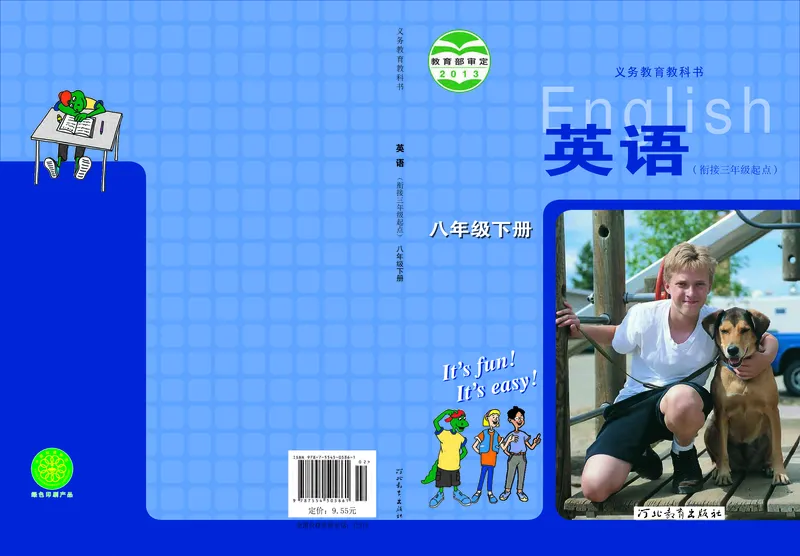
义 务 教 育 教 科 书
义
务
教
育
教
科
书
八 年 级 上 册
英
语
八
年
级
上
册义 务 教 育 教 科 书
八 年 级 上 册
主 编:陈 琳 Simon Greenall( 英)
副 主 编: 鲁子问 张连仲出 版 人:徐建忠
项目统筹:王 芳 Charlotte Liu(加)
项目策划:徐秀芝 申 蔷
项目负责:申 蔷 陈海燕 邢印姝
Mary-Jane Newton(德)
责任编辑:严雪芳 王 蕾 张玉青
绘制设计:石 蕾 张春玲 王 润
英语 (新标准)
八年级上册 学生用书
主编: 陈 琳 Simon Greenall (英)
基础教育出版分社:
地 址:北京市西三环北路19号 外研社大厦 基础教育出版分社 (100089)
咨询电话:010-88819666 (编辑部)/88819688 (市场部)
传 真:010-88819422 (编辑部)/88819423 (市场部)
电子信箱:
beed@fltrp.com
购书电话:010-88819928/9929/9930 (邮购部)
购书传真:010-88819428 (邮购部)前 言
各位同学,你们好!欢迎大家学习本套英语教材!
2000年,外语教学与研究出版社与麦克米伦出版(中国)有限公司依据
国家《义务教育 英语课程标准(实验稿)》共同组织开发了本套教材;作为
我国第一套中小学“一条龙”英语教材,本套教材已出版使用十余年。2011
年,基于新颁布的国家《义务教育 英语课程标准(2011年版)》,我们对教
材进行了认真修订。
在修订后的初中教材中,我们为同学们保留了大家熟悉并喜爱的四个小
伙伴-中国学生大明和玲玲、英国学生Tony和美国学生Betty,还增加了其
他一些人物。他们会带领大家在一系列有趣的对话、故事、活动、诗歌和韵
句中学习英语。
在修订过程中,我们依照《义务教育 英语课程标准(2011年版)》对初中
阶段英语学习者提出的要求,从同学们英语学习的实际出发,补充设计了丰富
而科学的学习内容和活动。教材遵循初中生认知发展的规律,由日常生活中涉
及的语言开始,逐渐扩及安全与救护、通信、自然等话题。
修订后的教材仍以模块为基本构成单位。本册教材包括12个学习模块
(Module)和两个复习模块(Revision module)。每个学习模块的第一、二单
元主要为大家呈现新的语言内容,第三单元为练习与活动,用以巩固第一、二
单元所学的内容。
本套教材同时还配有对应的网络教材,可供同学们在线学习使用。
通过对本套教材的学习,希望同学们能够:
1 )形成对英语学习的积极态度和强烈兴趣;
2)掌握基本的英语知识和听、说、读、写技能,提升英语语言的运用能力;
3)形成有效的英语学习策略;
4)增强对世界文化的了解,培养自己的跨文化交流意识。
希望同学们快乐学习,积极参与,大胆听说,认真读写,努力实践。相信
你们会在参与活动、完成任务的过程中体会到学习英语的乐趣,实现英语的灵
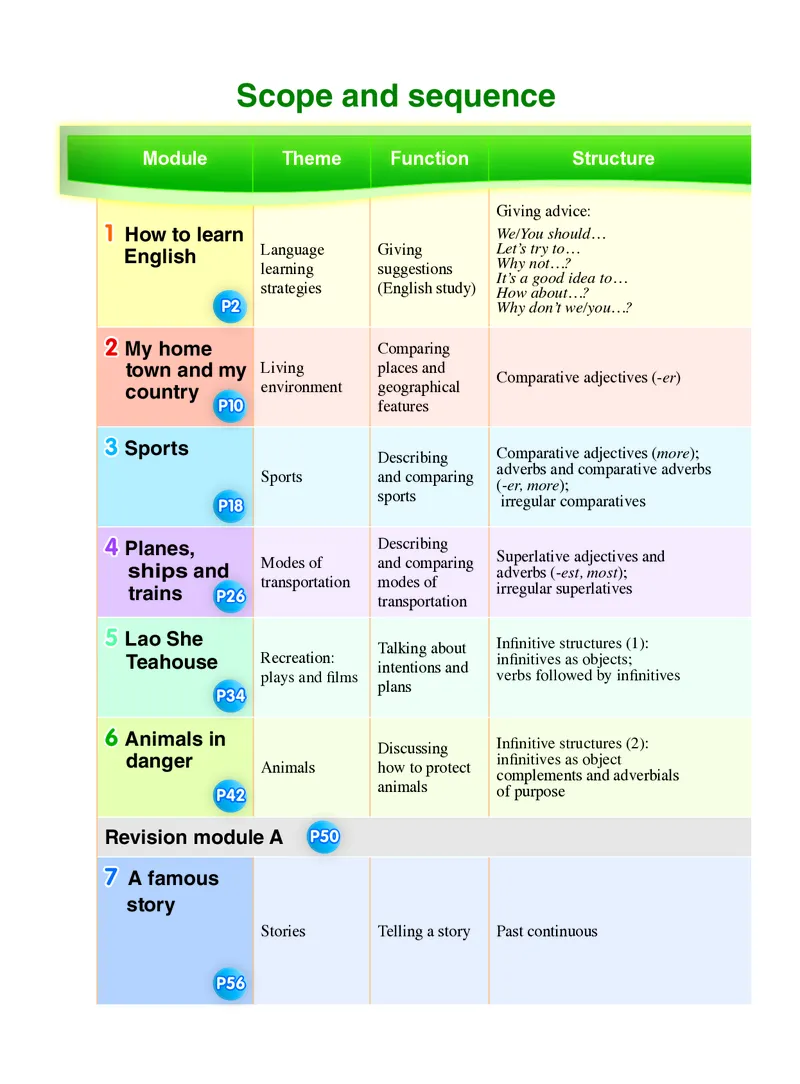
活运用和自由交际。Scope and sequence
Skills (Listening/Speaking/Reading/ Around the
Module Theme Function Structure Task
Writing) world
Giving advice:
Listening and understanding familiar topics (English study)
1 How to learn We/You should…
Talking about problems in English study and giving advice, Making your
English Language Giving Let’s try to… English
Why not…? holding conversations English study
learning suggestions online
It’s a good idea to… Reading and finding specific information about English study plan
strategies (English study)
How about…? Drafting a letter asking for advice about English study,
P2 Why don’t we/you…? revising through pair discussion
2 My home Listening and understanding familiar topics
Comparing
Making a report
Comparing two places, holding conversations
town and my Living places and Washington comparing two
Comparative adjectives (-er) Reading and understanding the main idea; finding specific
country environment geographical DC places in your
information about Cambridge and London
P10 features home town
Writing about your home town
3 Sports Listening and understanding familiar topics (sports)
Comparative adjectives (more);
Describing Comparing sports, linking words correctly The
adverbs and comparative adverbs Making a sports
Sports and comparing Reading and understanding behaviour of characters; guessing marathon
(-er, more); poster
sports the meaning of new words from the context race
P18 irregular comparatives
Writing about your school basketball team
4 Planes, Describing Listening and understanding familiar topics (transportation) Making a holiday
Superlative adjectives and
ships and Modes of and comparing Comparing modes of transportation The longest plan for a family
adverbs (-est, most);
transportation modes of Reading and finding specific information railway trip to a city in
trains irregular superlatives
P26 transportation Writing a short passage comparing modes of transportation China
5 Lao She Listening and understanding familiar topics (Beijing Opera);
Infinitive structures (1):
Talking about finding specific information
Teahouse Recreation: infinitives as objects; Acting out a
intentions and Describing intentions and plans in simple language Theatres
plays and films verbs followed by infinitives scene from a play
plans Reading and understanding the sequence of events
P34
Writing a short passage about your favourite play or film
6 Animals in Listening and understanding familiar topics (protecting
Infinitive structures (2):
Discussing animals); finding specific information Making a plan to
danger infinitives as object Animals in
Animals how to protect Talking about ways of protecting animals set up a wildlife
complements and adverbials danger
animals Reading and understanding the main idea club
P42 of purpose
Writing a short passage about an animal in danger
Revision module A P50
7 A famous Listening and understanding the plot development of Alice’s
Adventures in Wonderland, understanding the major
story
characters and events
Writing a short
Participating in a role-play with the teacher’s guidance
Stories Telling a story Past continuous Stories story about your
Reading and understanding the sequence of events in Alice’s
own experience
Adventures in Wonderland
Writing a short passage about what happened after Alice fell
P56
down the rabbit holeSkills (Listening/Speaking/Reading/ Around the
Module Theme Function Structure Task
Writing) world
Giving advice:
Listening and understanding familiar topics (English study)
1 How to learn We/You should…
Talking about problems in English study and giving advice, Making your
English Language Giving Let’s try to… English
Why not…? holding conversations English study
learning suggestions online
It’s a good idea to… Reading and finding specific information about English study plan
strategies (English study)
How about…? Drafting a letter asking for advice about English study,
Why don’t we/you…? revising through pair discussion
2 My home Listening and understanding familiar topics
Comparing
Making a report
Comparing two places, holding conversations
town and my Living places and Washington comparing two
Comparative adjectives (-er) Reading and understanding the main idea; finding specific
country environment geographical DC places in your
information about Cambridge and London
home town
features
Writing about your home town
3 Sports Listening and understanding familiar topics (sports)
Comparative adjectives (more);
Describing Comparing sports, linking words correctly The
adverbs and comparative adverbs Making a sports
Sports and comparing Reading and understanding behaviour of characters; guessing marathon
(-er, more); poster
sports the meaning of new words from the context race
irregular comparatives
Writing about your school basketball team
4 Planes, Describing Listening and understanding familiar topics (transportation) Making a holiday
Superlative adjectives and
ships and Modes of and comparing Comparing modes of transportation The longest plan for a family
adverbs (-est, most);
transportation modes of Reading and finding specific information railway trip to a city in
trains irregular superlatives
transportation Writing a short passage comparing modes of transportation China
5 Lao She Listening and understanding familiar topics (Beijing Opera);
Infinitive structures (1):
Talking about finding specific information
Teahouse Recreation: infinitives as objects; Acting out a
intentions and Describing intentions and plans in simple language Theatres
plays and films verbs followed by infinitives scene from a play
plans Reading and understanding the sequence of events
Writing a short passage about your favourite play or film
6 Animals in Listening and understanding familiar topics (protecting
Infinitive structures (2):
Discussing animals); finding specific information Making a plan to
danger infinitives as object Animals in
Animals how to protect Talking about ways of protecting animals set up a wildlife
complements and adverbials danger
animals Reading and understanding the main idea club
of purpose
Writing a short passage about an animal in danger
Revision module A
7 A famous Listening and understanding the plot development of Alice’s
Adventures in Wonderland, understanding the major
story
characters and events
Writing a short
Participating in a role-play with the teacher’s guidance
Stories Telling a story Past continuous Stories story about your
Reading and understanding the sequence of events in Alice’s
own experience
Adventures in Wonderland
Writing a short passage about what happened after Alice fell
down the rabbit holeSkills (Listening/Speaking/Reading/ Around the
Module Theme Function Structure Task
Writing) world
8 Accidents Listening and understanding familiar topics (road accidents)
Talking about
Past continuous with Participating in a role-play with the teacher’s guidance An Writing a news
what was
Accidents adverbial clauses (when, Reading and understanding the main idea; finding specific emergency report about an
happening at a
while) information; understanding the sequence of events landing accident
specific time
P64
Writing a simple passage about an accident based on clues
9 Population Listening and understanding familiar topics (population)
Talking about Saying large numbers; talking about population problems
World
population; Reading and understanding the main idea; finding specific
Population Articles; large numbers population Making a graph
using large information; understanding and explaining the information
and water
numbers provided by a population graph
P72
Writing about population problems
10 The Listening and understanding familiar topics (weather)
Giving a weather forecast based on clues; predicting the
weather The Giving advice on
Describing the May, might, probably (for weather using probably, may, might
Weather Amazon the best time to
weather possibility) Reading and finding specific information
Rainforest visit China
Writing a short passage about the best time to visit your town
P80
using because, so and but
11 Way of Describing Listening and understanding familiar topics (customs)
Giving advice to
life Social customs; Must/must not (mustn’t), Talking about customs at school/at the dining table
Traditional foreign guests
behaviour/ saying what can/cannot (can’t), Reading and finding specific information
presents who are visiting
customs you must and need/need not (needn’t) Writing a short passage giving advice about customs and
a Chinese family
P88 mustn’t do rules in your home town
12 Help Listening and understanding familiar topics (first aid)
Imperative for suggestions
Participating in a role-play with the teacher’s guidance Making a poster
Talking about and instructions; Special
Safety and first Reading and understanding the main idea; finding specific about preventing
safety and first must, can, could (for buildings in
aid information accidents at
aid prediction) Japan
Writing simple instructions about what to do in an school
P96
earthquake; revising your instructions through pair work
Revision module B
P104
Appendices Language notes.............................................. P111
Guide to language use................................... P122 Vocabulary...................................................... P145
Words and expressions.................................. P137 Pronunciation guide......................................... P151
Proper names.................................................. P143 Irregular verbs.................................................. P152Skills (Listening/Speaking/Reading/ Around the
Module Theme Function Structure Task
Writing) world
8 Accidents Listening and understanding familiar topics (road accidents)
Talking about
Past continuous with Participating in a role-play with the teacher’s guidance An Writing a news
what was
Accidents adverbial clauses (when, Reading and understanding the main idea; finding specific emergency report about an
happening at a
while) information; understanding the sequence of events landing accident
specific time
Writing a simple passage about an accident based on clues
9 Population Listening and understanding familiar topics (population)
Talking about Saying large numbers; talking about population problems
World
population; Reading and understanding the main idea; finding specific
Population Articles; large numbers population Making a graph
using large information; understanding and explaining the information
and water
numbers provided by a population graph
Writing about population problems
10 The Listening and understanding familiar topics (weather)
Giving a weather forecast based on clues; predicting the
weather The Giving advice on
Describing the May, might, probably (for weather using probably, may, might
Weather Amazon the best time to
weather possibility) Reading and finding specific information
Rainforest visit China
Writing a short passage about the best time to visit your town
using because, so and but
11 Way of Describing Listening and understanding familiar topics (customs)
Giving advice to
life Social customs; Must/must not (mustn’t), Talking about customs at school/at the dining table
Traditional foreign guests
behaviour/ saying what can/cannot (can’t), Reading and finding specific information
presents who are visiting
customs you must and need/need not (needn’t) Writing a short passage giving advice about customs and
a Chinese family
mustn’t do rules in your home town
12 Help Listening and understanding familiar topics (first aid)
Imperative for suggestions
Participating in a role-play with the teacher’s guidance Making a poster
Talking about and instructions; Special
Safety and first Reading and understanding the main idea; finding specific about preventing
safety and first must, can, could (for buildings in
aid information accidents at
aid prediction) Japan
Writing simple instructions about what to do in an school
earthquake; revising your instructions through pair work
Revision module B
Appendices Language notes.............................................. P111
Guide to language use................................... P122 Vocabulary...................................................... P145
Words and expressions.................................. P137 Pronunciation guide......................................... P151
Proper names.................................................. P143 Irregular verbs.................................................. P152o
du
l
M e
1 How to learn English
Module task: Making your English study plan
Unit 1 Let’s try to speak English as much
as possible.
Listening and vocabulary
1 Read the instructions and check (√) the ones you understand.
1 Work in pairs. Ask and answer the questions.
2 Correct the spelling.
3 Listen and check the words you hear.
4 Practise saying the words.
5 Match the words with their meanings.
6 Complete the sentences with the words in the box.
2 Listen and answer the questions. Use the words and expressions in the box.
dictionary grammar letter look up make a mistake understand
1 Which word did Daming not understand?
2 What mistake did Lingling make?
3 How does Daming usually check the spelling of a word?
4 Why was it difficult for Daming to check the spelling of cinema?
3 Listen and read.
Welcome back, everyone! Today, we’re going to talk about good ways to
Ms James:
learn English. Ready? Who has some advice?
We should always speak English in class.
Lingling:
Good!Let’s try to speak English as much as possible.
Ms James:
Why not write down our mistakes in our notebooks?
Daming:
That’s a good idea. And don’t forget to write down the correct answers next
Ms James:
to the mistakes. What else?
It’s a good idea to spell and pronounce new words aloud every day.
Lingling:
Thanks a lot, Lingling. How about listening to the radio?
Ms James:
Yes, that’s good for our pronunciation too. But there are so many new words.
Daming:
You don’t need to understand every word. You just need to listen for key
Ms James:
words and main ideas.
That’s the same for reading. English stories are so
Daming:
interesting. I get to know a lot about the world Everyday English
through reading.
I think writing is also important. Why don’t we Ready?
Lingling:
try to find some English pen friends? We can That’s a good idea.
write to them. What else?
Ms James: Excellent! I agree with you. Thanks a lot.
Excellent!
2Unit 1
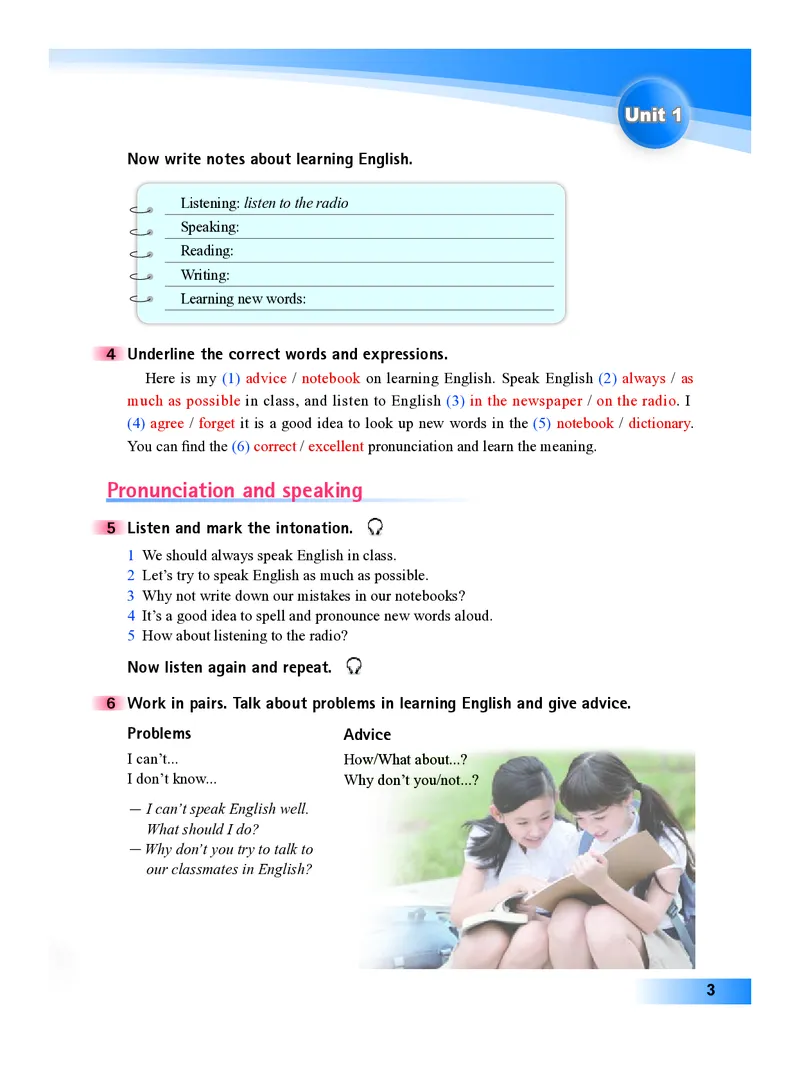
Now write notes about learning English.
Listening: listen to the radio
Speaking:
Reading:
Writing:
Learning new words:
4 Underline the correct words and expressions.
Here is my (1) advice / notebook on learning English. Speak English (2) always / as
much as possible in class, and listen to English (3) in the newspaper / on the radio. I
(4) agree / forget it is a good idea to look up new words in the (5) notebook / dictionary.
You can find the (6) correct / excellent pronunciation and learn the meaning.
Pronunciation and speaking
5 Listen and mark the intonation.
1 We should always speak English in class.
2 Let’s try to speak English as much as possible.
3 Why not write down our mistakes in our notebooks?
4 It’s a good idea to spell and pronounce new words aloud.
5 How about listening to the radio?
Now listen again and repeat.
6 Work in pairs. Talk about problems in learning English and give advice.
Problems A d vice
I can’t... How/What about...?
I don’t know... Why don’t you/not...?
- I can’t speak English well.
What should I do?
- Why don’t you try to talk to
our classmates in English?
3o
du
l
M e
1
How to learn English
Unit 2 You should smile at her!
Reading and vocabulary
1 Work in pairs. Talk about problems you have with...
● understanding English ● speaking English ● learning vocabulary
2 Read the passage and find out what problems the students have.
Questions and answers
Send your questions to Diana, the Language Doctor.
Many students ask for advice about how to improve their English. Here are three
basic questions.
The first question is about understanding English films and songs. Li Hao from
Hubei wrote, “I like watching English films and listening to English songs, but I
don’t understand very much. What can I do?”
Watching films and listening to songs are great ways to learn English! Watch and
listen several times, and guess the meaning of the new words. Each time you will
learn something new. I also advise you to talk about the films or songs with your
friends.
The second question is about speaking. Wang Fan from Jilin wrote, “Our school
has a teacher from the US. I am shy and I am afraid to speak to her. What should I
do?”
You can say, “Hello! How are you?” “Do you like China?” These are good ways
to start a conversation. And before you begin, you should smile at her! Remember
this: Do not be shy. Just try.
The third question is about vocabulary. Zhang Lei from Anhui wrote, “I write
down new words, but I forget them quickly. How can I remember them?”
Do not worry. It is natural to forget new words! I suggest you write four or five
words a day on pieces of paper and place them in your room. Read the words when
you see them, and try to use them.
3 Complete the table.
Advice from Diana
Li Hao
Wang Fan
Zhang Lei
4Unit 2
4 Complete the passage with the correct form of the words in the box.
advise basic conversation improve meaning shy suggest
Unit 2 You should smile at her!
Diana, the Language Doctor, gives some (1) ___________ advice about learning English.
She (2) ___________ you to talk about films and songs, and guess the (3) ___________
of the new words. The second piece of advice is this: Start your (4) ___________ with
greetings or a question. She (5) ___________ that you smile before you speak and do not feel
(6) ___________. Finally, (7) ___________ your vocabulary with four or five new
words every day.
Writing
5 Check (√) what you are good at or not good at in English.
What I am good at What I am not good at
Listening
Speaking
Reading
Writing
6 Write a letter to Diana asking for advice.
Learning to learn
Use the letter below to help you.
List all the things you
Dear Diana,
are good at in learning
I understand English in the classroom, English. Try to use what
you are good at to help
but it is sometimes hard to understand
you learn what you are not
American and British people. Can you
good at.
help me?
Thanks.
Lingling
7 Work in pairs. Read your partner’s letter. Write your advice.
Dear Lingling,
You should watch films and TV programmes in English...
5o
du
l
M e
1
How to learn English
Unit 3 Language in use
Language practice
We should always speak English in class.
Let’s try to speak English as much as possible.
Why not write down our mistakes in our notebooks?
It’s a good idea to spell and pronounce new words aloud.
How about listening to the radio?
1 Listen and check (√) the expressions of advice you hear.
1 Why don’t we...? 5 Let’s try to...
2 How about...? 6 Can you...?
3 We should... 7 Remember to...
4 We can...
2 Listen again and answer the questions.
1 What is difficult for Charlie? 3 When does Charlie think they should meet?
2 How will Mary help him? 4 What does Mary think about reading newspapers?
3 Work in pairs. Look at the pictures and say what Jack usually does.
1 2 3
go to bed / late get up / late listen / teacher / carefully
4 5 6
not use / dictionary read / English newspaper write / words / notebook
Do you think his habits are good? Why/Why not?
6Unit 3
4 Give Jack some advice.
He should go to bed before nine o’clock.
5 Read Helen’s question and complete Diana’s answer with the correct form of
the word and expressions in the box. You need to use some of the expressions
more than once.
how about should try to why don’t why not
Helen
Diana
How to improve speaking
Hi, Diana,
I like English very much. My reading is good, but my speaking is poor. How can
I improve my speaking?
Best,
Helen
Diana
Helen
Re: How to improve speaking
Hello, Helen,
You need to practise speaking more often. (1) _____________ you look for
some English-speaking people in your town? (2) _____________ saying
hello to them and asking them where they come from? (3) _____________
make friends with them and take them around your town.
Is there an English club in your town? If there is not, (4) _____________ start
one with your friends? (5) ______________ playing a few games and listening
to some music? You can watch English films together, and (6) _____________
speak English all the time. You (7) _____________ invite your new English-
speaking friends to your club!
Best,
Diana
7o
du
l
M e
1
How to learn English
6 Work in pairs. Read the problems of Student A and Student B. Take turns to
give advice. Use the expressions in the box to help you.
ask your teacher read aloud talk to your classmates use a dictionary
Student A’s problems Student B’s problems
I like listening to English songs, but there are
I can’t speak English well.
too many new words.
I want to read an English book, but I can’t
It’s difficult to remember new words.
choose the right one.
Now write down your advice.
You should use a dictionary to find the meaning of new words.
7 Complete the conversation with the words in the box.
advice check forget improve possible
Helen: How can I (1) ___________ my reading?
James: Here is my (2) ___________. Choose a newspaper to read. First, think about what’s
happening today. What will be in the newspaper? Then read the titles of articles and
choose one to read for more information. Don’t stop to (3) ___________ every
word. You don’t need to know every word to understand the article. Learning only a
few new words is enough. Try to use them as much as (4) ___________. Then you
won’t (5) ___________ them easily.
8Unit 3
Around the w rld
English online
In addition to English magazines, newspapers
and radio, there are various kinds of English
learning websites. Millions of people around the
world visit them daily to improve their English.
If someone from Spain asks a question, they
may get an answer from Canada instantly. On
the Internet, you can chat with other English
speakers freely, and enjoy the latest English
songs. The Internet brings the world of English
to you.
Module task: Making your English study plan
8 Write down what you are not good at in English.
What I am not good at What I should do
Now write down what you should do.
9 Make an English study plan for this year. Use the information in Activity 8 to
help you.
10 Work in pairs. Discuss your study plan.
- This is my English study plan. I will listen to English radio programmes every day.
- That’s a good idea. You can also listen to some English songs.
11 Think about your partner’s advice and revise your English study plan.
9o
du
l
M e
2 My home town and my country
Module task: Making a report comparing two places in your home town
Unit 1 It’s taller than many other buildings.
Listening and vocabulary
a
1 Look at the pictures and talk about them.
Use the words in the box to help you.
high hill population river wide
Now listen and complete.
Place: (1) _________
Population: (2) _________ million
b
Jin Mao Tower: (3) _________ metres high
Place: (4) _________
Population: (5) _________ million
Victoria Peak: (6) _________ metres high
2 Li st en and read.
Hey, Daming! How was your weekend?
Tony:
Pretty good! I went to Shenzhen.
Daming:
Where’s Shenzhen?
Tony:
Well, it’s on the coast near Hong Kong. It was a small village about thirty years
Daming:
ago, but today it’s a very big city.
So it’s a newer city than Hong Kong?
Tony:
Yes, it’s a very new city. In fact, it only became important in the 1980s. It’s
Daming:
getting bigger and busier. Some day it will become as busy as Hong Kong, I’m
sure.
What’s the population of Shenzhen?
Tony:
It’s over ten million, I think. That’s larger than Everyday English
Daming:
the population of many other cities in China. Its
Hey!
streets are much wider and cleaner too. I think How was your
it’s a beautiful city. weekend?
I’d like to go there one day. Pretty good!
Tony:
Remember to visit the Diwang Tower. It’s taller
Daming:
than many other buildings in Shenzhen.
10Unit 1
Now complete the passage about Shenzhen.
Shenzhen is on the coast near Hong Kong. It became important in the (1) __________.
Module task: Making a report comparing two places in your home town
Before that it was a (2) __________. Today the population of Shenzhen is more than
(3) __________ million. There are many tall buildings in Shenzhen. A famous one is
the (4) __________. It is (5) __________ than many other buildings in Shenzhen.
3 Complete the sentences with the correct form of the words in the box. You
need to use some of the words more than once.
big busy clean large new small wide
1 About thirty years ago, Shenzhen was a _________ village, but today it is a very _________ city.
2 Shenzhen is a ________ city than Hong Kong.
3 Shenzhen is getting _________ and _________. The streets are _________ and _________.
4 Shenzhen will become as _________ as Hong Kong.
5 The population of Shenzhen is _________ than that of many other cities in China.
Pronunciation and speaking
4 Listen and notice how the speaker stresses the underlined words.
1 - Shenzhen is larger in population than Beijing. - No, it isn’t. It’s smaller.
2 - Hong Kong is newer than Shenzhen. - No, it isn’t. It’s older.
3 - Shenzhen is as old as Hong Kong. - No, it isn’t. It’s newer.
4 - Hong Kong is as busy as Shenzhen. - No, it isn’t. It’s busier.
Now work in pairs. Listen again and repeat.
5 Compare Shenzhen with your home town. Learning to learn
Make notes in the table.
In English, sentence stress
is very important. We stress
Shenzhen Your home town
key words, which give the
a big city main information and the
main ideas.
6 Work in pairs. Talk about the differences between Shenzhen and your home
town. Use big, small, hot, cold, tall or new.
- Is your home town bigger than Shenzhen?
- No, it isn’t. It’s smaller than Shenzhen.
11o
du
l
M e
2
My home town and my country
Unit 2 Cambridge is a beautiful city N
in the east of England. W E
S
Reading and vocabulary
1 Look at the map of England and read the sentences.
east north south west
1 Cambridge is in the east of England.
2 London is in the south of England.
3 Bristol is in the west of England.
4 Manchester is in the north of England.
2 Read the passage and choose a title for each picture below.
1 Tower Bridge and the River Thames
2 Cambridge University and the River Cam
Cambridge, London and England
By Tony Smith
I come from Cambridge, a beautiful city years old, and it is famous for Big Ben,
in the east of England. It is on the River Buckingham Palace and Tower Bridge.
Cam and has a population of about 120,000. England itself is part of an island, and
My home town is especially famous for its you are always near the sea. The small
university. Many famous people studied villages and beaches on the coast are
here, such as Isaac Newton and Charles popular for holidays. Tourists like the areas
Darwin. There are lots of old buildings and of low mountains and beautiful lakes in the
churches to visit. Students and tourists enjoy north, and the hills and pretty villages in
trips along the river by boat. the south. Everywhere in England, you will
Cambridge is 80 kilometres from London. notice how green the countryside is.
London is in the south of England and it is It is never very hot in summer or very
on the River Thames. It has a population of cold in winter. So come and see England
about seven and a half million, so it is bigger any time of the year, but bring an umbrella
and busier than Cambridge. It is about 2,000 with you. You will need it most days.
a b
12Unit 2
3 Complete the table comparing Cambridge with London.
Cambridge London
Location
Population
Famous places
River
4 Complete the passage with the words and expression in the box.
countryside east home town island
London mountains south university
England is part of a(n) (1) ___________. It is famous for its beautiful green
(2) ___________ with (3) ___________ and lakes in the north, and hills and
villages in the south. My (4) ___________ is Cambridge, in the (5) ___________
of England. It has lots of old buildings and churches, and a well-known (6) ___________.
It is smaller than (7) ___________, which is in the (8) ___________ of England.
Writing
5 Answer the questions and write notes about your home town.
1 Where is it?
2 What is its population?
3 Is it big or small?
4 What is it famous for?
5 How old is it?
6 What is the weather like?
6 Use your notes and write answers to the questions in Activity 5.
Dalian is in the northeast of China.
It has a population of over six million.
7 Write a passage called My home town. Use Tony’s passage to help you.
I come from Dalian, a beautiful city in the northeast of China. It has a population of over
six million. It is…
13o
du
l
M e
2
My home town and my country
Unit 3 Language in use
Language practice
It’s getting bigger and busier. Its streets are much wider and cleaner too.
It’s a newer city than Hong Kong. It’s taller than many other buildings in Shenzhen.
1 Complete the sentences with the correct form of the words in the box.
big cold large old tall
1 Shenzhen was very small about thirty years ago but it is much _______ now.
2 This building is tall but that building is much _______.
3 Beijing is old but Xi’an is much _______.
4 The US has a large population but India’s population is _______.
5 Beijing is cold in winter but Harbin is _______.
2 Work in pairs. Talk about the pictures. Use the words in the box to help you.
big busy high low old small tall wide
1 2
Now make comparisons. Write sentences.
The buildings in Picture 1 are older than the buildings in Picture 2.
14Unit 3
My home town and my country
3 Write sentences. Use the information in the table.
Shenzhen Beijing new
Shanghai Hangzhou busy
Xi’an Beijing old
China Australia big
Tian’anmen Square Other squares in China wide
The population of Tianjin The population of Shanghai small
Shenzhen is newer than Beijing.
4 Complete the word map with the words in the box. You need to use one word more
than once.
big cold large new old small warm
weather size
Place
history population
Now work in pairs. Talk about your home town. Use the words in the word map
to help you.
5 Complete the sentences with the expressions in the box.
in the northeast is famous for on the coast pretty good The population of
1 Cambridge is a beautiful old English city. It ____________ its university.
2 Tianjin is near Beijing, ____________ of the Bohai Sea.
3 ____________ India is smaller than that of China but bigger than that of Russia.
4 Harbin is ____________ of China and is a very busy city.
5 The weather in Beijing in autumn is ____________.
15o
du
l
M e
2
My home town and my country
6 Complete the passage with the correct form of the words in brackets.
In my home town there are two cinemas, the Grand Cinema and the Palace Cinema.
The Grand Cinema is (1) _________ (old) and (2) _________ (small) than
the Palace Cinema. It is also (3) _________ (warm) in the Grand Cinema. The Palace
Cinema is usually (4) _________ (busy) than the Grand Cinema and the tickets are
(5) _________ (cheap) too.
7 Listen and complete the sentences.
3
1 Shanghai
New York
4
Beijing
2
Washington DC
1 New York is a(n) _______ and _______ city than Washington DC.
2 New York is more _______ than any other city in the US.
3 Shanghai has a(n) _______ population than Beijing.
4 Beijing is _______ than Shanghai.
16Unit 3
My home town and my country
Around the w rld
Washington DC
Washington DC is the capital of the US.
Located on the east coast, it is best known for the
White House, where the President of the US lives
and works, and for Capitol Hill, where the US
Congress meets.
There are many famous monuments, memorials
and museums in Washington DC. The Lincoln
Memorial is a grand white building. Millions
of tourists visit it every year to show respect to
President Lincoln. In the National Air and Space
Museum, people can see the command module of
Apollo 11, which sent the first humans to the moon
in 1969.
Module task: Making a report comparing two places in your home town
8 Work in pairs. Compare two places in your home town.
● Where is it? ● How old is it?
It’s in the north/south/east/west of the town. It’s about... years old.
● How many people work/go there? ● Is there anything special about it?
... people work/go there. It’s bigger than...
9 Write the information in the table.
Place 1: _____________ Place 2: _____________
10 Make a report.
● Write sentences.
Place 1 is bigger than Place 2.
Place 2 is older than Place 1.
● Join the sentences using and or but.
Place 1 is bigger than Place 2, but Place 2 is older than Place 1.
1 1 Read your report to the whole class.
17o
du
l
M e
3 Sports
Module task: Making a sports poster
Unit 1 Nothing is more enjoyable than playing tennis.
Listening and vocabulary
1 Listen and number the sports as you hear them.
baseball basketball football table tennis tennis volleyball
Now match the words with the pictures.
a b c d e f
2 Look at the sports in Activity 1 and talk about them. Use the words in the box
to help you.
boring dangerous difficult easy exciting expensive popular relaxing safe
3 Listen and read.
Hey, Tony. Come and watch the football match on TV!
Daming:
OK. What’s the score?
Tony:
Spain scored a minute ago.
Daming:
Wow! That’s fast!
Tony:
That’s right. Last week the match on TV was so boring because no one scored
Daming:
at all. So this week’s match is already more exciting.
What’s the matter with you, Tony? You look tired.
Betty:
I’m really tired after last night’s tennis match. And I hurt my knee.
Tony:
That’s too bad! Sit down and watch the match. It’s safer than playing tennis.
Daming:
Yes, watching is not dangerous and it’s more relaxing too!
Betty:
Well, I’m not sure about that. Nothing is more enjoyable than playing tennis.
Tony:
But you enjoyed watching the Olympics on TV, right?
Betty:
Yes, but that’s because it was cheaper than buying
Tony:
tickets for all the games.
And staying at home was easier than going to the Everyday English
Daming:
stadium. Oh, look at that!
That’s too bad!
Tony: Oh, he missed! Oh, bad luck! I’m not sure about that.
Never mind. There’s still plenty of time for them to Bad luck!
Daming:
score. Never mind.
18Unit 1
Now check (√) the true sentences.
1 This week’s match is more exciting than last week’s.
2 Tony played table tennis yesterday.
3 For Tony, playing tennis is more enjoyable than watching matches on TV.
4 Watching the Olympics on TV was more expensive than buying tickets for the games.
5 Going to the stadium was more difficult than staying at home.
4 Complete the sentences with the words in the box.
already hurt matter mind miss Olympics stadium
1 Why didn’t Tony score? What is the ________ with him?
2 You lost the match? Never ________. Maybe you will win next time.
3 I am not good at tennis. I always ________ the ball.
4 The match began ten minutes ago and Spain is ________ winning.
5 The 2008 ________ were held in Beijing.
6 Watching football at home is easier than going to the ________.
7 Tennis is a little dangerous because you may ________ your knee.
5 Complete the passage about yourself. Use the words in Activity 1 to help you.
My favourite sport is (1) ______________. And I enjoy watching (2) ______________.
I am quite good at (3) ______________. I do not like playing (4) ______________. And I
am not very good at (5) ______________.
Pronunciation and speaking
6 Listen and notice how the speaker links the words.
1 Spain scored a minute ago.
2 Last week the match on TV was so boring because no one scored at all.
3 Oh, look at that.
Now listen again and repeat.
7 Work in pairs. Talk about the sports you like.
- Hey, Bruce. Which sport do you like, swimming or running?
- I like swimming. It’s more relaxing than running.
19
(
(
(o
du
l
M e
3
Sports
Unit 2 This year we are training more carefully.
Reading and vocabulary
1 Work in pairs. Talk about the pictures. Use the words and expressions in the
box to help you.
beat careless cheer… on coach fan club play against train
a b
2 Read the passage and complete the table.
Training hard
By Li Daming
It is Saturday tomorrow, but I am going Our coach is pleased because we are
to school. I am not going for lessons, but to playing better as a team now. Last year we
play football. I am in our school team and we were sometimes careless when we passed
are going to play against another school next the ball and we lost to the other team in
week. The practice starts at 10 am. We all the final match. What a pity! This year we
arrive as early as we can so that we have time are training more carefully. That means we
to warm up. We are training harder than usual have a better chance of winning.
because the other team beat us last year. This The fan club has fewer people this year.
year we want to do better. We hope to play well so that we have more
It is more difficult to practise in winter fans to watch the matches. It is good to
because the days are short and the weather have our fans around. They cheer us on
is cold too. It gets dark earlier, so it is loudly and we feel more confident to win
important not to be late for after-school the game.
practice.
20Unit 2
What Why
Unit 2 This year we are training more carefully.
1 We arrive ______________________.
2 We are training _______ than _______.
3 It is _________ to practise in winter.
4 Our coach is _________.
3 Complete the passage with the words in the box.
against chance coach practice short usual
We all know (1) _________ makes perfect. But it is more difficult to practise in
winter because the days are (2) _________ and it is cold. The team is training harder
than (3) _________. Their (4) _________ is pleased with them. They are going
to play (5) _________ a team from another school next week, and they have a
good (6) _________ of winning.
4 Put the words in the box into pairs with opposite meanings.
badly carefully carelessly difficult early
easy late quickly slowly well
badly - well
Writing
5 Complete the sentences so they are true for
Learning to learn
your school basketball team.
1 It is... and the basketball team... You can use at that time/
yesterday/last week/last
2 The practice starts at... but they...
month/last year… to talk
3 Last year... about what people did in the
past; and use now/today/this
4 This year...
week/this month/this year… to
5 The coach is pleased/is not pleased talk about what they do now.
with them because...
6 So they now have a better/poor chance of...
6 Add some more details about your school basketball team. Write a passage.
It is Saturday morning and the school basketball team is training hard.
21o
du
l
M e
3
Sports
Unit 3 Language in use
Language practice
This week’s match is already more exciting.
It is more difficult to practise in winter.
We are training harder than usual.
This year we want to do better.
1 Work in pairs. Look at the pictures and talk about the sports. Use the words
in the box to help you.
boring cheap difficult easy exciting expensive popular relaxing
1 2 3
4 5 6
- What’s your favourite sport?
- My favourite sport is swimming. It’s exciting.
Now compare the sports.
1 Table tennis is more exciting than tennis. 4 Football is...
2 Tennis is... 5 Swimming is...
3 Basketball is... 6 Baseball is...
22Unit 3
2 Complete the sentences with the correct form of the words in brackets.
1 We trained _____________________ (hard) this year than last year.
2 The team played _____________________ (well) on Saturday than on Tuesday.
3 They practised _____________________ (carefully) this week than last week.
4 Playing football is _____________________ (exciting) than watching it.
5 Playing tennis is _____________________ (expensive) than swimming.
3 Complete the sentences with the correct form of the words in brackets.
Tom did his homework carelessly (careless).
The music is loud (loud).
1 They are working ________ (hard) to learn English.
2 This bike was ________ (cheap), so we decided to buy it.
3 The teacher speaks ________ (slow) and ________ (careful).
4 Mary is going to get up ________ (early) because she needs to catch the first bus.
5 Running is very ________ (easy). You can do it anywhere.
6 I do not like to be ________ (late).
7 I am afraid our team is doing very ________ (bad).
4 Complete the passage with the correct form of the words in brackets.
I wanted to choose a sport to keep fit. First I tried swimming. I joined the swimming
club, but the lessons were (1) _________________ (expensive) than I thought. So I stopped
swimming and tried running. The running club is (2) _________________ (popular) than the
swimming club. We ran (3) _________________ (slowly) in the park. Soon, I felt that running
was (4) _______________ (boring)! I decided to try something (5) _________________
(exciting). I went walking in the mountains. Once we got lost in the mountains, and I hurt my
leg (6) _________________ (badly). It is a bit (7) _________________ (dangerous) to walk
in the mountains, but I like the sport all the same.
23o
du
l
M e
3
Sports
5 Listen and choose the correct answer.
1 What was the race?
a) Boys’ 800 metres. b) Girls’ 800 metres. c) Girls’ 400 metres.
2 How many classes took part in the race?
a) One. b) Four. c) Eight.
3 Who ran faster than the others at first?
a) Joy. b) Sandy. c) Mary.
4 What happened to Sandy later on?
a) She stopped. b) She ran slowly. c) She cried.
5 - Who finally won?
- A student from _________.
a) Class 4 b) Class 5 c) Class 1
6 Read the passage and complete the sentences.
A lot of people around the world enjoy I enjoy jogging with my friends Tommy
jogging. Jogging means running slowly, but and Anna. In the early mornings, we often
it is still faster than walking. In the mornings go jogging in the park. Then we are ready
and evenings, you can see people jogging for school. At weekends, we sometimes go
in parks or along city streets. Jogging is jogging in the countryside. It is more fun
cheaper than many sports - to start, just than jogging in the city and we feel good
get some comfortable sports clothes and in the fresh air. The more you go jogging,
good running shoes. the healthier you will feel. Just try it!
2244Unit 3
1 Jogging means ________________.
2 Walking is ________________ than jogging.
3 To start jogging, you only need some _________________________________________.
4 Jogging in the countryside is ____________________ than jogging in the city.
5 The more you go jogging, ________________ you will feel.
Around the w rld
The marathon race
The marathon gets its name from a battle over
2,500 years ago between the Greeks and the Persians.
The battle happened at a place called Marathon. After
the Greeks won the battle, a soldier ran over forty
kilometres to tell people the good news. Today’s
marathon race, an important Olympic sport, is popular
all over the world. Thousands of people race in many
different marathons every year.
Module task: Making a sports poster
7 Work in groups. Talk about your favourite Olympic sports and choose one for
your poster.
A: What’s your favourite Olympic sport?
B: My favourite Olympic sport is...
A: Why do you like it?
B: I like it because...
...
8 Make a poster. Find a photo for your favourite Olympic sport and include it in
the poster.
Our favourite Olympic sport
● Our favourite Olympic sport is swimming/table tennis/...
● We like it because it is exciting, popular...
● It is more exciting than...
9 Show your poster to your classmates.
25o
du
l
M e
4 Planes, ships and trains
Module task: Making a holiday plan for a family trip to a city in China
Unit 1 He lives the farthest from school.
Listening and vocabulary
1 Match the words in the box with the pictures.
bus ship taxi train underground
1 2
3 4 5
2 Listen and match the words in the box with the pictures in Activity 1. You need
to use one word more than once.
busy cheap expensive modern
3 Listen and read.
I was late for school today.
B etty:
Why? What happened?
Mum:
I took the bus. There was a road accident, and the traffic was very heavy. But
Betty:
nobody was late, except me. Maybe I should go to school by taxi.
It’s the most comfortable way, but it’s also the most expensive. And taxis are very
Mum:
slow in heavy traffic too.
Then what about going by bike?
Betty:
That’s a good choice, but it’s a bit dangerous. There’s so much traffic.
Mum:
But most of my classmates ride bikes, and it’s quite safe. Don’t worry. I’ll be careful.
Betty:
How does Tony go to school?
Mum:
He lives the farthest from school, so he takes the underground.
Betty:
And what about Lingling?
Mum:
Her home is the closest to school, so she walks.
Betty:
How about Daming? Everyday English
Mum:
He goes by bus too, the same as me. But it’s so
Betty:
What happened?
crowded! And the traffic is heavy.
Don’t worry.
All right. You can ride your bike to school, but
Mum:
remember to be careful all the time.
26Planes, ships and trains Unit 1
Now complete the table.
Betty Tony Lingling Daming
Ways to go to
school
4 Complete the sentences with the correct form of the words in the box.
close comfortable far good
1 The ____________ way to go to school is by taxi.
2 Tony lives the ______________ from school.
3 Lingling’s home is the ______________ to school, so she always walks.
4 For Betty, going to school by bike is the ______________ choice.
5 Complete the sentences with the words or expression in the box.
accident crowded except most modern
1 All the students take the bus to school ______________ Sam.
2 The ______________ train in the world is the Shanghai airport train.
3 I saw a(n) ______________ on my way to school yesterday.
4 I do not take the bus to school because it is usually very ______________.
Pronunciation and speaking
6 Listen and underline the words the speaker stresses.
1 - Who lives the closest to school?
- Lingling lives the closest.
2 - What is the most comfortable way to go to school for Betty?
- By taxi.
Now work in pairs. Listen again and repeat.
7 Work in pairs. Ask and answer questions about the ways of going to school.
Use the words in the box to help you.
bike bus cheap comfortable crowded expensive
fast popular safe taxi underground walking
- What’s the most expensive way to go to school?
- Going by taxi is the most expensive.
27o
du
l
M e
4
Planes, ships and trains
Unit 2 What is the best way to travel?
Reading and vocabulary
1 Work in pairs. Talk about the ways to go to a city that you like to visit.
1 How do you get there?
2 What’s the cheapest way to get there?
3 What’s the best way to get there?
2 Read the passage and number the ways of travelling from the most expensive
to the least expensive.
c d
a
b
? Question: What is the best way to travel from London to Amsterdam?
I am planning to travel from London to Amsterdam. How long does the
journey take and what is the best way to travel? Could you please tell me about
the trains or ships to get there? The more information, the better. Thanks!
Best answer: There are four ways to travel.
A journey by train is more relaxing than by coach, but a lot more expensive. When
you go by train, buy your ticket a long time before you travel. It is usually cheaper.
You can go by car and by ship across the North Sea. This is the most comfortable
way to travel but also the most expensive. Book your ticket before you book your
hotel. Remember that parking in Amsterdam is very expensive, so stay outside the
city centre and travel in by bus or by train.
The third choice is by coach. This is usually the cheapest, but in summer, the
coaches sometimes get crowded! And it takes you about twelve hours to get there.
However, it will not cost as much as going by train.
Finally, you can fly. It is the fastest and the second cheapest, but you may have
to wait for hours at the airport because of bad weather.
Well, I hope this helps! Have a great trip!
28Unit 2
3 Complete the table.
Ways of travelling Good points Bad points
Unit 2 What is the best way to travel?
Train more relaxing than by coach more expensive than by coach
Car and ship
Coach
Plane
4 Complete the passage with the correct form of the words in the box.
choice cost fast however journey outside
There are four ways to travel from London to Amsterdam. The first (1) ________ is
by train because the (2) ________ takes only four hours. (3) ________, it is quite
expensive. Going by coach does not (4) ________ as much as going by train. When
you go by car and by ship, remember that parking in Amsterdam is not cheap, so it is best to
stay (5) ________ the city centre and travel in by bus or by train. Going by plane is the
(6) ________, but you need to go to the airport. It also takes time.
Writing
5 Work in pairs. Ask and answer about the ways of travelling. Use the information
in the table.
- What’s the cheapest way to travel from London to Paris?
- The cheapest way is by coach.
Ways of
Cost Time Comfortable Interesting
travelling
coach £20 10 hours ﹡ ﹡﹡
London–Paris plane £80 1 hour ﹡﹡ ﹡
train £60 3 hours ﹡﹡﹡ ﹡﹡﹡
6 Write a passage about ways of travelling from London to Paris. Use the information
in Activity 5 and the passage in Activity 2 to help you.
You can go from London to Paris by coach, plane or train. Travelling by plane is the
fastest but also the most expensive way.
29Unit 3
3 Complete the conversation with the correct form of the words in the box.
cheap close expensive good much slow
A: What’s the (1) ____________ way to go to Qingdao?
B: We can take a plane, but that’s (2) ____________.
We can also take a train. It’s (3) ____________,
Learning to learn
but it’s not so expensive. The coach is the
(4) ____________ way to go, but it takes Remember: It is easier to
learn words and expressions
the (5) ____________ time.
by putting them in groups
A: So how should we go? with a title, for example,
Travelling: take a bus/plane/
B: I think the best way is by train because the train
taxi/train, by bus/plane/taxi/
station is the (6) ____________ to our home. train, bus stop/airport/taxi
stand/train station.
4 Complete the word map.
by taxi
take a taxi
bus
taxi
taxi stand
Travelling
plane
train
5 Work in pairs. Choose a place you would like to visit. Ask and answer the
questions about the ways by which you can get there.
1 What is the cheapest way to get there?
2 What is the most expensive way to get there?
3 What is the fastest way to get there?
4 What is the most comfortable way to get there?
5 What is the safest way to get there?
31o
du
l
M e
4
Planes, ships and trains
6 Complete the email with the words in the box.
book choice cost travel trip
Sally
Tony
Journey to China
Hi, Tony,
My family is planning a journey to China in the summer. We want to visit
Beijing first. Do you think we should (1) _________ the plane tickets
early? After Beijing, we want to visit Xi’an and Hangzhou, and maybe
somewhere else. How can we (2) _________ from Beijing to Xi’an, by
train or by plane? The (3) _________ is not so important, but the time is.
After Xi’an, we want to go to Hangzhou. Is it better to go to Shanghai first, or
can we go from Xi’an to Hangzhou directly?
And after Hangzhou what is the best (4) _________? Can we make a
short (5) _________ to Suzhou? What do you think?
Thanks for your help.
Sally
7 Listen and match the cities with the information.
a) the city with about four million people
1 London
b) a small beautiful city
2 Birmingham
c) the most expensive city
3 Oxford
d) the most interesting city
4 Cambridge
e) the biggest city
32Unit 3
8 Listen again and answer the questions.
1 Which city has the largest population?
2 Which cities have the oldest universities in the world?
3 Which city is the nearest to London?
4 What are the popular places for sightseeing in London?
Around the w rld
The longest railway
The Trans-Siberian Railway is the
longest railway in the world. You can
go from Moscow, the capital of Russia,
to Vladivostok on the east coast. It
is not the fastest way to travel from
Moscow to Vladivostok, but it is the
most interesting and also the most
comfortable way.
Module task: Making a holiday plan for a family trip to a city in China
9 Work in groups. Make a holiday plan for a family trip to a city in China.
● Find a map of China. Choose a city to visit, and decide on the best way to get there.
● Make a list of things to do there.
● Present your plan to the class, and make notes about other groups’ plans.
10 Work in groups. Choose the best plan.
● Use your notes to compare the different plans, and decide which one is the best.
I think the trip to Shanghai by train is better because the journey is shorter and there
are a lot of interesting places to visit in Shanghai.
33o
du
l
M e
5 Lao She Teahouse
Module task: Acting out a scene from a play
Unit 1 I wanted to see the Beijing Opera.
Listening and vocabulary
1 Work in pairs. Look at the pictures and talk about them. Use the words in the
box to help you.
actress dance music play sing teahouse theatre traditional
1 2
2 Listen and underline the correct words or expressions.
1 Betty often sees / wants to see the traditional Beijing Opera.
2 Betty knows / doesn’t know Lao She Teahouse.
3 Lingling says that the opera is easy / difficult to understand.
3 Listen and read.
Lingling and I went to Lao She Teahouse last night.
Betty:
How was it?
Tony:
It was great! You know, I wanted to see the Beijing Opera, so Lingling offered
Betty:
to take me there. We drank tea and watched an opera.
Did you understand the opera?
Tony:
No, it was difficult to understand the words. But the actors and actresses were
Betty:
excellent.
How long did you stay?
Tony:
We only planned to watch for an hour, but in the end, we stayed for three hours.
Betty:
Did you enjoy it?
Tony:
Betty: Well, it was interesting - that’s the main thing.
I hope to understand more next time.
Do you often go to see the Beijing Opera, Lingling? Everyday English
Tony:
No, I don’t. I wanted to take Betty to the teahouse
Lingling:
How was it?
because it’s famous.
You know, …
Who is Lao She?
Tony:
That’s the main thing.
No idea. Ask Lingling.
Betty:
No idea.
Lao She is a great writer. He’s especially famous for
Lingling:
his play Teahouse.
34Unit 1
Now check (√) the true sentences.
1 Tony went to Lao She Teahouse with Betty and Lingling.
2 Betty understood the opera.
3 Lingling and Betty stayed longer than they planned.
4 Betty enjoyed the opera.
5 Betty would like to see the Beijing Opera again.
6 Betty knew about Lao She before she went to the teahouse.
4 Complete the passage with the correct form of the words in the box.
actress difficult end main offer
Betty wanted to see the Beijing Opera, so Lingling (1) ___________ to take Betty to
Lao She Teahouse. The words of the opera were (2) ___________ to understand, but
the actors and (3) ___________ were excellent. They only planned to watch for an hour, but
in the (4) ___________, they stayed for three hours. Betty thought it was interesting - that
was the (5) ___________ thing!
Pronunciation and speaking
5 Read and predict which words in the answers the speaker is likely to stress.
1 - Do you want to see the Beijing Opera?
- Yes, I’d love to.
2 - Do you want to come to Lao She Teahouse with me?
- Yes. I’d like to go with you.
Now listen and check.
6 Work in pairs. Read the conversations in Activity 5 aloud.
7 Complete the sentences.
1 I want to ___________________ next week.
2 They offered to ___________________.
3 I hope to ___________________ one day.
4 My parents agree to ___________________ on Saturday.
8 Work in pairs. Talk about something you’d like to do or see.
- I want to go to Xinjiang and ride horses.
- …
35o
du
l
M e
5
Lao She Teahouse
Unit 2 It describes the changes in Chinese society.
Reading and vocabulary
1 Work in pairs. Ask and answer the questions about Lao She.
1 What do you know about Lao She?
2 What are his most famous books and plays?
Learning to learn
3 What’s special about Lao She’s Teahouse?
When you read a passage,
2 Read the passage and match the headings remember to look at its title,
with the paragraphs. the paragraph headings and
the photos if there are any.
a) Lao She Teahouse
They will help you understand
b) The story of Teahouse
the main ideas.
c) Lao She
1 2
Teahouse is one of Lao She’s most famous Lao She was born in Beijing in 1899.
plays. He wrote it in 1957. The play has three His mother sent him to a teacher’s school
acts and shows the lives of common people in 1913. After finishing school in 1918, he
in China from the end of the nineteenth became a head teacher of a primary school.
century to the middle of the twentieth In 1924, Lao She left home and went to
century. It tells us the story of Wang Lifa and England. He taught Chinese at a college in
the customers of his teahouse in Beijing. It London and returned to China five years
describes the changes in Chinese society later. He wrote many plays, novels and
over fifty years. short stories about people’s lives, and was
named “the People’s Artist”. Lao She is
one of the greatest Chinese writers of the
twentieth century.
3
At Lao She Teahouse today, customers
can drink tea and eat delicious Beijing food.
If you like the Beijing Opera, traditional
music or magic shows, you can enjoy them
at the teahouse. Lao She Teahouse gives a
warm welcome to everyone from all over
the world.
36Unit 2
3 Complete the timeline with information about Lao She.
LAO SHE
1957
1924
1918
1913
born in Beijing
1899
4 Complete the passage with the words in the box.
century common if magic society writers
Lao She’s play, Teahouse, has three acts. It describes the life of Wang Lifa and the
changes to the lives of (1) ________ people in Chinese (2) ________ in the first
half of the twentieth (3) ________.
Lao She went to a teacher’s school in Beijing, taught in London and later returned to
China. He is one of China’s greatest (4) ________.
Come to Lao She Teahouse in Beijing (5) ________ you like the Beijing Opera,
traditional music or (6) ________ shows.
Writing
5 Complete the table.
Teahouse Your favourite play or film
Where does the story take place?
When does the story take place?
What is the story’s main idea?
Why is it good?
6 Write sentences about Teahouse with the information in Activity 5. Use the passage
in Activity 2 to help you.
The story of Teahouse takes place in Beijing.
Now join the sentences. Write a passage about Teahouse.
7 Write a passage about your favourite play or film. Use Activities 5 and 6 to help you.
37o
du
l
M e
5
Lao She Teahouse
Unit 3 Language in use
Language practice
I wanted to see the Beijing Opera.
Lingling offered to take me there.
We only planned to watch for an hour.
I hope to understand more next time.
1 Complete the sentences with the correct form of the words in the box.
see spend stay teach write
Do you want to go to the teahouse?
1 We decided __________ at home because it was raining.
2 Lao She started __________ Chinese in London in 1924.
3 I tried __________ poems.
4 They plan __________ a film tomorrow.
5 I want __________ my holiday in Beijing.
2 Read the conversation and complete the note with the correct form of the
words in the box.
advise decide offer want
Betty: I’d love to see the Beijing Opera again.
Lingling: Would you like me to take you? Where can we go this time?
Daming: I know! You can go to Mei Lanfang Theatre.
Lingling: Good idea! Let’s go next Saturday, Betty.
Betty (1) ______ to see the Beijing Opera again. Lingling
(2) ______ to take her. Daming (3) ______ them to
go to Mei Lanfang Theatre. Lingling (4)______ to go
next Saturday.
38Unit 3
3 Complete the passage with the correct form of the words in brackets.
Lu Xun is one of the greatest writers of modern
China. He was born in Shaoxing, Zhejiang Province,
in 1881. At first, Lu Xun hoped (1) ______________
(help) the Chinese people become healthy and strong,
so he decided (2) ______________ (be) a doctor. After
a few years, he started (3) ______________ (write)
short stories because he wanted (4) ______________
(teach) people about society. One of his most famous
stories is The True Story of Ah Q. It describes the hard
life of Ah Q and makes people (5) ______________
(think) about society. In the 1920s, people began to
translate his works into English.
4 Complete the passage with the correct form of the words and expression in
the box.
cheer magic take place theatre wonderful
We went to the (1) _______________ last night to see a play. I had a (2)_______________
evening. The play was very good and all the actors were excellent. The story
(3)_______________ in a small village in China. It was all about an old box of gold!
The box was a (4)_______________ box and was difficult to open. The play was very
interesting, and everyone (5) _______________ at the end of the play!
5 Listen and choose the correct answer.
1 Who is visiting London?
a) Vicky. b) Steve. c) Romeo.
2 What are they talking about?
a) Romeo and Juliet. b) London. c) Vicky’s parents.
6 Listen again and check (√) the true sentences.
1 Steve went to Shakespeare’s Globe Theatre last night.
2 Vicky offered to take Steve to the theatre.
3 Steve did not try to understand the words.
4 Vicky hopes to see her favourite play.
5 Vicky thinks her parents will take her to the theatre.
39o
du
l
M e
5
Lao She Teahouse
7 Work in pairs. Talk about your weekend plans. Use the words and expressions
in the box to help you.
hope how about let’s want why don’t we why not would like
- I want to see the Beijing Opera.
- Why don’t we...?
8 Read the passage and choose the correct answer.
Review of Teahouse
By Li Daming
This year’s school play was a very good very good job. Li Nan, the student playing
choice. Teahouse, by Lao She, is famous Wang Lifa, the owner of the teahouse, was
and interesting. We learnt a lot about the best. He brought Wang Lifa to life,
people’s lives in China some one hundred from a young man to an old man.
years ago. The actors’ and actresses’ I had a great time at the theatre. It was
clothes and the teahouse furniture were easy for everyone to understand the story
right for the first half of the twentieth and see the changes in Chinese society.
century. The actors and actresses all did a
1 You would find the passage 3 The actors and actresses in the play
in ________. wore ________.
a) a book a) the same clothes as today
b) a school newspaper b) their best clothes
c) a magazine c) clothes of the first half of
the twentieth century
2 The writer ________.
a) liked the play 4 Li Nan is ________.
b) did not like the play a) a famous actor
c) did not say he liked the play or not b) a student
c) an actress
40Unit 3
Around the w rld
Theatres
Western theatre started in Greece, around 600 BC. The theatres were very big.
About 15,000 people could watch a play at the same time. The audience sat on stone
seats to watch the performances. Some of the theatres survive, as do some of the
plays by ancient Greek writers. People still watch these plays today.
Module task: Acting out a scene from a play
9 Work in groups. Find a play. Think about these questions.
1 Where does it take place?
2 Who is in it?
3 What is the story?
4 What are the special moments in it?
10 Choose a scene and practise it.
1 1 Act out the scene in front of the class.
41o
du
l
M e
6 Animals in danger
Module task: Making a plan to set up a wildlife club
Unit 1 It allows people to get
a
closer to them.
Listening and vocabulary
1 Look at the pictures and do the quiz. Use b
the words in the box. c
bear elephant giraffe lion snake
1 I am tall and I have a long neck. ________
2 I am the tiger’s cousin. ________
3 I am long and thin. ________
4 I am big and I have a very long nose. ________ d
5 I am brown and I live in the forest. ________
2 Listen and answer the questions.
1 What is this week’s Animal World about?
2 What animals are in danger?
e
3 Listen and read.
(Lingling and Betty are leaving the zoo.)
Did you like the zoo?
Lingling:
Yes! I saw the pandas at last! But I am more interested to see the pandas in
Betty:
the Wolong Panda Reserve, because it allows people to get closer to them.
It’s sad to think of pandas and other animals in danger.
Lingling:
We need to protect them better.
Betty:
Yes. Many wild animals don’t have a safe place to live, because villages and
Lingling:
farms are growing bigger and are taking away their land and forests.
Also, often there isn’t enough clean water. I think
Betty:
we all need to help animals live in peace. Look,
Everyday English
there’s a notice.
It says, “Help! We want to save animals in danger,
Lingling: ... at last!
and we need your help.”
Help!
Betty:
But what can we do?
What can we do?
It says, “Your money pays to look after the
Lingling:
animals.” That means we can give money to help
protect the animals.
Maybe we can raise some money at school. Let’s find out what else we can do
Betty:
to save as many animals as possible.
42Unit 1
Now complete the table.
Why many animals are in danger What we can do to help
Work in pairs. Discuss and add more information to the table.
4 Complete the passage with the words and expression in the box.
allows danger enough in peace protect raise
Many wild animals, such as pandas, are in (1) __________. We need to (2) __________
them! Often there is not (3) __________ land or forests, so the animals do not have a safe
place to live.
The Wolong Panda Reserve (4) __________ people to get closer to pandas. And the
pandas live (5) __________ there. We can help (6) __________ money to protect pandas
and other wild animals.
Pronunciation and speaking
5 Listen and mark when the speaker pauses.
1 It allows people to get closer to them.
2 We want to save animals in danger, and we need your help.
3 We can give money to help protect the animals.
Now listen again and repeat.
6 Work in pairs. Ask and answer the questions.
1 Why do you visit the zoo?
2 Do you think animals are happy in the zoo?
3 Where do most animals live?
4 What can we do to help the animals?
7 Talk with your partner about what we can do to protect animals in danger.
- To protect... we should...
- We need to... to protect...
Now share your ideas with the rest of the class. What do they think?
43o
du
l
M e
6
Animals in danger
Unit 2 The WWF is working hard to save them all.
Reading and vocabulary
1 Say what you know about pandas.
2 Read the passage and match the headings with the paragraphs.
a) Nature parks for pandas c) The panda’s home
b) WWF and animals in danger d) An animal in danger
1 3
Pandas are in danger. There are only about In order to protect pandas in the
1,600 pandas in the wild today. Zoos and wild, the government is setting up
research centres are looking after about 340 nature parks and developing other
pandas. Pandas do not have many babies, plans. The nature parks will be big and
and baby pandas often die. The situation is there will be more bamboo to feed the
getting very difficult. Scientists are doing a pandas. Pandas born in zoos may go
lot of research to help pandas produce more back to live in the nature parks.
babies and help baby pandas live. 4
2 The World Wide Fund for Nature
Pandas live in the forests and mountains of (WWF) wants to protect all animals.
Southwest China. Each panda needs to eat a And it chose the panda to be its
lot of bamboo every day. The bamboo forests symbol. We do not want to lose tigers,
are getting smaller, so pandas are losing their elephants or any other animals, so the
home. WWF is working hard to save them all.
Learning to learn
Sometimes you can learn new words
through translation. For example,
when you learn “government”,
you can take a card and write the
English word on one side and the
Chinese on the other. Practise saying
“government” and check that you
remember the meaning.
44Unit 2
3 Complete the sentences.
Pandas eat bamboo to live.
Unit 2 The WWF is working hard to save them all. 1 Scientists do a lot of research ______________________________.
2 The government is setting up nature parks ______________________.
3 The WWF chose the panda _______________________________.
4 The WWF is working hard _______________________________.
4 Complete the passage with the words in the box.
baby government nature produce
save Scientists situation symbol
Zoos and research centres protect animals. (1) _________ do a lot of research to help
pandas (2) _________ more babies. Very few (3) _________ pandas are born outside zoos.
Many people are worried about the panda’s (4) _________. Luckily, the (5) _________ is
developing plans to (6) _________ pandas, and is setting up (7) _________ parks to protect
them.
People all over the world love pandas, and the panda has become a (8) _________ of
China.
Writing
5 Choose an animal in danger and answer the questions.
1 What is the animal?
2 Where does it live?
3 What does it feed on?
4 Why is it in danger?
5 How difficult is the situation?
6 What can we do to save it?
6 Write a passage about an animal in danger. Use your answers in Activity 5 and
the following example to help you.
Pandas live in Southwest China. They are in danger and the situation is getting very
difficult. First, pandas do not have many babies, and baby pandas often die. Second, pandas
eat bamboo, but the bamboo forests are getting smaller. So the government is setting up
nature parks with a lot of bamboo to help protect pandas.
45o
du
l
M e
6
Animals in danger
Unit 3 Language in use
Language practice
It allows people to get closer to them.
We all need to help animals live in peace.
Let’s find out what else we can do to save as many animals as possible.
In order to protect pandas in the wild, the government is setting up nature parks.
1 Match the two parts of the sentences.
1 They let the elephants... a) ... to help.
2 We want the animals... b) ... to become dangerous.
3 We should not allow the situation... c) ... plant more bamboo.
4 Help us... d) ... live in the nature park.
5 They came here... e) ... to be safe.
2 Complete the sentences with the correct form of the words in the box.
develop feed save tell
They are working hard to make a better life for pandas.
1 The government is trying ____________ plans to protect animals in danger.
2 He sent an email ____________ people what was happening.
3 In order ____________ pandas, people will grow more bamboo in the mountains.
4 The zoo asks us not ____________ the animals.
3 Complete the sentences. How many different sentences can you make?
1 I went to the nature park to...
2 They asked the children...
3 Let’s help them...
4 We want...
46Unit 3
4 Complete the conversation with the expressions in the box.
a) shall we meet d) to see a film
b) to ask me e) will it start
c) to protect them
Tony: Hi, Tony speaking.
Daming: Hi, Tony. It’s Daming. Do you want (1) _____________ this evening?
Tony: Oh, it’s very nice of you (2) _____________. What’s the film about?
Daming: It’s about animals in danger, and what the government is doing
(3) _____________.
Tony: Oh, I’d like to see it. I’m doing my homework about that. What time
(4) _____________?
Daming: At eight o’clock.
Tony: So what time (5) _____________?
Daming: At half past seven, outside the school gate.
Tony: OK. See you then.
Daming: See you.
5 Work in pairs. Act out the conversation in Activity 4.
6 Complete the passage with the correct form of the words in the box.
believe make protect stop think
Tigers are beautiful animals, but they are in danger. It is hard (1) __________ that there are
only about one hundred South China tigers left on earth - and few live in the wild. Why is
the situation so serious? What should we
do (2) __________ the tigers? People
need (3) __________ about these
questions carefully.
(4) __________ it easier for the
tigers to live, we should protect their
home in the wild. We should work hard
(5) __________ people killing tigers. If
we can do these things well, there will
be more tigers on earth.
47Unit 3
1 Sally is writing to her _________.
a) aunt b) teacher c) friend
2 Marwell Wildlife helps _________.
a) animals in danger b) scientists c) visitors
3 Scientists do research about _________.
a) feeding animals b) working with animals c) protecting animals
Around the w rld
Animals in danger
Many animals around the world are in
danger. Here are two examples.
The blue whale lives in oceans around
the world. It is the largest animal in the
world, but it feeds on one of the smallest
animals. Some people kill the whales. There
may be only about 3,000 blue whales left.
The wild Bactrian camel lives in
Mongolia and the northwest of China. It is
a large camel, and the only kind of camel
in the world with two humps. There are
only about 1,000 Bactrian camels left in
the wild.
Module task: Making a plan to set up a wildlife club
10 Work in groups. Discuss what you want people to know about the wildlife club:
● what animals you are going to help ● when you are going to meet
● what you are going to do ● where you are going to meet
11 Make a poster about your wildlife club.
12 Find out about the animals you want to help and add the information to the
poster to make it more interesting.
49R
evision module A
Grammar and speaking
1 Write advice about learning English.
write down new words in groups
You should write down new words in groups.
1 read an English newspaper
___________________________________
2 write down your mistakes in your notebook
___________________________________
3 speak English in class
___________________________________
4 listen to the radio in English
___________________________________
5 write new words in your vocabulary book
___________________________________
6 look up new words in a dictionary
___________________________________
2 Complete the sentences. Use the sentences in Activity 1 to help you.
Remember to write down new words in groups.
1 How about ______________________________________________?
2 Try to _________________________________________________.
3 Don’t forget to ___________________________________________.
4 Why not _______________________________________________?
5 Why don’t you ___________________________________________?
6 It is a good idea to _________________________________________.
3 Work in pairs. Ask for and give advice about learning English.
1 How can I learn new words?
2 How can I practise my English listening?
3 How can I improve my English grammar?
4 What’s the best way to improve speaking?
Now say if you agree or disagree with your partner.
5500e
vision mo
d
u
R A l e
4 Complete the sentences with the correct form of the words in brackets.
1 You can _______ (easy) buy a ticket.
2 You need to write _______ (careful).
3 He got there _______ (safe).
4 I spoke _______ (slow) because my English was poor.
5 She did her homework _______ (careless), so there were a lot of mistakes.
6 I did _______ (bad) in my homework.
7 I am going to study _______ (hard).
5 Complete the conversations with the correct form of the words in the box. You
need to use some of the words more than once.
cold dangerous difficult popular relaxing
1 - Are lions the _______________ cats?
- No, I think tigers are _______________ than lions.
2 - Is Beijing the _______________ city in China?
- I don’t think so. Harbin is _______________ than Beijing.
3 - Are pandas the _______________ animal in China?
- I think so. Everyone loves pandas.
4 - Is plane the _______________ way of travelling?
- No, I think travelling by train is a lot _______________.
5 - Is this exercise the _______________ in this lesson?
- I’m not sure. What do you think?
6 Answer the questions with the words and expressions in brackets.
Why did you come to Lao She Teahouse? (see / an opera)
I came to Lao She Teahouse to see an opera.
1 Why are you watching TV? (find out / the score of the match)
2 Why did the government build the National Stadium? (hold / the Olympic Games)
3 Why do you go running every morning? (stay / healthy)
4 What did Robert ask? (you / give him fifty yuan)
5 What did you hear? (some children / sing in the room)
6 What did you see? (a lot of birds / fly over our heads)
5511R
evision module A
7 Complete the sentences with the correct form of the words in the box.
help sell speak understand watch
1 Kate is from England and she can teach me _________ English.
2 He took me _________ an opera last night.
3 The man in the market wanted _________ us some vegetables.
4 I tried _________ her, but I could not. She spoke too fast.
5 Mary offered _________ me with my English homework yesterday.
Vocabulary
8 Complete the passage with the words in the box.
danger peace protect raise stop wild
All around the world many (1) _____________ animals are in (2) _____________. We may lose
them all. We need to do something to (3) _____________ this. People should (4) _____________
the earth, and let animals (5) _____________ their babies and live in (6) _____________.
9 Underline the correct words to complete the sentences.
1 “I’ll take you to the shopping centre,” she said.
She offered / hoped to take me to the shopping centre.
2 “Shall we play tennis or table tennis?” “Let’s play tennis.” “OK.”
They decided / hoped to play tennis.
3 “I’d like to watch the football match,” he said.
He planned / wanted to watch the football match.
4 “It would be great to go to the Great Wall,” she said.
She hoped / decided to go to the Great Wall.
5 “I can’t go shopping with you because I’m going to the cinema,” she said.
She hoped / planned to go to the cinema.
5522e
vision mo
d
u
R A l e
1 0 Complete the passage with the correct form of the words and
expression in the box.
beat careful chance coach early fan score warm up win
It was the day of the big match against the city’s best school team. Our (1) __________
said we could win, but it would not be easy. We (2) __________ before the match, but
we did not speak very much. It was very important for us to (3) __________ the other
team.
In the (4) __________ part of the match, everything went badly. We made some
mistakes, and we were not (5) __________ enough with the ball. At half time the coach
told us, “You’re faster than them, and you’ve got a good (6) __________. Try your best
and you will (7) __________.” In the second half, we heard our (8) __________
cheer, and it made us try even harder. In the end, we (9) __________ and we
won the match!
Listening
1 1 Listen and complete the sentences.
Tony’s visit to New York
1 Building
2 Play
They went to the top of the
They went to the
Empire State Building. It is not the
theatre and saw a play. It was
(1) _______________ building in the
one of the (3) ________________
world now, but it is still very
plays in New York.
(2) _______________.
3 Brooklyn Bridge
They walked over the Brooklyn Bridge.
It is one of the (4) ________________
places to visit in New York.
4 Hotel
They stayed in one of the
(5) ____________________
hotels in the city.
5533R
evision module A
1 2 Listen and chant. Notice the rhyme.
The fastest way to go
Travelling fast or travelling slow, But if you have to travel afar,
Which is the fastest way to go? You’re faster again in a motorcar.
Over the land or over the seas, And very much faster when riding a train,
Which is the fastest? Tell me, please! But the fastest of all in an aeroplane!
Running on two legs over the ground, Flying so high right up in the sky,
Or riding my bicycle, wheels going round? Looking at all the clouds go by.
Galloping fast on a galloping horse, Faster than bicycle, car or train,
That’s faster than on my bike, of course. The fastest of all is an aeroplane!
Reading
1 3 Read the passage and choose the correct answer.
On the north coast of Brazil, scientists them on a large aircraft. They flew to the
once found something very strange - lost south coast of Brazil. Many people came
penguins, far from home! The scientists to watch the birds. But at first, the birds
did not know why the penguins were lost. just looked at the water. Then, some of the
Perhaps a warm current took them north. braver ones swam about in it. It was cold!
But penguins cannot live for long in the It was good!
warmer waters of the north. It was time to And so they began the last part of
save the penguins. their journey. People cheered loudly as
Sadly though, some penguins were too the younger penguins started swimming
sick to travel, and some were dying. The behind the older ones. Together, they were
scientists took the healthy birds and put on their way home at last.
5544e
vision mo
d
u
R A l e
1 Where were the penguins when the scientists found them?
a) Far from home. b) In the water. c) On a plane.
2 Why were the penguins far away from home?
a) They swam there.
b) Scientists took them there.
c) Maybe the warm water carried them there.
3 Where did the scientists bring the penguins?
a) To the south coast. b) To the sea. c) To lots of different places.
4 What did the scientists want to do?
a) They wanted to take the penguins all back to Brazil.
b) They wanted to help the penguins get home.
c) They wanted to make the penguins swim all the way home.
5 What did people do as the penguins started swimming in the sea?
a) They swam behind them. b) They cried. c) They cheered.
6 How did the younger penguins get back home at last?
a) They swam behind the older ones.
b) They went by plane.
c) They swam in front of the older ones.
Writing
1 4 Write a report about your English study this term. Say:
● what you are good at
● what you can improve
● three things you are going to do over the next two months
5555o
du
l
M e
7 A famous story
Module task: Writing a short story about your own experience
Unit 1 Alice was sitting with her sister by the river.
Listening and vocabulary
1 Listen and number the words as you hear them.
fall follow hole rabbit strange
2 Listen again and number the pictures.
a b c
sees the has a tea party at the follows a white
Cheshire Cat March Hare’s house rabbit
3 Listen and read.
Hi, Lingling!
Tony:
Ssh! I’m reading.
Lingling:
Sorry! What’s the book about? Everyday English
Tony:
It’s about a girl called Alice. One day, Alice was
Lingling:
Ssh!
sitting with her sister by the river and she saw a
Sorry!
white rabbit with a watch. It ran past.
It’s about...
Why was it running?
Tony:
Because it was late.
Lingling:
And where was it going?
Tony:
To see the Queen of Hearts. Alice followed it and fell down a hole in the ground.
Lingling:
Yes! Then she saw the Cheshire Cat. It was sitting in a tree and smiling at
Tony:
everyone.
Then Alice arrived at the March Hare’s house. He was sitting with the Mad
Lingling:
Hatter and a mouse. They were having a tea party in the garden.
And then Alice met the Queen of Hearts. She was playing a strange game!
Tony:
Do you already know the book?
Lingling:
Yes, it’s Alice’s Adventures in Wonderland. Everyone in Britain knows the story.
Tony:
Then why did you ask me all those questions?
Lingling:
To see if you remember the story! Ha ha...
Tony:
56Unit 1
Now complete the notes.
1 Alice was ___________ with her ___________ by the river.
2 The white rabbit with a ___________ ran past.
3 The Mad Hatter, the March Hare and a mouse were having a _______ party.
4 The Queen of Hearts was ___________ a strange game.
4 Complete the sentences with the words in the box.
fall hole smile strange watch
1 Something is _________ if it is not usual.
2 You _________ when you are happy.
3 You can wear a _________. It tells you the time.
4 A rabbit _________ is a place where rabbits live.
5 You _________ when you move down quickly to the ground.
Pronunciation and speaking
5 Listen and underline the words the speaker stresses.
1 - The Cheshire Cat was sitting on the grass.
- No, it wasn’t. It was sitting in a tree.
2 - The white rabbit was looking at its watch.
- Yes, it was.
Now work in pairs. Listen again and repeat.
6 Work in pairs. Do an interview.
Student A: You are a school newspaper reporter. You are interviewing a school basketball
star about what he did yesterday.
Student B: You are a star in your school basketball team. A school newspaper reporter is
interviewing you.
- What were you doing at 5 am yesterday?
- I was getting up.
57o
du
l
M e
7
A famous story
Unit 2 She was thinking about her cat.
Reading and vocabulary
1 Look at the picture in Activity 2 and say what you think is strange.
2 Read the start of Alice’s Adventures in Wonderland and guess what happens
next.
Alice was sitting with her sister by the river and
her sister was reading a book. Alice had nothing to
do. Once or twice she looked into her sister’s book.
“And what is a book for,” thought Alice, “without
pictures or conversations?” Suddenly a white rabbit
with pink eyes ran by.
There was nothing strange about that. She heard
the rabbit say, “Oh dear! Oh dear! I’ll be late!” and
she did not think it was strange. Then the rabbit took
a watch out of its pocket and looked at it. A rabbit
with a pocket and a watch? Alice got up and ran
across the field after it. She saw it go down a large
rabbit hole in the ground.
Then Alice went down after it, but never thought
about how she was going to get out again. She found
that she was falling down a very, very deep hole.
It was too dark for her to see anything. She was
falling for a long time. While she was falling, she was
thinking about her cat, Dinah. Suddenly she landed
on some dry leaves...
3 Number the events in the order they happened.
a) Alice landed on some dry leaves.
b) Alice was sitting by the river with her sister.
c) Alice fell down a hole.
d) A rabbit ran by.
e) Alice ran across the field after the rabbit.
58Unit 2
4 Answer the questions. Use the words and expression in the box.
deep dry field once or twice pink pocket
1 Was Alice interested in her sister’s
book? How do you know?
2 What colour were the rabbit’s eyes?
3 Where was the rabbit’s watch before
he took it out?
4 What did Alice run across after the
rabbit?
5 What did she fall down?
6 Where did she land?
Writing
5 Match the answers with the questions.
Learning to learn
( ) 1 What did Alice find on a table?
( ) 2 What did Alice do with the key? You may find books
like Alice’s Adventures
( ) 3 What did Alice find next?
in Wonderland and Harry
( ) 4 What happened to Alice when she
Potter very interesting but
drank from the bottle? too difficult. Try to read
simplified versions of the
books you like.
a) She became very small.
b) Alice found a small key on a table.
c) She found a bottle with the words “DRINK ME” on it.
d) She opened a small door with the key and saw a beautiful garden.
6 Write what happened to Alice. Use the answers in Activity 5 to help you.
After Alice found a small key on a table, she opened a small door...
Now imagine what will happen next.
59o
du
l
M e
7
A famous story
Unit 3 Language in use
Language practice
Alice was sitting with her sister by the river.
It was sitting in a tree and smiling at everyone.
They were having a tea party in the garden.
Where was it going?
1 Underline the correct words.
1 Suddenly, all the lights in my house were going off / went off. There was heavy rain outside.
2 - I called you up at seven o’clock last night, but nobody answered.
- Really? I’m sorry, but I was teaching / taught a piano lesson at school.
3 - I was seeing / saw you and Tom in the library just now.
- Oh, we showed / were showing several visitors around the school.
2 Write sentences about what you were doing.
1 At about seven o’clock last night, _______________________________.
2 This morning, on my way to school, _____________________________.
3 This time last year, _______________________________________.
4 Last Saturday, from about 1 pm to 4 pm, ___________________________.
3 Work in groups of four. Play a chain game.
A: At eight o’clock last night I was watching TV. How about you, B?
B: At eight o’clock last night I was sleeping. How about you, C?
C: At eight o’clock last night I was having dinner. How about you, D?
D: ...
4 Write down what each member of your group was doing at eight o’clock last
night.
Sun Li was watching TV at eight o’clock last night.
1 _____________________________
2 _____________________________
3 _____________________________
4 _____________________________
60Unit 3
5 Complete the sentences with the correct form of the expressions
in the box.
have nothing to do once or twice run after think about what... for
1 The dog is ________________ the cat in the garden.
2 _______ is this machine _______?
3 He ________________ and was very bored.
4 She is ________________ how to finish the story.
5 I wrote to him ________________, but he did not answer.
6 Complete the passage with the words in the box.
conversations hole pink pocket river strange
Alice was sitting with her sister by the (1) ___________ and her sister was reading a
book. Her sister’s book had no pictures or (2) ___________ in it.
Then a white rabbit with (3) _____________ eyes ran by. There was nothing
(4) ____________ about that. Then the rabbit took a watch out of its (5) ___________
and looked at it. Alice followed the rabbit and fell down a (6) ___________. Alice
had a lot of adventures in Wonderland.
7 Listen and complete the sentences.
Paragraph 1
1 One day, I was with my friends. We were having a __________ in a field and I saw
something strange.
2 There was a __________ cat with a pink nose sitting in a tree.
3 It looked like it was eating the __________ in the tree.
Paragraph 2
4 While I was looking at it, the cat got out of the tree, jumped down to the __________,
and walked across the __________ and sat next to us.
5 The cat got up and __________ close to me.
6 I __________ to it and it smiled at me.
Paragraph 3
7 I found some biscuits in my __________ and gave them to the cat.
8 Soon, it was eating biscuits and __________ at us.
61o
du
l
M e
7
A famous story
8 Read the play and act it out.
(The Mad Hatter, the March Hare and the Mouse are having a tea party. Alice arrives
and sits down.)
It wasn’t very polite of you to sit down. We didn’t ask you.
March Hare:
I didn’t know it was your table. Anyway, there are cups of tea for more
Alice:
than three people.
That’s because it’s always tea time.
Mad Hatter:
I don’t understand.
Alice:
We don’t have time to wash
Mad Hatter:
the things...
So we just move round the
March Hare:
table...
(Mouse sings a song.)
Stop singing, Mouse!
March Hare:
(Mouse stops singing and falls asleep.)
He’s asleep.
Mad Hatter:
I wasn’t asleep! I heard
Mouse:
every word you were
saying.
Tell us a story!
March Hare:
Yes, please do!
Alice:
And be quick. Or you’ll
Mad Hatter:
be asleep again before it’s
done.
Once upon a time, there
Mouse:
were three little sisters, and
they lived...
Take some more tea.
March Hare:
I didn’t have any tea, so I can’t have more.
Alice:
You mean you can’t take less. It’s very easy to take more than nothing.
Mad Hatter:
Nobody asked you!
Alice:
I want a clean cup. Let’s all move one place.
Mad Hatter:
(The Mad Hatter moves, and the Mouse follows him. The March Hare knocks the milk
over when he is moving into the Mouse’s place. Alice takes the place of the March Hare.
Alice is not happy because there is milk on the table in front of her.)
Well, really! This is the stupidest tea party I’ve been to in all my life!
Alice:
62Unit 3
Around the w rld
Stories
In the past, not many people could read or
write, so people listened to stories. Some stories
were popular, and they changed every time
someone told them. The stories passed from
generation to generation. Finally, someone wrote
them down.
For example, in China today people still love
old stories like The Monkey King.
Some people say that new stories written in
books today are not as entertaining as the old
ones. Do you agree?
Module task: Writing a short story about your own experience
9 Make notes about your story. Think about:
● when it happened
● what you were doing at the time
● what happened first
● what happened next
● what happened finally
Friday evening
Waiting at the bus stop
A car stopped...
10 Write the story. Use your notes to help you.
It was a Friday evening. I was waiting at the bus stop...
1 1 Work in pairs. Discuss and revise your story.
1 2 Read your story to your classmates.
63o
du
l
M e
8 Accidents
Module task: Writing a news report about an accident
Unit 1 While the lights were changing to red,
a car suddenly appeared.
Listening and vocabulary
1 Look at the picture and say what
is happening. Use the words and
expression in the box to help you.
accident driver happen
mobile phone policewoman road
2 Listen and underline the
correct words.
1 The driver was / was not going fast.
2 The driver was / was not looking.
3 The driver was / was not talking on his mobile phone.
3 Listen and read.
Good morning, Ms James! You look pale. Are you all right?
Betty:
I’m OK, but I saw an accident. A boy was riding his bike and listening to music
Ms James:
on the road.
That’s very dangerous!
Daming:
I was waiting to cross the road. While the lights were changing to red, a car
Ms James:
suddenly appeared round the corner. It wasn’t going fast, but it didn’t stop.
Did the boy stop?
Lingling:
No. And the driver was talking on his mobile phone.
Ms James:
So did the car hit the boy?
Betty:
No, I’m glad to say. The car stopped just in time, but the boy fell off his bike and
Ms James:
hurt his knee.
That’s too bad.
Tony:
So when you’re on your bike, think about the risk Everyday English
Ms James:
of an accident! Pay attention, stop at the red lights
Are you all right?
and... what else?
That’s very dangerous!
Betty:
Don’t ride too fast.
That’s too bad.
Daming:
Don’t ride side by side with your friends.
Anything else?
Anything else?
Ms James:
Don’t listen to music!
All:
64Unit 1
Now complete the following advice.
When you are riding a bike, think about the risk of an accident!
● Pay _________________ and stop at the _________________.
● Don’t _________________ too fast.
● Don’t ride _________________ with your friends!
● Don’t _________________!
4 Complete the passage with the words in the box.
appear attention glad hit side
Accidents do not happen very often, I am (1) __________ to say. However, when you
are riding your bike, pay (2) __________ all the time, especially on the corner of the road
and at traffic lights. Do not ride side by (3) __________ with your friends. Sometimes cars
(4) __________ round the corner and do not stop. They may (5) __________ you.
Pronunciation and speaking
5 Listen and mark when the speaker pauses.
1 While the lights were changing to red, a car suddenly appeared round the corner.
2 When I was waiting to cross the road, the accident happened.
Now listen again and repeat.
6 Work in groups of four.
Student A: You are a policeman at an accident scene in the street. Ask people questions.
Students B, C and D: You saw the accident. Answer the policeman’s questions.
A: What were you doing when the accident happened?
B: When the accident happened, I was walking along the street.
C: When the accident happened, …
D: …
65o
du
l
M e
8
Accidents
Unit 2 I was trying to pick it up when it bit me again.
Reading and vocabulary
1 Work in pairs. Talk about what you can do with a mobile phone.
- I can use a mobile phone to call people/play music/take photos...
- ...
2 Look at the picture. Say what is happening.
3 Read the passage and check your answer to Activity 2.
Smile, please!
One day, when Henry was working in a hurried to hospital. As the doctors were
restaurant, a snake suddenly appeared and checking him, the pain got worse. But they
bit his hand. could not help him because they did not
A few days earlier, the snake arrived know what kind of snake bit him.
from Asia in a box of bananas. It climbed As he was lying there in great pain,
out and hid somewhere. Henry suddenly remembered the photo.
“I was trying to pick it up when it bit me The doctors sent the photo to a zoo. As
again. I threw it across the kitchen, and it soon as they learnt what kind of snake bit
landed on a table.” him, they gave Henry the right medicine,
While the snake was lying on the table, and he left hospital the next day.
Henry quickly picked up his mobile phone “So if a snake bites you, take out your
and took a photo with it. Then the snake mobile phone or camera. Take its photo,
hid behind the fridge. and show the photo to the doctors,”
When Henry was trying to find the suggests Henry. “But as you know, the
snake, his hand began to hurt badly. He snake won’t smile!”
66Unit 2
4 Choose the correct answer.
1 The snake bit Henry again when __________.
a) he was throwing it across the kitchen c) it was climbing out of a box
b) he was trying to pick it up
2 When Henry was trying to find the snake, __________.
a) he could take a photo c) his hand began to hurt badly
b) the snake became cool
3 Henry hurried to hospital because __________.
a) his hand was hurting c) the doctors called him on his mobile phone
b) he had a photo of the snake
4 The doctors gave Henry the right medicine after __________.
a) they knew what kind of snake bit him
b) they saw the snake in the photo
c) he left hospital the next day
5 Complete the passage with the correct form of the words in the box.
climb hide hurt medicine pain throw
A snake (1) __________ out of a box of bananas and (2) __________
somewhere. When Henry was working, the snake bit him. He (3) __________ the
snake on a table and took its photo. When he was trying to find the snake, his hand began
to (4) __________ badly. At the hospital the (5) __________ got worse. The
doctors sent the photo to a zoo. After they found out what kind of snake bit him, they gave
him the right (6) __________.
Writing
6 Write a short story about an accident.
● Find these words and expressions Learning to learn
in the passage in Activity 3.
When you write, make sure you use
One day...
the correct tense. Underline the time
A few days earlier...
and the verb, and check if they agree.
... When... For example:
While... I was having breakfast at seven
o’clock yesterday morning.
When... was...
I took a photo in the park yesterday.
As...
As soon as...
● Look at how they are used to tell the story.
● Use the words and expressions to write a new story. Start with:
One day, when a woman was getting dinner ready for the animals at a zoo, her
hand began to hurt. A few days earlier...
67o
du
l
M e
8
Accidents
Unit 3 Language in use
Language practice
While the lights were changing to red, a car suddenly appeared round the corner.
When Henry was trying to find the snake, his hand began to hurt badly.
I was trying to pick it up when it bit me again.
1 Complete the sentences with when or while.
1 He was listening to music _________ he was riding his bike.
2 I was waiting at the lights _________ I saw the boy fall off his bike.
3 I was walking in the street _________ an accident happened.
4 The driver was talking on his mobile phone _________ he was driving.
2 Look at what Tony did last Saturday. Complete the You column.
Time Tony You
8:30 am - 11:30 am playing in the park visiting my grandparents
12:30 pm - 1:30 pm having lunch with his friends
2:00 pm - 4:00 pm playing football
5:00 pm - 6:30 pm doing homework
Now write sentences. Follow the example below.
Last Saturday while Tony was playing in the park, I was visiting my grandparents.
3 Complete the conversation with the correct form of the words in the box.
appear bite show throw
Doctor: When did the snake (1) _________ you?
Henry: Earlier this morning. It suddenly (2) _________ in front of me and bit
my hand.
Doctor: Can you (3) _________ me a photo of it?
Henry: Yes. Here it is.
Doctor: Oh, the snake was on a table.
Henry: Yes. I (4) _________ it on the table after it bit me.
68Unit 3
4 Complete the passage with the correct form of the expressions in the box.
fall off just in time pay attention side by side
When the girl was riding her bike (1) ______________ with a friend, she had an accident.
They were talking and they were not (2) ______________. A car came round the corner but
stopped (3) ______________. The car did not hit her, but she (4) ______________ her bike.
5 Complete the news report with the correct form of the words in brackets.
Two planes (1) ____________ (fly) around the airport for a long time this morning
because an airport worker was asleep!
The planes (2) ____________
(call) the airport for half an hour. “We
were calling and (3) ____________
(ask) what to do, but no one answered.”
In the end, they found that the airport
worker was asleep.
One plane (4) ____________
(come) from Paris and the other was
coming from New York. “We couldn’t
land without reporting to the airport,
because we didn’t know what the other
planes (5) ____________ (do).”
6 Listen and complete the accident report.
Accident report
The accident happened to a (1) ________ at about four o’clock yesterday afternoon.
When the accident happened, Alice was (2) ________ in the sitting room. She heard a
strange (3) ________ from the next room. He was looking into the fish bowl and trying
to get a (4) ________ from the bowl. The bowl fell on Pete. Alice picked him up and
took him to the (5) _________ and dried him.
69o
du
l
M e
8
Accidents
7 Read the passage and check (√) the true sentences.
Careless Jack
My friend Jack was always having he was going. Some kind-hearted people
accidents. He did not pay attention to in the park helped him climb out of the
where he was going or what he was doing. hole and then took him to hospital because
A few months ago, a car hit him while he was in a lot of pain. Luckily, he did not
he was on his way home from school. The break an arm or a leg. At the hospital, the
driver was a bit tired, so he did not see doctors gave him some medicine and then
Jack. And Jack was talking on his mobile he went home.
phone and was riding in the middle of the I always told him to be careful, but
road. The car hit him. He broke his leg and he did not listen to me. After the two
was in hospital for over a month. accidents, he promised to take my advice.
Last week, he fell down a hole in the Now he is very careful.
park. As usual, he was not looking where
1 A car almost hit Jack last week.
2 Jack was talking on his mobile phone when the car hit him.
3 Jack fell down a hole on his way to the park.
4 A friend took Jack to hospital.
5 Jack did not break his arm.
6 The writer wants Jack to be careful.
Now choose the correct answer.
1 What is the best word to describe Jack in the past?
a) Careful. b) Caring. c) Careless.
2 How many accidents did Jack have in the passage?
a) One. b) Two. c) Three.
3 How careful is Jack now?
a) He is always careful.
b) He is careful sometimes.
c) He is still careless.
70Unit 3
Around the w rld
An emergency landing
US Airways Flight 1549 took off as usual from an airport in New York. But after
only three minutes, the plane was hit by a large number of birds. The pilot, Chesley
Sullenberger, had to make a quick decision to avoid a terrible disaster. He and the
crew kept calm and he carefully made an emergency landing on the Hudson River.
All the passengers left the plane safely. When reporters interviewed him, he said, “I
was just doing my job.”
Module task: Writing a news report about an accident
8 Think about a recent accident you know of. Write notes.
1 When and where did it happen?
2 Why did it happen?
3 How did it happen?
4 What happened after the accident?
9 Use your notes and write sentences for your news report about the accident.
1 A terrible accident happened at...
2 (Name) was...
3 He/She was not...
4 The accident happened because...
5 After the accident...
10 Join the sentences you wrote in Activity 9 and write your report. Use when,
while, so, because and then.
11 Read out your report to the class.
71o
du
l
M e
9 Population
Module task: Making a graph
Unit 1 The population of China is about
1.37 billion.
Listening and vocabulary
1 Work in pairs. Look at the picture and talk
about it. Use the words in the box to
help you.
noise people space traffic
2 Listen and choose the correct answer.
1 What is the population of Beijing?
a) About 11 million. c) About 20 million.
b) About 13 million.
2 What is the population of Chongqing?
a) About 28 million. c) About 36 million.
b) More than 33 million.
3 Listen and read.
What are you doing?
Betty:
I’m preparing some notes for a report called “Our growing population”.
Tony:
Well, we’re in the right place to talk about that! Beijing is a huge city with a
Lingling:
large population. That causes a lot of problems, such as too much traffic and
noise.
It’s not only Beijing. Population increase is a big problem in many countries.
Betty:
Do you know how many babies are born every minute in the world?
No. Can you tell me?
Tony:
Over 250! That makes over 131.4 million births a year.
Betty:
I can’t believe it!
Lingling:
The population of China is about 1.37 billion. That’s almost one fifth of the
Betty:
world’s population, that is, about 7 billion.
Hang on a minute! I’ll write that down too!
Tony:
But in the future, China’s population won’t grow Everyday English
Betty:
so fast, because families are getting smaller.
I can’t believe it!
Lingling:
How do you know all this?
Hang on a minute!
I wrote my report yesterday!
Betty: Great!
Great, thanks! Now I can write my report!
Tony:
72Unit 1
Now complete the notes.
Babies born every minute in the world:
Babies born every year in the world:
Population of China:
Population of the world:
4 Choose the correct answer.
1 Birth happens at the start / at the end of life.
2 Huge means large / small.
3 An increase in population means more / fewer people.
4 Hang on a minute means waiting for a short time / a long time.
5 Making notes means writing a long passage / a few words.
6 A problem is something easy / difficult.
7 A report is a long piece of writing / a few words.
8 A billion is a hundred / a thousand million.
Pronunciation and speaking
5 Listen and repeat.
8,742 eight thousand, seven hundred and forty-two
2,463,128 two million, four hundred and sixty-three thousand, one hundred and
twenty-eight
1,370,000,000 one billion, three hundred and seventy million
2,000,030,000 two billion and thirty thousand
6 Check (√) the statements you agree with.
1 There are too many people in the world.
2 The increasing population is the biggest problem in the world.
3 People should not have too many babies.
4 A city should not hold more than one million people.
Now work in groups and discuss your answers.
I can’t believe it!
Hang on a minute!
Great!
73o
du
l
M e
9
Population
Unit 2 Arnwick was a city with 200,000 people.
Reading and vocabulary
1 Work in pairs. Ask and answer the questions. Use the words in the box to help you.
countryside field flat hospital job office rubbish village
1 Why do people move to cities?
2 What are the problems of big cities?
2 Read the passage and check your answers to Activity 1.
Could it be your town?
Jo is fifteen and lives in Parkville. schools, buses and hospitals. It needs fresh air,
When Jo’s grandparents first came to clean water and better public services. It also
Parkville, it was a quiet village. They needs more police to protect its people. But to
had a small house, close to fields and do all these things, it needs more money.
hills. However, can money help solve all these
Parkville was near Arnwick, a city problems? Do we need more big cities like
with 200,000 people. People from this? In fact, this is just a story. But it describes
Parkville moved to Arnwick to find what is happening all over the world. Could it
jobs, and they needed places to live. be your town some day?
However, it was expensive to live in
the city centre, so the government built
flats outside the centre. Soon, Parkville
became part of Arnwick, and Arnwick
became a city with over a million
people. Jo’s family lives in one of those
flats. It is very crowded, and rubbish is
also a problem.
The small local school in Parkville
closed down five years ago, so Jo now
has to go to a school in Arnwick with
2,000 pupils. It takes an hour to get
there by bus. There is a lot of traffic
and pollution.
It is clear that Arnwick needs more
74Unit 2
3 Check (√) the true sentences.
1 Parkville was a quiet village.
Unit 2 Arnwick was a city with 200,000 people.
2 Arnwick was a city with 20,000 people.
3 Arnwick now has a population of more than one million.
4 The local school in Parkville has 2,000 pupils.
5 Big cities need more money for public services.
4 Complete the passage with the correct form of the words in the box.
flat local pollution rubbish service thousand
Many towns and cities have the same problems as Arnwick. People need places to live, so
the (1) _______ government has to build more (2) _______. People need better bus
and train (3) _______. They also produce more (4) _______, so the government
has to make more efforts to protect the city against (5) _______. As we say, a hundred
people make a (6) _______ problems!
Writing
5 Read and check (√) the problems that exist in your home town.
( ) Many young people want to leave the countryside because they want to find jobs
in the city.
( ) There are not enough schools and hospitals.
( ) Too much traffic brings air pollution.
( ) There is too much rubbish in the streets.
( ) There are not enough police in the city.
( ) It is difficult to get enough clean water.
6 Write down your suggestions to solve the problems in your home town.
75o
du
l
M e
9
Population
Unit 3 Language in use
Language practice
Beijing is a huge city.
It takes an hour to get there by bus.
That’s almost one fifth of the world’s population.
That makes over 131.4 million births a year.
1 Work in pairs. Match the countries with their populations.
1 China a) 4,437,000
2 the US b) 22,956,000
3 Australia c) 314,791,000 Learning to learn
4 New Zealand d) 1,370,537,000
When you see a table or a
chart, look carefully at the
labels and graphs to make
2 Read your answers to Activity 1 to the whole class.
sure that you understand
what they are showing. Look
China has a population of...
at the chart below. What is
Now listen and check. it comparing? What can you
conclude?
3 Read the chart and answer the questions.
76Unit 3
1 Which city had the largest population in 2000?
2 Which city’s population will increase the most from 2000 to 2025?
3 Which city will have a larger increase in its population, New York or Mexico City?
4 Which city/cities do you think will have the biggest population problem? Why?
4 Complete the passage with a, an or the where necessary.
Mina is (1) ________ eighteen-year-old girl. She has got (2) ________ brother and
(3) ________ sister. Mina is (4) ________ oldest child in (5) ________ family. She lives
in (6) ________ very big city. She has (7) ________ job in (8) ________ hotel. She
hopes that one day she will have (9) ________ chance to go to (10) ________ college.
5 Complete the sentences with the correct form of the words in the box.
few good much small
1 We believe the schools in Arnwick are very good, and we are working to make them even
___________.
2 Their flat is too large for two people. They want to find a ___________ one.
3 Anna always talks about her ideas. I think she needs to listen ___________.
4 There are a lot of parks in this city. I think there are ___________ parks in a lot of other cities.
6 Complete the diagram showing population problems. Use the words in the box
to help you.
air city countryside hospital increase public service traffic water
Problems of Arnwick
People move from _______________
People arrive in _______________
Problem: Population _______________
Environmental problems Health problems Problems for the government
Examples: Example: Examples:
__________________ ___________________ _______________________
__________________ _______________________
77o
du
l
M e
9
Population
7 Complete the passage with the words in the box.
countryside pollution population space traff ic
Our world is facing many problems. Two of the biggest are increasing population and
pollution.
The (1) _____________ of the world is increasing quickly. Why is this happening?
Because more babies are born every year and people also live longer. Many people are
leaving the (2) _______________ to work in the cities, but there is not enough
(3) _____________ for so many people.
Another huge problem for the world is (4) _____________. There is so much
(5) _____________ on the roads that in some cities the air is heavily polluted. We
should work harder to protect our world.
8 Complete the sentences with the expressions in the box.
all over the world closed down in the future it takes not... any more
1 Growing population is a problem _______________.
2 The population of China may grow more slowly _______________.
3 The supermarket _______________ when a bigger one opened in the town.
4 Usually _______________ an hour to get there by bus.
5 The town had a lot of pollution in the past but it is _________ a problem _________.
9 Listen and choose the best summary.
a) It is cheaper to share a car than to have a personal car.
b) People in a car club do not often take buses, trains or the underground.
c) There are no car clubs in the US.
d) Joining car clubs is good for you and for the city.
1 0 Listen again and choose the correct answer.
1 Joining a car club is cheaper / more expensive than having a personal car.
2 People in car clubs pay for / do not pay for a car when they drive.
3 People in car clubs sometimes / never take a bus or ride a bike.
4 People in car clubs probably are / are not healthier.
78Unit 3
11 Work in pairs and discuss this question.
Do you think car clubs would be popular in China? Why/Why not?
Around the w rld
World population and water
With more and more people in the world, more and more water is used. In fact,
water use is growing more than twice as fast as the world’s population! As a result,
getting good, clean water is becoming a problem in many places. A lot of water is
polluted and in many areas people have to walk a long way to get clean water for
daily use. More than 3.4 million people die each year from drinking and washing with
polluted water. So let’s do everything we can to stop the pollution and save water.
Module task: Making a graph
12 Work in groups. Prepare to make your graph.
● Choose a country or town which interests you. It could be your home town.
● Decide the points of time you want to look at - for example, now, ten years ago and
ten years from now.
● Research the population of your place in those years. Write your notes carefully.
13 Make your graph.
● Decide how you want to make your graph.
● Draw it and colour it. You can also make it on the computer.
● Label it clearly.
14 Write a paragraph to describe your graph.
15 Present your graph to the class.
79o
du
l
M e
10 The weather
Module task: Giving advice on the best time to visit China
Unit 1 It might snow.
City Temperature Weather
Listening and vocabulary
-8℃~ -2℃ □
Beijing
1 Work in pairs. Talk about the weather. □ □
Use the words in the boxes to help you.
5℃~ 9℃ □
Shanghai
cloud rain shower snow storm □ □
sun wind
-5℃~ 1℃ □
Xi’an
cloudy rainy snowy sunny windy □ □
2 Listen and check (√) the correct
10℃~ 21℃ □
Guangzhou
information in the table. □ □
3 Work in pairs. Correct the wrong 17℃~ 20℃ □
Hong Kong
information in the table. □ □
4 Listen and read.
Hey, boys!
Betty:
Hi, Betty. Hi, Lingling. Where are you going?
Tony:
We’re going to the park to skate. There’s thick ice on the lake. Are you coming
Betty:
with us?
Are you joking? It’s really cold today.
Tony:
And it’s cloudy too, so it might snow.
Daming:
What’s the temperature?
Lingling:
It’s between minus eight and minus two degrees! Winter is colder here than in
Tony:
England.
Is it snowy in England in December?
Daming:
Not usually, although this year it snowed quite a lot. Most Decembers are wet
Tony:
and rainy.
What’s the weather like in America in winter, Betty?
Daming:
We have cold winters and hot summers. It’s snowy
Betty:
Everyday English
in New York in winter.
Sounds great! I like sunny weather, and I like snow
Tony: Are you joking?
as well. But I don’t like showers or windy weather.
Sounds great!
Me neither. Rainy weather is terrible! I wish I were
Betty:
Me neither.
in Australia now. It’s probably sunny and hot there.
Come on!
You can go to Hainan Island if you like sunny weather.
Lingling:
One day I will.
Betty:
Come on, better get going! We can skate in the park
Lingling:
and get warm.
80Unit 1
Now check (√) the true sentences.
1 Tony and Daming are going to skate.
2 Winter is colder in Beijing than in England.
3 It sometimes snows in England in winter.
4 It is not hot in the US in summer.
5 It usually snows in New York in winter.
6 Tony does not like windy weather.
5 Complete the passage with the correct form of the words in the box.
dangerous degree joke may minus skate temperature
When it is very cold, it might be safe to (1) on lakes, but be very careful!
Although it (2) feel cold, it might not be safe. The (3) has to
be at least (4) one or two (5) or even lower for several
weeks, and the ice will be thick enough. Falling through the ice is (6) . I am
not (7) !
Pronunciation and speaking
6 Listen to the speaker asking a question or showing surprise.
What’s the weather like?
What’s the weather like?
7 Listen and write * if the speaker is asking a question or ** if he is showing
surprise.
1 When is the best time to visit your country?
2 What clothes should she bring?
3 What is the temperature?
4 Where are you going?
Now listen again and repeat.
8 Make a weather forecast for different cities in China. Use the correct information
in the table in Activity 2 to help you.
Now say what the weather might or might not be like in your town.
● tomorrow ● next week ● next month
It’ll probably be cold tomorrow.
81o
du
l
M e
10
The weather
Unit 2 The weather is fine all year round.
Reading and vocabulary
1 Talk about what you can see in the pictures.
1 2
2 Read the passage and find out the best time to visit the US.
When is the best time to visit the US?
The US is a very big country. It is about and warm in summer, but may be cool in
3,000 miles from the east coast to the the evening. In winter, Alaska can be very
west coast, so choose carefully the places very cold. If you want to visit Alaska, you
to see and the time to go. Bring a map had better go in summer. Do not forget to
because you may want to travel around. bring a warm sweater with you.
New York and Washington DC are In Texas and the southeast, it is usually
good places to visit in May or October, very hot and sunny compared to other
but in winter there is a lot of snow. places. There are storms from time to time
The best time to visit New England is in summer and autumn.
in September. The weather gets cooler, So when is the best time to visit the
and the green leaves start to turn gold, US? Any time you like!
then brown. Bring your camera so you
can take photos of the autumn trees.
California is on the Pacific coast, and Learning to learn
the weather is fine all year round. Take
your swimming clothes because you might When you read English in a
magazine or a newspaper, you
want to go swimming in the sea, even in
may find many names of people
December.
and places. Make a list of them
In Seattle, in the northwest, it is not
and find out how to say them. Do
very cold but it rains a lot, so bring an they sound similar to their Chinese
umbrella. In Alaska, the days are long translations?
82Unit 2
3 Complete the table.
Place Weather Best time to visit
New York Winter:
New England
California
Summer:
Alaska
Winter:
4 Complete the sentences with the correct form of the words in the box.
brown mile storm sweater umbrella
1 In autumn the leaves turn gold and then ____________.
2 It is about 3,000 ____________ from the east coast to the west coast.
3 You might need a(n) ____________ in the evening.
4 Sometimes there are ____________ in summer and autumn on the southeast coast.
5 You will need a(n) ____________ in Seattle because it rains a lot.
Writing
5 Match the two parts of the sentences.
1 You can come any time you like, but... a) ... it will soon become cold.
2 It often rains in spring, so... b) ... there are lots of things to see.
3 Bring a coat because... c) ... the best time to visit England is in
4 Our plan is to walk in the countryside, spring.
so... d) ... it is a good idea to bring an umbrella.
5 Sydney is a big city, but... e) ... wear comfortable shoes.
6 Let’s stay for a long time because... f) ... we will find our way with a good
map.
6 Write some advice for visiting your home town and give reasons. Use because,
so and but.
The best time to visit my home town is in... because the weather is...
83o
du
l
M e
10
The weather
Unit 3 Language in use
Language practice
It might snow.
It’s probably sunny and hot there.
Bring a map because you may want to travel around.
1 Complete the sentences with may or probably.
1 It _________ be cold and wet in Hong Kong in January.
2 Mary will _________ go to New York in the autumn.
3 It will _________ rain tomorrow, so I will stay at home and read a book.
4 You _________ need to take a scarf with you. It is cold.
5 It _________ rain later, so take an umbrella with you.
6 It will _________ be sunny in Haikou tomorrow.
2 Work in pairs. Say what you usually do, and then say what you might do:
1 in the evening
2 at the weekend
3 during the summer holiday
- I usually do my homework in the evening, but I might watch a TV programme this evening.
- ...
3 Complete the sentences. Use may, might or probably where necessary.
The weather is usually warm during the day, but bring a sweater... (cold in the evening)
The weather is usually warm during the day, but bring a sweater because it may be cold in
the evening.
1 It is sunny now, but let’s take an umbrella... (rain later)
2 It is not always warm in February, and... (cold)
3 It is usually hot and sunny, so we... (swim in the sea)
4 Buy a good map because we... (visit the city)
84Unit 3
4 Complete the sentences.
It rains a lot in summer in Beijing. It is often rainy.
1 There are a lot of ________. It is cloudy.
2 The weather is snowy and there is a lot of ________ in the park.
3 The sun is out. It is ________ and hot today.
4 The wind is very strong. It is so ________ that it is difficult to walk.
5 Listen and complete the sentences.
New York, winter New York, summer
1 In December, it often ___________ in New York.
2 My grandparents wear warm clothes because it is very ___________.
3 The summers are very ___________.
4 In July, the temperature is often over ___________ degrees.
Sydney, summer Sydney, autumn
5 December is the middle of ___________ in Sydney.
6 In December, we go to the ___________ because it is very hot and sunny.
7 In April, May and June, it often ___________.
8 The temperature in winter is about ___________ degrees.
85o
du
l
M e
10
The weather
6 Look at the world weather map. Work in pairs. Ask and answer the questions.
1 What is the weather like in Beijing? 4 Which city has the coldest weather?
2 What is the temperature in London? 5 What is the weather like in New York?
3 Is it raining in Cape Town? 6 Which city has the highest temperature?
7 Look at the weather table and complete the passage with the correct words.
Morning Afternoon
North
South
East
West
This morning in the north, it will be windy and there may be some (1) __________
in the mountains in the afternoon. In the south, it will be (2) __________ and in the
afternoon it will become (3) __________. In the east, it will be (4) __________ and hot
in the morning, but there might be some (5) __________ in the afternoon. In the west, it
will be (6) __________ in the morning, but the sun will come out in the afternoon.
86Unit 3
Around the w rld
The Amazon Rainforest
The Amazon Rainforest is one of the
wettest places in the world. It has more than
200 cm of rain every year. The Amazon
Rainforest has more different animals and
plants than any other place in the world.
Many rivers join the Amazon River as it
flows over 6,500 km from the Andes in the
west to the Atlantic Ocean in the east.
Module task: Giving advice on the best time to visit China
8 Read the email and find answers to Ms Wang’s questions below.
Ms Wang’s questions:
1 When is the best time to visit Britain? 4 Where can I stay?
2 What might the weather be like? 5 What can I do?
3 What clothes should I bring?
Sally Marks
Wang Lu
Re: My visit to Britain
Dear Ms Wang,
It is good to hear that you may visit Britain. I think the best time to come is in
October. It is usually warm and there may be some rain. Make sure you bring an
umbrella. It might be cold too, so bring a sweater.
You may like to stay in a small hotel. You will not have to pay much for it. When
you arrive in London, you can buy a weekly travel card to travel around the city.
I hope this helps you.
Yours,
Sally Marks
British Tourist Authority
9 Write an email to a friend who wants to visit China.
● Answer the questions in Activity 8 and make notes.
● Use your notes to write the email.
Dear...,
It is good to hear that you may visit China. I think the best time to come is...
87o
du
l
M e
11 Way of life
Module task: Giving advice to foreign guests who are visiting a Chinese family
Unit 1 In China, we open a gift later.
Listening and vocabulary
1 Listen and number the words and expressions as you hear them.
baseball cap chess set chocolate
chopsticks dictionary toy video game
2 Match the words and expressions in Activity 1 with the pictures.
a b c d e f g
What present do they want to buy for Lingling?
3 Listen and read.
Happy birthday, Lingling.
Betty:
Here’s your gift.
Daming:
Oh, you remembered! What a surprise!
Lingling:
You can open it! Everyday English
Tony:
I don’t think I should open it now. In China, we
Lingling:
Oh, you remembered!
open a gift later.
What a surprise!
But back in the US, we open a gift immediately.
Betty:
It’s bad luck!
So what do I do?
Lingling:
You can’t be serious!
You needn’t wait!
Betty:
Perfect!
(Lingling opens her present and finds a dictionary.)
Oh, thank you. I really wanted one.
Lingling:
We’re happy you like it.
Betty:
I noticed another difference. In China, you accept a gift with both hands. But in
Tony:
the West, we usually don’t pay much attention to that.
That’s interesting! I’m interested to know all the Chinese traditions. Tell me more.
Betty:
There are a lot. For example, in my home town, people say you mustn’t do any
Lingling:
cleaning on the first day of the Spring Festival. And you mustn’t break anything.
It’s bad luck!
You must only use red paper for hongbao because red means luck. And you’d
Daming:
better not have your hair cut during the Spring Festival month.
You can’t be serious!
Tony:
And in the north of China, people eat lots of jiaozi!
Daming:
Perfect! They taste great.
Betty:
I like eating jiaozi too. Anyway, the Spring Festival is still over a month away.
Tony:
Let’s celebrate Lingling’s birthday first!
88Unit 1
Now check (√) what you usually do in China.
Module task: Giving advice to foreign guests who are visiting a Chinese family 1 Open a present immediately when you receive it.
2 Accept a present with both hands.
3 Use red paper for hongbao.
4 Do cleaning on the first day of the Spring Festival.
5 Break something during the Spring Festival.
6 Have your hair cut during the Spring Festival month.
4 Complete the passage with the words in the box.
accept attention surprise taste traditions
It is always a(n) (1) _______ to receive gifts from family members and friends. In China,
we usually (2) _______ a gift with both hands and open it later. But in the West, people
usually do not pay much (3) _______ to that. During the Spring Festival, there are
many (4) _______. For example, people in the north of China eat lots of jiaozi. They
(5) _______ great.
Pronunciation and speaking
5 Read and predict how the speaker will pronounce the underlined words.
1 I don’t think I should open it now.
2 You needn’t wait!
3 You mustn’t break anything.
4 You must only use red paper for hongbao.
5 You’d better not have your hair cut during the Spring Festival month.
Now listen and check.
6 Read the sentences in Activity 5 aloud.
7 Think about what you must and mustn’t/can’t do in the situations. Write notes.
Must Mustn’t/Can’t
put up your hand before you
At school
talk
talk with food in your mouth
At the dining table
Now work in pairs. Say what you must and mustn’t/can’t do.
89o
du
l
M e
11
Way of life
Unit 2 In England, you usually drink tea with milk.
Reading and vocabulary
1 Work in pairs. Look at the pictures and talk about what you can see.
1 2
2 Read My experiences in England. Which sentences describe what you can see
in the pictures in Activity 1?
My experiences in England
By Wang Hui
I went to England last year. I enjoyed my Fish and chips is traditional food in
stay, and I noticed something interesting England. You can buy it and eat it in
with the English way of life. special fish and chip shops on the high
For example, you must say Mr or Mrs street, or you can take it away and eat it
when you meet someone for the first time. with your fingers! It is delicious!
When you get to know each other better At the bus stop, you must not push your
or when they ask you to, you can just use way onto the bus. You need to stand in a
their first names. line and wait your turn. Sometimes people
One day, we visited some friends and are slow to get on the bus. Once I noticed
had afternoon tea together. Afternoon a gentleman touch a young man on the
tea is not just a drink but a light meal at shoulder, smile politely and say, “Excuse
around 4 pm. We ate sandwiches and a me! Are you waiting for this bus?” He was
large fruit cake. In England, you usually really polite.
drink tea with milk. So I tried to drink tea
with milk too.
90Unit 2
3 Choose the correct answer.
1 When you are talking to your friends, you may call them ___________.
Unit 2 In England, you usually drink tea with milk. a) by their first names b) Mr or Mrs
2 When you are invited for afternoon tea, you will have ___________.
a) tea b) a light meal
3 Tea in England usually has ___________ in it.
a) milk b) sugar
4 ___________ is traditional food in England.
a) Steak and potatoes b) Fish and chips
5 At the bus stop, it is important that you ___________.
a) wait in a line b) smile politely
4 Write answers to the questions. Use the words and expressions in the box.
for the first time meal meet something interesting stand in a line take away
1 What did Wang Hui notice when he was in England?
2 What is one example of the English way of life?
3 What do you eat for afternoon tea?
4 How can you eat fish and chips?
5 What do people do when they wait for the bus?
Writing
5 Answer the questions about ways of life in your home town.
1 What do you do when you meet people for the first time?
2 What must you say when you talk to older people?
3 What food and drink do you give to visitors when they come to your home?
4 What do you eat during the Spring Festival?
6 Write a passage about ways of life in your home town. Use your answers to
the questions in Activity 5 to help you.
91o
du
l
M e
11
Way of life
Unit 3 Language in use
Language practice
You must say Mr or Mrs when you meet someone for the first time.
You can take it away.
You mustn’t break anything.
You needn’t wait!
1 Complete the conversations with can or can’t.
1 A: Can you drive a car at the age of seventeen in England?
B: Yes, we ______________. How about in China?
A: No, we ______________.
Learning to learn
2 A: Can you open a gift immediately after you
receive it in England?
Try to make a fact book
B: ______________. What about in China? about cultures of English-
speaking countries. Write
A: No, we usually don’t.
down the interesting things
3 A: Can you push your way onto a bus in England?
you find. Look for some
B: ______________. How about in China? pictures to go with them.
A: No, we ______________ either.
4 A: Can you drive on the right-hand side of the road
in England?
B: ______________. What about in China?
A: Yes, we must.
2 Complete the sentences with must or must not.
School rules
1 You ______________ be late for school.
2 You ______________ eat in the library.
3 You ______________ ride your bike in
the playground.
4 You ______________ do your homework.
5 You ______________ listen to the teacher.
92Unit 3
3 Underline the correct words.
It is important to know what you must and must not do when you meet people from a
different country.
You (1) may / must not ask Westerners “How old are you?” because it is not polite. You
(2) might / can know someone well, but you (3) must / need not ask “How much money do
you make?” He (4) may / can never speak to you again!
In public places, you (5) must / can ask people before you take photos of them, and you
(6) must not / might not eat or drink in shops or museums.
In some countries you (7) cannot / can go into someone’s house with your shoes on. You
(8) need not / must not take them off. But in some other countries you (9) might / must not
wear shoes in the house.
4 Listen to a teenager talking about his life. Check (√) the things he must or
mustn’t do.
1 2 3
4 5 6
must mustn’t
1 clean up bedroom once a week
2 wash up after dinner
3 stay out after 9 pm
4 do homework before going out
5 wash hands before dinner
6 play music loudly after 10 pm
93o
du
l
M e
11
Way of life
5 Listen again. What two things does he say he can do?
1 _________________________
2 _________________________
6 Write some things you can, must and must not do at home.
I can... I must... I must not...
Now work in pairs. Tell each other three things you must do at home and
three things you mustn’t do. Are your home rules different or the same?
- I must visit my grandparents once a week. I mustn’t stay up late in the evening.
- ...
7 Complete the sentences with the words or expressions in the box.
baseball cap chess set chopsticks dictionary presents
1 Use your ___________ to look up any words you do not understand.
2 Most Chinese people eat noodles with ___________.
3 Jenny could not wait to open her birthday ___________.
4 He thinks it is cool to wear his ___________ back-to-front.
5 Where is my ___________? Let’s play a game.
8 Play a game. Choose a word or an expression from the box and describe it to
the class. The class guesses what it is.
baseball cap bike chess set chocolate chopsticks
dictionary fish and chips litter photo video game
A: Many people have one.
B: Is it a chess set?
A: No. You use it to get to places.
C: Is it a bike?
A: Yes.
9944Unit 3
Around the w rld
Traditional presents
In the West, people often take flowers
when they visit someone. Different flowers
have different meanings. For example,
people often give red roses to someone
they love. In Greece, you must not give
white flowers because that means that
someone is dead.
When you go to a foreign country, it is
always best to check what people usually
do, so you do not make mistakes.
Module task: Giving advice to foreign guests who are visiting a Chinese family
9 Write some advice for foreign visitors to a Chinese family. Think about:
● What must they wear?
● What mustn’t they talk about?
● What can’t they do?
● What presents can they bring?
● When must they arrive?
...
10 Work in groups. Show the advice you wrote in Activity 9 to your group members.
Choose two best pieces of advice.
11 Show the advice your group chose in Activity 10 to the whole class. Put the
pieces of advice together to form the advice of the whole class.
12 Send the advice of the whole class to your foreign friends or post it on your
class blog.
95o
du
l
M e
12 Help
Module task: Making a poster about preventing accidents at school
Unit 1 What should we do before help arrives?
Listening and vocabulary
1 Work in pairs. Talk about the pictures. Use the words in the box to help you.
accident broken dangerous furniture glass kitchen stairs
1 2 3
2 Listen and check what the pictures are about.
3 Listen and read.
This morning’s class is about first aid, or giving someone basic medical help.
Ms James:
Let’s imagine an accident. A boy is lying at the bottom of the stairs. He isn’t
moving or making a sound. He is in pain. What can we do to help him?
First of all, find out what’s wrong with him.
Betty:
How do we do that?
Ms James:
Ask him.
Betty:
OK. But he could have trouble hearing you or speaking to you.
Ms James:
Shout for help? Call 120?
Lingling:
Good idea, but what should we do before help arrives?
Ms James:
Make him comfortable.
Tony:
And how can we do that?
Ms James: Everyday English
Lift him up and sit him on a chair?
Tony:
What can we do to...?
No, that could be harmful! You could drop him
Ms James:
How do we do that?
and hurt him even more. Betty, you must know!
How can we do that?
You did some basic medical training.
Make sure he’s warm. Cover him with a coat.
Betty:
That’s such good advice that you could be a doctor, Betty!
Ms James:
96Unit 1
Now read these first aid suggestions and decide if they are good
ideas (√) or bad ideas (×).
1 Ask the boy what is wrong.
2 Get help.
3 Shout so the boy can hear you.
4 Move the boy to a more comfortable place.
5 Make sure the boy is warm.
4 Complete the passage with the words in the box.
bottom Cover drop harmful imagine lift medical pain
Let’s (1) __________ you see a boy lying at the (2) __________ of the stairs. What
should you do? Call for (3) __________ help immediately. Do not (4) __________ the boy
up and sit him on a chair. This could be (5) __________ for him. Even worse, you might
(6) __________ him while you are moving him! That would cause a lot of (7) __________.
(8) __________ him with a coat and make sure he is warm. Then wait for the doctors
to arrive.
Pronunciation and speaking
5 Listen and underline the words the speaker stresses.
1 Let’s imagine an accident.
2 What can we do to help him?
3 Find out what’s wrong with him.
4 Make sure he’s warm.
5 Cover him with a coat.
Now listen again and repeat.
6 Work in pairs. Ask and answer questions.
Student A: You are a teacher of basic medical training.
Student B: You are a student of basic medical training.
- What do you do if someone’s hurt?
- Ask him/her what happened...
97o
du
l
M e
12
Help
Unit 2 Stay away from windows and heavy furniture.
Reading and vocabulary
1 Work in pairs. Look at the pictures and ask and answer the questions.
1 Where are the people? 2 What are they doing? Why?
1 2 3 4
2 Look at the title of the passage and think about what to do in an earthquake.
3 Read the passage and check your answer to Activity 2.
What to do in an earthquake
Earthquakes always happen suddenly, so it is difficult to warn people about them.
Usually people have little or no idea about what to do during an earthquake, so here is
some advice:
Inside
1 Do not jump out of high buildings.
2 Hide under a table. Stay away from windows and heavy furniture. Keep clear of fires.
3 Leave the building quickly when the ground stops shaking, but do not use the lift.
4 Keep calm, especially when you are with other people. Be brave and be helpful.
Outside
1 Move away from buildings, because parts of a building may fall on you.
2 Do not stand near street lights or under power lines.
3 Stay away from bridges and trees. If you are in a bus or car, stay in it.
4 In the mountains, be careful of falling rocks.
5 On a beach, run away from the sea and move quickly to higher ground.
In short, follow what you learnt in school. You can be safe and you can also help save
others.
98Unit 2
4 Read the sentences. Decide if the following actions are right (√)
or wrong (×).
When the earthquake started...
Unit 2 Stay away from windows and heavy furniture.
1 ... I hid under a table.
2 ... Sam sat on his desk.
3 ... Alice ran out of the building.
4 ... Peter and Helen stayed in their car.
5 ... my family and I moved away from the beach.
5 Answer the questions. Use the words and expressions in the box.
brave inside keep calm power lines street lights warn
1 What is difficult to do before an earthquake?
2 Where should you stay before the ground stops shaking?
3 What should you do when you are with other people?
4 What shouldn’t you stand near or under in the street?
Writing
6 Work in pairs. Do the following research.
Inside your school
● Make a list of safe places and dangerous places at
your school if an earthquake happens. Learning to learn
● Note where the nearest stairs and doors to the outside
When you read instructions,
of the school buildings are. make sure of what they tell
Outside your school you to do, and also focus on
the steps of activities.
● Make a list of places near your school. Note if they
are safe or dangerous.
● Note where the streets go, and where street
lights and power lines are.
7 Write some instructions about what to do in an earthquake.
Go out and meet on the playground.
Do not use the lift.
Now work in pairs. Check and share your instructions.
99o
du
l
M e
12
Help
Unit 3 Language in use
Language practice
That could be harmful!
Betty, you must know!
Stay away from windows and heavy furniture.
Do not stand near street lights or under power lines.
1 Complete the sentences with could, must or mustn’t.
1 It is dangerous. You ________ keep out!
2 These stairs are not safe. You ________ use them.
3 The rocks are falling down. You ________ get hit.
4 The river is too deep. You ________ swim in it.
5 Betty ________ know what to do because she did some basic medical training.
2 Underline the correct words to complete the first aid instructions.
1 Get / Do not get medical help immediately.
2 Ask / Do not ask them where the pain is.
3 Lift / Do not lift them because you may drop them.
4 Keep / Do not keep them warm.
3 Complete the poster about earthquakes with the correct form of the words
and expressions in the box.
do not use hide under keep leave stay away
When there is an earthquake...
1 ___________ from the windows. 4 ___________ the building quickly
2 ___________ a table. when the ground stops shaking.
3 ___________ the lift. 5 ___________ calm.
100Unit 3
4 Complete the conversation with the words and expressions in the box.
chance Cover in pain in trouble medical
Tony: Daming is training hard for the big match.
Lingling: Yes, the team has a good (1) __________ this year.
Tony: Oh no, Daming’s (2) __________. He’s down!
Lingling: It looks like he’s (3) __________.
Tony: Daming, what happened?
Daming: It’s my leg.
Lingling: (4) __________ him with my coat.
Tony: But don’t move him. Let’s wait for someone with (5) __________ training.
Lingling: OK.
5 Complete the news report with the correct form of the words in the box.
clear inside power rock trouble warn
Information is coming in that there could be (1) ___________ because of heavy rain in
the north. The government is (2) ___________ people about falling (3) ___________.
Some roads have a lot of rocks on them, but people are trying to (4) __________ them quickly.
In some places there is no (5) ___________. And people must stay (6) ___________ to
keep away from falling rocks.
Now read the report again and check (√) the true sentences.
1 There are problems everywhere because of rain.
2 The government is warning people about an earthquake.
3 Some roads in the mountains have a lot of rocks on them.
4 People are trying to clear the rocks off the roads.
5 There is no problem with power.
101o
du
l
M e
12
Help
6 Listen and complete the sentences.
1 We were having _______ at home when the earthquake happened.
2 The room started to _______.
3 Father shouted to everyone to get under the ______________.
4 We could not get out of the room because the _______ would not open.
5 My father called for help on his _______________.
6 People came to help us and we left our _______.
7 Read the passage and choose the correct answer.
A ten-year-old girl saved about one I knew there was going to be a tsunami. I
hundred other tourists in 2004 by warning told Mum,” she said.
them that a tsunami, a huge ocean wave, Tilly’s mother and the hotel workers
was on its way across the sea. She knew acted quickly. They cleared people from
what was happening because she learnt the beach just minutes before a huge wave
about underwater earthquakes at school reached the land. Luckily, no one died.
only a few weeks earlier, a newspaper Tilly’s teacher was very proud of her.
reported. “She’s a very clever girl... It is very lucky
“I was on the beach and the water that our class were learning about this
started to go funny,” Tilly Smith told the kind of tsunami just two weeks before
reporter from the newspaper. “There were Christmas,” he told the newspaper.
bubbles and the water went back suddenly.
110022Unit 3
1 What is the best title for this passage?
a) 2004 Asian tsunami. c) Underwater earthquakes.
b) A girl saves tourists from tsunami.
2 What did Tilly notice?
a) Water coming to the beach. c) Bubbles in the water.
b) People watching the water.
3 What does her teacher think of Tilly?
a) She is lucky. c) She is a clever student.
b) She does not do silly things.
Around the w rld
Special buildings in Japan
Earthquakes are very common in Japan.
Many can cause a lot of damage. But now
there are new ways of constructing buildings
to make them safer and stronger during
earthquakes. The Yokohama Landmark
Tower is one of the tallest buildings in
Japan. It is heavy and strong. It sits on
rollers. This means the earth can rise and
fall beneath the building without shaking it.
Module task: Making a poster about preventing accidents at school
8 Make a list of accidents that can happen at school.
9 Work in groups. Choose an accident from the list in Activity 8 and give instructions
about what to do.
10 Make a poster about preventing accidents at school using must/mustn’t.
1 1 Present your poster to the class.
103R
evision module B
Grammar and speaking
1 Work in pairs. Say what you were doing last Sunday and complete the table.
Time You Your partner
7 am having breakfast sleeping
9 am
11 am
2 pm
6 pm
9 pm
2 Write sentences about what you and your partner were doing last Sunday.
At seven o’clock last Sunday morning, I was having breakfast. ... (name) was...
3 Work with another student. Ask and answer questions about what you and
your partner were doing last Sunday. Use the table in Activity 1 to help you.
A: What were you doing at seven o’clock last Sunday morning?
B: I was having breakfast.
A: What was your partner doing at seven o’clock last Sunday morning?
B: He/She was sleeping.
A: Were you having dinner at nine o’clock last Sunday evening?
B: No, I wasn’t. I was...
4 Complete the passage with the correct form of the words in brackets.
Yesterday we (1) ____________ (go) for a walk in the park. When we (2) ____________
(enjoy) our walk, it (3) ____________ (begin) to rain. So we (4) ____________ (decide) to
go home.
When we (5) ____________ (run) to the bus stop, Alan (6) ____________ (fall) over. He
(7) ____________ (be) badly hurt, so we (8) ____________ (call) 120. While we
(9) ____________ (wait), we (10) ____________ (cover) him with some clothes to keep
him warm. After about ten minutes, the doctors arrived and took him to hospital.
110044e
vision mo
d
u
R B l e
5 Write sentences saying what may happen to the things below:
1 the weather around the world
2 your life in five years’ time
3 your home town
4 the Chinese team in the next Olympic Games
5 your English in three years’ time
The weather around the world may get warmer and warmer.
6 Complete the conversations with the correct form of the words in the box.
could might must mustn’t need needn’t
1 - ________ you leave?
- Yes, it’s getting late.
2 - Shall I help you?
- No, you ________. I can do it by myself.
3 - Do you want this book?
- Yes, I ________ to use it this afternoon.
4 - Have you got some free time?
- I ________ have some later.
5 - ________ you help me with my homework?
- Yes, after I finish mine, I’ll help you.
6 - Be quiet! You ________ talk in the library.
- Oh, sorry!
7 Complete the sentences with must, mustn’t, can or can’t.
1 Don’t open your present now! In China, you ________ wait and open it later.
2 - Can I clean the house on the first day of the Spring Festival?
- No, you ________. It’s bad luck.
3 In America, you ________ open your present immediately. You don’t have to wait!
4 In Australia, you ________ drive on the right. It’s against the law.
5 In Britain, you ________ be seventeen or over to drive a car.
8 Make a list of what you should and shouldn’t do in a fire.
1 Do not use the lift. 4 ______________________
2 Phone 119 for help. 5 ______________________
3 ______________________ 6 ______________________
110055R
evision module B
Vocabulary
9 Complete the sentences with the words in the box.
lift medical noise stairs umbrella
1 Do not make any _________. You are in the reading room.
2 Remember to take your _________. It might rain.
3 Do not use the _________ when there is a fire.
4 Be careful on the _________, or you might fall.
5 Get _________ help when there is an accident.
10 Complete the sentences with the correct form of the words in the box.
appear bite danger hurt medicine show snake
1 The _______ came into the country in a box of bananas.
2 I _______ my leg when I was playing football.
3 A dog _______ her leg, and she _______ me the place.
4 I will give you some _______ to stop your pain.
5 When you work with wild animals, you may be in _______.
6 The snake _______ round the corner.
11 Complete the passage with the expressions in the box.
any time just in time pay attention to raise money shake hands
Let me tell you about yesterday’s talk. I arrived (1) ___________ to see the visitor
walk to the front of the room and (2) ___________ with the head teacher. Next she gave
us her talk. “I hope you will (3) ___________ what I say. We want to (4) ___________ to
pay for our ‘Stop an accident’ programme. More than a third of you may see or be in an
accident while you are at school. Accidents can happen to anyone at (5) ___________.” I
thought a lot about her talk, and I decided to do everything I can to help the programme.
110066e
vision mo
d
u
R B l e
12 Underline the correct words.
The weather is not very good anywhere today. In the north, the temperature will be
very low and it will snow. It will stay (1) snow / snowy for the next few days. In the west,
there will be a few (2) storms / ice. It will (3) rainy / rain for two more days, then the sun
will come out on Saturday. It will be (4) hot / snow in the south but (5) rainy / showers
will arrive in the afternoon.
13 Complete the sentences with the words in the box.
government increase pollution public report
1 This is a(n) ________ park. Anyone may visit it.
2 You should ________ crimes to the police.
3 There will be a(n) ________ in noise when the new airport opens.
4 We should do what we can to stop air and water ________.
5 The ________ is spending more money on schools and hospitals.
14 Work in pairs. Look at the pie chart and make sentences about world population.
Oceania 35,000,000 South America 392,000,000
North America 534,000,000
Asia 4,089,000,000
Europe 728,000,000
Africa 990,000,000
World population in 2011
Asia has a population of 4.089 billion.
Africa has a population of 990 million.
The population of Asia is much larger than that of Africa.
110077R
evision module B
Listening
15 Listen and complete the sentences.
Peter Pan lives on the island of He believes in __________ and he
Neverland. never wants to grow up.
They meet Captain Hook, a very
One day he meets some _________ in
____________ man.
London and they go to the island with
him.
Peter __________ Captain Hook over
The children __________ loudly.
the side of a ship.
Wendy and her brothers __________ In the end, Wendy ________ her family,
Peter Pan and go back home. and is worried about getting back.
16 Listen and chant. Notice the rhyme.
Weather
When the wind is in the east, When the wind is in the north,
Then the fish bite the least; Then the fish do come forth;
When the wind is in the west, When the wind is in the south,
Then the fish bite the best; It blows the bait in the fish’s mouth.
110088e
vision mo
d
u
R B l e
Reading
17 Read and complete the passage with the sentences in the box.
a) Poor Lily had to go to the party with dirty clothes.
b) A few days ago, something very bad happened to my friend Lily.
c) They were playing football in the park.
d) The boys and girls stopped playing to see if Lily was all right.
(1) ______________ She was walking to past, the ball hit her! It was wet and dirty,
a party through the park one afternoon, so her beautiful new dress became wet and
and she was wearing a beautiful new dress. dirty too.
She was listening to music while she was (3) ______________ They were very sorry,
walking. It was sunny, but the ground was but there was nothing they could do, and
wet from rain in the morning. there was no time for Lily to go home and
She walked near some boys and girls. change. (4) ______________
(2) ______________ As Lily was walking
Writing
18 Work in groups of four. Think of ideas for a story.
● What happened?
● When and where did it happen?
● What was the weather like?
● What happened first?
● What happened next?
● What happened in the end?
Now plan four paragraphs to tell the story.
Paragraph A: Write about what happened, the time, the place and the weather.
Paragraph B: Write about what happened first.
Paragraph C: Write about what happened next.
Paragraph D: Write about what happened in the end.
19 Each group member writes a paragraph of the story.
Now put the paragraphs together and revise the story. Then read it to the class.
110099Appendices
L anguage notes
Module 1 How to learn English
1 Why not write down our mistakes in our notebooks? 为什么不把错误记在我们的笔记
本上呢?
Why not…? 用来表示提出建议,而不是询问为什么不做某事的原因。例如:
Why not take a walk in the park? 为什么不在公园里散散步?
我们还可以用Why don’t we…? 或What/How about...? 等表达方式来提建议。例如:
Why don’t we drive to the countryside? 我们为什么不开车去乡下?
What/How about going to Europe for a holiday? 去欧洲度假怎么样?
write down或者put down表示“记下,写下”。例如:
I’ll write down the prices on a piece of paper. 我会把价钱记在一张纸上。
Why not put down your ideas in your notebook? 为什么不把你的想法记在笔记本上?
2 And don’t forget to write down the correct answers next to the mistakes. What else? 而
且不要忘记把正确答案写在所犯错误的旁边。还有吗?
else常用在疑问词后面,表示“另外的,别的”。例如:
We have said we’re sorry. What else can we say? 我们已经道过歉了,还能说些什么呢?
If I can’t trust you, who else can I trust? 如果我不能相信你,还能相信谁呢?
3 Many students ask for advice about how to improve their English. 许多学生询求关于
怎样提高英语(水平)的建议。
advice是名词,ask for advice表示“询求建议”。例如:
I want to ask for advice about where to stay. 我想问问(应该)住在哪儿。
4 I like watching English films and listening to English songs... 我喜欢看英语电影和听英
语歌曲……
在本句中,动名词短语watching English films和listening to English songs并列作动词
like的宾语。例如:
My friend Tony likes playing football and travelling. 我的朋友托尼喜欢踢足球和旅行。
5 I also advise you to talk about the films or songs with your friends. 我还建议你和朋友们
谈谈(所看的)电影或(所听的)歌曲。
advise是动词,advise sb. to do sth. 表示“建议某人做某事”。例如:
Tom advised Laura to leave for Europe. 汤姆建议劳拉去欧洲。
I advised him to leave the factory. 我建议他离开那家工厂。
1111117 Once I noticed a gentleman touch a young man on the shoulder… 有一次我看到一位
先生拍了拍一位年轻人的肩膀……
touch sb. on the shoulder表示“拍某人的肩膀”,是英语的惯用表达,其他类似的表达
例子如:
pat sb. on the head拍某人的头
kick sb. in the leg踢某人的腿
Module 12 Help
1 He is in pain. 他很疼。
in pain 的意思是“处在疼痛之中”。例如:
Are you still in pain? 你还疼吗?
2 But he could have trouble hearing you or speaking to you. 但是他有可能难以听到你或
者和你说话。
句中的 could 表示推测。例如:
You could be right. 你可能是对的。
have trouble doing sth. 的意思是“做……有困难”。例如:
We never have any trouble getting the car started. 发动这辆车子我们从没费过劲儿。
Maria has trouble finding a job and is still staying at home. 玛丽亚找工作很费劲,现
在仍然呆在家里。
3 Make sure he’s warm. 确保他不受凉。
make sure 的意思是“确保,保证”。例如:
Make sure you turn off all the lights before you go out. 在出门之前一定要把所有的灯
都关掉。
I think I locked the door, but I’ll go back and check, just to make sure. 我觉得我锁上门
了,但我还是要回去看看,确认一下。
4 That’s such good advice that you could be a doctor, Betty! 这个建议非常好,贝蒂,你
都可以当医生了!
such... that... 这个句型表达“如此……以至于……”的意思,such后面接名词,名词
前可以有形容词修饰。如果只有形容词或副词,则要使用so... that...这一句型。例如:
It is such a tiny kitchen that only one person can cook in it. 这个厨房很小,只能容下
一个人在里面做饭。
They are such nice people that we all like them. 他们人很好,我们都喜欢他们。
He was so weak that he could hardly stand up. 他很虚弱,几乎站不起来。
Everything happened so quickly that I hadn’t time to think. 一切发生得太快了,我都
没有时间思考。
112200G uide to language use
Module 1 一般现在时、一般过去时、一般将来时、现在进行时
我们已经学习过一般现在时、一般过去时、一般将来时和现在进行时这四种时态。让我
们一起来回顾一下这些时态。首先请看下列句子:
A 一般现在时
(1) I always go to school by bike. 我总是骑自行车上学。
(2) I want to remember all the new words. 我想记住所有的生词。
(3) I don’t think we can do that. 我想我们做不到。
(4) Here are three basic questions. 这里是三个基本问题。
(5) The earth goes around the sun. 地球绕着太阳转。
B一般过去时
(1) Lingling made a mistake in grammar. 玲玲犯了一个语法错误。
(2) I saw a very good film in the holiday. 假期里我看了一部非常好的电影。
(3) What did Sam write in his letter? 萨姆在信里写了什么?
(4) Were the five things in the newspaper? 这五件事都上报纸了吗?
C一般将来时
(1) We’re going to talk about good ways to learn English. 我们将讨论学习英语的好方法。
(2) I will write that down in my notebook. 我将在笔记本上把它记下来。
(3) What will be in the newspaper? 报纸上会有什么(新闻)?
D 现在进行时
(1) Who is she writing the email to? 她在给谁写电子邮件?
(2) What are you doing? 你(们)在做什么?
(3) Are you learning English this year? 今年你(们)学习英语吗?
在以上四组句子中,A组为一般现在时的句子,分别表示习惯性的行为(1)、意愿(2)
或声明(3)、实际的情况(4)和客观真理(5)。B 组为一般过去时的句子,表示过去发
生的事情(1)(2)(3)或过去的状态(4)。C组为一般将来时的句子,表示将来的动作
(1)(2)或将来的状态(3)。D组为现在进行时的句子,表示目前正在进行的动作(1)(2)
或现阶段的情况(3)。
同学们在学习时,要特别注意各种时态中谓语部分的结构。
M o d u l e 2 形容词比较级(1)
英语中应该怎样表达比较呢?首先请大家看下面的例句:
Shanghai is busier than Hangzhou. 上海比杭州繁华。
London is bigger than Cambridge. 伦敦比剑桥大。
112222从以上例子可以看出,在对两者进行比较时,形容词要用比较级的形式,形容词比较级
之后要用than引出比较的对象。形容词的比较级在形式上有一定的变化规律,大体上分
为规则变化和不规则变化两种。我们首先介绍第一种——规则变化,请看下表:
构成方法 原级 比较级
tall, long, short, taller, longer, shorter,
一般在词尾加-er
old, small older, smaller
单音节 以字母e结尾的形容词直接加 -r nice, fine, large nicer, finer, larger
和少数 以重读闭音节结尾的形容词,
双音节 如末尾只有一个辅音字母,应 big, hot, thin bigger, hotter, thinner
单词 先双写该字母,再加-er
以“辅音字母 + y”结尾的形容
busy, easy, early busier, easier, earlier
词,先把y变成i, 再加-er
请同学们注意,表示比较时,原来的句子结构并没有改变,只是将形容词变成比较级的
形式,然后在后面用than引出所比较的对象。例如,原来的句式是Shanghai is busy,在
与另一个城市进行比较时,则只将busy 变成busier,后面加上“than + 比较的对象(如
Hangzhou)”即可。
如果基本句式是Shanghai is an old city, 在与其他城市比较时,只需将形容词变成比较级
的形式,其他结构不变,即Shanghai is an older city,然后接“than + 比较的对象”即可。
例如:
Shanghai is an older city than Shenzhen. 上海比深圳历史悠久。
Tom is a taller boy than my son.汤姆比我儿子高。
本模块中也出现了形容词的同级比较句式,这种句式最明显的标志是 as... as...,否定形式
为not as/so... as...。请看例句:
Some day it will become as busy as Hong Kong. 有一天它(深圳)将会变得和香港一样
繁忙。
I was as happy as John yesterday. 昨天我和约翰一样高兴。
She is not so active in sports as before. 她不像以前那样热衷运动了。
Module 3 形容词比较级(2)、副词的基本用法和副词比较级
形容词比较级(2)
上一模块我们学习了单音节形容词和部分双音节形容词的比较级的构成形式和比较级句
子的表达方式。 那么,还有部分双音节形容词和多音节形容词,它们的比较级是如何构
成的呢?也是在词尾加-er吗?不是的,一般这类形容词的比较级是在其前加more构成。
例如:
Football is more popular than baseball in many countries. 在很多国家,足球比棒球更
流行。
112233Nothing is more enjoyable than playing tennis. 没有什么比打网球更令人愉快的了。
It is more difficult to practise in winter (than in summer). 冬季训练(要比夏季训练)难度
更大。
可以看出,这部分形容词构成比较级的句式和上一模块的一样,只是形容词比较级的构
成方法不同而已。
副词的基本用法
英语中的副词该如何使用呢?一般来说,副词主要用来修饰动词、形容词和副词。例如:
She plays the piano badly. 她钢琴弹得很糟。
I’m really tired after last night’s tennis match. 昨晚的网球赛后我真的很累。
The teacher speaks very slowly and carefully. 这位老师讲得很慢、很仔细。
注意副词与形容词在位置及功能上的不同,试比较:
The teacher speaks carefully. 这位老师讲得很仔细。
The teacher is careful. 这位老师很细心。
She is a hard-working student. 她是一名学习努力的学生。
不难发现,副词修饰动词时通常出现在行为动词(实义动词)之后,而形容词通常位于系
动词之后或名词之前。另外,有许多副词是由形容词 + ly构成的,如:
careful + ly → carefully quick + ly → quickly safe + ly → safely
busy + ly → busily heavy + ly → heavily
需要注意的是,有些词既可作形容词也可作副词,如fast, early, late等。
副词比较级
副词比较级和形容词比较级的变化形式大致相同,也分为规则变化和不规则变化两种。
例如:
We are training harder because we want to win.我们训练得更刻苦,因为我们想要获胜。
This year we are training more carefully. 今年我们训练得更认真了。
Sam did better this year than last year. 萨姆今年做得比去年好。
“the + 比较级,the + 比较级”是比较级表达中的一个固定句式,表示“越……, 越……”。
例如:
The more carefully you drive, the safer it is. 开车越小心就越安全。
112244常用形容词、副词比较级不规则变化如下:
原 级 比 较 级
good, well better
bad/ill, badly worse
many/much more
little less
far farther/further
Module 4 形容词、副词的最高级
当我们要将三个或三个以上的事物进行比较时,可以用形容词或副词的最高级形式来
表达。例如:
Lingling’s home is the closest to school. 玲玲家离学校最近。
It is the most comfortable way, but it is also the most expensive. 这是最舒适的方式,但也
是最贵的。
Tony lives the farthest from school. 托尼住得离学校最远。
Of all the students in my class, Macy writes the most carefully. 在我们班所有的学生中,
梅西写得最仔细。
从以上句子可以看出,形容词和副词的最高级的规则变化有两种方式,一种是在词尾加
-est,另一种是在单词前面加 most。请看下表:
构成方法 原级 最高级
tall, long, tallest, longest,
一般在词尾加-est short, old, shortest, oldest,
hard, fast hardest, fastest
nice, fine, nicest, finest,
单音节和 以字母e结尾的词直接加-st large, close, largest, closest,
少数双音
late latest
节单词 以重读闭音节结尾的词,如末尾只
biggest, hottest,
有一个辅音字母,应先双写该字 big, hot, thin
thinnest
母,再加-est
以“辅音字母 + y”结尾的词,先把 busy, easy, busiest, easiest,
y变成i, 再加-est early earliest
careful, most careful,
carefully, most carefully,
大部分双
dangerous, most dangerous,
音节和多 在单词前加most
slowly, most slowly,
音节单词
beautiful, most beautiful,
beautifully most beautifully
112255请注意:在表示“A比B……”时,我们用A is... than B,但最高级表达的是三个及三个
以上事物的比较状况,所以后面通常用in/of/among...来表示比较的范围。例如:
Jack is the tallest in our class.杰克是我们班个子最高的。
Tom lives (the) closest to school of all my classmates. 在我们班所有的同学中,汤姆住得
离校最近。
另外,请同学们注意:形容词的最高级前通常要加定冠词the;副词的最高级前可加,也
可不加。
常见形容词、副词最高级不规则变化如下:
原 级 最高级
good, well best
bad/ill, badly worst
many/much most
little least
far farthest/furthest
Module 5 动词不定式(1)和双宾语
动词不定式(1)
当我们要表示“想做某事、需要做某事或决定做某事”时,就会出现两个动词连用的情况,
这时应如何表达呢?同学们自然会想到want to do sth.,need to do sth. 和decide to do sth.
等表达方式。行为动词后的动词都采用了“to + 动词原形”的结构。我们把这种结构称为
动词不定式。动词不定式没有人称和数的变化,在句中不能作谓语。那么动词不定式有
什么样的语法功能呢?首先,它可以在句中充当宾语成分,我们结合本模块中所出现的
包含动词不定式的句子来看一下:
You know, I wanted to see the Beijing Opera, so Lingling offered to take me there. 你看,我
想看京剧,所以玲玲就主动带我去那儿了。
We only planned to watch for an hour. 我们原先只打算看一个小时。
I hope to understand more next time. 我希望下次能懂得多一些。
可以看出,以上句子里 want, plan, hope 动词后都连接了to do sth.的不定式结构,这类动词
属于及物动词,动词不定式置于谓语动词之后作宾语,表明想要、计划或希望要做(或发
生)的事。
在英语中,并不是所有的动词在连用时都采用“动词 + 不定式”的形式。一般来说,用不
定式时,所表示的多为将来的行为。但是,在具体使用中同学们还要注意记忆,因为动
词不同,对其后动词形式的要求也不同。
常见的后面接“to + 动词原形”作宾语的动词有:plan, decide, want, hope, offer, try, like,
love, learn 等。
112266双宾语
当我们表达“给某人某物”时就出现了两个动作的承受者,一个是物,一个是人,那么在
英语中该如何排列呢?请看下面的例句:
(1)It tells us the story of Wang Lifa and the customers of his teahouse in Beijing.该话剧
为我们讲述的是北京一家茶馆的老板王利发和他的顾客们的故事。
(2) Lao She Teahouse gives a warm welcome to everyone from all over the world. 老舍茶
馆热情地欢迎来自世界各地的人们。
可以看出,(1)采用了“动词 + 人 + 物”的表达方式,(2)采用了“动词+物+人”的方式。
句中动词后面所接的是双宾语,其中人(第一句中的us与第二句中的everyone)为间接
宾语,物(第一句中的the story和第二句中的a warm welcome)为直接宾语。
可以接双宾语的动词很多,常见的有:give, bring, lend, pass, send, show, leave, buy, tell,
teach, sell等。例如:
My brother bought me some storybooks. 我哥哥给我买了一些故事书。
My uncle gave me a pretty birthday present. 我叔叔给了我一个漂亮的生日礼物。
Can you pass me that pencil? 你能把那支铅笔递给我吗?
Who teaches you English? 谁教你(们)英语?
请注意:双宾语结构为“动词+物+人”时,间接宾语(人)前要加入适当的介词。根据
动词的不同,有时用to,有时用for。例如:
My brother bought some storybooks for me. 我哥哥给我买了一些故事书。
Waiters bring tea to the customers. 服务员给顾客上茶。
其他常用的结构包括:
cook sb. sth. = cook sth. for sb. send sb. sth. = send sth. to sb.
give sb. sth. = give sth. to sb. show sb. sth. = show sth. to sb.
lend sb. sth. = lend sth. to sb. teach sb. sth. = teach sth. to sb.
make sb. sth. = make sth. for sb.
Module 6 动词不定式(2)
在上一个模块,我们学习了动词不定式作宾语的功能,那么,动词不定式的语法功能还
有哪些呢?我们结合本模块出现的相关句子来看一下:
(1) ... because it allows people to get closer to them. ……因为它(卧龙大熊猫自然保护
区)允许人们更近距离地接触它们(大熊猫)。
(2) The World Wide Fund for Nature (WWF) chose the panda to be its symbol. 世界自然基
金会选择了大熊猫作为其标志。
(3) ... the WWF is working hard to save them all. ……世界自然基金会正在努力挽救
所有的动物。
112277综观以上句子,我们可以发现动词不定式的另外两种语法功能:一种是在“动词+宾语+
动词不定式”的结构中充当宾语的补足语;另一种是在句中表示行为动作的目的,作目的
状语。
1. 动词不定式作宾语补足语
在以上例句中,句子(1)(2)的不定式都作宾语补足语,是对宾语的补充说明。例如句
子(1) 中people 作allow的宾语, to get closer to them 作宾语people的补足语。可用于“动
词+宾语+动词不定式”这一结构的动词有很多,除本模块出现的allow, choose等词外,
常见的还有:want, tell, ask, invite, help等。
需要注意的是:
1)以上动词后接不定式作宾语补足语时,若要表达否定的意思,要在 to do 前加 not,构
成 not to do 的形式。例如:
Mr Han told us not to make too much noise. 韩先生告诉我们不要弄出太大声音。
Jackie told me not to touch anything! 杰基告诉我不要碰任何东西!
2)有些动词后接不定式作宾语补足语时,要将to 省略,常见的这类动词有:make, let,
have, hear, feel, see等。例如:
I’ll have Tony show you around the school. 我会让托尼带你参观校园。
His words made everyone laugh. 他的话让大家哄堂大笑。
但是本模块的课文中也出现了这样一句话:Many wild animals don’t have a safe place to
live... 这里的不定式是作宾语补足语吗?它和以上例句有何不同呢?请同学们思考。
注意:动词help后面可以跟不带to的不定式,也可以跟带to的不定式。
2. 动词不定式作目的状语
如果表示“做某事是为了什么”,可以用动词不定式表示目的,上面的例句(3)中,to
save them all就是目的状语。在此情况下,不定式既可放在句首,也可放在句尾。例如:
Dylan trained hard to improve his basketball skills. 迪伦刻苦训练以提高自己的篮球技能。
也可以说:To improve his basketball skills, Dylan trained hard.
当然,根据表达的需要,动词不定式还可以作原因状语和结果状语等。
Module 7 过去进行时 (1)
在本书的第一模块中,我们归纳了以前学习过的四种基本时态,那么我们该如何表达“昨
天晚上8点我在看电视”“当时我在操场上打篮球”这样的意思呢?根据时间,我们可以
判断这些是发生在过去的事情,是否可以用一般过去时来表达呢?首先,请看例句:
- What were you doing at 7 am yesterday? 昨天早上7点你在做什么?
- I was having breakfast. 我在吃早餐。
一般来说,要表示过去某个时刻或某一时段正在进行的动作,我们常使用过去进行时。
112288常和过去进行时连用的时间状语有:then, at this/that time yesterday, at... last night 等。
过去进行时除了表示“过去某时刻/时段在做某事”之外,还常常出现在讲故事的语境中,
请看本模块的句子:
Alice was sitting with her sister by the river... 爱丽丝正和姐姐坐在河边……
It was sitting in a tree and smiling at everyone. 它(那只猫)正坐在树上,朝着大家微笑。
They were having a tea party in the garden. 他们正在花园里举行茶会。
过去进行时句子中的谓语部分由“was/were + 动词现在分词”构成,与现在进行时结构相
似,只是现在进行时中的am/is/are变成了was/were。由此同学们可以推断,过去进行时
的句式变化也应该与现在进行时的一样。请看下表:
肯定 否定 一般疑问句及其回答 特殊疑问句
I was not
I was reading Were you reading a book at that What were you
(wasn’t) reading
a book at that time? doing at that
a book at that
time. Yes, I was. / No, I was not (wasn’t). time?
time.
We were not Were you having a party at nine last
We were having What were you
(weren’t) having night?
a party at nine doing at nine
a party at nine Yes, we were. / No, we were not
last night. last night?
last night. (weren’t).
You were Were you sleeping then?
You were What were you
not (weren’t) Yes, I was/we were. / No, I was not
sleeping then. doing then?
sleeping then. (wasn’t)/we were not (weren’t).
She was not Was she sitting with her sister by the What was she
She was sitting
(wasn’t) sitting river? doing with her
with her sister
with her sister Yes, she was. / No, she was not sister by the
by the river.
by the river. (wasn’t). river?
They were
They were Were they playing basketball at
not (weren’t) What were they
playing 4 pm yesterday?
playing doing at 4 pm
basketball at Yes, they were. / No, they were not
basketball at yesterday?
4 pm yesterday. (weren’t).
4 pm yesterday.
那么,如何区别并准确使用过去进行时和一般过去时呢?试比较:
Laura was reading a novel at eight o’clock last night. 昨晚8点劳拉在看小说。
Laura read a novel last night.昨晚劳拉看了一本小说。
通过以上两个例句可以看出:这两种时态虽然都表示过去发生的事情,但是过去进行时
强调过去某一时刻或时段正在进行或持续的动作;一般过去时表示过去的时间里所发生
的动作,所表示的动作往往已经完成。
112299Module 8 过去进行时 (2)
通过上一模块的学习,我们知道过去进行时可以表示过去某一时刻或时段正在进行或持
续的动作,句子常和at... yesterday morning, at that time, at... last night等时间状语连用。其
实,过去进行时还可以和when, while, as引导的过去时间状语从句连用,形成复合句。请
看例句:
(1) While the lights were changing to red, a car suddenly appeared round the corner. 正当
交通信号灯要变成红灯的时候,一辆小轿车突然从拐角处驶出来。
(2) One day, when Henry was working in a restaurant, a snake suddenly appeared.一天,
当亨利正在餐馆里工作时,一条蛇突然钻了出来。
(3) I was trying to pick it up when it bit me again. 我正试图捡起它(那条蛇),突然它
(蛇)又咬了我一口。
(4) As the doctors were checking him, the pain got worse. 医生给他做检查时,疼痛加剧了。
下面, 让我们来分析when 和while从句与过去进行时连用的几种情况。
1. when所引导的时间状语既可以指时间点,也可指时间段; while所引导的时间状语只指
时间段。因此,在when引导的时间状语从句中,动词可以是终止性动词,也可以是延续
性动词;而在while从句中,动词必须是延续性动词。例如:
They arrived while we were having dinner. 我们吃饭的时候他们到了。
这句话还可以写成:They arrived when we were having dinner.
2. 由when引导的时间状语从句,如果主句用过去进行时、从句用一般过去时,则表示一个
动作正在进行的时候另一个动作(突然)发生了,强调后一动作发生的突然性。请看例句:
We were talking when the teacher came in. 我们正在讲话,老师(突然)进来了。
该句也可以用 while 表达,但与用when表达有细微的区别,请注意体会:
While we were talking, the teacher came in. 我们正在讲话的时候,老师进来了。(只表
明老师进来的事实,不强调突然性)
3. 当主句和从句的动作都是延续的或同时发生的,两句都用过去进行时的时候,多用
while引导。例如:
They were singing while we were dancing. 他们在唱歌,我们在跳舞。
Module 9 冠词和数字
冠词
冠词是限定词的一种,不能单独使用,常用于修饰名词。冠词有两种形式:不定冠词a/an,
定冠词the。在很多场合同学们会看到零冠词的提法,所谓零冠词就是不使用冠词。
1133001. 不定冠词
不定冠词用来修饰可数名词单数,指人或物中的某一个或某一类,但不具体说明是何人
何物。
(1)首次提到某人某物,不定冠词起介绍作用。如:
I am preparing some notes for a report. 我在为一个报告做些笔记。
Population increase is a big problem in many countries.人口增长在很多国家都是一个大
问题。
(2)表示“每一”的概念,相当于every。如:
That makes over 131.4 million births a year. 这就意味着每年有超过 1.314 亿人出生。
(a year = every year)
I go to the cinema once a month. 我每个月去看一次电影。 (a month = every month)
(3)某些固定短语中,要用不定冠词。如:have a good time, in a hurry, have a break, a lot of,
have a look, with a smile等。
在使用不定冠词时要注意a与an的不同。a用在以辅音音素开头的单词前,如:a city, a
university student;an用在以元音音素开头的单词前,如:an egg, an old man。请注意:元
音音素开头的单词不一定是元音字母开头,如hour使用不定冠词时要用an。
2. 定冠词
(1)指前文提到过的人或物,或特指某人或某物。例如:
I have a dog and a cat. The dog is brown and the cat is black. 我有一只狗和一只猫。狗是
棕色的,猫是黑色的。
The old man with thick glasses is their history teacher.那个戴着厚眼镜的老人是他们的历
史老师。
(2)指谈话双方都知道的人或物。例如:
I had to write the report twice last term! 上学期的报告我不得不写了两遍!
(3)用于序数词以及形容词的最高级之前。例如:
China has the largest population in the world, and India has the second largest population.
中国是世界上人口最多的国家,印度其次。
(4)用于指世界上独一无二的事物。例如:
The moon is far smaller than the earth.月球比地球小得多。
(5)在江河、海洋、山脉等地理名词前及由普通名词构成的专有名词前。例如:
the Nile, the Pacific Ocean, the Alps, the Great Wall of China
(6)用于表示方位的名词前。例如:
Shanghai is in the east of China. 上海位于中国的东部。
113311(7)用在乐器名称的前面。例如:
Can you play the guitar? 你会弹吉他吗?
(8)在某些形容词前加定冠词,表示一类人或物。例如:
The young should take care of the old. 年轻人应该照顾老年人。
(9)用于姓氏复数形式之前,表示“一家人”或“夫妇两人”。例如:
The Browns is really a large family. 布朗家真是个大家庭。
(10)用于某些固定短语中。例如:in the morning, the day after tomorrow, listen to the radio, at
the moment, go to the beach, by the way等。
3. 零冠词
(1)在球类活动、学科名称前以及在月份、星期前不用冠词。例如:
We have Chinese, maths and English on Friday. 星期五我们有语文、数学和英语课。
(2)如果名词前已有指示代词、物主代词、不定代词或数词等作定语,则其前面不再用冠
词。例如:
Her handbag is in that car. 她的手提包在那辆车里。
I have two questions to ask. 我有两个问题要问。
(3)在某些固定词组和习惯用语中不用冠词,如by bus/air/train, at night, in trouble等。
请注意:在某些词组中,名词前用冠词和不用冠词的意义有所不同。例如:
in class( 在课堂上) in the class( 在班里)
in hospital( 生病住院) in the hospital( 在医院里)
at table( 在吃饭) at the table( 在桌子旁)
数字
我们先来学习英语数字读法的特点。以下面的一个数字为例:
6,500,431,729
hundred
thousand
million
billion
朗读数字时,将每三位数看作一个单位。上例中的数字可以分解为... billion... million...
thousand...,每个单位里的数字按照百、十、个位往后读,遵循百位以内数字的读法,如
431读作four hundred and thirty-one。上面所举的数字读作six billion, five hundred million,
four hundred and thirty-one thousand, seven hundred and twenty-nine。
113322Module 10 情态动词 may/might 表示“可能”
情态动词本身有一定的含义,为谓语动词增添情态色彩,表示说话人对有关行为或事物的
态度和看法,认为其可能、应该或必要等。我们学过的can和may都属于这类词。情态动
词一般无人称和数的变化,后面接的动词需用原形,否定式是在情态动词后面加not。
当我们想表达可能发生某事以及某人可能做某事时,可以用may/might表示。例如:
Bring a map because you may want to travel around. 带张地图,因为你可能想四处转转。
There may be a few showers, so bring an umbrella with you. 可能会有阵雨,所以随身带
把伞吧。
might与may没有太大的区别,形式上might是may的过去式,但在表示将来的可能情况
时,might表示的可能性比may表示的可能性还要小。例如:
Take your swimming clothes because you might want to go swimming in the sea. 带上游泳
衣吧,说不定你想到海里游泳呢。
英语中表示可能的方式有很多,除使用情态动词may/might以外,还可以通过will以及表
示“可能”的形容词和副词表达,常用的有:It is possible to do sth., It is possible that..., 主
语 + will probably/possibly + v.等。例如:
Is it possible to visit Alaska in December? 1 2 月份去阿拉斯加旅游有可能吗?
It is possible that it will snow in the night. 夜里有可能会下雪。
It will probably be cold and wet. 天气很可能会又冷又湿。
probably表示“很可能”,所表示的可能性比possibly要大。
Module 11 情态动词 must, can, need 等
1. must
must表示“必须,一定要”,可用于肯定句、否定句和疑问句。否定形式must not (mustn’t)
表示“不能”或“禁止”的意思。例如:
In my home town, people say you mustn’t do any cleaning on the first day of the Spring
Festival. 在我的家乡,据说大年初一不能打扫卫生。
You must only use red paper for hongbao because red means luck. 你必须用红纸做红包,
因为红色代表幸运。
2. can
can表示“ 许可,可以”,可用于肯定句、否定句和疑问句。否定形式cannot (can’t) 表示“不
能,不可以”,语气弱于must not (mustn’t)。例如:
You can’t put the milk in first. 你不能先倒牛奶。(没有禁止的含义)
When you get to know each other better or when they ask you to, you can just use their first
113333names. 当你们更加熟悉或他们请你(这样做)时,你就可以只称呼他们的名字。
Can I have a look at your photo? 我可以看一下你的照片吗?
请注意:本模块所学的can与以前我们所学的can意义不同,以前我们所学的can表示“能
力”,这里表示“允许”。
3. need
need 作情态动词表示“需要”,可用于肯定句、否定句和疑问句。否定形式 need not
(needn’t)比较常用, 表示“不需要”或“不必要”。例如:
If she wants anything, she need only ask. 如果她要什么,说一下就行了。
You needn’t wait. 你不必等待。
请注意:need也可以作行为动词,表示“需要”,常用于need to do sth.结构。例如:
I need to clean the house. 我需要把房子打扫一下。
You don’t need to leave now. It’s still early. 你没必要现在走,还早呢。
4. must, can, need的一般疑问句的构成及其回答
请看下列三组例句:
- Must I come before 6∶30 tomorrow? 明天我必须在六点半之前来吗?
- Yes, you must. 是的,你必须在那之前到。(表示一定要)
- No, you needn’t. 不,你不必在那之前来。(表示没必要,相当于You don’t have to.)
- Can we go home now, please? 请问我们现在能回家吗?
- Yes, you can. 可以。(表示允许)
- No, you can’t. 不行。(表示不允许)
- Need I report it to the police?我要向警方报告这件事吗?
- Yes, you must. 是的,你必须报告。(表示必须做)
- No, you needn’t. 不,没必要。(表示没必要)
5. must 与 have to 的区别
两者都表示“必须”,但must 侧重于说话者的主观看法,认为有必要或有义务去做某事;
have to侧重于客观需要,含有“不得不,被迫”之意。例如:
All passengers must wear seat belts. 所有乘客都要系安全带。
My bike was broken yesterday, so I had to walk to school. 昨天我的自行车坏了,所以我
只能走路去学校。
用于否定句时,must 的否定式must not (mustn’t) 表示“一定不要,不允许”;而have to
的否定式do not (don’t) have to表示“不必”(= needn’t)。请比较:
You mustn’t tell him about it.你绝对不要告诉他这件事。(可能是秘密)
You don’t have to tell him about it.你不必告诉他这件事。(他可能知道了或者没有必要
让他知道)
1133446. had better
had better表示劝告或建议,意思是“最好……”。例如:
You’d better get some sleep. 你最好睡一会儿。
had better 一般不用于疑问句中,但可用于否定句中,其否定形式为had better not。例如:
You’d better not waste any more of your time. 你最好别再浪费你的时间了。
Module 12 祈使句和情态动词 must, can, could 表示推测
祈使句
祈使句表达说话人对对方的叮嘱、劝告、希望、禁止、建议、请求或命令等。祈使句一
般以动词原形开头,无时态和数的变化。常见的句型如下:
1. 动词原形构成的祈使句
此类祈使句暗含的主语是you,但通常省略。否定句往往由do not (don’t)或never开头。
祈使句的句首或句末有时加please,还可以加上称呼语,用逗号与句子主体隔开。例如:
Have a nice day! 祝你度过美好的一天!
Don’t waste your time! 别浪费时间了!
Never be late again! 再也不要迟到了!
Come this way, please. 请走这边。
Please be quiet, boys! 男孩们,请安静!
Make sure he’s warm. 确保他不受凉。
Don’t use the lift. 不要使用电梯。
2. let’s构成的祈使句
这类祈使句往往用于提出建议。例如:
Let’s spend this weekend in the countryside. 这周咱们到乡下度周末吧。
Let’s take a taxi, shall we? 我们坐出租车好吗?
3. 无动词祈使句
在请求、命令和口号中,常用无动词祈使句,它实际上是省略了动词,从而使语句更简
洁有力。例如:
Just a minute, please! 请稍等!
This way, please! 请这边走!
情态动词must, can, could 表示推测
我们学习过情态动词can和could表示“能够,可以”等意义的用法。can 和 could 还可以
表示对现在或将来的推测,意为“会,可能”,但can表示推测时,往往用于否定句和疑
113355问句。用于疑问句时, can比could表示的“可能性”要大;用于否定句时,cannot (can’t)
表示“ 不可能”。例如:
You can’t be serious! 你不是认真的吧!
could则可用于肯定句、否定句和疑问句。在以下例句中,can和could 均表示可能:
He could be in pain. 他可能很疼。
That could be harmful! 那可能有害!
Can/Could this be true? 这有可能是真的吗?
情态动词must也可以表示猜测,意思为“一定,准是”,通常只用于肯定句。如课文中的
例子:
Betty, you must know! 贝蒂,你肯定知道!
请仔细对比下列一组句子:
Who sent the present? Can it be your brother? 是谁送来的礼物啊?会是你哥哥吗?(询问
可能性)
It must be your brother. I saw him in your room just now.肯定是你哥哥,我刚才看见他在
你的房间里。(语气强烈,表示非常肯定)
It can’t be my brother. He is still in France. 不可能是我哥哥,他还在法国呢。(表示不可能)
113366W ords and expressions
Module 1 excellent /'eks2l2nt/ adj. 极好的;优秀的 (2)
agree /2'griː/ v. 赞同 (2)
pair /pe2/ n.( 相关的)两个人,一对 (2)
agree with sb. 同意某人 (2)
correct /k2'rekt/ v. 改正;纠正
vocabulary /v2%'kæbj%l2ri/ n. 词汇;
adj. 正确的;对的 (2)
词汇量 (4)
spelling /'spel!9/ n. 拼写 (2)
ask for请求(给予) (4)
* word /w^ːd/ n. 词;单词;字 (2)
improve /!m'pruːv/ v. 改进;改善 (4)
practise /'prækt!s/ v. 练习 (2) basic /'be!s!k/ adj. 主要的;基础的 (4)
match /mæt1/ v. 找到与……相配之物, time /ta!m/ n. 次;回 (4)
使相配;使成对 (2) advise /2d'va!z/ v. 向……提出意见;
meaning /'miːn!9/ n. 意义;意思 (2) 忠告;建议 (4)
complete /k2m'pliːt/ v. 把……填完整; shy /1a!/ adj. 羞怯的;腼腆的 (4)
使完全 (2) conversation /;k=nv2'se!1n/ n. 谈话;
sentence /'sent2ns/ n. 句子 (2) 交谈 (4)
dictionary /'d!k12n2ri/ n. 词典;字典 (2) quickly /'kw!kli/ adv. 快地;迅速地 (4)
grammar /'græm2/ n. 语法 (2) natural /'næt12r2l/ adj. 合理的;合乎
letter /'let2/ n. 字母 (2) 常情的 (4)
look up 查;查找 (2) suggest /s2'd3est/ v. 建议;提议 (4)
mistake /m!'ste!k/ n. 错误;过错 (2) place /ple!s/ v. 放置 (4)
make a mistake犯错误 (2)
understand /;7nd2'stænd/ v. (understood
Module 2
/;7nd2'st%d/)理解;明白 (2)
advice /2d'va!s/ n. 意见;建议 (2) hill /h!l/ n. 小山;小丘 (10)
should /1%d/ v. aux. 应该 (2) population /;p=pj%'le!1n/ n.( 某一地区
possible /'p=s2bl/ adj. 可能的 (2) 的)人口,全体居民 (10)
write down写下;记下 (2) wide /wa!d/ adj. 宽的;宽阔的 (10)
notebook /'n2%t;b%k/ n. 笔记本 (2) million /'m!lj2n/ num. 百万 (10)
forget /f2'get/ v. (forgot /f2'g=t/)忘;忘记 (2) pretty /'pr!ti/ adv. [主口] 相当地;
pronounce /pr2'na%ns/ v. 发……的音 (2) 非常;很 (10)
aloud /2'la%d/ adv. 大声地;出声地 (2) pretty good相当好;很好 (10)
radio /'re!di2%/ n. 电台;广播 (2) than /6æn;62n/ prep. 比 (10)
pronunciation /pr2;n7nsi'e!1n/ n. 发音 (2) get /get/ v. 变成;成为 (10)
key /kiː/ adj. 关键性的,非常重要的 (2) north /n0ː8/ n. 北;北方
main /me!n/ adj. 主要的;最大的 (2) adj. 在北方的;朝北的 (12)
注:黑体的单词要求掌握;加*的单词表示复习强化;白体的单词只要求理解。
113377south /sa%8/ n. 南;南方 plenty /'plenti/ pron. 大量;众多 (18)
adj. 在南方的;朝南的 (12) plenty of 大量;众多 (18)
west /west/ n. 西;西方 beat /biːt/ v. (beat /biːt/) 打败;战胜 (20)
adj. 在西方的;朝西的 (12) careless /'ke2l2s/ adj. 粗心的;疏忽的 (20)
home town 故乡;家乡 (12) cheer... on 用欢呼声激励;为……加油(20)
especially /!'spe1li/ adv. 尤其 (12) coach /k2%t1/ n. 教练 (20)
be famous for因……而闻名 (12) fan club球迷(或影迷、歌迷)俱乐部 (20)
university /;juːn!'v^ːs2ti/ n. 大学 (12) against /2'genst/ prep(. 在比赛或战斗
island /'a!l2nd/ n. 岛;岛屿 (12) 中)对(某人或某事物) (20)
area /'e2ri2/ n. 地区;区域 (12) train /tre!n/ v.( 体育)训练,操练 (20)
low /l2%/ adj. 矮的;低的 (12) practice /'prækt!s/ n. 练习 (20)
mountain /'ma%nt!n/ n. 山;山岳 (12) warm /w0ːm/ v. 使暖和;使温暖 (20)
countryside /'k7ntri;sa!d/ n. 农村地区; warm up热身;做准备活动 (20)
乡下 (12) usual /'juː3%2l/ adj. 通常的;平常的 (20)
* umbrella /7m'brel2/ n. 雨伞 (12) better /'bet2/ adv. 更好地
adj. 更好的 (20)
after-school /'4ːft2;skuːl/ adj. 下午放学
Module 3
后的;课外的 (20)
baseball /'be!s;b0ːl/ n. 棒球 (18) pleased /pliːzd/ adj. 开心的;满足的 (20)
volleyball /'v=li;b0ːl/ n. 排球 (18) pass /p4ːs/ v. 传递;传送 (20)
boring /'b0ːr!9/ adj. 烦人的;无聊的 (18) pity /'p!ti/ n. 可惜;遗憾 (20)
exciting /!k'sa!t!9/ adj. 令人激动的; chance /t14ːns/ n. 可能性;机会 (20)
使人兴奋的 (18) loudly /'la%dli/ adv. 响亮地;大声地 (20)
relaxing /r!'læks!9/ adj. 令人愉悦的; confident /'k=nf!d2nt/ adj. 自信的 (20)
使人放松的 (18)
Module 4
score /sk0ː/ v(. 体育比赛中) 得( 分) (18)
already /0ːl'redi/ adv. 已经;早已 (18) road /r2%d/ n. 路;(尤指)公路 (26)
matter /'mæt2/ n. 问题;麻烦 (18) accident /'æks!d2nt/ n. 交通事故;
What’s the matter? 怎么了? (18) 意外事件 (26)
hurt /h^ːt/ v. (hurt /h^ːt/)( 使)疼痛; except /!k'sept/ prep. 除……之外 (26)
(使)受伤 (18) choice /t10!s/ n. 选择 (26)
enjoyable /!n#d30!2bl/ adj. 令人愉快的; classmate /'kl4ːs;me!t/ n. 同班同学 (26)
有乐趣的 (18) * far /f4ː/ adv. 远;遥远
Olympics /2'l!mp!ks/ n. 奥林匹克运动会 (18) adj. 远的;遥远的 (26)
stadium /'ste!di2m/ n. 体育场 (18) far from远离 (26)
miss /m!s/ v. 未击中;未达到 (18) close/kl2%s/ adj.( 距离上)近的,接近的
mind /ma!nd/ v. 介意;讨厌;反对 (18) adv(. 距离上)接近地 (26)
113388name /ne!m/ v. 给……取名;给……
crowded /'kra%d!d/ adj. 拥挤的;人数 命名 (36)
过多的 (26) if /!f/ conj. 如果;若 (36)
all the time 一直;不断地 (26) magic /'mæd3!k/ adj. 魔术的;戏法的 (36)
journey /'d3^ːni/ n.旅行;旅程 (28)
Module 6
book /b%k/ v. 预订 (28)
park /p4ːk/ v. 停放(车);泊(车) (28) snake /sne!k/ n. 蛇 (42)
outside /;a%t'sa!d/ prep. 在……之外 neck /nek/ n. 颈;脖子 (42)
adv. 在外面;朝户外 * thin /8!n/ adj. 薄的;细长的 (42)
n. 外面;外部 danger /'de!nd32/ n. 危险;危害 (42)
adj. 外部的;外表的 (28) in danger处于危险中 (42)
however /ha%'ev2/ adv. 然而;但是 (28) at last终于;最后 (42)
cost /k=st/ v. (cost /k=st/) 价钱为;花费 interested /'!ntr2st!d/ adj. 关心的;
n. 价钱;成本;代价 (28) 感兴趣的 (42)
allow /2'la%/ v. 允许;准许 (42)
Module 5
think of 想到;想出 (42)
actress /'æktr2s/ n.女演员 (34) protect /pr2'tekt/ v. 保护;保卫 (42)
teahouse /'tiː;ha%s/ n.(尤指亚洲的)茶馆 (34) wild /wa!ld/ adj. 野生的
offer /'=f2/ v. 提议;提出 (34) n.野生环境 (42)
end /end/ n.( 时间的)最后一段,末尾 grow /gr2%/ v. (grew /gruː/)( 逐渐)
v. 结束 (34) 变得;生长 (42)
in the end最后;终于 (34) take away夺去;拿走 (42)
no idea不知道 (34) enough /!'n7f/ adj. 足够的;充分的 (42)
act /ækt/ n.( 戏剧、歌剧或芭蕾舞的) peace /piːs/ n. 和平;太平 (42)
in peace和平地;平静地 (42)
一幕 (36)
notice /'n2%t!s/ n. 布告;告示 (42)
show /12%/ v. 展示;显示
look after照顾;照管 (42)
n. 演出;表演 (36)
raise /re!z/ v. 筹集(钱款);抚养;养育 (42)
common /'k=m2n/ adj. 普通的;
research /r!'s^ːt1;'riːs^ːt1/ n. 研究;
一般的 (36)
探讨 (44)
twentieth /'twenti28/ num. 第二十 (36)
* baby /'be!bi/ n. 婴儿;婴孩 (44)
describe /d!'skra!b/ v. 描写;描述 (36) situation /;s!t1u'e!1n/ n. 形势;情况 (44)
society /s2'sa!2ti/ n. 社会 (36) scientist /'sa!2nt!st/ n. 科学家 (44)
head teacher 校长 (36) produce /pr2'djuːs/ v. 生育;繁殖 (44)
college /'k=l!d3/ n. 大学;学院 (36) southwest /;sau8'west/ n. 西南
novel /'n=vl/ n.( 长篇)小说 (36) adj. 西南的;
朝西南的 (44)
113399in order to 为了 (44) corner /'k0ːn2/ n. 拐角;街角 (64)
government /'g7vnm2nt/ n. 政府 (44) hit /h!t/ v. (hit /h!t/)(使)碰撞 (64)
set /set/ v. 设置;设定 (44) glad /glæd/ adj. 高兴的;欢喜的 (64)
set up 开办;设立;创办;建立 (44) in time及时 (64)
nature /'ne!t12/ n. 大自然;自然界 (44) fall off...从……跌落 (64)
nature park自然公园 (44) risk /r!sk/ n. 危险;风险 (64)
develop /d!'vel2p/ v. 研制;制定 (44) attention /2'ten1n/ n. 注意力 (64)
feed /fiːd/ v. (fed /fed/) 喂养;饲养 (44) pay attention注意;留心 (64)
symbol /'s!mbl/ n. 象征;标志 (44) side /sa!d/ n.( 物体或形状的)侧面
side by side 并排地;肩并肩地 (64)
Module 7
bite /ba!t/ v. (bit /b!t/)咬;叮 (66)
fall /f0ːl/ v. (fell /fel/)下落;跌落 (56) climb /kla!m/ v. 爬;攀爬 (66)
follow /'f=l2%/ v. 跟随;紧跟 (56) hide /ha!d/ v. (hid /h!d/)躲;躲藏 (66)
hole /h2%l/ n. 洞;孔;穴 (56) throw /8r2%/ v. (threw /8ruː/) 扔;掷 (66)
rabbit /'ræb!t/ n. 兔;家兔 (56) fridge /fr!d3/ n. 冰箱 (66)
ssh /1/ int. 嘘(示意某人不要说话) (56) pain /pe!n/ n. 痛;疼痛 (66)
ground /gra%nd/ n. 地面 (56) worse /w^ːs/ adj. 更糟的;更坏的
tea party茶会 (56) adv. 更糟;更严重 (66)
twice /twa!s/ adv. 两次;两倍 (58) medicine /'medsn/ n. 药;药物 (66)
once or twice 偶尔;一两次 (58)
suddenly /'s7dnli/ adv. 突然地; Module 9
出乎意料地 (58)
noise /n0!z/ n. 噪声;杂音 (72)
pink /p!9k/ adj. 粉红色的
prepare /pr!'pe2/ v. 准备;预备 (72)
n. 粉红色 (58)
notes /n2%ts/ n. (pl.) 笔记;随笔 (72)
pocket /'p=k!t/ n. 衣袋;口袋 (58)
report /r!'p0ːt/ n. 报告;汇报 (72)
field /fiːld/ n. 牧场;田地 (58)
grow /gr2%/ v. (grew /gruː/) 增长;增大 (72)
think about考虑 (58)
huge /hjuːd3/ adj. 巨大的;庞大的 (72)
deep /diːp/ adj(. 从顶部向下)深的 (58)
cause /k0ːz/ v. 造成;引起 (72)
while /wa!l/ conj. 当……的时候 (58)
problem /'pr=bl2m/ n. 麻烦;问题 (72)
land /l*nd/ v.降落(或跳落、跌落)
increase /'!9kriːs/ n. 增大;增长
到地面(或水面上) (58)
/!n'kriːs/ v. 增大;增长 (72)
dry /dra!/ adj. 干的;干燥的 (58)
birth /b^ː8/ n. 出生 (72)
Module 8 billion /'b!lj2n/ num. 十亿 (72)
fifth /f!f8/ num. 第五;五分之一 (72)
pale /pe!l/ adj.( 肤色)苍白的 (64) hang on [口]稍等 (72)
appear /2'p!2/ v. 出现;显露 (64) flat /flæt/ n. 套房;公寓 (74)
round /ra%nd/ prep. 转到(某物的)另一边(64)
114400rubbish /'r7b!1/ n. 垃圾;废弃物 (74) come on快点 (80)
quiet /'kwa!2t/ adj. 寂静的;安静的 (74) mile /ma!l/ n. 英里 (82)
local /'l2%kl/ adj. 当地的;本地的 (74) round /ra%nd/ adv. 围绕地 (82)
close down(永久)关闭,关停 (74) northwest /;n0ː8'west/ n. 西北
* pupil /'pjuːpl/ n. 学生;(尤指)小学生 (74) adj. 西北的;
pollution /p2'luː1n/ n. 污染 (74) 朝西北的 (82)
public /'p7bl!k/ adj. 公共的;公众的 (74) southeast /;sa%8'iːst/ n. 东南
service /'s^ːv!s/ n. 公共服务;服务 (74) adj. 东南的;
solve /'s=lv/ v. 解决问题 (74) 朝东南的 (82)
from time to time有时;间或 (82)
Module 10
Module 11
cloud /kla%d/ n. 云;云雾 (80)
shower /'1a%2/ n. 阵雨 (80)
* cap /kæp/ n.( 有檐的)帽子 (88)
* snow /sn2%/ n. 雪
chess /t1es/ n. 国际象棋 (88)
v. 下雪 (80)
set /set/ n.( 同类事物的)(一)套,
storm /st0ːm/ n. 暴风雨 (80)
( 一)副,(一)组 (88)
* cloudy /'kla%di/ adj. 多云的 (80)
a chess set 一副国际象棋 (88)
rainy /'re!ni/ adj. 多雨的;下雨的 (80)
chopstick /'t1=p;st!k/ n. 筷子 (88)
snowy /'sn2%i/ adj. 多雪的;下雪的 (80)
* sunny /'s7ni/ adj. 晴朗的 (80) * toy /t0!/ n. 玩具 (88)
* windy /'w!ndi/ adj. 多风的;刮大风的 (80) video /'v!di2%/ adj.( 电子)视频的 (88)
skate /ske!t/ v. 滑冰 (80) video game 电子游戏 (88)
thick /8!k/ adj. 厚的 (80) gift /g!ft/ n. 礼物 (88)
ice /a!s/ n. 冰 (80) surprise /s2'pra!z/ n. 惊奇;意外之事
joke /d32%k/ v. 说笑话;开玩笑 v. 使(某人)吃惊 (88)
n. 笑话;玩笑 (80) immediately /!'miːdi2tli/ adv. 立刻;当即 (88)
might /ma!t/ v. aux. 可能;也许 (80) difference /'d!fr2ns/ n. 差别;差异 (88)
temperature /'tempr!;t12/ n. 温度 (80) accept /2k'sept/ v. 收受;接受 (88)
minus /'ma!n2s/ adj. 负的;零下的 (80)
tradition /tr2'd!1n/ n. 传统习俗 (88)
degree /d!'griː/ n. 度;度数 (80)
example /!g'z4ːmpl/ n. 例子;实例 (88)
although /0ːl'62%/ conj. 然而;尽管 (80)
for example 例如 (88)
wet /wet/ adj. 下雨的;湿的 (80)
must /m7st; m2st/ v. aux. 必须;应该 (88)
neither /'na!62; 'niː62 / adv. (某人或
* month /m7n8/ n. 月;月份 (88)
某事物) 也不 (80)
serious /'s!2ri2s/ adj. 认真严肃的;
terrible /'ter2bl/ adj. 使人烦恼的;
不开玩笑的 (88)
可怕的 (80)
taste /te!st/ v. 有……的味道
wish /w!1/ v. 但愿;希望 (80)
n. 味道;滋味 (88)
probably /'pr=b2bli/ adv. 或许;可能 (80)
114411experience /!k'sp!2ri2ns/ n. 经历;经验 (90) lift /l!ft/ v. 举起;抬起;提起
stay /ste!/ n. 逗留;停留 (90) n. 电梯 (96)
someone /'s7mw7n/ pron. 某人;有人 (90) lift up抬起;提起 (96)
for the first time首次;初次 (90) harmful /'h4ːmfl/ adj. 有害的 (96)
sandwich /'sændw!d3/ n. 三明治; drop /dr=p/ v. 使落下;投下 (96)
夹心面包片 (90) training /'tre!n!9/ n. 训练;培训 (96)
chip /t1!p/ n. 炸土豆条;炸薯条 (90) make sure确保;确认 (96)
fish and chips 炸鱼加炸薯条 (90) cover /'k7v2/ v. 盖;盖上 (96)
onto /'=nt2/ prep. 到……之上; earthquake /'^ː8;kwe!k/ n. 地震 (98)
向……之上 (90) warn /w0ːn/ v. 警告;告诫 (98)
inside /'!n;sa!d/ n. 内部;里面
gentleman /'d3entlm2n/ n. 先生;男士(90)
adv. 在里面;向室内
shoulder /'12%ld2/ n. 肩;肩膀 (90)
prep. 在……里面
Module 12 adj. 里面的;内部的 (98)
* under /'7nd2/ prep. 在……正下方;
broken /'br2%k2n/ adj. 破碎的 (96)
在……下面 (98)
glass /gl4ːs/ n.玻璃 (96)
* window /'w!nd2%/ n. 窗;窗户 (98)
stairs /ste2z/ n. (pl.) 楼梯 (96)
keep /kiːp/ v. (kept /kept/) 保持;留在 (98)
aid /e!d/ n.救助;帮助 (96)
clear /kl!2/ adj.不和……接触的;
first aid急救 (96)
不挨……太近的
medical /'med!kl/ adj. 医学的;医疗的 (96)
v. 清除;清理;移走 (98)
imagine /!'mæd3!n/ v. 想象,设想 (96)
keep clear of...不和……接触 (98)
bottom /'b=t2m/ n. 底部;下端 (96)
calm /k4ːm/ adj. 镇静的;沉着的 (98)
at the bottom of...在……的底部 (96)
brave /bre!v/ adj. 勇敢的;无畏的 (98)
* wrong /r=9/ adj. 有毛病的;错误的
helpful /'helpfl/ adj. 有用的;提供帮
adv. 不正确地;错误地 (96)
助的 (98)
What’s wrong with...? ……怎么了? (96)
power /'pau2/ n. 电;电力 (98)
trouble /'tr7bl/ n. 问题;烦恼;困难 (96)
114422P roper names
Names of people
Amazon River 亚马孙河 (87)
Alan /'*l2n/ 艾伦(男名) (104) Amsterdam /;*mst2'd*m/阿姆斯特丹 (28)
Anna /'*n2/ 安娜(女名) (24) Andes /'*ndiːz/ 安第斯 (87)
Bruce /bruːs/ 布鲁斯(男名) (19) Arnwick /'4ːnw!k/ 阿恩威克(虚构地名) (74)
Charles Darwin /'d4ːw!n/ 查尔斯·达尔文 (12) Atlantic /2t'l*nt!k/ Ocean 大西洋 (87)
Charlie /'t14ːli/ 查利(男名) (6) Birmingham /'b^ːm!92m/ 伯明翰 (32)
Chesley /'t1esli/ Sullenberger /'s7l2nb2g2/ Bohai Sea 渤海 (15)
切斯利·萨伦伯格 (71) Brazil /br2'z!l/ 巴西 (54)
Diana /da!'*n2/ 黛安娜(女名) (4) Bristol /'br!st2l/ 布里斯托尔 (12)
Isaac Newton /'a!z2k 'njuːt2n/ Canada /'k*n2d2/ 加拿大 (9)
艾萨克·牛顿 (12) Cape Town /'ke!pta%n/ 开普敦 (86)
James /d3e!mz/ 詹姆斯(男名) (8) Chicago /1!'k4ːg2%/ 芝加哥 (86)
Jo /d32%/ 乔(女名) (74) Hudson /'h7ds2n/ River 哈得孙河 (71)
Joy /d30!/ 乔伊(女名) (24) Kolkata /k=l'k4ːt2/ 加尔各答 (76)
Lincoln /'l!9k2n/林肯 Lima /'liːm2/ 利马 (86)
(美国第16任总统) (17) Manchester /'m*nt1!st2/ 曼彻斯特 (12)
Marks /m4ːks/ 马克斯(姓) (87) Marathon /'m*r28n/ 马拉松 (25)
Mina /'miːn2/ 明娜(女名) (77) Mexico /'meks!k2%/ City 墨西哥城 (76)
Robert /'r=b2t/ 罗伯特(男名) (51) Mongolia /m=9'g2%l!2/ 蒙古 (49)
Romeo /'r2%m!2%/ 罗密欧(男名) (39) Mumbai /m%m'ba!/ 孟买 (76)
Sally /'s*li/ 萨莉(女名) (32) North Sea 北海 (28)
Sandy /'s*ndi/ 桑迪(女名) (24) Parkville /'p4ːkv!l/ 帕克维尔(虚构地名) (74)
Shakespeare /'1e!k;sp!2/ 莎士比亚 (39) River Cam /k*m/( 英国)康河 (12)
Steve /stiːv/ 史蒂夫(男名) (40) Seattle /s!'*tl/ 西雅图 (82)
Tilly /'t!l!/ 蒂莉(女名) (102) Spain /spe!n/ 西班牙 (18)
Tommy /'t=m!/ 汤米(男名) (24) Texas /'teks2s/ 得克萨斯 (82)
Vicky /'v!k!/ 薇姬 ( 女名) (39) Tokyo /'t2%kj2%/ 东京 (76)
Wendy /'wendi/温迪(女名) (108) Victoria /v!k't0ːr!2/ Peak /piːk/( 香港)
太平山 (10)
Names of places
Vladivostok /;vl*d!'v=st=k/ 符拉迪沃斯
Alaska /2'l*sk2/ 阿拉斯加 (82) 托克(海参崴) (33)
Amazon /'*m2z2n/ Rainforest /'re!n;f=r!st/ Washington /'w=1!9t2n/ DC 华盛顿特区 (16)
亚马孙雨林 (87)
114433Others
Alice’s Adventures in Wonderland National Air and Space Museum
/'w7nd2;l*nd/《 爱丽丝漫游奇境记》 (56) 美国航空航天博物馆 (17)
Animal World 动物世界(电视栏目) (42) Neverland /'nev2l2nd/梦幻岛
British Tourist Authority /0ː'8=r2ti/ (《彼得·潘》中的地名) (108)
英国旅游局 (87) Olympic Games 奥林匹克运动会 (51)
Brooklyn /'br%kl!n/ Bridge People’s Artist /'4ːt!st/ 人民艺术家 (36)
布鲁克林大桥 (53) Peter /'piːt2/ Pan /p*n/ 彼得·潘
Capitol /'k*p!tl/ Hill 国会山 (《彼得·潘》中的角色) (108)
(美国国会大厦) (17) Queen /kwiːn/ of Hearts /h4ːts/ 红桃王后
Captain /'k*pt!n/ Hook /h%k/ 胡克船长 (《爱丽丝漫游奇境记》中的角色) (56)
(《彼得·潘》中的角色) (108) Romeo and Juliet /'d3uːli2t/
Cheshire /'t1e12/ Cat 柴郡猫 《罗密欧与朱丽叶》 (39)
(《爱丽丝漫游奇境记》中的角色) (56) Shakespeare’s Globe /gl2%b/ Theatre
Dinah /'da!n2/ 黛娜(《 爱丽丝漫游奇 莎士比亚环球剧场 (39)
境记》中爱丽丝的猫) (58) The Monkey King《 美猴王》 (63)
Diwang Tower /'ta%2/地王大厦 (10) Trans-Siberian /;tr*ns sa!'b!2r!2n/ Railway
Empire /'empa!2/ State Building帝国大厦 (53) 西伯利亚铁路 (33)
Harry /'h*ri/ Potter /'p=t2/《 哈利·波特》 (59) US Congress /'k=9gres/ 美国国会 (17)
Jin Mao Tower 金茂大厦 (10) White House 白宫(美国总统官邸) (9)
Lincoln Memorial /m2'm0ːri2l/ Wolong Panda Reserve /r!'z^ːv/ 卧龙大
林肯纪念堂 (17) 熊猫自然保护区 (42)
Mad /m*d/ Hatter /'h*t2/ 疯帽匠 World Wide Fund /f7nd/ for Nature 世界
(《爱丽丝漫游奇境记》中的角色) (56) 自然基金会 (44)
March Hare /he2/ 三月兔 Yokohama /;j2%k2'h4ːm2/ Landmark
(《爱丽丝漫游奇境记》中的角色) (56) /'l*nd;m4ːk/ Tower 横滨标志塔
Marwell /'m4ːwel/ Wildlife( 英国)马威尔 大厦 (103)
野生动物园 (48)
114444V ocabulary
A baseball /'be!s;b0ːl/ n. 棒球 (18)
basic /'be!s!k/ adj. 主要的;基础的 (4)
accept /2k'sept/ v. 收受;接受 (88)
be famous for因……而闻名 (12)
accident /'æks!d2nt/ n. 交通事故;
beat /biːt/ v. (beat /biːt/) 打败;战胜 (20)
意外事件 (26)
better /'bet2/ adv. 更好地
act /ækt/ n.( 戏剧、歌剧或芭蕾舞的)
一幕 (36) adj. 更好的 (20)
actress /'æktr2s/ n.女演员 (34) billion /'b!lj2n/ num. 十亿 (72)
advice /2d'va!s/ n. 意见;建议 (2) birth /b^ː8/ n. 出生 (72)
advise /2d'va!z/ v. 向……提出意见; bite /ba!t/ v. (bit /b!t/)咬;叮 (66)
忠告;建议 (4) book /b%k/ v. 预订 (28)
after-school /'4ːft2;skuːl/ adj. 下午放学后 boring /'b0ːr!9/ adj. 烦人的;无聊的 (18)
的;课外的 (20)
bottom /'b=t2m/ n. 底部;下端 (96)
against /2'genst/ prep(. 在比赛或战斗
at the bottom of...在……的底部 (96)
中)对(某人或某事物) (20)
brave /bre!v/ adj. 勇敢的;无畏的 (98)
agree /2'griː/ v. 赞同 (2)
broken /'br2%k2n/ adj. 破碎的 (96)
agree with sb. 同意某人 (2)
aid /e!d/ n.救助;帮助 (96)
first aid急救 (96)
C
all the time 一直;不断地 (26)
allow /2'la%/ v. 允许;准许 (42) calm /k4ːm/ adj. 镇静的;沉着的 (98)
aloud /2'la%d/ adv. 大声地;出声地 (2) * cap /kæp/ n.( 有檐的)帽子 (88)
already /0ːl'redi/ adv. 已经;早已 (18) careless /'ke2l2s/ adj. 粗心的;疏忽的 (20)
although /0ːl'62%/ conj. 然而;尽管 (80) cause /k0ːz/ v. 造成;引起 (72)
appear /2'p!2/ v. 出现;显露 (64) chance /t14ːns/ n. 可能性;机会 (20)
area /'e2ri2/ n. 地区;区域 (12) cheer... on 用欢呼声激励;为……加油(20)
ask for请求(给予) (4) chess /t1es/ n. 国际象棋 (88)
at last终于;最后 (42) a chess set 一副国际象棋 (88)
attention /2'ten1n/ n. 注意力 (64) chip /t1!p/ n. 炸土豆条;炸薯条 (90)
pay attention注意;留心 (64) choice /t10!s/ n. 选择 (26)
chopstick /'t1=p;st!k/ n. 筷子 (88)
B
classmate /'kl4ːs;me!t/ n. 同班同学 (26)
* baby /'be!bi/ n. 婴儿;婴孩 (44)
注:黑体的单词要求掌握;加*的单词表示复习强化;白体的单词只要求理解。
114455clear [+of] /kl!2/ adj.不和……接触的; dictionary /'d!k12n2ri/ n. 词典;字典 (2)
不挨……太近的 difference /'d!fr2ns/ n. 差别;差异 (88)
v. 清除;清理;移走 (98) drop /dr=p/ v. 使落下;投下 (96)
climb /kla!m/ v. 爬;攀爬 (66) dry /dra!/ adj. 干的;干燥的 (58)
close/kl2%s/ adj.( 距离上)近的,接近的
adv(. 距离上)接近地 (26) E
close down(永久)关闭,关停 (74)
cloud /kla%d/ n. 云;云雾 (80) earthquake /'^ː8;kwe!k/ n. 地震 (98)
* cloudy /'kla%di/ adj. 多云的 (80) end /end/ n.( 时间的)最后一段,末尾
coach /k2%t1/ n. 教练 (20) v. 结束 (34)
college /'k=l!d3/ n. 大学;学院 (36) in the end最后;终于 (34)
come on快点 (80) enjoyable /!n#d30!2bl/ adj. 令人愉快的;
common /'k=m2n/ adj. 普通的; 有乐趣的 (18)
一般的 (36) enough /!'n7f/ adj. 足够的;充分的 (42)
complete /k2m'pliːt/ v. 把……填完整; especially /!'spe1li/ adv. 尤其 (12)
使完全 (2) example /!g'z4ːmpl/ n. 例子;实例 (88)
confident /'k=nf!d2nt/ adj. 自信的 (20) for example 例如 (88)
conversation /;k=nv2'se!1n/ n. 谈话; excellent /'eks2l2nt/ adj. 极好的;优秀的 (2)
交谈 (4) except /!k'sept/ prep. 除……之外 (26)
corner /'k0ːn2/ n. 拐角;街角 (64) except for 除了 (26)
correct /k2'rekt/ v. 改正;纠正 exciting /!k'sa!t!9/ adj. 令人激动的;
adj. 正确的;对的 (2) 使人兴奋的 (18)
cost /k=st/ v. (cost /k=st/) 价钱为;花费 experience /!k'sp!2ri2ns/ n. 经历;经验 (90)
n. 价钱;成本;代价 (28)
F
countryside /'k7ntri;sa!d/ n. 农村地区;
乡下 (12) fall /f0ːl/ v. (fell /fel/)下落;跌落 (56)
cover /'k7v2/ v. 盖;盖上 (96) fall off...从……跌落 (64)
crowded /'kra%d!d/ adj. 拥挤的;人数 fan club球迷(或影迷、歌迷)俱乐部 (20)
过多的 (26) * far /f4ː/ adv. 远;遥远
adj. 远的;遥远的 (26)
D
far from远离 (26)
danger /'de!nd32/ n. 危险;危害 (42) feed /fiːd/ v. (fed /fed/) 喂养;饲养 (44)
in danger处于危险中 (42) field /fiːld/ n. 牧场;田地 (58)
deep /diːp/ adj(. 从顶部向下)深的 (58) fifth /f!f8/ num. 第五;五分之一 (72)
fish and chips 炸鱼加炸薯条 (90)
degree /d!'griː/ n. 度;度数 (80)
flat /flæt/ n. 套房;公寓 (74)
describe /d!'skra!b/ v. 描写;描述 (36)
follow /'f=l2%/ v. 跟随;紧跟 (56)
develop /d!'vel2p/ v. 研制;制定 (44)
for the first time首次;初次 (90)
114466forget /f2'get/ v. (forgot /f2'g=t/)忘;忘记 (2) immediately /!'miːdi2tli/ adv. 立刻;当即 (88)
fridge /fr!d3/ n. 冰箱 (66) improve /!m'pruːv/ v. 改进;改善 (4)
from time to time有时;间或 (82) in order to 为了 (44)
in time及时 (64)
G
increase /'!9kriːs/ n. 增大;增长
gentleman /'d3entlm2n/ n. 先生;男士(90) /!n'kriːs/ v. 增大;增长 (72)
get /get/ v. 变成;成为 (10) inside /'!n;sa!d/ n. 内部;里面
gift /g!ft/ n. 礼物 (88) adv. 在里面;向室内
glad /glæd/ adj. 高兴的;欢喜的 (64) prep. 在……里面
glass /gl4ːs/ n.玻璃 (96) adj. 里面的;内部的 (98)
government /'g7vnm2nt/ n. 政府 (44)
interested /'!ntr2st!d/ adj. 关心的;
grammar /'græm2/ n. 语法 (2)
ground /gra%nd/ n. 地面 (56) 感兴趣的 (42)
grow /gr2%/ v. (grew /gruː/() 逐渐)变得; be interested in对……感兴趣 (42)
生长 (42) island /'a!l2nd/ n. 岛;岛屿 (12)
增长;增大 (72)
J
H
joke /d32%k/ v. 说笑话;开玩笑
hang on [口]稍等 (72)
n. 笑话;玩笑 (80)
harmful /'h4ːmfl/ adj. 有害的 (96)
journey /'d3^ːni/ n.旅行;旅程 (28)
head teacher 校长 (36)
helpful /'helpfl/ adj. 有用的;提供帮 K
助的 (98)
keep /kiːp/ v. (kept /kept/) 保持;留在 (98)
hide /ha!d/ v. (hid /h!d/)躲;躲藏 (66)
keep clear of... 不和……接触 (98)
hill /h!l/ n. 小山;小丘 (10)
key /kiː/ adj. 关键性的,非常重要的 (2)
hit /h!t/ v. (hit /h!t/)(使)碰撞 (64)
hole /h2%l/ n. 洞;孔;穴 (56)
L
home town 故乡;家乡 (12)
however /ha%'ev2/ adv. 然而;但是 (28) land /l*nd/ v.降落(或跳落、跌落)
huge /hjuːd3/ adj. 巨大的;庞大的 (72) 到地面(或水面上) (58)
hurt /h^ːt/ v. (hurt /h^ːt/)( 使)疼痛; letter /'let2/ n. 字母 (2)
( 使)受伤 (18) lift /l!ft/ v. 举起;抬起;提起
n. 电梯 (96)
I I lift up抬起;提起 (96)
local /'l2%kl/ adj. 当地的;本地的 (74)
ice /a!s/ n. 冰 (80)
look after照顾;照管 (42)
if /!f/ conj. 如果;若 (36)
look up 查;查找 (2)
imagine /!'mæd3!n/ v. 想象,设想 (96)
loudly /'la%dli/ adv. 响亮地;大声地 (20)
114477low /l2%/ adj. 矮的;低的 (12) north /n0ː8/ n. 北;北方
adj. 在北方的;朝北的 (12)
M
northwest /;n0ː8'west/ n. 西北
magic /'mæd3!k/ adj. 魔术的;戏法的 (36) adj. 西北的;
main /me!n/ adj. 主要的;最大的 (2) 朝西北的 (82)
make sure确保;确认 (96) notebook /'n2%t;b%k/ n. 笔记本 (2)
match /mæt1/ v. 找到与……相配之物, notes /n2%ts/ n. (pl.) 笔记;随笔 (72)
使相配;使成对 (2) notice /'n2%t!s/ n. 布告;告示 (42)
matter /'mæt2/ n. 问题;麻烦 (18) novel /'n=vl/ n.( 长篇)小说 (36)
What’s the matter? 怎么了? (18)
O
meaning /'miːn!9/ n. 意义;意思 (2)
medical /'med!kl/ adj. 医学的;医疗的 (96) offer /'=f2/ v. 提议;提出 (34)
medicine /'medsn/ n. 药;药物 (66) Olympics /2'l!mp!ks/ n. 奥林匹克运动会 (18)
might /ma!t/ v. aux. 可能;也许 (80) onto /'=nt2/ prep. 到……之上;
mile /ma!l/ n. 英里 (82) 向……之上 (90)
million /'m!lj2n/ num. 百万 (10) outside /;a%t'sa!d/ prep. 在……之外
mind /ma!nd/ v. 介意;讨厌;反对 (18) adv. 在外面;朝户外
minus /'ma!n2s/ adj. 负的;零下的 (80) n. 外面;外部
miss /m!s/ v. 未击中;未达到 (18) adj. 外部的;外表的 (28)
mistake /m!'ste!k/ n. 错误;过错 (2)
make a mistake犯错误 (2) P
* month /m7n8/ n. 月;月份 (88)
pain /pe!n/ n. 痛;疼痛 (66)
mountain /'ma%nt!n/ n. 山;山岳 (12)
in pain疼痛;痛苦 (66)
must /m7st; m2st/ v. aux. 必须;应该 (88) pair /pe2/ n.( 相关的)两个人,一对 (2)
pale /pe!l/ adj.( 肤色)苍白的 (64)
N
park /p4ːk/ v. 停放(车);泊(车) (28)
name /ne!m/ v. 给……取名;给…… pass /p4ːs/ v. 传递;传送 (20)
命名 (36) peace /piːs/ n. 和平;太平 (42)
natural /'næt12r2l/ adj. 合理的;合乎 in peace和平地;平静地 (42)
常情的 (4) pink /p!9k/ adj. 粉红色的
nature /'ne!t12/ n. 大自然;自然界 (44) n. 粉红色 (58)
nature park自然公园 (44) pity /'p!ti/ n. 可惜;遗憾 (20)
neck /nek/ n. 颈;脖子 (42) place /ple!s/ v. 放置 (4)
neither /'na!62;'niː62 / adv. (某人或 pleased /pliːzd/ adj. 开心的;满足的 (20)
某事物) 也不 (80) plenty /'plenti/ pron. 大量;众多 (18)
plenty of 大量;众多 (18)
no idea不知道 (34)
pocket /'p=k!t/ n. 衣袋;口袋 (58)
noise /n0!z/ n. 噪声;杂音 (72)
114488pollution /p2'luː1n/ n. 污染 (74)
population /;p=pj%'le!1n/ n.( 某一地区 rubbish /'r7b!1/ n. 垃圾;废弃物 (74)
的)人口,全体居民 (10)
S
possible /'p=s2bl/ adj. 可能的 (2)
power /'pau2/ n. 电;电力 (98) sandwich /'sændw!d3/ n. 三明治;
practice /'prækt!s/ n. 练习 (20) 夹心面包片 (90)
practise /'prækt!s/ v. 练习 (2) scientist /'sa!2nt!st/ n. 科学家 (44)
prepare /pr!'pe2/ v. 准备;预备 (72) score /sk0ː/ v(. 体育比赛中) 得( 分) (18)
pretty /'pr!ti/ adv. [主口] 相当地; sentence /'sent2ns/ n. 句子 (2)
serious /'s!2ri2s/ adj. 认真严肃的;
非常;很 (10)
不开玩笑的 (88)
pretty good相当好;很好 (10)
service /'s^ːv!s/ n. 公共服务;服务 (74)
probably /'pr=b2bli/ adv. 或许;可能 (80) set /set/ v. 设置;设定 (44)
problem /'pr=bl2m/ n. 麻烦;问题 (72) n.( 同类事物的)(一)套,
produce /pr2'djuːs/ v. 生育;繁殖 (44) ( 一) 副(,一)组 (88)
pronounce /pr2'na%ns/ v. 发……的音 (2) set up 开办;设立;创办;建立 (44)
pronunciation /pr2;n7nsi'e!1n/ n. 发音 (2) should /1%d/ v. aux. 应该 (2)
protect /pr2'tekt/ v. 保护;保卫 (42) shoulder /'12%ld2/ n. 肩;肩膀 (90)
show /12%/ v. 展示;显示
public /'p7bl!k/ adj. 公共的;公众的 (74)
n. 演出;表演 (36)
* pupil /'pjuːpl/ n. 学生;(尤指)小学生 (74)
shower /'1a%2/ n. 阵雨 (80)
shy /1a!/ adj. 羞怯的;腼腆的 (4)
Q
side /sa!d/ n.( 物体或形状的)侧面
side by side 并排地;肩并肩地 (64)
quickly /'kw!kli/ adv. 快地;迅速地 (4)
situation /;s!t1u'e!1n/ n. 形势;情况 (44)
quiet /'kwa!2t/ adj. 寂静的;安静的 (74)
skate /ske!t/ v. 滑冰 (80)
snake /sne!k/ n. 蛇 (42)
R
* snow /sn2%/ n. 雪
rabbit /'ræb!t/ n. 兔;家兔 (56) v. 下雪 (80)
radio /'re!di2%/ n. 电台;广播 (2) snowy /'sn2%i/ adj. 多雪的;下雪的 (80)
rainy /'re!ni/ adj. 多雨的;下雨的 (80) society /s2'sa!2ti/ n. 社会 (36)
solve /'s=lv/ v. 解决问题 (74)
raise /re!z/ v. 筹集(钱款);抚养;养育 (42)
someone /'s7mw7n/ pron. 某人;有人 (90)
relaxing /r!'læks!9/ adj. 令人愉悦的;
south /sa%8/ n. 南;南方
使人放松的 (18)
adj. 在南方的;朝南的 (12)
report /r!'p0ːt/ n. 报告;汇报 (72)
southeast /;sa%8'iːst/ n. 东南
research /r!'s^ːt1;'riːs^ːt1/ n. 研究; adj. 东南的;
探讨 (44) 朝东南的 (82)
risk /r!sk/ n. 危险;风险 (64) southwest /;sau8'west/ n. 西南
road /r2%d/ n. 路;(尤指)公路 (26) adj. 西南的;
round /ra%nd/ prep. 转到(某物的)另一边(64) 朝西南的 (44)
adv. 围绕地 (82) spelling /'spel!9/ n. 拼写 (2)
114499ssh /1/ int. 嘘(示意某人不要说话) (56) understand /;7nd2'stænd/ v. (understood
stadium /'ste!di2m/ n. 体育场 (18) /;7nd2'st%d/)理解;明白 (2)
stairs /ste2z/ n. (pl.) 楼梯 (96) university /;juːn!'v^ːs2ti/ n. 大学 (12)
stay /ste!/ n. 逗留;停留 (90)
usual /'juː3%2l/ adj. 通常的;平常的 (20)
storm /st0ːm/ n. 暴风雨 (80)
suddenly /'s7dnli/ adv. 突然地;
V
出乎意料地 (58)
suggest /s2'd3est/ v. 建议;提议 (4) video /'v!di2%/ adj.( 电子)视频的 (88)
* sunny /'s7ni/ adj. 晴朗的 (80) video game 电子游戏 (88)
surprise /s2'pra!z/ n. 惊奇;意外之事 vocabulary /v2%'kæbj%l2ri/ n. 词汇;
v. 使(某人)吃惊 (88)
词汇量 (4)
symbol /'s!mbl/ n. 象征;标志 (44)
volleyball /'v=li;b0ːl/ n. 排球 (18)
T
W
take away夺去;拿走 (42)
taste /te!st/ v. 有……的味道 warm /w0ːm/ v. 使暖和;使温暖 (20)
n. 味道;滋味 (88) warm up热身;做准备活动 (20)
tea party茶会 (56) warn /w0ːn/ v. 警告;告诫 (98)
teahouse /'tiː;ha%s/ n.(尤指亚洲的)茶馆 (34) west /west/ n. 西;西方
temperature /'tempr!;t12/ n. 温度 (80) adj. 在西方的;朝西的 (12)
terrible /'ter2bl/ adj. 使人烦恼的;
wet /wet/ adj. 下雨的;湿的 (80)
可怕的 (80)
while /wa!l/ conj. 当……的时候 (58)
than /6æn;62n/ prep. 比 (10)
thick /8!k/ adj. 厚的 (80) wide /wa!d/ adj. 宽的;宽阔的 (10)
* thin /8!n/ adj. 薄的;细长的 (42) wild /wa!ld/ adj. 野生的
think about考虑 (58) n. 野生环境 (42)
think of 想到;想出 (42) * window /'w!nd2%/ n. 窗;窗户 (98)
throw /8r2%/ v. (threw /8ruː/) 扔;掷 (66) * windy /'w!ndi/ adj. 多风的;刮大风的 (80)
time /ta!m/ n. 次;回 (4) wish /w!1/ v. 但愿;希望 (80)
* toy /t0!/ n. 玩具 (88)
* word /w^ːd/ n. 词;单词;字 (2)
tradition /tr2'd!1n/ n. 传统习俗 (88)
worse /w^ːs/ adj. 更糟的;更坏的
train /tre!n/ v.( 体育)训练,操练 (20)
training /'tre!n!9/ n. 训练;培训 (96) adv. 更糟;更严重 (66)
trouble /'tr7bl/ n. 问题;烦恼;困难 (96) write down写下;记下 (2)
twentieth /'twenti28/ num. 第二十 (36) * wrong /r=9/ adj. 有毛病的;错误的
twice /twa!s/ adv. 两次;两倍 (58) adv. 不正确地;错误地 (96)
once or twice 偶尔;一两次 (58) What’s wrong with...? ……怎么了? (96)
U
* umbrella /7m'brel2/ n. 雨伞 (12)
* under /'7nd2/ prep. 在……正下方;
在……下面 (98)
115500P ronunciation guide
Consonants Vowels
Symbol Keyword Symbol Keyword
p pen ! bit
b back e desk
t ten
* cat
d day
= dog
k keyboard
short 7 but
g get
% put
f fat
2 about
v visit
i happy
8 thing
u actual
6 then
s soup iː bean
z zoo 4ː father
1 shop long 0ː four
3 usually uː pool
h hot
^ː bird
t1 chair
e! make
d3 job
a! lie
m some
0! boy
n sun
2% home
9 spring
diphthongs
a% now
w war
!2 idea
l let
r red e2 chair
j year %2 sure
115511I rregular verbs
Infinitive Past tense Infinitive Past tense
am/is was /w=z; w2z/ give gave /ge!v/
are were /w^ː; w2/ go went /went/
beat beat /biːt/ grow grew /gruː/
become became /b! ke!m/ have/has had /hæd/
begin began /b! gæn/ hear heard /h^ːd/
break broke /br2% k/ hide hid /h!d/
bring brought /br0ːt/ hit hit /h!t/
build built /b!lt/ hold held /held/
buy bought /b0ːt/ hurt hurt /h^ːt/
can could /k% d/ keep kept /kept/
catch caught /k0ːt/ know knew /njuː/
choose chose /t12% z/ learn learnt /l^ːnt/, learned
come came /ke!m/ leave left /left/
cost cost /k=st/ let let /let/
do did /d!d/ lie (躺) lay /le!/
draw drew /druː/ lose lost /l=st/
drink drank /dræ9k/ make made /me!d/
drive drove /dr2%v/ may might /ma!t/
eat ate /e!t/ mean meant /ment/
fall fell /fel/ meet met /met/
feed fed /fed/ pay paid /pe!d/
feel felt /felt/ put put /p% t/
find found /fa% nd/ read read /red/
fly flew /fluː/ ride rode /r2% d/
forget forgot /f2 g=t/ rise rose /r2%z/
get got /g=t/ run ran /ræn/
115522Infinitive Past tense Infinitive Past tense
say said /sed/ sweep swept /swept/
see saw /s0ː/ swim swam /swæm/
sell sold /s2%ld/ take took /t%k/
send sent /sent/ teach taught /t0ːt/
shake shook /1%k/ tell told /t2%ld/
shall should /1% d/ think thought /80ːt/
sing sang /sæ9/ throw threw /8ruː/
sit sat /sæt/ understand understood /;7nd2 st%d/
speak spoke /sp2%k/ wear wore /w0ː/
spell spelt /spelt/, spelled will would /w%d/
spend spent /spent/ win won /w7n/
stand stood /st% d/ write wrote /r2%t/
115533后 记
既名为“后记”,一般应该是本教材使用完毕后才看到的吧。
那么,同学们,你们喜欢这套教材吗?大明、玲玲以及他们的朋友们
是否让你们喜爱上了英语,并且掌握了初步运用英语的能力呢?如果回答
是肯定的,那就太好啦!希望你们在以后的英语学习中继续大胆地开口说
英语——课上说、课下说;继续积极地参与各项语言活动。一句话,你们
要尽量主动使用英语来表达意思和做事情,这样才能把英语学好。
可敬的老师们,感谢你们的辛勤劳动,以及你们为国家英语课程改革
付出的努力和做出的贡献。在修订本套教材的过程中,我们也充分考虑了
英语课程改革以及一线教学的需求。修订后的教材更加突出了英语课程工
具性和人文性的统一,优化了各册的结构设计和内容安排,以使教学脉络
更加清晰、梯度更加合理。
为了在最大程度上保证教材与课程标准的契合,便于一线教学使用,
所有参与本套教材编写的人员均付出了艰辛的努力。在此我想特别感谢我
的编写团队,没有他们的努力与付出,就没有本教材的问世。
本册教材的主要编写人员如下:
Jill Florent (英) Deborah Friedland (英) Simon Greenall (英)
Mary Tomalin (英) Ken Wilson (英)
黄雪祥 王 路 杜明环 王笃勤 王 瑾 朱丽萍
你们的
二〇一二年春日义 务 教 育 教 科 书
义
务
教
育
教
科
书
八 年 级 上 册
英
语
八
年
级
上
册