




文档内容
上海教育出版社上海教育出版社
(cid:4461)(cid:4097)(cid:2462)(cid:4579)(cid:2462)(cid:2644)(cid:3713)
(cid:1239)(cid:3150)(cid:2346)(cid:33)(cid:33)(cid:3593)(cid:1449)
(cid:3593)(cid:2139)(cid:2462)(cid:4579)(cid:1564)(cid:1266)(cid:3617)上海教育出版社
(cid:4855)(cid:257)(cid:257)(cid:1354)(cid:470)(cid:33)(cid:4711)(cid:1598)(cid:1252)(cid:257)(cid:3710)(cid:4623)(cid:4183)
(cid:4593) (cid:4949) (cid:4737)(cid:470)(cid:33)(cid:78)(cid:33)(cid:69)(cid:102)(cid:98)(cid:111)(cid:257)(cid:81)(cid:33)(cid:70)(cid:117)(cid:105)(cid:102)(cid:115)(cid:117)(cid:112)(cid:111)(cid:257)(cid:72)(cid:33)(cid:78)(cid:100)(cid:66)(cid:115)(cid:117)(cid:105)(cid:118)(cid:115)
(cid:1354)(cid:33) (cid:33) (cid:4737)(cid:470)(cid:33)(cid:2900)(cid:257)(cid:6480)(cid:257)(cid:4844)(cid:257)(cid:4767)(cid:257)(cid:4007)(cid:1619)(cid:1619)(cid:33) (cid:4844)(cid:257)(cid:3292)
(cid:33) (cid:4711)(cid:257)(cid:1651)(cid:257)(cid:4376)(cid:257)(cid:4377)(cid:257)(cid:4551)(cid:2212)(cid:4742)
(cid:33) (cid:3173)(cid:2500)(cid:1655)(cid:4305)(cid:1564)(cid:1266)(cid:3617)(cid:41)(cid:4816)(cid:2132)(cid:42)(cid:4534)(cid:4172)(cid:2053)(cid:3764)(cid:4488)(cid:4565)(cid:2462)(cid:1420)(cid:1354)(cid:4224)(cid:4031)(cid:4597)(cid:2295)
(cid:33) (cid:3593)(cid:2139)(cid:3672)(cid:2369)(cid:1564)(cid:1266)(cid:2083)(cid:1915)(cid:4534)(cid:4172)(cid:2053)(cid:3764)(cid:3988)(cid:4565)(cid:2462)(cid:4579)(cid:3950)(cid:3713)(cid:1908)(cid:2053)(cid:3764)(cid:4488)(cid:4565)(cid:2462)(cid:1420)(cid:1354)(cid:4224)(cid:4031)(cid:4597)(cid:2295)
(cid:4660)(cid:3498)(cid:1354)(cid:2337)(cid:470)(cid:33)(cid:2268)(cid:33)(cid:4360)(cid:257)(cid:2848)(cid:33)(cid:6269)
©(cid:3593)(cid:2139)(cid:3688)(cid:4816)(cid:4205)(cid:4305)(cid:41)(cid:4541)(cid:1849)(cid:4596)(cid:42)(cid:2652)(cid:1522)(cid:1984)(cid:2027)(cid:4031)(cid:4597)(cid:2295)(cid:2181)(cid:3173)(cid:2500)(cid:1655)(cid:4305)(cid:1564)(cid:1266)(cid:3617)(cid:51)(cid:49)(cid:50)(cid:52)
(cid:272)(cid:80)(cid:121)(cid:103)(cid:112)(cid:115)(cid:101)(cid:273)(cid:4026)(cid:3173)(cid:2500)(cid:1655)(cid:4305)(cid:1564)(cid:1266)(cid:3617)(cid:1702)(cid:4864)(cid:1449)(cid:3590)(cid:1364)(cid:259)
(cid:4036)(cid:2525)(cid:3593)(cid:2139)(cid:3688)(cid:4816)(cid:4205)(cid:4305)(cid:41)(cid:4541)(cid:1849)(cid:4596)(cid:42)(cid:2652)(cid:1522)(cid:1984)(cid:2027)(cid:4031)(cid:4597)(cid:2295)(cid:2181)(cid:3173)(cid:2500)(cid:1655)(cid:4305)(cid:1564)(cid:1266)(cid:3617)(cid:41)(cid:4816)(cid:2132)(cid:42)(cid:4534)(cid:4172)(cid:2053)(cid:3764)(cid:3713)(cid:3052)(cid:4281)(cid:2647)(cid:456)(cid:1411)(cid:1701)
(cid:4638)(cid:3498)(cid:2182)(cid:1722)(cid:3446)(cid:4444)(cid:3498)(cid:2182)(cid:4250)(cid:3669)(cid:258)(cid:3498)(cid:2182)(cid:3011)(cid:2491)(cid:258)(cid:3498)(cid:2182)(cid:4052)(cid:4916)(cid:1867)(cid:4487)(cid:258)(cid:1888)(cid:4806)(cid:2312)(cid:4872)(cid:4636)(cid:1320)(cid:3713)(cid:1702)(cid:4052)(cid:4916)(cid:258)(cid:3950)(cid:3276)(cid:2312)(cid:4476)(cid:1660)(cid:259)(cid:33)
(cid:2252)(cid:4499)(cid:2109)(cid:1655)(cid:3646)(cid:3636)(cid:2720)(cid:1737)(cid:2720)(cid:2151)(cid:4792)(cid:1564)(cid:2462)(cid:1420)(cid:1702)(cid:1462)(cid:1649)(cid:2181)(cid:1411)(cid:4929)(cid:456)(cid:3893)(cid:1564)(cid:1296)(cid:2125)(cid:4458)(cid:2415)(cid:259)(cid:1737)(cid:2246)(cid:470)(cid:49)(cid:51)(cid:50)(cid:46)(cid:55)(cid:53)(cid:52)(cid:50)(cid:58)(cid:51)(cid:53)(cid:50)(cid:259)(cid:1737)(cid:4913)(cid:4528)(cid:4178)(cid:470)
(cid:107)(cid:100)(cid:107)(cid:122)(cid:65)(cid:116)(cid:102)(cid:113)(cid:105)(cid:47)(cid:100)(cid:112)(cid:110)(cid:47)(cid:100)(cid:111)(cid:259)(cid:3930)(cid:4320)(cid:1722)(cid:4791)(cid:470)(cid:3593)(cid:2139)(cid:3688)(cid:4518)(cid:1951)(cid:2911)(cid:50)(cid:51)(cid:52)(cid:2173)(cid:259)(cid:4528)(cid:4768)(cid:1354)(cid:2963)(cid:470)(cid:51)(cid:49)(cid:49)(cid:49)(cid:52)(cid:50)(cid:259)
(cid:3635)(cid:3069)(cid:257)(cid:1216)(cid:4727)(cid:278)(cid:4816)(cid:2240)(cid:3495)(cid:3063)(cid:2060)(cid:2181)(cid:2132)(cid:4856)(cid:4949)(cid:3460)(cid:1862)(cid:279)(cid:1724)(cid:1854)(cid:3654)(cid:4085)(cid:3913)(cid:4534)(cid:2098)(cid:2112)(cid:1768)(cid:456)(cid:4066)(cid:3021)(cid:4441)(cid:2513)(cid:2825)(cid:4314)(cid:4724)(cid:4856)(cid:4949)(cid:3460)(cid:3495)(cid:4775)(cid:1970)(cid:1298)(cid:1552)(cid:259)
(cid:4856)(cid:4949)(cid:3460)(cid:3495)(cid:3523)(cid:4534)(cid:2098)(cid:4544)(cid:4775)(cid:1970)(cid:1298)(cid:1552)(cid:3674)(cid:4435)(cid:2647)(cid:2340)(cid:3657)(cid:4561)(cid:1564)(cid:1266)(cid:3617)(cid:2804)(cid:4131)(cid:259)
(cid:4461)(cid:4097)(cid:2462)(cid:4579)(cid:2462)(cid:2644)(cid:3713)
英 语
(cid:1239)(cid:3150)(cid:2346)(cid:33)(cid:3593)(cid:1449)
(cid:266)(cid:266)(cid:266)(cid:266)(cid:266)(cid:266)(cid:266)(cid:266)(cid:266)(cid:266)(cid:266)(cid:266)(cid:266)(cid:266)(cid:266)(cid:266)(cid:266)(cid:266)(cid:266)(cid:266)(cid:266)(cid:266)(cid:266)(cid:266)(cid:266)(cid:266)(cid:266)(cid:266)(cid:266)
(cid:3593)(cid:2139)(cid:3672)(cid:2369)(cid:1564)(cid:1266)(cid:2083)(cid:1915)(cid:4534)(cid:4172)(cid:2053)(cid:3764)
(cid:1564)(cid:1266)(cid:1856)(cid:4252)
(cid:3593)(cid:33)(cid:2139)(cid:33)(cid:2462)(cid:33)(cid:4579)(cid:33)(cid:1564)(cid:33)(cid:1266)(cid:33)(cid:3617)
(cid:452)(cid:3593)(cid:2139)(cid:4518)(cid:1951)(cid:2911)(cid:50)(cid:51)(cid:52)(cid:2173)(cid:33)(cid:33)(cid:33)(cid:33)(cid:33)(cid:4528)(cid:4768)(cid:1354)(cid:2963)(cid:470)(cid:51)(cid:49)(cid:49)(cid:49)(cid:52)(cid:50)(cid:453)
(cid:2035)(cid:1722)(cid:33) (cid:33)(cid:2525)(cid:4200)(cid:33)(cid:33)(cid:2431)(cid:3787)(cid:4377)(cid:4816)(cid:4487)(cid:3736)(cid:4534)(cid:4172)(cid:2053)(cid:3764)(cid:4487)(cid:3736)
(cid:266)(cid:266)(cid:266)(cid:266)(cid:266)(cid:266)(cid:266)(cid:266)(cid:266)(cid:266)(cid:266)(cid:266)(cid:266)(cid:266)(cid:266)(cid:266)(cid:266)(cid:266)(cid:266)(cid:266)(cid:266)(cid:266)(cid:266)(cid:266)(cid:266)(cid:266)(cid:266)(cid:266)(cid:266)
(cid:2616)(cid:1320)(cid:33)(cid:56)(cid:57)(cid:56)(cid:289)(cid:50)(cid:49)(cid:58)(cid:51)(cid:33)(cid:33)(cid:33)(cid:50)(cid:459)(cid:50)(cid:55)(cid:33)(cid:33)(cid:33)(cid:4487)(cid:4711)(cid:33)(cid:58)(cid:47)(cid:54)
(cid:51)(cid:49)(cid:50)(cid:52)(cid:3150)(cid:56)(cid:4614)(cid:1724)(cid:50)(cid:1266)(cid:33)(cid:33)(cid:33)(cid:51)(cid:49)(cid:51)(cid:50)(cid:3150)(cid:56)(cid:4614)(cid:1724)(cid:50)(cid:52)(cid:1618)(cid:4487)(cid:3736)(cid:33)
(cid:74)(cid:84)(cid:67)(cid:79)(cid:33)(cid:58)(cid:56)(cid:57)(cid:457)(cid:56)(cid:457)(cid:54)(cid:53)(cid:53)(cid:53)(cid:457)(cid:53)(cid:55)(cid:57)(cid:54)(cid:457)(cid:52)(cid:459)(cid:72)(cid:260)(cid:52)(cid:56)(cid:49)(cid:55)
(cid:266)(cid:266)(cid:266)(cid:266)(cid:266)(cid:266)(cid:266)(cid:266)(cid:266)(cid:266)(cid:266)(cid:266)(cid:266)(cid:266)(cid:266)(cid:266)(cid:266)(cid:266)(cid:266)(cid:266)(cid:266)(cid:266)(cid:266)(cid:266)(cid:266)(cid:266)(cid:266)(cid:266)(cid:266)
(cid:1768)(cid:2383)(cid:470)(cid:58)(cid:47)(cid:53)(cid:49)(cid:33)(cid:4590)(cid:452)(cid:2871)(cid:3238)(cid:4476)(cid:1660)(cid:2181)(cid:2817)(cid:4126)(cid:1449)(cid:453)
辽宁省物价局价格审查批准文号:辽价发[2018]30号
全国物价举报电话:12315
此书如有印、装质量问题,请向出版社调换。联系电话:021-64377165上海教育出版社
(cid:4224)(cid:4224)(cid:4224)(cid:4638)(cid:4638)(cid:4638)(cid:3374)(cid:3374)(cid:3374)(cid:3052)(cid:3052)(cid:3052)
(cid:3801)(cid:3593)(cid:4205)(cid:4305)(cid:2473)(cid:1806)(cid:456)(cid:3934)(cid:4305)(cid:3021)(cid:4441)(cid:2525)(cid:4534)(cid:4085)(cid:3150)(cid:4488)(cid:4565)(cid:4305)(cid:4126)(cid:1702)(cid:2525)(cid:2790)(cid:456)(cid:2098)(cid:4544)(cid:4765)(cid:2034)(cid:1239)(cid:3150)(cid:2346)(cid:4305)(cid:1806)(cid:1702)(cid:4305)(cid:4126)(cid:3107)
(cid:1364)(cid:456)(cid:4066)(cid:3021)(cid:1702)(cid:1812)(cid:2246)(cid:2647)(cid:4444)(cid:4785)(cid:2469)(cid:2181)(cid:272)(cid:4870)(cid:4413)(cid:273)(cid:4419)(cid:4213)(cid:2837)(cid:259)
(cid:4305)(cid:4126)(cid:1702)(cid:3134)(cid:3513)(cid:1623)(cid:2823)(cid:1449)(cid:2462)(cid:1420)(cid:1702)(cid:3107)(cid:2916)(cid:2344)(cid:2647)(cid:2837)(cid:3479)(cid:470)(cid:1239)(cid:2034)(cid:3079)(cid:2679)(cid:3823)(cid:2148)(cid:1702)(cid:3654)(cid:2883)(cid:2034)(cid:2246)(cid:3894)(cid:456)(cid:1623)(cid:2790)(cid:3663)(cid:1695)(cid:4036)
(cid:2720)(cid:456)(cid:1623)(cid:2644)(cid:2352)(cid:1695)(cid:4052)(cid:4305)(cid:456)(cid:1623)(cid:4305)(cid:4207)(cid:1695)(cid:3617)(cid:2295)(cid:456)(cid:1623)(cid:4095)(cid:4810)(cid:1695)(cid:2523)(cid:3627)(cid:456)(cid:2348)(cid:2221)(cid:4078)(cid:3823)(cid:1411)(cid:1288)(cid:259)(cid:4929)(cid:2415)(cid:4066)(cid:3021)(cid:1824)(cid:3002)(cid:4113)(cid:4013)
(cid:4638)(cid:3143)(cid:3021)(cid:1702)(cid:3762)(cid:4028)(cid:2181)(cid:4305)(cid:4126)(cid:2659)(cid:2392)(cid:2779)(cid:4864)(cid:3527)(cid:2513)(cid:2825)(cid:1824)(cid:1702)(cid:4488)(cid:4565)(cid:4590)(cid:3790)(cid:456)(cid:4444)(cid:2791)(cid:3143)(cid:3021)(cid:4638)(cid:4940)(cid:4914)(cid:3479)(cid:1702)(cid:3431)(cid:2528)(cid:4816)(cid:4712)(cid:4069)(cid:4740)
(cid:3019)(cid:4565)(cid:4350)(cid:259)
(cid:2426)(cid:4465)(cid:3143)(cid:3021)(cid:2429)(cid:272)(cid:1793)(cid:452)Reading(cid:453)(cid:273)(cid:2181)(cid:272)(cid:2652)(cid:3894)(cid:452)Project(cid:453)(cid:273)(cid:2483)(cid:2183)(cid:3344)(cid:2720)(cid:3762)(cid:2634)(cid:259)(cid:1411)(cid:2504)(cid:4474)(cid:4026)(cid:272)(cid:2652)(cid:3894)(cid:273)
(cid:1702)(cid:3618)(cid:2362)(cid:4561)(cid:2652)(cid:4052)(cid:4534)(cid:3134)(cid:4638)(cid:2804)(cid:4131)(cid:456)(cid:2255)(cid:4474)(cid:4026)(cid:272)(cid:4616)(cid:1793)(cid:273)(cid:2181)(cid:272)(cid:4806)(cid:4949)(cid:273)(cid:2392)(cid:1642)(cid:4638)(cid:4899)(cid:4940)(cid:3996)(cid:3014)(cid:1702)(cid:2235)(cid:1409)(cid:266)(cid:266)(cid:1793)(cid:456)
(cid:1474)(cid:3636)(cid:4433)(cid:4058)(cid:2312)(cid:4247)(cid:3456)(cid:456)(cid:3457)(cid:3783)(cid:3821)(cid:1386)(cid:2837)(cid:2484)(cid:456)(cid:2375)(cid:3624)(cid:2870)(cid:4098)(cid:456)(cid:3479)(cid:2219)(cid:2257)(cid:4419)(cid:4822)(cid:4250)(cid:3669)(cid:456)(cid:272)(cid:1358)(cid:1519)(cid:273)(cid:2652)(cid:1320)(cid:2583)(cid:258)(cid:4205)(cid:3495)(cid:3713)(cid:258)
(cid:4205)(cid:1614)(cid:1734)(cid:1367)(cid:1651)(cid:1564)(cid:2720)(cid:259)(cid:3115)(cid:4387)(cid:1702)(cid:1793)(cid:3679)(cid:4940)(cid:3636)(cid:1775)(cid:4534)(cid:4211)(cid:1702)(cid:471)(cid:3115)(cid:4387)(cid:1702)(cid:272)(cid:4806)(cid:4949)(cid:273)(cid:2557)(cid:3679)(cid:2429)(cid:4778)(cid:3662)(cid:4201)(cid:2245)(cid:258)(cid:1511)(cid:1743)(cid:1702)(cid:2135)(cid:1522)(cid:259)
(cid:272)(cid:3921)(cid:452)Listening(cid:453)(cid:273)(cid:1702)(cid:1420)(cid:2841)(cid:1288)(cid:2708)(cid:1425)(cid:1889)(cid:258)(cid:1812)(cid:2246)(cid:258)(cid:2084)(cid:3674)(cid:3276)(cid:1806)(cid:258)(cid:2109)(cid:2018)(cid:1706)(cid:3897)(cid:1419)(cid:456)(cid:4855)(cid:4402)(cid:4319)(cid:2817)(cid:3921)(cid:1360)
(cid:1411)(cid:3934)(cid:4822)(cid:2764)(cid:1702)(cid:3733)(cid:4916)(cid:1367)(cid:1651)(cid:1862)(cid:258)(cid:2311)(cid:3453)(cid:2098)(cid:2416)(cid:4241)(cid:4112)(cid:258)(cid:3207)(cid:4286)(cid:258)(cid:1364)(cid:3662)(cid:1722)(cid:3950)(cid:1706)(cid:2352)(cid:3136)(cid:259)(cid:4561)(cid:3332)(cid:1812)(cid:4492)(cid:1702)(cid:1683)(cid:3479)(cid:3679)(cid:272)(cid:3755)
(cid:452)Speaking(cid:453)(cid:273)(cid:470)(cid:3593)(cid:1449)(cid:1702)(cid:4824)(cid:1733)(cid:4638)(cid:4565)(cid:4476)(cid:4565)(cid:1753)(cid:1702)(cid:1722)(cid:1698)(cid:471)(cid:4144)(cid:1449)(cid:1702)(cid:4824)(cid:1733)(cid:3679)(cid:272)(cid:3755)(cid:273)(cid:1701)(cid:1701)(cid:3897)(cid:456)(cid:4526)(cid:3332)(cid:2098)(cid:4544)(cid:272)(cid:2527)
(cid:3670)(cid:273)(cid:272)(cid:2018)(cid:4778)(cid:273)(cid:272)(cid:3944)(cid:3797)(cid:2312)(cid:2286)(cid:4492)(cid:3944)(cid:3797)(cid:273)(cid:272)(cid:1698)(cid:3382)(cid:273)(cid:1706)(cid:1706)(cid:456)(cid:1275)(cid:4858)(cid:1655)(cid:2374)(cid:4712)(cid:4069)(cid:4419)(cid:4213)(cid:2048)(cid:3136)(cid:4458)(cid:3154)(cid:1702)(cid:2112)(cid:1876)(cid:1367)(cid:1651)(cid:1862)(cid:259)
(cid:272)(cid:4224)(cid:452)Writing(cid:453)(cid:273)(cid:4561)(cid:3327)(cid:3150)(cid:2346)(cid:1330)(cid:456)(cid:4402)(cid:3593)(cid:4419)(cid:2034)(cid:3836)(cid:2473)(cid:470)(cid:3332)(cid:4419)(cid:456)(cid:4402)(cid:3441)(cid:2806)(cid:2580)(cid:1519)(cid:1806)(cid:3408)(cid:2951)(cid:2337)(cid:3753)(cid:1487)(cid:456)(cid:1411)
(cid:2504)(cid:4276)(cid:4402)(cid:4534)(cid:3276)(cid:1806)(cid:1702)(cid:2067)(cid:3762)(cid:456)(cid:2255)(cid:1701)(cid:4534)(cid:1733)(cid:4185)(cid:4191)(cid:2800)(cid:2181)(cid:1592)(cid:4656)(cid:4256)(cid:471)(cid:3332)(cid:1854)(cid:456)(cid:3616)(cid:2340)(cid:1702)(cid:3897)(cid:1419)(cid:258)(cid:3894)(cid:1420)(cid:2040)(cid:1824)(cid:456)(cid:4534)(cid:2626)
(cid:3950)(cid:4224)(cid:2084)(cid:3674)(cid:456)(cid:2626)(cid:1367)(cid:2029)(cid:4224)(cid:1908)(cid:4102)(cid:1298)(cid:2018)(cid:456)(cid:2037)(cid:2573)(cid:1420)(cid:2841)(cid:2491)(cid:3606)(cid:3495)(cid:4095)(cid:258)(cid:1775)(cid:4095)(cid:456)(cid:4026)(cid:3950)(cid:3276)(cid:3238)(cid:3755)(cid:3069)(cid:4052)(cid:4916)(cid:1706)(cid:1706)(cid:259)(cid:4144)
(cid:1449)(cid:2255)(cid:2429)(cid:2469)(cid:1577)(cid:2040)(cid:1824)(cid:3661)(cid:4521)(cid:4052)(cid:3897)(cid:456)(cid:4846)(cid:3523)(cid:3713)(cid:4241)(cid:258)(cid:1357)(cid:3913)(cid:258)(cid:3620)(cid:3433)(cid:3713)(cid:4782)(cid:2764)(cid:259)(cid:1563)(cid:4305)(cid:4224)(cid:4949)(cid:3679)(cid:3603)(cid:1411)(cid:1701)(cid:3079)(cid:1888)(cid:1702)(cid:456)
(cid:2426)(cid:4465)(cid:1655)(cid:2374)(cid:4638)(cid:4616)(cid:1793)(cid:4816)(cid:2878)(cid:4458)(cid:4314)(cid:4724)(cid:1876)(cid:1320)(cid:456)(cid:3523)(cid:2133)(cid:2255)(cid:3136)(cid:1245)(cid:1876)(cid:1320)(cid:4949)(cid:1330)(cid:2465)(cid:456)(cid:4661)(cid:3332)(cid:3593)(cid:1848)(cid:1888)(cid:4782)(cid:456)(cid:3115)(cid:3002)(cid:456)(cid:2506)(cid:1413)
(cid:2295)(cid:1893)(cid:1481)(cid:2682)(cid:259)
(cid:272)(cid:4565)(cid:1862)(Grammar)(cid:273)(cid:3332)(cid:3661)(cid:3679)(cid:4419)(cid:2034)(cid:4923)(cid:4192)(cid:1702)(cid:1265)(cid:2679)(cid:259)(cid:1320)(cid:3150)(cid:1806)(cid:1702)(cid:4855)(cid:4402)(cid:4565)(cid:1862)(cid:4188)(cid:3107)(cid:3616)(cid:2340)(cid:1411)(cid:1768)(cid:1662)(cid:1614)(cid:456)
(cid:2319)(cid:3733)(cid:1614)(cid:2181)(cid:4286)(cid:3733)(cid:1614)(cid:456)(cid:1775)(cid:1614)(cid:1411)(cid:1768)(cid:3669)(cid:456)(cid:4164)(cid:4638)(cid:3996)(cid:1519)(cid:3657)(cid:456)(cid:2135)(cid:3457)(cid:2506)(cid:4252)(cid:3657)(cid:456)(cid:1317)(cid:1775)(cid:4565)(cid:3840)(cid:456)(cid:3913)(cid:2418)(cid:4882)(cid:4565)(cid:1623)(cid:2580)(cid:2181)
(cid:4593)(cid:4474)(cid:4882)(cid:4565)(cid:1623)(cid:2580)(cid:1706)(cid:259)
(cid:4616)(cid:1793)(cid:1702)(cid:2109)(cid:1800)(cid:2181)(cid:4052)(cid:2245)(cid:1702)(cid:3624)(cid:1800)(cid:3679)(cid:1623)(cid:2720)(cid:3009)(cid:4534)(cid:1353)(cid:2366)(cid:2181)(cid:1721)(cid:4173)(cid:1702)(cid:456)(cid:4402)(cid:4744)(cid:4767)(cid:4305)(cid:2171)(cid:4419)(cid:3019)(cid:4565)(cid:4350)(cid:456)(cid:4740)(cid:2823)(cid:2034)
(cid:1883)(cid:3052)(cid:1411)(cid:2647)(cid:2312)(cid:3469)(cid:456)(cid:1848)(cid:3408)(cid:1824)(cid:1824)(cid:4462)(cid:3584)(cid:259)(cid:4474)(cid:1615)(cid:456)(cid:4066)(cid:3021)(cid:4424)(cid:3479)(cid:2523)(cid:4240)(cid:1354)(cid:4224)(cid:2837)(cid:3238)(cid:2183)(cid:1671)(cid:4590)(cid:2246)(cid:3894)(cid:1702)(cid:272)(cid:1409)(cid:1546)(cid:4616)(cid:1793)
(cid:452)More practice(cid:453)(cid:273)(cid:2181)(cid:272)(cid:4052)(cid:2245)(cid:2457)(cid:452)Culture corner(cid:453)(cid:273)(cid:3134)(cid:3513)(cid:259)(cid:3332)(cid:2109)(cid:1800)(cid:2181)(cid:3624)(cid:1800)(cid:1788)(cid:1330)(cid:3327)(cid:3150)(cid:2346)(cid:2040)(cid:3644)(cid:4419)
(cid:1557)(cid:456)(cid:1275)(cid:4858)(cid:1655)(cid:2374)(cid:3893)(cid:3639)(cid:1812)(cid:4488)(cid:4565)(cid:4565)(cid:4350)(cid:1702)(cid:1996)(cid:4778)(cid:2181)(cid:4266)(cid:4386)(cid:259)
(cid:4940)(cid:2219)(cid:3755)(cid:4419)(cid:4144)(cid:4488)(cid:4565)(cid:4305)(cid:4126)(cid:1702)(cid:272)(cid:4305)(cid:4126)(cid:2352)(cid:3136)(cid:452)Study skills(cid:453)(cid:273)(cid:456)(cid:3523)(cid:2182)(cid:1245)(cid:2462)(cid:1420)(cid:3823)(cid:1583)(cid:3698)(cid:1702)(cid:272)(cid:2352)(cid:273)(cid:1358)
(cid:4026)(cid:4914)(cid:2350)(cid:1702)(cid:272)(cid:3136)(cid:273)(cid:456)(cid:1411)(cid:2637)(cid:4797)(cid:3593)(cid:3852)(cid:1378)(cid:456)(cid:4024)(cid:3716)(cid:3136)(cid:3636)(cid:3399)(cid:259)(cid:3823)(cid:4444)(cid:456)(cid:4402)(cid:3416)(cid:1914)(cid:1722)(cid:4623)(cid:4521)(cid:2035)(cid:2764)(cid:4241)(cid:4112)(cid:2046)(cid:2575)(cid:266)(cid:266)(cid:1611)(cid:1734)(cid:258)
(cid:4010)(cid:2959)(cid:258)(cid:3011)(cid:3897)(cid:456)(cid:1824)(cid:2626)(cid:258)(cid:1824)(cid:1457)(cid:258)(cid:1824)(cid:2363)(cid:258)(cid:1824)(cid:4185)(cid:456)(cid:1411)(cid:1891)(cid:2135)(cid:3498)(cid:2182)(cid:4419)(cid:4822)(cid:1441)(cid:4949)(cid:4256)(cid:1702)(cid:1805)(cid:2816)(cid:456)(cid:3679)(cid:2311)(cid:1701)(cid:4305)(cid:4126)(cid:2352)
(cid:3136)(cid:1702)(cid:4024)(cid:4419)(cid:3952)(cid:2534)(cid:259)
(cid:3136)(cid:1935)(cid:1651)(cid:1519)(cid:3107)(cid:1364)(cid:475)(cid:4419)(cid:3150)(cid:2219)(cid:2415)(cid:445)
(cid:1563)(cid:4816)(cid:278)(cid:4488)(cid:4565)(cid:279)(cid:1354)(cid:4224)(cid:4935)
2012(cid:3150)12(cid:4614)上海教育出版社
鸣谢
(cid:4638)(cid:2462)(cid:1420)(cid:1354)(cid:4224)(cid:1702)(cid:2135)(cid:1522)(cid:4816)(cid:456)(cid:1415)(cid:1908)(cid:2462)(cid:3646)(cid:1812)(cid:1615)(cid:2046)(cid:4949)(cid:4558)(cid:4444)(cid:2335)(cid:1655)(cid:1702)(cid:1275)(cid:4858)(cid:456)(cid:3884)(cid:1615)(cid:1996)(cid:4231)(cid:470)
(cid:1214)(cid:1933)(cid:5812)(cid:257)(cid:4844)(cid:257)(cid:1519)(cid:257)(cid:2894)(cid:1384)(cid:2704)(cid:257)(cid:1444)(cid:2132)(cid:2859)
(cid:85)(cid:112)(cid:111)(cid:122)(cid:33)(cid:69)(cid:98)(cid:109)(cid:102)上海教育出版社
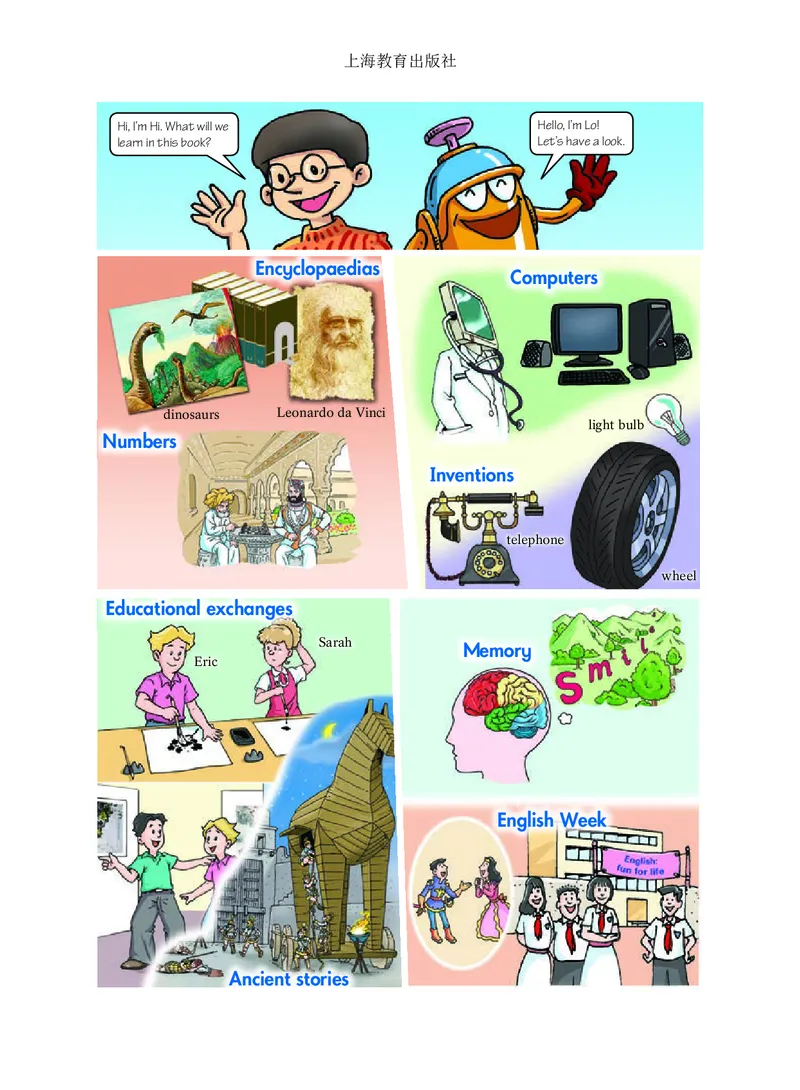
Hi, I’m Hi. What will we Hello, I’m Lo!
learn in this book? Let’s have a look.
Encyclopaedias
Computers
dinosaurs Leonardo da Vinci
light bulb
Numbers
Inventions
telephone
wheel
Educational exchanges
Sarah
Memory
Eric
English Week
Ancient stories上海教育出版社
CCCooonnnttteeennntttsss
Speaking Culture corner
(cid:43)
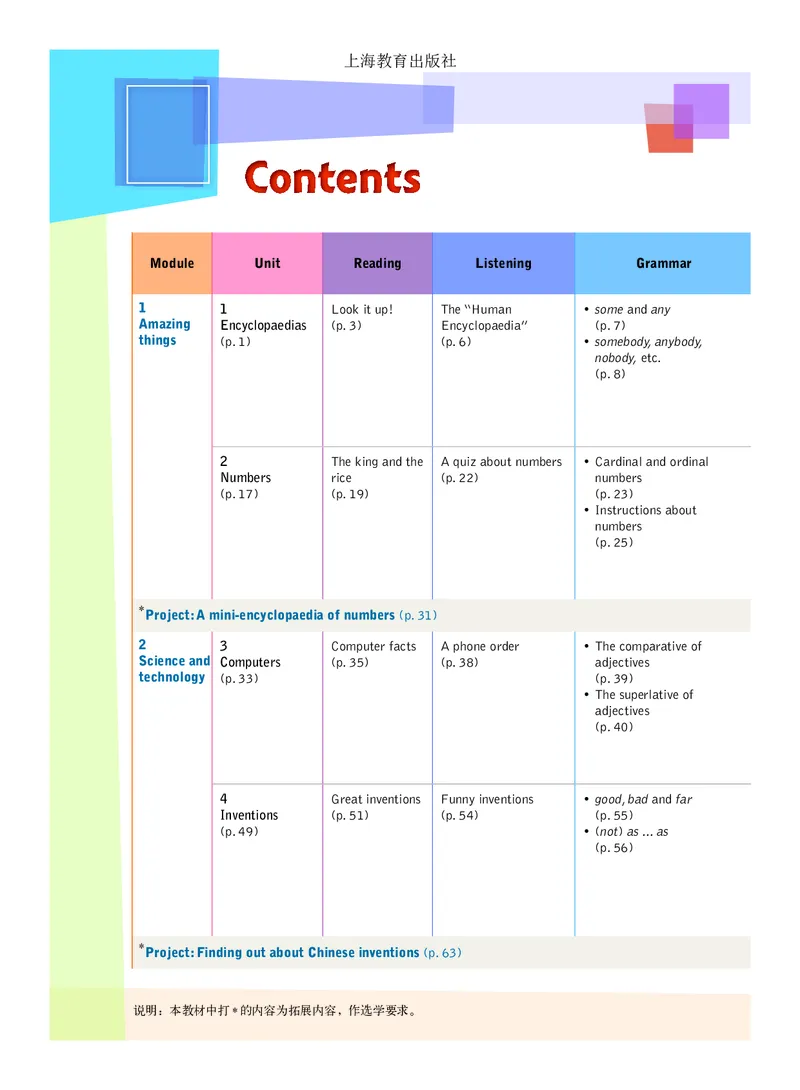
Module Unit Reading Listening Grammar Writing More practice Study skills and
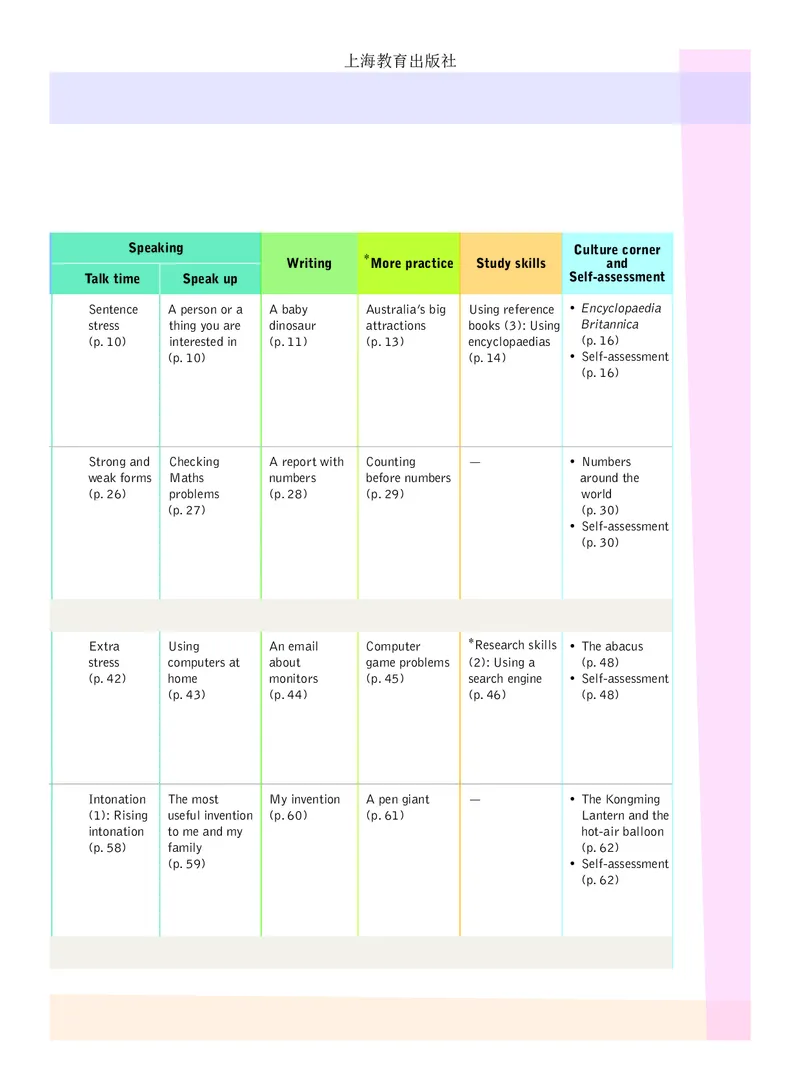
Talk time Speak up Self-assessment
1 1 Look it up! The “Human • some and any Sentence A person or a A baby Australia’s big Using reference • Encyclopaedia
Amazing Encyclopaedias (p. 3) Encyclopaedia” (p. 7) stress thing you are dinosaur attractions books (3): Using Britannica
things (p. 1) (p. 6) • somebody, anybody, (p. 10) interested in (p. 11) (p. 13) encyclopaedias (p. 16)
nobody, etc. (p. 10) (p. 14) • (cid:52)elf(cid:14)assessment
(p. 8) (p. 16)
2 The king and the A quiz about numbers • (cid:36)ardinal and ordinal Strong and (cid:36)hecking A report with (cid:36)ounting — • Numbers
Numbers rice (p. 22) numbers weak forms Maths numbers before numbers around the
(p. 17) (p. 19) (p. 23) (p. 26) problems (p. 28) (p. 29) world
• (cid:42)nstructions about (p. 27) (p. 30)
numbers • (cid:52)elf(cid:14)assessment
(p. 25) (p. 30)
(cid:43)
Project: A mini-encyclopaedia of numbers (p. 31)
(cid:43)
2 3 (cid:36)omputer facts A phone order • (cid:53)he comparative of Extra Using An email (cid:36)omputer Research skills • The abacus
Science and Computers (p. 35) (p. 38) ad(cid:75)ectives stress computers at about game problems (2): Using a (p. 48)
technology (p. 33) (p. 39) (p. 42) home monitors (p. 45) search engine • (cid:52)elf(cid:14)assessment
• (cid:53)he superlative of (p. 43) (p. 44) (p. 46) (p. 48)
ad(cid:75)ectives
(p. 40)
4 (cid:40)reat inventions (cid:39)unny inventions • good, bad and far (cid:42)ntonation The most (cid:46)y invention A pen giant — • (cid:53)he Kongming
Inventions (p. 51) (p. 54) (p. 55) (1): Rising useful invention (p. 60) (p. 61) Lantern and the
(p. 49) • (cid:9)not) as ... as intonation to me and my hot(cid:14)air balloon
(p. 56) (p. 58) family (p. 62)
(p. 59) • (cid:52)elf(cid:14)assessment
(p. 62)
(cid:43)
Project: Finding out about Chinese inventions (p. 63)
说明:本教(cid:1420)中打(cid:454)的(cid:3134)容为(cid:3978)(cid:4699)(cid:3134)容,作选学要求。上海教育出版社
Speaking Culture corner
(cid:43)
Module Unit Reading Listening Grammar Writing More practice Study skills and
Talk time Speak up Self-assessment
1 1 Look it up! The “Human • some and any Sentence A person or a A baby Australia’s big Using reference • Encyclopaedia
Amazing Encyclopaedias (p. 3) Encyclopaedia” (p. 7) stress thing you are dinosaur attractions books (3): Using Britannica
things (p. 1) (p. 6) • somebody, anybody, (p. 10) interested in (p. 11) (p. 13) encyclopaedias (p. 16)
nobody, etc. (p. 10) (p. 14) • (cid:52)elf(cid:14)assessment
(p. 8) (p. 16)
2 The king and the A quiz about numbers • (cid:36)ardinal and ordinal Strong and (cid:36)hecking A report with (cid:36)ounting — • Numbers
Numbers rice (p. 22) numbers weak forms Maths numbers before numbers around the
(p. 17) (p. 19) (p. 23) (p. 26) problems (p. 28) (p. 29) world
• (cid:42)nstructions about (p. 27) (p. 30)
numbers • (cid:52)elf(cid:14)assessment
(p. 25) (p. 30)
(cid:43)
Project: A mini-encyclopaedia of numbers (p. 31)
(cid:43)
2 3 (cid:36)omputer facts A phone order • (cid:53)he comparative of Extra Using An email (cid:36)omputer Research skills • The abacus
Science and Computers (p. 35) (p. 38) ad(cid:75)ectives stress computers at about game problems (2): Using a (p. 48)
technology (p. 33) (p. 39) (p. 42) home monitors (p. 45) search engine • (cid:52)elf(cid:14)assessment
• (cid:53)he superlative of (p. 43) (p. 44) (p. 46) (p. 48)
ad(cid:75)ectives
(p. 40)
4 (cid:40)reat inventions (cid:39)unny inventions • good, bad and far (cid:42)ntonation The most (cid:46)y invention A pen giant — • (cid:53)he Kongming
Inventions (p. 51) (p. 54) (p. 55) (1): Rising useful invention (p. 60) (p. 61) Lantern and the
(p. 49) • (cid:9)not) as ... as intonation to me and my hot(cid:14)air balloon
(p. 56) (p. 58) family (p. 62)
(p. 59) • (cid:52)elf(cid:14)assessment
(p. 62)
(cid:43)
Project: Finding out about Chinese inventions (p. 63)上海教育出版社
Speaking Culture corner
(cid:43)
Module Unit Reading Listening Grammar Writing More practice Study skills and
Talk time Speak up Self-assessment
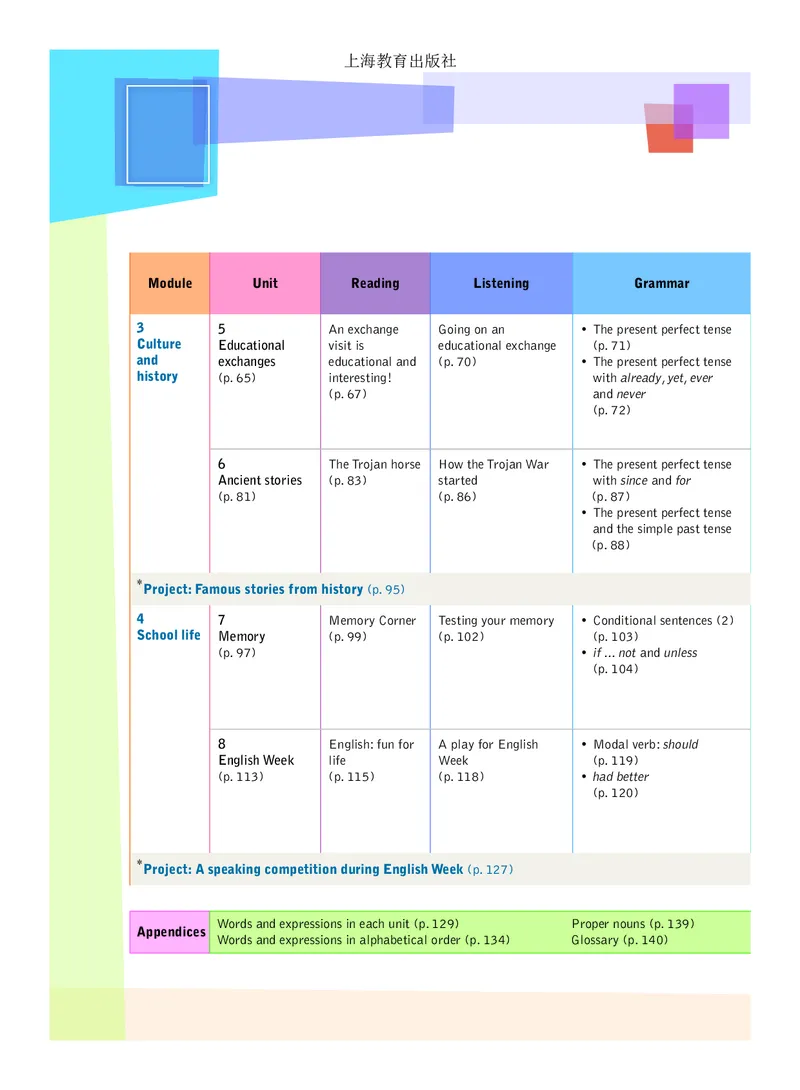
3 5 An exchange Going on an • (cid:53)he present perfect tense (cid:42)ntonation Alice’s An exchange Take part in Practical • (cid:36)ulture shock
Culture Educational visit is educational exchange (p. 71) (2): experience in visit our educational writing (1): (p. 80)
and exchanges educational and (p. 70) • (cid:53)he present perfect tense Falling London (p. 76) exchange Filling in a • (cid:52)elf(cid:14)assessment
history (p. 65) interesting! with already, yet, ever intonation (p. 75) (p. 77) form (p. 80)
(p. 67) and never (p. 74) (p. 78)
(p. 72)
6 The Trojan horse How the Trojan War • (cid:53)he present perfect tense Rhythm A play about A story about The story — • The Art of War
Ancient stories (p. 83) started with since and for (strong “The Trojan the Trojan War of 100,000 (p. 94)
(p. 81) (p. 86) (p. 87) and weak horse” (p. 92) arrows • (cid:52)elf(cid:14)assessment
• (cid:53)he present perfect tense sounds) (p. 91) (p. 93) (p. 94)
and the simple past tense (p. 90)
(p. 88)
(cid:43)
Project: Famous stories from history (p. 95)
4 7 (cid:46)emory (cid:36)orner Testing your memory • (cid:36)onditional sentences (cid:9)(cid:19)(cid:10) Loss of Special methods A special How to improve Making notes • World Memory
School life Memory (p. 99) (p. 102) (p. 103) plosion for remembering memory your memory (2): Making (cid:36)hampionships
(p. 97) • if ... not and unless (p. 106) English words (p. 107) (p. 109) notes from (p. 112)
(p. 104) (p. 106) sentences and • (cid:52)elf(cid:14)assessment
paragraphs (p. 112)
(p. 110)
8 English: fun for A play for English • (cid:46)odal verb(cid:27) should Word Ways to A notice for Robin Hood — • (cid:36)rossword
English Week life Week (p. 119) linking improve your English Week and Prince puzzles
(p. 113) (p. 115) (p. 118) • had better (p. 122) spoken English (p. 123) John (p. 126)
(p. 120) (p. 122) (p. 125) • (cid:52)elf(cid:14)assessment
(p. 126)
(cid:43)
Project: A speaking competition during English Week (p. 127)
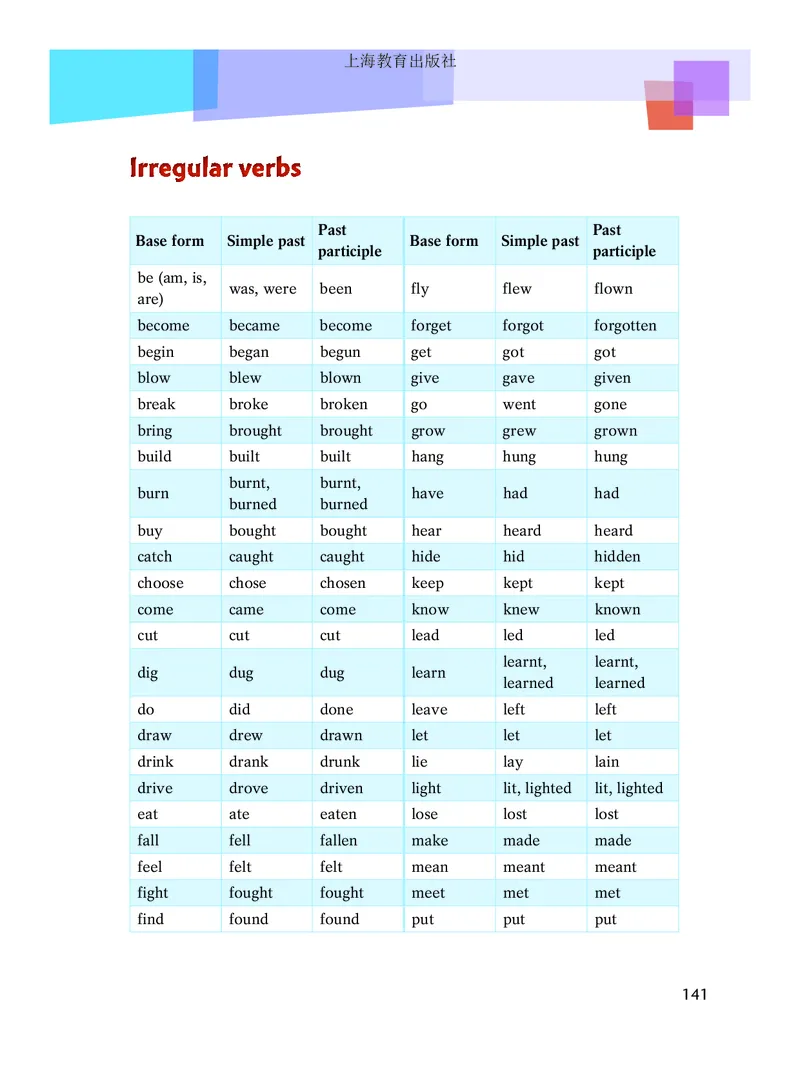
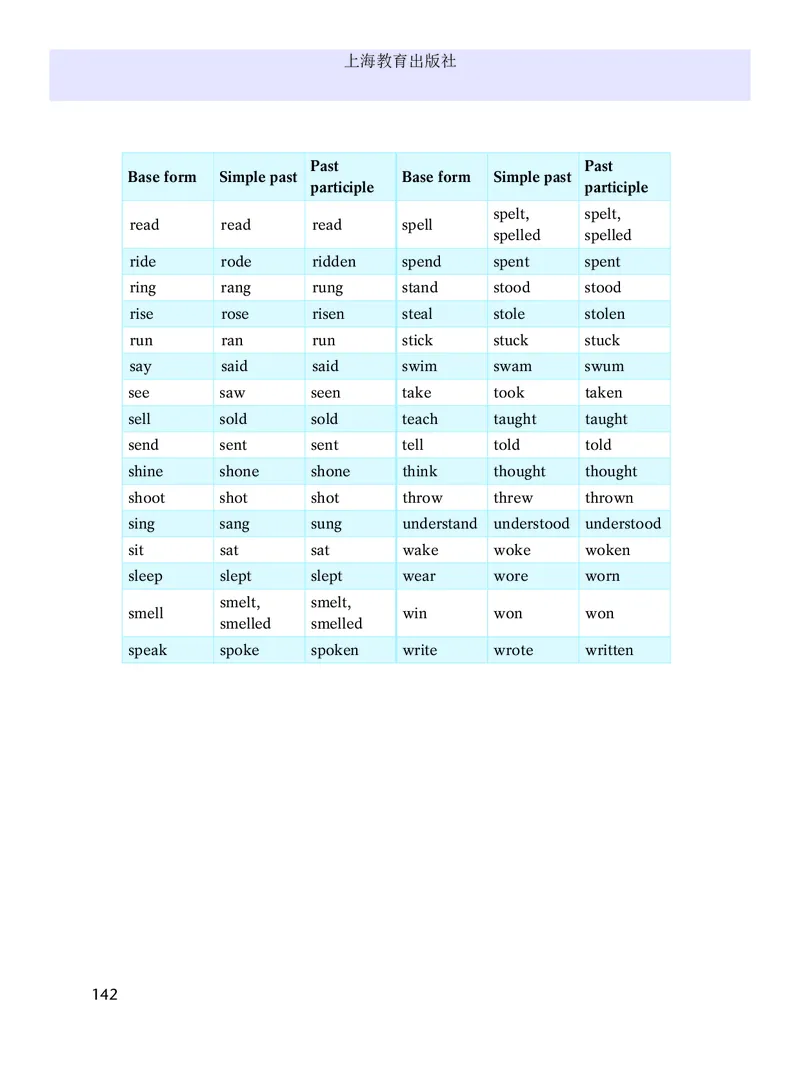
Words and expressions in each unit (p. 129) Proper nouns (p. 139) (cid:42)rregular verbs (cid:9)p. 141(cid:10)
Appendices
Words and expressions in alphabetical order (p. 134) Glossary (p. 140)上海教育出版社
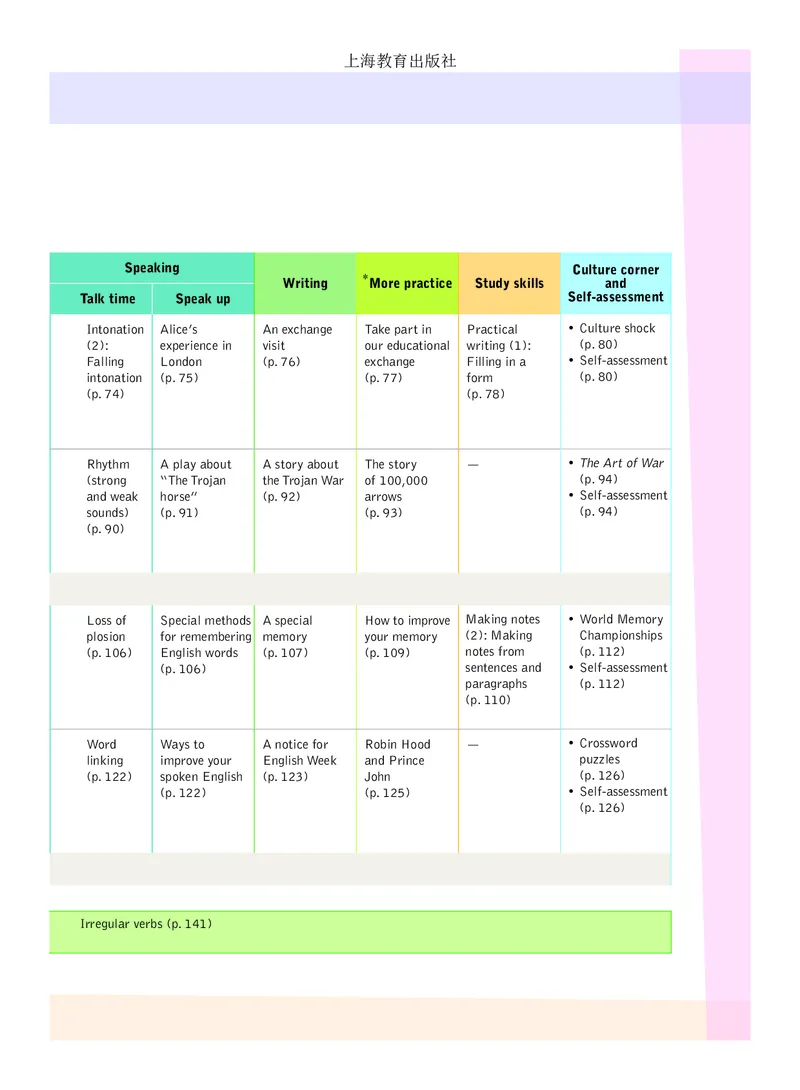
Speaking Culture corner
(cid:43)
Module Unit Reading Listening Grammar Writing More practice Study skills and
Talk time Speak up Self-assessment
3 5 An exchange Going on an • (cid:53)he present perfect tense (cid:42)ntonation Alice’s An exchange Take part in Practical • (cid:36)ulture shock
Culture Educational visit is educational exchange (p. 71) (2): experience in visit our educational writing (1): (p. 80)
and exchanges educational and (p. 70) • (cid:53)he present perfect tense Falling London (p. 76) exchange Filling in a • (cid:52)elf(cid:14)assessment
history (p. 65) interesting! with already, yet, ever intonation (p. 75) (p. 77) form (p. 80)
(p. 67) and never (p. 74) (p. 78)
(p. 72)
6 The Trojan horse How the Trojan War • (cid:53)he present perfect tense Rhythm A play about A story about The story — • The Art of War
Ancient stories (p. 83) started with since and for (strong “The Trojan the Trojan War of 100,000 (p. 94)
(p. 81) (p. 86) (p. 87) and weak horse” (p. 92) arrows • (cid:52)elf(cid:14)assessment
• (cid:53)he present perfect tense sounds) (p. 91) (p. 93) (p. 94)
and the simple past tense (p. 90)
(p. 88)
(cid:43)
Project: Famous stories from history (p. 95)
4 7 (cid:46)emory (cid:36)orner Testing your memory • (cid:36)onditional sentences (cid:9)(cid:19)(cid:10) Loss of Special methods A special How to improve Making notes • World Memory
School life Memory (p. 99) (p. 102) (p. 103) plosion for remembering memory your memory (2): Making (cid:36)hampionships
(p. 97) • if ... not and unless (p. 106) English words (p. 107) (p. 109) notes from (p. 112)
(p. 104) (p. 106) sentences and • (cid:52)elf(cid:14)assessment
paragraphs (p. 112)
(p. 110)
8 English: fun for A play for English • (cid:46)odal verb(cid:27) should Word Ways to A notice for Robin Hood — • (cid:36)rossword
English Week life Week (p. 119) linking improve your English Week and Prince puzzles
(p. 113) (p. 115) (p. 118) • had better (p. 122) spoken English (p. 123) John (p. 126)
(p. 120) (p. 122) (p. 125) • (cid:52)elf(cid:14)assessment
(p. 126)
(cid:43)
Project: A speaking competition during English Week (p. 127)
Words and expressions in each unit (p. 129) Proper nouns (p. 139) (cid:42)rregular verbs (cid:9)p. 141(cid:10)
Appendices
Words and expressions in alphabetical order (p. 134) Glossary (p. 140)上海教育出版社上海教育出版社
Module 1 Amazing things
Unit
1
EEEnnncccyyyccclllooopppaaaeeedddiiiaaasss
Getting ready
(cid:3)In this unit, you will learn about some different topics from encyclopaedias.
Reading
• Read two short articles from an encyclopaedia.
Listening
• Listen to a radio programme about the “Human Encyclopaedia”.
Grammar
• Learn how to use some and any.
• Learn how to use somebody, anybody, nobody, etc.
Speaking
• Learn to stress the important words in a sentence.
• Talk about an interesting person or thing from an encyclopaedia.
Writing
•• CCoommpplleettee aa sshhoorrtt ssttoorryy aabboouutt aa bbaabbyy ddiinnoossaauurr..
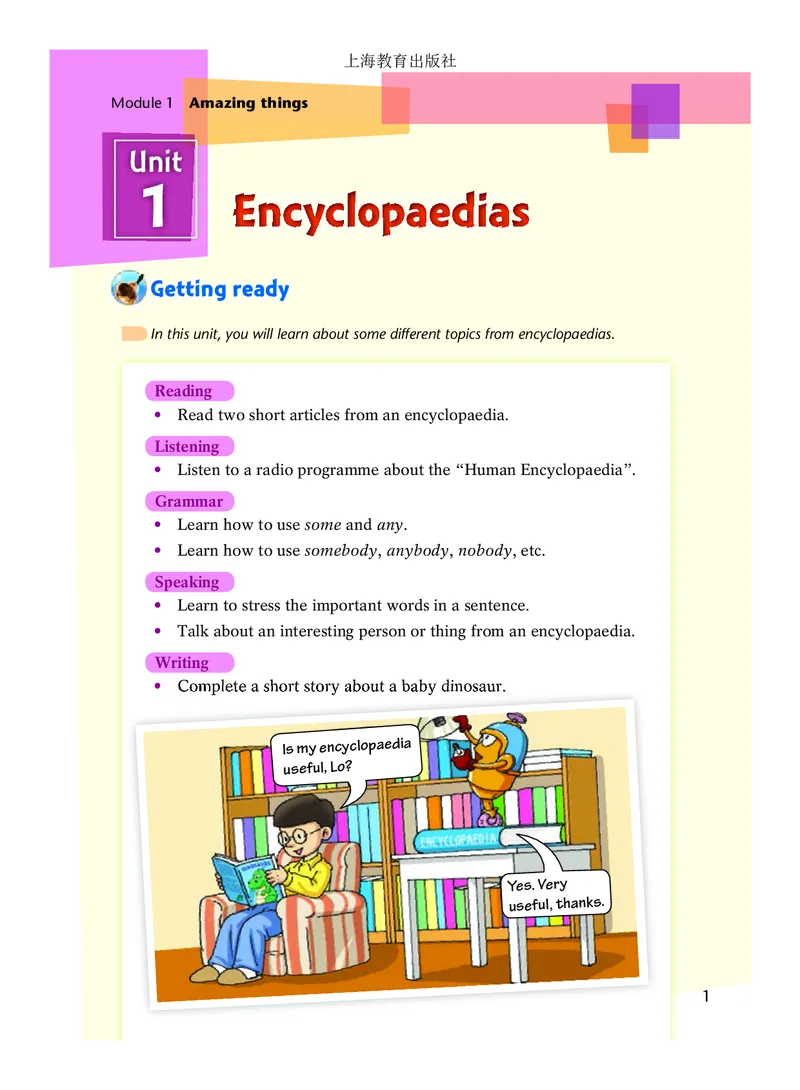
Is my
encyclopaedia
useful, Lo?
Yes. Very
useful, thanks.
1上海教育出版社
Module 1
Reading
A What do you know about …?
You are going to read two short articles from an encyclopaedia. Before you start,
try the quiz below. Circle the correct answers. There can be more than one answer.
1 Leonardo da Vinci was a(n) _____.
a painter b engineer c cook
2 Leonardo da Vinci was _____.
a French b English c Italian
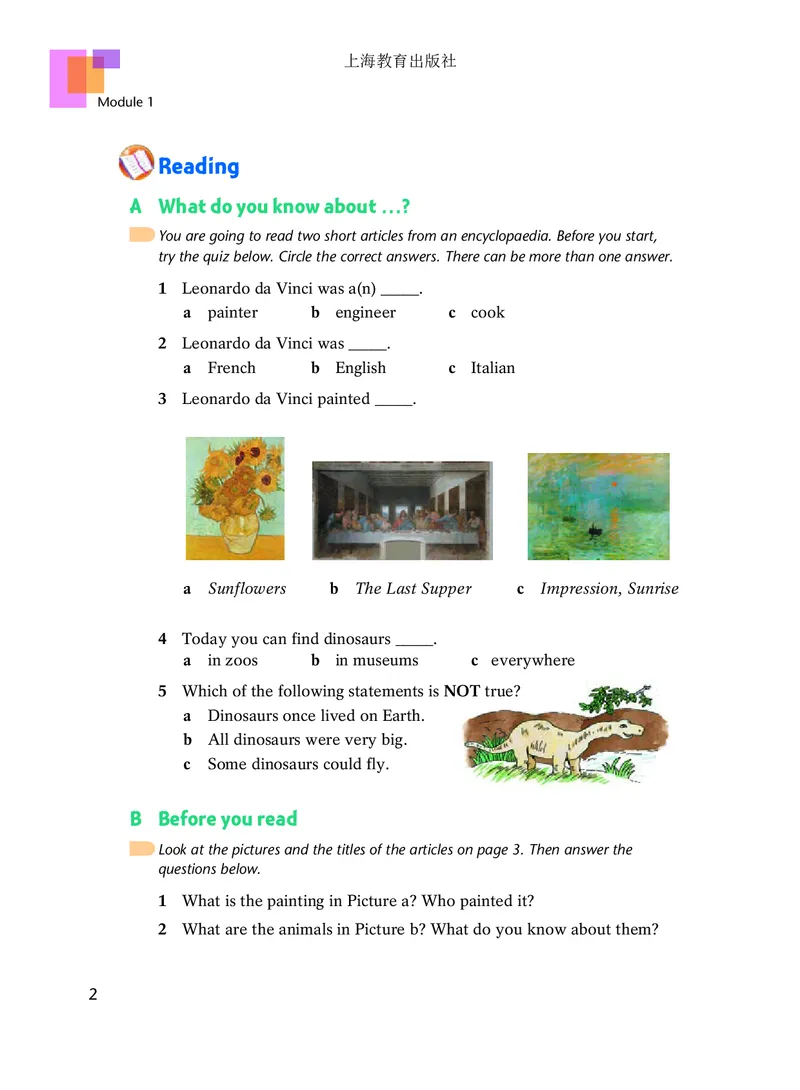
3 Leonardo da Vinci painted _____.
a Sunflowers b The Last Supper c Impression, Sunrise
4 Today you can find dinosaurs _____.
a in zoos b in museums c everywhere
5 Which of the following statements is NOT true?
a Dinosaurs once lived on Earth.
b All dinosaurs were very big.
c Some dinosaurs could fly.
B Before you read
Look at the pictures and the titles of the articles on page 3. Then answer the
questions below.
1 What is the painting in Picture a? Who painted it?
2 What are the animals in Picture b? What do you know about them?
2上海教育出版社
Unit 1
Look it up!
Here are two articles from an encyclopaedia.
Da Vinci, Leonardo
Leonardo da Vinci (1452–1519) was
a
an Italian painter, inventor, musician,
5 engineer and scientist.
Da Vinci was born in the countryside.
From an early age, he showed great
intelligence and artistic ability. As
he grew older, he learnt to do many
10 different things. His paintings are very
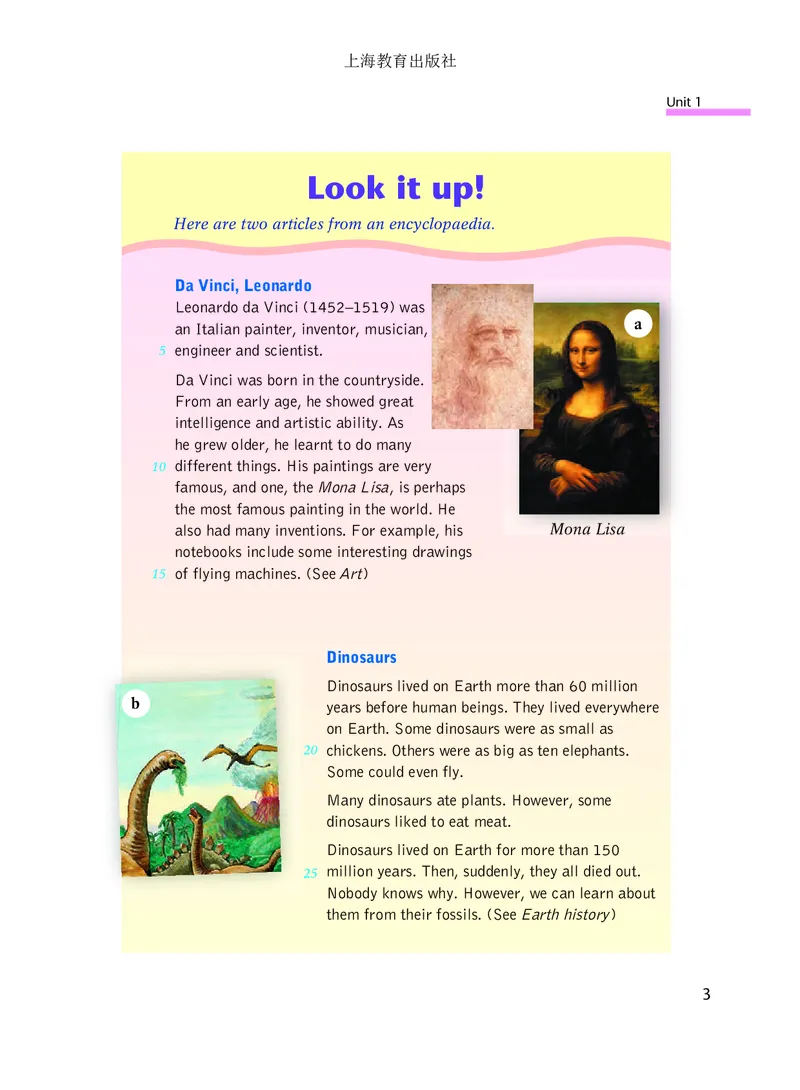
famous, and one, the Mona Lisa, is perhaps
the most famous painting in the world. He
also had many inventions. For example, his Mona Lisa
notebooks include some interesting drawings
15 of flying machines. (See Art)
Dinosaurs
Dinosaurs lived on Earth more than 60 million
b years before human beings. They lived everywhere
on Earth. Some dinosaurs were as small as
20 chickens. Others were as big as ten elephants.
Some could even fly.
Many dinosaurs ate plants. However, some
dinosaurs liked to eat meat.
Dinosaurs lived on Earth for more than 150
25 million years. Then, suddenly, they all died out.
Nobody knows why. However, we can learn about
them from their fossils. (See Earth history)
3上海教育出版社
Module 1
C Vocabulary
C1 The words in italics are from the two articles on page 3. Circle the correct answers
to complete these sentences.
1 When somebody is born, he/she _____.
a comes out of his/her mother’s body c leaves his/her parents
b goes to see a doctor
2 Benny’s grandparents live in the countryside. They live _____ the city.
a inside b outside c in the centre of
3 Birds have a musical ability. They _____ sing.
a can b cannot c are happy to
4 The book includes some beautiful photos. These photos are _____ the
book.
a part of b at the end of c connected to
5 A human being is a(n) _____.
a animal b machine c person
C2 Complete the article below with the words from the box. Change their forms if
necessary.
even however invention notebook perhaps scientist
When I was young, I used to keep a (_1)____________. I wrote many
poems and drew many pictures of different (_2)____________ in it.
They were not very good, but they helped me think and dream.
Now I am a famous _(3)____________ and I do many important things.
_(4)____________, my journey began when I was at school, with my
studies, and my poems and pictures. I was a student just like you.
_(5)____________ you will do something important or (_6)____________
become famous one day. Just remember to think and to dream.
4上海教育出版社
Unit 1
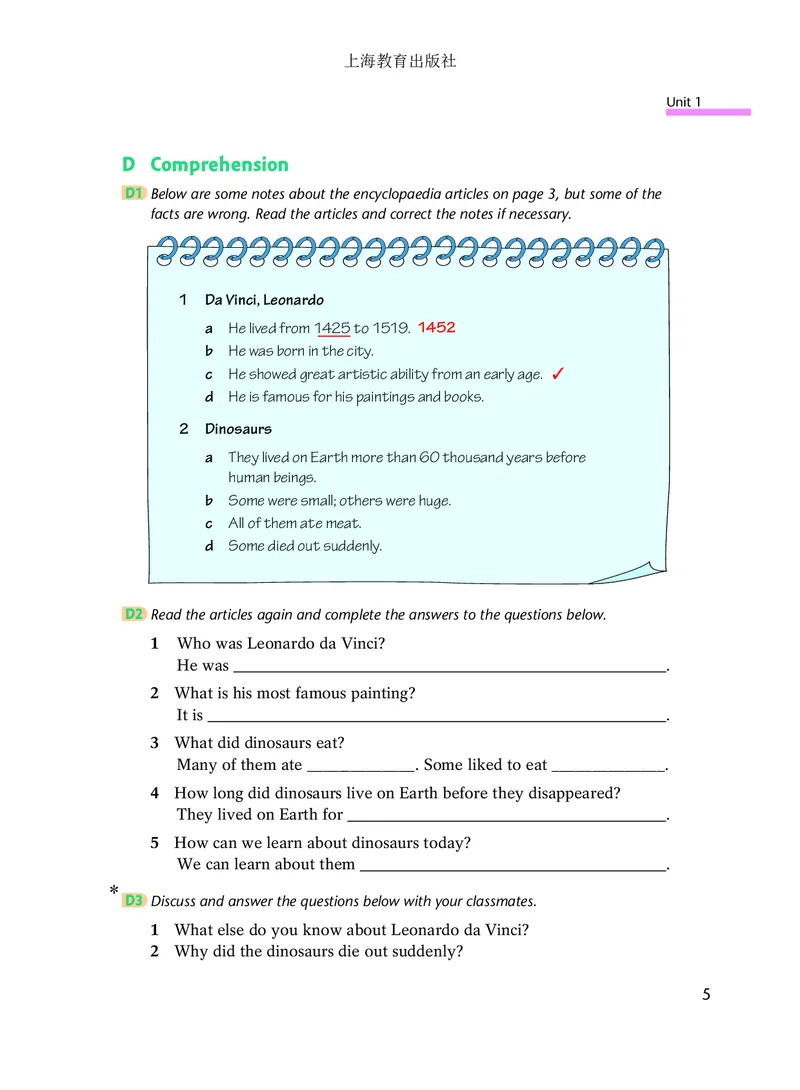
D Comprehension
D1 Below are some notes about the encyclopaedia articles on page 3, but some of the
facts are wrong. Read the articles and correct the notes if necessary.
1 Da Vinci, Leonardo
a He lived from 142 5 to 1519. 1452
b He was born in the city.
c He showed great artistic ability from an early age. ✓
d He is famous for his paintings and books.
2 Dinosaurs
a They lived on Earth more than 60 thousand years before
human beings.
b Some were small; others were huge.
c All of them ate meat.
d Some died out suddenly.
D2 Read the articles again and complete the answers to the questions below.
1 Who was Leonardo da Vinci?
He was .
2 What is his most famous painting?
It is .
3 What did dinosaurs eat?
Many of them ate ______________. Some liked to eat ______________.
4 How long did dinosaurs live on Earth before they disappeared?
They lived on Earth for .
5 How can we learn about dinosaurs today?
We can learn about them .
(cid:43)
D3 Discuss and answer the questions below with your classmates.
1 What else do you know about Leonardo da Vinci?
2 Why did the dinosaurs die out suddenly?
5上海教育出版社
Module 1
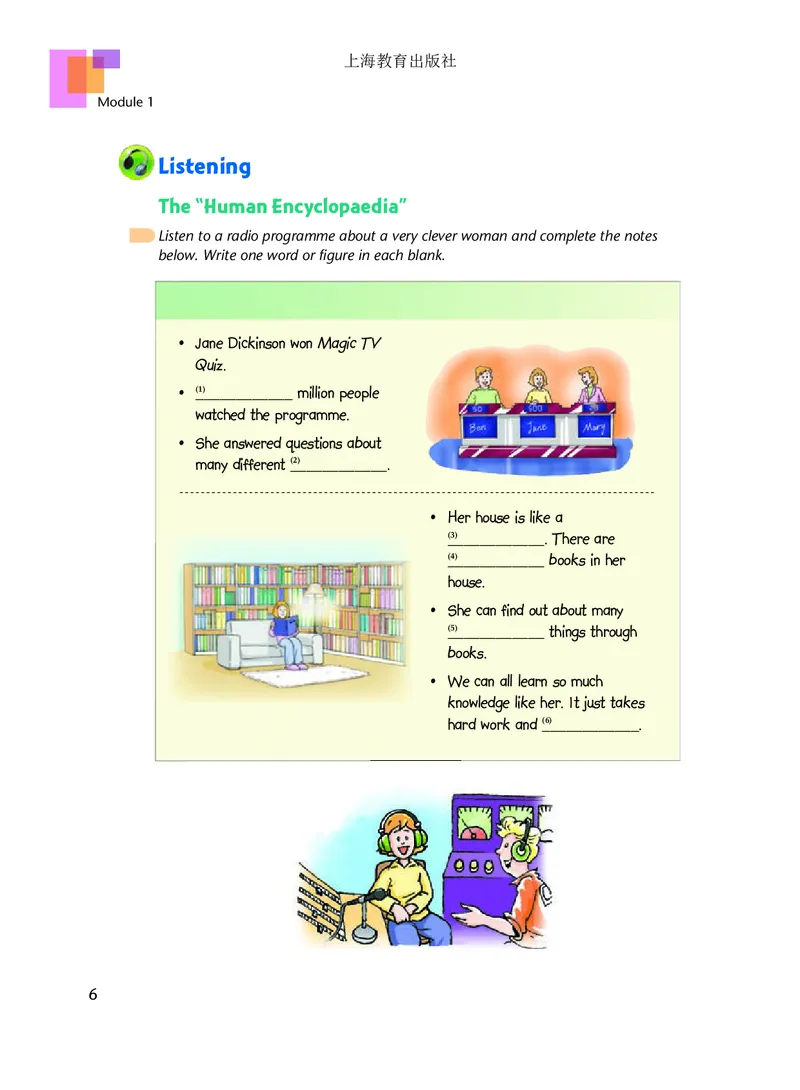
Listening
The “Human Encyclopaedia”
Listen to a radio programme about a very clever woman and complete the notes
below. Write one word or figure in each blank.
(cid:155) Jane (cid:59)ickinson won (cid:68)agic (cid:75)(cid:77)
(cid:72)uiz.
(cid:155) _(1)___________ million people
watched the programme.
(cid:155) She answered (cid:104)uestions about
many different _(2)___________.
(cid:155) Her house is like a
_(3)___________. (cid:75)here are
_(4)___________ books in her
house.
(cid:155) She can find out about many
_(5)___________ things through
books.
(cid:155) (cid:78)e can all learn so much
knowledge like her. (cid:64)t (cid:97)ust takes
hard work and _(6)___________.
6上海教育出版社
Unit 1
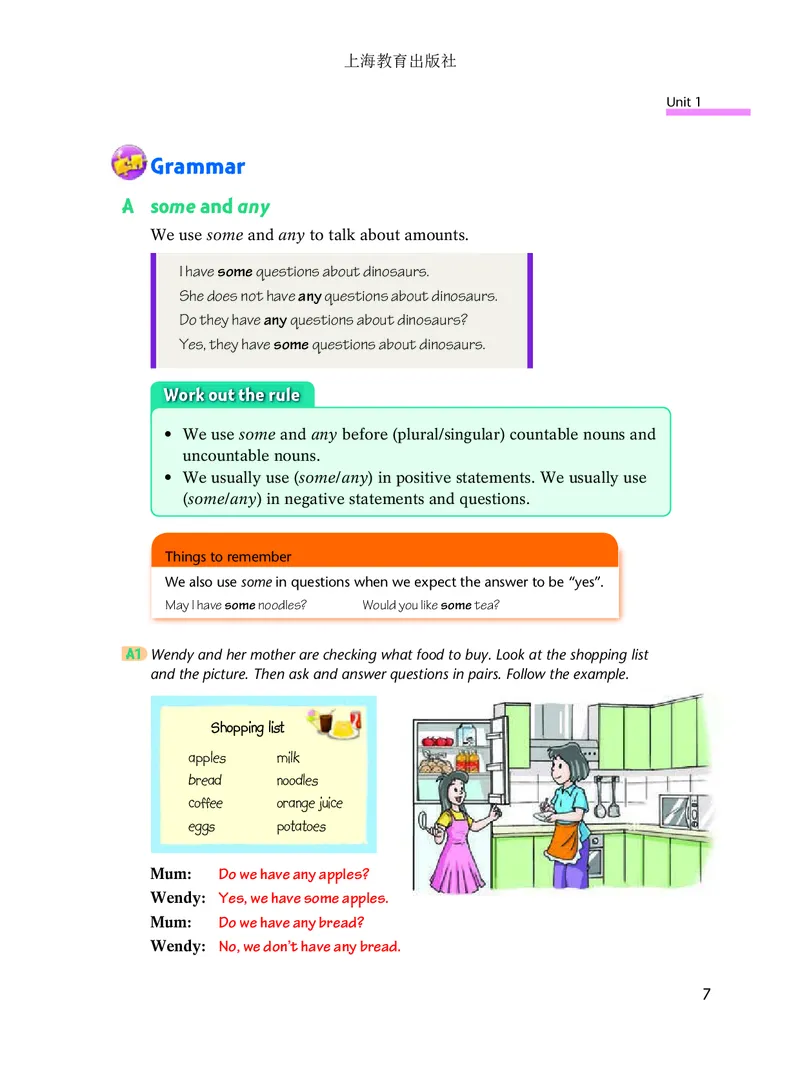
Grammar
A some and any
We use some and any to talk about amounts.
I have some questions about dinosaurs.
She does not have any questions about dinosaurs.
Do they have any questions about dinosaurs?
Yes, they have some questions about dinosaurs.
Work out the rule
• We use some and any before (plural/singular) countable nouns and
uncountable nouns.
• We usually use (some/any) in positive statements. We usually use
(some/any) in negative statements and questions.
Things to remember
We also use some in questions when we expect the answer to be “yes”.
May I have some noodles? Would you like some tea?
A1 Wendy and her mother are checking what food to buy. Look at the shopping list
and the picture. Then ask and answer questions in pairs. Follow the example.
Shopping list
apples milk
bread noodles
coffee orange juice
eggs potatoes
Mum: Do we have any apples?
Wendy: Yes, we have some apples.
Mum: Do we have any bread?
Wendy: No, we don’t have any bread.
7上海教育出版社
Module 1
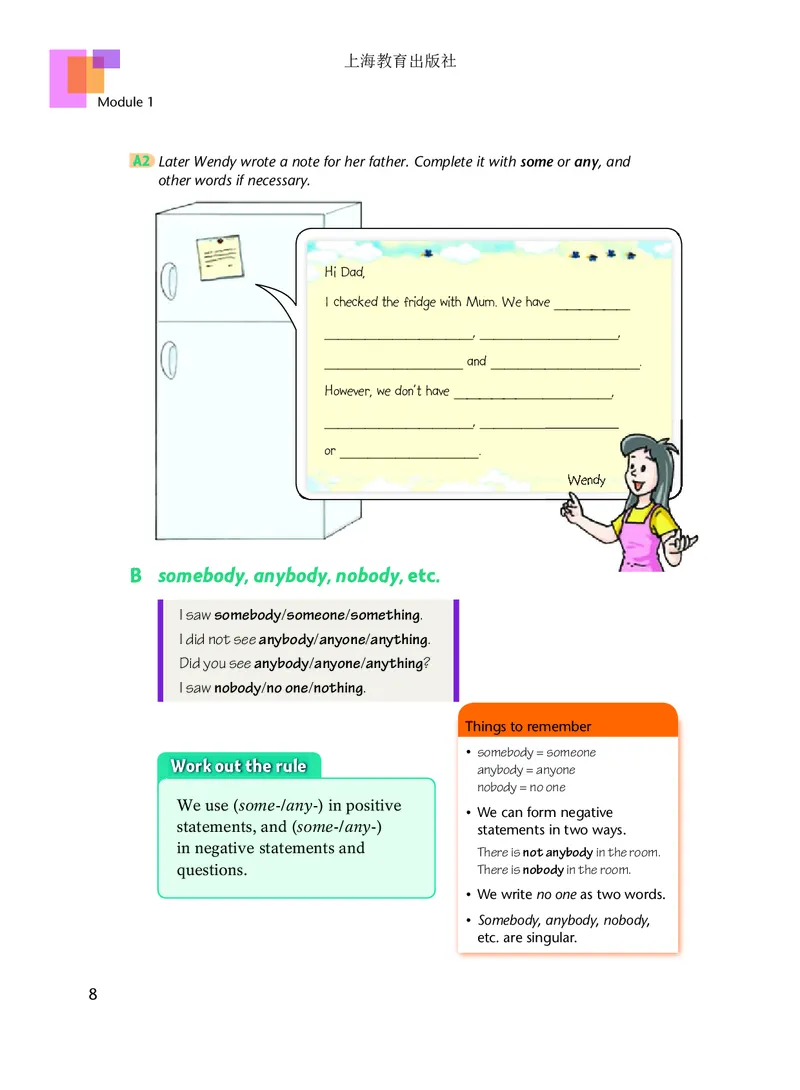
A2 Later Wendy wrote a note for her father. Complete it with some or any, and
other words if necessary.
Hi (cid:59)ad,
I checked the fridge with (cid:68)um. (cid:78)e have (cid:86)(cid:86)(cid:86)(cid:86)(cid:86)(cid:86)
(cid:86)(cid:86)(cid:86)(cid:86)(cid:86)(cid:86)(cid:86)(cid:86)(cid:86)(cid:86)(cid:86), (cid:86)(cid:86)(cid:86)(cid:86)(cid:86)(cid:86)(cid:86)(cid:86)(cid:86)(cid:86),
(cid:86)(cid:86)(cid:86)(cid:86)(cid:86)(cid:86)(cid:86)(cid:86)(cid:86)(cid:86) and (cid:86)(cid:86)(cid:86)(cid:86)(cid:86)(cid:86)(cid:86)(cid:86)(cid:86)(cid:86)(cid:86).
However, we don(cid:203)t have (cid:86)(cid:86)(cid:86)(cid:86)(cid:86)(cid:86)(cid:86)(cid:86)(cid:86)(cid:86)(cid:86)(cid:86),
(cid:86)(cid:86)(cid:86)(cid:86)(cid:86)(cid:86)(cid:86)(cid:86)(cid:86)(cid:86)(cid:86), (cid:86)(cid:86)(cid:86)(cid:86)(cid:86)(cid:86)(cid:86)(cid:86)(cid:86)(cid:86)(cid:86)(cid:86)(cid:86)(cid:86)(cid:86)(cid:86)(cid:86)(cid:86)(cid:86)(cid:86)
or (cid:86)(cid:86)(cid:86)(cid:86)(cid:86)(cid:86)(cid:86)(cid:86)(cid:86)(cid:86).
(cid:78)(cid:78)eennddyy
B somebody, anybody, nobody, etc.
I saw somebody/someone/something.
I did not see anybody/anyone/anything.
Did you see anybody/anyone/anything?
I saw nobody/no one/nothing.
Things to remember
• somebody = someone
Work out the rule
anybody = anyone
nobody = no one
We use (some-/any-) in positive
• We can form negative
statements, and (some-/any-)
statements in two ways.
in negative statements and
There is not anybody in the room.
questions. There is nobody in the room.
• We write no one as two words.
• Somebody, anybody, nobody,
etc. are singular.
8上海教育出版社
Unit 1
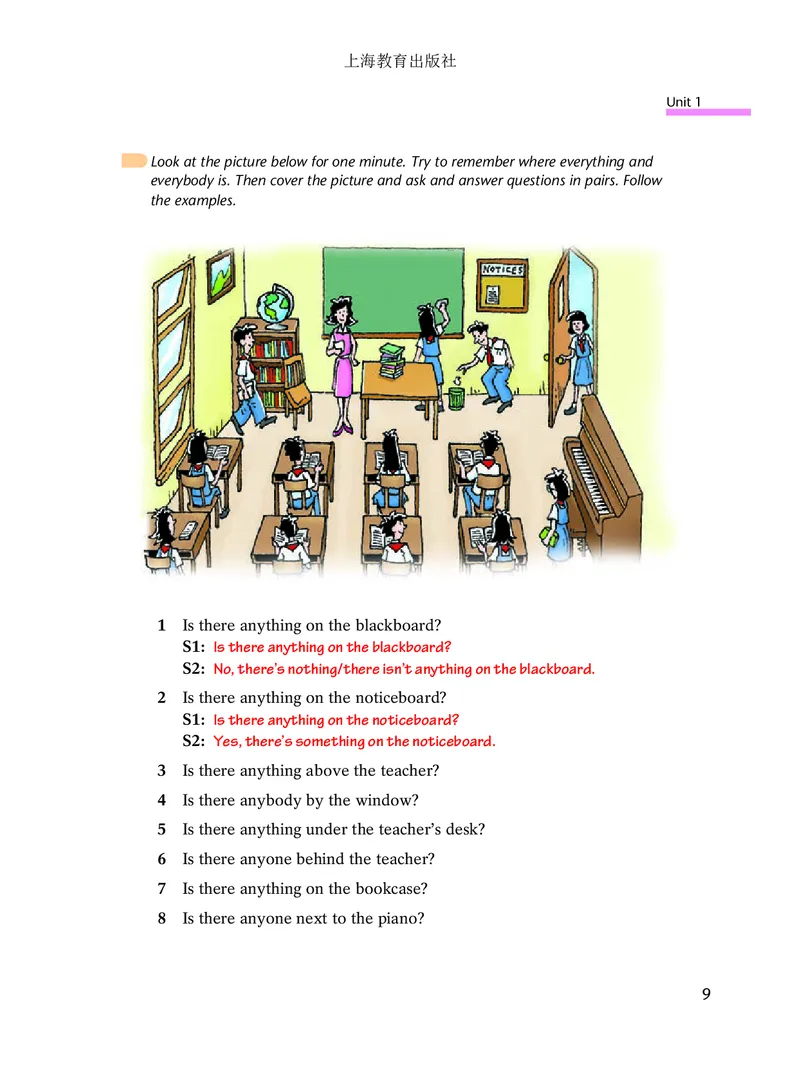
Look at the picture below for one minute. Try to remember where everything and
everybody is. Then cover the picture and ask and answer questions in pairs. Follow
the examples.
1 Is there anything on the blackboard?
S1: Is there anything on the blackboard?
S2: No, there’s nothing/there isn’t anything on the blackboard.
2 Is there anything on the noticeboard?
S1: Is there anything on the noticeboard?
S2: Yes, there’s something on the noticeboard.
3 Is there anything above the teacher?
4 Is there anybody by the window?
5 Is there anything under the teacher’s desk?
6 Is there anyone behind the teacher?
7 Is there anything on the bookcase?
8 Is there anyone next to the piano?
9上海教育出版社
Module 1
Speaking
A Talk time
Sentence stress
When we speak, we usually stress the important words (nouns, verbs,
adjectives, adverbs and numbers) in a sentence. We do not usually stress
unimportant words, e.g. a, the, he, of, is, and, have and can.
Read the conversation below and stress the underlined words.
Daisy: Happy birthday, Benny. This is for you.
Benny: An encyclopaedia? Thank you, Daisy!
Daisy: You’re welcome. I’m sure you’ll learn many things
from it.
Benny: Yes, I’m sure I will. It’s always useful to have an
encyclopaedia around the house.
Daisy: True. It’ll be a great help with your studies.
B Speak up
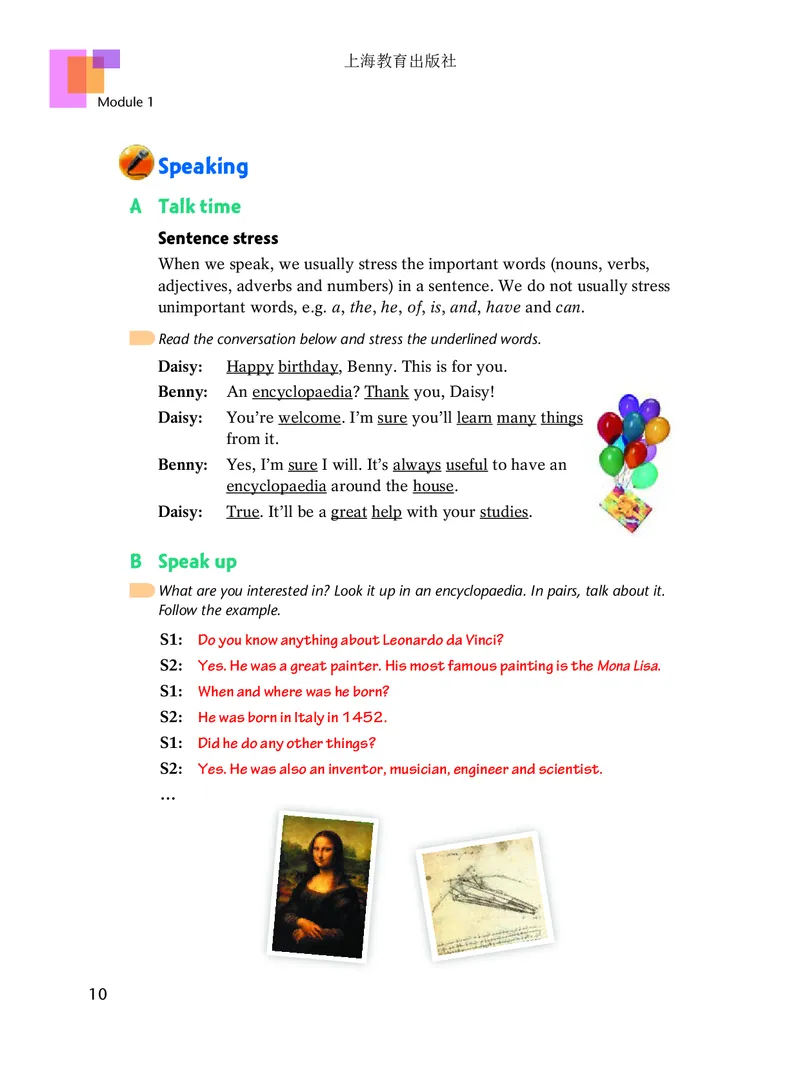
What are you interested in? Look it up in an encyclopaedia. In pairs, talk about it.
Follow the example.
S1: Do you know anything about Leonardo da Vinci?
S2: Yes. He was a great painter. His most famous painting is the Mona Lisa.
S1: When and where was he born?
S2: He was born in Italy in 1452.
S1: Did he do any other things?
S2: Yes. He was also an inventor, musician, engineer and scientist.
…
10上海教育出版社
Unit 1
Writing
A baby dinosaur
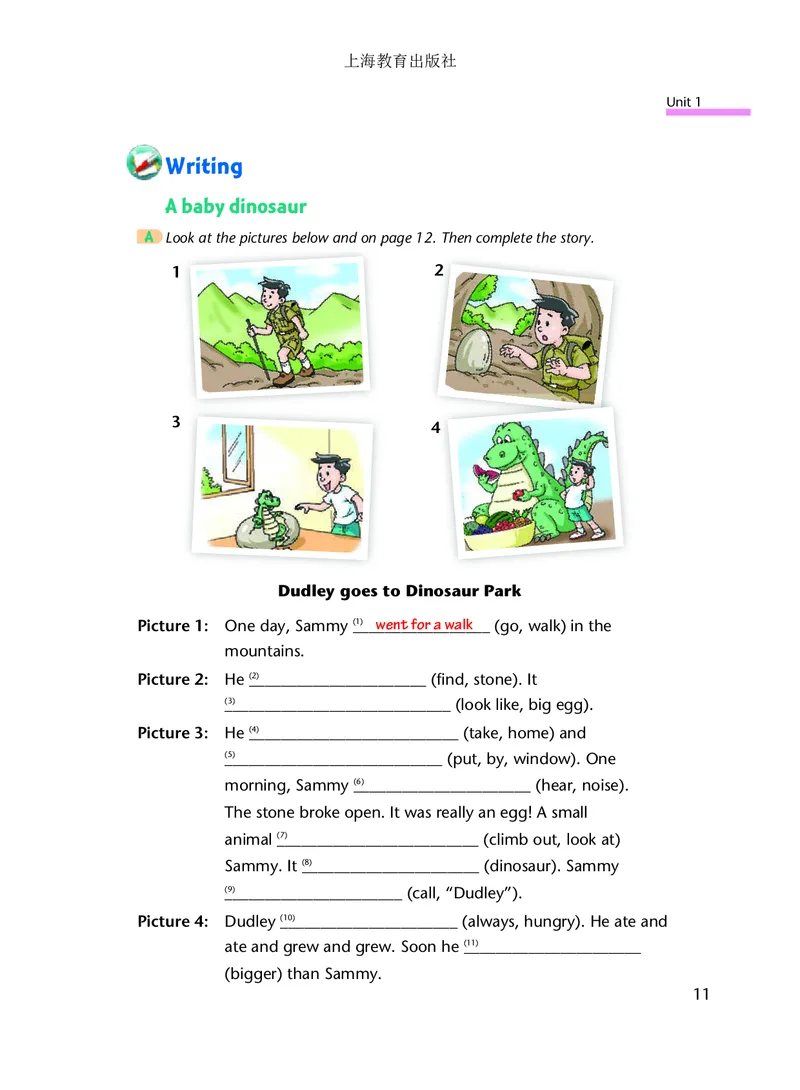
A LLooookk aatt tthhee ppiiccttuurreess bbeellooww aanndd oonn ppaaggee 1122.. TThheenn ccoommpplleettee tthhee ssttoorryy..
1 2
3
4
Dudley goes to Dinosaur Park
Picture 1: One day, Sammy (_1)__w__e_nt_ _fo_r_ _a_ w_a_l_k__ (go, walk) in the
mountains.
Picture 2: He (_2)_____________________ (find, stone). It
_(3)___________________________ (look like, big egg).
Picture 3: He (_4)_________________________ (take, home) and
_(5)__________________________ (put, by, window). One
morning, Sammy (_6)_____________________ (hear, noise).
The stone broke open. It was really an egg! A small
animal _(7)________________________ (climb out, look at)
Sammy. It (_8)_____________________ (dinosaur). Sammy
_(9)_____________________ (call, “Dudley”).
Picture 4: Dudley (_10_)____________________ (always, hungry). He ate and
ate and grew and grew. Soon he (_11_)____________________
(bigger) than Sammy.
11上海教育出版社
Module 1
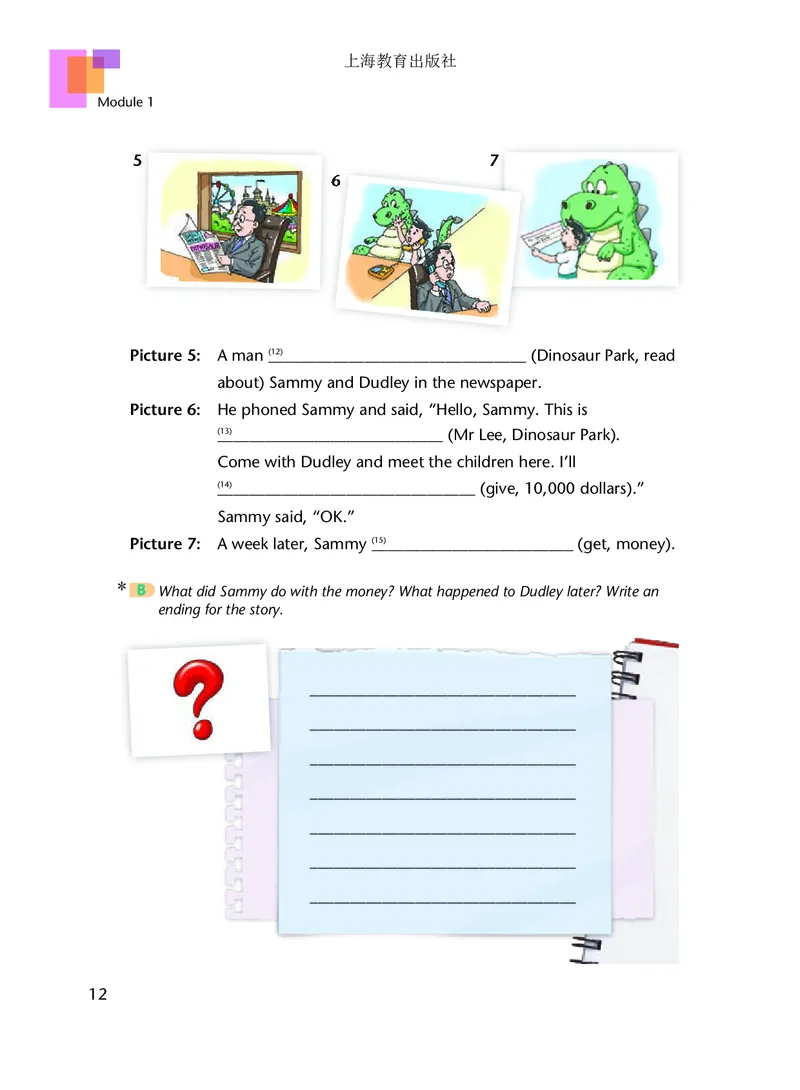
5 777
666
Picture 5: A man (_12_)______________________________ (Dinosaur Park, read
about) Sammy and Dudley in the newspaper.
Picture 6: He phoned Sammy and said, “Hello, Sammy. This is
(_13_)__________________________ (Mr Lee, Dinosaur Park).
Come with Dudley and meet the children here. I’ll
_(14_)______________________________ (give, 10,000 dollars).”
Sammy said, “OK.”
Picture 7: A week later, Sammy (_15_)_______________________ (get, money).
(cid:43)
B What did Sammy do with the money? What happened to Dudley later? Write an
ending for the story.
_________________________________
_________________________________
_________________________________
_________________________________
_________________________________
_________________________________
_________________________________
12上海教育出版社
Unit 1
(cid:43)
More practice
A Read the following encyclopaedia article about big attractions in Australia and
answer the questions below.
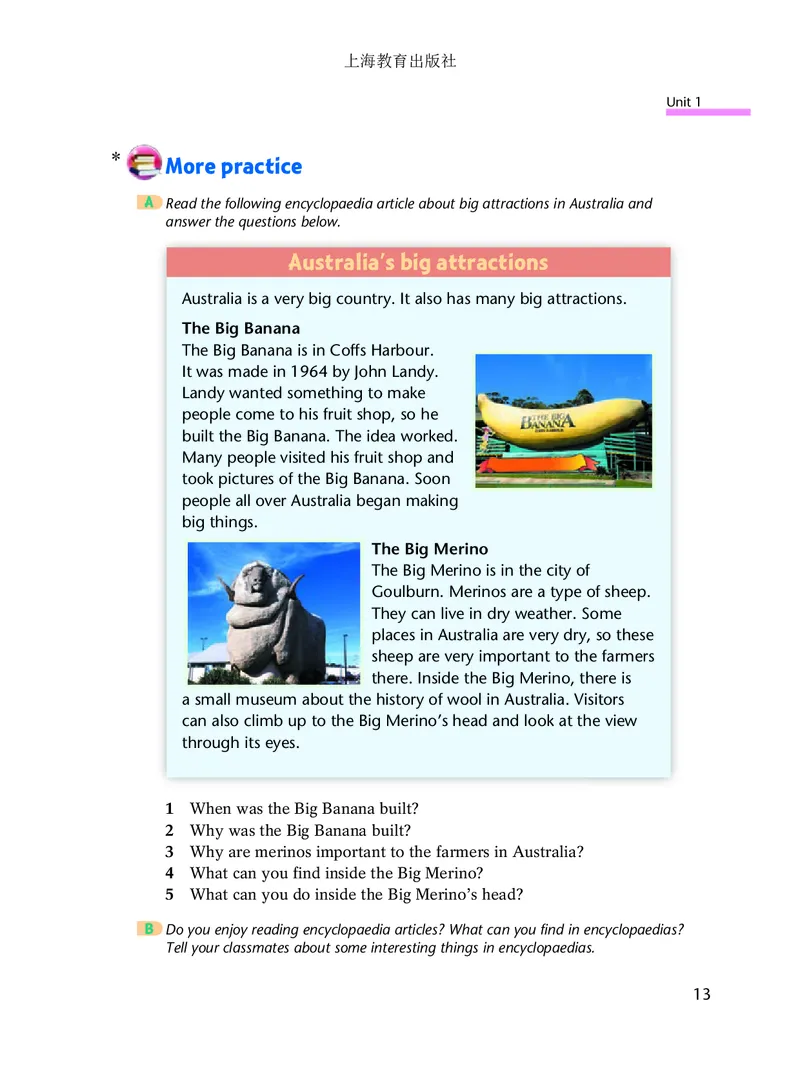
Australia’s big attractions
Australia is a very big country. It also has many big attractions.
The Big Banana
The Big Banana is in Coffs Harbour.
It was made in 1964 by John Landy.
Landy wanted something to make
people come to his fruit shop, so he
built the Big Banana. The idea worked.
Many people visited his fruit shop and
took pictures of the Big Banana. Soon
people all over Australia began making
big things.
The Big Merino
The Big Merino is in the city of
Goulburn. Merinos are a type of sheep.
They can live in dry weather. Some
places in Australia are very dry, so these
sheep are very important to the farmers
there. Inside the Big Merino, there is
a small museum about the history of wool in Australia. Visitors
can also climb up to the Big Merino’s head and look at the view
through its eyes.
1 When was the Big Banana built?
2 Why was the Big Banana built?
3 Why are merinos important to the farmers in Australia?
4 What can you find inside the Big Merino?
5 What can you do inside the Big Merino’s head?
B Do you enjoy reading encyclopaedia articles? What can you find in encyclopaedias?
Tell your classmates about some interesting things in encyclopaedias.
13上海教育出版社
Module 1
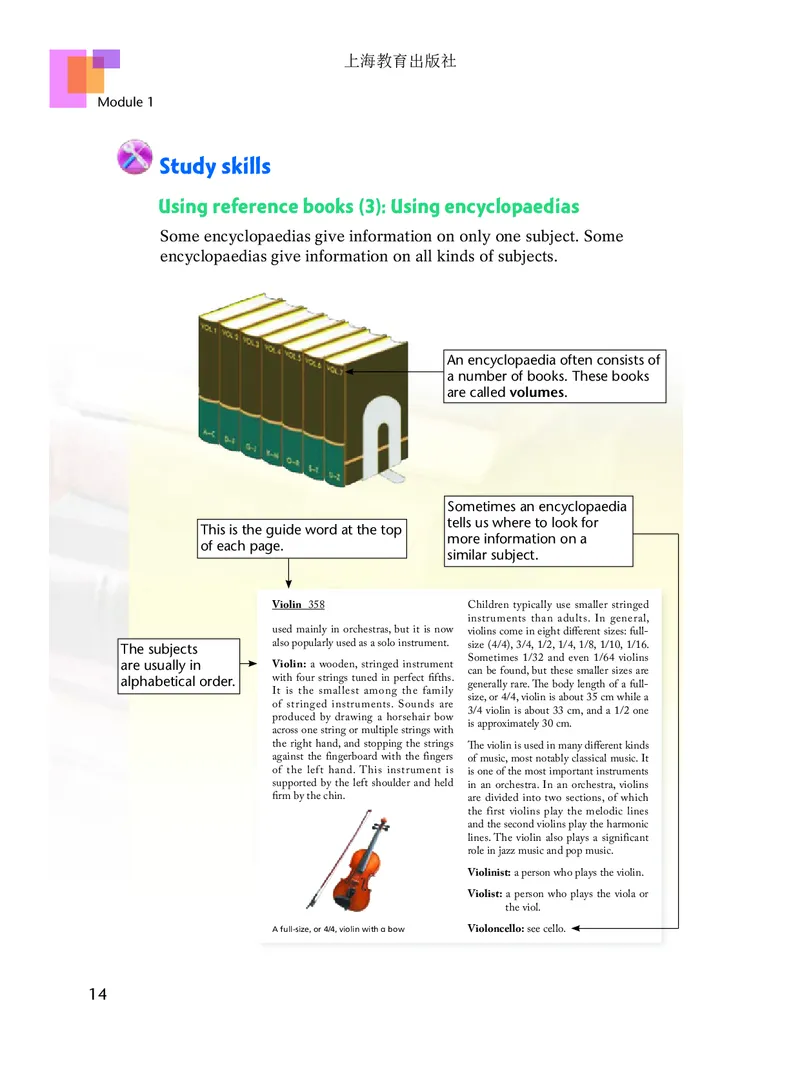
Study skills
Using reference books (3): Using encyclopaedias
Some encyclopaedias give information on only one subject. Some
encyclopaedias give information on all kinds of subjects.
An encyclopaedia often consists of
a number of books. These books
are called volumes.
Sometimes an encyclopaedia
tells us where to look for
This is the guide word at the top
more information on a
of each page.
similar subject.
Violin 358 Children typically use smaller stringed
instruments than adults. In general,
used mainly in orchestras, but it is now violins come in eight diff erent sizes: full-
The subjects also popularly used as a solo instrument. size (4/4), 3/4, 1/2, 1/4, 1/8, 1/10, 1/16.
are usually in Sometimes 1/32 and even 1/64 violins
Violin: a wooden, stringed instrument
can be found, but these smaller sizes are
alphabetical order. with four strings tuned in perfect fi fths.
generally rare. Th e body length of a full-
It is the smallest among the family
size, or 4/4, violin is about 35 cm while a
of stringed instruments. Sounds are
3/4 violin is about 33 cm, and a 1/2 one
produced by drawing a horsehair bow
is approximately 30 cm.
across one string or multiple strings with
the right hand, and stopping the strings Th e violin is used in many diff erent kinds
against the fingerboard with the fingers of music, most notably classical music. It
of the left hand. This instrument is is one of the most important instruments
supported by the left shoulder and held in an orchestra. In an orchestra, violins
fi rm by the chin. are divided into two sections, of which
the first violins play the melodic lines
and the second violins play the harmonic
lines. The violin also plays a significant
role in jazz music and pop music.
Violinist: a person who plays the violin.
Violist: a person who plays the viola or
the viol.
A full-size, or 4/4, violin with a bow Violoncello: see cello.
14上海教育出版社
Unit 1
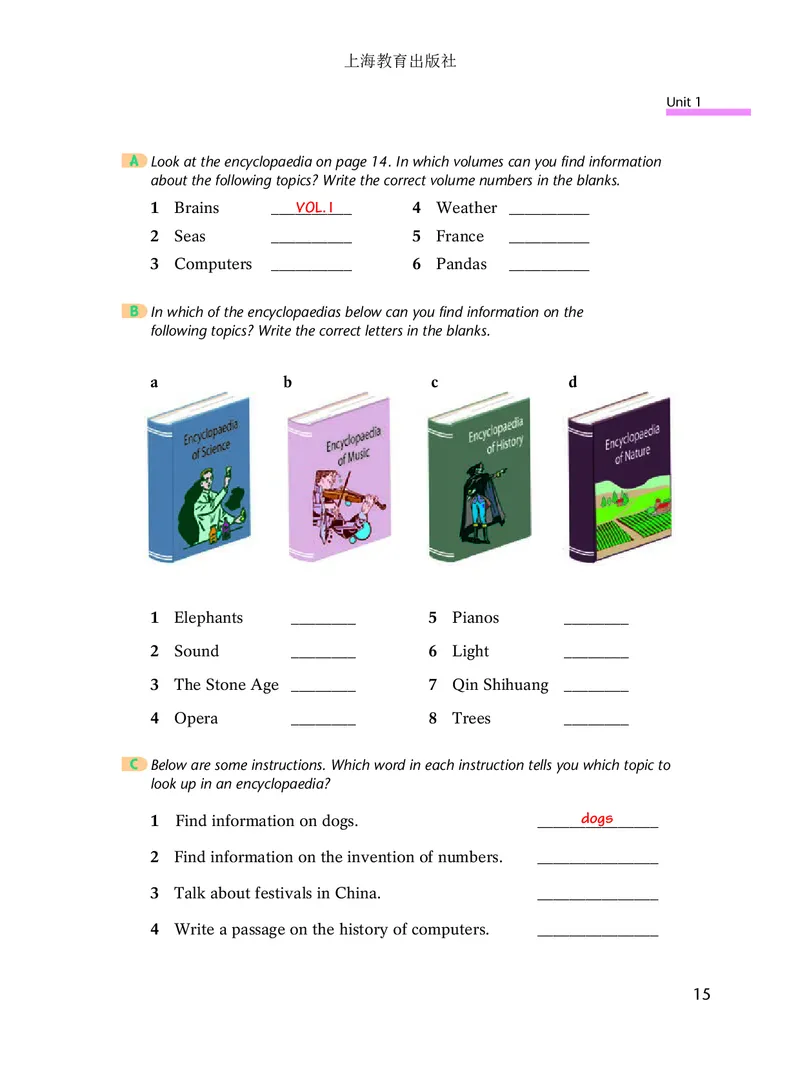
A Look at the encyclopaedia on page 14. In which volumes can you find information
about the following topics? Write the correct volume numbers in the blanks.
1 Brains ____V_O_L_. _I__ 4 Weather __________
2 Seas __________ 5 France __________
3 Computers __________ 6 Pandas __________
B In which of the encyclopaedias below can you find information on the
following topics? Write the correct letters in the blanks.
a b c d
1 Elephants ________ 5 Pianos ________
2 Sound ________ 6 Light ________
3 The Stone Age ________ 7 Qin Shihuang ________
4 Opera ________ 8 Trees ________
C Below are some instructions. Which word in each instruction tells you which topic to
look up in an encyclopaedia?
1 Find information on dogs. ______d_o_g_s______
2 Find information on the invention of numbers. _______________
3 Talk about festivals in China. _______________
4 Write a passage on the history of computers. _______________
15上海教育出版社
Module 1
Culture corner
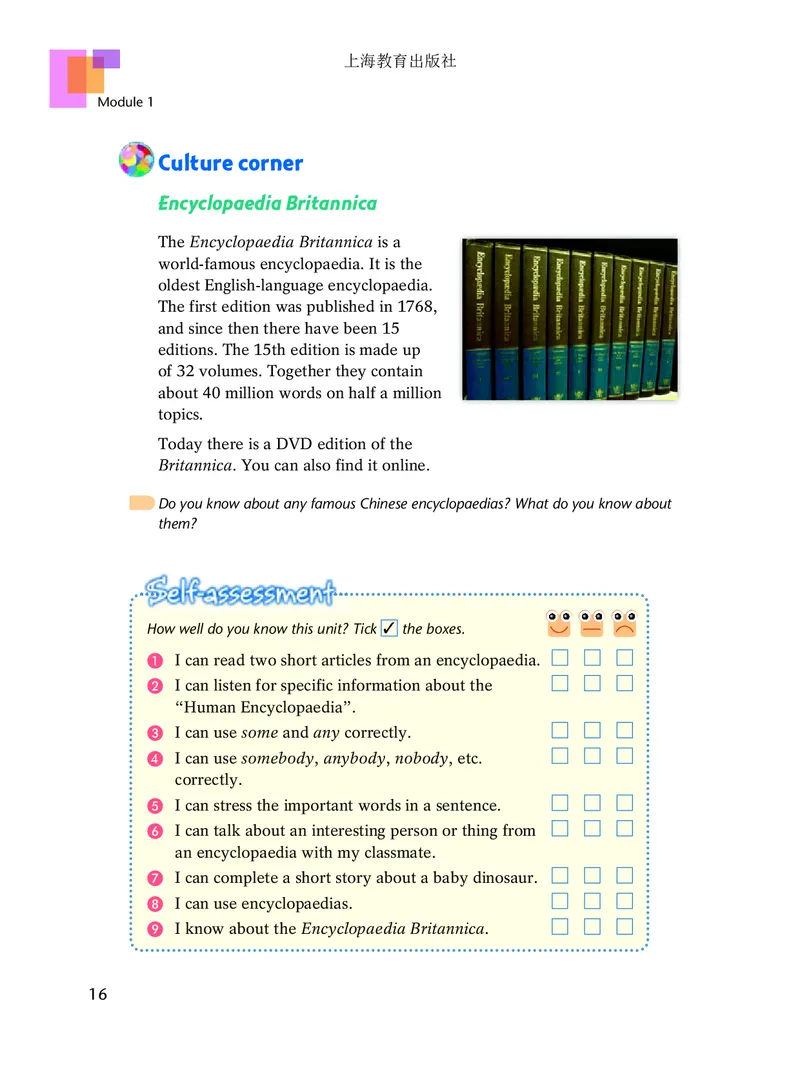
Encyclopaedia Britannica
The Encyclopaedia Britannica is a
world-famous encyclopaedia. It is the
oldest English-language encyclopaedia.
The first edition was published in 1768,
and since then there have been 15
editions. The 15th edition is made up
of 32 volumes. Together they contain
about 40 million words on half a million
topics.
Today there is a DVD edition of the
Britannica. You can also find it online.
Do you know about any famous Chinese encyclopaedias? What do you know about
them?
How well do you know this unit? Tick ✓ the boxes.
❶ I can read two short articles from an encyclopaedia.
❷ I can listen for specific information about the
“Human Encyclopaedia”.
❸ I can use some and any correctly.
❹ I can use somebody, anybody, nobody, etc.
correctly.
❺ I can stress the important words in a sentence.
❻ I can talk about an interesting person or thing from
an encyclopaedia with my classmate.
❼ I can complete a short story about a baby dinosaur.
❽ I can use encyclopaedias.
(cid:29) I know about the Encyclopaedia Britannica.
16上海教育出版社
Module 1 Amazing things
Unit
2
NNNuuummmbbbeeerrrsss
Getting ready
In this unit, you will learn about a different language—the language of numbers.
Reading
• Read a story about numbers.
Listening
• Listen to a quiz about numbers.
Grammar
• Learn how to use cardinal and ordinal numbers.
• Learn how to give instructions about numbers.
Speaking
• Learn to say the strong and weak forms of some words in a sentence.
• Check some Maths problems.
Writing
•• WWrriittee aa rreeppoorrtt wwiitthh nnuummbbeerrss..
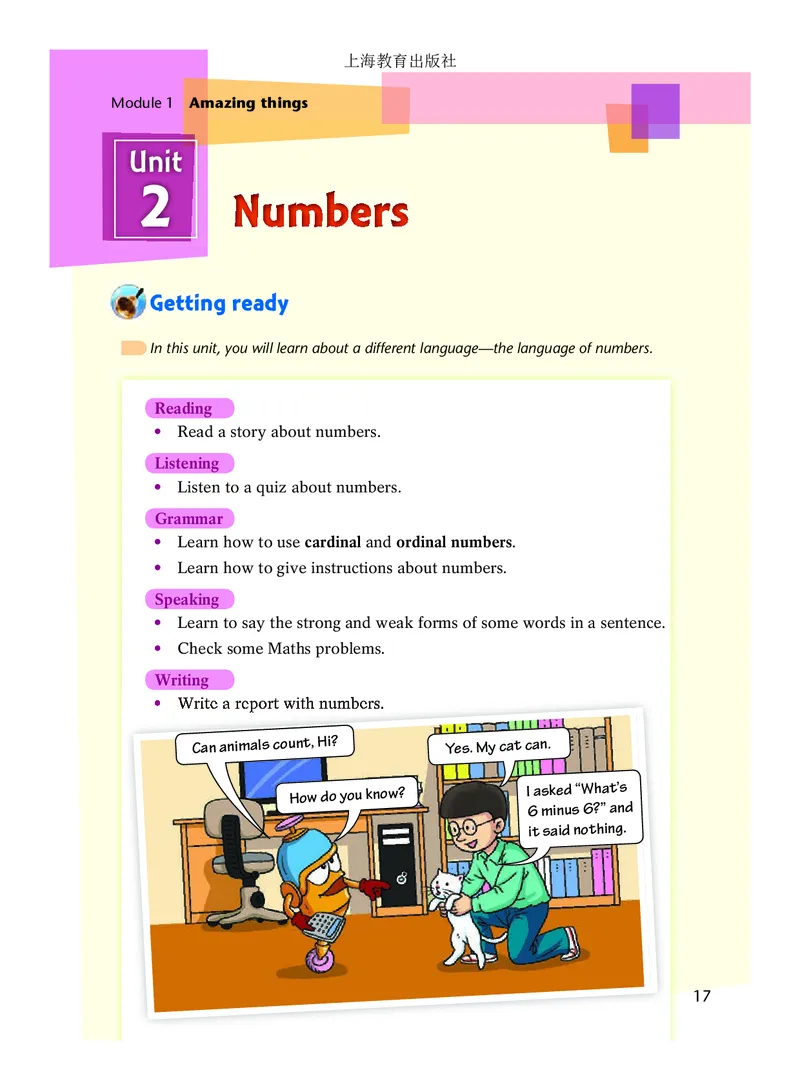
Can animals count, Hi? Yes. My cat can.
How do you know? I asked “What’s
6 minus 6?” and
it said nothing.
17上海教育出版社
Module 1
Reading
A What do you know about …?
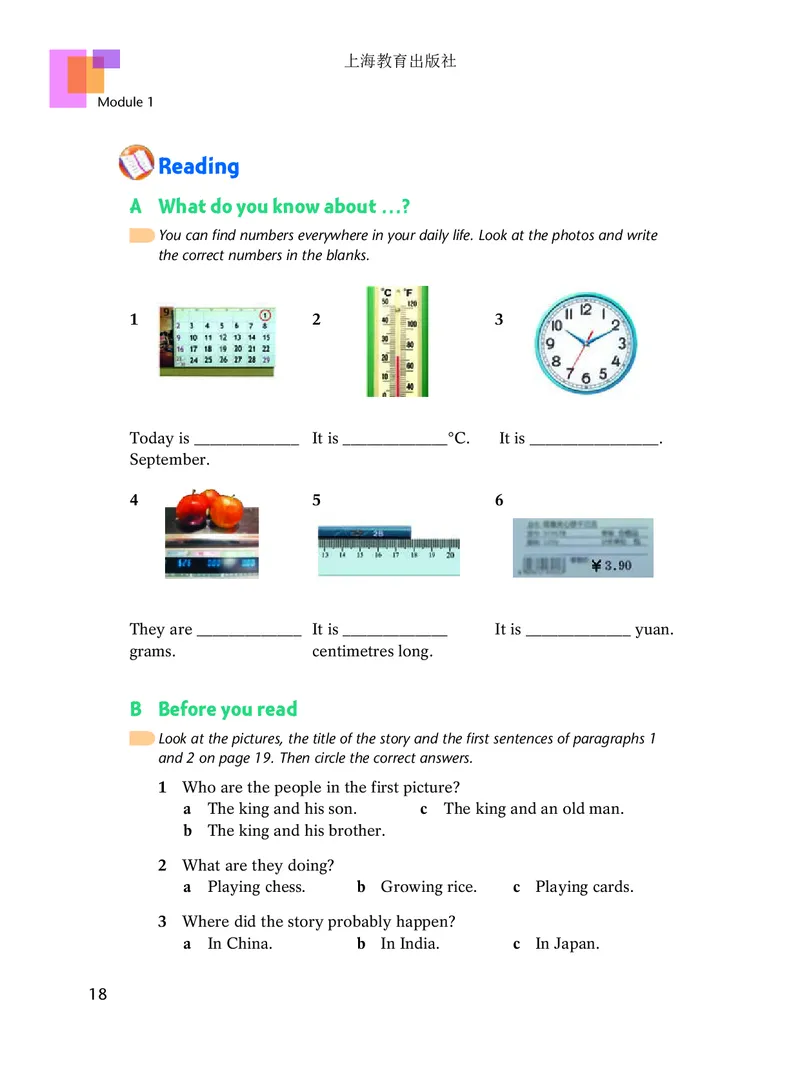
You can find numbers everywhere in your daily life. Look at the photos and write
the correct numbers in the blanks.
1 2 3
Today is _____________ It is _____________°C. It is ________________.
September.
4 5 6
They are _____________ It is _____________ It is _____________ yuan.
grams. centimetres long.
B Before you read
Look at the pictures, the title of the story and the first sentences of paragraphs 1
and 2 on page 19. Then circle the correct answers.
1 Who are the people in the first picture?
a The king and his son. c The king and an old man.
b The king and his brother.
2 What are they doing?
a Playing chess. b Growing rice. c Playing cards.
3 Where did the story probably happen?
a In China. b In India. c In Japan.
18上海教育出版社
Unit 2
The king and the rice
30
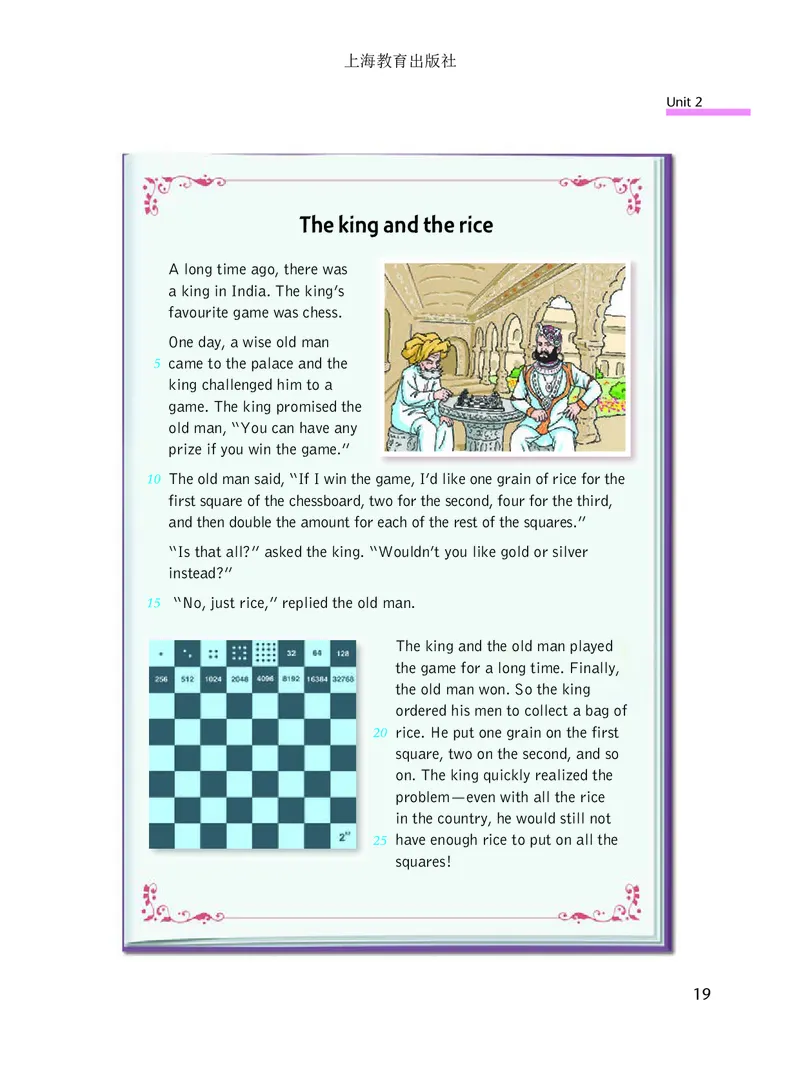
A long time ago, there was
a king in India. The king’s
favourite game was chess.
One day, a wise old man
5 came to the palace and the
35
king challenged him to a
game. The king promised the
old man, “You can have any
prize if you win the game.”
10 The old man said, “If I win the game, I’d like one grain of rice for the
first square of the chessboard, two for the second, four for the third,
and then double the amount for each of the 4re0st of the squares.”
“Is that all?” asked the king. “Wouldn’t you like gold or silver
instead?”
15 “No, just rice,” replied the old man.
The king and the old man played
the game for a long time. Finally,
the old man won. So the king
ordered his men to collect a bag of
20 rice. He put one grain on the first
45
square, two on the second, and so
on. The king quickly realized the
problem—even with all the rice
in the country, he would still not
25 have enough rice to put on all the
50
squares!
19上海教育出版社
Module 1
C Vocabulary
C1 The words in italics are from the story on page 19. Match the two halves of these
sentences to make them meaningful.
1 When you ask a wise person for a you tell him/her that you will
help, give him/her the present for
sure.
2 If you promise somebody a b you know something is
present, wrong.
3 If you get a prize in a game, c you get the number 4.
4 When you double the number 2, d you want him/her to give you
good advice.
5 When you realize the problem, e you win something for doing
very well.
C2 Complete the story below with the words from the box. Change their forms if
necessary.
double prize promise realize wise
A young man once talked to a (_1)___________ old man. “I won a
_(2)___________ and have a little gold now, but I want much more,” he
said. “Can you help me?”
The old man looked at him. “I can teach you how to make more money
if you (_3)___________ to follow my advice,” he said.
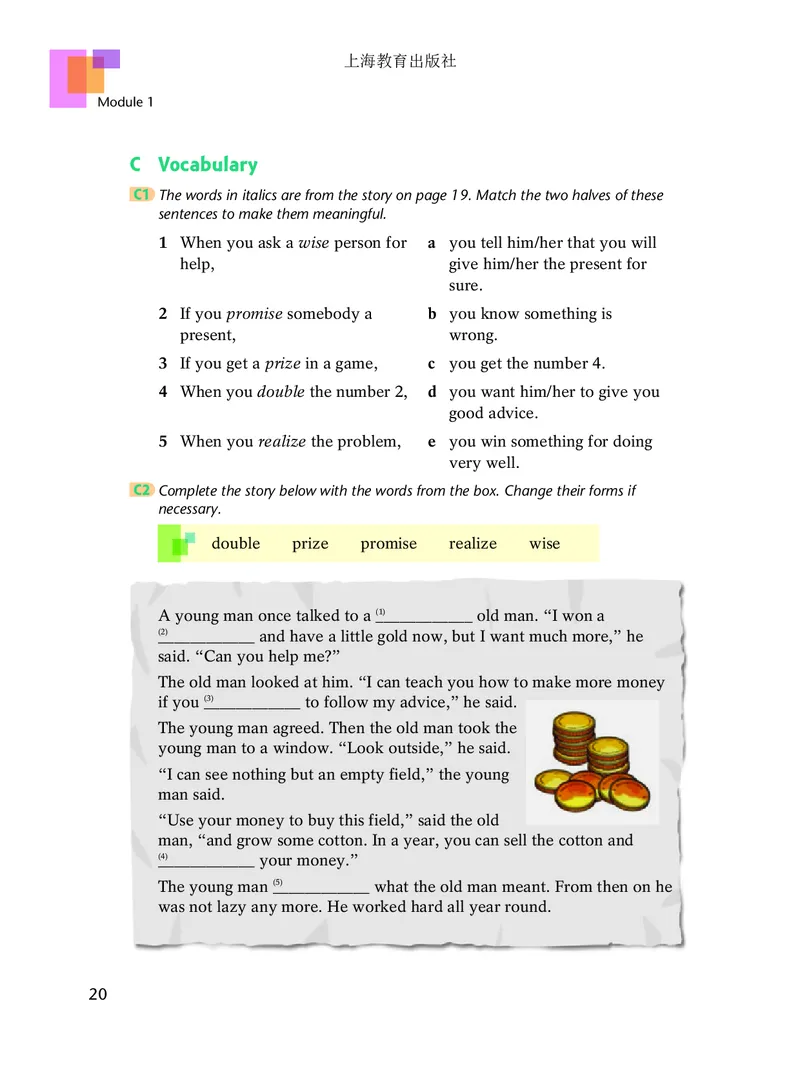
The young man agreed. Then the old man took the
young man to a window. “Look outside,” he said.
“I can see nothing but an empty field,” the young
man said.
“Use your money to buy this field,” said the old
man, “and grow some cotton. In a year, you can sell the cotton and
_(4)___________ your money.”
The young man (_5)___________ what the old man meant. From then on he
was not lazy any more. He worked hard all year round.
20上海教育出版社
Unit 2
D Comprehension
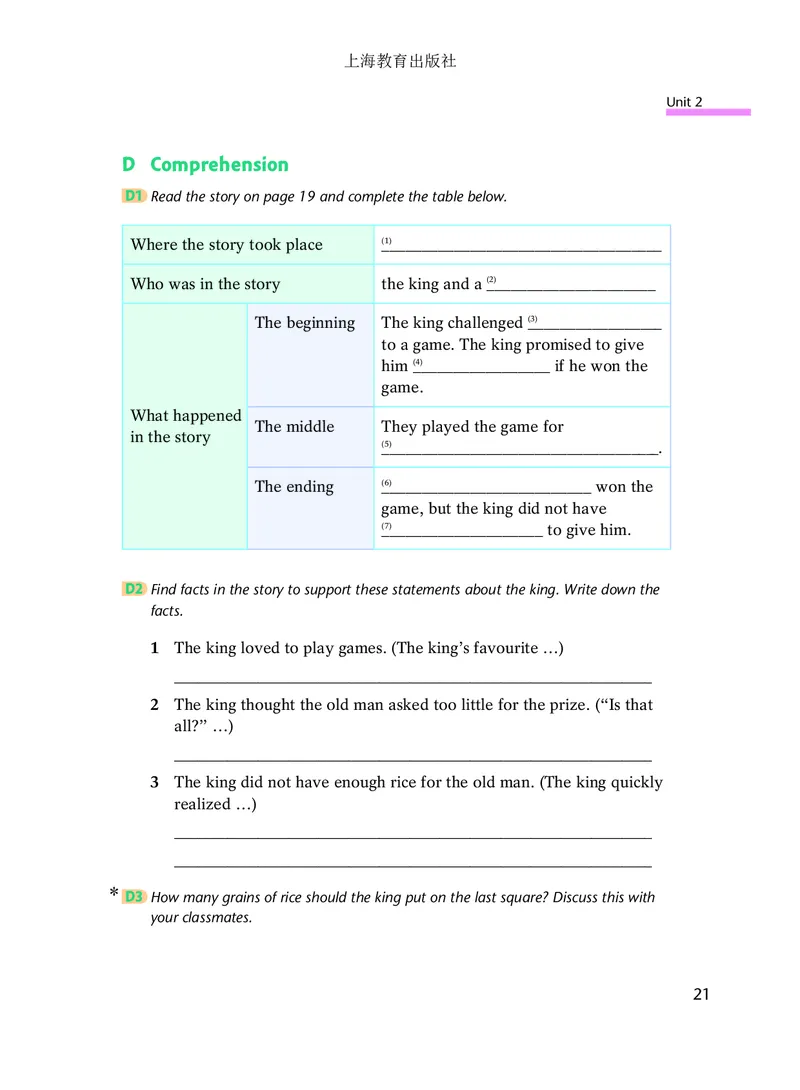
D1 Read the story on page 19 and complete the table below.
Where the story took place _(1)__________________________________
Who was in the story the king and a (_2)____________________
The beginning The king challenged (_3)________________
to a game. The king promised to give
him _(4)________________ if he won the
game.
What happened
The middle They played the game for
in the story
_(5)__________________________________.
The ending _(6)_________________________ won the
game, but the king did not have
_(7)___________________ to give him.
D2 Find facts in the story to support these statements about the king. Write down the
facts.
1 The king loved to play games. (The king’s favourite …)
_______________________________________________________________
2 The king thought the old man asked too little for the prize. (“Is that
all?” …)
_______________________________________________________________
3 The king did not have enough rice for the old man. (The king quickly
realized …)
_______________________________________________________________
_______________________________________________________________
(cid:43)
D3 How many grains of rice should the king put on the last square? Discuss this with
your classmates.
21上海教育出版社
Module 1
Listening
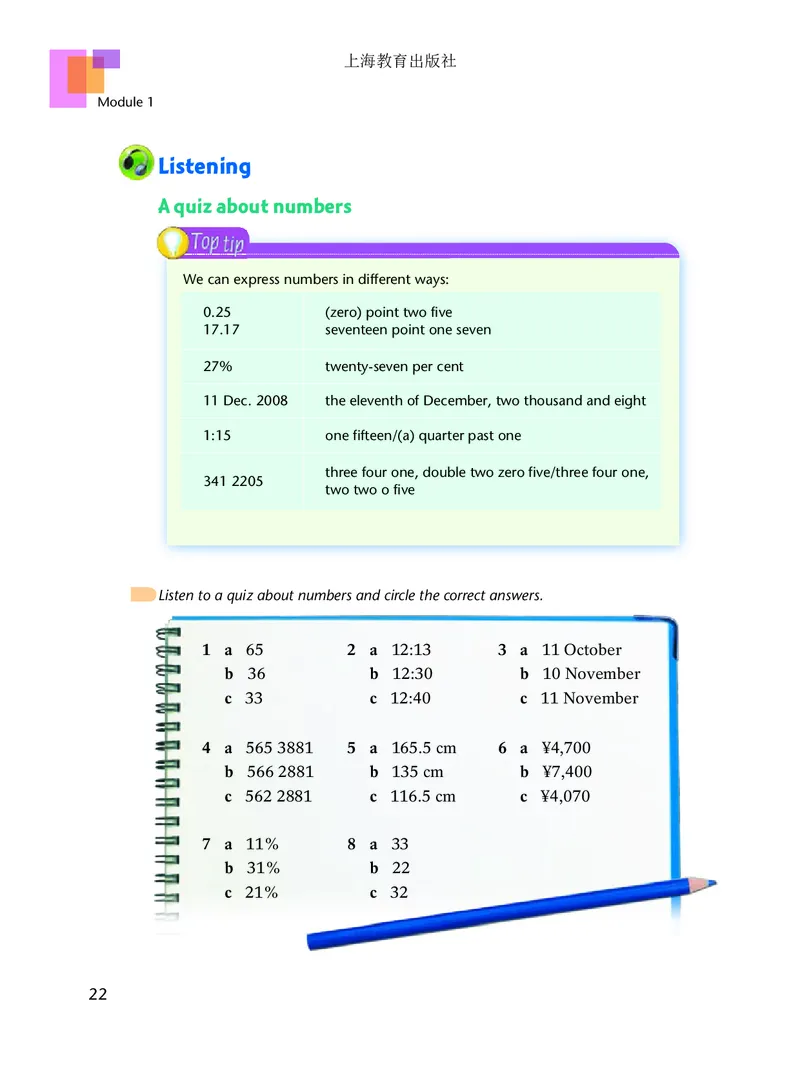
A quiz about numbers
We can express numbers in different ways:
0.25 (zero) point two five
17.17 seventeen point one seven
27% twenty-seven per cent
11 Dec. 2008 the eleventh of December, two thousand and eight
1:15 one fifteen/(a) quarter past one
three four one, double two zero five/three four one,
341 2205
two two o five
Listen to a quiz about numbers and circle the correct answers.
1 a 65 2 a 12:13 3 a 11 October
b 36 b 12:30 b 10 November
c 33 c 12:40 c 11 November
4 a 565 3881 5 a 165.5 cm 6 a ¥4,700
b 566 2881 b 135 cm b ¥7,400
c 562 2881 c 116.5 cm c ¥4,070
7 a 11% 8 a 33
b 31% b 22
c 21% c 32
22上海教育出版社
Unit 2
Grammar
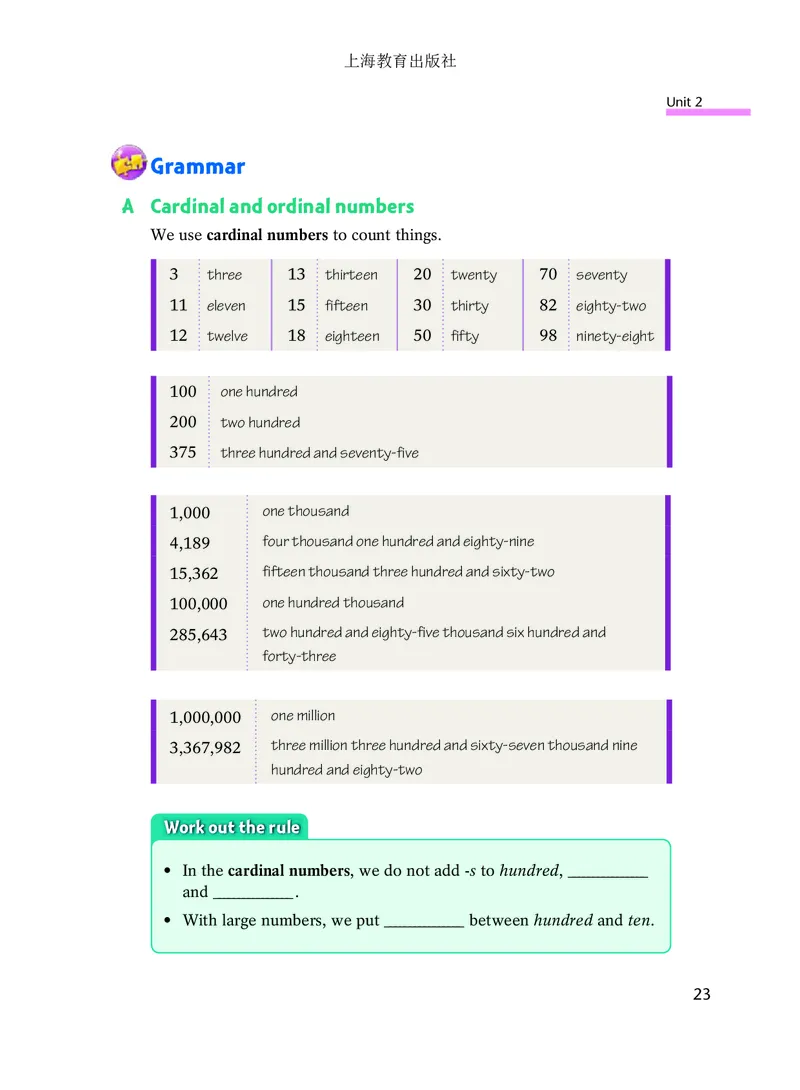
A Cardinal and ordinal numbers
We use cardinal numbers to count things.
3 three 13 thirteen 20 twenty 70 seventy
11 eleven 15 fifteen 30 thirty 82 eighty-two
12 twelve 18 eighteen 50 fifty 98 ninety-eight
100 one hundred
200 two hundred
375 three hundred and seventy-five
1,000 one thousand
4,189 four thousand one hundred and eighty-nine
15,362 fifteen thousand three hundred and sixty-two
100,000 one hundred thousand
285,643 two hundred and eighty-five thousand six hundred and
forty-three
1,000,000 one million
3,367,982 three million three hundred and sixty-seven thousand nine
hundred and eighty-two
Work out the rule
• (cid:42)n the cardinal numbers, we do not add -s to hundred, ________________
and ________________ .
• With large numbers(cid:13) we put ________________ between hundred and ten.
23上海教育出版社
Module 1
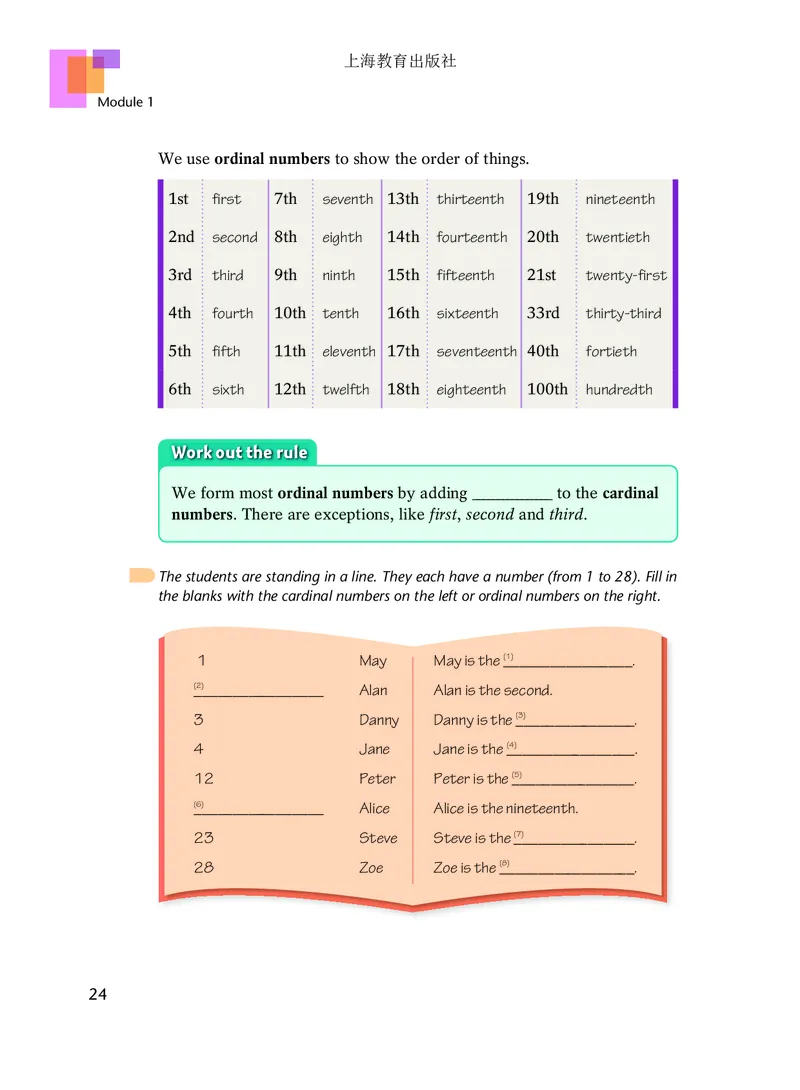
We use ordinal numbers to show the order of things.
1st first 7th seventh 13th thirteenth 19th nineteenth
2nd second 8th eighth 14th fourteenth 20th twentieth
3rd third 9th ninth 15th fifteenth 21st twenty-first
4th fourth 10th tenth 16th sixteenth 33rd thirty-third
5th fifth 11th eleventh 17th seventeenth 40th fortieth
6th sixth 12th twelfth 18th eighteenth 100th hundredth
Work out the rule
We form most ordinal numbers by adding ________________ to the cardinal
numbers. There are exceptions, like first, second and third.
The students are standing in a line. They each have a number (from 1 to 28). Fill in
the blanks with the cardinal numbers on the left or ordinal numbers on the right.
1 May May is the (_1)________________.
(_2)________________ Alan Alan is the second.
3 Danny Danny is the (_3)_______________.
4 Jane Jane is the (_4)________________.
12 Peter Peter is the (_5)_______________.
(_6)________________ Alice Alice is the nineteenth.
23 Steve Steve is the (_7)_______________.
28 Zoe Zoe is the (_8)_________________.
24上海教育出版社
Unit 2
B Instructions about numbers
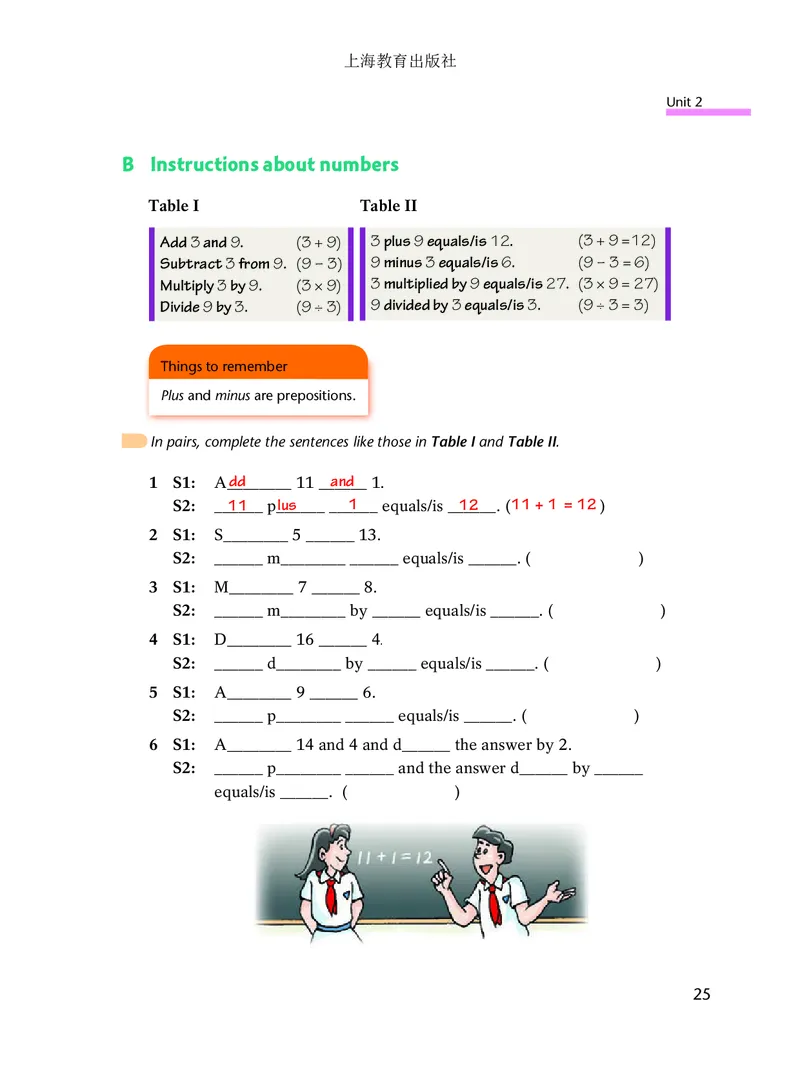
Table I Table II
Add 3 and 9. (3 + 9) 3 plus 9 equals/is 12. (3 + 9 =12)
Subtract 3 from 9. (9 - 3) 9 minus 3 equals/is 6. (9 - 3 = 6)
Multiply 3 by 9. (3 × 9) 3 multiplied by 9 equals/is 27. (3 × 9 = 27)
Divide 9 by 3. (9 ÷ 3) 9 divided by 3 equals/is 3. (9 ÷ 3 = 3)
Things to remember
Plus and minus are prepositions.
In pairs, complete the sentences like those in Table I and Table II.
1 S1: A_d_d______ 11 __a_n_d__ 1.
S2: __1_1___ p_lu_s____ ___1___ equals/is __1_2___. ( 1 1 + 1 = 1 2 )
2 S1: S________ 5 ______ 13.
S2: ______ m________ ______ equals/is ______. ( )
3 S1: M________ 7 ______ 8.
S2: ______ m________ by ______ equals/is ______. ( )
4 S1: D________ 16 ______ 4.
S2: ______ d________ by ______ equals/is ______. ( )
5 S1: A________ 9 ______ 6.
S2: ______ p________ ______ equals/is ______. ( )
6 S1: A________ 14 and 4 and d______ the answer by 2.
S2: ______ p________ ______ and the answer d______ by ______
equals/is ______. ( )
25上海教育出版社
Module 1
Speaking
A Talk time
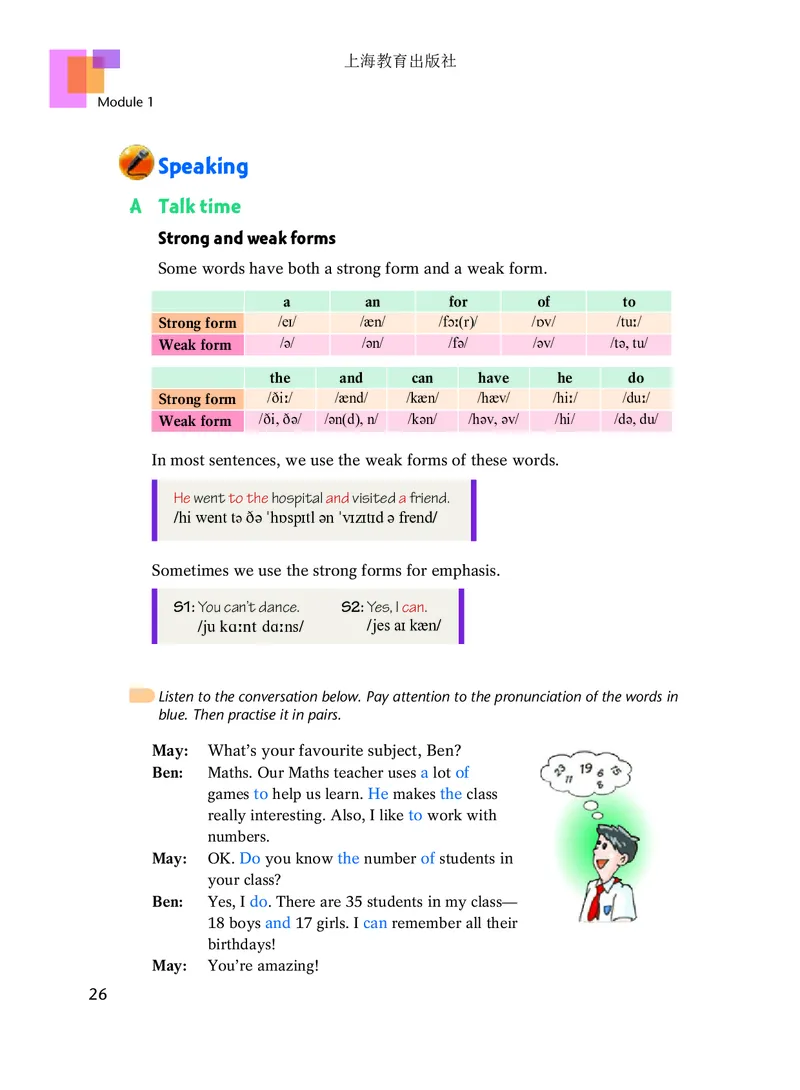
Strong and weak forms
Some words have both a strong form and a weak form.
a an for of to
Strong form /eI/ /Cn/ /fO:(r)/ /Bv/ /tu:/
Weak form /R/ /Rn/ /fR/ /Rv/ /tR, tu/
the and can have he do
Strong form /Qi:/ /Cnd/ /kCn/ /hCv/ /hi:/ /du:/
Weak form /Qi, QR/ /Rn(d), n/ /kRn/ /hRv, Rv/ /hi/ /dR, du/
In most sentences, we use the weak forms of these words.
He went to the hospital and visited a friend.
/hi went tR QR 3hBspItl Rn 3vIzItId R frend/
Sometimes we use the strong forms for emphasis.
S1: You can’t dance. S2: Yes, I can.
/ju(cid:0)(cid:72)(cid:31):(cid:75)(cid:81) dA:ns/ /jes aI kCn/
Listen to the conversation below. Pay attention to the pronunciation of the words in
blue. Then practise it in pairs.
May: What’s your favourite subject, Ben?
Ben: Maths. Our Maths teacher uses a lot of
games to help us learn. He makes the class
really interesting. Also, I like to work with
numbers.
May: OK. Do you know the number of students in
your class?
Ben: Yes, I do. There are 35 students in my class—
18 boys and 17 girls. I can remember all their
birthdays!
May: You’re amazing!
26上海教育出版社
Unit 2
B Speak up
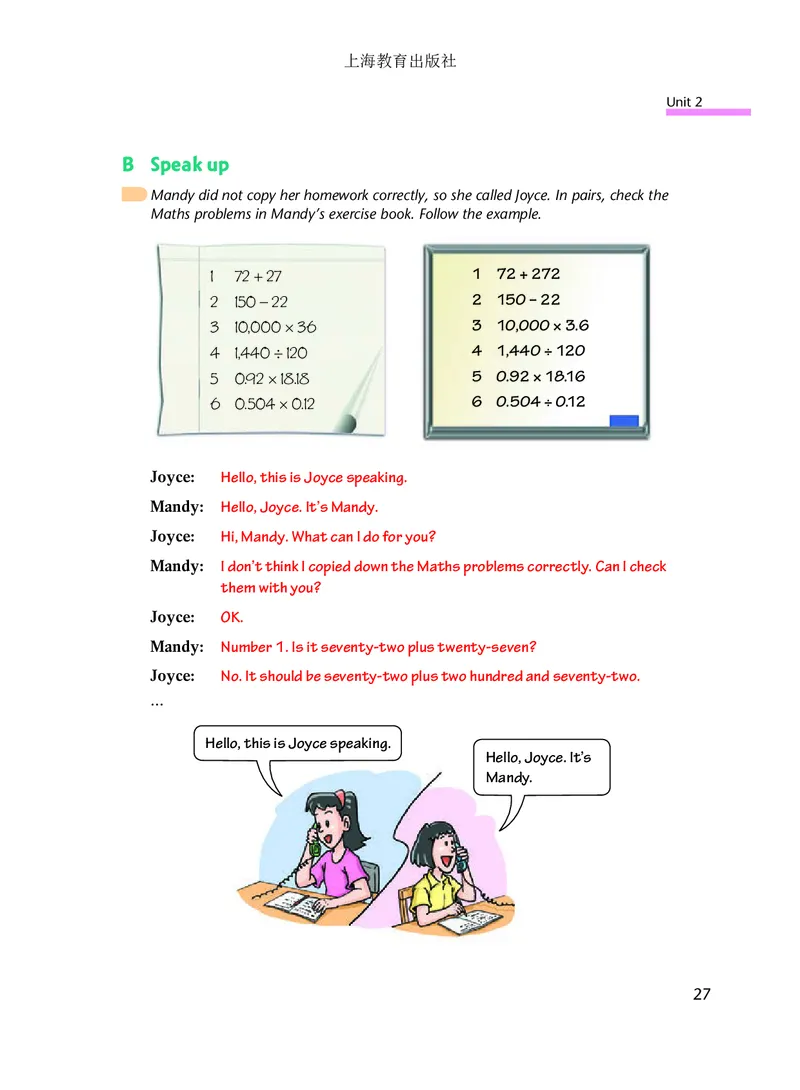
Mandy did not copy her homework correctly, so she called Joyce. In pairs, check the
Maths problems in Mandy’s exercise book. Follow the example.
1 72 + 27 1 72 + 272
2 150 – 22 2 150 – 22
3 10,000 × 36 3 10,000 × 3.6
4 1,440 ÷ 120 4 1,440 ÷ 120
the and can have he do 5 0.92 × 18.18 5 0.92 × 18.16
Strong form /Qi:/ /Cnd/ /kCn/ /hCv/ /hi:/ /du:/ 6 0.504 × 0.12 6 0.504 ÷ 0.12
Weak form /Qi, QR/ /Rn(d), n/ /kRn/ /hRv, Rv/ /hi/ /dR, du/
Joyce: Hello, this is Joyce speaking.
Mandy: Hello, Joyce. It’s Mandy.
Joyce: Hi, Mandy. What can I do for you?
Mandy: I don’t think I copied down the Maths problems correctly. Can I check
them with you?
Joyce: OK.
Mandy: Number 1. Is it seventy-two plus twenty-seven?
Joyce: No. It should be seventy-two plus two hundred and seventy-two.
...
Hello, this is Joyce speaking.
Hello, Joyce. It’s
Mandy.
27Module 1
Writing
A report with numbers
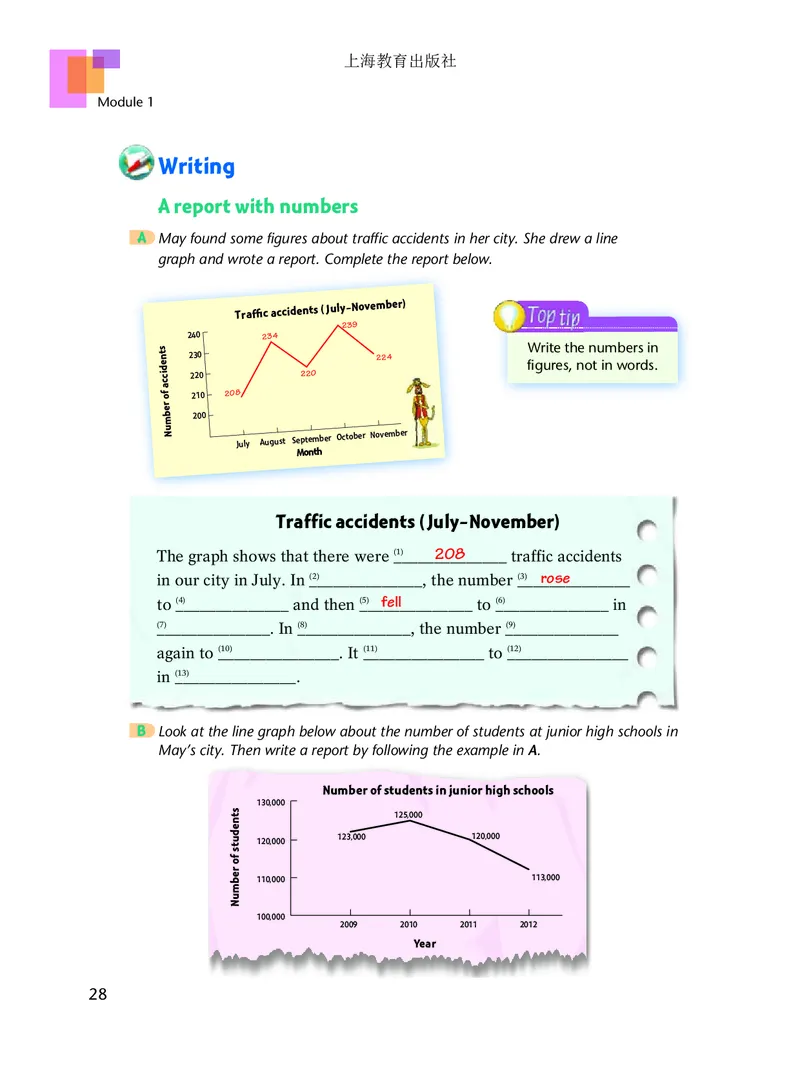
A May found some figures about traffic accidents in her city. She drew a line
graph and wrote a report. Complete the report below.
Write the numbers in
figures, not in words.
Traffic accidents (July–November)
The graph shows that there were (_1)_____2_0_8______ traffic accidents
in our city in July. In _(2)_____________, the number (_3)__r_o_s_e________
to _(4)_____________ and then (_5)__f_e_ll_________ to (_6)_____________ in
_(7)_____________. In (_8)_____________, the number (_9)_____________
again to _(10_)_____________. It (_11_)_____________ to (_12_)_____________
in _(13_)_____________.
B Look at the line graph below about the number of students at junior high schools in
May’s city. Then write a report by following the example in A.
28
stneduts
fo
rebmuN
上海教育出版社
Traffic accidents (
July–November)
239
240 234
s
t n 230 224
e
d
ic 220 220
c
a
fo 210 208
r
e
b 200
m
u N July August September October November
Month
Number of students in junior high schools
130,000
125,000
123,000 120,000
120,000
110,000 113,000
100,000
2009 2010 2011 2012
Year上海教育出版社
Unit 2
(cid:43)
More practice
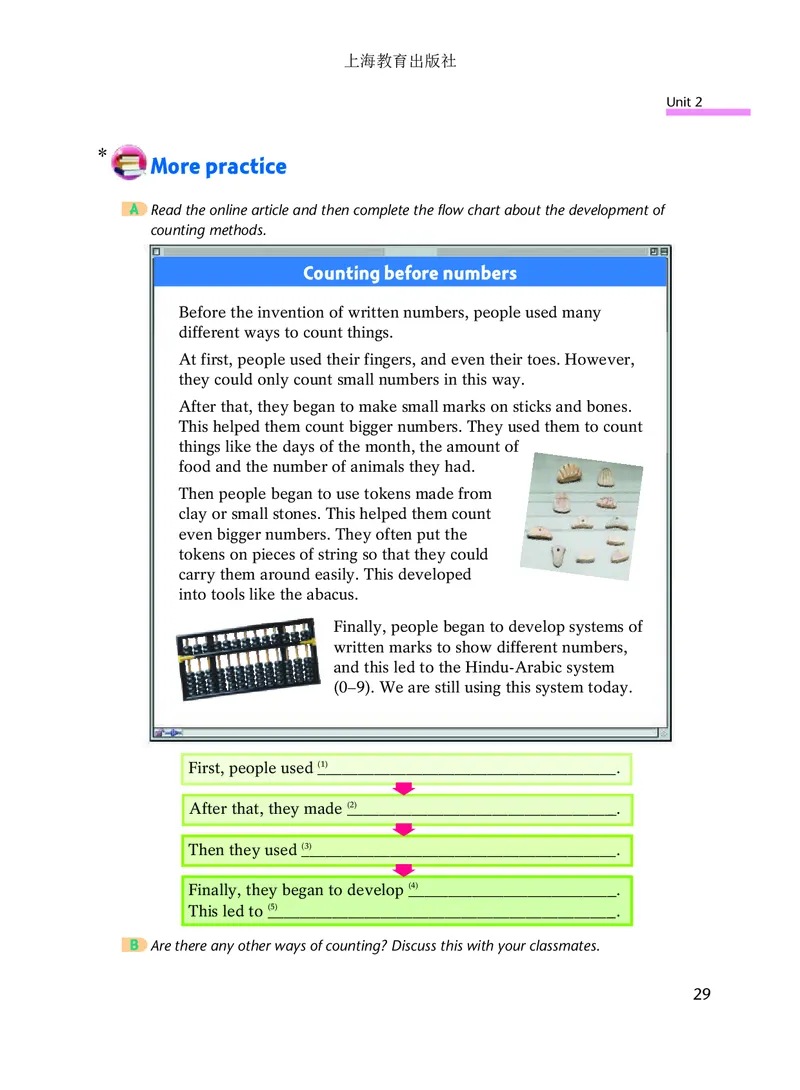
A Read the online article and then complete the flow chart about the development of
counting methods.
Counting before numbers
Before the invention of written numbers, people used many
different ways to count things.
At first, people used their fingers, and even their toes. However,
they could only count small numbers in this way.
After that, they began to make small marks on sticks and bones.
This helped them count bigger numbers. They used them to count
things like the days of the month, the amount of
food and the number of animals they had.
Then people began to use tokens made from
clay or small stones. This helped them count
even bigger numbers. They often put the
tokens on pieces of string so that they could
carry them around easily. This developed
into tools like the abacus.
Finally, people began to develop systems of
written marks to show different numbers,
and this led to the Hindu-Arabic system
(0–9). We are still using this system today.
First, people used (_1)____________________________________.
After that, they made (_2)_________________________________.
Then they used (_3)______________________________________.
Finally, they began to develop (_4)__________________________.
This led to _(5)___________________________________________.
B Are there any other ways of counting? Discuss this with your classmates.
29上海教育出版社
Module 1
Culture corner
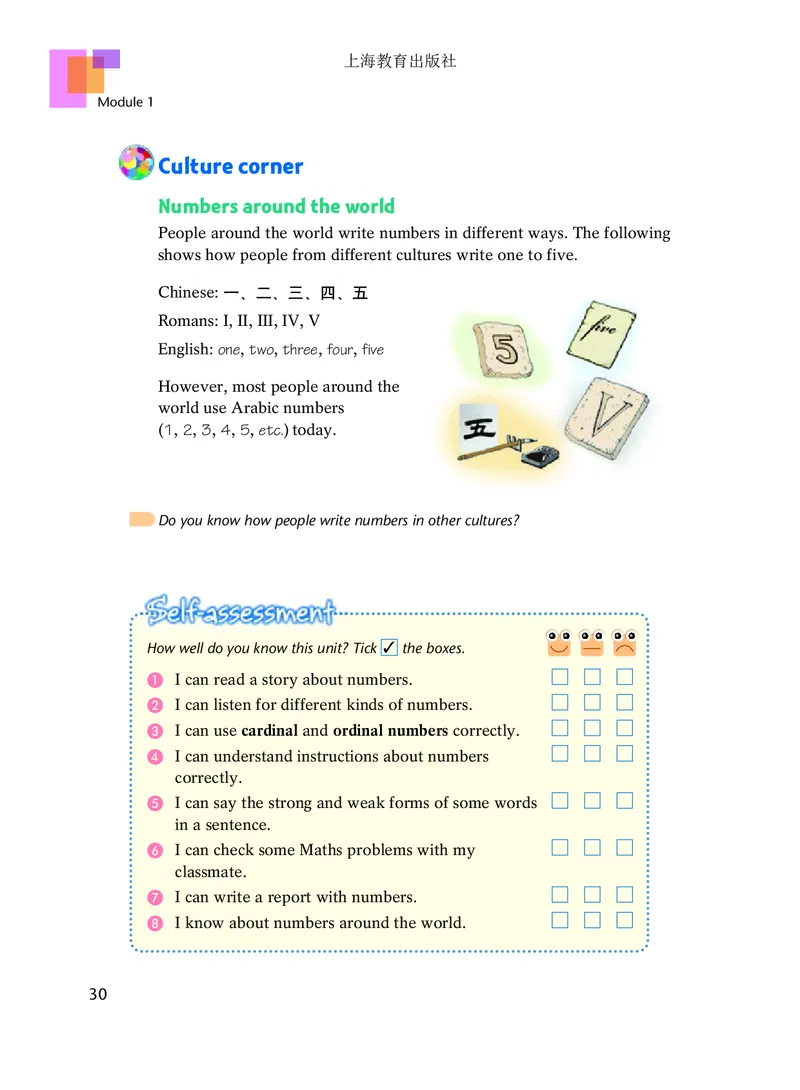
Numbers around the world
People around the world write numbers in different ways. The following
shows how people from different cultures write one to five.
Chinese: 一、二、三、四、五
Romans: I, II, III, IV, V
English: one, two, three, four, five
However, most people around the
world use Arabic numbers
(1, 2, 3, 4, 5, etc.) today.
Do you know how people write numbers in other cultures?
How well do you know this unit? Tick ✓ the boxes.
❶ I can read a story about numbers.
❷ I can listen for different kinds of numbers.
❸ I can use cardinal and ordinal numbers correctly.
❹ I can understand instructions about numbers
correctly.
❺ I can say the strong and weak forms of some words
in a sentence.
❻ I can check some Maths problems with my
classmate.
❼ I can write a report with numbers.
❽ I know about numbers around the world.
30上海教育出版社
Unit 2
(cid:43)
PPPrrrooojjjeeecccttt
A mini-encyclopaedia of numbers
How much do you know about numbers? In this project, you will make a
mini-encyclopaedia of numbers.
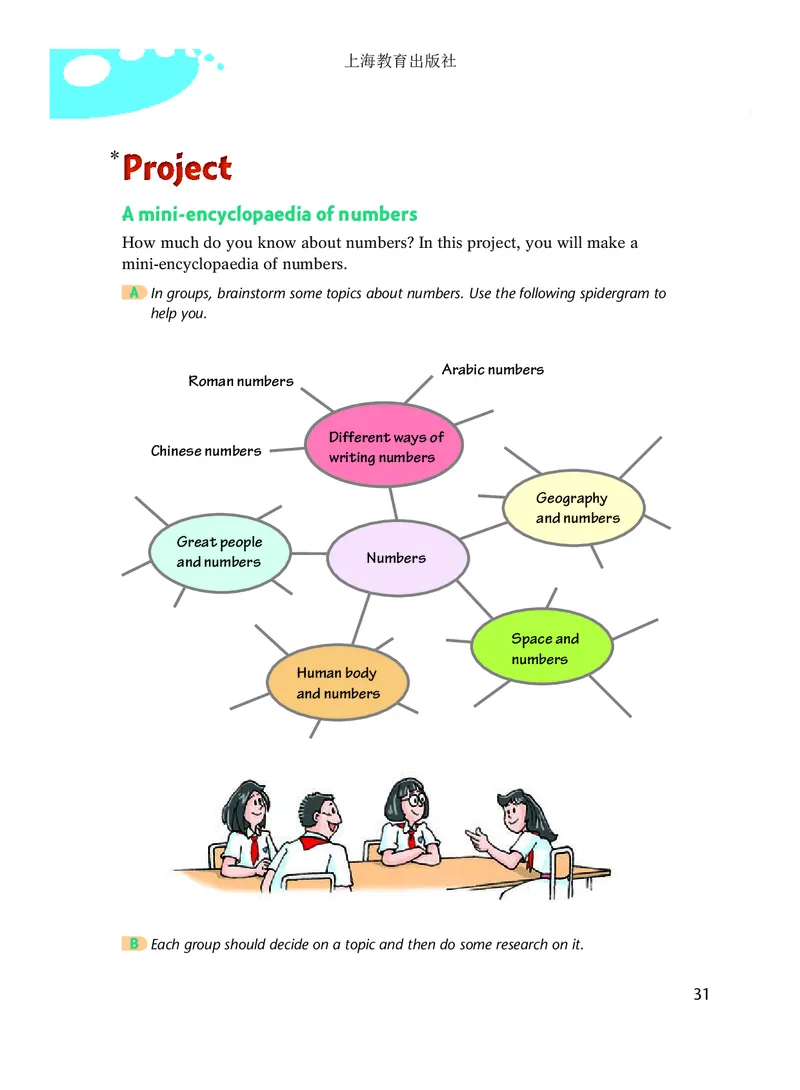
A In groups, brainstorm some topics about numbers. Use the following spidergram to
help you.
Arabic numbers
Roman numbers
Different ways of
Chinese numbers
writing numbers
Geography
and numbers
Great people
Numbers
and numbers
Space and
numbers
Human body
and numbers
B Each group should decide on a topic and then do some research on it.
31上海教育出版社
Module 1
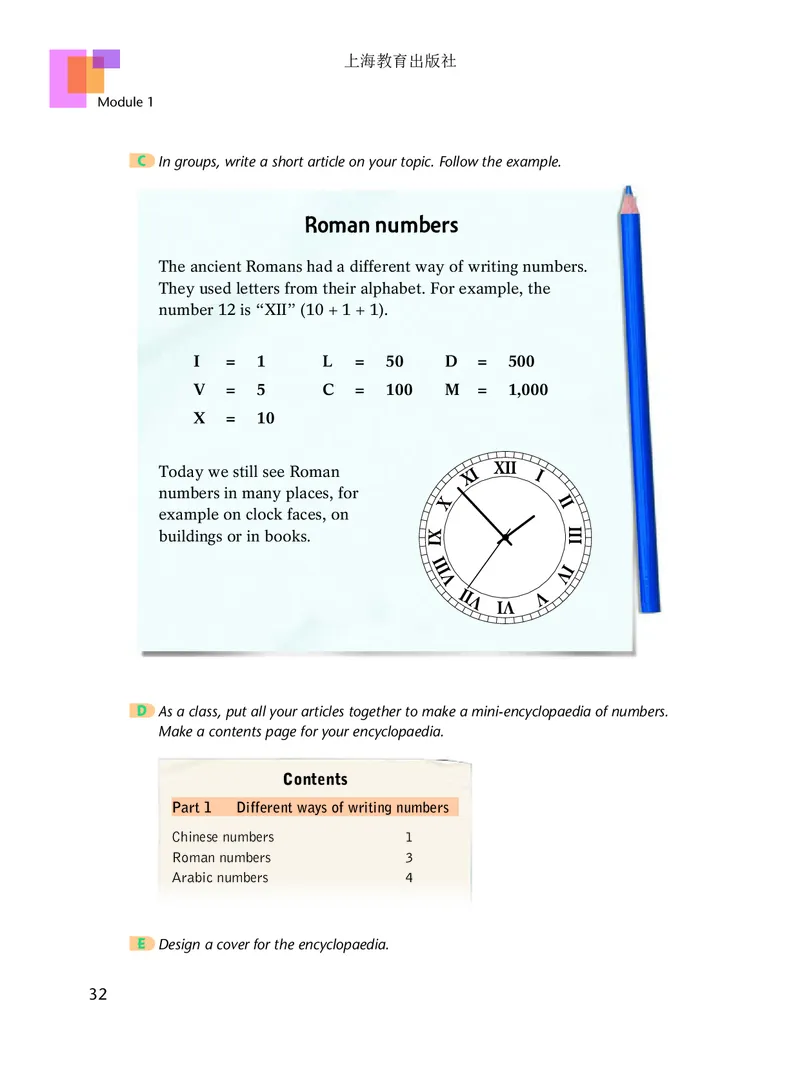
C In groups, write a short article on your topic. Follow the example.
Roman numbers
The ancient Romans had a different way of writing numbers.
They used letters from their alphabet. For example, the
number 12 is “XII” (10 + 1 + 1).
I = 1 L = 50 D = 500
V = 5 C = 100 M = 1,000
X = 10
Today we still see Roman XI XII I
numbers in many places, for
X I I
example on clock faces, on
buildings or in books. X I I
I I
I
I I V V I
IIV V
IV
D As a class, put all your articles together to make a mini-encyclopaedia of numbers.
Make a contents page for your encyclopaedia.
Contents
Part 1 Different ways of writing numbers
Chinese numbers 1
Roman numbers 3
Arabic numbers 4
E Design a cover for the encyclopaedia.
32上海教育出版社
Module 2 Science and technology
Unit
3
CCCooommmpppuuuttteeerrrsss
Getting ready
(cid:3)In this unit, you will learn some facts about computers.
Reading
• Read an article about computers.
Listening
• Listen to a woman making a phone order.
Grammar
• Learn how to compare things by using the comparative of adjectives.
• Learn how to compare things by using the superlative of adjectives.
Speaking
• Learn to give extra stress to the most important word in a sentence.
• Do a survey about using computers at home.
Writing
• WWrriittee aann eemmaaiill aabboouutt mmoonniittoorrss..
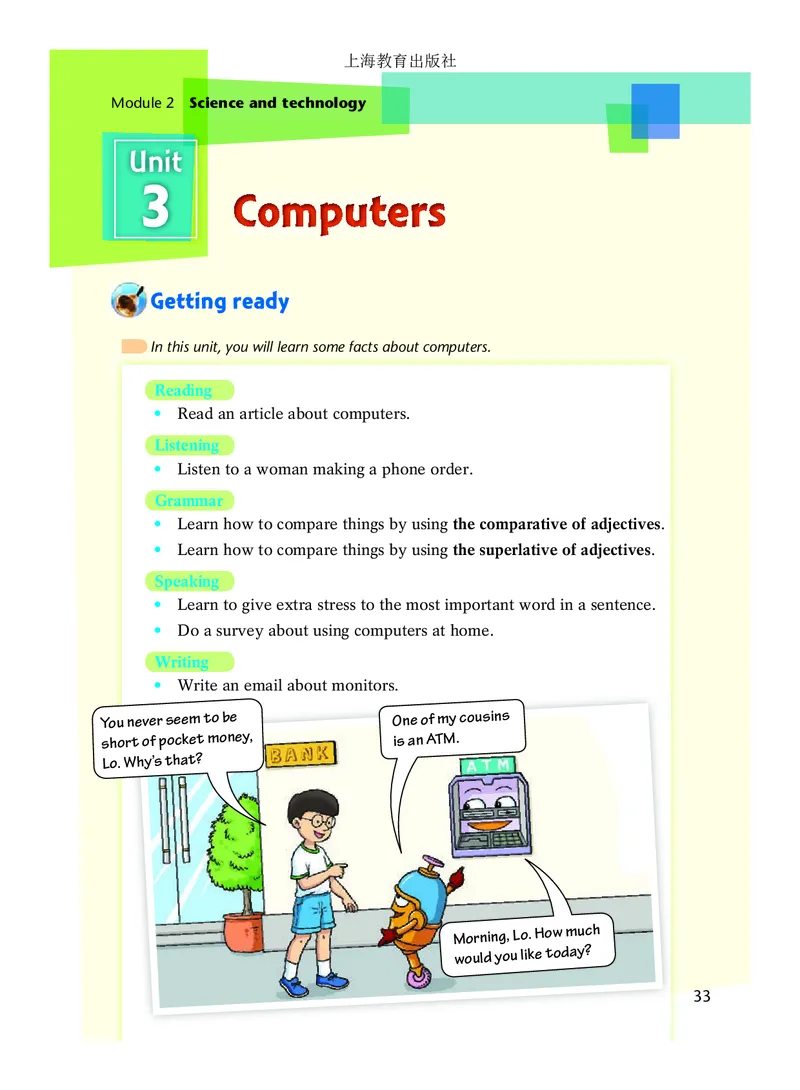
You never seem to be One of my cousins
short of pocket money, is an ATM.
Lo. Why’s that?
Morning, Lo. How much
would you like today?
33上海教育出版社
Module 2
Reading
A What do you know about …?
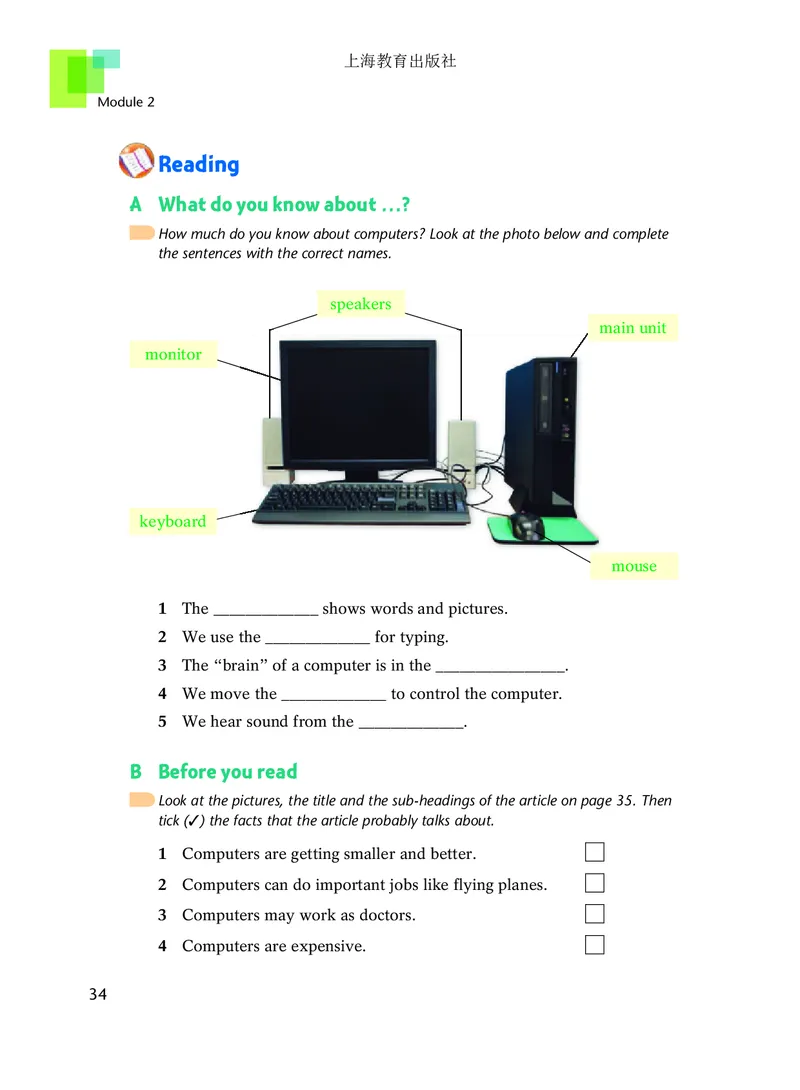
How much do you know about computers? Look at the photo below and complete
the sentences with the correct names.
speakers
mmaaiinn uunniitt
monitor
keyboard
mouse
1 The _____________ shows words and pictures.
2 We use the _____________ for typing.
3 The “brain” of a computer is in the ________________.
4 We move the _____________ to control the computer.
5 We hear sound from the _____________.
B Before you read
Look at the pictures, the title and the sub-headings of the article on page 35. Then
tick ((cid:22)) the facts that the article probably talks about.
1 Computers are getting smaller and better.
2 Computers can do important jobs like flying planes.
3 Computers may work as doctors.
4 Computers are expensive.
34上海教育出版社
Unit 3
Computer facts
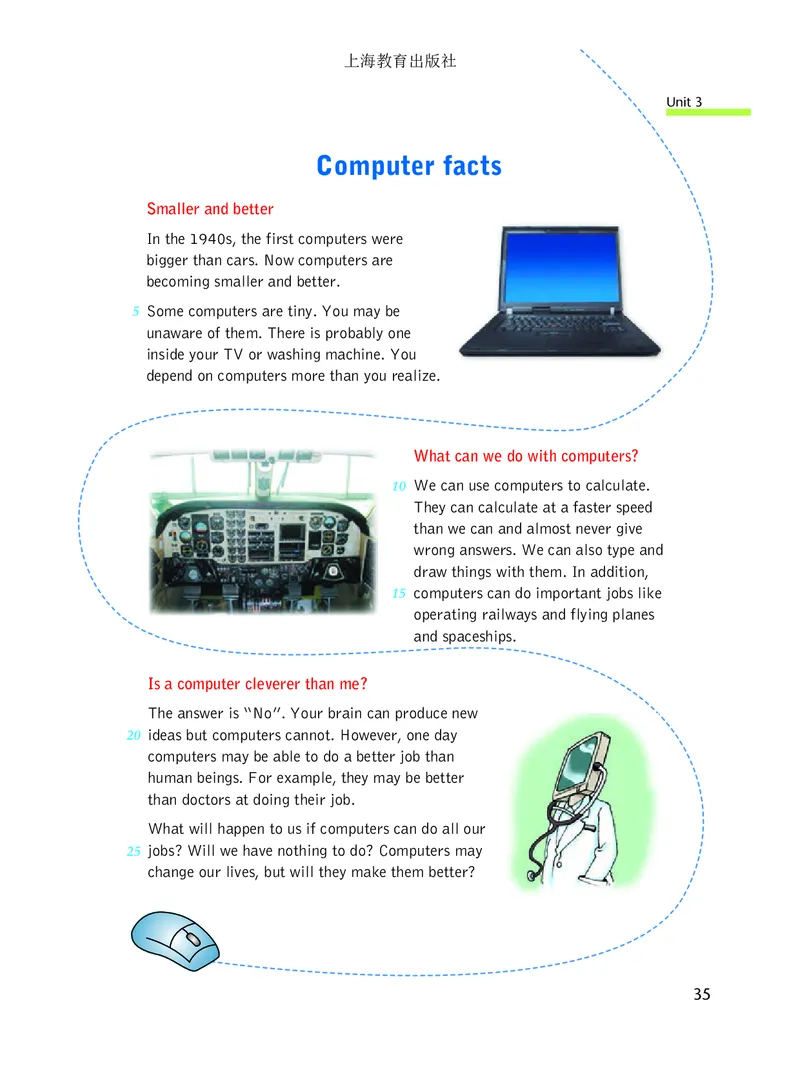
Smaller and better
In the 1940s, the first computers were
bigger than cars. Now computers are
becoming smaller and better.
5 Some computers are tiny. You may be
unaware of them. There is probably one
inside your TV or washing machine. You
depend on computers more than you realize.
What can we do with computers?
10 We can use computers to calculate.
They can calculate at a faster speed
than we can and almost never give
wrong answers. We can also type and
draw things with them. In addition,
15 computers can do important jobs like
operating railways and flying planes
and spaceships.
Is a computer cleverer than me?
The answer is “No”. Your brain can produce new
20 ideas but computers cannot. However, one day
computers may be able to do a better job than
human beings. For example, they may be better
than doctors at doing their job.
What will happen to us if computers can do all our
25 jobs? Will we have nothing to do? Computers may
change our lives, but will they make them better?
35上海教育出版社
Module 2
C Vocabulary
C1 The words in italics explain the meanings of some words on page 35. Find these
words to complete the sentences. Change their forms if necessary.
1 If something is very small, it is _____________. (line 5)
2 Some young people always need help from their parents. They should
learn to _____________ themselves. (line 8)
3 We had fun and learnt something new as well. We had a good time.
_____________, we learnt a lot. (line 14)
4 When we make a machine work, we _____________ it. (line 16)
C2 Complete the conversation below with the words from the box.
depend on expensive in addition speed
Mark: I bought a new computer.
Helen: Why?
Mark: I bought my first computer five years ago. I used it almost
every day, and it became really slow.
Helen: I see. So how’s your new computer?
Mark: It was really (_1)____________, but it works at a much faster
_(2)_____________ than my old one. (_3)_____________, it has a larger
monitor.
Helen: I also _(4)__________________ my computer a lot these days. I use
it to write reports, and to get on the Internet too. My computer
works well, so I’m not going to buy a new one.
Sub-headings
Sometimes a long passage has several small parts. Each part has a title. We
call the title a sub-heading. It usually tells us the topic of the paragraph(s)
below it.
For example, in the article on page 35, “Smaller and better” and “What can
we do with computers?” are sub-headings.
36上海教育出版社
Unit 3
D Comprehension
D1 Read the article on page 35 and complete the answers with the examples from the
article.
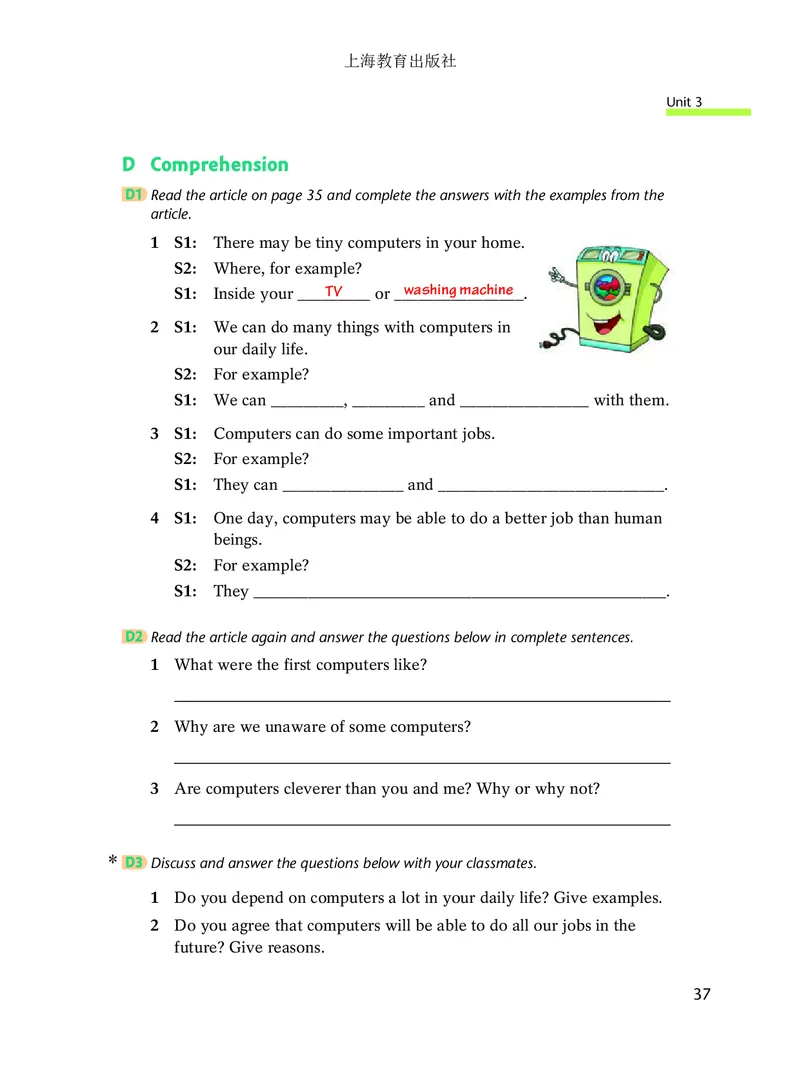
1 S1: There may be tiny computers in your home.
S2: Where, for example?
S1: Inside your ____T_V____ or __w_a_s_h_in_g_ _m_a_c_h_in_e__.
2 S1: We can do many things with computers in
our daily life.
S2: For example?
S1: We can _________, _________ and ________________ with them.
3 S1: Computers can do some important jobs.
S2: For example?
S1: They can _______________ and ____________________________.
4 S1: One day, computers may be able to do a better job than human
beings.
S2: For example?
S1: They _____________________________________________________.
D2 Read the article again and answer the questions below in complete sentences.
1 What were the first computers like?
2 Why are we unaware of some computers?
3 Are computers cleverer than you and me? Why or why not?
(cid:43)
D3 Discuss and answer the questions below with your classmates.
1 Do you depend on computers a lot in your daily life? Give examples.
2 Do you agree that computers will be able to do all our jobs in the
future? Give reasons.
37上海教育出版社
Module 2
Listening
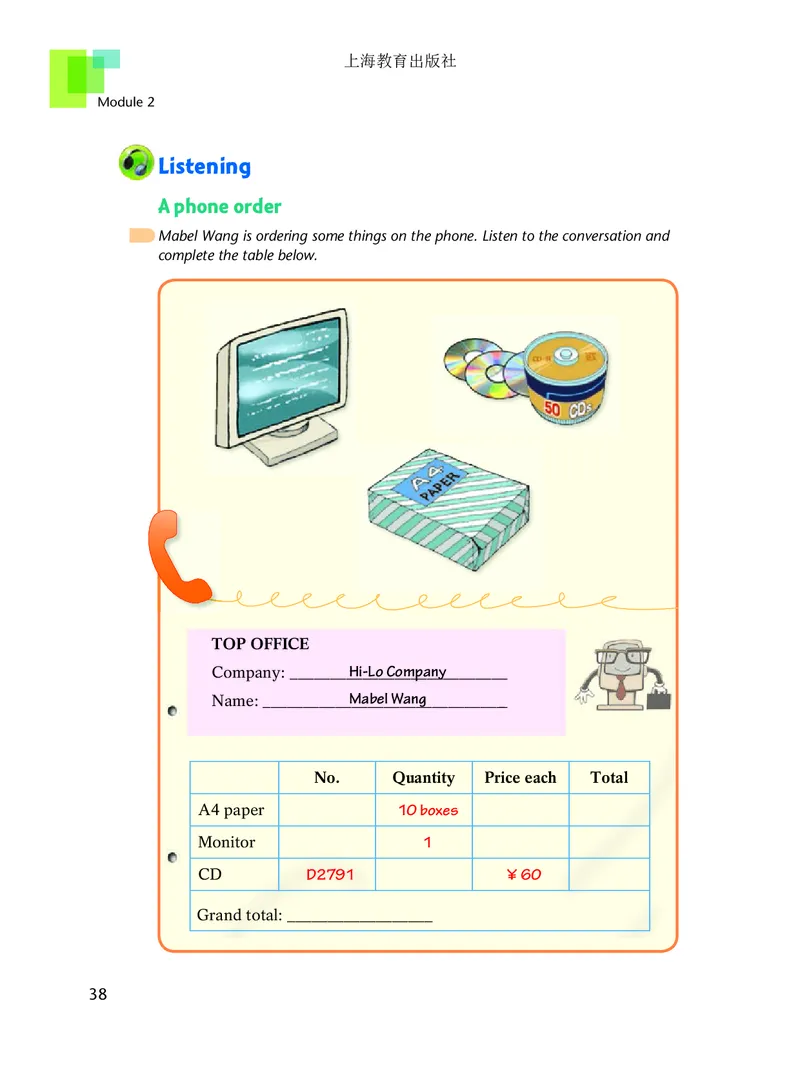
A phone order
Mabel Wang is ordering some things on the phone. Listen to the conversation and
complete the table below.
TOP OFFICE
Company: ________H_i_-L_o_ C__o_m_p_a_n_y________
Name: ___________M__a_b_e_l W__a_n_g___________
No. Quantity Price each Total
A4 paper 10 boxes
Monitor 1
CD D2791 ¥ 60
Grand total: __________________
38上海教育出版社
Unit 3
Grammar
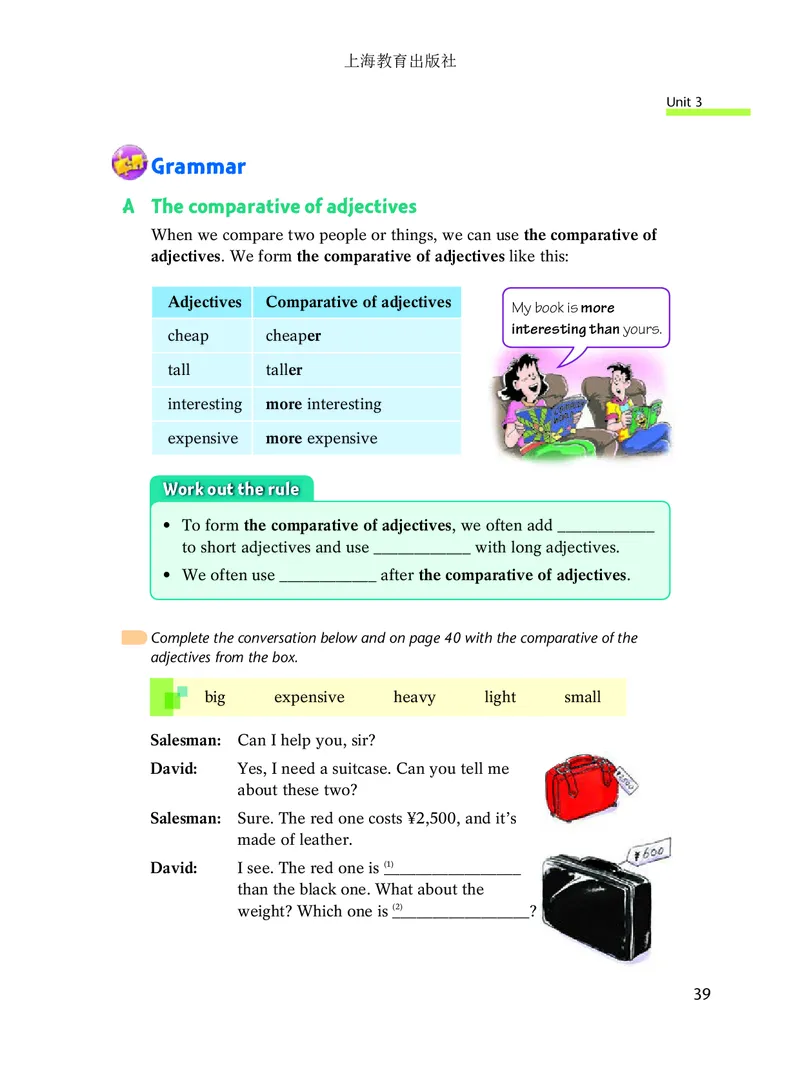
A The comparative of adjectives
When we compare two people or things, we can use the comparative of
adjectives. We form the comparative of adjectives like this:
Adjectives Comparative of adjectives
My book is more
interesting than yours.
cheap cheaper
tall taller
interesting more interesting
expensive more expensive
Work out the rule
• To form the comparative of adjectives, we often add ____________
to short adjectives and use ____________ with long adjectives.
• We often use ____________ after the comparative of adjectives.
Complete the conversation below and on page 40 with the comparative of the
adjectives from the box.
big expensive heavy light small
Salesman: Can I help you, sir?
David: Yes, I need a suitcase. Can you tell me
about these two?
Salesman: S ure. The red one costs ¥2,500, and it’s
made of leather.
David: I see. The red one is (_1)________________
than the black one. What about the
weight? Which one is (_2)________________?
39上海教育出版社
Module 2
Salesman: The black one. It’s made of plastic. Try them, sir.
David: You’re right. The red one is (_3)________________ than the
black one, and it’s _(4)________________ than the black one.
Salesman: D o you have a lot of things to carry?
David: Y es, I do. I’ll have the black one because it’s (_5)_______________
than the red one.
Salesman: Thank you very much, sir.
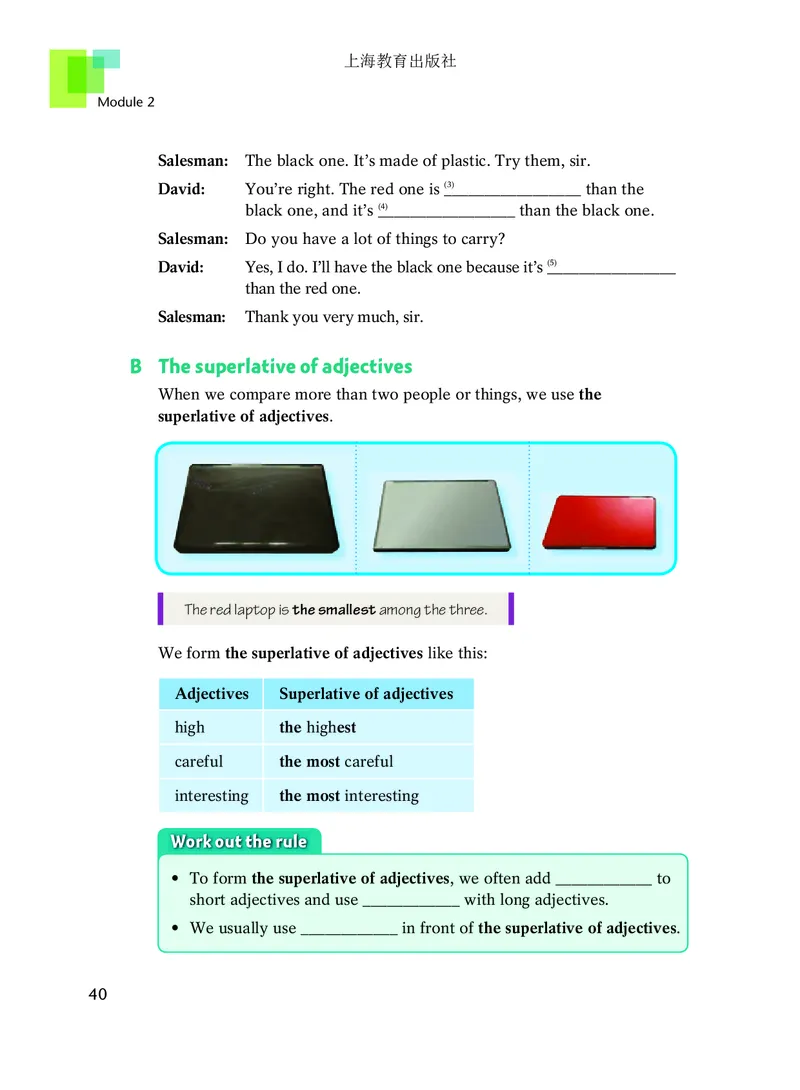
B The superlative of adjectives
When we compare more than two people or things, we use the
superlative of adjectives.
The red laptop is the smallest among the three.
We form the superlative of adjectives like this:
Adjectives Superlative of adjectives
high the highest
careful the most careful
interesting the most interesting
Work out the rule
• To form the superlative of adjectives, we often add ____________ to
short adjectives and use ____________ with long adjectives.
• We usually use ____________ in front of the superlative of adjectives.
40上海教育出版社
Unit 3
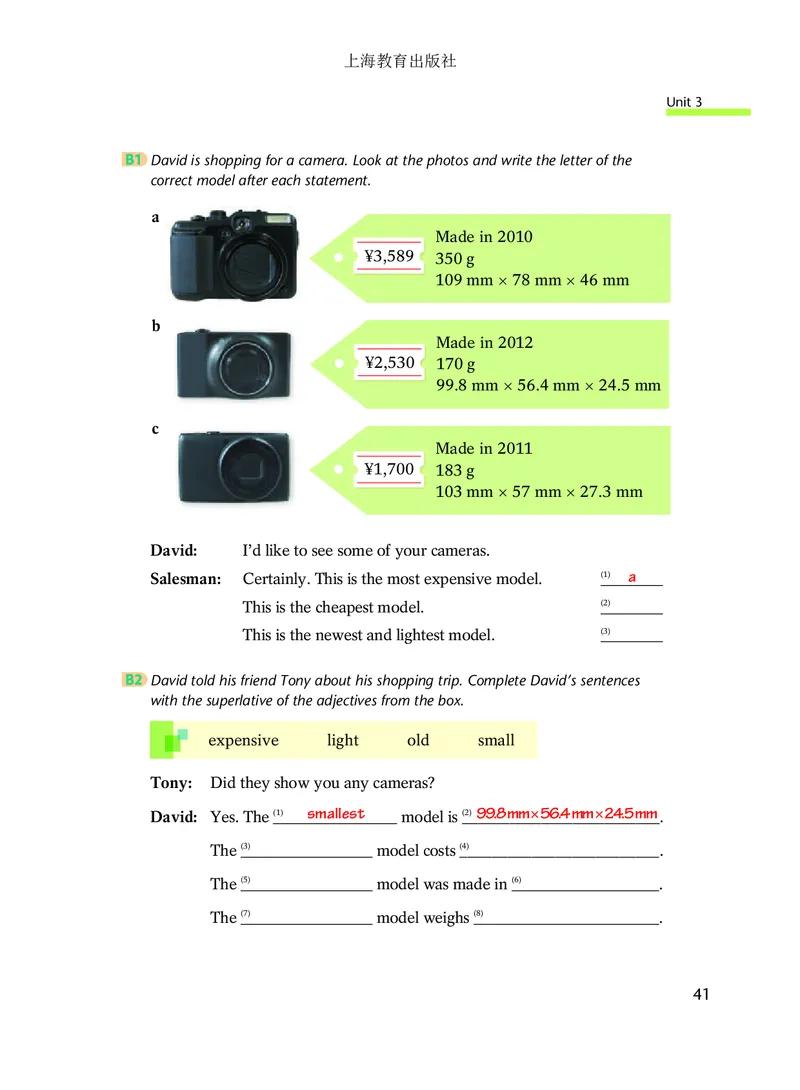
B1 David is shopping for a camera. Look at the photos and write the letter of the
correct model after each statement.
a
Made in 2010
¥3,589 350 g
109 mm × 78 mm × 46 mm
b
Made in 2012
¥2,530 170 g
99.8 mm × 56.4 mm × 24.5 mm
c
Made in 2011
¥1,700 183 g
103 mm × 57 mm × 27.3 mm
David: I’d like to see some of your cameras.
Salesman: Certainly. This is the most expensive model. (_1)___a____
This is the cheapest model. (_2)_______
This is the newest and lightest model. (_3)_______
B2 David told his friend Tony about his shopping trip. Complete David’s sentences
with the superlative of the adjectives from the box.
expensive light old small
Tony: Did they show you any cameras?
David: Yes. The (_1)____s_m_a_l_le_s_t_____ model is (_2)_9_9__.8_ m__m_ ×_ 5__6_.4_ m__m_ ×_ 2__4_.5_ m__m_.
The _(3)________________ model costs (_4)________________________.
The _(5)________________ model was made in (_6)__________________.
The _(7)________________ model weighs (_8)_______________________.
41上海教育出版社
Module 2
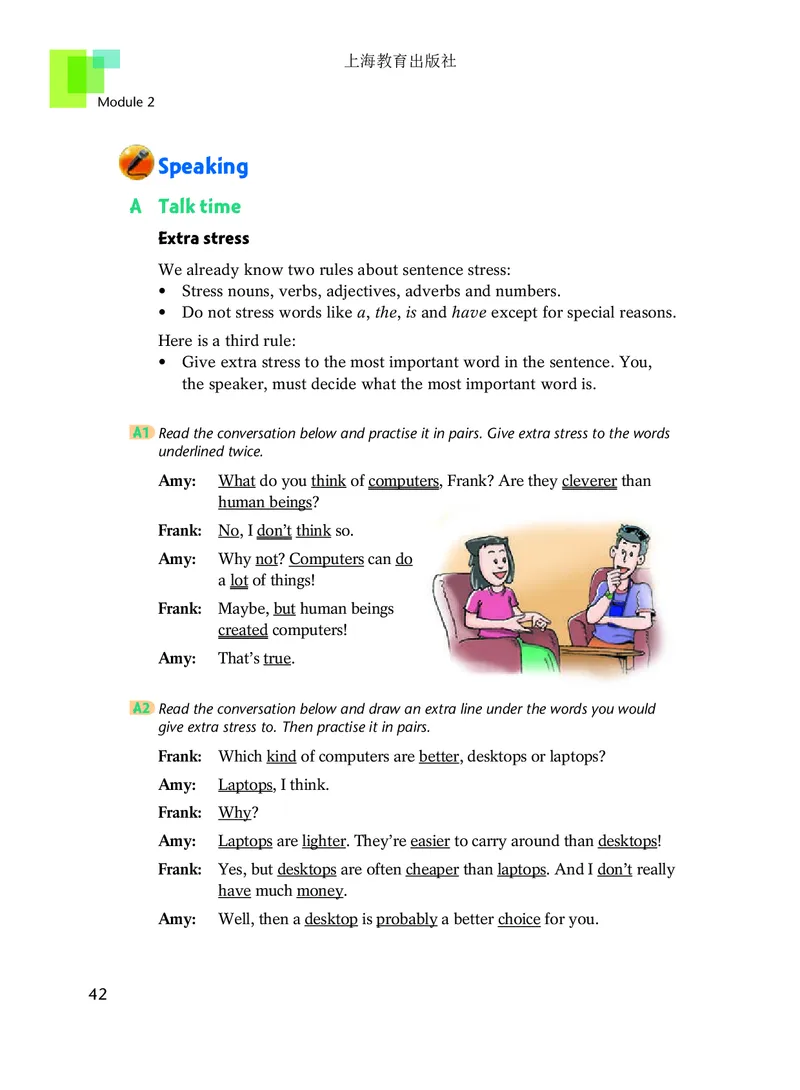
Speaking
A Talk time
Extra stress
We already know two rules about sentence stress:
• Stress nouns, verbs, adjectives, adverbs and numbers.
• Do not stress words like a, the, is and have except for special reasons.
Here is a third rule:
• Give extra stress to the most important word in the sentence. You,
the speaker, must decide what the most important word is.
A1 Read the conversation below and practise it in pairs. Give extra stress to the words
underlined twice.
Amy: What do you think of computers, Frank? Are they cleverer than
human beings?
Frank: No, I don’t think so.
Amy: Why not? Computers can do
a lot of things!
Frank: M aybe, but human beings
created computers!
Amy: That’s true.
A2 Read the conversation below and draw an extra line under the words you would
give extra stress to. Then practise it in pairs.
Frank: Which kind of computers are better, desktops or laptops?
Amy: Laptops, I think.
Frank: Why?
Amy: Laptops are lighter. They’re easier to carry around than desktops!
Frank: Y es, but desktops are often cheaper than laptops. And I don’t really
have much money.
Amy: Well, then a desktop is probably a better choice for you.
42上海教育出版社
Unit 3
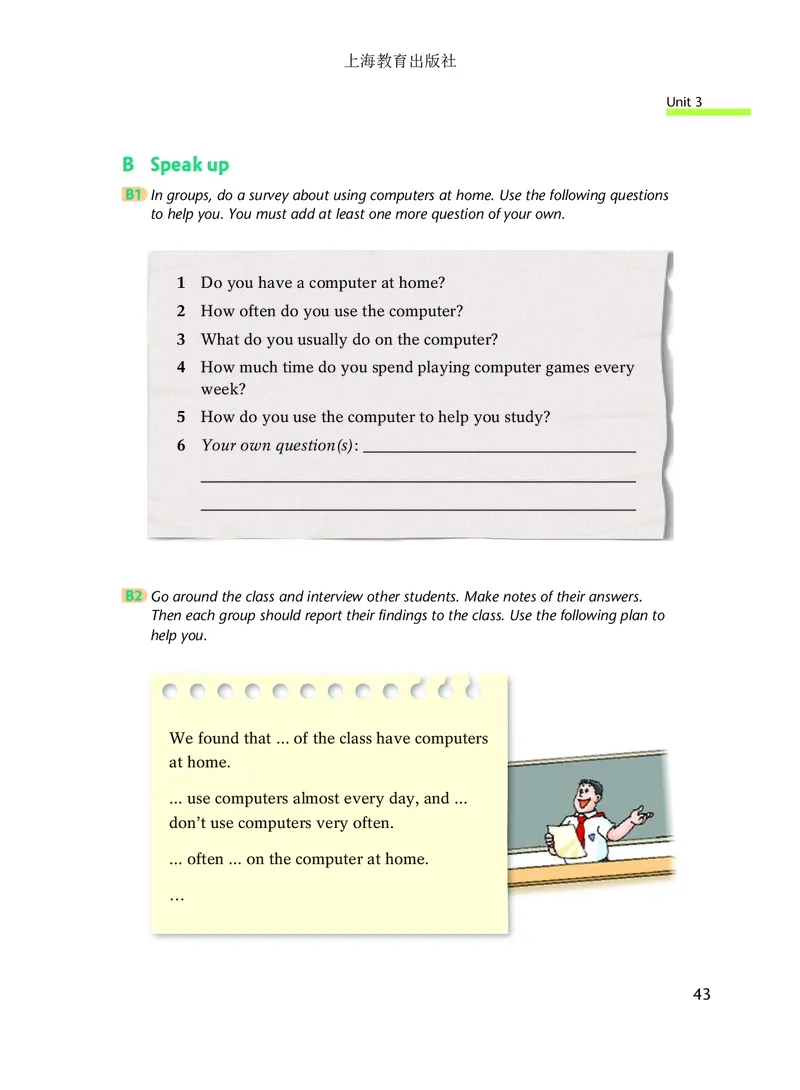
B Speak up
B1 In groups, do a survey about using computers at home. Use the following questions
to help you. You must add at least one more question of your own.
1 Do you have a computer at home?
2 How often do you use the computer?
3 What do you usually do on the computer?
4 How much time do you spend playing computer games every
week?
5 How do you use the computer to help you study?
6 Your own question(s):
B2 Go around the class and interview other students. Make notes of their answers.
Then each group should report their findings to the class. Use the following plan to
help you.
We found that ... of the class have computers
at home.
... use computers almost every day, and ...
don’t use computers very often.
... often ... on the computer at home.
…
43上海教育出版社
Module 2
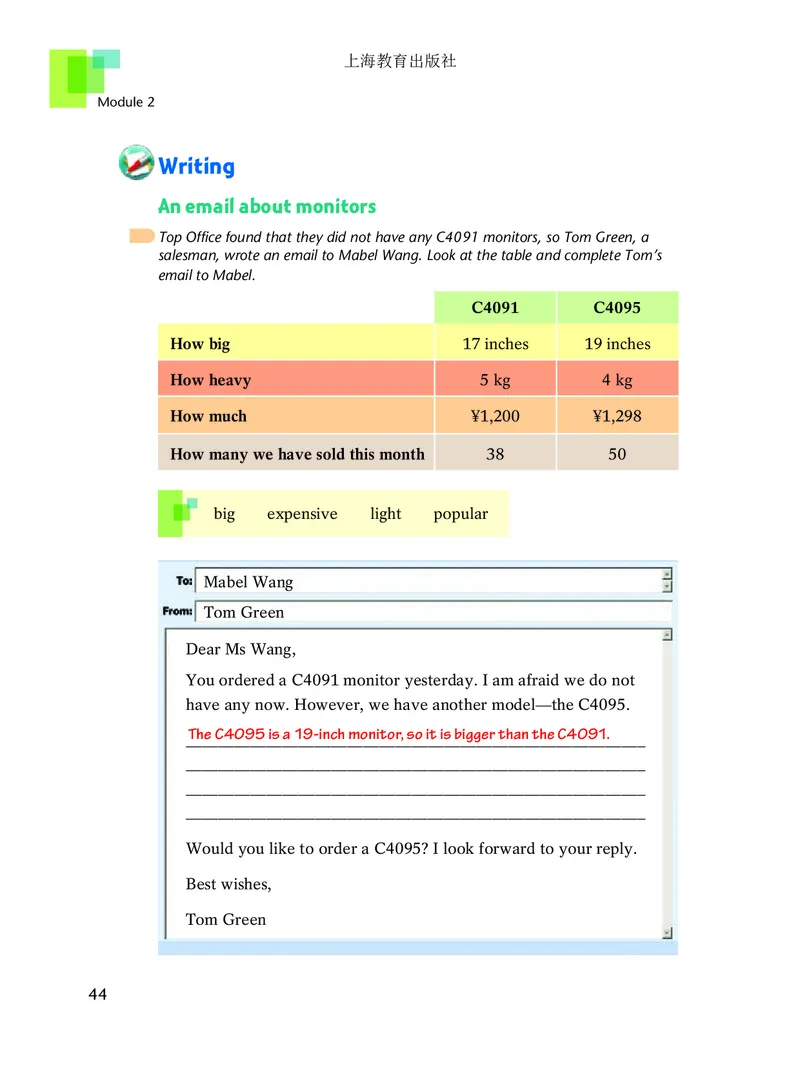
Writing
An email about monitors
Top Office found that they did not have any C4091 monitors, so Tom Green, a
salesman, wrote an email to Mabel Wang. Look at the table and complete Tom’s
email to Mabel.
C4091 C4095
How big 17 inches 19 inches
How heavy 5 kg 4 kg
How much ¥1,200 ¥1,298
How many we have sold this month 38 50
big expensive light popular
Mabel Wang
Tom Green
Dear Ms Wang,
You ordered a C4091 monitor yesterday. I am afraid we do not
have any now. However, we have another model—the C4095.
The C4095 is a 19-inch monitor, so it is bigger than the C4091.
_________________________________________________________
_________________________________________________________
_________________________________________________________
_________________________________________________________
Would you like to order a C4095? I look forward to your reply.
Best wishes,
Tom Green
44上海教育出版社
Unit 3
(cid:43)
More practice
A Read the script of a speech by a head teacher and answer the questions below.
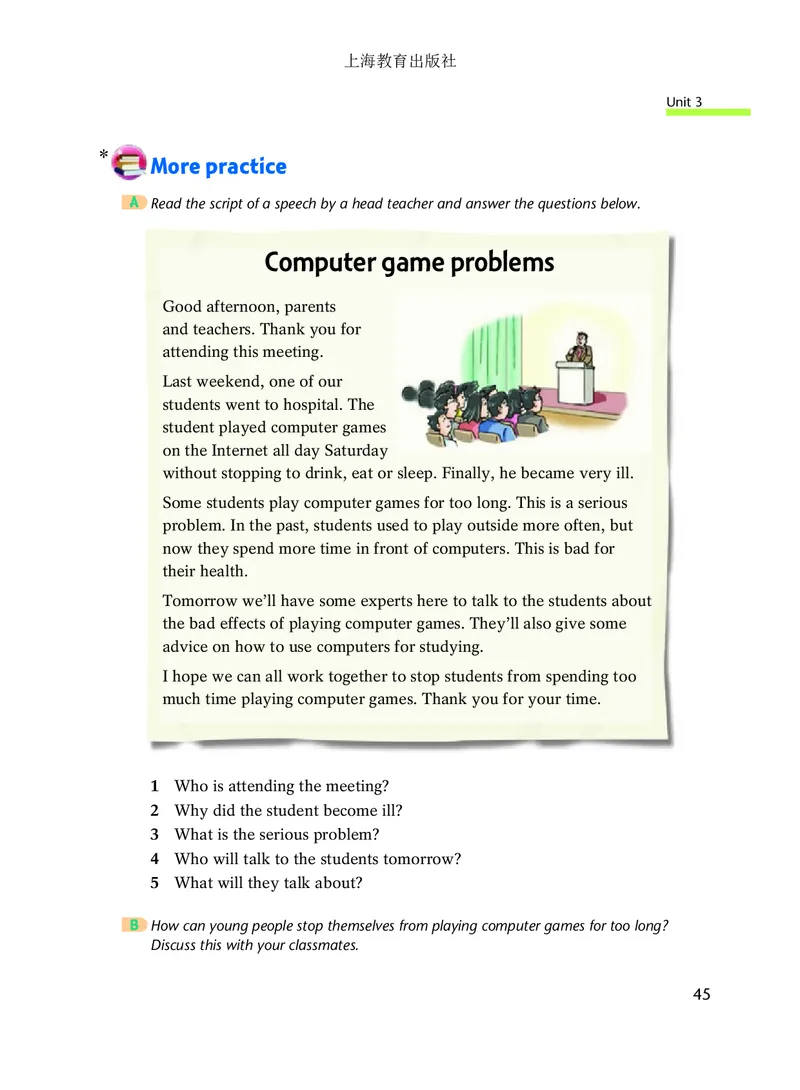
Computer game problems
Good afternoon, parents
and teachers. Thank you for
attending this meeting.
Last weekend, one of our
students went to hospital. The
student played computer games
on the Internet all day Saturday
without stopping to drink, eat or sleep. Finally, he became very ill.
Some students play computer games for too long. This is a serious
problem. In the past, students used to play outside more often, but
now they spend more time in front of computers. This is bad for
their health.
Tomorrow we’ll have some experts here to talk to the students about
the bad effects of playing computer games. They’ll also give some
advice on how to use computers for studying.
I hope we can all work together to stop students from spending too
much time playing computer games. Thank you for your time.
1 Who is attending the meeting?
2 Why did the student become ill?
3 What is the serious problem?
4 Who will talk to the students tomorrow?
5 What will they talk about?
B How can young people stop themselves from playing computer games for too long?
Discuss this with your classmates.
45上海教育出版社
Module 2
Study skills
(cid:43)
Research skills (2): Using a search engine
There is a lot of information on the Internet. You can find the information
you need by using a search engine.
Here are some useful tips for searching online:
1 Type in keywords, not complete
sentences. These keywords can
be words, phrases or even short
sentences.
Example: If you want to learn
more about the comparative of
adjectives, you can type in these
keywords:
comparative of adjectives
You do not have to type in words such as the.
You may get results like these.
About 3,080,000 results (0.16 seconds)
Comparative forms of adjectives
www. ... /comparativeadjectives/
Understand comparative adjectives. Comparative adjectives ...
What are comparative adjectives?
www. ... /comparative_adjectives/
What are comparative adjectives? Comparative adjectives are ...
English exercises: Comparative of adjectives
www. ... /comparative-adjectives/
Comparatives/superlatives exercise. Useful online activities to learn the
comparative of adjectives.
46上海教育出版社
Unit 3
2 Use more specific words to get better results.
Example: You may improve your search for the comparative of
adjectives by adding a specific word:
forming comparative of adjectives
In this way, you will get more specific and useful results.
About 1,700,000 results (0.17 seconds)
Forming comparative and superlative adjectives
www. ... /comparativeadjectives/
Learning English online. Comparative and superlative adjectives ...
Comparative adjectives: Formation
www. ... /comparative_adj_formation/
The formation of comparative adjectives. Comparative adjectives are ...
3 Use double quotation marks (“ … ”) to find web pages containing
specific groups of words or phrases.
Example: You may type in comparative of adjectives in double
quotation marks:
“comparative of adjectives”
You will get results containing this exact phrase.
About 25,800 results (0.18 seconds)
Thecomparative ofadjectives
www. ... /thecomparativeadjectives/
Learning English online. Comparative of adjectives ...
Comparative ofadjectives
www. ... /comparative_of_adjectives/
English grammar. Adjectives. Comparative of adjectives. Materials for students
and teachers ...
Use the Internet to search for more information about the grammar you have
learnt in this unit.
47上海教育出版社
Module 2
Culture corner
The abacus
The abacus was perhaps the first
type of computer. People started
using it over 4,000 years ago to
do maths. It was used in ancient
China, Rome, Egypt and Greece.
Today some people still use the
abacus.
Can you use an abacus? How is it similar to a modern computer?
How well do you know this unit? Tick ✓ the boxes.
❶ I can read an article about computers.
❷ I can find out the topic of a paragraph or some
paragraphs by reading the sub-heading.
❸ I can listen for specific information in a phone
order.
❹ I can compare things by using the comparative of
adjectives correctly.
❺ I can compare things by using the superlative of
adjectives correctly.
❻ I can give extra stress to the most important word
in a sentence.
❼ I can do a survey about using computers at home
with my classmates.
❽ I can complete an email about monitors.
(cid:29) I know about the abacus.
48上海教育出版社
Module 2 Science and technology
Unit
4
IIInnnvvveeennntttiiiooonnnsss
Getting ready
In this unit, you will learn about great inventions in history.
Reading
• Read an article about great inventions.
Listening
• Listen to advertisements for four funny inventions.
Grammar
• Learn how to use the comparative and superlative of good, bad and
far.
• Learn how to use (not) as … as.
Speaking
• Learn to use rising intonation.
• Talk about the most useful invention to you and your family.
Writing
•• WWrriittee aa sshhoorrtt aarrttiiccllee aabboouutt aa nneeww iinnvveennttiioonn tthhaatt yyoouu wwiillll
ccrreeaattee..
What do you think is
the most important I am, of course!
invention in the
world?
49上海教育出版社
Module 2
Reading
A What do you know about …?
A1 Inventions change our way of life. Look at the photos below. Write the name of
each invention in the blanks.
computer light bulb paper telephone train wheel
1 2 3
________________ ________________ ________________
4 5 6
________________ ________________ ________________
A2 How do these inventions help us in our daily lives? In groups, discuss this with your
classmates.
Computers help us find information easily. ...
B Before you read
Look at the photos, the title, the introduction and the sub-headings of the article
on page 51. Then answer the questions below.
1 What three inventions will the article talk about?
2 Which invention do you think is the greatest invention? Why?
50上海教育出版社
Unit 4
Great inventions
Great inventions change the world. They help people live a better
life. The following are three of the most important inventions in
history.
The wheel
5 The wheel is perhaps the greatest invention
in history. After its invention, travelling
became faster and more comfortable. A
few thousand years ago, people started
to use wheels on carriages. In the early
10 19th century, the first trains began to
carry passengers. At the start of the 20th
century, cars became popular. Without the
wheel, we would not have these inventions.
The telephone
15 Alexander Graham Bell invented one
of the first practical telephones in
1876. Since then, people have been
able to speak to each other over long
distances. Today millions of people
20 across the world own mobile phones.
They allow people to keep in touch
with each other anytime, anywhere.
The light bulb
Thomas Edison developed the first practical
25 light bulb in 1879. Before the invention of
the light bulb, people had to use oil lamps,
gas lamps or candles to see at night. With
light bulbs, people can do as many things in
the evenings as they can in the daytime. Can
30 you imagine living without them?
51上海教育出版社
Module 2
C Vocabulary
C1 Find words from the article on page 51 that have similar meanings to the words in
italics below.
1 My new shoes felt nice and soft. (line 7) _____________
2 This modern city was only a small village a
hundred years ago. (line 10) _____________
3 All the people on the bus got excited when they
arrived at the Great Wall. (line 11) _____________
4 The company produced a new camera last year.
(line 24) _____________
5 The swimming pool is open during the day. (line 29) _____________
C2 Complete the conversation below with the words from the box. Change their forms
if necessary.
anytime century comfortable daytime passenger
Bill: When did people first start using cars?
Maggie: People developed the first cars in the 1880s, and they started
using cars a lot in the early 20th (_1)___________.
Bill: I’m sure the people were very happy because cars are so fast
and _(2)___________.
Maggie: Not really. These early cars were very slow. They also created
a lot of problems.
Bill: What do you mean?
Maggie: Most people still had horses then, and the new cars made loud
noises and frightened them. Also, (_3)___________ often got very
dirty after a long ride, so many people didn’t use them.
Bill: I suppose that people could only drive in the (_4)___________
because those cars didn’t have lights.
Maggie: That’s not true. They had lights, so people could drive them
_(5)___________.
52上海教育出版社
Unit 4
Skimming
Skimming means to read an article quickly to get its general idea. To
skim an article, you should look at its introduction, title, sub-headings,
photos or pictures, and the first and last sentences of each paragraph.
D Comprehension
D1 Read the article on page 51 and complete the table below.
The wheel The telephone The light bulb
Don’t know. (_2)_______________ (_4)______________
Inventor
________________ _______________
Travelling became People can (_3)_____ People can (_5)____
_(1)_______________ ________________ _______________
Life after the
invention ________________ ________________ as they can in the
________________. ________________. daytime.
D2 Read the article again and answer the questions below in complete sentences.
1 Which of the three things was invented first?
_____________________________________________________________
2 What inventions did the wheel make possible?
_____________________________________________________________
3 How do mobile phones help people keep in touch with each other?
_____________________________________________________________
4 How did people see at night before the invention of the light bulb?
_____________________________________________________________
(cid:43)
D3 Can you name some other great inventions? Why do you think they are great?
Discuss these with your classmates.
53上海教育出版社
Module 2
Listening
Funny inventions
A Listen to advertisements for four funny inventions and complete their names. Write
one word in each blank.
1 2
_____________ For Shoes Cleaner Cat _____________
3 4
_____________ Telephone _________________ Glasses
B Listen to the recording again and circle the correct answers.
1 The first invention can _____.
a make your shoes more beautiful
b keep the dust off your shoes
c keep the rain off your feet
2 You buy the second invention to _____.
a keep your cat’s feet warm c help you clean the floor
b keep your cat’s feet clean
3 If you buy this telephone, you will _____.
a talk more c talk happily
b talk less
4 With this pair of glasses, you _____.
a can look behind and in front of you at the same time
b can see things more clearly
c will look cool
54上海教育出版社
Unit 4
Grammar
A good, bad and far
The comparative and superlative forms of some adjectives are irregular:
Adjectives Comparative forms Superlative forms
good better the best
bad worse the worst
far farther/further the farthest/furthest
A1 Look at the school report below. In pairs, ask and answer questions about it.
REPORT Class __2_A___
Name Art Science
Alice 84 65
Belinda 72 70
Daisy 83 91
Eric 79 64
Martin 80 78
Paul 81 84
Pauline 62 69
1 S1: Who __g_o_t_ a_ b_e_t_t_e_r_ m__a_rk__ in Art, Belinda or Daisy? (good)
S2: D__a_is_y_ g_o_t_ _a_ b_e_t_t_e_r _m_a_r_k_ i_n_ A_r_t_ t_h_a_n_ _B_e_li_n_d_a_.____________________
2 S1: Who __g_o_t _t_h_e_ b_e_s_t_ m__a_rk__ in Art? (good)
S2: _A_li_c_e _g_o_t_ t_h_e_ b_e_s_t_ m__a_r_k_ in_ _A_r_t_._______________________________
3 S1: Who _________________ in Science, Paul or Martin? (good)
S2: ________________________________________________________
4 S1: Who _________________ in Science, Eric or Alice? (bad)
S2: ________________________________________________________
5 S1: Who _________________ in Science? (bad)
S2: ________________________________________________________
55上海教育出版社
Module 2
A2 Look at the map below. In pairs, ask and answer questions about it. Follow the example.
Belinda’s Alice’s
School
Daisy’s
Pauline’s Eric’s Paul’s Martin’s
1 Whose home ..., Alice’s or Daisy’s?
S1: Whose home is farther/further from school, Alice’s or Daisy’s?
S2: Alice’s home is farther/further from school than Daisy’s.
2 Whose home ..., Daisy’s, Eric’s or Martin’s?
S1: Whose home is the farthest/furthest from school, Daisy’s, Eric’s or
Martin’s?
S2: Martin’s home is the farthest/furthest from school.
3 Whose home ..., Martin’s or Pauline’s?
4 Whose home ..., Alice’s, Belinda’s or Eric’s?
B (not) as … as
We use (not) as … as to say that things or people are (not) equal in some
way.
The first computer was as big as a room.
With light bulbs, people can do as many things in the evenings as they can
in the daytime.
A candle does not produce as much light as a light bulb.
Work out the rule
• We use (not) as … as with (the base form/the comparative) of
adjectives to compare things and people.
• We use (not) as … as with ____________ + the plural form of
a countable noun or ____________ + an uncountable noun to
compare amounts.
56上海教育出版社
Unit 4
B1 Look at the pictures below and complete the following sentences.
HOTWAVE
SPEEDCOOK
¥550
¥800
37 cm (H) × 55 cm (W) 36 cm (H) × 61 cm (W)
× 42 cm (D) × 55 cm (D)
SUPEROVEN
MICRO-KING
¥800
¥520
40 cm (H) × 61 cm (W) 37 cm (H) × 55 cm (W)
× 48 cm (D) × 39 cm (D)
1 The Hotwave and the Micro-King __a_r_e_ n_o_t_ _a_s_ e_x_p_e_n_s_iv_e_ a_s____
(expensive) the Speedcook and the Superoven.
2 The Speedcook _______i_s_ a_s_ w__id_e_ a_s________ (wide) the Superoven.
3 The Hotwave ________________________ (high) the Micro-King.
4 The Micro-King ________________________ (deep) the Speedcook.
5 The Hotwave and the Micro-King ________________________ (wide)
the Speedcook and the Superoven.
B2 Look at the table and the pictures below. Then complete the sentences with (not)
as many/much ... as.
1 The Blacks ___t_h_r_o_w__ a_w_a_y_ _a_s_ m__a_n__y___
cans ___a_s____ the Browns.
2 The Whites ________________________
plastic ________ the Browns.
Family Cans Plastic Paper Glass
3 The Browns ________________________
Brown 500 47 kg 32 kg 74 kg
paper ________ the Blacks.
White 525 47 kg 30 kg 78 kg
4 The Greens ________________________
Black 500 42 kg 32 kg 74 kg
glass ________ the Whites.
Green 200 21 kg 19 kg 23 kg
5 The Greens ________________________
Rubbish that four families
cans ________ the Whites.
throw away in a year
57上海教育出版社
Module 2
Speaking
A Talk time
Intonation (1): Rising intonation
When we ask a Yes/No question, we make our voice rise ( ) at the
end.
Do you understand?
Can you repeat it?
Is it correct?
A1 Read the conversation below and practise it in pairs. Make your voice rise at the
end of the Yes/No questions.
Wendy: I’m going to talk about an important invention. We use it
almost every day. Can you guess what it is?
Tony: Can I ask you some questions?
Wendy: Sure. You can ask five Yes/No questions.
Tony: OK. Do we have it in the classroom?
Wendy: Yes.
Tony: Do I have it in my school bag?
Wendy: Yes.
Tony: Is it a pen?
Wendy: Yes, you’re right.
A2 In pairs, make a conversation like the one in A1. Try to make your voice rise
correctly. Talk about the things from the box.
clock computer telephone wheel
58上海教育出版社
Unit 4
B Speak up
In pairs, talk about one of the everyday inventions below or a choice of your own.
Use the following questions to help you. Follow the example.
television
mobile phone
computer
watch
battery
What is the most useful invention to you and your family?
What do you use it for?
How often do you use it?
Can you do without it?
S1: The computer is the most useful invention to me and my family.
S2: Why is that?
S1: My dad uses it for his job. My mum uses it to buy clothes. And my sister
uses it to write emails to her friends.
S2: What do you use it for?
S1: I use it for my studies. At the weekend, I also use it to watch films.
What’s the most useful invention to you and your family?
S2: The mobile phone. I use it to …
59上海教育出版社
Module 2
Writing
My invention
A You are going to create a new invention. Use a spidergram to help you make plans
for this invention. Follow the example.
two wings
four wheels
What does
it look like?
My invention
What is special (A flying car)
about it?
run on land
How does
fly in the air it work?
use my voice
to control it
use solar power
B Now write a short article about your invention. Use the example below to help you.
(cid:68)y in(cid:109)ention
(cid:68)y invention is a flying car. It is fast, convenient and
Introduction
green(cid:24)
(cid:75)he flying car has four wheels and two wings. It has a
top speed of 300 km/h. (cid:80)ou can go to farther places
in a shorter time.
It can run on land and fly in the air. If you shout (cid:200)fly(cid:201),
Body
the car will turn into a plane in 30 seconds. (cid:75)hen you
can fly in the air. (cid:80)ou will be as free as a bird.
Instead of petrol, the car uses solar
power, so it will not pollute the air.
(cid:68)y invention will help people live a
Closing
better life in the future.
60上海教育出版社
Unit 4
(cid:43)
More practice
A Read the article about the inventor of the ballpoint pen, László Bíró. Then answer
the questions below.
A pen giant
Do you know László Bíró?
Maybe you do not, but you
probably use his invention
every day, and you may even
have it in your hand right now!
Bíró (1899–1985) was the There was a tiny ball at the tip
inventor of the ballpoint pen. of the pen. The ball rolled ink
He was born in Budapest, onto paper as it moved. They
Hungary. In the 1930s, when he called it the “ballpoint” pen.
worked as a newspaper editor,
The ballpoint pen was a great
he used a fountain pen almost
success. Everyone loved it. Now
every day. However, he had
millions of people use it all over
to refill it all the time. The ink
the world every day.
also did not dry easily, and it
sometimes made a mess on the
People will always remember
paper. Bíró wanted a better pen.
Bíró for his invention. Today
His brother, George, helped
in many English-speaking
him develop a special ink. The
countries, people still use the
ink dried easily. Then they
word “biro” to refer to any kind
developed a new type of pen.
of ballpoint pen.
1 Why did Bíró decide to invent the ballpoint pen?
2 How did Bíró’s brother help him invent the ballpoint pen?
3 How does the ballpoint pen work?
4 How do people remember Bíró for his invention today?
B Do you like to use ballpoint pens? Why or why not? Discuss these with your
classmates.
61上海教育出版社
Module 2
Culture corner
The Kongming Lantern and the hot-air balloon
The Kongming Lantern is very popular all over
Asia. It is a kind of paper lantern with a closed top
and a small candle inside. The candle heats the air
inside the lantern and makes it rise. People use the
Kongming Lantern on important days and during
festivals.
During the time of the Three Kingdoms, Zhuge
Liang used such lanterns to give signals in battles.
The Kongming Lantern led to the invention of the
hot-air balloon.
DDoo yyoouu kknnooww aannyy ootthheerr iinnvveennttiioonnss tthhaatt lleedd ttoo ootthheerr iinnvveennttiioonnss??
How well do you know this unit? Tick ✓ the boxes.
❶ I can read an article about great inventions.
❷ I can skim to get the general idea of an article.
❸ I can listen for specific information about four
funny inventions.
❹ I can use the comparative and superlative of good,
bad and far correctly.
❺ I can use (not)as ... as correctly.
❻ I can use rising intonation to ask Yes/No questions.
❼ I can talk about the most useful invention to me
and my family with my classmate.
❽ I can write a short article about my own invention.
I know about the Kongming Lantern and the hot-air
balloon.
62上海教育出版社
Unit 4
(cid:43)
PPPrrrooojjjeeecccttt
Finding out about Chinese inventions
How much do you know about Chinese inventions? In this project, you will
help make a booklet called Great Chinese Inventions.
A Look at the photos below. In groups, choose one invention and discuss it. Use the
questions below to help you. Add more questions if you wish.
1 2
compass paper
3 4
gunpowder printing
The history of this invention
• When was it invented(cid:32)
• What did people do before its invention(cid:32)
The importance of this invention in today’s world
• Who uses it(cid:32)
• What can people do with it(cid:32)
The invention and you
• (cid:41)ow often do you use it(cid:32)
• What do you use it for(cid:32)
63上海教育出版社
Module 2
B After the discussion, complete the table below. Research on the Internet or use an
encyclopaedia if necessary.
Name of the invention:
(Name of the
inventor:)
History of the invention:
Use(s):
C In groups, write a short article about the invention. Use the outline and the
example below to help you.
(cid:75)he in(cid:109)ention of paper
Introduction (cid:71)aper is an important invention.
Cai Lun invented it around 2,000
years ago in China. (cid:57)efore the
The history of
invention of paper, people had
this invention
to remember lots of information or write it on
stone, wood, leaves, etc.
(cid:75)oday everyone in the world uses paper. (cid:78)ith
The importance
paper, we can make books and print newspapers.
of this invention
Sharing information is a lot easier with the help
in today’s world
of paper.
I use paper every day. I do homework on paper
The invention
and I keep a diary. (cid:71)aper is a great invention.
and you
D As a class, put all your articles together to make a booklet for everyone to read.
64上海教育出版社
Module 3 Culture and history
Unit
5
EEEddduuucccaaatttiiiooonnnaaalll eeexxxccchhhaaannngggeeesss
Getting ready
In this unit, you will learn about educational exchanges.
Reading
• Read an article about an educational exchange.
Listening
• Listen to a teacher talking about an educational exchange.
Grammar
• Learn how to use the present perfect tense.
• Learn how to use the present perfect tense with already, yet, ever
and never.
Speaking
• Learn to use falling intonation.
• Talk about a student’s exchange visit.
Writing
•• CCoommpplleettee aa rreeppoorrtt oonn aann eexxcchhaannggee vviissiitt..
Great news, Lo!
I’m flying to the UK
for six weeks!
You can’t do that, Hi.
Why not?
Your arms aren’t
long enough!
65上海教育出版社
Module 3
Reading
A What do you know about …?
Eric is talking about his exchange visit to China. Complete the sentences with the
words from the box.
Chinese culture host family local school new friends
1 2
I stayed with a _____________. I visited a _____________.
3 4
I made some _____________. I learnt a lot about ___________.
B Before you read
Look at the pictures, the title and the introduction to the article on page 67. Then
answer the questions below.
1 Which country are the students from?
2 Where do they study during their exchange visit?
3 What will they probably do during their exchange visit?
4 What do they think of the exchange visit?
66上海教育出版社
Unit 5
An exchange visit is
educational and interesting!
A group of British students from Woodpark School in London are
visiting Xinhua Junior High School in Beijing on an educational
exchange.
“I was very nervous at first,” it. We’ve already learnt a lot
5 says Sarah. “However, my host 20 about Chinese culture and history.
family are really friendly. I’m The teachers have introduced
glad to be a guest in their home. us to Chinese painting as well.
I’ve learnt to use chopsticks, We’ve also tried to paint some
and they’re teaching me a little pictures ourselves! I haven’t had
10 Chinese!” 25 much success yet, but I’ll keep
trying.”
The students spend the weekdays
studying with Chinese students.
At the weekend, they tour around
Beijing and visit places of
15 interest with their host families.
“It’s been a fantastic experience
so far,” says Eric. “I’ve learnt a
“I’ve made many new friends,”
bit of t’ai chi, and I really enjoy
says Sarah. “I plan to keep in
touch with them when I return
30 home. We’ll see one another
soon because they’ll come over
to the UK for the second part of
the exchange next month. I can’t
wait!”
67上海教育出版社
Module 3
C Vocabulary
C1 The words in italics explain the meanings of some words on page 67. Find these
words to complete the sentences.
1 I am happy to meet you. I am __________ we met. (line 7)
2 A person who is invited to stay at another person’s home is a
__________. (line 7)
3 Helen goes to school from Monday to Friday. She has classes on
__________. (line 11)
4 The cake was really excellent. It tasted __________. (line 16)
5 Bob has got good exam results. His parents are proud of his
__________. (line 25)
C2 Complete the diary below with the words from the box.
already exchange introduce
culture experience tour
Friday, 8 July
(cid:75)omorrow I(cid:203)m going to take part in an exchange programme in
London. I(cid:203)ll be there for two weeks. (cid:70)ver the two weeks, I hope to
learn about (cid:57)ritish (_1)_____________ and practise my English. I(cid:203)ll
be an _(2)_____________ student at a famous school in London. I(cid:203)m
_(3)_____________ a little nervous because I don(cid:203)t know anyone there.
However, the (cid:57)ritish students are the same age as me, so I think we(cid:203)ll
become good friends. (cid:75)hey(cid:203)ll (_4)_____________ me to many new
things. I also plan to _(5)_____________ around London. (cid:75)he next two
weeks should be a good (_6)_____________ for me.
68上海教育出版社
Unit 5
D Comprehension
D1 A reporter from a student newspaper interviewed Sarah on campus. Read the
article on page 67 and complete Sarah’s answers.
Reporter: Good morning. I’m a reporter from a student newspaper.
Can I ask you a few questions?
Sarah: Sure.
Reporter: Why are you in Beijing?
Sarah: (_1)____________________________________________________
Reporter: Which school do you come from?
Sarah: _(2)____________________________________________________
Reporter: What do you and your classmates do in Beijing?
Sarah: We spend the weekdays (_3)_______________________________
______________________________. At the weekend, _(4)______
_____________________________________________________.
Reporter: That’s great. I hope you enjoy the rest of your stay in Beijing.
Thank you and goodbye.
Sarah: You’re welcome. Bye.
D2 Miss Wilson came to Beijing with the exchange students. Read the article again and
complete her report below.
The educational exchange visit to Beijing went well last month.
The host families were very friendly. They taught our students how to
use (_1)______________________. They also taught our students to speak
_(2)_________________________. Our students enjoyed their studies at
the school. They learnt a lot about Chinese culture and history. They
learnt some t’ai chi. They also learnt (_3)_________________________.
The students made (_4)______________________________ in Beijing.
They plan to keep in touch with them.
The Chinese students will come to our school for (_5)__________________
_____________________ next month. We need to get ready soon.
*
D3 Why is an exchange visit educational and interesting? Discuss this with your
classmates.
69上海教育出版社
Module 3
Listening
Going on an educational exchange
Some students from Xinhua Junior High School will go to Woodpark
School with their teacher Mr Liu for the second part of the exchange.
A Listen to the conversation between Mr Liu and the students. Complete the notes
below. Write one word or figure in each blank.
Arrive at the airport before _(1)______________ a.m.
Stay with our host families for (_2)______________ weeks.
Activities in London
• Host families have planned _(3)______________ activities.
• _(4)______________ _______________ at Woodpark School on
weekdays.
Things to remember
• Be _(5)_______________.
• Respect local
_(6)______________.
B George is asking Mr Liu several questions about the exchange visit. Listen to the
recording again and complete Mr Liu’s answers. Write one word in each blank.
George: When are we going to fly to London?
Mr Liu: On (_1)______________, the (_2)______________ of November.
George: What are we going to do in London?
Mr Liu: We’re going to experience (_3)______________ in London and
learn about _(4)______________ _______________.
George: OK. Should we bring something with us?
Mr Liu: Yes. You’re going to write a report when you come back, so
you should bring a _(5)______________ with you.
George: Thanks, Mr Liu.
Mr Liu: You’re welcome.
70上海教育出版社
Unit 5
Grammar
A The present perfect tense
We use the present perfect tense to talk about things that happened in
the past but have a connection to the present in some way.
I’ve seen almost all of
the places of interest
around Beijing.
have made
I/You/We/They a lot of new friends.
have not made
Have I/you/we/they made a lot of new friends?
Yes, have.
you/I/we/they
No, have not.
has made
He/She/It a lot of new friends.
has not made
Has he/she/it made a lot of new friends?
Yes, has.
he/she/it
No, has not.
Work out the rule
Things to remember
We form the present perfect • I/You/We/They have = I’ve/You’ve/We’ve/They’ve
tense with ___________ He/She/It has = He’s/She’s/It’s
or ___________ + the past have not = haven’t has not = hasn’t
participle of the main verb.
• The past participle of a regular verb is
usually the same as its past tense. You can
find the past participles of some irregular
verbs on pages 141 and 142.
71上海教育出版社
Module 3
Eric has been in Beijing for a week. Complete his email to his mother with the
present perfect tense of the verbs in brackets.
Mum
Eric
Dear Mum,
I’ve been in Beijing for a week now. I (_1)________________ (meet)
my host family. They’re really friendly. My host brother Wei and
I _(2)________________ (play) a lot of football at a park near his
home. We both enjoy football very much. Mrs Li, my host mother,
_(3)________________ (cook) me delicious Chinese food.
I (_4)________________ (study) Chinese with my British classmates.
We (_5)________________ (see) some places of interest in Beijing too.
However, I (_6)________________ (not, visit) the Great Wall yet, and I
_(7)_______________ (not, do) any shopping either. I’ll do these things next
week.
Love,
Eric
B The present perfect tense with already, yet, ever and never
We can use already, yet, ever and never with the present perfect tense.
Sarah has already seen many places of interest in Beijing.
Have you seen the Great Wall yet?
No, I have not seen the Great Wall yet.
Have you ever visited the Summer Palace?
No, I have never visited the Summer Palace.
Work out the rule
• We can use the adverbs already, ever and never (before/after)
have/has and (before/after) the main verb.
• We often use yet at the (beginning/end) of a question or a negative
sentence.
72上海教育出版社
Unit 5
B1 Sarah wants to know whether the students from Beijing have visited any places in
London before. Ask and answer questions in pairs. Follow the example.
Tour around
See Big Ben Visit Tower Bridge Buckingham
Palace
Alice (cid:26) (cid:22) (two years ago) (cid:26)
(cid:22)(cid:3)(one and a
George (cid:26) (cid:26)
half years ago)
Robin (cid:26) (cid:22)(cid:3)(one year ago) (cid:26)
S1: Has Alice ever seen Big Ben?
S2: NNoo,, sshhee hhaassnn’’tt.. SShhee’’ss nneevveerr sseeeenn BBiigg BBeenn..
S1: Has she ever visited Tower Bridge?
S2: Yes, she has. She visited it two years ago.
...
B2 Later Sarah is asking the students from Beijing about what they have and have not
done in London. Ask and answer questions in pairs. Follow the example.
Do shopping See Big Ben
Alice (cid:26) (cid:22)
George (cid:22) (cid:26)
Robin (cid:22) (cid:22)(cid:22)
S1: Have you done any shopping yet, Alice?
S2: No, I haven’t done any shopping yet.
S1: Have you seen Big Ben yet?
S2: Yes, I’ve already seen it.
73上海教育出版社
Module 3
Speaking
A Talk time
Intonation (2): Falling intonation
When we ask a Wh-question, we let our voice fall at the end of the
question. When we answer the question, we usually let our voice fall at
the end of the sentence too.
S1: What should we remember to do during our exchange visit?
S2: You should be polite and respect local culture.
We also let our voice fall at the end of an imperative sentence.
Arrive at the airport on time, please.
Please bring a camera with you.
A1 Read the conversations below and practise them in pairs. Make your voice fall at
the end of the sentences.
1 S1: Who have you met in Beijing?
S2: I’ve met lots of Chinese students.
2 S1: What have you learnt?
S2: I’ve learnt about Chinese painting and t’ai chi.
3 S1: Where have you visited?
S2: I’ve visited the Great Wall.
4 S1: When are you going to leave Beijing?
S2: I’m going to leave next week.
A2 Read these sentences. Make your voice fall at the end of the sentences.
1 Don’t worry about the exchange visit.
2 Try to learn about local culture.
3 Join in your host family’s weekend activities.
4 Remember to be friendly to others.
74上海教育出版社
Unit 5
B Speak up
B1 Alice has been in London for a week. She has written down some things that she
has done and some that she has not done. Look at the lists below and talk about
her experiences in pairs.
Have done Haven’t done
• meet my host family • visit Tower Bridge
• see Big Ben • go shopping
• have classes at Woodpark • see the London Eye
School
• take the London
Underground
S1: What has Alice already done?
S2: She’s met her host family. …
S1: What hasn’t Alice done yet?
S2: She hasn’t visited Tower Bridge. …
B2 Suppose you are Alice. You are telling your British classmates about your
experiences in London. Use the information in B1 to help you.
Hello, everyone. I’ve had a
good time here. I’ve …
75上海教育出版社
Module 3
Writing
An exchange visit
The students from Xinhua Junior High School have almost finished their
exchange visit to Woodpark School. They need to write a report on the
exchange visit before they return to Beijing.
Suppose you are one of the students. Complete the report below. Use the following
expressions to help you.
Activities in school
have classes with British students
learn a lot about British culture and history
take part in school club activities
Activities outside school
have a picnic with the host family
visit the British Museum
play football with British friends
A report on my exchange visit to Woodpark School
My exchange visit to Woodpark School has gone well.
I have enjoyed my studies at the school. I have _____________________
_________________________________________________________
_______________________________________. I have also _________
_________________________________________________________ .
My host family are friendly. They have cooked me delicious British food.
_________________________________________________________
_________________________________________________________
________________________________________________________
________________________________________________________
I will keep in touch with them.
76上海教育出版社
Unit 5
*
More practice
A Read the poster about educational exchanges and answer the questions below.
Take part in our
educational
exchange
Do you love to travel and meet country and stay with his or her
new people? Yes? Have you ever family. You will go to school with
lived and studied in another him or her. You will also take
country? No? Well, join our part in local activities.
educational exchange now!
You can apply for our educational
Our educational exchange is exchange if you:
fantastic. You can experience a • are aged between 14 and 17.
different culture and learn a new • would like to learn about the
language. You can improve your language, culture, history,
social skills and make lots of geography and way of life of
friends. another country.
• have a reference from your
There are two parts in our
head teacher.
educational exchange. In the
first part, an exchange student It will be the adventure of a
will travel to your home country lifetime. So, what are you waiting
and stay with your family. In the for? Apply today!
second part, you will travel to
your exchange partner’s home
1 What new experiences can students gain from the educational
exchange?
2 How many parts are there in the educational exchange?
What are they?
3 What will you do in the exchange country?
B Do you want to go on an educational exchange? Why or why not? Discuss these
with your classmates.
77上海教育出版社
Module 3
Study skills
Practical writing (1): Filling in a form
If you want to go on an educational exchange, you need to fill in an
application form.
This is a sample of an application form for an educational exchange.
Application form
Family name Li Given name Xiaolan
Date of birth 27/06/1997 Place of birth Shanghai photo
Nationality Chinese Sex F
Address 155 Nanjing Road, Shanghai, China Postal code 200050
Telephone no. (86 21) 322 2200 Email xiaolan.li97@555.com
Educational background Junior High 2 Passport no. G578115
Hobbies reading, swimming, collecting stamps
I love to travel and meet new people. I want to
Reasons for applying experience life in an English-speaking country and also
be able to practise English every day.
From 01/09/2012
Duration of study
To 20/01/2013
Signature of the applicant Date
Li Xiaolan
25/05/2012
78上海教育出版社
Unit 5
When you fill in an application form, remember the following things:
• Do not leave anything blank.
• Write clearly and neatly, using black ink.
• Check for spelling and grammatical errors.
• Sign your name.
You decide to go on an educational exchange. It will be from 10 January to 10 July
next year. Fill in the application form below with information about yourself.
Application form
Family name Given name
Date of birth Place of birth photo
Nationality Sex
Address Postal code
Telephone no. Email
Educational background Passport no.
Hobbies
Reasons for applying
From
Duration of study
To
Signature of the applicant Date
79上海教育出版社
Module 3
Culture corner
Culture shock
When we first visit another country, we may have a strange feeling.
We call this feeling “culture shock”. People have culture shock for
different reasons. They may not know the language and local culture of
the country. They may also miss their families and friends. To deal with
culture shock, you can:
• try and make new friends(cid:15)
• try new things(cid:13) like the local food(cid:15)
• keep a diary(cid:15) Write about all your
new experiences.
• call your parents and friends and tell
them about these new things.
What other ways can you think of to deal with culture shock?
How well do you know this unit? Tick ✓ the boxes.
❶ I can read an article about an educational
exchange.
❷ I can listen for specific information about an
educational exchange.
❸ I can use the present perfect tense correctly.
❹ I can use the present perfect tense with already,
yet, ever and never correctly.
❺ I can use falling intonation correctly.
❻ I can talk about a student’s exchange visit.
❼ I can complete a report on an exchange visit.
❽ I can fill in an application form.
I know about culture shock.
80
PB上海教育出版社
Module 3 Culture and history
Unit
6
AAAnnnccciiieeennnttt ssstttooorrriiieeesss
Getting ready
In this unit, you will read some interesting stories from ancient Greece and ancient
China.
Reading
• Read a story about the Trojan War.
Listening
• Listen to a story about how the Trojan War started.
Grammar
• Learn how to use the present perfect tense with since and for.
• Understand the differences between the present perfect tense and
the simple past tense.
Speaking
• Learn about rhythm.
• Act out a play.
Writing
• Complete a story about the Trojan War.
Children in ancient
times were lucky.
Why?
Because they didn’t
need to study so
much history!
81上海教育出版社
Module 3
Reading
A What do you know about …?
Here are photos of three famous places from history. Match them with the correct
countries by writing the letters in the brackets.
a Egypt b Greece c the UK
1 2 3
The Pyramids ( ) Stonehenge ( ) The Parthenon ( )
B Before you read
These pictures show some of the events in the story on page 83. Skim the story and
put the pictures in the correct order. Write the numbers 1–5 in the boxes.
a b
c d e
1
82上海教育出版社
Unit 6
1 The captain stood on the high wall of the city of Troy. “The Greeks have
gone and we’ve won,” he said. “They’ve tried to capture our city for ten
years. Now they’ve given up and sailed away!”
2 “But look over there,” a soldier said. “They’ve left a huge wooden horse.”
3 “Ah, yes,” the captain said, “it’s too big. The Greeks didn’t want to take 5
it with them. Get some help and pull it into the city.”
4 That night, in the main square of the city, all the Trojans celebrated.
They sang and danced around the horse, and made jokes about the
stupid Greeks. “I haven’t laughed like this since my childhood,” the
captain said. After the party, they locked all the gates of the 10
city and then all went to sleep.
5 By midnight, the main square was empty, except
for the huge horse. Suddenly a secret door
opened on the side of the wooden horse. The
horse was full of Greek soldiers! They quietly 15
climbed out of the horse one by one.
6 The soldiers opened the main
gates. The Greek army entered
the city.
7 For ten years, the Greeks could 20
not capture the city by fighting.
In one night, however, they
succeeded in capturing it
through a clever trick.
83上海教育出版社
Module 3
C Vocabulary
C1 The words in italics explain the meanings of some words on page 83. Find these
words to complete the sentences.
1 A blue whale is a very big animal. It is ____________. (line 4)
2 The soldiers thought the Greeks were not clever. They thought the
Greeks were ____________. (line 9)
3 The cinema does not have any people in it. It is ____________.
(line 12)
4 I like almost all meat, but this does not include chicken. I like all meat
__________________ chicken. (line 12)
5 Only a few people know about this information. Please keep it
____________. (line 13)
C2 Complete the conversations below with the words from the box. Change their forms
if necessary.
army full of pull succeed
celebrate make jokes about secret
1 Alice: Oh, no! Your dress is ____________________ holes!
Betty: Don’t ____________________ that. I need to wear this dress
to the party tonight.
Alice: Sorry, I’m only joking.
2 Barry: Follow me. I know a ____________________ path through
the forest. We can get to the town faster.
James: Really? That sounds great.
3 Simon: I want to join the ____________________ in the future.
William: Me too. My dream is to be a soldier.
4 Jill: Look! The old man is ____________________ a big box
into the house.
Ella: Let’s go and help him.
5 Grace: H ey! Great news. Our class has ____________________ in
winning first prize.
June: Wow! We should ____________________!
84上海教育出版社
Unit 6
The main ideas of the paragraphs in a story
The main idea of a paragraph tells what all or most of the sentences are
about. It is the most important information in the paragraph. The main
idea of a paragraph in a story is usually the description of a character, a
situation or an event.
D Comprehension
D1 What are the main ideas of the seven paragraphs in the story? Read the story on
page 83 and write the letter of the correct statement in each blank.
c
Paragraphs 1–2: _____ a The Trojans celebrated in the main square.
Paragraph 3: _____ b The Greek soldiers climbed out of the
wooden horse and opened the main gates.
Paragraph 4: _____ c The Greek army disappeared and left a
wooden horse outside the city of Troy.
Paragraphs 5–6: _____ d The Greeks captured the city of Troy.
Paragraph 7: _____ e The captain ordered the soldiers to pull
the horse into the city.
D2 Read the story again and circle the correct answers.
1 The Greek army disappeared because _____.
a they were afraid of the Trojans
b they wanted to play a trick on the Trojans
c they won the war
2 The Trojans thought the Greeks were _____.
a funny b stupid c helpful
3 The Greek soldiers in the wooden horse waited until midnight
because _____ then.
a they could break the gates
b all the Trojans would be asleep
c all the Trojans would leave the city
4 The Greeks could not capture the city of Troy for ten years because
_____.
a they could not get inside the city
b the Trojans were cleverer than the Greeks
c they did not build a wooden horse before
85上海教育出版社
Module 3
Listening
How the Trojan War started
A How did the Trojan War start? Listen to the story and put the pictures in the correct
order. Write the numbers 1–6 in the boxes.
a b c
1
d e f
B Listen to the recording again and complete the answers to the questions below.
Write one word in each blank.
1 What did Paris, the prince of Troy, decide to do one day?
He decided to _____________ the Greek city of Sparta.
2 What happened at the dinner?
Queen Helen and Paris _____________ _____________ _____________
with each other.
3 Why was the King of Sparta very angry?
Because Paris _____________ Helen to his ship and his men also stole
a lot of _____________ from Sparta.
4 What did the King of Sparta do in the end?
He asked many of the other Greek kings to help him ______________
Troy and punish the Trojans.
86上海教育出版社
Unit 6
Grammar
A The present perfect tense with since and for
We often use since and for with the present perfect tense.
I have not laughed like this since my childhood.
The Greeks have tried to capture our city for ten years.
Work out the rule
• We use since with (a period of time/a point in time).
• We use for with (a period of time/a point in time).
A1 Hans is from Hamburg in Germany. He is talking to Doris. Read their conversation
and answer the following questions.
Doris: So you live in Hamburg, Hans?
Hans: Yes, I’m a Hamburger. Have you ever met a Hamburger?
Doris: Yes, I met one yesterday at a fast-food restaurant, and I ate it.
Hans: Ah, yes. I’ve heard that joke before, Doris.
Doris: Sorry, Hans. Tell me, how long
have you lived in Hamburg?
Hans: Since 1996. How long have you
lived in Shanghai?
Doris: For 14 years. I was born here.
1 Where does Hans live?
He ____________ in _________________________.
2 How long has Hans lived in Hamburg?
He _________________ there _________________.
3 How long has Doris lived in Shanghai?
She ________________ there _________________.
4 Where was Doris born?
She _______________________________________.
87上海教育出版社
Module 3
A2 Doris is talking about herself. Read what she says and then decide whether the
following sentences are T (True) or F (False). Correct any false ones.
Hello. I’m Doris. It’s now November 2012. I’ve
lived in Shanghai since November 1998. I’ve
studied at New Point Junior High School for one
year and two months. I’ve been in the Science
Club for one year. I joined the Volleyball Club two
months ago.
1 Doris has lived in Shanghai for four years. T / F
____________________________________________________
2 She has studied at New Point Junior High School T / F
since September 2010.
____________________________________________________
3 She has been in the Science Club since November 2011. T / F
____________________________________________________
4 She has been in the Volleyball Club for two months. T / F
____________________________________________________
B The present perfect tense and the simple past tense
We can use both the present perfect tense and the simple past tense to
talk about a past experience.
I have studied History for two years. I had a History lesson yesterday.
I have learnt a lot about Greek history. I read the story of the Trojan War
last week.
Work out the rule
• We use (the present perfect tense/the simple past tense) to talk
about a past experience which has a connection to the present.
• We use (the present perfect tense/the simple past tense) to talk
about a completed action in the past.
88上海教育出版社
Unit 6
B1 Read the following conversation between the captain and a soldier from the story
“The Trojan horse”. Complete it with the correct tenses of the verbs in brackets.
Soldier: Captain! Captain! The Greeks (_1)_________________ (go). They
_(2)_______________ (leave) last
night.
Captain: Great! They (_3)______________
(come) here ten years ago
and _(4)_________________ (try)
many times to capture our
city, but they couldn’t. We
_(5)____________________ (win).
Soldier: But they (_6)_________________
(leave) a huge wooden horse. Can you see it outside the
gates? The Greeks (_7)_____________________ (not take) it with
them.
Captain: Let’s keep it then. Go and pull it into the city.
B2 Complete the diary below with the correct tenses of the verbs in brackets.
(cid:75)hursday(cid:35) (cid:40)(cid:39) (cid:69)o(cid:109)ember
A new bookshop _(1)___________________ (cid:31)open(cid:32) the day before yesterday
near my school. (cid:64) _(2)___________________ (cid:31)go(cid:32) there with my cousin this
afternoon.
(cid:64) _(3)___________________ (cid:31)buy(cid:32) a tra(cid:109)el book about (cid:62)reece. (cid:64) _(4)________
___________ (cid:31)ne(cid:109)er be(cid:32) to (cid:62)reece(cid:35) but my cousin _(5)___________________
(cid:31)(cid:109)isit(cid:32) the country last year. (cid:64) _(6)___________________ (cid:31)see(cid:32) some of her
photos. (cid:62)reece is such a beautiful country.
(cid:68)y cousin _(7)___________________ (cid:31)buy(cid:32) a book about ancient (cid:62)reece.
(cid:64) _(8)___________________ (cid:31)read(cid:32) a few pages of the book with her. (cid:64) think
it(cid:203)s (cid:109)ery interesting.
89上海教育出版社
Module 3
Speaking
A Talk time
Rhythm (strong and weak sounds)
In stressed syllables, we give the vowels a strong pronunciation
(clear and long). In unstressed syllables, we give the vowels a weak
pronunciation (unclear and short). This adds rhythm to words and
sentences when we speak.
A1 Say these words. Make the underlined vowels strong. Make the dotted vowels
weak.
except enter secret pyramid fantastic
3 3 3 3 3 3 3
A2 Say these words. Mark the strong and weak vowels as above.
about collect nobody animal invention
A3 Listen to these sentences. Pay attention to the rhythm of each sentence.
1 There’s a plane for America every day.
3 3 3 3 3 3 3
2 Denise has gone to work. She will be back at five o’clock.
3 3 3 3 3 3 3 3
3 How much does a ticket to Tokyo cost?
3 3 3 3 3 3
4 When you see Simon, can you give this book to him?
3 3 3 3 3 3 3 3
A4 Listen to the poem below. Pay attention to the rhythm.
There once was a man called Ed Heath,
Who sat on his set of false teeth.
He said, with a start,
“Oh, bless my poor heart!
I’ve bitten myself underneath!”
90上海教育出版社
Unit 6
B Speak up
In groups, act out the play below.
Scene 1
The captain of Troy is standing on the high wall of the city. He is
looking down at the empty sea.
Captain: The Greeks have gone and we’ve won. They’ve given up
and sailed away.
(A soldier enters.)
Soldier: Captain, Captain, look over there. They’ve left a huge
wooden horse.
Captain: Ah, yes. They didn’t want to take it with them. Get some
help and pull it into the city. That won’t be difficult. It’s
on wheels.
Soldier: Yes, Sir!
(The soldier leaves.)
Scene 2
All the Trojans celebrate in the
main square, by the wooden
horse.
Captain: II hhaavveenn’’tt llaauugghheedd lliikkee tthhiiss ssiinnccee mmyy cchhiillddhhoooodd!!
Man: The Greeks are so stupid! Ha! Ha!
Scene 3
The party is over. The Trojans lock all the gates of the city and
then go to sleep. Greek soldiers talk in the wooden horse.
Greek soldier A: All the Trojans have fallen asleep. Let’s climb
out and open the main gates!
Greek soldier B: Come on! Our army is waiting outside the city.
The Greek soldiers climb out of the horse quietly and then open
the main gates. The Greek army enter the city.
…
91上海教育出版社
Module 3
Writing
A story about the Trojan War
A After the Trojan War, one of the soldiers inside the wooden horse told his story
to his family. Complete the story with the words in brackets and other words if
necessary.
We tried to capture Troy for ten years, but did not succeed. Then we
thought of a trick.
We built a huge wooden horse and (_1)_______________________________
(leave/outside/main gates). During the night, our army disappeared, but
_(2)________________________________ (not go/far away). In the morning,
the Trojans (_3)________________________ (see/horse). I was inside the
horse with another five soldiers, but the Trojans did not know.
The Trojans opened the gates and (_4)________________________________
(pull/horse/into/city). That night, they celebrated and (_5)_______________
(make jokes/us). Then they _(6)______________________________________
(lock/gates/go to sleep).
When they were asleep, we _(7)________________________ (climb/horse).
We _(8)________________________________ (open/main gates) and
(_9)______________________________
(our army/enter/city).
Then we went to the captain’s
room. We (_10_)________________
(catch).
*
B Years later, the captain told his son what happened that night. Complete his story.
Use the words from the box to help you.
pull ... into ... be full of lock climb out of
a big mistake celebrate go to sleep enter the city
The Greeks left a huge wooden horse outside our main gates. ...
92上海教育出版社
Unit 6
*
More practice
A Read the story and answer the questions below.
The story of 100,000 arrows
This is a story about two wise men —Zhuge Liang and Zhou Yu. The
Chinese people have told it for many, many years.
One day, Zhou Yu gave Zhuge Liang an impossible task. He asked
him to make 100,000 arrows within ten days. “No problem,” Zhuge
Liang said. “I’ll bring you 100,000 arrows in three days.”
Zhuge Liang asked his soldiers to fill 20 large boats with many straw
men. In the early morning of the third day, Zhuge Liang’s soldiers
sailed the boats towards the camps of Cao Cao’s army on the other
side of the river. The soldiers shouted and beat their drums loudly.
When Cao Cao’s soldiers heard the sounds, they thought they were
under attack. However, they could not see through the thick fog on
the river. Cao Cao ordered his soldiers to shoot arrows towards the
sounds of the drums and the shouting. Zhuge Liang’s boats were soon
full of arrows.
Zhuge Liang’s soldiers then turned the
boats around and shouted, “Thank
you for your arrows, Cao Cao.” Zhuge
Liang took all these arrows to Zhou Yu.
There were more than 100,000 of them.
1 What task did Zhou Yu give Zhuge Liang?
2 What did Zhuge Liang ask his soldiers to do?
3 What did Cao Cao’s soldiers think when they heard the sounds of
the drums and the shouting?
4 What did Cao Cao order his soldiers to do?
B One of Cao Cao’s soldiers told the story to his family. Complete his story below.
In the early morning that day, most of us were sleeping in our camps. Suddenly
we heard some loud noises from the river. We quickly got up and went to look. …
93上海教育出版社
Module 3
Culture corner
The Art of War
The Art of War is an ancient book about the
strategy of war. Sun Tzu wrote this book
during the late Spring and Autumn period in
Chinese history.
The Art of War is full of clever sayings.
For example, “Know the enemy and know
yourself, and you can fight a hundred
battles with no danger of defeat.”
What do you know about The Art of War? Can you remember any famous sayings
from it?
How well do you know this unit? Tick ✓ the boxes.
❶ I can read a story about the Trojan War.
❷ I can find the main ideas of the paragraphs in a
story.
❸ I can listen for the sequence of events in a story.
❹ I can use the present perfect tense with since and
for correctly.
❺ I can use the present perfect tense and the simple
past tense correctly.
❻ I know about the rhythm of English words and
sentences.
❼ I can act out a play with my classmates.
❽ I can complete a story about the Trojan War.
(cid:16) I know about The Art of War.
94上海教育出版社
Unit 6
PPPrrrooojjjeeecccttt
Famous stories from history
Do you know any famous stories from history? In this project, you will do
some research and introduce one to your classmates.
A In groups, brainstorm and decide on a famous story from history. You can use the
stories in the box or choose your own.
Cao Chong weighs an elephant
Kong Rong and the pears
The story of 100,000 arrows
Tian Ji in a horse race
Columbus and the egg
The Great Fire of London
B Each group should do some research about the story. Use the questions below to
help you.
What is the title of this story?
When did the story happen?
Where did the story take place?
Who was in the story?
What happened at the beginning, in the middle and at the end of
the story?
What can we learn from the story?
95上海教育出版社
Module 3
C Each group should complete a table like the one below.
Title The story of 100,000 arrows
When and where the story took place in ancient China
Who was in the story Zhuge Liang, Zhou Yu and Cao Cao
Zhou Yu asked Zhuge Liang to make
The beginning
100,000 arrows within ten days.
Zhuge Liang’s soldiers sailed boats
The middle with many straw men towards the
What happened
camps of Cao Cao’s army.
in the story
Cao Cao’s soldiers shot arrows
towards Zhuge Liang’s boats. Zhuge
The ending
Liang took all these arrows to Zhou
Yu.
D The group leader should tell the story to the whole class. Use the table you have
completed and the following plan to help you.
Hello, everyone. Today I’ll tell you a famous story from Chinese
history. It’s called … It took place in …
…
From this story, we can learn that ...
I hope that you’ll enjoy this story. Thanks!
96上海教育出版社
Module 4 School life
Unit
7
MMMeeemmmooorrryyy
Getting ready
In this unit, you will learn about ways of improving your memory.
Reading
• Read some students’ articles about memory.
Listening
• Listen to two memory tests.
Grammar
• Learn how to use conditional sentences.
• Learn how to use if … not and unless.
Speaking
• Learn about the loss of plosion.
• Talk about your experience of remembering English words.
Writing
• Complete a story for Memory Corner.
How was your
memory course, Lo?
Very good.
I think I’ll take
it too. How much
did it cost? Er ... er ... Sorry,
I’ve forgotten.
97上海教育出版社
Module 4
Reading
A What do you know about …?
A1 Read the words in the list below for 30 seconds. Then close your book and write
down as many words as you can remember.
star mountain February baby river
apple monkey window computer soldier
A2 How much do you know about human memory? Decide whether the following
sentences are T (True) or F (False).
1 Young people usually have better memories than old people. T / F
2 When we make new memories, we lose old ones. T / F
3 We can remember pictures better than words. T / F
4 Once we learn how to ride a bike, we will never forget T / F
how to do it.
B Before you read
Look at the introduction, the title and the first sentence of each article on page 99.
Then circle the correct answers.
1 What do Henry, Paula and Millie do for the school newspaper?
a They write articles. b They take photos.
2 Why have Henry, Paula and Millie written these articles?
a Because they enjoy learning about memory.
b Because they want to help students improve their memory.
3 What way does Henry’s article mention to help students remember
something?
a To imagine a picture. b To write it down.
4 What is Paula’s article mainly about?
a The importance of memory.
b A method for remembering the spelling of a word.
98上海教育出版社
Unit 7
Henry, Paula and Millie write for the school newspaper. They have written
the short articles below to help students improve their memory.
Rosie Bridge School 27 March
Memory Corner
Henry
A great way to help you remember
something is to imagine a picture
of it in your mind. If you make the
5 picture big, strange or silly, you will
remember it better. For example, to
remember the word “smiles”, we can
imagine there is a “mile” between
the first letter and the last letter.
10 This makes it the longest word in the
world. Remember: a picture is worth a
thousand words.
Paula
A good method for remembering the spelling of a word is to make
15 a short sentence with each letter of the word. For example, if you
want to remember how to spell the word “because”, you can use the
sentence “Big elephants can always understand small elephants”.
Millie
You will forget something very
20 quickly unless you understand it
well. For example, you may have
trouble remembering the list of
steps in the water cycle. However,
it is easier to remember these steps
25 if you understand how the water
cycle works.
99上海教育出版社
Module 4
C Vocabulary
C1 The words in italics explain the meanings of some words on page 99. Find these
words to complete the sentences. Change their forms if necessary.
1 We go to school to learn new things and to train our __________. (the
brain) (line 4)
2 Sometimes __________ things are easy to remember. (stupid) (line 5)
3 She used a different __________ to do the Maths problem.
(a way of doing something) (line 14)
4 Can you help me carry this box? It is too big. I have __________
carrying it. (a problem) (line 22)
5 If you wish to get a good job, there are many important __________
you should take. (things that happen in a process) (line 23)
C2 Complete the conversations below with the words from the box.
list silly spelling trouble worth
1 Emily: Shall we walk to the park tomorrow?
Flora: Don’t be __________. It’s too far from here. Let’s take a bus.
2 Luke: Can you help me check my English exercise?
Owen: I’d love to. The __________ of “receive” is wrong.
Luke: Thanks. I always have __________ with this word.
3 Tony: I can’t go to English Corner tonight. I have a lot of
homework to do.
Robin: I know you’re very busy, but it’s __________ the time. If you
want to practise your English, you should go.
Tony: OK. I’ll see you there.
4 Jack: We need some milk.
Frank: OK. Let me add it to my shopping __________.
100上海教育出版社
Unit 7
D Comprehension
D1 Read the articles on page 99 and fill in the blanks below.
Henry
To remember something
Imagine a (_1)__________: _(2)___b_i_g_____, _(3)__________ or _(4)__________
(e.g. “smiles”: _(5)__________________________________________).
Paula
To remember the spelling of a word
Make a short sentence with (_6)_______________________________
(e.g. “because”: _(7)________________________________________).
Millie
To remember something more easily
Try to (_8)_____________________ something well
(e.g. _(9)__________________________________________).
*
D2 Make pictures of the words below in your mind. Then close your book and write
down as many words as you can remember. Compare the result with the one from
A1 on page 98. Has your memory improved?
map magazine joke
bulb planet whale
tap doll guide
elephant
101
*上海教育出版社
Module 4
Listening
Testing your memory
You can use different methods to help you remember information. For
example, you can put the number 2465716848 into groups like this:
246-571-6848.
A You are going to take two memory tests. Listen to the first test and follow the
instructions.
Number 1: ___________________________
Number 2: ___________________________
B Listen to the second test and follow the instructions.
1 List A: _______________________________________________________
2 List B: _______________________________________________________
C Listen to the recording again and circle the correct answers.
1 In the first test, how many numbers can most people remember for a
short time?
a Six or seven numbers. b Eight or nine numbers.
2 In the second test, which list was easier to remember?
a List A. b List B.
3 What do scientists think about words that sound similar?
a They are easier to remember.
b They are harder to remember.
102上海教育出版社
Unit 7
Grammar
A Conditional sentences (2)
We have already learnt to use conditional sentences to talk about
probable results.
We can also use conditional sentences to talk about results that will
certainly happen.
The if-clause talks about a possible action.
If you put salt into water, it disappears.
The main clause talks about the
result that will certainly happen.
Work out the rule
When we use a conditional sentence Things to remember
to talk about something that will We can also put the
if-clause after the main
certainly happen, both verbs should
clause.
be in (the simple present tense/the
Salt disappears if you put it
simple future tense). into water.
A1 Read these if-clauses and draw lines to match them with the results.
Possible actions Results
1 If you take a fish out of water, a it grows.
2 If you switch off the lamp, b it dies.
3 If you put wood into water, c the room becomes dark.
4 If you water a plant, d it breaks.
5 If you drop a glass, e it floats.
103上海教育出版社
Module 4
A2 In pairs, make conversations about the sentences in A1 on page 103. Follow the
example.
S1: What happens if you take a fish out of water?
S2: It dies.
S1: Are you sure?
S2: Of course, I’m sure. If you take a fish out of water, it dies.
A3 Complete these sentences with the words in brackets.
1 If you ______________ ice, _______________________________ water.
(turns/heat/it/into)
2 If you ______________ steam, _____________________________ water.
(into/cool/turns/it)
3 Oil ____________________________________________________ water.
(on/floats/pour/it/you/if)
4 Water _____________________________________________________ it.
(you/heat/boils/if)
B if ... not and unless
The word unless can mean if … not. For example, the two sentences
below have the same meaning:
If you do not get enough sleep every night, you will not remember things well.
Unless you get enough
sleep every night, you
will not remember
things well.
Things to remember
We can also put the if-clause and the unless-clause
after the main clause.
if you do not leave now.
You will be late for school
unless you leave now.
104上海教育出版社
Unit 7
B1 Draw lines to match the beginnings of the sentences in Column A with the endings
in Column B.
A B
1 We will have a picnic tomorrow a you will not play it well.
2 I will finish the book today b if it does not rain.
3 Unless you want to watch c I will switch the television
something, off now.
4 I am going to buy a dress for d unless I can think of a
my mother better idea for a present.
5 Unless you practise playing the e unless I feel tired.
piano every day,
B2 Rewrite the following sentences with unless.
1 If you do not improve your handwriting, you will lose marks in the
exam.
_U_n_le_s_s_ _yo_u_ _im__p_ro_v_e_ _yo_u_r_ _ha_n_d_w__ri_t_in_g_,_ y_o_u_ w_i_ll_ l_o_s_e _m_a_r_k_s_ i_n_ t_h_e_ e_x_a_m__./_____
You will lose marks in the exam unless you improve your handwriting.
_____________________________________________________________
2 You will get a toothache if you do not brush your teeth every day.
_____________________________________________________________
3 This room will get very hot if you do not open the window.
_____________________________________________________________
4 If you do not close that window, flies will get in.
_____________________________________________________________
5 I will leave this restaurant if the waiter does not come soon.
_____________________________________________________________
105上海教育出版社
Module 4
Speaking
A Talk time
Loss of plosion
When two plosive consonants (e.g. /t/, /d/, /p/, /b/, /k/ or /G/) are next
to each other, we do not pronounce the first one, and there is usually a
short pause between them. We call this the loss of plosion. The following
are some examples:
football /3fWtbO:l/ used to /3ju:(cid:80)t tu/ sit down /3sIt daWn/
A1 Practise saying these words.
bi(g) car re(d) pen be(d)time bla(ck)board
Bo(b) Brown stam(p) book ba(d) day cu(t) down
ge(t) back goo(d)bye pos(t)card shor(t)-term
A2 Read these sentences.
1 Gla(d) to meet you.
2 This is a goo(d) boy.
3 That was the bes(t) day of my life!
4 I fel(t) bad about what happened.
5 Mos(t) people like flowers.
B Speak up
Do you have any special methods for remembering English words? Do they work?
In pairs, talk about your experience. Follow the example.
S1: Do you have any special methods for remembering English words?
S2: Yes. You can make a short sentence with each letter of the word.
S1: Can you give me an example?
S2: If you want to remember the word “family”, you can make the sentence
“Father and mother, I love you”.
S1: That’s a good idea.
106上海教育出版社
Unit 7
Writing
A special memory
The school newspaper wants stories for its Memory Corner. Students
need to write a story about the pictures below.
A In pairs, discuss what happens in the pictures below. Then complete the following
paragraphs. Use the verbs from the box to help you.
1 I want $500. 2
3 4
begin come put stop want
A special memory
Early one morning, I went to (_1)______________________________
with my dad. He _(2)_____________ to take out (_3)_____________
dollars. He _(4)_____________ his card into the ATM. Five $100
notes _(5)_____________ out. He (_6)_____________ them into his
wallet.
Then the machine (_7)_____________ to make a funny noise. More
notes _(8)_____________ out. They poured out of the machine for
five minutes. Then the machine (_9)_____________.
107上海教育出版社
Module 4
B Look at the two pictures below and complete the rest of the story. Use the words
from the box to help you.
5 6 Thank you.
Thank you.
basket give surprised thank
put ... into manager count
That is a special memory for me. My dad was rich—for five
minutes.
*
C Do you have any special memories? Work alone and write your story. Use the
following questions to help you.
Who was in the story?
When and where did it happen?
What happened at the beginning, in the middle and in the end?
Why is it a special memory?
108上海教育出版社
Unit 7
*
More practice
A Read the magazine article about memory and complete the table below.
How to improve your memory
Memory is very important. It regular exercise if you do any of
helps you remember who you are, these things.
where you live, what you have If you live a healthy life, your
learnt and what you plan to do in memory will work better. You
the future. must have a balanced diet. You
So, how can you improve your must give your brain enough time
memory? to rest. Unless you get enough
sleep every night, you will not
It is important to exercise your
remember things well.
brain. For example, you can do
If you want your brain to work
new things and change your daily
well, you also need to relax. If
habits. If you walk a different
you get too worried, your brain
way to school or take a different
will slow down, and your memory
bus, you will keep your brain
will become less sharp.
active. You can try to memorize
something new. You can try a So, to improve your memory, you
Maths puzzle. You can also try to should exercise your brain, live a
learn new skills or study a foreign healthy life and stay relaxed.
language. Your brain gets lots of
How to improve your memory
Exercise your • (cid:37)o _(1)_________________________________________.
brain • Change (_2)_____________________________________.
Live a • (cid:41)ave _(3)________________________________________.
healthy life • (cid:40)ive _(4)________________________________________.
Stay relaxed • (cid:37)o not get too (_5)________________________________.
B What do you do to improve your memory? Do you have any good suggestions?
Discuss these with your classmates.
109上海教育出版社
Module 4
Study skills
Making notes (2): Making notes from sentences and
paragraphs
When you make notes from sentences, write down the most important
words. You do not need to write complete sentences, or use a, an, the,
etc.
Sentence: Some scientists believe that there are three types of
memory—immediate, short-term and long-term.
Note: 3 types of memory—immediate, short-term, long-term
When you make notes from paragraphs, find the most important
sentence in each paragraph and then write the sentence in note form.
Sometimes you can draw diagrams to show the connection between the
paragraphs.
Read the passage below and on page 111. Then complete the diagram on page
111 with the information from the passage.
Three types of memory
Some scientists believe that there are three types of memory —
immediate, short-term and long-term.
• (cid:42)mmediate memory holds information for less than a second(cid:13)
e.g. the name of a road you have just seen. Then it either forgets
it or passes it into short-term memory.
• (cid:52)hort(cid:14)term memory can hold about seven items of information
at a time, e.g. telephone numbers. It holds them for about 30
110上海教育出版社
Unit 7
seconds. Then it either forgets them or passes them into long-
term memory.
• (cid:45)ong(cid:14)term memory can hold information for the whole of our
lives. Some scientists believe that there are two types of long-
term memory. One type remembers events, e.g. the Beijing
2008 Olympic Games. The other remembers knowledge, e.g.
the names of countries or the meanings of words.
less than
a second
_(1)__Im__m_e_d_i_a_t_e___ No
Store? _(2)_____________
memory
Yes
_(3)_____________
memory
(4)
________ seconds
No
Store? Forget
Yes
_(5)_____________
memory
Store for (_6)______
_______________
Remember Remember
_(7)_______________ _(8)_______________
111上海教育出版社
Module 4
Culture corner
World Memory Championships
The World Memory Championships
first took place in London in 1991.
In the championships, people have
to memorize long lists of numbers,
names, dates, words and also packs
of playing cards. The record for
memorizing 52 playing cards in the
correct order is just 21.19 seconds!
How good is your memory? Look at these numbers for one minute. Then close your
book. How many did you remember correctly? How did you remember them?
5 6 1 9 3 7 4 4 8 2 6 5 1 3 2
How well do you know this unit? Tick ✓ the boxes.
❶ I can read some articles about memory.
❷ I can listen and take two memory tests.
❸ I can use conditional sentences correctly.
❹ I can use if … not and unless correctly.
❺ I know how to pronounce two plosive consonants
together.
❻ I can talk about my experience of remembering
English words with my classmate.
❼ I can complete a story for Memory Corner.
❽ I can make notes from sentences and paragraphs.
(cid:29) I know about the World Memory Championships.
112上海教育出版社
Module 4 School life
Unit
8
EEEnnngggllliiissshhh WWWeeeeeekkk
Getting ready
In this unit, you will learn about school activities for English Week.
Reading
• Read a newspaper report about English Week at Rosie Bridge
School.
Listening
• Listen to part of an English play.
Grammar
• Learn how to use the modal verb should.
• Learn how to use had better.
Speaking
• Learn about word linking.
• Give a speech on how to improve your spoken English.
Writing
•• WWrriittee aa nnoottiiccee ffoorr EEnngglliisshh WWeeeekk..
Why are you My teacher told
sitting on that pile me to write an
of
newspapers, Lo?
article on
newspapers.
113上海教育出版社
Module 4
Reading
A What do you know about …?
A1 It is English Week at Rosie Bridge School, and the students are doing some
activities. Write the correct activity name under each picture.
a book fair a speaking competition
a play a treasure hunt
1 2
3 4
A2 Which activity do you like best? Why?
B Before you read
Look at the picture, the title and the sub-heading on page 115. Then circle the
correct answers.
1 What type of text is it?
a An email. b A newspaper report. c An interview.
2 English Week probably gives the students a chance to _____. (There
can be more than one answer.)
a have fun using English
b learn new English words
c speak English confidently in public
114上海教育出版社
Unit 8
Rosie Bridge School 18 May
English: fun for life
English Week at Rosie Bridge School
Last week, students at Rosie Bridge
School worked hard to make their
English Week a big success.
5 There was an English book fair in the
library and a treasure hunt. Some
students put on an English play. Other
students took part in an English singing
competition.
10 There was also a speaking competition. The students had to speak on a
topic in English for two minutes.
We spoke to the winner, Henry. “I’m so happy that I won,” he said. “I
advise people to speak slowly. If they want to be good public speakers,
they’d better speak clearly and confidently.”
15 We also spoke to several other students about English Week. One of
them was Amy.
“I really enjoyed English Week. It gave me a chance to learn new words.
In my opinion, every school should have an English Week. It’s well worth
doing,” she said.
20 On the last day of English Week, the head teacher gave a speech to the
whole school. He gave students some suggestions on how to improve
their English. “You should communicate in English with your friends
whenever you can. You should read English books and magazines, and
watch English television programmes. Above all, you should enjoy
25 English!” he said.
115上海教育出版社
Module 4
C Vocabulary
C1 Find words from the newspaper report on page 115 that have similar meanings to
the words in italics below. Change their forms if necessary.
1 She told the class that they should study hard for
the next exam. (line 13) __________
2 A few people said that they loved the cake. (line 15) __________
3 I think English Week is very helpful to us. (line 18) __________
4 Can you give me some advice on how to improve my
writing? (line 21) __________
5 Jerry played basketball at any time that he could.
(line 23) __________
C2 Complete the conversation below with the words from the box. Change their forms
if necessary.
chance competition whole
communicate suggestion
Amy: Is there an English Week at your school, Jane?
Jane: Yes. It’ll start next Monday.
Amy: Will you take part in any activities?
Jane: Yes. I’m going to take part in the English singing (_1)_____________.
It’ll be my first _(2)_____________ to sing in public. I’m really
nervous. Do you have any _(3)_____________ for me?
Amy: Don’t worry. Just sing confidently, and you’ll be all right. Are
there any other activities during the week?
Jane: Yes. On the last day of the week, our head teacher will speak to
the _(4)_____________ school and tell us how to (_5)_____________
better in English.
Amy: I’m sure your English Week will be a big success.
Jane: Thank you.
116上海教育出版社
Unit 8
D Comprehension
D1 Read the newspaper report on page 115 and complete the notice below.
English Week at Rosie Bridge School
E W NG el L c I o S m H e W to E o E u K r
Visit our (_1)_____________________________ in the
_(2)_______________. We have a lot of English books for you to read.
You can go on a (_3)_________________________. You can watch an
_(4)_________________________ by our students. If you love music, you
should not miss our (_5)________________________________.
You can also take part in the (_6)____________________________________.
You must speak on a topic (_7)_______________ for (_8)_______________.
Come and take part in English Week. You will enjoy it a lot!
D2 In groups, try to find some tips on improving your English in the newspaper report.
You may also add some of your own tips.
Tips on improving your English
• Communicate in English __________________________________
• Read ___________________________________________________
• Watch __________________________________________________
• ________________________________________________________
*
D3 Is there an English Week at your school? If yes, what activities are there during the
week? Discuss these with your classmates.
117上海教育出版社
Module 4
Listening
A play for English Week
A Students from Rosie Bridge School are putting on a play for English Week. Listen to
the first part of the play. Who said the following lines? Fill in the blanks with the
correct names from the box.
Little John Robin Hood White
1 I’m the largest and strongest of the Merry Men! _______________
2 We take from the rich and give to the poor! _______________
B Listen to the second part of the play. Write one word in each blank.
In the forest
Little John: How did we do this
(_1)_______________, Robin?
Robin Hood: We’ve got a little money, but
we’ll need (_2)_______________
to give to the poor.
Little John: What should we do?
Robin Hood: We’d better find a rich traveller and take his
_(3)_______________!
Little John: Look out! Here come two men!
Robin Hood: We should take this (_4)_______________.
They hide their faces. A rich man and his friend enter.
Friend: Is it (_5)_______________ here in the forest?
Rich man: Of course it is. I’m a friend of the (_6)_______________ —
nobody would attack me!
Friend: Not even Robin Hood?
Rich man: I could (_7)_______________ him with my eyes closed!
Friend: Well, I hope you’re right. Those men over there look
dangerous.
Rich man: Don’t worry. I think they’re (_8)_______________.
Robin Hood: I’m Robin Hood. Give me your gold!
118上海教育出版社
Unit 8
Grammar
A Modal verb: should
We can use should to say what is best or right to do.
I’m not good at English.
What should I do?
You should communicate in English
with your friends whenever you can.
should read more English books.
I/You/We/They/He/She
should not speak too quietly.
Should we discuss it now?
Yes, we should.
No, we should not.
Work out the rule
We use should with (the base form/
the -ing form/the -ed form) of a verb.
Things to remember
• should not = shouldn’t
• Ought to is similar in meaning to should.
You ought to read more English books.
119上海教育出版社
Module 4
Ms Chen is writing a report about her students. Help her complete the report with
should or should not and the verbs from the box.
be do make pronounce read think try
Arthur should read more English books.
He (_1_) _______________ magazines about pop stars all the time.
Emily (_2_) _______________ her words more clearly when she speaks in English.
She _(3_) _______________ again in the speaking competition next year.
Amy _(4_) _______________ more friends. She (_5_) _______________ too shy.
Joseph _(6_) _______________ his homework more carefully.
He _(7_) _______________ also _________________ more carefully before
he speaks!
B had better
We can use had better to give strong advice in a particular situation.
You’d better be on time for your lessons.
had better be careful when you cross the street.
You
had better not leave your money on your desk.
120上海教育出版社
Unit 8
Work out the rule
• We use had better with (the base form/the -ing form/the -ed
form) of a verb.
• The negative form of had better is _________________.
Things to remember
had better = ’d better
had better not = ’d better not
Complete the following sentences with had better or had better not and the
expressions from the box.
ask her to come along next time take an umbrella with you
go and see a doctor watch TV tonight
sweep the floor
1 Vicky does not feel well. She has got a cold.
You say to her, “_________Y_o_u_’_d_ b_e_t_t_e_r_ g_o_ a_n_d_ _s_e_e _a_ d_o_c_t_o_r__________.”
2 Mandy and Jason are going to have a picnic with Judy. Mandy and
Jason have arrived but Judy is late again.
Mandy says to Jason, “_______________________________________.”
3 Some friends are going to visit you today. The floor is dirty.
You say to yourself, “________________________________________.”
4 Your mother needs to go out now, but it is going to rain.
You say to her, “____________________________________________.”
5 You will have an exam tomorrow.
Your mother says to you, “____________________________________.”
121上海教育出版社
Module 4
Speaking
A Talk time
Word linking
When we say a word ending in a consonant sound before a word starting
with a vowel sound, we often move the final sound in the first word to
the beginning of the second word.
A1 Say these words together.
aaaaallllllllll ooooovvvvveeeeerrrrr ttttthhhhheeeee wwwwwooooorrrrrlllllddddd bbbbbiiiiiggggg uuuuummmmmbbbbbrrrrreeeeellllllllllaaaaa gggggooooooooooddddd eeeeexxxxxaaaaammmmmpppppllllleeeee sssssooooommmmmeeeee ooooottttthhhhheeeeerrrrr
aaaaaaaaaaaaannnnnnnnnnnnn aaaaaaaaaaaaappppppppppppppppppppppppppllllllllllllleeeeeeeeeeeee fffffffffffffooooooooooooorrrrrrrrrrrrr aaaaaaaaaaaaa lllllllllllllooooooooooooonnnnnnnnnnnnnggggggggggggg tttttttttttttiiiiiiiiiiiiimmmmmmmmmmmmmeeeeeeeeeeeee mmmmmmmmmmmmmooooooooooooorrrrrrrrrrrrreeeeeeeeeeeee eeeeeeeeeeeeexxxxxxxxxxxxxccccccccccccciiiiiiiiiiiiittttttttttttteeeeeeeeeeeeeddddddddddddd tttttttttttttaaaaaaaaaaaaakkkkkkkkkkkkkeeeeeeeeeeeee oooooooooooooffffffffffffffffffffffffff
A2 Read these sentences. Link the words where indicated and pay attention to the loss
of plosion.
1 II’’mm aaffrraaiidd II ccaann’’((tt)) ccoommee ttoo sseeee yyoouu..
2 IIII’’’’mmmm ggggooooiiiinnnngggg ttttoooo aaaatttttttteeeennnndddd aaaa ttttaaaallllkkkk aaaabbbboooouuuu((((tttt)))) tttteeeeaaaacccchhhhiiiinnnngggg....
3 CCCCCaaaaannnnn IIIII hhhhhaaaaavvvvveeeee sssssooooommmmmeeeee mmmmmooooonnnnneeeeeyyyyy fffffooooorrrrr aaaaa rrrrreeeee(((((ddddd))))) dddddrrrrreeeeessssssssss?????
4 WWWWWWhhhhhheeeeeennnnnn IIIIII sssssswwwwwwiiiiiittttttcccccchhhhhh tttttthhhhhheeeeee lllllliiiiiigggggghhhhhhtttttt ooooooffffffffffff,,,,,, ttttttuuuuuurrrrrrnnnnnn ooooooffffffffffff tttttthhhhhheeeeee TTTTTTVVVVVV......
B Speak up
You are going to take part in a speaking competition during English Week. The
topic is “How to improve your spoken English”. Prepare a two-minute speech and
give a presentation to your classmates.
go to English Corner not be shy
listen to English songs watch English films
There are several ways to improve your spoken English, such as …
In my opinion, you should/’d better …
Most importantly, you should …
122上海教育出版社
Unit 8
Writing
A notice for English Week
A You are going to write a notice for your school’s English Week. Look at the
spidergram below. Then write notes for your notice.
A play A book fair Competitions
• What books?
• Which play? • What competitions?
• What else?
Your
own ideas
Activities
Games
• What games?
English Week
notice
Place
Time
Heading
Heading English Week at ________________ School
Place _____________________________________
Time _____________________________________
Activities
• a book fair • a play • competitions • games
• __________________________________ (Your own ideas)
123上海教育出版社
Module 4
B Write your notice. Use your notes from A on page 123 to help you.
A notice should be easy to read. You should keep your sentences short
and simple.
English Week at _____________________________ School
Address: _________________________________________________
Come to our English Week from ___________ to __________.
Visit our book fair in the school library. You will
find a lot of interesting English books there. Miss
Li, our English teacher, will give a talk on how to
choose good English books.
Some students will put on ____________________
___________________________________________
___________________________________________.
If you are a good singer, you should ___________
___________________________________________
___________________________________________.
A lot of students like games, so we have lots of
them! _____________________________________
___________________________________________
___________________________________________
___________________________________________
Come and take part in English Week! Have fun and enjoy English!
124上海教育出版社
Unit 8
*
More practice
A Read part of the play Robin Hood and answer the questions below.
Robin Hood and Prince John
Prince John has caught Maid Marian and has set a trap for Robin
Hood.
Inside Prince John’s castle.
Prince John: Now tell me, where’s Robin Hood hiding?
Maid Marian: Never! Robin Hood will come and rescue me.
Prince John: There’s no way Robin Hood can get past my guards.
Soon Robin Hood will be mine!
Robin Hood enters.
Robin Hood: Did somebody call my name?
Maid Marian: Robin Hood! I knew you’d come!
Prince John: Guards! Capture him!
Robin Hood: It’s a trap!
The first guard takes Robin Hood’s arms
from behind and the second guard tries to
hit him. Robin Hood ducks and the second
guard hits the first guard in the head. The
two guards then start fighting.
Prince John: Foolish guards!
Robin Hood pulls out a sword.
Robin Hood: Now you’re mine, Prince John! This castle and all your
gold now belong to the poor!
Maid Marian: Thank you for saving me, Robin Hood!
1 How many people are there in this scene? Who are they?
2 Why did Prince John catch Maid Marian?
3 Why does Prince John’s plan not work?
4 What happens to Prince John in the end?
B In groups, act out the above play.
125上海教育出版社
Module 4
Culture corner
Crossword puzzles
Many people love to do word puzzles. One
of the most popular types is the crossword
puzzle. You can find crossword puzzles in
most newspapers, and there are also books of them.
There are two sets of clues in each crossword puzzle: one for words
going “across” and the other for words going “down”. If you think you
know the word, you can write it in the correct place. Letters from one
word can help you guess other words in the puzzle.
Can you work out the crossword puzzle below?
Across
1
2. You can eat this.
3. To __________ is faster
than to walk.
2
4. You sleep in this.
Down
3 1. Put this in your drink to
make it cold.
2. You can write with this.
4 3. The baby’s eyes are
__________ from crying.
How well do you know this unit? Tick ✓ the boxes.
❶ I can read a newspaper report about English Week.
❷ I can listen for the keywords in a play.
❸ I can use the modal verb should correctly.
❹ I can use had better correctly.
❺ I can link words when I speak English.
❻ I can give a speech on how to improve one’s spoken
English.
❼ I can write a notice for English Week.
❽ I know about crossword puzzles.
126上海教育出版社
Unit 8
*
PPPrrrooojjjeeecccttt
A speaking competition during English Week
Have you ever given a speech to a large group of people? In this project, you
will prepare and give a two-minute speech for a speaking competition during
English Week.
A In groups of five, decide on the topic you will talk about. You may choose one from
the topics below.
computers English Week numbers
educational exchanges great inventions stories from ancient
encyclopaedias memory history
B Each group should brainstorm ideas for the topic. Here is an example.
Some facts
about memory Good habits that help
Memory improve your memory
Ways to
Stories about people
remember things
with a good memory
C Divide the work among the group members.
Students 1&2: search for information
Student 3: write the speech
Student 4: make slides
Student 5: give the speech
Use short and simple words and sentences in slides. You can also use
pictures, videos or sound effects to make your slides more interesting.
127上海教育出版社
Module 4
D Write your speech. Use the outline and the example below to help you.
Three good habits that help improve your memory
Introduction Dear teachers and students,
(Introduce
I’m (your name).
yourself and
the topic of Do you want to have a better memory? Many people
your speech.) would say “yes”. But how?
First, exercise every day. When you exercise your body,
you also exercise your brain. Your brain gets more
Body
oxygen when you do exercise like a 20 -minute walk.
(Give specific
information Second, don’t eat too much at a time. Have a good diet.
in several
This will help your brain become healthier.
points.)
Third, be happy. If you’re happy, your mind will become
livelier and your memory will become sharper.
Conclusion If you have these habits, your memory will improve.
(Make a You’ll do better in your studies and in your life. Thank
summary.)
you for listening.
E Student 5 of each group should give the speech to the class. Then as a class, decide
on the best group to take part in the school’s speaking competition during English
Week.
To catch your audience’s attention, you can start with a joke, a question or an
interesting fact. Be sure to support your points with figures and facts.
128上海教育出版社
Appendices
WWWooorrrdddsss aaannnddd eeexxxppprrreeessssssiiiooonnnsss iiinnn eeeaaaccchhh uuunnniiittt
Unit 1 die out 灭绝;消失 p. 3
find out 了解(到);弄清 p. 6
*encyclopaedia /In4saIklR3pi:diR/
go for a walk 去散步 p. 11
n. 百科全书 p. 1
human/3hju:mRn/ adj. 人的 p. 1
Unit 2
dinosaur /3daInRsO:(r)/ n. 恐龙 p. 1
number /3nVmbR(r)/ n. 数字 p. 17
*Italian /I3tCliRn/ n. 意大利人 p. 2
instructions /In3strVkSnz/ n. [pl.] 指示;
inventor /In3ventR(r)/ n. 发明家 p. 3
命令 p. 17
musician /mju3zISn/ n. 音乐家 p. 3
check /tSek/ v. 检查;核实 p. 17
scientist /3saIRntIst/ n. 科学家 p. 3
gram /GrCm/ n. 克(重量单位) p. 18
born /bO:n/ v. (be born) 出生 p. 3
son /sVn/ n. 儿子 p. 18
countryside /3kVntrisaId/ n. 乡村;
chess /tSes/ n. 国际象棋 p. 18
农村 p. 3
India /3IndiR/ n. 印度 p. 18
intelligence /In3telIdZRns/ n. 才智;
wise /waIz/ adj. 充满智慧的 p. 19
智慧 p. 3
challenge /3tSClIndZ/ v. 向(某人)挑战 p. 19
*artistic /A:3tIstIk/ adj. 有艺术天赋的 p. 3
promise /3prBmIs/ v. 许诺;承诺 p. 19
ability /R3bIlRti/ n. 才能;能力 p. 3
prize /praIz/ n. 奖赏;奖品 p. 19
perhaps /pR3hCps/ adv. 可能;大概 p. 3
grain /GreIn/ n. 谷粒 p. 19
invention /In3venSn/ n. 发明 p. 3
chessboard /3tSesbO:d/ n. 国际象棋
notebook /3nRWtbWk/ n. 笔记本 p. 3
棋盘 p. 19
include /In3klu:d/ v. 包括;包含 p. 3
double /3dVbl/ v.( 使)加倍 p. 19
even /3i:vn/ adv.( 强调出乎意料)
amount /R3maWnt/ n. 数量;数额 p. 19
甚至 p. 3
rest /rest/ n. 剩余部分 p. 19
however /haW3evR(r)/ adv. 然而 p. 3
gold /GRWld/ n. 金子;黄金 p. 19
suddenly /3sVdRnli/ adv. 突然;忽然 p. 3
instead /In3sted/ adv. 代替;顶替 p. 19
nobody /3nRWbRdi/ pron. 没有人 p. 3
realize /3ri:RlaIz/ v. 认识到;意识到 p. 19
*fossil /3fBsl/ n. 化石 p. 3
copy /3kBpi/ v. 抄写;誊写 p. 27
win /wIn/ v. (won, won)( 在比赛中)
correctly /kR3rektli/ adv. 准确无误地;
获胜,赢 p. 6
正确地 p. 27
dollar /3dBlR(r)/ n. 元(美国、加拿大
traffic /3trCfIk/ n. 交通 p. 28
等国货币单位) p. 12
accident /3CksIdRnt/ n.( 交通)事故 p. 28
in the countryside 在乡村;在农村 p. 3
a long time ago 很早以前 p. 19
human being 人 p. 3
注:本词汇表音标根据《牛津高阶英汉双解词典》(第6版)标注。标*的单词只要求理解。
129上海教育出版社
challenge … to … 向(某人)挑战 p. 19 depend on 依靠 p. 35
and so on ⋯⋯等等 p. 19 in addition 除⋯⋯以外(还) p. 35
copy down 抄写;誊写 p. 27 grand total 总计;共计 p. 38
look forward to 盼望;期待 p. 44
Unit 3
order /3O:dR(r)/ n. 订货;订购 p. 33 Unit 4
compare /kRm3peR(r)/ v. 比较;对比 p. 33 advertisement /Rd3vF:tIsmRnt/ n. 广告 p. 49
monitor /3mBnItR(r)/ n.( 计算机) funny /3fVni/ adj. 滑稽的;好笑的 p. 49
显示器 p. 33 create /kri3eIt/ v. 创造;创作 p. 49
speaker /3spi:kR(r)/ n. 扬声器 p. 34 telephone /3telIfRWn/ n. 电话;电话机 p. 50
main unit /meIn 3ju:nIt/ n.( 计算机) wheel /wi:l/ n. 车轮;轮子 p. 50
主机 p. 34 comfortable /3kVmftRbl/ adj. 使人
keyboard /3ki:bO:d/ n.( 计算机 舒服的;舒适的 p. 51
或打字机的)键盘 p. 34 carriage /3kCrIdZ/ n.( 旧时载客的)
mouse /maWs/ n.( 计算机)鼠标 p. 34 四轮马车 p. 51
type /taIp/ v. 打字 p. 34 century /3sentSRri/ n. 世纪 p. 51
brain /breIn/ n. 脑 p. 34 passenger /3pCsIndZR(r)/ n. 乘客;旅客 p. 51
control /kRn3trRWl/ v. 操纵,控制 invent /In3vent/ v. 发明;创造 p. 51
(机器或系统等) p. 34 practical /3prCktIkl/ adj. 有用的;
expensive /Ik3spensIv/ adj. 昂贵的; 适用的 p. 51
价格高的 p. 34 since /sIns/ prep. 从⋯⋯以后;
tiny /3taIni/ adj. 极小的;微小的 p. 35 自⋯⋯以来 p. 51
depend /dI3pend/ v. 依靠;依赖 p. 35 distance /3dIstRns/ n. 距离;间距 p. 51
*calculate /3kClkjuleIt/ v. 计算 p. 35 mobile phone /4mRWbaIl 3fRWn/
speed /spi:d/ n. 速度 p. 35 n. 移动电话;手机 p. 51
operate /3BpRreIt/ v. 操作;控制 p. 35 anytime /3enitaIm/ adv. 在任何时候;
railway /3reIlweI/ n. 铁路系统 p. 35 随便什么时候 p. 51
company /3kVmpRni/ n. 公司 p. 38 develop /dI3velRp/ v. 开发;研制 p. 51
price /praIs/ n. 价格 p. 38 lamp /lCmp/ n. 灯 p. 51
total /3tRWtl/ n. 总额;合计 p. 38 candle /3kCndl/ n. 蜡烛 p. 51
inch /IntS/ n. 英寸 p. 44 daytime /3deItaIm/ n. 白天;日间 p. 51
sell /sel/ v. (sold, sold) 出售;售卖 p. 44 dust /dVst/ n. 灰尘;尘土 p. 54
popular /3pBpjRlR(r)/ adj. 受喜爱的; special /3speSl/ adj. 特殊的;特别的 p. 60
受欢迎的 p. 44 wing /wIN/ n.( 飞行器的)翅膀;机翼 p. 60
introduction /4IntrR3dVkSn/ n. 引言 p. 60
work as 从事⋯⋯工作 p. 34 instead of /In3sted Rv/ prep. 代替;
(be) unaware of 没意识到;未察觉 p. 35 作为⋯⋯的替换 p. 60
130上海教育出版社
petrol /3petrRl/ n. 汽油 p. 60 a bit of 小量 p. 67
introduce … to … 使⋯⋯初次
since then 自那以来 p. 51 了解⋯⋯;使尝试 p. 67
keep in touch with 与⋯⋯保持联系 p. 51 come over (to ...)( 通常远距离地)
in the daytime 在白天 p. 51 从⋯⋯到⋯⋯ p. 67
keep … off 使⋯⋯不接近(或不接触、
Unit 6
远离)⋯⋯…… p. 54
at the same time 同时 p. 54 ancient /3eInSRnt/ adj. 古代的 p. 81
*Trojan /3trRWdZRn/ adj. 特洛伊的 p. 81
Unit 5 n. 特洛伊人 p. 83
educational /4edZu3keISRnl/ adj. war /wO:(r)/ n. 战争 p. 81
有关教育的;有教育意义的 p. 65 understand /4VndR3stCnd/ v. (understood,
exchange /Iks3tSeIndZ/ n. 交流;互访 p. 65 understood) 懂;理解 p. 81
culture /3kVltSR(r)/ n. 文化 p. 66 difference /3dIfrRns/ n. 差别;
host /hRWst/ n. 主人 p. 66 不同(之处) p. 81
local /3lRWkl/ adj. 地方的;当地的 p. 66 *pyramid /3pIrRmId/ n.( 古埃及的)
British /3brItIS/ adj. 英国的 p. 67 金字塔 p. 82
glad /GlCd/ adj. 高兴;愉快 p. 67 captain /3kCptIn/ n. 首领 p. 83
guest /Gest/ n. 客人;宾客 p. 67 *Greek /Gri:k/ n. 希腊人 p. 83
chopstick /3tSBpstIk/ n. 筷子 p. 67 *capture /3kCptSR(r)/ v. 用武力夺取;
weekday /3wi:kdeI/ n. 工作日 攻占 p. 83
(星期一至星期五的某一天) p. 67 soldier /3sRWldZR(r)/ n. 士兵 p. 83
tour /tWR(r)/ v. 在⋯⋯旅游 p. 67 huge /hju:dZ/ adj. 巨大的 p. 83
fantastic /fCn3tCstIk/ adj. 极好的; pull /pWl/ v.( 向某方向)拖,拉动 p. 83
了不起的 p. 67 main /meIn/ adj. 主要的 p. 83
experience /Ik3spIRriRns/ n. celebrate /3selIbreIt/ v. 庆祝;庆贺 p. 83
( 一次)经历,体验 p. 67 stupid /3stju:pId/ adj. 笨的;傻的 p. 83
*t’ai chi /4taI 3tSi:/ n. 太极(拳) p. 67 midnight /3mIdnaIt/ n. 午夜;子夜 p. 83
already /O:l3redi/ adv. 已经;早已 p. 67 empty /3empti/ adj. 空的 p. 83
introduce /4IntrR3dju:s/ v. 使⋯⋯初次 except /Ik3sept/ prep. 除⋯⋯之外 p. 83
了解⋯⋯;使尝试 p. 67 secret /3si:krRt/ adj. 秘密的 p. 83
success /sRk3ses/ n. 成功 p. 67 side /saId/ n. 侧面 p. 83
yet /jet/ adv. 尚未;仍未 p. 67 quietly /3kwaIRtli/ adv. 安静地 p. 83
respect /rI3spekt/ v. 慎重对待;尊重 p. 70 army /3A:mi/ n. 陆军部队 p. 83
enter /3entR(r)/ v. 进来;进入 p. 83
at first 起初;起先 p. 67 succeed /sRk3si:d/ v. 达到目的;
so far 到目前为止;迄今为止 p. 67 实现目标 p. 83
131上海教育出版社
trick /trIk/ n. 计谋 p. 83 cycle /3saIkl/ n. 循环 p. 99
prince /prIns/ n. 王子 p. 86 similar /3sImRlR(r)/ adj. 相像的;
queen /kwi:n/ n. 王后 p. 86 类似的 p. 102
steal /sti:l/ v. (stole, stolen) 偷;窃取 p. 86 note /nRWt/ n. 纸币 p. 107
punish /3pVnIS/ v. 处罚;惩罚 p. 86 wallet /3wBlIt/ n. 钱包;皮夹子 p. 107
scene /si:n/ n.( 戏剧或歌剧的)场 p. 91 basket /3bA:skIt/ n. 篮;筐 p. 108
sir /sF:(r)/ n. 先生 p. 91 manager /3mCnIdZR(r)/ n.
(企业的)经理 p. 108
act out 将⋯⋯表演出来 p. 81
make jokes about 拿⋯⋯开玩笑; take out( 从银行账户中)提取(款) p. 107
以⋯⋯为笑柄 p. 83 pour out 涌出 p. 107
except for 除⋯⋯之外 p. 83
Unit 8
(be) full of (有)大量的;(有)许多的 p. 83
in the end 最后 p. 86 speech /spi:tS/ n. 演说;发言 p. 113
come on( 用于命令)快;加油; notice /3nRWtIs/ n. 通告;布告 p. 113
加把劲 p. 91 competition /4kBmpR3tISn/ n. 比赛;
竞赛 p. 114
Unit 7
treasure /3treZR(r)/ n. 珍宝;宝物 p. 114
memory /3memRri/ n. 记忆力;记性 p. 97 text /tekst/ n. 文本 p. 114
n. 回忆;记忆 p. 97 chance /tSA:ns/ n. 机会;机遇 p. 114
corner /3kO:nR(r)/ n. 角 p. 97 confidently /3kBnfIdRntli/ adv.
lose /lu:z/ v. (lost, lost) 丧失;失去 p. 98 自信地 p. 114
improve /Im3pru:v/ v. 改进;改善 p. 98 topic /3tBpIk/ n. 话题 p. 115
mention /3menSn/ v. 提到;说到 p. 98 winner /3wInR(r)/ n. 优胜者 p. 115
method /3mePRd/ n. 方法;办法 p. 98 advise /Rd3vaIz/ v. 建议 p. 115
spelling /3spelIN/ n. 拼写;拼法 p. 98 several /3sevrRl/ det. 几个; 一些 p. 115
mind /maInd/ n. 头脑;大脑 p. 99 opinion /R3pInjRn/ n. 意见;想法 p. 115
silly /3sIli/ adj. 可笑的 p. 99 whole /hRWl/ adj. 整个的;全部的 p. 115
mile /maIl/ n. 英里 p. 99 suggestion /sR3dZestSRn/ n. 建议;
letter /3letR(r)/ n. 字母 p. 99 提议 p. 115
worth /wF:P/ adj. 值得;有价值 p. 99 communicate /kR3mju:nIkeIt/ v.
spell /spel/ v. (spelt, spelt) 用字母拼; (与某人)交流信息;沟通 p. 115
拼写 p. 99 whenever /wen3evR(r)/ conj.
unless /Rn3les/ conj. 除非 p. 99 在任何⋯⋯的时候;在任何⋯⋯
trouble /3trVbl/ n. 困难 p. 99 的情况下 p. 115
list /lIst/ n. 清单 p. 99 rich /rItS/ adj. 富有的;富裕的 p. 118
step /step/ n. 步骤 p. 99 poor /pO:(r)/ adj. 贫穷的;贫寒的 p. 118
132上海教育出版社
hide /haId/ v. (hid, hidden) 藏;隐蔽 p. 118 treasure hunt 寻宝游戏 p. 114
attack /R3tCk/ v. 袭击;攻击 p. 118 in public 公开地;在别人(尤指生人)
shy /SaI/ adj. 羞怯的;腼腆的 p. 122 面前 p. 114
else /els/ adv. 其他的;别的 p. 123 put on 上演 p. 115
choose /tSu:z/ v. (chose, chosen) in my opinion 依我看 p. 115
选择;挑选 p. 124 above all 最重要的是;尤其是 p. 115
look out 小心;当心 p. 118
133上海教育出版社
WWWooorrrdddsss aaannnddd eeexxxppprrreeessssssiiiooonnnsss iiinnn aaalllppphhhaaabbbeeetttiiicccaaalll ooorrrdddeeerrr
A celebrate /3selIbreIt/ v. 庆祝;庆贺 p. 83
century /3sentSRri/ n. 世纪 p. 51
a bit of 小量 p. 67
challenge /3tSClIndZ/ v. 向(某人)
a long time ago 很早以前 p. 19
挑战 p. 19
ability /R3bIlRti/ n. 才能;能力 p. 3
challenge ... to ... 向(某人)挑战 p. 19
above all 最重要的是;尤其是 p. 115
chance /tSA:ns/ n. 机会;机遇 p. 114
accident /3CksIdRnt/ n.( 交通)事故 p. 28
check /tSek/ v. 检查;核实 p. 17
act out 将⋯⋯表演出来 p. 81
chess /tSes/ n. 国际象棋 p. 18
advertisement /Rd3vF:tIsmRnt/ n. 广告 p. 49
chessboard /3tSesbO:d/ n. 国际象棋
advise /Rd3vaIz/ v. 建议 p. 115
棋盘 p. 19
already /O:l3redi/ adv. 已经;早已 p. 67
choose /tSu:z/ v. (chose, chosen)
amount /R3maWnt/ n. 数量;数额 p. 19
选择;挑选 p. 124
ancient /3eInSRnt/ adj. 古代的 p. 81
chopstick /3tSBpstIk/ n. 筷子 p. 67
and so on ⋯⋯等等 p. 19
come on( 用于命令)快;加油;
anytime /3enitaIm/ adv. 在任何时候;
加把劲 p. 91
随便什么时候 p. 51
come over (to ...)( 通常远距离地)
army /3A:mi/ n. 陆军部队 p. 83
从⋯⋯到⋯⋯ p. 67
*artistic /A:3tIstIk/ adj. 有艺术天赋的 p. 3
comfortable /3kVmftRbl/ adj.
at first 起初;起先 p. 67
使人舒服的;舒适的 p. 51
at the same time 同时 p. 54
communicate /kR3mju:nIkeIt/ v.
attack /R3tCk/ v. 袭击;攻击 p. 118
( 与某人)交流信息;沟通 p. 115
B company /3kVmpRni/ n. 公司 p. 38
basket /3bA:skIt/ n. 篮;筐 p. 108 compare /kRm3peR(r)/ v. 比较;对比 p. 33
born /bO:n/ v. (be born) 出生 p. 3 competition /4kBmpR3tISn/ n. 比赛;
brain /breIn/ n. 脑 p. 34 竞赛 p. 114
British /3brItIS/ adj. 英国的 p. 67 confidently /3kBnfIdRntli/ adv.
自信地 p. 114
C control /kRn3trRWl/ v. 操纵,控制
*calculate /3kClkjuleIt/ v. 计算 p. 35 (机器或系统等) p. 34
candle /3kCndl/ n. 蜡烛 p. 51 copy /3kBpi/ v. 抄写;誊写 p. 27
captain /3kCptIn/ n. 首领 p. 83 copy down 抄写;誊写 p. 27
*capture /3kCptSR(r)/ v. 用武力夺取; corner /3kO:nR(r)/ n. 角 p. 97
攻占 p. 83 correctly /kR3rektli/ adv. 准确无误地;
carriage /3kCrIdZ/ n.( 旧时载客的) 正确地 p. 27
四轮马车 p. 51
134上海教育出版社
countryside /3kVntrisaId/ n. 乡村; F
农村 p. 3
fantastic /fCn3tCstIk/ adj. 极好的;
create /kri3eIt/ v. 创造;创作 p. 49
了不起的 p. 67
culture /3kVltSR(r)/ n. 文化 p. 66
find out 了解(到);弄清 p. 6
cycle /3saIkl/ n. 循环 p. 99
*fossil /3fBsl/ n. 化石 p. 3
(be) full of (有)大量的;(有)许多的 p. 83
D
funny /3fVni/ adj. 滑稽的;好笑的 p. 49
daytime /3deItaIm/ n. 白天;日间 p. 51
depend /dI3pend/ v. 依靠;依赖 p. 35 G
depend on 依靠 p. 35
glad /GlCd/ adj. 高兴;愉快 p. 67
develop /dI3velRp/ v. 开发;研制 p. 51
go for a walk 去散步 p. 11
die out 灭绝;消失 p. 3
gold /GRWld/ n. 金子;黄金 p. 19
difference /3dIfrRns/ n. 差别;
grain /GreIn/ n. 谷粒 p. 19
不同(之处) p. 81
gram /GrCm/ n. 克(重量单位) p. 18
dinosaur /3daInRsO:(r)/ n. 恐龙 p. 1
grand total 总计;共计 p. 38
distance /3dIstRns/ n. 距离;间距 p. 51 *Greek /Gri:k/ n. 希腊人 p. 83
dollar /3dBlR(r)/ n. 元(美国、加拿大
guest /Gest/ n. 客人;宾客 p. 67
等国货币单位) p. 12
double /3dVbl/ v(. 使)加倍 p. 19 H
dust /dVst/ n. 灰尘;尘土 p. 54 hide /haId/ v. (hid, hidden) 藏;隐蔽 p. 118
host /hRWst/ n. 主人 p. 66
E
however /haW3evR(r)/ adv. 然而 p. 3
educational /4edZu3keISRnl/ adj. huge /hju:dZ/ adj. 巨大的 p. 83
有关教育的;有教育意义的 p. 65 human /3hju:mRn/ adj. 人的 p. 1
else /els/ adv. 其他的;别的 p. 123
human being 人 p. 3
empty /3empti/ adj. 空的 p. 83
*encyclopaedia /In4saIklR3pi:diR/ n. I
百科全书 p. 1 improve /Im3pru:v/ v. 改进;改善 p. 98
enter /3entR(r)/ v. 进来;进入 p. 83 in addition 除⋯⋯以外(还) p. 35
even /3i:vn/ adv.( 强调出乎意料) in my opinion 依我看 p. 115
甚至 p. 3 in public 公开地;在别人
except /Ik3sept/ prep. 除⋯⋯之外 p. 83 (尤指生人)面前 p. 114
except for 除⋯⋯之外 p. 83 in the countryside 在乡村;在农村 p. 3
exchange /Iks3tSeIndZ/ n. 交流;互访 p. 65 in the daytime 在白天 p. 51
expensive /Ik3spensIv/ adj. 昂贵的; in the end 最后 p. 86
价格高的 p. 34 inch /IntS/ n. 英寸 p. 44
experience /Ik3spIRriRns/ n.( 一次)经历, include /In3klu:d/ v. 包括;包含 p. 3
体验 p. 67
135上海教育出版社
India /3IndiR/ n. 印度 p. 18 make jokes about 拿⋯⋯开玩笑;
instead /In3sted/ adv. 代替;顶替 p. 19 以⋯⋯为笑柄 p. 83
instead of /In3sted Rv/ prep. 代替; manager /3mCnIdZR(r)/ n.( 企业的)
作为⋯⋯的替换 p. 60 经理 p. 108
instructions /In3strVkSnz/ n. [pl.] 指示; memory /3memRri/ n. 记忆力;记性 p. 97
命令 p. 17 n. 回忆;记忆 p. 97
intelligence /In3telIdZRns/ n. 才智; mention /3menSn/ v. 提到;说到 p. 98
智慧 p. 3 method /3mePRd/ n. 方法;办法 p. 98
introduce /4IntrR3dju:s/ v. 使⋯⋯初次 midnight /3mIdnaIt/ n. 午夜;子夜 p. 83
了解⋯⋯;使尝试 p. 67 mile /maIl/ n. 英里 p. 99
introduce … to … 使⋯⋯初次 mind /maInd/ n. 头脑;大脑 p. 99
了解⋯⋯;使尝试 p. 67 mobile phone /4mRWbaIl 3fRWn/ n.
introduction /4IntrR3dVkSn/ n. 引言 p. 60 移动电话;手机 p. 51
invent /In3vent/ v. 发明;创造 p. 51 monitor /3mBnItR(r)/ n.( 计算机)
invention /In3venSn/ n. 发明 p. 3 显示器 p. 33
inventor /In3ventR(r)/ n. 发明家 p. 3 mouse /maWs/ n.( 计算机)鼠标 p. 34
*Italian /I3tCliRn/ n. 意大利人 p. 2 musician /mju3zISn/ n. 音乐家 p. 3
K N
keep in touch with 与⋯⋯保持联系 p. 51 nobody /3nRWbRdi/ pron. 没有人 p. 3
keep … off 使⋯⋯不接近 note /nRWt/ n. 纸币 p. 107
(或不接触、远离)⋯⋯ p. 54 notebook /3nRWtbWk/ n. 笔记本 p. 3
keyboard /3ki:bO:d/ n.( 计算机或 notice /3nRWtIs/ n. 通告;布告 p. 113
打字机的)键盘 p. 34 number /3nVmbR(r)/ n. 数字 p. 17
L O
lamp /lCmp/ n. 灯 p. 51 operate /3BpRreIt/ v. 操作;控制 p. 35
letter /3letR(r)/ n. 字母 p. 99 opinion /R3pInjRn/ n. 意见;想法 p. 115
list /lIst/ n. 清单 p. 99 order /3O:dR(r)/ v. 订货;订购 p. 33
local /3lRWkl/ adj. 地方的;当地的 p. 66
P
look forward to 盼望;期待 p. 44
passenger /3pCsIndZR(r)/ n. 乘客;
look out 小心;当心 p. 118
旅客 p. 51
lose /lu:z/ v. (lost, lost) 丧失;失去 p. 98
perhaps /pR3hCps/ adv. 可能;大概 p. 3
M petrol /3petrRl/ n. 汽油 p. 60
main /meIn/ adj. 主要的 p. 83 poor /pO:(r)/ adj. 贫穷的;贫寒的 p. 118
main unit /meIn 3ju:nIt/ n.( 计算机) popular /3pBpjRlR(r)/ adj. 受喜爱的;
主机 p. 34 受欢迎的 p. 44
136上海教育出版社
pour out 涌出 p. 107 sir /sF:(r)/ n. 先生 p. 91
practical /3prCktIkl/ adj. 有用的; so far 到目前为止;迄今为止 p. 67
适用的 p. 51 soldier /3sRWldZR(r)/ n. 士兵 p. 83
price /praIs/ n. 价格 p. 38 son /sVn/ n. 儿子 p. 18
prince /prIns/ n. 王子 p. 86 speaker /3spi:kR(r)/ n. 扬声器 p. 34
prize /praIz/ n. 奖赏;奖品 p. 19 special /3speSl/ adj. 特殊的;特别的 p. 60
promise /3prBmIs/ v. 许诺;承诺 p. 19 speech /spi:tS/ n. 演说;发言 p. 113
pull /pWl/ v.( 向某方向)拖,拉动 p. 83 speed /spi:d/ n. 速度 p. 35
punish /3pVnIS/ v. 处罚;惩罚 p. 86 spell /spel/ v. (spelt, spelt) 用字母拼;
put on 上演 p. 115 拼写 p. 99
*pyramid /3pIrRmId/ n.( 古埃及的) spelling /3spelIN/ n. 拼写;拼法 p. 98
金字塔 p. 82 steal /sti:l/ v. (stole, stolen) 偷;窃取 p. 86
step /step/ n. 步骤 p. 99
Q stupid /3stju:pId/ adj. 笨的;傻的 p. 83
queen /kwi:n/ n. 王后 p. 86 succeed /sRk3si:d/ v. 达到目的;
quietly /3kwaIRtli/ adv. 安静地 p. 83 实现目标 p. 83
success /sRk3ses/ n. 成功 p. 67
R
suddenly /3sVdRnli/ adv. 突然;忽然 p. 3
railway /3reIlweI/ n. 铁路系统 p. 35
suggestion /sR3dZestSRn/ n. 建议;
realize /3ri:RlaIz/ v. 认识到;意识到 p. 19
提议 p. 115
respect /rI3spekt/ v. 慎重对待;尊重 p. 70
rest /rest/ n. 剩余部分 p. 19 T
rich /rItS/ adj. 富有的;富裕的 p. 118 *t’ai chi /4taI 3tSi:/ n. 太极(拳) p. 67
take out( 从银行账户中)提取(款) p. 107
S
telephone /3telIfRWn/ n. 电话;电话机 p. 50
scene /si:n/ n.( 戏剧或歌剧的)场 p. 91
text /tekst/ n. 文本 p. 114
scientist /3saIRntIst/ n. 科学家 p. 3
tiny /3taIni/ adj. 极小的;微小的 p. 35
secret /3si:krRt/ adj. 秘密的 p. 83
topic /3tBpIk/ n. 话题 p. 115
sell /sel/ v. (sold, sold) 出售;售卖 p. 44
total /3tRWtl/ n. 总额;合计 p. 38
several /3sevrRl/ det. 几个; 一些 p. 115
tour /tWR(r)/ v. 在⋯⋯旅游 p. 67
shy /SaI/ adj. 羞怯的;腼腆的 p. 122
traffic /3trCfIk/ n. 交通 p. 28
side /saId/ n. 侧面 p. 83
treasure /3treZR(r)/ n. 珍宝;宝物 p. 114
silly /3sIli/ adj. 可笑的 p. 99
treasure hunt 寻宝游戏 p. 114
similar /3sImRlR(r)/ adj. 相像的;
trick /trIk/ n. 计谋 p. 83
类似的 p. 102
*Trojan /3trRWdZRn/ adj. 特洛伊的 p. 81
since /sIns/ prep. 从⋯⋯以后;
n. 特洛伊人 p. 83
自⋯⋯以来 p. 51
trouble /3trVbl/ n. 困难 p. 99
since then 自那以来 p. 51
type /taIp/ v. 打字 p. 34
137上海教育出版社
U 在任何⋯⋯的情况下 p. 115
whole /hRWl/ adj. 整个的;全部的 p. 115
(be) unaware of 没意识到;未察觉 p. 35
win /wIn/ v. (won, won)( 在比赛中)
understand /4VndR3stCnd/ v. (understood,
获胜,赢 p. 6
understood) 懂;理解 p. 81
wing /wIN/ n.( 飞行器的)翅膀;
unless /Rn3les/ conj. 除非 p. 99
机翼 p. 60
W winner /3wInR(r)/ n. 优胜者 p. 115
wallet /3wBlIt/ n. 钱包;皮夹子 p. 107 wise /waIz/ adj. 充满智慧的 p. 19
war /wO:(r)/ n. 战争 p. 81 work as 从事⋯⋯工作 p. 34
weekday /3wi:kdeI/ n. 工作日 worth /wF:P/ adj. 值得;有价值 p. 99
(星期一至星期五的某一天) p. 67
wheel /wi:l/ n. 车轮;轮子 p. 50 Y
whenever /wen3evR(r)/ conj. yet /jet/ adv. 尚未;仍未 p. 67
在任何⋯⋯的时候;
138上海教育出版社
PPPrrrooopppeeerrr nnnooouuunnnsss
Names of people China /3tSaInR/ 中国 p. 18
Egypt /3i:dZIpt/ 埃及 p. 82
Alexander Graham Bell
/4ClIG3zA:ndR(r) 3GreIRm bel/
Greece /Gri:s/ 希腊 p. 82
India /3IndiR/ 印度 p. 18
亚历山大·格雷姆·贝尔 p. 51
Italy /3ItRli/ 意大利 p. 10
Dickinson /3dIkInsRn/ 狄更生(姓) p. 6
London /3lVndRn/ 伦敦 p. 67
Dudley /3dVdli/ 达德利(男名) p. 11
London Eye /3lVndRn aI/ 伦敦眼 p. 75
Eric /3erIk/ 埃里克(男名) p. 67
George /dZO:dZ/ 乔治 (男名) p. 70
Sparta /3spA:tR/ 斯巴达(古希腊
南部的城邦) p. 86
Henry /3henri/ 亨利 (男名) p. 98
Stonehenge /4stRWn3hendZ/ 巨石阵 p. 82
Leonardo da Vinci
/4li:R3nA:dRW dR 3vIntSi/
the Parthenon /QR 3pA:PInRn/
帕提农神庙 p. 82
列奥纳多·达·芬奇 p. 2
Tower Bridge /3taWR(r) brIdZ/
Little John /3lItl dZBn / 小约翰 p. 118
伦敦塔桥 p. 75
Mabel /3meIbl/ 梅布尔(女名) p. 38
Troy /trOI/ 特洛伊(古希腊
May /meI/ 梅(女名) p. 28
西北部的城邦) p. 83
Merry Men /3meri men/ 快乐的
伙伴们(指跟随罗宾汉的人) p. 118
Others
Millie /3mIli/ 米利 (女名) p. 98
ATM /4eI ti: 3em/ 自动提款机 p. 33
Paris /3pCrIs/ 帕里斯(特洛伊王子) p. 86
Impression, Sunrise /Im3preSn 3sVnraIz/
Paula /3pO:lR/ 葆拉(女名) p. 98
《印象·日出》 p. 2
Robin Hood /3rBbIn hWd/ 罗宾汉
Mona Lisa /3mRWnR 3li:zR/
(英国民间传说中侠盗式的
《蒙娜丽莎》 p. 3
英雄人物) p. 118
Sunflowers /3sVnflaWRz/《 向日葵》 p. 2
Sammy /3sCmi/ 萨米(男名) p. 11
The Last Supper /QR lA:st 3sVpR(r)/
Thomas Edison /3tBmRs 3edIsRn/
《最后的晚餐》 p. 2
托马斯·爱迪生 p. 51
Trojan horse /3trRWdZRn hO:s/
Names of places 特洛伊木马 p. 83
British Museum /3brItIS mju3zi:Rm/
Trojan War /3trRWdZRn wO:(r)/
特洛伊战争 p. 81
大英博物馆 p. 76
139上海教育出版社
GGGlllooossssssaaarrryyy
cardinal number 基数词 p. 17 skimming 略读 p. 53
falling intonation 降调 p. 65 stressed syllable 重读音节 p. 90
intonation 语调 p. 49 strong form 强读 p. 17
irregular verb 不规则动词 p. 71 sub-heading 小标题 p. 36
loss of plosion 失去爆破 p. 97 the comparative of adjectives
number 数词 p. 17 形容词比较级 p. 33
ordinal number 序数词 p. 17 the present perfect tense
past participle 过去分词 p. 71 现在完成时 p. 65
plosive consonant 爆破音 p. 106 the superlative of adjectives
pronunciation 发音 p. 90 形容词最高级 p. 33
regular verb 规则动词 p. 71 unstressed syllable 非重读音节 p. 90
rhythm 节奏 p. 81 weak form 弱读 p. 17
rising intonation 升调 p. 49 word linking 连读 p. 113
140上海教育出版社
IIIrrrrrreeeggguuulllaaarrr vvveeerrrbbbsss
Past Past
Base form Simple past Base form Simple past
participle participle
be (am, is,
was, were been fly flew flown
are)
become became become forget forgot forgotten
begin began begun get got got
blow blew blown give gave given
break broke broken go went gone
bring brought brought grow grew grown
build built built hang hung hung
burnt, burnt,
burn have had had
burned burned
buy bought bought hear heard heard
catch caught caught hide hid hidden
choose chose chosen keep kept kept
come came come know knew known
cut cut cut lead led led
learnt, learnt,
dig dug dug learn
learned learned
do did done leave left left
draw drew drawn let let let
drink drank drunk lie lay lain
drive drove driven light lit, lighted lit, lighted
eat ate eaten lose lost lost
fall fell fallen make made made
feel felt felt mean meant meant
fight fought fought meet met met
find found found put put put
141上海教育出版社
Past Past
Base form Simple past Base form Simple past
participle participle
spelt, spelt,
read read read spell
spelled spelled
ride rode ridden spend spent spent
ring rang rung stand stood stood
rise rose risen steal stole stolen
run ran run stick stuck stuck
say said said swim swam swum
see saw seen take took taken
sell sold sold teach taught taught
send sent sent tell told told
shine shone shone think thought thought
shoot shot shot throw threw thrown
sing sang sung understand understood understood
sit sat sat wake woke woken
sleep slept slept wear wore worn
smelt, smelt,
smell win won won
smelled smelled
speak spoke spoken write wrote written
142上海教育出版社