


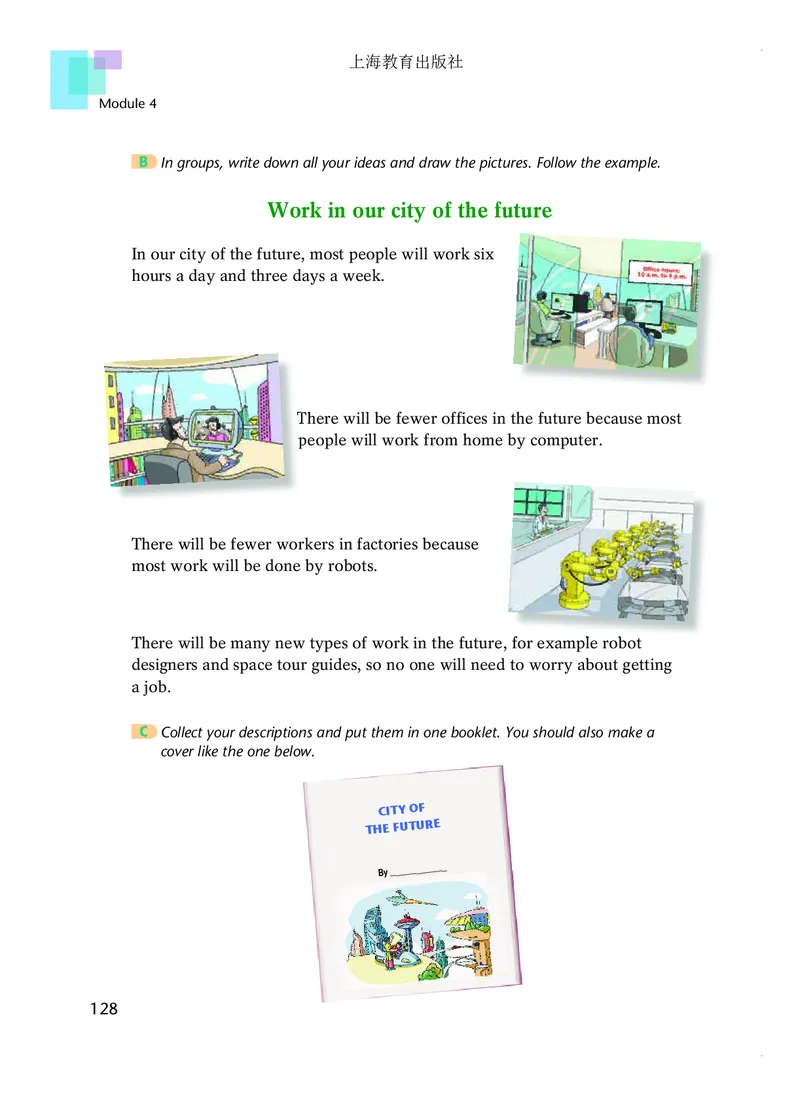

文档内容
上海教育出版社
义务教育教科书
八年级 下册
上海教育出版社上海教育出版社
(cid:4855)(cid:257)(cid:257)编: (cid:4711)(cid:1598)(cid:1252)(cid:257)(cid:3710)(cid:4623)(cid:4183)
(cid:4593) (cid:4949) (cid:4737): (cid:78) (cid:69)(cid:102)(cid:98)(cid:111)(cid:257)(cid:81) (cid:70)(cid:117)(cid:105)(cid:102)(cid:115)(cid:117)(cid:112)(cid:111)(cid:257)(cid:72) (cid:78)(cid:100)(cid:66)(cid:115)(cid:117)(cid:105)(cid:118)(cid:115)
编 (cid:4737): (cid:2900)(cid:257)(cid:6480)(cid:257)(cid:4844)(cid:257)(cid:4767)(cid:257)(cid:4007)(cid:1619)(cid:1619) (cid:4844)(cid:257)(cid:3292)
(cid:4711) (cid:1651)(cid:257)(cid:4376)(cid:257)(cid:4377)(cid:257)(cid:4551)(cid:2212)(cid:4742)
(cid:3173)(cid:2500)(cid:1655)(cid:4305)(cid:1564)(cid:1266)(cid:3617)(cid:41)(cid:4816)(cid:2132)(cid:42)(cid:4534)(cid:4172)(cid:2053)(cid:3764)(cid:4488)(cid:4565)(cid:2462)(cid:1420)(cid:1354)(cid:4224)(cid:4031)(cid:4597)(cid:2295)
(cid:3593)(cid:2139)(cid:3672)(cid:2369)(cid:1564)(cid:1266)(cid:2083)(cid:1915)(cid:4534)(cid:4172)(cid:2053)(cid:3764)(cid:3988)(cid:4565)(cid:2462)(cid:4579)(cid:3950)书(cid:1908)(cid:2053)(cid:3764)(cid:4488)(cid:4565)(cid:2462)(cid:1420)(cid:1354)(cid:4224)(cid:4031)(cid:4597)(cid:2295)
责任编辑: 黄(cid:257)艳(cid:257)林(cid:257)妍
©(cid:3593)(cid:2139)(cid:3688)(cid:4816)(cid:4205)(cid:4305)(cid:41)(cid:4541)(cid:1849)(cid:4596)(cid:42)(cid:2652)(cid:1522)(cid:1984)(cid:2027)(cid:4031)(cid:4597)(cid:2295)和(cid:3173)(cid:2500)(cid:1655)(cid:4305)(cid:1564)(cid:1266)(cid:3617)(cid:51)0(cid:50)4
(cid:272)(cid:80)(cid:121)(cid:103)(cid:112)(cid:115)(cid:101)(cid:273)(cid:4026)(cid:3173)(cid:2500)(cid:1655)(cid:4305)(cid:1564)(cid:1266)(cid:3617)(cid:1702)(cid:4864)册(cid:3590)(cid:1364)(cid:259)
(cid:4036)(cid:2525)(cid:3593)(cid:2139)(cid:3688)(cid:4816)(cid:4205)(cid:4305)(cid:41)(cid:4541)(cid:1849)(cid:4596)(cid:42)(cid:2652)(cid:1522)(cid:1984)(cid:2027)(cid:4031)(cid:4597)(cid:2295)和(cid:3173)(cid:2500)(cid:1655)(cid:4305)(cid:1564)(cid:1266)(cid:3617)(cid:41)(cid:4816)(cid:2132)(cid:42)(cid:4534)(cid:4172)(cid:2053)(cid:3764)书(cid:3052)(cid:4281)(cid:2647)(cid:456)(cid:1411)(cid:1701)
(cid:4638)(cid:3498)(cid:2182)(cid:1722)(cid:3446)(cid:4444)(cid:3498)(cid:2182)(cid:4250)(cid:3669)(cid:258)(cid:3498)(cid:2182)(cid:3011)(cid:2491)(cid:258)(cid:3498)(cid:2182)(cid:4052)(cid:4916)(cid:1867)(cid:4487)(cid:258)(cid:1888)(cid:4806)(cid:2312)(cid:4872)(cid:4636)本书(cid:1702)(cid:4052)(cid:4916)(cid:258)(cid:3950)(cid:3276)(cid:2312)音(cid:3285)(cid:259)
(cid:2252)(cid:4499)(cid:2109)(cid:1655)(cid:3646)(cid:3636)(cid:2720)(cid:1737)(cid:2720)(cid:2151)(cid:4792)(cid:1564)(cid:2462)(cid:1420)(cid:1702)(cid:1462)(cid:1649)和(cid:1411)(cid:4929)(cid:456)(cid:3893)(cid:1564)(cid:1296)(cid:2125)(cid:4458)(cid:2415)(cid:259)(cid:1737)(cid:2246):0(cid:51)(cid:50)(cid:46)(cid:55)4(cid:52)(cid:50)9(cid:51)4(cid:50)(cid:259)(cid:1737)(cid:4913)(cid:4528)(cid:4178):
(cid:107)(cid:100)(cid:107)(cid:122)(cid:65)(cid:116)(cid:102)(cid:113)(cid:105).(cid:100)(cid:112)(cid:110).(cid:100)(cid:111)(cid:259)(cid:3930)(cid:4320)(cid:1722)(cid:4791):(cid:3593)(cid:2139)(cid:3688)(cid:6031)(cid:4252)(cid:3446)(cid:2173)(cid:2528)(cid:2911)(cid:50)(cid:54)9(cid:3180)(cid:68)(cid:4951)(cid:259)(cid:4528)(cid:4768)(cid:1354)(cid:2963):(cid:51)0(cid:50)(cid:50)0(cid:50)(cid:259)
(cid:3635)(cid:3069)(cid:257)(cid:1216)(cid:4727)(cid:278)(cid:4816)(cid:2240)(cid:3495)(cid:3063)(cid:2060)和(cid:2132)(cid:4856)(cid:4949)(cid:3460)(cid:1862)(cid:279)(cid:1724)(cid:1854)(cid:3654)(cid:4085)(cid:3913)(cid:4534)(cid:2098)(cid:2112)定(cid:456)(cid:4066)(cid:3021)(cid:4441)(cid:2513)(cid:2825)(cid:4314)(cid:4724)(cid:4856)(cid:4949)(cid:3460)(cid:3495)(cid:4775)(cid:1970)(cid:1298)(cid:1552)(cid:259)
(cid:4856)(cid:4949)(cid:3460)(cid:3495)(cid:3523)(cid:4534)(cid:2098)(cid:4544)(cid:4775)(cid:1970)(cid:1298)(cid:1552)(cid:3674)(cid:4435)(cid:2647)(cid:2340)(cid:3657)(cid:4561)(cid:1564)(cid:1266)(cid:3617)(cid:2804)(cid:4131)(cid:259)
(cid:4461)(cid:4097)(cid:2462)(cid:4579)(cid:2462)(cid:2644)书
英 语
(cid:1239)(cid:3150)(cid:2346) (cid:4144)册
(cid:266)(cid:266)(cid:266)(cid:266)(cid:266)(cid:266)(cid:266)(cid:266)(cid:266)(cid:266)(cid:266)(cid:266)(cid:266)(cid:266)(cid:266)(cid:266)(cid:266)(cid:266)(cid:266)(cid:266)(cid:266)(cid:266)(cid:266)(cid:266)(cid:266)(cid:266)(cid:266)(cid:266)(cid:266)
(cid:3593)(cid:2139)(cid:3672)(cid:2369)(cid:1564)(cid:1266)(cid:2083)(cid:1915)(cid:4534)(cid:4172)(cid:2053)(cid:3764)
(cid:1564)(cid:1266)(cid:1856)(cid:4252)
(cid:3593) (cid:2139) (cid:2462) (cid:4579) (cid:1564) (cid:1266) (cid:3617)
((cid:3593)(cid:2139)(cid:3688)(cid:6031)(cid:4252)(cid:3446)(cid:2173)(cid:2528)(cid:2911)(cid:50)(cid:54)9(cid:3180)(cid:68)(cid:4951) (cid:4528)(cid:4768)(cid:1354)(cid:2963):(cid:51)0(cid:50)(cid:50)0(cid:50))
(cid:2035)(cid:1722) (cid:2525)(cid:4200) (cid:2431)(cid:3787)(cid:4377)(cid:4816)(cid:4487)(cid:3736)(cid:4534)(cid:4172)(cid:2053)(cid:3764)(cid:4487)(cid:3736)
(cid:266)(cid:266)(cid:266)(cid:266)(cid:266)(cid:266)(cid:266)(cid:266)(cid:266)(cid:266)(cid:266)(cid:266)(cid:266)(cid:266)(cid:266)(cid:266)(cid:266)(cid:266)(cid:266)(cid:266)(cid:266)(cid:266)(cid:266)(cid:266)(cid:266)(cid:266)(cid:266)(cid:266)(cid:266)
(cid:2616)本 (cid:56)(cid:57)(cid:56)(cid:289)(cid:50)09(cid:51) (cid:50)(cid:459)(cid:50)(cid:55) (cid:4487)(cid:4711) 9.(cid:54)
(cid:51)0(cid:50)4(cid:3150)(cid:50)(cid:4614)(cid:1724)(cid:50)(cid:1266) (cid:51)0(cid:51)(cid:51)(cid:3150)(cid:50)(cid:4614)(cid:1724)(cid:50)0(cid:1618)(cid:4487)(cid:3736)
(cid:74)(cid:84)(cid:67)(cid:79) 9(cid:56)(cid:57)(cid:457)(cid:56)(cid:457)(cid:54)444(cid:457)(cid:54)(cid:50)4(cid:52)(cid:457)(cid:56)(cid:459)(cid:72)(cid:260)4(cid:50)(cid:51)0
(cid:266)(cid:266)(cid:266)(cid:266)(cid:266)(cid:266)(cid:266)(cid:266)(cid:266)(cid:266)(cid:266)(cid:266)(cid:266)(cid:266)(cid:266)(cid:266)(cid:266)(cid:266)(cid:266)(cid:266)(cid:266)(cid:266)(cid:266)(cid:266)(cid:266)(cid:266)(cid:266)(cid:266)(cid:266)
定价:9.40 元(另配音带和练习册)
辽宁省物价局价格审查批准文号:辽价发[2018]30号
全国物价举报电话:12315
此书如有印、装质量问题,请向出版社调换。联系电话:021-64373213上海教育出版社
(cid:4224)(cid:4224)(cid:4224)(cid:4638)(cid:4638)(cid:4638)(cid:3374)(cid:3374)(cid:3374)(cid:3052)(cid:3052)(cid:3052)
(cid:3801)(cid:3593)(cid:4205)(cid:4305)(cid:2473)(cid:1806)(cid:456)(cid:3934)(cid:4305)(cid:3021)(cid:4441)(cid:2525)(cid:4534)(cid:4085)(cid:3150)(cid:4488)(cid:4565)(cid:4305)习(cid:1702)(cid:2525)(cid:2790)(cid:456)(cid:2098)(cid:4544)(cid:4765)(cid:2034)(cid:1239)(cid:3150)(cid:2346)(cid:4305)(cid:1806)(cid:1702)(cid:4305)习(cid:3107)
(cid:1364)(cid:456)(cid:4066)(cid:3021)(cid:1702)(cid:1812)(cid:2246)(cid:2647)(cid:4444)(cid:4785)(cid:2469)和(cid:272)(cid:4870)(cid:4413)(cid:273)(cid:4419)(cid:4213)(cid:2837)(cid:259)
(cid:4305)习(cid:1702)(cid:3134)(cid:3513)(cid:1623)(cid:2823)册(cid:2462)(cid:1420)(cid:1702)(cid:3107)(cid:2916)(cid:2344)(cid:2647)(cid:2837)(cid:3479):(cid:1239)(cid:2034)(cid:3079)(cid:2679)(cid:3823)(cid:2148)(cid:1702)(cid:3654)(cid:2883)(cid:2034)(cid:2246)(cid:3894)(cid:456)(cid:1623)(cid:2790)(cid:3663)(cid:1695)(cid:4036)
(cid:2720)(cid:456)(cid:1623)(cid:2644)(cid:2352)(cid:1695)(cid:4052)(cid:4305)(cid:456)(cid:1623)(cid:4305)(cid:4207)(cid:1695)(cid:3617)(cid:2295)(cid:456)(cid:1623)(cid:4095)(cid:4810)(cid:1695)(cid:2523)(cid:3627)(cid:456)(cid:2348)(cid:2221)(cid:4078)(cid:3823)(cid:1411)(cid:1288)(cid:259)(cid:4929)(cid:2415)(cid:4066)(cid:3021)(cid:1824)(cid:3002)(cid:4113)(cid:4013)
(cid:4638)(cid:3143)(cid:3021)(cid:1702)(cid:3762)(cid:4028)和(cid:4305)习(cid:2659)(cid:2392)(cid:2779)(cid:4864)(cid:3527)(cid:2513)(cid:2825)(cid:1824)(cid:1702)(cid:4488)(cid:4565)元(cid:3790)(cid:456)(cid:4444)(cid:2791)(cid:3143)(cid:3021)(cid:4638)(cid:4940)(cid:4914)(cid:3479)(cid:1702)(cid:3431)(cid:2528)(cid:4816)(cid:4712)(cid:4069)(cid:4740)
(cid:3019)(cid:4565)(cid:4350)(cid:259)
(cid:2426)(cid:4465)(cid:3143)(cid:3021)(cid:2429)(cid:272)(cid:1793)(Reading)(cid:273)和(cid:272)(cid:2652)(cid:3894)(Project)(cid:273)(cid:2483)(cid:2183)(cid:3344)(cid:2720)(cid:3762)(cid:2634)(cid:259)(cid:1411)(cid:2504)(cid:4474)(cid:4026)(cid:272)(cid:2652)(cid:3894)(cid:273)
(cid:1702)(cid:3618)(cid:2362)(cid:4561)(cid:2652)(cid:4052)(cid:4534)(cid:3134)(cid:4638)(cid:2804)(cid:4131)(cid:456)(cid:2255)(cid:4474)(cid:4026)(cid:272)(cid:4616)(cid:1793)(cid:273)和(cid:272)(cid:4806)(cid:4949)(cid:273)(cid:2392)(cid:1642)(cid:4638)(cid:4899)(cid:4940)(cid:3996)(cid:3014)(cid:1702)(cid:2235)(cid:1409)(cid:266)(cid:266)(cid:1793)(cid:456)
(cid:1474)(cid:3636)(cid:4433)(cid:4058)(cid:2312)(cid:4247)(cid:3456)(cid:456)(cid:3457)(cid:3783)(cid:3821)(cid:1386)(cid:2837)(cid:2484)(cid:456)(cid:2375)(cid:3624)(cid:2870)(cid:4098)(cid:456)(cid:3479)(cid:2219)(cid:2257)(cid:4419)(cid:4822)(cid:4250)(cid:3669)(cid:456)(cid:272)(cid:1358)(cid:1519)(cid:273)(cid:2652)本(cid:2583)(cid:258)(cid:4205)(cid:3495)书(cid:258)
(cid:4205)(cid:1614)(cid:1734)(cid:1367)(cid:1651)(cid:1564)(cid:2720)(cid:259)(cid:3115)(cid:4387)(cid:1702)(cid:1793)(cid:3679)(cid:4940)(cid:3636)(cid:1775)(cid:4534)(cid:4211)(cid:1702)(cid:471)(cid:3115)(cid:4387)(cid:1702)(cid:272)(cid:4806)(cid:4949)(cid:273)(cid:2557)(cid:3679)(cid:2429)(cid:4778)(cid:3662)(cid:4201)(cid:2245)(cid:258)(cid:1511)(cid:1743)(cid:1702)(cid:2135)(cid:1522)(cid:259)
(cid:272)(cid:3921)(Listening)(cid:273)(cid:1702)(cid:1420)(cid:2841)(cid:1288)(cid:2708)(cid:1425)(cid:1889)(cid:258)(cid:1812)(cid:2246)(cid:258)(cid:2084)(cid:3674)(cid:3276)(cid:1806)(cid:258)(cid:2109)(cid:2018)(cid:1706)(cid:3897)(cid:1419)(cid:456)(cid:4855)(cid:4402)(cid:4319)练(cid:3921)(cid:1360)
(cid:1411)(cid:3934)(cid:4822)(cid:2764)(cid:1702)(cid:3733)(cid:4916)(cid:1367)(cid:1651)(cid:1862)(cid:258)(cid:2311)(cid:3453)(cid:2098)(cid:2416)(cid:4241)(cid:4112)(cid:258)(cid:3207)(cid:4286)(cid:258)(cid:1364)(cid:3662)(cid:1722)(cid:3950)(cid:1706)(cid:2352)(cid:3136)(cid:259)(cid:4561)(cid:3332)(cid:1812)(cid:4492)(cid:1702)(cid:1683)(cid:3479)(cid:3679)(cid:272)(cid:3755)
(Speaking)(cid:273):(cid:3593)册(cid:1702)(cid:4824)(cid:1733)(cid:4638)(cid:4565)音(cid:4565)(cid:1753)(cid:1702)(cid:1722)(cid:1698)(cid:471)(cid:4144)册(cid:1702)(cid:4824)(cid:1733)(cid:3679)(cid:272)(cid:3755)(cid:273)(cid:1701)(cid:1701)(cid:3897)(cid:456)(cid:4526)(cid:3332)(cid:2098)(cid:4544)(cid:272)(cid:2527)
(cid:3670)(cid:273)(cid:272)(cid:2018)(cid:4778)(cid:273)(cid:272)(cid:3944)(cid:3797)(cid:2312)(cid:2286)(cid:4492)(cid:3944)(cid:3797)(cid:273)(cid:272)(cid:1698)(cid:3382)(cid:273)(cid:1706)(cid:1706)(cid:456)(cid:1275)(cid:4858)(cid:1655)(cid:2374)(cid:4712)(cid:4069)(cid:4419)(cid:4213)(cid:2048)(cid:3136)(cid:4458)(cid:3154)(cid:1702)(cid:2112)(cid:1876)(cid:1367)(cid:1651)(cid:1862)(cid:259)
(cid:272)(cid:4224)(Writing)(cid:273)(cid:4561)(cid:3327)(cid:3150)(cid:2346)(cid:1330)(cid:456)(cid:4402)(cid:3593)(cid:4419)(cid:2034)(cid:3836)(cid:2473):(cid:3332)(cid:4419)(cid:456)(cid:4402)(cid:3441)(cid:2806)(cid:2580)(cid:1519)(cid:1806)(cid:3408)(cid:2951)(cid:2337)(cid:3753)(cid:1487)(cid:456)(cid:1411)
(cid:2504)(cid:4276)(cid:4402)(cid:4534)(cid:3276)(cid:1806)(cid:1702)(cid:2067)(cid:3762)(cid:456)(cid:2255)(cid:1701)(cid:4534)(cid:1733)(cid:4185)(cid:4191)(cid:2800)和(cid:1592)(cid:4656)(cid:4256)(cid:471)(cid:3332)(cid:1854)(cid:456)(cid:3616)(cid:2340)(cid:1702)(cid:3897)(cid:1419)(cid:258)(cid:3894)(cid:1420)(cid:2040)(cid:1824)(cid:456)(cid:4534)(cid:2626)
(cid:3950)(cid:4224)(cid:2084)(cid:3674)(cid:456)(cid:2626)(cid:1367)(cid:2029)(cid:4224)(cid:1908)(cid:4102)(cid:1298)(cid:2018)(cid:456)(cid:2037)(cid:2573)(cid:1420)(cid:2841)(cid:2491)(cid:3606)(cid:3495)(cid:4095)(cid:258)(cid:1775)(cid:4095)(cid:456)(cid:4026)(cid:3950)(cid:3276)配(cid:3755)(cid:3069)(cid:4052)(cid:4916)(cid:1706)(cid:1706)(cid:259)(cid:4144)
册(cid:2255)(cid:2429)(cid:2469)(cid:1577)(cid:2040)(cid:1824)(cid:3661)(cid:4521)(cid:4052)(cid:3897)(cid:456)(cid:4846)(cid:3523)书(cid:4241)(cid:258)(cid:1357)(cid:3913)(cid:258)(cid:3620)(cid:3433)书(cid:4782)(cid:2764)(cid:259)(cid:1563)(cid:4305)(cid:4224)(cid:4949)(cid:3679)(cid:3603)(cid:1411)(cid:1701)(cid:3079)(cid:1888)(cid:1702)(cid:456)
(cid:2426)(cid:4465)(cid:1655)(cid:2374)(cid:4638)(cid:4616)(cid:1793)(cid:4816)(cid:2878)(cid:4458)(cid:4314)(cid:4724)(cid:1876)本(cid:456)(cid:3523)(cid:2133)(cid:2255)(cid:3136)(cid:1245)(cid:1876)本(cid:4949)(cid:1330)(cid:2465)(cid:456)(cid:4661)(cid:3332)(cid:3593)(cid:1848)(cid:1888)(cid:4782)(cid:456)(cid:3115)(cid:3002)(cid:456)(cid:2506)(cid:1413)
(cid:2295)(cid:1893)(cid:1481)(cid:2682)(cid:259)
(cid:272)(cid:4565)(cid:1862)(Grammar)(cid:273)(cid:3332)(cid:3661)(cid:3679)(cid:4419)(cid:2034)(cid:4923)(cid:4192)(cid:1702)(cid:1265)(cid:2679)(cid:259)本(cid:3150)(cid:1806)(cid:1702)(cid:4855)(cid:4402)(cid:4565)(cid:1862)(cid:4188)(cid:3107)(cid:3616)(cid:2340)(cid:1411)定(cid:1662)(cid:1614)(cid:456)
(cid:2319)(cid:3733)(cid:1614)和(cid:4286)(cid:3733)(cid:1614)(cid:456)(cid:1775)(cid:1614)(cid:1411)定(cid:3669)(cid:456)(cid:4164)(cid:4638)(cid:3996)(cid:1519)(cid:3657)(cid:456)(cid:2135)(cid:3457)(cid:2506)(cid:4252)(cid:3657)(cid:456)(cid:1317)(cid:1775)(cid:4565)(cid:3840)(cid:456)(cid:3913)(cid:2418)(cid:4882)(cid:4565)(cid:1623)(cid:2580)和
(cid:4593)(cid:4474)(cid:4882)(cid:4565)(cid:1623)(cid:2580)(cid:1706)(cid:259)
(cid:4616)(cid:1793)(cid:1702)(cid:2109)(cid:1800)和(cid:4052)(cid:2245)(cid:1702)(cid:3624)(cid:1800)(cid:3679)(cid:1623)(cid:2720)(cid:3009)(cid:4534)(cid:1353)(cid:2366)和(cid:1721)(cid:4173)(cid:1702)(cid:456)(cid:4402)(cid:4744)(cid:4767)(cid:4305)(cid:2171)(cid:4419)(cid:3019)(cid:4565)(cid:4350)(cid:456)(cid:4740)(cid:2823)(cid:2034)
(cid:1883)(cid:3052)(cid:1411)(cid:2647)(cid:2312)(cid:3469)(cid:456)(cid:1848)(cid:3408)(cid:1824)(cid:1824)(cid:4462)(cid:3584)(cid:259)(cid:4474)(cid:1615)(cid:456)(cid:4066)(cid:3021)(cid:4424)(cid:3479)(cid:2523)(cid:4240)(cid:1354)(cid:4224)(cid:2837)配(cid:2183)(cid:1671)元(cid:2246)(cid:3894)(cid:1702)(cid:272)(cid:1409)(cid:1546)(cid:4616)(cid:1793)
(More practice)(cid:273)和(cid:272)(cid:4052)(cid:2245)(cid:2457)(Culture corner)(cid:273)(cid:3134)(cid:3513)(cid:259)(cid:3332)(cid:2109)(cid:1800)和(cid:3624)(cid:1800)(cid:1788)(cid:1330)(cid:3327)(cid:3150)(cid:2346)(cid:2040)(cid:3644)(cid:4419)
(cid:1557)(cid:456)(cid:1275)(cid:4858)(cid:1655)(cid:2374)(cid:3893)(cid:3639)(cid:1812)(cid:4488)(cid:4565)(cid:4565)(cid:4350)(cid:1702)(cid:1996)(cid:4778)和(cid:4266)(cid:4386)(cid:259)
(cid:4940)(cid:2219)(cid:3755)(cid:4419)(cid:4144)(cid:4488)(cid:4565)(cid:4305)习(cid:1702)(cid:272)(cid:4305)习(cid:2352)(cid:3136)(Study skills)(cid:273)(cid:456)(cid:3523)(cid:2182)(cid:1245)(cid:2462)(cid:1420)(cid:3823)(cid:1583)(cid:3698)(cid:1702)(cid:272)(cid:2352)(cid:273)(cid:1358)
(cid:4026)(cid:4914)(cid:2350)(cid:1702)(cid:272)(cid:3136)(cid:273)(cid:456)(cid:1411)(cid:2637)(cid:4797)(cid:3593)(cid:3852)(cid:1378)(cid:456)(cid:4024)(cid:3716)(cid:3136)(cid:3636)(cid:3399)(cid:259)(cid:3823)(cid:4444)(cid:456)(cid:4402)(cid:3416)(cid:1914)(cid:1722)(cid:4623)(cid:4521)(cid:2035)(cid:2764)(cid:4241)(cid:4112)(cid:2046)(cid:2575)(cid:266)(cid:266)(cid:1611)(cid:1734)(cid:258)
(cid:4010)(cid:2959)(cid:258)(cid:3011)(cid:3897)(cid:456)(cid:1824)(cid:2626)(cid:258)(cid:1824)(cid:1457)(cid:258)(cid:1824)(cid:2363)(cid:258)(cid:1824)(cid:4185)(cid:456)(cid:1411)(cid:1891)(cid:2135)(cid:3498)(cid:2182)(cid:4419)(cid:4822)(cid:1441)(cid:4949)(cid:4256)(cid:1702)(cid:1805)(cid:2816)(cid:456)(cid:3679)(cid:2311)(cid:1701)(cid:4305)习(cid:2352)
(cid:3136)(cid:1702)(cid:4024)(cid:4419)(cid:3952)(cid:2534)(cid:259)
(cid:3136)(cid:1935)(cid:1651)(cid:1519)(cid:3107)(cid:1364)(cid:475)(cid:4419)(cid:3150)(cid:2219)(cid:2415)(cid:445)
(cid:1563)(cid:4816)(cid:278)(cid:4488)(cid:4565)(cid:279)(cid:1354)(cid:4224)(cid:4935)
2012(cid:3150)12(cid:4614)上海教育出版社
(cid:3071)(cid:4231)
(cid:4638)(cid:2462)(cid:1420)(cid:1354)(cid:4224)(cid:1702)(cid:2135)(cid:1522)(cid:4816)(cid:456)(cid:1415)(cid:1908)(cid:2462)(cid:3646)(cid:1812)(cid:1615)(cid:2046)(cid:4949)(cid:4558)(cid:4444)(cid:2335)(cid:1655)(cid:1702)(cid:1275)(cid:4858)(cid:456)(cid:3884)(cid:1615)(cid:1996)(cid:4231):
(cid:1214)(cid:1933)(cid:5812)(cid:257)(cid:4844)(cid:257)(cid:1519)(cid:257)(cid:2894)(cid:1384)(cid:2704)(cid:257)(cid:1444)(cid:2132)(cid:2859)
(cid:85)(cid:112)(cid:111)(cid:122) (cid:69)(cid:98)(cid:109)(cid:102)上海教育出版社
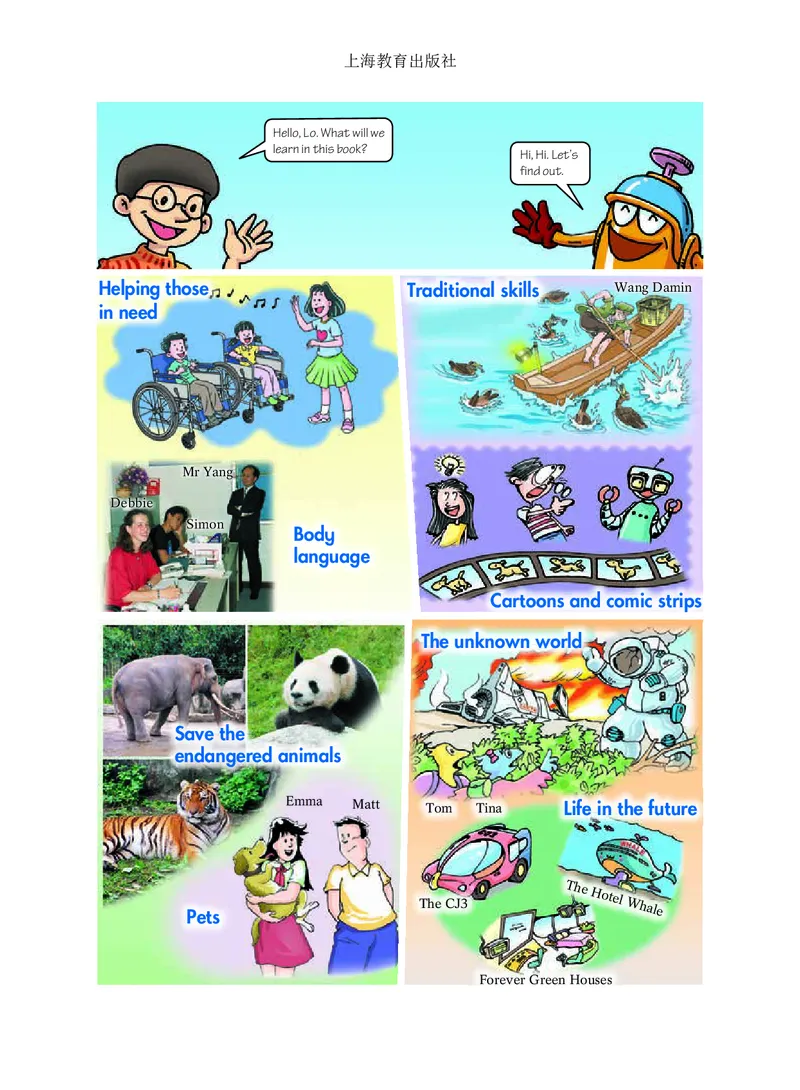
Hello, Lo. What will we
learn in this book?
Hi, Hi. Let’s
find out.
Helping those Traditional skills Wang Damin
in need
Mr Yang
Debbie
Simon
Body
language
Cartoons and comic strips
The unknown world
Save the
endangered animals
Emma Matt Tom Tina Life in the future
The CJ3
The
Hotel
Whale
Pets
Forever Green Houses上海教育出版社
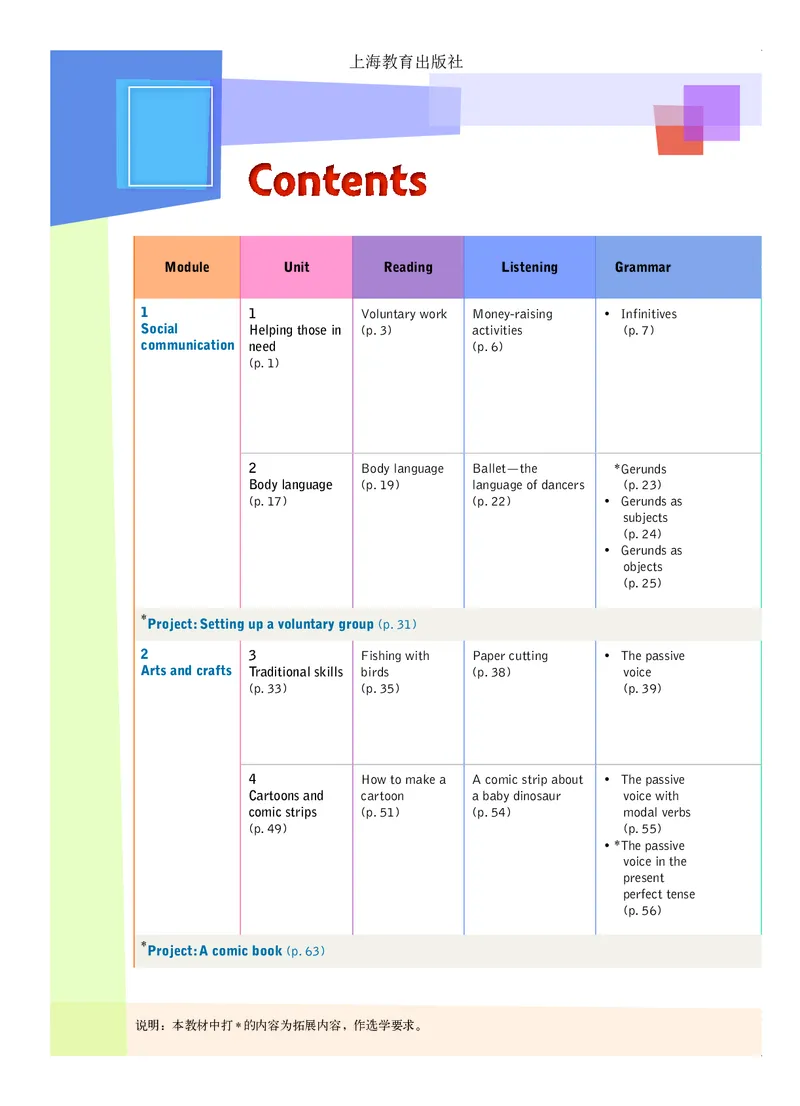
CCCooonnnttteeennntttsss
Speaking Culture corner
(cid:43)
Module Unit Reading Listening Grammar Writing More practice Study skills and
Talk time Speak up Self-assessment
1 1 Voluntary work Money-raising • Infinitives Talking Which A letter to the Success for Charts and • U(cid:47)IC(cid:38)F
Social Helping those in (p. 3) activities (p. 7) about plans voluntary head teacher Spring Buds graphs (3): (p. 16)
communication need (p. 6) (p. 10) activity are (p. 11) (p. 13) Using pie • Self(cid:14)assessment
(p. 1) you going charts (p. 16)
to take (p. 14)
part in?
(p. 10)
2 Body language Ballet—the (cid:43)Gerunds Making, The A short (cid:38)ye contact — • Different ways
Body language (p. 19) language of dancers (p. 23) accepting meanings message (p. 29) of greeting
(p. 17) (p. 22) • (cid:40)erunds as and of some (p. 28) others
subjects rejecting gestures (p. 30)
(p. 24) suggestions (p. 27) • Self(cid:14)assessment
• (cid:40)erunds as (p. 26) (p. 30)
objects
(p. 25)
(cid:43)
Project: Setting up a voluntary group (p. 31)
(cid:43)
2 3 Fishing with Paper cutting • The passive Describing The A person with Shadow puppet Practical • Chinese knots
Arts and crafts Traditional skills birds (p. 38) voice people traditional a traditional plays writing (2): (p. 48)
(p. 33) (p. 35) (p. 39) (p. 42) skill of skill (p. 45) Posters, • Self(cid:14)assessment
paper (p. 44) notices, etc. (p. 48)
cutting (p. 46)
(p. 43)
4 How to make a A comic strip about • The passive Giving The ending Mystery Island Tom and (cid:43)erry — • Havoc in
Cartoons and cartoon a baby dinosaur voice with warnings of the (p. 59) (p. 61) Heaven
comic strips (p. 51) (p. 54) modal verbs (p. 58) story about (p. 62)
(p. 49) (p. 55) a baby • Self(cid:14)assessment
•(cid:43)The passive dinosaur (p. 62)
voice in the (p. 58)
present
perfect tense
(p. 56)
(cid:43)
Project: A comic book (p. 63)
说明:本(cid:2462)(cid:1420)中(cid:1654)(cid:454)的内容为(cid:3978)(cid:4699)内容(cid:456)作选(cid:4305)要求。上海教育出版社
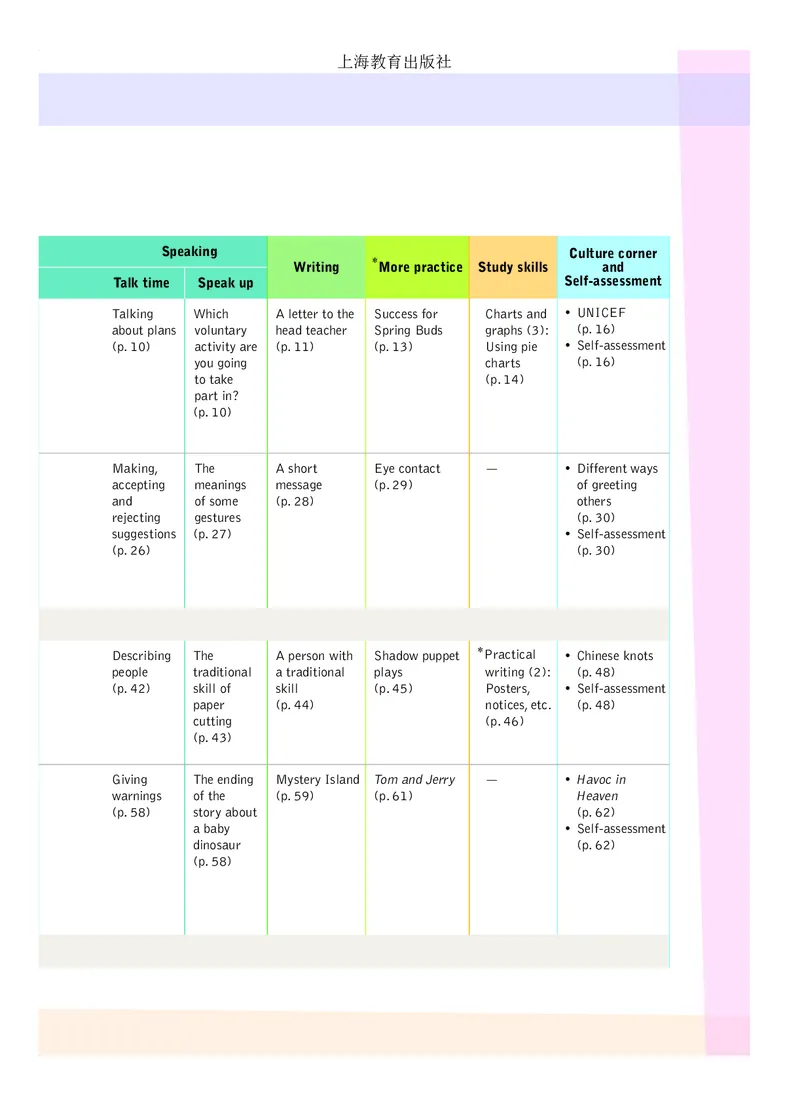
Speaking Culture corner
(cid:43)
Module Unit Reading Listening Grammar Writing More practice Study skills and
Talk time Speak up Self-assessment
1 1 Voluntary work Money-raising • Infinitives Talking Which A letter to the Success for Charts and • U(cid:47)IC(cid:38)F
Social Helping those in (p. 3) activities (p. 7) about plans voluntary head teacher Spring Buds graphs (3): (p. 16)
communication need (p. 6) (p. 10) activity are (p. 11) (p. 13) Using pie • Self(cid:14)assessment
(p. 1) you going charts (p. 16)
to take (p. 14)
part in?
(p. 10)
2 Body language Ballet—the (cid:43)Gerunds Making, The A short (cid:38)ye contact — • Different ways
Body language (p. 19) language of dancers (p. 23) accepting meanings message (p. 29) of greeting
(p. 17) (p. 22) • (cid:40)erunds as and of some (p. 28) others
subjects rejecting gestures (p. 30)
(p. 24) suggestions (p. 27) • Self(cid:14)assessment
• (cid:40)erunds as (p. 26) (p. 30)
objects
(p. 25)
(cid:43)
Project: Setting up a voluntary group (p. 31)
(cid:43)
2 3 Fishing with Paper cutting • The passive Describing The A person with Shadow puppet Practical • Chinese knots
Arts and crafts Traditional skills birds (p. 38) voice people traditional a traditional plays writing (2): (p. 48)
(p. 33) (p. 35) (p. 39) (p. 42) skill of skill (p. 45) Posters, • Self(cid:14)assessment
paper (p. 44) notices, etc. (p. 48)
cutting (p. 46)
(p. 43)
4 How to make a A comic strip about • The passive Giving The ending Mystery Island Tom and (cid:43)erry — • Havoc in
Cartoons and cartoon a baby dinosaur voice with warnings of the (p. 59) (p. 61) Heaven
comic strips (p. 51) (p. 54) modal verbs (p. 58) story about (p. 62)
(p. 49) (p. 55) a baby • Self(cid:14)assessment
•(cid:43)The passive dinosaur (p. 62)
voice in the (p. 58)
present
perfect tense
(p. 56)
(cid:43)
Project: A comic book (p. 63)上海教育出版社
Speaking Culture corner
(cid:43)
Module Unit Reading Listening Grammar Writing More practice Study skills and
Talk time Speak up Self-assessment
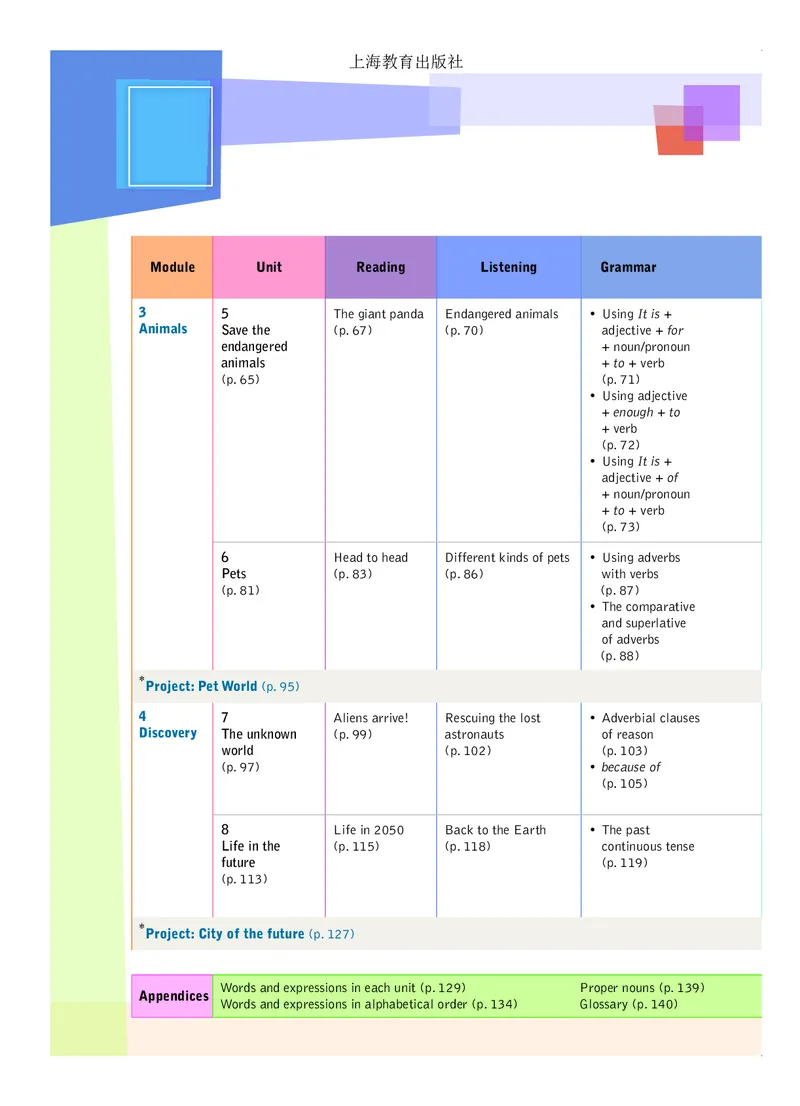
3 5 The giant panda (cid:38)ndangered animals • Using It is + Talking How can we An The story of the Using • WWF
Animals Save the (p. 67) (p. 70) adjective + for about help save endangered red-crowned reference (p. 80)
endangered + noun/pronoun obligations endangered animal crane books (4): • Self(cid:14)assessment
animals + to + verb (p. 74) animals(cid:32) (p. 75) (p. 77) Using a (p. 80)
(p. 65) (p. 71) (p. 74) dictionary
• Using adjective ((cid:432))
+ enough + to (p. 78)
+ verb
(p. 72)
• Using It is +
adjective + of
+ noun/pronoun
+ to + verb
(p. 73)
6 Head to head Different kinds of pets • Using adverbs Making and Problems What animal A dog’s story — • How sayings
Pets (p. 83) (p. 86) with verbs responding caused by makes the (p. 93) about dogs have
(p. 81) (p. 87) to pets best pet? changed
• The comparative complaints (p. 90) (p. 91) (p. 94)
and superlative (p. 90) • Self(cid:14)assessment
of adverbs (p. 94)
(p. 88)
(cid:43)
Project: Pet World (p. 95)
4 7 Aliens arrive! Rescuing the lost • Adverbial clauses Agreeing Things to Meeting the UFO Making • Science fiction
Discovery The unknown (p. 99) astronauts of reason and take while people of Bird (p. 109) notes (3): (p. 112)
world (p. 102) (p. 103) disagreeing lost on World Making • Self(cid:14)assessment
(p. 97) • because of (p. 106) Planet X (p. 107) notes while (p. 112)
(p. 105) (p. 106) listening
(p. 110)
8 (cid:45)ife in (cid:19)(cid:17)(cid:22)(cid:17) Back to the (cid:38)arth • The past Making A trip to (cid:45)ife in the Problems in — • Shanghai (cid:38)xpo:
Life in the (p. 115) (p. 118) continuous tense apologies the Moon past and 2050 Dream inspires
future (p. 119) and giving (p. 122) present (p. 125) future cities
(p. 113) excuses (p. 123) (p. 126)
(p. 122) • Self(cid:14)assessment
(p. 126)
(cid:43)
Project: City of the future (p. 127)
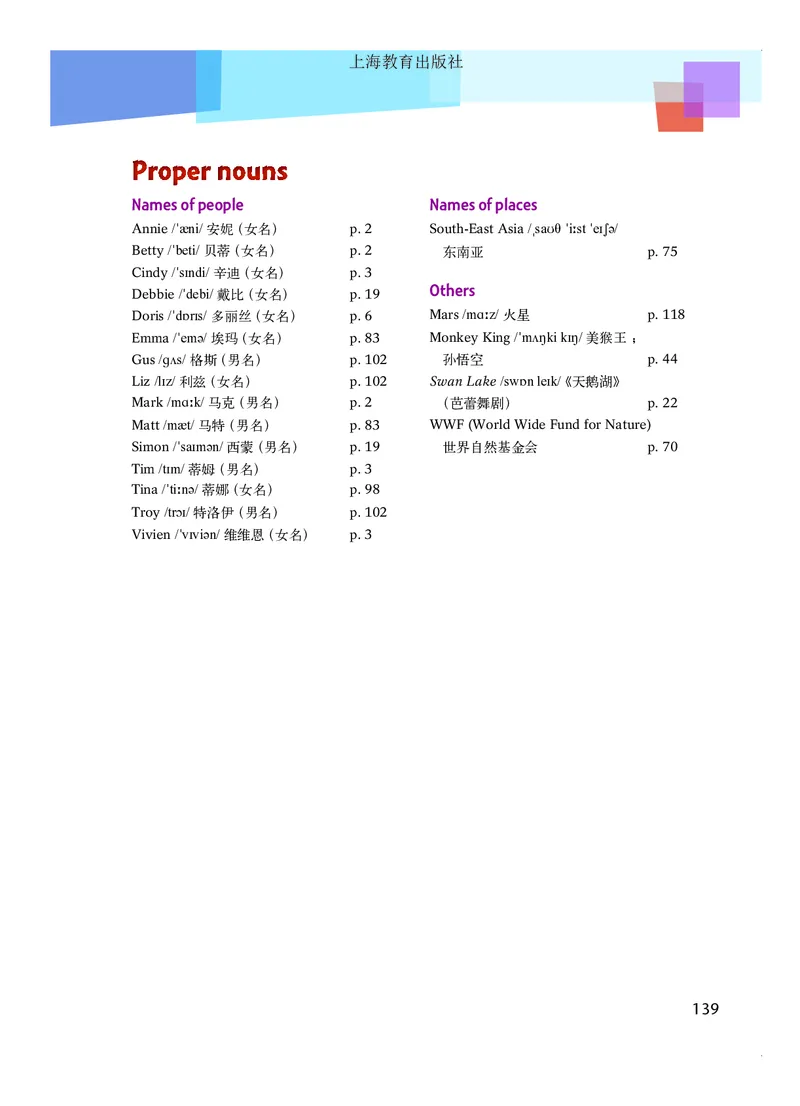
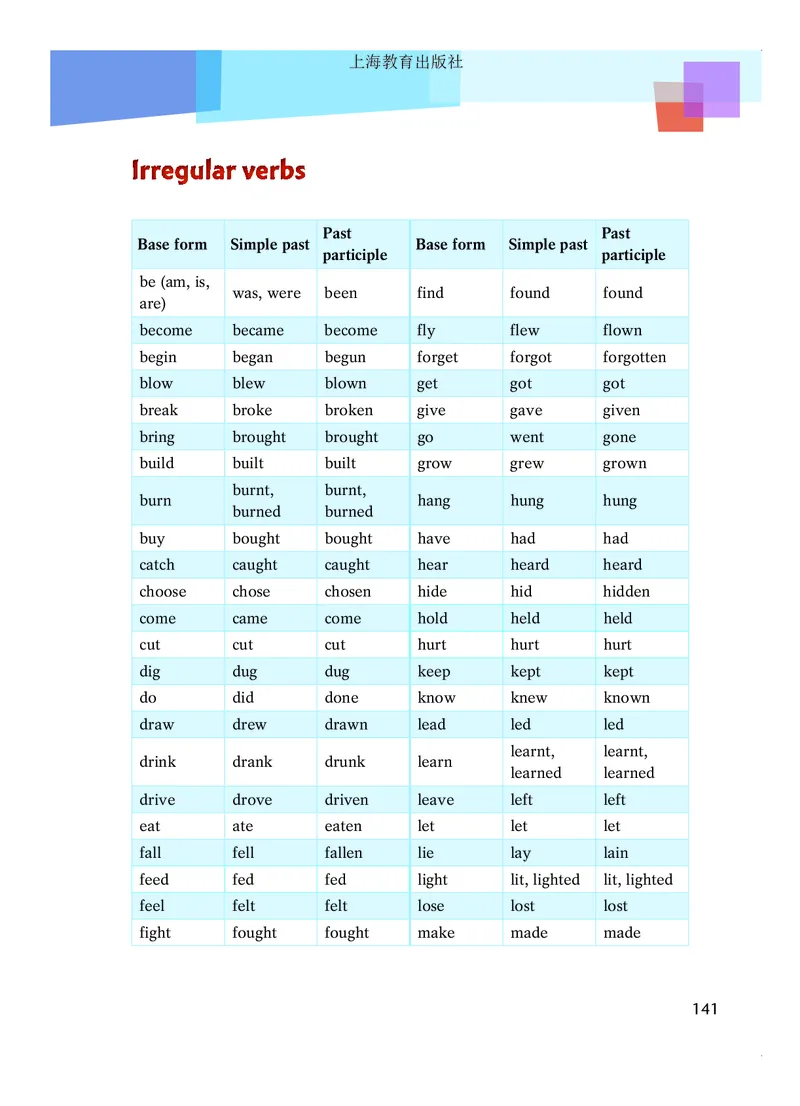
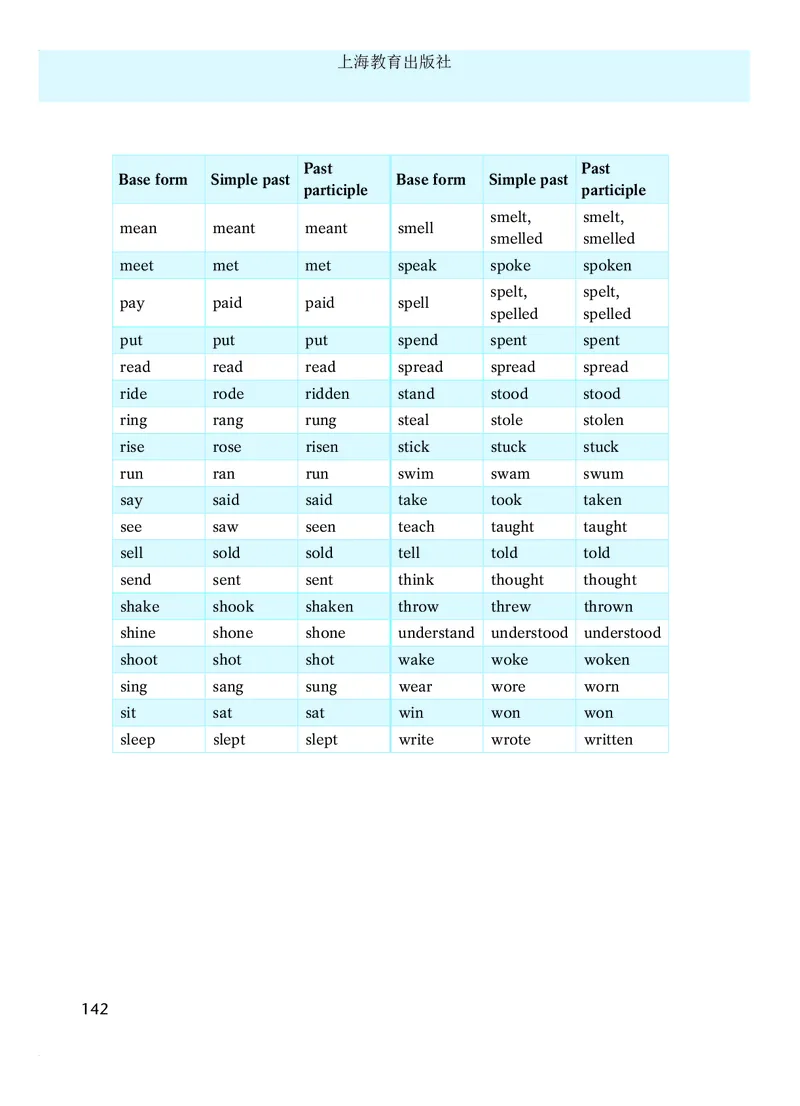
Words and expressions in each unit (p. 129) Proper nouns (p. 139) Irregular verbs (p. 141)
Appendices
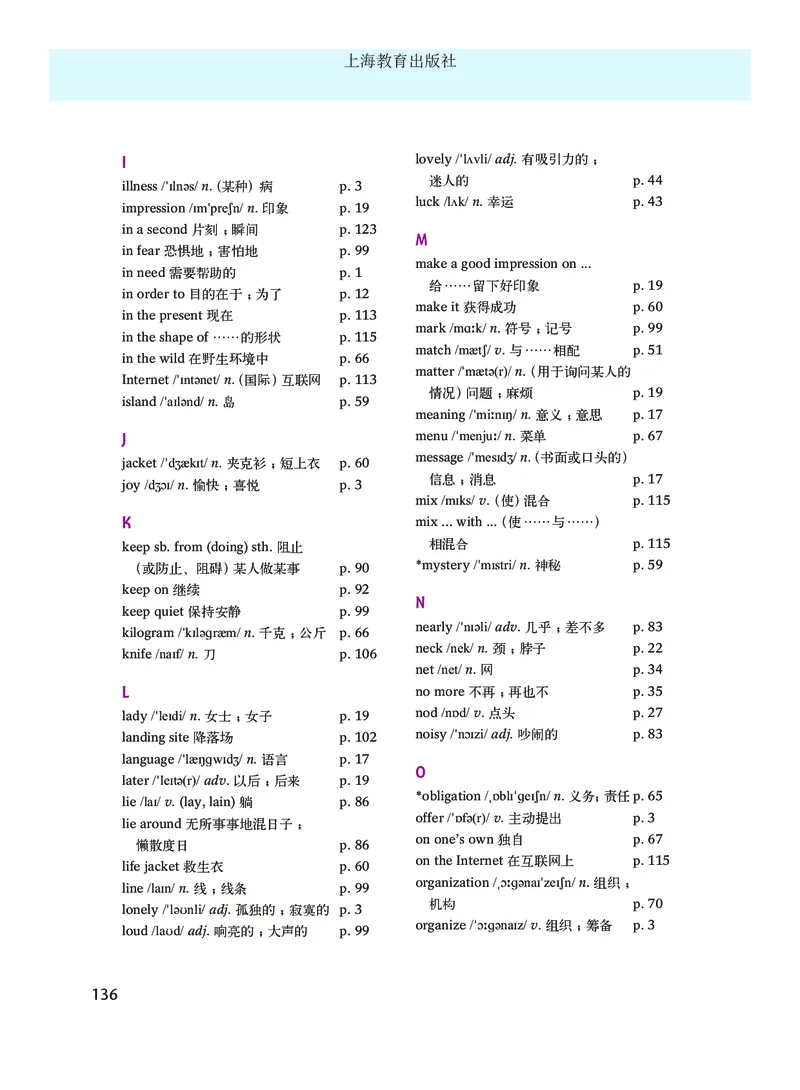
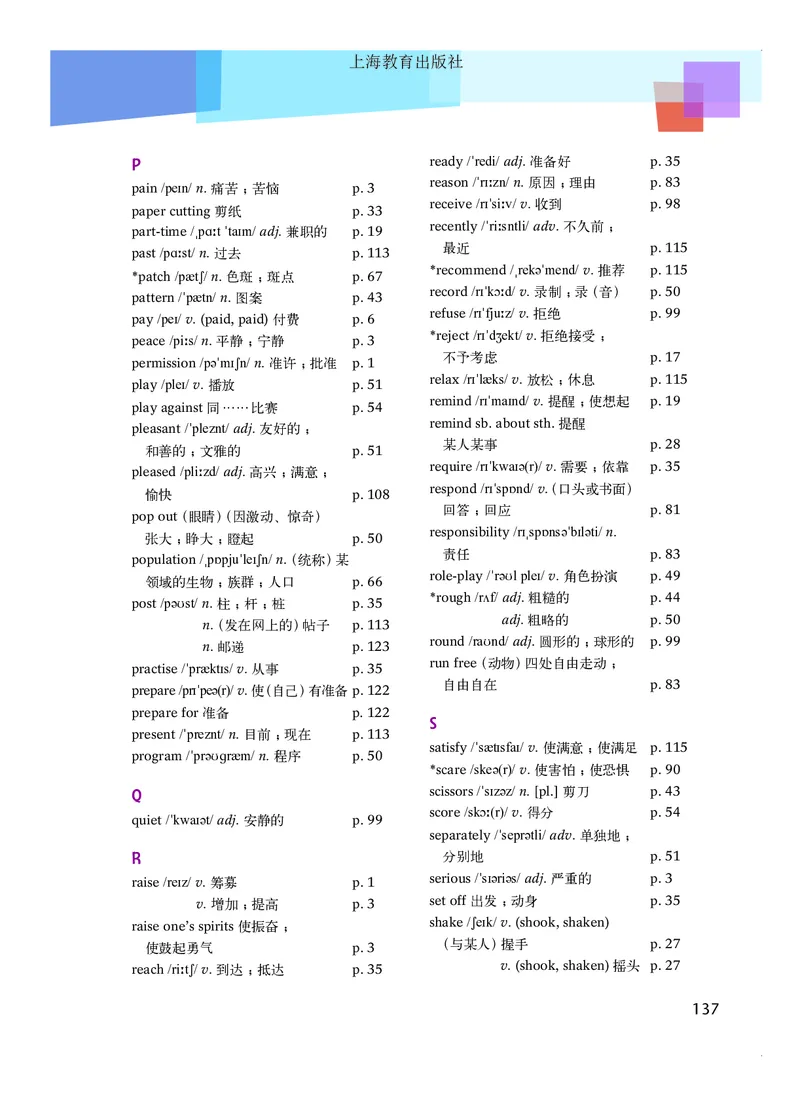
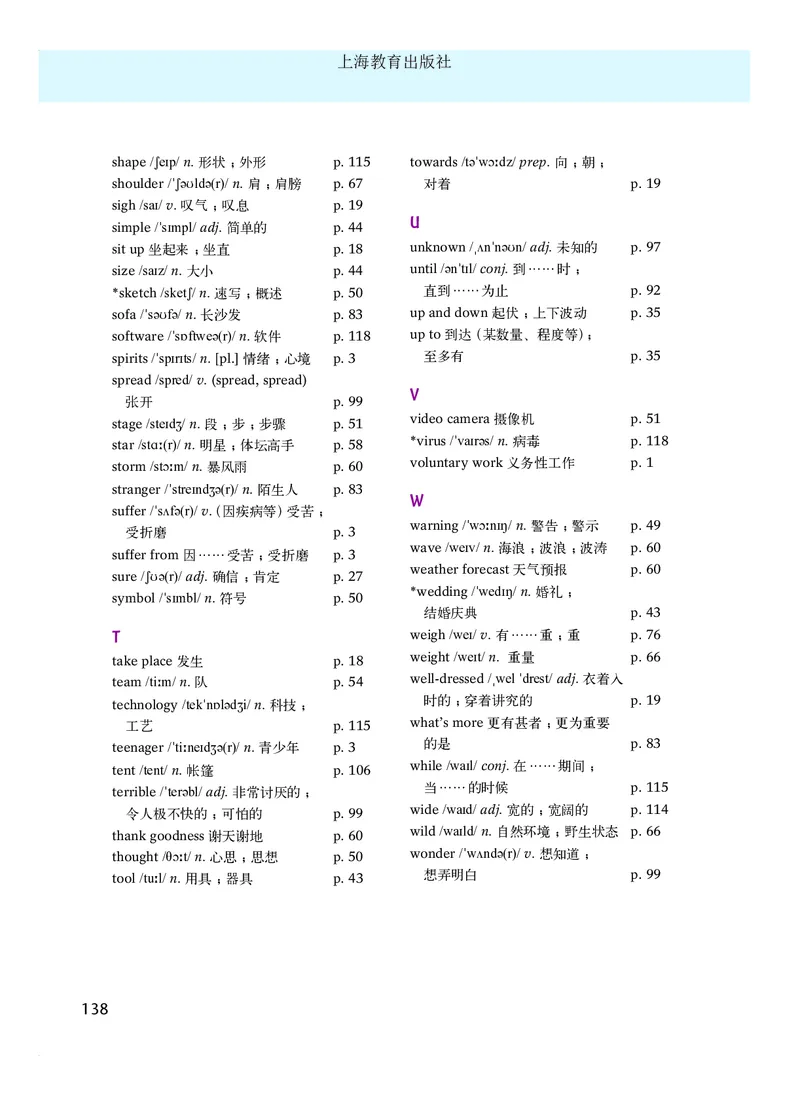
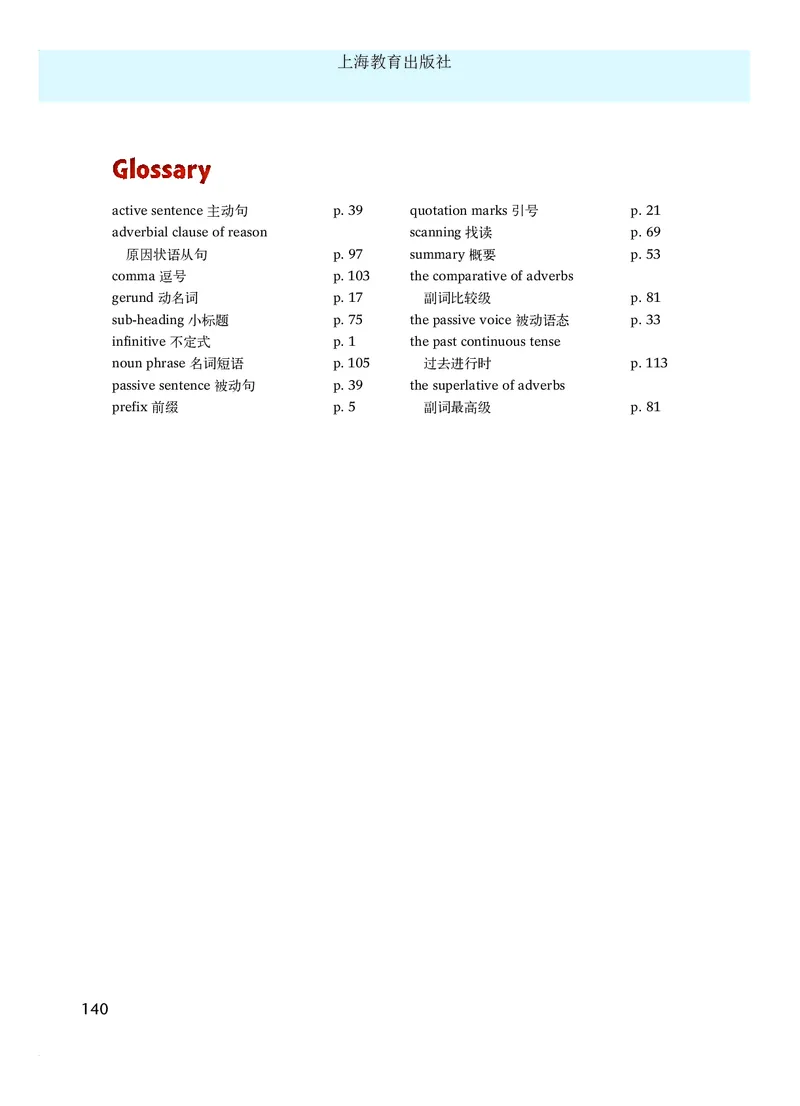
Words and expressions in alphabetical order (p. 134) Glossary (p. 140)上海教育出版社
Speaking Culture corner
(cid:43)
Module Unit Reading Listening Grammar Writing More practice Study skills and
Talk time Speak up Self-assessment
3 5 The giant panda (cid:38)ndangered animals • Using It is + Talking How can we An The story of the Using • WWF
Animals Save the (p. 67) (p. 70) adjective + for about help save endangered red-crowned reference (p. 80)
endangered + noun/pronoun obligations endangered animal crane books (4): • Self(cid:14)assessment
animals + to + verb (p. 74) animals(cid:32) (p. 75) (p. 77) Using a (p. 80)
(p. 65) (p. 71) (p. 74) dictionary
• Using adjective ((cid:432))
+ enough + to (p. 78)
+ verb
(p. 72)
• Using It is +
adjective + of
+ noun/pronoun
+ to + verb
(p. 73)
6 Head to head Different kinds of pets • Using adverbs Making and Problems What animal A dog’s story — • How sayings
Pets (p. 83) (p. 86) with verbs responding caused by makes the (p. 93) about dogs have
(p. 81) (p. 87) to pets best pet? changed
• The comparative complaints (p. 90) (p. 91) (p. 94)
and superlative (p. 90) • Self(cid:14)assessment
of adverbs (p. 94)
(p. 88)
(cid:43)
Project: Pet World (p. 95)
4 7 Aliens arrive! Rescuing the lost • Adverbial clauses Agreeing Things to Meeting the UFO Making • Science fiction
Discovery The unknown (p. 99) astronauts of reason and take while people of Bird (p. 109) notes (3): (p. 112)
world (p. 102) (p. 103) disagreeing lost on World Making • Self(cid:14)assessment
(p. 97) • because of (p. 106) Planet X (p. 107) notes while (p. 112)
(p. 105) (p. 106) listening
(p. 110)
8 (cid:45)ife in (cid:19)(cid:17)(cid:22)(cid:17) Back to the (cid:38)arth • The past Making A trip to (cid:45)ife in the Problems in — • Shanghai (cid:38)xpo:
Life in the (p. 115) (p. 118) continuous tense apologies the Moon past and 2050 Dream inspires
future (p. 119) and giving (p. 122) present (p. 125) future cities
(p. 113) excuses (p. 123) (p. 126)
(p. 122) • Self(cid:14)assessment
(p. 126)
(cid:43)
Project: City of the future (p. 127)
Words and expressions in each unit (p. 129) Proper nouns (p. 139) Irregular verbs (p. 141)
Appendices
Words and expressions in alphabetical order (p. 134) Glossary (p. 140)上海教育出版社上海教育出版社
Module 1 Social communication
Unit
1
HHHeeelllpppiiinnnggg ttthhhooossseee iiinnn nnneeeeeeddd
Getting ready
In this unit, you will learn about voluntary activities.
Reading
• Read three students’ reports on their voluntary work.
Listening
• Listen to a radio programme about money-raising activities.
Grammar
• Learn how to use infinitives.
Speaking
• Learn to talk about plans.
• Talk about the voluntary activity you would like to
take part in.
Writing
• Write a letter to the head teacher to ask permission to
rraaiissee mmoonneeyy..
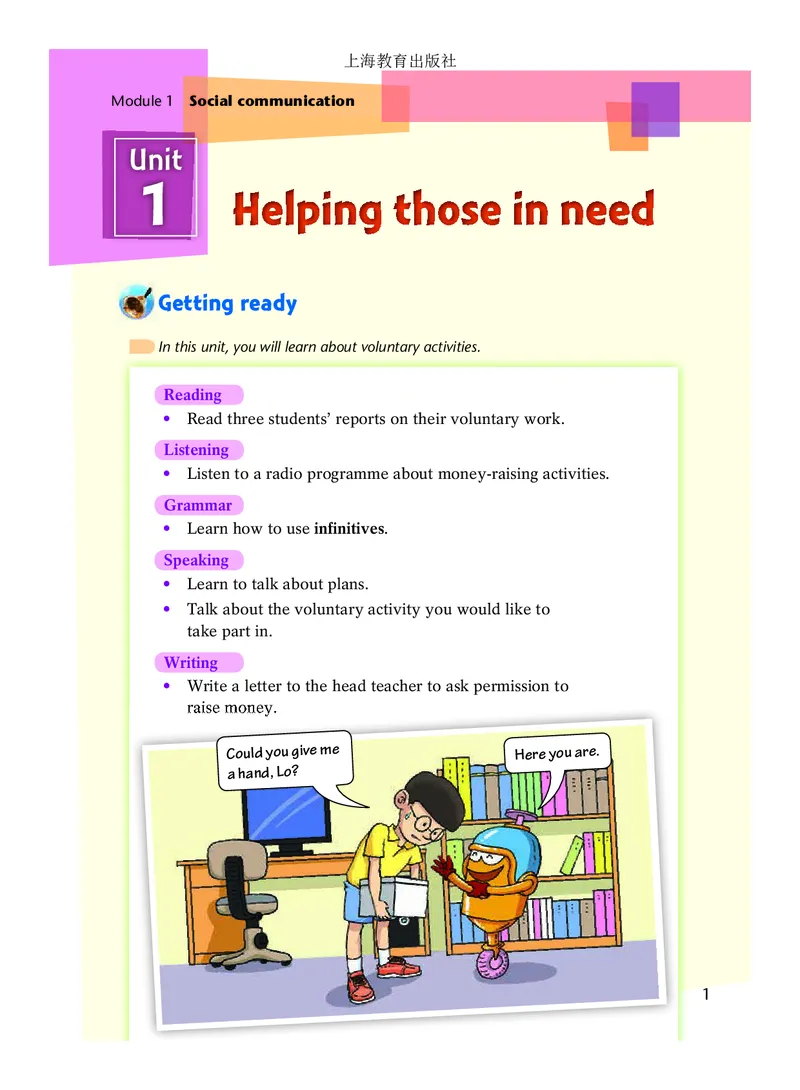
Could you give me Here you are.
a hand, Lo?
1上海教育出版社
Module 1
Reading
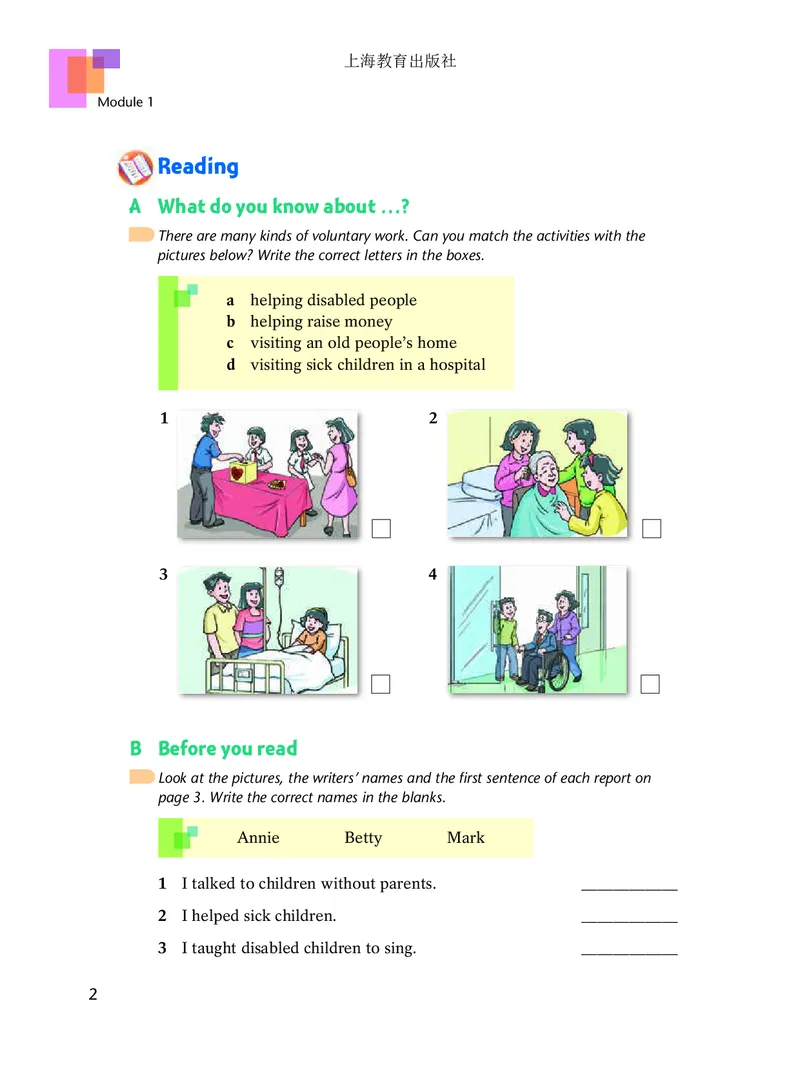
A What do you know about …?
There are many kinds of voluntary work. Can you match the activities with the
pictures below? Write the correct letters in the boxes.
a helping disabled people
b helping raise money
c visiting an old people’s home
d visiting sick children in a hospital
1 2
3 4
B Before you read
Look at the pictures, the writers’ names and the first sentence of each report on
page 3. Write the correct names in the blanks.
Annie Betty Mark
1 I talked to children without parents. ____________
2 I helped sick children. ____________
3 I taught disabled children to sing. ____________
2上海教育出版社
Unit 1
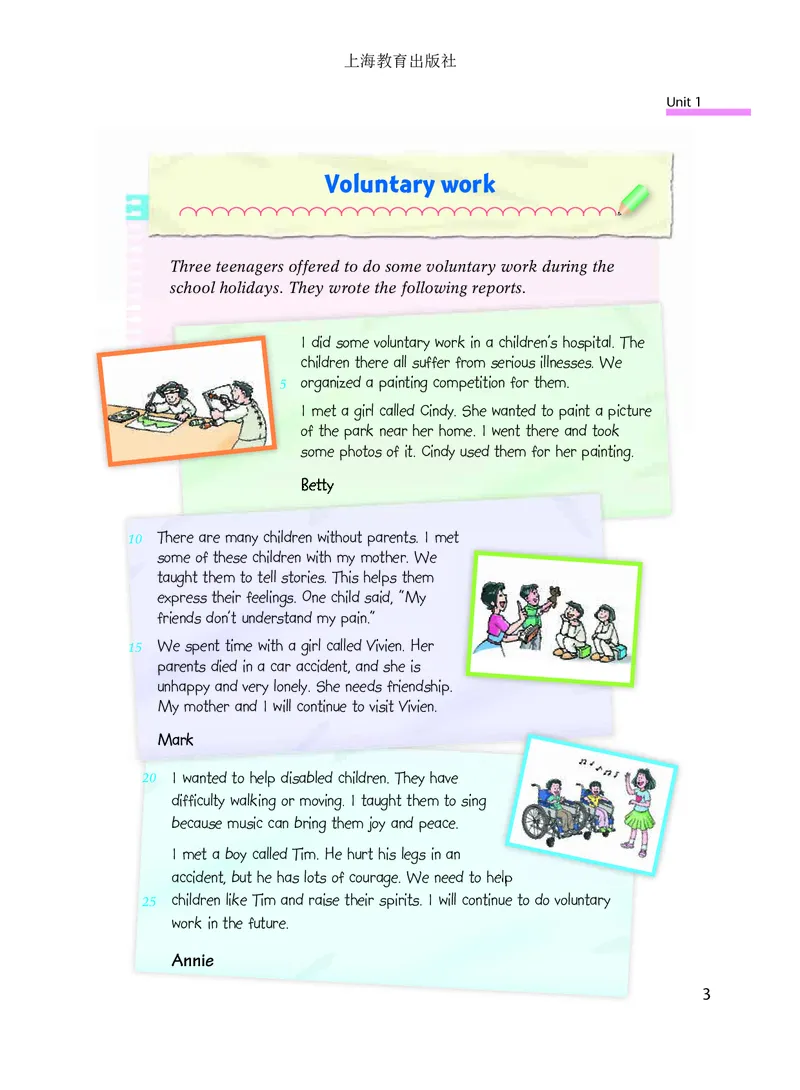
Voluntary work
Three teenagers offered to do some voluntary work during the
school holidays. They wrote the following reports.
I did some voluntary work in a children’s hospital. The
children there all suffer from serious illnesses. (cid:78)e
organi(cid:113)ed a painting competition for them.
5
I met a girl called (cid:58)indy. (cid:74)he wanted to paint a picture
of the park near her home. I went there and took
some photos of it. (cid:58)indy used them for her painting.
(cid:57)(cid:57)(cid:92)(cid:92)(cid:107)(cid:107)(cid:107)(cid:107)(cid:112)(cid:112)
TTThhheeerrreee aaarrreee mmmaaannnyyy ccchhhiiillldddrrreeennn wwwiiittthhhooouuuttt pppaaarrreeennntttsss... III mmmeeettt
10
some of these children with my mother. We
taught them to tell stories. This helps them
express their feelings. One child said, “My
friends don’t understand my pain.”
We spent time with a girl called Vivien. Her
15
parents died in a car accident, and she is
unhappy and very lonely. She needs friendship.
My mother and I will continue to visit Vivien.
Mark
20 I wanted to help disabled children. They have
difficulty walking or moving. I taught them to sing
because music can bring them joy and peace.
I met a boy called Tim. He hurt his legs in an
aacccciiddeenntt,, bbuutt hhee hhaass lloottss ooff ccoouurraaggee.. WWee nneeeedd ttoo hheellpp
children like Tim and raise their spirits. I will continue to do voluntary
25
work in the future.
Annie
3上海教育出版社
Module 1
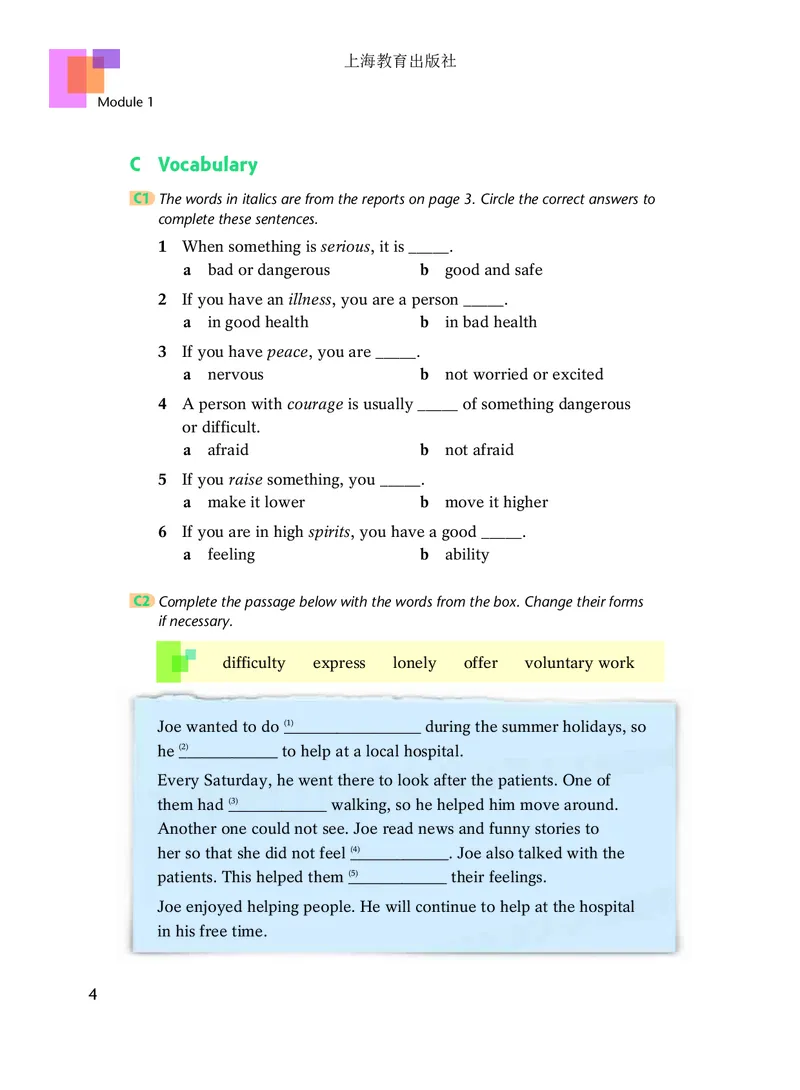
C Vocabulary
C1 The words in italics are from the reports on page 3. Circle the correct answers to
complete these sentences.
1 When something is serious, it is _____.
a bad or dangerous b good and safe
2 If you have an illness, you are a person _____.
a in good health b in bad health
3 If you have peace, you are _____.
a nervous b not worried or excited
4 A person with courage is usually _____ of something dangerous
or difficult.
a afraid b not afraid
5 If you raise something, you _____.
a make it lower b move it higher
6 If you are in high spirits, you have a good _____.
a feeling b ability
C2 Complete the passage below with the words from the box. Change their forms
if necessary.
difficulty express lonely offer voluntary work
Joe wanted to do (_1)_________________ during the summer holidays, so
he _(2)____________ to help at a local hospital.
Every Saturday, he went there to look after the patients. One of
them had (_3)____________ walking, so he helped him move around.
Another one could not see. Joe read news and funny stories to
her so that she did not feel (_4)____________. Joe also talked with the
patients. This helped them (_5)____________ their feelings.
Joe enjoyed helping people. He will continue to help at the hospital
in his free time.
4上海教育出版社
Unit 1
Using prefixes to guess the meanings of words
Look at these two sentences. Do you know the meanings of unhappy and
disabled?
Vivien’s parents died in a car accident, and she is unhappy and very lonely.
Annie wanted to help disabled children.
Un- and dis- are two prefixes. We add them to the beginning of words to give
these words the opposite meaning.
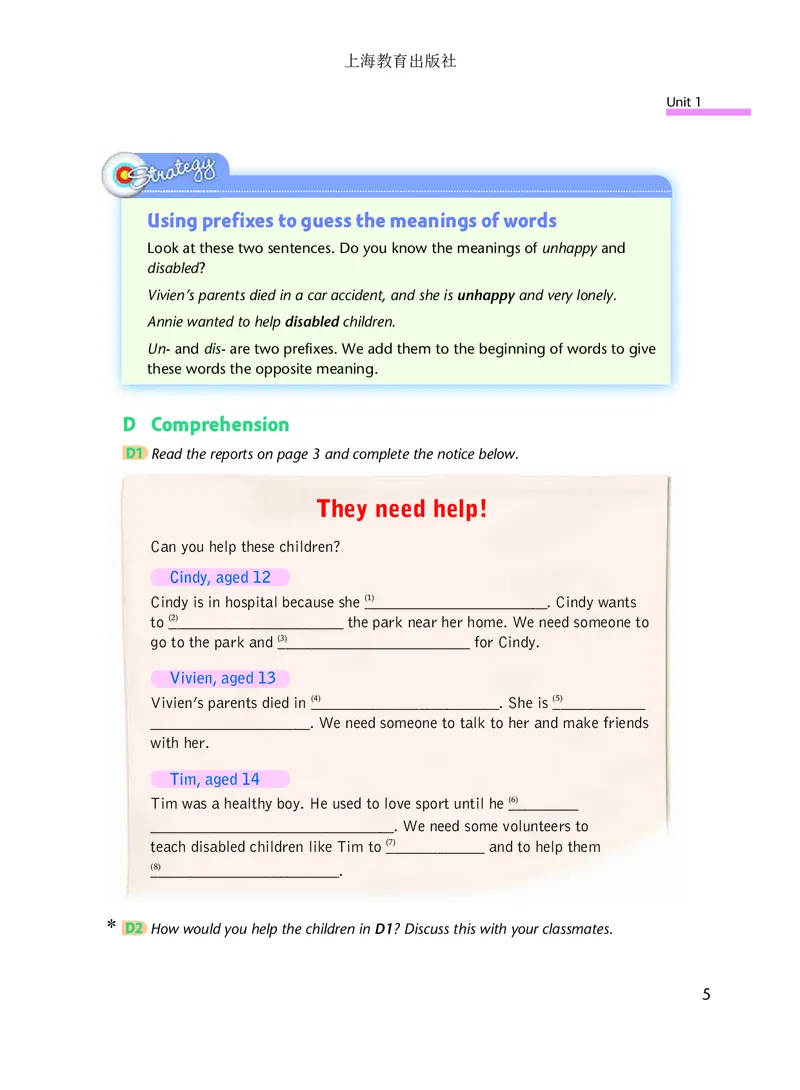
D Comprehension
D1 Read the reports on page 3 and complete the notice below.
They need help!
Can you help these children?
Cindy, aged 12
Cindy is in hospital because she (_1)_______________________. Cindy wants
to _(2)______________________ the park near her home. We need someone to
go to the park and (_3)________________________ for Cindy.
Vivien, aged 13
Vivien’s parents died in (_4)________________________. She is (_5)___________
_____________________. We need someone to talk to her and make friends
with her.
Tim, aged 14
Tim was a healthy boy. He used to love sport until he (_6)________
________________________________. We need some volunteers to
teach disabled children like Tim to _(7)____________ and to help them
_(8)________________________.
(cid:43)
D2 How would you help the children in D1? Discuss this with your classmates.
5上海教育出版社
Module 1
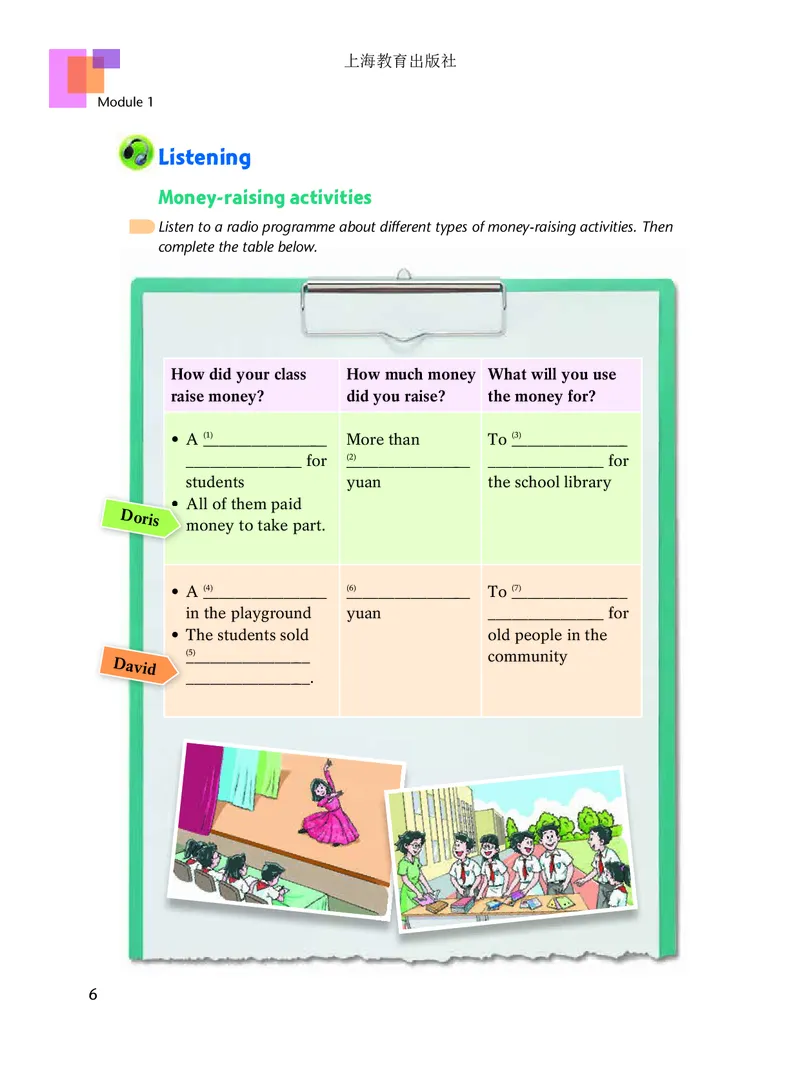
Listening
Money-raising activities
Listen to a radio programme about different types of money-raising activities. Then
complete the table below.
How did your class How much money What will you use
raise money? did you raise? the money for?
• (cid:34) (_1)_______________ More than To (_3)______________
_______________ for (_2)_______________ _______________ for
students yuan the school library
•• (cid:34)(cid:34)llll oo(cid:71)(cid:71) tthheemm ppaaiidd
Doris
mmoonneeyy ttoo ttaakkee ppaarrtt..
• (cid:34) (_4)_______________ (_6)_______________ To (_7)______________
in the playground yuan _______________ for
•• (cid:53)(cid:53)hhee ssttuuddeennttss ssoolldd old people in the
_(_5)_______________ community
David
________________________________..
6上海教育出版社
Unit 1
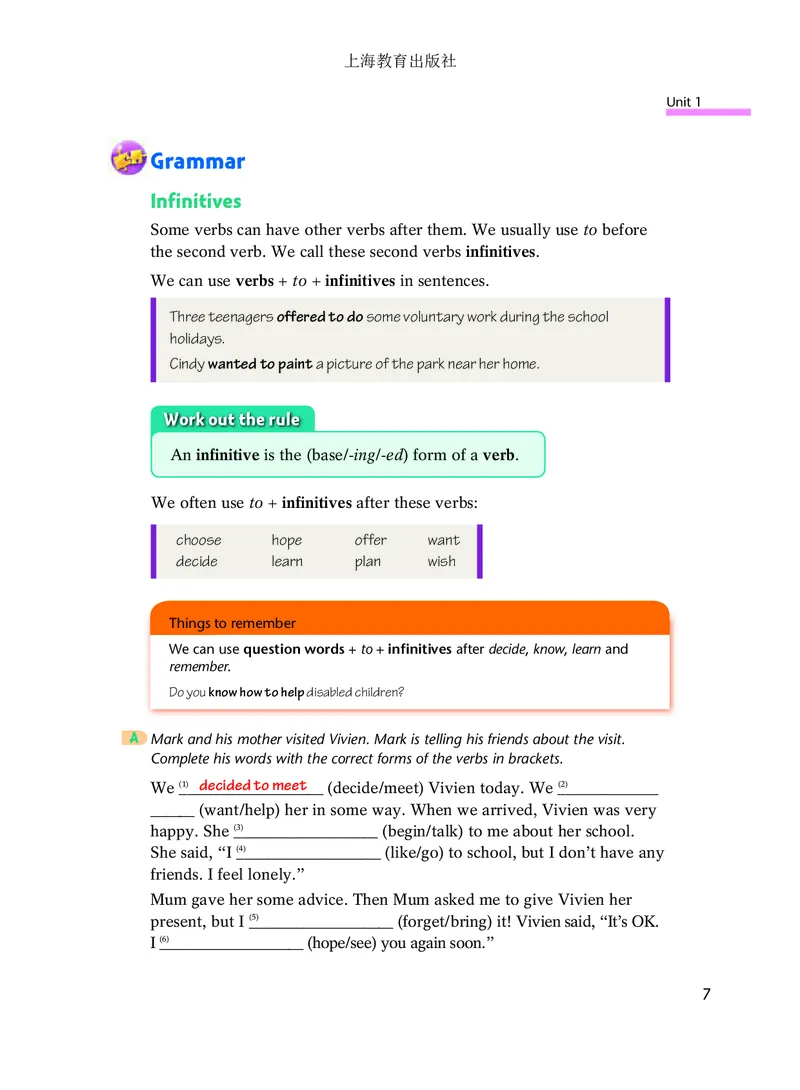
Grammar
Infinitives
Some verbs can have other verbs after them. We usually use to before
the second verb. We call these second verbs infinitives.
We can use verbs + to + infinitives in sentences.
Three teenagers offered to do some voluntary work during the school
holidays.
Cindy wanted to paint a picture of the park near her home.
Work out the rule
An infinitive is the (base/-ing/-ed) form of a verb.
We often use to + infinitives after these verbs:
choose hope offer want
decide learn plan wish
Things to remember
We can use question words + to + infinitives after decide, know, learn and
remember.
Do you know how to help disabled children?
A Mark and his mother visited Vivien. Mark is telling his friends about the visit.
Complete his words with the correct forms of the verbs in brackets.
We (_1)__d_e_c_i_d_e_d_ t_o_ _m_e_e_t___ (decide/meet) Vivien today. We (_2)____________
______ (want/help) her in some way. When we arrived, Vivien was very
happy. She _(3)__________________ (begin/talk) to me about her school.
She said, “I (_4)__________________ (like/go) to school, but I don’t have any
friends. I feel lonely.”
Mum gave her some advice. Then Mum asked me to give Vivien her
present, but I (_5)__________________ (forget/bring) it! Vivien said, “It’s OK.
I _(6)__________________ (hope/see) you again soon.”
7上海教育出版社
Module 1
We can also use verbs + objects + to + infinitives in sentences.
Annie taught Tim to sing beautiful songs.
We want them to be happy.
Things to remember
We use infinitives without to after some verbs, such as let and make.
Mum made me go to bed early.
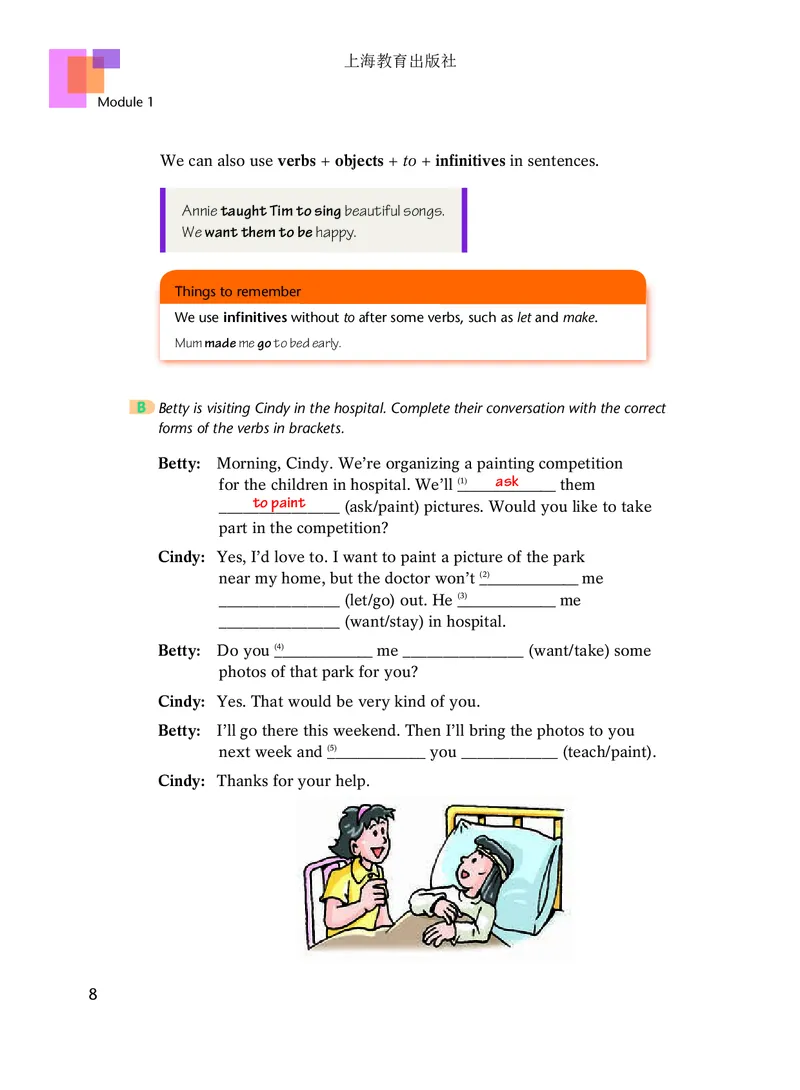
B Betty is visiting Cindy in the hospital. Complete their conversation with the correct
forms of the verbs in brackets.
Betty: Morning, Cindy. We’re organizing a painting competition
for the children in hospital. We’ll (_1)____a_s__k_____ them
_____t_o_ p_a_in_t_____ (ask/paint) pictures. Would you like to take
part in the competition?
Cindy: Yes, I’d love to. I want to paint a picture of the park
near my home, but the doctor won’t (_2)____________ me
_______________ (let/go) out. He _(3)____________ me
_______________ (want/stay) in hospital.
Betty: Do you _(4)____________ me _______________ (want/take) some
photos of that park for you?
Cindy: Yes. That would be very kind of you.
Betty: I’ll go there this weekend. Then I’ll bring the photos to you
next week and (_5)____________ you ____________ (teach/paint).
Cindy: Thanks for your help.
8上海教育出版社
Unit 1
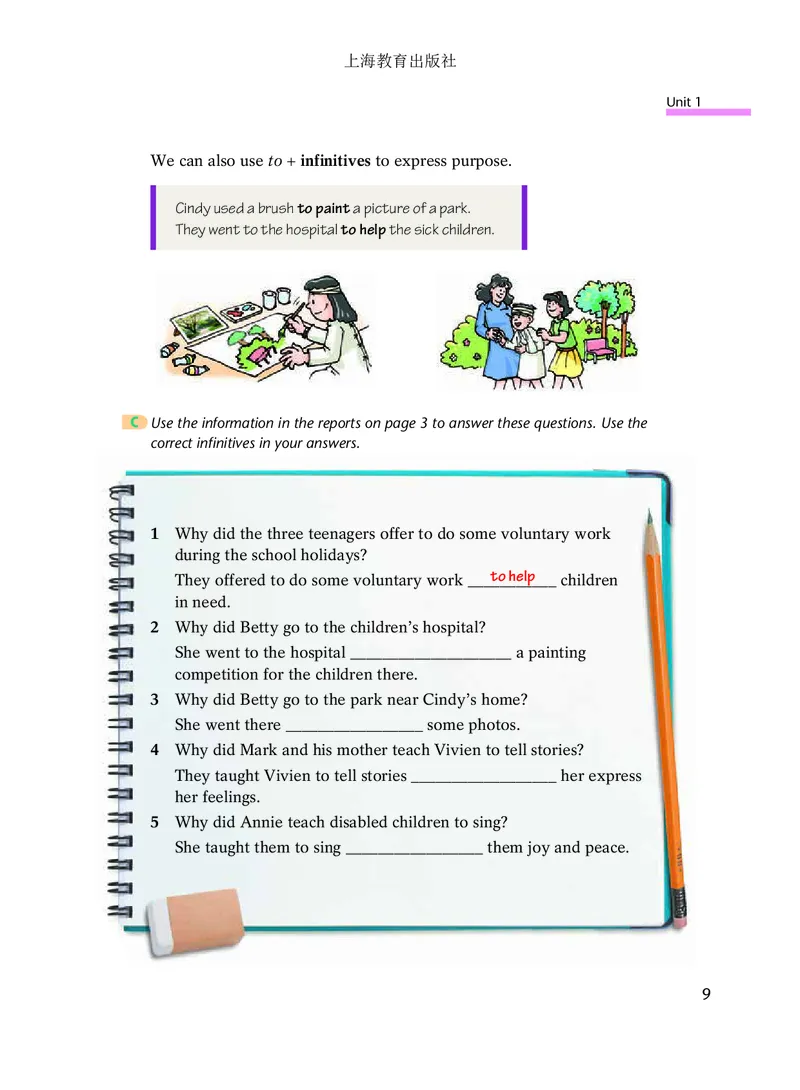
We can also use to + infinitives to express purpose.
Cindy used a brush to paint a picture of a park.
They went to the hospital to help the sick children.
C Use the information in the reports on page 3 to answer these questions. Use the
correct infinitives in your answers.
1 Why did the three teenagers offer to do some voluntary work
during the school holidays?
They offered to do some voluntary work ___t_o_ _h_el_p___ children
in need.
2 Why did Betty go to the children’s hospital?
She went to the hospital ____________________ a painting
competition for the children there.
3 Why did Betty go to the park near Cindy’s home?
She went there _________________ some photos.
4 Why did Mark and his mother teach Vivien to tell stories?
They taught Vivien to tell stories __________________ her express
her feelings.
5 Why did Annie teach disabled children to sing?
She taught them to sing _________________ them joy and peace.
9上海教育出版社
Module 1
Speaking
A Talk time
Talking about plans
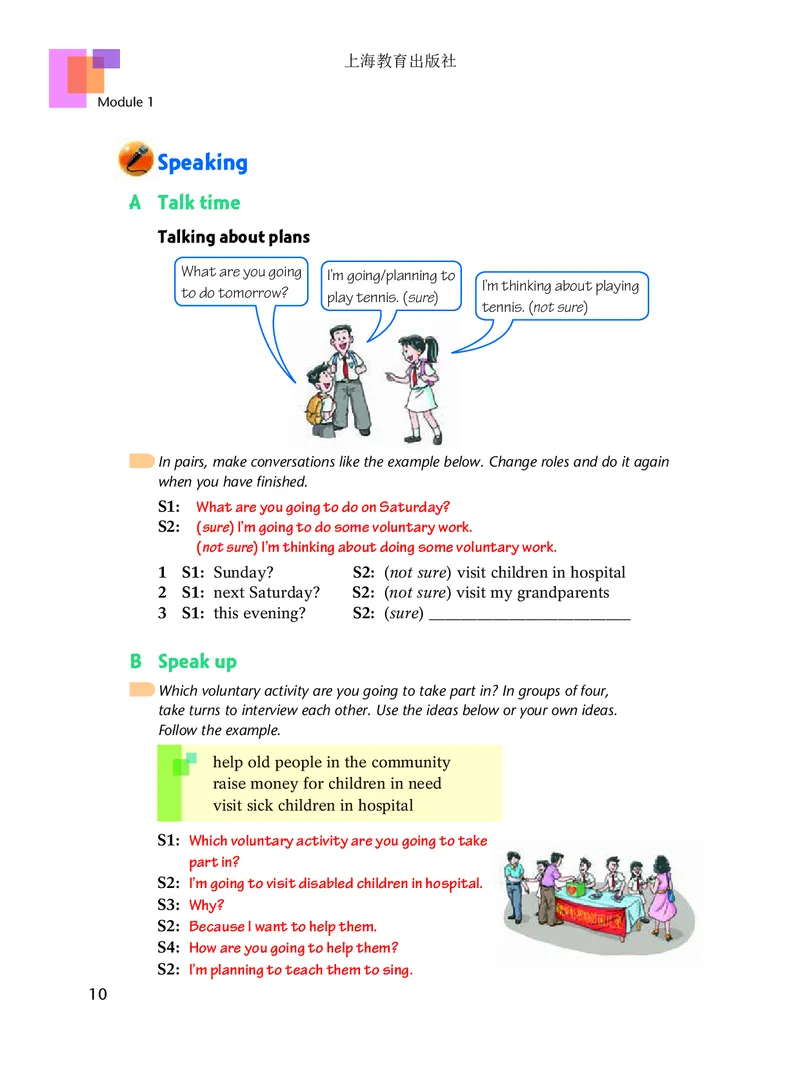
What are you going
I’m going/planning to
I’m thinking about playing
to do tomorrow?
play tennis. (sure)
tennis. (not sure)
In pairs, make conversations like the example below. Change roles and do it again
when you have finished.
S1: What are you going to do on Saturday?
S2: (sure) I’m going to do some voluntary work.
(not sure) I’m thinking about doing some voluntary work.
1 S1: Sunday? S2: (not sure) visit children in hospital
2 S1: next Saturday? S2: (not sure) visit my grandparents
3 S1: this evening? S2: (sure) _________________________
B Speak up
Which voluntary activity are you going to take part in? In groups of four,
take turns to interview each other. Use the ideas below or your own ideas.
Follow the example.
help old people in the community
raise money for children in need
visit sick children in hospital
S1: Which voluntary activity are you going to take
part in?
S2: I’m going to visit disabled children in hospital.
S3: Why?
S2: Because I want to help them.
S4: How are you going to help them?
S2: I’m planning to teach them to sing.
10上海教育出版社
Unit 1
Writing
A letter to the head teacher
You and your classmates are planning a money-raising activity to help
children in need. You need to write a letter to your head teacher to
ask permission.
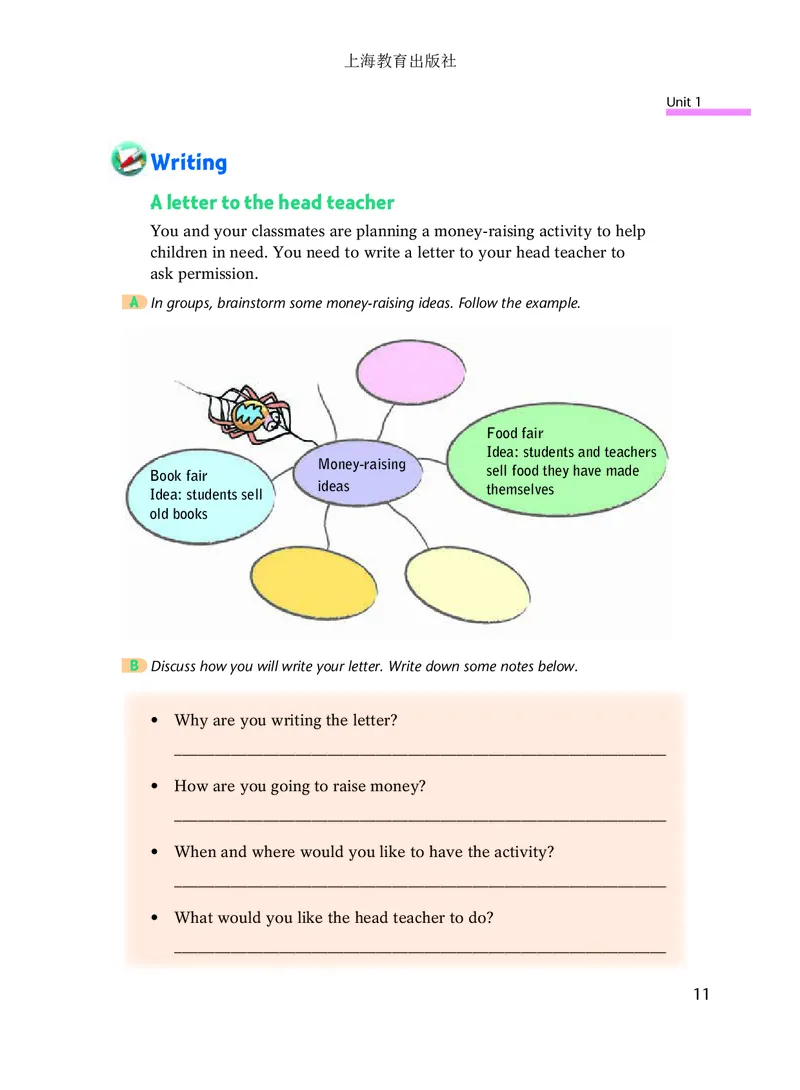
A In groups, brainstorm some money-raising ideas. Follow the example.
Food fair
Idea: students and teachers
Money-raising
sell food they have made
Book fair
ideas themselves
Idea: students sell
old books
B Discuss how you will write your letter. Write down some notes below.
• Why are you writing the letter?
_____________________________________________________________
• How are you going to raise money?
_____________________________________________________________
• When and where would you like to have the activity?
_____________________________________________________________
• What would you like the head teacher to do?
_____________________________________________________________
11上海教育出版社
Module 1
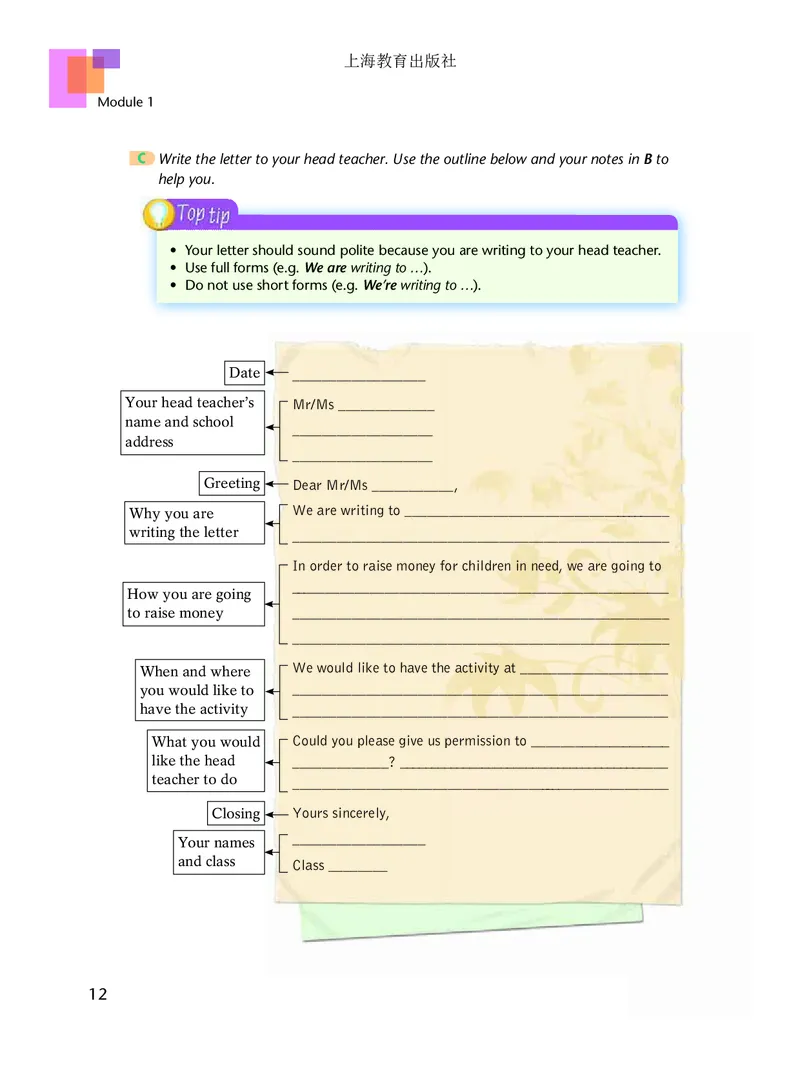
C Write the letter to your head teacher. Use the outline below and your notes in B to
help you.
• (cid:58)o(cid:86)r letter sho(cid:86)l(cid:69) so(cid:86)(cid:79)(cid:69) (cid:81)ol(cid:74)te be(cid:68)(cid:66)(cid:86)se yo(cid:86) (cid:66)re (cid:88)r(cid:74)t(cid:74)(cid:79)g to yo(cid:86)r he(cid:66)(cid:69) te(cid:66)(cid:68)her.
• (cid:54)se f(cid:86)ll forms (cid:9)e.g. We are writing to …).
• (cid:37)o (cid:79)ot (cid:86)se short forms (cid:9)e.g. We’re writing to …).
Date __________________
Your head teacher’s Mr/Ms _____________
name and school
___________________
address
___________________
Greeting Dear Mr/Ms ___________,
Why you are We are writing to _____________________________________
writing the letter ___________________________________________________
In order to raise money for children in need, we are going to
____________________________________________________
How you are going
to raise money ___________________________________________________
___________________________________________________
When and where We would like to have the activity at ____________________
you would like to ___________________________________________________
have the activity ___________________________________________________
What you would Could you please give us permission to ____________________
like the head _____________? __________________________________________
teacher to do ____________________________________________________
Closing Yours sincerely,
Your names __________________
and class Class ________
12上海教育出版社
Unit 1
(cid:43)
More practice
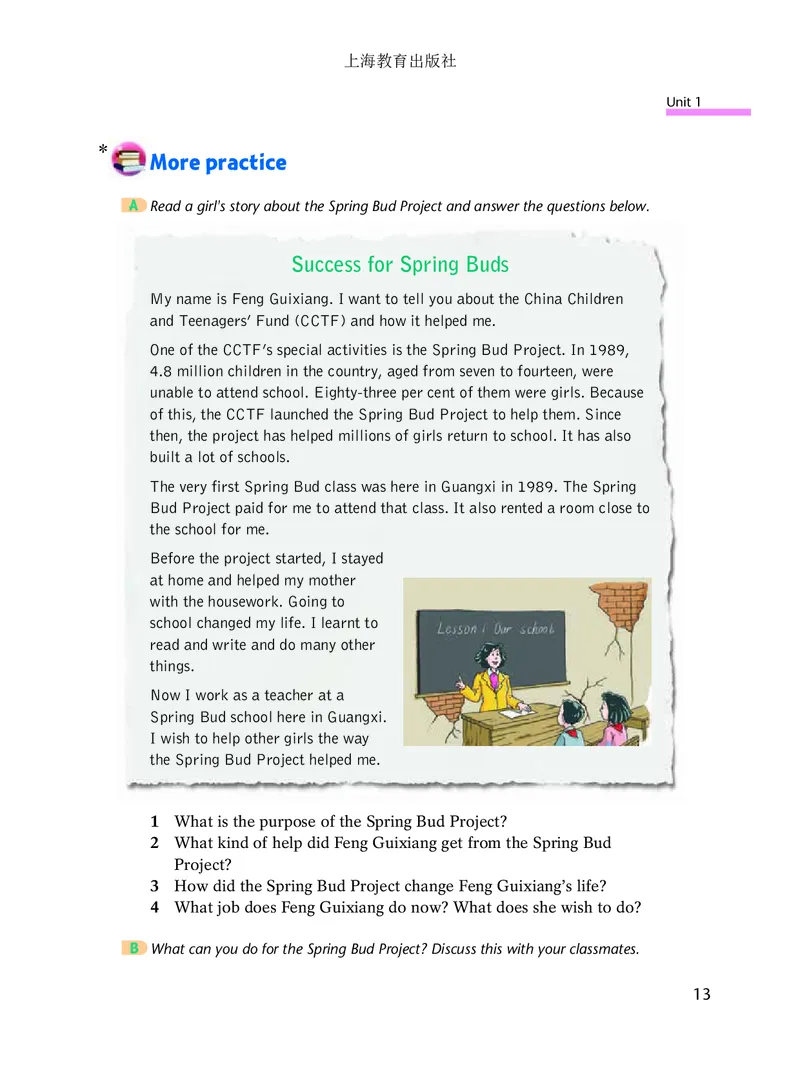
A Read a girl's story about the Spring Bud Project and answer the questions below.
Success for Spring Buds
My name is Feng Guixiang. I want to tell you about the China Children
and Teenagers’ Fund (CCTF) and how it helped me.
One of the CCTF’s special activities is the Spring Bud Project. In 1989,
4.8 million children in the country, aged from seven to fourteen, were
unable to attend school. Eighty-three per cent of them were girls. Because
of this, the CCTF launched the Spring Bud Project to help them. Since
then, the project has helped millions of girls return to school. It has also
built a lot of schools.
The very first Spring Bud class was here in Guangxi in 1989. The Spring
Bud Project paid for me to attend that class. It also rented a room close to
the school for me.
Before the project started, I stayed
at home and helped my mother
with the housework. Going to
school changed my life. I learnt to
read and write and do many other
things.
Now I work as a teacher at a
Spring Bud school here in Guangxi.
I wish to help other girls the way
the Spring Bud Project helped me.
1 What is the purpose of the Spring Bud Project?
2 What kind of help did Feng Guixiang get from the Spring Bud
Project?
3 How did the Spring Bud Project change Feng Guixiang’s life?
4 What job does Feng Guixiang do now? What does she wish to do?
B What can you do for the Spring Bud Project? Discuss this with your classmates.
13上海教育出版社
Module 1
Study skills
Charts and graphs (3): Using pie charts
A pie chart gets its name because it looks like a pie. We use a pie chart to
show the different parts of a total amount.
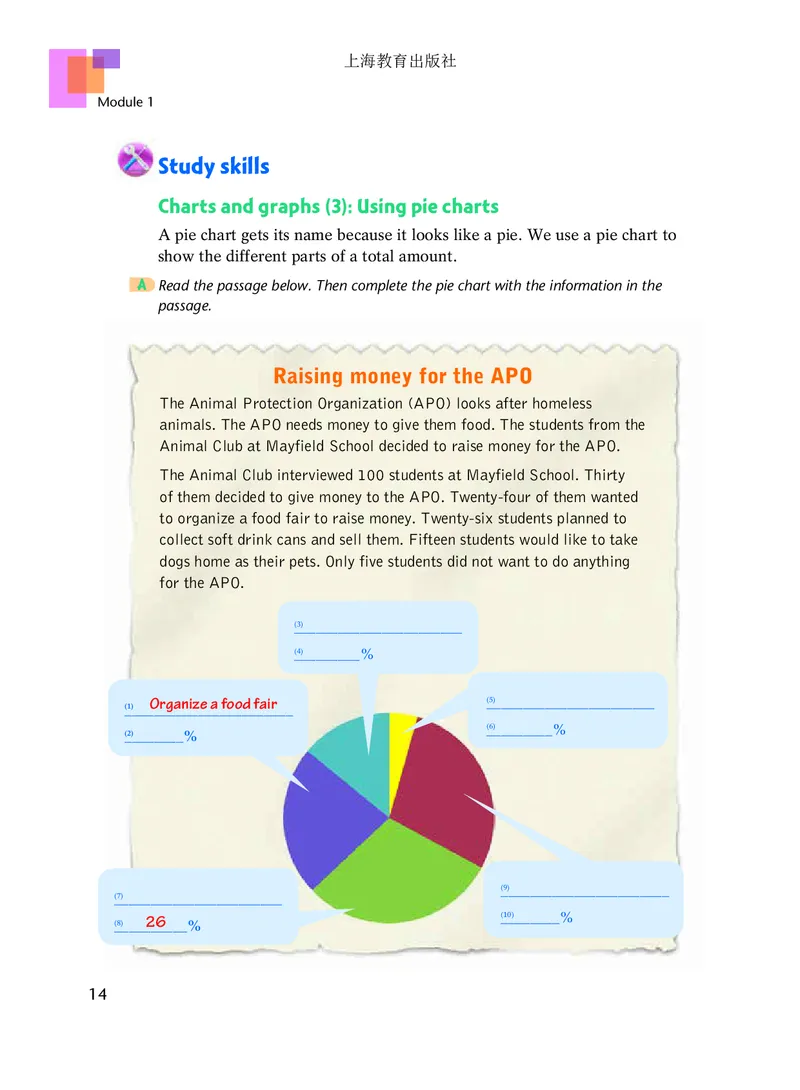
A Read the passage below. Then complete the pie chart with the information in the
passage.
Raising money for the APO
The Animal Protection Organization (APO) looks after homeless
animals. The APO needs money to give them food. The students from the
Animal Club at Mayfield School decided to raise money for the APO.
The Animal Club interviewed 100 students at Mayfield School. Thirty
of them decided to give money to the APO. Twenty-four of them wanted
to organize a food fair to raise money. Twenty-six students planned to
collect soft drink cans and sell them. Fifteen students would like to take
dogs home as their pets. Only five students did not want to do anything
for the APO.
(_3)______________________
_(4)________%
Organize a food fair (_5)______________________
_(1)______________________
_(6)________%
_(2)_______%
_(9)______________________
_(7)______________________
_(10_)______%
26
_(8)_________%
14上海教育出版社
Unit 1
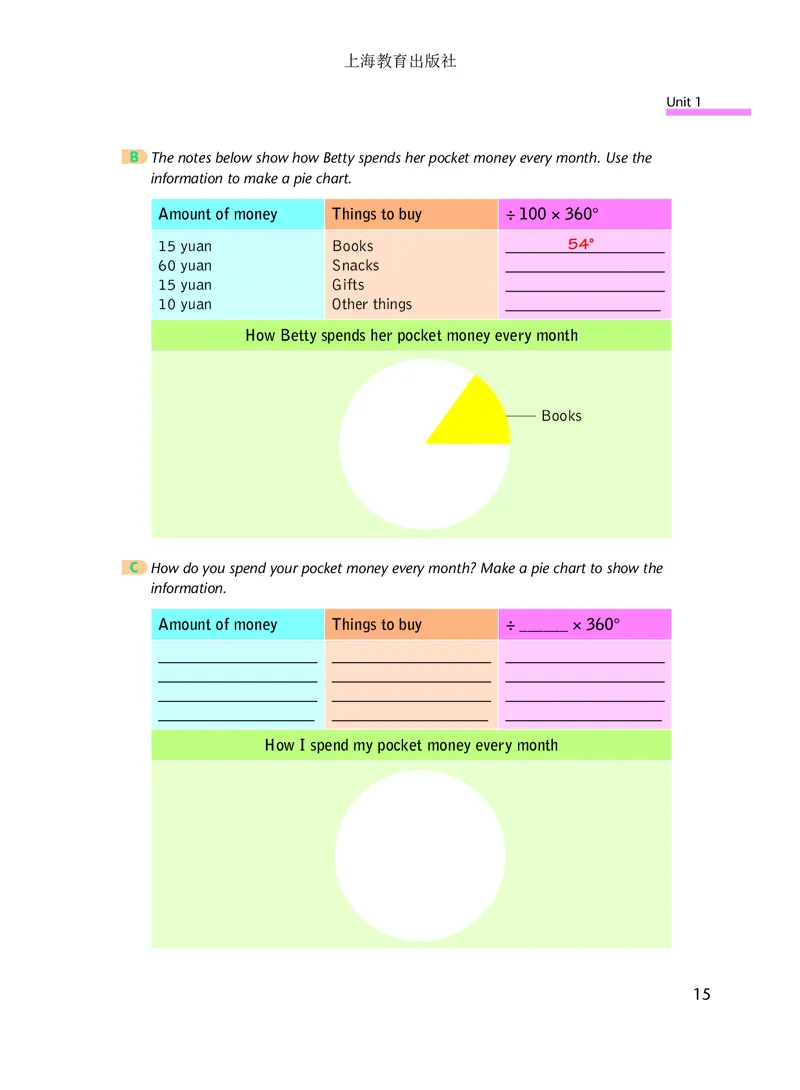
B The notes below show how Betty spends her pocket money every month. Use the
information to make a pie chart.
Amount of money Things to buy ÷ 100 × 360°
15 yuan Books 5 4 °
60 yuan Snacks
15 yuan Gifts
10 yuan Other things
How Betty spends her pocket money every month
Books
C How do you spend your pocket money every month? Make a pie chart to show the
information.
Amount of money Things to buy ÷ ______ × 360°
How I spend my pocket money every month
_(9)______________________
_(10_)______%
15上海教育出版社
Module 1
Culture corner
UNICEF
UNICEF is the “United Nations Children’s
Fund”. A lot of children suffered during World
War II. UNICEF was started in 1946 to help
those children.
Today UNICEF offers help to children and
women in over 190 countries. It helps them
get proper food, clean water and health supplies. It also works to provide
help in disasters and runs long-term education and child protection
programmes.
What other voluntary organizations do you know about? What do they do?
How well do you know this unit? Tick ✓ the boxes.
❶ I can read three reports on voluntary work.
❷ I know how to use prefixes to guess the meanings
of words.
❸ I can listen for facts about money-raising activities.
❹ I can use infinitives correctly.
❺ I can talk about my plans.
❻ I can talk about the voluntary activity I am going
to take part in with my classmates.
❼ I can write a letter to ask permission to raise
money.
❽ I can use a pie chart to show the different parts of
a total amount.
(cid:29) I know about UNICEF.
16上海教育出版社
Module 1 Social communication
Unit
2
BBBooodddyyy lllaaannnggguuuaaagggeee
Getting ready
In this unit, you will learn about the use of body language in communication.
Reading
• Read a story about using body language in communication.
Listening
• Listen to a speech about ballet—the language of dancers.
Grammar
• Learn how to use gerunds.
Speaking
• Learn to make, accept and reject suggestions.
• Discuss the meanings of some gestures.
Writing
•• WWrriittee aa sshhoorrtt mmeessssaaggee..
What’s wrong
with Harry, Lo?
He
doesn’t
understand
why people don’t want
to talk to him.
17上海教育出版社
Module 1
Reading
A What do you know about …?
Look at the pictures below and match them with the adjectives from the box. Write
the words in the blanks.
angry excited happy surprised
1 3
2 4
_____________ _____________
_____________ _____________
B Before you read
Look at the photo, the title and the introduction to the story on page 19. Then
answer the questions below.
1 Where does the story take place?
2 Who are the young people in the photo?
3 What body language are the boy and the girl showing? Tick (3) B for
the boy and G for the girl.
B G
a looking down
b looking up
c sitting up straight
d smiling
e looking happy
f looking bored
4 Which person looks friendlier, the boy or the girl?
18上海教育出版社
Unit 2
Body language
Debbie and Simon are students. They both have part-time jobs at a
travel company.
A well-dressed lady entered the office. She looked at Debbie and Simon,
and then walked over to Debbie. Debbie gave her a cheerful greeting.
5 Simon sighed and walked away.
“What’s the matter?” Mr Yang asked.
“People always choose Debbie instead of me. I don’t understand.”
“I do. It’s the way you communicate.”
“How can that be?” Simon asked. “I don’t get a chance to speak.”
10 “Communicating is more than just speaking. Your body language is
important too.”
“Body language?”
“It’s the way you stand and sit. It’s your gestures and the expression on
your face. Your whole appearance communicates things. You don’t give
15 people a good impression, Simon. You look down, you never smile and you
don’t turn your head towards them.
“Look at Debbie. She’s holding her head up. She always smiles and looks
friendly. Her body language is making people feel welcome, so they go to
her for help.”
20 SSiimmoonn ddeecciiddeedd ttoo iimmpprroovvee hhiiss bbooddyy llaanngguuaaggee.. HHee ssaatt uupp
straight and tried smiling at people.
Minutes later, a beautiful girl entered. She
walked over to Simon. A few moments later,
she left with a smile.
25 Mr Yang came over at once and said, “You
made a good impression on her, Simon.”
“That was my sister,” said Simon. “She
wanted to remind me that tomorrow is
her birthday.”
19上海教育出版社
Module 1
C Vocabulary
C1 Find words from the story on page 19 that have similar meanings to the words
below.
1 wearing nice clothes (line 3) __________
2 a polite word for a woman (line 3) __________
3 the look on one’s face (line 13) __________
4 the way someone or something looks (line 14) __________
5 keeping something in a place (line 17) __________
C2 Later that day, Simon was talking with his mother. Complete their conversation
with the words from the box.
body language matter towards
later part-time
Simon: Mum, I’m thinking of leaving my (_1)_________________ job at the
travel company.
Mum: What’s the _(2)___________? You have a good chance to learn
about travel there. Don’t you want to build a career in tourism?
Simon: Yes, but it’s more important for me to develop other skills at
the moment. I want to take a class in communication skills
because I need to improve my (_3)__________________. I can get
another job like this _(4)___________.
Mum: Well, I understand the feelings you have (_5)___________ your job,
but I don’t think you should leave it. This job will teach you
something you can’t learn in a classroom.
Simon: Thanks, Mum. I’ll think it over.
20上海教育出版社
Unit 2
Identifying the speaker
In a written conversation, a new paragraph starts and ends with quotation
marks (“…”). If a paragraph does not end in a quotation mark, the same
speaker will still be speaking. See lines 16 –17 on page 19.
D Comprehension
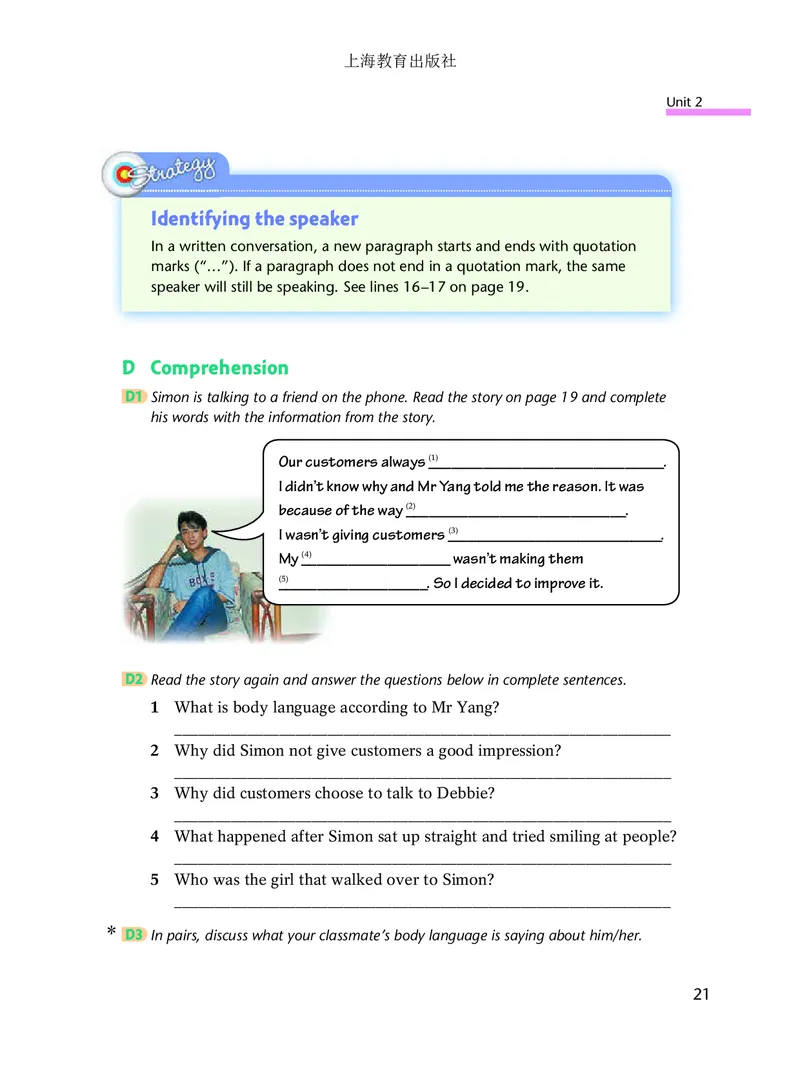
D1 Simon is talking to a friend on the phone. Read the story on page 19 and complete
his words with the information from the story.
Our customers always (_1_) ____________________________.
I didn’t know why and Mr Yang told me the reason. It was
because of the way _(2_) __________________________.
I wasn’t giving customers (_3_) __________________________.
My (_4_) _________________ wasn’t making them
(_5_) _________________. So I decided to improve it.
D2 Read the story again and answer the questions below in complete sentences.
1 What is body language according to Mr Yang?
______________________________________________________________
2 Why did Simon not give customers a good impression?
______________________________________________________________
3 Why did customers choose to talk to Debbie?
______________________________________________________________
4 What happened after Simon sat up straight and tried smiling at people?
______________________________________________________________
5 Who was the girl that walked over to Simon?
______________________________________________________________
(cid:43)
D3 In pairs, discuss what your classmate’s body language is saying about him/her.
21上海教育出版社
Module 1
Listening
Ballet—the language of dancers
Listen to a speech about ballet and complete the notes below. Write one word in
each blank.
Ballet
• (cid:59)ancers use (_1)_____________ ______________ such
as steps, gestures and the e(cid:111)pressions on their faces to tell
stories.
• This type of dance started in (_2)___________ Europe in the
_(3)___________ century.
• (cid:74)wan Lake is one of the most (_4)___________ ballets in the
world. The dancers move their arms like (_5)___________ and
move their necks like the _(6)___________ ____________
of swans.
• (cid:57)allet dancers start training at an (_7)___________ age.
• The dancers use their _(8)___________ to communicate
messages.
22上海教育出版社
Unit 2
Grammar
(cid:43)Gerunds
Gerunds are nouns ending in -ing. These nouns refer to actions and
activities.
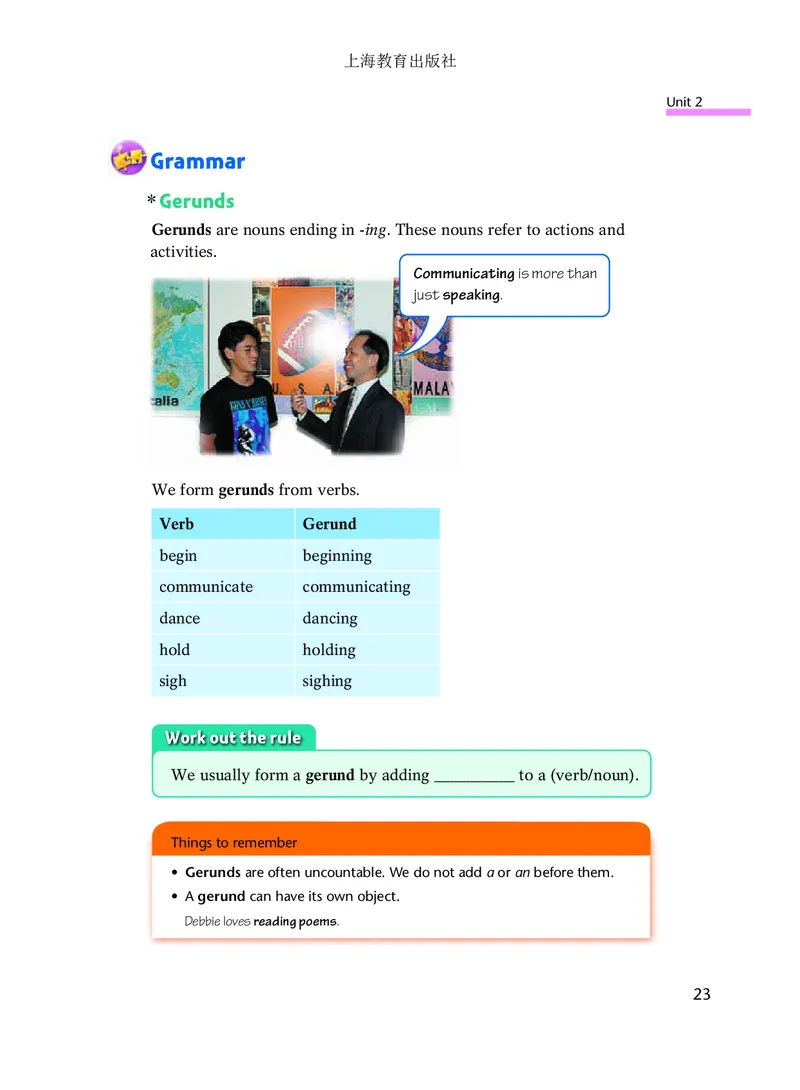
Communicating is more than
just speaking.
We form gerunds from verbs.
Verb Gerund
begin beginning
communicate communicating
dance dancing
hold holding
sigh sighing
Work out the rule
We usually form a gerund by adding __________ to a (verb/noun).
Things to remember
• Gerunds are often uncountable. We do not add a or an before them.
• (cid:34) gerund can have its own object.
Debbie loves reading poems.
23上海教育出版社
Module 1
A Gerunds as subjects
We can use a gerund as the subject of a sentence.
Smiling shows that you are happy.
Ballet training usually starts at an early age.
Dancing is her favourite hobby.
Work out the rule
When we use a gerund as the subject of a sentence, the main verb is
in (singular/plural) form.
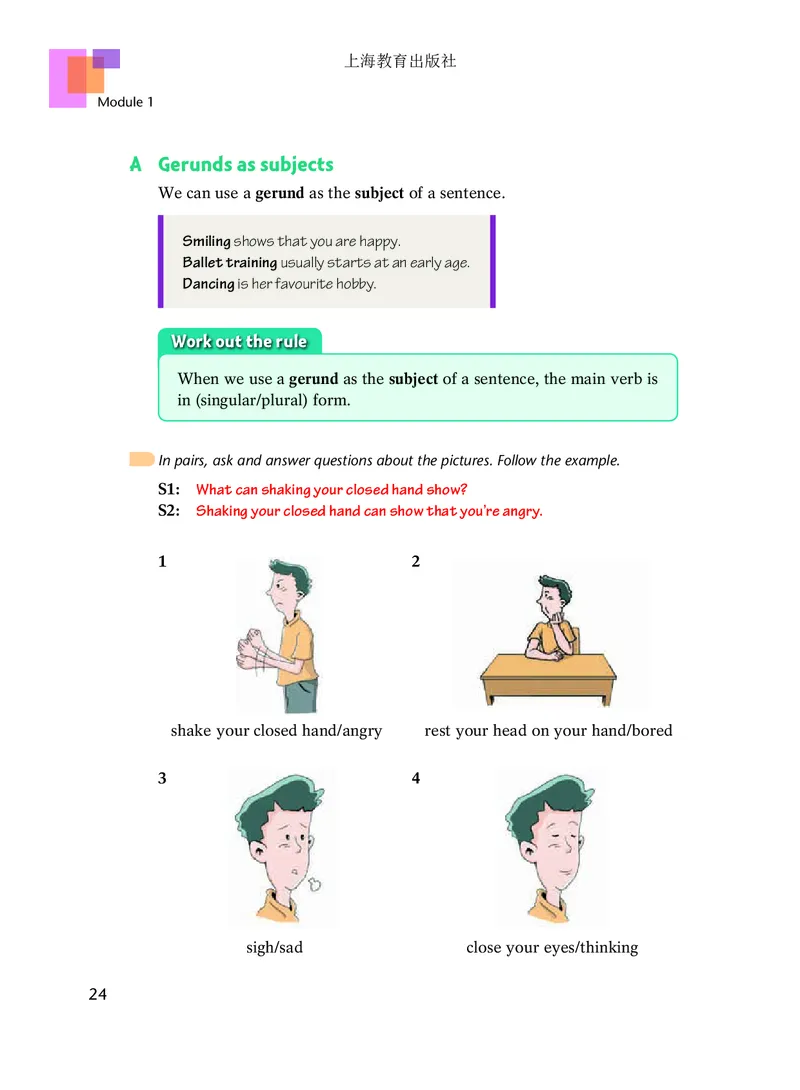
In pairs, ask and answer questions about the pictures. Follow the example.
S1: What can shaking your closed hand show?
S2: Shaking your closed hand can show that you’re angry.
1 2
shake your closed hand/angry rest your head on your hand/bored
3 4
sigh/sad close your eyes/thinking
24上海教育出版社
Unit 2
B Gerunds as objects
We can also use a gerund as the object of a sentence.
Debbie enjoys smiling and always looks friendly.
We often use gerunds after these verbs.
enjoy imagine practise
finish mind
Things to remember
We often use gerunds after prepositions.
Debbie is good at communicating with people.
I am looking forward to going to Beijing.
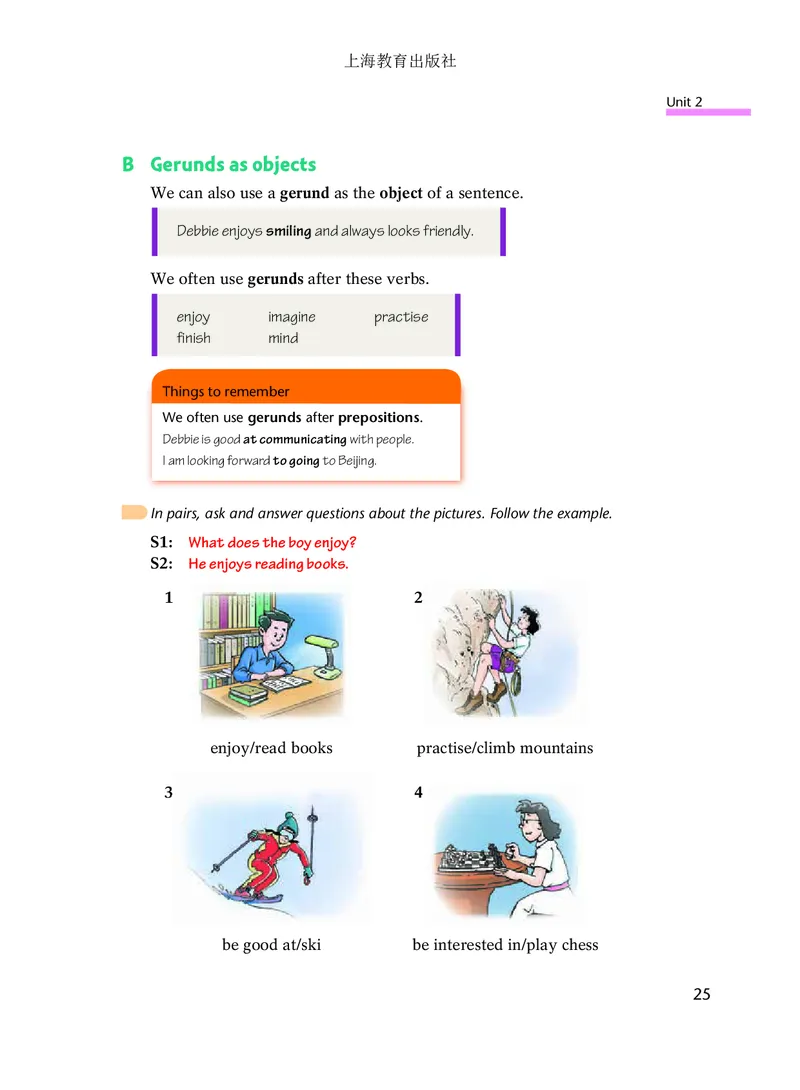
In pairs, ask and answer questions about the pictures. Follow the example.
S1: What does the boy enjoy?
S2: He enjoys reading books.
1 2
enjoy/read books practise/climb mountains
33 4
be good at/ski be interested in/play chess
25上海教育出版社
Module 1
Speaking
A Talk time
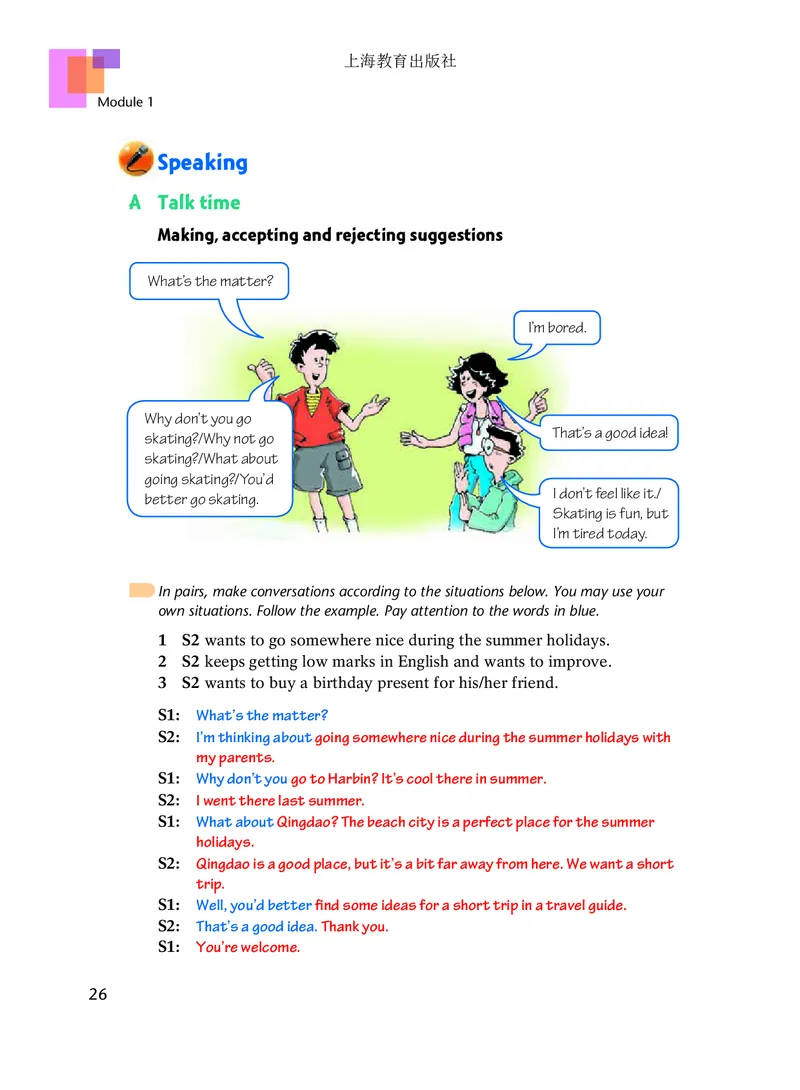
Making, accepting and rejecting suggestions
What’s the matter?
I’m bored.
Why don’t you go
That’s a good idea!
skating?/Why not go
skating?/What about
going skating?/You’d
I don’t feel like it./
better go skating.
Skating is fun, but
I’m tired today.
In pairs, make conversations according to the situations below. You may use your
own situations. Follow the example. Pay attention to the words in blue.
1 S2 wants to go somewhere nice during the summer holidays.
2 S2 keeps getting low marks in English and wants to improve.
3 S2 wants to buy a birthday present for his/her friend.
S1: What’s the matter?
S2: I’m thinking about going somewhere nice during the summer holidays with
my parents.
S1: Why don’t you go to Harbin? It’s cool there in summer.
S2: I went there last summer.
S1: What about Qingdao? The beach city is a perfect place for the summer
holidays.
S2: Qingdao is a good place, but it’s a bit far away from here. We want a short
trip.
S1: Well, you’d better find some ideas for a short trip in a travel guide.
S2: That’s a good idea. Thank you.
S1: You’re welcome.
26上海教育出版社
Unit 2
B Speak up
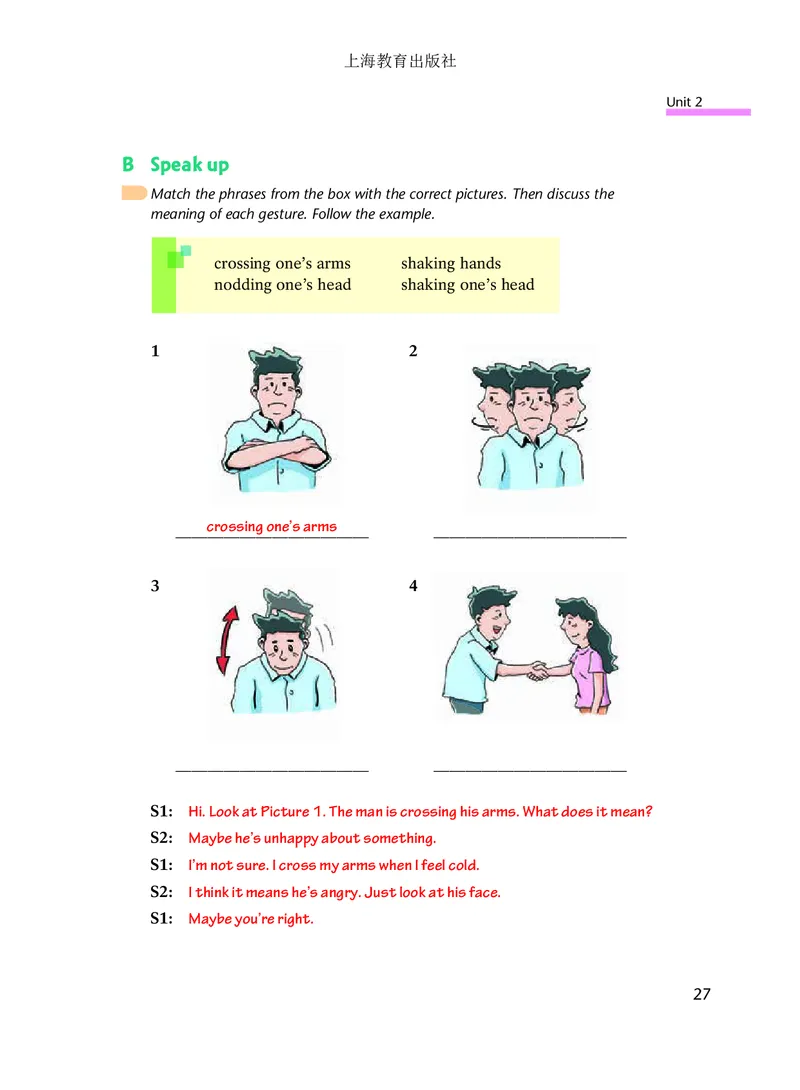
Match the phrases from the box with the correct pictures. Then discuss the
meaning of each gesture. Follow the example.
crossing one’s arms shaking hands
nodding one’s head shaking one’s head
1 2
crossing one’s arms
________________________ ________________________
3 4
________________________ ________________________
S1: Hi. Look at Picture 1. The man is crossing his arms. What does it mean?
S2: Maybe he’s unhappy about something.
S1: I’m not sure. I cross my arms when I feel cold.
S2: I think it means he’s angry. Just look at his face.
S1: Maybe you’re right.
27上海教育出版社
Module 1
Writing
A short message
We often write short messages to family members, friends or classmates
to remind them about something. The messages can be on any topic, but
they often:
• start with a greeting (cid:9)e(cid:15)g(cid:15) Dear …).
• talk about the topic in the (cid:71)irst sentence(cid:15)
• gi(cid:87)e the message clearly in a (cid:71)ew words(cid:15)
• end with a (cid:71)riendly word or phrase (cid:9)e(cid:15)g(cid:15) Best wishes).
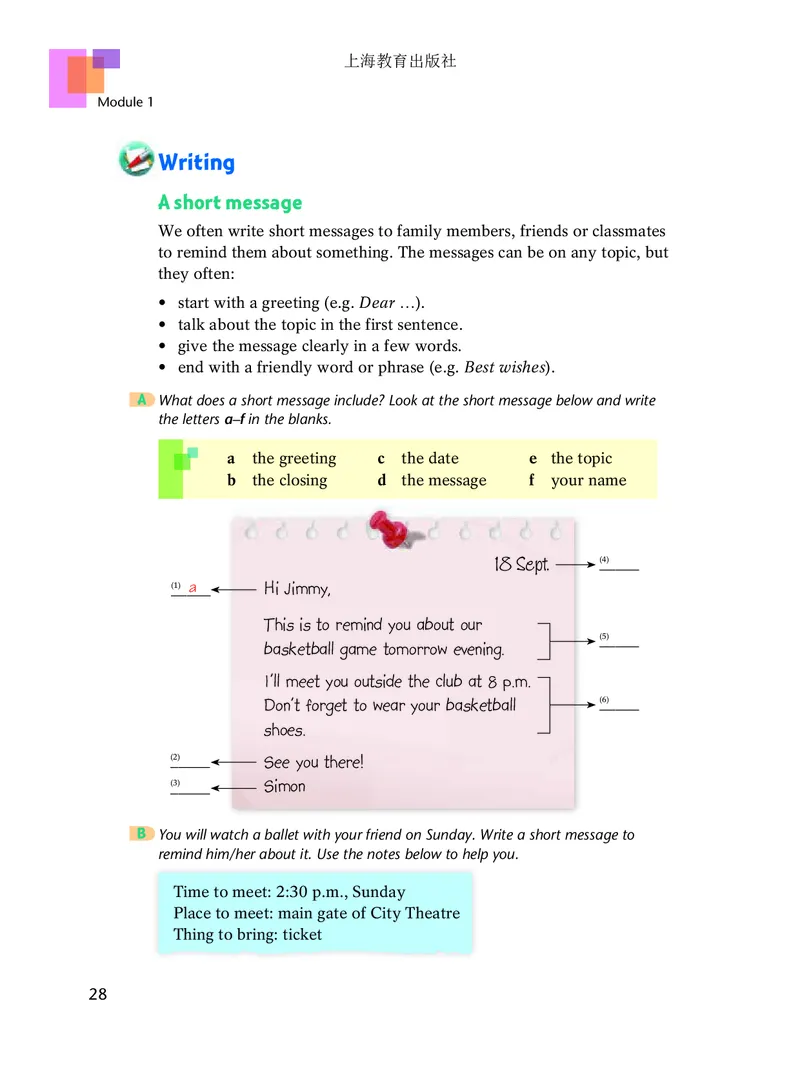
A What does a short message include? Look at the short message below and write
the letters a –f in the blanks.
a the greeting c the date e the topic
b the closing d the message f your name
18 Sept. (_4)____
_(1)__a__ Hi Jimmy,
This is to remind you about our
_(5)____
basketball game tomorrow evening.
I’ll meet you outside the club at (cid:47) p.m.
(cid:59)on’t forget to wear your basketball _(6)____
shoes.
(_2)____ (cid:74)ee you there(cid:24)
_(3)____ (cid:74)imon
B You will watch a ballet with your friend on Sunday. Write a short message to
remind him/her about it. Use the notes below to help you.
Time to meet: 2:30 p.m., Sunday
Place to meet: main gate of City Theatre
Thing to bring: ticket
28上海教育出版社
Unit 2
(cid:43)
More practice
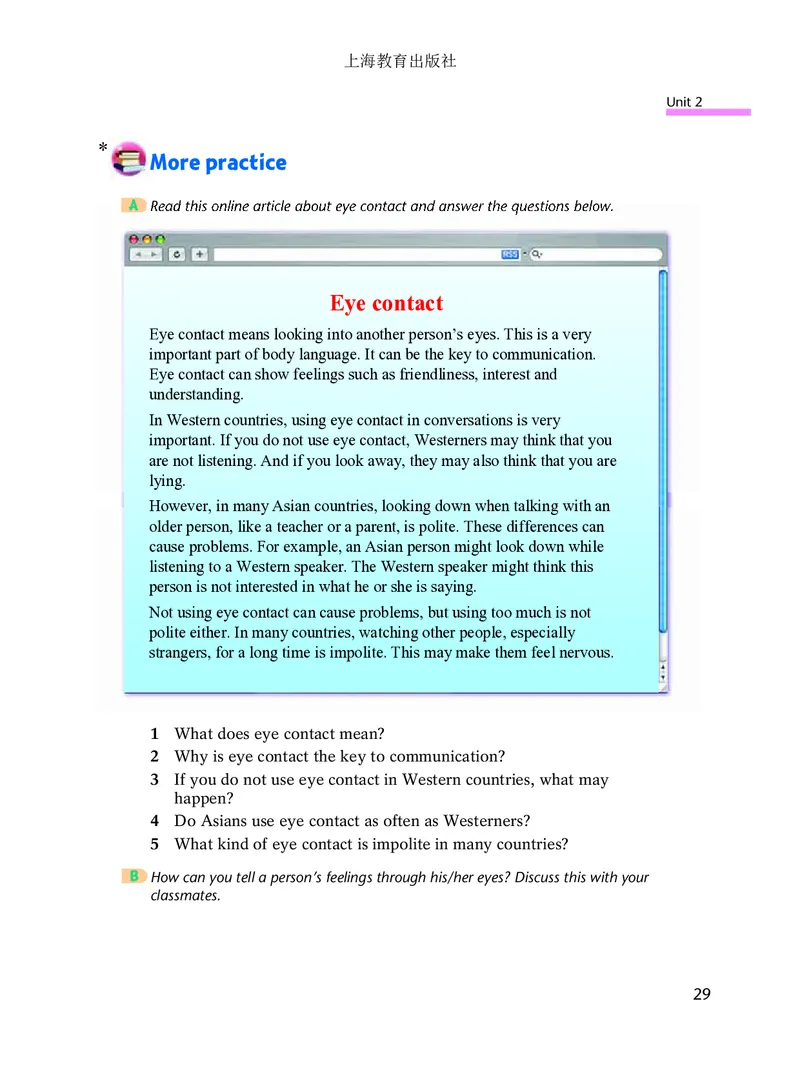
AA RReeaadd tthhiiss oonnlliinnee aarrttiiccllee aabboouutt eeyyee ccoonnttaacctt aanndd aannsswweerr tthhee qquueessttiioonnss bbeellooww..
Eye contact
Eye contact means looking into another person’s eyes. This is a very
important part of body language. It can be the key to communication.
Eye contact can show feelings such as friendliness, interest and
understanding.
In Western countries, using eye contact in conversations is very
important. If you do not use eye contact, Westerners may think that you
are not listening. And if you look away, they may also think that you are
lying.
However, in many Asian countries, looking down when talking with an
older person, like a teacher or a parent, is polite. These differences can
cause problems. For example, an Asian person might look down while
listening to a Western speaker. The Western speaker might think this
person is not interested in what he or she is saying.
Not using eye contact can cause problems, but using too much is not
polite either. In many countries, watching other people, especially
strangers, for a long time is impolite. This may make them feel nervous.
1 What does eye contact mean?
2 Why is eye contact the key to communication?
3 If you do not use eye contact in Western countries, what may
happen?
4 Do Asians use eye contact as often as Westerners?
5 What kind of eye contact is impolite in many countries?
B How can you tell a person’s feelings through his/her eyes? Discuss this with your
classmates.
29上海教育出版社
Module 1
Culture corner
Different ways of greeting others
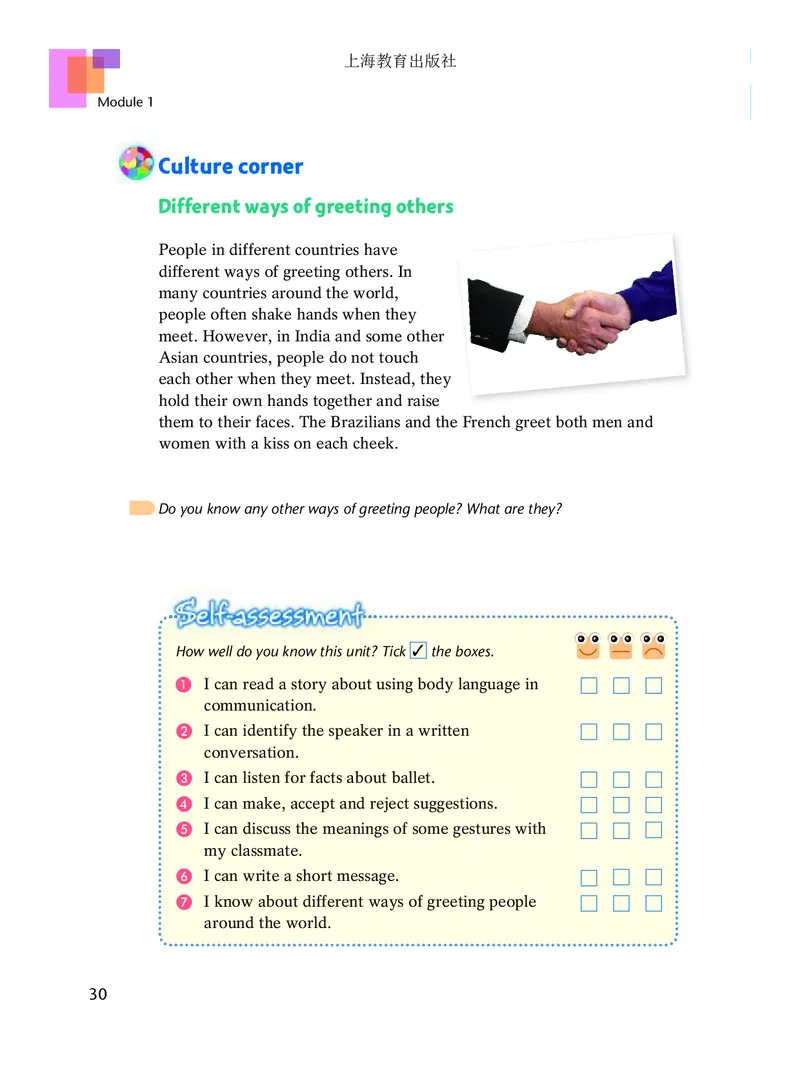
People in different countries have
different ways of greeting others. In
many countries around the world,
people often shake hands when they
meet. However, in India and some other
Asian countries, people do not touch
each other when they meet. Instead, they
hold their own hands together and raise
them to their faces. The Brazilians and the French greet both men and
women with a kiss on each cheek.
Do you know any other ways of greeting people? What are they?
How well do you know this unit? Tick ✓ the boxes.
❶ I can read a story about using body language in
communication.
❷ I can identify the speaker in a written
conversation.
❸ I can listen for facts about ballet.
❹ I can make, accept and reject suggestions.
❺ I can discuss the meanings of some gestures with
my classmate.
❻ I can write a short message.
❼ I know about different ways of greeting people
around the world.
30上海教育出版社
(cid:43)
PPPrrrooojjjeeecccttt
Setting up a voluntary group
Have you done any voluntary work with your classmates? In this project,
you are going to set up a voluntary group.
A In groups, discuss the goal of your voluntary group. Use the questions below to
help you.
Who/What do you think needs help? (e.g. children,
old people, animals) Why?
What places do you think need more volunteers?
(e.g. hospitals, communities, old people’s homes)
Which place would you like to help at? Why?
The goal of our voluntary group is to help _____________________
because __________________________________________________.
B In groups, brainstorm and discuss the name and slogan for your voluntary group.
Use the conversation below to help you.
(cid:34) slogan is a word or phrase used to attract people’s attention and
communicate your ideas quickly. It should be easy to remember.
S1: What shall we call our voluntary group?
S2: Why don’t we call it …?
S3: I don’t think that name is very good. What about …?
S4: That’s a good idea. How about the slogan? I suggest …
S1: That’s too long. People won’t remember it. My suggestion is …
S2: That sounds great.
…
31上海教育出版社
Module 1
The name of our voluntary group is ______________________________
______________________________________________________________.
The slogan of our voluntary group is _____________________________
_______________________________________________________________.
C How will you achieve the goal of your voluntary group? In groups, think of some
activities and list at least three in the table below.
Activity Time Place
D Choose a representative and introduce your voluntary group to the class. Use the
information in A, B and C and the expressions below to help you.
We call our voluntary group …
Our slogan is …
We want to help …
We will ...
Would you like to take part in our …?
32上海教育出版社
Module 2 Arts and crafts
Unit
3
TTTrrraaadddiiitttiiiooonnnaaalll ssskkkiiillllllsss
Getting ready
In this unit, you will learn about some people with special skills.
Reading
• Read an article about fishing with birds.
Listening
• Listen to a description of a picture.
Grammar
• Learn how to use the passive voice in different tenses.
Speaking
• Learn how to describe people.
• Describe the traditional skill of paper cutting.
Writing
• WWrriittee aa sshhoorrtt aarrttiiccllee aabboouutt aa ppeerrssoonn wwiitthh aa ttrraaddiittiioonnaall sskkiillll..
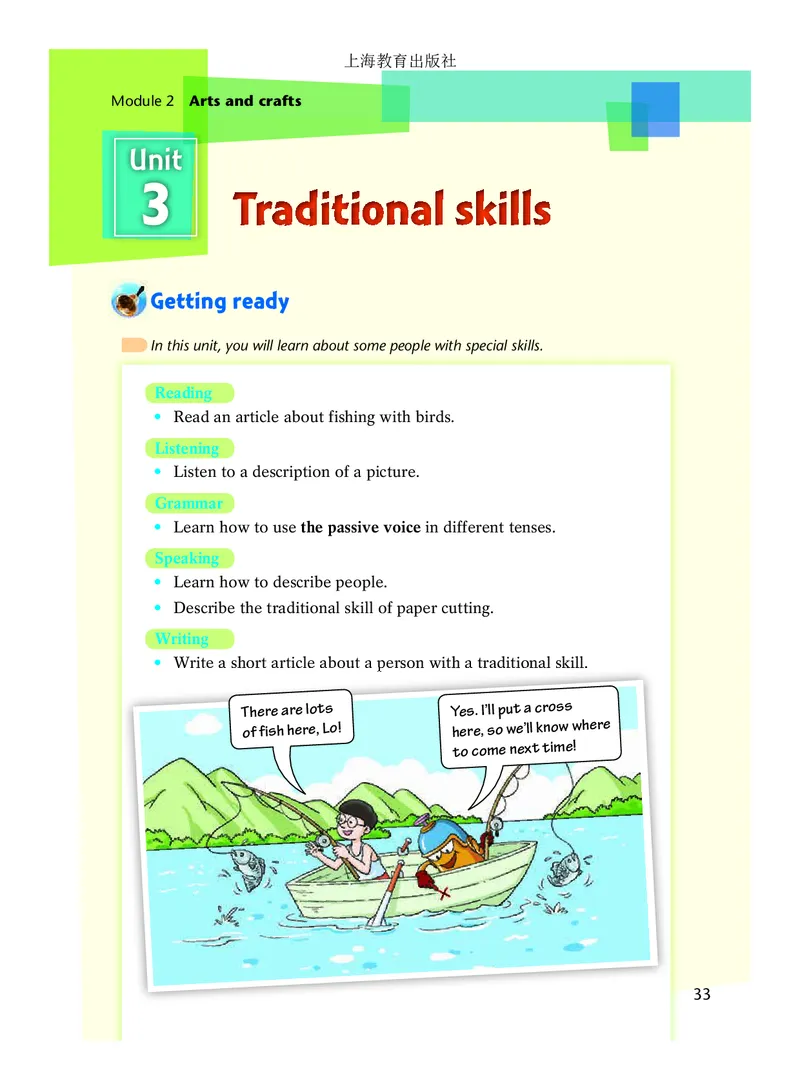
There are lots Yes. I’ll put a cross
of fish here, Lo! here, so we’ll know where
to come next time!
33上海教育出版社
Module 2
Reading
A What do you know about …?
A1 How do people and animals work together? Match the beginning of each sentence
with the correct ending.
1 Farmers use cats _____ a to find things.
2 Blind people use dogs _____ b to catch mice.
3 We used to use horses _____ c to guide them.
4 The police use dogs _____ d to pull carriages.
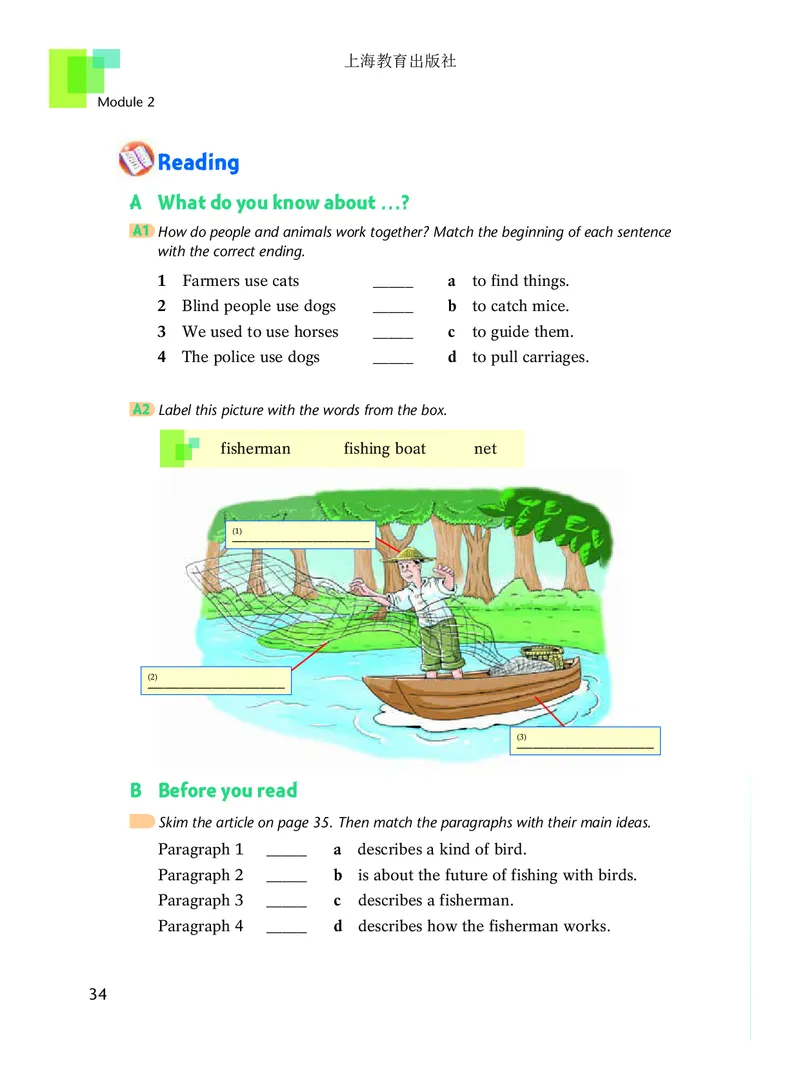
A2 Label this picture with the words from the box.
fisherman fishing boat net
_(1)________________
_(2)________________
_(3)________________
B Before you read
Skim the article on page 35. Then match the paragraphs with their main ideas.
Paragraph 1 _____ a describes a kind of bird.
Paragraph 2 _____ b is about the future of fishing with birds.
Paragraph 3 _____ c describes a fisherman.
Paragraph 4 _____ d describes how the fisherman works.
34上海教育出版社
Unit 3
Fishing with birds
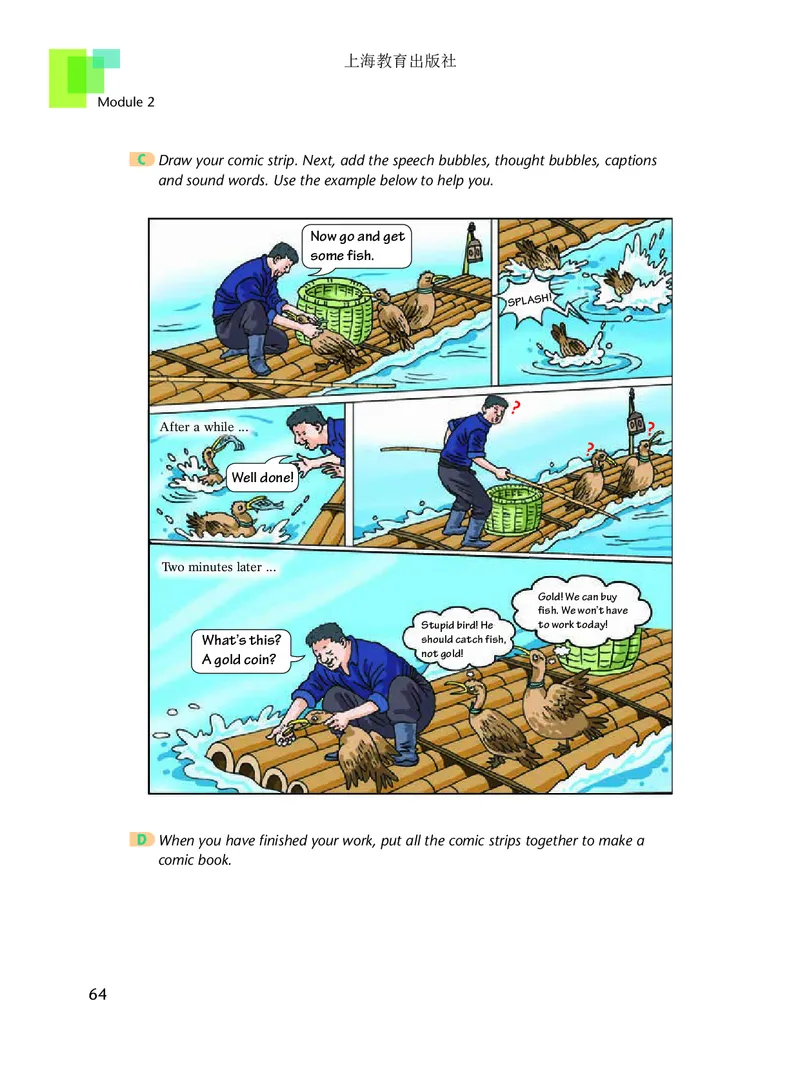
Wang Damin is a fisherman. Although he is over 65, he is very fit and still enjoys
working.
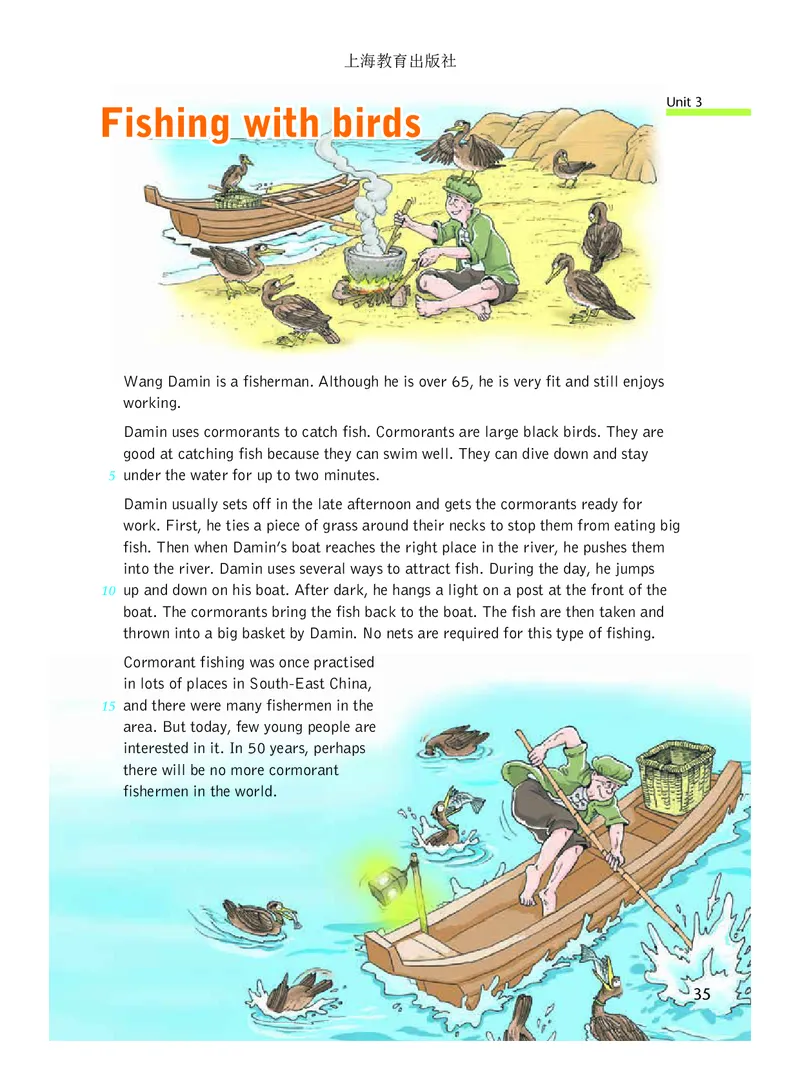
Damin uses cormorants to catch fish. Cormorants are large black birds. They are
good at catching fish because they can swim well. They can dive down and stay
5 under the water for up to two minutes.
Damin usually sets off in the late afternoon and gets the cormorants ready for
work. First, he ties a piece of grass around their necks to stop them from eating big
fish. Then when Damin’s boat reaches the right place in the river, he pushes them
into the river. Damin uses several ways to attract fish. During the day, he jumps
10 up and down on his boat. After dark, he hangs a light on a post at the front of the
boat. The cormorants bring the fish back to the boat. The fish are then taken and
thrown into a big basket by Damin. No nets are required for this type of fishing.
Cormorant fishing was once practised
in lots of places in South-East China,
15 and there were many fishermen in the
area. But today, few young people are
interested in it. In 50 years, perhaps
there will be no more cormorant
fishermen in the world.
333555上海教育出版社
Module 2
C Vocabulary
C1 The words in italics are from the article on page 35. Circle the correct answers to
complete these sentences.
1 If a person is fit, he or she is _____.
a healthy and strong b weak and ill
2 When you set off, you _____ a journey.
a plan b start
3 When you reach a place, you _____ the place.
a arrive at b return from
4 If you hang something on a post, you _____ the post.
a put it on b take it from
5 If you require something to do your work, you _____ it.
a lose b need
C2 Mark wrote an email to Jenny about fishing with hand nets. Complete his email
with the words from the box. Change their forms if necessary.
fisherman fit hang reach require set off
Jenny
Mark
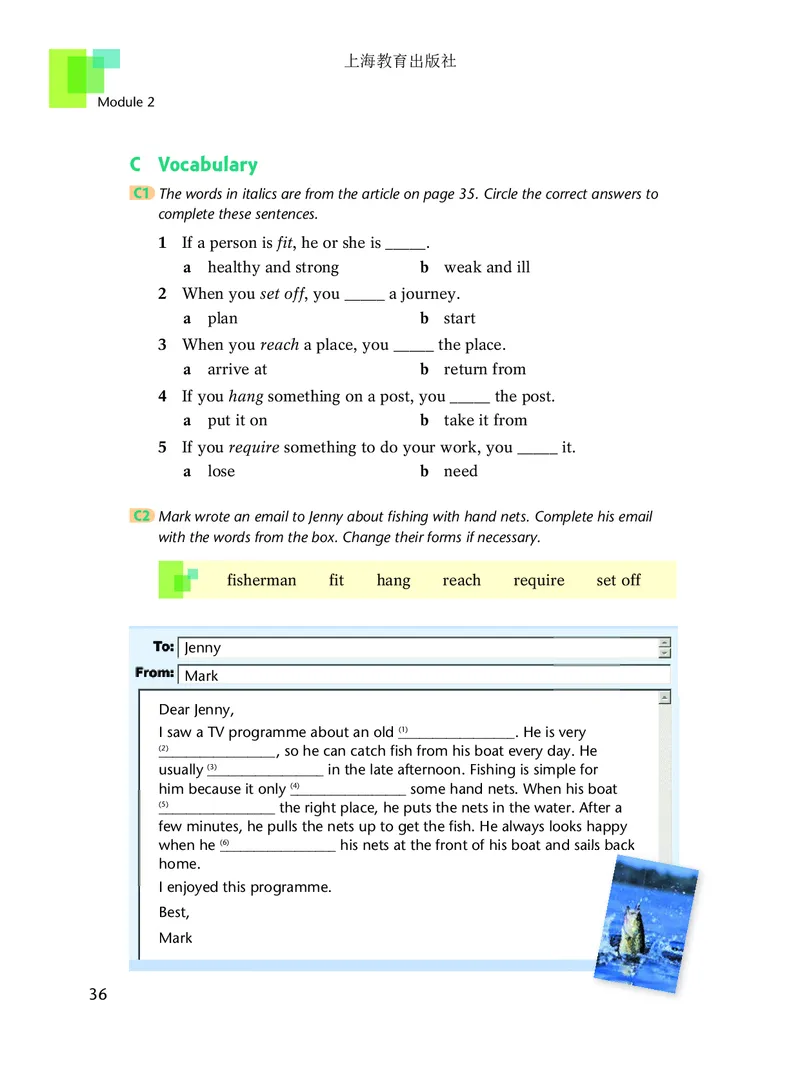
Dear Jenny,
I saw a TV programme about an old (_1_) _______________. He is very
_(2_) _______________, so he can catch fish from his boat every day. He
usually (_3_) _______________ in the late afternoon. Fishing is simple for
him because it only (_4_) _______________ some hand nets. When his boat
_(5_) _______________ the right place, he puts the nets in the water. After a
few minutes, he pulls the nets up to get the fish. He always looks happy
when he (_6___) _____________________________________________ hhhiiisss nnneeetttsss aaattt ttthhheee fffrrrooonnnttt ooofff hhhiiisss bbboooaaattt aaannnddd sssaaaiiilllsss bbbaaaccckkk
home.
I enjoyed this programme.
Best,
Mark
36上海教育出版社
Unit 3
D Comprehension
D1 These sentences are about the article on page 35. Each sentence has one incorrect
word or number in it. Underline the mistake and write the correct word or number
in each blank.
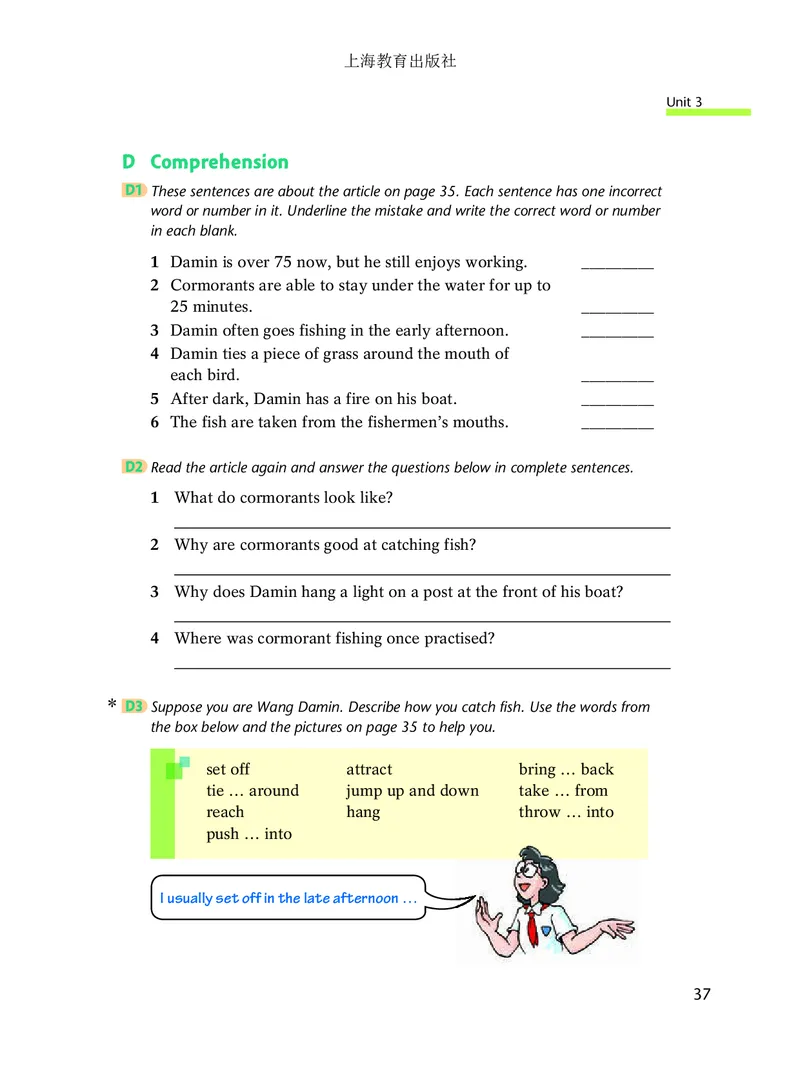
1 Damin is over 75 now, but he still enjoys working. _________
2 Cormorants are able to stay under the water for up to
25 minutes. _________
3 Damin often goes fishing in the early afternoon. _________
4 Damin ties a piece of grass around the mouth of
each bird. _________
5 After dark, Damin has a fire on his boat. _________
6 The fish are taken from the fishermen’s mouths. _________
D2 Read the article again and answer the questions below in complete sentences.
1 What do cormorants look like?
2 Why are cormorants good at catching fish?
3 Why does Damin hang a light on a post at the front of his boat?
4 Where was cormorant fishing once practised?
(cid:43)
D3 Suppose you are Wang Damin. Describe how you catch fish. Use the words from
the box below and the pictures on page 35 to help you.
set off attract bring … back
tie … around jump up and down take … from
reach hang throw … into
push … into
I usually set off in the late afternoon …
37上海教育出版社
Module 2
Listening
Paper cutting
To correct mistakes in a picture, you should do the following:
• (cid:45)oo(cid:76) (cid:66)t the (cid:81)(cid:74)(cid:68)t(cid:86)re (cid:68)(cid:66)ref(cid:86)lly before l(cid:74)ste(cid:79)(cid:74)(cid:79)g.
• (cid:54)se yo(cid:86)r (cid:68)ommo(cid:79) se(cid:79)se. (cid:39)or e(cid:89)(cid:66)m(cid:81)le, (cid:100)(cid:22)(cid:17)(cid:17) (cid:74)s too e(cid:89)(cid:81)e(cid:79)s(cid:74)(cid:87)e for (cid:66)
paper picture.
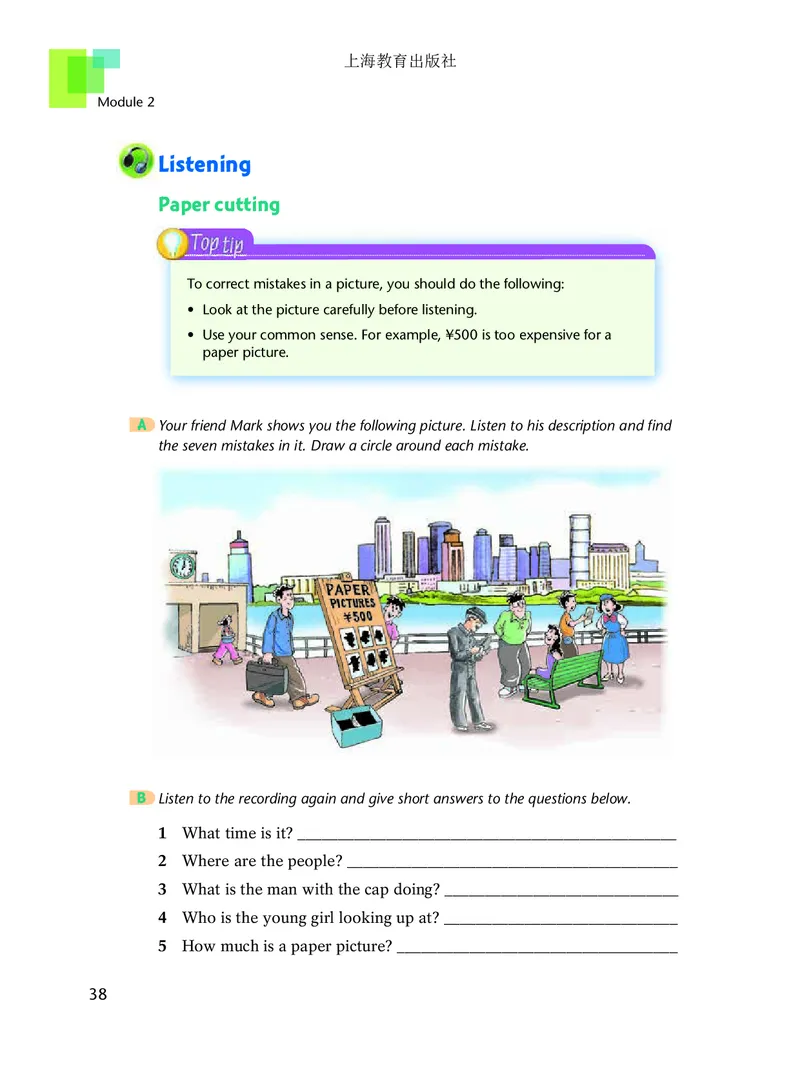
A Your friend Mark shows you the following picture. Listen to his description and find
the seven mistakes in it. Draw a circle around each mistake.
B Listen to the recording again and give short answers to the questions below.
1 What time is it? _______________________________________________
2 Where are the people? _________________________________________
3 What is the man with the cap doing? _____________________________
4 Who is the young girl looking up at? _____________________________
5 How much is a paper picture? ___________________________________
38上海教育出版社
Unit 3
Grammar
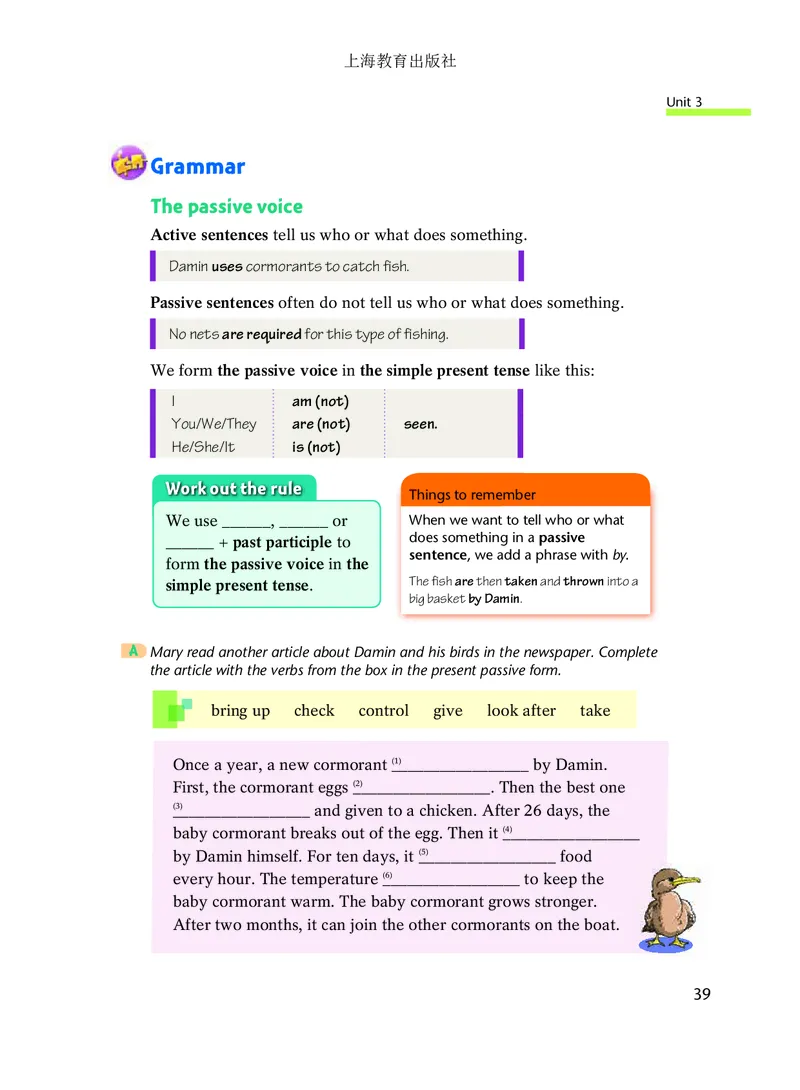
The passive voice
Active sentences tell us who or what does something.
Damin uses cormorants to catch fish.
Passive sentences often do not tell us who or what does something.
No nets are required for this type of fishing.
We form the passive voice in the simple present tense like this:
I am (not)
You/We/They are (not) seen.
He/She/It is (not)
Work out the rule
Things to remember
We use ______, ______ or When we want to tell who or what
______ + past participle to does something in a passive
sentence, we add a phrase with by.
form the passive voice in the
simple present tense. The fish are then taken and thrown into a
big basket by Damin.
A Mary read another article about Damin and his birds in the newspaper. Complete
the article with the verbs from the box in the present passive form.
bring up check control give look after take
Once a year, a new cormorant (_1)________________ by Damin.
First, the cormorant eggs (_2)________________. Then the best one
_(3)________________ and given to a chicken. After 26 days, the
baby cormorant breaks out of the egg. Then it (_4)________________
by Damin himself. For ten days, it _(5)________________ food
every hour. The temperature _(6)________________ to keep the
baby cormorant warm. The baby cormorant grows stronger.
After two months, it can join the other cormorants on the boat.
39上海教育出版社
Module 2
We form the passive voice in the simple past tense like this:
I was (not)
You/We/They were (not) seen.
He/She/It was (not)
Work out the rule
We use ______ or ______ + past participle to form the passive voice in
the simple past tense.
B Mary watched a TV programme about Damin. It was made by a film company
from the UK. This is how they filmed the programme. Complete the passage with
the verbs from the box in the past passive form.
choose film interview take use
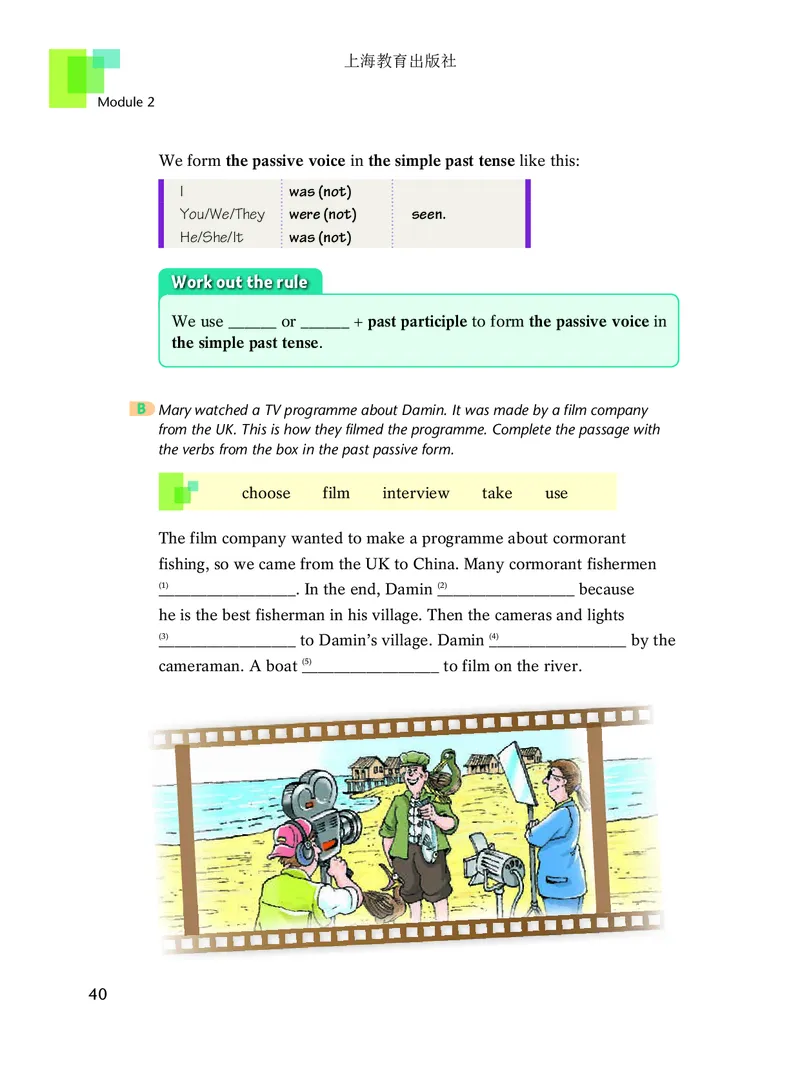
The film company wanted to make a programme about cormorant
fishing, so we came from the UK to China. Many cormorant fishermen
_(1)________________. In the end, Damin (_2)________________ because
he is the best fisherman in his village. Then the cameras and lights
_(3)________________ to Damin’s village. Damin (_4)________________ by the
cameraman. A boat (_5)________________ to film on the river.
(cid:21)(cid:17)上海教育出版社
Unit 3
We form the passive voice in the simple future tense like this:
I
You/We/They will (not) be seen.
He/She/It
Work out the rule
We use ____________ + past participle to form the passive voice in
the simple future tense.
Things to remember
Note the positions of the verbs in passive questions:
Is a piece of grass tied around the neck of each bird?
Was a light hung on the post at the front of the boat?
Will the fish be sold in the market?
C After the filming, the British director talked to Damin. Complete his words with the
verbs from the box in the future passive form.
add make show take watch
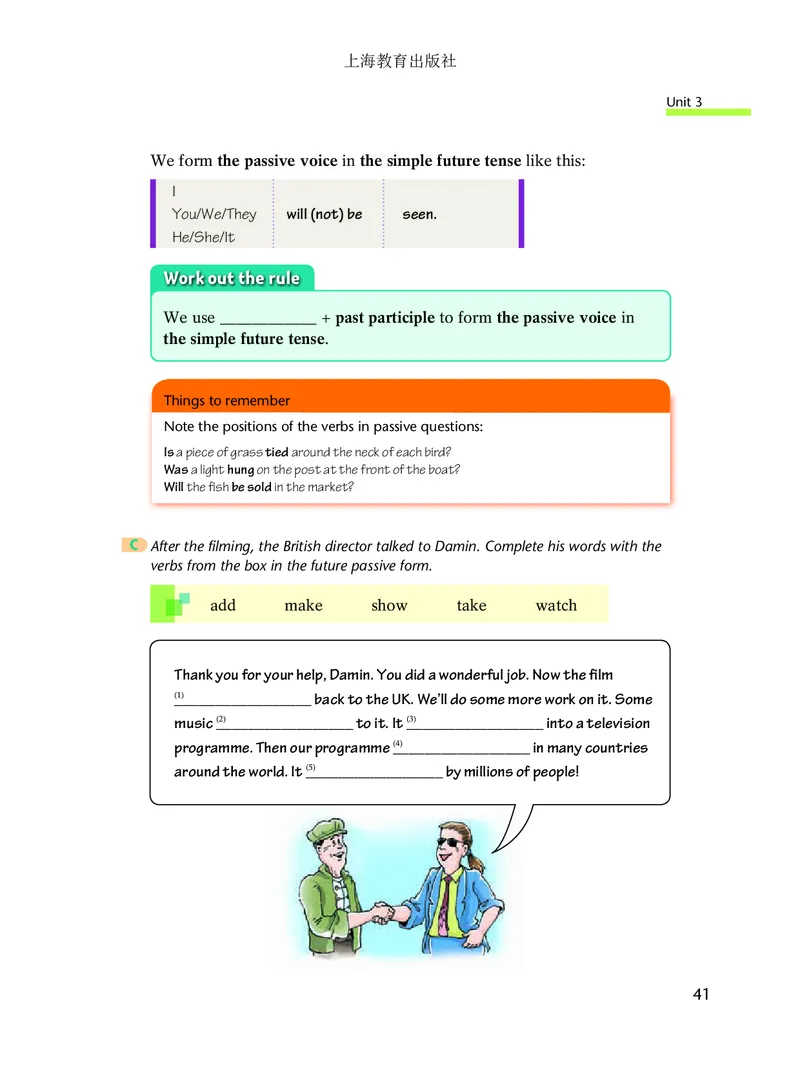
Thank you for your help, Damin. You did a wonderful job. Now the film
_(1)________________ back to the UK. We’ll do some more work on it. Some
music (_2)________________ to it. It (_3)________________ into a television
programme. Then our programme (_4)________________ in many countries
around the world. It _(5)________________ by millions of people!
41上海教育出版社
Module 2
Speaking
A Talk time
Describing people
When we describe a person, we usually mention his or her age, build,
height and anything else special about him or her. Here are some words
we can use:
Age Build
young heavy
middle-aged big
old slim/thin
Height Hair/Other
tall black/blond(e)/brown hair
short long/short hair
wears glasses
We also use words like very and quite, e.g. very young and quite tall.
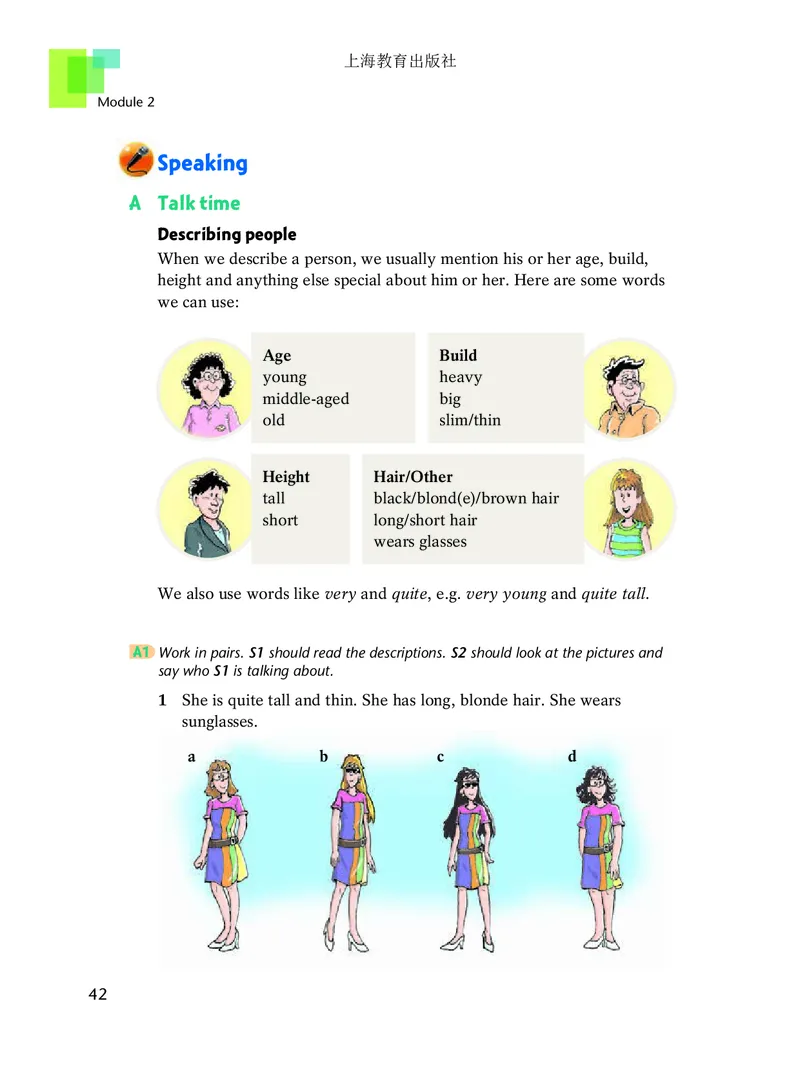
A1 Work in pairs. S1 should read the descriptions. S2 should look at the pictures and
say who S1 is talking about.
1 She is quite tall and thin. She has long, blonde hair. She wears
sunglasses.
a b c d
42上海教育出版社
Unit 3
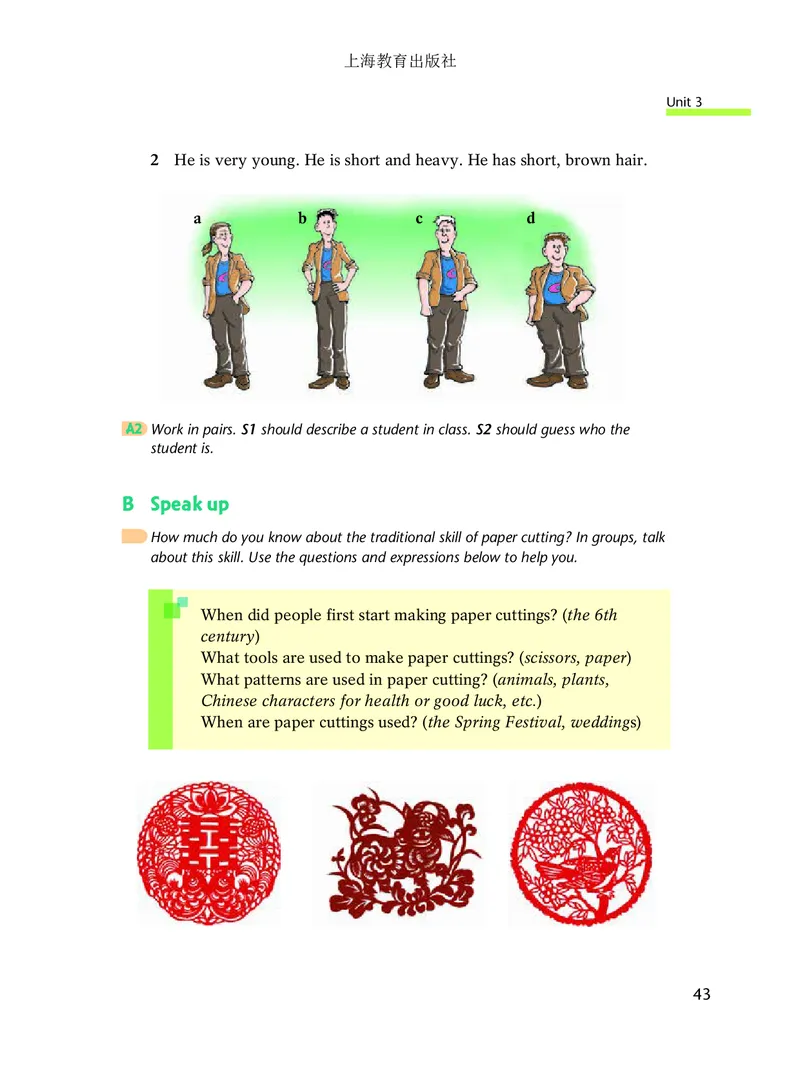
2 He is very young. He is short and heavy. He has short, brown hair.
a b c d
A2 Work in pairs. S1 should describe a student in class. S2 should guess who the
student is.
B Speak up
How much do you know about the traditional skill of paper cutting? In groups, talk
about this skill. Use the questions and expressions below to help you.
When did people first start making paper cuttings? (the 6th
century)
What tools are used to make paper cuttings? (scissors, paper)
What patterns are used in paper cutting? (animals, plants,
Chinese characters for health or good luck, etc.)
When are paper cuttings used? (the Spring Festival, weddings)
43上海教育出版社
Module 2
Writing
A person with a traditional skill
A Mark wrote an article about Mr Chen. Read the article and answer the questions
below.
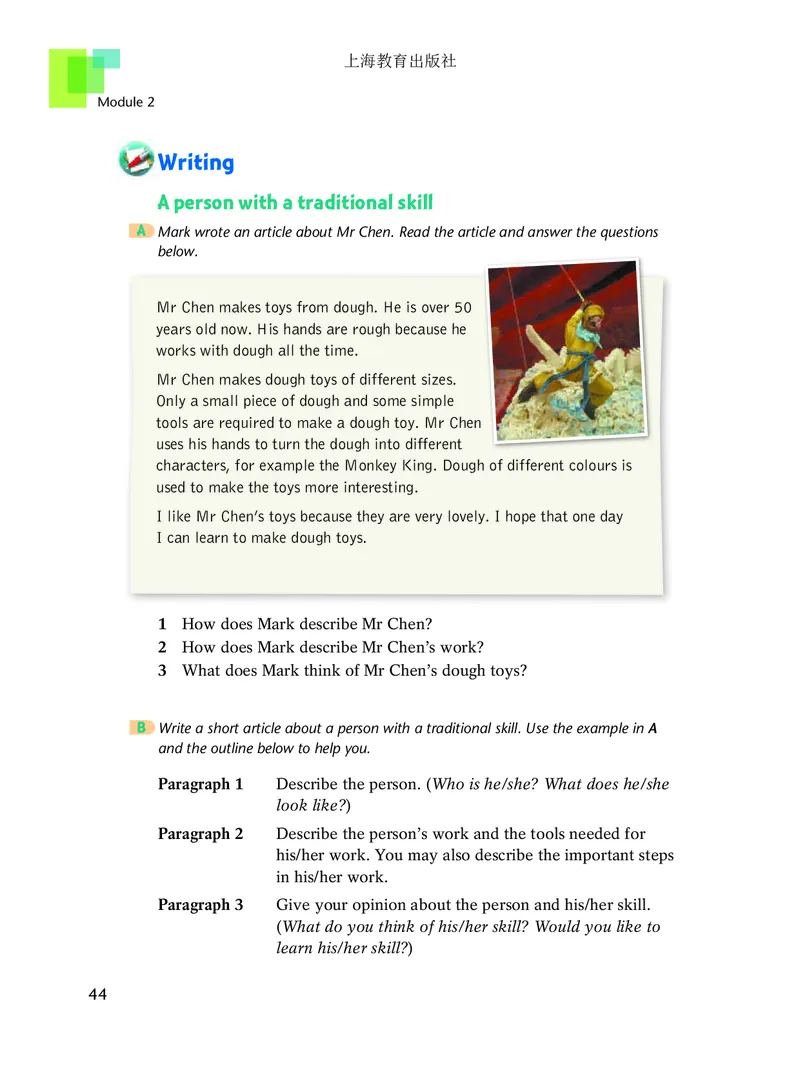
Mr Chen makes toys from dough. He is over 50
years old now. His hands are rough because he
works with dough all the time.
Mr Chen makes dough toys of different sizes.
Only a small piece of dough and some simple
tools are required to make a dough toy. Mr Chen
uses his hands to turn the dough into different
characters, for example the Monkey King. Dough of different colours is
used to make the toys more interesting.
I like Mr Chen’s toys because they are very lovely. I hope that one day
I can learn to make dough toys.
1 How does Mark describe Mr Chen?
2 How does Mark describe Mr Chen’s work?
3 What does Mark think of Mr Chen’s dough toys?
B Write a short article about a person with a traditional skill. Use the example in A
and the outline below to help you.
Paragraph 1 Describe the person. (Who is he/she? What does he/she
look like?)
Paragraph 2 Describe the person’s work and the tools needed for
his/her work. You may also describe the important steps
in his/her work.
Paragraph 3 Give your opinion about the person and his/her skill.
(What do you think of his/her skill? Would you like to
learn his/her skill?)
44上海教育出版社
Unit 3
(cid:43)
More practice
A Read this newspaper article about shadow puppet plays and answer the questions
below.
Shadow puppet plays
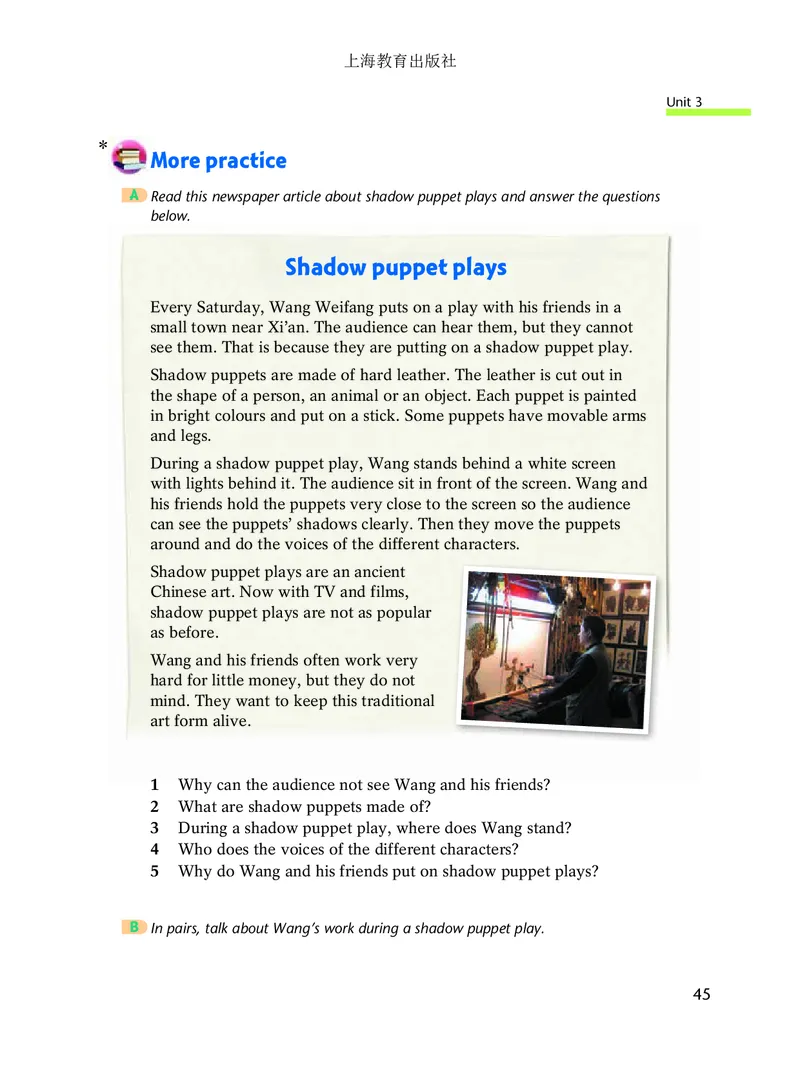
Every Saturday, Wang Weifang puts on a play with his friends in a
small town near Xi’an. The audience can hear them, but they cannot
see them. That is because they are putting on a shadow puppet play.
Shadow puppets are made of hard leather. The leather is cut out in
the shape of a person, an animal or an object. Each puppet is painted
in bright colours and put on a stick. Some puppets have movable arms
and legs.
During a shadow puppet play, Wang stands behind a white screen
with lights behind it. The audience sit in front of the screen. Wang and
his friends hold the puppets very close to the screen so the audience
can see the puppets’ shadows clearly. Then they move the puppets
around and do the voices of the different characters.
Shadow puppet plays are an ancient
Chinese art. Now with TV and films,
shadow puppet plays are not as popular
as before.
Wang and his friends often work very
hard for little money, but they do not
mind. They want to keep this traditional
art form alive.
1 Why can the audience not see Wang and his friends?
2 What are shadow puppets made of?
3 During a shadow puppet play, where does Wang stand?
4 Who does the voices of the different characters?
5 Why do Wang and his friends put on shadow puppet plays?
B In pairs, talk about Wang’s work during a shadow puppet play.
45上海教育出版社
Module 2
Study skills
(cid:43)
Practical writing (2): Posters, notices, etc.
Sometimes you need to make a poster, write a notice, etc.
When you do these, you should try to:
• get the readers(cid:8) attention(cid:28)
• gi(cid:87)e all the in(cid:71)ormation as clearly and brie(cid:71)ly as possible(cid:28)
• ask the readers to do something (cid:9)e(cid:15)g(cid:15) take part in an acti(cid:87)ity(cid:10)(cid:15)
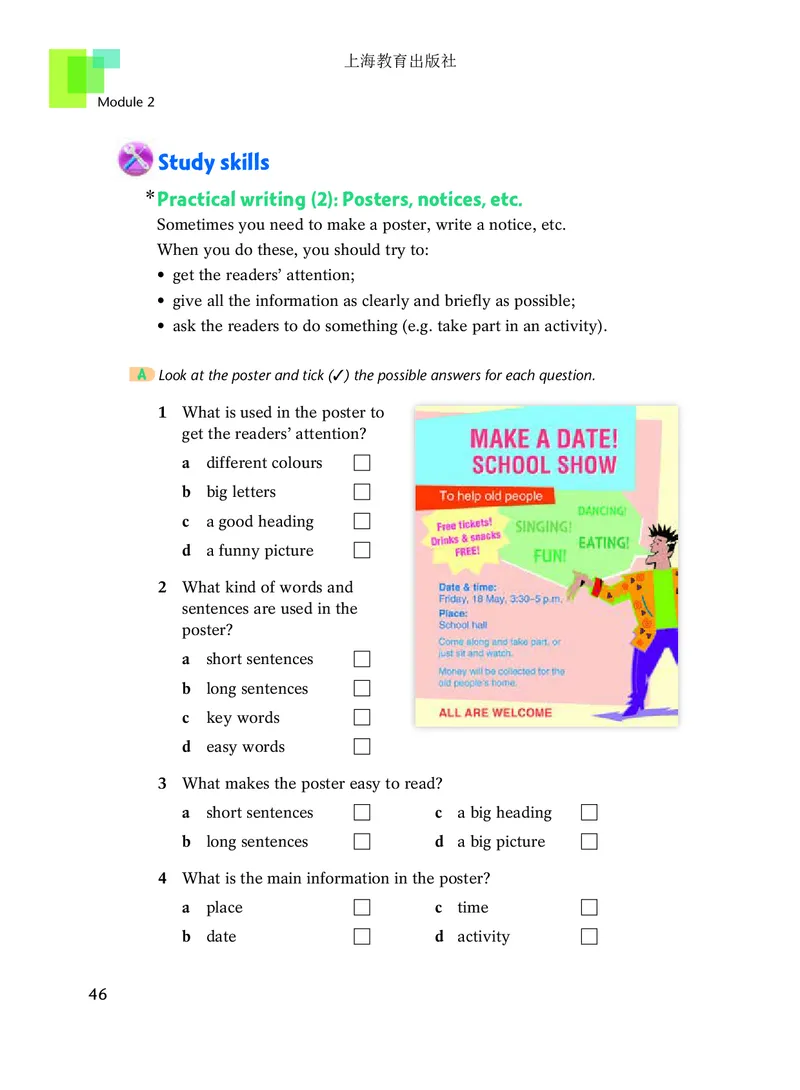
A Look at the poster and tick (3) the possible answers for each question.
1 What is used in the poster to
get the readers’ attention?
a different colours
b big letters
c a good heading
d a funny picture
2 What kind of words and
sentences are used in the
poster?
a short sentences
b long sentences
c key words
d easy words
3 What makes the poster easy to read?
a short sentences c a big heading
b long sentences d a big picture
4 What is the main information in the poster?
a place c time
b date d activity
46上海教育出版社
Unit 3
B In pairs, improve the notice below. Do not write more than 25 words.
Notice
bb bb 5 4 uu A aa : tt nn 3 p m dd pp . 0 m u aa ww s rr p . ii ee o . i ll m c ll nn n pp tt s . ll T aa ss T h u yy h o ww e .. e w s TT ii r ll ll d ii e w cc hh a kk w i aa l y ee l i vv , l tt b l ee 4 ss e b tt e h M ww oo e s ii a ll pp l ll i d n y aa bb . g ee yy i n I i t n ff 22 t rr g w 00 ee h a i ee e l l yy n tt s f uu d i oo c n aa t h i ss nn s h o tt h ee e o uu aa l a dd s cc h t c ee hh a h nn .. ll o tt a ss o t ,, l
You Can’t
Miss
It!
M
usic
Show
Everyone is
w
e
lco
m
e!
C In pairs, make a poster for a school event, for example a science fair.
47上海教育出版社
Module 2
Culture corner
Chinese knots
A Chinese knot is usually made of a thin rope.
It can be in the shape of an animal, a flower or
a Chinese character with a special meaning. Red
ropes are usually used because red is a lucky
colour for Chinese people.
Many Chinese knots have special meanings.
People think that these knots can bring them
happiness or good luck, so they carry the knots
with them or put them up at home.
Do you have a Chinese knot at home? What does it mean?
How well do you know this unit? Tick ✓ the boxes.
❶ I can read an article about cormorant fishing.
❷ I can listen to a description to identify mistakes in
a picture.
❸ I can use the passive voice in different tenses
correctly.
❹ I can describe people.
❺ I can talk about the traditional skill of paper
cutting with my classmates.
❻ I can write a short article about a person with a
traditional skill.
❼ I know about Chinese knots.
48上海教育出版社
Module 2 Arts and crafts
Unit
4
CCCaaarrrtttoooooonnnsss aaannnddd cccooommmiiiccc ssstttrrriiipppsss
Getting ready
(cid:3)In this unit, you will learn about cartoons and comic strips.
Reading
• Read an article about how to make a cartoon.
Listening
• Listen to a story about a baby dinosaur.
Grammar
• Learn how to use the passive voice with modal verbs.
• Learn how to use the passive voice in the present perfect tense.
Speaking
• Learn to give warnings.
• Role-play the story of a baby dinosaur.
Writing
• WWrriittee tthhee wwoorrddss ffoorr aa ccoommiicc ssttrriipp..
Why are you looking
at yourself in the
mirror, Lo?
I’m watching the best
cartoon character in
the world.
49上海教育出版社
Module 2
Reading
A What do you know about …?
Artists use many symbols in comic strips to show special meanings. Match the
symbols below with their meanings. Write the correct letter in each box.
a b c d
Hello, I’ll meet my
Sam! friends soon.
Meanings of symbols
1 This is a “speech bubble” for the words that the character says.
2 If a character’s eyes pop out like this, it means he/she is very
surprised.
3 The light bulb symbol means that the character has an idea.
4 This is a “thought bubble” for the words that the character
is thinking of.
B Before you read
There are six stages of making a cartoon. Do you know the correct order? Read the
first sentence of each paragraph in the article on page 51 and write the numbers
1–6 in the boxes.
a Make a rough sketch of the story.
b Have a good idea for a story.
c Use a computer program to put the pictures together.
d Think about the characters.
e Add colour to the drawings.
f Record the voices and sound effects.
50上海教育出版社
Unit 4
Jason is learning how to make cartoons. He has found some information in
a magazine.
How to make a cartoon
First, you need to decide on some basic ideas for a story.
This story is about a robot, Han. He always forgets things.
One day, Han meets his friends (cid:74)arah and Tim at the underground station. He
says, (cid:200)I’m happy. I bought a new notebook. (cid:69)ow I
won’t forget things.(cid:201)
5
(cid:74)arah says, (cid:200)(cid:80)es. I have one too. Here it is.(cid:201)
Tim asks, (cid:200)(cid:78)here’s yours, Han(cid:54)(cid:201)
Han says, (cid:200)Oh, no(cid:24) I forgot to bring it(cid:24)(cid:201)
In the second stage, think about the kinds of characters you want
10 and what they will look like.
Han is a tall robot. He has s(cid:104)uare eyes. They are actually video cameras. Tim
wears glasses, so he looks clever. (cid:74)arah is a pleasant girl. (cid:74)he has straight,
black hair.
Now make a rough sketch of the story.
15 Next, use a computer to draw detailed pictures and add colour. To
make the characters and things appear to move, each picture should
be made a little different from the one before it.
In the next stage, a computer
program is used to put the
20 pictures together as a film.
Finally, record the voices
and sound effects. The actors will do the characters’ voices. Their
speech must match the pictures. Sound effects, like the noise of the
underground, must also be added separately.
25 After everything has been checked, the cartoon is ready to be played
for everyone to enjoy.
51上海教育出版社
Module 2
C Vocabulary
C1 The words in italics explain the meanings of some words from the article on page
51. Find the words to complete the sentences. Change their forms if necessary.
1 The __________ idea of the story must be simple as well as important.
(line 1)
2 The painting is really interesting. The people in it look real. They
__________ to be alive. (line 16)
3 He wants to be a person in a film. His dream is to be an __________.
(line 22)
4 This shirt __________ your trousers well. Their colours really go
together. (line 23)
5 They did not watch the cartoon together. They went to the cinema
__________. (line 24)
C2 Jason is writing an email to his friend Anna in Germany. Complete his email with
the words from the box. Change their forms if necessary.
actor appear basic decide on record
Anna
Jason
Hi Anna,
I’ve (_1)_____________ a story for my cartoon. It’s about a boy called Jim. He
lives on another planet in the year 2200. Jim (_2)_____________ to be a human
from the Earth, but he’s actually a robot.
I’ll make the cartoon myself, as I have some (_3)_____________ drawing and
computer skills. However, I need some people to help me (_4)_____________
the voices and sound effects. My friend Tom has always wanted to be an
(_5)_____________, so I’ll ask him to do the voice of the robot.
I’ll show my cartoon to you when it’s ready. I hope you’ll like it.
Yours,
Jason
52上海教育出版社
Unit 4
Making summaries
When you make a summary, you give the most important information in your
own words. You should include the main points only. Then the main idea can
be understood quickly and easily.
D Comprehension
D1 Anna wants some advice on how to make cartoons. She has asked Jason some
questions in a chat room. Read the article on page 51 and help Jason answer her
questions in complete sentences.
Anna: After I’ve decided on the story of my cartoon, what should
I do?
Jason: _(1)___________________________________________________
Anna: What should I do after that?
Jason: _(2)___________________________________________________
Anna: How do I make the characters and things appear to move?
Jason: _(3)___________________________________________________
Anna: What should I do next?
Jason: _(4)___________________________________________________
Anna: What should I do last?
Jason: _(5)___________________________________________________
(cid:43)
D2 Read the article again and make a summary of it. Remember to use your own
words. You may begin like this:
There are six stages of making a cartoon. First, …
53上海教育出版社
Module 2
Listening
A comic strip about a baby dinosaur
A Listen to the story. Then put the pictures in the correct order by writing the
numbers 1– 6 in the boxes.
Can I play for the (_1)____________
Team, Captain?
a b
Blue Red
3 0
I scored!
Don’t be silly. Dinosaurs
don’t play football.
Mum, I’ve (_2)______________.
Mum, I want to
Can I play football _(5)__________________.
c _(3)______________? d
Don’t _(6)__________________.
Do your homework. It
Dinosaurs (_4)______________ 1
(_7)___________________ today.
play football.
e f
Oh, OK. You can play against the
Red Team (_8)__________________.
B Listen to the recording again and complete the conversations in the comic strip
in A.
54上海教育出版社
Unit 4
Grammar
A The passive voice with modal verbs
We use the passive voice with modal verbs like this:
It can be enjoyed by everyone.
made a little different from the one
should be
before it.
Each picture
should not be made the same as the one before it.
must be added.
Sound effects
must not be forgotten.
made a little different from the one
Should each picture be
before it?
Must sound effects be added?
Yes, it should. No, it should not/shouldn’t.
Yes, they must. No, they must not/mustn’t.
Work out the rule
To make the passive voice with modal verbs, ____________ is used
between the modal verb and the past participle of the main verb.
55上海教育出版社
Module 2
Complete the article below with the correct forms of the words in brackets.
Drawing cartoon faces
When we draw a cartoon face, some parts of the face
(_1)__s_h_o_u_ld_ _b_e_ m_a_d_e__ (should/make) bigger to make the face look funny.
So let’s start to draw a cartoon face for the woman!
A rough circle (_2)_______________________ (should/draw) first. Then a
nose and big glasses _(3)_______________________ (should/add).
Next, a pair of small eyes and a smiling mouth (_4)________________
_______ (must/draw). The mouth _(5)_______________________ (can/
make) larger to make the woman look friendlier.
Finally, some hair _(6)_______________________ (should/add) to the
cartoon. The face (_7)_______________________ (can/colour) with
bright colours.
(cid:43)
B The passive voice in the present perfect tense
We use the passive voice in the present perfect tense like this:
After everything has been checked, it is ready to be played for everyone
to enjoy.
The cartoon characters have been drawn carefully by the artists.
Work out the rule
We form the passive voice in the present perfect tense by using
have/has + ____________ before the past participle of the main verb.
56上海教育出版社
Unit 4
B1 In pairs, read the article in A on page 56 again. Ask and answer questions about
drawing cartoon faces. Follow the example.
S1: Now I’ve drawn a rough circle. What should I do next?
S2: After a rough circle has been drawn, you should add a nose and big
glasses.
S1: I’ve added the nose and big glasses. What must I do now?
…
B2 Complete the article below with the correct forms of the words in brackets.
How to make a comic strip
To make a comic strip, first, a story _(1)_______________ (must/think)
of. The story _(2)_______________ (should/make) interesting with an
exciting ending. After the story _(3)_______________ (create), pictures
_(4)_______________ (must/draw).
Look at the comic strip below. Speech and thought bubbles have been
added so that the pictures _(5)_______________ (can/understand) easily. A
line of words called a “caption” _(6)_______________ (put) at the top of the
fifth picture to explain a change of place or time.
CRASH!
CRASH!
This will fool
those two bad
TINKLE!
guys!
This is my
only chance.
Meanwhile, back at Chief? We’ve got some
the police station news. We’re searching
Green Island ...
BRRRRING
BRRRIIING
57上海教育出版社
Module 2
Speaking
A Talk time
Giving warnings
Here are some ways of warning people.
Be careful! There’s Look out! Watch Watch out! You’re
a bus coming. the doors! going to fall!
A1 Read the conversation below and practise it in pairs.
Peter: Let’s have a look in the South Shopping Centre.
Judy: All right, but watch the steps as you go in.
Peter: Thanks. Let’s go this way.
Judy: OK, but watch out! The floor is wet.
Peter: Here’s a shop. Let’s go in.
Judy: All right, but be careful! Don’t break anything.
Peter: Oh, I like this vase. I’ll just pick it up and … oops!
Judy: Look out! You almost dropped it.
A2 Find four warnings in the conversation in A1 and write them down.
B Speak up
B1 In groups of four, decide on the ending of the story about the baby dinosaur on
page 54. Use the questions below to help you.
What happens to the baby dinosaur in the end?
Does the baby dinosaur become a football star?
How does the baby dinosaur feel?
B2 In groups, role-play the story. Each student should play the role of one of the
characters below.
a The baby dinosaur c The captain of the Blue Team
b The mother dinosaur d One of the fans of the Blue Team
58上海教育出版社
Unit 4
Writing
Mystery Island
A The following is the first part of a comic strip called “Mystery Island”. In groups,
discuss what happens in each picture.
3
1
4 5
6
2
Thanks.
Goodbye.
b
a After the storm ...
10
7 11
8 CRASH!
Help!
12
c 9
d
e
A few days later ... 15
A few minutes later ...
16
13 ROAR! 17
14
f g h
59上海教育出版社
Module 2
B Write the captions and speech bubbles for the comic strip. Use the words for each
picture to help you.
a
e
a small boat
Thank goodness
a trip around the world
b … were celebrating
f Look! There’s a/an …
the weather forecast
Let’s …
a storm is coming
c
g
We made it!
in trouble
life jacket
d
h Quick! Run!
a huge wave
a dinosaur
1 Jim and Betty were in a small boat. They began a trip around the world.
2 Good luck! Goodbye!
3 A month later,
60上海教育出版社
Unit 4
(cid:43)
More practice
A Read the magazine article and answer the questions below.
Tom and Jerry
Tom the cat and Jerry the mouse are two of the most popular cartoon
characters in the world. In the short cartoons, Tom is always trying to catch
Jerry, but he never has any success. Almost every cartoon ends with Tom
in trouble and Jerry laughing at him. The stories are full of fun and have a
long history.
William Hanna and Joseph Barbera both worked for MGM in the late
1930s. Their boss told them to make funny cartoons. Together they thought
of the idea of a cat and a mouse. They thought it would be funny if the
mouse was clever and always got the cat into trouble.
The first Tom and Jerry cartoon was shown in cinemas in 1940. It was
a great success. Over the next 17 years, they made many Tom and Jerry
cartoons. Most of them are around seven minutes long.
In total, Hanna and Barbera made 114 Tom
and Jerry cartoons. The cartoons were so
good that they won a number of awards. The
famous cat and mouse remain popular today,
as the cartoons are still shown on television
around the world.
1 Who thought of the idea of Tom and Jerry?
2 When was the first Tom and Jerry cartoon shown in cinemas?
3 How long do most Tom and Jerry cartoons last?
4 How many Tom and Jerry cartoons were made in total?
B What is your favourite cartoon? Give a brief introduction to it and tell your
classmates why you like it.
61上海教育出版社
Module 2
Culture corner
Havoc in Heaven
One of the most famous cartoons in
China is called Havoc in Heaven.
Havoc in Heaven was created in
the 1960s by the Wan brothers. It
tells the story of the Monkey King.
The cartoon shows many Chinese
characteristics. For example, it
was made from hand-drawn Chinese pictures, and some of the sound
effects are from Beijing Opera. This cartoon has won many awards at
home and abroad, and has influenced cartoons throughout Asia since
it was produced.
Have you ever watched the cartoon Havoc in Heaven? How do you like it?
How well do you know this unit? Tick ✓ the boxes.
❶ I can read an article about making cartoons.
❷ I can make a summary of an article.
❸ I can listen for the sequence of events in a story
about a baby dinosaur.
❹ I can use the passive voice with modal verbs
correctly.
❺ I can give warnings.
❻ I can role-play the story of a baby dinosaur with
my classmates.
❼ I can write the words for a comic strip.
❽ I know about the Chinese cartoon Havoc in
Heaven.
62上海教育出版社
Unit 4
(cid:43)
PPPrrrooojjjeeecccttt
A comic book
Do you like to read comic books? In this project, you are going to make a
comic book.
A In groups of four, decide on an idea that would make a good story for your comic
strip. Use the example below to help you.
Idea: A fisherman goes fishing
with his cormorants every
afternoon. One day, one of
Think of these points when you plan
the cormorants goes under the your comic strip:
water but does not come up • story • characters
for a long time. When it finally • s(cid:81)ee(cid:68)h b(cid:86)bbles • tho(cid:86)ght b(cid:86)bbles
comes up, it does not have a • (cid:68)(cid:66)(cid:81)t(cid:74)o(cid:79)s • so(cid:86)(cid:79)(cid:69) (cid:88)or(cid:69)s
fish. Instead, it has a gold coin (Look back at Unit 4 for more ideas.)
in its mouth.
B Plan your comic strip with your group members. Follow the example.
Story: The fisherman and his three cormorants are on the river.
The cormorants go under the water for some fish. When
Cormorant 1 comes up, he does not have a fish. He has
a gold coin in his mouth.
Cormorant 2 thinks Cormorant 1 is stupid, but
Cormorant 3 is happy because they will not have to
work today.
Characters: The fisherman is old but very fit.
Cormorant 1 is young and looks hard-working.
Cormorant 2 is thin, old and looks tired.
Cormorant 3 is fat and looks lazy.
63上海教育出版社
Module 2
C Draw your comic strip. Next, add the speech bubbles, thought bubbles, captions
and sound words. Use the example below to help you.
Now go and get
some fish.
SPLASH!
?
After a while ... ?
?
Well done!
Two minutes later ...
Gold! We can buy
fish. We won’t have
Stupid bird! He to work today!
What’s this? should catch fish,
not gold!
A gold coin?
D When you have finished your work, put all the comic strips together to make a
comic book.
64上海教育出版社
Module 3 Animals
Unit
SSSaaavvveee ttthhheee eeennndddaaannngggeeerrreeeddd
5
aaannniiimmmaaalllsss
Getting ready
In this unit, you will learn about endangered animals and how we can save them.
Reading
• Read a fact file about the giant panda.
Listening
• Listen to a speech about endangered animals.
Grammar
• Learn how to use It is + adjective + for + noun/pronoun + to + verb.
• Learn how to use adjective + enough + to + verb.
• Learn how to use It is + adjective + of + noun/pronoun + to + verb.
Speaking
• Learn to talk about obligations.
• Talk about how to save an endangered animal.
Writing
• WWrriittee aa ffaacctt ffiillee aabboouutt aann eennddaannggeerreedd aanniimmaall..
Pandas like old films.
Do you know why?
No, I don’t. Why?
Because they’re
in black and white!
65上海教育出版社
Module 3
Reading
A What do you know about …?
How much do you know about pandas? Try the short quiz below. Circle the correct
answers.
1 How many pandas still live in the wild?
a About 1,600. b About 160,000.
2 Can pandas climb trees?
a Yes, they can. b No, they can’t.
3 What do pandas usually eat?
a Bananas. b Bamboo.
4 How long can pandas live in the wild?
a About 20 years. b About 50 years.
5 Where do pandas live? (There is more than one
answer.)
a In Sichuan. c In Gansu.
b In Shaanxi. d In Jiangsu.
B Before you read
Look at the article on page 67. Complete the facts about pandas.
Panda facts
Adult weight: about (_1)_____________ kilograms
Life: Pandas live for about (_2)__________________ in the wild
but in zoos they can live for (_3)__________________.
Food: A panda eats about _(4)__________________ of bamboo a
day.
Home: Pandas live high up in the mountains of (_5)____________
___________________________.
Population: There are about _(6)______________ pandas in the wild.
Behaviour: Pandas spend more than (_7)_____________________ a
day eating.
66上海教育出版社
UUnniitt 55
Population In the wild: about 1,600
Appearance Weight at birth: about 100–200 grams
Adult weight: about 100–150 kilograms
Colour: black and white
A giant panda is a kind of bear. It has a white face with black patches around its
eyes. It also has black ears, shoulders and legs. The rest of its body is white.
Home Life
Pandas live high up in the mountains Pandas live for about 20 years in the
5 of Central and Western China. They 25 wild, but in zoos they can live for up
live in the bamboo forests there. to 35 years.
Food The future
Pandas in the wild usually eat People are cutting down forests, so
bamboo. In zoos, their menu includes the pandas are losing their homes.
10 bamboo, apples and carrots. A 30 Some people are killing them for their
giant panda can eat as much as 30 fur. It is cruel of them to do so. There
kilograms of bamboo a day. are not many pandas in the world
now. It is important for us to protect
Behaviour
them.
Pandas like to live on their own.
15 They need to eat a lot to stay
healthy, so they spend more than
12 hours a day eating. Although
they are big and heavy, it is
not difficult for them
20 to climb trees. They
are strong enough to
protect themselves.
6677上海教育出版社
Module 3
C Vocabulary
C1 The words in italics are from the article on page 67. Circle their correct meanings.
1 The giant panda has a small population.
a the total weight of animals in an area
b the total number of animals in an area
2 Not many pandas live in the wild because there is not enough food
for them.
a a natural environment not controlled by people
b a dangerous place
3 A giant panda is tiny at birth.
a when it dies b when it is born
4 A giant panda is about two to three feet tall at the shoulder.
a the part of the body between the arms and the neck
b the top of the head
5 Shaanxi is in Central China. You can see pandas there.
a the middle of b the area around
C2 Complete the passage with the words from the box. Change their forms if
necessary.
adult in the wild population
at birth kilogram
Rabbit fact file
A rabbit weighs between 0.4 and 2 (_1)____________ and can live for up
to 12 years. However, a rabbit (_2)____________________ can seldom live
for more than a year.
_(3)_________________, a baby rabbit cannot see. An (_4)____________
rabbit cannot see very far, but it can see behind itself without turning
its head.
Adult rabbits can give birth to many baby rabbits,
and their _(5)____________ can grow very quickly.
This can cause problems for farmers, because
rabbits like to eat the farmers’ vegetables.
68上海教育出版社
Unit 5
Scanning
When you need to find certain information in a text, you do not have to read
every word. Instead, you can move your eyes quickly over the text to find
the information you need. This is called scanning. The exercise in B on page
66 is a scanning exercise.
D Comprehension
D1 Mandy wrote a passage about pandas for the school newspaper, but she has made
ssoommee mmiissttaakkeess.. RReeaadd tthhee aarrttiiccllee oonn ppaaggee 6677 aanndd hheellpp hheerr ccoorrrreecctt tthhee mmiissttaakkeess..
Please help us!
Western
Hello. I am a panda. My home is in Central and Southern China. I live
close to the mountains. I have a black face with white patches around my
eyes. I also have black ears, shoulders and legs. I love eating bamboo and
I spend more than 18 hours a day eating.
There are about 3,000 of us in the wild. However, some people are still
killing us for our teeth. Please help us!
D2 You are writing about the future of the giant panda. Read the article again and
complete the notes below. You may also add some other facts.
Why are giant pandas endangered?
• (cid:53)hey are losing their homes because (cid:64)(cid:64)(cid:64)(cid:64)(cid:64)(cid:64)(cid:64)(cid:64)(cid:64)(cid:64)(cid:64)(cid:64)(cid:64)(cid:64)(cid:64)(cid:64)(cid:64)(cid:64)(cid:64)(cid:64)(cid:64)(cid:64)(cid:64)(cid:64)(cid:64)(cid:64)(cid:64)(cid:64)(cid:64)
_____________________________________________________________.
• (cid:64)(cid:64)(cid:64)(cid:64)(cid:64)(cid:64)(cid:64)(cid:64)(cid:64)(cid:64)(cid:64)(cid:64)(cid:64)(cid:64)(cid:64)(cid:64)(cid:64)(cid:64)(cid:64)(cid:64)(cid:64)(cid:64)(cid:64)(cid:64)(cid:64)(cid:64)(cid:64)(cid:64)(cid:64)(cid:64)(cid:64)(cid:64)(cid:64)(cid:64)(cid:64)(cid:64)(cid:64)(cid:64)(cid:64)(cid:64)(cid:64)(cid:64)(cid:64)(cid:64)(cid:64)(cid:64)(cid:64)(cid:64)(cid:64)(cid:64)(cid:64)(cid:64)(cid:64)(cid:64)(cid:64)(cid:64)(cid:64)(cid:64)(cid:64)(cid:64)(cid:64)
• (cid:64)(cid:64)(cid:64)(cid:64)(cid:64)(cid:64)(cid:64)(cid:64)(cid:64)(cid:64)(cid:64)(cid:64)(cid:64)(cid:64)(cid:64)(cid:64)(cid:64)(cid:64)(cid:64)(cid:64)(cid:64)(cid:64)(cid:64)(cid:64)(cid:64)(cid:64)(cid:64)(cid:64)(cid:64)(cid:64)(cid:64)(cid:64)(cid:64)(cid:64)(cid:64)(cid:64)(cid:64)(cid:64)(cid:64)(cid:64)(cid:64)(cid:64)(cid:64)(cid:64)(cid:64)(cid:64)(cid:64)(cid:64)(cid:64)(cid:64)(cid:64)(cid:64)(cid:64)(cid:64)(cid:64)(cid:64)(cid:64)(cid:64)(cid:64)(cid:64)(cid:64)
(cid:43)
D3 In pairs, discuss how you can help the giant panda.
69上海教育出版社
Module 3
Listening
Endangered animals
A Jason is listening to a speech about endangered animals at school. Listen to the
speech and tick (✓) the animals that are mentioned in it.
1 2 3
4 5 6
B Jason is telling his mum about the speech. Listen to the recording again and
complete their conversation below. Write one word or figure in each blank.
Jason: Mum, today I listened to a speech by a man from the World
Wide Fund for Nature.
Mum: I know this organization. It looks after endangered animals. How
many members does it have?
Jason: It has close to (_1)____________ _____________ members in around
_(2)____________ countries. I know that there are (_3)____________ of
endangered animals around the world.
Mum: Why are they endangered?
Jason: It’s because people _(4)____________ _____________ forests and
_(5)____________ the water.
Mum: What do people from the WWF do to help these endangered
animals?
Jason: They work to (_6)____________ the endangered animals and their
_(7)____________.
70上海教育出版社
Unit 5
Grammar
A Using It is + adjective + for + noun/pronoun + to + verb
noun/
It is adjective for to + verb
pronoun
important us to protect giant pandas.
It is for
good people to save endangered animals.
Work out the rule
The adjective in this sentence pattern describes (the person/the
action).
Read the notes below. Then write a short notice to remind your classmates about
how to protect endangered animals.
Ways to protect endangered animals
1 learn about endangered animals in the area—important
2 buy products made from endangered animals—wrong
3 report any hunting of endangered animals—helpful
4 protect the homes of endangered animals—right
Protecting endangered animals
1 It is important for people/us to ________________________________.
2 ___________________________________________________________
3 ___________________________________________________________
4 ___________________________________________________________
71上海教育出版社
Module 3
B Using adjective + enough + to + verb
They are strong enough to protect themselves.
Things to remember
not … enough to = too … to
The baby panda is not old enough to eat bamboo. = The baby panda is too young
to eat bamboo.
Simon is talking about his trip to the nature park with Emma. Complete their
conversation with the adjectives and verbs in brackets.
Simon: Someone was throwing rocks at a duck in the park, but I
(_1)___w_a_s_ _n_o_t__ b__r_a_v__e__ e__n_o_u__g__h_ _t_o_ _t_e__ll____ (brave/tell) him to stop doing
it. I feel really sorry about it.
Emma: That’s OK, Simon. At least you’re (_2)_________________________________
____________ (honest/say) you were wrong. What happened to the
duck then?
Simon: It flew away from us. I think it came close because it was
hungry. Some other people in the park were _(3)____________________
___________________ (kind/give) it some food, so it was fine.
Emma: Did you see any other animals during your trip?
Simon: Yes, I saw some birds, some horses and some sheep. I did a lot
of walking. I’m _(4)_______________________________________ (tired/fall)
asleep right now!
72上海教育出版社
Unit 5
C Using It is + adjective + of + noun/pronoun + to + verb
It is adjective of noun/pronoun to + verb
cruel them to kill pandas.
It is of
kind you to try to save the dog.
Work out the rule
The adjective in this sentence pattern describes (the person/the
action).
The adjectives below are often used in this sentence pattern.
bad foolish kind silly
clever good nice wrong
Below are some pictures of Helen’s visit to the zoo. Write captions for the pictures.
bad clever lose take
careless nice show wave
1 2
_It_ _w_a_s_ n_i_ce_ _o_f _t_h_e_ p_o_li_c_e_m_a_n_ t_o_ _s_h_o_w_ ____________________________
Helen the way to the zoo.
________________ at the visitors.
3 4
____________________________ ____________________________
__________________ her camera. _______________ Helen’s camera.
73上海教育出版社
Module 3
Speaking
A Talk time
Talking about obligations
What should/must we do
We shouldn’t/mustn’t
to help giant pandas?
buy fur products.
We should/must
protect their homes.
Read the conversation below and practise it in pairs. Pay attention to the words in
blue.
Kevin: What should we do to protect the fish in the river?
Amy: We mustn’t throw rubbish into the river. The fish will die if
the river is polluted.
Kevin: What else should we do?
Amy: We should write to factories and ask them to stop polluting the
river.
Kevin: Good idea.
B Speak up
How can we help save endangered animals? In groups, choose one endangered
animal from A on page 70 to talk about. Use the questions below to help you.
Which endangered animal are we going to talk about?
What dangers do they face?
How should we protect them?
74上海教育出版社
Unit 5
Writing
An endangered animal
The school magazine wants you to write a fact file about an endangered
animal.
A Below are some endangered animals. Write about one of them or choose one of
your own. Then make a spidergram. Use the example below to help you.
Asian elephants giant pandas
blue whales South China tigers
Home:
Live in the grasslands and
forests of South-East Asia
Appearance:
Height, weight, colour
Food:
Eat grass,
leaves and fruit
Asian
elephants
Why in danger:
People cut down forests
and kill them for their Behaviour:
long teeth Move in large groups
Life:
Live for up to 60
years in the wild
• (cid:45)oo(cid:76) for (cid:74)(cid:79)terest(cid:74)(cid:79)g f(cid:66)(cid:68)ts (cid:88)he(cid:79) yo(cid:86) (cid:66)re (cid:69)o(cid:74)(cid:79)g rese(cid:66)r(cid:68)h.
• (cid:54)se sub-headings to help readers quickly find what they are looking for.
Sub-headings in the form of questions are also helpful. Wh-questions make
great sub-headings.
75上海教育出版社
Module 3
B Write a fact file about the endangered animal you have chosen. Follow the
example.
Asian elephant fact file
Appearance Life
Asian elephants are huge and grey. In the wild, Asian elephants may live
They weigh up to 5,400 kilograms for up to 60 years, but most do not
and are 3.2 metres tall at the live that long.
shoulder.
Why in danger
Home People are cutting down forests.
Asian elephants live in the They are also killing them for their
grasslands and forests of teeth. It is important for us to
South-East Asia. protect them.
Food
Asian elephants usually eat grass,
leaves and fruit.
Behaviour
Asian elephants often move in large
groups.
76上海教育出版社
Unit 5
(cid:43)
More practice
A Read the article and answer the questions below.
The story of the red-crowned crane
Have you ever heard of the song “The story of the red-crowned crane”?
It is about a girl called Xu Xiujuan.
Xiujuan was born in Zhalong, Heilongjiang Province in 1964. Her
father’s job was to look after red-crowned cranes. Xiujuan started
helping her father when she was young. She soon showed a great love
for these white birds. She became good at raising them.
When Xiujuan was 21, she got a job at a nature reserve in Jiangsu
Province. She enjoyed taking care of the baby cranes. If a bird became
sick, she took good care of it and stayed with it every day until it was
strong enough to fly again.
In September 1987, one of the birds went missing. The workers in the
nature reserve looked everywhere, but no one could find it. Xiujuan
was very worried. She looked for it day and night for two
days. On the second night, while she was looking for the
missing bird, she fell into a river and died. She was only
23.
Later, a song was written in memory of Xiujuan. Though
Xiujuan died young, people always remember her when
they hear the song or see a red-crowned crane.
1 How did Xu Xiujuan take care of the red-crowned cranes at the
nature reserve in Jiangsu Province?
2 What happened to Xu Xiujuan in September 1987?
3 Why was the song “The story of the red-crowned crane” written?
B In pairs, talk about someone who helps endangered animals.
77上海教育出版社
Module 3
Study skills
Using reference books (4): Using a dictionary (II)
A dictionary not only tells you the most common meaning of a word, it
also tells you:
• how to spell and say the word;
• if it is a noun, a verb, etc.;
• if the word has more than one meaning;
• how we might use it in a sentence.
A In groups, look at the dictionary page below and answer the questions on page 79.
can v [BrE] /kRn/ [AmE] /kCn/
1 used to say that it is possible for sb/sth to do sth, or for sth to happen
• We can catch the bus here.
2 used to say that sb knows how to do sth
• She can speak Spanish.
3 used with the verbs “feel”, “hear”, “see”, “smell”, “taste”
• I can hear music.
4 used to show that sb is allowed to do sth
• We can wear jeans at work.
5 (informal) used to ask permission to do sth
• Can I read your newspaper?
6 (informal) used to ask sb to help you
• Can you help me with this box?
can n [BrE] /kCn/ [AmE] /kCn/
1 [C] a metal container in which food and drink is sold
• a can of beans, a beer/paint can
2 the can [sing.] (AmE, slang) prison
• He spent 30 years in the can.
IDIOMS
no can do (informal) used to say that you are not able or willing to do sth
• Sorry, no can do. I’m busy at the moment.
a can of worms (informal) if you open up a can of worms, you start doing sth
that will cause a lot of problems and be very difficult
• Do not open a can of worms by giving Matthew any suggestions.
78上海教育出版社
Unit 5
1 How many different meanings of “can” are given in the
dictionary?
__________________________________________________
2 What are the two pronunciations of the word?
__________________________________________________
3 Why are some words in italics?
__________________________________________________
4 What do the abbreviations “v”, “n”, “sing.”, “C”, “BrE”
and “AmE” mean?
__________________________________________________
5 What do the words “informal” and “slang” mean?
__________________________________________________
6 What idioms are given?
__________________________________________________
(cid:43)
B Use your dictionary to answer the following questions. Compare your answers with
your classmates’.
1 What is the pronunciation of “record” as a verb? What is it as a
noun?
2 What is the British English pronunciation of “vase”? What is its
American English pronunciation?
3 From your dictionary, find an example sentence for the word “trip”.
4 What is the American English for “autumn”?
5 What does “room” mean as a countable noun? What does it mean as
an uncountable noun?
6 What does the idiom “let the cat out of the bag” mean?
79上海教育出版社
Module 3
Culture corner
WWF
The World Wide Fund for Nature (WWF) was founded
in 1961. It was called the “World Wildlife Fund” in the
past. It uses a panda as its logo.
The WWF is an important environmental organization. It
aims to build a future where people live in harmony with
nature. It works on around 1,300 projects in over 100
countries, and has 5 million supporters.
Why do you think it is important to look after the environment?
How well do you know this unit? Tick ✓ the boxes.
❶ I can read a fact file about the giant panda.
❷ I can scan to find specific information.
❸ I can listen for specific information about how to
help endangered animals.
❹ I can use It is + adjective + for + noun/pronoun +
to + verb correctly.
❺ I can use adjective + enough + to + verb correctly.
❻ I can use It is + adjective + of + noun/pronoun + to
+ verb correctly.
❼ I can talk about obligations.
❽ I can talk about how to save an endangered
animal.
(cid:29) I can write a fact file about an endangered animal.
(cid:30) I know how to find specific information about a
word in a dictionary.
(cid:31) I know about the WWF.
80上海教育出版社
Module 3 Animals
Unit
6
PPPeeetttsss
Getting ready
In this unit, you will learn about pets.
Reading
• Read an article about two different opinions on keeping pet dogs.
Listening
• Listen to a conversation about different kinds of pets.
Grammar
• Learn how to use adverbs with verbs.
• Learn how to use the comparative and superlative of adverbs.
Speaking
• Learn to make and respond to complaints.
• Talk about problems caused by pets.
Writing
• Write a short article about what animal makes the best pet.
You’d better put Why? I put some
more water in the in yesterday and
fish tank, Lo. the fish haven’t
drunk it yet.
81上海教育出版社
Module 3
Reading
A What do you know about …?
A1 Do you know any fun facts about animals? Decide whether the following sentences
are T (True) or F (False).
1 Cats can taste sweets. T / F
2 Chocolate can make dogs sick. T / F
3 Dolphins sleep with both eyes closed. T / F
4 When a rabbit is happy, it clicks its teeth. T / F
5 Dogs may feel unhappy if they are not taken out for a walk. T / F
A2 In pairs, discuss the following questions.
1 Do you have a pet? What is it? What is it like?
2 If you do not have a pet, do you want one? Why or why not?
3 Why do people keep pets?
B Before you read
Look at the pictures, the title, the introduction and the sub-headings of the article
on page 83. Then answer the questions below.
1 What do you think the article is about?
2 Who likes keeping a pet dog and who does not?
(cid:43)
3 Why is keeping a pet dog a good idea?
(cid:43)
4 Why is keeping a pet dog a bad idea?
82上海教育出版社
Unit 6
HEAD
TO HEAD
Is it a good idea to keep pet dogs? Emma and
Matt give their opinions on this matter.
Keeping pet dogs is a good idea, Keeping pet dogs is not a good
says Emma idea, says Matt
5 Keeping pet dogs is a good idea. It’s not a good idea to keep pet dogs.
There are lots of reasons for this.
25 Pet dogs leave their hair on the floor,
First, dogs are really cute. It’s nice on beds and on sofas, and they need to
to hold them in our arms, and it’s be washed often.
wonderful to see them grow up.
Dogs are noisy. Nearly all dogs bark
10 Second, we can learn responsibility at strangers. Some dogs bark more
from keeping dogs. We have to feed 30 loudly than others. A few dogs bark
them, train them and play with them. all night. This stops people from
According to my mum, this helps us getting any sleep. Not all dogs are
become more responsible people. friendly. A small number of pet dogs
15 Young people can learn how to care even attack people.
for others by keeping dogs.
35 What’s more, it’s common for people
A dog will love you faithfully and to live in flats. They have no choice
bring you lots of happiness for many but to keep their dogs in small spaces.
years. However, dogs need fresh air and
large open spaces where they can run
20 So I think it’s a good idea to keep
40 free.
pet dogs.
Finally, owning dogs can be
expensive.
So keeping pet dogs is not a good
idea.
83上海教育出版社
Module 3
C Vocabulary
C1 The words in italics explain the meanings of some words from the article on page
83. Find the words to complete the sentences.
1 The girl likes the small cat because it is pretty and lovely. She likes
__________ animals. (line 7)
2 Do not give food to the bears. If you __________ them, they might
attack you. (line 11)
3 __________ everyone was excited about the Olympics. Almost all the
families in the country were watching the games on TV. (line 28)
4 It is __________ for students to make these mistakes. Such mistakes
happen often. (line 35)
5 You ____________________ take this exam. Everyone in the school
must take it. (lines 36–37)
C2 Complete the conversation with the words from the box below.
according to cute feed noisy sofa stranger
Emma: Mum! The rabbits are so (_1)________________. Can you buy me
one?
Mum: I don’t think they make very good pets. They smell, and they’ll
get the _(2)________________ and the floor dirty.
Emma: _(3)________________ my friend, a rabbit makes a great pet. It
isn’t (_4)________________ like a dog.
Mum: But you won’t have time to (_5)________________ it and take care
of it. Also, it’s not a good idea to buy a pet in the street from a
_(6)________________.
Facts or opinions
An article may contain both facts and opinions. A fact is a true statement.
An opinion shows the writer’s view about something.
• It is common for people to live in flats. (a fact)
• Keeping pet dogs is a good idea. (an opinion)
84上海教育出版社
Unit 6
D Comprehension
D1 Read the following statements and decide whether they are F (Facts) or O (Opinions).
1 According to my mum, this helps us become more F / O
responsible people.
2 A dog will love you faithfully and bring you lots of F / O
happiness for many years.
3 Nearly all dogs bark at strangers. F / O
4 Keeping pet dogs is not a good idea. F / O
D2 Emma and Matt have given us many reasons to support their opinions. Read the
article again and complete the notes below.
Emma’s opinion: keeping pet dogs is a good idea
Emma’s reasons:
• (cid:37)ogs are (_1)___________________.
• (cid:49)eople can learn (_2)___________________________.
• (cid:58)oung people can learn how to (_3)___________________________.
• (cid:37)ogs will lo(cid:87)e you (cid:71)aith(cid:71)ully and bring you lots o(cid:71) happiness (cid:71)or
_(4)_________________.
Matt’s opinion: keeping pet dogs is not a good idea
Matt’s reasons:
• (cid:49)et dogs lea(cid:87)e their _(5)__________ everywhere, and they need to be
washed often.
• (cid:37)ogs are _(6)__________. Most dogs bark at (_7)__________.
• (cid:47)ot all dogs are _(8)__________. A small number of pet dogs even
_(9)_________________.
• (cid:49)eople keep their dogs in (_10_)________________. The dogs cannot run
free.
• (cid:48)wning dogs can be _(11_)_________________.
(cid:43)
D3 In pairs, discuss whether it is a good idea to keep a pet dog. Give some reasons.
85上海教育出版社
Module 3
Listening
Different kinds of pets
A Jason is talking with his friend Alice about their favourite pets. Listen to their
conversation and complete the notes below. Write one word in each blank.
Jason
Alice
Favourite pet: (_1)________
Favourite
pet:
_(3)________
Reason: They are (_2)________
Reasons:
They are _(4)________
to hold and to touch. to take care of and it is nice to
_(5)________
them swim around.
B Listen to the recording again. Who has each of the following opinions? Put a
tick (✓) in each correct box. In some cases, Alice and Jason both agree.
Opinions Jason Alice
1 Cats just lie around. They do not do anything.
2 Cats just do as they wish.
3 Dogs need a lot of attention.
4 You cannot play with a fish or even hold it.
5 You cannot really do anything with a fish,
except watch it.
6 It is nice to watch the fish swim around.
86上海教育出版社
Unit 6
Grammar
A Using adverbs with verbs
We can use adverbs to talk about how something happens or is done.
A dog will love you faithfully and bring
you lots of happiness for many years.
The cat is sleeping peacefully.
The girl is talking with her mum happily.
Work out the rule
We usually put the adverb (after/
before) the main verb or the object.
Many adverbs are formed by adding -ly to adjectives:
Adjectives Changes Examples
Most adjectives + ly quick (cid:171)(cid:1)quickly
Adjectives ending in -y y + ily easy (cid:171) easily
Adjectives ending in a consonant + -le e + y simple (cid:171) simply
Adjectives ending in -ll + y full (cid:171) fully
Things to remember
• hard, fast, late
These adverbs have the same form as adjectives.
He is a hard worker. He works hard.
She is a fast runner. She can run fast.
Do you like late dinners? No, I do not like to eat late.
• good, well
Good is an adjective; well is an adverb.
Is she a good singer? Yes, she sings well.
87上海教育出版社
Module 3
A man called Happy keeps a pet shop, but today Happy is not happy! He is
speaking to his workers. Complete the sentences with the correct form of the
words in the box. Use each word only once.
bad correct happy quick
cheerful good patient
My customers are leaving me because you act
(_1_) __b_a_d_l_y____.
In the future, I want you all to smile _(2_) __________
at our customers. I want you to listen to them
(_3_) __________. I want you to work (_4_) __________
and add up all the amounts _(5_) __________.
Finally, I want you all to dress (_6_) __________. Do all
these things, and I’m sure we’ll work _(7_) __________
together.
B The comparative and superlative of adverbs
We have learnt how to compare people or things with adjectives. We can
use adverbs to compare how something happens or is done.
We can take care of pet dogs more easily in large open spaces than in small
spaces.
Of all her friends, Emma looked after her pet dog (the) most carefully.
We form the comparative and superlative of adverbs like this:
Adverbs Comparatives Superlatives
quickly more quickly (the) most quickly
slowly more slowly (the) most slowly
hard harder (the) hardest
fast faster (the) fastest
late later (the) latest
88上海教育出版社
Unit 6
Work out the rule
• (cid:53)o (cid:71)orm the comparative and superlative of adverbs ending in -ly,
we add ________ and ________ before them.
• (cid:39)or adverbs that do not end in -ly and have the same form as the
adjectives, we often add ________ and ________ to them.
Things to remember
The comparative and superlative forms of badly, far, little, much and
well are irregular:
badly—worse—worst much—more—most
far—farther/further—farthest/furthest well—better—best
little—less—least
Emma interviewed 40 people to find out which pet centre is the most popular.
Help her complete her report with the information from the table below. Use the
comparative and superlative of the adverbs in brackets.
Good animal
Pet centre Good helpers Number of visits
doctors
(cid:53)(cid:38)(cid:49)
LOVE
Ken’s
Heart
I interviewed 40 people who keep pets at home. They think the animal
doctors at TEP check pets (_1)_____________ (carefully) and the helpers
help look after pets _(2)_____________ (patiently) than those at LOVE
and Ken’s. However, among the four pet centres, people go to Heart
_(3)_______________ (regularly). They think the animal doctors and helpers
there did their jobs (_4)________________ (well). They seldom go to Ken’s
because the animal doctors there usually work (_5)________________ (slowly)
than those in the other centres. Of all these four pet centres, Ken’s helpers care
_(6)____________________ (little) about pets.
89上海教育出版社
Module 3
Speaking
A Talk time
Making and responding to complaints
What’s the problem?/
I want to complain
What’s the matter?
about this DVD.
There’s a hole
in the middle. I’m sorry to hear that.
A1 Read the conversation below and practise it in pairs.
Ellen: Excuse me. I want to make a complaint about these dog
biscuits.
Manager: What’s the problem?
Ellen: When I opened the box, I found that many of them were bad.
Look!
Manager: Oh, I’m very sorry about that. I’ll take care of it right away.
Can you show me your receipt?
Ellen: Yes. Here it is.
Manager: Thanks. Now if you can wait, I’ll be back in a moment.
A2 Answer the following questions.
1 What did Ellen say to make her complaint?
2 What did the manager say to respond to the complaint?
3 What do you think the manager will do after he leaves Ellen?
B Speak up
Pets can sometimes cause problems. In pairs, make conversations according to the
situations below. Take turns to make and respond to the complaints.
1 S1 has a pet dog. It is usually friendly, but one day it barked and
scared S2’s younger sister when she tried to touch it.
2 S2 has a pet dog. It makes a lot of noise in the evening and keeps
S1 from sleeping.
90上海教育出版社
Unit 6
Writing
What animal makes the best pet?
A In pairs, discuss what animal makes the best pet. Write down your opinion and
reasons. Use the example below to help you.
I think that dogs make the best pets.
Reasons:
• Dogs are lovely.
• Dogs are faithful to their owners.
• Walking a dog can help the owner
stay healthy.
B Use your notes from A, the expressions from the box below and the example on
page 92 to help you write a short article.
(cid:34)ccording to (cid:15)(cid:15)(cid:15) (cid:52)econdly(cid:13) (cid:15)(cid:15)(cid:15) (cid:39)or these reasons(cid:13) (cid:15)(cid:15)(cid:15)
In my opinion, ... What’s more, ... I (do not) believe that ...
(cid:39)irstly(cid:13) (cid:15)(cid:15)(cid:15) (cid:39)inally(cid:13) (cid:15)(cid:15)(cid:15) (cid:42) (cid:9)do not(cid:10) think that (cid:15)(cid:15)(cid:15)
Remember to include the following sections in your article:
• (cid:42)(cid:79)tro(cid:69)(cid:86)(cid:68)t(cid:74)o(cid:79)(cid:27) (cid:52)t(cid:66)te yo(cid:86)r o(cid:81)(cid:74)(cid:79)(cid:74)o(cid:79).
• (cid:35)o(cid:69)y(cid:27) (cid:40)(cid:74)(cid:87)e f(cid:66)(cid:68)ts or e(cid:89)(cid:66)m(cid:81)les th(cid:66)t s(cid:86)(cid:81)(cid:81)ort yo(cid:86)r o(cid:81)(cid:74)(cid:79)(cid:74)o(cid:79).
• (cid:36)o(cid:79)(cid:68)l(cid:86)s(cid:74)o(cid:79)(cid:27) (cid:52)t(cid:66)te yo(cid:86)r o(cid:81)(cid:74)(cid:79)(cid:74)o(cid:79) (cid:66)g(cid:66)(cid:74)(cid:79).
91上海教育出版社
Module 3
Dogs make the best pets
I think that dogs make the best pets.
(cid:39)irstly(cid:13) dogs are lo(cid:87)ely(cid:15) (cid:42) en(cid:75)oy playing with them(cid:15) (cid:42)t(cid:8)s pleasant
to hold them in our arms.
Secondly, dogs are faithful. There was once a faithful dog in
Japan. One day, his owner died suddenly of a heart attack. The
dog did not know it and kept on waiting for his owner every
day for many years, until he died.
Thirdly, if you keep a pet dog, you need to walk it every day.
When you are walking your dog, you are doing exercise.
(cid:39)or these reasons(cid:13) (cid:42) belie(cid:87)e that dogs make the best pets(cid:15)
92上海教育出版社
Unit 6
(cid:43)
More practice
A Read the story about Robbie, Emma’s pet dog. Then put the pictures in the correct
order by writing the numbers 1–4 in the boxes.
A dog’s story
My name is Robbie. I was born on a farm with my brothers and sisters.
One day, a man and two little boys came to the farm.
“Which dog do you want?” the man asked.
“We want that one!” the boys said. They chose me!
They drove me to my new home in the city. The boys promised they
would look after me very carefully, and they did.
They fed me, played with me and walked me every day. Then one day,
they got a computer. After that, the boys played computer games all the
time. They did not play with me or feed me any more.
Eventually the boys’ father took me to a pet centre. He told the staff
that his boys loved their computer more than me. The centre gave me
lots of food and took good care of me. One day, a nice girl called Emma
came to visit.
“Do you want to come home with me?” she asked.
“Woof!” I said. She smiled and took me home.
Emma feeds me and takes me for walks every day. I know I will live
here happily for the rest of my life.
a b
c d
B What should you think about before you get a pet? Discuss this with your classmates.
93上海教育出版社
Module 3
Culture corner
How sayings about dogs have changed
In the old days, people kept dogs, but they used
them for hunting or to help with farm work. Dogs
often had a very difficult life. So we have sayings
such as “to lead a dog’s life” or “as sick as a dog”.
(cid:39)eelings towards dogs began to change when li(cid:71)e
became more prosperous (cid:71)or people(cid:15) (cid:49)eople came
ttoo sseeee ddooggss aass ffrriieennddss oorr ccoommppaanniioonnss.. TTooddaayy wwee ccaallll
aa ddoogg ““mmaann’’ss bbeesstt ffrriieenndd”” aanndd tteellll ppeeooppllee ““LLoovvee mmee,,
love my dog”.
Do you know any sayings about dogs? What are they?
How well do you know this unit? Tick ✓ the boxes.
❶ I can read an article about two different opinions on
keeping pet dogs.
❷ I can tell the difference between facts and opinions.
❸ I can listen for the different opinions in a
conversation.
❹ I can use adverbs with verbs correctly.
❺ I can use the comparative and superlative of
adverbs correctly.
❻ I can make and respond to complaints.
❼ I can talk about problems caused by pets with my
classmate.
❽ I can write a short article about what animal makes
the best pet.
(cid:29) I know about how sayings about dogs have changed
over time.
94上海教育出版社
(cid:43)
PPPrrrooojjjeeecccttt
Pet World
Do you keep a pet? Would you like to keep one? In this project, you will
help make a booklet about some different pets.
A In groups, discuss and choose an animal that would make an interesting pet.
Choose a pet below, or think of one of your own.
cats dogs
parrots goldfish
B Each group should divide its work among different members. Research the following
information about your pet.
Why do people like
to keep this pet?
Keeping
_________
as a pet
How should people
Some fun facts
take care of it?
about this pet
95上海教育出版社
Module 3
C Each group should then work together to write about this pet. Use the example
below to help you.
Keeping a dog as a pet
1 Why do people like to keep a dog as a pet?
• (cid:37)ogs make people go out more o(cid:71)ten to do e(cid:89)ercise(cid:15)
• (cid:37)ogs are (cid:87)ery (cid:71)aith(cid:71)ul and they are people(cid:8)s best (cid:71)riends(cid:15)
• (cid:37)ogs help people become more responsible(cid:15)
2 Some fun facts about dogs:
• (cid:56)hen dogs mo(cid:87)e their tails (cid:71)rom side to side(cid:13)
they are happy.
• (cid:37)ogs can see better than humans in the dark(cid:15)
• (cid:37)ogs like sweets a lot more than cats do(cid:15)
3 How should people take care of a dog?
• (cid:49)lay with it e(cid:87)ery day(cid:15)
• (cid:36)lean and (cid:71)eed it regularly(cid:15)
• (cid:40)i(cid:87)e it much care and lo(cid:87)e(cid:15)
D All the groups should then put their work together to make a booklet called “Pet
World” for everyone to read. Design a cover if possible.
96上海教育出版社
Module 4 Discovery
Unit
7
TTThhheee uuunnnkkknnnooowwwnnn wwwooorrrlllddd
Getting ready
(cid:3)In this unit, you will learn about Unidentified Flying Objects (UFOs) and aliens.
Reading
• Read a story about aliens.
Listening
• Listen to a spaceship captain giving instructions to two lost
astronauts.
Grammar
• Learn how to use adverbial clauses of reason.
• Learn to give reasons with because of.
Speaking
• Learn to agree and disagree.
• Discuss what five things the lost astronauts should take with them.
Writing
•• W Wrriittee aa ssttoorryy aabboouutt mmeeeettiinngg tthhee ppeeooppllee ooff BBiirrdd WWoorrlldd..
Are you sure
Quite sure. There are
this planet
no creatures on it.
is safe, Hi?
97上海教育出版社
Module 4
Reading
A What do you know about …?
Do you believe in aliens? Do you agree with the following sentences? Discuss them
with your classmates.
1 2
We received some messages Aliens came to the Earth
from aliens about ten years thousands of years ago,
ago. and made some buildings.
3 4
Aliens sometimes take people There are many planets in space.
from the Earth into their Aliens live on some of them.
spaceships.
B Before you read
Look at the pictures, the title and the first paragraph of the story on page 99. Then
answer the questions below. You may need to guess some of the answers.
1 When did Tina wake up?
2 What was the yellow light in the sky?
3 What happened to the light?
4 What did Tina probably do the next day?
98上海教育出版社
Unit 7
Aliens arrive!
Tina woke up at midnight. She looked out of
her window and saw a yellow light in the sky. It
suddenly dived towards the ground. She heard a
noise and saw a red light.
5 The next morning, Tina mentioned it to her brother
Tom. “I’m sure something landed in the forest near
the hills as I heard a loud noise last night,” she said.
“Let’s explore after school.”
At 6 p.m., Tina and Tom reached the forest. They heard some
10 voices speaking a strange language, so they hid behind some bushes
and kept quiet. Then they saw an alien! It was tall, with a round
head and a silver body. It was standing next to a long spaceship.
The spaceship was damaged because of a crash.
The children were frightened. Suddenly, another alien appeared
15 from the bushes in front of them. It discovered them and made a
terrible noise! The children ran away in fear.
The next morning, Tina and Tom told their parents about the
strange creatures. “They were very ugly. They had some hair, but
they didn’t have any feathers,” said Tina.
20 “There was something written on the spaceship,” said Tom. “It
looked like this. I wonder what it means.” He drew some lines on a
piece of paper.
But Dad said, “Since no one else saw these aliens, I refuse to
believe you. Now go to school!”
25 The children spread their wings and flew to school together.
Dad looked at the piece of paper with the strange marks on it. “It
looks strange,” he said, as he looked at the word “EARTH”.
99上海教育出版社
Module 4
C Vocabulary
C1 Read the following sentences from the story on page 99. Circle the correct
meanings for the words in italics below.
1 ... they hid behind some bushes and kept quiet.
a did not make any noise b stayed in a place without any people
2 It discovered them and made a terrible noise!
a soft b not pleasant
3 The children ran away in fear.
a feeling tired b feeling afraid
4 The children spread their wings and flew to school together.
a opened … outwards b put … together
5 Dad looked at the piece of paper with the strange marks on it.
a grades b symbols or writing
C2 Complete the following newspaper article with the words from the box. Change
their forms if necessary.
discover loud refuse wonder
in fear quiet spread
“UFO” Seen in West Jersey
At around 7 p.m. last night, the Johnson family heard a (_1)___________
noise and saw a bright light in the sky. Something then fell into the
bushes. There were more noises, and then all became _(2)___________.
_(3)___________, the family called the police.
The police (_4)___________ some feathers in the bushes. Since the feathers
were _(5)___________ out, the police believed that a bird was killed.
Next to the feathers, there was a broken power line. The police
_(6)___________ how the bird was killed.
The Johnson family, however, (_7)___________ to believe it was a bird.
“It was a UFO, I tell you!” said Mr Johnson.
100上海教育出版社
Unit 7
D Comprehension
D1 Tina and Tom are telling a police officer what they have seen. Complete their
answers to the police officer’s questions.
Police: Why did you go to the forest?
Tina: We went there because I heard _(1)___________________ last night.
Police: What happened?
Tina: I woke up at midnight and saw _(2)____________________________.
It _(3)______________________________. Then I heard a noise and
saw a red light.
Police: I see. So when did you reach the forest?
Tom: We reached the forest (_4)_____________.
Police: What happened there?
Tom: We saw an alien. It was tall, with _(5)__________________________
_______________.
Police: What else did you see?
Tina: We saw _(6)____________________. It was damaged because of
_(7)________________.
Police: Interesting! What happened next?
Tom: _(8)______________________ discovered us, so we ran away in fear.
Police: Thanks, Tina and Tom. We’ll explore the forest to try and find
out more about these aliens.
D2 Read the story again and answer the questions below in complete sentences.
1 What are Tina and her family?
_____________________________________________________________
2 Who are the aliens?
_____________________________________________________________
3 Where did the spaceship come from?
_____________________________________________________________
(cid:43)
D3 In pairs, discuss whether you believe aliens are real. Why or why not?
101上海教育出版社
Module 4
Listening
Rescuing the lost astronauts
Two astronauts, Liz and Gus, are lost on Planet X. Their captain Troy is
talking to them from the mother ship.
A Listen to the captain’s instructions and help Liz and Gus label the map with the
words from the box.
desert landing site spaceship
lake mountains town
A B C D E
_(2)_____________
11 11
_(1)_____________
22 2
(_3)_____________
_(4)_____________
3 3
44 riv er 4
(_5)___s_p_a_c_e_s_h_ip___
5 h ills 55
(_6)_____________
A B C D E
B Listen to the recording again and complete the notes below. Write one word in
each blank.
Captain Troy:
• We cannot land the mother ship in the forest because of the (_1)__________.
• Your spaceship is in B4. We are going to _(2)__________ in D1.
• You must get to D1 _(3)__________ __________ __________.
• You must _(4)__________ __________ __________ behind.
• You can only carry (_5)__________ __________.
• You mustn’t hurt or _(6)__________ anyone on this planet.
102上海教育出版社
Unit 7
Grammar
A Adverbial clauses of reason
Adverbial clauses of reason tell us why things happen. We usually use
because, as and since to start adverbial clauses of reason.
I’m sure something landed in the
forest near the hills as I heard a
loud noise last night.
Adverbial clause of reason Main clause
Because
As no one else saw these aliens, I refuse to believe you.
Since
We can also put the adverbial clause of reason after the main clause.
Main clause Adverbial clause of reason
because
I refuse to believe you as no one else saw these aliens.
since
Things to remember
When we put the adverbial clause of reason at the beginning of the
sentence, we often separate it from the main clause with a comma (,).
103上海教育出版社
Module 4
The police officer asked Tom some more questions about the aliens. Match the
questions with the answers. Then use them to complete the police officer’s notes
with as, since or because.
Police officer Tom
1 Why was Tina sure that a WWee hheeaarrdd ssoommee vvooiicceess
something landed in the forest speaking a strange
near the hills? language.
2 Why did you and Tina hide b She heard a loud noise last
behind some bushes? night.
3 Why did you run away? c No one else saw these
aliens.
4 Why did your father refuse to d An alien saw us and made a
believe you? terrible noise.
1 (because) _T_in_a_ _w_a_s_ s_u_r_e_ t_h_a_t_ _s_o_m_e_t_h_in_g_ _la_n_d_e_d_ i_n_ t_h_e_ f_o_r_e_s_t_ n_e_a_r_ t_h_e_
hills because she heard a loud noise last night.
2 (as) _______________________________________________________
3 (Because) __________________________________________________
4 (Since) ____________________________________________________
104上海教育出版社
Unit 7
B because of
We can also use because of to give the reason for something.
I’m unhappy because of
your marks in the exam!
They went to the forest because of their curiosity.
Tina woke up at midnight because of a loud noise.
She decided to explore the forest because of it.
Work out the rule
We can use a noun, a noun phrase or a(n) (subject pronoun/object
pronoun) after because of.
Write sentences about the story on page 99 by using because of.
1 Tina was surprised/the yellow light in the sky
__________________________________________________________
2 The aliens landed on this planet/an accident
__________________________________________________________
3 The children ran away from the forest/the aliens
__________________________________________________________
4 Their dad was not sure about the children’s story/the writing on the
piece of paper
__________________________________________________________
105上海教育出版社
Module 4
Speaking
A Talk time
Agreeing and disagreeing
I think/believe that the pyramids
So do I./I agree./I think you’re right.
in Egypt were built by aliens.
I don’t agree./I think you’re wrong./
I disagree.
In pairs, make a conversation like the example above. Choose one of the following
topics.
Aliens are a danger to us. Aliens will become our friends.
Aliens are cleverer than us. We will fight aliens in the future.
B Speak up
Look at B on page 102 again. The two astronauts must get to their
mother ship as soon as possible. They have the following things, but they
can only take five of them.
a camera a tent 10 bottles of water
a knife matches 25 gold coins
a map of Planet X medicine 6 lunch boxes
Work in pairs. Imagine you and your classmate are Liz and Gus.
1 Choose five things to take with you. Explain why you need these
things and why you agree or disagree with your classmate;
2 Tell the class your list and give your reasons.
106上海教育出版社
Unit 7
Writing
Meeting the people of Bird World
Liz and Gus finally arrived at the landing site of their mother ship.
However, something strange happened.
A In pairs, look at the picture below and discuss what happened to Liz and Gus when
they got to the mother ship.
a strange noise Captain Troy
bird-like people with wings mother ship
B Liz wanted to make friends with the people of Bird World. Discuss what she might do
with your classmate. Use the ideas from the box and the example below to help you.
dance for the people of Bird World smile
draw some pictures for them sing
give them something
No one knew what to do. Then Liz had a good idea. She started to sing as
she wanted to show the people of Bird World that she was friendly. Liz had a
beautiful voice. Because the people of Bird World liked her song, they started
to sing too. They were happy.
107上海教育出版社
Module 4
C Write the story of Liz and Gus with your ideas from A and B.
Liz and Gus finally reached the landing site and saw Captain Troy.
“Liz! Gus! Welcome back!” said Captain Troy. “I’m very pleased to
see you. Now let’s get on the mother ship and …”
Suddenly ____________________________________________________
____________________________________________________________
____________________________________________________________
No one knew what to do. Then Liz had a good idea. ______________
____________________________________________________________
____________________________________________________________
____________________________________________________________
____________________________________________________________
____________________________________________________________
____________________________________________________________
And so the people from the Earth and Bird World became friends!
108上海教育出版社
Unit 7
(cid:43)
More practice
A Read the article and answer the questions below.
UFO
Many people say they have seen UFOs. Here is one
famous story. It is called the Roswell Incident and
it happened in the US in 1947.
Person A (name not given): My wife and I were
sitting outside because it was a warm night.
Suddenly we saw something very bright flying
through the sky.
Person B (William Brazel, a farmer): I found some pieces of strange
metal on my farm. I called the army. Major Marcel came and collected the
pieces. He told me not to talk to anyone about this.
Person C (Major Marcel): I went and collected the pieces. I gave them to
an army expert. He said the pieces came from a weather balloon. However,
since I have not seen this kind of metal before, I think this was a lie.
Person D (name not given): My parents and I were in the countryside.
Suddenly we saw a silver spaceship on the side of the hill. There were the
bodies of three aliens lying on the grass. Then some soldiers came and told
us to leave.
So what is the truth?
• Perhaps some or all of the people lied.
• Perhaps a US rocket crashed and people thought it had come from
space.
• Perhaps an alien spaceship really crashed in Roswell.
1 What is the article about?
2 What did Mr Brazel find on his farm?
3 What did the US army expert say about the pieces of metal?
4 Did Person D believe there were aliens? Why or why not?
B What do you think of mysteries such as UFOs? In groups, give your opinions.
109上海教育出版社
Module 4
SSttuuddyy sskkiillllss
Making notes (3): Making notes while listening
Good listeners usually make good notes. Making notes can help you find
key points and facts.
• Write down the key information. It includes names, times, numbers,
thoughts or ideas.
• Do not try to write down everything. Do not use complete sentences.
Instead, you should write down the important nouns and verbs.
The following example shows how to make notes while listening.
What time is the
Space Museum open?
On weekdays, the Space Museum is
open from nine o’clock in the morning
to four thirty in the afternoon. On
Saturdays, it’s open from nine o’clock
to three o’clock. On Sundays, it’s open
for three hours only, from nine in the
Notes
morning to 12 noon.
Weekdays: 9 a.m.–4:30 p.m.
Sat.: 9 a.m.–3 p.m.
Sun.: 9 a.m.–12 noon
When you make notes, you can use:
• symbols, e.g. +, ✓, (cid:24) and (cid:171).
• short forms, e.g. a.m., p.m., Sat. and Sun.
110上海教育出版社
Unit 7
(cid:43)
A Listen to a book review and make notes below. Remember to write down key
information only. Do not write complete sentences.
Before you begin, you should think about what information you need to pay
special attention to while listening.
Programme:
Book name:
Writer:
Topic:
Comment:
(cid:43)
B Complete the following sentences using your notes in A.
1 The woman is talking about a book called ______________________.
(book name)
2 The book was written by __________________. (who)
3 The writer was born in ______________ in _____________. (where and
when)
4 In the book, the man meets _______________________ in the future.
(what)
5 You should read the book because it is ____________________. (why)
111上海教育出版社
Module 4
Culture corner
Science fiction
Science fiction (or “sci-fi”) is a popular
kind of story found in many books, comics
and films. The War of the Worlds is a
famous science fiction story. It is about
aliens from Mars (called “Martians”)
attacking the Earth. It was written by the
English writer, H. G. Wells, who is called
the “Father of Science Fiction”. Many
people in America thought it was real
when they heard the story on the radio in 1938!
Have you ever read any science fiction stories? Share one with your classmates.
How well do you know this unit? Tick ✓ the boxes.
❶ I can read a story about aliens.
❷ I can listen for specific information about a
captain’s instructions.
❸ I can use adverbial clauses of reason correctly.
❹ I can use because of correctly.
❺ I know how to agree and disagree with others.
❻ I can talk about things the astronauts should carry.
❼ I can write a story about meeting the people of
Bird World.
❽ I know how to make notes while listening.
(cid:29) I know about science fiction.
112上海教育出版社
Module 4 Discovery
Unit
8
LLLiiifffeee iiinnn ttthhheee fffuuutttuuurrreee
Getting ready
In this unit, you will learn about life in the past, present and future.
Reading
• Read some Internet posts about life in the future.
Listening
• Listen to a story about two astronauts.
Grammar
• Learn how to use the past continuous tense.
Speaking
• Learn to make apologies and give excuses.
• Talk about a trip to the Moon.
Writing
• Write an Internet post about life in the past and present.
Have you ever planned
for the future?
Of course. Today I bought
two bottles of oil instead of
one because I know I’ll want
another one in the future!
113上海教育出版社
Module 4
Reading
A What do you know about …?
A1 Which of the following sentences are probably about the future, and which are
about the present? Tick (3) the boxes.
Now Future
1 There are hotels on the Moon.
2 Our houses use a lot of energy.
3 Your fridge can order food for you.
4 Most people use hydrogen cars.
A2 What will life be like in the future? In pairs, discuss the following questions.
1 What will hotels be like?
2 What will houses be like?
3 What will cars be like?
B Before you read
Look at the pictures and the headings of the Internet posts on page 115. Then tick (3)
the descriptions that match the pictures.
1 The hotel looks like a very large fish.
2 The hotel is built on a mountain.
3 There is a robot helper in the house.
4 The CJ3 has a wide window at the front.
5 The CJ3 does not have any wheels.
114上海教育出版社
Unit 8
It is August 2050. Some people are writing about hotels, houses and cars on
the Internet. Read their posts.
Life in 2050
The Hotel Whale
The Hotel Whale is built under the water. It is in the shape of a whale.
This hotel has 50 bedrooms, a cafe and a shopping centre.
Mrs Peng: “When we were staying at the hotel
5 recently, my children watched the fish outside
their bedroom window. They were never bored!”
Forever Green Houses
These houses are both “green” and “smart”. There is glass outside
the houses. Heat is held under the glass and is then used as energy for
10 each house. In the bathroom, your medicine cupboard is connected
to your doctor’s computer. In the kitchen, your smart fridge tells the
supermarket’s computer when you need more food.
Mr Yu: “When we were living in our old
house, we were using more energy. I would
15 certainly recommend Forever Green Houses to
my friends. They will satisfy everyone.”
The CJ3
The CJ3 is a new type of hydrogen car. The
hydrogen in the car is mixed with oxygen from the air to make electricity
20 for the car. The CJ3 has an electronic map and is driven by a computer.
You tell the computer where you want to go. Then you sit back and relax
as the car takes you there.
Mr Hu: “While I was driving my old car, I was
polluting the city. Now, with the new technology
25 in my CJ3, I’m helping protect the environment.”
115上海教育出版社
Module 4
C Vocabulary
C1 The words in italics are from the Internet posts on page 115. Circle the correct
answers to complete these sentences.
1 The shape of something is _____.
a what it is made of b its outside form
2 If something happened recently, it happened _____.
a not long ago b a long time ago
3 To satisfy people means to make them _____.
a angry by not giving them what they want
b pleased by giving them what they want
4 When things are mixed, they _____.
a are put together
b do not go together
5 Relax means to _____.
a do something with a lot of energy
b rest while doing something fun
C2 Complete the conversation with the words from the box. Change their forms if
necessary.
certainly electronic shape technology while
Matt: I’ve decided to build a space hotel when I grow up.
Nelson: Really? What will the hotel be like?
Matt: It’ll be in the _(1)______________ of a star. And it’ll use
solar energy to run its (_2)_______________ parts, so it’ll be
environmentally friendly. With this (_3)______________, the hotel
will also be able to move from place to place, like a spaceship.
Nelson: What else will it have?
Matt: There’ll be a computer in each bedroom. It’ll be connected
to the Internet. In this way, you’ll be able to communicate
with your family and friends on Earth (_4)_____________ you’re
staying in the space hotel. Do you like my idea?
Nelson: _(5)_______________. I’d recommend it to all my friends!
116上海教育出版社
Unit 8
Finding supporting details
Writers use supporting details to help readers understand and remember
new ideas. In the second post on page 115, it says that Forever Green
Houses are “green”. To understand this, look at the supporting details that
follow: “There is glass outside the houses. Heat is held under the glass and is
then used as energy for each house.”
D Comprehension
D1 Below are some questions about the Internet posts on page 115. Answer the
questions. Write Y (Yes) or N (No).
1 Can we go shopping at the Hotel Whale?
———
2 Are there 100 bedrooms in the Hotel Whale?
———
3 Can I contact my doctor from the bathroom of
a Forever Green House?
———
4 Do Forever Green Houses use a lot of energy?
———
5 Do we need oxygen to run the CJ3?
———
D2 Read the Internet posts again and answer the questions below in complete
sentences.
1 Where is the Hotel Whale?
_____________________________________________________________
2 What is special about Forever Green Houses?
_____________________________________________________________
3 Why does the driver of the CJ3 not need to drive the car?
_____________________________________________________________
(cid:43)
D3 In pairs, discuss what you think life will be like in 2050.
117上海教育出版社
Module 4
Listening
Back to the Earth
A Listen to a story about two astronauts. Then put the events in the correct order by
writing the numbers 1 –5 in the brackets.
( ) The astronauts started the software and flew back home.
( ) Two astronauts returned from a trip to the Moon.
( ) The computer flew the spaceship to Mars instead.
( ) The Whizz-Kid created some virus-cleaning software.
( ) People at the Space Computer Club tried to help the astronauts.
I can’t stop the computer.
B Listen to the recording again and complete the answers to the following questions.
Write one word in each blank.
1 Where were the two astronauts?
They were in a __________.
2 What was wrong with the computer?
It was __________ by a virus.
3 Why did the people at the Space Computer Club ask the Whizz-Kid for
help?
Because he is good at __________ computer viruses.
4 How long did it take the Whizz-Kid to write the virus-cleaning software?
It took him __________ __________.
118上海教育出版社
Unit 8
Grammar
The past continuous tense
We use the past continuous tense to talk about actions that were
happening at a particular time in the past.
When we were staying at the
hotel recently, my children
watched the fish outside their
bedroom window.
I/He/She/It was (not)
watching TV at eight o’clock last night.
You/We/They were (not)
Was I/he/she/it
having dinner at eight o’clock last night?
Were you/we/they
I/he/she/it was.
Yes,
you/we/they were.
I/he/she/it was not/wasn’t.
No,
you/we/they were not/weren’t.
Work out the rule
We form the past continuous tense with __________ or __________
+ the -ing form of the main verb.
119上海教育出版社
Module 4
A Linda was helping at a charity event last Saturday. Read her schedule and
complete the sentences below using the past continuous tense.
Time Activity
7:00–8:00 get ready to go out
8:00–9:00 travel on the underground
9:00–10:00 buy food in the market with some friends
10:00–12:00 make lunch for 30 people
12:00–13:00 have lunch
13:00–15:00 tidy up and wash the dishes
15:00–17:00 meet a friend at a tea shop
17:00–18:00 go home on the underground
1 At 7:30, Linda _w_a_s_ g_e_t_t_i_n_g_ r_e_a_d_y_ t_o_ g_o_ _o_u_t________________________.
2 At 8:30, she __________________________________________________.
3 At 9:30, she and some friends __________________________________.
4 At 12:30, they _______________________________________________.
5 At 16:30, she ________________________________________________.
6 At 17:30, she ________________________________________________.
We can also use the past continuous tense to talk about two actions
happening at the same time in the past.
While I was driving my old car,
I was polluting the city.
Things to remember
Usually we use while to talk about
two continuing actions in the past.
120上海教育出版社
Unit 8
B Super-smart is a smart computer and Ultra-smart is a smart robot. Look at their
notes about what they did on Wednesday and complete the paragraph below.
Super-smart wrote: Ultra-smart wrote:
Order food from the Make a new hydrogen
10:00–11:00
supermarket. car for Jacky.
Collect holiday information Play games with
11:00–12:00
for David’s family. Jacky’s son.
12:00–13:00 Teach David Chinese. Make lunch.
Check the plants in the
13:00–14:00 Play football with Jacky.
garden.
14:00–15:00 Read stories with David. Make afternoon tea.
While Super-smart (_1)___________________ from the supermarket,
Ultra-smart (_2)________________________ for Jacky. While Super-
smart _(3)__________________________ for David’s family, Ultra-
smart _(4)____________________ with Jacky’s son. While Super-smart
_(5)__________________ Chinese, Ultra-smart (_6)__________________. While
Super-smart _(7)__________________ in the garden, Ultra-smart and Jacky
_(8)_________________________. While _(9)__________________________ with
David, _(10_)______________________ afternoon tea.
C In pairs, talk about what you were doing last weekend. Use the table below to help
you.
___________________ (Your name)
Morning Afternoon Evening
Saturday
Sunday
121上海教育出版社
Module 4
Speaking
A Talk time
Making apologies and giving excuses
What happened?
I’m sorry that I broke your vase.
I was holding it when the phone rang.
That’s all right./Never mind./
Don’t worry about it.
Read the conversation below and practise it in pairs. Pay attention to the words
in blue.
Arthur: Sorry, I’m late. The bus broke down, and there were no
taxis.
Tony: That’s all right. I just got here myself.
Arthur: And I’ve forgotten to bring the tickets with me. I’m terribly
sorry.
Tony: Oh, what’s wrong with you?
Arthur: I’m having trouble remembering things recently.
Tony: You’d better do something about that.
B Speak up
In groups, plan a trip to the Moon. Use the questions below to help you.
What will you need to prepare for the trip?
How will you get there?
What will you do on the Moon?
122上海教育出版社
Unit 8
Writing
Life in the past and present
Science and technology are developing very quickly. When your
grandparents were young, their lives were different from yours today.
A Many things in daily life are different from those in your grandparents’ teenage
days. In pairs, think of one thing. Use the topics below to help you.
the way people keep in touch with others
the way people wash clothes, heat their homes, etc.
the way people go to school or work
the way people buy things
tthhee wwaayy ppeeooppllee ttaakkee pphhoottooss
B Choose one topic and make an outline. Follow the example.
The way people keep in touch with others
Your grandparents’ teenage days Now
• wrote letters • write emails
• used pens and paper • use computers
• letters were sent by post • get a reply in a short time
• it took a long time to get a
• reach people in a second
reply
123上海教育出版社
Module 4
C Write an Internet post about the topic. Follow the example.
Life in the past and present
Your grandparents’ teenage days
When my grandparents were young, they
wrote letters to keep in touch with others. They
used pens and paper. Their letters were sent by
post and it took several days to reach people.
While they were waiting for the reply, they
might feel worried.
Now
Today we write emails to keep in touch with
our friends. Our emails can reach others in
a second and we can get a reply in a short
time. We do not use paper to write emails, so
we can save many trees and help protect the
environment.
Life in the past and present
__________________________________________________________
__________________________________________________________
__________________________________________________________
__________________________________________________________
__________________________________________________________
__________________________________________________________
__________________________________________________________
__________________________________________________________
__________________________________________________________
124上海教育出版社
Unit 8
(cid:43)
More practice
A Read the Internet posts and answer the questions below.
Problems in 2050
Lily: I was staying at the Hotel Whale with
my friends last week. After going shopping
and having tea at the cafe, I went back
to my room to rest. But when I opened
the door, I saw that water was coming in
through the window! I knew I should not
just stand there, but I did not know what to
do…
Mike: At 11:30 a.m. the day before
yesterday, I was having lunch in our
Forever Green House while our fridge was
ordering food. Suddenly a light went on
and a lot of food started to arrive from the
supermarket: meat, vegetables, fruit, milk,
and so on. “Stop!” I shouted at the fridge,
but the food continued to come in…
Benny: Dad was driving us to the airport in his CJ3, and suddenly the car
stopped. The hydrogen in the car failed to mix with the oxygen, so the
car did not work. “Oh, no!” said Mum. “We’re going to miss our plane.
What shall we do?”
1 What did Lily see when she came back to her room?
2 What happened to Mike’s fridge when it was ordering food?
3 What was wrong with Benny’s father’s car?
B The three Internet posts above do not have endings. In pairs, choose one of the
posts and discuss how you can finish it. Write the ending in your exercise book.
125上海教育出版社
Module 4
Culture corner
Shanghai Expo: Dream inspires future cities
What will cities of the future look like? At
the 2010 Shanghai Expo, countries around
the world displayed their dreams of future
cities.
The UK displayed the ZED Pavilion. “ZED”
means “zero energy development”. The
idea of this building is to show that we
can have more environmentally friendly
buildings and houses.
Shanghai displayed its eco-home. This house is built completely of
recycled and reused materials. It has a solar power system and provides
all its own power.
How might cities develop in the future?
How well do you know this unit? Tick ✓ the boxes.
❶ I can read Internet posts about life in the future.
❷ I can find supporting details.
❸ I can listen for the sequence of events in a story
about two astronauts.
❹ I can use the past continuous tense correctly.
❺ I can make apologies and give excuses.
❻ I can talk about a trip to the Moon with my
classmates.
❼ I can write an Internet post about life in the past
and present.
❽ I know about the Shanghai Expo.
126上海教育出版社
(cid:43)
PPPrrrooojjjeeecccttt
City of the future
What will your city be like in the future? The following advertisement asks
young people to help plan a city of the future. Read it and work together to
describe your city.
What will your city be like in 2050?
Work together to plan for a better future!
You should ...
form a team. Discuss and draw a city of the future. Send us your
descriptions and drawings!
The winning team will ...
get a free ten-day trip to Greece. Plane tickets and hotels are included.
A In groups, choose one topic below and discuss what it will be like in the future.
High-tech machines Roads Transport
Hotels Study Work
Houses The environment
S1: In the future, there’ll only be a
few people in the office. Most
people will work from home with
their computers connected to
their offices.
S2: There’ll be fewer workers in the
factories because most work will
be done by robots.
127上海教育出版社
Module 4
B In groups, write down all your ideas and draw the pictures. Follow the example.
Work in our city of the future
In our city of the future, most people will work six
hours a day and three days a week.
TThheerree wwiillll bbee ffeewweerr ooffffiicceess iinn tthhee ffuuttuurree bbeeccaauussee mmoosstt
ppeeooppllee wwiillll wwoorrkk ffrroomm hhoommee bbyy ccoommppuutteerr..
There will be fewer workers in factories because
most work will be done by robots.
TThheerree wwiillll bbee mmaannyy nneeww ttyyppeess ooff wwoorrkk iinn tthhee ffuuttuurree,, ffoorr eexxaammppllee rroobboott
designers and space tour guides, so no one will need to worry about getting
a job.
C Collect your descriptions and put them in one booklet. You should also make a
cover like the one below.
CITY OF
THE
FUTURE
By
___________
128上海教育出版社
Appendices
WWWooorrrdddsss aaannnddd eeexxxppprrreeessssssiiiooonnnsss iiinnn eeeaaaccchhh uuunnniiittt
Unit 1 raise one’s spirits (cid:3665)(cid:4755)(cid:1914)(cid:471)
(cid:3665)(cid:2078)(cid:3344)(cid:4520)(cid:3352) p. 3
raise /reIz/ v. (cid:1557)(cid:3104) p. 1
in order to (cid:3107)(cid:1702)(cid:4638)(cid:4544)(cid:471)(cid:4026)(cid:2837) p. 12
v. (cid:4666)(cid:2375)(cid:471)(cid:3893)(cid:2011) p. 3
permission /pR3mISn/ n. (cid:4890)(cid:4281)(cid:471)(cid:3260)(cid:4890) p. 1
Unit 2
disabled /dIs3eIbld/ adj. (cid:3551)(cid:3647)(cid:3136)(cid:2800)(cid:1702)(cid:471)
language /3lCNGwIdZ/ n. (cid:4565)(cid:4350) p. 17
(cid:4534)(cid:1432)(cid:2342)(cid:1702) p. 2
communication /kR4mjunI3keISn/ n.
teenager /3tineIdZR(r)/ n. (cid:3422)(cid:3603)(cid:3150) p. 3
(cid:2445)(cid:2881)(cid:471)(cid:2445)(cid:2366) p. 17
offer /3BfR(r)/ v. (cid:4855)(cid:1775)(cid:3893)(cid:1564) p. 3
*ballet /3bCleI/ n. (cid:1233)(cid:2757)(cid:4088) p. 17
suffer /3sVfR(r)/ v.( (cid:4474)(cid:2342)(cid:1385)(cid:1706))(cid:3700)(cid:2670)(cid:471)
accept /Rk3sept/ v. (cid:2469)(cid:3700)((cid:2426)(cid:4465)(cid:258)
(cid:3700)(cid:4733)(cid:3081) p. 3
(cid:4389)(cid:3433)(cid:1706)) p. 17
serious /3sIRriRs/ adj. (cid:4345)(cid:4824)(cid:1702) p. 3
*reject /rI3dZekt/ v. (cid:2572)(cid:2600)(cid:2469)(cid:3700)(cid:471)
illness /3IlnRs/ n. (cid:41)(cid:3095)(cid:4822)(cid:42) (cid:1385) p. 3
(cid:1411)(cid:4558)(cid:2634)(cid:2927) p. 17
organize /3OGRnaIz/ v. (cid:4935)(cid:4783)(cid:471)(cid:1557)(cid:1314) p. 3
meaning /3minIN/ n. (cid:4458)(cid:4461)(cid:471)(cid:4458)(cid:3762) p. 17
express /Ik3spres/ v. (cid:1367)(cid:1651)(cid:471)(cid:1367)(cid:2910) p. 3
gesture /3dZestSR(r)/ n. (cid:3694)(cid:3678) p. 17
pain /peIn/ n. (cid:3942)(cid:2670)(cid:471)(cid:2670)(cid:3129) p. 3
message /3mesIdZ/ n.( 书(cid:3052)(cid:2312)(cid:2664)(cid:3945)(cid:1702))
lonely /3lRWnli/ adj. (cid:2076)(cid:1792)(cid:1702)(cid:471)(cid:2361)(cid:3091)(cid:1702) p. 3
(cid:4241)(cid:4112)(cid:471)(cid:4201)(cid:4112) p. 17
friendship /3frendSIp/ n. (cid:4535)(cid:3431)(cid:471)(cid:4535)(cid:4466) p. 3
bored /bOd/ adj.( (cid:1812)(cid:3095)(cid:3495)(cid:48)(cid:3095)(cid:4095))
difficulty /3dIfIkRlti/ n. (cid:2707)(cid:3125)(cid:471)(cid:1903)(cid:2514) p. 3
(cid:4363)(cid:2587)(cid:1702)(cid:471)(cid:1873)(cid:3020)(cid:1702) p. 18
joy /dZOI/ n. (cid:4554)(cid:2682)(cid:471)(cid:4128)(cid:4615) p. 3
part-time /4pAt 3taIm/ adj. (cid:2394)(cid:4784)(cid:1702) p. 19
peace /pis/ n. (cid:3293)(cid:2530)(cid:471)(cid:3170)(cid:2530) p. 3
well-dressed /4wel 3drest/ adj. (cid:4426)(cid:4899)(cid:3527)
hurt /hFt/ v. (hurt, hurt)((cid:3665))(cid:3887)(cid:3942)(cid:471)
(cid:3657)(cid:1702)(cid:471)(cid:1581)(cid:4899)(cid:2436)(cid:2543)(cid:1702) p. 19
(cid:3700)(cid:3589) p. 3
lady /3leIdi/ n. (cid:3184)(cid:3671)(cid:471)(cid:3184)(cid:4913) p. 19
courage /3kVrIdZ/ n. (cid:4520)(cid:3352)(cid:471)(cid:4520)(cid:1998) p. 3
sigh /saI/ v. (cid:3858)(cid:3352)(cid:471)(cid:3858)(cid:4112) p. 19
spirits /3spIrIts/ n. (cid:92)pl.(cid:94) (cid:3431)(cid:4291)(cid:471)
matter /3mCtR(r)/ n.( (cid:4521)(cid:4544)(cid:4313)(cid:4058)(cid:3095)(cid:3495)(cid:1702)
(cid:4240)(cid:2531) p. 3
(cid:3431)(cid:2692))(cid:4058)(cid:3894)(cid:471)(cid:2961)(cid:1873) p. 19
pay /peI/ v. (paid, paid) (cid:1970)(cid:1903) p. 6
expression /Ik3spreSn/ n. (cid:1367)(cid:3431)(cid:471)(cid:3627)(cid:3557) p. 19
community /kR3mjunRti/ n. (cid:3617)(cid:3446) p. 6
appearance /R3pIRrRns/ n. (cid:3988)(cid:3000)(cid:471)(cid:3988)(cid:1367) p. 19
impression /Im3preSn/ n. (cid:4487)(cid:4193) p. 19
in need (cid:4276)(cid:4402)(cid:1275)(cid:4858)(cid:1702) p. 1
towards /tR3wOdz/ prep. (cid:4192)(cid:471)(cid:1493)(cid:471)
voluntary work (cid:4461)(cid:4097)(cid:4256)(cid:2046)(cid:4949) p. 1
(cid:1812)(cid:4899) p. 19
ask permission (cid:1298)(cid:3433)(cid:3260)(cid:4890) p. 1
hold /hRWld/ v. (held, held) (cid:3665)(cid:1293)(cid:1532)
suffer from (cid:4474)(cid:269)(cid:269)(cid:3700)(cid:2670)(cid:471)(cid:3700)(cid:4733)(cid:3081) p. 3
((cid:4638)(cid:3095)(cid:4043)(cid:4803)) p. 19
(cid:3755)(cid:3069):本(cid:1614)(cid:2297)(cid:1367)音(cid:1364)(cid:2037)(cid:2573)(cid:278)(cid:3173)(cid:2500)(cid:2011)(cid:2473)(cid:4488)(cid:2162)(cid:3745)(cid:2484)(cid:1614)(cid:1734)(cid:279)((cid:1724)(cid:55)(cid:1266))(cid:1364)(cid:4864)(cid:259)(cid:1364)*(cid:1702)(cid:1671)(cid:1614)(cid:4795)(cid:4402)(cid:3441)(cid:2777)(cid:2484)(cid:259)
129上海教育出版社
later /3leItR(r)/ adv. 以后;后来 p. 19 character /3kCrRktR(r)/ n. 文字;符号 p. 43
remind /rI3maInd/ v. 提醒;使想起 p. 19 n. 人物;角色 p. 44
neck /nek/ n. 颈;脖子 p. 22 health /helP/ n. 健康 p. 43
cross /krBs/ v. 使交叉;使交叠 p. 27 luck /lVk/ n. 幸运 p. 43
nod /nBd/ v. 点头 p. 27 *wedding /3wedIN/ n. 婚礼;结婚庆典 p. 43
shake /SeIk/ v. (shook, shaken) *dough /dRW/ n. 生面团 p. 44
(与某人)握手 p. 27 *rough /rVf/ adj. 粗糙的 p. 44
v. (shook, shaken) 摇头 p. 27 size /saIz/ n. 大小 p. 44
sure /SWR(r)/ adj. 确信;肯定 p. 27 simple /3sImpl/ adj. 简单的 p. 44
lovely /3lVvli/ adj. 有吸引力的;
body language 身势语;肢体语言 p. 17 迷人的 p. 44
take place 发生 p. 18
sit up 坐起来;坐直 p. 18 paper cutting 剪纸 p. 33
make a good impression on ... up to 到达(某数量、程度等);
给⋯⋯留下好印象 p. 19 至多有 p. 35
remind sb. about sth. 提醒某人 set off 出发;动身 p. 35
某事 p. 28 up and down 起伏;上下波动 p. 35
after dark 天黑后;黄昏后 p. 35
Unit 3
no more 不再;再也不 p. 35
description /dI3skrIpSn/ n. 说明;形容 p. 33 all the time( 在某段时间内)一直;
describe /dI3skraIb/ v. 描述;形容 p. 33 始终 p. 44
fisherman /3fISRmRn/ n. 渔民 p. 34
net /net/ n. 网 p. 34 Unit 4
although /Ol3QRW/ conj. 虽然;尽管 p. 35 cartoon /kA3tun/ n. 动画片;卡通片 p. 49
fit /fIt/ adj. 健壮的;健康的 p. 35 warning /3wOnIN/ n. 警告;警示 p. 49
*cormorant /3kOmRrRnt/ n. 鸬鹚 p. 35 role-play /3rRWl pleI/ v. 角色扮演 p. 49
dive /daIv/ v. 下潜 p. 35 symbol /3sImbl/ n. 符号 p. 50
ready /3redi/ adj. 准备好 p. 35 *bubble /3bVbl/ n. 泡;气泡 p. 50
reach /ritS/ v. 到达;抵达 p. 35 thought /POt/ n. 心思;思想 p. 50
attract /R3trCkt/ v. 吸引;使喜爱 p. 35 *rough /rVf/ adj. 粗略的 p. 50
hang /hCN/ v. (hung, hung) 悬挂;吊 p. 35 *sketch /sketS/ n. 速写;概述 p. 50
post /pRWst/ n. 柱;杆;桩 p. 35 program /3prRWGrCm/ n. 程序 p. 50
require /rI3kwaIR(r)/ v. 需要;依靠 p. 35 record /rI3kOd/ v. 录制;录(音) p. 50
practise /3prCktIs/ v. 从事 p. 35 *effect /I3fekt/ n. 效果 p. 50
tool /tul/ n. 用具;器具 p. 43 basic /3beIsIk/ adj. 基本的;基础的 p. 51
scissors /3sIzRz/ n. [pl.] 剪刀 p. 43 stage /steIdZ/ n. 段;步;步骤 p. 51
pattern /3pCtn/ n. 图案 p. 43 pleasant /3pleznt/ adj. 友好的;和善的;
文雅的 p. 51
130上海教育出版社
*detailed /3diteIld/ adj. 详细的; adult /3CdVlt/ n. 成年动物 p. 66
细致的 p. 51 weight /weIt/ n. 重量 p. 66
appear /R3pIR(r)/ v. 显得;看来;似乎 p. 51 kilogram /3kIlRGrCm/ n. 千克;公斤 p. 66
actor /3CktR(r)/ n. 演员 p. 51 population /4pBpju3leISn/ n.( 统称)某
match /mCtS/ v. 与⋯⋯相配 p. 51 领域的生物;族群;人口 p. 66
separately /3seprRtli/ adv. 单独地; behaviour /bI3heIvjR(r)/ n.( 动植物的)
分别地 p. 51 活动方式 p. 66
play /pleI/ v. 播放 p. 51 birth /bFP/ n. 出生;诞生 p. 67
score /skO(r)/ v. 得分 p. 54 *patch /pCtS/ n. 色斑;斑点 p. 67
team /tim/ n. 队 p. 54 shoulder /3SRWldR(r)/ n. 肩;肩膀 p. 67
star /stA(r)/ n. 明星;体坛高手 p. 58 central /3sentrRl/ adj. 在中心的;
*mystery /3mIstri/ n. 神秘 p. 59 中央的 p. 67
island /3aIlRnd/ n. 岛 p. 59 menu /3menju/ n. 菜单 p. 67
storm /stOm/ n. 暴风雨 p. 60 fur /fF(r)/ n.( 动物的)毛皮 p. 67
jacket /3dZCkIt/ n. 夹克衫;短上衣 p. 60 cruel /kruRl/ adj. 残忍的;残酷的 p. 67
wave /weIv/ n. 海浪;波浪;波涛 p. 60 organization /4OGRnaI3zeISn/ n. 组织;
机构 p. 70
comic strip 连环漫画 p. 49 danger /3deIndZR(r)/ n. 危险;风险 p. 74
pop out( 眼睛)(因激动、惊奇)张大; face /feIs/ v. 面对 p. 74
睁大;瞪起 p. 50 Asian /3eISn/ adj. 亚洲的 p. 75
decide on 决定;选定 p. 51 weigh /weI/ v. 有⋯⋯重;重 p. 76
video camera 摄像机 p. 51
play against 同⋯⋯比赛 p. 54 in the wild 在野生环境中 p. 66
weather forecast 天气预报 p. 60 at birth 出生时 p. 67
life jacket 救生衣 p. 60 on one’s own 独自 p. 67
thank goodness 谢天谢地 p. 60 close to 几乎;接近 p. 70
make it 获得成功 p. 60
Unit 6
Unit 5 respond /rI3spBnd/ v.( 口头或书面)
*endangered /In3deIndZRd/ adj. 回答;回应 p. 81
濒危的 p. 65 *complaint /kRm3pleInt/ n. 投诉;抱怨 p. 81
file /faIl/ n. 档案 p. 65 cause /kOz/ v. 造成;引起 p. 81
giant panda /3dZaIRnt 3pCndR/ n. chocolate /3tSBklRt/ n. 巧克力 p. 82
大熊猫 p. 65 *dolphin /3dBlfIn/ n. 海豚 p. 82
*obligation /4BblI3GeISn/ n. 义务;责任 p. 65 *click /klIk/ v. 使发出咔哒声 p. 82
wild /waIld/ n. 自然环境;野生状态 p. 66 reason /3rizn/ n. 原因;理由 p. 83
bamboo /4bCm3bu/ n. 竹;竹子 p. 66 cute /kjut/ adj. 可爱的 p. 83
responsibility /rI4spBnsR3bIlRti/ n. 责任 p. 83
131上海教育出版社
feed /fid/ v. (fed, fed) 给(人或动物) Unit 7
食物;喂养 p. 83
unknown /4Vn3nRWn/ adj. 未知的 p. 97
according to /R3kOdIN tR/ prep.
*alien /3eIliRn/ n. 外星人 p. 97
据(⋯⋯所说) p. 83 astronaut /3CstrRnOt/ n. 宇航员;
*faithfully /3feIPfRli/ adv. 忠实地; 航天员 p. 97
忠诚地 p. 83 receive /rI3siv/ v. 收到 p. 98
sofa /3sRWfR/ n. 长沙发 p. 83 hill /hIl/ n. 山丘;小山 p. 99
noisy /3nOIzi/ adj. 吵闹的 p. 83 loud /laWd/ adj. 响亮的;大声的 p. 99
nearly /3nIRli/ adv. 几乎;差不多 p. 83 *explore /Ik3splO(r)/ v. 探索 p. 99
stranger /3streIndZR(r)/ n. 陌生人 p. 83 bush /bWS/ n. 灌木 p. 99
common /3kBmRn/ adj. 常见的; quiet /3kwaIRt/ adj. 安静的 p. 99
通常的;普遍的 p. 83
round /raWnd/ adj. 圆形的;球形的 p. 99
choice /tSOIs/ n. 选择;抉择 p. 83 damage /3dCmIdZ/ v. 毁坏;破坏 p. 99
lie /laI/ v. (lay, lain) 躺 p. 86 *crash /krCS/ n. 碰撞;相撞 p. 99
attention /R3tenSn/ n. 注意力;留心 p. 86 frightened /3fraItnd/ adj. 惊吓的;
*scare /skeR(r)/ v. 使害怕;使恐惧 p. 90 害怕的 p. 99
believe /bI3liv/ v. 相信 p. 91
discover /dI3skVvR(r)/ v. 发现;找到;
heart /hA:t/ n. 心;心脏 p. 92 发觉 p. 99
heart attack /hAt R3tCk/ n. 心脏病发作
terrible /3terRbl/ adj. 非常讨厌的;
p. 92 令人极不快的;可怕的 p. 99
until /Rn3tIl/ conj. 到⋯⋯时; fear /fIR(r)/ n. 害怕;惧怕 p. 99
直到⋯⋯为止 p. 92 creature /3kritSR(r)/ n. 生物;动物 p. 99
feather /3feQR(r)/ n. 羽毛 p. 99
care for 照顾;照料 p. 83 wonder /3wVndR(r)/ v. 想知道;
what’s more 更有甚者;更为 想弄明白 p. 99
重要的是 p. 83
line /laIn/ n. 线;线条 p. 99
have no choice but to do refuse /rI3fjuz/ v. 拒绝 p. 99
除了⋯⋯别无选择 p. 83
spread /spred/ v. (spread, spread)
run free( 动物)四处自由走动; 张开 p. 99
自由自在 p. 83 mark /mAk/ n. 符号;记号 p. 99
lie around 无所事事地混日子; desert /3dezRt/ n. 沙漠;荒漠 p. 102
懒散度日 p. 86
tent /tent/ n. 帐篷 p. 106
keep sb. from (doing) sth. 阻止 knife /naIf/ n. 刀 p. 106
(或防止、阻碍)某人做某事 p. 90
explain /Ik3spleIn/ v. 解释;说明 p. 106
(be) faithful to … 对⋯⋯忠诚的 p. 91 pleased /plizd/ adj. 高兴;满意;
die of 死于 p. 92 愉快 p. 108
keep on 继续 p. 92
132上海教育出版社
keep quiet 保持安静 p. 99 certainly /3sFtnli/ adv. 无疑;肯定;
because of 因为 p. 99 当然 p. 115
in fear 恐惧地;害怕地 p. 99 *recommend /4rekR3mend/ v. 推荐 p. 115
landing site 降落场 p. 102 satisfy /3sCtIsfaI/ v. 使满意;使满足 p. 115
as soon as possible 尽快 p. 106 mix /mIks/ v.( 使)混合 p. 115
agree with 同意;赞成 p. 106 electronic /I4lek3trBnIk/ adj. 电子的 p. 115
disagree with 不同意;持不同意见; relax /rI3lCks/ v. 放松;休息 p. 115
有分歧 p. 106 while /waIl/ conj. 在⋯⋯期间;
当⋯⋯的时候 p. 115
Unit 8
technology /tek3nBlRdZi/ n. 科技;
Internet /3IntRnet/ n.( 国际)互联网 p. 113 工艺 p. 115
post /pRWst/ n.( 发在网上的)帖子 p. 113 software /3sBftweR(r)/ n. 软件 p. 118
n. 邮递 p. 123 *virus /3vaIrRs/ n. 病毒 p. 118
apology /R3pBlRdZi/ n. 道歉 p. 113 prepare /prI3peR(r)/ v. 使(自己)
excuse /Ik3skjus/ n. 借口;辩解 p. 113 有准备 p. 122
past /pAst/ n. 过去 p. 113
present /3preznt/ n. 目前;现在 p. 113 in the present 现在 p. 113
*hydrogen /3haIdrRdZRn/ n. 氢; at the front 在前面 p. 114
氢气 p. 114 on the Internet 在互联网上 p. 115
wide /waId/ adj. 宽的;宽阔的 p. 114 in the shape of ⋯⋯的形状 p. 115
shape /SeIp/ n. 形状;外形 p. 115 mix ... with ...( 使⋯⋯与⋯⋯)
cafe /3kCfeI/ n. 咖啡馆;小餐馆 p. 115 相混合 p. 115
recently /3risntli/ adv. 不久前;最近 p. 115 prepare for 准备 p. 122
forever /fRr3evR(r)/ adv. 永远 p. 115 in a second 片刻;瞬间 p. 123
133上海教育出版社
WWWooorrrdddsss aaannnddd eeexxxppprrreeessssssiiiooonnnsss iiinnn aaalllppphhhaaabbbeeetttiiicccaaalll ooorrrdddeeerrr
A believe /bI3liv/ v. 相信 p. 91
accept /Rk3sept/ v. 接受(建议、
birth /bFP/ n. 出生;诞生 p. 67
body language 身势语;肢体语言 p. 17
邀请等) p. 17
according to /R3kOdIN tR/ prep.
bored /bOd/ adj(. 对某人/某物)
厌倦的;烦闷的 p. 18
据(⋯⋯所说) p. 83
*bubble /3bVbl/ n. 泡;气泡 p. 50
actor /3CktR(r)/ n. 演员 p. 51
bush /bWS/ n. 灌木 p. 99
adult /3CdVlt/ n. 成年动物 p. 66
after dark 天黑后;黄昏后 p. 35
C
agree with 同意;赞成 p. 106
cafe /3kCfeI/ n. 咖啡馆;小餐馆 p. 115
*alien /3eIliRn/ n. 外星人 p. 97
care for 照顾;照料 p. 83
all the time(在某段时间内)一直;
cartoon /kA3tun/ n. 动画片;卡通片 p. 49
始终 p. 44
cause /kOz/ v. 造成;引起 p. 81
although /Ol3QRW/ conj. 虽然;尽管 p. 35
central /3sentrRl/ adj. 在中心的;
apology /R3pBlRdZi/ n. 道歉 p. 113
中央的 p. 67
appear /R3pIR(r)/ v. 显得;看来;
certainly /3sFtnli/ adv. 无疑;肯定;
似乎 p. 51
当然 p. 115
appearance /R3pIRrRns/ n. 外貌;外表 p. 19
character /3kCrRktR(r)/ n. 文字;符号 p. 43
as soon as possible 尽快 p. 106
n. 人物;角色 p. 44
Asian /3eISn/ adj. 亚洲的 p. 75
chocolate /3tSBklRt/ n. 巧克力 p. 82
ask permission 报请批准 p. 1
choice /tSOIs/ n. 选择;抉择 p. 83
astronaut /3CstrRnOt/ n. 宇航员;
*click /klIk/ v. 使发出咔哒声 p. 82
航天员 p. 97
close to 几乎;接近 p. 70
at birth 出生时 p. 67
comic strip 连环漫画 p. 49
at the front 在前面 p. 114
common /3kBmRn/ adj. 常见的;
attention /R3tenSn/ n. 注意力;留心 p. 86
通常的;普遍的 p. 83
attract /R3trCkt/ v. 吸引;使喜爱 p. 35
communication /kR4mjunI3keISn/ n.
B 交流;交际 p. 17
*ballet /3bCleI/ n. 芭蕾舞 p. 17
community /kR3mjunRti/ n. 社区 p. 6
bamboo /4bCm3bu/ n. 竹;竹子 p. 66 *complaint /kRm3pleInt/ n. 投诉;
抱怨 p. 81
basic /3beIsIk/ adj. 基本的;基础的 p. 51
because of 因为 p. 99
*cormorant /3kOmRrRnt/ n. 鸬鹚 p. 35
courage /3kVrIdZ/ n. 勇气;勇敢 p. 3
behaviour /bI3heIvjR(r)/ n(. 动植物的)
*crash /krCS/ n. 碰撞;相撞 p. 99
活动方式 p. 66
creature /3kritSR(r)/ n. 生物;动物 p. 99
134上海教育出版社
cross /krBs/ v. 使交叉;使交叠 p. 27 (be) faithful to … 对⋯⋯忠诚的 p. 91
cruel /kruRl/ adj. 残忍的;残酷的 p. 67 *faithfully /3feIPfRli/ adv. 忠实地;
cute /kjut/ adj. 可爱的 p. 83 忠诚地 p. 83
fear /fIR(r)/ n. 害怕;惧怕 p. 99
D
feather /3feQR(r)/ n. 羽毛 p. 99
damage /3dCmIdZ/ v. 毁坏;破坏 p. 99 feed /fid/ v. (fed, fed) 给(人或动物)
danger /3deIndZR(r)/ n. 危险;风险 p. 74 食物;喂养 p. 83
decide on 决定;选定 p. 51 file /faIl/ n. 档案 p. 65
describe /dI3skraIb/ v. 描述; 形容 p. 33 fisherman /3fISRmRn/ n. 渔民 p. 34
description /dI3skrIpSn/ n. 说明;形容 p. 33 fit /fIt/ adj. 健壮的;健康的 p. 35
desert /3dezRt/ n. 沙漠;荒漠 p. 102 forever /fRr3evR(r)/ adv. 永远 p. 115
*detailed /3diteIld/ adj. 详细的; friendship /3frendSIp/ n. 友情;友谊 p. 3
细致的 p. 51 frightened /3fraItnd/ adj. 惊吓的;
die of 死于 p. 92 害怕的 p. 99
difficulty /3dIfIkRlti/ n. 困难;费劲 p. 3 fur /fF(r)/ n(. 动物的)毛皮 p. 67
disabled /dIs3eIbld/ adj. 丧失能力的;
有残疾的 p. 2 G
disagree with 不同意;持不同意见; gesture /3dZestSR(r)/ n. 手势 p. 17
有分歧 p. 106 giant panda /3dZaIRnt 3pCndR/ n.
discover /dI3skVvR(r)/ v. 发现;找到; 大熊猫 p. 65
发觉 p. 99
H
dive /daIv/ v. 下潜 p. 35
*dolphin /3dBlfIn/ n. 海豚 p. 82 hang /hCN/ v. (hung, hung) 悬挂;吊 p. 35
*dough /dRW/ n. 生面团 p. 44 have no choice but to do
除了⋯⋯别无选择 p. 83
E health /helP/ n. 健康 p. 43
*effect /I3fekt/ n. 效果 p. 50 heart /hAt/ n. 心;心脏 p. 92
electronic /I4lek3trBnIk/ adj. 电子的 p. 115 heart attack /hAt R3tCk/ n. 心脏病
*endangered /In3deIndZRd/ adj. 发作 p. 92
濒危的 p. 65 hill /hIl/ n. 山丘;小山 p. 99
excuse /Ik3skjus/ n. 借口;辩解 p. 113 hold /hRWld/ v. (held, held)
explain /Ik3spleIn/ v. 解释;说明 p. 106 使保持(在某位置) p. 19
*explore /Ik3splO(r)/ v. 探索 p. 99 hurt /hFt/ v. (hurt, hurt)(使)疼痛;
express /Ik3spres/ v. 表达;表露 p. 3 受伤 p. 3
expression /Ik3spreSn/ n. 表情;神色 p. 19 *hydrogen /3haIdrRdZRn/ n. 氢;氢气 p. 114
F
face /feIs/ v. 面对 p. 74
135上海教育出版社
I lovely /3lVvli/ adj. (cid:4534)(cid:4108)(cid:4485)(cid:2800)(cid:1702)(cid:471)
(cid:3034)(cid:3495)(cid:1702) p. 44
illness /3IlnRs/ n. (cid:41)(cid:3095)(cid:4822)(cid:42) (cid:1385) p. 3
luck /lVk/ n. (cid:4254)(cid:4623) p. 43
impression /Im3preSn/ n. (cid:4487)(cid:4193) p. 19
in a second (cid:3276)(cid:2650)(cid:471)(cid:3752)(cid:2392) p. 123
M
in fear (cid:2660)(cid:2581)(cid:1722)(cid:471)(cid:2142)(cid:3204)(cid:1722) p. 99
make a good impression on ...
in need (cid:4276)(cid:4402)(cid:1275)(cid:4858)(cid:1702) p. 1
(cid:2036)(cid:269)(cid:269)(cid:2878)(cid:4144)(cid:2171)(cid:4487)(cid:4193) p. 19
in order to (cid:3107)(cid:1702)(cid:4638)(cid:4544)(cid:471)(cid:4026)(cid:2837) p. 12
make it (cid:2311)(cid:1701)(cid:1519)(cid:2048) p. 60
in the present (cid:4164)(cid:4638) p. 113
mark /mAk/ n. (cid:1945)(cid:2173)(cid:471)(cid:2363)(cid:2173) p. 99
in the shape of (cid:269)(cid:269)(cid:1702)(cid:4250)(cid:4882) p. 115
match /mCtS/ v. (cid:4561)(cid:269)(cid:269)(cid:4174)配 p. 51
in the wild (cid:4638)(cid:4408)(cid:3636)(cid:2253)(cid:2531)(cid:4816) p. 66
matter /3mCtR(r)/ n.( (cid:4521)(cid:4544)(cid:4313)(cid:4058)(cid:3095)(cid:3495)(cid:1702)
Internet /3IntRnet/ n(. (cid:2132)(cid:2366))(cid:2235)(cid:2804)(cid:4010) p. 113
(cid:3431)(cid:2692))(cid:4058)(cid:3894)(cid:471)(cid:2961)(cid:1873) p. 19
island /3aIlRnd/ n. (cid:1692) p. 59
meaning /3minIN/ n. (cid:4458)(cid:4461)(cid:471)(cid:4458)(cid:3762) p. 17
J menu /3menju/ n. (cid:1427)(cid:1671) p. 67
message /3mesIdZ/ n(. 书(cid:3052)(cid:2312)(cid:2664)(cid:3945)(cid:1702))
jacket /3dZCkIt/ n. (cid:2372)(cid:2649)(cid:3578)(cid:471)(cid:1804)(cid:3593)(cid:4426) p. 60
(cid:4241)(cid:4112)(cid:471)(cid:4201)(cid:4112) p. 17
joy /dZOI/ n. (cid:4554)(cid:2682)(cid:471)(cid:4128)(cid:4615) p. 3
mix /mIks/ v.( (cid:3665))(cid:2306)(cid:2183) p. 115
K mix ... with ...( (cid:3665)(cid:269)(cid:269)(cid:4561)(cid:269)(cid:269))
keep sb. from (doing) sth. (cid:4934)(cid:4793) (cid:4174)(cid:2306)(cid:2183) p. 115
((cid:2312)(cid:1886)(cid:4793)(cid:258)(cid:4934)(cid:1209))(cid:3095)(cid:3495)(cid:4948)(cid:3095)(cid:3674) p. 90 *mystery /3mIstri/ n. (cid:3627)(cid:3038) p. 59
keep on (cid:2368)(cid:4292) p. 92
N
keep quiet (cid:1293)(cid:1532)(cid:1214)(cid:2530) p. 99
nearly /3nIRli/ adv. (cid:2348)(cid:2221)(cid:471)(cid:1462)(cid:1411)(cid:1824) p. 83
kilogram /3kIlRGrCm/ n. (cid:3365)(cid:2649)(cid:471)(cid:2053)(cid:2497) p. 66
neck /nek/ n. (cid:2529)(cid:471)(cid:1401)(cid:4913) p. 22
knife /naIf/ n. (cid:1688) p. 106
net /net/ n. (cid:4010) p. 34
L no more (cid:1411)(cid:4637)(cid:471)(cid:4637)(cid:4410)(cid:1411) p. 35
lady /3leIdi/ n. (cid:3184)(cid:3671)(cid:471)(cid:3184)(cid:4913) p. 19 nod /nBd/ v. (cid:1733)(cid:3945) p. 27
landing site (cid:2439)(cid:2956)(cid:1479) p. 102 noisy /3nOIzi/ adj. (cid:1497)(cid:3130)(cid:1702) p. 83
language /3lCNGwIdZ/ n. (cid:4565)(cid:4350) p. 17
O
later /3leItR(r)/ adv. (cid:4444)(cid:2219)(cid:471)(cid:2219)(cid:2720) p. 19
*obligation /4BblI3GeISn/ n. (cid:4461)(cid:4097)(cid:471)(cid:4660)(cid:3498) p. 65
lie /laI/ v. (lay, lain) (cid:3869) p. 86
offer /3BfR(r)/ v. (cid:4855)(cid:1775)(cid:3893)(cid:1564) p. 3
lie around (cid:4078)(cid:3823)(cid:3674)(cid:3674)(cid:1722)(cid:2306)(cid:3505)(cid:4913)(cid:471)
on one’s own (cid:1792)(cid:4914) p. 67
(cid:2733)(cid:3548)(cid:1800)(cid:3505) p. 86
on the Internet (cid:4638)(cid:2235)(cid:2804)(cid:4010)(cid:3593) p. 115
life jacket (cid:2552)(cid:3636)(cid:4426) p. 60
line /laIn/ n. (cid:4173)(cid:471)(cid:4173)(cid:3913) p. 99
organization /4OGRnaI3zeISn/ n. (cid:4935)(cid:4783)(cid:471)
(cid:2320)(cid:2067) p. 70
lonely /3lRWnli/ adj. (cid:2076)(cid:1792)(cid:1702)(cid:471)(cid:2361)(cid:3091)(cid:1702) p. 3
loud /laWd/ adj. (cid:4186)(cid:2827)(cid:1702)(cid:471)(cid:1655)(cid:3635)(cid:1702) p. 99
organize /3OGRnaIz/ v. (cid:4935)(cid:4783)(cid:471)(cid:1557)(cid:1314) p. 3
136上海教育出版社
P ready /3redi/ adj. 准备好 p. 35
pain /peIn/ n. 痛苦;苦恼 p. 3
reason /3rIzn/ n. 原因;理由 p. 83
receive /rI3siv/ v. 收到 p. 98
paper cutting 剪纸 p. 33
part-time /4pAt 3taIm/ adj. 兼职的 p. 19
recently /3risntli/ adv. 不久前;
最近 p. 115
past /pAst/ n. 过去 p. 113
*recommend /4rekR3mend/ v. 推荐 p. 115
*patch /pCtS/ n. 色斑;斑点 p. 67
pattern /3pCtn/ n. 图案 p. 43
record /rI3kOd/ v. 录制;录(音) p. 50
pay /peI/ v. (paid, paid) 付费 p. 6
refuse /rI3fjuz/ v. 拒绝 p. 99
*reject /rI3dZekt/ v. 拒绝接受;
peace /pis/ n. 平静;宁静 p. 3
不予考虑 p. 17
permission /pR3mISn/ n. 准许;批准 p. 1
relax /rI3lCks/ v. 放松;休息 p. 115
play /pleI/ v. 播放 p. 51
remind /rI3maInd/ v. 提醒;使想起 p. 19
play against 同⋯⋯比赛 p. 54
remind sb. about sth. 提醒
pleasant /3pleznt/ adj. 友好的;
某人某事 p. 28
和善的;文雅的 p. 51
require /rI3kwaIR(r)/ v. 需要;依靠 p. 35
pleased /plizd/ adj. 高兴;满意;
respond /rI3spBnd/ v(. 口头或书面)
愉快 p. 108
回答;回应 p. 81
pop out( 眼睛)(因激动、惊奇)
responsibility /rI4spBnsR3bIlRti/ n.
张大;睁大;瞪起 p. 50
责任 p. 83
population /4pBpju3leISn/ n.( 统称)某
role-play /3rRWl pleI/ v. 角色扮演 p. 49
领域的生物;族群;人口 p. 66
*rough /rVf/ adj. 粗糙的 p. 44
post /pRWst/ n. 柱;杆;桩 p. 35
adj. 粗略的 p. 50
n.( 发在网上的)帖子 p. 113
round /raWnd/ adj. 圆形的;球形的 p. 99
n. 邮递 p. 123
run free( 动物)四处自由走动;
practise /3prCktIs/ v. 从事 p. 35
自由自在 p. 83
prepare /prI3peR(r)/ v. 使(自己)有准备 p. 122
prepare for 准备 p. 122
S
present /3preznt/ n. 目前;现在 p. 113
satisfy /3sCtIsfaI/ v. 使满意;使满足 p. 115
program /3prRWGrCm/ n. 程序 p. 50
*scare /skeR(r)/ v. 使害怕;使恐惧 p. 90
Q scissors /3sIzRz/ n. [pl.] 剪刀 p. 43
score /skO(r)/ v. 得分 p. 54
quiet /3kwaIRt/ adj. 安静的 p. 99
separately /3seprRtli/ adv. 单独地;
R 分别地 p. 51
raise /reIz/ v. 筹募 p. 1 serious /3sIRriRs/ adj. 严重的 p. 3
v. 增加;提高 p. 3 set off 出发;动身 p. 35
raise one’s spirits 使振奋; shake /SeIk/ v. (shook, shaken)
使鼓起勇气 p. 3 (与某人)握手 p. 27
reach /ritS/ v. 到达;抵达 p. 35 v. (shook, shaken) 摇头 p. 27
137上海教育出版社
shape /SeIp/ n. 形状;外形 p. 115 towards /tR3wOdz/ prep. 向;朝;
shoulder /3SRWldR(r)/ n. 肩;肩膀 p. 67 对着 p. 19
sigh /saI/ v. 叹气;叹息 p. 19
U
simple /3sImpl/ adj. 简单的 p. 44
sit up 坐起来;坐直 p. 18 unknown /4Vn3nRWn/ adj. 未知的 p. 97
size /saIz/ n. 大小 p. 44 until /Rn3tIl/ conj. 到⋯⋯时;
*sketch /sketS/ n. 速写;概述 p. 50 直到⋯⋯为止 p. 92
sofa /3sRWfR/ n. 长沙发 p. 83 up and down 起伏;上下波动 p. 35
software /3sBftweR(r)/ n. 软件 p. 118 up to 到达(某数量、程度等);
spirits /3spIrIts/ n. [pl.] 情绪;心境 p. 3 至多有 p. 35
spread /spred/ v. (spread, spread)
V
张开 p. 99
stage /steIdZ/ n. 段;步;步骤 p. 51 video camera 摄像机 p. 51
star /stA(r)/ n. 明星;体坛高手 p. 58 *virus /3vaIrRs/ n. 病毒 p. 118
storm /stOm/ n. 暴风雨 p. 60 voluntary work 义务性工作 p. 1
stranger /3streIndZR(r)/ n. 陌生人 p. 83
W
suffer /3sVfR(r)/ v(. 因疾病等)受苦;
warning /3wOnIN/ n. 警告;警示 p. 49
受折磨 p. 3
wave /weIv/ n. 海浪;波浪;波涛 p. 60
suffer from 因⋯⋯受苦;受折磨 p. 3
weather forecast 天气预报 p. 60
sure /SWR(r)/ adj. 确信;肯定 p. 27
*wedding /3wedIN/ n. 婚礼;
symbol /3sImbl/ n. 符号 p. 50
结婚庆典 p. 43
T weigh /weI/ v. 有⋯⋯重;重 p. 76
take place 发生 p. 18 weight /weIt/ n. 重量 p. 66
team /tim/ n. 队 p. 54 well-dressed /4wel 3drest/ adj. 衣着入
technology /tek3nBlRdZi/ n. 科技; 时的;穿着讲究的 p. 19
工艺 p. 115 what’s more 更有甚者;更为重要
teenager /3tineIdZR(r)/ n. 青少年 p. 3 的是 p. 83
tent /tent/ n. 帐篷 p. 106 while /waIl/ conj. 在⋯⋯期间;
terrible /3terRbl/ adj. 非常讨厌的; 当⋯⋯的时候 p. 115
令人极不快的;可怕的 p. 99 wide /waId/ adj. 宽的;宽阔的 p. 114
thank goodness 谢天谢地 p. 60 wild /waIld/ n. 自然环境;野生状态 p. 66
thought /POt/ n. 心思;思想 p. 50 wonder /3wVndR(r)/ v. 想知道;
tool /tul/ n. 用具;器具 p. 43 想弄明白 p. 99
138上海教育出版社
PPPrrrooopppeeerrr nnnooouuunnnsss
Names of people Names of places
Annie /3Cni/ 安妮(女名) p. 2 South-East Asia /4saWP 3ist 3eISR/
Betty /3beti/ 贝蒂(女名) p. 2 东南亚 p. 75
Cindy /3sIndi/ 辛迪(女名) p. 3
Others
Debbie /3debi/ 戴比(女名) p. 19
Doris /3dBrIs/ 多丽丝(女名) p. 6 Mars /mAz/ 火星 p. 118
Emma /3emR/ 埃玛(女名) p. 83 Monkey King /3mVNki kIN/ 美猴王;
Gus /GVs/ 格斯(男名) p. 102 孙悟空 p. 44
Liz /lIz/ 利兹(女名) p. 102 Swan Lake /swBn leIk/《 天鹅湖》
Mark /mAk/ 马克(男名) p. 2 (芭蕾舞剧) p. 22
Matt /mCt/ 马特(男名) p. 83 WWF (World Wide Fund for Nature)
Simon /3saImRn/ 西蒙(男名) p. 19 世界自然基金会 p. 70
Tim /tIm/ 蒂姆(男名) p. 3
Tina /3tinR/ 蒂娜(女名) p. 98
Troy /trOI/ 特洛伊(男名) p. 102
Vivien /3vIviRn/ 维维恩(女名) p. 3
139上海教育出版社
GGGlllooossssssaaarrryyy
active sentence 主动句 p. 39 quotation marks 引号 p. 21
adverbial clause of reason scanning 找读 p. 69
原因状语从句 p. 97 summary 概要 p. 53
comma 逗号 p. 103 the comparative of adverbs
gerund 动名词 p. 17 副词比较级 p. 81
sub-heading 小标题 p. 75 the passive voice 被动语态 p. 33
infinitive 不定式 p. 1 the past continuous tense
noun phrase 名词短语 p. 105 过去进行时 p. 113
passive sentence 被动句 p. 39 the superlative of adverbs
prefix 前缀 p. 5 副词最高级 p. 81
140上海教育出版社
IIIrrrrrreeeggguuulllaaarrr vvveeerrrbbbsss
Past Past
Base form Simple past Base form Simple past
participle participle
be (am, is,
was, were been find found found
are)
become became become fly flew flown
begin began begun forget forgot forgotten
blow blew blown get got got
break broke broken give gave given
bring brought brought go went gone
build built built grow grew grown
burnt, burnt,
burn hang hung hung
burned burned
buy bought bought have had had
catch caught caught hear heard heard
choose chose chosen hide hid hidden
come came come hold held held
cut cut cut hurt hurt hurt
dig dug dug keep kept kept
do did done know knew known
draw drew drawn lead led led
learnt, learnt,
drink drank drunk learn
learned learned
drive drove driven leave left left
eat ate eaten let let let
fall fell fallen lie lay lain
feed fed fed light lit, lighted lit, lighted
feel felt felt lose lost lost
fight fought fought make made made
141上海教育出版社
Past Past
Base form Simple past Base form Simple past
participle participle
smelt, smelt,
mean meant meant smell
smelled smelled
meet met met speak spoke spoken
spelt, spelt,
pay paid paid spell
spelled spelled
put put put spend spent spent
read read read spread spread spread
ride rode ridden stand stood stood
ring rang rung steal stole stolen
rise rose risen stick stuck stuck
run ran run swim swam swum
say said said take took taken
see saw seen teach taught taught
sell sold sold tell told told
send sent sent think thought thought
shake shook shaken throw threw thrown
shine shone shone understand understood understood
shoot shot shot wake woke woken
sing sang sung wear wore worn
sit sat sat win won won
sleep slept slept write wrote written
142义
务
责任编辑:黄 艳 林 妍
教
育
义务教育教科书
教
科
書
八年级 下册
上海教育出版社
英
語
八
年
級
下
冊
上海教育出版社
上
海
教
育
出
定价:9.40 元 版
绿色印刷产品 (本书另配音带和练习册) 社
全国版8B课本(沈阳版).indd 1 2019/8/15 下午1:37