Numerical Test 6
Solutions Booklet
Instructions
This numerical reasoning test comprises 30 questions, and you will have 30 minutes in
which to correctly answer as many as you can. Calculators are permitted for this test, and it is
recommended you have some rough paper to work on.
You will have to work quickly and accurately to perform well in this test. If you don't know the
answer to a question, leave it and come back to it if you have time. Each question will have
five possible answers, one of which is correct. You may click Back and Next during the test to
review or skip questions.
You can submit your test at any time. If the time limit is up before you click submit the test will
automatically be submitted with the answers you have selected. It is recommended to keep
working until the time limit is up.
Try to find a time and place where you will not be interrupted during the test. The test will
begin on the next page.
AssessmentDay
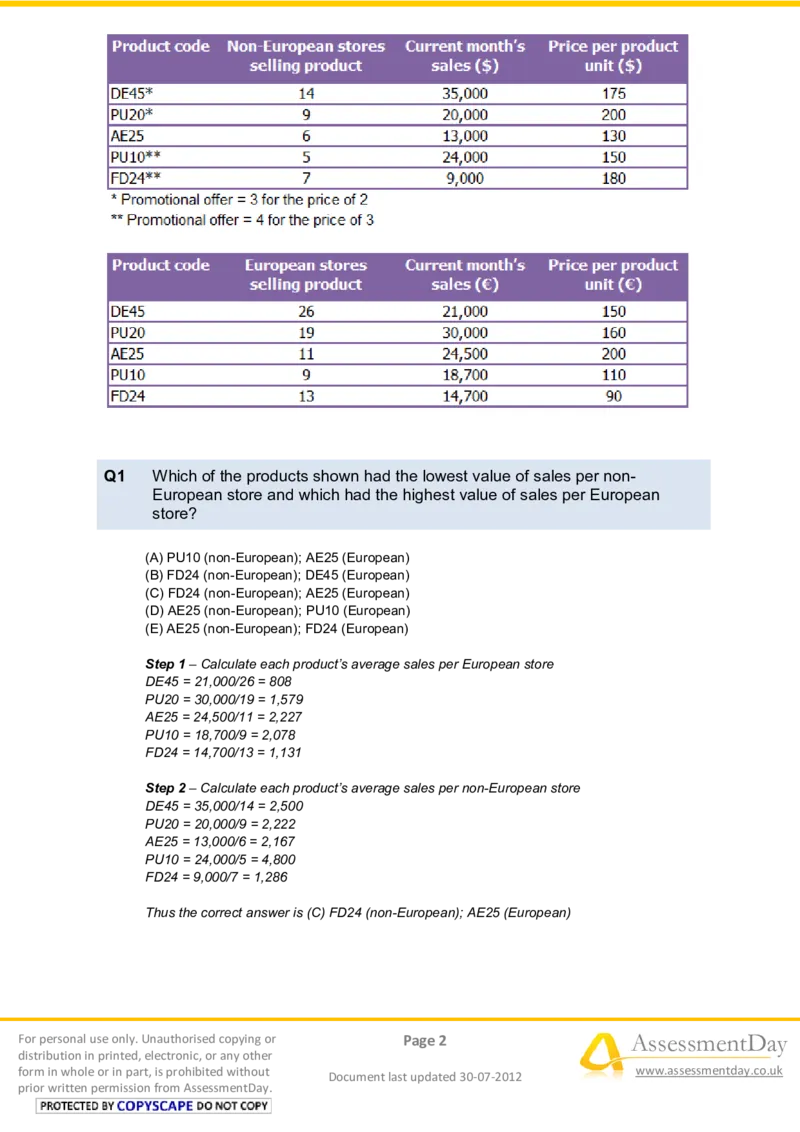
Practice Aptitude TestsQ1 Which of the products shown had the lowest value of sales per non-
European store and which had the highest value of sales per European
store?
(A) PU10 (non-European); AE25 (European)
(B) FD24 (non-European); DE45 (European)
(C) FD24 (non-European); AE25 (European)
(D) AE25 (non-European); PU10 (European)
(E) AE25 (non-European); FD24 (European)
Step 1 – Calculate each product’s average sales per European store
DE45 = 21,000/26 = 808
PU20 = 30,000/19 = 1,579
AE25 = 24,500/11 = 2,227
PU10 = 18,700/9 = 2,078
FD24 = 14,700/13 = 1,131
Step 2 – Calculate each product’s average sales per non-European store
DE45 = 35,000/14 = 2,500
PU20 = 20,000/9 = 2,222
AE25 = 13,000/6 = 2,167
PU10 = 24,000/5 = 4,800
FD24 = 9,000/7 = 1,286
Thus the correct answer is (C) FD24 (non-European); AE25 (European)
For personal use only. Unauthorised copying or Page 2 AssessmentDay
distribution in printed, electronic, or any other
form in whole or in part, is prohibited without
Document last updated 30-07-2012
www.assessmentday.co.uk
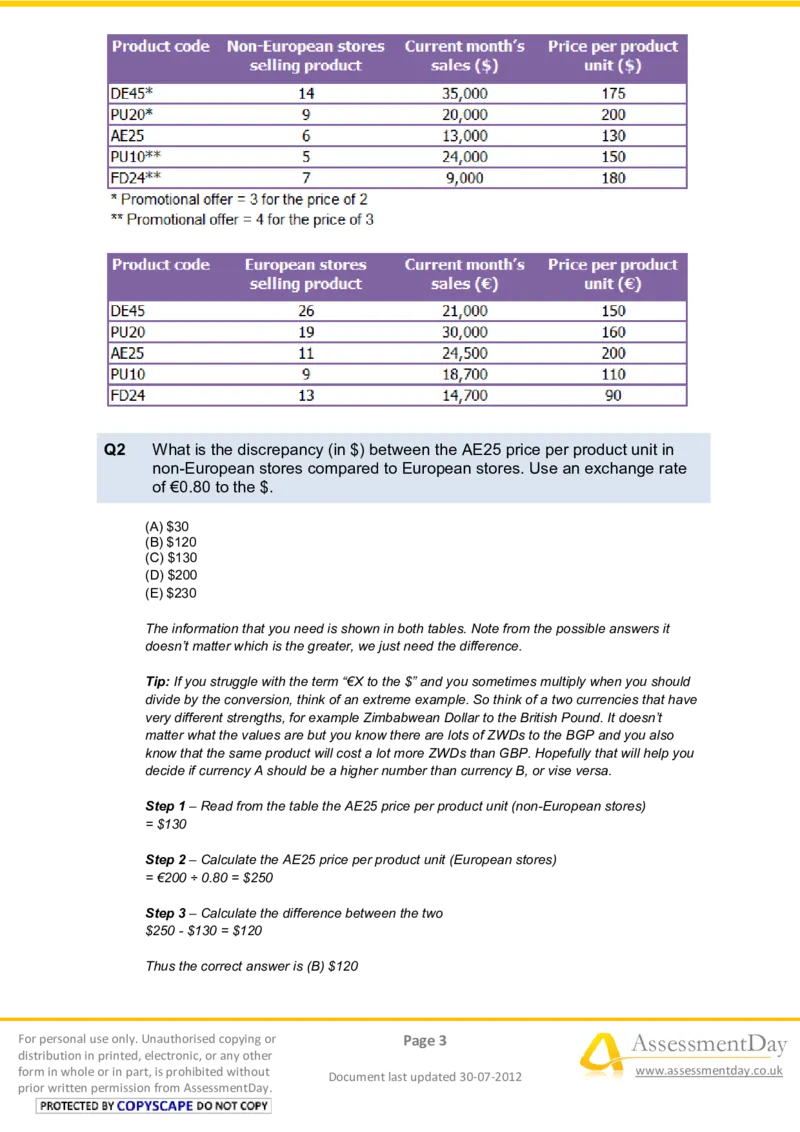
prior written permission from AssessmentDay.Q2 What is the discrepancy (in $) between the AE25 price per product unit in
non-European stores compared to European stores. Use an exchange rate
of €0.80 to the $.
(A) $30
(B) $120
(C) $130
(D) $200
(E) $230
The information that you need is shown in both tables. Note from the possible answers it
doesn’t matter which is the greater, we just need the difference.
Tip: If you struggle with the term “€X to the $” and you sometimes multiply when you should
divide by the conversion, think of an extreme example. So think of a two currencies that have
very different strengths, for example Zimbabwean Dollar to the British Pound. It doesn’t
matter what the values are but you know there are lots of ZWDs to the BGP and you also
know that the same product will cost a lot more ZWDs than GBP. Hopefully that will help you
decide if currency A should be a higher number than currency B, or vise versa.
Step 1 – Read from the table the AE25 price per product unit (non-European stores)
= $130
Step 2 – Calculate the AE25 price per product unit (European stores)
= €200 ÷ 0.80 = $250
Step 3 – Calculate the difference between the two
$250 - $130 = $120
Thus the correct answer is (B) $120
For personal use only. Unauthorised copying or Page 3 AssessmentDay
distribution in printed, electronic, or any other
form in whole or in part, is prohibited without
Document last updated 30-07-2012
www.assessmentday.co.uk
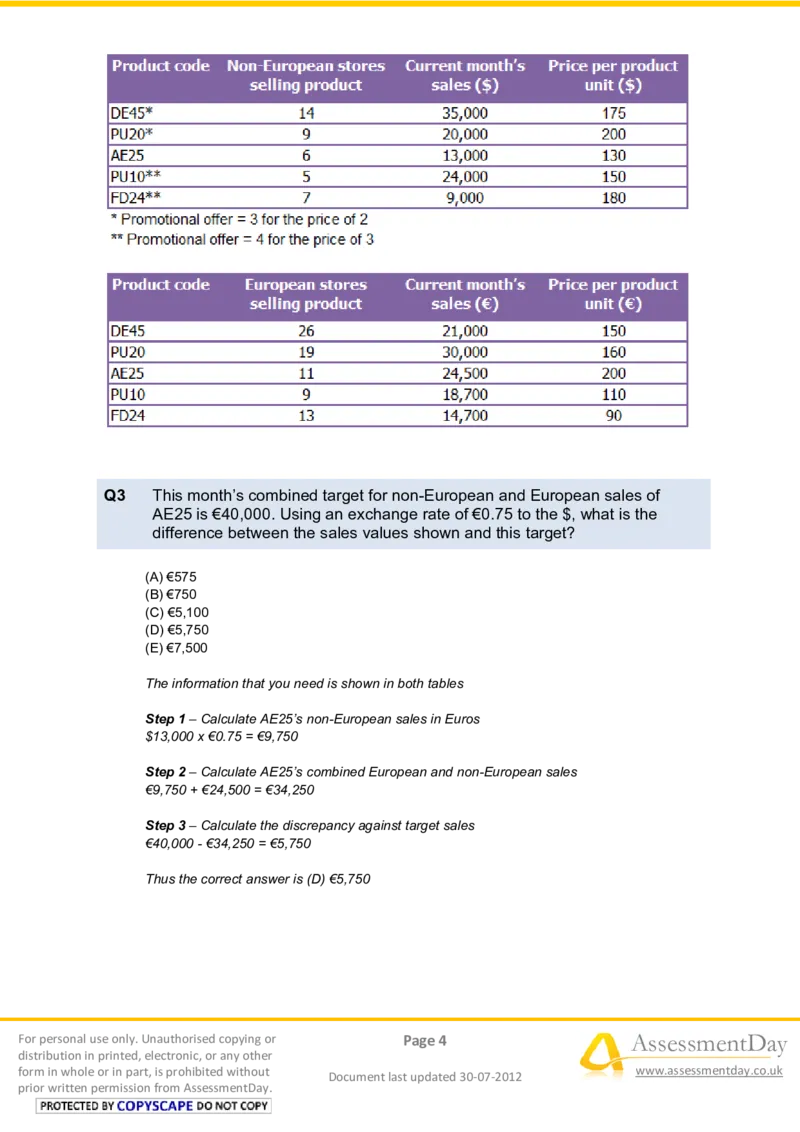
prior written permission from AssessmentDay.Q3 This month’s combined target for non-European and European sales of
AE25 is €40,000. Using an exchange rate of €0.75 to the $, what is the
difference between the sales values shown and this target?
(A) €575
(B) €750
(C) €5,100
(D) €5,750
(E) €7,500
The information that you need is shown in both tables
Step 1 – Calculate AE25’s non-European sales in Euros
$13,000 x €0.75 = €9,750
Step 2 – Calculate AE25’s combined European and non-European sales
€9,750 + €24,500 = €34,250
Step 3 – Calculate the discrepancy against target sales
€40,000 - €34,250 = €5,750
Thus the correct answer is (D) €5,750
For personal use only. Unauthorised copying or Page 4 AssessmentDay
distribution in printed, electronic, or any other
form in whole or in part, is prohibited without
Document last updated 30-07-2012
www.assessmentday.co.uk
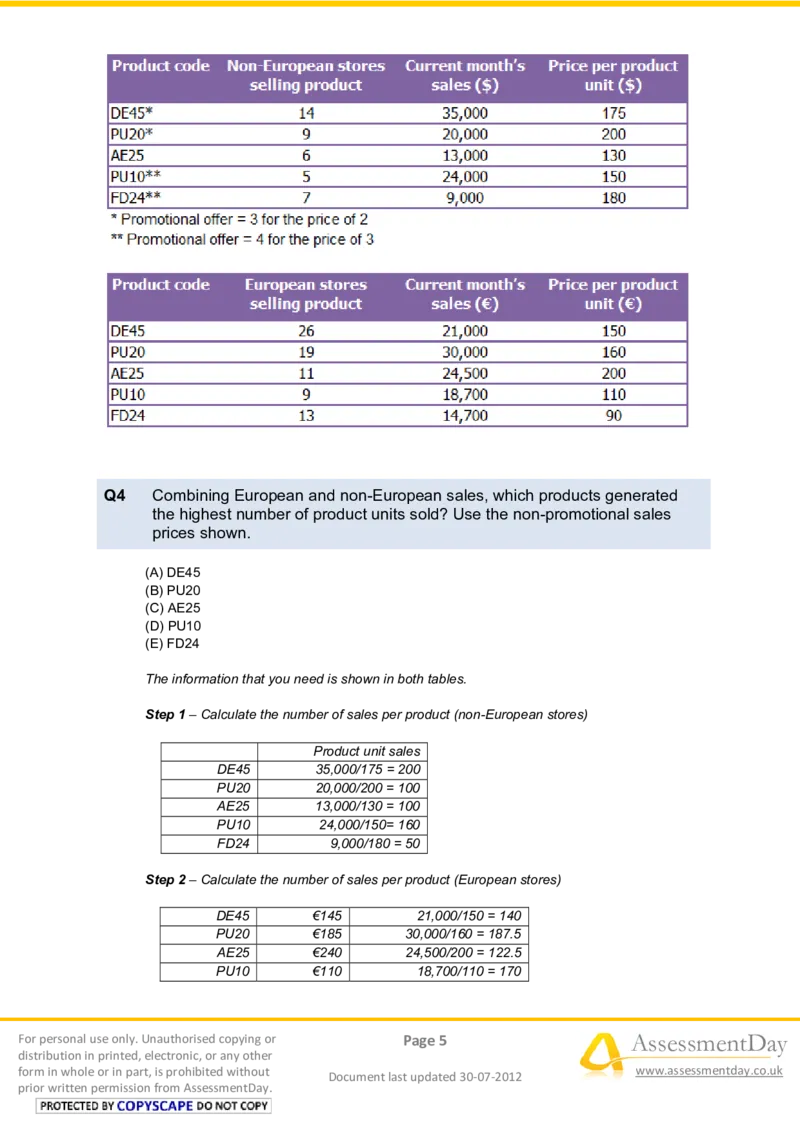
prior written permission from AssessmentDay.Q4 Combining European and non-European sales, which products generated
the highest number of product units sold? Use the non-promotional sales
prices shown.
(A) DE45
(B) PU20
(C) AE25
(D) PU10
(E) FD24
The information that you need is shown in both tables.
Step 1 – Calculate the number of sales per product (non-European stores)
Product unit sales
DE45 35,000/175 = 200
PU20 20,000/200 = 100
AE25 13,000/130 = 100
PU10 24,000/150= 160
FD24 9,000/180 = 50
Step 2 – Calculate the number of sales per product (European stores)
DE45 €145 21,000/150 = 140
PU20 €185 30,000/160 = 187.5
AE25 €240 24,500/200 = 122.5
PU10 €110 18,700/110 = 170
For personal use only. Unauthorised copying or Page 5 AssessmentDay
distribution in printed, electronic, or any other
form in whole or in part, is prohibited without
Document last updated 30-07-2012
www.assessmentday.co.uk
prior written permission from AssessmentDay.FD24 €150 14,700/90 = 163.33
Step 3 – Calculate the total number of sales per product
DE45 200 + 140 = 340
PU20 100 + 187.5 = 287.5
AE25 100 + 122.5 = 222.5
PU10 160 + 170 = 330
FD24 50 + 63.33 = 213.33
Thus the correct answer is (A) DE45
For personal use only. Unauthorised copying or Page 6 AssessmentDay
distribution in printed, electronic, or any other
form in whole or in part, is prohibited without
Document last updated 30-07-2012
www.assessmentday.co.uk
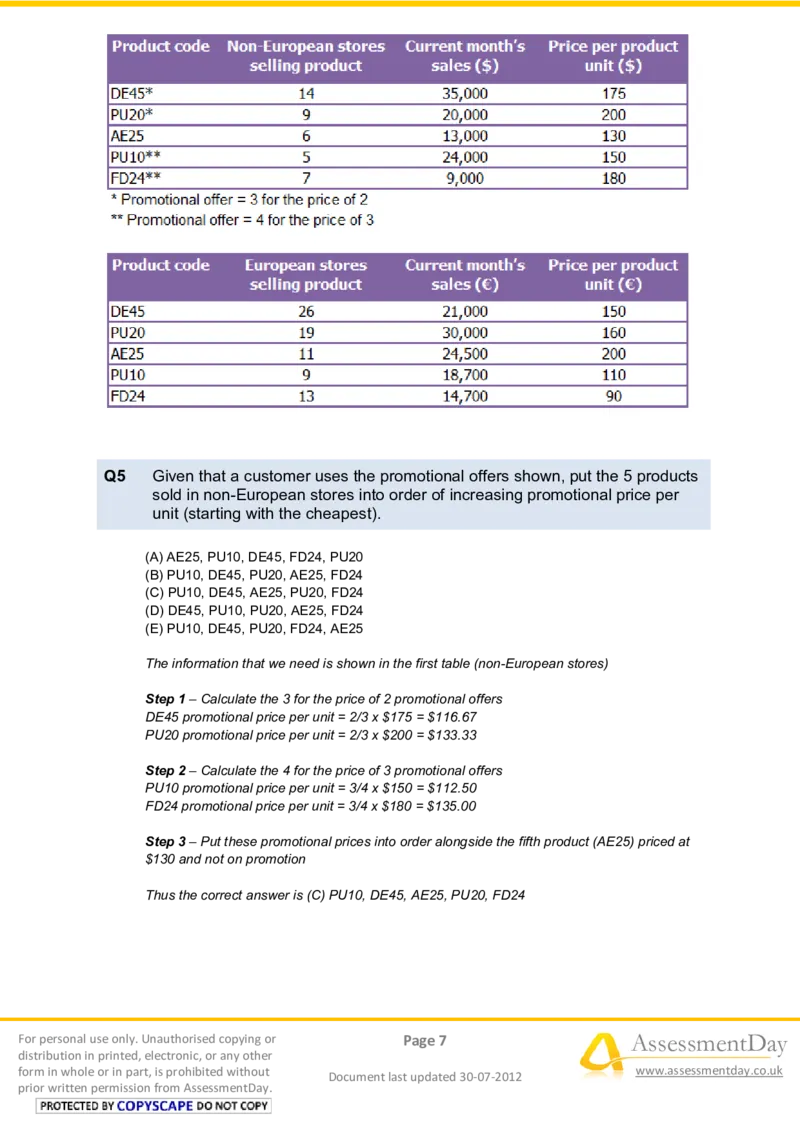
prior written permission from AssessmentDay.Q5 Given that a customer uses the promotional offers shown, put the 5 products
sold in non-European stores into order of increasing promotional price per
unit (starting with the cheapest).
(A) AE25, PU10, DE45, FD24, PU20
(B) PU10, DE45, PU20, AE25, FD24
(C) PU10, DE45, AE25, PU20, FD24
(D) DE45, PU10, PU20, AE25, FD24
(E) PU10, DE45, PU20, FD24, AE25
The information that we need is shown in the first table (non-European stores)
Step 1 – Calculate the 3 for the price of 2 promotional offers
DE45 promotional price per unit = 2/3 x $175 = $116.67
PU20 promotional price per unit = 2/3 x $200 = $133.33
Step 2 – Calculate the 4 for the price of 3 promotional offers
PU10 promotional price per unit = 3/4 x $150 = $112.50
FD24 promotional price per unit = 3/4 x $180 = $135.00
Step 3 – Put these promotional prices into order alongside the fifth product (AE25) priced at
$130 and not on promotion
Thus the correct answer is (C) PU10, DE45, AE25, PU20, FD24
For personal use only. Unauthorised copying or Page 7 AssessmentDay
distribution in printed, electronic, or any other
form in whole or in part, is prohibited without
Document last updated 30-07-2012
www.assessmentday.co.uk
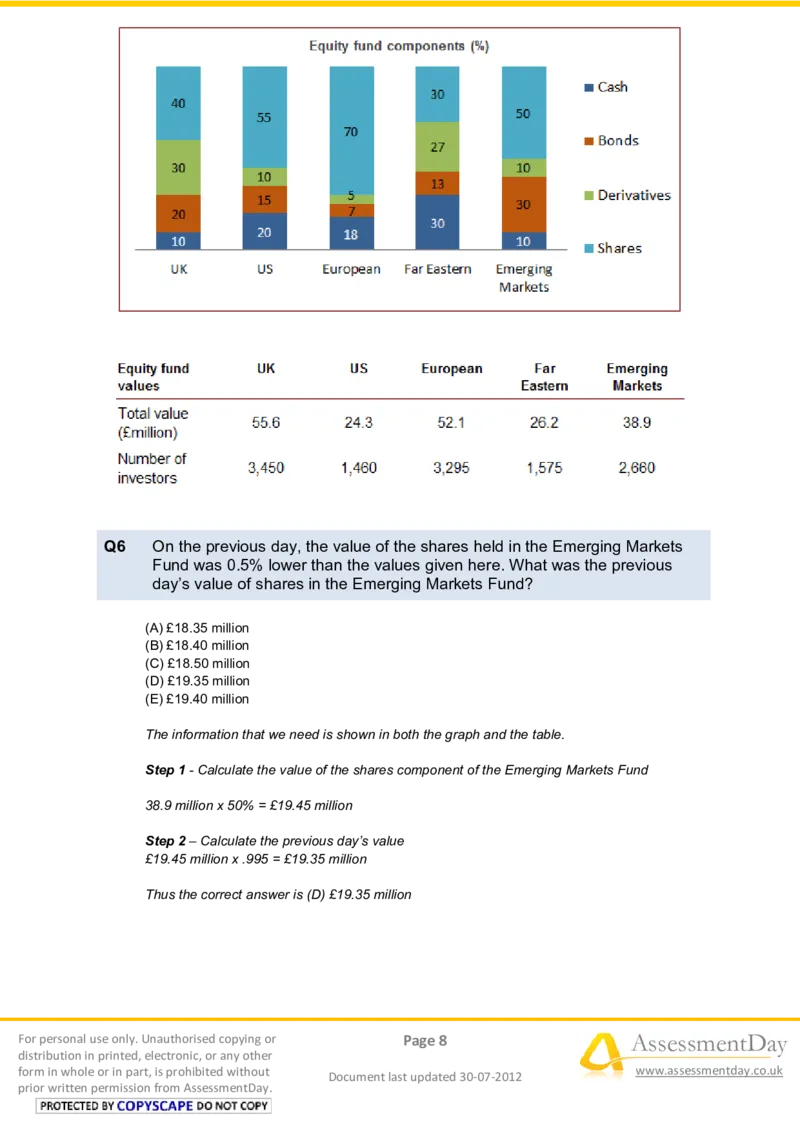
prior written permission from AssessmentDay.Q6 On the previous day, the value of the shares held in the Emerging Markets
Fund was 0.5% lower than the values given here. What was the previous
day’s value of shares in the Emerging Markets Fund?
(A) £18.35 million
(B) £18.40 million
(C) £18.50 million
(D) £19.35 million
(E) £19.40 million
The information that we need is shown in both the graph and the table.
Step 1 - Calculate the value of the shares component of the Emerging Markets Fund
38.9 million x 50% = £19.45 million
Step 2 – Calculate the previous day’s value
£19.45 million x .995 = £19.35 million
Thus the correct answer is (D) £19.35 million
For personal use only. Unauthorised copying or Page 8 AssessmentDay
distribution in printed, electronic, or any other
form in whole or in part, is prohibited without
Document last updated 30-07-2012
www.assessmentday.co.uk
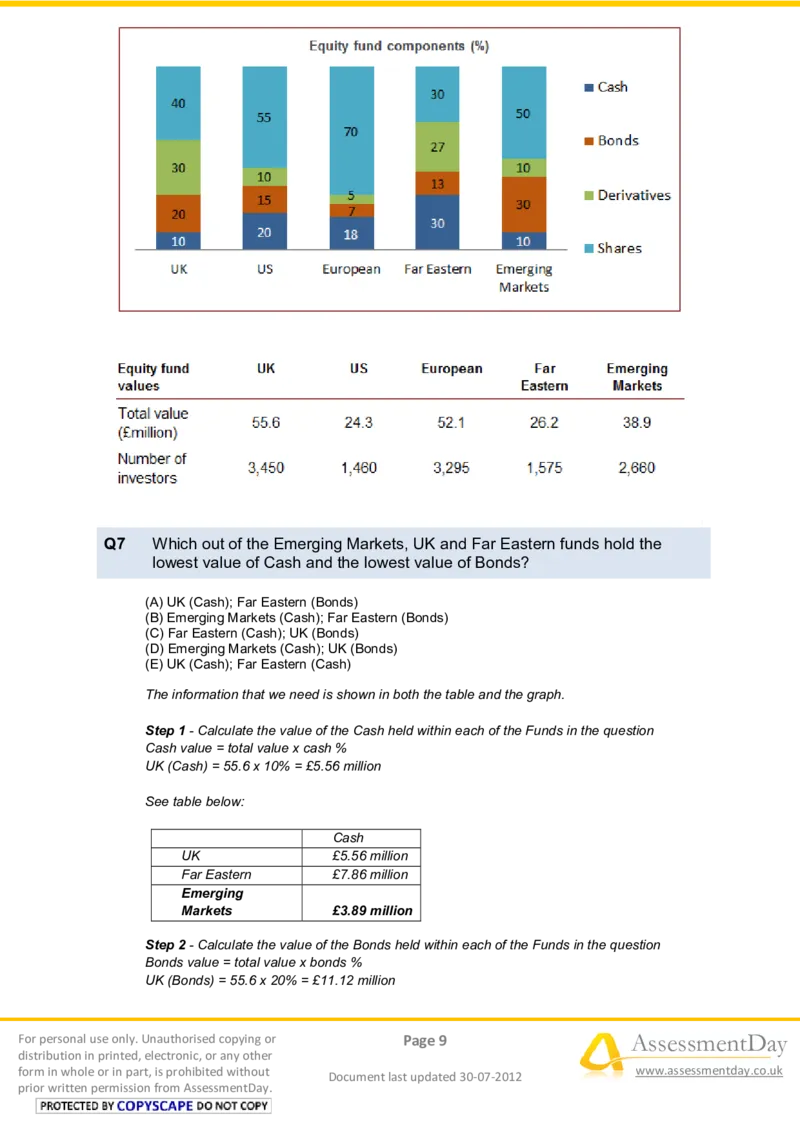
prior written permission from AssessmentDay.Q7 Which out of the Emerging Markets, UK and Far Eastern funds hold the
lowest value of Cash and the lowest value of Bonds?
(A) UK (Cash); Far Eastern (Bonds)
(B) Emerging Markets (Cash); Far Eastern (Bonds)
(C) Far Eastern (Cash); UK (Bonds)
(D) Emerging Markets (Cash); UK (Bonds)
(E) UK (Cash); Far Eastern (Cash)
The information that we need is shown in both the table and the graph.
Step 1 - Calculate the value of the Cash held within each of the Funds in the question
Cash value = total value x cash %
UK (Cash) = 55.6 x 10% = £5.56 million
See table below:
Cash
UK £5.56 million
Far Eastern £7.86 million
Emerging
Markets £3.89 million
Step 2 - Calculate the value of the Bonds held within each of the Funds in the question
Bonds value = total value x bonds %
UK (Bonds) = 55.6 x 20% = £11.12 million
For personal use only. Unauthorised copying or Page 9 AssessmentDay
distribution in printed, electronic, or any other
form in whole or in part, is prohibited without
Document last updated 30-07-2012
www.assessmentday.co.uk
prior written permission from AssessmentDay.See table below:
Bonds
UK £11.12 million
Far Eastern £3.41 million
Emerging
Markets £11.67 million
Thus the correct answer is (B) Emerging Markets (Cash); Far Eastern (Bonds)
For personal use only. Unauthorised copying or Page 10 AssessmentDay
distribution in printed, electronic, or any other
form in whole or in part, is prohibited without
Document last updated 30-07-2012
www.assessmentday.co.uk
prior written permission from AssessmentDay.Q8 Which equity fund has the highest average value per individual investor?
(A) UK Fund
(B) US Fund
(C) European Fund
(D) Far East Fund
(E) Emerging Markets Fund
The information that we need is shown in the table. Note there doesn’t appear to be an
obvious answer just from inspection so we must calculate each option.
Step 1 - For each equity fund calculate the average value per individual investor.
UK = 55.6/3,450 = £16,116
US = 24.3/1,460 = £16,644
European = 52.1/3,295 = £15,811
Far East = 26.2/1,575 = £16,635
Emerging Markets = 38.9/2,660 = £14,624
Thus the correct answer is (B) US Fund
For personal use only. Unauthorised copying or Page 11 AssessmentDay
distribution in printed, electronic, or any other
form in whole or in part, is prohibited without
Document last updated 30-07-2012
www.assessmentday.co.uk
prior written permission from AssessmentDay.Q9 Which of the components of the UK and US equity funds have the highest
and the lowest value?
(A) lowest is US Fund (Bonds); highest is UK Fund (Derivatives)
(B) lowest is US Fund (Shares); highest is UK Fund (Shares)
(C) lowest is UK Fund (Bonds); highest is US Fund (Shares)
(D) lowest is US Fund (Bonds); highest is UK Fund (Shares)
(E) lowest is US Fund (Derivatives); highest is UK Fund (Shares)
Tip: Note that just from looking at the graph and table we know the overall US fund is smaller
than the UK fund and the smallest fraction within the US find (10% to Derivatives) is not larger
than the smallest fraction within the UK fund. So we can instantly say the smallest fraction is
Derivatives in the US fund. As it happens there is only one multiple choice with this as an
option so we know (E) is the correct answer.
In full, the solution is as follows. The information that we need is shown in both the graph and
the table.
Step 1 - Calculate the value of each component of each equity fund, using this formula:
Component value = Total value x Equity fund component %
UK Fund (Cash) = 55.6 x 10% = 5.56 (£million)
For personal use only. Unauthorised copying or Page 12 AssessmentDay
distribution in printed, electronic, or any other
form in whole or in part, is prohibited without
Document last updated 30-07-2012
www.assessmentday.co.uk
prior written permission from AssessmentDay.See table below for other component values:
Component value (£million)
Cash Bonds Derivatives Shares
UK 5.56 11.12 16.68 22.24
US 4.86 3.65 2.43 13.37
Thus the correct answer is (E) lowest is US Fund (Derivatives); highest is UK Fund (Shares)
For personal use only. Unauthorised copying or Page 13 AssessmentDay
distribution in printed, electronic, or any other
form in whole or in part, is prohibited without
Document last updated 30-07-2012
www.assessmentday.co.uk
prior written permission from AssessmentDay.Q10 Which equity fund holding(s) hold less than double the number of Shares
compared to Bonds?
(A) UK
(B) US
(C) Emerging Markets
(D) UK, US
(E) UK, US, Emerging Markets
The information that we need is shown in the graph.
Step 1 - Calculate the Shares: Bonds ratios for each equity fund
Bonds Shares
UK 20 40
US 15 55
European 7 70
Far Eastern 13 30
Emerging Markets 30 50
The UK fund has exactly double the number of Shares compared to Bonds. Only the
Emerging Markets has less than double the number of Shares compared to Bonds.
Thus the correct answer is (C) Emerging Markets
For personal use only. Unauthorised copying or Page 14 AssessmentDay
distribution in printed, electronic, or any other
form in whole or in part, is prohibited without
Document last updated 30-07-2012
www.assessmentday.co.uk
prior written permission from AssessmentDay.Q11 Averaged across the Manufacturing Plants, put the average values for each of
the maintenance costs in decreasing size order, starting with the highest.
(A) Servicing, Administration, Misc., Rent, Insurance, Utilities
(B) Servicing, Administration, Rent, Misc., Utilities, Insurance
(C) Servicing, Administration, Rent, Misc., Insurance, Utilities
(D) Servicing, Administration, Misc., Rent, Utilities, Insurance
(E) None of these
Step 1 - Calculate the average for each maintenance cost:
Insurance = 192.2
Servicing = 1,000
Rent = 295
Utilities = 185.8
Administration = 589
Misc = 450
Thus the correct answer is (A) Servicing, Administration, Misc., Rent, Insurance, Utilities
For personal use only. Unauthorised copying or Page 15 AssessmentDay
distribution in printed, electronic, or any other
form in whole or in part, is prohibited without
Document last updated 30-07-2012
www.assessmentday.co.uk
prior written permission from AssessmentDay.Q12 For which manufacturing plant(s) are the Administration: Rent costs in the
ratio 12:5?
(A) Bordeaux
(B) Berlin
(C) Midlands and Glasgow
(D) Berlin and Midlands
(E) Glasgow and Bordeaux
Step 1 - Calculate the Administration: Rent cost ratio for each production plant, as follows:
Midlands 650:300 = 13:6
Bordeaux 600:250 = 12:5
Berlin 450:275 = 18:11
Amsterdam 525:350 = 21:14
Glasgow 720:300 = 12:5
Thus the correct answer is (E) Glasgow and Bordeaux
For personal use only. Unauthorised copying or Page 16 AssessmentDay
distribution in printed, electronic, or any other
form in whole or in part, is prohibited without
Document last updated 30-07-2012
www.assessmentday.co.uk
prior written permission from AssessmentDay.Q13 For the Glasgow manufacturing plant, which maintenance cost(s) represent
approximately 7% of the total costs?
(A) Rent and Utilities
(B) Rent
(C) Utilities
(D) Insurance
(E) Insurance and Utilities
Step 1 - For the Glasgow plant, calculate the total costs
195 + 875 + 300 + 189 + 720 + 425 = 2,704
Step 2 - For the Glasgow plant, calculate each cost as a % of the total cost
Insurance = 100% x 195/2,704 = 7%
Servicing = 100% x 875/2,704 = 32%
Rent = 100% x 300/2,704 = 11%
Utilities = 100% x 189/2,704 = 7%
Administration = 100% x 720/2,704 = 27%
Misc = 100% x 425/2,704 = 16%
Tip: To save time, you can stop after you’ve calculated 7% for Insurance and just scan across
the row to see if any other costs are close to £195. You will see that Utilities are.
Thus the correct answer is (E) Insurance and Utilities
For personal use only. Unauthorised copying or Page 17 AssessmentDay
distribution in printed, electronic, or any other
form in whole or in part, is prohibited without
Document last updated 30-07-2012
www.assessmentday.co.uk
prior written permission from AssessmentDay.Q14 What is the average annual cost for servicing each of the 5 manufacturing
plants (assume 4 weeks in a month)?
(A) £3,300
(B) £12,400
(C) £16,500
(D) £39,600
(E) £48,000
Step 1 – Total the servicing costs
1,050 + 1,100 + 950 + 1,025 + 875 = £5,000 per week
Step 2 – Calculate the monthly cost
5,000 x 4 = £20,000 per month
Step 3 – Calculate the average monthly cost
£20,000 / 5 = £4,000 per month
Step 4 – Calculate the average annual cost
4,000 x 12 = £48,000
Thus the correct answer is (E) £48,000
For personal use only. Unauthorised copying or Page 18 AssessmentDay
distribution in printed, electronic, or any other
form in whole or in part, is prohibited without
Document last updated 30-07-2012
www.assessmentday.co.uk
prior written permission from AssessmentDay.Q15 Which two manufacturing plants have the same total maintenance costs per
week?
(A) Midlands and Glasgow
(B) Bordeaux and Glasgow
(C) Bordeaux and Amsterdam
(D) Midlands and Amsterdam
(E) None of these
Step 1 - Calculate the total weekly maintenance costs for each production plant
Midlands = 196 + 1,050 + 300 + 95 + 650 + 525 = 2,816
Bordeaux = 204 + 1,100 + 250 + 236 + 600 + 400 = 2,790
Berlin = 212 + 950 + 275 + 164 + 450 + 400 =2,451
Amsterdam = 154 + 1,025 + 350 + 245 + 525 + 500 = 2,799
Glasgow = 195 + 875 + 300 + 189 + 720 + 425 = 2,704
Thus the correct answer is (E) None of these
For personal use only. Unauthorised copying or Page 19 AssessmentDay
distribution in printed, electronic, or any other
form in whole or in part, is prohibited without
Document last updated 30-07-2012
www.assessmentday.co.uk
prior written permission from AssessmentDay.Q16 Which garden furniture manufacturer has 22.5% of the UK market in terms of
2010 annual sales?
(A) Manufacturer A
(B) Manufacturer B
(C) Manufacturer C
(D) Manufacturer D
(E) Manufacturer E
The information that you need is shown in the pie-chart.
Step 1 – Calculate the total annual sales for all furniture manufacturers
1.2 + 3.3 + 2.4 + 2.7 + 2.4 = £12 million
Step 2 – Next, the quickest way to complete this question is to calculate 22.5% of the 12
million and see which manufacturer has this sales value. So 22.5% of 12 is 2.7. We
immediately see that Manufacturer D has sales of 2.7 (ignoring any units).
Alternatively, the slower way would be to calculate the % of the UK market held by each
furniture manufacturer:
Manufacturer A = 1.2/12 x 100% = 10%
Manufacturer B = 3.3/12 x 100% = 27.5%
Manufacturer C = 2.4/12 x 100% = 20%
Manufacturer D = 2.7/12 x 100% = 22.5%
Manufacturer E = 2.4/12 x 100% = 20%
Thus the correct answer is (D) Manufacturer D
For personal use only. Unauthorised copying or Page 20 AssessmentDay
distribution in printed, electronic, or any other
form in whole or in part, is prohibited without
Document last updated 30-07-2012
www.assessmentday.co.uk
prior written permission from AssessmentDay.Q17 Manufacturers B and D each aim to increase their annual sales from 2010 to
2011 by a quarter. Manufacturers A, C and E each aim to grow their annual
sales by a fifth. Assuming all companies meet these targets, what will be
2011’s total furniture manufacturer sales (to the nearest £million)?
(A) £13 million
(B) £14 million
(C) £15 million
(D) £16 million
(E) £17 million
The information that you need is shown in the pie-chart.
Step 1 - Calculate the 2011 targets for each garden furniture manufacturer
Manufacturer A: 1.2 x 1.2 = 1.44
Manufacturer B: 3.3 x 1.25 = 4.125
Manufacturer C: 2.4 x 1.2 = 2.88
Manufacturer D: 2.7 x 1.25 = 3.375
Manufacturer E: 2.4 x 1.2 = 2.88
Step 2 – Calculate the total 2011 target for all garden furniture manufacturers
1.44 + 4.125 + 2.88 + 3.375 + 2.88 = 14.7
Step 3 – To the nearest £million = £15 million
Note: in this question we were lucky that £14.7 million was not an available answer.
Sometimes questions deliberately include the answer not rounded as required, to catch you
out.
For personal use only. Unauthorised copying or Page 21 AssessmentDay
distribution in printed, electronic, or any other
form in whole or in part, is prohibited without
Document last updated 30-07-2012
www.assessmentday.co.uk
prior written permission from AssessmentDay.Thus the correct answer is (C) £15 million
Q18 Which region showed the second largest absolute difference in Company C
sales between 2009 and 2010?
(A) Northern
(B) Central
(C) Southern
(D) Eastern
(E) Western
Tip - The word “absolute” in the question means we are considering the value of the change,
not the percentage change.
The information that you need is shown in the table.
Step 1 - Calculate the change in Company C sales (2009-2010) for each region
Northern: 278,500 – 312,500 = -34,000
Central: 470,400 – 396,700 = 73,700
Southern: 502,000 – 546,300 = -44,300
Eastern: 643,100 – 595,500 = 47,600
Western: 506,000 – 529,000 = -23,000
Thus the correct answer is (D) Eastern
For personal use only. Unauthorised copying or Page 22 AssessmentDay
distribution in printed, electronic, or any other
form in whole or in part, is prohibited without
Document last updated 30-07-2012
www.assessmentday.co.uk
prior written permission from AssessmentDay.Q19 What is the percentage increase in Company C’s total sales for 2010
compared its 2009 total sales?
(A) 0.83%
(B) 0.84%
(C) 0.85%
(D) 0.86%
(E) 0.87%
The information that you need is shown in the table.
Step 1 – Calculate 2009’s total sales
312,500 + 396,700 + 546,300 + 595,500 + 529,000 = 2,380,000
Step 2 – Calculate 2010’s total sales
278,500 + 470,400 + 502,000 + 643,100 + 506,000 = 2,400,000
Step 3 – Calculate the % difference
2,400,000 / 2,380,000 = 1.0084 which is a 0.84% increase.
Thus the correct answer is (B) 0.84%
For personal use only. Unauthorised copying or Page 23 AssessmentDay
distribution in printed, electronic, or any other
form in whole or in part, is prohibited without
Document last updated 30-07-2012
www.assessmentday.co.uk
prior written permission from AssessmentDay.Q20 If Company C’s sales in 2009 were in the ratio of 8:7 for online: offline sales,
what were the offline sales (to the nearest £1,000)?
(A) £110,000
(B) £1,000,000
(C) £1,100,000
(D) £1,110,000
(E) £1,111,000
Step 1 – Use Manufacturer C’s 2009 total sales figure from the previous question
i.e. 2,380,000 (312,500 + 396,700 + 546,300 + 595,500 + 529,000)
Step 2 – Put this figure into the question’s ratio
Online sales + offline sales = 2,380,000
Offline sales = (2,380,000 x 7)/ (7+8) = 1,110,667
Step 3 - To the nearest £1,000 = 1,111,000
Thus the correct answer is (E) £1,111,000
For personal use only. Unauthorised copying or Page 24 AssessmentDay
distribution in printed, electronic, or any other
form in whole or in part, is prohibited without
Document last updated 30-07-2012
www.assessmentday.co.uk
prior written permission from AssessmentDay.Q21 Assume that the percentage change trends between the Current Year and
Next Year continue at the same rate for a subsequent year. What’s the
subsequent year’s average entry level graduate salary across the 5 sectors
(to the nearest £500)?
(A) £28,000
(B) £28,500
(C) £29,000
(D) £29,500
(E) Can’t tell from data
It might be tempting to do the following calculation, however since we don’t know how many
graduates there are in each sector we cannot calculate the average salary. For example if
Engineering has 1,000 graduates and Research has 10, it is not true to add up the totals and
divide by the number of sectors (five).
Thus the answer is (E) Can’t tell from data.
Don’t be tempted to do this:
Step 1 – Calculate the subsequent year’s entry level graduate salary for each sector
Step 2 – Calculate the average
Step 3 – to the nearest £500 = £28,500
For personal use only. Unauthorised copying or Page 25 AssessmentDay
distribution in printed, electronic, or any other
form in whole or in part, is prohibited without
Document last updated 30-07-2012
www.assessmentday.co.uk
prior written permission from AssessmentDay.Q22 In Year 3 a company paid the average entry graduate starting salaries when
recruiting 15 graduates for a consultancy role and 6 graduates for a research
role. What was the average salary per recruited graduate?
(A) £26,000
(B) £26,114
(C) £26,429
(D) £26,500
(E) £27,000
Step 1 – Total the salaries for 15 graduates (consultancy)
15 x 27,000 = 405,000
Step 2 – Total the salaries for 6 graduates (research)
6 x 23,500 = 141,000
Step 3 – Calculate the average salary per graduate
(405,000 + 141,000)/21 = £26,000
Thus the correct answer is (A) £26,000
For personal use only. Unauthorised copying or Page 26 AssessmentDay
distribution in printed, electronic, or any other
form in whole or in part, is prohibited without
Document last updated 30-07-2012
www.assessmentday.co.uk
prior written permission from AssessmentDay.Q23 Which sector has seen the smallest percentage increase in graduate entry
level salary between Year 2 and the Current Year?
(A) Engineering
(B) Research
(C) Consulting
(D) Legal
(E) Accounting
Step 1 - Calculate the % increase for each sector
Engineering: (24.5 – 23.7)/23.7 = 3.4%
Research: (24.2 – 23.5)/23.5 = 3.0%
Consulting: (28.3 – 27.6)/27.6 = 2.5%
Legal: (33.2 – 29.8)/29.8 = 11.4%
Accounting: (27.3 – 26.6)/26.6 = 2.6%
Thus the correct answer is (C) Consulting
For personal use only. Unauthorised copying or Page 27 AssessmentDay
distribution in printed, electronic, or any other
form in whole or in part, is prohibited without
Document last updated 30-07-2012
www.assessmentday.co.uk
prior written permission from AssessmentDay.Q24 The current year’s entry level graduate salaries for working in logistics and
retail are £25,000 and £24,000 respectively. If these sectors experience the
same percentage change as the legal sector over the same period, what’s
next year’s predicted entry level graduate salary in the logistics and retail
sectors (to the nearest £100)?
(A) £24,800 (logistics); £25,800 (retail)
(B) £25,100 (logistics); £25,300 (retail)
(C) £25,500 (logistics); £25,000 (retail)
(D) £25,800 (logistics); £24,800 (retail)
(E) Can’t tell from data
Step 1 – Calculate the % increase in legal sector salaries between the current year and next
year
100% x (34.3 – 33.2)/33.2 = 3.31%
Step 2 – Apply this % increase to the entry level graduate salaries (logistics)
103.31% x £25,000 = £25,828
Step 3 – Apply this % increase to the entry level graduate salaries (retail)
103.31% x £24,000 = £24,794
Thus the correct answer is (D) £25,800 (logistics); £24,800 (retail)
For personal use only. Unauthorised copying or Page 28 AssessmentDay
distribution in printed, electronic, or any other
form in whole or in part, is prohibited without
Document last updated 30-07-2012
www.assessmentday.co.uk
prior written permission from AssessmentDay.Q25 Which of the 5 sectors had the lowest difference in entry level graduate
salary between Year 3 and the Current Year?
(A) Engineering
(B) Research
(C) Consulting
(D) Legal
(E) Accounting
Step 1 - Calculate the change for each sector
Engineering: 24.5 – 24.1 = 0.4
Research: 24.2 – 23.5 = 0.7
Consulting: 28.3 – 27 = 1.3
Legal: 33.2 – 30.9 = 2.3
Accounting: 27.3 – 27 = 0.3
Note - Because the question asks for ‘difference’ not percentage change, we must calculate
the absolute difference. As it happens, if you had worked out the percentage change by
mistake, you would sill have arrived at (E) Accounting.
Thus the correct answer is (E) Accounting
For personal use only. Unauthorised copying or Page 29 AssessmentDay
distribution in printed, electronic, or any other
form in whole or in part, is prohibited without
Document last updated 30-07-2012
www.assessmentday.co.uk
prior written permission from AssessmentDay.Q26 Which competitor(s) has less than 100,000 customers per day (assume 30
days per month)?
(A) All competitors
(B) Competitor B
(C) Competitor E
(D) Competitors B and E
(E) Competitors B, D and E
The information that you need is shown in the table.
Step 1 – Calculate the number of daily customers for each competitor, as shown below:
Per
4.2 2.2 4.5 3.1 2.2
month
Per day /30 = 0.14 /30 = 0.073 /30 = 0.15 /30 = 0.103 /30 =
(millions) 0.073
These figures are in millions.
Thus the correct answer is (D) Competitors B and E
For personal use only. Unauthorised copying or Page 30 AssessmentDay
distribution in printed, electronic, or any other
form in whole or in part, is prohibited without
Document last updated 30-07-2012
www.assessmentday.co.uk
prior written permission from AssessmentDay.Q27 Which Competitor has the lowest average number of staff per country of
operation?
(A) Competitor A
(B) Competitor B
(C) Competitor C
(D) Competitor D
(E) Competitor E
The information that you need is shown in the table.
Step 1 - Calculate the average number of staff per country of operation for each Competitor,
as shown below
A B C D E
Staff /
Countri
es of 325,000/38 180,000/30 295,000/22 204,000/28 154,000/32
operati
on
= 8,553 = 6,000 = 13,409 = 7,286 = 4,813
Thus the correct answer is (E) Competitor E
For personal use only. Unauthorised copying or Page 31 AssessmentDay
distribution in printed, electronic, or any other
form in whole or in part, is prohibited without
Document last updated 30-07-2012
www.assessmentday.co.uk
prior written permission from AssessmentDay.Q28 If Competitors B to E make up 85% of the business sector in which they
operate (based upon operating profits), approximately what are the total
operating profits of the other companies in the same business sector?
(A) £3 million
(B) £28 million
(C) £33 million
(D) £35 million
(E) £221 million
The information that you need is shown in the graph.
Step 1 – Calculate the total operating profits for Competitors B to E
45.4 + 56.5 + 42.9 + 42.7 = £187.5 million
Step 2 – Calculate operating profits for the entire sector
187.5 ÷ 0.85 = 220.6 million.
Step 3 – Calculate other companies’ operating profits
220.6 x 15% = 33.09 million = £33 million approx.
Thus the correct answer is (C) £33 million
For personal use only. Unauthorised copying or Page 32 AssessmentDay
distribution in printed, electronic, or any other
form in whole or in part, is prohibited without
Document last updated 30-07-2012
www.assessmentday.co.uk
prior written permission from AssessmentDay.Q29 Competitor B has an additional business that generates an additional 8% to
the Retail Sales shown. Competitors A and C have additional businesses that
generate 7% and 4% additional revenue respectively. What’s the total of these
additional sales streams for Competitors A, B and C combined (to the nearest
£million)?
(A) £9 million
(B) £10 million
(C) £11 million
(D) £12 million
(E) £13 million
The information that you need is shown in the graph.
Step 1 – Calculate the additional sales for Competitor B
52.5 x 8% = 4.20
Step 2 – Calculate the additional sales for Competitor A
57.4 x 7% = 4.02
Step 3 – Calculate the additional sales for Competitor C
68.2 x 4% = 2.73
Step 4 – Calculate the total sales
For personal use only. Unauthorised copying or Page 33 AssessmentDay
distribution in printed, electronic, or any other
form in whole or in part, is prohibited without
Document last updated 30-07-2012
www.assessmentday.co.uk
prior written permission from AssessmentDay.4.20 + 4.02 + 2.73 = 10.95
Step 5 – To the nearest £million
10.95 = £11 million
Thus the correct answer is (C) £11 million
For personal use only. Unauthorised copying or Page 34 AssessmentDay
distribution in printed, electronic, or any other
form in whole or in part, is prohibited without
Document last updated 30-07-2012
www.assessmentday.co.uk
prior written permission from AssessmentDay.Q30 Which two Competitors average the same approximate number of customers
per country of operation?
(A) Competitor A and Competitor D
(B) Competitor B and Competitor D
(C) Competitor A and Competitor C
(D) Competitor B and Competitor E
(E) No two competitors
The information that you need is shown in the table.
Step 1 - Calculate the average number of customers per country of operation for each
Competitor
Competitor A = 4.2/38 = 0.111
Competitor B = 2.2/30 = 0.073
Competitor C = 4.5/22 = 0.205
Competitor D = 3.1/28 = 0.111
Competitor E = 2.2/32 = 0.069
Thus the correct answer is (A) Competitor A and Competitor D
For personal use only. Unauthorised copying or Page 35 AssessmentDay
distribution in printed, electronic, or any other
form in whole or in part, is prohibited without
Document last updated 30-07-2012
www.assessmentday.co.uk
prior written permission from AssessmentDay.-- End of Test --
For personal use only. Unauthorised copying or Page 36 AssessmentDay
distribution in printed, electronic, or any other
form in whole or in part, is prohibited without
Document last updated 30-07-2012
www.assessmentday.co.uk
prior written permission from AssessmentDay.