专题 08 阅读理解
一、细节理解类
(一)明考查方式和考查角度
Ⅰ.把握细节理解题的常见设问方式:
(1)特殊疑问句形式:以when, where, what, which, who, how much/many等疑问词开头引出的问题。
(2)填空题形式:通常涉及与主题有关的事实或细节。
(3)就文中数字、排序等提问。
Ⅱ.明晰细节理解题的考查角度:
(1)高频考点:直接信息题;间接信息题。
(2)低频考点:数字计算题;正误判断题;细节排序题。
(二) 细节理解题正确选项特征
同义替换 指对原文句子中的关键词进行同义替换。如把lose one's job换成了be out of work。有些细节
理解题把原文中的一些词变换一下词性,如把important变换成of importance;改变原文中句
子的语态,如主动语态与被动语态的转换。
信息归纳 用精炼的语言来概括原文中比较分散或复杂的信息,设置为正确答案。
正话反说 把原文中的意思反过来表达而成为正确选项。
原文原词 利用原文原词作为正确选项。
(三)细节理解题干扰选项特征
张冠李戴 是原文信息,但不是题目要求的内容。
无中生有 符合常识,但不是文章的内容。
曲解文意 与原文的内容极其相似,只是在某个细节处有些变动。
颠倒是非 在意思上与原文大相径庭甚至完全相反。
正误参半 部分正确,部分错误。
二、推理判断类
(一)明确考查特点
Ⅰ.把握推理判断题常见的命题方式
(1)We can infer from the (first .../last) passage that ________.(2)The passage/author implies/suggests that
______.
(3)It can be concluded from the passage that ______.(4)The main purpose of the passage is ________.
(5)Where does this passage probably come from?(6)What's the author's attitude towards …?
(7)The writer developed the passage/his main idea by ________.
(8)The first .../last paragraph serves as a(n) ________.
Ⅱ.掌握推理判断题的考查角度
(1)高频考点:推断隐含意义、写作意图、观点态度。
(2)低频考点:推断下段内容、文章出处、读者对象。
(二)推理判断题正确选项特征
推理判断题中的正确选项是依据文章的事实或证据推断出的符合逻辑的结论或观点,正确选项一般具有以
下特征:
1.“立足原文,只推一步”,即根据原文内容,一步即可推得。
2.选项中一般不可以出现绝对概念。如only, never, all, absolutely等,正确答案的表述一般有一点模糊,会
用一些相对能够留有一些余地的词汇,如often, usually, sometimes, some, may, might, can, could, probably
等。
(三)推理判断题干扰选项特征
1.曲解文意:即推测意义与文章表层意义有区别。推理判断题中有些选项来自文章中的某一句或某几句
话,命题者可能会利用里面的词设计出干扰项,看似表达文章的意思,其实是借题发挥,是对原文意思的
曲解。
学科网(北京)股份有限公司2.张冠李戴:即把文章中作者的观点与其他人的观点混淆在一起。题干问的是作者的观点,选项中出现
的却是其他人的观点;题干问的是其他人的观点,选项中却出现了作者的观点。
3.偷梁换柱:干扰项用了与文章中某一句话相似的句型结构和单词,却在考生易忽视的地方换了几个单
词,造成句意的改变。
4.无中生有:这种类型的干扰项往往是基本的生活常识或普遍认可的观点,但在文章中并无相关的信息
支撑点。其次,这种干扰项也有可能与设置的问题毫不相干。
5.鱼目混珠:鱼目混珠类型的干扰项常出现在词句理解类试题的选项中,即利用某个词或句子的字面含
义代替其在文章特定语境中的具体含义。
6.扩缩范围:为了准确、严密地表达文章内容,命题者特别注意对文意范围的限定,有时通过加上
almost, all, nearly, more than, normally, usually等词语对文意加以限制。“扩缩范围”干扰法就是在选项中通
过改变或去掉限制性词语,将信息的范围、程度、感情色彩等改变,从而给考生解题造成干扰的命题方
法。
三、词义猜测类
(一)明确考查特点
Ⅰ.把握词句猜测题常见的命题方式
(1)The phrase “...” in the sentence could be replaced by ________.
(2)The word “...” in the paragraph refers to ______.
(3)What is the meaning of the underlined word in the ... paragraph?/What does the underlined word mean?
(4)Which of the following is the closest in meaning to the phrase “...”?
(5)The word “...” most nearly means ________.
(6)The underlined sentence in the second paragraph implies that ________.
Ⅱ.掌握词句猜测题的考查角度
(1)猜测生词或熟词生义;(2)猜测短语的意义;(3)猜测替代词所替代的内容(如it, one, they, this, that, these,
those等);(4)猜测句意。
(二)明确方法技巧
(1)根据定义或上下文解释进行猜测
(2)根据同位关系进行猜测
(3)根据构词法(前缀、后缀、派生、合成等)进行猜测
(4)根据因果关系进行猜测
(5)根据上下文的指代关系进行猜测
(6)根据同义或近义关系进行猜测
(7)根据转折或对比关系进行猜测
(8)意义吻合定句意
四、主旨大意类题型
(一)明确考查特点
Ⅰ.把握主旨大意题常见的命题方式
What is the main idea of the text?
What does the text mainly tell us?
What would be the best title for the text?
The main idea of the first/second/third paragraph is ___________.
Paragraph 1/2/3 mainly deals with ___________.
Ⅱ.掌握主旨大意题的考查角度
主旨大意类题型主要测试学生对文章全面理解和概括的能力,提问的内容可能是全文的大意,也可能
是某段的段落大意,一般不易在文中直接找到答案。
(二)明确方法技巧
1.阅读文章的标题或副标题
文章的标题是一篇文章的题眼,通过阅读标题或副标题可以迅速把握文章的主旨大意。
2.寻找文章的主题句
分析篇章结构,找出文章主题。在许多情况下,尤其在阅读说明文和议论文时,根据其篇章特点我们
可以通过仔细阅读短文的第一句或第二句,即文章的主题句来归纳出文章的主题.若短文由若干段组成,除
仔细阅读第一段的首句外,还须仔细阅读每一段的第一句,即段落中心。通常文章的中心思想包含在文章
的首句,有时也在文章的末句,其他句子都是用来说明和阐述主题句。因此,在确定文章的中心思想时,
要求学生重视阅读文章的首句和末句。但也有一些文章,中心思想常常贯穿在全文中,因此要求学生综观
全文,对段落的内容要融会贯通,对文章透彻理解后归纳总结。主题句的特点是:1. 相对于其他句子,它
学科网(北京)股份有限公司表达的意思比较概括;2. 主题句一般结构简单;3. 段落中其他句子必定是用来解释,支撑或发展主题句
所表达的思想的。
五、理清文章结构
文章的逻辑结构是文章重要的内在特征,了解篇章段落的逻辑结构对提高阅读理解的准度和速度有着
不可估量的作用。因此,在平时的阅读理解训练中要强化领悟段落、篇章结构及行文逻辑内在规律,长此
以往,内化于心,潜移默化形成读文的内在“情思”,这个“情思”就是指与文章情感思路一致的、默契
的思维流动。具备了这种“情思”,快读、精读文章就达到了一种至高境界。
(一)记叙文中的“具体事例型段落”——抓住此事例围绕的观点
这种类型的段落整段都在讲具体事例。往往这个事例本身并不重要,而作者是为了证明自己的某个观
点才讲了这样一个事例。因此,考生要站在宏观的角度把握这个事例证明了什么观点,或者说明了哪一方
面。它的特点就是会有特别具体的描述词,比如某个人名,多次被提到,而且用到的动词也都是一些表示
具体动作的动词,而不是观点动词。
(二)说明文中的“对比型段落”——分清层次最重要
这种段落最常见的就是按时间分类说明或按某一特性分类说明。针对这种段落,要特别留意段落中的
过渡词,比如,above all, in addition, finally等等。
(三)议论文中的“总分型段落”或“分总型段落”——一定要找到并读懂主旨句
“总分型段落”排列在一开始就给出了作者的观点或者要说明的主要内容。后面的大部分都在论证这
个观点或者进行细节上的说明。针对这种类型的语篇,考生应该做到细读主旨段落,略读细节段落,以读
懂主旨为要务。考生会发现文后的题目大都围绕主旨而命题,而偏离主旨的大都是干扰项,而不是正确答
案。
“分总型段落”排列在开始和中间都是一些细节型的内容,有时是平行的细节,有时是层层递进,但一直
到语篇的最后一段才点出最重要的观点或结论。显然读这种语篇的落脚点应该在结尾处。跟总分型的语篇
相比,分总型的语篇有时更耗时间去发现主旨,因此考生们平时做题的时候要多去体会,争取在最短的时
间找到主旨。
基础题
一
Do you know that over 1/3 of all food produced in the world goes to waste? According to the United Nations
(UN), every year around the world, about one billion (十亿) tons of food is wasted. At the same time, there are
nearly one billion people who go hungry. Simply 1/4 of the food wasted is enough to keep them out of hunger. In
addition, the wasted food produces over three billion tons of carbon dioxide (CO ), which speeds up climate (气候)
2
change. What can we do to solve this food waste problem?
One effective solution is balancing food production with demand (需求). In hotels and other similar places,
special instruments should be used so that cooking specialists just prepare and cook food as it is ordered.
Another effective solution is starting programs to reduce (减少) food waste. Stores and buyers can try their
best to be creative in food waste reduction. For example, stores can provide customers with instructions telling
them how to make full use of food. Buyers can try not fixing their eyes only on food of the best quality (质量).
Sometimes, the food of non-top quality is also good enough to eat, or can be bought and then used to make
delicious dishes.
One of the hardest solutions to achieve is for each and every one to buy and prepare food with a plan of their
own so that less food is wasted. Challenging as it is, the use of meal plans in preparing food can play an important
role in ending food waste in the family.
Food recycling is one of the known solutions. Efforts are now already in progress. Food that is not safe for
学科网(北京)股份有限公司humans to eat is recycled into other products such as animal feeds and clothing. Yet, there is still a long way to go
and much for improvement in this area.
In a word, food waste has been one of the biggest problems in the world that have influenced us greatly. Many
solutions have been found and many more are yet to be worked out. If each of us can put in more efforts, food
waste is sure to be reduced for the good of our future.
1. According to the passage, what is a possible result of food waste?
A. The problem of worldwide hunger. B. A big increase in food production.
C The speed-up of climate change. D. A sudden drop in population.
2. What can we learn from the passage?
A. Food recycling has been hugely successful. B. Buyers should give up non-top quality food.
C. Stores should train people to make delicious dishes. D. Meal plans in the family are hard to put into practice.
3. What is the passage mainly about?
A. Benefits of reducing food waste. B. Solutions to the food waste problem.
C. The importance of fighting food waste. D. The attitude to the food waste problem.
二
When considering the kind of experience that makes life better, most people first think that happiness depends
on experiencing pleasure: good food, good jobs, all the comforts that money can buy. If we couldn’t have these, we
might as well sit in front of the television on a quiet evening.
Pleasure is an important part of the quality of life, but by itself it doesn’t bring happiness. When people think
further about what makes a worthy life, they tend (倾向于) to move beyond pleasant memories and begin to
remember other events, other experiences that overlap (有重叠) pleasurable ones but fall into a group with a
separate name: enjoyment. Enjoyable events take place when people have not only satisfied a need or met some
earlier expectation, but also achieved something unexpected.
Enjoyment is characterized by a sense of curiosity, of achievement. Playing a tennis game that improves one’s
ability is enjoyable, as is reading a book that shows things in a new light, as is having a conversation that leads us
to express ideas we didn’t know we had. None of these experiences may be especially pleasurable when they are
taking place, but when we think back on them afterwards, we would say, “That really was fun” and wish they
would happen again. After an enjoyable event we know that we have changed, and grown.
Experiences that give pleasure can also give enjoyment, but the two feelings are quite different. For example,
everybody takes pleasure in eating. However, to enjoys food is more difficult — you have to pay enough attention
to a meal, so as to sense and tell its various tastes. As this example suggests, we can experience pleasure without
any psychic energy, while enjoyment happens only as a result of full attention. A person can feel pleasure without
any effort, as long as certain parts in his brain are stimulated (刺激). But it’s impossible to enjoy a tennis game or a
book without full attention. It’s for this reason that pleasure does not last long, nor does it make us grow. Growth
requires full attention to goals that are new, that are relatively challenging.
Without enjoyment, life will go on, and it can even be pleasant. But it depends heavily on luck and the external
(外部的) environment. To achieve personal control over the quality of experience, however, we need to learn how
学科网(北京)股份有限公司to build enjoyment into what happens day in, day out.
1. You will most probably experience enjoyment when you ________.
A. buy expensive shoes B. order a delicious meal
C. talk with friends for new ideas D. sit quietly in front of a television
2. What do you know about pleasure and enjoyment from the passage?
A. Enjoyment grows out of pleasure.
B. Pleasure and enjoyment come hand in hand.
C. Pleasurable experiences are part of enjoyable ones.
D. Some experiences provide both pleasure and enjoyment.
3. The words “psychic energy” in Paragraph 4 are closest in meaning to ________.
A. attention B. interest C. ability D. knowledge
4. The writer probably agrees that ________.
A. feeling pleasure stops people from achieving growth
B. feeling enjoyment comes with achieving growth
C. a worthy life depends on luck and environment
D. pleasure is the key to a happy and worthy life
三
The scientific method is used for simple experiments that students may do in the classroom or very difficult
experiments that scientists are doing all over the world. It is a way of thinking that helps you to avoid drawing
incorrect conclusions.
There are usually four steps in the scientific method, including observation (观察), hypothesis (假设),
experiment, and conclusion. The steps may not always be completed in the same order, but the first step is usually
observation and asking a question about your observation. For example, you had a sick stomach, and ate a candy
bar. An hour later, you observed that you felt much better. Here, you can ask a question, such as, “What makes a
sick stomach feel better?”
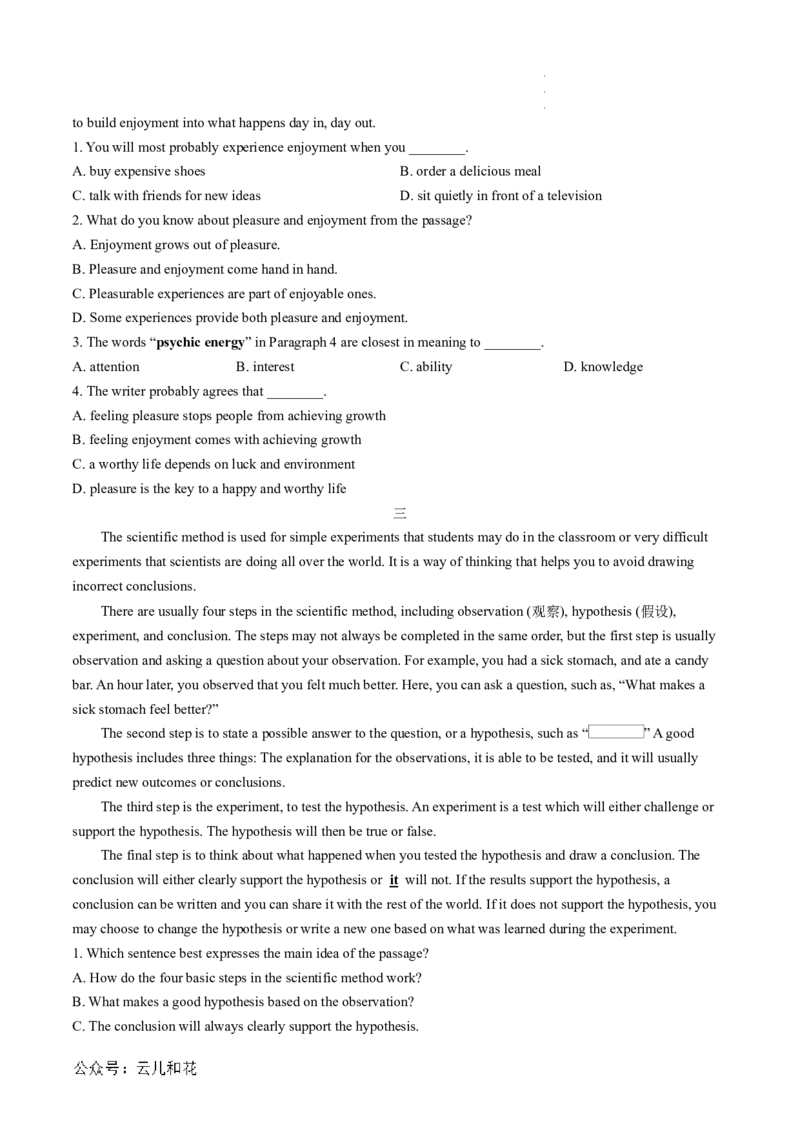
The second step is to state a possible answer to the question, or a hypothesis, such as “ ” A good
hypothesis includes three things: The explanation for the observations, it is able to be tested, and it will usually
predict new outcomes or conclusions.
The third step is the experiment, to test the hypothesis. An experiment is a test which will either challenge or
support the hypothesis. The hypothesis will then be true or false.
The final step is to think about what happened when you tested the hypothesis and draw a conclusion. The
conclusion will either clearly support the hypothesis or it will not. If the results support the hypothesis, a
conclusion can be written and you can share it with the rest of the world. If it does not support the hypothesis, you
may choose to change the hypothesis or write a new one based on what was learned during the experiment.
1. Which sentence best expresses the main idea of the passage?
A. How do the four basic steps in the scientific method work?
B. What makes a good hypothesis based on the observation?
C. The conclusion will always clearly support the hypothesis.
学科网(北京)股份有限公司D. Learning the scientific method may help students succeed in science.
2. Which sentence should go in the empty box in Paragraph 3?
A. A candy bar makes a sick stomach feel better.
B. It was the medicine you took an hour earlier that made you feel better.
C. Eat a candy bar again, and see what happens to your sick stomach.
D. Ask people if eating a candy bar has made a sick stomach feel better.
3. What does the underlined word “it” in the last paragraph refer to (指的是)?
A. The hypothesis. B. The conclusion.
C. The question. D. The observation.
4. Which of the following sentences about the experiment is TRUE?
A. An experiment is a test to always support the hypothesis.
B. An experiment does not have to be part of the scientific method.
C. An experiment is a test to either challenge or support a hypothesis.
D. An experiment is only used when scientists are trying to prove a hypothesis.
四
One day, Helen shouts, “Roger, come and look at the egg! It’s cracking(裂开).” Slowly a long beak(喙)
appears. They are unsure what it is.
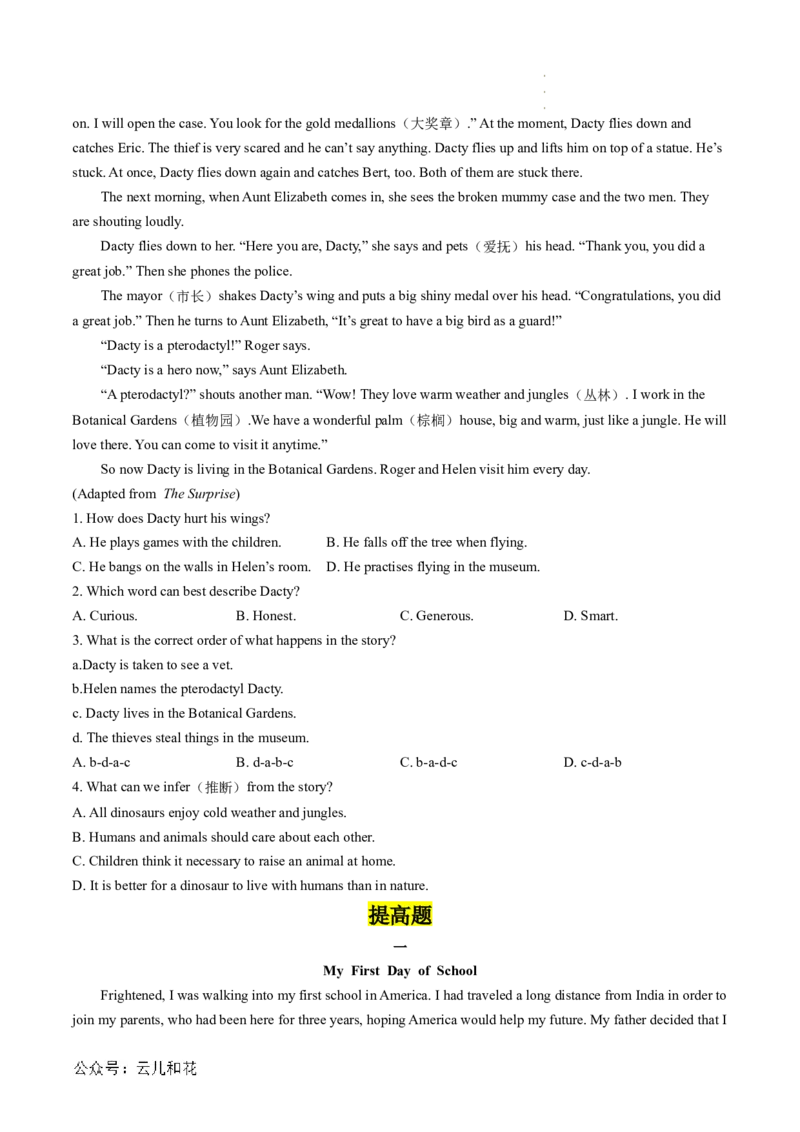
Dad checks on the computer, “Hey, look! It’s a pterodactyl(翼手龙).” “A pterodactyl?” shout the children.
“Yes, it’s a type of dinosaur. Pterodactyls can fly,” says Dad.
Then Helen names it Dacty.
A month later, he grows up. But there is something wrong with his wings. “My room is too small and Dacty
keeps banging(碰撞)his wings on the walls. I feel sorry for him,” says Helen. Finally, they take Dacty to a vet
(兽医).
Two weeks later, Dacty’s wings are better. However, he isn’t willing to fly. They phone Aunt Elizabeth. Soon
she arrives. “My office is very big. It’s perfect for Dacty during the day. And at night, when the museum is empty,
Dacty can fly around happily.” Then she takes them to the museum. On arriving, they take Dacty out of the basket.
He stretches(伸展)his wings, flies high up and lands on a stone statue.
“Look, he likes here,” shouts Helen. “Can he see in the dark?” asks Roger. “Yes, they see clearly in the dark,
just like owls(猫头鹰),” says Aunt Elizabeth.
Six months passes and Dacty is very big now. One night, Dacty sees lights moving inside the museum. Two
men—Bert and Eric come in with torches(手电筒). They are wearing masks and trying to open a case(箱子).
Inside it is a mummy(木乃伊). Suddenly Eric looks up and sees Dacty. He is very scared. “Look, Bert, there is a
huge bird up there.” Bert looks up. Dacty doesn’t move, “Eric, don’t be silly. It’s only a statue,” says Bert. “Come
学科网(北京)股份有限公司on. I will open the case. You look for the gold medallions(大奖章).” At the moment, Dacty flies down and
catches Eric. The thief is very scared and he can’t say anything. Dacty flies up and lifts him on top of a statue. He’s
stuck. At once, Dacty flies down again and catches Bert, too. Both of them are stuck there.
The next morning, when Aunt Elizabeth comes in, she sees the broken mummy case and the two men. They
are shouting loudly.
Dacty flies down to her. “Here you are, Dacty,” she says and pets(爱抚)his head. “Thank you, you did a
great job.” Then she phones the police.
The mayor(市长)shakes Dacty’s wing and puts a big shiny medal over his head. “Congratulations, you did
a great job.” Then he turns to Aunt Elizabeth, “It’s great to have a big bird as a guard!”
“Dacty is a pterodactyl!” Roger says.
“Dacty is a hero now,” says Aunt Elizabeth.
“A pterodactyl?” shouts another man. “Wow! They love warm weather and jungles(丛林). I work in the
Botanical Gardens(植物园).We have a wonderful palm(棕榈)house, big and warm, just like a jungle. He will
love there. You can come to visit it anytime.”
So now Dacty is living in the Botanical Gardens. Roger and Helen visit him every day.
(Adapted from The Surprise)
1. How does Dacty hurt his wings?
A. He plays games with the children. B. He falls off the tree when flying.
C. He bangs on the walls in Helen’s room. D. He practises flying in the museum.
2. Which word can best describe Dacty?
A. Curious. B. Honest. C. Generous. D. Smart.
3. What is the correct order of what happens in the story?
a.Dacty is taken to see a vet.
b.Helen names the pterodactyl Dacty.
c. Dacty lives in the Botanical Gardens.
d. The thieves steal things in the museum.
A. b-d-a-c B. d-a-b-c C. b-a-d-c D. c-d-a-b
4. What can we infer(推断)from the story?
A. All dinosaurs enjoy cold weather and jungles.
B. Humans and animals should care about each other.
C. Children think it necessary to raise an animal at home.
D. It is better for a dinosaur to live with humans than in nature.
提高题
一
My First Day of School
Frightened, I was walking into my first school in America. I had traveled a long distance from India in order to
join my parents, who had been here for three years, hoping America would help my future. My father decided that I
学科网(北京)股份有限公司would have a better education here, so I enrolled(登记)in the local high school in my new town.
I was afraid of how I would do. On the first day, I went to my second class after I had missed my first. With
anxiety, I reached for the door, opening it slowly. Without paying attention to my classmates, I went straight to the
teacher and asked if this was the right class. With a soft voice he answered, “Yes.” His voice comforted me a little.
He gave me a sheet called Course Requirements, which I would never get in India because we didn't have anything
like that. Then he asked me to choose where I would sit. I didn't actually want to pick a seat. In India we had fixed
seats, so I never needed to worry about that. I spent the rest of the class taking notes from the image produced by
the overhead projector(投影仪). In Indian schools, we didn't use the technology. We had to take notes as the teacher
spoke.
It was noon. I was very confused about when I would have lunch. I went to my next class and the bell rang as I
entered. I went through the regular(惯常的) process of asking the teacher if I was in the right class. She said, “It's
still fourth period.”
“But the bell just rang,” I said.
Changing from a gentle tone to a harsh(刺耳的)one, she said, “That is the lunch bell, young man.”
I apologized. Without another word I headed for the cafeteria. I felt lucky because we didn't have this in India.
Every confusion seemed like a barrier I had to get through to reach my goal. At the end of the day, I was on my
way to the bus which we didn't have in India either. I saw my bus and sat down inside happily. I was thinking,
today wasn't so bad.
1.Why did the author attend an American high school?
A.Because his father preferred American schools.
B.Because his family wanted him to have a bright future.
C.Because his mother had worked in it for 3 years.
D.Because he had been longing to leave his homeland.
2.What do we know about the author's first day of school?
A.He went to the wrong class for second period.
B.He met some enthusiastic teachers and classmates.
C.He got the Course Requirements sheet from his classmate.
D.He experienced differences between American and Indian schools in many ways.
3.What does the underlined word “barrier” probably mean?
A.Door. B.Difficulty.
C.Task. D.Period.
4.How did the author feel at the end of the day?
A.Worried. B.Puzzled. C.Happy. D.Sad.
二
Peru is famously known as the “land of the Incas”. A trip to Peru had been on my wish list for quite a while. It
was finally time for me to visit the country.
My first day started in Lima, the capital of Peru. I met with the G Adventures representative(代表)of the tour
学科网(北京)股份有限公司here. G Adventures is an organization that helps you to connect with other like⁃minded people in small group⁃based
travel adventures. They played a big part in helping to make Peru an unforgettable experience for me! In Lima, my
representative discussed the plan for my tour, and I also had the chance to explore Lima in my own time, with many
activities, including a city tour, show, biking tour, and more.
Day two had me taking a flight from Lima to Cusco. Many people visit Cusco for shopping but for me, the
main reason for spending a day or two in Cusco was to adapt to the altitude(海拔). As I'd decided to reach the
wonder of Machu Picchu, adaptation had become important to avoiding altitude sickness. I was happy to spend a
day exploring Cusco. Cusco was once the capital of the Inca Empire. Today, it's famous for its artists, paintings,
clothing and traditional instruments. There's something for everyone in this city.
The day finally came! Day three had me enjoying a lovely guided visit to Machu Picchu at sunrise. I had free
time to explore the city on my own as well as with my guide. There was a lot to take in! I had to stop for a moment
and felt the energy of such an ancient city. The history here is unbelievable and I will never forget my time here for
as long as I live!
1.What is the author's attitude to G Adventures?
A.Doubtful. B.Satisfied. C.Uninterested. D.Hopeful.
2.Why did the author stay in Cusco?
A.To go shopping. B.To find a local guide.
C.To get used to the high altitude. D.To do research on the Inca Empire.
3.How did the author feel when traveling around Machu Picchu?
A.Full of excitement. B.Out of luck.
C.Lost in doubt. D.Deep in regret.
4.What is the best title for the text?
A.My love of traveling B.My wonderful trip to Peru
C.Peru: the “land of the Incas” D.Traveling: the future of Peru
三
Eating a light meal
Many of us like to eat out and treat ourselves to delicious food. We are used to choosing hearty, fat⁃filled
dishes and sugary snacks, which are not easily cooked at home.
The recent rise of light(清淡的) meals, however, gives diners a smarter choice. According to Economic
Daily, low⁃calorie, low⁃fat and high⁃fiber(高纤维的) meals have become popular in China's restaurants and online
delivery platforms.
The country saw a rapid expansion of restaurants specializing in light meals, from just 600 in 2017 to more
than 3,500 in 2018. According to a report released by Meituan, a major online food delivery platform, the number
of light meals ordered online also rose 75 percent compared to the previous year.
Having a light meal, however, doesn't mean eating only vegetables. Different from the meat⁃free lifestyle, a
typical light dish avoids oily, salty and spicy food. Instead, it contains things like boiled meat, wholegrains, fruits
and vegetables. Healthy nutrients(营养成分) are the theme of the light meal.
学科网(北京)股份有限公司These dishes are useful for keeping healthy and controlling your weight. That's probably why so many people,
especially the Millennial generation(千禧一代), are into them. Diners see it as “a great way to avoid bloating(变
胖),” wrote The Telegraph.
“After eating several light meals, I feel my appetite has shrunk(缩小). I now prefer light flavors,” Zou Jing, a
college teacher in Wuhan, told China Daily. She shared a picture of her lunch: a mixture of beef, eggs, corn,
mushrooms and cherry tomatoes.
These changes in eating behavior are connected with deeper changes in how people think about food, says
Walter Willett, chair of the Department of Nutrition at the Harvard T.H. Chan School of Public Health, the US.
So next time you have a party with friends, try a light meal. It will satisfy not only your stomach but maybe
also your heart.
1.What are light meals?
A.Low⁃calorie and high⁃fiber meals. B.Meat⁃free dishes.
C.Sugary snacks. D.Fat⁃filled dishes.
2.What is the main way that the author uses to prove the popularity of light meals?
A.Giving descriptions. B.Giving examples.
C.Listing numbers. D.Showing other people's views.
3.Why do many young people enjoy light meals according to the article?
A.They can help them control their weight. B.They are simple and convenient.
C.They are cheaper than other meals. D.They are usually colorful.
4.What do we know from Paragraph 7?
A.Light meals will stay popular for a while.
B.There is a change in the attitude towards healthy eating.
C.One's eating habit shows their personality.
D.It's important to eat the right amount of good food.
四
Phoenix, Arizona, the USA was struck by a big sandstorm(沙尘暴) recently. It was a huge dust storm that
struck Phoenix a little after 7:00 p.m. local time.
Arizona has sandstorms particularly during the monsoon(季风) season which usually starts from mid⁃June
until the end of September. However, this was the biggest. The cloud of dust turned day into night. Some trees
were downed and gardens were destroyed and it cut off the power of thousands of local people in the area, but
luckily no death happened. A number of people's pools became dirty with dust. People who lived in Phoenix for
more than 40 years said that this was the first time they had experienced this huge dust storm. It could greatly
influence people's health.
The big dust cloud started in Tucson traveling north across the desert. The huge storm ran up to 60 miles per
hour. It was more than 100 miles wide and a mile high. Besides Phoenix and nearby cities, the storm also reached
Yuma County in southwestern Arizona. It reduced the visibility(能见度) in these areas, putting off the flights at
Phoenix Sky Harbor International Airport.
学科网(北京)股份有限公司The storm only takes place in Arizona, the Sahara Desert and areas of the Middle East, because of the dry
environment and large amounts of sand. Because of the serious shortage of rain, there's a large possibility that the
water is polluted because of the storm.
1.In what season do sandstorms usually take place in Arizona?
A.In fall and winter. B.In summer and fall.
C.In winter and spring. D.In spring and summer.
2.What does the underlined word “this” in Paragraph 2 refer to?
A.The storm. B.The wind.
C.The desert. D.The state.
3.Why was local people lucky after the big sandstorm happened?
A.People's health was not influenced.
B.It didn't do harm to people's gardens.
C.All the local people in the area survived.
D.The electricity was not affected at all.
4.What can probably be the title of the passage?
A.Phoenix, Arizona has more sandstorms
B.Sandstorms do a great deal of harm to people
C.We must do something to prevent sandstorms
D.Phoenix, Arizona experienced a huge sandstorm
五
Another three astronauts(宇航员) went into space on Oct. 16, 2021. How do they sleep in space? In fact, they
don't have beds in the space station but they do have sleeping bags. During the day, when they are working, they
leave the bags tied to the wall, out of the way. At bedtime they untie them and take them wherever they've chosen to
sleep.
On most space station flights everyone sleeps at the same time. No one has to stay awake to watch over the
space station; the space station's computers and the engineers at the mission control do that. If anything goes
wrong, the computers will raise the alarm and the engineers will call them by radio.
In the space station, bedtime doesn't mean nighttime. During each ninety⁃or⁃so⁃minute orbit the sun “rises”
and shines through their windows for about fifty minutes, and then it “sets” as their space station takes them around
the dark side of the Earth. To keep the sun out of their eyes, they wear black sleep masks.
It is surprisingly easy to get comfortable and fall asleep in space. Every astronaut sleeps differently—some
sleep upside down, some sideways, and others right side up. When it's time to sleep, some will take their bags, their
sleep masks, and their tape players with earphones and float up to the flight deck. Then they crawl into the bag, and
float in a sitting position just above a seat, and right next to a window. Before they pull the mask down over their
eyes, they have a rest for a while, listening to music and watching the Earth go by beneath them.
1.When it's bedtime, where do the astronauts put their sleeping bags?
A.On the wall. B.At the mission control.
C.In the flight deck. D.In any place they like.
学科网(北京)股份有限公司2.What does the underlined phrase “watch over” in the second paragraph probably mean?
A.Go over to. B.Research on.
C.Look into. D.Take care of.
3.How long does it take for the space station to go round the Earth once?
A.Forty minutes. B.About fifty minutes.
C.About ninety minutes. D.Twenty⁃four hours.
4.What is the best title for this passage?
A.Sleeping in the Space Station B.Travel in Space
C.Sleeping Equipment for Astronauts D.The Earth Seen from Outer Space
六
Grading Policies for Introduction to Literature
Grading Scale
90-100, A; 80-89, B; 70-79, C; 60-69, D; Below 60, E.
Essays (60%)
Your four major essays will combine to form the main part of the grade for this course: Essay 1 = 10%; Essay
2 = 15%; Essay 3 = 15%; Essay 4 = 20%.
Group Assignments (30%)
Students will work in groups to complete four assignments (作业) during the course. All the assignments will
be submitted by the assigned date through Blackboard, our online learning and course management system.
Daily Work/In-Class Writings and Tests/Group Work/Homework (10%)
Class activities will vary from day to day, but students must be ready to complete short in-class writings or
tests drawn directly from assigned readings or notes from the previous class' lecture/discussion, so it is important to
take careful notes during class. Additionally, from time to time I will assign group work to be completed in class or
short assignments to be completed at home, both of which will be graded.
Late Work
An essay not submitted in class on the due date will lose a letter grade for each class period it is late. If it is not
turned in by the 4th day after the due date, it will earn a zero. Daily assignments not completed during class will get
a zero. Short writings missed as a result of an excused absence will be accepted.
1. Where is this text probably taken from?
A. A textbook. B. An exam paper. C. A course plan. D. An academic article.
2. How many parts is a student’s final grade made up of?
A. Two. B. Three. C. Four. D. Five.
3. What will happen if you submit an essay one week after the due date?
A. You will receive a zero. B. You will lose a letter grade.
C. You will be given a test. D. You will have to rewrite it.
七
In 1916, two girls of wealthy families, best friends from Auburn, N. Y. — Dorothy Woodruff and Rosamond
Underwood — traveled to a settlement in the Rocky Mountains to teach in a one-room schoolhouse. The girls had
学科网(北京)股份有限公司gone to Smith College. They wore expensive clothes. So for them to move to Elkhead, Colo. to instruct the children
whose shoes were held together with string was a surprise. Their stay in Elkhead is the subject of Nothing Daunted:
The Unexpected Education of Two Society Girls in the West by Dorothy Wickenden, who is a magazine editor and
Dorothy Woodruff’s granddaughter.
Why did they go then? Well, they wanted to do something useful. Soon, however, they realized what they had
undertaken.
They moved in with a local family, the Harrisons, and, like them, had little privacy, rare baths, and a blanket of
snow on their quilt when they woke up in the morning. Some mornings, Rosamond and Dorothy would arrive at the
schoolhouse to find the children weeping from the cold. In spring, the snow was replaced by mud over ice.
In Wickenden’s book, she expanded on the history of the West and also on feminism, which of course
influenced the girls’ decision to go to Elkhead. A hair-raising section concerns the building of the railroads, which
entailed (牵涉) drilling through the Rockies, often in blinding snowstorms. The book ends with Rosamond and
Dorothy’s return to Auburn.
Wickenden is a very good storyteller. The sweep of the land and the stoicism (坚忍) of the people move her to
some beautiful writing. Here is a picture of Dorothy Woodruff, on her horse, looking down from a hill top: “When
the sun slipped behind the mountains, it shed a rosy glow all around them. Then a full moon rose. The snow was
marked only by small animals: foxes, coyotes, mice, and varying hares, which turned white in the winter.”
1. Why did Dorothy and Rosamond go to the Rocky Mountains?
A. To teach in a school. B. To study American history.
C To write a book. D. To do sightseeing.
2. What can we learn about the girls from paragraph 3?
A. They enjoyed much respect. B. They had a room with a bathtub.
C. They lived with the local kids. D. They suffered severe hardships.
3. Which part of Wickenden’s writing is hair-raising?
A. The extreme climate of Auburn. B. The living conditions in Elkhead.
C. The railroad building in the Rockies. D. The natural beauty of the West.
4. What is the text?
A. A news report. B. A book review. C. A children’s story. D. A diary entry.
八
Like most of us, I try to be mindful of food that goes to waste. The arugula (芝麻菜)was to make a nice green
salad, rounding out a roast chicken dinner. But I ended up working late. Then friends called with a dinner invitation.
I stuck the chicken in the freezer. But as days passed, the arugula went bad. Even worse, I had unthinkingly bought
way too much; I could have made six salads with what I threw out.
In a world where nearly 800 million people a year go hungry, “food waste goes against the moral grain,” as
Elizabeth Royte writes in this month’s cover story. It’s jaw-dropping how much perfectly good food is thrown away
— from “ugly” (but quite eatable) vegetables rejected by grocers to large amounts of uneaten dishes thrown into
restaurant garbage cans.
Producing food that no one eats wastes the water, fuel, and other resources used to grow it. That makes food
学科网(北京)股份有限公司waste an environmental problem. In fact, Royte writes, “if food waste were a country, it would be the third largest
producer of greenhouse gases in the world.”
If that’s hard to understand, let’s keep it as simple as the arugula at the back of my refrigerator. Mike Curtin
sees my arugula story all the time — but for him, it's more like 12 bones of donated strawberries nearing their last
days. Curtin is CEO of DC Central Kitchen in Washington, D.C., which recovers food and turns it into healthy
meals. Last year it recovered more than 807,500 pounds of food by taking donations and collecting blemished (有
瑕疵的) produce that otherwise would have rotted in fields. And the strawberries? Volunteers will wash, cut, and
freeze or dry them for use in meals down the road.
Such methods seem obvious, yet so often we just don’t think. “Everyone can play a part in reducing waste,
whether by not purchasing more food than necessary in your weekly shopping or by asking restaurants to not
include the side dish you won’t eat,” Curtin says.
1. What does the author want to show by telling the arugula story?
A. We pay little attention to food waste. B. We waste food unintentionally at times.
C. We waste more vegetables than meat. D. We have good reasons for wasting food.
2. What is a consequence of food waste according to the test?
A. Moral decline. B. Environmental harm.
C. Energy shortage. D. Worldwide starvation.
3. What does Curtin’s company do?
A. It produces kitchen equipment. B. It turns rotten arugula into clean fuel.
C. It helps local farmers grow fruits. D. It makes meals out of unwanted food.
4. What does Curtin suggest people do?
A. Buy only what is needed. B. Reduce food consumption.
C. Go shopping once a week. D. Eat in restaurants less often.
学科网(北京)股份有限公司