Verbal Test 3
Solutions Booklet
Instructions
This verbal reasoning test comprises 30 questions, and you will have 25 minutes in which to
correctly answer as many as you can.
You will be presented with a passage to read, and a statement about that passage. For each
statement you must select one of the following answers:
True: The statement follows logically from the information contained in the passage.
False: The statement is logically false from the information contained in the passage.
Cannot Say: It is not possible to determine whether the statement is true or false
without further information.
You will have to work quickly and accurately to perform well in this test. If you don’t know the
answer to a question, leave it and come back to it if you have time.
Try to find a time and place where you will not be interrupted during the test. When you
are ready, begin the test.
Assessment Day
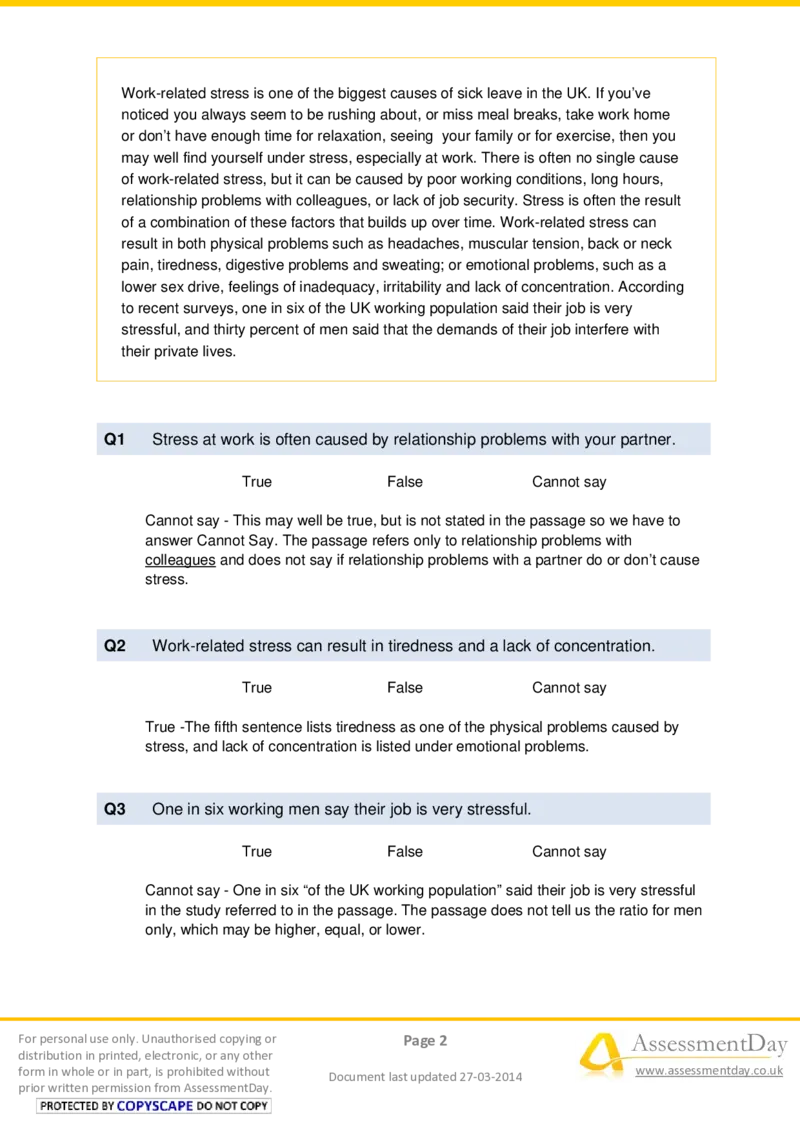
Practice Aptitude TestsWork-related stress is one of the biggest causes of sick leave in the UK. If you’ve
noticed you always seem to be rushing about, or miss meal breaks, take work home
or don’t have enough time for relaxation, seeing your family or for exercise, then you
may well find yourself under stress, especially at work. There is often no single cause
of work-related stress, but it can be caused by poor working conditions, long hours,
relationship problems with colleagues, or lack of job security. Stress is often the result
of a combination of these factors that builds up over time. Work-related stress can
result in both physical problems such as headaches, muscular tension, back or neck
pain, tiredness, digestive problems and sweating; or emotional problems, such as a
lower sex drive, feelings of inadequacy, irritability and lack of concentration. According
to recent surveys, one in six of the UK working population said their job is very
stressful, and thirty percent of men said that the demands of their job interfere with
their private lives.
Q1 Stress at work is often caused by relationship problems with your partner.
True False Cannot say
Cannot say - This may well be true, but is not stated in the passage so we have to
answer Cannot Say. The passage refers only to relationship problems with
colleagues and does not say if relationship problems with a partner do or don’t cause
stress.
Q2 Work-related stress can result in tiredness and a lack of concentration.
True False Cannot say
True -The fifth sentence lists tiredness as one of the physical problems caused by
stress, and lack of concentration is listed under emotional problems.
Q3 One in six working men say their job is very stressful.
True False Cannot say
Cannot say - One in six “of the UK working population” said their job is very stressful
in the study referred to in the passage. The passage does not tell us the ratio for men
only, which may be higher, equal, or lower.
For personal use only. Unauthorised copying or Page 2 AssessmentDay
distribution in printed, electronic, or any other
form in whole or in part, is prohibited without www.assessmentday.co.uk
Document last updated 27-03-2014
prior written permission from AssessmentDay.Q4 If you spend more time with your family, you will not suffer from stress.
True False Cannot say
Cannot say - The passage states that stress can be caused by not spending enough
time with your family. However, the passage does not tell us explicitly that everyone
who spends more time with their family will or will not suffer from stress.
For personal use only. Unauthorised copying or Page 3 AssessmentDay
distribution in printed, electronic, or any other
form in whole or in part, is prohibited without www.assessmentday.co.uk
Document last updated 27-03-2014
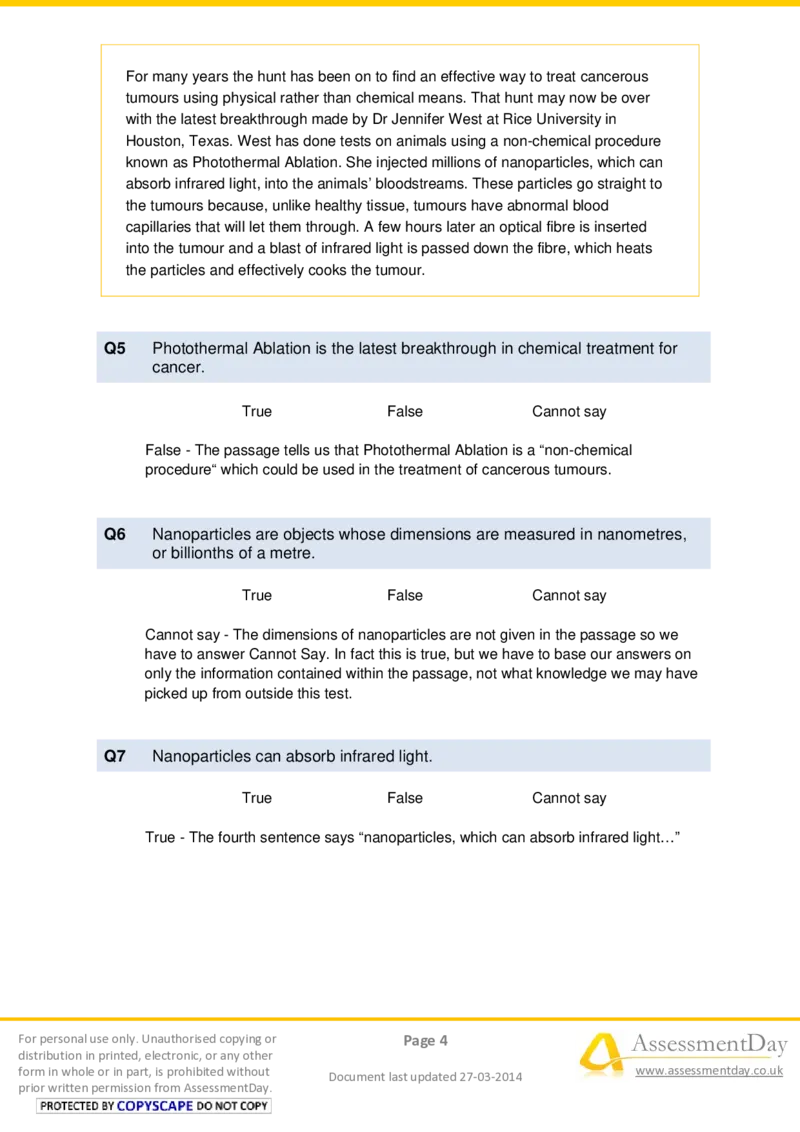
prior written permission from AssessmentDay.For many years the hunt has been on to find an effective way to treat cancerous
tumours using physical rather than chemical means. That hunt may now be over
with the latest breakthrough made by Dr Jennifer West at Rice University in
Houston, Texas. West has done tests on animals using a non-chemical procedure
known as Photothermal Ablation. She injected millions of nanoparticles, which can
absorb infrared light, into the animals’ bloodstreams. These particles go straight to
the tumours because, unlike healthy tissue, tumours have abnormal blood
capillaries that will let them through. A few hours later an optical fibre is inserted
into the tumour and a blast of infrared light is passed down the fibre, which heats
the particles and effectively cooks the tumour.
Q5 Photothermal Ablation is the latest breakthrough in chemical treatment for
cancer.
True False Cannot say
False - The passage tells us that Photothermal Ablation is a “non-chemical
procedure“ which could be used in the treatment of cancerous tumours.
Q6 Nanoparticles are objects whose dimensions are measured in nanometres,
or billionths of a metre.
True False Cannot say
Cannot say - The dimensions of nanoparticles are not given in the passage so we
have to answer Cannot Say. In fact this is true, but we have to base our answers on
only the information contained within the passage, not what knowledge we may have
picked up from outside this test.
Q7 Nanoparticles can absorb infrared light.
True False Cannot say
True - The fourth sentence says “nanoparticles, which can absorb infrared light…”
For personal use only. Unauthorised copying or Page 4 AssessmentDay
distribution in printed, electronic, or any other
form in whole or in part, is prohibited without www.assessmentday.co.uk
Document last updated 27-03-2014
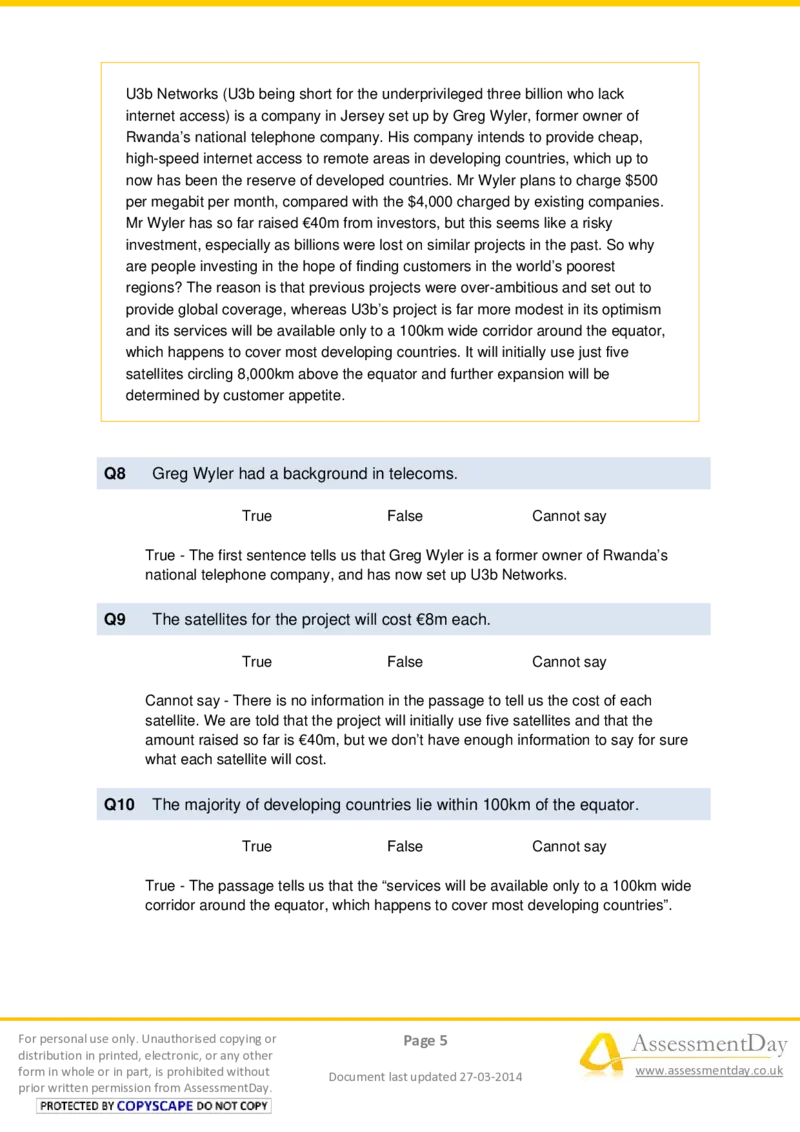
prior written permission from AssessmentDay.U3b Networks (U3b being short for the underprivileged three billion who lack
internet access) is a company in Jersey set up by Greg Wyler, former owner of
Rwanda’s national telephone company. His company intends to provide cheap,
high-speed internet access to remote areas in developing countries, which up to
now has been the reserve of developed countries. Mr Wyler plans to charge $500
per megabit per month, compared with the $4,000 charged by existing companies.
Mr Wyler has so far raised €40m from investors, but this seems like a risky
investment, especially as billions were lost on similar projects in the past. So why
are people investing in the hope of finding customers in the world’s poorest
regions? The reason is that previous projects were over-ambitious and set out to
provide global coverage, whereas U3b’s project is far more modest in its optimism
and its services will be available only to a 100km wide corridor around the equator,
which happens to cover most developing countries. It will initially use just five
satellites circling 8,000km above the equator and further expansion will be
determined by customer appetite.
Q8 Greg Wyler had a background in telecoms.
True False Cannot say
True - The first sentence tells us that Greg Wyler is a former owner of Rwanda’s
national telephone company, and has now set up U3b Networks.
Q9 The satellites for the project will cost €8m each.
True False Cannot say
Cannot say - There is no information in the passage to tell us the cost of each
satellite. We are told that the project will initially use five satellites and that the
amount raised so far is €40m, but we don’t have enough information to say for sure
what each satellite will cost.
Q10 The majority of developing countries lie within 100km of the equator.
True False Cannot say
True - The passage tells us that the “services will be available only to a 100km wide
corridor around the equator, which happens to cover most developing countries”.
For personal use only. Unauthorised copying or Page 5 AssessmentDay
distribution in printed, electronic, or any other
form in whole or in part, is prohibited without www.assessmentday.co.uk
Document last updated 27-03-2014
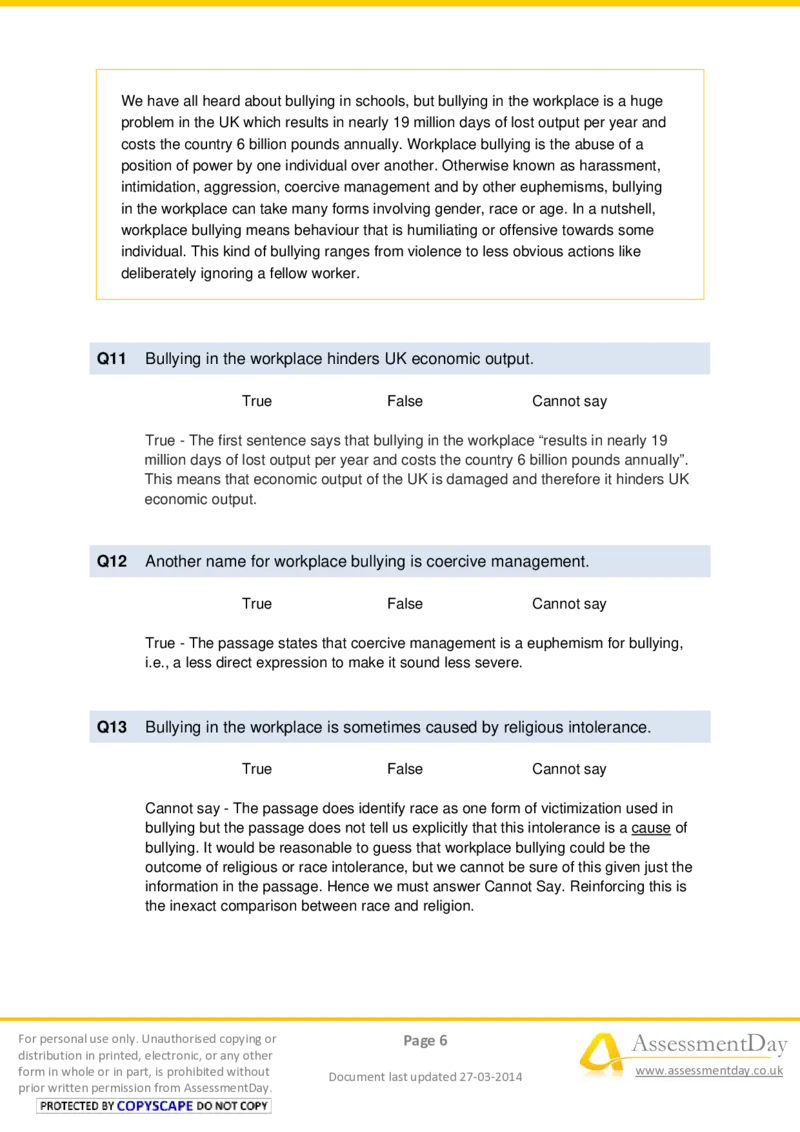
prior written permission from AssessmentDay.We have all heard about bullying in schools, but bullying in the workplace is a huge
problem in the UK which results in nearly 19 million days of lost output per year and
costs the country 6 billion pounds annually. Workplace bullying is the abuse of a
position of power by one individual over another. Otherwise known as harassment,
intimidation, aggression, coercive management and by other euphemisms, bullying
in the workplace can take many forms involving gender, race or age. In a nutshell,
workplace bullying means behaviour that is humiliating or offensive towards some
individual. This kind of bullying ranges from violence to less obvious actions like
deliberately ignoring a fellow worker.
Q11 Bullying in the workplace hinders UK economic output.
True False Cannot say
True - The first sentence says that bullying in the workplace “results in nearly 19
million days of lost output per year and costs the country 6 billion pounds annually”.
This means that economic output of the UK is damaged and therefore it hinders UK
economic output.
Q12 Another name for workplace bullying is coercive management.
True False Cannot say
True - The passage states that coercive management is a euphemism for bullying,
i.e., a less direct expression to make it sound less severe.
Q13 Bullying in the workplace is sometimes caused by religious intolerance.
True False Cannot say
Cannot say - The passage does identify race as one form of victimization used in
bullying but the passage does not tell us explicitly that this intolerance is a cause of
bullying. It would be reasonable to guess that workplace bullying could be the
outcome of religious or race intolerance, but we cannot be sure of this given just the
information in the passage. Hence we must answer Cannot Say. Reinforcing this is
the inexact comparison between race and religion.
For personal use only. Unauthorised copying or Page 6 AssessmentDay
distribution in printed, electronic, or any other
form in whole or in part, is prohibited without www.assessmentday.co.uk
Document last updated 27-03-2014
prior written permission from AssessmentDay.Q14 Deliberately ignoring a colleague is a form of bullying.
True False Cannot say
True - The last sentence in the passage states that “deliberately ignoring a fellow
worker” is a less obvious – but still existing - kind of workplace bullying.
For personal use only. Unauthorised copying or Page 7 AssessmentDay
distribution in printed, electronic, or any other
form in whole or in part, is prohibited without www.assessmentday.co.uk
Document last updated 27-03-2014
prior written permission from AssessmentDay.Nobody knows what life forms may exist outside our own planet. The search for
extra-terrestrial life in the universe took a step nearer to fruition with the discovery
in June of what are believed to be traces of water on the surface of Mars. Life on
our planet requires water and its presence on Mars may point towards the
existence of past life on the planet. The Phoenix Mars Lander robot landed on the
plains of Mars on May 25th 2008, searching for signs that the Martian environment
might once have been habitable to life. When it dug a ditch in the planet’s surface,
photos revealed small patches of bright material. Four days later those patches
had disappeared, causing scientists to speculate that they were water ice that had
previously been buried and which vaporised when exposed to the air. Scientists
insisted that if the patches had been salt, they wouldn't have disappeared and if
they had been solid carbon dioxide, then they wouldn't have vaporised.
Q15 The Phoenix Mars Lander has provided proof that life once existed on Mars.
True False Cannot say
Cannot say - The passage states that scientists speculate that there were ice
patches on Mars, which is needed for life. We are told about the Phoenix Mars
Lander and its discovery but we are not told what the Phoenix Mars Lander has
proved, disproved, or failed to prove. For illustration: this passage could be reporting
on just one aspect of what Phoenix has discovered. So we cannot say if this is true or
false without further information.
Tip: this statement would have been False if the passage had said something to the
effect that this is everything the Phoenix Mars Lander has ever done or found.
Q16 Life forms on Mars require water in order to survive.
True False Cannot say
Cannot say - The passage states that “Life on our plant requires water”. The passage
also says that we do not know about every single life form: “Nobody knows what life
forms may exist outside our own planet”. Given that the passage does not tell us
whether all life on Mars (or any planet other than our own) does or does not require
water, we cannot say whether or not this statement is true or false, therefore we have
to answer Cannot Say.
For personal use only. Unauthorised copying or Page 8 AssessmentDay
distribution in printed, electronic, or any other
form in whole or in part, is prohibited without www.assessmentday.co.uk
Document last updated 27-03-2014
prior written permission from AssessmentDay.Q17 Since the Phoenix Mars Lander cannot excavate it is limited to surface
photography.
True False Cannot say
False - The fifth sentence says “When it dug a ditch in the planet’s surface…”
meaning that the Phoenix Mars Lander is capable of some sort of excavation.
For personal use only. Unauthorised copying or Page 9 AssessmentDay
distribution in printed, electronic, or any other
form in whole or in part, is prohibited without www.assessmentday.co.uk
Document last updated 27-03-2014
prior written permission from AssessmentDay.Most workers in the UK over the age of 16 are legally entitled to a minimum rate of
pay, called the national minimum wage. An independent body called the Low Pay
Commission (LPC) each year reviews this rate and passes their recommendation to
the government, who then set and enforce the rate. With few exceptions, the
minimum wage is the same for all types of work and all kinds of business. The
current amount for people over 22 years of age is £6.80 per hour. The rates for
younger workers are less. However, the following groups are not entitled to receive
the minimum wage: workers under school leaving age, the genuinely self-employed,
some apprentices, au pairs, armed service personnel and voluntary workers. Also
agricultural workers have a separate minimum rate of pay set by the Agricultural
Wages Board.
Q18 The Low Pay Commission sets the rate of the national minimum wage.
True False Cannot say
False - The second sentence tells us that the Low Pay Commission “passes their
recommendation to the government, who then set and enforce the rate”. So we are
told that the LPC give a recommendation but it is actually the government who set
the rate.
Q19 The Agricultural Wages Board sets pay bands for different levels of
agricultural workers
True False Cannot say
Cannot say - The last sentence says that “agricultural workers have a separate
minimum rate of pay set by the Agricultural Wages Board.” So we are told that the
AWG set a minimum rate but we are not told if they set rate bands for different levels
of workers. Pay bands implies multiple levels of wage rates dependent on factors
such as age or experience.
For personal use only. Unauthorised copying or Page 10 AssessmentDay
distribution in printed, electronic, or any other
form in whole or in part, is prohibited without www.assessmentday.co.uk
Document last updated 27-03-2014
prior written permission from AssessmentDay.Q20 The lowest wage a 16 year old is entitled to is £6.80 an hour.
True False Cannot say
False - The passage states that this is the rate for people over 22 years of age, and
that “the rates for younger workers are less”.
Q21 Au pairs generally receive less than the minimum wage.
True False Cannot say
Cannot say - The passage states that au pairs are not entitled to the minimum wage.
However, it does not tell us anything about the actual payments received by au pairs,
so we have to answer Cannot Say. Even if you know if this is actually true, we have
to answer based only on the information contained within the passage.
For personal use only. Unauthorised copying or Page 11 AssessmentDay
distribution in printed, electronic, or any other
form in whole or in part, is prohibited without www.assessmentday.co.uk
Document last updated 27-03-2014
prior written permission from AssessmentDay.The 2008 A level results show that 97.2% of students passed compared with 96.6%
in 2007. And 25.9% gained A grades, a rise of 0.6% from the 2007 results. The
number of students sitting A levels in 2008 was also up, at a record high of 827,737.
This high success-rate is causing concerns in some quarters that the exams are
getting easier. However the government attribute the annual change to the
increased spending on schools over the period. Meanwhile the general secretary of
the Association of Teachers and Lecturers, Dr Mary Bousted, has berated teaching
methods in schools as spoon-feeding students to pass exams without developing
the desire to continue learning or gaining the skills necessary to learn
independently. Adding to the debate, the general secretary of the University and
College Union, Sally Hunt, suggested it is unfair to downplay the students’ results
and the hard work of their teachers.
Q22 A level results have improved every year.
True False Cannot say
Cannot say - The passage tells us the there was an increased percentage of
students passing in 2008 compared with 2007, but we are not told about results from
any other years. So we cannot say for sure if results are improving every year.
Q23 A level exams are getting easier.
True False Cannot say
Cannot say - Some people have expressed concerns that the exams are getting
easier, but no evidence of this notion is given in the passage.
Q24 More money was spent on schools in 2008 than in 2007.
True False Cannot say
True - The passage refers to the “the increased spending on schools over the period”
and from earlier in the passage we see that “the period” referred to is 2007 to 2008.
For personal use only. Unauthorised copying or Page 12 AssessmentDay
distribution in printed, electronic, or any other
form in whole or in part, is prohibited without www.assessmentday.co.uk
Document last updated 27-03-2014
prior written permission from AssessmentDay.International Development Secretary, Douglas Alexander, has compared sanitary
conditions in developing countries today with the situation in London 150 years ago
when Parliament had to be closed owing to sewage running through the streets of
the capital and a stench from the River Thames – an event that has been called
‘The Great Stink’. Today more than 1 billion people living in developing countries
have no toilets and 900 million have no access to clean water. Mr. Alexander’s
response has been an announcement that the Department of International
Development plans to build more than 50 million toilets and provide clean drinking
water to more than 25 million people in developing countries over the next five
years. This plan is part of the department’s broader strategy to help poor countries
in Africa and Asia to better manage their water resources and fight the effects of
climate change.
Q25 ‘The Great Stink’ occurred in London.
True False Cannot say
True - The first sentence tells us that this event occurred 150 years ago in London.
Q26 There are fewer than 900 million people living in developing countries.
True False Cannot say
False - The second sentence says that “more than 1 billion people living in
developing countries have no toilets…” So if this is just the number of people living in
developing countries with no toilets there are at least this number of people living in
developing countries, and probably a lot more.
Q27 The Department of International Development intends to do more than just
provide clean drinking water and toilets to poor parts of Africa and Asia.
True False Cannot say.
True - The last sentence in the passage states that “This plan is part of the
department’s broader strategy to help poor countries in Africa and Asia...”.So if they
have a strategy for a broader action, we can infer they intend to do more.
For personal use only. Unauthorised copying or Page 13 AssessmentDay
distribution in printed, electronic, or any other
form in whole or in part, is prohibited without www.assessmentday.co.uk
Document last updated 27-03-2014
prior written permission from AssessmentDay.On 1st July 2007 the smoke-free law was introduced in England with the aim of
protecting employees in their places of work, and the general public in enclosed
public places, from the effects of secondhand smoking. These law changes mean
that all public transport and work vehicles used by more than one person must be
smoke-free, no-smoking signs must be displayed in all smoke-free premises and
vehicles, and staff smoking rooms are no longer allowed; staff who want to smoke
must go outside. Local councils in England have the responsibility of enforcing the
law but it is the legal responsibility of the managers of smoke-free premises and
vehicles to make sure people don’t smoke. Individuals can be fined or prosecuted
for breaking the law and employers can be fined if they do not display the no-
smoking signs or if they allow smoking to continue on their premises.
Q28 Second hand smoking can cause lung cancer and other respiratory
diseases.
True False Cannot say
Cannot say - There is nothing in the passage telling us that this is definitely either
true or false, so we must answer Cannot Say (regardless of what knowledge you may
have from sources other than this passage of text).
Q29 The smoke-free law had the public’s welfare in mind.
True False Cannot say
True - The first sentence tells us that the smoke-free law “was introduced in England
with the aim of protecting employees in their places of work, and the general
public…”. So we are told that this was one of the aims, which means they must have
had public welfare in mind.
Q30 It is no longer legal for smoking rooms to be provided for employees inside
buildings.
True False Cannot say
True - The passage states that “staff smoking rooms are no longer allowed; staff who
want to smoke must go outside”. Employees are the same as “staff” so we are told
that this statement is true.
-- End of Test --
For personal use only. Unauthorised copying or Page 14 AssessmentDay
distribution in printed, electronic, or any other
form in whole or in part, is prohibited without www.assessmentday.co.uk
Document last updated 27-03-2014
prior written permission from AssessmentDay.