绝密★启用前
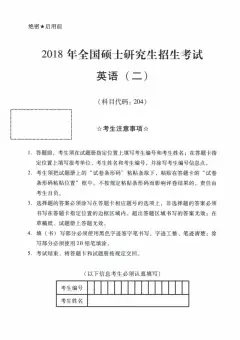
2018年全国诚士研究生招生考试
英语(一)
(科目代码:201)
☆考生注意事项女
1. 答题前,考生须在试题册指定位置上填写考生编号和考生姓名;在答题卡指
定位置上填写报考单位、考生姓名和考生编号,并涂写考生编号信息点。
2. 考生须把试题册上的“试卷条形码”粘贴条取下,粘贴在答题卡的“试卷
条形码粘贴位置”框中。不按规定粘贴条形码而影响评卷结果的,责任由
考生自负。
3. 选择题的答案必须涂写在答题卡相应题号的选项上,非选择题的答案必须
书写在答题卡指定位置的边框区域内。超出答题区域书写的答案无效;在
草稿纸、试题册上答题无效。
4-填(书)写部分必须使用黑色字迹签字笔书写,字迹工整、笔迹清楚;涂
写部分必须使用2B铅笔填涂。
5.考试结束,将答题卡和试题册按规定交回。
(以下信息考生必须认真填写)
考生编号
考生姓名Section I Use of English
Directions:
Read the following text. Choose the best word( s) for each numbered blank and
mark A, B, C or D on the ANSWER SHEET. (10 points)
Trust is a tricky business. On the one hand, it's a necessary condition ]
many worthwhile things: child care, friendships, etc. On the other hand, putting
your 2 in the wrong place often carries a high 3
4 , why do we trust at all? Well, because it feels good. 5 people
place their trust in an individual or an institution, their brains release oxytocin, a
hormone that 6 pleasurable feelings and triggers the herding instinct that
prompts humans to 7 with one another. Scientists have found that exposure
8 this hormone puts us in a trusting 9 : In a Swiss study, researchers
sprayed oxytocin into the noses of half the subjects ; those subjects were ready to
lend significantly higher amounts of money to strangers than were their 10
who inhaled something else.
11 for us, we also have a sixth sense for dishonesty that may 12
us. A Canadian study found that children as young as 14 months can differentiate
13 a credible person and a dishonest one. Sixty toddlers were each 14 to
an adult tester holding a plastic container. The tester would ask, “What's in
here?" before looking into the container, smiling, and exclaiming, "Wow!"
Each subject was then invited to look 15 . Half of them found a toy; the
other half 16 the container was empty—and realized the tester had 17
them.
Among the children who had not been tricked, the majority were 18 to
cooperate with the tester in learning a new skill, demonstrating that they trusted
his leadership. 19 , only five of the 30 Children paired with the u 20
tester participated in a follow-up activity.'
英语(一)试题. 1.(共14页)1. A. on B. like C. for D. from
2. A. faith B. concern . C. attention D. interest
3. A. benefit B. debt “ C. hope D. price
4. A. Therefore B. Then C. Instead D. Again
5. A. Until B. Unless C. Although D. When
6. A. selects B. produces C. applies D. maintains
7. A. consult B. compete C. connect D. compare
8. A. at B.by C. of D. to
9. A. context B. mood C. period D. circle
10. A. counterparts B. substitutes C. colleagues D. supporters
11. A. Funny B. Lucky C. Odd D. Ironic
12. A. monitor B. protect C. surprise D. delight
13. A. between B. within C. toward D. over
14. A. transferred B. added C. introduced D. entrusted
15. A. out B. back C. around D. inside
16. A. discovered B, proved C. insisted D. remembered
17. A. betrayed B. wronged C. fooled D. mocked
18. A. forced B. willing C. hesitant D. entitled
19. A. In contrast B. As a result C. On the whole D. For instance
20. A. inflexible B. incapable C. unreliable D. unsuitable
Section U Reading Comprehension
Part A
Directions:
Read the following four texts. Answer the questions after each text by choosing
A, B, C or D. Mark your answers on the ANSWER SHEET. (40 points)
英语(一)试题.2.(共14页)Text 1
Among the annoying challenges facing the middle class is one that will
probably go unmentioned in the next presidential campaign: What happens when
the robots come for their jobs?
Don't dismiss that possibility entirely. About half of U. S. jobs are at high
risk of being automated, according to a University of Oxford study, with the
middle class disproportionately squeezed. Lower-income jobs like gardening or
day care don't appeal to robots. But many middle-class occupations—trucking,
financial advice, software engineering—have aroused their interest, or soon will.
The rich own the robots, so they will be fine.
This isn't to be alarmist. Optimists point out that technological upheaval has
benefited workers in the past. The Industrial Revolution didn't go so well for
Luddites whose jobs were displaced by mechanized looms, but it eventually
raised living standards and created more jobs than it destroyed. Likewise,
automation should eventually boost productivity, stimulate demand by driving
down prices, and free workers from hard, boring work. But in the medium term,
middle-class workers may need a lot of help adjusting.
The first step, as Erik Brynjolfsson and Andrew McAfee argue in The
Second Machine Age, should be rethinking education and job training.
Curriculums—from grammar school to college—should evolve to focus less on
memorizing facts and more on creativity and complex communication. Vocational
schools should do a better job of fostering problem-solving skills and helping
students work alongside robots. Online education can supplement the traditional
kind. It could make extra training and instruction affordable. Professionals trying
to acquire new skills will be able to do so without going into debt.
The challenge of coping with automation underlines the need for the U.S. to
revive its fading business dynamism: Starting new companies must be made
easier. In previous eras of drastic technological change, entrepreneurs smoothed
the transition by dreaming up ways to combine labor and machines. The best uses
of 3D printers and virtual reality haven't been invented yet. The U.S. needs the
new companies that will invent them.
Finally, because automation threatens to widen the gap between capital
income and labor income, taxes and the safety net will have to be rethought.
Taxes on low-wage labor need to be cut, and wage subsidies such as the earned
income tax credit should be expanded: This would boost incomes, encourage
work, reward companies for job creation, and reduce inequality.
Technology will improve society in ways big and small over the next few
years, yet this will be little comfort to those, who find their lives and careers
upended by automation. Destroying the machines that are coming for our jobs
would be nuts. But policies to help workers adapt will be indispensable.
英语(一)试题.3.(共14页)21. Who will be most threatened by automation?
A. Leading politicians. .
B. Low-wage laborers. ”
C. Robot owners.
D. Middle-class workers.
22. Which of the following best represents the author5s view?
A. Worries about automation are in fact groundless.
B. Optimists5 opinions on new tech find little support.
C. Issues arising from automation need to be tackled.
D. Negative consequences of new tech can be avoided.
23. Education in the age of automation should put more emphasis on
A. creative potential
B. job-hunting skills
C. individual needs
D. cooperative spirit
24. The author suggests that tax policies be aimed at・
A. encouraging the development of automation
B. increasing the return on capital investment
C. easing the hostility between rich and poor
D. preventing the income gap from widening
25. In this text, the author presents a problem with.
A. opposing views on it
B. possible solutions to it
C. its alarming impacts
D. its major variations
英语(一)试题. 4 .(共14页)Text 2
A new survey by Harvard University finds more than two-thirds of young
Americans disapprove of President Trump5s use of Twitter. The implication is
that Millennials prefer news from the White House to be filtered through other
sources, not a president's social media platform.
Most Americans rely on social media to check daily headlines. Yet as
distrust has risen toward all media, people may be starting to beef up their media
literacy skills. Such a trend is badly needed. During the 2016 presidential
campaign, nearly a quarter of web content shared by Twitter users in the
politically critical state of Michigan was fake news, according to the University of
Oxford. And a survey conducted for BuzzFeed News found 44 percent of
Facebook users rarely or never trust news from the media giant.
Young people who are digital natives are indeed becoming more skillful at
separating fact from fiction in cyberspace. A Knight Foundation focus-group
survey of young people between ages 14 and 24 found they use u distributed trust"
to verify stories. They cross-check sources and prefer news from different
perspectives—especially those that are open about any bias. "Many young people
assume a great deal of personal responsibility for educating themselves and
actively seeking out opposing viewpoints, ” the survey concluded.
Such active research can have another effect. A 2014 survey conducted in
Australia, Britain, and the United States by the University of Wisconsin-Madison
found that young people's reliance on social media led to greater political
engagement.
Social media allows users to experience news events more intimately and
immediately while also permitting them to re-share news as a projection of their
values and interests. This forces users to be more conscious of their role in
passing along information. A survey by Barna research group found the top
reason given by Americans for the fake news phenomenon is "reader error,"
more so than made-up stories or factual mistakes in reporting. About a third say
the problem of fake news lies in “ misinterpretation or exaggeration of actual
news,, via social media. In other words, the choice to share news on social media
may be the heart of the issue. " This indicates there is a real personal
responsibility in counteracting this problem," says Roxanne Stone, editor in chief
at Barna Group.
So when young people are critical of an over-tweeting president, they reveal
a mental discipline in thinking skills—and in their choices on when to share on
social media.
英语(一)试题.5.(共14页)26. According to Paragraphs 1 and 2, many young Americans cast doubts
on. .
A. the justification of the ne哪-filtering practice
B. people's preference for social media platforms
C. the administration's ability to handle information
D. social media as a reliable source of news
27. The phrase “beef up" (Line 2, Para.2) is closest in meaning to.
A. sharpen
B. define
C. boast
D. share
28. According to the Knight Foundation survey, young people.
A. tend to voice their opinions in cyberspace
B. verify news by referring to diverse sources
C. have a strong sense of social responsibility
D. like to exchange views on udistributed trustn
29. The Barna survey found that a main cause for the fake news problem
is.
A. readers5 outdated values
B. journalists5 biased reporting
C. readers' misinterpretation
D. joumalists, made-up stories
30. Which of the following would be the best title for the text?
A. A Rise in Critical Skills for Sharing News Online
B. A Counteraction Against the Over-tweeting Trend
C. The Accumulation of Mutual Trust on Social Media
D. The Platforms for Projection of Personal Interests
英语(一)试题.6.(共14页)Text 3
Any fair-minded assessment of the dangers of the deal between Britain's
National Health Service (NHS) and DeepMind must start by acknowledging that
both sides mean well. DeepMind is one of the leading artificial intelligence (Al)
companies in the world. The potential of this work applied to healthcare is very
great, but it could also lead to further concentration of power in the tech giants.
It is against that background that the information commissioner, Elizabeth
Denham, has issued her damning verdict against the Royal Free hospital trust
under the NHS, which handed over to DeepMind the records of 1.6 million
patients in 2015 on the basis of a vague agreement which took far too little
account of the patients5 rights and their expectations of privacy.
DeepMind has almost apologised. The NHS trust has mended its ways.
Further arrangements—and there may be many—between the NHS and DeepMind
will be carefully scrutinised to ensure that all necessary permissions have been
asked of patients and all unnecessary data has been cleaned. There are lessons
about informed patient consent to learn. But privacy is not the only angle in this
case and not even the most important. Ms Denham chose to concentrate the
blame on the NHS trust, since under existing law it “controlled" the data and
DeepMind merely "processed” it. But this distinction misses the point that it is
processing and aggregation, not the mere possession of bits, that gives the data
value.
The great question is who should benefit from the analysis of all the data that
our lives now generate. Privacy law builds on the concept of damage to an
individual from identifiable knowledge about them. That misses the way the
surveillance economy works. The data of an individual there gains its value only
when it is compared with the data of countless millions more.
The use of privacy law to curb the tech giants in this instance feels slightly
maladapted. This practice does not address the real worry. It is not enough to say
that the algorithms DeepMind develops will benefit patients and save lives. What
matters is that they will belong to a private monopoly which developed them
using public resources. If software promises to save lives on the scale that drugs
now can, big data may be expected to behave as a big pharma has done. We are
still at the beginning of this revolution and small choices now may turn out to
have gigantic consequences later. A long struggle will be needed to avoid a future
of digital feudalism. Ms Denham's report is a welcome start.
英语(一)试题.7.(共14页)31. What is true of the agreement between the NHS and DeepMind?
A. It caused conflicts among tecb giants.
B. It failed to pay due attention to patients9 rights.
C. It fell short of the latter's expectations.
D. It put both sides into a dangerous situation.
32. The NHS trust responded to Denham's verdict with.
A. empty promises
B. tough resistance
C. necessary adjustments
D. sincere apologies
33. The author argues in Paragraph 2 that.
A. privacy protection must be secured at all costs
B. leaking patients5 data is worse than selling it
C. making profits from patients5 data is illegal
D. the value of data comes from the processing of it
34. According to the last paragraph, the real worry arising from this deal
is.
A. the vicious rivalry among big pharmas
B. the ineffective enforcement of privacy law
C. the uncontrolled use of new software
D. the monopoly of big data by tech giants
35. The author9s attitude toward the application of Al to healthcare is.
A. ambiguous
B. cautious
C. appreciative
D. contemptuous
英语(一)试题.8.(共14页)Text 4
The U.S. Postal Service (USPS) continues to bleed red ink. It reported a
net loss of $5.6 billion for fiscal 2016, the 10th straight year its expenses have
exceeded revenue. Meanwhile, it has more than $120 billion in unfunded
liabilities, mostly for employee health and retirement costs. There are many
reasons this formerly stable federal institution finds itself on the verge of
bankruptcy. Fundamentally, the USPS is in a historic squeeze between
technological change that has permanently decreased demand for its bread-and-
butter product, first-class mail, and a regulatory structure that denies management
the flexibility to adjust its operations to the new reality.
And interest groups ranging from postal unions to greeting-card makers exert
self-interested pressure on the USPS's ultimate overseer—Congress—insisting that
whatever else happens to the Postal Service, aspects of the status quo they depend
on get protected. This is why repeated attempts at reform legislation have failed
in recent years, leaving the Postal Service unable to pay its bills except by
deferring vital modernization.
Now comes word that everyone involved—Democrats, Republicans, the
Postal Service, the unions and the system's heaviest users—has finally agreed on
a plan to fix the system. Legislation is moving through the House that would save
USPS an estimated $28.6 billion over five years, which could help pay for new
vehicles, among other survival measures. Most of the money would come from a
penny-per-letter permanent rate increase and from shifting postal retirees into
Medicare. The latter step would largely offset the financial burden of annually
pre-funding retiree health care, thus addressing a long-standing complaint by the
USPS and its unions.
If it clears the House, this measure would still have to get through the
Senate—where someone is bound to point out that it amounts to the bare, bare
minimum necessary to keep the Postal Service afloat, not comprehensive reform.
There's no change to collective bargaining at the USPS, a major omission
considering that personnel accounts for 80 percent of the agency's costs. Also
missing is any discussion of eliminating Saturday letter delivery. That common-sense
change enjoys wide public support and would save the USPS $2 billion per year.
But postal special-interest groups seem to have killed it, at least in the House.
The emerging consensus around the bill is a sign that legislators are getting
frightened about a politically embarrassing shortterm collapse at the USPS. It is
not, however, a sign that they're getting serious about transforming the postal
system for the 21st century.
英语(一)试题.9.(共14页)36. The financial problem with the USPS is caused partly by.
A. its unbalanced budget
B. its rigid management ■
C. the cost for technical upgrading
D. the withdrawal of bank support
37. According to Paragraph 2, the USPS fails to modernize itself due to.
A. the interference from interest groups
B. the inadequate funding from Congress
C. the shrinking demand for postal service
D. the incompetence of postal unions
38. The long-standing complaint by the USPS and its unions can be addressed
by.
A. removing its burden of retiree health care
B. making more investment in new vehicles
C. adopting a new rate-increase mechanism
D. attracting more first-class mail users
39. In the last paragraph, the author seems to view legislators with.
A. respect
B. tolerance
C. discontent
D. gratitude
40. Which of the following would be the best title for the text?
A. The USPS Starts to Miss Its Good Old Days
B. The Postal Service: Keep Away from My Cheese
C. The USPS: Chronic Illness Requires a Quick Cure
D. The Postal Service Needs More than a Band-Aid
英语(一)试题.10.(共14页)Part B
Directions:
The following paragraphs are given in a wrong order. For questions 41-45, you
are required to reorganize these paragraphs into a coherent article by choosing
from the list A-G and filling them into the numbered boxes. Paragraphs C
and F have been correctly placed. Mark your answers on the ANSWER SHEET.
(10 points)
A. In December of 1869, Congress appointed a commission to select a site and
prepare plans and cost estimates for a new State Department Building. The
commission was also to consider possible arrangements for the War and Navy
Departments. To the horror of some who expected a Greek Revival twin of
the Treasury Building to be erected on the other side of the White House, the
elaborate French Second Empire style design by Alfred Mullett was selected,
and construction of a building to house all three departments began in June of
1871.
B. Completed in 1875, the State Department's south wing was the first to be
occupied, with its elegant four-story library (completed in 1876) , Diplomatic
Reception Room, and Secretary's office decorated with carved wood, Oriental
rugs, and stenciled wall patterns. The Navy Department moved into the east
wing in 1879, where elaborate wall and ceiling stenciling and marquetry floors
decorated the office of the Secretary.
C. The State, War, and Navy Building, as it was originally known, housed the
three Executive Branch Departments most intimately associated with
formulating and conducting the nation's foreign policy in the last quarter of the
nineteenth century and the first quarter of the twentieth century—the period
when the United States emerged as an international power. The building has
housed some of the nation's most significant diplomats and politicians and has
been the scene of many historic events.
英语(一)试题.11.(共14页)D. Many of the most celebrated national figures have participated in historical
events that have taken place within the EEOB's granite walls. Theodore and
Franklin D. Roosevelt, WiJJiam Howard Taft, Dwight D. Eisenhower,
Lyndon B. Johnson, Gerald Ford, and George H. W. Bush all had offices in
this building before becoming president. It has housed 16 Secretaries of the
Navy, 21 Secretaries of War, and 24 Secretaries of State. Winston Churchill
once walked its corridors and Japanese emissaries met here with Secretary of
State Cordell Hull after the bombing of Pearl Harbor.
E. The Eisenhower Executive Office Building ( EEOB) commands a unique
position in both the national history and the architectural heritage of the United
States. Designed by Supervising Architect of the Treasury, Alfred B.
Mullett, it was built from 1871 to 1888 to house the growing staffs of the
State, War, and Navy Departments, and is considered one of the best
examples of French Second Empire architecture in the country.
F. Construction took 17 years as the building slowly rose wing by wing. When
the EEOB was finished, it was the largest office building in Washington, with
nearly 2 miles of black and white tiled corridors. Almost all of the interior
detail is of cast iron or plaster ; the use of wood was minimized to insure fire
safety. Eight monumental curving staircases of granite with over 4, 000
individually cast bronze balusters are capped by four skylight domes and two
stained glass rotundas.
G. The history of the EEOB began long before its foundations were laid. The first
executive offices were constructed between 1799 and 1820. A series of fires
(including those set by the British in 1814) and overcrowded conditions led to
the construction of the existing Treasury Building. In 1866, the construction
of the North Wing of the Treasury Building necessitated the demolition of the
State Department building.
而壹「n一而「—FFn—矿ni45. i
英语(一)试题.12.(共14页)Part C
Directions:
Read the following text carefully and then translate the underlined segments into
Chinese. Write your answers on the ANSWER SHEET. (10 points)
Shakespeare's lifetime was coincident with a period of extraordinary activity
and achievement in the drama. (46) By the date of his birth Europe was
witnessing the passing of the religious drama, and the creation of new forms
under the incentive of classical tragedy and comedy. These new forms were at
first mainly written by scholars and performed by amateurs, but in England, as
everywhere else in western Europe, the growth of a class of professional actors
was threatening to make the drama popular, whether it should be new or old,
classical or medieval, literary or farcical. Court, school, organizations of
amateurs, and the traveling actors were all rivals in supplying a widespread desire
for dramatic entertainment ; and (47) no boy who went to a grammar school could
be ignorant that the drama was a form of literature which gave glory to Greece
and Rome and might yet bring honor to England.
When Shakespeare was twelve years old the first public playhouse was built
in London. For a time literature showed no interest in this public stage. Plays
aiming at literary distinction were written for schools or court, or for the choir
boys of St. PauFs and the royal chapel, who, however, gave plays in public as
well as at court. (48 ) But the professional companies prospered ia their
permanent theaters, and university men with literary ambitions were quick to turn
to these theaters as offering a means of livelihood. By the time that Shakespeare
was twenty-five, Lyly, Peele, and Greene had made comedies that were at once
popular and literary; Kyd had written a tragedy that crowded the pit; and
Marlowe had brought poetry and genius to triumph on the common stage—where
they had played no part since the death of Euripides. (49) A native literary drama
had been created, its alliance with the public playhouses established, and at least
some of its great traditions had been begun.
The development of the Elizabethan drama for the next twenty-five years is
of exceptional interest to students of literary history, for in this brief period we
may trace the beginning, growth, blossoming, and decay of many kinds of
plays, and of many great careers. We are amazed today at the mere number of
plays produced, as well as by the number of dramatists writing at the same time
for this London of two hundred thousand inhabitants. (50) To realize how great
was the dramatic activity, we must remembeq further that hosts of plays have
been lost, and that probably there is no author of note whose entire work has
survived.
英语(一)试题.13.(共14页)Section HI Writing
Part A
51. Directions:
Write an email to all international experts on campus, inviting them to attend
the graduation ceremony. In your email, you should include the time, place and
other relevant information about the ceremony.
You should write about 100 words on the ANSWER SHEET.
Do not use your own name at the end of the email. Use “Li Ming” instead.
(10 points)
Part B
52. Directions:
Write an essay of 160-200 words based on the picture below. In your essay,
you should
1) describe the picture briefly,
2) interpret the meaning, and
3) give your comments.
Write your answer on the ANSWER SHEET. (20 points)
选课进行时
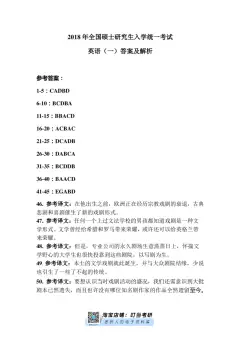
2018年考研英语(一)真题答案速查表
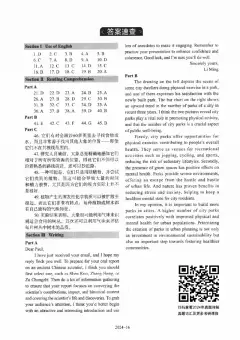
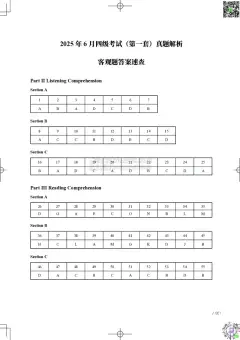
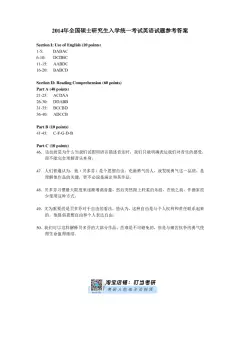
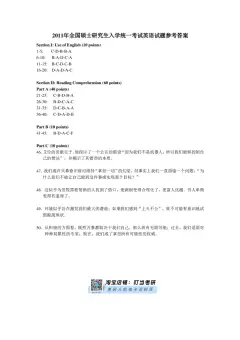
1 ~5 CADBD 6 ~ 10 BCDBA 11~15BBACD 16~20ACBAC 21 -25DCADB
26 ~30 DABCA 31 〜35 BCDDB 36 〜40 BAACD 41 ~45 EGABD
46. 他出生时,欧洲的宗教戏剧正在消亡,同时在古典悲剧和喜剧的推动下,新戏剧形式
应运而生。
47. 每位在文法学校就读的少年不会不知道戏剧这种文学形式曾为希腊和罗马带来荣
耀,也可能会为英格兰带来荣耀。
48 .然而,专业剧团在它们固定的剧院中蓬勃发展,大学里拥有文学抱负的人士迅速投奔
这些剧院,将其视为一种谋生的手段。
49. 一种本土文学戏剧已经诞生,而且已经与公共剧院结成联盟,至少这种戏剧的一些伟
大传统已经开始萌芽。
50. 为了充分了解当时的戏剧活动是何等繁荣,我们还必须牢记:大量戏剧作品已经失
传,可能没有哪位著名作家的全部作品会被保留至今。
英语(一)试题.14.(共14页)者研人想放奔的N个理由!
第[次 第5次想放弃,
想放弃,是 是看到别人保研!
单词太多
背不下去
|用闪过背单词,坚持很容易! |
考研词汇用闪过
划重点,省时间!