文档文本内容
阅读理解+完形填空+语法填空
一、阅读理解
A
THEN WE CAME TO THE END
Joshua Ferris
The first novel by American author Joshua Ferris was so
different, because it is written in the second person; the group of
odd (古怪的) office colleagues talk and act as a collective. It
must have been hard to maintain, but Ferris does a great job. It is
really a good novel set in boring office environments.
THE GRAPES OF WRATH
John Steinbeck
Obviously a classic and still popular, the themes of this novel
are timeless and echo just us strongly today. Set during the Great
Depression, the story follows a family of “Okies”—poor migrant
farmers from Oklahoma—as they head west seeking work.
PROPERTY
Lionel Shriver
Short stories from one of our best contemporary writers.
Exploring the theme of possessions and ownership from many
angles, this is certainly one for Marie Kondo fans. I have long been
interested in what it is about things that can hook some people. The
drive to possess items that serve no obvious purpose is most
appealing to me. Fine, if an item is something given to you by
someone special. But if you take a look around you, some things
are probably simply useless and unmemorable. Shriver’s book
explores it better.
THE LOVE THAT I HAVE
James Maloney
This absorbing story is about Margot Baumann, who takes a
job in a mail-room in what, as later becomes clear, is a
concentration camp. The amazing thing is the perspective it gives of
German life during World War Ⅱ. Of course not all Germans,
probably the large majority, had any real idea of what was going
on. Within Margot’s immediate circle you see the reactions amongthe German population to the rise and fall of their beloved—or hated
Fuhrer (元首), and nation.
1. Who may be liked by Marie Kondo fans?
A. Joshua Ferris. B. John Steinbeck.
C. Lionel Shriver. D. James Maloney.
2. What is special about THE LOVE THAT I HAVE?
A. It follows a family of “Okies”.
B. It is set in boring office environments.
C. It tells stories about a contemporary writer.
D. It explores the rise and fall of a nation in the world.
3. For whom is this text mainly intended?
A. Novelists. B. Book addicts.
C. Editors. D. Story tellers.
B
William Butler Yeats, a most famous Irish writer, was born in
Dublin on June 13, 1865. His childhood lacked the harmony (和
睦) that was typical of a happy family. Later, Yeats shocked his
family by saying that he remembered “little of childhood but its pain”.
In fact, he inherited (继承) excellent taste in art from his family
—both his father and his brother were painters. But he finally settled
on literature, particularly drama and poetry.
Yeats had strong faith in coming of new artistic movements. He
set himself the fresh task in founding an Irish national theater in the
late 1890s. His early theatrical experiments, however, we’re not
received favorably at the beginning. He didn’t lose heart, and
finally enjoyed success in his poetical drama.
Compared with his dramatic works, Yeats’s poems attract much
admiring notice. The subject matter includes love, nature,
history, time and aging. Though Yeats generally relied on very
traditional forms, he brought modern sensibility (情感) to them.
As his literary life progressed, his poetry grew finer and richer,
which led him to worldwide recognition.
He had not enjoyed a major public life since winning the Nobel
Prize in 1923. Yet, he continued writing almost to the end of his
life. Had Yeats stopped writing at age 40, he would probably now
be valued as a minor poet, for there is no other example in literaryhistory of a poet who produces his greatest works between the ages
of 50 and 75. After Yeats’s death in 1939, W. H. Auden wrote,
among others, the following lines:
Earth, receive an honored guest:
William Yeats is laid to rest.
Let the Irish vessel lie
Emptied of its poetry.
4. Which of the following can best describe Yeats’s family?
A. It filled Yeats’s childhood with laughter.
B. It was shocked by Yeats’s choice.
C. It was a typically wealthy family.
D. It had an artistic atmosphere.
5. What do we know about Yeats’s life?
A. He founded the first Irish theater.
B. He stuck to modern forms in his poetry.
C. He was not favored by the public until 1923.
D. He began to produce his best works from 1915.
6. What kind of feeling is expressed in W. H. Auden’s lines?
A. Worry. B. Pity.
C. Emptiness. D. Respect.
7. What is the text mainly about?
A. Yeats’s literary achievements.
B. Yeats’s historical influence.
C. Yeats’s artistic ambition.
D. Yeats’s national honor.
C
We may be only three weeks into December, but artist Jonnie
Hartman has been in the holiday spirit for months, designing and
building the Grand America Holiday Window Stroll.
The goal with each window stroll is to create playful and uplifting
displays, according to Hartman. “I really try to do something light-
hearted, something whimsical, that is, something everyone
can connect with and maybe not see every day in the real world,”
Hartman said.
She designs all of the window displays by hand, starting with
pencil sketches (素描), then illustrating the designs on hercomputer and sending parts of the drawings to be printed. From
there, Hartman works with a team of five people to build the
displays, creating, sewing and embellishing (润色) many
elements by hand.
However, a challenge Hartman has faced over the years as she
has designed the displays is making sure all of the measurements
are right for elements to fit inside the windows.
“When I was in college, I was an art major, and I thought, I
don’t need math. I will never use it. I’m an artist, and guess what,
it’s the most important thing that I use,” Hartman said. “If I don’t
get that right, then the windows don’t fit, the pieces don’t come
together and it just doesn’t work out.”
The holiday window stroll gives Hartman a special opportunity to
hear feedback from those who observe her creations, which is
something she doesn’t always get to experience with her other
artworks. She said it’s fun to hear people’s reactions as they go
through the holiday window stroll.
“It just makes me happy that I can kind of set the tone for peoples
holiday season and just maybe bring a smile to their face,”
Hartman said.
8. What word can replace the underlined word “whimsical” in
Paragraph 2?
A. Serious. B. Exciting.
C. Unusual. D. Ordinary.
9. What challenges Hartman most in designing the displays?
A. To sew. B. To fit.
C. To measure. D. To draw.
10. What does Hartman think about math now?
A. It is too difficult for her.
B. She values it very much.
C. She still thinks it’s useless.
D. It’s not suitable for her to learn.
11. Why is the holiday window stroll special for Hartman?
A. It just can make her happy.
B. She has a chance to create by hand.
C. It can help improve her other artworks.D. She can get some remarks from the viewers.
D
In fiction and literature, the canon is the collection of works
considered representative of a period or genre. The collected works
of William Shakespeare, for instance, would be part of the canon
of Western literature.
The accepted body of work that includes the canon of Western
literature has changed over the years. Some works become less
proper in the canon as they’re replaced by more modern
counterparts (对应物). For instance, the works of Shakespeare
and Chaucer are still considered significant. But lesser-known
writers of the past, such as William Blake and Matthew Arnold,
have faded in relevance, replaced by modern counterparts like
Ernest Hemingway, Langston Hughes and Toni Morrison.
In religious terms, a canon is a standard of judgment.
Sometimes within religious traditions, as views evolve or change,
some formerly canonical texts become “apocryphal (伪经的)”,
meaning outside the field of what’s considered representative. Some
apocryphal works never won formal acceptance but are influential
nevertheless. An example of an apocryphal text would be the Gospel
of Mary a highly debatable text not widely recognized in the
Church, but believed to be the words of one of Jesus closest
companions.
Many teachers and schools rely on the canon to teach students
about literature, so it’s necessary that it includes works that are
representative of society, providing an introduction to a given point
in time. This, of course, has led to many debates among literary
scholars over the years, and arguments about which works are
worthy of further examination and study are likely to continue as
cultural standards and habits change and evolve.
By studying canonical works of the past, we can get a new
appreciation for them in a modern perspective.
12. The canon refers to literary works that ___ .
A. are reprinted many times
B. has large groups of readers
C. has great social and economic valueD. are recognized as classics in one field
13. Why does the canon change over time?
A. New methods are used to evaluate works.
B. More works in the similar styles come out.
C. Works that are better valued may stand out.
D. People become less interested in old works.
14. Paragraph 3 suggests that the value of apocryphal works can
be ___ .
A. high B. low
C. limited D. obvious
15. What can we learn from Paragraph 4?
A. Canon use can influence the education quality.
B. Today’s canon used for education is out of date.
C. Modern students are less familiar with canonical works.
D. Educators should improve children’s interest in learning.
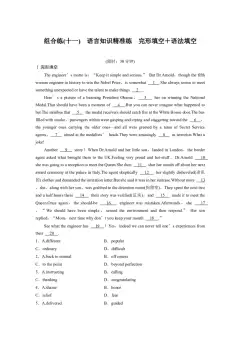
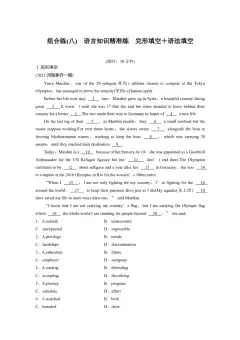
二、完形填空
The Roll of a Lifetime
Since the age of three, Chelsea Hill had dreamed of becoming
a dancer. That ambition 1 ended one night in 2010. Hill was in a
car accident that left her paralyzed (瘫痪的) from the waist down.
For most people, that would have 2 any hope of a dancing
career. For Hill, it was the beginning. Far from being an obstacle,
her wheelchair 3 her courage. She wanted to prove that she was
still “normal”, whatever normal meant.
Normal for her meant 4 , so Hill did it in her wheelchair right
alongside her nondisabled high school dance team. Half of her body
was taken 5 from her. It definitely took a lot of bumping (碰撞)
and patience.
After graduation, Hill wanted to 6 her dance network to 7
women like her. She met people online who had 8 various spinal
cord injuries (脊髓损伤) but shared her 9 , and she invited
them to dance with her.
Hoping to 10 more people in a larger city, Hill moved to Los
Angeles and formed a team of dancers with 11 she calls the
Rillettes. Dancing on 12 , the Rillettes discovered, can be justas fast-paced and fulfilling as the foot based variety. In disabled
dance competitions around the country, they’re having fun, and
as the audiences 13 reactions indicate, the fun is infectious.
Hill has 14 what many of us never will: Her childhood
dream. The Rillettes have helped her find something else just as
fulfilling. Every year she holds a dance 15 for wheelchair users
and in 2019, 173 participants from ten countries attended. For
many, being part of the Rillettes was really great. It was the first
time they’d felt they 16 . “I had a girl say it was the most
empowering thing when she 17 into a room and everyone was at
eye level,” Hill told CBS News.
The dancers aren’t the only ones feeling 18 . One woman saw
a YouTube video of the team competing and commented, “You
guys are so19 ! Im in tears when you rock! To be in a
wheelchair and 20 be so beautiful makes me know I can be
beautiful too!”
1. A. simply B. nearly C. suddenly D. really
2. A. approached B. abandoned C. raised D. ruined
3. A. proved B. offered C. created D. indicated
4. A. dream B. performance C. dancing D. teamwork
5. A. away B. in C. out D. off
6. A. design B. expand C. employ D. change
7. A. include B. contact C. protect D. cure
8. A. suffered B. lacked C. treated D. escaped
9. A. accomplishment B. identification
C. determination D. requirement
10. A. interview B. entertain C. educate D. reach
11. A. illnesses B. injuries C. pains D. disabilities
12. A. wheels B. chairs C. stages D. feet
13. A. immediate B. enthusiastic C. extreme D. distant
14. A. experienced B. applied
C. attained D. accumulated
15. A. camp B. club C. party D. show
16. A. lived B. succeeded C. appeared D. belonged
17. A. walked B. rolled C. rushed D. wandered
18. A. engaged B. determined C. inspired D. delighted19. A. talented B. amazing C. energetic D. special
20. A. just B. ever C. only D. still
三、填空
After college I wanted to make a difference in the world, so I
became a volunteer teacher and 1 (send) to Namibia.
Honestly, my first choice wasn’t Africa, but I am extremely
grateful that I had the chance. So with a group of 2 (equal)
eager young graduates, I went on my journey.
Schools were quite bare, and the students 3 ( have) tiring
days, walking miles to get to school often barefoot. With their
mountains 4 work at home, few possessions and little
opportunity, these 5 (child) were joyful, which I admired.
This 6 (be) my first time living abroad in a different
culture, simply getting used to the living conditions was 7 big
adjustment. I had no electricity, running water, phone or the
Internet. Imagine no air-conditioning at a place 8 the temperature
often goes beyond 38 degrees Celsius! Some days it was just too
hot to move.
However, I could end each day with a 9 (glory) African
sunset. And at night, I had a light-pollution-free view of the entire
Milky Way. Before Namibia, I never thought I would survive in
such an environment. My experience awakened me to not only the
limitations 10 (place) on ourselves, but also our amazing
ability to adapt. Stepping out of your comfort zone in another culture
will certainly make your life worthwhile.
1. 2. 3. 4.
5. 6. 7. 8.
9. 10.
答案
阅读理解
A: 1—3 CDB B: 4—7 DDDA
C: 8—11 CBBD D: 12—15 DCCA完形填空
1—5 BDBCA 6—10 BAACD
11—15 DABCA 16—20 DBCBD
语法填空
1.was sent 2.equally 3.had 4.of 5.children
6.being 7.a 8.where 9.glorious 10.placed