® YIWU JIAOYU JIAOKESHU
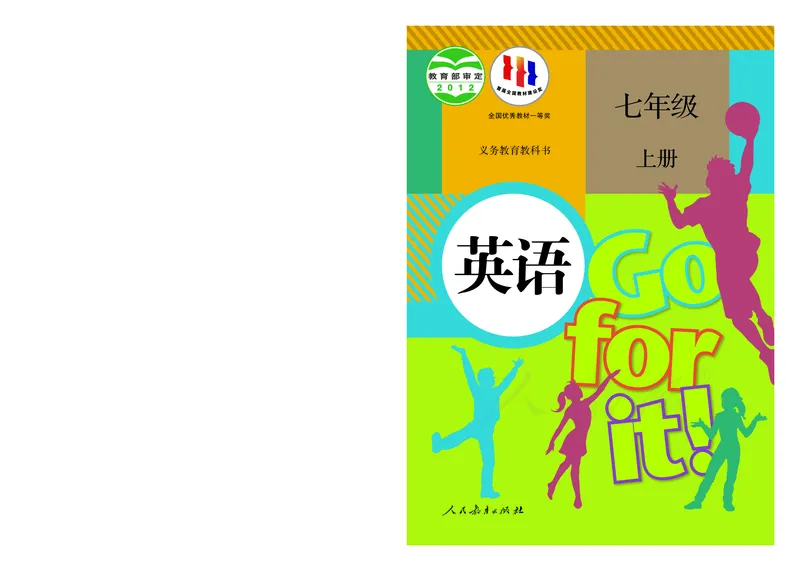
YINGYU 义
务
七年级
教
全国优秀教材一等奖
育
教
科
义务教育教科书
上册
书
英语 七年级 上册
英 oo
GG
英语
语
ffoo
rr
七
年
级
上
册
!!
tt
ii
绿绿色色印印刷刷产产品品
英英语语新新目目标标七七上上封封面面正正稿稿--改改书书脊脊 绿绿标标..iinndddd 11 22002222//77//2211 上上午午1100::3399义 务 教 育 教 科 书
英语
七年级
上册
(中国) 人民教育出版社 课程教材研究所
英语课程教材研究开发中心 编著
(美国) 圣 智 学 习 集 团
·北 京·Copyright © 2012 by People’s Education Press Ltd. and Cengage Learning Asia Pte Ltd.
No part of this publication may be reproduced or transmitted in any form or by any means,
without permission in writing from the publisher.
版权共有,未经出版社书面同意,任何人不得以任何形式或方式复制或转换本作品的任何部分。
主 编:刘道义 郑旺全
David Nunan
副主编:张献臣 张雅君
主要编写人员:张琳琳 陆锡钦 熊金霞 龚亚夫 李静纯 郭 娟 李 俏
周 斌 庄 力 Eden Brough Anthony Sheridan Hoi Kin Chiu
Andrew Robinson Guy de Villiers Edward Vickers
责任编辑:张琳琳
美术编辑:张 蓓
版面设计:马仕睿
插 图:严 峥(含封面) Edwin Ng Martha Friedman 陈 刚
义务教育教科书 英语 七年级 上册
(中国) 人民教育出版社 课程教材研究所
英语课程教材研究开发中心 编著
(美国) 圣 智 学 习 集 团
出 版
(北京市海淀区中关村南大街17号院1号楼 邮编:100081)
网 址 http://www.pep.com.cn
版权所有·未经许可不得采用任何方式擅自复制或使用本产品任何部分·违者必究
如发现内容质量问题,请登录中小学教材意见反馈平台:jcyjfk.pep.com.cn
如发现印、装质量问题,影响阅读,请与×××联系调换。电话:×××致同学
同学们,你们好!祝贺你们进入一个新的英语学习阶段!这套教材
将陪伴你们走过初中三年的英语学习历程,帮助你们实现更高的英语学
习目标。
这套教材是根据你们的心理特点、认知水平和兴趣爱好来编写的。
相信在今后的英语学习中,新教材的以下特点会引起你们的学习兴趣,
并对你们的英语学习有所帮助:
1. 新教材不仅要帮助你们学会一些英语语言知识,更重要的是要帮
助你们发展语言运用能力,让你们会用英语表达思想、与人交流。
2. 新教材充分考虑了你们的生活实际和学习需求,教材的内容和活
动都与你们的生活和兴趣紧密相连,目的是让你们在英语学习中不感到
枯燥乏味,做到有话可说、有话想说、有话能说。
3. 新教材不仅重视培养你们的语言能力,而且重视培养你们的学习
能力,包括自主学习能力和合作学习能力,这些能力会让你们终身受益。
4. 新教材为你们设计了许多具有交际意义的任务或活动,目的是让
你们在英语课堂上“活”起来、“动”起来。英语课堂教学需要你们的充
分参与,英语学习需要你们与老师合作、与同学交流。通过参与和互动,
你们的英语水平才会得到不断提高。
5. 学习语言和学习文化是密不可分的。因为语言是文化的载体,文化
是语言的灵魂。新教材为你们编写了大量的文化内容,包括我们的民族文
化、英语国家的文化和非英语国家的文化。通过文化内容的学习,你们的
视野会更开阔,思想会更丰富,思维会更活跃,交流会更得体。
要想学好英语,光靠课本是不够的,你们还需要接触更多的英语学习
资源。学习英语没有捷径,只有多听、多说、多读、多写、多记、多用才
是最有效的办法。因此,你们要充分利用各种资源和机会来学习英语。
同学们,加油吧!朝着你们的目标,Go for it! 祝你们英语学习取得
成功!
编者
2012年5月Contents
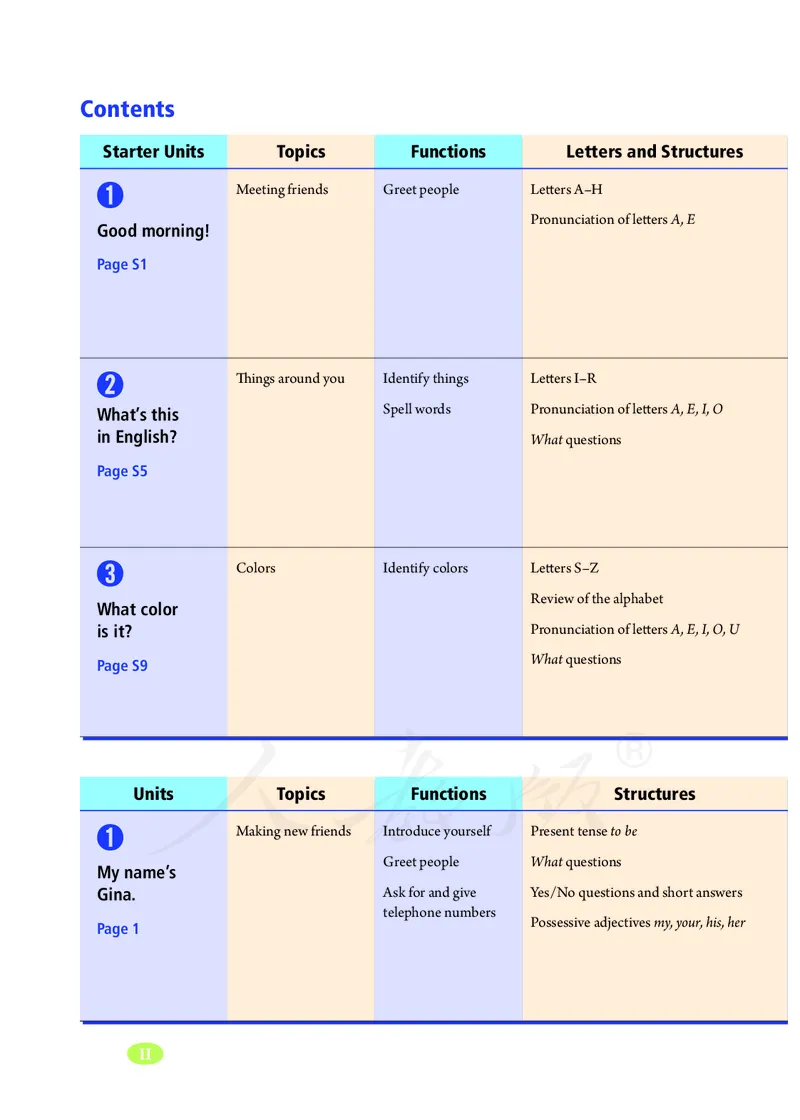
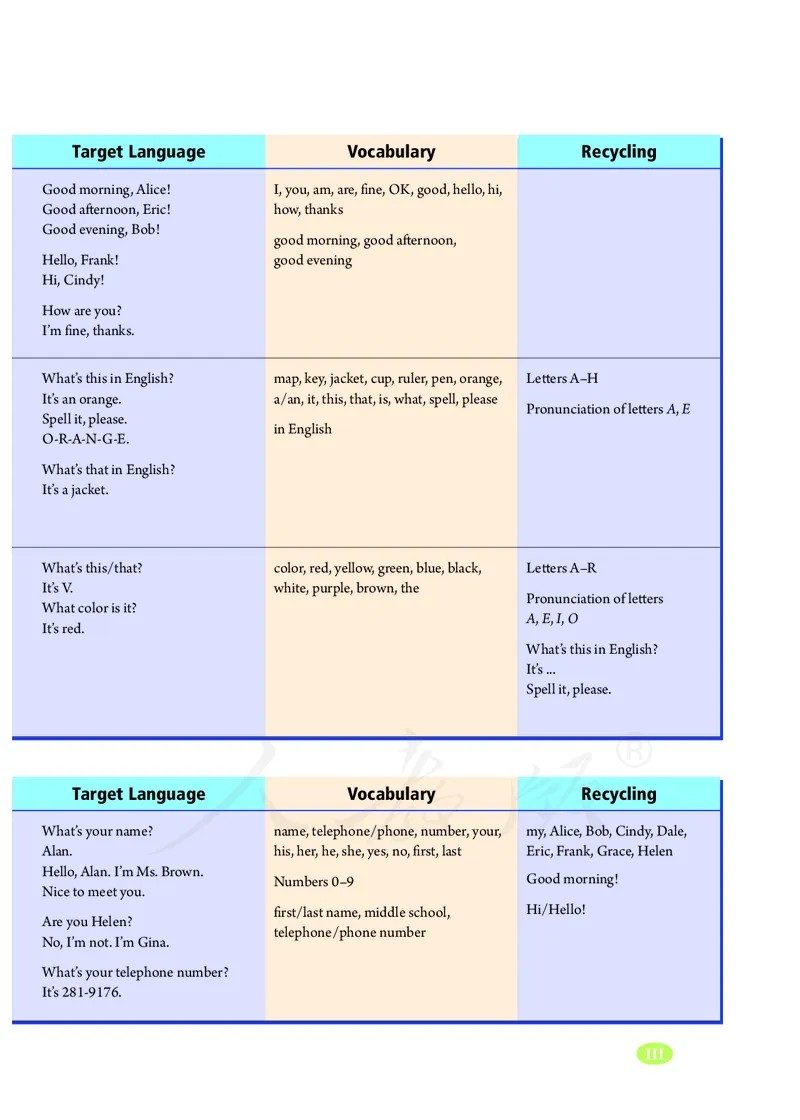
Starter Units Topics Functions Letters and Structures Target Language Vocabulary Recycling
➊
Meeting friends Greet people Lett ers A–H Good morning, Alice! I, you, am, are, fi ne, OK, good, hello, hi,
➊
Good aft ernoon, Eric! how, thanks
➋ Pronunciation of lett ers A, E
Good morning! Good evening, Bob!
good morning, good aft ernoon,
➌ Page S1 Hello, Frank! good evening
Hi, Cindy!
➍
How are you?
I’m fi ne, thanks.
➎
➏ Th ings around you Identify things Lett ers I–R What’s this in English? map, key, jacket, cup, ruler, pen, orange, Lett ers A–H
➋
It’s an orange. a/an, it, this, that, is, what, spell, please
➐ What’s this Spell words Pronunciation of lett ers A, E, I, O Spell it, please. Pronunciation of lett ers A, E
in English
in English? What questions O-R-A-N-G-E.
➑
Page S5 What’s that in English?
It’s a jacket.
➒
Colors Identify colors Lett ers S–Z What’s this/that? color, red, yellow, green, blue, black, Lett ers A–R
➌
It’s V. white, purple, brown, the
Review of the alphabet Pronunciation of lett ers
What color What color is it?
A, E, I, O
is it? Pronunciation of lett ers A, E, I, O, U It’s red.
What’s this in English?
What questions
Page S9
It’s ...
Spell it, please.
Units Topics Functions Structures Target Language Vocabulary Recycling
Making new friends Introduce yourself Present tense to be What’s your name? name, telephone/phone, number, your, my, Alice, Bob, Cindy, Dale,
➊
Alan. his, her, he, she, yes, no, fi rst, last Eric, Frank, Grace, Helen
Greet people What questions
My name’s Hello, Alan. I’m Ms. Brown.
Numbers 0–9 Good morning!
Gina. Ask for and give Yes/No questions and short answers Nice to meet you.
telephone numbers fi rst/last name, middle school, Hi/Hello!
Possessive adjectives my, your, his, her Are you Helen?
Page 1
telephone/phone number
No, I’m not. I’m Gina.
What’s your telephone number?
It’s 281-9176.
IIStarter Units Topics Functions Letters and Structures Target Language Vocabulary Recycling
Meeting friends Greet people Lett ers A–H Good morning, Alice! I, you, am, are, fi ne, OK, good, hello, hi,
➊
Good aft ernoon, Eric! how, thanks
Pronunciation of lett ers A, E
Good morning! Good evening, Bob!
good morning, good aft ernoon,
Page S1 Hello, Frank! good evening
Hi, Cindy!
How are you?
I’m fi ne, thanks.
Th ings around you Identify things Lett ers I–R What’s this in English? map, key, jacket, cup, ruler, pen, orange, Lett ers A–H
➋
It’s an orange. a/an, it, this, that, is, what, spell, please
What’s this Spell words Pronunciation of lett ers A, E, I, O Pronunciation of lett ers A, E
Spell it, please.
in English
in English? What questions O-R-A-N-G-E.
Page S5 What’s that in English?
It’s a jacket.
Colors Identify colors Lett ers S–Z What’s this/that? color, red, yellow, green, blue, black, Lett ers A–R
➌
It’s V. white, purple, brown, the
Review of the alphabet Pronunciation of lett ers
What color What color is it?
A, E, I, O
is it? Pronunciation of lett ers A, E, I, O, U It’s red.
What’s this in English?
What questions
Page S9
It’s ...
Spell it, please.
Units Topics Functions Structures Target Language Vocabulary Recycling
Making new friends Introduce yourself Present tense to be What’s your name? name, telephone/phone, number, your, my, Alice, Bob, Cindy, Dale,
➊
Alan. his, her, he, she, yes, no, fi rst, last Eric, Frank, Grace, Helen
Greet people What questions
My name’s Hello, Alan. I’m Ms. Brown.
Numbers 0–9 Good morning!
Gina. Ask for and give Yes/No questions and short answers Nice to meet you.
telephone numbers fi rst/last name, middle school, Hi/Hello!
Possessive adjectives my, your, his, her Are you Helen?
Page 1
telephone/phone number
No, I’m not. I’m Gina.
What’s your telephone number?
It’s 281-9176.
III
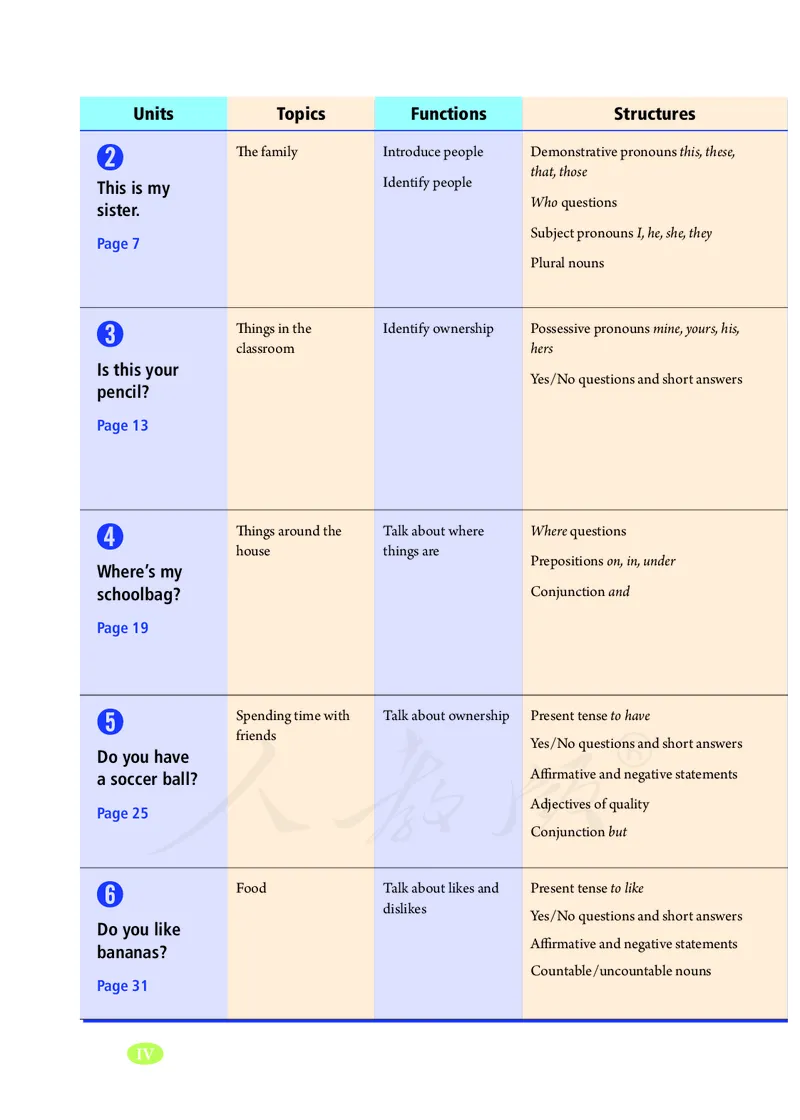
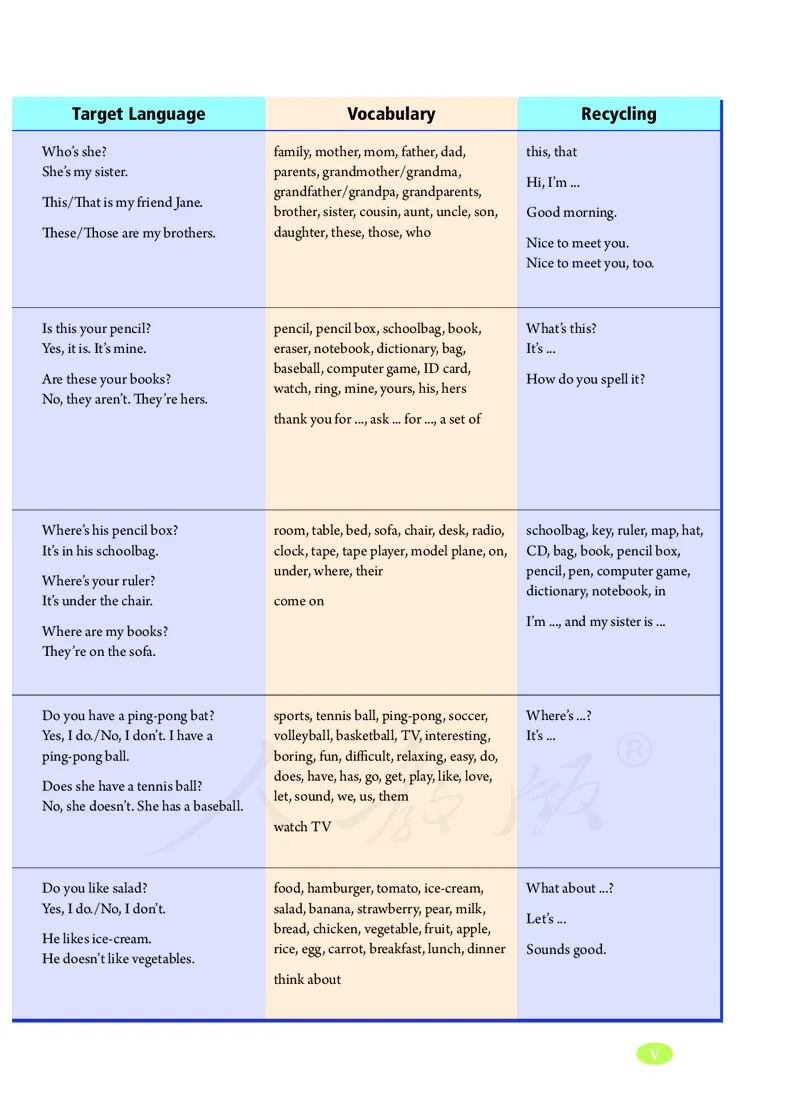
Page PBUnits Topics Functions Structures Target Language Vocabulary Recycling
Th e family Introduce people Demonstrative pronouns this, these, Who’s she? family, mother, mom, father, dad, this, that
➋
that, those She’s my sister. parents, grandmother/grandma,
This is my Identify people Hi, I’m ...
grandfather/grandpa, grandparents,
Who questions Th is/Th at is my friend Jane.
sister. brother, sister, cousin, aunt, uncle, son, Good morning.
Subject pronouns I, he, she, they Th ese/Th ose are my brothers. daughter, these, those, who
Page 7 Nice to meet you.
Plural nouns Nice to meet you, too.
Th ings in the Identify ownership Possessive pronouns mine, yours, his, Is this your pencil? pencil, pencil box, schoolbag, book, What’s this?
➌
classroom hers Yes, it is. It’s mine. eraser, notebook, dictionary, bag, It’s ...
Is this your baseball, computer game, ID card,
Yes/No questions and short answers Are these your books? How do you spell it?
pencil? watch, ring, mine, yours, his, hers
No, they aren’t. Th ey’re hers.
thank you for ..., ask ... for ..., a set of
Page 13
Th ings around the Talk about where Where questions Where’s his pencil box? room, table, bed, sofa, chair, desk, radio, schoolbag, key, ruler, map, hat,
➍
house things are It’s in his schoolbag. clock, tape, tape player, model plane, on, CD, bag, book, pencil box,
Prepositions on, in, under
Where’s my under, where, their pencil, pen, computer game,
Where’s your ruler?
schoolbag? Conjunction and dictionary, notebook, in
It’s under the chair. come on
I’m ..., and my sister is ...
Page 19
Where are my books?
Th ey’re on the sofa.
Spending time with Talk about ownership Present tense to have Do you have a ping-pong bat? sports, tennis ball, ping-pong, soccer, Where’s ...?
➎
friends Yes, I do./No, I don’t. I have a volleyball, basketball, TV, interesting, It’s ...
Yes/No questions and short answers
Do you have ping-pong ball. boring, fun, diffi cult, relaxing, easy, do,
a soccer ball? Affi rmative and negative statements does, have, has, go, get, play, like, love,
Does she have a tennis ball?
let, sound, we, us, them
Adjectives of quality No, she doesn’t. She has a baseball.
Page 25
watch TV
Conjunction but
Food Talk about likes and Present tense to like Do you like salad? food, hamburger, tomato, ice-cream, What about ...?
➏
dislikes Yes, I do./No, I don’t. salad, banana, strawberry, pear, milk,
Yes/No questions and short answers Let’s ...
Do you like bread, chicken, vegetable, fruit, apple,
He likes ice-cream.
Affi rmative and negative statements
bananas? rice, egg, carrot, breakfast, lunch, dinner Sounds good.
He doesn’t like vegetables.
Countable/uncountable nouns
think about
Page 31
IVUnits Topics Functions Structures Target Language Vocabulary Recycling
Th e family Introduce people Demonstrative pronouns this, these, Who’s she? family, mother, mom, father, dad, this, that
➋
that, those She’s my sister. parents, grandmother/grandma,
This is my Identify people Hi, I’m ...
grandfather/grandpa, grandparents,
Who questions Th is/Th at is my friend Jane.
sister. brother, sister, cousin, aunt, uncle, son, Good morning.
Subject pronouns I, he, she, they Th ese/Th ose are my brothers. daughter, these, those, who
Page 7 Nice to meet you.
Plural nouns Nice to meet you, too.
Th ings in the Identify ownership Possessive pronouns mine, yours, his, Is this your pencil? pencil, pencil box, schoolbag, book, What’s this?
➌
classroom hers Yes, it is. It’s mine. eraser, notebook, dictionary, bag, It’s ...
Is this your baseball, computer game, ID card,
Yes/No questions and short answers Are these your books? How do you spell it?
pencil? watch, ring, mine, yours, his, hers
No, they aren’t. Th ey’re hers.
thank you for ..., ask ... for ..., a set of
Page 13
Th ings around the Talk about where Where questions Where’s his pencil box? room, table, bed, sofa, chair, desk, radio, schoolbag, key, ruler, map, hat,
➍
house things are It’s in his schoolbag. clock, tape, tape player, model plane, on, CD, bag, book, pencil box,
Prepositions on, in, under
Where’s my under, where, their pencil, pen, computer game,
Where’s your ruler?
schoolbag? Conjunction and dictionary, notebook, in
It’s under the chair. come on
I’m ..., and my sister is ...
Page 19
Where are my books?
Th ey’re on the sofa.
Spending time with Talk about ownership Present tense to have Do you have a ping-pong bat? sports, tennis ball, ping-pong, soccer, Where’s ...?
➎
friends Yes, I do./No, I don’t. I have a volleyball, basketball, TV, interesting, It’s ...
Yes/No questions and short answers
Do you have ping-pong ball. boring, fun, diffi cult, relaxing, easy, do,
a soccer ball? Affi rmative and negative statements does, have, has, go, get, play, like, love,
Does she have a tennis ball?
let, sound, we, us, them
Adjectives of quality No, she doesn’t. She has a baseball.
Page 25
watch TV
Conjunction but
Food Talk about likes and Present tense to like Do you like salad? food, hamburger, tomato, ice-cream, What about ...?
➏
dislikes Yes, I do./No, I don’t. salad, banana, strawberry, pear, milk,
Yes/No questions and short answers Let’s ...
Do you like bread, chicken, vegetable, fruit, apple,
He likes ice-cream.
Affi rmative and negative statements
bananas? rice, egg, carrot, breakfast, lunch, dinner Sounds good.
He doesn’t like vegetables.
Countable/uncountable nouns
think about
Page 31
V
Page PBUnits Topics Functions Structures Target Language Vocabulary Recycling
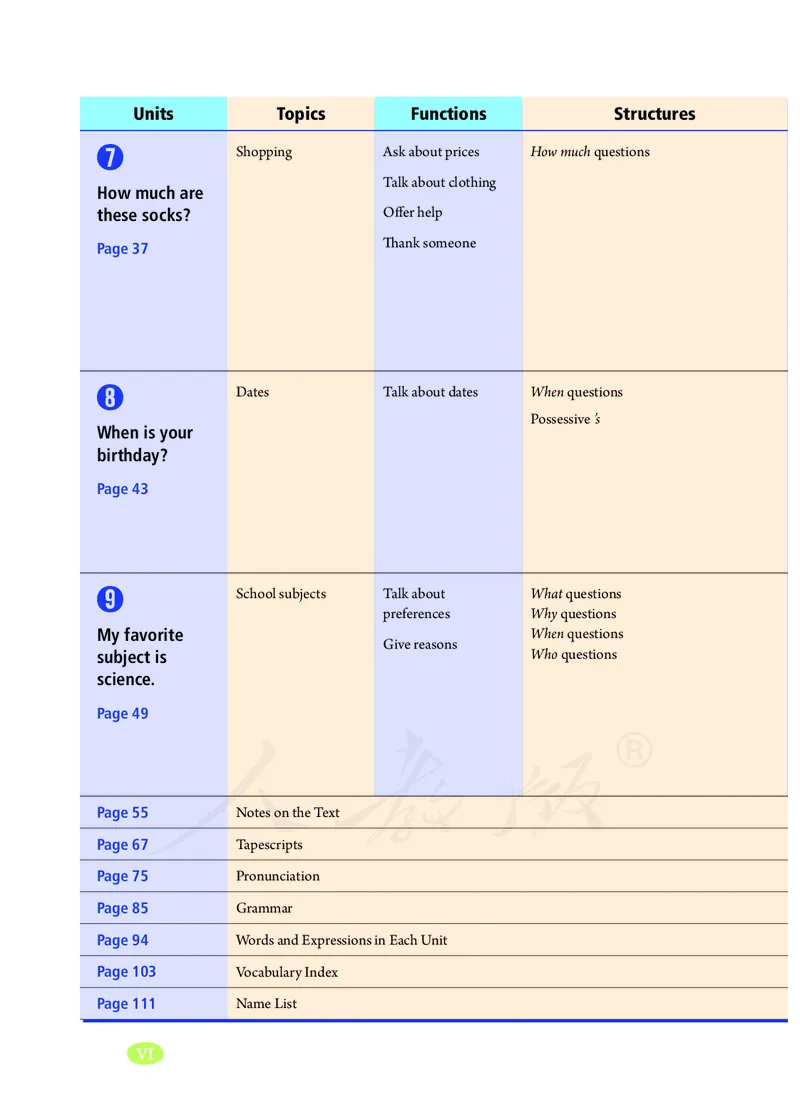
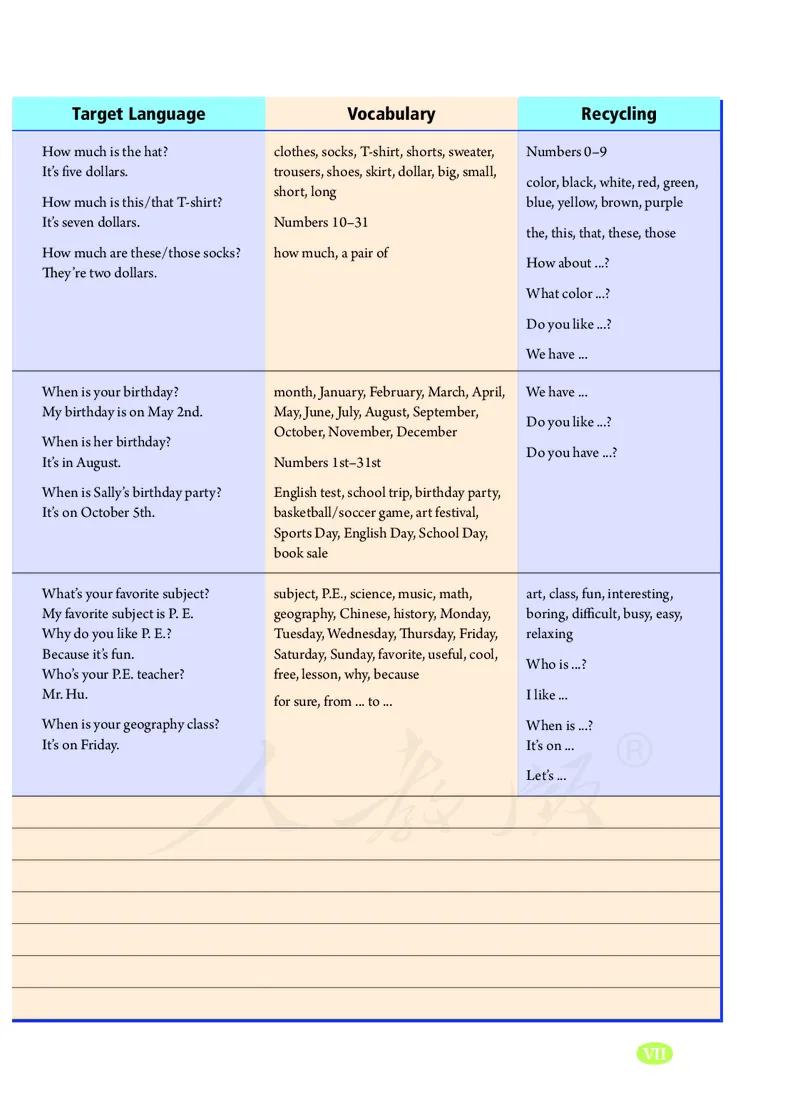
Shopping Ask about prices How much questions How much is the hat? clothes, socks, T-shirt, shorts, sweater, Numbers 0–9
➐
It’s fi ve dollars. trousers, shoes, skirt, dollar, big, small,
Talk about clothing color, black, white, red, green,
How much are short, long
How much is this/that T-shirt? blue, yellow, brown, purple
these socks? Off er help
It’s seven dollars. Numbers 10–31
the, this, that, these, those
Th ank someone
Page 37
How much are these/those socks? how much, a pair of
How about ...?
Th ey’re two dollars.
What color ...?
Do you like ...?
We have ...
Dates Talk about dates When questions When is your birthday? month, January, February, March, April, We have ...
➑
My birthday is on May 2nd. May, June, July, August, September,
Possessive ’s Do you like ...?
When is your October, November, December
When is her birthday?
birthday? Do you have ...?
It’s in August. Numbers 1st–31st
Page 43
When is Sally’s birthday party? English test, school trip, birthday party,
It’s on October 5th. basketball/soccer game, art festival,
Sports Day, English Day, School Day,
book sale
School subjects Talk about What questions What’s your favorite subject? subject, P.E., science, music, math, art, class, fun, interesting,
➒
preferences Why questions My favorite subject is P. E. geography, Chinese, history, Monday, boring, diffi cult, busy, easy,
My favorite When questions Why do you like P. E.? Tuesday, Wednesday, Th ursday, Friday, relaxing
Give reasons
subject is Who questions Because it’s fun. Saturday, Sunday, favorite, useful, cool,
Who is ...?
science. Who’s your P.E. teacher? free, lesson, why, because
Mr. Hu. I like ...
for sure, from ... to ...
Page 49
When is your geography class? When is ...?
It’s on Friday. It’s on ...
Let’s ...
Page 55 Notes on the Text
Page 67 Tapescripts
Page 75 Pronunciation
Page 85 Grammar
Page 94 Words and Expressions in Each Unit
Page 103 Vocabulary Index
Page 111 Name List
VVIIUnits Topics Functions Structures Target Language Vocabulary Recycling
Shopping Ask about prices How much questions How much is the hat? clothes, socks, T-shirt, shorts, sweater, Numbers 0–9
➐
It’s fi ve dollars. trousers, shoes, skirt, dollar, big, small,
Talk about clothing color, black, white, red, green,
How much are short, long
How much is this/that T-shirt? blue, yellow, brown, purple
these socks? Off er help
It’s seven dollars. Numbers 10–31
the, this, that, these, those
Th ank someone
Page 37
How much are these/those socks? how much, a pair of
How about ...?
Th ey’re two dollars.
What color ...?
Do you like ...?
We have ...
Dates Talk about dates When questions When is your birthday? month, January, February, March, April, We have ...
➑
My birthday is on May 2nd. May, June, July, August, September,
Possessive ’s Do you like ...?
When is your October, November, December
When is her birthday?
birthday? Do you have ...?
It’s in August. Numbers 1st–31st
Page 43
When is Sally’s birthday party? English test, school trip, birthday party,
It’s on October 5th. basketball/soccer game, art festival,
Sports Day, English Day, School Day,
book sale
School subjects Talk about What questions What’s your favorite subject? subject, P.E., science, music, math, art, class, fun, interesting,
➒
preferences Why questions My favorite subject is P. E. geography, Chinese, history, Monday, boring, diffi cult, busy, easy,
My favorite When questions Why do you like P. E.? Tuesday, Wednesday, Th ursday, Friday, relaxing
Give reasons
subject is Who questions Because it’s fun. Saturday, Sunday, favorite, useful, cool,
Who is ...?
science. Who’s your P.E. teacher? free, lesson, why, because
Mr. Hu. I like ...
for sure, from ... to ...
Page 49
When is your geography class? When is ...?
It’s on Friday. It’s on ...
Let’s ...
Page 55 Notes on the Text
Page 67 Tapescripts
Page 75 Pronunciation
Page 85 Grammar
Page 94 Words and Expressions in Each Unit
Page 103 Vocabulary Index
Page 111 Name List
VVIIII
Page PBS 1
TARTER UNIT
Good morning!
Language Goals: Letters A–H; Greet people
语言目标:字母 A-H;问候他人
1a
Write down the
names in the
picture.
Grace
写出图中人物的名字。
Boys’ names
Good morning,
Helen!
Hi, Bob!
Bob
Good morning,
Alice!
Good morning,
Dale
Cindy!
Helen
Girls’ names
Hello, Frank! Cindy
Hello, Eric!
Frank
Good morning, Alice
Dale!
Eric
1b Listen and repeat. 听录音并跟读。
1c Practice the conversations in the picture. Then greet your partner.
练习图中对话,然后问候同伴。
S1
Page PBSTARTER UNIT 1
2a Listen and repeat. 听录音并跟读。
A a B b C c D d E e F f G g H h
2b Listen and number the letters you hear [1–8].
听录音,根据所听到的顺序为字母编号。
h 1 a e g
d b c f
2c Look and copy. 观察并按笔画抄写下列字母。
1 2 2 1 1 1 2 2
1
1 1 1
3
1 2 1 2 1 1 1 2 1
3 2 1
3 1 3
2d Write the missing big letter or small letter for each pair.
补全每组所缺的大写或小写字母。
2e Talk about what these letters mean. 谈谈下列字母组合的含义。
HB CD BBC
S2Good morning! STARTER UNIT 1
3a Listen and number the pictures [1–3]. 听录音,为图片编号。
Good morning,
Good afternoon, Helen!
Eric!
Good afternoon, 1 Good morning,
Frank! Dale!
Good evening,
Bob!
Good evening,
Alice!
3b Practice the conversations in 3a with your partner. 与同伴练习 3a 中的对话。
3c Listen to the conversation. Th en
practice it with your partner.
Good afternoon,
Dale!
听对话并与同伴练习。
Hi, Cindy!
How are you?
I‛m fi ne, thanks. I‛m OK.
How are you?
3d Choose an English name for yourself.
A: Hi, Helen! How are you?
Th en greet each other. 为自己选一个英文名
B: Hi, Eric! I’m fi ne, thanks.
字,与同伴互相问候。
S3
Page PBSTARTER UNIT 1
4a Write the names of the children on page S1. Th en write the names in
alphabetical order. 从第一页中找出下列孩子的名字,按首
字母顺序列表。 Name List
Alice
Alice
4b Listen and repeat. 听录音并跟读。
A A H Dale Grace Frank thanks
E B C D E G evening F Helen
4c Read the lett ers and words in column 1. Th en try to read the new words
in column 2. 朗读第一栏的字母和单词,并试着读出第二栏的生词。
1 2
A H Dale Grace age
A
Frank thanks hand
B C D E G evening he
E
F Helen bed
4d Listen and sing the song. 听一听,唱一唱。
Good morning! Good afternoon! Good evening!
Good morning! Good afternoon! Good evening!
How are you? How are you? How are you?
I‛m fi ne, thanks. I‛m fi ne, thanks. I‛m fi ne, thanks.
How are you? How are you? How are you?
I‛m OK. I‛m OK. I‛m OK.
S4S 2
TARTER UNIT
What’s this in English?
Language Goals: Letters I–R; Identify things; Spell words
语言目标:字母 I-R;辨认物品;拼写单词
1a
Look for the
small letters in
map
the picture for
these big letters.
Check (✔) the
ones you find.
在图中找出下列大写字
key
母的小写,在找到的字
母后打钩。
jacket
A ✔ cup
What’s this quilt
in English?
B
C ruler
It’s an orange.
D
pen
E orange
F
What’s that
G
in English?
It’s a jacket.
H
1b Listen and repeat. 听录音并跟读。
1c Practice the conversation in the picture with your partner. Then make
your own conversations. 与同伴一起练习图中对话,然后编新对话。
S5
Page PBSTARTER UNIT 2
2a Listen and repeat. 听录音并跟读。
I i J j K k L l M m N n O o P p Q q R r
2b Listen and number the letters you hear [1–10].
听录音,根据所听到的顺序为字母编号。
l o q k 1 i
n p r m j
2c Look and copy. 观察并按笔画抄写下列字母。
1 1 1 2 1 1 1 1 2
2 2
2 1
1 1
3
2 3 1 2 1 2
1 1
1 1 2 1
1 1 1
2
2d Write the missing big letter or small letter for each pair.
补全每组所缺的大写或小写字母。
2e Talk about what these letters mean. 谈谈下列字母或字母组合的含义。
10kg
P NBA kg
S6What’s this in English? STARTER UNIT 2
3a Listen and number the pictures [1–8]. 听录音,为图片编号。
1
Beijing
a u e a a a ck t a y
a u t an r g a en a u
3b Listen and complete the words under the pictures in 3a.
听录音,补全 3a 中的单词。
What’s this It’s a map.
in English?
3c Listen to the conversation. Th en
practice it with your partner.
听对话,并与同伴练习。
M-A-P.
Spell it, please.
3d Listen to the conversations and number the words you hear [1–4].
听对话,根据所听到的顺序为单词编号。
1 key pen cup ruler
3e Talk about the things in the
picture. 与同伴谈谈图中的物品。
It’s an
What’s that
orange.
in English?
O-R-A-N-G-E.
Spell it,
please.
S7
Page PBSTARTER UNIT 2
4a Fill in the missing lett ers. 补全所缺字母。
B C E H I K L M O R
a b d f h i j l o p
4b Number the words in alphabetical order [1–15].
根据首字母顺序为单词编号。
( ) jacket ( 1 ) Alice ( ) map ( ) key ( ) orange
( ) Dale ( ) Helen ( ) Grace ( ) Cindy ( ) Bob
( ) pen ( ) Frank ( ) quilt ( ) Eric ( ) ruler
4c Listen and repeat. 听录音并跟读。
A A H J K Dale Grace Frank thanks jacket map
E B C D E G P evening F L M N Helen pen
I I hi fine quilt in
O O OK orange
4d Read the lett ers and words in column 1. Th en try to read the new words
in column 2. 朗读第一栏的字母和单词,并试着读出第二栏的生词。
1 2
A H J K Dale Grace name
A
Frank thanks jacket map can
B C D E G P evening he
E
F L M N Helen pen leg
I hi fine nice
I
quilt in milk
O OK go
O
orange dog
S8S 3
TARTER UNIT
What color is it?
Language Goals: Letters S–Z; Identify colors
语言目标:字母 S-Z;辨认颜色
1a
Look at the What‛s this? It‛s V.
picture. Write
the lett er for each
color. 看图写出与每种
颜色匹配的字母。
red V
What
color is it?
yellow
It‛s red.
green
blue
black
What‛s that?
white
purple It‛s Z.
brown
What color
is it? It‛s black.
1b Listen and repeat. 听录音并跟读。
1c Practice the conversations in the picture with your partner. Th en
make your own conversations. 与同伴一起练习图中对话,然后编新对话。
S9
Page PBSTARTER UNIT 3
2a Listen and repeat. 听录音并跟读。
S s T t U u V v W w X x Y y Z z
2b Listen and number the letters you hear [1–8].
听录音,根据所听到的顺序为字母编号。
t z v x
w y u 1 s
2c Look and copy. 观察并按笔画抄写下列字母。
1 1 1 2
1 2 1 2 1
1 1
1
1 1 2 1 2 1
1
1 2
1
2d Write the missing big letter or small letter for each pair.
补全每组所缺的大写或小写字母。
2e Talk about what these letters mean. 谈谈下列字母或字母组合的含义。
S/M/L UFO CCTV
S10What color is it? STARTER UNIT 3
3a Listen and color the things. 听录音,为下列物品涂色。
3b Listen again. Complete the sentences. 再听一遍录音并完成句子。
1. Th e key is yellow .
2. Th e ruler is .
3. Th e cup is .
3c Listen and complete the chart. 听录音,完成表格。
Thing Color
3d Make conversations using
A: What’s this in English?
the things in 3a–3c. 用 3a-3c
B: It’s a key.
中的物品编对话。
A: Spell it, please.
B: K-E-Y.
A: What color is it?
B: It’s yellow.
S11
Page PBSTARTER UNIT 3
4a Find the lett ers from A to Z. Write the small lett er next to each big lett er.
找出字母 A 到 Z, 并在每个大写字母旁写出对应的小写字母。
Q W E R T Y U I O P { } |
[ ] \
A S D F G H J K L : “
; ‘
Z X C V B N M < > ?
, . /
4b Listen and sing the alphabet song. 听唱字母歌。
A, B, C, D, E, F, G, U, V, W, X, Y, Z.
H, I, J, K, L, M, N, X, Y, Z — now you see,
O, P, Q, R, S, T, I can say my ABCs.
4c Listen and repeat. 听录音并跟读。
A A H J K Dale Grace Frank thanks jacket map black
F L M N S X (Z)
E B C D E G P T V Z evening
Helen pen red yellow
I I Y hi fine white quilt in
O O OK no orange
Q U W
U cup
ruler blue
4d Listen and read the chant. 听一听,唱一唱。
AA,, EE,, II,, OO,, UU.. AA,, EE,, II,, OO,, UU.. AA,, EE,, II,, OO,, UU..
AA,, EE,, II,, OO,, UU.. AA,, EE,, II,, OO,, UU.. AA,, EE,, II,, OO,, UU..
AA iinn DDaallee,, AA iinn GGrraaccee,,
EE iinn eevveenniinngg,, EE iinn ggrreeeenn,,
II iinn hhii,, II iinn wwhhiittee,,
OO iinn OOKK,, OO iinn nnoo,,
UU iinn rruulleerr.. UU iinn bblluuee..
S12U 1
NIT
My name’s Gina.
Language Goals: Introduce yourself; Greet people; Ask for
and give telephone numbers
1a
语言目标:介绍自己;问候他人;询问和告知电话号码
Write English
Hi. My name’s I’m Jenny. Nice
words for the
Gina. to meet you!
things in the
picture. 写出图中 Nice to meet
you, too.
物品的英文名称。
Good morning! Hello, Cindy!
I’m Cindy. I’m Dale.
What’s your
name?
Alan.
Hello, Alan.
I’m Ms. Brown. Nice to
meet you!
1b Listen and number the conversations [1–3]. 听录音,为对话编号。
A: What’s your name? A: Good morning! A: Hi. My name’s Gina.
B: Alan. I’m Cindy. B: I’m Jenny. Nice to
A: Hello, Alan. I’m Ms. B: Hello, Cindy! I’m meet you!
Brown. Dale. A: Nice to meet you,
A: Nice to meet you! too.
1c Practice the conversations above with your partner. Then greet your
classmates. 与同伴一起练习上面的对话,然后问候你的同学。
1
Page PBUNIT 1
2a Listen to the conversations and number the pictures [1–4].
听对话,为图片编号。
1
2b Listen again. Circle the names you hear. 再听一遍录音,圈出所听到的名字。
Eric Tom Alice Bob Mike Jack Mary Ms. Miller
2c Practice the conversations in pairs. 两人一组练习下面的对话。
A: Hello! What’s your name? A: What’s his name?
B: My name’s ... B: His name’s ...
A: I’m ... A: And what’s her name?
B: Nice to meet you! B: Her name’s ...
2d Role-play the conversation. 分角色表演对话。
Linda: Good aft ernoon! My name’s Linda.
Are you Helen?
Helen: Yes, I am. Nice to meet you, Linda.
Linda: Nice to meet you, too. What’s her
name?
Helen: She’s Jane.
Linda: Is he Jack?
Helen: No, he isn’t. His name’s Mike.
2My name’s Gina. UNIT 1
Grammar
Focus
What’s your name? Alan./I’m Alan./My name’s Alan.
What’s his name? He’s Eric./His name’s Eric.
What’s her name? She’s Mary./Her name’s Mary.
Is he Jack? Yes, he is./No, he isn’t. His name’s Mike.
Are you Helen? Yes, I am./No, I’m not. I’m Gina.
what’s = what is name’s = name is I’m = I am
he’s = he is she’s = she is
3a Put the words in order to make conversations. Th en practice them.
调整词序,组成对话并练习。
1. your name What’s 2. name his What’s 3. Mike you Are
Cindy I’m Bob He’s am I Yes
3b Complete the conversation and practice it with your partner.
补全对话并与同伴练习。
A: Hi, your name?
B: My Gina. you Tom?
A: , I’m not. Bob.
B: Hi, . to meet you.
A: Nice to you, too.
3c Practice introducing yourself and others in a group. How many names
can you remember? 分小组练习介绍自己和他人。你能记住多少个名字?
His name’s His name’s Dale.
Dale. My name’s Her name’s Linda.
Linda. My name’s Frank.
My name’s
Dale.
His name’s Dale.
Her name’s Linda.
His name’s Frank.
My name’s Grace.
3
Page PBUNIT 1
1a Listen and repeat. 听录音并跟读。
Section
B 0 zero 2 two 4 four 6 six 8 eight
1 one 3 three 5 five 7 seven 9 nine
1b Listen to the conversation and write the telephone number.
听对话,写出电话号码。
What’s your
telephone number,
Li Xin?
1c Ask for and give your phone numbers.
与同伴练习询问和告知电话号码。
It’s
281-9176.
1d Listen and match the names with the telephone numbers.
听录音,将名字和电话号码配对。
1. Tom c a. 929-31
2. Linda b. 398-61
3. Bob c. 278-79
4. Mary d. 555-80
1e Listen again. Complete the phone numbers in 1d.
再听一遍录音,补全上面的电话号码。
1f Write your phone number on a piece of paper and put it in a bag. Then
take out a piece of paper and find the owner. 将你的电话号码写在纸条上放入袋
中,然后任意取出一张纸条,找出号码的主人。
What’s your
phone number?
It’s
587-6275.
Is this
your number?
4My name’s Gina. UNIT 1
2a Read the list of names. Write F for first name and L for last name.
阅读下面的姓名,在名字后写 F,在姓氏后写 L。
What’s
your first What’s
name? your last
1. Alan 6. Jack F name?
2. Green 7. Smith L
Jack. Smith.
3. Miller 8. Brown
4. Mingming 9. Zhang
5. Gina 10. Mary
2b Read the messages and match them with the pictures. Circle the first
names and underline the last names.
阅读以下信息,并与图片配对。然后在名字上画圈,在姓氏下画线。
A. B. C.
1. My name is Jenny Green. My phone number is 281-9176. My friend is
Gina Smith. Her phone number is 232-4672.
2. I’m Dale Miller and my friend is Eric Brown. His telephone number is
357-5689. My telephone number is 358-6344.
3. My name is Mary Brown. My friend is in China. Her name is Zhang
Mingming. My phone number is 257-8900 and her number is 929-3155.
2c Match the names with the telephone numbers. Then find three pairs of
friends in the name list. 将姓名与电话号码配对,然后找出文中的三对朋友。
Names Telephone numbers
Eric Brown 358-6344
Friends
Gina Smith 929-3155
1. and
Dale Miller 281-9176
2. and
Zhang Mingming 257-8900
3. and
Jenny Green 357-5689
Mary Brown 232-4672
5
Page PBUNIT 1
3a Use the information on the ID card to complete the sentences.
用学生卡上的信息完成句子。
Her fi rst name is
PEP Middle School .
First Name:
Alice
Her last name is
Last Name:
Green
.
Phone Number:
951-3397
Her phone number is
.
3b Fill in your own ID card and write about yourself.
填写你的学生卡并写几句话介绍自己。
My fi rst name
First Name:
Last Name:
Phone Number:
Self Check
1 Write out the numbers. 写出正确的号码。
120 one two zero 10086
114 12315
119 17951
2 Match the sentences to make conversations. 将句子配对,组成对话。
1. Hello. I’m Cindy. A. I’m Chen Kang.
2. What’s your name? B. It’s 876-9548.
3. Hello. I’m Grace. C. Nice to meet you, Cindy.
4. My name’s Eric. D. Nice to meet you, Eric. I’m Bill.
5. What’s his telephone number? E. Hi, Grace. I’m Alice.
6U 2
NIT
Section
A This is my sister.
Language Goals: Introduce people; Identify people
语言目标:介绍他人;辨认人物
1a
b
Match the words c d
with the people in
the picture.
e
a
将单词与图中人物配对。
f
1. mother a
2. father
3. parents
4. brothers g
That’s my family.
Those are my parents.
5. grandmother
h
Who’s she?
6. grandfather
7. friend
8. grandparents
9. sister
i
She’s my sister.
Oh, and these are
my brothers.
1b Listen and circle the words you hear in 1a. 听录音,在 1a 中圈出所听到的单词。
1c Role-play the conversation in 1a. Then talk about the other people in
the picture. 分角色表演 1a 中的对话,然后谈论图中的其他人物。
A: That’s my family. Those are my parents.
B: Who’s she?
A: She’s my sister. Oh, and these are my brothers.
7
Page PBUNIT 2
2a Listen and circle the words you hear. 听录音,圈出所听到的单词。
parents mother father sister brother
grandmother grandfather friend grandparents
2b Listen again. Match the names with the people in the picture.
再听一遍录音,将名字与图中人物配对。
a
d
e
1. Jenny d 4. Bob
b f
2. Jack 5. Linda
3. Tom 6. Mary
c
Who’s she? She’s Cindy.
2c Ask and answer questions about the
photo in 2b. 根据 2b 照片中人物进行问答。
Who’s he? He’s her father.
2d Role-play the conversation. 分角色表演对话。
Sally: Good morning, Jane.
Jane: Good morning, Sally.
Sally: Oh, Jane, this is my sister Kate.
Kate, this is my friend Jane.
Kate: Nice to meet you, Jane.
Jane: Nice to meet you, too. Are those
your parents?
Kate: Yes, they are.
Jane: And who’s he?
Sally: He’s my brother, Paul.
Jane: Oh, I see. Well, have a good day!
Sally/Kate: Th anks! You, too. Bye!
8This is my sister. UNIT 2
Grammar
Focus
This is my friend Jane. That’s my grandfather.
These are my brothers. Those are my parents.
Who’s she? She’s my sister.
Who’s he? He’s my brother.
Who’re they? They’re my grandparents.
that’s = that is who’re = who are who’s = who is they’re = they are
3a Complete the conversation and practice it with your partner.
补全对话并与同伴练习。
A: Th at my family. Th at’s my mother.
B: he?
A: my father.
B: Who’s ?
A: She’s sister.
B: And they?
A: my grandparents.
3b Look at the picture. Make sentences with
the words in the three boxes.
看图,从方框中选词造句。
this father mother
that my grandfather grandmother
these your parents grandparents
those brother sister
3c Bring some family photos to class. Take turns to ask and answer questions
about the photos. 带几张家庭照片,课上与同伴轮流谈论照片中的人物。
Who’s she?
She’s my
grandmother.
9
Page PBUNIT 2
1a Add the words in the box to the family tree.
Section
用方框中的单词补全家庭关系图。
B
sister son cousin grandpa mom aunt
grandpa grandma
dad uncle
daughter daughter
( ) ( bro th er) (( ))
1b Listen and check (✔) the words you hear. 听录音,在所听到的单词后打钩。
grandpa grandma cousin dad mom
uncle aunt ✔ brother sister friends
1c Listen again. Which picture are Jiang Tao and Tom talking about?
再听一遍录音,找出姜涛和汤姆谈论的照片。
Picture 1 Picture 2
1d Draw a picture of your family These are my
parents and this is
and friends. Tell your partner
my grandma. This is
about your picture. 画一张你家人 my friend, Lin Fang.
和朋友的图片,并向同伴介绍他们。
10This is my sister. UNIT 2
2a Find the male and female fi rst names in this unit and write them.
找出本单元出现的男、女人名,并分别写下来。
Male Female
2b Read about Jenny’s family and circle the names.
阅读珍妮一家的简介,圈出文中人名。
My Family
Hi, I’m Jenny. Here are two nice
photos of my family. My grandfather
and grandmother are in the fi rst photo.
Th ese are my parents, Alan and Mary.
In the next picture are my brothers,
Bob and Eric. Th ese two girls are my
sister Cindy and my cousin Helen.
Coco is in my family, too.
2c Read the passage again and complete the sentences. 再读一遍短文,并完成句子。
1. My name is .
2. Alan and Mary are my .
3. Bob and Eric are my .
4. Cindy is my .
5. Helen is my .
6. is the name of my dog.
11
Page PBUNIT 2
3a Complete the passage with the words in the box. Th en draw a picture of
Paul’s family. 选词补全短文,然后画一张保罗的全家福。
brothers parents Cindy family
Hi. My name is Paul. Th is is a
photo of my . Th ese are
my and these are my
, John and Bob. Th is is
my sister .
3b Bring a family photo to class and write about it. Th en tell a classmate
about your family. 带一张家庭照片,课上根据照片写一段介绍,然后给同学讲一讲。
Hi. I am . Here is a photo of my family. Th ese are
Self Check
1 Group the words for family members you have learned.
将所学的家庭成员名称分类。
Male Both Female
father parent
2 Complete the conversation. 完成对话。
Bill: Here’s a photo of my family.
Dale: he?
Bill: my uncle.
Dale: this girl?
Bill: my cousin.
Dale: Are your parents?
Bill: Yes, are. And these my grandparents.
12U 3
NIT
Section
A Is this your pencil?
Language Goal: Identify ownership
语言目标:确认物品所属关系
1a
Match the words Is that your No, it isn’t.
schoolbag? It’s his.
with the things in
the picture.
将单词与图中物品配对。 d
1. pencil e
c
2. pen
3. books Yes, it is.
a e
Is this It’s mine.
4. eraser your pencil?
5. ruler
Are these No, they aren’t.
6. pencil box
your books? They’re hers.
7. schoolbag
f
8. dictionary b
g
h
1b Listen and number the conversations [1–3]. 听录音,为对话编号。
A: Is this your pencil? A: Is that your A: Are these your books?
B: Yes, it is. It’s mine. schoolbag? B: No, they aren’t.
B: No, it isn’t. It’s his. They’re hers.
1c Practice the conversations above with your partner. Then make your
own conversations. 与同伴一起练习上面的对话,然后编新对话。
13
Page PBUNIT 3
2a Listen and check (✔) the
things you hear.
听录音,将所听到的物品打钩。
✔
2b Listen again. Complete the conversation with the words in the box.
再听一遍录音,选词补全对话。
erasers pencil ruler pencil box books
Tom: Excuse me, Grace. Is this your pencil ?
Grace: Yes, thank you. And those are my
.
Tom: And Jane, is this your ?
Jane: No, it isn’t. It’s hers.
Tom: OK, and these are my . Th is is
your , Jane.
Is this
2c Practice the conversation in 2b. Th en make
your
your own conversations using the things in schoolbag?
your classroom. 练习2b中的对话,然后用教室里的
物品编新对话。
No, it isn‛t.
2d Role-play the conversation. 分角色表演对话。
Teacher: Hi, Anna. Are these your pencils?
Anna: No, they’re Bob’s.
Teacher: And is this his green pen?
Anna: No, it isn’t. Th e blue pen is his.
Teacher: What about this dictionary?
Anna: It’s Helen’s. And the green pen is
hers, too.
Teacher: And the eraser? Is that yours?
Anna: Yes, it is.
Teacher: Th ank you for your help, Anna.
Anna: You’re welcome.
14Is this your pencil? UNIT 3
Grammar
Focus
Is this your pencil? Yes, it is. It’s mine./No, it isn’t. It’s hers.
Is this his green pen? Yes, it is./No, it isn’t. The blue pen is his.
Is that your schoolbag? Yes, it is./No, it isn’t. It’s his.
Are these your books? Yes, they are./No, they aren’t. They’re hers.
Are those her keys? Yes, they are./No, they aren’t. They’re mine.
it’s = it is isn’t = is not aren’t = are not
3a Complete the questions and answers about each picture.
根据图片补全问句和答语。
Yes, it is.
Is your book?
No, it .
Yes, are.
Are my pencils?
No, they aren’t.
Yes, it .
Is his ruler?
No, it isn’t.
Yes, they are.
Are her pens?
No, they .
3b Read the questions and complete the answers. 阅读问句并补全答语。
1. Is this her ruler? Yes, . It’s .
2. Is that Eric’s schoolbag? No, . Sally’s.
3. Are these his pencils? Yes, . Th ey’re .
4. Are those Anna’s books? No, . mine.
3c Put some things into the teacher’s box. Th en take one thing out of the
box and fi nd the owner. You only have two guesses! 在老师的盒子里放一些物
品,然后取出一件物品并找到物品的主人。你只可以猜两次!
Is this
your eraser?
No, it isn’t.
15
Page PBUNIT 3
1a Match the words with the things in the picture.
Section
将下列单词与图中物品配对。
B
1. baseball e 4. ID card 7. ring
2. watch 5. key 8. pen
3. computer game 6. notebook 9. bag
f h i
c
a
d
b e g
A: What’s this?
B: It’s a watch.
1b Ask and answer questions about the things
A: How do you spell it?
in the picture above. 就上图中物品与同伴问答。
B: W-A-T-C-H.
1c Listen and circle the things you hear in 1a.
听录音,在 1a 中圈出所听到的物品。
1d Listen again. Write the things that belong to Linda or Mike.
再听一遍录音,写出属于琳达或迈克的物品。
watch
Linda Mike
1e Student A is Linda and Student B is Mike. Make conversations about
the things in 1d. Th en change roles. 学生 A 扮演琳达,学生 B 扮演迈克,用 1d 中
的物品编对话,然后交换角色。
16Is this your pencil? UNIT 3
2a Write the things you lose easily. 写出你常丢失的物品。
2b Read the notices on the board and circle the lost things.
阅读公告栏启事,圈出丢失的物品。
Lin Hai,
A computer game is in
Found:
the school library. Is it
Some keys are in Classroom
yours? Ask the teacher
7
E. Are they yours? E-mail me
for it.
at maryg2@gfi mail.com.
MMiikkee
Is this your watch?
My phone number is
Lost:
495-3539. Call me.
I lost my school ID card.
JJoohhnn
I must fi nd it. Call me
at 685-6034. Thanks.
Tom
2c Read the notices again and write down the items. Th en check (✔) Lost
or Found. 再读一遍启事,写出丢失的物品,并在 Lost 或 Found 下打钩。
Item Lost Found
17
Page PBUNIT 3
3a Complete the notices with the words or phone number in the box.
选择正确的单词或号码补全信息。
name yours found 284-5486 lost call
: My notebook
: A set of keys
My is David.
Are these ?
Please me at
Call Jenny at .
679-8871.
3b Write your own lost or found notice with your name and phone number.
写一则你自己的寻物启事或失物招领启事,加上你的名字和电话号码。
Self Check
1 Write the school things you know. 写出你知道的学习用品。
pen, ruler,
2 Complete the chart with pronouns. 用代词填表。
I me my mine
you yours
her hers
he him
3 Look at the picture and write conversations. 看图写对话。
1 A: Is that your schoolbag?
B: No, it isn’t.
2 A:
B:
3 A:
B:
4 A:
B:
1 2 3 4
18U 4
NIT
Section
A Where’s my schoolbag?
Language Goal: Talk about where things are
语言目标:谈论物品的位置
1a
Where are my books? They’re on h
Match the words the sofa.
Where’s my pencil box?
with the things in It’s in your
schoolbag.
the picture.
Where’s my computer game?
将单词与图中物品配对。
1. table b
2. bed
f
g
1
3. bookcase
4. sofa
It’s under
5. chair
your bed.
c
6. schoolbag
7. books
d
b
8. keys e
a
1b Listen and number the things in the picture [1–4]. 听录音,为图中物品编号。
1c Practice the conversation in 1a with your partner. Th en make your own
conversations using the words in the box. 与同伴一起练习 1a 中的对话,然后用
方框中的单词编新对话。
A: Where’s the schoolbag?
on in under
B: It’s under the table.
19
Page PBUNIT 4
2a Listen and number the things [1–6]. 听录音,为物品编号。
1
1
2b Listen again. Find the things
from 2a and number them in the
picture [1–6].
再听一遍录音,找出 2a 中的物品并编号。
2c Ask and answer questions about the things in the picture in 2b.
就 2b 图中物品的位置与同伴问答。
A: Are the keys on the sofa?
B: No, they aren’t. Th ey’re on the table.
2d Role-play the conversation. 分角色表演对话。
Mom: Come on, Jack!
Jack: Oh, no! Where’s my bag?
Mom: Hmm ... is it on your desk?
Jack: No. And it’s not under the chair.
Mom: Oh! It’s on the sofa.
Jack: Th ank you, Mom. Err ... where’s the map?
Mom: I think it’s in your grandparents’ room.
Jack: Yes, it’s on their bed! And my hat?
Mom: It’s on your head!
Jack: Oh, yeah! Haha!
20Where’s my schoolbag? UNIT 4
Grammar Where’s = Where is
Focus
Where’s the map? It’s in your grandparents’ room.
Where are my books? They’re on the sofa.
Where’s his pencil box? It’s in his schoolbag.
Where’s your ruler? It’s under the chair.
Where are their keys? They’re on the table.
3a Look at the pictures and complete the conversations. 看图补全对话。
1 2 3
A: Where the A: Where’s the ? A: Where the
keys? it on your pencils?
B: Th ey’re the desk? B: I don’t know.
. B: No, it’s the they in the ?
chair. A: Yes, they are.
3b Ask and answer
questions about the
things on the right.
就右图中物品与同伴问答。
3c Student A, look at the picture
on page 19. Student B, look at
the picture on the right. Ask
and answer questions to fi nd the
diff erences. 学生 A 看第十九页的图,
学生 B 看右图,通过问答找出不同之处。
A: Where’s the schoolbag? Is it
under the table?
B: No, it isn’t. It’s on the table.
21
Page PBUNIT 4
1a Match the words with the things in the picture.
Section
将单词与图中物品配对。
B
1. radio a 3. tape player 5. tape
2. clock 4. model plane 6. hat
d
c
a
e
b f
1b Look at the picture in 1a for three minutes. Then close your books and
write down all the things you remember.
看 1a 中的图片 3 分钟,然后合上书,写出你记住的物品。
1c Listen and circle the things Tom wants from his room.
听录音,圈出房间里汤姆想要的物品。
English books tape player clock ruler
notebook tape model plane radio
1d Listen again. Where are Tom’s things? Write them down.
再听一遍录音,汤姆的物品在哪里?记录下来。
The English books are under the radio.
Where are the
1e Ask and answer questions about the English books?
things in Tom’s room.
根据汤姆房间里物品的位置进行问答。
They’re
under the radio.
22Where’s my schoolbag? UNIT 4
2a Write the words you know for
the things in the picture.
写出图中你知道的物品名称。
2b Read the passage and answer the questions: Is Kate tidy? Is Gina tidy?
阅读短文并回答问题:Is Kate tidy? Is Gina tidy?
I’m Kate, and my sister is plane is hers. It’s under the
Gina. I’m tidy, but Gina desk. “Where are my keys?
is not. In our room, my Where’s my ruler? Where’s
books and tapes are in the my schoolbag?” Gina always
bookcase. My keys are in my asks.
schoolbag. I have a clock. It’s
on the desk. Gina’s books
are everywhere — on her
bed, on the sofa and under
the chair. Th e white model
2c Complete the chart about the things Kate and Gina have and where
they are. 根据凯特和吉娜拥有的物品及其位置完成表格。
Kate Gina
Things Where Things Where
books and tapes in the bookcase
23
Page PBUNIT 4
3a Do you have these things? Where are they?
你有这些物品吗?通常你把它们放在哪里?
What Yes/No Where
a dictionary yes on my desk
a schoolbag
a pencil box
a radio
books
pens
tapes
CDs
3b Write about where the things are in your room. Use the word and if you
can. 写出你房间里物品的位置,尝试在句中使用 and。
1. My dictionary and my radio are on the desk.
2. My pencil box is in my schoolbag and my schoolbag is under the desk.
Self Check
1 Write the things in your room. 写出你房间里的物品。
Furniture (家具): desk,
Stationery (文具): pencil,
Other (其他):
2 Write about the things in your classroom with in, on and under.
用 in,on 和 under 写出教室里物品的位置。
The tape player is on the teacher’s desk.
24U 5
NIT
Section
A Do you have a soccer ball?
Language Goal: Talk about ownership
语言目标:谈论物品所属关系
1a
Match the words Do you have a a
with the things in ping-pong bat? Yes, I do.
the picture.
b
将单词与图中物品配对。 Do you have a
c
ping-pong ball?
No, I don’t.
1. tennis ball a
2. ping-pong bat d
e
3. soccer ball
4. volleyball
5. basketball
6. baseball bat
f
1b Listen and circle the words you hear. 听录音,圈出所听到的单词。
ping-pong bat soccer ball volleyball ping-pong ball
1c Practice the conversation with your partner. Then ask and answer
questions about the things in the picture above. 与同伴一起练习下面的对话,
然后就上图中物品进行问答。
A: Do you have a ping-pong bat?
B: Yes, I do.
A: Do you have a ping-pong ball?
B: No, I don’t.
25
Page PBUNIT 5
2a Listen to the conversations and number the pictures [1–4].
听对话,为图片编号。
Jane Dale
Paul Mike
1
2b Listen again. Match the pictures in 2a with the balls.
再听一遍录音,将 2a 中图片与下面几种球配对。
1
Does Jane have
a tennis ball?
2c Ask and answer questions about the
people in 2a. 就 2a 中人物与同伴问答。
No, she
doesn’t.
2d Role-play the conversation. 分角色表演对话。
Cindy: Hey, Helen, let’s go! We’re late!
Helen: OK.
Cindy: Do you have the baseball?
Helen: Yes, I do. It’s in my bag.
Cindy: And where’s our baseball bat?
Helen: Bill has it.
Cindy: Oh, yeah. And do you have
your jacket?
Helen: Oh, no, I don’t. It’s on the
chair. Let me get it.
Cindy: And your hat, too!
Helen: OK, I have my jacket and hat. Let’s go!
26Do you have a soccer ball? UNIT 5
Grammar
Focus
Do you have a baseball? Yes, I do./No, I don’t. I have a volleyball.
Do you have a ping-pong bat? Yes, I do./No, I don’t. I have a ping-pong ball.
Does she have a tennis ball? Yes, she does./No, she doesn’t. She has a baseball.
Does he have a soccer ball? Yes, he does./No, he doesn’t. He has two ping-pong bats.
Do they have a basketball? Yes, they do./No, they don’t. They have a volleyball.
don’t = do not doesn’t = does not
3a Write each word in the correct place in the chart.
将将方方框框中中的的单单词词填填入入表表格格中中正正确确的的位位置置。。
I he they you do does
we she it Eric
3b Fill in the blanks with do or ddooeess.. ThTh eenn pprraaccttiiccee tthhee ccoonnvveerrssaattiioonnss wwiitthh
your partner. 用 do 或 does 填空,然后与同伴练习对话。
A: John have
a soccer ball? A: your friends have
A: you have B: No, he . a basketball?
a baseball? A: he have a
B: Yes, they . Th ey
B: Yes, I . ping-pong bat?
have two basketballs.
A: Great! I have a B: Yes, he . I
A: Well, let’s play basketball.
bat. Let’s play! think he has a ping-
B: Th at sounds good.
pong ball, too.
A: Hmm ... let’s ask.
3c Remember the things in Bob’s room.
Th en close your books and ask and
answer questions with a partner.
记住鲍勃房间里的物品,然后合上书与同伴问答。
A: Does Bob have a soccer ball?
B: Yes, he does.
27
Page PBUNIT 5
1a Match the words with the pictures. 将单词与图片配对。
Section
1. interesting c 4 3. fun 5. relaxing
B
2. boring 4. difficult
c
d
b
a
e
1b Listen and check (4) the description words you hear in 1a.
听录音,在 1a 中勾出所听到的形容词。
1c Listen again. What does Paul say about these activities? Choose a word
from 1a to fill in each blank. 再听一遍录音,保罗如何评论下列活动?从 1a 中选词填空。
play computer games interesting
play volleyball
watch TV
play basketball
Let’s play
1d You are Paul. Your partner is Paul’s friend computer games.
Jenny. Talk about the activities in 1c.
你扮演保罗,你的同伴扮演保罗的朋友珍妮,谈论 1c 中
That sounds
的活动。
interesting.
28Do you have a soccer ball? UNIT 5
2a Find the sports words
Things I have Things I don’t have
in the unit. Write them
in the correct column.
从本单元找出有关运动的词汇,
并填在对应的栏目里。
2b Read the survey results in a school magazine and answer the question:
Who has a soccer ball? 阅读一份校刊的调查结果,并回答问题:Who has a soccer ball?
Do You Have a Soccer Ball? volleyballs, four basketballs and fi ve
baseballs and bats. I love sports, but
Frank Brown:
I don’t play them — I only watch
I don’t have a
them on TV!
soccer ball, but my
Wang Wei:
brother Alan does.
We go to the same No, I don’t.
school and we love soccer. We play Soccer is diffi cult.
it at school with our friends. It’s I like ping-pong.
relaxing. It’s easy for me. I
have three ping-
Gina Smith:
pong balls and two ping-pong bats.
Yes, I do. I have two
Aft er class, I play ping-pong with my
soccer balls, three
classmates.
2c Who do you think says these sentences? Check (✔) F for Frank, G for
Gina or W for Wang Wei. 你认为下面的话是谁说的?在相应的位置打钩(F 代表弗兰
克、G 代表吉娜、W 代表王伟)。
F G W
1. I play ping-pong with my classmates after class.
2. I have soccer balls, basketballs, volleyballs and baseballs.
3. My brother has a soccer ball but I don’t.
4. I only watch sports on TV.
5. Soccer is not easy for me.
6. My brother and I are in the same school.
29
Page PBUNIT 5
3a Write more questions about sports equipment.
再写出几个询问体育用品的问题。
Sports Survey
1. Do you have a soccer ball? ( ) Yes, I do. ( ) No, I don’t.
2. ( ) Yes, I do. ( ) No, I don’t.
3. ( ) Yes, I do. ( ) No, I don’t.
4. ( ) Yes, I do. ( ) No, I don’t.
3b Exchange books with a partner. Answer his or her questions in 3a.
与同伴交换课本,回答对方在 3a 中的问题。
3c Look at the information in 3a. Write about yourself and your partner
with but. 根据 3a 中的信息写一段话,谈谈你和你的同伴,尝试在句中使用 but。
I don’t have a baseball, but I have a soccer ball.
Tom has a baseball, but he doesn’t have a baseball bat.
Self Check
1 List all the sports you know. Write what you think of them.
列出你知道的运动名称,并写出你的看法。
Sports Your opinion
volleyball fun, diffi cult
2 Complete the questions and answers. 补全问句或答语。
1. A: ? 3. A: ?
B: Yes, my mom has a baseball bat. B: Yeah, my father has a soccer ball.
2. A: Do you have a volleyball? 4. A: ?
B: . B: No, she doesn’t. My teacher has a tennis ball.
30U 6
NIT
Section
A Do you like bananas?
Language Goal: Talk about likes and dislikes
语言目标:谈论好恶
1a
Match the words Do you like Yes, I do.
with the things in bananas?
g
the picture. a d e
将单词与图中物品配对。
i
1. hamburgers
d
2. tomatoes
h
3. oranges
No, I
4. ice-cream
don’t.
Do you like
5. salad
salad?
c
6. bananas
b
7. strawberries
Yes, I do.
8. pears f
9. milk
Do you like
10. bread
oranges?
j
1b Listen and number the conversations [1–3]. 听录音,为对话编号。
A: Do you like A: Do you like A: Do you like
salad? bananas? oranges?
B: No, I don’t. B: Yes, I do. B: Yes, I do.
1c Practice the conversations above with your partner. Then make your
own conversations. 与同伴一起练习上面的对话,然后编新对话。
31
Page PBUNIT 6
2a Listen and circle the food you hear. 听录音,圈出所听到的食物。
hamburgers pears tomatoes strawberries
oranges ice-cream salad bananas
2b Listen again. Fill in the blanks. 再听一遍录音并填空。
I like
Let’s have
hamburgers.
Do you like . Oh, no.
Do you like
? I don’t like
?
No?
.
Yes, I do.
No, I don’t like
.
1 2 3
2c Practice the conversations above. Give answers that are true for you.
练习上面的对话,并谈谈自己的真实情况。
2d Role-play the conversation. 分角色表演对话。
Jack: Hey, John’s birthday dinner is next week. Let’s think about the food.
Tom: Sure. How about burgers, vegetable
salad, and some fruit?
Bill: Sounds good. John likes hamburgers.
Jack: Oh, I don’t like salad.
Bill: But John likes salad, and it’s his
birthday.
Jack: Yes, you’re right. What about the fruit?
Tom: I think John likes strawberries and apples.
Bill: OK. Let’s have strawberries and apples
then.
32Do you like bananas? UNIT 6
Grammar
Focus
Do you like salad? Yes, I do./No, I don’t.
Do they like pears? Yes, they do./No, they don’t.
Does she like tomatoes? Yes, she does./No, she doesn’t.
I like oranges. I don’t like bananas.
We like rice. We don’t like hamburgers.
He likes ice-cream. He doesn’t like vegetables.
Countable and
Countable nouns Uncountable nouns
uncountable nouns
hamburgers, eggs, oranges, milk, bread, rice food, fruit,
bananas, apples, pears, ice-cream, salad,
carrots, vegetables, tomatoes, chicken
strawberries
3a Underline the correct words in the brackets. 在括号内正确的单词下画线。
1. I like fruit, but I (don’t / doesn’t) like vegetables.
2. She (like / likes) bread, but she (doesn’t / don’t) like salad.
3. He (like / likes) bananas, but he (don’t / doesn’t) like oranges.
4. We (likes / like) hamburgers, but we don’t (like / likes) chicken.
5. Th ey (likes / like) pears, but they (don’t / doesn’t) like strawberries.
3b Number these sentences [1–4] to make a conversation.
将句子编号,组成对话。
So, let’s get salad. Yes, I do. Do you like salad? OK.
3c Ask your classmates Food Likes Doesn’t like
about the food in the ice-cream Liu Li Zhao Jun
chart. Find out what they
like and don’t like.
调查你的同学,看看表中的食物
他们喜欢什么,不喜欢什么。
33
Page PBUNIT 6
1a Write the number of each word next to the correct food.
Section
将单词编号写在对应的食物旁边。
B
1. orange 3. eggs 5. ice-cream 7. banana 9. rice
2. salad 4. apple 6. hamburger 8. chicken 10. carrots
breakfast lunch dinner
fruit: pear,
1b How many other words can you
add to the lists?
vegeta ble s: carrot,
你在每一栏后还能补充几个单词?
1c Listen and circle the food you hear in 1a. 听录音,在 1a 中圈出所听到的食物。
1d Listen again. Fill in the chart. 再听一遍录音并填表。
Likes Doesn’t like
carrots,
Tom
Sally
Does Tom
1e Ask and answer questions about what like carrots?
Sally and Tom like and don’t like.
根据萨莉和汤姆喜欢与不喜欢的食物与同伴进行问答。 Yes,
he does.
34Do you like bananas? UNIT 6
2a Which food do you think is healthy? Check (✔) Yes, Maybe or No.
你认为哪种食物健康?在 Yes、Maybe 或 No下打钩。
Food Yes Maybe No
fruit
vegetables
eggs
chicken
hamburgers
ice-cream
2b Read the magazine article and circle the food words.
阅读杂志文章,圈出食物名称。
Sports Star Eats Well! oranges and apples.
David: What about lunch? Do
David asks the volleyball star,
you like salad?
Cindy Smith, about her eating
Cindy: Yes, I really like it.
habits.
David: Hmm ... and do you like
David: Hello, Cindy. What do
hamburgers for dinner?
you like for breakfast?
Cindy: Oh, no, they’re not
Cindy: I love fruit. I think
healthy. I like chicken for
it’s healthy.
dinner.
David: OK. So what fruit
David: OK, well, one last
do you like? Do
question — do you eat
you like bananas?
ice-cream aft er dinner?
Cindy: Well, I don’t
Cindy: Err ... I like ice-cream ...
like bananas.
but I don’t eat it. I don’t
But I like
want to be fat.
2c Write fi ve sentences about Cindy’s eating habits.
写五个句子,谈谈辛迪的饮食习惯。
Cindy likes healthy food.
1. Cindy
2. She
3. She
4. Cindy doesn’t
5. She doesn’t
35
Page PBUNIT 6
3a Complete the survey. Do you like eggs
完成调查表。 for breakfast? No, I don’t.
I like oranges.
Breakfast Lunch Dinner
I like
I don’t like
My partner likes
My partner doesn’t like
3b Write about what you and your partner like and don’t like for breakfast,
lunch and dinner. 写出你和同伴一日三餐喜欢吃什么、不喜欢吃什么。
For breakfast, I like , but I don’t like .
For lunch, .
And for dinner, .
For breakfast, likes .
For lunch, .
And for dinner, .
Self Check
1 Do you know the plurals of these words? Put them in the
correct columns. 下面单词的复数形式是什么?将它们写在相应的栏目里。
hamburger tomato carrot
+ s + es y → i + es
photo banana strawberry
hat table dictionary
egg apple pear
radio vegetable family
pencil key volleyball
2 What food, sports and colors do you like and dislike? 你喜欢什么
食物、运动和颜色?不喜欢什么?
3 What food, sports and colors do your parents like and dislike?
Write at least fi ve sentences. 你父母喜欢什么食物、运动和颜色?不喜欢什
么?至少写出五句话。
36U 7
NIT
Section
A How much are these socks?
Language Goals: Ask about prices; Talk about clothing;
Offer help; Thank someone
1a
语言目标:询问价格;谈论衣物;提供帮助;感谢他人
Match the words
with the things
e
How much is
in the picture. this T-shirt?
将单词与图中物品配对。 a It’s seven dollars.
1. socks i
How much are
2. T-shirt these socks?
g
3. shorts
They’re two
h
dollars.
4. sweater
b
5. bag
6. hat d Nice to
meet you!
7. trousers
i
8. shoes j
9. jacket
c
10. skirt
f
1b Listen and circle the things you hear in the picture in 1a.
听录音,在 1a 的图片中圈出所听到的物品。
1c Practice the conversation with
A: How much is this T-shirt?
your partner. Th en make your own
B: It’s seven dollars.
conversations.
A: How much are these socks?
与同伴一起练习对话,然后编新对话。 B: Th ey’re two dollars.
37
Page PBUNIT 7
2a Listen and repeat. 听录音并跟读。
short
big
small long
2b Listen to the conversations
and circle the things you
hear. 听对话,圈出所听到的物品。
2c Listen again. Fill in the price
tags. 再听一遍录音并填写价签。
A: I like these shorts.
2d Ask and answer questions about the
How much are they?
things in 2b. 与同伴就 2b 中的物品进行问答。
B: They’re six dollars.
2e Role-play the conversation. 分角色表演对话。
Woman: Can I help you?
Mary: Yes, please. I need a sweater for school.
Woman: OK. What color do you want?
Mary: Blue.
Woman: How about this one?
Mary: It looks nice. How much is it?
Woman: Nine dollars.
Mary: I’ll take it. How much are those
yellow socks?
Woman: Two dollars for one pair and
three dollars for two pairs.
Mary: Great! I’ll take two pairs.
Woman: Here you are.
Mary: Thank you.
Woman: You’re welcome.
38 39How much are these socks? UNIT 7
Grammar
Focus
How much is the hat? It’s fi ve dollars.
How much is this T-shirt? It’s seven dollars.
How much is that brown sweater? It’s eight dollars.
How much are these socks? They’re two dollars.
How much are those black trousers? They’re nine dollars.
yellow green
3a Make sentences in the chart with the purple blue
the this
words in the three boxes. brown red
that these
white black
从方框中选词造句,写在表格相应的栏目中。
those
T-shirt hat
How much is …? How much are …?
trousers skirt
the yellow T-shirt sweater socks
shorts shoes
jacket bag
3b Look at the pictures and write the questions and answers.
看图写问句或答语。
1. How much is the hat?
2. How much is the bag?
3. How much is the T-shirt?
4. Th ey’re three dollars.
5. It’s nine dollars.
6. It’s eight dollars.
3c Student A, look at the pictures in
3b for a minute and then close your
B: How much are the socks?
book. Student B, ask questions.
A: Umm, they’re three dollars.
学生 A 看 3b 中的图片一分钟,然后合上书。
学生 B 提问。
39
Page PBUNIT 7
1a Listen and repeat. 听录音并跟读。
Section
B 10 11 12 13 14 15 16 17 18 19 20
21 22 23 24 25 26 27 28 29 30 31
1b Write the numbers in 1a next to the correct words. Which rows of
numbers are in the wrong places?
将 1a 中的数字写在对应的单词后。哪几行数字的顺序不对?
ten 10 eleven twelve thirteen fourteen
twenty-five twenty-six twenty-seven twenty-eight twenty-nine
twenty twenty-one twenty-two twenty-three twenty-four
fifteen sixteen seventeen eighteen nineteen
thirty thirty-one
1c Listen and circle the numbers you hear in 1a.
听录音,在 1a 中圈出所听到的数字。
1d Listen again. Circle the things in the picture that Kate and her mom
talk about. Check (✔) the thing Kate buys.
再听一遍录音,在图中圈出凯特和妈妈谈到的物品,在凯特购买的物品上打钩。
1e Ask and answer questions about
the things in the picture above. How much
is the white bag?
就上图中的物品与同伴进行问答。
It’s seventeen
dollars.
40 41How much are these socks? UNIT 7
2a How much do you think these things cost? Match each clothing item
with a price. 你认为下列物品的价格是多少?将物品与价格配对。
1. a skirt 3. socks 5. shorts a. 3 c. 30 e. 22
2. a sweater 4. trousers 6. shoes b. 15 d. 20 f. 25
2b Read the ad and fi ll in the price tags. 读广告,填价签。
Mr. Cool’s Clothes Store
Come and buy your clothes
at our great sale! We sell
all our clothes at very good
prices. Do you like sweaters?
We have green sweaters for
only 15! Yellow sweaters
are only 12! Do you need
trousers? For boys, we have
black trousers for only 22. And shorts are only 16! For girls, we have
skirts in purple for only 20. How much are our jackets? Only 30! And
we have black shoes for only 28. Socks are only 2 for three pairs! Come
to Mr. Cool’s Clothes Store now!
2c Imagine you work at Mr. Cool’s Clothes Store. Complete the conversation
and practice it in a group. 假设你在 Mr. Cool’s Clothes Store 工作,补全对话并与小组
同伴练习。
You: Hello, I help you?
Girl: Yes, please. I need a .
You: How about these purple ?
Girl: Oh, I like this one. How is it?
You: It’s only dollars.
Girl: Oh, good. I’ll it.
You: And what do you need?
Boy: Well, I need a pair of black for school.
You: What about this pair? Th ey’re twenty-eight .
Boy: Great. And do you have shorts, too?
You: Yes, our shorts are only dollars.
Boy: OK. I’ll take the and the .
41
Page PBUNIT 7
3a Look at the things in the picture. Fill in the blanks in the ad.
看图并补全广告信息。
Huaxing Clothes Store
Do you like ?
We have for only yuan.
How much are our ?
Only yuan.
And red are yuan.
3b Write an ad for your own clothes store. 为你自己的服装店写一则广告。
Come and buy your clothes at ...! Do you like ...?
We have ...
Come to our store now!
Self Check
1 Describe what these
I: a pair of white socks,
people are wearing today.
My partner:
描述这些人今天的穿着。
My teacher:
2 Put the sentences in order to make a conversation.
将句子排序,组成对话。
A. Th ank you. F. OK. I’ll take them.
B. I’m sorry. We don’t sell bags. G. Can I help you?
C. You’re welcome. H. I see. Hmm ... those blue trousers
D. Here you are. are nice. How much are they?
E. Yes, please. Do you sell bags? I. Th ey’re twenty-fi ve dollars.
42U 8
NIT
Section
A When is your birthday?
Language Goal: Talk about dates
语言目标:谈论日期
1a
Listen and repeat.
听录音并跟读。
When is your
birthday, Linda?
MONTHS
1. January My birthday is
on May 2nd.
2. February
3. March When is your
birthday, Mike?
4. April
My birthday is
5. May on June 3rd.
6. June When is your
birthday, Mary?
7. July
8. August
9. September
10. October
11. November
It’s on
January 5th.
12. December
1b Listen and number the conversations [1–3]. 听录音,为对话编号。
A: When is your A: When is your A: When is your
birthday, Linda? birthday, Mary? birthday, Mike?
B: My birthday is on B: It’s on January B: My birthday is on
May 2nd. 5th. June 3rd.
1c Practice the conversations above with your partner. Then make your
own conversations. 与同伴一起练习上面的对话,然后编新对话。
43
Page PBUNIT 8
2a Listen and repeat. 听录音并跟读。
1st 2nd 3rd 4th 5th 6th 7th 8th 9th 10th 11th
12th 13th 14th 15th 16th 17th 18th 19th 20th 21st 22nd
23rd 24th 25th 26th 27th 28th 29th 30th 31st
2b Listen and circle the numbers you hear in 2a.
听录音,在 2a 中圈出所听到的数字。
2c Listen again. Match the names, months
and dates. 再听一遍录音,将名字、月份、日期
配对。
Name Month Date
Alice July 4th
Frank August 22nd
Eric January 5th
Jane September 17th
A: When is Alice’s birthday?
2d Talk about the children’s
B: Her birthday is on September
birthdays in 2c. Th en ask your
5th.
partner about the birthdays in
A: When is your father’s birthday?
his or her family. 与同伴谈谈 2c 中
B: His birthday is on .
人物的生日,然后询问彼此家人的生日。
2e Role-play the conversation. 分角色表演对话。
Bill: Hi, Alan. Happy birthday!
Alan: Th ank you, Bill.
Bill: So, how old are you, Alan?
Alan: I’m twelve. How old are you?
Bill: I’m thirteen.
Alan: When is your birthday?
Bill: My birthday is in August.
Alan: Well, do you want to come to my
birthday party?
Bill: Oh, yes. When is it?
Alan: At three this aft ernoon.
Bill: OK, great. See you!
44When is your birthday? UNIT 8
Grammar
Focus
When is your birthday? My birthday is on May 2nd.
When is his birthday? His birthday is on January 17th.
When is her birthday? It’s in August.
When is Alice’s birthday? Her birthday is on September 5th.
When is your father’s birthday? His birthday is on April 21st.
fi rst second third fourth fi fth sixth seventh eighth
ninth tenth eleventh twelfth thirteenth fourteenth
fi fteenth sixteenth seventeenth eighteenth nineteenth
twentieth twenty-fi rst twenty-second twenty-third
twenty-fourth twenty-fi fth twenty-sixth twenty-seventh
twenty-eighth twenty-ninth thirtieth thirty-fi rst
3a Match the questions and answers. 将问句与答语配对。
Questions Answers
1. When is Jenny’s birthday? a. No, it’s on the 6th.
2. When are their birthdays? b. Her birthday is on May 24th.
3. When is your brother’s birthday? c. Yes, it is.
4. Is his birthday in July? d. Their birthdays are in January.
5. Is your birthday on February 1st? e. It’s on June 16th.
3b CCoommpplleettee tthhee ccoonnvveerrssaattiioonn aanndd pprraaccttiiccee iitt wwiitthh yyoouurr ppaarrttnneerr..
补全对话并与同伴练习。
A: How are you, Grace?
B: twelve.
A: And is your birthday?
B: My is on March 12th. How about you and Tom?
A: Well, my birthday is July 5th, and Tom’s birthday is
December.
3c Find out your group
members’ birthdays and
ages. Line up from the
youngest to the oldest.
调查组内其他同学的生日和年龄,
然后按从小到大的顺序排队。
45
Page PBUNIT 8
1a Match the pictures with the events.
Section
将图片与活动配对。
B
1. d English test 3. school trip
2. party 4. basketball game
b
d
a c
1b Listen and circle the events you hear in 1a.
听录音,在 1a 中圈出所听到的活动。
1c Listen again. Fill in John’s calendar. 再听一遍录音,完成约翰的日程表。
SEPTEMBER
24 25 26 27 28 29 30
OCTOBER
1 2 3 4 5 6 7
Sally’s
birthday
party
When is Sally’s
birthday party?
1d Ask and answer questions about
John’s calendar. 与同伴就约翰的日程表问答。
It’s on
October 5th.
46When is your birthday? UNIT 8
2a Check (✔) the activities you have at your school.
在你们学校经常组织的活动后打钩。
soccer game school trip School Day book sale
English Day art festival Sports Day party
2b Read the school notice and list the activities and the dates.
阅读一则学校通知,列出文中活动和日期。
Dear students,
We have some interesting and fun things for you this term. On September
21st, we have a school trip in the aft ernoon.
October is a great month. On the 12th and the SEPTEMBER
15th, we have two ball games, soccer and volleyball.
School Day is on October 22nd. Your parents can
come to our school. Next month, we have an art
festival. It’s on November 3rd. We have an
English party on November 30th. And on December 3rd, we have a book sale
in the school library.
Th is is a really busy term! Have a good time!
Dates Activities
2c Discuss the questions with your partner. 与同伴讨论下面的问题。
1. What activities from 2b do you like?
2. What other activities do you like?
47
Page PBUNIT 8
3a Complete the note with the words in the box. 选词补全便条。
my school game September like basketball
Dear Alan,
Do you sports? Do you have a ? Please come
to next week. We have a basketball . It is on
28th. See you there!
Guo Peng
3b Write your own note to a friend. Invite
·What is your friend’s name?
him/her to an activity in your school.
·What does your friend like to do?
Use the questions to help you. 给朋友写
·What activity do you have in your school?
一个便条,邀请对方参加学校的某项活动。右边的
·When is the activity?
问题对你会有帮助。
Dear ,
Self Check
1 Complete the chart with the correct forms of the numbers.
用正确的数词填表。
one fi rst six twelve
second seventh thirteenth
three eight twenty
fourth nine twenty-fi rst
fi ve tenth thirty
2 Write the dates for these holidays in China. 写出下列中国节假日的日期。
1. When is Children’s Day (儿童节)? It’s on .
2. When is National Day (国庆节)? It’s on .
3. When is Women’s Day (妇女节)? It’s on .
4. When is New Year’s Day (新年)? It’s on .
48U 9
NIT
Section
A My favorite subject is science.
Language Goals: Talk about preferences; Give reasons
语言目标:谈论喜好;说明理由
1a
Match the words c
with the pictures.
将单词与图片配对。
1. P.E. c d
e
2. art
3. science
My favorite
What’s your subject is science.
4. music favorite subject?
5. math b
6. Chinese
7. geography
f
8. history
a
h g
1b Listen and circle the subjects you hear in 1a. 听录音,在1a中圈出所听到的学科。
1c Practice the conversation with your partner. Th en make your own
conversations. 与同伴一起练习对话,然后编新对话。
A: What’s your favorite subject?
B: My favorite subject is art.
49
Page PBUNIT 9
1
2a Listen and put the
Because
WWWhhhaaattt’’’sss yyyooouuurrr fffaaavvvooorrriiittteee sssuuubbbjjjeeecccttt???
conversation in order. it’s fun.
听录音,为句子编号,组成对话。
My favorite subject is P.E. Why do you
like P.E.?
Subject Description
1. art a. fun
2b Listen and match the
2. science
subjects you hear with b. interesting
3. music
the descriptions.
4. P.E. c. boring
听录音,将学科名称与形容词匹配。
5. math
d. diffi cult
6. geography
7. history e. relaxing
2c What do you think of the What’s your
Science.
favorite subject?
subjects above? Make your
own conversations using the Why do you
words in 2b. 你对上述学科的看法是 like science?
什么?与同伴用 2b 中的单词编对话。 Because it’s
interesting.
2d Role-play the conversation. 分角色表演对话。
Frank: Hi, Bob. How’s your day?
Bob: It’s OK. I like Monday because I have P.E. and
history. Th ey’re my favorite subjects.
Frank: Who’s your P.E. teacher?
Bob: Mr. Hu. He always plays games with us.
Frank: Th at’s great! But why do you like history? It’s boring.
Bob: Oh, I think history is interesting. What’s your
favorite day?
Frank: Friday.
Bob: Why?
Frank: Because the next day is Saturday!
Bob: Haha! Th at’s for sure. I like Friday, too.
50My favorite subject is science. UNIT 9
Grammar
Focus
WWhhaatt’’ss yyoouurr ffaavvoorriittee ssuubbjjeecctt?? My favorite subject is science.
What’s his favorite subject? His favorite subject is Chinese.
What’s her favorite subject? Her favorite subject is art.
Why does Bob like history? Because it’s interesting.
Why do Frank and Bob like P.E.? Because it’s fun.
Who is your music teacher? My music teacher is Ms. Xie.
When is your geography class? It’s on Monday and Friday.
3a Fill in the blanks with what, who or why. 用 what, who 或 why 填空。
1. A: do you like history?
B: Because it’s interesting.
2. A: likes math? B: Eric does.
3. A: is your favorite subject?
B: My favorite subject is P.E.
4. A: is your science teacher? B: My science teacher is Mr. Chen.
5. A: do you like art? B: Because it’s fun.
3b Write questions for the answers. 根据答语写出问句。
Questions Answers
1. ? Because history is interesting.
2. ? Science and math.
3. ? His Chinese class is on Monday.
4. ? Mary’s favorite subject is art.
5. ? My geography teacher is Mrs. Qin.
3c Interview three classmates and complete the chart. Th en tell your group
about the results. 采访三个同学并填表,然后在组内汇报。
Favorite subject Reason Teacher A: What’s your favorite
Name
subject, Jingjing?
(What) (Why) (Who)
B: Music.
Li Jingjing music It’s fun. Ms. Xie
A: Why do you like music?
B: Because it’s fun.
A: Who’s your music teacher?
B: Ms. Xie.
51
Page PBUNIT 9
1a Match the words on the left with their opposites on
Section
the right. 将左栏的单词与右栏的反义词配对。
B
easy
boring interesting
diffi cult fun
busy free
cool
1b Listen and check (✔) the words you hear in 1a.
听录音,在 1a 中勾出所听到的形容词。
1c Listen again. Circle the classes David talks about on this schedule.
再听一遍录音,在下面的日程表中圈出戴维谈到的学科。
DECEMBER
Monday 25th Tuesday 26th Wednesday 27th
A.M. 08:00 science A.M. 08:00 math A.M. 08:00 Chinese
09:00 English 09:00 math 09:00 science
10:00 Chinese 10:00 history 10:00 math
11:00 P.E. 11:00 science 11:00 P.E.
P.M. 12:00 lunch P.M. 12:00 lunch P.M. 12:00 lunch
01:00 geography 01:00 music 01:00 English
02:00 art 02:00 geography 02:00 art
Thursday 28th Friday 29th Saturday 30th
A.M. 08:00 math A.M. 08:00 Chinese soccer game
09:00 Chinese 09:00 English
10:00 Chinese 10:00 art
11:00 history 11:00 P.E. Sunday 31st
P.M. 12:00 lunch P.M. 12:00 lunch Bill’s birthday party
01:00 geography 01:00 math
02:00 English 02:00 history
1d Talk about David’s favorite subject
A: What’s David’s favorite subject?
with your partner. Th en talk about
B: .
your favorite subject. 与同伴谈谈戴维
A: Why does he like ?
最喜欢的学科,然后谈谈你最喜欢的学科。
B: Because it’s .
A: When is the class?
B: It’s on .
52My favorite subject is science. UNIT 9
2a What do you think of these subjects? Write a description for each one.
你对这些学科有什么看法?用适当的形容词描述每个学科。
music relaxing art English
history science Chinese
P.E. math geography
2b Read the following lett er. Underline the subjects Yu Mei likes. Circle the
subjects she doesn’t like. Are Yu Mei’s ideas the same as yours?
阅读下面的信,在于梅喜欢的学科下画线,在她不喜欢的学科上画圈。你和她的想法一致吗?
Dear Jenny,
I am very busy on Friday. At 8:00 I have math.
It is not fun. Th e teacher says it is useful, but I
think it is diffi cult. Th en at 9:00 I have science. It
is diffi cult but interesting. At 10:00 I have
history. Aft er that, I have P.E. at 11:00. It is
easy and fun. Lunch is from 12:00 to 1:00,
and aft er that we have Chinese. It is my favorite subject. Our Chinese
teacher, Mrs. Wang, is great fun. My classes fi nish at 1:50, but aft er that I
have an art lesson for two hours. It is really relaxing!
How about you? When are your classes? What is your favorite subject?
Your friend,
Yu Mei
2c Complete Yu Mei’s schedule with the information in 2b.
用2b中的信息完成于梅的日程表。
Friday
Time Subjects/Activities Time Subjects/Activities
8:00 to 8:50
12:00 to 1:00
9:00 to 9:50
1:00 to 1:50
10:00 to 10:50
2:00 to 4:00
11:00 to 11:50
53
Page PBUNIT 9
3a Number these parts of an e-mail message [1–3].
将下列内容排序,组成一封电子邮件。
II hhaavvee PP..EE.. aatt 11::0000.. PP..EE.. iiss ffuunn.. ThTh eenn aatt 22::0000 II hhaavvee
math. It is boring. At 3:00 I have art. It is cool.
Hi Mei Ling,
Th ank you for your e-mail. I
LLeett’’ss mmeeeett oonn SSaattuurrddaayy.. IIss tthhaatt
want to meet you on Friday
OK with you?
aft ernoon, but I am really busy.
Dale
3b Fill in the schedule below for your classes on Friday. 填写你星期五的课程表。
Friday
Time Subjects Time Subjects
3c Now write an e-mail message to a friend about your Friday.
给朋友写封电子邮件,谈谈你星期五的活动。
Self Check
1 Add more words to each column. 在每一栏中补充单词。
Descriptions School subjects Days of the week
interesting English Monday
2 Complete the questions with what, when, who or why. Th en
answer the questions. 用 what, when, who 或 why 补全问句并回答。
1. is your favorite subject?
2. do you like it?
3. is your music teacher?
4. is your math class?
54Notes on the Text
Notes on the Text
Starter Unit 1 Good morning!
1. 关于英语名字的性别
在英语中,人的名字大多带有性别特征。因此,一般情况下我们可以从一个人的名
字得知此人的性别。例如:Paul(保罗)是男士,Helen(海伦)是女士等。 教材后的人
名表提供了英语中常见的男、女名字。
2. Good morning! 早上好!
Good morning! 是英语中常见的见面问候语,类似的问候语还有Good afternoon!
(下午好)和Good evening!(晚上好)。在英语国家的非正式场合及日常口语中,熟人及
朋友间常常用Morning! Afternoon!或Evening!进行问候。例如:
Morning, everyone! 大家早上好!
Evening, Gina. How’re you today? 晚上好,吉娜。今天可好?
但是,Good night!并不是问候语,而是晚上分别时或就寝前的道别用语,它的含义
是“晚安!”“再见。”
Starter Unit 2 What’s this in English?
1. a map和an orange
英语中不定冠词a和an用在名词的前面,泛指“一个”。大多数情况下,人们使用
不定冠词a。例如:a key(一把钥匙)、a jacket(一件夹克衫)等。但是,当所修饰的名
词发音为元音开头时,就要用不定冠词an。例如:an apple(一个苹果)、an egg(一个鸡
蛋)、an hour(一个小时)等。
2. What’s this in English? 这个用英语怎么说?
在此句中,in English中的in表示“使用;利用(某种语言)”。例如:What’s that in
Chinese? 那个用汉语怎么说?
此外,英语中还可以用What’s the English for ...? 表达同样的含义。例如:
A: What’s the English for 枕头? B: It’s a pillow.
A:“ 枕头”用英语怎么说?B: 是pillow。
Starter Unit 3 What color is it?
歌谣A-E-I-O-U
英语的26个字母中有5个元音字母,即Aa, Ee, Ii, Oo, Uu。
55
Page PBNotes on the Text
歌谣中的介词in与What’s this in English?中的in含义不同,这里in表示“在⋯⋯之中;
在⋯⋯里边”。例如:A in Dale; E in evening的含义是“Dale中的A,evening中的E”。
Unit 1 My name’s Gina.
1. My name’s Gina. 我的名字叫吉娜。
What’s your name? 你叫什么名字?
这两个句子中的’s是英语单词is(是)的缩写,即:My name’s = My name is;
What’s = What is。此处的“’”称作缩略符,它可将两个单词缩略连接到一起,从而使
得说话时语言更加流畅、简洁。
2. I’m Jenny. 我是珍妮。(我叫珍妮。)
这是自我介绍的另一种说法,相当于My name’s Jenny. 此处I’m为I am的缩写。I’m ...
是本单元一个重要的句型,它的含义是“我是⋯⋯”。例如:
I’m your teacher. 我是你的老师。
I’m a new student. 我是一位新学生。
3. 英语国家的姓和名
英语国家的名字也有姓和名之分。但是,英语姓名和汉语姓名的位置顺序不同。在
汉语中,通常“姓”在前,“名”在后。而在英语中,通常是“名”在前,“姓”在后。
在非正式场合或熟人之间,英语国家的人往往直呼其名。在正式场合或陌生人之间,
人们通常在姓氏前面加上Mr(. 先生)、Ms(. 女士)、Mrs(. 夫人;太太)等称谓。例如:
Mr. Black(布莱克先生)、Ms. Green(格林女士)等。
4. ID card 身份证;(个人身份)信息卡
ID card是Identity card的简写形式。一般情况下,ID card指公安机关发放的“身
份证”。但在学校中,ID card也可用来特指学生的school ID card,即学生的“个人身份
信息卡”或“学生证”。例如:
Do you have your ID card with you? 你随身带身份证了吗?
Your school ID card, please. 请出示你的学生证。
5. 公共电话号码
每个国家都会特别设定一些公共电话号码,用以提供公共服务及社会保障。例如:
在我国有120(医疗急救电话)、110(报警电话)、114(电话查询台)、119(火警电
话)等。
Unit 2 This is my sister.
1. 中外家庭亲属成员之间称谓的文化差异
在我国,家庭亲属成员之间的称谓可体现出长幼(例如:“姐弟”和“兄妹”)、性
别(例如:“表哥”和“表姐”)、血缘关系(例如:“奶奶”和“姥姥”,“舅舅”和“伯
56Notes on the Text
伯”),通过称呼便可得知双方的血缘关系、辈分等等。
英语国家却不一样,在称呼中对于辈分、性别、长幼、血缘等因素不做细分。例
如:grandfather既可指“爷爷”,也可指“姥爷;外公”;sister既可指“姐姐”,也可
指“妹妹”;uncle和aunt不仅指父亲一方的兄弟、姐妹或他们的配偶,同时也指母亲
一方的兄弟、姐妹或他们的配偶;cousin则泛指“堂兄(或弟、姊、妹);表兄(或弟、
姊、妹)”。
2. Jane: ... Well, have a good day! Sally/Kate: Thanks! You, too.
简:……那好,愿你们(一天)玩得高兴!萨莉/凯特:多谢了!也祝你玩得高兴。
1) Have a good day!用于表达祝愿,祝愿对方一天里有好的心情和运气。该句中的
day还可用morning, afternoon等词语替代。
2)You, too. 是英语中较常见的一句答语,通常表示把同样的祝愿送给对方,相当于
汉语中的“你(们)也一样!”
3. Here are two nice photos of my family. 这儿有两张我家人的漂亮照片。
Here are ... 表示“这是…… ;这(儿)有……”,用于介绍或引入话题,也可用
Here is ...来表示单数的概念。例如:
Here are some of my friends. 这是我的几位朋友。
4. Coco is in my family, too. 蔻蔻也是我家中的一位成员。
Coco可译作“蔻蔻”,是指该家庭中宠物的名字。人们喜爱饲养宠物,对宠物很有
感情,常把它们视为家庭成员。在英语表达中,人们通常用she/her或he/him称呼宠
物,而不是用代词it称呼。
Unit 3 Is this your pencil?
1. Excuse me, Grace. Is this your pencil? 打扰了,格雷丝。这是你的铅笔吗?
excuse me相当于汉语中的“劳驾;打扰了”,常用于询问、求助或请求之前。
2. Teacher: What about this dictionary? Anna: It’s Helen’s.
老师:这本词典(是谁的)呢?安娜:是海伦的。
1) What about ...?用于非正式场合中对所谈话题进行反问,或向对方征求意见,表
示“……怎么样呢?”“……又如何呢?”也可以说 How about ...? 例如:
I like English. How about you? 我喜欢英语。你呢?
I’m busy this afternoon. What about this evening? 今天下午我比较忙。今晚怎样?
2)此处的Helen’s表示“海伦的”。’s是“名词所有格”,用于名词的后边,表示
“……的”。例如:
my brother’s name 我兄弟的名字
Jack’s father and John’s uncle 杰克的爸爸和约翰的舅舅
57
Page PBNotes on the Text
3. Teacher: Thank you for your help, Anna. Anna: You’re welcome.
老师:多谢你的帮助,安娜。安娜:不客气。
Thank you for ... 和Thanks for ...都是表达感谢的方式,在for 的后边加上感谢的
原因。例如:
Thanks for your books. 多谢你的(那几本)书。(= Thank you for your books.)
4. How do you spell it? 它(指某一单词)如何拼写呢?(你如何拼写它?)
英语中常用代词代替已知的名词,而不重复该词。本句中it代替需要拼写的单词。
用于询问或要求对方拼写单词的表达方式还有:
Can you spell it, please? 请你把它拼写出来好吗?(你能拼写它吗?)
Spell it, please. 请把它拼写出来。
Do you know how to spell it? 你知道它如何拼写吗?
5. Lost and Found 失物招领处
在西方国家,学生一旦不小心在学校里丢失了东西,就会写一个Lost便条,上面
写出所丢物品以及联系方式。同样,当人们拾到了物品,会以相同的方式在纸上写一
个Found便条。也有些学校会专门设立一个失物招领处,例如:Lost and Found (box,
office, room, desk ...),便于大家找回丢失的物品。
6. Ask the teacher for it. 去老师那里拿。(到老师那儿去领。)
ask ... for ...表示“向某人索取某物;向某人要某物”。例如:
You can ask him for the dictionary. 你可以找他要那本词典。
Don’t ask me for it. Go and ask your father (for it). 不要向我要(它),去向你爸爸
要吧。
7. E-mail me at maryg2@gfimail.com(. 请)给我发电子邮件到maryg2@gfimail.com。
Call me at 685-6034.( 请)拨打电话685-6034找我。
1) at放在电子邮箱的地址或电话号码等前面,表示“按照……;根据……”。例如:
Please meet me at No. 202, Xingqing Road. 请在兴庆路202号与我见面。
2) maryg2@gfimail.com是一个电子邮箱地址,其中符号@是at的缩写,读作at,
com前的实心点读作dot。
8. I must find it. 我必须找到它。(我一定要找着它。)
该句中must的含义是“必须”、“一定”,属于情态动词。例如:
I must go now. 现在我必须走了。
9. a set of keys 一串钥匙;一套钥匙
a set of 表示“一套⋯⋯”、“一副⋯⋯”等。例如:
a set of books 一套书籍;一套图书
a set of music CDs 一套音乐光碟
58Notes on the Text
Unit 4 Where’s my schoolbag?
1. Come on, Jack! 快点儿,杰克!
Come on!用于表示催促、鼓励、安慰等,此处表示催促,含义是“赶快;快点儿”。
英语中还可以用Hurry (up)!表示催促。例如:
Hurry up, David! We’re late. 赶紧啦,戴维!我们已经晚啦。
2. I’m Kate, and my sister is Gina. 我叫凯特,我的妹妹叫吉娜。
I’m tidy, but Gina is not. 我(爱)整洁,但吉娜却不(整洁)。
以上两句中的and和but均为连词,把两个独立的短句并列连接为一个较长的句子。
英语中把这种由and或but并列连接而成的句子称为“并列句”。其中,and表示“和;
并且;而(且);同时”等;but表示“但是;然而”等。例如:
We’re here, and you’re there. 我们在这边,你们在那边。
The book’s good, but not that good. 这本书是好,但并非那么好。
3. Gina’s books are everywhere — on her bed, on the sofa and under the chair. 吉
娜的书到处都是——她的床上、沙发上、椅子底下(都有)。
句中连词and表示短语与短语的连接。另外,英文破折号“—”后的内容表示补充
说明。
Unit 5 Do you have a soccer ball?
1. 关于英语中球类运动的词汇
1) tennis和tennis ball
以上两词虽都表示“网球”,意义却不完全相同:tennis指运动项目名称,即“网球
运动”。tennis ball则是指具体的“球”,有单、复数之分。例如:a tennis ball(一个网
球),some tennis balls(一些网球)。
2) have a basketball和play basketball
have a basketball 是指“有一个篮球”,play basketball 是指“打篮球”。have a
basketball中的basketball指的是“篮球”,前面要加上不定冠词a;play basketball中的
basketball指的是“篮球运动”,不需要使用其他词汇进行限定。
2. Hey, Helen, let’s go! 嗨,海伦,(让)我们走吧!
let’s是let us的缩写,let表示“让……”,在其后加上“人”及“所做的事”,表示
“让某人做某事”。英语口语中以Let’s ...开头的句子很常见,本单元中还有Let’s play./
Let’s ask./Let’s play computer games.等句子。
另外,let后面的us还可换用其他人称。例如:
Let me get it. 让我(去)拿(它)。(我去拿。)
Please let your little brother play. 请让你的小弟弟玩玩。
59
Page PBNotes on the Text
3. I think he has a ping-pong ball, too. 我想他也有一个乒乓球。
I think ...表示“我想⋯⋯;我认为⋯⋯”,用来表达自己的判断或想法,可放在自
己观点的前面(称作“前置”)或后面(称作“后置”)。例如:
I think he’s your brother. 我认为他是你弟弟。
You can play soccer, I think. 我想你会踢足球。
4. That sounds good. 那听起来不错。
sound表示“听上去⋯⋯;听起来⋯⋯;听着⋯⋯”。例如:
That sounds interesting. 那听起来挺有趣的。
5. I don’t have a soccer ball, but my brother Alan does. 我没有足球,但我哥哥艾伦有。
此句完整的表达方式是:I don’t have a soccer ball, but my brother Alan has a soccer
ball.为了避免重复,此处用does代替了has a soccer ball,这种用法在英语中非常常见。
本单元have问句的回答也是省略回答。例如:
A: Do you have a baseball? B: Yes, I do. (= Yes, I have a baseball.)
6. We play it at school with our friends. 我们和(我们的)朋友在学校踢(足球)。
1) at school表示“在学校”。
2)介词with表示“和;与;跟⋯⋯一起”。例如:
Now I’m with my father at home. 现在我跟我爸爸在家。
Can you go with us? 你能跟我们一起走吗?
7. It’s easy for me. 这对我来说挺容易的。
“for +具体的人”表示“对⋯⋯来说”。例如:
Computer is difficult for my grandparents, but it’s really easy for me. 电脑对我爷爷
奶奶来说挺难,但对我来说的确很简单。
Sports are good for you, for him and for her — for all of us!体育运动对你、对他、
还有她——对我们大家来说都有好处!
Unit 6 Do you like bananas?
1. 关于西餐食品hamburger(汉堡包)和salad(沙拉)
1) hamburger简称burger,是西方一种经典的快餐食品。传统的汉堡包是将烘制
好的圆面包从中间切开,夹入蔬菜、牛肉饼和调味酱即可。此外,人们还可以根据自
己的口味,将其做成鸡肉汉堡(chicken burger)、鱼肉汉堡(fish burger)、奶酪汉堡
(cheese burger)和时蔬汉堡(veggieburger)等各种汉堡。
2) salad是西餐中一道经典的凉拌菜。传统的沙拉是将洗净、切成块状或片状的生
蔬菜(通常包括生菜、黄瓜和西红柿等)与沙拉酱混合,均匀搅拌即可。沙拉也有水果
沙拉(fruit salad)、土豆沙拉(potato salad)、海鲜沙拉(seafood salad)等多个品种。
60Notes on the Text
2. Let’s think about the food. 让我们来想想(吃什么)食物吧。
think about表示“思考;考虑”,think为不及物动词,常与介词about连用。例如:
Let me think about it. 让我考虑考虑(这件事)。
3. So what fruit do you like? 那你喜欢哪种水果?
此处what fruit表示“什么水果;哪种水果”。what还可以和其他名词搭配,例如:
What color do you like? 你喜欢什么颜色?
4. I don’t want to be fat. 我可不想变胖。
1) want to be ...表示“想要成为⋯⋯;想要变得⋯⋯”,动词be之后接形容词或名
词。例如:
Do you want to be a teacher? 你想成为一名老师吗?
I don’t want to be old! 我可不想变老!
2) fat有“肥胖”之意,表达较为直接。在英语中,人们比较忌讳使用这个词,而是
委婉地改用其他说法。例如:I don’t want to be overweight(超重)。
5. For breakfast/lunch/dinner, I like ... 早饭/午饭/晚饭我喜欢(吃)⋯⋯
介词for与一日三餐名称搭配使用时,表示各餐所吃的食物。例如:
What do you have for breakfast? 早饭你吃什么?
We often eat rice for lunch. 我们午饭常吃米饭。(= For lunch, we often eat rice.)
Unit 7 How much are these socks?
1. 英语中常见的购物用语
A: Can I help you? B: Yes, please. A: 您要买点什么吗?B: 是的。
How much (is/are ...)?( ⋯⋯)多少钱?
I’ll take it. 我买下了。
I’ll take two pairs. 我买两双。
Here you are. 给您。(您拿好了。)
2. I need a sweater for school. 我需要为上学买一件毛衣。(我需要买一件毛衣上学穿。)
介词for表示目的,它的含义是“为⋯⋯ ;去做⋯⋯”。need ... for ...表示“需
要⋯⋯去做⋯⋯”。例如:
What do you need for your party? 你的聚会需要些什么?
We need some color pencils for this afternoon’s English class. 今天下午的英语课我
们需要一些彩色铅笔。(我们需要带一些彩色铅笔上今天下午的英语课。)
3. It looks nice. 它看起来很漂亮。
这句话与That sounds good.属于同一类型的句子结构,look表示“看起来;看上
去”,后面接形容词。例如:
61
Page PBNotes on the Text
That man looks old, but he’s not that old. 那位男士看上去年长,但他没那么大年龄。
These shoes look nice on you. 这双鞋穿在你脚上真好看。
4. Two dollars for one pair and three dollars for two pairs. 两美元一双,三美元两双。
1)在此句中,介词for用来表示物品的价格,用法为:价格+for+具体物品。例如:
It’s 30 yuan for this book. 这本书30元。
How much is it for two?( 买)两个多少钱?
2) pair表示“双;对;副;套”,通常与介词of搭配,表示裤子、鞋袜、手套、眼
镜等由两个相同部分组成的物品的量。例如:
a pair of trousers/shorts 一条长裤/短裤
two pairs of soccer shoes/socks 两双足球鞋/袜
many pairs of glasses 许多副眼镜
5. Mr. Cool’s Clothes Store 酷先生服装店
在英语中,服装店等专有名词(人名、地名、店名等)的每个单词的首字母均要大
写。例如:
No. 6 Middle School 第六中学
Huaxing Clothes Store 华兴服装店
6. Come and buy your clothes at our great sale! 我们在大甩卖,快来买衣服吧!
1) come and ...表示“来(做某事)”。例如:
Come and see us. 来拜访我们吧。(来看看我们。)
Please come and have dinner with us. 请来跟我们吃顿饭吧。
2) sale与介词on搭配,表示“降价销售;大甩卖;促销甩卖”。例如:
Let’s go to Huaxing Clothes Store this evening — they’re on sale. 我们今晚去华兴
服装店吧——他们在大甩卖。
7. We sell all our clothes at very good prices. 我们卖的所有服装价格都很优惠。
sell表示“卖;销售”,是buy(买)的反义词,常与介词at连用,表示“以⋯⋯价格
卖”。例如:
That store sells things at high prices — but they’re really good. 那家商店的(物品)
价格卖得很高,但东西的确不错。
Unit 8 When is your birthday?
1. 介词in,on和at
在表述时间概念时,介词in,on和at常与不同的时间名词搭配。
1)介词in常与表示“一段时间”的时间名词搭配。例如:
in the morning 在上午
in the afternoon 在下午
62Notes on the Text
in the evening 在晚上
2)介词on常与“日期”、“星期几”搭配,表示“在具体的某一天”。例如:
on October 2nd 在十月二日
on Monday 在星期一
3)介词at常与“钟点时刻”搭配,表示“在具体的某一时刻”。例如:
at 9:00 in the morning 在早上九点钟
2. So, how old are you, Alan? 那么,你多大了,艾伦?
1) so是英语口语中人们常用的一个语气词,相当于汉语中的“于是;那么;这样一
来”,起到承上启下的作用。
2) How old are you?是指“你多大了?”需要指出的是,在西方国家,人们大多忌
讳别人了解自己的年龄,尤其是成年女性,他们认为年龄是个人隐私,询问他人年龄是
不礼貌的。
3. See you! 再见!
See you.相当于Goodbye. 英语中常见的表示道别的表达方式还有:
See you later. 过一会儿见;回头见。
See you this afternoon/evening. 今天下午(晚上)见。
See you soon. 早日见。(希望早点再见。)
See you then. 到时见。
See you tomorrow. 明天见。
4. School Day 学校开放日;学校活动日
day通常表示“天;白天;一日”,但当D大写,成为专有名词时,Day可以表示节
日、纪念日以及其他有特殊意义的日期。在本单元中,School Day表示“学校开放日;
学校活动日”,但它不是一个固定的节日,不同学校庆祝的方式也会有不同。类似的搭配
还有:
English Day 英语节;英语日
Sports Day 体育节;运动会
英、美国家的中小学校非常重视学生的课余活动,每一学年都会组织各种各样的活
动来丰富学生的生活,培养他们的社会能力。
5. We have some interesting and fun things for you this term. 本学期我们为大家安
排了一些有趣又好玩的活动。
term表示“学期”,this term表示“本学期”。英语中的“学年”称作school year。
interesting和fun是近义词,但语意稍有差别。interesting的含义是“有意思的;有
吸引力的”,fun的含义是“逗乐的;有趣的;使人快乐的”。例如:
I find this book interesting. 我发现这本书很有意思。
This game looks fun. 这个游戏看来好玩。
63
Page PBNotes on the Text
6. Your parents can come to our school. 你们的家长可以前来学校。
can是情态动词,表示“可以;能够”。例如:
Can you help me? 你能帮我吗?
You can’t do it like this! 你不能这样做!
Unit 9 My favorite subject is science.
1. Frank: Hi, Bob. How’s your day? Bob: It’s OK.
弗兰克:你好,鲍勃!今天过得如何?鲍勃:还行吧。
How’s your day?是非正式场合朋友见面时的问候用语,表示“今天过得如何?”例
如:
A: How’s your day? B: Great. Today’s my day!
A: 今天可好?B: 棒极了!今天太爽了!
2. I like Monday because I have P.E. and history. 我喜欢星期一,因为我上体育课和
历史课。
此处have与学科名称搭配,表示“上某一学科的课”。例如:
We have P.E. on Tuesday and Thursday. 我们周二和周四上体育课。
在第五单元中出现了have表示“有;拥有”的用法,have还可以与其他名词搭配,
表示不同含义。例如:
have a class/lesson 上课
have breakfast/lunch/dinner 吃早/中/晚饭
have a soccer game 举行足球比赛
have a party 举办聚会
3. Because the next day is Saturday! 因为第二天是星期六!
the next day表示“接下来的那一天;紧接着的那一天”,相当于汉语中的“第二
天”。例如:
We had a bad time that day, but the next day’s trip was pretty good.
那天我们玩得一点都不开心,但第二天的旅行却很好。
4. That’s for sure. 的确如此。(那可一点不假。)
That’s for sure.表示完全赞同他人的观点,相当于汉语中的“那是肯定的”、“确实是
这样的”或“完全没有问题”。例如:
A: Mr. Wang’s English class is very interesting. B: That’s for sure.
A: 王老师的英语课非常有趣。B: 的确如此。
5. Lunch is from 12:00 to 1:00, ... 十二点钟到一点钟为午餐(时间),⋯⋯
介词短语from ... to ... 表示“从⋯⋯到⋯⋯”,用来表述时间、地点等范围。例如:
from Monday to Friday 从周一至周五
64Notes on the Text
from Beijing to Shanghai 从北京到上海
6. 关于英文书信和电子邮件
在英语中,书信和电子邮件均属于应用文,有正式和非正式文体之分。本单元中的
书信和电子邮件均为非正式文体,由称谓、正文和落款三部分构成。
称谓:在书信开头,通常要在对方的名字前冠以Dear。而在电子邮件中,还常使用
Hi。另外,在称谓之后应使用逗号(这与汉语不同,不用冒号),然后另起段落书写正文。
正文:由一段或若干段组成,可以采用每段首行缩进的方式,或采用每段齐头的方
式开始段落;如采用齐头式,段与段之间要空行。
落款:较为传统或偏正式的落款一般是在写信人自己的名字前冠以Your friend,
Yours等,并用逗号将其与名字隔开,或另行书写名字。非正式的方式是直接在结尾写上
自己的名字,这种方式在电子邮件中较为常见。
7. Our Chinese teacher, Mrs. Wang, is great fun. 我们的语文老师王老师是个很有意
思的人。
此句中fun的用法不是形容词,而是一个名词,表示“有意思的人;逗人开心的人;
有趣的人”。在这种用法中,fun前面可搭配great,good等词。例如:
Tom’s good fun; we all enjoy being with him. 汤姆是个很有趣的人;我们都喜欢和
他在一起。
8. My classes finish at 1:50, but after that I have an art lesson for two hours. 我学
校的课(下午)一点五十分结束,但随后我要上两个小时的美术课。
1) class和lesson:
当表示“学校的课”时,class和lesson区别不大,美式英语中常用class,英式英语
中常用lesson。例如:
Classes start at 9 o’clock(. 学校)九点开始上课。(英式英语:Lessons start at 9
o’clock.)
当表示“某种技能、技巧性的课程”时,常用lesson,较少用class。例如:piano
lessons 钢琴课,driving lessons 驾驶课。
当表示“教材中的教学单元;课”时,常用lesson。class则还有“班;班级”的含
义。例如:
Now, Class, please open your books to Lesson 9. 同学们,现在请打开书,翻到第
九课。
2) an art lesson for two hours表示“一节两小时的美术课”,此句中的介词for表示
“持续某段时间”。例如:
I have a class/lesson for 45 minutes at school. What about you?
我的学校一节课四十五分钟。你们(学校)呢?
Every day, we have sports for about one hour at school.
65
Page PBNotes on the Text
每天我们在学校进行一小时左右的体育活动。
9. Is that OK with you? 那对你来说合适吗?
本句用来征求对方的意见,其中that指代所需征求意见的内容,依据上下文的不同
也可使用this或it。例如:
They want us to come. I can go. Is it OK with you?
他们想要我们一同前往。我可以去,你也可以去吗?
Let’s eat hamburgers for lunch. Is this OK with you?
我们午饭吃汉堡包吧。你看可以吗?
66Tapescripts
Tapescripts
Starter Unit 1 Good morning! Girl: It’s an orange.
1b Girl: What’s that in English?
Conversation 1 Boy: It’s a jacket.
Bob: Good morning, Helen! 2a and 2b
Helen: Hi, Bob! i, j, k, l, m, n, o, p, q, r
Conversation 2 3a
Cindy: Good morning, Alice! a key
Alice: Good morning, Cindy! a map
Conversation 3 a pen
Dale: Hello, Frank! Hello, Eric! a quilt
Frank/Eric: Good morning, Dale! a ruler
2a and 2b an orange
a, b, c, d, e, f, g, h a jacket
3a a cup
Conversation 1 3b
Dale: Good morning, Helen! a key, K-E-Y, a key
Helen: Good morning, Dale! a map, M-A-P, a map
Conversation 2 a pen, P-E-N, a pen
Frank: Good afternoon, Eric! a quilt, Q-U-I-L-T, a quilt
Eric: Good afternoon, Frank! a ruler, R-U-L-E-R, a ruler
Conversation 3 an orange, O-R-A-N-G-E, an orange
Alice: Good evening, Bob! a jacket, J-A-C-K-E-T, a jacket
Bob: Good evening, Alice! a cup, C-U-P, a cup
3c 3c
Cindy: Good afternoon, Dale! Boy: What’s this in English?
Dale: Hi, Cindy! How are you? Girl: It’s a map.
Cindy: I’m fine, thanks. How are you? Boy: Spell it, please.
Dale: I’m OK. Girl: M-A-P.
3d
Starter Unit 2 What’s this in English? Conversation 1
1b Girl: What’s this in English?
Boy: What’s this in English? Boy: It’s a key.
67
Page PBTapescripts
Girl: Spell it, please. Boy: What color is it?
Boy: K-E-Y. Girl: It’s blue.
Conversation 2 Boy: What’s this?
Boy: What’s that? Girl: It’s a cup.
Girl: It’s a cup. Boy: What color is it?
Boy: Spell it, please. Girl: It’s red.
Girl: C-U-P. 3c
Conversation 3 Bob: Good morning, Alice!
Girl 1: What’s that in English? Alice: Hi, Bob. How are you?
Girl 2: It’s a ruler. Bob: I’m fine, thanks. What’s this in English,
Girl 1: Spell it, please. Alice?
Girl 2: R-U-L-E-R. Alice: It’s a jacket.
Conversation 4 Bob: Spell it, please.
Boy 1: What’s this in English? Alice: J-A-C-K-E-T.
Boy 2: It’s a pen. Bob: What color is it?
Boy 1: Spell it, please. Alice: It’s brown. What’s that in English, Bob?
Boy 2: P-E-N. Bob: It’s a quilt.
Alice: Spell it, please.
Starter Unit 3 What color is it? Bob: Q-U-I-L-T.
1b Alice: What color is it?
Girl 1: What’s this? Bob: It’s purple. And what’s this in English?
Boy: It’s V. Alice: It’s a pen. P-E-N.
Girl 1: What color is it? Bob: What color is it?
Boy: It’s red. Alice: It’s green.
Girl 1: What’s that?
Girl 2: It’s Z. Unit 1 My name’s Gina.
Girl 1: What color is it? Section A, 1b
Girl 2: It’s black. Conversation 1
2a and 2b Cindy: Good morning! I’m Cindy.
s, t, u, v, w, x, y, z Dale: Hello, Cindy! I’m Dale.
3a and 3b Cindy: Nice to meet you!
Boy: What’s this in English? Conversation 2
Girl: It’s a key. Ms. Brown: What’s your name?
Boy: What color is it? Alan: Alan.
Girl: It’s yellow. Ms. Brown: Hello, Alan. I’m Ms. Brown.
Boy: What’s that? Conversation 3
Girl: It’s a ruler. Gina: Hi. My name’s Gina.
68Tapescripts
Jenny: I’m Jenny. Nice to meet you! Tom: It’s 278-7928.
Gina: Nice to meet you, too. Conversation 2
Section A, 2a and 2b Bill: Hi, Linda!
Conversation 1 Linda: Hello, Bill!
Eric: Hello. What’s your name? Bill: Linda, what’s your phone number?
Alice: My name’s Alice. Linda: Oh, it’s, umm ... 555-8024.
Eric: I’m Eric. Conversation 3
Alice: Nice to meet you. Ms. Miller: Hi! I’m Ms. Miller.
Conversation 2 Bob: Hello, Ms. Miller! My name’s Bob.
Tom: What’s his name? Ms. Miller: What’s your phone number, Bob?
Grace: His name’s Eric. Bob: My phone number? It’s 398-6149.
Tom: And what’s her name? Conversation 4
Grace: Her name’s Alice. Dale: Hello, Mary!
Conversation 3 Mary: Oh, hi, Dale!
Bob: Excuse me, are you Eric? Dale: Mary, what’s your phone number?
Eric: Yes, I am. Are you Mike? Mary: It’s 929-3160.
Bob: No, I’m not. I’m Bob. Nice to meet you.
Eric: Nice to meet you, too. Unit 2 This is my sister.
Conversation 4 Section A, 1b
Ms. Miller: Good morning, boys and girls. My David: That’s my family. Those are my
name’s Ms. Miller. What’s your parents.
name? Lin Hai: Who’s she?
Jack: My name’s Jack. David: She’s my sister. Oh, and these are my
Ms. Miller: And what’s your name? brothers.
Mary: My name’s Mary. Lin Hai: Who’re they?
David: They’re my grandparents.
Section B, 1a Section A, 2a and 2b
zero, one, two, three, four, five, six, seven, eight, Li Lan: Cindy, is this your family photo?
nine Cindy: Yes, it is, Li Lan.
Section B, 1b Li Lan: Are these your parents?
Bill: What’s your telephone number, Alan? Cindy: Yes, they are. This is my mother,
Alan: It’s 278-6926. Jenny, and this is my father, Tom.
Bill: 2-7-8-6-9-2-6. Thanks. Li Lan: Oh, who’s she?
Section B, 1d and 1e Cindy: She’s my sister, Mary.
Conversation 1 Li Lan: Who’re they?
Girl: Hello. What’s your name? Cindy: They’re my grandparents, Linda and
Tom: My name’s Tom. Bob.
Girl: What’s your phone number, Tom? Li Lan: And who’s he?
69
Page PBTapescripts
Cindy: He’s my brother, Jack. Man: Here you are.
Linda: And that’s my ID card.
Section B, 1b and 1c Man: OK. What’s your name?
Jiang Tao: This is a photo of my family. This is Linda: Linda.
my aunt. Conversation 2
Tom: Who’s he? Mike: That’s my pen.
Jiang Tao: He’s my uncle. Man: This?
Tom: And is she your cousin? Mike: Yes ... and that’s my baseball.
Jiang Tao: Yes, she’s my cousin, Jiang Shan. Man: All right. What’s your name?
And these are her friends. Mike: Mike.
Tom: Who’re they? Man: OK. Here’s your baseball.
Jiang Tao: They’re my grandpa and grandma. Mike: Thank you.
Unit 3 Is this your pencil? Unit 4 Where’s my schoolbag?
Section A, 1b Section A, 1b
Conversation 1 Tom: Where are my books?
Girl: Are these your books? Father: They’re on the sofa.
Boy: No, they aren’t. They’re hers. Tom: How about my pencil box?
Conversation 2 Mother: It’s in your schoolbag.
Woman: Is that your schoolbag? Tom: OK. And where’s my computer
Boy: No, it isn’t. It’s his. game?
Conversation 3 Helen: Your computer game? It’s under your
Boy: Is this your pencil? bed.
Girl: Yes, it is. It’s mine. Tom: Great. Now where are my keys?
Section A, 2a and 2b Father: Oh, they’re on the table.
Tom: Excuse me, Grace. Is this your pencil? Section A, 2a and 2b
Grace: Yes, thank you. And those are my Tom: Hey, Helen.
erasers. Helen: Yes?
Tom: And Jane, is this your ruler? Tom: Is my computer game on the table?
Jane: No, it isn’t. It’s hers. Helen: No, it isn’t. It’s in the bookcase.
Tom: OK, and these are my books. This is Tom: Oh, OK. How about my books? Are
your pencil box, Jane. they in the bookcase, too?
Helen: No, they aren’t. They’re on the chair.
Section B, 1c and 1d Tom: Oh. So, where’s my pencil box?
Conversation 1 Helen: Hmm ... it’s under the sofa.
Linda: I lost my watch this morning. Tom: And where’s my schoolbag?
Man: OK. Is this your watch? Helen: It’s under the table. And your ruler is
Linda: No, it isn’t. That’s my watch. under the chair.
70Tapescripts
Tom: Oh, I see. And where are Mom’s keys? Conversation 2
Helen: The keys? They’re on the table. John: Hi, Mike.
Mike: Hi, John.
Section B, 1c and 1d John: I want to play basketball. Do you have a
Mom: Hello. basketball?
Tom: Hi, Mom. Could you bring some things Mike: Yes, I do.
to school for me? John: Great!
Mom: OK. Conversation 3
Tom: I need my English books ... Jane: Hi, Sally.
Mom: English books? Where are your English Sally: Hi, Jane.
books? Jane: Sally, this is my friend, Anna.
Tom: Hmm, they’re on the chair ... Oh, no, Sally: Hi, Anna. Nice to meet you.
they’re under the radio. Anna: Nice to meet you, Sally.
Mom: OK. Sally: Let’s play tennis. Do you have a tennis
Tom: And I need my ruler. It’s on the bed. ball, Jane?
And my notebook. Jane: Sorry, I don’t.
Mom: Where’s your notebook? Conversation 4
Tom: Uh, I don’t know. Oh ... it’s under the Frank: Do you have a volleyball, Dale?
model plane in the bookcase. And Dale: No, I don’t. But my brother does. Let’s
Frank’s tape. He needs it. go and find him.
Mom: Where’s his tape?
Tom: Oh, it’s in the tape player. Section B, 1b and 1c
Mom: OK. Meet you at one at your school. Jenny: Hi, Paul! Let’s play computer games!
Tom: Thanks, Mom! Paul: That sounds interesting, Jenny, but I
don’t have a computer.
Unit 5 Do you have a soccer ball? Jenny: Well, do you have a volleyball?
Section A, 1b Paul: Yes.
Boy 1: Do you have a ping-pong bat? Jenny: Then let’s play volleyball.
Boy 2: Yes, I do. Paul: Oh, volleyball is so difficult ...
Boy 1: Do you have a ping-pong ball? Jenny: OK, let’s watch TV.
Boy 2: No, I don’t. Paul: That sounds boring. Hmm ... Let’s play
Section A, 2a and 2b soccer! Do you have a soccer ball?
Conversation 1 Jenny: No, I don’t.
Bob: Do you have a soccer ball, Paul? Paul: Oh. Well, do you have a basketball?
Paul: No, I don’t. Jenny: Yes, I do. Let’s play basketball!
Bob: Does your brother Alan have one? Paul: That sounds fun!
Paul: Yes, he does.
71
Page PBTapescripts
Unit 6 Do you like bananas? Tom: What?
Section A, 1b Sally: Ice-cream!
Conversation 1
Boy: Do you like bananas? Unit 7 How much are these socks?
Girl: Yes, I do. Section A, 1b
Conversation 2 Girl: How much is the hat?
Girl 1: Do you like salad? Woman: It’s six dollars.
Girl 2: No, I don’t. Girl: And how much are these shorts?
Conversation 3 Woman: Oh, they’re eight dollars.
Girl: Do you like oranges? Girl: And this sweater? How much is it?
Boy: Yes, I do. Woman: Let’s see. It’s nine dollars.
Section A, 2a and 2b Section A, 2a
Conversation 1 colors, black, white, red, green, blue, yellow,
Girl: I like hamburgers. Do you like brown, purple, big, small, short, long
hamburgers? Section A, 2b and 2c
Boy: Yes, I do. Conversation 1
Conversation 2 Girl: I like big purple hats. Do you have
Girl: Do you like tomatoes? one?
Boy: No, I don’t like tomatoes. Woman: Yes, I have this one here.
Conversation 3 Girl: How much is it?
Girl: Let’s have ice-cream. Woman: It’s five dollars.
Boy: Oh, no. Conversation 2
Girl: No? Boy: I like this brown sweater. How much is it?
Boy: I don’t like ice-cream. Man: It’s eight dollars.
Conversation 3
Section B, 1c and 1d Girl: How much are those red shorts?
Sally: Do you like carrots? Man: They’re six dollars.
Tom: Yes, I do. I like all vegetables. Conversation 4
Sally: How about salad? Do you like salad? Girl: How much is that green T-shirt?
Tom: Yes, I do. It’s great! Do you like Woman: It’s seven dollars.
vegetables? Conversation 5
Sally: No, I don’t like vegetables. Well, only Boy: I like those long blue and yellow socks.
salad. But I like fruit. I like bananas, How much are they?
oranges ... Man: They’re only two dollars.
Tom: How about apples? I don’t like apples! Conversation 6
Sally: Yes, I like apples. And you know what I Boy: How much are the black trousers?
really like? Woman: They’re nine dollars.
72Tapescripts
Section B, 1a thirteenth, fourteenth, fifteenth, sixteenth,
10, 11, 12, 13, 14, 15, 16, 17, 18, 19, 20, 21, 22, seventeenth, eighteenth, nineteenth, twentieth,
23, 24, 25, 26, 27, 28, 29, 30, 31 twenty-first, twenty-second, twenty-third,
Section B, 1c and 1d twenty-fourth, twenty-fifth, twenty-sixth,
Mom: Oh, look! I like that blue sweater. How twenty-seventh, twenty-eighth, twenty-ninth,
much is it? thirtieth, thirty-first
Kate: Fifteen dollars. Oh, I like these socks. Section A, 2b and 2c
Mom: Oh, no. I don’t like red. Mr. Smith: Now, Alice, how old are you?
Kate: Do you like this T-shirt? Alice: I’m thirteen.
Mom: Mmm, yes, I do, but it’s eleven dollars. Mr. Smith: When is your birthday?
Kate: Oh. How much is the green sweater? Alice: It’s on September 5th, Mr. Smith.
Mom: It’s twenty dollars. But you have a green Mr. Smith: Oh, OK. And how about Frank?
sweater. Alice: Frank isn’t here today, but his
Kate: Mmm. birthday is on July 4th.
Mom: Oh, do you like these trousers? Mr. Smith: Thank you, Alice. And Eric?
Kate: Oh, yes. How much are they? Eric: My birthday is on January 17th.
Mom: Only sixteen dollars. Mr. Smith: On January 17th. OK. And Jane,
Kate: OK, I’ll take them. when is her birthday?
Eric: Her birthday is on August 22nd.
Unit 8 When is your birthday?
Section A, 1a Section B, 1b and 1c
months, January, February, March, April, John: Hey, Sally. Can I ask you some
May, June, July, August, September, October, questions?
November, December Sally: Sure, John.
Section A, 1b John: When is your birthday party?
Conversation 1 Sally: My birthday party is on October 5th.
Girl: When is your birthday, Linda? John: OK, and when is the basketball game?
Linda: My birthday is on May 2nd. Sally: The basketball game? Oh, it’s on
Conversation 2 October 2nd.
Boy: When is your birthday, Mary? John: Good. And, umm, how about the
Mary: It’s on January 5th. school trip?
Conversation 3 Sally: The school trip is on September 26th
Boy: When is your birthday, Mike? and 27th.
Mike: My birthday is on June 3rd. John: And when is the English test?
Section A, 2a Sally: Oh, that’s on Friday, September 29th.
first, second, third, fourth, fifth, sixth, seventh, John: OK. Thank you!
eighth, ninth, tenth, eleventh, twelfth,
73
Page PBTapescripts
Unit 9 My favorite subject is science. Boy 1: Because it’s relaxing.
Section A, 1b Boy 2: What subject do you not like?
Linda: Hi, Anna! How’s your first day of Boy 1: I don’t like history because it’s boring.
school? Boy 2: Really? I don’t like geography because
Anna: Hey, Linda! It’s good. I’m happy to see it’s really difficult.
all my friends. What about you?
Linda: Me, too. And my classes are great. Section B, 1b and 1c
Anna: What’s your favorite subject? Eric: Hi, David. How are you? Are you OK?
Linda: My favorite subject is science. What’s David: No, I’m not.
yours? Eric: What’s wrong?
Anna: Hmm. Well, I like art and math. But my David: It’s Tuesday.
favorite subject is music. Eric: So?
Section A, 2a David: I have two math classes on Tuesday.
Boy 1: What’s your favorite subject? Eric: You don’t like math?
Boy 2: My favorite subject is P.E. David: No. It’s so difficult! My father says it’s
Boy 1: Why do you like P.E.? interesting, but I don’t think so.
Boy 2: Because it’s fun. Eric: So what’s your favorite subject?
Section A, 2b David: Chinese. It’s difficult but interesting!
Boy 1: What’s your favorite subject? Eric: When is your Chinese class?
Boy 2: My favorite subject is P.E. David: It’s on Monday, Wednesday, Thursday
Boy 1: Why do you like P.E.? and Friday. I have to go now! I have
Boy 2: Because it’s fun. How about you? math, history and science this morning.
What’s your favorite subject? Eric: OK, see you at music class.
Boy 1: Hmm. My favorite subject is music. David: Bye!
Boy 2: Really? Why?
74Pronunciation
Pronunciation
英语不同于汉语,它是拼音文字,读音和拼写之间有直接的联系。因此,掌握英语语
音基本知识是学好英语的基础。在本套教材七年级上、下册以及八年级上册中,我们结合
每个单元的内容,设计了“音素学习——由字母或字母组合到读音——由读音到拼写”这
三轮拼读规则训练,帮助同学们掌握单词的拼读规则。另外,我们还设计了一些最基本的
朗读技巧训练,帮助同学们打好语音基础。
I. 字母发音
Aa /eI/ Bb /bi:/ Cc /si:/ Dd /di:/
Ee /i:/ Ff /ef/ Gg /dZi:/ Hh /eItS/
Ii /aI/ Jj /dZeI/ Kk /keI/ Ll /el/
Mm /em/ Nn /en/ Oo /@U/ Pp /pi:/
Qq /kju:/ Rr /A:(r)/ Ss /es/ Tt /ti:/
Uu /ju:/ Vv /vi:/ Ww /dVblju:/ Xx /eks/
Yy /waI/ Zz /zed/,/zi:/
II. 英语语音音素
英语共有44个音素,其中元音20个,辅音24个,另外还有四个辅音连缀(/ts/,
/dz/, /tr/, /dr/)。英语辅音和元音的作用相当于汉语中的声母和韵母。记录英语音素的
符号叫做音标,音标放在两条斜线(/ /)内,以免和字母混淆。
1. 元音
/i:/ /I/ /e/ /{/ /3:/ /@/ /A:/ /V/ /O:/ /Q/ /u:/ /U/
/ eI/ /aI/ /OI/ /@U/ /aU/ /I@/ /e@/ /U@/
2. 辅音
清音 /p/ /t/ /k/ /f/ /T/ /s/ /S/ /tS/ /h/
浊音 /b/ /d/ /g/ /v/ /D/ /z/ /Z/ /dZ/ /r/
/m/ /n/ /N/ /l/ /w/ /j/
75
Page PBPronunciation
III. 英语字母在单词中的读音
1. 元音字母与元音字母组合在重读音节中的读音
/eI/ game late name plane sale same take table David
/{/ bat bag black dad fat math map thank happy jacket
a
/Q/ or /A:/ watch what want
/A:/ or /{/
after ask last class basketball father
(在f, s, th等前)
al /O:/ all ball call small talk walk
ay /eI/ day May play say
ar /A:(r)/ art car card party March star
/i:/ he me she we these
e
/e/ bed egg help ten get desk let next sell twelve
/i:/ eat please speak easy teacher
ea
/e/ head bread breakfast healthy sweater
ee /i:/ beef green meet need see free three week fifteen
er /3:(r)/ her hers term
/I@(r)/ or /Ir/ dear near hear clear
ear
/e@(r)/ or /er/ bear pear wear
/aI/ like nice nine price time white tidy
i
/I/ big quilt thing think trip with middle
ir /3:(r)/ first girl shirt skirt third birthday thirty
/@U/ no go so old those clothes phone photo sofa
/Q/ or /A:/, /O:/ box clock dog long lost sock dollar model
o
/V/
come love month son brother mother Monday
(在m, n, th, v前)
/U/ book good look foot
oo
/u:/ cool food room school too
or /O:(r)/ short sport morning
ou /aU/ found sound about trousers
ow /aU/ brown how now
oy /OI/ boy toy
/ju:/ music excuse student Tuesday useful computer
u /V/ but cup fun lunch much must number subject uncle
/u:/ blue June ruler
ur /3:(r)/ turn burger purple Thursday
76Pronunciation
2. 元音字母和元音字母组合在非重读音节中的读音
a about China salad sofa banana vegetable
e/i hello science April
/@/
o/or carrot second favorite tomato color doctor
(/@(r)/)
ar/er dollar brother dinner under number
u/ur August diffi cult Saturday
e eraser eleven relaxing
/I/
i English evening morning music
3. 辅音字母和辅音字母组合的读音
b /b/ bat ball Bob ch /tS/ chair teacher March
c /k/ call can music ck /k/ black chicken Jack
/s/ city pencil price dr /dr/ draw drum children
d /d/ dad date read ds /dz/ beds cards sounds
f /f/ father fun after kn /n/ know knife
g /g/ get go big ng /N/ long sing morning
/dZ/ orange geography vegetable nk /Nk/ think thank Frank
h /h/ head happy heavy ph /f/ phone photo geography
j /dZ/ July jacket subject qu /kw/ quilt queen question
k /k/ key book week sh /S/ she shoe fi nish
l /l/ look like July tch /tS/ watch match catch
m /m/ map math game th /T/ thank thing math
n /n/ name need nine /D/ that this brother
p /p/ pen party cup tr /tr/ trip trousers strawberry
r /r/ red rice bread ts /ts/ bats hats habits
s /s/ some sister sock wh /w/ what white when
/z/ his always yours /h/ who whose whole
t /t/ tape table set wr /r/ write wrong writer
v /v/ very vegetable have
w /w/ week well watch
x /ks/ box six excuse
/gz/ exam example
y /j/ yes your yellow
z /z/ zero zoo size
7777
Page PBPronunciation
IV. 英音和美音的读音简要对比
情 况 英 音 美 音
sport /spO:t/ sport /spO:rt/
1. 当字母r出现在元音字母组合中时,
card /kA:d/ card /kA:rd/
美式英语有强烈的儿化音。
first /f3:st/ first /f3:rst/
2. 当英式英语中元音字母a读/A:/时,
ask /A:sk/ ask /{sk/
在美式英语中读/{/,但有的词除外,
after /A:ft@(r)/ after /{ft@(r)/
例如:father,calm。
3. 英式英语中长短音比较明确,而美 box /bQks/ box /bA:ks/
式英语中基本上不分长短音,短元音 sock /sQk/ sock /sA:k/
可以读成长元音,例如: long /lQN/ long /lO:N/
在英式英语中许多单词读作/Q/的, want /wQnt/ want /wA:nt; wO:nt/
在美式英语中读作/A:/或/O:/。
V. 朗读基本知识
1. 单词重音(Word Stress)
英语单词有单音节词、双音节词和多音节词之分。含有一个响亮音素的声音片断叫
做一个音节。英语里的元音都是响亮的音素。由一个音节构成的词叫做单音节词,例如:
hi,mom,dad,first,meet等等。由两个或两个以上音节构成的词称为双音节词或多
音节词。对于双音节词或多音节词,有的音节须读得重些,叫做重读音节;有的音节要
读得轻些,叫做非重读音节。重读音节用重音符号“ ”标出。
双音节词的重音一般落在第一个音节上,例如:
jacket /dZ{kIt/,question /kwestS@n/,sweater /swet@(r)/
少数双音节词的重音在第二个音节上,例如:
excuse /Ikskju:z/,July /dZulaI/,about /@baUt/
三音节词的重音一般也在第一个音节上,例如:
favorite /feIv@rIt/,vegetable /vedZt@bl/,interesting /Intr@stIN/
少数三音节词的重音在第二个音节上,例如:
computer /k@mpju:t@(r)/,tomato /t@mA:t@U/ (/t@meIt@U/),December
/dIsemb@(r)/
有的双音节词和多音节词有两个重音,一个是主重音,一个是次重音。次重音用“ ”
表示,标在次重音的左下方。例如:
thirteen /T3:(r)ti:n/,fifteen /fIfti:n/,afternoon /A:ft@nu:n/ (/{ft@rnu:n/)
78Pronunciation
2. 连读(Liaison)
在同一个意群中,前后相连的两个单词之间,前一个单词末尾的辅音和后一个单词词
首的元音有时可连起来读,这种现象称为连读。连读现象是在语言交际中,特别是随着语
速的加快而自然产生的,可用符号“ ”表示。常见的连读情况有:
1) 辅音+元音
前一个词的词尾是辅音,后一个词以元音开头,这时两个词可以连读。例如:
It’s a good idea. Come on, Jack! Is it on the desk?
Look at it. Let me get it. Can you play games with us?
2) r/re+元音
前一个词的词尾是r或re,后一个词的词首是元音,这时两个词可以连读,中间增加
一个/r/ 音。例如:
Ask the teacher for it. I need a pair of sports shoes for school.
VI. 分单元语音练习
Starter Unit 1 Good morning!
Listen and read.
/eI/ /{/ /i:/ /e/
Dale map he pen
same thank these yes
Grace black evening spell
Starter Unit 2 What’s this in English?
Listen and read.
/aI/ /I/ /@U/ /Q/ or /A:/, /O:/
hi is no dog
fine this OK not
white quilt those orange
79
Page PBPronunciation
Starter Unit 3 What color is it?
Listen and read.
/ju:/ /u:/ /V/
use blue cup
excuse ruler bus
computer June must
Unit 1 My name’s Gina.
1. Listen and read.
/i:/ /I/ /e/ /{/ /3:(r)/ /@(r)/
she six egg black her ruler
we his spell jacket first number
evening middle seven Alice girl color
2. Listen and read.
1) A: What’s your name? B: My name’s Jenny.
2) A: What’s your telephone number? B: It’s 555-8903.
3) He’s Alan. She’s Linda. I’m Bob.
Unit 2 This is my sister.
1. Listen and read.
/u:/ /U/ /O:(r)/ /Q/ or /A:/ /A:(r)/ /V/
too good four not art son
school look short Bob card mother
ruler book sport clock party number
2. Listen and read.
1) This is my mother. Mom, this is John.
2) These are her parents and those are her brothers.
3) Hi, I’m Jenny. I have a very nice family.
80Pronunciation
Unit 3 Is this your pencil?
1. Listen and read.
/@U/ /aU/ /eI/ /aI/ /I@(r)/ or /Ir/ /e@(r)/ or /er/
those now name mine dear chair
photo how same China near pear
sofa found eraser library here bear
2. Listen and read.
1) A: Is this your ruler? B: Yes, it is.
2) A: Is that your schoolbag? B: No, it isn’t.
3) A: Are these her books? B: Yes, they are.
4) These are my keys. Are those your keys?
Unit 4 Where’s my schoolbag?
1. Listen and read.
/p/ /b/ /t/ /d/ /k/ /g/ /s/ /z/
pencil book tidy dog key girl spell zero
picture blue table desk color grandpa some yours
tape Bob last bed ask bag nice please
/T/ /D/ /m/ /n/ /N/ /w/ /j/
thing this mine nine ring watch yes
thank they model know thank what your
three mother room pen morning white yellow
2. Listen and read.
1) A: Where’s my pencil box? 2) A: What’s your name?
B: It’s on the sofa. B: My name’s Linda.
A: How about my schoolbag? A: What’s your phone number?
B: It’s on the table. B: It’s 237-657 7.
81
Page PBPronunciation
Unit 5 Do you have a soccer ball?
1. Listen and read.
/f/ /v/ /S/ /tS/ /dZ/
find very she chair Jane
fun evening short teacher jacket
after love English watch orange
/tr/ /dr/ /ts/ /dz/ /l/ /r/ /h/
tree draw bats beds let ring hat
trousers drum hats cards look great hers
strawberry children sports sounds play friend here
2. Listen and read.
only after always picture
about excuse hello because
Unit 6 Do you like bananas?
1. Listen and read.
a /eI/ /{/ /A:/ or /{/ ai /eI/ ay /eI/ al /O:/ aw /O:/
same fat last mail day call draw
tape apple class rain May ball law
radio salad grass paint play small strawberry
/s/ /z/ /Iz/ /ts/ /dz/
maps girls classes hats beds
cups photos watches parents cards
desks families oranges students friends
2. Listen and read.
hamburger strawberry difficult interesting telephone
banana tomato relaxing computer September
82Pronunciation
Unit 7 How much are these socks?
1. Listen and read.
e /i:/ /e/ ea /i:/ /e/ ee /i:/ ear /I@(r)/ or /Ir/ /e@(r)/ or /er/
we help please sweater need dear pear
be sell easy breakfast meet near bear
these twelve teacher healthy thirteen clear wear
2. Listen and read.
thirty twenty question dollar purple
thirteen fourteen fifteen sixteen eighteen
Unit 8 When is your birthday?
1. Listen and read.
i /aI/ /I/ y /aI/ /i/ /j/ x /ks/
ice trip my party yes six
time fifth why healthy your next
price milk July busy yellow excuse
c /k/ /s/ ck /k/ ch /tS/ g /g/ /dZ/
cup nice clock China game age
color pencil jacket March green orange
computer price chicken lunch August vegetable
2. Listen and read.
festival telephone family library
September October November December
83
Page PBPronunciation
Unit 9 My favorite subject is science.
1. Listen and read.
o /@U/ /Q/ or /A:/, /O:/ /V/ oo /u:/ /U/ ou /aU/ ow /aU/ /@U/
old long love food good found how know
home clock some cool book sound brown show
sofa dollar color school look about now yellow
2. Listen and read.
1) A: Why does Tom like math? B: Be cause it’s interesting.
2) A: Why do you like art? B: Be cause it’s fun.
3) A: Do you like English? B: Yes, I do.
4) A: Does she like history? B: No, she doesn’t.
84Grammar
Grammar
I. 词类(Parts of Speech)
词类 英语名称 意 义 例 词
名词 Noun (n.) 表示人或事物的名称 pencil, people, fruit, tennis
用于名词前,帮助说明名词所指
冠词 Article (art.) a (an), the
的人或事物
用于代替名词以及起名词作用的
代词 Pronoun (pron.) we, that, hers, what
短语、分句或句子等
用于修饰名词,表示人或事物的
形容词 Adjective (adj.) red, happy, difficult, busy
特征
数词 Numeral (num.) 表示数量或顺序 six, thirteen, first, twentieth
动词 Verb (v.) 表示动作或状态 be (am, is, are), have, like, go
副词 Adverb (adv.) 用于修饰动词、形容词或其他副词 not, too, always, only, here
表示名词、代词等与句中其他词
介词 Preposition (prep.) in, on, under, of
的关系
用于连接词与词、短语与短语或
连词 Conjunction (conj.) and, or, but, because, when
句与句
感叹词 Interjection (interj.) 表示说话时的喜悦、惊讶等情感 oh, hello, well, please
II. 名词(Nouns)
名词是指人或事物的名称。
1. 总的来说,名词分为专有名词和普通名词两类。专有名词是个别的人、事物、地
点等专有的名称,如:Gina,China。专有名词的第一个字母要大写。
2. 名词按其所表示的事物的性质分为可数名词和不可数名词。可数名词有复数形式,
如:an apple,two apples,a bag,some bags。不可数名词一般没有复数形式,如:milk,
bread,rice。还有一些词既可以充当可数名词,也可以充当不可数名词,如:ice-cream,
salad,chicken。
3. 可数名词有单数和复数两种形式。名词的复数形式的部分规则如下:
85
Page PBGrammar
类 别 构成方法 例 词 读 音
book - books /bks/
pet - pets /pets/
bag - bags /b{z/
一般情况 加-s
bed - beds /bedz/
在清辅音后
key - keys /ki:z/
读/s/;在
boy - boys /bOIz/
浊辅音和元
class - classes /kl:sIz/, /kl{sIz/ 音后读/z/;
以s,x,ch,
box - boxes /bksIz/, /b:ksIz/ 在/s/,/z/,
sh等结尾的 加-es
watch - watches /wtSIz/, /w:tSIz/ /S/,/tS/,
词
dish - dishes /dISIz/ /d/等后读
/Iz/
family - families /f{m@lIz/
以辅音字母加 变y 为i, strawberry - strawberries /strO:b@rIz/,
y 结尾的词 再加-es /strO:berIz/
party - parties /p:(r)tIz/
注:少数名词的复数形式是不规则的,如:man - men,woman - women,child -
children,sheep - sheep 等。
4. 名词所有格(Possessive Case of Nouns)表示所属关系,它的构成方法如下:
类 别 构成方法 例 词 读 音
Mike’s /mIks/ baseball
Kate’s /keIts/ model plane
Alice’s /{lIsIz/ family
单数名词 加’s John’s /dnz/, /d:nz/ phone number
与名词复数词
your father’s /f:@(r)z/ birthday
尾-s读音相同
Mary’s /me@rIz/, /merIz/ friend
the actress’s /{ktr@sIz/ name
不以-s 结尾 加’s Children’s /tSIldr@nz/ Day
复数
名词 your grandparents’
以-s 结尾 加’ 读音不变
/r{npe@r@nts/, /r{nper@nts/ room
注:以-s结尾的人名的所有格的构成是在其后加’或’s,如:James’或James’s,读作
/deImzIz/或/deImz/。
86Grammar
III. 冠词(Articles)
冠词是置于名词之前,说明名词所表示的人或事物的一种虚词。冠词不能离开名词而
单独存在。冠词包括定冠词、不定冠词和零冠词三类。
1. 定冠词(the) :the通常有明确的所指,即以说话人和听话人已知的人或事物为
前提,可与单数可数名词、复数可数名词或不可数名词放在一起使用。例如:The white
model plane is hers. Where are the keys? The milk is on the table. 定冠词the在辅音前
读/D@/,在元音前读/Di/,特别强调时,可读作/Di:/。
2. 不定冠词( a/an) :a/an有不确定的意义,即所说的人或事物对听者或读者来说可
能是不知道的,其中an放在以元音开头的名词前面,如an apple。不定冠词只能与单数
可数名词结合,基本含义有“该类中的一例”、“只有一个”、“每一个”等。例如:Do you
have a volleyball? It’s an orange. I take the medicine twice a day.
3. 零冠词:即不使用冠词。一般来说,在复数可数名词、不可数名词或专有名词前
不使用冠词。例如:Hamburgers are not healthy. I like ice-cream. My friend is in China.
IV. 代词(Pronouns)
1. 人称代词(Personal Pronouns)
单 数 复 数
人 称
主 格 宾 格 主 格 宾 格
第一人称 I me we us
第二人称 you you you you
he him
第三人称 she her they them
it it
2. 物主代词(Possessive Pronouns)
物主代词是表示所有关系的代词,分为形容词性物主代词和名词性物主代词两种。形
容词性物主代词相当于形容词,置于名词之前做定语。如:my name, your birthday, their
parents。名词性物主代词相当于名词,不能用于名词前,说话时要加重语气。例如:A: Is
this your green pen? B: No, it isn’t. The blue pen is mine.
87
Page PBGrammar
数 单 数 复 数
人称
第一人称 第二人称 第三人称 第一人称 第二人称 第三人称
类别
形容词性
my your his her its our your their
物主代词
名词性
mine yours his hers its ours yours theirs
物主代词
他( 她,
含义 我的 你的 他的 她的 它的 我们的 你们的
它) 们的
3. 指示代词(Demonstrative Pronouns)
表示“这个”、“那个”、“这些”、“那些”等指示概念的代词叫指示代词。
指示代词 用 法 例 句
Is this your pencil?
this (these) 用于指时间或空间上较近的事物 These are his brothers.
These yellow socks are good.
That dictionary is Helen’s.
that (those) 用于指时间或空间上较远的事物 How much is that white bag?
Are those your parents?
V. 数词(Numerals)
1. 基数词(Cardinal Numbers)
基数词表示数目的多少。
one 1 eight 8 fifteen 15 twenty-two 22 ninety 90
two 2 nine 9 sixteen 16 thirty 30 one hundred 100
three 3 ten 10 seventeen 17 forty 40 one hundred and one 101
four 4 eleven 11 eighteen 18 fifty 50 two hundred 200
five 5 twelve 12 nineteen 19 sixty 60
six 6 thirteen 13 twenty 20 seventy 70
seven 7 fourteen 14 twenty-one 21 eighty 80
88Grammar
2. 序数词(Ordinal Numbers)
序数词表示事物的先后顺序,往往与定冠词the 连用。
first lst ninth 9th seventeenth 17th fiftieth 50th
second 2nd tenth 10th eighteenth 18th sixtieth 60th
third 3rd eleventh 11th nineteenth 19th seventieth 70th
fourth 4th twelfth 12th twentieth 20th eightieth 80th
fifth 5th thirteenth 13th twenty-first 21st ninetieth 90th
sixth 6th fourteenth 14th twenty-second 22nd hundredth 100th
seventh 7th fifteenth 15th thirtieth 30th one hundred and first 101st
eighth 8th sixteenth 16th fortieth 40th
VI. 一般现在时(Simple Present Tense)
一般现在时可表示现在的状态,例如:I’m twelve. Where’s the schoolbag? I have
three ping-pong balls and two ping-pong bats. 还可表示经常的或习惯性的动作,例如:
“Where’s my schoolbag?” Gina always asks. I don’t play sports — I only watch them on
TV. 亦可表示主语具备的性格和能力等,例如:Bill likes beef, but he doesn’t like chicken.
谓语动词在一般现在时中的使用情况如下:
1. 动词be(Verb to be)
连系动词be是表示谓语关系的动词,它的后面必须加表语( 通常为名词、形容词或
介词短语) 。在一般现在时中,be动词有三种形式:am( 用在第一人称单数,即I后) ,is
(用在第三人称单数,即he,she,it后) ,are( 用在第二人称you以及第一、三人称复数
we,they后) 。 含有be动词的一般现在时的疑问句是将be动词提到句首,否定句是在be
动词后加not,见下表:
肯定式 否定式
I am ... I am not ...
You are ... You are not ...
He/She/It is ... He/She/It is not ...
We/You/They are ... We/You/They are not ...
89
Page PBGrammar
疑问式和简略答语
Am I ...? Are you ...? Is he/she/it ...?
Yes, you are. Yes, I am. Yes, he/she/it is.
No, you are not. No, I am not. No, he/she/it is not.
Are we ...? Are you ...? Are they ...?
Yes, we/you are. Yes, we are. Yes, they are.
No, we/you are not. No, we are not. No, they are not.
在口语中经常使用的缩略形式如下:
肯定式 否定式 其 他
I’m = I am aren’t = are not that’s = that is
you’re = you are isn’t = is not what’s = what is
he’s = he is who’s = who is
she’s = she is who’re = who are
it’s = it is where’s = where is
we’re = we are my name’s = my name is
they’re = they are
2. 实义动词 do(Verb to do)
实义动词是表示动作或状态的词。英语动词是词类中最复杂的一种,谓语动词的人称
和数必须与主语保持一致。此外,它们还有时态、语态、语气等变化。在一般现在时中,
除第三人称单数外,谓语动词用原形。主语是第三人称单数时,谓语动词要相应变化。含
有实义动词的一般现在时的疑问句、否定句中要借助助动词do或does。详见下表:
肯定式 否定式
I like oranges. I do not like oranges.
You like oranges. You do not like oranges.
He/She likes oranges. He/She does not like oranges.
We/You/They like oranges. We/You/They do not like oranges.
疑问式和简略答语
Do I like oranges? Do you like oranges? Does he/she like oranges?
Yes, you do. Yes, I do. Yes, he/she does.
No, you do not. No, I do not. No, he/she does not.
Do we like oranges? Do you like oranges? Do they like oranges?
Yes, we/you do. Yes, we do. Yes, they do.
No, we/you do not. No, we do not. No, they do not.
90Grammar
在口语中,do not 经常缩略为don’t,does not经常缩略为doesn’t。
当主语是第三人称单数时,谓语动词有下列几种变化形式:
类 别 构成方法 例 词 读 音
help — helps /helps/
like — likes /lks/
come — comes /kVmz/
一般情况 加-s know — knows /nz/
play — plays /plez/ 在清辅音后读
get — gets /gets/ /s/;在浊辅音
find — finds /fndz/ 和元音后读/z/;
在/s/, /z/, /S/,
guess — guesses /gesz/
/tS/, /d/等后
以字母s, x, ch, fix — fixes /fksz/
加-es 读/z/
sh 结尾的动词 teach — teaches /ti:tSz/
finish — finishes /fnSz/
以辅音字母加 变y为i,再
study — studies /stVdz/
y 结尾的动词 加-es
VII. 介词(Prepositions)
介词一般用于名词或代词前,表示该词与句子其他成分的关系。介词后面的名词或代
词称为介词宾语。介词和介词宾语一起构成介词短语。
在本册书中出现的含有介词的主要短语如下:
about: what about how about
think about
after: after class after dinner
at: at school at three (o’clock)
e-mail me at ... call me at ...
at good prices
for: thank you for your help thanks for
for boys for breakfast/lunch/dinner
ask the teacher for it for two hours
from: from 12:00 to 1:00
in: in the schoolbag in your grandparents’ room
in purple in the photo
in July in my family
in China in the afternoon
91
Page PBGrammar
in English
of: a photo of my family the name of my dog
on: on the table on your head
on January fifth on Saturday
on TV
under: under the desk under your bed
with: play with our friends
VIII. 句子种类(Sentence Types)
英语句子按照用途可分为以下四类:
种 类 用 途 例 句
My name is Jenny Green.
I like him because he always plays games with us.
陈述句 用于说明事实或说话人的看法
Hamburgers are not healthy.
I think history is interesting.
Are you Jenny?
Do you like ice-cream?
疑问句 用于提出问题
How much are those yellow socks?
When is your mother’s birthday?
Spell it, please.
用于表示请求、命令、劝告、 Come and buy your clothes at our great sale!
祈使句
建议等 Let’s play basketball.
Please come next week.
What a fine day it is!
感叹句 用于表达强烈的感情 How clean the classroom is!
Have a good day, Jane!
陈述句包括肯定结构和否定结构,在肯定结构中,谓语动词不含否定词,否定结构在
be动词、助动词或情态动词后加not,常用缩略形式。陈述句句末用句号。
疑问句包括一般疑问句、特殊疑问句、选择疑问句、附加疑问句等。其中一般疑问句和
特殊疑问句的解释见下页,其他疑问句将在后面的册次学习。疑问句句末用问号。
祈使句的结构与陈述句一样,但主语常常省略,谓语动词用原形。祈使句的否定结构
用don’t加动词原形形式,句末用句号或感叹号。
感叹句句末常用感叹号。将感叹词what或how及其所修饰的词置于句首,即可构成
感叹句。what后接名词,how后接形容词或副词,其他部分用陈述句语序。陈述句句末
加感叹号,朗读时加强语气亦可构成感叹句。
92Grammar
疑问句(Questions)
1. 一般疑问句(Yes/No Questions)
一般疑问句是在句子中用提问的方式提供一些信息,要求对方用Yes 或No 回答的疑
问句。在答语中通常重复问句里的be动词、助动词或情态动词,完全否定时口语中通常使
用缩略词,例如:aren’t, doesn’t。例句如下:
A: Is this your pencil? B: Yes, it is./No, it isn’t.
A: Do you have a soccer ball? B: Yes, I do./No, I don’t.
A: Does she like tomatoes? B: Yes, she does./No, she doesn’t.
当然,一般疑问句的回答有时可以省去Yes或No,或者补充更多信息,例如:
A: Do you like salad? B: Yes, I really like it.
A: Do you have a tennis ball, Jane? B: Sorry, I don’t.
2. 特殊疑问句(Wh- Questions)
特殊疑问句是以特殊疑问词开始的以寻求信息为目的的疑问句。常见的特殊疑问词包
括:what( 什么) ,who( 谁) ,where( 在哪里) ,when( 何时) ,why( 为什么) ,how
(如何) 等。例句如下:
A: What’s your name? B: My name’s Alan.
A: What’s your favorite subject? B: My favorite subject is P.E.
A: Who’re they? B: They’re my grandparents.
A: Who’s your P.E. teacher? B: Mr. Hu.
A: Where are my books? B: They’re on the sofa.
A: When is your birthday, Linda? B: It’s on May 2nd.
A: When is Sally’s birthday party? B: It’s on October 5th.
A: When is the class? B: On Monday and Wednesday.
A: Why do you like P.E.? B: Because it’s fun.
A: How much is this T-shirt? B: It’s seven dollars.
A: How old are you? B: I’m thirteen.
在特殊疑问句中,疑问词与后面的be动词或助动词常用缩略形式,例如:what’s,
where’s。
特殊疑问句既可以使用完整答语,其中名词常用代词替代,也可以只回答提问部分,
例如:
A: What’s your phone number? B: It’s 587-6275.
A: How much are they? B: Thirty-nine dollars.
93
Page PBWords and Expressions in Each Unit
Words and Expressions in Each Unit
(注:在本词表中,重点词汇用黑体标出。
在英式发音和美式发音有区别时,英式发音在前,美式发音在后。)
Starter Unit 1 Dale /deIl/ 戴尔(男名) p.S1
good /gUd/ adj. 好的 p.S1 Eric /erIk/ 埃里克(男名) p.S1
morning /mO:(r)nIN/ n. 早晨;上午 p.S1 Frank /fr{Nk/ 弗兰克(男名) p.S1
Good morning! 早上好! p.S1 Grace /greIs/ 格雷丝(女名) p.S1
hi /haI/ interj(. 用于打招呼)嗨;喂 p.S1 Helen /hel@n/ 海伦(女名) p.S1
hello /h@l@U/ interj. 你好;喂 p.S1
afternoon /A:ft@nu:n/, /{ft@rnu:n/ Starter Unit 2
n. 下午 p.S3 what /wQt/, /wA:t/ pron. & adj. 什么 p.S5
Good afternoon! 下午好! p.S3 is /Iz/ v. 是 p.S5
evening /i:vnIN/ n. 晚上;傍晚 p.S3 this /DIs/ pron. 这;这个 p.S5
Good evening! 晚上好! p.S3 in /In/ prep(. 表示使用语言、材料等)
how /haU/ adv. 怎样;如何 p.S3 用;以 p.S5
are /A:(r); @(r)/ v. 是 p.S3 English /INglIS/ n. 英语
you /ju:/ pron. 你;你们 p.S3 adj. 英格兰的;英语的 p.S5
How are you? 你好吗? p.S3 in English 用英语 p.S5
I /aI/ pron. 我 p.S3 map /m{p/ n. 地图 p.S5
am /{m/ v. 是 p.S3 cup /kVp/ n. 杯子 p.S5
fine /faIn/ adj. 健康的;美好的 p.S3 ruler /ru:l@(r)/ n. 尺;直尺 p.S5
thanks /T{Nks/ pen /pen/ n. 笔;钢笔 p.S5
interj. & n. 感谢;谢谢 p.S3 orange /QrIndZ/, /O:rIndZ/ n. 橙子 p.S5
OK /@UkeI/ adj. & adv. 安然无恙 p.S3 jacket /dZ{kIt/ n. 夹克衫;短上衣 p.S5
key /ki:/ n. 钥匙 p.S5
HB /eItS bi:/( 铅笔芯)硬黑 p.S2 quilt /kwIlt/ n. 被子;床罩 p.S5
CD /si: di:/ 光盘;激光唱片 p.S2 it /It/ pron. 它 p.S5
BBC /bi:bi: si:/ 英国广播公司 p.S2 a /eI; @/(an /{n; @n/)
art(. 用于单数可数名词前,表示
Alice /{lIs/ 艾丽斯(女名) p.S1 未曾提到的)一(人、事、物) p.S5
Bob /bQb/, /bA:b/ 鲍勃(男名) p.S1 that /D{t/ pron. 那;那个 p.S5
Cindy /sIndi/ 辛迪(女名) p.S1 spell /spel/ v. 用字母拼;拼写 p.S7
94 95Words and Expressions in Each Unit
please /pli:z/ interj(. 用于客气地请 Unit 1
求或吩咐)请 p.S7 name /neIm/ n. 名字;名称 p.1
nice /naIs/ adj. 令人愉快的;宜人的 p.1
NBA /en bi: eI/ to /tu:; t@/ 常用于原形动词之前,表
(美国)全国篮球协会 p.S6 示该动词为不定式 p.1
P /pi:/ 停车场;停车位 p.S6 meet /mi:t/ v. 遇见;相逢 p.1
kg /keI dZi:/ 千克;公斤 p.S6 too /tu:/ adv. 也;又;太 p.1
your /jO:(r)/ pron. 你的;你们的 p.1
Starter Unit 3 Ms. /mIz/( 用于女子的姓氏或姓名前,
color /kVl@(r)/ n(. = colour)颜色 p.S9 不指明婚否)女士 p.1
red /red/ adj. & n. 红色(的) p.S9 his /hIz/ pron. 他的 p.2
yellow /jel@U/ adj. & n. 黄色( 的) p.S9 and /{nd; @nd/ conj. 和;又;而 p.2
green /gri:n/ adj. & n. 绿色(的) p.S9 her /h3:(r)/ pron. 她的 p.2
blue /blu:/ adj. & n. 蓝色(的) p.S9 yes /jes/ interj. 是的;可以 p.2
black /bl{k/ adj. & n. 黑色(的) p.S9 she /Si:/ pron. 她 p.2
white /waIt/ adj. & n. 白色(的) p.S9 he /hi:/ pron. 他 p.2
purple /p3:(r)pl/ no /n@U/ adv. & adj. 不;没有;不是 p.2
adj. & n. 紫色(的) p.S9 not /nQt/, /nA:t/ adv. 不;没有 p.2
brown /braUn/ zero /zI@r@U/, /zIr@U/ num. 零 p.4
adj. & n. 棕色(的);褐色(的) p.S9 one /wVn/ num.一 p.4
the /Di; D@/ art. 指已提到或易领会 two /tu:/ num. 二 p.4
到的人或事物 p.S11 three /Tri:/ num. 三 p.4
now /naU/ adv. 现在;目前 p.S12 four /fO:(r)/ num. 四 p.4
see /si:/ v. 理解;明白 p.S12 five /faIv/ num. 五 p.4
can /k{n; k@n/ modal v. 能;会 p.S12 six /sIks/ num. 六 p.4
say /seI/ v. 说;讲 p.S12 seven /sevn/ num. 七 p.4
my /maI/ pron. 我的 p.S12 eight /eIt/ num. 八 p.4
nine /naIn/ num. 九 p.4
S /es/( 尤指服装的尺码)小号的 p.S10 telephone /telIf@Un/
M /em/( 尤指服装的尺码)中号的 p.S10 n. 电话;电话机 p.4
L /el/( 尤指服装的尺码)大号的 p.S10 number /nVmb@(r)/ n. 号码;数字 p.4
UFO /ju: ef @U/ 不明飞行物 p.S10 phone /f@Un/ n. 电话;电话机 p.4
CCTV /si: si: ti: vi:/ telephone/phone number 电话号码 p.4
中国中央电视台 p.S10 first /f3:(r)st/ adj. 第一 p.5
94 95
Page PBWords and Expressions in Each Unit
first name 名字 p.5 grandparent /gr{npe@r@nt/,
last /lA:st/, /l{st/ /gr{nper@nt/
adj. 最后的;末尾的 p.5 n. 祖父(母);外祖父(母) p.7
last name 姓 p.5 family /f{m@li/ n. 家;家庭 p.7
friend /frend/ n. 朋友 p.5 those /D@Uz/ pron. 那些 p.7
China /tSaIn@/ 中国 p.5 who /hu:/ pron. 谁;什么人 p.7
middle /mIdl/ adj. 中间的 n. 中间 p.6 oh /@U/ interj. 哦;啊 p.7
school /sku:l/ n. 学校 p.6 these /Di:z/ pron. 这些 p.7
middle school 中学;初中 p.6 they /DeI/ pron. 他(她、它)们 p.8
well /wel/ interj. 嗯;好吧 p.8
Gina /dZi:n@/ 吉娜(女名) p.1 have /h{v/ v. 经受;经历 p.8
Jenny /dZeni/ 珍妮(女名) p.1 day /deI/ n. 一天;一日;白天 p.8
Brown /braUn/ 布朗(姓) p.1 Have a good day!
Alan /{l@n/ 艾伦(男名) p.1 (表示祝愿)过得愉快! p.8
Tom /tQm/, /tA:m/ 汤姆(男名) p.2 bye /baI/ interj. (= goodbye) 再见 p.8
Mike /maIk/ 迈克(男名) p.2 son /sVn/ n. 儿子 p.10
Jack /dZ{k/ 杰克(男名) p.2 cousin /kVzn/ n. 堂兄(弟、姊、
Mary /me@ri/, /meri/ 玛丽(女名) p.2 妹);表兄(弟、姊、妹) p.10
Miller /mIl@(r)/ 米勒(姓) p.2 grandpa /gr{npA:/
Linda /lInd@/ 琳达(女名) p.2 n(. 外)祖父;爷爷;外公;姥爷 p.10
Jane /dZeIn/ 简(女名) p.2 mom /mQm/, /mA:m/
Green /gri:n/ 格林(姓) p.5 n(. = mum)妈妈 p.10
Smith /smIT/ 史密斯(姓) p.5 aunt /A:nt/, /{nt/ n. 姑母;姨母;
伯母;婶母;舅母 p.10
Unit 2 grandma /gr{nmA:/
sister /sIst@(r)/ n. 姐;妹 p.7 n(. 外)祖母;奶奶;外婆;姥姥 p.10
mother /mVD@(r)/ n. 母亲;妈妈 p.7 dad /d{d/ n. 爸爸 p.10
father /fA:D@(r)/ n. 父亲;爸爸 p.7 uncle /VNkl/ n. 舅父;叔父;伯父;
parent /pe@r@nt/, /per@nt/ 姑父;姨父 p.10
n. 父(母)亲 p.7 daughter /dO:t@(r)/ n. 女儿 p.10
brother /brVD@(r)/ n. 兄;弟 p.7 here /hI@(r)/, /hIr/ adv(. 用以介绍
grandmother /gr{nmVD@(r)/ 某人或某物)这就是;在这里 p.11
n(. 外)祖母;奶奶;外婆;姥姥 p.7 photo /f@Ut@U/ n. 照片 p.11
grandfather /gr{nfA:D@(r)/ of /Qv; @v/, /Vv; @v/ prep. 属于(某
n(. 外)祖父;爷爷;外公;姥爷 p.7 人或某物); 关于(某人或某物) p.11
96 97Words and Expressions in Each Unit
next /nekst/ adj. & n. 下一个(的); welcome /welk@m/ adj. 受欢迎的 p.14
接下来(的) p.11 You’re welcome. 别客气。 p.14
picture /pIktS@(r)/ n. 照片;图画 p.11 baseball /beIsbO:l/ n. 棒球 p.16
girl /g3:(r)l/ n. 女孩 p.11 watch /wQtS/, /wA:tS/ n. 表;手表 p.16
dog /dQg/, /dO:g/ n. 狗 p.11 computer /k@mpju:t@(r)/
n. 计算机;电脑 p.16
Sally /s{li/ 萨莉(女名) p.8 game /geIm/ n. 游戏;运动;比赛 p.16
card /kA:(r)d/ n. 卡片 p.16
Kate /keIt/ 凯特(女名) p.8
ID card 学生卡;身份证 p.16
Paul /pO:l/ 保罗(男名) p.8
notebook /n@UtbUk/ n. 笔记本 p.16
ring /rIN/ n. 戒指 p.16
Unit 3
bag /b{g/ n. 袋;包 p.16
pencil /pensl/ n. 铅笔 p.13
in /In/ prep. 在……里 p.17
book /bUk/ n. 书 p.13
library /laIbr@ri/, /laIbreri/
eraser /IreIz@(r)/, /IreIs@r/ n. 橡皮 p.13
n. 图书馆 p.17
box /bQks/, /bA:ks/ n. 箱;盒 p.13
ask /A:sk/, /{sk/ v. 请求;要求;
pencil box 铅笔盒;文具盒 p.13
询问 p.17
schoolbag /sku:lb{g/ n. 书包 p.13
ask ... for ... 请求;恳求(给予) p.17
dictionary /dIkS@nri/, /dIkS@neri/
find /faInd/ v(. 过去式、过去分词
n. 词典;字典 p.13
found /faUnd/) 找到;发现 p.17
his /hIz/ pron. 他的 p.13
some /sVm/ adj. 一些;某些
mine /maIn/ pron. 我的 p.13
pron. 有些;有的 p.17
hers /h3:(r)z/ pron. 她的 p.13
classroom /klA:sru:m/, /kl{sru:m/
excuse /Ikskju:z/ v. 原谅;宽恕 p.14
n. 教室 p.17
me /mi:/ pron(. I的宾格)我 p.14
e-mail /i:meIl/( = email)
excuse me 劳驾;请原谅 p.14
v. 给……发电子邮件;用电邮发送
thank /T{Nk/ v. 感谢;谢谢 p.14
n. 电子邮件 p.17
teacher /ti:tS@(r)/ n. 老师;教师 p.14 at /{t/ prep(. 提供电话号码等时使用)
about /@baUt/ prep. 关于 adv. 大约 p.14 按照;根据;在(某处、某时间
What about ...?( 询问消息或提出建议) 或时刻) p.17
……怎么样?……好吗? p.14 call /kO:l/ v(. 给……)打电话 p.17
yours /jO:(r)z/ pron. 你的;你们的 p.14 lost /lQst/, /lA:st/ v(. 动词lose
for /fO:(r); f@(r)/ prep. 为了;给;对 p.14 /lu:z/的过去式)遗失;丢失 p.17
thank you for ... 为……而感谢你(们) p.14 must /mVst/ modal v. 必须 p.17
help /help/ v. & n. 帮助;援助 p.14 set /set/ n. 一套;一副;一组 p.18
96 97
Page PBWords and Expressions in Each Unit
a set of 一套;一副;一组 p.18 plane /pleIn/ n. 飞机 p.22
model plane 飞机模型 p.22
Anna /{n@/ 安娜(女名) p.14 tidy /taIdi/ adj. 整洁的;井井有条的 p.23
John /dZQn/, /dZA:n/ 约翰(男名) p.17 but /bVt; b@t/ conj. 但是 p.23
David /deIvId/ 戴维(男名) p.18 our /A:(r), aU@(r)/ pron. 我们的 p.23
everywhere /evriwe@(r)/, /evriwer/
Unit 4 adv. 处处;到处;各个地方 p.23
always /O:lweIz/ adv. 总是 p.23
where /we@(r)/, /wer/
adv. 在哪里;到哪里 p.19
Unit 5
table /teIbl/ n. 桌子 p.19
do /du:; d@/(第三人称单数形式
bed /bed/ n. 床 p.19
does /dVz/)aux v. & v. 用于构成
bookcase /bUkkeIs/ n. 书架;书柜 p.19
否定句和疑问句;做;干 p.25
sofa /s@Uf@/ n. 沙发 p.19
have /h{v; h@v/ v. 有 p.25
chair /tSe@(r)/, /tSer/ n. 椅子 p.19
tennis /tenIs/ n. 网球 p.25
on /Qn/, /A:n/ prep. 在……上 p.19
ball /bO:l/ n. 球 p.25
under /Vnd@(r)/ prep. 在……下 p.19
ping-pong /pINpQN/, /pINpA:N/
come /kVm/ v. 来;来到 p.20
n. 乒乓球 p.25
come on 快点儿 p.20
bat /b{t/ n. 球棒;球拍 p.25
desk /desk/ n. 书桌 p.20
soccer /sQk@(r)/, /sA:k@(r)/
think /INk/ v. 认为;想;思考 p.20
n(. 英式)足球 p.25
room /ru:m/ n. 房间 p.20
soccer ball( 英式)足球 p.25
their /De@(r)/, /Der/
volleyball /vQlibO:l/, /vA:libO:l/
pron. 他(她、它)们的 p.20
n. 排球 p.25
hat /h{t/ n. 帽子 p.20
basketball /bA:skItbO:l/, /b{skItbO:l/
head /hed/ n. 头 p.20
n. 篮球 p.25
yeah /je@/ interj. 是的;对 p.20
hey /heI/ interj. 嘿;喂 p.26
know /n@U/ v. 知道;了解 p.21 let /let/ v. 允许;让 p.26
radio /reIdi@U/ us /Vs; @s/ pron(. we 的宾格)我们 p.26
n. 收音机;无线电广播 p.22 let’s = let us 让我们(一起) p.26
clock /klQk/, /klA:k/ n. 时钟 p.22 go /g@U/ v. 去;走 p.26
tape /teIp/ n. 磁带;录音带;录像带 p.22 we /wi:/ pron. 我们 p.26
player /pleI@(r)/ n. 播放机 p.22 late /leIt/ adj. 迟到 p.26
tape player 磁带播放机 p.22 has /h{z; h@z/ v(. have的第三人称
model /mQdl/, /mA:dl/ n. 模型 p.22 单数形式)有 p.26
98Words and Expressions in Each Unit
get /get/ v. 去取(或带来);得到 p.26 Bill /bIl/ 比尔(男名) p.26
great /greIt/ adj. 美妙的;伟大的 p.27
play /pleI/ Unit 6
v. 参加(比赛或运动);玩耍 p.27 banana /b@nA:n@/, /b@n{n@/
sound /saUnd/ v. 听起来好像 p.27 n.香蕉 p.31
interesting /Intr@stIN/ adj. 有趣的 p.28 hamburger /h{mb3:(r)g@(r)/
boring /bO:rIN/ n.汉堡包 p.31
adj. 没趣的;令人厌倦的 p.28 tomato /t@mA:t@U/, /t@meIt@U/
fun /fVn/ adj. 有趣的;使人快乐的 n.西红柿 p.31
n. 乐趣;快乐 p.28 ice-cream /aIs kri:m/ n. 冰激凌 p.31
difficult /dIfIk@lt/ adj. 困难的 p.28 salad /s{l@d/ n. 沙拉 p.31
relaxing /rIl{ksIN/ strawberry /strO:b@ri/, /strO:beri/
adj. 轻松的;令人放松的 p.28 n.草莓 p.31
watch /wQtS/, /wA:tS/ pear /pe@(r)/, /per/ n.梨 p.31
v. 注视;观看 p.28 milk /mIlk/ n. 牛奶 p.31
TV /ti:vi:/ n(. = television /telIvIZn/) bread /bred/ n. 面包 p.31
电视;电视机 p.28 birthday /b3:(r)TdeI/ n. 生日 p.32
watch TV 看电视 p.28 dinner /dIn@(r)/ n(. 中午或晚上吃的)
same /seIm/ adj. 相同的 p.29 正餐 p.32
love /lVv/ v. & n. 爱;喜爱 p.29 week /wi:k/ n. 周;星期 p.32
with /wID, wIT/ prep. 和……在一起; think about 思考;思索 p.32
带有;使用 p.29 food /fu:d/ n. 食物 p.32
sport /spO:(r)t/ n. 体育运动 p.29 sure /SU@(r)/, /SUr/
them /Dem; D@m/ pron(. they 的宾格) adv. 当然;肯定;一定 p.32
他(她、它)们 p.29 How about ...?
only /@Unli/ adv. 只;仅 p.29 (提出建议)……怎么样? p.32
like /laIk/ v. 喜欢;喜爱 p.29 burger /b3:(r)g@(r)/
easy /i:zi/ adj. 容易的;不费力的 p.29 n(. = hamburger)汉堡包 p.32
after /A:ft@(r)/, /{ft@(r)/ vegetable /vedZt@bl/ n. 蔬菜 p.32
prep. & conj. 在……以后 p.29 fruit /fru:t/ n. 水果 p.32
class /klA:s/, /kl{s/ n. 班级;课 p.29 right /raIt/ adj. 正确的;适当的 p.32
classmate /klA:smeIt/, /kl{smeIt/ apple /{pl/ n. 苹果 p.32
n. 同班同学 p.29 then /Den/ adv. 那么 p.32
98 99
Page PBWords and Expressions in Each Unit
egg /eg/ n. 蛋;鸡蛋 p.33 long /lQN/, /lO:N/ adj. 长的 p.38
carrot /k{r@t/ n. 胡萝卜 p.33 woman /wUm@n/ n. (pl. women
rice /raIs/ n. 大米;米饭 p.33 /wImIn/) 女子 p.38
chicken /tSIkIn/ n. 鸡肉 p.33 Can I help you? 我能帮您吗? p.38
so /s@U/ conj(. 引出评论或问题)那么 p.33 need /ni:d/ v. 需要 p.38
breakfast /brekf@st/ n. 早餐;早饭 p.34 look /lUk/ v. 看;看上去 p.38
lunch /lVntS/ n. 午餐 p.34 pair /pe@(r)/, /per/ n. 一双;一对 p.38
star /stA:(r)/ n. 明星;星星 p.35 take /teIk/ v. 买下;拿;取 p.38
Here you are. 给你。 p.38
eat /i:t/ v. 吃 p.35
ten /ten/ num. 十 p.40
well /wel/ adv. 好;令人满意地 p.35
eleven /Ilev@n/ num. 十一 p.40
habit /h{bIt/ n. 习惯 p.35
twelve /twelv/ num. 十二 p.40
healthy /helTi/ adj. 健康的 p.35
thirteen /T3:(r)ti:n/ num. 十三 p.40
really /ri:@li/ adv. 真正地 p.35
fifteen /fIf ti:n/ num. 十五 p.40
question /kwestS@n/ n. 问题 p.35
eighteen /eIti:n/ num. 十八 p.40
want /wQnt/, /wA:nt/ v. 需要;想要 p.35
twenty /twenti/ num. 二十 p.40
be /bi:, bi/ v. 变成 p.35
thirty /T3:(r)ti/ num. 三十 p.40
fat /f{t/ adj. 肥的;肥胖的 p.35
Mr. /mIst@(r)/( 用于男子的姓氏或
姓名前)先生 p.41
Unit 7
clothes /kl@UDz, kl@Uz/
much /mVtS/ pron. & adj. 许多;
n. (pl.) 衣服;服装 p.41
大量;多少 p.37
store /stO:(r)/ n. 商店 p.41
How much ...?( 购物时)……多少钱? p.37
buy /baI/ v. 购买;买 p.41
sock /sQk/, /sA:k/ n. 短袜 p.37
sale /seIl/ n. 特价销售;出售 p.41
T-shirt /ti: S3:(r)t/ n. T恤衫 p.37
sell /sel/ v. 出售;销售;卖 p.41
shorts /SO:(r)ts/ n. (pl.) 短裤 p.37
all /O:l/ adj. 所有的;全部的 p.41
sweater /swet@(r)/ n. 毛衣 p.37
very /veri/ adv. 很;非常 p.41
trousers /traUz@(r)z/ n. (pl.) 裤子 p.37 price /praIs/ n. 价格 p.41
shoe /Su:/ n. 鞋 p.37 boy /bOI/ n. 男孩 p.41
skirt /sk3:(r)t/ n. 裙子 p.37 a pair of 一双 p.41
dollar /dQl@/, /dA:l@r/ n. 元(美国、
加拿大等国的货币单位,符号为$) p.37 Unit 8
big /bIg/ adj. 大的;大号的 p.38 when /wen/ adv(. 疑问副词)
small /smO:l/ adj. 小的;小号的 p.38 什么时候 p.43
short /SO:(r)t/ adj. 短的;矮的 p.38 month /mVnT/ n. 月;月份 p.43
100 101Words and Expressions in Each Unit
January /dZ{nju@ri/, /dZ{njueri/ dear /dI@(r)/, /dIr/ adj. 亲爱的 p.47
n.一月 p.43 student /stju:dnt/, /stu:dnt/
February /febru@ri/, /febjueri/ n. 学生 p.47
n. 二月 p.43 thing /TIN/ n. 东西;事情 p.47
March /mA:(r)tS/ n. 三月 p.43 term /t3:(r)m/ n. 学期 p.47
April /eIpr@l/ n. 四月 p.43 busy /bIzi/ adj. 忙碌的;无暇的 p.47
May /meI/ n. 五月 p.43 time /taIm/ n. 时间 p.47
June /dZu:n/ n. 六月 p.43
Have a good time!
July /dZulaI/ n. 七月 p.43
(表示祝愿)过得愉快! p.47
August /O:g@st/ n. 八月 p.43
there /De@(r)/, /Der/
September /septemb@(r)/ n. 九月 p.43
adv(. 在)那里 p.48
October /Qkt@Ub@/, /A:kt@Ub@r/
n. 十月 p.43
Unit 9
November /n@Uvemb@(r)/ n. 十一月 p.43
favorite /feIv@rIt/
December /dIsemb@(r)/ n. 十二月 p.43
adj. & n(. = favourite)特别喜爱的
happy /h{pi/ adj. 愉快的;高兴的 p.44
(人或事物) p.49
Happy birthday! 生日快乐! p.44
subject /sVbdZIkt/ n. 学科;科目 p.49
old /@Uld/ adj. 年老的;旧的 p.44
science /saI@ns/ n. 科学 p.49
How old ...?
P.E. /pi: i:/
……多大年纪?……几岁了? p.44
n(. = physical education)体育 p.49
party /pA:(r)ti/ n. 聚会 p.44
music /mju:zIk/ n. 音乐;乐曲 p.49
See you! 再见! p.44
math /m{T/ n(. = maths)数学 p.49
first /f3:(r)st/ num. 第一 p.45
Chinese /tSaIni:z/ n. 语文;汉语
second /sek@nd/ num. 第二 p.45
adj. 汉语的;中国的 p.49
third /T3:(r)d/ num. 第三 p.45
geography /dZiQgr@fi/, /dZiA:gr@fi/
fifth /fIfT/ num. 第五 p.45
n. 地理(学) p.49
eighth /eItT/ num. 第八 p.45
ninth /naInT/ num. 第九 p.45 history /hIstri/ n. 历史 p.49
twelfth /twelfT/ num. 第十二 p.45 why /waI/ adv. 为什么 p.50
twentieth /twenti@T/ num. 第二十 p.45 because /bIkQz/, /bIkO:z/
test /test/ n. 测验;检查 p.46 conj. 因为 p.50
trip /trIp/ n. 旅游;旅行 p.46 Monday /mVndeI/ n. 星期一 p.50
art /A:(r)t/ n. 艺术;美术 p.47 Friday /fraIdeI/ n. 星期五 p.50
festival /festIvl/ n(. 音乐、戏剧等 Saturday /s{t@(r)deI/ n. 星期六 p.50
的)会演节;节日 p.47 for sure 无疑;肯定 p.50
100 101
Page PBWords and Expressions in Each Unit
free /fri:/ adj. 空闲的 p.52 useful /ju:sfl/ adj. 有用的;有益的 p.53
cool /ku:l/ adj. 妙极的;酷的 p.52 from /frQm/, /frA:m/ prep(. 表示
Tuesday /tju:zdeI/, /tu:zdeI/ 开始的时间)从……开始 p.53
n. 星期二 p.52 from ... to ... 从……到…… p.53
Wednesday /wenzdeI/ n. 星期三 p.52 Mrs. /mIsIz/( 用于女子的姓氏或
Thursday /T3:(r)zdeI/ n. 星期四 p.52 姓名前)太太;夫人 p.53
Sunday /sVndeI/ n. 星期日 p.52 finish /fInIS/ v.完成;做好 p.53
A.M. /eI em/( = a.m.)上午 p.52 lesson /lesn/ n. 课 ;一节课 p.53
P.M. /pi: em/( = p.m.)下午;午后 p.52 hour /aU@(r)/ n. 小时 p.53
110022 110033Vocabulary Index
Vocabulary Index
(注:在本词表中,重点词汇用黑体标出。
在英式发音和美式发音有区别时,英式发音在前,美式发音在后。)
A B
a /eI; @/(an /{n; @n/) bag /b{g/ n. 袋;包 p.16
art(. 用于单数可数名词前,表示 ball /bO:l/ n. 球 p.25
未曾提到的)一(人、事、物) p.S5 banana /b@nA:n@/, /b@n{n@/
a pair of 一双 p.41 n.香蕉 p.31
a set of 一套;一副;一组 p.18 baseball /beIsbO:l/ n. 棒球 p.16
basketball /bA:skItbO:l/, /b{skItbO:l/
A.M. /eI em/( = a.m.)上午 p.52
about /@baUt/ prep. 关于 adv. 大约 p.14 n. 篮球 p.25
bat /b{t/ n. 球棒;球拍 p.25
after /A:ft@(r)/, /{ft@(r)/
be /bi:, bi/ v. 变成 p.35
prep. & conj. 在……以后 p.29
because /bIkQz/, /bIkO:z/
afternoon /A:ft@nu:n/, /{ft@rnu:n/
conj. 因为 p.50
n. 下午 p.S3
bed /bed/ n. 床 p.19
all /O:l/ adj. 所有的;全部的 p.41
big /bIg/ adj. 大的;大号的 p.38
always /O:lweIz/ adv. 总是 p.23
birthday /b3:(r)deI/ n. 生日 p.32
am /{m/ v. 是 p.S3
black /bl{k/ adj. & n. 黑色(的) p.S9
and /{nd; @nd/ conj. 和;又;而 p.2
blue /blu:/ adj. & n. 蓝色(的) p.S9
apple /{pl/ n. 苹果 p.32
book /bUk/ n. 书 p.13
April /eIpr@l/ n. 四月 p.43
bookcase /bUkkeIs/ n. 书架;书柜 p.19
are /A:(r); @(r)/ v. 是 p.S3
boring /bO:rIN/
art /A:(r)t/ n. 艺术;美术 p.47
adj. 没趣的;令人厌倦的 p.28
ask /A:sk/, /{sk/ v. 请求;要求;
box /bQks/, /bA:ks/ n. 箱;盒 p.13
询问 p.17
boy /bOI/ n. 男孩 p.41
ask ... for ... 请求;恳求(给予) p.17
bread /bred/ n. 面包 p.31
at /{t/ prep(. 提供电话号码等时使用)
breakfast /brekf@st/ n. 早餐;早饭 p.34
按照;根据;在(某处、某时间
brother /brVD@(r)/ n. 兄;弟 p.7
或时刻) p.17
brown /braUn/
August /O:g@st/ n. 八月 p.43 adj. & n. 棕色(的);褐色(的) p.S9
aunt /A:nt/, /{nt/ n. 姑母;姨母; burger /b3:(r)g@(r)/
伯母;婶母;舅母 p.10 n(. = hamburger)汉堡包 p.32
103
Page PBVocabulary Index
busy /bIzi/ adj. 忙碌的;无暇的 p.47 D
but /bVt; b@t/ conj. 但是 p.23 dad /d{d/ n. 爸爸 p.10
buy /baI/ v. 购买;买 p.41 daughter /dO:t@(r)/ n. 女儿 p.10
bye /baI/ interj. (= goodbye) 再见 p.8 day /deI/ n. 一天;一日;白天 p.8
dear /dI@(r)/, /dIr/ adj. 亲爱的 p.47
C December /dIsemb@(r)/ n. 十二月 p.43
call /kO:l/ v(. 给……)打电话 p.17 desk /desk/ n. 书桌 p.20
can /k{n; k@n/ modal v. 能;会 p.S12 dictionary /dIkS@nri/, /dIkS@neri/
Can I help you? 我能帮您吗? p.38 n. 词典;字典 p.13
card /kA:(r)d/ n. 卡片 p.16 difficult /dIfIk@lt/ adj. 困难的 p.28
carrot /k{r@t/ n. 胡萝卜 p.33 dinner /dIn@(r)/ n(. 中午或晚上吃的)
chair /tSe@(r)/, /tSer/ n. 椅子 p.19 正餐 p.32
chicken /tSIkIn/ n. 鸡肉 p.33 do /du:; d@/(第三人称单数形式
China /tSaIn@/ 中国 p.5 does /dVz/)aux v. & v. 用于构成
Chinese /tSaIni:z/ n. 语文;汉语 否定句和疑问句;做;干 p.25
adj. 汉语的;中国的 p.49 dog /dQg/, /dO:g/ n. 狗 p.11
class /klA:s/, /kl{s/ n. 班级;课 p.29 dollar /dQl@/, /dA:l@r/ n. 元(美国、
classmate /klA:smeIt/, /kl{smeIt/ 加拿大等国的货币单位,符号为$) p.37
n. 同班同学 p.29
classroom /klA:sru:m/, /kl{sru:m/ E
n. 教室 p.17 easy /i:zi/ adj. 容易的;不费力的 p.29
clock /klQk/, /klA:k/ n. 时钟 p.22 eat /i:t/ v. 吃 p.35
clothes /kl@UDz, kl@Uz/ egg /eg/ n. 蛋;鸡蛋 p.33
n. (pl.) 衣服;服装 p.41 eight /eIt/ num. 八 p.4
color /kVl@(r)/ n(. = colour)颜色 p.S9 eighteen /eIti:n/ num. 十八 p.40
come /kVm/ v. 来;来到 p.20 eighth /eItT/ num. 第八 p.45
come on 快点儿 p.20 eleven /Ilev@n/ num. 十一 p.40
computer /k@mpju:t@(r)/ e-mail /i:meIl/( = email)
n. 计算机;电脑 p.16 v. 给……发电子邮件;用电邮发送
cool /ku:l/ adj. 妙极的;酷的 p.52 n. 电子邮件 p.17
cousin /kVzn/ n. 堂兄(弟、姊、 English /INglIS/ n. 英语
妹);表兄(弟、姊、妹) p.10 adj. 英格兰的;英语的 p.S5
cup /kVp/ n. 杯子 p.S5 eraser /IreIz@(r)/, /IreIs@r/ n. 橡皮 p.13
104 105Vocabulary Index
evening /i:vnIN/ n. 晚上;傍晚 p.S3 from ... to ... 从……到…… p.53
everywhere /evriwe@(r)/, /evriwer/ fruit /fru:t/ n. 水果 p.32
adv. 处处;到处;各个地方 p.23 fun /fVn/ adj. 有趣的;使人快乐的
excuse /Ikskju:z/ v. 原谅;宽恕 p.14 n. 乐趣;快乐 p.28
excuse me 劳驾;请原谅 p.14
G
F
game /geIm/ n. 游戏;运动;比赛 p.16
family /f{m@li/ n. 家;家庭 p.7
geography /dZiQgr@fi/, /dZiA:gr@fi/
fat /f{t/ adj. 肥的;肥胖的 p.35
n. 地理(学) p.49
father /fA:D@(r)/ n. 父亲;爸爸 p.7
get /get/ v. 去取(或带来);得到 p.26
favorite /feIv@rIt/
girl /g3:(r)l/ n. 女孩 p.11
adj. & n(. = favourite)特别喜爱的
go /g@U/ v. 去;走 p.26
(人或事物) p.49
good /gUd/ adj. 好的 p.S1
February /febru@ri/, /febjueri/
n. 二月 p.43 Good afternoon! 下午好! p.S3
festival /festIvl/ n(. 音乐、戏剧等 Good evening! 晚上好! p.S3
的)会演节;节日 p.47 Good morning! 早上好! p.S1
fifteen /fIf ti:n/ num. 十五 p.40 grandfather /gr{nfA:D@(r)/
fifth /fIfT/ num. 第五 p.45 n(. 外)祖父;爷爷;外公;姥爷 p.7
find /faInd/ v(. 过去式、过去分词 grandma /gr{nmA:/
found /faUnd/) 找到;发现 p.17 n(. 外)祖母;奶奶;外婆;姥姥 p.10
fine /faIn/ adj. 健康的;美好的 p.S3
grandmother /gr{nmVD@(r)/
finish /fInIS/ v.完成;做好 p.53
n(. 外)祖母;奶奶;外婆;姥姥 p.7
first /f3:(r)st/ adj. 第一 p.5
grandpa /gr{npA:/
first /f3:(r)st/ num. 第一 p.45
n(. 外)祖父;爷爷;外公;姥爷 p.10
first name 名字 p.5
grandparent /gr{npe@r@nt/,
five /faIv/ num. 五 p.4
/gr{nper@nt/
food /fu:d/ n. 食物 p.32
n. 祖父(母);外祖父(母) p.7
for /fO:(r); f@(r)/ prep. 为了;给;对 p.14
great /greIt/ adj. 美妙的;伟大的 p.27
for sure 无疑;肯定 p.50
green /gri:n/ adj. & n. 绿色(的) p.S9
four /fO:(r)/ num. 四 p.4
free /fri:/ adj. 空闲的 p.52
Friday /fraIdeI/ n. 星期五 p.50 H
friend /frend/ n. 朋友 p.5 habit /h{bIt/ n. 习惯 p.35
from /frQm/, /frA:m/ prep(. 表示 hamburger /h{mb3:(r)g@(r)/
开始的时间)从……开始 p.53 n.汉堡包 p.31
104 105
Page PBVocabulary Index
happy /h{pi/ adj. 愉快的;高兴的 p.44 I
Happy birthday! 生日快乐! p.44 I /aI/ pron. 我 p.S3
has /h{z; h@z/ v(. have的第三人称 ice-cream /aIs kri:m/ n. 冰激凌 p.31
单数形式)有 p.26 ID card 学生卡;身份证 p.16
hat /h{t/ n. 帽子 p.20 in /In/ prep(. 表示使用语言、材料等)
have /h{v/ v. 经受;经历 p.8 用;以 p.S5
have /h{v; h@v/ v. 有 p.25 in /In/ prep. 在……里 p.17
Have a good day! in English 用英语 p.S5
(表示祝愿)过得愉快! p.8 interesting /Intr@stIN/ adj. 有趣的 p.28
Have a good time! is /Iz/ v. 是 p.S5
(表示祝愿)过得愉快! p.47 it /It/ pron. 它 p.S5
he /hi:/ pron. 他 p.2
head /hed/ n. 头 p.20 J
healthy /helTi/ adj. 健康的 p.35 jacket /dZ{kIt/ n. 夹克衫;短上衣 p.S5
hello /h@l@U/ interj. 你好;喂 p.S1 January /dZ{nju@ri/, /dZ{njueri/
help /help/ v. & n. 帮助;援助 p.14 n.一月 p.43
her /h3:(r)/ pron. 她的 p.2 July /dZulaI/ n. 七月 p.43
here /hI@(r)/, /hIr/ adv(. 用以介绍 June /dZu:n/ n. 六月 p.43
某人或某物)这就是;在这里 p.11
Here you are. 给你。 p.38 K
hers /h3:(r)z/ pron. 她的 p.13 key /ki:/ n. 钥匙 p.S5
hey /heI/ interj. 嘿;喂 p.26 know /n@U/ v. 知道;了解 p.21
hi /haI/ interj(. 用于打招呼)嗨;喂 p.S1
his /hIz/ pron. 他的 p.2, p.13 L
history /hIstri/ n. 历史 p.49 last /lA:st/, /l{st/
hour /aU@(r)/ n. 小时 p.53 adj. 最后的;末尾的 p.5
how /haU/ adv. 怎样;如何 p.S3 last name 姓 p.5
How about ...? late /leIt/ adj. 迟到 p.26
(提出建议)……怎么样? p.32 lesson /lesn/ n. 课 ;一节课 p.53
How are you? 你好吗? p.S3 let /let/ v. 允许;让 p.26
How much ...? let’s = let us p.26
(购物时)……多少钱? p.37 library /laIbr@ri/, /laIbreri/
How old ...? n. 图书馆 p.17
……多大年纪?……几岁了? p.44 like /laIk/ v. 喜欢;喜爱 p.29
106Vocabulary Index
long /lQN/, /lO:N/ adj. 长的 p.38 must /mVst/ modal v. 必须 p.17
look /lUk/ v. 看;看上去 p.38 my /maI/ pron. 我的 p.S12
lost /lQst/, /lA:st/ v(. 动词lose
/lu:z/的过去式)遗失;丢失 p.17 N
love /lVv/ v. & n. 爱;喜爱 p.29 name /neIm/ n. 名字;名称 p.1
lunch /lVntS/ n. 午餐 p.34 need /ni:d/ v. 需要 p.38
next /nekst/ adj. & n. 下一个(的);
M 接下来(的) p.11
map /m{p/ n. 地图 p.S5 nice /naIs/ adj. 令人愉快的;宜人的 p.1
March /mA:(r)tS/ n. 三月 p.43 nine /naIn/ num. 九 p.4
math /m{T/ n(. = maths)数学 p.49 ninth /naInT/ num. 第九 p.45
May /meI/ n. 五月 p.43 no /n@U/ adv. & adj. 不;没有;不是 p.2
me /mi:/ pron(. I的宾格)我 p.14 not /nQt/, /nA:t/ adv. 不;没有 p.2
meet /mi:t/ v. 遇见;相逢 p.1 notebook /n@UtbUk/ n. 笔记本 p.16
middle /mIdl/ adj. 中间的 n. 中间 p.6 November /n@Uvemb@(r)/ n. 十一月 p.43
middle school 中学;初中 p.6 now /naU/ adv. 现在;目前 p.S12
milk /mIlk/ n. 牛奶 p.31 number /nVmb@(r)/ n. 号码;数字 p.4
mine /maIn/ pron. 我的 p.13
model /mQdl/, /mA:dl/ n. 模型 p.22 O
model plane 飞机模型 p.22 October /Qkt@Ub@/, /A:kt@Ub@r/
mom /mQm/, /mA:m/ n. 十月 p.43
n(. = mum)妈妈 p.10 of /Qv; @v/, /Vv; @v/ prep. 属于(某
Monday /mVndeI/ n. 星期一 p.50 人或某物); 关于(某人或某物) p.11
month /mVnT/ n. 月;月份 p.43 oh /@U/ interj. 哦;啊 p.7
morning /mO:(r)nIN/ n. 早晨;上午 p.S1 OK /@UkeI/ adj. & adv. 安然无恙 p.S3
mother /mVD@(r)/ n. 母亲;妈妈 p.7 old /@Uld/ adj. 年老的;旧的 p.44
Mr. /mIst@(r)/( 用于男子的姓氏或 on /Qn/, /A:n/ prep. 在……上 p.19
姓名前)先生 p.41 one /wVn/ num.一 p.4
Mrs. /mIsIz/( 用于女子的姓氏或 only /@Unli/ adv. 只;仅 p.29
姓名前)太太;夫人 p.53 orange /QrIndZ/, /O:rIndZ/ n. 橙子 p.S5
Ms. /mIz/( 用于女子的姓氏或姓名前, our /A:(r), aU@(r)/ pron. 我们的 p.23
不指明婚否)女士 p.1
much /mVtS/ pron. & adj. 许多; P
大量;多少 p.37 P.E. /pi: i:/
music /mju:zIk/ n. 音乐;乐曲 p.49 n(. = physical education)体育 p.49
106 107
Page PBVocabulary Index
P.M. /pi: em/( = p.m.)下午;午后 p.52 rice /raIs/ n. 大米;米饭 p.33
pair /pe@(r)/, /per/ n. 一双;一对 p.38 right /raIt/ adj. 正确的;适当的 p.32
parent /pe@r@nt/, /per@nt/ ring /rIN/ n. 戒指 p.16
n. 父(母)亲 p.7 room /ru:m/ n. 房间 p.20
party /pA:(r)ti/ n. 聚会 p.44 ruler /ru:l@(r)/ n. 尺;直尺 p.S5
pear /pe@(r)/, /per/ n. 梨 p.31
pen /pen/ n. 笔;钢笔 p.S5 S
pencil /pensl/ n. 铅笔 p.13 salad /s{l@d/ n. 沙拉 p.31
pencil box 铅笔盒;文具盒 p.13 sale /seIl/ n. 特价销售;出售 p.41
phone /f@Un/ n. 电话;电话机 p.4 same /seIm/ adj. 相同的 p.29
photo /f@Ut@U/ n. 照片 p.11 Saturday /s{t@(r)deI/ n. 星期六 p.50
picture /pIktS@(r)/ n. 照片;图画 p.11 say /seI/ v. 说;讲 p.S12
ping-pong /pINpQN/, /pINpA:N/ school /sku:l/ n. 学校 p.6
n. 乒乓球 p.25 schoolbag /sku:lb{g/ n. 书包 p.13
plane /pleIn/ n. 飞机 p.22 science /saI@ns/ n. 科学 p.49
play /pleI/ second /sek@nd/ num. 第二 p.45
v. 参加(比赛或运动);玩耍 p.27 see /si:/ v. 理解;明白 p.S12
player /pleI@(r)/ n. 播放机 p.22 See you! 再见! p.44
please /pli:z/ interj(. 用于客气地请 sell /sel/ v. 出售;销售;卖 p.41
求或吩咐)请 p.S7 September /septemb@(r)/ n. 九月 p.43
price /praIs/ n. 价格 p.41 set /set/ n. 一套;一副;一组 p.18
purple /p3:(r)pl/ seven /sevn/ num. 七 p.4
adj. & n. 紫色(的) p.S9 she /Si:/ pron. 她 p.2
shoe /Su:/ n. 鞋 p.37
Q short /SO:(r)t/ adj. 短的;矮的 p.38
question /kwestS@n/ n. 问题 p.35 shorts /SO:(r)ts/ n. (pl.) 短裤 p.37
quilt /kwIlt/ n. 被子;床罩 p.S5 sister /sIst@(r)/ n. 姐;妹 p.7
six /sIks/ num. 六 p.4
R skirt /sk3:(r)t/ n. 裙子 p.37
radio /reIdi@U/ small /smO:l/ adj. 小的;小号的 p.38
n. 收音机;无线电广播 p.22 so /s@U/ conj(. 引出评论或问题)
really /ri:@li/ adv. 真正地 p.35 那么 p.33
red /red/ adj. & n. 红色(的) p.S9 soccer /sQk@(r)/, /sA:k@(r)/
relaxing /rIl{ksIN/ n(. 英式)足球 p.25
adj. 轻松的;令人放松的 p.28 soccer ball( 英式)足球 p.25
108Vocabulary Index
sock /sQk/, /sA:k/ n. 短袜 p.37 thank you for ... 为……而感谢你(们) p.14
sofa /s@Uf@/ n. 沙发 p.19 thanks /{Nks/
some /sVm/ adj. 一些;某些 interj. & n. 感谢;谢谢 p.S3
pron. 有些;有的 p.17 that /D{t/ pron. 那;那个 p.S5
son /sVn/ n. 儿子 p.10 the /Di; D@/ art. 指已提到或易领会
sound /saUnd/ v. 听起来好像 p.27 到的人或事物 p.S11
spell /spel/ v. 用字母拼;拼写 p.S7 their /De@(r)/, /Der/
sport /spO:(r)t/ n. 体育运动 p.29 pron. 他(她、它)们的 p.20
star /stA:(r)/ n. 明星;星星 p.35 them /Dem; D@m/ pron(. they 的宾格)
store /stO:(r)/ n. 商店 p.41 他(她、它)们 p.29
strawberry /strO:b@ri/, /strO:beri/ then /Den/ adv. 那么 p.32
n.草莓 p.31 there /De@(r)/, /Der/
student /stju:dnt/, /stu:dnt/ adv(. 在)那里 p.48
n. 学生 p.47 these /Di:z/ pron. 这些 p.7
subject /sVbdZIkt/ n. 学科;科目 p.49 they /DeI/ pron. 他(她、它)们 p.8
Sunday /sVndeI/ n. 星期日 p.52 thing /IN/ n. 东西;事情 p.47
sure /SU@(r)/, /SUr/ think /INk/ v. 认为;想;思考 p.20
adv. 当然;肯定;一定 p.32 think about 思考;思索 p.32
sweater /swet@(r)/ n. 毛衣 p.37 third /3:(r)d/ num. 第三 p.45
thirteen /3:(r)ti:n/ num. 十三 p.40
T thirty /3:(r)ti/ num. 三十 p.40
table /teIbl/ n. 桌子 p.19 this /DIs/ pron. 这;这个 p.S5
take /teIk/ v. 买下;拿;取 p.38 those /D@Uz/ pron. 那些 p.7
tape /teIp/ n. 磁带;录音带;录像带 p.22 three /ri:/ num. 三 p.4
tape player 磁带播放机 p.22 Thursday /3:(r)zdeI/ n. 星期四 p.52
teacher /ti:tS@(r)/ n. 老师;教师 p.14 tidy /taIdi/ adj. 整洁的;井井有条的 p.23
telephone /telIf@Un/ time /taIm/ n. 时间 p.47
n. 电话;电话机 p.4 to /tu:; t@/ 常用于原形动词之前,表示
telephone/phone number 电话号码 p.4 该动词为不定式 p.1
ten /ten/ num. 十 p.40 tomato /t@mA:t@U/, /t@meIt@U/
tennis /tenIs/ n. 网球 p.25 n.西红柿 p.31
term /t3:(r)m/ n. 学期 p.47 too /tu:/ adv. 也;又;太 p.1
test /test/ n. 测验;检查 p.46 trip /trIp/ n. 旅游;旅行 p.46
thank /{Nk/ v. 感谢;谢谢 p.14 trousers /traUz@(r)z/ n. (pl.) 裤子 p.37
109
Page PBVocabulary Index
T-shirt /ti: S3:(r)t/ n. T恤衫 p.37 week /wi:k/ n. 周;星期 p.32
Tuesday /tju:zdeI/, /tu:zdeI/ welcome /welk@m/ adj. 受欢迎的 p.14
n. 星期二 p.52 well /wel/ interj. 嗯;好吧 p.8
TV /ti:vi:/ n.( = television /telIvIZn/) well /wel/ adv. 好;令人满意地 p.35
电视;电视机 p.28 what /wQt/, /wA:t/ pron. & adj. 什么 p.S5
twelfth /twelfT/ num. 第十二 p.45 What about ...?( 询问消息或提出
twelve /twelv/ num. 十二 p.40 建议)……怎么样?……好吗? p.14
twentieth /twenti@T/ num. 第二十 p.45 when /wen/ adv(. 疑问副词)
twenty /twenti/ num. 二十 p.40 什么时候 p.43
two /tu:/ num. 二 p.4 where /we@(r)/, /wer/
adv. 在哪里;到哪里 p.19
U white /waIt/ adj. & n. 白色(的) p.S9
uncle /VNkl/ n. 舅父;叔父;伯父; who /hu:/ pron. 谁;什么人 p.7
姑父;姨父 p.10 why /waI/ adv. 为什么 p.50
under /Vnd@(r)/ prep. 在……下 p.19 with /wID, wIT/ prep. 和……在一起;
us /Vs; @s/ pron(. we 的宾格)我们 p.26 带有;使用 p.29
useful /ju:sfl/ adj. 有用的;有益的 p.53 woman /wUm@n/ n. (pl. women
/wImIn/) 女子 p.38
V
vegetable /vedZt@bl/ n. 蔬菜 p.32 Y
very /veri/ adv. 很;非常 p.41 yeah /je@/ interj. 是的;对 p.20
volleyball /vQlibO:l/, /vA:libO:l/ yellow /jel@U/ adj. & n. 黄色( 的) p.S9
n. 排球 p.25 yes /jes/ interj. 是的;可以 p.2
you /ju:/ pron. 你;你们 p.S3
W You’re welcome. 别客气。 p.14
want /wQnt/, /wA:nt/ v. 需要;想要 p.35 your /jO:(r)/ pron. 你的;你们的 p.1
watch /wQtS/, /wA:tS/ n. 表;手表 p.16 yours /jO:(r)z/ pron. 你的;你们的 p.14
watch /wQtS/, /wA:tS/ v. 注视;观看 p.28
watch TV 看电视 p.28 Z
we /wi:/ pron. 我们 p.26 zero /zI@r@U/, /zIr@U/ num. 零 p.4
Wednesday /wenzdeI/ n. 星期三 p.52
110Name List
Name List
Alan /{l@n/ 艾伦(男名) Helen /hel@n/ 海伦(女名)
Alice /{lIs/ 艾丽斯(女名) Jack /dZ{k/ 杰克(男名)
Anna /{n@/ 安娜(女名) Jane /dZeIn/ 简(女名)
Bill /bIl/ 比尔(男名) Jenny /dZeni/ 珍妮(女名)
Bob /bQb/, /bA:b/ 鲍勃(男名) John /dZQn/, /dZA:n/ 约翰(男名)
Brown /braUn/ 布朗(姓) Kate /keIt/ 凯特(女名)
Cindy /sIndi/ 辛迪(女名) Linda /lInd@/ 琳达(女名)
Dale /deIl/ 戴尔(男名) Mary /me@ri/, /meri/ 玛丽(女名)
David /deIvId/ 戴维(男名) Mike /maIk/ 迈克(男名)
Eric /erIk/ 埃里克(男名) Miller /mIl@(r)/ 米勒(姓)
Frank /fr{Nk/ 弗兰克(男名) Paul /pO:l/ 保罗(男名)
Gina /dZi:n@/ 吉娜(女名) Sally /s{li/ 萨莉(女名)
Grace /greIs/ 格雷丝(女名) Smith /smIT/ 史密斯(姓)
Green /gri:n/ 格林(姓) Tom /tQm/, /tA:m/ 汤姆(男名)
111
Page PB后 记
本册教科书是人民教育出版社课程教材研究所英语课程教材研究开发中心依据教育部
《义务教育英语课程标准》(2011年版)与美国圣智学习集团合作编写的,经国家基础教
育课程教材专家工作委员会2012年审查通过。
本册教科书集中反映了基础教育教科书研究与实验的成果,凝聚了参与课改实验的教
育专家、学科专家、教研人员以及一线教师的集体智慧。我们感谢所有对教科书的编写、
出版提供过帮助与支持的同仁和社会各界朋友。
本册教科书出版之前,我们通过多种渠道与教科书选用作品(包括照片、画作)的作
者进行了联系,得到了他们的大力支持。对此,我们表示衷心的感谢!但仍有部分作者未
能取得联系,恳请入选作品的作者与我们联系,以便支付稿酬。
我们真诚地希望广大教师、学生及家长在使用本册教科书的过程中提出宝贵意见,并
将这些意见和建议及时反馈给我们。让我们携起手来,共同完成义务教育教材建设工作!
联系方式
电 话:010-58758281
电子邮箱:jcfk@pep.com.cn
人民教育出版社 课程教材研究所
英语课程教材研究开发中心
2012年5月® YIWU JIAOYU JIAOKESHU
YINGYU 义
务
七年级
教
全国优秀教材一等奖
育
教
科
义务教育教科书
上册
书
英语 七年级 上册
英 oo
GG
英语
语
ffoo
rr
七
年
级
上
册
!!
tt
ii
绿绿色色印印刷刷产产品品
英英语语新新目目标标七七上上封封面面正正稿稿--改改书书脊脊 绿绿标标..iinndddd 11 22002222//77//2211 上上午午1100::3399