


























































































































































































文档内容
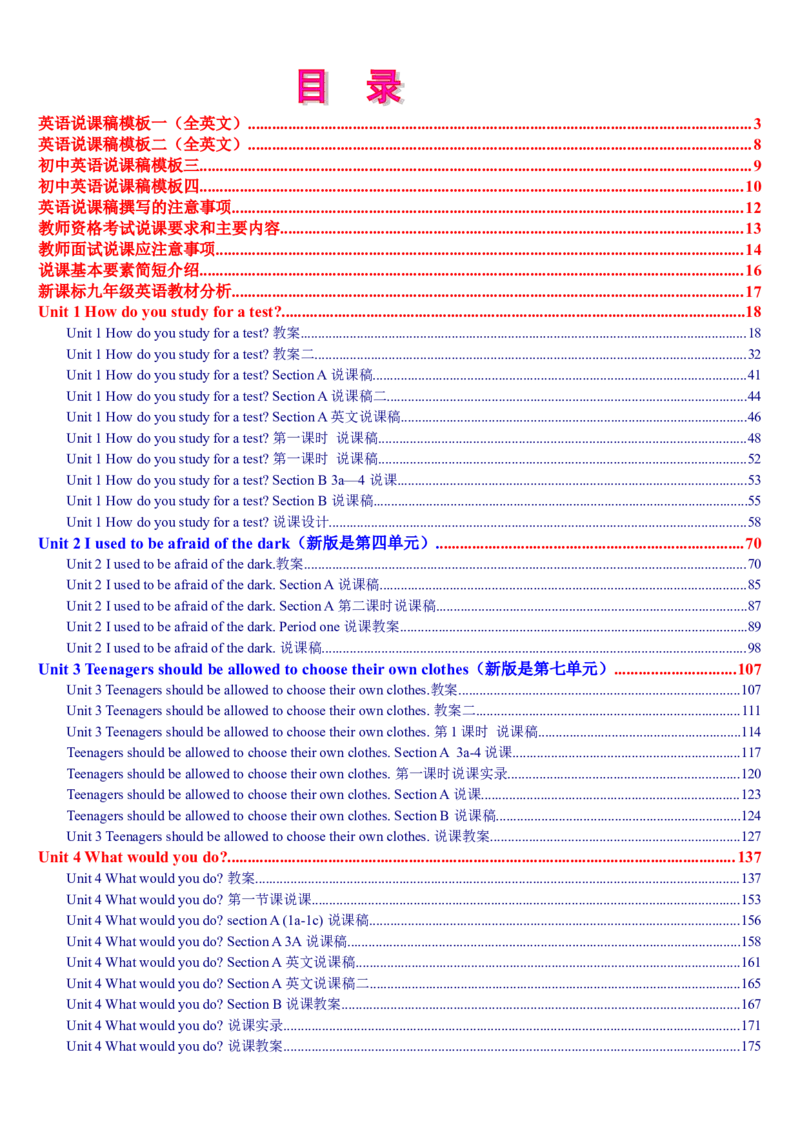
英语说课稿模板一(全英文).............................................................................................................................3
英语说课稿模板二(全英文).............................................................................................................................8
初中英语说课稿模板三.........................................................................................................................................9
初中英语说课稿模板四.......................................................................................................................................10
英语说课稿撰写的注意事项...............................................................................................................................12
教师资格考试说课要求和主要内容...................................................................................................................13
教师面试说课应注意事项...................................................................................................................................14
说课基本要素简短介绍.......................................................................................................................................16
新课标九年级英语教材分析...............................................................................................................................17
Unit 1 How do you study for a test?...................................................................................................................18
Unit 1 How do you study for a test? 教案...............................................................................................................................18
Unit 1 How do you study for a test? 教案二...........................................................................................................................32
Unit 1 How do you study for a test? Section A 说课稿...........................................................................................................41
Unit 1 How do you study for a test? Section A 说课稿二.......................................................................................................44
Unit 1 How do you study for a test? Section A 英文说课稿...................................................................................................46
Unit 1 How do you study for a test? 第一课时 说课稿.........................................................................................................48
Unit 1 How do you study for a test? 第一课时 说课稿.........................................................................................................52
Unit 1 How do you study for a test? Section B 3a—4 说课....................................................................................................53
Unit 1 How do you study for a test? Section B 说课稿...........................................................................................................55
Unit 1 How do you study for a test? 说课设计.......................................................................................................................58
Unit 2 I used to be afraid of the dark(新版是第四单元)............................................................................70
Unit 2 I used to be afraid of the dark.教案..............................................................................................................................70
Unit 2 I used to be afraid of the dark. Section A 说课稿.........................................................................................................85
Unit 2 I used to be afraid of the dark. Section A 第二课时说课稿.........................................................................................87
Unit 2 I used to be afraid of the dark. Period one 说课教案...................................................................................................89
Unit 2 I used to be afraid of the dark. 说课稿.........................................................................................................................98
Unit 3 Teenagers should be allowed to choose their own clothes(新版是第七单元)..............................107
Unit 3 Teenagers should be allowed to choose their own clothes.教案................................................................................107
Unit 3 Teenagers should be allowed to choose their own clothes. 教案二...........................................................................111
Unit 3 Teenagers should be allowed to choose their own clothes. 第1课时 说课稿..........................................................114
Teenagers should be allowed to choose their own clothes. Section A 3a-4说课.................................................................117
Teenagers should be allowed to choose their own clothes. 第一课时说课实录..................................................................120
Teenagers should be allowed to choose their own clothes. Section A说课..........................................................................123
Teenagers should be allowed to choose their own clothes. Section B 说课稿......................................................................124
Unit 3 Teenagers should be allowed to choose their own clothes. 说课教案.......................................................................127
Unit 4 What would you do?..............................................................................................................................137
Unit 4 What would you do? 教案..........................................................................................................................................137
Unit 4 What would you do? 第一节课说课..........................................................................................................................153
Unit 4 What would you do? section A (1a-1c) 说课稿..........................................................................................................156
Unit 4 What would you do? Section A 3A说课稿................................................................................................................158
Unit 4 What would you do? Section A英文说课稿..............................................................................................................161
Unit 4 What would you do? Section A英文说课稿二..........................................................................................................165
Unit 4 What would you do? Section B说课教案..................................................................................................................167
Unit 4 What would you do? 说课实录..................................................................................................................................171
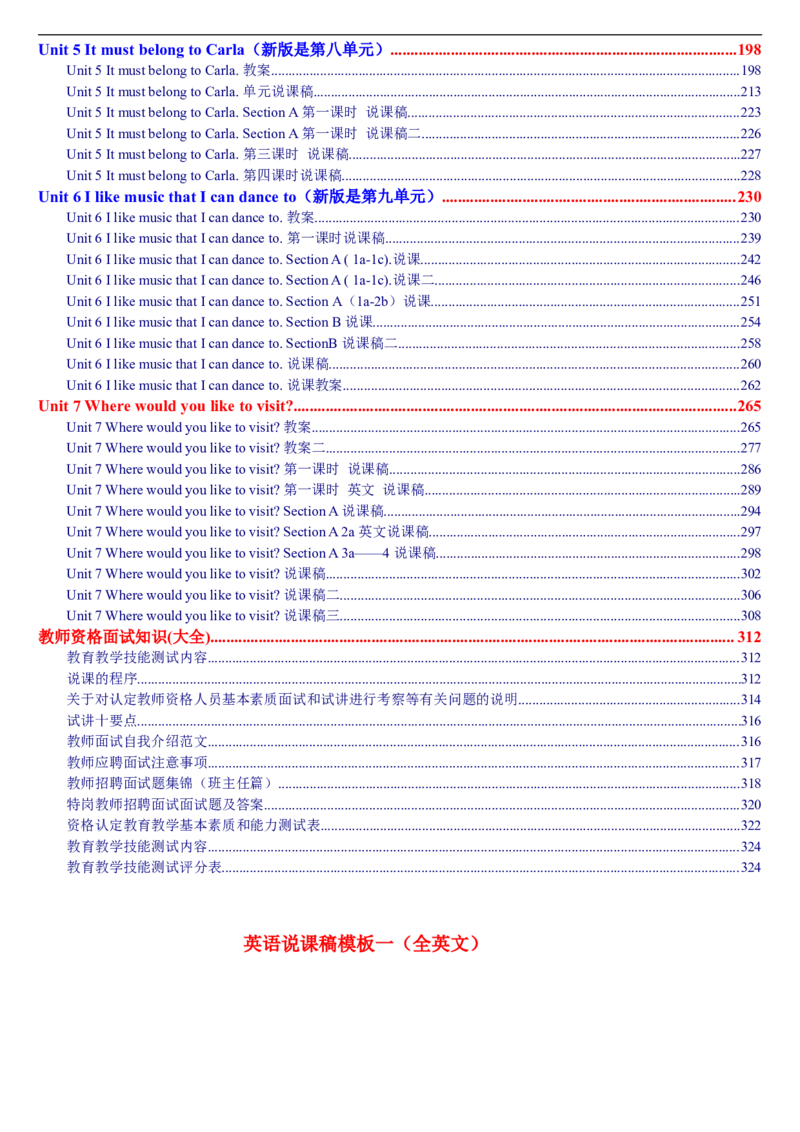
Unit 4 What would you do? 说课教案..................................................................................................................................175Unit 5 It must belong to Carla(新版是第八单元)......................................................................................198
Unit 5 It must belong to Carla. 教案......................................................................................................................................198
Unit 5 It must belong to Carla. 单元说课稿..........................................................................................................................213
Unit 5 It must belong to Carla. Section A 第一课时 说课稿...............................................................................................223
Unit 5 It must belong to Carla. Section A 第一课时 说课稿二...........................................................................................226
Unit 5 It must belong to Carla. 第三课时 说课稿................................................................................................................227
Unit 5 It must belong to Carla. 第四课时说课稿..................................................................................................................228
Unit 6 I like music that I can dance to(新版是第九单元).........................................................................230
Unit 6 I like music that I can dance to. 教案.........................................................................................................................230
Unit 6 I like music that I can dance to. 第一课时说课稿.....................................................................................................239
Unit 6 I like music that I can dance to. Section A ( 1a-1c).说课...........................................................................................242
Unit 6 I like music that I can dance to. Section A ( 1a-1c).说课二.......................................................................................246
Unit 6 I like music that I can dance to. Section A(1a-2b)说课........................................................................................251
Unit 6 I like music that I can dance to. Section B说课.........................................................................................................254
Unit 6 I like music that I can dance to. SectionB 说课稿二.................................................................................................258
Unit 6 I like music that I can dance to. 说课稿.....................................................................................................................260
Unit 6 I like music that I can dance to. 说课教案.................................................................................................................262
Unit 7 Where would you like to visit?..............................................................................................................265
Unit 7 Where would you like to visit? 教案..........................................................................................................................265
Unit 7 Where would you like to visit? 教案二......................................................................................................................277
Unit 7 Where would you like to visit? 第一课时 说课稿....................................................................................................286
Unit 7 Where would you like to visit? 第一课时 英文 说课稿..........................................................................................289
Unit 7 Where would you like to visit? Section A 说课稿......................................................................................................294
Unit 7 Where would you like to visit? Section A 2a 英文说课稿.........................................................................................297
Unit 7 Where would you like to visit? Section A 3a——4 说课稿.......................................................................................298
Unit 7 Where would you like to visit? 说课稿......................................................................................................................302
Unit 7 Where would you like to visit? 说课稿二..................................................................................................................306
Unit 7 Where would you like to visit? 说课稿三..................................................................................................................308
教师资格面试知识(大全)..................................................................................................................................312
教育教学技能测试内容........................................................................................................................................................312
说课的程序............................................................................................................................................................................312
关于对认定教师资格人员基本素质面试和试讲进行考察等有关问题的说明...............................................................314
试讲十要点............................................................................................................................................................................316
教师面试自我介绍范文........................................................................................................................................................316
教师应聘面试注意事项........................................................................................................................................................317
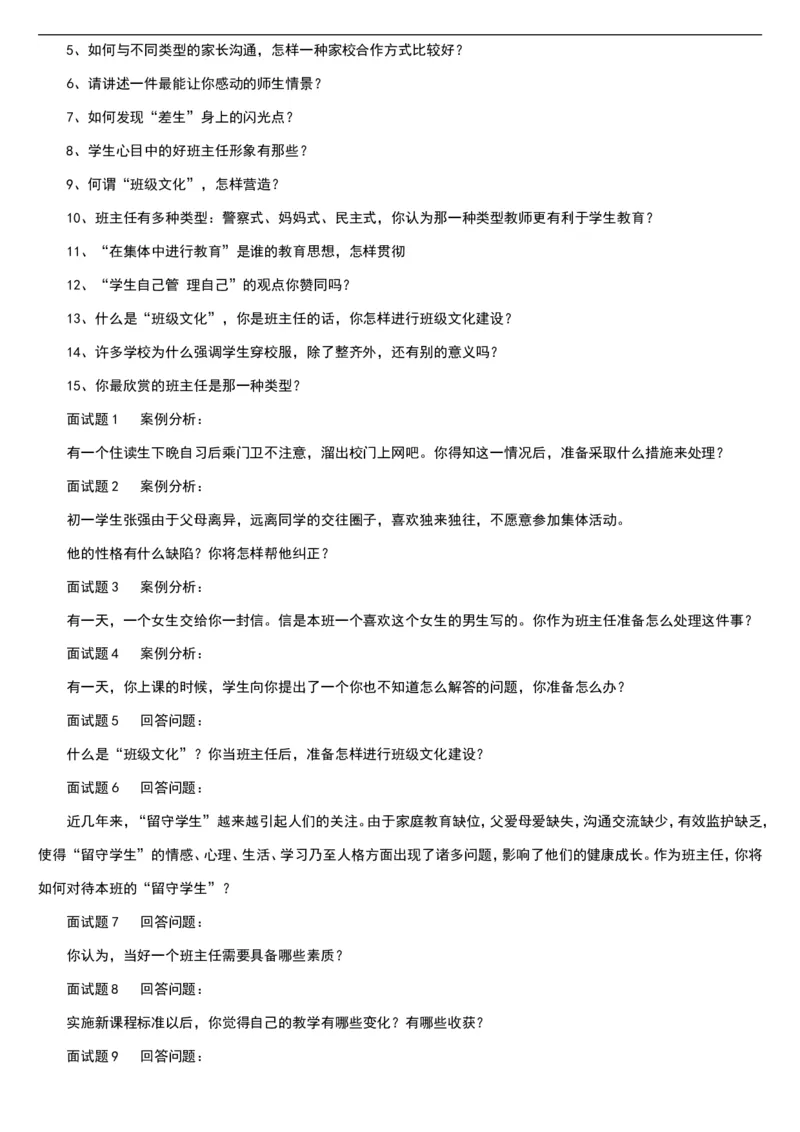
教师招聘面试题集锦(班主任篇)....................................................................................................................................318
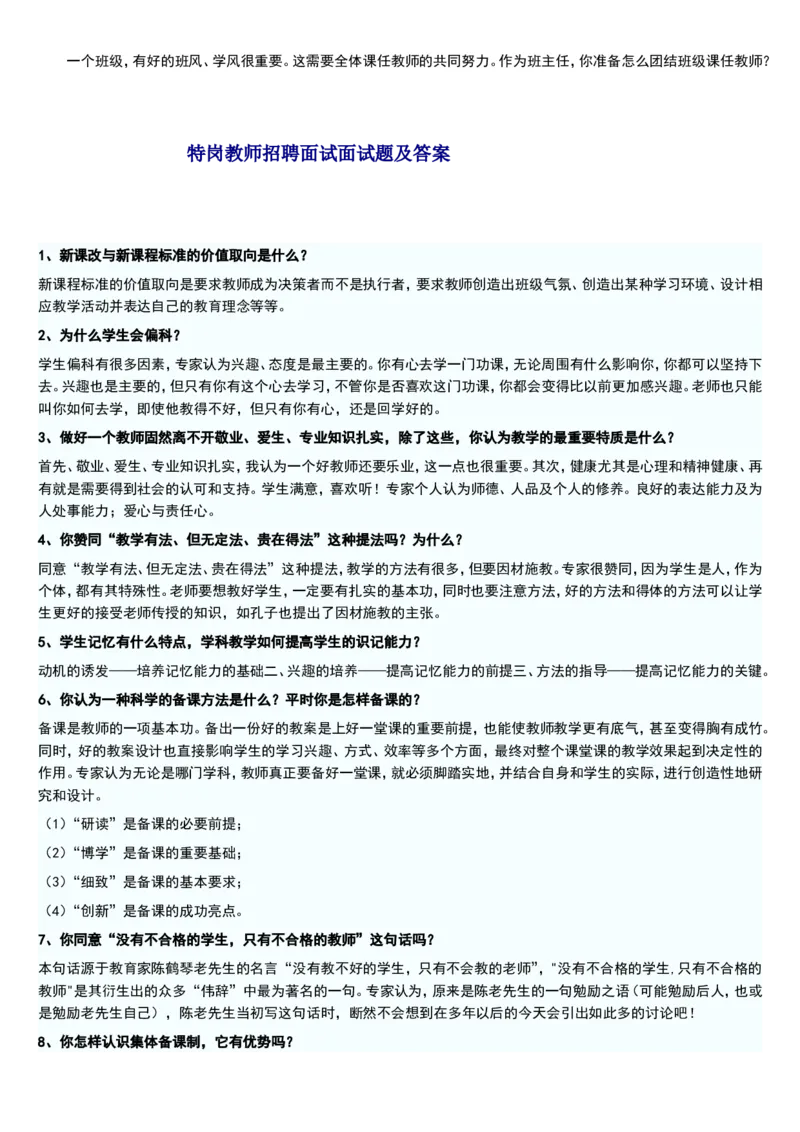
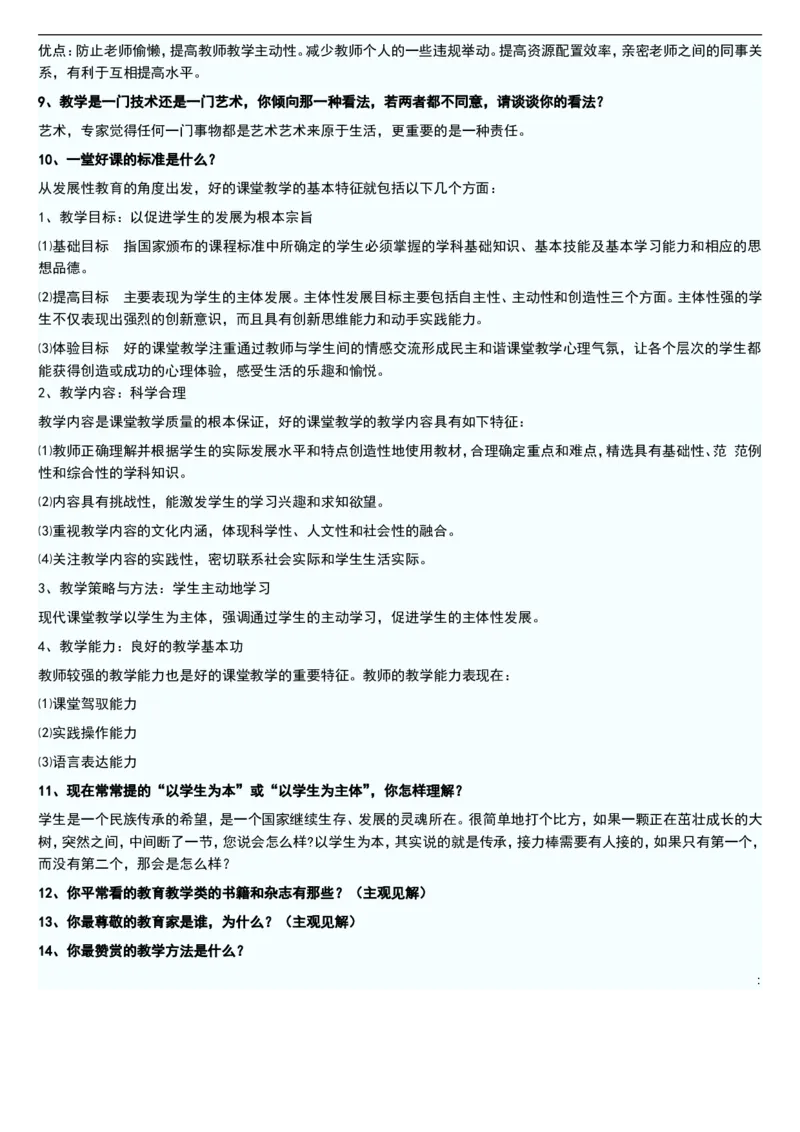
特岗教师招聘面试面试题及答案........................................................................................................................................320
资格认定教育教学基本素质和能力测试表........................................................................................................................322
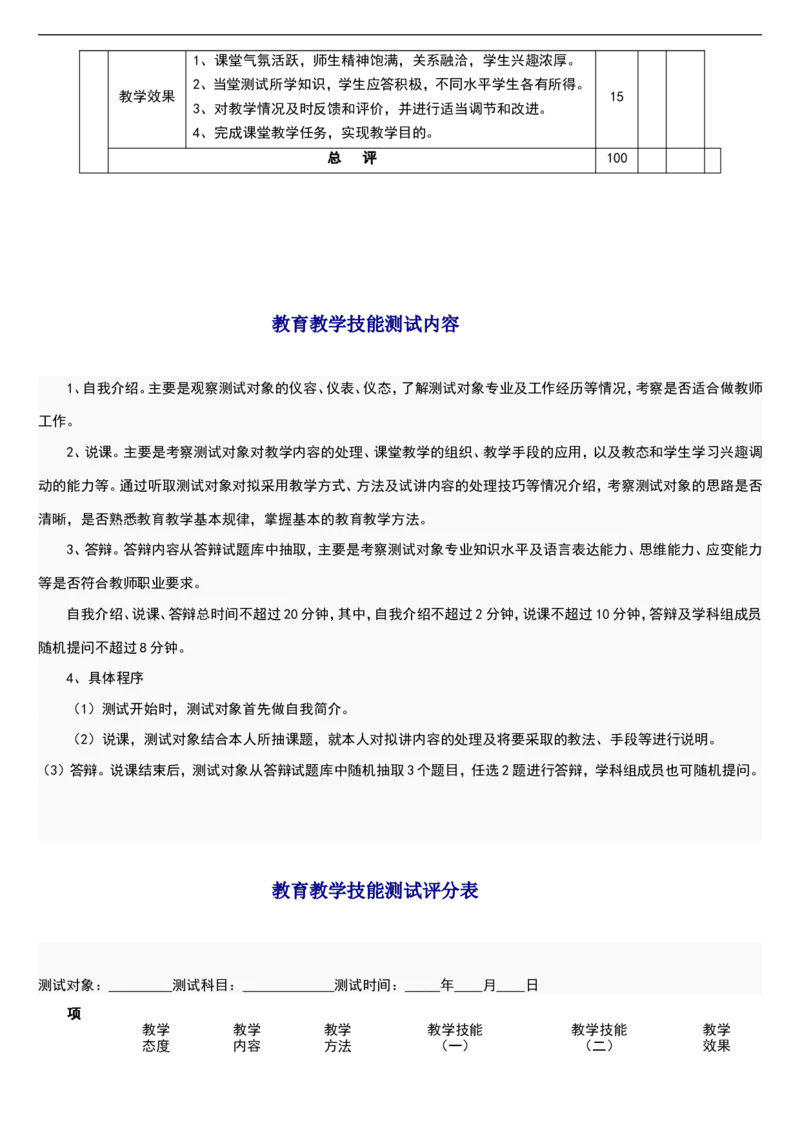
教育教学技能测试内容........................................................................................................................................................324
教育教学技能测试评分表....................................................................................................................................................324
英语说课稿模板一(全英文)Good afternoon, ladies and gentlemen. My name is (). I come from () Middle School in ().Today I’m
going to talk about the topic” What should I do?”I will divide the instruction into seven parts:
they are Teaching material Analysis, Teaching aims, Teaching emphasis, Teaching difficulties, Teaching
methods, Teaching aids and Teaching procedures.
一、说教材(教材分析) Analyzing teaching material
1. 说课型 lesson type (Dialogue/ reading/ listening/ revision)
2. 本课在教材中的地位 status and function
Lesson 33 Saving the Earth is a dialogue. The lesson is focused on the topic of the problems of the
earth and the functional items of Supposition/ Intentions/ conjecture/ Prohibition. Since it is a
dialogue / reading. It’s helpful to improve the Ss communicative/ reading ability.
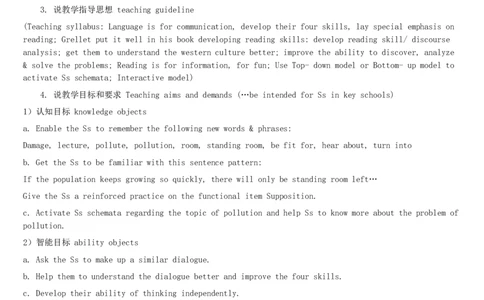
3. 说教学指导思想 teaching guideline
(Teaching syllabus: Language is for communication, develop their four skills, lay special emphasis on
reading; Grellet put it well in his book developing reading skills: develop reading skill/ discourse
analysis; get them to understand the western culture better; improve the ability to discover, analyze
& solve the problems; Reading is for information, for fun; Use Top- down model or Bottom- up model to
activate Ss schemata; Interactive model)
4. 说教学目标和要求 Teaching aims and demands (…be intended for Ss in key schools)
1)认知目标 knowledge objects
a. Enable the Ss to remember the following new words & phrases:
Damage, lecture, pollute, pollution, room, standing room, be fit for, hear about, turn into
b. Get the Ss to be familiar with this sentence pattern:
If the population keeps growing so quickly, there will only be standing room left…
Give the Ss a reinforced practice on the functional item Supposition.
c. Activate Ss schemata regarding the topic of pollution and help Ss to know more about the problem of
pollution.
2)智能目标 ability objects
a. Ask the Ss to make up a similar dialogue.
b. Help them to understand the dialogue better and improve the four skills.
c. Develop their ability of thinking independently.
d. Cultivate their ability to discover, analyze and solve problems.
e. Train them to collect information from the Internet.
f. Train them with some effective learning methods to optimize Ss’ learning results.
3)德育目标 moral objects
a. Arouse their interest in learning English;
b. Help them to understand the background of pollution.
c. Enable the students to love our earth and the nature.
d. Be aware of the importance of stopping pollution & protecting out environment.
e. Encourage the Ss to do something to save the earth.5. 说教学重点 teaching important points (生词、句型;培养阅读技能)
a. New words and phrases
b. Sentence pattern: If- clause
c. improve their reading skills.
d. Talking about problems of the Earth.
6. 说教学难点 teaching difficult points (语法;发展交际能力)
a. functional item: Supposition.
b. Develop their communicative ability. Act out their own dialogue.
7. 说教具 teaching aids (multi-media computer, software, OHP)
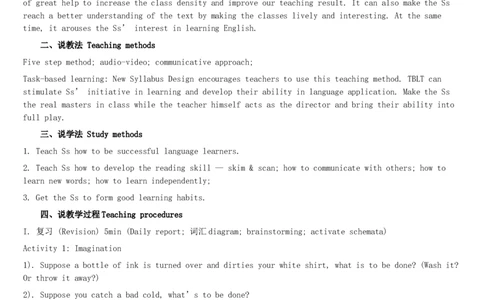
The teaching syllabus says that it’s necessary for teachers to use modern teaching facilities. It’s
of great help to increase the class density and improve our teaching result. It can also make the Ss
reach a better understanding of the text by making the classes lively and interesting. At the same
time, it arouses the Ss’ interest in learning English.
二、说教法 Teaching methods
Five step method; audio-video; communicative approach;
Task-based learning: New Syllabus Design encourages teachers to use this teaching method. TBLT can
stimulate Ss’ initiative in learning and develop their ability in language application. Make the Ss
the real masters in class while the teacher himself acts as the director and bring their ability into
full play.
三、说学法 Study methods
1. Teach Ss how to be successful language learners.
2. Teach Ss how to develop the reading skill — skim & scan; how to communicate with others; how to
learn new words; how to learn independently;
3. Get the Ss to form good learning habits.
四、说教学过程Teaching procedures
I. 复习 (Revision) 5min (Daily report; 词汇diagram; brainstorming; activate schemata)
Activity 1: Imagination
1). Suppose a bottle of ink is turned over and dirties your white shirt, what is to be done? (Wash it?
Or throw it away?)
2). Suppose you catch a bad cold, what’s to be done?
3). Suppose your bike is broken, what’s to be done?
4). And suppose the earth, on which we all live, is damaged, what’s to be done?
* What can you think of when you see “pollution” this word?(waste, environment, air, water, factory,
desert, climate... Try to activate the Ss schemata regarding the topic of pollution.)
II. 呈现 (Presentation) 5min
Activity 2: Presentation
Play the song “Earth Song” sung by Michael Jackson. (Create an atmosphere)
A lot of pictures and video clips about the causes and results of the three problems mentioned in this
lesson will be shown on the screen with the help of the computer.Ss’ presentation on pollution. Attract their attention, arouse their interest, and create a good
atmosphere for communication.
* Activate their schemata and cultivate their ability in collecting information from the Internet and
develop their ability in thinking independently.
III. 对话 / 阅读 (Dialogue)18m
1. Pre- reading
Activity 3: Prediction
1st listening/ fast reading, one guided Q to help Ss to get the main idea:
What do you think is discussed at the conference?
2. While- reading
Activity 4: Read and answer
2nd listening/ careful reading, more Qs to get the detailed information. Develop their reading skills:
skim & scan. Pay attention to the pronunciation, stress & intonation.
* 阅读: Pre-reading; while-reading; post-reading (fast reading/ careful reading; skim/ scan; 识别关键
词key words;确定主题句;创设信息差information gap;T or F; 填表格chart/diagram; Predicting; Make a
timeline; Make a story map。达到对课文的整体理解和掌握。So that they can have a good understanding of
the whole text.)
3. Post- reading
Activity 5: Language focus
While Ss are answering the Qs, the teacher deals with some key language points.
a. is being caused b. and so on c. go on doing
d. be fit for e. standing room f. if- clause
IV. 操练 (Practice) 10m
Activity 6: Retell
Use your own words to retell the dialogue in the 3rd person.
Activity 7: Acting out
Activity 8: Drill – Supposition
Purpose: Practise the functional item of Supposition. (P. 33 Part 2; P.113, wb Ex. 3)
(Retell; act out; role play)
V. 巩固 (Consolidation) 6m
(Discussion; interview; press conference; debate; quiz)
Activity 9: role play
Suppose you were head of a village, scientist, journalist and villager, make up a conversation and ask
several groups to demonstrate in front of the class.
* The Ss are encouraged to use the words and expression_r_rs like pollution, damage, be fit for, turn
into, the if- clause, etc.
Activity 10: Discussion
Think of the question: Are we causing damage to the world?What should we do to save the earth and protect our environment especially in our daily life?
Collect their answers and form a report.
VI. 作业 (Homework) 1m (Writing; continue the story; recite; retell)
Write a letter to the mayor, telling him sth. about the pollution around your school.
英语说课稿模板二(全英文)
Today , I’m going to talk about my plan for teaching ….
First, I’d like to say something about the teaching content . …
Second, the aims of this lesson are:
1. Knowledge of language: …
2. Pratical skills …
3. Personal development …
Thid, the focus and difficulties are: …. ryfvg
Next, my way of teaching.
Teaching English at primary schools aims at students’ basic skills in listening and speaking and
the their interest in English. So I find it necessary to design a task-based class: students will
be assigned to do a survey. This task will make it possible for the students to pick up the
language in an authentic way. Teaching aids: a recorder, sentences cards , stationary ,pictures,
head ornaments and a form. I shall have the students join in the singing, ridding guessing and
doing a survey .
I’m going to take the following procedures:
Step 1 Warm-up
Step2 Presentation
Step3 Practice
Step 4 Consolidation
Step 5 Assignment
Ⅱ
It's my pleasure to be here. Now, I'd like to say something about my teaching plans about …
For its objective, it covers …objectives1. Knowledge objective …
2. Ability objective …
3. Moral objective …
During the procedure of my teaching, multi-media, over head project, tape recorder, pictures will
surely be adopted that will also be accompanied by demonstration, role-playing, task-oriented
approach. Through these methods and by using these aids, I want to teach the students how to be
successful language learners.
After analyzing the dialogue, I set off my teaching plan around 4 tasks and many activities: pre-
task, while-task, post-task and creative task.
…
That’s my idea about the teaching plan of this lesson. Thanks for listening.
初中英语说课稿模板三
一、说教学理念:
英语新课程标准要求教师要从教学实践者转为教学的研究者,……
二、说教材
㈠教材概述:本单元……
㈡三维目标设立:
1、知识与技能
⑴学会单词、短语:……;句型:……
⑵提高学生交际,探究能力,培养创新精神。
2、过程与方法:
以学生自主学习为基础,以一幅……图引入,……
3、情感态度与价值观
⑴引导学生充分认识到必须……
⑵培养学生的学习英语兴趣,……
⑶培养团结协作精神。
㈢重点、难点
基于以上分析,确定本课重点:……
难点:⑴……
⑵……
三、说教法
1、学生分析:……
2、教学方法:
⑴游戏教学法;⑵任务型教学法;⑶多媒体辅助教学。
四、说学法
1、善于抓住用英语交际的机会,充分感知,积极体验,大胆实践。
2、积极参与,善于合作,培养团队精神。3、为赢取“英语课堂最佳表现奖”而主动学习。
依据:新课程倡导的感知——体验——实践——参与——合作,以及形成性评价。
五、说流程
1、总体设计及依据
在任务型活动中热身(8分钟)……
2、教具准备:
3、分步设计及依据(多媒体课件制作)
Step1:在任务活动中热身
活动一:chant
活动二:Guessing games
活动三:利用挂图……
活动四:学生俩俩合作,……
Step2 在任务活动中认知
……
Step3 在任务活动中巩固
6个活动
Step4 Summary
……
4、板书设计
六、教学效果预测
……
七、教学反思(教后说)
1、教学内容要形式多样,……
2、尽量合理组织教材,……
3、课件制作要充满色彩,……
4、拓展学生文化视野,……
5、充分发挥学生主动作用,……
初中英语说课稿模板四
各位老师好:
今天我说课的课题是《XXX》。下面我对
本课题进行分析:
一、说教材(地位与作用)
《XXX》是人教版必修教材第XX单元第XX个课题。在此之前,学生们已经学习了XX,这为过度到本课题的学习
起到了铺垫的作用。因此,本课题的理论、知识是学好以后课题的基础,它在整个教材中起着承上启下的作用。
二、说教学目标
根据本教材的结构和内容分析,结合着XX年级学生他们的认知结构及其心理特征,我制定了以下的教学目标:1. 知识与技能目标
2. 过程与方法目标
3. 情感与价值观目标
三、说教学的重难点
本着XXX新课程标准,在吃透教材基础上,我确定了以下教学重点和难点。
教学重点:重点的依据是只有掌握了 ,才能理解和掌握 。
教学难点:难点的依据是 较抽象,学生没有这方面的基础知识。
为了讲清教材的重难点,使学生能够达到本课题设定的教学目标,我再从教法我学法上谈谈。
四、说教法。
我们都知道XX是一门培养人的XXX能力的更要学科。因此,在教学过程中,不仅要使学生“知其然”,还要使
学生“知其所以然”。我们在以师生既为主体又为客体的原则下,展现获取理论知识、解决实际问题的思维过程。
考虑到XX年级学生的现状,我主要采取设置情景教学法,让学生积极主动地参与到教学活动中来,使他们在活动
中得到认识和体验,产生践行的愿望。培养学生将课堂教学和自己的经验结合起来,引导学生主动去发现周边的客观事
物,发展思辩能力,注重滨心理状况。当然老师自身也是非常重要的教学资源。教师本人应该通过课堂教学感染和激励
学生,调动起学生参与活动的积极性,激发学生对解决实际问题的渴望,并且要培养学生以理论联系实际的能力,从而
达到最佳的教学效果。基于本课题的特点,我主要采用了以下的教学方法:
1. 直观演示法:利用图片等手段进行直观演示,激发学生的学习兴趣,活跃课堂气氛,促进学生对知识的掌握。
2. 活动探究法:引导学生通过创设情景等活动形式获取知识,以学生为主体,使学生的独立探索性得到了充分的发挥,
培养学生的自觉能力、思维能力、活动组织能力。
3. 集体讨论法:针对学生提出的问题,组织学生进行集体和分组语境讨论,促使学生在学习中解决问题,培养学生团结
协作的精神。
由于本课题内容与社会现实生活的关系比较密切,学生已经具有了直观的感受,可以让学生自己阅读
课本并思考,例举社会上存在的一些有关的经济现象,在老师的指导下进行讨论,然后进行归纳总结,得出正确的结论。
这样有利于调动学生的积极性,发挥学生的主体作用,让学生对本框题知识的认知更清晰、更深刻。
五、说学法
我们常说:“现代的文盲不是不懂字的人,而是没有掌握学习方法的人”,因而,我在教学过程中特别重视学法
的指导。让学生从机械的“学答”向“学问”转变,从“学会”向“会学”转变,成为学习的真正的主人。这节课在指
导学生的学习方法和培养学生的学习能力方面主要采取以下方法:思考评价法、分析归纳法、自主探究法、总结反思法。
最后我具体来谈谈这一堂课的教学过程。
六、说教学过程
在这节课的教学过程中,我注重突出重点,条理清晰,紧凑合理,各项活动的安排也注重互动、交流,最大限度的
调动学生参与课堂的积极性、主动性。
1. 导入新课:(2~3分钟)
由上节课演过的知识和教材开头的情景设置导入新课。导语设计的依据:一是概括了旧知识,引出新知
识,温故而知新,使学生的未知欲望。这是教学非常重要的一个环节。
2. 讲授新课:(35分钟)
在讲授新课的过程中,我突出教材的重点,明了地分析教材的难点。还根据教材的特点,学生的实际、教
师的特长,以及教学设备的情况,我选择了多媒体的教学手段。这些教学手段的运用可以使抽象的知识具体化,枯燥的
知识生动化,乏味的知识兴趣华。还重视教材中的疑问,适当对题目进行引申,使它的作用更加突出,有利于学生对知识
的串联、积累、加工,从而达到举一反三的效果。
3. 课堂小结:(2~3分钟)
课堂小结的目的是强化认识,可以把课堂传授的知识尽快地转化为学生的素质;简单扼要的课堂小结,
可使学生更深刻地理解XXX理论在实际生活中的应用,并且逐渐地培养学生形成良好的个性。4. 板书设计:
我比较注重直观地、系统的板书设计,并及时地体现教材中的知识点,以便于学生能够理解掌握。我的板
书设计是:
5. 布置作业。
针对XX年级学生素质的差异,我进行了分层训练,这样做既可以使学生掌握基础知识,又可以
使学有余力的学生有所提高,从而达到拔尖和“减负”的目的。我布置的课堂作业是:XXX
英语说课稿撰写的注意事项
说课是教师职业的基本素养,说课要求教师对教学大纲、教学目的、课堂设计很了解,说课要包括:教材、目标、重点、
难点、教法、学法、过程、板书、小结。
说课有别于讲课。讲课的对象是学生,侧重讲授知识、培养能力、教书育人,是系统的教育教学活动;而说课的对象
是教师、教研员、评委,侧重表述如何讲授知识、培养能力、教书育人,是系统的教育教学研究活动。说课是教学与教研的
结晶,是教学理论和教学实践结合的产物。说课讲稿的撰写要注意以下几点。
(一)突出理论性
说课讲稿有别于教案或教案提要,它比教案更具有理论性。写说课讲稿也不同于写教案,教案多是具体教学过程,
而说课稿则侧重于有针对性的理论指导的阐述;教案只说"怎么教",而说课讲稿则要重点说清“为什么这么教"。因此,
写说课讲稿要注重理论依据的阐述,尤其是说教材、说教法、说学法及学法指导时,一定要说明其理论依据。
(二)简明扼要
说课稿有别于教学论文,它比教学论文更具实践性,因此。说课稿的撰写要用词精当,切忌长篇大论、面面俱到或泛
泛而谈。说课各个要素及其理论依据必须要有直接的内在联系,在语言表达方面要言简意赅。另外,表述具体的教学目
标时,要尽量避免使用抽象、笼统、缺乏可操作性和可监测性的一般性用语,如知识目标一Student will learn about the
present perfect tense;能力目标一Improve the students' abilities of listening,speaking, reading and writing。这样的教学目标
只是泛泛而谈,没有说明要求学生做到的是什么,教师在教学过程中也无法有效操作,听课者更难确定教学目标是否达
成。
(三)不拘一格
由于教学内容不同,教学对象(学生)不同,课型不同,教师的教学经验以及对教材的理解和处理不同,说课稿的撰
写也不应拘泥于单一的、固定的模式。只要教师能够准确把握说课的要素和要点,透彻分析教学设计的理论依据,采用
综合论述(说课的各个要素不逐项列出)或分块论述(说课钠各个要素逐条列出),都能达到说课教研的最终目的。
(四)突出英语学科特点,但要量力而行
原则上讲,英语说课讲稿最好用英语写。但是用英语写说课讲稿对教师的英语写作能力提出了更高的要求,因此,
在有些教师还没有掌握说课方法或没有能力准确翻译某些教学理论时,最好慎重用英语写说课讲稿。笔者认为,现阶段
英语说课讲稿用英语撰写或用汉语撰写均可。因为,说课是陈述教学方案设计及其理论依据,而不是具体实施课堂教学
方案。英语说课的目的主要是进行英语教学研究,提高教师的教研水平,而不侧重于提高教师的英语口语表达能力。教师资格考试说课要求和主要内容
①说教材。说本教材目的、联系、教学目标、重点、难点和课时安排。
②说教法。说本课选择何种教学方法、教学手段及其教育理论依据。
③说学法。说本课拟教给学生什么学习方法,培养哪些能力。④说教学程序。说本课的教学思路课堂结构及板书设
计等。
“说课”有哪些基本要求呢?我们认为主要有以下六项:
1、说清本课内容在本学科教学中所处的地位及其作用。在教学过程中,每一课时教案所包含的内容是不同的,它们
在每一学科的知识体系中的地位及其作用也是不同的,有些课时所含的教学内容极其重要,与今后授课的内容关系十分
密切,是阶段性的关键点,甚至是本教材的重点内容,起着承上启下的作用。因此,说课者如何认识每一课时教案在学科
教学中的地位,如何对学生进行学习指导是至关重要的。说课者就是要说清该课在学科知识体系中的要点和关键,说清
每一课时教案内容在学科知识体系中的地位及其作用,并抓住这些知识关键点来指导学生,从而达到事半功倍的教育效
果。
2、说清本课内容的重点、难点和要点。每一课时教学内容都有自己的重点、难点和要点,要让学生把握一节课的教学内
容,必须突出重点。在教学过程中,每一课时又往往有一些知识点学生难以明确,难以掌握,作为教师必须从学生的实际
出发,把握重点要点找出难点,化解难点以达到预期的教学目的。这些都需要“说课”者在说课过程中掌握并说清如何
在教学过程中体现。
3、说清本课的课时结构和目标。掌握课堂教学目标是教师的基本功,在有限的40分钟内,实现课堂教学目标,是很
有讲究的,如何突出重点、掌握要点,如何化解难点、巩固知识,如何复习旧课、导入新课,如何演绎示范、归纳总结,如何
提问设问、布置练习,都有一个时间合理安排问题,一节好的课离不开一个好的课时结构,要使每一课时的各个教育环
节均能恰到好处,合理分配课堂教学时间就尤为重要。作为说课者,必须紧紧围绕课堂教学目标,在说课过程中,体现课
时结构,反映各个教学环节的时间分配。
4、说清实施课堂教学目标的方法与手段。在课堂教学目标确定之后,用什么方法和手段实现课堂教学目标,极为重要,
它要求“说课”者根据教学要求和所教对象,说清如何运用相应的教学方法来完成教学任务,并运用何种教学手段,来
强化教学目标的重点、要点,化解难点,使学生掌握所教知识。
5、说清教学过程状态的调节与信息的有效传递。教学过程中师生教学状态的调控,与教和学信息的传递、反馈,实
质上是一个很重要的,但往往又容易被“说课”者遗忘的环节,在实际教学中教师的“教”与学生的“学”虽是相互联
系的,但有主动和被动、先后快慢之分,有时也许老师讲得快的地方恰恰正是学生一下子不能领悟到的地方;有时学生
积极性很高、偏离教学目标,这就需要教师通过信息传递、反馈来适当调控,而教学状态的有机调控必须注意提问、设问、
练习等信息传递的精心设计和合理安排。在“说课”中说课者要充分说明。6、说清对本节教学过程的预先评估。说课虽不是课堂展现,说课者对说课内容的教学过程也应该有一个预先评估,并将
此作为说课的一项内容。预先评估中包括教学过程中可能出现的问题,学生中可能“冒出”的个别代表性的错误、时间
控制上的调整,以及补救措施、目标测试的答疑等。
说课者说完课后,其他教师应围绕这课的教学怎样落实素质教育要求,怎样提高深堂教学效益,各抒已见,相互交流,使
说课者与参与者在理论与实践的结合上得到新的认识、新的提高。说课一定要抓住重点、难点,突出教法的特点,说出与
众不同的教学新意,这就是说课的艺术。
教师面试说课应注意事项
(一)说课应注重什么
一般说来,说课应注重以下几点:
1.说课要突出一个“新”字
创新是艺术的生命,只有创新才能突出说课的艺术。“新”是说课成功的关键。“新”的要求很高:
方法新——不能平铺直叙。
结构新——要有起伏,高潮迭起。
练习新——要激发学生的兴趣、启发学生的智慧。
手段新——运用多媒体突出重点,图文并茂。
设计新——从导入新课、展开新课、巩固新课、结束新课等几个怀节,要环环紧扣,具有新意。
开始新——从开讲艺术到结尾艺术要吸引听者,引起共鸣。2.说课要体现一个“美”字
美是艺术的核心,说课要跟讲课一样处处体现美,给人美的享受。
内容美——教师要善于从教材里感受美、提炼美、提示美、使原有的美更添色彩。
语言美——教师语言美是决定说课成败的关键。
情感美——情感是教学艺术魅力形成的关键因素,没有强烈的情感,不可能把课说得成功。
板书美——板书是教师的备课中构思的艺术结晶,它以独特的魅力,给学生以美的熏陶。
教态美——教态是沟通师生情感的桥梁,教态美可以唤起学生对美的追求。
3.抓住一个“课”字,突出一个“说”字
说课,要用一节课1/4~1/3时间说出一节教学环节齐全的课,必须经历完整课堂教学的各个环节。对常规课课
型来说,要经历“铺垫——新授课——举例_巩固——置疑——小结——练习”等过程,对采用目标教学法的课程来说,
要经历“目标呈现——揭题展示——反馈矫正——课堂练习”等过程。因此,说课者要根据课型抓住这节课的基本环节
去“说”,说思路、说方法、说过程、说结构、说内容、说训练、说学生。无论说什么,都要说得有理有据,使听者叫好,达
到“听君一席话,胜读十年书”的目的。
在说课过程中,要特别注意以下几点:
(1)“说课”不等于备课,教师千万不能照教案去说。(2)“说课”不等于讲课,教师不能视听课对象为学生去说。
(3)“说课”不等于背死课,教师不应将事先准备好的“说案”一字不漏地死背下去。(4)“说课”不等于读课,教师不
能拿着事先写好的材料去读。因此,教师在说课时,要紧紧围绕一个“课”字,突出“说课”的特点,完成说的过程。
4.遵循“课”路,选准“说”法教学思路是教师课堂教学思想的具体体现,是教师实施教学过程的基本构想。教师讲课时,要紧紧围绕教学思路
进行,教师在说课时,当然也要环环扣住课堂教学思路展开。能否围绕教学思路实施“教”法,能否围绕教学思路展开
“说”法,无疑是教师授课和说课成败的关键。诚然,说课的方法很多,需要因人制宜、因材施“说”。说理、说实验、说
演变、说现象、说本质、说事实、说规律,正面说、反面说,横向说、纵向说,理论联系实际说等。但无论怎么“说”,都要
遵循课堂教学思路这一主线去“说”。
5.变换“说”法,找准“说”点
说课的对象是听众,而不是授课的对象学生。这些听众可能自是说课的评委、本学科的教师、本教研室的教师、
其他学科的教师及教务科、教育研究部门、教育行政部门的领导。但无论怎样,这些听众都竭力站在学生角度去对待说
课者所说的课,去审视教法的采用,教学重难点的突出、突破,教学环节的把握等。因此,说课者必须置于听众思维和学
生思维的变化处,站在备课讲课的临界点,变换“说”位,编写“说”案,研究“说”法,找准“说”点。
6.把握“说”度,把课“说”活
说课的重点应放在说清思路、说清教学过程、说清教学方法;而讲课的重点则应放在实施教学过程、完成教学任
务、反馈教学信息、提高教学效率。换句话说,说课重理性和思路,讲课重感情和实践。因此,用极有限的时间完成说课,
必须详略得当。那么,如何把握“说”度呢?最主要的一点就是因“材”制宜,具体问题具体分析,灵活选取“说”法,
把课“说”活。说出该课的特点和特色,把课说得有条有理、有理有法、有法有效,说得生动有趣、绘声绘色,使听众听得
清清楚楚、明明白白。使听众都有“词已尽意无穷”的感觉。这就要求说课教师认真钻研说“材”说“案”,灵活选用
“说”法,准确实施“说”程,这样,才能把课“说”活。
7、语气得体、内容不失真
听说课的对象是评委,是领导等,都是成人,说的语气、称呼要得体。虽然听课者是成年人,但他们还ui竭力站
在学生的角度去听说课,去审视说课者的一字一句、一举一动,包括组织过程、参与过程、教法的采用,因此,说课时要真
是体现教学设计的理性思路、教学的过程、方法的选择,又要注意说课时的语气、称呼、表情要得体。
8、说出特点、说出风格
说课的重点应放在实施教学过程、完成教学任务、反馈信息、提高教学效率上。说课要重理性,讲课注意感性和
实践,因此,用极有限的时间完成说课内容不容易,必须做到详略得当、简繁适宜、准确把握说度。说得太详太繁,时间不
允许,也没必要,说的过略过简,说不出基本内容,听众无法接受。那么,如何把握说度呢?最主要的一点是因地制宜,灵
活选择说法,把课说活,说出该课的特色,把课说得条理清晰、法度适宜,说得生动有趣,人情人理;其次是发挥个人的特
长,说出个人的风格,这就把握了说课的度 。
(二)说课的艺术
教师,作为说课活动的主体,必须努力使说课的每个环节到位,做到“说深”“说实”“说准”“说精”,把握
好说课艺术。
1.说标准要“深”。
任何一门学科,都构成了一个相对完整的学科知识体系。每节课的内容都是这个体系中的一个“小分枝”。就语
文学科而言,它要求教师在说课前就一节内容出发追本溯源,找到它在课程标准中的位置,看看课程标准对这节所在单
元及所在课文的要求,然后顺藤摸瓜,准确把握课程标准对这节课的要求。至此,这节课的教学目的、重难点就可随之确
定了。反之,脱离课程标准的说课就是无本之木、无源之水,会给人一种虚无缥缈的感觉。
2.说方法要“实”
这个方法既包括教师实施教学目标的教法,又包括学生在这节课上要掌握的学法。只有教法得当、教师才能有条
不紊地施教;只有学法合理,学生也才会兴趣盎然地受教。而要做到教法得当、学法合理,我们教师在备课说课时必须要
“实”。要从教材的实际出发,从学生的实际出发,遵循学生掌握知识过程“由浅入深、循序渐进、由感性到理性”的认
识规律,依据“主体参与、分层优化、及时反馈、激励评价”的十六字原则,理论联系实际的原则以及传授知识和发展能
力相结合等教学原则来确定教法、教学手段和学法。作为教师还要有全局观,树立面向个体学生的思想,实行分层优化,
采取建立帮带小组,实行小组讨论等方法,促优生提高,帮差生转化。总之,“教学有法而无定法,贵在得法”,教师必须
找准出发点,采取切实可行的教学方法,从而实现教学所要达到的目的。
3.说习题要“准”
课堂练习与课后作业是检查课堂教学效果和巩固课堂教学内容的手段。因此习题的设计一定要“准”。既要准
确体现该节教学的目标、重点、难点,又要与考试(中考、高考)题型、难度相吻合。否则就会事倍功半、收效甚微。同时,
教师设计这些习题一定要考虑到不同类型学生的接受能力,做到分层设计、区别对待,真正做到使“优生吃饱,中等生
吃好,差生吃了”。4.说程序要“精”
说课堂教学程序与前三项比起来,应说得详细些,因为课堂教学程序的设计和安排既是说课的出发点,又是落脚
点,是贯穿整个说课过程的一条主线。但说课毕竟不同于授课,因它面对的是与说课者水平相当的教师,因此说课堂教
学程序时无需将教案全搬出来,而要做到一个“精”字。具体地讲:一要说出课堂教学的整体思路和环节;二要说出处理
教材、教法和学生实际之间联系的方法;三要说出对每个环节、每个层次、每个步骤的设想和安排及这样设想和安排的依
据;四要说出教学中突出重点、突破难点、抓好关键点的理由和方法;五要说出习题设计和板书以及设计的意图、目的和
理论依据。只要将以上五方面用最精炼的语言说出,使人听明白,即可达到教研交流的目的。说课,作为教研活动的一种
形式,它要求教师发挥主体作用,积极参与。只要深钻标准,细研方法,优选习题,精琢程序,就能保证说课质量;只要持
之以恒,坚持说课,就可不断提高自身素质,以适应教改形势。
说课基本要素简短介绍
“说课”说什么?
刚涉及说课的老师可能对说课的几个基本要素不是很清楚,这里作一个简短的介绍。
从现有的说课基本模式而言,说课大体由以下几个基本要素构成:
1、教材分析
(1)该节课的教学内容是什么,属于何种课型,包含了哪些知识点,教材在编写上有什么意图和特点,特别要注意挖掘教
材中隐含的渗透的数学思想;
(2)该教学内容在教材、单元乃至整个小学数学学习阶段中所处的位置,所起的作用以及前后知识之间的联系。
2、目标定位
(1)教学目标
现在已打破原有的知识技能、思想教育分块目标陈述的方式,新课标倡导我们将知识、技能、情感三大领域目标予以整
合,有机结合来定位;
(2)教学重点;
(3)教学难点;
(4)教学准备(如教具、学具的准备等都可简要予以阐述)
3、教学流程
(1)整体设计
应该说一说课堂设计的整体思路,是在什么样的思想指导下设计教学的?简要介绍该节课的课堂教学结构。如应用题课
大体可沿用数学建模的思想,安排“创设情景——建立模型——实践运用”三部曲进行,体现数学知识从生活中来,又
用数学解决生活中的相关问题的做数学的教学理念。
(2)环节设计
围绕你的整体思路,介绍说明主要教学环节,或者说是教学框架,着重阐述重难点的处理,说说突出重点,突破难点的具
体有效的教学措施,另外介绍自己有特色的地方。
“说课”怎样说?根据本人对说课的理解与体会觉得,真正“说课”的操作和说课稿还是有一定差异的,即使有了一份精美的说课
稿照本宣读也未必有好效果。因为说课稿是静态的,而说课整个也是动态生成的过程,是有听众的,你能否调动他们的
情绪和思想在很大程度上决定你说课的成败。
在说课中,我认为要给自己说课赋予一些基本思想,如:
教学设计的基本教学理念,在你的设计中体现了哪些新课标精神?
你的教学整体思路是在什么教育理论支撑下展开的,也就是教学理论依据;
你这样设计的意图是什么?力求达到什么目的?在实施中可能会产生哪些问题,各种问题你又如何引导、解决?
你觉得这节课教材对学习主体来说,是否要进行处理,阐述你处理的理由,通过你的处理学生可能在学习中避免了哪些
学习障碍,有什么优点等。
同时,在说课中要注意几个问题:
(1)说课整体要流畅,不要作报告式,如“许多123”,几个环节过渡要自然,比如,教材分析后,要确定目标时,可以这样
说“基于对教材的理解和分析,本人将该节课的教学目标定位为……”“下面我侧重谈谈对这节课重难点的处理”
(2)说课要有层次感,不要面面俱到,不要将说课说得很细,我们要说的都是一些教学预案,所以要多谈谈学生学习中可
能碰到的困难和教师的教学策略。这里的层次针对某一教学环节来说也是如此。比如,在重难点处理上,你设计哪些问
题,如果第一套方案不行,第二套方案有怎样安排等;在练习中你安排了哪些练习,有没有体现出层次性等。
(3)说课要自信,要富有激情和个性。既然是说课,说的成分很重要。最好能说的神采飞扬,激情澎湃感染听众。同时要针
对自身扬长避短,体现个性。比如擅长书法的教师可将你的整体框架进行板书,既使听众思路清晰,又能增加你的印象
分,和乐而不为呢?
新课标九年级英语教材分析
目前九年级使用的英语教材,是人民教育出版社的《义务教育课程标准实验教科书英语(新目标)系列教材之一。它
采用任务型语言教学模式,融会了话题、交际功能和语言结构形成了一套循序渐进地深化的学习程序。本书共有15个单
元和3个复习单元。供九年级全年使用,其中每个单元都列出明确的语言目标、主要的功能与语言结构以及需要掌握的
基本词汇,并分为A和B两部分。A部分是基本的语言内容,展开目标句型,提供部分示例和指导性练习;B部分是知识的
扩展和语言的综合运用;每个单元还附有SELF CHECK部分,供学生用来自我检测本单元所学的语言知识,使学生对学过
的目标句型运用自如。该教材摒弃了统治我国外国语教学领域多年的灌输式和机械的语法翻译教学方法,把直接法,听
说法等教学方法有机地柔和在一起,充分考虑了12-15岁年龄段学生的心理和生理特点,照顾到了知识性,趣味性和运
用性诸方面。突出了学生主体性,兼顾了个别差异,发展了学习策略。本册教材要求学习和掌握的语法知识有:情态动词
(must, might, could, can, should,etc.);情态动词的被动语态(should be allowed to);被动语态(questions
andstatements);现在完成时态(with already and yet);宾语从句(Indirect questions);定语从句(Relative
clauses with that and who)等。要求学习和掌握的常用的表达结构有:by doing something; used to do
something;I would ..., if I ...;hope to ...;I'd like/ love to ...;prefer ...;I'd rather do ...;I wish...;I feel/ think/ believe/ agree that ...;be supposed to ...等。要求学习和掌握一些常用的短语动词:put
up, put off, call up, run out of, think up, set up, give out等等。
新教材加大了语言训练密度,语言材料特别丰富,促进了学生英语语音素质和语言运用能力及其表达能力的提高,
充分调动了学生课堂活动的积极性,九年级(即初三年级)已经处于初、高中衔接的重要转折时期。为了给学生奠定今后
高中或今后继续学习英语的基础,教材在1—4;6—9;11—14单元均增加了语篇阅读(Reading)并配有相关的练习。语
篇内容均能激发学生阅读的欲望和兴趣。引导学生在轻松愉快的语言环境中运用学过的知识表达自己的思想。
新教材的内容充分体现了时代性和趣味性。从“职业爱好”(PEOPLE AND JOBS),“健康教育”(HEALTH AND
DIET),“娱乐活动”(ENTERTAINMENT AND SPORTS),“现代教育技术”(MODERN TECHNOLOGY)到“旅游文化”(GOING
ON HOLIDAY)。这些教学板块都极富鲜明的时代特征,大大地激发和培养了学生的学习兴趣,但教材的词汇量极大,学生
在掌握词汇方面有困难。针对这一点,我认为教师应该教会学生学习方法。俗话说:“授之于鱼不如授之于渔”。与其让
学生被动地接受,不如教会他们怎样去学习,我们要帮助他们提高记忆单词的效率:如运用形象记忆法记单词,根据构
词法科学记忆单词,根据拼读规则记忆单词。同时加强口语联系,创设良好的语言学习情景。
总之,新教材给我们提出了新的要求,我们必须不断地更新教学理念,改进教学方法,才能探索出最新的、最优化的
教学模式。教师们一定要注意,在本教材的教学中,一定要始终坚持课程改革的理念,一定要以激励人、培养人为旨。不
能够因为要准备毕业和升学考试,而放弃了许多教学中必须坚持的活动或实践形式。要牢记:
“义务教育阶段英语课程的任务是:激发和培养学生学习英语的兴趣,使学生树立自信心,养成良好的学习习惯和形成
有效的学习策略,发展自主学习的能力和合作精神;使学生掌握一定的英语基础知识和听、说、读、写技能,形成一定的
综合语言运用能力;培养学生的观察、记忆、思维、想像能力和创新精神;帮助学生了解世界以及中外文化的差异,拓展
视野,培养爱国主义精神,形成健康的人生观,为他们的终身学习和发展打下良好的基础。 ”
Unit 1 How do you study for a test?
Unit 1 How do you study for a test? 教案
单元分析
内容提示
本单元主要内容是学会利用verb十by/with gerund表示方式方法来讨论学习英语的策略,认识自己在学习方面
的长处和不足。初步了解现在完成时的结构和用法。现在完成时由助动词have/has+动词的过去分词构成,主要表示过
去发生的某一动作对现在仍有影响或造成的后果,常与already,yet,just,ever,never等副词连用。
教学目标
一、学习目标(Language Goal)
1. Talk about how to study . 学会讨论各种学习方法和策略。
2. Find out your suitable learning methods. 找出适合自己的学习方法。
二、语言结构(Language Structures)1. Verb + by with gerund by+动名词短语 表示“通过…途径,方法”
2. How questions have引导的特殊疑问句
三、目标语言(Target Language)
1. How do you study for tests ? 你是怎样准备考试的?
Well , I study by working with my classmates. 哦,我和同学们一起学习。
2. Have you ever studied with a group ? 你曾经参加过学习小组吗?
Yes , I have . I’ve learned a lot that way . 是的,参加过。通过这种方式我学了许多。
3. I don’t have a partner to practice English with . 我没有同伴可以练习英语。
Maybe you should join an English club. 或许,你应该参加一个英语俱乐部。
4. What about reading aloud to practice pronunciation ? 大声朗读来练习发音怎么样?
Why don’t you join an English language club ? 你为什么不参加一个英语俱乐部呢?
四、重点词汇(Key words and phrases)
1. flashcard n. 抽认卡
2. frustrating a. 令人沮丧的
3. memorize v. 记忆,背诵
4. aloud adv. 出声地、高声地
5. comma n. 逗号
6. pronunciation n. 发音
7. solution n. 解决办法
8. not at all 根本(不) 全然(不 )
9. end up 结束,告…终
10. make mistakes 犯错
11. later on 以后;随后
12. be afraid to 害怕去做
13. laugh at sb. 笑话;取笑(某人 )
14. take notes 做笔记,做记录
15. enjoy doing sth . 喜欢做…乐意做…
16. native speaker 说本族语的人
17. make up 组成、构成
五、重点、难点(Key points and difficulties)
1. by 介词,表示“通过…方法或途径”的意思,译成“靠、通过” by后面可以加名词或动名词短语。
2.动名词的构成 :
动词后加动名词doing,相当于名词,在句子中可以做主语、宾语、表语定语等。
六、情感目标
通过对学习方法学习,培养学生用正确而科学的方法做事的能力,明白“一份耕耘,一份收获”。
课时安排
4课时第一课时:SectionA la,1b, 1c,
第二课时;SectionA 2a,2b, 2c, 3a,3b,4
第三课时;SectionB 1a,1b, 2a,2b, 2c, 3a
第四课时:SectlonB 3b,4,Self Check
第一课时
教学目标
1.能运用以下句型进行口头交际:
How do you study for a test?
I study by working with a group.
2.对目标语言的听力训练,提高听力技能。
教学过程
一、导入(Lead-in)
1.新学期的问候:
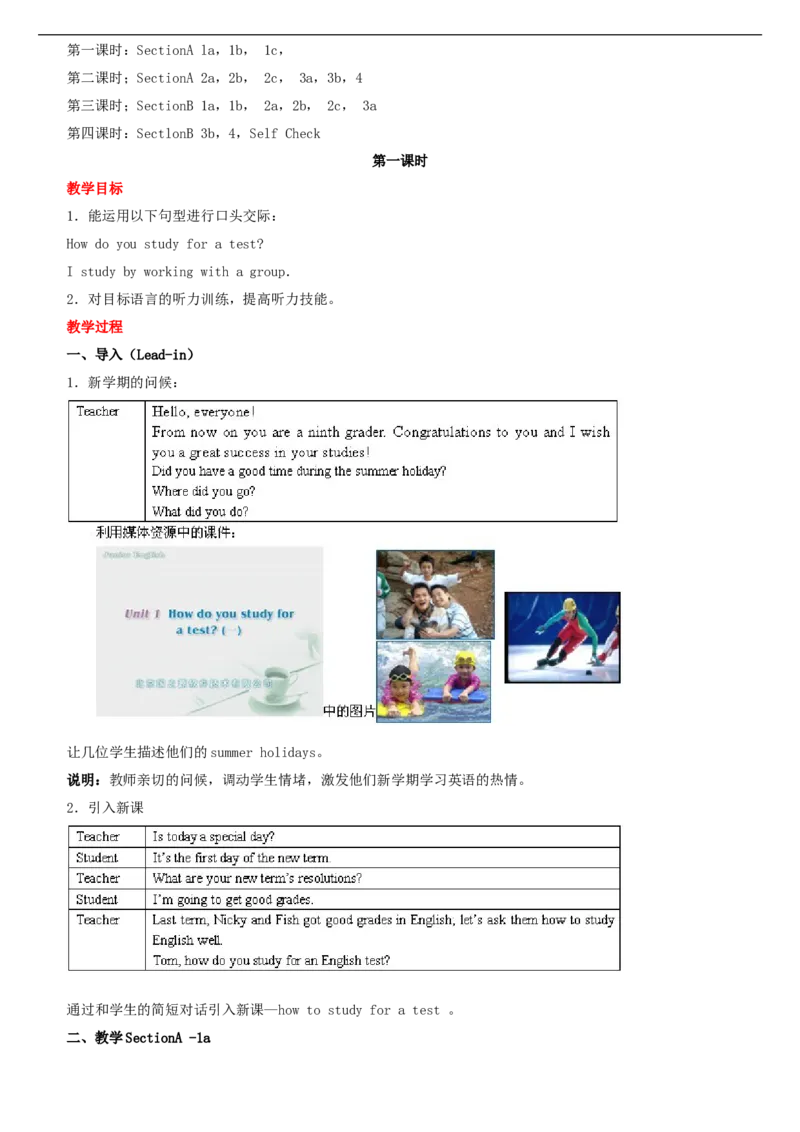
让几位学生描述他们的summer holidays。
说明:教师亲切的问候,调动学生情堵,激发他们新学期学习英语的热情。
2.引入新课
通过和学生的简短对话引入新课—how to study for a test 。
二、教学SectionA -1a老师板书标题: How do you study for a test?
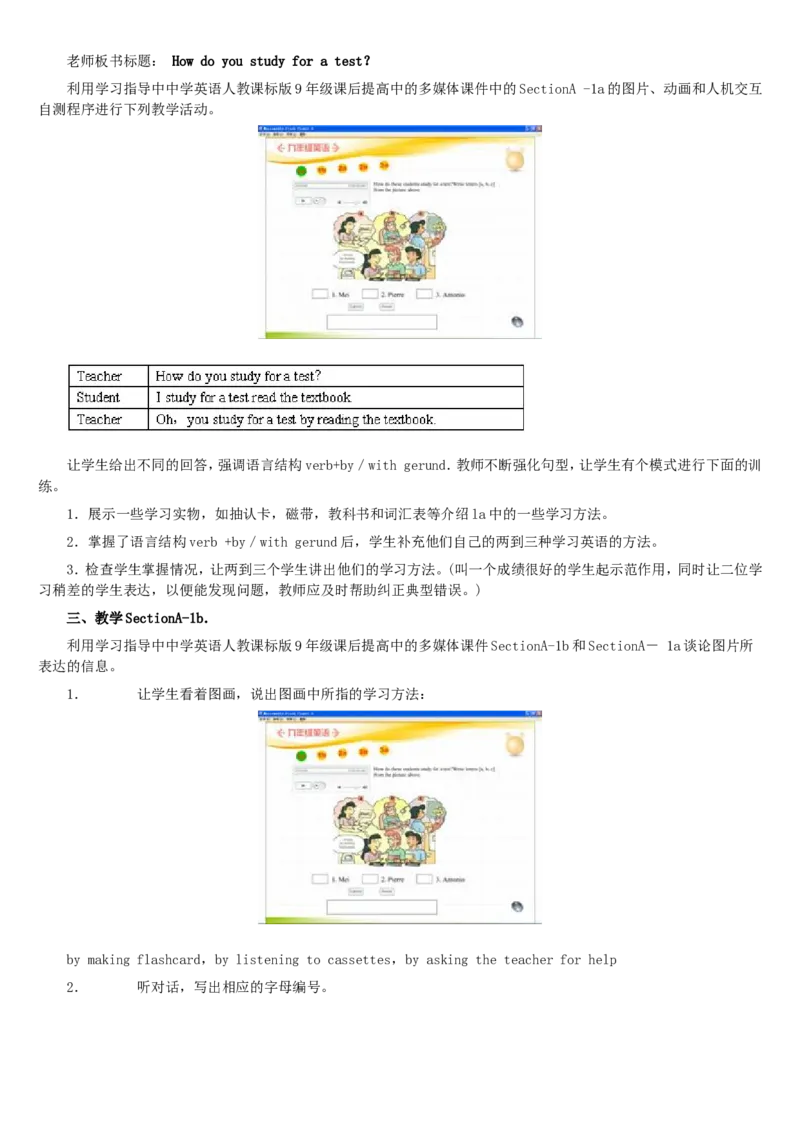
利用学习指导中中学英语人教课标版9年级课后提高中的多媒体课件中的SectionA -1a的图片、动画和人机交互
自测程序进行下列教学活动。
让学生给出不同的回答,强调语言结构verb+by/with gerund.教师不断强化句型,让学生有个模式进行下面的训
练。
1.展示一些学习实物,如抽认卡,磁带,教科书和词汇表等介绍la中的一些学习方法。
2.掌握了语言结构verb +by/with gerund后,学生补充他们自己的两到三种学习英语的方法。
3.检查学生掌握情况,让两到三个学生讲出他们的学习方法。(叫一个成绩很好的学生起示范作用,同时让二位学
习稍差的学生表达,以便能发现问题,教师应及时帮助纠正典型错误。)
三、教学SectionA-1b.
利用学习指导中中学英语人教课标版9年级课后提高中的多媒体课件SectionA-1b和SectionA- 1a谈论图片所
表达的信息。
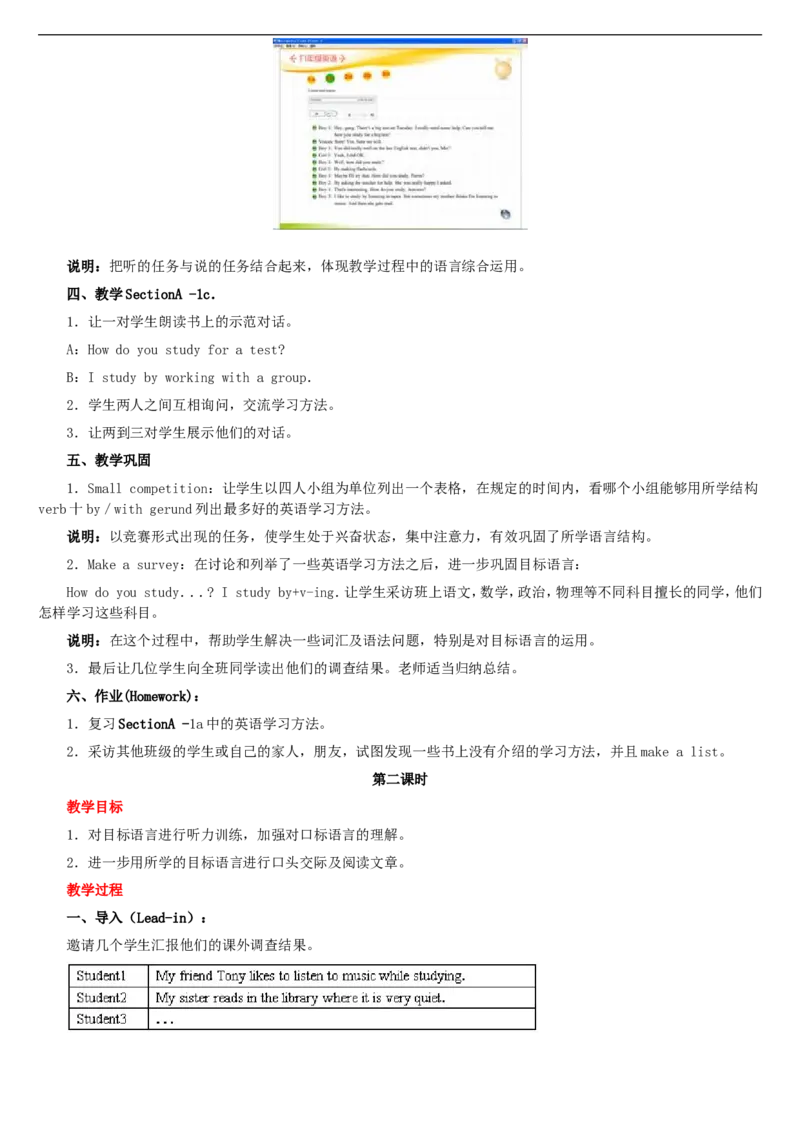
1. 让学生看着图画,说出图画中所指的学习方法:
by making flashcard,by listening to cassettes,by asking the teacher for help
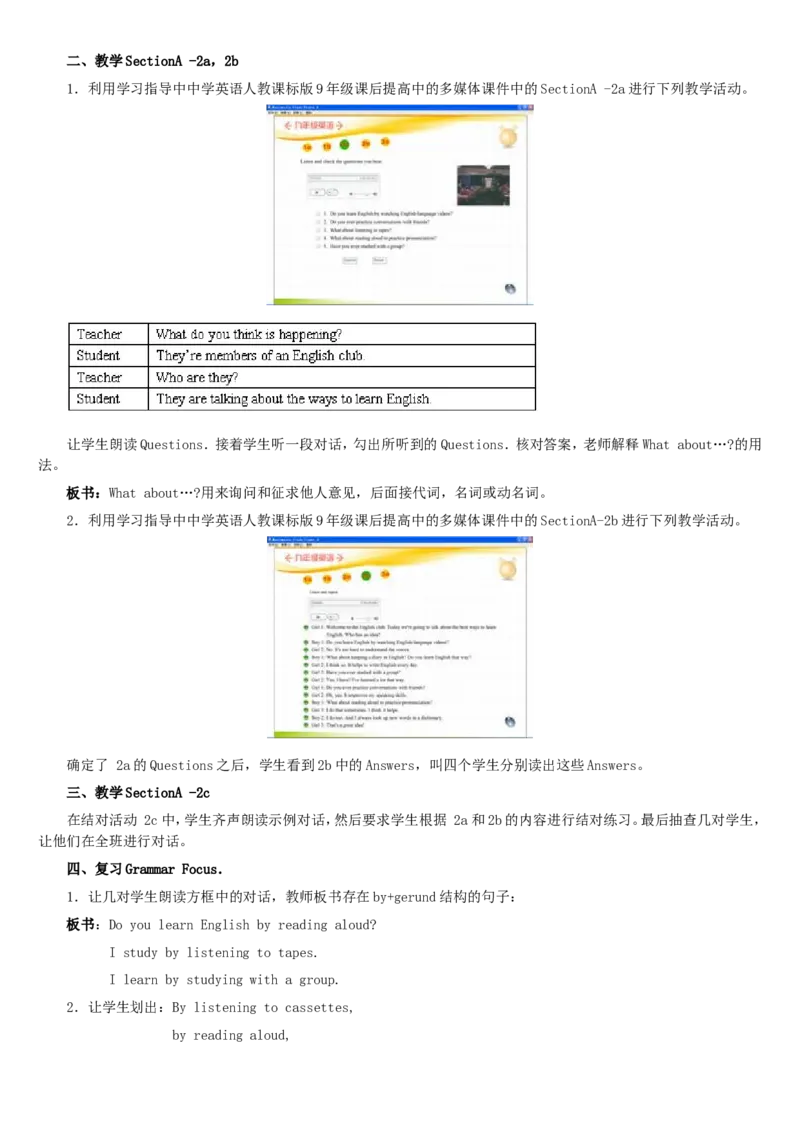
2. 听对话,写出相应的字母编号。说明:把听的任务与说的任务结合起来,体现教学过程中的语言综合运用。
四、教学SectionA -1c.
1.让一对学生朗读书上的示范对话。
A:How do you study for a test?
B:I study by working with a group.
2.学生两人之间互相询问,交流学习方法。
3.让两到三对学生展示他们的对话。
五、教学巩固
1.Small competition:让学生以四人小组为单位列出一个表格,在规定的时间内,看哪个小组能够用所学结构
verb十by/with gerund列出最多好的英语学习方法。
说明:以竞赛形式出现的任务,使学生处于兴奋状态,集中注意力,有效巩固了所学语言结构。
2.Make a survey:在讨论和列举了一些英语学习方法之后,进一步巩固目标语言:
How do you study...? I study by+v-ing.让学生采访班上语文,数学,政治,物理等不同科目擅长的同学,他们
怎样学习这些科目。
说明:在这个过程中,帮助学生解决一些词汇及语法问题,特别是对目标语言的运用。
3.最后让几位学生向全班同学读出他们的调查结果。老师适当归纳总结。
六、作业(Homework):
1.复习SectionA -1a中的英语学习方法。
2.采访其他班级的学生或自己的家人,朋友,试图发现一些书上没有介绍的学习方法,并且make a list。
第二课时
教学目标
1.对目标语言进行听力训练,加强对口标语言的理解。
2.进一步用所学的目标语言进行口头交际及阅读文章。
教学过程
一、导入(Lead-in):
邀请几个学生汇报他们的课外调查结果。二、教学SectionA -2a,2b
1.利用学习指导中中学英语人教课标版9年级课后提高中的多媒体课件中的SectionA -2a进行下列教学活动。
让学生朗读Questions.接着学生听一段对话,勾出所听到的Questions.核对答案,老师解释What about…?的用
法。
板书:What about…?用来询问和征求他人意见,后面接代词,名词或动名词。
2.利用学习指导中中学英语人教课标版9年级课后提高中的多媒体课件中的SectionA-2b进行下列教学活动。
确定了 2a的Questions之后,学生看到2b中的Answers,叫四个学生分别读出这些Answers。
三、教学SectionA -2c
在结对活动 2c中,学生齐声朗读示例对话,然后要求学生根据 2a和2b的内容进行结对练习。最后抽查几对学生,
让他们在全班进行对话。
四、复习Grammar Focus.
1.让几对学生朗读方框中的对话,教师板书存在by+gerund结构的句子:
板书:Do you learn English by reading aloud?
I study by listening to tapes.
I learn by studying with a group.
2.让学生划出:By listening to cassettes,
by reading aloud,by studying with a group。
五、教学巩固
1.阅读练习SectionA -3a
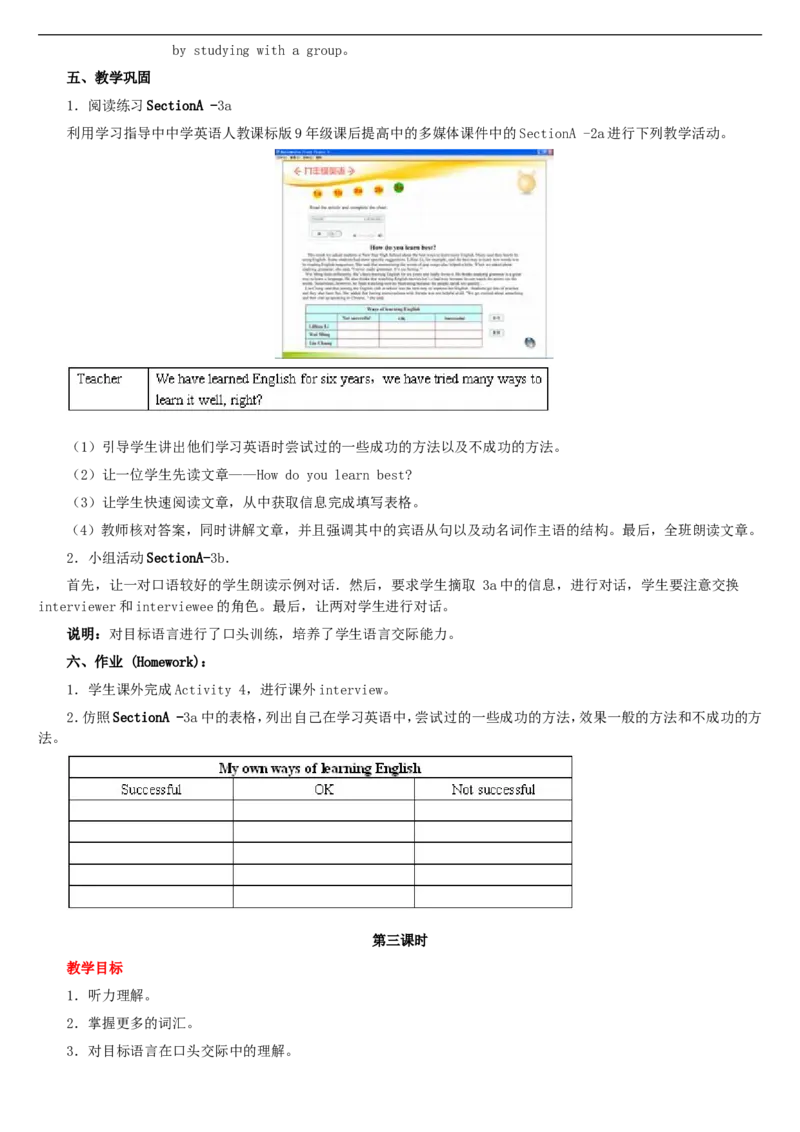
利用学习指导中中学英语人教课标版9年级课后提高中的多媒体课件中的SectionA -2a进行下列教学活动。
(1)引导学生讲出他们学习英语时尝试过的一些成功的方法以及不成功的方法。
(2)让一位学生先读文章——How do you learn best?
(3)让学生快速阅读文章,从中获取信息完成填写表格。
(4)教师核对答案,同时讲解文章,并且强调其中的宾语从句以及动名词作主语的结构。最后,全班朗读文章。
2.小组活动SectionA-3b.
首先,让一对口语较好的学生朗读示例对话.然后,要求学生摘取 3a中的信息,进行对话,学生要注意交换
interviewer和interviewee的角色。最后,让两对学生进行对话。
说明:对目标语言进行了口头训练,培养了学生语言交际能力。
六、作业 (Homework):
1.学生课外完成Activity 4,进行课外interview。
2.仿照SectionA -3a中的表格,列出自己在学习英语中,尝试过的一些成功的方法,效果一般的方法和不成功的方
法。
第三课时
教学目标
1.听力理解。
2.掌握更多的词汇。
3.对目标语言在口头交际中的理解。教学过程
一、导入(Lead-in):
检查家庭作业的同时,又让学生复习和巩固了上节课所学的目标语言,重要词汇。为以下的新课作好铺垫。
说明:通过口语练习,既激发了学生的学习积极性,让学生在轻松的氛围中复习了上节课的
目标语言,又引出新课。
二、教学SectionB-la.
1.
引导学生回答一些problemls。
2.让不同的学生讲出他们学习英语所遇到的困难,教师总结一些普遍的problems。
3.板书SectionA -1a 的problems,让学生大声朗读这些problems。
板书:I can’t pronounce some of the words.
I can’t spell some English words.
I can’t understand spoken English.
I make mistakes in grammar.
I read very slowly.
4.让学生根据自己的情况单独完成SectionB-la的任务。
5.
确定学生掌握了SectionB -1a的内容后,接着让学生笔头补充自己学习英语的困难。教师在这过程中,及时给出帮
助和指导。
三、教学SectionB -2a,SectionB-2b.
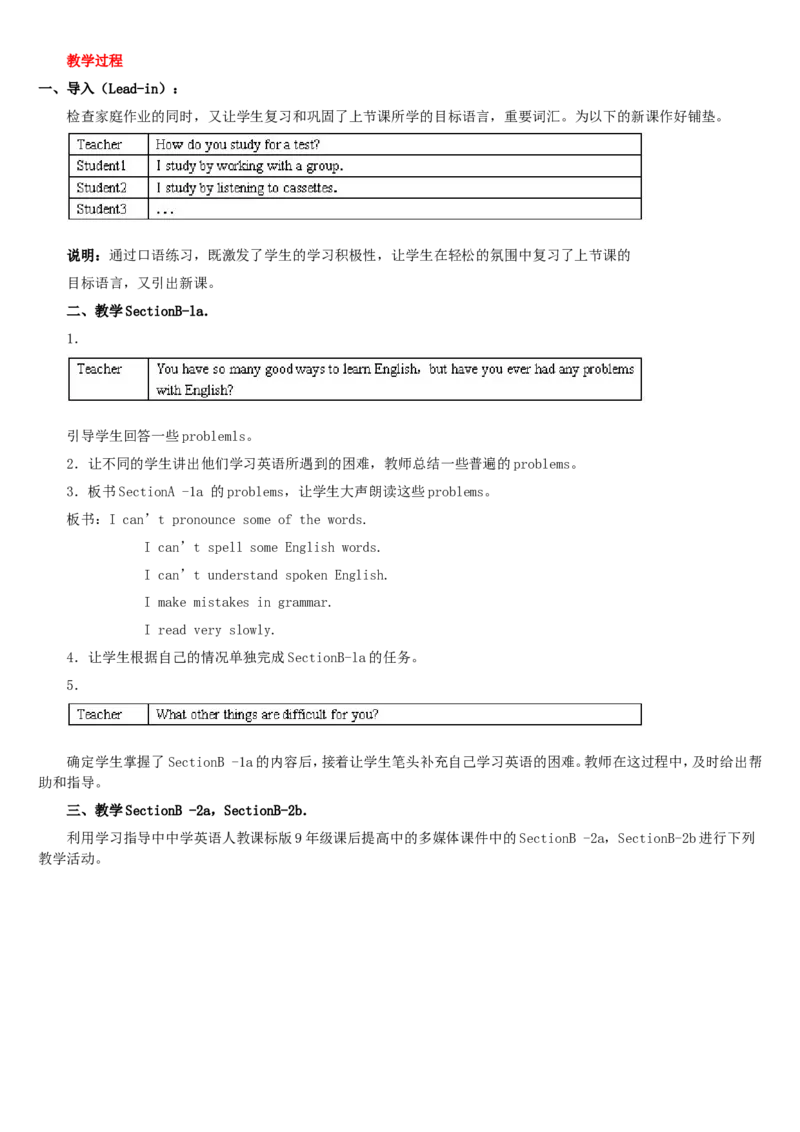
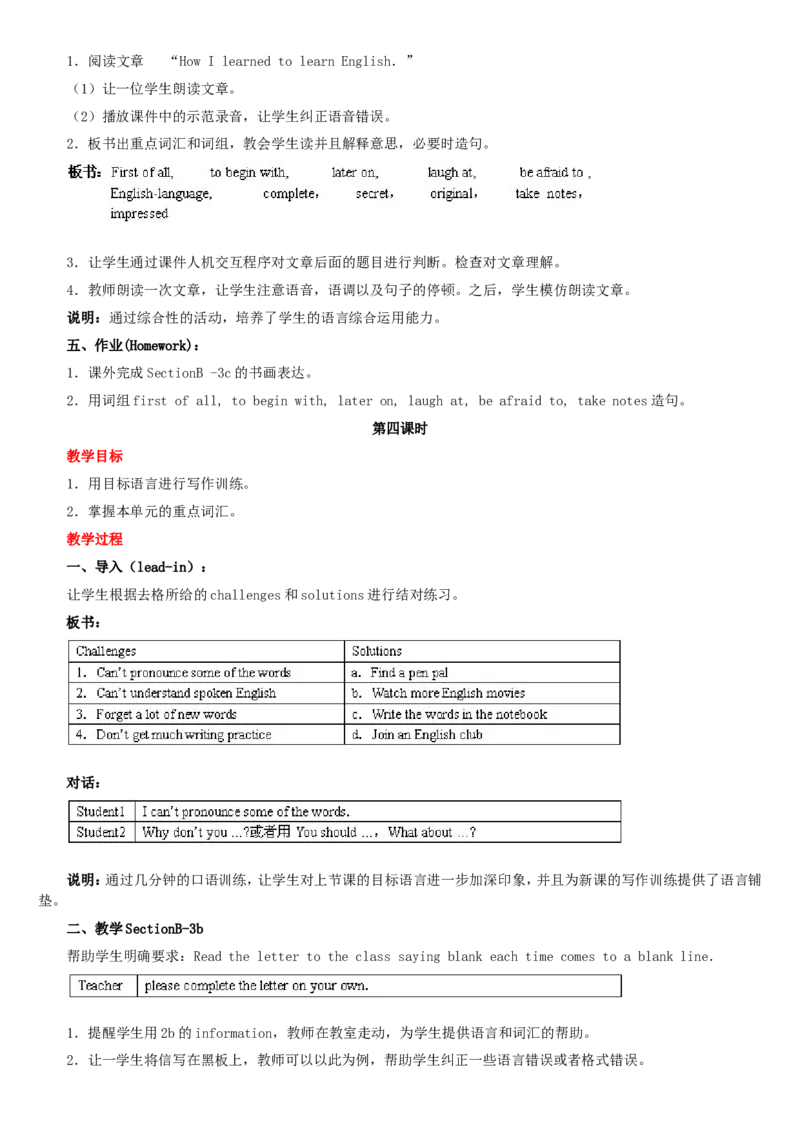
利用学习指导中中学英语人教课标版9年级课后提高中的多媒体课件中的SectionB -2a,SectionB-2b进行下列
教学活动。1. 让一位学生朗读方框中的challenges.教师解释生词challenge,it means“problem"。
适当渗透其文化差异:Americans通常喜欢用challenges表达生活和工作上的一些问题,体现了一种积极向上的人
生观。
2. 帮助学生明确听力要求。
例:Say,you will hear a conversation between Paul and his teacher,Ms Mitchell.
3. 播放二次录音,核对答案。
4.
让学生朗读2b方框中的solutions,教师做出一定的解释。
5.播放录音,学生完成SectionB-2b的任务。
说明:学生通过听力练习,巩固了本课的目标语言。
四、教学SectionB -2c
1.吸引学生的注意力到示例对话,让两位学生大声朗读对话。
2.让学生结对练习对话,然后模仿编造对话。(在这过程中,教师应在教室移动以便帮助学生解决一些语言,词汇上
的问题。)
3.让两到三对学生展示所编对话。
五、教学巩固
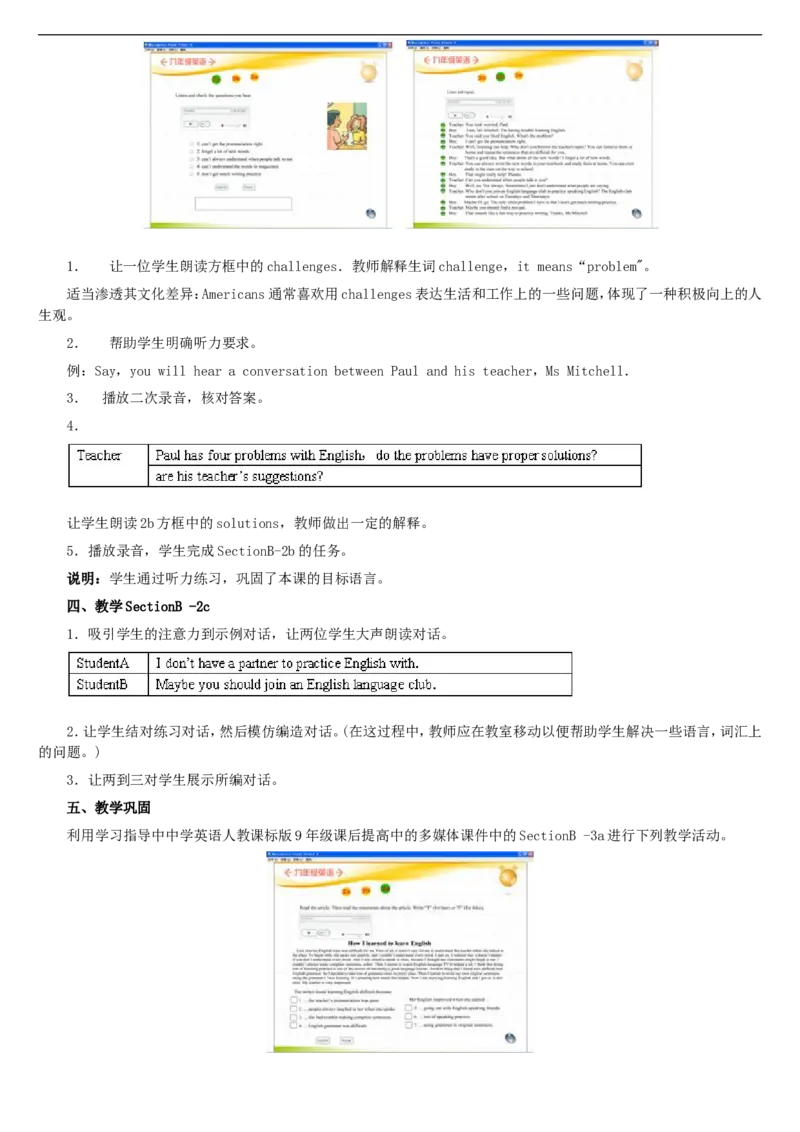
利用学习指导中中学英语人教课标版9年级课后提高中的多媒体课件中的SectionB -3a进行下列教学活动。1.阅读文章 “How I learned to learn English.”
(1)让一位学生朗读文章。
(2)播放课件中的示范录音,让学生纠正语音错误。
2.板书出重点词汇和词组,教会学生读并且解释意思,必要时造句。
3.让学生通过课件人机交互程序对文章后面的题目进行判断。检查对文章理解。
4.教师朗读一次文章,让学生注意语音,语调以及句子的停顿。之后,学生模仿朗读文章。
说明:通过综合性的活动,培养了学生的语言综合运用能力。
五、作业(Homework):
1.课外完成SectionB -3c的书画表达。
2.用词组first of all, to begin with, later on, laugh at, be afraid to, take notes造句。
第四课时
教学目标
1.用目标语言进行写作训练。
2.掌握本单元的重点词汇。
教学过程
一、导入(lead-in):
让学生根据去格所给的challenges和solutions进行结对练习。
板书:
对话:
说明:通过几分钟的口语训练,让学生对上节课的目标语言进一步加深印象,并且为新课的写作训练提供了语言铺
垫。
二、教学SectionB-3b
帮助学生明确要求:Read the letter to the class saying blank each time comes to a blank line.
1.提醒学生用2b的information,教师在教室走动,为学生提供语言和词汇的帮助。
2.让一学生将信写在黑板上,教师可以以此为例,帮助学生纠正一些语言错误或者格式错误。说明:通过该活动用语言目标提供阅读和写作练习。
三、教学Self Check l.
1.让一位学生读出单词,让学生集中在这些单词上。
2.交代学生用这些词的正确的形式填空,并且注意保持句子的主渭一致。
3.核对答案,让五个学生分别读出完艇的句子。
4.学生用这些词造句。收集几个学生的句子,帮助学生纠正错误,加强对目标词汇的理解和运用。
四、教学Self Check 2.
1.帮助学生明确要求,引导学生组织语言,将Xu Zheng’s notes和Xu Zheng's essay组织成一篇文章。
2.读一位优秀学生的文章给其他学生。(给一些学习相对差的学生参考。)
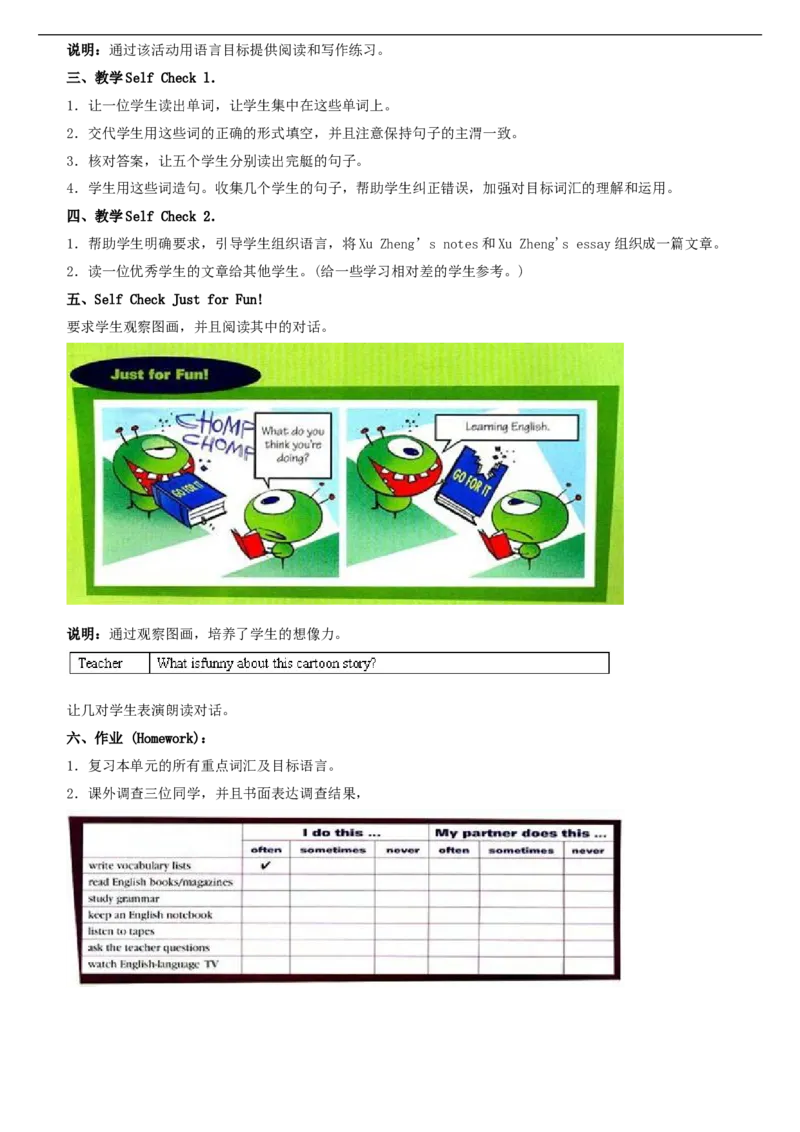
五、Self Check Just for Fun!
要求学生观察图画,并且阅读其中的对话。
说明:通过观察图画,培养了学生的想像力。
让几对学生表演朗读对话。
六、作业 (Homework):
1.复习本单元的所有重点词汇及目标语言。
2.课外调查三位同学,并且书面表达调查结果,Unit 1 How do you study for a test? 教案二
[话题](Topic): How to learn English
[重点词组](Key Phrases)
1.make flashcards 制作抽认卡 2.ask for help 请求帮助
3. make mistakes 犯错 4. later on 后来
5. be afraid to do 害怕做某事 6. laugh at 嘲笑(某人)
7. take notes 作笔记 8.read aloud 朗读
9. native speaker 说本族语的人 10. make up 组成
11. the best way to do…做某事最好的办法 12. to begin with 首先
13. write down 写下,记下 14. on one’s way to 在某人去某地的路上
15. once more 又一次,再一次 16. first of all 首先
17. give up 放弃 18. think about 考虑
19. be angry with 对(人或事)感到生气 20.break off 突然终止某事
21 end up (doing) sth 结束做某事1. 22. enjoy doing sth 喜欢做某事
[交际用语]
1. –How do you study for tests? –well. I study by working with my classmates.
2. –Have you ever studied with a group?- Yes, I have. I’ve learned a lot that way.
3. what (how) about…?
4. why don’t sb do…?=why not do…
5. –Maybe you should join an English club.
[重点难点释义](Language Points)
I. How to learn English ?
1. 本单元的话题是讨论如何学习英语。这个话题既有趣又实用,既能锻炼我们的语言能力,又能使我们学到一些实用
的方法,对自身的学习大有帮助。如何向别人请教学习方法呢?又如何回答呢?请诵读下面的目标句型:
How do you study English?
I study English by listening cassettes.
by studying with a group.
by watching English programs on TV.
by enjoying English songs.
by taking part in English classes after school.
by getting an English tutor.
by reading English magazines and newspaper.
by surfing the Internet.
by making flashcards.
by reading the textbook.
by asking the teacher for help.
by making vocabulary lists.
by taking notes carefully.
by having the English class carefully.
by finishing my homework seriously.
Do you learn English by…?
Yes, I do / No, I don’t.Have you ever studied with a group?
Yes, I have. I’ve learned a lot that way.
What about listening to cassettes?
I do that sometimes. I think it helps.
2.学会评价各种学习方法的优劣 (Comment on the ways of learning English)
看到上面的学习方法,有些眼花缭乱。其实,并不是所有的学习方法都适合自己。我们要学会评价与判断,然后才能
选择最适合自己的方法。用下面的语言进行评价:
I think studying English by… is … because…
e.g. I think studying English by working with a group is a good way because you can ask others when you have questions.
I think surfing the Internet is a bad way because you have to use a computer and always waste your time.
这个句型较长,是个复合句, 出现了由because引导的原因状语从句。进入初三后,我们在写作表达时,要避免使用没
有主句的because从句,而要写完整的句子。另外,在这句话中,我们看到了以动名词studying English为主语的句子。
如:不能写Because I slept late. 这样句意不完整,不清晰。
要写成 I missed the early bus because I slept late.这样有原因,有结果的句子才是完整的句子。
3. 找出自己在英语学习中的困难(Find out your own difficulties in learning English)
要选择适合自己的学习方法,还必须清楚自己的困难所在,然后才能有的放矢。我们如何表达自己学习上遇到的困难
呢?如何给出建议呢?请诵读下面的句型:
I have a problem. I can’t remember the new words.
I can’t pronounce some of the words.
I can’t understand spoken English.
I always make mistakes in grammar.
I read very slowly.
I don’t know how to speak English well.
给出建议:
You should read English aloud.
Listening can help you.
Why don’t you join an English language club to practice speaking.
Would you mind remembering new words by flashcards?
Please try to talk with your friends in English as much as possible.
4.确定自己的学习方法(Decide your suitable learning ways)
通过以上各个环节的学习,我们终于可以完成最后的目标——选择适合自己的方法。如何表达呢?目标句型如下:
(注意要给出原因,练习使用because)
I think I can study English by …because…
e.g. I think I can study English by listening to English songs because I love music too.
I don’t think I can get an English tutor because I want to learn by myself at home.
Teaching goals(单元教学目标)
语言知识目标:
1.学会用by短语表达学习方法。 学会讨论各种学习方法和策略。
2.Vocabulary: flashcard , take notes ,frustrating ,memorize ,aloud ,comma ,make mistakes ,pronunciation ,be afraid of ,Why
don’t you … ?
3.Pattern: How do you study for a test ?
Well .I study by working with my classmates .
Have you ever studied with a group ?
Yes , I have .I’ve learned a lot that way .
语言技能:学生能与同学们交流和讨论学习方法。
学习策略:使学生能根据自己的实际采用适当的学习方法,并形成个性化的学习。文化意识:了解英美国家学生学习的主要方法。
情感态度:形成相互交流相互促进的学习氛围。
Important and difficult points (重难点):
Functions: Talk about how to study .
Structures: Verb + by 后接动名词的用法。
课时安排5课时
第一课时: Section A 1a ---2c
第二课时:Section A 3a 3b 4
第三课时:Section B 1a---2c
第四课时: Section B 3a----Self Check
第五课时: Reading
教学计划
Period 1
Teaching contents(教学内容)
Section A 1a 1b 1c 2a 2b 2c
Teaching aims(教学目标)
1.学会谈论如何学英语。
2.学会谈论如何为考试作准备。
Language points(语言点)
1.要求掌握以下句式:
(1)----How do you study for a test?
----I study by…..
(2)----How do you learn English?
----I learn by….
(3)----Do you learn English by…?
----Yes, I do / No, I don’t.
(4)----Have you ever studied with a group?
----Yes, I have. I’ve learned a lot that way.
2.要求掌握以下词汇:flashcard, vocabulary, aloud, pronunciation.
Difficulties(难点):by +doing结构的使用。
Teaching steps(教学步骤):
1. Warming-up and revision(课堂热身和复习)
(1)Daily greetings to the students(日常问候)
(2)Ask some students about their summer holiday
(3)Revision(复习)
----How do you come to school?
----I come to school by….
教学设计说明 跟学交流拉近学生的距离,找回以前的感觉,引出本节课的新内容。
2. Presentation(呈现新知识)
T: (从复习中引出) How do you study for a test?
S: I study for a test by working with friends /
• by making flashcards .
• by reading the textbooks.
• by asking the teacher for help .
• by reading aloud .
• by studying with groups .
• by studying grammar.教学设计说明 利用图片提供学生大量语言操练信息,掌握句型by+doing结构。 ……
1. Work on 1a(完成P2 --1a)
(1)Ask several students to tell you how they study for a test .Write their answers on the blackboard .
(2)Call some volunteers to read the phrases on Page 2 .Explain something about the structures “verb + by with gerund ”.
(3)Read the phrases ,students repeat .
教学设计说明 同学之间通过交流相互了解不同的学习方法。
4.Work on 1b(完成P2-1b)
Read the instructions to the students and make sure students know what to do .Then play recording and check the answers .
教学设计说明 训练学生的听力能力。
5.Work on 1c(完成P2-1c)
(1)First students work in pairs to talk about the picture .
(2)Then ask several pairs to present their dialogues .
教学设计说明 生生互动,加强学生的语速语感训练,进一步巩固句型by+doing结构。
6.Work on 2a , 2b(完成P3-2a ,2b)
(1)Read the instructions to students and ask some volunteers to read after you if necessary .
(2)Play the recording ,students finish the work .Check the answers .
(3)Ask some students to read the questions and answers in pairs .
教学设计说明 进一步强化训练学生的听力能力。
7. Post-task
(1)In pairs ,students talk about how to study for several minutes .
(2)Ask some students how they study individually .
(3)SB Page 3 , 2c .Get students work in pairs .Ask a few pairs to present their conversations .
教学设计说明 ……利用2a,2b中的信息,生生互动。
8. Grammar Focus
Read the questions and answers in the grammar box .Students repeat .Explain something about them if it is necessary .
教学设计说明 通过不同问句的口头操练来讨论同学间不同的学习方法。……
9.Follow up
Make a list and make a survey the ways of learning English.
教学设计说明 培养学生获取信息的能力。……
10.Homework
Oral work:
(1) Listen to 1b, read and recite it. (听读背诵1b中的对话)
(2) Go on making up your dialogues with your group members and polish it. (继续和小组成员编对话。并完善对
话。)
Written work:
Write a letter telling a friend how to become a better language learner.
教学设计说明 让学生学到的知识通过笔头练习得到升华。……
Period 2
Teaching contents(教学内容)
Section A 3a ---4
Teaching aims(教学目标)
1.学会谈论最好的学英语的方法。
2.学会谈论评价学英语的方法。
Language points(语言点)
1.要求掌握以下句式:
I find…frustrating because… I think…is not helpful at all. I feel differently
2.要求掌握以下词汇:excited frustrating memorize differently frustrate frustrating quickly add.
Difficulties(难点):对学习方法的评价。Reading Skills
(1) The students will be able to guess the meaning of the new words according to the context.
(2) The students will be able to scan for the information needed.
(3 The students will be able to get detailed information from an article.
Learning Strategies
(1) The students will be able to read the blog for the information needed. (资源策略)
(2) The students will be able to make up a dialogue according to the article. (交际策略)
(3) The students will be encouraged to further the dialogue. (认知策略)
Emotion & attitude
1) Enable the students to form a correct attitude to study.
2) Enable the students to choose good ways to study.
Teaching steps(教学步骤):
1. Warming up activity(课堂热身)
A song: What’s up ( by张靓颖)
教学设计说 明 让学生听英语歌自然引入新课。
2. Presentation(呈现新知识)
T: Do you know her? She is good at singing English songs.
Do you study by singing English songs?
T: How do you study English?
S: I study English by +V ing ….
T: Do you learn by watching English movies?
This is my favorite movie. I find it really interesting.
I feel the same way.
I feel differently.
教学设计说明 ……很自然地呈现出以下要学的新句型。
3.Practice
I find it…
I find…not …at all.
教学设计说明 ……给学生大量的图片进行口语操练,学会评价不同的学习方法。
4. Discuss in groups
What do you think of surfing the Internet?
A: I find… because…
B: I feel differently/I feel the same way.
C: …
D: …
教学设计说明 ……让学生操练不同的评价观点的句型。
5. Presentation(呈现新知识)
T:If you meet some new words when you are reading, what will you do?
S: dictionary
Another way is to guess the meaning. I will show you some specific examples.
ppt
The news is frustrating
The news is frustrating because my favorite basketball team lost the game.
A.令人激动的 B.令人愉快的 C.令人失望的,沮丧的I will feel frustrated
Ppt: If… I will feel frustrated./I will find it frustrating.
I find memorizing a lot of new words frustrating.
So I asked for help on my blog. Some friends sent some ideas for me. Today I want to share them with you.
Please read it quickly and find out the ways to memorize new words.
附页1
What do you think of these ideas? Students make comments
Please read again, I underlined some new words .Can you guess the meaning?
教学设计说明 ……利用学法指导来呈现新词汇。
6. Reading
T: Here is another article on my blog. Look at the title and the first two sentences. Can you tell me what it talks about?
We have learned many ways of studying English. Please read and tell me what ways are talked about here.
First reading: find out the ways and make comments
T: These are your opinions. What about the students in New Star High School.
Second reading: Fill in the chart.
教学设计说明 ……给学生灌输blog的新概念,培养学生信息技术的技能,并利用blog中的文章对学生进行阅读方
法指导。
7. Dialogue time:
The students are going to make up a dialogue according to the article..
教学设计说明 ……增加难度培养学生自编对话的能力。
8. Make a survey and write a report
Please make a survey in your group and write a report.
name ways comments How often
教学设计说明 ……有上面口语表达的基础再让学生进行调查以及写调查报告,将所学的语言知识通过笔头表达出
来,培养学生的书面表达能力。
9. Homework:
1.Polish the project and send them to my blog king0.07.blog.163.com
2. practice reading 3a with your classmates.
教学设计说明 ……学生在学会如何发e-mail的基础上,给学生尝试在blog上写文章的机会,当然很有必要。
Period 3
Teaching contents(教学内容)
Section B 1a ---2c
Teaching aims(教学目标)
学会谈论学英语中的困难和解决办法。
Language points(语言点)
----I don’t have a partnet to practice English with.
----Maybe you should join an English language club.
1.要求掌握以下句式:
I can’t pronounce some of the words.
I can’t understand spoken English .
I always make mistakes in grammar.
I read very slowly.
Maybe you should join an English language club.
2.要求掌握以下词汇:Pronounce spoken slowly mistake make mistakes comma challenge solution.
Difficulties(难点):学英语中的困难和解决办法的的语言表达。
Teaching steps(教学步骤):
1.Revision (复习)
Ask some students how they study English ,get them to answer individually .
教学设计说明 ……利用图片让学生温故知新,起到承上起下的作用。
2.Background.(背景)
Learning English is very important. When you search ”learning English” on the Internet. Youcan get 4,060,000 pieces of
information.
教学设计说明 ……让学生了解有关学英语的背景也是有必要的,同时也是一种对学生的学法指导。
3.Say your challenges and problems out.
I can’t pronounce some of the words.
I can’t understand spoken English .
I always make mistakes in grammar.
I read very slowly.
教学设计说明 ……学生能说出自己的问题所在,各抒己见,也就等于训练了学生的口语表达能力 。
4.Solutions to the problems:
(1)You should read English aloud.
(2) Listening can help.
(3)Why don’t you join an English language club to practice spoken English.
(4)Would you mind remembering new words by flashcards?
(5)Please try to talk with your friends in English as much as possible.
……..
教学设计说明 ……培养学生解决问题的能力和团体协作精神。
5. Work on 1a & 1b(完成P5-1a,1b)
(1) Ask one student to read the sentences to the class .
(2) Then have students check the statements which are true for them and ask them to add some other different things .
(3) Ask several students to write their lists on the blackboard and discuss them with the whole class .
教学设计说明 ……先口头再笔头归纳学英语中的困难,利用竞赛方式,激发学生的学习积极性。
6. Listening : work on Page 5 , 2a & 2b . (完成P5-2a,2b)
(1)Ask two students to read the challenges and solutions .If necessary ,have students repeat after you .
(2)Play the recording two or three times ,let students listen and finish the work .
(3)Ask one student to have his/her answers with the class .
(4)Correct the answers .
教学设计说明 ……为最后的听力大挑战作铺垫,培养学生的听力能力和技巧。
7.Pairwork: work on 2c(完成P5 --2c)
In pairs ,students role play conversations using the information from activity 2a and 2b .Then ask some pairs to present their
dialogue to the class .
教学设计说明 ……生生互动交流,加强学生的口语表达能力。
8.Listening Challenge(听力大挑战)
听下面三位同学的独白,完成任务.
教学设计说明 ……利用真实的录象提供学生听力信息,对学生的听力进行一次测验,激发兴趣。
9.Homework
Write an article to introduce how you study English .
教学设计说明 ……结合前几课时所学的内容让学生写一篇综合性的文章,培养学生的书面表达能力。
Period 4
Teaching contents(教学内容)Section B 3a ---Self Check
Teaching aims(教学目标)
1. Find some problems in learning English
2. Find some solutions to the problems in learning English
3. Reading strategy: scanning and skimming
Language points(语言点)
1.要求掌握以下句式:
How I learned to learn English
I couldn’t always make complete sentence s , either.
First of all , it wasn’t easy for me to understand the teacher when she talked to the class.
I was afraid to speak in class
I decided to take lots of grammar notes in every class.
2.要求掌握以下词汇:
later on realize matter be afraid to laugh at complete secret learner take notes term impress trouble
fast look up soft make up essay.
4. Difficulties(难点): Find some solutions to the problems in learning English
Teaching steps(教学步骤):
1.Work on SB Page 6 , 3a (完成P6 –3a)
(1)Read the instructions and make sure students know what to do .
(2)Give students several minutes to read the article and finish the task .
(3)After students finished ,ask one student to write his/her answers on the blackboard.
(4)Correct the answers .
(5)Ask one volunteer to read the article aloud to the class ,offer assistance if necessary .
教学设计说明 ……这一环节是本课时的中心内容,在教师的学法指导下布置学生完成一系列的任务,培养学生的阅
读理解能力。
2.Reading skills
教学设计说明 ……罗列阅读文章的阅读技巧,给学生一个清晰的思路,降低阅读理解难度。
3.Complete the conversation according to the reading.
教学设计说明 ……利用文中的有关信息,加以知识的扩充,提高学生的解题能力很有帮助。
4.Find in the reading
教学设计说明 ……进一步强化理解文章的大意,深化学生的理解能力。
5.Work on 3b(完成P6 –3b)
First ,have students finish the letter on their own ,while they are working ,walk around and give them some help .Then ask two
students to read their letter aloud to the class .Finally answer some questions the students may have .
教学设计说明 ……基于上面的知识基础,将所学的语言点通过笔头表达出来,是对学生的书面表达能力的一种检测。
6. Interview (完成 Page 6 ,Part 4 .)
(1)Read the instructions and explain how to finish this task .
(2)Divide the class into groups of four .In each group ,each student takes turn interviewing the other students and take notes .
(3)Ask some groups to tell the class about their answers .
教学设计说明 ……通过四人一小组的调查活动,既培养了学生的互助协作精神,又提高了学生收集信息的能力。
7 . Selfcheck(完成Page 7 , Part 1 )
1. Students finish it on their own first ,then check the answers with the whole class .
2. Ask some students to make their own sentences with these words orally .
教学设计说明 ……检测学生对词汇运用的辨别能力。
8.Work on Page 7 , Part 2 (完成Page 7 , Part 1 )
(1)First ,read the instructions and explain something in the notes .
(2)Ask students to write an article .
(3)Ask someone to read his article to the class .教学设计说明 ……给学生足够的时间完成写作任务,再量出不同档次学生的作品作讲评,让学生尝到相应的成就感。
9.Learn
by 与 because的用法
教学设计说明 ……通过大量的例句来区分这两个字的用法,形象透彻。
10. Homework
SB Page 6 , 3c .Have students finish the article as their homework .
教学设计说明 ……检测所有学生的书面表达能力。
Period 5
Teaching contents(教学内容)
Reading
Teaching aims(教学目标)
How to deal with our problems.
Reading strategy:
1. according to the passage, find the correct definitions.
2. skim and find the main ideas of the essay.
Language points(语言点)
1.要求掌握的句式:the ways to deal with our problems.
2.要求掌握以下词汇:
deal with unless regard duty easily influence friendship development face soldier .
Difficulties(难点): How to deal with our problems.
Teaching steps(教学步骤):
1.Lead -in
Read and understand about My Beautiful Hometown—Ningbo.
Reading skilsl: a.Usually the first sentence in each paragraph is the key sentence.
b. It’s an important ability to guess the meaning of a word according to the context(上下文).
教学设计说明 利用学生比较了解的当地文章来对学生进行阅读技巧指导,为学下文作好很好的铺垫。……
2.Presentation
(1)Show the picture about Stephen Hawking – a great scientist.
(2)Free talk: Do you have any problems about…? (study. life. Family)
What are they?
Problems:
Solutions:
Talk about the pictures about the pollution. How should we deal with the problem?
教学设计说明 ……让学生看图观察一位著名的科学家,从而引出Problems和Solutions。
3.Group work:
What about your recent life? Talk about it with your partners. Ask and answer about your problems happening in your
recent life.
A: Do you have any problems recently?
B: Yes. I had a fight with my cousin.
A: I think you can deal with it by talking with him.
教学设计说明 ……通过生生互动交流近来生活中所碰到的问题,很贴近学生生活的话题。
4.Reading
(1)Read the article quickly and try to find at least three ways to solve problems.
How many ways does it mention?
What are they?
(2)Please guess if the following words are nouns, verbs, adjectives or others.
Then tell what they mean:affect, challenge, influence, duty, smart
(3) Let’s solve the problems in the passage :
a.What will happen if we worry about our problems?
b.Are there many ways to deal with our problems? What are they?
(4)Explain three ways to deal with our problems.
教学设计说明 ……设计任务型教学法,达到阅读理解的目的。
5.Match
教学设计说明 ……培养学生发现问题和解决问题的能力。
6.Make sentences with the words
教学设计说明 ……造句是词汇教学的途径之一,让学生学以致用。
7.According to the reading:
Are Betty’s ideas true or false?
教学设计说明 ……根据书上的观点来判断Betty’s ideas正确与否,将知识延伸到课外,进一步提高学生的阅读
理解能力。
8.Debate
You can think about the problem in these ways:
the family
the teachers there
the students there
the education
the surroundings
how he’ll feel
what he’ll get
教学设计说明 ……此环节有一定的难度,尽可能鼓励学生开口发表自己的意见,加强学生口语训练。
9.Discusion(Do you know?)
We meet different problems every day. We can solve them by learning to forget, by regarding them as challenges or
thinking of worse things. But first of all, we have to think about them carefully. It’s the first step to deal with problems.
教学设计说明 ……对学生进行人生观、价值观、克服困难的教育。
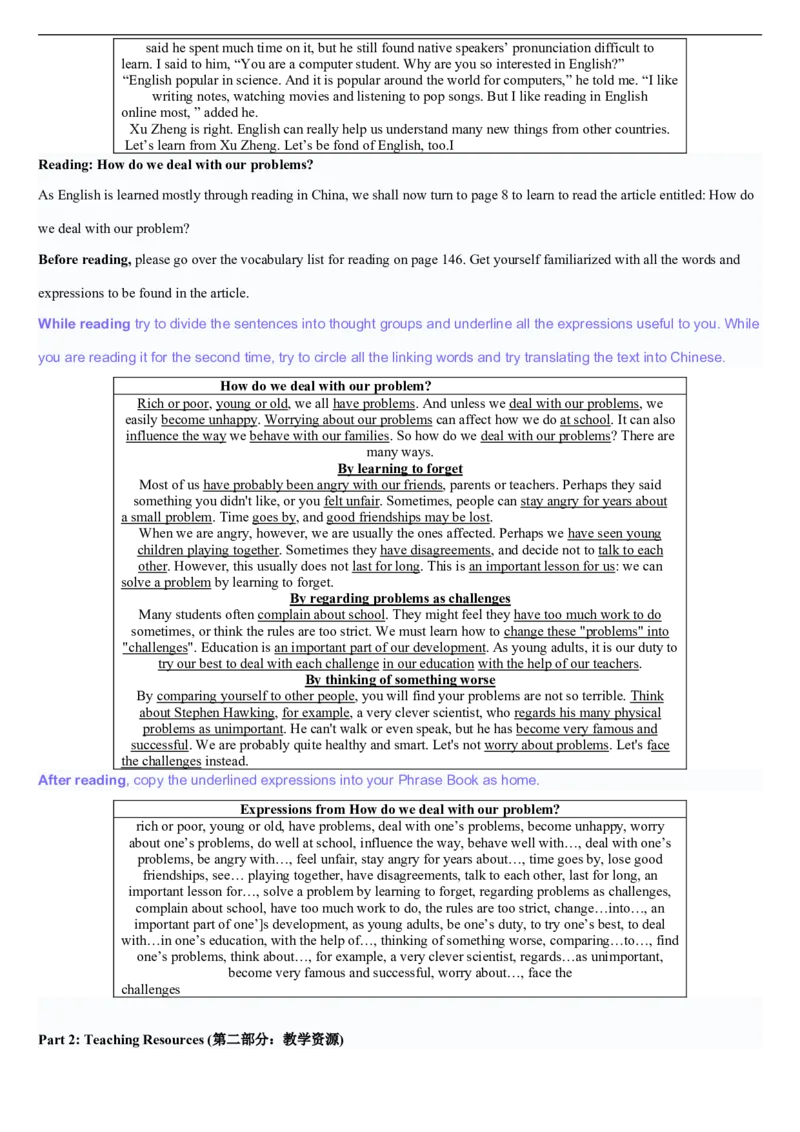
10.Homework
Stephen Hawking is a great man. But he has many physical problems. Please go to the library or surf the Internet to look
for more information about him, then write a passage to introduce him.
Here are the key sentences for your passage.
Stephen Hawking is a great man. He …
But he has many physical problems. He …
He regards his problems unimportant….
教学设计说明 ……通过书面描写,不仅培养学生的书面表达能力,还学会崇拜科学家的磨砺困难的崇高精神。
Unit 1 How do you study for a test? Section A 说课稿
Ladies and Gentlemen:
上午好。今天我说课的内容是GO FOR IT新目标英语九年级Unit1. Section A. Period 1的内容。
一、 教材内容分析:本单元以How to study for a test?为主线,让学生感受动名词的使用环境;充分掌握动名词的用法。同时改进自
己学习英语的方法,为今后的英语学习奠定坚实的基础。
二、 教学重点和难点:
1. 教学重点:
A. 句型:What about reading aloud to practice pronunciation?
词汇:aloud, secret, friendship, memorize, frustrate, agreement, disagreement, pronounce.
B. Talking about the methods on learning English.
2. 教学难点:
本课时的难点着眼于两个层面,一个为动名词在句中所充当的各种成分,另一个为用口头和书面两种方式表述学习
英语的方法。
三、 教学目标:
1. 语言知识目标:领略与掌握动名词用法。
2. 文化意识目标:通过本课时的学习,培养人际交往与自省能力。
3. 语言技能目标:能准确运用含有动名词的句型。
4. 学习策略目标:学生能善于利用合作学习,对集体行为表述个体想法,在合作学习中提升个人英语表达能力。
5. 情感态度目标:本课时创设的情境为Talking about the ways of how to learn English,学生要体现“公
益”精神,集大家智慧,开好一个party,使学生的协作能力在本课时中得到一定程度的提高。
四、 任务型活动:
Task1. Which group’s organization of the talk is the best?
Task2. Design a dialog .
Task3. Write a passage about learning English..
五、 教学过程设计
1. Greetings.
Talk about the activities students had last weekend.
复习检查本课的单词(短语),作为本课学习的铺垫与热身。
2. Discussing.
T: How do you study for a test?
T: I study by making flashcards.
T: What about reading aloud?
幻灯展示一些flashcards,引导学生用上述句型讨论。
注意:此时务必要让学生完整表达含有动名词的句式。3. Pair work: class party.
S1: I think I study by memorizing the new words….
S2: But for me, I study by listening to the teather carefully…
该环节的目的是想让学生强化训练句型和相关的拓展句型。
4. Listening: 1a and 1b
该听力测试难度并不大,学生在听之前的答案预测往往正确率会较高。
5. Group work:
Students work in a group of 4 to make up a conversation about how to study for a test. Which group’s
organization is the best?
提供给学生3个问题,便于学生讨论:
Question 1. Which is the best way to study English?
Question 2. How many ways do you study English by?
Question 3. What activities of learning English are popular in your everyday English studying?
学生小组讨论时,教师要到各小组旁听,引导学生尽量使用重点句型,争取难点有效突破。
6. Listening: 2a and 2b
7. Design: jion a club to learn English.
学生依然以group work形式为即将参加考试的同学设计一个提高英语成绩的学习方法.
8. Writing:
Task1: How do you study English every day?
Task2: Which method do you think is the best for you to learn English well?
Task3: If you have a test next week, what will you do to improve your English grade?
9. Homework:
Think about more ways of learning English well and write them down.
六、 板书设计:
Unit 1
1, New words
2,句型; How do you study for a test?
I study by making flashcards.
七、 教学评价与预测:本课时的教学评价应该着眼于以下三个方面:
1. 学生在Group work 中是否能积极参与
2. 学生对于动名词结构,能够主动运用
3. 学生在If对话和写作中,能够了解并正确使用学英语的更多好方法。
本课时的教学预测是学生可能会以比较高的热情参与若干个情景小组讨论中,而难点在于含有动名词的句式表述
上,需要课下及时的消化与巩固。 谢谢!
Unit 1 How do you study for a test? Section A 说课稿二
Goals
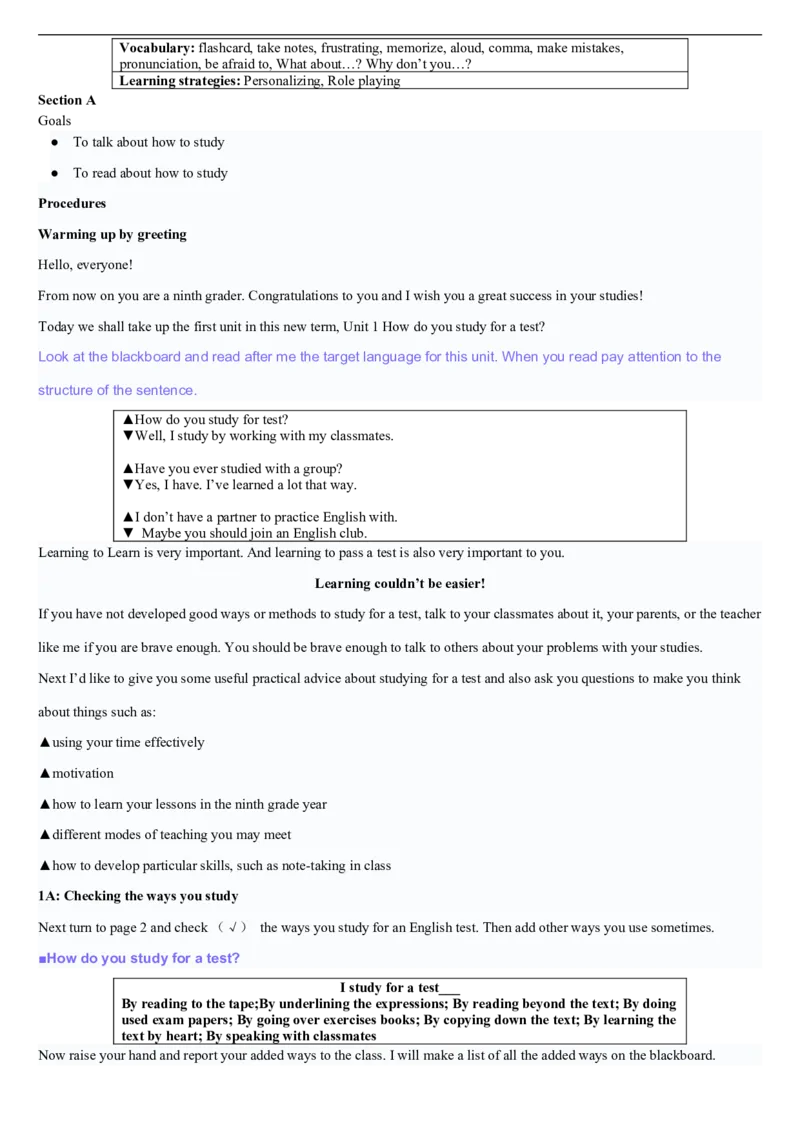
● To talk about how to study
● To read about how to study
Procedures
Warming up by greeting
Hello, everyone!
From now on you are a ninth grader. Congratulations to you and I wish you a great success in your
studies!
Today we shall take up the first unit in this new term, Unit 1 How do you study for a test?
Look at the blackboard and read after me the target language for this unit. When you read pay
attention to the structure of the sentence.
Learning to Learn is very important. And learning to pass a test is also very important to you.
Learning couldn’t be easier!
If you have not developed good ways or methods to study for a test, talk to your classmates about it,
your parents, or the teacher like me if you are brave enough. You should be brave enough to talk to
others about your problems with your studies.
Next I’d like to give you some useful practical advice about studying for a test and also ask you
questions to make you think about things such as:
▲using your time effectively
▲motivation
▲how to learn your lessons in the ninth grade year
▲different modes of teaching you may meet
▲how to develop particular skills, such as note-taking in class
1A: Checking the ways you study
Next turn to page 2 and check √ the ways you study for an English test. Then add other ways you use
sometimes.
■How do you study for a test?Now raise your hand and report your added ways to the class. I will make a list of all the added ways
on the blackboard.
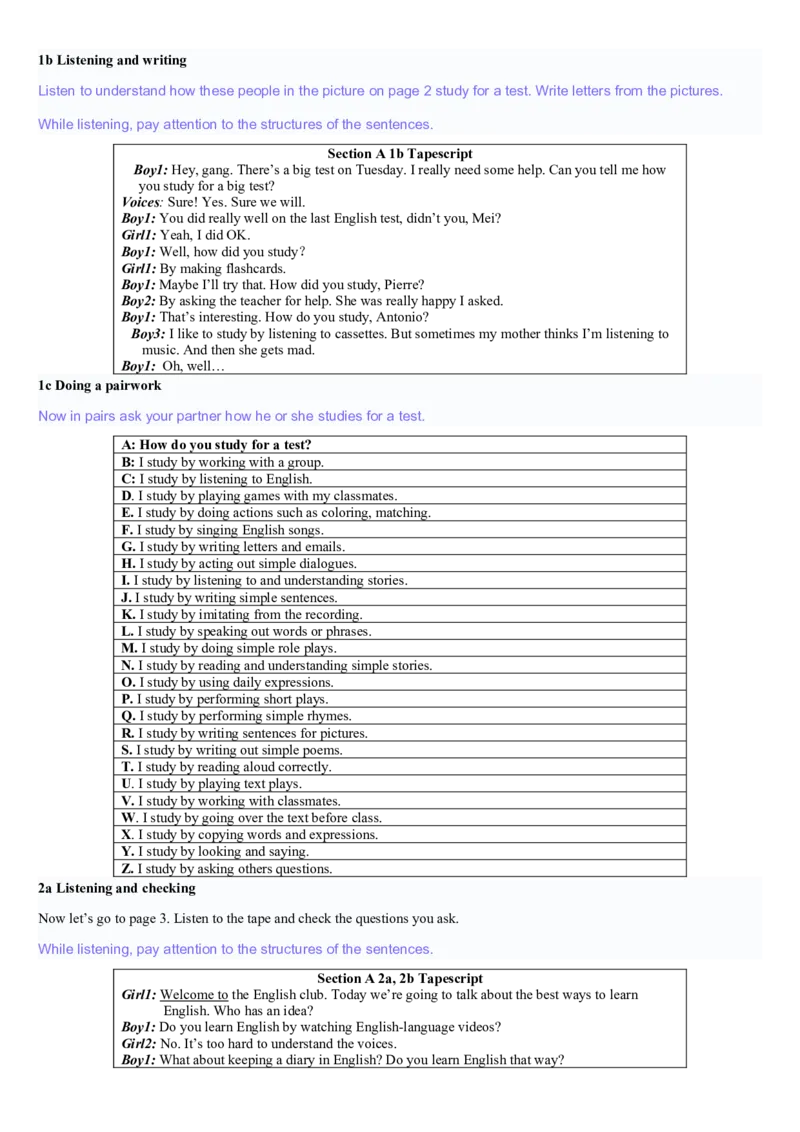
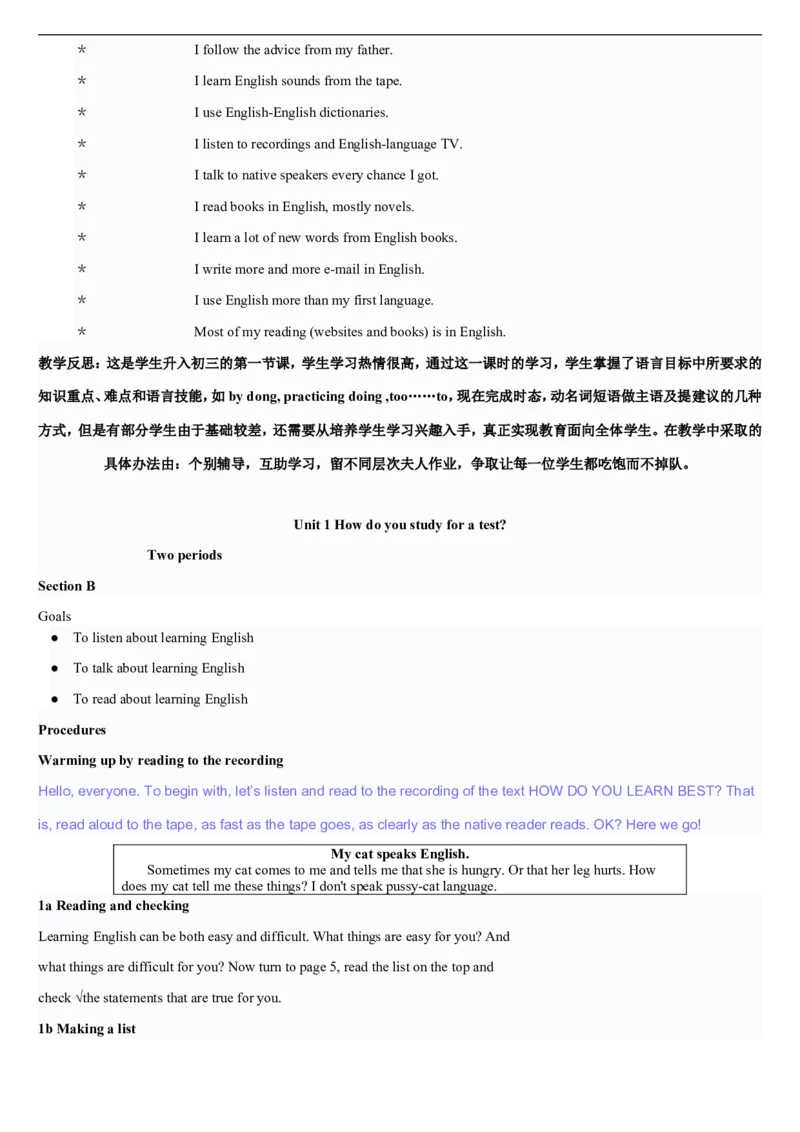
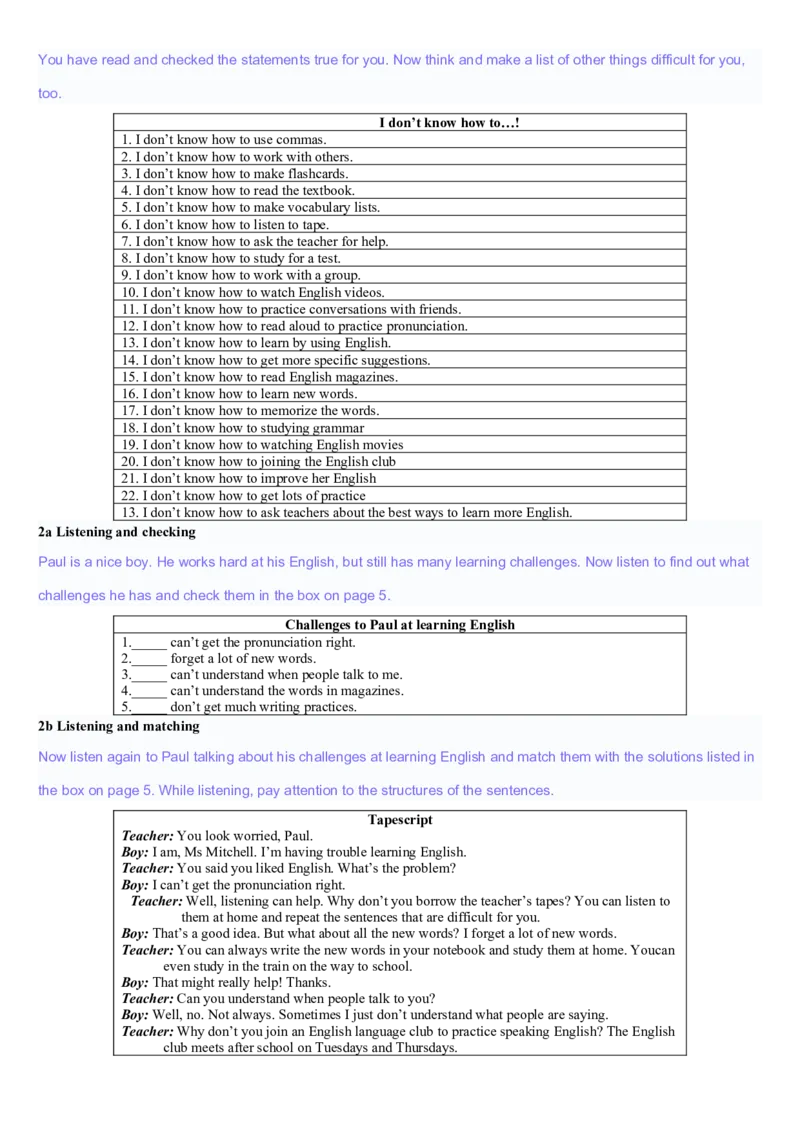
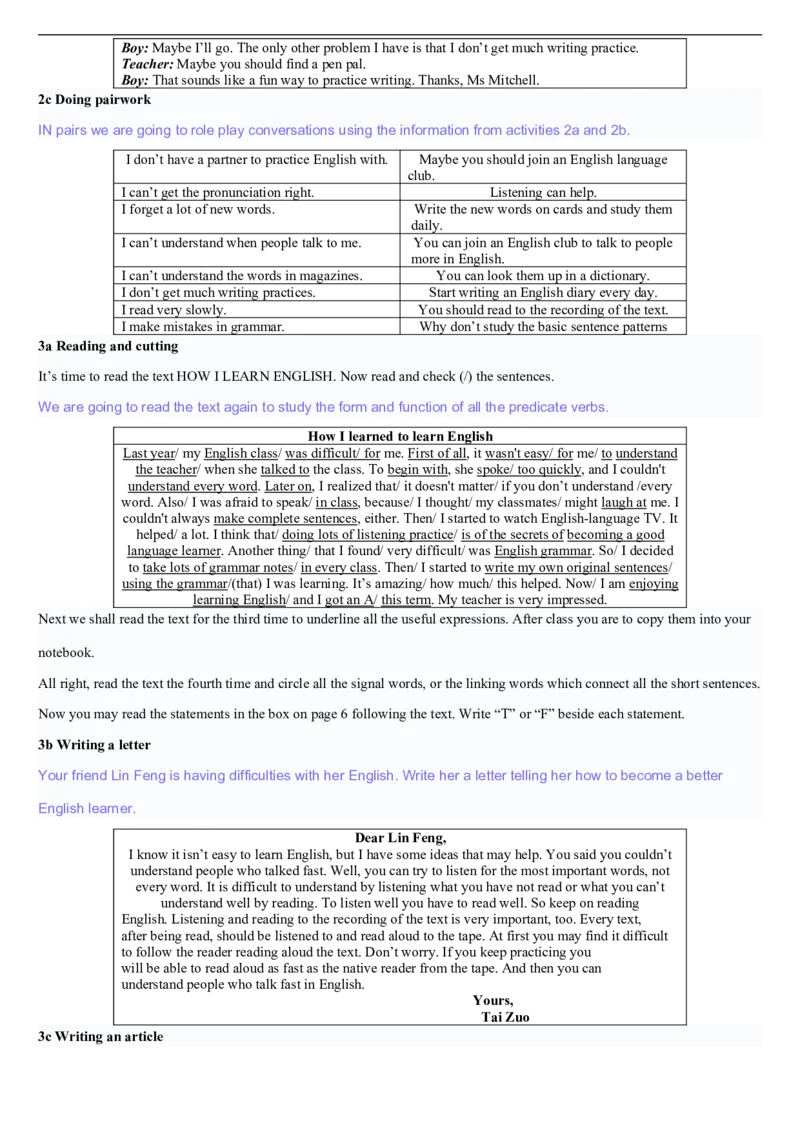
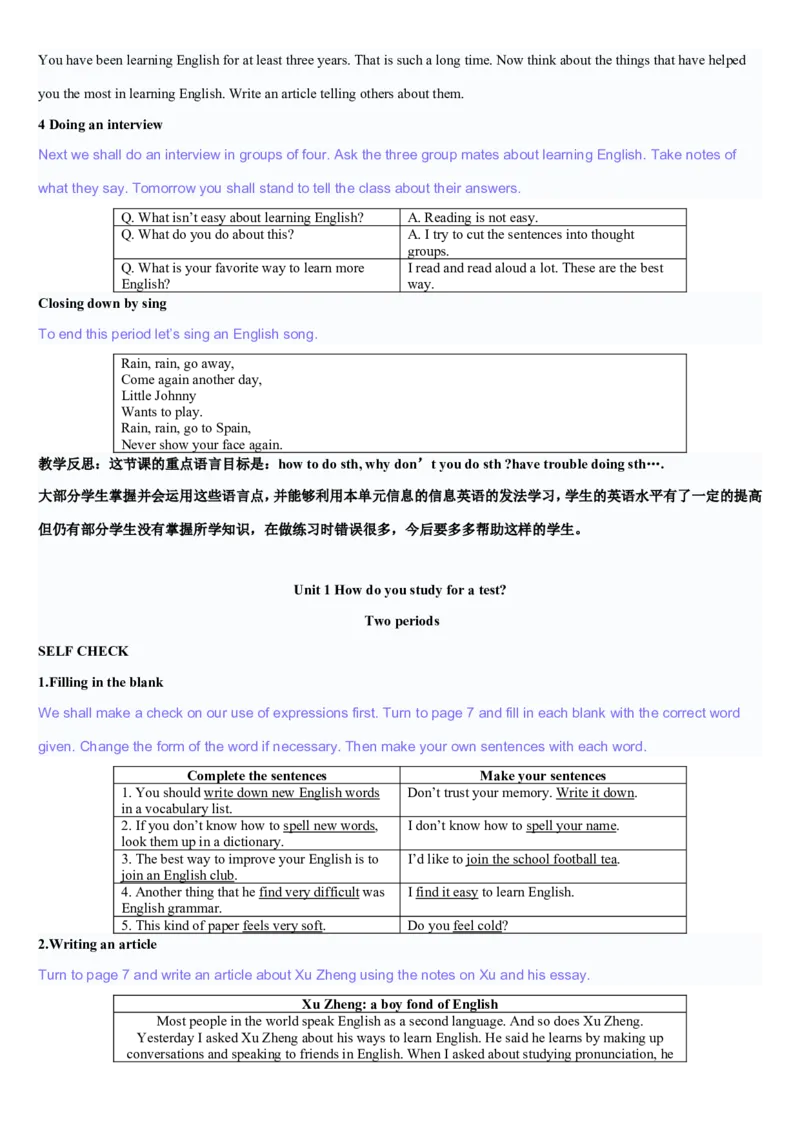
1b Listening and writing
Listen to understand how these people in the picture on page 2 study for a test. Write letters from
the pictures. While listening, pay attention to the structures of the sentences.
1c Doing a pairwork
Now in pairs ask your partner how he or she studies for a test.
2a Listening and checking
Now let’s go to page 3. Listen to the tape and check the questions you ask.
While listening, pay attention to the structures of the sentences.
2b Listening and matching
Listen again and match each question from 2a with an answer in the box on page 3.
2c Doing a pairwork
Next we are going to make a conversation in pairs using the information from activities 2a and 2b.
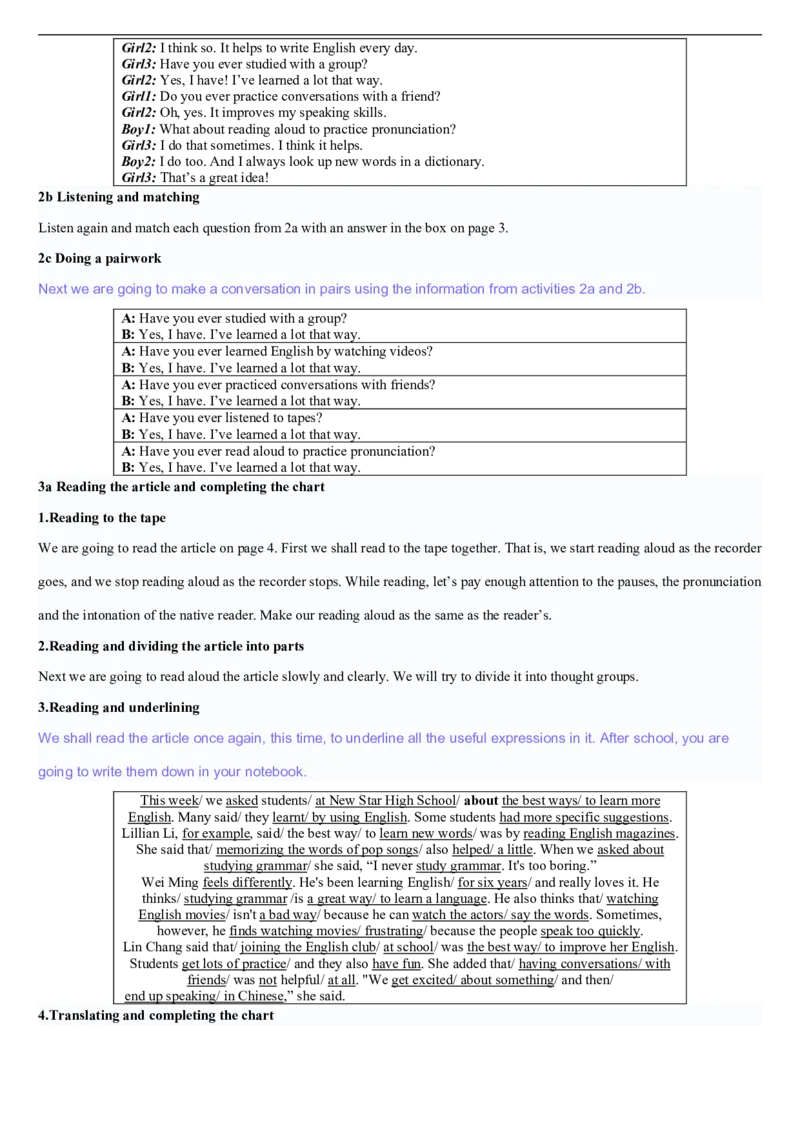
3a Reading the article and completing the chart
1.Reading to the tape
We are going to read the article on page 4. First we shall read to the tape together. That is, we
start reading aloud as the recorder goes, and we stop reading aloud as the recorder stops. While
reading, let’s pay enough attention to the pauses, the pronunciation and the intonation of the native
reader. Make our reading aloud as the same as the reader’s.
2.Reading and dividing the article into parts
Next we are going to read aloud the article slowly and clearly. We will try to divide it into thought
groups.
3.Reading and underlining
We shall read the article once again, this time, to underline all the useful expression_rs in it.
After school, you are going to write them down in your notebook.
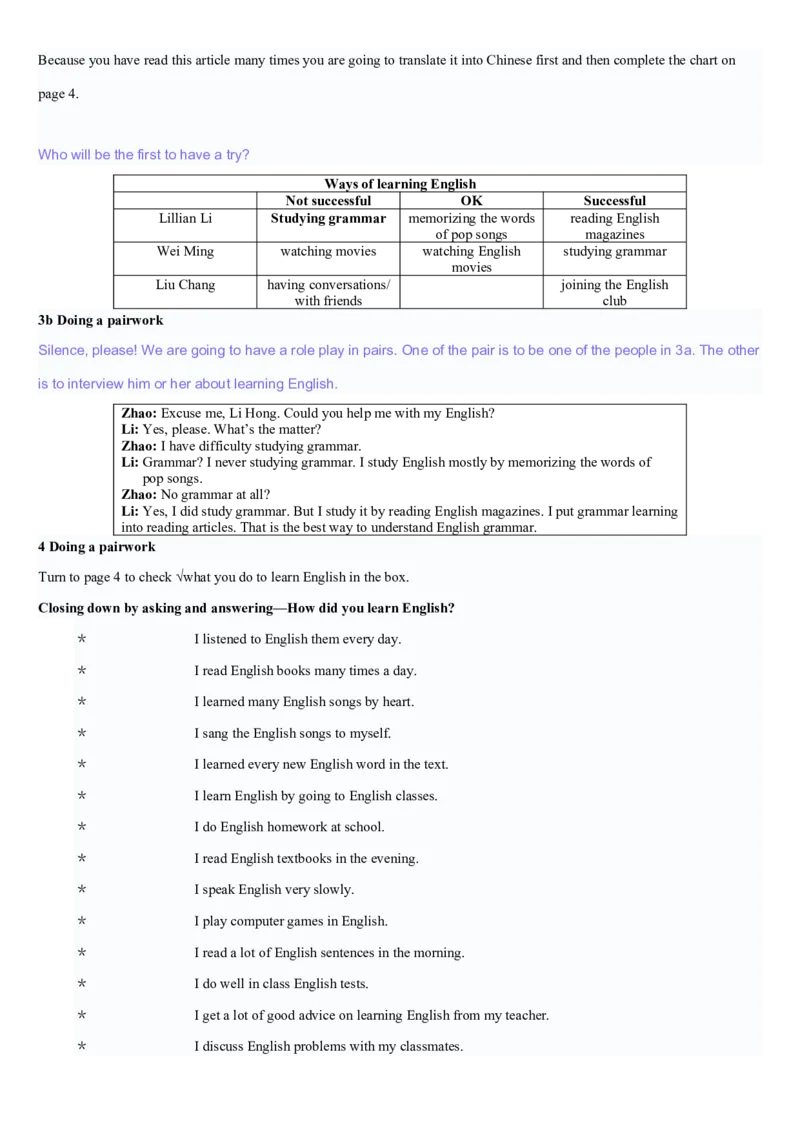
4.Translating and completing the chart
Because you have read this article many times you are going to translate it into Chinese first and
then complete the chart on page 4.
Who will be the first to have a try?
3b Doing a pairwork
Silence, please! We are going to have a role play in pairs. One of the pair is to be one
of the people in 3a. The other is to interview him or her about learning English.
4 Doing a pairwork
Turn to page 4 to check √what you do to learn English in the box.Unit 1 How do you study for a test? Section A 英文说课稿
一. Teaching material analysis
In this unit,students learn to talk about how to study for a test.Such a topic is very useful to the students so
that they can make a great progress after they master the right way to study.It’s helpful to raise learning interest
of all students.Either more or less advanced students will benefit a lot in all their life.
二. Teaching aims
1. knowlege objects
In this unit,students learn to talk about how to study for a test and give advice to those who have difficulties
in studying.
2. ability objects
Let students form a good habit of learning english through giving advice. Train the students’communicative
competence.
3. Moral objects
Everyone learns in a different way and the best one is to do.Let them know that no pains,no gains.
三. Teaching key points and difficult points
1. key points
words:flashcards,pronunciation,aloud and so on.
Target language:How do you study for test?---I study by working with a group.
2. Difficuit points:
Train students’communicative competence
四.
五.Learning methods
Cooperation and communication
As we all know,the main aims of learning english in middle school is to cultivate students’ abilities of
listening,speaking,reading,writing and their grammer.To use these methods is helpful to develop students’abilities.
六.Teaching procedures
Step1 Greetings
“How do you study for a test ?”is the first lesson in the new term,so greetings at the beginning of the class
is necessary.
First,welcome students back to school and ask them if they had a good time during the summer holiday.and
then ask different students to describe what they did in summer vacation, at last,ask them whether did they learn
english and how did they learn.
Step 2 presentation
write the ways they study english on the blackboard..Let them check the ways they usually study for a test.While
students are doing this,write the list of ways of studying on the blackbag.
After they have finished checking the ways,ask the students to look at the blackboard and discuss which are the
most popular and least popular ways of studying.
3And next, I will let the students add other waysthey use sometimes,and invite. Several students to read their
ways to the class.
This activity reviews earlier volabulany and introduces some new words.
Step 3 Practive
Firstly,read the instructions to the class focus the students atlention on the illustration and point to the pictures
labeled a,b and c and elisit how each student is studying. Then point to the pictures with names Mei. Antonio and
pierre undunderneath and tell them listen.
Secondly, ask them write the letler of each picture in front of the name the person.Who studies that way. Suchas, Mei says, I study by making flashcards, so the answer to number 1 is a, play the tape for the first time,
students only listen. Play the tape a second time, students write dowm their answers. After listening, I will invite
several students to check the answer, then I will give the right answers.
Step 4 Production
First, read the instructions to the class. And call the students attention to the conversation in the box. Invite
a pair of students to read it to the class. And then tell the students look at the other ways of studying in activity 1
and ask their partner how he/she studies for a test. As students work, I will listen in on various pairs checking
proress and offer help as needed. And after students have a ahance to practice act out their conversation.
This activity givers students oral practice using the target languge therefore, it can improve their speaking skill.
七,Summary
In this class, we’ve learned some new words, such as flashcard, vocabulary. And we’ve also learned the target
langguagge: how do you study for a test? Istudy by working with group.
八,Homework
Ask students to interview students in other class, family members, and friends to try to discover some new ways
of studying that haven’t been introduced in the book or in class.
九, Blackboard Design
How do you study for a test
Section A
1, Ways of studying
By working with friends by making flashcards
By reading the textbook by making vocabalary lists
By listening to tapes by asking the teacher for help
2, Target language
A How do you study for test?
B I study by working with a group.
Unit 1 How do you study for a test? 第一课时 说课稿
一.教材分析
本单元围绕“How to study”这一话题展开教学活动,帮助学生学会用“verb + by doing”的表达方式探讨学习英语
的策略,认清自己在学习方面的长处和不足。本单元的话题跟学生的学生生活有密切联系,学生很感兴趣,也容易理解。
通过对一些学习话题的讨论,让学生明白英语学习的重要性,并能够根据所学知识进行交流和学习,了解哪些学习方法
适合自己,从而有效地提高英语成绩。同时,也让学生学会面对困难,学会解决问题,养成良好的学习习惯,善于向同学、
朋友、老师学习更好的方法,能给他人提出适当的解决方法,树立学好英语的信心。
二、学情分析
学生经过一定时间的学习已经有了一定的语言基础知识,且本单元的话题“How to study”,源于实际的学习生活,因
此学生的学习积极性会很高。通过本单元的学习,学会谈论学习生活中遇到的困惑和烦恼,并进行更深入的经验交流。
有利于延伸和拓展知识范围,培养解决实际问题的能力。
三、教学目标
1.知识目标
重点词汇: flashcard,vocabulary, aloud , pronunciation
掌握语言结构:verb+ by doing
掌握给出建议的句型: what about,…?
why don’t you…?2.技能目标
(1)能够介绍自己的学习方法
(2)能够谈论学习中遇到的困难
(3)能够针对学习中遇到的困难给别人提建议
3. 情感目标
(1)了解各种学习方法,培养用正确,科学的方法做事的能力,
明白“一分耕耘,一分收获”的道理
(2)通过学习上的互相帮助,能够形成相互交流,相互促进的学
习氛围
四、教学重难点分析
正确运用” verb + by doing”的表达方式谈论学习中的困难,并提出相应的建议。
五、教学课时
第一课时
六、教学用具
录音机,磁带
七、教学过程
Step Ⅰ Warm up
Greetings
Welcome back to school !Then ask them if they had a good time during the summer holidays.
Step ⅠⅠ Lead-in
Now you have finished your holiday, did you study in your holiday ? How did you study?
Step Ⅲ Presentation
1. 1a
This activity reviews earlier vocabulary and introduces some new words.
Read the instructions to the class.
Call students’ attention to the box. Read the list of ways of studying to the class.
Please check the ways you usually study for an English test. While the students are doing this, write
the list of ways of studying on the blackboard. After they have finished checking the ways, ask the
students to look at the blackboard. Ask, who study by working with friends for an English test? Please
raise your hands.
Write the number of hands you see after by working with friends on the list. Repeat the same approach
with the other ways of studying on the list. Then discuss which are the most popular and least popular
ways of studying.
Say, And now please add other ways you use sometimes. While the students are doing this, move around
the room to offer language support as needed. Invite several students to read their ways to the class.
2. 1b
This activity provides students practice in understanding the target language in spoken conversation.
Read the instructions to the class.
Focus attention on the illustration. Point to the pictures labeled a,b and c and elicit how each
student is studying. Then point to the pictures with names Mei, Antonio and Pierre underneath. Say,You will hear one conversation. You are asked to write the letter of each picture in front of the name
of the person who studies that way.
Point out the sample answer to the class.
Call students attention to the speech bubble in the illustration. Say, Mei says, "I study by making
flashcards. "so the answer to number 1 is a.
Play the recording for the first time. Students write down their answers. Check the answers .
Step 3. 1c
This activity gives students oral practice using the target language.
Read the instructions to the class.
Call students’ attention to the conversation in the box. Invite a pair of students to read it to the
class,
Say, Now work with a partner. Start by reading the conversation in the box with your partner. Then
look at the other ways of studying in Activity 1 and ask your partner how he or she studies for a
test.
As students work, listen and offer help as needed.
Ask pairs to come to the front of the room and act out their conversations after practice.
4.2a
This activity provides listening practice using the target language.
Call students’ attention to the picture.
Ask, What do you think is happening? Who are they? Guide the students to say. They are members of an
English club that meets after school once a week. They are talking about the ways to learn English.
Point to the list of questions in the box.
Get different students to read them to the class.
Say, Listen to a conversation among the members of the English club. Check the questions you hear.
Point out the sample answer.
Play the recording for the first time.
Students only listen. Play the recording again. This time students listen and check the questions they
hear. Check the answers with the whole class.
5. 2b
This activity provides listening practice using the target language.
Point to the list of answers in the box.
Get different students to read the answers to the class.
Point to the checked questions in Activity 2a.
Say, You are to listen to the same conversation again. This time write the letter of the correct
answer after each question you checked in Activity 2a. Point out the sample answer. Play the recording
again.
Students write the letters in the blanks. If necessary, play the recording once more so that students
have an opportunity to check their answers themselves. Check the answers with the whole class.
6. 2cThis activity provides oral practice using the target language. Invite a pair of students to read the
sample conversation to the class.
Read the instructions. Say, Make conversations using information from Activities 2a and 2b with a
partner. As students work, move around the classroom and offer help as needed.
Aask pairs to come to the front of the room and act out their conversations after practice.
Step Ⅳ Grammar Focus
Invite a student to read the sentences to the class.
Underline the words by listening, by studying and by reading aloud. Say, When you ask how to do
something or to tell how you do something, you often use the word "by" followed by an-ing word.
Step Ⅴ Summary
Say, In this class, we’ve learned some key vocabulary words, such as flashcard, vocabulary, aloud ,
pronunciation .
And we’ve also learned the the structure verb+by doing.
We should pay special attention to the structure verb+by doing.
八、作业 Homework
Ask students to interview someone else to find some new ways of studying that are effective.then write
an article about how to study with by + doing structure.
九、板书设计
Unit 1 How do you study for a test?
Vocabularies: flashcard,vocabulary, aloud , pronunciation
Language structure:verb+ by doing
Sentence patterns: what about…?
why don’t you…?
十、教学反思
通过对一些学习话题的讨论,让学生明白英语学习的重要性,并能够根据所学知识进行交流和学习,了解哪些学习方法
适合自己,从而有效地提高英语成绩
Unit 1 How do you study for a test? 第一课时 说课稿
大家好:
很高兴能在网上参加这次的英语说课活动,我说课的内容是新目标英语九年级第一单元How do you study for a
test ?的第一课时( 1a —— 1c ),本课时所学知识十分贴近学生的实际生活经验,本课话题How to study……与日
常生活密切相关,作为一名中学生学会如何学习是非常重要的,发展学生的自主学习能力和合作精神,是基础教育阶段
英语课程的任务之一,因此,本课时对于提升学生的学习兴趣而提高听、说、读、写能力有很大的帮助。我的说课包括以
下内容:
第一、 教材分析。
1、 本课时主要围绕How do you study for a test ?展开,谈论如何学习英语,如何准备考试,
通过听、说、读、写的训练,熟练掌握和运用V+by+Ving的语言功能结构,并对学生进行学习策略指导,使他们
能采取最合适自己的英语学习方法。
2、 教学目标:
① 知识目标:通过本节课的学习,学生能掌握本课时的重点单词及短语,并能灵活运用V+by+Ving结构。
② 能力目标:培养学生用V+by+Ving结构,陈述做事的方法及方式。③ 情感目标:培养学生在学习中相互学习、相互帮助、相互促进、取长补短,并掌握适合自己的学习方法,
养成良好的学习习惯。
④ 教学重点:掌握重点词汇和功能句。
⑤ 教学难点:结合功能句V+by+Ving进行听、说、读、写的训练。
第二、 学生分析。
所教学生绝大部分来自农村,英语基础差,不知怎样学好英语,很多学生对英语已失去了信心,还有一部分学生
心有余而力不足,没有掌握好学习方法,往往是事倍功半,可以借这堂课让学生就怎样学好英语的方法这个话题畅所
欲言,达到取长补短、以点带面的教学效果。
第三、 教法设计。
1、 词汇教学:采用多媒体、幻灯片及卡片展示,让学生形象直观的学习新单词。
2、 听力方面:教师创设听力情境,并对听力提出适当的问题,供学生思考,让学生感知问
题,带着问题去听。
3、 分小组反复操练功能句。根据实际情况,拓展对话内容,让学生从中学会更多有利于
自己的学习方法。
第四、 教学过程。
1、 复习旧知:
① 复习V+ing的几种类型,为学习by+Ving结构作铺垫,
② 复习句型:How do you go to school?
I go to school by bike,引出课题Unit 1 :How do you study for a test?
2、导入新知:
用幻灯展示图片,教新单词,引出短语make flashcards. make vocabulary lists. 然后教师提问:
How do you study the new words?帮助学生用V+by+Ving结构来回答:We study by making
flashcards /We study by vocabulary lists 通过本环节直接引出1a内容How do you study for an
English test? 提醒学生特别注意本课时功能句V+by+Ving结构,要求学生掌握一些重要短语:work
with sb / listen to tapes / ask sb for help 然后根据1a中的词组,以师生问答的形式进行连锁
操练。
教师再设问:Can you think out other ways to study?给予学生更多思维的空间,根据他们的学习经验,
补充更多的学习方法。
3、1b听力练习,让学生观察1a中的图片,教师创设听力情境,并对听力提出适当的问题,供学生思考理解,
播放录音,核对答案。此任务练习了学生的听力及理解能力。
4、1c 巩固操练:此环节本着积极参与、善于合作的原则,把全班分为若干小组,采取全班互动的方式,鼓
励学生善于抓住用英语交际的机会,充分感知,积极体验,大胆实践,以问答的形式,根据幻灯片的提示,
反复操练功能句How do you study for a test? I study by……使学生做到熟能生巧。此环节老师要
特别关注差生,及时个别辅导,然后鼓励学生想出更多学习英语的好方法,并及时给予充分肯定,让学生
在学习过程中体验成功的快乐,从而保护和激励学生的自尊心和自信心,让他们对英语学习有一个积极向
上的良好心态。
5、总结:小结本课时的功能句,梳理知识结构。
6、课堂练习:用小黑板展示,做到直观,有助于集体讨论。
7、板书设计:力求做到突出重点,一目了然。
Unit 1 :How do you study for a test?
How do you study for a test?
I study by + Ving
第五、教学评价。
本节课遵循了任务型教学理念,以学生为主体,以任务为中心,以培养学生正确的学习方法为目的,
充分调动学生的积极性,提高学习的主动性和自主性,使学生积极参与教学,能较流利的表达自己的思想,
对较差学生通过知识点反馈,及时个别辅导,使其能够参与到课堂活动中,让全班学生认识到养成勤学善
问的良好学习习惯,是非常重要的。
以上是我说课的全部内容,对于您的点评,在此说声“谢谢”。Unit 1 How do you study for a test? Section B 3a—4 说课
同学们,我们开始了本课的学习,希望我这个小小的学案能成为你学习路上的小帮手,使你成为学习的小能手。
知识目标:
1.通过本节课的学习,要掌握重点词汇有:
realize, matter, afraid, secret, term, trouble, fast
2.我们要学会在写作中运用下列句型,如:
—First of all, it wasn’t easy for me to understand the teacher when she talked.
—I was also afraid to speak in class, because I thought my classmates might laugh at me.
—I decided to take lots of grammar notes in every class.
—She had trouble making complete sentences.
技能目标:能够运用目标语言就英语学习的困难和突破方法进行写作训练。
情感目标:培养同学之间团结互助,共同进步的协作精神。
【课前露一手】
I.你能在3a中找到下面的短语吗?试着写下来。
首先________开始________随后________太快了________没关系________害怕做某事____________
造完整的句子____________开始做某事___________做笔记______________这个学期_____________
其中的秘密之一________________
II.你在英语学习中存在哪些挑战呢?
I couldn’t ____________________________________________
I often ______________________________________________
It isn’t easy___________________________________________
I don’t have__________________________________________
III.你认为解决挑战应该采取哪些有效的措施?
It’s a good way to____________________________________
It doesn’t matter if ___________________________________
______________________________________helped me a lot.
I started to _________________________________________
【课堂显身手】
1.师生互动:
(1)Could you understand me when I talk in English?
(2)Are you afraid to speak in class?
(3 ) What isn’t easy about learning English?
(4) What do you do about this?
2.看课前活动II和III.交流一下在英语学习中存在的挑战及采取的措施。
任务一:例文学习 Model composition
How Vivien learned to learn English?
Fast reading:
1.What’s one of the secrets of becoming a good language learner?
Careful reading: Vivien’s Challenges
1. The teacher spoke too quickly, she couldn’t understand
2. She was afraid to speak in class.
3. She couldn’t make complete sentences.
4. English grammar was difficult.找出作者战胜挑战采取的措施
Her solutions
1._________________________________________________
2. _________________________________________________
3. _________________________________________________
4. _________________________________________________
Deal with the statements about the article.
Listening and reading practice.
任务二:例文分析 Analysis composition
Challenges Solutions
1. It is adj. for sb. to do → It doesn’t matter.
2. be afraid to do → start to do
3. couldn’t do → decide to do
4. have trouble doing → enjoy doing
另外,必要的连词会使文章更加连贯和完整。找一找文中出现了那些连词。
First of all,___________________________________________
观察与思考:
1.It wasn’t easy for me to understand the teacher when she talked. 在结构It is adj. for sb. to do中,
It是形式主语,动词不定式短语作句子的真正主语。
2.She had trouble making complete sentences.
have trouble doing sth. 的意思是“做某事有困难”,类似的结构还有have problem/difficulty (in)doing sth,
其中介词in可以省略。
练一练:1. 学习英语对我们是很重要的
______________________________________
2. 他在学习英语语法方面有困难。
______________________________________
任务三:口头作文 Oral composition
你能用我们刚才所学的语言结构,用一句话描述你在英语学习的四种技能中存在的挑战及采取的措施吗?
1. It is adj. for sb. to do (later on)→ It doesn’t matter.
2. be afraid to do ( then )→ start to do
3. couldn’t do ( so ) → decide to do
4. have trouble doing ( now ) → enjoy doing
任务四:书面作文 Written composition
网友Lucy在Vivien的博客上发布了她在英语学习中遇到的困难和挑战,请你以Vivien的名义帮她出出主意吧。
Dear Lucy,
I know it isn’t easy to learn__________________, but I have some ideas that may help. You said
you couldn’t understand people who talked fast. Well, you can try to listen for the most important
words, not every word.________________________________________
________________________________________________________________________________
_______________________________________________________________________________
Yours
Vivien
【课后是高手】
I. 根据汉语提示完成句子。
1.一开始老师讲话太快了,我听不懂。
To____________, teacher spoke too__________, and
I couldn’t____________ every word.
2.我害怕课上发言,怕同学笑话。I_______________ speak in class, because I thought
my classmates might ____________me.
3.我总是不会造完整的句子。
I couldn’t always _____________________________.
4.我在学习语法方面有困难。
I had __________in___________ grammar.
Homework
针对不同程度的同学,你有两种作业可以选择.
A:把你最有效的英语学习方法写下来,介绍给大家。
B:熟读和背诵3a,完成同步学习中本课的内容。
本节课你的表现怎么样,给自己一个评价吧!
Great ( ) Good ( ) Not bad ( )
Unit 1 How do you study for a test? Section B 说课稿
Goals
● To listen about learning English
● To talk about learning English
● To read about learning English
Procedures
Warming up by reading to the recording
Hello, everyone. To begin with, let's listen and read to the recording of the text HOW DO YOU LEARN
BEST? That is, read aloud to the tape, as fast as the tape goes, as clearly as the native reader
reads. OK? Here we go!
My cat speaks English.
Sometimes my cat comes to me and tells me that she is hungry. Or that her leg hurts. How does my cat
tell me these things? I don't speak pussy-cat language. 1a Reading and checking
Learning English can be both easy and difficult. What things are easy for you? And what things are
difficult for you? Now turn to page 5, read the list on the top and check √the statements that are
true for you.
1b Making a list
You have read and checked the statements true for you. Now think and make a list of other things
difficult for you, too.
I don't know how to...! 1. I don't know how to use commas. 2. I don't know how to work
with others. 3. I don't know how to make flashcards. 4. I don't know how to read the textbook. 5. I
don't know how to make vocabulary lists. 6. I don't know how to listen to tape. 7. I don't know how to
ask the teacher for help. 8. I don't know how to study for a test. 9. I don't know how to work with a
group. 10. I don't know how to watch English videos. 11. I don't know how to practice conversations
with friends. 12. I don't know how to read aloud to practice pronunciation. 13. I don't know how to
learn by using English. 14. I don't know how to get more specific suggestions. 15. I don't know how to
read English magazines. 16. I don't know how to learn new words. 17. I don't know how to memorize the
words. 18. I don't know how to studying grammar 19. I don't know how to watching English movies 20. I
don't know how to joining the English club 21. I don't know how to improve her English 22. I don't
know how to get lots of practice 13. I don't know how to ask teachers about the best ways to learnmore English. 2a Listening and checking
Paul is a nice boy. He works hard at his English, but still has many learning challenges. Now listen
to find out what challenges he has and check them in the box on page 5.
Challenges to Paul at learning English 1._____ can't get the pronunciation right.
2._____ forget a lot of new words.
3._____ can't understand when people talk to me.
4._____ can't understand the words in magazines.
5._____ don't get much writing practices. 2b Listening and matching
Now listen again to Paul talking about his challenges at learning English and match them with the
solutions listed in the box on page 5. While listening, pay attention to the structures of the
sentences.
Tapescript
Teacher: You look worried, Paul.
Boy: I am, Ms Mitchell. I'm having trouble learning English.
Teacher: You said you liked English. What's the problem?
Boy: I can't get the pronunciation right.
Teacher: Well, listening can help. Why don't you borrow the teacher's tapes? You can listen to them at
home and repeat the sentences that are difficult for you.
Boy: That's a good idea. But what about all the new words? I forget a lot of new words.
Teacher: You can always write the new words in your notebook and study them at home. You can even
study in the train on the way to school.
Boy: That might really help! Thanks.
Teacher: Can you understand when people talk to you?
Boy: Well, no. Not always. Sometimes I just don't understand what people are saying.
Teacher: Why don't you join an English language club to practice speaking English? The English club
meets after school on Tuesdays and Thursdays.
Boy: Maybe I'll go. The only other problem I have is that I don't get much writing practice.
Teacher: Maybe you should find a pen pal.
Boy: That sounds like a fun way to practice writing. Thanks, Ms Mitchell. 2c Doing pairwork
IN pairs we are going to role play conversations using the information from activities 2a and 2b.
I don't have a partner to practice English with. Maybe you should join an English language club. I
can't get the pronunciation right. Listening can help. I forget a lot of new words. Write the new
words on cards and study them daily. I can't understand when people talk to me. You can join an
English club to talk to people more in English. I can't understand the words in magazines. You can
look them up in a dictionary. I don't get much writing practices. Start writing an English diary every
day. I read very slowly. You should read to the recording of the text. I make mistakes in grammar. Why
don't study the basic sentence patterns 3a Reading and cutting
It's time to read the text HOW I LEARN ENGLISH. Now read and check (/) the sentences.
We are going to read the text again to study the form and function of all the predicate verbs.
How I learned to learn English Last year/ my English class/ was difficult/ for me. First of all, it
wasn't easy/ for me/ to understand the teacher/ when she talked to the class. To begin with, she
spoke/ too quickly, and I couldn't understand every word. Later on, I realized that/ it doesn't
matter/ if you don't understand /every word. Also/ I was afraid to speak/ in class, because/ I
thought/ my classmates/ might laugh at me. I couldn't always make complete sentences, either. Then/ I
started to watch English-language TV. It helped/ a lot. I think that/ doing lots of listening
practice/ is of the secrets of becoming a good language learner. Another thing/ that I found/ very
difficult/ was English grammar. So/ I decided to take lots of grammar notes/ in every class. Then/ I
started to write my own original sentences/ using the grammar/(that) I was learning. It's amazing/ how
much/ this helped. Now/ I am enjoying learning English/ and I got an A/ this term. My teacher is veryimpressed. Next we shall read the text for the third time to underline all the useful expressions.
After class you are to copy them into your notebook.
All right, read the text the fourth time and circle all the signal words, or the linking words which
connect all the short sentences.
Now you may read the statements in the box on page 6 following the text. Write "T" or "F" beside each
statement.
3b Writing a letter
Your friend Lin Feng is having difficulties with her English. Write her a letter telling her how to
become a better English learner.
Dear Lin Feng,
I know it isn't easy to learn English, but I have some ideas that may help. You said you couldn't
understand people who talked fast. Well, you can try to listen for the most important words, not every
word. It is difficult to understand by listening what you have not read or what you can't understand
well by reading. To listen well you have to read well. So keep on reading English. Listening and
reading to the recording of the text is very important, too. Every text, after being read, should be
listened to and read aloud to the tape. At first you may find it difficult to follow the reader
reading aloud the text. Don't worry. If you keep practicing you will be able to read aloud as fast as
the native reader from the tape. And then you can understand people who talk fast in English.
Yours,
Tai Zuo 3c Writing an article
You have been learning English for at least three years. That is such a long time. Now think about the
things that have helped you the most in learning English. Write an article telling others about them.
4 Doing an interview
Next we shall do an interview in groups of four. Ask the three group mates about learning English.
Take notes of what they say. Tomorrow you shall stand to tell the class about their answers.
Q. What isn't easy about learning English? A. Reading is not easy. Q. What do you do about this? A. I
try to cut the sentences into thought groups. Q. What is your favorite way to learn more English? I
read and read aloud a lot. These are the best way. Closing down by sing
To end this period let's sing an English song.
Rain, rain, go away,
Come again another day,
Little Johnny
Wants to play.
Rain, rain, go to Spain,
Never show your face again.
Unit 1 How do you study for a test? 说课设计
two periods
Structures: verb+by with gerund
Target language:
-How do you study for test?
-Well, I study by working with my classmates.
-Have you ever studied with a group?
-Yes, I have. I’ve learned a lot that way.
-I don’t have a partner to practice English with.
-Maybe you should join an English club.Vocabulary: flashcard, take notes, frustrating, memorize, aloud, comma, make mistakes,
pronunciation, be afraid to, What about…? Why don’t you…?
Learning strategies: Personalizing, Role playing
Section A
Goals
● To talk about how to study
● To read about how to study
Procedures
Warming up by greeting
Hello, everyone!
From now on you are a ninth grader. Congratulations to you and I wish you a great success in your studies!
Today we shall take up the first unit in this new term, Unit 1 How do you study for a test?
Look at the blackboard and read after me the target language for this unit. When you read pay attention to the
structure of the sentence.
▲How do you study for test?
▼Well, I study by working with my classmates.
▲Have you ever studied with a group?
▼Yes, I have. I’ve learned a lot that way.
▲I don’t have a partner to practice English with.
▼ Maybe you should join an English club.
Learning to Learn is very important. And learning to pass a test is also very important to you.
Learning couldn’t be easier!
If you have not developed good ways or methods to study for a test, talk to your classmates about it, your parents, or the teacher
like me if you are brave enough. You should be brave enough to talk to others about your problems with your studies.
Next I’d like to give you some useful practical advice about studying for a test and also ask you questions to make you think
about things such as:
▲using your time effectively
▲motivation
▲how to learn your lessons in the ninth grade year
▲different modes of teaching you may meet
▲how to develop particular skills, such as note-taking in class
1A: Checking the ways you study
Next turn to page 2 and check (√) the ways you study for an English test. Then add other ways you use sometimes.
■How do you study for a test?
I study for a test___
By reading to the tape;By underlining the expressions; By reading beyond the text; By doing
used exam papers; By going over exercises books; By copying down the text; By learning the
text by heart; By speaking with classmates
Now raise your hand and report your added ways to the class. I will make a list of all the added ways on the blackboard.1b Listening and writing
Listen to understand how these people in the picture on page 2 study for a test. Write letters from the pictures.
While listening, pay attention to the structures of the sentences.
Section A 1b Tapescript
Boy1: Hey, gang. There’s a big test on Tuesday. I really need some help. Can you tell me how
you study for a big test?
Voices: Sure! Yes. Sure we will.
Boy1: You did really well on the last English test, didn’t you, Mei?
Girl1: Yeah, I did OK.
Boy1: Well, how did you study?
Girl1: By making flashcards.
Boy1: Maybe I’ll try that. How did you study, Pierre?
Boy2: By asking the teacher for help. She was really happy I asked.
Boy1: That’s interesting. How do you study, Antonio?
Boy3: I like to study by listening to cassettes. But sometimes my mother thinks I’m listening to
music. And then she gets mad.
Boy1: Oh, well…
1c Doing a pairwork
Now in pairs ask your partner how he or she studies for a test.
A: How do you study for a test?
B: I study by working with a group.
C: I study by listening to English.
D. I study by playing games with my classmates.
E. I study by doing actions such as coloring, matching.
F. I study by singing English songs.
G. I study by writing letters and emails.
H. I study by acting out simple dialogues.
I. I study by listening to and understanding stories.
J. I study by writing simple sentences.
K. I study by imitating from the recording.
L. I study by speaking out words or phrases.
M. I study by doing simple role plays.
N. I study by reading and understanding simple stories.
O. I study by using daily expressions.
P. I study by performing short plays.
Q. I study by performing simple rhymes.
R. I study by writing sentences for pictures.
S. I study by writing out simple poems.
T. I study by reading aloud correctly.
U. I study by playing text plays.
V. I study by working with classmates.
W. I study by going over the text before class.
X. I study by copying words and expressions.
Y. I study by looking and saying.
Z. I study by asking others questions.
2a Listening and checking
Now let’s go to page 3. Listen to the tape and check the questions you ask.
While listening, pay attention to the structures of the sentences.
Section A 2a, 2b Tapescript
Girl1: Welcome to the English club. Today we’re going to talk about the best ways to learn
English. Who has an idea?
Boy1: Do you learn English by watching English-language videos?
Girl2: No. It’s too hard to understand the voices.
Boy1: What about keeping a diary in English? Do you learn English that way?Girl2: I think so. It helps to write English every day.
Girl3: Have you ever studied with a group?
Girl2: Yes, I have! I’ve learned a lot that way.
Girl1: Do you ever practice conversations with a friend?
Girl2: Oh, yes. It improves my speaking skills.
Boy1: What about reading aloud to practice pronunciation?
Girl3: I do that sometimes. I think it helps.
Boy2: I do too. And I always look up new words in a dictionary.
Girl3: That’s a great idea!
2b Listening and matching
Listen again and match each question from 2a with an answer in the box on page 3.
2c Doing a pairwork
Next we are going to make a conversation in pairs using the information from activities 2a and 2b.
A: Have you ever studied with a group?
B: Yes, I have. I’ve learned a lot that way.
A: Have you ever learned English by watching videos?
B: Yes, I have. I’ve learned a lot that way.
A: Have you ever practiced conversations with friends?
B: Yes, I have. I’ve learned a lot that way.
A: Have you ever listened to tapes?
B: Yes, I have. I’ve learned a lot that way.
A: Have you ever read aloud to practice pronunciation?
B: Yes, I have. I’ve learned a lot that way.
3a Reading the article and completing the chart
1.Reading to the tape
We are going to read the article on page 4. First we shall read to the tape together. That is, we start reading aloud as the recorder
goes, and we stop reading aloud as the recorder stops. While reading, let’s pay enough attention to the pauses, the pronunciation
and the intonation of the native reader. Make our reading aloud as the same as the reader’s.
2.Reading and dividing the article into parts
Next we are going to read aloud the article slowly and clearly. We will try to divide it into thought groups.
3.Reading and underlining
We shall read the article once again, this time, to underline all the useful expressions in it. After school, you are
going to write them down in your notebook.
This week/ we asked students/ at New Star High School/ about the best ways/ to learn more
English. Many said/ they learnt/ by using English. Some students had more specific suggestions.
Lillian Li, for example, said/ the best way/ to learn new words/ was by reading English magazines.
She said that/ memorizing the words of pop songs/ also helped/ a little. When we asked about
studying grammar/ she said, “I never study grammar. It's too boring.”
Wei Ming feels differently. He's been learning English/ for six years/ and really loves it. He
thinks/ studying grammar /is a great way/ to learn a language. He also thinks that/ watching
English movies/ isn't a bad way/ because he can watch the actors/ say the words. Sometimes,
however, he finds watching movies/ frustrating/ because the people speak too quickly.
Lin Chang said that/ joining the English club/ at school/ was the best way/ to improve her English.
Students get lots of practice/ and they also have fun. She added that/ having conversations/ with
friends/ was not helpful/ at all. "We get excited/ about something/ and then/
end up speaking/ in Chinese,” she said.
4.Translating and completing the chartBecause you have read this article many times you are going to translate it into Chinese first and then complete the chart on
page 4.
Who will be the first to have a try?
Ways of learning English
Not successful OK Successful
Lillian Li Studying grammar memorizing the words reading English
of pop songs magazines
Wei Ming watching movies watching English studying grammar
movies
Liu Chang having conversations/ joining the English
with friends club
3b Doing a pairwork
Silence, please! We are going to have a role play in pairs. One of the pair is to be one of the people in 3a. The other
is to interview him or her about learning English.
Zhao: Excuse me, Li Hong. Could you help me with my English?
Li: Yes, please. What’s the matter?
Zhao: I have difficulty studying grammar.
Li: Grammar? I never studying grammar. I study English mostly by memorizing the words of
pop songs.
Zhao: No grammar at all?
Li: Yes, I did study grammar. But I study it by reading English magazines. I put grammar learning
into reading articles. That is the best way to understand English grammar.
4 Doing a pairwork
Turn to page 4 to check √what you do to learn English in the box.
Closing down by asking and answering—How did you learn English?
* I listened to English them every day.
* I read English books many times a day.
* I learned many English songs by heart.
* I sang the English songs to myself.
* I learned every new English word in the text.
* I learn English by going to English classes.
* I do English homework at school.
* I read English textbooks in the evening.
* I speak English very slowly.
* I play computer games in English.
* I read a lot of English sentences in the morning.
* I do well in class English tests.
* I get a lot of good advice on learning English from my teacher.
* I discuss English problems with my classmates.* I follow the advice from my father.
* I learn English sounds from the tape.
* I use English-English dictionaries.
* I listen to recordings and English-language TV.
* I talk to native speakers every chance I got.
* I read books in English, mostly novels.
* I learn a lot of new words from English books.
* I write more and more e-mail in English.
* I use English more than my first language.
* Most of my reading (websites and books) is in English.
教学反思:这是学生升入初三的第一节课,学生学习热情很高,通过这一课时的学习,学生掌握了语言目标中所要求的
知识重点、难点和语言技能,如by dong, practicing doing ,too……to,现在完成时态,动名词短语做主语及提建议的几种
方式,但是有部分学生由于基础较差,还需要从培养学生学习兴趣入手,真正实现教育面向全体学生。在教学中采取的
具体办法由:个别辅导,互助学习,留不同层次夫人作业,争取让每一位学生都吃饱而不掉队。
Unit 1 How do you study for a test?
Two periods
Section B
Goals
● To listen about learning English
● To talk about learning English
● To read about learning English
Procedures
Warming up by reading to the recording
Hello, everyone. To begin with, let’s listen and read to the recording of the text HOW DO YOU LEARN BEST? That
is, read aloud to the tape, as fast as the tape goes, as clearly as the native reader reads. OK? Here we go!
My cat speaks English.
Sometimes my cat comes to me and tells me that she is hungry. Or that her leg hurts. How
does my cat tell me these things? I don't speak pussy-cat language.
1a Reading and checking
Learning English can be both easy and difficult. What things are easy for you? And
what things are difficult for you? Now turn to page 5, read the list on the top and
check √the statements that are true for you.
1b Making a listYou have read and checked the statements true for you. Now think and make a list of other things difficult for you,
too.
I don’t know how to…!
1. I don’t know how to use commas.
2. I don’t know how to work with others.
3. I don’t know how to make flashcards.
4. I don’t know how to read the textbook.
5. I don’t know how to make vocabulary lists.
6. I don’t know how to listen to tape.
7. I don’t know how to ask the teacher for help.
8. I don’t know how to study for a test.
9. I don’t know how to work with a group.
10. I don’t know how to watch English videos.
11. I don’t know how to practice conversations with friends.
12. I don’t know how to read aloud to practice pronunciation.
13. I don’t know how to learn by using English.
14. I don’t know how to get more specific suggestions.
15. I don’t know how to read English magazines.
16. I don’t know how to learn new words.
17. I don’t know how to memorize the words.
18. I don’t know how to studying grammar
19. I don’t know how to watching English movies
20. I don’t know how to joining the English club
21. I don’t know how to improve her English
22. I don’t know how to get lots of practice
13. I don’t know how to ask teachers about the best ways to learn more English.
2a Listening and checking
Paul is a nice boy. He works hard at his English, but still has many learning challenges. Now listen to find out what
challenges he has and check them in the box on page 5.
Challenges to Paul at learning English
1._____ can’t get the pronunciation right.
2._____ forget a lot of new words.
3._____ can’t understand when people talk to me.
4._____ can’t understand the words in magazines.
5._____ don’t get much writing practices.
2b Listening and matching
Now listen again to Paul talking about his challenges at learning English and match them with the solutions listed in
the box on page 5. While listening, pay attention to the structures of the sentences.
Tapescript
Teacher: You look worried, Paul.
Boy: I am, Ms Mitchell. I’m having trouble learning English.
Teacher: You said you liked English. What’s the problem?
Boy: I can’t get the pronunciation right.
Teacher: Well, listening can help. Why don’t you borrow the teacher’s tapes? You can listen to
them at home and repeat the sentences that are difficult for you.
Boy: That’s a good idea. But what about all the new words? I forget a lot of new words.
Teacher: You can always write the new words in your notebook and study them at home. Youcan
even study in the train on the way to school.
Boy: That might really help! Thanks.
Teacher: Can you understand when people talk to you?
Boy: Well, no. Not always. Sometimes I just don’t understand what people are saying.
Teacher: Why don’t you join an English language club to practice speaking English? The English
club meets after school on Tuesdays and Thursdays.Boy: Maybe I’ll go. The only other problem I have is that I don’t get much writing practice.
Teacher: Maybe you should find a pen pal.
Boy: That sounds like a fun way to practice writing. Thanks, Ms Mitchell.
2c Doing pairwork
IN pairs we are going to role play conversations using the information from activities 2a and 2b.
I don’t have a partner to practice English with. Maybe you should join an English language
club.
I can’t get the pronunciation right. Listening can help.
I forget a lot of new words. Write the new words on cards and study them
daily.
I can’t understand when people talk to me. You can join an English club to talk to people
more in English.
I can’t understand the words in magazines. You can look them up in a dictionary.
I don’t get much writing practices. Start writing an English diary every day.
I read very slowly. You should read to the recording of the text.
I make mistakes in grammar. Why don’t study the basic sentence patterns
3a Reading and cutting
It’s time to read the text HOW I LEARN ENGLISH. Now read and check (/) the sentences.
We are going to read the text again to study the form and function of all the predicate verbs.
How I learned to learn English
Last year/ my English class/ was difficult/ for me. First of all, it wasn't easy/ for me/ to understand
the teacher/ when she talked to the class. To begin with, she spoke/ too quickly, and I couldn't
understand every word. Later on, I realized that/ it doesn't matter/ if you don’t understand /every
word. Also/ I was afraid to speak/ in class, because/ I thought/ my classmates/ might laugh at me. I
couldn't always make complete sentences, either. Then/ I started to watch English-language TV. It
helped/ a lot. I think that/ doing lots of listening practice/ is of the secrets of becoming a good
language learner. Another thing/ that I found/ very difficult/ was English grammar. So/ I decided
to take lots of grammar notes/ in every class. Then/ I started to write my own original sentences/
using the grammar/(that) I was learning. It’s amazing/ how much/ this helped. Now/ I am enjoying
learning English/ and I got an A/ this term. My teacher is very impressed.
Next we shall read the text for the third time to underline all the useful expressions. After class you are to copy them into your
notebook.
All right, read the text the fourth time and circle all the signal words, or the linking words which connect all the short sentences.
Now you may read the statements in the box on page 6 following the text. Write “T” or “F” beside each statement.
3b Writing a letter
Your friend Lin Feng is having difficulties with her English. Write her a letter telling her how to become a better
English learner.
Dear Lin Feng,
I know it isn’t easy to learn English, but I have some ideas that may help. You said you couldn’t
understand people who talked fast. Well, you can try to listen for the most important words, not
every word. It is difficult to understand by listening what you have not read or what you can’t
understand well by reading. To listen well you have to read well. So keep on reading
English. Listening and reading to the recording of the text is very important, too. Every text,
after being read, should be listened to and read aloud to the tape. At first you may find it difficult
to follow the reader reading aloud the text. Don’t worry. If you keep practicing you
will be able to read aloud as fast as the native reader from the tape. And then you can
understand people who talk fast in English.
Yours,
Tai Zuo
3c Writing an articleYou have been learning English for at least three years. That is such a long time. Now think about the things that have helped
you the most in learning English. Write an article telling others about them.
4 Doing an interview
Next we shall do an interview in groups of four. Ask the three group mates about learning English. Take notes of
what they say. Tomorrow you shall stand to tell the class about their answers.
Q. What isn’t easy about learning English? A. Reading is not easy.
Q. What do you do about this? A. I try to cut the sentences into thought
groups.
Q. What is your favorite way to learn more I read and read aloud a lot. These are the best
English? way.
Closing down by sing
To end this period let’s sing an English song.
Rain, rain, go away,
Come again another day,
Little Johnny
Wants to play.
Rain, rain, go to Spain,
Never show your face again.
教学反思:这节课的重点语言目标是:how to do sth, why don’t you do sth ?have trouble doing sth….
大部分学生掌握并会运用这些语言点,并能够利用本单元信息的信息英语的发法学习,学生的英语水平有了一定的提高
但仍有部分学生没有掌握所学知识,在做练习时错误很多,今后要多多帮助这样的学生。
Unit 1 How do you study for a test?
Two periods
SELF CHECK
1.Filling in the blank
We shall make a check on our use of expressions first. Turn to page 7 and fill in each blank with the correct word
given. Change the form of the word if necessary. Then make your own sentences with each word.
Complete the sentences Make your sentences
1. You should write down new English words Don’t trust your memory. Write it down.
in a vocabulary list.
2. If you don’t know how to spell new words, I don’t know how to spell your name.
look them up in a dictionary.
3. The best way to improve your English is to I’d like to join the school football tea.
join an English club.
4. Another thing that he find very difficult was I find it easy to learn English.
English grammar.
5. This kind of paper feels very soft. Do you feel cold?
2.Writing an article
Turn to page 7 and write an article about Xu Zheng using the notes on Xu and his essay.
Xu Zheng: a boy fond of English
Most people in the world speak English as a second language. And so does Xu Zheng.
Yesterday I asked Xu Zheng about his ways to learn English. He said he learns by making up
conversations and speaking to friends in English. When I asked about studying pronunciation, hesaid he spent much time on it, but he still found native speakers’ pronunciation difficult to
learn. I said to him, “You are a computer student. Why are you so interested in English?”
“English popular in science. And it is popular around the world for computers,” he told me. “I like
writing notes, watching movies and listening to pop songs. But I like reading in English
online most, ” added he.
Xu Zheng is right. English can really help us understand many new things from other countries.
Let’s learn from Xu Zheng. Let’s be fond of English, too.I
Reading: How do we deal with our problems?
As English is learned mostly through reading in China, we shall now turn to page 8 to learn to read the article entitled: How do
we deal with our problem?
Before reading, please go over the vocabulary list for reading on page 146. Get yourself familiarized with all the words and
expressions to be found in the article.
While reading try to divide the sentences into thought groups and underline all the expressions useful to you. While
you are reading it for the second time, try to circle all the linking words and try translating the text into Chinese.
How do we deal with our problem?
Rich or poor, young or old, we all have problems. And unless we deal with our problems, we
easily become unhappy. Worrying about our problems can affect how we do at school. It can also
influence the way we behave with our families. So how do we deal with our problems? There are
many ways.
By learning to forget
Most of us have probably been angry with our friends, parents or teachers. Perhaps they said
something you didn't like, or you felt unfair. Sometimes, people can stay angry for years about
a small problem. Time goes by, and good friendships may be lost.
When we are angry, however, we are usually the ones affected. Perhaps we have seen young
children playing together. Sometimes they have disagreements, and decide not to talk to each
other. However, this usually does not last for long. This is an important lesson for us: we can
solve a problem by learning to forget.
By regarding problems as challenges
Many students often complain about school. They might feel they have too much work to do
sometimes, or think the rules are too strict. We must learn how to change these "problems" into
"challenges". Education is an important part of our development. As young adults, it is our duty to
try our best to deal with each challenge in our education with the help of our teachers.
By thinking of something worse
By comparing yourself to other people, you will find your problems are not so terrible. Think
about Stephen Hawking, for example, a very clever scientist, who regards his many physical
problems as unimportant. He can't walk or even speak, but he has become very famous and
successful. We are probably quite healthy and smart. Let's not worry about problems. Let's face
the challenges instead.
After reading, copy the underlined expressions into your Phrase Book as home.
Expressions from How do we deal with our problem?
rich or poor, young or old, have problems, deal with one’s problems, become unhappy, worry
about one’s problems, do well at school, influence the way, behave well with…, deal with one’s
problems, be angry with…, feel unfair, stay angry for years about…, time goes by, lose good
friendships, see… playing together, have disagreements, talk to each other, last for long, an
important lesson for…, solve a problem by learning to forget, regarding problems as challenges,
complain about school, have too much work to do, the rules are too strict, change…into…, an
important part of one’]s development, as young adults, be one’s duty, to try one’s best, to deal
with…in one’s education, with the help of…, thinking of something worse, comparing…to…, find
one’s problems, think about…, for example, a very clever scientist, regards…as unimportant,
become very famous and successful, worry about…, face the
challenges
Part 2: Teaching Resources (第二部分:教学资源)Tips for Beginners
You are like a new baby
Babies learn their language slowly.
First they learn to listen.
Then they learn to talk.
Finally, they can read and write.
Listen to English every day
Listen to English radio.
Watch English TV.
Go to English movies.
Use online lessons.
Make an English/ESL friend
Make up conversations.
Practice dialogues.
Use beginner textbooks.
Read English stories
Start with children's storybooks.
Try ESL readers.
Read advertisements, signs and labels.
Try EnglishClub.com for Young Learners.
Write down new words
Start a vocabulary (new word) notebook.
Write words in alphabetical order (A...B...C...).
Make example sentences.
Always use an English-English dictionary first.
Keep an English diary
Start with one sentence.
How do you feel?
How is the weather?
What did you do today?
Write another sentence tomorrow.
Visit an English speaking country
Learn English more quickly.Stay with an English family.
Hear native speakers talk.
Have a fun experience.
教学反思:
Students can master the meaning of the text and they can say many ways og deciding with our problems as well as the three
ways in the book and they can make sentences with the phrases, but some of them can’t understand the whole text because
their vocabulary is very small. I think they should read books as well in class as in their spare time .I shall help them with their
comprehensions.
Unit 2 I used to be afraid of the dark.
Unit 2 I used to be afraid of the dark.教案
单元分析
内容提示
1.本单元主要内容是学会used to结构。Used to +动词原形表示过去经常、以前常常,只用于过去式中,用来表示
现在已不存在的习惯或状态。
例如:They used to play football together.他们过去常在一起蹋足球。(现在不在一起踢了)
2.used to的疑问形式和否定形式为Did you use to…?和I didn’t use to… 也可以用Used you to…?和I
used not to…但现在多使用前者。
例如:
Did you used to swim in the river? 你过去常在河里游泳吗?
I didn’t use to play the piano. 我以前并不经常弹钢琴。
教学目标
一、学习目标(Language Goal)
1.学会陈述自己过去常做的事情。
2.学会陈述自己过去的爱好等。
3.能够表达自己现在和过去在外表、性格、娱乐等方面的变化。
4.能够表达朋友、家人等现在和过去的变化。
二、语言结构(Language Structures)
1.I used to be short when I was young. 我年轻时个子很矮。2. —Did you use to have straight hair? 你过去是直发吗?
—Yes, I did. 是的。
3. —Did you use to play the piano? 你过去弹钢琴吗?
—No, I didn’t. 不,我不弹。
4.I used to be afraid of dark. 我过去害怕黑暗。
5.I’m terrified of the snakes. 我害怕蛇。
6.—Did you use to be afraid of being alone? 你过去害怕独自一人呆着吗?
—Yes, I did. 是的,我怕。
7.I used to walk to school. 我过去走着上学。
三、目标语言(Target Language)
1.—Did Mario used to be short?
—Yes, he did. Now he is tall.
2.—I used to eat candy all the time, didn’t you?
—Yes, I did. And I used to chew gum a lot.
四、重点词汇(Key words and phrases)
dark 黑暗
sure 无疑,确实
terrify 使害怕,使恐惧
on 接通的,工作着的
spider 蜘蛛
insect 昆虫
chew 嚼,咀嚼
gum 口香糖
right 立即,马上
comic 连环漫画
hardly 不十分,简直没有
used to do sth. 过去经常
be interested in 对…感兴趣
be on the swim team 是游泳队成员
be afraid of 害怕
be terrified of 害怕
with the light on 灯开着做…
worry about 担心
chew gum 嚼口香糖
these days 目前,如今
not…anymore 不再
五、认知目标学生能运用used to结构,谈论学生自己怎样与过去不同,能准确地描述自己的外貌、性格的变化,灵活运用used
to 结构处理和传递信息。
情感目标
培养学生积极健康的心态,学会谈论事物的发展和变化,明白事物是不断发展、变化的道理。
教材分析
一、Section A
该部分有4个内容模块:
1. 第一块围绕What did he use to look like?为话题展开思维( 1a)、听力(1b)口语( 1c)训练;
2. 第二模块围绕What did you use to do? 为话题进行听力( 2a-2b)、口语训练( 2c);
3.第三模块在以上两模块的基础上以Did you use to be afraid of the dark 为话题展开训练,训练形式为填
写表格(3b);
4.第四模块拓展思维,让学生随意谈论自己的过去与现在,并简单陈述一下发生变化的原因。
二、Section B
该部分仍为4个模块:
1.第一模块是思维( 1a)与口语(1b)训练;
2.第二模块就used to do 句式进行听力( 2a-2b)与口语( 2c)训练;
3.第三个模块What did you use to do 这一话题进行阅读( 3a)与写作(3b -3c)训练;
4.第四模块让学生进行调查活动( 4a-4b),从而提高他们的口语表达能力。
三、Self Check
该部分分为2个模块:
1. 第一个模块以填空形式对新词汇进行训练;
2. 第二模块要求学生跟句图画中所提供的信息展开写作训练。
四、Reading
该部分设置了5项任务:
1. 第一项任务以对话形式启发学生介绍自己的过去与现在,为下一任务作铺垫;
2. 第二项任务让学生快速阅读,了解文章大意;
3. 第三项任务以填空形式让学生了解文章段与段,句与句之间的关系;
4. 第四项任务要求学生了解文章的细节;
5. 第五项任务要求学生用新学知识展开活动,具备真正运用语言的能力。
课时安排
4课时
第一课时:SectionAla,1b, 1c, 2a, 2b, 2c
第二课时:SectionA 3a, 3b, 4
第三课时:SectionB la,1b, 2a, 2b, 2c
第四课时:SectionB 3a,3b, 4a, Self Check
第一课时
教学目标1.能使用used to结构描述人物。
2.通过听力训练,巩固used to be和used to do的用法。
教学过程
一、导入(lead-in):
1.在黑板上写出两个日期,左边是当日日期,右边是10年前的今天,然后让一位学生站起来,并以此学生为例展开
对话。
2.以另一位学生为例重复进行对话。
二、教学SectionA -1a.
1.投影SectionA -1a的表格,帮助学生回忆appearance和personality的含义。
2.把学生分为若干小组,比一比,看哪个小组在规定的时间内写出属于appearance和personality的单词多。
3.让学生用所填写的词汇,互相告诉自己的同桌十年来自己的变化。
三、教学SectionA- lb.
利用学习指导中中学英语人教课标版9年级课后提高中的多媒体课件中的SectionA-1b进行下列教学活动。1.让学生先看图,比较图画中人物的不同。
2.听第一遍录音材料,只听不填。
3.再听一次录音材料,在多媒体课件的人机交互程序中填空,进行检测。
四、教学SectionA-lc.
对目标语言进行口头交际训练,让学生转为描述他人的外表、性格变化,注意人称的换用,叫3到4对同学表演这个
对话。
利用媒体资源中的课件中的图片让学生操练used to be / have句型
五、教学SectionA -2a, SectionA-2b
1.利用学习指导中中学英语人教课标版9年级课后提高中的多媒体课件中的SectionA -2a,让学生选择勾选。
2.利用学习指导中中学英语人教课标版9年级课后提高中的多媒体课件中的SectionA-2b,让同桌之间分角色朗读
对话。六、教学SectionA -2c
这部分要求学生用目标语言进行对话练习,教师巡视全班,提供必要的语言帮助,最后叫两组同学把他们的对话表
演给全班同学。
七、教学Grammar Focus
板书:You used to be short.
He used to play tennis.
Did you use to be short?
Did he use to have long hair?
利用媒体资源中课件中语法讲解内容,给学生讲解used to 句型。说明used to 用于陈述句而Did…use to 用于
一般疑问句。
八、作业
叫学生写一篇短文,写出自己现在与五年前的不同情形。
第二课时
教学目标
1.能够谈论自己过去与现在的情况,使用句型I used to be afraid of.
2.培养学生综合运用语言的能力,能用英语完成简单的任务,处理传送信息。
教学过程
一、导入(lead-in)
1.展示一些学生熟悉并且喜欢的明星,他们童年与成人时的照片,然后让不同的学生口头描述他们的不同的变化。
如:Jack Chen used to be shy, now he is outgoing.
He used to be fat, now he is thin.
He used to have short hair, but now he has long hair.
2.利用媒体资源中课件中的图片重复上述教学活动:
说明:明星图片能激起学生学习的积极性,特别是通过展示他们童年时的照片更能激起学生开口表达语言的热情,
同时又让学生在轻松愉快的图片欣赏中复习了所学内容。
二、教学SectionA -3a
投影展示一些图片:
1.
2.教师指着第一幅图画(黑暗的夜空)和一位女生对话:3.运用上面的方法教师对其他图片对其他学生提问:
4.老师向全班同学报告:
5.利用学习指导中中学英语人教课标版9年级课后提高中的多媒体课件中的SectionA -3a的人机交户课件。教师
要求学生独立完成点选表格,根据自己的实际,最后向全班同学报告结果。
三、教学SectionA-3b
1.叫一组发音较好的学生分角色朗读对话,然后叫他们利用 3a中b-f句子任选一个对话练习。教师巡视,提供语
言支持及纠正发音。
2.教师检查多少学生害怕同一事物:
四、教学巩固(教学Part 4-group work)
1.解释任务要求,然后叫一位学生回答。叫他填写表格。
2.让学生四人一小组为单位谈论完成表格。
3.最后让几位学生告诉全班同学他们所了解的情况。例如:
My desk mate used to eat lots of chocolate, now she likes to eat fruits. She thinks keeping fit is
important.
五、作业(Homework)
叫学生回家调查自己的祖父母、阿姨或者其他亲属过去常常怕什么,并做好记录,完成书面报告。第三课时
教学目标
1.能够理解所学目标语言并且能在实际交际中运用。
2.能够针对所听的语段内容记录简单信息。
教学过程
一、导入(lead-in)
邀请不同的学生报告她/他的祖父母、父母、叔叔、阿姨等亲属年轻时害怕什么?
例如:
二、教学SectionB -1a,1b
利用媒体资源中课件中的内容进行下列教学活动:
1. 指着图画,然后叫学生描述图画中的情景。
2. 让学生写出自己小时候的其他事情,然后和同桌分享。
例如:三、教学SectionB -2a,2b
1.利用学习指导中中学英语人教课标版9年级课后提高中的多媒体课件中的SectionB -2a的人机交互程序,让学
生根据听到的选择。
2.教学SectionB-2b
(1)提醒学生表格的标题是过去与现在的对比,先让学生浏览句子猜测可能的答案。
(2)利用学习指导中中学英语人教课标版9年级课后提高中的多媒体课件中的SectionB-2b的课件放录音,学生边
听边填空。
四、教学巩固(教学SectionB -2c)
1.让学生朗读这个对话。
2.叫学生小组活动,自己编对话。
例如:
五、小组活动叫学生互相告诉自己的同桌自己的好的(坏的)习惯,用used to 表示过去的习惯,用still表示习惯至今还保持。
六、作业 (Homework)
用used to造出至少五个句子。
第四课时
教学目标
1.能够比较熟练地运用英语语音知识朗读篇章。
2.学生捕捉语篇主题,理解细节,并推断语篇深层意思的能力。
3.培养学生略读、精读的能力。
教学过程
一、教学SectionB -3a (reading)
1.教师问全班学生。让学生讨论生活有了哪些变化。
2.利用学习指导中中学英语人教课标版9年级课后提高中的多媒体课件中的SectionB -3a的课件,先叫一个学生
朗读 3a,纠正他/她的语音语调中的错误,然后叫全班同学听录音,模仿朗读,最后叫学生泛读,捕捉信息完成表格,教
师巡视帮助学生理解课文内容。
二、教学SectionB-3b
叫学生单独完成,可以根据2b的信息,也可以用自己的实际情况回答问题,答案可以多样化,最后叫不同的学生朗
读自己的信件,参考答案是:
didn't use to,used to hate math,basketball l play football used to walk ride my bike.
三、教学SectionB -3c
叫学生写一篇短文,对照自己现在和小学时代各方面的变化,以下列句子开头:
My life has changed a lot since primary school...
四、教学SectionB -4a1.向学生解释本节活动要求,再投影出一个表格。
2.教师与一位学生做示范对话。
3.让学生填表。(猜想自己父母曾经喜欢什么?)
五、教学SectionB-4b.
解释任务要求。叫学生四人一小组为单位完成该任务。然后让几位学生转述其他学生
的话。
六、教学巩固
1.Self Check l
(1)让一位学生大声朗读这些单词。然后叫学生单独完成填空练习。叫学生注意时态和语态,人称与数的变化。
更正答案。让学生大声朗读这五个句子。
Answers: 1. am afraid of 2. worry about 3. have to 4. miss 5. used to
(2)叫学生用这五个词组口头造句。
2.Self Check 2
(1)问学生:
(2)小组讨论并描述这些图片,每位小组成员至少提供两个句子。两分钟后,叫学生把刚才所讨论的内容写下来。完
成本文。
七、作业 (Homework)
1.叫学生回家调查自己的家人过去喜欢哪一种书,哪种运动,哪一类音乐。
2.描述自己从小学以来发生的变化。Unit 2 I used to be afraid of the dark. Section A 说课稿
尊敬的各位评委老师:
大家上午好!我是来()学校的(),今天我说课的内容是新课标英语九年级第二单元Section A,题目为:I used to
be afraid of the dark.本单元具有三部分,Section A, Section B和自我检测部分。我计划用四课时完成,本节课是
第一课时,从教材的整体上来说,本节课仍在进行一般过去时的学习,并且进行了一般过去时和一般现在时的综合运用。
再有从本单元来说,它既是本单元基本语言内容,又为本单元知识的扩展和综合语言运用奠定坚实基础。因此上好
Section A部分即可以让知识学习有一定的延续性,又可为下面的教学做好铺垫,对完成本单元和今后的英语教学具有
重要的意义。基于以上分析,本节课的教学要达到以下几个目标:在知识与能力方面,让学生掌握used to do结构,学
会用英语运用本结构谈论自己和他人过去经常做的事,学会谈论自己和他人过去的外貌、性格和爱好。学会谈论自己和
他人的变化等等,从而提高学生的语言综合运用能力;在过程与方法方面,指导学生在自主探究和任务型教学模式中,
主动参与学习活动和积极与他人配合。
在情感目标方面,采用积极的手段去激发学生的学习兴趣,让学生充满自信,体验成功感和具有合作精神。而且通
过目标语言的学习使学生在学习和生活中能发现问题,不断进步。使学生更加了解自己和树立自信心,明确自己的奋斗
目标。
对于Section A部分教学,我准备把used to do和but的用法作为重点,把一般过去时和一般现在时的比较作为
难点。
为达到以上教学目标,突出重点,突破难点,根据英语课程的要求,知识的讲授要从学生的学习兴趣、生活经验和认
知水平出发去发展学生的综合语言的运用能力,提高跨文化意识和形成自主学习的能力。因此,我将在教学中采用任务
型教学模式,利用多媒体辅助教学、结合听说法、竞赛法,以循序渐进的方式来进行教学。根据初中生的抽象思维能力还
不太高,注意力 还很分散的特点,在课堂教学的每个环节中,我将采用多媒体辅助教学,利用多媒体展示学生们喜欢的
图片,以增强学生的兴趣和注意力,因为教育心理学给了我们这样的提示:如果学生对于一件事物有极大的兴趣,他们
会就排除主观和客观的消极因素,尽量全身心地投入到知识的学习中去。
教法的选择固然重要,但学法也是不可缺少的。我们都知道学生的学习并不仅仅孤限于课堂的学习之中,很多时候
更需要参于实践,因此,我们应遵循学生的这一身心发展规律和学习规律,在教学过程中,利用合作与交流的学习方式
指导学生去体验、实践、参与去提高他们的各种能力。在本节课的教学中,我主要采用比较法和小组合作学习的方法。
教法与学法的选择是为了更好地服务于课堂,在课堂教学中我设计了如下八个环节:
Step 1: 课前热身,首先用多媒体播放歌曲《Yesterday once more》,让大家一起跟唱,在课前营造轻松愉快的氛
围,然后通过大屏幕显示图片,进行师生互动和生生互动。通过几组图片对人物的外貌和性格进行描述,去复习形容词,
为目标语言的学习作铺垫。这些图片都是同学们所喜欢的,会使学生产生浓厚的兴趣,主动思维。而且这一环节中为学
生提供了说英语的机会,营造了说英语的氛围。
Step 2: 激趣导入,在本活动中通过听说法配合多媒体辅助教学导入新课,引出used to do结构。并以其为引线,
不知不觉地将学生引入新课,达到润物无声的效果。
Step 3: 小组竞赛。本活动采用任务型教学模式及小组合作的学习方式,办法是以小组为单位,学生们手拿旧照片,
用目标语言对过去的情况分别进行介绍,最后各组组长,代表本组运用She used to be short, didn't she? She
used to play basketball, didn't she? 的句型进行汇报。开展此项活动可以培养学生的合作精神和竞争意识。同时,
可以训练学生快速思维的能力及语言表达能力。
Step 4: 比较交流
这一方法主要用于任务型教学及work in pairs的对话时刻,谈论自己和搭档在过去和现在情况,巩固used to do
结构与but的用法。同时区别两种不同时态的运用。通过练习培养学生的语言表达能力,突破本课的难点。体现“用中学学了就用”的教学理念。在这一环节中落实情感目标,让学生认识自己的不足,明确自己的奋斗目标,在生活和学习中
互相帮助,相互学习,取长补短。
Stetp 5: 听力反馈
这个环节我设计了两个听力练习。
练习一:利用1b的内容填空。
练习二:利用2a和2b完成used to do的训练及but的运用。
通过这一环节,使学生能更进一步对声音语言进行体会、感受,提高学生听的能力,也来检验一下本节课重点知识
的掌握情况。
Step 6: 综合运用
猜谜游戏,四人一组,对班上的老师或同学进行过去和现在的对比介绍,猜其是谁,在组织语言的过程中,每人一句,
合作探究完成任务。在写作的过程中增强合作意识和提高写作水平。在猜测的过程中,去提高学生的听说水平,调动他
们的积极性,感受英语学习的快乐与成功。帮助他们树立学习英语的自信心。
要想让学生正确的使用语言结构“used to do”及过去与现在的时态,形成完整统一。让学生自己通过上述的游戏
活动和利用板书设计明确本节课的重难点。在这一环节中,我将采用对比法,意在培养学生的自主探究能力、观察能力
和归纳能力。
Step 7: 自我评价
在这一环节中,为了检测学生对于used to do语言结构的掌握完成作文(大屏幕)。在这个过程中我采用男女擂台
赛:用大屏幕呈现几组对比图片。限定五分钟内,独立完成写作。写作结束后以最快的速度张贴在黑板上。看男生和女生
哪组作文写得又多又好,多而好的那一组为胜利组。在擂台赛过程中,学生会努力思维,充分运用所学语言,积极地完成
任务,为本组争光。这个过程一定会激发学生的学习兴趣和强烈的写作欲望,增强学习的责任感体会到学习的重要性。
从而使学生综合运用语言的能力得以提高。
Step 8: 布置作业
《英语课程标准》建议教师把“任务型”教学活动延伸到教学之外的学习和生活之中。为此,我把作业布置为常规
性作业和探究性作业两种。
常规性作业:完成《学英语》上的练习。
探究性作业:比较自己学习方法的转变。
探究性作业既是本节课的新任务,也是下节课的前任务。
以上就是这次我说课的内容,如有不足之处,请各位领导评委给与指导,谢谢大家!
Unit 2 I used to be afraid of the dark. Section A 第二课时说课稿
今天我说课的内容是九年级Unit2 I used to be afraid of the dark.. Section A的第二课时。
一、说教材
(一)教材的作用及地位
《新目标英语》教材采用“话题 .功能.结构”三维的编排形式,凸现了语义、语言结构和语用三者有机结合的“任务型
语言教学(Task - based Language Teaching & Learning)”的现代英语教育理念和教学途径。这种十分突出的编排特点,使得英语教和学的过程始终以“话题”为主线,交际功能的实践围绕着话题展开,语言结构的学习和掌握融入综合
的语言运用活动之中。
本单元以 “how we have changed” 为核心话题,编排了一系列凸现“交际功能
(talk about what they used to be like)”运用的听说读写综合语言活动。在这些语言活动中,融入大量含
语言结构(used to)的学生可接受的语句。然后,在学生感受、理解、体验的基础上,学习该结构。这种三维的设计,形成
了一个循序渐进、自然的学习程序。
本节课是section A 的第二课时,在第一课时我们学习了如何谈论自己的外貌、性格
及娱乐方面的变化,本节课我们首先复习第一课时的内容然后学习使用be afraid of 这一结构来继续谈论过去于现在
的变化。
(二)教学目标
根据《英语课程标准》关于总目标的具体描述,结合本节课的教学内容,我制订了如下目标:
1、 知识与技能目标 :学会使用be afraid of,并能结合used to 结构谈论自己及他人的过去与现在的变化。
2、 过程与方法目标: 通过直观的对图片的感受谈论自己的变化,通过听力及对话来了解别人的变化,通过小组调查这
样的任务型活动来谈论他人的变化。
3、情感目标:人是发展变化的,不但身体上会发生变化,兴趣和爱好也会较以前有所不同,随着年龄的增长,应不断克服
自己的缺点,增长知识,健全自己的人格,日趋完善自己。
(三)教学重点及难点
用be afraid of 来谈论自己及他人过去于现在的变化。
二、教学设计的理念及思路
八年级的学生对英语语言知识有了一定的积累,而且本单元涉及的外貌及性格在七年级下册第七单元已经学习过,学生
表达上会比较容易,能够体会到成就感。可以借此提高他们对英语学习的兴趣并培养口语表达能力。
按照课程标准的要求八年级结束时学生应在听说读写方面要达到四级标准,所以教学设计时要注意语言能力的培养与
积累。首先采用直观教学法复习第一课时的内容,并利用直观教学法学习使用be afraid of 来谈论自己的变化,通过
听力来了解其他人的变化,采用任务型教学法来输出语言,从而培养学生的自主学习能力。
三、教学过程的安排与意图
1、Warm-up
Task1 通过用used to 和now 来描述不同图片中人们的性格外貌及娱乐方面的变化。通过这样的直观教学使学生更
加记忆深刻,达到复习的目的。
2. Lead-in
Task 2 通过看图片来描述自己对图片的感觉来学习使用 be afraid of 并用此句型谈论自己过去和现在的变化。看到
图片感受更加明显,有利于理解记忆。
3、Listening
根据本节课的教学目标自编了一个听力练习,通过听力练习再现情境,使学生了解何时可以应用到本节课的教学内容。
并了解其他人过去与现在对一些事物的情感变化。
Task 3 pair work,让学生模仿simple conversation来询问彼此过去与现在对事物的情感及变化
Task 4 survey time 四人一组,调查除自己以外的组员对书中3a所列事物害怕与否及现在的变化。然后由一名同学
做出报告。由此可以掌握学生对所学内容的掌握情况。4、Homework 调查家人曾经是否有害怕的事物,现在是否有变化。完成表格并写出报告。此项作业可以使学生真正的
应用到所学知识,并更加了解家人,理解家人了解人都是发展变化的,随着年龄的增长,我们应不断克服自己的缺点,增
长知识,健全自己的人格,日趋完善自己。
以上就是我本节课内容的教学设计及分析。
Unit 2 I used to be afraid of the dark. Period one 说课教案
I. Analysis of the Teaching Material
This unit is aiming at talking about what the people used to be like with the pattern of used to be, used to have, used to
like. All the activities are carried out around the topic of how to describe the people's appearance and personality. The first
teaching period serves as an introduction and lead-in part. During this part the goal was introduced and the main topic of this
unit also was presented. Just like a warming up it plays, it is acceptable to review what has been learned in the last unit and to
transfer to the new language. The materials in talking are mostly from the recent real life and are familiar to the students. A
series of questions with pictures and a big picture are used to attract students to the knowledge.
Ⅱ. Analysis of the Students
As Junior 3 students, they would like to talk about the changes between a person in the past and now. They have learned
some words about how to describe the people's appearance and personality like short, tall, long hair, short hair, kind, friendly,
serious, shy and so on. So it is easy for the students to listen about, talk about or write about what the people used to be like.
Such topic will remind students of the days of their childhood. So it is also helpful to raise learning interest of students and
students will be active in all the activities in this unit.
Ⅲ. Overview of Lesson Plan
The first period introduces a lot of words describing people first. And then students will be provided listening and oral
practice using the target language. So in this lesson, students will learn how to describe the people's appearance and
personality. They will share opinions about the changes between a person in the past and now by comparing, listening and
talking.
IV. Objectives
1. Knowledge Objectives
Students will learn to talk about what they used to be like and they will learn and grasp the structure used to, including
statements, yes / no questions and short answers.2. Ability Objectives
Students will train their own integrating skills by comparing, brainstorming, listening, talking, reading and writing.
3. Moral Objectives
Students will know that everyone surely changes. If someone is afraid of speaking in front of the class, encourage her/him
not to be shy. "More practice, and you'll feel more confident."
V. Teaching Key Points
1. To learn the key vocabulary and the target language
a. Key vocabulary: outgoing, friendly, serious, quiet, curly hair, straight hair
b. Target language: I use to be quiet. / She used to have long hair./...
2. To learn the usage of the structure used to.
--- You used to be short, didn't you? --- Yes, I did. / No, I didn't. He is tall.
--- Did Tony use to play the piano? --- Yes, he did. / No, he didn't.
They didn't use to like tests.
VI. Teaching Difficult Points
1. To improve students' listening, speaking skills.
2. To enable students to grasp the usage of the structure used to.
VII. Resources
1. A tape recorder.
2. Some posters.
3. Some photos.
VIII. Teaching Time45 minutes.
Ⅸ. Procedures
Step 1. Pre –listening
This activity will introduce a lot of words describing people first. And then students are provided listening and oral
practice using the target language.
--- Mario used to be short. --- Yes, he did. Now, he's tall.
1. Warm-up (1a)
Show some posters to the students and introduce the key vocabulary. Let them describe the people's appearance and
personality by comparing and brainstorming .Call their attention to the chart with the headlines.
Appearance: tall, short, long hair, short hair,good-looking, thin, strong, ...
Personality: outgoing, funny, quiet, shy, friendly, kind, warm-hearted
a. Look at the pictures and describe the appearance.
b. How can we describe the personality?2. Presentation
Show students some photos in the past and now. Let students compare and practice to understand the target language "used
to be" in spoken conversations.
3. Explanation
When we talk about the things that have changed, we can use "used to".
e.g. Tom used to be short. Now he is tall.
She used to have short hair. Now she has long hair.
Mary used to like eating meat. Now she likes eating vegetables.
Step 2. While-listening
The activity will give students practice in understanding the target language in spoken conversation.
1. First listening
Bob is seeing some friends for the first time in four years. What did his friends use to look like?
a. Play the recorder and let the students listen and fill in the chart. (1b)
1. Mary used to short . He used to wear _glasses_ .
2. Amy used to be _tall . She used to have _short hair .
3. Tina used to have _red and _curly hair .
b. PairworkLet students have some more practice. The students look at the chart and make conversations in pairs. (1c)
Name Sep.18, 2008 Sep .18, 2000
Yang Lan tall short
Mary long hair short hair
Mrs. Liu serious funny
2. Second listening
Play the recorder and let the students listen and check the words they hear. (2a)
_______ shy _______ serious
√ friendly _______ funny
__√___ outgoing √ quiet
3. Third listening
Play the recorder again and let the students listen and fill in the blanks with the words they hear. (2b)
Paula: Hey, Steve! Over here! Don't you remember me?
Steve: Oh, wow! You're Paula , aren't you?
Paula: That's right.
Steve: But you used to be really __quiet ,didn't you?
Paula: Yeah. I wasn't very outgoing .
Steve: No, you weren't. But you were always friendly . Wait a minute! Did
you use to play the piano?
Paula: Yes, I did. But now I'm more interested in sports. I play soccer and
I'm on the swim team.
Steve: Wow! People sure change.
Step 3. Post-listeningThis activity is helpful to improve students' speaking skills. In this activity, we will introduce more words to students to
extend their vocabulary and we will provide more oral practice to them using both the old and new target language. They make
conversations about peoples' appearance and personality, and they can also talk about the peoples' hobbies.
1. Pairwork (2c)
Tell the students to practice the conversation in activity 2b. Then make conversations about themselves in pairs. They can
use...
A: Hello! You're Zhu Guoming, aren't you?
B: Yes, you're right.
A: But you used to be really quiet, didn't you?
B: Yeah. I wasn't very outgoing.
A: No, you weren't. But you were always friendly. Wait a minute! Did you use to play the piano?
B: Yes, I did. But now I'm more interested in sports. I play soccer and I'm on the swim team.
A: Wow! People sure change....
2. Talk about their photos in pairs
Before class, let each student prepare two photos. One was taken in the past, and one is taken now. Now, let them take out
their own photos and make conversations about their changes in pairs by comparing the two photos. Then ask some pairs to act
their conversations out in front of the class. In this activity, students will practice the target language by listening and speaking.
Encourage her/him not to be shy. "More practice, and you'll feel more confident." Help to build the students confidence.
3. Guessing games
In this activity, students will use the target language to get more detailed information of their classmates. Students are fond
of such activities. So they are helpful to improve students' spoken English. From the game, let students find out the usages of
used to and then summarize the usages of used to.
a. First the teacher plays the guessing game with the whole class as a modal. Saying "Can you guess what I used to be
like?" Let students guess.
Student 1: Did you use to be thin?
Teacher: Yes, you're right. I used to be thin, but now I'm heavy.
Student 2: Did you use to have short hair?
Teacher: No, I used to have long hair.
Student 3: Did you use to like running?
Teacher: Yes, I used to like running, but now I have no time to run....
b. Ask three or four students to come to the front of the class and play the game with the whole class. Teacher will give
them some help if they need.
Step 4. Summary
This activity will help students to summarize the usages of used to.As students say, teacher will write them on the
blackboard.Students can say in Chinese.
Teacher: What have we learned today?
Student A: Today we have learned the statement of the usages of used to.
e.g. ---You used to be short, didn't you? --- Yes, I did. / No, I didn't.
Student B: And we have also learned the yes/no questions and short answers of the usages of used to.
e.g. --- Did Tony use to play the piano? --- Yes, he did. / No, he didn't.
Student C: And we have also learned the negative sentences of the usages of used to.
e.g.They didn't use to like tests.
Step 5. Homework
This activity will help students to consolidate the target language we have learned today. From students'homework, teacher
will find out that what the students have mastered and what they haven't mastered and decide what will do in the future
teaching.
Unit 2 I used to be afraid of the dark.
Appearance: tall, short, long hair, short hair,good-looking...
Personality: outgoing, funny, quiet, shy, friendly, kind, warm-hearted
Grammar Focus:
--- You used to be short, didn't you? --- Yes, I did. / No, I didn't.
--- Did Tony use to play the piano? --- Yes, he did. / No, he didn't.
She used to be really quiet.
They didn't use to like tests.
He used to have long hair.Unit 2 I used to be afraid of the dark. 说课稿
我说课的内容为初三英语上册Unit 2 I used to be afraid of the dark. 整个说课包括教材分析、教材处理、
说教法、说学法、课时划分和教学过程六大板块。
一、教材分析
1.教材的地位及作用:
本单元是初中英语新教材第三册第2单元,本单元的核心话题为“talk about what they used to be like”,围
绕着谈论过去自己和他人过去经常做的事,谈论自己和他人过去的外貌性格爱好,以观察图片、听力理解、阅读理解等
训练方式和独立学习、合作交流、完成任务等形式完成目标语言的输入,学习句型Used to 为主要学习任务,并且设置
任务型综合性语言实践活动,让学生在交际活动中,学会如何正确地用英语表达自己的意见和建议,重在培养学生的习
得语言运用能力、实践能力、合作能力及创新意识。
2.教学目标
(1)知识目标
重点词汇 ●Used to, dark, spider, insect
●Used to
●Conjunction but
重点句型 ●Mario used to be short.
● Yes, he did. Now he’s tall
●I used to eat candy all the time.
● Did you ?
●Yes, I did. And I used to chew gum a lot.
(2)能力目标
1)依托本单元的语言素材提高学生听、说、读、写及自学、创新和沟通能力。熟练掌握“used to” 句型,培养学生
运用语言的能力。
2)培养学生善于听说、乐于听说的良好习惯和学习能力。
3)运用CAI或图片,充分调动学生的感官,培养观察力和注意力。
4) 在表演中培养学生乐于表达的人际交往能力和知识创新能力。
(3)、重点和难点
重点: used to句型。
难点:used to句型在日常生活中的运用。
确立重点与难点的依据:
根据教学大纲的要求,及本单元在教材中所处的地位和作用。
二、教材处理:
根据以上对教材的分析,同时针对学生学习外语存在一定困难的实际情况。首先给学生创造外语语言氛围,创设一
定的语言情景,这样可以激发学生学习兴趣,使学生在参与一系列活动中,掌握知识。最后通过对话和小组活动对学生
所学知识点进行训练,从而达到巩固知识的目的。
三、说教法:教学内容的核心要求符合科学规律、认识规律,因此我在教学过程中,正确把握教育教学的特点,倡导自主、合作、
探究的学习方式,激发兴趣,调动思维,培养创新能力,力求简练、正确、系统。通过五步教学法,精讲巧练,由浅入深,由
易到难,由已知到未知,循序渐进地深化教学内容。展开以教师为主导,以学生为主体的师生双边活动。采用视听法、问
答法,和情景交际法,并把竞争机制引入课堂。
(1) 视听法,主要通过多媒体课件展示、图片展示、老师提问、学生回答等方式提供让学生看、听、说、的练习机会
(2) 问答法和情景交际法,用多媒体展示各种图片,让学生利用这些图片进行交流,让学生在做中学,在实践中获
得信息,习得英语。
对教材的处理上本着,以“旧”代“新”,以“练”促“学”,以“熟”生“巧”的原则,通过朗读、背诵、对话和
小组表演,提高口语表达能力,且对话表演能够活跃课堂气氛,使学生愉快学习,真正做学习的主人。
四、学法设计:
本单元主要的任务就是要让学生学会运用习得语言知识结合自己谈论自己和他人过去经常做的事,在对话中学习
并巩固本单元的知识点。因此,在教学中,教师主要是让学生学会让学生学会:
1)课前预习,尝试自学。
2)课堂认真听讲,养成好习惯;提高学习效率。
3)复习巩固,拓展新知。
五、课时安排:本单元分五课时完成。
课 时 内 容 任 务 主要方 法
掌握本单元的单词;初步掌握
Period 1 Section A 1a-2c 听、说
used to 的用法
掌握并能运用used to 的用
法,学会谈论过去;巩固新
Period 2 Section A 3a- 4 听、说、写
知,完成Section A学习任
务。
能够谈论自己或他人过去的
Period 3 Section B 1a-2c 外貌、性格、爱好等,提高交 听、写、说
际能力
阅读理解,写出2b的描述。完
Period 4 Section B 3a- 4b 成Section B,提高写作能 听、读、写
力。
查漏补缺,复习巩固,拓展新
Period 5 Selfcheck1-2 听、说、写作
知
通过这样五课时才能把整个单元的教与学有机结合起来。
六、教学过程:
第一课时
1.学习单词
本单元的生词不多,不需要花费过多的时间,在学习课文之前,集中识词的基础上,学生基本上掌握了单词的读音
规则与拼写。本单元的目标语言与我们的现实生活非常接近,所以学生掌握起来比较容易。课前,教师可以将单词制成
课件,用大屏幕展示,在检测学生的同时,也给了他们愉悦的视觉感受。对于不能用大屏幕展示的单词,可以做成单词卡
片,正面汉语反面英语及词性,让学生完成他们彼此间的转换,使学生很好地将单词的音、形、义结合,同样可以收到很
好的效果。
2. 看图说话,导入新课课前任务:请同学们带几张他们喜爱的人物以前和现在的相片。
课上任务:请同学们猜猜他是谁?
看相片,由浅入深的提出问题,教师可以将以前和现在的照片对比,这样开始:
1)
T: What’s this?
S: It’s a photo.
T: Who is it?
S: It’s…
T: He used to be short, didn’t he?
S: Yes.
She used to be thin ,right?
She used to have short hair. outgoing ,etc.
让学生根据图片所提供的信息回答问题,从图片导入,为本课的学习
used to 句型做了铺垫。当学生一一回答出上述问题后,将表示外貌和性格的形容词板书出来。可以请同学们描述
照片中人物的过去的相貌和性格,并说出更多的这样的句子,引导学生该如何描述过去常常的事等,让他们慢慢领悟到:
在对比情况下,怎样描述过去,让他们以愉悦的心情接受新知识。
小组活动
为了进一步掌握目标语言,可以采取以小组为单位的形式,请同学们拿出他们带的相片,描述照片中的人物过去的
相貌和性格,其他同学猜猜他或她事谁。让目标语言在活动中多次出现,小组成员之间的汇报,让每个学生都充分展现
自己。他们之间的互相总结,并请几位同学介绍照片上人物的变化。不仅复习了所学知识,还有助于增进学生之间的交
流,更重要的是为1b的听力打下了坚实的基础。
3. 听力训练
听力内容听两遍。第一遍,听对话,完成1b。
Mario used t be__short______. He used to wear_________________.
Amy used to be ______________. She used to have ________________.
Tina used to have _____________ and ________________ hair.
第二遍,采用漏词填空形式,将听力材料打印出来,漏掉关键词语,让学生边听边填。最后,将含有答案的听力材料
展示在大屏幕上。设置的填空既要考虑难易适中,又要照顾本课重点。不能让学生听不懂,失去信心。我们应该让学生觉
得“我行”,而不是“我不行”。本课听力主要在于考察学生对形容词的掌握,所以在设置填空时,将其作为重点。让学
生通过填空去体会,给学生留下深刻的记忆。然后让学生根据手中的听力原文,跟读录音,进行朗读训练,这样不仅练习
了1c的pair work,更重要的是让学生学习到了纯正的语音、语调,弥补了教材朗读材料的不足。
2a的听力难度比1b要大,因此在处理时,先采用根据听力内容问答的形式。让同学们在听力之前就接触到听力中
的重点词汇、感知听力内容。这样做降低了听力的难度,为2a的听力打下基础,增强了学生对听力的自信心。我是这样
操作的:
大屏幕展示
教师根据本课需要给予提示语言:
让学生根据自己的喜好,表达自己的猜测。练习之后再听,学生听起来有的放矢,避免了听不懂听力内容的尴尬。听
两遍学生就能顺利地完成2a和2b,也为2c 的pair work打下基础。
5. 小组活动教师让学生根据2b的重点句型,以小组为单位自由的交谈讨论,自己对这些形容词的体会。然后可以给出例句。通
过这项训练,使学生能用这些词表达自己,并恰当的与他人进行交流。完成本课的能力目标。最后教师用剩下的时间对
本课内容进行归纳总结。
6. 作业:
1)尽可能多写描述外貌、性格的形容词,
2)教师可以指定一部分照片,或部分同学让全班同学描述起过去和现在,并且写出书面作业,下节课让同学们猜猜
他们描述的是谁。
这样设计的作业,一是复习了本节课的目标语言,二是为下节课内容的展开做了良好的铺垫。
第二课时
1. 检查作业
通过检查学生的家庭作业,可以了解学生对上一节所学知识的运用情况。让学生在小组内向其他的小组成员展示自
己的描述。可以采用自己陈述,也可以通过互相询问的方式获得小组其他同学的猜测内容。由于学生谈论的是自己的想
法,因此他们有着强烈的表达欲望,这极大的提高了学生的学习兴趣,活跃课堂气氛,激发学生浓厚的学习兴趣和强烈
的表达欲望,又使下个环节的展开有了良好的开端,在学生高昂的情绪下展开新的内容,为本课时的学习做了良好的铺
垫。
2、说说写写
通过读写训练,进一步学会用 used to 结构来表达自己和同伴过去害怕,或现在仍旧害怕的事情,
并且要把最后的结果书写下来,然后让他们将结果用英语告之其他同学,为学生创造展示才能的机会。这样能使全体同
学都积极参与,集中精力认真听。既巩固了本节课的目标语言,又为下一个环节3b的对话打下基础。活动结问题比较容
易,英语基础较差的学生也能够独立完成,因此,在检查答案是尽量让这部分学生回答,使他们体验到成功后的喜悦,提
高他们学习英语的兴趣。
3.对话练习:
让学生两人一组,模仿3a中的对话,根据提供的信息与提示词进行对话练习,目的在于对新学的目标语言进行口头
练习与设定情景中的运用。为学生创造展示才能的机会。推荐两至三组的同学到教室前面,就所编的对话进行角色表演。
其他同学既要充当评委,为表演的同学打分,又要评判出谁的对话最精彩。这样能使全体同学都积极参与,集中精力认
真听。既巩固了本节课的目标语言,又为下一个环节打下伏笔。活动结束后,教师对表演好的与听讲好的学生提出表扬。
4. 小组活动
Activity Past Now
Eat…
Read…
Watch…on TV
Do …at school
让学生在小组内向其他的小组成员陈述自己过去常做的事情,然后在全组中找出和自己有同感的,并讨论他们如何
改变,成为现在的状况。由于是谈论自己的情况,学生们都会津津乐道,这样可以活跃课堂气氛,激发学生浓厚的学习兴
趣和强烈的表达欲望。当别人发言时一定要让小组每个成员做书面记录,记录下关键的词语,这是锻炼与提高写作的最
佳途径之一,这样会使每一个同学都能聚精会神地听。组内介绍之后,让他们选出小组内表达最流利的,全班交流,给他
们充分的展现自我风采的机会,也给全班学生一个互相学习的机会。
展示才能使学生的情绪高涨,教师可以趁热打铁,给学生几分钟的时间,让他们把自己的书面记录的内容以对话的
形式呈现出来,达到练笔的目的。本环节的活动设计从听、说、写三个方面进行练习,使学生对本节目标语言运用有了更深层次的理解。也为下一节
课的学习打下良好的基础。
2. 作业
调查父母及朋友过去常常害怕的事、现在仍害怕的事; 调查父母及朋友过去常常做的事以及如何改变的,并写出书
面作业。下节课进行交流。本次作业的设计既练习了本节课的重点,又为下一课的学习打下伏笔。
第三课时
1、 检查作业
作业在小组内展示,然后可以选出最好的,将其中的一部分在全班展示。
教师可以问:
What other things did you use to do when you were a child?
然后将学生的答案总结在黑板上,这样在检查了作业的同时,也复习了所学过的词汇,达到了温故而知新的目的,
也为下一个环节的开展做了铺垫。
2、小组活动
根据1a的图片提示,教师可以让学生用英语表述他们过去常常做什么?然后让他们以小组为单位,继续发挥想象,
他们这样做,可能发生了什么事情,并且加上自己的理由,这样不仅练习了本节课的内容,并且为2a的听力打下基础,
让学生熟悉听力内容,为2a铲除了听力上的障碍,增强了学生对搞好听力自信心。
3. 听力练习
2a的听力难度虽然较大,但是有了前面的练习,难度已经降低,学生听起来,比较容易。做2a的听力,听力好的同学
觉得这个题太简单。我们可以让他们在补充的同时,可以加以想象和发挥。这样面对不同层次的学生,提出不同层次的
要求,让每个学生都有成功的喜悦,符合分层次教学的原则。再听一遍,然后让学生回答2b的问题,学生就有一种轻车
熟路的感觉。这样既遵循了学生接受知识的循序渐渐性,也为下面的角色表演做了铺垫。
4.才艺表演
学生两人一组就2a与2b的对话内容进行表述,由于有听力练习部分的基础,较差的学生也能较好地完成对话表演
这个环节主要是给这些同学在全班表演的机会,增强他们的信心。
自由对话表演。还是pairwork。要求学生谈论自己的过去的好恶。不拘泥于本课中的问题与词汇,广开思路,并将对
话写下来。然后进行小组交流,再选出组内最好的,在全班表演、交流。这样可以给学习较好的学生展示自我的机会。这
一环节给学生创造一个拓宽思路,展示自己才能的平台。他们不仅练习了说、写能力,还学会了合作,相互促进,相互提
高。这个环节的设计,既可以巩固前面的听力,也将本课的内容拓展延伸。
5.作业。
模仿听力材料中的问题,询问自己父母在在过去常常喜欢做的事和厌恶的事,以及如何改变了。要求在运用本节课
目标语言的基础上有所创新。
第四课时
1、 检查作业
小组内作业展示。向小组成员叙说自己父母的喜好,然后组长总结,将其罗列出来,向全班汇报。最后让小组成员复
述成员的说法。这样可以培养学生认真听讲的习惯,还可以增进他们之间的了解。并且在此基础上进行3a,学生更容易
理解。
2.阅读训练
这部分是本课的重点。既要培养学生良好的阅读习惯,又要提高学生的阅读能力,掌握略读和细读的学习策略。并
帮助学生学会准确的表达自己的感受。
3a中的阅读短文。旨在学习表达自己的感受。整个阅读课可分四个步骤完成。
默读。本着先易后难的原则,这一环节教师给出三个wh问题。1.What is Rose Tang’s biggest problem?
2. What do Rose Tang think of her life?
3.Did she miss the old days?
让学生带着问题快速浏览全文,从阅读材料中找到问题的答案。因问题比较简单,答案也是一目了然,所以即使是
学困生也能很轻松的找到答案,这样使学生对文章不再有畏难情绪。这一过程又是对学生进行了先思考后提问的学法指
导。也是培养学生略读这一阅读技巧。在略读之后,要求学生对课文进行认真细致的阅读,即细读。使学生对日记的内容
有了更深层次的理解。还是让学生带着问题进行阅读,这样阅读时做到有的放矢。这次,学生可以回答课本上的问题,
这些问题难度相对大些,要求学生认真阅读文章内容,学困生会有些困难,那么机会主要是给了中等以上的同学,
对回答积极的同学教师要给予表扬与鼓励。有的问题可能学生回答得不完整,教师不要急于说出答案,可把机会让给其
他的学生。这一环节使学生练习了细读的阅读技巧。
让学生根据以上所得的信息,完成表格。教师将表格展示在大屏幕上,学生阅读完成后,师生共同来完成表格
Rose Tang’ then Rose Tang’s now
步骤三:让学生根据短文,完成表格。
然后让学生再次阅读课文内容。
教师自制课件,将3a的内容展示在大屏幕上,每幅图的下面有关键字提示。学生以小组为单位,看哪个组能最快地
根据图片与关键词将课文内容口述出来。一位学生不能说全的,其他组员可以接着说。。每组派一名同学到屏幕前指着
图片进行复述。看哪个组说的最流利,最好,最有创新。这样做体现合作精神,也是锻炼学生口头复述课文的能力的一个
平台,更为下一步的写作打下牢固的基础。
3.写作训练(3c)
学习就是为了运用。本课最终的知识目标就是使学生能够运用所学进行语言交际和书面表达。要求学生独立完成。
然后,将学生分为四人一组,在组内交流。相互取长补短。然后推荐好的在全班交流,与大家共同分享。这样做给了学生
一个充分展现自我的机会,更有助于学生间的相互取长补短,共同提高,共同进步。
4. 作业:调查父母的喜好,并同自己的进行比较,完成表格。
I… My parents used to
…
books I like reading comic
s
music
sports
food
Favorite subject at school
Favorite things
第五课时
1.检查作业:和同班同学讨论你和你的父母,在对话的过程中,相互纠正语音语法错误。
2.本课主要是对前面四个课时内容进行复习检测。因而设计一些检测性的练习。
I. 词汇检测Self check 中所列词汇皆为本单元重点,重在考察学生的基础知识。为了检测学生对词汇掌握的程度和运用情况,
这一环节设计两个练习。
选词填空
1) I _________the sea. I don’t know how to swim.
2) Don’t __________things so much. It will make you stressed out.
3) Sorry, I can’t join you. I __________study for a test.
4) I really ________my friend Tina. She moved to another town.
5) I _________have short hair but now I grow it long.
Check the answers.
这一练习设计以抢答的方式开展,。抢答竞赛是学生喜欢的一种活动,它促使学生积极进行思考,锻炼他们的反应
能力,也让学生体验到参与挑战的乐趣。
II.用下面所给的词造句。
1) be afraid of
_______________________________
2)worry about
______________________________
3)have to
_________________________________
4) miss
________________________________
5) used to
_________________________________?
这个练习要求学生对本单元中所学的目标语言熟练掌握,比上一个练习更具有挑战性,更能检测学
生对句型的掌握与运用的程度。可设计为小组活动。
3.写作练习
本环节主要是检测学生运用目标语言进行表达的能力。活动设计分三个部分。
学生以小组为单位,看图说话,其他学生给于意见和纠正。交流的过程亦是互相学习、取长补短的过程。
学生以书面形式写下所说内容,小组交流,交换批改。使每一位学生都会用心去做。选出最好的在全班交流。这样可
以给学生创造展示自我的机会。
这几项活动的设置,使学生通过听、说、读、写检测了自己掌握与运用本单元知识的程度,起到了查漏补缺的作用。
这个环节使学生从听说读写几个方面巩固了目标语言,实施实现了本单元能力目标要求。
要求学生抄好作文。交给教师,作为本堂课的答卷。教师批改后,将好的作品贴在黑板报的专栏里,让大家学习。这
样对每个学生都是一种督促。
4.作业
根据本单元的学习内容,写一篇有关文章,描述自己过去和现在有何不同。Unit 3 Teenagers should be allowed to choose their own clothes.
Unit 3 Teenagers should be allowed to choose their own clothes.教案
教学内容分析:
本单元以学生是否应该挑选自己的衣服为话题,以谈论学生在生活中应当遵守的规矩和学生自己的意见为主线,向学生
展示了的用于表达被或不被允许做某事和同意不同意的目标语言。
教学目标:
1.词汇:allow, pierce, silly, stay up, drivers’ license earring, strict, concentrate, volunt
eer,
目标语言:I think sixteen-year-olds should be allowed to drive.
I disagree. I think sixteen is too young.
Do you think thirteen-year-olds should be allowed to have part-time
jobs?
No, I don’t.
2.通过目标语言的学习,学生学会谈论自己平时需要遵守的规则,并能发表自己的看法或独特见解 。
3.教育学生要在培养自己的独立思想的同时注意遵守规章制度。
教学重点及难点:
1. 本单元重点在于新单词及目标语言,并再次出现了被动语态。
2. 难点在于学生运用目标语言进行自由表达及对被动语态的掌握。
课时分配(5课时):
第一课时:Section A 1a---2c Grammar Focus
第二课时:Section A 3a---4
第三课时:Section B 1a---2c
第四课时:Section B 3a---4 Self Check 2
第五课时:Reading: That’s cool
教学指导思想:
以素质教育为指导思想,促进学生个性发展,注意对学生进行思想引导,培养学生[此文转于斐斐课件园 FFKJ.Net]正
确认识个性及美丑。
教学方法:听说读写相结合,循序渐进;设计合理并具有挑战性任务,让学生在完成任务时练习使用目标语言,体验成功
之快乐教学过程(本文来自优秀教育资源网斐斐课件园)设计:
Period One
Step 1 Greeting and a small talk
The S on duty gives a small talk on her unpleasant shopping(her mother didn’t l
et her choose her own clothes) to lead in the topic of Unit 3 “Teenagers should be a
llowed to choose their own clothes” Then, Ss show their own opinion by saying “agree
” and “disagree”
Step 2 Do you agree or disagree
1a Read the statements in the textbook. Circle A or D
Step 3 Pairwork 1c
Get students to tell out their “agrees” and “disagrees” ,as well as their r
easons, to their partners. T moves around to give help if necessary.
Step 4 Listening practice
1b Get Ss to look at the picture and tell them they are going to hear a con
versation between Anna and her mother. Listen and circle T of F (for the first time, S
s only listen.) Then check the answers: F, F, T
2a-2b Do the same with them as 1b
Step 5 Pairwork 2c
First get Ss to list out teenagers should and should not be allowed to do. Th
en discuss their lists with their partners using the short conversation in the right box
.
Step 6 Task1:
Get Ss to list out what they are and are not allowed to do and make comments
about them. (to get Ss practice talking about their real experience and feelings with th
e target language)
Step 7 Grammar focus
Get Ss first to read out the statements and then give out their own opinions
to replace the statements in the right column.
Step 8 Summary and homework:
What rules do you have at home? Make a list of them.Period Two
Step 1 Greeting
Greet the class and check the homework
Step 2 A duty report
The S on duty gives a report on the rules in his home and lead in 3a “Sun
Fei’s and Wu Yu’s rules”
Step 3 Reading
Ss read the conversation and write the two girls’ rules in the chart.
Check the answers.
Get Ss to read after the tape and then read aloud by themselves.
Then, T explains the language points.
Step 4 Pairwork 3b
Role play. Use the information in chart to practice with the conversation in 3a
covered. They can look at the sample conversation in the right box.
Step 5 Task 2 “Who’s the best reporter?”
Make a survey by asking any 5 students the questions in the chart in activity
4. Then give out a report about it. See who is the best reporter? And the best report
er will get a nice ball-pen.
Step 6 Summary and homework:
Write out the report in your exercise-books.
Period Three
Step 1 Greeting and a duty report
The S gives a duty report talking
about his experience of being late for school. Lead in the question “Do you ever get
to school late? How often do you get to school late? Always, usually, sometimes, or nev
er?
Step 2 1a Get Ss to finish writing.
Step 3 Pairwork 1b
Get Ss to talk about their answers with their partners using the sample conversation in the box on the right.
Step 4 Listening practice
2a Lead-in: What will happen if you get to school late? What about Peter? Let
’s listen to a conversation between Peter and his father. Get Ss to finish 2a (As usu
al, for the first time, Ss only listen.) Check the answers.
2b Listen again, match these sentences parts. Check the answers.
Step 5 Groupwork 2c
Ss discuss the statements with their group members to practice oral English.
Step 6 Task 3:A debate
Choose one statement (No.3 Parents should not be too strict with teenagers.) as
the topic for them to debate. Those who agree sit on one side, those who disagree sit
on the other side. Before starting, each group have 2 minutes to get prepared. See whic
h group is the winner.While debating, Ss should write down the opinions they hear for t
heir homework.
Step 7 Summary and homework
Write an article about your own opinions to the topic debated in class.
Period Four
Step 1 Greeting
Greet the class as usual and check the homework. Get two students to read out
their articles to the class.
Step 2 Reading
Leading-in: Everyone of you has your own thought. Let’s read an article written
by a teenagers like you. While reading, please try to find out the answers to the ques
tions below.
Check the answers.
T plays the tape for Ss to listen and repeat. Then get them to read it out
loudly.
T explains some language points.
Step 3 Pairwork 3b
Role play. Use the information in 3a to have a conversation like the sample conversation in the box.
Step 4 Task 4 The best opinion
“What school rules do you think should be
changed in our school?” Get Ss to discuss with their partners and then write down what both of them think should be changed o
n the paper given by T. Later, discuss those statements on the paper with the whole class and tell them to give the best one to the
headmaster as good advice.
Step 5 Task 5 4
Suppose: you and your partner are starting a new Saturday English club. Discuss with him. Make a list of rules about what s
hould and should not be allowed.
Step 6 Writing practice
Self Check Ex.2 get Ss to read the article and then practice writing a letter using the target language.
Step 7 Summary and homework
Finish Ex.1 in Self Check.
Period Five
Reading---That’s cool.
Step 1 Warming-up
Ask: What does the word “cool” mean to you? Give some examples. Ss talk about their own opinions freely.
Step 2 While-reading
Go through the reading and match the people with their opinions in 2 on page 24 and complete the sentences in 4 on page 25.
Step 3 Deep comprehension
Ss read the article more carefully. Try to guess the meanings of the new words. And match the words and expressions with their
meanings in 3 on page 25. Then get Ss to make sentences with them.
Step 4 Groupwork 5
Get Ss to finish the groupwork in 5 on page 25 by asking their group members.
Step 5 Summary and homework
Write a report about what your classmates think about “cool”.
Unit 3 Teenagers should be allowed to choose their own clothes. 教案二
教学内容分析:
本单元以学生是否应该挑选自己的衣服为话题,以谈论学生在生活中应当遵守的规矩和学生自己的意见为主线,向
学生展示了的用于表达被或不被允许做某事和同意不同意的目标语言。
Learning aims
1.Vocabulary:allow, pierce, silly, stay up, drivers’ license earring, strict, concentrate, volunteer,
Target language:I think sixteen-year-olds should be allowed to drive.
I disagree. I think sixteen is too young.
Do you think thirteen-year-olds should be allowed to have part-time jobs?
No, I don’t.
2.Talk about what you are allowed to do
3.Ask students to obey the rules of school
Importance and difficulties
1.Mater new words and phrases ,master the passive voice。
2.Use target language to express what you are allowed to do教学指导思想:
以素质教育为指导思想,促进学生个性发展,注意对学生进行思想引导,培养学生正
确认识个性及美丑。
教学方法:听说读写相结合,循序渐进;设计合理并具有挑战性任务,让学生在完成任务时练习使用目标语言,体验成功
之快乐
Period One
Step 1 Greeting and a small talk
The S on duty gives a small talk on her unpleasant shopping(her mother didn’t let her choose her own clothes)
to lead in the topic of Unit 3 “Teenagers should be allowed to choose their own clothes” Then, Ss show
their own opinion by saying “agree” and “disagree”
Step 2 Do you agree or disagree
1a Read the statements in the textbook. Circle A or D
Step 3 Pairwork 1c
Get students to tell out their “agrees” and “disagrees” ,as well as their reasons, to their partners. T moves
around to give help if necessary.
Step 4 Listening practice
1b Get Ss to look at the picture and tell them they are going to hear a conversation between Anna and her
mother. Listen and circle T of F (for the first time, Ss only listen.) Then check the answers: F, F, T
2a-2b Do the same with them as 1b
Step 5 Pairwork 2c
First get Ss to list out teenagers should and should not be allowed to do. Then discuss their lists with their
partners using the short conversation in the right box.
Step 6 Task1:
Get Ss to list out what they are and are not allowed to do and make comments about them. (to get Ss
practice talking about their real experience and feelings with the target language)
Step 7 Grammar focus
Get Ss first to read out the statements and then give out their own opinions to replace the statements in the
right column.
Step 8 Summary and homework:
What rules do you have at home? Make a list of them.
Period Two
Step 1 Greeting
Greet the class and check the homework
Step 2 A duty report
The S on duty gives a report on the rules in his home and lead in 3a “Sun Fei’s and Wu Yu’s rules”
Step 3 Reading
Ss read the conversation and write the two girls’ rules in the chart.
Check the answers.
Get Ss to read after the tape and then read aloud by themselves.
Then, T explains the language points.
Step 4 Pairwork 3b
Role play. Use the information in chart to practice with the conversation in 3a covered. They can look at the
sample conversation in the right box.
Step 5 Task 2 “Who’s the best reporter?”Make a survey by asking any 5 students the questions in the chart in activity 4. Then give out a report about
it. See who is the best reporter? And the best reporter will get a nice ball-pen.
Step 6 Summary and homework:
Write out the report in your exercise-books.
Period Three
Step 1 Greeting and a duty report
The S gives a duty report talking about his experience of being late for school. Lead in the question “Do
you ever get to school late? How often do you get to school late? Always, usually, sometimes, or never?
Step 2 1a Get Ss to finish writing.
Step 3 Pairwork 1b
Get Ss to talk about their answers with their partners using the sample conversation in the box on the right.
Step 4 Listening practice
2a Lead-in: What will happen if you get to school late? What about Peter? Let’s listen to a conversation
between Peter and his father. Get Ss to finish 2a (As usual, for the first time, Ss only listen.) Check the
answers.
2b Listen again, match these sentences parts. Check the answers.
Step 5 Groupwork 2c
Ss discuss the statements with their group members to practice oral English.
Step 6 Task 3:A debate
Choose one statement (No.3 Parents should not be too strict with teenagers.) as the topic for them to debate.
Those who agree sit on one side, those who disagree sit on the other side. Before starting, each group have 2
minutes to get prepared. See which group is the winner.While debating, Ss should write down the opinions
they hear for their homework.
Step 7 Summary and homework
Write an article about your own opinions to the topic debated in class.
Period Four
Step 1 Greeting
Greet the class as usual and check the homework. Get two students to read out their articles to the class.
Step 2 Reading
Leading-in: Everyone of you has your own thought. Let’s read an article written by a teenagers like you.
While reading, please try to find out the answers to the questions below.
Check the answers.
T plays the tape for Ss to listen and repeat. Then get them to read it out loudly.
T explains some language points.
Step 3 Pairwork 3b
Role play. Use the information in 3a to have a conversation like the sample conversation in the box.
Step 4 Task 4 The best opinion
“What school rules do you think should be changed in our school?” Get Ss to discuss with their partners and
then write down what both of them think should be changed on the paper given by T. Later, discuss thosestatements on the paper with the whole class and tell them to give the best one to the headmaster as good
advice.
Step 5 Task 5 4
Suppose: you and your partner are starting a new Saturday English club. Discuss with him. Make a list of
rules about what should and should not be allowed.
Step 6 Writing practice
Self Check Ex.2 get Ss to read the article and then practice writing a letter using the target language.
Step 7 Summary and homework
Finish Ex.1 in Self Check.
Period Five
Reading---Should I be allowed to make my own decisions?
Step 1 Warming-up
Ask: 1.How old is a teenager?
2.What are some of the rules that a teenager should obey?
Step 2 While-reading
Go through the reading and match the people with their opinions in 2 on page 32 and complete the sentences
in 3b on page32
Step 3 Deep comprehension
Ss read the article more carefully. Try to guess the meanings of the new words. And match the words and
expressions with their meanings in 3c on page 25. Then get Ss to make sentences with them.
Step 4 Groupwork 5
Get Ss to finish the groupwork in 5 on page 32 by asking their group members.
Step 5 Summary and homework
Unit 3 Teenagers should be allowed to choose their own clothes. 第1课时 说课稿
我说课的内容是人教版《新目标英语》九年级上册九年级上册Unit 3 Teenagers should be allowed to choose
their own clothes.的第1课时。下面我将从教材分析、学情分析、教学渗透及教学流程四个方面对本节课的教学设
计进行说明。
一、教材分析
(一)教材的地位及作用
1、新目标英语教材概述
《新目标英语》教材的语言教育理念是:知识用于行动,强调语言应用,培养创新、实践能力,发展学习策略。
它采用任务型语言教学(Task-based Language Teaching)模式。教材中每单元都设计一个或几个与该单元话题有
关的任务,让学生在完成任务的过程中,使用英语获取信息,用英语进行交流,培养运用英语解决实际问题的能
力。每一单元由四个版块构成:Section A(基本的语言知识)、 Section B(知识的扩展和综合的运用)、Selfcheck
(学生自我检测本单元所学的语言知识)、 Reading(为了加强学生的阅读能力的大量语篇输入) 。
2、单元分析及教材处理本单元以rules为中心话题,让学生学会谈论允许和不允许做的事情;应该被允许和不被允许做的事情;能够
针对被允许和不被允许做的事情发表自己的观点,并且能叙述同意或不同意的理由。本课时的内容为Section A
1a-2c,及Grammar Focus。这一节可分为两个模块:第一模块围绕What should teenagers be allowed to do?这一话
题展开思维(1a)、听力(1b)、 口语 (1c) 训练;第二模块围绕“agrees” and “disagrees”进行听力(2a-2b)、口语
(2c) 训练,并就所学语言结构进行总结(Grammar Focus)。这课时的重点任务是导入新的语言,即New function
presenting。
(二)教学目标的确定
根据《英语课程标准》关于总目标的具体描述,结合第3单元的教材内容,我按语言目标、认知目标、情感目标三个方
面将本课时的教学目标细化:
1、语言目标
(1)语言结构:含情态动词的被动语态 should be allowed to
(2)语言功能:谈论规章制度;表达同意或不同意。
(3)知识目标:
词汇:allow, drive, pierce, driver, license, silly, earring, instead of等。
句型:I think students should be allowed to go out with their friends. (P18)
I agree. / I disagree. (P19)
Do you think sixteen-year-olds should be allowed to work at night? (P19)
No, I don’t think so.
2、认知目标:掌握关键词汇和目标语言。
3、情感目标:学会谈论自己应该被允许做的事情和不应该被允许做的事情。学生勇于发表自己的观点和意见,
表达同意和不同意;学生明白接受父母、老师的合理化建议,对他们成长的重要性。
(三)教学重点及难点的确定
重点:
1、如何运用 should be allowed to 结构表达自己对各种规章制度的看法。
2、表达同意和不同意。
难点:含情态动词的被动语态结构should be allowed to。
二、学情分析:
1、学生学情分析:本班的学生经过两年多的英语学习,有了一定的英语基础知识和听、说、读 写的能力;同时,
学生们对英语学习有着较浓厚的兴趣。经过两年的新课程理念的熏陶及实践,有了初步的自主、合作、探究的
能力。
2、本单元学情剖析:
主题:谈论规章制度;表达同意或不同意。
学生让辩论一些学校规章制度,例如学生是否应该在学校使用手机、学生是否应该穿校服等。学生在使用所学
目标语言进行辩论时,教师要不断鼓励学生,让学生勇于发表自己的真实观点和想法,增强学生开口讲英语的
自信心。这样既能巩固所学知识,又能提高解决问题的能力以及综合运用语言的能力。
三、教法渗透:1、教学设计思路:
《新目标英语》中的具体语言目标是通过各种各样的Tasks来实现的;学生需要运用具体而特定的行动来完
成一定的交际任务。因此本节课我将始终引导学生通过完成具体的任务活动来学习语言,让学生为了特定的学
习目的去实施特定的语言行动,通过完成特定的交际任务来获得和积累相应的学习经验,让学生在用中学,在
学中用(Learning by using, learning for using)。
2、教学方式和手段:
任务型教学法、多媒体辅助教学、情景交际教学法等。
3、学习方法指导:
本节课将在课堂活动中把学生分成两人或四人的学习小组,让他们围绕着课堂任务分工合作,在活动中相
互探讨、相互交流、相互合作,从而获得知识、技能和情感体验,发展他们的能力。
四、教学流程:
教学活动 教 学 内 容 设 计 思 路
1、Free talk.通过和学生的交谈,询问学生的衣服是谁买 这样的活动能使学生在轻松活泼
的。再问其余学生:谁可以自己做主买衣服? 的气氛中学习和掌握知识。
2、通过投影,展示以下活动名称:Go out at night , take 通过学生感兴趣的内容引入新
mobile phones to school ,do homework with friends,have 知;
part-time jobs.学生四人一组活动,各自谈论在家能做哪 多媒体呈现的图片形象生动,能
些,不能做哪些。 让学生保持学习新知识的兴趣。
Warming- up
(热身)
1、Introduce the new structure -be allowed to .通过投 由熟悉的结构引入新的结构,有
影,呈现新结构“is allowed to ”和“isn’t allowed to 助于学生理解;
”来替换“can do” 和“can’t do”。
Presentation
2、教学1a .进一步介绍带有主观态度的新结构。然后, 这一节特别要注意帮助学生理解
(呈现) 让不同的学生发表意见——agree or disagree. Why? 中1a的句子。
3、教学 1b、2a、2b听力训练。在听力练习之前,应先帮助 让学生带着问题听录音能提高学
学生明确要求,并且给出一定的指导。 生听的质量和信心。
1、教学1c、2c. 学生列出青少年应该被允许做的和不应 创设贴近学生实际情况的情境,
该被允许做的事情,列表之后分两人或四人小组进行 能激发学生的参与意识,巩固本
free talk。然后,叫几组学生展示他们的对话。 课的新知。
Consolidation
and Extensive
(巩固和拓展)
2、Grammar Focus .用多媒体课件展示本节内容。 学生参与活动后再让学生反思
本节课的语法焦点,对学生在
叫几个学生先大声朗读,再看看学生在语句的理解上
任务活动中的语言失误进行纠
有什么疑问,尽量在课堂上解决。
正,使学生保持学习信心。
1、用结构be (not) allowed to do 列出课堂上没有介 由于Section A的环节较多,一节
绍的一些事情。 课要全部完成不大可能,因此我
Extra -work
将最后一个环节“辩论”作为作
(课外延伸) 2、准备明天的辩论:Should students be allowed to use
业,将课堂小组活动延伸的课
mobile phone?
外。Teenagers should be allowed to choose their own clothes. Section A 3a-4 说
课
一、设计背景
“国有国法、家有家规”,这是每位学生鄢熟的理念。但用英语怎样准确地表达是本课的任务所在。但教师不采用说教
的方式强制学生了解,而是为学生设立一个平台, 让学生在课堂上通过对校规或家规的讨论,明确自己该做什么,不该
做什么,培养学生正确的是非判断力,增强遵守规定的意识。并将这份责任持续到课外,利用合作探究的形式来制定新
的班规。
二、设计理念
本课教授情态动词和含有情态动词的被动语态为导线,在课堂上教师把主动权交给学生,以听说训练为主线,通过竞赛、
讨论、演练等一系列教学活动,旨在提高学生的综合语言运用能力,并在教学中充分激发学生强烈的学习愿望,在注重
学生知识能力发展的同时,培养学生正确的是非判断力,增强遵守规定的意识。
三、设计特色
(一)“竞赛式”教学
所谓的“竞赛式”教学,即是利用初中学生人人都有的追求成功、展示自我的心理,构建一种使学生积极参与活动的课
堂机制。在课堂教学中通过各种竞争手段,使学生激励进取,张扬个性,调动其内在的学习动机。从而使学生学得主动,
学得愉快,学得扎实。通过比赛能刺激学生快速反应,积极用英语进行聆听、思考、判断和排除,自觉快速地运用语言知
识,使事态往自己所希望的方向发展,去享受运用语言的乐趣和获胜后的成就感。通过比赛可以使班上形成一个良性的
竞争环境,增强学生的集体荣誉感和团队合作精神。
(二)小组合作学习
合作学习就是以小组为基本组织形式,学生在其成员能力各异的小组中从事学习活动,小组成员互相帮助,共同达成学
习目标的活动。通过互相合作,小组成员为共同达到学习的预期目标而互免、互助,进行足够的交流和良好的沟通。小组
合作不仅给学生提供了大量的口头操练的机会,而且是一个相互交流和学习的过程,学生们通过互相配合,培养了团结
协作精神,体会到了共同攻克难关,分享快乐的愉悦。
(三)探究式学习
在本课后,教师要求学生以探究的方式用英语制定本班的新班规,让学生通过自己的努力和亲身的体验,主动获取知识
或信息,应用知识或信息去解决问题,完成交际任务,做到了“We can’t teach the students, but we can teach
our students teach themselves”。
四、教学流程
(一)教学内容:Section A 3a---4
(二)教学目标:
1、语言目标:通过谈论校规或家规, 巩固“allow somebody to do something”( 允许做某事) 和“should be
allowed to do something”(应该被允许做某事)的用法 。
2、能力目标:能正确使用情态动词和含有情态动词的被动语态(should be allowed to do something )结构表达自己
对事情的看法和观点。
3、策略目标:培养学生在讨论中发展自己的创新能力和合作精神。
4、情感态度目标:通过对校规或家规的讨论,明确自己该做什么,不该做什么,培养学生正确的是非判断力,增强遵守规
定的意识。(三)教学重点和难点:
1、重点:A. know how to use “should be allowed”
B. talk about what they are allowed to do
2、难点:talk about the rules by using the target language
(四)教学方法:
任务型语言教学法、小组竞赛法、小组合作法。
(五)教学过程
任务一:小组竞赛,导入新课
1. 值日生报告。
2. 以小组竞赛的方式复习上一节课的内容。
T: From the last period, we know that in our daily life teenagers should or should not be allowed to
do a lot of things. Now please make a list of things you should or shouldn’t be allowed to do. Let’s
see which group can do the best.
S1: We should be allowed to do what we like.
S2: Teenagers shouldn’t be allowed to sleep in class.
S3: I’m allowed to watch TV for an hour every day.
S5: Students should be allowed to surf the Internet if they need.
……
(根据初中生好强的性格特征,采用小组竞赛的方式复习,既可活跃课堂,又可以激活学生的思维,激发学生的求知欲和
参与意识,调动学生的学习积极性,同时为下面的阅读做热身准备。)
3. 阅读并完成表格。
T: You really did a good job. It’s very interesting. Different houses may have different rules. Now
let’s read a conversation between Sun Fei and Wu Yu. They’re talking about their house rules. First
read after the teacher or the tape, then fill in the chart with your partners.
(有了前面的竞赛活动做铺垫,易于学生把握对话内容,而且集体跟读和分组阅读讨论,让学生有充分的阅读时间,通过
相互合作和教师指导,使任务简单化,让学困生有了成就感。)
4. 结合学生所填的表格内容,帮助学生用第三人称的形式复述对话内容。
(口头复述可以为学生提供运用语言的机会,提高学生概括语言的能力,促使学生语言知识向语言技能的转化,有助于
语言学习的巩固和深化。)
任务二:分组讨论,生生互助
教师用多媒体展示相关信息,引导学生分组讨论。每组有4个人,人人参与,各抒己见。小组长主持并作笔录,教师巡查
指导。
T: Now I’d like you to talk in pairs about your own rules at home. You can use the information in the
chart.
S1: I am allowed to play basketball after school.
S2: I’m not allowed to stay up late on school nights.
S3: I have to babysit my younger sister on Sundays.
S4: My mother lets me go shopping on Sundays.
……(让学生通过家里的实际情况互相沟通,使之在训练中熟练掌握基本的被动语态和带有情态动词的被动语态。并通过讨
论培养了学生探究问题和自主解决问题的能力,同时培养了学生的团队精神。)
任务三:角色表演,巩固提高
T: Have you finished discussing your family rules? OK, I’ll ask some pairs to act out their
dialogues.
Sample dialogue:
SA: What rules do you have at home?
SB: Well, I have lots of rules at home. I’m not allowed to play computer.
SA: Neither am I. But I think we should be allowed to surf the Internet.
SB: I can choose my own clothes. What about you?
SA: I’m not so lucky as you. My parents buy everything for me.
SB: I think we should be allowed to make our own decisions. Do you think so?
SA: I agree with you. But sometimes we can’t.
(分角色扮演,激励学生运用所学知识联系实际进行谈论。通过思考、讨论、交流和合作等方式,学习和使用英语,完成学
习任务。)
任务四:课外探究,任务提升
为了使学生能创造性地使用语言,让学生在说中学,灵活运用所掌握的句型拓展内容,我让学生在课后运用所学知识用
英语制定出本班的新班规。
五、设计评析
1、依据课程的总体目标并结合教学内容,本节课我设计了贴近学生实际的教学活动,让学生始终以积极的情感态度,在
轻松愉快的氛围中学习英语,在语言交际过程中学会使用语言。
2、教师通过“任务型”的学习活动,精心设计各种任务,以任务为载体,搭建意义交流舞台,创设各种情景途径,创建各
种情感体验机会。通过教学,进一步发展学生基本语言运用能力,激活学生的英语思维,保持英语的学习热情,使精心设
定的教学目标 的完成能水到渠成。例如,提高用英语获取信息、处理信息、分析和解决问题的能力,发展学生与人沟通
和合作的能力;激发学生对事物深入了解的探究心理,逐步养成研究性学习意识。真正做到“为用而学,用中学,学了就
用”。
3、在整个教学流程中,教师再也不是“一言堂”,而是处处鼓励学生运用
新的学习方式---自主学习、合作学习和探究学习。这是实施新课程最为核心和
最为关键的环节。在本课中,教师除了营造气氛、让学生体现自主和给予学生展示成功的平台,实现自主外,还组建学习
小组,让学生学会多向交流、互相合作、取长补短,学会合作、理解、宽容、尊重别人,塑造健全的人格。同时,对于奥运这
一话题的挖掘,教师还用“课外”补充“课内”,让学生通过查找资料、制作新班规的方式,激发学生自主探究的兴趣。
4、教师在以促进学生发展为终极关怀的参照下,从不同的视角、不同的层面去看待每一个学生,
注重培养和激发学生学习的积极性和自信心,对学生的学习成果进行及时的评价反馈和指导,让学生的综合能力得到了
很好的训练。教师努力建立能激励学生学习兴趣和自主学习、合作学习、探究学习能力发展的评价体系。
Teenagers should be allowed to choose their own clothes. 第一课时说课实录
1.教学内容Teenagers should be allowed to choose their own clothes. (sectionA1a-2c)2.教学方法和目标:通过集体讨论的形式,谈论一下学校制度或家庭制度,以练习“允许做某事”(allow somebody to do
something)“应该被允许做某事”(should be allowed to do something)的用法。
3.情感态度与价值观目标:通过对学校或其他制度的讨论,培养学生自我判断是非的能力,作为学生什么该做、什么不该
做,要做到心中有数,同时针对一些社会的不良现象,也应该有极强的判断力和正义感。
4.能力目标:能正确使用情态动词和含有情态动词的被动语态(shouldbeallowedtodosomething)结构表达自己对事情的看
法和观点。
5.探究活动(任务):结合班上的实际情况,分小组分别讨论,编写一份行之有效的、受同学们欢迎和认可的班级规章制度,
并与其他小组进行比较和修改,最后将之作为正式的班规张贴起来。
6.教学重点及难点
重点:
1)、如何运用 should be allowed to 结构表达自己对各种规章制度的看法。
2)、表达同意和不同意。
难点:含情态动词的被动语态结构should be allowed to。
教学过程:
1.导入:
T:Do you love our class?
Ss:Yes.
T:Did you do any thing bad for our class?Do you have any bad manners?
Ss:Yes.
T:Can you say something aboutit?(学生七嘴八舌地议论起来。)
S:Some students often make noises.
S:Someone sleeps in class.
S:Someone is often late for school.
S:Some one often throwsl itter on the ground of our classroom.
S:Some one often draws on the wall and make it very dirty.
(一些基础差的学生也谈论起来,只不过他们用中文,英语好的学生帮助他们用英语表达。)
2.分组讨论:
T:What should you do to make our class better?Discuss in groups.
(全班分成9个小组,每组有6个人,人人参与,各抒己见。小组长主持并作笔录。教师巡查指导)以下是第一小组的讨论
情景。
Group1:
S:I think students should keep quiet in class.
S :I agree with you. We should listen to the teacher carefully. Students shouldn't be
allowed to make noise in the classroom.
Group Leader:Have you ever been sleeping in class?(问一个上课经常睡觉的学生)Do you know “sleep”?(做睡觉状)
S:(不好意思地说):Yes.yes,sometimes…
Group Leader:What should you do from now on?
S:No sleep.(其他组员帮他纠正。)
Ss:Are you sure you will not sleep in class?We don't think you should be allowed to sleep in class from now on(. 大家鼓掌认
可,那位同学红着脸表示接受。)
Group Leader:Do you know who often throws the rubbish in the classroom or from the window?(随手做扔垃圾状。)
Ss:He--(大家都指着一位男生)You shouldn't be allowed to throw the rubbish anywhere. You will be a good student if you
don't do that again!
S;Sorry,anyone is not allowed to litter anywhere and I want to be a good student!(鼓掌通过)…我巡视了整个教室,各个小组都讨论得非常热烈,连那些平时英语学得差的学生也跟着议论起来,有时用英语,有时
用汉语,其他成员有时帮他们翻译。
3.制定班规:
为了操练句型should be allowed to do something,我让6个小组做计时游戏比赛,规则是每个小组分别说出几条班规,
由组长先说,然后传给另外一个成员,依次传下去,每个成员必须小声传话,最后一个成员到事先准备好的记录员处陈
述本小组制定的班规。规定时间为两分钟。最后以制定的班规条数多而且句型运用正确的小组获胜。游戏一宣布开始,6
个小组群情激昂,不甘落后。课堂气氛达到高潮,然后6个小组在黑板上呈现本组制定的班规。有些小组竟然说出6条班
规来,而且每句都正确运用了句型。我非常惊讶,我知道刚才的小组讨论起了很大的作用。我心里非常开心,我的预期目
标达到了。最后经过对比筛选出了十条班规。我让班长大声宣布,每一条都让全班同学举手表决通过,制定出正式的班
规,张贴公布,最后全班朗读班规。
Students shouldn't be allowed to sleep in class.
Students shouldn't be allowed to make noises.
Students shouldn't be allowed to throw the rubbish in the classroom.
Students should be allowed to speak English loudly.
Classmates shouldn't be allowed to get to classlate.
(根据班级实际通过学生自己制定的班规,学生容易接受。这样既严明了班级纪律,也锻炼了学生运用英语交际的能
力。)
4. Extra -work(课外延伸)
1)、用结构be (not) allowed to do 列出课堂上没有介绍的一些事情。
2)、准备明天的辩论:Should students be allowed to use mobile phone?
活动设计意图:由于Section A的环节较多,一节课要全部完成不大可能,因此我将最后一个环节“辩论”作为作业,将
课堂小组活动延伸的课外。
课后反思:
1.本节课,我主要运用了小组内合作学习法,通过讨论培养了学生探究问题和自主解决问题的能力,同时培养了学生的
团队精神。
2.我根据本节课的语言目标(情态动词+be+v.pp),从学生熟悉的事物入手,创建一个与学生生活密切相关的问题情景
(制定班规),适当运用Body language来启发学生带着问题思考,从而寻找解决问题的办法。
3.通过“任务型”的学习活动,给学生提供产生“成就感”的机会,特别是对于一部分英语基础差的学生,使他们感受
一下成功的喜悦。从而促进学生实践能力和创新思维的发展,引导学生运用观察、发现、归纳和实践等方法,学习语言知
识,感悟语言功能,从而达到交际的目的。
新的课程标准以学生“能做某事”的描述方式设定各级目标要求。本节课本人依据课程的总体目标并结合教学内容,
设计了贴近学生实际的教学活动,吸引和组织他们积极参与。学生通过思考、调查、讨论、交流和合作等方式,学习和使
用英语,完成学习任务。课后学生反映较好,基本达到了本节课的预期目标。
在设计任务型教学活动时,我主要注意到了以下几点:
(1)活动的目的性和可操作性;
(2)活动中以学生的真实生活和兴趣为焦点话题,内容形象生动,学生易理解掌握;
(3)通过活动让学生习得英语语言知识、更重要的是发展学生的语言技能;
(4)分组活动时尽量创造机会,促使学生主动获取、处理和使用信息,尝试用英语与他人交流,提高用英语解决实际问题
的能力。
如何设计合理的高效率的英语课堂教学活动是每一位英语教师值得探索的问题。教师应根据教材、教学对象、教
学条件和教学环境,创造性地设计课堂教学活动。必须做到持之以恒,设计每一个教学活动都必须做到精心准备,精心
组织,认真总结。教师应努力提高自身的素质,注意收集资料,获取新知,只有这样,教师才能在设计教学活动这一环节
中,达到“事半功倍”的效果。Teenagers should be allowed to choose their own clothes. Section A说课
Hello, everyone! I’m Peng Hongjiao .I’m from Shaoha middle school of Yong Shun。.I’m glade to
see you here, this is my teaching plan .
我说课的内容是〈〈新目标英语九年级上册〉〉Unit9 section A 的第一课时。根据《新目标英语》旨在培养和提高
学生学习英语的兴趣,提高英语交际的能力,结合本单元内容,我设计了这堂课。
一、课程内容分析,教学目标确定
本课是Unit9的第一课时,其主要目标是用被动谈论发明的历史,掌握What, Who , When引导的一般过去时态被
动语态的疑问句及其回答。
1、本课的目标语言是:When was it invented? It was invented in 1885.Who was it invented by? What are
they used for? It was used for making a telephone call.
2、本课的知识内容是:名词,scoop, heel, slippers, microwave ,light bulb,形容词,adjustable, battery-
operated, helpful, 短语,used for.
2、重要的单词和短语是:slippers, scoop, light bulb, microwave oven .be invented by, be used for
3、重点句型和语法是:When was it invented? It was invented in 1885.What was it used for? It was used
for making a telephone call.
4、本课情感目标是:树立科学观念,培养积极探索,勇于创新的精神。
二、学情分析
本课话题是谈论发明的历史,在我们的生活中每天都使用一些生活用品,吃一些食物,他们都是前人的发明,那么
他们是在什么情况下发明的呢?在我们的日常生活中,我们还要发明一些什么来改变我们的生活呢?这些都是我们感
兴趣的话题。本课我们会用被动语态谈论这些问题。被动语态在本册书的Unit3 Teenagers should be allowed to
choose their own clothes中学过,为本课作了很好的铺垫,我们将是复习和巩固被动语态。
三、教法分析本节课采用听说结合的形式,活动设计首先是;谈论我们的书它是用纸做的,纸是谁发明的呢?学生们都学过历史,
他们能一下子回答出这个问题,由这些问题导入听力练习,听力的主题:电脑----汽车----计算器---电话---电视这些
常见的发明。再进入新鲜有趣的的发明:可调节后跟的鞋子,带电池的拖鞋,加热冰淇林的勺子,谈论他们被发明的时间
和发明者。
在学习中培养学生积极探索,勇于创新意识,树立科学观念。
四、本课重点和难点
教学重点是学习和复习被动语态,掌握短语:be used for, be invented by.
教学难点是用被动语态描述发明的历史。
五、教学过程
1、1a拿出些小玩具,汽车,计算器,电话,电脑和电视的模型,自己在讲台上玩,学生就会站起来看,我就会问
“What’s this? It’s a car. Who was it invented by? When was it invented? ”导出本课内容“I think the
car was invented before the computer.”然后要学生猜测其他的几种物品被发明的时间先后顺序。
2、1b让学生听一段谈话找出他们被发明先后顺序,听出被发明的具体时间。
3、1c谈论他们被发明具体时间,学生们自由交谈,练习对话。抽查几组学生,检查练习的结果。
4、2a听谈话,按所听的顺序排列这几种物品。
5、2b再听一遍,把发明和他的用途以及发明连起来。
6、谈论他们的用途和发明者。然后自己在讲台上汇报他们谈论的结果。
7、让学生们拿出他们身边的发明,和他们所看到一些物品,谈论他们的用途和被发明的时间。让学生自己总结这节
课的重点和难点。以及这节课的我们得到的启示。
8、课后作业;找出我们周围的五种发明,了解他们被发明的时间和发明者。用英文写一篇汇报短文。
以上是我说课的全部内容,望各位尊敬评委老师给予指点,各位同仁提出宝贵建议。谢谢!
Teenagers should be allowed to choose their own clothes. Section B 说课稿
我说课的内容是人教版《新目标英语》九年级上册九年级上册 Unit 3 Teenagers should be allowed tochoose their own clothes. Section B。下面我将从教材分析、学情分析、教学渗透及教学流程四个方面对本节课
的教学设计进行说明。
一、说教材分析
(一)教材的地位及作用
1、新目标英语教材概述
《新目标英语》教材的语言教育理念是:知识用于行动,强调语言应用,培养创新、实践能力,发展学习策略。它采
用任务型语言教学(Task-based Language Teaching)模式。教材中每单元都设计一个或几个与该单元话题有关的任务,
让学生在完成任务的过程中,使用英语获取信息,用英语进行交流,培养运用英语解决实际问题的能力。每一单元由
四个版块构成:Section A(基本的语言知识)、 Section B(知识的扩展和综合的运用)、Selfcheck(学生自我检测本单
元所学的语言知识)、 Reading(为了加强学生的阅读能力的大量语篇输入)。
2、单元分析及教材处理
本单元以rules为中心话题,让学生学会谈论允许和不允许做的事情;应该被允许和不被允许做的事情;能够针
对被允许和不被允许做的事情发表自己的观点,并且能叙述同意或不同意的理由。本课时的内容为Section B 1a-3a,
这一节可分为两个模块:第一模块围绕频率副词always often usually sometimes等,以学生喜爱的电影演员成龙
展开思维(1a)、口语 (1b) 训练;第二模块围绕“agrees” and “disagrees”进行听力(2a-2b)、口语 (2c) 分小组进
行Groupwork活动,引导学生带着任务阅读3a,并让学生找出难点、疑点,然后完成任务,最后就所学语言结构进行总
结。
(二)教学目标的确定
根据《英语课程标准》关于总目标的具体描述,结合第3单元的教材内容,我按语言目标、认知目标、情感目标三
个方面将本课时的教学目标细化:
1、语言目标
(1)语言结构:含情态动词的被动语态 should be allowed to
(2)语言功能:谈论规章制度;表达同意或不同意。
(3)知识目标:
词汇:study、present、experience、member、design、 opportunity、 volunteer、 local 、the other day、concentrate on、
be good/bad for、keep happy、learn from、at present.
句型: the problem is that+句子、would you like to do sth. 、
It’s a good idea for sb. to do sth. 、have an opportunity to do sth.
It would be a good experience for sb.
2、认知目标:掌握关键词汇和目标语言。
3、情感目标:学会谈论自己应该被允许做的事情和不应该被允许做的事情。学生勇于发表自己的观点和意见,表
达同意和不同意;学生明白接受父母、老师的合理化建议,对他们成长的重要性。(三)教学重点及难点的确定
重点:
1、如何运用 should be allowed to 结构表达自己对各种规章制度的看法。
2、表达同意和不同意。
难点:含情态动词的被动语态结构should be allowed to。
二、说学情分析
1、学生学情分析:本班的学生经过两年多的英语学习,有了一定的英语基础知识和听、说、读写的能力;同
时,学生们对英语学习有着较浓厚的兴趣。经过两年的新课程理念的熏陶及实践,有了初步的自主、合作、探究
的能力。
2、本单元学情剖析:
主题:谈论含情态动词的被动语态结构should be+及物动词的过去分词;表达同意或不同意。
让学生辩论一些学校规章制度,例如学生是否应该在学校使用手机、学生是否应该穿校服等及环境问题。学生
在使用所学目标语言进行辩论时,教师要不断鼓励学生,让学生勇于发表自己的真实观点和想法,增强学生开
口讲英语的自信心。这样既能巩固所学知识,又能提高解决问题的能力以及综合运用语言的能力。
三、说教法渗透
1、教学设计思路
《新目标英语》中的具体语言目标是通过各种各样的Tasks来实现的;学生需要运用具体而特定的行动来完
成一定的交际任务。因此本节课我将始终引导学生通过完成具体的任务活动来学习语言,让学生为了特定的学
习目的去实施特定的语言行动,通过完成特定的交际任务来获得和积累相应的学习经验,让学生在用中学,在
学中用(Learning by using, learning for using)。
2、教学方式和手段
任务型教学法、多媒体辅助教学、情景交际教学法等。
3、学习方法指导
本节课将在课堂活动中把学生分成两人或四人的学习小组,让他们围绕着课堂任务分工合作,在活动中相
互探讨、相互交流、相互合作,从而获得知识、技能和情感体验,发展他们的能力。
四、说教学流程
教学活动 教 学 内 容 设 计 思 路
1、Free talk.通过和学生的交谈,询问学生的衣服是谁买 这样的活动能使学生在轻松活泼
Warming- up 的。再问其余学生:谁可以自己做主买衣服? 的气氛中学习和掌握知识。
(热身)
2、谈论电影演员成龙,复习频率副词 always often 通过学生感兴趣的内容引入新
usually sometimes等,学习1a,引导学生回忆自己所做的 知;
事。 多媒体呈现的图片形象生动,能
让学生保持学习新知识的兴趣。
Presentation 3.教学 1b,进一步巩固1a的内容, 两人一组free talk, 有针对性的训练,有助于学生理
(呈现) 然后,叫几组学生展示他们的对话。 解;4、教学2a、2b听力训练。在听力练习之前,应先帮助学 让学生带着问题听录音能提高学
生明确要求,并且给出一定的指导。 生听的质量和信心。
引导学生带着任务阅读3a,并让学生找出难点、疑点, 有目的性的学习,能提高学生的
然 后 完 成 任 务 。 阅读能力。
5、教学2c. 讨论Peter应该被允许做的和不应该被允许 创设贴近学生实际情况的情境,
做的事情,分两人或四人小组进行free talk。然后,让不 能激发学生的参与意识,巩固本
Consolidation and 同的学生发表意见——agree or disagree. Why? 课的新知。
Extensive
(巩固和拓展)
6. 讨 论 三 个 问 题 学生参与活动,对学生在任务活动
1.What rules do you think should be changed in 中的语言失误进行纠正,使学生保
the school? Why? 持学习信心。
2.Is our uniform beautiful?
Is our uniform comfortable?
Do you like to wear uniform?
3.What do you think of our environment?
Extra -work(课外 1、用结构should be+及物动词的过去分词列出课堂 课外延伸能开阔学生视野,提高
延伸) 上 没 有 介 绍 的 一 些 事 情 。 学习兴趣。
Unit 3 Teenagers should be allowed to choose their own clothes. 说课教案
一、单元教材分析
本单元的话题有两个:Talk about what you are allowed to do和agree and disagree。这两个话题均围绕着社会生
活中不同的“规矩或习惯”来展开话题,引导学生正确使用 be allowed to do来表达“允许或不允许”。通过be
allowed to来表达学生自己的观点,培养语言的运用能力;同时了解一些学校、周围环境等的制度和要求,以及对学生学
习上的指导。本单元的主要语法项目是含情态动词的被动语态,结构为:情态动词+be +过去分词。
二、教学目标
知识技能
1. 结合生活中,尤其是自己身边的事例来“be (not) allowed to do sth.(允许做某事与不允许做某事)”的基本表达
方式。
2. 在听、说基本过关的情况下,开展读、写等的训练,明确听说领先,读写跟上的原则。
3. 学会如何判断他人的观点,并表达自己对此观点的看法。会学表达agree和disagree。
4. 通过课前的资料收集、课堂提问和分析,掌握常见的一些家庭、学校和公共场所的一些行为习惯要求和制度,辨
别日常生活中的是与非,了解中学生的行为习惯准则。
情感态度
1. 能积极参与pair work和group word的双向及多项英语实践活动,培养对英语的兴趣,提高学生的求知欲望。
2. 培养学生了解各种制度并认真准守德心态,培养学生克服困难的意志,树立正确的社会功德心态,建立和谐家庭
和社会。
3. 通过教学活动,提高学生对学习、家庭、学校和周围社会生活的认识,树立良好的社会意识。
学习策略
1. 引导学生做好预习工作、指导学生如何做课堂笔记、及时有效地完成课后作业。
2. 引导学生如何做到上课专心听讲,勤于思考,培养学生分析、归纳语言材料的能力,树立其正确、积极的学习心态,
拓展其学习思路。
文化意识对比中国和西方国家中关于习俗的不同理解和要求,加强学生对西方文化习俗的了解和鉴别能力。
三、教学重点、难点
1. Words and phrases: license, silly, study, present, experience, member, sleepy, reply, achieve, race, taught,
succeed, point, importance, etc.
instead of, stay up, concentrate on, at present, reply on, in the way, care about, etc.
Sentence Pattern:
I think students should be allowed to do homework with friends.
Sixteen-year-olds should not be allowed to drive.
They talk instead of doing homework.
Do you think sixteen-year-olds should be allowed to choose their own clothes? ---Yes, I do./ No, I don’t.
2. 含有情态动词的被动语态的构成及基本用法。
四、课时安排(六课时)
1. 第一课时:Section A (1a~2c)
2. 第二课时:Section A (3a~4)
3. 第三课时:Section B (1a~2c)
4. 第四课时:Section B (3a~4)
5. 第五课时:Self check 及复习
6. 第六课时:Reading
五、教学方法与学习策略
教学方法
1. 教学中体现教师的主导和学生的主体意识,加强学生的参与意识,使学生在参与、合作与交流中学习;
2. 明确每一课时的具体任务,又重点地展开教学活动,促进学生的主动学习并提高其学习的进取心,锻炼学生在活
动中团结协作的能力。
3. 在互动的教学中,真正体现任务型的教学模式,组织好每节课的pair work 和group work, 通过会话训练提高口
语表达能力,通过词语的掌握,培养学生的写作能力。
学习策略
1. 充分利用好课堂的pair work和group work,让学生边学边用,学以致用,以学促用,从而使学生学习英语增加一
定的主动性和自觉性。
2. 培养学生的课堂听课能力,掌握一定的学习技巧和能力;
3. 鼓励学生在学习中互帮互助,在相互的问与答中完善学习,提高学习效率。
(The First Period)
一、教学内容
1. Words and phrases: pierce, license, silly, earring, instead of, etc.
2. New patterns:
I think students should be allowed to do homework with friends.
Sixteen-year-olds should not be allowed to drive.
I agree. / I disagree.
二、教材分析
本课时以听说为主,在训练好听力的基础上,进行适当的口语训练,为后面的书面表达训练打下基础。本课时的主
要任务就是通过日常生活中的某些规定或要求,来训练be allowed to do sth.的句型,因此在使用这一句型时,一定要结
合生活实际,用学生身边的规章制度来训练be allowed to do sth.的句型。同时,学会表达自己的观点:I agree祸I
disagree/ I don’t agree.
三、教学目的和要求
1. 掌握并能基本运用本课时的主要词汇、短语和句型的基本用法,学会be (not) allowed to do sth.(允许做某事和
不允许做某事)的表达方式。
2. 学会判断使用I agree和I disagree / I don’t agree;
3. 了解中西文化的差异,尤其是家长在对中学生管理方面的不同。
四、教学重点和难点1. 口头上正确掌握be (not)allowed to do sth. 的用法;
2. “get something + 过去分词”的用法。
五、教学过程
T—teacher S—student Ss—students Bb—blackboard
Step 1 Warming-up
Make a list in Chinese on the Bb, and see how many regulations exist in their homes and another list about the
ones in their class. Try to push all the Ss to think about them.
After that, make some sentences with “should, shouldn’t”, such as:
We should do homework every day.
We should not play computer games too much.
We should have some free time on school days. etc.
Then, help the Ss to use: be allowed to …, such as:
We should be allowed to study in groups.
We should be allowed choose our own clothes.
Students shouldn’t be allowed to get their ears pierced, etc.
Ask Ss to make more sentences according to the regulation lists.
Step 2 Presentation
After the Ss have made enough sentences, ask them to turn to page 18. And read 1a.
Ask the Ss to read the five sentences first, and see which statement they agree and which they disagree. If
possible, ask them for their ideas about what they disagree.
Present some pictures of flashcards, on which Ss can see some behaviors or regulations, such as: going shopping
with friends, playing computer games in the computer rooms, copying others’ exercise, playing sports with friends,
etc.
Try to make the Ss make more and more sentences with “should be allowed to…, should not be allowed
to…”.
Step 4 Listening
Listen to 1b first to tell T or F.
Listen again and try to help the Ss retell each sentence before checking their answers.
Listen to 2a, and check their answers.
After listening for the first time, check their answers. If their answers are disagree or doesn’t know, listen
again, and ask the Ss to tell what the original sentence is. In this way, T can know if the Ss can understand the
conversation.
Listen to 2b. After listening, ask the Ss to repeat the five sentences together for three times, and see if they can
recite them in such a short time. (T helps as much as possible).
After listening, ask the Ss to read the transcript for some time.
Step 4 Making conversation
Ask the Ss to use the words and phrases in 1c and 2c. Follow the conversation in 2a and 2b, try a shorter
conversation. “should be allowed and should not be allowed” must be used in their conversations.
Samples likes:
A: Do you think teenagers should ….?
B: Yes, I agree….
A: Do you think teenagers should …?
B: No, I disagree. ….
Step 5 Summary
Come to Grammar focus.
Write on the Bb:
I think students should be allowed to do homework with friends.
Sixteen-year-olds should not be allowed to drive.
I agree. / I disagree.Step 6 General training
Do the following exercises orally.
将所给汉语译成英语
1.应该允许学生和朋友一起外出。
2.不应该让学生穿耳洞。
3.16岁的孩子不应该允许开车。
4.应该让学生按小组一起学习吗?
5.男学生不应该留长发。
Keys:
1. Students should be allowed to go out with their friends.
2. Students shouldn’t be allowed to get their ears pierced.
3. Sixteen-year-olds should not be allowed to drive.
4. Should students be allowed to study in groups?
5. Boy students shouldn’t be allowed to keep / have long hair.
Step 8 Homework
After the Ss finish the exercises above orally, let them copy these exercise down in their work book.
六、教学反思
1. 本节课对日常生活习惯和生活准则,提醒并安排学生用英语思考问题,使学生能主动地在互动中学习英语,掌握
基本技能。
2. 课堂内容始终围绕在“听”和“说”之间展开,有利于学生主动思维,但如何解决动中有静的问题却值得思考。
(The Second Period)
一、教学内容
1. Words and phrases: stay up, go to the movies, to be home, by 10:00pm., get my ears pierced, go out on
school nights, etc.
2. New patterns:
So do we.
I have to be home by 10:00 pm.
I’m not allowed to get my ears pierced.
I’m not allowed to go out on school nights either.
二、教材分析
本课时以阅读对话为中心内容,检测学生的对话阅读能力和会话能力。通过对对话内容的阅读,培养学生灵活运用
语言的能力,并掌握其中的个别重点句子。通过听、读训练来表达如何运用英语表达家庭中的不同“规矩”。
三、教学目的和要求
1. 培养学生通过身边的事例来灵活运用语言的能力;
2. 掌握stay up的用法及相关句型和短语的用法。
3. 提高学生阅读对话的技巧和运用交际英语的能力。
四、教学重点和难点
1. 含有allow的被动语态用法(一般现在时);
2. 如果通过听力训练来掌握对话的中心内容。
3. 重点词语和句型的用法:stay up, by, get my ears pierced
I’m allowed to go to the movies with friends on Friday nights.
I’m not allowed to go out on school nights either.
…is allowed to stay up until 11:00 pm.
五、教学过程
T—teacher S—student Ss—students Bb—blackboard
Step 1 Revision
Check the five translation sentences. And see if the Ss need help.Pick up “should be allowed to …”, and write it on the Bb.
Ask some students to make some more sentences with it, and write one or two on the Bb for later use.
Step 2 Listening
Listen to the tape for the first time. Ask some easy questions like:
1. Do Sun Fei and Wu Yu have a lot of rules at their homes?
2. Are they allowed to go to the movies with friends on Friday nights?
3. When does Sun Fei have to get back home?
4. Is Wu Yu allowed to choose his own clothes?
Easy questions are of help for the Ss to focus their attention on the listening material.
Then listen again for the chart filling in 3a. After the Ss finish their work, ask one or two to read out their
answer and check them.
Step 3 Read and Practice
Ask the Ss to read first in chorus, and then by themselves for some time until the Ss stop reading. Ask more questions like:
What are they talking about?
What rules are the same in their homes?
Is Sun Fei allowed to go shopping with his friends on Saturday afternoons?
What do Wu Yu’s parents think about getting his ears pierced?
Help the Ss to get the answers. If they can’t answer them all, get them to read once again until they get the
right answers.
Then ask the Ss to make conversation in class.
When the Ss get ready, ask some pairs to act it out in the front. If time permits, ask some more.
Step 4 Explain some sentences
(1)I ’ m allowe d t o g o to the movies with friends on Friday nights.
(2)I have to be home by 11:00 pm.
(3)I’m not allowed to go out on school nights either.
(4)…is allowed to stay up until 11:00 pm.
Step 5 General training
Get the Ss to fill the blanks according to 3a, 3b and 4.
1. I am not allowed ____________(熬夜) on school nights.
2. My sister and I are not allowed ______________(也不让外出)at night _____.
3. I am asked to ______________(收拾)my room every day.
4. I have to get home _____________(12点之前)on weekends.
5. What ________ you __________(允许做) on school nights?
Keys: 1. to stay up 2. to go out, either 3.clean up 4.by 12 pm. 5. are, allowed to do
Step 6 Homework
Use the rules in 4 to make some sentences.
六、教学反思
本节课通过“听”来熟悉对话,通过“读”来了解对话内容,通过“练习”来掌握对话的精髓,在执行这个教学的过
程中有一定的难度,因此要结合学生的实际情况进行取舍。
(The Third Period)
一、教学内容
1. Words and phrases: get to school late, finish a test, fail a test, pass the test, take the test, be strict with sb.
2. New Patters:
Do you ever get to class late?
I sometimes get to class late.
Peter should be allowed to take the test later. ?
Parents should not be too strict with teenagers.
二、教材分析
本课时主要是以听和说的方式来谈论一些家庭和学校的“规矩和制度”,知道那些时可以做的,那些是不可以做的,让学生先从口头上了解这些规矩和制度,为后面的学习做好准备。
三、教学的目的和要求
1. 掌握短语be strict with sb.的用法,并介绍be strict in sth.的用法;
2. 学生能够根据所学的知识,了解用什么方式/句型来制定规章制度。
3. 多听,提高学生的习愿望,敦促学生开口说英语,用本课所学的知识来表达自己的意见。
四、教学重点和难点
1. 如何正确使用be allowed to do…这一句型(在不同时态中的被动语态运用)。
2. 如何获得听力技巧及口语技能的提高。
五、教学过程
T—teacher S—student Ss—students Bb—blackboard
Step 1 Warming up
Check their homework first, and see if the Ss can make sentences by using the rules in 4, Section A.
If possible, try to give some help.
If they can do the homework well, pick a sentence like “has to get up early on weekends” to make some
sentences.
Do you ever have to get up early on weekends?
Help the Ss answer: Yes, I do. / No, I don’t.
If the Ss can do it well, try to make some more, such as: has to stay at home on school nights, be allowed to
stay up until 11:00 pm. etc.
Step 2 Practice
1a. by writing on the Bb or showing on the screen, show: get to class late, study with friends, finish a test
early, worry that you’ll fail a test, etc.
Try to push the Ss to do this short conversation (by giving a short answer) well. Then ask the Ss to make
some more sentences as they can.
Step 3 Listening
2a. Then ask the Ss to get ready for the listening.
For the first time, ask the Ss to circle the things in 1a. Check the answers.
Then, listen again. Try to push the Ss to retell the main sentences, such as I think I’m going to fail a math test.
I’m not allowed to get to class late…
2c
After that, listen for the third time, and see if the Ss can finish 2b.
If they can, ask the Ss to retell some useful sentences in the listening, and listen for the last time to see if
some / most of the students can recite some parts of the conversation.
Step 4 Reading and reciting
Ask the Ss to read the tapescript. First teach the Ss to read, then ask them to read together. At last, leave
some time for the Ss to read freely so that they can grasp the main meaning and recite some of the conversation.
Check the Ss if they can recite. Since it is not easy for most students to recite, it’s a better way to recite this
conversation similar to a chain recitation.
Ask one S to recite first two sentences, and another S to recite the next two sentences, and so on. If possible
the last few Ss can be asked to recite only one sentence.(On the way, some students may peep at their books, just
let them do it. We only want them to practice more and recite as much as they can.)
Step 5 Group work
After checking the recitation of the tapescript, divide the Ss into some groups of 4—5, let them make sentences
similar to 2c.
After they finish their statements, check some if possible.
Explain a little about “be strict with sb.” and “be strict in sth.”
My father is strict with me.
My father is strict in his work.Step 5 General training
Orally translate some sentences in class:
1. 应该允许他早点考试。
2. 我准备参加英语考试。
3. 她想和朋友一起学习,但没有得到允许。
4. 我们都不允许上课迟到。
Keys:
1.He should be allowed to take the test early. 2.I am going to take the English test. 3.She wasn’t allowed
to study with her friends. 4. We are not allowed to get to class late.
Step 7 Homework
Ask the Ss to recite the tapescript of 2a and 2b.
六、教学反思
本文是一堂完整地听说课,需要教师做好充分的准备和事前设计,是学生能积极投入到学习中去,但如何能使所有
的学生都能听懂所听内容,则需要教师认真分析,掌控课堂。
(The Fourth Period)
一、 教学内容
1.Words and phrases: concentrate on, study, design, present, at present, opportunity, volunteer, local, experience,
member, etc.
2.New patterns:
The other day, my friend and I talked about the rules that we have in school.
The problem is that all my classmates think the uniforms are ugly.
It’s also probably a good idea for parents to allow teenagers to study in groups during the evening.
What school rules do you think should be changed?
We would feel more comfortable and that is good for studying.
二、 教材分析
本课时是以阅读为中心内容,同时掌握一些比较难的复合句结构。对一些难句子要加以适当地分析,使学生能较好
地了解定语从句、表语从句及状语从句。
三、 教学目的和要求
1. 掌握部分重点词语和短语及相关用法。
2. 了解并基本能使用部分复合句句型。
3. 学会分析处理材料,表达自己的观点(agree 或disagree)。
4. 提高一定的阅读技能。
四、 教学重点和难点
1. 部分重点地理解和运用,尤其是有词性变化的单词。
2. 上面所提到的重点句型。
3. 如果根据已学知识制定一些规章制度。
五、 教学过程。
T—teacher S—student Ss—students Bb—blackboard
Step1 Check homework
Ask some students to recite the tapescript in 2a and 2b. If possible, get Ss to recite in pairs so that they can do
it better and not waste class time.
Step 2 Listen
First listen to the tape. For the first time, ask some very easy questions such as:
1.What is it about in the first paragraph?
2.What is it about in the second paragraph?
Then, listen again. Ask the five questions in 3a. Try to help the Ss to answer them in oral.
Step 3 Reading
Turn to 3a on page 22.
Ask the Ss to read the text for about five minutes. Then read in chorus. At last, ask the Ss to write out theanswers to the five questions.
Ask the Ss to read again, and tell them to list some questions about the reading. And ask them to work in pairs
by asking and answering the questions they have designed for themselves.
Step 4 Explaining
List some sentences and explain a little because these sentences may stop them understanding the reading better.
1.The other day, my friends and I talked about the rules that we have in school.
2.The problem is that all my classmates think the uniforms are ugly.
3.Our teachers believe that if we did that, we would concentrate more on our clothes than our studies.
4.It’s also a good idea for parents to allow teenagers to study in groups during the evening.
5. Longer vacati0on would give us time to do things like volunteering.
Step 5 Practice
Role play.
Leave some minutes for the Ss to work in pairs and get ready for their conversation making.
Ask some pairs act in the front.
Step 6 Writing
In order to 4, Section B well, the Ss can be asked to discuss first with their partners and make their list.
When they finish their writing, list them all on the Bb., and check their answers.
Step 6 Homework
Write down the students’ rules in the workbook.
六、教学反思
阅读文章的上课容易使课堂气氛比较沉闷,如何使阅读的教学既能使学生学到知识和技能,也能活跃课堂气氛是我
们需要考虑的问题。
5. 第五课时:Self check 及复习
6. 第六课时:Reading
(The Fifth Period)
一、教学内容
1. Words and phrases: mess, old people’s home, sleepy, reply, newsletter, at least, have …of, reply to, etc.
2. New patterns:
You have to be 18 years old before you are allowed to drive a car.
I can’t choose which pair of jeans to buy.
They both look good on me.
I want to be a teacher when I’m older.
二、教材分析
本课时既是一节复习课,也是一节新课。本节课不仅要掌握几个动词及短语的用法,还要学习关于 helping and
learning中表达agree和disagree的用法及写书信中如何运用agree和disagree。
三、教学目的和要求
1. 巩固be allowed to do…句型的学习;
2. 掌握重点动词在句中的用法;
3. 如何想报社编辑陈述自己的观点(agree或disagree)。
四、教学重点和难点
1. 动词及动词短语的用法,如:finish, allow, choose, need, clean up, etc
2. 培养阅读技巧,尤其是如何捕捉关键信息。
3.如果就所阅读的内容向报社编辑反应情况。
五、教学过程
T—teacher S—student Ss—students Bb—blackboard
Step 1 Warming up
Check homework and see if “be allowed be” can be found using in their homework. Then pick it out. Write
it on the Bb. And ask the Ss to make more sentences with it.If the Ss can do it well, introduce “choose” with an examlpe. And tell the Ss that both “allow” and
“choose” can be followed by an infinitive.
Step 2 Doing exercises
Self check 1
Ask the Ss to fill in the blanks first, and then check the answers. While explaining the answers each, tell the
main uses of each words, such as: finish doing sth.; allow sb. to do sth.; choose sth./ choose sb. to do sth.; need to
do sth./ need do sth./ need doing sth., etc.
Step 2 Reading
Ask the Ss to read Self check 2 for a while.
After that, ask some questions about it, such as:
1. What did they do last year?
2. What job does the writer want to take when he grows older?
3. What does Tian Ge want to do? And how often?
4. How are the students on Friday afternoons?
5. What’s the main idea of this reading?
Check the answers.
Make a list of the verbs in this reading, and see if the students can understand their meanings and know how
they can be used in sentences. Some words should be paid more attention to: perform, help teach, would like to do
sth., help others, etc.
If possible, ask the Ss to make some sentences with the words given above.
Step 3 Writing
After the Ss read “Helping and Learning” for some time, ask them to writer a letter to the editor saying whether they agree or
disagree with what it is said in the article.
If time permits, ask one or two Ss to come to the Bb and write theirs on the Bb so that T can correct them as an example.
Step 4 Just for fun
Ask the Ss what fun it is, and see if the Ss can understand what the fun comes from. Then tell the short story
which comes Lessons 65, New Concept English II. Maybe in this way the Ss can understand where the humor is.
六、教学反思
本节课以练习为主,在练中巩固和掌握所学的内容。练习课总是有部分学生不能及时跟上教学步子,个别学生可能会
注意力不集中,所以教学时要及时掌控每个学生的课堂学习积极性,使每个学生都能认真地完成教学任务。
(The Sixth Period)
一、教学内容
1. Words and phrases: obey, in the way, achieve, race, realistic, taught, importance, care about, succeed, point,
etc.
2. New patterns:
Teenagers often think they should be allowed to practice their hobbies as much as they want / would like to.
Of course we want to see Liu Yu achieve his dreams.
Now that he is getting older, he needs to think about what will happen if he doesn't become a professional
runner in the end.
Being a professional runner is the only thing I have ever wanted to do.
Only then will I have a chance of achieving my dream.
二、教材分析
本课时是阅读课,重点在掌握一定的阅读技巧(主动地阅读)和了解文章的主题内容(家长和孩子对某一观点的看
法)。
三、教学目的和要求
1. 通过阅读扩大知识面和词语的运用。
2.如何阅读中学习新句型。
3. 训练学生如何在阅读的过程中捕捉重要信息,从而使自己的阅读更上一个台阶。四、教学重点和难点
1. 掌握get in the way of, (be) serious about, spend time on sth.等的用法。
2. 时态的用法和各种复合句的使用及其中的时态搭配。
3.阅读技巧的提高。
五、教学过程
T—teacher S—student Ss—students Bb—blackboard
Step 1 Learning strategy
What is “activating your language learning”?
Explain it in simple languages so that the Ss can understand better.
Step 2 Section 1 Before reading
Discuss and explain how old a teenager is, and explain how the word is formed.
Ask the Ss the concentrate on the title, and ask the Ss’ answers. Then go on directly to the next step.
Step 2 Section 2 While reading
Should I be allowed to make my own decisions?
1. Ask the Ss to read the text themselves for a while. Underline some setences which may stop them from
understanding the text completely. (5 mins)
2. Ask some easy questions:
1). Why are parents worried about their kids’ hobbies?
2). Who is Liu Yu?
3). What does Liu Yu want to be?
4). Does Liu Yu agree with his parents? Why or why not?
Check the answers while the Ss give their answers.
Ask the Ss to read in chorus to get ready for some exercises.
Step 3 After reading
1. 3a
Ask the Ss to find the three phrases in the reading, and make similar sentences according to them.
Ask the Ss if they know the similar expressions of the three phrases. T should give them some help to grasp the use of them.
2. 3b
Fill in the chart as much as possible. If they can do this right away, ask the Ss to scan the reading and find more examples.
3. 3c
Find a partner and discuss “Should Liu Yu be allowed to practice running?” give their opinions.
Step 4 Section 4 Go for it
Plan a schedule to balance the time needed for your schoolwork and your bohhies.
Find a partner first and fill in the chart after discussing with each other, and try your best to finish your
writing in class.
Step 5 Homework
The Ss may not have enough time to finish their writing, so it can be left as their homework.
六、教学反思
本节课以阅读为主,辅之于写作。阅读的关键的正确理解原文的意思,写作是利用阅读文章所进行的模仿写作,因此
必须在阅读上下工夫,为写作做好准备。因为写作是学生的弱项,因此必须多加注意,尤其是教阅读时就要为后面的写
作做准备了。Unit 4 What would you do?
Unit 4 What would you do? 教案
单元分析
内容提示
本单元主要内容是学会利用虚拟语气来讨论假设的情景,以及如何面对这些状况,采取
相应的应变措施,通过对事件的处理态度,培养从容自信的性格。
教学目标
Skill Talk about imaginary (interesting/embarrassing) situations
Focus Talk about worries and advice
Listen, describe and talk about personalities
Learn to write in reply
Learn to deal with new problems or situations using what you know
Language Talk about imaginary situations(P26)
Focus What would you do if …?
If I were you, I’d …
If you were …, you would …
Talk about worries(P27-28)
You shouldn’t worry about …
I don’t know …
What if …?
功能句
What should I do?
式
What problems do you have at home/school?
I can’t ...
The problems is that …
What do you think I should …
Talk about personalities(P29)
What are you like?
I’m creative and outgoing.
How confident are you?
重点词汇
research, worry, exam, herself, circle, listener, knowledgeable, rest, shelf,
词汇
cover, deep, downstairs, correct, burn, knee, hurt, offer, refuse, safety, helpful
认读词汇million, medical, pimple, energetic, confident, permission, bother, slight,
annoy, fairly, plenty, represent, aid, first-aid, nearby, press, pain, treat, burn,
spotty
词组
what if, in public, in the slightest, plenty of, get along with, let … down,
come up with, get along with, come out
语法 Subjunctive mood: If I were you, I’d …
Strategy Matching
Focus Sharing ideas with classmates/teachers
3. Using what you know
Culture What is the others’ attitude toward money?
Focus How do they deal with worries/problems?
教材分析
本单元以What would you do为话题,共设计了四个部分的内容:
一、Section A
该部分有4个模块:
1.第一模块围绕What would you do if you had a lot of money?这一话题展开思维( 1a)、听力(1b)、口语(
1c)训练;
2.第二模块围绕Embarrassing situations(worries/problems) 进行听力( 2a-2b)、口语训练( 2c);
3.第三模块继续就上一模块中的Embarrassing situations这一话题展开训练,训练形式为阅读配对( 3a)和角色
表演(3b);
4.第四模块仍就Embarrassing situations以小组活动形式展开讨论。
二、Section B
该部分有4个模块:
1.第一模块是词汇的学习( 1a)与运用(1b);
2.第二模块围绕A personality survey继续对What would you do if…/I would…进行听力( 2a-2b)、口语训
练( 2c);
3.第三模块继续围绕A personality survey 这一话题展开阅读( 3a)和写作(3b)训练;
4.第四模块仍就A personality survey这一话题以口语训练形式展开小组活动。
三、Self Check
该部分有2个模块:
1.第一模块以填空形式对所学词汇进行训练;
2.第二模块就一封E-mail展开阅读和写作训练。
四、Reading该部分共设置了5项任务:
第一项任务以问题讨论的方式激活学生相关背景知识;
第二项任务要求学生通过快速阅读获取信息;
第三项任务利用讨论、写作等练习形式加深学生对阅读内容的理解;
第四项任务要求学生能运用所学知识解决实际问题;
第五项任务要求学生运用所学知识开展实践活动(做一次调查)。
课时安排
4课时
第一课时:SectionA 1a,1b,lc, 2a,2b, 2c Grammar Focus
第二课时:SectionA 3a,3b,4
第三课时:SectionB 1a,1b, 2a,2b, 2c
第四课时:SectionB 3a,3b,4,Self Check
第一课时
教学目标
学习运用虚拟语气表达虚拟的情境,掌握虚拟条件句的基本结构。
教学过程
一、导入
1.教师可以用多媒体或图片呈现一些让人意想不到的情景,比如一个人掉进了动物园里的老虎山,险象环生;或者
是—个在沙漠中迷路的人,一筹莫展等等,用“身处困境中,你会怎么做”来引导学生进行思考,进入本课主题。
利用媒体资源中课件中的图片:
例:展示一张图片:海边沙滩上,一个人在为另一个人拍照,背景是巨浪正在扑上来。
说明:教师可以采用各种不同情形的图片,以叙述的形式拉开话题,制造悬念,吸引学生注意力。
2.句型复习
(1)板书:What would you do if you were the man?
说明:让学生给出不同的回答,强调动词的过去时态以及I would = I’d
(2)结对让学生分组按照板书句型,自己想象情景进行操练:
板书:
说明:通过反复操练,巩固句型,体会虚拟语气的语法结构,为后面的讨论作铺垫。
二、教学生词
1.利用彩票引出lottery。
说明:利用实物引出生词,采用学生感兴趣的热门话题,激发他们讨论的热情。
2.利用媒体资源中课件中的内容教学新词。
3.利用媒体资源课件中的内容,让学生组成小组,按照SectionA -1a的要求,说出自己的想法。
三、教学SectionA-1b
利用学习指导中中学英语人教课标版9年级课后提高中的多媒体课件中的SectionA -1a进行下列教学活动。1. 谈论图片所表达的信息,引出medical research,save money。
2.
让学生听对话,写出相应的顺序。
答案:2 1 4 3
说明:通过听对话,选出他们想做的事情,既训练了听力,也让学生了解了别人对一些状况的阐述。
四、教学SectionA -1c
参考对话:
1.让学生自由讨论,按小组写下他们想做的事情。
2.挑选一些比较有趣的想法的小组给全班表演,活跃课堂气氛,鼓励学生开口问,大胆说。
3.教师总结,正确引导举生
4.通过介绍一些慈善家的一些事迹,学生培养关爱别人的意识。
五、教学SectionA -2a, 2b
引出新词nervous
1.步骤:初步听信息,由学生给出答案,如果不同意见教师进行解释,最后给出正确答案。
2.
利用学习指导中中学英语人教课标版9年级课后提高中的多媒体课件中的SectionA -2a和2b的内容,让学生听并
选择答案。
步骤:根据对话内容,进一步选出信息。由学生给出答案,如果不同意见教师进行解释,最后给出正确答案。听力循
序渐进,由简至难。
六、教学SectionA -2c
叫一些同学用What if …?提问,提醒学生what if = what will happen if… 另一些同学用If I were you,
I’d …句型来做出反应。
如:What if I don’t have a present?
What if I am late for the party?
说明:重点让学生熟练运用句型,学会用它来表达一些虚拟的情景和相应的反应,培养他们
的应变能力,拓展他们本课所学知识。
七、总结
先由同学总结本课所学知识,再由老师做结论。
板书:
说明:巩固主要词汇和句型,让学生在学习中通过接受新知识、观察知识结构,学会归纳总
结,进一步培养他们主动获取知识和信息的能力。
八、作业
自己想像一些情景用所学句型描述出来,可以用对话的形式。
例:
What would you do if you were a pilot?If I were a pilot,I would fly all over the around.
Why?
Because 1 1ove traveling.
说明:巩固本课重点句型,加深印象。
第二课时
教学目标
能运用所掌握的语法、句型和词汇比较流利地表达自己的一些烦恼和困惑并且能针对他人的问题给出可行的建议。
教学过程
一、复习
选择上节课留的作业中的一些,在班上让学生读给大家听,并且征询不同的答案。
说明:通过复习上节课所学内容,为本节课的练习做好充分的准备。
二、教学SectionA -3a
1.进入本课话题(Lead-in)
(1)教师可以利用一些实物或图片,比如一双破旧不堪的袜子,堆积如山的文件,或者是一些生活中让人备受困扰
的问题的图片。
(2)教师展示图片:
(3)教师展示图片:说明:用图片引出生词pimple
2.利用学习指导中中学英语人教课标版9年级课后提高中的多媒体课件中的SectionA -3a进行下列教学活动。
(1)老师指导学生阅读理解每小段内容,选出适当的建议。
(2)当学生进行阅读时,教师列出以下表达:
板书:
be shy,
enjoy the parties,
get nervous,
get pimples,
take a big exam,
too…to,
help with the problem,
take a long walk,
help you relax
I don’t know what to say or do.
I’m too tired to do well.
If I were you , I’d talk to someone who looks friendly.
说明:这些词组句型都是以前学过的但是经常使用,列出来给他们加深印象,以便他们能更
灵活运用到各种场合。让学生有足够的时间消化 3a部分内容,如果有不同意见可以进行
讨论。
三、教学SectionA-3b
1.针对 3a的某个问题,让学生谈谈自己不同的见解和方法。
2.让学生分组活动,用准备好的一些问题分发给每个小组,让他们集体讨论解决方法。
例:
A. What would you do if you found your shirt was broken in the classroom?
B. I found a wallet this morning.And I found there were 10,000 yuan in it.
What should l do?C.I fell into the cage of the tiger in the zoo.What shall I do?
3.先由学生小组讨论,得出结论,由一个同学起来向全班同学阐述他们对这个问题的看法和解决方法。
说明:通过这些讨论,让学生能针对不同的问题表达自己的不同的见解,使他们能流利运用
英语进行交流,引导学生多一些关心他人,帮助有困难的人的意识。
四、教学SectionA-4
全班活动。
利用课文4的表格,老师询问一学生的情况,接着让全体同学互相询问同学在家、在校时的一些烦恼,然后给出建议,
也可以问别的同学有没有更好的建议。
说明:同学们对自己感兴趣人提问题,并且尽量给出好的建议,通过记录别人的问题和解决
方法,在听、说和写方面都得到训练。
五、作业 (Homework):
写一份关于自己最好的朋友的困难和解决困难建议的报告。
第三课时
教学目标
能运用以下句型进行交际:
What would you do if someone asked you to be in a movie?
I’d say…
教学过程
一、导入(lead-in)
1.教师和学生谈论性格
(1)利用媒体资源中课件中的内容,教师和学生一起谈论著名人物的性格。
教师和学生谈论熟悉的学生或其他人的性格。让学生畅所欲言。把他们所说的关于性格的词汇板书出来。
板书:
easygoing,
quiet,
wild,
outgoing,
kind,
creative,
shy,generous,
selfish
2.学生在老师的引导下用自己的语言来描述能表达性格的词:
例:shy:people don’t like to talk in public
outgoing:people are easy to get on well with
3.展示上述周总理的图片引出新词confident;
4.教师出示图片引出新词energetic
说明:利用班上同学来举例,贴近生活,学生更容易理解,同时温习旧词,引出新词。
选择学生感兴趣的人物图片,激发学生学习热情。通过引导,让学生更容易接受新词。
二、教学SectionB-la
利用学习指导中中学英语人教课标版9年级课后提高中的多媒体课件中的SectionB -1a进行下列教学活动。
1.提名学生填空,叫一些学生来核对答案。
2.对于confident, in public,creative,energetic教师反复强调以保证学生能听、读单词和词组,理解其含义。
三、教学SectionB-lb
板书:
confident,
in public,
creative,
energetic
1.让学生使用黑板上的单词和同桌进行对话,描述自己的性格。
例:A:What are you like?
B:I think I am creative and confident.I can do many things I like.What about you?
A:I think I am quiet and shy.
I am afraid to speak in public.
2.学生对话完毕,让一些同学表演。
说明:巩固词汇,学会灵活运用,结合自己的情况,让学生能更好进行表述。
四、教学活动
教师和同学一起做猜一猜游戏。说出某个同学的特点,然后让学生来猜是谁。
老师做示范,用班上大家熟悉的同学做例子让同学来猜测。
2.让一些同学举另一些熟悉的同学的例子,其他同学猜。
说明:通过游戏的方式进行猜同学,增加了趣味性,同时也锻炼同学的听力和口语表达能力。
五、教学SectionB -2a, 2b
利用学习指导中中学英语人教课标版9年级课后提高中的多媒体课件中的SectionB -2a, 2b进行下列教学活动。
1.使用 2a内容让学生听录音,选择答案。并让其他同学来检查答案。
2.使用2b内容让学生跟读,纠正发音。
说明:通过听采访,让学生学习辨别信息,从而有目的地选择正确内容。
六、教学PAIRWORK
1.根据听力部分的对话内容,首先理解对话,然后互相提问,记录下同学所选择的选项。凭自己掌握的知识,判断同
学的性格类型。
2.让部分同学表演对话内容。
第四课时
教学目标
能理解文段内容,并且能根据所学知识进行写作,培养学生自信积极的性格。
教学过程
一、教学SectionB -3a
利用媒体资源中课件中的内容进行下列教学活动:1. 教师解释以下单词和词组:
板书:
in the slightest,
fairly=quite=very,
get along with,
rather than,
would rather do…than do…
2.让学生自己进行阅读理解训练,按要求填好空。
说明:学生通过自己阅读理解,在过程中加深印象,比教师直接说出答案要有效得多。
注:根据实际情况,如果有学生有不能理解的句子或文段,教师进行解释,确保他们能理解每一种性格的表现。
二、教学SectionB-3b, 4
1.让学生组成小组,以3b为例,设计一份性格调查表,至少要有4个问题,每个问题有3个回答。
说明:发挥小组合作精神,进行探究学习能力,在组织问题时训练写作能力。
(1)成果展示(Act out)。
将一些小组的性格调查表展示给全班,看看哪些是比较好的,集中最好的组成一份,让学生进行测试,并且说出被
测试人的性格特征。
说明:根据学生好奇心重的年龄特征,问同学们的自我测试情况,同时训练口语表达能力。也温习了已学的知识。
2.组织学生讨论(A discussion)。
(1)让学生讨论自己喜爱的性格特点,为什么喜欢,怎么做一个受欢迎的人。
(2)老师根据学生的讨论得出结论,引导学生形成自信、开朗、大方、真诚、友善的性格。说明:先由学生自己进行思
考,独立寻找答案。然后由教师引导学生,通过口头表达能力的培养,提高口语交际能力,同时让他们心目中有个良好性
格的定位。
三、教学Self Check part l
填单词并用这些词造句。由学生完成练习,然后让学生运用黑板上的单词造句,如有错误,进行更正。
拓展单词和词组,板书:
lottery,
Trouble,
energetic,
in public,
permission,bother,
get along with
四、教学self Check part 2
1.掌握以下表达。
板书:
English speech contest,
represent,
come top,
let sb. down,
be terrified of,
come up with,
solutions to one’s problem,
the rest of
2.阅读Reading,注意:
(1)掌握e-mail的格式
(2)根据问题提出建议
(3)叫部分同学朗读他们的回信。如有错误进行更正。
五、教学Just for Fun
1.让3名同学运用对话在课堂上表演内容。
2.学生分析漫画内容。
说明:利用课本现成的有趣的资料,进行口语和理解训练。
六、作业 (Homework):
用50字左右的文字描述自己或同学的性格,并且能针对性格方面的不足给你的建
Unit 4 What would you do? 第一节课说课
一、 教材分析
1、 教材简析
此课为本单元的第一节课,主要谈论假想的情况,它围绕着以下
两个话题展开:
①What would you do if you had a million dollars?
②If I were you, I would ……
2、 教学目标
⑴知识目标:
①What would you do if you had a million dollars?I’d give the money to charity.
②If I were you, I’d wear a shirt and tie.
⑵能力目标:发展学生的听及识记能力,培养学生综合语言运用
能力。
⑶情感、态度和价值观:通过本节课,激发学生对社会的关注,
增强奉献意识,使学生形成积极的情感态度,主动思维,大胆
表述,提高语言实际运用能力。
3、 重点和难点
⑴重点句子:
What would you do if you had a million dollars?
I’d give it to medical research.
If I were you, I’d take a small present.
⑵难点:2a 部分,听the reasons why Larry is nervous。
原因是语速较快且人称由I到he的转变。
4、 教学辅助工具:录音机,图片
二、 学情分析
枯燥的话题很难提期学生的学习兴趣。在这节课,通过一个
有趣的话题——假如你有一百万美元,你会怎么做来激起学生的
兴趣,让学生主动谈自己的看法,学有所得。
三、 教学方法
本课采用任务型教学法,用What would you do if you had a million dollars?这个问句,引出谈论假想情
况的话题。 采用提问、启发和归纳的教法,让学生易于接受教材内容,培养学生的语言运用能力。
四、 教学过程设计
Step Ⅰ. Greet the whole class as usual.
Step Ⅱ. Warming-up
T: Do you have ten Yuan in your pocket?
S1: No, I don’t.
T: (Take out ten Yuan and give it to the student)
OK, never mind. What would you do if it was yours? What would you do if you had ten Yuan?
S1: I would buy snacks.
T: OK, thank you. Sit down, please.
(To the whole class) Just now, it was only ten Yuan. What about 100 Yuan? What would you doif you had 100 Yuan?
S2: I’d buy a beautiful jacket.
T: Thank you.
(To the whole class) Now suppose you had a million dollars, what would you do? We know that
one dollar nearly equals eight Yuan, so that’s a large sum of money. Think it over carefully and tel
l
me your ideas. What would you do if you had a million dollars?
S3: I’d buy a big house.
S4: I’d buy a sports car.
S5: I’d put it in the bank.
T: OK, stop here. Please look at the blackboard and guess what would I do if I had a million
dollars?
(Teacher puts two pictures onto the blackboard and asks students to guess.)
Answers: ①I’d give the money to the zoo.
I want to help pandas.
②I’d give the money to the medical research.
I want to help the sick people.
Step Ⅲ. Listening
1. Section A 1a.
Add more ideas and write them down,
2. Ask two students to write their answers onto the blackboard, and then correct them.
3. Section A 1b.
Listen to the tape and number the pictures 1-3.
4. Correct the answer.
Step Ⅳ. Listening ⅱ
1. Point to the picture on the book and ask students to tell what is happening.
Explain that the boy is getting ready to go to his friend Tom’s party and he’s feeling a lit
tle
nervous. His sister is helping him pick out what to wear.
2. Section A 2b.
Listen and check four things Larry’s sister says to him.
Explain that Larry is nervous to go to the party so his sister gives some advice to him. What
arethey?
3. Check the answer.
4. 2a. Circle the reasons why Larry is nervous.
First read the five sentences. Then listen and circle the reasons. Listen to it twice.
5. Correct the answer.
StepⅤ. Pairwork
Student A is Larry and Student B is his sister.
Student A, talk about your worries
Students B, give
advice.
Example:
A: I don’t know what to wear.
B: If I were you, I’d wear a shirt and tie.
C: If I were you, I’d take a small present.
D: If I had enough money, I would send him a sports car.
Step Ⅵ. Summary and Homework
1. Read and copy the grammar focus.
2. Make five sentences according to the VP
3. Pre-read 3a on page 28.
1、这样会使学生很感兴趣;
2、 从10元到100元再到100万元,让学生的思维有准备的过程,并且使学生积极地思考,主动学习。
3、学生考虑的多是个人,而没有为社会做奉献的意识,教师应积极引导。
4、这个内容也为下一步做听力练习奠定了语言基础,适当减轻了听力难度。
5、有了热身部分的铺垫,这个听力显得很简单。
6、进一步熟悉巩固句型:
What would you do if you had a million dollars?
I’d give some to the zoo. I want to help the pandas.
7、通过读图,让学生初步了解听力内容,增强他们的学习信心。
8、这里的四条建议在听力材料中都是原话,故较简单,放在前面完成。
9、2a 相对较难,所以放在后面完成。
10、2a的难点在于人称的改变,没有录音稿的原文,需要学生理解去完成。
11、在完成2b后,对听力材料内容比较熟悉,让学生更容易完成2a的任务。
12、对话练习,培养学生运用语言的能力,谈论假想的情况。
13、进一步巩固课堂知识,并用所学内容进行操练,保证课堂效益。
14、积极预习,为下一节课做准备。
五、 板书设计
Unit 4 What would you do?
ten Yuan? I would buy snacks.
What would you do if you had one hundred Yuan? I’d buy a beautiful jacket.
a million dollars? I’d buy a big house.
I’d buy a sports car.
I’d put it in the bank.
六、教学反思
1.用提问的方式引导学生循序渐进,顺利进入话题。2.将任务2b调整到2a之前完成,充分的考虑到了学生接受的能力,作到了根据实际情况用教材而不是死板的
教教材。
3.听力练习与思考的时间较多,使得口语练习的机会相对较少。
Unit 4 What would you do? section A (1a-1c) 说课稿
各位评委老师好!本人名叫田野,今天说课的内容是:新目标英语九年级上册Unit 4 section A (1a-1c).本单元
所涉及的内容主要是学习虚拟语气。要求学生了解和掌握虚拟语气的用法。本节课主要学习表示与现在事实相反的情况
下虚拟语气的结构。即(从句)if+主语+动词过去式(be动词用were),(主句)主语+would+动词原形。如:If I had
time,I would go home.如果我有时间,我就会回家(事实上我没有时间)。If I were you,I would buy a car. 如果
我是你,我就会买一辆小轿车(事实上我不是你,也不可能买一辆小轿车)。
本课教学目标中的技能目标要求学生能听懂师生之间就本节课的对话内容而展开的回答,能与同伴利用自制的图
片进行情景对话。本节课的知识目标就是要求学生牢记今天所学的3个单词(million、medical、research)及理解和运
用与现在事实相反的情况下的虚拟语气的用法。(What would you do if you had a million dollars?)目的就是要求
学生能积极主动地投入到语言实践中去,训练学生的听、说、读、写的技能,让学生通过学习本课内容学会帮助和关心他
人,让学生知道知识能创造财富,有了财富才有能力关心和帮助需要帮助的人。
本课的重点和难点就是表示与现在事实相反的虚拟语气的用法,学生在学习此语法时可能会出现主句与从句结构
搞反的现象。
本课的教学方法:一是听录音。听录音是学习英语的一种很好的方法,既可以训练学生的听的能力,也可以训练学
生说英语的能力,当然也可以训练学生速写的能力。二是情景对话。学生可以根据教师所提供的教具,利用教具自编自
导的进行交流,这种方法可以把书面知识转化学生自身的知识,这样可以训练学生说的技能,同时也可以训练学生的应
变能力。三是设计练习。设计练习的目的就是巩固本课知识。
本课的学法就是要求学生经常听录音,听同学们讲英语,在课堂上勇于开口,积极参与教师设计的每个教学活动。
学生们利用所学知识创设情境进行对话交流,以便巩固所学知识。本节课所使用的教具就是一些自制图片,一个抽奖箱,
一些自制彩票,一台录音机。
本课的教学过程:
Step Ⅰ GreetingStep Ⅱ Revision
Check the homework.
Step Ⅲ Teaching of new lesson
导入:教师在讲台上假装卖彩票,有一些同学就会上来买彩票,在买彩票的学生中就会有人中大奖,然后教师利
用这个机会向其发问:What would you do?这名中奖的学生可能会说出答案。(如果学生想不出,教师可向其提供准备
好的图片)帮助学生回答I would buy a computer.这时教师说:If I were you, I would buy a car. Then let the
students discuss what they would do if they had a million dollars. Then check the answers.
Listening: (1b).Listen to the tape and finish lb.
Then check the answers.
Pairwork:(1c)Talk with your partner about what would you do if you had a million dollars.
Step Ⅳ Summary.
Step Ⅴ Homework.
利用所给单词的正确形式填空。
1、If it (rain)tomorrow, I’ll go to the park with my sister.
2、If I (be)you, I’d give her the hat.
3、If I (find)a pen, I (give)it to the teacher.
4、If I (be)a fish, I (swim)in the river.
5、If Aunt Li were here now, she (help)me.
Step Ⅵ Blackboard design:
Unit 4 what would you do?
If+主语+动词过去式,主语+would+动词原形。
If I had a million dollars, I’d give it to medical research.
If I were you , I’d buy a car.Unit 4 What would you do? Section A 3A说课稿
尊敬的各位评委、老师:
大家好!今天我说课的内容是九年级Unit1 What would you do? Section A 3a。本次说课从以下四个环节展开:教材
分析、教法和学法、教学过程、教学评价。
一、教材分析
(一)、教材的地位与作用
本节课选自九年级Unit1 What would you do? Section A部分的 3a。这是一篇短文阅读。短文内容主要是个人遇到的烦恼
以及他人提出的建议。涉及到的重要语法是本单元的虚拟语气句型If I were you, I’d…。通过本节课的学习让学生掌握虚
拟语气的结构,能够谈论想象中的情景,为Section B的学习打下基础。
(二)、教学目标
结合以上教材分析,本节课我设计了三个知识目标、一个能力目标和一个情感价值目标。
1、知识目标
1、全体学生能从音、形、义上掌握单词 exam pimple
2、全体学生能掌握短语 what to say, too…to, take a big exam ,并会运用。
3、80%学生能正确认知英语中的“ 虚拟语气” 和“定语从句”
eg. If I were you, I would talk to someone who looks friendly.
2、能力目标
训练学生掌握良好的阅读习惯和阅读方法,即略读、跳读、细读等,以便让全体学生的阅读能力有不同程度的提高。
3、情感目标
通过学习,学生能够对他人的问题提出合理建议,从而培养乐于助人的品质 。
(三)、教学重点、难点
重点 :1、能用略读、跳读、详读的阅读方法进行阅读。
2、掌握本课出现的相关词汇和句型,并能正确 使用 。
难点:能利用课文中出现的重要词汇和线索来复述课文并形成自己的语篇。
二、教法和学法
本节课的教法采用的是任务型的教学方法。任务的设计由易到难,由简到繁,环环相扣。让学生在自主完成任务的过程
中,掌握语言点,掌握阅读的策略和技巧。
本节课的学法采用的是学生自主学习和小组合作交流相结合的学习方法。目的是让学生在自主学习中发展,从合作交流
中提高。
三、教学过程
本节课的教学过程我设计了以下六个环节:
Step1 Pre-reading Step2 While-reading
Step3 Post-reading Step4 Development
Step5 Summary Step6 Homework
Step1 Pre-reading
1、Revision
课件呈现图片,学生进行问答练习:
A: What would you do if you had a million dollars?
B: If I had…, I would…/ If I were you, I would…
设计意图:复习前一课时所学的虚拟语气的句型,同时为导入3a做铺垫。2、导入3a
T: If I had a million dollars, I’d give it to charity to help those in trouble. In our dailylife, maybe everyone has problems at
home, at school at work and so on. Read 3a and find out what problems are mentioned
设计意图:承接上一环节,利用give it to charity 图片导入,让学生感到过渡非常自然。
Step2 While-reading
Task1、快读
Question: What problems are mentioned?
设计意图:锻炼学生快速阅读的能力,题目难度低,增加学生的参与兴趣,提高他们的积极性。
Task2 细读
Match each problem with the correct advice.
设计意图:加大问题难度,引导学生加深对课文的理解。
Task3细读
Read3 a carefully to find out difficult points and discuss them in groups.
设计意图:进一步详细理解课文。学生提问,学生回答,鼓励学生能够发现问题,并通过合作交流从而解决问题。(对表现
突出的小组给以加分奖励。)
Task4 Explanation
Teacher explains some difficult and important points.
1、I’m too tired to do well.
too…to 太…而不能
eg. He is too nervous to say a word.
比较:So…that…如此…以至于…
eg. I’m so tired that I can’t do well.
He is so nervous that he can’t say a word.
2、观察下面两个句子
If I were you, I would talk to someone who looks friendly.
The foods that you eat could help with this problem.
翻译句子,认知、理解定语从句以及先行词和引导词之间的关系。
先行词 人 物
引导词 who/whom/that which/that
设计意图:教师答疑解惑,并进行知识点的补充、拓展,把握中考脉搏,举例符合中考题的思路
Task5 Ss practice reading loudly.
设计意图:学生朗读课文,注意语音语调,培养语感,为下一环节复述课文做铺垫。
Step3 Post-reading
Task1 Retell the story according to the key words.
shy…what to say…talk to someone…then…
get nervous…look terrible…foods…should eat…drink…
can’t sleep…too…to…take a long walk…relax
设计意图:学生读后再说,这样知识的输入经过大脑加工转为输出,学以致用。
Task2 Fill in blanks with the correct word given.
I’m really shy and I don’t enjoy parties. I don’t know what ______(say) or do. If I _____(be) you, I’d talk to someone who
looks friendly. Then you won’t feel so Shy. I get nervous before big parties and then I get pimples. What should I do? Thefoods you eat could help with this problem. You should _____(eat) fruits and vegetables and drink lots of water. I can’t sleep
well the night before I take a big exam. Then I’m too tired ____(do ) well. What should I do? If I were you, I_____(take) a long
walk before ______(go) to bed. That should help you_____( relax).
设计意图:充分利用3a提供的语言材料,将其改编成时态填空题,将中考题型的训练落实到平时的课堂教学中。
Task3 Ss do five exercises.
1、The two dictionaries are good and I don’t know which one______(choose).
2、It’s the most interesting movie______he has ever seen.
A. and B. that C.who
3、If I _____ you, I______ a shirt.
A. were, had worn B. were, would wear C. was, would wear
4、这辆车太贵了,我买不起。
5、你找到上周丢的那本书了吗?
设计意图:通过不同题型来考查学生对3a知识点的掌握情况。
Step4 拓展提升
Task : (Groupwork) What problems do you have? Ask your classmates for advice.
Name Problems Advice
设计意图:让学生通过本课的学习,将课本知识转化为自己的知识,把对知识的操练上升到对知识的运用的高度。同时
通过提出合理建议,培养学生乐于助人的品质。
Step5总结
设计意图:由学生自己总结本节课的收获,一方面锻炼归纳总结的能力,另一方面体验成功,提高学好英语的信心。
1、学习了虚拟语气的句型If I were you, I’d…
2、学习了定语从句的句型
If I were you, I would talk to someone who looks friendly.
3、学习了从短文中获取信息的方法
——略读、快读和细读。
4、学会了设身处地为他人提出建议解决问题的方法。
Step6作业设计
根据拓展提升环节的表格内容,写一篇报告。
Lily has a problem. She can’t have a dog at home. If I were she, I’d get a small pet like a goldfish…
设计意图:通过作业让学生巩固所学的短语和句型,提高书写英语语篇的能力。
本次说课到此结束,敬请各位专家、老师批评、指正,谢谢!Unit 4 What would you do? Section A英文说课稿
Section A
Introduction:
Good morning,my teachers and my friends!I’m Xu Dan from Jiudaoling Middle School. Today I’m
very pleased to have this opportunity to talk about my teaching plan in front of you. I think
it’s a challenge for me. My topic is Unit 4 What would you do?Section A Part 1 in Grade 9 of
《Go for it.》.I’ll introduce my teaching plan from 4 parts.
Part1: The analyses of the teaching material. (I divide this part into 3)
1. Statue and functions
This lesson is the first part of this unit and it also plays an important part in this book. So
I think if the students can learn it well, it’ll be good for their further studying in the
future. At the same time, they can also get more practice from listening, speaking, reading and
writing. What’s more, they can also receive some moral education.
2. The teaching aims
l The knowledge and ability aims:
To understand and grasp the 4-nouns,1-adiective,1-phrase .To comprehend and use the Subjunctive
Mood and can use it to describe their wishes and provide advice for others.
l The process and methods:
According to《The new English course standard》,I’ll mainly use Task-based learning and Activity-
based teaching in my lesson. I’ll make different situations to train my students to co-operate,
to practice, to experience, to take part and to communicate with others.. And encourage more
students to take part in the activities.
l Emotion , Attitude and value points:
Such a topic is related to the students’ daily life. So it’s easy to arouse their interest of
learning English. According to different activities, train them to care for others,to understand
others and to provide valuable advice for others.
3. The important and difficult points
l The important points
According to the students’ real language level and ability, I think the important points are to
grasp the words and phrase and try to comprehend the Subjunctive Mood.
l The difficult points
To know the structure of Subjunctive Mood and try to use it to solve their problems in their
daily life .
Part 2 Teaching strategy
l The method of teaching
According to《The new English course standard》,We should develop the course resource and expand
their learning channel. And the language goal of this unit is to talk about the imaginary
situations, so I’ll mainly use multi-media computer system to attract my students and design
different language situations .I’ll give my students different tasks to encourage more students
to take part in them.
l The method of learning
Cooperation, Communication, Discussion, Experience, Practice and Self-learning.
Part 3 Teaching design
In this class, communicative approach and computer-assisted Instruction are to be used in this
class.So I’ll give my students more free time and make them the real master of the class. At
the same time I’ll change my role into their helper or assistant .So during this lesson, theemphases are to be laid on:
1. Student-centered teaching
2. Task-based learning
3. Activity-based teaching (Individual work, pair work, group work, class work)
Part 4 Teaching procedure
1.Warm up & lead in
At the beginning, I’ll show my students a piece of video. I think it’s very funny. While the
students are watching, I’ll explain something for them. At the end of the video, I’ll stop and
ask: “Imagine this is you, what would you do ?”This is class work.. I’ll encourage more
students to answer. At the same time I’ll write down the important part on the blackboard. And
emphasize: “If I were them, I would run as quickly as I can ”.
I design this part in order to make good use of the multi-media computer system to attract my
students and make them feel the real language situations and lead them to get to know the
structure of the Subjunctive Mood
2. Practice
In this part, I’ll provide 4 pictures for my students, and I’ll ask them to talk about the
pictures using the sentence like this: “What would you do if you were the woman/the boy /the
girl or Li Jiacheng?” This is pair work.
I design this part in order to train my students to co-operate and communicate with others. By
practicing using the sentence pattern, they’ll be more familiar with the structure of the
Subjunctive Mood. And I think the rich and colorful pictures will arouse the students’
curiosity and make them take part in the pair work actively.
3. Task 1
Next part is a task, I’ll show them a picture with a lot of money and make them have a group
discussion. They are supposed to use the sentence pattern to describe their wishes and then
report their results in groups.
I design this part in order to improve their spoken English and train them to be more familiar
with the structure of the Subjunctive Mood. And encourage them to use what they’ve learnt to
express their wishes. At the same time, they can also receive some moral education: That is “To
use the money to do the useful things”
4. Listening parts
There are 2 parts of listening in this lesson. According to this part, they’ll finish the
exercises on their books. During the listening, they’ll find something new. For the students, I
think they should try to guess the meanings of the new parts first,and then by discussing, they
should try to use them in different language situations. For the teacher, I think I should
provide enough help for my students and help them to comprehend the new parts. For example: What
if, it’s very important.And after that, work in pairs to practice the listening part and to
consolidate what they’ve learnt.
The purpose of this part is to develop the students’ listening ability and to train them to
find problems and to solve problems by themselves.
5. Sum-up
After learning all the above parts, they must have grasped most of the structure of the
Subjunctive Mood. I’ll make them do a summary by discussing in groups. And I’ll help them.
I’ll train my students to analyses and summarize what they’ve learnt.
6. Task link
In this part, I’ll provide 5 different kinds of tasks for my students to consolidate what
they’ve learnt .They can choose the one they’re the most interested in and take part in it.
They can combine a new group and work with other members to practice the language goals. When
they’re working, I’ll show them a beautiful song to relax them and limit their working
time .After that, let them report their results. Their results can be varied. They can summary,
act, exchange their ideas, write letters and so on.
I design this part in order to give the students more freedom and make them the real master of
the class. In this class they can do what they’re interested in and work with the students they
like. By doing this, they can combine the language structures with the language functions. Therich and colorful activities will arouse their interest again. They can get happiness as well as
they get knowledge. Also they can receive some emotional education. So I think it’s the most
excellent part in my class.
7. Homework
Their homework is to write a composition. I’ll give them 3 topics . They can choose one of
them.
I do this in order to suit the students in different levels. And to improve their ability of
writing .
8. Blackboard design.
This is my blackboard design.
I think the blackboard design can reflect the teacher’s ability of mastering the teaching
parts. And can lead the students to pay more attention to it. So I divide my blackboard design
into 3 parts. It looks clean and makes the students think it’s easy to learn. I want to make it
inductive, instructive and artistic.
This is my teaching plan . Your advice will be welcomed. Thank you for listening.
Unit 4 What would you do? Section A英文说课稿二
Good afternoon,everyone. I’m glad to have an apportunity to talk about some of my teaching ideas. My topic is
talking about imaginary situations from Go for it Section A , Unit 4 , Book 3. I’ll talk about the following parts.
First, I’ll talk about my understanding of this teaching material.
In this unit students learn to talk about imaginary situations . Such topic enables students to activate their
imagination and raise learning interest of students . Most of students are active in such activities.
I’ll talk about the first period of Unit 4.
The first period introduces the key vocabulary words and the target language in this unit. The topic,what would
you do if you had a lot of money makes the introduction easier.
I.Teaching aims of this lesson.
1. Knowledge objects:
Students will be able to understand the grammar of subjunctive mood, some important phrases and
sentences.
2. Ability objects:
To train students’ listening and speaking skills.
3. Moral objects
Remember it’s really being cool to realize your dream through great efforts.
II. Key points and difficult points.
1. Key vocabulary : million, medical , research, tie, what if
2. Target language: What would you do if you had….
3. The structure : I would / I’d do….
III.Something about the students
1. Most of them don’t often use English to express themselves and communicate with others .
2. Some of them aren’t active in class because they are afraid of making mistakes.
IV.Now next ,I’ll talk about my teaching opinions, methods and aids.
While dealing with the lesson , I’ll do my best to carry out the following teaching opinions.
1. Combine the language structures with the language functions.
2. Let students know how to talk about imaginary situations with the subjunctive mood
3. I’ll take the Task-based learning approach .4. And I’ll use some teaching aids, such as a tape recorder, CAI and so on.
V. Now let me talk about my teaching procedures.
Step 1: Lead-in
T: What a fine day, isn’t it? If it’s fine this Sunday, what will you do?
S1: I will go shopping with my friends if it is fine this Sunday.
S2: I will go to the park with my cousin.
… …
T: Then if there were no classes this afternoon,what would you do?
Tell students that there are classes this afternoon in fact .Let Ss know why we use “were” and “would”. Help Ss
answer with “I would do…if there were no classes this afternoon”.
S3: I would play basketball with my friends if there were no classes this afternoon.
……
T: After school Jim played basketball with his friends .He went back home very late and his mother was very
angry. If you were him, what would you do ? Can you give him some advice?
S4: If I were him , I would say sorry to mother.
S5: If I were him, I would try to do something to make mother happy.
T: There will be an English test. Jim worries about it . What should he do?
S6; If I were him , I would study harder.
……
In this step,I want to revise the if clause,and next I will lead in the subjunctive mood. I think students can
understand easily and grasp it.
Step 2: Practice
T; Bill Gates is a very rich man in the world . He has given a lot of his money to charity. If you had so much
money, what would you do?
Get Ss to think it over and write down their answers(Section A 1a)
Let Ss listen to the tape and number the picture.(Section A 1b)
Then get Ss to practice the conversation.
Ss practice the conversation, they communicate with each other often .Everyone has a chance to speak English.
Step3: Listening and practicing
T:If I had much money, I’d buy many presents for each of my friends. Larry is going to his friend,Tom’s
birthday party . But he’s a little nervous. Why?Can you guess?
S1: Perhaps he is late.
S2: He doesn’t have enough money to buy a present
…
T; Maybe you are right.I’m not sure .Let’s listen to the tape.
Get Ss to listen to the tape and circle the reasons(Section A 2a)
Get Ss to listen to the tape again and check the advice Larry’s sister says to him. Let Ss read the conversation
after the tape. Then let Ss do pairwork.
S1: Hi, Harry . You look worried.
S2; I’m going to Tom’s party .But I don’t know what to wear.
S1: If I were you, I would wear a shirt and a tie.
S2; I don’t have a present. What if everyone else brings a present?
……
After this step . Ss can have a good understanding of the subjunctive mood and develop their listening ability.
Step 4: Discussion
Get Ss to choose one of the following situations or make up another imaginary situation , have a discussion in
groups and write down their advice,then give a report.
1. Tom had an argument with his best friend . What should he do?2. There are always some Ss talking in class. If you were the teacher,what would you do?
In this step, students can use English in the real situation and use English to solve the real problems.
Step 5: Homework’
Write a passage “If I were a teacher/headmaster…”
At last ,let me talk about my blackboard design. We will have a look at it on the blackboard.
Unit 4 What would you do?
Words and phrases Sentences
Million What would you do if you had a million dollars?
Medical research I’d give it to charity.
What if If I were you , I’d wear a shirt and a tie
Worry about
tie
I write these words and phrases on the blackboard in order to tell the students that they are very important .I
think my blackboard design will help students understand the lesson better.
So much for this .Thank you.
Unit 4 What would you do? Section B说课教案
Teacher Grade Three
Book Go for it 9 Time 45 minutes
Teaching Plan
Teaching Unit 4 What would you do?
Contents
Material & In this unit, students need to learn to talk about what imaginary situations. In this
student unit, the Ss are still going to be improved their reading, listening and writing
analysis abilities. They are able to talk about imaginary situations with target language.
Studying aims Talk about imaginary (interesting/embarrassing) situations
Talk about worries and advice
Listen, describe and talk about personalities
Learn to write in reply
Learn to deal with new problems or situations using what you know
Important & Talk about personalities(P29)
difficult
What are you like?
points
I’m creative and outgoing.
How confident are you?
Phrases
in the slightest, plenty of, get along with,
人教版九年级
Unit 4 What would you do? Section B
教学流程:
一、课前预习,大声朗读单词3遍,进行每日播报。
二、课上探究
㈠复习检测1、词汇互译
有活力的a._________ permission_________ 很多的,大量的____________
使恼怒,使生气v.___________ circle__________ 听者、收听者___________
Not…in the slightest__________________ confident_________________
2、两人一组交换检查词汇掌握情况
㈡课前导入
1、人气调查-What are you like?
⑴连线――“调查准备”
Outgoing people like to meet new people.
Creative people usually like art and music.
Shy people get nervous when they have to meet new people.
Energetic people are hardly tired.
Confident people aren’t afraid to speak in public.
⑵听录音,标出你所听到的问题(2a)
⑶再听录音,写出你所听到的回答。
________________________ ________________________
㈡读前导入—介绍东西方文化在家庭教育方面的不同
㈢多层阅读
⑴默读3a后,用3b中的“a”“b”或“ c”填空。
⑵大声朗读3a两遍,与同桌讨论自己的性格特点。
㈣精讲足练
1、introduce vt.“介绍、相识”常用于下列结构:
①introduce oneself to sb.(向某人)作自我介绍
He will introduce himself to us.他要向我们作自我介绍。
②introduce sb. to sb.把某人介绍给某人 Could you introduce the girl to me? 你能把这个女孩介绍给我认
识吗? Can you i_____ yourself to us in English?
2、be easy to do sth.“容易做某事”
这篇课文对我们来说容易理解。The text is _____ for us___ ________..
3、would rather…than…宁愿……而不愿……;与其……不如……。在would rather和than后所连接的两个对比部分
要结构相同。
我宁愿要那个红的也不愿要那个绿的。
I would rather____(have) the red one than the green one.
扩展链接:①当我们表达“宁愿做某事”时,可只用would rather than do,而不带than,表示句子主语的愿望,后接省
略to的不定式。
He would rather walk to school.他宁愿步行去上学。
②prefer to do…rather than do…意为“宁愿做…而不愿做…” He preferred to walk there rather than go
by bus.他宁愿走着去那里,也不愿乘公共汽车去。
㈤写作练习-用动词的适当形式填空Dear editor,
I’m a student in a university of Zhenzhou. I’m a little shy.
I’d like_____(chat) with my teacher very well. One day, a good friend told me that our teacher would
move home and she needed some help. So I agree____(help) her. After finished____(do) that, our teacher
invited us_____(have) a meal. I was so shy that I ate a little and said,“I’m full.” The
teacher____(think) she didn’t treat me very well, and I didn’t want to make her unhappy. I know
it’s all because I’m too shy. What should I do? Please help me!
Li Hua
三、课后延伸
(一)复习巩固 复习当天所学内容,整理课堂笔记,掌握新词汇、语法知识等并辅以巩固练习。
Form: If+主语+动词的过去式(beàwere),主语+would+动词原形.
1. If I had time, I would go for a walk. (事实上我现在没有时间,不能去散步.)
2. If I were invited, I would go to the dinner.
(事实上没有人邀请我,我也不能去参加宴会.)
3.If I had a million dollars, I would put it in the bank.
(事实上我没有一百万美圆,也不可能存在银行.)
4.If I were Zhao Benshan,I would be watched by the people of the world. (事实上我不可能是
赵本山,也不可能被全世界人关注。)
练一练:1.If I _________(find) a purse, I __________(give) it to the police.
2. If I ______(be) a bird, I ___________(fly) in the blue sky.
3. If you _______(have) something important, you _________( can go) now.
4. If I ________(be) you, I _____________(choose) this one.
(二)分层作业 详见家庭作业纸
㈢达标检测题
一、英汉互译
1、in public____________ 2、紧张,变得紧张______________
3、hardly ever___________ 4、做演讲,发言______________
5、in front of____________ 6、等候,等待______________
7、pretty confident________________ 8、大量的,充足的_________________
9、not…in the slightest______________ 10、宁愿…而不愿_______________
11、a small circle of_______________ 12、立刻,马上_____________
二、选择:
1、We are going for a picnic tomorrow. I’ll call Wendy to make sure______.
(中考真题)
A. why to start B. when to start C. what to start D. which to start
2、-When will Han Han’s new book_______? (中考真题)
-Sorry, I don’t know. I’m looking forward to his new book, too.
A. come on B. come in C. come out D. come over3、-What about playing football this afternoon, Sam?
-I would rather_____ at home than___ football. It’s too hot outside.
A. stay; playing B. stay; play C. to stay; to play D. to play; playing
4、I find Tom easy to get along_____. So I’d like him to come to my birthday party. A. to B.
for C. with D. at
5、-What would you do if you won a million yuan? -_________.
A.I will give it to charities B.I will buy snacks
C. I will put it in the bank D. I’d give it to medical research
答案:
一、1、在公共场合 2、get nervous 3、几乎不,从不 4、give a speech
5、在…前面(在内部) 6、wait for 7、相当自信 8、plenty of 9、一点也不,根本不 10、would rather…than
11、一个…的小圈子 12、right away
二、1.B 2.C 3.B 4.C 5.D
Unit 4 What would you do? 说课实录
I.案例背景:
语言学家的研究表明,听、说、读、写在人们的语言使用中各占一定的比例,我们的《英语(新目标)》,是在基础教育课程
整体改革需要的趋势下应运而生的一套英语系列教材。在每一个单元的教学中,教材都安排有这几个基本的训练环节。
如何才能在初中英语的课堂教学中恰当运用有效策略,培养与训练学生的综合能力呢?如何才能让学生在中考中取得
理想的成绩呢?这就需要教师抓好课堂的每一个环节,积极地从多层次巩固、多方面训练、多形式提高学生的综合能力。
为此,我已原生态的课堂进行了初步的尝试。
Ⅱ.课堂实录、案例分析与反思:
组织课堂:(二分钟)
Ss(standing):Good morning,Mr.Yang.
T: Good morning, class. It’s a fine day, isn’t it?
Ss: Yes ,it is.
T: How do you like today?
Ss: We feel comfortable about it.
T: Very good. I hope we all have good feelings in a new day. Let’s begin our new lesson today.
课前交流可以让学生放松一下心情,并能以轻松愉悦的、积极地心态投入到课堂学习中,使课堂产生事半功倍的效果。
Step one: words and expressions.
从词汇开始,为教学扫清障碍(五分钟)T: Dear class! Today we’ll learn Section B. Before our new lesson, first, let’s review words and
expressions we’ve learnt for this lesson. Zhao Zhiguang,“百万”。
Zhao: million, M-I-L-L-I-O-N.
T:一百万。
Zhao: a million
T:数以百万计。
Zhao: millions of.
T: Good. Sit down, please. Next, Jiang Dandan , 医学的
J:Medical. M-E-D-I-C-A-L.
T:医学研究。
J: medical research
T: Very good! sit down, please . Next ,……
(优点:用时较短,可以让学生充分的复习前面的单词,对应英语和汉语意思准确、熟练、无误;复习的是重、难点词汇,内
容与中考接轨。
反思:本环节只调动了一部分同学,而让大部分同学在等、没能进行更积极的训练;
可使用的纠正策略:以习题的形式对词汇进行检查,我们可以找一些近几年的中考题,有选择的摘录经典中考题,既可
以检查词汇,又可以训练中考题型,既有信度、又有效度,并且会使每一个同学有事可做。 )
对话练习目标功能语言:(十分钟)
T:Now let’s practice dialogues. We’d better use the expression we’ve learnt in this unit----If
clause. We’ll practice three minutes and then ask some students to write down their answers. Ok
let’s begin.
(教师板书对话:
A:I can’t study anything well. I’m not good at studying. Your advice, please?
Sa: If I were you , I’d read aloud books.
Sb: If I were you, I’d……
Sc: …… )
(Three minutes later.)
T:Ok.who will come here and write down your sentence. At most five.
(five students came to the blackboard and wrote down what they wanted to say. )
The sentences are :Deng Jingjing : If I were you, I’d read more easy and short English stories.
Jiang Dandan : If I were you , I’d ask the teacher for help.
Huang Xuan : If I were you ,I’d work harder than anyone else.
Deng Ruirui: If I were you , I’d learn from others .
Guo Panpan: If I were you , I’d study with friends and discuss
with them.
T: From these sentences, we can find we all can find ways to learn English better. I hope we can get
better marks and high abilities. (学生会心地点点头,说明适时的鼓励与积极的评价能给同学们更大的学习动力,
更能激发他们的进取心。学生也产生了继续学习的浓厚兴趣。)
(在本环节,注重让学生用目标语言解决实际问题,并非为教教材而教教材,重点锻炼学生运用目标语言解决实际问题
的能力。)
Step tow: Presentation
(Ⅰ)学习新内容,提升阅读能力(二十分钟)
T:Now , let’s learn more .Turn to page28. Read and try to understand the meaning of it. Give you five
minutes. If you have problems , you can move and ask others in class. (学生们积极的进行着读与理解的训
练,并且不同层次的学生都在努力地学习应学会的内容,通过自由结合学习使学生的积极性进一步提升。)
At the same time the teacher wrote some exercises on the blackboard.(板书内容:
左:Ⅰ
1.I don’t know _____________________(说什么、做什么).
2. 参加考试_________________ 3.散 步______________
4.在某方面帮助某人___________ 5.太……而不能……_____________
中:Ⅱ
1. The first person is
___________________________.
He should _____________________________________
2. The second one gets
____________________________
He should _____________________________________
3. The last one can’t
____________________________
He should _____________________________________ )
(Five minutes later)T:Who will be brave enough to come here and read a passage?
Ren Mengyu came to the blackboard and began to read the first passage. Then Meng Haoting、 Wu Dandan 、
Wu Rujie 、Tian Lulu and Wang Ruijie came and read one by one.(在本环节,学生能积极的进入角色,顺利的完
成阅读的任务。)
T: Very good. We all have done well. Let’s do more . ……
(让学生到前面来练习阅读可以有多种好处:利于集中其他学生的注意力;利于锻炼学生的胆量;利于学生们发现并纠
正错误。)
(Ⅱ)深化阅读练习,激发学生潜能力(十分钟)
T:Our next task is to find out how to fill in the blanks in the middle of the blackboard. If you
can’t do those, please match the problems and advice in 3a.You can move and discuss if necessary. In
ten minutes, you can come and finish them .(学生的学习兴趣更加高涨)
(Six minutes later)Sun Lulu 、Wang Yuanyuan 、Deng Jingjing came and filled blanks. Other students
gave their opinions.(本环节,以本为本,但又高于课本,体现了教学的层次性,进行课本教学的同时又进行了考试技
能的训练,对学生的能力是很好的锻炼和磨练。)
T:We’ll come to our last task in this lesson. Now let’s read the text again and find out some
useful things together. Something can help you is on the left of the blackboard.(学生积极性达到高潮)
(Three minutes later , some Ss finished those and they gave exact explanations.)(本环节利于学生的自由
发挥,因为,有些题目他们可以给出多种答案、解释。这充分说明:我们只要发动学生,他们就会发挥出应有的创造性、训
练出我们臆想象不到的结果,达到他们自由学又应有的学习效果,这种理想的程度。)
T:Our task after class is practicing speaking using the target language we’ve learnt in this lesson.
We can practice as part four on page28 (the bell is ringing) OK. Let’s have a rest and hope you have
a good time all day long.
Ss: The same to you, Mr. Yang .See you.
(学生带着愉快的笑容、幸福而满足的心情离开了课堂。)
Unit 4 What would you do? 说课教案
1.教学设计学科名称:Unit4 What would you do?(九年级英语上)
2.所在班级情况,学生特点分析:我所任教的九年级(3),(4)班的学生,无论从学习习惯还是听课习惯都存在着很
大差异。其中(3)班的学生沉默寡言,不善于表现,课堂气氛有点沉闷;而(4)班的学生恰恰相反,思维活跃,敢于表现,
课堂气氛活跃。所以在教学中我得采取不同的方法完成教学任务。
3.教学内容分析:
本单元以What would you do?为话题,共设计了四个部分的内容:Section A
该部分有4个模块:第一模块围绕What would you do if you had a lot of money?这一话题展开思维(1a)、听
力(1b)、口语(1c)训练;第二模块围绕Embarrassing situations(worries/problems) 进行听力(2a-2b)、口语训练
(2c);第三模块继续就上一模块中的Embarrassing situations这一话题展开训练,训练形式为阅读配对(3a)和角色
表演(3b);第四模块仍就Embarrassing situations以小组活动形式展开讨论。
Section B
该部分有4个模块:第一模块是词汇的学习(1a)与运用(1b);第二模块围绕A personality survey继续对What
would you do if…/I would…进行听力(2a-2b)、口语训练(2c);第三模块继续围绕A personality survey 这一话题
展开阅读(3a)和写作(3b)训练;第四模块仍就A personality survey这一话题以口语训练形式展开小组活动。
Self Check
该部分有2个模块:第一模块以填空形式对所学词汇进行训练;第二模块就一封E-mail展开阅读和写作训练。
Reading
该部分共设置了5项任务:第一项任务以问题讨论的方式激活学生相关背景知识;第二项任务要求学生通过快速
阅读获取信息;第三项任务利用讨论、写作等练习形式加深学生对阅读内容的理解;第四项任务要求学生能运用所学知
识解决实际问题;第五项任务要求学生运用所学知识开展实践活动(做一次调查)。让学生学会利用虚拟语气谈论假设
的情景,充分发挥学生的想象力,以形成乐观开朗的性格,并培养他们正确的人生观和价值观。
枯燥的话题很难提起学生的学习兴趣。在这单元通过一个有趣的话题——假如你有一百万美元,你会怎么做来激
起学生的学习兴趣,让学生主动谈自己的看法,学有所得。
学情分析:
九年级学生已具备了一定词汇量,并且在八年级就已经掌握了if引导的真实条件句,经过两年的新课程理念的熏
陶及实践,有了初步的自主、合作、探究的能力。加上学生都有一双充满幻想的翅膀,本节课的内容恰好符合学生的这一
特点,他们一定会对本节课感兴趣。
4.教学目标:
⑴知识目标:
①What would you do if you had a million dollars?
I’d give the money to charity.
②If I were you, I’d wear a shirt and tie.
⑵能力目标:发展学生的听及识记能力,培养学生综合语言运用
能力。
⑶情感、态度和价值观:通过本节课,激发学生对社会的关注,
增强奉献意识,使学生形成积极的情感态度,主动思维,大胆
表述,提高语言实际运用能力。5.教学难点分析:
To train students’ listening, speaking, reading and writing skills by many different kinds of
activities.
教学方法
本课采用任务型教学法,用What would you do if you had a million dollars?这个问句,引出谈论假想情
况的话题。 采用提问、启发和归纳的教法,让学生易于接受教材内容,培养学生的语言运用能力.
6.教学课时: 5个课时
7.教学过程:
The First Period
Ⅰ.Teaching Aims and Demands
1.Knowledge Object
(1) Key Vocabulary
lottery, million, medical, research
(2) Target Language
Look. This girl won a million dollars in the lottery.
Wow ! What would you do if you won a million dollars?
I'd give it to medical research.
(3) Structure
I would/I'd do
2.Ability Objects
(1) Train students' listening skill.
(2) Train students' communicative competence.
3.Moral Object
If you won a million dollars, you'd buy a big house, buy a car and so forth. However, do
remember it's really being cool to realize your dream through great efforts.
Ⅱ.Teaching Key Points1.Target language
2.The structure: I would/I'd do
Ⅲ.Teaching Difficult Point
The structure: I would/I'd do
Ⅳ.Teaching Methods
1.Scene teaching. Method
2.Teaching by induction
3.Pairwork
Ⅴ.Teaching Aid
A tape recorder
Ⅵ.Teaching Procedures
Step Ⅰ Revision
Review the structure "should be allowed to" by asking students to make sentences about school
rules.
Step Ⅱ 1a
This activity focuses on vocabulary and structures introduced in the unit.
Read the instructions to the class.
Call students' attention to the words in the box. Ask a student to read them to the class.
Say, What would you do if you had a lot of money? Add more ideas to the list. Then share your
answers with other students.
Get students to complete the task. First individually, then in groups.
As they work, walk around the room checking progress and offering any help they may need.
Collect answers from students on the blackboard.
Answers will vary but should include a mixture of ideas for helping themselves and others.
Step Ⅲ 1b
This activity gives students practice understanding the target language in spoken
conversation.
Read the instructions to the class.
Read the question in the speech bubble.
Explain the word lottery to students.Say, You will hear teenagers talking about what they would do if they won the lottery.
Point to the pictures. Ask students to describe them one by one.
For example, for Picture One, a student might say,"If I won the lottery, I'd buy a big house.
"
Point out the sample .answer, Say, The first picture you will hear about has the number one on
it.
Play the recording for the first time. Students only listen.
Play the recording again. This time students listen and number the pictures in the order they
hear them.
Check the answers.
Answers
2,1,4,3
Tapescript
Girl 1: Hey, did you see this newspaper article? A girl won a million dollars in the lottery.
She was only 14.
Boy 1: Wow, how luck!
Girl 1: What would you do if you won the lottery?
Boy 1: If I won the lottery, I'd give the money to the 200. I want to help the pandas.
Girl 1 : That's a good idea! I know what I'd do. If I won the lottery, I'd buy a big house for
my family.
Girl 2: Really I'd put the money in the bank. Then I'd just watch it grow!
Boy 2: Hmmmm … I think I'd give the money to medical research. I'd want to help other people.
Step Ⅳ 1c
This activity provides oral practice using the target language.
Read the instructions to the class.
Call students' attention to the conversation in the box. Explain the vocabulary words million
and medical research. Invite a pair of students to read it to the class.
SA: Look! This girl won a million dollars in the lottery.
SB: Wow! What would you do if you won a million dollars?
SA: I'd give it to medical research.
Write it on the blackboard.Say, Pretend you are the people in the picture. Talk with your partner about what you would do
if you won a million dollars.
Get students to work in pairs. As they work in pairs together, walk around the room offering
language support as needed.
After students have had a chance to practice several exchanges, ask pairs to come to the front
of the classroom and act out their conversations.
Step Ⅴ Summary
In this class, we've learned some vocabulary words and the target language what would you do
if you won the lottery? I'd give it to medical research.
Step Ⅵ Homework
If you had a large amount of money, e. g. 100 , 000 what would you buy? Please write down each
item and its cost to see when you will spend the full amount. And bring your lists to class tomorrow.
Step Ⅶ Blackboard Design
Unit 4 What would you do?
Section A
The First Period
Target language:
A: Look. This girl won a million dollars in the lottery.
B: Wow! What would you do if you won a million dollars?
A: I'd give it to medical research.
The second Period:
Ⅰ.Teaching Aims and Demands
1.Knowledge Objects
(1) Key Vocabulary
tie
(2) Target Language
What would you do if you won a million dollars?
I'd give it to charities.
If I were you, I'd wear a shirt and tie.
If I were you. I'd take an umbrella.2.Ability Objects
(1) Train students' listening skill.
(2) Train students' communicative competence.
3.Moral Object
Two heads are better than one. Give some direction to those who are in trouble.
Ⅱ.Teaching Key Points
1.Listening Practice
2.Target language
Ⅲ.Teaching Difficult Point
Train students' ability to use the target language.
Ⅳ.Teaching Methods
1.Listening to cassettes
2.Pairwork
3.Teaching by induction
Ⅴ.Teaching Aids
1.A tape recorder
2.A picture of a person in a lion's cage
3.A projector
Ⅵ.Teaching Procedures
Step Ⅰ Revision
Check homework. Students talk about how to spend a large amount of money.
Invite a student to come to the front of the class and ask, if you had 100, 000 yuan, what
would you buy? Students take turns answering his/her question.
Step Ⅱ 2a
This activity provides practice understanding the target language in spoken conversation.
Focus attention on the picture. Ask students to describe it. Help students say that the boy is
going to somewhere, but he doesn't know what to wear. The girl is helping him to pick out clothes.
Point to the list of reasons. Invite a student to read them to the class.Say, You are to listen to a conversation between Larry and the girl and circle the reasons.
Play the recording the first time. Students only listen. Play the recording a second time. This time
students listen and circle the reasons.
Check the answers.
Answers
Circle items: 2,3,5
Tapescript
Girl 1: Where are you going, Larry?
Boy 1 : To Tom's party.
Girl 1: Lucky you! I'd love to go to that party!
Boy 1: Yeah, well, I'm a little nervous. I don't know what to wear.
Girl 1: If I were you, I'd wear a shirt and tie.
Boy 1: What if everybody else is wearing jeans and T-shirts?
Girl 1: Oh, you shouldn't worry about what other people are wearing.
Boy 1: And I don't have a present. What if everyone brings a present?
Girl 1: If I were you, I'd take a small present-a pen or something. Keep it in your pocket and
if everyone has a present, you can give him yours. If not, you can keep it.
Boy 1: OK. But what if I don't know anyone?
Girl 1: If you don't know anyone, you can talk to Tom. He'll introduce you to people.
Boy 1 :I guess I can do that.
Girl 1: Look! You're sure to have fun. But if you're still nervous, you can leave.
Step Ⅲ 2b
This activity provides listening practice using the target language.
Read the instructions to the class.
Point to the list of sentences. Invite a student to read them to the class.
Say, You will listen to the same conversation again. This time you are to check the four
things Larry's sister says to him.
Play the recording again. Students listen and check the things.
Check the answers.
AnswersChecked items: 1,2,4,5
Step Ⅳ 2c
This activity provides oral practice using the target language.
Point to the list of Larry's worries in the box. Invite a student to read them to the class.
Ask students to look back at the list of checked sentences.
Read the instructions to the class. Say, Please make conversations using information from
Activities 2b and 2c.
Ask a pair of students to demonstrate a conversation to the class.
SA: I don't know what to wear.
SB: If I were you, I'd wear a shirt and tie. Get students to work in pairs. As the pairs work
together, walk around the room listening in on various pairs and giving language and pronunciation
support as needed.
After all the students have a chance to play both parts, stop the activity. Ask different
students to perform their conversations.
Optional activity
Ask students to write down a problem they have on a piece of paper. Have students exchange
papers with one another and read the one they receive. Then ask students to write two pieces of advice
they would give the other student. Ask a student to read his/her advice to the class. The rest guess
the problem.
Step Ⅴ Grammar Focus
Ask different students to read the question and answer and the statements to the class.
S1: What would you do if you won a million dollars?
S2: I'd give it to charities.
S3 :If I were you, I'd wear a shirt and tie.
S4: If I were you, I'd take an umbrella.
Write them on the blackboard.
Show a picture of someone in a lion's cage on the screen by a projector. Ask students
questions pointing to the picture.
T: Have you ever been in a lion's cage?
Ss: No.
T: That's right. None of us has ever been in a lion's cage. What would you do if you were in a
lion's cage? (Write the question on the blackboard.)S1: I'd call for help. (Write the sentence on the blackboard.)
T: What about you?
S1: I'd get out fast. (Write the sentence on the blackboard.)
Get several more examples from other students.
Say, When we talk about things that haven't happened, we often use the word would (underline
the word would in the question) . Apostrophe'd is the abbreviation of the word would (underline the
abbreviation 'd in the answers) .
Then underline the word were in the two statements. Say, When you tell someone what you would
do, you use the expression if I were you. Get all the students to read the target language on the
blackboard.
Pronunciation note
When saying the words would you in phrases such as what would you do …,English speakers often
run the words together and pronounce these words as if they were spelled wudjuh.
Step Ⅵ Summary
Say, In this class, we've learned the target language I'd give it to charities and If I were
you, I'd wear a shirt and tie. And we've also done much listening practice using the target language.
Step Ⅶ Homework
Say, If your teacher criticized you, but in fact it isn't your fault, what would you do? Get
students to make a list.
Step Ⅷ Blackboard Design
Unit 4 What would you do?
Section A
The Second Period
Target language:
A: What would you do if you won a million dollars?
B: I'd give it to charities.
A: If I were you, I'd wear a shirt and tie.
B: If I were you, I'd take an umbrella.
A: What would you do if you were in a lion's cage?
B: I'd call for help.The Third Period
Ⅰ.Teaching Aims and Demands
1.Knowledge Objects
(1) Key Vocabulary
pimple, trouble
(2) Target Language
I can't sleep the night before an exam.
Then I'm too tired to do well. What should I do?
If I were you, I'd take a long walk before going to bed.
I really want a dog, but my parents won't let me have one.
Well, dogs can be a lot of trouble. Maybe you should get a small pet, like a goldfish.
That's a good idea.
2.Ability Objects
(1) Train students' reading skills.
(2) Train students' integrating skills.
3.Moral Object
Everyone may have some trouble. Don't worry.
Ⅱ.Teaching Key Point
1.Reading
2.Target language
Ⅲ.Teaching Difficult Point
Give advice using the target language.
Ⅳ.Teaching Methods
1.Reading Practice
2.Pairwork
Ⅴ.Teaching Aid
The blackboard
Ⅵ.Teaching ProceduresStep Ⅰ Revision
Check homework. Get students to talk about what they would do if a teacher criticized them.
For example, a student might say I'd explain to the teacher and so forth.
Step Ⅱ 3a
This activity provides reading practice using the target language. Point to the problems on
the left. Ask different students to read them to the class.
Point out the pieces of advice on the right. Get different students to read them to the class.
Point out the sample answer. Invite a pair of students to read the problem and the piece of
advice to the class.
SA: I'm really shy and I just don't enjoy parties. I don't know what to say or do.
SB: If I were you, I'd talk to someone who looks friendly. Then you won't feel so shy.
Say, Please match each problem on the left with the correct advice on the right. Get students
to complete the activity on their own. As they work individually, move around the room answering any
questions students raise and offering help as needed.
Check the answers.
Answers
1.c 2.a 3.b
Step Ⅲ 3b
This activity provides oral practice using the target language.
Read the instructions to the class. Invite a pair of students to read the sample conversation.
SA: I can't sleep the night before an exam. Then I'm too tired to do well. What should I do?
SB: If I were you, I'd take a long walk before going to bed. That should help you relax.
Say, Please think of different advice for the problems in Activity 3a.
Collect suggestions from students. For example, for the third problem, a student might say, If
I were you, I'd watch TV to relax my mind.
Ask students to make conversations with partners using new suggestions to each problem. As
they work in pairs, walk around the room offering language support as needed.
After each student has a chance to play both parts, stop the activity. Get several pairs of
students to say their conversations.
Step Ⅳ Part 4
This activity provides writing, listening and speaking practice using the target language.Read the instructions to the class. Get a pair of students to say the sample conversation to
the class.
SA: I really want a dog, but my parents won't let me have one.
SB: Well, dogs can be a lot of trouble. Maybe you should get a small pet, like a goldfish.
SA: That's a good idea.
Write the conversation on the blackboard.
Point out the sample answers in the chart. Say, What problems do you have at home? At school?
Make a list in the chart. Then ask your classmates for advice and write their advice in the chart too.
Get students to complete the activity in groups of four. As the groups work together, move
around the room to make sure students discuss the topic in English and know how to fill in the chart.
Check the answers by asking different pairs of students to say their conversations to the
class.
Answers will vary.
Optional activity
Ask, What would you do if there were no classes tomorrow? Ask students to write as many
answers as they can. Then get students to work in pairs. One ask the other the question and see how
many new answers the other is able to think of.
Step Ⅴ Summary
Say, In this class, we've done a lot of reading, speaking and writing practice using the
target language.
Step Ⅵ Homework
(1) Review the target language by reading the conversations in Activity 3a.
(2) Finish off the exercises on pages 11~12 of the workbook.
Step Ⅶ Blackboard Design
Unit 4 What would you do?
Section A
The Third Period
Target language:
A: I can't sleep the night before an exam. Then I'm too tired to do well. What should I do?
B: If I were you, I'd take a long walk before going to bed. That should help you relax.
A: I really want a dog, but my parents won't let me have one.B: Well, dogs can be a lot of trouble. Maybe you should get a small pet, like a goldfish.
A: That's a good idea.
The Fourth Period
Ⅰ.Teaching Aims and Demands
1.Knowledge Objects
(1) Key Vocabulary
energetic, confident, public, in public, permission
(2) Target Language
What would you do if someone asked you to be in a movie?
I'd say yes.
2.Ability Objects
(1) Train students' ability to identify words in context.
(2) Train students' ability to use the target language.
(3) Train students' listening skill.
3.Moral Object
Enable students to realize that confidence is a good personality.
Ⅱ.Teaching Key Points
1.Key Vocabulary
2.Target Language
Ⅲ.Teaching Difficult Points
1.Listening practice using the target language.
2.Use the target language.
Ⅳ.Teaching Methods
1.Listening practice
2.Pairwork
Ⅴ.Teaching Aids
1.A projector2.A tape recorder
Ⅵ.Teaching Procedures
Step Ⅰ Revision
1.Check the homework exercises on pages 11~12 of the workbook.
2.Say, If I had a day off today, what would I do? Encourage students to give advice using
sentences beginning with if I were you, I'd … or you should … See how many pieces of advice students
are able to think of.
Step Ⅱ 1a
This activity reviews earlier vocabulary and introduces some new words. Introduce the key
vocabulary words on page 29 by showing them on the screen by a projector.
energetic adj. 有活力的;精力充沛的
confident adj. 自信的;有把握的
public n. & adj. 公众(的);公共(的)
in public 当众;公开的
permission n. 许可;允许;准许
Say the words one by one and have students repeat several times.
Write them on the blackboard.
Read the instructions to the class.
Point to the five words above the box. Invite a student to read them to the class. Ask
students to tell what each word means. For example, for the word outgoing, a student might say,
outgoing means friendly.
Focus attention on the five numbered sentences in the box. Point out the sample answer. Ask
students to think about which word would work best in each blank.
Get students to fill in the blanks on their own. Walk around the room offering help as needed.
Ask different students to read their sentences, filling the blanks. The rest of the class
check their answers.
Correct the answers.
Answers
1.Confident 2.Outgoing 3.Creative 4.Shy 5.Energetic
Step Ⅲ 1b
This activity provides oral practice using the target language.Read the instructions to the class.
Call students' attention to the sample conversation. Invite a pair of students to read it to
the class.
SA: What are you like?
SB: I think I'm creative and outgoing.
Say, Practice in pairs. Say the sample conversation first. Then make conversations to tell
each other what words in activity 1a describe you.
Have students practice in pairs. As they work, walk around the classroom checking progress and
offering language support as needed. Have a few pairs of students to share their conversations with
the class.
Step Ⅳ 2a
This activity provides listening practice using the target language.
Call students' attention to the chart. Tell them that this is a questionaire about how
confident you are. Explain to students that a questionaire means a written list of questions to be
answered by a number of people.
Point to the list of questions underneath the headline "What would you do…" Ask different
students to read them to the class. Correct any pronunciation and intonation errors.
Say, You are to listen to a conversation between Cellia and Bill. Check the questions Cellia
asks.
Play the recording the first time.
Students only listen.
Play the recording a second time. This time students listen and check the answers Cellia asks.
Check the answers.
Answers
Checked questions:
the teacher asked you to give a speech in front of the whole school?
someone asked you to be in a movie?
Tapescript
Girl 1: I just did a personality survey in Teen Time Magazine. It tells you how confident you
are.
Boy 1: Oh? How did you do, Cellia?
Girl 1 :I don't know yet. But it's a really interesting test. You should try it, Bill.Boy 1: OK.
Girl 1: How about question 1? What would you do if the teacher asked you to give a speech in
front of the whole school?
Boy 1: I'd say I had a cold and couldn't speak. I would be afraid to make a speech in front of
the whole school.
Girl 1: How about this movie question? What would you do if someone asked you to be in a
movie?
Boy 1: Oh , I'd say no. I'd be too nervous. What's the next question?
Girl 1: Let's see …
Step Ⅴ 2b
This activity provides listening practice using the target language.
Point to the list of answers underneath the headline "I would …" Ask different students to
read them to the class.
Say, You are to listen to the same conversation again. This time listen to both the questions
and answers. Gircle the letter of the correct answers to each question. Play the recording again.
Students listen and circle Bill's responses.
Check the answers.
Answers
Both answers should be b.
Step Ⅵ 2c
This activity provides oral practice using the target language.
Point to the sample conversation in the box. Invite a pair of students to read it to the
class.
SA: What would you do if someone asked you to be in a movie?
SB: I'd say yes.
Write it on the blackboard.
Point out the personality survey in Activity 2a. Say, Please work in pairs. Ask and answer the
questions in the survey.
Get students to work in pairs. As the pairs work together, move around the classroom offering
language and pronunciation support as needed.
Check the answers by asking different pairs to share their conversations with the class.
Step Ⅶ SummaryPointing to the blackboard, say we've learned these vocabulary words and the target language.
Step Ⅷ Homework
Get students to make as many conversations as they can using the questions and answers in the
personality survey in Activity 2a.
Step Ⅸ Blackboard Design
Unit 4 What would you do?
Section B
The Fourth Period
1.Key vocabulary:
energetic confident
public in public
permission
2.Target language:
A: What would you do if someone asked you to be in a movie?
B: I'd say yes.
The Fifth Period
Ⅰ.Teaching Aims and Demands
1.Knowledge Objects
(1) Key Vocabulary
pretty, social, bother, slight, in the slightest, fairly, plenty, plenty, get along with,
listener
(2) Reading
(3) Writing
2.Ability Objects
(1) Train students' ability of reading comprehension.
(2) Train students' ability of writing.
3.Moral ObjectsSometimes you might annoy people because you are so confident. In fact, being a good listener
is an art.
Ⅱ.Teaching Key Points
1.Reading
2.Writing
3.Key vocabulary
Ⅲ.Teaching Difficult Points
1.Reading 2.Writing
Ⅳ.Teaching Methods
1.Practice method 2.Pairwork
Ⅴ.Teaching Aid
A projector
Ⅵ.Teaching Procedures
Step Ⅰ Revision
Hold a quick survey around the class. Ask what would you do if …
(1) the teacher asked you to give a speech in front of the whole school?
(2) your brother borrowed your clothes without permission?
(3) someone asked you to be in a movie?
(4) you wanted to be friends with a new student?
Encourage students to give different answers to each question.
Step Ⅱ 3a
This activity introduces key vocabulary words and provides reading practice using the target
language.
Show the vocabulary words on page 30 on the screen by a projector.
pretty adv. 相当,颇;非常
social adj. 社会的;社交的
bother v. 打扰;扰乱
slight adj. 微不足道的;极不重要的
in the slightest 一点儿也;根本fairly adv. 相当;完全
plenty adj. 很多的;足够的
plenty of 很多的;足够的
get along with 与……相处
listener n. 听者;收听者
Say the words one by one and have students repeat them several times.
Call students' attention to the personality survey results in the box. Set a time limit of two
or three minutes. Have students read the three paragraphs silently. Meanwhile, write the new words on
the blackboard. Ask students to look at the questions and answers on the survey in Activity 2a. Say,
The letter a answers all describe one type of person. The letter b answers describe another and c
still another type.
Read the Activity 3a instructions to the class. Ask students to reread the personality survey
results and decide which letter goes in each paragraph. Point out the sample answer.
Get students to complete the activity on their own.
Check the answers.
Answers
1.c 2.a 3.b
Step Ⅲ 3b
This activity provides reading and writing practice using the target language.
Read the instructions to the class.
Invite a student to say the example to the class.
If a friend said something bad about you, would you …
a. talk to the friend right away?
b. say nothing?
c. think about what he or she said?
T: What kind of person is question a asking about?
Ss : Outgoing.
T: What about b?
Ss : Shy.
T: What about c?
Ss: Pretty confident.Say, You are to write your own personality survey. You can write any questions you want, but
each question must be about a different personality type.
Give another example on the blackboard.
If a friend misunderstood 'you, would you a, tell him/her it is a misunderstanding at once?
b. want to explain to him/her, but have no courage?
c. invite him/her to dinner and explain?
Get students to work individually. Remind them to use the ones in the book and on the
blackboard as a model.
As they work, move around the room checking their works and offering language support.
Step Ⅳ Part 4
This activity provides oral practice using the target language.
Read the instructions to the class.
Point out the sample conversation in the box. Invite a pair of students to read it to the
class.
SA: How many people would talk to the friend right away?
SB: Three. And two people would say nothing.
Divide the class into groups of five. Ask students to give their survey to each person in
their group, and circle the answers.
Say, Having given your survey, talk about what you learned. Use the sample conversation in the
box as a model. As the groups work together, walk around the room offering any help they may need.
Ask several students to read his/her question and tell the class about the results.
Optional activity
Divide the class into groups and ask each group to write a question with three choices.
Collect the results. After class, combine the survey questions into a new survey. Make a survey to the
class tomorrow.
Step Ⅴ Summary
Say, In this class, we've learned some new vocabulary words. And we've also done much reading
and writing practice using the target language.
Step Ⅵ Homework
Ask students to reread the three paragraphs under the headline personality survey results for
further comprehension.
Step Ⅶ Blackboard DesignUnit 4 What would you do?
Section B
The Fifth Period
1.Key vocabulary:
pretty social
bother slight
in the slightest fairly
plenty plenty of
get along with listener
2.An example to Activity 3b:
If a friend misunderstood you, would you…
a. tell him/her it's a misunderstanding at once?
b. want to explain to him/her, but have no courage?
c. invite him/ her to dinner and explain?
8.课堂练习
9.作业安排:以What would you do if you had a million dollars?为题目,写一篇大约200个词的文章。
10. 附录(教学资料及资源)
(1)教师用书和教材 (2)利用网络资源
11. 自我问答:
上完这节课后,经过认真的反思,体会到游戏教学、情境教学给了学生很多的自由空间,使他们能够从英语活动中
享受到乐趣。我们每个教者需要平时多注意对学生学习方法的指导,学习策略的培养,采用灵活多样的方法,激发学生
学习英语的兴趣。
今后需要在以下方面改进:
(一),在课堂上需要加强学生学习技能与技巧的培养。,做到教为主导,学为主体,因此,在今后的教学中我要时刻
注意指导学生掌握科学的学习方法。
(二),上课激情不够,“一个没有激情的教师,难以创设充满激情的课堂;一个没有激情的课堂,难以引导学生充
满激情地学习。”在这个方面,我需要继续努力,向“大家”学习。(三), 在教学中我们应该有一种瞻前的目光,应该挖掘更深层次的激发学生学习兴趣的方法,从提高学生“内力”上
下功夫,由单纯的知识性向综合的能力的过渡。只有这样,我们的课堂才有生命力,教学才有实效。
Unit 5 It must belong to Carla.
Unit 5 It must belong to Carla. 教案
单元分析
内容提示
本单元围绕情态动词must,might,could,can’t,通过灵活运用这些情态动词,让学生学习推理,培养学生的逻辑
判断能力。
教学目标教材分析
本单元以It must belong to Carla为话题,共设计了三部分的内容:
一、Section A
该部分有4个模块。
第一模块围绕Whose volleyball is this? 这一话题展开思维( 1a)、听力(1b)、口语( 1c)训练;
第二模块围绕上一模块中的话题进行听力( 2a-2b)、口语训练( 2c);
第三模块继续围绕前两个模块中的“making inferences”展开训练。训练形式为阅读排序( 3a)和两人问答
(3b);
第四模块仍就上一话题展开讨论。
二、Section B
该部分有4个模块。
第一模块要求根据图画和所提供的单词写出合理的句子;
第二模块在听力( 2a-2b)和分角色口语训练( 2c)的基础上,继续进行“推测”训练;
第三模块围绕“Strange events in Bell Tower neighborhood”这一话题展开阅读( 3a)和写作(3b -3c)训练;第四模块以dream为话题展开小组活动。
三、Self Check
该部分有3个模块。
第一模块以填空形式对所学词汇进行训练;
第二模块就8个谚语展开阅读和讨论。
第三模块要求找出不同类的词。
课时安排
4课时
第一课时:SectionA : 1a,1b,lc, 2a,2b, 2c
第二课时:SectionA : 3a,3b,4
第三课时:SectionB: 1, 2a,2b, 2c, 3a
第四课时:SectionB: 3b, 3c,4,Self Check
第一课时
教学目标
学习运用情态动词must,could,might,can’t进行推理。
教学过程
一、导入(lead-in)
猜单词,用一些常见实物(碟子、石头、代数书、CD等)或者用图片、单词卡让学生表达下列单词,先给一学生看,让他
用英语来描述,其他学生猜。
说明:温习已学单词.引入生词,利用游戏的形式,吸引学生的兴趣,同时让学生练习口语和听力。
二、教学引出本课重点:must,might,could,can’t,belong to
1.利用媒体资源中课件中的图片内容进行以下教学活动。中的
教师展示一些学生很熟悉的东西,可以有学生天天带在身边的钥匙、文具盒、笔,发带,
或者是其他老师的衣服、饰物。或者使用上述图片。
例:在上课时,教师展示自己的手表。
2.教师板书本课句型:
The watch must be the teacher’s.
3.利用其他的东西进行提问,引出might,could,can’t,通过反复的练习,让学生归纳总结,谈谈他们对这几个情
态动词的理解。
4.教师归纳总结对某事判断的肯定程度,并板书:
must:100%
could,might:20%~80%
can’t:0%
5.在学生掌握的基础上,利用下面两个句子引出新词组:belong to
The watch must be Helen’s.=The watch belongs to Helen.
说明:利用实物来操练句型,能有效地吸引学生的注意力,激发学习兴趣,让学生自己先寻找规律,将探究式学习运
用于课堂教学中。通过反复操练,强化对情态动词的理解。
三、教学SectionA -1a
1.复习(Revision)。
复习以前学过的一些有关的单词:Clothing,Fun things,Kitchen things。
说明:复习单词,为下一步作捕垫。
2.利用媒体资源中课件,让学生看图片,列出他们在图片中看见的东西:中的
答案:
Clothing:hat,jacket,T-shirt;
Funthings:volleyball,CD,toy car,magazine,book;
Kitchen things:plate,cups
说明:通过多媒体课件展示出的丰富多彩的图画,刺激学生的视觉感官,避免了枯燥乏味的说教,激发了学生的学
习积极性,让学生在轻松好奇的氛围中学习本节课的目标语言。
四、教学SectionA-1b
利用学习指导中中学英语人教课标版9年级课后提高中Unit5多媒体课件中的SectionA -1a, 1b进行下列教学活
动。
1.播放对话语音,让学生听第一遍,按要求完成1b,再播放—遍,教师检查学生答案,更正答案。
利用媒体资源中课件中的内容展示答案。
中的
2.再播放—遍录音,学生跟读。
说明:训练学生的听选信息的能力,再让学生跟读,培养语流和语调。
五、教学SectionA -1c1.让学生将1b的对话按照 1c右侧的句式进行模仿练习。
例:
2.收集—些同学儿时的照片,让同学去猜。教师也可以收集一些风景迷人的名胜古迹的图片,让同学猜猜是哪里。
例:
让学生之间互相猜,充分运用must,could,might,can’t进行口语训练。
说明:用学生自己的照片进行句型操练,使学生在饶有兴趣的猜测中巩固了对情态动词的理解。
六、教学SectionA -2a, 2b
1.教师告诉学生Bob和Anna拾到一个背包,他们在推测这是谁的背包。
2.利用学习指导中中学英语人教课标版9年级课后提高中Unit5多媒体课件中的SectionA -2a, 2b进行下列教学
活动。
播放对话语音,听第一遍,完成 2a,再听第二遍,提名一个学生将答案填写在上述课件 2a的交互测试,全班同学检
查答案,教师更正。
3.教师强调情态动词must,could,might,can’t的用法。
利用媒体资源中课件中的语法讲解部分:
4.跟读对话。利用媒体资源中课件中的图片或者各种各样的实物,模仿听力的对话模式。让学生进行各种猜测。
中的
例:
拿一个同学的文具盒,根据里面的东西,让同学至少用3个猜测的句子来寻找主人。
要学会逻辑判断。
要求学生能通过自己的判断,得出正确结论,
说明:让学生在不停的训练中体验情态动词在句子中的灵活运用。
七:作业(Homework)
利用SectionA -2c部分的练习,巩固本课的重点内容。
第二课时
教学目标
熟练掌握情态动词must,might,could,can’t的用法,学会理解它们在句子中的含义。
教学过程
一、导入(lead-in)
1.展示一些图片,让学生根据图片进行猜测。比如,展示一些同学的不同时期去旅游的照片,让他们猜地点或者其
中的人物。
2.用一些其他的课前收集的同学其他的东西实物,如浯文、英语作业本、校服、夹子等,让同学们猜物主。
说明:通过看同学的照片等活动,激发了学生的学习积极性,让学生在轻松好奇的氛围中复习了上节课的目标语言。
3.检查作业(Checkhomework)。
对SectionA -2c 的内容提名几个学生回答,教师纠正答案和进行讲解。
二、教学SectionA -3a, 3b
1.利用学习指导中中学英语人教课标版9年级课后提高中的多媒体课件中的SectionA -3a进行下列教学活动。展示 3a中的图片中的女孩,让同学讨论“What is Linda doing?”
阅读并排序(Reading and put them into right order.)。让学生阅读句子,如果有生词,在生词上画圈,根据上
下文猜猜它们的含义。
生词包括:
2.以3b的对话为模式,运用3b的句型,让学生小组讨论上述生词的可能含义,经过讨沦后查字典判断谁是谁非。谈
论时引导学生运用句型:
当学生讨论时,教师应该巡视各组的进展,如果有困难,教师参与其中,引导学生能运用句型进行讨论。
3.归纳总结(Sum-up),让学生根据自己的推断后更加完整地理解了全文,保证了能正确排出顺序——5,2,4,3,1。
4.巩固新词(Consolidation):
利用媒体资源中课件中的单词内容:中的
让学生根据音标拼读单同,再跟老师读,注意学生的发音。
三、教学语言点
比较because of,because的用法。教师可以通过例句来让学生分辨,假如学生仍然不理解,可以多举几个例句。
He was late for school because it was raning heavily.
He was late for school because of the heavy rain.
说明:将探究式和小组合作的学习方式运用于课堂活动中,不局限学生的思维,通过这个活
动,既培养了学生的创新意识和合作意识,又锻炼了口语和听力,进一步理解了情态动词must,might,could,
can’t的用法。
四、教学4
利用媒体资源中课件中的内容进行下列教学活动:
中
1.让学生观察图片。要求学生先在表格中写下自己的猜测。
2.参照给出的对话模式以及上一节课的句型和同学进行交流。
可以全班自由交谈,也可以问问你感兴趣的同学的猜测,并且用Why do you think it must belong to a girl?
等句型巩固本单元的语言目标,培养自己的逻辑思维能力。
五、作业 (Homework)
使用4部分里自己的猜测,用4—5句话写成一段文章。
要求分别用上must,can’t,might,could 并且要有推断依据。
第三课时
教学目标学会用情态动词must,might,could,can’t对各种情况进行描述,培养自己的判断能力和逻辑思维能力。
教学过程
一、导入(lead-in)
展示一张姚明投篮的图片:
让学生根据自己的判断用must,might,could,can’t这些词进行描述。
例:
说明:通过图片和他们熟悉的明星,引起学生的学习积极性,让学生在轻松好奇的氛围中既
复习了上节课的目标语言,又引出新课。
二、教学SectionB-1
1.根据1部分的三副图片,用三句话来表达图片内容。用动作教新词chase.让学生先自己写出句子,在小组讨论谁
的句子最贴近图片内容。
2.利用学习指导中中学英语人教课标版9年级课后提高中的多媒体课件中的SectionB -2a 内容,让学生听句子,
填入课件中。说明:通过此活动,以图片的形式吸引学生的注意力,让学生能自己根据自己的知识来描述图片,结合小组学习来
完善自己的句子。
三、教学SectionB -2a , 2b
利用学习指导中中学英语人教课标版9年级课后提高中的多媒体课件中的SectionB -2a 课件中的语音。
1.让学生仔细观察图片,猜测图片可能要告诉什么事情。
说明:通过问题让学生猜,既对对话内容有整体了解,为听力练习作好准备;又培养学生的注意力,想像力,观察力。
2.要求学生快速阅读 2a ,2b,,帮助学生明确听力语言目标的要求。
3.听力练习,学生根据录音内容完成 2a and 2b。
4.重放一遍录音内容,学生跟读。
说明:学生通过听力练习,进一步熟悉本课的目标语言。
四、教学SectionB -2c
让学生根据掌握的对话内容,扮演在场的人,模仿 2c 部分的对话,利用2b的内容进行操练。
说明:先进行语言输入,再进行语言输出,充分训练目标语言。
五、写作训练(Writing practice)
让学生组成小组,共同利用上述听力的内容以及自己的想像,编一个小故事。教师为他们开头:说明:通过模仿性的写作训练巩固所学语言,培养学生综合运用语言的能力。
六、作业 (Homework)
让学生和同桌讨论课本SectionB-2b的对话游戏,用正确的词或词组完成句子。
第四课时
教学目标
通过对情态动词的熟练掌握,运用到阅读理解之中,学会逻辑思维,培养自己的判断能力。
教学过程
一、导入(lead-in)
1.老师呈现图片,(风景名胜,备受欢迎的各种明星,也有同学不是很熟悉的风景人物画)让学生对图片中所涉及的
人物、地点或者事件等进行猜测。
2.或者使用连环漫画“父与子”的前几幅,让同学们发挥想象猜最后一幅会是什么样。
说明:通过丰富多彩的图片和有趣的漫画,让学生温习所学知识和句型,既激发了学生的口语练习的积极性,又让
学生在不断的猜测中锻炼自己的思维。
二、教学SectionB -3a
利用学习指导中中学英语人教课标版9年级课后提高中的多媒体课件中的SectionB -3a进行下列教学活动。让学生看书上插图,让学生谈谈图片中小姑娘的感受。
例:
She looks worried. She might have some trouble.
2.播放短文录音,让学生听语音,理解文章大意。
3.让学生仔细阅读文章,划出文章中提到的可能制造怪叫的动物或者其他东西。
例:an animal,teenagers,the wind,a dog
4.让学生复述短文大意。以第一人称,分人物进行描述,提名学生论述。
人物:
例:I am Zhou Gu.
I hear some strange noises outside my widow every night.
I think it might…
说明:以有悬念的故事吸引学生,让学生根据不同人物的描述,自己进行猜测,为下面的写作打好基础。
三、写作(writing)
1.根据提示模仿 3a写一篇关于Bell Tower的文章。
2.由学生自由发挥,写作时,教师指导写作方法,提醒学生注意先后顺序,注意逻辑思维,推理要合情合理。
说明:通过该活动用语言目标提供阅读和写作练习。
四、教学SectionB-4
教师和学生谈谈梦以及梦可能预示着什么。
让学生淡谈他们做过的梦,其他的学生帮他分析是什么原因。教师提供一些提示词汇。
Light――go traveling,fresh wind――be lucky,
dirty wind――be unlucky,
stars/moon——be happy,
cold-be going to fall ill…
假如不知道,就凭自己的生活经验进行判断。
五、教学Self Check
1.Self Check 1:
让学生用所给单词进行填空,检查答案,再用这些词语分别造句。
2.Selfcheck 2 小组合作学习
让学生猜猜每句谚语可能的意思,教师总结。
3.Self check 3 学生自主完成。
六、教学巩固
口语训练Just for fun!
让学生利用有趣的图片,结合本单元的语言知识点,自由谈论图片的情节。
七、作业 (Homework)
根据SectionB -3a所给内容写一篇大约60个词的文章,揭开Bell Tower之谜。
Unit 5 It must belong to Carla. 单元说课稿
单元说课
一、说教材
1. 地位和作用。
《新目标英语》教材的语言教育理念是:知识用于行动,强调语言应用,培养创新,实践能力,发展学习策略。它采用
任务型语言教学模式。教材中每单元都设计一个或几个与该单元话题有关的任务,让学生在完成任务的过程中,使用英
语获取信息,用英语进行交流,培养运用英语解决实际问题的能力。在这个单元,学生要学会进行合理的推论,这样的主
题对活跃学生的想像力和提高学生的推测能力很有帮助。对于一些掌握快的学生会在课上就活跃地参与到活动当中。通
过各部分的学习,要求学会如何进行推测,并了解、学会基本句型的使用。教材内容从基本语言知识到语言综合知识的
应用,层层递进,以一种循序渐进的生活化的学习程序,引导学生在活动中有目的的学习语言,这样对提高学生口语和
交流能力很有帮助。
2.教学目标
1) 知识与技能
本单元通过学习情态动词,学会正确运用must, might, could 和can’t 对事物进行推断,并注意体会这些词
表示判断时的程度,尽量做到用词准确。拓展了belong to, much too, too much, count等词的使用,并提供了一些实
用的英语谚语,要对本单元中的生词做到会读、会写、会用。学会根据一定的背景或前提进行续写。
2) 学习策略有目的的让学生预习,在完成任务的活动中主动的学习语言,养成继续学习英语和学好英语的良好习惯。归纳总结
情态动词 must , might, could 和 can’t 表示推断的用法,比较它们的用法区别,在选择它们进行运用时,要多角度,
全方位地思考,根据句子语境,明确句子的含义,选择正确的情态动词。并让学习学会查字典。
3) 情态态度与价值观
在日常生活中我们用善于动脑观察,比较事物的特点与区别,逐渐培养自己的推理、判断能力。 同时要学会对某一
事物民表自己的看法并申明理由,进而锻炼自己的演讲口才与交往能力,还要注意环保,野餐后要记得带走垃圾,在餐
厅吃饭时,不要乱扔垃圾等,来保持环境的整洁与干净。
3.教学重点
学会重点词汇和目标语言,学会用must, might, could 和can’t 进行推论。
4.教学难点
训练学生的听、说、读、写的能力,让学生掌握must, might, could 和can’t 的用法。
5.课时划分。
分为六个课时
第一课时:Section A 1a, 1b, 1c
第二课时:Section A 2a, 2b, 2c
第三课时:Section A 3a, 3b, 4
第四课时:Section B 1,2a, 2b, 2c
第五课时:Section B 3a,3b,3c
第六课时:Section B 4,selfcheck
二、说教法
1.听录音
听录音是英语学习的重要方法,也是课堂教学的重要步骤,在听中可以感知,可以模仿。
2.重点讲解
1)情态动词must, might, could 和can’t 表示推测的含义与用法,后面都接动词原形,都可以对现在情况的揣
测或推断,但他们含义有所不同,must,一定,肯定(100%),might, could有可能,也许(20%--80%),can’t 不可能,不
会(可能性几乎为零)
2)belong to someone和 be someone’s
含义基本相同,都表示“属于某人”、“归某人所有”。但要注意用法上的区别: belong to 中的 to 为介词,后
面需接名词可宾格代词,而be someone’s 中有 be 动词,根据意思需要后面要接名词的所有格形式或名词性物主代
词。
3) much too与too much的区别
3.情景对话
通过对话逐步达到对教材的全部操练对话时,可不受课文内容和顺序的限制,学生可以根据当时的实际思路创造
性的交流,这种教法是实现语言知识向语言能力转变的必经之路。
4.独立操练
首先要求学生根据示范独立对话,随后叫几组分别出来表演。5.教具准备
在整个教学过程中,我采用图片、实物等,对顺利开展了教学活动起到了很好的辅助作用。
三、说学法
1.听的习惯
学生要经常听录音,听教师讲英语,听学生讲英语,这结学好英语大有帮助。
2.及时巩固,反复记忆
凡老师在课堂上所讲到的语言难点,学生要及时整理,再次认识并积极使用,对前面已学过的内容,学生要有安排
地经常复习,否则常常是学习新的,忘了旧的。
3.积极操练,重在口头
在课堂上,学生要积极参与教师设计的每个教学活动,大胆开口说英语,创造性地说出自己想说的话,课后做自己
的相应的练习,和与学生进行英语交流练习,只有这样,才能将书本知识变成自己的知识和语言能力。
Unit5 Period 1 说课稿
一、说教材
这一课时主要介绍了重点词汇和目标语言,通过听力和口语练习,使学生对如何用must进行推论有一个简短的理
解。
教学目标:1.知识与能力:掌握重点词汇和目标语言
锻炼学生的听力,用目标语言训练学生的交往能力。
2.情感态度与价值观:当野餐后,要带走垃圾,在餐厅吃饭时不要乱扔垃圾,以保持环境的确良整洁与干净,增强环
保意识。
教学重点:掌握重点词汇,运用目标语言
教学难点:目标语言的听力练习和口语练习
二、说教法
场景设置法:给学生设置一个野餐的场景,有了一定的场景,学生可以较好的理解句子。
听力训练法:做听力练习,是学英语的重要方法围绕目标语言进行听力练习,更能很好提高学生的听力水平。
同伴合作法:与同伴进行口语交流,学习语言需要语境更需要一个同伴一起练习口语,开口说是很重要的。
教具准备:照相机,多媒体,让学生准备一些实物。
三、说学法
学生要养成听的习惯,明白听呼的重要性。
有练习口语的伙伴,并且要勇敢地开口讲英语。
词汇与目标语言要反复记忆。
四、说教学过程
(一)导课和1a用一架照相机复习unit4的重点句型 What would you do if you had a camera? 学生的回答中有一个必定是:I
would take some photos。
这下这利用这个回答引入到课本P34的图片。
(1a这项活动主要介绍了重点词汇。)
用幻灯片形式把图片展示在屏幕上,问学生,“What are they doing?”让学生把图片中所包含的东西列出并加
以分类:clothing, fun things, kitchen things.
然后教师拿出一个文具盒,说,我捡了一个文具盒,请问它归哪一类的。没有。再问:Whose pencil case is this?
引出表示推测的句子,可能是 It might belong to ……
解析:belong to
(二)1b
(这项活动让学生在语言环境中更好的运用目标语言。)
展示1b中的表格,让学生通过听力推测物主所有者,和推测的原因。录音放两遍。检查答案。
(三)1c
(这项活动通过口语来练习目标语言。)
采用同伴合作法,一问一答式,其中要注意 must belong to someone和 must be someone’s,还需要说明理由。
(四)师生互动
教师随机在学生的学习文具中拿出一些东西,比如,课本、笔、字典等,去问其他的学生,Whose …… is this? 让
学生来用must 回答。两三组对话即可。
然后让学生闭上眼睛,抽出五位学生和他们拥有的东西,这些东西必须具有典型性,让学生们一看就知道是谁的,
有利于练习must这一词。让五个学生在黑板前站成一排,把学生的东西陈列在讲桌上,让学生练习对话。
(五)教下一阶段单词
练习完对话之后,教师拿出第六样东西,这一东西不具有典型性,让学生难以猜测,这时学生就得考虑用什么词来
表达呢?告诉学生预习下节课的内容,就能解决这个问题。但首先要学会下阶段的单词,所以就要先教学生单词。
(六)总结和布置作业
这节课学习一些重点词汇和用目标语言进行听力和口语练习,让学生对推测有一个简短的理解。
作业:记住新单词和在课下与同伴进行口语练习,用情态动词must写出自己进行推断的句子。
Unit5 Period 2 说课稿
一、说教材
这一课时,通过校门前捡的一个书包,让学生听录音练习词汇并对must, might, could 和can’t有一个准确的
理解,同时又有针对性的进行书写练习。
教学目标:1.知识方面:掌握重点词汇和目标语言
2.能力方面:要训练学生的听力和书写能力,并且还要训练学生的推测能力。3.情感方面:用自己的思维,正确地进行推理判断,并要告诉学生要看管好自己的东西,捡到的别人的东西要及时
归还。
教学重点:目标语言的听力和书写练习。
用目标语言进行推测
教学难点:用目标语言进行推测
二、说教法
练习法:听力练习,让学生专心听录音,填上空上所缺的单词,书写练习
根据must, might, could 和can’t写出百分比,更好理解这些情态动词。
游戏:寻找失主。
教具准备:录音机,一些实物等
三、说学法
认真做听力,有针对性的斩,理解must, might, could 和can’t和准确含义。
根据自己的思维,做出正确的推测。
认真记语法要点中的句子。
四、说教学过程
(一)展示自己
让学生展示自己所写的句子和对话。(3-5分钟)
(二)2a
(这项活动用目标语言进行听力练习。)
教师展示书包,告诉学生,这是学生Bob and Anna捡到的,让学生听听力列出书包中所有的东西。(教师要提前在
书包中要准备好这些东西。)
(三)2b
(这项活动用目标语言进行听力和书写练习。)
用做听力的方式呈现must, might, could 和can’t这些词,先让学生自己分析这几个词的含义,然后教师讲解
并用百分比方式呈现,利于学生理解。
must,一定,肯定(100%)
might, could有可能,也许(20%--80%)
can’t 不可能,不会(可能性几乎为零)
(四)2c 书写练习
(这项活动锻炼学生的书写能力。)
让学生根据后半句的理由,来填写空中的词,算是对这几个情态动词的深入理解和灵活运用。讲解both ,并辨析
both, all.
(五)Grammar Focus和“寻找失主”游戏
先让学生读句子,读对话,并标出must, might, could 和can’t。解析句子,全体学生读句子。教师拿出所准备的
书包,课本,凳子等实物,用目标语言进行交流游戏,先是教师问,学生答,然后是学生问,学生答,最后汇报表演。(六)总结和布置作业
每位学生用must, might, could 和can’t各写两个句子。
Unit5 Period3 说课稿
一、说教材
在读一篇文章时,学生不可避免地遇见生单词。在这一课时,要求学生用目标语言来谈论生单词,对激发学生兴趣
和提高学生的听力和口语很有帮助。
教学目标:1. 掌握词汇和目标语言。
2.训练学生的阅读能力,训练用目标语言进行交流的能力,进一步理解情态动词的用法。学会理解他们在句子中的
含义。
3.情感方面:当你同到麻烦时,会给朋友发送E-mail以寻求帮助,并且你要对处于困难中的伙伴也要提供帮助。
培养创新意识和合作意识,提高口语表达能力。
运用所学语言、语法在现实生活中进行交际。
教学重点:阅读练习 用目标语言进行口语练习
教学难点:词汇练习 目标语言
二、说教法
练习法:利用3a中的生单词,可以进行目标语言的练习,并有一些相应的书写练习。
小组合作法:练习语言,小组间的语言交流是一个重要方法,既可以再现场景,有益于理解,还可以加深友谊。
三、说学法
有目标语言对不认识的单词向同伴询问,还可以用查字典的方法,培养他们的探究能力和合作意识。
进一步理解情态动词的用法。理解他们在句中的含义。
四、说教学过程
(一)展示自己和导入3a
把自己写的句子展示给大家一起分享。
出示3a中的图片,让学生分析图片。根据图片内容用情态动词must, might, could和can’t说一句话, She
might play compute games. She could write an e-mail to her friend to ask for help,把学生的思路引入到3a
中的e-mail。
读这封e-mail,圈出不认识的单词。(在3a中插入3b,向同伴询问时,用3b中的句型。)
做完了3b后,再进行3a中的排序练习。
(三)3b
(这项活动用目标语言来进行口语练习。)
和你的同伴谈论3a中不认识的单词,要用上must, might, could 和can’t,在此还锻炼学生的查字典的能力。
在查到单词的英语解释时,可以让学生试着用自己的话把后面的解释说给大家听。anxious—worried have any idea – know
have no idea – don’t know crucial—important
appointment: meet somebody at someplace for a special time
symphony: long music with three or four parts
optometrist: a person who give you a pair of glasses to make you see clearly
既练习了对话,又解决了3b中的生单词,让3a的排序,也简单一些。
(四)4
(这项活动用目标语言来进行口语练习。)
看图片中背包里的东西,猜猜背包的主人。
先让学生把自己的想法写出在表格中,让一组学生读一下示范对话。然后让学生在小组内完成对话。
解析:university 和 college
(五)做一些关于相近词的练习。
( ) 1. The book must belong to Alice. It has her name on it.
A. is Alice B. be Alice’s C. be Alice
( ) 2. The T-shirt is much too small for him.
A. too B. very much C. too much
( ) 3.It’s crucial that we study English well.
A. sure B. interesting C. important
( ) 4.I don’t know why I always feel anxious before a test.
A. worried B. afraid C. tired
(六)总结和布置作业
做目标书Section A中的练习题。
Unit5 Period 4 说课稿
一、说教材
这一课时,让学生用目标语言进行谈论一个外星人追赶一个地球人的故事,来完成附加的听力练习和口语练习。在
这一课中,学生对must, might, could 和can’t有一个更好的理解。
教学目标:1.知识与技能:掌握词汇和目标语言,锻炼学生的听力和书写能力。
2.学习策略:能运用所学语言、词汇猜测各种情况。
能听懂听力内容,并完成相应任务。
学会用情态动词must, might, could 和can’t对各种情况进行描述。
3.情感方面:飞碟和外星人可能不是真的。对我们学生而言,应该努力学习在将来去探索宇宙中的奥秘。教学重点:听力和书写练习
教学难点:1. 对每张图片都写出一句话。
2.听和补充句子
3.写两三句话来结束这个故事。
二、说教法
1.做听力。 完成给图片标序号,按要求听并完成任务句子。
2.编故事 1)看图写句子 2)编成一个故事
3)能给故事写一个结尾
3.小组合作法:在小组里练习对话
教具准备:多媒体,一些实物
三、说学法
认真分析图片,组织语言,写出一个小故事。
运用所学的语言、词汇猜测各种情况
听懂听力内容,完成相应的任务。
四、说教学过程
(一)导课和1
用一些实物练习和情态动词must, might, could 和can’t练习句型,在一本书中可以夹入一些图片,这些图片
就是1中的三张图片,把这些图片利用实物投影仪展示在屏幕上,让学生观察图片写句子,要注意句子的时态,主谓一致
单词的选用等。
(二)2a
(这项活动是在口语环境中,让学生理解和书写目标语言。)
用听力进行目标语言的练习,一个男人和一个女人在谈论关于的图片的内容。
做听力,给图片排序,并整理故事,写出两三句话的结尾。
(三)2b
(这项活动用目标语言来进行听力和书写练习。)
难度加大,需要学生认真听,对于他们看到的同一种情况,男人和女人各自会有什么不同的想法呢?录音放两遍。
听力技巧:第一遍,先让学生专心听男人的想法
第二遍,让学生专心听女人的想法。
(四)2c
(这项活动用目标语言进行口语练习。)
先让一组学生读一下这组对话。
讲解 教师分析句子以及让学生观察表格中的句子在对话的句子中所占的成分,然后用代换法和结合图片理解,
让编写对话更加简单。
小组完成对话最后班上汇报表演。(五)猜猜他们正在干什么?
让学生猜测一下,他们的父母、老师、朋友现在在哪里,正在干什么?以及为什么?通过此项活动,学生学会根据对
家人、老师、朋友等的了解,运用所学语言知识推测在某个时间内他们的日常活动。培养学生的观察力和增加他们对父
母、老师、朋友的关心。
(六)总结和布置作业
把刚才的猜测写成一篇小文章。
Unit5 Period 5 说课稿
一、说教材
首先学生会学到更多的单词,然后进行阅读和书写练习,所有的活动都是为提高学生的阅读和写作能力而设计的。
教学目标:1.掌握词汇和目标语言。
2.理解文章意思,并完成相应的练习。
3.通过读写练习巩固所学语言,语法知识,并提高英语写作能力。
教学重点:词汇,阅读练习,写作练习
教学难点:理解文章意思,通过读写练习巩固所学语言、语法知识。
二、说教法
理解文章意思,完成相应的练习。
三、说学法
预习生词,理解其读音、词义、词性,反复记忆。
用模仿的方法来练习写作
通过读、写的方式,自主学习和小组合作学习相结合,培养学生自主学习和合作学习的能力。
四、说教学过程
(一)导课
利用图片复习上节课的小故事,再用图片引入到3a中的图片,让学生仔细观察图片“What happened?” 3a的新
闻文章将会告诉给你们。另外要看看该文作者是怎样运用所学语言、语法进行猜测的。
(二)3a
小组合作,感受新知(目标语言的阅读练习。)
教师因势利导,提出问题:这篇文章提到了哪些人,发生了什么事,以及人们所认为的发生原因。让学生以3b的形
式来完成回答,并在文章上有所标示。让学生分成四人小组来讨论。
Person----------- What happened ----------Reason
(三)3b
这项活动用目标语言进行阅读和书写练习,并学会用模仿的方法来完成小作文。上下联系,完成小作文。让学生先读3b中的内容,然后根据刚才在3a中所标示的内容,再把3b中的内容按照相对应的位置放入到3a的文
章中去,然后再进行一些语法修改,就完成了3b的小作文了。
(四)总结和布置作业
把3c的小作文做为作业布置给学生。让学生把这个故事补充完整。
Unit5 Period 6 说课稿
一、说教材
这一课时,通过“解梦”来练习用目标语言进行合理的推论。在self check中学生会学到大量的谚语。谚语中充
满了真话和劝告,学生会受益匪浅的。
教学目标:1.掌握词汇,并能造句。
2.根据所学的语言、语法,完成相应的练习;学习一些谚语。圈出不同类的单词。
3.每个人都有一个梦,不能虚度我们的时光。从谚语中学生得到一些启示。
教学重点:根据所学的语言、语法,完成相应的练习;学习一些谚语。圈出不同类的单词。能用自己的话解释那些谚
语。
教学难点:.掌握词汇,并能造句。能用自己的话解释那些谚语。
二、说教法
解析法:学生提出不明白的问题,教师给予解析。
三、说学法
学生要识记一些自己感兴趣的谚语,学会词语分类。
四、谈教学过程
(一)谈梦,解梦
利用多媒体展示一些关于梦的图片,让学生解梦。要用到情态动词must, might, could 和can’t。要给他们提醒:
每个人都有自己的梦,为了这个美梦的实现,大家不要虚度时光。
(二)做self check 中的1
用所给词的适当形式,并能要这些词造句。
(三)2
(这项活动用目标语言进行听、说、读、写的练习)
先让学生读这些来自世界各地的谚语,再让学生分小组讨论它们可能是什么意思。
(四)3
(这项活动重点介绍这个单元的新单词。 )
圈出不属于不同类的词。让学生自己完成。让一个学生把他所圈的单词读给大家听。
(五)Just for fun(这项活动给学生提供了一个用目标语言进行读和说的练习。)
先让学生自己读这则卡通故事片,说出这则故事的可笑之处。
(六)总结和布置作业
完成目标书的练习题。
Unit 5 It must belong to Carla. Section A 第一课时 说课稿
各位评委:
大家好。
我很高兴有机会在网络上参加这次英语说课比赛,让我有机会在大家面前展现自己的教学设想。我说课的内容是
《新目标英语》九年级上册Unit5 It must belong to Carla的第一课时SectionA 1A to 1c. 下面我将从教材分析、
教法策略、学法策略和教学过程四个方面对本节课的教学设计进行说明。
一、教材分析
1、教学内容
本单元围绕着谈论某物属于某人等语言功能展开一系列的任务活动,通过第一部分的学习,要求学生学会如何进
行推测,并了解、学会基本句型的应用。教材内容从基本语言的学习到语言综合知识的运用,层层递进,以一种循序渐进
的生活化的学习程序,引导学生在活动中有目的的学习语言。
2、教学目标
①知识目标:能够让学生掌握重点词汇和语言结构。
②能力目标:培养学生听说读写的能力和观察事物的能力。
③情感目标:使学生养成不乱扔垃圾的良好的卫生习惯,以确保环境的干净,清洁,增强环保意识。同时在语言交
际活动中增强学生之间的相互了解,增进同学之间的友谊。
3、教学重点:掌握重点词汇,运用目标语言(即Make inferences)。
4、教学难点:目标语言中的听力练习和口语练习。
二、教法策略
场景设置法:我以任务形教学策略为主,采用情景教学法,利用幻灯片给学生设置一个野餐的场景,有了较好的场
景,学生就可以较好地理解句子。
听力训练法:做听力练习,是学英语的重要方法。围绕目标语言进行听力练习,更能很好提高学生的听力水平。同伴合作法:与同伴进行口语交流,学习语言需要语境,更需要一个同伴一起练习口语,开口说是很重要的。我让
学生用自身的物品对物体所属进行问答,这样,学生就能在轻松真实的语境中无拘无束地说英语,达到了用英语进行交
际的目的。
教具准备:我准备了相片、录音机、多媒体等教学工具,让学生准备一些实物。
三、学法策略
学生采用互助合作式学习方式,培养学生的合作精神是教育不可缺少的重要组成部分。在完成任务的活动中,让英
语基础较好的学生带动基础较为薄弱的学生大胆主动地对事物进行推测和作出判断,养成开口说英语及用英语进行交
际的良好习惯,并强调学生还要在课上积极发言、多练、多读、多说。学生进行小组合作的时候,我深入到小组中去,了解
学生合作的效果,讨论的焦点,认知的进程等等,及时从他们的合作学习中发现问题,再及时解决问题,并灵活地调整下
一个教学环节。
四、教学过程
(一)、导入和1a
首先,我用幻灯向学生展示我的一张家庭照,问:What can you see in the picture?学生的回答中有一个必定是:
I can see you.利用这个回答引入Whose photo is this,do you know?学生肯定会因为照片中有我而说I think
it’s yours.然后再引入到课本34页的图片。(2分钟)
1a这项活动主要介绍了重点词汇,是对以前所学内容进行归纳和复习。我用幻灯片把1a中的图片展示在屏幕上,
问学生What can you see in the picture?这样,学生的注意力就会很快地集中到这张多姿多彩的图片上来,并且会
涌跃地回答I can see a boy、two girls、a T-shirt…. 让学生把图片中所包含的东西按照1a中的要求列出并加以归
类。这一项任务更好地提高了学生的观察和综合分析能力,达到任务形教学的目的。(5分钟)
然后指着图中的一个排球,问:Whose volleyball is this?引出表示推测的句子:It must belong to someone.
或者It must be someone’s.(板书)
(解析:belong to及情态动词must在表示推测时的用法。)(4分钟)
用图中的几样物品进行引导之后,让学生感知“Whose...is this?It must belong to…和It must be…”这几
个重点句子,再用学生的学习用品进行反复地操练,同时把单词教学融入句形,培养学生情境中理解记忆单词的能力。
(5分钟)
(二)、1b(6分钟)
这项活动让学生在语言环境中更好的运用目标语言。我利用多媒体展示1b中的表格和1a中的图片,播放课文录
音材料(播放两遍),让学生通过听力推测物主是谁,说出推测的原因。通过听觉进行训练,培养学生从听力材料中捕捉
重要的相关信息,对物体所属作出正确的判断的能力。
(三)1c(5分钟)
这项活动通过口语来练习目标语言。为了更好地运用重点句形结构,我让学生在1c部分读完对话后,用1b里的句
子,采用同伴合作法,一问一答的方式来编对话。即A学生问Whose …is this?B学生回答It must belong to…或者
It must be….同时要说明推理的依据。(四)师生互动(8分钟)
我再次利用多媒体在屏幕上展示这样的材料,如下
Jim likes playing volleyball.
Kate likes reading story books.
Lily likes listening to pop music.
Li Fang’s brother is only 5 years old.
The man and woman in the photo are John’s parents.The boy in front of them is John.
在材料的旁边有故事书、音乐CD、照片、排球,玩具车这些物品。根据材料所提供的信息,采用老师提问,学生个别
回答或者一个学生问,另一个学生回答的方式,运用目标语言进行对话练习,讨论物体所属。
(五)小组对话(6分钟)
最后将班上的学生分成若干个小组,让他们利用自己的私人物品进行目标语言的对话练习,学生自由会话结束后,
叫几组学生各自拿着一样有典型特点的物品上讲台来进行对话,我及时引导班上的其他的学生对于他们的表演报以热
烈的掌声。
不管学生在对话活动中表现如何,我都用赞赏的语言来表扬他们,让学生体验成功的乐趣,激励学生积极开口说英
语,增强学生学好英语的信心
(六)承前启后(2分钟)
练习完对话之后,我拿出第六样东西(预先准备好),这东西不具有典型性,让学生难以猜测是谁的。这时学生就得
考虑用什么词来表达。告诉学生预习下节课的内容就能解决这个问题。(即用could和might表示不能确定的推测,用
can’t表示否定的推测。)
(七)小结和作业(2分钟)
这节课复习一些服饰、学习用品、厨房用品,娱乐用品等重点词汇和用目标语言(即根据某种典型的信息对事物进
行推测)进行听力和口语练习,让学生对推测有一个简短的理解。
作业:记住新单词和在课后用情态动词must和同伴进行口语练习。
(八)板书
Unit5 It must belong to Carla.
SectionA Period1 1a-1c
A: -Whose…is this?=Whose is this…?
B:-It must belong to someone(名词/代词宾格)
或-It must be someone’s(名词所有格/名词性物主代词)
总之,整节课体现了以学生为主体,以任务为中心,以交际为目的,以激励为机制,以课程标准为理论依据,教学中
选用多媒体这一先进的教学手段,为学生创造真实的语言学习环境,让学生在轻松有趣的学习环境中学习语言。学生对
本节课的语言目标掌握得很好,并且积极参加课堂活动,达到了很好的教育教学效果。
以上是我说课的全部内容,谢谢评委的评审。Unit 5 It must belong to Carla. Section A 第一课时 说课稿二
一 、教材分析
1、教学内容
本单元以"A picnic"为话题,共设计了四大部分的内容。以"It must belong to Carla"为主线,围绕着谈论XX东西属
于某人等语言功能展开一系列的任务活动,通过第一部分的学习,要求学会如何进行推测,并了解、学会基本句型的应
用。教材内容从基本语言知识到语言综合知识的运用,层层递进,以一种循序渐进的生活化的学习程序,引导学生在做
事中有目的的学习语言。
2、教学目标
①知识目标:能够让学生掌握重点词汇和语言结构。
②能力目标:培养学生听说读写的能力和观察事物的能力。
③情感目标:培养学生在外野营时,不能乱扔,乱丢垃圾的良好习惯,以确保环境的干净,清 洁。
3、教法策略
以任务型教学策略为主,采用情景教学法(如本单元新知识推导时)、听力训练法(处理听力材料)、并辅助个人、小组竞
赛和图片等兴趣策略教学。如在新授单词时,通过一些图片,幻灯片等进行分析教学,以致于从视角引起他们注意从而
记住单词。采取任务型教学策略的目的是主要是让学生多练多用,在做中学、学中乐、乐中掌 握。
4、学习策略
采用合作式学习方式,有目的的让学生预习,在完成任务的活动中主动的学习语言,养成继续学习英语和学好英语的良
好习惯。并让学生学会如何推测,以致于在做推测性阅读题时有很好的方法。强调学生不仅要在课上积极发言、多练,并
鼓励他们课后成立英语学习兴趣小组、英语角等积极参加训练。
二、重难点分析
重点词汇在对话中解决。如:belong to, plate, author, must, may, can't等。
难点:听力训练;用功能语言句进行口语训练 。
三、教学准备:黑板图画、录音机、投影仪 等
四、教学过程(本节课采用模式二教学 )
1、课前任务设置,在每一节课,我让学生提前预习。课前3分钟我让学生学唱"Are you sleeping"的歌曲,目的是激发
他们学习热情,另一方面铃声响的时候,首先检查学生对第四单元单词的识记情况。然后让学生看着屏幕,用"Who is
he?"等句子问,用"It can`t、 may、 must be..."等回答,之后通过look and learn 推出新单词 belong, belong to
和新授的单元。在此期间,让学生感知"whose ...is this? It must belong to..."的重点句型结构,把单词教学融入
句型,培养学生情境中理解记忆单词的能力。
2、为了更好的提高学生观察能力,以任务型教学为理念,让学生有目的的完成Activity 1a的部分。
3、完成1a部分后,为了更好的巩固学生对上面方框中重点单词的理解程度,让他们通过听觉进行训练,培养学生在用中
学、学中用的能力。
4、为了更好的运用重点句型结构,我让学生在1c部分读完对话后,用1b里边的句子进行对子活动,进而提高学生的口
语表达能力。之后通过单选题来检测他们对本节课重点知识的掌握。
5、总结本节课所学的知识,梳理知识结构,并通过家庭作业让他们更好的掌握本节课内容 。总之,整节课,我始终遵循任务型教学的理念,以学生为主体,以任务为中心,以交际为目的,以课程标准为理论依据,坚
持让学生学会在生活中运用语言,始终遵循一个原则,就是让学生乐学,因为兴趣是最好的教师,整个过程中一直采用
激励机制给有所表现的学生以鼓励。
Unit 5 It must belong to Carla. 第三课时 说课稿
一、教材分析:
1. 位置和内容:这是新目标英语(Go For It)九年级下册第五单元第三课时。谈论如何猜测物品的主人是谁。如何使
用must, could, might, can’t, belongto进行猜测是本单元的重点内容。为了让学生更好的这些情态动词,我重新
安排了教学内容:SectionB(part1,2a、2b、2c), SectionA (3a,Part4). 把这些内容组合在一起。 同时我也创造了
一些便于进行沟通交流的情境,让学生学会使用以上这些情态动词。
2.教学重点: 如何使用上面几个情态动词。
3.教学难点: 上面几个情态动词的使用
二、教学目标:
1. 知识目标:要求学生掌握使用表示猜测的情态动词。
2. 能力目标:让学生做课堂的主人,同时培养他们掌握一些行之有效的学习方法,优化学习效果。
3. 情感目标:让学生爱上英语课堂活动,鼓励他们在课堂上进行合作交流。
4.学习策略目标:设法使学生掌握使用英语进行交流,学习积极参与班级活动.
三、教学分析:
1. 说教法:
1)任务型教学法:给学生三项任务, 让学生使用这些情态动词来完成这些任务。使他们在任务中学习英语。
2)情景教学法:创造足够的交际环境刺激学生的视听能力,使他们能够更好的理解这些情态动词。以培养他们的听和会
话能力。
3)交易际教学法:学生可以通过俩俩对话或小组对话来掌握这些情态动词。
2. 说学法:
1)学生要善于把握机会,用英语进行沟通,大胆实践。
2)积极参加课堂活动,培养合作关系。
四. 教学过程的分析:
步骤1---组织
1)师生互相打招呼;
步骤2---复习(目的是复习以上表示猜测的情态动词)
1)上课之前先从学生那里拿来五张校卡,让学生猜测这些校卡的主任是谁,并说明原因,为什么猜是这位同学的。引导
学生使用那几个表示猜测的情态动词。
2. 让几组学生就刚才的猜测进行对话,复习这些情态动词和whose, belong to的用法。
3. 告诉学生黑板上的句型短语就是我们今天学习的重点。
步骤4---教授新课:
SectionB(Part1,2a,2b、)
1. 屏幕上显示37面的三副图先导入故事的发生,让学生自由描述图片中发生的事情,并且应用所学的情态动词。。
2. 让学生通过听力了解材料中发生的相关事情。 (这一步骤是为了使学生了解课文,并且帮助学生能轻易完成下面
的任务)
步骤5---三个任务:
任务1:根据外星人的出现,描述发生了什么事情,并对不同任务的表现进行猜测。
2. 学生小组操练上述的对话。并让一些学生来展示他们的对话过程。3.学生尝试把他们所讲的句子在练习本上写出来。
任务2:听力练习。先让学生熟悉表格里的内容和必须做的任务,在part1的基础上认真听录音,并完成表格。
步骤6--总结:在学生经过三个任务操练后,帮助他们总结表示猜测的情态动词并校对答案。
步骤7---2c, 写作。让学生根据具体句子的前后意思,将右边的情态动词填在表格里, 并叫同学起来校对答案。
步骤8---3a阅读。
任务1:阅读3a的,注意理解钟塔附近发生了什么事情。
任务2:找出不同人的几种不同的猜测。
任务3:让学生尝试扮演不同的人物角色,对话钟塔附近发生了什么事情及不同人的表现。
步骤9:Part4 小组活动
任务:分享自己最近的梦境,并让小组同学一起来猜测。注意运用所学的情态动词。
Blackboard design
Unit 5 It must belong to Carla.
Section B
must , He could be running for exercise.
could, It could be a helicopter.
might, It must be an alien.
can’t She could be from a TV station.
belong to, It might be a UFO.
I must be dreaming.
They must be making a movie.
Unit 5 It must belong to Carla. 第四课时说课稿
各位评委教师大家好:
我说课的题目是初三英语第5单元第4课时,本课为口语阅读课,阅读课教学是英语教学重要一环,如何培养学生良好
阅读习惯和阅读方法,提高阅读能力,这正是素质教育中对英语教学的要求。整个说课我将分三部分进行讲述,即教材
分析、教学环节的设计、教学程序。
一 教材分析
本单元的教学核心项目是“属于谁”(belong to sb),整个教学内容主要围绕在“情态动词”的区分上面,以此为语言
背景,让学生通过4个课时的学习感知,初步掌握本单元的语法项目--情态动词。
(一)教学目标:
1 知识目标:掌握新单词,如:interview ,neighnor ,noise, strange等 。掌握句型:it must/could/might be…
2 能力目标:有效提高阅读速度和理解材料的准确度,能灵活运用所学知识并展开丰富地想象力流畅地表达其他相关
内容。
德育目标:通过形象、生动的教学使学生能较好地保持深厚的学习兴趣和较高的学习动机。培养学生遇到问题时,能主
动向老师或同学请教,取得帮助。
(二)重点、难点
重点:学会区分各种情态动词的用法
难点:文章中较难句子的理解及应用。
二.教学环节的设计
首先老师应始终保持饱满的热情,让学生得到身心享受,在生动直观的语言环境中学习新语言。本节课中我尤其侧重训
练学生通过合作探索来获取知识的过程,并注重改变学生以往的学习方式,通过设计有效问题激发学生的兴趣使他们始
终处于主动寻求知识去学习而不是被动地接受知识的状态。为了更好地突出重点,突破难点,我主要采用了:
1.任务型教学法:新课标倡导的"玩中学,学中玩"的理念也很受学生欢迎。2.竞赛教学法:根据初中生争强好胜的性格特征,我每堂课都进行小组竞赛,激发学生兴趣,给学生创造外语语言氛,培
养学生集体荣誉感。实践证明这是个复习巩固旧知识的好办法。
三、教学程序
课堂的整体设计我遵循整体教学的思路,运用情景教学法和交际法,分五个主要步骤进行,即:导入,展示,巩固操练,检
测和布置作业。
1.导入,(pre- reading):
师生问候之后,让学生四人一组围绕一个物品的归属进行自由对话,每天3-5分钟口语练习是为了提高学生的交际能力
这样就练习了本单元的重点——情态动词。导入部分我给学生展示这样一张照片:深夜的社区,每家都开着灯,外面一
个黑影闪过,每个窗户都有人向外张望,让学生猜测发生了什么事情,学生通过迅速联想和回忆,会编出若干个短句,
如:’it must be an animal. It could be young people…’从而达到新课标要求下的知识目标一部分。我会用2—
3分钟时间。
2.展示,(while-reading):
通过讲解我指导学生快速阅读的方法,如猜词悟意法、略读扫读法、找中心句和关键词等方法,之后要检验一下学生是
否掌握此方法,于是我要求学生快速阅读文章然后回答我的问题,:What strange events happened in Bell Tower
neighorhood? 这一过程是让学生快速浏览全文,抓住文章主要内容,学生为获取某种特定信息而阅读,只需找到特定内
容,可忽略大部分内容。在抓住文章大致内容之后,就应该要求学生对文章进行深入细致的阅读:首先由小组学习,找出
topic sentence。这样做不仅贴现了学生的合作意识和探究精神,而且有助于学生分析归纳能力的培养。然后就是解释
explaining,这一部分是对学生在阅读中遇到的问题进行排疑解难,同时提出文章中的语法点加以重点讲解。
3.巩固操练(post-reading):
然后对于这篇文章,我让学生分组来进行讲解,这样可以了解学生的阅读现状和存在的问题。这样即可以使口语较好的
同学得到机会展示拔高的作用,又可以使得口语教弱的学生也有参与的机会并能向他人学习。最后按事实丰富、语言准
确、表述清晰程度评出最优秀的小组,通过这种方式可让学生有很强的集体荣誉感。
4.检测:
主要是检测各个情态动词的用法以及它们之间的区别,进一步巩固课堂上学习到的内容。A
5.作业布置:
为了巩 固 课 堂 上 所单学元知目识标,与给要学生求布置课外作业:继续完成写作并完成自测部分练习。
这就是我对于这 教 堂 学 课 目 的具 标 体 : 安1.排 E,xp我re相ss 信pre每fe一ren个ce学s 生通过这堂课一定能有所收获。
2. Talk about one’s likes and dislikes and
That's all. Thank you.
the reasons
3. Learn to express one’s opinions
4. Learn to write a reply
语言功能: 1) Talk about one’s preferences, using t
he relative clause
2) Talk about people’s likes and dislikes
and the reasons
3) Talk about opinions
语言结构: Relative clauses with that and
Unit 6 I like music that I can dance to.
who语言目标:What kind of music do you like?
I like music that I can sing along with.
I love singers who write their own music.
We prefer music that has great lyric.
重点词汇及短语:heart, photography, interest, class,
whatever, miss, okay, expect, sweet, taste, itself,
Unit 6 I like music that I can dance to. 教案
laboratory, cancer, increase, biscuit, main, care, prefer…
to…, remind somebody of …, dance to, sing along with,
be sure to, interest somebody, make somebody adj., to be
honest, suit somebody, on display, catch up
教学重难点:What do other people think of the
different kinds of things? How to express one’s opinions?
学习方式:讨论,合作学习
情感目标:通过本单元的学习,能提高学生的艺术鉴
赏能力和审美情趣,并引导学生养成健康的饮食习惯。课时安排5课时
第一课时:
Section A: 1a-2c
第二课时:
Section A : 3a-4
Unit 6 I like music that I can dance to. 第三课时:
Period 1 (Section A: 1a-2c) Section B:1-2c, Self check2
第四课时:
Teaching aims:
Section B: 3a-4, Self check1
1. Knowledge aims:
第五课时:
1) Ss can use the following words: prefer, lyric, gentle
Self check Reading
2) Ss can use the following sentence patterns: What kind of music do you like ?
I like music that I can sing along with.
I love singers who write their own music.
We prefer music that has great lyric.
3) Ss can use the attributive clause.
2. Ability aims: Learn to express their preferences.
3. Emotion aims: Let Ss gain the abilities of appreciating music.
Important & difficult points:
Learn how to use the attributive clauses to talk about their preferences
Teaching aids: recorder, computer
Teaching design:
Teaching steps Suggestions
Step 1 Warming-up and Presentation
1. Greetings. 通过师生问候,拉近师生
2. (Show some pictures of our school and teachers) Ask: Do you like our school? 距离,让学生很快融入到英
What do you like best about our school? 语学习的氛围中,另外,教师
What kind of school do you like? Why? 选取学生身边的、非常熟悉
(Help Ss to say): I like the school that is beautiful… 的校园生活作为话题,使学
Which teacher do you like best? 生有话可说,同时为下面引What kind of teacher do you like? Why? 出定语从句的教学作好铺垫
(Help Ss to say): I like the teacher who is friendly to us… 。
3.Notes: the attributive clause: 利用学校和教师的图
Step 2 Word Study and Practice 片,可以激发学生学习的兴
1. Say: We have learned the attributive clause. Are you feeling tired? Let’s have a relax. (Play 趣和参与学习活动的欲望。
some different kinds of music.) 在课堂中播发音乐,既活跃
2. Then ask: 了课堂气氛,又很自然引出
Do you like listening to music? 生词。
Who wrote the music? Can you sing along with it?
Can you dance to it?
And how about the lyrics? Are they great?
What kind of music do you like/prefer? Why?
What kind of musicians do you like/prefer?
Why?
3. Teach some new words and expressions.
4. Work on Section A, 1a. Present the picture and ask: What kind of music do you like?
Step 3 Listening and practice
1. T: We know something about you .What about Tony and Betty? What kind of music do
they like? 从谈论学生本人过渡到教材
S1: I think Tony likes music that… 中的人物,对学生来说是轻
S2: I think Betty likes music that… 车熟路了。
T: Well. Let’s listen to the tape and complete the chart in Section A 1b.
2.Work on Section A 1b
3. Work on Section A 1c
Step 4 Practice
1. Say: Carmen and Xu Fei are our new friends. Do you want to know what kind of
培养学生的听说能力和获取
music /musicians they prefer?
信息、处理信息的能力。
2. Work on Section A 2a. Listen and circle.
3. Work on Section A 2b.Listen again and complete the sentences.
4. Work on Section A 2c.Ask and answer.
利用小组合作学习,拓展了
Step 5 Make a survey
教材,巩固了知识,有利于培
1. Work in groups of four and make a survey.
养学生综合运用英语语言的
Say: Well done! We know different people may like different kinds of music. What do our
能力。
classmates like?
Ask: What kind of music/musicians/groups do you like/prefer?
2. Fill in the form.(Hand out the sheets before class)
Names About the music About the musicians
I like music that__ I prefer musicians who__
3. Make a report.
My friend…likes music that …, and she /he prefer musicians who….
Step6 Consolidation
(1)在复合句中修饰名词或代词的从句叫定语从句。
人(n.)+ who + 从句
物 (n.) + that + 从句
(2)Model: 小结语言知识,巩固对定语
1) I have an apple. An apple is red.-I have an apple that is red. 从句的理解。
2) I like some friends. Some friends like sports.-
I like some friends who like sports.
3) Have a try.
Homework:
1. Listen to the tape of 1b/2a and repeat.
2. Copy the new words in Period1.
3. Finish the exercises in this period.
Bb design:
Unit 6 I like music that I can dance to.
A: What kind of school/teacher do you like?B:I like school that …
I like the teacher who...
A: What about you?
lyric
prefer
dance to
sing along with
Unit 6 I like music that I can dance to.
Period 2 (Section A: 3a-4)
Teaching Aims:
1. Knowledge aims:
1) Ss can use the following words: dislike, remind of, heart, string
2) Ss can use the following sentence patterns:
I like groups that________ I love singers who_________
3) Review the use of the attributive clause.
2. Ability aims: Learn to talk about Ss’ favorite music and musicians..
3. Emotion aims: Learn to live in a happy and healthy way.
Teaching Key Points & Difficult Points:
1. How to teach the Ss to talk about their favorite music and musicians.
2. How to use the attributive clause.
Teaching aids: recorder, CAI
Teaching steps Suggestions
Teaching Steps:
Step1. Warming up and revision
1. Enjoy and sing some English songs. 课前通过听唱英文歌曲、欣
2. Proverbs: 赏包含定语从句的谚语及头
All work and no play make Jack a dull boy. 脑风暴活动,既复习了上节
只会用功不玩耍,聪明孩子也变傻。 课所学的知识,又使学生能
The man that suffers much knows much. 磨难多,见识广。 够迅速地融入到英语课堂中
Heaven helps those who help themselves. 自助者天助。 来。
He who laughs last laughs best.谁笑到最后,谁笑得最好。
3. Revise the attributive clause by brainstorming:
I like/dislike the gifts that... I like/dislike the friends who…
4. Grammar focus: the attributive clause.
5. Fill in the blanks.
Step2. Reading
1. Ask: Have you ever received any gifts from your friends? 通过对前一课时知识的复
Have you ever received any CDs as gifts? 习,自然引入到本单元的话
What do you think of them? 题中来。
What do they remind you of?
2.Work on Section A 3a
1) Say: Jennifer has got a CD, please read her CD review and match the sentence
parts.
2) Check the answers.
3) T: This is a review online. Next I will ask more questions:
a) What review is it? b) Who gives this review?
c) What kind of music is it? d) What does she think of the songs?
e) Why does like it?
f) What does it remind her of?
g) What do you know about her from this review?
Step3. Practice ( Section A 3b) 从教材内容回归到学生的实
Ask: What CD did you listen to recently? 际生活,使教学内容更加生
What’s the name of the CD? 活化。
Why do you like this CD?
What do you dislike about this CD?What does it remind you of?
1. T: Now please write your own review about your favourite CD, movie, book, game or
TV show.
A review of my favourite ______________
Items Review
What’s the name of?
Why do you like it?
What do you dislike about it?
What does it remind you of?
3. Get Ss to ask and answer, and make new dialogues.
Step4. Pair work
通过生生互动交流,使语言
1. T: Wonderful! I like music that’s quiet and gentle, but I can’t stand music that’s
知识在真实的生活中得到升
boring. What about you?
华。
2. T: Now please complete this survey. Then find classmates who agree with you.
My opinion Classmate who agrees
I like groups that_________________
I love singers who________________
I can’t stand music that____________
I don’t like musicians who_________
3. Pair work:
A: I like groups that wear really cool clothes.
B: That’s not really important to me. I like groups that can sing.
A: What’ your favorite group?
B: My favorite is…
Step5 Homework
Copy the new words.
Write a review about their favorite CDs they have got on the exercise books.
Bb design
Unit 6 I like music that I can dance to.
All work, no play makes Jack a dull boy.
He who laughs last laughs best.谁笑到最后,谁笑得最好。
I like/dislike the gifts that...
I like/dislike the friends who…
What do they remind you of?
Unit 6 I like music that I can dance to.
Period 3 (Section B: 1-2c, Self check 2)
Teaching aims
Knowledge aims:
1. Ss can use the following words and expressions: sink, honest, course, expect, suit sb. fine
2. Ss can use the following sentence patterns: I like movies that are sad/have scary monsters.
He likes clothes that are unusual.
Ability aims:
Learn to talk about likes of oneself and others
Learn to write a reply to an e-mail
Emotional aims:
Let the Ss know how to express one’s own likes and respect others’ likes
Important and difficult points
Use attributive clause to talk about likes of oneself and others
Teaching aids: computer
Teaching steps Suggestions
Teaching steps
Step1 Revision and lead-in 以谈论 music复习前两节
1. T: Do you like music? What kind of music do you like? 课学过的定语从句并引出2. T: There are many famous bands that can play music very well, do you know any 本 节 课 要 讲 的 bands,
of them? books and movies.
Let the Ss say the names of the bands and then present pictures of some bands.
T: What kind of band do you like?
Which is your favorite band?
Ss may answer: I like the bands that play pop music.
My favorite band is….
3. Talk about books and movies
4. Let the Ss fill in the chart in Section B 1 .Write names of their favorite band, book
and movie. 让学生在小组中谈论自己
Step 2 Group work 的爱好,使他们在表达自
1. Let the Ss discuss their favorite things, say why they like each thing. 己爱好的同时聆听别人的
A: I like movies that are sad. I love “Sinking Ship”. 爱好并要求用第三人称的
B: Oh, I don’t. I like movies that have scary monsters. I really like 形式来讲述别人的爱好
2. Ask some groups to express their likes and dislikes
3. The other Ss listen carefully and say something about the likes and dislikes of the
groups.
Step 3 Listening
1. Read the instructions on 2a and point to the picture. Say,
Michael and Ali are talking about some of the things in the room. Listen and write
down three things they are talking about.
2.Check the answers
3. Work on 2b
Step 4 Reading 以夏天喜欢去的地方引入
1. T: What kind of clothes do you like to wear in summer? 香港,并用一些图片来简
T: What kind of places do you like to go to in summer? 单地介绍一下香港,为下
S: I like to go to places that are not too hot. 面的阅读做好铺垫
T: So you can go to places such as Qingdao, Dalian, Hong Kong, etc.
Have you ever been to Hong Kong? Do you know anything about it? 在阅读之前设计几个问
Present some pictures of Hong Kong and let the Ss say something about it. 题,让学生有针对性地去
2. Let the Ss read Self check 2, the e-mail from Lingling and answer some questions: 阅读,有利于加深对学生
1) What does Lingling think of Hong Kong? 文章的理解
2) Why is she there?
3) What kind of music does she prefer?
4) What did she do before the concert?
5) What is she going to do next weekend?
3. Let the Ss write a reply to Lingling 在写信之前给学生一些提
Pay attention to the questions she raised in the e-mail. They can write something about 示,降低
language, music, food and films, etc. 写的难度
Homework:Write a reply to Lingling in the exercise books.
The design of the Bb
Period 3
I like movies that are sad/have scary monsters. Sinking Ship
My favorite movie is… to be honest
He likes clothes that are unusual. English course
what to expect
suit sb fine
Unit6 I like music that I can dance to
Period 4 (Section B: 3a, 3b, 3c, 4)Teaching aims:
Knowledge aims:
1. Review how to express preferences and causes.
2. Understand the three reviews well.
3. Write a review of a book, a movie or a CD.
Ability aims: 1. Master how to express preferences and causes.
2. Learn to write a review of a book, a movie or a CD.
3. Improve the ability of reading.
Emotion aims: Enable the students to understand some strict rules they have to follow.
Key points: 1. Understand the three reviews well.
2. Write a review of a book, a movie or a CD.
Difficult points: How to write a review of a book, a movie or a CD.
Teaching tools: Some pictures, CAI, a tape recorder.
Teaching design:
Teaching steps Suggestions
Step1. Revision
1. T: Are you happy today? What did you do last night? 由平常的问候自然引入到
Did you go out with your friends? 本单元的话题,进而进行上
Do you have a lot of friends? 节课句型以及新词的复习。
What kind of friends do you prefer?
S: I prefer friends who are outgoing/ smart/ modest… 这部分重点复习了定语从
love sports/ get good grades/ can keep secrets… 句句型。从朋友、音乐、电影
I don’t like friends who are… 和乐队四个话题进行复习。
T: Do you like music? What kind of music do you prefer?
S: I prefer music that I can sing along with .
has great lyrics. 这个部分主要完成了课本
is quiet, loud, gentle, energetic, 第四部分的任务,由复习部
slow, fast, exciting, crazy, not noisy,not too loud 分的话题很自然地引入到
I don’t like the music that … 这个任务环节。最后以定语
What kind of movie do you prefer/ you don’t like? 从句的形式让学生作报告。
What kind of band do you prefer/you don’t like?
Step2:Groupwork (4) 分三个步骤对本节课的阅
T: What do you like to do next week? 读文章进行处理,先让学生
In our city, there will be a lot of special events. Now discuss in groups and decide 略读,完成课本中的任务,
what you and your friends prefer to do together next week? 第二步跟录音进行精读,对
Monday Tuesday Wednesday Thursday Friday Saturday Sunday 某些生字、词以及语法重点
movie movie boxing boxing music athletes athletes 进行解释,使学生进一步地
match match concert 了解文章内容,从而为第三
步完成表格作好铺垫。
My friend and I prefer to go to …on…Because we like …that…
Step 3. Reading
学完文章后教授学生如何
1. Have you ever written a review after you watched a movie or read a book or listened
写评论,通过提供4个问题
to a CD? Today, we will learn three reviews. They are reviews of a movie, an
给学生以写作的框架,并且
exhibition of photography and a band. First, please read these three reviews and circle
提供样本文章进行实例解
the things the reviewers like and underline the things the reviewers don’t like. (3a)
说,从而使学生能够依照这
2. Read the passage after the tape again and explain some new words, phrases and
个框架顺利完成写作任务。
grammar points.
3. Use the information from the reviews to complete the chart.(3b)
Pros Cons
Movie The fisherman’s wife was
funny.
Exhibition
Band
Step4. Writing 给学生一次做主人的特权,
Do you want to write a review? How to write a review? 让他们自己制订一次家规,
If we want to write a review of a book we have read, a CD we have listened 发挥小组效应,制定既符合
to or a movie we have seen, we should write about the following four parts:
现代学生的需求又不违反
1. What’s the name of the book, the CD or the movie?
常理的家规。
2. What do you like in it? Why?3. What do you dislike in it? Why?
4. What does it remind you of?
A sample:
Recently I listened to a CD named Dance, Dance, Dance.
The music is great because you can dance to it. You can take this to a party. Also,
these musicians write their own lyrics.
Some songs are too long. Some of the singers don’t sing the words clearly.
The music reminds me of Brazilian dance music.
Stept5. Practice Finish Self check 1
Step6. Homework
Write a review of a book you have read, a CD you have listened to, or a movie
you have seen.
Bb design
Unit6 I like music that I can dance to
I prefer …that / who…
I don’t prefer… that / who…
1. What’s the name of the book, the CD or the movie?
2. What do you like in it? Why?
3. What do you dislike in it? Why?
4. What does it remind you of?
Unit 6 I like music that I can dance to.
Period 5 (Reading)
Teaching aims:
1. Knowledge aims:
1) Ss can use the following words and phrases : sweet, taste, actually, fry, mainly, itself, laboratory, type, cancer, barbecue,
increase, risk, biscuit, main, shock, to be honest, be bad for, stay away from, be in agreement.
2) Ss can use the following sentence patterns: I prefer to drink water.He prefers the food that is …
3) Ss can use the attributive clause.
2. Ability aims: 1) Learn to express their preferences on food.
2) Know the differences between spoken languages and written languages.
3. Emotional aims: Having a balanced diet is important.
Important & difficult points:
Show their own ideas about the food. Try to use the attributive clauses to express their preferences.
Teaching aids: recorder, computer
Teaching design:
Teaching steps Suggestions
Step1 Revision
Do you like music? What kind of music do you like?
What kind of movies/clothes do you prefer
What kind of clothes does she prefer?
What about food? What kind of food do you prefer? Why? 从闲聊中引到课文的内容,
Do you prefer to eat…? Why or why not? 从已学的食品到未学过的食
Step2 Presentation 品。
T: Here are some other foods. What are they?
Do you like eating them/it? What do you think of them/it?
Present: stay away from, be bad for, cause cancer…
T: Look at the diets of two people. Discuss which diet is healthier and why.
LINDA’S DIET JACK’S DIET
She prefers: He prefers:
to drink water to drink coffee
to eat brown bread and rice to eat white bread and rice
to eat fruit and fish to eat sweet desserts
Step 3 Reading
1. Read the text and answer the two questions.
1)How many people are talking in the passage?2)What are they talking about?
2. Read again and fill in the form according to the passage. 通过这个表格将三个人物对
Food that Likes Food that dislikes 食物的爱好方面进行比较,
Peter food that tastes good; meat
将文章在整体上进行了梳
that’s we cooed
理,一目了然。降低了对主章
理解上的难度。
Tony food that he likes Too much food that is
fried; sugar
Laura Food that is healthy, nuts Food that is cooked in
oil; burnt food; meat
通过上面的表格,各用一句
Their main ideas:
话分析了各个人物的特点。
Peter: He doesn’t mind burnt food. Tony: She is a vegetarian.
Laura: Having a balanced diet is important.
3. Do true for false.
1) Peter prefers too much fried food. 2) Tony doesn’t eat sugar.
3) Some types of oil are bad for us. 4) Laura eats meat.
5) Burnt barbecued meat might cause cancer.
4. P51 3b Use the information from the conversation to match the statements with
each person.
5. Match the words or phrases with the right meaning.
这种形式有点难度,但能让
to be honest——to tell the truth
学生对已经学过的知识进行
taste good——put something in the mouth and it is delicious
回忆,同时又巩固了刚学的
be fried——be cooked in oil stay away from——don’t eat
知识。
be in agreement——agree actually——in fact
increase——make… larger risk——danger type——kind
Step 4 Finish the exercises Section3 3a and 3c
Step 5 Task
Do a class survey to find out of diets. Check each person’s answer under the YES or NO
column. Discuss the results of the survey.
YES NO 此项任务就是要求学生运用
Are you a vegetarian? 所学的知识,表达自己的真
Do you care how much fried food you eat? 实想法,并最好说明理由。因
Do you prefer to drink water when you are thirsty? 为语言重在运用。
Do you only eat food that you like?
Step 6 Homework
Write a report of what was said in the discussion by Laura, Peter and Tony. Use words like
“agree” and “disagree”.
e.g. Peter wants to stay healthy but he thinks food that tastes good is bad for you. Kim agrees
…
Bb design
Reading: I only eat food that tastes good.
to be honest, stay away from,
be in agreement, increase the risk of cancer,
taste good, be fried
is fried/healthy/well cooked.
I prefer food that has been cooked in oil
I like
…
Unit 6 I like music that I can dance to. 第一课时说课稿
各位老师:大家好!让学生愉快地、充满自信地走进我的英语课堂,是我最大的愿望,让学生在我的英语课堂上享受快乐和成功是我孜
孜以求的。多年来,我为实现自己的梦想和追求不懈地努力着。今天,借此平台,希望各位老师指导我的说课,使我更快
的成长。
我说课的内容是人教版九年级Unit6 I like music that I can dance to。主要从教材分析、教学策略、教学程序 、
板书设计、教学评价等方面作具体的阐述。
下面我先来说第一个板块——教材分析中的第一环节——说教材
本单元的话题是music.音乐与我们的生活息息相关,本课的知识点是大部分学生乐于学习和接受的,相信他们对本
课的学习充满期待。
第二环节——说教学目标
根据《英语课程标准》的教学理念,教材特点以及九年级学生的实际情况,将本课时的教学目标确定如下:
【教学目标】:
词汇:lyric prefer
句型:I like music that has great lyrics.
I love music that I can sing along with.
I like music that isn't too loud.
I like music that I can dance to
[能力目标]:学生能流利的用英语表达自己的喜好及其原因。
[情感目标] 通过活动、游戏使学生产生学习英语的兴趣;让学生敢于、乐于开口,积极参与交流。并让学生在学习的过程
中,培养他们的合作意识和竞争意识。
在仔细研究教材和分析学生的心理和生理特点的基础上,我认为本课重点是掌握有关喜欢某物或某事的句型:I like
music that has great lyrics.
I love music that I can sing along with.
I like music that isn't too loud.
I like music that I can dance to
重点难点是":that" 引导的定语从句
第二个板块——说教学策略
本课主要采用情景教学和交际功能法以及多媒体计算机辅助课堂教学,充分发挥教师的主导作用和学生的主体作
用,利用现代教育技术优化教学过程,通过课件为学生创设更多生动活泼的语言环境,把学生吸引到活动中去,并激发
他们主动参与学习的欲望内。努力培养学生的自学能力,把学习的钥匙交给学生,在传授知识的同时授以科学的思维方
法。不仅要使学生学会,更要使学生学会学,因此,在课堂教学中巧妙运用教学艺术,适当安排自学、小组讨论、全班讨论、
游戏、竞赛等活动,鼓励学生开口就说,提高运用语言的能力,变“讲堂”为“学堂”,变“要我学”为“我要学”,从而从根本上打破传统的课堂教学方法,建构一种新型的现代教育模式,使学生在更轻松更愉快的环境下实现更多的信息
交流,真正做到快快乐乐学英语,扎扎实实打基础,向四十分钟要质量,向课堂教学要效益的最终目的。
第三个板块——说教学程序
遵循人类认识过程的普遍规律和学生认识活动的主要特点,我把教学过程分为以下几个环节:
导入设计、新课呈现、巩固操练、拓展延伸以及课后作业五个环节。教育家托尔斯泰说过:“成功的教学所必须的不是强
制,而是激发学生的兴趣,兴趣是推动学生学习的强大动力,是学生参与教学活动的基础,激发学生的兴趣是新课导入
的关键。”“Well begun, half done”良好的开端是成功的一半。
第一环节 导入设计分三块:
① 通过即将到来的Mother’s Day的相关英语讨论引出今天的topic,在这段师生问答中,使学生达到口语的锻炼的同时
让学生了解对母亲的爱不仅是要在这一天来表达,而是有爱就要说出来,进行间接的情感教育。
②review the words来巩固学过的知识.
② Ask the students what kinds of music do they like? Then ask some students to answer.
第二环节 新课呈现分两部分:
① 通过英文歌曲when you say nothing at all.引出这一单元的题目,然后进行关于喜好的问答,将学生的答案引导
that定语从句的回答上来.
② 对主要句型I like music that I can dance to.进行讲解。并做相关练习进行巩固
③听video, 让学生找出Tony and Betty 所喜欢的不同的音乐(1b).
④让两名学生站起来读convensation (1c).并却进行翻译,给学生五分钟时间练习此对话,并作相似对话的练习。
第三环节 课后作业也是两部分:
① 完成相应的练习题,使知识进一步巩固消化。
② 写一篇关于喜好的文章,并阐明原因(100-120字)。
第四个板块——说教学板书
Unit6 I like music that I can dance to
Review(words)
句型讲解:I like music that I can dance to.
Exercise
Listening (1b)
Dialogue(1C)
Homework第五个板块——说教学评价
综观整节课,为了达到新课标所要求的中学英语课程的要求, 我主要通过创设教学情景进行师生互动,充分激发学
生学习英语的兴趣,培养英语学习的积极态度,把情感、态度与价值观目标的实现融合在知识与能力、过程与方法目标
实现的过程之中,努力为学生进一步学习英语打下坚实基础。
苏霍姆林斯基说过:没有也不可能有抽象的学生。因此,我们要鼓励孩子们,让他们知道“English, I can”.
That’s all. Thank you!
Unit 6 I like music that I can dance to. Section A ( 1a-1c).说课
一、教材分析与学生分析
教材分析:
新目标九年级Unit 6的中心话题是音乐,而音乐与我们的生活密切相关,通过本单元的学习,要求学生能够用英语谈论
自己喜欢的音乐,和音乐家,并说明为什么。在谈论这个话题的同时,学习并掌握定语从句。定语从句在初中教材中是一
个很重要的知识点,学好这一单元对后面的学习很有帮助,起着承上启下的作用。
I. Teaching Aims and Demands (教学目的和要求)
1. Knowledge Objects(知识目标)
(1) Key Vocabulary : prefer, lyric
(2) Target Language :
What kind of music do you like?
I like music that I can sing along with.
What about you?
I prefer music that has great lyrics.
2. Ability Objects(能力目标)
(1) Train the students to express preferences.
(2) Train the students’ listening skill.
3. Moral Object(情感目标)
Let’s enjoy music. It always brings us happiness.
Ⅱ. Teaching Key Points(教学重点)
1. Key Vocabulary prefer, lyric
2. Target Language
Ⅲ. Teaching Difficult Points(教学难点)
1. Relative clauses with that
2. The listening practice
Ⅳ. Teaching Methods(教学方法)
1. Chain drill(连锁练习)
2. Pairwork
Ⅴ. Teaching Aids(教学手段)
1. A tape recorder2. Some tapes of different kinds of music
学生分析:
通过两年多的初中英语学习,这个学期的九年级学生已经掌握了一定的英语基础知识,他们也能够比较自觉地学习英语
并能够通过使用英语来表达他们的某些感受。结合学生的年龄特点及知识能力,本课联系学生生活实际,引导学生结合
自己的生活体验,以小组对话、采访等方式,运用所学的语言基础知识自我学习,互相学习,鼓励他们主动参与教学活动,
在课堂上能进入角色,克服语言障碍和胆怯害羞的心理压力,真正成为学习的主体。
二、教法
根据英语“课标”的要求,课程要从学生的学习兴趣、生活经验和认知水平出发,因此,我将在教学中采用多媒体辅助
教学、任务型教学模式,结合听说法等。
(1).听录音。
听录音是英语学习的重要方法,也是课堂教学的重要步骤。在听听力的同时完成相应的短文填空任务,和判断。
(2).直观法: 观看图片以及听音乐激发学生的学习兴趣。
(3).齐读法:让学生大声朗读课文培养语感,并加强学生间的合作。
(4). 快乐教学法:多媒体辅助教学,激发学生兴趣,活跃课堂气氛,从而优化英语教学过程。让老师教得开心,学生学得
开心。
(5). 学生独立操作。
首先要求学生根据师生示范独立对话,随后叫几组分别站起来表演。这是深化课堂教学的重要举措。
(6).设计填空或完成句子,以检查学生对本对话的掌握情况 。
三、学法
我所采用的教法有助于学生掌握如下学法:
(1). 养成听的习惯。学生要认真听听力材料,以便完成相应的任务以提高听力能力。
(2).及时巩固,反复记忆。
(3).积极操练,重在口头。
(4). 让学生自主学习,通过小组讨论解决课文中的重难点知识。
四、教学程序
Teaching Procedures(教学过程)
Step Ⅰ Warm up (Lead in)
1. Greeting.
T: Good afternoon ! Everyone ! Ss: Good afternoon ! Miss Wu !
T: What is the weather like today ? Ss: It’s sunny.
T: I like weather that is sunny! What kind of weather do you like ? (板书)(sunny, cold, hot , warn,
rainy, windy, cloudy ~~~~~days)(多媒体展示)
2. Point out the pictures and ask.
T: What is the weather like?
Ss: It’s sunny, cloudy, hot, rainy, cold, windy .
T: If you like weather that is ~~~~~~~. Then you can say
I like weather that is ( sunny , cloudy ,hot, rainy, cold, windy )
3. Then ask some students.
T: What kind of weather do you like ?
Ss:~~~~~~~~~~.
3.Present different kinds of clothes and fruits .Talk about them with students.
Eg. T:What kind of clothes do you like? What kind of fruits do you like?Ss:I like clothes that are comfortable/soft/not expensive.
I like clothes that are red/yellow/green.
(设计思路:以学熟悉而感兴趣的话题,引出本课的重要句子,自然流畅,吸引学生的学习注意力,激发学生的学习动机,
调动学生的学习积极性,同时,在师生、生生互相交流的基础上,加深了彼此之间的信任与情感,培养学生的语言交际能
力。)
Step 2 Presentation
1. Play different kinds of music for the students .Only one short piece of each songs .
T: Do you like music? Now I would like you to listen to some wonderful music .
(1) OK. Let’s listen to the first one . (芭比娃娃)This kind of music is that I can dance to .
(多媒体展示)Read after me !
(2) Let’s listen to the second one.(高山流水) This kind of music is that isn’t too loud.(多媒
体展示) Read after me !
(3) Next ,Let’s listen to the third one .(千里之外) This kind of music is that has great
lyrics. (多媒体展示) “lyric” means 歌词 in Chinese. “has great lyrics” 。means “有好的歌词”Read
after me !
(4) Finally, Let’s listen to the fourth one.(北京欢迎您) This kind of music is that I can sing
along with. (多媒体展示) “along with” means “伴随”in Chinese. “sing along with” means “随着
歌唱,哼唱” in Chinese。Read after me !
2. T: There are four kinds of music here . “I like music that (多媒体展示) I can dance
to. “What kind of music do you like ? (多媒体展示)(设计思路:通过音乐的播放,刺激学生的听觉感官,避免了枯燥乏味的说教,调节学生的情绪,调动学生的学习积极性。
让学生在轻松好奇的氛围中学习本节课的目标语言。自然生动,易于掌握运用。)
3. Ask and answer. ( T-->S,T-->S )
4. Present love, prefer.
5. T: Look at the word “like” It means “喜欢“in Chinese. There are still some words
mean “喜欢”For example, love, prefer. (多媒体展示)
T: We can say :”I like music that I can dance to .”We also can say I love\prefer music that I can
dance to . ~~~~~~~~~~~
6. T: Next time ! If someone ask you “What kind of music do you like ? ” You can
answer (1) I like music that ~~~~~~~(2) I love music that ~~~~~~~ (3)I prefer music that ~~~~~~~
7. (多媒体展示)A picture of sandwich (1)I prefer sandwich that is really delicious.
8. (多媒体展示)A picture of Yao Ming. (2) He is the man who I met yester day.
9. 小结定语从句的定义(多媒体展示)
10. Practice.(T-àS,S--àS)
Sample dialogue :
A: What kind of music do you like?
B: I like music that is`````````````. What
about you?
A: I prefer music that```````````````.
(设计思路:通过小组合作,学生初步操练目标语言,学会比较,学会讨论不同的事物对他们情绪的影响,并进行优化选
择。同时,为听懂听力内容作了铺垫。)
Step 3 Listening practice.
1. Say, Tony and Betty are talking about the kinds of music they like .
Tony is a boy and Betty is a girl.
2. Look at the chart in 1b on P44. There are three kinds of music they might talk
about on the chart.
3. Point and read.
4. Say ,Now let’s listen to the tape and find out What kind of music does Tony and
Betty like ?
5. Listen and check.
(设计思路:通过老师的提问题及学生看表格了解信息的准备,让学生带着问题有意识地听,有的放矢,效果好。)
11. Ask students to look at the picture on P44 and make some conversations. Then ask some pairs
of them to perform the conversations.
Eg. T: What kind of music does Tony and Betty like ?
Ss: Tony\ Betty likes ~~~~~~~~~~~.
(设计思路:要提高学生的听说能力,必须进行必要的口头训练,让学生带着任务进行面对面的交流。学生通过对话,进
一步操练了目标语言,增进了学生之间,师生之间的交流,培养学生的合作能力,在情感目标方面,又鼓励学生勇于说出
自己的想法,做个情感丰富的人。)Step 4 Extension and consolidation.
1. Complete the sentences with that .who (多媒体展示)
(1)I prefer apples _that_are red.
(2)He has some friends _who_can help him a lot .
(3)No one likes books that_are boring.
(4)I prefer singers __who_write their own songs.
(5)I like shoes _that_are comfortable.
(6)I like food __that_are delicious.
(7)I like restaurants _that_aren’t too expensive.
(8)I like friend_who_looks friendly.
(9)I love people__who_are funny.
(设计思路:这是语言的实际运用的检验,通过学生熟悉的语言,激发了学生的学习积极性,既巩固了本课所学的语言目
标,又开拓了学生思维,使学生思维跳出了课本,从而真正达到新课程提出的培养学生综合运用语言的能力。)
Step5 Summary and home-work .
T: This period .We’ve learnt how to express our preferences to different music.
After class,please.
1. Listen to the conversations again.
2. Try to write about the kinds of music you like .Why you like or dislike them.
(设计思路:通过听的复习和写的训练,既能巩固本课的目标语言,又锻炼学生的逻辑思维能力,实用有效,同时又为下
一节课的学习内容作好了铺垫,既承上又启下。)
五、 教学反思
通过这一系列的教学设计,教师在教学活动中与学生积极互动,在传授知识的同时,既培养了学生的独立性和自主性,
又引导他们主动、富有个性的学习,面向全体学生,又关注个体差异,创设引导学生主动参与教学活动,激发学生的学习
积极性,把课堂“交还”学生,使学生真正成为学习的主人。
板书设计:
Unit 6 I like music that I can dance to
Period 1 (Section A: 1a, 1b, 1c,)
What kind of music do you like?
Unit 6 I like music that I can dance to. Section A ( 1a-1c).说课二
各位领导、老师:大家好!
让学生愉快地、充满自信地走进我的英语课堂,是我最大的愿望,让学生在我的英语课堂上享受快乐和成
功是我孜孜以求的目标。多年来,我为实现自己的梦想和追求不懈地努力着。今天,借此平台,恳请各位领导、老师指导
我的说课,使我更好地成长。
我说课的内容是人教版九年级Unit6. I like music that I can dance to . Section A ( 1a-1c). 整个说课我将分成五
个大部分进行讲述:即教材分析、教学方法、学习方法、教学程序、教学效果。
第一个板块:教材分析
(一)说教材
本单元以music为中心话题,让学生学会用定语从句谈论自己所喜爱的艺术,学习表达自己的爱好。从结
构内容上说,定语从句是初中阶段必须了解的一种句法结构。本单元将通过一系列的练习(句型结构练习、听力练习、精
读写作练习、自我检测、泛读练习)来达到学习目的,完成学习任务。共需要七个课时。本课时所进行的是基本的句型结
构和部分听力练习,是整个单元的双基——基本和基础。其重点任务是导入新的语言, 即New function presenting. 因
此,这一节课我分为两个部分:第一部分引入定语从句的学习;第二部分围绕I like music that I can dance to. 这一话
题展开思维(1a)、听力(1b)、口语(1c)训练进行授课,最终完成本课时的教学任务。
(二)教学目标
根据《英语课程标准》的教学理念,教材特点以及学生的实际情况,将本课时的教学目标确定如下:
1、Knowledge Objects
(1) Key Vocabulary
prefer, lyric
(2) Target Language
What kind of music do you like?
I like music that I can sing along with..
What about you?
I prefer music that has great lyrics.
2、Ability Objects
(1) Train the students to express preferences.
(2) Train the students listening skill.
3、Moral ObjectsLet’s enjoy music. It always brings us happiness. Let’s enjoy English class: Beautiful pictures、group work and
games make us be interested in English. Let’s speak、listen、communicate even play games actively.
第二个板块:说教法
由于英语是一门综合性与实践性相结合的科目,根据本文内容,结合创新教育理论,本课主要采用任务型教学法、
情景教学以及多媒体计算机辅助课堂教学,充分发挥教师的主导作用和学生的主体作用,利用现代教育技术优化教学过
程,通过课件为学生创设更多生动活泼的语言环境,把学生吸引到活动中去,并激发他们主动参与学习的欲望,努力培
养学生的自学能力,把学习的钥匙交给学生,在传授知识的同时授以科学的思维方法。不仅要使学生学会,更要使学生
学会学,因此,在课堂教学中巧妙运用教学艺术,适当安排自学、小组交流、全班讨论、游戏、竞赛等活动,鼓励学生勇于
说,乐于说,提高运用语言的能力,变“讲堂”为“学堂”,变“要我学”为“我要学”,从而从根本上打破传统的课堂
教学方法,建构一种新型的现代教育模式,使学生在更轻松更愉快的环境下实现更多的信息交流,真正做到快快乐乐学
英语,扎扎实实打基础,从而达到向四十五分钟要质量,向课堂教学要效益的最终目的。
第三个板块:说学法
初三的学生已具备一定的认知能力,有自我的观点和看法,不满足于教科书的内容,而希望通过学习获取更多的知
识和信息,开拓视野。而现代的教育理念认为“获得知识的过程比获得知识更重要”。因此,在本节课的教学中,我不是
把知识直接交待给学生,而是引导学生自主参与学习、交流合作,倡导体验、实践和自主探究的学习方式,注重学生实际
与课文文题的结合,激发学生学习兴趣,使他们自主地寻找信息,获取信息,使用信息,激发学生潜能,使学生在自主与
合作的学习方式中获取知识,形成正确的学习方法,实现英语能力的提高。
第四板块:说教学程序
步骤1
①用多媒体向学生出示几张动物图片,引导学生make a conversation: “A. What kind of animals do you like
best? Why? ” “ B. I like…because…, How about you?” “ A: …”请同学对话表演后,师适时用含有定语从句的句子归纳
总结。如:“Oh ,I see, A likes animals that are friendly best but B likes animals that are clever best.”
②用多媒体出示中央电视台四位著名主持人的图片及要求“They are famous hosts in CCTV. Do you know Who
they are? Which one do you like best? Why? Make up a conversation with your partners.”在学生对话交流后,师再与
两生对话,并引导学生们说出 “B likes the host who is humor but C likes the host who is smart.”等之类含有定语从
句的句子。
步骤2
通过以上练习,使学生对定语从句有了初步的印象,然后趁热打铁,通过图示I have an apple.
An apple is red.
I have an apple that is red.
定语从句修饰先行词an apple
I like the friends.
The friends like sports.
I like the friends who like sports.
定语从句修饰先行词friends
使学生对定语从句的构成有了进一步的了解,在此基础上,出示定语从句的rules(包括定语从句的构成、关系代词
who/that的作用以及关系代词在从句中做主语时,定语从句中的谓语动词应与先行词在人称上保持一致的规则),就
可谓水到渠成了。通过以上教学环节的设计,既激发了学生的学习兴趣,又循序渐进地巧妙突破了难点。
步骤3
为了帮助学生更好地理解定语从句的rules,再出示几幅图片及含定语从句的图片说明,然后安排一个智力抢答的
活动。要求用定语从句把下列的每两个句子重组成一个句子。
1、The man is my brother. He is standing under the tree.__________________________________________________________________
2、I like music. I can sing along with them.
____________________________________________________________________
3、He missed the train. He usually catches this train.
_____________________________________________________________________
4、Do you know the girl? She is talking with the teacher.
_____________________________________________________________________
5、Liu Li likes music. Music has great lyrics.
_____________________________________________________________________
步骤4
以 “Do you like music? What kind of music do you like best?”的问题过渡到下一环节的教学。再用多媒体出示
配有乐声的pop music、jazz music、country music、dance music、classical music的图片,然后开展“我唱你猜”的小
组游戏活动。即一个学生哼出自己最喜爱的音乐旋律,小组的其它同学猜出该学生最喜爱什么类型的音乐。
步骤5
用多媒体出示配有声音的课本1a中的画面,用鼠标点图中的人物便自己说出:“I like music that isn’t too loud.”
“I love music that I can sing along with.” “I like music that I can dance to.”学生听后,师问:“What did they say?
Can you say them in Chinese?”再引导理解prefer这个词的意思及用法,并请学生用prefer说句子。
步骤6
引导学生完成听力练习1. Listen and check the kinds of music. Tony and Berry like.
步骤7
Pairwork: Talk about the music you like.
为了拓展学生的思维,帮助学生更好地表达,师可利用多媒体补充出示一些句子,如“I like music that is written
in China.” “I like music that sounds sweet.” “I like music that we can easily sing along with.”“ I like music that is
educational”等。使其对话内容更丰富,以避免千篇一律。
步骤8
质疑问难,学生提出不懂的问题,师点拨引导全班讨论交流,为其排疑解惑。
步骤9
Homework: Please finish a task.如果你是学校广播站的广播员,学校委派你去购买一些学生们喜爱的歌曲光碟,请你先做一个调查,看看学生们喜
欢什么样的歌曲、什么样的歌手以及什么样的乐队。并可试着将调查结果整理成一篇英文材料。
第五板块:说教学效果
纵观整节课,我主要通过创设教学情境进行师生互动、生生互动,充分激发学生学习英语的兴趣,培养英语学习的
积极态度,把情感、态度与价值观目标的实现融合在知识与能力、过程与方法目标实现的过程之中,努力为学生进一步
学习英语打下坚实基础。正如我们常说的那样,“没有学不好的学生。”因此,我们要鼓励孩子们,让他们知道
“English, I can.”
That’s all. Thank you!
Unit 6 I like music that I can dance to. Section A(1a-2b)说课
学生分析
学生对英语学习有较浓厚的兴趣和热情,他们活泼、好动、好奇心强,表现欲强,他们喜欢追随新鲜事物,尤其喜欢音乐
喜欢明星,本课教材的选择符合他们的心理特点。在学习本课之前,学生已掌握有关描述乐曲、乐队组合的句型,已初步
具备小组合作学习的能力和逻辑表述能力。
教材分析
本课是本单元的第一课时,话题主要围绕谈论个人的偏爱,特别是谈论音乐及歌唱家、歌星等 。从而学会用含定语从
句的复合句来进行描述。因为学生在学习本课之前已掌握部分相关知识,所以教材要求与学生的水平一致。通过本课的
学习,学生的各方面能力将会得的加强。
教学目标
Normal goals:
Students can learn something from the music and know that music makes our life more wonderful.
Language goals:
Help students to know: prefer, gentle, lyric.
Learn how to express preferences using the attributive clause.
Ability goals: Improve listening skills, speaking skills ,reading skills and writing skills.
理论依据:任务型教学法主张 learning for doing强化了语言运用和二语习得过程,充分体现了语言的交际本质。
教学重点、难点
教学重点:用含定语从句的复合句表达个人的偏好。
教学难点:先行词 关系代词 从句三者间的联系 听力练习
理论依据:新课标及本课在教材中的地位和作用。
教学策略
教学方法:Task-based Language Teaching. 途径:pair work , group work , make a survey make a
n interview. 教学辅助手段:采用多媒体充分利用网上资源,扩大学生的知识面,激发学生的兴趣。
教学过程
Step 1 Revision
Review the target language in Unit5
Whose book/ basket/ CD is this?
It must belong to ……
目的:复习第五单元的目标语言,并由Whose CD is this? Do you like music?引出新课。
Step 2 warming- up activity
Let the students say some English songs that they like
目的:由谈论歌曲激发学生的兴趣和热情,活跃课堂气氛并为本课任务的开展做热身准备。
Step 3 Presentation
Play some famous music and let some students say some words to describe music.
Learn gentle lyric prefer and the target languages.
目的:由学生喜欢的音乐引出目标语言,使学生有交流的动机和兴趣,而由简单句到复合句的变换,字体颜色的变化则
使句子结构更加明了。为解决教学难点打好基础。
Step4 pairwork
Ask the students to make conversations
A: What kind of music do you like?
B: I like music that I can sing along with .What about you?
A: I prefer music that has great lyrics.
目的:在小组活动中操练、巩固目标语言。同时默契的配合和行动上的支持更增进了彼此的友谊。
Step 5 guessing game
Listen to the music again. Then divide the whole class into two groups. One is girls and the other is boys. Ask one student of ea
ch group to stand in front of the screen. Show a name of a song and ask his or her companions to describe the song. The student
who uses the shortest time to get the answer is the winner.
目的:在游戏中学习和操练句型,并使整个过程充满竞争意识,进入本课堂的高潮。
Step 6 listening comprehension
1b .Listen and check (√) the kinds of music Tony and Betty like.
Music that I can dance to Music that has great lyrics Music that I can sing along with
Tony
Betty
目的:训练学生的听力,“一张一弛是文武之道” ,在激烈的竞争之后,让同学们安静地听一段对话,并配以舒缓的背
景音乐,让学生们感觉很舒服。学习效果也是很不错的。
2a.Listen and circle “T” (for true) or “F” (for false).
1. Carmen likes musicians who play different kinds of music.
Carmen likes a musician who (play)different kinds of music
2. Xu Fei likes Dan Dervish.
3. Carmen likes music that’s loud.
4. Xu Fei prefers groups that play quiet and gentle songs.
Xu Fei prefers a group that (play) quiet and gentle songs
2b.Listen again and complete the sentences.
About the modern About Dan Dervish
Xu Fei says 1. I prefer _____ ___________. 3. I like musicians _______________.
Carmen says 2. I love music__ _____________. 4. I like musicians _______________.目的:设置2a、2b目的有三个1、练习听力2、通过对比得出关系代词that和who的用法3、加入了两个小题,并通过对比
来解决定语从句中谓语动词的形式判定问题。这样本课的难点问题都得到了解决。
Step 7 Make an interview
An student acts as a reporter . He /she can interview other students about music/musicians/songs/singers that they like.
目的:在模拟真实的情景下使用目标语言,增加语言使用的真实性,提高学生使用目标语言的能力。而熟练的运用目标
语言也会使同学们很有成就感,给他们的学习无尽的动力。
Step 8 Grammar Focus
定语从句
在复合句中修饰名词或代词的从句叫定语从句。
被定语从句修饰的名词或代词叫先行词。引导定语从句的叫关系词。
在本课里提及的是关系代词 和 。that指 也可指人。 只
可指人不可指物。
目的:通过语法小结不但使学生进一步明确定语从句的句子结构,而且通过自己总结所学知识,培养学生良好的学习习
惯,提高学习能力。
Step9 测试题
1. I (更喜欢)Chinese to math.
2. That book is the one I bought yesterday.
3. Do you know the music I dance to.
4. I like musicians play different kinds of music.
5. She likes a singer who (write) her own music.
6. She likes singers who (write) their own music.
7. They like a book that (be) interesting
8. They like books that (be) interesting.
9. The man is talking with my mother is my father.
10. He is one of the workers was saved in that accident
目的:测试题的设置检测了课堂学习效果,同时也培养了课上认真学习的好习惯。
Step10 课后作业
Complete the survey . Then find classmates who agree with you .
My opinion Classmate who agrees
I like groups that .
I love singers who .
I can’t stand music that .
I don’t like musicians who .
目的:课后作业设计了难易两部分 。左栏是简单的完成句子,右栏则需要一番表述,很考验学生的表达能力。
板书设计:
Unit 6
A: What kind of music do you like?
B: I like music that I can dance to .
A: I prefer music that has great lyrics.
A: What kind of group do you like?
B: I prefer a group who/that plays gentle music.
教学反思:
在整个教学过程中,我努力做到以下几点:
一、 在乐中学,让学生有浓厚的兴趣
本节课音乐的设置,各类活动的设置充分调动了学生的积极性,使他们对本课拥有了浓厚的兴趣。令他们觉得学习是一
种享受。
二、 学以致用,活学活用Pairwork,groupwork,guessing game,make an interview, Make a survey,由浅入深,由简到繁的活动,不同的情景,不同
的表达方式,不但使学生们熟练掌握了语言,还在 变换的情境中达到了活学活用的目的
三、 分层次教学
每一个环节的设置我都遵循有难有易,分层教学 。比如,开始对歌曲的描述,我要求即可以是简单的词也可以是句子。
又如,题型有判断对错,有填词,有说句子。这样就照顾了全体学生,总之,我谨记:不能冷落每一个学生,给每个人表现
自己的机会。
四、 在学中体验生活,茁壮成长
通过本节课学习我要让学生明白,音乐有舒缓有高亢,有快乐有伤悲,我们要学会聆听,我们的学习就像音乐一样,无论
成功还是失败
Unit 6 I like music that I can dance to. Section B说课
一,说教材
二,说教法
三,说学法
四,说教学程序
一,说教材
1.教材分析
本课时的内容为新目标九年级英语第六单元Section B 的第二课时.本节课是一堂阅读课,根据课标对英语阅读的要求,
我设计了本堂课,为学生拥有良好的阅读习惯奠定了基础.本课的主要内容是让大家通过阅读别人写的三篇评论,学会
对自己喜欢或者不喜欢的事物说出自己的观点并写出简单的评论.
一,说教材
2.教学目标
1)知识目标:
A.___ 要求学生掌握以下重点词汇和短语:latest, on display, be sure to do something, over the years,
best-known.
B.___ 复习并巩固定语从句的结构及其用法.
(2)能力目标:
A. 提高学生的快速阅读能力;听听力解决不同问题的能力.英语口语能力
B. 学会用英语写简短的评论.
(3)情感目标:
激发学生的学习兴趣,通过本课的学习让学生能够用所学的英语知识来评论自己的喜好.
一,说教材
3.教学重点
(1).___ 让学生学会用英语对自己喜欢或者不喜欢的一件事物谈论自己的观点,并写出简短评论.
(2).___ 掌握本课的一些重点词汇和短语.如:latest, on display, be sure to do something, over the years,
best-known.
(3).___ 复习和巩固定语从句的结构和用法.
一,说教材
4.教学难点
训练学生的快速阅读能力.听听力
解决不同问题的能力.
一,说教材5.媒体资源
我选择的媒体资源主要来源于英语教师
网,优酷网,百度和一些在网上搜索的素材,并
且经过加工自制而成的课件.
二,说教法
根据英语"课标"的要求,课程要从学生的学习兴趣,生活经验和认知水平出发,因此,我将在教学中采用多媒体辅助教学,
任务型教学模式,结合听说法等.
1.听录音.
听录音是英语学习的重要方法,也是课堂教学的重要步骤.在听听力的同时完成相应的短文填空任务,和判断.
二,说教法
2.直观法
看电影片段和观看图片以及听音乐激发学生的学习兴趣.
3. 速读法:让学生快速阅读,以尽快了解文章大意.并完成3b任务.
4.齐读法:让学生大声朗读课文培养语感,并加强学生间的合作.
二,说教法
5. 快乐教学法:多媒体辅助教学,激发学生兴趣,活跃课堂气氛,从而优化英语教学过程.让老师教得开心,学生学得开
心.
6.自主加分层次教学.让学生以小组形式讨论并解决课文中出现的重难点短语,并记在积累本上.任务型听力中设置了
简单与难度的题型.最后针对对重点短语设计一些分层次的题.
三,说学法
我所采用的教法有助于学生掌握如下学法:
1. 养成听的习惯.学生要认真听听力材料,以便完成相应的任务以提高听力能力.
2.及时巩固,反复记忆.
三,说学法
4.积极操练,重在口头.
5.让学生自主学习,通过小组讨论解决课文中的重难点知识.
Task 1-Revision
1. What kind of photos do you like
photos of people
photos of countryside life
photos of city life
2.What kind of movies do you like
I like movies that…
funny
scary
I like movies that…
3. What kind of bands do you prefer
I prefer bands that …
play different kinds of music
What kind of bands do you prefer
I prefer musical groups who …
have strange names
3a
Listen to the tape and fill in the blanks
Yellow River Fisherman
This is Hong Tao's __________ movie. I like Hong Tao.He's made some great movies _________________ .
Unfortunately, this is his worst movie. If you're looking
for entertainment, stay at home and watch TV.
Yellow River Fisherman is too long, and it's really
boring. It __________ have a few good features, __________ .
I thought the fisherman's wife was really funny.
latest
over the years
does
though
Now let's enjoy some beautiful photos
3a
Amy Kim, Photography
______________ see this exhibition at the Lido Gallery. Amy Kim is one of the ________________ Chinese
photographers in the world today, and some of her most famous photos are ________________ in this
exhibition. She really has something for everyone. There are many great photos of people and of the
countryside. The few city photographs are less successful. I see the same things every day and they
don't interest me as much. But this is a great show from a world class photographer. ____________ you
do, don't miss this exhibition.
Be sure to
best-known
on display
Whatever
Let's enjoy a music
1. The author didn't like the band because the music they played were too loud.
2. The music that the band played had great lyrics.
3. Musical groups often have strange names.
4. Wild and windy is a band that has lots of energy.
F
F
Listen to the tape and finish the following statements:
T
T
Read quickly and finish 3b
Cons
Pros
Yellow River
Fisher-man
The fisherman's wife is funny.
too long; really boring
Cons
Pros
Amy's
Photos
There are many great
photographs of people and of the countryside.
The few city photographs are less successful.
Read quickly and finish 3bCons
Pros
Band
They play the
kind of music that
I love to hear.
Every song is really
loud and often you
can't understand the
words.
Read quickly and finish 3b
合作学习
Find difficult points. Discuss them in groups, if you can't solve by yourselves, please ask the
teacher for help.
3a
Yellow River Fisherman
This is Hong Tao's latest movie. I like Hong Tao.
He's made some great movies over the years.
Unfortunately, this is his worst movie. If you're looking
for entertainment, stay at home and watch TV.
Yellow River Fisherman is too long, and it's really
boring. It does have a few good features, though.
I thought the fisherman's wife was really funny.
然而,也有好的一些方面.
does 表示强调,"确实,的确"
though 尽管,如此
Explain
3a
Amy Kim, Photography
Be sure to see this exhibition at the Lido Gallery. Amy Kim is one of the best known Chinese
photographers in the world today, and some of her best loved photos are on display in this exhibition.
She really has something for everyone. There are many great photos of people and of the countryside.
The few city photographs are less successful. I see the same things every day and they don't interest
me as much. But this is a great show from a world class photographer. Whatever you do, don't miss this
exhibition.
Explain
be sure to do sth.
一定要做某事
展览, 同义词组:on show
每个人的确能从她的作品中领悟到一些东西.
出自世界摄影大师之手.
3a
Wild and Windy
Over the years, we've seen musical groups with pretty strange names come and go. Few have stranger
names than this band. As the name suggests, the band has lots of energy. And they play the kind of
music that I love to hear. Every song is really loud and often you can't understand the words, but
this is okay because the lyrics aren't very good. However, these are musicians who make us happy even
on a Monday morning!
Explain他们演奏的音乐是我爱听的那种.
"这些年来".常用在现在完成时的句中,作状语.
很,相当.
作副词.
来往,这
里指来往于
乐坛.
who在这个定语从句中做主语 .
Follow the reading
Review a book you've read
Cons
Pros
Harry
Potter
interesting; have some monsters; realistic; scary
才技展示
堂堂清练习:
Have a try!
A: 翻译下列句子:
1 多年来他们已在山上种植了许多树
2 千万不要忘记呀!
B:根据句意及首字母提示完成单词
1 some famous pictures are on d__________ in this exhibition.
2 Yao Ming is one of the b___________ basketball players in the word today.
3 he said he would come;he didn't,t________.
内容小结:
本课的主要内容是让学生们通过学习别人的三篇评论,来学会用英语表达自己对某一件事物的喜好,也就是评价.本课
所学习的重点词汇有: on display, , be sure to do something, over the years, best-known.希望同学们课后能
多读,多写,熟练掌握这些词汇和短语.
Homework
Read: Read 3a and try to recite it.
2.Written: Review a CD that you've watched.
Unit 6 I like music that I can dance to. SectionB 说课稿二
一、教材分析
(一)教材地位
Unit 6的中心话题是音乐,而音乐与我们的生活密切相关,通过本单元的学习,要求学生能够用英语谈论自己喜欢
的音乐,和音乐家,并说明为什么。在谈论这个话题的同时,学习并掌握定语从句。定语从句在初中教材中是一个很重要
的知识点,学好这一单元对后面的学习很有帮助,起着承上启下的作用。在中招考试中,不但十五个选择题中要涉及这
方面的内容,而且在也阅读理解中也有大量的定语从句出现,如果不能够很好地掌握它,势必影响学生今后对阅读文章
的理解。因此,本单元不仅是本册书的重点,在整个初中教学中,他都占着非常重要的地位。
(二)教学目标
1、知识目标:学会恰当的使用引导词that ,which ,who
2、能力目标
1)掌握功能句“What kind of music do you like ? I like music that I can dance to . I love singers who can
write their own music.”
2) 能够自如地谈论自己所喜欢的音乐和音乐家。
3、情感目标:
通过学生谈论对音乐和音乐家的好恶,从而使学生学会欣赏音乐的美。
三)重点和难点:
1、重点
1)本节课的教学重点是学会并掌握先行词为物或者人时,引导词“that ,who ,which”的使用方法。
2)“prefer …to…”的用法
3)掌握有关音乐的词汇和相关的词组,能够比较流利地描述自己喜欢的音乐,运用功能句 “What kind of music
do you like ? I like music that I can dance to . I love singers who can write their own music.”
2、 难点
结合功能句进行听力练习。
确定目标的根据
新课程标准规定,通过听、说、读、写的训练,使学生获得英语基础知识和初步运用英语进行交际的能力,激发学生
的学习兴趣,为进一步的学习打基础。此外,根据我国国情及新课程标准的要求,现阶段英语教学的素质主要包括思想
素质教育,潜在英语能力的培养,非智力因素的培养等几个方面。而我们班的学生本身英语基础不太好,部分学生已经
对英语失去了信心,还有一部分学生觉得英语越来越难,渐渐力不从心了,不感兴趣了,上课注意力也不集中了。针对这
种情况,备课时要增加趣味性,以此来提高学生对英语的学习兴趣。
二、教法学法
1、 教法:采取“任务型”教学法。教师根据本节课内容,安排合适的任务,让学生在完成任务的过程中
达到本节课所拟定的目标。
2、 学法:任务型。让学生通过完成课前找资料、上课积极参与、讨论,课后进行巩固和迁移等任务,来
达到拟定的目标。
采用任务型教学法的根据:
初中英语新课程理念中说,使用“任务型”的教学,能让学习者在实施任务的过程中有更多的机会去接触可理解
的语言输入,有更多的机会以口头或笔头的形式去进行语言交际,由此产生更多的语言互动或磋商性的活动,最终将促
进他们更好更快地学习语言。四、教学环节的设计
三、教学过程
(一)准备阶段
我要准备的工作是备好课,制好课件。学生要做的准备工作是查找喜欢的音乐、歌手,并思考为什么。使学生在预习
中就掌握了大量的信息,具备了相应的选择能力和重组能力,这也恰恰是新课程标准的要求。
(二)课堂教学过程
任务一 :创设情境。通过看图片,谈天气、服装、音乐等学生生活中比较熟悉的事情引入本单元的功能句。倾听、观
看、理解、记忆、回答、模仿、参与操练。通过为学生设置情境,能够让学生充分理解和感受功能句“what kind of musicdo you like ? I like music that I can dance to . I like musician who can write their own music.”的用法。《初中英语新课
程教学法》一书提倡英语生活化教学,文中这样写道,“英语生活化教学,就是在教学过程中要关注和联系学生的生活
实际和生活体验。让英语教学贴近实际、贴近生活、贴近时代,树立以学生为本的思想,提倡学生参与、体验、亲身实践、
独立思考、合作探究从而实现教学方式和学习方式的转变。”利用学生感兴趣的生活实际引入教学,有利于引起学生的
学习兴趣和参与兴趣。
任务二:分组操练。让全班同学以四人小组为单位操练和表演对话,教师巡视、观察、监控、调整、提供帮助。通过编
对话的形式谈论他们对音乐和音乐家的好恶,不仅体现小组合作学习,也体现了师生之间的合作学习。《新课程理念》中
提到,“学会与他人合作已经成为全球教育改革的四大支柱之一。在英语教学中培养学生的合作精神的一个重要途径是
通过设计和提供大量合作性的语言活动,让学生在学习过程中感受与他人合作、分享知识和成功的感受。”
任务四:写自己的句子。让学生在逐步掌握功能句“说”的技能之后,转入模仿句式写句子,“I like music that_
_”。 “造句是培养学生运用英语的最简单易行的训练方法,可以使学生通过运用单词和短语来掌握句子。为今后写作
练习打下最基本的基础。”(《现代英语教学法》)
任务五:教师创设听力情景,并针对听力提出适当的问题,使学生有目的地进行听力练习,然后小组讨论、全班订正。
听力练习也是本节课的教学难点,平时大多数学生都说听力难,其实主要是没掌握听力技巧,如果让学生带着问题有目
的地去听就容易多了。这实际也是一种听力技巧,即不需要听清每个词,只需抓住关键即可。
任务六:巩固和迁移。教师简单的设计一些针对性比较强的练习,让学生几分钟内完成以达到学生对本单元知识点
的巩固和迁移。
任务七:阅读练习。让学生带着问题,根据本节课所学自己阅读课文Section A 3a,然后找出问题相应的答案,阅读
前,教师解释remind sb of sb/sth “使…记得,提醒”,然后小组讨论,全班订正。这样安排的主要目的是锻炼学生的阅读
能力和培养学生的合作精神。
任务八::布置作业。让学生利用本节所学内容完成3b和4,也即编对话和采访练习。以达到对本节知识的巩固和迁
移。
Unit 6 I like music that I can dance to. 说课稿
各位老师:
您们好!我是九年级英语教师().今天我说的题目是九年级Unit6 I like music that I can dance to .整个说
课我将分成五大部分讲述:教材分析,教学方法,学习方法,教学环节的设计,教学程序,一教材分析
(一)教材的地位和作用
本单元的中心话题是—音乐,整个单元围绕各种类型的音乐及相关话题以生动,活泼的对话,以及学生谈论自己喜欢的
音乐类型,学习会话,语法知识.通过本单元的学习,要求学生能够谈论自己喜欢的音乐形式,并了解影评,书评的写作方
式.同时了解英语国家青少年对音乐的看法,从而能够形成自己积极向上,健康的音乐审美情趣.因此,各种音乐形式和
相关知识的介绍,在本单元占据了主导地位,同时训练学生口语表达能力,根据新目标对学生交际能力培养,尤其对学生
口语能力要求提高,根据农村学生实际情况我将本堂课定为一堂口语会话课.
(二).教学目标确立和依据
为了完成正常教学任务,还要有效地培养学生创新精神和实践能力,我确立如下教学目标:
1. 知识目标:掌握词汇:prefer,lyric,gentle
掌握:prefer to和prefer….that句型通过操练和运用加以巩固
2. 能力目标:
A:学会用that引导的定语从句谈论自己喜欢音乐类型
B:会使用以下句子进行会话练习
What kind of music do you like?I like music that I can dance to.
I prefer music that I sing along with. etc.
C:初步掌握在听过程中抓捕具体信息技巧
3.情感目标:
通过对本单元的学习,增强自己与他人交流的能力和自信心,开阔眼界,加深对讲英语国家文化的了解和同龄人生
活情境的了解,形成自己健康,积极的审美情趣
(三).重点和难点
教学重点:根据新目标对口语会话能力要求我确定本课重点为:
1. 掌握重点单词和词组
2. 运用句型:I like music that…或I prefer music that…..
教学难点根据我所教授班级的实际情况我认为本节课难点有两方面
1. 学生能够用所学词汇归纳自己了解的音乐形式
2. 口语能力的提高.升入初三后学生两级分化形成和学生年龄增长很多学生不愿开口,羞于表达自己的想法.我认
为音乐是很多人喜欢的元素,通过和学生一起归纳音乐的类型,然后和学生谈论自己喜欢音乐形式,通过创没小游戏
和情境表演,以及鼓励和肯定的方法突破难点
二.教学方法
由于英语是一门综合性和实践相结合的科程,根据本文内容结合学生的实际情况,在课堂教学中我采用了讲练
相结合方法,辅以归纳总结的教学方式,充分运用交际法来活跃课堂氛围,尽力让更多的学生参与操练活动.另外还
利用了多媒体,VCD等实物创设情境教学.
三.学法指导
现代化的教师不光是传授知识的教师更重要的是能够教给学生学习知识的方法,是每一个从教着的目标.本
单元是口语会话课,以归纳法和交际式教学方法引导学生在学习重点单词和词汇的基础上鼓励他们合作.探究小组
活动等,同时注重学生口语实践和学习体验.不求面面俱到,但求积极参与,创新体验.
四.教学环节设计
学生具有无限替力,我们常说:没有学不好的学生,只有教不好老师.因此在教学中需要教师适当引导.本节课
侧重训练学生通过合作探究来获取知识的过程,并注重对学生学习方法的培养.通过引导学生自主地归纳和替换练
习,让学生具有主动寻求知识的渴望.因此,我将教学环节设计为七步进行。
1问答
与学生进行快速的口语对话,内容是天气,日期,自己的爱好等,不能回答的学生要求唱一首自己喜欢的歌.目的
是和稍后的课堂内容作比较,加深学生的印象.
2.热身
听多媒体音乐分别展示:A.I can dance to.
B.I sing along with.
C.quiet and gentle music
D.has great lyrics
3.句型教学
提问学生 : What kind of music do you like? 这时学生会用以前的知识回答问题,在多媒体屏幕的右边显示
学生的答语让全班朗读,然后要求学生在I like music后加上你喜欢的音乐形式,但学生不会回答.可以建议他们
在句子后加that, 给他们一分钟时间把自己喜欢的从句加在 I like music that后让学生操练句子以达到熟练掌
握句型目的.
4完成听力作业
尽力让学生在听完一次后完成作业,师生检查后可再让学生针对听力材料检查答案
5合作发展
首先,我会用实物操练,鼓励学生听VCD口头复习音乐的类型,
反复几次让学生能够快速、熟练地反映。然后分发这些VCD,进行小组合作交谈.不能较好地完成小组合作的学生唱一首
与之相关连的歌曲,以加深了解。这样设计目的是:
可把书本中知识进行力所能及的巩固与拓展,对优等生解决吃不饱问
题,还可通过这一环节来增强与他人合作机会,技巧和方法.
6交流与分享让学生自愿到前面当采访的小记者对学生和朋友进行采访他们喜
欢的音乐类型,用小黑板制作一张表格,把采访的结果进行分类,与大叫交流共享
7作业.
用今天所学知识造两个句子分别是that在从句中当主语和宾语.
本节课教学效果预测
90%的学生能认真听讲, 70%的左右学生能够积极参与教学,60%的
学生能表达自己喜好,并通过操练和作业反惯了学生对本课掌握情况.
谢谢!
Unit 6 I like music that I can dance to. 说课教案
课前朗读
朗读学过的单词短语对话课文等或预习的新单词等
教学设计:
教材及学情分析:第六单元的语言结构重点和难点是定语从句。学生对句子成分了解得很少,普遍认为句子成分很枯燥,
很乏味。学生经常见到的是词、短语作定语,但句子作定语学生接触得很少。因此把定语从句这一语法设置为节前置语
法课比较合适。
教学过程:
一、情景导入:展示词、短语作定语的例句,进一步引入定语从句
尽量利用教室内的人和物,展示词、短语做定语的例句,为学生创设一个真实的语言环境。如:1、The big desk is our
teacher’s. The desk in the front of the classroom is our teacher’s.2、 The beautiful girl is Lucy.
The girl beside me is Lucy.让学生试着找出句中作定语的词或短语,并观察他们的位置有何不同。然后让学生模仿
例句写句子,同桌间讨论教师巡回指导。让写得比较好的同学到黑板上进行展演
利用身边的人或物,创设语言情境, 更能激发学生的学习兴趣,为下面定语从句的学习铺路搭桥。
二、精讲规则:引导学生根据教师的汉语提示,说出包含定语从句的句子并及时指导。
学生对词和短语作定语的句子有了进一步的了解之后,学习定语从句就不再感到陌生了。教师可引导学生将上述两组句
子用定语从句的方式来表达。The desk that’s in the front of the classroom is our teacher’s. The girl
who is wearing a red skirt is Lucy. (板书在黑板上)让学生观察并说出句子的定语部分,说一下它们是由词、短
语还是句子充当的 ,进一步引出定语从句这一语法。至此学生对定语从句已经有了一个初步的认识,然后教师简要介绍
定语从句的相关知识:在句中起定语作用修饰某一名词或代词,或修饰整个主句的从句,叫做定语从句。如例句中的
that’s in the front of the classroom who is wearing a red skirt.分别是先行词the desk 和
the girl的定语。定语从句在先行词的后面.引导定语从句的词有关系代词that who whom which whose和关系副词
when where why等。关系代词或关系副词放在先行词和定语从句之间,起联系作用,同时又做定语从句的某个成分。在
这个单元中我们主要涉及到who that引导的定语从句,who用于指人,在定语从句中作主语或宾语that 在从句中可指
人也可指物,在定语从句中可作主语也可做宾语。作宾语时关系代词that可以省略,但做主语时关系代词that不能省
略.通过反复练习进一步掌握定语从句的用法。.
三、专项练习:先说后写,通过反复练习进一步掌握定语从句的用法。
1.口头练习,由易到难
1)学生模仿黑板上的例句 结合教室里的人或物,口头组合句子。可在同桌间、小组间进行。
For example:The book that’s on your desk is an English book .
The boy who is front of me is our monitor.
2)尝试着给下列句中名词加上一个定语从句。
I like music.
Lily loves singers.
Tom prefers movies.
3)同桌一起讨论各自喜欢的老师。
I like teachers who are strict with us.
I like teachers who are friendly to us.
2.笔头练习,由简到繁。
1)在练习本上用两三句话描述身边的人或物。然后同桌交流,小组讨论 。
2)用三五句话描述自己对老师或同学的偏爱。同桌交流,小组讨论,最后推荐几名同学把文章读给同学听,全班交流。举
一反三地反复练习,让学生在理解的基础上,综合运用定语从句,。
教师根据学生在交流过程中存在的问题进行点拨、指导。
四、综合运用:在专项强化训练的基础上,设计综合练习,使学生将本课学习的语法知识进行灵活运用,达到掌握和学以
致用的目的。
在班内搞一个调查,根据同学们对“食品”的喜好填写表格。
Food that’s Food that’s Food that Food that is Food that is
good for you bad for you tastes good fried healthy
1)在课堂上每人搞一个调查,填写表格。这样的活动,更能调动学生的参与兴趣,既要开动脑筋,精心准备,还要仔细聆
听,细心观察,做出判断或改错。通过这一活动有效地提高学生的口语表达能力,锻炼学生的交际能力。
2)根据表格内容,同桌间或小组间相互介绍调查结果,进行结对互评或小组互评。(以第三人称为主语)
3)在全班同学面前展示调查结果。(以第三人称为主语)
4)再次精讲定语从句规则,最后落实到笔头训练的形式。
整节课我注意激发学生的学习积极性,调动更多学生的参与热情,引导学生学会做课堂的真正主人。通过多层次多角度
的练习,学生基本上掌握了定语从句的用法。
练习:
A)用关系代词who that填空
1.The girl _____ I met yesterday is a well-known dancer.
2.Our children like the story _____ is now being told on the radio.
3. Tom likes movies _____are very funny.4. She means the one _____was bought yesterday.
5. Lily wants to have friends _____are ready to help others.
6. It is the important task ____should be finished soon.
7. Are you interested in the books _____have many cartoons.
8. Your must thank the boy ______found your purse .
9. My brothers hates clothes ______are unusual.
10. It is a book _______will help you a lot.
11.It’s the kind of music ____you can dance to.
12.Do you know the man ____is sitting behind Lucy ?
B)从A、B、C、D中选出可以填入空白处的最佳选项。
1. This is the bag _____ my mother bought yesterday.
A. that B. who C. whom D. this
2. The man _____ lives next to us is my English teacher.
A. whom B. which C. who D. /
3. The girl _____ you saw in the street is Mary.
A. that B. whose C. which D. as
4. The only language _____ is easy to learn is the mother tongue.
A. which B. that C. / D. it
5. The girl handed everything _____ she had picked up in the street to the police.
A. which B. in which C. that D. all
6. This is the best book _____ I have been looking for all this year.
A. who B. whom C. which D. /
Unit 7 Where would you like to visit?
Unit 7 Where would you like to visit? 教案
The First Period
Ⅰ.Teaching Aims and Demands
Knowledge Objects
(1) Key Vocabulary
tiring, educational, fascinating, thrilling, peaceful, exotic, trek, jungle, take it easy, explore,
historic, site
(2) Target Language
Where would you like to go on vacation?
I’d like to trek through the jungle, because I like exciting vacations.
2. Ability Objects
(1)Train students to talk about places they would like to visit with the target language.
(2)Train students to describe vacations with different adjectives.
(3)Train students’ listening skill.3. Moral Object,
It′s more interesting to go on vacating somewhere instead of staying at home.
Ⅱ. Teaching Key Points
1. Key Vocabulary
tiring, educational, fascinating, thrilling, peaceful, exotic, trek, jungle, take it easy, explore,
historic, site
2. Terget Language
Talk about different places with the target language.
Ⅲ. Teaching Difficult Points
1. Describe vacations with different adjectives.
2. Talk about different places with the target language.
Ⅳ. Teaching Methods
1. Teaching by illumination
2. Teaching by doing chain drills
3. Teaching by pairwork
Ⅴ. Teaching Aids
1. A tape recorder
2. Some pictures of different places with famous views
Ⅵ. Teaching Procedures
Step Ⅰ Revision
1. Revise the language points in Unit 6.
Provides some questions, What kind of music do you like/love/prefer? What kind of
clothes/writers/movies/… do you like/love/prefer?
Then ask two pairs to make model conversations to the class to make sure they answer, I
like/love/prefer music that…I prefer writers who…
Next ask students to practise in pairs.
Walk around the classroom listening to them, correct some errors they may make and be sure they are
answering with sentences with relative clauses.
2. Revise the words and expressions in Unit 6 by dictating the following:
lyric, remind of, entertainment, exhibition, gallary, on display, energy, suggest, photograph, suit
Step Ⅱ 1a
At first introduce the key vocabulary.
Point to the words and teach the children to read them several times till they can pronounce the words
fluently and correctly.After that, try to let students explain the adjectives and make up sentences
with them. For example, exciting, do like this:
Let’s try to explain some new adjectives in our own words and make up some sentences now. See
exciting first. Who can explain it in your own words in English?
What does exciting mean?
Help the children to explain it. Exciting means not boring, or means hard to be quiet.
Who can make up a sentence with it?
Give an example sentence with it, please.
Ask several ones to say their sentences to the class. For example,
Surfing makes us exciting.
The boy is very exciting when he is watching a football match.
Then do the same with these new words in the box:
tiring, educational, peaceful, fascinating, thrilling, exotic
Read the instructions to the students. Be sure that everyone knows what to do.
Tell students to look at the posters in the picture and compare them.
We can see three posters. Tell me what you can see in each one.
Then discuss the three posters with students. For Poster One, help students to say, It is a beach. A
man with sunglasses is sleeping, etc.
Do the same to the other two posters.
Read the words on each poster to students and then let them read together several times. Ask some ones
to tell the Chinese meanings of the words to see if they can understand them. Do some explanation if
necessary.
Call the students’ attention to the chart.
Point to vacation 1,2 and 3 in the chart.
Say, Let’s choose the adjectives from the box for the three vacations. The adjectives you choose
should correspond with the posters. Now let’s use Vacation 1 as a sample. Which adjectives should we
choose? Who can tell me?
Then ask several students to tell the class the words they’ve chosen. Write down their answers on the
blackboard like this:
Vacation 1 Take it easy on a Florida beach!
Adjectives: relaxing, peaceful, boring
Who has got some other adjectives to describe it? Some other adjectives you know, but not in the box?
Ask some to say more besides the ones in the box, such as quiet, lazy.
Write them on the blackboard, too.
Please fill in the chart with the adjectives now. Note to match the posters.
Get them to fill in the answers by themselves. As they work, move around the room checking theirprogress and answering questions they may have.
Check the answers.
Step Ⅲ 1b
We’ll listen to three students talking about where they would like to go on vacation and why. See the
sample answers in the chart. Write your answers like that while you hear. Look at the three posters in
Activity la and do this part. Each one of the three students, Sam, Gina and Lydia, wants to go to one
of the three places.
Play the tape for the first time, and tell the students not to write in a hurry, just try to catch the
main idea of the dialogue.
Then play the recording again. Ask them to write their answers this time.
Check the answers.
Step Ⅳ 1c
Presentate this dialogue, showing some pictures of the places with great interest all over the world
and say like this:
I’d like to travel to France. I’d love to visit Paris, because I like relaxing vacations.
Where would you like to go on vacation, Sam?
Ask one student to answer the question.
After that let him or her ask another student. Set off a chain drill like this:
T: I’d love to visit Paris, because I like relaxing vacations. Where would you like to go on
vacation, S?
1
S:I’d like to climb Mount Emei, because I like dangerous vacations. Where would you like to go on
1
vacation, S?
2
S :I prefer to travel to the USA, because I like exotic vacations. Where would you like to go on
s
vacation, S?
3
S…
3
After a team finished get the children to make their own conversations in pairs.
Ask two students to read the example in the speech bubbles in Activity la. Tell them to talk about the
posters with their partners this time.
As students work together, move around the classroom, offering language support as needed. Ask some
pairs to say their conversations to the class.
Step Ⅴ Summary
In this class, we’ve learned some adjectives that are used to describe vacations and some other
words. We have also learned the target language—Where would you like to go on vacation? I’d like to
trek through the jungle because I like exciting vacations.
Step Ⅵ Homework
1. Try to remember the new key vocabulary.
2. Write out three similar conversations to the example in the picture in Activity 1a.
Step Ⅶ Blackboard Design
Unit 7 Where would you like to visit?
Section A
The First Period
Possible answers to Activity 1a:
Vacation 1: relaxing, peaceful, boring
Vacation 2: exciting, tiring, dangerous, educational,
fascinating, interesting, fun, thrilling, exotic
Vacation 3: exciting, educational, peaceful, interesting
The Second Period
Ⅰ. Teaching Aims and Demands
1. Knowledge Objects
(1) Key Vocabulary
fall, Niagara Falls
(2) Target Language
Where would you like to visit?
I’d like/hope to visit/see…
I’d like/love places where…
2. Ability Objects
(1)Train students’ listening skill.
(2) Train students’ communicative competence.
3. Moral Object
It can make you know more about the world to travel much.
Ⅱ. Teaching Key Points
1. New words fall, Niagara Falls
2. Listening practice with target language
3. Make communications with target language
Ⅲ. Teaching Difficult Points
1. Train students’ listening practice with target language.2. Help students to make communications with target language.
Ⅳ. Teaching Methods
1. Listening 2. Pairwork 3. Explanation
Ⅴ. Teaching Aids
1. A tape recorder
2. Some pictures of Hawaii, Mexico and Niagara Falls
Ⅵ. Teaching Procedures
Step Ⅰ Revision
(1) Revise the target language by asking question, Where would you like to go on vacation?
Get several students to give different answers.
Then ask them to work in pairs to practise with:
Where would you like to go on vacation?
I’d like/love to…because I like… vacations.
(2) Check homework by asking several ones to read their conversations.
(3)Check homework by dictating the following words:
tiring, educational, fascinating, thrilling, relaxing, dangerous, exotic, trek. jungle, take it easy,
explore, historic
After dictating, hove students check in pairs. Make a survey by asking them to put up hands to see how
many have written out all the words correctly.
Step Ⅱ 2a
Read the instructions to the students.
Look at the four sentences in the box.
They are from a conversation, but they are not in the right order. We will listen to a conversation
talking about going on a vacation. We can see the number in from of the fourth sentence. It’s a
sample answer
Please write the right numbers before the first three sentences in the blanks.
Then play the tape. Students only listen this time. Try to catch the main idea of the conversation.
Next play the tape again. Students listen and write the numbers in the blanks.
Check the answers.
Step Ⅲ 2b
This activity provides listening practice using the target language, too.
Read the instructions to students, and make sure that they know what to do.
Look at the first column, "Place". Someone doesn’t like going to these places.
Why? Choose the reason for each place from the second column. Write the letters of the reasons in the
blanks before the places/Let’s read the contents in the chart first. Get them to read the places and
reasons several times. Then say, we’ll listen to the same recording again. Listen and match each
place with a reason for not going there. Play the recording again.
Ask students to fill in their answers.
Check the answers
Step Ⅳ 2c
Read the instructions to the students. Tell them to use the information in Activities 2a and 2b to
role play conversations.
(Holding a picture of Hawaii). I hope to visit Hawaii some day.
Get a student to answer, So do I. I like places where the weather is always warm.
Showing a picture of Mexico, ask two students to make up similar conversations. Note to use the
information in Activities 2a and 2b.
Do the same with the third place Niagara Falls.
Say, Now please role play the conversations in pairs, using the information in Activities 2a and 2b.
Each pair makes one at least. As the students work, move around the room checking progress of the
pairs and offering help as needed. Ask one or two move pairs to say their conversations to the class.
Step 5 Grammar Focus
Presentate the conversation below by saying to the students and writing it on the blackboard:
Where would you like to visit?
I’d like to go somewhere relaxing.
Draw a line under the word relaxing.
Then ask the children the same questions and tell them to answer in their own words. For example,
I’d like to go somewhere interesting.
I’d like to go somewhere exotic.
After asking several children to give answers with different adjectives, get them to practice in
pairs. Each pair makes two conversations.
Next ask several pairs to share their conversations with the class.
Then say, the adjectives usually come before the nouns, such as, an educational vacation, a tiring
trip. But in the sentences which are using the word something or somewhere, the adjective should be
put after the pronouns. For example:
I’d like to go somewhere fascinating.
I’d love to eat something delicious.
After that, presentate another pair of sentences . Say to the students and write down on the
blackboard:
Where would you like to visit?I hope to go to France som e da y.
Explain sentences with some day in English orally, like this,
I hope to go to France some day. This sentence means I hope to go to France some day, but I’m not
sure I will. Maybe I will go there in the future and maybe I won’t. The sentences with some day are
often used to express that.
Then have the children make up more sentences.
Step Ⅵ Summary
In this class, we’ve done some listening practice with target language. We have also practiced our
oral English in pairs.
And we’ve discussed something on grammar.
Step Ⅶ Homework
1. Write out two pairs of sentences like this:
Where would you like to visit?
I’d like to go somewhere relaxing.
Where would you like to visit?
I hope to go to France some day.
2. Practice the target language orally with the classmates.
Step Ⅷ Blackboard Design
Unit 7 Where would you like to visit?
Section A
The Second Period
Ⅰ. Answers to Activity 2a:
3 4 2 1
Ⅱ. Answers to Activity 2b:
1. b 2. a 3. c
Ⅲ. Grammar Focus:
1. Where would you like to visit?
I’d like to go somewhere relaxing.
2. Where would you like to visit?
I hope to go to France some day.
The Third Period
Ⅰ. Teaching Aims and Demands
1. Knowledge Objects
(1) Key Vocabulary
touristy, spotlight" Singapore, beautiful, heavy, private, downtown, get around, Pack, light
(2)Target Language
Where would you like to go, Kathy?
I’d like to visit Kunming.
2. Ability Objects
(1) Train students’ reading skill.
(2) Train students’ skill of communication.
3. Moral Object
Share your experience on travelling in a city with your classmates and tell them what they should
bring if they decide to visit it.
Ⅱ. Teaching Key Points
1. Guide students to read the passage in Activity 3a.
2. The new vocabulary
Ⅲ. Teaching Difficult Point
Help students to talk to their partners about the cities they know.
Ⅳ. Teaching Methods
1. Teaching by illumination.
2. Teaching by asking questions.
Ⅴ. Teaching Procedures
Step Ⅰ Revision
1. Revise the target language they learned last class by asking Where would you like to go on
vacation? Get several children to answer I’d like to…because…
2. Check the homework by asking some children to read the conversations they wrote to the class.
Step Ⅱ 3a
At first introduce the key vocabulary words.
Teach students to read the vocabulary several times until they can read them out easily and correctly.
Read the passage quickly and try to answer the questions on the blackboard.
Write these questions on the blackboard:
1. What doesn’t Singapore have?
2. What does Singapore have?
3. Is Singapore also a wonderful place for shopping?4. What don’t you plan on doing in singapore? why?
5. What is easiest to do in Singapore?
6. What is suggested to bring if you decide to go there? Why?
A few minutes later(maybe two or three minutes), ask different students to answer the questions.
Play the video tape of Singapore for students or show them some pictures.
Next, read the instructions to students.
Say, What things do you like about visiting Singapore and what things don’t you like? Read the
passage again. Circle the things you like about visiting Singapore and underline the things you don’t
like.
Get them to finish the activity on their own.
Check the answers.
Step Ⅲ 3b
Read the instructions to students. Make sure that they know what to do.
Ask two students to read the sample conversation on the left in Activity 3b,
Note to correct any pronunciation errors to make sure the students are providing a good model for the
rest of the class.
Ask another pair to model a conversation with the first group of words on the right, the words in the
first line. Listen to them carefully with the whole class to see if they can put the words in the
proper places. Then let the whole class practice in pairs. Each pair should make up four conversations
with the information on the right. Walk around the classroom as the students are working. Listen to
some pairs and see if they have met any problems. Offer some help as needed. After all the students
have finished practicing, ask some more pairs to share their conversations with their classmates.
Step Ⅳ Part 4
Read the instructions to the children.
Make sure that they understand it.
Say, First think of a city you know, everyone. I think of Dalian. What about you?
Ask several ones to tell the names of the cities they’ve thought of.
Then say, Please write down the name of the city you’ve thought of on the line above city name in the
chart.
After that, show some photos of Dalian to the students around the room. Then continue saying, Dalian
is a very beautiful city with wonderful beaches. It has very long coast. It also has quite a few big
and nice parks. Some are near the sea and some are not. I like the big museum of different kinds of
sea animals, too. What about you? What do you like about the cities you’ve written in your book?
Ask two or three to say something about their cities.
Then say, Now please fill in the left box with the things you like about the city.
I’ll write mine on the blackboard, you can use it as a sample.
Write the sample on the blackboard, and students write out theirs.
Walk around the classroom and direct them to write.
After all of them have finished, go on with the third step.
Now talk to your partner about the things you don’t like.
After they finish talking, go on saying something I don’t like about Dalian to them.
For example, The things in Dalian are too expensive.
They are for the rich. And there are too many cars running on the streets. It’s very hard for people
to cross a street.
Can you say something you don’t like about your cities?
Ask some to say something on that to the class. Then tell them to fill in the box for things you
don’t like. Let them talk to their partners about it.
Step Ⅵ Summary
In this class, we’ve learned something about Singapore, and we’ve talked about some other places all
over the world.
We’ve done a lot of listening, speaking, reading and writing practice using the target language.
Step Ⅶ Homework
1. Write a short passage on the city you talked about in class.
2. Try to remember the new words on page 54.
Step Ⅷ Blackboard Design
Unit 7 Where would you like to visit?
Section A
The Third Period
Questions to Activity 3a:
1. What doesn’t Singapore have?
2. What does Singapore have?
3. Is Singapore also a wonderful place for shopping?
4. What don’t you plan on doing in Singapore? Why?
5. What is easiest to do in Singapore?
6. What is suggested to bring if you decide to go there?
Why?
Sample answers to Activity 4:
DalianThings you like
1. wonderful beaches
2. long coast
3. big and nice parks
4. the big museum of different kinds of sea animals
Things you don’t like
1. things are too expensive
2. too many cars running in the streets
The Fourth Period
Ⅰ. Teaching Aims and Demands
1. Knowledge Objects
(1)Key Vocabulary
customer, save money, pool, culture, dream vacation, travel agency
(2)Target Language
Where would you like to go?
I’d like to go somewhere warm.
2. Ability Objects
(1)Train students’ listening ability.
(2) Train students to use the target language in oral English properly.
3. Moral Object
To role play the conversations you’ve heard is a very good way to improve your oral English.
Ⅱ. Teaching Key Point
Train students’ listening skill by listening to the conversations with the target language.
Ⅲ. Teaching Difficult Point
Help students to role play the conversations.
Ⅳ. Teaching Methods
1. Brainstorm
2. Listening method
3. Pairwork
Ⅴ. Teaching Aid
A tape recorder
Ⅵ. Teaching Procedures
Step Ⅰ Revision
1. Revise the passage about Singapore by asking two or three students to read it to the class. Make
sure that they pronounce each word correctly.
Then let students read it aloud once by themselves.
2. Check the short compositions they have written at home. First let several ones read theirs to the
class. Second, get them to work in pairs to check the compositions. At last, collect all students’
compositions. Go over them carefully after class.
Step Ⅱ Part 1
This activity reviews the target language and introduces new vocabulary.
Read the instructions to students. Explain brainstorm like this:
Brainstorm a list of things means you should write down all the ideas that come into your minds.
Now brainstorm a list of things that are important to you when you go on vacation. Write them down in
your exercise books. You should not worry if an idea is silly or if a word is spelled wrong. You can
even write a word in their first language for the moment.
Ask them to have a look at the two model phrases the book provides before they begin. Move around the
room offering language support as needed.
After about three minutes, tell them to stop writing and thinking.
Let’s review the ideas you’ve thought of together. We will correct spelling and find the correct
English words for any words you don’t know.
Then ask some children to read their lists to the class. Write any new words or
phrases they have used on the blackboard. Ask them to discuss the lists in groups of four. Each one
reads his or her own list to the other three. Then they discuss the words or phrases together. If
there is something that they are not sure, tell them to show me by putting up their hands. Move around
the room and solve the problems they may have. Help students find the correct English words to express
their ideas.
Step Ⅲ 2a
Read the instructions to students. Tell them to guess the meaning of travel agency first. Then explain
it like this:
If you plan to have a trip or vacation, you can go to a travel agency. A travel agency is an office
that can help you make travel plans. Also they help you get plane tickets and hotel reservations. Then
presentate whale watch and amusement park to the class like below. A whale watch tour means you stay
in a ship and go out to the oceaning during the time of year when the whales are migrating, then you
can see them travelling. Amusement park means a place like disneyland. You can do lots of rides and
play lots of games there.Write the two phrases on the blackboard.
Look at the three pictures in Activity 2a now. We know Jeff has a summer job at a travel agency. We
will hear him talking on the phone with three different people.
Can you see the small box in the corner of each picture? Listen to the conversations and number the
pictures. Write a proper number in each box to show the right order of the pictures. Then play the
tape for the first time. Tell them only to listen. Play the tape a second time. As they listen to the
tape this time, have the students number the pictures.
Check the answers.
Step Ⅳ 2b
Read the instructions to the children.
Tell them to look at the chart. Then read the headings Customer, Wants, Doesn’t want and point out
the blanks under each one. And let them see the sample answer under Wants in the chart. Ask them to
read it together. Say, Then first customer wants to go somewhere warm.
I’ll play the recording again. Please write down the things the three customers want and don’t want
in this chart as you listen to the recording.
The play the recording again. Students fill in the blanks with the words they hear. Pause the tape
several times to give students time to fill out the chart.
Correct the answers.
Step Ⅴ 2c
This activity provides guided oral practice using the target language.
Read the instructions to the children.
Say, In this activity, you are asked to role play Jeff’s conversation with the information in the
chart in Activity 2b.
Ask a pair of students to read the sample conversation to the class.
Offer more phrases,…to go to a small town,…to go by ship,…to go to a place which is too crowded, …
to travel by plane,…to go to anywhere too far, ect.
Write them on the blackboard.
Then ask students to practice in pairs.
Move around the room checking the progress of the pairs and offering help as needed. Ask one or two
pairs to say their conversations to the class. Correct any mistakes they may have made.
Step Ⅵ Summary
Say, In this class, we’ve done lots of listening practice on target language, and we’ve also written
and spoken some.
Step Ⅶ Homework
1. Write out the phrases you have brainstormed in Activity 1.
2. Write down the conversation in Activity 2c.
Step Ⅷ Blackboard Design
Unit 7 Where would you like to visit?
Section B
The Fourth Period
The answers to Activity 2b:
Customer 1 wants: to go somewhere warm,
doesn’t want: to fly
Customer 2 wants: to go on a nature tour, doesn’t want:
to
to anywhere cold
Customer 3 wants: to go somewhere that’s fun for kinds,
doesn’t wants to go to a big city
Some phrases for Activity 2c:
to go to a small town
to go by ship
to go to a place where is too crowded
to travel by plane
to go to anywhere too far
The Fifth Period
Ⅰ. Teaching Aims and Demands
1. Knowledge Objects
(1) Key Vocabulary
provide, firm, offer, spot, Confucius, stele, forest
The Forest of Steles
(2) Reading practice using the target language
(3) Writing practice using the target language2. Ability Objects
(1) Train students’ reading skill.
(2) Train students’ writing skill.
(3) Train students’ listening and speaking skills.
3. Moral Object
Are you planning to take a trip this summer?
Write an e-mail to a travel agency in English to get some information on vacations.
Ⅱ. Teaching Key Points
1. The new vocabulary.
2. Read an e-mail.
3. Write an e-mail.
Ⅲ. Teaching Difficult Point
Write an e-mail.
Ⅳ. Teaching Methods
1. Scanning the e-mail to find out the answers
2. Writing
3. Groupwork
Ⅴ.Teaching Procedures
Step Ⅰ Revision
1. Revise the conversation in Activity 2c on page 55 by making a conversation with one student like
this,
T: Where would you like to go?
S: I’d like to go somewhere relaxing.
s
T: What else can you tell me?
S: I don’t want to go to big noisy cities.
After that, ask them to practice in pairs.
Ask several pairs to share their conversations with the whole class.
2. Check their homework.
Step Ⅱ 3a
This activity provides reading practice using the target language.
At first, introduce the key vocabulary words.
Teach students to read the words and expressions several times. Then ask several to read to the class.
Make sure that they can read the words fluently and correctly.
Read the instructions to students. Make sure that each student knows what they will have to do.
Go over the statements about the e-mail message with the whole class. Make sure that they can
understand all the six sentences in the box. And tell them to put the six statements in their minds
while they scan the e-mail below.
Say, Boys and girls, please scan the e-mail in Activity 3a now. Try to get the main idea of the letter
and find out the answers to the statements. Ask them to scan the letter individually, and write T, F
or DK before each statement.
After they’ve all finished scanning, check the answers with the whole class. Elicit why the false
sentences are false at the same time.
After checking the answers, tell the children to read the passage more carefully and prepare to answer
the questions on the blackboard.
After they’ve all finished reading, get some students to answer these questions.
Encourage them to ask questions on what they don’t understand about the e-mail.
Ask one student to read the letter to the class. Help him or her with the pronunciation. Then let all
the students read the passage several times.
Step Ⅲ 3b
Read the instructions to students.
Ask: Who can explain the instructions in your own language?
Choose two or three among those who have put up their hands to explain the instructions in English.
They may say like this, Suppose I work for Ace Travel Agency and I have received the letter from S.T.
Zhang. Then it is my duty to reply the e-mail and I have to tell where they should go on vacation.
After they all know what to do, get them to begin writing. Move around the classroom as they write,
offering help if necessary. Remember whose passage is excellent and prepare to ask them to read theirs
to the class.
After they’ve all finished writing, ask the students who have written very good passages to read
theirs to the class.
Let them work in pairs to correct the mistakes in the passage they’ve written.
Tell them that they have to rewrite the letters after class and bring them to school tomorrow.
Step Ⅳ Part 4
Read the instructions to students.
Say something about the three places in the chart. Showing some pictures of these places to the
students, say like this, Qufu is a small city in Shandong Province.
It is famous for Confucius. It was Confucius’ hometown. He was born there.
The Great Wall is the pride of the Chinese people. It is very long and it is hard to believe that it
was built over two thousand years ago.
The Forest of Steles in Xi’an is a great place for people who are interested in writing Chinese withbrushes.
What do you think of the three places?
Look at the chart in Activity 4. We can see the sample answer in the box about Qufu in the column of
you.
Continue saying, Now please fill in the boxes about The Great Wall and The Forest of Steles in Xi’an
on your own.
You can use the words above the chart or any other word.
Tell them to write out the three students’ names in the proper places in the chart.
Then get them to survey the three students. Let them work in groups of four.
Ask a pair of students to read the model conversation in Activity 4 before they begin their own ones.
At last, have several groups report the results to the class. Then ask the class where they would
prefer to go together.
Step Ⅴ Summary
In this class, we’ve read an e-mail to a travel agency and we’ve also written an e-mail. And we’ve
done some reading, writing, listening and speaking practice using the target language through group
work.
Step Ⅵ Homework
1. Rewrite the e-mail which you wrote in class.
2. Try to remember the new words and expressions on page 56.
Step Ⅷ Blackboard Design
Unit 7 Where would you like to visit?
Section B
The Fifth Period
Answers to Activity 3a:
1. F 2. F 3. DK 4. DK 5. T 6. F
Questions on the e-mail in Activity 3a:
1. Where do S.T. Zhang and the family want to take a trip?
2. What kind of place do they want to go to?
3. What exercise do they especially love doing?
4. What does S.T. Zhang say about the hotel they want to
live in?
5. What does S. T. Zhang want the travel agency to do?
6. How long would they like to be away?
The Sixth Period
Ⅰ. Teaching Aims and Demands
1. Knowledge Objects
(1)Key Vocabulary
surf, arctic
(2) Use the following words properly
hope, pack, save, provide, cook
(3) Write an article using the target language.
2. Ability Objects
(1)Train students to use the verbs hope, pack, save, provide and cook well.
(2)Train students’ writing skill.
3. Moral Object
Do you want to travel abroad? English
will be very useful for you then. It is spoken all over the world.
Ⅱ. Teaching Key Points
1. Help students have a self check on the key words and target language.
2. Practice using the verbs.
hope, pack, save, provide, cook
3. Write an article.
Ⅲ. Teaching Difficult Points
1. Use the verbs hope, pack, save, provide and cook.
2. Write the article.
Ⅳ. Teaching Methods
1. Teaching by making sentences.
2. Teaching by writing.
Ⅴ. Teaching Aid
The pictures of the four places
Ⅵ. Teaching Procedures
Step ⅠRevision1. Check the homework by asking students to show their e-mails.
Choose several to read theirs to the class. Then let them work in pairs and read their own letters to
the partners. At last, collect all the letters.
2. Have a dictation to see if they can remember the new vocabulary which they learned last class.
Dictate the following ones. provide, firm, offer, spot. the Forest of
Steles, Confucius
Step Ⅱ Part
Focus attention on the box. Invite a student to read the vocabulary words at the top.
You are asked to fill in the blanks with the words. In some cases, you may need to use another form of
the word, for example, adjusting for tense or subject/verb agreement.
Ask students to fill in the blanks on their own.
Check the answers.
Ask students to make their own sentences with the words, preferably sentences that are meaningful.
Move around the room.
Collect a few students’ answers with mistakes on the blackboard. Along with the students help correct
the mistakes.
Step Ⅲ 2
This activity provides reading and writing practice using the target language.
Read the instructions to the class. Get them to look at the pictures.
Say, Can you say out the English names of the four famous places in the pictures?
Ask some students who know that to tell the names. Write the four names on the blackboard: the Golden
Gate Bridge in San Francisco, the Sydney Opera House, Big Ben in London, the Eiffel Tower in Paris.
Then teach them to read the names several times till they can read them fluently and correctly.
Practice reading the names by showing some pictures of the four places to students. Get them to say
out the English names of the places as soon as they see each picture. Change the pictures more and
more quickly and students do as fast as they can.
After practicing the names, ask, Which these places would you like to visit most? Why? Ask two or
three students to tell their answers to the class.
Then say, Please say something on the place where you would like to visit most to your partner now.
Get them to work in pairs. Move around the room as they work, offering words and sentences as needed.
After they’ve all finished, tell them to write an article about where they would like to visit most
and why. Ask students to complete the work on their own. Move around the classroom and help them.
After they’ve finished writing, ask a few students to read their articles to the class. Encourage the
rest of the class to tell the mistakes they may have made in their passages.
Work in pairs. Each one reads their own passage to the partner. Help correct any mistakes in the
passage.
Step Ⅳ Summary
In this class, we’ve practiced using some words. We’ve done some exercises on writing, too.
Step Ⅵ Homework
1. Review all the language points in this unit.
2. Finish off the exercises on pages 27~29 of the workbook.
3. Make another more sentence with each of these verbs, hope, pack, save, provide, cook.
4. Rewrite the passage in Activity 2. Try to make sure each sentence is correct.
Step Ⅶ Blackboard Design
Unit 7 Where would you like to visit?
Self check
The Six Period
Answers to Activity 1:
1. provide 2. cook 3. saving 4. pack 5. hope
Sample answers to Activity 1:
1. My family hope to go to Sydney soon.
2. He is packing all his clothes. He will leave for London
tomorrow.
3. We’d better save time for study.
4. The hotel provides breakfast for free.
5. Many foreigners can cook dumplings.
The Seventh Period
Reading: Your own robot
Ⅰ. Teaching Aims and Demands
1. Knowledge Objects
(1) Key Vocabulary
servant, doubtful, artificial intelligence, humanoid, wave, elderly, trapped and so forth
(2) Text: Your own robot2. Ability Objects
(1) Train students’ ability of identifying main idea.
(2) Train students’ ability of understanding words in context.
(3) Train students’ ability of reading for special information.
3. Moral Object
Have you thought of making your own robot?
If you have, why not try out your idea?
Ⅱ. Teaching Key Points
1. Key vocabulary.
2. Read the text to identify main idea.
3. Read the text to understand words in context.
4. Read the text for special information.
Ⅲ. Teaching Difficult Points
1. Train students’ reading skill.
2. Train students’ writing skill.
Ⅳ. Teaching Methods
1. Up-down reading methods
2. Pairwork
3. Groupwork
Ⅴ.Teaching Procedures
Step Ⅰ Part 1
First read the title with the children and ask them what they think the article is about. Ask several
to tell the class what they think the article is about based on the title. If they think of it is
about robots, tell them they have done well. Second say to the class, Please look at the picture on
this page. What can you see in it? How many robots can you see? What are they busy doing? Ask one or
two students to describe the picture to the class. Note to correct the sentences that they use.
Read the instructions to students now.
Go over the three questions with students and choose three students to give answers to make model ones
to the others. Then ask them to work in pairs, discuss the three questions. The answer will vary.
Tell them to discuss the questions without reading the article. As the children work, walk around,
listen to them and offer any words and sentences they may need.
When all the pairs finish discussing, ask some pairs to ask and answer the questions. The others in
the class listen to them.
Step Ⅱ Part 2
Draw students’ attention to the instructions and read the instructions to them.
Look at the chart in Activity 2. There are five main ideas of the article in it.
You need to read the article quickly and get one detail for each of these main ideas. The first one
has given as a sample.
Go over the five main ideas and the sample answer with the class.
Tell them A.I. =Artificial Intelligence.
It is a name of a film. Do some more explanation if needed. Make sure that each student knows the
meanings of the sentences.
Ask students to complete the task individually first, Then get them to discuss their answers in pairs.
Be sure that they discuss details in English. Encourage students to fill in the form with complete
sentences.
Have some students report their answers to the class. The others listen and help to correct the
mistakes they may make.
Step Ⅲ Part 3
Say, We can see there are some words indicated in bold in the article. Please guess the meanings of
them now.
Then ask some children to guess the meanings of the bold words, but just guess. Don’t give them the
correct answers.
Do you want to know more about the robots? Read the article more carefully this time and you’ll get
more knowledge about robots. Please read the article again. And note to read in context. Try to guess
the meanings of the words in bold from the other words around them. You can also guess the meanings of
any words and phrases you can’t understand from the other words around them.
Ask students to read the article again for comprehension. After a while, ask some students to tell the
meanings of the words in bold by reading and guessing. Discuss their answers with the whole class.
Check their answers
Ask students to raise their hands and say which sentences and words they don’t understand. Explain
them.
Read the instructions with students and have them look at the example. Ask students to match words to
meanings. Remind them to read the story again for extra help.
Check the answers.
Step Ⅳ Part 4
Read the instructions to students. Ask the first question as a sample to check if they understand what
they need to do.Ask students to do the activity individually. Tell them to read the text again to get
help.
Check the answers by asking different students to answer the questions.Step Ⅴ Part 5
Read the task with students. We know there are many different kinds of robots and people want
different robots to do different jobs. Suppose you are a robot scientist and you are going to design a
robot pet. What kind of robot do you want to design? What can your robot do?
Please look at the three questions in the chart in Activity 5. Think them over. I’ll ask one to
present his or her robot to the class.
Let them think for a while. Then ask one good student to present his or her design to the class. He or
she may say like this.
I am going to invent a robot dancer. It will look like a very pretty girl. I hope my robot can dance
to different kind of music. When people are tired and want to listen to some music, my robot can
perform dancing while the music is on. And my robot doesn’t need any other kind of power except the
sound of the music.
Then ask the whole class to discuss their robots in groups of four and fill in the chart with the
information about the robots.
Ask one or two students to present their designs to the class. If time permits, get students to make
drawings of their robot pets or other robot ideas.
Step Ⅵ Summary
We have read a very wonderful article about robot. And we have discussed our own robots. We have done
much practice on comprehension.
Step Ⅶ Homework
Read the article in Activity 2 again for further comprehension.
Step Ⅷ Blackboard Design
Reading: Your own robot
The Seventh Period
Answers to Activity 3:
servant g; doubtful a; artificial intelligence e; humanoid
f; wave b; elderly d; trapped c
Sample answers to Activity 4:
1. Robots will help the elderly because there aren’t
enough children in Japan anymore.
2. Robots don’t get bored because they don’t think.
3. An all-robot football team will play well because the
players won’t get tired.
4. A hundred years ago, computers, spaceships and electric
toothbrushes seemed impossible.
5. Some robots will look like spiders and snakes.
Unit 7 Where would you like to visit? 教案二
一. 教学内容:
Unit 7 Where would you like to visit?
二. 学习目标
1. 熟悉一些与旅游相关的词汇。
2. 学会表达想去某地或不想去某地。
3. 学会谈论去一个自己想去的地方。
三. 教学重点难点:
would like 的用法;由关系副词where引导的定语从句;本模块中的一些重点短语
四. 重点词和短语1. would like 想要
2. go on vacation 去度假
3. trek through the jungle 徒步穿过热带雨林
go / walk through the park 穿过公园
go trekking 徒步旅行
【即学即用】
⑴They walked the street.
⑵The river runs the city.
⑶Be careful when you the busy street.
4. take it easy 从容,轻松
5. hope to do 希望
hope + that 从句
6. some day (将来)有一天
one day (将来)有一天/(过去)一天
7. consider doing sth 考虑做某事
consider sb. to be sth. 把……视为……
consider sb as 认为……
【即学即用】
⑴I’m considering my hotel, I will come and leave my new address in a few days.
A. to change B. changed C. change D. changing
⑵This book is considered a great help to students of English.
A. to be B. being C. is D. was
8. the capital of sp ……的首都 / 省会
9. one of the liveliest cities in Europe 欧洲最有活力的城市之一
one of the most famous churches in the world 世界上最著名的教堂之一
10. fantastic sights 奇妙的景色
11. in general 通常
12. quite an expensive place 一个高消费的地方
13. translate things for sb 为某人翻译事情
14. unless 除非
【即学即用】
⑴除非天气很冷,我爸爸通常开着窗户睡觉。
My father usually sleeps the window open it’s very cold.
⑵The party won’t begin if Mary doesn’t come.(改为同义句)
The party won’t begin Mary .
15. take a trip = have a trip 去郊游
16. provide sth for sb
= provide sb with sth 提供……给……
17. outdoor activities 户外活动
18. give me some suggestions for vacation spots 给我一些旅游景点的好提议19. be away 离开
20. go out for half an hour 出去半小时
21. answer the phone 接电话
22. take messages 捎个信儿
23. call sb back 回电
24. get some information 得到一些信息
25. find out 弄明白
26. vacation packages 旅行指南
27. go on a nature tour 去亲近大自然的旅行
28. have a great whale watch tour举行一次大型的亲近鲸的旅游
29. depend on 取决于
30. advertisement for vacations 假日广告
31. sail across the Pacific 横渡太平洋
32. dream about things = dream of doing sth 梦想做某事
33. hopes and dreams 希望与梦想
34. different answers to the question 问题的几种不同的回答
35. as soon as possible=as soon as you can 尽快地
36. so that 以便
37. continue doing = go on doing 继续做某事
38. according to the survey 根据调查
39. the most popular choice of job 选择最流行的工作
40. all kinds of dreams 各种梦想
41. be willing to do 愿意做某事
42. achieve one’s dreams 实现梦想
43. hold on 坚持
44. come true 实现
五. 重点、难点、考点及疑点注释
1. I hope to see Niagara Falls some day. 我希望有一天能去看尼亚加拉大瀑布。
I hope to visit Hawaii one day. 我希望有一天能去夏威夷。(Section A, 2a)
⑴ hope 用作动词时,后面接不定式或that 从句,但不能接“宾语 + 不定式”。例如:
We hope to see you again. = We hope we can see you again.我们希望再次见到你。
I hope you can help me with my math.希望你能帮我学数学。
相关链接:hope与wish的区别:
①hope与wish均可表示“想,希望”,宾语用不定式。例如:
I hope (wish) to visit the Great Wall. 我希望去参观长城。
②wish后接“宾语+不定式”,其意相当于“想要,希望”(= would like或want),不定式作宾语补足语,而hope无
此用法。例如:
His parents wish him to become a doctor while he hopes to be a teacher. 他父母希望他当医生而他却想当老师。③hope 和wish 都可以跟that从句,但hope加that从句表示“希望”或可以实现的愿望;而wish加that从句表示
“愿望”,通常指某种强烈而又难以实现的“愿望”,因此从句用虚拟语气。例如:
I hope you’ll be better soon. 我希望你能很快好起来。
I wish I could fly like a bird. 但愿我能像鸟一样飞。
④wish 可以表示良好的“祝愿”,后面接“宾语+宾补(形容词或名词)”,而hope不能这样用。例如:
I wish you happy. 我祝你幸福。
⑤在简单句中,如要表示希望某事不会发生时,应说I hope not,不可用I don’t hope so;表示希望某事会发生时,说I
hope so。而wish无此用法。
⑵one day 既可以指过去某一天,也可以指将来某一天。表示将来某一天还可用some day,有“总有一天”之意。例
如:
One day, he walked out of the house with a small bag and never came back.
一天,他带了个小提包走出家门,再也没有回来。
You’ll be sorry for this one day.总有一天你会因此事而致歉的。
We will meet again some day, I believe.我相信总有一天我们会再见面的。
【即学即用】
⑴I hope a good job in a foreign company after I graduate school.
A. to find; from B. finding; from C. to find; at D. finding; at
⑵I everyone good luck in the coming new year.
A. hope B. want C. suppose D. wish
⑶I I were a butterfly now.
A. hope B. wish C. think D. guess
⑷I hope I can be an engineer .
A. every day B. each day C. the other day D. some day
⑸ last year I dropped in and found her badly ill.
A. A day B. One day C. That day D. The day
2. v-ing型形容词和v-ed型形容词
本单元出现了大量v-ing型形容词,那么大家对它的用法熟悉吗?在英语中,某些动词的后面加上-ing或-ed,可以
变成形容词。
v-ing型形容词具有主动或进行的含义,是人或物本身所具有的品质。常见的词有:
surprise—surprising 令人惊奇的 excite—exciting令人兴奋的
bore—boring 令人讨厌的 interest—interesting 有趣的
develop—developing 发展中的 move—moving 感人的
inspire—inspiring 鼓舞人心的
v-ed型形容词具有被动或已完成的含义,是由于受到某种影响而产生的结果。常见的词有:
surprise—surprised感到惊奇的 bore—bored 感到厌恶的
excite—excited 感到兴奋的 interest—interested感兴趣的
develop—developed 发达的 move—moved 受感动的
inspire—inspired受到鼓舞的 please—pleased 高兴的
3. For your next vacation, why not consider visiting Paris? 下一次假期为什么不考虑去巴黎呢?(Section A, 3a)
(1)Why not+动词原形相当于Why don’t you+动词原形,表示“为什么不……?”,常用来向别人提建议。Why not study hard? 为什么不努力学习?
Why don’t you ask the policeman for help? 怎么不向那个警察寻求帮助呢?
知识链接
表示建议的句型还有:
Shall we do sth? 我们去做……,好吗?
Let’s do sth! 咱们去做……吧!
You’d better do sth. 你最好……
What / How about doing …? ……怎么样?
(2)consider 表示“考虑,细想”,相当于think about,后面接动词时,应用动词的-ing形式。
I first considered writing to him, but then decided to see him.
我开始想写信给他,但后来决定去见他。
4. Isn’t it supposed to be very hot? 难道天气不应该是很热的吗?(Section A, 3b)
(1)这是一个否定形式的一般疑问句,用来表示说话人提出自己的建议或看法,并希望得到对方肯定的答复。有时也
表示惊讶、不相信、挖苦、批评等意义。
Isn’t he a League member? 难道他不是团员吗?
Haven’t you known him yet? I saw you having dinner with him just now.
你难道还不认识他吗?刚才我还见你和他一起吃饭了呢。
(2)be supposed to 的意思与should近似,意为“被期望或被要求做某事”。
Am I supposed to clean all the rooms or the single one?
我是应该打扫所有房间还是这个单间?
You’re supposed to start work at 8:30 every morning.
你应该每天早晨八点半开始工作。
5. My family and I want to take a trip this summer somewhere in eastern China. 我和我的家人想在今年夏天去中国东部的
某个地方旅游。(Section B, 3a)
⑴take a trip “去旅行”。trip为名词。如:
He took a trip in Shanghai last summer. 他去年夏天去了上海旅游。
⑵介词in在这里表示“位于”,表示在某范围之内;to表示在某范围之外;on表示“接壤”。
Shanghai lies in the east of China. 上海位于中国东部。
Japan lies to the east of China. 日本位于中国的东面。
Liaoning Province is on the west of Jilin Province. 辽宁省在吉林省的西面。
6. I hope you can provide me with some information about the kinds of vacations that your firm can offer.我希望你能给我
提供一些贵公司能提供的各种假期旅游的信息。(Section B, 3a)
⑴provide 作动词,表示“提供,供给”,常与介词with连用构成:provide sb. with sth. 意为“供给某人某物”,也可
用于:provide sth. for sb. 意为“为某人提供某物”。
They provide us with pure water. 他们供给我们纯净水。
We provided food for those children. 我们为那些孩子提供食物。
⑵firm表示“公司,商号,商行”等意思,常指商行,不用于商号名称。
He is thinking of starting another firm in Paris.
他正在考虑在巴黎另开一家公司。
特别提示offer可作动词,意为“提供,给予”,常用于offer sb. sth中,意为“给某人提供……”;当表示主动提出做某事,后
接不定式。
He offered me a glass of wine. 他给了我一杯酒。
The driver offered to drive us to the station.
那位司机主动提出送我们去火车站。
【即学即用】
⑴His parents are dead. So his uncle him the money for his study.
A. offer; to B. provide; to C. offer; with D. provide; with
⑵He ______to lend me his new bike but I refused, for I didn’t want to trouble him.
A. failed B. offered C. considered D. insisted
⑶Our teacher offered us many chances to practise English.(选择能替换划线部分的选项)
A. showed B. lent C. gave D. bring
7. It would be nice if we could get a room with a kitchen so we could save money by cooking our own meals.如果房间带有
厨房那就太好了,这样我们可以自己做饭来省些钱。(Section B, 3a)
⑴with a kitchen是介词短语,在句中作定语修饰room。with在这里意为“具有,带有”,由其连接的介词短语在句
中作定语修饰名词,常用以说明人或物的特征;作状语时,表示一个伴随状态。
Mrs Smith is a woman with big eyes and long hair.
史密斯太太是一位大眼睛、长头发的妇女。
Our math teacher came in with a book in his hand.
我们数学老师拿着一本书进来了。
⑵动词save 在本句中是“节省”的意思。
If you want to save time, you’d better make a list before you go shopping.
如果你想节省时间,去买东西之前,先列一张购物清单。
知识拓展
save还有“拯救”,“抢救”,“搭救”;“储存”,“保存”等多种意思。
A lot of land has been saved by the Great Green Wall.
绿色长城拯救了许多土地。
My father saved a lot of money in the bank.
我父亲在银行里存了许多钱。
8. The room needs to be big enough for three people . 房间大得够住下三个人。(Section B, 3a)
⑴for 相当于to hold。
⑵“形容词或副词+enough (for sb ) to do sth. ”意为“足以……”。
It’s late enough for us to stop work. 已经够晚了,我们可以收工了。
The man is strong enough for the heavy box. (for = to lift)
那个男人足够强壮能抬起这只重箱子。
⑶“not +形容词/副词+ enough +不定式”结构中,意为“不够……以至于不能……”。如:
The boy is not old enough to go to school.
= The boy is too young to go to school.
= The boy is so young that he can’t go to school. 这个男孩年龄不够大以至于不能上学。
【即学即用】
Mom, I think I’m to get back to school.A. so well B. so good C. well enough D. good enough
9. You need to pack warm clothes if you go there. 如果你去的话,得带上暖和的衣服。(Self Check 1, 4)
⑴pack 作动词,意为“把……打包,把……装箱”。如:
I haven’t packed my things and clothes.我还没有把衣服和东西装箱。
⑵need to do sth 意为“需要去做某事”。need作及物动词,意为“需要”,后常跟名词、代词、不定式或v-ing形式。
如:
They certainly need your help.他们肯定需要你的帮助。
Our farm needs helping in autumn.秋天我们农场需要有人帮忙。
【注意】最后一句的宾语虽是形式,但是含有被动的意思,意即“我们农场需要被人帮助”而不是“帮助别人”,此
句可以用不定式的被动式来表示。即:Our farm needs to be helped in autumn. 又如:
The vegetable garden needs watering.
= The vegetable garden needs to be watered. 菜园需要浇水。
⑶need 还可作情态动词,常用于否定句或疑问句中。
You needn’t be so polite to him. 你没有必要对他如此客气。
—Need we come? 我们必须来吗?
—No, you needn’t. 不必了。
【即学即用】
⑴You need to the meeting. It’s important for us.
A. to come B. coming C. came D. come
⑵Your handwriting is really too hard to read. Do you think it needs ?
A. to practice B. write C. not seeing D. improving
10. Here are some of the findings of a survey about hopes and dreams, in which thousands of students across China took part.
下面是有关希望与梦想的一次调查中的一些发现,中国有成千上万个学生参加了这次调查。(Reading)
⑴句中in which修饰一个非限制性定语从句。引导非限制性定语从句的关系代词只能用which,而本句句首有介词,
是因为从句中谓语是一个短语动词,书面语中通常将其短语中的介词置于从句句首,而口语中则把介词放在后面。如:
We visited that factory, of which I was speaking many times.
我们参观了那家工厂。我多次谈到过那家工厂。
⑵across China 中的across指“在……处,遍及”。相当于all over。
The song is very popular across England. 这首歌在英国很流行。
六. 语法:
◎would like 的用法:
⑴ ’d是would的缩略形式,后面接名词或代词或带to的动词不定式,不接动词原形。 例:
I’d like some bread. 我想要些面包。
I’d like to see a film with you tonight. 今晚我想跟你一起去看电影。
We’d like something to drink. 我们想要点喝的。
I’d like Tom to go with me. 我想要汤姆和我一起去。
⑵would like to do句式的疑问式将would提到主语前。在回答时,可省略to后面相同的部分。
—Would you like to go with me? 你愿意和我一起去吗?
—I’d like / love to. 我愿意。—Would you like to join us? 加入我们好吗?
—I’d like / love to, but I have no time. 我想(加入你们),但我没时间。
⑶Would you like +名词?表示“征求”意见,一般疑问句的答语:肯定回答用Yes, please;否定回答用No, thanks。
①—Would you like a cup of tea? 来杯茶好吗?
—Yes, please. 好的。
②—Would you like something to eat? 来点吃的好吗?
—No, thanks. 不用了,谢谢。
⑷Would you like…? 和Do you want …?的区别:
如果想表示礼貌,就应使用Would you like…? Would you like a cup of tea?
而Do you want…用于好朋友之间和家庭成员之间。Do you want a cup of tea?
◎再会“定语从句”
本单元我们重点学习由关系副词where引导的定语从句。
请翻译下面三个句子,体会划线部分的含义及功用。
例1. I know a place where we can have a wonderful time.
例2. I don’t know any place where you can find a better job.
例3. That is the house in which he lived ten years ago.
【解析】
关系副词在定语从句中只能作状语,且不可省略,常见的关系副词有where, when, why等。
★where引导定语从句时,在从句中作地点状语,其先行词是表示“地点”的名词,如place, room, village, town,
home等。
例1. 我知道一个可以玩得很开心的地方。
例2. 我不知道你还能在什么地方找到一份更好的工作。
★where引导定语从句,可替换为“介词+ 关系代词(which)”。
例3. 那就是他十年前住过的房子。
介词也可以放在后面:That is the house which he lived in ten years ago.
【趁热打铁】
I. “would like”句型转换
1. Do you want to have some water? (改为同义句)
you some water?
2. We’d like to buy some oranges. (改为一般疑问句)
you like to buy oranges?
3. I’d like to go to the Great Wall this weekend. (对划线部分提问)
you to go this weekend?
4. Would you like to go out for a walk with me?(作肯定回答)
Yes, .
5. I’d like you to help Xiao Nan with his math. (对划线部分提问)
you to help Xiao Nan with his math?
II. 按要求改写句子。
1. The weather is always warm at these places. I like them.(合并为一句)I like these places the weather always warm.
2. The hotel where we stayed on holiday is a five-star one. (同义句)
The hotel we stayed on holiday is a five-star one.
3. What’s the place where you’d like to visit this winter?(改错)
[参考答案]
I. 1. Would; like to have 2. Would; some 3. Where would; like 4. I’d like to 5. Who would; like
II. 1. where; are 2. in which 3. where→ which
[中考聚焦]
考点1. where 定语从句
①—Which city is the one there is a large man-made lake?
—Liaocheng. (2007山东聊城)
A. that B. which C. where D. what
②This is the place the old man lived last year. (2006贵州贵阳)
A. when B. where C. that
【要点简析】题中先行词分别是the one ;the place ,后面的定语从句中都缺少地点状语,故应选择表示地点的关系副
词。①选C;②选B。
考点2. Why not do …?
— come and join us in the game?
— . But I must meet my uncle at the airport. (2006内蒙古呼和浩特)
A. Why not to; I think so B. Why not; I hope so
C. Why don’t you; I’m very tired D. Why not you; I like it
【要点简析】选B。 Why not do…? 意为“为什么不……?”,常和句型Why don’t you do.. ?相互转化。
考点3. somewhere + adj.
Do you hope to go ? (2007甘肃兰州)
A. warm somewhere B. anywhere warm C. warm anywhere D. somewhere warm
【要点简析】选D。somewhere“在某处;到某处”,修饰词形容词放在其后。
考点4. consider doing sth
— Mum, why not having hamburgers instead of dumplings?
—Good idea. I’ll get for you. (2006辽宁沈阳)
A. practice B. remember C. forget D. consider
【要点简析】consider doing sth. 意为“考虑做某事”。选D。
考点5. provide sb. with sth. / provide sth. for sb.
①根据句意及汉语提示,写出单词的正确形式。
It’s generous of Julia to (提供)books and stationery for the schools in the west of China.(2007江苏镇江)
②选词填空:请根据所给句子的内容,从方框内选出适当的词填在相应的横线上。
differently, experience, provide, singer, ever, although, argue, between, alone, whose,
either, since
We hope you can us with some information about the 2008 Olympic Games. (2006广西南宁)
【要点简析】provide sb. with sth. = provide sth. for sb. 意为“供应 / 提供给某人某物”。分别填写:①provide;
②provide。Unit 7 Where would you like to visit? 第一课时 说课稿
尊敬的各位领导、老师,您们好!我叫向清华,来自保靖县普戎九年一贯制学校。
我说课的内容是新目标英语九年级第七单元Where would you like to visit?的第一课时SectionA(1a-1c)。说
课的内容包括四部分:一、分析教材;二、说教法与学法;三、说教学设计与设计理念;四、说教学程序。
一.分析教材
(一)教材的地位和作用
本单元的学习目标是Talk about places you would like to visit.目标语言是:Where would you like to
visit (go on vacation)?—I’d like to visit Florida. I hope to visit Hawaii one day.这是本单元的重点也
是难点。
本节课作为本单元的第一课时,要向学生展示新的语言目标,着重训练听,说和写。
(二)教学目标:
1、知识目标:
句型:—Where would you like to visit (go on vacation)?
—I’d like to visit Florida.
—Why ?
—I like exciting vacations.
词汇:tiring ,educational,fascinating,peaceful,historic,
thrilling,take it easy,trek , jungle.
2、能力目标:
首先,学生会使用以下基本句型:
—Where would you like to visit(go on vacation) ?
—I would like to visit France.
第二、学生学会谈论自己想去的地方。第三、训练听说能力.
3、情感目标:
通过本节课的学习,增强学生的实际交际能力,开阔视野,加深对世界各地的地理环境,风土人情,人文教育的了解,
自觉地保护地球,保护环境。并让学生了解一些著名的风景名胜,让学生喜欢旅游,向往旅游,
(三)、重点和难点:
1.重点:根据新目标对口语会话能力的要求,本课重点为:掌握有关国家或地点的词汇和描绘景点的形容词,能比较流
利地描述一个自己想去的地方,灵活地运用句型—Where would you like to visit(go on vacation)?—I would
like to visit …
2.难点:根据实际情况,我认为本节课的难点有两方面:第一、学生用自己的话描述自己喜欢的一个景点。第二、提高学
生的口语水平。
二 说教法与学法
1、中学生抽象思维能力较低,形象思维能力强,注意力易分散。本节课采用多媒体教学,以风景名胜的图片、音乐或动画
等形式展示,配以丰富的色彩,从而增强学生的兴趣、提高学生的注意力。
2、中学生对英语感兴趣,但不稳定,机械记忆强,理解记忆弱发,缺乏概括分析能力。到了九年级,一部分学生几乎没有
了学习的兴趣。因此,在本节课教学过程中,教师注重启发引导,培养学生分析、概括能力的同时,更注重教学方法的灵
活性,通过任务型教学,情景交际,角色表演,采访调查等方法,激发学生学习兴趣,让学生乐于接受,易于接受。
3、经过两年的新课程理念的熏陶及实践,九年级学生有了一定的英语基础知识和听说能力和初步的自主、合作、探究、
实验的能力。因此采用活动教学法和Role playing的学习策略,让学生在活动中自主地学习新词汇、重点句型;自主地
完成任务,提高解决问题的能力及综合运用语言能力。
三.说教学设计与设计理念
九年级的学生对英语语言知识有了一定的积累。确定了本节课的教学目标后,我将本课分成六个步骤:(一)导入与
热身。即世界名景点欣赏;(二)目标语言呈现;(三)目标语言操练Pair work;(四)听力训练;(五)小组任务Make a
survey;(六)课后练习homework。
本节课的教学活动始终遵循任务型教学理念,以学生为学习主体,以任务为中心,在运用语言完成任务的过程中学
习,体会和掌握语言。在教学过程中,关注学生的实际和体验,让其贴近实际、贴近生活,树立以学生为本的思想,提倡学
生参与、体验、独立思考、合作探究,从而实现教学目标.四.说教学程序
第一步:导入与热身。这一环节老师首先问学生是否想去周游世界?(学生回答),再问学生知道哪些风景名胜?(学生
可以自由发言)。。接下来通过多媒体让学生欣赏并描绘国内外的旅游胜地。教师适当地加以提示补充,同时引入新单词
tiring、 educational、fascinating 、peaceful、thrilling、trek、jungle 、take it easy等,从而创设语言的运用环
境,为Section A activity1a and 1b做一个热身和铺垫。这一步中描述景点是学生主动运用语言的平台,学生以此为
新课做准备,老师则在学生的描述中教会学生本节课的新词汇。之后完成活动1a。(10分钟)
第二步:目标语言呈现。给学生展示世界地图,并提问Where would you like to visit? Why? 让学生回答I’d like
to visit…,并帮助学生用刚学的单词讲述理由(Because I want a peaceful trip)。这是对第一环节所学的单词进一
步巩固,并学习了本单元的主要句型,为下一步作准备。( 10分钟)
第三步:目标语言操练即Pair work。 让学生适时操练目标语言Where would you like to visit /go on
vacation?—I’d like/love to visit France. Why? —Because I like fascinating vacations.并设置 “比
一比谁说得又对又快”的小竞赛,竞赛在小组之间进行,要求每组学生前一个学生问,后一个学生答,看哪组先完成,费
时最少的一组获胜。这个竞赛利用本课的主要句型和词汇来练习说的技能,将听说结合,这使学生对目标语言的运用和
操练又向前迈进一步。(5分钟)
第四步:听力练习。这一步覆盖课本Section A 1b的内容。有了前面几个步骤的准备,为学生听懂这段对话扫清了障碍.
(5分钟)
第五步:小组任务Make a survey。这一环节覆盖课本Section A1a—1c的内容,让学生在本小组内展开调查,就Where
would you like to visit ? Why? 等句型询问本小组成员想去哪个国家或地方旅游,并记录相关的信息,根据记录的
信息写一个report.这就把本单元的目标语言知识和旅游这一话题很好的结合起来了,写调查报告充分训练了学生写的
技能。 (15分钟)
环节六:课后练习homework.要求每个学生写一篇小短文,介绍自己想去的国家或景点,并说明原因。
本堂课通过一系列活动,学生的四大语言技能已有较大的提高,对本节课的词汇、句型、语法等语言知识也有较扎
实的掌握。
Unit 7 Where would you like to visit? 第一课时 英文 说课稿
Good morning, ladies and gentlemen. I'm glad to interpreter my lesson here today. The lesson plan I'm going to talk aboutis from BookⅢ—Unit 7 Where would you like to visit?the first period. I'd like to explain my teaching methods and the reasons
from the following five aspects:
I. Understanding of the teaching material
II. Teaching aids and methods
III. Learning strategies
IV. Teaching procedures
V. Blackboard work
I. Understanding of the teaching material
1. Status and function of this period in the teaching material:
This period is the first one of Unit7, it mainly provides some new vocabulary to the students to describe different kinds of
vacations. And it gives students practice in listening and speaking on the target language "Where would you like to go on
vacation? I’d love to visit Mexico."
students learn to talk about places they would like to visit.I’ll teach section A 1a---grammar focus.
2. Teaching goals:
(1) Knowledge goal:
1) Key Vocabulary
tiring, educational, fascinating, thrilling, peaceful, exotic, trek, jungle, take it easy, explore, historic, site
2) Target Language
Where would you like to go on vacation?
I’d like to trek through the jungle, because I like exciting vacations.
students learn to talk about places they would like to visit.
New language:
[1]. Where would you like to go on vacation?
I’d love to visit Mexico.
[2]. I hope to go to France some day.
Enable the students to master new words, phrases and syntactic structures, to talk about places they would like to visit.
freely and fluently
(2) Ability goal:
improve the students’ listening, speaking, reading and writing skills. especially the speaking skill. Provide the students with
chances of cooperation .Encourage the students to think and talk in English through communicative tasks. Cultivate the
students’ research ability after class
1)Train students to talk about places they would like to visit with the target language.
2)Train students to describe vacations with different adjectives.
3)Train students’ listening skill.
(3) Moral goal:
It′s more interesting to go on vacating somewhere instead of staying at home.get the students to learn to love the nature, love
life , love themselves , love others. learn to arrange their own lives and enjoy their lives..
3 .Teaching important points and difficult points:
Important points:
To help students learn and grasp the key vocabulary words and the target language.
Difficult points:
(1) To train students’ listening, speaking, reading and writing skills.
(2) To train students’ communicative competence.
II. Teaching aids and methods:
The content of this period is not so difficult. As a everyday teaching , I choose a tape recorder , a blackboard , wall pictures as
my teaching aids. What method do I use? How can students learn happily and quickly? I think interest is the best teacher. I
think we should use text to teach, but not teach the text. So during the course of teaching. I design the task-based teaching. For
example, the points of unit2 are talk about health and give advice. so I use the “healthy song” sung by Fan Xiaoxuan to start thelesson. It starts an easy , happy and active atmosphere.. and then design a task for the students to have a brainstorm to give
advice about keeping healthy.
According to the teaching schedule , when I teach this lesson ,the date is about Septemper20. it’s near national Day. I design a
real task for the students to make a vacation plans. It not only lets the students t communicate in English bravely and fluently,
provide the students with chances of cooperation , but also leads out the title of the period “What are you doing for
vacation ?”and learn some new language:
Teaching Aids
1. A tape recorder and a projector
2. Some pictures of different places with famous views
Teaching Methods
1. Teaching by illumination
2. Teaching by doing chain drills
3. Teaching by pairwork
III. Learning strategies:
Guided by the idea to “s Listening
Pair work and group work
Discussing and Reporting
Trengthen the psychological ability, and lighten the psychological burden of the students”, begin with the desire to cultivate a
good relation between the teacher and students, inspire their interest to learn, and lead them to actively explore, discover and
solve the problems by themselves. Students are centered as the principal part in the teaching procedure with the leading of the
teacher. In the procedure of the teaching practice, learning guides of the following aspects should be paid attention to: guiding
the students to do preparation and revision, encouraging the students to think and talk in English through communicative tasks.
to attend the tasks and take notes, and to summarize and do exercises. All these will facilitate the students to know how to learn.
IV. Teaching procedures:
Step Ⅰ Revision
1. Revise the language points in Unit 6.
Provides some questions, What kind of music do you like/love/prefer? What kind of clothes/writers/movies/… do you
like/love/prefer?
Then ask two pairs to make model conversations to the class to make sure they answer, I like/love/prefer music that…I prefer
writers who…
Next ask students to practise in pairs.
Walk around the classroom listening to them, correct some errors they may make and be sure they are answering with sentences
with relative clauses.
2. Revise the words and expressions in Unit 6 by dictating the following:
lyric, remind of, entertainment, exhibition, gallary, on display, energy, suggest, photograph, suit
Step Ⅱ 1a
This activity trains students to use the new vocabulary to describe the vacations.
At first introduce the key vocabulary.
Show the new vocabulary words on the screen by a projector:
tiring adj.引起疲劳的;累人的
educational adj.教育的;有教育意义的
fascinating adj.迷人的;有极大吸引力的
thrilling adj.令人激动的;令人震颤的
peaceful adj.平静的;宁静的;和平的
exotic adj.外(国)来的;外国产的
trek v.(缓慢或艰难地)旅行;长途跋涉
jungle n.热带丛林;密林
take it easy 从容;轻松;不紧张explore v.探险;考察
historic adj.历史上著名的;历史上有重大意义的
site n.地方;场所
Point to the words and teach the children to read them several times till they can pronounce the words fluently and correctly.
After that, try to let students explain the adjectives and make up sentences with them. For example, exciting, do like this:
Let’s try to explain some new adjectives in our own words and make up some sentences now. See exciting first. Who can
explain it in your own words in English?
What does exciting mean?
Help the children to explain it. Exciting means not boring, or means hard to be quiet.Who can make up a sentence with it?
Give an example sentence with it, please.
Ask several ones to say their sentences to the class. For example,Surfing makes us exciting.
The boy is very exciting when he is watching a football match.
Then do the same with these new words in the box:
tiring, educational, peaceful, fascinating, thrilling, exotic
Read the instructions to the students. Be sure that everyone knows what to do.
Tell students to look at the posters in the picture and compare them.We can see three posters. Tell me what you can see in each
one.Then discuss the three posters with students. For Poster One, help students to say, It is a beach. A man with sunglasses is
sleeping, etc.
Do the same to the other two posters.
Read the words on each poster to students and then let them read together several times. Ask some ones to tell the Chinese
meanings of the words to see if they can understand them. Do some explanation if necessary.
Call the students’ attention to the chart.
Point to vacation 1,2 and 3 in the chart.
Say, Let’s choose the adjectives from the box for the three vacations. The adjectives you choose should correspond with the
posters. Now let’s use Vacation 1 as a sample. Which adjectives should we choose? Who can tell me?
Then ask several students to tell the class the words they’ve chosen. Write down their answers on the blackboard like this:
Vacation 1 Take it easy on a Florida beach!
Adjectives: relaxing, peaceful, boring
Who has got some other adjectives to describe it? Some other adjectives you know, but not in the box?
Ask some to say more besides the ones in the box, such as quiet, lazy.Write them on the blackboard, too.Please fill in the chart
with the adjectives now. Note to match the posters.
Get them to fill in the answers by themselves. As they work, move around the room checking their progress and answering
questions they may have.
Check the answers. Provide the possible answers on the blackboard.
Possible answers include
Vacation 1: relaxing, peaceful, boring
Vacation 2: exciting, tiring, dangerous. educational, fascinating, interesting, fun, thrilling, exotic
Vacation 3: exciting, educational, peaceful, interesting
Step Ⅲ 1b
This activity gives students practice in understanding the target language in spoken conversation. Read instructions to students.
We’ll listen to three students talking about where they would like to go on vacation and why. See the sample answers in the
chart. Write your answers like that while you hear. Look at the three posters in Activity la and do this part. Each one of the three
students, Sam, Gina and Lydia, wants to go to one of the three places.
Play the tape for the first time, and tell the students not to write in a hurry, just try to catch the main idea of the dialogue.
Then play the recording again. Ask them to write their answers this time.
Check the answers.
Answers1. Sam, Brazil, likes exciting vacations
2. Gina, Japan, has been bored lately
3. Lydia, Florida, has been stressed out
Step Ⅳ 1c
This activity provides guided oral practice using the target language.Presentate this dialogue, showing some pictures of the
places with great interest all over the world and say like this:I’d like to travel to France. I’d love to visit Paris, because I like
relaxing vacations.
Where would you like to go on vacation, Sam?
Ask one student to answer the question.After that let him or her ask another student. Set off a chain drill like this:
T: I’d love to visit Paris, because I like relaxing vacations. Where would you like to go on vacation, S1?
S1:I’d like to climb Mount Emei, because I like dangerous vacations. Where would you like to go on vacation, S2?
Ss :I prefer to travel to the USA, because I like exotic vacations. Where would you like to go on vacation, S3?
S3…
After a team finished get the children to make their own conversations in pairs.
Ask two students to read the example in the speech bubbles in Activity la. Tell them to talk about the posters with their partners
this time.
As students work together, move around the classroom, offering language support as needed. Ask some pairs to say their
conversations to the class.
2a This activity provides listening practice using the target language.
·Read the instructions and point to the sentences withblanks in front of them. Say, Listen to students talking about going on a
vacation together. The sentences in your book are in the wrong order. You will be writing numbers in front of the sentences to
show the correct order.·Play the recording. Students only listen the first time.·Play the recording again. This time ask students
to write a number in front of each sentence.·Check the answers.
The sentences should be numbered in this order:
3 4 2 1
2b This activity provides listening practice using the target language.·Read the instructions and point to the two columns: Place
and Reason not to visit the place. Read the lists to the class or ask different students to do it.
Say, You will hear the same recording again. This time please match each place with the reason for not going there. Write the
correct letter next to each place.
Play the recording again. Ask students to fill in their answers.·Check the answers.1.b 2.a 3.C
2c This activity provides guided oral practice using the target language.
Point to the sample conversation in the box. Ask two students to read it to the class.
Read the instructions. Say, Make a conversation using information from activities 2a and 2b.
Ask students to work in pairs. Move around the room checking the progress of the pairs and offering help as needed.
Ask one or two pairs to say their conversations to the class.
Grammar Focus
Review the grammar box. Ask a student to read the question and answers to the class.
Write the first sentence on the board and draw a box around the last word, relaxing. I'd like to go somewhere relaxing. Ask
students to say other words to replace relaxing. Then ask students to say their own sentences. For example, I'd like to go
somewhere exciting.
Write the second sentence on the board and underline the words some day. I hope to go to France some day. Say, I hope to go to
France some day, but I'm not sure I will. Maybe I will go in the future, and maybe I won't. We often use the word someday
when we say we hope to do something, but we aren't sure when.
Grammar note
Point out to students that in English the adjective usually comes before the noun. We talk about an exciting vacation or a long
trip. But in sentences using the word something or somewhere, the adjective comes after the pronoun. For example: I'd like to
go somewhere relaxing. I want to do something exciting. The adjective comes after the pronoun in these cases because the
adjective is part of a longer clause. The full sentences would read: I want to go somewhere (that is) relaxing or I want to do
something (that is) exciting. 3a This activity provides reading practice using the target language.Step Ⅴ Summary
In this class, we’ve learned some adjectives that are used to describe vacations and some other words. We have also learned the
target language—Where would you like to go on vacation? I’d like to trek through the jungle because I like exciting vacations.
Step Ⅵ Homework
1. Try to remember the new key vocabulary.
2. Write out three similar conversations to the example in the picture in Activity 1a.
V.Blackboard Design
Unit 7 Where would you like to visit?
Section A
Possible answers to Activity 1a:
Vacation 1: relaxing, peaceful, boring
Vacation 2: exciting, tiring, dangerous, educational, fascinating, interesting, fun, thrilling, exotic
Vacation 3: exciting, educational, peaceful, interesting
Unit 7 Where would you like to visit? Section A 说课稿
本课时是人教版新目标九年级全册书中的Unit7 Where would you like to visit? Section A对话部分,以旅游为话题,
通过朋友间自由讨论希望去旅游的地方引出Where would you like to go on vocation? I’d like to visit…这一重点句型;
通过I like the places where… 和 I hope to …句型来表达个人意愿和希望。因此我把这节课设计成一节听说课,侧重学
生听说技能的培养。本课功能为意愿和希望,话题为旅游,主要语言结构是:Where would you like to go on vocation?
I’d like to visit…和I like the places where…I hope to …
本课处于本单元的起始部分,本课的教学对后面课程的顺利开展和学生的延伸学习起着很重要的引领作用,因
此上好这一堂课就显得十分重要。
针对此课时,我会提前要求学生完成两项预习任务,以利于本课时的顺利展开。任务一:预习并能够认读本课时
出现的新词汇;任务二:多种渠道搜集各国旅游资源的信息,并写出你认为此旅游地的优缺点各一条。
一、教学目标
1.知识目标
词汇:tiring, educational, fascinating, thrilling and peaceful
重点句型:Where would you like to go on vocation?
I’d like to visit…
I hope to …
定语从句I like the places where…
2. 能力目标
(1)通过学习本课的功能与话题,能够听懂有关旅游的对话和简单文本,并能准确用英语表达自己想去某地旅游的
意愿和希望。
(2)能够熟练运用本课的重点句型,并能在此基础上扩展话题,发展自己的综合语言运用能力。
3. 情感目标
世界真奇妙,不看不知道!使学生通过本课的学习感受到学习英语的乐趣,进而激发学生走进世界文化的志向和
情感。
二.教学重难点
1.教学重点:(1)掌握新词汇和重点句型。
(2)能够根据特定的关旅游话题的素材,完成填写表格的任务。2.教学难点:能够在具体的语言情境中正确运用本课的语言功能来表达自己的意愿和希望,即Talk about places
you would like to visit,真正做到学以致用。
三.教学策略
兴趣导入法,任务型教学,资源共享
四.教学课时
一课时
五.教学媒体
影像资源,图片,照片,录音机
六、教学过程
Step One 导入新课
1.北京奥运会和上海世博会的成功举办使得农村的中学生也对世界文化有了初步的了解,但是由于他们几乎没有
什么机会旅游过,所以对话中涉及到的旅游胜地对那些知识面较窄的学生来说基本上是闻所未闻,因此针对这样一个学
情我是这样导入新课的。
以幻灯片的形式播放世界各地名胜,并伴以英文歌曲《would you like to take a trip 》,先给学生一个视觉上和听觉
上的冲击,引出本单元的题目Unit7 Where would you like to visit?这时学生的热情已经调动起来了,也对本课的话题有了
大致了解。
随后播放六段游览六个国家名胜古迹的视频,每段大约40秒左右,类似于《正大综艺》里的“世界真奇妙”版块,
视频的播放中伴以教师课前录好的英文解说,解说中尽量用到本课要学的新单词。如:Look! This is a big beach. It’s in
Australia. It’s called Sandy Beach. It’s fascinating, relaxing and peaceful.
(注:这六段视频其中两个是对话1a中涉及到的地方,另一个是关于北京奥运会的鸟巢的,其他三个可以任选。为
什么要选鸟巢,稍后解说。)
视频的播放与解说会给学生一种身临其境的美感和心灵上的触动,一下子就让他们有了真实的语言情境,也给他
们空白的大脑提供了丰富的素材。有了具体的语言情境,有了想要表达的欲望,那学起来就轻松多了 。
2.视频播放之后展示视频中相应旅游地的六幅图片,有学生发表自己对旅游地的感觉,问:What do you think of
the place?有了前面解说的铺垫学生们几乎可以把学过的形容词脱口而出,像beautiful, relaxing, fun, exciting, interesting
等。而预习作业一的完成使学生在谈论图片时自热仍然地就引出了本课时的新词汇,如fascinating, tiring等。等学生说完
后,这些单词都出现在所对应的图片中,给学生以更直观的理解。其实在这个热身过程中学生已经很轻松地完成了1a中
表格填写的任务。然后由一名发音较好的学生领读单词两遍,以巩固学习效果,面向全体学生。
Step Two 创设情境,学习新知。
1.教师指着鸟巢那幅图画说:I have been very happy that I watched the 29th Olympic Games in Niao Chao in 2008. it’s
so great and exciting. Look!(showing two photos of myself in Niao Chao)It’s me. And if I have free time, I’d like to visit there
again.
(以自身的实际经历来引出本课时的重点句型,让学生对教师所创设的语言情境更有真实感)
Say: Now winter holiday is coming. If you have a chance to go on vacation, where would you like to go?
有了前面的视觉冲击、单词引入、熟读巩固做铺垫,在学生想要表达的同时又有真实的语境,本课时的重点句型轻
轻松松地就突破了。作为九年级的学生这时几乎能百分百的动起来,两人一组自由讨论where would you like to go on
vacation? I’d like to go to…这一语言功能。
2.一分钟的句型练习之后展示书中Sam和Gina聊天的图片,教师提出问题:They are talking about where they
would like to visit, do you want to know why they would like to go there?出示1b中的表格,播放录音完成任务。
这个问题的提出一是帮助学生把握所听对话的重点信息,以完成1b中表格的任务,二是为引出另一语言功能,清
楚地表达自己的意愿和希望做铺垫。3.给学生三分钟的准备时间来完成对话操练环节。即:Where would you like to go on vocation? I’d like to visit… I
like…预习作业二的完成会给这项活动带来更多的内容,达到了资源共享的目的,拓展了学用渠道。本环节的操练我
同样设计成了1b中表格的形式,人名换成学生的名字,两人一组在谈论的同时,其他人认真听他们所叙述的地点和理
由,完成表格内容。这样可以达到听说双练的效果。
Step Three 听力练习,扩展话题
1.随意问一名学生:Where would you like to go on vocation? 生答:I’d like to visit…教师说:I’d, too. I like the places
where…随意问另一名学生:Where would you like to go on vocation? 生答:I’d like to visit…教师说:I’d, too. But…I hope
to go to Australia. I love places where have many beaches. I like swimming.
这一真实话题的讨论复习了1b的功能话题,同时也引出了2a的重点句型I hope too…和定语从句I love places
where…的表达方式。
之后教师说:Now let’s listen to another conversation in groups of three. They also hope to visit somewhere. But they
have different ideas. Now let’s listen and finish the two forms.
分别展示2a、2b中的表格,轻松完成听力任务。
2.三分钟的准备时间完成Role play conversations活动。预习作业二的完成也会使本活动更鲜活、内容更丰富。这
一活动我一改往常结组练习对话的方式,而是采用随意点名的游戏方式,使全班学生都能参与体验。即第一个学生是由
老师点的,说:xx. Wouldn’t it be great if we could go on a vacation together? 生答:Yeah. That would be wonderful. Where
would you like to go? 教师:I hope to visit Canada some day.生答:I’d, too .I like places where…或I’d, too. But …这时这位
学生再点名叫另一个学生问Where would you like to go? 继续这个话题,以此类推。
这种A学生随意点名叫B学生的方式会使对话操练成为一种游戏,因为学生不知道下一个要点到的是不是自己,
所以所有学生始终都处于高度集中和兴奋的状态,在这种积极情绪中完成的任务,定会收到事半功倍的效果。相信这一
活动会在课下也成为学生们津津乐道的话题。
Step Four 上升文本,课外延伸
由于九年级的学生在综合语言运用方面已经有了一定的基础,因此在本课的结尾部分我将本节课的对话上升到了
文本,但所选文本一定要简单,要让学生跳一跳就能够得着的小短文。练习方式有两种,一是听短文,判断正误;二是读
短文,用所学的新词汇填空。
最后仍以本课开头引用的歌曲《Would you like to take a trip》并伴以优美动感的画面结束本课。
七.评价手段???
八.预期效果
本教学预设是以英语新课程标准为依据进行设计的,纵观整个教学设计,充分调动起了学生的积极性,对于农村
学生来说敢于说英语是最最困难的一关,而这节课学生可以在完全没有困难的情况下突破本课的重难点,达到能够熟练
运用语言功能的目的。
九.教学反思
对教学预设的反复推敲就是教学的前反思的体现,通过这种反思发现本课教学的不足之处就是设计有一定的局限
性,如果找不到合适的视频就要用幻灯片来代替,效果肯定没有视频播放的效果好。
十.教学板书
Unit7 Where would you like to visit?
Adjectives: Where would you like to go on vocation?
tiring fascinating I’d like to visit…
thrilling peaceful I hope to …
educational 定语从句I like the places where…Unit 7 Where would you like to visit? Section A 2a 英文说课稿
I. Analysis of the Teaching Material
1. Status and Function
In this unit, students learn to talk about places they would like to visit. This is a topic that
students will be very interested in. That will be very helpful to practice using the target language.
All the students can make great progress in expressing the places which they would like to visit.
(1) The first period mainly provides some new vocabulary to the students to describe different kinds
of vacations. And it gives students practice in listening and speaking on the target language "Where
would you like to go on vacation? I'd love to visit Mexico."
(2) The activities in the second period give students more listening and oral practice using more
target language. They are helpful to improve students' listening and speaking skills.
(3)In the third period, students learn to get detailed information from an article. And they will do
some writing and oral practice as well.
They will improve their reading, speaking and writing skills and know something about Singapore and
some other places all over the world.
(4) The fourth period provides more listening practice to train the students to understand the target
language in spoken conversation and write the target language. It also provides some more oral
practice using the target language.
(5)The fifth period is designed to train students' reading and writing skills.
(6)The activities in the last period are used to train students' writing skill.
Ⅰ.Teaching Aims and Demands(教学目的和要求)
1. Knowledge Objects
(1) Key Vocabulary
fall, Niagara Falls
(2) Target Language
Where would you like to visit?
I'd like/hope to visit/see…
I'd like/love places where…
2. Ability Objects
(1)Train students' listening skill.
(2) Train students' communicative competence.
3. Moral Object
It can make you know more about the world to travel much.
Ⅱ. Teaching Key Points(教学重点)
1. New words fall, Niagara Falls
2. Listening practice with target language
3. Make communications with target language
Ⅲ. Teaching Difficult Point(教学难点)
1. Train students' listening practice with target language.
2. Help students to make communications with target language.
Ⅳ. Teaching Methods(教学方法)
1. Listening
2. Pairwork
3. Explanation
Ⅴ. Teaching Aid(教学手段)1. CIA
2. Some pictures of Hawaii, Mexico and Niagara Falls
Unit 7 Where would you like to visit? Section A 3a——4 说课稿
Section A 3a-4
I. Analysis of the Teaching Material
1. Status and Function
In this unit, students learn to talk about places they would like to visit. This is a topic that students will be very
interested in. That will be very helpful to practice using the target language. All the students can make great
progress in expressing the places which they would like to visit.
(1) The first period mainly provides some new vocabulary to the students to describe different kinds of
vacations. And it gives students practice in listening and speaking on the target language "Where would you like to
go on vacation? I’d love to visit Mexico."
(2) The activities in the second period give students more listening and oral practice using more target
language. They are helpful to improve students’ listening and speaking skills.
(3)In the third period, students learn to get detailed information from an article. And they will do some writing
and oral practice as well.
They will improve their reading, speaking and writing skills and know something about Singapore and some
other places all over the world.
(4) The fourth period provides more listening practice to train the students to understand the target language in
spoken conversation and write the target language. It also provides some more oral practice using the target
language.
(5)The fifth period is designed to train students’ reading and writing skills.
(6)The activities in the last period are used to train students’ writing skill.
Ⅰ.Teaching Aims and Demands(教学目的和要求)
1. Knowledge Objects
(1) Key Vocabulary
fall, Niagara Falls
(2) Target Language
Where would you like to visit?
I’d like/hope to visit/see…
I’d like/love places where…
2. Ability Objects
(1)Train students’ listening skill.(2) Train students’ communicative competence.
3. Moral Object
It can make you know more about the world to travel much.
Ⅱ. Teaching Key Points(教学重点)
1. New words fall, Niagara Falls
2. Listening practice with target language
3. Make communications with target language
Ⅲ. Teaching Difficult Point(教学难点)
1. Train students’ listening practice with target language.
2. Help students to make communications with target language.
Ⅳ. Teaching Methods(教学方法)
1. Listening
2. Pairwork
3. Explanation
Ⅴ. Teaching Aid(教学手段)
1. A tape recorder
2. Some pictures of Hawaii, Mexico and Niagara Falls
Ⅵ. Teaching procedures(教学过程)
Step Ⅰ Revision
(1) Revise the target language by asking
question, Where would you like to go on vacation? Get several students to give different answers.
Then ask them to work in pairs to practise with:
Where would you like to go on vacation?
I’d like/love to…because I like… vacations.
(2) Check homework by asking several ones to read their conversations.
(3)Check homework by dictating the following words:
tiring, educational, fascinating, thrilling, relaxing, dangerous, exotic, trek. jungle, take it easy, explore, historic
After dictating, hove students check in pairs. Make a survey by asking them to put up hands to see how many
have written out all the words correctly.
Step Ⅱ 2a
This activity provides listening practice using the target language.
Read the instructions to the students.
Look at the four sentences in the box.They are from a conversation, but they are not in the right order. We will listen to a conversation talking about
going on a vacation. We can see the number in from of the fourth sentence. It’s a sample answer
Please write the right numbers before the first three sentences in the blanks.
Then play the tape. Students only listen this time. Try to catch the main idea of the conversation. Next play the
tape again. Students listen and write the numbers in the blanks.
Check the answers.
Answers
The sentences should be numbered in this order:3 4 2 1
Tapescript
Boy 1: Wouldn’t it be great if we could go on a vacation together?
Girl 1: Yeah. That would be wonderful!
Boy 1: Where would we go?
Girl 1: Well, I hope to visit Hawaii one day. Would you be interested in going there?
Boy 2: Sure! I like places where the weather is always warm.
Boy 1: But Hawaii is too touristy. Maybe we could go to Mexico. I love places where the people are really
friendly.
Boy 2: Well, Mexico would be nice, but we don’t know the language. I hope to see Niagara Falls some day.
What about going there?
Girl 1: Niagara Falls would be beautiful, but there’s not much to do there.
Why don’t we all go to San Francisco together? It has everything—beautiful views, friendly people, exciting
things to do…
Boy 2: That’s not a bad idea…if you pay for it.
Step Ⅲ 2b
This activity provides listening practice using the target language, too.
Read the instructions to students, and make sure that they know what to do.
Look at the first column, "Place". Someone doesn’t like going to these places.
Why? Choose the reason for each place from the second column. Write the letters of the reasons in the blanks
before the places/Let’s read the contents in the chart first. Get them to read the places and reasons several times.
Then say, we’ll listen to the same recording again. Listen and match each place with a reason for not going there.
Play the recording again.
Ask students to fill in their answers.
Check the answers
Answers
1. b 2. a 3. c
Step Ⅳ 2cThis activity provides guided oral practice using the target language.
Read the instructions to the students. Tell them to use the information in Activities 2a and 2b to role play
conversations.
(Holding a picture of Hawaii). I hope to visit Hawaii some day.
Get a student to answer, So do I. I like places where the weather is always warm.
Showing a picture of Mexico, ask two students to make up similar conversations. Note to use the information in
Activities 2a and 2b.
Do the same with the third place Niagara Falls.
Say, Now please role play the conversations in pairs, using the information in Activities 2a and 2b. Each pair
makes one at least. As the students work, move around the room checking progress of the pairs and offering help
as needed. Ask one or two move pairs to say their conversations to the class.
Step 5 Grammar Focus
Presentate the conversation below by saying to the students and writing it on the blackboard:
Where would you like to visit?
I’d like to go somewhere relaxing.
Draw a line under the word relaxing.
Then ask the children the same questions and tell them to answer in their own words. For example,
I’d like to go somewhere interesting.
I’d like to go somewhere exotic.
After asking several children to give answers with different adjectives, get them to practice in pairs. Each pair
makes two conversations.
Next ask several pairs to share their conversations with the class.
Then say, the adjectives usually come before the nouns, such as, an educational vacation, a tiring trip. But in
the sentences which are using the word something or somewhere, the adjective should be put after the pronouns.
For example:
I’d like to go somewhere fascinating.
I’d love to eat something delicious.
After that, presentate another pair of sentences. Say to the students and write down on the blackboard:
Where would you like to visit?
I hope to go to France some day.
Explain sentences with some day in English orally, like this,
I hope to go to France some day. This sentence means I hope to go to France some day, but I’m not sure I
will. Maybe
I will go there in the future and maybe I won’t. The sentences with some day are often used to express that.
Then have the children make up more sentences.
Step Ⅵ SummaryIn this class, we’ve done some listening practice with target language. We have also practiced our oral English
in pairs.
And we’ve discussed something on grammar.
Step Ⅶ Homework
1. Write out two pairs of sentences like this:
Where would you like to visit?
I’d like to go somewhere relaxing.
Where would you like to visit?
I hope to go to France some day.
2. Practice the target language orally with the classmates.
Step Ⅷ Blackboard Design(板书设计)
Unit 7 Where would you like to visit?
Section A
The Second Period
Ⅰ. Answers to Activity 2a:
3 4 2 1
Ⅱ. Answers to Activity 2b:
1. b 2. a 3. c
Ⅲ. Grammar Focus:
1. Where would you like to visit?
I’d like to go somewhere relaxing.
2. Where would you like to visit?
I hope to go to France some day.
Unit 7 Where would you like to visit? 说课稿
各位领导老师:大家好,今天我说课的题目是初中英语人教板九年级unit7 where would you like to visit ?本
课的中心话题是旅游。通过熟悉我们周围的旅游胜地来开阔眼界,丰富自己的阅历,使自己养成勤于思考,善于总结的
好习惯。整个说课我将分成五个大部分进行讲述:即教材分析、教学方法、学习方法、教学环节的设计、教学程序。
一、 教材分析
(一) 教材的地位和作用本单元的中心话题是Inventions,整个单元的内容是围绕Vacations以生动、活泼的对话,以及个人的自我介绍展
开的。而且这些旅游胜地都与我们的生活密切相关,通过本单元的学习,要求学生能够谈论自己想去的地方,并学会介
绍旅游景点,同时了解世界各地的一些名胜古迹,从而能自觉地保护地球,保护环境。因此,国家和旅游景点的介绍,不
仅在本单元占据主导地位,也是训练学生口语表达能力的良好素材。根据新目标对学生交际能力的培养,尤其对学生口
语及阅读能力的要求不断提高,以及农村学生的实际情况,我将本课设计为一堂口语会话课。
(二)教学目标的确立和依据
为了完成正常的教学任务,还要有效地培养学生的创新精神和实践能力,我确立如下的教学目标:
1.知识目标:
A:掌握would like to 和 hope to 句型,通过练习和运用加以巩固.
B:掌握词汇:thrilling peaceful tiring boring
2.能力目标:
A:学会谈论自己想去的地方。
B:会使用以下基本句型。
Where would you like to visit ?
I would like to visit U.S.A.\\ I hope to visit U.S.A.\\ I would love to visit U.S.A.
C:能从听到的对话中获取信息.
3.情感目标:
A:通过对本单元的学习,增强实际交际能力,开阔眼界,加深对世界各地的了解,自觉地保护地球,保护环境。B:通过本单元的学习使学生更加了解外面的世界。
(三).重点和难点:
1.重点:根据新目标对口语会话能力的要求,我确定本课重点为:掌握有关国家和地点的词汇和相关的词组,能够比较
流利地描述一个自己想去的地方,运用名型 I would like to \\ I hope to 。
2.难点:根据实际情况,我认为本单元的难点有两方面:A:如何从地图中熟练地找出学过的国家和城市所在的地理位置。
B:口语水平的提高。我们班的学生都是来自偏远,教学条件落后的农村,在小学阶段都对英语几乎是一无所知,升到初
中后,一切要从头开始,学习的难度可想而知。加上传统的英语教学注重书本知识的讲授,忽视交际能力的培养,使大部
学生不敢开口,羞于在人前表达而使口语薄弱。我想通过创设引人入胜的情境和师生共同讨论,自选地点与同学自由会
话,以及不断鼓励的方法突破难点。
二、 教学方法
由于英语是一门综合性与实践相结合的科目,根据本文内容,结合创新教育理论,在课堂中教学中采用讲、练相结合的
方法,让学生在45分钟内自己研讨,充分进行口语练习。另外,充分利用各种图片、实物创设情境,使学生自然融于对话
的意境中去,从而将学习与美术、游戏、旅游活动相结合,以深化对知识的感悟、对英语听、说、读、写等全方面的培养。
三、 学法指导
一个差的老师只会奉献而好的老师则会交给学生,发现真理的方法。中国有句古话“受人以鱼,不如授人以渔”,学习
也是这样,要教学生学会学习,才是每一个从教者的目标。本单元是口语会话课,以讨论法引导学生在自主学习重点单
词与语法的基础上鼓励他们合作、探究、小组活动等。注重学生的口语实践和学习体验,不求面面俱到,但求积极参与,
独特体验。
四、 教学环节的设计
学生具有无限的潜力,我们常说“没有学不好的学生,只有教不好的老师”。因此,在教学中需要教师适时适当的引导,
本节课中我尤其侧重训练学生通过合作、探究来获取知识的过程,并注重改变学生以往的学习方法,通过设计有效地例
句来引导学生,使他们始终处于主动寻求知识的渴望。我充分放手让学生发挥其主体地位,使其真正成为课堂的主人。
本节课我讲解的时间不超过15分钟,让学生有充分的30分钟进行会话,以达到了解、掌握本单元的重点的目的,课前我给学生布置了预习作业,让他们查找有关国家、城市的相关图片或资料,使学生在预习中就掌握了大量的信息,具备了
相应的选择能力和重组能力,这也恰恰是新课程标准的要求。
五、教学程序
1.课前对话
师生问候之后,让当前值日的学生到讲台前进行课3分钟演讲,内容是当天的天气、日期、自己的家庭、个人爱好等等。
如果有可能的话,让一些有能力的同学自己写一些小短文,如:学习心得、对某些事物的感受等。之后再给学生3——5
分钟,让他们就这些内容进行提问,回答。这种口语练习的目的是为了提高学生的交际能力,新课标指出口语是在人与
人交流时即兴脱口而出的会话,双方必须对听到的语言做出快速反应,才能使谈话继续,同时,由于口语具有很强的交
互性,这都要求在平时要多为了学生的口语学习创造必要的条件,提供良好的训练。
2.热身
用多媒体向学生出示一张世界地图,通过世界地图让学生复习以前增经学过的国家和地名,并教授本课的新单词,如:
Brazil Florida Amazom Niagara falls
3. 句型的教学
同样,利用课件中的图片引入句型:Where would you like to visit ? I would like to visit U.S.A. Why would
you like to visit U.S,A ? Because it is beautiful 。然后放手让学生给出不同的回答,同时,展示一些城市的图
片,让学生操练句型,以达到熟练掌握地图的目。
4. 听力部分
本课中2a.2b.2c.组成了一个完整的听力活动体系,2 出示了一张有关几个人想去某地旅游的图片,并给出想去某地
的句子。2 是三个不想去某地的理由。2 是这个听力要运用到的重点句型。这个听力的安排由易到难,便于学生的理
解,可以让学生轻松做出习题,对他们今后的发展打下坚实的基础。
5. 合作与发展接下来我会再次展示一些各地名胜古迹的图片,鼓励学生可以利用手中的工具书自己查找他们感兴趣的国家和地点,小
组合作进行交谈。以这种方式充分把学生们的积极性调动起来,这样设计的目的是:一是可以把书本中的知识进行力所
能及的巩固与拓展,对优等生解决吃不饱的问题。二是可以通过这一环节来增强与他人合作的机会,技巧和方法。
6. 交流与分享
让学生自愿到前面来充当采访的小记者,对每个学生进行采访,提问他们想到哪个城市去旅游,并把采访结果进行分类,
与大家交流分享。
7. 作业:写一个小短文。
简单写一下自己想去哪个城市,并说出想去这个城市的理由。
Unit 7 Where would you like to visit? 说课稿二
一、教材分析
(一)教材的地位和作用
整个单元的内容是围绕Vacations以生动、活泼的对话展开的,而且这些旅游胜地都与我们的生活密切相关,通
过本单元的学习,要求学生能够谈论自己想去的地方,并学会介绍旅游景点,同时了解世界各地的一些名胜古迹,从而
能自觉地保护地球,保护环境。因此,国家和旅游景点的介绍,不仅在本单元占据主导地位,也是训练学生口语表达能力
的良好素材。根据新目标对学生交际能力的培养,尤其对学生口语及阅读能力的要求不断提高,以及农村学生的实际情
况,我将本课设计为一堂口语会话课。
(二)教学目标的确立和依据
为了完成正常的教学任务,还要有效地培养学生的创新精神和实践能力,我确立如下的教学目标:
1、知识目标:
1)掌握would like to do sth句型,通过练习和运用加以巩固。
2)掌握词汇:tiring, educational, fascinating, thrilling, peaceful, touristy
2、能力目标:
1)学会谈论自己想去的地方。
2)会使用以下基本句型: A: Where would you like to visit?
B: I would like to visit …
3)能从听到的对话中获取信息。
3、情感目标:
1)通过对本单元的学习,了解世界不同的自然风光及人文景观,要热爱地球这个人类的共同的家园。
2)通过本单元的学习使学生更加了解外面的世界。
(三)重点和难点:1、重点:根据新目标对口语会话能力的要求,我确定本课重点为:掌握有关国家和地点的词汇和相关的词组,能够比
较流利地描述一个自己想去的地方,运用句型 I would like to …
2、难点:根据实际情况,我认为本单元的难点有两方面:A:如何从地图中熟练地找出学过的国家和城市所在的地理
位置。B:自如运用所学的句型,提高口语水平的。我想通过创设引人入胜的情境和师生共同讨论,自选地点与同学自由
会话,以及不断鼓励的方法突破难点。
二、教学方法
由于英语是一门综合性与实践相结合的科目,根据本文内容,结合创新教育理论,在课堂中教学中采用讲、练相
结合的方法,让学生在45分钟内自己研讨,充分进行口语练习。另外,充分利用各种图片创设情境,使学生自然融于对
话的意境中去,从而将学习与美术、地理、旅游活动相结合,以深化对知识的感悟、对英语听、说、读、写等全方面的培养。
三、学法指导
一个差的老师只会奉献而好的老师则会交给学生,发现真理的方法。本单元是口语会话课,以讨论法引导学生在
自主学习重点单词与语法的基础上鼓励他们合作、探究、小组活动等。注重学生的口语实践和学习体验,不求面面俱到,
但求积极参与,独特体验。
四、教学程序
1、导入(利用两幅图来导入题目)
2、热身
用多媒体向学生出示一张世界地图,通过世界地图让学生复习以前学过的国家和地名,并教授本课的新单词,如:
Brazil , Florida, Amazon, Niagara Falls.....
3、句型的教学
与一名学生编对话的形式引入句型:Where would you like to visit ? I would like to visit … Why
would you like to visit there? Because it is … 然后,展示一些城市和国家的图片,让学生操练句型。
4、听力部分
本课的听力由1b,2a,2b组成。这个听力的安排由易到难,便于学生的理解,可以让学生轻松做出习题,对他们
今后的发展打下坚实的基础。
5、合作与发展
接下来出示一个表格进行小组合作学习(An ideal place for a trip)。以这种方式充分把学生们的积极性调动
起来,这样设计的目的是:一是可以把书本中的知识进行力所能及的巩固与拓展,对优等生解决吃不饱的问题。二是可
以通过这一环节来增强与他人合作的机会,技巧和方法。
6、小结
7、最后一个环节是作业,写一个小短文。
简单写一下自己想去哪个城市,并说出想去这个城市怕理由。
总之,整节课,我始终遵循任务型教学的理念,以学生为主体,以任务为中心,以交际为目的,以课程标准为理论
依据,坚持让学生学会在生活中运用语言,始终遵循一个原则,就是让学生乐学,因为兴趣是最好的教师,整个过程中一
直采用激励机制给有所表现的学生以鼓励。
Unit 7 Where would you like to visit? 说课稿三
一. 教材分析
1. 教材的地位和作用本单元是新目标九年级第七单元,本单元以Vacations 为话题,让学生搜集并了解一些世界名胜,并谈论喜欢去
旅游的地方,以便更进一步运用形容词和定语从句。在上一单元运用定语从句谈论自己喜好的基础上,进一步学习和运
用定语从句谈论所喜欢去旅游的地方,学好这一单元对后面的学习有很大的帮助,起着承上启下的作用。本单元通过听、
说、读、写的全面训练能力,进一步提高学生听、说、读、写的综合素质能力。
2. 教学目标
(1) 知识目标
学生学会谈论他们想要参观的地方。
词汇:学习并掌握本单元单词。
功能句:Where would you like to go on vacation?
(2) 能力目标
培养学生用功能句进行听、说、读、写的能力。
(3) 情感目标
无论你去哪旅行,你能用英语,指出学习英语的重要性。
(4) 教学重点
学会并掌握重点词汇和功能句。
(5) 教学难点
结合功能句进行听、说、读、写的训练。
确定教学目标的根据:
根据新课程标准和初中英语教学大纲的规定,通过听、说、读、写的训练,使学生获得英语基础知识和初步运用
英语进行交际的能力,激发学生的学习兴趣,为进一步的学习打好初步基础。此外,根据我国国情、新课程标准和英
语教学大纲的要求,现阶段英语教学的素质主要包括思想素质教育、潜在英语能力的培养、非智力因素的培养等几
个方面。
二.学生分析
根据本地区的教学实际,9年级毕业班的英语教学要在教学教材新内容的同时,注意兼顾对以前所学内容的归纳和
复习。在教学中,教师一定要处理好新课教学与复习之间的关系。今年任九年级英语,学生的基本情况较差,部分学生已
经对英语失去了信心,还有一部分学生觉得英语越来越难,渐渐力不从心了,不感兴趣了,上课的注意力也不集中了,发
言也不是很活跃。针对这种情况,教学的时候需要注意在备课中增加趣味性,以此来提高学生对英语学习的兴趣。
三.评价目的的确立和实现教学目标的基本思路
1. 评价目的的确立
按照课程标准的理念,我们在设计英语课堂教学计划时,首先要确定科学的,可操作的,具体的教学目标,它是教师
专业活动的灵魂,是每节课的方向,是判断教学是否有效的直接依据,并根据教学目标进行适当的评价。
2. 教学整体框架结
教学流程 教师指导 学生活动 设计意图
准备活动 教师带领学生复习上一单 思考,回答,表演,对话 在情景中引出课题,起着承
元的词汇和功能句 上启下的作用。
任务一 让学生看一些中国名胜等 倾听,观看,理解,记忆(集体活动);回 通过图片为学生设置情境,
图片,然后与学生复习有关 答(个体活动);跟读,模仿,参与操练 进一步让学生理解和感受
创设情景
词汇,引出新的单词。 (集体活动)。 句型和单词的用法。
任务二 教师T:I’d like to 观看,回答,学生一个接一个的回答之 让学生在接近真实环境的
travel to France . I’d 后,编他们自己的对话,表演。 模拟情境中自主活动,利用
链接活动
love to visit Paris. 所学知识进行交际。
Because …
提出问题供学生思考,理
解。
任务三 全班分为8组,进行对话表 讨论,体验各地的景点,并共同设计和 不仅体现小组中学习的合
演。教师巡视,观察,监控, 排练本组的展开活动。 作学习,也体现教师之间的
分组活动
调整,提供帮助。 合作教学。
任务四 教师创设听力情境,并对听 听音,选择,小组讨论,全班订正。 练习学生的听力,理解能力
力提出适当的问题,供学生听力练习 思考,理解,播放录音,核对 和小组协作能力。
答案。
任务五 让学生查找一些世界名胜 在班级前进行讨论,进行二人练习,然 调动学生的生活经验,培养
的资料,并对其分类,归纳, 后全班进行模拟操练,最后写作,小组 学生在活动中团结协作的
写作练习
总结。在学生准备的过程 评论。 能力。并发挥学生的自组
中,给予适当的指导。 性,放手让学生去创造,树
立学生学习英语的信心。
课后评价活动 布置作业,批改作业,根据 Writing 通过设立书面作业,设定不
调查表适当调整自己的教 同的作业完成等级,不同程
Reciting
学方法。 度的学生,可完成的作业等
级程度不同,以达到有针对
的个性化评价。
四.课程评价
1.评价目的
传统的英语教学评价重视英语学科的知识体系,以测试为评价的唯一形式,过分注重对语言知识的考察,导致了课堂
教学以考试为中心的局面,严重地限制了学生的个性发展。英语课程标准从以学生为本的教育理念出发,提倡多元化的
评价体系,主张评价要有利于学生的长远发展,有利于学生自主的个性化,多元化的发展。通过评价,让学生感受成功和
发展,从而保护和激励学生的自尊心和自信心。
2.评价内容
(1)学习兴趣:通过观察,提问,座谈,问卷等方式了解学生对课程学习的兴趣情况,并不断改进自己的教学方法,提高学
生的学习兴趣。
(2)情感策略发展状态:在学生课堂听讲,回答问题以及学生对话表演,小组讨论等活动中观察学生的主动学习态度和
合作学习情况,同时了解学生是否根据不同情况的学习任务调整学习策略。
(3)单元小测试检验教学效果,根据检验结果判断学生对教学重点掌握情况,并及时采取相应补救措施。
(4)通过学生的课上表现,了解学生综合运用语言能力。
1. 评价工具
(1)话语评价
(2)星级评价:设立各种荣誉称号,听力先锋,最佳演员,最佳搭档,记忆能手,“快又准”标兵。
(3)对后进生的学生设立最佳表演奖。
目的是要让不同层次的学生在学习过程中体验成功的过程和快乐。注重学生的发展,培养学生的兴趣和自信心,使
他们面对学习有积极的心态。
2. 评价方法
(1) 课前评价。
在听新课之前,出示幻灯,提出几个问题,让学生回答。这样学生知道自己需要掌握哪些重要信息,注意力集中,听
的效果好。我采用给出分数或等级的同时,表扬听力强,能积极主动参与学习活动的同学。这样训练听力的同时也培养
提问和问答的能力,有利于学生树立自信心,发展自主学习能力。
(2) 课堂活动。
课上学生活动教多,评价学生有一定的困难,加上课堂容量较大,时间显的很紧,所以评价方式主要是老师评,多说
些鼓励性语言。
(3)课后评价。
检查老师课上布置的写作练习。
由学生自己把不懂的整理出来交给老师,供教师做个别辅导并作为以后教学的参考。
第七单元学习情况调查表(写出好中差三个评价等级)
姓名:
学习内容 词汇 语法复习 交际用语的 旅游话题的 旅游话题的
运用 写作 阅读
掌握情况
3. 评价结果学生能积极参与教学,大部分能流利的表达自己的思想,对于较差的学生通过课上的反馈对其个别辅导,使其能够参与
到课堂活动中。
(1)我们学校是一个农村学校,用英语交际的难度大,在分组讨论中,如何调动学生进行合作学习,互相帮助,缩小差
距是我在教学中特别注意的问题。
(2)我在教第二课时,课堂容量较大,如果给学生提供足够的思维想象空间和回答问题的时间,可能完不成大纲规定
的任务,所以如果完不成,我准备把最后一个话题设计为课后作业。
(3)班大人多,我所交的两个班每个班60多人,在分组讨论过程中,在短短的45分钟内很难及时地对每个组进行指导。
五.突出重点,突破难点的策略
为了更好地突出重点,突破难点,我采用了以下设计:
(1)善于抓住用英语交际的机会,充分感知,积极体验,大胆实践。例如:在复习环节,学生可以利用很多机会: Once
minute dialogue(每组都有一次) Revise words and phrase (每人至少一次)Act out the conversation (每组
一次)
(2)积极参与,善于合作。例如:本单元设计了几个任务,操作简单,学生一定很感兴趣,并且积极地参与其中,从而合作
完成任务,培养了团队精神。
六.教学方法和教学手段
1. 词汇教学时,采用图片幻灯直观教学法。直观教学,易于 接受。
2. 让学生利用功能句反复操练。
3. 听力训练时,指导学生感知问题,再有目的的去听,根据学生听的情况,适当调整
听的速度,确保听的效果。
七.教学效果
通过本单元的学习,不仅能使学生学会本单元的词汇和功能句,而且能调动学生的积极性,提高学生学习的主动性和
自主性,使学生在课内外敢于用英语交流和表达,在学习中遇到困难,愿意主动向他人请教,并有较强的合作精神。在测
试中成绩能有所提高,使学生进一步体会到学习的快乐和成就。
教师资格面试知识(大全)
教育教学技能测试内容
1、自我介绍。主要是观察测试对象的仪容、仪表、仪态,了解测试对象专业及工作经历等情况,考察是否适合做教师
工作。
2、说课。主要是考察测试对象对教学内容的处理、课堂教学的组织、教学手段的应用,以及教态和学生学习兴趣调
动的能力等。通过听取测试对象对拟采用教学方式、方法及试讲内容的处理技巧等情况介绍,考察测试对象的思路是否
清晰,是否熟悉教育教学基本规律,掌握基本的教育教学方法。
3、答辩。答辩内容从答辩试题库中抽取,主要是考察测试对象专业知识水平及语言表达能力、思维能力、应变能力
等是否符合教师职业要求。
自我介绍、说课、答辩总时间不超过20分钟,其中,自我介绍不超过2分钟,说课不超过10分钟,答辩及学科组成员
随机提问不超过8分钟。
4、具体程序
(1)测试开始时,测试对象首先做自我简介。
(2)说课,测试对象结合本人所抽课题,就本人对拟讲内容的处理及将要采取的教法、手段等进行说明。
(3)答辩。说课结束后,测试对象从答辩试题库中随机抽取3个题目,任选2题进行答辩,学科组成员也可随机提问。说课的程序
说课必须站在理论的高度对备课做出科学的分析和解释,从而证明自己的备课是有序的,而不是盲目的;是理性的而
不是感性的。因此,说课的内容一般包括四个方面:
1、说教材及学情(即分析教材)
(1)说本课题或本章节内容在整个学段和年级的教材系统中所处的地位及其作用。
(2)说本节课或章节内容的教学目标及确立的依据。确定教学目标的依据有三点:一是依据教学大纲的规定,二是教材
内容的要求,三是教学对象的实际。要把这三点结合在一起通盘考虑,来确定教学的起点和终点。另外,教学目标要全面。
素质教育的教学目标有三个层面:知识目标、能力目标、情感价值目标。
(3)说本节课的重点、难点以及为什么要这样确立和突破的方法。新课标的理念是“为了一切学生,为了学生的一切”确
立 重点难点要做到两看:一看教学内容,根据目标确立重点、难点。二看学生。学生是学习的主人,确立重点、难点一
定要分析学生原有的基础,知识层次,心理特征、学习中可能遇到的困难,发展方向等,有针对性的,决不可盲目地求
全求高。
2、说教法(三部曲)(教什么、怎么教,为什么这样教)
(1)选用什么样的教学方法
(2)使用什么样的教学手段(即录象带、多媒体课件、教具等辅助手段,在说课过程中,可以向大家简明扼要地说清它们
使用的目的和作用。
(3)选择教学方法的理论依据
无论是你借鉴的方法还是你正在探索实践的方法,一要介绍这种方法的操作过程,二要介绍这种方法的理论依据。
但无论选择何种教学方法,关键在于教师对教材特点和学生认知规律的把握,无论采用什么样的方法,都要始终贯彻
“具有启发性”、“突出主体性”、“注重思维品质”的原则。
3、说学法
说学法不能停留在介绍学习方法这一层面上,要把主要精力放在解说如何实施学法指导上。特别在当今的新课程改
革中,转变学生的学习方式,倡导以“主动参与,乐于研究,交流与合作”为主要特征的学习方式,是本次新课程改革的
重中之重,这也将成为我们所有教师教学中的“指挥棒”。说学法,要注重对某方法指导过程的阐述,如说明教师是通
过怎样的情景设计,学生在怎样的活动中,养成哪些良好的学习习惯,领悟出何种科学的学习方法等。
4、说教学程序
即说出教学过程的整体安排。这种安排既体现教材分析,教法设计和学法指导,又表现为可具体操作的程序:①引
进课题——(创设情境,导入新课)——看选择的内容能否让学生进入新的课堂情景,二看提出的问题是否服务于课堂重
点,能否牵动全体学生的心——②讲授新课(根据学科知识点的教学目标、重点,难点,形成授课的结构思路)——③课
堂练习——(根据教材知识点的示例,形成灵活多变的训练)——④内容小结(强化知识重点、概念)——⑤布置作业——
⑥板书设计。
每一个步骤又有具体的教学设计,并考虑可能出现的情况及调控措施,要说清楚教师突破难点教学的主要环节设计、化
解教学难点的具体步骤,说清楚师生双边活动的具体安排及学情依据,说清楚课题的板书设计和设计意图,说清楚课后
作业的布置和训练意图。
撰写说课稿不必拘泥于固定、呆板的模式。可以分块写清,按部分阐述;可以按照整体构思融为一体,综合论述。另外,在
语言表述上,既要把问题论述清楚,又切忌过长,避免陈词滥调,泛泛而谈,力求言简意骇,文词准确,语言针对性强。要
做到这些,并非易事,还需要认真学习,深入研究,多下苦功。
三、说课的注意事项
1、说课要围绕“说”字
说课要用一节课的四分之一至三分之一的时间说出一节教学环节齐全的课,要紧紧围绕一个“说”字,突出说
“课”特点,完成说课进程。“说课”不等于“备课”,教师不能照教案读,要把备课过程中的内在思维活动说出来。
“说课”不等于“讲课”,教师不能视听课对象为学生去说。“说课”不等于“背课”,教师不应将事先准备好的“说
案”一字不漏地背下去。“说课”不等于“读课”,教师不能拿着事前写好的材料去读。
2、说课要突出“新”字
说课是深层次的教研活动,它要求说课者树立创新的意识和勇气,大胆假设,小心求证,探索出新的教学思路和方法
才能取得说课的成功。它要求:(1)理念新,符合思想品德新课程的理念;(2)设计新,要求导入新课、新课教学、新课小结、布置作业等几个环节,环环紧扣,富有新意;(3)结构新,要求要有起伏,高潮迭起,过渡自然;(4)手段新,要求运用
多媒体突出重点,突破难点,图文并茂;(5)方法新,不能平铺直叙,要符合新课标提倡的教学方法,引导学生自主学习和
主动探索。
3、说课要体现“美”字
说课要处处体现美,给人以美的享受,这要求做到:(1)语言美。教师语言美是决定说课成败的关键,它要求表述准确,
清楚明白。(2)仪表美。仪表是沟通师生情感的桥梁,仪表美可以唤起学生对美的追求。仪表美是指仪美优雅,表情自然,
举止从容。(3)内容美。教师要善于从教材里感受美、提练美、提示美,使原有的美更添色彩。(4)情感美。情感是教学艺
术魅力形成的关键因素,没有强烈的情感,不可能把课说得成功。在说课时,要以情动人,充满激情,富有感染力。(5)板
书美。板书是教师在备课中构思的艺术结晶。直观形象、提纲挈领、形式多样、布局合理、造型优美,就会以独特的魅力给
学生以美的熏陶。
4、说课要把握“度”字
说课重理性和思维,说课的重点应放在实施教学过程、完成教学任务、反馈教学信息、提高教学效率上。所以,在极
有限的时间内完成说课,必须详略得当,繁简适宜,准确把握“说”度。说的太详太繁,时间不允许,听众觉得没必要;说
的过略过简,说不出基本内容,听众无法接受。这要求教师认真钻研“说”的教材,说出该课的特点特色,把课说得有条
有理、有理有法、有法有效,说得生动有趣。
高级中学教师资格
教育教学技能测试评分表
测试对象: 测试科目: 测试时间: 年 月 日
项
目 教学 教学 教学 教学技能 教学技能 教学
态度 内容 方法 (一) (二) 效果
结
论
分值 10分 20分 20分 20分 15分 15分
得分
综合 专业组组长签名:
得分 年 月 日
关于对认定教师资格人员基本素质面试和试讲进行考察等有关问题的说明
一、考察机构
学校成立教师资格专家审查委员会负责学校的教师资格认定工作,各二级院系成立教师资格专家小组具体负责面试和
试讲。
二、考察对象
根据教师资格有关规定,由教师资格办公室(设在人事处)将具体名单通知到二级院系。
三、考察方法和程序
(一)方法
1. 专家组负责测试工作,测试后将结果报专家审查委员会评议和审定。
2. 测试由专家组长主持,按照面试和试讲两个环节分别测试和评定。测试工作按照相应的测试项目和标准,分项做定性和定量的量化测评。满分100分,60分为合格。具体标准见附件1-3和附表2。
3. 测试时,专家要独立做出评定和打分,将分数填入专家测评计分表,核定出总分,并写出综合评语,确定是否合
格。
4. 半数专家评定为合格的,提请专家审查委员会审议,确认其合格;超过半数评定为不合格的,由专家审查委员
会审议,确认其不合格,并由专家组长写出书面材料,说明原因。
5. 专家小组要将评定意见和测评结果如实填写在申请人的教育教学基本素质和能力考察表(附表-4)和教师资格
认定申请表的专业小组测试意见栏,并由组长签名。
(二)程序
1. 基本素质面试。应测人员回答专家组提出的问题。
2. 试讲。应测人员按照本人的教学设计教案,就教学内容、对象、目标、重点和难点、方法、手段、板书设计、教学过程
作陈述和说明(5分钟以内),然后开始试讲(15-20分钟)。
3. 答辩。专家组成员根据试讲情况,有针对性地提问,由应测人员回答和说明(5 分钟以内)。
4. 专家组成员根据测试标准和测试对象的表现,进行评分,并做出是否合格的评定。组长根据所有成员评定结果,确
定考察对象是否合格。
四、几点说明
1.由于大多数教师在毕业生接收时已经经过面试和试讲,专家组可以根据当时面试和试讲的实际情况进行测评,可
不再进行面试和试讲。
2.黑教师[2004]81号文件规定,为了使考察工作不影响正常的教育教学工作,对于申请教师资格的各级各类学校
在职教师的考察工作,各级教育行政部门和高校组建的专家委员会可派出学科专家组,采取面对面交谈、深入课堂
听课、阅读其教案等综合方式进行考察。
注:测试结束后,将申请表、教育教学基本素质和能力考察表、教育教学基本素质和能力考察专家测评记分表装入各人
材料袋。
教学技能考试程序及注意事项
一、程序
到指定地点报到 到教师休息室等 按顺序到指定教室参加教学技能
候 考试
二、报到时间
根据安排,上午考试的于当天上午7:40分,下午考试的于当天下午2:10分。
三、报到地点详见《 年下半年高等学校教师资格教学技能考试安排表( )》
四、试讲材料
(一)教案一式3份(用标准A4纸打印,尺寸为210毫米×297毫米)及与教学技能考试教材内容对应的有关章节的
复印件,在考试时直接交给各学科组专家;
(二)出示备课所用教材(必须是大学本科教材);
(三)申请人在面试、试讲时交验身份证原件,没有身份证的提交单位证明及有效证件。
五、注意事项
(一)参加教育技能考试的教师应与工作人员积极配合,服从工作人员的安排。
(二)不能使用课件,不提供多媒体教室。
(三)外语类专业提交的教案必须使用外语编写,外语类专业一律用外语进行面试试讲,非外语类专业一律用普通
话进行面试试讲。
(四)试讲的内容(学科)必须与上报的申请任教学科一致。
(五)不安排学生旁听。
(六)认定机构提供下列教学设备
1.普通教室:黑板、粉笔。
2.音乐专业教室备有钢琴。
3.体育专业(室外)备有足球、篮球等常见体育器械。
4.认定机构没有准备的软硬件,如收音机、CD机等,请申请人自备。
试讲十要点
第一,用普通话。
第二,睡眠充足,精神状态良好。
第三,头发脸面清爽干净。
第四,身体站正,敢于迎视讲台下听课人的目光。
第五,对讲稿熟悉,能花几分钟时间集中阐述一个问题,而无需频频低头看讲稿。过渡到另一个问题时,再看一看讲
稿。
第六,声音响亮,言语流畅,连贯,语意重点突出,声音高低自然是讲课,而不是背讲稿。
第七,不要频繁地背过身去写板书,弄得不好,会给听课人造成不自信的印象。
第八,板书居中,条理清晰,字体大小合适,规范。
第九,在讲完课后,听课老师在向你现场提问题时,或者指出你的不足之处时,你不要狡辩,而是正面理解对方的含
义,用积极的语言及时补充说明,让别人进一步领会你的意思,把一个问题深入展开,而不是陷在原地打转。
第十,自始至终亲切地注视别人的目光,显现自己的亲和力。教师面试自我介绍范文
尊敬的各位考官、各位评委老师:
通过考试,今天,我以本岗位笔试第一的成绩进入了面试。对我来说,这次机会显得尤为珍贵。
面试自我介绍范文我叫***,今年27岁。1997年7月我从**师范学校艺师美术专业计划内自费毕业。由于从97年
起国家不再对自费生包分配,使我与“太阳底下最 光辉的职业”失之交臂。幸好,当时河西马厂完小师资不足,经人
介绍,我在该完小担任了一年的临时代课教师。
面试自我介绍范文回想起那段时光真是既甜蜜又美好,虽然代课工资很低,但听着同学们围在身旁“老师”、“老
师”的叫个不停,看着那一双双充满信任的眼睛,那一张张稚气的小脸,生活中的所有不快都顿时烟消云散了。我原想
即使不能转正,只要学校需要,就是当一辈子代课教师我也心甘情愿。不料,1998年起国家开始清退临时工和代课教师
接到了学校的口头通知后,我怀着恋恋不舍的心情,悄悄地离开了学校。
面试自我介绍范文今天,我想通过此次考试重新走上讲坛的愿望是那样迫切!我家共有三姊妹,两个姐姐在外打
工,为了照顾已上了年纪的父母,我一直留在他们身边。我曾开过铺子,先是经营工艺品,后又经营服装。但不论生意做
得如何得心应手,当一名光荣的人民教师始终是我心向往之并愿倾尽毕生心血去追求的事业。我曾多次参加考试,但都
由于各种原因而未能实现梦想,但我暗下决心,只要有机会,我就一直考下去,直到理想实现为止。
面试自我介绍范文如今的我,历经生活的考验,比起我的竞争对手在年龄上我已不再有优势,但是我比他们更多了
一份对孩子的爱心、耐心和责任心,更多了一份成熟和自信。
面试自我介绍范文教师这个职业是神圣而伟大的,他要求教师不仅要有丰富的知识,还要有高尚的情操。因此,在
读师范时,我就十分注重自身的全面发展,广泛地培养自己的兴趣爱好,并学有专长,做到除擅长绘画和书法外,还能
会唱、会说、会讲。“学高仅能为师,身正方能为范”,在注重知识学习的同时我还注意培养自己高尚的道德情操,自觉
遵纪守法,遵守社会公德,没有不良嗜好和行为。我想这些都是一名教育工作者应该具备的最起码的素养。
假如,我通过了面试,成为众多教师队伍中的成员,我将不断努力学习,努力工作,为家乡的教育事业贡献自己的
力量,决不辜负“人类灵魂的工程师”这个光荣的称号。
教师应聘面试注意事项
(一)面试中,忌不良用语
1.急问待遇
“你们的待遇怎么样?”“工作还没干,就先提条件,何况我还没说要你呢!”谈论报酬待遇无可厚非,只是要看准
时机,一般在双方已有初步意向时,再委婉地提出。
2.不合逻辑考官问:“请你告诉我一次失败的经历。”“我想不起我曾经失败过。”如果这样说,在逻辑上讲不通。 又如:“你
有何优缺点?”“我可以胜任一切工作。”这也不符合实际。
3.报有熟人
“我认识你们单位的××”,“我和××是同学,关系很不错”等等。这种话主考官听了会反感,如果主考官与你所
说的那个人关系不怎么好,甚至有矛盾,那么你这话引起的结果就会更糟。
4.本末倒置
例如一次面试快要结束时,主考官问面试者:“请问你有什么问题要问我们吗?”这位面试者欠了欠身,开始了他的
发问:“请问你们单位有多大?竞聘比例有多少?”参加面试,一定要把自己的
位置摆正,像这位面试者,就是没有把自己的位置摆正,提出的问题已经超出了应当提问的范围,使主考官产生了反
感。
5.不当反问
主考官问:“关于工资,你的期望值是多少?”面试者反问:“你们打算出多少?”这样的反问就很不礼貌,很容易引
起主考官的不快。
(二)面试中,忌不良习惯
面试时,个别面试者由于某些不拘小节,因而破坏了自己的形象,使面试的效果大打折扣,甚至失败。面试中应注意
的日常习惯主要有:
手 这个部位最易出毛病。如双手总是不安稳,忙个不停,做些玩弄领带、挖鼻、抚弄头发、掰关节、玩弄考官递过
来的名片等动作。
脚 神经质般不停晃动、前伸、翘起等,不仅人为地制造紧张气氛,而且显得心不在焉,相当不礼貌。
背 哈着腰,弓着背,似一个“刘罗锅”,考官如何对你有信心?
眼 或惊慌失措,或躲躲闪闪,该正视时,却目光游移不定,给人缺乏自信或者隐藏不可告人的秘密的印象,容易使
考官反感;另外,死盯着考官的话,又难免给人压迫感,招致不满。脸
或呆滞死板,或冷漠无生气等,如此僵尸般的表情怎么能打动人?要记住,一张活泼动人的脸很重要。
行为动作有的手足无措,慌里慌张,明显缺乏自信;有的反应迟钝,不知所措,不仅会自贬身价,而且考官会将你看
“扁”。
总之,面试时,这些坏习惯一定要改掉,并自始至终保持斯文有礼、不卑不亢,大方得体、生动活泼的言谈举止。这不
仅能大大提升自身的形象,而且往往使成功机会大增。
教师招聘面试题集锦(班主任篇)
1、如何组织与培养班集体?
2、激励与批评都是一种教育手段,你倾向用那一种?
3、主题班会有那些类型,你怎样组织班会?
4、请你描述青春期男女学生的心理特点?5、如何与不同类型的家长沟通,怎样一种家校合作方式比较好?
6、请讲述一件最能让你感动的师生情景?
7、如何发现“差生”身上的闪光点?
8、学生心目中的好班主任形象有那些?
9、何谓“班级文化”,怎样营造?
10、班主任有多种类型:警察式、妈妈式、民主式,你认为那一种类型教师更有利于学生教育?
11、“在集体中进行教育”是谁的教育思想,怎样贯彻
12、“学生自己管 理自己”的观点你赞同吗?
13、什么是“班级文化”,你是班主任的话,你怎样进行班级文化建设?
14、许多学校为什么强调学生穿校服,除了整齐外,还有别的意义吗?
15、你最欣赏的班主任是那一种类型?
面试题1 案例分析:
有一个住读生下晚自习后乘门卫不注意,溜出校门上网吧。你得知这一情况后,准备采取什么措施来处理?
面试题2 案例分析:
初一学生张强由于父母离异,远离同学的交往圈子,喜欢独来独往,不愿意参加集体活动。
他的性格有什么缺陷?你将怎样帮他纠正?
面试题3 案例分析:
有一天,一个女生交给你一封信。信是本班一个喜欢这个女生的男生写的。你作为班主任准备怎么处理这件事?
面试题4 案例分析:
有一天,你上课的时候,学生向你提出了一个你也不知道怎么解答的问题,你准备怎么办?
面试题5 回答问题:
什么是“班级文化”?你当班主任后,准备怎样进行班级文化建设?
面试题6 回答问题:
近几年来,“留守学生”越来越引起人们的关注。由于家庭教育缺位,父爱母爱缺失,沟通交流缺少,有效监护缺乏,
使得“留守学生”的情感、心理、生活、学习乃至人格方面出现了诸多问题,影响了他们的健康成长。作为班主任,你将
如何对待本班的“留守学生”?
面试题7 回答问题:
你认为,当好一个班主任需要具备哪些素质?
面试题8 回答问题:
实施新课程标准以后,你觉得自己的教学有哪些变化?有哪些收获?
面试题9 回答问题:一个班级,有好的班风、学风很重要。这需要全体课任教师的共同努力。作为班主任,你准备怎么团结班级课任教师?
特岗教师招聘面试面试题及答案
1、新课改与新课程标准的价值取向是什么?
新课程标准的价值取向是要求教师成为决策者而不是执行者,要求教师创造出班级气氛、创造出某种学习环境、设计相
应教学活动并表达自己的教育理念等等。
2、为什么学生会偏科?
学生偏科有很多因素,专家认为兴趣、态度是最主要的。你有心去学一门功课,无论周围有什么影响你,你都可以坚持下
去。兴趣也是主要的,但只有你有这个心去学习,不管你是否喜欢这门功课,你都会变得比以前更加感兴趣。老师也只能
叫你如何去学,即使他教得不好,但只有你有心,还是回学好的。
3、做好一个教师固然离不开敬业、爱生、专业知识扎实,除了这些,你认为教学的最重要特质是什么?
首先、敬业、爱生、专业知识扎实,我认为一个好教师还要乐业,这一点也很重要。其次,健康尤其是心理和精神健康、再
有就是需要得到社会的认可和支持。学生满意,喜欢听!专家个人认为师德、人品及个人的修养。良好的表达能力及为
人处事能力;爱心与责任心。
4、你赞同“教学有法、但无定法、贵在得法”这种提法吗?为什么?
同意“教学有法、但无定法、贵在得法”这种提法,教学的方法有很多,但要因材施教。专家很赞同,因为学生是人,作为
个体,都有其特殊性。老师要想教好学生,一定要有扎实的基本功,同时也要注意方法,好的方法和得体的方法可以让学
生更好的接受老师传授的知识,如孔子也提出了因材施教的主张。
5、学生记忆有什么特点,学科教学如何提高学生的识记能力?
动机的诱发——培养记忆能力的基础二、兴趣的培养——提高记忆能力的前提三、方法的指导——提高记忆能力的关键。
6、你认为一种科学的备课方法是什么?平时你是怎样备课的?
备课是教师的一项基本功。备出一份好的教案是上好一堂课的重要前提,也能使教师教学更有底气,甚至变得胸有成竹。
同时,好的教案设计也直接影响学生的学习兴趣、方式、效率等多个方面,最终对整个课堂课的教学效果起到决定性的
作用。专家认为无论是哪门学科,教师真正要备好一堂课,就必须脚踏实地,并结合自身和学生的实际,进行创造性地研
究和设计。
(1)“研读”是备课的必要前提;
(2)“博学”是备课的重要基础;
(3)“细致”是备课的基本要求;
(4)“创新”是备课的成功亮点。
7、你同意“没有不合格的学生,只有不合格的教师”这句话吗?
本句话源于教育家陈鹤琴老先生的名言“没有教不好的学生,只有不会教的老师”,"没有不合格的学生,只有不合格的
教师"是其衍生出的众多“伟辞”中最为著名的一句。专家认为,原来是陈老先生的一句勉励之语(可能勉励后人,也或
是勉励老先生自己),陈老先生当初写这句话时,断然不会想到在多年以后的今天会引出如此多的讨论吧!
8、你怎样认识集体备课制,它有优势吗?优点:防止老师偷懒,提高教师教学主动性。减少教师个人的一些违规举动。提高资源配置效率,亲密老师之间的同事关
系,有利于互相提高水平。
9、教学是一门技术还是一门艺术,你倾向那一种看法,若两者都不同意,请谈谈你的看法?
艺术,专家觉得任何一门事物都是艺术艺术来原于生活,更重要的是一种责任。
10、一堂好课的标准是什么?
从发展性教育的角度出发,好的课堂教学的基本特征就包括以下几个方面:
1、教学目标:以促进学生的发展为根本宗旨
⑴基础目标 指国家颁布的课程标准中所确定的学生必须掌握的学科基础知识、基本技能及基本学习能力和相应的思
想品德。
⑵提高目标 主要表现为学生的主体发展。主体性发展目标主要包括自主性、主动性和创造性三个方面。主体性强的学
生不仅表现出强烈的创新意识,而且具有创新思维能力和动手实践能力。
⑶体验目标 好的课堂教学注重通过教师与学生间的情感交流形成民主和谐课堂教学心理气氛,让各个层次的学生都
能获得创造或成功的心理体验,感受生活的乐趣和愉悦。
2、教学内容:科学合理
教学内容是课堂教学质量的根本保证,好的课堂教学的教学内容具有如下特征:
⑴教师正确理解并根据学生的实际发展水平和特点创造性地使用教材,合理确定重点和难点,精选具有基础性、范 范例
性和综合性的学科知识。
⑵内容具有挑战性,能激发学生的学习兴趣和求知欲望。
⑶重视教学内容的文化内涵,体现科学性、人文性和社会性的融合。
⑷关注教学内容的实践性,密切联系社会实际和学生生活实际。
3、教学策略与方法:学生主动地学习
现代课堂教学以学生为主体,强调通过学生的主动学习,促进学生的主体性发展。
4、教学能力:良好的教学基本功
教师较强的教学能力也是好的课堂教学的重要特征。教师的教学能力表现在:
⑴课堂驾驭能力
⑵实践操作能力
⑶语言表达能力
11、现在常常提的“以学生为本”或“以学生为主体”,你怎样理解?
学生是一个民族传承的希望,是一个国家继续生存、发展的灵魂所在。很简单地打个比方,如果一颗正在茁壮成长的大
树,突然之间,中间断了一节,您说会怎么样?以学生为本,其实说的就是传承,接力棒需要有人接的,如果只有第一个,
而没有第二个,那会是怎么样?
12、你平常看的教育教学类的书籍和杂志有那些?(主观见解)
13、你最尊敬的教育家是谁,为什么?(主观见解)
14、你最赞赏的教学方法是什么?
:资格认定教育教学基本素质和能力测试表
申请人姓名 学 科
测 测 试 标 准 评 价
测试 满
试 优 良 及格 不及格
等 得
方 (0.85-1.0) (0.7-0.85) (0.6-0.7) (0. 6以下)
项目 分 级 分
式 完全达到 大部分达到 基本达到 大部分达不到
仪表仪态 仪表端庄、自然,服饰得体、大方、整洁,表现出良好的仪容、气质
15
心理素质 和修养。积极乐观,精神饱满,心理健康。
行为举止 举止稳重大方、朴实自然,表现出良好的师德风范。 15
面 思维能力 根据提问及时应答,回答流畅、正确,有条理性和逻辑性。 15
语言表达 使用普通话,表述准确、清晰、完整、逻辑性强。
15
能力
基础理论 1、具备拟教学科、专业的基础理论和基本知识。
试
和
2、掌握教育学、心理学基本常识,了解现代教育理念。 40
专业知识
3、了解主要相关专业的有关知识。
总 评 100
1、注重素质教育,培养学生分析和解决问题的能力。
教学态度 2、教书育人,融思想政治教育和科学精神、人文精神于教学中。 15
3、备课认真,讲稿(或教案)内容充实,清晰整洁。
1、 教学目标明确、具体,符合培养目标要求,切合学生学习实际。
教学目标 10
2、 教学目标体现知识传授、技能训练及能力培养的相互统一。
1、 根据课程性质及大纲处理教材,结合学科发展注意内容更新
试 2、 重视理论联系实际,突出实践性教学。
教学内容 3、 容量安排适当,信息量适中,教学结构程序设计合理,条理清 25
楚,重点突出。
4、 内容准确,无知识性错误。
讲
1、注重激发学生学习兴趣,启发学生思维,鼓励学生创新。
教学方法 2、教学方法灵活多样,适合教学内容,符合学生实际。 20
3、根据教学需要,适时、适度运用教具和现代教育技术手段。
1、 教态亲切、自然,使用普通话,语言清晰、准确、规范、形象、生
动,语速、语调适中。
教学技能 15
2、 板书层次分明,图例规范,布置恰当,无错别字和不规范字。
3、 善于组织教学,有教学调控能力,教学时间分配合理。1、课堂气氛活跃,师生精神饱满,关系融洽,学生兴趣浓厚。
2、当堂测试所学知识,学生应答积极,不同水平学生各有所得。
教学效果 15
3、对教学情况及时反馈和评价,并进行适当调节和改进。
4、完成课堂教学任务,实现教学目的。
总 评 100
教育教学技能测试内容
1、自我介绍。主要是观察测试对象的仪容、仪表、仪态,了解测试对象专业及工作经历等情况,考察是否适合做教师
工作。
2、说课。主要是考察测试对象对教学内容的处理、课堂教学的组织、教学手段的应用,以及教态和学生学习兴趣调
动的能力等。通过听取测试对象对拟采用教学方式、方法及试讲内容的处理技巧等情况介绍,考察测试对象的思路是否
清晰,是否熟悉教育教学基本规律,掌握基本的教育教学方法。
3、答辩。答辩内容从答辩试题库中抽取,主要是考察测试对象专业知识水平及语言表达能力、思维能力、应变能力
等是否符合教师职业要求。
自我介绍、说课、答辩总时间不超过20分钟,其中,自我介绍不超过2分钟,说课不超过10分钟,答辩及学科组成员
随机提问不超过8分钟。
4、具体程序
(1)测试开始时,测试对象首先做自我简介。
(2)说课,测试对象结合本人所抽课题,就本人对拟讲内容的处理及将要采取的教法、手段等进行说明。
(3)答辩。说课结束后,测试对象从答辩试题库中随机抽取3个题目,任选2题进行答辩,学科组成员也可随机提问。
教育教学技能测试评分表
测试对象: 测试科目: 测试时间: 年 月 日
项
教学 教学 教学 教学技能 教学技能 教学
态度 内容 方法 (一) (二) 效果目
结
论
分值 10分 20分 20分 20分 15分 15分
得分
综合
得分 专业组组长签名:
年 月 日