
































































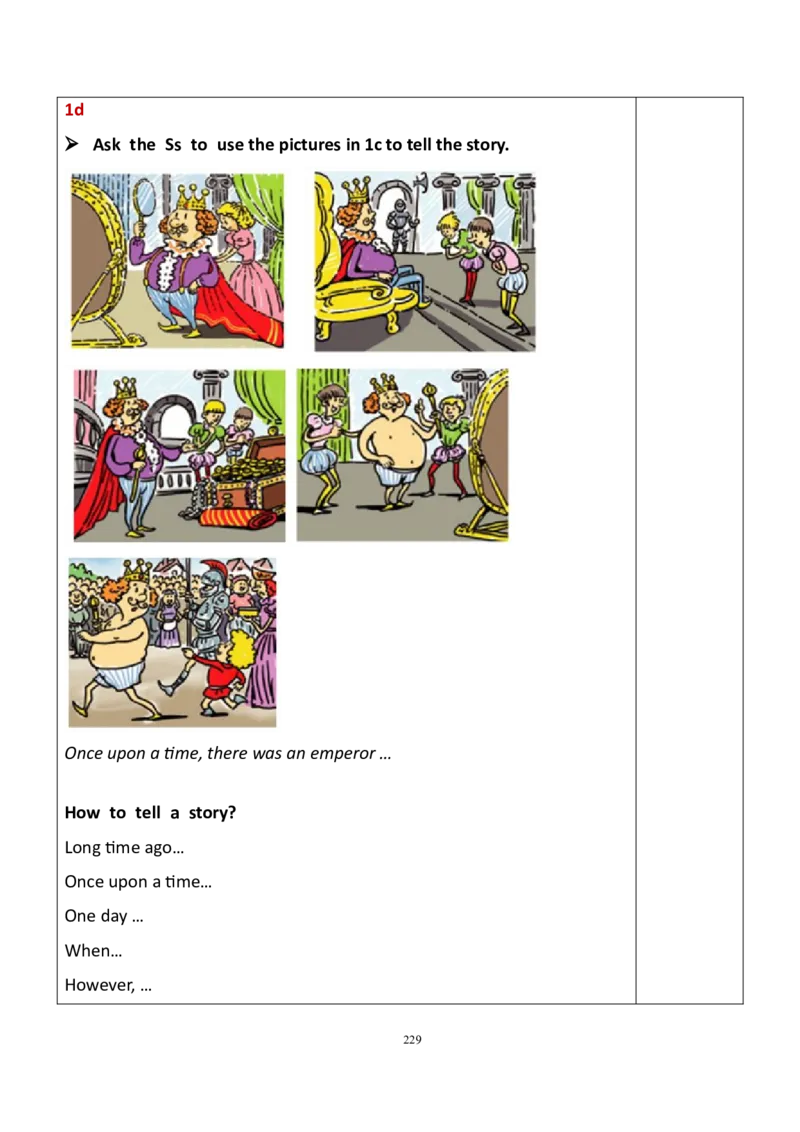
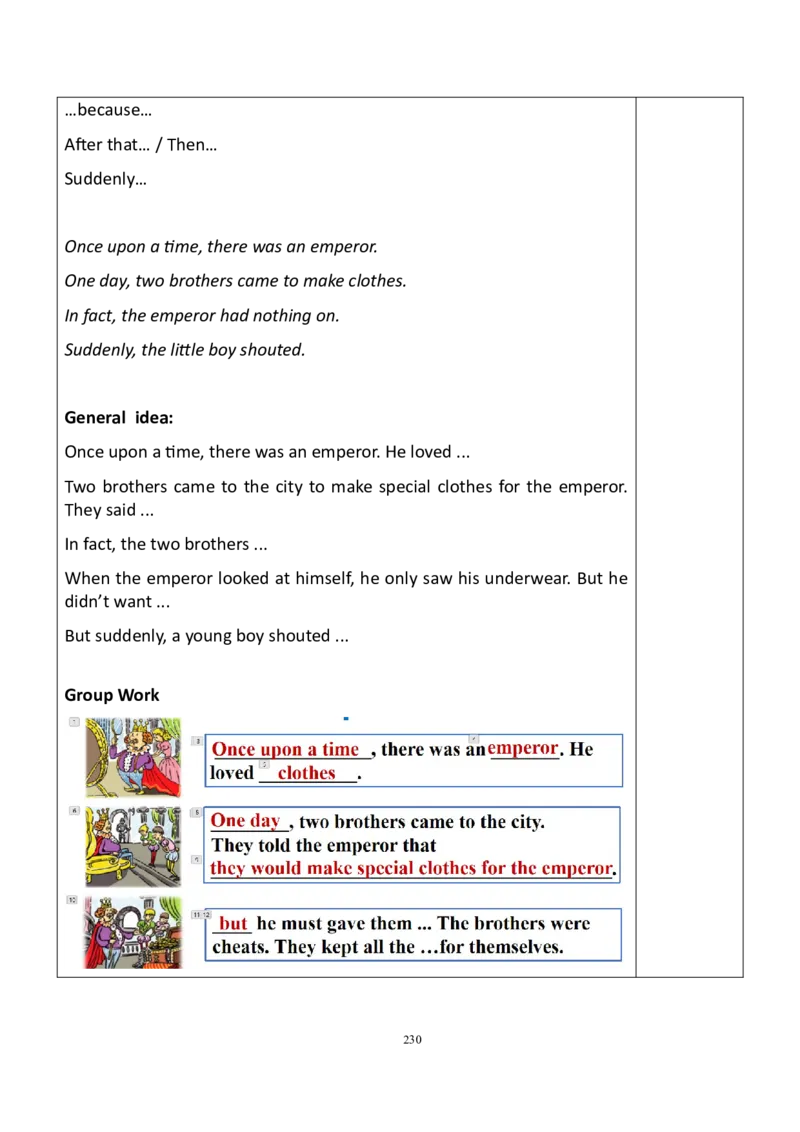
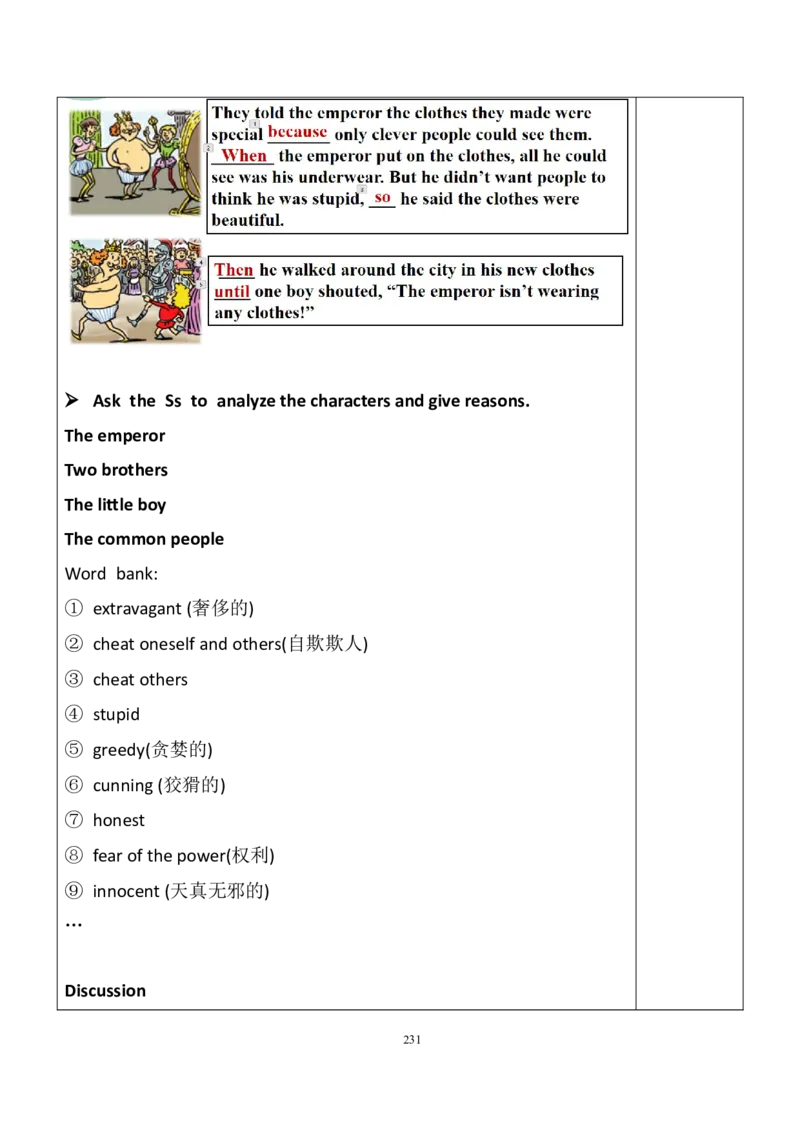
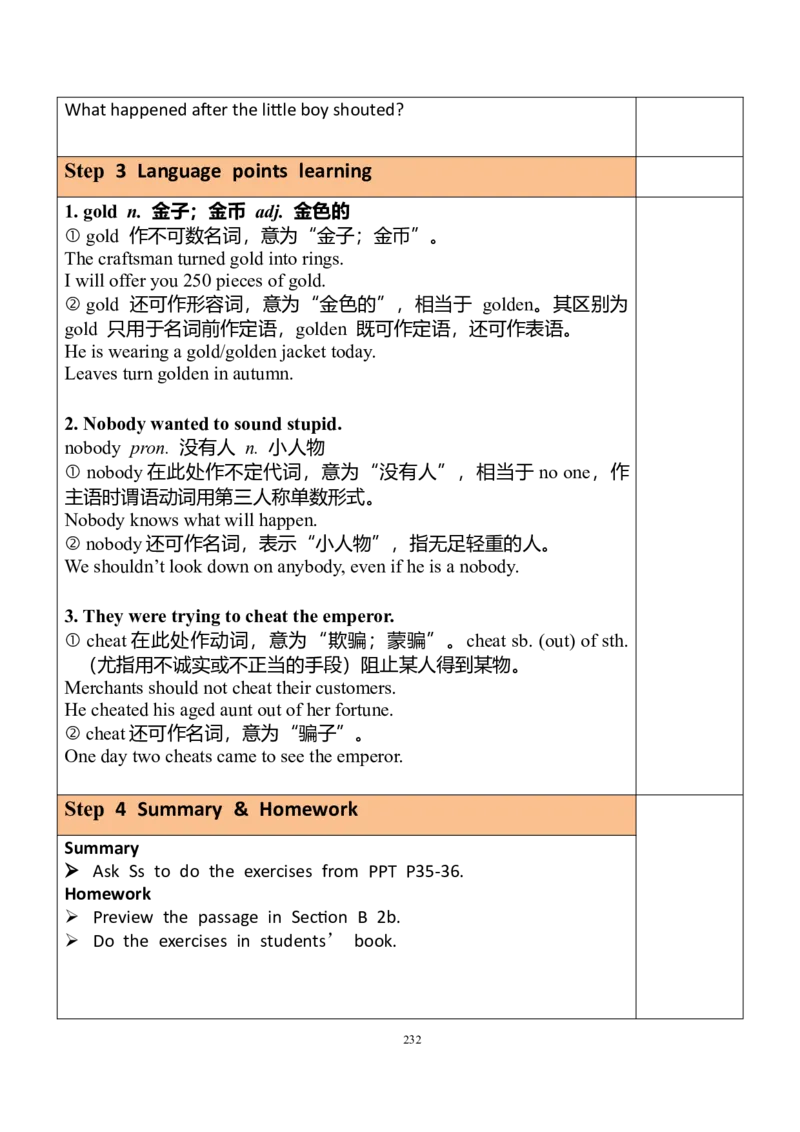

















































文档内容
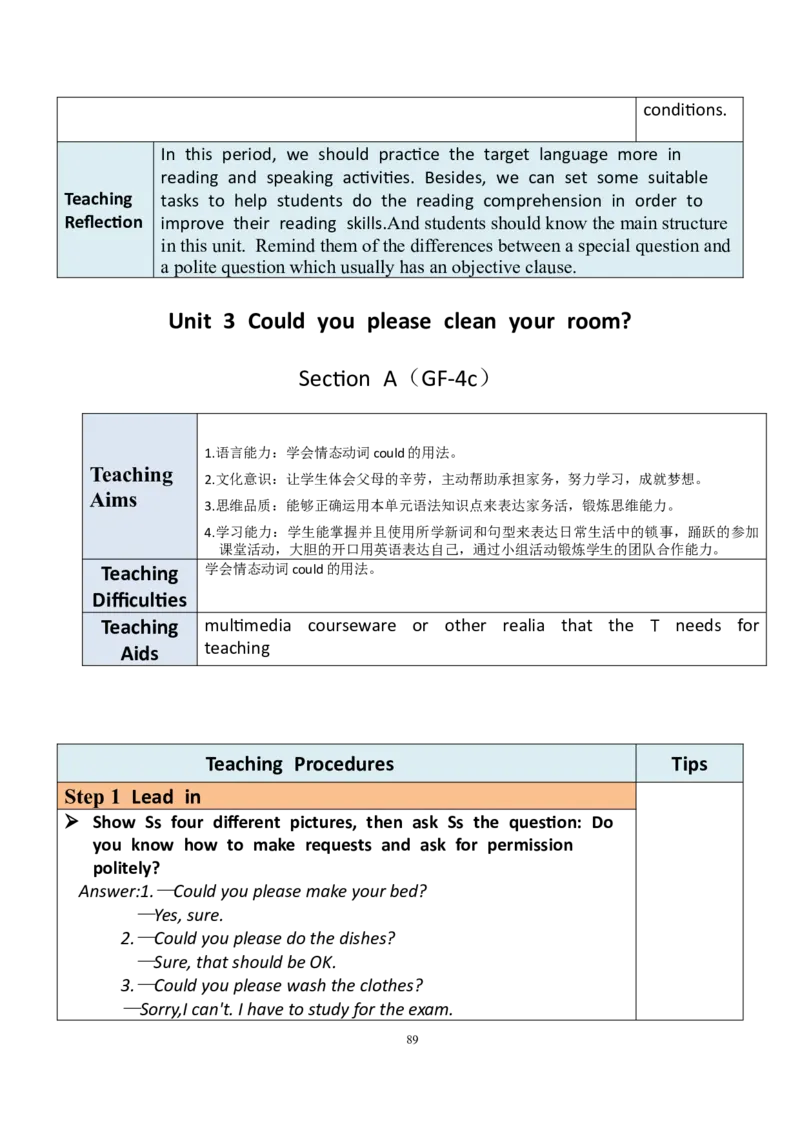
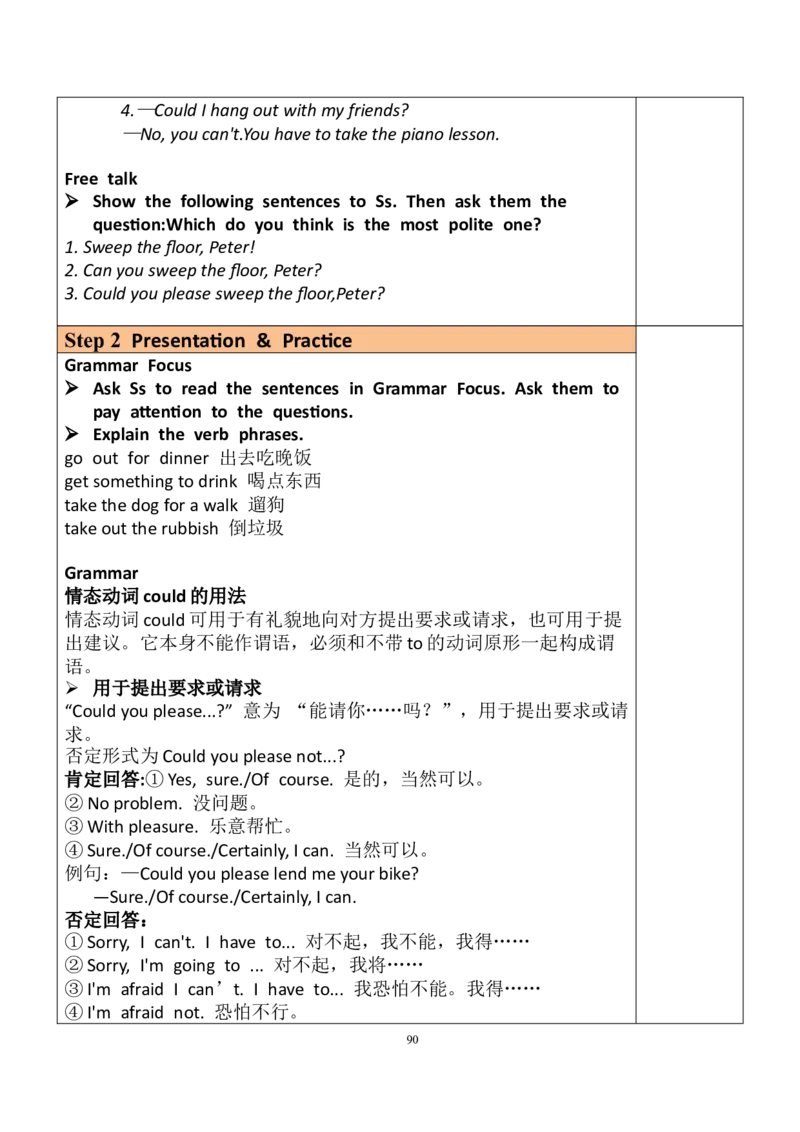
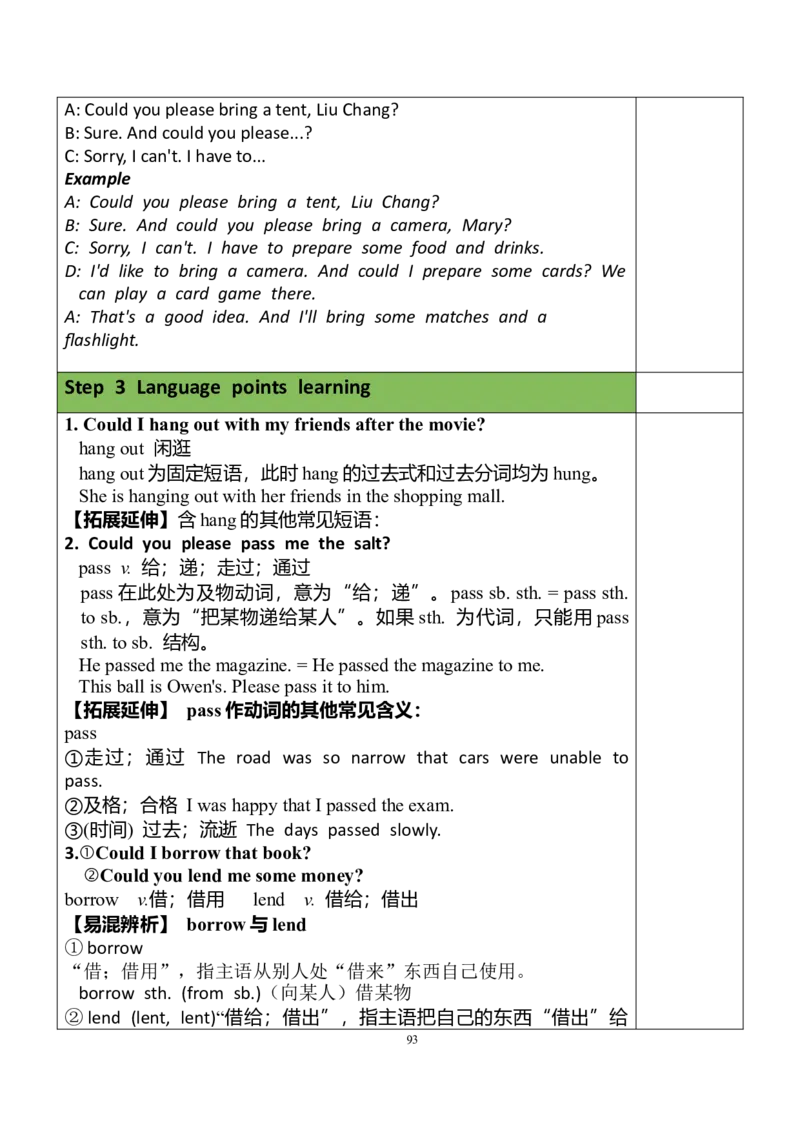
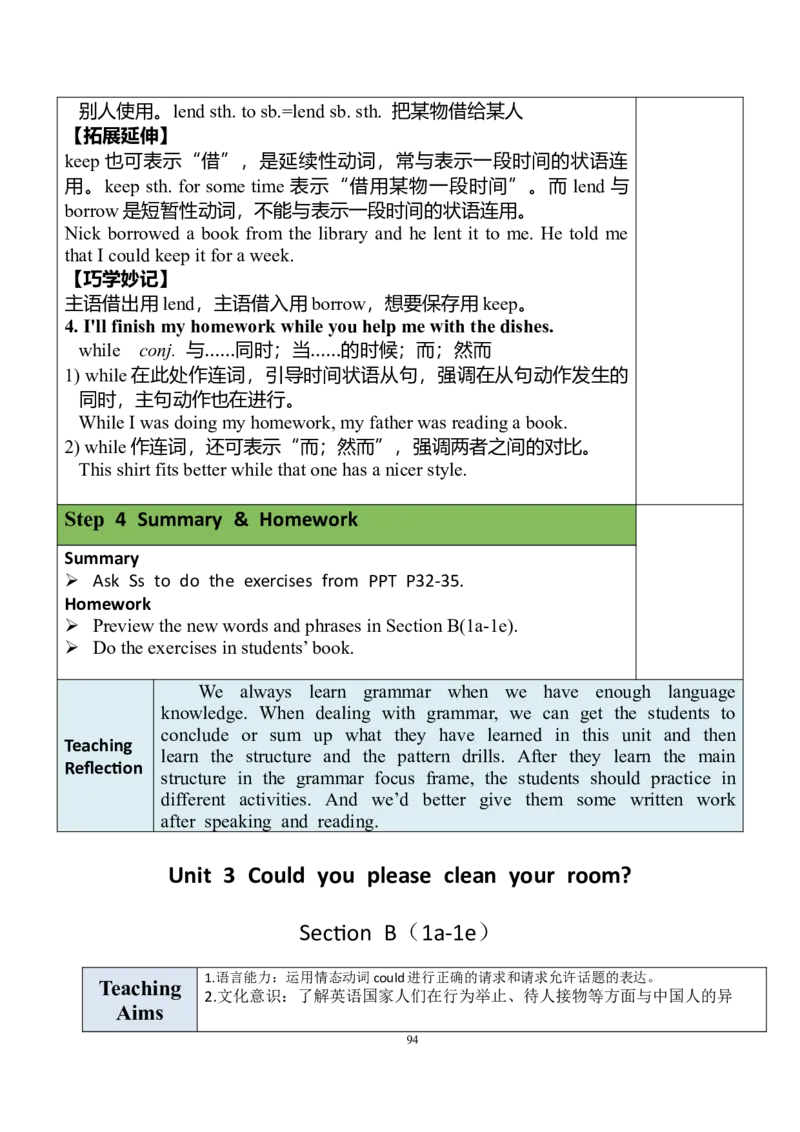
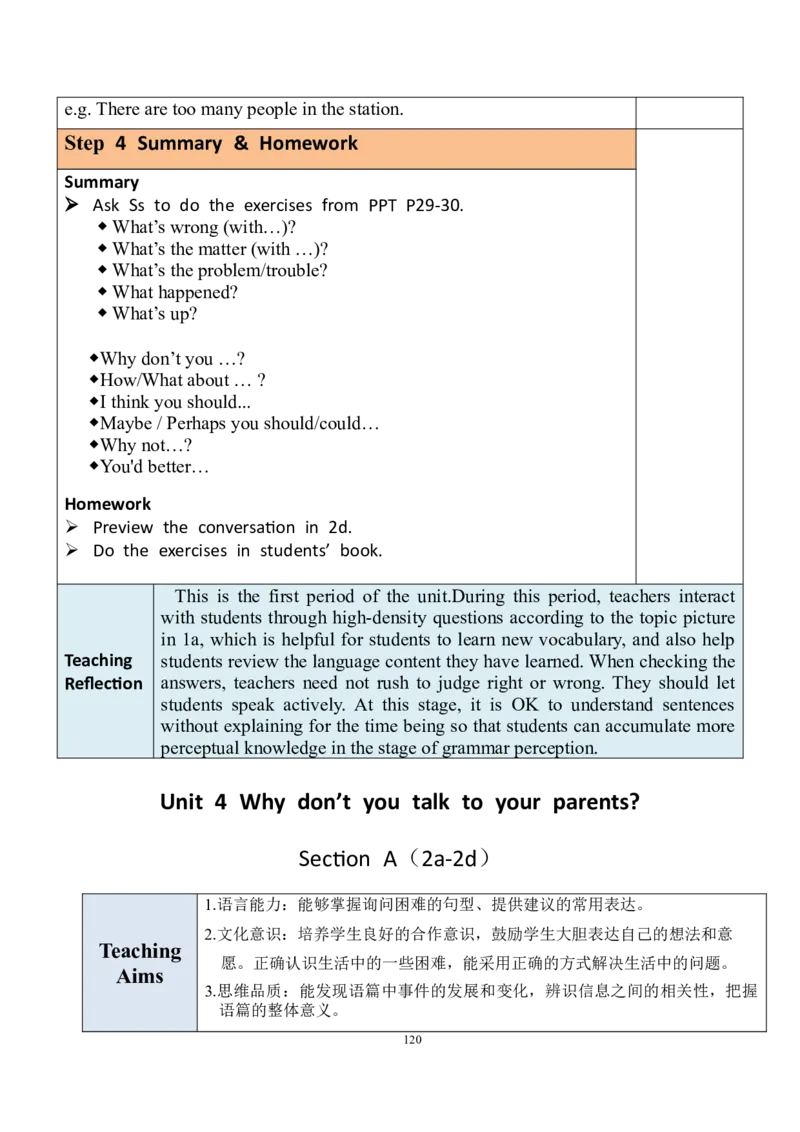
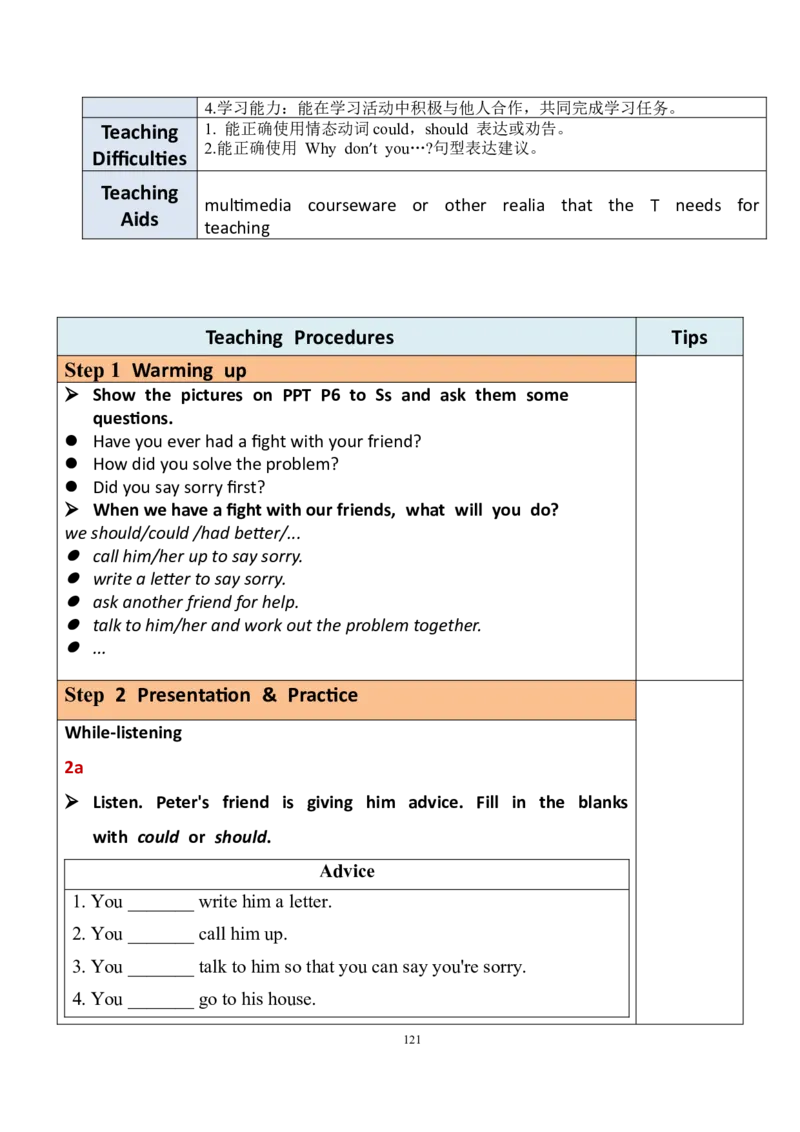
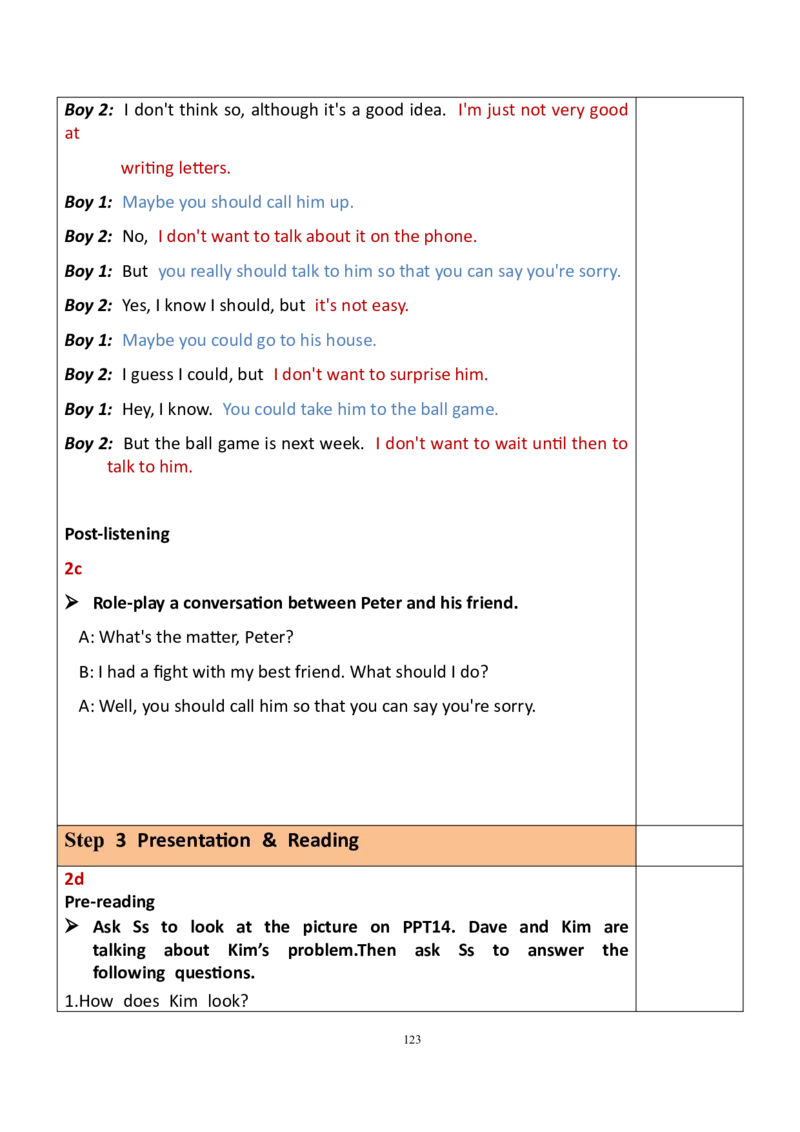
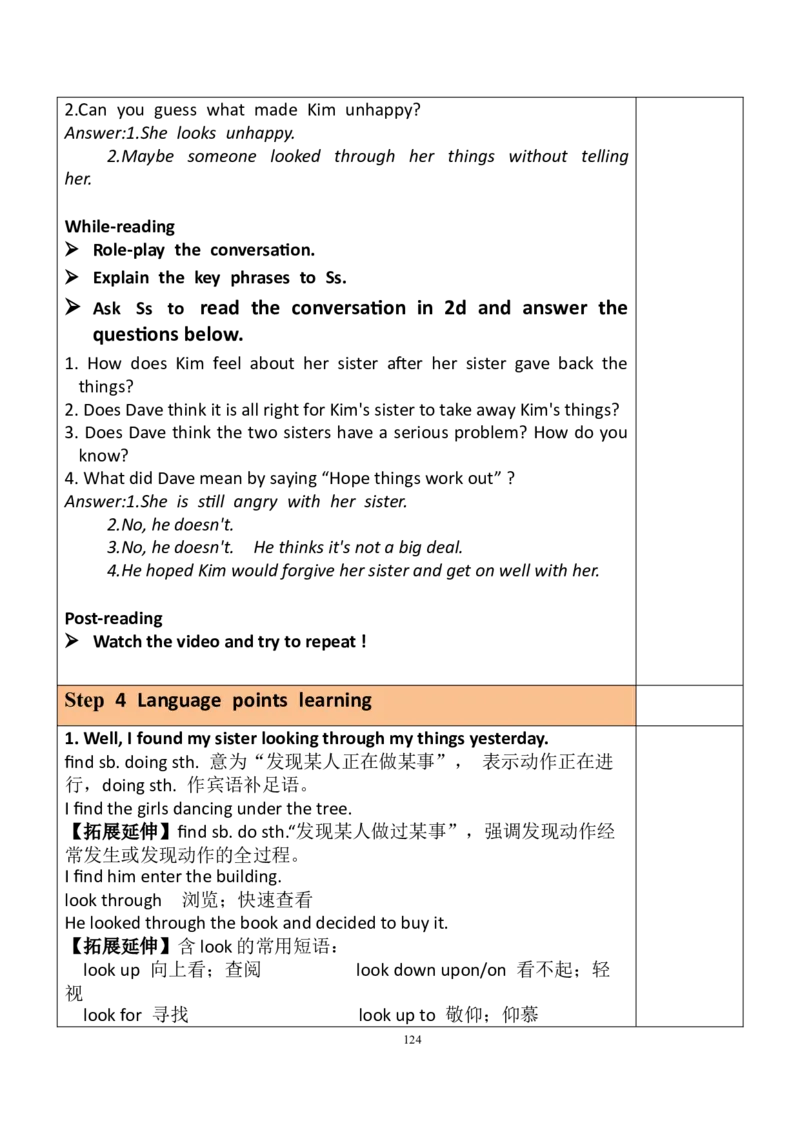
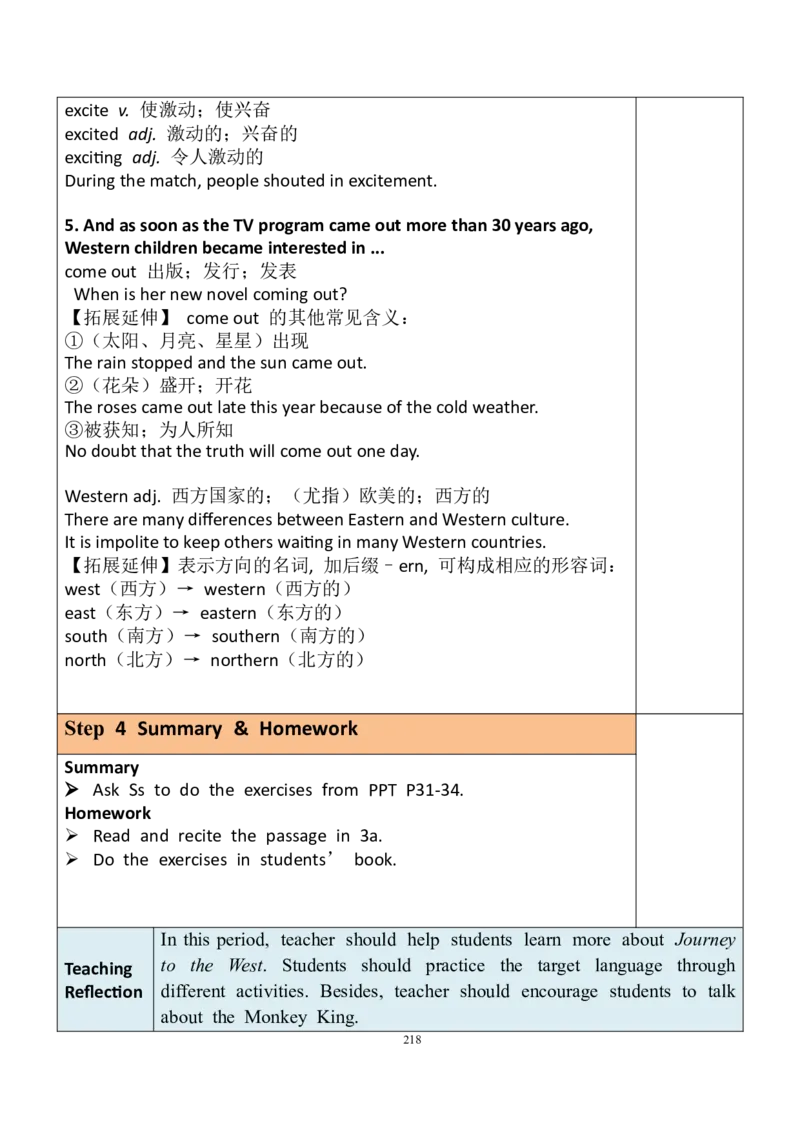
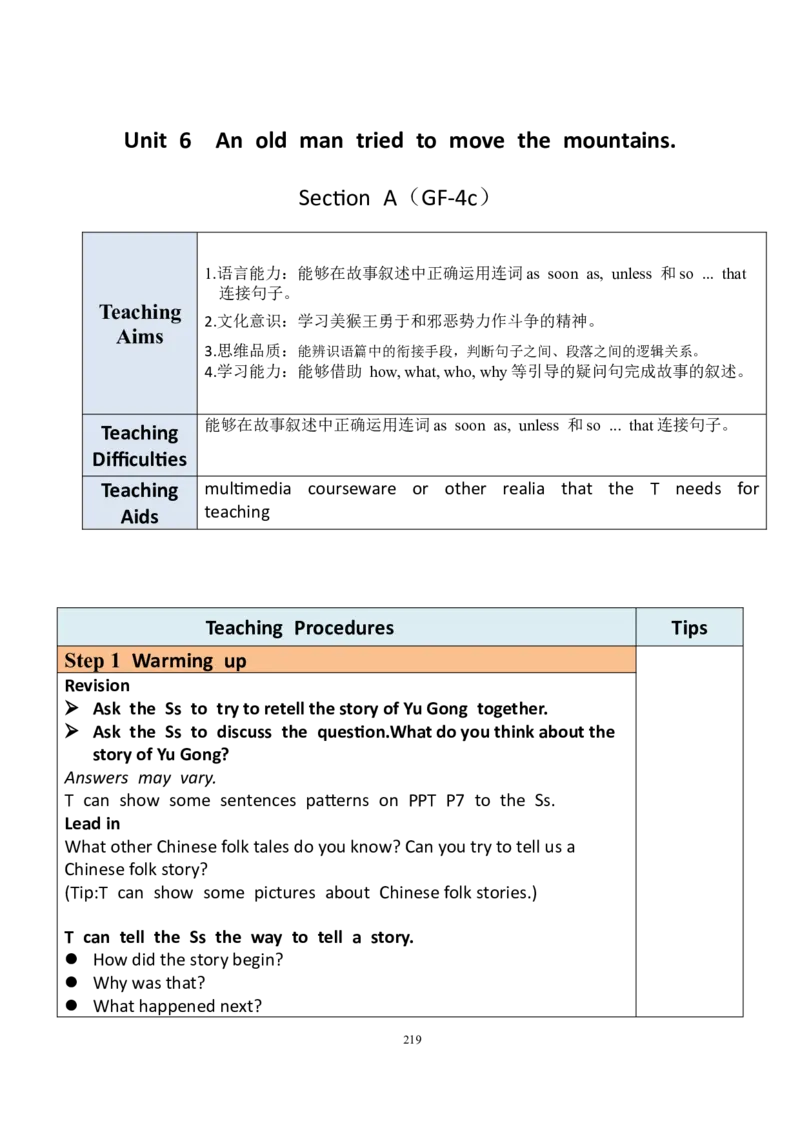
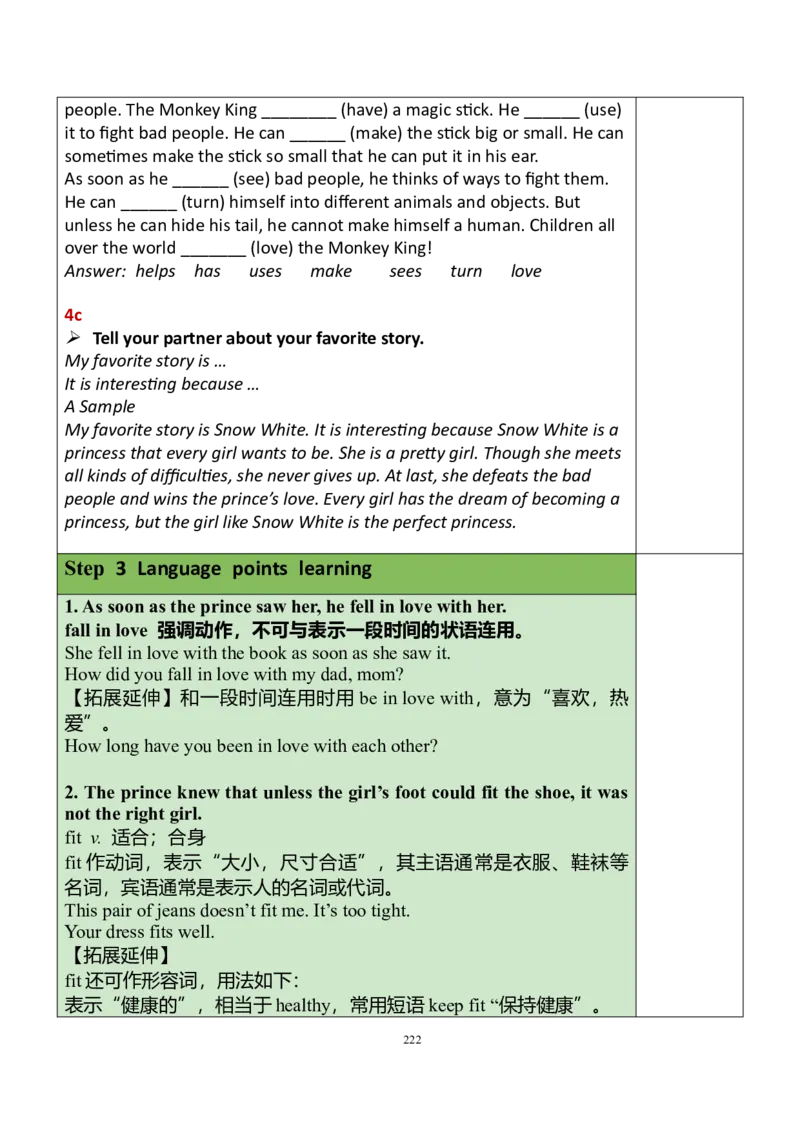
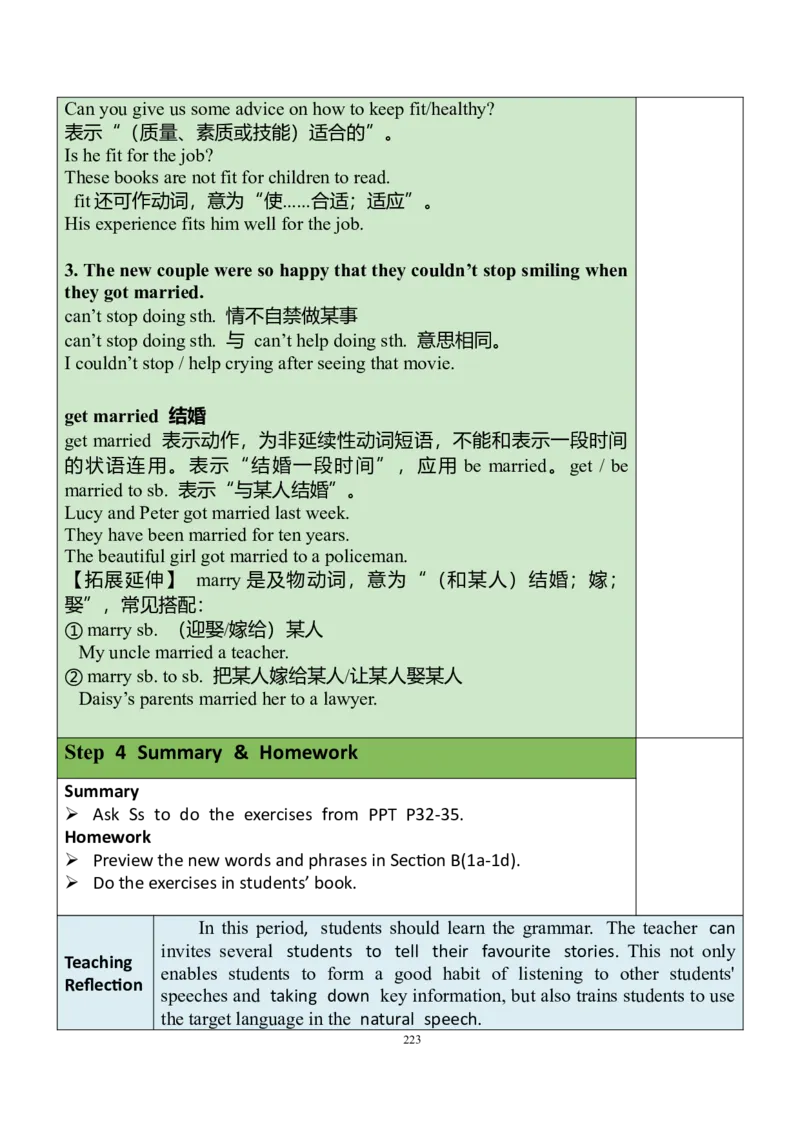
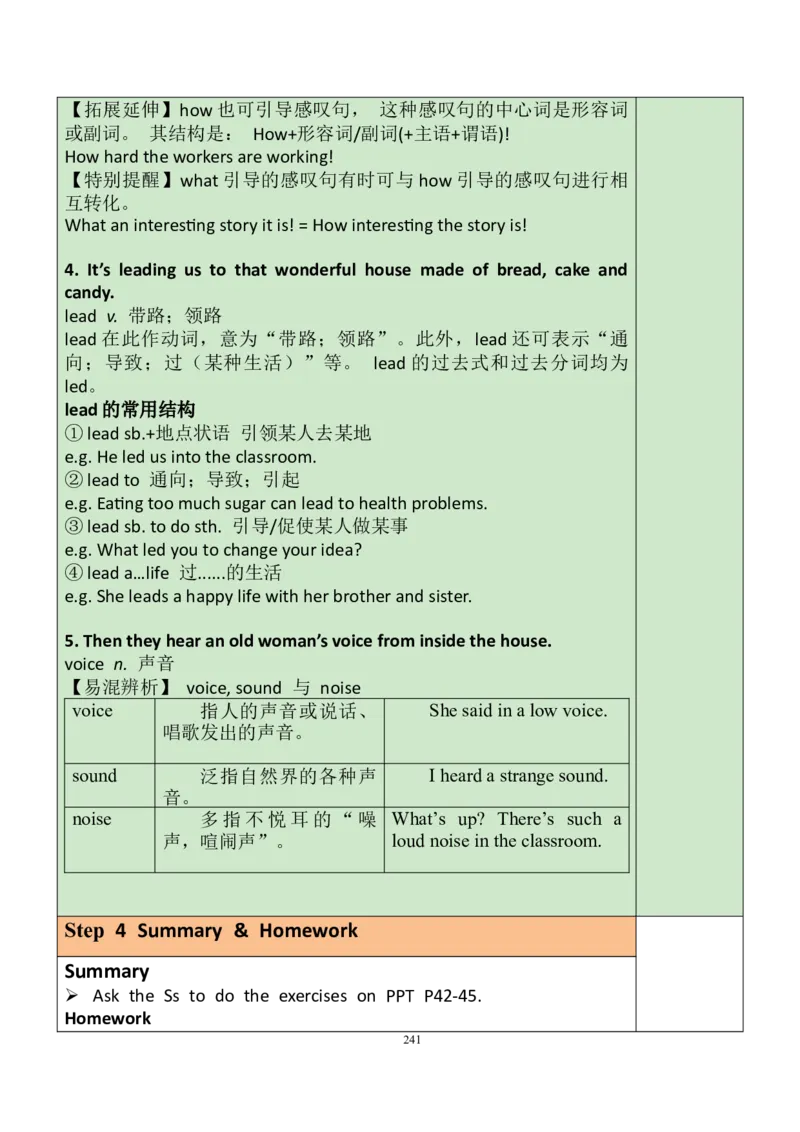
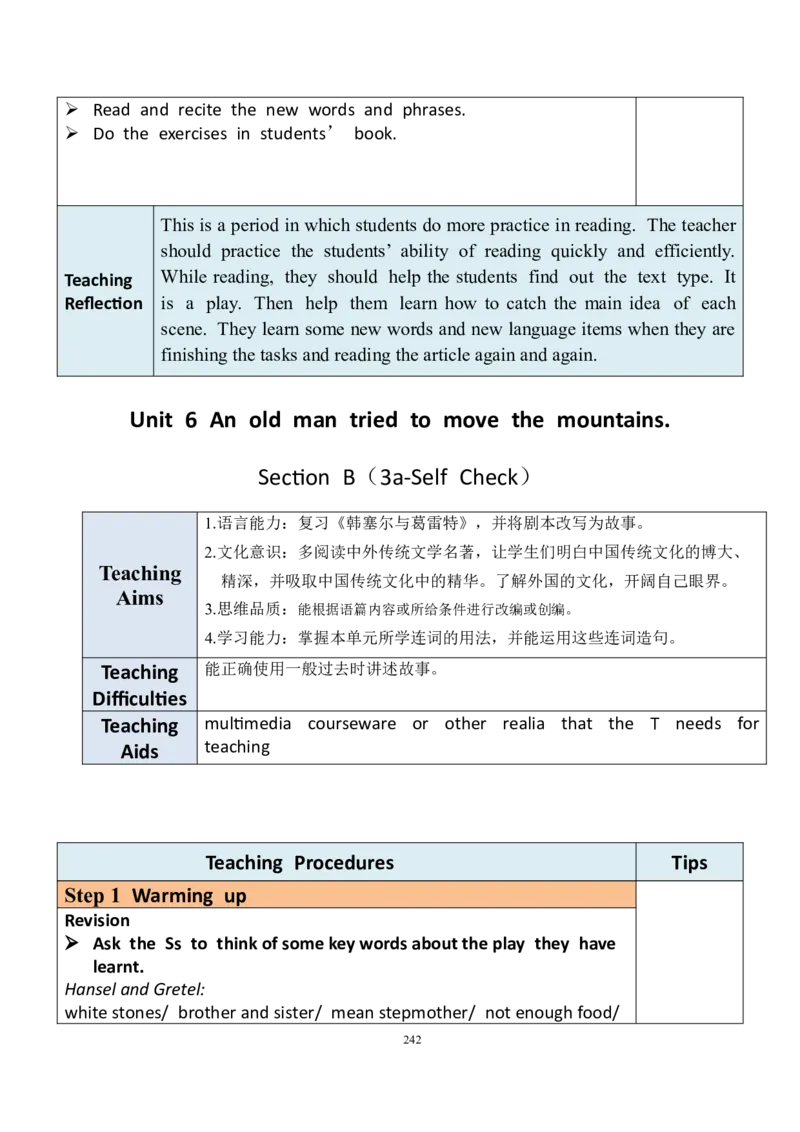
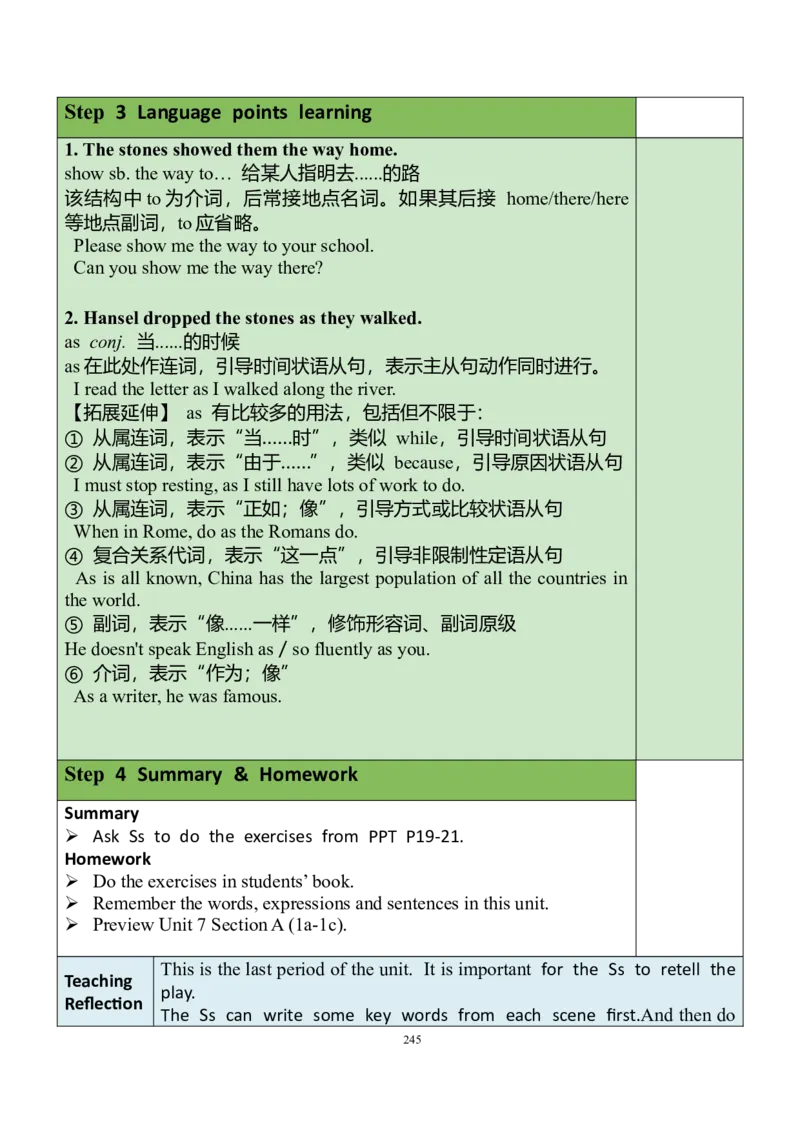
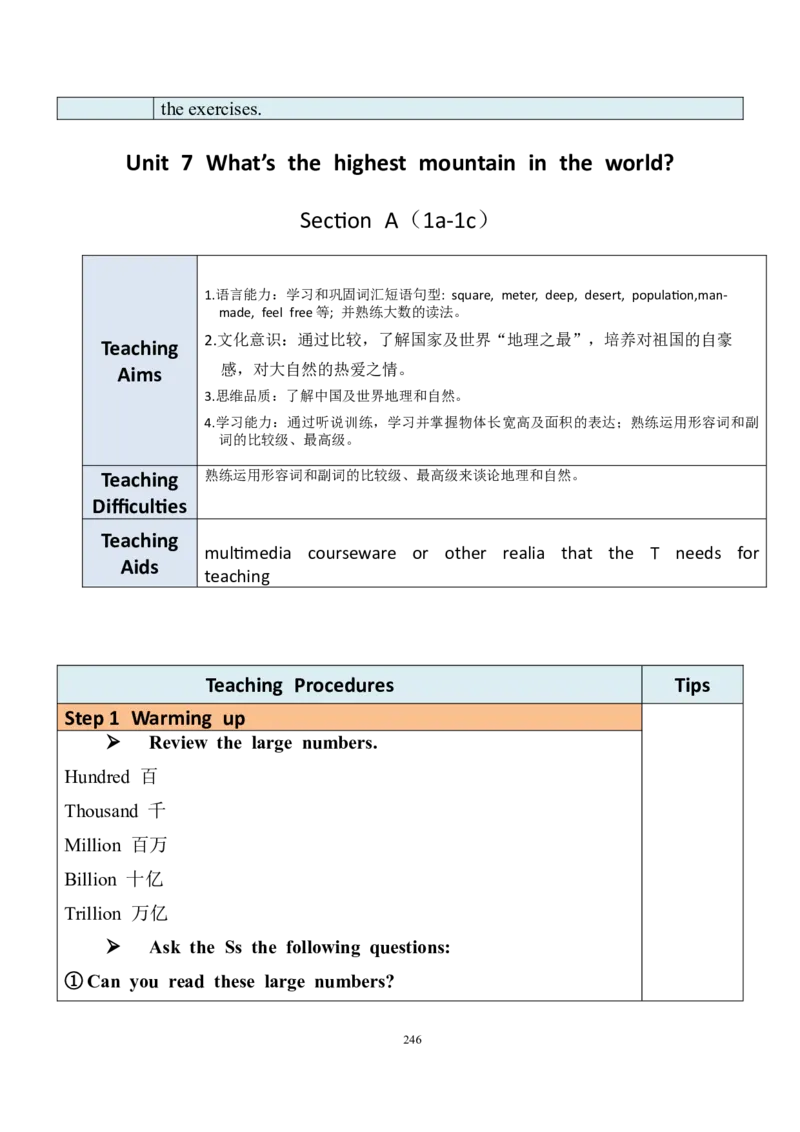
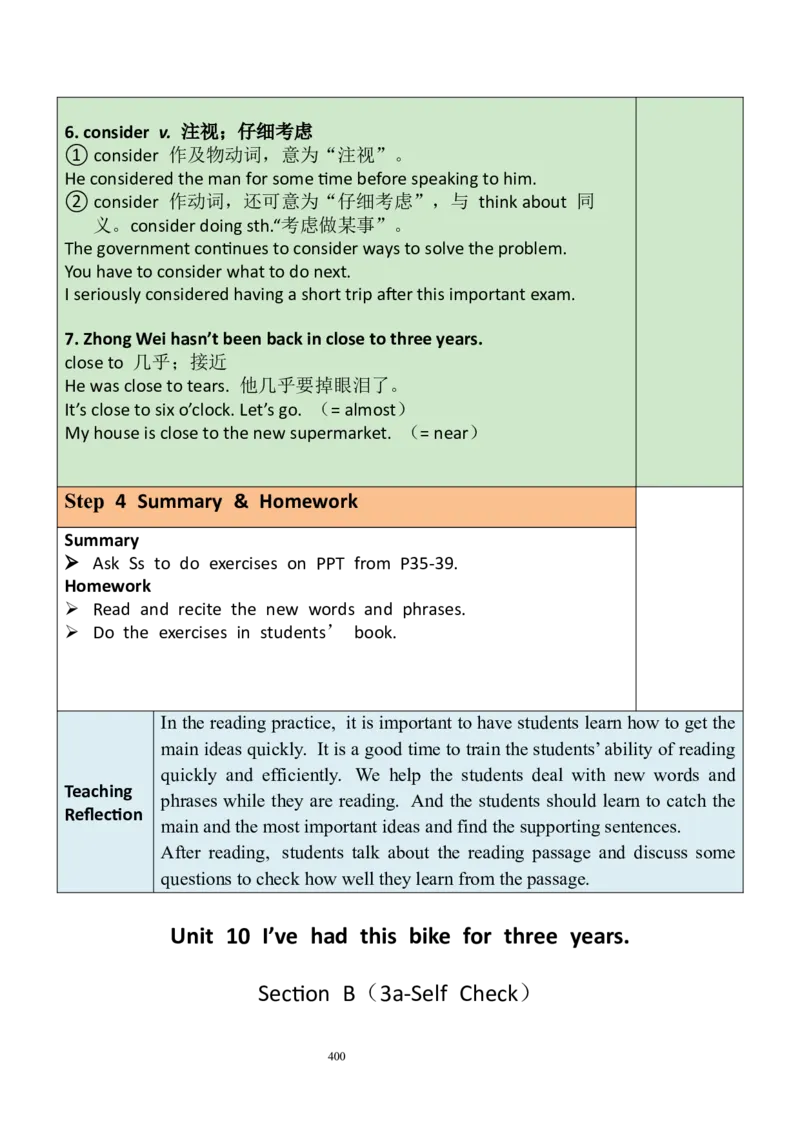
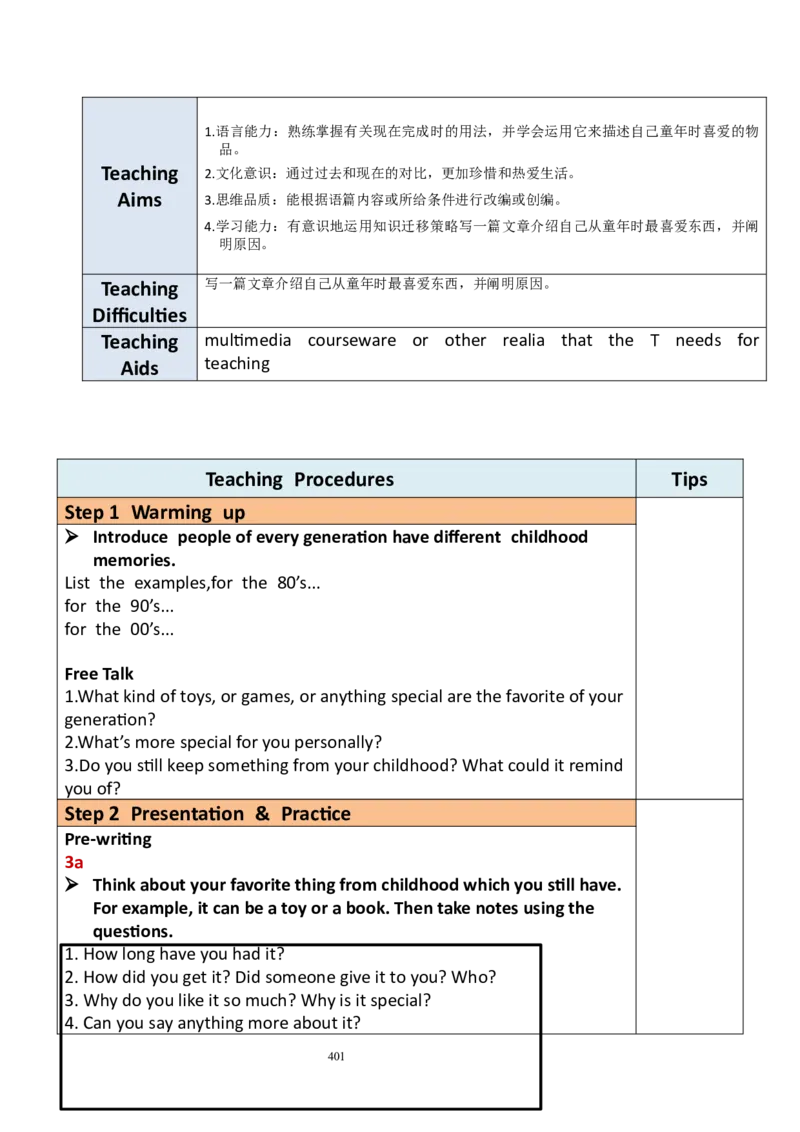
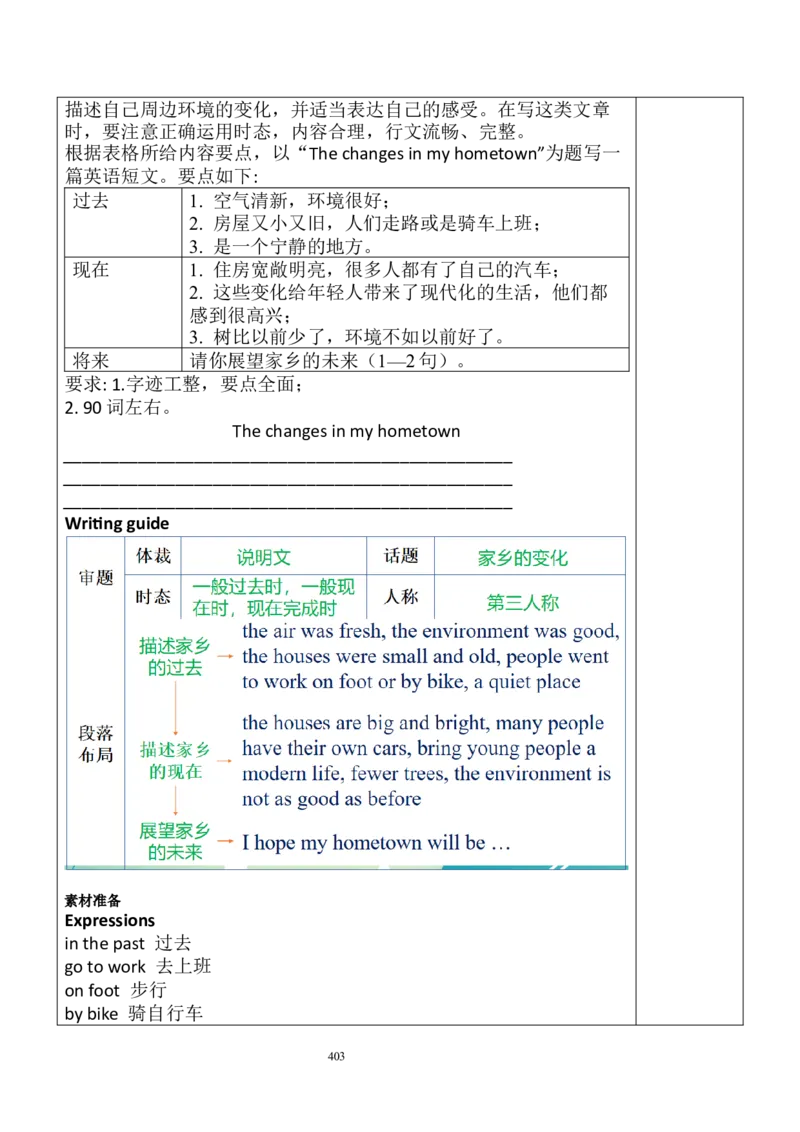
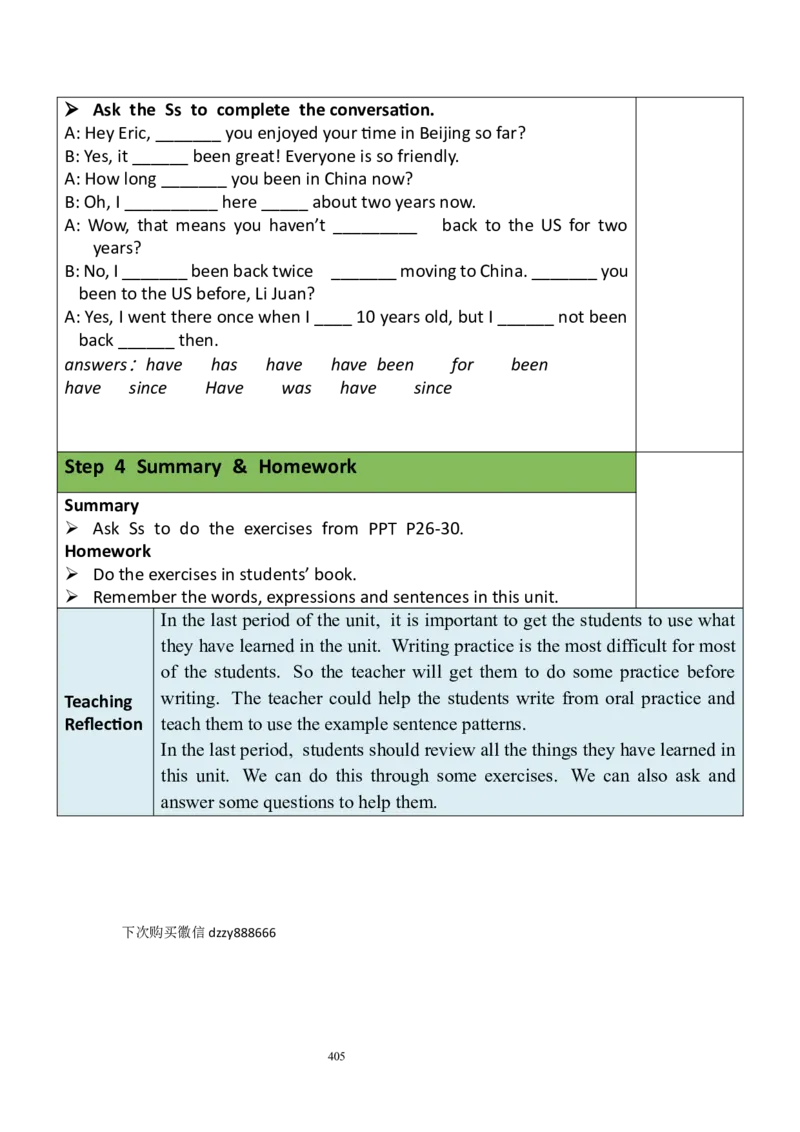
Unit 1 What’s the matter?
Section A(1a-1c)
1.语言能力:积累身体部位、身体健康问题相关的单词和短语。
2.文化意识:能够培养关心自身或他人健康的意识。
Teaching
3.思维品质:学习使用“have a + 病症”结构谈论健康问题。
Aims
4.学习能力:有意识地运用知识迁移策略来询问他人的健康。
Teaching 学习使用“have a + 病症”结构谈论健康问题
Difficulties
Teaching
multimedia courseware or other realia that the T needs for
Aids
teaching
Teaching Procedures Tips
Step 1 Warming up
Ask Ss to learn the parts of the body and chant body song.
The parts of the body: nose, mouth, neck, stomach, legs, head,
eyes,
ears, arms, hands, foot(feet), back
The body song:
Everybody moves your body.
Nod your head and touch your face.
Touch your nose and close your eyes.
Touch your ears and clap your hands.
Raise your arms and look at your back.
Touch your stomach and tap your foot.
Sit down and move your legs.
1 Play the Bingo game and review the parts of the body.
1. We look with our eyes.
2. We listen with our ears.
3. We smell with our noses.
4. We walk with our feet.
5. He carries a big bag on his back.
6. We do eye exercises to protect our sight.
7. People sometimes shake hands when they meet for the first
time.
8. If you agree, you can nod your head.
Lead in
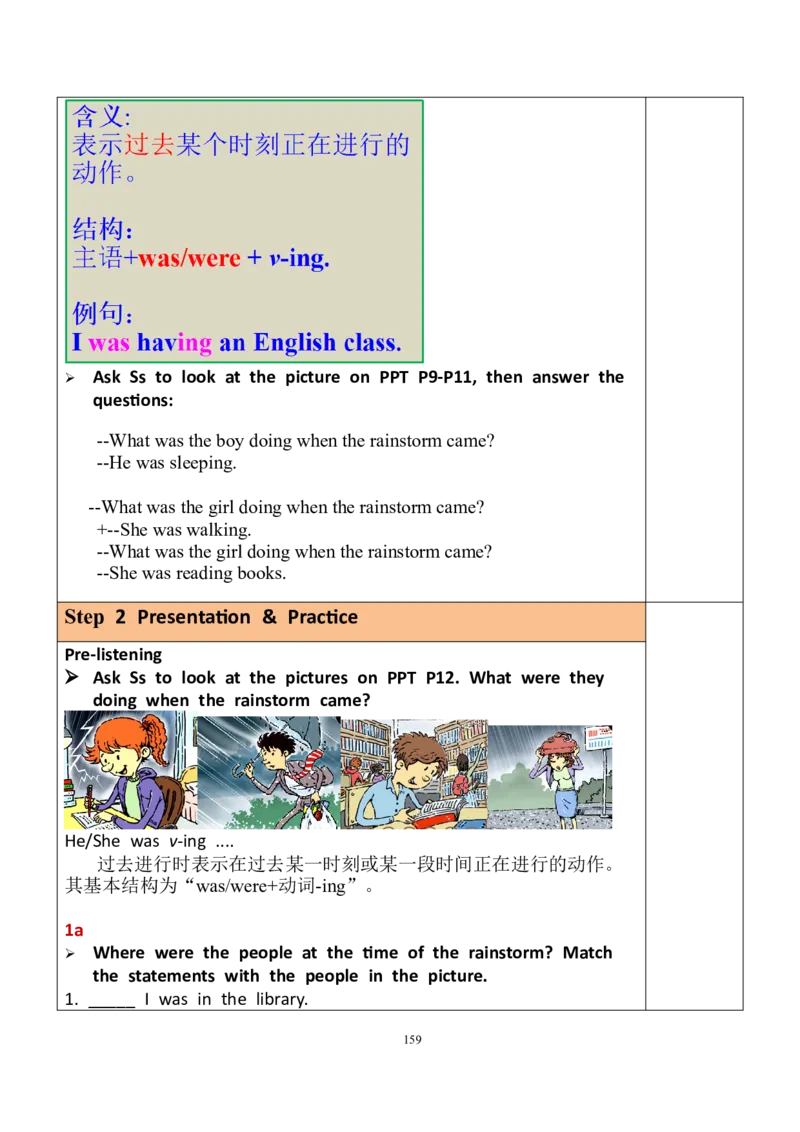
There are many patients in the hospital. Ask Ss to look at the
following pictures and describe the patients’ health condition.
T: What’ s the matter with her/him?
Ss: He has a sore throat. / He has a sore back. / She has a cold.
/ He has a stomachache. / He has a toothache. / She has a cough.
Step 2 Presentation & Practice
Pre-listening
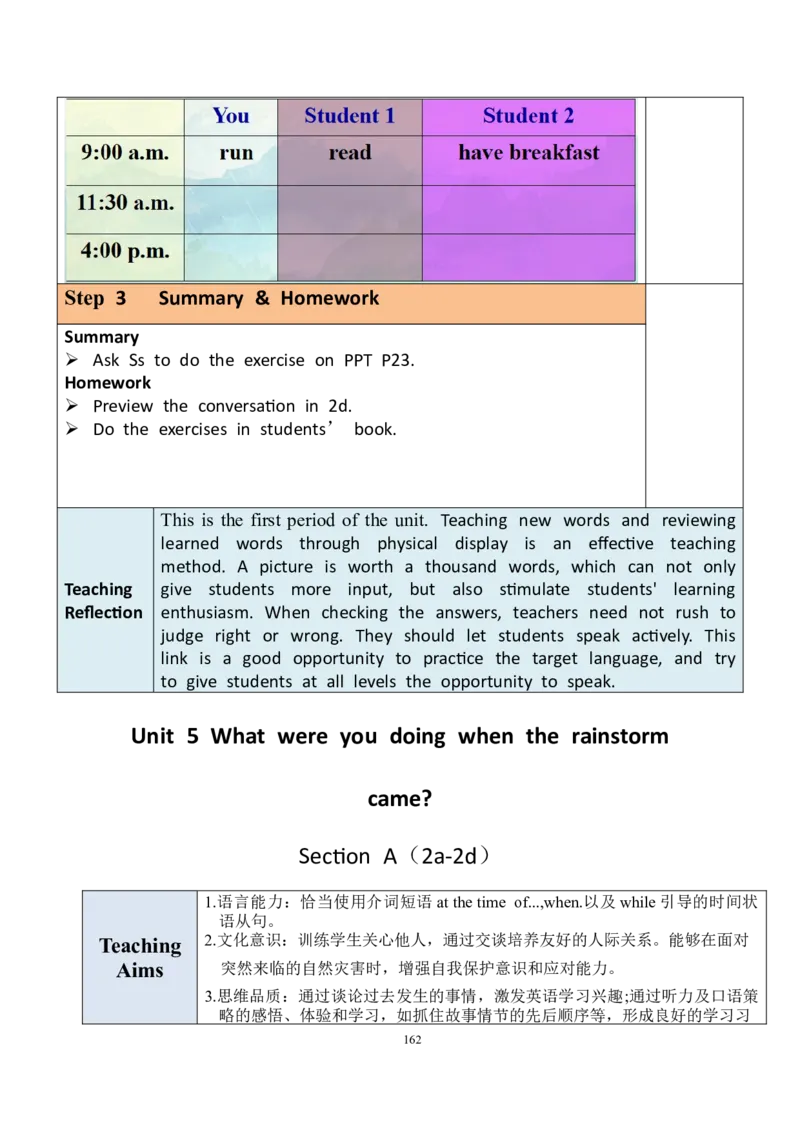
1a
Look at the picture. Write the correct letter [a-m] for each
part of the body.
Answers: h arm e back g ear i eye b foot a hand j head
l leg c mouth d neck m nose k stomach f tooth
(Tip: T can do this activity as a class or have Ss do this alone or
in pairs first before doing the activity as a class.)
While-listening
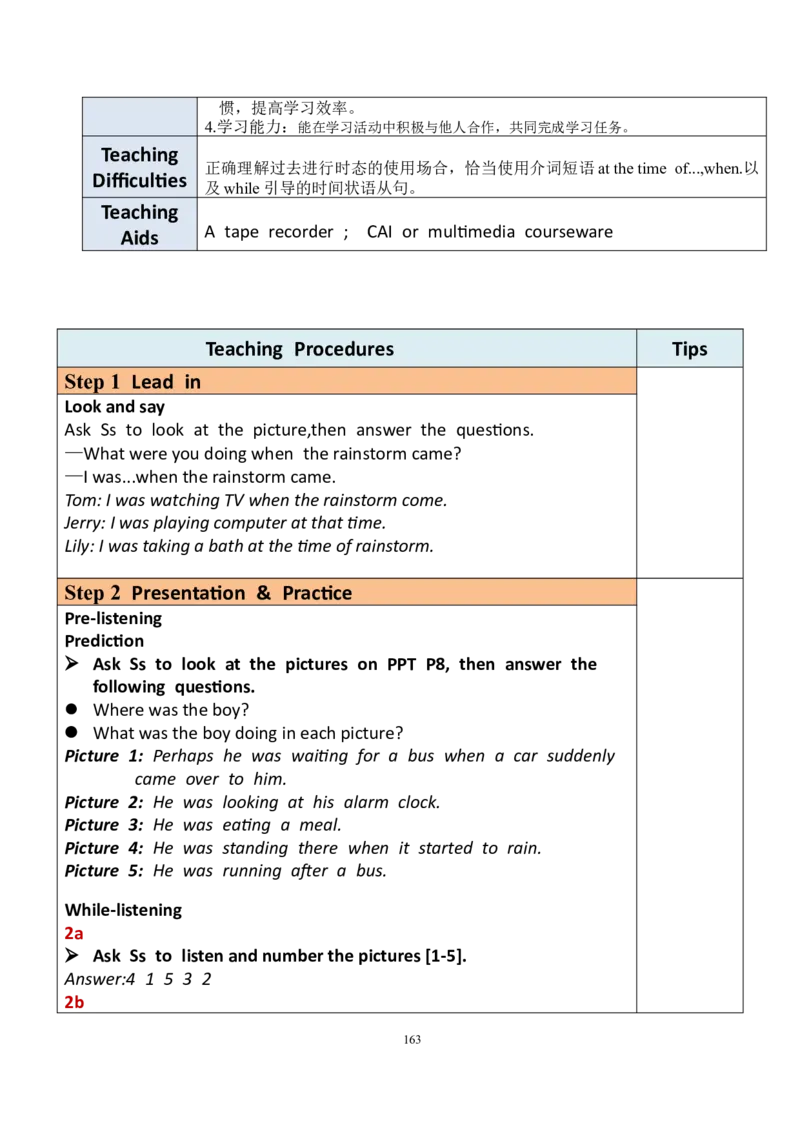
1b
Ask Ss to listen and look at the picture. Then number the
2names.
T may want to point out some tricks that Ss can use before
listening to the recording: 1. Not all of the people in the picture
are numbered, so Ss should focus more on listening for the
activities of the people who are numbered. 2. Ss can also limit the
possible choices of their answers by noting whether the name is
male or female.
Answers: Nancy 3 Sarah 1 David 2 Ben 5 Judy 4
Play the recording again and ask Ss to find out what’s the
matter.
Answers:
Conversation 1
Nurse: You don’t look well. What’s the matter, Sarah?
Sarah: I have a cold.
Conversation 2
Nurse: What’s the matter, David?
David: I have a stomachache.
Conversation 3
Nurse: What’s the matter, Ben?
Ben: I have a sore back.
Conversation 4
Nurse: What’s the matter, Nancy?
Nancy: I have a toothache.
Conversation 5
Nurse: What’s the matter, Judy?
Ben: I have a sore throat.
Show the video of 1b to Ss.
Post-listening
31c
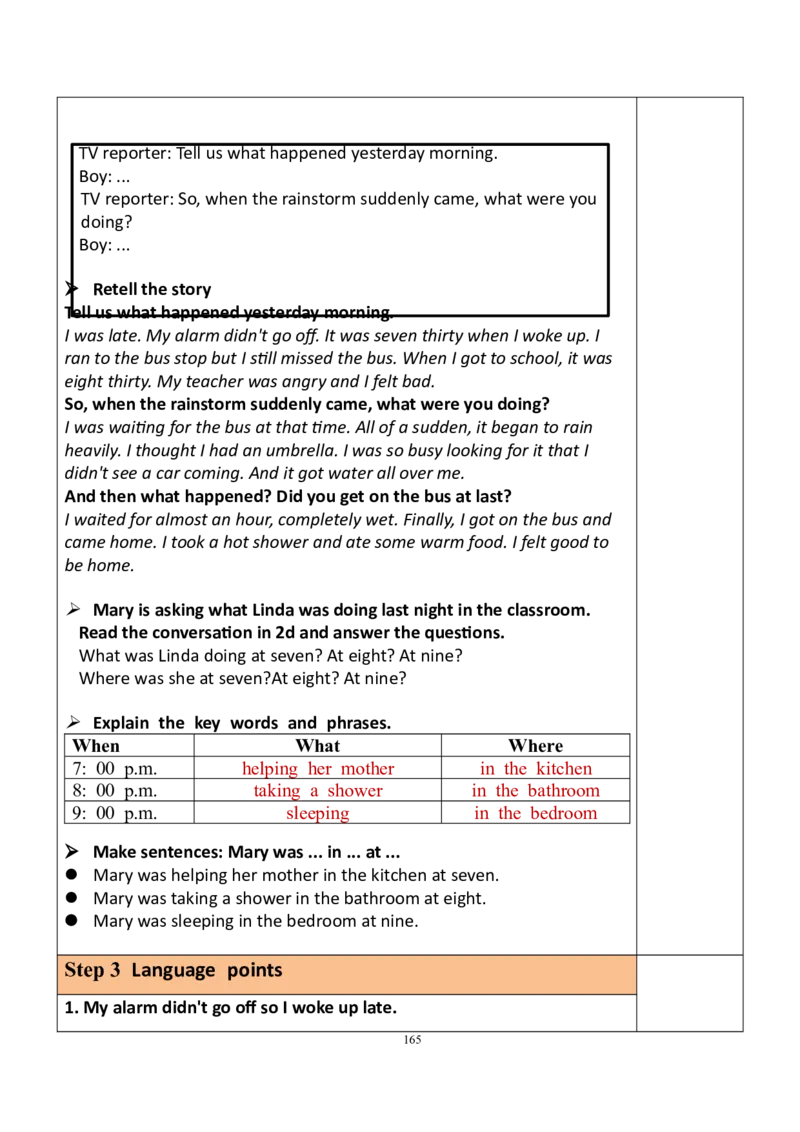
Ask Ss to make conversations about the people in the picture.
A: What’s the matter with Judy?
B: She talked too much yesterday and didn’t drink enough water.
She has a very sore throat now.
Ask Ss to complete the table about other students’ problems
and make conversations about others’ health condition
following the example in 1c.
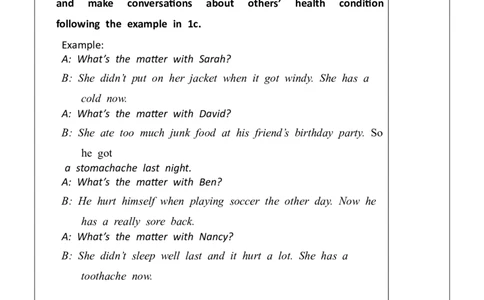
Example:
A: What’s the matter with Sarah?
B: She didn’t put on her jacket when it got windy. She has a
cold now.
A: What’s the matter with David?
B: She ate too much junk food at his friend’s birthday party. So
he got
a stomachache last night.
A: What’s the matter with Ben?
B: He hurt himself when playing soccer the other day. Now he
has a really sore back.
A: What’s the matter with Nancy?
B: She didn’t sleep well last and it hurt a lot. She has a
toothache now.
Step 3 Language points learning
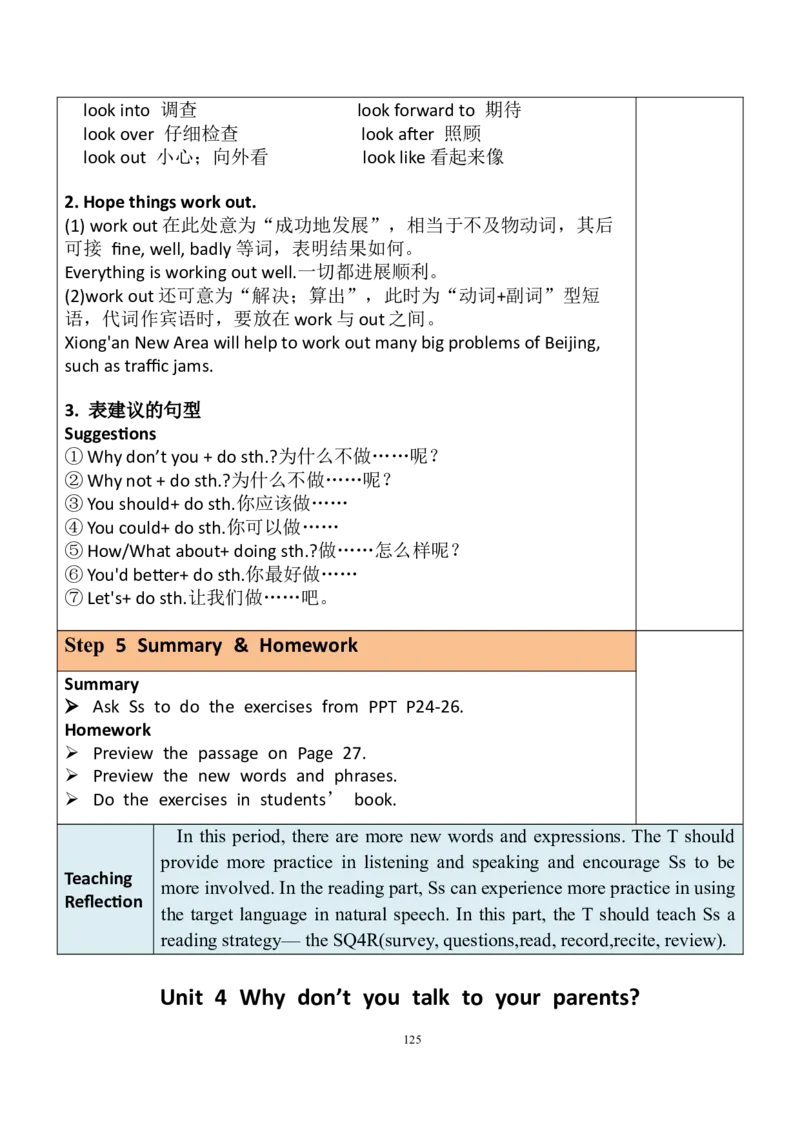
1. What’s the matter? 这是询问病人病情时最常用的问句,意思是
“怎么了?”,其后通常与介词with连用。类似的问句还有:
What’s wrong?
What’s wrong with you?
What’s your trouble?
What’s the trouble with you?
4What’s up?
Is there anything wrong with you?
2. 表示某种“病症,症状”用have a + n. 来表示。
(1)have a + 疾病(n.)
E.g. have a cough (咳嗽) have a cold (感冒) have a fever
(发烧)
(2)have a + 身体部位-ache
E.g. have a headache (头疼) have a toothache (牙疼)
have a stomachache (胃疼) have a backache (后背疼)
(3)have a sore + 身体部位
E.g. have a sore throat (嗓子疼) have a sore back (背疼)
3. She talked too much yesterday and didn't drink enough water. 她昨天说
话太多了又没有喝足够多的水。
too much的用法:
①作形容词词组,修饰不可数名词。
e.g. The students have too much homework.
②作副词词组,修饰动词。
e.g. Don't watch TV too much.
③作名词词组。
e.g. He has given me too much.
Step 4 Summary & Homework
Summary
Ask Ss to do the exercises from PPT P33-34.
Homework:
Preview the conversation in 2d.
Do the exercises in students’ book.
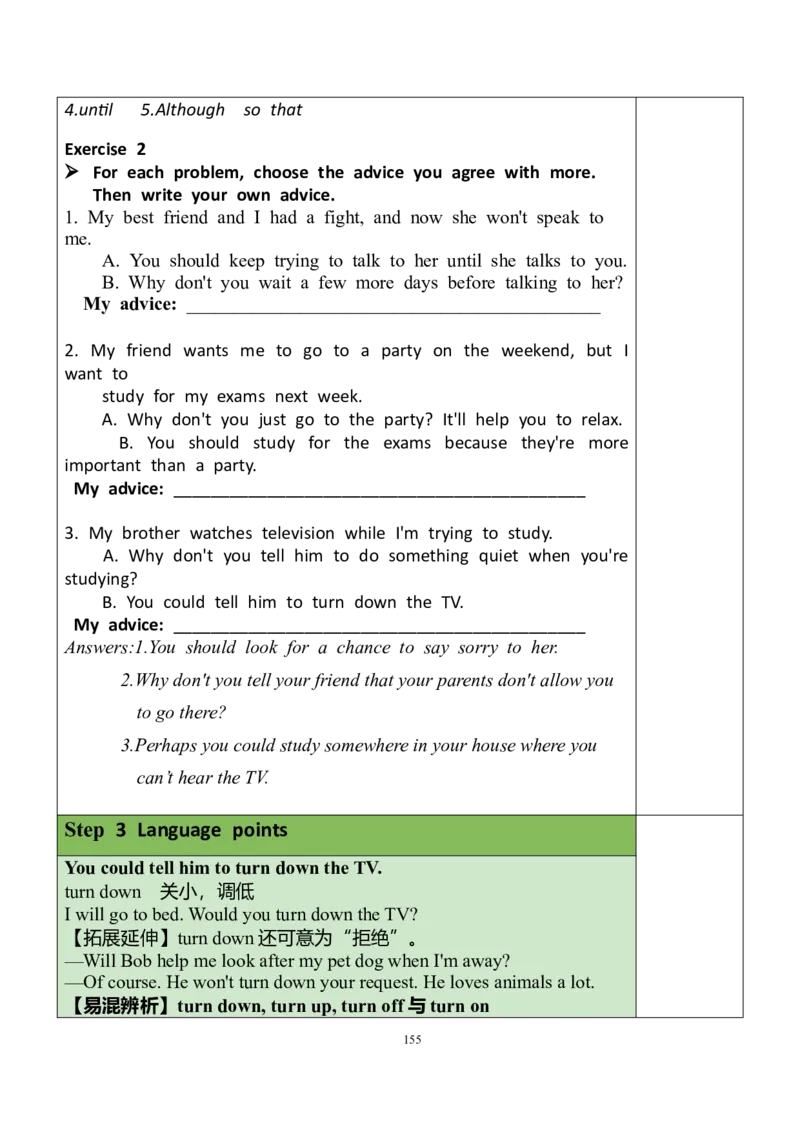
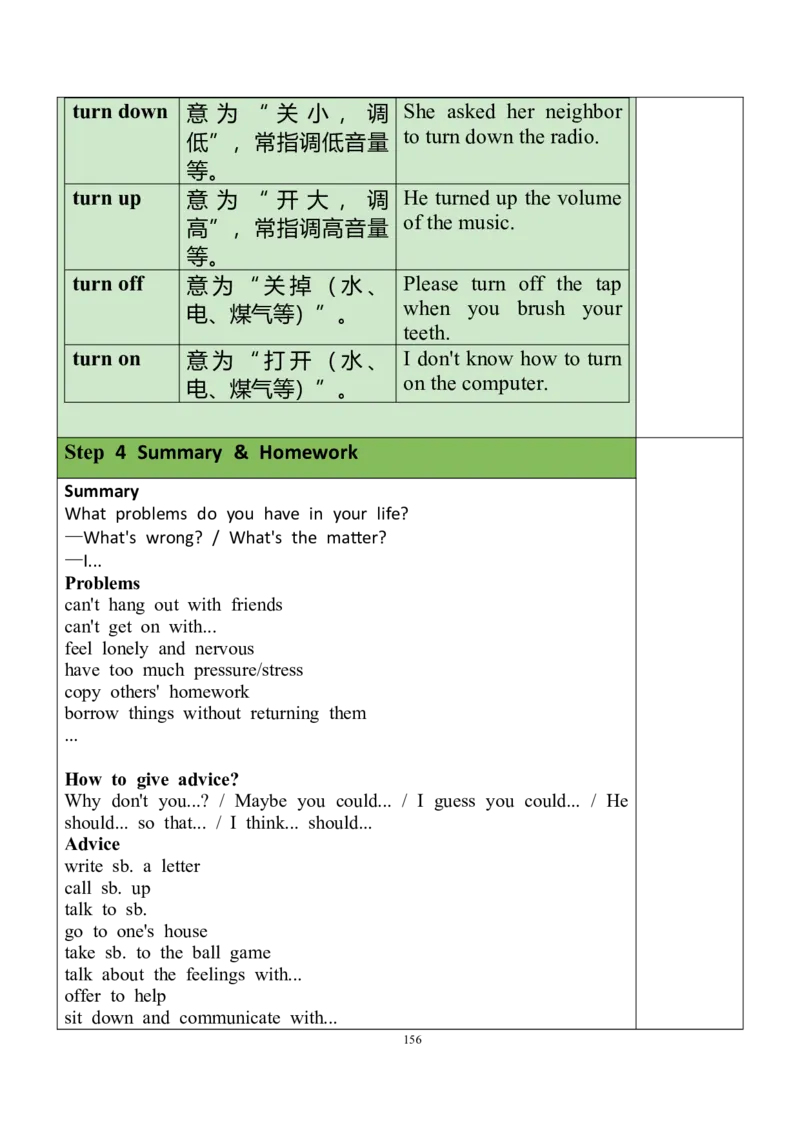
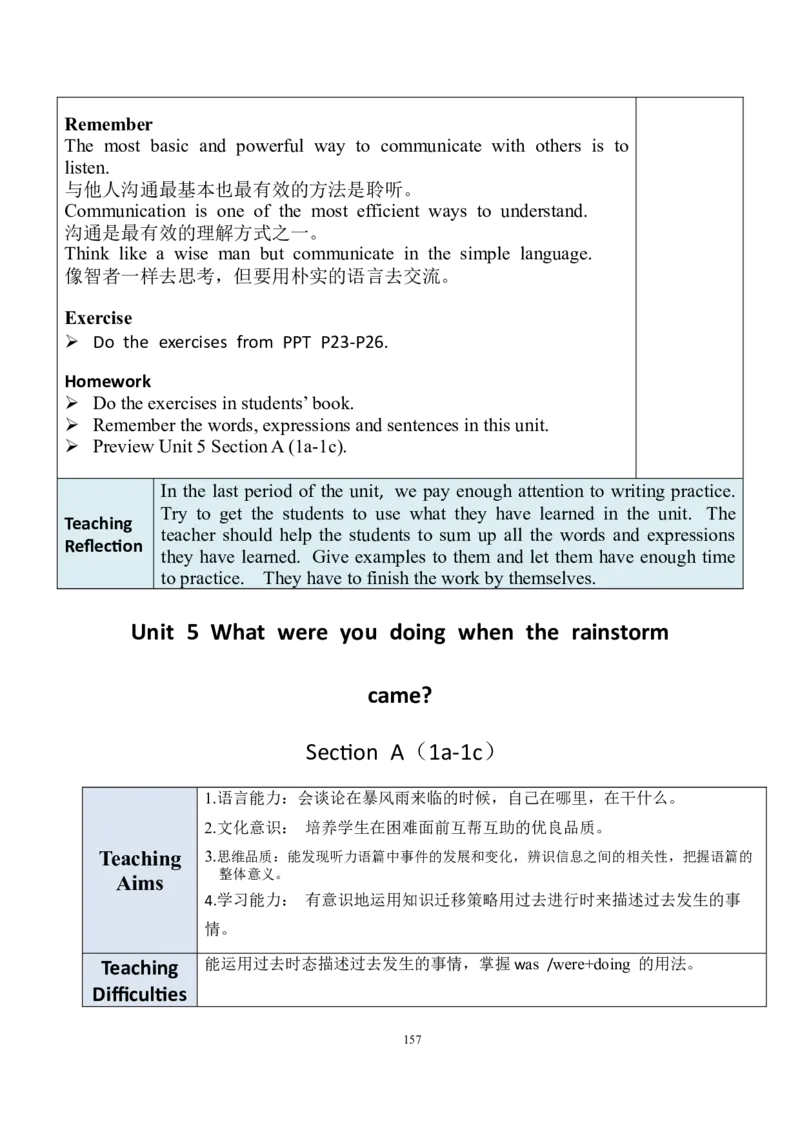
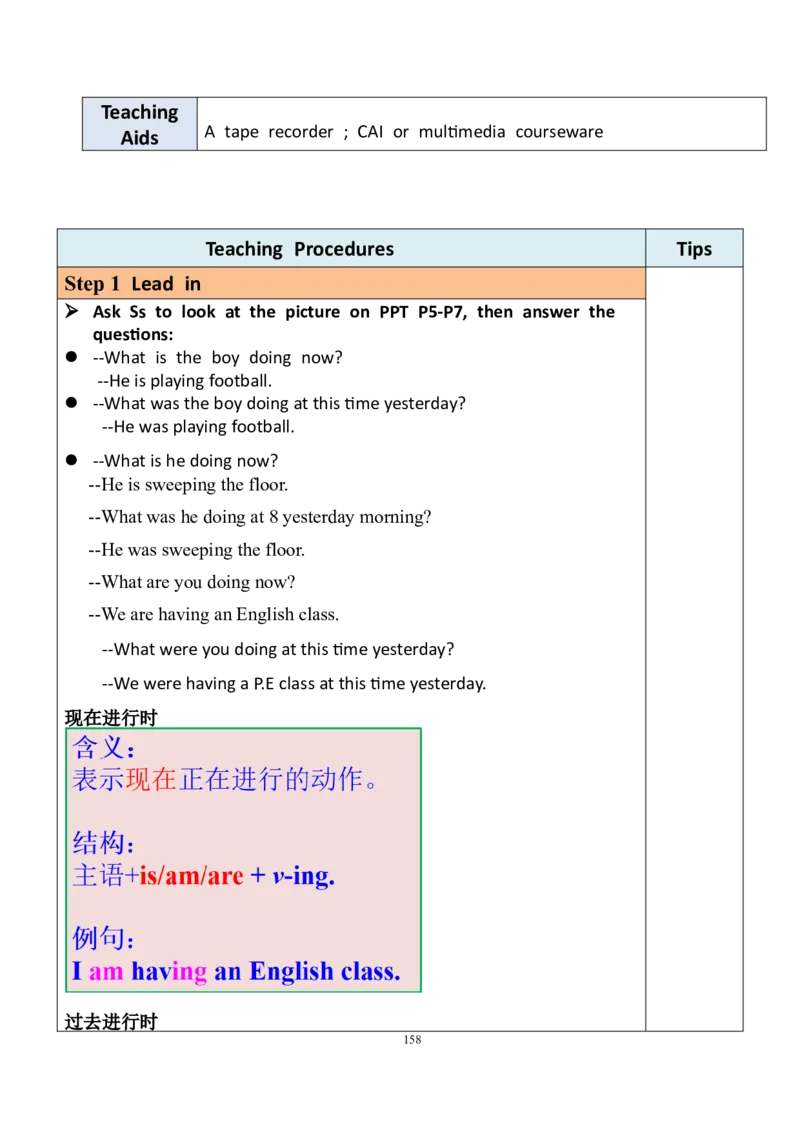
Teaching This is the first period of the unit. The topic of the unit is about “health
5problems and accidents” and we talk about the sentence pattern
“ What’s the matter?” that can be used to ask others’ health
condition. It’s necessary for students to learn some words about the
parts of the body and the pattern “have a + n.” to describe the
Reflection
health problems. This lesson designs chanting, Bingo game, and
conversation. These activities can arouse students’ interest in learning
the topic of this unit. They cultivate students’ ability to listen, and
communicate in English and encourage them to speak English boldly.
Unit 1 What’s the matter?
Section A(2a-2d)
1.语言能力:掌握有关身体的词汇以及有关疾病的词汇,并学会描述身体的不适和提出建
议。
2.文化意识:①通过描述自己的身体的不适提出建议,表达自己的看法,使学
生在人际交往中学会关心别人,增进情谊。②用恰当的方式表达自己的看
Teaching
法,增进人际交往中学会关心别人的能力,了解英美国家询问和表达身体不
Aims
适的习惯,培养跨文化交际意识。
3.思维品质:①通过情境学习让学生了解本课的教学重点--疾病的表达方式,从视觉上激
起了学生的好奇心和求知欲。②通过结对练习,游戏和角色扮演等多种任务的训练巩固
所学的基础语言材料:I have a …/ You should/shouldn’t…
4.学习能力:有意识地运用知识迁移策略来谈论身体不适以及表达建议。
Teaching
身体不适的表达及建议。
Difficulties
Teaching multimedia courseware or other realia that the T needs for
Aids teaching
Teaching Procedures Tips
Step 1 Warming up
Revision
Show Ss the English verb phrases and the Chinese translation. Ask
6Ss to match the English verb phrases with each Chinese translation
.
In pairs, ask Ss to talk about what’s the matter with them
each other.
(Tip: T can ask Ss to use the sentence structures from PPT 8.)
Ask the questions: What should we do if we have these health
problems?Can you give some useful advice?
Step 2 Presentation & Practice
While-listening
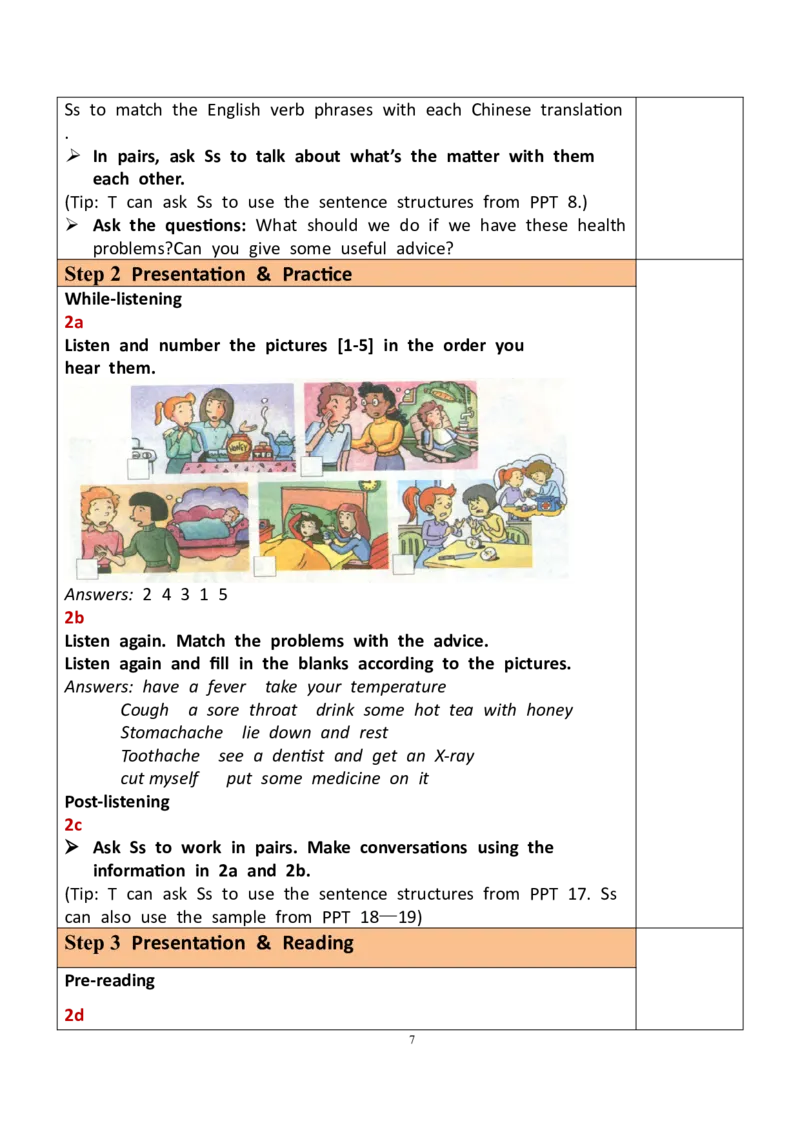
2a
Listen and number the pictures [1-5] in the order you
hear them.
Answers: 2 4 3 1 5
2b
Listen again. Match the problems with the advice.
Listen again and fill in the blanks according to the pictures.
Answers: have a fever take your temperature
Cough a sore throat drink some hot tea with honey
Stomachache lie down and rest
Toothache see a dentist and get an X-ray
cut myself put some medicine on it
Post-listening
2c
Ask Ss to work in pairs. Make conversations using the
information in 2a and 2b.
(Tip: T can ask Ss to use the sentence structures from PPT 17. Ss
can also use the sample from PPT 18—19)
Step 3 Presentation & Reading
Pre-reading
2d
7 Ask Ss to read the conversation. Explain the phrases that are
marked on PPT P20 and P21.
Show task 1 to Ss. Ask them to answer the questions below
after reading the conversation.
Answers:
She has a headache and can’t move her neck.
She played computer games all weekend.
She should lie down and rest.
She should go to a doctor then.
Show task 2 to Ss. Ask them to fill in the blanks according to
the conversation.
Answers: all weekend has a headache can’t move her neck
take her temperature take breaks lie down go to a doctor
Ask Ss to watch the video and try to repeat !
Step 4 Language points learning
1. lie down and rest 躺下休息
1)lie down 躺下
e.g. Don’t lie down on the ground. 不要躺在地上。
与down有关的词组:
sit down 坐下
come down 下来;(价格;水平)下降
get down 下车
write down 写下;记下
fall down 落下;跌倒
2)lie 多种词义辨析
3)rest v./n. 放松;休息
have/take a rest 休息
【拓展延伸】
rest n. 剩余部分 the rest of...
e.g. I will finish the rest of the work tomorrow.
8rest v. 支撑;放置
e.g. Their bikes were resting against the wall.
2. You need to take breaks away from the computer.
你需要远离电脑好好休息一下了。
1) break n. 间歇;休息 take a break/take breaks
【拓展延伸】
break n. 缝隙;间隔
e.g. We can see the moon through a break in the clouds.
break v. 打破;弄坏;违反;中断······(break-broke-broken)
e.g. She broke the silence(寂静) by coughing.
She broke her arm by accident.
2) 副词结构away from属于一种固定搭配,其原始语义为“离开(某
处);与······(某处)有一定的距离”,与不同动词配合使用时,具
体意思往往会受上下文的用词影响。
此处take breaks away from the computer即指“停止玩电脑进行休
息;远离电脑进行休息”。
试体会以下句子中away from ...的意思:
In spring or autumn, my parents usually take their annual vacation away
from home.我父母通常在春季或秋季去外地休年假。
I will be away from school for a week. 我将离校一周。
They live away from us. 他们不和我们住在一起。
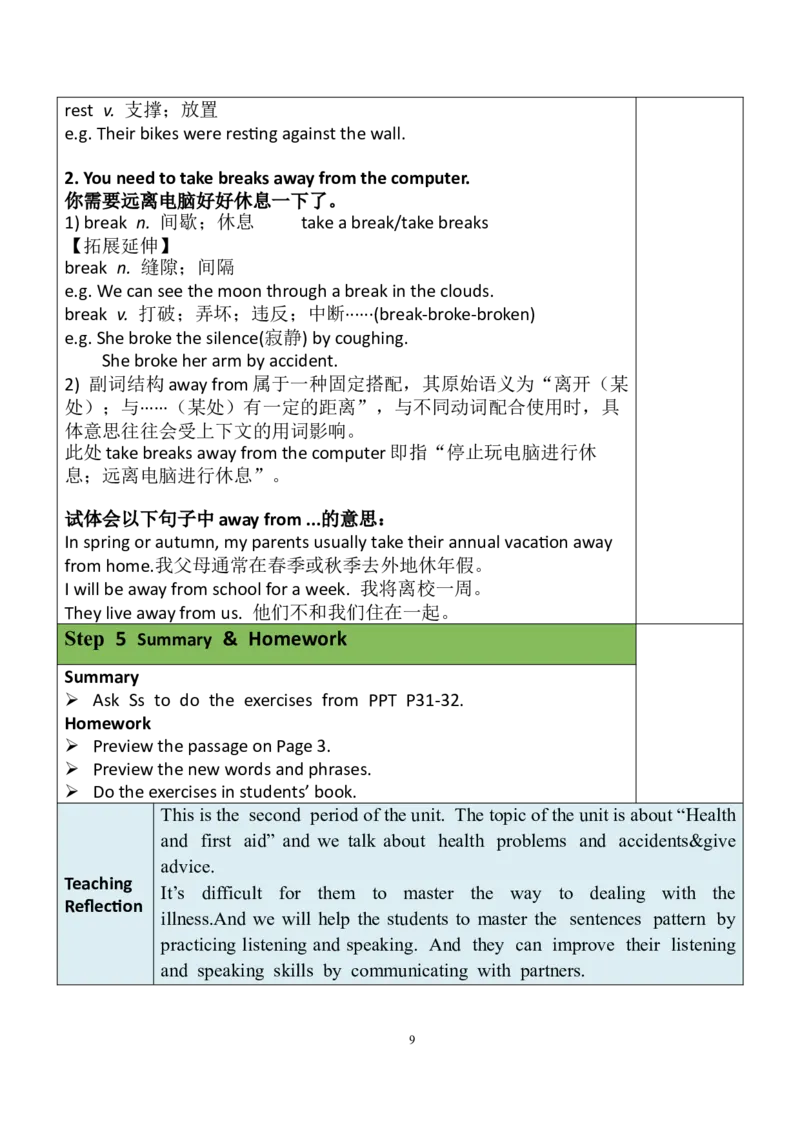
Step 5 Summary & Homework
Summary
Ask Ss to do the exercises from PPT P31-32.
Homework
Preview the passage on Page 3.
Preview the new words and phrases.
Do the exercises in students’ book.
This is the second period of the unit. The topic of the unit is about “Health
and first aid” and we talk about health problems and accidents&give
advice.
Teaching
It’s difficult for them to master the way to dealing with the
Reflection
illness.And we will help the students to master the sentences pattern by
practicing listening and speaking. And they can improve their listening
and speaking skills by communicating with partners.
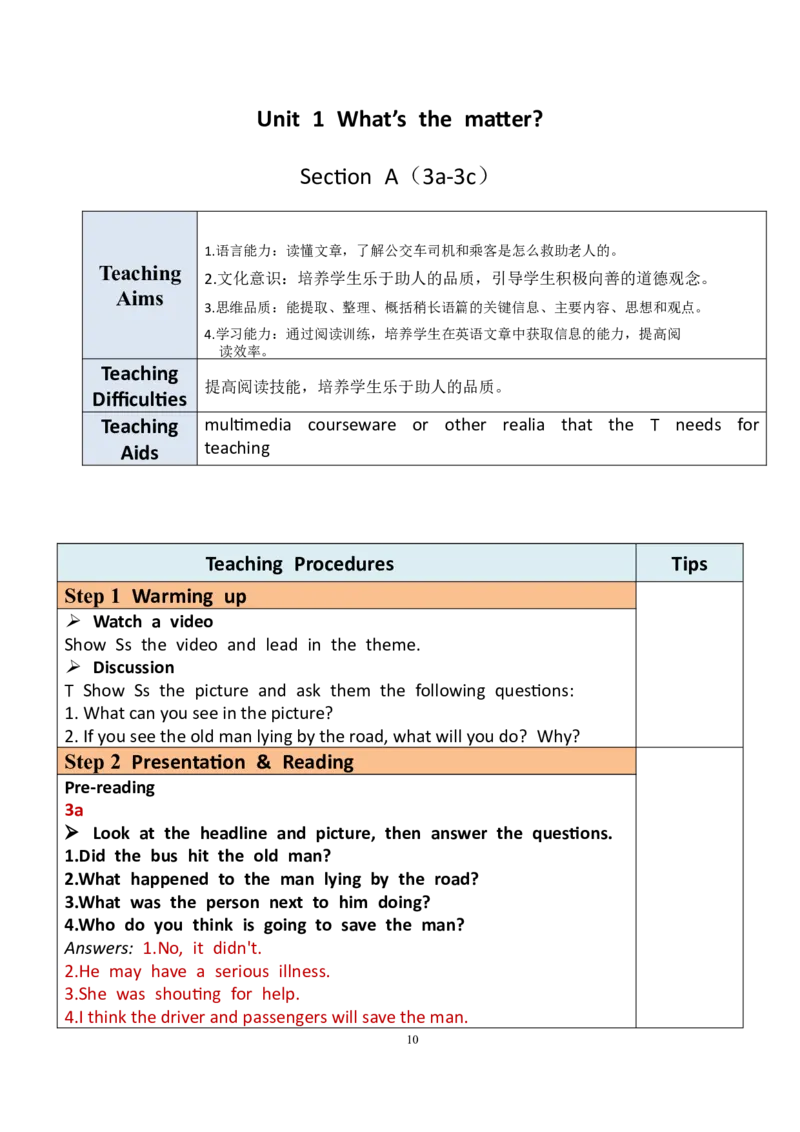
9Unit 1 What’s the matter?
Section A(3a-3c)
1.语言能力:读懂文章,了解公交车司机和乘客是怎么救助老人的。
Teaching
2.文化意识:培养学生乐于助人的品质,引导学生积极向善的道德观念。
Aims
3.思维品质:能提取、整理、概括稍长语篇的关键信息、主要内容、思想和观点。
4.学习能力:通过阅读训练,培养学生在英语文章中获取信息的能力,提高阅
读效率。
Teaching
提高阅读技能,培养学生乐于助人的品质。
Difficulties
Teaching multimedia courseware or other realia that the T needs for
Aids teaching
Teaching Procedures Tips
Step 1 Warming up
Watch a video
Show Ss the video and lead in the theme.
Discussion
T Show Ss the picture and ask them the following questions:
1. What can you see in the picture?
2. If you see the old man lying by the road, what will you do? Why?
Step 2 Presentation & Reading
Pre-reading
3a
Look at the headline and picture, then answer the questions.
1.Did the bus hit the old man?
2.What happened to the man lying by the road?
3.What was the person next to him doing?
4.Who do you think is going to save the man?
Answers: 1.No, it didn't.
2.He may have a serious illness.
3.She was shouting for help.
4.I think the driver and passengers will save the man.
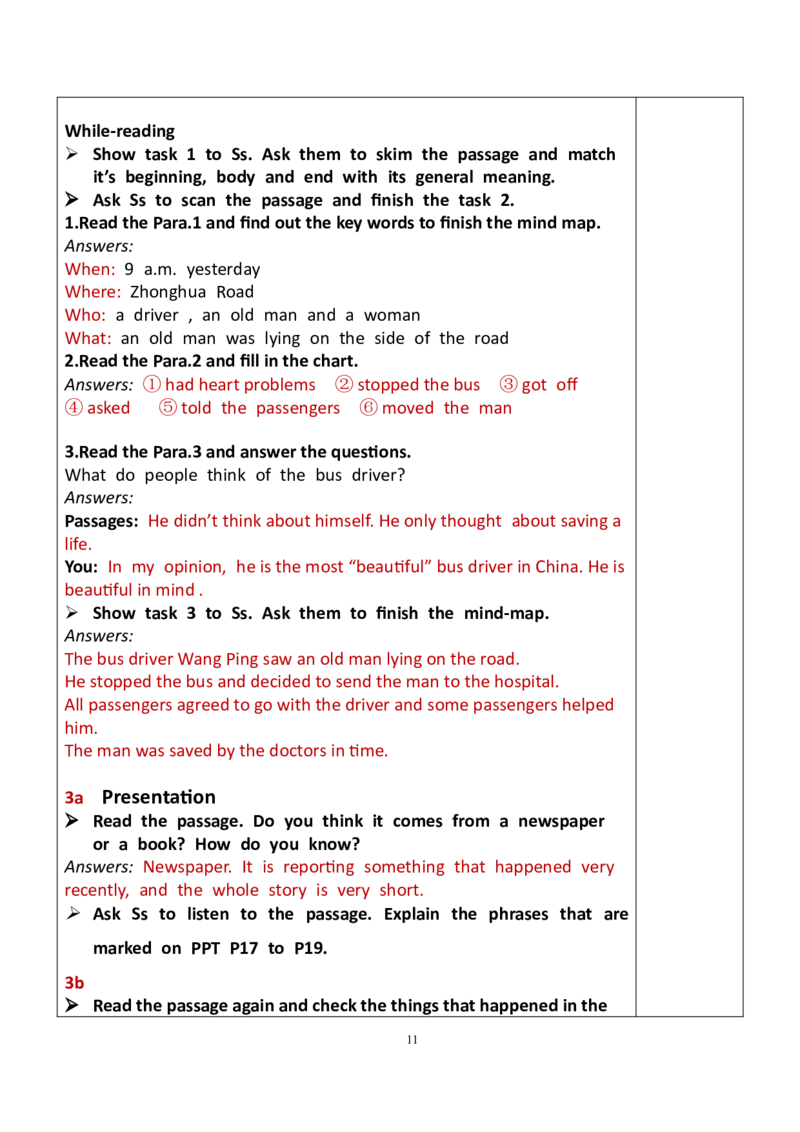
10While-reading
Show task 1 to Ss. Ask them to skim the passage and match
it’s beginning, body and end with its general meaning.
Ask Ss to scan the passage and finish the task 2.
1.Read the Para.1 and find out the key words to finish the mind map.
Answers:
When: 9 a.m. yesterday
Where: Zhonghua Road
Who: a driver , an old man and a woman
What: an old man was lying on the side of the road
2.Read the Para.2 and fill in the chart.
Answers: ①had heart problems ②stopped the bus ③got off
④asked ⑤told the passengers ⑥moved the man
3.Read the Para.3 and answer the questions.
What do people think of the bus driver?
Answers:
Passages: He didn’t think about himself. He only thought about saving a
life.
You: In my opinion, he is the most “beautiful” bus driver in China. He is
beautiful in mind .
Show task 3 to Ss. Ask them to finish the mind-map.
Answers:
The bus driver Wang Ping saw an old man lying on the road.
He stopped the bus and decided to send the man to the hospital.
All passengers agreed to go with the driver and some passengers helped
him.
The man was saved by the doctors in time.
3a Presentation
Read the passage. Do you think it comes from a newspaper
or a book? How do you know?
Answers: Newspaper. It is reporting something that happened very
recently, and the whole story is very short.
Ask Ss to listen to the passage. Explain the phrases that are
marked on PPT P17 to P19.
3b
Read the passage again and check the things that happened in the
11story.
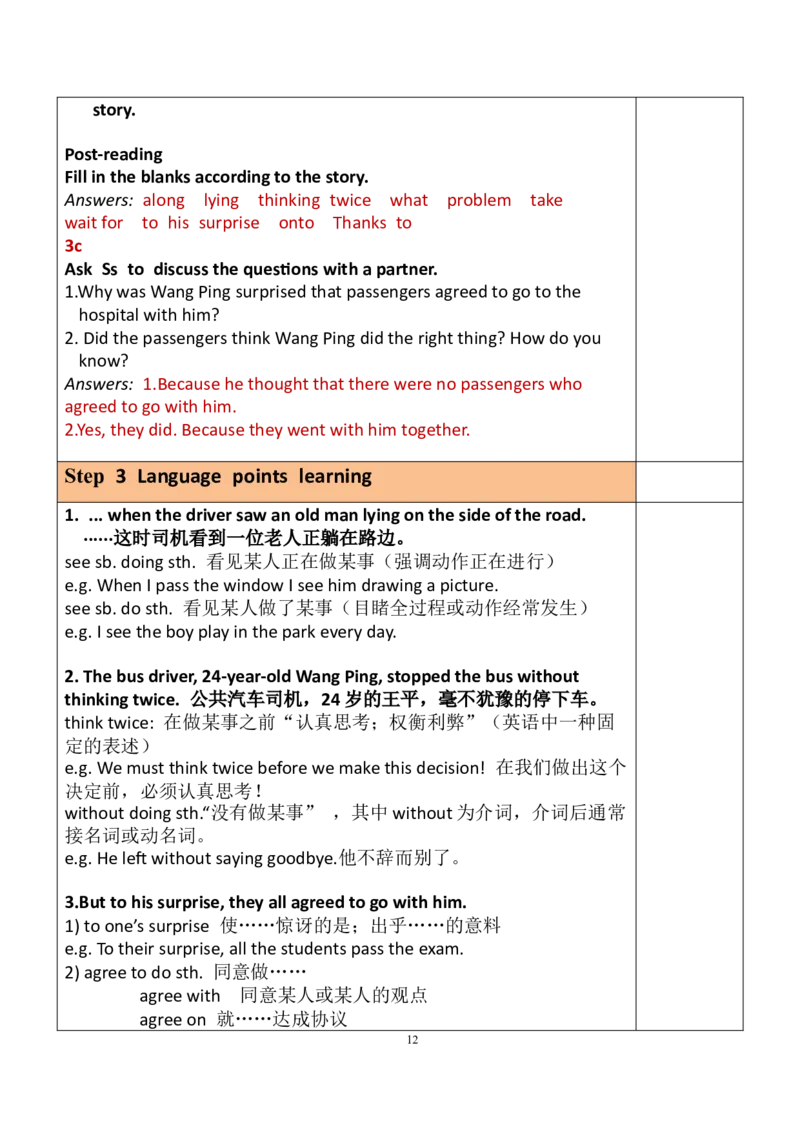
Post-reading
Fill in the blanks according to the story.
Answers: along lying thinking twice what problem take
wait for to his surprise onto Thanks to
3c
Ask Ss to discuss the questions with a partner.
1.Why was Wang Ping surprised that passengers agreed to go to the
hospital with him?
2. Did the passengers think Wang Ping did the right thing? How do you
know?
Answers: 1.Because he thought that there were no passengers who
agreed to go with him.
2.Yes, they did. Because they went with him together.
Step 3 Language points learning
1. ... when the driver saw an old man lying on the side of the road.
······这时司机看到一位老人正躺在路边。
see sb. doing sth. 看见某人正在做某事(强调动作正在进行)
e.g. When I pass the window I see him drawing a picture.
see sb. do sth. 看见某人做了某事(目睹全过程或动作经常发生)
e.g. I see the boy play in the park every day.
2. The bus driver, 24-year-old Wang Ping, stopped the bus without
thinking twice. 公共汽车司机,24岁的王平,毫不犹豫的停下车。
think twice: 在做某事之前“认真思考;权衡利弊”(英语中一种固
定的表述)
e.g. We must think twice before we make this decision! 在我们做出这个
决定前,必须认真思考!
without doing sth.“没有做某事” ,其中without为介词,介词后通常
接名词或动名词。
e.g. He left without saying goodbye.他不辞而别了。
3.But to his surprise, they all agreed to go with him.
1) to one’s surprise 使……惊讶的是;出乎……的意料
e.g. To their surprise, all the students pass the exam.
2) agree to do sth. 同意做……
agree with 同意某人或某人的观点
agree on 就……达成协议
12agree to do 同意做某事
注意:sth. agree with sb. 某人适应/适合某物(多为气候、食物等)
e.g. I love strawberries, but they don't agree with me.
4. Thanks to Mr. Wang and the passengers, the doctor saved the man in
time. 多亏了王先生和这些乘客,医生及时救了这个人。
thanks to sb./sth. “多亏;因为;由于”(to为介词)
e.g. Thanks to your help, we were successful.
多亏了你的帮助, 我们得以成功。
5. ... because they don’t want any trouble, ...
(1)当trouble意为“困难;麻烦”时,是不可数名词。
如: I’m sorry to give you so much trouble.
be in trouble意为“有困难;陷入困境”。
e.g. He always asks me for help when he is in trouble.
(2) get sb. into trouble 意为“使某人陷入困境”
e.g. If you come, you may get me into trouble.
(3) 主语 + have / has trouble (in) doing sth. 意为“某人在做某事方面
有困难”。
e.g. I have some trouble (in) reading the letter.
当trouble意为“麻烦事;烦心事”时,是可数名词。
e.g. She was on the phone for an hour telling me her troubles.
Phrases summary
see sb. doing sth. 看见某人正在做某事
lie on the side of the road 躺在路边
to one’s surprise 使……惊讶的是 in time 及时
agree to do sth. 同意做某事
thanks to 多亏;由于 right away 立即;马上
lie down 躺下 get into trouble 陷入困境
get some sleep 睡会觉 wait for 等待
fall down 突然倒下;跌倒;倒塌
Step 4 Summary & Homework
Exercises: Ask Ss to do the exercises from PPT P33 to P34.
Homework
Read and recite the passage in 3a.
Do the exercises in students’ book.
Teaching This is the third period of the unit. In this period, we should practice
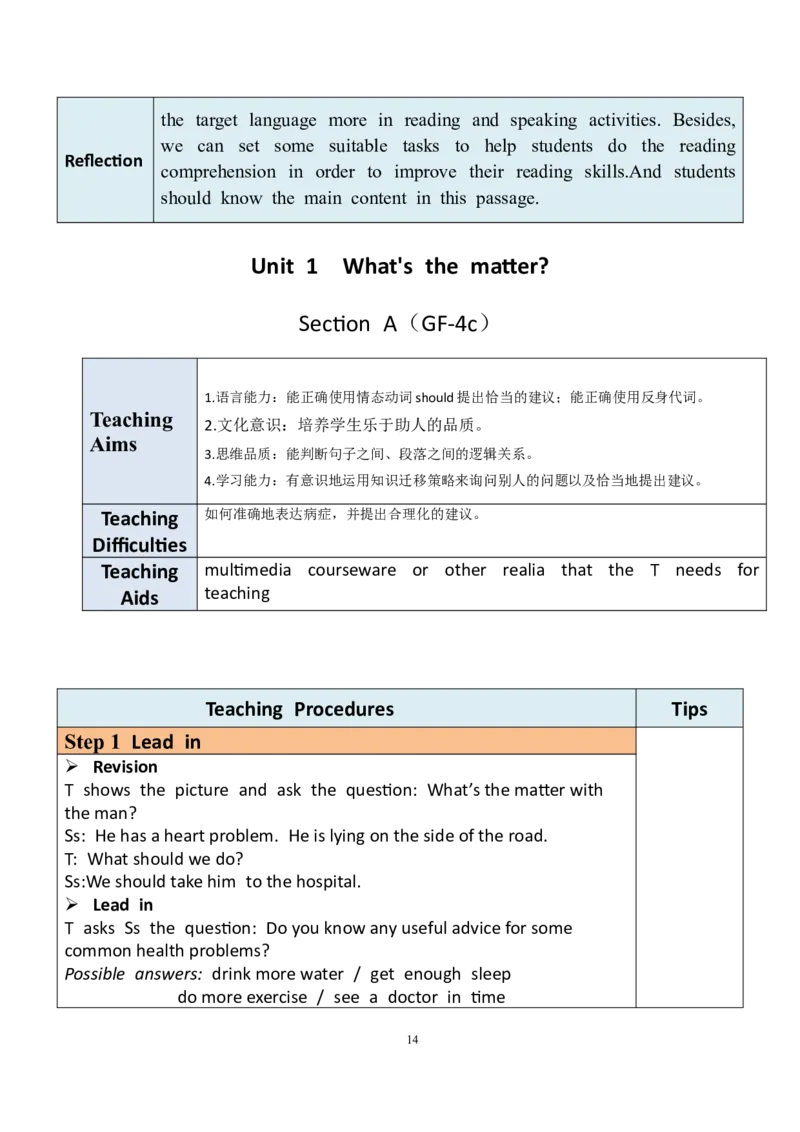
13the target language more in reading and speaking activities. Besides,
we can set some suitable tasks to help students do the reading
Reflection
comprehension in order to improve their reading skills.And students
should know the main content in this passage.
Unit 1 What's the matter?
Section A(GF-4c)
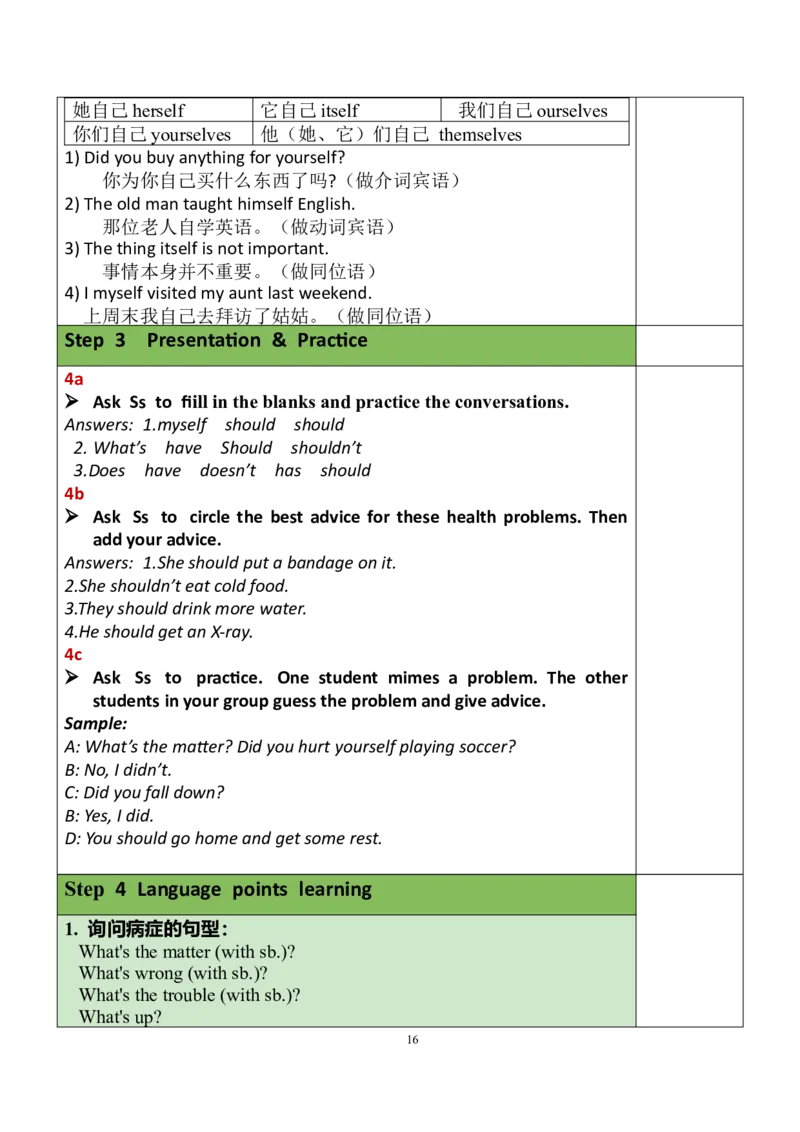
1.语言能力:能正确使用情态动词should提出恰当的建议;能正确使用反身代词。
Teaching
2.文化意识:培养学生乐于助人的品质。
Aims
3.思维品质:能判断句子之间、段落之间的逻辑关系。
4.学习能力:有意识地运用知识迁移策略来询问别人的问题以及恰当地提出建议。
Teaching 如何准确地表达病症,并提出合理化的建议。
Difficulties
Teaching multimedia courseware or other realia that the T needs for
Aids teaching
Teaching Procedures Tips
Step 1 Lead in
Revision
T shows the picture and ask the question: What’s the matter with
the man?
Ss: He has a heart problem. He is lying on the side of the road.
T: What should we do?
Ss:We should take him to the hospital.
Lead in
T asks Ss the question: Do you know any useful advice for some
common health problems?
Possible answers: drink more water / get enough sleep
do more exercise / see a doctor in time
14Step 2 Grammar
Grammar Focus
Ask Ss to read the sentences in grammar focus. T can also
encourage Ss to find out more sentences from the textbook.
情态动词should
should属于情态动词,意为“应该;应当”,不能单独作谓语,后接
动词原形,没有人称和数的变化。should的否定形式为should not,
缩写形式为shouldn’t。在疑问句中should位于主语前面。
We should go home at once. 我们应该马上回家。
You shouldn’t smoke here. 你不应该在这里抽烟。
should用法荟萃
1.用来向别人提出建议或劝告别人做某事,意为“应
该;应当”。
e.g. —Tom, I have a toothache. 汤姆,我牙痛。
—You should see a dentist. 你应当去看牙医。
2.表示现在或将来的某种义务或责任。
e.g. We should respect the old. 我们应该尊重老人。
You should leave her a note. 你应该给她留个字条。
3.用来表示要求、命令。
e.g. You should listen to the teacher carefully in class.在课堂上你应该认
真听老师讲课。
4.表示可能性、期望以及推测即将发生的情况。
e.g. They should be there by now.他们现在应该到那儿了。
It should be snowing now according to the weather forecast. 按天气
预报,现在应该下雪才是。
5. Should/Shall I …?用来征求意见、提供帮助或请求指示。
e.g. Should I help you clean the bedroom?要不要我帮你打扫卧室?
Should we begin now? 我们要不要现在开始呢?
6. “假如;万一”。表可能。常用于if 引导的条件状语从句中。
e.g. If you should change your mind, please let me know.假如你改变主意
的话,请告诉我。
In case you should need any help, here's my number.万一你需要帮助
的话,这是我的电话号码。
反身代词小结:
myself (我自己),yourself (你自己)是反身代词。表示“某人自己的
词”叫反身代词。见下表:
我自己 myself 你自己yourself 他自己himself
15她自己herself 它自己itself 我们自己ourselves
你们自己yourselves 他(她、它)们自己 themselves
1) Did you buy anything for yourself?
你为你自己买什么东西了吗?(做介词宾语)
2) The old man taught himself English.
那位老人自学英语。(做动词宾语)
3) The thing itself is not important.
事情本身并不重要。(做同位语)
4) I myself visited my aunt last weekend.
上周末我自己去拜访了姑姑。(做同位语)
Step 3 Presentation & Practice
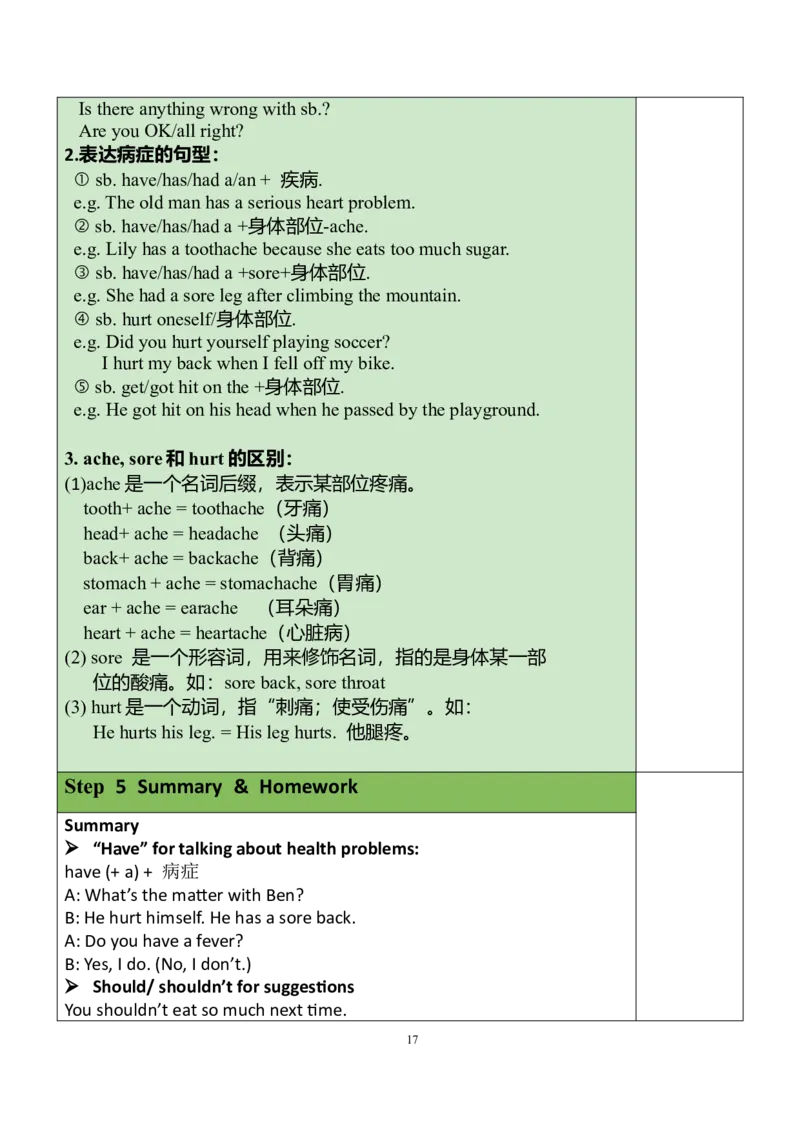
4a
Ask Ss to fiill in the blanks and practice the conversations.
Answers: 1.myself should should
2. What’s have Should shouldn’t
3.Does have doesn’t has should
4b
Ask Ss to circle the best advice for these health problems. Then
add your advice.
Answers: 1.She should put a bandage on it.
2.She shouldn’t eat cold food.
3.They should drink more water.
4.He should get an X-ray.
4c
Ask Ss to practice. One student mimes a problem. The other
students in your group guess the problem and give advice.
Sample:
A: What’s the matter? Did you hurt yourself playing soccer?
B: No, I didn’t.
C: Did you fall down?
B: Yes, I did.
D: You should go home and get some rest.
Step 4 Language points learning
1. 询问病症的句型:
What's the matter (with sb.)?
What's wrong (with sb.)?
What's the trouble (with sb.)?
What's up?
16Is there anything wrong with sb.?
Are you OK/all right?
2.表达病症的句型:
① sb. have/has/had a/an + 疾病.
e.g. The old man has a serious heart problem.
② sb. have/has/had a +身体部位-ache.
e.g. Lily has a toothache because she eats too much sugar.
③ sb. have/has/had a +sore+身体部位.
e.g. She had a sore leg after climbing the mountain.
④ sb. hurt oneself/身体部位.
e.g. Did you hurt yourself playing soccer?
I hurt my back when I fell off my bike.
⑤ sb. get/got hit on the +身体部位.
e.g. He got hit on his head when he passed by the playground.
3. ache, sore和hurt的区别:
(1)ache是一个名词后缀,表示某部位疼痛。
tooth+ ache = toothache(牙痛)
head+ ache = headache (头痛)
back+ ache = backache(背痛)
stomach + ache = stomachache(胃痛)
ear + ache = earache (耳朵痛)
heart + ache = heartache(心脏病)
(2) sore 是一个形容词,用来修饰名词,指的是身体某一部
位的酸痛。如:sore back, sore throat
(3) hurt是一个动词,指“刺痛;使受伤痛”。如:
He hurts his leg. = His leg hurts. 他腿疼。
Step 5 Summary & Homework
Summary
“Have” for talking about health problems:
have (+ a) + 病症
A: What’s the matter with Ben?
B: He hurt himself. He has a sore back.
A: Do you have a fever?
B: Yes, I do. (No, I don’t.)
Should/ shouldn’t for suggestions
You shouldn’t eat so much next time.
17Should I put some medicine on it?
Reflexive pronouns
He didn’t think about himself.
Exercise
Ask Ss to do the exercises from PPT P30-32.
Homework
Preview the new words and phrases in Section B(1a-1d).
Do the exercises in students’ book.
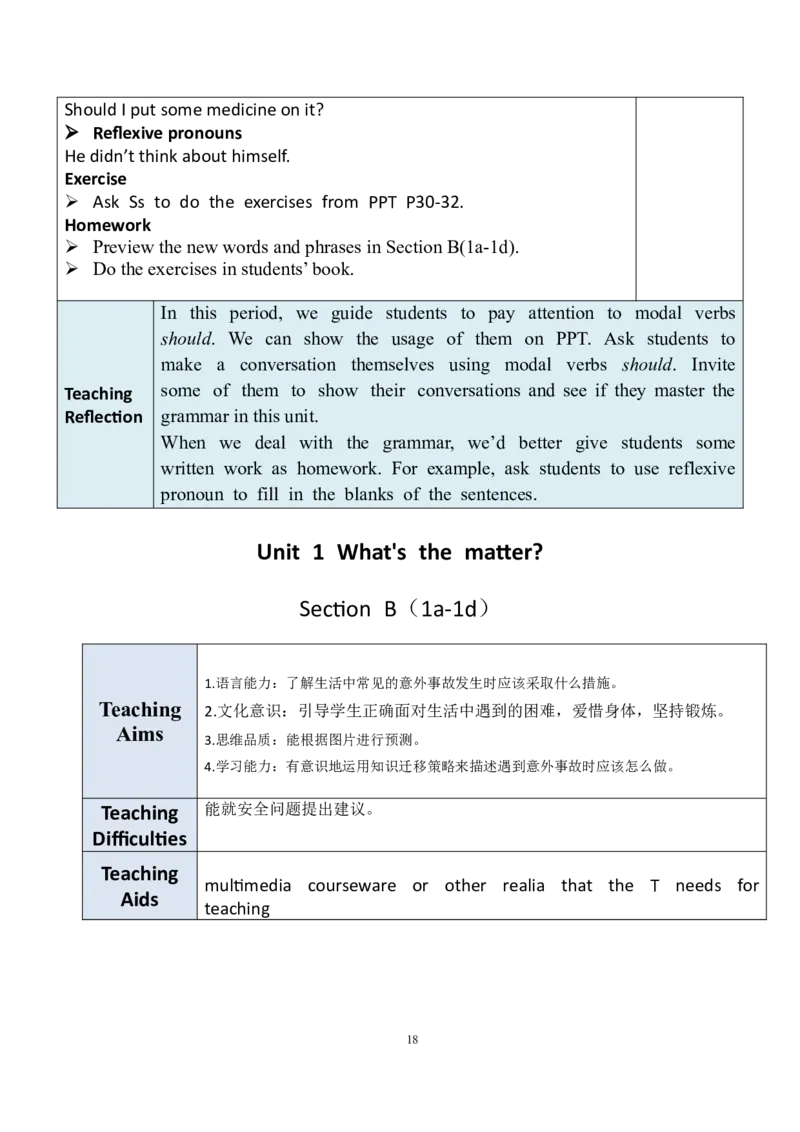
In this period, we guide students to pay attention to modal verbs
should. We can show the usage of them on PPT. Ask students to
make a conversation themselves using modal verbs should. Invite
some of them to show their conversations and see if they master the
Teaching
Reflection grammar in this unit.
When we deal with the grammar, we’d better give students some
written work as homework. For example, ask students to use reflexive
pronoun to fill in the blanks of the sentences.
Unit 1 What's the matter?
Section B(1a-1d)
1.语言能力:了解生活中常见的意外事故发生时应该采取什么措施。
Teaching 2.文化意识:引导学生正确面对生活中遇到的困难,爱惜身体,坚持锻炼。
Aims
3.思维品质:能根据图片进行预测。
4.学习能力:有意识地运用知识迁移策略来描述遇到意外事故时应该怎么做。
Teaching 能就安全问题提出建议。
Difficulties
Teaching
multimedia courseware or other realia that the T needs for
Aids
teaching
18Teaching Procedures Tips
Step 1 Lead in
T can ask Ss the questions: Have you ever met any accidents?
What should we do in the face of accidents?
T can show Ss some pictures of accidents in our daily life.
T can ask Ss the question: Do you know anything about first
aid?
T can show Ss some pictures of first aid.
Step 2 Presentation & Practice
Pre-listening
1a
When these accidents happen, what should you do? Put the
actions in order.
T can show Ss the pictures in the textbook in Page 5. Then ask
them some questions.
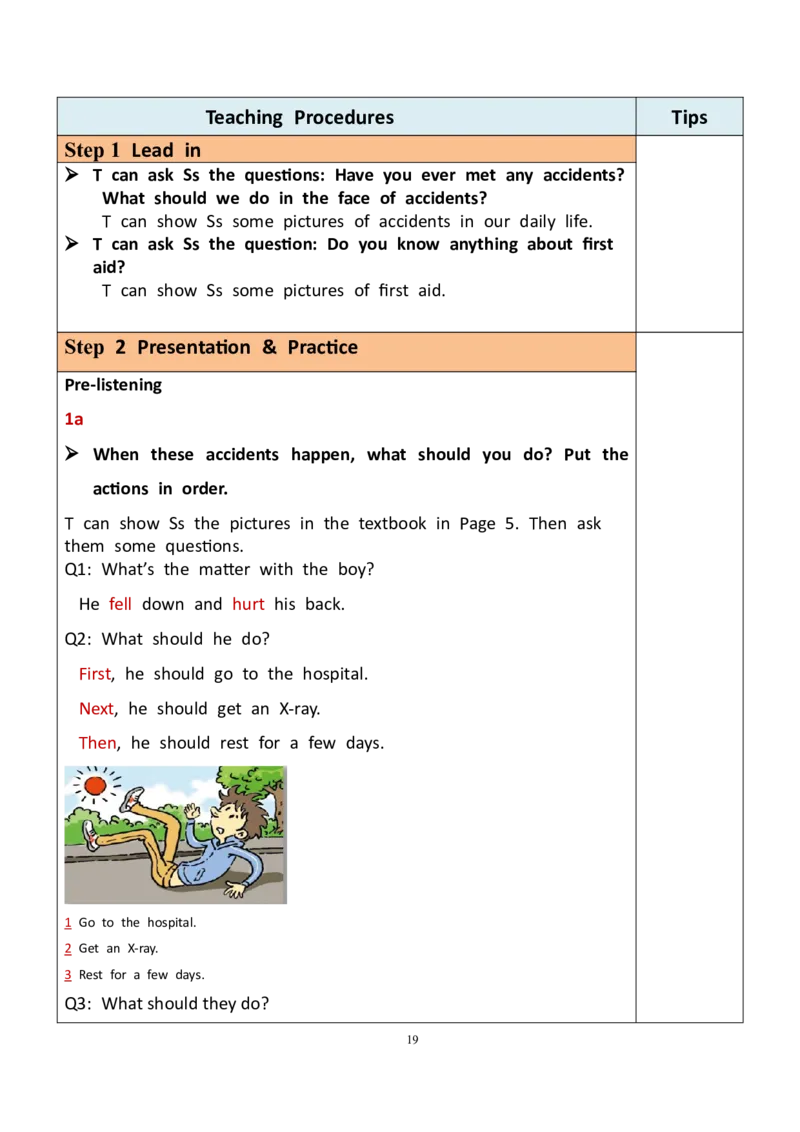
Q1: What’s the matter with the boy?
He fell down and hurt his back.
Q2: What should he do?
First, he should go to the hospital.
Next, he should get an X-ray.
Then, he should rest for a few days.
1 Go to the hospital.
2 Get an X-ray.
3 Rest for a few days.
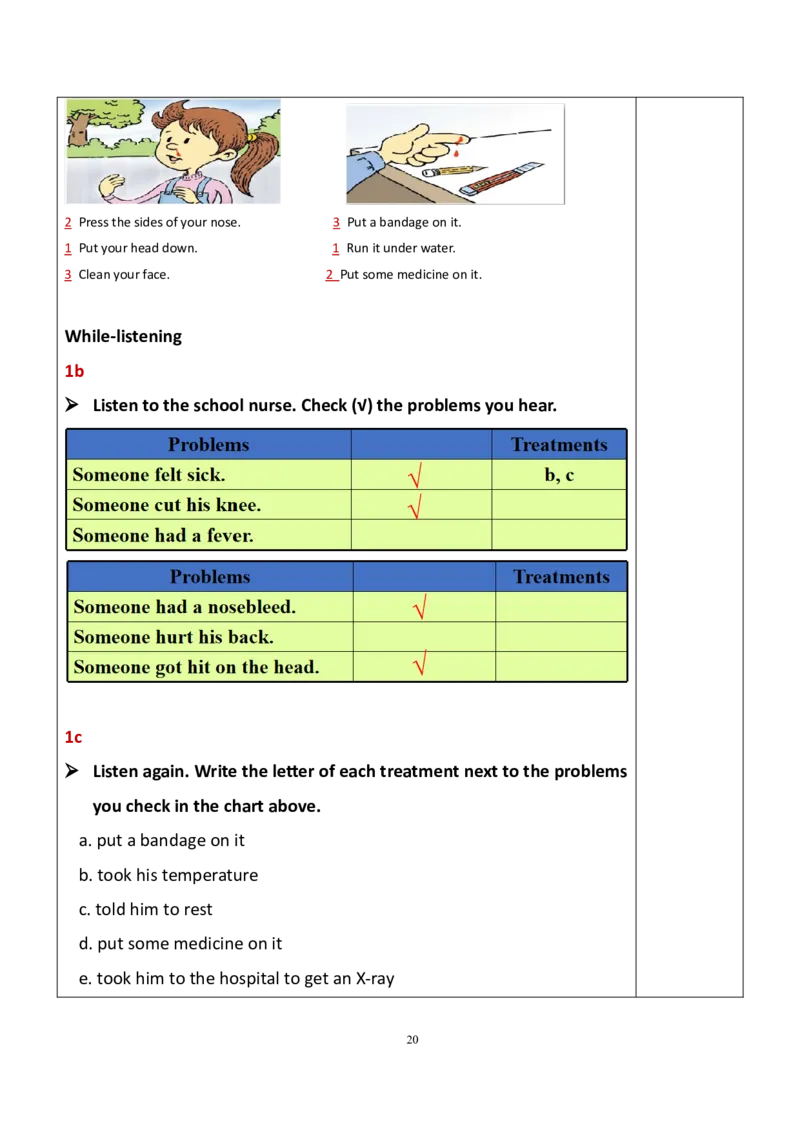
Q3: What should they do?
192 Press the sides of your nose. 3 Put a bandage on it.
1 Put your head down. 1 Run it under water.
3 Clean your face. 2 Put some medicine on it.
While-listening
1b
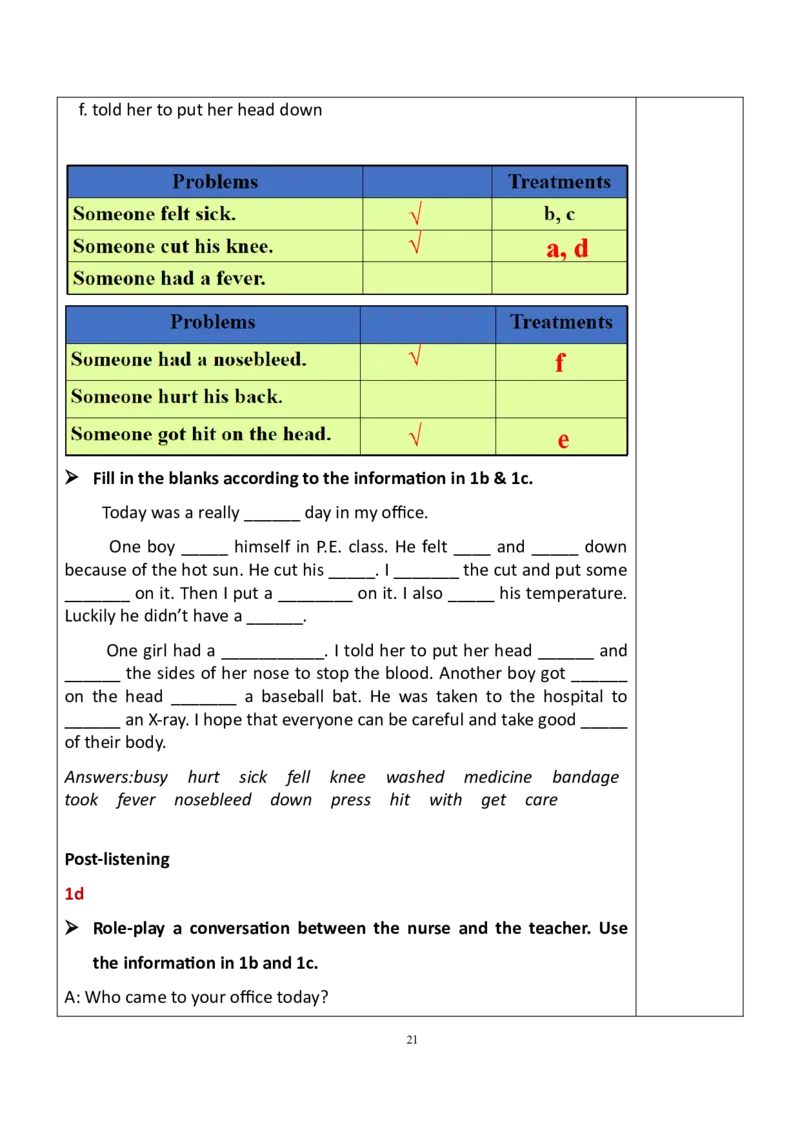
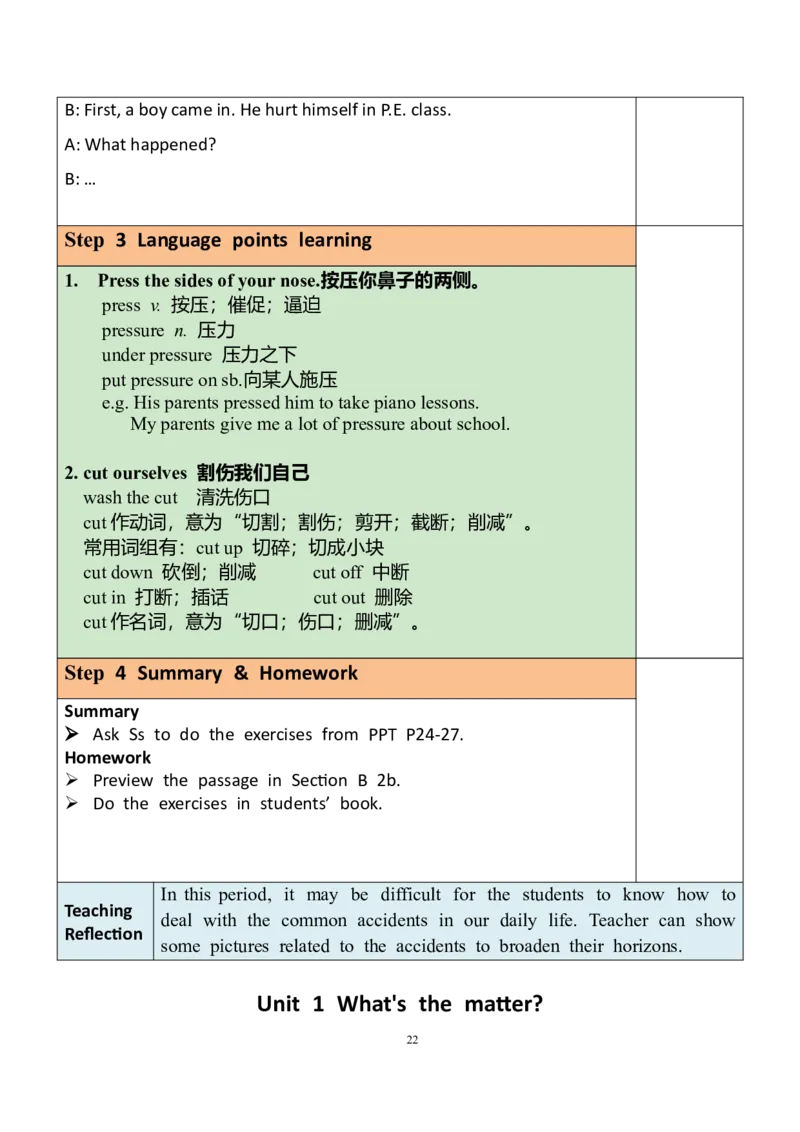
Listen to the school nurse. Check (√) the problems you hear.
1c
Listen again. Write the letter of each treatment next to the problems
you check in the chart above.
a. put a bandage on it
b. took his temperature
c. told him to rest
d. put some medicine on it
e. took him to the hospital to get an X-ray
20f. told her to put her head down
Fill in the blanks according to the information in 1b & 1c.
Today was a really ______ day in my office.
One boy _____ himself in P.E. class. He felt ____ and _____ down
because of the hot sun. He cut his _____. I _______ the cut and put some
_______ on it. Then I put a ________ on it. I also _____ his temperature.
Luckily he didn’t have a ______.
One girl had a ___________. I told her to put her head ______ and
______ the sides of her nose to stop the blood. Another boy got ______
on the head _______ a baseball bat. He was taken to the hospital to
______ an X-ray. I hope that everyone can be careful and take good _____
of their body.
Answers:busy hurt sick fell knee washed medicine bandage
took fever nosebleed down press hit with get care
Post-listening
1d
Role-play a conversation between the nurse and the teacher. Use
the information in 1b and 1c.
A: Who came to your office today?
21B: First, a boy came in. He hurt himself in P.E. class.
A: What happened?
B: …
Step 3 Language points learning
1. Press the sides of your nose.按压你鼻子的两侧。
press v. 按压;催促;逼迫
pressure n. 压力
under pressure 压力之下
put pressure on sb.向某人施压
e.g. His parents pressed him to take piano lessons.
My parents give me a lot of pressure about school.
2. cut ourselves 割伤我们自己
wash the cut 清洗伤口
cut作动词,意为“切割;割伤;剪开;截断;削减”。
常用词组有:cut up 切碎;切成小块
cut down 砍倒;削减 cut off 中断
cut in 打断;插话 cut out 删除
cut作名词,意为“切口;伤口;删减”。
Step 4 Summary & Homework
Summary
Ask Ss to do the exercises from PPT P24-27.
Homework
Preview the passage in Section B 2b.
Do the exercises in students’ book.
In this period, it may be difficult for the students to know how to
Teaching
deal with the common accidents in our daily life. Teacher can show
Reflection
some pictures related to the accidents to broaden their horizons.
Unit 1 What's the matter?
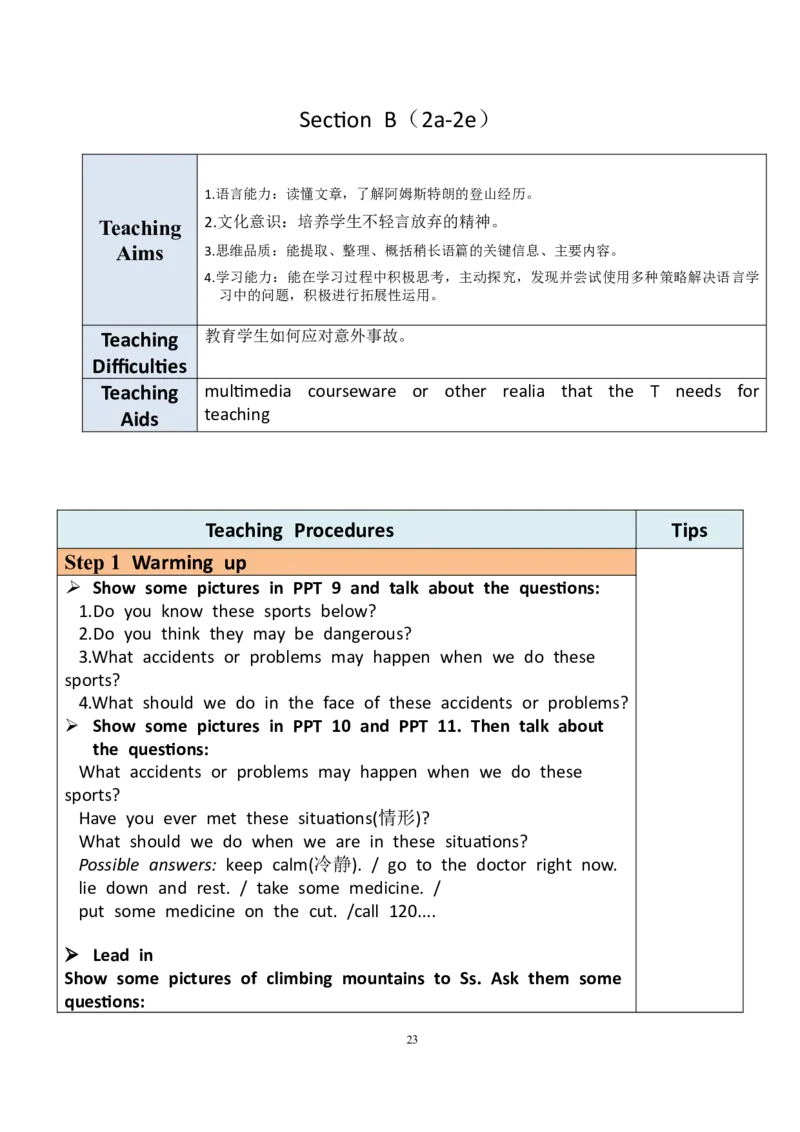
22Section B(2a-2e)
1.语言能力:读懂文章,了解阿姆斯特朗的登山经历。
Teaching
2.文化意识:培养学生不轻言放弃的精神。
Aims 3.思维品质:能提取、整理、概括稍长语篇的关键信息、主要内容。
4.学习能力:能在学习过程中积极思考,主动探究,发现并尝试使用多种策略解决语言学
习中的问题,积极进行拓展性运用。
Teaching 教育学生如何应对意外事故。
Difficulties
Teaching multimedia courseware or other realia that the T needs for
Aids teaching
Teaching Procedures Tips
Step 1 Warming up
Show some pictures in PPT 9 and talk about the questions:
1.Do you know these sports below?
2.Do you think they may be dangerous?
3.What accidents or problems may happen when we do these
sports?
4.What should we do in the face of these accidents or problems?
Show some pictures in PPT 10 and PPT 11. Then talk about
the questions:
What accidents or problems may happen when we do these
sports?
Have you ever met these situations(情形)?
What should we do when we are in these situations?
Possible answers: keep calm(冷静). / go to the doctor right now.
lie down and rest. / take some medicine. /
put some medicine on the cut. /call 120....
Lead in
Show some pictures of climbing mountains to Ss. Ask them some
questions:
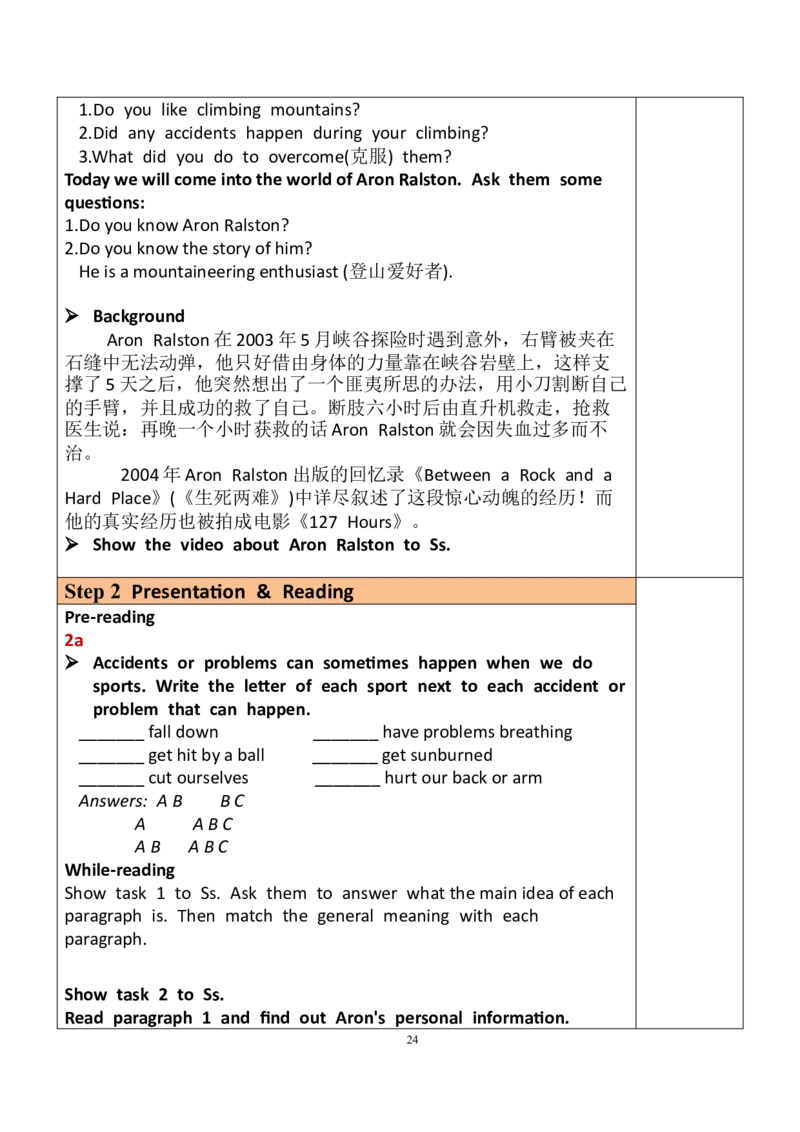
231.Do you like climbing mountains?
2.Did any accidents happen during your climbing?
3.What did you do to overcome(克服) them?
Today we will come into the world of Aron Ralston. Ask them some
questions:
1.Do you know Aron Ralston?
2.Do you know the story of him?
He is a mountaineering enthusiast (登山爱好者).
Background
Aron Ralston在2003年5月峡谷探险时遇到意外,右臂被夹在
石缝中无法动弹,他只好借由身体的力量靠在峡谷岩壁上,这样支
撑了5天之后,他突然想出了一个匪夷所思的办法,用小刀割断自己
的手臂,并且成功的救了自己。断肢六小时后由直升机救走,抢救
医生说:再晚一个小时获救的话Aron Ralston就会因失血过多而不
治。
2004年Aron Ralston出版的回忆录《Between a Rock and a
Hard Place》(《生死两难》)中详尽叙述了这段惊心动魄的经历!而
他的真实经历也被拍成电影《127 Hours》。
Show the video about Aron Ralston to Ss.
Step 2 Presentation & Reading
Pre-reading
2a
Accidents or problems can sometimes happen when we do
sports. Write the letter of each sport next to each accident or
problem that can happen.
_______ fall down _______ have problems breathing
_______ get hit by a ball _______ get sunburned
_______ cut ourselves _______ hurt our back or arm
Answers: A B B C
A A B C
A B A B C
While-reading
Show task 1 to Ss. Ask them to answer what the main idea of each
paragraph is. Then match the general meaning with each
paragraph.
Show task 2 to Ss.
Read paragraph 1 and find out Aron's personal information.
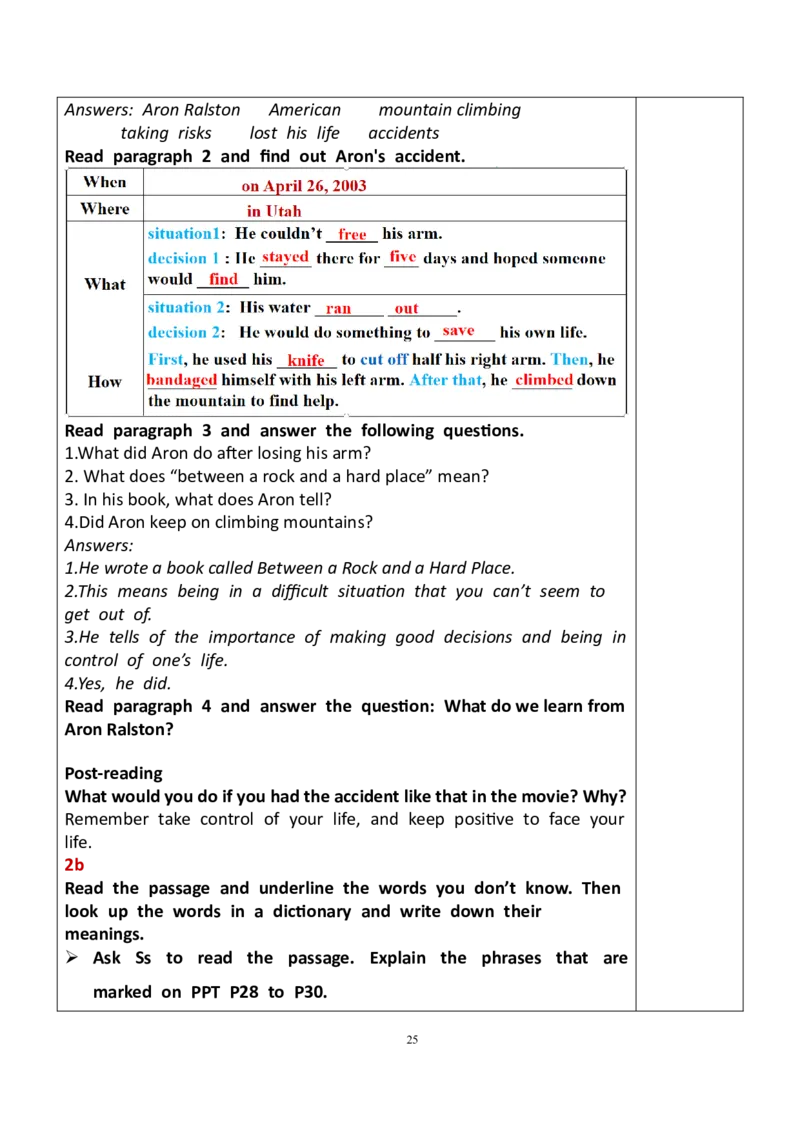
24Answers: Aron Ralston American mountain climbing
taking risks lost his life accidents
Read paragraph 2 and find out Aron's accident.
Read paragraph 3 and answer the following questions.
1.What did Aron do after losing his arm?
2. What does “between a rock and a hard place” mean?
3. In his book, what does Aron tell?
4.Did Aron keep on climbing mountains?
Answers:
1.He wrote a book called Between a Rock and a Hard Place.
2.This means being in a difficult situation that you can’t seem to
get out of.
3.He tells of the importance of making good decisions and being in
control of one’s life.
4.Yes, he did.
Read paragraph 4 and answer the question: What do we learn from
Aron Ralston?
Post-reading
What would you do if you had the accident like that in the movie? Why?
Remember take control of your life, and keep positive to face your
life.
2b
Read the passage and underline the words you don’t know. Then
look up the words in a dictionary and write down their
meanings.
Ask Ss to read the passage. Explain the phrases that are
marked on PPT P28 to P30.
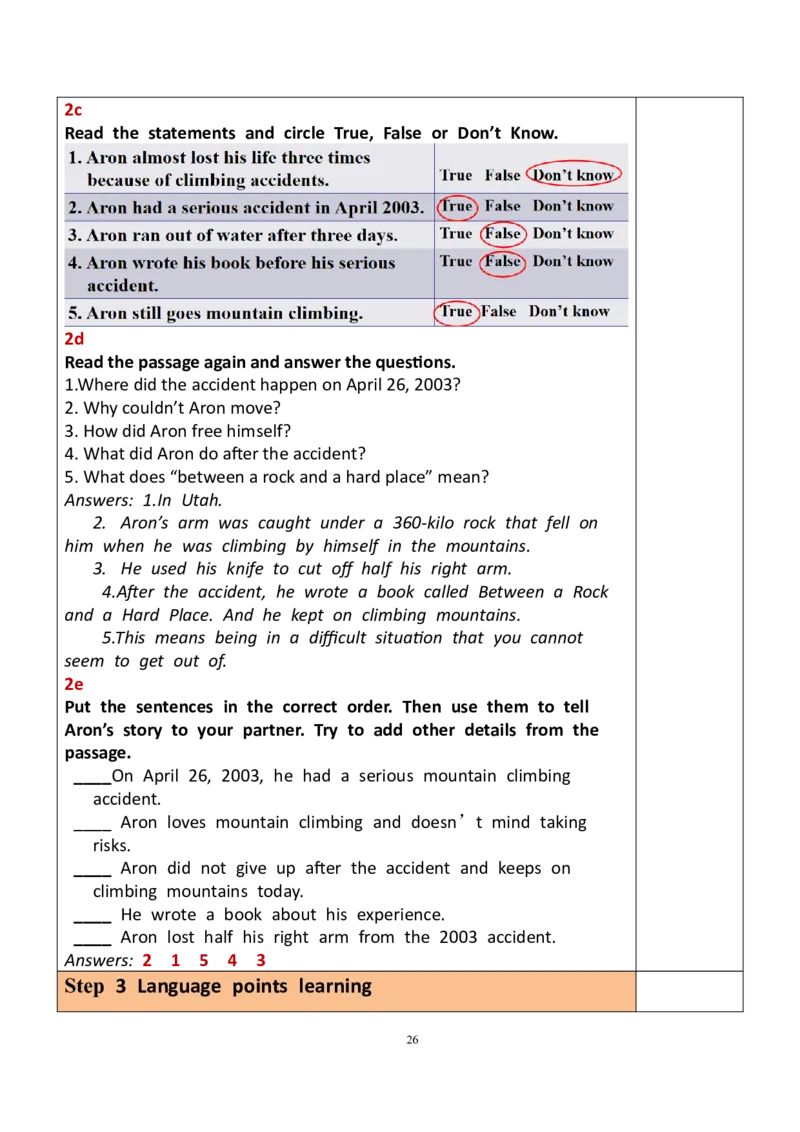
252c
Read the statements and circle True, False or Don’t Know.
2d
Read the passage again and answer the questions.
1.Where did the accident happen on April 26, 2003?
2. Why couldn’t Aron move?
3. How did Aron free himself?
4. What did Aron do after the accident?
5. What does “between a rock and a hard place” mean?
Answers: 1.In Utah.
2. Aron’s arm was caught under a 360-kilo rock that fell on
him when he was climbing by himself in the mountains.
3. He used his knife to cut off half his right arm.
4.After the accident, he wrote a book called Between a Rock
and a Hard Place. And he kept on climbing mountains.
5.This means being in a difficult situation that you cannot
seem to get out of.
2e
Put the sentences in the correct order. Then use them to tell
Aron’s story to your partner. Try to add other details from the
passage.
____On April 26, 2003, he had a serious mountain climbing
accident.
____ Aron loves mountain climbing and doesn’t mind taking
risks.
____ Aron did not give up after the accident and keeps on
climbing mountains today.
____ He wrote a book about his experience.
____ Aron lost half his right arm from the 2003 accident.
Answers: 2 1 5 4 3
Step 3 Language points learning
261. As a mountain climber, Aron is used to taking risks. 作为一个
登山者,阿伦习惯于冒险。
(1)be used to意为“习惯于······;适应于······”,后常接动名
词、 代词或现在分词。
be/get used to doing “习惯于做某事”
be used to do “······被用来做某事”
used to do “过去常常做某事”
e.g. I am used to eating rice now. 我现在习惯吃米饭。
The knife can be used to cut meat. 刀能用来切肉。
I used to ride to work. 我过去骑车去工作。
(2)take risks是动词词组,意为“冒险”,其同义词组是take a
risk。在此短语中,risk 作名词。
e.g. We do not expect untrained people to take risks.我们不主张未受
过培训的人去冒险。
I have to take a risk in my job.做我这种工作要冒风险。
risk也可作动词,意为“冒······风险;使······面临风险”。
risk one's life to do sth. 冒着生命危险去做······
e.g. The soldier risked his life to save the little girl.
2. There were many times when Aron almost lost his life because
of accidents. 有很多次 阿伦因为事故几乎失去了他自己的生命。
almost是副词,意为“几乎;差不多”。用来修饰不定代词、动
词、副词、形容词等。
e.g. The girl is almost eight years old.这女孩将近八岁了。
He is almost two metres tall.他差不多有两米高。
3. But when his water ran out of, he knew that he would have to do
something to save his own life. 但当他的水用光了的时候,他知道他必
须做点什么来挽救他自己的生命。
run out (of)意为“用尽;耗尽”。
e.g. We have run out of head notepaper.我们已用完了有抬头的信纸。
They have run out of their supplies.他们的供应品已耗尽了。
4. So he used his knife to cut off half his right arm. 所以他用刀切除了
右臂一半。
(1) knife是可数名词,意为“刀”,其复数形式是knives。
e.g. The soldiers sharpened up their knives. 战士们把刀磨得锋利。
(2) cut off 是动词短语,意为“切除”。
e.g. Please help me to cut off the rinds of lemons.请帮我切除柠檬的
皮。
27cut的相关短语:
cut away 切掉;减掉 cut up 切碎
cut down 砍刀;削减 cut in 插嘴
cut into halves 切成两半 cut into pieces 切成碎块
cut out 剪去;删掉
5. This means being in a difficult situation that you cannot seem to
get out of. 它的意思是“处于一个你似乎无法摆脱的困境中”。
(1)此处mean 表示“……意思是;意味着”,用来解释上句出现
在书名中的习语的意思。如:
What do you mean? 你的意思是什么?
常用短语:
mean to do sth. 打算做······
mean a lot to sb. 对某人来说很重要
mean that从句 打算/意思是······
mean 可作形容词,意为“吝啬的;刻薄的”。
e.g. Don't be so mean to your brother. 不要对你的兄弟如此刻薄。
meaning n. 意思;意义 the meaning of ······的意义
meaningful adj. 有意义的
meaningless adj. 无意义的
(2) a difficult situation that you cannot seem to get out of和a decision
that could mean life or death均为定语从句。
在前者中,从句that you cannot seem to get out of 修饰名词
situation;
在后者中,从句that could mean life or death 修饰名词decision。
(3) get out of意为“离开;从······出来”。
e.g. I couldn't get out of going to that wedding.我不能逃避出席婚礼。
She backed her car out of the garage.她从车库倒车出来。
6. Aron didn't give up after the accident and keeps on climbing
mountains today. 阿伦在这起事故后并没有放弃,现在仍然坚持登
山。
(1) give up 表示“放弃”,可接名词、代词、动名词作宾语。
e.g. He gave up smoking at last. 他最终戒烟了。
give相关短语:
give in 屈服;投降 give out 分发
give away 泄露;赠送 give sb. a hand 帮某人一把
give off 发出(光、热、气味等) give back 归还
(2) keep on doing 表示“坚持做······”。
e.g. He kept on writing these years. 他这些年坚持创作。
28keep相关短语及句型:
keep doing sth. 一直做······
keep from doing sth. 忍不住做······
keep sb. from doing sth. 阻止某人做······
keep up with 跟上
Step 4 Summary & Homework
Summary
Ask Ss to do the exercises from PPT P51-53.
Homework
Read and recite the new words and phrases.
Do the exercises in students’ book.
In the process of English teaching, teachers should try their best to
encourage students to participate in the discussion and do not
Teaching
overemphasize the correct answers. This can not only broaden students'
Reflection
thinking space, help the development of creative thinking ability, but also
help students master the language in use.
Unit 1 What’s the matter?
Section B(3a-Self Check)
1.语言能力:谈论健康问题并提出合理建议。
2.文化意识:培养学生乐于助人的品质,引导学生积极向善的道德观念。
Teaching
3.思维品质:能根据所给内容或条件对语篇进行改编或创编。
Aims
4.学习能力:运用知识迁移策略描述健康问题并能提出合理化建议。
Teaching 掌握描述事故及急救的常用句子,能描述事故,有步骤地描述急救措施。
Difficulties
Teaching multimedia courseware or other realia that the T needs for
Aids teaching
29Teaching Procedures Tips
Step 1 Warming up
Revision
1.Show a girl’s picture on PPT 5 and PPT 6 to Ss. Ask them the
body parts:
eye nose mouth head ear tooth(teeth) neck hand heart
leg arm back stomach foot knee throat
2.Show the pictures on PPT 7 to Ss. And tell them a disease
associated with a part of the body.
heartache stomachache toothache headache earache
backache sore throat sore back
3.Summarize some health problems and injuries in PPT 8 and PPT 9.
◆ feel sick/bad/terrible 感觉不舒服 ◆ have an accident 出事故
◆ have problems breathing 呼吸有问题◆ fall down 跌倒
◆ cut one’s knee 割破膝盖 ◆ hurt one’s back 伤了背
部
◆ hurt/cut himself/herself/... 伤了/割破他/她自己
◆ get hit (on the head) (by...) 头部被击中 ◆ get sunburned 晒伤
4.Summarize some advice and treatments.
◆ lie down and rest 躺下休息
◆ drink some hot tea with honey 喝点加蜂蜜的热茶
◆ see a dentist and get an X-ray 去看牙医,做X光检查
◆ take some medicine 服药
◆ take one’s temperature 量体温
◆ put some medicine on it 上点药
◆ take breaks away from... 离开……休息一下
◆ go to a doctor 看病
◆ go to (the) hospital 去医院
◆ take... to the hospital 带……去医院
◆ get some sleep/rest 睡会儿觉/休息一下
◆ put a bandage on it 用绷带包扎一下
◆ run it under water 用水冲
◆ put one’s head down 低头
◆ bandage oneself 自己包扎
Step 2 Presentation &writing
3a
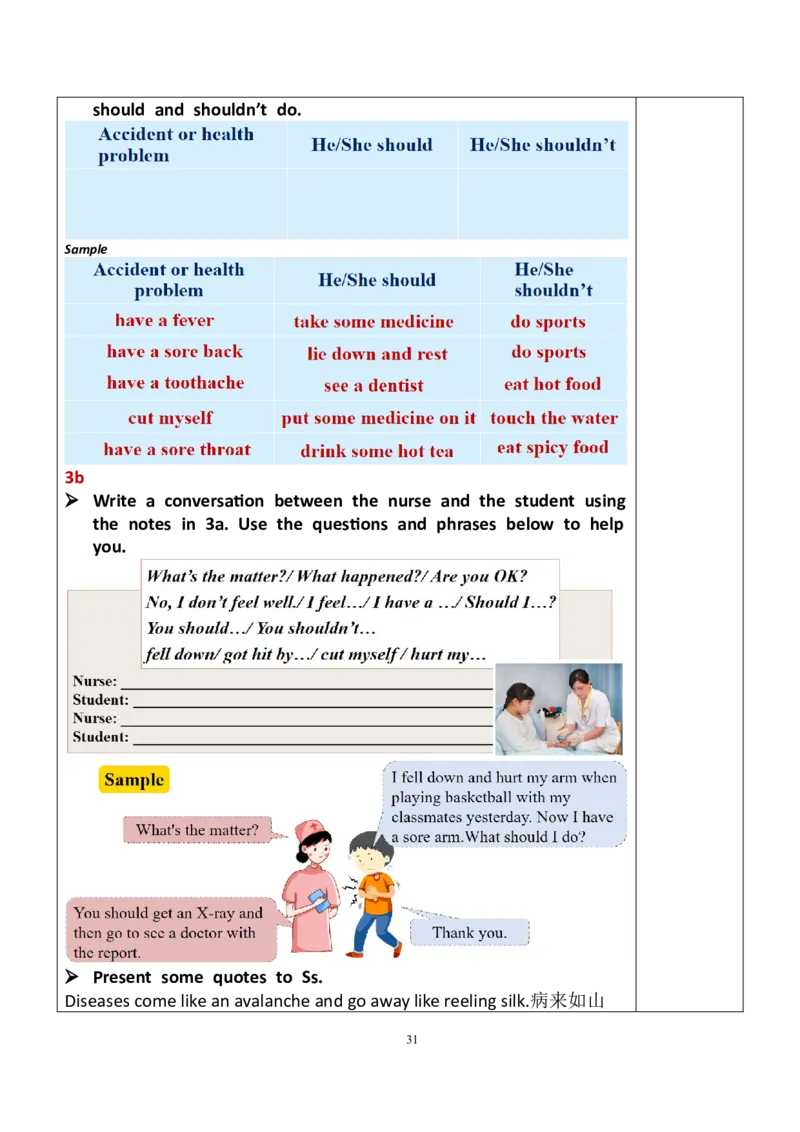
Imagine you are the school nurse and a student just had an
accident or a health problem. Make notes about what he/she
30should and shouldn’t do.
Sample
3b
Write a conversation between the nurse and the student using
the notes in 3a. Use the questions and phrases below to help
you.
Present some quotes to Ss.
Diseases come like an avalanche and go away like reeling silk.病来如山
31倒,病去如抽丝。
An apple a day keeps the doctor away.一天一苹果,医生远离我。
Health is over wealth. 健康胜过财富。
Happiness lies first of all in health.幸福首先在于健康。
Early to bed and early to rise can make a man healthy, wealthy and wise.
早睡早起能使人健康、富有和聪明。
Self Check
Exercise 1
Ask Ss to write different health problems next to the body
parts.
Then write more health problems you know of.
Answers:
1. headache 2. sore back; backache 3. sore throat
4. toothache 5. stomachache 6.earache; sore eyes;
heartache
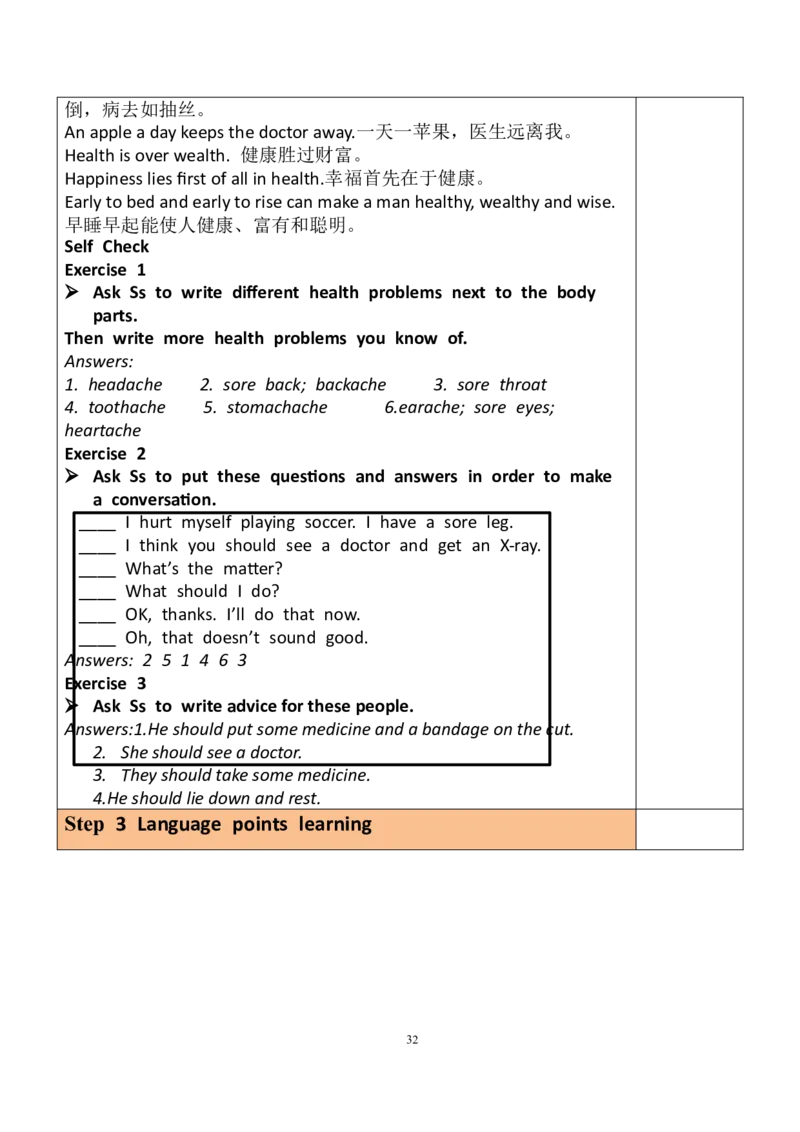
Exercise 2
Ask Ss to put these questions and answers in order to make
a conversation.
____ I hurt myself playing soccer. I have a sore leg.
____ I think you should see a doctor and get an X-ray.
____ What’s the matter?
____ What should I do?
____ OK, thanks. I’ll do that now.
____ Oh, that doesn’t sound good.
Answers: 2 5 1 4 6 3
Exercise 3
Ask Ss to write advice for these people.
Answers:1.He should put some medicine and a bandage on the cut.
2. She should see a doctor.
3. They should take some medicine.
4.He should lie down and rest.
Step 3 Language points learning
32nurse
①n.护士;保育员
a male nurse 男护士
a dental nurse 牙科护士
② v. 看护;照料;调养
e.g. He nursed his daughter back to health.他照料女儿恢复了健康。
nursing house 敬老院;疗养院
Step 4 Summary & Homework
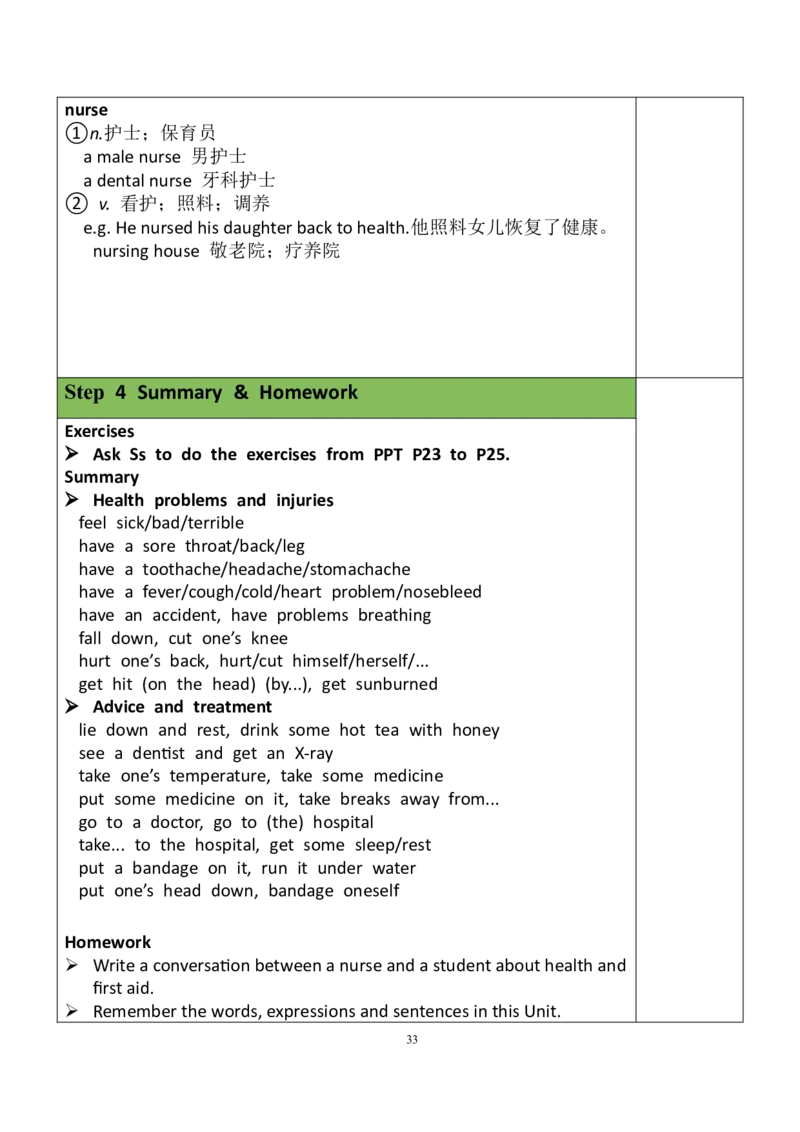
Exercises
Ask Ss to do the exercises from PPT P23 to P25.
Summary
Health problems and injuries
feel sick/bad/terrible
have a sore throat/back/leg
have a toothache/headache/stomachache
have a fever/cough/cold/heart problem/nosebleed
have an accident, have problems breathing
fall down, cut one’s knee
hurt one’s back, hurt/cut himself/herself/...
get hit (on the head) (by...), get sunburned
Advice and treatment
lie down and rest, drink some hot tea with honey
see a dentist and get an X-ray
take one’s temperature, take some medicine
put some medicine on it, take breaks away from...
go to a doctor, go to (the) hospital
take... to the hospital, get some sleep/rest
put a bandage on it, run it under water
put one’s head down, bandage oneself
Homework
Write a conversation between a nurse and a student about health and
first aid.
Remember the words, expressions and sentences in this Unit.
33 Preview Unit 2 Section A (1a-1c).
In the last period of this unit, writing practice is the most important. We
can use the notes in 3a and the questions in 3b to teach the students
Teaching
how to write a conversation. Meanwhile, we can guide them to write
Reflection
by using PPT. After writing, the students can correct and polish what
they write together and tell which is the best.
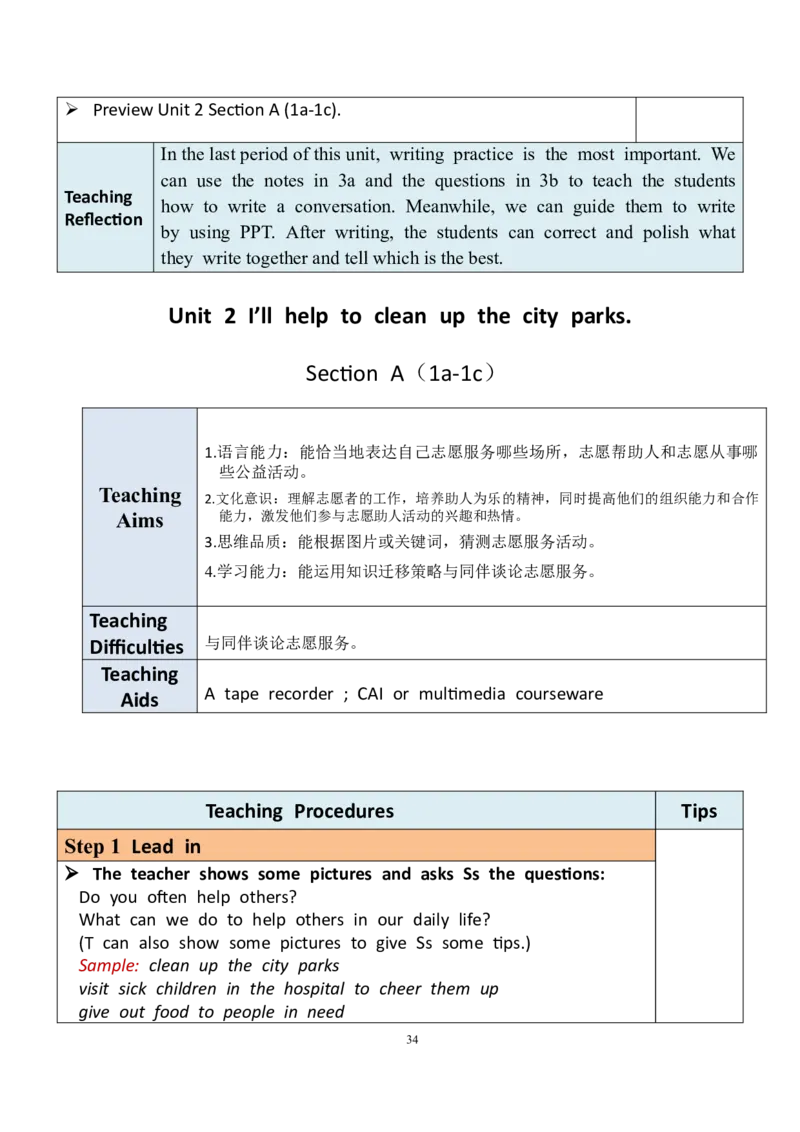
Unit 2 I’ll help to clean up the city parks.
Section A(1a-1c)
1.语言能力:能恰当地表达自己志愿服务哪些场所,志愿帮助人和志愿从事哪
些公益活动。
Teaching
2.文化意识:理解志愿者的工作,培养助人为乐的精神,同时提高他们的组织能力和合作
Aims 能力,激发他们参与志愿助人活动的兴趣和热情。
3.思维品质:能根据图片或关键词,猜测志愿服务活动。
4.学习能力:能运用知识迁移策略与同伴谈论志愿服务。
Teaching
Difficulties 与同伴谈论志愿服务。
Teaching
A tape recorder ; CAI or multimedia courseware
Aids
Teaching Procedures Tips
Step 1 Lead in
The teacher shows some pictures and asks Ss the questions:
Do you often help others?
What can we do to help others in our daily life?
(T can also show some pictures to give Ss some tips.)
Sample: clean up the city parks
visit sick children in the hospital to cheer them up
give out food to people in need
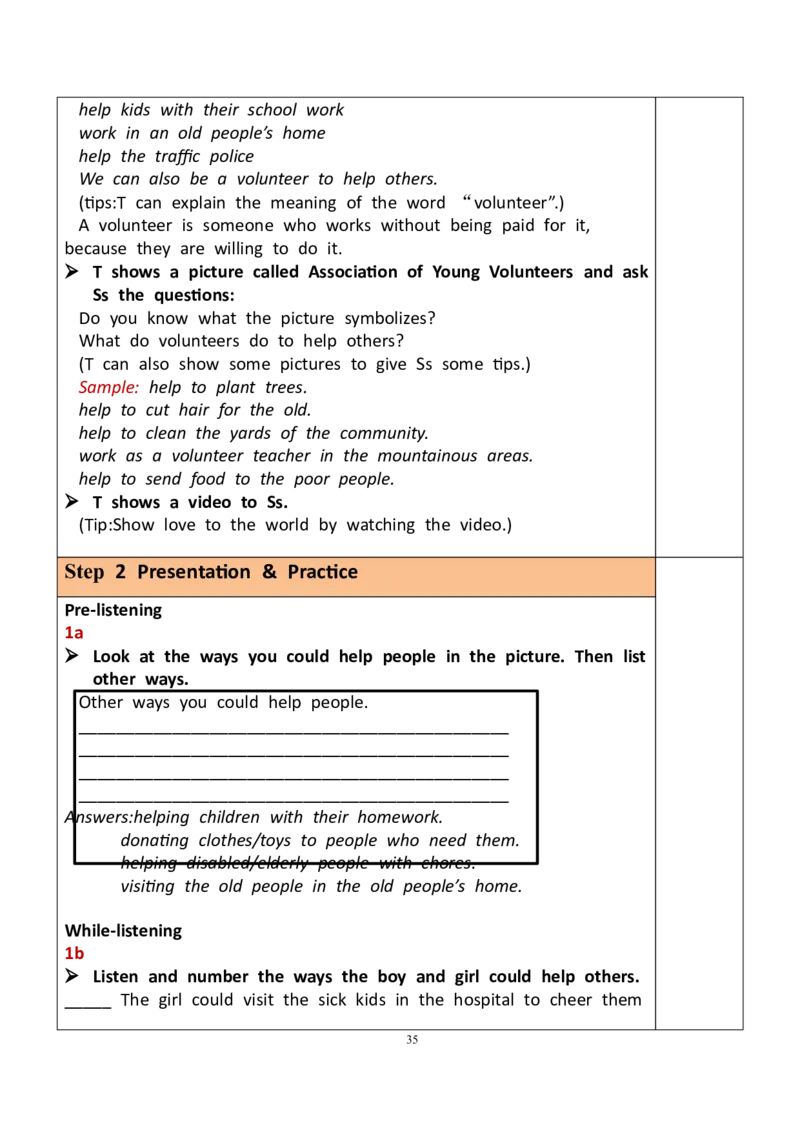
34help kids with their school work
work in an old people’s home
help the traffic police
We can also be a volunteer to help others.
(tips:T can explain the meaning of the word “volunteer”.)
A volunteer is someone who works without being paid for it,
because they are willing to do it.
T shows a picture called Association of Young Volunteers and ask
Ss the questions:
Do you know what the picture symbolizes?
What do volunteers do to help others?
(T can also show some pictures to give Ss some tips.)
Sample: help to plant trees.
help to cut hair for the old.
help to clean the yards of the community.
work as a volunteer teacher in the mountainous areas.
help to send food to the poor people.
T shows a video to Ss.
(Tip:Show love to the world by watching the video.)
Step 2 Presentation & Practice
Pre-listening
1a
Look at the ways you could help people in the picture. Then list
other ways.
Other ways you could help people.
______________________________________________
______________________________________________
______________________________________________
______________________________________________
Answers:helping children with their homework.
donating clothes/toys to people who need them.
helping disabled/elderly people with chores.
visiting the old people in the old people’s home.
While-listening
1b
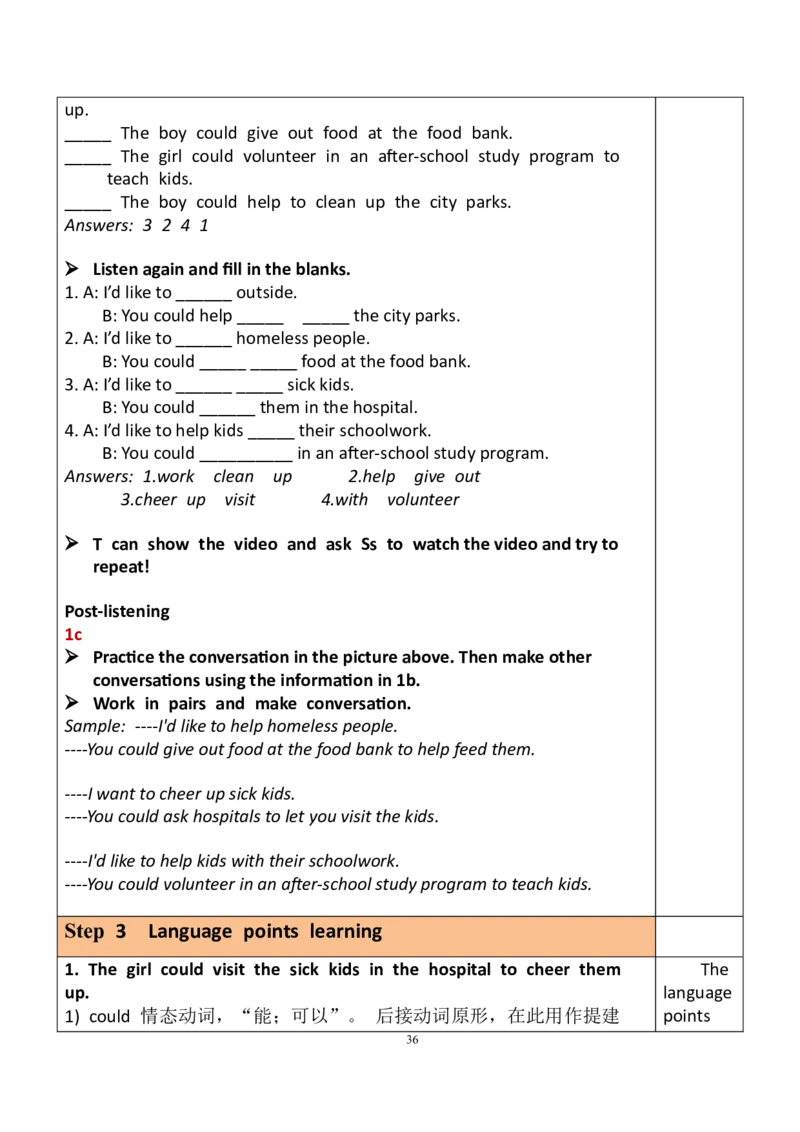
Listen and number the ways the boy and girl could help others.
_____ The girl could visit the sick kids in the hospital to cheer them
35up.
_____ The boy could give out food at the food bank.
_____ The girl could volunteer in an after-school study program to
teach kids.
_____ The boy could help to clean up the city parks.
Answers: 3 2 4 1
Listen again and fill in the blanks.
1. A: I’d like to ______ outside.
B: You could help _____ _____ the city parks.
2. A: I’d like to ______ homeless people.
B: You could _____ _____ food at the food bank.
3. A: I’d like to ______ _____ sick kids.
B: You could ______ them in the hospital.
4. A: I’d like to help kids _____ their schoolwork.
B: You could __________ in an after-school study program.
Answers: 1.work clean up 2.help give out
3.cheer up visit 4.with volunteer
T can show the video and ask Ss to watch the video and try to
repeat!
Post-listening
1c
Practice the conversation in the picture above. Then make other
conversations using the information in 1b.
Work in pairs and make conversation.
Sample: ----I'd like to help homeless people.
----You could give out food at the food bank to help feed them.
----I want to cheer up sick kids.
----You could ask hospitals to let you visit the kids.
----I'd like to help kids with their schoolwork.
----You could volunteer in an after-school study program to teach kids.
Step 3 Language points learning
1. The girl could visit the sick kids in the hospital to cheer them The
up. language
1) could 情态动词,“能;可以”。 后接动词原形,在此用作提建 points
36议,语气比can委婉。 are for
2) cheer up “使振奋;使高兴”。后接代词,代词要放在中间。 reference
cheer v./n. 欢呼;喝彩 cheer on 为……加油喝彩 only.
e.g. Most will probably be cheering on their favourite players.
多数人大概都会为自己喜欢的球员加油。
cheerful adj.快乐的;愉快的
2. The boy could give out food at the food bank.
give out 分发;散发
give out在此处相当于hand out,是“动词+副词”型短语。
The teacher is giving out books to the class.
Can you see the papers on the desk? Give them out to the
students.
【拓展延伸】 give out 的其他含义:
① 发出(光、热等)
The sun gives out light and heat to the earth.
② 耗尽;用尽;筋疲力尽;停止起作用
After two hours, her patience gave out.
Dance till my legs give out.
3. The girl could volunteer in an after-school study program to
teach kids.
volunteer
①v. 自愿做……
volunteer to do sth.
volunteer for sth.
e.g. They volunteered to help the poor students.
②n. 志愿者;义务工作者
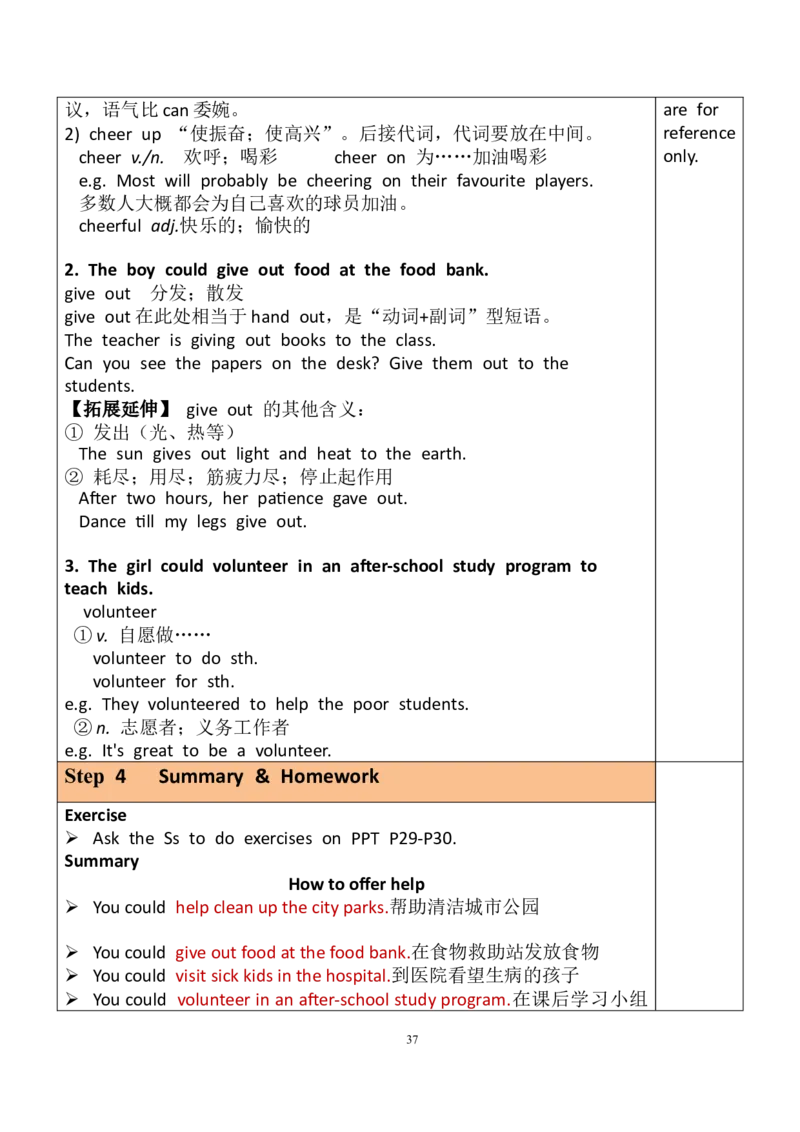
e.g. It's great to be a volunteer.
Step 4 Summary & Homework
Exercise
Ask the Ss to do exercises on PPT P29-P30.
Summary
How to offer help
You could help clean up the city parks.帮助清洁城市公园
You could give out food at the food bank.在食物救助站发放食物
You could visit sick kids in the hospital.到医院看望生病的孩子
You could volunteer in an after-school study program.在课后学习小组
37做志愿者
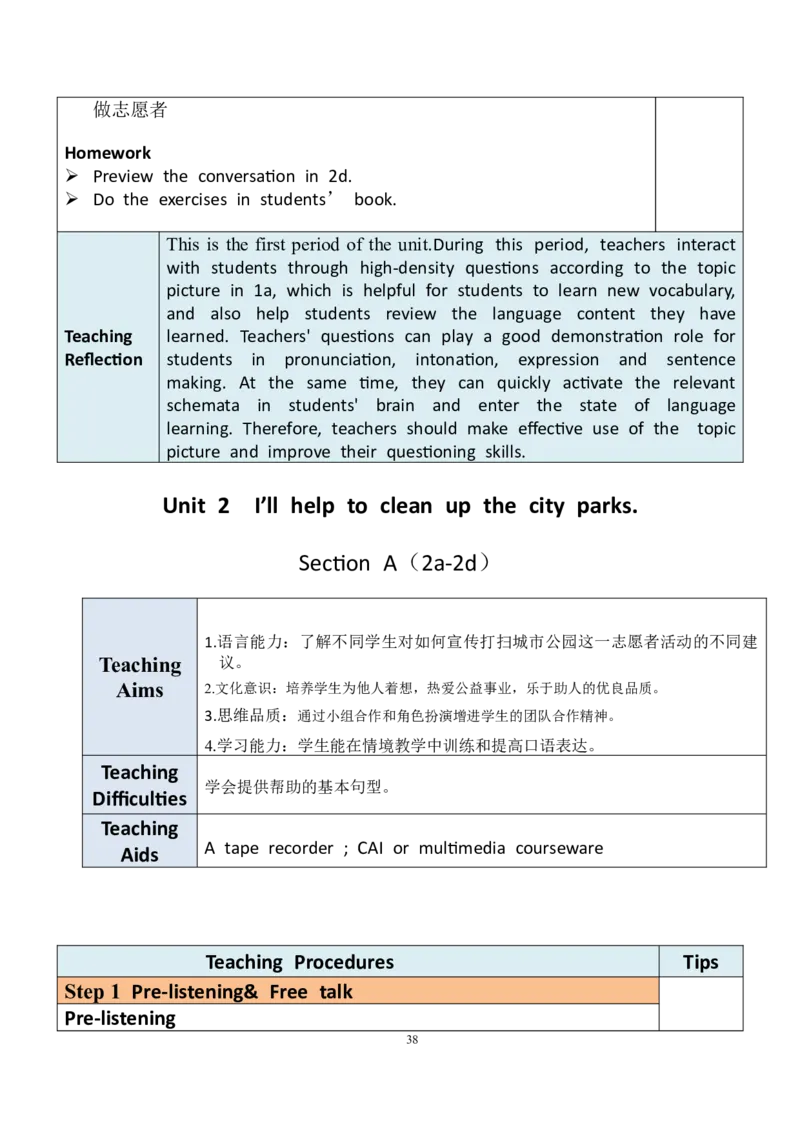
Homework
Preview the conversation in 2d.
Do the exercises in students’ book.
This is the first period of the unit.During this period, teachers interact
with students through high-density questions according to the topic
picture in 1a, which is helpful for students to learn new vocabulary,
and also help students review the language content they have
Teaching learned. Teachers' questions can play a good demonstration role for
Reflection students in pronunciation, intonation, expression and sentence
making. At the same time, they can quickly activate the relevant
schemata in students' brain and enter the state of language
learning. Therefore, teachers should make effective use of the topic
picture and improve their questioning skills.
Unit 2 I’ll help to clean up the city parks.
Section A(2a-2d)
1.语言能力:了解不同学生对如何宣传打扫城市公园这一志愿者活动的不同建
Teaching 议。
Aims 2.文化意识:培养学生为他人着想,热爱公益事业,乐于助人的优良品质。
3.思维品质:通过小组合作和角色扮演增进学生的团队合作精神。
4.学习能力:学生能在情境教学中训练和提高口语表达。
Teaching
学会提供帮助的基本句型。
Difficulties
Teaching
A tape recorder ; CAI or multimedia courseware
Aids
Teaching Procedures Tips
Step 1 Pre-listening& Free talk
Pre-listening
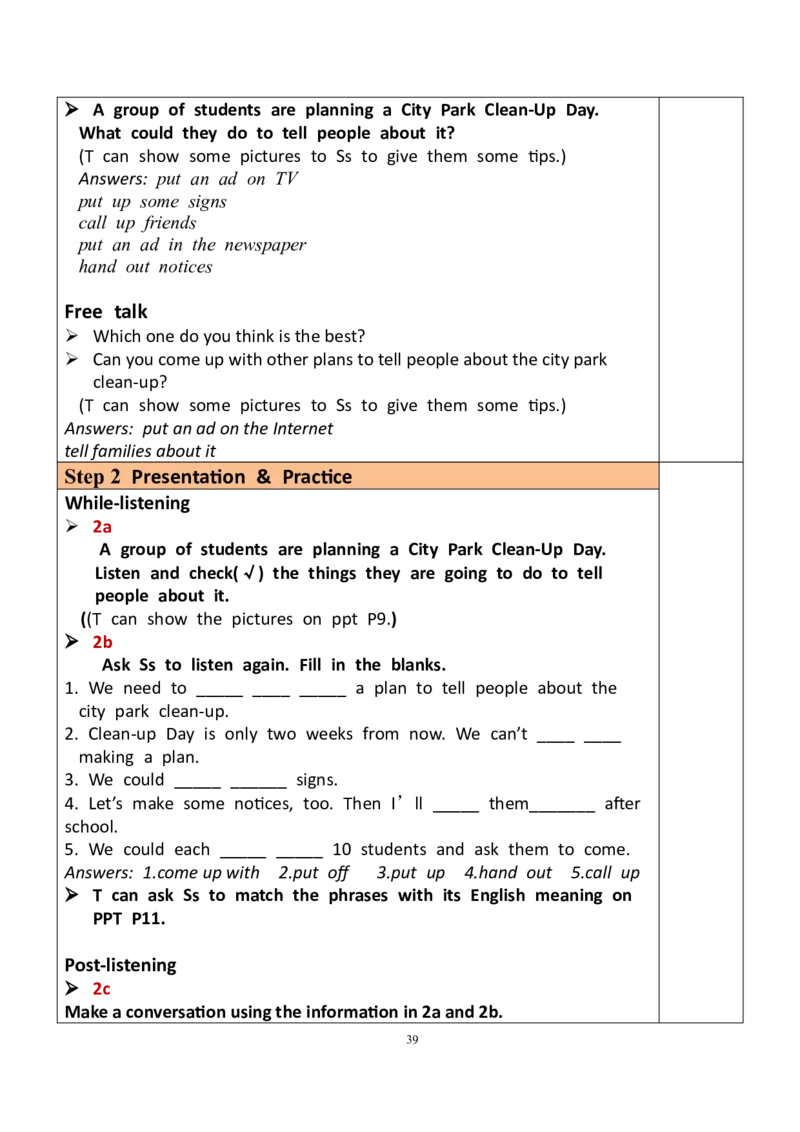
38 A group of students are planning a City Park Clean-Up Day.
What could they do to tell people about it?
(T can show some pictures to Ss to give them some tips.)
Answers: put an ad on TV
put up some signs
call up friends
put an ad in the newspaper
hand out notices
Free talk
Which one do you think is the best?
Can you come up with other plans to tell people about the city park
clean-up?
(T can show some pictures to Ss to give them some tips.)
Answers: put an ad on the Internet
tell families about it
Step 2 Presentation & Practice
While-listening
2a
A group of students are planning a City Park Clean-Up Day.
Listen and check(√) the things they are going to do to tell
people about it.
((T can show the pictures on ppt P9.)
2b
Ask Ss to listen again. Fill in the blanks.
1. We need to _____ ____ _____ a plan to tell people about the
city park clean-up.
2. Clean-up Day is only two weeks from now. We can’t ____ ____
making a plan.
3. We could _____ ______ signs.
4. Let’s make some notices, too. Then I’ll _____ them_______ after
school.
5. We could each _____ _____ 10 students and ask them to come.
Answers: 1.come up with 2.put off 3.put up 4.hand out 5.call up
T can ask Ss to match the phrases with its English meaning on
PPT P11.
Post-listening
2c
Make a conversation using the information in 2a and 2b.
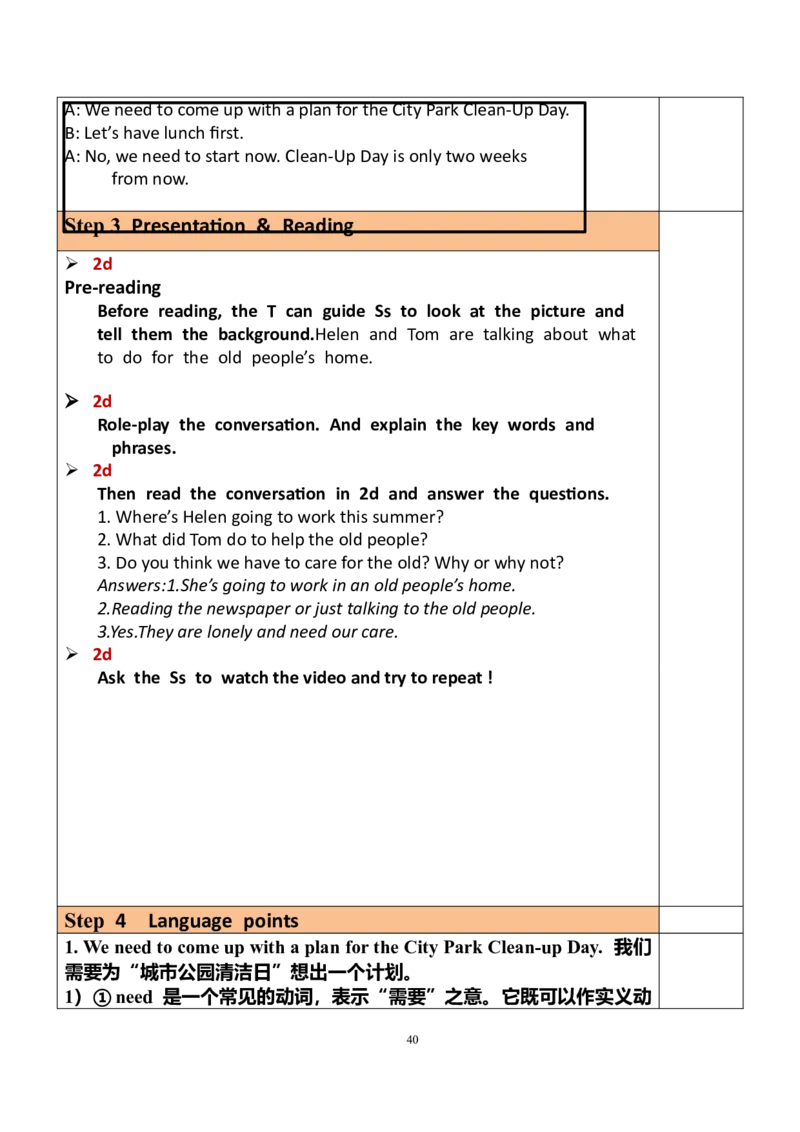
39A: We need to come up with a plan for the City Park Clean-Up Day.
B: Let’s have lunch first.
A: No, we need to start now. Clean-Up Day is only two weeks
from now.
Step 3 Presentation & Reading
2d
Pre-reading
Before reading, the T can guide Ss to look at the picture and
tell them the background.Helen and Tom are talking about what
to do for the old people’s home.
2d
Role-play the conversation. And explain the key words and
phrases.
2d
Then read the conversation in 2d and answer the questions.
1. Where’s Helen going to work this summer?
2. What did Tom do to help the old people?
3. Do you think we have to care for the old? Why or why not?
Answers:1.She’s going to work in an old people’s home.
2.Reading the newspaper or just talking to the old people.
3.Yes.They are lonely and need our care.
2d
Ask the Ss to watch the video and try to repeat !
Step 4 Language points
1. We need to come up with a plan for the City Park Clean-up Day. 我们
需要为“城市公园清洁日”想出一个计划。
1)①need 是一个常见的动词,表示“需要”之意。它既可以作实义动
40词,也可以作情态动词。其具体用法如下:
need用作实义动词,有“必要”、“必需”之意,有人称、数和时态的
变化,可以接名词、代词、动名词或带to 的动词不定式作宾语。
e.g. The man needs an English dictionary when he works.
Do you need to see him yourself?
② need 用作情态动词,意为“必须”、“必要”,没有人称、数等变
化,后接不带 to 的动词不定式。通常用于疑问句和否定句中,构成疑
问句和否定句时,不需要使用助动词。
e.g. Need you go to the park with your classmate?
He needn’t spend much money for this new watch.
【注意】 由 need 引出的疑问句,答语表肯定时用 must 或 have to;表
示否定时用needn’t或don’t have to。
A: Need I come to work tomorrow?
B: Yes, you must/have to.
A: Need I finish the work at once?
B: No, you needn’t/don’t have to.
2)come up with 意为“想出;提出” 后面常接 idea、plan、answer、
solution、advice 等名词。
同义短语:think up
e.g. She came up with a way to work out the math problem.
come up with 还可意为“追上;赶上”,相当于catch up with。
e.g. I will come up with you soon.
2. We can’t put off making a plan. 我们不能推迟制定计划。
put off 推迟
通常指会议、活动等未能按预定的时间举行,后面可接名词、代词或动
词-ing形式作宾语。
Would you mind if we put it off until tomorrow?
【拓展延伸】 与put相关的短语还有:
put down 放下;写下 put ... into 投入 (时间、心思等)
put up 张贴; 搭建; 举起 put out 熄灭
put away 把······放回原处 put on 穿上;上演;体重增加
3. We could each call up 10 students and ask them to come.
call up 打电话给(某人);征召
(1) call up 在此处意为“打电话给(某人)”,是“动词+副词” 型短
语。
Forgive me for calling you up so early please.
(2) call up还可意为“征召”。
41He was called up at the beginning of the war.
【拓展延伸】 含call的其他常见短语
4. They tole me stories about the past and how things used to be.
used to 曾经……;过去……
used to 表示过去一度存在或经常发生,但现在已经不存在的动作或状
态。其后接动词原形,且不与表示过去的时间状语连用。used to的否定
形式是didn’t use to或used not to(usedn’t to)。
He used to be a teacher.
He didn’t use to wear glasses. = He usedn’t to wear glasses.
【拓展延伸】
①be/get used to doing sth. 意为“习惯做某事”,to在此处为介词。
Mario is used to volunteering at an animal hospital now.
②be used to do sth. 意为“被用来做某事”,to为不定式符号。
③be used for doing sth. 意为“被用来做某事”
The milk is used to make kinds of food.
Knives are used for cutting fruits.
5. ①Yeah, a lot of old people are lonely.
②I want to travel alone.
lonely adj. 孤独的;寂寞的 alone adv. 独自;单独
The old man lives alone, but he doesn’t feel lonely.
At a dark night, a man came to a lonely village.
The boy was very shy, and he was alone all the time.
6. We should listen to them and care for them.
care for 照顾;非常喜欢
(1) care for在此处意为“照顾”,相当于look after 或
take care of。
The mother cared for the sick child day and night.
(2) care for还可意为“非常喜欢”,常与not连用。
He doesn’t care for classical music.
【归纳总结】 与care相关的短语:
care for 照顾;非常喜欢
care about 关心;在意
take care 当心;小心
take care of 照顾
Step 5 Summary & Homework
42Summary
Ask Ss to do the exercises from PPT P31-33.
Homework:
Preview the passage on Page 11.
Preview the new words and phrases.
Do the exercises in students’ book.
teacher needs to encourage the students to practice the target language
Teachilnisgt ening and speaking. With the help of language practice, the students
Reflectileoanrn the new pattern in a more natural way.
Unit 2 I’ll help to clean up the city parks.
Section A(3a-3c)
1.语言能力:了解Mario和Mary各自参与的志愿者工作和感受以及选择志愿者
工作的原因。
Teaching
2.文化意识:了解志愿服务及慈善活动的内容,表达帮助他人的意愿和建议,初步形成关
Aims 爱他人和社会的意识。
3.思维品质:能根据语篇推断人物的心理、行为动机等,推断信息之间简单的逻辑关
系。
4.学习能力:能整理、归纳所学内容,把握重点和难点。
Teaching
理解在不同语境中动词不定式的用法。
Difficulties
Teaching
CAI or multimedia courseware
Aids
Teaching Procedures Tips
Step 1 Lead in
Ask Ss the following questions:
1. What do you think about volunteers?
2. What kinds of work can volunteers do?
3. What do you usually do on your free time? Would you like to
43volunteer to do anything for others?
Do you know them?
(T shows the pictures in PPT8)
They were always volunteering to help others and never expected
reward. We should learn from them.
What could we do as volunteers?
(T shows the pictures in PPT9 and PPT10)
Answers: We could clean up the parks.
We could help the traffic police.
We could help the old people.
We could teach children to learn.
Step 2 Presentation & Practice
Pre-reading
Ask Ss to look at the title and answer the questions.
1. Do the students work for money or do they work for free? What word
in the title helps us get the answer?
2. Are the volunteers young or old? How do we know?
Answers:1.They work for free. Volunteer.
2. They are young. Students.
Ask Ss to look at the picture in PPT 12 and answer the
questions.
1. Where is the boy?
2. What job do you think the man next to the boy in the picture
does?
Answers:1.He may be at an animal hospital.
2.Maybe he is an animal doctor.
Ask Ss to look at the picture in PPT 13 and answer the
questions.
1. Where are the girls in this picture? Are they in the classroom
or in the library? Why?
2. What are they doing?
Answers:1.They are in the library. Because there are no desks or
chairs.
2.They are reading books.
While-reading
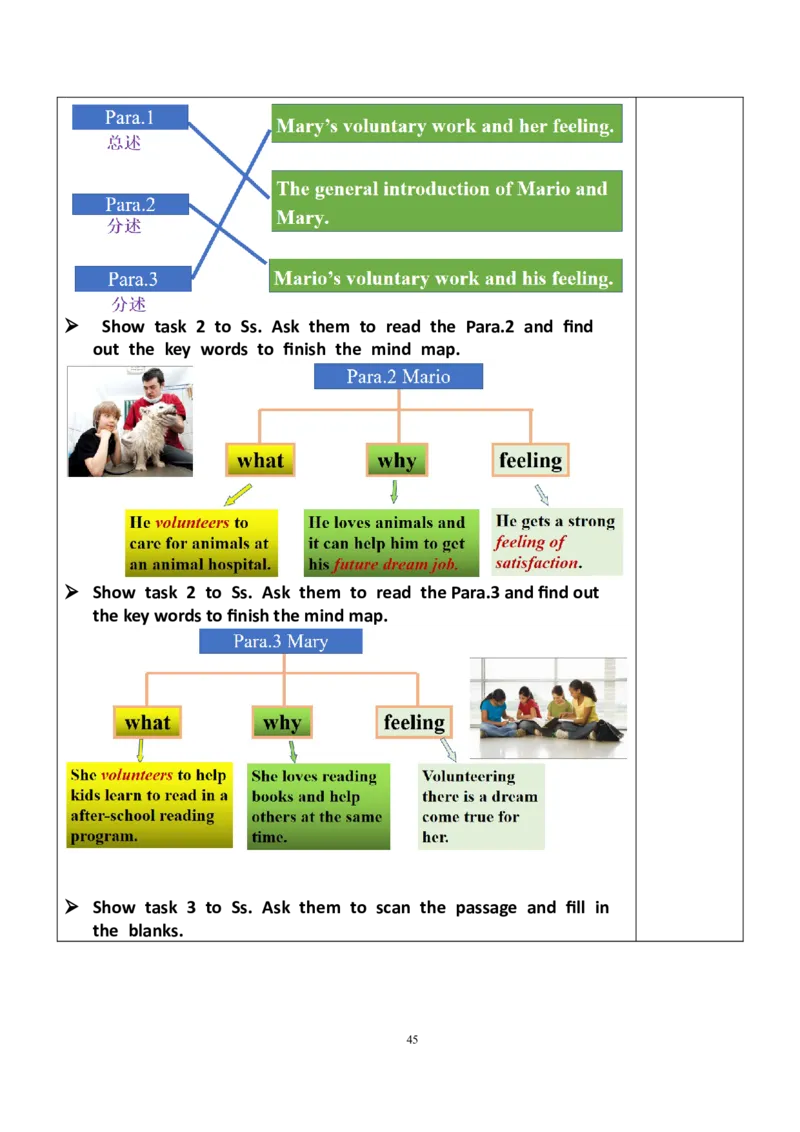
Show task 1 to Ss. Ask them to skim the passage and match
its general meaning with its paragraphs.
44 Show task 2 to Ss. Ask them to read the Para.2 and find
out the key words to finish the mind map.
Show task 2 to Ss. Ask them to read the Para.3 and find out
the key words to finish the mind map.
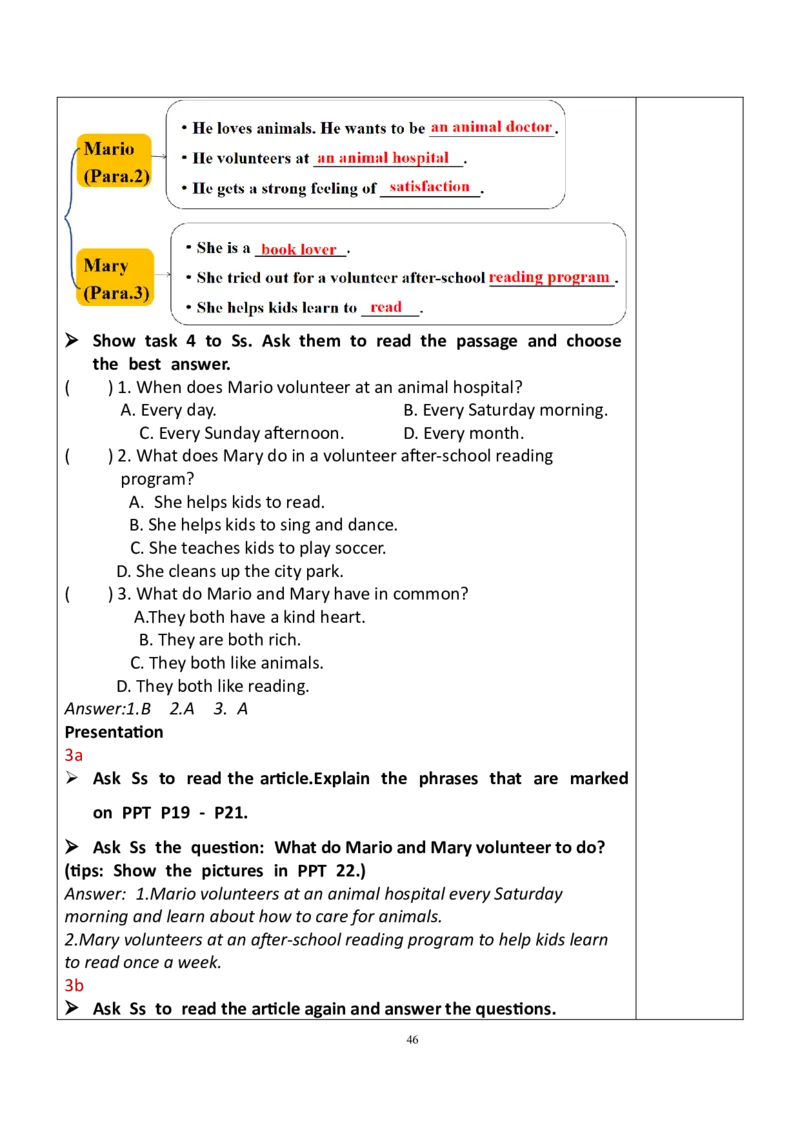
Show task 3 to Ss. Ask them to scan the passage and fill in
the blanks.
45 Show task 4 to Ss. Ask them to read the passage and choose
the best answer.
( ) 1. When does Mario volunteer at an animal hospital?
A. Every day. B. Every Saturday morning.
C. Every Sunday afternoon. D. Every month.
( ) 2. What does Mary do in a volunteer after-school reading
program?
A. She helps kids to read.
B. She helps kids to sing and dance.
C. She teaches kids to play soccer.
D. She cleans up the city park.
( ) 3. What do Mario and Mary have in common?
A.They both have a kind heart.
B. They are both rich.
C. They both like animals.
D. They both like reading.
Answer:1.B 2.A 3. A
Presentation
3a
Ask Ss to read the article.Explain the phrases that are marked
on PPT P19 - P21.
Ask Ss the question: What do Mario and Mary volunteer to do?
(tips: Show the pictures in PPT 22.)
Answer: 1.Mario volunteers at an animal hospital every Saturday
morning and learn about how to care for animals.
2.Mary volunteers at an after-school reading program to help kids learn
to read once a week.
3b
Ask Ss to read the article again and answer the questions.
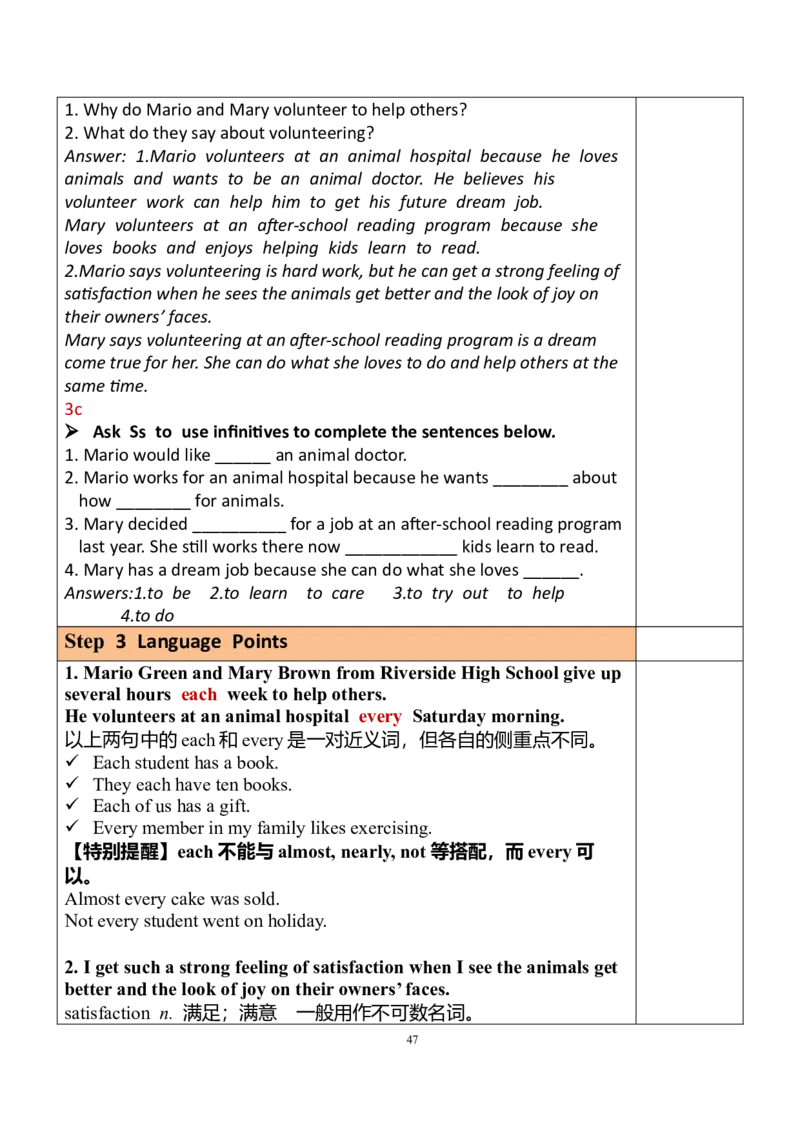
461. Why do Mario and Mary volunteer to help others?
2. What do they say about volunteering?
Answer: 1.Mario volunteers at an animal hospital because he loves
animals and wants to be an animal doctor. He believes his
volunteer work can help him to get his future dream job.
Mary volunteers at an after-school reading program because she
loves books and enjoys helping kids learn to read.
2.Mario says volunteering is hard work, but he can get a strong feeling of
satisfaction when he sees the animals get better and the look of joy on
their owners’ faces.
Mary says volunteering at an after-school reading program is a dream
come true for her. She can do what she loves to do and help others at the
same time.
3c
Ask Ss to use infinitives to complete the sentences below.
1. Mario would like ______ an animal doctor.
2. Mario works for an animal hospital because he wants ________ about
how ________ for animals.
3. Mary decided __________ for a job at an after-school reading program
last year. She still works there now ____________ kids learn to read.
4. Mary has a dream job because she can do what she loves ______.
Answers:1.to be 2.to learn to care 3.to try out to help
4.to do
Step 3 Language Points
1. Mario Green and Mary Brown from Riverside High School give up
several hours each week to help others.
He volunteers at an animal hospital every Saturday morning.
以上两句中的each和every是一对近义词,但各自的侧重点不同。
Each student has a book.
They each have ten books.
Each of us has a gift.
Every member in my family likes exercising.
【特别提醒】each不能与almost, nearly, not等搭配,而every可
以。
Almost every cake was sold.
Not every student went on holiday.
2. I get such a strong feeling of satisfaction when I see the animals get
better and the look of joy on their owners’ faces.
satisfaction n. 满足;满意 一般用作不可数名词。
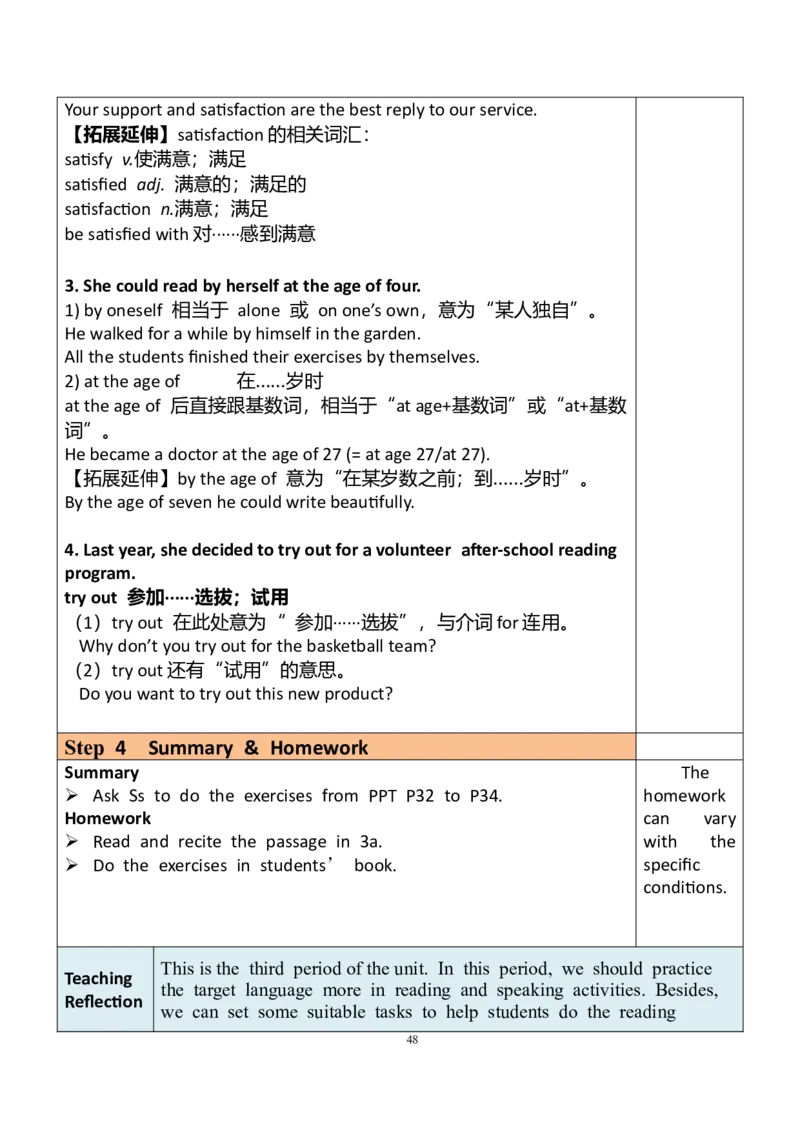
47Your support and satisfaction are the best reply to our service.
【拓展延伸】satisfaction的相关词汇:
satisfy v.使满意;满足
satisfied adj. 满意的;满足的
satisfaction n.满意;满足
be satisfied with对······感到满意
3. She could read by herself at the age of four.
1) by oneself 相当于 alone 或 on one’s own,意为“某人独自”。
He walked for a while by himself in the garden.
All the students finished their exercises by themselves.
2) at the age of 在……岁时
at the age of 后直接跟基数词,相当于“at age+基数词”或“at+基数
词”。
He became a doctor at the age of 27 (= at age 27/at 27).
【拓展延伸】by the age of 意为“在某岁数之前;到……岁时”。
By the age of seven he could write beautifully.
4. Last year, she decided to try out for a volunteer after-school reading
program.
try out 参加······选拔;试用
(1)try out 在此处意为“ 参加······选拔”,与介词for连用。
Why don’t you try out for the basketball team?
(2)try out还有“试用”的意思。
Do you want to try out this new product?
Step 4 Summary & Homework
Summary The
Ask Ss to do the exercises from PPT P32 to P34. homework
Homework can vary
Read and recite the passage in 3a. with the
Do the exercises in students’ book. specific
conditions.
This is the third period of the unit. In this period, we should practice
Teaching
the target language more in reading and speaking activities. Besides,
Reflection
we can set some suitable tasks to help students do the reading
48comprehension in order to improve their reading skills.And students
should know the main content in this passage.
Unit 2 I’ll help to clean up the city parks.
Section A(GF-4c)
1.语言能力:正确运用本单元所学的动词短语,理解动词不定式的用法。
Teaching
2.文化意识:培养学生为他人着想,热爱公益事业,乐于助人的优良品质。
Aims
3.思维品质:概括语篇的关键信息,了解志愿服务。
4.学习能力:有意识地运用动词不定式去补充句子,使句子意思完整。
Teaching 学习动词不定式的用法。
Difficulties
Teaching multimedia courseware or other realia that the T needs for
Aids teaching
Teaching Procedures Tips
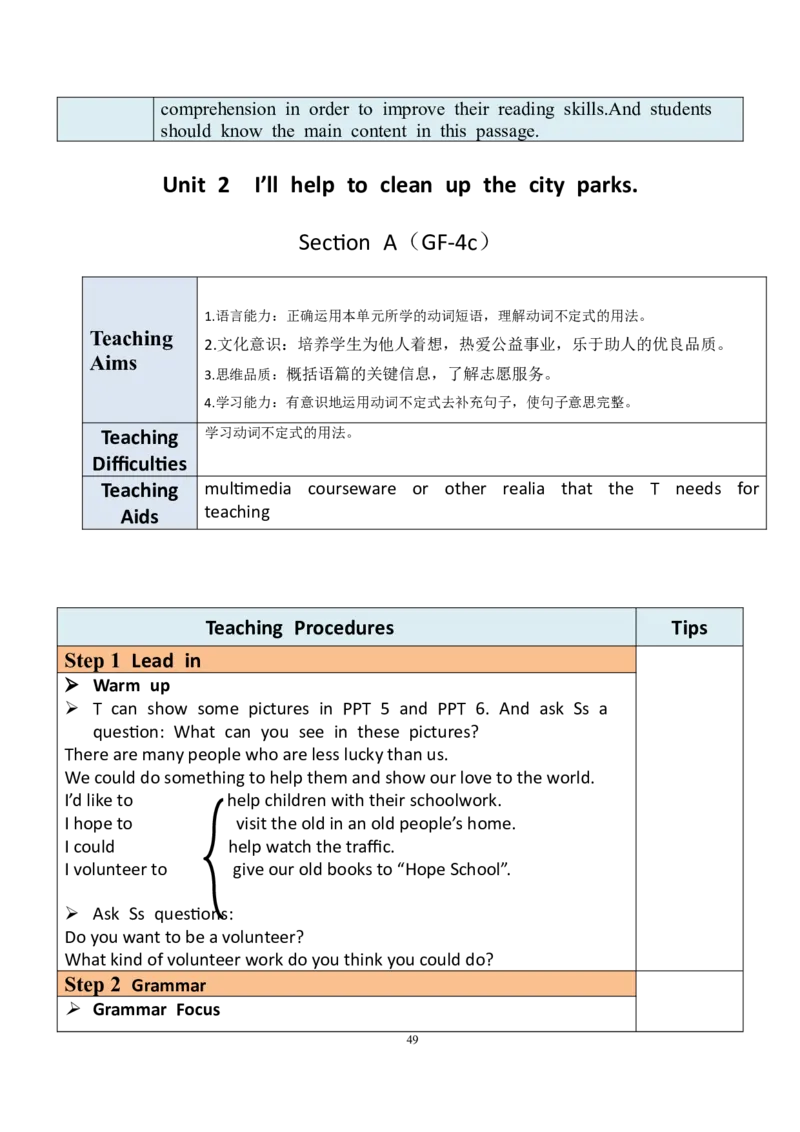
Step 1 Lead in
Warm up
T can show some pictures in PPT 5 and PPT 6. And ask Ss a
question: What can you see in these pictures?
There are many people who are less lucky than us.
We could do something to help them and show our love to the world.
I’d like to help children with their schoolwork.
I hope to visit the old in an old people’s home.
I could help watch the traffic.
I volunteer to give our old books to “Hope School”.
Ask Ss questions:
Do you want to be a volunteer?
What kind of volunteer work do you think you could do?
Step 2 Grammar
Grammar Focus
49Ask Ss to read the sentences in grammar focus. T can also
encourage Ss to find out more sentences from the textbook.
短语动词(Phrasal verbs)
短语动词是由动词加介词、副词或其他词构成的固定词组或习语
(idioms),其作用和动词差不多。有些短语动词相当于及物动词,
有些则相当于不及物动词。
短语动词的类型和用法
1.动词+介词
相当于及物动词,后面必须有宾语,且宾语只能位于介词之后。
look after 照顾 look at 看 care for 非常喜欢;照顾
think about 考虑 agree with 同意 wait for 等待
I agree with what you said.
He cared for her more than she realized.
2.动词+副词
①可看作及物动词,名词作宾语时,可位于动词与副词之间或副词
之后;代词作宾语时;只能位于动词与副词之间。
②有的也可看作不及物动词。
cheer up 振奋起来 clean up 打扫干净
give up 放弃 put off 推迟
take away 拿走 fix up 修理
turn down 调低;拒绝 turn up 出现;调高
This is a new word. You’d better look it up in the dictionary.
It’s too noisy. Please turn down the TV. =It’s too noisy. Please turn
the TV down.
3.动词+副词+介词
相当于及物动词, 宾语位于介词之后。
catch up with 赶上 come up with 想出
look forward to 期望 run out of 用完;耗尽
He worked hard to catch up with his classmates.
I’m looking forward to the weekend.
4.动词+名词+介词
相当于及物动词,名词前可加形容词说明程度,宾语位于介词之
后。
make fun of 取笑 make use of 利用 pay attention to 注意
take care of 照顾 make friends with 与······交朋友
It’s impolite to make fun of your classmate.
We could make better use of our resources.
动词不定式
50动词不定式的基本形式是“to+动词原形”,有时to可省略。它没有
人称和数的变化,在句中不能作谓语。其否定形式为“not to+动词原
形”。
动词不定式的用法
1.动词不定式作宾语
常接动词不定式作宾语的动词有:
想要 拒绝 忘记 (want, refuse, forget)
需要 努力 学习 (need, try, learn)
选择 同意 帮助 (choose, agree, help)
希望 决定 开始 (hope/wish/expect, decide, begin/start)
Lily wants to find a job as an English teacher in Beijing.
He decided to help the homeless.
2.动词不定式作宾语补足语
常接动词不定式作宾补的动词有:
ask, tell, want, teach, wish, help, warn, invite, encourage 等可以构成
“...sb. (not) to do sth.”结构的动词。
Sam asked me to help him.
The teacher always tells us not to swim in the river.
注意:在let, make, see, watch, hear, feel, notice, have 等感官听觉动
词或使役动词后面作宾语补足语的动词, 其不定式一般要省略动词
不定式符号“to”。
let / make / have + sb. +do sth.
e.g. Let the girl leave here now.
The boy made the baby cry.
see / watch / hear / notice / feel +sb.+do sth.
e.g. I often hear the girl sing in the next room.
3.动词不定式作状语
1)作目的状语。强调动词不定式所表示的目的时,动词不定式可in
order to或so as to +动词原形,so as to不用于句首。
e.g. The bus stopped so as to pick up passengers.
2)作结果状语。
e.g. He woke up only to find everybody gone.
His grandma lived to see the liberation of China.
He is old enough to go to school.
3)在某些表示喜、怒、哀、乐等的形容词后作原因状语。
e.g. I’m proud to have taken part in the competitions.
She was surprised to see him.
They jumped for joy to hear the news.
4.动词不定式作主语
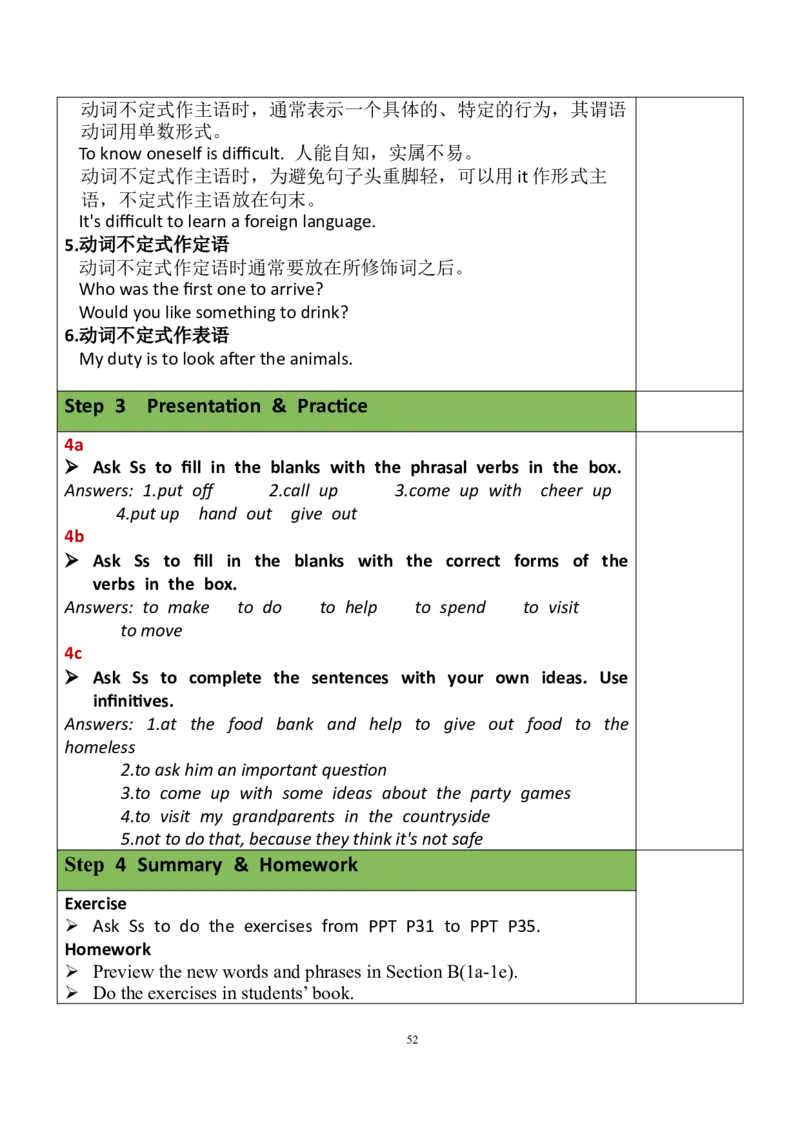
51动词不定式作主语时,通常表示一个具体的、特定的行为,其谓语
动词用单数形式。
To know oneself is difficult. 人能自知,实属不易。
动词不定式作主语时,为避免句子头重脚轻,可以用it作形式主
语,不定式作主语放在句末。
It's difficult to learn a foreign language.
5.动词不定式作定语
动词不定式作定语时通常要放在所修饰词之后。
Who was the first one to arrive?
Would you like something to drink?
6.动词不定式作表语
My duty is to look after the animals.
Step 3 Presentation & Practice
4a
Ask Ss to fill in the blanks with the phrasal verbs in the box.
Answers: 1.put off 2.call up 3.come up with cheer up
4.put up hand out give out
4b
Ask Ss to fill in the blanks with the correct forms of the
verbs in the box.
Answers: to make to do to help to spend to visit
to move
4c
Ask Ss to complete the sentences with your own ideas. Use
infinitives.
Answers: 1.at the food bank and help to give out food to the
homeless
2.to ask him an important question
3.to come up with some ideas about the party games
4.to visit my grandparents in the countryside
5.not to do that, because they think it's not safe
Step 4 Summary & Homework
Exercise
Ask Ss to do the exercises from PPT P31 to PPT P35.
Homework
Preview the new words and phrases in Section B(1a-1e).
Do the exercises in students’ book.
52We always learn grammar when we have enough language materials to
support.Students can practice grammar by using what they have learned.
Teaching
After they learn the main structure in the grammar focus frame , the
Reflection
students should practice in different activities.And we'd better give them
some written work after speaking and reading.
Unit 2 I’ll help to clean up the city parks.
Section B(1a-1e)
1.语言能力:正确运用已知的英语语言来解释新词汇。
2.文化意识:引导学生要关爱他人,并力所能及的去帮助那些需要帮助的人。
Teaching
3 3.思维品质:通过图片预测所听内容,听懂与助人行为相关的对话,并获取细
Aims
节
。 信息。
4.学习能力:运用本单元所学句型讨论我们可以用什么样的形式去帮助需要帮
助的人。
运用本单元所学句型讨论我们可以用什么样的形式去帮助需要帮助的人。
Teaching
Difficulties
Teaching
A tape recorder; CAI or multimedia courseware
Aids
Teaching Procedures Tips
Step 1 Lead in
T can show some pictures in PPT 12 to Ss. Then ask them the
following questions:
Have you ever helped others as a volunteer?
What do you want to do if you are a volunteer ?
Step 2 Presentation & Practice
1a
Ask Ss to match the sentences with similar meanings.
53__b__ 1. I’ve run out of it. a. I repaired it.
____ 2. I take after my mother. b. I don’t have any more of
it.
____ 3. I fixed it up. c. I’m similar to her.
____ 4. I gave it away. d. I didn’t keep it.
Answers: 2.c 3.a 4.b
Match the phrasal verbs with paraphrases(释义).
A. come up with B. call up C. put off D. cheer up
( ) 1. to make a phone call to sb.
( ) 2. to make other people happy
( ) 3. to think of an idea, answer, etc.
( ) 4. to decide to do sth. at a later time or date because
you
can’t or don’t want to do it now.
Answers: 1.B 2.D 3.A 4.C
Pre-listening
1b
Ask Ss to match the phrasal verbs with the nouns. Then make
sentences with the phrases.
run out of my bike
take after money
fix up my father
give away old clothes
Sample: I gave away my bike to a children’s home.
I have run out of money during my vacation.
My brother takes after my father.
I fixed up my bike yesterday.
I decided to give away my old clothes to the children’s home.
1c
T shows the pictures in PPT 18-21 to Ss.Then ask them the
questions.
Look at Jimmy’s pictures carefully and answer the questions.
1. Does Jimmy have any money in his pocket?
2. What problem do you think he has?
Answer:1.No, he doesn't.
542.I think he may run out of his money.
1. Is the bike in the picture new or old?
2. What’s Jimmy doing?
Answer:1.It's old.
2.He is fixing up the bike.
1. What does the boy find?
2. Does the bike have a broken wheel?
3 3.Why doesn’t the owner want it any longer?
Answer:1.He finds an abandoned(废弃的) bike.
2.Yes, it does.
3.Maybe it's broken.
1. How does the bike look in this picture?
2. What does Jimmy do with the bike?
3. Do you think your parents will be proud of you if you do this?
Answer:1.It looks great.
2. He repairs it and makes it work well.
3.Yes, they will.
While-listening
1c
Ask Ss to listen and number the pictures [1-4] in the correct order.
Answer:4 2 1 3
1d
Ask Ss to listen again. Circle T for true or F for false.
1. Jimmy fixes up broken bicycle parts, like wheels. T F
552. Jimmy sells bikes. T F
3. Jimmy takes after his mother. T F
4. Jimmy has run out of money. T F
Answer:T F F T
Ask Ss to retell the passage.
Jimmy is a very wonderful young man. Many kids don’t have _______
_______ to buy their own bikes. He finds or buys old bikes. He_______
the bikes and then ________________ to these kids.
Jimmy ___________ his father. He loves to help people and always
volunteers to help people in need. But now Jimmy has
_______________, he can’t buy any more old bikes. So he needs to come
up with some way of getting money or he’ll have to stop.
Answer:enough money fixes up gives them away takes after
run out of money
Post-listening
1e
Role-play a conversation between Jimmy and the reporter. Use the
information in 1c and 1d.
A:What do you do, Jimmy?
B:I fix up...
Sample:
--What do you do, Jimmy?
--I find or buy old bikes. I fix up some old bikes. Then I give them away to
the kids who don’t have enough money to buy bikes.
--Wow! Your parents must be proud of you.
--I guess so. But I’ve run out of my money, so I can’t buy any
more old bikes. I need to come up with some way of getting money
or I’ll have to stop.
Step 3 Language points
1.I’ve run out of it.
run out of = use up 意为“用完”、“卖光”。
e.g. I am running out of my money.
= My money is running out.
We are running out of the gas.
= Our car is running out of the gas.
2. I take after my mother.
56take after(外貌或行为)像
take after 着重指因有血缘关系而相像,其同义短语是 be similar to。
take after是“动词+介词”型短语,无论是名词还是代词作宾语,都位
于after后面。
The boy seems to take after his father.
【拓展延伸】
look like意为“看上去像······”,多指外貌上像。
Lucy looks like her aunt very much.
3. I gave it away.
give away赠送;捐赠
give away是“动词+副词”构成的短语。代词作宾语,要放在中间。
The rich man gave away most of his money to charity.
【拓展延伸】
give away还有“颁发;泄露”之意。
The headmaster gave away the prizes on the school sports day.
She would give nothing away.
4. Jimmy fixes up broken bicycle parts, like wheels.
fix up = repair (修理)
【拓展延伸】
fix v. 固定;安装;确定;决定(日期;时间;数量等);
安排;组织
e.g. We will fix the date of the next meeting.
You have to fix visits up earlier with the museum.
Step 4 Summary & Homework
The
Summary homewor
Ask Ss to do the exercise from PPT32 to PPT33. k can
Homework: vary with
Preview the passage in Section B 2b. the
Do the exercises in students’ book. specific
conditions
.
The design of activities before listening(Activities1a and 1b) is very
Teaching
important. The purpose is to activate the memory in students' brain, recall
Reflection
the learned words, phrases and sentence patterns, and pave the way for
57listening activities. At the same time, students' response process is also to
learn and consolidate language knowledge in application. The role of
teachers in this link is also very important. They should be good at
providing topics and mastering the rhythm and difficulty levels of the
discussion and adjusting the discussion atmosphere. We should not only
encourage excellent students to express actively, but also pay attention to
the students with average or weak foundation and give them the
opportunity to express, even if they are just asked to repeat the statements
of other students or express whether they agree with others. Teachers should
also purposefully pre-teach the unfamiliar words possibly appearing in
1c-1d.
In addition, the demonstration of teachers' language is extremely
important. The wording should be concise, clear and easy to understand,
which is also an important language information input.
Unit 2 I’ll help to clean up the city parks.
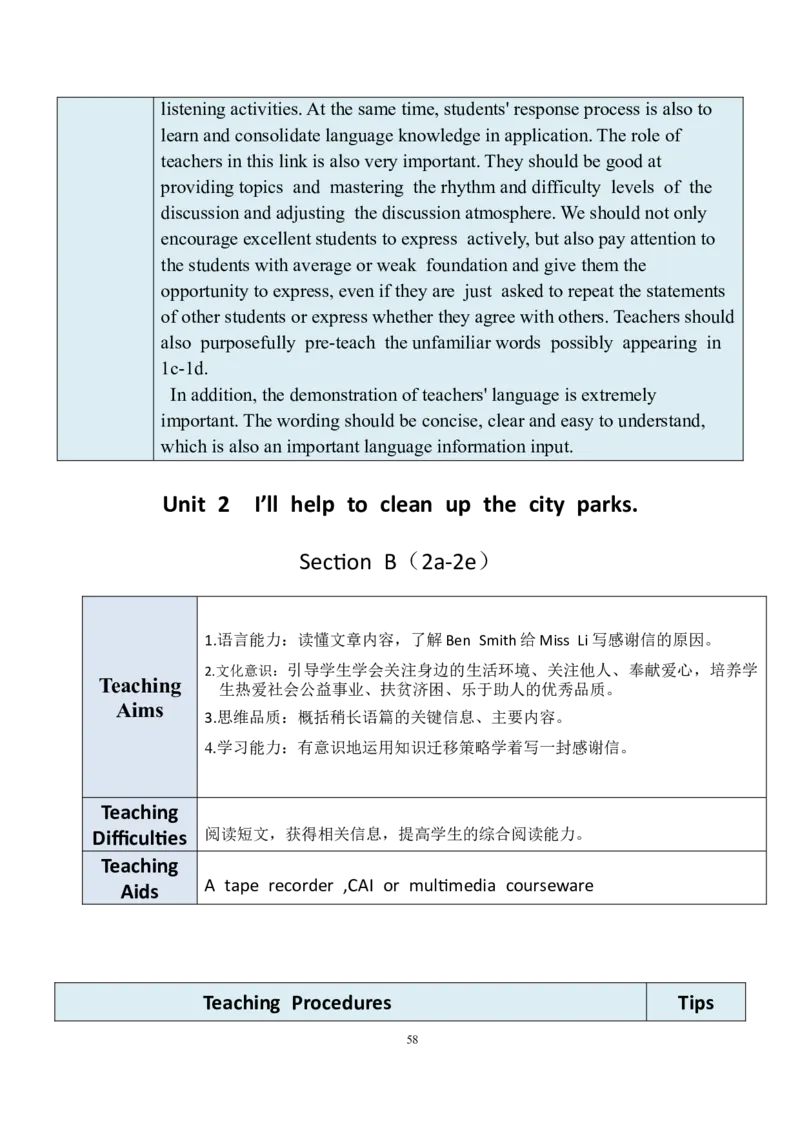
Section B(2a-2e)
1.语言能力:读懂文章内容,了解Ben Smith给Miss Li写感谢信的原因。
2.文化意识:引导学生学会关注身边的生活环境、关注他人、奉献爱心,培养学
Teaching
生热爱社会公益事业、扶贫济困、乐于助人的优秀品质。
Aims
3.思维品质:概括稍长语篇的关键信息、主要内容。
4.学习能力:有意识地运用知识迁移策略学着写一封感谢信。
Teaching
Difficulties 阅读短文,获得相关信息,提高学生的综合阅读能力。
Teaching
A tape recorder ,CAI or multimedia courseware
Aids
Teaching Procedures Tips
58Step 1 Lead in
The T can present some pictures of famous disabled people,
and ask Ss the question: Do you know them?
Being disabled is hard to imagine for common people.
The T can present some pictures to help Ss understand the
difficulties the disabled may meet.
They’ll have difficulties with normal things, like...
Free talk
What can we do to help the disabled?
Do you know anything about assistance dogs?
(T can present some pictures to broaden Ss’s horizons.)
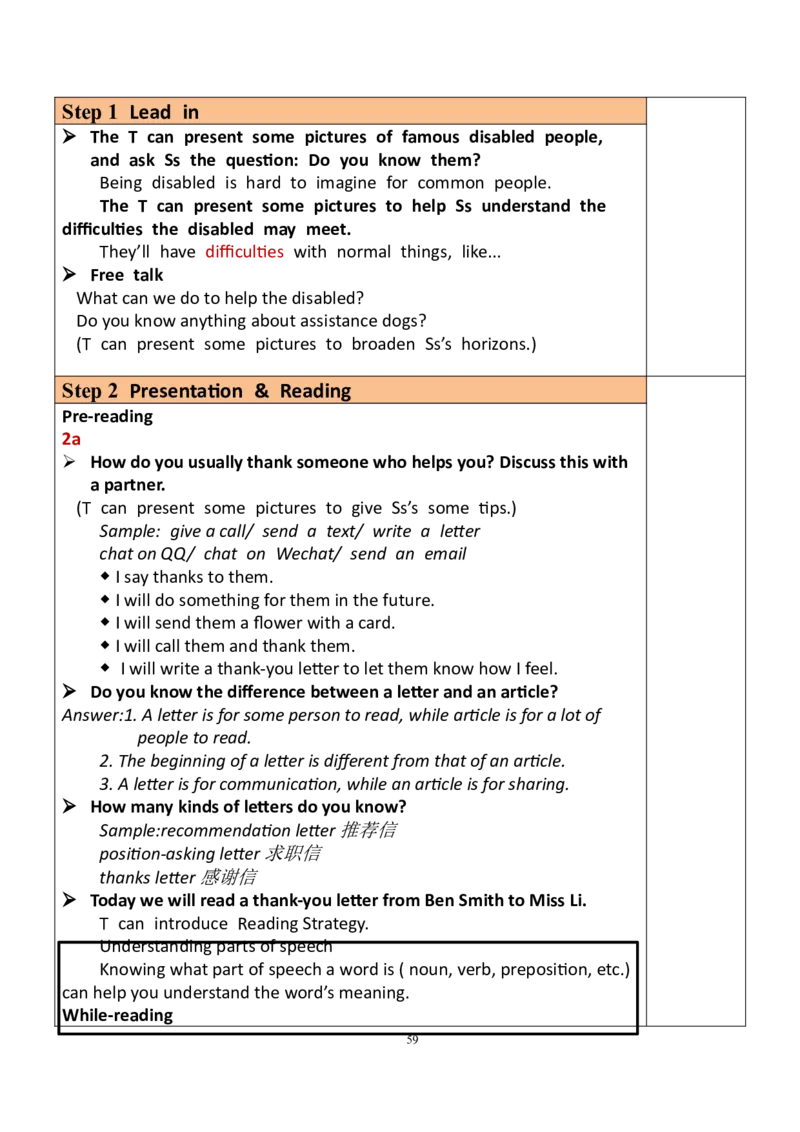
Step 2 Presentation & Reading
Pre-reading
2a
How do you usually thank someone who helps you? Discuss this with
a partner.
(T can present some pictures to give Ss’s some tips.)
Sample: give a call/ send a text/ write a letter
chat on QQ/ chat on Wechat/ send an email
◆ I say thanks to them.
◆ I will do something for them in the future.
◆ I will send them a flower with a card.
◆ I will call them and thank them.
◆ I will write a thank-you letter to let them know how I feel.
Do you know the difference between a letter and an article?
Answer:1. A letter is for some person to read, while article is for a lot of
people to read.
2. The beginning of a letter is different from that of an article.
3. A letter is for communication, while an article is for sharing.
How many kinds of letters do you know?
Sample:recommendation letter推荐信
position-asking letter求职信
thanks letter感谢信
Today we will read a thank-you letter from Ben Smith to Miss Li.
T can introduce Reading Strategy.
Understanding parts of speech
Knowing what part of speech a word is ( noun, verb, preposition, etc.)
can help you understand the word’s meaning.
While-reading
592b
Ask Ss to read the letter and answer the questions.
1. What kind of letter is it?
2. Who wrote the letter to Miss Li? Why?
3. What did Miss Li do?
Answer:1.It’s a thank-you letter.
2.Ben Smith. Because he wanted to thank her (for giving money to Animal
Helpers and tell her how Animal Helpers helped him).
3.She gave some money to Animal Helpers.
Explain the phrases that are marked on PPT 21-24.
Ask Ss to finish the task 1.
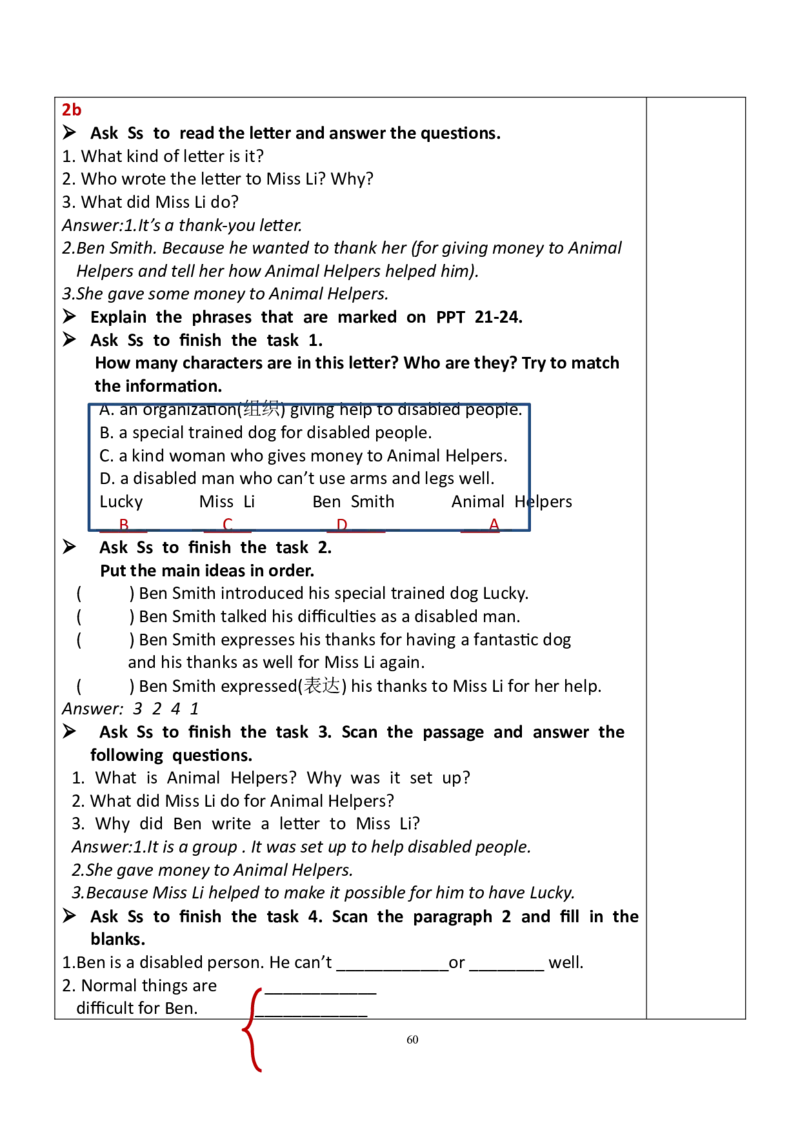
How many characters are in this letter? Who are they? Try to match
the information.
A. an organization(组织) giving help to disabled people.
B. a special trained dog for disabled people.
C. a kind woman who gives money to Animal Helpers.
D. a disabled man who can’t use arms and legs well.
Lucky Miss Li Ben Smith Animal Helpers
B C D A
Ask Ss to finish the task 2.
Put the main ideas in order.
( ) Ben Smith introduced his special trained dog Lucky.
( ) Ben Smith talked his difficulties as a disabled man.
( ) Ben Smith expresses his thanks for having a fantastic dog
and his thanks as well for Miss Li again.
( ) Ben Smith expressed(表达) his thanks to Miss Li for her help.
Answer: 3 2 4 1
Ask Ss to finish the task 3. Scan the passage and answer the
following questions.
1. What is Animal Helpers? Why was it set up?
2. What did Miss Li do for Animal Helpers?
3. Why did Ben write a letter to Miss Li?
Answer:1.It is a group . It was set up to help disabled people.
2.She gave money to Animal Helpers.
3.Because Miss Li helped to make it possible for him to have Lucky.
Ask Ss to finish the task 4. Scan the paragraph 2 and fill in the
blanks.
1.Ben is a disabled person. He can’t ____________or ________ well.
2. Normal things are ____________
difficult for Ben. ____________
60____________
3.A friend would like to help Ben out
She would talk to _______________.
Ben was excited about the idea of ________________.
Answer:1.use his arms legs
2. answering the telephone
opening and closing doors
carrying things
3.“Animal helpers” having a dog
Ask Ss to finish the task 5. Make an ID card for Lucky.
You can think it as the following aspects:
①Who is Lucky?
②Where does Lucky from?
③What is Lucky like?
④What can Lucky do?
Name: Lucky
From: Animal Helper s
Owner: Ben Smith
Personality: six-month-trained, cleve r
Ability: understand many English words;
do quickly as Ben order s
Post-reading
Ask Ss to retell the story.
Ben Smith is a __________ person. He can’t use his arms ____ legs
well, so normal things like _________(answer) the phone or carrying things
_____ (be) difficult for me.
One day ,a friend of _____(他的) helped him _____.The friend
______(talk) to Animal Helper about ______(get) him a special _______
(train) dog to cheer ____ (he) up.
After six months of _________(train) with lucky, he was ______ (able)
to bring him home. Ben felt very _______(luck) to have the fantastic dog.
So he ______(write) a letter to Miss Li to show his thanks. He said “
I’d like to thank you for ______(give) money to Animal Helpers .
You helped to _______________for me to have Lucky(让我拥有Lucky
成为可能) ”. Lucky makes a big __________(很大的作用) to my life. Thank
you again for ________(change) my life.
Answer: disabled or answering are his out talked getting
trained him training able lucky wrote giving
make it possible difference changing
612c
Ask Ss to look at the list of words below. Circle the part of speech of
each word and make your own sentences with these words.
1. group ( adj. / n. ) _________________________________________
2. disabled ( adj. / adv. ) _____________________________________
3. difference ( adv. / n. ) _____________________________________
4. imagine ( v. / n. ) ________________________________________
5. difficulties ( n. / adj. ) _______________________________________
6. normal ( adv./ adj. ) _________________________________________
7. training ( adv. / n. ) _________________________________________
8. kindness ( n. / v. ) __________________________________________
Answer: 1.A group of students are going to Shenzhen.
2.We should help the disabled children.
3.There are some differences between my friend and me.
4.Close your eyes and imagine you are in a forest.
5.We’ve run into difficulties with the new project.
6.It’s normal to feel nervous before an exam.
7.They haven’t finished the training.
8.She always treats others with kindness.
2d
Ask Ss to use the information in the letter to make true sentences by
matching the different parts.
SUBJECT VERB OBJECT
Miss Li can get a letter to Miss Li.
Ben Smith trains money to Animal Helpers.
Lucky sent animals like Lucky.
Animal Helpers wrote things for disabled people.
2e
Discuss the questions with a partner.
1. In what other ways do you think dogs are able to help people?
2. What other animals can we train to help people?
Answer:1. detector dog sniffer dog police dog
hearing dog sled dog shepherd dog
cattle dog hunter dog
2.elephant camel pigeon
Step 3 Language points learning
1. I’m sure you know that this group was set up to help disabled The
people like me. language
621) set up意为“建立;设立”,在此处为被动语态(be + done) points are
set up 还可意为“摆放好”。 for
e.g. Tom, set up the table for dinner. reference
set相关短语: only.
set out 动身;着手做
set off 出发;引起;使爆炸
2) disabled adj. 丧失能力的;有残疾的
disabled作形容词,the disabled意为“残疾人”,表示复数概念。
He was born disabled but he didn’t give up.
I worked as a volunteer to help the disabled.
【拓展延伸】 一些词加否定前缀dis-可以构成它的反义词,如:
agree (同意) — disagree (不同意)
appear (出现) — disappear (消失)
honest (诚实的) — dishonest (不诚实的)
2. You helped to make it possible for me to have Lucky.
make it + adj. + for sb. to do sth. 使做某事对某人来说……
该结构中it作形式宾语,真正的宾语是后面的动词不定式短语。
His help makes it easy for me to learn English.
【拓展延伸】除make外,常用于这种结构的还有think, find等。
I think it useful for us to master a foreign language.
We find it difficult for us to finish this task by ourselves.
3. Or imagine you can’t walk or use your hands easily.
imagine v. 想象;设想
imagine 作动词,一般不用于进行时。其用法如下:
①imagine+名词/代词 想象……
Can you imagine life without electricity?
②imagine (sb.) doing sth. 想象(某人)做某事
She couldn’t imagine living in a place like that.
③imagine+从句 想象
Can you imagine that we could build a beautiful city with rubbish?
【拓展延伸】imagination 作名词,意为“想象力;想象”。
4. I can’t use my arms or legs well, so normal things like
answering the telephone, opening and closing doors, or carrying
things are difficult for me.
carry v. 拿;提;扛
【易混辨析】 carry, take, bring与get
①carry 拿; 提; 扛
63没有方向性,具有负重的含义,表示搬运;携带。
②take 拿走; 带走
指把人或物从说话者所在的地方带到别处。有方向性。
③bring 拿来; 带来
指把人或物从别的地方带到说话者所在的地方。有方向性。
④get 去取; 去拿
指到某地去把某人或某物带来或拿来。表示来回。
He was carrying a big bag.
Mark often takes his books to Beth’s house to study.
Don’t forget to bring it here.
Can you go and get some water for us?
5. Then one day last year, a friend of mine helped me out.
a friend of mine 我的一位朋友
a friend of mine相当于one of my friends,是双重所有格。如果被所
有格修饰的名词前有冠词、数词、不定代词或指示代词等,常用双重
所有格,即“of+’s所有格/名词性物主代词”的形式,来表示所属关
系。
John is a friend of my father’s (= John is one of my father’s
friends.)
6. I love animals and I was excited about the idea of having a
dog.
be excited about 对……感到兴奋
这是一个固定短语,后接名词、代词或动词-ing形式。
be excited about doing sth. = be excited to do sth.
意为“做某事感到兴奋”。
Are you excited about the new work place?
Jack was excited about traveling there by plane.(= Jack was excited
to travel there by plane.)
Step 4 Summary & Homework The
homework
Summary
can be
Ask the Ss to do exercises on PPT 47-49.
varied
Homework:
with the
Read and recite the new words and phrases.
specific
Do the exercises in students’ book.
conditions.
64In the process of English teaching, teachers should try their best to
encourage students to participate in the discussion and do not overemphasize
Teaching
the correct answers. This can not only broaden students' thinking space, help
Reflection
the development of creative thinking ability, but also help students master
the language in use.
Unit 2 I’ll help to clean up the city parks.
Section B(3a-Self Check)
1.语言能力:写一封信或者邮件给你想参加志愿服务的地方。
2.文化意识:了解社会上有很多需要帮助,奉献爱心的地方,从自己身边的小事做起。明
Teaching 确自己所喜欢的志愿活动,并知道自己能为他人做些什么。
Aims 3.思维品质:能根据所给内容或条件对语篇进行改编或创编。
4.学习能力:能够用英语表达常见的志愿活动,并就自己喜欢的志愿活动发表
看
法。
Teaching 写一封信或者邮件给你想参加志愿服务的地方。
Difficulties
Teaching
CAI or multimedia courseware
Aids
Teaching Procedures Tips
Step 1 Lead in
The T can ask Ss to talk about what kind of volunteer work
you could do.
Possible answers: clean up the city parks
volunteer at an animal hospital
give out food at the food bank
visit sick children in the hospital to cheer them up
work in an old people’s home
try out for a volunteer after-school reading
65give away books to the children
volunteer in an after-school study program to teach kids
Step 2 Writing
Pre-writing
3a
Look at these kinds of volunteer work. Can you add more?
What would you like to do? Discuss it with a partner.
Working in an old people’s home
Helping kids in an after-school program
Being a guide at a museum
More volunteer work
teach at a night school
help at a hospital
write letters for people who can’t read or write
get information online for the farmers who can’t use Internet
repair bikes, radios, computers and other things for citizens
…
Discuss and answer the questions in groups.
If you are a volunteer, what would you like to do?
Why do you like to do that?
Sample:
A: If you are a volunteer, what would you like to do?
B: I’d like to help kids in an after-school program.
A:Why do you like to do that?
B: Because I like kids and I’m good at many subjects.
A:If you are a volunteer, what would you like to do?
C:I’ll help to clean up the city parks.
A:Why do you like to do that?
C:I hope to work outside.
A:If you are a volunteer, what would you like to do?
D:I want to volunteer at an animal hospital.
A:Why do you like to do that?
D:I’d like to learn more about how to care for animals.
While-writing
3b
Write a letter or e-mail to the place you want to volunteer
at.
1. Which volunteer job do you want to do?
2. What are your interests and hobbies?
3. How can these help you to do the job?
664. Why do you want to do the volunteer job?
5. When are you free to do the job?
Possible answer:
1. I’d like to/I’m interested in/I want to volunteer as …
2. …
3.I’m good at/I’m strong in/In my free time, I like to … so I
think I’d be good at the job.
4.I want to help out as a volunteer in old people’s home /
school / museum / group because …
5.I’m free to help in/on …
Dear Sir or Madam,
____________________________________________________________
____________________________________________________________
____________________________________________________________
________________________________________
Yours truly,
____________
The structure of the letter
引出话题 Which 表达想做什么样的志愿者工作
What 你的兴趣/爱好
How 它们对你工作的帮助
陈述观点 Why 说明你想做这份工作的原因
When 你做这份工作的时间
Sample writing
Dear Sir or Madam,
I am writing to you about volunteering at the library. I’m interested in
computers and teaching, and I want to volunteer as a computer teacher
for people who lack computer skills.
I love working with computers and I'm good at explaining how to use
software to younger students at my school. I've taught my grandparents
how to use e-mail and word processing software.
I like to help people to enjoy computers as much as I do, so I think I’d be
good at this job.
I want to help out as a volunteer at your library because I know that many
people go there to use your computers. I'm free to help on weekends and
sometimes in the evenings.
Yours truly,
Jiang Hua
67 Present some quotes to Ss.
It is better to give than to take. 施予比索取更好。
Virtue is its own reward. 美德本身就是报偿。
We can’t help everyone, but everyone can help someone else.我们无法
帮助每个人,但每个人都能帮助别人。
Helping others is a virtue. 助人为乐是一种美德。
Roses given, fragrance in hand. 赠人玫瑰,手有余香。
Helping others to stand up is good exercise for our mind.帮助他人站起来
是对我们心灵很好的锻炼。
Step 3 Self Check
1
Ask Ss to fill in each blank with a possible verb to make a
phrasal verb.
1. _____________________up 2. _____________ off
3. _____________ away 4. ______________ out of
5. __________ after 6. __________ up with
Answer:1.fix/cheer/wake/put/take 2.put/take/get
3.run/get/take 4.give/put/take 5.take/look
6.come/put
2
Ask Ss to fill in the blanks with the appropriate phrasal verbs or
infinitives.
I go to school in a small town. Last month, a volunteer teacher from
Beijing came to our school ___________ us English. At first,we were too
shy ___________ to her. But then she ___________ with some really fun
activities for an English party. She told us _____________ some signs
around the school and ______________ notices to tell people about it. It
was interesting ___________ English in this way. The teacher also taught
us how___________the guitar. She even ___________ some free books.It
will be hard ___________ such a wonderful teacher.
Answer:to teach to talk/speak came up to put up hand/give
out
to learn to play gave away to forget
Step 4 Language points
1.What are your interests and hobbies?
interest n. 兴趣;关注 v. 使感兴趣;使关注
interest在此处作名词,意为“兴趣;关注”。常用短语:
(1)have (an) interest in 对······感兴趣
68have no interest in 对······不感兴趣
take an interest in 对······产生兴趣
lose interest in 对······失去兴趣
I have no interest in history at all.
He lost interest in his work.
(2) interest还可作动词,意为“使感兴趣;使关注”。
Things of that nature do not interest me.
(3) interest还可作名词,意为“利益;利息;好处”。
Banks add all the interest and other charges together.银行合计所有利息
和其他费用。
Step 5 Summary & Homework
Summary The
Ask Ss to finish the exercise from PPT28 to PPT30. homework
Homework can be
Write an article of at least 80 words about your volunteer varied with
activity. the specific
Remember the words, expressions and sentences in this unit. conditions.
Preview Unit 3 Section A (1a-2d).
In the last period of the unit, the students should use the new items
they have learned to practice writing. And before writing practice,
students should learn how to figure out the structure of a letter and
Teaching
organize a letter.The T can make full use of the sample to help
Reflection
students.After writing, the teacher can ask the students to correct and
polish the letter they write together, which will help to foster their spirit
of cooperation.
Unit 3 Could you please clean your room?
Section A(1a-1c)
1.语言能力:能用could礼貌地提出要求。
Teaching
2.文化意识:培养学生分担家务的正确态度,养成良好的行为习惯和家庭责任
Aims 感。
3.思维品质:利用主题图和1a中的短语,学习用礼貌、委婉地提出要求的句型
表达。
694.学习能力:有意识地运用知识迁移策略在在实际生活中委婉地表达请求和征
求许可。
Teaching 在实际生活中委婉地表达请求和征求许可。
Difficulties
Teaching
multimedia courseware or other realia that the T needs for
Aids
teaching
Teaching Procedures Tips
Step 1 Warming up
Free talk
Show some pictures about doing chores to Ss.Then ask them
the questions:
1.Do you like doing housework?
2.Do you often help your parents with housework?
3.What housework can you do?
Lead in
Do you do these chores at home? Show some pictures about
doing chores.
For example, do the dishes, clean the living room, make the
bed,wash the clothes, sweep the floor, fold the clothes,take out
the rubbish, cook the dinner,walk the dog.
Step 2 Presentation & Practice
Pre-listening
1a
Ask Ss the question:Do you do these chores at home? Discuss
them with your partner.
1. do the dishes 2. take out the rubbish
3. fold your clothes 4. sweep the floor
5. make your bed 6. clean the living room
Do a survey.Ask your classmates what they often do and don't
70do at home.
O=often; VO=very often; LO=less often; HE=hardly ever; N=never
Look at the picture and answer the questions.
1.Who are the two people in the picture?
2.Where are they? How do we know?
Answer:1.They are mother and son.
2.They must be at home. We can know it from the picture.
While-listening
1b
Ask Ss to listen. Who will do these chores? Check(√) Peter's
mother or Peter.
71 Ask Ss to listen again and read.
Let's watch the video and try to repeat !
Post-listening
1c
Make conversations about the chores in 1a.
A: Could you please sweep the floor?
B: Yes, sure. Can you do the dishes?
A: Well, could you please do them? I'm going to clean the living
room.
B: No problem.
Ask Ss the question: Which sounds more polite to you?
can和could均可用来提出要求,但 could要较为委婉、客气。 Could
you please...?是一个礼貌、委婉地提出要求的句式,其后只要添加所
要求内容即可,please后接动词原形。
Pair work. Work in pairs, make conversations about the
chores.
A: Could you please take out the rubbish?
B: Yes, sure. Can you make your bed?
72A: Well, could you please do them? I'm going to buy some food
in the supermarket.
B: No problem.
Use the sentence pattern Could you please ...? to make
sentences.
give me a call
sweep the floor
turn down the music
get up early
cook for us
73open the window
What will you response(回复) if somebody says “Could you
please …”?
—Could you please clean your room?
—I’m sorry. I’ll do it right away.
—Could you please take out the rubbish?
—Yes, Sure./ Of course. / All right. / OK.
A: Could you please make the bed?
B: Sorry, I can’t. I have to do my homework.
Use the sentence pattern Could you please not ...? to make
sentences.
play soccer here
play computer games
74speak loudly
What will you response if somebody says “Could you please
not…”?
—Could you please not play football on the road?
—I’m sorry. I won’t do it again.
—Could you please not smoke here?
—I’m sorry. I’ll go out.
Step 3 Language points learning
1. Peter, could you please take out the rubbish?
1)Could you please do sth. ? 意为“请你做……好吗?” 表示委婉地
请求或建议。
肯定回答:Sure./Of course./Certainly./No problem.等。
否定回答:Sorry,I can't.(可说明理由。)
注意:回答不用could.
否定形式:Could you please not do sth.?
2) take out 带出去;取出
take out为“动词+副词”型短语。其接代词作宾语时,代词应放在
take和out之间;接名词作宾语时,名词放在take和out之间或out
之后均可。
The dog is noisy. Can you take it out?
I usually take my phone out/take out my phone when I sit down.
【拓展延伸】 take... out of... 意为“把……从……中取出”。
I took the money out of my wallet to pay for the breakfast.
Step 4 Summary & Homework
Summary
Could you please …? Yes, I can.
do the dishes “Yes” All right.
75sweep the floor Sure.
take out the rubbish No problem.
make your bed Certainly.
fold your clothes No , I can’t…
clean the living room “No” I have to …
open the door Sorry, I can’t…
I have to …
Homework
Preview the conversation in 2d.
Do the exercises in students’ book.
In this unit, students will learn how to make polite requests and ask
for permission. In the first period, the main task is to make students
Teaching
learn how to make polite requests. According to the well-designed
Reflection
tasks, we can get students to learn the target language easily. After
speaking practice, let them summarize what they have learned.
Unit 3 Could you please clean your room?
Section A(2a-2d)
1.语言能力:学会礼貌地表达请求和许可。
Teaching 2.文化意识:教育学生爱劳动、爱父母,学会帮父母分担家务。
3.思维品质:能根据语篇推断人物的心理、行为动机等,推断信息之间简单的
Aims
逻辑关系。
4.学习能力:能运用知识迁移策略使用目标语言结构委婉地提出请求或征求别
人的许可。
Teaching 使用目标语言结构委婉地提出请求或征求别人的许可。
Difficulties
Teaching multimedia courseware or other realia that the T needs for
Aids teaching
Teaching Procedures Tips
Step 1 Presentation & Practice
76Pre-listening
Look at the activity and the picture in 2a and answer the
questions.
1. What's the boy's name?
2. Who's the man in the picture? How do you know?
3. Where are they when they are talking? Why do you say so?
Look at the table:What does Peter want to do?
①This means Peter wants to eat out in a restaurant or food
shop.
②This means he wants to see a movie.
③This means he doesn’t want to come home early.
④This means he wants his father to give him a ride.
While-listening
2a
Listen. Peter asks his father if he can do four things. What
does his father say? Check(√) yes or no.
772b
Listen again. Why does Peter's father say“no”? Draw lines
to the reasons in the chart in 2a.
Listen again and read.
Peter: Hey, Dad?
Dad: Yes?
Peter: Could I go out for dinner with my friends tonight?
Dad: Sure, that should be OK.
Peter: Could I go to the movies after that? My friends said the
new action
movie is really good.
Dad: I guess so. But don't stay out late.
Peter: Could I stay out until eleven? We might get something to
drink after the movie.
Dad: No, you can't. You have a basketball game tomorrow,
remember?
You need to have a good rest.
Peter: Oh, yeah. Well, could you give me a ride to town now? If I
take the
bus, I'll be late.
Dad: I can't, Peter. I have to do some work now.
Peter: Oh, OK. No problem. I'll call Alan. Maybe his dad can give
me a
ride.
Post-listening
782c
Ask Ss to make conversations between Peter and his father.
A: Could I use your computer?
B: Sorry. I'm going to work on it now.
A: Well, could I watch TV?
B: Yes, you can, but first you have to clean your room.
Could I do...?礼貌地征询许可。
--Could I …
--Yes, you can./No, you can’t.
2d
Role-play the conversation.
Explain the phrases that are marked on PPT 28-30.
Read the conversation in 2d and answer the questions.
1. What chores does the sister want her brother to do?
2. Where do you think their mother is?
3. Who's really the boss at home, the boy, the girl, or the mother?
Answer:1.She wants her brother to take out the rubbish, fold the clothes
and do the dishes.
2.I think their mother is in a supermarket.
3.The mother.
Fill in the blanks.
Sister:Tony, could you please a few things?
Brother: Could I finish watching this show?
Sister:No. I think two hours of TV is for you!
Brother: Fine. What do you want me to do?
Sister: Could you the rubbish, fold the clothes and do the
dishes?
Brother: So much?
Sister:Yes, because will be back from shopping any minute
now. And she be happy if she sees this mess.
Brother: But the house is pretty clean and tidy!
Sister:Yes, well, it's clean, it's not “mother clean”!
Answer:help out with at least enough take out Mom
won't already but
79 Ask Ss to watch the video and try to repeat!
Step 2 Language points learning
1. Could I at least finish watching this show?
1)Could I do sth.? 意为“我可以做……吗”,表示想要征得对方允
许。
e.g. ---Could I go to the movies?
---Yes, you can./No,you can't.
注意:答语一般不用could
同义句:May I do sth.?
e.g.---May I use your computer? ---Go ahead.
2) finish doing sth. 完成做某事。
I finished writing the English composition.
【巧学妙记】 常接动词-ing作宾语的词(短语)
喜欢(enjoy)错过(miss)别介意(mind),
完成(finish)愉快(have fun)勤练习(practice),
忙得(be busy)禁不住(can't help)想放弃(give up)。
注意:介词后一般接动词-ing形式。
What about watching TV?
2. And she won't be happy if she sees this mess.
mess n. 杂乱;不整洁
make a mess 搞得一团糟(表示动作)
be in a mess 杂乱不堪;陷入困境(表示状态)
What a mess! 多么凌乱啊!
—Don't make a mess on the balcony, Betty.
—Sorry, I won't.
80All the rooms are in a mess.
【拓展延伸】
mess还可作动词,意为“使不整洁;弄脏;弄乱” 。
mess up 搞砸;弄糟
messy adj. 凌乱的;杂乱的
I've put the books away. Please don't mess them up again.
3. I think two hours of TV is enough for you!
此处,two hours of TV 虽为复数,但却表达一种整体的观念。英语语
法规定,当时间、长度、距离或其他可数名词表示一个完整的整体
概念作主语时,其后的谓语动词用其单数形式。
e.g. Two months is quite a long time.
两个月是挺长的一段时间。
e.g. Thirty students is not a big number for a class.
30人对一个班来说算不上是大数目。
4. any minute now 一种常见的口语表达法,相当于“随时;马上;
在任何时刻”的意思,表示事情有可能在极短的时间内发生或眼下
就要发生。minute还可以用second, moment, time等词替换。
e.g. Don’t worry. He will come here any minute now.别担心, 他会马上
来这儿。
The guests are arriving any time now but we’re still not ready.客人即刻就
到,但我们还没有准备好。
We’re expecting them any moment now.我们期待他们随时到来。
Step 5 Summary & Homework
Summary
Ask Ss to do the exercises on PPT P24-26.
Homework
Preview the passage on Page 19.
Preview the new words and phrases.
Do the exercises in students’ book.
81In this period, there are more new words and expressions. The T
should provide more practice in listening and speaking and encourage
Teaching
Ss to be more involved. In the reading part, Ss can experience more
Reflection
practice in using the target language in natural speech. In this part,
the T should teach Ss a reading strategy— the SQ4R(survey,
questions,read, record,recite, review).
Unit 3 Could you please clean your room?
Section A(3a-3c)
1.语言能力:能够读懂有关“做家务活动”话题的语篇内容。
2.文化意识:树立帮助父母做家务的意识,学习主动承担日常劳动义务。
Teaching
3.思维品质:能提取、整理、概括稍长语篇的关键信息、主要内容、思想和观
Aims 点。
4.学习能力:通过阅读,感受主人公和母亲的情感变化,同时培养获取文章大
意和关键信息的能力。
Teaching 感受主人公和母亲的情感变化,同时培养获取文章大意和关键信息的能力。
Difficulties
Teaching
A tape recorder ,CAI or multimedia courseware
Aids
Teaching Procedures Tips
Step 1 Lead in
Revision
Let's chant!
A: … , could you please do the dishes?
B: Yes, sure. … , Could you…?
C: Sorry, I can’t. …, could you please … ?
D:…
Ask Ss to list chores in our life.
do the dishes/ sweep the floor/ take out the rubbish /do the
laundry
make the bed/ fold the clothes/ clean the living room/ cook meals
What other chores do you know?
82do the shopping/ walk the dog/ wash the car
cook/make dinner/ babysit brother/sister
water flowers or plants
Do you like doing chores?Why?
Do you hate doing chores?Why?
Free talk
Present some pictures about the chores, and ask Ss to answer
the following questions.
Do you often help out around the house?
Do you think it's our duty to share the housework?
Who do the most chores in your family?
Step 2 Reading & Presentation
Pre-reading
Look at the picture and answer the questions.
Was the house clean and tidy, or was it a mess?
What would you do if your house is a mess like this?
While-reading
Show task 1 to Ss. Ask them to skim the story and choose
the right answer.
The general idea of the story is about _____.
A. when to do the chores
B. who should do the chores
C. how to do the chores
Answer: C
Show task 2 to Ss. Ask them to read Paragraph 1-3 and
answer the questions.
1. When did this story happen?
2. What was the first thing Nancy did when she got home?
3. What did her mother want her to do?
4. What did Nancy want to do?
Answer:1.Last month.
2.She threw down her bag and went to the living room.
3.She wanted her to take the dog for a walk.
4.She wanted to watch TV.
Show task 3 to Ss. Ask them to read Paragraph 4-6 and
answer the questions.
1. What does Nancy's mother do during the day? And what does
83she have to do in the evening?
2. What was the result when neither Nancy nor her mother did
any housework for a week?
Answer:1.She works during the day and does houswork in the
evening.
2.Nancy couldn’t find a clean dish or a clean shirt.
Show task 4 to Ss. Ask them to read Paragraph 7-9 and
answer the question.
What did Nancy finally understand?
Answer:“We need to share the housework to have a clean and
comfortable home.”
Show task 5 to Ss. Ask them to fill in the chart.
Show task 6 to Ss. Ask them to retell the story.
Last month, when Nancy came home from school she
______________her bag and went to the living room. Her mom
came over ____________________she sat down in front of the
TV. Her mother wanted her to____________________first, but she
wanted to watch one show first. Her mother was angry with her
but said _________. For one week, _______ of them did any
housework. Finally, Nancy could not find __________ or
__________.She knew she was wrong. To solve the problem, she
did chores around the house. She thinks it's important for us to
__________________.
Answer:threw down as soon as/the minute take the dog for a
walk
nothing neither a clean dish a clean shirt share the
housework
T can summarize: It's our duty to share the housework.
Ask Ss the question: How did they feel at first and at last?
T can show the additional material on PPT 19.
Show task 7 to Ss. Read the report and answer the questions.
1. How much time do American teenagers spend on housework?
2. What housework do American teenagers do?
3. Why should children do housework?
Answer:1.72 minutes a day.
2.Clean the toilet,cook meals, wash the family car and do a clean-
up of the house.
3.Doing housework can help children understand and share the
duty of looking after the family./ ...
84Presentation
3a
Read the story and answer the questions.
1. Why was Nancy's mom angry with her?
2. Did they solve the problem? How?
Answer:1.Because she didn’t do any housework.
2.Yes, they did. Nancy said sorry to her mother. She finally
understood that they needed to share the housework to have a
clean and comfortable home.
Analyse the structure and explain the key words and phrases.
起因 (Para. 1-3)
经过 (Para. 4-6)
结局 (Para. 7-9)
3b
Read the sentences below. Underline the sentences from the
reading that mean the same thing.
1.Neither of us did any housework for a week.
2.My mom came over as soon as I sat down in front of the TV.
3.You're tired, but I’m tired, too.
Sentences with the same meanings.
Answer:1.For one week, she did not do any housework and neither did I.
2.The minute I sat down in front of the TV,my mom came over.
3.I'm just as tired as you are.
3c
Decide whether the underlined words in the sentences are
verbs or nouns. Then write another sentence using the
underlined word in the other form.
1.Could you take the dog for a walk? (noun)
I walked home from school.(verb)
2.Could I watch one show first?
_____________________________________________
3.I can’t work all day.
____________________________________
4.You watch TV all the time.
___________________________________
5.“What happened?” she asked in surprise.
__________________________________________________
Answer:2.(noun)
85Could you please show me your new book?(verb)
3.(verb)
I have to do some work. (noun)
4.(verb)
Your new watch looks nice. (noun)
5.(noun)
Oh, my god, you surprised me a lot. (verb)
Summary
起因 (Para.1-3)
·I was too tired.
·My mother wanted me to take the dog for a walk.
·I wanted to watch a TV show first.
经过(Para.4-6)
·Mother replied angrily.
·For one week, my mother did not do any housework
and neither did I.
·I could not find a clean dish or a clean shirt.
结局(Para.7-9)
·Mother found the house clean and tidy.
·We need to share the housework.
Step 3 Language points learning
1. I threw down my bag and went to the living room. The
throw down 扔下;随手丢下 language
【相关短语】 points are
throw...at... 把……扔向…… for
throw away 丢弃 reference
throw up 呕吐 only.
throw off 摆脱;迅速脱下
2. The minute I sat down in front of the TV, my mom came
over.
My mom came over as soon as I sat down in front of the TV.
as soon as 一……就……
as soon as 引导的时间状语从句,相当于the minute(that)。在含有
as soon as 引导的时间状语从句的复合句中,如果主句用一般将来
时(或主句含情态动词,或主句为祈使句),从句应用一般现在
时。
86The football fans cheered as soon as they heard the exciting news.
You can go as soon as he comes.
come over 过来;突然感到;顺便来访
I already told you not to come over.我已经告诉你别过来了。
I'm sorry.I don't know what came over me. 对不起。我不知道自己
是怎么回事。
【come相关短语】
come out 出版,发行;出来
come across 偶遇;碰到
come to oneself 苏醒
come up with 想出;提出
come along 到达;抵达;跟随
3. I'm just as tired as you are!
as...as... 像……一样……
as...as...表示两者在某方面程度相同,as...as... 中间用形容词或副词
的原级。其否定形式为not as/so...as...,意为“不如……”。
Does the dish taste as good as it looks?
He doesn't study as/so hard as his brother.
【拓展延伸】 as... as... 中的第一个as后一般接形容词或副词的原
级,但有时也与名词连用, 比如:
as much+不可数名词+as
as many+可数名词复数+as
There aren't as many people at the meeting as we have expected.
4. She replied angrily.
reply n.回答,答复; 反应;
v. 作答;做出反应回应,作出反应,回复
I wrote to you last week and I am waiting for your reply. (noun.)
上个星期我写信给你,我正在等待你的答复。
Please reply in writing to this invitation. (verb.)
请写信回复邀请。
5. For one week, she did not do any housework and neither did
I.
neither + be动词/助动词/情态动词+主语
neither did I是“neither+be动词/助动词/情态动词+主语”结构,表
示前面描述的否定情况也适用于后面。neither在此作副词,意为
“也不”。该结构中的neither也可用nor代替。此结构的时态与前
87一句保持一致。
—I don't like this dress.
—Neither/ Nor do I.
—Tom can't play the piano at all.
—Me neither. /Neither can I.
so + be动词/助动词/情态动词+主语
表示前面描述的肯定情况也适用于后面。其时态应与上一句保持一
致,前后两个句子的主语指的是不同的人或物。
He will go to Hangzhou for a vacation. So will I.
He made some mistakes in grammar. So did Lucy.
【拓展延伸】neither的其他用法:
1) 作代词,意为“两者都不”。neither of 结构作主语时,谓语动
词用单复数形式均可。
Neither of them has/have a car.
2)用于“neither... nor ...”结构,意为“既不……也不……”,连接
两个并列成分作主语时,谓语动词的数要与邻近的主语保持一致。
Neither I nor he knows Linda.
3)作限定词,意为“两者都不”,常置于单数可数名词前,其对应词
为both。“neither+单数可数名词”作主语时,谓语动词要用单数形
式。
Neither sentence is correct.
6. “What happened?” She asked in surprise.
in surprise 惊讶地;吃惊地
in surprise常用于动词之后作方式状语,相当于with surprise。其中
surprise作名词,意为“惊奇”,
含surprise的常用短语还有:
to one's surprise“令某人惊讶的是”。
Simpson looked at them in/with surprise.
To my surprise, the man who helped me clean the yard is our
headmaster.
Step 5 Summary & Homework
Summary The
Ask Ss to do the exercises from PPT 41 to PPT 43. homework
Homework can vary
Read and recite the passage in 3a. with the
Do the exercises in students’ book. specific
88conditions.
In this period, we should practice the target language more in
reading and speaking activities. Besides, we can set some suitable
Teaching tasks to help students do the reading comprehension in order to
Reflection improve their reading skills.And students should know the main structure
in this unit. Remind them of the differences between a special question and
a polite question which usually has an objective clause.
Unit 3 Could you please clean your room?
Section A(GF-4c)
1.语言能力:学会情态动词could的用法。
Teaching
2.文化意识:让学生体会父母的辛劳,主动帮助承担家务,努力学习,成就梦想。
Aims
3.思维品质:能够正确运用本单元语法知识点来表达家务活,锻炼思维能力。
4.学习能力:学生能掌握并且使用所学新词和句型来表达日常生活中的锁事,踊跃的参加
课堂活动,大胆的开口用英语表达自己,通过小组活动锻炼学生的团队合作能力。
Teaching 学会情态动词could的用法。
Difficulties
Teaching multimedia courseware or other realia that the T needs for
Aids teaching
Teaching Procedures Tips
Step 1 Lead in
Show Ss four different pictures, then ask Ss the question: Do
you know how to make requests and ask for permission
politely?
Answer:1.—Could you please make your bed?
—Yes, sure.
2.—Could you please do the dishes?
—Sure, that should be OK.
3.—Could you please wash the clothes?
—Sorry,I can't. I have to study for the exam.
894.—Could I hang out with my friends?
—No, you can't.You have to take the piano lesson.
Free talk
Show the following sentences to Ss. Then ask them the
question:Which do you think is the most polite one?
1. Sweep the floor, Peter!
2. Can you sweep the floor, Peter?
3. Could you please sweep the floor,Peter?
Step 2 Presentation & Practice
Grammar Focus
Ask Ss to read the sentences in Grammar Focus. Ask them to
pay attention to the questions.
Explain the verb phrases.
go out for dinner 出去吃晚饭
get something to drink 喝点东西
take the dog for a walk 遛狗
take out the rubbish 倒垃圾
Grammar
情态动词could的用法
情态动词could可用于有礼貌地向对方提出要求或请求,也可用于提
出建议。它本身不能作谓语,必须和不带to的动词原形一起构成谓
语。
用于提出要求或请求
“Could you please...?” 意为 “能请你……吗?”,用于提出要求或请
求。
否定形式为Could you please not...?
肯定回答:①Yes, sure./Of course. 是的,当然可以。
②No problem. 没问题。
③With pleasure. 乐意帮忙。
④Sure./Of course./Certainly, I can. 当然可以。
例句:—Could you please lend me your bike?
—Sure./Of course./Certainly, I can.
否定回答:
①Sorry, I can't. I have to... 对不起,我不能,我得……
②Sorry, I'm going to ... 对不起,我将……
③I'm afraid I can’t. I have to... 我恐怕不能。我得……
④I'm afraid not. 恐怕不行。
90例句:—Could you please go hiking with me tomorrow?
—Sorry, I can't. I have to prepare for a competition.
注意:肯定回答及否定回答中,均不用could,而是要用can代替
could。
用于征得许可
“Could I...?”意为“我能……吗?”,用于请求对方允许自己做某事。
肯定回答
Yes, you can. / Of course you can. /Yes, please.
否定回答
Sorry, you can't. /I'm afraid you can't. /No, you mustn’t.
例句:—Could I have a look at your new watch?
—Of course you can. Here you are.
—Mum, could I go out for a while?
—I'm afraid you can't. You have to wash your clothes first.
特别提醒:
①表示请求允许(即请求别人允许自己做某事),could和can都可
以用,但could语气更委婉。
Could/Can I come in?
②对别人的请求许可的回答,一般只用can,而不用could。
—Could I use your pen?
—Of course you can.
用于表示能力
could 表示过去的能力,表示现在的能力用can。此时could是can的
过去式。
Could you speak English then?
Looking down from the plane, we could see the light on the runway.
表示推测
①后接动词原形,表示对现在或将来的推测。
You could be right, but I don’t think you are. (对现在的推测)
We could go there this summer. (对将来的推测)
②后接动词的完成式,表示对过去的推测。
Where could he have gone?
She couldn't have left so soon.
表示建议
“You could...” 表示提建议,意为“你可以……” 。
You could go to the station by subway.
You could do housework for your mother.
Presentation
4a
91 Ask Ss to write R for requests and P for permission.
1. ____ Could I hang out with my friends after the movie?
2. ____ Could you please pass me the salt?
3. ____ Could I borrow that book?
4. ____ Could you help me do the dishes?
5. ____ Could you lend me some money?
Answer:1.P 2. R 3.P 4.R 5.R
Explain the key phrases to Ss.
Then match each one with the correct response.
1. P-__ Could I hang out with my friends after the movie?
2. R-__ Could you please pass me the salt?
3. P-__ Could I borrow that book?
4. R-__ Could you help me do the dishes?
5. R-__ Could you lend me some money?
a. Yes, here you are.
b. Hmm. How much do you need?
c. Yes, sure. No problem. I finished reading it last night.
d. Yes, but don't come back too late.
e. No, I can't. I cut my finger and I'm trying not to get it wet.
Answer:1.d 2. a 3.c 4.e 5.b
4b
Fill in the blanks in the conversation.
A: I hate to ______ chores.
B: Well, I hate some chores too, but I like other chores.
A: Really? Great! ________ I ask you to ____ me with some chores then?
B: What do you need help with?
A: ______ you please _____ my clothes for me?
B: I don’t want to do that! It’s boring!
A: OK. Then ______ you ________ do the dishes for me?
B: Sure, no problem. But _______ we go to the movies after that?
A: Sure. I’ll finish my homework while you help me with the
dishes. Then we can go to the movies.
Answer:do Could help Could fold could please could
4c
Make a list of things your group needs to do for a camping trip. Then
discuss who will do them and complete the chart.
92A: Could you please bring a tent, Liu Chang?
B: Sure. And could you please...?
C: Sorry, I can't. I have to...
Example
A: Could you please bring a tent, Liu Chang?
B: Sure. And could you please bring a camera, Mary?
C: Sorry, I can't. I have to prepare some food and drinks.
D: I'd like to bring a camera. And could I prepare some cards? We
can play a card game there.
A: That's a good idea. And I'll bring some matches and a
flashlight.
Step 3 Language points learning
1. Could I hang out with my friends after the movie?
hang out 闲逛
hang out为固定短语,此时hang的过去式和过去分词均为hung。
She is hanging out with her friends in the shopping mall.
【拓展延伸】含hang的其他常见短语:
2. Could you please pass me the salt?
pass v. 给;递;走过;通过
pass 在此处为及物动词,意为“给;递”。pass sb. sth. = pass sth.
to sb.,意为“把某物递给某人”。如果 sth. 为代词,只能用 pass
sth. to sb. 结构。
He passed me the magazine. = He passed the magazine to me.
This ball is Owen's. Please pass it to him.
【拓展延伸】 pass作动词的其他常见含义:
pass
①走过;通过 The road was so narrow that cars were unable to
pass.
②及格;合格 I was happy that I passed the exam.
③(时间) 过去;流逝 The days passed slowly.
3.①Could I borrow that book?
②Could you lend me some money?
borrow v.借;借用 lend v. 借给;借出
【易混辨析】 borrow与lend
①borrow
“借;借用”,指主语从别人处“借来”东西自己使用。
borrow sth. (from sb.)(向某人)借某物
② lend (lent, lent)“借给;借出”,指主语把自己的东西“借出”给
93别人使用。lend sth. to sb.=lend sb. sth. 把某物借给某人
【拓展延伸】
keep 也可表示“借”,是延续性动词,常与表示一段时间的状语连
用。keep sth. for some time 表示“借用某物一段时间”。而 lend 与
borrow是短暂性动词,不能与表示一段时间的状语连用。
Nick borrowed a book from the library and he lent it to me. He told me
that I could keep it for a week.
【巧学妙记】
主语借出用lend,主语借入用borrow,想要保存用keep。
4. I'll finish my homework while you help me with the dishes.
while conj. 与……同时;当……的时候;而;然而
1) while 在此处作连词,引导时间状语从句,强调在从句动作发生的
同时,主句动作也在进行。
While I was doing my homework, my father was reading a book.
2) while作连词,还可表示“而;然而”,强调两者之间的对比。
This shirt fits better while that one has a nicer style.
Step 4 Summary & Homework
Summary
Ask Ss to do the exercises from PPT P32-35.
Homework
Preview the new words and phrases in Section B(1a-1e).
Do the exercises in students’ book.
We always learn grammar when we have enough language
knowledge. When dealing with grammar, we can get the students to
conclude or sum up what they have learned in this unit and then
Teaching
learn the structure and the pattern drills. After they learn the main
Reflection
structure in the grammar focus frame, the students should practice in
different activities. And we’d better give them some written work
after speaking and reading.
Unit 3 Could you please clean your room?
Section B(1a-1e)
1.语言能力:运用情态动词could进行正确的请求和请求允许话题的表达。
Teaching
2.文化意识:了解英语国家人们在行为举止、待人接物等方面与中国人的异
Aims
94同,进一步了解中外文化差异。
3.思维品质:能根据语篇推断人物的心理、行为动机等,推断信息之间简单的逻辑关系。
4.学习能力:能在学习过程中积极与他人合作,共同完成学习任务。
Teaching 运用情态动词could进行正确的请求和请求允许话题的表达。
Difficulties
Teaching
multimedia courseware or other realia that the T needs for
Aids
teaching
Teaching Procedures Tips
Step 1 Warming up
Lead in
Ask a question to the Ss: What do your parents always ask you
to do?
Then show them some pictures. The pictures may contain the
following aspects: do chores, study hard, go to the store
/supermarket to buy things for them, look after siblings
Free Talk
In pairs, ask Ss to think about: What do you ask your parents'
permission for?
T can show some pictures. For example,hang out with friends,
invite friends to a party, get some pocket money, go out for
dinner.
Step 2 Presentation & Practice
1a
Ask Ss the question: What do teenagers ask their parents’
permission for? What do parents ask their teenagers to do?
Write parents or teenagers next to each phrase.
1. buy some drinks and snacks teenagers
2. borrow some money _________
953. clean your room __________
4. invite my friends to a party __________
5. go to the store _________________
6. use your CD player _________
7. take out the rubbish __________
8. make your bed _________
Answer:2.teenagers 3.parents 4.teenagers
5.teenagers/parents 6.teenagers 7.parents 8.parents
1b
Ask Ss to use the phrases in 1a to make conversations.
Parent: Could you clean your room?
Child: Yes, I can.
Child: Could I invite my friends to a party?
Parent: No, you can't have a party. You have a test on Monday.
T can also show Ss some expressions about how to make
conversations.
Parents: Could you please…?
Child: Yes, sure. / Sorry, I can’t. I have to ...
buy some drinks and snacks
go to the store
take out the rubbish
make your bed
clean your room
96Child: Could I …?
Parents: Yes, you can. / No, you can’t. You ...
buy some drinks and snacks
borrow some money
use your CD player
invite my friends to a party
Pre-listening
Suppose your friends are coming to your party, what should
you and your parents do in advance?
Answers will vary.
Sample: take out the rubbish, clean my room, make my bed,
invite my friends to the party, go to the store, buy some drinks
and snacks
Look and say
Sandy is going to have a party.
What are Sandy and her mother going to do?
While-listening
1c
Listen to a conversation between Sandy and her mom. Check
(√) the things in 1a that your hear.
____ 1. buy some drinks and snacks
____ 2. borrow some money
____ 3. clean your room
____ 4. invite my friends to a party
97____ 5. go to the store
____ 6. use your CD player
____ 7. take out the rubbish
____ 8. make your bed
Sample: 2.√ 3.√ 4.√ 5.√ 6. √
1d
Let Ss to listen again. Fill in the chart.
Show the tapescript. Ask Ss to underline the sentences that
ask for permission. Circle the sentences that make polite
requests.
Sandy: Could I invite my friends to a party on Saturday, Mom?
Mom: Of course! That sounds like fun.
Sandy: Yeah. Um... could I borrow some money?
Mom: What for?
Sandy: I need to buy some drinks and snacks. Could I go to the
store?
Mom: Well, I'm going tomorrow, and I can buy some drinks and
snacks for you.
Sandy: Oh, good. Thanks, Mom.
Mom: You're welcome. Oh, could you clean your room?
Sandy: I cleaned it last week.
98Mom: You need to clean it again for your party.
Sandy: OK. At the party, could I use your CD player?
Mom: Yes, if you're careful with it.
Sandy: Don't worry, Mom!
Mom: Now, there are a few other things I want you to do before
the party.
Could you please move the big chairs to the bedroom and clean
the
living room?
Sandy: Sure. Dave is coming early on Saturday, so he can help me.
Post-listening
1e
You are having a party. Ask your partner for help with these
things:
go to the store buy drinks and snacks do the dishes
clean the living room take out the rubbish
A: Could you please take out the rubbish?
B: Yes, sure.
Sample: --Could you please buy drinks and snacks for the party?
--Of course. But I want to see the football match first.
--Could you please do the dishes? I have a lot of things to prepare.
--Of course. But I want to see the football match first.
Step 3 Language points learning
1. invite my friends to a party
invite作动词,意为“邀请”。常见用法有:
99 invite sb. to+地点名词 邀请某人到某地
invite sb. to do sth. 邀请某人做某事
He invited me to his party yesterday.
Chinese people often invite their friends to have dinner together.
【拓展延伸】invitation作名词,意为 “邀请;请柬”。
2. What for?
此句为省略句,意为“为什么呢”。
完整的句子应为What do you borrow money for?
----I need to see a doctor?
----What for?
Step 4 Summary & Homework
Summary
Ask Ss to do the exercises from PPT P26-28.
Homework
Preview the passage in Section B 2b.
Do the exercises in students’book.
In this period, the students should try to make polite requests and
ask for permission with their parents.The teacher should get the
Teaching
students to practice the target language in listening and speaking.They
Reflection
will improve their capacity of language organization and oral output while
listening and speaking practice.
Unit 3 Could you please clean your room?
Section B(2a-2e)
Teaching
Aims 1.语言能力:能在听、读、看的过程中,围绕书信内容记录重点信息,整体理解和简要概
100括主要内容。
2.文化意识:学会体谅父母,帮助父母做适当的家务劳动,增强责任感,培养
自己的独立意识。
3.思维品质:能提取、整理、概括稍长语篇的关键信息、主要内容、思想和观点,分析 Ms
Miller和 Mr Smith关于青少年做家务的观点。
4.学习能力:能在学习过程中积极思考,主动探究,发现并尝试使用多种策略解决语言学
习中的问题,积极进行拓展性运用。表达自己关于做家务的观点。
Teaching 分析Ms Miller和 Mr Smith关于青少年做家务的观点。
Difficulties
Teaching multimedia courseware or other realia that the T needs for
Aids teaching
Teaching Procedures Tips
Step 1 Warming up
Brainstorm
In pairs, ask Ss to talk about chores. T can give Ss some
examples: do the dishes, take out the rubbish, make the bed, fold
the clothes, sweep the floor, clean the living room and so on.
Free talk
Get Ss to work in groups of four, let them discuss the following
questions:
Do you often help do chores at home?
What chores do / don’t you like doing?
(I like... / I hate... / I don’t mind... )
Do you think kids should help out with chores at home?
Step 2 Presentation & Reading
Presentation
Pre-reading
2a
Ask Ss to discuss the questions with their partner.
1. What do you often do to help your parents at home?
2. Do you think kids should help out with chores at home?
Answers:1.I often take out the rubbish and do the dishes.
1012.I think kids should help out with chores at home. In this way,
we can learn how to take care of ourselves.
While-reading
2b
The Sunday Mail magazine invited parents to write about
whether they think young people should do chores at home.
Read the following letters. Which one agrees and which one
disagrees?
Reading Strategy
Skimming
This means looking quickly through a piece of writing to find the
main idea without reading every word. It is still a good idea to
read the first sentence in each paragraph a little more carefully.
The last sentence is important, too.
Ask Ss to find the topic sentence. Then show the topic
sentence to the Ss.
Ms. Miller’s opinion disagree
I do not understand why some parents make their kids help
with housework and chores at home.
And anyway, I think doing chores is not so difficult. I don’t
mind doing them.
Mr. Smith’s opinion agree
I think it is important for children to learn how to do chores
and help their parents with housework.
The earlier kids learn to be independent, the better it is for
their future.
Ask Ss to read the letters again and judge whether the
sentences are true or false.
( ) 1. Ms. Miller thinks kids should do chores at home.
( ) 2. According to Ms. Miller’s letter, she doesn’t think
housework is a waste of kids’ time.
( ) 3. Ms. Miller and Mr. Smith have different opinions on
doing chores.
( ) 4. Mr. Smith thinks it is useful to do chores.
Answer: 1.F 2. F 3.T 4.T
Analyse the structure of the first letter.
102 Analyse the structure of the second letter.
Post-reading
Ask Ss to share their opinions. Should kids do chores at home?
Your opinion:
I (don't) think/agree/disagree that ...
In my opinion/mind,….
Reasons:
First,…/ Second,… /What’s more,…
Finally,…
Example(s):
For example,.../As for me,…
Conclusion:
All in all,/In a word, ...
Anyway, when we are free , we should try to help our parents do
some chores.
After all, it’s not easy for our parents to work all day and do chores all
evening.
1032c
According to Ms. Miller and Mr. Smith, what are the pros and
cons about kids doing chores?
Pros
Doing chores helps to develop children's independence.
·Doing chores teaches children how to look after themselves.
·It helps them to understand the idea of fairness.
·It is good for their future.
Cons
Housework is a waste of children's time.
·Children already have enough stress from school.
·Children should spend their time on their schoolwork in order to
get good grades and get into a good university.
·When they get older, they will have to do housework so there is
no
need for them to do it now.
·It is the parents' job to provide a clean and comfortable
environment at home for their children.
2d
Ask Ss to write one sentence with each phrase from the
letters.
1. a waste of time _______________________________________
2. there is no need for ... to
__________________________________
3. do not mind _________________________________________
4. spend time on __________________________________________
5. in order to _____________________________________________
6. it is not enough to _______________________________________
7. the earlier ... the better _________________________________
Answer:1. Playing computer games is a waste of time.
2.There is no need for him to come so early.
1043.I do not mind opening the window.
4.She spent much time on stamps.
5.In order to catch the early bus, he got up early.
6.It is not enough to just write the new words.
7.The earlier a child starts learning a new language, the better he
will be at it.
2e
Ask Ss to discuss the questions with a partner.
1. Which letter do you agree with? Why?
2. What would you say to the person who wrote the letter you
don't agree with?
Answer:1.I agree with the second letter. Because I think kids need
to do some chores at home in order to learn how to take care of
themselves.
2.Grades are not everything. Besides study, kids really need to learn some
basic life skills.
Step 3 Language points learning
1. I do not understand why some parents make their kids help with
housework and chores at home.
make sb. do sth. 使某人做某事
make sb. do sth. 为固定结构,其中sb.后接不带to的动词不定式作宾
语补足语。其否定形式为make sb. not do sth., 意为“使某人不要做
某事”。有此用法的词还有let, have。
Kids like reading stories which can make them laugh.
2. Kids these days already have enough stress from school.
stress n. 精神压力;心理负担
stress 作名词还可意为“强调;重要性”。
I think you should place more stress on the cost.我认为你应该更多的去
强调成本。
He stressed the importance of getting a good education.他强调了接受良
好教育的重要性。
拓展延伸:
stressful adj. 令人有压力的
stressed adj. 感到有压力的
It was a stressful time for all of us. 那是一个让我们所有人都感到压力
的时期。
I always feel stressed out.我总是感觉到压力很大。
1053. They should spend their time on schoolwork in order to get good
grades and get into a good university.
spend time/money on sth. 在某事/物上花费时间/金钱
【易混辨析】spend, cost, take与pay均有“花费”的意思,区别如
下:
例词 主语 宾语 常用结构
spend 人 时间或 sb. spend(s) some time/money on sth.
金钱 某人在某事/物上花费时间/金钱
sb. spend(s) some time/money doing sth.
某人花费时间/金钱做某事
cost 物 金钱 sth. cost(s) (sb.) some money
某物花费(某人)多少钱
take it或事 时间 it takes sb. some time to do sth.
物 做某事花费某人多长时间
(doing) sth. take(s) sb. some time
(做)某事花费某人多长时间
pay 人 金钱 sb. pay(s) some money for sth.
某人为某物付多少钱
in order to 目的是;为了
in order to表示目的,后接动词原形,其否定形式为in order not to。
In order to finish the report, he stayed up very late.
Jenny will get up earlier than usual in order to catch the first bus.
【拓展延伸】in order that也表示“为了”,其后接从句。有时可与
in order to进行转换。
He raised his voice in order that we could hear him clearly.
I worked hard in order that I could get good grades. = I worked hard in
order to get good grades.
4. So there is no need for them to do it now.
there is no need for sb. to do sth.对某人来说没有必要做……
It hardly rains here, so there is no need for me to buy an expensive
umbrella.
There is no need for them to explain the reason to anyone.
5. It's the parents' job to provide a clean and comfortable environment
at home for their children.
It's+名词+ to do sth. 其中it为形式主语,真正主语为to do sth.
It's everyone's duty to keep the environment clean and tidy.
106provide v.提供
【相关短语】
provide sb. with sth.
provide sth. for sb. 为某人提供某物
6. And anyway, I think doing chores is not so difficult. 反正我觉得干家
务也不太难。
anyway是个副词,置于句首时,其后常常用逗号与其他成分隔开。
意为“反正,仍然,依然”。
Sam didn’t get the job, but he is not unhappy because it didn’t pay well
anyway.
anyway还可以表示“不管怎样,无论如何”。
It’s just a cold. But anyway you should still see the doctor.
7. Since they live in one house with their parents, they should know that
everyone should do their part in keeping it clean and tidy.
do one's part in doing sth. 在某事上尽职责;尽本分
since conj. 因为;既然
prep., conj. & adv. 从……以后;自……以来
(1) since在此处作连词,意为“因为;既然”,引导原因状语从句,
常位于句首。
Since you don't know the boy, I'll ask someone else.
(2) since作连词,还可意为“从……以后;自……以来”,其引导的
时间状语从句常用一般过去时,主句多用现在完成时。
Mary has lived here since she was five.
(3) since作介词,意为“从……以后;自……以来”,后接表示时间
点的词或短语。
She has been here since three o'clock this morning.
(4) since作副词,意为“从……以后;自……以来”,常与现在完成
时连用。
She left here ten years ago, and I haven't seen her since.
8. The earlier kids learn to be independent, the better it is for their
future. 孩子们越早学会独立,对他们的未来就越好。
“the +比较级+......, the +比较级+...... ”表示“越……,就越……”。
如:
The more he explained, the better we understood.
他解释得越多,我们就理解得越透彻。
Step 4 Summary & Homework
107Summary
Ask Ss to do the exercises from PPT P39-43.
Homework
Read and recite the new words and phrases.
Do the exercises in students’ book.
This is a period in which students do more practice in reading. The teacher
should practice the students’ ability of reading quickly and efficiently.
While reading, help the students learn how to catch the main idea and the
Teaching
Reflection most important ideas as quickly as they can by mind-mapping. They learn
some new words and new language items when they are finishing the tasks
and reading the article again and again.
Unit 3 Could you please clean your room?
Section B(3a-Self Check)
1.语言能力:在书面表达中,能选用不同句式结构和时态,描述和介绍青少年是否应该做
家务,表达情感、态度、观点和意图。
Teaching 2.文化意识:学会体谅父母,帮助父母做适当的家务劳动,增强责任感,培养
Aims 自己的独立意识。
3.思维品质:能根据所给的表格内容和图片对语篇进行创编。
4.学习能力:运用知识迁移策略表达自己关于青少年做家务的观点。
Teaching 表达自己关于青少年做家务的观点。
Difficulties
Teaching multimedia courseware or other realia that the T needs for
Aids teaching
Teaching Procedures Tips
Step 1 Presentation & Reading
Pre-writing
Do you think children should do some chores at home? Why
108or why not? Discuss this with a partner and take notes.
Discussion
Ask Ss to have a discussion: whether children should do
chores or not. Then give your reasons.
Children should do chores because…
Doing chores develops children’s independence.
They can learn to look after themselves.
Doing chores is not difficult.
Children can understand the idea of fairness.
Doing chores is good for their future.
Sharing the housework can make parents less tired.
Children shouldn't do chores because…
It’s a waste of time.
Children should spend time on their schoolwork.
Sometimes it’s difficult for them.
Children already have enough stress from school.
It’s parents’ job to provide a clean and comfortable
environment.
They will have to do it when they are older, so there is no
need to do it now.
While-writing
3b
Ask Ss to write a letter to the Sunday Mail and express their
opinion.
109 Show the Bubble map to Ss.
How to write an argument essay(议论文)?
Hamburger structure
(汉堡结构)
Reason 1 Reason 2 Reason 3
Supporting reason Supporting example Supporting reason
110 Tell Ss the writing skills.
Writing skills
开头部分
提出自己的观点,学生是否应该做家务
I think/believe that...
I agree/disagree that...
主体部分
针对自己的观点做进一步的阐述
I think it is fair/unfair for children to...
I think children should/should not... because...
For example, they should/should not...because...
word bank:
a waste of time
do not mind
spend time on
in order to
it is not enough to ...
there is no need for ... to ...
the earlier... the better...
Show the sample writing
Dear Sir or Madam,
I think that doing housework is good for children. I disagree that
doing chores at home is a waste of time. Doing chores helps to
develop children's independence. And I think it's fair for children to
help their parents do something at home, because their parents
have to work hard all day, just the same as they have stress on
study. Children these days need to get good grades and take good
care of themselves as well.
I think children should share some housework with their parents,
because it's a good way to learn how to look after themselves. For
example, they should help their parents do some cooking, because
when they are alone at home, they can get themselves something
to eat.
Yours truly,
Li Hua
remember
111 One can’t expect to control the world without sweeping his
room first.
一屋不扫何以扫天下。
It's our duty to help parents do chores.帮父母做家务是我们的
责任。
Self Check
Exercise 1
Ask Ss to make a list of chores using these verbs.
1. do ___________________________________________
2. clean _________________________________________
3. make _________________________________________
4. fold __________________________________________
5. sweep _________________________________________
6. take out ________________________________________
Answer:1.do the dishes/ do the shopping /do the laundry
2.clean the living room/ clean your bedroom
3.make the bed
4.fold your clothes
5.sweep the floor
6.take out the rubbish/take out the trash
Exercise 2
Permission(许可)
A: Could I go out for dinner with my friends?
B: Sure, that should be OK.
A: Could we get something to drink after the movie?
B: No, you can't. You have a basketball game tomorrow.
Requests(请求)
A: Could you please take out the rubbish?
B: OK, but I want to watch one show first.
A: Could you please take the dog for a walk?
B: Yes, sure.
Are these polite requests or permission? Write the numbers in
the correct places in the chart.
1. Could you please do your homework?
2. Could I watch TV?
3. Could you take out the rubbish first?
4. Could I use your computer?
5. Could I leave now?
1126. Could you come back before nine?
Requests Permission
1, 3, 6 2, 4, 5
Exercise 3
Ask Ss to use the questions in activity 2 to write a
conversation.
A: ____________________________________________
B: ____________________________________________
A: ____________________________________________
B: ____________________________________________
Sample
A: Could I watch TV after dinner? I want to watch my favorite program.
B: Well, have you finished your homework?
A: Ah... no. I'll do my homework after watching the program.
B: I don't think that's a good idea. Could you do your homework first?
A: OK. But I'll miss the first part of the program.
Step 2 Language points learning
1.I think it's fair/unfair for children to ...
fair adj. 合理的;公正的
unfair adj. 不合理的;不公正的
fair 作形容词,还可意为“白皙的;浅色的;天气晴朗的”。
She has long fair hair. 她有一头浅色长发。
a fair and breezy day 风和日丽的一天
fair n. 展览会;商品交易会
a book fair 图书交易会
Step 3 Summary & Homework
Summary
Do the exercises from PPT P27-P28.
Homework
Write an article of at least 80 words about your volunteer activity.
Remember the words, expressions and sentences in this unit.
Preview Unit 4 Section A (1a-2d).
113In the last period, the students should use the words they have learned
to practice writing. First, they must express their opinion on doing
chores. Then, they should write down some sentences to state their
Teaching
Reflection reasons. The process of writing should connect what they have
learned with what they have known. And the teacher can give them
some advice about how to do it.
Unit 4 Why don’t you talk to your parents?
Section A(1a-1c)
1.语言能力:能够描述中学生常见的问题。
2.文化意识:鼓励学生大胆表达自己的想法和意愿。正确认识生活中的一些困
Teaching
难,能采用正确的方式解决生活中的问题。
Aims
3.思维品质:培养根据具体问题提供合理建议的逻辑思维能力。
4.学习能力:能够根据描述的问题,自主发表观点和建议。
Teaching
能根据对方所提出的问题,给出一些合理的建议。
Difficulties
Teaching
multimedia courseware or other realia that the T needs for
Aids
teaching
Teaching Procedures Tips
Step 1 Warming up
Brainstorm
Ask Ss the following questions:
What kinds of problems do you have in your daily life?
Do you have any idea how to work out the problems?
Lead in
Show the pictures on PPT7-11 to Ss. Then ask them the
questions:
What's the matter with the boy?
Answer:He has too much homework so he doesn't have any free time to
114do things he likes.
What's wrong with the boy ?
Answer:He has to study too much so he doesn't get enough sleep.
What's wrong with the boy ?
Answer:He has to take more lessons after school.
What's wrong with the girl?
Answer:She got into a fight with her best friend.
What's the matter with the boy ?
Answer:His mother doesn't allow him to hang out with his friends.
Ask Ss to share other problems or troubles in our life.
Answers may vary.
For example, fail the exam, too heavy, parents fight a lot and so on.
Ask Ss the following questions:
How can we work out these problems?
Can you give any good suggestions or advice?
Why don’t you…?
Why not…
You should…
Suggestions You could…
How/What about…
You'd better…
Step 2 Presentation & Practice
Pre-listening
1a
Look at these problems. Do you think they are serious
or not? Explain the key phrase in the sentences.
1. I have to study until really late, so I don't get enough sleep.
2. I have too much homework so I don't have any free time to do
things
I like.
3. My parents don't allow me to hang out with my friends.
4. I have to take more lessons after school.
5. I got into a fight with my best friend.
E.g. allow sb. to do sth.允许某人做某事
hang out 闲逛;常去某处
115get into a fight with sb. 和某人打架/吵架
Then write them in the appropriate box.
Find the correct sentences from 1a to describe the pictures.
Picture 1: I have too much homework so I don't have any free time
to do things I like.
Picture 2: I have to take more lessons after school.
While-listening
1b
Ask Ss to listen and circle the problems you hear in 1a.
1. I have to study until really late, so I don't get enough sleep.
2. I have too much homework so I don't have any free time to
116do things I like.
3. My parents don't allow me to hang out with my friends.
4. I have to take more lessons after school.
5. I got into a fight with my best friend.
Listen and read.
Girl 1: You look really tired. What’s the matter?
Girl 2: Well, I had an art lesson after school yesterday. Then I did
my homework until really late last night, so I didn't get
enough sleep.
Girl 1: Oh, so you should start studying earlier tonight, and then
you can sleep earlier.
Girl 2: But I have a piano lesson after school today, so I can only
study later tonight.
Girl 1:Maybe you should tell your parents that you can't do so
many things.
Girl 2: I did, but they think it's important that I learn new things.I
started learning the piano when I was six!
Girl 1:Oh, that's a really long time! You must be really good now.
Girl 2:Yes,but I'm so tired.
Girl 1: Why don’t you talk to your parents again? Explain to them
that
you need to get enough sleep to stay healthy.
Girl 2:Yes,that's a good idea.I'll try to talk to them again.
Post-listening
1c
Ask Ss to look at the problems in 1a and make conversations.
117Ways to ask about problems.
◆ What’s wrong (with…)?
◆ What’s the matter (with …)?
◆ What’s the problem/trouble?
◆ What happened?
◆ What’s up?
Ways to give advice.
◆Why don’t you …?
◆How/What about … ?
◆I think you should...
◆Maybe / Perhaps you should/could…
◆Why not…?
◆You'd better…
Step 3 Language points learning
1.My parents don't allow me to hang out with my friends.
allow v. 允许;准许
allow的用法:
allow sb. to do sth. 允许某人做某事
allow doing sth. 允许做某事
be allowed to do sth. 被允许做某事
My parents don't allow me to watch TV on school nights.
We don't allow eating in the classroom.
In Britain, people are not allowed to use plastic bags except in
hospitals.
2. What's wrong?
wrong adj. 有毛病;错误的
(1) wrong作形容词,在此意为“有毛病的”。
The doctor could find nothing wrong with him.
118(2) wrong 作形容词,还可意为“错误的”,此时其反义词为 right“正
确的”。
Sorry, I dialed the wrong number.
What's wrong? 怎么了?
该句可以单独使用,也可以与 with 连用。“What's wrong (with...)?”
常用于以下几种情况:
(1) 用于询问对方有什么问题或有什么不顺心的事,意为“(……)
怎么了?”或“(……)出什么事了?”。
—What's wrong with Jim?
—He left his homework at home.
(2) 用于医生询问患者的病情,意为“(……)怎么了?”或
“(……)哪里不舒服?”。
—What's wrong with you?
—I have a headache.
(3) 用于询问某物出了什么毛病或故障,意为“(……)出什么毛病
了?”。同义句:Is there anything wrong with sth.?
—What's wrong with this clock?
—It doesn't work.
3. I have too much homework.
I have to study too much.
I have too many after-school classes.
too much的用法:
①作形容词词组,修饰不可数名词。
e.g. The students have too much homework.
②作副词词组,修饰动词。
e.g. Don't watch TV too much.
③作名词词组。
e.g. He has given me too much.
辨析:too much /much too/ too many
①much too 意为 “太”,用于加强语气,常用来修饰形容词或副
词。
e.g. The question is much too difficult for me.
②too many 意为“太多的”,用来修饰名词复数形式。
119e.g. There are too many people in the station.
Step 4 Summary & Homework
Summary
Ask Ss to do the exercises from PPT P29-30.
◆ What’s wrong (with…)?
◆ What’s the matter (with …)?
◆ What’s the problem/trouble?
◆ What happened?
◆ What’s up?
◆Why don’t you …?
◆How/What about … ?
◆I think you should...
◆Maybe / Perhaps you should/could…
◆Why not…?
◆You'd better…
Homework
Preview the conversation in 2d.
Do the exercises in students’ book.
This is the first period of the unit.During this period, teachers interact
with students through high-density questions according to the topic picture
in 1a, which is helpful for students to learn new vocabulary, and also help
Teaching students review the language content they have learned. When checking the
Reflection answers, teachers need not rush to judge right or wrong. They should let
students speak actively. At this stage, it is OK to understand sentences
without explaining for the time being so that students can accumulate more
perceptual knowledge in the stage of grammar perception.
Unit 4 Why don’t you talk to your parents?
Section A(2a-2d)
1.语言能力:能够掌握询问困难的句型、提供建议的常用表达。
2.文化意识:培养学生良好的合作意识,鼓励学生大胆表达自己的想法和意
Teaching
愿。正确认识生活中的一些困难,能采用正确的方式解决生活中的问题。
Aims
3.思维品质:能发现语篇中事件的发展和变化,辨识信息之间的相关性,把握
语篇的整体意义。
1204.学习能力:能在学习活动中积极与他人合作,共同完成学习任务。
Teaching 1. 能正确使用情态动词could,should 表达或劝告。
2.能正确使用 Why don’t you…?句型表达建议。
Difficulties
Teaching
multimedia courseware or other realia that the T needs for
Aids
teaching
Teaching Procedures Tips
Step 1 Warming up
Show the pictures on PPT P6 to Ss and ask them some
questions.
Have you ever had a fight with your friend?
How did you solve the problem?
Did you say sorry first?
When we have a fight with our friends, what will you do?
we should/could /had better/...
call him/her up to say sorry.
write a letter to say sorry.
ask another friend for help.
talk to him/her and work out the problem together.
...
Step 2 Presentation & Practice
While-listening
2a
Listen. Peter's friend is giving him advice. Fill in the blanks
with could or should.
Advice
1. You _______ write him a letter.
2. You _______ call him up.
3. You _______ talk to him so that you can say you're sorry.
4. You _______ go to his house.
1215. You _______ take him to the ball game.
Answer:1.could 2.should 3.should 4.could 5.could
2b
Listen again. Why doesn't Peter like his friend's advice? Write the
letters (a-e) next to the advice in 2a.
Why Peter doesn't like the advice
a. It's not easy.
b. I don't want to wait that long.
c. I don't want to surprise him.
d. I'm not good at writing letters.
e. I don't want to talk about it on the phone.
Explain the key phrase: be good at 擅长
Advice
1. You could write him a letter. ( )
2. You should call him up. ( )
3. You should talk to him so that you can say you're sorry. ( )
4. You could go to his house. ( )
5. You could take him to the ball game. ( )
Answer:1. d 2. e 3. a 4. c 5. b
Listen and read.Then ask Ss to find the sentences about giving
advice and the reason why Peter doesn’t like his friend’s
advice.
Boy 1: Hey, Peter, what's wrong?
Boy 2: I had a fight with my best friend. What should I do?
Boy 1: Well, you could write him a letter.
122Boy 2: I don't think so, although it's a good idea. I'm just not very good
at
writing letters.
Boy 1: Maybe you should call him up.
Boy 2: No, I don't want to talk about it on the phone.
Boy 1: But you really should talk to him so that you can say you're sorry.
Boy 2: Yes, I know I should, but it's not easy.
Boy 1: Maybe you could go to his house.
Boy 2: I guess I could, but I don't want to surprise him.
Boy 1: Hey, I know. You could take him to the ball game.
Boy 2: But the ball game is next week. I don't want to wait until then to
talk to him.
Post-listening
2c
Role-play a conversation between Peter and his friend.
A: What's the matter, Peter?
B: I had a fight with my best friend. What should I do?
A: Well, you should call him so that you can say you're sorry.
Step 3 Presentation & Reading
2d
Pre-reading
Ask Ss to look at the picture on PPT14. Dave and Kim are
talking about Kim’s problem.Then ask Ss to answer the
following questions.
1.How does Kim look?
1232.Can you guess what made Kim unhappy?
Answer:1.She looks unhappy.
2.Maybe someone looked through her things without telling
her.
While-reading
Role-play the conversation.
Explain the key phrases to Ss.
Ask Ss to read the conversation in 2d and answer the
questions below.
1. How does Kim feel about her sister after her sister gave back the
things?
2. Does Dave think it is all right for Kim's sister to take away Kim's things?
3. Does Dave think the two sisters have a serious problem? How do you
know?
4. What did Dave mean by saying “Hope things work out” ?
Answer:1.She is still angry with her sister.
2.No, he doesn't.
3.No, he doesn't. He thinks it's not a big deal.
4.He hoped Kim would forgive her sister and get on well with her.
Post-reading
Watch the video and try to repeat !
Step 4 Language points learning
1. Well, I found my sister looking through my things yesterday.
find sb. doing sth. 意为“发现某人正在做某事”, 表示动作正在进
行,doing sth. 作宾语补足语。
I find the girls dancing under the tree.
【拓展延伸】find sb. do sth.“发现某人做过某事”,强调发现动作经
常发生或发现动作的全过程。
I find him enter the building.
look through 浏览;快速查看
He looked through the book and decided to buy it.
【拓展延伸】含look的常用短语:
look up 向上看;查阅 look down upon/on 看不起;轻
视
look for 寻找 look up to 敬仰;仰慕
124look into 调查 look forward to 期待
look over 仔细检查 look after 照顾
look out 小心;向外看 look like看起来像
2. Hope things work out.
(1) work out在此处意为“成功地发展”,相当于不及物动词,其后
可接 fine, well, badly等词,表明结果如何。
Everything is working out well.一切都进展顺利。
(2)work out还可意为“解决;算出”,此时为“动词+副词”型短
语,代词作宾语时,要放在work与out之间。
Xiong'an New Area will help to work out many big problems of Beijing,
such as traffic jams.
3. 表建议的句型
Suggestions
①Why don’t you + do sth.?为什么不做……呢?
②Why not + do sth.?为什么不做……呢?
③You should+ do sth.你应该做……
④You could+ do sth.你可以做……
⑤How/What about+ doing sth.?做……怎么样呢?
⑥You'd better+ do sth.你最好做……
⑦Let's+ do sth.让我们做……吧。
Step 5 Summary & Homework
Summary
Ask Ss to do the exercises from PPT P24-26.
Homework
Preview the passage on Page 27.
Preview the new words and phrases.
Do the exercises in students’ book.
In this period, there are more new words and expressions. The T should
provide more practice in listening and speaking and encourage Ss to be
Teaching
more involved. In the reading part, Ss can experience more practice in using
Reflection
the target language in natural speech. In this part, the T should teach Ss a
reading strategy— the SQ4R(survey, questions,read, record,recite, review).
Unit 4 Why don’t you talk to your parents?
125Section A(3a-3c)
1.语言能力:读懂书信的内容,了解sad and thirteen在生活中遇到的问题,以
及Mr. Hunt给出的建议。
2.文化意识:学会积极寻求帮助,乐观面对生活。
Teaching
Aims 3.思维品质:能提取、整理、概括稍长语篇的关键信息、主要内容、思想和观点,判断
各种信息的异同和关联。
4.学习能力:能在学习过程中积极思考,主动探究,发现并尝试使用多种策略解决语言
学习中的问题,积极进行拓展性运用。
Teaching 读懂书信的内容,了解 sad and thirteen 在生活中遇到的问题,以及 Mr.
Hunt给出的建议。
Difficulties
Teaching
multimedia courseware or other realia that the T needs for
Aids
teaching
Teaching Procedures Tips
Step 1 Warming up
Ask Ss to watch the video on PPT P8.
Free talk
Then ask Ss to answer the following questions.
Can your parents always understand you?
Have you ever argued with them?
Do you have any brothers or sisters? Do you get on well with them?
Explain the key phrases.
argued with 与……争吵/争论
get on with 和睦相处;关系良好
Show the pictures on PPT P10-11. Then ask Ss to answer the
questions.
Do you have these problems about family relations?
If you have these problems, who would you ask for help?
Answers may vary.
Explain a school counselor.
A school counselor is a person who is trained to help students with both
school and personal problems.
Step 2 Presentation & Reading
1263a
Pre-reading
Show the picture on PPT P12 to Ss. Then ask them to look at
the picture and guess.
1. What's the relationship between them?
2. What's the problem with them?
Answer:1.They may be a couple.
2.They argue with each other. They don’t get on well with each other.
How do you feel when your parents argue?
worried, afraid, scared, nervous ...
While-reading
Show task 1 to Ss. skimming and matching.
Letter 1
from Sad and Thirteen advice
Letter 2
from Robert Hunt problem
Show task 2 to Ss. Skim and choose the main idea.
The letter from Sad and Thirteen C__ _
The letter from Robert Hunt A__ _
A. advice on solving family problems
B. advice on how to communicate with others
C. problems on how to get on well with family
Show task 3 to Ss.Scanning.
Read the Letter 1 and find out the key words to finish the mind
map.
127Read the Letter 2 and find out the key words to finish the mind map.
Show task 4 to Ss.Scanning and judging.
( ) 1. The kid's problem is that he can't get on with his
family.
( ) 2. The kid's parents don't fight.
( ) 3. The kid's elder brother is friendly to him.
( ) 4. The kid feels lonely and nervous at home.
( ) 5. Robert thinks he could talk about his feelings with his
parents.
( ) 6. Robert thinks he should argue with his brother.
Answer: 1.T 2.F 3. F 4. T 5.T 6. F
Presentation
3a
Look at this letter to a magazine and the reply from Robert Hunt, a
school counselor. Complete the chart.
Problems Advice
128(Tips:Ask Ss to listen to the conversation. Then explain the key
words and phrases.)
Answer:
Problems:
can't get on with his family
parents fight a lot
elder brother is not very nice to him and treats him unfairly
(e.g. won't let him watch his favorite TV show while he
watches whatever he wants)
always feels lonely and nervous at home
Advice:
talk about these feelings with his family
offer to help parents(e.g. do more jobs around the house so
that they have more time for proper communication)
communicate with his elder brother and let him know he
doesn't mind him watching TV all the time, but he should let
him watch his favorite show
3b
Ask Ss the question.Do you agree or disagree with Mr. Hunt's
advice? Why?
I agree/disagree with his advice because...
Answers may vary.
Sample: I agree with his advice because more communication can
make family members understand each other better and know
about the feelings they have.
I don’t agree with his advice. The parents and elder brother may
get even angrier as they may think that the writer is disrespectful.
They may feel that children should not comment on the behavior
of their seniors.
3c
Which words or phrases in the letters have the same or
similar meanings as the following? Write a sentence using
each word or phrase.
make sth. clear — explai n
Can you explain to me how to do this math problem?
①talk — _______ ________________
②not allow — _______ ________________
129③worried — _______ ________________
④get along with — _______ ________________
Answer: ①communicate
Family members should communicate with each other so that they can
understand each other better.
②refuse
Tom refuses to let her younger brother use her computer.
③nervous
I'm always very nervous before a test.
④get on with
John and I get on with each other because we have a lot in common.
Ask Ss to fill in the blanks according to the letters.
Sad and Thirteen has some __________. He can’t _____ ____ _____ his
family. His parents _____ a lot. It’s the only ______________ they have.
When they ______, it’s like a big black cloud ________ _____ their home.
He doesn’t like it. His brother always watches whatever he wants until
midnight. He _______ to let him watch his favorite TV show. So he always
feels ______ and ________ at home. Robert Hunt thinks Sad and Thirteen
should ______ _____ these feelings to his family. He should ______ to
help. Maybe he ______ ____ _____ jobs around the house so that they
have more time ____ ______ _____________. Secondly, he could sit
down and ____________ _____ his brother. He could ________ that he
______ _____ him watching TV all the time. However, he should let him
watch his ________ _____.
Answer:
problems get on with fight communication argue
hanging over refuses lonely nervous talk about offer could
do more for proper communication communicate with
explain doesn’t mind favorite show
130 A good relation depends on good communication.
First, listen to each other.
Then, open your mind.
Next, voice your true feelings.
Finally, treat each other equally.
Step 3 Language points learning
1. My problem is that I can't get on with my family.
get on with 和睦相处;关系良好
get on with后接表示人的名词或代词作宾语,相当于get along with。
get on/along well/badly with sb. 意为“和某人相处得好/不好”。
The new teacher is getting on/ along well with the students.
【拓展延伸】get on/along with sth. 意为“(谈及或问及工作情况)进
展”。
How are you getting on with your novel?
2. When they argue, it's like a big, black, cloud hanging over our home.
argue v. 争吵;争论
argue with sb. 与人争吵/争论
argue about/over sth. 就某事而争吵/争论
argue with sb. about sth. 为某事与某人争论
They were arguing about/over the matter again.
Mary often argues with her mother about which clothes to wear.
【拓展延伸】 argument作名词,意为“争吵;辩论”。have an
argument with sb. 意为“与某人争吵/辩论”。
I'm very sorry to have an argument with you.
3.Instead he watches whatever he wants until late at night.
instead adv. 代替;反而;却
单独使用时位于句首或句末。
e.g. There’s no coffee. Would you like some tea instead?
instead of 是介词短语,意为“代替……”,后面可跟名词、代词、
介词短语、动词-ing形式等。
e.g. My mother went shopping on foot instead of by bus.
e.g. Why don’t you play football instead of just looking on?
whatever pron. 任何;每一
131本句中whatever作代词,意为“任何;每一”,引导宾语从句,作
watches的宾语。
You can wear whatever you feel comfortable.
【拓展延伸】 whatever还可意为“无论什么;不管什么”,相当于
no matter what,引导让步状语从句。
As far as we know, safety comes first whatever you do.
until conj. &prep. 直到
until作连词或介词,意为“直到……为止”,用于肯定句中时,表
示主句的动作或状态一直持续到从句动作发生或状态出现时为止。
用于否定句中,表示动作直到某时才发生。
e.g.He lived with his parents until he graduated from college.
e.g. I shall stay here until twelve o'clock.
e.g. We didn't leave until the rain stopped.
4. If your parents are having problems, you should offer to help.
offer to do sth. 主动提出做某事
offer在此作动词,意为“提供”。
The kids offered to do the dishes.
【拓展延伸】
offer相关短语:offer sth. to sb.= offer sb. sth.为某人提供某物
The government tried to offer more jobs to the local people.
offer还可作名词,意为“提议;提供”。
Thanks for your offer of help.
5. You should explain that you don't mind him watching TV all the time.
explain v. 解释;说明
explanation n. 解释;说明
explain to sb. 向某人解释
explain sth. to sb. 向某人解释某事
sb. explains+宾语从句 某人解释说……
You'd better go and explain to the teacher.
Could you explain the reason of being late to me?
He explained that he was too busy.
Step 4 Summary & Homework
Summary
Ask Ss to do the exercises from PPT P35-37.
Homework:
Read and recite the passage in 3a.
132 Do the exercises in students’ book.
In this period,reading practice is important.We learn a lot of new words
and expressions while we are reading.The students must pay enough
Teaching attention to the new words in 3a as well as they finish the task. It is a good
Reflection idea to ask them write down the useful phrases in the reading materials.
They can learn from these models and copy them when writing their own
articles.
Unit 4 Why don’t you talk to your parents?
Section A(GF-4c)
1.语言能力:学习although/so that/until引导的状语从句,并掌握常用的表达建
议的句型。
2.文化意识:培养学生良好的合作意识,鼓励学生大胆表达自己的想法和意
Teaching
Aims 愿。正确认识生活中的一些困难,能采用正确的方式解决生活中的问题。
3.思维品质:能针对别人的困境提出解决的办法和建议,并与人进行交流。
4.学习能力:有意识地运用知识迁移策略针对别人的困境提出对应的建议。
Teaching 学习although/so that/until引导的状语从句,并掌握常用的表达建议的句型。
Difficulties
Teaching multimedia courseware or other realia that the T needs for
Aids teaching
Teaching Procedures Tips
Step 1 Warming up
Revision
Ask Ss the following questions.
What problems do you have in your life? And how to work out the
problems?
A: What's wrong?/What's the matter...? B: I...
A: What should I do? B: Why don't you...?/You could/should/...
133 Then show some pictures to give them prompts.
Step 2 Grammar
Grammar Focus
Ask Ss to read the sentences in the chart.
Show Ss PPT P7, ask them find out the conjunctions in the
sentences.
(Tip: T can encourage Ss to share their answers.)
Grammar
until引导的时间状语从句
until作连词,意为“直到”,引导时间状语从句。
1. 主句是肯定句时,其谓语用延续性动词,强调主句的动作或状态
一直持续到从句的动作发生时为止,译成“直到……为止”。
I'll stay here until you come back.
2.主句是否定句时,其谓语用非延续性动词,强调主句的动作在从句
的动作发生之后才开始,一般译成“直到……才……”。
We can't get off the bus until it stops.
We didn't start our discussion until he arrived.
so that引导的目的状语从句
so that意为“为了,以便”,引导目的状语从句,相当于in order
that,从句中多含有can, could, may, might等情态动词。
I took a taxi so that I could get there earlier.
although引导的让步状语从句
although意为“尽管;然而”,引导让步状语从句,相当于though。
Although we are neighbors, I don't know them well.
Although she was in poor health, she continued to carry out her duties.
【注意】although或though不能与but用在同一个句子中,但可以与
yet, still同时使用。
Although/Though he was badly ill, he still went to school.
表建议的句型
1.Why don't you do sth.? = Why not do sth.? 你为什么不做某事?
Why don't you try once more? = Why not try once more?
2.Shall we do sth.? 我们做某事好吗?
Shall we meet at the school gate?
3.Let's do sth. 让我们做某事吧。
Let's go to a restaurant for a change.
4.You/We had better do sth. 你(们)/我们最好做某事。
You'd better go to hospital at once.
5.You/We (not )should do sth. 你(们)/我们(不)应该做某事。
We should ask our teacher for help.
1346.You/We could...你(们)/我们可以……
You could go to the movies instead of staying at home.
7.Would you like sth. / to do sth.? 你想某物/做某事吗?
Would you like to go to the Great Wall?
Would you like some drink?
8.What/How about (doing) sth.? (做)某事/某物怎么样?
What/How about watching a film this weekend?
What/How about a bowl of noodles?
【特别提醒】perhaps也可用于提建议,常位于句首。
Perhaps you can park your car over there.
回答建议的句型
肯定回答
Good idea. / That's a good idea. 好主意。
OK. / All right. / Great. 好。
Yes, please. / I'd love / like to. 好的。/我愿意。
Sounds good / great. 听起来不错。
No problem. 没问题。
Sure. / Of course. / Certainly. 当然可以。
I can't agree more. 我非常同意。
Yes, I think so. 好的,我也这样认为。
否定回答
I don't think so. 我不这样认为。
Sorry, I can't. 对不起,我不能。
I'd love / like to, but... 我很乐意,但是……
I'm afraid... 我恐怕……
What a pity! I have to... 真遗憾!我不得不……
Step 3 Presentation & Practice
4a
Fill in the blanks with although, so that or until.
1. A: What’s wrong?
B: My sister borrows my clothes without asking. What should I do?
A: Well, you could tell her that this makes you angry ________ she’ll
ask you next time.
2. A: I don’t have any friends at my new school. What should I do?
B: __________ you don’t have any now, you will soon make some.
3. A: I’m worried about my school grades. What’s your advice?
B: You shouldn’t wait _______ the last minute to study for a test.
4. A: Mike is my best friend, but he always copies my homework. What
should I do?
135B: ____________ he’s your best friend, you should still tell him that
copying others’ homework is wrong.
Answer:1.so that 2.Although 3.until 4.Although
4b
Write one piece of advice for each problem. Then compare your
advice with your partner's and decide whether the advice is good or
bad.
1. I’m very shy.
Advice:
2. My sister and I fight all the time.
Advice:
3.My sister spends all evening on the phone.
Advice:
4. My cousin borrows my things without returning them.
Advice:
5.My parents won't let me have a pet.
Advice:
Answer:1.You should practice speaking in front of class more.
2.You could try to do more fun things with her so that you will
like each other better and not fight so often.
3. Maybe you could talk to her about it.
4.You could tell him that this makes you unhappy so that he will
return them soon next time.
5.You should communicate with them.
4c
Choose one of the problems and ask your classmates for advice.
Decide which classmate has the best advice.
Problems
You left your homework at home.
Your best friend is more popular than you.
You are afraid of speaking in front of people.
Your best friend does not trust you anymore.
Your parents always argue.
Sample:
A: My best friend is more popular than me. I want to be like him. What
should I do?
B: You could try to be friendlier.
C: You should just be yourself.
136Group work
The group collects advice. The group leader reports to the class,
and selects the best advice.
Step 4 Language Points
1. My cousin borrows my things without returning them.
return v. 归还;回来;返回
return在此处作及物动词,意为“归还”,相当于give sth. back。
return sth. to sb. = return sb. sth., 意为“把某物还给某人”。
I'm going to return this book to Tom.=I'm going to return Tom his book.
【拓展延伸】return 还可用作不及物动词,意为“回来;返回”,相
当于come back。
返回某地
return to+地点名词
return+地点副词
He returned to the factory.
2. You are afraid of speaking in front of people.
afraid adj. 害怕;畏惧
afraid在句中一般作表语,不作定语,其主要用法有:
be afraid of sb./sth. 害怕某人/某物
be afraid of doing sth.害怕做某事 (强调担心会发生, 但实际未必发生)
be afraid to do sth. 不敢做某事 (强调不敢去做某事)
be afraid+ that从句 担心……
Never be afraid of difficulties and never give up hope.
Are you afraid of going to the dentist?
He was afraid to travel by plane.
I'm afraid that I will fall into the hole.
3. Your best friend doesn't trust you anymore.
not...anymore 不再……
主要用来表示数量和程度,常修饰短暂性动词,指某个动作不再重
复发生,相当于no more。
My father didn't smoke anymore.= My father no more smoked.
【拓展延伸】 not... any longer 主要用来表示时间及距离上的“不
再” ,一般修饰延续性动词,表示某个动作或状态不再延续下去,
相当于no longer。
She isn't a student any longer.= She is no longer a student.
137Step 5 Summary & Homework
Summary
Ask Ss to do the exercises from PPT P28-32.
Homework
Preview the new words and phrases in Section B(1a-1e).
Do the exercises in students’ book.
We always learn grammar when we have enough language knowledge.
When dealing with grammar, we can get the students to conclude or sum
Teaching up what they have learned in this unit and then learn the structure and the
Reflection pattern drills. After they learn the main structure in the grammar focus
frame, the students should practice in different activities. And we’d better
give them some written work after speaking and reading.
Unit 4 Why don't you talk to your parents?
Section B(1a-1e)
1.语言能力:听懂Wei Ming谈论的问题以及Alice所给的建议。
2.文化意识:能够明白如何面对生活和学习所带来的压力以及一些缓解压力的
Teaching
有效方法,从而逐步建立正确积极的生活态度。
Aims
3.思维品质:能发现语篇中事件的发展和变化,辨识信息之间的相关性,把握语篇的整
体意义。
4.学习能力:能根据Wei Ming的问题提出相应的建议并陈述原因。
Teaching 能根据Wei Ming的问题提出相应的建议并陈述原因。
Difficulties
Teaching
multimedia courseware or other realia that the T needs for
Aids
teaching
Teaching Procedures Tips
Step 1 Warming up
Free talk
Ask Ss the following questions:
138 Do you have any pressure/stress in daily life?
Do you often feel stressed out?
Do you often compete with others?
Most of us are under pressure. What activities should we do to help
lower our stress?
You can use the following sentences patterns.
You'd better...
You could...
Why don't...?
Why not...?
Let's...
You should...
How/What about...
Lead in
There are some ways to lower the stress.Show some pictures
and use the following sentences patterns.
Why not...? / Why don't you...?
You should / could...
You'd better... / Let's...
How / What about...?
read books
play computer games
play sports
eat delicious food
talk to parents or other family members
hang out with friends/go shopping
Can you think of other ways to relax and lower the stress? Which
one do you like best?
keep a diary
go travelling
sleep a sound sleep
Step 2 Presentation & Practice
Pre-listening
1a
What activities do you like to do to help lower your stress?
Order them [1-8] with 1 being the most favorite thing you do
139to lower stress.
____ play sports
____ hang out with friends
____ talk to parents or other family members
____ spend time alone
____ play computer games
____ read books
____ watch movies
____ other: __________________
1b
Tell your partner about your answers in 1a.
A: What activity do you do to help lower your stress?
B: I ________. How about you?
C: I _______.
Sample: This is Wei Ming. He is unhappy.
Because his parents give him too much pressure.
While-listening
Ask Ss to listen and check (√) the problems Wei Ming talks about.
√ My parents give me a lot of pressure about school.
_____ I don’t get enough sleep.
140√ I don’t have enough free time.
_____ I had a fight with my parents.
√ I have to compete with my classmates at school.
1d
Ask Ss to listen again. What advice does Alice give to Wei Ming?
Fill in the blanks.
1. Although you may be _________ with your parents, you should talk to
them. Ask them why they give you so much _________.
2. Life shouldn’t just be about _______. Free time activities like ______
and hanging out with friends are important, too.
3. You shouldn’t ________ with your classmates to get better grades. You
should all be _______ each other to improve.
Answer:1.unhappy pressure
2. grades sports
3. compete helping
Listen and read the tape script.
Wei Ming: Alice, help me! My parents are giving me too much
pressure
about school!
Alice: Hey, Wei Ming. Although you may be unhappy with your
parents, you should talk to them. Ask them why they give
you so much pressure.
Wei Ming: It’s because they want me to get good grades.
Alice: But life shouldn’t just be about grades. Free time activities
like
sports and hanging out with friends are important, too.
Wei Ming: I totally agree. I need more free time to do activities I
enjoy.
141This can help me relax and be healthier.
Alice: Yes, you won’t get good grades if you’re stressed out all
the
time.
Wei Ming: I also keep worrying about getting better grades than
my
classmates.
Alice: Oh, you shouldn’t compete with your classmates to get
better grades. You should all be helping each other to
improve.
Wei Ming: You’re right. Thanks for all the good advice, Alice.
Explain the key phrases and sentences.
Ask Ss to fill in the blanks according to the information in
1c&1d.
Wei Ming's parents are giving him ____ _____ _______ about
school because they want him to ____ _____ ______. But life
shouldn't just be about grades. Free time activities like sports and
_______ ____ with friends are important, too. Wei Ming totally
agrees that he needs more free time to ___ ________ he enjoys.
This can help him relax and ___ ________. He won't get good
grades if he is _______ ___ all the time. Wei Ming shouldn't
_______ ____ his classmates to get better grades. They should all
be helping ____ ______ to improve.
Answer: too much pressure get good grades hanging out
do activities be healthier stressed out compete with
each other
Post-listening
1e
What is your advice for Wei Ming? Tell your partner and say why.
142A: I think Wei Ming should…
B: Why?
A: Because…
Sample:
-- I think Wei Ming should communicate with his parents and talk about
his pressure.
--Why?
--Because if he does that, his parents will understand him and allow him
to do some free time activities he likes.
Free talk
Why does Alice say “Life shouldn’t just be about grades”? What’s
your opinion?
Step 3 Language points
1. My parents give me a lot of pressure about school.
pressure n. 压力
pressure 可指外界施加的压力或工作、生活中的压力。既可作可数名
词又可作不可数名词,但一般情况下用作不可数名词。常用短语:
put pressure on sb. 向某人施加压力
under pressure 在压力之下
I’m not able to do well with the pressure from my job.
The team performs well under pressure.
2. I have to compete with my classmates at school.
compete v. 竞争;对抗
compete为不及物动词,常构成短语:
compete with/against 和……竞争
compete for 为……竞争
It’s difficult for a small store to compete with/against a supermarket.
They’re competing for the job.
【拓展延伸】compete的相关词:
competition n. 竞争;比赛
competitor n. 竞争者;对手
competitive adj. 竞争的;有竞争力的
143The girl won the first place in the singing competition.
The company is our main competitor.
Universities are very competitive for the best students.
Step 4 Summary & Homework
Summary
Ask Ss to do the exercises from PPT P27-29.
Homework
Preview the passage in Section B 2b.
Do the exercises in students’ book.
In this period, students will learn some ways to lower the stress.The
topic is still about giving the advice. They will improve their capacity of
Teaching
language organization and oral output while listening and speaking practice.
Reflection
As usual, we can give them some written work to do after they practice
listening and speaking.
Unit 4 Why don't you talk to your parents?
Section B(2a-2e)
1.语言能力:能够在语境中感悟和体会词汇含义,找出意思相近或相同的语言
表达; 能够根据上下文猜测生词的含义。
2.文化意识:让学生通过对比中美国家父母对孩子课后活动的看法,发现和感
Teaching
受中西方文化的异同。
Aims
3.思维品质:能从不同角度解读语篇,推断语篇的深层含义,作出正确的价值判断。
4.学习能力:通过使用语言来真正的学习语言;阅读策略的培养;采取分段阅读的
方式进行阅读。
Teaching 能根据上下文联系猜测词语意思,在理解语篇的基础上进行归纳表述观点和建
议。
Difficulties
Teaching multimedia courseware or other realia that the T needs for
Aids teaching
144Teaching Procedures Tips
Step 1 Warming up
Warming up
Ask Ss the following questions:
What activities do you usually do after school?
What activities do you want to do after school?
Do you have to take any after-school classes?
After-school activities:
use the Internet/ do homework/ watch TV/ play chess/ hang out with
friends/ have after-school classes
Lead in
What kinds of after-school classes do you have?
dancing class/ painting class/ singing class/ English training class/
Olympic math class/ physics training class/ basketball practice/
football practice/ ping-pong practice
Discussion
How do you like these after-school classes?
Do you think they are necessary or just a waste of time and money?
Step 2 Presentation & Reading
Pre-reading
2a
Check (✓) the after-school activities you and your classmates usually
do.
_____ do homework _____ use the Internet
_____ have after-school lessons _____ hang out with friends
_____ watch movies _____ play sports or exercise
Introduce the Reading Strategy to the Ss.
Guessing the Meaning
145When reading something for the first time, do not worry about words you
do not know. Use the context to help you guess the meaning.
While-reading
2b
Read the article and answer the questions.
1. What is the common problem for many students these days?
2. Who gives their opinions about the problem?
Answer: 1.The common problem is that children have to do so many
after-school activities which cause them to be stressed.
2.Cathy Taylor, Linda Miller and Dr. Alice Green give their opinions about
the problem.
Explain the key phrases and sentences.
Ask Ss to finish the task 1.Skimming and matching. Match the
main idea with each paragraph.
Tell Ss the skills.
Skills: Look through the passage without reading every word. Focus on
the beginning and the ending.
Ask Ss to finish the task 2. Scanning and judging. Read Para.
2 and judge the sentence True or False.
( ) 1. Cathy has three children and they all have to take
after-school activities.
( ) 2. Cathy takes her daughter to piano lessons.
( ) 3. Cathy's kids can have a rest after dinner.
( ) 4. Cathy doesn't want to cut out some of their activities.
Answer:1. T 2. F 3. F 4. F
Life for Cathy Taylor's three children is very ______.
Para. 2 Cathy Taylor's opinion: These activities are _________ for her
children's ______.
Answer: busy important future
Ask Ss to finish the task 3. Read Para.3 carefully and fill in
the blanks.
146Linda Miller's opinion
She ________ with Cathy. She thinks that it is crazy to ________
the kids _____ other children. She also thinks people shouldn't
_____ their kids ____ _____.
Answer: disagrees compare with push so hard
Ask Ss to finish the task 4. Read Para.4 carefully and fill in
the blanks.
Dr. Alice Green's opinion
Doctors say too much pressure isn’t good for
_________________________.
She says all these activities can
_______________________________________.
Kids should have time to
___________________________________.
Although it’s normal to _______________________, it’s even
more important to____________________.
Answer:a child’s development
cause a lot of stress for children
relax and think for themselves
want successful children
have happy children
2c
Ask Ss to look at the words in bold in the article. Can you guess
their meanings? Try to match them with the meanings below.
1. Keeps on happening __________
2. Physical exercise and practice of skills ________
3. Worries about things at home, school or work _______
4. Usual or common _______
5. Try to be the best or the first to finish something _________
6. Getting better or bigger ___________
7. Looking for differences and similarities between things
__________
Answer: 1.continues 2.training 3.stress 4.typical
5. compete 6. development 7.comparing
2d
Ask Ss to read the article again and answer the questions.
1471. Does Cathy Taylor think it's important for kids to join after-school
activities?
2. Does Linda Miller agree with Cathy? What's her opinion?
3. Does Dr. Green agree with Cathy or Linda? What does she say?
Answer:
1.Yes, she does.
2.No, she doesn't. Her opinion is that people shouldn't push their
kids so hard, and that they should let their kids be kids.
3.She agrees with Linda. She says that after-school activities can
cause a lot of stress for children. She also says that kids should
have time to relax and think for themselves, and that it's more
important to have happy children than successful children.
2e
Ask Ss to discuss the questions with your partner.
1. What do you think of after-school activities?
2. What should you do to relax?
Group work
Do a survey and talk about the advantages and disadvantages
of having after-school classes.
Advantages Disadvantages
develop exam skills no time for myself
Step 3 Language points learning
1. Maybe I could cut out a few of their activities, but I believe these
activities are important for my children's future.
cut out 删除;删去
cut out 是“动词+副词”型短语,名词作宾语时,可以放在 cut 与
out之间或out之后;代词作宾语时,只能放在cut与out之间。
I cut out one paragraph in this article.
The comma is unnecessary. Please cut it out.
【拓展延伸】cut out 还有“剪下;戒除;突然熄火”的含义。
cut的相关短语:
cut up 切碎 cut off 中断;切除
cut down 砍倒;削减;降低 cut in 插话;超车
148You should cut up bananas to make a banana milk shake.
The doctor told him to cut down on his drinking.
She kept cutting in on our conversation.
Our water supply(供应) has been cut off.
2. I really want them to be successful.
successful adj. 成功的;有成就的
successful 在句中可作表语或定语。常用结构:
be successful in (doing) sth.“在(做)……方面取得成功” 。
Being not lazy will enable you to live a happy and successful life.
She was successful in finding a job.
【拓展延伸】successful的相关词汇
success n. 成功 This plan was a great success.
succeed v. 成功 He succeeded in the examination this
time.
successfully adv. 成功地 The big bridge has been successfully
completed.
3. However, the tired children don't get home until after 7:00 p.m.
In some families, competition starts very young and continues until the
kids get older.
until的用法
(1) 第一句包含了not... until...(直到……才……)结构,until在句中
作介词。句中谓语动词为非延续性动词,表示主语的动作直到 until
所表示的时间才发生。
(2) 第二句中until作连词,意为“直到……为止”,引导时间状语从
句。
We can't leave until Friday.
She stayed up until she finished her homework.
continue v. 继续;持续
continue 后可接名词、动名词、动词不定式等。
The poor boy couldn't continue his study after his father died.
【辨析】continue to do与continue doing
continue doing sth. 继续做同一件事,同义短语:
go on doing sth.
continue to do sth. 继续做某事(另外一件事),同义短语:
go on to do sth.
4. And they are always comparing them with other children.
be always doing sth. 一直/总是做某事
149be always doing sth. 表示说话人的某种情绪,例如不满、赞扬、不耐
烦等。
She is always moving things around.
She is always thinking of her work.
【特别提醒】be always doing sth. 不强调动作正在进行。
compare ... with 比较;对比
【易混辨析】compare ... with与compare... to...
compare... with… 把……与……比较 用于两个同类事物之间的
比较。
compare...to… 把……与……比较 常用于两个不同性质事物
把……比作 之间的比较,含有比喻意
味。
He compared his camera with/to mine.
We usually compare books to friends.
5. People shouldn't push their kids so hard.
push v. 鞭策;督促;推动
push在此作动词,意为“鞭策;督促”。
push sb. to do sth. 意为“督促某人做某事。
She thanks her parents for pushing her to study.
【拓展延伸】push的其他常见义项:
(1) 意为“推动”,其反义词是pull“拉”。
(2) 意为“按下(按钮、开关等)”,其同义词是press。
6. Dr. Alice Green says all these activities can cause a lot of stress for
children.
cause v. 造成;引起
cause作及物动词,常用结构:
cause sb. sth.=cause sth. for sb. 给某人带来某事(多指麻烦)
cause sb. to do sth. 导致某人做某事
She is always causing her parents trouble.
= She is always causing trouble for her parents.
What caused him to change his mind?
【拓展延伸】cause还可作名词,意为“原因,起因;理由。”
The police tried to find out the cause of the accident.
Step 4 Summary & Homework
Summary
Ask Ss to do the exercises from PPT P43-46.
150Homework
Read and recite the new words and phrases.
Do the exercises in students’ book.
In this period, students will learn and practice how to guess the new words’
meaning by using context while reading the passage. It is a good time to
train the students’ ability of reading quickly and efficiently. So we deal
Teaching
Reflection with new words and phrases by reading the passage again and again.They
must learn some new words and new language items. Reading strategies
are helpful and they must learn to use them.
Unit 4 Why don't you talk to your parents?
Section B(3a-Self Check)
1.语言能力:能运用所学谈论问题和困难,并提出建议。
Teaching 2.文化意识:学会与别人沟通交往,并给出合理的建议,学会关心他人,以
Aims 积极的心态去面对生活。
3.思维品质:能根据语篇内容或所给条件进行改编或创编。
4.学习能力:培养写作能力,写一封信表达对课外活动的观点。
Teaching 写一封信表达对课外活动的观点。
Difficulties
Teaching multimedia courseware or other realia that the T needs for
Aids teaching
Teaching Procedures Tips
Step 1 Revision
Ask Ss to translate the Chinese into English.
1. 一个典型的美国家庭 __________________________
2. 足球训练_________________
3. 删除 ___________
1514. 比较;对比 ________________
5. 逼得太紧 ____________________
6. 一个儿童的成长____________________
7. 疲惫的孩子们直到晚上七点钟后才到家。
________________________________________________
8. 他们总是将自己的孩子与其他的孩子相比较。
_________________________________________________
9. 他们为什么不让孩子们顺其自然呢?
___________________________________________________
10. 所有这些活动会给孩子们造成很大的压力。
___________________________________________________
Answer: 1.a typical American family 2.football training
3.cut out 4.compare … with
5.push … so hard 6.push … so hard
7.The tired children don’t get home until 7:00 p.m.
8.They always compare their children with other children.
9.Why don’t they let their kids be kids?
10.All these activities can cause a lot of stress for children.
Step 2 Presentation & Practice
Pre-writing
3a
A magazine interviewed some parents about after-school
classes for children. Read the opinions below and make notes
on your own opinions.
For example,
Agree:
◆ After-school classes are good for the children's future. They can
help children get into good schools and universities.
◆ Some of these classes help children get better grades at school.
Better grades help children feels good about themselves.
◆ Some classes help children learn important skills that are not
taught at school. These skills may actually help children relax,
152for example, playing a sport or playing a musical instrument.
◆ People learn better at a younger age.
◆ Children have more time than adults, so they should learn as
much as they can before they get too busy to learn new things.
Disagree:
◆ After-school classes take away the children's free time.
Children have no time to relax.
◆ Children may be so busy that they have no time to absorb and apply
what they have been taught.
◆ Some children are made to learn skills they are not interested in.
◆ These classes cause the children to be stressed out.
◆ These classes take away the children's childhood.
While-writing
3b
Ask Ss to write a letter to the magazine to express your
opinions on after-school classes for children. Use the following
expressions to help you.
Try to write two paragraphs.
First, say if you agree or Then, explain why.
disagree. In my opinion, it is
Dear ..., important for children / parents
I don't really agree with ... to ...
because ... I believe it is better if
Although some parents are children / parents ... so that ...
right about ..., I think children Perhaps children / parents
should... should / could ...
If children ..., they will ...
Writing guide
体裁为议论文。
◆ 人称为第一人称;时态为一般现在时
Structure
首先,表明自己的观点,支持还是不支持。
然后,列举你的原因。
Para. 1
Write down your opinion about after-school classes.
(agree/disagree)
Dear...,
I don't really agree with ... because ...
Although some parents are right about..., I think children should...
153Para. 2
Explain why you agree or disagree.
In my opinion, it is important for children / parents to...
I believe it is better if children / parents... so that...
Perhaps children / parents should / could...
If children..., they will...
Sample
Dear Sir or Madam,
Yours truly,
Wang Xiao
Self Check
Exercise 1
Ask Ss to fill in the blanks using until, so that or although.
1. You should eat more now ________ you won't be hungry later.
2. _________ you may not like to do chores, you should help your
parents around the house.
3. You could save more money _______ you can buy a gift for
your
friend's birthday.
4. Kids shouldn't play computer games _______ late at night.
They should rest early.
5. _________ many people like to eat junk food, they should really
eat more fruit and vegetables _______ they can be healthy.
Answers: 1.so that 2. Although 3.so that
1544.until 5.Although so that
Exercise 2
For each problem, choose the advice you agree with more.
Then write your own advice.
1. My best friend and I had a fight, and now she won't speak to
me.
A. You should keep trying to talk to her until she talks to you.
B. Why don't you wait a few more days before talking to her?
My advice: ____________________________________________
2. My friend wants me to go to a party on the weekend, but I
want to
study for my exams next week.
A. Why don't you just go to the party? It'll help you to relax.
B. You should study for the exams because they're more
important than a party.
My advice: ____________________________________________
3. My brother watches television while I'm trying to study.
A. Why don't you tell him to do something quiet when you're
studying?
B. You could tell him to turn down the TV.
My advice: ____________________________________________
Answers:1.You should look for a chance to say sorry to her.
2.Why don't you tell your friend that your parents don't allow you
to go there?
3.Perhaps you could study somewhere in your house where you
can’t hear the TV.
Step 3 Language points
You could tell him to turn down the TV.
turn down 关小,调低
I will go to bed. Would you turn down the TV?
【拓展延伸】turn down还可意为“拒绝”。
—Will Bob help me look after my pet dog when I'm away?
—Of course. He won't turn down your request. He loves animals a lot.
【易混辨析】turn down, turn up, turn off与turn on
155turn down 意 为 “ 关 小 , 调 She asked her neighbor
to turn down the radio.
低”,常指调低音量
等。
turn up 意 为 “ 开 大 , 调 He turned up the volume
of the music.
高”,常指调高音量
等。
turn off 意 为 “ 关 掉 ( 水 、 Please turn off the tap
when you brush your
电、煤气等)”。
teeth.
turn on 意 为 “ 打 开 ( 水 、 I don't know how to turn
on the computer.
电、煤气等)”。
Step 4 Summary & Homework
Summary
What problems do you have in your life?
—What's wrong? / What's the matter?
—I...
Problems
can't hang out with friends
can't get on with...
feel lonely and nervous
have too much pressure/stress
copy others' homework
borrow things without returning them
...
How to give advice?
Why don't you...? / Maybe you could... / I guess you could... / He
should... so that... / I think... should...
Advice
write sb. a letter
call sb. up
talk to sb.
go to one's house
take sb. to the ball game
talk about the feelings with...
offer to help
sit down and communicate with...
156Remember
The most basic and powerful way to communicate with others is to
listen.
与他人沟通最基本也最有效的方法是聆听。
Communication is one of the most efficient ways to understand.
沟通是最有效的理解方式之一。
Think like a wise man but communicate in the simple language.
像智者一样去思考,但要用朴实的语言去交流。
Exercise
Do the exercises from PPT P23-P26.
Homework
Do the exercises in students’ book.
Remember the words, expressions and sentences in this unit.
Preview Unit 5 Section A (1a-1c).
In the last period of the unit, we pay enough attention to writing practice.
Try to get the students to use what they have learned in the unit. The
Teaching
teacher should help the students to sum up all the words and expressions
Reflection
they have learned. Give examples to them and let them have enough time
to practice. They have to finish the work by themselves.
Unit 5 What were you doing when the rainstorm
came?
Section A(1a-1c)
1.语言能力:会谈论在暴风雨来临的时候,自己在哪里,在干什么。
2.文化意识: 培养学生在困难面前互帮互助的优良品质。
Teaching 3.思维品质:能发现听力语篇中事件的发展和变化,辨识信息之间的相关性,把握语篇的
整体意义。
Aims
4.学习能力: 有意识地运用知识迁移策略用过去进行时来描述过去发生的事
情。
Teaching 能运用过去时态描述过去发生的事情,掌握was /were+doing 的用法。
Difficulties
157Teaching
A tape recorder ; CAI or multimedia courseware
Aids
Teaching Procedures Tips
Step 1 Lead in
Ask Ss to look at the picture on PPT P5-P7, then answer the
questions:
--What is the boy doing now?
--He is playing football.
--What was the boy doing at this time yesterday?
--He was playing football.
--What is he doing now?
--He is sweeping the floor.
--What was he doing at 8 yesterday morning?
--He was sweeping the floor.
--What are you doing now?
--We are having an English class.
--What were you doing at this time yesterday?
--We were having a P.E class at this time yesterday.
现在进行时
过去进行时
158 Ask Ss to look at the picture on PPT P9-P11, then answer the
questions:
--What was the boy doing when the rainstorm came?
--He was sleeping.
--What was the girl doing when the rainstorm came?
+--She was walking.
--What was the girl doing when the rainstorm came?
--She was reading books.
Step 2 Presentation & Practice
Pre-listening
Ask Ss to look at the pictures on PPT P12. What were they
doing when the rainstorm came?
He/She was v-ing ....
过去进行时表示在过去某一时刻或某一段时间正在进行的动作。
其基本结构为“was/were+动词-ing”。
1a
Where were the people at the time of the rainstorm? Match
the statements with the people in the picture.
1. _____ I was in the library.
1592. _____ I was in my house.
3. _____ I was on the street.
4. _____ I was at the bus stop.
Answer:1.b 2.a 3.d 4.c
There is a TV reporter and another four people: one girl, one
boy, one man and one woman. Listen. What were th g yesterday at
the time of the rainstorm?
While-listening
1b
Ask Ss to listen to the TV report and circle the correct responses.
a. doing my homework / studying
b. playing basketball / reading
c. going to work / waiting for the bus
d. walking home / shopping
Ask Ss to listen again and fill in the blanks.
What ____ people ______ at the time of the _________?
The girl was at home __________________.
The boy ___________ at the library after school.
The woman ____________________ after work.
The man ________________ from the supermarket.
Answer:were doing rainstorm doing her homework
was reading was waiting for the bus was walking home
Ask Ss to listen again and read.
[in the studio]
Reporter: The weather is beautiful today! But yesterday's rainstorm was
the heaviest one so far this year. So, what were people doing
yesterday at the time of the rainstorm?
[outside the studio, on the street]
Girl: I was at home doing my homework. But I could hear the heavy
rain against my bedroom window.
Boy: I was reading at the library after school. I’m so glad I didn't decide to
play basketball!
Woman: I was waiting for the bus after work. Then the rain suddenly
started
and I got all wet.
160Man: I was walking home from the supermarket. Luckily, I had an
umbrella, but I still got wet!
[back in the studio]
Reporter: Looks like many people were caught in the rain yesterday. Many
took hours to get home...
Post-listening
1c
Ask Ss to talk about what the people in 1a were doing at the time of
the rainstorm.
A: What was the girl doing at the
time of the rainstorm?
B: She was...
Pair work
Speaking
A: What was the girl doing at the time of the rainstorm?
B: She was reading at home.
A: What was the boy doing at the time of the rainstorm?
B: He was studying in the library.
A: What was the woman doing at the time of the rainstorm?
B: She was waiting for the bus after work.
A: What was the man doing at the time of the rainstorm?
B: He was walking home from the supermarket.
Group work
Survey
What were you and your friends doing at these times last Sunday?
Then report the results to us.
161Step 3 Summary & Homework
Summary
Ask Ss to do the exercise on PPT P23.
Homework
Preview the conversation in 2d.
Do the exercises in students’ book.
This is the first period of the unit. Teaching new words and reviewing
learned words through physical display is an effective teaching
method. A picture is worth a thousand words, which can not only
Teaching give students more input, but also stimulate students' learning
Reflection enthusiasm. When checking the answers, teachers need not rush to
judge right or wrong. They should let students speak actively. This
link is a good opportunity to practice the target language, and try
to give students at all levels the opportunity to speak.
Unit 5 What were you doing when the rainstorm
came?
Section A(2a-2d)
1.语言能力:恰当使用介词短语 at the time of...,when.以及while引导的时间状
语从句。
Teaching
2.文化意识:训练学生关心他人,通过交谈培养友好的人际关系。能够在面对
Aims 突然来临的自然灾害时,增强自我保护意识和应对能力。
3.思维品质:通过谈论过去发生的事情,激发英语学习兴趣;通过听力及口语策
略的感悟、体验和学习,如抓住故事情节的先后顺序等,形成良好的学习习
162惯,提高学习效率。
4.学习能力:能在学习活动中积极与他人合作,共同完成学习任务。
Teaching
正确理解过去进行时态的使用场合,恰当使用介词短语at the time of...,when.以
Difficulties
及while引导的时间状语从句。
Teaching
A tape recorder ; CAI or multimedia courseware
Aids
Teaching Procedures Tips
Step 1 Lead in
Look and say
Ask Ss to look at the picture,then answer the questions.
—What were you doing when the rainstorm came?
—I was...when the rainstorm came.
Tom: I was watching TV when the rainstorm come.
Jerry: I was playing computer at that time.
Lily: I was taking a bath at the time of rainstorm.
Step 2 Presentation & Practice
Pre-listening
Prediction
Ask Ss to look at the pictures on PPT P8, then answer the
following questions.
Where was the boy?
What was the boy doing in each picture?
Picture 1: Perhaps he was waiting for a bus when a car suddenly
came over to him.
Picture 2: He was looking at his alarm clock.
Picture 3: He was eating a meal.
Picture 4: He was standing there when it started to rain.
Picture 5: He was running after a bus.
While-listening
2a
Ask Ss to listen and number the pictures [1-5].
Answer:4 1 5 3 2
2b
163 Ask Ss to listen again. Then fill in the blanks in the sentences in
2a.
I _____ so busy _______ for the umbrella that I didn't see a car coming.
My alarm didn't go off so I _____ up late.
I took a hot shower and _____ some warm food.
I ___________ for the bus when it began to rain heavily.
I ____ to the bus stop but I still missed the bus.
Answers:was looking woke ate was waiting ran
Ask Ss to listen and judge the sentences True or False.
( ) 1. The boy didn't wake up until seven thirty because his alarm
didn't work.
( ) 2. He arrived at school at eight.
( ) 3. He still didn't catch the bus although he ran to the bus stop.
( ) 4. While he was waiting for the bus, it suddenly started to rain
heavily.
( )5. While he was busy looking for the umbrella in his schoolbag, a
car came and got water all over him.
Answers:1.T 2. F 3.T 4. T 5. T
Ask Ss to listen again and read.
Boy: Yesterday was a terrible day. My alarm didn't go off so I
woke up late. It was seven thirty when I woke up, and I needed
to be at school by eight! I ran to the bus stop ... but, I still
missed the bus. It was eight thirty when I got to school. My
teacher was angry and I felt bad all day. At four thirty, it was
time to go home. I was waiting for the bus when ... all of a
sudden ... it began to rain heavily.
It was like ... a really crazy rainstorm! I thought I had an
umbrella in my schoolbag, so I kept trying to look for it. I was so
busy looking for the umbrella that I didn't see a car coming. And
it got water all over me! I was waiting like that ... completely wet
... for maybe almost an hour. Finally, the bus came and brought
me home. I took a hot shower and ate some warm food. It felt
so good to be home!
Post-listening
2c
Ask Ss to use the information in 2a to retell the story in a
conversation between the boy and a TV reporter.
164TV reporter: Tell us what happened yesterday morning.
Boy: ...
TV reporter: So, when the rainstorm suddenly came, what were you
doing?
Boy: ...
Retell the story
Tell us what happened yesterday morning.
I was late. My alarm didn't go off. It was seven thirty when I woke up. I
ran to the bus stop but I still missed the bus. When I got to school, it was
eight thirty. My teacher was angry and I felt bad.
So, when the rainstorm suddenly came, what were you doing?
I was waiting for the bus at that time. All of a sudden, it began to rain
heavily. I thought I had an umbrella. I was so busy looking for it that I
didn't see a car coming. And it got water all over me.
And then what happened? Did you get on the bus at last?
I waited for almost an hour, completely wet. Finally, I got on the bus and
came home. I took a hot shower and ate some warm food. I felt good to
be home.
Mary is asking what Linda was doing last night in the classroom.
Read the conversation in 2d and answer the questions.
What was Linda doing at seven? At eight? At nine?
Where was she at seven?At eight? At nine?
Explain the key words and phrases.
When What Where
7: 00 p.m. helping her mother in the kitchen
8: 00 p.m. taking a shower in the bathroom
9: 00 p.m. sleeping in the bedroom
Make sentences: Mary was ... in ... at ...
Mary was helping her mother in the kitchen at seven.
Mary was taking a shower in the bathroom at eight.
Mary was sleeping in the bedroom at nine.
Step 3 Language points
1. My alarm didn't go off so I woke up late.
165go off (闹钟)发出响声 为不及物动词短语。
I have set the alarm clock to go off at 7 a.m.
【拓展延伸】go off 的其他常见含义:
①离开
He went off early this morning.
②(食物、饮料)变质;变坏
Meat goes off easily in hot weather.
③(电、灯)熄灭;(电)中断
Suddenly the lights went off.
wake up 醒来
wake up 在此处意为“醒来”,用作不及物动词短语,其后不能接宾
语。
I usually wake up at six o'clock in the morning.
【拓展延伸】wake up还可意为“叫醒”,此时为“动词+副词”型
短语,其后可接宾语。当宾语是代词时,代词要放在wake和up中
间。
The alarm clock wakes me up at seven every morning.
2. I was waiting for the bus when it began to rain heavily.
begin v. 开始
begin作动词,同义词是start。常见用法有:
begin to to sth. = begin doing sth. 开始做某事
begin with 以······开始
to begin with 首先;起初
He sat down at the desk and began/started to write.
She began/started teaching English at the age of 25.
The party began with a game.
To begin with, we have to consider the passengers' safety.
3. I called at seven and you didn't pick up.
pick up 接电话
pick up在此处相当于pick up the phone, 与answer the phone同义。
Lucy was watering the flowers in the garden, so she didn't pick up the
phone/answer the phone.
【拓展延伸】pick up的其他常见含义:
捡起;拾起 You should pick up the paper on the ground.
整理;收拾 Let's pick up the living room.
搭载;驾车去接(某人) Shall we go to the airport to pick up your
sister?
(偶然)得到;学会 She picked up Spanish when she was living
in Mexico.
逮捕;抓捕 He was picked up by police and taken to the
166station for questioning.
得(某种疾病) She seemed to pick up a terrible cold .
4. I called again at eight and you didn't answer then either.
either adv. 也
either在此作副词,用于否定句句末。
Jenny won't go and Bill won't either.
【拓展延伸】
(1) either还可作代词,意为“(两者中的)任何一个”。
You can keep either of the photos.
(2) either还可作限定词,意为“(二者之中)任一的”,修饰可数名
词单数。
You can park on either side of the street.
Either plan is better than mine.
过去进行时(Past continuous tense)
定义:表示过去在某一时刻或某一段时间内正在进行的动作或存在的
状态。
结构:主语+be(was/were)+动词的现在分词
I was cooking at 8:00 p.m. yesterday.
过去进行时的用法
①表示过去某一时刻正在进行的动作:
eg. I was drawing at that time yesterday.
②表示过去某一时间段内正在进行的动作:
eg. I was reading last night.
③表示一个动作发生时,另一个动作正在进行:
eg. When my mum came home, I was sleeping.
④表示一个动作正在进行,另一个动作突然发生:
eg. When I was walking, it rained.
⑤表示两个动作同时进行。
eg. While I was sweeping the floor, she was cooking.
时间状语标志:
①at +过去时间点
②those days
③from ... to ... +过去时间
④when/while 引导的时间状语从句
167⑤at this(that)time +过去时间
Step 4 Summary & Homework
Summary The
Ask Ss to do the exercises on PPT P34-P36. homework
Homework can vary
Preview the passage on Page 35. with the
Preview the new words and phrases. specific
Do the exercises in students’ book. conditions.
In this period, there are more new words and expressions. The T
should provide more practice in listening and speaking and encourage
Teaching Ss to be more involved. In the reading part, Ss can experience more
Reflection practice in using the target language in natural speech. In this part,
the T should teach Ss a reading strategy—the SQ4R(survey, questions,
read, record, recite, review).
Unit 5 What were you doing when the rainstorm
came?
Section A(3a-3c)
1.语言能力:读懂文章内容,了解人们在暴风雨来临前后所做的事情。
2.文化意识:培养学生在危难中互帮互助的精神。
Teaching
3.思维品质:能提取、整理、概括稍长语篇的关键信息、主要内容、思想和观点,判断
Aims
各种信息的异同和关联。
4.学习能力:通过阅读训练,学生能够学会寻找中心句,利用scanning 和
skimming 的阅读技巧提取语篇的重点信息。
Teaching
体会文章中人物的情感变化及文章内涵的价值取向。
Difficulties
Teaching
A tape recorder ,CAI or multimedia courseware
Aids
168Teaching Procedures Tips
Step 1 Lead in
Show some pictures about rainstorms. Then ask Ss to talk
about the questions freely.
Have you ever experienced a rainstorm in your life?
What can we do in face of rainstorms?
Do you know what will happen before a rainstorm?
black clouds
strong winds
thunder and lightening
Do you know what may happen after a rainstorm?
fallen trees
broken windows
rubbish
Everywhere is in a mess.
What can we do after a rainstorm?
help people in need.
clean up the mess.
rebuild broken houses.
Step 2 Presentation & Reading
Pre-reading
3a
Ask Ss to look at the title and the photo on PPT P13 and make
predictions.
Title: The Storm Brought People Closer Together
1. What can you see in the photo?What happened?
2. How can a storm bring people closer?
Background
Alabama is in the southeast of the United States. There are often
tornadoes(龙卷风), hurricanes(飓风) and rainstorms in March and April
every year.
3a
While-reading
Explain the key words and phrases.
Ask Ss to finish the task 1.Skimming and matching.Match the
main idea with each paragraph.
Analyse the passage’s structure.
before the storm
169during the storm in the order of time
after the storm
Ask Ss to finish the task 2. Read para.1 carefully and answer the
questions.
1. What was the weather like before the heavy rain started?
2. How did Ben's family know the storm was coming?
Answers:1.The weather was very terrible. Strong winds were blowing, and
black clouds were making the sky very dark.
2.The news on TV reported that a heavy rainstorm was in the
area.
Ask Ss to finish the task 3. Read para.2 carefully and fill in the
blanks.
What did people do before the storm?
__________ in the neighborhood was busy.
Ben's dad was putting pieces of _____ over the windows.
Ben's mom was making sure the _________ and _____ were
working.
Ben's mom was putting some _______ and _______ on the table.
Answers: Everyone wood flashlights radio candles matches
What should they prepare before the storm comes?
pieces of wood/ flashlight/ radio/ candles/ matches
Ask Ss to finish the task 4. Read para.3 carefully and fill in
the blanks.
What were Ben's family doing during the storm?
Ben: He was helping his mom _____________.
Ben's family: They tried to play ____________ after dinner.
But it was _______ to have fun.
Answers: make dinner a card game hard
Ask Ss to finish the task 5. Read para.4 carefully and answer the
questions.
1. When did Ben fall asleep?
2. What was the neighborhood like after the storm?
3. What did Ben and his family do then?
4. What did the writer think of the rainstorm?
Answers: 1.At around 3:00 a.m.
2.The neighborhood was in a mess. Fallen trees, broken windows and
rubbish were everywhere.
1703.They joined the neighbors to help clean up the neighborhood together.
4.Although the storm broke many things apart, it brought families and
neighbors closer together.
Presentation
3a
Ask Ss to read the passage and answer the questions.
1.What was the weather like before the heavy rain started?
2. What was the neighborhood like after the storm?
Answers:1.The weather was very terrible. Strong winds were blowing, and
black clouds were making the sky very dark. It felt like midnight.
2.The neighborhood was in a mess.Fallen trees, broken windows and
rubbish were everywhere.
3b
Complete the sentences using information from the passage.
1. When the news on TV was reported, strong wind ____________
outside.
2. While Ben's mom was making sure the radio was working, his dad
_______________________________________.
3. Ben ______________________________ when the heavy rain finally
started.
4. When Ben _________ at 3:00 a.m., the wind _______________.
Answers:1.were blowing
2.was putting pieces of wood over the windows
3.was helping his mom make dinner
4.fell asleep was dying down
3c
Ask Ss to discuss the questions with a partner.
“Although the storm broke many things apart, it brought families and
neighbors closer together.” What other things can bring people closer
together? How can we help each other in times of difficulty?
Possible answers:We can …
work together and be united as one/
encourage or comfort each other/
give away things to others or work as a volunteer/
cheer people up or share experiences with others/
keep calm and come up with ideas to solve the problem/
...
Summary
171The Storm Brought People Closer Together
暴风雨前(Para. 1-2)
Strong winds; Black clouds were making the sky very dark; felt like
midnight
Everyone in the neighborhood was busy.
Ben's dad was putting pieces of wood over the windows.
his mom was making sure the flashlights and radio were working; also
put some candles and matches on the table.
暴风雨中(Para. 3)
Ben was helping his mom make dinner→they tried to play a card
game→it was hard to have fun
暴风雨后(Para. 4)
the sun was rising; fallen trees, broken windows and rubbish were
everywhere
They joined the neighbors to help clean up the neighborhood
together
it brought families and neighbors closer together
Step 3 Language points learning The
language
1.With no light outside, it felt like midnight.
points are
with 在此句中表伴随状态,通常构成“with +宾语+宾补”结构
for
其中宾补可由形容词、副词或介词短语充当。
reference
With the window open, he felt very cool.
only.
With our lessons over, we all went to play soccer.
light n. 光;光线;光亮
在此句中为不可数名词。
【拓展延伸】
1) light 还可作可数名词,意为“灯”。
e.g. The light is still on, so he must be at home.
灯还亮着的,所以他一定在家。
2) light 还可作形容词,意为“轻的;浅色的;轻柔的”。
e.g. We both like listening to light music.
light blue 淡蓝色
3) light 还可作动词,意为“点亮”,过去式为lit/lighted。
e.g. He lighted a candle.
feel like 感觉像
其后可以接名词或从句。
I felt like a fool at that moment.
172I felt like I was flying in the sky.
【拓展延伸】
feel like doing sth. 想要做。。。。。。
I didn't feel like eatig anything.
2. Ben's dad was putting pieces of wood over the windows while
his mom was making sure the flashlights and radio were working.
make sure 确保;确认;查明
make sure + (that) 从句 确保......
make sure of (doing) sth. 确保(做)某事
When we read a piece of news online, we'd better make sure it's
true before sending it to others.
You'd better make sure of the time and address.
3. Ben was helping his mom make dinner when the rain began
to beat heavily against the windows.
beat v.敲打;打败
(1) beat在此处作不及物动词,意为“敲打”,其过去式为beat,过
去分词为beaten。
Sid was beating at the door with his hand.
(2) beat还可作及物动词,意为“战胜;打败”。
In yesterday's game, Switzerland beat the United States two to
one.
【易混辨析】win与beat
win 意为“获胜;赢;赢得”,指在竞赛或战争中获得胜
利,其宾语多为表示比赛、战争、奖品、金钱或奖牌等
的名词。
beat 意为“打败“,指在游戏或竞赛中击败对手,其宾语是
比赛或竞争的对手。
against prep. 倚;碰;撞
(1) against在此处作介词,意为“碰;撞”。
The child knocked his head against the tree.
(2) against作介词,还可意为“倚着;靠着”。
The worker put the ladder against the wall.
【拓展延伸】against作介词,还有以下意思。
①与......相反;逆
We were walking against the strong wind.
②反对
They're against building a factory here.
173③与......比赛
Our class are much sure to win the basketball game against Class
Three.
4. He finally fell asleep when the wind was dying down at
around 3:00 a.m.
asleep adj. 睡着的
【易混辨析】sleepy, asleep, sleep与sleeping
sleepy 形容词,“困倦的;瞌睡的”,可作表语和定语。
asleep 形容词,“睡着”,通常用作表语,不用作定语。
sleep 可作动词和名词,意为“睡觉”。
sleeping 形容词,通常用作定语,表示与睡觉有关的东西,如
sleeping bag, sleeping car等。
The little boy was so sleepy that he fell asleep in the sleeping
bag.
He is sleeping now. Don't make noise.
5. When he woke up, the sun was rising.
rise v. & n. 升起;增加;提高
【易混辨析】rise与raise
rise (rose, risen) 不及物动词,意为“升起;增加;提高”,
强调主语在位置、数量或价值等方面的增
加,比如太阳的升起、价格的上涨、温度的
上升等。
raise (raised, 及物动词,意为“举起;提升”,说明主语
raised) 发出的动作是要作用于其他事物的,比如举
手、升国旗等。
While we were raising the flag, the sun rose in the east.
6. Fallen trees, broken windows and rubbish were everywhere.
fallen adj. 倒下的;落下的
fallen在此处作形容词,意为“倒下的;落下的”,仅用于名词前作
定语。fallen leaves 意为“落叶”。
Autumn is a beautiful season with fresh air and fallen leaves.
【拓展延伸】fallen还是动词fall(落下;掉落)的过去分词形式。
Several of the books have fallen onto the floor.
Step 5 Summary & Homework
Summary The
Ask Ss to do the exercises on PPT P45-47. homework
174Homework can vary
Read and recite the passage in 3a. with the
Do the exercises in students’ book. specific
conditions.
During the teaching process, teachers had better not translate every
sentence into Chinese or explain it in Chinese, but to understand students'
mastery of information through asking questions at all levels, guide students
Teaching to pay attention to some words, phrases or sentence patterns through asking
Reflection questions, and "force" students to answer questions with some words,
phrases and sentence patterns through asking questions, so as to enable
students to perceive the target language and use the target language, and
cultivate students' ability to use the target language.
Unit 5 What were you doing when the rainstorm
came?
Section A(Grammar Focus-4c)
1.语言能力:学生能够用过去进行时谈论过去发生的事情,能够正确运用when
和while引导的时间状语从句。
Teaching 2.文化意识:培养学生在困境中互帮互助的品质。
Aims 3.思维品质:能发现语篇中事件的发展和变化,辨识信息之间的相关性,把握语篇的整
体意义。
4.学习能力:能在学习活动中积极与他人合作,共同完成学习任务。
Teaching
when 和 while 引导的时间状语从句的用法及区别
Difficulties
Teaching
A tape recorder ,CAI or multimedia courseware
Aids
Teaching Procedures Tips
Step 1 Revision
175 The T can show some pictures and ask Ss some questions.
--What is she doing now?
--She is doing her homework.
--What was he doing at that time?
--He was doing his homework.
--What is he doing now?
--He is taking a shower.
--What was he doing at eight last night?
--He was taking a shower.
--Look! What is she doing?
--She is listening to music.
--What was he doing when the storm came?
--He was listening to music when the storm came.
The T can ask Ss to write the -ing form of the following
words.
take ________ play ________ shop ________
sleep ________ buy ________ leave ________
turn ________ kid ________ hit ________
Answer: taking playing shopping sleeping buying
leaving turning kidding hitting
Step 2 Grammar learning
Ask Ss to read the sentences in Grammar Focus. Then ask
them to pay attention to the form of the verbs.
Grammar Focus
The T can ask Ss to read aloud the sentences in the chart,
observe these sentences and trying to find the rules about
the target structure. Ss can have a discussion to check their
findings in pairs.
At last the T can summarize the usage of the target grammar
structure from several aspects. The T can also explain to Ss
when and where we should use the past progressive tense.
Grammar
过去进行时(Past Progressive Tense)
语法概述
过去进行时表示在过去某一时刻或某一段时间正在进行的动作。其
176基本结构为“was/were+动词-ing”。
过去进行时的基本句式
肯定句
主语 + was/were + v-ing+其他.
The girl was shopping when I saw her.
否定句
主语 + was/were + not + v-ing+其他.
He was not working at that time.
一般疑问句
Was/Were + 主语 + v-ing + 其他?
肯定回答:Yes, 主语+was/were.
否定回答:No, 主语+wasn't/weren't.
—Were you playing basketball then?
—Yes, I was. / No, I wasn't.
特殊疑问句
特殊疑问词 + was/were + 主语 + v-ing + 其他?
—What were you doing at nine last Sunday morning?
—I was reading.
过去进行时的基本用法
◆ 表示过去某一段时间内一直进行的动作,常与the whole day, all
day yesterday等时间状语连用。有时没有明显的时间状语,可根据上
下文语境判断。
I was watching TV the whole night.
We were having classes all day yesterday.
◆ 表示过去某一时刻正在进行或发生的动作,与表示过去某一时间
点的时间状语连用,如at 3 o'clock yesterday afternoon, at this time
yesterday等。
Miss Li was shopping at this time yesterday.
I was looking for my lost cat at nine last Monday morning.
过去进行时与其他时态的区别
现在进行时 一般过去时 过去进行时
用法 表示现在或最近 表示过去某个时间 表示过去某一时
正在进行和发生 发生过的动作或存 刻或某一时间正
的动作。 在的状态。强调动 在进行的动作。
177作已经结束。 强调动作的未完
成性。
构成 主语+am/is/are+v- 主语+v-ed 主语+was/
ing were+v-ing
时间 now(或引起注意 yesterday, last night, at eight last night,
的look/ listen等 two years ago at the time of the
动词) rainstorm, when
the rainstorm
came, while he
was sleeping
when 与 while 引导的时间状语从句
语法概述
when和while都可意为“当······时”,用来引导时间状语从句,表示
主句动作发生的背景。
when引导的时间状语从句
◆ 表示主句动作发生的特定时间,既可指时间点,也可指时间段。
When he was a child, he always tried out new ideas.
◆ 从句的谓语动词可以是延续性动词,也可以是非延续性动词;从
句的动作和主句的动作既可同时发生,也可以是先后发生。
It was snowing when he arrived at the station.
◆ 从句位于主句之前或之后,当位于主句之前时,与主句要用逗号
分开。
When I got to the airport, the guests had left.
◆ 当主句为将来时或表示将来意义时,从句要用一般现在时表示将
来。(主将从现)
The boy will be a writer when he grows up.
while引导的时间状语从句
◆ while引导的时间状语从句强调主句动作在从句动作进行的过程中
发生,或者同时发生。从句的谓语动词必须为延续性动词,常用进
行时。
While Linda was sleeping, Jenny was helping me with my homework.
The boy fell asleep while I was reading the story.
When和while的区别
1.When I arrived at home, my mum was cooking.
从句 主句
主句的动作是持续的,而从句的动作是短暂的,此时用when
引导时间状语从句,主句用过去进行时态,从句用一般过去
时态。
1782.I arrived at home while/when my mum was cooking.
主句 从句
主句的动作是短暂性的,从句的动作是持续性的,此时用while/
when
引导从句,主句用一般过去时态,从句用过去进行时态。
3.I was watching TV while my mother was cooking.
主句 从句
主句和从句的动作在过去的某时刻或某时段同时发生,而且动作都
是持续性的,此时用while引导从句,并且主句和从句都用过去进行
时态。
Step 3 Presentation & Practice
4a
Look at the table and write sentences with both while and
when.
John Mary
take photos buy a drink
play the piano leave the house
clean his room turn on the radio
shop take the car to the car wash
While John was taking photos, Mary bought a drink.
John was taking photos when Mary bought a drink.
Possible answers:
1. While John was playing the piano, Mary left the house.
John was playing the piano when Mary left the house.
2. While John was cleaning his room, Mary turned on the radio.
John was cleaning his room when Mary turned on the radio.
3. While John was shopping, Mary took the car to the car wash.
John was shopping when Mary took the car to the car wash.
4b
Ss finish the task in 4b and then communicate with their
partners.
Then the T can invite some Ss to share their answers in class
and the T can make assessments.
Answers:While was was While When was was were
4c
What were you doing at these times last Sunday? Fill in the
chart. Then ask your partner.
179Time You Your partner
9:00 a.m.
11:30 a.m.
4:00 p.m.
9:00 p.m.
For example,
A: What were you doing at nine o'clock last Sunday
morning?
B: I was sleeping. How about you?
A: I was doing my homework.
B: You're kidding!
Work in pairs, look at the pictures on PPT30 , then ask and
answer questions.
What were you doing at … last Sunday?
Example
A: What were you doing at nine o’clock last Sunday?
B: I was running. How about you?
A: I was reading.
B: You’re kidding!
Step 4 Language Points
1. You're kidding!
kid v. 开玩笑;欺骗
kid作动词,其现在分词为kidding,过去式和过去分词均为kidded。
I didn't mean it. I was only kidding.
Don't kid yourself (that) he'll change.
【拓展延伸】kid 还可以作名词,意为“小孩”,复数形式为 kids。
正式用语或书面用语中用child表示。
They've got three kids.
He is just a child.
Step 5 Summary & Homework
180Summary The
Ask the Ss to do the exercises on PPT P32-36. homework
Homework can vary
Preview the new words and phrases in Section B(1a-1d). with the
Do the exercises in students’ book. specific
conditions.
We always learn grammar when we have enough language
knowledge. When dealing with grammar, we can get the students to
conclude or sum up what they have learned in this unit and then
Teaching
learn the structure and the pattern drills. After they learn the main
Reflection
structure in the grammar focus frame, the students should practice in
different activities. And we’d better give them some written work
after speaking and reading.
Unit 5 What were you doing when the rainstorm
came?
Section B(1a-1d)
1.语言能力:学生能听懂Kate在路上发生的事情并抓住事件要点。
2.文化意识:教育学生要养成守时的习惯。
Teaching
Aims 3.思维品质:能恰当运用一般过去时与过去进行时叙述事件。
4.学习能力:通过标题和插图等获取文章的主旨大意,训练捕捉听力材料中关
键信息的技巧。
Teaching
能恰当运用一般过去时与过去进行时复述、叙述事件。
Difficulties
Teaching
A tape recorder; CAI or multimedia courseware
Aids
181Teaching Procedures Tips
Step 1 Warm-up
Ask Ss to look at the pictures on PPT P5-7, and fill in the
blanks.
While she was sleeping , her grandma was watching TV.
While they were cleaning , I was calling/called them .
While I was doing my homework , Tom was cooking/cooked .
Ask Ss to look at the pictures on PPT P8 and make
sentences with While/When...
Step 2 Presentation & Practice
Pre-listening
1a
Think of a time when you were late for or couldn't go to an event.
What was the event? What was the reason why you were late or
couldn't go? Tell your partner the story.
T can show some pictures to give some tips.
You were late for...
a ball game/ an interview/ a picnic/ a party/ a school trip/a meeting
/a performance/ a visit to a museum/...
Work in pairs, then share your story.
Example
Can you think of a time when you were late for class?
When was that?
What did you say to your teacher?
What happened to you?
What did your teacher say to you?
Why do you remember the teacher's words so clearly?
1b
Read the questions in 1b and guess.
1. What event happened at the school yesterday?
1822. Who missed the event?
3. Which team won at the event?
4.What kind of competition is the listening material about?
basketball/football ... game, speaking competition, English contest ... ?
While-listening
1b
Ask Ss to listen and write short answers to the questions.
1. What event happened at the school yesterday?
_____________________________________
2. Who missed the event?
_____________________________________
3. Which team won at the event?
_____________________________________
Answer:1.A school basketball competition.
2.Kate.
3.John’s team.
1c
Ask Ss to read the sentences and predict the sequence.
·Kate saw a dog by the side of the road.
·Kate got to the bus stop.
·Kate called the Animal Helpline.
·Kate left the house.
·Kate waited for someone to walk by.
·Kate realized her bag was still at home.
Ask Ss to listen again. Number the events [1-6] in the
order they happened.
_____ Kate saw a dog by the side of the road.
_____ Kate got to the bus stop.
_____ Kate called the Animal Helpline.
183_____ Kate left the house.
_____ Kate waited for someone to walk by.
_____ Kate realized her bag was still at home.
Answer: 4 2 6 1 5 3
Listen again and answer the questions.
1. What did she do when she got to the bus stop?
2. What did she do when she realized her bag was at home?
3. What did she see while she was running back home?
4. What did she want to do when she saw the dog?
5. Why did she wait for someone when she wanted to call the Animal
Helpline?
Answers:1.She realized that her bag was still at home.
2.She ran back home.
3.She saw a dog by the side of the road and it was hurt.
4.She wanted to call the Animal Helpline.
5.Because she left her phone at home. So she had to used someone else's
phone to call the helpline.
Ask Ss to listen and read the tape script.
Ask Ss to try retelling the story.
______ I got to the bus stop, I _______ that my bag was still at home. But
_______ I ________________ home, I saw ______ by the side of the road
and it was hurt. I wanted to ______ the Animal Helpline, but I didn't have
my ______ so I had to _______ someone to walk by. Then I used his phone
to call the helpline. Therefore, I didn't __________ the competition.
Answers:When realized while was running back a dog call
phone wait for make it to
Post-listening
1d
184 Talk about why Kate missed the school basketball competition.
Student A begins a sentence with while or when. Student B
completes the sentence.
A: When the school basketball competition started...
B: When the school basketball competition started, Kate was still making
her way to school.
Example
A: When the school basketball competition started...
B: When the school basketball competition started, Kate was still making
her way to school.
C: When Kate got to the bus stop...
D: When Kate got to the bus stop, she realized that her bag was still at
home.
E: ...
Step 4 Language points learning
1.Kate realized her bag was still at home. The
realize v. 理解;领会;认识到 language
points are
realize作及物动词,其后可接名词、代词或从句作宾语。
for
He didn't realize his mistake. reference
only.
Listening is important in learning English, but he doesn't realize it.
The man laughed when he realized what had happened.
【拓展延伸】realize 还可意为“实现”,主语一般是人,后面常接
dream, goal等名词作宾语。
In the end, Tim realized his dream.
2. When the school basketball competition started, Kate was still
making her way to school.
make one’s way 前往;费力地前进
185make one’s way 意为“前往;费力地前进”,常与介词 to/towards 连
用,表示方向,后接表示地点的名词。
We slowly made our way to the mall through the crowd.
【拓展延伸】与way相关的其他短语:
all the way 一路上;自始至终
lose one's way 迷路
on one's way (to) 在某人去......的路上
by the way 顺便说一下
in a way 在某种程度上
in the /one's way 挡路;妨碍
Step 5 Summary & Homework
The
Summary homewor
Ask Ss to do exercises on PPT 28-29.
k can
Homework
vary with
Preview the passage in Section B 2b.
the
Do the exercises in students’ book.
specific
conditions
.
In this period, the students should learn from Kate in the listening
Teaching
practice. The teacher should help them learn the new words and phrases.
Reflection
At the same time, he will teach some knowledge. It is important to use the
language in communication.
Unit 5 What were you doing when the rainstorm
came?
Section B(2a-2e)
Teaching
1.语言能力:能够熟练掌握用when、while引导时间状语从句来表达过去的时间,并且熟
Aims
练运用所学单词和句型来讨论过去的事情。
1862.文化意识:通过学习美国历史上马丁路德金遇害和911世贸大厦恐怖袭击两
件重大事件,同时谈论了两名亲历者的经历和感受,引导学生关注人类面临
的全球性挑战,激发自身作为世界公民的忧患意识和责任意识,同时培养学
生崇尚自由民主、热爱和平的意识。
3.思维品质:通过让学生总结阅读方法和技巧,提升学生阅读理解的逻辑性,进而增强学
生的阅读分析能力。由书本对美国历史的重大事件的了解延伸到现在发生在中国的重大
事件的介绍,培养学生发散性思维和创造性思维。
4.学习能力:学生能够学会看插图和标题预测文章的内容,运用略读与寻读技能提升阅读
效率,学会自主总结阅读技巧和方法,并且有意识地运用知识迁移策略来完成小组活
动。
Teaching
Difficulties 能够总结出本文所用到的阅读方法和技巧,学会描述事件以及表达感受。
Teaching
A tape recorder ,CAI or multimedia courseware
Aids
Teaching Procedures Tips
Step 1 Lead in
Free talk
The T can present the pictures on PPT P7-8. Then ask the Ss
the following questions.
Do you know this man?
What do you know about him?
Background
The T can introduce the background of Martin Luther King to
the Ss.
Ask the Ss to watch a video called I have a dream on PPT P10.
Step 2 Presentation & Reading
Pre-reading
2a
Look at the pictures and title in the passage. What do you
think the passage is about?
187 Ask the Ss to choose the best answer.
A. The passage talks about the future events.
B. The passage talks about the present events.
C. The passage talks about the past events.
While-reading
2b
Read the passage and answer the questions.
1. What are the two events in the passage?
2. When did they happen?
Then the T can present a chart:
Event Time
Dr. Martin Luther King was killed. April 4, 1968
The World Trade Center in New York September 11, 2001
was taken down by terrorists.
Reading Strategy
Reading the Title and First Sentences
The title can be helpful for you to understand a text. It is also a good idea to
read the first sentence of each paragraph before you read the whole text.
Ask the Ss to analyse the passage’s structure.
188 Listen to the passage and explain the key words and phrases.
Ask the Ss to read Para.1-2 and complete the table.
Ask the Ss to read Para.1-2 and fill in the blanks.
Ask the Ss to read para. 3-4 and complete the table.
189Ask the Ss to read Para. 3-4 and fill in the blanks.
2c
Read the passage again. Are the following statements true(T) or false(F),
or is the information not given(NG)?
____ 1. Everyone in America remembers who killed Dr. King.
____ 2. Robert Allen was eating lunch when Dr. King was killed.
____ 3. Robert's parents were shocked to hear the news.
____ 4. Kate Smith was watching a movie when a plane hit the World Trade
Center.
____ 5. Kate didn't think her friend was telling the truth about the event.
Answers:1.F 2.F 3. T 4. F 5. T
2d
Ask Ss to underline sentences from the passage with similar
190meanings to the ones below.
1. Not everyone will remember who killed him, but they can remember
what they were doing when they heard that he got killed.
2. No one said anything for the rest of dinner.
3. September 11, 2001 — the date alone means something to most
people in the US.
4. I had trouble thinking clearly after that because I was very afraid.
Answers:1.Although some people may not remember who killed him, they
remember what they were doing when they heard the news.
2.My parents did not talk after that, and we finished the rest of our
dinner in silence.
3. Even the date — September 11, 2001 — has meaning to most
Americans.
4. I was so scared that I could hardly think clearly after that.
2e
How much do you remember about the events in the passage?
Test your partner.
Step 3 Language points learning
1.More recently, most Americans remember what ... by terrorists. The
language
recently adv. 不久前;最近
points are
recently作副词,可用于一般过去时(表示时间点)或现在完成时(表 for
reference
示一段时间)中。
only.
We received a letter from him recently.
I have been very tired recently.
191【拓展延伸】recent作形容词,意为“最近的”,修饰名词。
Our way of life has changed a great deal in recent years.
2.I was so scared that I could hardly think clearly after that.
hardly adv. 几乎不;几乎没有
hardly 作副词,表示否定含义。 当 hardly 出现在反意疑问句中时,后
面的附加疑问部分要用肯定形式。有类似用法的词还有 seldom, never,
few等。
We hardly have time to have breakfast.
John can hardly understand any Chinese, can he?
3. Kate didn't think her friend was telling the truth about the
event.
truth n. 实情;事实
truth在此处作不可数名词,是true的名词形式。
to tell the truth“说实话”。
That cannot hide the truth.
To tell the truth, I don't want to go to the party.
【拓展延伸】
truth n.实情;事实
true adj.符合事实的
truly adv.真正;确实
It is true that young people truly love this new kind of shared bikes.
You should believe the truth.
Step 5 Summary & Homework The
homewor
Summary
k
Ask the Ss to do the exercises on PPT P34-36.
can vary
Homework
with the
Read and recite the new words and phrases.
specific
Do the exercises in students’ book.
conditions
192.
In this period,the most important thing is reading.It is a good time to
train the students' ability of reading quickly and efficiently.Usually we do
some work to deal with new words and phrases before reading.While
reading,students should learn to catch the main and the most important
Teaching ideas as quickly as they can.They must learn some new words and new
Reflection language items.They are supposed to be able to use dictionaries to look up
the new words.They need to have reading strategies and the teacher should
teach them these.After reading, we can talk about the reading passage and
discuss some questions to check how well the students learn from the
passage.
Unit 5 What were you doing when the rainstorm
came?
Section B(3a-Self Check)
1.语言能力:能运用所学写一篇短文介绍发生在过去的重要事情。
2.文化意识:了解令人难忘的故事及历史事件,体会事件中人们的行为和感
Teaching 受,感悟面对具有挑战性的境况时应冷静自处、与他人心手相连,最终树立
Aims 互助合作、共度难关的意识并付诸实践。
3.思维品质:能根据语篇内容或所给条件进行改编或创编。
4.学习能力:能在学习过程中积极思考,主动探究,发现并尝试使用多种策略解决语言
学习中的问题,积极进行拓展性运用。
Teaching 能运用所学写一篇短文介绍发生在过去的重要事情。
Difficulties
Teaching
A tape recorder ,CAI or multimedia courseware
Aids
Teaching Procedures Tips
193Step 1 Lead in
Revision
Events Details
Dr Martin Luther When on April 4, 1968
King Where in America
was killed Robert Allen eating dinner
Feeling completely shocked
The World Trade When September 11, 2001
Center Where in New York
was taken down Kate Smith working in her office near the
two towers
Feeling so scared that ... hardly think
clearly
Free talk
Do you remember what happened in the past?
a piano competition/ an earthquake / an important exam / a big fire /
a school trip ...
Why do you remember it well?
Do you remember what you were doing when it happened?
The T can show some pictures on PPT P7 to give Ss the prompts.
Step 2 Writing
Pre-writing
3a
Make notes about an event you remember well.
What was the event?
When did it happen?
Where did it happen?
What were you doing?
What were your friends doing?
Why was it important?
Why do you remember this event?
Example
What was the event? A group of foreign students visited
our school.
194When did it happen? On March 20th, 2019.
Where did it happen? In our school.
What were you doing? I was reading an article in the
classroom.
What were your friends doing? They were playing basketball in
the playground.
Why was it important? Because this was the first time that
I had communicated with
foreigners.
Why do you remember this event? I was so excited at that moment.
Work in pairs, and make a dialogue.
A: What was the event?
B: ...
A: When did it happen?
B: ...
A: Where did it happen?
B: ...
...
While-writing
3b
Write a short article about the important event in 3a. Try to write
three paragraphs.
·First, write about the event (when and where it happened).
·Next, write about what you and some of your friends were doing when
this event happened.
·Then, write about why this event was important.
·An important event that I remember well was ___________. It happened
in/on _____ at/in _______.
·When I heard the news of this event/When this event happened, I was
________. My friends were_______________.
·This event is very important to me because __________. /I remember
this event well because_________________________
_____________________.
Writing guide
1.人称:第一人称
2.时态:一般过去时和过去进行时为主
3.结构:
①开门见山陈述这件最令你难忘的事件(What, Where, When)
195②描述当事件发生时你和你的一些朋友正在做什么和感受。
(Where, When, What, feelings)
③写出这件事为什么重要的原因。(Why)
The first paragraph
write about the event (when and where it happened)
An important event that I remember well was wha t
It happened in/on wh en at/in wh er e .
The second paragraph
write about what you and some of your friends were doing when this
event happened
When I heard the news of this event/When this event happened, I was
what . My friends were wha t .
The third paragraph
write about why this event was important
This event is very important to me because w h y . I remember
this event well because w h y .
Sample writing
An important event that I remember well was that a group of foreign
students visited our school. It happened on March 20th, 2019.
When this event happened, I was reading an article in the classroom. My
friends were playing basketball in the playground.
This event is very important to me because this was the first time that I
had communicated with foreigners. I was so excited that day.
remember
History is the memory of things said and done.
历史是说过和做过事情的记忆。
Enrich your life today; yesterday is history; tomorrow is the unknown.充
实今天的生活,昨日已成历史,明天还是未知数。
Step 3 Self Check
1
Ss can be asked to fill in the blanks with when or while.
1. ______ I was walking home from school, I saw a strange light
in the sky. But ______ I pointed it out to my friend, it went away.
2. ______ I told my older brother about the strange light in the
sky, he just laughed and didn't believe me.
3. ______ my brother was laughing, the television news reported
that other people had seen the light as well.
196answers: 1.While when 2.When 3.While
2
Ss can be asked to fill in the blanks with the correct forms of
the words in brackets.
When I _____ (be) in the sixth grade, I ______ (join) a piano
competition. I _________ (practice) for four hours every day and
my piano teacher ______ (come) three times a week to ______
(help) me. Then the big day finally ________(arrive). I _____ (be)
so nervous when they ______ (call) my name. I ______ (go) up
and _______ (start) to play.
While I ___________ (play), everyone _____ (sit) still and listened.
I played the song without any mistakes. Then I ______ (wait) for
them to call out the winner. When I ______ (hear) my name, my
heart _____ (beat) so quickly I thought I would stop breathing. I
couldn't believe it. I _____ (win)! It _____ (be) the happiest day of
my life!
answers: was joined practiced came help arrived
was called went started was playing sat waited
heard beat won was
Step 4 Language points
But when I pointed it out to my friend, it went away.
point out 指出
point out是“动词+副词”型短语。代词作宾语时,只能放在 point与
out 之间。
This is a photo of my family. Can you point me out?
The teacher pointed out many mistakes in my homework.
【拓展延伸】point to 意为“指向”,所指的物体较远,point at 意为
“指着”,所指的物体较近。
Step 5 Summary & Homework
Summary The
Ask the Ss to do the exercises on PPT P23-26. homework
Homework can vary
Do the exercises in students’ book. with the
Remember the words, expressions and sentences in this unit. specific
Preview Unit 6 Section A (1a-1c). conditions.
197In the last period of the unit, it is important to get the students to use
what they have learned in the unit. Writing practice is the most difficult for
most of the students. So the teacher will get them to do some practice
Teaching before writing. The teacher could help the students write from oral practice
Reflection
and teach them to use the example sentence patterns.
In the last period, students should review all the things they have
learned in this unit. We can do this through some exercises. We can also
ask and answer some questions to help them.
Unit 6 An old man tried to move the mountains.
Section A(1a-1c)
1.语言能力:通过观察图片,了解神话故事的英文名称。通过听力训练,能够
在听懂听力材料的基础上,对故事中的时间、地点、人物及事件等进行提问
并作出相应的回答。
Teaching 2.文化意识:具有国家认同感和文化自信,有正确的价值观和积极向上的情感态度,增
强民族文化自信。
Aims
3.思维品质:通过使用 as soon as, so...that..., unless复述故事,并能从时间、地
点、人物及事件等方面讲述故事,并能对故事中的人物或情节谈论自己的看
法。
4.学习能力:能在学习活动中积极与他人合作,共同完成学习任务。
Teaching 连词unless ,as soon as 和 so…that 句子的时态和运用。
Difficulties
Teaching
multimedia courseware or other realia that the T needs for
Aids
teaching
Teaching Procedures Tips
Step 1 Warming up
Lead in
Show some pictures about stories, then ask the Ss the
198following questions.
Do you like reading stories?
What kinds of stories do you like? Chinese folk stories? Western
fairy tales?
Show some videos about Chinese folk stories on PPT 6-9, then
ask the Ss to watch them, then ask them the following
questions.
Group 1: What’s the name of the story?
Who is the main character?
What is he doing?
Answers: Hou Yi Shoots the Suns.
Hou Yi.
He is shooting the suns.
Group 2:What’s the name of the story?
Who is the main character?
What can he do?
Answers: Journey to the West.
Monkey King.
He can make 72 changes to his shape and size.
Group 3: What’s the name of the story?
Who is the main character?
What does he decide to do?
Answers: Yu Gong Moves the Mountains.
Yu Gong.
He decides to move the mountains near his house.
Group 4: What’s the name of the story?
Who is the main character?
What is she doing?
199Answers:Nü Wa Repairs the Sky.
Nü Wa.
She is repairing the sky.
Free Talk
Ask the Ss to talk about the following questions freely.
What's your favorite Chinese story?
What can we learn from these stories?
Answers may vary.
Possible answers:brave/ never give up/ kind/ real/ try the best/
courage.
Brainstorm
Ask the Ss to share other famous stories or fairy tales.
For example, Nezha Conquers The Dragon King
King Yu Tames The Flood
The Goddess Chang’e Fly To The Moon
The Cowherd and the Meaving Maid
...
Step 2 Presentation & Practice
Pre-listening
1a
Ask the Ss to match the story titles with the pictures[a-d].
Journey to the West
200Yu Gong Moves the Mountains
Hou Yi Shoots the Suns
Nü Wa Repairs the Sky
Answers:b d a c
While-listening
1b
Ask the Ss to listen and check (√) the facts you hear.
Which story are Anna and Wang Ming talking about?
The two mountains are very high and big.
A very old man tried to move the mountains.
A man told Yu Gong that he could never do it.
Anna and Wang Ming are talking about Yu Gong Moves the Mountains.
Ask the Ss to listen and read.
Wang Ming: Hi, Anna. In my Chinese class today, we read a famous story
called Yu Gong Moves a Mountain.
Anna: Oh, how does the story begin?
Wang Ming: Well, once upon a time, there was a very old man. There
were two mountains near his house. They were so high and
big that it took a long time to walk to the other side.
Anna: So what happened next?
Wang Ming: Well, the old man told his family that they should all help
him to move the mountains.
Anna: Mm, but the old man probably couldn't even move a small hill.
Wang Ming: Yes, that's what his wife said, too.
Anna: And where would they put all the earth and stone from the
mountains?
Wang Ming: Yu Gong said they could put it into the sea because it's big
enough to hold everything. So they all started digging the next
day.
Ask the Ss to watch the video.
201Post-listening
1c
Ask the Ss to discuss the questions with your partner.
1. How does the story begin?
2. What happened next?
3. Where would they put all the earth and stone from the mountains?
Answers:1.Once upon a time, there was a very old man. There were
two mountains near his house. They were so big and high
that it took a long way to walk to the other side.
2.The old man told his family that they should all helped him to
move the mountains.
3.Yu Gong said they could put them into the sea because
it’s big enough to hold everything.
Step 3 Language points learning
1. Hou Yi Shoots the Suns
shoot v. 射击;发射
shoot此处作及物动词,其过去式和过去分词均为shot。shoot还可作
不及物动词,与介词at连用,表示动作的方向或目标。shoot at意
为“向……射击”。
He shot an arrow from his bow.
The soldiers are shooting at the target.
【拓展延伸】 shoot还可表示“射门;投篮”。
He shot at the basket and missed.
Mike shot from the halfway line.
【拓展延伸】 shoot还可作名词,意为“幼苗;拍摄;摄影”。
bamboo shoots 竹笋
a fashion shoot 时尚摄影
Step 4 Homework
202Homework
Preview the conversation in 2d.
Do the exercises in students’ book.
This is the period for listening and speaking practice. Before listening,
Teaching students talk about Chinese folk stories. In addition, the T can
Reflection introduce other famous stories or fairy tales.
Unit 6 An old man tried to move the mountains.
Section A(2a-2d)
1.语言能力:能掌握并运用:shoot,earth,stone,weak,continue,remind,bit, silly,
instead of 等词汇。
2.文化意识:通过了解西方的fairy tales及中国的传统文化故事来培养文化意
Teaching
识。
Aims
3.思维品质:学习愚公不畏艰险,不怕困难,勇敢面对的精神。
4.学习能力:能听懂英语故事并且能够用英语询问故事的开始、发展及后续
等。能够复述愚公移山的故事。
Teaching 复述愚公移山的故事。
Difficulties
Teaching
multimedia courseware or other realia that the T needs for
Aids
teaching
Teaching Procedures Tips
Step 1 Warming up
Ask the Ss to listen to a song, then ask them a question.
What is the song about?
Answer: It's about the story of Yu Gong Moves a Mountain.
203 Ask them to watch a video on PPT P6. Then talk about the
following questions freely.
What do you think about the story about Yu Gong?
What can we learn from it?
Can you find other ways to help Yu Gong solve the problem?
Step 2 Presentation & Practice
Pre-listening
Look at the pictures and describe these scenes.
Yu Gong and his family kept on digging day after day and year
after year.
A man saw this and told Yu Gong that he could never do it.
Yu Gong and his family began to move some of the earth and
stone.
Two gods took the mountains away.
204While-listening
2a
Ask the Ss to listen and number the pictures [1-4] in
order to tell the story.
Ask the Ss to read and try to understand the
sentences.
1.A man saw Yu Gong and his (children / family) when they were
working on moving the mountains.
2.He told Yu Gong he could never do it because he was old and
(poor / weak).
3.As soon as the man finished (talking / speaking), Yu Gong said
that his family could continue to move the mountains after he
died.
4.Finally, a god was so moved by Yu Gong that he sent (two /
three) gods to take the mountains away.
5.This story reminds us that you can never (know / see) what’s
possible unless you try to make it happen.
Explain the key phrases in the sentences to the Ss.
2b
Ask the Ss to listen again and circle the words you
205hear.
1.A man saw Yu Gong and his (children / family) when they were
working on moving the mountains.
2.He told Yu Gong he could never do it because he was old and
(poor/ weak).
3.As soon as the man finished (talking / speaking), Yu Gong said
that his family could continue to move the mountains after he
died.
4.Finally, a god was so moved by Yu Gong that he sent (two /
three) gods to take the mountains away.
5.This story reminds us that you can never (know / see) what’s
possible unless you try to make it happen.
Listen again and fill in the blanks.
Yu Gong and his family began to move some of the _____ and
stone to the ___. One day, a man saw Yu Gong and his children
when they were working on _______ the mountains. He told Yu
Gong that he could _____ do it because he was old and weak. As
soon as the man finished talking, Yu Gong said that his family
could ________ to move the mountains after he _____.
His family would live and grow, but the __________ could not
get bigger. So Yu Gong and his family kept on ________ day after
day and year after year. Finally, a god was so ______ by Yu Gong
that he sent two gods to take the mountains ______. This story
reminds us that you can never know what’s possible _______ you
try to make it _______.
Answer: earth sea moving never continue died mountains
digging moved away unless happen
206Post-listening
2c
Look at the pictures in 2a and tell the story in your own
words.
Let’s retell the story!
Once upon a time, there was …
And there are … near his house.
They are so … that …
So he decided to …
He thought he could put … into …
Then a man saw this and told Yu Gong that he could never … because …
As soon as he finished talking, Yu Gong said that his family could
continue to … even when he died, and the family would … but the
mountains could not …
The family kept on … day after day and ...
At last, a god was moved by … and he sent … to …
207After learning the story of Yu Gong, let’s answer the questions.
What do you think about the story of Yu Gong?
What did they want to do?
How did they work out the problem?
Do you think it’s a good way to solve the problem?
Does it seem possible to move a mountain?
Answers may vary.
2d
Role-play the conversation.
Explain the key phrases and words in the
conversation.
Read the conversation in 2d and fill in the chart.
Ask the Ss to watch the video. Then
Ask the Ss to adapt the conversation.
208A: So what do you think about the story of … ?
B: I think …
A: Really? I think …
B: But the story is trying to show us …
…
Step 3 Language points learning
1. He told Yu Gong he could never do it because he was old
and
weak.
weak adj. 虚弱的;无力的
weak 在此处意为“虚弱的;无力的”,反义词为 strong(强壮
的)。
e.g. At the hospital, my body was weak, but my mind was still
very clear.
【拓展延伸】
1. weak还可表示“不擅长的;(能力)弱的;懦弱的”。
be weak in 意为“在……方面差”,相当于 be bad at 。
e.g. Geography is my weak subject.
2. weak 的名词形式为 weakness,意为“懦弱;衰弱;弱点,缺
点”。
e.g. He thought crying was a sign of weakness.
3.weak 还可表示“稀的;稀释的”。
e.g. weak tea/coffee淡茶/淡咖啡
2. This story reminds us that you can never know what’s
possible
unless you try to make it happen.
remind v. 提醒;使想起
remind的用法:
remind sb. of … 使某人想起……
remind sb. (not) to do sth. 提醒某人(不要)做某事
209remind sb. + 从句 提醒某人……
The movie reminds me of my childhood.
My parents often remind me to study hard.
He reminds me that it is necessary to take some money with me.
3. I think it’s a little bit silly.
a little bit 有点儿,稍微
1) a little bit 常用来修饰形容词或副词及其比较级,相当于 a little, a
bit 或 kind of 。
It’s a little bit ( = a little / a bit / kind of ) hot today.
You’d better come a little bit earlier tomorrow.
2) a little bit 还可修饰动词。
Could you turn the TV up a little bit?
【拓展延伸】
1) a little 可直接修饰不可数名词,但是 a bit 及 a little bit 不可直接
修饰名词,需要加of。
He has a little money.=He has a little bit of money.
2) not a little与 not a bit 区别
not a little 意为 “很;非常”,not a bit 意为 “一点也不”,相当于
not at all。
He is not a bit hungry. 他一点也不饿。
He is not a little hungry. 他非常饿。
silly adj. 愚蠢的;不明事理的
silly 作形容词,既可作定语,也可作表语。silly 的比较级和最高级分
别是sillier和silliest。
That’s a silly question.
I thought it was silly to speak like that.
2104. But what could Yu Gong do instead of moving the mountains?
instead of 代替;反而
instead 与 instead of 两者都有“代替”的含义,其区别如下:
He didn’t reply. Instead, he left the room.
Now in China, more and more people are willing to use Huawei’s products
instead of foreign ones.
Step 4 Summary & Homework
Summary
Ask Ss to do the exercises on PPT P34-35.
Homework:
Preview the passage on Page 43.
Preview the new words and phrases.
Do the exercises in students’ book.
In this period, there are more new words and expressions. The T
should provide more practice in listening and speaking and encourage
Teaching
Ss to be more involved.The teacher should get them to learn to retell
Reflection
the story of Yu Gong Moves a Mountain.Then the Ss can express
the opinion about Yu Gong.
Unit 6 An old man tried to move the mountains.
Section A(3a-3c)
1.语言能力:了解如何运用一般过去时态讲述英语故事;能在实际运用中体会领
悟连词(如if...not, unless, as soon as等)的用法,从而学会用一般过去时态及
恰当连词描述神话故事。
Teaching 2.文化意识:学习孙悟空乐于助人及永不放弃的精神。
Aims
3.思维品质:能掌握一般的阅读技巧和策略(如寻读等),获取相关语篇信息,
提高阅读能力。
4.学习能力:在阅读中查读首尾句,获取主旨,了解文章结构;并善于抓关键词
借助思维导图总结或复述文本内容。
211Teaching 用英语讲述The Monkey King 的故事。
Difficulties
Teaching
multimedia courseware or other realia that the T needs for
Aids
teaching
Teaching Procedures Tips
Step 1 Lead in
Free Talk
Show the pictures of the Four Great Classics of Chinese literature.
Then ask the Ss the following questions.
Do you know the Four Great Classics of Chinese literature?
Have you ever read them?
Journey to the West《西游记》
Romance of the Three Kingdoms《三国演义》
Water Margin《水浒传》
A Dream of Red Mansions《红楼梦》
Warming up
Look at the pictures on PPT P6. Do you know which classic they're
from?
Introduce the background of Journey to the West to the Ss.
Journey to the West (Chinese: 《西游记》) is a Chinese novel
published in the 16th century during the Ming Dynasty and
attributed to Wu Cheng'en. It is one of the Four Great Classical
Novels of Chinese literature.
Discussion
Ask the Ss to discuss the following questions.
Do you know what story the classic tells of?
Answer: The story is about four people. They went through eighty-
one difficulties and went to the west for scriptures(真经).
What are the names of the four main characters in Journey to
the West?
Answer: They are Tang Seng, Sun Wukong, Zhu Bajie and Sha
Heshang.
212 Which character do you like best?
Answers may vary.
What do you think of Sun Wukong?
Smart /brave/ Lively/ magic...
Step 2 Presentation & Reading
Pre-reading
Ask the Ss to look at the picture on PPT P10 and guess.
1.Will this passage be about Monkey King?
2.Will this passage be a story about Monkey King?
(Tip: the theme picture(主题图)can help you understand!)
While-reading
3a
Task 1 Skimming and matching
Ask the Ss to match the main ideas with each paragraph.
Task 2 Scanning and judging
Ask the Ss to read Para. 1 carefully and tell T or F.
1.In November 1978, pupils in England were able to watch a new
TV program called Monkey. ( )
2.Most of them were hearing this story for the second time. (
213)
3.The Monkey King is the main character in the traditional Chinese
book Journey to the West. ( )
Answer: F F T
Task 3 Scanning for details
Read Para. 2 and find out the key words to finish the mind map.
Task 4 Scanning for details
Read Para. 3 and find out the key words to finish the mind map.
Analyse the spirit of Monkey King.
Fight bad people.
Never give up.
Keep on fighting.
214 Clever.
Brave.
Help the weak.
Listen to the passage and explain the key words and phrases.
Task 5 Retell the passage
Which character is talked about?
What is the main character like?
Why has it excited so many children?
Summary
Describe a character (描述人物)
Can you share your favorite character now ?
Presentation
3a
Ask the Ss to read the passage and answer the questions.
1. Which book is talked about?
Journey to the West.
2. Who is the main character?
The Monkey King. / Sun Wukong.
2153. What is he like?
He can change his shape and size, but he cannot turn himself into a
man unless he can hide his tail. He is clever, and keeps fighting to help
the weak and never gives up.
3b
Read the passage again and complete the chart about the Monkey
King.
3c
Ask the Ss to complete the sentences below with phrases from
the passage.
1. Journey to the West is a _________ Chinese book. It tells one of the
most popular stories in China.
2. When the English TV program Monkey ________ in 1979, Western
children __________________ this wonderful story.
3. The Monkey King can ____________ to his body. He is able to
________________ different animals and objects.
4. The Monkey King ___________ make his magic stick small or large.
Answer:1.traditional
2.came out became interested in
3.make changes
2164.can/is able to
Step 3 Language points learning
1. This is because he can make 72 changes to his shape and size, turning
himself into different animals and objects. 此处只摘录部
分语法点
turn … into … 把……变成
turn … into … 相当于 change… into…。
They turned/changed the reading room into a laboratory.
【拓展延伸】 turn into表示“变成”,turn在此作不及物动词。
A few weeks later, winter turned into spring.
2. But unless he can hide his tail, he cannot turn himself into a man.
hide (过去式hid)
vt. 隐藏;隐蔽
Hearing someone come in, he hid himself behind the door.
vt. 掩盖(真实情感);隐瞒(计划、真相等)
He tried to hide evidence from the police.
【拓展延伸】hide 还可作名词,意为“隐蔽处,藏身处”。
We found a good hide to watch birds.
3. To fight bad people, the Monkey King uses a magic stick.
magic adj. 有魔力的;有神奇力量的
Have you ever heard the magic sword?
【拓展延伸】 magic 还可作名词,意为“魔法;魔术”。magician
作名词,意为“魔术师;巫师”。
The magician is performing magic on the stage. He is waving a magic
wand (魔杖). Do you think he has magic?
4. The Monkey King has excited the children of China for many years.
现在完成时
本句中 has excited 是现在完成时结构。现在完成时表示从过去某一
时间开始一直持续到现在的动作或状态,基本结构为“have/has + 动
词的过去分词”。
Our school life has changed a lot since 2017. We have more activities
now.
excite v. 使激动; 使兴奋
The match result excited us. = We were excited at the match result.
【拓展延伸】
excitement n. 激动;兴奋
217excite v. 使激动;使兴奋
excited adj. 激动的;兴奋的
exciting adj. 令人激动的
During the match, people shouted in excitement.
5. And as soon as the TV program came out more than 30 years ago,
Western children became interested in ...
come out 出版;发行;发表
When is her new novel coming out?
【拓展延伸】 come out 的其他常见含义:
①(太阳、月亮、星星)出现
The rain stopped and the sun came out.
②(花朵)盛开;开花
The roses came out late this year because of the cold weather.
③被获知;为人所知
No doubt that the truth will come out one day.
Western adj. 西方国家的;(尤指)欧美的;西方的
There are many differences between Eastern and Western culture.
It is impolite to keep others waiting in many Western countries.
【拓展延伸】表示方向的名词, 加后缀–ern, 可构成相应的形容词:
west(西方)→ western(西方的)
east(东方)→ eastern(东方的)
south(南方)→ southern(南方的)
north(北方)→ northern(北方的)
Step 4 Summary & Homework
Summary
Ask Ss to do the exercises from PPT P31-34.
Homework
Read and recite the passage in 3a.
Do the exercises in students’ book.
In this period, teacher should help students learn more about Journey
to the West. Students should practice the target language through
Teaching
Reflection different activities. Besides, teacher should encourage students to talk
about the Monkey King.
218Unit 6 An old man tried to move the mountains.
Section A(GF-4c)
1.语言能力:能够在故事叙述中正确运用连词as soon as, unless 和so ... that
连接句子。
Teaching
2.文化意识:学习美猴王勇于和邪恶势力作斗争的精神。
Aims
3.思维品质:能辨识语篇中的衔接手段,判断句子之间、段落之间的逻辑关系。
4.学习能力:能够借助 how, what, who, why等引导的疑问句完成故事的叙述。
能够在故事叙述中正确运用连词as soon as, unless 和so ... that连接句子。
Teaching
Difficulties
Teaching multimedia courseware or other realia that the T needs for
Aids teaching
Teaching Procedures Tips
Step 1 Warming up
Revision
Ask the Ss to try to retell the story of Yu Gong together.
Ask the Ss to discuss the question.What do you think about the
story of Yu Gong?
Answers may vary.
T can show some sentences patterns on PPT P7 to the Ss.
Lead in
What other Chinese folk tales do you know? Can you try to tell us a
Chinese folk story?
(Tip:T can show some pictures about Chinese folk stories.)
T can tell the Ss the way to tell a story.
How did the story begin?
Why was that?
What happened next?
219 What happened at last?
What does the story tell us?
Step 2 Presentation & Practice
Grammar Focus
Ask Ss to read the sentences in the box and explain the key
words and phrases.
Grammar
as soon as的用法
as soon as 意为“一......就......”,引导时间状语从句。若主句是一般
将来时,从句用一般现在时表示将来。
As soon as he arrives, we will start to work.
I will do my homework as soon as I finish the meal.
We chose the house for our home as soon as we saw it.
As soon as I went in, Jason greeted me warmly.
Cathy is afraid of dogs. She will run away she sees them.
A. ever since B. although
C. as soon as D. so that
Answer:C.
unless的用法
unless意为“除非;如果不”,引导条件状语从句,如果主句为一般
将来时、祈使句或主句含有情态动词,条件状语从句中的谓语常用
一般现在时表将来。
Unless it rains tomorrow, we will go camping.
Don’t watch TV unless you finish your homework.
You should stick to taking exercise unless you do not care about your
health.
【拓展延伸】 通常情况下, unless可与if… not结构进行转换。
Unless we are careful, we can’t do our work well.
= If we are not careful, we can’t do our work well.
Our business won’t improve we offer better services to our
customers.
A. because B. unless C. after D. since
Answer:B.
so...that...的用法
so … that意为“如此……以至于”,引导结果状语从句,其中so 是
副词,修饰形容词或副词,其构成为“so + 形容词/副词 + that从
句”。
He worked so hard that he passed the exam.
220He was so worried that he didn’t sleep well last night.
【拓展延伸】
① such … that也可引导结果状语从句,但such为限定词,修饰名
词,其结构为“such (+ a/an) + 形容词 + 名词 + that从句”。
This is such an important problem that we should take it seriously.
②so … that… 结构有时可与 too … to…(太......而不能......),not …
enough to do …(做某事不够......) 结构互换。
The man is so weak that he can’t swim across the river.
= The man is too weak to swim across the river.
= The man is not strong enough to swim across the river.
【特别提醒】
当形容词为many/much/few/little(少)时,要用 so,不用such,即
“so + many/much/few/little + 名词 + that从句”。
There are so many apples that I can’t eat them all.
Bob is always polite to everyone, and he is lovely all of
us like him very much.
A. too; to B. neither; nor
C. so; that D. such; that
Answer:C.
4a
Fill in the blanks with unless, as soon as or so … that.
1. __________ her father died, the stepsisters made her do all the chores.
2. She was ______ busy ______ she had no time to make a dress for the
party.
3. The mice knew that ______ they helped her make a dress, she would
not be able to go to the party.
4. __________ the prince saw her, he fell in love with her.
5. The prince knew that ______ the girl’s foot could fit the shoe, it was
not the right girl.
6. The new couple were _____ happy _____ they couldn’t stop smiling
when they got married.
Answer:1.As soon as 2.so that
3.unless 4As soon as 5.unless 6.so that
4b
Ask the Ss to fill in the blanks with the correct forms of the verbs
in brackets.
The Monkey King is the main character from the famous Chinese story
Journey to the West. He is wonderful because he _______ (help) weak
221people. The Monkey King ________ (have) a magic stick. He ______ (use)
it to fight bad people. He can ______ (make) the stick big or small. He can
sometimes make the stick so small that he can put it in his ear.
As soon as he ______ (see) bad people, he thinks of ways to fight them.
He can ______ (turn) himself into different animals and objects. But
unless he can hide his tail, he cannot make himself a human. Children all
over the world _______ (love) the Monkey King!
Answer: helps has uses make sees turn love
4c
Tell your partner about your favorite story.
My favorite story is …
It is interesting because …
A Sample
My favorite story is Snow White. It is interesting because Snow White is a
princess that every girl wants to be. She is a pretty girl. Though she meets
all kinds of difficulties, she never gives up. At last, she defeats the bad
people and wins the prince’s love. Every girl has the dream of becoming a
princess, but the girl like Snow White is the perfect princess.
Step 3 Language points learning
1. As soon as the prince saw her, he fell in love with her.
fall in love 强调动作,不可与表示一段时间的状语连用。
She fell in love with the book as soon as she saw it.
How did you fall in love with my dad, mom?
【拓展延伸】和一段时间连用时用 be in love with,意为“喜欢,热
爱”。
How long have you been in love with each other?
2. The prince knew that unless the girl’s foot could fit the shoe, it was
not the right girl.
fit v. 适合;合身
fit 作动词,表示“大小,尺寸合适”,其主语通常是衣服、鞋袜等
名词,宾语通常是表示人的名词或代词。
This pair of jeans doesn’t fit me. It’s too tight.
Your dress fits well.
【拓展延伸】
fit还可作形容词,用法如下:
表示“健康的”,相当于healthy,常用短语keep fit “保持健康”。
222Can you give us some advice on how to keep fit/healthy?
表示“(质量、素质或技能)适合的”。
Is he fit for the job?
These books are not fit for children to read.
fit还可作动词,意为“使......合适;适应”。
His experience fits him well for the job.
3. The new couple were so happy that they couldn’t stop smiling when
they got married.
can’t stop doing sth. 情不自禁做某事
can’t stop doing sth. 与 can’t help doing sth. 意思相同。
I couldn’t stop / help crying after seeing that movie.
get married 结婚
get married 表示动作,为非延续性动词短语,不能和表示一段时间
的状语连用。表示“结婚一段时间”,应用 be married。get / be
married to sb. 表示“与某人结婚”。
Lucy and Peter got married last week.
They have been married for ten years.
The beautiful girl got married to a policeman.
【拓展延伸】 marry 是及物动词,意为“(和某人)结婚;嫁;
娶”,常见搭配:
①marry sb. (迎娶/嫁给)某人
My uncle married a teacher.
②marry sb. to sb. 把某人嫁给某人/让某人娶某人
Daisy’s parents married her to a lawyer.
Step 4 Summary & Homework
Summary
Ask Ss to do the exercises from PPT P32-35.
Homework
Preview the new words and phrases in Section B(1a-1d).
Do the exercises in students’ book.
In this period, students should learn the grammar. The teacher can
invites several students to tell their favourite stories. This not only
Teaching
enables students to form a good habit of listening to other students'
Reflection
speeches and taking down key information, but also trains students to use
the target language in the natural speech.
223Unit 6 An old man tried to move the mountains.
Section B(1a-1d)
1.语言能力:能够借助图片讲述故事的发生、发展、结局。
2.文化意识:理解并传承中华文化的优秀文化精神。
Teaching
3.思维品质:能根据语篇内容或所给条件进行改编或创编。
Aims
4.学习能力:利用图片环游故事,复述故事。
Teaching 利用图片复述故事。
Difficulties
Teaching
multimedia courseware or other realia that the T needs for
Aids
teaching
Teaching Procedures Tips
Step 1 Warming up
Free Talk
Show some books of fairy tales. Then ask the Ss the following
questions.
Have you ever heard of these books?
Have you ever read them?
Can you list any famous stories from these books?
Little Red Riding Hood《小红帽》
The Little Match Girl《卖火柴的小女孩》
The Ugly Duckling《丑小鸭》
Cinderella《灰姑娘》
Snow White《白雪公主》
The Emperor's New Clothes《皇帝的新装》
Show the pictures on PPT P8-9, and phrases,then ask the Ss
to guess:
What’s this story?
224Answer: Cinderella Hansel
Lead in
Ask the Ss to look at the video The Emperor's New Clothes.
Step 2 Presentation & Practice
Pre-listening
Ask the Ss to look at the picture on PPT P11, then ask the
question.
What’s the title of the story?
Answer:The Emperor's New Clothes.
Show the pronunciation of the word “emperor”.
Explain the key words on PPT12-14.
1a
Match the words with the letters in the pictures in 1c.
______ gold ______ emperor
______ silk ______ underwear
Answers: b d c a
Look and Answer.
Group 1: Who’s in the middle?
What’s he doing? Does he look satisfied?
Who do you think the other two persons are? And what would
they say to the emperor?
Group 2: What is the emperor doing?
The little boy in red is pointing at the emperor. What do you think
he would say?
225What’s the look on the emperor’s face now?
Group 3: What happened in this picture?
Group 4: What is he doing?
What does he like to do?
Group 5: What would the two men say to the emperor?
Why does the emperor believe them?
While-listening
1b
Ask the Ss to listen and number the pictures [1-5] in 1c.
1c
Ask the Ss to listen again and fill in the blanks.
226This story is about an emperor who loved clothe s .
Two brothers came to the city to make special clothes for the
emperor.
The emperor had to give them silk and gold, but they kept
everything for themselves. They were trying to cheat the emperor.
227When the emperor looked at himself, he only saw his underwear.
Nobody wanted to sound stupid. But suddenly, a young boy shouted
, “Look! The emperor isn’t wearing any clothes!”
Ask the Ss to fill in the blanks according to the information in 1c.
Once upon a time, an ( ) loved new clothes very much. Two (
) came to the city and made a ( ) clothes for the emperor. They
asked for much gold and silk, but they ( ) them for( ). They
worked for a long time every day. Then at last, the special ( ) was
OK. But nobody could ( ) it. But no one said it until one young boy (
) that the emperor wore nothing.
Answers:emperor brothers special kept themselves clothes
see shouted
Post-listening
2281d
Ask the Ss to use the pictures in 1c to tell the story.
Once upon a time, there was an emperor …
How to tell a story?
Long time ago…
Once upon a time…
One day …
When…
However, …
229…because…
After that… / Then…
Suddenly…
Once upon a time, there was an emperor.
One day, two brothers came to make clothes.
In fact, the emperor had nothing on.
Suddenly, the little boy shouted.
General idea:
Once upon a time, there was an emperor. He loved ...
Two brothers came to the city to make special clothes for the emperor.
They said ...
In fact, the two brothers ...
When the emperor looked at himself, he only saw his underwear. But he
didn’t want ...
But suddenly, a young boy shouted ...
Group Work
230 Ask the Ss to analyze the characters and give reasons.
The emperor
Two brothers
The little boy
The common people
Word bank:
① extravagant (奢侈的)
② cheat oneself and others(自欺欺人)
③ cheat others
④ stupid
⑤ greedy(贪婪的)
⑥ cunning (狡猾的)
⑦ honest
⑧ fear of the power(权利)
⑨ innocent (天真无邪的)
…
Discussion
231What happened after the little boy shouted?
Step 3 Language points learning
1. gold n. 金子;金币 adj. 金色的
① gold 作不可数名词,意为“金子;金币”。
The craftsman turned gold into rings.
I will offer you 250 pieces of gold.
② gold 还可作形容词,意为“金色的”,相当于 golden。其区别为
gold 只用于名词前作定语,golden 既可作定语,还可作表语。
He is wearing a gold/golden jacket today.
Leaves turn golden in autumn.
2. Nobody wanted to sound stupid.
nobody pron. 没有人 n. 小人物
① nobody 在此处作不定代词,意为“没有人”,相当于 no one,作
主语时谓语动词用第三人称单数形式。
Nobody knows what will happen.
② nobody还可作名词,表示“小人物”,指无足轻重的人。
We shouldn’t look down on anybody, even if he is a nobody.
3. They were trying to cheat the emperor.
① cheat 在此处作动词,意为“欺骗;蒙骗”。cheat sb. (out) of sth.
(尤指用不诚实或不正当的手段)阻止某人得到某物。
Merchants should not cheat their customers.
He cheated his aged aunt out of her fortune.
② cheat还可作名词,意为“骗子”。
One day two cheats came to see the emperor.
Step 4 Summary & Homework
Summary
Ask Ss to do the exercises from PPT P35-36.
Homework
Preview the passage in Section B 2b.
Do the exercises in students’ book.
232In this period, it’s difficult for the Ss to tell a story. So the T should
give some clues to help them. First,we can give them the general
idea of the story. Then, we can show some sentence patterns to help
Teaching
Reflection them tell the story. At last, we can ask them to tell the story by
looking at the pictures.
Unit 6 An old man tried to move the mountains.
Section B(2a-2e)
1.语言能力:能够读懂《糖果屋》的故事内容,并能根据人物对白总结故事情
节要点,并能够了解戏剧的文本特征。
2.文化意识:学习故事主人公韩塞尔遇到困难,勇敢、机智、沉着冷静的优秀
Teaching
品质。
Aims
3.思维品质:能够根据关键词的提示讲故事,并且能够在剧本的帮助下,进行
戏剧表演。
4.学习能力:能在学习活动中积极与他人合作,共同完成学习任务。
Teaching 能够根据关键词的提示讲故事,并且能够在剧本的帮助下,进行戏剧表演。
Difficulties
Teaching multimedia courseware or other realia that the T needs for
Aids teaching
Teaching Procedures Tips
Step 1 Warming up
Introduce the Grimm’s Fairy Tales《格林童话》to the Ss.
Then ask the Ss the following questions.
Do you know these fairy tales?
Introduce the Brothers Grimm.
Jacob (1785-1863) and Wilhelm Grimm (1786-1859) were two German
brothers famous for having collected many of the stories that are now
popular in Western countries and around the world. Jacob and Wilhelm
Grimm spent many years collecting and publishing popular folk stories.
233The versions of the stories they collected were often very
violent(暴力的) and scary — they were meant to teach people
important lessons, not just entertain and amuse. Modern versions
of their stories are often much gentler, with happier endings and
less frightening characters.
Ask the Ss the following question:
Old, traditional stories such as fairy tales and folk tales usually have
positive messages in them. So what social or moral messages did you get
from the stories we have learnt so far in this unit?
Ask the Ss to have a discussion.
What's your favorite fairy?
What can you learn from it?
Step 2 Presentation & Reading
Pre-reading
2a
A fairy tale is an old, traditional story. Do you know what these fairy
tales are about?
Sleeping Beauty
Cinderella
Little Red Riding Hood
Introduce the plots of these fairy tales.
Sleeping Beauty
This is a classic fairy tale about a princess who is cursed to sleep for a
hundred years by an evil fairy. She would be awakened by a handsome
prince’s kiss years later.
Good things can sometimes take a long time to happen.
Cinderella
Cinderella is a girl who is treated badly by her mean stepmother but
234achieves happiness and marries a prince at last.
Good may triumph over evil if one is willing to overcome adversity.
Little Red Riding Hood
It’s about a young girl who faces danger when she meets a big, bad wolf.
While she is on her way to visit her grandmother, the wolf dresses up and
pretends to be her grandmother waiting in her bed ...
We should be careful of people trying to cheat us for their own reasons
or purposes.
Do you know Hansel and Gretel? What do you know about it?
Hansel and Gretel《韩塞尔与葛雷特》/《糖果屋》
Reading Strategy
Finding Out the Text Type
Before you read, decide what kind of text it is. Is it a letter, a play, a short
story or something else?
Read quickly and answer the following question.
What’s the type of the text in 2b?
Answer: A play.
Introduce the play.
戏剧
①根据场景不同分为不同的幕(scene)。
②文本多以人物对白为主,偶尔有旁白或舞台指示语。
③有的戏剧文本简单介绍故事背景。
235 Ask the Ss to read the text in 2b and answer the questions.
1.How many characters are mentioned(提到) in the play?
2.Who are they?
Answers:1.Five.
2.Gretel, Hansel, Wife, Husband and an Old Woman.
Show the pictures of characters.
While-reading
2b
Ask the Ss to read the first paragraph of Hansel and Gretel. Think
about how the fairy tale will continue. Then read the rest of the
story.
Explain the key phrases and words.
Task 1 Skimming and reordering
Number the pictures on PPT P23 according to the play.
Task 2 Scanning for details
Read para.1 carefully and fill in the blanks.
1.Why: One year, the weather was ___dry _____ no food would
grow.
2.Where:in a forest
3.Who:Hansel ,Gretel, Stepmother,and father
4.What happened:The stepmother wanted to_____ the kids, and
Hansel
planned to _____ themselves.
236Answer:1.so that 4.kill save
Task 3 skimming and dividing
Divide the seven scenes into several parts.
Task 4 Scanning and mind-mapping
Read Part 1(scene1-3) and finish the mind map.
Task 5 Scanning for details
Read part 2(scene4-6) carefully and answer the questions.
1. Were their stepmother and father angry to see the children back
home?
2. Does Hansel really want to go out to look at the moon?If not, what
237does he want to do?
3. What is Hansel's second plan?
4.Why do Hansel and Gretel get lost the second time?
5. Why do they keep walking?
Answers:1.Yes, they were.
2.No, he wants to get white stones.
3.He will drop pieces of bread instead.
4.The birds ate pieces of bread.
5.Because they want to find their way out.
Post-reading
Task 6 Predict the ending
Guess : What happened between the old woman and the children?
2c
Ask the Ss to match each description below with the correct
scene.
A. The children get lost.
B. The children wake up.
C. The children cannot find the pieces of bread.
D. Gretel learns about Hansel’s plan.
E. The children surprise the parents.
F. Hansel has to change his plan.
G.The children learn that something bad is going to happen.
Answer: A.——SCENE SEVEN
B.——SCENE TWO
C.——SCENE SIX
238D.——SCENE THREE
E.——SCENE FOUR
F.——SCENE FIVE
G.——SCENE ONE
2d
Ask the Ss to read the play again and answer the questions.
1. Why does the wife tell her husband to leave the children in the forest?
2. What does Hansel go out to get?
3. Why does he do this in the moonlight?
4. How do Hansel and Gretel find their way home?
5. Why do Hansel and Gretel get lost the second time?
Answers:1.Unless he leaves the children to die in the forest, the whole
family will die because they don’t have enough food.
2.He goes out to get some white stones.
3.Because when the moon is shining bright, they’ll be able to see
the stones.
4.They follow the white stones which Hansel dropped along the
way.
5.They can’t find any of the pieces of bread they dropped on the
ground.
2e
Act out the play in groups of four.
Introduce some tips of acting.
Building a character
Communicating with your partners
Lines
Self-confidence
Showtime
239Group work
Ask the Ss to act out the play.
Hansel Gretel Father stepmother an old woman
Step 3 Language points learning
1. The wife told her husband that unless he left the children to die in the
forest, the whole family would die.
whole adj. 全部的;整体的
【易混辨析】 whole与all
whole 位于冠词、物主代词等限 the whole family
定 词 之 后 , 即 “ 限 定 词 +
whole + 名词”。
all 位于冠词、物主代词等限 all the family
定词之前,即“all + 限定词 +
名词”。
注意:whole 一般不用来修饰不可数名词或物质名词
2. Tonight, when the moon is shining bright, we’ll be able to see the
stones.
bright adv. 光亮地;明亮地 adj. 明亮的;光线充足的
① bright 此处作副词,意为“光亮地;明亮地”,常与动词 burn,
shine等连用。
The stars were shining bright.
② bright 还可作形容词,意为“明亮的;光线充足的”,其比较级
为brighter, 最高级为brightest。
The room is comfortable and bright.
3. What a long time you slept in the forest!
本句是 what 引导的感叹句。这种感叹句的中心词是名词或名词短
语。 其结构为:
What + a / an (+形容词) + 名词 + 陈述句!
What(+形容词)+ 可数名词复数 / 不可数名词 + 陈述句!
e.g. What an easy question (it is)!
What nice music!
240【拓展延伸】how 也可引导感叹句, 这种感叹句的中心词是形容词
或副词。 其结构是: How+形容词/副词(+主语+谓语)!
How hard the workers are working!
【特别提醒】what 引导的感叹句有时可与 how 引导的感叹句进行相
互转化。
What an interesting story it is! = How interesting the story is!
4. It’s leading us to that wonderful house made of bread, cake and
candy.
lead v. 带路;领路
lead 在此作动词,意为“带路;领路”。此外,lead 还可表示“通
向;导致;过(某种生活)”等。 lead 的过去式和过去分词均为
led。
lead的常用结构
①lead sb.+地点状语 引领某人去某地
e.g. He led us into the classroom.
②lead to 通向;导致;引起
e.g. Eating too much sugar can lead to health problems.
③lead sb. to do sth. 引导/促使某人做某事
e.g. What led you to change your idea?
④lead a…life 过......的生活
e.g. She leads a happy life with her brother and sister.
5. Then they hear an old woman’s voice from inside the house.
voice n. 声音
【易混辨析】 voice, sound 与 noise
voice 指人的声音或说话、 She said in a low voice.
唱歌发出的声音。
sound 泛指自然界的各种声 I heard a strange sound.
音。
noise 多指不悦耳的“噪 What’s up? There’s such a
声,喧闹声”。 loud noise in the classroom.
Step 4 Summary & Homework
Summary
Ask the Ss to do the exercises on PPT P42-45.
Homework
241 Read and recite the new words and phrases.
Do the exercises in students’ book.
This is a period in which students do more practice in reading. The teacher
should practice the students’ ability of reading quickly and efficiently.
While reading, they should help the students find out the text type. It
Teaching
Reflection is a play. Then help them learn how to catch the main idea of each
scene. They learn some new words and new language items when they are
finishing the tasks and reading the article again and again.
Unit 6 An old man tried to move the mountains.
Section B(3a-Self Check)
1.语言能力:复习《韩塞尔与葛雷特》,并将剧本改写为故事。
2.文化意识:多阅读中外传统文学名著,让学生们明白中国传统文化的博大、
Teaching
精深,并吸取中国传统文化中的精华。了解外国的文化,开阔自己眼界。
Aims
3.思维品质:能根据语篇内容或所给条件进行改编或创编。
4.学习能力:掌握本单元所学连词的用法,并能运用这些连词造句。
Teaching 能正确使用一般过去时讲述故事。
Difficulties
Teaching multimedia courseware or other realia that the T needs for
Aids teaching
Teaching Procedures Tips
Step 1 Warming up
Revision
Ask the Ss to think of some key words about the play they have
learnt.
Hansel and Gretel:
white stones/ brother and sister/ mean stepmother/ not enough food/
242forest/
candy house/ birds/ lost/ bread/ moonlight.
Ask the Ss to watch the video Hansel and Gretel.
Step 2 Presentation & Practice
3a
Write some key words from each scene. Then discuss your
answers with your partner.
Scene 1: ______________________________________________
Scene 2: ______________________________________________
Scene 3: ______________________________________________
Scene 4: ______________________________________________
Scene 5: ______________________________________________
Scene 6: ______________________________________________
Scene 7: _______________________________________________
Answers:
Scene 1: plan, kill, save, moonlight
Scene 2: forest, wood, bread
Scene 3: drop, white stones, unless, lost, shine, bright
Scene 4: sleep, forest, wake up, moon, go out
Scene 5:drop, pieces of bread, moon, rise, follow, instead
Scene 6: keep walking, unless, find one’s way out
Scene 7: lost, song, beautiful, follow, wonderful, bread,cake, candy,
part, house
3b
Complete the summary of the play.
Gretel heard that their _________________ planned to ____ her
and her brother. But Hansel had a plan to _____ himself and his
sister. He went to get some white ______ before he went to bed
that night. The next day, the wife sent the children to the
________. Hansel ________ the stones as they walked. Later that
night, they could see the stones because of the shining _________.
The stones showed them the way home.
Hansel wanted to get more stones, but his stepmother did not let
him go out. The next morning, the wife sent the children to the
forest again. Hansel had no stones, so he dropped _______ of
_______. But the _______ ate them, so Hansel and Gretel were
_______ in the forest. They walked until they saw a _______ made
243of food. Hansel wanted to ______ the house, but then they heard
the voice of an old _______ coming from the house.
Answers:parents/stepmother kill save stones forest dropped
Moon pieces bread birds lost house eat woman
Self Check
Exercise 1
Ask the Ss to use their own ideas to complete the sentences.
1.We will be late unless …
2. You won’t be successful unless …
3. As soon as I got to the bus stop …
4. Bill opened his book as soon as…
5. The movie was so touching that …
6. The boy was so excited that …
Answers:1.We will be late unless we take a taxi.
2.You won’t be successful unless you work hard.
3. As soon as I got to the bus station, the bus came.
4. Bill opened his book as soon as he sat down.
5. The movie was so touching that everyone cried.
6. The boy was so excited that he jumped up and down.
Exercise 2
Ask the Ss to fill in the blanks with the correct forms of the words
in brackets.
Once upon a time, there ______ (be) an emperor. He _______ (love)
buying and looking at clothes. One day, two brothers ______ (come) to
the city. They ______ (tell) the emperor that they could make beautiful
clothes for him, but he must ______ (give) them silk and gold. The
brothers _____ (be) bad people. They ______ (keep) all the silk and gold
for themselves.
They told the emperor the clothes they made _____ (be) special because
only clever people could _____ (see) them. When the emperor ______
(put) on the clothes, all he could see was his underwear. But he didn’t
want people to _______ (think) he was stupid, so he _____ (say) the
clothes were beautiful. Then he _______ (walk) around the city in his new
clothes until one boy _______ (shout), “The emperor isn’t wearing any
clothes!”
Answers: was loved came told give were kept were
see put think said walked shouted
244Step 3 Language points learning
1. The stones showed them the way home.
show sb. the way to… 给某人指明去......的路
该结构中 to 为介词,后常接地点名词。如果其后接 home/there/here
等地点副词,to应省略。
Please show me the way to your school.
Can you show me the way there?
2. Hansel dropped the stones as they walked.
as conj. 当......的时候
as在此处作连词,引导时间状语从句,表示主从句动作同时进行。
I read the letter as I walked along the river.
【拓展延伸】 as 有比较多的用法,包括但不限于:
① 从属连词,表示“当……时”,类似 while,引导时间状语从句
② 从属连词,表示“由于……”,类似 because,引导原因状语从句
I must stop resting, as I still have lots of work to do.
③ 从属连词,表示“正如;像”,引导方式或比较状语从句
When in Rome, do as the Romans do.
④ 复合关系代词,表示“这一点”,引导非限制性定语从句
As is all known, China has the largest population of all the countries in
the world.
⑤ 副词,表示“像......一样”,修饰形容词、副词原级
He doesn't speak English as/so fluently as you.
⑥ 介词,表示“作为;像”
As a writer, he was famous.
Step 4 Summary & Homework
Summary
Ask Ss to do the exercises from PPT P19-21.
Homework
Do the exercises in students’ book.
Remember the words, expressions and sentences in this unit.
Preview Unit 7 Section A (1a-1c).
This is the last period of the unit. It is important for the Ss to retell the
Teaching
play.
Reflection
The Ss can write some key words from each scene first.And then do
245the exercises.
Unit 7 What’s the highest mountain in the world?
Section A(1a-1c)
1.语言能力:学习和巩固词汇短语句型: square, meter, deep, desert, population,man-
made, feel free等; 并熟练大数的读法。
2.文化意识:通过比较,了解国家及世界“地理之最”,培养对祖国的自豪
Teaching
感,对大自然的热爱之情。
Aims
3.思维品质:了解中国及世界地理和自然。
4.学习能力:通过听说训练,学习并掌握物体长宽高及面积的表达;熟练运用形容词和副
词的比较级、最高级。
Teaching 熟练运用形容词和副词的比较级、最高级来谈论地理和自然。
Difficulties
Teaching
multimedia courseware or other realia that the T needs for
Aids
teaching
Teaching Procedures Tips
Step 1 Warming up
Review the large numbers.
Hundred 百
Thousand 千
Million 百万
Billion 十亿
Trillion 万亿
Ask the Ss the following questions:
①Can you read these large numbers?
2469,000,000
nine million
1,025
one thousand and twenty-five
6,671
six thousand six hundred and seventy-one
8,848.86
eight thousand eight hundred and forty-eight point eight six
②What are these descriptions for?
9,000,000 square kilometers in size land
1,025 meters deep sea
6,671 kilometers long river
8,848.86 meters high mountain
Show the pictures on PPT P7. Then ask the Ss the following
questions.
Do you know these famous places in the world?
Then show the pronunciation of the famous places on PPT P7.
Introduce the Qomolangma ,the Nile, the Caspian Sea
and the Sahara.
Step 2 Presentation & Practice
Pre-listening
1a
Ask the Ss to match the facts you know.
Qomolangma About 9,000,000 square kilometers in size
The Sahara 1,025 meters deep
247The Caspian 6,671 kilometers long
Sea
The Nile 8,848.86 meters high
Ask the Ss to fill in the table.
Mountain River Sea/Lake Desert
Feature height length depth area
Most highest/tallest longest deepest biggest
Least lowest/shortest shortest shallowest smallest
While-listening
1b
Listen and complete the sentences.
1.Qomolangma is _____________ than any other mountain in the
world.
2.The Sahara is _____________ desert in the world.
3.The Caspian Sea is _______________ of all the salt lakes.
4.The Nile is _________________ river in the world.
Answers:1.higher 2.the biggest 3.the deepest 4.the longest
Listen and read.
Teacher: Yesterday, we learned some important geographical facts. I hope
you all still remember them. I'm going to test you now by asking a
few questions. First, what's the highest mountain in the world?
Boy 1: Qomolangma! It's higher than any other mountain in the world.
Teacher: That's right. And who can tell me what the Sahara is?
Girl 1: The Sahara is the biggest desert in the world.
248Teacher: Very good. And which is the deepest salt lake in the world?
Girl 2: The Caspian Sea is the deepest of all the salt lakes.
Teacher: You're all so smart! Now, for the last question, which is the
longest river in the world?
Boy 2: I know! The Nile is the longest river in the world.
Boy 1: And the Amazon is the second longest river in the world.
Teacher: It seems that you know the answers to all my questions. Good
job!
Ask the Ss to watch the video.
Post-listening
1c
Ask the Ss to use the information in 1b to make
conversations.
Sample:
--What is the highest mountain in the world?
--Qomolangma.
--What is the biggest desert in the world?
--The Sahara.
Think of other objects that are high, big, deep or long
and describe them.
I live in the highest building in the city.
We have the biggest field of all the high schools in town.
Helen has the longest hair in the class.
Step 3 Language points learning
1. 长、宽、高、深、面积的表达方法
①基数词 + 单位词 + 形容词(long, wide, high, deep等)
249②基数词 + 单位词 + in + 名词(length, width, height, depth, size等)
The river is 20 meters wide. = The river is 20 meters in width.
【拓展延伸】作定语时用合成词“数词 - 单位词单数- 形容词”。
This 20-meter-long rope isn’t long enough to help climb the mountain.
2. Qomolangma is higher than any other mountain in the world.
比较级 + than any other + 可数名词单数
该结构意为“比其他任何一个……都……”,指同一范围内比较,表
示最高级含义。
She is thinner than any other student in her class. = She is the thinnest in
her class.
注意:other必不可少,用以将主语从比较对象中排除,避免逻辑矛盾。
【特别提醒】如果比较对象不在同一范围内或不属于同一类别,应用
“形容词/副词比较级 + than any(任何的) + 可数名词单数”。
The Pacific Ocean is larger than any lake in the world.
练一练
①Hulunbuir is bigger than any other city in China.
②Hulunbuir is bigger than an y city in Anhui.
Step 4 Summary & Homework
Exercises
Ask Ss to do the exercises from PPT P25-26.
Summary
英语表示“有多长(宽,高……)”时,一般将数词和数量单位放在表示长宽高的形容词
前。
长度 long
谈论物体的 高度 tall/high
深度 deep
宽度 wide
1. —How high/tall/long/wide/deep...+ is + 主语?
—It's + 数量+high/tall/long/wide/deep.
2. 数词+ square kilometer(s) in size.
250数词+ square meter(s)
A: How high is Qomolangma?
B: It’s 8,848.86 meters high.
A: How deep is the Caspian Sea?
B: It’s 1,025 meters deep.
A: How long is the Nile?
B: It’s 6,671 kilometers long.
A: How big is the Sahara?
B: It’s about 9,000,000 square kilometers in size.
Homework
Preview the conversation in 2d.
Do the exercises in students’ book.
This is the first period of the unit. The topic of the unit is about “facts
Teaching
about the world” and we talk about geography and nature. It’s necessary
Reflection
for students to learn some expressions about the large numbers.
Unit 7 What’s the highest mountain in the world?
Section A(2a-2d)
1.语言能力:了解中国、世界地理和自然,并了解我国明长城的基本知识。
Teaching 2.文化意识:通过比较,了解国家及世界“地理之最”,培养对祖国的自豪感,对大自然
的热爱之情。
Aims
3.思维品质:熟练运用形容词和副词的比较级、最高级。
4.学习能力:能在学习活动中积极与他人合作,共同完成学习任务。
Teaching
能够运用形容词和副词的比较级及最高级来谈论中国及世界地理知识。
Difficulties
Teaching multimedia courseware or other realia that the T needs for
Aids teaching
Teaching Procedures Tips
Step 1 Warming up
251 Show the pictures of the Yangtze River and the Yellow River.
Then
ask the Ss the following question:
Do you know any geographical facts about China?
How long are the two famous rivers?
What's the population of China?
How long is the Great Wall?
Step 2 Presentation & Practice
Pre-listening
Ask the Ss to read the numbers.
6300 six thousand and three hundred
5000 five thousand
5465 five thousand, four hundred and sixty-five
300 three hundred
While-listening
2a
Listen and number the facts [1-4] in the order you hear them.
6,300 5,000 5,464 300
4 The Yangtze River is about ______ kilometers long and the Yellow
River is _____ kilometers long.
2 China has the biggest population in the world. It’s a lot bigger than
the population of the US.
1 China is over ________ years old. It has a much longer history than
the US. The US is not even ________ years old.
3 China is almost as big as the US, and it is the biggest country in Asia.
2b
Listen again and fill in the blanks in 2a with the numbers in the box.
4 The Yangtze River is about 6,300 kilometers long and the Yellow
River is 5,464 kilometers long.
2 China has the biggest population in the world. It’s a lot bigger than
the population of the US.
1 China is over 5 , 0 00 years old. It has a much longer history than
the US. The US is not even 30 0 years old.
3 China is almost as big as the US, and it is the biggest country in Asia.
Listen and read the tape script.
Post-listening
2522c
Make conversations using the information in 2a.
—Did you know that China is one of the oldest countries in the world?
—Yes, I did. It’s much older than my country.
Step 3 Presentation & Reading
2d
Role-play the conversation.
Explain the key words.
Read the conversation in 2d and answer the questions.
1. What is the conversation about?
2. How long is the Ming Great Wall?
3. What does the guide say about the wall?
Answer:1.It’s about a tour to the Ming Great Wall.
2.It’s about 8,850 kilometers long.
3.It’s quite tall and wide.
It’s the longest wall in the world.
There are no man-made objects as big as this.
…
Role-play in groups of four.
Some tips:
Make eye contact.
Express interest in what other person is saying.
If you are not familiar with the subject matter, just ask questions.
Feel confident and do not hesitate to take part in a conversation.
Enjoy the conversation.
Ask the Ss to watch the video.
253Revision
比较级和最高级变化规则
比较级和最高级不规则变化
Step 4 Language points learning
1. China has the biggest population in the world.
① population 是集体名词,在句中作主语时,谓语动词用单数形
式。
The population of the world continues to increase, but in some areas the
population is falling.
② 表示有多少人口时,用“have/has a population of + 数词”,或
“the population of … is + 数词”。
China has a population of about 1.4 billion. = The population of China is
about 1.4 billion.
③ 询问人口多少时,用“What is the population of …?”或“How large
is the population of …?”。
254What/How large is the population of Henan Province?
④ 表示人口多少时,用 big/large 或 small 修饰,而不能用
many,much 或 few 等。
India has a large population.
【注意】类似的,表示 price(价格)高低,用 high 或 low,不能
用 expensive 或 cheap;表示 temperature(温度)高低,用 high
或 low,不能用 hot 或 cold。
2. Feel free to ask me anything on today’s Great Wall tour.
tour n. & v. 旅行;旅游
tour在此处作可数名词,还可以作动词。
They went on a tour around Europe last year. ( n.)
We toured Italy for our holiday last year. ( v.)
【拓展延伸】
tour (v.) + 后缀 -ist → tourist (n.) 旅行者;观光者
The tourists (n.) toured (v.) Hong Kong for holidays. They all enjoyed their
tour (n.).
3. Wow, that’s amazing.
amazing adj. 令人大为惊奇的;令人惊喜(惊叹)的
amazing一般用于修饰事物,amazed(感到惊奇的)常用于修饰人。
be amazed at 意为“对......感到惊讶”。
The amazing magic show made me feel so amazed.
I’m amazed at his rapid progress.
【拓展延伸】类似的以 -ing(令人……),-ed(感到……)结尾的
形容词:
interesting/interested, surprising/surprised, relaxing/relaxed,
moving/moved, tiring/tired, boring/bored, exciting/excited, …
6. The main reason was to protect their part of the country.
protect v. 保护;防护
protect此处用作及物动词, protect… against/from…“保护……免
于……”。protection作不可数名词,意为“保护;防卫”。
Are we doing enough to protect the environment?
He wears a scarf to protect himself against/from the strong wind.
It’s parents’ duty to provide protection for their children.
Step 5 Summary & Homework
Summary
255 Ask Ss to do the exercises from PPT P28-30.
Homework
Preview the passage on Page 51.
Preview the new words and phrases.
Do the exercises in students’ book.
This is the second period of the unit. The teacher needs to
encourage the students to practice the target language in listening and
Teaching
speaking. With the help of language practice, the students can learn
Reflection
the new pattern and the comparatives and superlatives in a more
natural way.
Unit 7 What’s the highest mountain in the world?
Section A(3a-3c)
1.语言能力:读懂文章,了解珠穆朗玛峰的相关史实。
Teaching
2.文化意识:学习人类克服困难,挑战极限的精神。
Aims
3.思维品质:能提取、整理、概括稍长语篇的关键信息、主要内容、思想和观点。
4.学习能力:通过阅读训练,培养学生在英语文章中获取信息的能力,提高阅
读效率。
Teaching
训练学生的阅读能力,掌握阅读技巧。
Difficulties
Teaching multimedia courseware or other realia that the T needs for
Aids teaching
Teaching Procedures Tips
Step 1 Warming up
Free Talk
Show some pictures on PPT P5, then ask the Ss to answer
the following questions.
Do you like mountain climbing ?
256Do you know the most popular place to go for it?
One of the most popular places to go for mountain climbing is the
Himalayas.
Introduce the background knowledge of the Himalayas.
Ask Ss to watch the video about the Olympic torch relay on
Qomolangma.
Step 2 Presentation & Reading
Pre-reading
3a
Look at the picture on PPT P14 and the title, and then guess.
Title: Qomolangma—the Most Dangerous Mountain in the World?
What might be the dangers of climbing Qomolangma?
While-reading
Task 1 Skimming and matching
Match the main ideas with each paragraph.
Task 2 Scanning
Read Para. 1 and find out the key words to finish the mind map.
Task 3 Scanning for details
Read Para. 2 and fill in the chart.
257Task 4 Scanning and answering
Read Para.3 and answer the questions.
1.Why do so many climbers risk their lives?
2.What spirit do the climbers show us ?
Answers:1. People want to challenge themselves in the face of
difficulties.
2.We should never give up trying to achieve our dreams and humans can
sometime be stronger than the forces of nature.
Presentation
3a
Read the article and match each paragraph with the main ideas.
Ask the Ss to listen and read the passage.
Explain the key words and phrases.
3b
Ask the Ss to read the article again and complete the chart.
258Answers:
3c
Answer the questions using information from the article.
1.Where are the Himalayas?
2. How high is Qomolangma?
3. Why do so many people try to climb this mountain even though it is
dangerous?
4. What does the spirit of the climbers tell us?
Answers:1.The Himalayas run along the southwestern part of China.
2.Qomolangma is 8,848.86 meters high.
3.Many people try to climb this mountain even though it is dangerous
because they want to challenge themselves in the face of difficulties.
4.The spirit of the climbers tells us that we should never give up
trying to achieve our dreams.
Ask the Ss to fill in the blanks according to the passage.
259One of the most ___________ sports in the world is mountain
_________, and one of the most _________ places to go for this is the
Himalayas. These extremely high _______ attract(吸引) _________ from
all over the world. Many people say this is one of the most ________
parts of the world.The Himalayas _______ along the ____________ part
of china. Of all the mountains, Qomolangma is the _________ and the
most _________.
It’s _____________ to climb Qomolangma because thick clouds _______
the top of the mountain. Even more serious ___________ include the
freezing ___________ conditions and the _______ storms.The first
_________ to reach the top of Qomolangma – Tenzing Norgay and
Edmund Hillary – did it in 1953. The first Chinese team __________ the
top in 1960, and in 1975, the first __________ did it too.
Answers: dangerous climbing popular risks climbers
famous run southwestern highest famous the hardest
cover difficulties weather heavy people reached woman
Step 3 Language points learning
1. Even more serious difficulties include freezing weather conditions and
heavy storms.
include v. 包括;包含
His job includes looking after the wounded.
including 介词 意为“包括……在内”,后接名词或
代词作宾语。
included 形容词 意为“包括在内的”,位于所修饰的
名词或代词后。
There are 40 students in the classroom, including me.
= There are 40 students in the classroom, me included.
作不可数名词时,difficulty可译作“困难;艰难;辛苦;费劲”。
e.g. He had great difficulty in finding a new job.
他找新的工作费了很大劲。
e.g. We found the house without difficulty.
我们轻而易举地找到了那座房子。
freezing adj. 极冷的;冰冻的
相当于extremely cold
【拓展延伸】
freezing 可以作名词,意为“冰点”。
e.g. The temperature is below freezing.
260freeze v.冻结;使冻住,其过去式及过去分词分别为froze和frozen。
e.g. Water freezes at 0℃.
condition n. 条件;状况
既可作可数名词也可作不可数名词,在此用作可数名词。
【常用短语】
be in good / bad condition 处于良好/糟糕的状态
weather condition 天气状况
living condition 居住条件
out of condition 健康状况不佳
2. …, while the first woman to succeed was Junko Tabei from Japan in
1975.
succeed v. 实现目标;成功
succeed作不及物动词,其后不能直接跟宾语,主语通常是人或组织
等,succeed in doing sth. 表示“成功做某事”。
Very few people succeed in losing weight and keeping it off.
【拓展延伸】
成功相关的词 反义词
succeed v. 成功 fail v. 失败
success n. 成功 failure / unsuccess n. 失败
successful adj. 成功的 unsuccessful adj. 不成功的
successfully adv. 成功地 unsuccessfully adv. 不成功地
3. The spirit of these climbers shows us that we should never give up
trying to achieve our dreams.
achieve v.达成;完成;成功
achieve 在此作及物动词,其主语通常为人, 宾语通常为目标、目
的或胜利、成功等。achieve one’s dream=realize one’s dream=make
one’s dream come true, 意为“实现某人的梦想”。
He achieved / realized his dream of becoming an engineer.
= His dream of becoming an engineer came true.
【拓展延伸】achieve + 后缀 -ment → achievement n. 成就;成绩
4. It also shows that humans can sometimes be stronger than the forces
of nature.
force n. 力;力量
force既可指实际意义上的力,如自然力,又可指抽象意义的力,如
影响力。the force of“......的力量/力”。
He changed the world through the force of his ideas.
【拓展延伸】force还可作动词,意为“迫使;强迫”,force sb. to
261do sth. 表示“迫使某人做某事”。
Wars forced them to leave their homes.
Step 4 Summary & Homework
Summary
Ask Ss to do the exercises from PPT P38 to P40.
Homework
Read and recite the passage in 3a.
Do the exercises in students’ book.
This is the third period of the unit. In this period, we should practice
the target language more in reading and speaking activities. Besides,
Teaching
we can set some suitable tasks to help students do the reading
Reflection
comprehension in order to improve their reading skills.And students
should know the main content in this passage.
Unit 7 What’s the highest mountain in the
world?
Section A(GF-4c)
1.语言能力:学习形容词和副词的比较级和最高级。掌握much等词修饰形容词和副词的
比较级以及as...as...用于同级比较的用法。
Teaching
Aims
2.文化意识:了解世界地理之最,增长见识。
3.思维品质:能发现同类型语篇的相似之处和不同类型语篇的结构特征。
4.学习能力:使用形容词和副词的比较级和最高级去描述事物。
Teaching 学会形容词和副词的比较级和最高级。
Difficulties
Teaching multimedia courseware or other realia that the T needs for
Aids teaching
262Teaching Procedures Tips
Step 1 Lead in
Revision
Introduce some interesting facts about Qomolangma.
1.Qomolangma is 8,848.86 meters high and is still growing.
2.It takes at least 30,000 USD to climb Qomolangma.
3.More than 7,000 climbers reach the summit of Qomolangma.
4.About 300 people have died on the mountain.
5.The summit of Qomolangma is on the border of Nepal and China. Nepal
lies to the south and China to the north.
Can you read these large numbers?
8,848.86 eight thousand eight hundred and forty-eight point eight
six
30,000 thirty thousand
7,000 seven thousand
61,021 sixty-one thousand and twenty-one
大数字的表达和读法
大于1000的基数词的表达法:
①从数字的右端向左数,每三位数加一个逗点;
②第一个逗点前的数为thousand(千),
第二个逗点前的数为million(百万),
第三个逗点前的数为billion(十亿)。
③读的时候通常在hundred后加and,如果百位数为0,则在
thousand
后加and。
Step 2 Grammar
Grammar Focus
Ask Ss to read the sentences in grammar focus. Then find the
comparatives and superlatives.
Grammar
回顾
形容词和副词通常有三种级别:
1.原级(Positive form):没有比较含义,“......”;
2.比较级(Comparative form):两者间比较,“更......”;
3.最高级(Superlative form):三者及三者以上比较,“最......”。
263注意:某些形容词和副词只用原级,如:perfect,excellent,dead
等。
形容词和副词的比较级和最高级
语法概述
形容词和副词的比较级用于两者之间的比较, 表示“较......”或
“更......一些”;形容词和副词的最高级用于三者或三者以上的人或
物之间的比较,表示“最......”形容词最高级前一般要加定冠词the,
副词最高级前的the可以省略。
比较级和最高级的构成
1.规则变化
单音节和部分双音节词 多音节词和
部分双音节
词
一般在词尾 以e结尾 以“辅音字 重读闭音节 在单词前加
直接加 -er 的,加-r或- 母+y”结尾 以一个辅音 more构成
或-est st 的,改y为 字母结尾 比较级,加
i加-er或-est 的,双写这 most构成最
个辅音字母 高级
后加 -er或-
est
long→ nice→ heavy→ big→ beautiful→
longer→ nicer→ heavier→ bigger→ more
longest nicest heaviest biggest beautiful→
most
beautiful
2. 不规则变化
原级 比较级 最高级
good/well better best
many/much more most
bad/badly worse worst
little less least
far farther/further farthest/furthest
比较级的用法
264“比较级+than any other+可数名词单数”=“比较级+than the other+可
数名词复数”表示“比其他任何……都……”, 表示最高级含义,
可与表示最高级的句子进行转换。
My father is the tallest one in my family.
=My father is taller than any other member in my family.
=My father is taller than the other members in my family.
可用于修饰形容词和副词比较级程度的副词(短语)有:
much, a little, even, a lot, a bit, far等。
最高级的用法
1.(the + )最高级 + in/of 短语
该结构意为“……中最……的”。
I think spring is the best time of a year.
Tom works (the) hardest in Class 3.
2. one of the + 最高级 + 可数名词复数 + in/of 短语
该结构意为“……中最……的……之一”。
Hangzhou is one of the most beautiful cities in the world.
【注意】of与in都有“在......当中”的意思。但它们有严格的区别。
用of的时候,主语同of后面的词是指同一类的人或物。而用in的时
候,主语同in后面的词是指不同类的人或物。
3. the + 序数词 + 最高级 + 可数名词单数 + in / of 短语
该结构意为“……在……中是第几……的……”(从第二开始)。
China is the third largest country in the world.
4. Which / Who … + 最高级, A, B or C?
该结构意为“A,B,C中,哪个 / 谁最……?”。
Which is the biggest, Beijing, Shanghai or Guangzhou?
【特别提醒】
(1)最高级前有物主代词、名词所有格等修饰时,其前不加the。
The Yangtze River is China’s longest river.
(2)当most表示“非常”时,其前不加the。
It is a most useful book.
Step 3 Presentation & Practice
4a
Ask Ss to fiill in the blanks with the correct forms of the words in
the box.
1. The Amazon River is one of the _________ rivers in the world. It’s a
little ________ than the Yangtze River.
2. Qomolangma is 8,844.43 meters _______. It’s one of the most
__________ places for serious mountain climbers.
2653. No ocean in the world is as ________ as the Pacific Ocean.
4. Although Japan is _______ than Canada, it is ________ smaller.
answers:1.longest longer 2.high popular
3.big 4.older much
Make comparisons according to the table.
the Nile River the Amazon the Yangtze the Yellow
River River River
6,671 km 6,480 km 6,300 km 5,464 km
The Nile River is the longest river in the world.
No river in the world is as long as the Nile River.
The Amazon River is one of the longest rivers in the world.
The Amazon River is a little longer than the Yangtze River.
The Nile River is much longer than the Yellow River.
4b
Write two comparisons about two topics. Write true facts.
e.g. Two rivers: the Yangtze River and the Amazon River
The Yangtze River is almost as long as the Amazon River.
The Amazon is longer than the Yangtze, but the Yangtze is the longest
river in China.
Two cities: Singapore and Kuala Lumpur
1.Kuala Lumpur is as modern as Singapore.
2.Singapore is bigger than Kuala Lumpur and has a larger population than
Kuala Lumper.
Two animals: Rabbit and Snail
1.A rabbit is bigger than a snail.
2.A snail is a lot smaller than a rabbit, and it runs much more slowly than
a rabbit.
4c
Write five questions using comparisons. Then ask your partner
your questions.
1. What is the highest building in our city?
2. ___________________________________________________
3. ___________________________________________________
4. ___________________________________________________
5. ___________________________________________________
Answers:2.What is the busiest subway station in our city?
2663.What is the largest shopping mall in our city?
4.Which is the biggest park in our city?
5.Which is the longest road in our city?
Step 4 Language points learning
No ocean in the world is as big as the Pacific Ocean.
as+形容词/副词原级+as 表示双方在程度、性质、特征等方面一
样。此句意为“世界上没有和太平洋一样大的海洋”,表示“太平
洋是世界上最大的海洋” ,表示最高级含义,可与表示最高级的句
子进行转换。
否定句型:not...as / so+ 形容词 / 副词原级 + as 意为“不
如……”。
Step 5 Summary & Homework
Summary
Ask Ss to do the exercises from PPT P22-25.
Homework
Preview the new words and phrases in Section B(1a-1d).
Do the exercises in students’ book.
In this period, we guide students to pay attention to the comparatives
and superlatives. We can show the usage of them on PPT. Ask
students to write two comparisons about two topics. Invite some of
Teaching
them to show their sentences and see if they master the grammar in this
Reflection
unit.
When we deal with the grammar, we’d better give students some
written work as homework.
Unit 7 What’s the highest mountain in the world?
Section B(1a-1d)
Teaching
Aims
1.语言能力:正确使用比较级、最高级来描述事物,熟练掌握倍数的表达。
2672.文化意识:了解国宝大熊猫的相关知识,树立保护动物的意识。
3.思维品质:通过对比,来了解不同动物的相关知识。
4.学习能力:有意识地运用知识迁移策略比较动物。
Teaching 正确使用比较级、最高级来描述事物,熟练掌握倍数的表达。
Difficulties
Teaching
multimedia courseware or other realia that the T needs for
Aids
teaching
Teaching Procedures Tips
Step 1 Lead in
Ask the Ss to watch a video about panda on PPT P5-P6.
Free Talk
Do you like wild animals?
What's your favorite wild animal?
Do you know any basic facts about them?
How can we describe wild animals when talking about them?
Food/ place/ height(高度)/ weight(重量)/ behavior(习性).
Lead in
Show the pictures of elephants and pandas. try to describe these
animals with the Ss.
elephants
It's the biggest animal on land.
It is 350 cm tall.
It weighs 5,000 kilos.
It eats 150 kilos of food a day.
It always eats vegetables, plants, and some fruits.
pandas
It's one of the oldest species in the world.
It is 150 cm tall (standing on two legs)
At birth, it is only about 0.1 to 0.2 kilos, but an adult one weighs 100 kilos.
It eats 10 kilos of food a day.
It always eats bamboos.
268It is a symbol of our country.
Ask the Ss to describe the tigers and giraffes.
Step 2 Presentation & Practice
Pre-listening
1a
Ask the Ss to compare facts about these two animals. Use the
language in the box to help you make sentences.
Example sentence:
Compared on weight.
This elephant weighs many times more than this panda.
(200 cm taller / shorter, weigh much more / less, eat much more / less,
eat many times more)
Now ask the Ss to make more sentences.
On height / weight / food / other facts you know:
—————————————————————————————
—————————————————————————————
—————————————————————————————
———
Answers:This panda is 200 cm shorter than this elephant.
269This elephant eats much more than this panda.
Ask the Ss to read the following number.
0.1 zero point one
0.2 zero point two
16 sixteen
20 twenty
50 fifty
100 one hundred
120 one hundred and twenty
150 one hundred and fifty
While-listening
1b
Ask the Ss to listen and check (√) the numbers you hear.
1c
Listen again and complete the sentences.
1.At birth, a baby panda is about ______ to ______ kilos.
2.At birth, a baby panda is about ______ cm long.
3.A baby panda is not black. It is ______ and it has no ______.
4.A panda can live up to ______ to ______ years.
Answers:1.0.1 0.2 2.15 3.pink teeth 4.20 30
270 Listen and read.
Teacher:Do you have any questions about baby pandas?
Boy 1:Are they much smaller than an adult panda?
Teacher:Yes. When they’re born, they only weigh about 0.1 to 0.2 kilos.
Boy 1:Wow, that’s small! I know an adult panda weighs many times
more than a baby.
Teacher:That’s right. And the adult pandas weigh around 100 kilos.
Boy 2:What about the size of a baby panda? How small is it?
Teacher:At birth, it’s only around 15 cm long, but an adult panda is
around 150 cm long.
Girl 1:Is a baby panda also black and white?
Teacher : No, you would never guess! A baby panda is pink and it
cannot see. It also doesn’t have any teeth.
Girl 1:How long can pandas live?
Teacher:They can live up to 20 to 30 years.
Ask the Ss to fill in the blanks according to the information in
1b&1c.
A baby panda is lovely. When it is born, it is much ________than an adult
panda. It _______ about 0.1 to 0.2 kilos, but an adult panda weighs about
100 kilos. At ______, it’s only around
______ long, but an adult panda is around 150 cm long. A baby panda is
pink and it _____ see. It also doesn’t have any ______. A baby panda can
_____ ____ to 20 to 30 years.
Answers:smaller weighs birth 15 cm can’t teeth
live up
Post-listening
2711d
Ask the Ss to take turns telling your classmates about pandas.
A: A baby panda cannot see.
B: An adult panda weighs many times more than a baby panda.
True of False?
An adult panda is ten times longer than a baby panda.
True. At birth, a panda is only around 15 cm long, but an adult panda is
around 150 cm long.
Ask the video to watch the first 100 days of a panda.
Step 3 Language points learning
1. This elephant weighs many times more than this panda.
① weigh 此处作不及物动词,意为“重量是......”。
How much do you weigh?
At birth, most babies weigh between 3 and 4 kilograms.
② weigh 还可作及物动词,意为“称......的重量”。
She weighed the stone in her hand.
【拓展延伸】weight 作名词,意为“重量;分量”。put on / gain
weight 表示“增加体重”;lose weight 表示“减重”。
倍数 + 比较级 + than
该结构意为“比......(大 / 长 / 重......)多少倍”,表示倍数。
This table is three times longer than that one.
【拓展延伸】
① “倍数 + as + 形容词/副词原级 + as”也表示倍数,意为“是......
的几倍”。
This table is three times as long as that one.
② “倍数 + the size / length / height + of …”意为“.....是......的几倍大
/ 长 / 高”。
This table is three times the length of that one.
Step 4 Summary & Homework
272Summary
Ask Ss to do the exercises from PPT P26-28.
Homework
Preview the passage in Section B 2b.
Do the exercises in students’ book.
In this period, it may be difficult for the students to know how to
Teaching
Reflection describe the animals.T can show some videos to give them some tips.
Unit 7 What’s the highest mountain in the world?
Section B(2a-2e)
1.语言能力:能读懂有关大熊猫的相关文章,了解大熊猫的现状。
2.文化意识:进一步了解大熊猫,增强保护濒危动物的意识。引导学生形成保
Teaching
护自然和动物的责任意识, 并关爱动物,热爱大自然。
Aims
3.思维品质:能提取、整理、概括稍长语篇的关键信息、主要内容、思想和观点,判断各
种信息的异同和关联。
4.学习能力:能整理、归纳所学内容,把握重点和难点。
Teaching 能够谈论保护大熊猫的方式。
Difficulties
Teaching multimedia courseware or other realia that the T needs for
Aids teaching
Teaching Procedures Tips
Step 1 Warming up
Ask the Ss the following question:What do you know about
pandas?
Answers may vary.
Brainstorm
273Ask the Ss to talk about the pandas.you can talk about them as
following:
ability/food/numbers/weight/height/appearance/habit/life span
The panda is known as the national treasure of China.
Pandas are a symbol of China.
Lead in
Try to answer these questions below.
1.Which province (省) are most of the pandas from?
A. Shandong. B. Guizhou. C. Sichuan.
2.What color are the adult pandas?
3.What color are the baby pandas?
4.Where do they live?
A.In the air. B. In the forest. C.In the sea.
5.What do they eat?
6.Are they endangered? Why or why not?
Answers:1.C 2.Black and white. 3.Pink.
4.B 5.They eat bamboos. 6.Yes, they are. Because ...
Discussion
Ask the Ss to have a discussion. Then answer the following
questions:
1.Why are pandas endangered?
2.What can we do to protect them?
Step 2 Presentation & Reading
Pre-reading
2a
Ask the Ss to talk about pandas in your class. Use these words to
help you.
big bamboo zoo popular cute black and white
Sichuan famous endangered beautiful forest protect
Work in groups of 4. Take turns to add a sentence to your group to make a
story about pandas.
Sample
S1: There are several pandas living in a forest.
S2: The adult panda is black and white.
S3: The baby panda is pink and very cute.
274S4: The pandas eat a lot of bamboos every day.
S1: …
Introduce the reading strategy to the Ss.
While-reading
2b
Ask the Ss to read the article to find out what these numbers
mean: 10, 12, 300, 2,000.
10
Adult pandas eat 10 kilos of bamboo a day.
12
Adult pandas spend more than 12 hours a day eating.
300
About 300 pandas live in zoos or research centers in China or
other
countries.
2,000
Scientists say there are fewer than 2,000 pandas living in the
forest.
Listen and read the passage.Then ask explain the key words
and phrases.
Ask the Ss to finish the tasks.
Task 1 Skimming and matching
Match the main idea with each paragraph.
Task 2 Skimming and reordering
275Task 3 Scanning for details
Read para. 1&2 carefully and fill in the blanks.
The Schedule of Panda Keepers
Task 4 Scanning and answering
Ask the Ss to read para.1&2 carefully and answer the questions.
How do the pandas react to the keepers?
When the baby pandas see the keepers, they run over to them with
excitement and some of them even walk into their friends and fall over.
What is the relationship like between keepers and the pandas?
The dearest families & the closest friends.
Task 5 Scanning for details
Ask the Ss to read para.3 carefully and find the meaning of these
numbers.
10
12
300
2,000
What do these numbers mean?
10 kilos of bamboo a day.
more than 12 hours eating.
276300 pandas in zoos or research centers.
2,000 in the forest.
They are endangered. Ask the Ss to ask the question:
Why are the pandas endangered?
Answers:Less food/ Smaller forest/ Serious illness/ Human killing/
Fewer babies.
Task 6 Scanning for details
Ask the Ss to read para.4 carefully and answer the questions.
1.Who saves pandas?
2.What do they do?
The education program--------teach children
The Chinese government--------try hard to help
Scientists--------do research
remember
Love animals.
Love the environment.
Love the world.
No trading, no killing!
2c
Ask the Ss to read the article again and write short answers to the
questions.
1. What is Lin Wei’s job?
2. What do the baby pandas have for breakfast?
3. Why are pandas endangered?
4. What does the education program in Chengdu do?
5. Why are scientists doing research?
(T can give the Ss some tips.)
Answers:1.Lin Wei is a panda keeper.
2.Baby pandas drink milk for breakfast.
3.Pandas are endangered because they do not have many babies, and the
babies often die from illnesses and do not live very long. As the forests get
smaller and other human activities cause more problems, pandas cannot
find enough bamboo to eat and they are having fewer babies.
4.They send people to schools to tell children about the importance of
saving pandas and other endangered wild animals.
5.Scientist are doing research because they hope to better understand the
habits of pandas.
2d
277 Ask the Ss to complete the sentences using words from the
passage.
1. The panda ___________ at the Chengdu Research Base are awake
early in the morning to __________ breakfast for the baby pandas.
2. In _________, pandas have become so __________ that they are now
a symbol of China.
3. Adult pandas do not have babies very ________, and some of the
babies only live for a short time because of ___________.
4. A special program in Chengdu teaches _________ about why pandas
are ____________________.
5. The Chinese government is helping to __________ the pandas.
Scientists also want to better ____________ the habits of pandas.
Answers:1.keepers prepare
2. fact popular
3.often illnesses
4.child endangered (animals)
5.save understand
2e
What other ways do you think children can help to save the pandas?
Work in groups of 4. Think of ways to save pandas with funds and without
funds. Then write ideas down and report to class.
Group Work
Step 3 Language points learning
1. At 9: 00 a. m., they find that most of the babies are already awake
and hungry.
awake作形容词,常位于系动词之后作表语,不可位于名词前作定
语, 可以作定语的是waking。
She was awake all night.
278Most of their waking hours are spent eating.
【拓展延伸】表示睡觉整个过程的相关词汇参考:
sleepy (adj. 打瞌睡的) → go to bed/go to sleep (v. 去睡觉)
→ sleep (v. 睡觉) → fall asleep (v. 入睡) → asleep (adj. 睡着的)
→ wake (up)(v. 醒来;唤醒) → awake (adj. 醒着的)
→ get up (v. 起床)
2. The babies often die from illnesses and do not live very long.
【易混辨析】die from与die of
die from 侧重指外部原因造成的死亡, 表示死于疾病时,二
如负伤、事故、折磨等。 者可以互换。
die of 侧重指内部原因造成的死亡,
如饥饿、衰老或悲伤等。
He died from overwork.
The famous writer died of/from cancer last year.
Step 4 Summary & Homework
Summary
Ask Ss to do the exercises from PPT P43-45.
Homework
Read and recite the new words and phrases.
Do the exercises in students’ book.
In this period,the most important thing is reading.It is a good time to
train the students' ability of reading quickly and efficiently.Usually we do
some work to deal with new words and phrases before reading.While
reading,students should learn to catch the main and the most important
ideas as quickly as they can.They must learn some new words and new
Teaching
language items.They are supposed to be able to use dictionaries to look up
Reflection
the new words.They need to have reading strategies and the teacher should
teach them these.After reading, we can talk about the reading passage and
discuss some questions to check how well the students learn from the
passage.In addition, we should encoursge the Ss to talk about the
ways to help to save the pandas.
Unit 7 What’s the highest mountain in the world?
279Section B(3a-Self Check)
1.语言能力:复习形容词和副词的比较级和最高级的用法。
2.文化意识: 树立保护动物的意识。
Teaching
3.思维品质:能用英语就大自然话题展开讨论。
Aims
4.学习能力:培养学生的阅读和写作能力。
Teaching 如何利用所学词汇和句型写保护鲸鱼的海报。
Difficulties
Teaching multimedia courseware or other realia that the T needs for
Aids teaching
Teaching Procedures Tips
Step 1 Warming up
Show a picture on PPT P5, then ask the Ss the following
questions:
According to the following description, Can you guess what the animal
is?
They are huge animals.
They live in the sea.
They can sing songs.
They can jump high out of water.
They are very clever and also very friendly.
What are they?
Answers:They are whales.
Ask the Ss to watch a video about whales.
Introduce related knowledge to the Ss.
鲸的体型是世界上存在的动物中最大的,鲸是终生生活在水中的哺
乳动物,对水的依赖程度很大,以至于它们一旦离开了水便无法生
活,鲸形状像鱼,鼻孔在头的上部,用肺呼吸。体长可达三十米,
是现在世界上最大的动物。
鲸为适应水中生活,减少阻力,它们的后肢消失,前肢变成划水的
浆板。身体成为流线型,酷似鱼。因而它们的潜水能力很强,小型
齿鲸可潜至100-300米的水深处,停留4-5分钟,长须鲸可在水下
280300-500米处待上1小时,最大的齿鲸--抹香鲸能潜至千米以下,并
在水中持续2小时之久。
Brainstorm
Can you say anything else about whales?
Step 2 Presentation &writing
Pre-writing
3a
Read the following words and phrases about whales. Put them in
the correct place in the chart.
Humans catch whales for meat, Live in the sea
fat and oil Some kinds have teeth
Eat small fish and other sea life Learn more about whales
Jump high out of the water Stop putting rubbish into the
Rules on whale protection sea
Huge Sing songs
Water pollution Whale parts sold to make
things like candles and soap
Explain the key words in the form.
What do they look like? · Huge
· Some kinds have teeth
Where do they live? In the sea
What do they eat? · Small fish and other sea life
What can they do? · Jump high out of the water
· Sing songs
Why do some of them have · Humans catch whales for meat, fat
to be protected? and oil
· Water pollution
· Whale parts sold to make things
like candles and soap
How can we protect them? · Rules on whale protection
· Learn more about whales
· Stop putting rubbish into the sea
3b
Write a paragraph about whales and why they need to be protected.
Use the information in 3a. Then make a poster.
Whales are … They live in … They eat … They can … One interesting fact is
… Another interesting fact is … Some kinds of whales are in danger
because …
281We should protect whales from …
I think people should / shouldn’t …
Writing guide
Sample
Whales are huge animals. They live in the sea and eat small fish and other
sea life. One interesting fact is whales can jump high out of water. Some
kinds of whales are in danger because humans catch them for meat, fat,
and oil, and use whale parts to make candles and soap. Whales are also in
danger from water pollution. We should protect whales by making rules
on whale protection and by not putting rubbish into the sea. I think
people should learn more about whales.
Samples
282Step 3 Self Check
Exercise 1
Ask the Ss to complete the chart.
Adjectives Comparatives Superlatives
high higher highest
dangerous more dangerous most dangerous
long longer longest
popular more popular most popular
Exercise 2
Ask the Ss to match verbs and objects. Then add one more object
to each list.
Verbs Objects
1. reach a. my life, my money, ______________
2. achieve b. the top of a mountain, the library,
____________________________
3. risk c. my dream, success, ______________
Answer: my health/ the theater/ good results
Exercise 3
283 Ask the Ss to circle the correct word and/or fill in the blank with
the correct form of the word in brackets for each sentence.
1. An elephant weighs (few / many) times more than a dog.
2. An adult panda can eat (much / a little) more than a cat.
3. Canada is a (little / lot) less ________(crowded) than China.
4. A tiger is (much / a little) ________(strong) than a man.
Answer:3.crowded 4.stronger
Step 4 Summary & Homework
Exercises
Ask Ss to do the exercises from PPT P21 to P25.
Summary
Revision
形容词副词的比较级和最高级
Topic
Facts on whales and dangers they face
Writing
学习写“保护动物”类型文章
体裁:说明文
时态:一般现在时为主
人称:第三人称为主
Homework
Do the exercises in students’ book.
Remember the words, expressions and sentences in this unit.
Preview Unit 8 Section A (1a-1c).
In the last period of this unit, writing practice is the most important. We
can use the notes in 3a and the questions in 3b to teach the students
Teaching
how to write a paragraph. Meanwhile, we can guide them to write
Reflection
by using PPT. After writing, the students can correct and polish what
they write together and tell which is the best.
Unit 8 Have you read Treasure Island yet?
Section A(1a-1c)
2841.语言能力:学习谈论“文学著作”的话题,了解国外一些经典文学作品的名称、内容及
相关知识。初步了解现在完成时的定义和结构。
Teaching
2.文化意识:通过文学作品相关的听说读写活动,激发学生对英语语言文化的兴
Aims 趣,从而提高学生的文学素养和人文精神。
3.思维品质:能辨识语篇中的衔接手段,判断句子之间、段落之间的逻辑关系。
4.学习能力:学会如何与人探讨和交流文学作品,表达自己的观点和看法。
Teaching 了解现在完成时的定义和结构。
Difficulties
Teaching multimedia courseware or other realia that the T needs for
Aids teaching
Teaching Procedures Tips
Step 1 Warming up
Show some books on PPT P5-P6. Then ask the Ss to answer
the following questions:
Have you ever heard of these classics?
Can you call out their Chinese names?
Have you ever read them?
Can you say any key words about these stories?
285Introduce the background knowledge
Little Women (1868)
Treasure Island (1883)
Oliver Twist (1838)
Robinson Crusoe (1719)
Alice in Wonderland (1865)
The Adventures of Tom Sawyer (1876)
Free Talk
What do you think of these books?
Which is your favorite story?
What can you learn from them?
286Step 2 Presentation & Practice
Pre-listening
1a
Have you heard of these books? Check(√ ) the ones you
know.
Now match the pictures on PPT P16 with the books.
_______ Alice in Wonderland _______ Little Women
_______ Treasure Island _______ Oliver Twist
_______ Robinson Crusoe _______ Tom Sawyer
Answers:1 2 4 3 5 6
While-listening
1b
Ask the Ss to listen and complete the chart.
Listen and read.
287Conversation 1
Nick:Hey, Judy, how was English class?
Judy:Hey, Nick. It was a good class today. I enjoyed it.
Nick:What's your class reading right now?
Judy:We're reading a book called Treasure Island.
Nick:How is it? I haven't read it yet.
Judy:It's really exciting.
Conversation 2
Alan: Sandy, have you finished the reader yet?
Sandy:What reader, Alan?
Alan: Robinson Crusoe. Ms. Butler told us to finish it this week,
remember?
Sandy:Oh, no! I’ve not read it yet.
Alan: Well, I just finished reading it last night.
Sandy:How is it? Is it boring?
Alan: No, I love it. It's wonderful.
Conversation 3
Kate: Have you read Little Women yet, Harry?
Harry:No, I haven't. Have you, Kate?
Kate: Yes. I've already read it.
Harry:What's it like?
Kate: It's fantastic.
Harry:Can I borrow it from you?
Kate: Sure.
Ask the Ss to watch the video.
Post-listening
1c
Practice the conversation. Then talk about the other books in 1a.
288A: Have you read Little Women yet?
B: No, I haven't. Have you?
A: Yes, I've already read it.
B: What's it like?
A: It's fantastic.
Pair Work
—Have you read yet?
—Yes, I have.I have already read it. / No, I haven't.
—What's it like?
—It is . .
Sample
A: Have you read Alice in Wonderland yet?
B: No, I haven't. Have you?
A: Yes, I've already read it.
B: How is it?
A: It's wonderful.
Group Work
Do a survey and give a report.
289Step 3 Language points learning
1. Have you ever read Little Women yet?
本句是现在完成时的一般疑问句式。
现在完成时肯定句:have / has +过去分词
否定句:have / has not +过去分词
一般疑问句:Have / Has +主语+ 过去分词+...?
e. g. I have finished reading the book.
Have you finished reading the book?
yet / already常用于现在完成时
already一般用于 肯定句 句中, have/has 之后,表示“已经”。
yet常用于一般疑问句 或 否定句 的句末。
用于疑问句中时,意为“已经”;用于否定句中时,意为“还”。
Step 4 Summary & Homework
Exercises
Ask Ss to do the exercises from PPT P28-29.
Summary
I. 1. Treasure Island 2. Little Women
3. Alice in Wonderland 4. Tom Sawyer
5. Robinson Crusoe 6. Oliver Twist
290II. 7. —Have you read Little Women yet?
—Yes , I have. / No, I haven't.
8. —Has he read it?
—Yes, he has. / No, he hasn't.
9. —What's it like?
—It's fantastic.
III. 10. already用于肯定句; yet用于否定句和疑问句句末。
Homework
Preview the conversation in 2d.
Do the exercises in students’ book.
This is the first period of the unit.So it is important to get the
students to know what they will learn in this unit and their learning
Teaching goals. At the beginning the teacher should introduce the background
Reflection of the books mentioned in the textbook ,and get the students to be
familiar with the books in listening and speaking. The teacher should
encourage students to practice using the target structure more.
Unit 8 Have you read Treasure Island yet?
Section A(2a-2d)
1.语言能力:用所学目标语言谈论部分英美文学作品及音乐。
2.文化意识:引导学生学习如何谈论最近的阅读经历及感悟,并体会经典文学
作品的魅力,培养学生阅读经典文学作品的热情及意识,从而提高学生的文
Teaching
学素养和人文素养。
Aims
3.思维品质:通过情景介绍的方式进行词汇或短语教学,让学生在情境
中操练、理解并学会运用现在完成时。
4.学习能力:能够获取听力大意和细节信息,提升听力水平。
Teaching 学会运用现在完成时。
Difficulties
Teaching
multimedia courseware or other realia that the T needs for
Aids
teaching
291Teaching Procedures Tips
Step 1 Warming up & Pre-listening
Ask the Ss the following questions:
Do you often read English books?
What classic books have you read?
What's it about?
And what's it like?
Step 2 Presentation & Practice
While-listening
2a
Listen. Who has read these books? Circle the names.
1. Treasure Island Mark / Tina
2. Oliver Twist Mark / Tina
3. Robinson Crusoe Mark / Tina
4. Tom Sawyer Mark / Tina
Read the following sentences and understand them.
1. Oliver Twist is about a boy who goes out to sea and finds an
island full of treasures.
2. Robinson Crusoe is a classic.
3. Tina thinks that Treasure Island is a fantastic book.
4. Tom Sawyer is about a boy who lives in the United Kingdom.
Explain the key words.
2b
292Listen again and write T for true and F for false.
1. Oliver Twist is about a boy who goes out to sea and finds an island full
of treasures.
2. Robinson Crusoe is a classic.
3. Tina thinks that Treasure Island is a fantastic book.
4. Tom Sawyer is about a boy who lives in the United Kingdom.
Answers:1. F 2. T 3. T 4.F
Listen and read.
Tina:Hi, Mark.
Mark:Hey there, Tina. What's up?
Tina:I'm reading this fantastic book.
Mark:What is it?
Tina: Treasure Island. Have you read it yet?
Mark:No, I haven't. What's it about?
Tina:It's about this boy who goes out to sea and finds an island full of
treasures. What are you reading right now?
Mark:I've just finished Oliver Twist and Robinson Crusoe..
Tina: Oh, yeah. I've already read both of them. They're classics. We
had to study Robinson Crusoe last term.
Mark:So what are you studying this term?
Tina: Tom Sawyer. It's a story about a boy who lives in the United
States. Many exciting things happen to him.
Mark:Sounds interesting. I'll have to read it.
Post-listening
2c
Use the information in 2a and 2b to talk about the books.
293A: Has Tina read Treasure Island?
B: Yes, she has. She thinks it's fantastic.
A: What's it about?
B: It's about …
Introduce some background knowledge.
Treasure Island:
the boy found a treasure map;
the boy encountered pirates;
the pirates planned a mutiny(暴动)
Tom Sawyer:
the boy was an orphan;
the boy lived on the banks of the Mississippi River;
the boy had a good friend named Huckleberry Finn
Introduce the book report.
In English-speaking countries, students are often asked to read some
books and write book reports. A book report, or a book summary, is
essentially an analysis of the contents of a book. It shows that you fully
understand the book. Your book report should be informative and
objective.
Step 3 Presentation & Reading
2d
Ask the Ss to role-play the conversation.
Explain the key words and phrases to the Ss.
Read the conversation in 2d and answer the questions.
1. Which books have Amy and Steve chosen to write about?
2942. Has Steve finished reading his book yet? What's the book about? What
does he think of the book?
3. Has Amy finished reading her book yet? How many pages has she
already read? What's it like?
4. When do they have to hand in the book report?
Answers:1.Amy chose Treasure Island. Steve chose Little Women.
2.Yes.he has.It's about four sisters growing up. He thinks it's really
good.
3.No, she hasn't.She has already read 25 pages.
4.They have to hand in the book report in two weeks.
Role-play in groups of four.
Some tips:
Make eye contact.
Express interest in what other person is saying.
If you are not familiar with the subject matter, just ask questions.
Feel confident and do not hesitate to take part in a conversation.
Enjoy the conversation.
Ask the Ss to watch the video.
Step 4 Language points learning
1. Oliver Twist is about a boy who goes out to sea and finds an
island full of treasures.
full of 满是......的;(有)大量的;(有)丰富的
full of 在此处作后置定语,修饰 island。be full of 意为“充
满......”,相当于 be filled with。
She received a basket full of flowers.
If you read a lot, your life will be full of pleasure.
treasure n. 珠宝;财富;贵重物品;珍品
treasure 作“珠宝;财富”讲时为不可数名词。作“贵重物品;珍
品”讲时是可数名词,经常用复数。
We shall take the buried treasure away to a safe place.
295The gallery has priceless art treasures.
【拓展延伸】treasure的其他用法:
treasure
动词,意为“珍惜;珍视”
I treasure his friendship.
2. You should hurry up.
hurry up 赶快;急忙(做某事)
hurry up 常用在口语中,用来催促别人。其中,hurry 作不及物动
词,意为“匆忙;赶快”。
e.g. Hurry up, or you will miss the flight. There is little time left.
3. The book report is due in two weeks.
due adj. 预期;预定
due 作形容词,通常用作表语,后面引出预期的时间、地点等。be
due to do sth. 表示“预计做某事;预定要做某事”。
e.g. When is the baby due? 孩子什么时候出生?
Rose is due to start school in January.罗斯预定一月份开始上学。
【拓展延伸】due to 意为“因为,由于”,相当于 because of,但
due to一般不置于句首, because of 可以。
He was absent from work due to / because of illness.
Step 5 Summary & Homework
Summary
Ask Ss to do the exercises from PPT P25-27.
Homework:
Preview the passage on Page 59.
Preview the new words and phrases.
Do the exercises in students’ book.
Teaching This is the second period of the unit. The teacher needs to encourage the
Reflection students to practice the target language in listening and speaking. With the
296help of language practice, the students can perceive the usage of the
present perfect tense.
Unit 8 Have you read Treasure Island yet?
Section A(3a-3c)
1.语言能力:读懂《鲁滨逊漂流记》,了解故事内容,了解人物的性格特征。
Teaching 2.文化意识:培养学生吃苦耐劳的精神,同时也要拥有乐观向上的精神。
Aims 3.思维品质:能提取、整理、概括稍长语篇的关键信息、主要内容、思想和观点,判断
各种信息的异同和关联。
4.学习能力:能整理、归纳所学内容,把握重点和难点。
Teaching 复述课文。
Difficulties
Teaching
multimedia courseware or other realia that the T needs for
Aids
teaching
Teaching Procedures Tips
Step 1 Warming up
Free Talk
Show some pictures to the Ss, then ask them the following
questions:
Have you ever heard of the story of Robinson Crusoe?
What do you think of it ?
Introduce the background knowledge of the story of Robinson
Crusoe.
Ask the Ss to watch Robinson Crusoe. Then answer the
following questions.
1.What's this video about?
2.Who's the main character?
2973.Can you imagine his life on the island? What could he do to
protect himself?
Answers:1.The story of Robinson Crusoe.
2.Robinson Crusoe, who had a ship wreck and was isolated on a
deserted island.
3.Answers may vary.
Step 2 Presentation & Reading
Pre-reading
Ask the Ss to take a test – How much do you know
about Robinson Crusoe?
1. Robinson Crusoe ( 鲁滨逊漂流记 ) is a western classic.
2. It is written by Danie l Defo e .
3. It mainly tells about his life on the island (a piece of land in
the middle of the sea).
4. He used guns to shoot birds for food and knive s to cut things.
5. Then one day, he found some mark s of another man's feet
on the sand. Something has changed from that day on.
While-reading
3a
Read the passage based on Robinson Crusoe. Explain
the key words and phrases.
Then answer the questions.
1. What does Robinson Crusoe wait for?
2. Why does Robinson Crusoe call the man Friday?
Answers:1.He waits for another ship.
2.Because Robinson Crusoe meets him on a Friday.
298 Summarize the main idea of each paragraph.
Para. 1: How Robinson survived on the island.
Para. 2: It turned out that Robinson was not alone on the island.
He saved another man from the cannibals and named him Friday.
Para. 1:How Robinson survived on the island.
What problems did Robinson have and how did he solve them?
Para.2: It turned out that Robinson was not alone on the island.
He saved another man from the cannibals and named him Friday.
Ask the Ss to judge the sentences true(T) or false(F).
1. Robinson found the marks of another man's feet on the tree.
2. Robinson saw some robots trying to kill two men.
3. One of the two men died and the other ran towards his house.
4. Robinson named the man Friday because he liked Friday best.
5. Friday is stupid and he hasn't learned any English.
Answers:1.F 2. F 3. T 4. F 5. F
3b
Read the passage again. Find words that have these
meanings.
2991. You can use these to shoot things: ____________________
2. Something you use to travel in the sea: _______________
3. A piece of land in the middle of the sea: ______________
4. You can use these to cut things: ____________________
5. Signs left behind by someone or something: __________
Answers:1.guns 2.ship 3.island 4.knives 5.marks
3c
Correct the sentences.
1. Robinson Crusoe arrived on the island with enough food and drink.
2. Friday made a small boat.
3. Robinson had some food and tools when he first arrived on the island.
4. Robinson used the ship to build his house.
5. Friday saw some marks of another man's feet on the beach.
6. Robinson tried to kill the two men.
Answers:1. Robinson Crusoe arrived on the island with nothing.
2. Robinson made a small boat.
3. Robinson had nothing when he first arrived on the island.
4. Robinson used trees to build his house.
5. Robinson saw some marks of another man's feet on the beach.
6. Robinson tried to kill some cannibals.
Ask the Ss to find the sentences using the Present Perfect
in the text.
But I've found the ship and made a small boat.
I've brought back many things I can use — food and drink, tools, knives
and guns.
300Although I have lost everything, I have not lost my life.
I have already cut down trees and built a house.
How long have they been here?
He is smart and I have already taught him some English.
Ask the Ss to think the following questions:
1.What are the verb forms in common?
2.When do we use this tense in writing?
Answers:1. have(has) + 过去分词
2.说明过去的动作对现在的影响或结果。
Fill in the blanks according to the passage.
When he first _______ on this island, he had _________. But he has
_________ the ship and _________ a small boat. He's _________ back
many things he can use—food and drink, ________, knives and
_________. Although he has_________ everything, he has not lost his
__________. So he will not ________ and he will wait for _________
ship. He ________ already ________ down trees and _________ a house.
He goes out ______ his gun __________ every day to kill animals and
birds for food. He's even learning to _________ fruit and vegetables.
A few weeks ago, he found the __________of another man's feet on the
_________.Not long after that, he saw some ___________trying to kill
two men from a __________ ship._______ ________ them died but the
other ran _________ his house. He saved the man and ________ him
Friday because that was the day he ______ him.
Answers:arrived nothing found made brought tools
301guns lost life give up another has cut made
with almost grow
marks sand cannibals broken One of towards named
met
Step 3 Language points learning
1. A few weeks ago, I found the marks of another man's feet on
the sand.
mark n. 迹象;记号;分数 v. 做记号;打分
She worked hard and got a good mark. (n. 分数)
Our Chinese teacher marked the exam papers into deep night. (v.
打分)
2. Who else is on my island?
else adv. 其他的;另外的
【易混辨析】else 与 other
else 副词 修饰疑问代词、疑问副词或 We had
不定代词、不定副词,置于 nothing else to
这些词之后。 do on those
long trips.
other 形容词 修饰名词,置于名词之前。 He had to
accept it; there
was no other
way.
3. One of them died but the other ran towards my house.
towards prep. 朝;向;对着
【易混辨析】towards 与 to
towards 在美式英语中也常写作 I saw her walking
toward。表示动作朝向,强 towards the bank.
调方向。
to 一般位于come,go,move We go to school by
302等动词后,强调目的地。 bus.
One.... the other ... 一个......另一个......
One ... the other ... 意为“一个……另一个……”,表示特定范围
内两个事物的不同情况。one 和 the other 既可单独作主语,也可
修饰可数名词。
We have two ways to solve this problem. One is talking with them
face to face, and the other is writing a letter to them.
One girl was singing, and the other girl was dancing to the song.
Step 4 Summary & Homework
Summary
Ask Ss to do the exercise on PPT P27-P30.
Homework:
Read and recite the passage in 3a.
Do the exercises in students’ book.
During the teaching process, teachers had better not translate
every sentence into Chinese or explain it in Chinese, but to
understand students' mastery of information through asking questions
at all levels, guide students to pay attention to some words, phrases
Teaching
or sentence patterns through asking questions, and "force" students to
Reflection
answer questions with some words, phrases and sentence patterns
through asking questions, so as to enable students to perceive the
target language and use the target language, and cultivate students'
ability to use the target language.
Unit 8 Have you read Treasure Island yet?
Section A(GF-4c)
1.语言能力:了解现在分词的构成,学习现在完成时的用法。
2.文化意识:以名著为话题进行问答或对话,拓展学生知识面,培养文学素
Teaching
养。
Aims
3.思维品质:能发现同类型语篇的相似之处和不同类型语篇的结构特征。
4.学习能力:能制订明确的英语学习目标和计划,合理安排学习任务,主动预习和复
303习。
Teaching 熟练掌握 already,yet在现在完成时中的用法。
Difficulties
Teaching multimedia courseware or other realia that the T needs for
Aids teaching
Teaching Procedures Tips
Step 1 Warming up
Ask the Ss to watch a video about present perfect tense!
Step 2 Presentation & Practice
Grammar Focus
Ask Ss to read the sentences in the box.
Ask the Ss the following questions:
1.How is the present perfect tense formed?
2.What adverbs are often used with the present perfect tense?
3.含现在完成时的句子如何构成一般疑问句?
Answers:1.have / has + 过去分词.
2.Already and yet.
3.将助动词have / has放在主语之前。
Grammar
现在完成时(一)
一、现在完成时的基本结构
现在完成时由“助动词have/has + 过去分词”构成,其基本句式结
构为:
① 肯定句:主语 + have/has + 过去分词 + 其他.
I have seen this film.
② 否定句:主语 + have/has not + 过去分词 + 其他.
I have not seen this film.
③ 一般疑问句:Have/Has + 主语 + 过去分词 + 其他?
肯定回答:Yes, 主语 + have/has. 否定回答:No, 主语 +
haven't/hasn't.
—Have you seen the film? —Yes, I have. / No, I haven't.
304二、过去分词的构成
1. 规则变化(与动词过去式规则一样,此类称作规则动词)
-ed的读音规则:
① 在元音或浊辅音后读[d],如tried [traɪd],lived [lɪvd]。
② 在清辅音后读[t],如worked [wɜːkt],stopped [stɒpt]。
③ 在[t][d]后读[ɪd],如mended [mendɪd],wanted [wɒntɪd]。
2. 不规则变化(此类称作不规则动词,有很多)
三、现在完成时的用法
1. 表示过去发生或已经完成的动作对现在造成的影响或结果。常和
just(刚刚),already(已经),yet(还,仍然),ever(曾经),
never(从未),before(以前),so far(到目前为止)等连用。
— Have you had your breakfast yet?
— Yes, I have. I've just had it.
305— Have you ever heard this song?
— No. I've never heard it before.
Julia has collected over 100 beautiful hair clips so far.
图示法表示
现在完成时用法1:
表示过去发生或已经完成的动作对现在造成的影响或结果。
I have already had breakfast.
2. 现在完成时还可以表示过去某一时间开始并一直持续到现在的动
作或状态,常与“for + 时间段”或“since + 时间点 / 从句”连
用,这时要用延续性动词。
They have worked in this company for 30 years.
He has been in the army since 2016.
(错:He has joined the army since 2016.)
【特别提醒】如果要对for或since短语提问,疑问词用how long。
— How long have you lived in this area?
— For at least 10 years.
图示法表示
现在完成时用法2:
表示过去某一时间开始并一直持续到现在的动作或状态。
I have lived here for 30 years.
(30年来一直生活在这里。)
四、already与yet在现在完成时中的用法解析
306五、现在完成时 VS 一般过去时
1.现在完成时表示过去发生的某一动作对现在造成的影响或结果,强
调的是现在的情况,因此不能和表示过去的时间状语连用。
I have already done my homework.(不能用last night等)
I've been to Paris before.(不能用last year等)
2.一般过去时只表示过去的动作和状态,与现在无关。可以和表示过
去的时间状语连用。
I did my homework last night.
When did you go to Paris? (when一定不要和现在完成时连用)
3. 日常对话中通常两种时态配合使用,开始提到一件事做没做或发
生过时用现在完成时,说起这件事具体情形时用一般过去时。
— Have you been to Japan?
— Yes, I have. I went there last year.
— Who did you go with?
— …
Step 3 Presentation & Practice
4a
Use the words in brackets to complete the conversations.
1. A: Would you like something to drink?
B: No, thanks. ________________________. (just / drink some tea)
2. A: I heard you lost your key. _______________________? (find)
307B:No, not yet.
3. A: Do you know when Tom is leaving?
B: ________________________________. (already / leave)
A: When _____________________? (leave)
B: This morning.
4. A: Is your sister going to the movies with us tonight?
B: No. ___________________________. (already / see the film)
5. A: What do your parents think about our plan?
B: I _____________________________. (not / tell them / yet)
Answers:1.I've just drunk some tea
2.Have you found it yet
3.He has already left
did he leave
4.She has already seen the film
5.have not/haven't told them yet
4b
Fill in the blanks with the correct forms of the words in brackets.
Sally ______(love) reading. In the morning, she reads the newspaper and
in the evening she reads books. She ______ already _______(read) more
than 100 different books! Her favorite kind of books is science fiction. She
is interested in science and technology and loves to imagine what the
world _________(be) like in 50 years.
She ________ (finish) reading a book about robots last week and
_________ (write) a book report about it next week for her French class.
Every time she is in the library, Sally looks at the many books she
____________(not read) yet and she can't wait to read them!
Answers:loves has read will be finished will write
hasn't read
Explain the key words and phrases.
4c
Complete the chart with information about you and a
friend.
A: What books have you already read?
308B: I've already read Tom Sawyer and Harry Potter.
A: What do you think of them?
B: Well, I think Harry Potter was exciting, but Tom Sawyer was
a bit boring.
Experiences You Your friend Comments
Books I have
already read
Movies I have
already seen
Songs I have
already heard
Step 4 Summary & Homework
Summary
Ask Ss to do the exercises from PPT P24-28.
Homework
Preview the new words and phrases in Section B(1a-1d).
Do the exercises in students' book.
We always get the students to learn grammar by summing up the sentences
they have learned. Students can practice grammar by using. After they
Teaching
know how to use these present perfect tense to make sentences, the
Reflection
students should practice in different activities. And we give them some
written work after speaking and reading.
Unit 8 Have you read Treasure Island yet?
Section B(1a-1d)
1.语言能力:掌握目标词汇和句型,了解有关音乐知识的英语表达。
2.文化意识:培养学生英语学习的兴趣,感受音乐的美和鼓励学生热爱音乐,热爱生活。
Teaching
3.思维品质:能够运用现在完成时态来描述自己最喜欢的歌手、乐队或音
Aims
乐人。
4.学习能力:训练学生的听说能力,培养学生在听力中捕捉关键词的能力并学
会谈论音乐类型及原因,提升学生口头表达能力。
309Teaching 训练学生在听力过程中抓关键词及边听边记的能力,提高学生的口语表达能力。
Difficulties
Teaching
multimedia courseware or other realia that the T needs for
Aids
teaching.
Teaching Procedures Tips
Step 1 Warming up
Free Talk
Ask the Ss the following questions:
Do you like listening to music?
How many kinds of music do you know?
Show different kinds of music to the Ss, then ask them listen.
pop music country music jazz music classical music
rock music
Ask the Ss to answer the question.
Can you list other kinds of music?
Hip-Hop Electronic music heavy metal light music
folk music Blues
Then ask the Ss to listen to the music above.
Lead in
Ask the Ss the following questions:
Who is your favourite singer or musician?
Why do you like him or her?
(T can show some famous singers or musicians to give the Ss
some tips.)
What's your favorite band?
(T can show some bands to give the Ss some tips.)
Ask the Ss to enjoy the music on PPT P9.Then answer the
following questions.
1.What kind of music is it?
2.Have you ever head of it?
3.What is the name of the song?
3104.Who sang it?
5.How does it make you feel?
6.Do you like her? Why or why not?
Answers: 1.It is pop music.
1. Yes, I have. / No, I haven't.
2. Halo.
3. Beyoncé.
4. It makes me feel encouraged / excited.
5. Yes, I do. Because she is a perfect singer.
311Step 2 Presentation & Practice
Pre-listening
1a
Who is your favorite singer or musician? Tell your partner why you
like him or her.
Some choices: Taylor Swift, Justin Bieber, Charlie Puth, The Beatles,
Michael Jackson, Linkin Park, Beyoncé, Avril Lavigne …
Work in pairs and report to class.
I like / love … because it's ______________________.
Because it sounds ____________________________.
I feel ________________________ when I listen to it.
Pair Work
A: Do you have a favorite singer ?
B: Yes, my favorite singer is ...
A: Where does she / he come from ?
B: She / He is from ... And she is a famous pop / country music ... singer.
A: Why do you like her / his songs?
B: Because they make me feel excited / relaxed ...
While-listening
1b
Ask the Ss to listen to a conversation between Alex and Dave.
Write A for Alex or D for Dave next to each opinion.
_____ The Toms must be popular.
_____ The Toms play pop music.
_____ The Toms' music sounds more like rock._____ Listening to The Toms is a good way to wake up.
Answers:D D A D
1c
Ask the Ss to listen again and take notes.
Listen and read.
Dave:What are you listening to, Alex? The song sounds really
good.
Alex:Hey, Dave! I'm listening to a band called “The Toms”.
Have you heard of them yet?
Dave:No, I haven't. Are they a new band?
Alex:Yes, they only started singing earlier this year. But they've
already made two CDs.
Dave:Wow, they must be really popular. Where are they from?
Alex:They're from California, in the United States. There are five
people in the band and they're all teenage boys.
Dave:I guess what they're playing is pop music, right?
Alex:Yes, but it sounds more like rock. I like their music because
it's loud and full of energy. I feel excited when I listen to it.
Dave:Me, too. I think if I listen to their music every morning, it
will wake me up and make me happy for the rest of theday!
Alex:Do you want to borrow my CD then?
Dave:Sure, thanks! That'd be great!
Fill in the blanks according to the information in 1b&1c.
Dave and Alex are talking about a band ______________
“The Toms”. They are a _____ band. They only started
_______ earlier this year. But they've already______ two CDs.
There are _____ people in the band and they are all teenage
_____. Alex thinks their pop music is more like ______. Their
music is ______ and full of energy. It makes him _______. Dave
also likes their music. He says their music _______ him happy for
the whole day.
answers:called / named new singing made five
boys rock loud excited makes
Let's make a brief introduction about The Toms.
My favorite band is called The Toms. They come from California, in the
United States. There are five people in the band. They are all teenage
boys.
They play pop music, but it sounds more like rock. I like their music
because it's loud and full of energy. It makes me feel excited and powerful
when I listen to their songs.
What do you think of the band?
Post-listening
1d
Ask your friends and parents what kind of music they listen to and
why. How does the music make them feel?Sample dialogue:
A: Do you like music?
B: Yes, I do.
A: What kind of music do you often listen to?
B: I often listen to pop music.
A: Oh, pop music. Why do you listen to it?
B: Because it's...
A: How does it make you feel?
B: …
Group Work
Work in groups of four.
Make conversations;
Write down information;
Act in front of class.
Report the information you wrote down to class.Step 3 Language points learning
1. The Toms must be popular.
此句中,must 作情态动词,意为“一定”,表示推测,暗含很大的
可能性,而非“必须”。
The dictionary must belong to Sam. You can see his name on it.
【拓展延伸】表示否定的推测“不可能”时,用 can't,而不是
mustn't,mustn't表示“不可以;禁止”。
He can't be the murderer because he was with his family the whole day.
You mustn't smoke here, or you will be fined.
Step 4 Summary & Homework
Summary
Ask Ss to do the exercises on PPT from P23-26.
Homework
Preview the passage in Section B 2b.
Do the exercises in students' book.
In this period, the students should try to expand the topic and practice more
Teaching
in listening and speaking. They will improve their capacity of language
Reflection
organization to talk about their favorite singers or musicians.
Unit 8 Have you read Treasure Island yet?
Section B(2a-2e)
1. 语言能力:了解乡村音乐的定义、起源以及承载的人们的情感,理解Sarah
与乡村音乐的经历。
Teaching 2.文化意识:理解音乐是人类表达情感的一种载体。
Aims 3.思维品质:提取、概括段落及文本大意。
4.学习能力:能在学习过程中积极思考,主动探究,发现并尝试使用多种策略解决语言
学习中的问题,积极进行拓展性运用。
Teaching 能掌握阅读策略,学会运用阅读技巧。
Difficulties
316Teaching multimedia courseware or other realia that the T needs for
Aids teaching
Teaching Procedures Tips
Step 1 Warming up
Ask the Ss to enjoy the music on PPT P5.then ask them to
answer the questions.
1.What kind of music is it?
2.What's the name of the song? Who sang it?
3.How does the song make you feel?
Answers:1.It is country music.
2.Shameless by Garth Brooks.
3.Answers may vary.
Introduce the background of country music.
乡村音乐(Country music),又称“乡村与西部音乐” (Country
and Western),是当代音乐的一种风格形式。其根源可追溯至上世纪
20年代,起源于美国南部与阿帕拉契山区,人们公认田纳西州纳什
维尔地区是乡村音乐的故乡,并建有专门的乡村音乐博物馆。此音
乐风格于70年代在世界各地得以快速普及,受到广大青年的欢迎,
并由“乡村音乐”逐步取代了“乡村与西部音乐”的称法。
乡村音乐出了两位十分知名的畅销歌手。一位是艾维斯·普利斯
莱,人称猫王,同时也是新音乐类型摇滚乐的代表人物。另一位是
当代音乐家加思·布鲁克斯(Garth Brooks),拥有一亿两千八百万专
辑销售量,是美国历史上最畅销的歌手。
Introduce Garth Brooks to the Ss.
Free Talk
1.What kind of music do you like best ?
2.What is the function (作用) of music?
For example, We all like music because music can make us happy,
relaxed or excited…, and it can bring us into a wonderful world.
Good music can make us realize love/hometown/ family/memories...
317Step 2 Presentation & Reading
Pre-reading
2a
Ask the Ss to discuss the questions with a partner.
1. Do you have a favorite singer or band?
2. Do you have a favorite song?
3. What facts do you know about your favorite singer, band or song?
Sample
A: Do you have a favorite singer?
B: Yes, my favorite singer is Avril Ramona Lavigne.
A: Where does she come from?
B: She comes from Canada. And she is a famous pop singer.
A: Why do you like listening to her songs?
B: Because they make me feel excited.
Introduce the reading strategy to the Ss.
Summarizing
While reading, take notes or underline the main ideas in the text. After
reading, write a short summary in your own words. This can help you
better understand the text.
While-reading
Task 1 Predicting
From the title and the picture, the passage may talk about _______ and
_______________.
Answer:A girl country music
A girl has changed because of country music.
318Tip 1:The title is very important for reading.
Task 2 Skimming and matching
Match the main idea with each paragraph.
Tip 2:Topic sentence is usually the first / last sentence.
Task 3 Scanning and filling
Read para.1 carefully and fill in the blanks.
Sarah's change
Country music is important to Sarah.
When she was a teenager,
She used to figh t ove r almost everything with he r famil y
.
Five years ago,
She heard a song full of feelings about returning home
on the radio.She cam e to realiz e how much she actually missed
her family and friends.
Ever since then,
She has been a fan of American country music.
319Task 4 Scanning for details
Read para.2 carefully and answer the questions.
1.What's the difference between many songs these days and
country music?
Answers:
Many songs these days
about modern life.
such as th e importanc e o f mone y and succes s
Country music
about bes t thing s in lif e like. ..
brings us back to good old days
2.What kind of music does the writer prefer,songs these days or
country music? Why?
3.What are the best things in life?
Answers:
2.Country music. Because country music reminds us that the best
thing in life are free.
3.Laughter, friends, family, and the beauty of nature and the
countryside.
Task 5 Scanning and filling
Read para.3 carefully and fill in the blanks.
How many Sarah's dreams are mentioned?
Two
go to Nashvill e one day
hope to see Garth Brooks sing live one day
320What did she do to make her dreams come ture?
She has already read a lot about Nashville and done some
research on it.
Why does Sarah want to go to Nashville?
Answers:Because there is the Country Music Hall of Fame and
Museum in Nashville.
There are a lot of concerts with famous musicians and singers.
2b
Read the passage and complete the fact sheet on page 63.
Country Music Fact Sheet
①Where it is from: ____________________________________
②What kind of music it is: ______________________________
③A famous country music place in Nashville: ______________
④A famous country music singer: _______________________
⑤The number of records he has sold: _____________________
Answers:①southern states of America
②a traditional kind of music about belonging to a group, people being
kind to each other and trusting one another
③Country Music Hall of Fame and Museum
④Garth Brooks
⑤more than 120 million
2c
Read the passage again and underline the main ideas.
321 Explain the key words and phrases.
Then use the underlined text to write short answers to the questions
below.
First paragraph
①Who is Sarah?
②Where is she from?
③What does she like?
Answers:①Sarah is an American girl who used to fight over
almost everything with her family.
②She is from America.
③She likes country music.
Second paragraph
①What is country music?
②What is country music about?
Answers:①Country music is a traditional kind of music from the
southern states of America.
②It is about belonging to a group and reminds us of the time
when people were kind to each other and trusted one another.
Third paragraph
①What is Sarah's dream?
②Who is Garth Brooks?
Answers:①Her dream is to visit Nashville.
②Garth Brooks is a famous country singer who has sold more
than 120 million records.
3222d
Use the notes you made in 2c to write a short summary of
the passage. Write no more than 100 words.
Sample writing
Sarah is an American girl who used to fight over almost everything
with her family. While she was studying in England, she heard
country music song which made her think of her family and
friends. She became a fan of country music.
Country music is a traditional kind of music from the southern
states of America. It is about belonging to a group and reminds us
of the time when people were kind to each other and trusted one
another. Sarah's dream is to visit Nashville, and she hopes to see
Garth Brooks sing live one day.
2e
Close your book. What facts can you remember about country
music? Tell a partner. What other facts would you like to
know about country music? Make a list of questions.
remember
Music is a melody, is some memories, is a story, is sometimes
a kind of a company.音乐,是一种旋律,是一些回忆,是一个故事,是有些时
候的某种陪伴。
Step 3 Language points learning
1. When Sarah was a teenager, she used to fight over almost everything
with her family.
fight over 为……而争吵/打架
They are fighting over who should do the dishes.
【拓展延伸】fight 构成的其他动词短语:
fight against 与......作战;与......作斗争
fight with 与......打架 / 作战
fight for 为......斗争
3232. But five years ago, while she was studying abroad in England, she
heard a song full of feelings about returning home on the radio.
abroad adv. 在国外;到国外
与 abroad 相关的短语有:
go abroad 出国
at home and abroad 在国内外
She worked abroad for a year.
The writer is famous both at home and abroad.
【拓展延伸】aboard 为 abroad 的形近词,可作副词和介词,意为
“在(船或飞机等)上;上船;登机”。go aboard 意为“上
船;登机”。
His mother often goes abroad on business. She is going aboard the plane
to America now.
3. She came to realize how much she actually missed all of them.
come to do sth. 逐渐;终于
come to do sth. 常与 know, realize, understand 等动词连用,强调渐
变过程。
He came to know the importance of the family.
We come to understand how important education is.
actually adv. 真实地;事实上
actually 作副词,由“形容词 actual (实际的) + -ly(副词后缀)”构成,
强调情况的真实性,与 in fact 意思相近。
Actually, Grandpa is over 70.
4. Ever since then, she has been a fan of American country music.
ever since 自从
ever since 相当于 since,ever 起强调作用。ever since 后可接短语或
句子,也可单独使用。在含有 ever since 引导的时间状语从句的复
合
句中,主句常用现在完成时,从句常用一般过去时。
I haven't heard from him ever since last year.
That night, everything has changed ever since my car crashed into a tree.
5. …, but not about belonging to a group.
belong v. 属于;归属
belong 是不及物动词,不可用进行式。后接宾语时用 belong to。
belong to sb. = be sb.’s。
Mr. Wu keeps telling his students that the future belongs to the well-
324educated.
They need to have a sense of belonging(归属感).
The yellow car belongs to me. = The yellow car is mine.
6. However, country music brings us back to the "good old days"
when people were kind to each other and trusted one another.
each other/one another 互相
one another 与 each other 同义。两者常用作动词或介词的宾语,不
可
作主语。所有格都是在词尾加“-’s”。
We communicate with one another (= each other) in this special
language.
We are surprised at one another's /each other's ideas.
We should help each other.
Don't hurt each other.
7. He's sold more than 120 million records.
million num. 百万
million 作数词,前面有具体数字时,million 后不能加 “-s”,也不
能
跟 of。millions of 意为“数百万的”,millions 前不能加具体数字,
of 后
面跟可数名词复数。
There are about two million people in the city.
Millions of children don't have enough food to eat.
【拓展延伸】hundred(一百),thousand(一千),billion(十亿)
的
用法与 million 相似:
hundreds of 成百上千的
thousands of 成千上万的
billions of 数十亿的
record n. 唱片;记录 v. 录制;录(音)
record 作名词时读[ˈrekɔːd]或[ˈrekərd],作动词时读[rɪˈkɔː(r)d]。record
的词性和词义要根据上下文理解。
I spent a lot of time listening to records.(n. 唱片)
I try to keep a record of every cent I spend. (n. 记录)
I'll record the film and we can watch it later. (v. 录制)
The athlete broke the world record in his last match. (世界记录)
3258. I hope to see him sing live one day!
live adv. 在现场直播;在现场表演(或录制)
live 此处作副词,也可作形容词,读作[laɪv]。
The concert was broadcast live on BBC.
There is a live music show on TV now.
9. The number of records he has sold
the number of ……的数量
【易混辨析】the number of 与 a number of:
the number of 表示“……的数量”,后跟可数名词复数;
作主语时,谓语动词用单数形式。
a number of 表示“一些;若干”,后跟可数名词复数;
作主语时,谓语动词用复数形式。
The number of the books is about 100.
A number of students are going on a trip this weekend.
Step 4 Summary & Homework
Summary
Ask Ss to do the exercises on PPT from P47-50.
Homework
Read and recite the new words and phrases.
Do the exercises in students' book.
In this period, the most important thing is reading. It is a good time to train
the students’ ability of reading quickly and efficiently. While reading,
students should learn to catch the main and the most important ideas as
Teaching
quickly as they can. They must learn some new words and new language
Reflection
items.
After reading, we do some oral practice and discuss some questions to
check how well the students learn from the passage.
Unit 8 Have you read Treasure Island yet?
Section B(3a-Self Check)
Teaching
6.语言能力:复习现在完成时。
3262.文化意识:帮助学生正确对待偶像、树立正确的价值观,促进他们健康成长。
3.思维品质:能够准确获取有关文学作品和音乐的信息,学会与人探讨、交流
Aims 和表达自我观点和看法,在此基础上联系实际,有逻辑、辩证地、创新性地
表达个人看法,实现知识与思维的迁移。
4.学习能力:写一篇短文介绍你了解的歌手或者作家。
Teaching 能用英语描述自己喜欢的歌手或作家。
Difficulties
Teaching multimedia courseware or other realia that the T needs for
Aids teaching
Teaching Procedures Tips
Step 1 Warming up
Ask the Ss to watch the video on PPT P5, then answer the
following questions:
①Who's this video about?
②Do you know any of her works?
③How do you feel when you know her story?
Answers:①It's about J. K. Rowling, a famous British writer.
②The Harry Potter series.
③Answers may vary.
Ask the Ss to listen to a song, then answer the following
questions:
①What's this song? Who sang it?
②What kind of music do you think it is?
③Have you heard any of his songs before?
④Do you know any other facts about Jay Chou?
Answers:①Dao Xiang by Jay Chou.
②Answers may vary.
③Answers may vary.
④Answers may vary.
Step 2 Presentation & Practice
Pre-writing
3a
Ask the Ss to think of a singer or writer you know well.
Make a list of facts about him / her. Think of the following:
3271. Who is the singer / writer?
2. When did the singer / writer first become famous?
3. How and why did he / she first become famous?
4. What famous songs / books has he / she recorded/written?
When?
5. How many CDs / books has he / she sold?
6. How did you find out about him/her?
7. Is he / she still popular today?
8. Have you introduced this singer / writer to others?
9. How do you feel about his / her music / books?
10. Have you ever played / sung his / her songs yourself?
Answers:1.Jay Chou.
2. In 2000.
3.In 2000, he released his first album, titled Jay and his music has
gained recognition throughout Asia.
4.Some of them are “Mojito(2020)” and “Dao Xiang(2008)”.
5.Tens of millions.
6.I first heard his songs on the radio.
7.Yes, he is.
8.Yes, I have.
9.I feel happy and full of energy.
10.Yes, I have.
3b
Ask the Ss to write an article about the singer or writer. Here
are some words and phrases you can use.
the first line in the song/book
the book/song was written/recorded by
enjoyed success in
successful song/CD/book
I listen to this song/read this book when ...
The song/book makes me feel …
Writing Instructions
本单元的话题是文学和音乐,和该话题有关的书面表达通常是我们
较为熟悉的内容,如介绍或谈论一个歌手或一个作家。写作时,我
们要用一般现在时、现在完成时,可先介绍想写的人,然后具体谈
谈其相关情况或喜欢他/她的原因,最后可表达自己的感受或感想
等。文章要层次分明,感情真挚。
Writing guide
328素材准备
Expressions
become famous 成名
since then 从那时起
encourage sb. (not) to do sth. 鼓励某人(不要)做某事
give up 放弃
full of energy 充满能量
introduce sth. to sb. 向某人介绍某事
Sentence patterns
1.My favorite … is … 我最喜欢的……是……
2.It took sb. some time to do sth. 做某事花了某人一些时间
3.While …, … 当……时,……
4. …, and since then, … ……,从那之后,……
5.His songs are popular with… 他的歌受到……的欢迎
6.One of … is … ……其中之一是……
Sample
My favorite singer is Jay Chou (Zhou Jielun). It took him a few
years to become famous. While Jay wrote songs for other pop
singers, he also learned recording and sound mixing.
His first album was released in 2000, and since then, he has
released one album per year. His albums have enjoyed great
success in many countries, and his songs are popular with listeners
of all ages.
I like his music very much. It is pop music, but it has a mix of
other kinds of music, such as R&B, rap and rock. Many of his
329songs are about the world we live in. One of my favorite songs is
Dao Xiang, which encourages people not to give up even when life
is difficult.
I feel happy and full of energy when I listen to his songs. I have
introduced my best friend to Jay's songs, and he enjoys the songs,
too!
Self Check
Exercise 1
Ask the Ss to fill in the blanks with the correct words in the
box.
down of about back up
1. What do you think ______ this dress? Do you think it looks good on
me?
2. The little boy was so hungry that he didn't put his spoon ________ at
all. He just kept on eating.
3. She grew ______ in a small town, although she lives in a big city now.
4. For homework, our teacher told us to write ______ our summer
vacation.
5. At the end of the day, the bus brought us _______ to our school.
Answers:1.of 2. down 3. up 4. about 5. back
Exercise 2
Ask the Ss to fill in the blanks with the correct forms of the words
in brackets.
1. I ________ (join) the book club last month and I __________ (read) five
books already.
2. I only _________ (start) taking French classes last week and I
____________ (learn) 50 French words already.
3. Tony __________ (buy) a pop music CD yesterday but he
______________ (listen) to it yet.
4. They _______________ (listen) to many songs by The Beatles, but they
cannot ______ (sing) any of them.
5. She _________ (see) the newspaper on the table this morning, but she
__________ (have) any time to read it yet.
Answers:1.joined have read
2.started have learnt
3.bought hasn't listened
4.have listened sing
5.saw hasn't had
330Exercise 3
Ask the Ss to make a list of the things you have done and the ones
you haven't done yet this week. Then ask two other students.
Make a conversation.
A: Have you done your homework?
B: Yes, I have. / No, I haven't.
A: What have you done? / What haven't you done?
B : I have … / I haven't …
A : You've done well. Come on. / Ah, you should hurry up.
Step 3 Summary & Homework
Exercises
Ask Ss to do the exercises from PPT P25-26.
Summary
(1) Revision 现在完成时态
(2) Topic Literature and Music
(3) Writing 学习写作关于文学音乐的文章
①体裁:说明文
②时态:一般现在时和现在完成时为主
③人称:第一人称为主
Homework
Do the exercises in students' book.
Remember the words, expressions and sentences in this unit.
Preview Unit 9 Section A (1a-1c).
This is the period for writing practice. In this period, we help the students
to review the unit and tell them how to write an article about the singer
Teaching
or writer. Before the students write, they talk about their favourite
Reflection
singers so that they have enough expressions to use. Then they learn what
are in the first, second and third part of the article. That is to get the
331students to write what they have learned in listening, speaking and reading.
Unit 9 Have you ever been to a museum?
Section A(1a-1c)
1.语言能力:了解不同类型的博物馆。
2.文化意识:培养学生热爱生活,热爱自然的心理品格。
Teaching
3.思维品质:继续学习现在完成时,区别have been to 与have gone to。
Aims
能够运用 have been to来描述过去的经历。
4.学习能力:能在学习活动中积极与他人合作,共同完成学习任务。
Teaching
继续学习现在完成时,区别have been to 与have gone to。
Difficulties
Teaching
A tape recorder ; CAI or multimedia courseware
Aids
Teaching Procedures Tips
Step 1 Warming up
Show some pictures of different kinds of museums, then ask
the Ss to answer the following questions:
Have you ever been to any interesting museums?
What do you think of the museum?
What kind of museums are you interested in?
Introduce the museum.
Museums are popular attractions for students and tourists. There are many
different kinds of museums in the US and other Western countries.
Museums usually provide educational information by showing and
explaining interesting objects. Most museums charge a small fee to enter,
while in the UK, the large national museums are supported by the
government and admission is free for the public.
332 Show the pictures of the following places and introduce them.
a space museum
a science museum
a history museum
a nature museum
an art museum
an amusement park
a water park
Use the sentences patterns to make dialogues.
— Have you been to …?
— Yes, I have. / No, I haven’t.
Free Talk
Have you ever been to these places?
Which of these places do you think is the most interesting?
Do you know other interesting places?
Space museum Science museum
History museum Art museum
Nature museum zoo
Water park Amusement park
Step 2 Presentation & Practice
Pre-listening
Ask the Ss to describe the picture on PPT P15 and read the
dialogue.
1a
Which of these places would you like to visit? Rank them from 1
(most) to 6 (least).
space museum ____ history museum ____
art museum _____ water park _____
zoo _____ amusement park _____
Possible answers:2 3 1 4 6 5
While-listening
3331b
Listen. Have these students ever been to these places? Check (√) the
boxes.
Name Science History Art Nature Space
museum museum museum museum museum
Claudia √ √ √
Sarah √ √ √
Listen again and answer the questions.
1. When did Sarah go to the National Science Museum?
2. Has Sarah been to a history museum?
3. What does Claudia say about history?
Answers:1.She went there last year.
2.No, she has never been to a history museum.
3.She is not interested in history.
Listen and read.
Sarah: I’m bored, Claudia. Let’s do something interesting.
Claudia:Have you ever been to a science museum?
Sarah: Yes, I have. I went to the National Science Museum last year. Have
you ever been to a history museum?
Claudia:No, I haven’t.
Sarah: Me neither. Let’s go to one tomorrow.
Claudia:Well, that sounds good, but I’m not interested in history.
Sarah: Really? I didn’t know that. Well, how about the art museum?
Have you been to the art museum?
Claudia:I’ve been to the art museum many times.
Sarah: Me, too. But I’d like to go again. Hmm, let’s see…how about
the nature museum? I’ve been there a few times.
Claudia:So have I. I went there on our last school trip.
Sarah: I know. Let’s go to the space museum. I’ve never been there.
Claudia:That’s a great idea. I went there last year, but I’d like to go there
again.
Ask the Ss to watch the video.
Post-listening
1c
Ask and answer questions about the places in 1b.
A: Let's go somewhere different today.
334B: OK. Where do you want to go?
A: Have you ever been to the space museum?
B: No, I haven't. How about you?
A: …
Group Work
A: Have you ever been to a / an ... museum?
B:Yes,I … How about you?
A:Me,… /… have I.
C:Has A ever been to a / an…?
D:Yes, A …
B:No,I …What about you?
A:Me,… / … have I.
C:Has A ever been to a / an…?
D:No, A …
Step 3 Language points learning
1. Me neither.
Me neither 的用法
Me neither 是常见的交际用语,表示自己的情况与前面的否定情况一
样,此处相当于 Neither / Nor have I。“Neither / Nor + 情态动词
/ 助动词 / be动词 + 主语”表示前面所述的否定情况也同样适用于
另一个人或物。
— I don’t like winter. It’s too cold.
— Me neither. ( = Neither / Nor do I. )
【拓展延伸】如果表示自己的情况和前面的肯定情况一样,则用 Me
too 或“So + 情态动词 / 助动词 / be 动词 + I”。“So + 情态动
词 / 助动词 / be动词 + 主语”表示前面所述的肯定情况也同样适用
于另一个人或物。
— I often visit my grandparents on weekends.
— Me too. ( =So do I. )
2. Let's go somewhere different today.
somewhere adv.在某处;到某处
形容词修饰 somewhere 时,形容词应放在 somewhere 之后。适用
于这种用法的词有:some-,any-,every-,no- 构成的复合词。
Can we go somewhere warm?
I want to go somewhere interesting to relax with family.
335【拓展延伸】在否定句和疑问句中,常用 anywhere 代替
somewhere,anywhere 意为“在任何地方”。
Many of these animals are not found anywhere else.
Did you go anywhere interesting?
3. Have you ever been to the space museum?
have been (to) 表示“去过某地” (去过,已经回来了)
【拓展】
have gone (to) 表示“去了某地” ( 没有回来)
两个用法中,后如果接地点副词(here、there),则不加介词 to
Step 4 Summary & Homework
Summary The
Ask the Ss to do the exercises on PPT P29-P32. homework
Homework can vary
Preview the conversation in 2d. with the
Do the exercises in students’ book. specific
conditions
.
This is the first period of the unit.During this period, teachers interact
with students through high-density questions according to the topic
picture in 1a, which is helpful for students to learn new vocabulary,
and also help students review the language content they have
Teaching
learned. When checking the answers, teachers need not rush to
Reflection
judge right or wrong. They should let students speak actively. At this
stage, it is OK to understand sentences without explaining for the
time being so that students can accumulate more perceptual
knowledge in the stage of grammar perception.
Unit 9 Have you ever been to a museum?
Section A(2a-2d)
Teaching 1.语言能力:能够听懂谈论过去经历的文章。
Aims 通过谈论自己或他人曾经去过的有趣的地方,增强学生对
2.文化意识:
生活、对大自然的热爱。
3363.思维品质:通过学习Have you ever been to ..., I have been to ...进一步学习现在
完成时。
4.学习能力:能用现在完成时询问他人的经历,并能谈论自己的经历。
Teaching
现在完成时的正确运用。
Difficulties
Teaching
A tape recorder ; CAI or multimedia courseware
Aids
Teaching Procedures Tips
Step 1 Warming up
Show the pictures on PPT P5-P6, then answer the following
questions:
Have you ever been to ...?
Yes, I have.
I have ever been to…
No, I haven’t.
I have never been to…
Step 2 Presentation & Practice
Pre-listening
Look at the map of the town on PPT P7 and describe
locations.
e.g. The amusement park is on Green Street, behind the zoo.
While-listening
2a
Look at the map of the town. Listen and circle the places you
hear.
3372b
Listen again and circle T for true or F for false.
Conversation 1
1.Tina went to the space amusement last year. T F
2.Jone has never been to the space museum. T F
3.They are going to take the subway. T F
Conversation 2
1.Linda has been to the amusement park. T F
2.Linda went to the amusement park yesterday. T F
3.Linda is going to the amusement park again by bike. T F
Conversation 3
1.Frank had a great time at the water park. T F
2.Frank’s friend has never been to the water park. T F
3.Frank and his friend are going skating. T F
Conversation 1
John:Hey, have you ever visited the space museum, Tina?
Tina:Yes, I went there last year. Have you ever been there, John?
John:No, I haven’t.
Tina:Well, I’d really like to go there again.
John:Great. What bus do we take to get to the museum?
Tina:We can take the subway. The station is near the museum.
Conversation 2
Kim: Hi, Linda. Have you ever been to the amusement park?
Linda:Yes, I have, but a long time ago. I remember it was really fun.
338There were so many exciting things to do there.
Kim: Do you want to go again next week?
Linda:Sure. I think that would be a great idea.
Kim: Do you think we can ride our bikes there?
Linda:Of course! It’s not very far away. It’s just on Green Street,
behind the zoo.
Conversation 3
Tom: Have you ever been to the water park, Frank?
Frank:No, I’ve never been there.
Tom: Neither have I. Let’s go there together!
Frank:I’d really love to go, but I don’t have any money.
Tom: Well, let’s go skating instead. There’s a great new place for
skating in River Park on Center Street.
Frank:That’s a great idea. Could I borrow your bike? I want to go home
to get my skates.
Post-listening
2c
Look at the map in 2a and make conversations about the places.
A: Have you ever been to the space museum?
B: Yes, I have. How about you?
A: No, I haven't.
B: Oh, it's fantastic. Let's go tomorrow.
A: OK. How are we going to get there?
B: We can take the subway.
Pair Work
Some sentences you may use:
I’d really like to go there again.
What bus do we take to get to ...?
There were so many ... things to do there.
Neither have I.
Let's go ... instead.
There’s a great new place for…
A: Have you ever been to the Concert Hall?
B: No, I haven’t.
A: I have been there last year. Would you like to go there?
B: Yes, I’d like to . Where is it?
339A: It’s on Green Street, opposite the zoo.
B: How are we going to get there?
A:…
Sample
Conversation 1
A: Have you ever been to the water park?
B: No, I haven’t. But I’m going there next week. Would you like to come?
A: Sure. How will we get there?
B: We can ride our bikes.
Conversation 2
A: Have you ever been to Disneyland?
B: No, I’ve never been there.
A: Neither have I. Let’s go!
B: I’d really love to , but I don’t have any money.
A: Let’s go skating instead.
B: OK, when do we go there?
A: What about tomorrow?
B: That sounds good.
2d
Role-play the conversation.
Explain the key words and phrases.
Read the conversation in 2d and answer the questions.
1.When did Jill go to the film museum?
2.What does Jill love about the film museum?
3.What did Jill learn about?
4.Who did Jill camp with on the weekend?
5.Has Anna ever been camping?
Answers:1.In April.
2.She loves all the old movie cameras.
3.She learned about the inventions that led to color movies.
4.With her friends.
5.No, she hasn’t.
Ask the Ss to watch the video.
Step 3 Language Points learning
1. It’s really interesting, isn’t it?
反意疑问句
The
340本句是一个反意疑问句。反意疑问句是指在陈述句后附加一个简短问 language
句,用于征询肯定或否定的意见,或者希望陈述句所说的内容得到证 points are
实。
for
一、反意疑问句的两种形式:
reference
① 肯定的陈述句+否定的简短问句
only.
② 否定的陈述句+肯定的简短问句
二、反意疑问句的答语:
反意疑问句的答语应符合事实。事实是肯定的,用yes;事实是否定
的,用no。当句式是“前否定,后肯定”时,翻译要以事实为依
据,yes翻译为“不” , no翻译为“是的”。
— They had milk and bread for breakfast, didn't they?
肯定 否定
— Yes, they did.
— He isn’t a teacher, is he?
否定 肯定
— No, he isn’t. 是的,他不是。/ Yes, he is. 不,他是。
2. I learned about the inventions that led to color movies, too.
这是一个含有定语从句的复合句。that led to color movies 是一个
由that引导的定语从句,修饰前面的先行词inventions。that 在定语
从句中做主语,不能省略,此处可以替换为which.
invention n. 发明;发明物
invention在此处作可数名词,意为“发明;发明物” ,此外,
invention 还可作不可数名词,意为“发明”。其动词形式为invent,
意为“发明;创造”。inventor 作名词,意为“发明家”。
Edison invented a lot of things. He was a great inventor and he is
famous for his inventions.
lead to 导致;通向;把……带到
All roads lead to Rome. 条条大路通罗马。
In given conditions, a bad thing can lead to good results.在一定条
件下,一件坏事可以导致好的结果。
The man led us to our rooms.这个人把我们带到了我们的房间。
3. I’ve never been camping. 我从未野营过。
此句为现在完成进行时,这一时态的结构 has / have been + 现在
分词,表示从过去某一时刻一直延续至今的动作。在本句中,说话人
使用这一时态来强调自己至今从未有过野营的经历,欠缺这方面的经
验。
341e.g. We’ve been living like this ever since the birth of my little
brother.
自打我小弟弟出生,我们就一直这样生活。
Step 4 Summary & Homework
Summary The
Ask the Ss to do the exercises on PPT P30-P33. homework
Homework can vary
Preview the passage on Page 67. with the
Preview the new words and phrases. specific
Do the exercises in students’ book. conditions.
In this period, there are more new words and expressions. The T should
provide more practice in listening and speaking and encourage Ss to be
Teaching more involved.The teacher should get them to learn the main structure-
Reflection have been to/ have gone to and get the students to practice it in
listening and speaking. In the reading part, Ss can experience more practice
in using the target language in natural speech.
Unit 9 Have you ever been to a museum?
Section A(3a-3c)
1.语言能力:谈论文中提及博物馆的信息
2.文化意识:通过询问别人曾经去过哪些有趣的地方,来表达了解、关心别人,并增进友
Teaching
谊。
Aims
3.思维品质:知道如何通过上下文猜测词义。
4.学习能力:学会向别人介绍并推荐某个地方。
Teaching 学会向别人介绍并推荐某个地方。
Difficulties
Teaching
A tape recorder ,CAI or multimedia courseware
Aids
342Teaching Procedures Tips
Step 1 Lead in
Ask the Ss to watch the video What is a museum? then
answer the following questions:
1.What’s this video about?
2.How many parts does it have? What do they tell?
Answers: 1.It’s about museums.
2.It has three parts. The first part is to explain what is a museum.
The second is to introduce all kinds of museums. And the last is
to give the reasons why we should visit museums.
Free Talk
Show some pictures to the Ss, then ask them to answer the
following questions:
Do you know what kinds of museums are there in the world ?
Have you ever been to these museums ?
Have you ever been to these museums ?
Brainstorm
Can you think of more museums?
All Kinds of Museums:
History Museum/ Science Museum/ Space Museum/ Art Museum
/ Film Museum/ Toilet Museum/ Computer Museum/ Nature Museum.
Ask the Ss to watch the video Chinese Umbrella Museum
Step 2 Presentation & Reading
Pre-reading
Show the pictures in 3a to the Ss, then ask them to answer
the following questions:
What can you see in the pictures in 3a?
Guess what the passage is about.
What do you want to know about the three museums?
Where are the museums?
What can we see at each museum?
343What can we learn at each museum?
What do they think of each museum?
Show the International Museum of Toilets in India to the Ss.
Then introduce it.
While-reading
3a
Three students talk about the most interesting museums they have
ever been to. Read the magazine article and answer the questions.
1. Which three museums do the students talk about?
2. What do you think is the most interesting thing about each museum?
Answers:1.They talk about the American Computer Museum, the
International Museum of Toilets, and the Hangzhou National Tea
Museum.
2.The American Computer Museum — the special computer that
can play chess even better than humans
The International Museum of Toilets—many different kinds of toilets
The Hangzhou National Tea Museum—the tea art performances
Read the paragraph 1, then explain the key words and
phrases to the Ss.
Now answer the following questions.
1. What surprised Ken most in the American Computer Museum?
Answers: The thing that surprised Ken most is that technology has
progressed in such a rapid way.
Technology has progressed in such a rapid way!
Supporting 1.The old computers were much bigger.
sentences: 2. A special computer could play chess even better than
humans.
3. I wonder how much more computers will be able to do
in the future.
What do you think the computers will be able to do in the future?
344 Read the paragraph 2, then explain the key words and
phrases to the Ss.
Ask the Ss to answer the following questions.
1.What’s the topic sentence of this paragraph?
2.What does the museum encourage governments and social groups to
do?
Answers:1. I’ve recently been to a very unusual museum in India,
the
International Museum of Toilets.
2.It encourages governments and social groups to think about
ways to improve toilets in the future.
What advice do you have on improving the toilets in our school?
Read the paragraph 3, then explain the key words and
phrases to the Ss.
Ask the Ss to judge the sentence True(T) or False(F).
1.Amy went to the Hangzhou National Tea Museum last year.
( )
2. Watching the tea preparation is just as enjoyable as drinking the tea
itself. ( )
Answers:1.F 2.T
3b
Read the article again and answer the following questions.
1. What does Ken say about the American Computer Museum?
2. What can we learn at the International Museum of Toilets?
3. Why is the Hangzhou National Tea Museum a nice place to enjoy tea?
Answers:1.Ken says that: (a) it is the most interesting museum he
has ever been to; (b) it has information about different
computers and who invented them, and (c) he learned that
there was a special computer that plays chess better than
humans.
2.The museum teaches people about the history and development
of toilets. It also encourages governments and social groups to
think about ways to improve toilets in the future.
3.It’s a relaxing and peaceful place near a lake. The tea art
performances show how to make a perfect cup of tea with
beautiful tea sets. Watching the tea preparation is just as
enjoyable as drinking the tea itself.
3453c
Which of the underlined words in the passage have the following
meanings?
①make (something) better ②become better
③uncommon ④quiet
⑤made ⑥quick
Answers:①improve ②progressed
③unusual ④peaceful
⑤invented ⑥rapid
Step 3 Language points learning
1. It's unbelievable that technology has progressed in such a rapid The
way! language
unbelievable adj. 难以置信的;不真实的 points are
unbelievable 由“否定前缀 un- + believable”构成,其反义词是 for
believable“可信的”。 reference
The story you told us is so unbelievable. only.
【拓展延伸】由否定前缀un-构成的其他常见词汇:
unhappy(不幸福的),unlucky(不幸的),unfriendly(不友好的),
unknown(不知名的),unfair(不公平的)
progress v. & n. 进步;进展
① progress 在此处作不及物动词。
I asked the nurse how my father was progressing.
② progress 还可作不可数名词,常用 much,great,rapid 等形容词
修饰。make progress in 表示“在……方面取得进步”。
We have made great progress in learning English.
rapid adj. 迅速的;快速的
rapid作形容词,其副词形式为rapidly,意为“迅速地;快速地”。
With the rapid development of science and technology, China has
entered a new era.
With Cai Lun's paper making method, Chinese culture grew more
rapidly over the next several centuries.
2. It also encourages governments and social groups to think
about ways to improve toilets in the future.
encourage v. 鼓励
encourage sb. to do sth. 鼓励某人做某事
346encourage sb. in … 在......方面鼓励某人
Mary's teacher often encourages her to be positive.
My father encouraged me in my dream to be a model.
【拓展延伸】
encouragement作名词,意为“鼓励;起激励作用的事物”。
With encouragement, Sally is starting to play with the other
children.
social adj. 社会的
social作形容词,常用在名词前作定语。
We should treat some social problems reasonably.
【拓展延伸】social的名词形式为society,意为“社会”。
Nowadays, the education of safety has caught the attention of the
whole society.
3. The tea art performances show how to make a perfect cup of
tea with beautiful tea sets.
perfect adj. 完美的;完全的
perfect无比较级和最高级形式。类似地,excellent,favorite也只用
原级。
Practice makes perfect. 熟能生巧。
Nobody is perfect. 人无完人。
【拓展延伸】perfect还可作动词,意为“使……完美”。
4. I've finally realized why my grandpa loves drinking tea and
collecting tea sets.
collect v. 收集;采集
I like collecting stamps while my brother likes collecting coins.
【拓展延伸】collect 的相关词:
collect v. 收集;采集
collection n. 收藏;收藏品
collector n. 收藏家
The famous collector has collected many things in the past fifty
years. His collections are priceless.
Step 4 Summary & Homework
Summary The
Ask the Ss to do the exercises on PPT P35-38. homework
Homework can vary
Read and recite the passage in 3a.
347 Do the exercises in students’ book. with the
specific
conditions.
In the process of English teaching, teachers should try their best to
encourage students to participate in the discussion and do not
Teaching overemphasize the correct answers. This can not only broaden
Reflection students' thinking space, help the development of creative thinking
ability, but also help students master the language in use and build
up their confidence.
Unit 9 Have you ever been to a museum?
Section A(Grammar Focus-4c)
1.语言能力:学习现在完成时中的ever和never,了解have / has been to 与 have
/ has gone to 的区别。
Teaching
2.文化意识:了解迪斯尼乐园的相关信息,体会旅游的乐趣。
Aims
3.思维品质:能辨识语篇中的衔接手段,判断句子之间、段落之间的逻辑关系。
4.学习能力:有意识地运用知识迁移策略会用现在完成时谈论过去的经历。
熟练掌握现在完成时的用法。
Teaching
Difficulties
Teaching
A tape recorder ,CAI or multimedia courseware
Aids
Teaching Procedures Tips
Step 1 Grammar learning
Grammar Focus
The T can ask Ss to read aloud the sentences in the chart,
observe these sentences and trying to find the rules about
the target structure. Ss can have a discussion to check their
findings in pairs.
Grammar
348现在完成时(二)
一、现在完成时中的 ever 和 never
① ever 的含义及用法
ever 作副词,意为“曾经”,常用于现在完成时的否定句和疑问句
中,位于助动词 have / has 之后、过去分词之前。
Have you ever seen anything like it?
你曾见过像它这样的东西吗?
I don't think I have ever been here before.
我觉得我以前从未到过这里。
② never 的含义及用法
never 作副词,意为“从不;从未”,常用于现在完成时中,表示否
定含义,位于助动词 have / has 之后、过去分词之前。
I have never lost the weight I put on in my teens.
我在十几岁时增加的体重从没减下去过。
二、have / has been to 与 have / has gone to 的区别
have / has been to 表示“曾经去过某 My sister has been to
地”,暗含现在已不在 Dalian twice. 我姐姐
那里了。后可接次数, 去过大连两次。
如 once, twice, three Have you ever been to
times 等,表示“去过某 the West Lake?
地几次”,也可和 你曾经去过西湖吗?
just,never,ever等连
用。
have / has gone to 表示“去某地了”,暗 — Where is Jim?吉姆
含说话时该人不在现 在哪里?
场。 — He has gone to
England.他去英国
了。 (尚未回来)
Ask the Ss to watch the video The difference between been
and gone.
Step 2 Presentation & Practice
4a
Ask the Ss to put the correct forms of the verbs in the
blanks.
1. A: Do you want __________ (come) to the space museum?
B: No, I’ve already ______ (be) there three times.
2. A: Have you ________ (see) the robots at the science museum?
349B: Yes, I ______ (go) there last weekend.
3. A: Let’s ________ (spend) the day at the zoo.
B: Well, I’ve already _______ (be) there a couple of times, but
I’m happy______(go) again.
4. A: How about _________ (go) to the art museum?
There are some special German paintings there right now.
B:Sure. When do you want _______ (go) ?
5. A: Have you ever _________ (visit) the history museum?
B:No, I’ve never________ (be) there.
Answers:1. to come been 2. seen went
3. spend been 4. going to go
5.visited been
4b
Ask the Ss to fill in the blanks with the correct forms of the
verbs in brackets.
Most of us _________ (see) Mickey Mouse, Donald Duck and other
famous Disney characters in cartoons before. But have you ever
_________ (be) to Disneyland? Disneyland ________ (be) an amusement
park with a special theme — Disney characters and movies. There
_________ (be) many exciting rides, lovely restaurants and fantastic gift
shops there.
You can also _________ (see) the Disney characters walking around
the park. And have you ever _________ (hear) of a Disney Cruise? This
_________ (be) a boat ride with a Disney theme. You can _________
(take) a ride on the boat for several days and eat and sleep on it. On the
boat, you can _________ (shop) and have Disney parties before you
_________ (arrive) at the Disney island.
Answers: have seen been is are see heard is
take shop arrive
Ask the Ss to read the passage in 4b and answer the questions.
1.What is the theme of Disneyland?
2.What can you do on a Disney Cruise?
Answers:1.Disney characters and movies.
2.You can take a ride on the boat for several days and eat and sleep on it.
On the boat, you can shop and have Disney parties before you arrive at
the Disney island.
Ask the Ss to watch the video Disney Cruise.
350 Ask the Ss to read the passage Cruise ships.
4c
Answer the survey questions and then ask your partner.
Have you ever … You Your partner
been to another
province in China?
lost something
important?
Step 3 Language points learning
1. Well, I've already been there a couple of times, but I’m happy to go
again.
a couple of 两个;一对;几个
a couple of 后跟可数名词复数。a couple of... 作主语时,谓语动词用
复数形式。
There are a couple of shoes in my bedroom, but they are not a pair.
A couple of monkeys are playing in the tree.
2. There are some special German paintings there right now.
adj. 德国的;德语的;德国人的 n. 德语;德国人
① German 在此处作形容词,意为“德国的”。
German cars are different from ours.
② German 作形容词,还可意为“德语的;德国人的”。
I find German grammar is very difficult.
③ German 还可作名词。作不可数名词时,意为“德语”;作可数名
词时,意为“德国人”,其复数形式为 Germans。
I know a little German.
There are a few Germans in our school.
【拓展延伸】Germany 作名词,意为“德国”。
My best friend comes from Germany.
351区分:
Englishman→Englishmen
Frenchman→Frenchmen
German→Germans
Chinese→Chinese
Japanese→Japanese
Step 4 Summary & Homework
Summary The
Ask the Ss to do the exercises on PPT P21-24. homework
Homework: can vary
Preview the new words and phrases in Section B(1a-1e). with the
Do the exercises in students’ book. specific
conditions.
The teacher can invites several groups of students to perform the dialogue
and guides other students to ask questions about the contents reported by
Teaching
each group. This not only enables students to form a good habit of listening
Reflection
to other students' speeches and taking down key information, but also
trains students to use the target language in the natural speech.
Unit 9 Have you ever been to a museum?
Section B(1a-1d)
1.语言能力:能听懂关于他人的游览经历及一些具体细节。
Teaching
2.文化意识:通过本课的学习,互相交流曾经旅游过的地方,增长知识,开
Aims 阔学生的视野,热爱祖国壮丽河山。立志学习,积极进取。
3.思维品质:能多角度、辩证地看待事物和分析问题。
4.学习能力:能够从景点和美食等方面来介绍一次旅游经历。
复述听力中的要点和细节。
Teaching
Difficulties
Teaching
352Aids A tape recorder; CAI or multimedia courseware
Teaching Procedures Tips
Step 1 Warm-up
Show the pictures on PPT P5, then answer the following
questions.
Do you know these places of interest?
Have you ever been to these places?
What do you think of them?
Ask the Ss to answer the question: Can you list other places of
interest in China?
Huangshan Mountain
the Landscape of Guilin
the West Lake
Yellow Crane Tower
the Potala Palace
Huangguoshu Waterfall
Ask the Ss to watch the video, the Terracotta Army.
Introduce the Terracotta Army.
Ask the Ss to watch the video, the Great Wall.
Introduce the The Great Wall.
Ask the Ss to watch the video, the Bird’s Nest.
Introduce the The Bird’s Nest.
Step 2 Presentation & Practice
Pre-listening
1a
Ask the Ss to match the pictures on PPT P15 with the names.
______ the Terracotta Army
______ the Great Wall
______ the Bird's Nest
______ the Palace Museum
Answers:c a d b
While-listening
1b
353 Listen to a student interviewing a foreign student. Check (√) the
questions you hear.
√ Have you visited the Palace Museum?
√ Have you been to the Great Wall?
_____ Have you been to the Bird's Nest?
_____ Have you seen the Terracotta Army?
√ Have you tried Chinese food?
1c
Listen again and take notes.
①Name: ___________________________________________
②Country: _________________________________________
③How long in China: ________________________________
④Places visited: ____________________________________
________________________________________________
⑤Food: ___________________________________________
Answers:①Peter
②Australia
③two weeks
④the Palace Museum, the Great Wall, the Bird’s Nest (in Bejing),
the Terracotta Army (in Xi'an)
⑤Beijing Duck
Listen and read the tape script.
Ask the Ss to fill in the blanks according to the information in
1b&1c.
Peter ________ in China for two weeks. He _______ back to Australia
tomorrow. He has ____ many interesting things here. He went to the
Palace Museum last week. There are ________ beautiful ________. He also
__________ the Great Wall and the Bird’s Nest. He thinks the Terracotta
Army in Xi’an is very ________. He loves ____________ very much. His
_______ dish is Beijing Duck.
Answers:has been is going seen so many treasures
has been to fantastic Chinese food favorite
Post-listening
1d
What places have you been to? Ask your partner.
Have you visited …?
Have you been to ...?
Have you seen ...?
354Have you tried …?
Sample dialogue:
A: Have you visited Xi’an ?
B: Yes, I went there last summer.
A: Have you been to the Terracotta Army ?
B: Of course. It was fantastic.
A: Have you seen …?
A: Have you tried …?
Step 3 Summary & Homework
The
Summary homewor
Ask the Ss to do the exercises on PPT P23-P25. k can
Homework: vary with
Preview the passage in Section B 2b. the
Do the exercises in students’ book. specific
conditions
.
The design of activities before listening(Activities1a) is very important.
The purpose is to activate the memory in students' brain, recall the learned
words, phrases and sentence patterns, and pave the way for listening
activities. At the same time, students' response process is also to learn and
consolidate language knowledge in application. The role of teachers in this
Teaching
link is also very important. They should be good at providing topics and
Reflection mastering the rhythm and difficulty levels of the discussion and
adjusting the discussion atmosphere. We should not only encourage
excellent students to express actively, but also pay attention to the students
with average or weak foundation and give them the opportunity to express,
even if they are just asked to repeat the statements of other students or
express whether they agree with others.
Unit 9 Have you ever been to a museum?
Section B(2a-2e)
Teaching
3551.语言能力:读懂文章介绍新加坡的内容,提取并归纳关键信息,理解隐含意义。
2.文化意识:了解新加坡的语言、食物、气候和特色。
Aims 3.思维品质:能提取、整理、概括稍长语篇的关键信息、主要内容、思想和观点,判断
各种信息的异同和关联。
4.学习能力:能通过标题和图片预测文章内容,激活背景知识;
Teaching 在阅读中进一步体会现在完成时的用法。通过阅读,把握文章的细节,并且对
文章的整个脉络有个整体把握,并画出全文思维导图。
Difficulties
Teaching
A tape recorder ,CAI or multimedia courseware
Aids
Teaching Procedures Tips
Step 1 Lead in
Ask the Ss to watch a video about Singapore, then answer the
following questions:
1.What’s this video about?
2.What do you know about Singapore after watching this video?
Answers:1.It’s about Singapore.
2.Singapore Flyer新加坡摩天观景轮
Merlion 鱼尾狮
Esplanade—Theaters on the Bay滨海艺术中心
Gardens by the Bay滨海湾花园
Night Safari夜间野生动物园
Indian food
Chinese food
Sentosa Island 圣淘沙岛
S. E.A. Aquarium (水族馆)
Show the map of .Singapore to the Ss.
Free Talk
Ask the Ss to talk the following questions freely.
What should we consider when we choose a place of interest to travel ?
places to visit
history
weather
356 transportation
best time to go and stay there
food
people
…
Step 2 Presentation & Reading
Pre-reading
2a
What do you know or want to know about Singapore? Discuss it with
your group.
Answers:
Location: Southeast Asia(东南亚)
Area: 724 km²
Population: Over 5.7 million
Official Languages: English, Malay, Mandarin, Tamil
Neighbor countries: Burma, Laos, Cambodia, Malaysia, Thailand, Indonesia
Currency: Singapore dollar (SGD)
Introduce the background of Singapore.
Ask the Ss to read the passage The Little Red Dot on PPT P15.
Introduce the reading strategy to the Ss.
While-reading
Explain the key words and phrases to the Ss.
Ask the Ss to read the passage, then finish the tasks.
Task 1 Predicting
From the title and the picture, the passage may talk about _________.
A.the people in Singapore
B.the food in Singapore
C.reasons for visiting Singapore
Task 2 Skimming and matching
What is the main idea of each paragraph?
Para .1 The zoo in Singapore
Para. 2 The temperature in Singapore
Para. 3 The language in Singapore
Para. 4 The food in Singapore
T can give the Ss the tip to find the main idea.
(Tip: Topic sentence is usually the first / last sentence.)
Task 3 Scanning and filling
357 Read the passage carefully and fill in the blanks.
Paragraph 1 language Chinese and English
Paragraph 2 food Chinese food and new food, such as
Indian
food, Western food, or Japanese food.
Paragraph 3 zoo There is a Night Safari that you can go at
night.
Paragraph 4 temperature It’s almost the same all year round.
Task 4 Scanning for details
Read para.1 carefully and answer the questions.
1. Where is Singapore?
2. What language do people speak in Singapore?
3. Why can we speak Chinese in Singapore ?
4. Can we speak English there? Why?
Answers:1.It’s an island in Southeast Asia.
2.Chinese and English.
3.Because more than three quarters of the population are Chinese.
4.Yes. Because Singapore is an English-speaking country.
Task 5 Scanning for details
Read para.2 carefully and answer the questions.
1.Can we find any Chinese food there ?
2.What kind of Chinese food can we find ?
3.Can we try any kind of new food there?
4.What kinds of new food can we find?
Answers:1.Yes, we can.
2.Rice, noodles and dumplings.
3.Yes, we can.
4.Indian food, Western food and Japanese food.
Task 6 Scanning and filling
Read para.3 carefully and fill in the blanks.
1. Singapore has a special zoo called __________________.
2. A lot of animals ________ at night, so this is _____________ to
watch them.
3. At the zoo, you can watch lions, tigers, and foxes in a
_________________________than a normal zoo.
Answers:1.the “Night Safari”
2.wake up the best time
3.more natural environment
358Task 7 Scanning for details
Read para.4 carefully and answer the questions.
1. What is the weather like in Singapore ? Why?
2. When can we go to Singapore?
Answers:1.The temperature is almost the same all year round.
Because it is so close to the equator.
2.Whenever (At any time of year/ In any season).
2b
Read the article. How many reasons can you find for visiting Singapore?
Answers:There are eight reasons for visiting Singapore:
1. wonderful and safe place to take a holiday
2. can speak Putonghua
3. good place to practice English
4. able to find a lot of food from China
5. place to try new food
6. the Night safari
7. temperature is almost the same all year round (so you can visit it at any
time),
8. not too far from China
2c
The statements below are false. Use information from the article to
correct them.
1. Most people in Singapore only speak English.
2. It is not easy to get many different kinds of good food in Singapore.
3. It is better to see lions and tigers during the daytime because they will
probably be awake.
4. It is best to visit Singapore in the autumn.
Answers:1.Most people in Singapore speak English as well as Putonghua.
2.It is easy to get many different kinds of good food in Singapore.
3.It is better to see lions and tigers at night because they will probably be
awake.
4.You can visit Singapore at any time of the year.
2d
Fill in the conversation about Singapore using the information from
the article.
A: I’m going to Singapore next week. __________ you ever __________
there before?
359B: Yes, I've __________ to Singapore many times. It’s my favorite country to
visit in __________ Asia.
A: What languages do people __________ there?
B: Mostly Chinese and __________.
A: What about the food? Is it good?
B: It's excellent! __________ you ever tried Indian food? Indian food is
really good in Singapore.
A: I see. Have you __________ heard of the Night Safari? Someone told me
to go there.
B: Yes! I __________ been to the Night Safari. It was really exciting to
__________ the animals in the dark.
A: And is it always __________ in Singapore?
B: All __________ round! It's always summer there!
Answers:Have been
been Southeast
speak English
Have ever
have watch/see
hot/sunny year
2e
Make notes about Singapore. Write down anything that you
remember. Do not look at the article.
safe place to take a holiday
can speak Putonghua there
good place to practice English as well
different kinds of food
Night safari
temperature the same all year round
Step 3 Language points learning
1. On the one hand, more than three quarters of the population are The
Chinese, … On the other hand, … language
On the one hand,… On the other hand, … 一方面......另一方面...... points are
on the one hand... on the other hand... 常用于列举原因、情况等,说明 for
一个事物的两个方面。有时 on the other hand也可单独使用。 reference
On the one hand, teachers should take good care of the students; on the only.
other hand, students should respect their teachers.
分数的表达法
three quarters 意为“四分之三”。分数在英语中通常借助基数词和序
360数词来共同表达。其中分子常用基数词,分母用序数词。如果分子大
于1,分母要用复数形式。
三分之二 two thirds
十分之一 a / one tenth
【拓展延伸】分数修饰名词在句子中作主语时,若该名词为可数名词
单数或不可数名词,则谓语动词用单数形式;若该名词为可数名词复
数,则谓语动词用复数形式。
About one fifth of the water is polluted.
About two thirds of the students are going to attend the meeting.
2. …, so you can simply speak Putonghua a lot of the time.
simply adv. 仅仅;只;不过
simply 在此处相当于 just 或 only。
Simply add hot water and stir.
【拓展延伸】simply 还有“简单地;简朴地”的意思。simple 作形容
词,意为“简单的;容易的”。
The book explains grammar simply and clearly.
They live simply.
The machine is very simple to use.
3. Maybe you fear that you won't be able to find anything good to eat
when you travel.
fear v. & n. 害怕;惧怕
① fear 在此处作及物动词,意为“害怕;惧怕”,相当于be afraid
of。
Children usually fear to go out alone at night.
He fears that he may lose his job, so he works hard every day.
② fear 还可作名词,意为“害怕;惧怕” 。be in fear of “害怕……;
担心……”。
Don't let a little fear stop you from getting what you want.
We are in fear of tigers.
4. Whether you like Indian food, Western food or Japanese food, you'll
find it all in Singapore!
whether conj. 不管……(还是);或者……(或者);是否
①在此处 whether 作连词,常与 or 连用,意为“不管……(还
是);或者……(或者)”,引导让步状语从句。
Whether the news is true or not, you should be prepared.
② whether 作连词,还可意为“是否”,引导宾语从句(名词从
句)。
361My deskmate asked me whether I needed any help.
5. So you can choose to go whenever you like — spring, summer, autumn
or winter.
whenever conj. 在任何……的时候;无论何时
whenever 作连词,此处引导让步状语从句,相当于 no matter when。
与其用法相似的还有:
whatever = no matter what 无论什么
whichever = no matter which 无论哪一 个
wherever = no matter where 无论在哪里
whoever = no matter who 无论谁
however = no matter how 无论如何
Whenever/No matter when it happened, it was certainly not last Friday.
The quality is the same, whichever of them you choose.
Whoever/No matter who you are, you must obey the school rules.
【拓展延伸】whenever还可意为“每当;每次”,此时用来引导时间
状语从句。
Miss Chan is very patient. Whenever we ask questions in class, she explains
to us very carefully.
Step 4 Summary & Homework The
homewor
Summary
k
Ask the Ss to do the exercises on PPT P44-P47.
can vary
Homework
with the
Read and recite the passage in 2b.
specific
Do the exercises in students’ book.
conditions
.
In order to practice the students' reading ability,we must do a lot of work
and keep on doing the same work.We usually help students to get the
relative knowledge or new words and expressions ready for the reading.And
Teaching
during reading,we use noting supporting details strategy and read the
Reflection
passage again and again.Students read with tasks,finish the tasks and learn
the new words and expressions while reading.After that,they can use the
information to retell the story.We should train the students in this way.
362Unit 9 Have you ever been to a museum?
Section B(3a-Self Check)
1.语言能力:运用所学知识写自己熟悉的某个地方。
2.文化意识:培养热爱家乡的思想感情,了解世界文化的多样性,建立跨文化
Teaching
意识。
Aims
3.思维品质:能根据语篇内容或所给条件进行改编或创编。
4.学习能力:写一篇文章为某个地方代言。
Teaching 能够综合运用所学知识写自己熟悉的某个地方。
Difficulties
Teaching
A tape recorder ,CAI or multimedia courseware
Aids
Teaching Procedures Tips
Step 1 Free Talk
Show some famous tourists to the Ss, then answer the
following questions:
1.Where did you go?
2.What did you do?
3.How did you feel?
How to keep the memory of your trip forever?
Answer:We can write a travelogue(游记).
How to write a travelogue?
places to visit
feeling
people
location
weather
food
transportation
363Step 2 Presentation
Ask the Ss to watch a video about Sydney Harbour. Then
answer the following questions.
1.What does this video show?
2.Have you ever been there?
3.What do you know about Sydney?
Answer:1.It shows the beautiful view from above in Sydney.
2.answers may vary.
3.answers may vary.
Show some facts about Sydney.
Size and location: located on Australia's southeast coast.
Population: more than five million.
Weather: four seasons — the coldest month is July, the warmest month
is January.
History: established in 1788 as the first British colony in Australia.
Places to visit: Sydney Opera House, Bondi Beach.
Things to eat: all kinds of food from around the world, including Greek
and Chinese food.
Step 3 Writing
Pre-writing
3a
Make a list of facts about your hometown or a place you have been
to. Think about these topics.
Size and location: _______________________________
Population: ____________________________________
Weather: ______________________________________
History: _______________________________________
Places to visit: __________________________________
Things to eat: ___________________________________
3b
Write an article to advertise your hometown or a place you have
been to.
Have you ever tried/seen/been ... ?
If you ..., you will/can …
You should …
One great thing about ... is ....
364Writing Instructions
本单元要求学生用现在完成时谈论自己曾经去过的地方。在写
这类文章时,可先介绍去过的一个地方,然后具体描述该地方,最
后谈一谈自己去该地方的感受。要注意语气委婉,内容合理,行文
流畅、完整。
Writing guide
审题
①体裁:说明文
②话题:介绍曾经去过的地方
③时态:现在完成时和一般过去时
④人称:第一人称
段落布局
引出话题 Have you ever been to …?
对该地方进行描述
If you go to …, you can …
You should also …
There are many things you can…
Have you ever seen …?
One great thing about … is that …
表达感受
No matter which … you choose, there will always be …
素材准备
Expressions
with a population of 有……人口
pay a visit to 去访问;前往参观
get tired of doing sth. 疲于……
be made of 是用……做的
as well as ……也一样
Sentence patterns
Have you ever been to …? 你曾去过……吗?
If you go to …, you can … 假如你去……,你可以……
You should also … 你也应该……
There are many things you can… 你有许多事可以……
Have you ever seen …? 你曾见过……吗?
One great thing about … is that … 关于……有一件很棒的事是……
No matter which … you choose, there will always be … 无论你选哪一
个……,总是会有……。
Sample Writing
365Have you ever been to Sydney, Australia? It is the state capital of New
South Wales, and is a wonderful, modern city with a population of more
than five million people. Sydney was established in 1788 as the first
British colony in Australia.
If you go to Sydney, you can visit the famous UNESCO World Heritage
site — the Sydney Opera House, and maybe watch a performance there.
You should also pay a visit to Bondi Beach. Many people say it is
Australia's most famous beach.
There are many different kinds of food in Sydney, such as Australian,
Greek food. If you miss Chinese food, you can go to areas like Chinatown
for all styles of Chinese food.
Sydney has four seasons. Its coldest month is usually July, and its
warmest month is usually January. No matter which season you choose to
go in, there will always be fun and exciting activities for you in Sydney!
Step 4 Self Check
Exercise 1
Ask the Ss to think about the things below and write an answer
for each one.
1.One thing that you have collected before:
_____________________________________
2. One invention that you have found to be very useful:
______________________________________
3. One unbelievable or unusual thing that you’ve seen or heard recently:
__________________________________________
4. One way that you’ve used to encourage a friend in the past:
____________________________________________
5. One peaceful and quiet place that you’ve been to recently:
________________________________________
Answers:1.I have collected stamps before.
2.I have found computer very useful.
3.I have seen a cat with two heads. It was unusual.
4.By telling stories.
5.I have been to a town near the city recently.
Exercise 2
Ask the Ss to complete the conversation.
A: Hey, John.________ are you doing this weekend?
B: Not much, Mark. I don’t really have any plans yet.
A: _____ you ever been to the space museum?
366B: ______, I have. I ______there last month.
A: Oh, how _________ it?
B: It was great. I _____been there many times.
A: I see. I_______ never______ there.
B: Well, let’s go this weekend then. I don’t_______going again. I think
there’s something new there. I ________ not see it last time.
A: Perfect!
Answers:What Have Yes went was have
have been mind did
Exercise 3
Ask the Ss to complete the chart.
Step 5 Summary & Homework
Summary The
Ask the Ss to do the exercises on PPT P24-P25. homework
Homework can vary
Do the exercises in students’ book. with the
Remember the words, expressions and sentences in this unit. specific
367 Preview Unit 10 Section A (1a-1c). conditions.
Before students start writing, teachers should lead students to collect
corpus, review and sort out vocabulary and sentence patterns related to
Teaching
writing topics, which is conducive to activating students' thinking and links
Reflection
of relevant knowledge, and prompting students to review and sort out the
relevant materials read or discussed earlier in their mind for use in writing.
Unit 10 I’ve had this bike for three years.
Section A(1a-1c)
1. 语言能力:能听懂谈论人们拥有某物多长时间的话题,能熟练运用since,
for谈论自己的个人物品。
Teaching
2.文化意识:了解国外的庭院售卖会,树立环保及旧物循环利用的意识。
Aims
3.思维品质:培养学生多角度、辩证地看待事物和分析问题的能力。
4.学习能力:有意识地运用知识迁移策略与同伴谈论自己所拥有的物品及其背
后的故事及情感。
Teaching 能熟练运用since,for谈论自己的个人物品。
Difficulties
Teaching multimedia courseware or other realia that the T needs for
Aids teaching.
Teaching Procedures Tips
Step 1 Warming up
Ask the Ss to watch a video about yard sale.
Introduce the yard sale.
A yard sale is also known as a garage sale, a lawn sale, a tag sale,
etc.
Ask the Ss to watch the video How to have a yard sale?
Free Talk
Ask the Ss to talk the following questions freely.
368Do you know a yard sale?
Have you ever been to a yard sale or a flea market?
Do you know what we can buy there?
Ask the Ss to choose the correct answers.
1.When do people usually have yard sales?
A.On weekdays. B.On weekends.
2.Why are the sales called "yard sales"?
A.They sell at their yard. B.Sounds good.
3.What kind of things do people sell in a yard sale?
A. Something they don't need any more.
B. Something they think important.
4.Why do people like to buy things in a yard sale?
A.Because the things are very cheap.
B.Because the things they can't buy in other place.
Answers: B A A A
Step 2 Presentation & Practice
Pre-listening
Describe the picture on PPT P12 and read the dialogue.
Name Objects
Amy bike cup toy
Jeff book clock T-shirt
The picture shows two children standing outside, talking. The boy
is having a yard sale. He is standing behind a table on the grass
in the yard in front of his house. The table is covered with things
his family is selling: old clothes, toys, cups and glasses, plates and
bowls, books, a vase and a lamp. The girl is carrying a backpack
on her back and asking about the red bicycle.
1a
Look at the things at the yard sale. Do you have any of these
things at home? How long have you had them?
369 Show the pictures of the things at the yard sale.
—Do you have a bike at home?
—Yes, I do. / No, I don’t.
—How long have you had the bike?
—I’ve had it for three years.
While-listening
1b
Ask the Ss to listen and check (√) the facts you hear.
√ Jeff’s family is having a yard sale.
√ Amy thinks it’s hard to sell her old things.
______ Jeff has had his bike for more than 10 years.
______ Amy wants to keep her old things because they bring back sweet
memories.
√ You can also give old things away to people in need.
Explain the key words and phrases in the sentences in 1b.
Listen again and answer the questions.
1.What’s the relationship between Amy and Jeff?
2.What things did Amy ask about?
Answers:1.Seller and buyer.
2.The bike and book.
Ask the Ss to listen and read the tape script.
Amy:You have some great things at this yard sale, Jeff.
Jeff: Thanks, Amy. Our family has collected so many things over the
years, but we don’t use them anymore.
Amy:But isn’t it hard to sell some of your things? There are many things
I’ve had since I was a child. I don’t think I could sell them.
370Jeff: Yes, it’s hard to say goodbye to certain things.
Amy:By the way, how long have you had that bike over there?
Jeff: I’ve had it for three years! I learned how to ride a bike on it.
Amy:Old things really bring back sweet memories. But it’s true that we
may never use some of these things again.
Jeff: Yes, like old toys or books you’ve already read. You can sell those,
or you can also give them away to kids or people who need them.
Amy:Oh! How much is this book?
Jeff: You can have it for 75 cents.
Ask the Ss to watch the video.
Post-listening
1c
Ask the Ss to practice the conversation. Then make conversations
about other things in the picture above.
A: This is a really old book.
B: Yes, I’ve had it for seven years. I’ve read it three times.
A: Why are you selling it?
B: Because I don't read it anymore.
A: How much is it?
B: You can have it for 75 cents.
Show some samples to the Ss.
Ask the Ss to list the old things you want to sell on Idle Fish(闲鱼)
and discuss with your partners.
371e.g. I have an old clock. I’ve had it for two years. I want to sell it
because I don’t like it anymore. I want to sell it for 15 yuan.
Step 3 Language points learning
1. —How long have you had that bike over there?
—I’ve had it for three years.
how long 多长时间
how long在此处引导特殊疑问句,用于询问“多长时间”,常与现
在完成时连用。对其回答时常用“for+时间段(for可省略)”
“since+过去的时间点或从句”或“since+时间段+ago”。
—How long has she been in China?
—She has been in China since three years ago.
—How long have you learned English?
—For more than five years./More than five years.
2. Amy wants to keep her old things because they bring back
sweet memories.
memory n. 记忆;回忆
memory 在此处作可数名词,其复数形式为 memories。
What is your earliest memory?
【拓展延伸】
① memory 作名词,还可意为“记忆力”。
I have a bad memory.
② memorize 作动词,意为“记忆”。
My Chinese teacher asked me to memorize the poem.
3. You can also give old things away to people in need.
give away 赠送; 捐赠
He was giving his collection away for nothing.
【拓展延伸】与 give 相关且易混淆的短语有:
372give out 分发;give off 放出,释放;give in 投降,屈服;give up
停止,放弃;give or take 相差不到......
He wouldn’t give out any information.
Three thousand people came, give or take a few hundre
d.
in need 贫困;在困境中
in need 意为“贫困;在困境中”,为固定短语。
in need of 意为“需要......”。
We are collecting money for children in need.
A friend in need is a friend indeed.(谚语)患难见真情。
After working for twelve hours, she was in great need of a rest.
Step 4 Summary & Homework
Summary
Ask Ss to do the exercises from PPT P31-32.
Homework:
Preview the conversation in 2d.
Do the exercises in students’ book.
This is the first period of the unit. The topic is living environment. The
function is talking about possessions and things around you. So it is
Teaching important to get the students to know the yard sale. And we should learn
Reflection the new words and expressions in the first period of the unit. We’d better
learn them by using them in listening, speaking and reading activities. And
we always learn them in the meaning group.
Unit 10 I’ve had this bike for three years.
Section A(2a-2d)
1.语言能力:听懂Amy和她妈妈谈论将哪些物品捐赠出去的对话,积累常见的
词语搭配。并能提取归纳关键信息,理解隐含意义。
Teaching
2.文化意识:感受自己周围事物的变化,感恩社会,回报社会,关爱他人,培养学生节俭
Aims 节约的品质。
3.思维品质:能提取、概括语篇的关键信息、主要内容,能够根据语篇内容推
断人物的心理、行为动机等,推断信息之间简单的逻辑关系。
3734.学习能力:能主动参与课内外各种英语实践活动,注意倾听,积极使用英语
进行交流;能够整理归纳所学内容,把握重点和难点。
Teaching
熟练掌握现在完成时的运用,弄懂since 和for的用法区别。
Difficulties
Teaching
multimedia courseware or other realia that the T needs for
Aids
teaching.
Teaching Procedures Tips
Step 1 Warming up
Ask the Ss to answer the question: Do you know what could
be sold in a yard sale?
Answers may vary. For example, old toys, old books, old furniture,
old clothes, old utensils, old ornaments.
Step 2 Presentation & Practice
Pre-listening
2a
Ask the Ss to discuss the items in 2a.
Do you have ...?
How long have you had it?
Which one will you give away? Why?
Which one will you keep? Why?
While-listening
2a
Listen and check (√) the things Amy’s family are giving away
and circle the things they are keeping.
book magazine toy bear toy lion toy tiger
bread maker sweater dress hat scarf
374Answers:
the things Amy’s family are giving away : magazine toy lion
toy tiger bread maker sweater dress
the things they are keeping: book toy bear hat scarf
2b
Ask the Ss to listen again and fill in the blanks.
1. Amy has had her favorite __________ for three years.
2. Amy has had the toy __________ since she was a __________.
3. Amy's mom has had the old bread maker for more than
__________ years.
4. Amy can give away the __________ and __________ because
they do not fit her anymore.
Answers:1.book
2.bear baby
3.ten
4.sweater dress
Ask the Ss to listen again and choose the correct answers.
1. Amy wants to give away the _____.
A. book B. magazine C. bear D. hat
2. Why does the bear has special meaning to Amy?
A. Because her father bought it for her.
B. Because her Grandpa bought it for her.
C. Because her Grandma bought it for her.
Answers:1.B 2.C
375 Listen and read the tapescript.
Mom:Let’s look through this box of old things and decide what to give
away.
Amy: I think I want to keep this book. I’ve had it for three years. Even
though I’ve already read it twice, it’s still my favorite book. But we
can give away the magazine.
Mom:What about these soft toys?
Amy: I want to keep the bear because I’ve had it since I was a baby. It
has special meaning to me because Grandma gave it to me. I’ll
give away the lion and tiger.
Mom:OK. And this old bread maker of mine can go, too. I’ve had it for
more than 10 years. Aunt Taylor bought a new one for me last week.
Amy: That’s great. We can still have homemade bread. And I can give
away this sweater and dress, too. They don’t fit me anymore. But I
want to keep the hat and scarf for ice skating.
Mom:Great. You can take these things to the children’s home tomorrow
then.
Show the key sentences to the Ss.
I’ve had it for three years.
I want to keep the bear because I’ve had it since I was a baby.
I’ve had it for more than 10 years.
Post-listening
2c
Student A is Amy’s mom. Student B is Amy. Make conversations.
A: Amy, can we give away these soft toys?
B: Mom, I want to keep the bear.
A: Why? It's so old.
B: Because I've had it since I was a baby.
376Pair Work
Sample:
A: Amy, can we give away this book?
B: Mom, I want to keep this book.
A: Why? You’ve already read it twice.
B: Because it’s my favorite book.
(Tips: If you are unable to remember the reasons why Amy is willing or
unwilling to give away an item, you can make up your own reasons, as
long as the reasons are logical or believable.)
Step 3 Presentation & Reading
2d
Role-play the conversation.
Explain the key words and phrases.
Ask the Ss to read the conversation in 2d and answer the
questions.
1.Where are the two people talking?
2. What does Amy want to do there?
3. What did Amy take there?
Answers:1.They are at the Sunshine Home for Children.
2.Amy wants to give away some things to the children.
3.A magazine, some soft toys, board games, a sweater, a dress
and a bread maker.
Ask the Ss to watch the video.
Step 4 Language points learning
1. And check out these soft toys and board games for younger kids.
377check out 察看;观察 此处只呈现部
分语言点
check out 为“动词 + 副词”型短语,若代词作其宾语,要放在
check 与 out 之间。该短语中 check 作动词,意为“检查,审
查”。
Maybe we should go to the library and check it out.
【拓展延伸】
① check out 还有“结账离开”的意思,其反义短语为 check in,意
为“(在旅馆、机场等)登记,报到”。
— What time should we check out? — By 2 p.m.
We’ve checked in at the hotel.
② check还可作名词,意为“检查;支票”。
I keep a careful check on my blood pressure.
Can I pay by check?
soft adj. 软的;柔软的
soft 作形容词,意为“软的;柔软的”,反义词为 hard,“坚硬
的”。
It is very relaxing for me to lie on a soft sofa after a long time study.
【拓展延伸】soft的其他常见含义:
①(声音或音乐)轻柔的,柔和的。
It is easy for me to fall asleep with soft music.
②(颜色或灯光)柔和的,不耀眼的。
I like to read a book in the park in the soft light of the afternoon.
③不强烈的,和缓的。多用来形容雨、雪、风等。
Soft rain started falling and we went back home quickly.
Step 5 Summary & Homework
Summary
Ask Ss to do the exercises from PPT P25-27.
Homework
Preview the passage on Page 75.
Preview the new words and phrases.
Do the exercises in students’ book.
In this period, there are more new words and expressions. The T should
Teaching
provide more practice in listening and speaking and encourage Ss to be
Reflection
more involved. In this lesson, it is important to get the students to know
378the things they are giving away and the things they are keeping.
Unit 10 I’ve had this bike for three years.
Section A(3a-3c)
1.语言能力:读懂有关庭院售卖的文章,并提取、梳理、概括文章信息。
2.文化意识:感悟旧物背后的情感价值并思考如何让旧物重新变得有意义。
Teaching
3.思维品质:能提取、概括语篇的关键信息、主要内容,把握语篇的整体意
Aims
义。
4.学习能力:能在学习过程中积极思考,主动探究,发现并尝试使用多种策略解决语言
学习中的问题,积极进行拓展性运用。
Teaching 感受并描述出文章中各人物角色的情感态度及变化。
Difficulties
Teaching
multimedia courseware or other realia that the T needs for
Aids
teaching
Teaching Procedures Tips
Step 1 Warming up
Ask the Ss to watch a video about yard sale.
Introduce yard sale to the Ss.
Race to answer the following questions.
1.When do people usually have yard sales?
2.Why are the sales called “yard sales”?
3.What kinds of things do people sell at a yard sale?
4.Why do people like to buy things at a yard sale?
Free Talk
Ask the Ss to answer the following questions.
Have you ever had a yard sale / sold something in a flea market?
What did you sell?
What did you do with the money you got from them?
379Step 2 Presentation & Reading
Pre-reading
3a
Read the article written by a father for a newspaper. What is his
family going to sell at the yard sale?
Answers: They are going to sell some old toys and football shirts at the
yard sale.
Explain the key words and phrases.
While-reading
Task 1 Skimming and matching
What is the main idea of each paragraph?
Para. 1 The reason why the family want to have a yard
sale.
Para. 2 The father decides to sell his football shirts.
Para. 3 The son and the daughter decide to sell some toys.
Task 2 Scanning and judging
Read the passage carefully and and choose true(T) or false(F).
1. My daughter is 15 and my boy has already started junior high school.
2. Our house really get smaller.
3. My son was quite sad at first.
4. My daughter felt happy to part with certain toys.
5. I want to give up my football shirts.
Answers:1.F 2.F 3.T 4.F 5.F
3b
Read the article again and answer the questions.
1. Why did they decide to have a yard sale?
2. What do they want to do with the money from the sale?
3. Why does the son want to keep his train and railway set?
4. How can the old toys be useful again?
5. Have you ever thought about having a yard sale to sell your things?
What would you do with the money you raise?
Answers:1. They decided to have a yard sale because they have
too many things in the house and don’t seem to have enough
space.
3802.They want to give the money to a children’s home.
3.He wants to keep his train and railway set because he has had it since
his fourth birthday and he played with it almost every week until he
was about seven.
4.Old toys can bring joy to children who don’t have the money to buy toys.
5.Yes, I have. I would give the money I raise to my favorite animal
shelter to help the animals there.
3c
Find the words or phrases in the article which can be replaced with
the ones below and write them next to the words.
lose — part with kids — children
truthful — honest many — a lot of
some time — a while even though — although
quickly — fast older — growing up
Ask the Ss to make sentences with the words either on the left or
the right.
Step 3 Language points learning
1. We have already cleared out a lot of things from our bedrooms.
clear out 清理;丢掉 此处呈现部分
语言点
clear out 为“动词 + 副词”型短语,代词作其宾语时要位于 clear
与 out 之间。该短语中,clear 作动词,意为“清理;清除”。
The closet is dirty, and we need to clear it out.
It is Kelly’s turn to clear the table.
2. We have decided to each sell five things that we no longer use.
no longer 不再;不复
no longer 为固定短语,相当于 not ... any longer。
Mr. Smith no longer works here (= doesn’t work here any longer). It’s hard
for me to see him as often as before.
3. For example, he has owned a train and railway set since his fourth
birthday ...
own v. 拥有;有
own 在此处作及物动词,相当于 have。own 的名词形式为owner,
意为“物主;主人”。
The little girl is the owner of this book. She owns many kinds of books.
381【拓展延伸】
① own作形容词,意为“(用于强调)自己的;本人的”,常作定
语修饰名词。
I saw it with my own eyes.
② own 作代词,常与one’s连用,意为“自己的东西;自己独有的
东西”。
on one’s own 单独;独自
of one’s own 属于自己的
You can’t expect him to do it all on his own.
I’d like to have a place of my own.
4. My daughter was more understanding, although she also felt sad to
part with certain toys.
part v. 离开;分开
part 在此处作动词,part with 意为“放弃、交出(尤指不舍得的东
西)”,为“动词 + 介词”构成的短语,其后常接名词或代词作宾
语。
The crowd parted to let him through.
They felt sad to part with the old house.
【拓展延伸】 part 还可作名词,意为“角色;参与”。常用短语
有:
①take part in参加
About 400 students took part in the activity.
②play a part in 在······中扮演角色/起作用
Everyone on the earth should play a part in cleaning it up.
She played a part in that movie.
certain adj. 某种;某事;某人
certain 作形容词,在此处意为“某种;某事;某人”,通常用于名词
前作定语。
A certain person called me yesterday.
There are certain things I should discuss with my mother.
【拓展延伸】 certain 作形容词,还可表示“确信的;无疑的”,与
sure 同义,此时常用作表语。be certain of/about“对······有把握”。
If you want to be certain of getting a ticket, book now.
I’m not certain when it will be ready.
5. As for me, I did not want to give up my football shirts, but, to be
honest, I have not played for a while now.
as for 至于;关于
382as for 为固定短语,其中 for 是介词,后跟名词、代词或动词-ing 形
式作宾语。
As for the weather, it will be a sunny day tomorrow.
You can ask the others, but as for myself, I’ll be busy at home.
to be honest 说实在的
to be honest 通常作插入语,其后常用逗号与句子的其他部分隔开。
与 to be honest 意思相近的短语是 to tell (you) the truth“老实说;说
实话”。honest 作形容词,意为“诚实的;老实的”。
To be honest, he is an honest and hard-working boy.
【拓展延伸】 honest 的相关词汇:
honest adj. 诚实的;老实的
honestly adv.诚实地;正直地
dishonest adj.不诚实的
honesty n.诚实
while n. 一段时间;一会儿
while 在此处用作名词,意为“一段时间;一会儿”,常用单数形
式,与不定冠词 a 连用。常用搭配有:
after a while 过了一会儿 for a while 暂时;一会儿
quite a while 很长一段时间 in a while 不久;马上
all the while 一直;始终 once in a while 偶尔;有时
At last, he could relax for a while.
Mr. Thomas will come to meet you in a while.
He comes to our room for a chat once in a while.
【拓展延伸】while 还可作从属连词,引导时间状语从句,意为
“当······的时候”,作并列连词,意为“而;然而”,表示对比、转
折。
While the discussion was still going on, George came in.
There’s plenty of rain in the southeast,while there’s little in the
northeast.
Step 4 Summary & Homework
383Summary
Ask Ss to do the exercise from PPT P33-37.
Homework
Read and recite the passage in 3a.
Do the exercises in students’ book.
In this period,reading practice is important.We learn a lot of new words
and expressions while we are reading.The students must pay enough
Teaching attention to the new words in 3a as well as they finish the task. It is a good
Reflection idea to ask them to write down the useful phrases in the reading materials.
They can learn from these models and copy them when writing their own
articles.
Unit 10 I’ve had this bike for three years.
Section A(GF-4c)
1.语言能力:熟练掌握现在完成时的运用,弄懂since 和for的用法区别。
2.文化意识:珍惜自己周围事物的变化,感恩社会,回报社会,关爱他人,培
Teaching
养学生节俭节约的品质。
Aims
3.思维品质:能辨识语篇中的衔接手段,判断句子之间、段落之间的逻辑关系。
4.学习能力:有意识地运用知识迁移策略互相询问某人拥有某物多长时间。
Teaching 熟练掌握现在完成时的运用,弄懂since 和for的用法区别。
Difficulties
Teaching multimedia courseware or other realia that the T needs for
Aids teaching
Teaching Procedures Tips
Step 1 Presentation
Grammar Focus
384 Ask Ss to read the sentences in the box.
Find adverbials of time beginning with for and since.
Ask the Ss to answer the following questions.
1.用什么疑问词来询问拥有某物品的时间?
Answer:询问拥有时间的疑问词用how long。
2.用什么疑问词来询问拥有某物品的时间?
Answer:询问拥有时间的疑问词用how long。
3.现在完成时的特殊疑问句结构是什么?
Answer:疑问词(不作主语)+have/has+主语+过去分词+其他成分?
Step 2 Grammar & Practice
现在完成时(三)
一、含since 或 for 的现在完成时
某些动词的现在完成时可表示过去某一时间开始并一直持续到现在
的动作或状态,常与“for + 时间段”、“ since+过去的时间点或从
句”或“since + 时间段+ago”连用。
He has worked here for over twenty years.
He has learned about 5,000 English words since he went to college.
She’s been at this school since five years ago.
【拓展延伸】含 for 和含 since 的现在完成时的句子有时可互相转
换。
我从13年前开始就住在这里。
I’ve lived here since 13 years ago.
= I’ve lived here for 13 years.
= It has been 13 years since I began to live here.
Ask the Ss to watch the video The differences between for and
since.
Ask the Ss to do the exercises on ppt p12.
选择for或since填空。
1. I have been here ________ five months ago.
2. He has been a soldier _____ about two months.
3. Great changes have taken place ________ you left.
4. His grandpa has been dead _____ ten years.
5. I have studied English _______ I was 12 years old.
6. It is two years ________ I became a postgraduate student.
Answers:1.since 2. for 3. since 4. for 5.since 6. since
二、现在完成时中的谓语动词
在现在完成时中,与“for + 时间段”、“since + 过去的时间点或从
句”或“since+时间段+ago”连用的动词必须为延续性动词。常见的
385延续性动词有 have,live,teach,learn,work,study ,know 等;
常见的非延续性动词(词组)有 come,go,leave,start,die,
finish,become,join,buy,get married 等。
他入团两年了。
( × ) He has joined the League for two years.
( √ ) He has been a League member for two years.
这块手表我买了两年了。
( × ) I have bought this watch for two years.
( √ ) I have had this watch for two years.
【拓展延伸】
部分非延续性动词(词组)和与之对应的延续性动词(词组)的表
达。
386 Ask the Ss to do the exercises on ppt p17.
1.Becky (has been, has become) a doctor for ten
years. She likes her job very much.
2.We are late. The movie (has started, has been on)
for ten minutes.
3. Ken, you should return the book to the library. You
______________ (have borrowed, have kept) it for more than two
weeks.
4.I (have bought, have had) this bike since I was ten,
so I want to buy a new one.
answers:1.has been
2.has been on
3.have kept
4.have had
4a
Rewrite the sentences using for or since.
1. Jim is in Japan. He arrived there three days ago.
__Jim has been in Japan for three days.
2. They are very hungry. Their last meal was ten hours ago.
____________________________________________
3. I have a camera. I bought it in 2009.
____________________________________________
4. I know Anna. I first met her three years ago.
________________________________________________
5. Linda is ill. She became ill on Monday.
________________________________________________
387Answers:2.They have not eaten for ten hours.
3.I have had a camera since 2009.
4.I have known Anna for three years.
5.Linda has been ill since Monday.
4b
Ask the Ss to fill in the blanks with the correct forms of the
words in brackets.
1.I _______________ (never be) to the water park before. I want
to _______ (go) next month before the weather gets too cold.
2.They ________________ (never own) any pets, but they
___________________ (always want) to have a dog.
3.We ____________ (have) a piano since last November. We
________________ (buy) it from the Li family when they moved
to the US last year.
4.Cathy and Amy __________________ (not be) back to their
hometown for two years. They ___________ (miss) their
hometown a lot and hope to visit the place next year.
5.This museum _____________ (be) here for over 20 years. It
______ (be) one of the oldest buildings in this small town.
Answers:1.have never been go
2.have never owned have always wanted
3.have had bought
4.have not/haven’t been miss
5.has been is
4c
Ask the Ss to fill in the questions and ask two students. Then
complete the chart.
1. Do you have a(n) __________? How long have you had it?
2. Do you own a(n) __________? How long have you owned it?
388Step 3 Language points learning
Jim has been in Japan for three days.
have been in + 地点名词
have been in + 地点名词,常与时间段连用,表示“待在某地(多长
时间)”。当 have been in 后面接地点副词时,省略 in。
— How long have you been in China?
— I have been here since six years ago.
Step 4 Summary & Homework
Summary
Ask Ss to do the exercises from PPT P24-29.
Homework
Preview the new words and phrases in Section B(1a-1d).
Do the exercises in students’ book.
When we deal with the grammar focus, we ask the students to summarize
the usage of the structures and we practice after learning. After they learn
Teaching
the main structure in grammar focus frame, the students should practice in
Reflection
different activities. And we’d better give them some written work after
speaking and reading.
Unit 10 I’ve had this bike for three years.
Section B(1a-1d)
1.语言能力:通过听说训练,学会使用目标语言谈论自己家乡的变化并介绍家
乡。
Teaching 2.文化意识:观察和分享身边居住环境或城市的变化,增进对家乡的了解,激发对家乡的
热爱。
Aims
3.思维品质:能提取整理概括对话中的关键信息和主要内容,并能根据所给条
件进行相应的创编。
4.学习能力:能在学习活动中积极与他人合作,共同完成学习任务,并能运用
所学积极进行拓展性迁移应用。
Teaching 利用相关听力技巧获取较长对话中的关键信息和主要内容。
Difficulties
Teaching
multimedia courseware or other realia that the T needs for
389Aids teaching
Teaching Procedures Tips
Step 1 Warming up
Ask the Ss to watch video about “my town”,then answer the
following question.
Are these places in the video? What other places do you remember?
√ a museum ______ a primary school
______ a bridge ______ a zoo
√ a park ______ a hill
√ a library ______ a river
Free Talk
Show some pictures on PPT P7, then talk about the following
questions freely.
1.Can you describe the places in your hometown?
2.How long have they been around?
3.What do you think of these places or things?
Step 2 Presentation & Practice
Pre-listening
1a
Check (√) the places or things you can find in your town or city.
____ a museum ____ a primary school ____ a bridge
____ a zoo ____ a park ____ a hill
____ a library ____ a river
While-listening
1b
Ask the Ss to listen and answer the questions.
1.Does Martin like Jenny’s hometown?
3902. Does Jenny still live in her hometown?
3. What is behind the science museum? What do people do there on
weekends?
Answers:1.Yes, he thinks Jenny’s hometown is really beautiful.
2.No, she doesn’t. She’s been away for the past few years.
3.There’s a really big park behind the museum.
Many families go there on weekends to let their kids run around
and climb the hills.
1c
Ask the Ss to listen again and fill in the chart about the places in
Jenny’s hometown.
Place New or old? How long has it been
there?
town library old for hundreds of years
science museum new since last August
restaurant down the street old for as long as Jenny
can remember
Listen and read the tapescript.
Explain the key words and phrases.
Fill in the blanks according to the information in 1b&1c.
Jenny’s hometown is really __________. She ______ ________________
for the past few years. It’s _______ interesting places to see and things to
do. One of the oldest buildings in this town is the library. It’s been around
for ____________of years. Next to the library is the new science
museum. It’s only been here since ___________. There’s a big park
__________ the museum. Many families go there on weekends to let the
kids ___________ and climb the hills. There’s a restaurant down the
street. It’s been around for _________________________. It serves the
391best food in town.
Answers:beautiful has been away full of hundreds
last August behind run around as long as she can
remember
Post-listening
1d
Ask the Ss to talk about your town / city with a partner.
A: My city is lovely.
B: What are some of the special places there?
A: Well, there’s a concert hall there. It’s been around for at least 20 years.
These sentences may help you:
My hometown is really beautiful / interesting / lovely/…
It’s full of …
There’s… / Look at that building, it’s …
It has been around for / since …
Step 3 Language points learning
1. It’s been around for at least 20 years.
around adv. 在某处;在附近
此处 around 作地点副词,表示“在附近;在某处”。
I told you. He’s not around.
【拓展延伸】around 作副词,还可意为“大约,左右;四周;掉
头”;作介词,意为“在……附近;围绕;到处”等。
There are around one hundred students here. (adv. 大约)
We spent years travelling around in an old car. (adv. 到处)
She turned the car around and drove off. (adv. 掉头)
There is a new movie theater open around the corner. (prep. 在附近)
The discussion centered around four subjects. (prep. 围绕)
3922.Even though it’s old, it’s full of interesting places to see and things to
do.
1) even though 和 even if 两者均可用于引导让步状语从句,其细微区
别是:even if 引导的从句往往是假设性的,相当于汉语的“即使”
“纵然”“就算”“哪怕”。even though 引导的从句内容往往是真
实的,主要用于引出不利于主句情况的信息,相当于汉语的“尽
管”“虽然”。 不过,在实际语言运用中,even if与even though有
时也可不加区别地混用。
即使明天下雨,我们也决不改变计划。
Even if it rains tomorrow, we won’t change our plan.
他尽管经验最少,但教得最好。
He’s the best teacher even though he has the least experience.
尽管她嘲笑他,他还是很喜欢她。
Even if / Even though she laughs at him, he likes her.
2) although 和(even) though 均可用于句首或从句之首。though 多用于
非正式文体中,较为通俗。
虽然我们已尽了最大的努力,但还是输了。
Although/Though/Even though we all tried our best, we lost the game.
我们输了,虽然我们已尽了最大的努力。
We lost the game although/though/even though we tried our best.
3) be full of = be filled with 充满,装满
e.g. The bottle is filled with water. 瓶子里装满了水。
The room is filled with heavy smoke. 满屋浓烟。
Champagne (香槟酒) is full of bubbles (气泡). 香槟酒有很多气
泡。
Step 4 Summary & Homework
Summary
Ask Ss to do the exercises on PPT P23-P26.
Homework
Preview the passage in Section B 2a.
Do the exercises in students’book.
Teaching In this period, we should get the students to do more practice in listening
Reflection and speaking by asking them to talk about their hometowns. Students will
393improve their spoken English through listening and speaking activities.
Besides, they will learn new words and phrases when doing listening
activities. And they will learn new words and phrases quickly.
Unit 10 I’ve had this bike for three years.
Section B(2a-2d)
1.语言能力:能够运用不同阅读策略获取所需信息,理解文本内容,领会作者
写作意图。
2.文化意识:通过文本学习,引导学生关注社会,关注家乡发展变化,关注祖
Teaching 国发展进步,并为祖国的巨大发展而感到自豪,树立民族意识,明白自己应为祖国伟大
复兴工程贡献一份力量。
Aims
3.思维品质:通过多层次的阅读任务,让学生通过观察,比较,分析进行推理
判断,培养思维的逻辑性;通过深层次研读文本,对文本内容进行个性思考,
培养思维的深刻性。
4.学习能力:有积极主动的学习态度和较强的自信心,能够主动参与课内外各
种英语实践活动,注意倾听,积极使用英语进行交流。
Teaching 利用所学语言进行相关话题的迁移创新。
Difficulties
Teaching multimedia courseware or other realia that the T needs for
Aids teaching
Teaching Procedures Tips
Step 1 Warming up
There’s a beautiful word for the people who have been a long time
away from home and miss their hometown. Can you guess what it
is?
It is homesickness, or nostalgia(思乡;怀旧).
Ask the Ss to enjoy the poetry and the music. Then talk
about the following questions freely.
How do you feel when enjoying the poetry and the music?
Is anyone in our class away from his/her hometown?
394 If you are away from your hometown, will you miss it? What will you
miss about your hometown?
Do your parents leave your hometown for work every year?
Step 2 Presentation & Reading
Pre-reading
2a
Answer the questions before you read. Then read the passage to
find out how similar your answers are to the passage.
1.What changes have you seen in your hometown?
2.What has stayed the same in your hometown?
Discussion
Ask the Ss to follow the instructions and have a discussion.
1.Work in groups of four.
2.First, discuss the three questions together.
3.Next, read the passage and find the answers.
4.Compare your answers with those from the text.
Introduce the reading strategy to the Ss.
Using Previous Knowledge
We can often guess what a text is about by using what we already know.
Answering questions before we read can also help us do this.
Ask the Ss to read the passage,then finish the following tasks.
Task 1
Skim the passage and match each paragraph with its main idea.
395Task 2
Read para.1 carefully and answer the questions.
Name Zhong Wei
Age 46 yeras old
Workplace a crayon factory in Wenzhou
How long has he worked there? almost 13 years
Does Zhong Wei want to move back? Why?
Answer:Yes. Because his hometown has improved so much.
Task 3
Read Para.2&3 carefully and fill in the blanks.
Great Changes of Their Hometowns
1.Large hospitals and new schools have appeared.
2.The government has also built new roads and bridges .
3.There’s a completely new school with a big library. Some city schools
have also sent teachers to help out.
Task 4
Read Para.4 carefully and answer the questions.
1. What does the big old tree remind Zhong Wei of ?
2. Why is the big old tree mentioned in the paragraph?
3963. Besides the big old tree, what else do you think will never change in
Zhong Wei’s heart?
2b
Ask the Ss to find expressions in the passage that have the same
meanings as these words and phrases.
1. look for ________ 5. go back ___________
2. consider __________ 6. changes _____________
3. across from ___________ 7. area _____________
4. in one’s opinion _____________________
Answers:1.search for 2.regard 3.opposite
4.according to (someone) 5.return 6.developments 7.place
2c
Complete the summary with words from the passage. You may need
to change the forms of the words.
People often leave their ____________ to work in the ___________.
Zhong Wei is one such person, and he really misses his hometown. He has
worked in a ___________ factory in Wenzhou for close to ___________
years.
More and more hometowns are changing for the ___________ . The
___________ has built many new buildings and roads. Zhong Wei thinks
the changes in his hometown are very ___________. He is especially
happy about the new ___________ in his village. However, he believes
that one thing ___________ change—the lovely old tree opposite his
school. His hometown is the place that holds all his best ___________
memories.
Answers:hometown(s) city crayon 13 better
government
good/big school will never childhood
3972d
Think of changes that are happening in your town or city today.
Which changes are generally good? Which changes could be seen as
bad?
remember
East or west, home is the best!
Step 3 Language points learning
1. Many people choose to leave their towns and villages to search for
work in the city.
search v. & n. 搜索;搜查
① search在此处作动词,意为“搜索;搜查”。
search ( + 地点) for sb. / sth. (在某处)搜寻某人/某物
search sb. 搜某人的身
He searched for his schoolbag everywhere.
Visitors are regularly searched as they enter the building.
② search 意为“搜索;搜查”时还可作名词。
in search of 意为“寻找……”。
They made a long search for the missing child.
Tom went to the big city in search of a good job.
2. Among these people is Zhong Wei, a 46-year-old husband and father.
among prep. 在(其)中;......之一
among 作介词,用于三者或三者以上的情况,其常见用法如下:
① 用来引出最高级的比较范围。
The movie is the best among the modern movies.
② 表示“……之一”,相当于“one of …”。
398New York is among( = one of ) the largest cities in the world.
【易混辨析】among 与 between
among 用于三者或三者 Among all the school
以上 subjects,English is my favorite.
在所有的学科中,英语是我特别
喜爱的。
between 指两者之间 The paper fell down between the
desk and the wall.
那张纸掉在桌子和墙壁之间
(的缝隙里)了。
【特别提醒】表示“三个或三个以上的人或物中的每两个之间”,
应用
between,而不用 among。
She takes some medicine between meals.
她在两餐之间吃些药。(不可换为among)
3. Zhong Wei regards such developments as important steps for his
hometown.
regard v. (尤指以某种方式)注视,凝视;v. 将……认为;把……
视为;看待
regard…as…表示“把……当作/视为……”。
His work is highly regarded by artists.
We always regard red as the symbol of hope and good luck.
4. According to Zhong Wei, however, some things will never change.
according to 依据;按照
according to 在此处意为“据……所说”。
According to Professor Li, robots play an important role in people’s daily
life.
According to the timetable, the train leaves at 8:27.
5. In my hometown, there is a big old tree opposite the school.
opposite prep.与……相对;在……对面 adj. 对面的;另一边的
①作介词,“与……相对;在……对面”
There is a bank opposite our school.
②作形容词,“对面的;另一边的”
We live on the opposite side of the road.
③作名词,“对立的人或物”
What’s the opposite of active?
3996. consider v. 注视;仔细考虑
① consider 作及物动词,意为“注视”。
He considered the man for some time before speaking to him.
② consider 作动词,还可意为“仔细考虑”,与 think about 同
义。consider doing sth.“考虑做某事”。
The government continues to consider ways to solve the problem.
You have to consider what to do next.
I seriously considered having a short trip after this important exam.
7. Zhong Wei hasn’t been back in close to three years.
close to 几乎;接近
He was close to tears. 他几乎要掉眼泪了。
It’s close to six o’clock. Let’s go. (= almost)
My house is close to the new supermarket. (= near)
Step 4 Summary & Homework
Summary
Ask Ss to do exercises on PPT from P35-39.
Homework
Read and recite the new words and phrases.
Do the exercises in students’ book.
In the reading practice, it is important to have students learn how to get the
main ideas quickly. It is a good time to train the students’ ability of reading
quickly and efficiently. We help the students deal with new words and
Teaching
phrases while they are reading. And the students should learn to catch the
Reflection
main and the most important ideas and find the supporting sentences.
After reading, students talk about the reading passage and discuss some
questions to check how well they learn from the passage.
Unit 10 I’ve had this bike for three years.
Section B(3a-Self Check)
4001.语言能力:熟练掌握有关现在完成时的用法,并学会运用它来描述自己童年时喜爱的物
品。
Teaching 2.文化意识:通过过去和现在的对比,更加珍惜和热爱生活。
Aims 3.思维品质:能根据语篇内容或所给条件进行改编或创编。
4.学习能力:有意识地运用知识迁移策略写一篇文章介绍自己从童年时最喜爱东西,并阐
明原因。
Teaching 写一篇文章介绍自己从童年时最喜爱东西,并阐明原因。
Difficulties
Teaching multimedia courseware or other realia that the T needs for
Aids teaching
Teaching Procedures Tips
Step 1 Warming up
Introduce people of every generation have different childhood
memories.
List the examples,for the 80’s...
for the 90’s...
for the 00’s...
Free Talk
1.What kind of toys, or games, or anything special are the favorite of your
generation?
2.What’s more special for you personally?
3.Do you still keep something from your childhood? What could it remind
you of?
Step 2 Presentation & Practice
Pre-writing
3a
Think about your favorite thing from childhood which you still have.
For example, it can be a toy or a book. Then take notes using the
questions.
1. How long have you had it?
2. How did you get it? Did someone give it to you? Who?
3. Why do you like it so much? Why is it special?
4. Can you say anything more about it?
401Sample answers:
(It is a teddy bear.)
1. I have had it since I was a baby.
2. My grandmother made it for me.
3. I slept with it every night after I got it.
4. I can’t fall asleep without it, so I bring it along with me if I have to
spend a night away from home.
3b
Ask the Ss to write three paragraphs about your favorite thing.
Use your notes in 3a to help you.
In the first paragraph, My favorite thing from childhood is _______.
introduce your favorite I’ve had it for / since ______. ______ gave it
thing. to me.
In the second paragraph, I like ______ so much because ______. It’s
talk about why it is special to me because _______. I think
special. ______.
In the third paragraph, ______ has given me many memories. I
write about a story or remember when ______.
memories.
Sample writing:
In the first paragraph, My favorite thing from childhood is my
introduce your favorite teddy bear. I've had it since I was five
thing. years old. My grandmother gave it to me
on my 5th birthday.
In the second paragraph, I like the teddy bear so much because
talk about why it is special. it's dressed in my favorite color. It's
special to me because my grandmother
made it for me. I think I will keep it
forever to remind me of my grandmother.
In the third paragraph, write The teddy bear has given me many good
about a story or memories. memories. I remember when I was young
and I was scared at night because I
didn’t like the dark, I held my teddy bear
to feel safe.
While-writing
Writing Instructions
本单元的话题是“Living environment(居住环境)”,要求学生学会
402描述自己周边环境的变化,并适当表达自己的感受。在写这类文章
时,要注意正确运用时态,内容合理,行文流畅、完整。
根据表格所给内容要点,以“The changes in my hometown”为题写一
篇英语短文。要点如下:
过去 1. 空气清新,环境很好;
2. 房屋又小又旧,人们走路或是骑车上班;
3. 是一个宁静的地方。
现在 1. 住房宽敞明亮,很多人都有了自己的汽车;
2. 这些变化给年轻人带来了现代化的生活,他们都
感到很高兴;
3. 树比以前少了,环境不如以前好了。
将来 请你展望家乡的未来(1—2句)。
要求: 1.字迹工整,要点全面;
2. 90词左右。
The changes in my hometown
________________________________________________
________________________________________________
________________________________________________
Writing guide
素材准备
Expressions
in the past 过去
go to work 去上班
on foot 步行
by bike 骑自行车
403bring sb. sth. 给某人带来某物
feel happy 感到高兴
not as good as 不如……好
Sentence patterns
1. My hometown has changed a lot in recent years.
最近几年,我的家乡发生了很大变化。
2. It used to be a/an . . . place. 它过去是个……地方。
3. Now things have changed a lot.
现在事情发生了很大变化。
4. I hope my hometown ... 我希望我的家乡……
Sample Writing
The changes in my hometown
My hometown has changed a lot in recent years. In the past, the air here
was very fresh and the environment was good. The houses were small
and old. People went to work on foot or by bike. It used to be a very quiet
place.
Now things are quite different. The houses are big and bright. Many
people have their own cars. The changes have brought young people a
modern life. They all feel happy. But there are fewer trees than before.
The environment is not as good as before, either.
I hope my hometown will be more and more beautiful so that we can live
a happier life.
Step 3 Self Check
Exercise 1
Ask the Ss to complete the sentences using for or since.
1.I haven’t been to a museum ___________________.
2. I haven’t written a letter _____________.
3. I haven’t ridden a bike _______________________.
4. I haven’t seen a movie __________________.
5. I haven’t played computer games ____________.
answers:1.since four years ago
2.for five years
3.for more than half a year
4.for several months
5.since last year
Exercise 2
404 Ask the Ss to complete the conversation.
A: Hey Eric, _______ you enjoyed your time in Beijing so far?
B: Yes, it ______ been great! Everyone is so friendly.
A: How long _______ you been in China now?
B: Oh, I __________ here _____ about two years now.
A: Wow, that means you haven’t _________ back to the US for two
years?
B: No, I _______ been back twice _______ moving to China. _______ you
been to the US before, Li Juan?
A: Yes, I went there once when I ____ 10 years old, but I ______ not been
back ______ then.
answers:have has have have been for been
have since Have was have since
Step 4 Summary & Homework
Summary
Ask Ss to do the exercises from PPT P26-30.
Homework
Do the exercises in students’ book.
Remember the words, expressions and sentences in this unit.
In the last period of the unit, it is important to get the students to use what
they have learned in the unit. Writing practice is the most difficult for most
of the students. So the teacher will get them to do some practice before
writing. The teacher could help the students write from oral practice and
Teaching
Reflection teach them to use the example sentence patterns.
In the last period, students should review all the things they have learned in
this unit. We can do this through some exercises. We can also ask and
answer some questions to help them.
下次购买徽信dzzy888666
405