文档内容
1
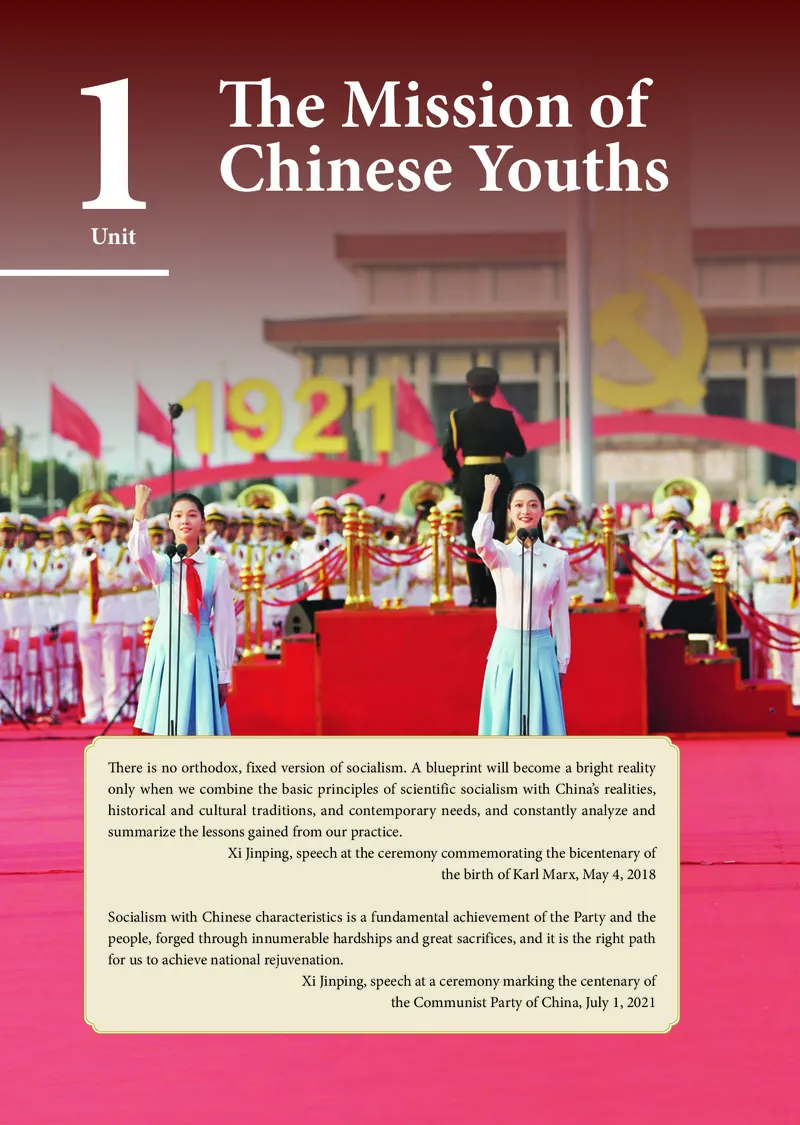
The Mission of
Chinese Youths
Unit
」
There is no orthodox, fixed version of socialism. A blueprint will become a bright reality
only when we combine the basic principles of scientific socialism with China’s realities,
historical and cultural traditions, and contemporary needs, and constantly analyze and
summarize the lessons gained from our practice.
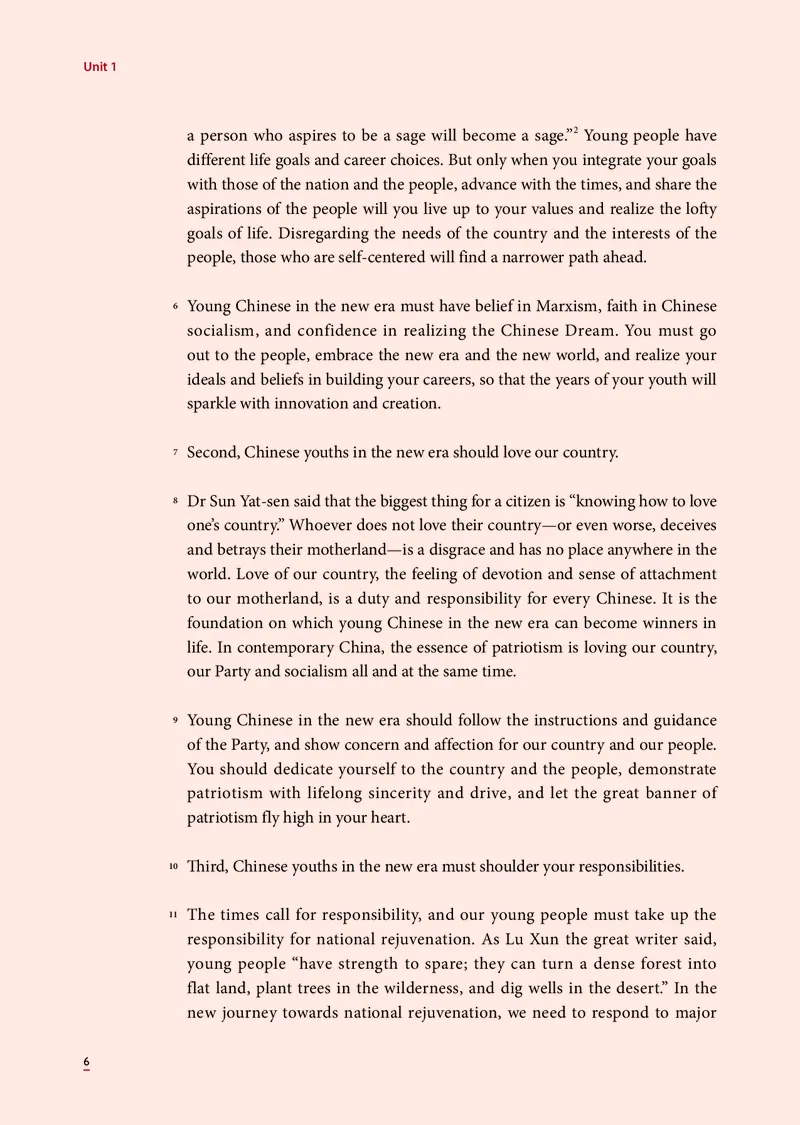
Xi Jinping, speech at the ceremony commemorating the bicentenary of
the birth of Karl Marx, May 4, 2018
Socialism with Chinese characteristics is a fundamental achievement of the Party and the
people, forged through innumerable hardships and great sacrifices, and it is the right path
for us to achieve national rejuvenation.
Xi Jinping, speech at a ceremony marking the centenary of
the Communist Party of China, July 1, 2021The Mission of Chinese Youths
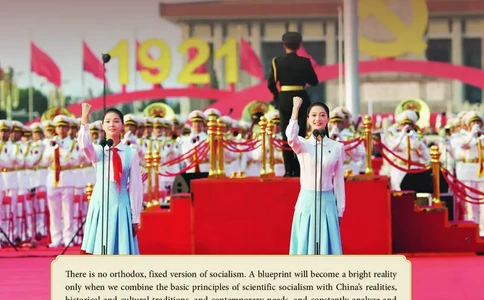
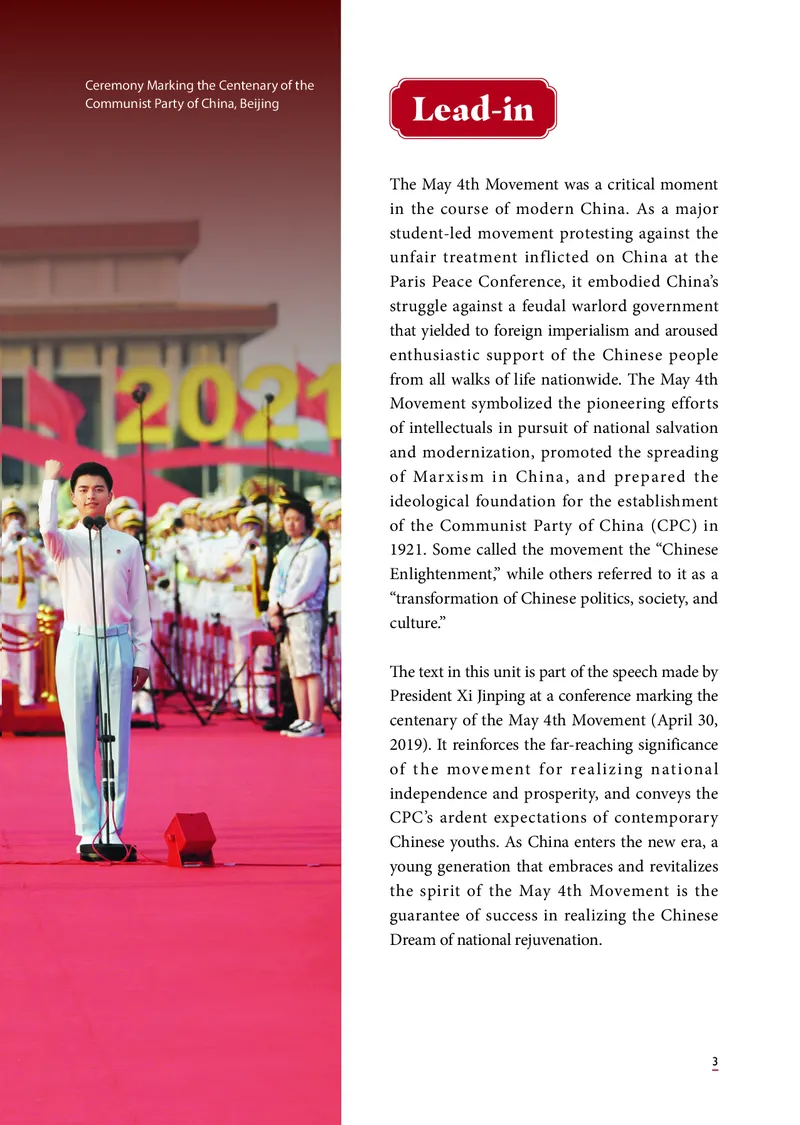
Ceremony Marking the Centenary of the
Communist Party of China, Beijing Lead-in
The May 4th Movement was a critical moment
in the course of modern China. As a major
student-led movement protesting against the
unfair treatment inflicted on China at the
Paris Peace Conference, it embodied China’s
struggle against a feudal warlord government
that yielded to foreign imperialism and aroused
enthusiastic support of the Chinese people
from all walks of life nationwide. The May 4th
Movement symbolized the pioneering efforts
of intellectuals in pursuit of national salvation
and modernization, promoted the spreading
of Marxism in China, and prepared the
ideological foundation for the establishment
of the Communist Party of China (CPC) in
1921. Some called the movement the “Chinese
Enlightenment,” while others referred to it as a
“transformation of Chinese politics, society, and
culture.”
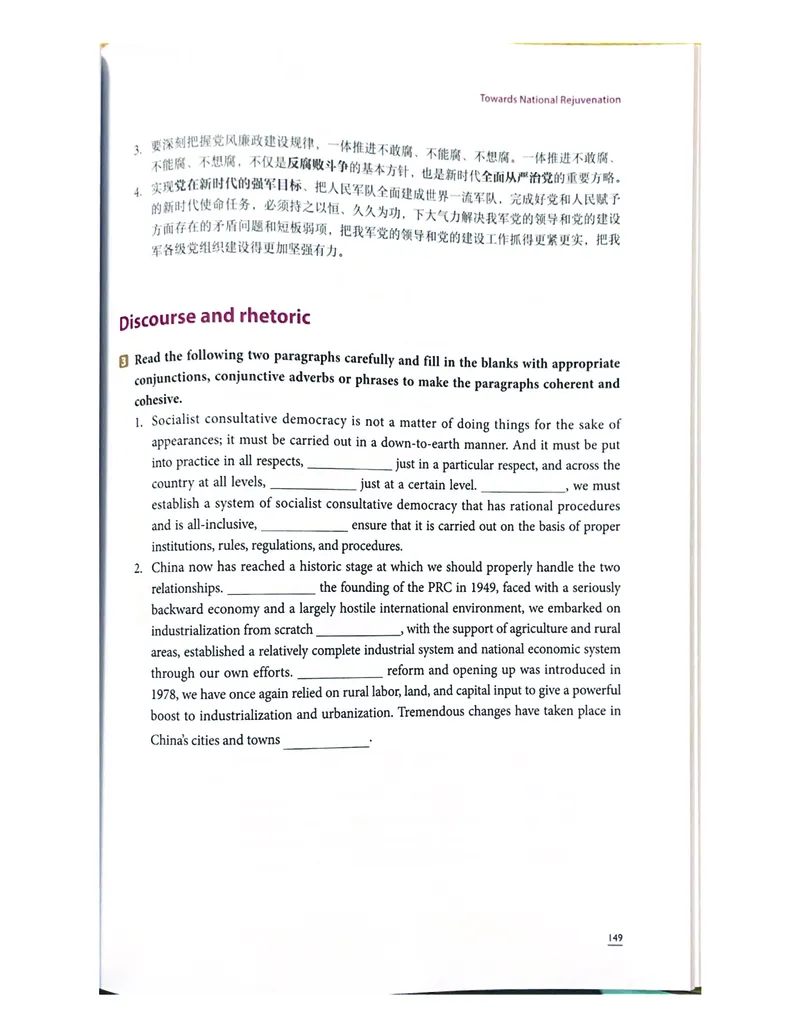
The text in this unit is part of the speech made by
President Xi Jinping at a conference marking the
centenary of the May 4th Movement (April 30,
2019). It reinforces the far-reaching significance
of the movement for realizing national
independence and prosperity, and conveys the
CPC’s ardent expectations of contemporary
Chinese youths. As China enters the new era, a
young generation that embraces and revitalizes
the spirit of the May 4th Movement is the
guarantee of success in realizing the Chinese
Dream of national rejuvenation.
3Unit 1
Read and Respond
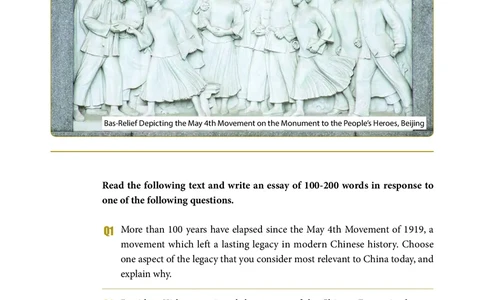
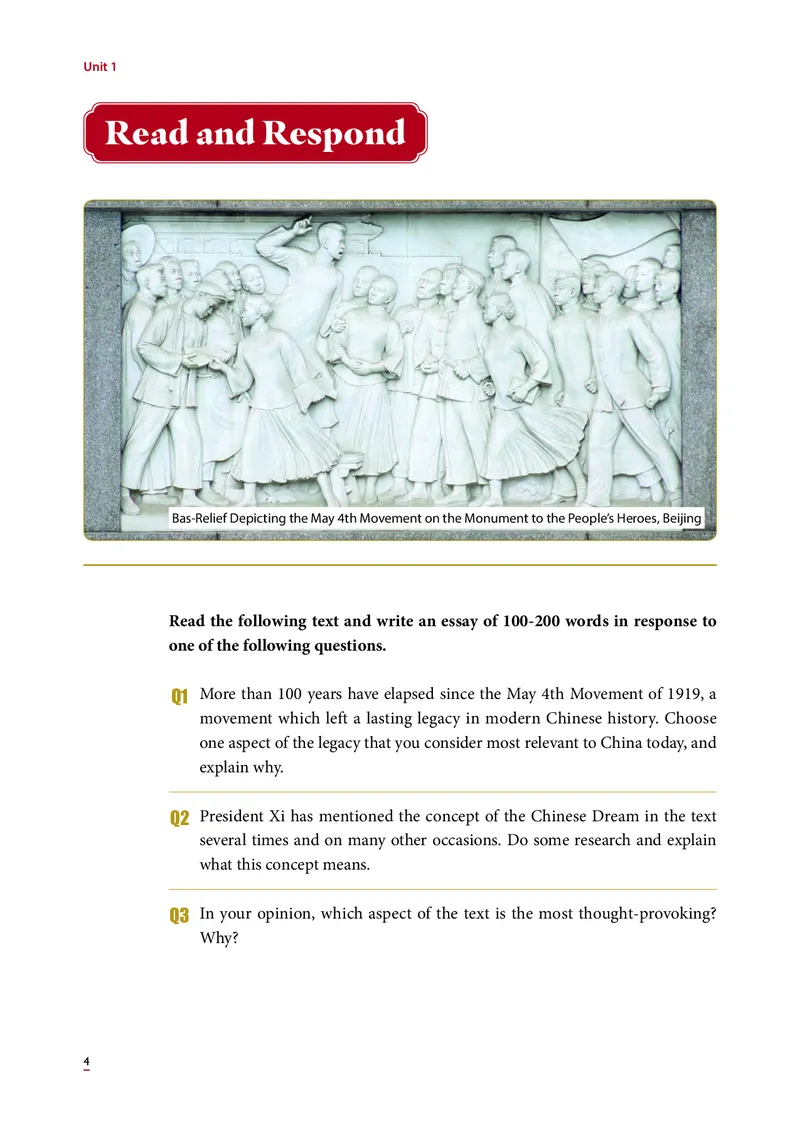
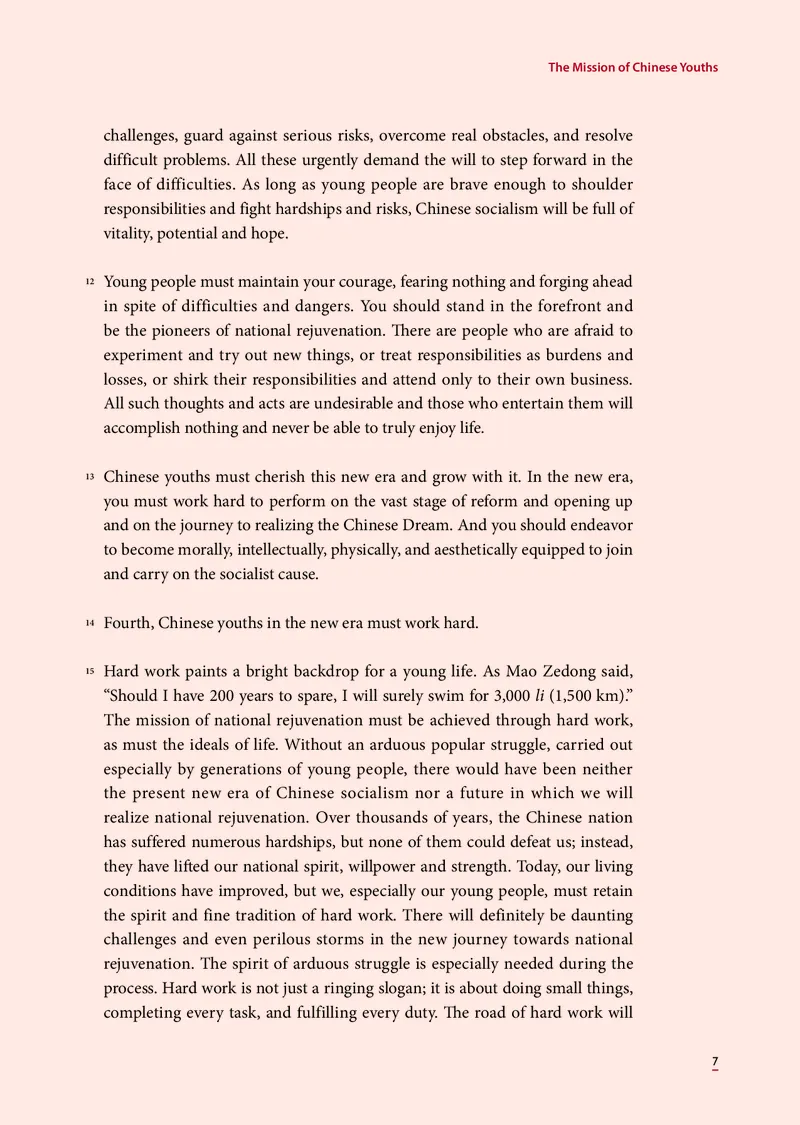
Bas-Relief Depicting the May 4th Movement on the Monument to the People’s Heroes, Beijing
Read the following text and write an essay of 100-200 words in response to
one of the following questions.
Q1 More than 100 years have elapsed since the May 4th Movement of 1919, a
movement which left a lasting legacy in modern Chinese history. Choose
one aspect of the legacy that you consider most relevant to China today, and
explain why.
Q2 President Xi has mentioned the concept of the Chinese Dream in the text
several times and on many other occasions. Do some research and explain
what this concept means.
Q3 In your opinion, which aspect of the text is the most thought-provoking?
Why?
4The Mission of Chinese Youths
Text
Carry On the Legacy of the May
4th Movement, and Be Worthy
of the New Era
1 Under the leadership of the Party, we have opened up the path of Chinese
socialism, formed its theoretical framework, established its system,
developed its culture, and brought it into a new era. The Chinese people have
unprecedented confidence in the path, theory, system and culture of Chinese
socialism, and the prospects for national rejuvenation have never been brighter.
2 In the new era, the theme and direction of the Chinese youth movement and
the mission of Chinese youths are to uphold the leadership of the CPC, and
work along with other people to realize the Two Centenary Goals1 and the
Chinese Dream of national rejuvenation.
3 Youth is the most active and energetic element among all forces in society. You
are the hope and future of our country. Today, in the most promising period
of the Chinese nation, young Chinese are endowed with rare opportunities to
achieve things, and the mission to shoulder great responsibilities. In this new
era, you should continue to carry forward the spirit of the May 4th Movement
and take on your mission to realize national rejuvenation. You should meet
the expectations of our Party and our people, be worthy of the trust of the
nation, and live up to the demands of this great era.
4 First, Chinese youths in the new era should establish great ideals.
5 The ideals and beliefs of youths have a bearing on the future of a country.
Young people with great ideals and firm beliefs are the driving force that
builds an invincible nation. High ambitions can stimulate your potential to
forge ahead, so that you will not drift aimlessly like a boat without a rudder.
It is said that “a person who aspires to be a saint will become a saint; and
5Unit 1
a person who aspires to be a sage will become a sage.”2 Young people have
different life goals and career choices. But only when you integrate your goals
with those of the nation and the people, advance with the times, and share the
aspirations of the people will you live up to your values and realize the lofty
goals of life. Disregarding the needs of the country and the interests of the
people, those who are self-centered will find a narrower path ahead.
6 Young Chinese in the new era must have belief in Marxism, faith in Chinese
socialism, and confidence in realizing the Chinese Dream. You must go
out to the people, embrace the new era and the new world, and realize your
ideals and beliefs in building your careers, so that the years of your youth will
sparkle with innovation and creation.
7 Second, Chinese youths in the new era should love our country.
8 Dr Sun Yat-sen said that the biggest thing for a citizen is “knowing how to love
one’s country.” Whoever does not love their country—or even worse, deceives
and betrays their motherland—is a disgrace and has no place anywhere in the
world. Love of our country, the feeling of devotion and sense of attachment
to our motherland, is a duty and responsibility for every Chinese. It is the
foundation on which young Chinese in the new era can become winners in
life. In contemporary China, the essence of patriotism is loving our country,
our Party and socialism all and at the same time.
9 Young Chinese in the new era should follow the instructions and guidance
of the Party, and show concern and affection for our country and our people.
You should dedicate yourself to the country and the people, demonstrate
patriotism with lifelong sincerity and drive, and let the great banner of
patriotism fly high in your heart.
10 Third, Chinese youths in the new era must shoulder your responsibilities.
11 The times call for responsibility, and our young people must take up the
responsibility for national rejuvenation. As Lu Xun the great writer said,
young people “have strength to spare; they can turn a dense forest into
flat land, plant trees in the wilderness, and dig wells in the desert.” In the
new journey towards national rejuvenation, we need to respond to major
6The Mission of Chinese Youths
challenges, guard against serious risks, overcome real obstacles, and resolve
difficult problems. All these urgently demand the will to step forward in the
face of difficulties. As long as young people are brave enough to shoulder
responsibilities and fight hardships and risks, Chinese socialism will be full of
vitality, potential and hope.
12 Young people must maintain your courage, fearing nothing and forging ahead
in spite of difficulties and dangers. You should stand in the forefront and
be the pioneers of national rejuvenation. There are people who are afraid to
experiment and try out new things, or treat responsibilities as burdens and
losses, or shirk their responsibilities and attend only to their own business.
All such thoughts and acts are undesirable and those who entertain them will
accomplish nothing and never be able to truly enjoy life.
13 Chinese youths must cherish this new era and grow with it. In the new era,
you must work hard to perform on the vast stage of reform and opening up
and on the journey to realizing the Chinese Dream. And you should endeavor
to become morally, intellectually, physically, and aesthetically equipped to join
and carry on the socialist cause.
14 Fourth, Chinese youths in the new era must work hard.
15 Hard work paints a bright backdrop for a young life. As Mao Zedong said,
“Should I have 200 years to spare, I will surely swim for 3,000 li (1,500 km).”
The mission of national rejuvenation must be achieved through hard work,
as must the ideals of life. Without an arduous popular struggle, carried out
especially by generations of young people, there would have been neither
the present new era of Chinese socialism nor a future in which we will
realize national rejuvenation. Over thousands of years, the Chinese nation
has suffered numerous hardships, but none of them could defeat us; instead,
they have lifted our national spirit, willpower and strength. Today, our living
conditions have improved, but we, especially our young people, must retain
the spirit and fine tradition of hard work. There will definitely be daunting
challenges and even perilous storms in the new journey towards national
rejuvenation. The spirit of arduous struggle is especially needed during the
process. Hard work is not just a ringing slogan; it is about doing small things,
completing every task, and fulfilling every duty. The road of hard work will
7Unit 1
not be smooth, instead it will be cobbled with hardships and full of ups and
downs. The strong can always rise from setbacks; they are never discouraged.
16 In the new era young Chinese must forge ahead as brave and devoted
pioneers in the forefront of the times against all difficulties and obstacles, and
work hard to blaze new trails, achieve successes and create miracles that will
astonish the world.
17 Fifth, Chinese youths in the new era must have remarkable abilities.
18 Youth is a golden age for developing skills through hard work. “If you idle
away your youth and achieve nothing, it’s no good lamenting in old age.”3
19 In this new era, knowledge updates quickly, the social division of labor is
becoming more refined, and new technologies, models, and forms of business
are emerging one after another. This not only provides a broad stage for young
people to display your talents, but also raises new and higher requirements for
your abilities. To achieve your ideals or to shoulder the mission of the times,
young people must cherish and do justice to the prime of youth, study hard
to acquire scientific knowledge, improve your capabilities, hone your skills,
and keep up with new developments around the world in terms of thinking,
vision, ideas, and level of understanding.
20 Chinese youths in the new era must have a stronger sense of urgency in
learning, and work hard on studying the Marxist stance, viewpoint and
methodology. You must master knowledge of science and culture and
professional expertise. You must improve your attainment in humanities by
educating yourselves and tempering your character through study. You must
acquire more skills and become more professionally competent at work, so
that you will be able to serve the people and make innovative and creative
contributions to the country.
21 Sixth, Chinese youths in the new era should temper your moral character.
22 A person cannot succeed without virtues. This makes morality essential.
The Chinese nation has been trying to attain moral qualities that repose
in the heights of excellence. To build China into a strong modern socialist
8The Mission of Chinese Youths
country, we must enrich ourselves not only materially but culturally and
ethically. Cultural and ethical progress is more lasting, more profound and
more powerful. Young people must integrate sound moral appreciation
and conscious moral development with active moral practice, to improve
yourselves and maintain moral integrity. This way you will travel further in
the correct direction on the path of life.
23 Faced with a complex and changing international landscape, young people
must differentiate between truth and falsehood and keep to the right path,
and never blindly follow what others say or do. Facing temptation from the
outside world, you must remain resolute, strictly abide by rules, create a
better life with hard and honest work, and never be opportunistic or become
conceited. While enjoying the good times, you should remember those who
fought to make the present possible and work to repay them. You should be
grateful to the Party, the country, the society and the people. You are expected
to go through hardships, understand what life entails, get to know people’s
concerns and real problems, and identify the true meaning and value of life
and work.
24 In the new era young people must nurture and practice the core socialist
values, draw nourishment from traditional Chinese virtues, learn from heroes
and role models of the times, and enhance your moral integrity through
introspection. You should recognize illustrious virtue, follow social ethics, and
restrict personal desires, while guarding against temptations such as worship
of money, self-indulgence, overly self-centered pursuits, and historical
nihilism. You should aim high and look far to pursue a more lofty and
fulfilling life, so that integrity and vitality will prevail throughout our society.
Notes
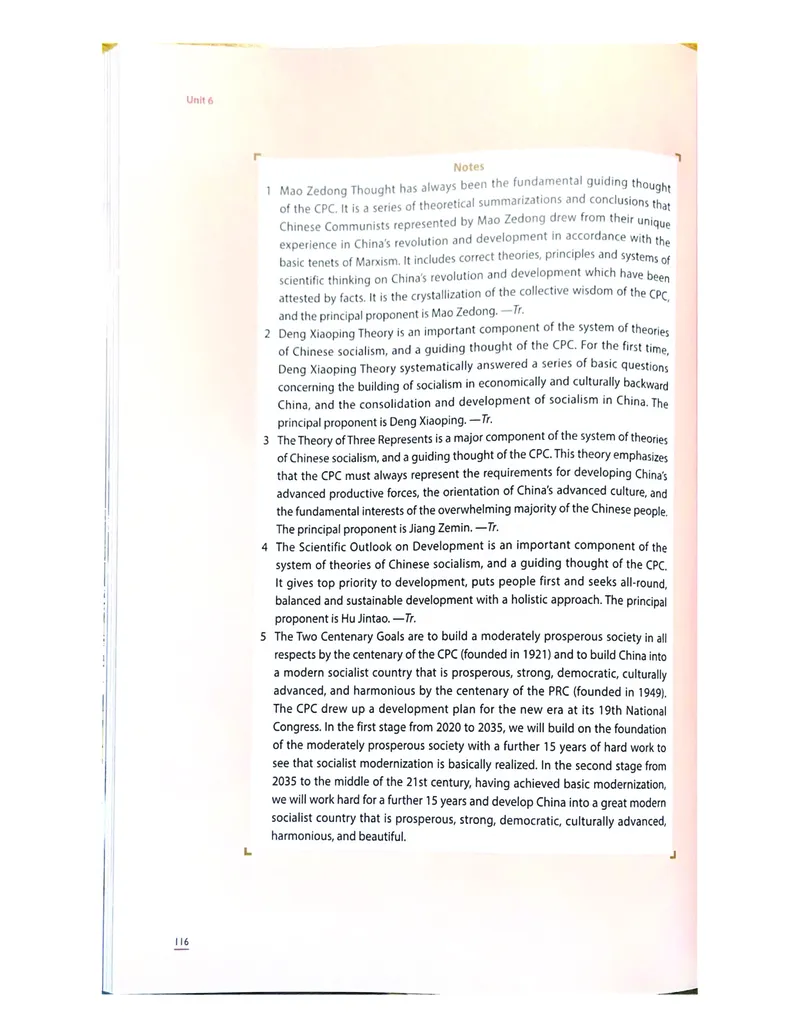
1 The Two Centenary Goals were put forth by the CPC at its 18th National
Congress in November 2012 for building socialism with Chinese characteristics.
See Note 5, Page 116 for detailed information.
2 Wang Shouren: Rules for Students at Longchang (Jiao Tiao Shi Long Chang Zhu
Sheng). Wang Shouren (1472-1529), better known as Wang Yangming, was a
neo-Confucian philosopher and educator of the Ming Dynasty.
3 Quan Deyu: “A Reflection on My Life” (Fang Ge Xing). Quan Deyu (759-818) was
a writer and official of the Tang Dynasty.
9Unit 1
Analytical Reading
Understanding the text
1 The following outline presents an overview of the text. Fill in the blanks to complete
the outline.
Part I (Paras. 1-3): The mission of Chinese youths in the new era
To uphold the , and work along with other people to
realize the and the Chinese Dream of .
Part II (Paras. 4-24): How Chinese youths can accomplish the mission in the
new era
• First, .
• Second, .
• Third, .
• Fourth, .
• Fifth, .
• Sixth, .
2 Discuss the following questions in pairs and share your ideas in class.
1. President Xi says, “Youth is the most active and energetic element among all forces
in society. You are the hope and future of our country.” (Para. 3) Find other sayings,
proverbs or famous quotes about the importance of youth for society.
2. How do you interpret the spirit of the May 4th Movement?
3. Why should Chinese youths in the new era establish great ideals?
4. President Xi says, “In contemporary China, the essence of patriotism is loving our
country, our Party and socialism all and at the same time.” (Para. 8) What does this
statement imply?
5. How can young people “truly enjoy life” according to President Xi?
10The Mission of Chinese Youths
6. Working hard is a glorious tradition of the CPC, a tradition which contributed to the
success of the Chinese revolution. Why does President Xi stress the need for Chinese
youths to carry on this tradition in the new era? How might this be interpreted under
today’s circumstances?
7. In this text President Xi encourages Chinese youths in the new era to develop
remarkable abilities to achieve ideals and shoulder the mission of the times. What
particular abilities do you think you must develop at college to prepare yourself for
future challenges?
8. What particular virtues does President Xi highlight as fundamental for Chinese
youths? Which virtue is most relevant to you personally? Why? What else would you
like to add to the list?
9. President Xi says, “Faced with a complex and changing international landscape, young
people must differentiate between truth and falsehood and keep to the right path,
and never blindly follow what others say or do.” (Para. 23) What do you think young
people can do at college to cultivate such a quality?
Critical thinking
3 Discuss one of the following questions in small groups and share your ideas in class.
1. “Mr Democracy” and “Mr Science” were advocated by the youths of the May 4th
Movement period as the two fundamental strategies to save China. In the new era,
they are still regarded as pivotal by the CPC. Use examples to illustrate the importance
of democracy and science in our pursuit of national rejuvenation.
2. Each generation has its own mission. Great changes have taken place in China and
the world since the May 4th Movement. What do you think is the mission of your
generation in the new era? How are you going to fulfill your mission personally?
3. President Xi says, only when “you integrate your goals with those of the nation and
the people, advance with the times, and share the aspirations of the people will you
live up to your values and realize the lofty goals of life.” Search for some cases from all
walks of life in China to illustrate how to integrate the goals of individuals with those
of our nation and the people.
11Unit 1
Global Perspectives
Read the following review of the legacy of the May 4th Movement. Write a summary of
200-300 words.
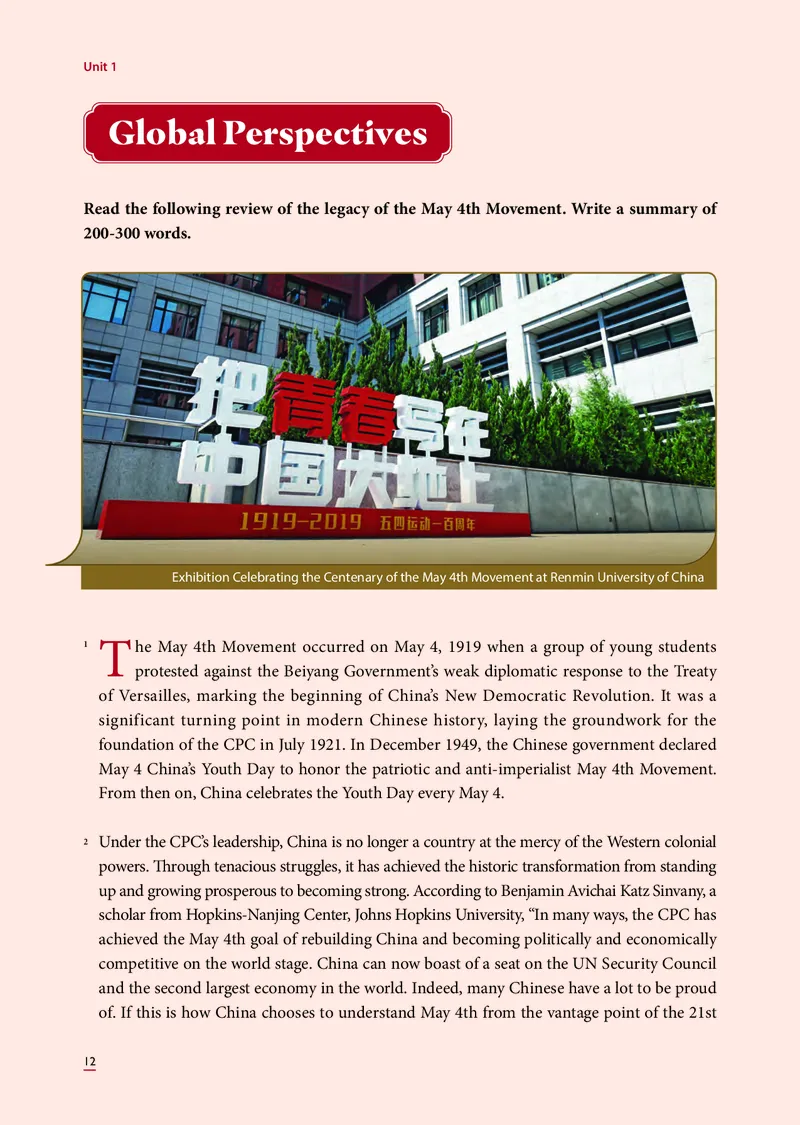
Exhibition Celebrating the Centenary of the May 4th Movement at Renmin University of China
1 The May 4th Movement occurred on May 4, 1919 when a group of young students
protested against the Beiyang Government’s weak diplomatic response to the Treaty
of Versailles, marking the beginning of China’s New Democratic Revolution. It was a
significant turning point in modern Chinese history, laying the groundwork for the
foundation of the CPC in July 1921. In December 1949, the Chinese government declared
May 4 China’s Youth Day to honor the patriotic and anti-imperialist May 4th Movement.
From then on, China celebrates the Youth Day every May 4.
2 Under the CPC’s leadership, China is no longer a country at the mercy of the Western colonial
powers. Through tenacious struggles, it has achieved the historic transformation from standing
up and growing prosperous to becoming strong. According to Benjamin Avichai Katz Sinvany, a
scholar from Hopkins-Nanjing Center, Johns Hopkins University, “In many ways, the CPC has
achieved the May 4th goal of rebuilding China and becoming politically and economically
competitive on the world stage. China can now boast of a seat on the UN Security Council
and the second largest economy in the world. Indeed, many Chinese have a lot to be proud
of. If this is how China chooses to understand May 4th from the vantage point of the 21st
12The Mission of Chinese Youths
century, then its legacy is one of affirmation for the CPC—that in a time of hardship and
ideological turmoil, the Communist Party provided sound and steadfast guidance to China
and the Chinese people through the tumultuous 20th century.”
3 Today, the May 4th spirit—patriotism, progress, democracy and science—has been passed
down to the young generation in China.
4 The May 4th spirit motivates Chinese youths to uphold patriotism in the new era. For
example, Chinese youths have emerged more confident and more patriotic after the
outbreak of the COVID-19 pandemic. According to a survey by the China Youth Daily, the
average score of national pride among young Chinese aged 18 to 35 was 9.57 out of 10 in
2020, up from 9.18 in a similar survey in 2019. In another survey conducted by the Global
Times Research Center in April 2021, approximately 90 percent of young Chinese believe
China should not “look up to the West” anymore due to multiple reasons, including China’s
socioeconomic development and the West’s failure in handling the COVID-19 pandemic.
When talking about Chinese youths’ remarkable optimism and increasing national pride,
Zak Dychtwald, CEO of Young China Group, said, “There’s the sense that they don’t want
to westernize as they modernize. What they witness in their lifetime is this rags-to-riches
story without parallel on the world stage. And they feel that exceptionalism. They are
proud of that.”
5 The May 4th spirit inspires Chinese youths to play a pioneering role in helping realize
China’s national rejuvenation. In the new era, Chinese youths are indeed the pioneers in the
process of China’s realization of national rejuvenation, making remarkable achievements
on the front line in many areas of society. Two typical examples are the Chang’e-4 lunar
landing mission team and the Beidou team. The average age of the Chang’e-4 lunar landing
mission team was 33 years old. Due to its outstanding achievement of completing the
first soft landing on the far side of the moon, the Chang’e-4 lunar landing mission team
was awarded the Team Gold Medal by the British Royal Aeronautical Society (RAeS) in
November 2019, making it the first team from China to be awarded the Team Gold Medal
since the inception of the RAeS in 1866. The average age of the Beidou team was 35 years
old. It is because of this team’s great contribution that China has managed to break the
West’s technological monopoly of the Navigation Satellite System.
6 Today, Chinese youths are expected to connect their own destiny with the destiny of
China and contribute their share to national rejuvenation, at a time when China faces very
different challenges and international responsibilities than it did over 100 years ago.
13Unit 1
Telling
China’s Story
to the World
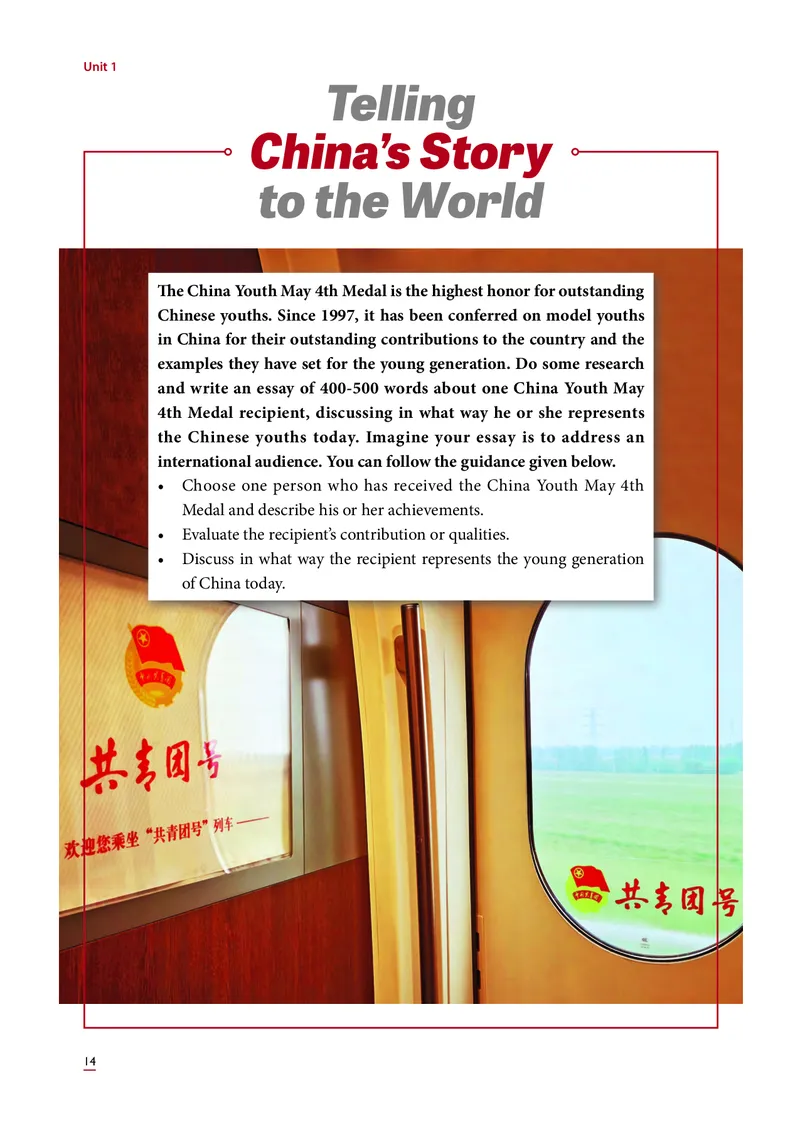
The China Youth May 4th Medal is the highest honor for outstanding
Chinese youths. Since 1997, it has been conferred on model youths
in China for their outstanding contributions to the country and the
examples they have set for the young generation. Do some research
and write an essay of 400-500 words about one China Youth May
4th Medal recipient, discussing in what way he or she represents
the Chinese youths today. Imagine your essay is to address an
international audience. You can follow the guidance given below.
• Choose one person who has received the China Youth May 4th
Medal and describe his or her achievements.
• Evaluate the recipient’s contribution or qualities.
• Discuss in what way the recipient represents the young generation
of China today.
14The Mission of Chinese Youths
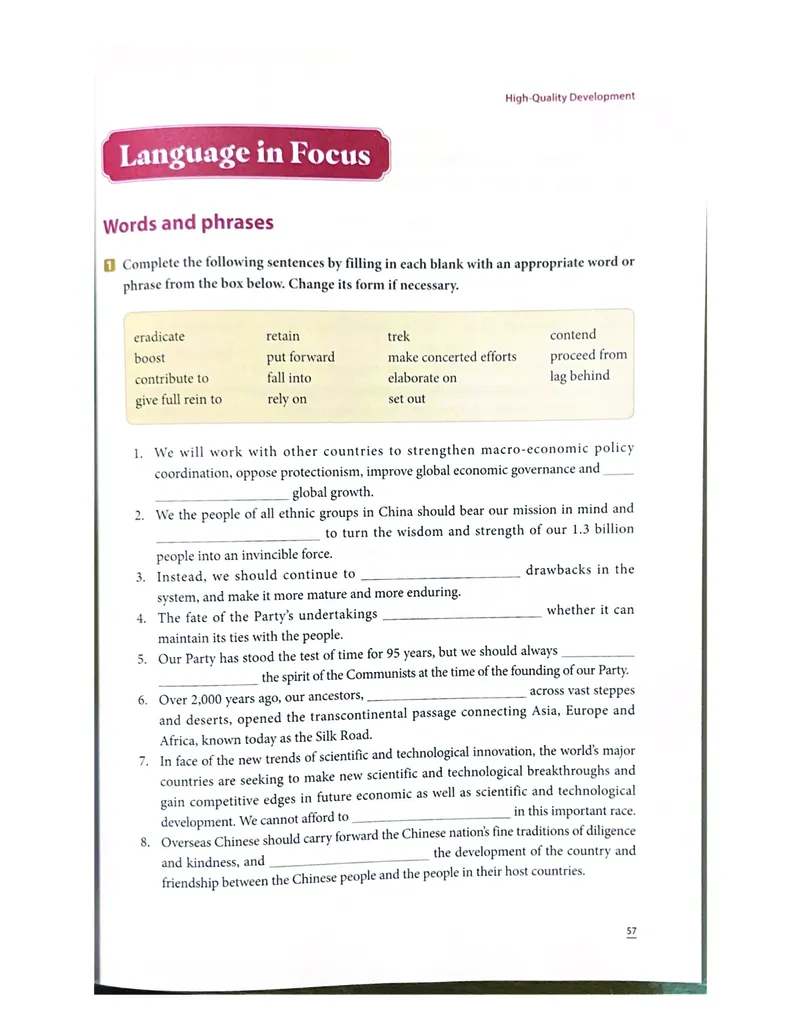
Language in Focus
Words and phrases
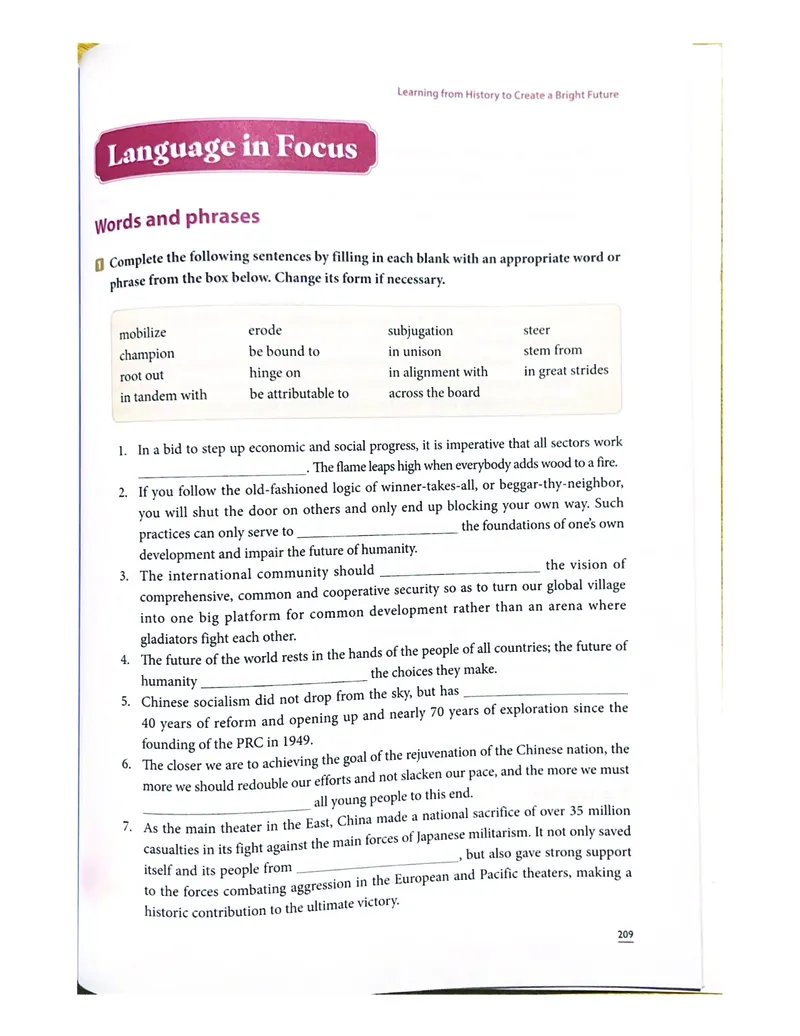
1 Complete the following sentences by filling in each blank with an appropriate word or
phrase from the box below. Change its form if necessary.
hone prevail blaze temper
embrace endow…with live up to do justice to
aspire to have a bearing on ups and downs forge ahead
attend to be worthy of try out
1. The Decision proposes reform measures to improve the mechanisms and institutions
for the integrated development of urban and rural areas: One, accelerating the
building of a new type of agricultural operation system. Two, farmers
more property rights. Three, promoting equal exchanges of factors of
production and balanced allocation of public resources between urban and rural areas.
2. Let our officials be true and practical, dedicated to work and bold to shoulder their
responsibilities, so as to the expectations of history and
the people.
3. The people a better education, more stable jobs, higher
incomes, reliable social security, better medical and health care, improved housing
conditions, a beautiful environment, and richer intellectual pursuits and cultural
entertainment.
4. Maritime peace the safety and interests of all countries,
and thus needs to be protected and cherished by all.
5. We should have the courage to break new ground and
new experiments, and at the same time, make active yet prudent efforts to advance
reform swiftly and steadily.
6. In implementing this strategy, we should both general
planning and specific, critical problems.
7. When a gentleman errs, his mistake is as visible as a solar or lunar eclipse, but when
he corrects it, he respect again.
8. In general, our relations have been improving over the decades, which is a reflection
of the trend of history, despite the occasional .
15Unit 1
9. Writers and artists should take a people-centered approach and draw inspiration
from everyday life and the experiences of the people to produce works that
our times.
10. After many years of efforts, we have improved people’s conditions and
a development path suited to China’s reality.
11. We will work with our African friends to a new era of
mutually beneficial cooperation and common development.
12. We should enhance our ability to distinguish between right and wrong on political
issues, maintain our political resolve, navigate political currents, and forestall
political risks. A key aspect of this is to the ability to
analyze and resolve problems from a political perspective.
13. We need to promote the core socialist values, strengthen political and moral education,
improve the nomination and commendation of role models who act bravely for justice,
and let integrity and justice in the whole society.
14. Young people should aim high, acquire more knowledge,
their will, and make their formative years richly rewarding ones in an era of progress.
15. Throughout his 70-year political career, he exhibited the indomitable courage to
with reform and an innovative spirit to think ahead and
lead the way forward.
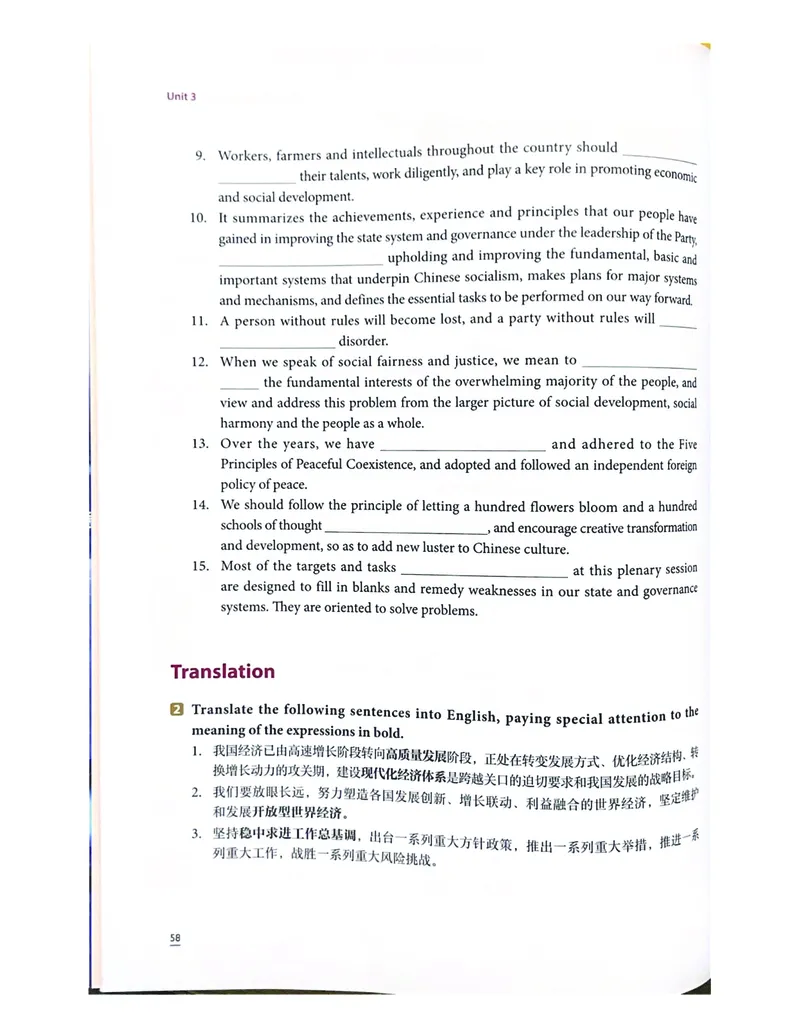
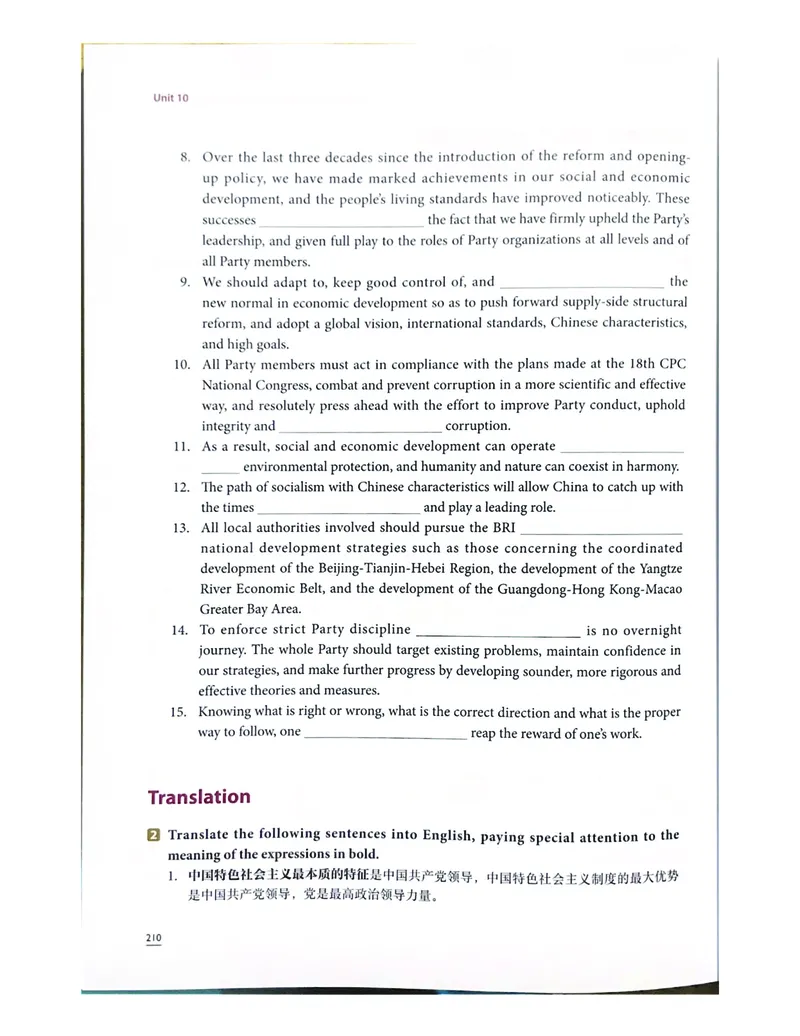
Translation
2 Translate the following sentences into English, paying special attention to the
meaning of the expressions in bold.
1. 新时代中国青年要自觉树立和践行社会主义核心价值观,善于从中华民族传统美德中汲
取道德滋养,从英雄人物和时代楷模的身上感受道德风范,从自身内省中提升道德修为。
2. 勿忘昨天的苦难辉煌,无愧今天的使命担当,不负明天的伟大梦想,以史为鉴、开创未来,埋
头苦干、勇毅前行,为实现第二个百年奋斗目标、实现中华民族伟大复兴的中国梦而不懈奋斗。
3. 新中国成立70年来,我们党领导人民创造了世所罕见的两大奇迹。一是经济快速发展
奇迹……二是社会长期稳定奇迹。
4. 在中国共产党领导下,我们开辟了中国特色社会主义道路,形成了中国特色社会主义理
论体系,建立了中国特色社会主义制度,发展了中国特色社会主义文化,推动中国特色
社会主义进入了新时代。
16The Mission of Chinese Youths
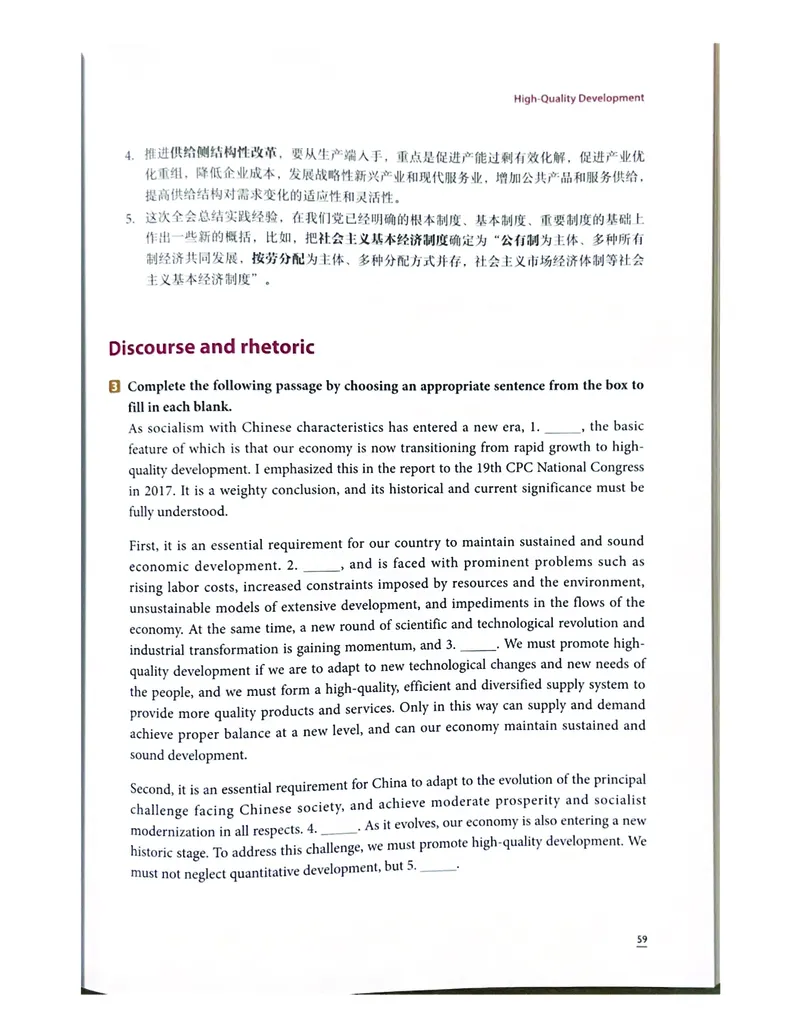
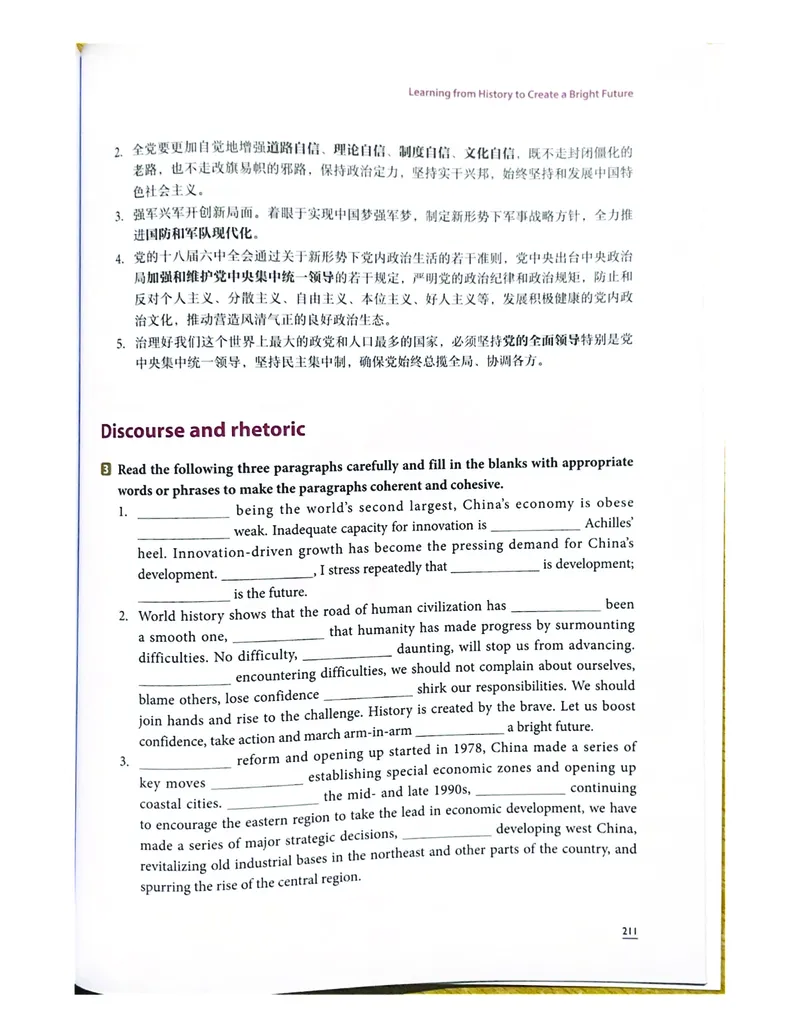
Discourse and rhetoric
3 Complete the following passage by choosing an appropriate sentence from the box to
fill in each blank.
Facing the mighty tide of the times and the great expectations of the people for a better
life, we must not become complacent or slacken off in the slightest. We must redouble our
efforts and forge ahead relentlessly to advance the cause of building Chinese socialism
and endeavor to realize the Chinese Dream of the rejuvenation of the Chinese nation.
—1. It is not an easy path. We are able to embark on this path thanks to the great
endeavors of reform and opening up made in the past 30 years and more, the continuous
quest made in the 60-plus years of the PRC, a thorough review of the evolution of the
Chinese nation in its 170-plus years of modern history, and carrying forward the 5,000-
plus years of Chinese civilization. 2. The Chinese nation has extraordinary
capabilities, with which it has built the great Chinese civilization and with which we can
expand and stay on the development path suited to China’s national conditions. 3.
—To realize the Chinese Dream, we must foster the Chinese spirit. 4. This spirit
unites the people and pools their strength, and it is the source for rejuvenating and
strengthening the country. 5. Our people of all ethnic groups must foster the great
national spirit and follow the call of the times, strengthen our inner bond of unity and
perseverance, and vigorously march towards the future.
A. Patriotism has always been the inner force that binds the Chinese nation
together, and reform and innovation have always been the inner force that
spurs us to keep abreast of the times in the course of reform and opening up.
B. The people of all ethnic groups in China should have full confidence in
the path, theory and system of socialism with Chinese characteristics, and
steadfastly forge ahead along the correct Chinese path.
C. It is the national spirit with patriotism at its core, and it is the spirit of the
times with reform and innovation at its core.
D. This path is deeply rooted in history and broadly based on China’s present realities.
E. To realize the Chinese Dream, we must take our own path, which is the path of
building socialism with Chinese characteristics.
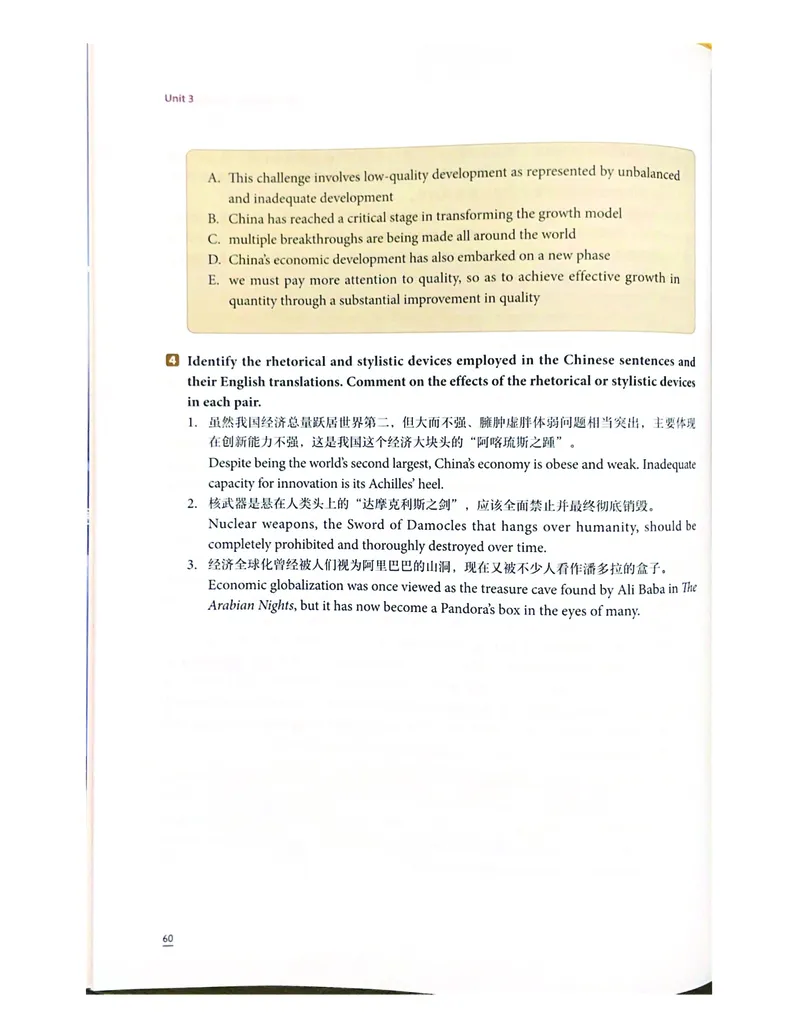
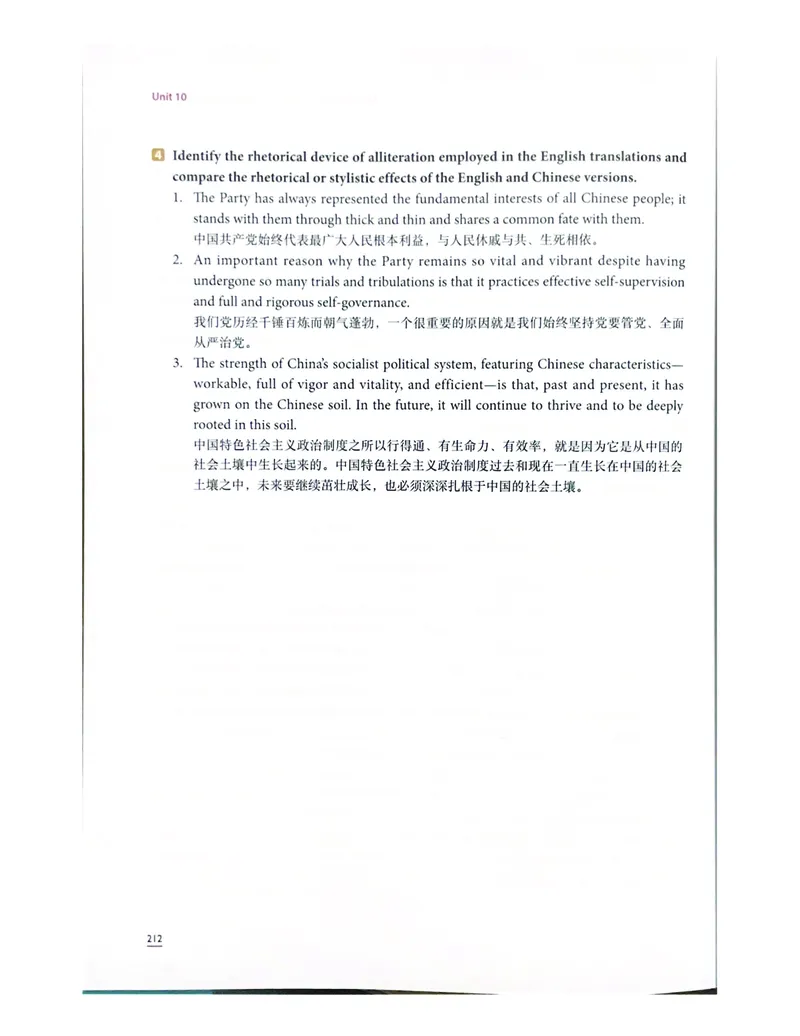
17Unit 1
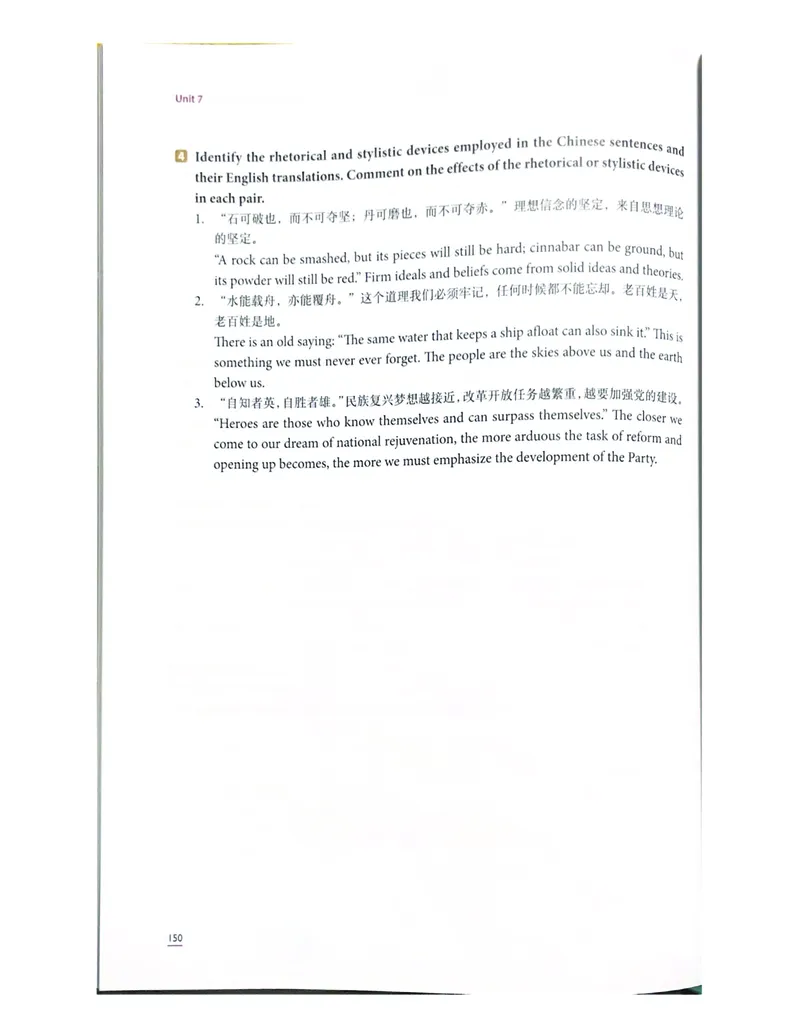
4 Identify the rhetorical and stylistic devices employed in the Chinese sentences and
their English translations. Comment on the effects of the rhetorical or stylistic devices
in each pair.
1. 青年志存高远,就能激发奋进潜力,青春岁月就不会像无舵之舟漂泊不定。
High ambitions can stimulate your potential to forge ahead, so that you will not drift
aimlessly like a boat without a rudder.
2. 奋斗是青春最亮丽的底色。
Hard work paints a bright backdrop for a young life.
3. 在实现中华民族伟大复兴的新征程上,必然会有艰巨繁重的任务,必然会有艰难险阻甚
至惊涛骇浪。
There will definitely be daunting challenges and even perilous storms in the new journey
towards national rejuvenation.
18The Mission of Chinese Youths
Ancient Chinese Wisdom
Explain the following quote and reflect on its contemporary relevance.
Just as heaven keeps moving forward vigorously, a man of
virtue should strive continuously to strengthen himself.
Just like the earth, which is generous and peaceful, a man of
virtue should have ample virtue and accommodate all things.
(天行健,君子以自强不息。地势坤,君子以厚德载物。)
From The Book of Changes (《周易》)
Further Reading
1 “Uphold and Develop Socialism with Chinese Characteristics”, The Governance of
China (Volume I, Pages 23-26)
《毫不动摇坚持和发展中国特色社会主义》,出自《习近平谈治国理政》(第一卷,
第21—24页)
2 “Achieving Rejuvenation Is the Dream of the Chinese People”, The Governance of
China (Volume I, Pages 37-39)
《实现中华民族伟大复兴是中华民族近代以来最伟大的梦想》,出自《习近平谈治
国理政》(第一卷,第35—37页)
3 “Develop and Popularize Marxism in the Modern Chinese Context”, The Governance
of China (Volume II, Pages 68-70)
《继续推进马克思主义中国化时代化大众化》,出自《习近平谈治国理政》(第二卷,
第65—68页)
198
Harmony Without
Uniformity
Unit
Diversity spurs interaction among civilizations, which in turn promotes mutual learning
and further development.
Xi Jinping, keynote speech at the opening ceremony of the Conference on
Dialogue of Asian Civilizations, May 15, 2019
We must uphold the greater good and pursue shared interests. This means we should act
in good faith, value friendship, champion moral principles and uphold justice.
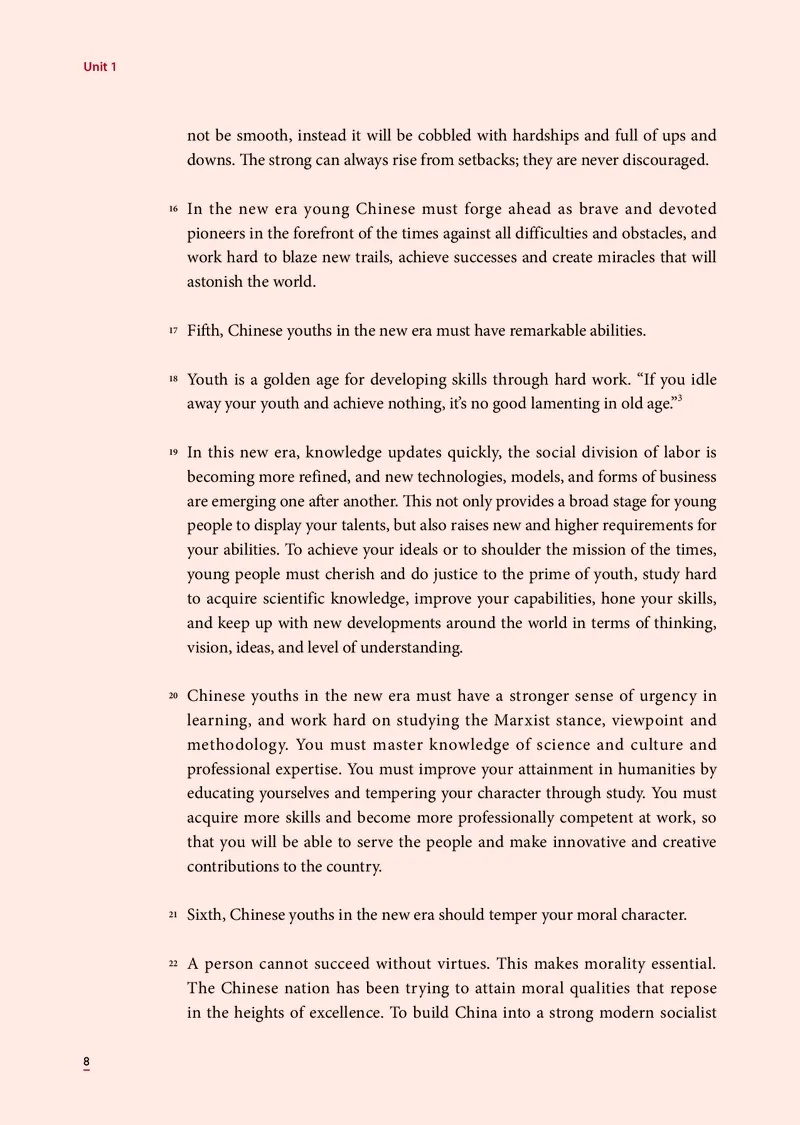
Xi Jinping, speech at the Central Conference on Foreign Affairs, November 28, 2014Harmony Without Uniformity
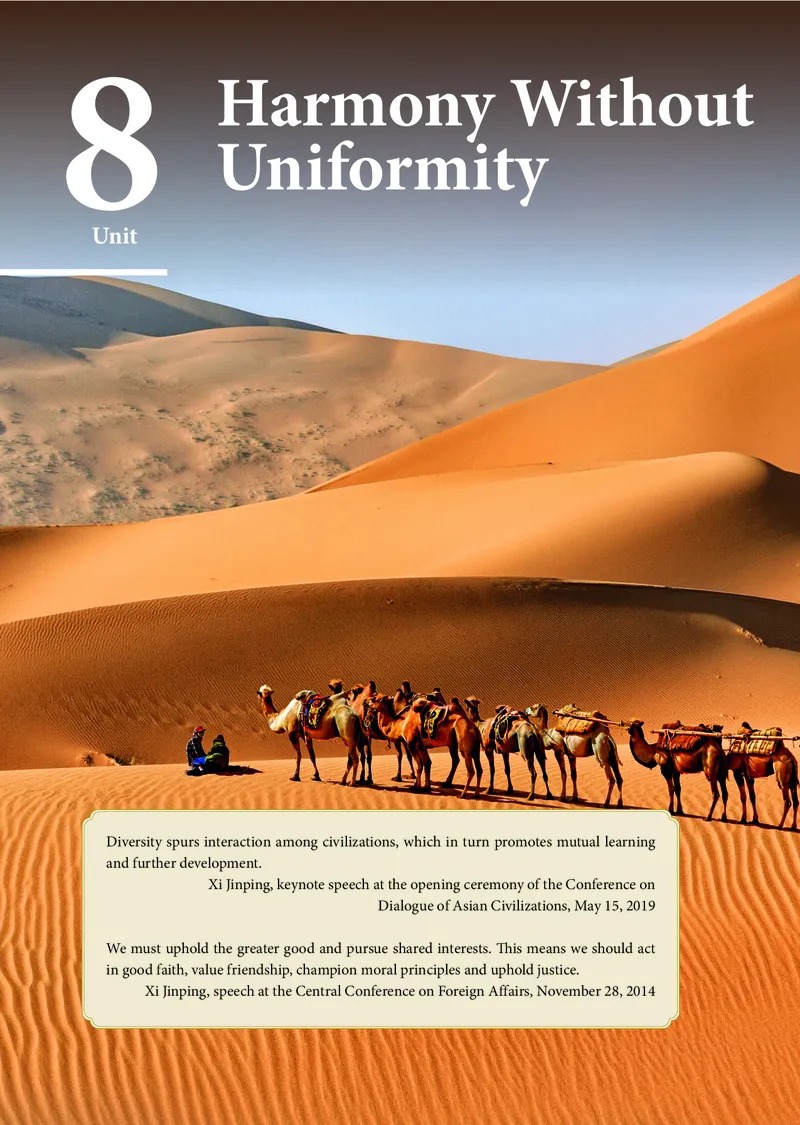
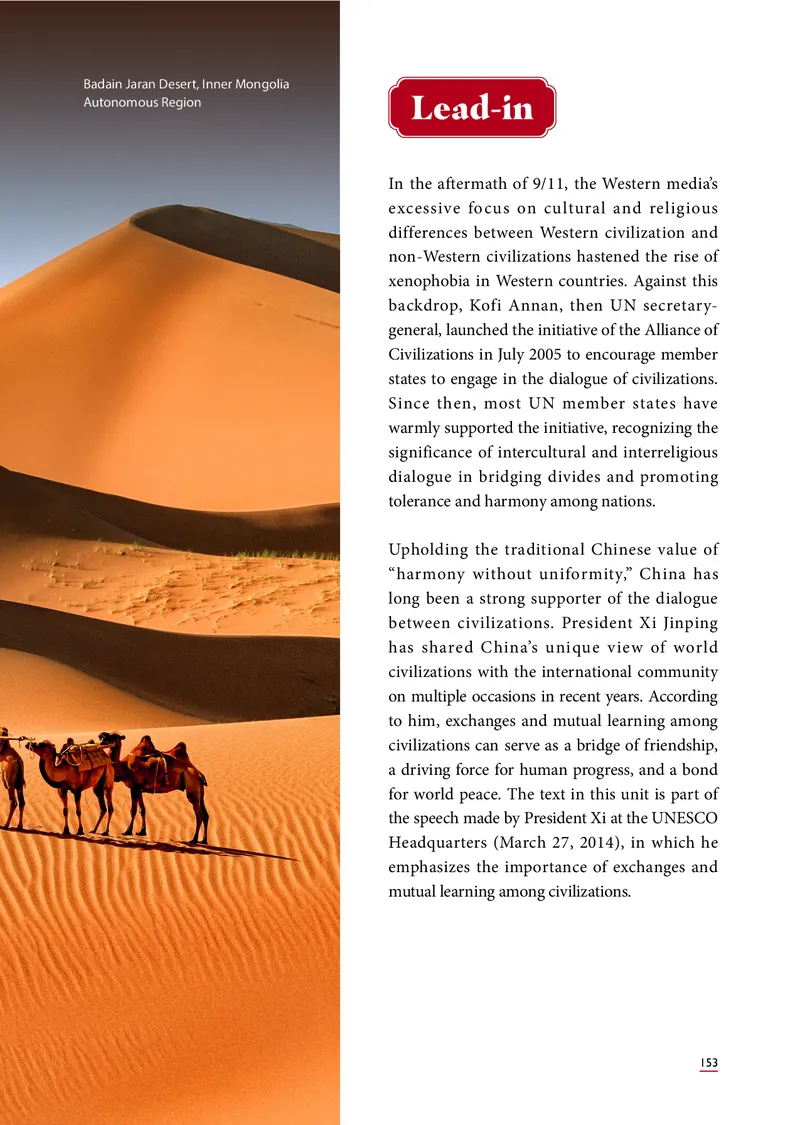
Badain Jaran Desert, Inner Mongolia
Autonomous Region Lead-in
In the aftermath of 9/11, the Western media’s
excessive focus on cultural and religious
differences between Western civilization and
non-Western civilizations hastened the rise of
xenophobia in Western countries. Against this
backdrop, Kofi Annan, then UN secretary-
general, launched the initiative of the Alliance of
Civilizations in July 2005 to encourage member
states to engage in the dialogue of civilizations.
Since then, most UN member states have
warmly supported the initiative, recognizing the
significance of intercultural and interreligious
dialogue in bridging divides and promoting
tolerance and harmony among nations.
Upholding the traditional Chinese value of
“harmony without uniformity,” China has
long been a strong supporter of the dialogue
between civilizations. President Xi Jinping
has shared China’s unique view of world
civilizations with the international community
on multiple occasions in recent years. According
to him, exchanges and mutual learning among
civilizations can serve as a bridge of friendship,
a driving force for human progress, and a bond
for world peace. The text in this unit is part of
the speech made by President Xi at the UNESCO
Headquarters (March 27, 2014), in which he
emphasizes the importance of exchanges and
mutual learning among civilizations.
153Unit 8
Read and Respond
Read the following text and write an essay of 100-200 words in response to
one of the following questions.
Q1 What are the potential benefits of exchanges and mutual learning among
civilizations?
Q2 What are the major obstacles to exchanges and mutual learning among
civilizations?
Q3 In your opinion, which aspect of the text is the most thought-provoking?
Why?
154Harmony Without Uniformity
Text
Exchanges and Mutual
Learning Make Civilizations
Richer and More Colorful
1 Civilizations become richer and more colorful through exchanges and
mutual learning, which form an important driver for human progress
and global peace and development.
2 To promote exchanges and mutual learning among civilizations we must
adopt a correct approach with some important principles. They, in my view,
contain the following:
3 First, civilizations come in different colors, and such diversity has made
exchanges and mutual learning among civilizations relevant and valuable.
Just as the sunlight has seven colors, our world is a place of dazzling colors.
A civilization is the collective memory of a country or a nation. Throughout
history, mankind has created and developed many colorful civilizations,
from the earliest days of primitive hunting to the period of agriculture, and
from booming industrial revolution to the information society. Together,
they present a magnificent genetic map of the exciting march of human
civilizations.
4 “A single flower does not make spring, while one hundred flowers in full
blossom bring spring to the garden.” If there were only one kind of flower in
the world, people would find it boring no matter how beautiful it was. Be it
Chinese civilization or other civilizations in the world, they are all fruits of
human progress.
5 I have visited the Louvre Museum in France and the Palace Museum in China,
both of which house millions of art treasures. They are attractive because they
155Unit 8
present the richness of diverse civilizations. Exchanges and mutual learning
among civilizations must not be built on the exclusive praise or belittling
of one particular civilization. As early as over 2,000 years ago, the Chinese
people came to recognize that “it is natural for things to be different.”1 Greater
exchanges and mutual learning among civilizations can further enrich the
colors of various civilizations and the cultural life of people and open up still
greater alternatives in the future.
6 Second, civilizations are equal, and such equality has made exchanges and
mutual learning among civilizations possible. All human civilizations are
equal in value, and they all have their respective strengths and weaknesses.
No civilization is perfect on the planet. Nor is it devoid of merit. No single
civilization can be judged superior to another.
7 I have visited many places in the world. What interested me most during the
trips was to learn about differing civilizations across the five continents, what
makes them different and unique, how their people think about the world
and life and what they hold dear. I have visited Chichen Itza, a window on the
ancient Maya civilization, and the Central Asian city of Samarkand, an icon of
the ancient Islamic civilization. It is my keenly felt conviction that an attitude
of equality and modesty is required if one wants to truly understand various
civilizations. Taking a condescending attitude towards a civilization cannot
help anyone to appreciate its essence, and may risk antagonizing it. Both
history and reality show that pride and prejudice are the biggest obstacles to
exchanges and mutual learning among civilizations.
8 Third, civilizations are inclusive, and such inclusiveness has given exchanges
and mutual learning among civilizations the impetus to move forward. The
ocean is vast because it refuses no rivers. All civilizations are crystallizations
of mankind’s diligence and wisdom. Every civilization is unique. Copying
other civilizations blindly or mechanically is like cutting one’s toes to fit one’s
shoes—impossible and highly detrimental. All achievements of civilizations
deserve our respect and must be cherished.
9 History proves that only by interacting with and learning from others can
a civilization enjoy full vitality. If all civilizations are inclusive, the so-called
“clash of civilizations” can be avoided and the harmony of civilizations will
156Harmony Without Uniformity
become reality; as a Chinese saying goes, “Radish or cabbage, each to his own
delight.”
10 Having gone through over 5,000 years of vicissitudes, the Chinese civilization
has always kept to its original root. As an icon, it contains the most profound
pursuits of the Chinese nation and provides it with abundant nourishment
for existence and development. Deriving from Chinese soil, it has come to
its present form through constant exchanges with and learning from other
civilizations.
11 In the 2nd century BC, China started the Silk Road2 leading to the Western
Regions. In 138 BC and 119 BC, Envoy Zhang Qian3 of the Han Dynasty (206
BC-AD 220) made two trips to those regions, disseminating Chinese culture
and bringing into China grapes, alfalfa, pomegranates, flax, sesame and other
products.
12 During the Western Han Dynasty (206 BC-AD 25), China’s merchant fleets
sailed as far as India and Sri Lanka where they traded China’s silk for colored
glaze, pearls and other products.
13 The Tang Dynasty (618-907) saw dynamic interactions between China and
other countries. Historical records reveal that China exchanged envoys with
more than 70 countries, and Chang’an, the capital of Tang, bustled with
envoys, merchants and students from other countries. Exchanges of such
a magnitude helped spread Chinese culture to the rest of the world and
introduce other cultures and products to China.
14 During the early 15th century, Zheng He4, a famous navigator of the Ming
Dynasty (1368-1644), made seven expeditions to the Western Seas, reaching
many Southeast Asian countries and even Kenya on the eastern coast of
Africa, leaving behind many stories of friendly exchanges between China and
countries along the route.
15 During the late Ming and early Qing (1644-1911) dynasties, the Chinese
people began to access modern science and technology through the
introduction of European knowledge in the realms of astronomy, medicine,
mathematics, geometry and geography, which helped broaden the horizons of
157Unit 8
Chinese people. Thereafter, exchanges and mutual learning between Chinese
civilization and other civilizations became more frequent. Naturally, there
were conflicts, frictions, bewilderment and denial, but the more dominant
features of the period were learning, digestion, integration and innovation.
16 Buddhism originated in ancient India. After it was brought to China, the
religion went through an extended period of integrated development with the
indigenous Confucianism and Taoism, and finally became Buddhism with
Chinese features, thus greatly impacting the religious beliefs, philosophy,
literature, art, etiquette and customs of China. Xuan Zang5, an eminent
monk of the Tang Dynasty, who endured untold sufferings as he went on a
pilgrimage to ancient India for Buddhist scriptures, gave full expression to
the determination and fortitude of the Chinese people to learn from other
cultures. I am sure you have heard of the Chinese mythological classical novel
Journey to the West6 based on his stories.
17 The Chinese people enriched Buddhism and developed some special Buddhist
thoughts in the light of Chinese culture, and helped it spread from China to
Japan, Korea, Southeast Asia and beyond.
18 Over the last 2,000 years religions such as Buddhism, Islam and Christianity
have been introduced into China, nurturing the country’s music, painting
and literature. China’s freehand oil painting, for instance, is an innovative
combination of its own traditional painting and Western oil painting, and the
works by Xu Beihong7 and other master painters have been widely acclaimed.
China’s Four Great Inventions—papermaking, gunpowder, printing and
the compass—brought drastic changes to the whole world, including the
European Renaissance. Its philosophy, literature, medicine, silk, porcelain
and tea have been shared by the West and become part of its people’s life. The
book Travels of Marco Polo provoked widespread interest in China.
19 I think some of you might be familiar with the terracotta warriors and horses8
of the Qin Dynasty (221-207 BC), one of the eight wonders in the world. After
his visit to the site, President Chirac of France remarked that a visit to Egypt
would not be complete without seeing the pyramids, and that a visit to China
would not be complete without seeing the terracotta warriors and horses.
158Harmony Without Uniformity
20 In 1987 this national treasure was listed as one of UNESCO’s World Cultural
Heritage Sites. Many Chinese legacies are ranked as World Cultural Heritage
Sites, and World Intangible Cultural Heritage Sites and are listed on the
Memory of the World Register. Here, I’d like to express my heartfelt thanks
to UNESCO for its contribution to the preservation and dissemination of
Chinese civilization.
21 Today, we live in a world with different cultures, ethnic groups, skin colors,
religions and social systems, and all people on the planet have become
members of an intimate community of shared future.
22 The Chinese people have long come to appreciate the concept of “harmony
without uniformity.”9 Zuoqiu Ming10, a Chinese historian who lived 2,500
years ago, recorded a few lines by Yan Zi11, prime minister of the State of Qi
during the Spring and Autumn Period (770-476 BC) in Zuo’s Chronicles (Zuo
Zhuan)12: “Harmony is like cooking thick soup. You need water, fire, vinegar,
meat sauce, salt and plum to go with the fish or meat. It is the same with
music. Only by combining the texture, length, rhythm, mood, tone, pitch and
style adequately and executing them properly can you produce an excellent
melody. Who can tolerate soup with nothing but water in it? Who can tolerate
the same tone played again and again with one instrument?”
23 On the planet, there are more than 200 countries and regions inhabited by
over 2,500 ethnic groups with a multitude of religions. Can we imagine a
world with only one lifestyle, one language, one kind of music and one style of
costume?
24 Victor Hugo once said that there was a prospect greater than the sea—the sky;
there was a prospect greater than the sky—the human soul. Indeed, we need a
mind that is broader than the sky as we approach different civilizations, which
serve as water, moistening everything silently. We should encourage different
civilizations to respect each other and live in harmony, so as to turn exchanges
and mutual learning between civilizations into a bridge promoting friendship
between peoples around the world, an engine driving human society, and
a bond cementing world peace. We should draw wisdom and nourishment
and seek spiritual support and psychological consolation from various
civilizations, and work together to face down the challenges around the globe.
159Unit 8
25 In 1987, 20 exquisite pieces of colored glaze were brought to light from an
underground tomb of Famen Temple in Shaanxi, China. They proved to
be Byzantine and Islamic relics brought to China during the Tang Dynasty.
Marveling at these exotic relics, I was struck by the thought that we should
appreciate their cultural significance rather than simply admiring their
exquisiteness, and bring their inherent spirit to life instead of merely
appreciating the artistic presentation of life in the past.
Notes
1 The Mencius (Meng Zi).
2 The Silk Road was a trade thoroughfare on land connecting ancient China
with South Asia, Western Asia, Europe and North Africa through Central Asia.
The name derives from the bustling trade in silk and silk products from China
to the Western Regions.
3 Zhang Qian (?-114 BC) was a minister of the Western Han Dynasty. He was
dispatched by Emperor Wudi as an envoy to the Western Regions (a historical
name specified in the Han Dynasty that referred to the regions west of Yumen
and Yangguan passes) in 138 BC and 119 BC, respectively, to seek alliances
among local ethnic groups to fight against the Xiongnu, an aggressive tribe.
His travels, as far as Central Asia today, tightened the ties between the Central
Plains and the Western Regions and contributed remarkably to the opening
of the ancient Silk Road.
4 Zheng He (1371 or 1375-1433 or 1435) was a navigator of the Ming Dynasty.
He began his service at the imperial court in the early Ming Dynasty and
was later promoted to be the Grand Director (Taijian) of the Directorate of
Palace Servants. He eventually served as chief envoy during his seven grand
sea voyages between 1405 and 1433 when he traveled to more than 30
160Harmony Without Uniformity
countries and regions in Asia and Africa, including Southeast Asian countries,
the Indian Ocean and the Red Sea, as well as the East Coast of Africa and
Mecca—the sacred place for Islamic pilgrimages (Zheng He was a Muslim.).
His expeditions were dubbed Treasure Voyages, which greatly boosted the
economic and cultural exchanges between China and other Asian and African
countries.
5 Xuan Zang (600 or 602-664), also known as Tang Seng, was an eminent monk
of the Tang Dynasty, translator of Buddhist scriptures, and co-founder of the
Vijnaptimatrata (Consciousness-only) School. He took Buddhist orders at the
age of 13, after which time he learned from many masters who confused him
with different ideas, causing him a dream of journey to India—the Western
Regions. His dream came true in 629 (or 627) when he headed to India for
the study of Buddhist sutras. After his return to Chang’an, capital of the Tang
Dynasty, Xuan Zang committed himself to translating 75 Buddhist scriptures
in 1,335 volumes and writing a book, Great Tang Records on the Western
Regions (Da Tang Xi Yu Ji).
6 Journey to the West (Xi You Ji) is a mythical novel attributed to Wu Cheng’en
(c. 1500-c. 1582), a novelist of the Ming Dynasty. It recounts the legendary
pilgrimage of the Tang Dynasty monk Tang Seng (Xuan Zang), who traveled
to the Western Regions (India) to obtain sacred texts (sutras) with his
three disciples, Sun Wukong (Monkey King), Zhu Bajie (Pig of the Eight
Prohibitions), and Sha Wujing (Friar Sand), and returned after many trials
and much suffering subduing demons and monsters. It is dubbed one of the
four great classical novels of Chinese literature, the other three being Three
Kingdoms, Outlaws of the Marsh and A Dream of Red Mansions.
7 Xu Beihong (1895-1953) was a master painter and fine arts educator.
8 Terracotta warriors and horses of the Qin Dynasty (221-207 BC) were
archaeological discoveries from the mausoleum of Emperor Yingzheng (259-
210 BC), or the First Emperor of Qin—the first to unify feudal China. They were
listed as one of UNESCO’s World Cultural Heritage Sites in 1987.
9 The Analects of Confucius (Lun Yu).
10 Zuoqiu Ming (556-451 BC) was a historian in the State of Lu during the Spring
and Autumn Period.
11 Yan Zi (?-500 BC), also known as Yan Ying, was a prime minister of the State of
Qi during the Spring and Autumn Period.
12 Zuo’s Chronicles (Zuo Zhuan), also known as Zuo’s Commentary on the Spring and
Autumn Annals, is believed to have been written by Zuoqiu Ming. Acclaimed
as one of the Chinese Confucian classics, it is one of the three “commentaries”
on the Spring and Autumn Annals, along with Gongyang’s Commentary on the
Spring and Autumn Annals (Gong Yang Zhuan) and Guliang’s Commentary on the
Spring and Autumn Annals (Gu Liang Zhuan).
161Unit 8
Analytical Reading
Understanding the text
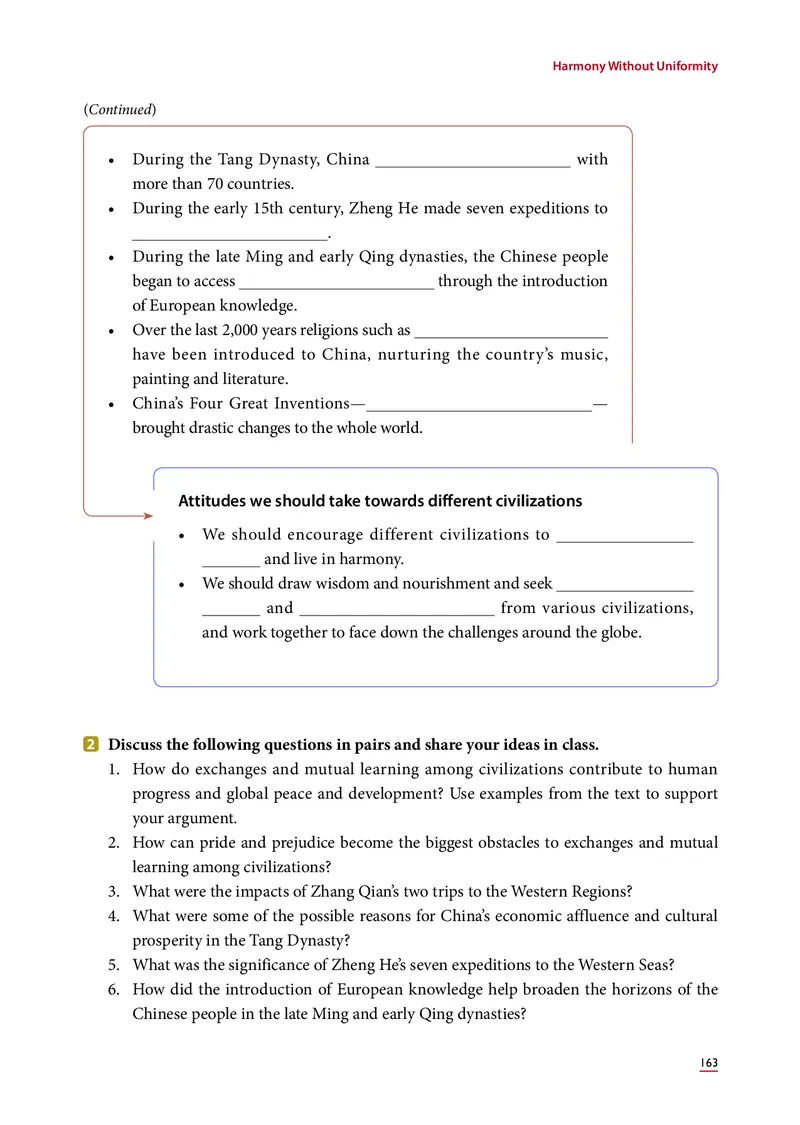
1 The following diagram presents the key points of the text. Fill in the blanks to get a
general idea of the text.
Thesis statement
Civilizations become richer and more colorful through
, which form an important
for human progress and global .
Principles to follow
• Civilizations come in different colors, and such
has made exchanges and mutual learning among civilizations
.
• Civilizations are , and such has made
exchanges and mutual learning among civilizations .
• Civilizations are , and such has given
exchanges and mutual learning among civilizations
.
Supporting examples of exchanges and mutual learning among
civilizations in Chinese history
• In the 2nd century BC, China started leading
to the Western Regions.
• During the Western Han Dynasty, China’s merchant fleets sailed as far as
.
(To be continued)
162Harmony Without Uniformity
(Continued)
• During the Tang Dynasty, China with
more than 70 countries.
• During the early 15th century, Zheng He made seven expeditions to
.
• During the late Ming and early Qing dynasties, the Chinese people
began to access through the introduction
of European knowledge.
• Over the last 2,000 years religions such as
have been introduced to China, nurturing the country’s music,
painting and literature.
• China’s Four Great Inventions— —
brought drastic changes to the whole world.
Attitudes we should take towards different civilizations
• We should encourage different civilizations to
and live in harmony.
• We should draw wisdom and nourishment and seek
and from various civilizations,
and work together to face down the challenges around the globe.
2 Discuss the following questions in pairs and share your ideas in class.
1. How do exchanges and mutual learning among civilizations contribute to human
progress and global peace and development? Use examples from the text to support
your argument.
2. How can pride and prejudice become the biggest obstacles to exchanges and mutual
learning among civilizations?
3. What were the impacts of Zhang Qian’s two trips to the Western Regions?
4. What were some of the possible reasons for China’s economic affluence and cultural
prosperity in the Tang Dynasty?
5. What was the significance of Zheng He’s seven expeditions to the Western Seas?
6. How did the introduction of European knowledge help broaden the horizons of the
Chinese people in the late Ming and early Qing dynasties?
163Unit 8
7. What kind of spirit did Xuan Zang embody regarding exchanges and mutual learning
among civilizations?
8. What do “cultural significance” and “inherent spirit” mean in the last paragraph of the
text?
9. Why does President Xi cite examples related to France several times throughout his
speech to illustrate his intercultural communication experiences?
Critical thinking
3 Discuss one of the following questions in small groups and share your ideas in class.
1. Samuel Huntington, the late author of The Clash of Civilizations, claimed that post-
Cold War conflicts would not occur between countries, but between different
cultures or civilizations. To what extent do you agree or disagree with his scenario of
international relations? Why?
2. Since 2013, China has been reviving the Silk Road with the Belt and Road Initiative
(BRI), promoting cooperation between China and other BRI countries. In what
aspects do you think BRI exemplifies the spirit of exchanges and mutual learning
among civilizations?
3. The UNESCO Universal Declaration on Cultural Diversity states, “As a source of
exchange, innovation and creativity, cultural diversity is as necessary for humankind
as biodiversity is for nature.” How do you understand this analogy? How does cultural
diversity contribute to exchange, innovation and creativity? Use concrete evidence to
support your argument.
164Harmony Without Uniformity
Global Perspectives
Read the following review of China’s role in exchanges and mutual learning among
civilizations. Write a summary of 200-300 words.
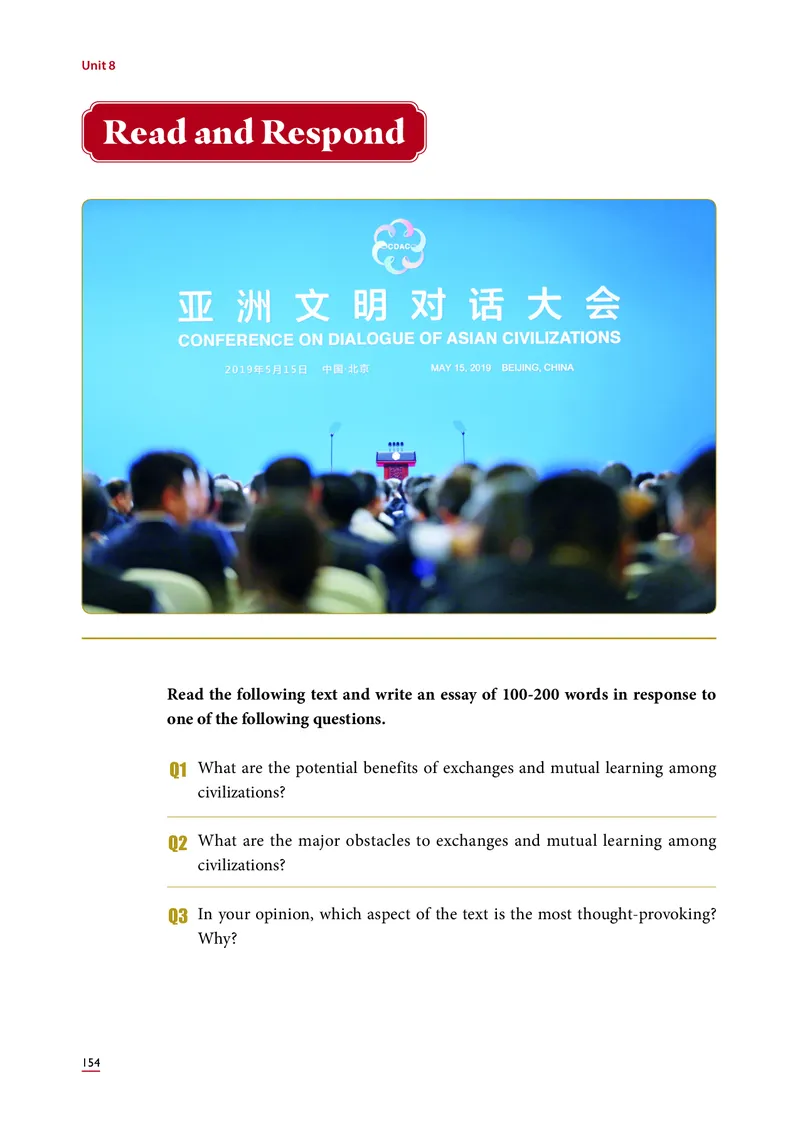
1 In May 2019, China initiated the first Conference on Dialogue of Asian Civilizations
(CDAC), which gathered more than 1,300 representatives from all 47 Asian countries,
countries in other parts of the world, and international organizations. The week-long
conference served as an open platform for mutual learning and development among Asian
civilizations. In 2021, President Xi Jinping announced China’s plan to host the second
CDAC, solidifying China’s continuous efforts to promote the dialogue of civilizations on
and beyond the continent.
2 China’s stepped-up efforts to promote exchanges and mutual learning among civilizations
have been applauded by international observers. As Rashid Alimov, former secretary-
general of the Shanghai Cooperation Organization, notes, “There is no doubt that the
conference will make its valuable contribution to the rapprochement with/between the
peoples of Asia.” Helmy al-Namnam, former Egyptian minister of culture, praises the
165Unit 8
initiative as “a very important move to pave the way for the language of dialogue over the
language of conflict.”
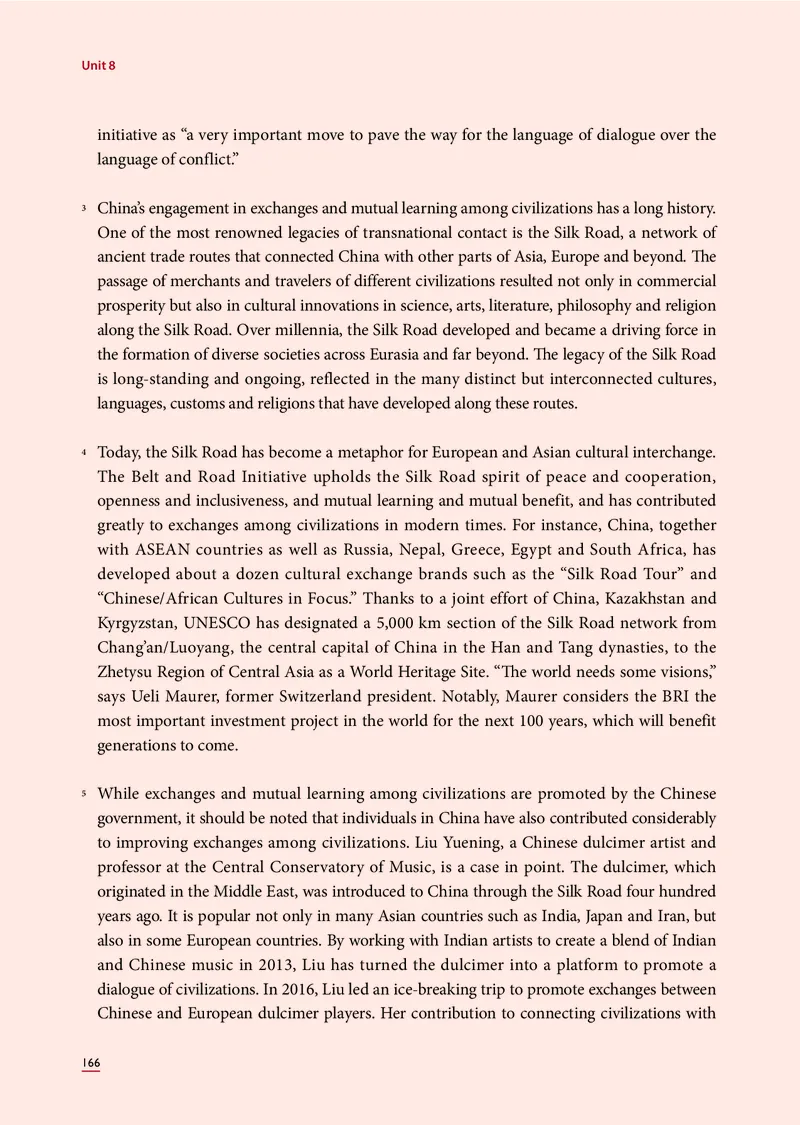
3 China’s engagement in exchanges and mutual learning among civilizations has a long history.
One of the most renowned legacies of transnational contact is the Silk Road, a network of
ancient trade routes that connected China with other parts of Asia, Europe and beyond. The
passage of merchants and travelers of different civilizations resulted not only in commercial
prosperity but also in cultural innovations in science, arts, literature, philosophy and religion
along the Silk Road. Over millennia, the Silk Road developed and became a driving force in
the formation of diverse societies across Eurasia and far beyond. The legacy of the Silk Road
is long-standing and ongoing, reflected in the many distinct but interconnected cultures,
languages, customs and religions that have developed along these routes.
4 Today, the Silk Road has become a metaphor for European and Asian cultural interchange.
The Belt and Road Initiative upholds the Silk Road spirit of peace and cooperation,
openness and inclusiveness, and mutual learning and mutual benefit, and has contributed
greatly to exchanges among civilizations in modern times. For instance, China, together
with ASEAN countries as well as Russia, Nepal, Greece, Egypt and South Africa, has
developed about a dozen cultural exchange brands such as the “Silk Road Tour” and
“Chinese/African Cultures in Focus.” Thanks to a joint effort of China, Kazakhstan and
Kyrgyzstan, UNESCO has designated a 5,000 km section of the Silk Road network from
Chang’an/Luoyang, the central capital of China in the Han and Tang dynasties, to the
Zhetysu Region of Central Asia as a World Heritage Site. “The world needs some visions,”
says Ueli Maurer, former Switzerland president. Notably, Maurer considers the BRI the
most important investment project in the world for the next 100 years, which will benefit
generations to come.
5 While exchanges and mutual learning among civilizations are promoted by the Chinese
government, it should be noted that individuals in China have also contributed considerably
to improving exchanges among civilizations. Liu Yuening, a Chinese dulcimer artist and
professor at the Central Conservatory of Music, is a case in point. The dulcimer, which
originated in the Middle East, was introduced to China through the Silk Road four hundred
years ago. It is popular not only in many Asian countries such as India, Japan and Iran, but
also in some European countries. By working with Indian artists to create a blend of Indian
and Chinese music in 2013, Liu has turned the dulcimer into a platform to promote a
dialogue of civilizations. In 2016, Liu led an ice-breaking trip to promote exchanges between
Chinese and European dulcimer players. Her contribution to connecting civilizations with
166Harmony Without Uniformity
music has been recognized by the European Institute for One Belt One Road Economic
and Cultural Cooperation and Development, which honored her with the 2016 Euro-Sino
Cultural Exchange Contribution Award. In 2018, Liu set up the Asian Dulcimer Association.
6 China’s emphasis on exchanges and mutual learning among civilizations is an inclusive and
powerful alternative to “the clash of civilizations,” proposed by Samuel Huntington, late
professor of political science at Harvard University. In characterizing conflicts in a post-
Cold War era, Huntington posited in his 1993 landmark essay that the fundamental source
of conflict in the post-Cold War era will not be primarily ideological or economic, but
cultural. He claimed, “The principal conflicts of global politics will occur between nations
and groups of different civilizations. The clash of civilizations will dominate global politics.
The fault lines between civilizations will be the battle lines of the future.”
7 The concept of “the clash of civilizations” has since been countered empirically, logically
and ideologically by many intellectuals and public figures around the world. Edward
Said, late professor at Columbia University, argued in his famous response “The Clash
of Ignorance” that Huntington’s categorization omits the dynamic interdependency
and interaction of civilizations. “Civilizations are not meant to make war,” echoes
Massoud Daher, professor at Lebanese University. “There is no clash of civilizations, but
complementarity between them.”
8 China’s championship of exchanges and mutual learning, not conflict, among civilizations
may find its deep roots in the rich tradition of Chinese culture. Laurence Brahm, founding
director of Himalayan Consensus, alludes to the concept of non-duality, as reflected by the
Chinese principles of yin and yang. According to Brahm, Western values are based on a
core concept of duality, a zero-sum mentality evident in politics, economics and workplaces.
However, Asian culture emphasizes a prior unity that evolves into derivatives of multiplicity
that are interconnected, multi-dimensional and always interactive and synergistic. This
creates a politics of consensus rather than a zero-sum game. “Asian politics is all about
consensus. No side wins or loses; all sides move forward together.”
9 Miguel Ángel Moratinos, high representative for the United Nations Alliance of
Civilizations, highlights key elements of Chinese civilization as “fantastic thoughts”
good for this world with so many differences, including “striving constantly for self-
improvement,” “great virtues perfecting all things” and “living in harmony and valuing
differences.” “All these shining ancient Chinese thoughts must be greatly valued and
applied to modern bilateral and multilateral relations,” Moratinos stresses.
167Unit 8
Telling
China’s Story
to the World
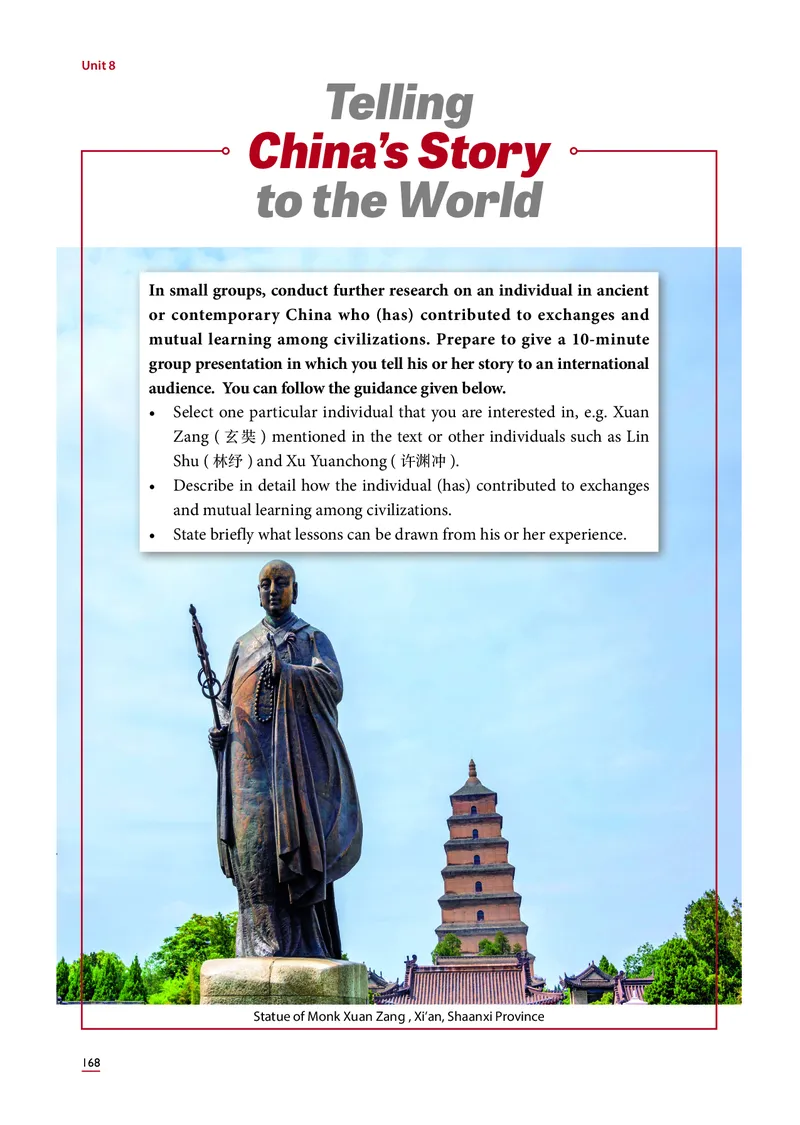
In small groups, conduct further research on an individual in ancient
or contemporary China who (has) contributed to exchanges and
mutual learning among civilizations. Prepare to give a 10-minute
group presentation in which you tell his or her story to an international
audience. You can follow the guidance given below.
• Select one particular individual that you are interested in, e.g. Xuan
Zang ( (cid:4114)(cid:1884) ) mentioned in the text or other individuals such as Lin
Shu ((cid:3180)(cid:4922)) and Xu Yuanchong ((cid:6013)(cid:3734)(cid:1100)).
• Describe in detail how the individual (has) contributed to exchanges
and mutual learning among civilizations.
• State briefly what lessons can be drawn from his or her experience.
Statue of Monk Xuan Zang , Xi’an, Shaanxi Province
168Harmony Without Uniformity
Language in Focus
Words and phrases
1 Complete the following sentences by filling in each blank with an appropriate word or
phrase from the box below. Change its form if necessary.
bustle disseminate condescend nurture
provoke be struck by in the light of a multitude of
come to leave behind keep to devoid of
go through derive from give full expression to
1. facts have shown that many problems within the Party
are attributed to weak political commitment and a lack of regular and sound political
activities.
2. On the afternoon of May 4, 1919, over 3,000 students of Peking University and other
schools protested against the treaty and the compromise of the Beiyang Government,
a quick response throughout the country.
3. Our Party and people stand together through storm and stress,
thick and thin together, and keep flesh-and-blood ties, which is the basic guarantee
of the Party in overcoming all difficulties and risks.
4. The Chinese nation, which since modern times began had endured so much for so
long, has achieved a tremendous transformation: It has stood up, become better
off, and grown in strength; it has embrace the brilliant
prospects of rejuvenation.
5. Publicity is necessary to encourage the public to learn from role models, and to
a positive atmosphere of respecting, emulating,
honoring and caring for heroes.
6. A Party member ideals lacks an essential quality—as
does one who engages in empty talk about lofty ideals without doing anything.
7. As long as we the goal of building a global community
of shared future and work hand in hand to fulfill our responsibilities and overcome
difficulties, we will be able to create a better world and deliver better lives for our
peoples.
8. When I visit Africa, I always two things. One is its
169Unit 8
continuous progress. Each time I come to Africa, I am deeply impressed by new
progress in development, which is most encouraging. The other is the warmth of the
African people.
9. Over the past four years, China and Arab states have worked together to develop Belt and
Road cooperation regional realities, to combine collective
action with bilateral cooperation, and to promote development while upholding peace.
10. The very purpose of developing socialist democracy is to
the will of the people, protect their rights and interests, spark their creativity, and
provide systemic and institutional guarantees to ensure the people’s position as masters
of the country.
11. China’s battle against poverty has entered the toughest stage. To achieve our goals,
we must carry on the fight with firmer resolve, clearer thinking, more targeted
measures, unique intensity, and concerted action, no
single poverty-stricken area or individual.
12. The confidence in our culture is a more fundamental, broader and more profound
faith in the development of China. It our splendid
5,000-year history and is embedded in decades of a revolutionary struggle that
embodies the deep-rooted spiritual pursuits of the Chinese nation, and represents
the unique cultural identity of the Chinese people.
13. During its 5,000-year history, the Chinese nation has created a brilliant and
profound culture. We should the most fundamental
Chinese culture in a popular way to attract more people to participate in it, matching
modern culture and society.
14. There is no manual to which we can refer in promoting reform and development,
neither do we have any need for instructors to lecture
our people.
15. The ancient Silk Road witnessed scenes of visiting
emissaries and traveling merchants jostling one another on the land and numerous
ships calling at ports.
Translation
2 Translate the following sentences into English, paying special attention to the
meaning of the expressions in bold.
1. 两(cid:1258)(cid:1851)年的(cid:796)(cid:2404)(cid:1299)史(cid:6021)明,(cid:1342)要坚持(cid:3095)(cid:13320)(cid:967)(cid:1302)、(cid:5032)(cid:12414)(cid:967)(cid:1886)、(cid:2106)(cid:4334)(cid:967)(cid:18345)、(cid:2365)(cid:1169)(cid:1702)(cid:17047),不(cid:1367)(cid:4640)族、
不(cid:1367)(cid:959)(cid:844)、不(cid:1367)(cid:2985)化(cid:5192)(cid:3080)的国(cid:2074)(cid:2049)(cid:1059)(cid:1347)以共(cid:802)和平,共(cid:1367)发展。
170Harmony Without Uniformity
2. (cid:2365)(cid:2684)(cid:725)(cid:6273)(cid:4861)(cid:4608),就是要(cid:944)进(cid:2985)明(cid:785)鉴。(cid:1007)(cid:12720)文(cid:6979)(cid:8662)(cid:7230)(cid:20493)(cid:1155)(cid:1101)(cid:2008)(cid:896)(cid:1851),(cid:1674)为平(cid:4758)(cid:796)(cid:3647)而(cid:1331)
(cid:2418)(cid:736)(cid:2085)(cid:1851)(cid:2393),(cid:3436)所(cid:6099)(cid:259)(cid:787)色(cid:796)辉,(cid:4409)(cid:2418)(cid:4390)(cid:2397)(cid:8033)(cid:1060)(cid:7051)(cid:1364)(cid:1878),(cid:4932)和(cid:717)平(cid:260)。
3. 我们(cid:2316)(cid:6055)(cid:1050)(cid:8876)(cid:13288)(cid:11187)(cid:4882)的(cid:4338)(cid:5044)(cid:13869)(cid:5429)(cid:6024)(cid:11625)文化(cid:985)(cid:5301)的(cid:3574)(cid:3271),(cid:1050)(cid:1713)(cid:6763)(cid:5035)(cid:14841)的(cid:5430)度(cid:8615)(cid:2315)(cid:1707)(cid:1035)文(cid:6979)
的(cid:1712)(cid:1851),(cid:944)进(cid:790)(cid:3639)(cid:2985)明在(cid:796)(cid:3647)(cid:785)鉴中共(cid:1367)前进。
4. 要(cid:13332)(cid:12462)国(cid:1722)国(cid:19322)(cid:857)(cid:863)大(cid:4469),(cid:3238)立(cid:3110)(cid:2077)(cid:2305)的世(cid:4245)(cid:4435)(cid:1048)、(cid:3110)(cid:2050)大的(cid:2645)(cid:4253)(cid:2717)负,(cid:5220)(cid:2462)(cid:4602)国,(cid:1074)
(cid:3656)天下,推动(cid:3174)(cid:2349)新(cid:3264)国(cid:19322)(cid:1704)系,推动(cid:3174)(cid:2349)(cid:1007)(cid:12720)(cid:2482)(cid:17669)(cid:1702)(cid:2369)体。
Discourse and rhetoric
3 Complete the following passage by choosing an appropriate sentence from the box to
fill in each blank.
Ladies and gentlemen,
Friends,
We Asian countries are closely connected and share a natural bond of affinity. 1.
Going forward, we need to see where the world is heading, ride the trends of the times,
and turn our people’s longing for a better life into reality.
—2. Upholding peace is the responsibility of every country. When peace is
interrupted by conflict or war, economic growth, decent lives, social stability and people-
to-people exchanges will fall by the wayside. We the people of Asian countries wish to
live and work in contentment and security, free from fear. We hope that all countries will
respect and trust each other, live in harmony, and interact with each other in a manner
that transcends national boundaries, time and space, as well as the differences between
civilizations. 3.
—We Asian people hope to see common prosperity in Asia. Economic growth sustains
a civilization, and prosperity underpins the progress of a nation. 4. This must
change. We Asian people long for a decent life free of poverty. 5. This will enable us
to eradicate the poverty and backwardness that still plague people in some countries. It will
enable our children to live a carefree life and bring happiness to all families.
171Unit 8
A. We hope that countries will work together to promote economic globalization
and make it more open, inclusive, balanced, and beneficial to all.
B. We have passed through similar historical trials, and we cherish the same
dreams for the future.
C. In some parts of Asia, people—women and children in particular—are still
suffering from poverty, hunger, and disease.
D. We should work together to safeguard peace, something that is far more precious
than gold.
E. We Asian people hope to see peace and stability across Asia.
4 Identify the rhetorical and stylistic devices employed in the Chinese sentences and
their English translations. Comment on the effects of the rhetorical or stylistic devices
in each pair.
1. (cid:5426)以(cid:3517)(cid:3656)之,(cid:6082)能(cid:7108)之(cid:8037)(cid:5426)(cid:4169)(cid:4181)之(cid:716)一,(cid:6082)能(cid:1390)之(cid:8037)
Who can tolerate soup with nothing but water in it? Who can tolerate the same tone
played again and again with one instrument?
2(cid:15)(cid:1) (cid:1896)(cid:3183)(cid:1342)有一(cid:4640)(cid:4223)(cid:3643)(cid:3005)(cid:2360),(cid:1342)有一(cid:4640)(cid:6062)(cid:5979),(cid:1342)有一(cid:4640)(cid:7051)(cid:757),(cid:1342)有一(cid:4640)(cid:3121)(cid:7127),(cid:6511)是不(cid:1347)想(cid:6142)的。
Can we imagine a world with only one lifestyle, one language, one kind of music and
one style of costume?
3(cid:15)(cid:1) 中国有(cid:26)60(cid:1851)(cid:706)平(cid:3005)(cid:1061)(cid:6623)(cid:1696)地、56个民族,我们能(cid:3962)(cid:6082)的模(cid:2360)(cid:1201)(cid:8037)(cid:6082)(cid:1321)能(cid:2769)(cid:2668)(cid:4239)(cid:5238)(cid:1407)(cid:6028)
我们(cid:6055)(cid:2471)(cid:750)(cid:1201)(cid:8037)
China is a country with a land area of over 9.6 million square kilometers and a
population of 56 ethnic groups. Whose model should we copy? And who is qualified
to throw their weight around and tell us what to do?
172Harmony Without Uniformity
Ancient Chinese Wisdom
Explain the following quote and reflect on its contemporary relevance.
Oceans do not reject any water, so that they can become
extremely large. Mountains do not reject any earth or
stone, so that they can become extremely high. ((cid:3674)不(cid:6391)
(cid:3517),(cid:2964)能成(cid:1069)大。(cid:2155)不(cid:6391)(cid:1696)(cid:4491),(cid:2964)能成(cid:1069)高。)
From Guan Zi (《(cid:4790)子》)
Further Reading
1 “Create an Asian Community of Shared Future Through Mutual Learning”, The
Governance of China (Volume III, Pages 540-547)
《(cid:3727)化(cid:2985)明(cid:796)(cid:3647)(cid:785)鉴,共(cid:2349)(cid:790)(cid:3639)命(cid:6410)共(cid:1367)(cid:892)》,出自《习近平谈治国理政》(第(cid:708)卷,
第465—472页)
2 “Meet the People’s Expectation for a Better Life”, The Governance of China (Volume
III, Pages 503-509)
《(cid:2698)世(cid:4245)(cid:1362)国人民(cid:2099)美(cid:1894)(cid:4223)(cid:3643)的(cid:1372)(cid:2404)(cid:1331)成现实》,出自《习近平谈治国理政》(第(cid:708)卷,
第433—438页)
3 “Work Together to Build the Belt and Road”, The Governance of China (Volume II,
Pages 553-566)
《(cid:2894)(cid:2668)推进(cid:259)一(cid:2276)一(cid:6273)(cid:260)(cid:2349)(cid:6018)》,出自《习近平谈治国理政》(第二卷,第506—517页)
173