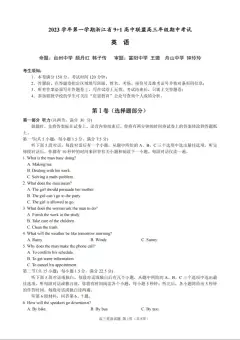
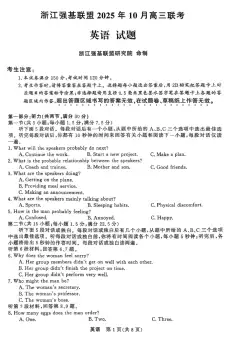
2022学年第一学期浙江强基联盟10月统测高三年级
英语试题
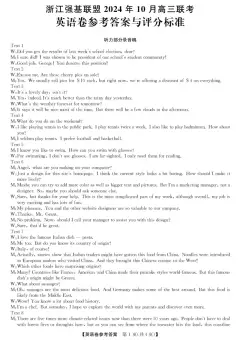
第一部分听力(共20小题;每小题1.5分,满分30分)
第一节(共5小题;每小题1.5分,满分7.5分)
听下面5段对话。每段对话后有一个小题,从题中所给的A、B、C三个选项中选出最佳选项,并标在
试卷的相应位置。听完每段对话后,你都有5秒钟的时间来回答有关小题和阅读下一小题。每段对
话仅读一遍。
1.What happened to the man?
A.He's injured. B.He's tired. C.He's lost.
2.What does the woman want to grow in her garden?
A.Herbs. B.Flowers. C.Vegetables.
3.How does the woman sound?
A.Angry. B.Pleased. C.Unconfident.
4.What is the woman going to do on Sunday?
A.Get a haircut. B.Work in the office. C.Climb the mountains.
5.When will the test begin today?
A.At 9:30 a.m. B.At10:00a.m. C.At 10:30 a.m.
第二节:(共15小题;每小题1.5分,满分22.5分)
听下面5段对话或独白。每段对话或独白后有几个小题,从题中所给的A、B、C三个选项中选出最
佳选项,并标在试卷的相应位置。听每段对话或独白前,你将有5秒钟的时间阅读各个小题。听完
后,各小题将给出5秒钟的作答时间。每段对话或独白读两遍。
听第6段材料,回答第6、7题。
6.What is the man probably trying to do?
A.Open a new bank account.
B.Exchange some money.
C.Withdraw money from his account.
7.What is the man's main problem?
A.He doesn't have any money.
B.He forgot his bank account number.
C.His bank isn't available in New York.
听第7段材料,回答第8至10题。
8.Where are the speakers probably?
A.In a gym. B.On a street. C.In the man's office.
9.What is the man's wish?
A.To improve his health condition.
B.To make friends in the gym.
C.To join in a competition.
10.What kind of deal will the man probably take?
A.A discounted monthly membership.
B.A free weightlifting class.
C.A free one-time visit.
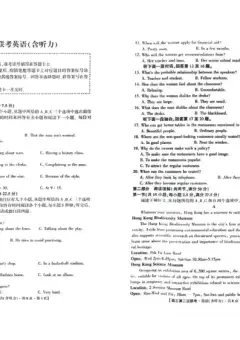
听第8段材料,回答第11至13题。11.What is the probable relationship between the speakers?
A.Car salesman and customer.
B.Car mechanic and client.
C.Car collector and visitor.
12.What is probably wrong with the woman's car according to the man?
A.It is too old.
B.It was hit in an accident.
C.It has an issue with its engine.
13.How much will the man probably offer to get the previous car?
A.$10,000. B.$35,000. C.$45,000.
听第9段材料,回答第14至17题。
14.In which country are the speakers?
A.Russia. B.Mongolia. C.China.
15.What does the man probably do for a living?
A.A miner. B.A land surveyor. C. A teacher.
16.Why is the woman's English good?
A.Because she teaches English part-time.
B.Because she has read many English novels.
C.Because one of her parents is a native English speaker.
17.What do we know about the coldest capital city in the world?
A.It is beautiful in winter.
B.It's a city with a unique history.
C.Its heating is powered by electricity.
听第10段材料,回答第18至20题。
18.Which grade will the students enter next year?
A.The 9th grade in high school.
B.The 10th grade in high school.
C.The first year in university.
19.Why is the speaker giving the lesson?
A.To introduce the current school year.
B.To prepare for the upcoming final exam.
C.To celebrate the end of the school year.
20.What will the students do last?
A.Watch a movie.
B.Make a group presentation.
C.Practice the greetings in pairs.
第二部分阅读(共两节,满分50分)
第一节(共15小题;每小题2.5分,满分37.5分)
阅读下列短文,从每题所给的A、B、C、D四个选项中选出最佳选项。
A
Urban gardens are valuable assets to communities. They provide green spaces to grow
sustainable food, build community cohesion (凝聚力),make new friends, connect with the
earth, and much more. So, let's check out our list of 4 inspiring urban gardens in the US.
Gotham GreensWhere: New York &Chicago
What: Gotham Greens first started in Brooklyn and now has four locations in New York City and
Chicago. Their flagship farm in Brooklyn produces over 100,000 pounds of greens per year. But it
doesn't just produce healthy local vegetables. It is using high-tech greenhouses with solar panels to
make sure the food grown is healthy and sustainable.
Baltimore Urban Gardening with Students
Where: Baltimore, Maryland
What:The Baltimore Urban Gardening with Students (BUGS) program encourages students to get
their hands dirty and plant vegetables through their after-school and summer programs. Many of these
kids don't have access to green spaces, and have never had the opportunity to grow food.
ReVision Urban Farm
Where: Boston,Massachusetts
What: ReVision Urban Farm in Boston works in partnership with the ReVision Family Home-a
shelter for 22 homeless parents and their kids. The farm provides these families with information on
healthy eating, and access to the farm’s fresh vegetables. The organization also provides job training to
help families escape the cycle of poverty.
Swale
Where: New York
What: Swale, a floating food forest located on a large boat, is an innovative project meant to
inspire citizens to rethink the relationship between our cities and our food. This urban garden serves as
both a living art exhibit and an educational farm. Food forests are sustainable gardens that include
vegetables, fruit, nut trees, bushes, herbs, and vines -each one complementing the other in a
symbiotic (共生的) relationship.
21.What does the BUGS program mainly do?
A.Provide job training for students.
B.Use high-tech greenhouses to grow healthy food.
C.Create a sustainable garden on a large boat.
D.Offer students the opportunity to grow vegetables.
22.Which urban garden helps people get out of poverty?
A.Gotham Greens. B.Baltimore Urban Gardening with Students.
C.ReVision Urban Farm. D.Swale.
23.Where can citizens go to see a food forest?
A.Chicago. B.Baltimore. C.Boston. D.New York.
B
Like many other five-year-old, Jeanie Low of Houston, Texas, would use a stool (凳子) to
help her reach the bathroom sink. However, the plastic step-stool she had at home was
unstable and cluttered up the small bathroom shared by her whole family. After learning of an
invention contest held by her school that year, Jeanie resolved to enter the contest by creating a stool
that would be a permanent fixture in the bathroom, and yet could be kept out of the way when not in
use.
Jeanie decided to make a stool attached to the bathroom cabinet door under the sink.
She cut a board of wood into two pieces, each about two feet wide and one foot long.
Using metal hinges (铰链),Jeanie attached one piece of the wood to the front of the cabinet
door, and the second piece to the first. The first piece was set just high enough so that when it swungout horizontally from the cabinet door, the second piece would swing down from the first, just touching
the ground, and so serving as a support for the first piece of the wood. This created a convenient,
strong platform for any person too short to reach the sink. When not in use, the hinges allowed the
two pieces of wood to fold back up tightly against the cabinet, where they were held in place by
magnets. Jeanie called her invention the “Kiddie Stool”.
Jeanie's Kiddie Stool won first place in her school's contest. Two years later, it was awarded first
prize again at Houston's first annual Invention Fair. As a result, Jeanie was invited to make a number of
public appearances with her Kiddie Stool, and was featured on local TV as well as in newspapers. Many
people found the story of the Kiddie Stool inspiring because it showed that with imagination, anyone
can be an inventor.
24.Why did Jeanie Low invent the Kiddie Stool, according to the passage?
A.Many other five-year-olds had problems reaching the bathroom sink.
B.She did not think that plastic stools were tall enough for her.
C.The stool in her bathroom was not firm and often got in the way.
D.She was invited to enter an invention contest held by her school.
25.Which of the following statements is true about how the Kiddie Stool works?
A.The Kiddie Stool will swing out only when the cabinet door opens.
B.It uses hinges and magnets to keep the wooden pieces in place.
C.It swings from left to right to be attached to the cabinet door.
D.The platform is supported by two pieces of metal.
26.What are the characteristics of Jeanie's Kiddie Stool?
A.Permanent and foldable. B.Fragile and disposable.
C.Conventional and portable. D.Convenient and recyclable.
27.Which of the following sayings best captures the spirit of Jeanie Low's story?
A.Failure is the mother of success.
B.Necessity is the mother of invention.
C.Genius is 1% inspiration and 99%perspiration.
D.Invention requires both disciplines and wild imagination.
C
In Japan, you are what your blood type is. A person's blood type is popularly believed to decide
his/her character and personality. Type-A people are generally considered sensitive perfectionists and
good team players, but over-anxious. Type OS are curious and generous but stubborn. Type ABs are
artistic but mysterious and unpredictable, and type Bs are cheerful but eccentric, individualistic, and
selfish. Though lacking scientific evidence, this belief is widely seen in books, magazines, and television
shows. Last year, four of Japan's top 10 best-sellers were about how blood type determines personality,
through which readers seemed to be able to discover the definition of their blood type or have their
self-image confirmed.
The blood-type belief has been used in unusual ways. The women softball team that won gold for
Japan at the Beijing Olympics is reported to have used blood-type theories to customize training for
each player. Some kindergartens have adopted teaching methods along blood group lines, and even
major companies reportedly make decisions about assignments based on an employee's blood type. In
1990, Mitsubishi Electronics was reported to have announced the formation of a team composed
entirely of AB workers, thanks to “their ability to make plans".The belief even affects politics. One former prime minister considered it important enough to
reveal in his official profile that he was a type A, while his opposition rival was type B. In 2011, a
minister, Ryu Matsumoto, was forced to resign after only a week in office, when a bad-tempered
encounter with local officials was televised. In his resignation speech, he blamed his failings on the fact
that he was blood type B.
The blood-type craze, considered simply harmless fun by some Japanese, may reveal
itself as prejudice and discrimination. In fact, this seems so common that the Japanese now
have a term for it: bura-hara, meaning blood-type harassment (骚扰). There are reports of
discrimination leading to children being bullied, ending of happy relationships, and loss of job
opportunities due to blood type.
28.What's the main idea of paragraph 1?
A.The Japanese attach great importance to blood type.
B.The books about blood type are popular in Japan.
C.The Japanese confirm their personality totally through blood type.
D.The Japanese think blood type bestsellers are important to their self-image.
29.According to the passage,which blood type can we infer is the LEAST favored in Japan?
A.Type A. B.Type B. C.Type O. D.Type AB.
30.Prime Minister Ryu Matsumoto resigned from office because.
A.he revealed his rival's blood type
B.he was seen behaving rudely on TV
C.he blamed his failings on local officials
D.he was discriminated against because of blood type
31.What is the speaker's attitude toward the blood-type belief in Japan?
A.Negative. B.Defensive. C.Objective. D.Encouraging.
D
You've most likely heard the news by now: A car-commuting, desk-bound, TV-watching lifestyle
can be harmful to our health. All the time that we spend rooted in the chair is linked to increased risks
of so many deadly diseases that experts have named this modern-day health epidemic the“sitting
disease".
Sitting for too long slows down the body's metabolism (新陈代谢) and the way enzymes
(酶) break down our fat reserves, raising both blood sugar levels and blood pressure. Small
amounts of regular activity, even just standing and moving around, throughout the day is
enough to bring the increased levels back down. And those small amounts of activity add up -30
minutes of light activity in two or three-minute bursts can be just as effective as a half-hour block of
exercise. But without that activity, blood sugar levels and blood pressure keep creeping up,
steadily damaging the inside of the arteries (动脉) and increasing the risk of diabetes, heart
disease, stroke, and other serious diseases. In essence, fundamental changes in biology occur
if you sit for too long.
But wait, you're a runner.You needn't worry about the harm of a sedentary lifestyle because you
exercise regularly, right? Well, not so fast. Recent studies show that people spend an average of 64
hours a week sitting, whether or not they exercise 150 minutes a week as recommended by World
Health Organization (WHO). Regular exercisers, furthermore, are found to be about 30 percent less
active on days when they exercise. Overall, most people simply aren't exercising or moving around
enough to counteract all the harm that can result from sitting nine hours or more a day.Scared straight out of your chair? Good. The remedy is as simple as standing up and taking activity
breaks.
32.What is the best way to bring down high blood sugar level and blood pressure?
A.Exercising for 150 minutes or more every week.
B.Getting rid of the habit of car commuting and TV watching.
C.Interrupting sitting time with light activity as often as possible.
D.Standing or moving around for at least two or three minutes every day.
33.What does the word “sedentary” in the third paragraph most likely meant?
A.Modern. B.Risky. C.Inactive. D.Epidemic.
34.Which of the following may be inferred about those who do serious exercise?
A.They usually do not meet the standard of exercise recommended by WHO.
B.They generally spend less time sitting than those who are inactive.
C.They often live longer than those who don't exercise.
D.They tend to stand or move around less on their work-out days.
35.What is the passage mainly about?
A.The challenges of the modern lifestyle.
B.The reasons for the spread of a modern epidemic.
C.The effect of regular exercise on our body.
D.The threat to our health from long hours of sitting.
第二节:(共5小题;每小题2.5分,满分12.5分)
根据短文内容,从短文后的选项中选出能填人空白处的最佳选项。选项中有两项为多余选项。
From the dawn of civilization, paper records have been a method of keeping track of important
and necessary documentation. A common experience throughout the world's record keeping has been
the necessity to ensure that all documents are kept together, and none are lost.
__36__ These included tying ribbons through the paper, and melting wax to secure the papers in
place. For nearly 600 years, these were the methods used to secure papers.
__37__ In 1835, a machine that could mass-produce straight pins was invented by Howe
J.I, an American inventor. Although straight pins (大头针) were originally designed for sewing
and tailoring, people began using them as a quick and easy way to secure papers. __38__ In
1899 he patented the device, which consisted of a wire bent into a particularly shaped hoop for the
purpose of securing papers.
During this time, however, the paperclip (回形针) was not a widely distributed device.
Therefore, the Gem Manufacturing Company of England developed a machine to manufacture
and standardize the paperclip design. __39__
Today the paperclip is a famous invention used throughout offices, schoolrooms, and business
throughout the world. __40__
A.The next paper invention was that of the straight pin.
B.Before the paper clip, people had to be creative to keep paper together.
C.The humble item only came into popular usage around the mid-19th century.
D.Later, inspired by the straight pin, Norwegian Vaaler J. came up with the idea of the first paperclip.
E.This manufacturing development allowed for the expansion of the modern paperclip worldwide.
F.Being a wonder of simplicity and function, the paperclip remains a standard office supply throughout
the worldG.Therefore, from the early 13th century people had created various methods to ensure documents
were kept together.
第三部分语言运用(共两节,满分30分)
第一节(共15题;每小题1分,满分15分)
阅读下面短文,从每题所给的A、B、C、D四个选项中选出可以填人空白处的最佳选项。
We live in a world increasingly dominated by science. Since elementary school, I have always
__41__ subjects like science and math. To me, these subjects, full of discoveries and __42__, seem to
play more significant role in human progress than humanities. And I always __43__ thought of these
subjects as more solid and serious than classes like English. If there was no right __44__ I thought, why
bother? But recently I had an __45__ that taught me my academic interests are more flexible than I
had thought: I took my first philosophy class.
Before I entered the classroom, I was __46__. I waited outside with the other students and
wondered what exactly philosophy would involve. I imagined getting into pretty long and boring
conversations __47__ intended to reflect on the meaning of life. But what I got was something quite
__48__.
A young man in jeans, Mr.Jones—“but you can call me Rob”—was far from the white-haired,
buttoned-up old man I had __49__. Rather than pulling us into dull arguments about difficult-to-
understand philosophical points, Rob __50__ us on our level. To talk free will, we looked at our own
__51__. To talk morals, we looked at dilemmas we had faced ourselves. By the end of class, I’d
discovered that questions with no right answer can turn out to be the most __52__ ones.
It __53__ me that if I let go of my __54__, I can actually get a lot out of the subjects I once
thought little of. The class taught me - in more ways than one - to look at things with a(n) __55__ mind.
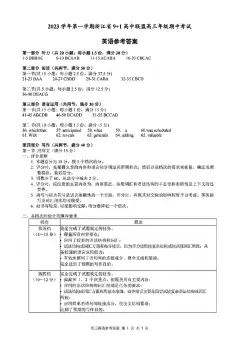
41.A.chosen B. evaluated C. favored D. avoided
42.A. formulas B.puzzles C. challenges D. innovations
43. A. automatically B.consciously C. accurately D. impatiently
44.A.reason B. answer C. method D.direction
45.A. surprise B.experience C. incident D.adventure
46.A. hopeful B.confident C. doubtful D.nervous
47.A. supposedly B. mistakenly C. naturally D. previously
48.A. unique B.common C. different D. strange
49.A. mentioned B.encountered C.expected D. missed
50.A. engaged B. tested C. persuaded D. invited
51.A.choices B. abilities C.obstacles D.doubts
52.A. objective B.effective C. encouraging D. appealing
53.A. confused B.struck C.warned D.convinced
54.A. pride B.concern C. assessment D.prejudice
55.A. open B. strong C.sharp D. ready
第二节(共10小题;每小题1.5分,满分15分)
阅读下面短文,在空白处填入1个适当的单词或括号内单词的正确形式。
The Getty Center sits on a hilltop in the Santa Monica Mountains, __56__ (tower) above the city of
Los Angeles. The museum was __57__ (origin) constructed to house the vast art collection belonging to
oil tyooonJ.Paul Getty. Today, the modernist complex __58__ (stock) with so many art works that the
exhibit arenas can show just a part of them at a time, making the artistic special exhibitions a highlight
of any visit to the Getty.The Center's award-winning architect, Richard Meier, did __59__ outstanding job of creating a
public space that has surprised many visitors. Visitors go to the Getty thinking they are visiting a
museum with works of art on the inside. __60__ they discover instead is a work of art with a museum
inside. Meier took some basic __61__ (material): metal, stone and glass. Working with a billion-dollar
budget, he combined them to create a work of architecture that can excite visitors as much as the art
collection inside __62__ (do). Around every corner and at every turn, there is a new view __63__ store
for guests. And then, just __64__ they think they have seen it all, a new fountain or landscape pops up.
In addition to museum tours, the Getty also provides various free on-site tours, including tours of
the gardens. These explorations are a must for anyone __65__ (interest) in learning more about
Meier's techniques and ideas.
第四部分写作(共两节,满分40分)
第一节(满分15分)
假定你是李华,你将作为交换生前往新西兰学习三个月并寄宿在Wilson家。为了更好地融入住家,
请给Wilson写封邮件,内容包括:
1.自我介绍;
2.告知到达时间;
3.询问住家的兴趣爱好及其他信息。
注意:
1.词数80左右;
2.可适当增加细节,以使行文连贯。
第二节(满分25分)
阅读下面材料,根据其内容和所给段落开头语续写两段,使之构成一篇完整的短文。
When school was over, the day was fading and it started to drizzle (毛毛雨). I stood at
the school gate, with a loaded backpack on my shoulders. It was Friday again: a weekend of
joy with unlimited sleeping hours and dinner courses specially made to my taste, a weekend
at home. I waved goodbye to my friends as they jumped into their fathers' warm and
comfortable cars. Curiously, this gave rise to a disturbing feeling in me. It was not exactly
what they called jealousy, but something like dismay (沮丧). I knew all I could expect was an
old bike Mom would ride along on, with the badly-oiled chain creaking (嘎吱作响) against the
wheel to announce her arrival.
Every Friday when Mom came to pick me up for the weekend, it was a moment full of great
expectation and great unease. I always felt my face burning as we rode our way in and out of the
numerous cars and saw my friends' faces sticking out of the car windows. It was like stepping into a
ballroom with beautifully dressed ladies and finding yourself in a smelly T-shirt.
To tell you the truth, Mom is quite a headache once in a while. She just looks a homely middle-
aged housewife. Being a practitioner of DIY, she knits most of my sweaters, chiefly in old styles.
Whenever caught by some curious classmates asking what brand my sweaters are, I’d force a smile and
reply in a half joking manner: homemade.
I couldn't remember when I started to find her such an embarrassment. As a little boy, I relied on
her so much. She had been working at home, cooking in the kitchen, knitting by the lamp or riding
across town to buy me a book I badly needed. It had always been much fun riding with mom. But justnow there seemed to be something standing between us, something that made her so strange to me
and me to her.
注意:
1.续写词数应为150左右;
2.请按如下格式在答题卡的相应位置作答。
Today she showed up in a raincoat.
Mom tried to cover me with the back of the raincoat again as a storm set in.