2022年 12月大学英语四级考试真题(第 1 套)
扫码获音频
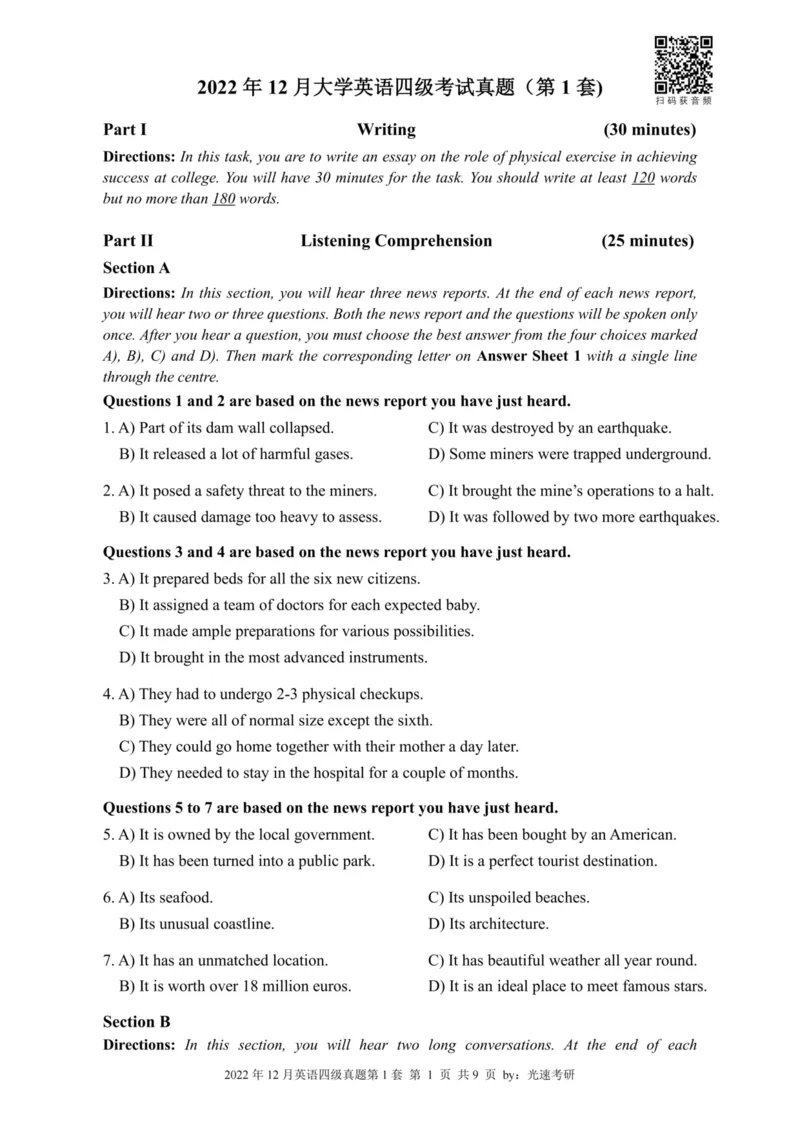
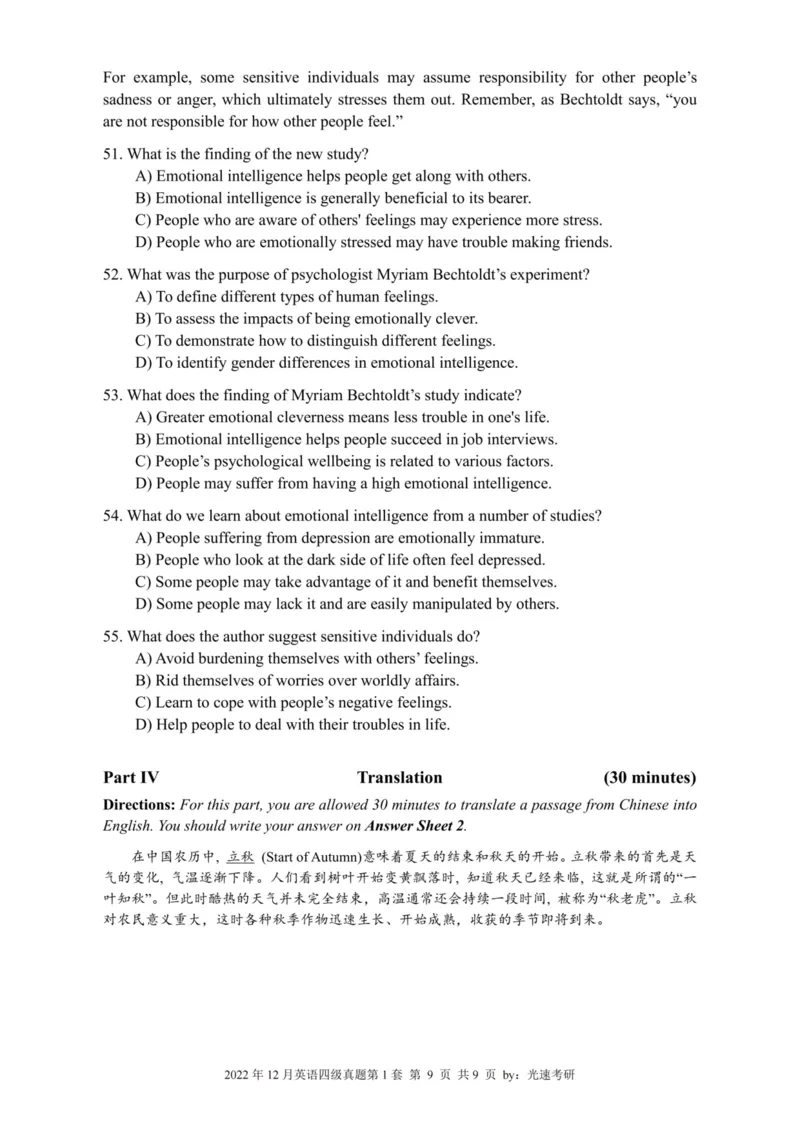
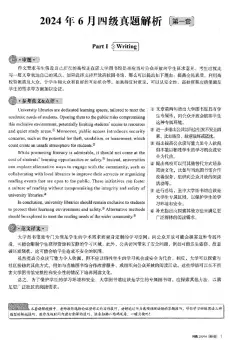
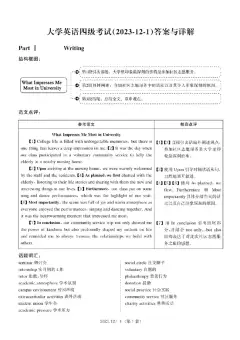
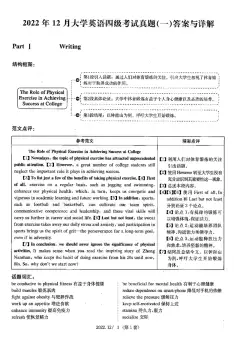
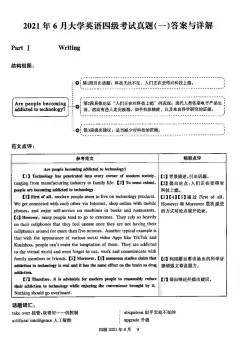
Part I Writing (30 minutes)
Directions: In this task, you are to write an essay on the role of physical exercise in achieving
success at college. You will have 30 minutes for the task. You should write at least 120 words
but no more than 180 words.
Part II Listening Comprehension (25 minutes)
Section A
Directions: In this section, you will hear three news reports. At the end of each news report,
you will hear two or three questions. Both the news report and the questions will be spoken only
once. After you hear a question, you must choose the best answer from the four choices marked
A), B), C) and D). Then mark the corresponding letter on Answer Sheet 1 with a single line
through the centre.
Questions 1 and 2 are based on the news report you have just heard.
1. A) Part of its dam wall collapsed. C) It was destroyed by an earthquake.
B) It released a lot of harmful gases. D) Some miners were trapped underground.
2. A) It posed a safety threat to the miners. C) It brought the mine's operations to a halt.
B) It caused damage too heavy to assess. D) It was followed by two more earthquakes.
Questions 3 and 4 are based on the news report you have just heard.
3. A) It prepared beds fbr all the six new citizens.
B) It assigned a team of doctors fbr each expected baby.
C) It made ample preparations for various possibilities.
D) It brought in the most advanced instruments.
4. A) They had to undergo 2-3 physical checkups.
B) They were all of normal size except the sixth.
C) They could go home together with their mother a day later.
D) They needed to stay in the hospital fbr a couple of months.
Questions 5 to 7 are based on the news report you have just heard.
5. A) It is owned by the local government. C) It has been bought by an American.
B) It has been turned into a public park. D) It is a perfect tourist destination.
6. A) Its seafood. C) Its unspoiled beaches.
B) Its unusual coastline. D) Its architecture.
7. A) It has an unmatched location. C) It has beautiful weather all year round.
B) It is worth over 18 million euros. D) It is an ideal place to meet famous stars.
Section B
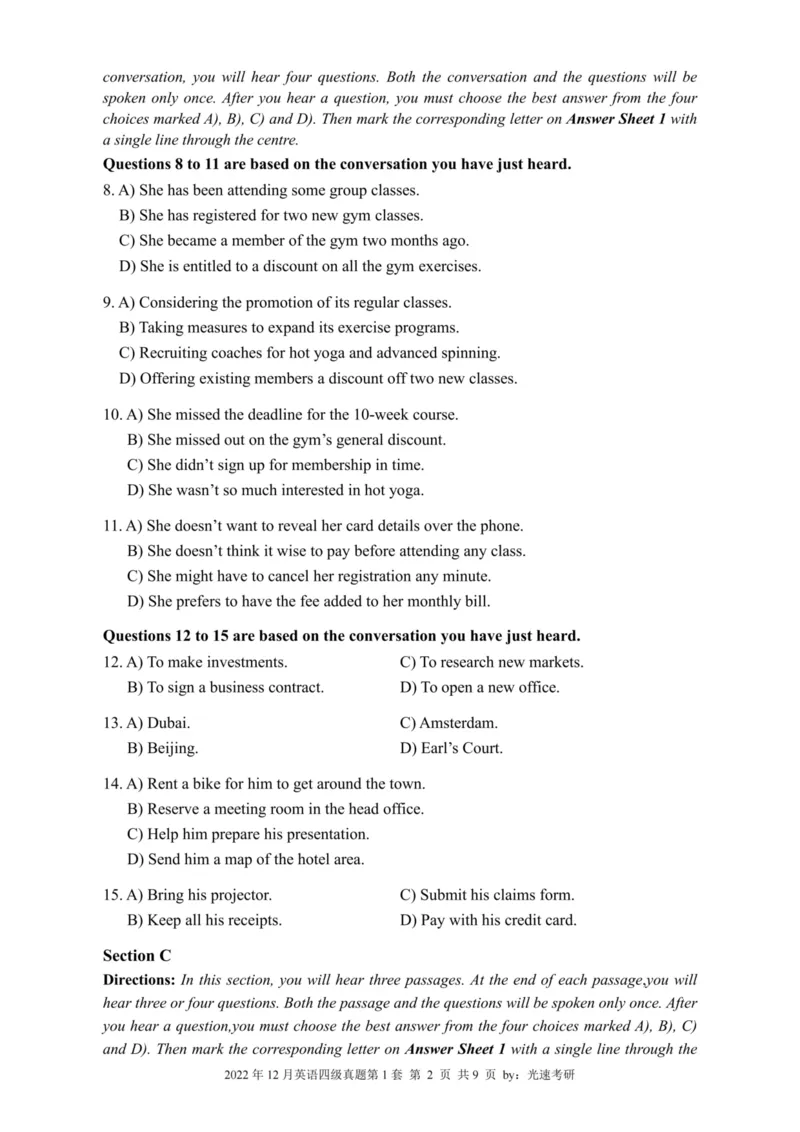
Directions: In this section, you will hear two long conversations. At the end of each
2022年12月英语四级真题第1套 第 1 页 共 9 页 by:光速考研conversation, you will hear four questions. Both the conversation and the questions will be
spoken only once. After you hear a question, you must choose the best answer from the four
choices marked A), B), C) and D). Then mark the corresponding letter on Answer Sheet 1 with
a single line through the centre.
Questions 8 to 11 are based on the conversation you have just heard.
8. A) She has been attending some group classes.
B) She has registered for two new gym classes.
C) She became a member of the gym two months ago.
D) She is entitled to a discount on all the gym exercises.
9. A) Considering the promotion of its regular classes.
B) Taking measures to expand its exercise programs.
C) Recruiting coaches for hot yoga and advanced spinning.
D) Offering existing members a discount off two new classes.
10. A) She missed the deadline for the 10-week course.
B) She missed out on the gym's general discount.
C) She didn't sign up for membership in time.
D) She wasn't so much interested in hot yoga.
11. A) She doesn't want to reveal her card details over the phone.
B) She doesn't think it wise to pay before attending any class.
C) She might have to cancel her registration any minute.
D) She prefers to have the fee added to her monthly bill.
Questions 12 to 15 are based on the conversation you have just heard.
12. A) To make investments. C) To research new markets.
B) To sign a business contract. D) To open a new office.
13. A) Dubai. C) Amsterdam.
B) Beijing. D) Earl's Court.
14. A) Rent a bike for him to geta round the town.
B) Reserve a meeting room in the head office.
C) Help him prepare his presentation.
D) Send him a map of the hotel area.
15. A) Bring his projector. C) Submit his claims form.
B) Keep all his receipts. D) Pay with his credit card.
Section C
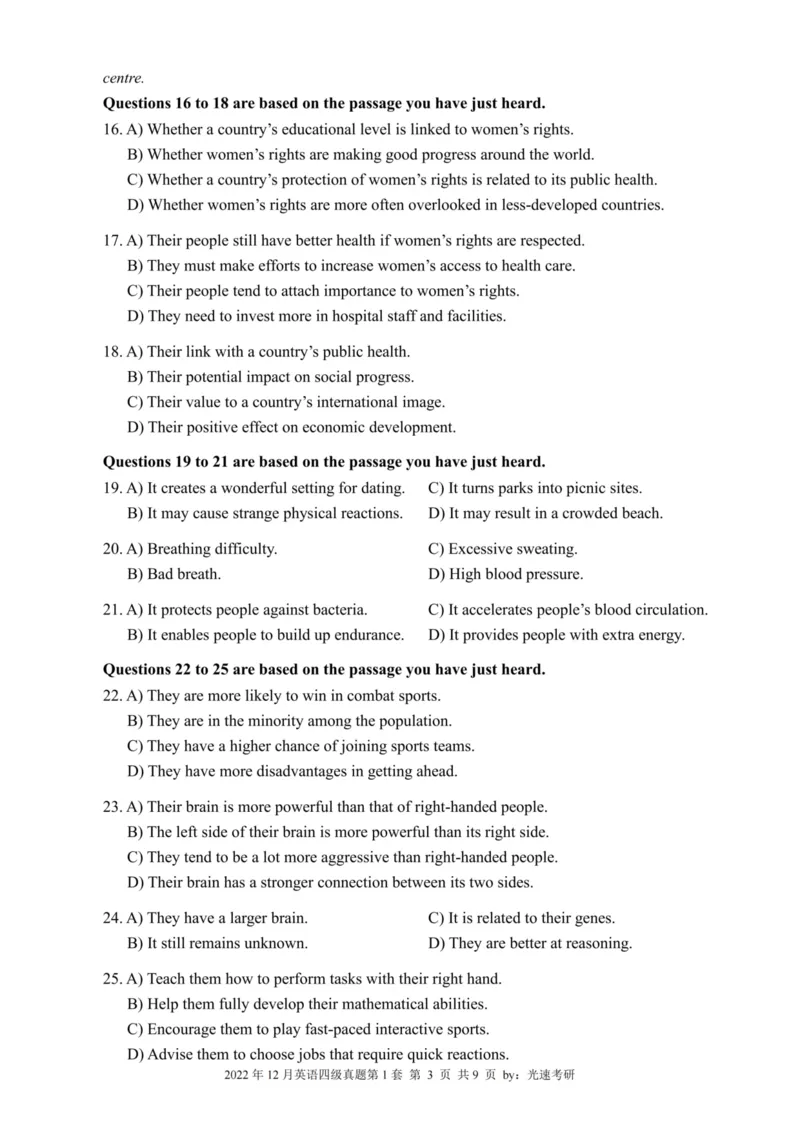
Directions: In this section, you will hear three passages. At the end of each passage,you will
hear three or four questions. Both the passage and the questions will be spoken only once. After
you hear a question,you must choose the best answer from the four choices marked A), B), C)
and D). Then mark the corresponding letter on Answer Sheet 1 with a single line through the
2022年12月英语四级真题第1套 第 2 页 共 9 页 by:光速考研centre.
Questions 16 to 18 are based on the passage you have just heard.
16. A) Whether a country's educational level is linked to women's rights.
B) Whether women's rights are making good progress around the world.
C) Whether a country's protection of women's rights is related to its public health.
D) Whether women's rights are more often overlooked in less-developed countries.
17. A) Their people still have better health if women's rights are respected.
B) They must make efforts to increase women5s access to health care.
C) Their people tend to attach importance to women5s rights.
D) They need to invest more in hospital staff and facilities.
18. A) Their link with a country's public health.
B) Their potential impact on social progress.
C) Their value to a country's international image.
D) Their positive effect on economic development.
Questions 19 to 21 are based on the passage you have just heard.
19. A) It creates a wonderful setting for dating. C) It turns parks into picnic sites.
B) It may cause strange physical reactions. D) It may result in a crowded beach.
20. A) Breathing difficulty. C) Excessive sweating.
B) Bad breath. D) High blood pressure.
21. A) It protects people against bacteria. C) It accelerates people's blood circulation.
B) It enables people to build up endurance. D) It provides people with extra energy.
Questions 22 to 25 are based on the passage you have just heard.
22. A) They are more likely to win in combat sports.
B) They are in the minority among the population.
C) They have a higher chance of joining sports teams.
D) They have more disadvantages in getting ahead.
23. A) Their brain is more powerful than that of right-handed people.
B) The left side of their brain is more powerful than its right side.
C) They tend to be a lot more aggressive than right-handed people.
D) Their brain has a stronger connection between its two sides.
24. A) They have a larger brain. C) It is related to their genes.
B) It still remains unknown. D) They are better at reasoning.
25. A) Teach them how to perform tasks with their right hand.
B) Help them fully develop their mathematical abilities.
C) Encourage them to play fast-paced interactive sports.
D) Advise them to choose jobs that require quick reactions.
2022年12月英语四级真题第1套 第 3 页 共 9 页 by:光速考研Part III Reading Comprehension (40 minutes)
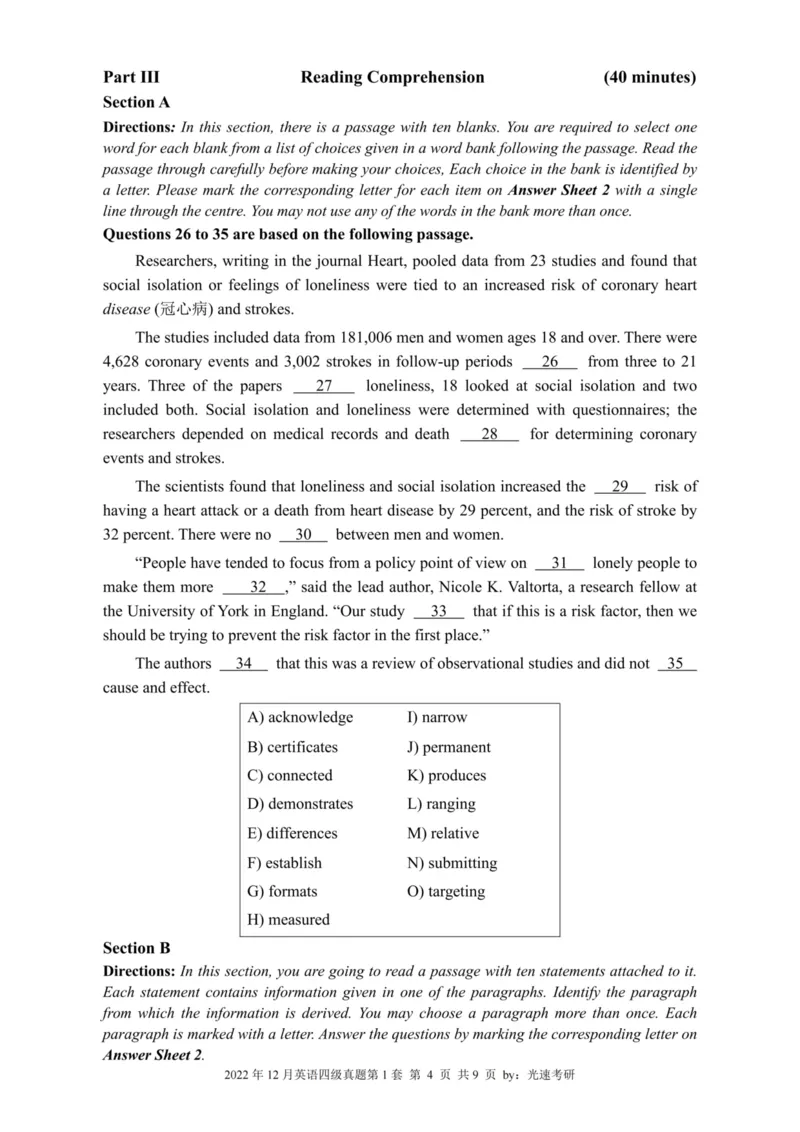
Section A
Directions: In this section, there is a passage with ten blanks. You are required to select one
word for each blank from a list of choices given in a word bank following the passage. Read the
passage through carefully before making your choices, Each choice in the bank is identified by
a letter. Please mark the corresponding letter for each item on Answer Sheet 2 with a single
line through the centre. You may not use any of the words in the bank more than once.
Questions 26 to 35 are based on the following passage.
Researchers, writing in the journal Heart, pooled data from 23 studies and found that
social isolation or feelings of loneliness were tied to an increased risk of coronary heart
disease (冠心病)and strokes.
The studies included data from 181,006 men and women ages 18 and over. There were
4,628 coronary events and 3,002 strokes in follow-up periods 26 from three to 21
years. Three of the papers 27 loneliness, 18 looked at social isolation and two
included both. Social isolation and loneliness were determined with questionnaires; the
researchers depended on medical records and death 28 for determining coronary
events and strokes.
The scientists found that loneliness and social isolation increased the 29 risk of
having a heart attack or a death from heart disease by 29 percent, and the risk of stroke by
32 percent. There were no 30 between men and women.
“People have tended to focus from a policy point of view on 31 lonely people to
make them more 32 J said the lead author, Nicole K. Valtorta, a research fellow at
the University of York in England. t4Our study 33 that if this is a risk factor, then we
should be trying to prevent the risk factor in the first place.”
The authors 34 that this was a review of observational studies and did not 35
cause and effect.
A) acknowledge I) narrow
B) certificates J) permanent
C) connected K) produces
D) demonstrates L) ranging
E) differences M) relative
F) establish N) submitting
G) formats O) targeting
H) measured
Section B
Directions: In this section, you are going to read a passage with ten statements attached to it.
Each statement contains information given in one of the paragraphs. Identify the paragraph
from which the information is derived. You may choose a paragraph more than once. Each
paragraph is marked with a letter. Answer the questions by marking the corresponding letter on
Answer Sheet 2.
2022年12月英语四级真题第1套 第 4 页 共 9 页 by:光速考研The hidden costs colleges don't want you to know about
A) This fall, thousands of college students from across the country will begin their
undergraduate studies at colleges around the nation. They will inevitably pack too much
to fit in their tiny dorm rooms. They will also carry with them a huge student loan debt,
in addition to countless “hidden“ out-of-pocket costs paid for by their bank accounts
and the bank accounts of their families.
B) At my well-respected, private, four-year university in Washington, D.C., which boasts a
yearly tuition of $44,046 not including room and board, I receive over $57,000 yearly
in financial aid. As a student from a family that is struggling to make ends meet, my
financial aid package is a combination of federal grants and federal work study,
university merit scholarships and financial aid awards, and about $8,000 yearly in
federally subsidized (有补贝占的)and unsubsidized loans. On paper, my expenses and
my financial aid just about even out. Off paper, they don't.
C) Universities today are in the business of making money, and mine is no exception. They
hit me right out of gate with a $160 fee to attend my freshman orientation, a price which
does not include the cost of travel to and from the District. Almost every class has an
associated fee not included in the cost of tuition, most between $40 and $100. Fees for
lab science classes are the highest, and all students at my university are required to take
at least one lab before they graduate. Buying a laptop proved a necessity and, thankfully,
a relative bought me one as a gift. Renting a mini-fridge for my dorm room costs my
roommates and me about $140 a year.
D) Schools will charge you whatever they can. The costs of any damage to the dorm,
including elevators, bathrooms, and common areas, are billed to every person on a dorm
floor, or even the entire building if they do not know who caused the damage. After I
fell out of my bed twice during my freshman year, the university installed a railing一for
$20, billed to my student account. My financial aid did not anticipate any of these costs,
and so it did not cover them.
E) An Internet search of “hidden costs” of college turns up a host of articles on
parent-centered websites on the college application process. These articles are almost
always geared towards upper- and middle-class families. For students already struggling
to pay tuition, these costs may be the least of their worries.
F) So what hidden costs should low-income students really be paying attention to? My
college experience offers a few examples.
G) If you are a low-income student who will be attending school out-of^state, make sure
you know if you can use your state benefits, such as the Supplemental Nutrition
Assistance Program, or SNAP. It wasn't until after I had accepted admission to an
out-oi-state school that I learned that I could not use my Ohio Medicaid on campus for
anything other than emergency care. My benefits became invalid the second I moved
out of Ohio. After my freshman year, I had to opt for the schooFs insurance plan, which
costs around $2,000 a year. Even if your school offers a flat-rate fee for a doctor's
appointment at the student health center (mine is $20 a visit), these fees often do not
include extra fees for lab tests or prescription medications (药物).
H) If you plan on paying off bills in your student account with a credit card, be aware of
any additional costs. My school charges an additional fee for the use of a credit card to
2022年12月英语四级真题第1套 第 5 页 共 9 页 by:光速考研settle outstanding charges, which can add upwards of 3% of the balance to your bill.
I) There is another depressing reality hidden within even the largest financial aid packages:
Colleges often offer the most generous packages during freshman year as a way to
attract new students. My family was careful to ask about the chances of financial aid
being taken away after my freshman year. We were assured that, except for low grades
or a raise in family income, no money would be taken away. We did not know to
ask- and the school did not readily point out- that even if tuition rises, my financial
aid package will stay the same. So when my university voted to raise tuition costs 3% at
the end of my freshman year, my financial aid package remained the same and I was
suddenly responsible fbr an additional $1,200 fbr the next year. The university
administration will likely vote to raise costs at least once more before my graduation.
J) Yes, I chose to attend an expensive university far from my hometown. Yes, there were
cheaper options. But there are promising students from struggling families across the
nation who should not rule out their dream schools entirely. All things considered, I am
paying significantly less than the ticket price of my university, and having an
educational experience in Washington, D.C., that I would not have had anywhere else.
As a low-income student from a down-and-out Rust Belt community, these educational
experiences have enormous potential to brighten my future-and my family's future.
K) The key is to make sure that students and their families understand that hidden costs
exist, and that they may prove problematic. Fill out a more comprehensive checklist,
and be wary of listed prices that seem too low. Understand just how complicated the
financial aid process is.
L) Students and families must also understand their ability to self^advocate. They should
not pay student bills or excess fees blindly. If something does not look right, ask about
it. If it still doesn't look right, negotiate it. In cases where parents are working multiple
jobs, are less knowledgeable about college bureaucracies, have limited English
language skills, or are not contributing financially to their child's education, the burden
of self-advocacy will fall on the student. I understand the difficulty, and the
embarrassment. But it is necessary.
M) In the grand scheme of things, however, colleges also must come to understand that the
hidden fees they ask for may prove unmanageable fbr the very kinds of low-income or
first-generation students they are trying desperately to attract.
36. Students5 financial aid remains unchanged even when tuition rises.
37. Students may not be able to enjoy their state benefits when they go to college out of the
state.
38. The financial aid the author receives is supposed to cover all her college expenses.
39. When the person who damages dorm facilities is not identified, students are required to
share the cost.
40. Though it is difficult and embarrassing, students should make inquiries about what fees
they have to pay and why.
41. Today, many Americans have to go to college on student loans.
42. Receiving education in a private university in the nation's capital may change the
2022年12月英语四级真题第1套 第 6 页 共 9 页 by:光速考研author's future life and that of her family's.
43. Students may no longer be qualified for financial aid if they perform poorly in school or
if their family income has increased.
44. In addition to tuition, college students have to pay extra fees for the courses they take.
45. Some schools charge students a fee to their student accounts for using credit cards to
pay bills.
Section C
Directions: There are 2 passages in this section. Each passage is followed by some questions
or unfinished statements. For each of them there are four choices marked A), B), C) and D).
You should decide on the best choice and mark the corresponding letter on Answer Sheet 2
with a single line through the centre.
Passage One
Questions 46 to 50 are based on the following passage.
To write his 2010 book, The 5-Factor World Diet, nutritionist Harley Pasternak
traveled to the healthiest countries around the world to learn more about what made their
meals extra nourishing.
He noted that Japanese people ate a wonderful variety of seaweeds, and that Chinese
people tried to include at least five different colors in every meal. Pasternak also came
away with some valuable observations about how different the North American way of life
was, compared with many other countries.
For starters, Americans eat much bigger portions than people in other countries. 44We
don't prioritize eating seasonally or locally, and we also add lots of salt, sugar and
thickening agents to our foods,explained Pasternak. Contrast that to the healthy
Mediterranean, Nordic and Okinawan diets listed in Pasternak's book. They all seem to
stick to the ethos (特质)of regional, seasonal produce.
For example, a traditional Mediterranean diet includes fruits, vegetables, whole grains,
nuts and olive oil as the main components of nutritional intake. Fish, chicken and red wine
make moderate appearances, while red meat, salt and sugar are used much less often. The
benefits of a traditional Mediterranean diet have been studied since the 1970s, and
researchers have found that living that olive oil life can help people lose weight, lower their
heart disease risk and reverse diabetes.
Most other healthy eating cultures also make meals an event一say, multiple courses
around the family table, or a glass or two of red wine at a long lunch-as opposed to hastily
wolfing down handfuls of cereal above the kitchen sink and calling it dinner.
Each of the healthy eating cultures has its own unique feature. But Pasternak did take
note of one unifying factor in all of the healthy societies he observed. "The only
overlapping feature in most of these healthy countries is that they all walk way more than
the average American,said Pasternak, “So really, regardless of what you're eating, if
someone's walking four miles more than you each day, they're going to be a lot thinner and
live a lot longer than you.^^
46. What characterizes Japanese and Chinese foods?
A) Variety. B) Flavor. C) Color. D) Naturalness.
2022年12月英语四级真题第1套 第 7 页 共 9 页 by:光速考研47. What is typical of Americans in the way of eating?
A) They emphasize nutrition. C) They prioritize convenience.
B) They tend to eat quite a lot. D) They care about flavors.
48. What features in Mediterranean, Nordic and Okinawan diets?
A) Fruits and vegetables. C) Seasonal local produce.
B) Olive oil and red wine. D) Unprocessed ingredients.
49. What do people in most healthy eating cultures have in common?
A) They get the whole family to eat at a table.
B) They eat their meals regularly and punctually.
C) They consume plenty of cereal for breakfast.
D) They attach great importance to their meals.
50. Compared with the average American, people in healthy societies .
A) walk at least 4 miles a day
B) do considerably more walking
C) pay more attention to body shape
D) consume a lot more organic food
Passage Two
Questions 51 to 55 are based on the following passage.
Recognizing when a friend or colleague feels sad, angry or surprised is key to getting
along with others. But a new study suggests that being sensitive to people's feelings may
sometimes come with an extra dose of stress. This and other research challenge the
prevailing view that emotional intelligence is uniformly beneficial to its bearer.
In a study, psychologist Myriam Bechtoldt of the Frankfurt School of Finance and
Management in Germany asked 166 male university students a series of questions to
measure their emotional intelligence. For example, they showed the students photographs
of people's faces and asked them to what extent feelings such as happiness or disgust were
being expressed. The students then had to give job talks in front of judges who displayed
serious facial expressions. The scientists measured concentrations of stress honnones in the
students5 saliva (唾液)before and after the talk.
In students who were rated more emotionally intelligent, the stress measures increased
more during the experiment and took longer to go back to baseline. The findings suggest
that some people may be too emotionally clever fbr their own good, says Bechtoldt.
“Sometimes you can be so good at something that it causes trouble,she notes.
Indeed, the study adds to previous research hinting at a dark side of emotional
intelligence. A study published in 2002 in Personality and Individual Differences suggested
that emotionally perceptive people might be particularly influenced by feelings of
depression and hopelessness. Furthermore, several studies have implied that emotional
intelligence can be used to manipulate others for personal gains.
More research is needed to see how exactly the relation between emotional
intelligence and stress would play out in women and in people of different ages and
education levels. Nevertheless, emotional intelligence is a useful skill to have, as long as
you learn to also properly cope with emotions- both others' and your own, says Bechtoldt.
2022年12月英语四级真题第1套 第 8 页 共 9 页 by:光速考研For example, some sensitive individuals may assume responsibility for other people's
sadness or anger, which ultimately stresses them out. Remember, as Bechtoldt says, “you
are not responsible for how other people feel.^^
51. What is the finding of the new study?
A) Emotional intelligence helps people get along with others.
B) Emotional intelligence is generally beneficial to its bearer.
C) People who are aware of others' feelings may experience more stress.
D) People who are emotionally stressed may have trouble making friends.
52. What was the purpose of psychologist Myriam Bechtoldfs experiment?
A) To define different types of human feelings.
B) To assess the impacts of being emotionally clever.
C) To demonstrate how to distinguish different feelings.
D) To identify gender differences in emotional intelligence.
53. What does the finding of Myriam Bechtoldfs study indicate?
A) Greater emotional cleverness means less trouble in one's life.
B) Emotional intelligence helps people succeed in job interviews.
C) People's psychological wellbeing is related to various factors.
D) People may suffer from having a high emotional intelligence.
54. What do we learn about emotional intelligence from a number of studies?
A) People suffering from depression are emotionally immature.
B) People who look at the dark side of life often feel depressed.
C) Some people may take advantage of it and benefit themselves.
D) Some people may lack it and are easily manipulated by others.
55. What does the author suggest sensitive individuals do?
A) Avoid burdening themselves with others' feelings.
B) Rid themselves of worries over worldly affairs.
C) Learn to cope with people's negative feelings.
D) Help people to deal with their troubles in life.
Part IV Translation (30 minutes)
Directions: For this part, you are allowed 30 minutes to translate a passage from Chinese into
English. You should write your answer on Answer Sheet 2.
在中国农历中,在 数 (Start of Autumn)意味着夏天的结束和秋天的开始。立秋带来的首先是天
气的变化,气温逐渐下降。人们看到树叶开始变黄飘落时,知道秋天已经来临,这就是所谓的“一
叶知秋”。但此时酷热的天气并未完全结束,高温通常还会持续一段时间,被称为“秋 老 虎 立 秋
对农民意义重大,这时各种秋季作物迅速生长、开始成熟,收获的季节即将到来。
2022年12月英语四级真题第1套 第 9 页共9 页 by:光速考研2022年 12月大学英语四级考试真题(第 2 套)
扫码获音频
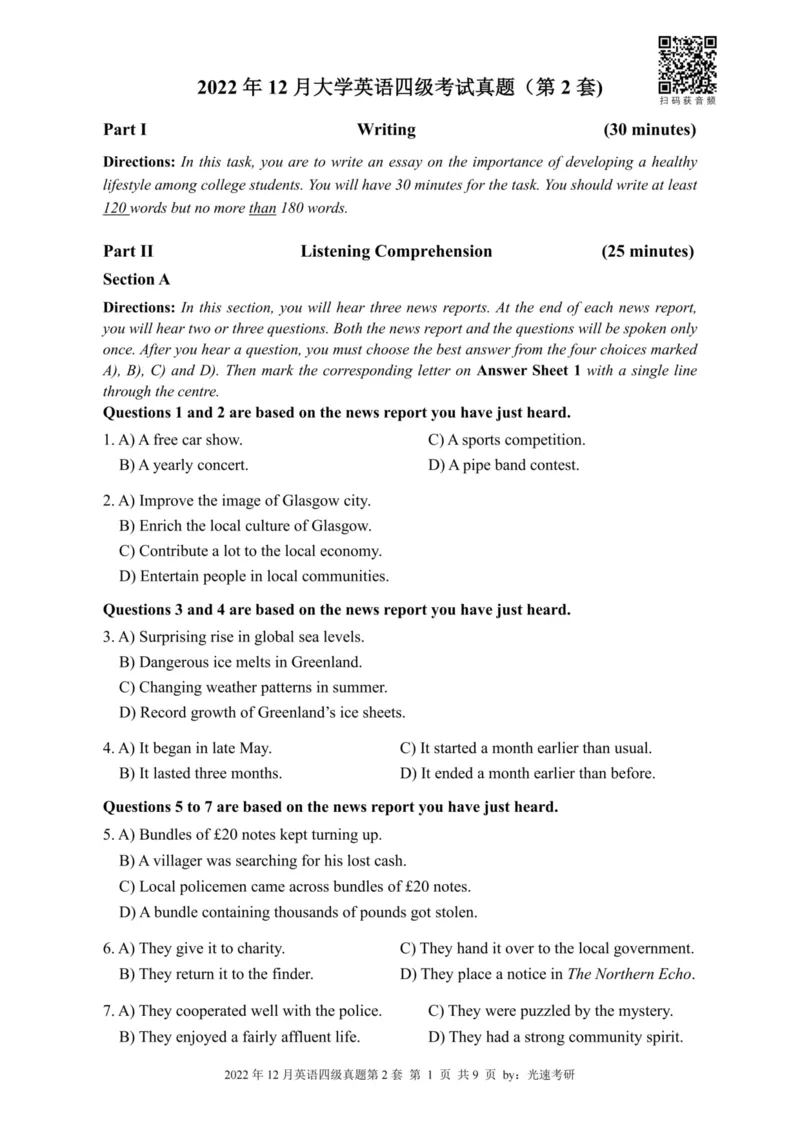
Part I Writing (30 minutes)
Directions: In this task, you are to write an essay on the importance of developing a healthy
lifestyle among college students. You will have 30 minutes for the task. You should write at least
120 words but no more than 180 words.
Part II Listening Comprehension (25 minutes)
Section A
Directions: In this section, you will hear three news reports. At the end of each news report,
you will hear two or three questions. Both the news report and the questions will be spoken only
once. After you hear a question, you must choose the best answer from the four choices marked
A), B), C) and D). Then mark the corresponding letter on Answer Sheet 1 with a single line
through the centre.
Questions 1 and 2 are based on the news report you have just heard.
1. A) A free car show. C) A sports competition.
B) A yearly concert. D) A pipe band contest.
2. A) Improve the image of Glasgow city.
B) Enrich the local culture of Glasgow.
C) Contribute a lot to the local economy.
D) Entertain people in local communities.
Questions 3 and 4 are based on the news report you have just heard.
3. A) Surprising rise in global sea levels.
B) Dangerous ice melts in Greenland.
C) Changing weather patterns in summer.
D) Record growth of Greenland's ice sheets.
4. A) It began in late May. C) It started a month earlier than usual.
B) It lasted three months. D) It ended a month earlier than before.
Questions 5 to 7 are based on the news report you have just heard.
5. A) Bundles of £20 notes kept turning up.
B) A villager was searching for his lost cash.
C) Local policemen came across bundles of £20 notes.
D) A bundle containing thousands of pounds got stolen.
6. A) They give it to charity. C) They hand it over to the local government.
B) They return it to the finder. D) They place a notice in The Northern Echo.
7. A) They cooperated well with the police. C) They were puzzled by the mystery.
B) They enjoyed a fairly affluent life. D) They had a strong community spirit.
2022年12月英语四级真题第2套 第 1 页 共 9 页 by:光速考研Section B
Directions: In this section, you will hear two long conversations. At the end of each
conversation, you will hear four questions. Both the conversation and the questions will be
spoken only once. After you hear a question, you must choose the best answer from the four
choices marked A), B), C) and D). Then mark the corresponding letter on Answer Sheet 1 with
a single line through the centre.
Questions 8 to 11 are based on the conversation you have just heard.
8. A) Excited. C) Indifferent.
B) Delighted. D) Strange.
9. A) Search fbr the meaning of their life. C) Call on their relatives and friends.
B) Look back on their years at school. D) Talk about future plans with friends.
10. A) He prefers to have them shown on social media.
B) He loves them but does not want to make a fuss.
C) He enjoys celebrating others' birthdays rather than his own.
D) He looks forward to receiving presents from his close friends.
11. A) Hold it on a modest scale to remove birthday anxieties.
B) View it as a chance fbr people to socialize and have fiin.
C) Extend invitation to those he trusts most.
D) Make it an occasion to collect donations.
Questions 12 to 15 are based on the conversation you have just heard.
12. A) It was absolutely exhausting. C) There was too long a delay.
B) There was a terrible smell. D) She got off at the wrong station.
13. A) She hasn't saved enough money. C) She hasn't passed the driving test yet.
B) She is worried about traffic jams. D) She is used to taking public transport.
14. A) They are popular. C) They are a bit expensive fbr her.
B) They are dangerous. D) They are environmentally friendly.
15. A) By bus. C) By renting a bike.
B) By jogging. D) By sharing a ride.
Section C
Directions: In this section, you will hear three passages At the end of each passage, you will
hear three or four questions.Both the passage and the questions will be spoken only once.
After you hear a question,you must choose the best answer from the four choices marked A), B),
C) and D). Then mark the corresponding letter on Answer Sheet 1 with a single line through
the centre.
Questions 16 to 18 are based on the passage you have just heard.
16. A) He is a sign language interpreter. C) He doesn't like speaking at meetings.
B) He is a deaf person working in IT. D) He doesn't use email or text messages.
17. A) Improved communication skills. C) Big advances in sign language.
B) Speech recognition technology. D) Transformation in the IT industry.
2022年12月英语四级真题第2套 第 2 页 共 9 页 by:光速考研18. A) He can avoid being mistaken. C) He can understand with ease.
B) He can take notes on the spot. D) He can see the speakers; images.
Questions 19 to 21 are based on the passage you have just heard.
19. A) To find pure white walls shining. C) To get a hug from family members.
B) To enter a house well looked after. D) To see cheerful colours all around.
20. A) Choosing a colour because it is fashionable.
B) Painting the interior of their cupboards.
C) Doing the painting job all by themselves.
D) Designing all window frames the same way.
21. A) Fit most of the cupboards into walls.
B) Hang landscape paintings all around.
C) Match the room's ceiling with all the furniture in colour.
D) Paint the wooden frameworks and walls the same colour.
Questions 22 to 25 are based on the passage you have just heard.
22. A) Children must read at least 3 times a week.
B) Reading is a habit every child can develop.
C) Reading to their children is important.
D) Children should start reading at age 3.
23. A) The number of books they have read by age four.
B) The speed of their brain development in infancy.
C) The number and quality of books parents read to them in infancy.
D) The quality and quantity of time parents spend playing with them.
24. A) Books with specifically labeled images.
B) Books with pictures of dolls and toys.
C) Books describing the lives of animals.
D) Books telling very interesting stories.
25. A) Read as many books as possible to their children.
B) Choose carefully what to read to their children.
C) Share experience with other parents.
D) Create picture books for their children.
Part III Reading Comprehension (40 minutes)
Section A
Directions: In this section, there is a passage with ten blanks. You are required to select one
word for each blank from a list of choices given in a word bank following the passage. Read the
passage through carefully before making your choices, Each choice in the bank is identified by
a letter. Please mark the corresponding letter for each item on Answer Sheet 2 with a single
line through the centre. You may not use any of the words in the bank more than once.
2022年12月英语四级真题第2套 第 3 页 共 9 页 by:光速考研Parenting brings fathers more joy than it does mothers, according to a new study. The
research examined three studies 26 more than 18,000 participants. Across all three,
parenthood was 27 with more positive wellbeing outcomes for dads than for mums.
So why are fathers happier than mothers? "Fathers may fare better than mothers in part
due to how they spend time with their children,“ said lead author Katherine Nelson-Cofley.
In one study, the authors 28 that dads were more likely to take “playing” as an 29
activity both when caring fbr their kids and spending time with their kids. t4Playing with
their children likely offers parents opportunities to experience positive feelings and 30
closeness with their children,“ they say.
Fathers also did better than men without kids, reporting greater happiness, life
satisfaction, and fewer 31 symptoms. They also reported greater connectedness and
autonomy (自 主).For mums, 32 , compared to women without children, the results
weren't quite as positive. Mums reported greater autonomy, but also “greater trouble” and
fewer positive 33 .
Mums reported happier moods while interacting with their kids, compared to other
experiences, but not while engaging 34 in childcare. t4This difference suggests that
how mothers and fathers spend time with their children might have important 35 for
their wellbeing,the authors write. They suspect that mums may be less happy than dads
because they5re more likely to have higher expectations about parenthood. As such, they're
more likely to be “let down^^ by the experience.
A) additional I) implications
B) associated J) interfered
C) composing K) involving
D) cultivate L) note
E) depressive M) precisely
F) directly N) superficial
G) emotions O) therefore
H) however
Section B
Directions: In this section, you are going to read a passage with ten statements attached to it.
Each statement contains information given in one of the paragraphs. Identify the paragraph
from which the information is derived. You may choose a paragraph more than once. Each
paragraph is marked with a letter. Answer the questions by marking the corresponding letter on
Answer Sheet 2.
Learning to say no
A) Not doing something will always be faster than doing it. This philosophy applies in
many areas of life. For example, there is no meeting that goes faster than not having a
meeting at all. This is not to say you should never attend another meeting, but the truth
is that we say "yes" to too many things we don't actually want to do.
B) How often do people ask you to do something and you just reply, ttSure.^^ Three days
later, you're overwhelmed by how much is on your to-do list. We become frustrated by
our obligations even though we were the ones who said "yes" to them in the first place.
2022年12月英语四级真题第2套 第 4 页 共 9 页 by:光速考研Even worse, people will occasionally fight to do things that waste time. You don't have
to do something just because it exists. Ifs worth asking if things are necessary. Many of
them are not, and a simple "no” will be more productive than whatever work the most
efficient person can cope with. But if the benefits of saying "no" are so obvious, then
why do we say "yes" so often?
C) We say "yes" to many requests not because we want to do them, but because we don't
want to be seen as rude or unhelpful. Often, we have to consider saying “no" to
someone we will interact with again in the future—our co-worker, our spouse, our
family and friends. Saying "no" to our superiors at work can be particularly difficult. In
these situations, I like the approach recommended in Essentialism by Greg McKeown.
He writes, ''Remind your superiors what you would be neglecting if you said 'yes' and
force them to deal with the trade-off. For example, if your manager comes to you and
asks you to do X, you can respond with 'Yes, I'm happy to make this the priority.
Which of these other projects should I deprioritize to pay attention to this new project?^^^
D) Collaborating with others is an important element of life. The thought of straining the
relationship outweighs the commitment of our time and energy. For this reason, it can
be helpful to be gracious in your response. Do whatever favors you can, and be
warm-hearted and direct when you have to say no. But even after we have accounted
for these social considerations, many of us still seem to do a poor job of managing the
trade-off between yes and no. We find ourselves over-committed to things that don't
meaningfully improve or support those around us, and certainly don't improve our
own lives.
E) Perhaps one issue is how we think about the meaning of yes and no. The words "yes"
and “no" get so often used in comparison with each other that it feels like they carry
equal weight in conversation. In reality, they5re not just opposite in meaning, but of
entirely diflerent magnitudes in commitment. When you say "no", you're only saying
"no" to one option. When you say "yes”, you5re saying "no" to every other option. I
like how economist Tim Harford put it, “Every time we say 'yes' to a request, we're
also saying 'no' to anything else we might accomplish with the time." Once you're
committed to something, you've already decided how that future block of time will be
spent. In other words, saying "no" saves you time in the future. Saying "yes" costs you
time in the fixture. "No" is a form of time credit. You retain the ability to spend your
future time however you want. “Yes" is a form of time debt. You have to pay back your
commitment at some point.
F) “No" is a decision. "Yes" is a responsibility. Saying "no" is sometimes seen as a
luxury that only those in power can afford. And it's true: turning down opportunities is
easier when you can foil back on the safety net provided by power, money, and
authority. But it's also true that saying "no" is not merely a privilege reserved for the
successful. It's also a strategy that can help you become successful. Saying 'no" is an
important skill to develop at any stage of your career because it retains the most
important asset in life: your time. As investor Pedro Sorrentino put it, “If you don't
guard your time, people will steal it from you." You need to say "no" to whatever isn't
leading you toward your goals.
G) Nobody embodied this idea better than Steve Jobs, who said, “People think fbcus
means saying 'yes' to the thing you've got to focus on. But thafs not what it means at
all. It means saying 'no' to the hundred other good ideas that there are. You have to
2022年12月英语四级真题第2套 第 5 页 共 9 页 by:光速考研pick carefully.^^ Jobs had another great quote about saying "no": 'Tm actually as
proud of the things we haven5t done as the things I have done. Innovation is saying
4no5 to 1,000 things.
H) Over time, as you continue to improve and succeed, your strategy needs to change. The
opportunity cost of your time increases as you become more successful. At first, you
just eliminate the obvious distractions and explore the rest. As your skills improve and
you learn to separate what works from what doesn't, you have to continually increase
your threshold for saying "yes”. You still need to say "no" to distractions, but you also
need to learn to say “no" to opportunities that were previously good uses of time, so
you can make space fbr better uses of time. Ifs a good problem to have, but it can be a
tough skill to master.
I) What is true about health is also true about productivity: an ounce of prevention is
worth a pound of cure. More effort is wasted doing things that don't matter than is
wasted doing things inefficiently. And if that is the case, elimination is a more useful
skill than optimization. Fm reminded of the famous Peter Drucker quote, “There is
nothing so useless as doing efficiently that which should not be done at all.”
36. People often grant a request just because they want to appear polite and helpful.
37. It's no easy job learning to say "no" to opportunities that were once considered worth
grasping.
38. When you decline a request, you are saving your future time.
39. People sometimes struggle to do things that are simply a waste of time.
40. Doing efficiently what is not worth doing is the most useless effort.
41. It is especially difficult fbr people to decline to do what their superiors ask them to do.
42. People agree to do too many things they are in fact unwilling to do.
43. According to one famous entrepreneur, innovation means refusal to do an enormous
number of things.
44. It is an essential aspect of life to cooperate with other people.
45. Refusing a request is sometimes seen as a privilege not enjoyed by ordinary people.
Section C
Directions: There are 2 passages in this section. Each passage is followed by some questions
or unfinished statements. For each of them there are four choices marked A), B), C) and D).
You should decide on the best choice and mark the corresponding letter on Answer Sheet 2
with a single line through the centre.
Passage One
Questions 46 to 50 are based on the following passage.
We're eating more fish than ever these days. At around 20 kilograms per person global
fish consumption is now more than twice what it was in the 1960s. Whafs really
remarkable, though, is where that fish comes from.
For the first time in human history, most of our aquatic (水产的)food now comes
from farming rather than fishing.
People ate around 73 million tonnes of farmed fish- just more than half of the volume
2022年12月英语四级真题第2套 第 6 页 共 9 页 by:光速考研of fish that humans consumed—in 2014. Thafs out of a total fish supply of 167 million
tonnes; the remaining 20 million or so tonnes go into things like animal feed and medical
products.
To keep eating fish at the current rate, we're definitely going to need to keep
aquaculture (水产养殖) developing. Thafs because the volume offish caught in the wild
has leveled off since the 1990s.
Back in 1974, only 10% of marine fish stocks had been overfished. Now, more than
three-tenths are. Only a tenth of our oceans' fish stocks could sustain heavier fishing than
current levels.
But while catchings at sea have suffered, fish-farming has been growing at a fast rate.
A lot of that is coming from China, which produces 60% of the world's farmed fish. In fact,
some 35 countries, including China, now produce more farmed than wild-caught fish.
This shift toward aquaculture isn't just good for ensuring salmon (三文鱼)on your
plate; ifs also crucial to ensuring food security and sustainability. By 2050, the world will
need to feed an estimated 9.7 billion people. They'll have to get their protein somewhere.
However, raising cattle, pigs, and other land-based animals requires vast sums of grain and
water. For example, pound for pound, beef requires 15 times more feed to raise than carp, a
freshwater fish farmed all over Asia. That grain-and the water needed to grow it-could be
consumed by people instead.
However, aquaculture is no silver bullet. In some southeast Asian countries, shrimp
farming does disastrous damage to marine ecosystems. Despite these problems, however,
shrimp continues to be among the most popular sea foods worldwide.
46. What does the author say is remarkable about the fish we eat?
A) They reproduce quickly.
B) They are mostly farmed.
C) They have become as important as grain.
D) They have a longer history than humans.
47. What do we need to do if we keep consuming fish at the current rate?
A) Increase the fishing volume considerably.
B) Develop more advanced fishing technology.
C) Enlarge the marine fish stocks effectively.
D) Expand the scale offish-farming continuously.
48. What does the author say about China in terms of aquatic food?
A) It places increasing emphasis on fishing now.
B) It boasts of the world's largest fishing stocks.
C) It raises more fish than caught from the wild.
D) It supplies 60% of the world's fish products.
49. Why does the author say aquaculture is so important these days?
A) It is a must for feeding the world's fast-growing population.
B) It proves a reliable source of protein for humans and animals.
C) It is essential to maintaining both mental and physical health.
D) It ensures a balanced healthy diet for people the world over.
2022年12月英语四级真题第2套 第 7 页 共 9 页 by:光速考研50. What does the author imply by saying aquaculture is no silver bullet?
A) Shrimp-farming is a risky business.
B) Fish-farming will not be sustainable.
C) Fish-farming may cause serious problems too.
D) Shrimp-farming can become quite expensive.
Passage Two
Questions 51 to 55 are based on the following passage.
In 2020, the Nobel Peace Prize was awarded to the World Food Programme (WFP).
Why a Nobel Prize for the WFP, and why now? In 2019, the WFP assisted nearly 100
million people in 88 countries. It is the safety net fbr those who fall off the edge of existence.
It is a response to solving the problem of food instability. Its Nobel Prize reminds us all of the
moral hazard in imagining that the poor and vulnerable are somebody else's problem.
The WFP has been around since 1961 and has been the global coordinator of
nationally based efforts to avoid disasters with food aid. Despite decades of effort to
eliminate hunger, the latest estimate is that about 11% of people on the planet (about 820
million people) are suffering daily undernourishment. Progress at reducing undernourishment
has stopped despite gains through the 1990s and 2000s.
Developed countries sometimes offer food and aid to developing ones, but at a price.
One American philosopher stated that addressing the needs of the poor and vulnerable is
about more than money- it is mostly about creating conditions under which prosperity and
opportunity can thrive. When aid is offered with heavy conditions attached, like loan
repayment or food for resources, it often widens the gap between rich and poor and sustains
the old world order. This is why the work of the WFP is so vital.
The scientific community, however, can provide a helping hand to the WFP. By
sharing knowledge of agriculture and climate with peers in countries most vulnerable to
poverty and hunger, scientists can help reduce these problems. By making its voice heard,
science can lead by example. The ability to overcome food shortages that must be built into
some of the poorest countries will not come from loans from wealthy countries, which may
have food problems of their own, or world economic institutions. This ability will be built
upon self-confident people using open and shared scientific knowledge to pull themselves
out of their misery.
51. What does the WFP's winning of the Nobel Peace Prize make us realize?
A) More and more people in the world are suffering from starvation.
B) All of us can be affected by food instability one way or another.
C) It is hazardous to leave millions of people poor and vulnerable.
D) It is morally wrong to think helping the poor is not our business.
52. What do we learn about the WFP's effort to eliminate hunger?
A) It has ensured a sufficient food supply to millions.
B) It is still far from its goal despite the progress made.
C) It has done a good job in combating natural disasters.
D) It is preventing starvation occurring on a global scale.
53. What will happen when food aid is offered at a price?
2022年12月英语四级真题第2套 第 8 页 共 9 页 by:光速考研A) The rich will become richer and the poor poorer.
B) More people will be willing to join in the effort.
C) More food will be made available to the needy.
D) The relief effort will be rendered less sustainable.
54. How can scientists help cope with poverty and hunger?
A) By collaborating closely with world economic institutions.
B) By sharing expertise with peers in poverty-stricken nations.
C) By setting up more food research programs in developing countries.
D) By building self-respect in people suffering from undemutrition.
55. What message does the author try to convey at the end of the passage?
A) Wealthy nations should solve their own food problems first.
B) Rich countries should be more generous in providing food aid.
C) Poor nations should enhance their own ability to solve their food shortages.
D) World economic institutions should play a bigger role in fighting hunger.
Part IV Translation (30 minutes)
Directions: For this part, you are allowed 30 minutes to translate a passage from Chinese into
English. You should write your answer on Answer Sheet 2.
立 春 (Start of Spring)在中国农历中表示春天的开始。立春之后,白天变得更长,天气也愈发
温暖,万物开始复苏,大地充满生机。人们常说“一年之计在于春”,农民在这个时节开始播种,
为全年的丰收打下基础。中国人早在三千年前就己开始在立春这一天举行庆祝活动。数百年来,
迎春一直是民间的重要习俗。在春暖花开的日子里,人们常常外出游玩,欣赏春天的美景。
2022年12月英语四级真题第2套 第 9 页共9 页 by:光速考研2022年 12月大学英语四级考试真题(第 3 套)
Part I Writing (30 minutes)
Directions: In this task, you are to write an essay on the necessity of developing social skills for
college students. You will have 30 minutes for the task. You should write at least 120 words but
no more than 180 words.
Part II Listening Comprehension (25 minutes)
淘宝店铺【光速考研工作室】温馨提示:2022年 12月大学英语四级考试全国共考了两套听力。
本套试题听力内容与第二套相同,因此本套听力部分不再重复给出。
Part III Reading Comprehension (40 minutes)
Section A
Phones influence all aspects of teenage life. Ninety-five percent of Americans ages 13
to 17 have a smartphone or have access to one, and nearly half report using the internet
“almost 26
But as recent survey data and interviews have suggested, many teens find much of that
time to be unsatisfyingly spent. Continuous 27 shouldn't be mistaken for endless
enjoyment. A new 28 representative survey about “screen time and device distractions^^
from the Pew Research Center indicates that ifs not just parents who think teenagers are
worryingly 29 from their phones- many teens themselves do too. Fifty-four percent
of the 13-to-17-year-olds surveyed said they spend too much time 30 in their phones.
Vicky Rideout, who runs a research firm that studies children's interactions with media
and technology, was not surprised by this finding. She says ifs hardly 31 to teenagers.
“They are dealing with the same challenges that adults are, as far as they are living in the
32 of a tech environment designed to suck as much of their time onto their devices as
possible,5, Rideout says.
The way parents interact with technology can 33 the way they interact with their
kids. Rideout thus thinks it's up to parents to model good 34 : Kids tend to take note if
their parents put their phone away at dinner or charge it in another room while they sleep.
Witnessing habits like that can help kids “realize that they can 35 some more control
over their devices,she says.
A) absorbed I) recruited
B) addicted J) shape
C) behavior K) solution
D) constantly L) specific
E) context M) summary
F) exercise N) usage
G) inseparable O) vaguely
H) nationally
Section B
2022年12月英语四级真题第3套 第 1 页共6页 by:光速考研Evil Genius
A) A few years ago I found myself teaching a university class on evil. It was for third-year
criminology students to help them contextualize theory and research within
controversial current topics. It was a huge success. The debates were heated and
interesting. I could see people's views change within the course of a single lecture. Over
the past 13 years, as a student, lecturer and researcher, I've enjoyed discussing the
science of evil with anyone willing to listen. What I like most is destroying the cliche
(陈词滥调)of good and evil, and replacing them with scientific insight. We need a
more informed way of discussing behavior that at first we cannot, or should not, begin
to understand.
B) Without understanding, we risk dehumanizing others, writing off human beings simply
because we don't comprehend them. We must try to understand what we have labeled
evil. We tend to think evil is something that other people are. We think of ourselves as
“good people”, and even when we do morally wrong things, we understand the context
of our decisions. With others, however, it is far easier to write them off. If their actions
deviate (偏离)substantially from what we consider acceptable, we may label them evil.
We need to be careful with this. Calling someone evil is often similar to saying they
cannot change, and perhaps aren't even a human at all. However, when you actually go
monster-hunting, and you look deeply at the people behind shocking behavior, you may
be surprised.
C) As a child I used to love the Scooby-Doo cartoons. Arriving in their “Mystery
Machine55, the gang would have to find a monster who was terrorizing a neighborhood.
They would run around looking for clues and at the end unmask the bad guy. It was
always a normal person in a costume. There were no monsters. Like the Scooby crew,
we may find ourselves hunting for an easy fix, one word fbr people who do bad things.
But if we take a good look, the word "evil" is insufficient- there are no simple
explanations for why humans do bad things: instead there are many, and they are all
marvelously different.
D) Evil is typically referred to when there is deviance from social norms: formal deviance
is the violation of laws, like theft, murder, and attacks, while informal deviance
involves violations of social norms, like lying. Evil behavior is typically thought to
embrace one or both forms. However, deviance can also describe a behavior that simply
differs from the norm.
E) Perhaps this is where we can find the good side of our bad side. Deviating from the
norm can make us villains (恶棍),but it can also make us heroes. A child deviates from
social pressures when they stand up fbr another child being bullied in school. A soldier
deviates when they choose not to follow orders to kill an innocent civilian. An
employee in a big tech company deviates when they expose its wrongdoings.
F) Creativity is also a deviation. Here, too, things are complex. Thinking creatively has
given us modem medicine, technology and modem political structures, but it has also
given us poison and nuclear weapons. Great benefit and great harm can come from the
same human tendency.
G) In a research paper, Evil Genius, published in 2014, the behavioral scientists Francesca
Gino and Scott Wiltermuth wanted to examine whether people who behave unethically in
one task are more creative than others on a subsequent task, even after controlling for
differences in baseline creative skills. The unethical behavior they chose was dishonesty.
2022年12月英语四级真题第3套 第 2 页 共 6页 by:光速考研 ’H) Over five experiments researchers gave participants tasks in which they could cheat. In
one study, they were given matrixes (矩阵)and had to find two numbers that added up
to 10. Participants were asked to self-report how well they did at the end of the study:
59% cheated by saying that they solved more matrixes than they actually had.
I) After each task, the researchers measured participants? performance on the Remote
Associates Test. This shows participants three words at a time that appear to be
unrelated, and the person has to think of a fourth word that is associated with all of
them. For example, you might get “Fox, Man, Peep”, or "Dust, Cereal, Fish”. In order
to find the linking words ("Hole" for the first, "Bowl" for the second) you need to be
creative. The more you get right, the more creative you are thought to be because you
have come up with uncommon associations.
J) For every one of the five studies, they found the same thing- participants who cheated
in the first task did better on the creativity task. Why? Like other forms of unethical
behavior, lying means breaking rules. It involves being deviant, going against the social
principle that people should tell the truth. Similarly, being creative involves “thinking
outside the box”, deviating from expectations. They involve similar thought patterns, so
stimulating one stimulates the other. Can we learn from this? Perhaps. To be more
creative, we could try lying in a controlled environment. Find online logic games and
cheat at them, play Scrabble (拼字游戏)with a dictionary, or write a story about
something that is untrue? Such tasks can get our brains thinking flexibly, beyond our
normal comfort zone. This is not a call to become a compulsive (强迫性的)liar, but a
controlled liar.
K) In addition to benefits for creativity, deviance can be a good thing in other ways. Even
Philip Zimbardo, the author of the Stanford prison experiment, who showed how easily
we can be led to behave badly, believes that the future of deviance research may lie
more in understanding extreme pro-social behavior, such as heroism. Like evil, we
often view heroism as only a possibility for outliers- for people who are abnormal. But
Zimbardo asks: "What if the capability to act heroically is also fundamentally ordinary
and available to all of us?” Some say we should never meet our heroes, lest they
disappoint us when we find out how normal they are. But this should be liberating, not
disappointing. We are all capable of behaving like outliers. Ifs time for us to understand
deviance, and realize its potential for good as well as for harm.
36. A behavior that does not conform to social norms may be described as being deviant.
37. Various experiments found that participants who cheated in the initial task performed
better in the creativity test.
38. People may be simply considered evil if their behaviors are morally unacceptable to us.
39. The research published by two scientists was intended to examine the relationship
between dishonesty and creativity.
40. The author's lectures sparked lively discussions in his class.
41. The researchers tested the participants5 creativity by asking them to play a word game.
42. It is time we realized that deviance may be capable of doing both good and harni to
individuals and society.
43. The reasons fbr people's evil behaviors can be explained in more ways than one.
2022年12月英语四级真题第3套 第 3 页 共 6页 by:光速考研44. The math task in one experiment was designed to test participants' tendency to cheat.
45. Some creative ideas have turned out to do harm to human society.
Section C
Directions: There are 2 passages in this section. Each passage is followed by some questions
or unfinished statements. For each of them there are four choices marked A), B), C) and D).
You should decide on the best choice and mark the corresponding letter on Answer Sheet 2
with a single line through the centre.
Passage One
Questions 46 to 50 are based on the following passage.
Even though we are living in an age where growing old is thought of as an inevitable
misery, this doctor has been changing the game for seniors over the last 25 years.
It all started in 1991 when the Harvard-educated physician was transferred from
working in a stressful emergency room to being the medical director of a nursing home in
upstate New York. The depressing and regimented (严格管制的)environment got him
thinking on what exactly could improve the residents? conditions.
Even though animals in nursing homes were illegal at the time, Dr. Bill Thomas took a
chance. Based on a hunch (直觉),he brought in two dogs, four cats, hens, rabbits, 100 birds,
a multitude of plants, a flower garden, and a vegetable patch.
The change was dramatic. There was a 50% drop in medical prescriptions along with a
dramatic decrease in death rates- but most importantly, the residents were simply happier.
Dr. Thomas's approach, named the Eden Alternative, has driven nursing homes to
allow a more autonomous (自 主的)and creative living space fbr their elderly. It erases the
belief that growing old means growing useless. He encourages residents to think of their
age as an enriching new phase of life rather than the end of it.
Thomas, now a speaker and author of several books, also created small,
independently-run residences with their own bedrooms and bathrooms, and he has been
preaching a singular message that getting old is not a bad thing.
“Within six weeks, they had to send a truck around to pick up all the wheelchairs,
Thomas told the Washington Post. "You know why most people in nursing homes use
wheelchairs? Because the buildings are so big.”
The 56-year-old doctor's methods have been adopted in Australia, Japan, Canada, and
America with enormous success. Last year he published Second Wind'. Navigating the
Passage to a Slower, Deeper, and More Connected Life, a guide on how to shift our
perspectives on aging and growth.
He is currently traveling through North America performing with his guitar and his
enthusiasm on his Age of Disruption Tour.
46. What has Bill Thomas been doing for a quarter of a century?
A) Transforming people's lifestyle. C) Changing people's philosophy of life.
B) Honoring his Harvard education. D) Shifting people's perspective on aging.
47. Why did Bill Thomas try something diflerent in the nursing home?
A) He wanted to make it more pleasant fbr seniors.
B) He wanted to apply his Harvard training to practice.
2022年12月英语四级真题第3套 第 4 页 共 6页 by:光速考研C) He felt it his duty to revolutionize its management.
D) He felt disappointed working in the environment.
48. What do we learn about Bill Thomas bringing animals and plants into the nursing home?
A) He made a mess of the nursing home.
B) He did something all professionals would do.
C) He won instant support from the state authorities.
D) He acted in violation of the state law.
49. What has Bill Thomas been persistently advocating?
A) Good health is not just a privilege of the young.
B) Nursing homes should be strictly limited in size.
C) Getting old is by no means something miserable.
D) Residences for seniors should be run independently.
50. How is Bill Thomas's new concept received?
A) It is gaining ground in many countries.
B) It is being heatedly debated worldwide.
C) It is considered revolutionary everywhere.
D) It is winning approval from the government.
Passage Two
Questions 51 to 55 are based on the following passage.
Research shows that in developed countries, more affluent and educated people tend to
consume higher-quality diets- including more fruits and vegetables, fish and whole grains.
On the contrary, economically disadvantaged people report diets that are nutrient-poor and
energy-dense. They are less likely to have food-purchasing habits that confonn to public
health recommendations.
These dietary differences are often accompanied by higher rates of obesity and
diabetes among lower-income people. This relationship between social class and diet
quality and health is extensively documented. However, the research does not explain why
this is the case- a question that has significant implications for designing effective policies
and initiatives to improve diets and prevent chronic diseases.
Public-health initiatives to promote healthy diets often focus on providing nutrition
education and recipes (食谱).These approaches, however, often presume less food literacy
(i. e. food knowledge and skills) among low-income people. Are unhealthy diets really the
result of poor choices, limited food skills and knowledge?
Research suggests that adults in food-insecure households are just as likely as those in
food-secure households to adjust recipes to make them more healthy. They are also just as
proficient in food preparation and cooking skills. There is no indication that increasing food
skills or budgeting skills will reduce food insecurity.
Instead, disadvantaged groups are constrained by their economic, material and social
circumstances. For example, low income is the strongest predictor of food insecurity in
Canada, where one in eight households experiences insufficient access to nutritious foods.
Ifs well-established that food prices are an important determinant of food choice.
Low-income households report that they find it difficult to adopt dietary guidelines because
food prices are a barrier to improving their diets.
2022年12月英语四级真题第3套 第 5 页 共 6页 by:光速考研When researchers estimate the cost of diets people actually eat, higher-quality diets are
typically more costly.
While this may be so, it does not, in itself, prove that healthy diets are necessarily
more expensive or cost-prohibitive. After all, not all socioeconomically disadvantaged
people consume poor diets.
We can easily think of a number of foods and recipes that are both inexpensive and
nutritious. The internet is full of recipes fbr “eating well on a budget.”
51. What can we learn from research on diets in developed countries?
A) Dietary recommendations are not fit for underprivileged people.
B) People from different social groups vary in their dietary habits.
C) People;s choice of food depends on their individual taste.
D) There is no consensus on what high-quality diets are.
52. What does the author say is important in formulating policies to improve diets and health?
A) A better understanding of the relationship between social class and health.
B) A greater emphasis on studying the cause of obesity and chronic diseases.
C) Prioritizing the provision of better nutrition fbr lower classes.
D) Designing education programs and initiatives on public health.
53. What does research reveal about adults in food-insecure households?
A) Their eating habits need to be changed.
B) Their food literacy has been improving.
C) They do not pay much attention to their food recipes.
D) They do not lack food knowledge or budgeting skills.
54. What would help improve food security among the disadvantaged groups in Canada?
A) Teaching them budgeting skills.
B) Increasing their food choices.
C) Enabling them to have more access to nutritious foods.
D) Taking more effective measures to increase food supplies.
55. What does the author suggest disadvantaged people do to improve their health?
A) Adopt a positive attitude towards dietary guidelines.
B) Choose diets that are both healthy and affordable.
C) Make sure to purchase healthy foods on the internet.
D) Change their eating habits and consumption patterns.
Part IV Translation (30 minutes)
Directions: For this part, you are allowed 30 minutes to translate a passage from Chinese into
English. You should write your answer on Answer Sheet 2.
冬 至 (Winter Solstice)是全年白昼最短、黑夜最长的一天,标志着一年中最寒冷时节的开始。
冬至过后,气温越来越低,人们的户外活动逐渐减少。农民地里活儿不多,主要忙于灌溉系统的
维护和农作物的防冻,同时为来年春天播种做准备。
中国人历来很重视冬至,许多地方都把冬至当作一个节日,庆祝方式各地不尽相同。北方人
有冬至吃饺 子 (jiaozi)的习俗,南方人有冬至吃汤 圆 (tangyuan)的传统。
2022年12月英语四级真题第3套 第 6 页共6 页 by:光速考研