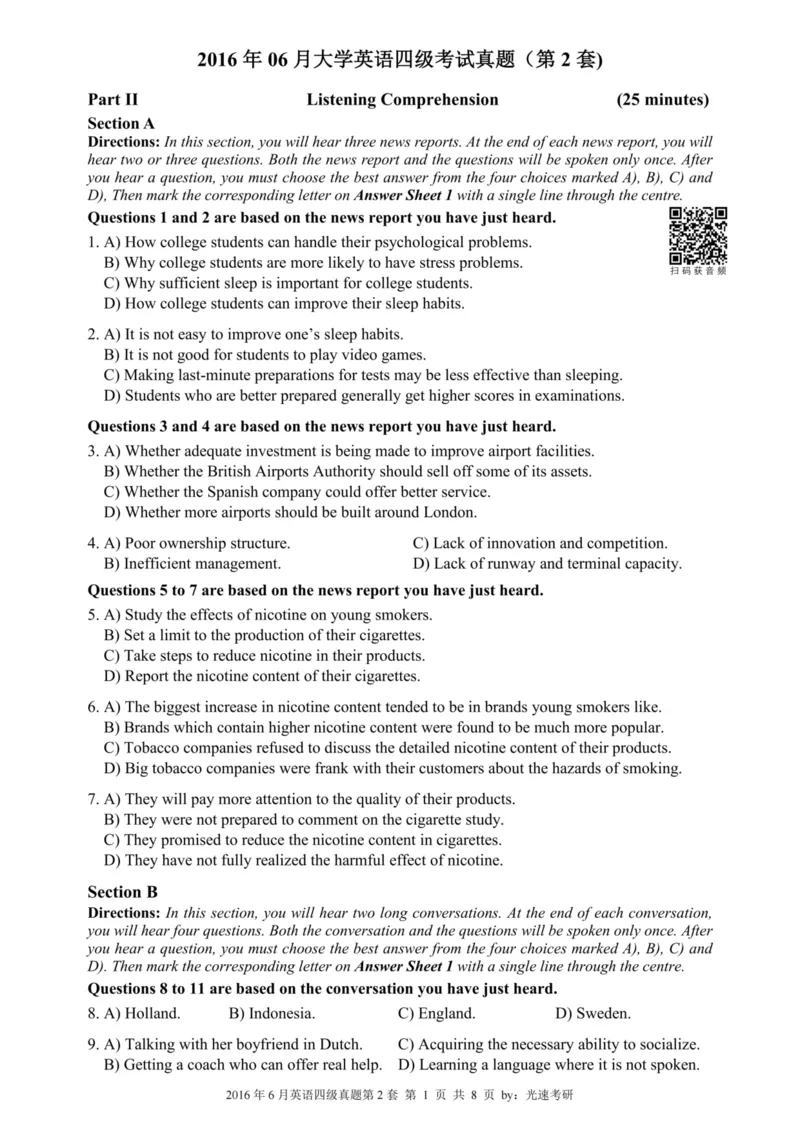
2016年 06月大学英语四级考试真题(第 1 套)
说明:本套真题采用特殊排版,阅读真题刷题不翻页,写作与翻译预留书写空间。
Part II Listening Comprehension (25 minutes)
Section A
Directions: In this section, you will hear three news reports. At the end of each news report, you will
hear two or three questions. Both the news report and the questions will be spoken only once. After
you hear a question, you must choose the best answer from the four choices marked A), B), C) and
D). Then mark the corresponding letter on Answer Sheet 1 with a single line through the centre.
Questions 1 and 2 are based on the news report you have just heard.
1. A) The International Labour Organization's key objective.
B) The basic social protection for the most vulnerable.
C) Rising unemployment worldwide. 扫码获音频
D) Global economic recovery.
2. A) Many countries have not taken measures to create enough jobs.
B) Few countries know how to address the current economic crisis.
C) Few countries have realised the seriousness of the current crisis.
D) Many countries need support to improve their people's livelihood.
Questions 3 and 4 are based on the news report you have just heard.
3. A) Serve standardised food nationwide. C) Increase protein content in the food.
B) Put calorie information on the menu. D) Offer convenient food to customers.
4. A) They will be fined. C) They will get a warning.
B) They will be closed. D) They will lose customers.
Questions 5 to 7 are based on the news report you have just heard.
5. A) Inability to implement their business plans.
B) Inability to keep turning out novel products.
C) Lack of a successful business model of their own.
D) Failure to integrate innovation into their business.
6. A) It is the secret to business success. C) It is a magic tool to bring big rewards.
B) It is the creation of something new. D) It is an essential part of business culture.
7. A) Its hardworking employees. C) Its innovation culture.
B) Its flexible promotion strategy. D) Its willingness to make investments.
Section B
Directions: In this section, you will hear two long conversations. At the end of each conversation,
you will hear four questions. Both the conversation and the questions will be spoken only once. After
you hear a question, you must choose the best answer from the four choices marked A), B), C) and
D). Then mark the corresponding letter on Answer Sheet 1 with a single line through the centre.
Questions 8 to 11 are based on the conversation you have just heard.
8. A) He's got addicted to technology. C) He is crazy about text-messaging.
B) He is not very good at socializing. D) He does not talk long on the phone.
9. A) Talk big. C) Gossip a lot.
B) Talk at length. D) Forget herself.
10. A) He thought it was cool. C) He wanted to stay connected with them.
B) He needed the practice. D) He had an urgent message to send.
2016年6月英语四级真题第1套 第 1 页 共 8 页 by:光速考研11. A) It poses a challenge to seniors. C) It is childish and unprofessional.
B) It saves both time and money. D) It is cool and convenient.
Questions 12 to 15 are based on the conversation you have just heard.
12. A) He wants to change his job assignment.
B) He is unhappy with his department manager.
C) He thinks he deserves extra pay for overtime.
D) He is often singled out for criticism by his boss.
13. A) His workload was much too heavy.
B) His immediate boss did not trust him.
C) His colleagues often refused to cooperate.
D) His salary was too low for his responsibility.
14. A) He never knows how to refuse. C) His boss has a lot of trust in him.
B) He is always ready to help others. D) His boss has no sense of fairness.
15. A) Put all his complaints in writing. C) Learn to say no when necessary.
B) Wait and see what happens next. D) Talk to his boss in person first.
Section C
Directions: In this section, you will hear three passages. At the end of each passage, you will hear
three or four questions. Both the passage and the questions will be spoken only once. After you hear
a question, you must choose the best answer from the four choices marked A), B), C) and D). Then
mark the corresponding letter on Answer Sheet 1 with a single line through the centre.
Questions 16 to 18 are based on the passage you have just heard.
16. A) The importance of sleep to a healthy life.
B) Reasons for Americans? decline in sleep.
C) Some tips to improve the quality of sleep
D) Diseases associated with lack of sleep.
17. A) They are more health-conscious. C) They get less and less sleep.
B) They are changing their living habits. D) They know the dangers of lack of sleep.
18. A) Their weight will go down. C) Their work efficiency will decrease.
B) Their mind function will deteriorate. D) Their blood pressure will rise.
Questions 19 to 21 are based on the passage you have just heard.
19. A) How much you can afford to pay.
B) What course you are going to choose.
C) Which university you are going to apply to.
D) When you are going to submit your application.
20. A) The list of courses studied. C) The references from teachers.
B) The full record of scores. D) The personal statement.
21. A) Specify what they would like to do after graduation.
B) Describe in detail how much they would enjoy studying.
C) Indicate they have reflected and thought about the subject.
D) Emphasize that they admire the professors in the university.
Questions 22 to 25 are based on the passage you have just heard.
22. A) It was equipped with rubber tyres. C) It was purchased by the Royal family.
B) It was built in the late 1 9th century. D) It was designed by an English engineer.
2016年6月英语四级真题第1套 第 2 页 共 8 页 by:光速考研23. A) They consumed lots of petrol. C) They were difficult to drive.
B) They took two passengers only. D) They often broke down.
24. A) They were produced on the assembly line.
B) They were built with less costly materials.
C) They were modeled after British cars.
D) They were made for ordinary use.
25. A) It made news all over the world. C) It marked a new era in motor travel.
B) It was built for the Royal family. D) It attracted large numbers of motorists.
Part III Reading Comprehension (40 minutes)
Section A
Directions: In this section, there is a passage with ten blanks. You are required to select one word
for each blank from a list of choices given in a word bank following the passage. Read the passage
through carefully before making your choices. Each choice in the bank is identified by a letter.
Please mark the corresponding letter for each item on Answer Sheet 2 with a single line through
the centre. You may not use any of the words in the bank more than once.
Questions 26 to 35 are based on the following passage.
Physical activity does the body good, and there's growing evidence that it helps the brain
too. Researchers in the Netherlands report that children who get more exercise, whether at
school or on their own, 26 to have higher GPAs and better scores on standardized tests. In
a 27 of 14 studies that looked at physical activity and academic 28 investigators
found that the more children moved, the better their grades were in school, 29 in the basic
subjects of math, English and reading.
The data will certainly fuel the ongoing debate over whether physical education classes
should be cut as schools struggle to 30 on smaller budgets. The arguments against
physical education have included concerns that gym time may be taking away from study time.
With standardized test scores in the U.S. 31 in recent years, some administrators believe
students need to spend more time in the classroom instead of on the playground. But as these
findings show, exercise and academics may not be 32 exclusive. Physical activity can
improve blood 33 to the brain, fueling memory, attention and creativity, which are 34
to learning. And exercise releases hormones that can improve 35 and relieve stress, which
can also help learning. So while it may seem as if kids are just exercising their bodies when
they5re running around, they may actually be exercising their brains as well.
A) attendance I) mood
B) consequently J) mutually
C) current K) particularly
D) depressing L) performance
E) dropping M) review
F) essential N) survive
G) feasible 0) tend
H) flow
Section B
Directions: In this section, you are going to read a passage with ten statements attached to it. Each
statement contains information given in one of the paragraphs. Identify the paragraph from which
the information is derived. You may choose a paragraph more than once. Each paragraph is marked
with a letter. Answer the questions by marking the corresponding letter on Answer Sheet 2.
2016年6月英语四级真题第1套 第 3 页 共 8 页 by:光速考研Finding the Right Home- and Contentment, Too
A) When your elderly relative needs to enter some sort of long-term care facility- a moment
few parents or children approach without fear-what you would like is to have everything
made clear.
B) Does assisted living really mark a great improvement over a nursing home, or has the
industry simply hired better interior designers? Are nursing homes as bad as people fear, or
is that an out-moded stereotype (固定看法)? Can doing one's homework really steer
families to the best places? It is genuinely hard to know.
C) I am about to make things more complicated by suggesting that what kind of facility an
older person lives in may matter less than we have assumed. And that the characteristics
adult children look for when they begin the search are not necessarily the things that make a
difference to the people who are going to move in. I am not talking about the quality of care,
let me hastily add. Nobody flourishes in a gloomy environment with irresponsible staff and a
poor safety record. But an accumulating body of research indicates that some distinctions
between one type of elder care and another have little real bearing on how well residents do.
D) The most recent of these studies, published in The Journal of Applied Gerontology, surveyed
150 Connecticut residents of assisted living, nursing homes and smaller residential care
homes (known in some states as board and care homes or adult care homes). Researchers
from the University of Connecticut Health Center asked the residents a large number of
questions about their quality of life, emotional well-being and social interaction, as well as
about the quality of the facilities.
E) “We thought we would see diflferences based on the housing types,55 said the lead author of the
study, Julie Robison, an associate professor of medicine at the university. A reasonable
assumption- don't families struggle to avoid nursing homes and suffer real guilt if they can't?
F) In the initial results, assisted living residents did paint the most positive picture. They were
less likely to report symptoms of depression than those in the other facilities, for instance,
and less likely to be bored or lonely. They scored higher on social interaction.
G) But when the researchers plugged in a number of other variables, such diflerences
disappeared. It is not the housing type, they found, that creates differences in residents5
responses. tcIt is the characteristics of the specific environment they are in, combined with
their own personal characteristics- how healthy they feel they are, their age and marital
status/5 Dr. Robison explained. Whether residents felt involved in the decision to move and
how long they had lived there also proved significant.
H) An elderly person who describes herself as in poor health, therefore, might be no less
depressed in assisted living (even if her children preferred it) than in a nursing home. A
person who had input into where he would move and has had time to adapt to it might do as
well in a nursing home as in a small residential care home, other factors being equal. It is an
interaction between the person and the place, not the sort of place in itself, that leads to better
or worse experiences. "You can?t just say, 'Let's put this person in a residential care home
instead of a nursing home—she will be much better off,' " Dr. Robison said. What matters,
she added, t4is a combination of what people bring in with them, and what they find there.^^
I) Such findings, which run counter to common sense, have surfaced before. In a multi-state
study of assisted living, for instance, University of North Carolina researchers found that a
host of variables—the facility's type, size or age; whether a chain owned it; how attractive
the neighborhood was- had no significant relationship to how the residents fared in terms of
illness, mental decline, hospitalizations or mortality. What mattered most was the resident5s
physical health and mental status. What people were like when they came in had greater
consequence than what happened once they were there.
J) As I was considering all this, a press release from a respected research firm crossed my desk,
2016年6月英语四级真题第1套 第 4 页 共 8 页 by:光速考研announcing that the five-star rating system that Medicare developed in 2008 to help families
compare nursing home quality also has little relationship to how satisfied its residents or
their family members are. As a matter of fact, consumers expressed higher satisfaction with
the one-star facilities, the lowest rated, than with the five-star ones. (More on this study and
the star ratings will appear in a subsequent post.)
K) Before we collectively tear our hair out~~how are we supposed to find our way in a landscape
this confusing?- here is a thought from Dr. Philip Sloane, a geriatrician (老年病学专家)at
the University of North Carolina: "In a way, that could be liberating for families.
L) Of course, sons and daughters want to visit the facilities, talk to the administrators and
residents and other families, and do everything possible to fulfill their duties. But perhaps
they don't have to turn themselves into private investigators or Congressional subcommittees.
“Families can look a bit more for where the residents are going to be happy," Dr. Sloane said.
And involving the future resident in the process can be very important.
M) We all have our own ideas about what would bring our parents happiness. They have their
ideas, too. A friend recently took her mother to visit an expensive assisted living/nursing
home near my town. I have seen this place—it is elegant, inside and out. But nobody greeted
the daughter and mother when they arrived, though the visit had been planned; nobody
introduced them to the other residents. When they had lunch in the dining room, they sat
alone at a table.
N) The daughter feared her mother would be ignored there, and so she decided to move her into
a more welcoming facility. Based on what is emerging from some of this research, that
might have been as rational a way as any to reach a decision.
36. Many people feel guilty when they cannot find a place other than a nursing home for their
parents.
37. Though it helps for children to investigate care facilities, involving their parents in the
decision-making process may prove very important.
38. It is really difficult to tell if assisted living is better than a nursing home.
39. How a resident feels depends on an interaction between themselves and the care facility they
live in.
40. The author thinks her friend made a rational decision in choosing a more hospitable place
over an apparently elegant assisted living home.
41. The system Medicare developed to rate nursing home quality is of little help to finding a
satisfactory place.
42. At first the researchers of the most recent study found residents in assisted living facilities
gave higher scores on social interaction.
43. What kind of care facility old people live in may be less important than we think.
44. The findings of the latest research were similar to an earlier multi-state study of assisted
living.
45. A resident5s satisfaction with a care facility has much to do with whether they had
participated in the decision to move in and how long they had stayed there.
Section C
Directions: There are 2 passages in this section. Each passage is followed by some questions or
unfinished statements. For each of them there are four choices marked A), B), C) and D). You
should decide on the best choice and mark the corresponding letter on Answer Sheet 2 with a single
line through the centre.
Passage One
Questions 46 to 50 are based on the following passage.
2016年6月英语四级真题第1套 第 5 页 共 8 页 by:光速考研As Artificial Intelligence (AI) becomes increasingly sophisticated, there are growing
concerns that robots could become a threat. This danger can be avoided, according to
computer science professor Stuart Russell, if we figure out how to turn human values into a
programmable code.
Russell argues that as robots take on more complicated tasks, ifs necessary to translate our
morals into AI language.
For example, if a robot does chores around the house, you wouldn't want it to put the pet
cat in the oven to make dinner for the hungry children. "You would want that robot preloaded
with a good set of values/5 said Russell.
Some robots are already programmed with basic human values. For example, mobile robots
have been programmed to keep a comfortable distance from humans. Obviously there are cultural
differences, but if you were talking to another person and they came up close in your personal
space, you wouldn't think thafs the kind of thing a properly brought_up person would do.
It will be possible to create more sophisticated moral machines, if only we can find a way
to set out human values as clear rules.
Robots could also learn values from drawing patterns from large sets of data on human
behavior. They are dangerous only if programmers are careless.
The biggest concern with robots going against human values is that human beings foil to do
sufficient testing and they've produced a system that will break some kind of taboo (禁忌).
One simple check would be to program a robot to check the correct course of action with a
human when presented with an unusual situation.
If the robot is unsure whether an animal is suitable fbr the micro wave, it has the
opportunity to stop, send out beeps (嘟嘟声),and ask fbr directions from a human. If we
humans aren't quite sure about a decision, we go and ask somebody else.
The most difficult step in programming values will be deciding exactly what we believe is
moral, and how to create a set of ethical rules. But if we come up with an answer, robots could
be good for humanity.
46. What does the author say about the threat of robots?
A) It may constitute a challenge to computer programmers.
B) It accompanies all machinery involving high technology.
C) It Can be avoided if human values are translated into their language.
D) It has become an inevitable peril as technology gets more sophisticated.
47. What would we think of a person who invades our personal space according to the author?
A) They are aggressive. C) They are ignorant.
B) They are outgoing. D) They are ill-bred.
48. How do robots learn human values?
A) By interacting with humans in everyday life situations.
B) By following the daily routines of civilized human beings.
C) By picking up patterns from massive data on human behavior.
D) By imitating the behavior of properly brought-up human beings.
49. What will a well-programmed robot do when facing an unusual situation?
A) Keep a distance from possible dangers.
B) Stop to seek advice from a human being.
C) Trigger its built-in alarm system at once.
D) Do sufficient testing before taking action.
50. What is most difficult to do when we turn human values into a programmable code?
A) Determine what is moral and ethical. C) Set rules for man-machine interaction.
B) Design some large-scale experiments. D) Develop a more sophisticated program.
Passage Two
Questions 46 to 50 are based on the following passage.
2016年6月英语四级真题第1套 第 6 页 共 8 页 by:光速考研Why do some people live to be older than others? You know the standard explanations:
keeping a moderate diet, engaging in regular exercise, etc. But what effect does your personality
have on your longevity (长寿)? Do some kinds of personalities lead to longer lives? A new
study in the Journal of the American Geriatrics Society looked at this question by examining the
personality characteristics of 246 children of people who had lived to be at least 100.
The study shows that those living the longest are more outgoing, more active and less
neurotic (神经质 的 )than other people. Long-living women are also more likely to be
sympathetic and cooperative than women with a normal life span. These findings are in
agreement with what you would expect from the evolutionary theory: those who like to make
friends and help others can gather enough resources to make it through tough times.
Interestingly, however, other characteristics that you might consider advantageous had no
impact on whether study participants were likely to live longer. Those who were more
sell-disciplined, for instance, were no more likely to live to be very old. Also, being open to new
ideas had no relationship to long life, which might explain all those bad-tempered old people
who are fixed in their ways.
Whether you can successfully change your personality as an adult is the subject of a
longstanding psychological debate. But the new paper suggests that if you want long life, you
should strive to be as outgoing as possible.
Unfortunately, another recent study shows that your mother's personality may also help
determine your longevity. That study looked at nearly 28, 000 Norwegian mothers and found
that those moms who were more anxious, depressed and angry were more likely to feed their
kids unhealthy diets. Patterns of childhood eating can be hard to break when we're adults, which
may mean that kids of depressed moms end up dying younger.
Personality isn't destiny (命运),and everyone knows that individuals can learn to change.
But both studies show that long life isn't just a matter of your physical health but of your mental
health.
51. The aim of the study in the Journal of the American Geriatrics Society is .
A) to see whether people's personality affects their life span
B) to find out if one's lifestyle has any effect on their health
C) to investigate the role of exercise in living a long life
D) to examine all the factors contributing to longevity
52. What does the author imply about outgoing and sympathetic people?
A) They have a good understanding of evolution.
B) They are better at negotiating an agreement.
C) They generally appear more resourceful.
D) They are more likely to get over hardship.
53. What finding of the study might prove somewhat out of our expectation?
A) Easy-going people can also live a relatively long life.
B) Personality characteristics that prove advantageous actually vary with times.
C) Such personality characteristics as self-discipline have no effect on longevity.
D) Readiness to accept new ideas helps one enjoy longevity.
54. What does the recent study of Norwegian mothers show?
A) Children's personality characteristics are invariably determined by their mothers.
B) People with unhealthy eating habits are likely to die sooner.
C) Mothers' influence on children may last longer than fathers5.
D) Mothers5 negative personality characteristics may affect their children's life spans.
55. What can we learn from the findings of the two new studies?
A) Anxiety and depression more often than not cut short one's life span.
B) Longevity results from a combination of mental and physical health.
C) Personality plays a decisive role in how healthy one is.
D) Health is in large part related to one's lifestyle.
2016年6月英语四级真题第1套 第 7 页 共 8 页 by:光速考研Part IV Translation (30 minutes)
Directions: For this part, you are allowed 30 minutes to translate a passage from Chinese into
English. You should write your answer on Answer Sheet 2.
功夫(Kimg凡)是中国武龙(martial arts)的俗称。中国武术的起源可以追溯到自卫的需要、狩猎
活动以及古代中国的军事训练。它是中国传统体育运动的一种,年轻人和老年人都练。它已逐渐演
变成了中国文化的独特元素。作为中国的国宝,功夫有上百种不同的风格,是世界上练得最多的武
术形式。有些风格模仿了动物的动作,还有一些则受到了中国哲学思想、神话和传说的启发。
Part I Writing (30 minutes)
Directions: For this part, you are allowed 30 minutes to write a letter to express your thanks to one
of your school teachers upon entering college. You should write at least 120 words but no more
than 180 words.
2016年6月英语四级真题第1套 第 8 页 共 8 页 by:光速考研2016年 06月大学英语四级考试真题(第 2 套)
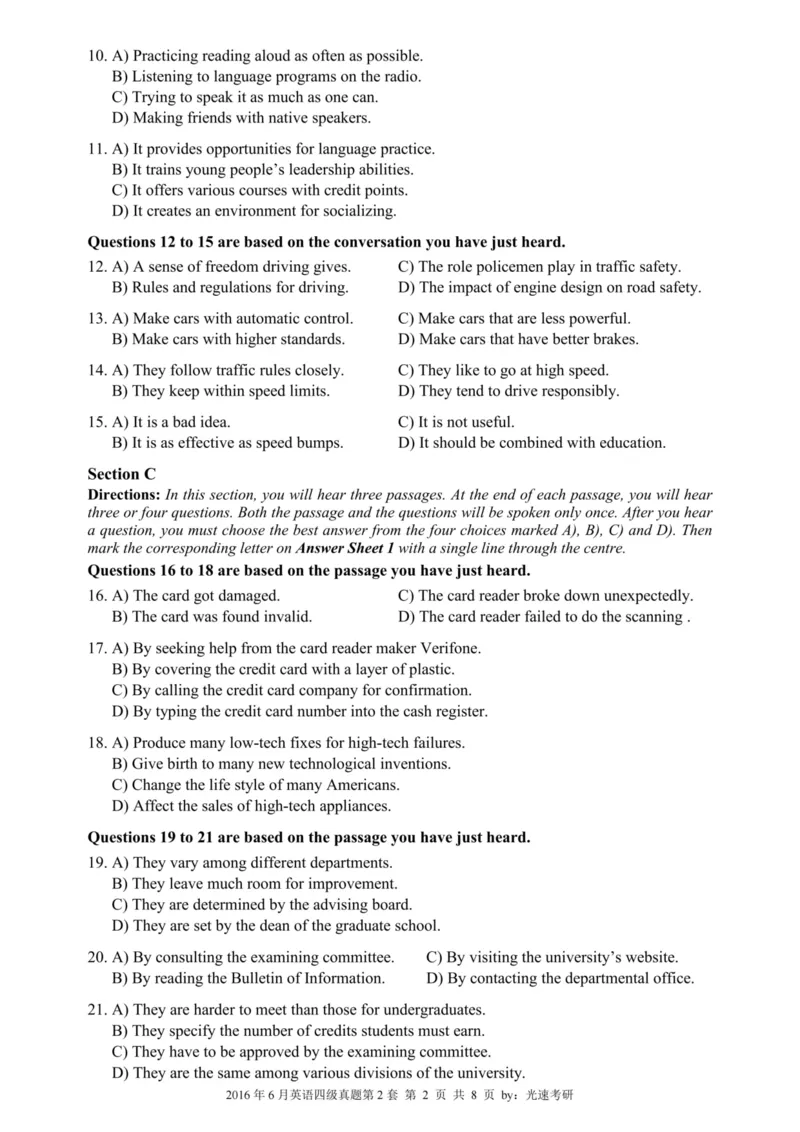
Part II Listening Comprehension (25 minutes)
Section A
Directions: In this section, you will hear three news reports. At the end of each news report, you will
hear two or three questions. Both the news report and the questions will be spoken only once. After
you hear a question, you must choose the best answer from the four choices marked A), B), C) and
D), Then mark the corresponding letter on Answer Sheet 1 with a single line through the centre.
瞿蕾蒯
Questions 1 and 2 are based on the news report you have just heard.
1. A) How college students can handle their psychological problems.
B) Why college students are more likely to have stress problems.
扫码获音频
C) Why sufficient sleep is important for college students.
D) How college students can improve their sleep habits.
2. A) It is not easy to improve one's sleep habits.
B) It is not good for students to play video games.
C) Making last-minute preparations for tests may be less effective than sleeping.
D) Students who are better prepared generally get higher scores in examinations.
Questions 3 and 4 are based on the news report you have just heard.
3. A) Whether adequate investment is being made to improve airport facilities.
B) Whether the British Airports Authority should sell off some of its assets.
C) Whether the Spanish company could offer better service.
D) Whether more airports should be built around London.
4. A) Poor ownership structure. C) Lack of innovation and competition.
B) Inefficient management. D) Lack of runway and terminal capacity.
Questions 5 to 7 are based on the news report you have just heard.
5. A) Study the effects of nicotine on young smokers.
B) Set a limit to the production of their cigarettes.
C) Take steps to reduce nicotine in their products.
D) Report the nicotine content of their cigarettes.
6. A) The biggest increase in nicotine content tended to be in brands young smokers like.
B) Brands which contain higher nicotine content were found to be much more popular.
C) Tobacco companies refused to discuss the detailed nicotine content of their products.
D) Big tobacco companies were frank with their customers about the hazards of smoking.
7. A) They will pay more attention to the quality of their products.
B) They were not prepared to comment on the cigarette study.
C) They promised to reduce the nicotine content in cigarettes.
D) They have not fully realized the harmful effect of nicotine.
Section B
Directions: In this section, you yvill hear two long conversations. At the end of each conversation,
you will hear four questions. Both the conversation and the questions will be spoken only once. After
you hear a question, you must choose the best answer from the four choices marked A), B), C) and
D). Then mark the corresponding letter on Answer Sheet 1 with a single line through the centre.
Questions 8 to 11 are based on the conversation you have just heard.
8. A) Holland. B) Indonesia. C) England. D) Sweden.
9. A) Talking with her boyfriend in Dutch. C) Acquiring the necessary ability to socialize.
B) Getting a coach who can offer real help. D) Learning a language where it is not spoken.
2016年6月英语四级真题第2套 第 1 页 共 8 页 by:光速考研10. A) Practicing reading aloud as often as possible.
B) Listening to language programs on the radio.
C) Trying to speak it as much as one can.
D) Making friends with native speakers.
11. A) It provides opportunities for language practice.
B) It trains young people's leadership abilities.
C) It offers various courses with credit points.
D) It creates an environment for socializing.
Questions 12 to 15 are based on the conversation you have just heard.
12. A) A sense of freedom driving gives. C) The role policemen play in traffic safety.
B) Rules and regulations for driving. D) The impact of engine design on road safety.
13. A) Make cars with automatic control. C) Make cars that are less powerful.
B) Make cars with higher standards. D) Make cars that have better brakes.
14. A) They follow traffic rules closely. C) They like to go at high speed.
B) They keep within speed limits. D) They tend to drive responsibly.
15. A) It is a bad idea. C) It is not useful.
B) It is as effective as speed bumps. D) It should be combined with education.
Section C
Directions: In this section, you will hear three passages. At the end of each passage, you will hear
three or four questions. Both the passage and the questions will be spoken only once. After you hear
a question, you must choose the best answer from the four choices marked A), B), C) and D). Then
mark the corresponding letter on Answer Sheet 1 with a single line through the centre.
Questions 16 to 18 are based on the passage you have just heard.
16. A) The card got damaged. C) The card reader broke down unexpectedly.
B) The card was found invalid. D) The card reader failed to do the scanning .
17. A) By seeking help from the card reader maker Verifbne.
B) By covering the credit card with a layer of plastic.
C) By calling the credit card company for confirmation.
D) By typing the credit card number into the cash register.
18. A) Produce many low-tech fixes for high-tech failures.
B) Give birth to many new technological inventions.
C) Change the life style of many Americans.
D) Affect the sales of high-tech appliances.
Questions 19 to 21 are based on the passage you have just heard.
19. A) They vary among different departments.
B) They leave much room fbr improvement.
C) They are determined by the advising board.
D) They are set by the dean of the graduate school.
20. A) By consulting the examining committee. C) By visiting the university's website.
B) By reading the Bulletin of Information. D) By contacting the departmental office.
21. A) They are harder to meet than those for undergraduates.
B) They specify the number of credits students must earn.
C) They have to be approved by the examining committee.
D) They are the same among various divisions of the university.
2016年6月英语四级真题第2套 第 2 页 共 8 页 by:光速考研Questions 22 to 25 are based on the passage you have just heard.
22. A) Ph. D. candidates in dieting. C) Students in health classes.
B) Students majoring in nutrition. D) Middle and high school teachers.
23. A) Its overemphasis on thinness. C) Its mistaken conception of nutrition.
B) Its changing criteria for beauty. D) Its overestimate of the effect of dieting.
24. A) To demonstrate the magic effect of dieting on women.
B) To explain how computer images can be misleading.
C) To prove that technology has impacted our culture.
D) To illustrate her point that beauty is but skin deep.
25. A) To help students rid themselves of bad living habits.
B) To establish an emotional connection with students.
C) To promote her own concept of beauty.
D) To persuade girls to stop dieting.
Part III Reading Comprehension (40 minutes)
Section A
Directions; In this section, there is a passage with ten blanks. You are required to select one word
for each blank from a list of choices given in a word bank following the passage. Read the passage
through carefully before making your choices, Each choice in the bank is identified by a letter.
Please mark the corresponding letter for each item on Answer Sheet 2 with a single line through the
centre. You may not use any of the words in the bank more than once.
Questions 26 to 35 are based on the following passage.
Signs barring cell- phone use are a familiar sight to anyone who has ever sat in a
hospital waiting room. But the 26 popularity of electronic medical records has forced
hospital-based doctors to become 27 on computers throughout the day, and desktops一
which keep doctors from bedsides- are 28 giving way to wireless devices.
As clerical loads increased, "something had to 29 . and that was always face time with
patients,5, says Dr. Bhakti Patel, a former chief resident in the University of Chicago's
internal-medicine program. In fall 2010, she helped 30 a pilot project in Chicago to see
if the iPad could improve working conditions and patient care. The experiment was so 31
that all internal-medicine residents at the university now get iPads when they begin the program.
Johns Hopkin?s internal-medicine program adopted the same 32 in 2011. Medical schools
at Yale and Stanford now have paperless, iPad-based curriculums. ''You511 want an iPad just so
you can wear this“ is the slogan for one of the new lab coats 33 with large pockets to
accommodate tablet computers.
A study of the University of Chicago iPad project found that patients got tests and 34
faster if they were cared for by iPad-equipped residents. Many patients also 35 a better
understanding of the illnesses that landed them in the hospital in the first place.
A) dependent I) policy
B) designed J) prospect
C) fast K) rather
D) flying L) reliable
E) gained M) signal
F) give N) successful
G) growing O) treatments
H) launch
2016年6月英语四级真题第2套 第 3 页 共 8 页 by:光速考研Section B
Directions: In this section, you are going to read a passage with ten statements attached to it. Each
statement contains information given in one of the paragraphs. Identify the paragraph from which
the information is derived. You may choose a paragraph more than once. Each paragraph is marked
with a letter. Answer the questions by marking the corresponding letter on Answer Sheet 2.
Ancient Greek Wisdom Inspires Guidelines to Good Life
A) Is it possible to enjoy a peaceful life in a world that is increasingly challenged by threats and
uncertainties from wars, terrorism, economic crises and a widespread outbreak of infectious
diseases? The answer is yes, according to a new book The 10 Golden Rules: Ancient Wisdom
from the Greek Philosophers on Living a Good Life. The book is co-authored by Long Island
University's philosophy professor Michael Soupios and economics professor Panos
Mourdoukoutas.
B) The wisdom of the ancient Greek philosophers is timeless, says Soupios. The philosophy
professor says it is as relevant today as when it was first written many centuries ago. "There
is no expiration (失效)date on wisdom,5, he says. "There is no shelf life on intelligence. I
think that things have become very gloomy these days, lots of misunderstanding, misleading
cues, a lot of what the ancients would have called sophistry (诡辩).The nice thing about
ancient philosophy as offered by the Greeks is that they tended to see life clear and whole, in
a way that we tend not to see life today.5,
Examine your life
C) Soupios, along with his co-author Panos Mourdoukoutas, developed their 10 golden rules by
turning to the men behind that philosophy- Aristotle, Socrates, Epictetus and Pythagoras,
among others. The first rule- examine your life- is the common thread that runs through
the entire book. Soupios says that it is based on Plato's observation that the unexamined life
is not worth living. t4The Greeks are always concerned about boxing themselves in, in terms
of convictions (信 念 )he says. "So take a step back, switch off the automatic pilot and
actually stop and reflect about things like our priorities, our values, and our relationships.
Stop worrying about what you can not control
D) As we begin to examine our life, Soupios says, we come to Rule No.2: Worry only about
things that you can control. 4tThe individual who promoted this idea was a Stoic philosopher.
His name is Epictetus,“ he says. "And what the Stoics say in general is simply this: There is
a larger plan in life. You are not really going to be able to understand all of the dimensions
of this plan. You are not going to be able to control the dimensions of this plan.^^
E) So, Soupios explains, it is not worth it to waste our physical, intellectual and spiritual energy
worrying about things that are beyond our control. 4tI can not control whether or not I wind
up getting the disease swine flu, for example, “he says. "I mean, there are some cautious
steps I can take, but ultimately I can not guarantee myself that. So what Epictetus would say
is sitting at home worrying about that would be wrong and wasteful and irrational. You
should live your life attempting to identify and control those things which you can genuinely
control.5,
Seek true pleasure
F) To have a meaningful, happy life we need friends. But according to Aristotle- a student of
Plato and teacher of Alexander the Great- most relationships don't qualify as true
friendships. 4tJust because I have a business relationship with an individual and I can profit
from that relationship, it does not necessarily mean that this person is my friend,Soupios
says. "Real friendship is when two individuals share the same soul. It is a beautiful and
uncharacteristically poetic image that Aristotle offers.
G) In our pursuit of the good life, he says, it is important to seek out true pleasures- advice
which was originally offered by Epicurus. But unlike the modem definition of Epicureanism
2016年6月英语四级真题第2套 第 4 页 共 8 页 by:光速考研as a life of indulgence (放纵)and luxury, for the ancient Greeks, it meant finding a state of
calm, peace and mental ease.
H) “This was the highest and most desirable form of pleasure and happiness fbr the ancient
Epicureans,“ Soupios says. "This is something that is very much well worth considering
here in the modem era. I do not think that we spend nearly enough time trying to concentrate
on achieving a sort of calmness, a sort of contentment in a mental and spiritual way, which
was identified by these people as the highest form of happiness and pleasure.
Do good to others
I) Other golden rules counsel us to master ourselves, to avoid excess and not to be a
prosperous (发迹的)fool. There are also rules dealing with interpersonal relationships. Be a
responsible human being and do not do evil things to others.
J) “This is Hesiod, of course, a younger contemporary poet, we believe, with Homer,“ Soupios
says. "Hesiod offers an idea- which you very often find in some of the world's great
religions, in the Judeo-Christian tradition and in Islam and others- that in some sense, when
you hurt another human being, you hurt yourself. That damaging other people in your
community and in your life, trashing relationships, results in a kind of self-inflicted (自 己招
致的)spiritual wound.”
K) Instead, Soupios says, ancient wisdom urges us to do good. Golden Rule No.10 for a good
life is that kindness toward others tends to be rewarded.
L) “This is Aesop, the fabulist (寓言家),the man of these charming little tales, often told in
terms of animals and animal relationships,he says. "I think what Aesop was suggesting is
that when you offer a good turn to another human being, one can hope that that good deed
will come back and sort of pay a profit to you, the doer of the good deed. Even if there is no
concrete benefit paid in response to your good deed, at the very least, the doer of the good
deed has the opportunity to enjoy a kind of spiritually enlightened moment.
M) Soupios says following the 10 Golden Rules based on ancient wisdom can guide us to the
path of the good life where we stop living as onlookers and become engaged and happier
human beings. And that, he notes, is a life worth living.
36. According to an ancient Greek philosopher, it is impossible for us to understand every aspect
of our life.
37. Ancient philosophers saw life in a different light from people of today.
38. Not all your business partners are your soul mates.
39. We can live a peaceful life despite the various challenges of the modem world.
40. The doer of a good deed can feel spiritually rewarded even when they gain no concrete
benefits.
41. How to achieve mental calmness and contentment is well worth our consideration today.
42. Michael Soupios suggests that we should stop and think carefully about our priorities in life.
43. Ancient philosophers strongly advise that we do good.
44. The wise teachings of ancient Greek thinkers are timeless, and are applicable to
contemporary life.
45. Do harm to others and you do harm to yourself.
Section C
Directions: There are 2 passages in this section. Each passage is followed by some questions or
unfinished statements. For each of them there are four choices marked A), B), C) and D). You
should decide on the best choice and mark the corresponding letter on Answer Sheet 2 with a single
line through the centre.
2016年6月英语四级真题第2套 第 5 页 共 8 页 by:光速考研Passage One
Questions 46 to 50 are based on the following passage.
Attitudes toward new technologies often fall along generational lines. That is, generally,
younger people tend to outnumber older people on the front end of a technological shift.
It is not always the case, though. When you look at attitudes toward driverless cars, there
doesn,t seem to be a clear generational divide. The public overall is split on whether they'd like
to use a driverless car. In a study last year, of all people surveyed, 48 percent said they wanted
to ride in one, while 50 percent did not.
The fact that attitudes toward sei住driving cars appear to be so steady across generations
suggests how transformative the shift to driverless cars could be. Not everyone wants a driverless
car now- and no one can get one yet_but among those who are open to them, every age group
is similarly engaged.
Actually, this isn't surprising. Whereas older generations are sometimes reluctant to adopt
new technologies, driverless cars promise real value to these age groups in particular. Older
adults, especially those with limited mobility or difficulty driving on their own, are one of the
classic use-cases for driverless cars.
This is especially interesting when you consider that younger people are generally more
interested in travel-related technologies than older ones.
When it comes to driverless cars, differences in attitude are more pronounced based on
factors not related to age. College graduates, fbr example, are particularly interested in
driverless cars compared with those who have less education: 59 percent of college graduates
said they would like to use a driverless car compared with 38 percent of those with a
high-school diploma or less.
Where a person lives matters, too. More people who lived in cities and suburbs said they
wanted to try driverless cars than those who lived in rural areas.
While there5s reason to believe that interest in self-driving cars is going up across the board,
a person's age will have little to do with how self-driving cars can become mainstream. Once
driverless cars are actually available for sale, the early adopters will be the people who can
afford to buy them.
46. What happens when a new technology emerges?
A) It further widens the gap between the old and the young.
B) It often leads to innovations in other related fields.
C) It contributes greatly to the advance of society as a whole.
D) It usually draws different reactions from different age groups.
47. What does the author say about the driverless car?
A) It does not seem to create a generational divide.
B) It will not necessarily reduce road accidents.
C) It may start a revolution in the car industry.
D) It has given rise to unrealistic expectations.
48. Why does the driverless car appeal to some old people?
A) It saves their energy. C) It adds to the safety of their travel.
B) It helps with their mobility. D) It stirs up their interest in life.
49. What is likely to aflect one's attitude toward the driverless car?
A) The location of their residence. C) The amount of training they received.
B) The field of their special interest. D) The length of their driving experience.
50. Who are likely to be the first to buy the driverless car?
A) The seniors. C) The wealthy.
B) The educated. D) The tech fans.
2016年6月英语四级真题第2套 第 6 页 共 8 页 by:光速考研Passage Two
Questions 51 to 55 are based on the following passage.
In agrarian (农业的),pre-industrial Europe, "you'd want to wake up early, start working
with the sunrise, have a break to have the largest meal, and then you'd go back to work,5, says
Ken Albala, a professor of history at the University of the Pacific. "Later, at 5 or 6, you'd have a
smaller supper.”
This comfortable cycle, in which the rhythms of the day helped shape the rhythms of the
meals, gave rise to the custom of the large midday meal, eaten with the extended family. "Meals
are the foundation of the family,says Carole Counihan, a professor at Millersville University in
Pennsylvania, “so there was a very important interconnection between eating together^and
strengthening family ties.
Since industrialization, maintaining such a slow cultural metabolism has been much harder,
with the long midday meal shrinking to whatever could be stuffed into a lunch bucket or bought
at a food stand. Certainly, there were benefits. Modem techniques for producing and shipping
food led to greater variety and quantity, including a tremendous increase in the amount of
animal protein and dairy products available, making us more vigorous than our ancestors.
Yet plenty has been lost too, even in cultures that still live to eat. Take Italy. Ifs no secret
that the Mediterranean diet is healthy, but it was also a joy to prepare and eat. Italians, says
Counihan, traditionally began the day with a small meal. The big meal came at around 1 p.m. In
between the midday meal and a late, smaller dinner came a small snack. Today, when time
zones have less and less meaning, there is little tolerance for offices' closing for lunch, and
worsening traffic in cities means workers can't make it home and back fast enough anyway. So
the formerly small supper after sundown becomes the big meal of the day, the only one at which
the family has a chance to get together. t6The evening meal carries the full burden that used to be
spread over two meals,“ says Counihan.
51. What do we learn from the passage about people in pre-industrial Europe?
A) They had to work from early morning till late at night.
B) They were so busy working that they only ate simple meals.
C) Their daily routine followed the rhythm of the natural cycle.
D) Their life was much more comfortable than that of today.
52. What does Professor Carole Counihan say about pre-industrial European families eating
meals together?
A) It was helpful to maintaining a nation's tradition.
B) It brought family members closer to each other.
C) It was characteristic of the agrarian culture.
D) It enabled families to save a lot of money.
53. What doesctcultural metabolism^^ (Line 1, Para.3) refer to?
A) Evolutionary adaptation.
B) Changes in lifestyle.
C) Social progress.
D) Pace of life.
54. What does the author think of the food people eat today?
A) Its quality is usually guaranteed.
B) It is varied, abundant and nutritious.
C) It is more costly than what our ancestors ate.
D) Its production depends too much on technology.
55. What does the author say about Italians of the old days?
A) They enjoyed cooking as well as eating.
B) They ate a big dinner late in the evening.
C) They ate three meals regularly every day.
D) They were expert at cooking meals.
2016年6月英语四级真题第2套 第 7 页 共 8 页 by:光速考研Part IV Translation (30 minutes)
Directions: For this part, you are allowed 30 minutes to translate a passage from Chinese into
English. You should write your answer on Answer Sheet 2.
在山东省潍坊市,风筝不仅仅是玩具,而且还是这座城市文化的标志。潍坊以“风筝之都”而闻
名,已有将近2,400年放飞风筝的历史。传说中国古代哲学家墨子用了三年时间在潍坊制作了世界
上首个风筝,但放飞的第一天风筝就坠落并摔坏了。也有人相信风筝是中国古代木匠鲁班发明的。
据说他的风筝用木头和竹子制作,飞了三天后才落地。
Part I Writing (30 minutes)
Directions: For this part, you are allowed 30 minutes to write a letter to express your thanks to one
ofyour friends who helped you most when you were in difficulty. You should write at least 120 words
but no more than 180 words.
2016年6月英语四级真题第2套 第 8 页 共 8 页 by:光速考研2016年 06月大学英语四级考试真题(第 3 套)
Part II Listening Comprehension (25 minutes)
淘宝店铺【光速考研工作室】温馨提示:由于2016年6 月大学英语四级考试共考了 2 套听力,本套真题
听力与第2 套内容完全相同,只是选项顺序不同,因此在本套真题中不再重复出现。
Part III Reading Comprehension (40 minutes)
Section A
Directionsr In this section, there is a passage with ten blanks. You are required to select one word
for each blank from a list of choices given in a word bank following the passage. Read the passage
through carefully before making your choices, Each choice in the bank is identified by a letter.
Please mark the corresponding letter for each item on Answer Sheet 2 with a single line through the
centre. You may not use any of the words in the bank more than once.
Questions 26 to 35 are based on the following passage.
Contrary to popular belief older people generally do not want to live with their children.
Moreover, most adult children 26 every bit as much care and support to their aging
parents as was the case in the“good old days",and most older people do not feel 27 .
About 80% of people 65 years and older have living children, and about 90% of them
have 28 contact with their children. About 75% of elderly parents who don't go to nursing
homes live within 30 minutes of at least one of their children.
However, 29 having contact with children does not guarantee happiness in old age.
In fact, some research has found that people who are most involved with their families have the
lowest spirits. This research may be 30 however, as ill health often makes older people
more 31 and thereby increases contact with family members. So it is more likely that poor
health, not just family involvement, 32 spirits.
Increasingly, researchers have begun to look at the quality of relationships, rather than at
the frequency of contact, between the elderly and their children. If parents and children share
interests and values and agree on childrearing practices and religious 33 、they are likely to
enjoy each other5s company. Disagreements on such matters can 34 cause problems. If
parents are angered by their daughter's divorce, dislike her new husband, and disapprove of how
she is raising their grandchildren, 35 are that they are not going to enjoy her visits.
A)abandoned I) frequent
B) advanced J) fulfillment
C) biased K) grant
D) chances L) merely
E) commitment M) provide
F) dampens N) understandably
G) dependent O) unrealistically
H) distant
Section B
Directions: In this section, you are going to read a passage with ten statements attached to it. Each
statement contains information given in one of the paragraphs. Identify the paragraph from which
the information is derived. You may choose a paragraph more than once. Each paragraph is marked
with a letter. Answer the questions by marking the corresponding letter on Answer Sheet 2.
2016年6月英语四级真题第3套 第 1 页 共 6 页 by:光速考研Could Food Shortages Bring Down Civilization?
A) For many years I have studied global agricultural, population, environmental and economic
trends and their interactions. The combined effects of those trends and the political tensions
they generate point to the breakdown of governments and societies. Yet I, too, have resisted
the idea that food shortages could bring down not only individual governments but also our
global civilization.
B) I can no longer ignore that risk. Our continuing failure to deal with the environmental
declines that are undermining the world food economy forces me to conclude that such a
collapse is possible.
C) As demand for food rises faster than supplies are growing, the resulting food-price inflation
puts severe stress on the governments of many countries. Unable to buy grain or grow their
own, hungry people take to the streets. Indeed, even before the steep climb in grain prices in
2008, the number of failing states was expanding. If the food situation continues to worsen,
entire nations will break down at an ever increasing rate. In the 20th century the main threat
to international security was superpower conflict; today it is failing states.
D) States fail when national governments can no longer provide personal security, food security
and basic social services such as education and health care. When governments lose their
control on power, law and order begin to disintegrate. After a point, countries can become so
dangerous that food relief workers are no longer safe and their programs are halted. Failing
states are of international concern because they are a source of terrorists, drugs, weapons and
refugees (难民),threatening political stability everywhere.
E) The surge in world grain prices in 2007 and 2008一and the threat they pose to food
security-has a different, more troubling quality than the increases of the past. During the
second half of the 20th century, grain prices rose dramatically several times. In 1972, for
instance, the Soviets, recognizing their poor harvest early, quietly cornered the world wheat
market. As a result, wheat prices elsewhere more than doubled, pulling rice and com prices
up with them. But this and other price shocks were event-driven - drought in the Soviet
Union, crop-shrinking heat in the U.S. Com Belt. And the rises were short-lived: prices
typically returned to normal with the next harvest.
F) In contrast, the recent surge in world grain prices is trend-driven, making it unlikely to
reverse without a reversal in the trends themselves. On the demand side, those trends include
the ongoing addition of more than 70 million people a year, a growing number of people
wanting to move up the food chain to consume highly grain-intensive meat products, and the
massive diversion (转向)of U.S. grain to the production of bio-fuel.
G) As incomes rise among low-income consumers, the potential for further grain consumption
is huge. But that potential pales beside the never-ending demand for crop-based fuels. A
fourth of this year's U.S. grain harvest will go to fuel cars.
H) What about supply? The three environmental trends- the shortage of fresh water, the loss of
topsoil and the rising temperatures- are making it increasingly hard to expand the world5 s
grain supply fast enough to keep up with demand. Of all those trends, however, the spread of
water shortages poses the most immediate threat. The biggest challenge here is irrigation,
which consumes 70% of the world's fresh water. Millions of irrigation wells in many
countries are now pumping water out of underground sources faster than rainfall can refill
them. The result is falling water tables (地下水位)in countries with half the world's people,
including the three big grain producers- China, India and the U.S.
I) As water tables have fallen and irrigation wells have gone dry, China's wheat crop, the
world's largest, has declined by 8% since it peaked at 123 million tons in 1997. But water
shortages are even more worrying in India. Millions of irrigation wells have significantly
lowered water tables in almost every state.
2016年6月英语四级真题第3套 第 2 页 共 6 页 by:光速考研J) As the world's food security falls to pieces, individual countries acting in their own
seli-interest are actually worsening the troubles of many. The trend began in 2007, when
leading wheat-exporting countries such as Russia and Argentina limited or banned their
exports, in hopes of increasing local food supplies and thereby bringing down domestic food
prices. Vietnam banned its exports for several months for the same reason. Such moves may
eliminate the fears of those living in the exporting countries, but they are creating panic in
importing countries that must rely on what is then left for export.
K) In response to those restrictions, grain-importing countries are trying to nail down long-term
trade agreements that would lock up future grain supplies. Food-import anxiety is even
leading to new efforts by food-importing countries to buy or lease farmland in other
countries. In spite of such temporary measures, soaring food prices and spreading hunger in
many other countries are beginning to break down the social order.
L) Since the current world food shortage is trend-driven, the environmental trends that cause it
must be reversed. We must cut carbon emissions by 80% from their 2006 levels by 2020,
stabilize the world's population at eight billion by 2040, completely remove poverty, and
restore forests and soils. There is nothing new about the four objectives. Indeed, we have
made substantial progress in some parts of the world on at least one of these- the
distribution of family-planning services and the associated shift to smaller families.
M) For many in the development community, the four objectives were seen as positive,
promoting development as long as they did not cost too much. Others saw them as politically
correct and morally appropriate. Now a third and far more significant motivation presents
itself: meeting these goals may be necessary to prevent the collapse of our civilization. Yet
the cost we project for saving civilization would amount to less than $200 billion a year, 1/6
of current global military spending. In effect, our plan is the new security budget.
36. The more recent steep climb in grain prices partly results from the fact that more and more
people want to consume meat products.
37. Social order is breaking down in many countries because of food shortages.
38. Rather than superpower conflict, countries unable to cope with food shortages now
constitute the main threat to world security.
39. Some parts of the world have seen successful implementation of family planning.
40. The author has come to agree that food shortages could ultimately lead to the collapse of
world civilization.
41. Increasing water shortages prove to be the biggest obstacle to boosting the world's grain
production.
42. The cost for saving our civilization would be considerably less than the world's current
military spending.
43. To lower domestic food prices, some countries limited or stopped their grain exports.
44. Environmental problems must be solved to ease the current global food shortage.
45. A quarter of this year's American grain harvest will be used to produce bio-fiiel for cars.
Section C
Directions: There are 2 passages in this section. Each passage is followed by some questions or
unfinished statements. For each of them there are four choices marked A), B), C) and D). You
should decide on the best choice and mark the corresponding letter on Answer Sheet 2 with a single
line through the centre.
Passage One
Questions 46 to 50 are based on the following passage.
2016年6月英语四级真题第3套 第 3 页 共 6 页 by:光速考研Declining mental function is often seen as a problem of old age, but certain aspects of brain
function actually begin their decline in young adulthood, a new study suggests.
The study, which followed more than 2,000 healthy adults between the ages of 18 and 60,
found that certain mental fiinctions-including measures of abstract reasoning, mental speed and
puzzle-solving-started to dull as early as age 27.
Dips in memory, meanwhile, generally became apparent around age 37.
On the other hand, indicators of a person's accumulated knowledge- like performance on
tests of vocabulary and general knowledge- kept improving with age, according to findings
published in the journal Neurobiology of Aging.
The results do not mean that young adults need to start worrying about their memories.
Most people's minds function at a high level even in their later years, according to researcher
Timothy Salthouse.
“These patterns suggest that some types of mental flexibility decrease relatively early in
adulthood, but that the amount of knowledge one has, and the effectiveness of integrating it with
one's abilities, may increase throughout all of adulthood if there are no diseases/ Salthouse said
in a news release.
The study included healthy, educated adults who took standard tests of memory, reasoning
and perception at the outset and at some point over the next seven years.
The tests are designed to detect subtle (细微的)changes in mental function, and involve
solving puzzles, recalling words and details from stories, and identifying patterns in collections
of letters and symbols.
In general, Salthouse and his colleagues found, certain aspects of cognition (认矢口 能力)
generally started to decline in the late 20s to 30s.
The findings shed light on normal age-related changes in mental function, which could aid
in understanding the process of dementia (痴呆),according to the researchers.
“By following individuals over time,“ Salthouse said, “we gain insight in cognition
changes, and may possibly discover ways to slow the rate of decline.5,
The researchers are currently analyzing the study participants5 health and lifestyle to see
which factors might influence age-related cognitive changes.
46. What is the common view of mental function?
A) It varies from person to person. C) It gradually expands with age.
B) It weakens in one's later years. D) It indicates one's health condition.
47. What does the new study find about mental functions?
A) Some diseases inevitably lead to their decline.
B) They reach a peak at the age of 20 for most people.
C) They are closely related to physical and mental exercise.
D) Some of them begin to decline when people are still young.
48. What does Timothy Salthouse say about people's minds in most cases?
A) They tend to decline in people's later years.
B) Their flexibility determines one's abilities.
C) They function quite well even in old age.
D) Their functioning is still a puzzle to be solved.
49. Although people's minds may function less flexibly as they age, t h e y .
A) may be better at solving puzzles
B) can memorize things with more ease
C) may have greater facility in abstract reasoning
D) can put what they have learnt into more effective use
50. According to Salthouse, their study may help us .
A) find ways to slow down our mental decline
B) find ways to boost our memories
C) understand the complex process of mental functioning
D) understand the relation between physical and mental health
2016年6月英语四级真题第3套 第 4 页 共 6 页 by:光速考研Passage Two
Questions 51 to 55 are based on the following passage.
The most important thing in the news last week was the rising discussion in Nashville
about the educational needs of children. The shorthand (简写)educators use for this is “pre-K”
- meaning instruction before kindergarten-and the big idea is to prepare 4-year-olds and even
younger kids to be ready to succeed on their K-12 journey.
But it gets complicated. The concept has multiple forms, and scholars and policymakers
argue about the shape, scope and cost of the ideal program.
The federal Head Start program, launched 50 years ago, has served more than 30 million
children. It was based on concepts developed at Vanderbilt University5 s Peabody College by
Susan Gray, the legendary pioneer in early childhood education research.
A new Peabody study of the Tennessee Voluntary Pre-K program reports that pre-K works,
but the gains are not sustained through the third grade. It seems to me this highlights quality
issues in elementary schools more than pre-K, and indicates longer-term success must connect
pre-K with all the other issues related to educating a child.
Pre-K is controversial. Some critics say it is a luxury and shouldn't be free to families able
to Pay. Pre-K advocates insist it is proven and will succeed if integrated with the rest of the
child5 s schooling. I lean toward the latter view.
This is, in any case, the right conversation to be having now as Mayor Megan Barry takes
office. She was the first candidate to speak out for strong pre-K programming. The important
thing is for all of us to keep in mind the real goal and the longer, bigger picture.
The weight of the evidence is on the side of pre-K that early intervention (干预)works.
What government has not yet found is the political will to put that understanding into full
practice with a sequence of smart schooling that provides the early foundation.
For this purpose, our schools need both the talent and the organization to educate each
child who arrives at the schoolhouse door. Some show up ready, but many do not at this critical
time when young brains are developing rapidly.
51. What does the author say about pre-kindergarten education?
A) It should cater to the needs of individual children.
B) It is essential to a person's future academic Success.
C) Scholars and policymakers have different opinions about it.
D) Parents regard it as the first phase of children's development.
52. What does the new Peabody study find?
A) Pre-K achievements usually do not last long.
B) The third grade marks a new phase of learning.
C) The third grade is critical to children's development.
D) Quality has not been the top concern of pre-K programs.
53. When does the author think pre-K works the best?
A) When it is accessible to kids of all families.
B) When it is made part of kids' education.
C) When it is no longer considered a luxury.
D) When it is made fun and enjoyable to kids.
54. What do we learn about Mayor Megan Barry?
A) She knows the real goal of education.
B) She is a mayor of insight and vision.
C) She has once run a pre-K program.
D) She is a finn supporter of pre-K.
55. What does the author think is critical to kids' education?
A) Teaching method. C) Early intervention.
B) Kids, interest. D) Parents5 involvement.
2016年6月英语四级真题第3套 第 5 页 共 6 页 by:光速考研Part IV Translation (30 minutes)
Directions: For this part, you are allowed 30 minutes to translate a passage from Chinese into
English. You should write your answer on Answer Sheet 2.
乌镇是浙江的一座古老水镇,坐落在京杭大运河畔。这是一处迷人的地方,有许多古桥、中式
旅店和餐馆。在过去一千年里,乌镇的水系和生活方式并未经历多少变化,是一座展现古文明的博
物馆。乌镇所有房屋都用石木建造。数百年来,当地人沿着河边建起了住宅和集市。无数宽敞美丽
的庭院藏身于屋舍之间,游客们每到一处都会有惊喜的发现。
Part I Writing (30 minutes)
Directions: For this part, you are allowed 30 minutes to write a letter to express your thanks to your
parents or any other family member upon making a memorable achievement. You should write at
least 120 words but no more than 180 words.
2016年6月英语四级真题第3套 第 6 页 共 6 页 by:光速考研