2016年 6 月大学英语四级考试真题(二)
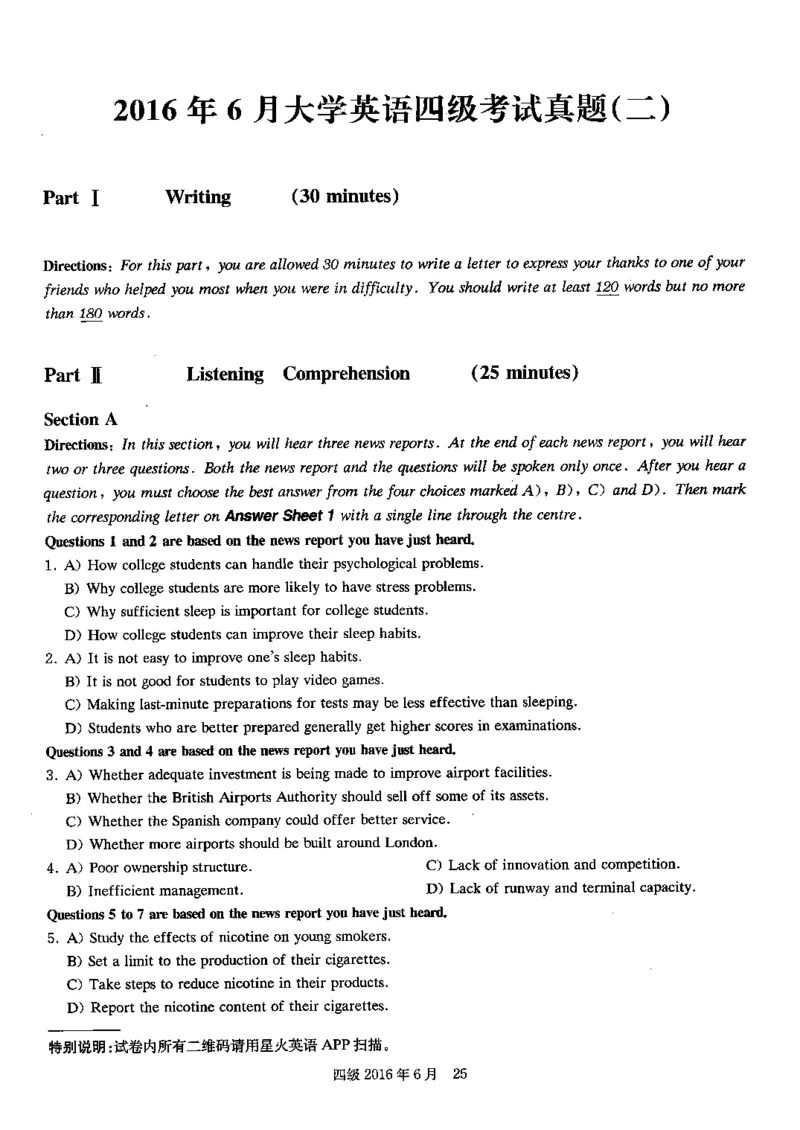
Part I Writing (30 minutes)
Directions: For this part, you are allowed 30 minutes to write a letter to express your thanks to one of your
friends who helped you most when you were in difficulty. You should write at least 120 words but no more
than 180 words.
Part K Listening Comprehension (25 minutes)
Section A
Directions: In this section, you will hear three news reports. At the end of each news report, you will hear
two or three questions. Both the news report and the questions will be spoken only once. After you hear a
question, you must choose the best answer from the four choices marked A )» B), C) and D). Then mark
the corresponding letter on Answer Sheet 1 with a single line through the centre.
Questions 1 and 2 are based on the news report you have just heard.
1. A) How college students can handle their psychological problems.
B) Why college students are more likely to have stress problems.
C) Why sufficient sleep is important for college students.
D) How college students can improve their sleep habits.
2. A) It is not easy to improve one's sleep habits.
B) It is not good for students to play video games.
C) Making last-minute preparations for tests may be less effective than sleeping.
D) Students who are better prepared generally get higher scores in examinations.
Questions 3 and 4 are based on the news report you have just heard.
3. A) Whether adequate investment is being made to improve airport facilities.
B) Whether the British Airports Authority should sell off some of its assets.
C) Whether the Spanish company could offer better service.
D) Whether more airports should be built around London.
4. A) Poor ownership structure. C) Lack of innovation and competition.
B) Inefficient management. D) Lack of runway and terminal capacity.
Questions 5 to 7 are based on the news report you have just heard.
5. A) Study the effects of nicotine on young smokers.
B) Set a limit to the production of their cigarettes.
C) Take steps to reduce nicotine in their products.
D) Report the nicotine content of their cigarettes.
特别说明:试卷内所有二维码请用星火英语APP扫描。
四级2016年6月 256. A) The biggest increase in nicotine content tended to be in brands young smokers like.
B) Brands which contain higher nicotine content were found to be much more popular.
C) Tobacco companies refused to discuss the detailed nicotine content of their products.
D) Big tobacco companies were frank with their customers about the hazards of smoking.
7. A) They will pay more attention to the quality of their products.
B) They were not prepared to comment on the cigarette study.
C) They promised to reduce the nicotine content in cigarettes.
D) They have not fully realized the harmful effect of nicotine.
Section B
Directions: In this section, you will hear two long conversations. At the end of each conversation, you will
hear four questions. Both the conversation and the questions will be spoken only once. After you hear a
question, you must choose the best answer from the four choices marked A ), B), C) and D). Then mark
the corresponding letter on Answer Sheet 1 with a single line through the centre.
Questions 8 to 11 are based on the conversation you have just heard.
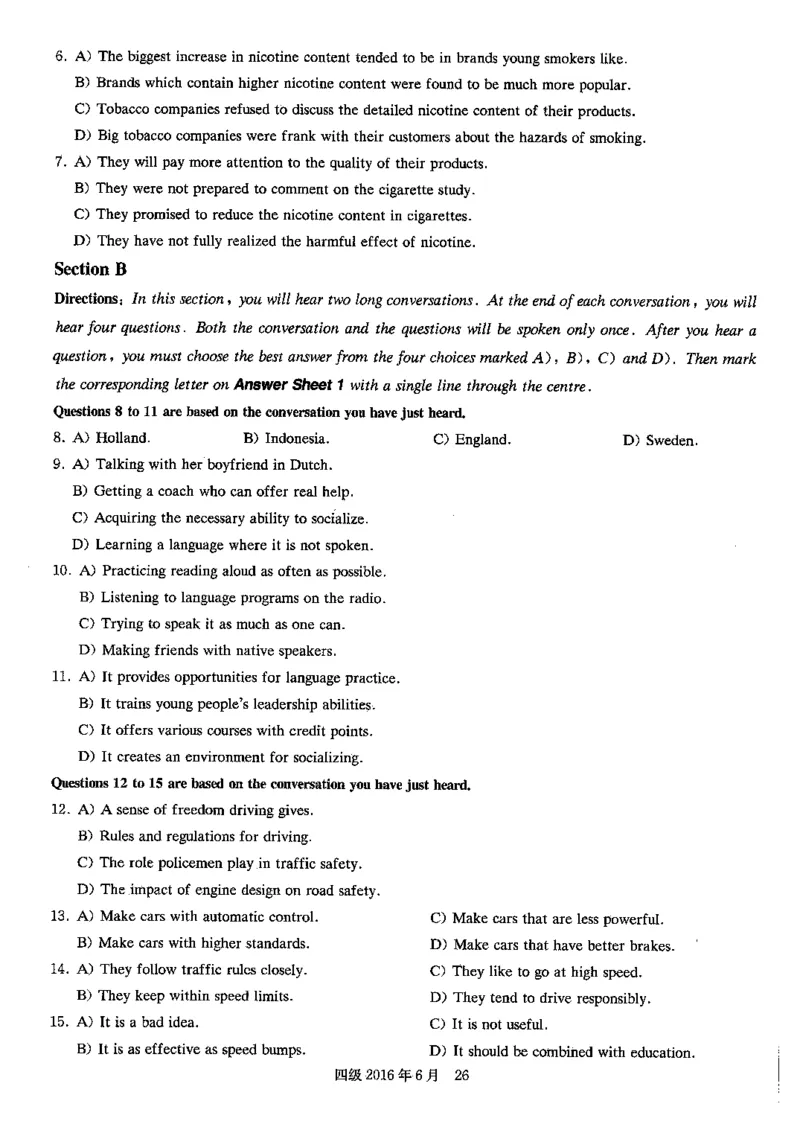
8. A) Holland. B) Indonesia. C) England. D) Sweden.
9. A) Talking with her boyfriend in Dutch.
B) Getting a coach who can offer real help.
C) Acquiring the necessary ability to socialize.
D) Learning a language where it is not spoken.
10. A) Practicing reading aloud as often as possible.
B) Listening to language programs on the radio.
C) Trying to speak it as much as one can.
D) Making friends with native speakers.
11. A) It provides opportunities for language practice.
B) It trains young people's leadership abilities.
C) It offers various courses with credit points.
D) It creates an environment for socializing.
Questions 12 to 15 are based on the conversation you have just heard.
12. A) A sense of freedom driving gives.
B) Rules and regulations for driving.
C) The role policemen play in traffic safety.
D) The impact of engine design on road safety.
13. A) Make cars with automatic control. C) Make cars that are less powerful.
B) Make cars with higher standards. D) Make cars that have better brakes.
14. A) They follow traffic rules closely. C) They like to go at high speed.
B) They keep within speed limits. D) They tend to drive responsibly.
15. A) It is a bad idea. C) It is not useful.
B) It is as effective as speed bumps. D) It should be combined with education.
四级2016年6月 26Section C
Directions: In this section, you will hear three passages. At the end of each passage, you will hear three or
four questions. Both the passage and the questions will be spoken only once. After you hear a question, you
must choose the best answer from the four choices marked A ), B), C) and D). Then mark the
corresponding letter on Answer Sheet 1 with a single line through the centre.
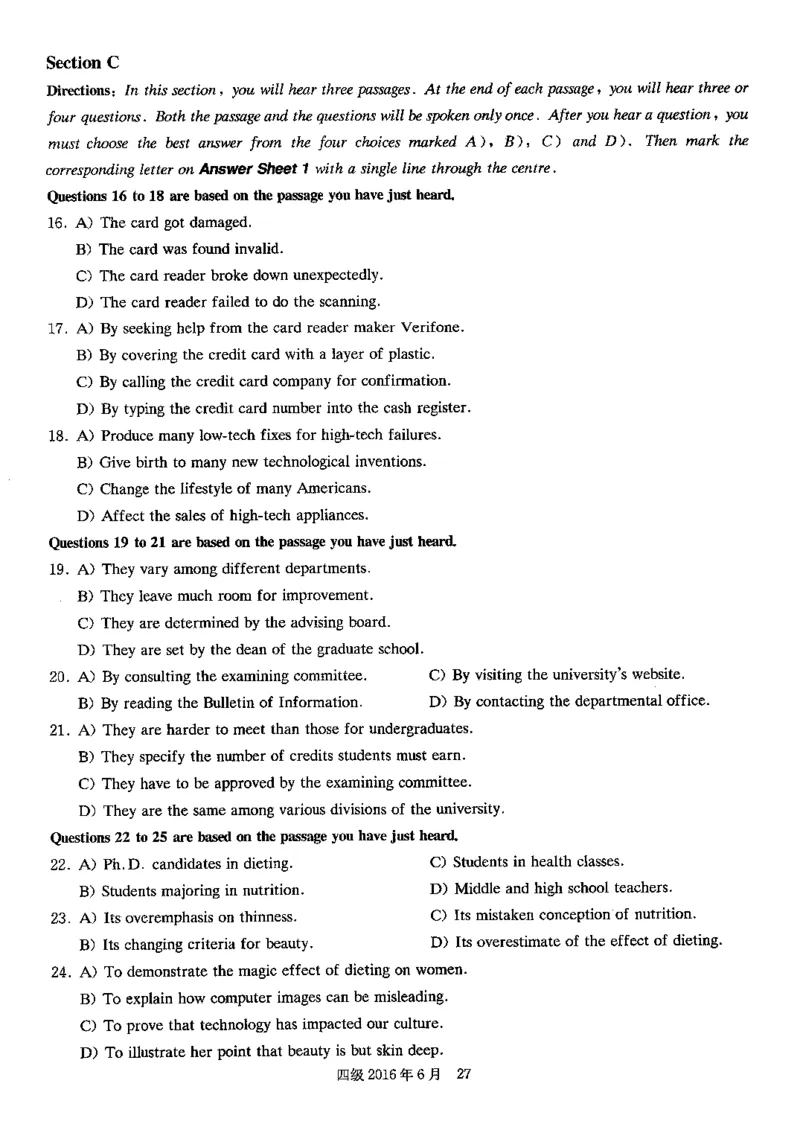
Questions 16 to 18 are based on the passage you have just heard.
16. A) The card got damaged.
B) The card was found invalid.
C) The card reader broke down unexpectedly.
D) The card reader failed to do the scanning.
17. A) By seeking help from the card reader maker Verifone.
B) By covering the credit card with a layer of plastic.
C) By calling the credit card company for confirmation.
D) By typing the credit card number into the cash register.
18. A) Produce many low-tech fixes for high-tech failures.
B) Give birth to many new technological inventions.
C) Change the lifestyle of many Americans.
D) Affect the sales of high-tech appliances.
Questions 19 to 21 are based on the passage you have just heard.
19. A) They vary among different departments.
B) They leave much room for improvement.
C) They are determined by the advising board.
D) They are set by the dean of the graduate school.
20. A) By consulting the examining committee. C) By visiting the university's website.
B) By reading the Bulletin of Information. D) By contacting the departmental office.
21. A) They are harder to meet than those for undergraduates.
B) They specify the number of credits students must earn.
C) They have to be approved by the examining committee.
D) They are the same among various divisions of the university.
Questions 22 to 25 are based on the passage you have just heard.
22. A) Ph.D. candidates in dieting. C) Students in health classes.
B) Students majoring in nutrition. D) Middle and high school teachers.
23. A) Its overemphasis on thinness. C) Its mistaken conception of nutrition.
B) Its changing criteria for beauty. D) Its overestimate of the effect of dieting.
24. A) To demonstrate the magic effect of dieting on women.
B) To explain how computer images can be misleading.
C) To prove that technology has impacted our culture.
D) To illustrate her point that beauty is but skin deep.
四级2016年6月 2725. A) To help students rid themselves of bad living habits.
B) To establish an emotional connection with students.
C) To promote her own concept of beauty.
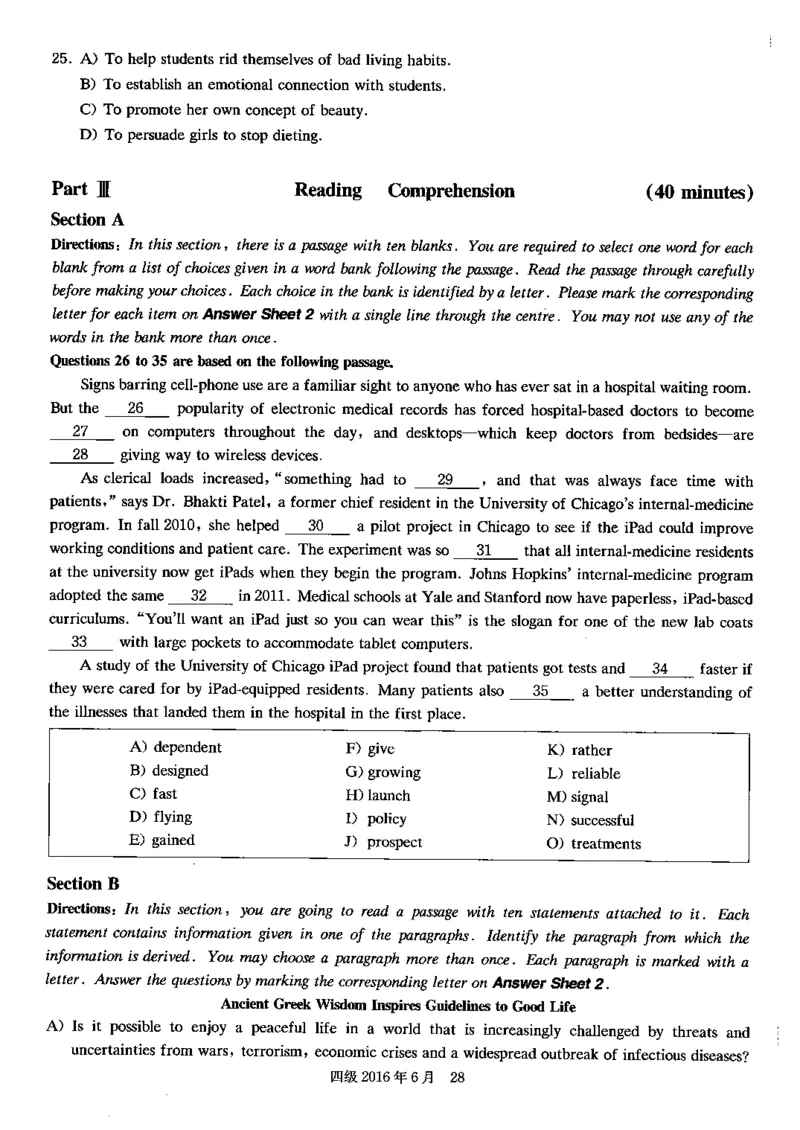
D) To persuade girls to stop dieting.
Part JU Reading Comprehension (40 minutes)
Section A
Directions: In this section, there is a passage with ten blanks. You are required to select one word for each
blank from a list of choices given in a word bank following the passage. Read the passage through carefully
before making your choices. Each choice in the bank is identified by a letter. Please mark the corresponding
letter for each item on Answer Sheet 2 with a single line through the centre. You may not use any of the
words in the bank more than once.
Questions 26 to 35 are based on the following passage.
Signs barring cell-phone use are a familiar sight to anyone who has ever sat in a hospital waiting room.
But the 26 popularity of electronic medical records has forced hospital-based doctors to become
27 on computers throughout the day, and desktops- which keep doctors from bedsides- are
28 giving way to wireless devices.
As clerical loads increased, something had to 29 , and that was always face time with
patients,“ says Dr. Bhakti Patel, a former chief resident in the University of Chicago's internal-medicine
program. In fall 2010, she helped 30 a pilot project in Chicago to see if the iPad could improve
working conditions and patient care. The experiment was so 31 that all internal-medicine residents
at the university now get iPads when they begin the program. Johns Hopkins' internal-medicine program
adopted the same 32 in 2011. Medical schools at Yale and Stanford now have paperless, iPad-based
curriculums. "You'll want an iPad just so you can wear this“ is the slogan for one of the new lab coats
33 with large pockets to accommodate tablet computers.
A study of the University of Chicago iPad project found that patients got tests and 34 faster if
they were cared for by iPad-equipped residents. Many patients also 35 a better understanding of
the illnesses that landed them in the hospital in the first place.
A) dependent F) give K) rather
B) designed G) growing L) reliable
C) fast H) launch M) signal
D) flying I) policy N) successful
E) gained J) prospect O) treatments
Section B
Directions: In this section, you are going to read a passage with ten statements attached to it. Each
statement contains information given in one of the paragraphs. Identify the paragraph from which the
information is derived. You may choose a paragraph more than once. Each paragraph is marked with a
letter. Answer the questions by marking the corresponding letter on Answer Sheet 2.
Ancient Greek Wisdom Inspires Guidelines to Good Life
A) Is it possible to enjoy a peaceful life in a world that is increasingly challenged by threats and
uncertainties from wars, terrorism, economic crises and a widespread outbreak of infectious diseases?
四级2016年6月 28The answer is yes, according to a new book The 10 Golden Rules : Ancient Wisdom from the Greek
Philosophers on Living a Good Life. The book is co-authored by Long Island University's philosophy
professor Michael Soupios and economics professor Panos Mourdoukoutas.
B) The wisdom of the ancient Greek philosophers is timeless, says Soupios. The philosophy professor says it is
as relevant today as when it was first written many centuries ago. "There is no expiration (失效)date on
wisdom,“ he says. "There is no shelf life on intelligence. I think that things have become very gloomy
these days, lots of misunderstanding, misleading cues, a lot of what the ancients would have called
sophistry (诡辩).The nice thing about ancient philosophy as offered by the Greeks is that they tended to
see life clear and whole, in a way that we tend not to see life today. ”
Examine your life
C) Soupios, along with his co-author Panos Mourdoukoutas, developed their 10 golden rules by turning to the
men behind that philosophy—Aristotle, Socrates, Epictetus and Pythagoras, among others. The first rule一
examine your life- is the common thread that runs through the entire book. Soupios says that it is based on
Plato's observation that the unexamined life is not worth living. "The Greeks are always concerned about
boxing themselves in, in terms of convictions (信念)」 he says. "So take a step back, switch off the
automatic pilot and actually stop and reflect about things like our priorities, our values, and our
relationships.
Stop worrying about what you can not control
D) As we begin to examine our life, Soupios says, we come to Rule No. 2 : Worry only about things that you
can control. "The individual who promoted this idea was a Stoic philosopher. His name is Epictetus,“ he
says. "And what the Stoics say in general is simply this: There is a larger plan in life. You are not really
going to be able to understand all of the dimensions of this plan. You are not going to be able to control the
dimensions of this plan.
E) So, Soupios explains, it is not worth it to waste our physical, intellectual and spiritual energy worrying
about things that are beyond our control. "I can not control whether or not I wind up getting the disease
swine flu, for example,“ he says. "I mean, there are some cautious steps I can take, but ultimately I can
not guarantee myself that. So what Epictetus would say is sitting at home worrying about that would be
wrong and wasteful and irrational. You should live your life attempting to identify and control those things
which you can genuinely control.w
Seek true pleasure
F) To have a meaningful, happy life we need friends. But according to Aristotle--a student of Plato and
teacher of Alexander the Great- most relationships don't qualify as true friendships. "Just because I have a
business relationship with an individual and I can profit from that relationship, it does not necessarily mean
that this person is my friend,“ Soupios says. "Real friendship is when two individuals share the same soul.
It is a beautiful and uncharacteristically poetic image that Aristotle offers.w
G) In our pursuit of the good life, he says, it is important to seek out true pleasures- advice which was
originally offered by Epicurus. But unlike the modern definition of Epicureanism as a life of indulgence (放
纵)and luxury, for the ancient Greeks, it meant finding a state of calm, peace and mental ease.
H) “This was the highest and most desirable form of pleasure and happiness for the ancient Epicureans,”
Soupios says. "This is something that is very much well worth considering here in the modem era. I do not
think that we spend nearly enough time trying to concentrate on achieving a sort of calmness, a sort of
contentment in a mental and spiritual way, which was identified by these people as the highest form of
happiness and pleasure.
四级2016年6月 29Do good to others
I) Other golden rules counsel us to master ourselves, to avoid excess and not to be a prosperous (发迹的)fool.
There are also rules dealing with interpersonal relationships: Be a responsible human being and do not do
evil things to others.
J) “This is Hesiod, of course, a younger contemporary poet, we believe, with Homer,“ Soupios says. "Hesiod
offers an idea- which you very often find in some of the world's great religions, in the Judeo-Christian
tradition and in Islam and others- that in some sense, when you hurt another human being, you hurt
yourself. That damaging other people in your community and in your life, trashing relationships, results in
a kind of self-inflicted (自己招致的)spiritual wound.w
K) Instead, Soupios says, ancient wisdom urges us to do good. Golden Rule No. 10 for a good life is that
kindness toward others tends to be rewarded.
L) “This is Aesop, the fabulist (寓言家),the man of these charming little tales, often told in terms of animals
and animal relationships,,, he says. "I think what Aesop was suggesting is that when you offer a good turn
to another human being, one can hope that that good deed will come back and sort of pay a profit to you,
the doer of the good deed. Even if there is no concrete benefit paid in response to your good deed, at the
very least, the doer of the good deed has the opportunity to enjoy a kind of spiritually enlightened moment.M
M) Soupios says following the 10 Golden Rules based on ancient wisdom can guide us to the path of the good
life where we stop living as onlookers and become engaged and happier human beings. And that, he notes,
is a life worth living.
36. According to an ancient Greek philosopher, it is impossible for us to understand every aspect of our life.
37. Ancient philosophers saw life in a different light from people of today.
38. Not all your business partners are your soul mates.
39. We can live a peaceful life despite the various challenges of the modern world.
40. The doer of a good deed can feel spiritually rewarded even when they gain no concrete benefits.
41. How to achieve mental calmness and contentment is well worth our consideration today.
42. Michael Soupios suggests that we should stop and think carefully about our priorities in life.
43. Ancient philosophers strongly advise that we do good.
44. The wise teachings of ancient Greek thinkers are timeless, and are applicable to contemporary life.
45. Do harm to others and you do harm to yourself.
Section C
Directions: There are 2 passages in this section. Each passage is followed by some questions or unfinished
statements. For each of them there are four choices marked A) , B), C) and D). You should decide on
the best choice and mark the corresponding letter on Answer Sheet 2 with a single line through the centre.
Pass 阻e One
Questions 46 to 50 are based on the following passage.
Attitudes toward new technologies often fall along generational lines. That is, generally, younger
people tend to outnumber older people on the front end of a technological shift.
It is not always the case, though. When you look at attitudes toward driverless cars, there doesn't
seem to be a clear generational divide. The public overall is split on whether they'd like to use a driverless
car. In a study last year, of all people surveyed, 48 percent said they wanted to ride in one, while
50 percent did not.
The fact that attitudes toward self-driving cars appear to be so steady across generations suggests how
transformative the shift to driverless cars could be. Not everyone wants a driverless car now- and no one
can get one yet- but among those who are open to them, every age group is similarly engaged.
四级2016年6月 30Actually, this isn,t surprising. Whereas older generations are sometimes reluctant to adopt new
technologies, driverless cars promise real value to these age groups in particular. Older adults, especially
those with limited mobility or difficulty driving on their own, are one of the classic usecases for driverless
cars.
This is especially interesting when you consider that younger people are generally more interested in
travel-related technologies than older ones.
When it comes to driverless cars, differences in attitude are more pronounced based on factors not
related to age. College graduates, for example, are particularly interested in driverless cars compared with
those who have less education: 59 percent of college graduates said they would like to use a driverless car
compared with 38 percent of those with a high-school diploma or less.
Where a person lives matters, too. More people who lived in cities and suburbs said they wanted to
try driverless cars than those who lived in rural areas.
While there's reason to believe that interest in self-driving cars is going up across the board, a person's
age will have little to do with how self-driving cars can become mainstream. Once driverless cars are
actually available for sale, the early adopters will be the people who can afford to buy them.
46. What happens when a new technology emerges?
A) It further widens the gap between the old and the young.
B) It often leads to innovations in other related fields.
C) It contributes greatly to the advance of society as a whole.
D) It usually draws different reactions from different age groups.
47. What does the author say about the driverless car?
A) It does not seem to create a generational divide.
B) It will not necessarily reduce road accidents.
C) It may start a revolution in the car industry.
D) It has given rise to unrealistic expectations.
48. Why does the driverless car appeal to some old people?
A) It saves their energy. C) It adds to the safety of their travel.
B) It helps with their mobility. D) It stirs up their interest in life.
49. What is likely to affect one's attitude toward the driverless car?
A) The location of their residence. C) The amount of training they received.
B) The field of their special interest. D) The length of their driving experience.
50. Who are likely to be the first to buy the driverless car?
A) The seniors. C) The wealthy.
B) The educated. D) The tech fans.
Passage Two
Questions 51 to 55 are based on the following passage.
In agrarian (农业的),pre-industrial Europe, "you'd want to wake up early, start working with the
sunrise, have a break to have the largest meal, and then you'd go back to work,“ says Ken Albala, a
professor of history at the University of the Pacific. Later, at 5 or 6, you'd have a smaller supper.
This comfortable cycle, in which the rhythms of the day helped shape the rhythms of the meals, gave
rise to the custom of the large midday meal, eaten with the extended family. "Meals are the foundation of
the family,“ says Carole Counihan, a professor at Millersville University in Pennsylvania, “so there was a
very important interconnection between eating together“ and strengthening family ties.
四级2016年6月 31Since industrialization, maintaining such a slow cultural metabolism has been much harder, with the
long midday meal shrinking to whatever could be stuffed into a lunch bucket or bought at a food stand.
Certainly, there were benefits. Modern techniques for producing and shipping food led to greater variety
and quantity, including a tremendous increase in the amount of animal protein and dairy products
available, making us more vigorous than our ancestors.
Yet plenty has been lost too, even in cultures that still live to eat. Take Italy. It's no secret that the
Mediterranean diet is healthy, but it was also a joy to prepare and eat. Italians, says Counihan,
traditionally began the day with a small meal. The big meal came at around 1 p.m. In between the midday
meal and a late, smaller dinner came a small snack. Today, when time zones have less and less meaning,
there is little tolerance for offices' closing for lunch, and worsening traffic in cities means workers can't
make it home and back fast enough anyway. So the formerly small supper after sundown becomes the big
meal of the day, the only one at which the family has a chance to get together. "The evening meal carries
the full burden that used to be spread over two meals,“ says Counihan.
51. What do we learn from the passage about people in pre-industrial Europe?
A) They had to work from early morning till late at night.
B) They were so busy working that they only ate simple meals.
C) Their daily routine followed the rhythm of the natural cycle.
D) Their life was much more comfortable than that of today.
52. What does Professor Carole Counihan say about pre-industrial European families eating meals together?
A) It was helpful to maintaining a nation's tradition.
B) It brought family members closer to each other.
C) It was characteristic of the agrarian culture.
D) It enabled families to save a lot of money.
53. What does “cultural metabolism,, (Line 1, Para. 3) refer to?
A) Evolutionary adaptation. C) Social progress.
B) Changes in lifestyle. D) Pace of life.
54. What does the author think of the food people eat today?
A) Its quality is usually guaranteed.
B) It is varied, abundant and nutritious.
C) It is more costly than what our ancestors ate.
D) Its production depends too much on technology.
55. What does the author say about Italians of the old days?
A) They enjoyed cooking as well as eating.
B) They ate a big dinner late in the evening.
C) They ate three meals regularly every day.
D) They were expert at cooking meals.
Part N Translation (30 minutes)
Directions: For this part, you are allowed 30 minutes to translate a passage from Chinese into English. You
should write your answer on Answer Sheet 2.
在山东省潍坊市,风筝不仅仅是玩具,而且还是这座城市文化的标志。潍坊以“风筝之都”而闻名,已
有将近2,400年放飞风筝的历史。传说中国古代哲学家墨子用了三年时间在潍坊制作了世界上首个风|
筝,但放飞的第一天风筝就坠落并摔坏了。也有人相信风筝是中国古代木匠鲁班发明的。据 说 他 的 风 筝 :
用木头和竹子制作,飞了三天后才落地。 I
四级2016年6月 32