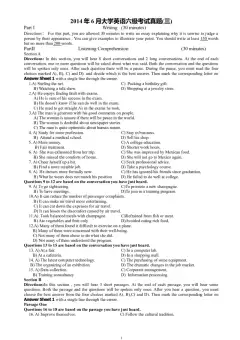
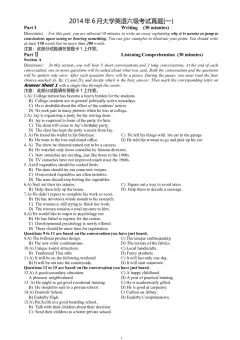
2014 年 12 月大学英语六级考试真题(二)
PartI Writing (30 minutes)
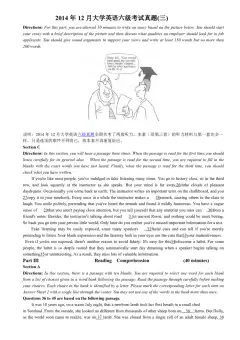
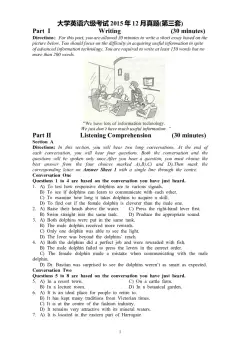
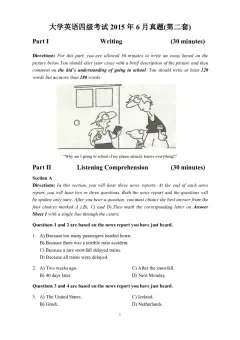
Directions:Forthispart,youareallowed30minutestowriteanessaybasedonthepicturebelow.Youshouldstart
your essay with a brief description of the picture and then discuss whether there is a shortcut to learning. You
shouldgivesoundargumentstosupportyourviewsandwriteatleast150wordsbutnomorethan200words.
“‘How To Do Well In School Without
Studying’isoverthereinthefictionsection.”
注意:此部分试题请在答题卡 1上作答。
PartⅡ Listening Comprehension (30 minutes)
SectionA
Directions: In this section, you will hear 8 short conversations and 2 long conversations. At the end of each
conversation, one or more questions will be asked about what was said. Both the conversation and the questions
will be spoken only once. After each question there will be a pause. During the pause,you must read the four
choicesmarkedA) B) C)andD) , anddecidewhichis the bestanswer.Then markthe correspondingletter on
9 9
AnswerSheet1withasinglelinethroughthecentre.
注意:此部分试题请在答题卡 1上作答。
1.A)Inaparkinglot. C)Atafastfoodrestaurant.
B)Atagrocery. D)Inacarshowroom.
2.A)Changeherpositionnowandthen. C)Havealittlenapafterlunch.
B)Stretchherlegsbeforestandingup. D)Getupandtakeashortwalk.
3.A)Thestudentsshouldpracticelong-distancerunning.
B)Thestudents’physicalconditionisnotdesirable.
C)Hedoesn’tquitebelievewhatthewomansays.
D)Hethinkstheraceistoohardforthestudents.
4.A)Theywillgettheirdegreesintwoyears.
B)Theyarebothpursuinggraduatestudies.
C)Theycannotaffordtogetmarriedrightnow.
D)Theydonotwanttohaveababyatpresent.
5.A)HemusthavebeenmistakenforJack. C)Jackiscertainlynotashealthyashe is.
B)Twinsusuallyhavealotincommon. D)HehasnotseenJackforquiteafew days.
6.A)Thewomanwillattendtheopeningofthe museum.
B)Thewomanisaskingthewayatthecrossroads.
C)Themanknowswherethemuseumislocated.
D)Themanwilltakethewomantothemuseum.
7.A)Theycannotasktheguytoleave. C)Theguymustbefeelingextremelylonely.
B)Theguyhasbeencominginforyears. D)Theyshouldnotlookdownupontheguy.
8.A)Collecttimepieces. C) Learntomendclocks.
B)Becometime-conscious. D)Keeptrackofhisdailyactivities.
Questions9to11arebasedontheconversationyouhavejustheard.
9.A)Itiseatingintoitsbanks. C)Itis wideanddeep.
B)Itwindsitswaytothesea. D)Itis quicklyrising.
10.A)Trytospeeduptheoperationbyanymeans.
B)Taketheequipmentapartbeforebeingferried.
C)Reducethetransportcostasmuchaspossible.
D)Getthetrucksovertotheothersideoftheriver.
11.A)Findasmanyboatsaspossible. C)Halttheoperationuntilfurtherorders.
B)Cuttreesandbuildrowingboats. D)Askthecommandertosend ahelicopter.
Questions12to15arebasedontheconversationyouhavejustheard.2014年12月大学英语六级考试真题(二)
12.A)Talkabouthisclimbingexperiences. C)Giveupmountainclimbing altogether.
B)HelphimjoinanIndianexpedition. D)Savemoneytobuyclimbingequipment.
13.A)HewasthefirsttoconquerMt.Qomolangma.
B)Hehadanunusualreligiousbackground.
C)Heclimbedmountainstoearnaliving.
D)Hewasverystrictwithhischildren.
14.A)Theyaretobeconquered. C)Theyaresacredplaces.
B)Theyaretobeprotected. D)Theyarelikehumans.
15.A)Itwashisfather’strainingthatpulledhimthrough.
B)Itwasamilestoneinhismountainclimbingcareer.
C)IthelpedhimunderstandtheSherpaviewofmountains.
D)Itwashisfatherwhogavehimthestrengthtosucceed.
SectionB
Directions: In this section, you will hear 3 short passages. At the end of each passage, you will hear some
questions.Boththepassageandthequestionswillbespokenonlyonce.Afteryouhearaquestion,youmustchoose
the best answer from the four choices marked A) , B),C) and D). Then mark the corresponding letter onAnswer
Sheet1withasinglelinethroughthecentre.
注意:此部分试题请在答题卡 1上作答 PassageOne
6
Questions16to19arebasedonthepassageyouhavejustheard.
16.A)Byshowingamemorandum’sstructure.
B)Byanalyzingtheorganizationofaletter.
C)Bycomparingmemorandumswithletters.
D)Byreviewingwhathehassaidpreviously.
17.A)Theyignoredmanyofthememorandumstheyreceived.
B)Theyplacedemphasisontheformatofmemorandums.
C)Theyseldomreadamemorandumthroughtotheend.
D)Theyspentalotoftimewritingmemorandums.
18. A)Styleandwording. C)Structureandlength.
B)Directnessandclarity. D)Simplicityandaccuracy.
19. A)Inclusionofappropriatehumor. C)Professionallook.
B)Directstatementofpurpose. D)Accuratedating.
PassageTwo
Questions20to22arebasedonthepassageyouhavejustheard.
20.A)Theygivetopprioritytotheirworkefficiency.
B)Theymakeanefforttolightentheirworkload.
C)Theytryhardtomakethebestuseoftheirtime.
D)Theyneverchangeworkhabitsunlessforcedto.
21.A)Senseofduty. C)Workefficiency.
B)Self-confidence. D)Passionforwork.
22.A)Theyfindnopleasureintheworktheydo.
B)Theytrytoavoidworkwheneverpossible.
C)Theyareaddictedtoplayingonlinegames.
D)Theysimplyhavenosenseofresponsibility.
PassageThree
Questions23to25arebasedonthepassageyouhavejustheard.
23.A)Helostallhisproperty. C)Heranawayfromhisfamily.
B)Hewassoldtoacircus. D)Hewasforcedintoslavery.
24.A)Acarpenter. C)Abusinessman.
B)Amasterofhis. D)Ablackdrummer.
25.A)ItnameditstownhallafterSolomonNorthup.
B)Itfreedallblacksinthetownfromslavery.
C)ItdeclaredJuly24SolomonNorthupDay.
D)IthostedareunionfortheNorthupfamily.
SectionC
Directions: Inthissection,youwillhearapassagethreetimes.When thepassageisreadforthefirsttime,you
shouldlistencarefullyforitsgeneralidea.Whenthepassageisreadforthesecondtime,youarerequiredtofillin
theblankswiththeexactwordsyouhavejustheard.Finally,whenthepassageisreadforthethirdtime,youshould
checkwhatyouhavewritten.
注意:此部分试题请在答题卡 1上作答。
Intoleranceistheartofignoringanyviewsthatdifferfromyourown.It 26 itselfinhatred,stereotypes,
2prejudice,and27 Onceitintensifiesinpeople,intoleranceisnearlyimpossibletoovercome.Butwhywould
anyonewanttobelabeledintolerant?Whywouldpeoplewanttobe 28 abouttheworldaroundthem?Why
wouldonewanttobepartoftheprobleminAmerica,insteadofthesolution?
Therearemanyexplanationsforintolerantattitudes,some 29 childhood.Itislikelythatintolerantfolks
grewup 30 intolerantparentsandthecycleofprejudicehassimplycontinuedfor 31 .Perhapsintolerant
peoplearesosetintheirwaysthattheyfinditeasiertoignoreanythingthatmightnot 32 theirlimitedviewoflife.
Ormaybeintolerantstudentshavesimplyneverbeen 33 toanyonedifferentfromthemselves.Butnoneofthese
reasonsisanexcuseforallowingtheintolerancetocontinue.
Intoleranceshouldnotbeconfusedwithdisagreement.Itis,ofcourse,possibletodisagreewithanopinion
withoutbeingintolerantofit/Ifyouunderstandabeliefbutstilldon’tbelieveinthatspecificbelief,that’sfine.You
are 34 youropinion.Asamatteroffact, 35 dissenters(持异议者)areimportantforanybelief.Ifweall
believedthesamethings,wewouldnevergrow?andwewouldneverlearnabouttheworldaroundus.Intolerance
doesnotstemfromdisagreement.Itstemsfromfear.Andfearstemsfromignorance.
PartⅢ Reading Comprehension (40 minutes)
SectionA
Directions: Inthissection thereisapassagewithtenblanks.Youarerequiredtoselectonewordforeachblank
9
from a list of choices given in a word bank following the passage. Read the passage through carefully before
makingyourchoices.Eachchoiceinthebankisidentifiedbyaletter.Pleasemarkthecorrespondingletterforeach
itemonAnswerSheet2withasinglelinethroughthecentre.Youmaynotuseanyofthewordsinthebankmore
thanonce.
Questions36to45arebasedonthefollowingpassage.
His future subjects have not always treated the Prince of Wales with the respect one might expect. They
laughedaloudin1986whentheheirtotheBritish 36 toldaTVreporterthathetalkedtohisplantsathiscountry
house, Highgrove, to stimulate their growth. The Prince was being humorous —“My sense of humor will get me
intotroubleoneday,“hesaidtohisaids(随从)—butlisteningtoCharlesWindsorcanindeedprovestimulating.
Theroyal 37 hasbeenpromotingradicalideasformostofhisadultlife.Someofhis 38 ,whichoncesounded
abitweird,weresimplyaheadoftheirtime.Now,finally,theworldseemstobecatchingupwithhim.
Takehisviewsonfarming.PrinceCharles’DuchyHomeFarmwent 39 backin1986,whenmostshoppers
caredonlyaboutthelow pricetagonsuspiciouslyblemish-free(无瑕戚的)vegetables and 40 large chickens
piledhighinsupermarkets.
Hiswarningsonclimatechangeprovedfarsighted,too.Charlesbegan 41 actiononglobalwarmingin1990
andsayshehasbeenworriedaboutthe 42 ofmanontheenvironmentsincehewasateenager.
Although he has gradually gained international 43 as one of the world’s leading conservationists, many
British people still think of him as an 44 person who talks to plants. This year, as it happens, South Korean
scientistsprovedthatplantsreallydo 45 tosound.SoCharleswasaheadofthegamethere,too.
注意:此部分试题请在答题卡 2上作答。
A)conform F)notions K)subordinate
B)eccentric G)organic L)suppressing
C)environmentalist H)originally M)throne
D)expeditions I)recognition N)unnaturally
E)impact J)respond O)urging
SectionB
Directions: In this section, you are going to read a passage with ten statements attached to it. Each statement
containsinformationgiveninoneoftheparagraphs.Identifytheparagraphfromwhichtheinformationisderived.
You may choose a paragraph more than once. Each paragraph is marked with a letter. Answer the questions by
markingthecorrespondingletteronAnswerSheet2.
HighSchoolSportsAren’tKillingAcademics
[A] In this months Atlantic cover article, “The Case Against High-School Sports,” Amanda Ripley argues that
school-sponsoredsportsprograms shouldbeseriously cut. She writes that, unlike mostcountries thatoutperform
the United States on international assessments, American schools put too much of an emphasis on athletics.
“Sports are embedded in American schools in a way they are not almost anywhere else,” she writes. “Yet this
difference hardly ever comes up in domestic debates about America’s international mediocrity (平庸) in
education.”2014年12月大学英语六级考试真题(二)
[B] American student-athletes reap many benefits from participating in sports, but the costs to the schools could
outweightheirbenefits,sheargues.Inparticular,Ripleycontendsthatsportscrowdouttheacademicmissionsof
schools: America should learn from South Korea and Finland and every other country at the top level of
internationaltestscores,allofwhomemphasizeathleticsfarlessinschool.“Evenineighthgrade,Americankids
spendmorethantwicethetimeKoreankidsspendplayingsports,”shewrites,citinga2010studypublishedinthe
JournalofAdvancedAcademics.
[C] It might well be true that sports are far more rooted in American high schools than in other countries. But our
reading of international test scores finds no support for the argument against school athletics. Indeed, our own
researchandthatof othersleadusto make the opposite case.School-sponsoredsports appearto providebenefits
thatseemtoincrease,notdetract(减少)from,academicsuccess.
[D] Ripley indulges a popular obsession (痴迷) with international test score comparisons,which show wide and
frightening gaps betweenthe United States and other countries. She ignores, however, the factthat states vary at
least as much in test scores as do developed countries. A 2011 report from Harvard University shows that
Massachusettsproduces math scorescomparableto SouthKoreaandFinland, whileMississippiscores arecloser
to Trinidad and Tobago. Ripley’s thesis about sports falls apart in light of this fact. Schools in Massachusetts
providesportsprogramswhileschoolsinFinlanddonot.SchoolsinMississippimaylovefootballwhileinTobago
interscholasticsportsarenowherenearasprominent.Sportscannotexplainthesesimilaritiesinperformance.They
can’texplaininternationaldifferenceseither.
[E] If it is true that sports undermine the academic mission of American schools, we would expect to see a negative
relationship between the commitment to athletics and academic achievement. However, the University of
Arkansas’sDanielBowenandJayGreeneactuallyfindtheopposite.Theyexaminethisrelationshipbyanalyzing
schools’sportswinningpercentagesaswellasstudent-athleticparticipationratescomparedtograduationratesand
standardized test score achievement over a five-year period for all public high schools in Ohio. Controlling for
student poverty levels, demographics(人口统计 4大况),and district financial resources, both measures of a
school’s commitment to athletics are significantly and positively related to lower dropout rates as well as higher
testscores.
[F] On-the-field success and high participation in sports is notrandom —it requires focus and dedication to athletics.
Onemightthinkthiswouldleadschoolsobsessedwithwinningtodeemphasizeacademics.BowenandGreene’s
resultscontradictthatargument.Alikelyexplanationforthisseeminglycounterintuitive(与直觉相反的)resultis
thatsuccessinsportsprogramsactuallyfacilitatesorrejectsgreatersocialcapitalwithinaschool’scommunity.
[G]RipleycitesthewritingsofrenownedsociologistJamesColeman,whoseresearchineducationwasgroundbreaking.
Colemaninhisearlyworkheldathleticsincontempt,arguingthattheycrowdedoutschools’academicmissions.
Ripleyquoteshis1961study,TheAdolescentSociety,whereColemanwrites,“Altogether,thetrophy(奖品)case
wouldsuggesttotheinnocentvisitorthathewasenteringanathleticclub,notaneducationalinstitution.
[H]However,inlaterresearchColemanwouldshowhowthesuccessofschoolsishighlydependentonwhathetermed
socialcapital,“thenorms,thesocialnetworks,andtherelationshipsbetweenadultsandchildrenthatareofvalue
forthechild’sgrowingup.”
[I] According to a 2013 evaluation conducted by the Crime Lab at the University of Chicago, a program called
BecomingaMari—SportsEditioncreateslastingimprovementsintheboys’studyhabitsandgradepointaverages.
During the first year of the program, students were found to be less likely to transfer schools or be engaged in
violent crime. A year after the program, participants were less likely to have had an encounter with the juvenile
justicesystem.
[J] If school-sponsored sports were completely eliminated tomorrow, many American students would still have
opportunities to participate in organized athletics elsewhere, much like they do in countries such as Finland,
Germany, and South Korea. The same is not certain when it comes to students from more disadvantaged
backgrounds. In an overview of the research on non-school based after-school programs, researchers find that
disadvantaged children participate in these programs at significantly lower rates. They find that low-income
studentshavelessaccessduetochallengeswithregardtotransportation,non-nominalfees,andoff-campussafety.
Therefore, reducing or eliminating these opportunities would most likely deprive disadvantaged students of the
benefits from athletic participation, not least of which is the opportunity to interact with positive role models
outsideofregularschoolhours.
[K] Another unfounded criticism that Ripley makes is bringing up the stereotype that athletic coaches are typically
lousy(蹩脚的)classroomteachers.“Americanprincipals,unlikethevastmajorityofprincipalsaroundtheworld,
make many hiring decisions with their sports teams in mind, which does not always end well for students.” she
writes.Educatorswhoseekemploymentatschoolsprimarilyforthepurposeofcoachingarelikelytoshirk(推卸)
teachingresponsibilities,theargumentgoes.Moreover,eveninthecaseswheretheemployeeisateacherfirstand
athletic coach second, the additional responsibilities thatcome with coaching likely come atthe expense of time
otherwisespentonplanning,grading,andcommunicatingwithparentsandguardians.
[L] The data, however, do not seem to confirm this stereotype. In the most rigorous study on the classroom results of
highschoolcoaches,theUniversityofArkansas’sAnnaEgalitefindsthatathleticcoachesinFloridamostlytend
4to perform just as well as their non-coaching counterparts, with respect to raising student test scores. We do not
doubt that teachers who also coach face serious tradeoffs that likely come at the expense of time they could
dedicate to their academic obligations. However, as with sporting events, athletic coaches gain additional
opportunitiesforcommunicatingandservingasmentors(导师)thatpotentiallyhelpstudentssucceedandmakeup
forthecostsofcoachingcommitments.
[M] If schools allow student-athletes to regularly miss out on instructional time for the sake of traveling to athletic
competitions, that’s bad. However, such issues would be better addressed by changing school and state policies
withregardtotheschedulingofsportingeventsasopposedtototalelimination.Iftheempiricalevidencepointsto
anything,itpointstowardsschool-sponsoredsportsprovidingassetsthatarewellworththecosts.
[N]DespitenegativestereotypesaboutsportscultureandRipley’spresumptionthatacademicsandathleticsareatodds
with one another, we believe that the greater body of evidence shows that school-sponsored sports programs
appeartobenefitstudents.Successesontheplayingfieldcancarryovertotheclassroomandviceversa(反之亦
然).Moreimportantly,findingwaystoincreaseschoolcommunities’socialcapitalisimperativetothesuccessof
theschoolasawhole,notjusttheathletes.
注意:此部分试题请在答题卡 2上作答。
46.Studentsfromlow-incomefamilieshavelessaccesstooff-campussportsprograms.
47.AmandaRipleyarguesthatAmericashouldlearnfromothercountriesthatrankhigh ininternationaltestsand
laylessemphasisonathletics.
48.Accordingtotheauthor,AmandaRipley failsto notethatstudents’performanceinexams variesfromstateto
state.
49.AmandaRipleythinksthatathleticcoachesarepooratclassroominstruction.
50.JamesColeman’slaterresearchmakesanargumentforaschool’ssocialcapital.
51.Researchersfindthatthereisapositiverelationshipbetweenaschool’scommitmenttoathleticsandacademic
achievements.
52.Arigorousstudyfindsthatathleticcoachesalsodowellinraisingstudents’testscores.
53. According to an evaluation, sports programs contribute to students’ academic performance and character
building.
54. Amanda Ripley believes the emphasis on school sports should be brought up when trying to understand why
Americanstudentsaremediocre.
55.JamesColemansuggestsinhisearlierwritingsthatschoolathleticswouldundermineaschool’simage.
SectionC
Directions: Thereare2passagesinthissection•Eachpassageisfollowedbysomequestionsorunfinished
statements.ForeachofthemtherearefourchoicesmarkedA),B),C)andD).Youshoulddecideonthebestchoice
andmarkthecorrespondingletteronAnswerSheet2withasinglelinethroughthecentre.PassageOne
Questions56to60arebasedonthefollowingpassage.
Itiseasytomiss amidtheday-to-dayheadlinesofglobaleconomicrecession,butthereis alessconspicuous
kindofsocialupheaval(剧变)underwaythatisfastalteringboththefaceoftheplanetandthewayhumanbeings
live. Thatchange is the rapid acceleration of urbanization. In 2008, for the first time in human history, more than
halftheworld’spopulationwaslivingintownsandcities.Andasarecentlypublishedpapershows,theprocessof
urbanizationwill only accelerate inthe decades tocome-with anenormous impactonbiodiversityand potentially
onclimatechange.
AsKarenSeto,theleadauthorofthepaper,pointsout,thewaveofurbanizationisn’tjustaboutthemigration
of people into urban environments, but about the environments themselves becoming bigger to accommodate all
thosepeople. The rapid expansion of urban areas will have a huge impacton biodiversity hotspots and oncarbon
emissionsinthoseurbanareas.
Humansaretheultimateinvasivespecies—whentheymoveintonewterritory,theyoftendisplacethewildlife
that was already living there. And as land is cleared for those new cities —especially in the dense tropical
forests—carbon will be released into the atmosphere as well. It’s true that as people in developing nations move
from the countryside to the city, the shift may reduce the pressure on land, which could in turn be good for the
environment.Thisisespeciallysoindesperatelypoorcountries,whereresidentsinthecountrysideslashandburn
forests each growing season to clear space for farming. But the real difference is that in developing nations, the
movefromruralareasto cities oftenleads toanaccompanying increaseinincome —andthatincreaseleadstoan
increaseintheconsumptionoffoodandenergy,whichinturncausesariseincarbonemissions.Gettingenoughto
eatandenjoying the safety and comfort of living fully onthe grid is certainly a good thing —butit does carry an
environmentalprice.
The urbanization wave can’t be stopped —and it shouldn’t be. But Seto’s paper does underscore the
importance of managing that transition. If we do it the right way, we can reduce urbanization’s impact on the
environment.“There’sanenormousopportunityhere,andalotofpressureandresponsibilitytothinkabouthowwe
urbanize,” says Seto. “One thing that’s clear is that we can’t build cities the way we have over the last couple of
hundredyears.Thescaleofthistransitionwon’tallowthat.”We’reheadedtowardsanurbanplanetnomatterwhat,2014年12月大学英语六级考试真题(二)
butwhetheritbecomesheavenorhellisuptous.
注意:此部分试题请在答题卡 2上作答。
56.Whatissuedoestheauthortrytodrawpeopledattentionto?
A)Theshrinkingbiodiversityworldwide.
B)Therapidincreaseofworldpopulation.
C)Theongoingglobaleconomicrecession.
D)Theimpactofacceleratingurbanization.
57.Inwhatsensearehumanstheultimateinvasivespecies?
A)Theyaremuchgreedierthanotherspecies.
B)Theyareauniquespeciesborntoconquer.
C)Theyforceotherspeciesoutoftheirterritories.
D)Theyhaveanurgetoexpandtheirlivingspace.
58.Inwhatwayisurbanizationinpoorcountriesgoodfortheenvironment?
A)Morelandwillbepreservedforwildlife.
B)Thepressureonfarmlandwillbelessened.
C)Carbonemissionswillbeconsiderablyreduced.
D)Naturalresourceswillbeusedmoreeffectively.
59.Whatdoestheauthorsayaboutlivingcomfortablyinthecity?
A)Itincursahighenvironmentalprice.
B)Itbringspovertyandinsecuritytoanend.
C)Itcausesabigchangeinpeople’slifestyle.
D)Itnarrowsthegapbetweencityandcountry.
60.WhatcanbedonetominimizethenegativeimpactofurbanizationaccordingtoSeto?
A)Slowingdownthespeedoftransition.
B)Innovativeuseofadvancedtechnology.
C)Appropriatemanagementoftheprocess.
D)Enhancingpeople’ssenseofresponsibility.
PassageTwo
Questions61to65arebasedonthefollowingpassage.
WhenHarvardstudentMarkZuckerberglaunchedthefacebook.cominFeb.2004,evenhecouldnotimagine
the forces it would let loose. His intent was to connect college students. Facebook, which is what this website
rapidlyevolvedinto,endedupconnectingtheworld.
To the children of this connected era, the world is one giant social network. They are not bound —as were
previousgenerationsofhumans一bywhattheyweretaught.Theyareonlylimitedbytheircuriosityandambition.
During my childhood, all knowledge was local. You learned everything you knew from your parents, teachers,
preachers,andfriends.
Withthehigh-qualityandtimelyinformationattheirfingertips,today’schildrenarerisingabovethefearsand
biases of their parents. Adults are also participating in this revolution. India’s normally tame middle class is
speaking up against social ills. Silicon Valley executives are being shamed into adding women to their boards.
Politicalleadersare marshalling theenergy ofmillionsfor elections andpoliticalcauses.All ofthis is being done
withsocialmediatechnologiesthatFacebookanditscompetitorssetfree.
Asdoeseveryadvancingtechnology,socialmediahascreatedmanynewproblems.Itiscommonlyaddictive
andcreatesrisksforyoungerusers.SocialmediaisusedbyextremistsintheMiddleEastandelsewheretoseekand
brainwash recruits. And it exposes us and our friends to disagreeable spying. We may leave our lights on in the
housewhenweareonvacation,butthroughsocialmediawetellcriminalsexactlywhereweare,whenweplanto
returnhome,andhowtoblackmail(敲诈)us.
Governments don’t need informers any more. Social media allows government agencies to spy on their own
citizens.We recordour thoughts, emotions, likes anddislikes onFacebook; we share ourpoliticalviews, social
preferences,andplans. We postintimate photographsofourselves. No spy agencyor criminalorganization could
activelygatherthetypeofdatathatwevoluntarilypostforthem.
The marketers are also seeing big opportunities. Amazon is trying to predict what we will order. Google is
tryingtojudgeourneedsandwantsbasedonoursocial-mediaprofiles.Weneedtobeawareoftherisksandkeep
workingtoalleviatethedangers.
Regardless ofwhatsocialmediapeopleuse,onethingis certain: weareinaperiodofacceleratingchange.
Thenextdecadewillbeevenmoreamazingandunpredictablethanthelast.Justasnoonecouldpredictwhatwould
happenwithsocialmediainthelastdecade,noonecanaccuratelypredictwherethistechnologywilltakeus.Iam
optimistic,however,thataconnectedhumanitywillfindawaytoupliftitself.
注意:此部分试题请在答题卡 2上作答。
61.WhatwasthepurposeofFacebookwhenitwasfirstcreated?
A)Tohelpstudentsconnectwiththeoutsideworld.
6B)Tobringuniversitystudentsintoclosercontact.
C)Tohelpstudentslearntoliveinaconnectedera.
D)Tocombinetheworldintoanintegralwhole.
62.Whatdifferencedoessocialmediamaketolearning?
A)Localknowledgeandglobalknowledgewillmerge.
B)Studentswillbecomemorecuriousandambitious.
C)Peopleareabletolearnwherevertheytravel.
D)Sourcesofinformationaregreatlyexpanded.
63.Whatistheauthor’sgreatestconcernwithsocialmediatechnology?
A)Individualsandorganizationsmayuseitforevilpurposes.
B)Governmentwillfindithardtoprotectclassifiedinformation.
C)Peoplemaydisclosetheirfriends’informationunintentionally.
D)People’sattentionwillbeeasilydistractedfromtheirworkinhand.
64.Whatdobusinessesusesocialmediafor?
A)Creatingagoodcorporateimage.
B)Anticipatingtheneedsofcustomers.
C)Conductinglarge-scalemarketsurveys.
D)Minimizingpossiblerisksanddangers.
65.Whatdoestheauthorthinkofsocialmediaasawhole?
A)Itwillenablehumansocietytoadvanceatafasterpace.
B)Itwillposeagravethreattoourtraditionalwaysoflife.
C)Itisboundtobringaboutanotherinformationrevolution.
D)Itbreaksdownthefinalbarriersinhumancommunication.
PartⅣ Translation(30minutes)
Directions:Forthispart,youareallowed30minutestotranslateapassagefromChineseintoEnglish.Youshould
writeyouransweronAnswerSheet2.
自从1978年启动改革以来,中国已从计划经济转为以市场为基础的经济,并经历了经济和社会的快
速发展。年均10%的GDP增长已使五亿多人脱贫。联合国的“千年(millennium)发展目标”在中国均已达
到或即将达到。目前,中国的第十二个五年规划强调发展服务业和解决环境及社会不平衡的问题。政府已
设定目标减少污染,提高能源效率,改善得到教育和医保的机会,并扩大社会保障。中国现在7%的经济
年增长目标表明政府意在重视生活质量而不是增长速度。
注意:此部分试题请在答题卡 2上作答。