淘宝店铺【光速考研工作室】温馨提示:
word版真题仅校对内容,因格式不无法固定,未精美排版,仅供自行复制粘贴使用,若打
印或用于电子笔记,请务必使用PDF版本真题!!!
本店PDF版真题打印无乱码,用于电子版笔记支持取词翻译,为优质版PDF。
2017年6月大学英语四级真题(卷一)
Part I Writing (25 minutes)
(请于正式开考后半小时内完成该部分,之后将进行听力考试)
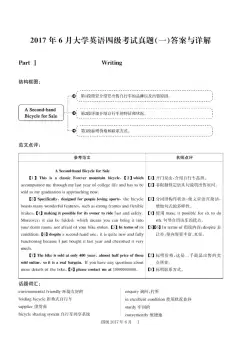
Directions: For this part, you are allowed 30 minutes to write an advertisement on your campus website to sell a
bicycle you used at college. Your advertisement may include its brand, features, condition and price, and your
contact information. You should write at least 120 words but no more than 180 words.
Part II Listening Comprehension (30 minutes)
Section A
Directions: In this section, you will hear three news reports. At the end of each news report, you will hear two or
three questions. Both the news report and questions will be spoken only once. After you hear questions, you must
choose the best answer from the four choices marked A), B), C) and D). Then mark the corresponding letter on
Answer Sheet 1 with a single line through the centre.
注意:此部分试题请在答题卡1上作答。
Questions 1 and 2 are based on the news report you have just heard.
1. A) The self-driving system was faulty. B) The car was moving at a fast speed.
C) The man in the car was absent-minded. D) The test driver made a wrong judgment.
2. A) They have generally done quite well. B) They have caused several severe crashes.
C) They have posed a threat to other drivers. D) They have done better than conventional cars.
Questions 3 and 4 are based on the conversation you have just heard.
3. A) He is a queen bee specialist. B) He works at a national park.
C) He removed the bees from the boot. D) He drove the bees away from his car.
4. A) They were making a lot of noise B) They were looking after the queen
C) They were dancing in a unique way D) They were looking for a new box to live in
Questions 5 to 7 are based on the conversation you have just heard.
5. A) The latest test on a rare animal species B) The finding of two new species of frog
C) The second trip to a small remote D) The discovery of a new species of snake
6. A) He fell from a tall palm tree by accident B) A snake crawled onto his head in his sleep
C) He discovered a rare fog on a deserted island D) A poisonous snake attacked him on his field trip
7. A) From its origin B) From its length
C) From its colour D) From its genes
Section B
Directions: In this section, you will hear three passages. At the end of each passage,you will hear three or four
questions. Both the passage and the questions will be spoken only once. After you hear a question,you must
choose the best answer from the four choices marked A), B), C) and D). Then mark the corresponding letter on
Answer Sheet 1 with a single line through the centre.
Questions 8 to 11 are based on the conversation you have just heard.
8. A) The airport is a long way from the hotel B) His flight is leaving in less than 2 hours
C) He has to check a lot of luggage D) The security check takes time
9. A) In cash B) By credit card
C) With his smart phone D) With a traveler’s check
10. A) Look after his luggage B) Find a porter for himC) Give him a receipt D) Confirm his flight
11. A) Posting a comment on the hotel’s webpage B) Staying in the same hotel next time he comes
C) Signing up for membership of Sheraton Hotel D) Loading her luggage onto the airport shuttle
Questions 12 to 15 are based on the conversation you have just heard.
12. A) He becomes tearful in wind B) He is the only boy in his family
C) He is his teacher's favorite student D) He has stopped making terrible faces
13. A) Warn him of danger by making up a story B) Give him some cherry stones to play with
C) Do something funny to amuse him D) Tell him to play in her backyard
14. A) They could knock people unconscious B) They could fly against a strong wind
C) They could sometimes terrify adults D) They could break people's legs
15. A) One would have curly hair if they ate too much stale bread
B) One would go to prison if they put a stamp on upside down
C) One would have to shave their head to remove a bat in their hair
D) One would get a spot on their tongue if they told a lie deliberately
Section C
Directions: In this section, you will hear three passages of lectures or talks followed by three or four questions.
The recordings will be played only once. After you hear a question,you must choose the best answer from the four
choices marked A), B), C) and D). Then mark the corresponding letter on Answer Sheet 1 with a single line
through the centre.
Questions 16 to 18 are based on the passage you have just heard.
16. A) Everything seemed to be changing. B) People were formal and disciplined.
C) People were excited to go travelling overseas. D) Things from the Victorian era came back alive.
17. A) Watching TV at home. B) Meeting people.
C) Drinking coffee. D) Trying new foods.
18. A) He was interested in stylish dresses. B) He was able to make a lot of money.
C) He was a young student in the 1960s. D) He was a man full of imagination.
Questions 19 to 21 are based on the passage you have just heard.
19. A) They avoid looking at them. B) They run away immediately.
C) They show anger on their faces. D) They make threatening sounds.
20. A) It turns to its owner for help. B) It turns away to avoid conflict.
C) It looks away and gets angry too. D) It focuses its eyes on their mouths.
21. A) By observing their facial features carefully. B) By focusing on a particular body movement.
C) By taking in their facial expressions as a whole. D) By interpreting different emotions in different ways.
Questions 22 to 25 are based on the passage you have just heard.
22. A) They have to look for food and shelter underground.
B) They take little notice of the changes in temperature.
C) They resort to different means to survive the bitter cold.
D) They have difficulty adapting to the changed environment.
23. A) They have their weight reduced to the minimum.
B) They consume energy stored before the long sleep.
C) They can maintain their heart beat at the normal rate.
D) They can keep their body temperature warm and stable.
24. A) By staying in hiding places and eating very little.
B) By seeking food and shelter in people’s houses.
C) By growing thicker hair to stay warm.
D) By storing enough food beforehand.25. A) To stay safe. B) To save energy.
C) To keep company. D) To protect the young.
Part Ⅲ Reading Comprehension (40 minutes)
Section A
Directions: In this section, there is a passage with ten blanks. You are required to select one word for each blank
from a list of choices given in a word bank following the passage. Read the passage through carefully before
making your choices, Each choice in the bank is identified by a letter. Please mark the corresponding letter for
each item on Answer Sheet 2 with a single line through the centre. You may not use any of the words in the bank
more than once.
Questions 26 to 35 are based on the following passage.
The method for making beer has changed over time. Hops (啤酒花),for example, which give many a
modern beer its bitter flavor, are a (26)_______ recent addition to the beverage. This was first mentioned in
reference to brewing in the ninth century. Now, researchers have found a (27)_______ingredient in residue (残留
物) from 5,000-year-old beer brewing equipment. While digging two pits at a site in the central plains of China,
scientists discovered fragments from pots and vessels. The different shapes of the containers (28)_______they
were used to brew, filter, and store beer. They may be ancient “beer-making tools,” and the earliest
(29_______evidence of beer brewing in China, the researchers reported in the Proceedings of the National
Academy of Sciences. To (30)_______that theory, the team examined the yellowish, dried (31)_______inside
the vessels. The majority of the grains, about 80%, were from cereal crops like barley (大麦),and about 10%
were bits of roots, (32)_______lily, which would have made the beer sweeter, the scientists say. Barley was an
unexpected find: the crop was domesticated in Western Eurasia and didn't become a (33)_______food in central
China until about 2,000 years ago, according to the researchers. Based on that timing, they indicate barley may
have (34)_______ in the region not as food, but as (35)_______material for beer brewing.
A) arrived B) consuming C) direct D) exclusively
E) including F) inform G) raw H) reached
I) relatively J) remains K)resources L) staple
M) suggest N) surprising O) test
Section B
Directions: In this section, you are going to read a passage with ten statements attached to it. Each statement
contains information given in one of the paragraphs. Identify the paragraph from which the information is
derived. You may choose a paragraph more than once. Each paragraph is marked with a letter. Answer the
questions by marking the corresponding letter on Answer Sheet 2.
The Blessing and Curse of the People Who Never Forget
A handful of people can recall almost every day of their lives in enormous detail—and after years of research,
neuroscientists (神经科学专家) are finally beginning to understand how they do it.
[A] For most of us, memory is a mess of blurred and faded pictures of our lives. As much as we would like
to cling on to our past, even the saddest moments can be washed away with time.
[B] Ask Nima Veiseh what he was doing for any day in the past 15 years, however, and he will give you the
details of the weather, what he was wearing, or even what side of the train he was sitting on his journey to work.
“My memory is like a library of video tapes, walk-throughs of every day of my life from waking to sleeping,” he
explains.
[C] Veiseh can even put a date on when those tapes started recording: 15 December 2000, when he met his
first girlfriend at his best friend's 16th birthday party. He had always had a good memory, but the thrill of young
love seems to have shifted a gear in his mind: from now on, he would start recording his whole life in detail. “I
could tell you everything about every day after that.”
[D] Needless to say, people like Veiseh are of great interest to neuroscientists hoping to understand the waythe brain records our lives. A couple of recent papers have finally opened a window on these people’s
extraordinary minds. And such research might even suggest ways for us all to relive our past with greater clarity.
[E] “Highly superior autobiographical memory”(or HSAM for short) first came to light in the early 2000s,
with a young woman named Jill Price. Emailing the neuroscientist and memory researcher Jim McGaugh one day,
she claimed that she could recall every day of her life since the age of 12. Could he help explain her experiences?
[F] McGaugh invited her to his lab, and began to test her: he would give her a date and ask her to tell him
about the world events on that day. True to her word, she was correct almost every time.
[G] It didn’t take long for magazines and documentary film-makers to come to understand her “total
recall”, and thank to the subsequent media interest, a few dozen other subjects (including Veiseh) have since
come forward and contacted the team at the University of California, Irvine.
[H] Interestingly, their memories are highly self-centred: although they can remember “autobiographical” life
events in extraordinary detail, they seem to be no better than average at recalling impersonal information, such as
random (任意选取的)lists of words. Nor are they necessarily better at remembering a round of drinks, say. And
although their memories are vast, they are still likely to suffer from “false memories”.Clearly, there is no such
thing as a “perfect” memory—their extraordinary minds are still using the same flawed tools that the rest of us
rely on. The question is, how?
[I] Lawrence Patihis at the University of Southern Mississippi recently studied around 20 people with HSAM
and found that they scored particularly high on two measures: fantasy proneness (倾向)and absorption. Fantasy
proneness could be considered a tendency to imagine and daydream, whereas absorption is the tendency to allow
your mind to become fully absorbed in an activity—to pay complete attention to the sensations (感受)and the
experiences. “I’m extremely sensitive to sounds, smells and visual detail,” explains Nicole Donohue, who has
taken part in many of these studies. “I definitely feel things more strongly than the average person.”
[J] The absorption helps them to establish strong foundations for recollection, says Patihis, and the fantasy
proneness means that they revisit those memories again and again in the coming weeks and months. Each time this
initial memory trace is “replayed”, it becomes even stronger. In some ways, you probably go through that process
after a big event like your wedding day—but the difference is that thanks to their other psychological tendencies,
the HSAM subjects are doing it day in, day out, for the whole of their lives.
[K] Not everyone with a tendency to fantasise will develop HSAM, though, so Patihis suggests that
something must have caused them to think so much about their past. “Maybe some experience in their childhood
meant that they became obsessed (着迷)with calendars and what happened to them,” says Patihis.
[L] The people with HSAM I’ve interviewed would certainly agree that it can be a mixed blessing. On the
plus side, it allows you to relive the most transformative and enriching experiences. Veiseh, for instance, travelled
a lot in his youth. In his spare time, he visited the local art galleries, and the paintings are now lodged deep in his
autobiographical memories.
[M] “Imagine being able to remember every painting, on every wall, in every gallery space, between nearly
40 countries,” he says. “That’s a big education in art by itself.” With this comprehensive knowledge of the
history of art, he has since become a professional painter.
[N] Donohue, now a history teacher, agrees that it helped during certain parts of her education. “I can
definitely remember what I learned on certain days at school. I could imagine what the teacher was saying or what
it looked like in the book.”
[O] Not everyone with HSAM has experienced these benefits, however. Viewing the past in high definition
can make it very difficult to get over pain and regret. “It can be very hard to forget embarrassing moments,” says
Donohue. “You feel the same emotions—it is just as raw, just as fresh... You can’t turn off that stream of
memories, no matter how hard you try.” Veiseh agrees. “It is like having these open wounds—they are just a part
of you,” he says.
[P] This means they often have to make a special effort to lay the past to rest. Bill, for instance, often gets
painful “flashbacks”,in which unwanted memories intrude into his consciousness, but overall he has chosen tosee it as the best way of avoiding repeating the same mistakes. “Some people are absorbed in the past but not open
to new memories, but that’s not the case for me. I look forward to each day and experiencing something new.”
36.People with HSAM have the same memory as ordinary people when it comes to impersonal information.
37.Fantasy proneness will not necessarily cause people to develop HSAM.
38.Veiseh began to remember the details of his everyday experiences after he met his first young love.
39.Many more people with HSAM started to contact researchers due to the mass media.
40.People with HSAM often have to make efforts to avoid focusing on the past.
41.Most people do not have clear memories of past events.
42.HSAM can be both a curse and a blessing.
43.A young woman sought explanation from a brain scientist when she noticed her unusual memory.
44.Some people with HSAM find it very hard to get rid of unpleasant memories.
45.A recent study of people with HSAM reveals that they are liable to fantasy and full absorption in an activity.
Section C
Directions: There are 2 passages in this section. Each passage is followed by some questions or unfinished
statements. For each of them there are four choices marked A), B), C) and D). You should decide on the best
choice and mark the corresponding letter on Answer Sheet 2with a single line through the centre.
Passage One
Questions 46 to 50 are based on the following passage.
The phrase almost completes itself: midlife crisis. It’s the stage in the middle of the journey when people feel
youth vanishing, their prospects narrowing and death approaching.
There’s only one problem with the cliche (套话).It isn’t true.
“In fact, there is almost no hard evidence for midlife crisis other than a few small pilot studies conducted
decades ago,” Barbara Hagerty writes in her new book, Life Reimagined. The bulk of the research shows that
there may be a pause, or a shifting of gears in the 40s or 50s, but this shift “can be exciting, rather than terrifying”.
Barbara Hagerty looks at some of the features of people who turn midlife into a rebirth. They break routines,
because “autopilot is death”. They choose purpose over happiness一having a clear sense of purpose even reduces
the risk of Alzheimer’s disease. They give priority to relationships, as careers often recede(逐渐淡化).
Life Reimagined paints a picture of middle age that is far from gloomy. Midlife seems like the second big
phase of decision-making. Your identity has been formed; you’ve built up your resources; and now you have the
chance to take the big risks precisely because your foundation is already secure.
Karl Barth described midlife precisely this way. At middle age, he wrote, “the sowing is behind; now is the
time to reap. The run has been taken; now is the time to leap. Preparation has been made; now is the time for the
venture of the work itself.”
The middle-aged person, Barth continued, can see death in the distance, but moves with a “measured haste”
to get big new things done while there is still time.
What Barth wrote decades ago is even truer today. People are healthy and energetic longer. We have
presidential candidates running for their first term in office at age 68, 69 and 74. A longer lifespan is changing the
narrative structure of life itself. What could have been considered the beginning of a descent is now a potential
turning point—the turning point you are most equipped to take full advantage of.
46. What does the author think of the phrase “midlife crisis”?
A) It has led to a lot of debate. B) It is widely acknowledged.
C) It is no longer fashionable. D) It misrepresents real life.
47.How does Barbara Hagerty view midlife?
A) It may be the beginning of a crisis. B) It can be a new phase of one’s life.
C) It can be terrifying for the unprepared. D)It may see old-age diseases approaching.
48.How is midlife pictured in the book Life Reimagined?A) It can be quite rosy. B) It can be burdensome.
C) It undergoes radical transformation. D) It makes for the best part of one’s life.
49.According to Karl Barth, midlife is the time_______.
A) to relax B) to mature
C) to harvest D) to reflect
50.What does the author say about midlife today?
A) It is more meaningful than other stages of life.
B) It is likely to change the narrative of one’s life,
C) It is more important to those with a longer lifespan.
D)It is likely to be a critical turning point in one’s life.
Passage Two
Questions 51 to 55 are based on the following passage.
In spring, chickens start laying again, bringing a welcome source of protein at winter’s end. So it’s no
surprise that cultures around the world celebrate spring by honoring the egg.
Some traditions are simple, like the red eggs that get baked into Greek Easter breads. Others elevate the egg
into a fancy art, like the heavily jewel-covered “eggs” that were favored by the Russians starting in the 19th
century.
One ancient form of egg art comes to us from Ukraine. For centuries, Ukrainians have been drawing
complicated patterns on eggs. Contemporary artists have followed this tradition to create eggs that speak to the
anxieties of our age: Life is precious, and delicate. Eggs are, too.
“There’s something about their delicate nature that appeals to me,” says New Yorker cartoonist Roz Chast.
Several years ago, she became interested in eggs and learned the traditional Ukrainian technique to draw her very
modern characters. “I’ve broken eggs at every stage of the process—from the very beginning to the very, very
end.”
But there’s an appeal in that vulnerability. “There’s part of this sickening horror of knowing you’re walking
on the edge with this, that I kind of like, knowing that it could all fall apart at any second.” Chast’s designs, such
as a worried man alone in a tiny rowboat, reflect that delicateness.
Traditional Ukrainian decorated eggs also spoke to those fears. The elaborate patterns were believed to offer
protection against evil.
“There’s an ancient legend that as long as these eggs are made, evil will not prevail in the world,” says Joan
Brander, a Canadian egg-painter who has been painting eggs for over 60 years, having learned the art from her
Ukrainian relatives.
The tradition, dating back to 300 B.C., was later incorporated into the Christian church. The old symbols,
however, still endure. A decorated egg with a bird on it, given to a young married couple, is a wish for children. A
decorated egg thrown into the field would be a wish for a good harvest.
51.Why do people in many cultures prize the egg?
A) It is a welcome sign of the coming of spring.
B) It is their major source of protein in winter.
C) It can easily be made into a work of art.
D) It can bring wealth and honor to them.
52.What do we learn about the decorated “eggs” in Russia?
A) They are shaped like jewel cases. B) They are cherished by the rich.
C) They are heavily painted in red. D) They are favored as a form of art.
53.Why have contemporary artists continued the egg art tradition?
A) Eggs serve as an enduring symbol of new life.B) Eggs have an oval shape appealing to artists.
C) Eggs reflect the anxieties of people today.
D) Eggs provide a unique surface to paint on.
54.Why does Chast enjoy the process of decorating eggs?
A) She never knows if the egg will break before the design is completed.
B) She can add multiple details to the design to communicate her idea.
C) She always derives great pleasure from designing something new.
D) She is never sure what the final design will look like until the end.
55.What do we learn from the passage about egg-painting?
A) It originated in the eastern part of Europe.
B) It has a history of over two thousand years.
C) It is the most time-honored form of fancy art.
D) It is especially favored as a church decoration.
Part IV Translation (30 minutes)
Directions: For this part, you are allowed 30 minutes to translate a passage from Chinese into English. You
should write your answer on Answer Sheet 2.
黄河是亚洲第三、世界第六长的河流。“黄”这个字描述的是其河水浑浊的颜色。黄河发源于青海,
流经九个省份,最后注入渤海。黄河是中国赖以生存的几条河流之一。黄河流域(river basin)是中国古代文
明的诞生地,也是中国早期历史上最繁荣的地区。然而,由于极具破坏力的洪水频发,黄河曾造成多次灾
害。在过去几十年里,政府采取了各种措施防止灾害发生。
2017年6月大学英语四级真题(卷二)
Part I Writing (25 minutes)
(请于正式开考后半小时内完成该部分,之后将进行听力考试)
Directions: For this part, you are allowed 30 minutes to write an advertisement on your campus website to sell
some of the course books you used at college. Your advertisement may include a brief description of their
content, their condition and price, and your contact information. You should write at least 120 words but no
more than 180 words.
Part II Listening Comprehension (30 minutes)
Section A
Directions: In this section, you will hear three news reports. At the end of each news report, you will hear two or
three questions. Both the news report and questions will be spoken only once. After you hear questions, you must
choose the best answer from the four choices marked A), B), C) and D). Then mark the corresponding letter on
Answer Sheet 1 with a single line through the centre.
Questions 1 and 2 are based on the news report you have just heard.
1.A) The majority of drivers prefer to drive and park themselves.
B)Human drivers become easily distracted or tired while driving.
C)Most drivers feel uncertain about the safety of self-driving cars.
D)Most drivers have test driven cars with automatic braking features.
2.A) Their drivers would feel safe after getting used to the automatic devices.
B)They would be unpopular with drivers who only trust their own skills.
C)Their increased comfort levels have boosted their sales.
D)They are not actually as safe as automakers advertise.
Questions 3 and 4 are based on the news report you have just heard.3.A) Thefts of snowmobile dogs in Alaska.
B)A series of injuries to snowmobile drivers.
C)Attacks on some Iditarod Race competitors.
D)A serious accident in the Alaska sports event.
4.A) He stayed behind to look after his injured dogs.
B)He has won the Alaska Iditarod Race four times.
C)He received a minor injury in the Iditarod Race.
D)He has quit the competition in Alaska for good.
Questions 5 to 7 are based on the news report you have just heard.
5. A) It sank into the sea due to overloading. B) It ran into Nicaragua’s Big Corn Island.
C) It disappeared between two large islands. D) It turned over because of strong winds.
6.A) 13. B) 25. C) 30. D)32.
7. A) He has helped with the rescue effort. B) He is being investigated by the police.
C) He was drowned with the passengers. D) He is among those people missing.
Section B
Directions: In this section, you will hear three passages. At the end of each passage,you will hear three or four
questions. Both the passage and the questions will be spoken only once. After you hear a question,you must
choose the best answer from the four choices marked A), B), C) and D). Then mark the corresponding letter on
Answer Sheet 1 with a single line through the centre.
Questions 8 to 11 are based on the conversation you have just heard.
8.A) At a shopping centre. B) At a community college.
C) At an accountancy firm. D) At an IT company.
9.A) Helping out with data input. B) Arranging interviews.
C) Sorting application forms. D) Making phone calls.
10.A) He enjoys using computers. B) He needs the money badly.
C) He wants to work in the city centre. D) He has relevant working experience.
11. A) Purchase some business suits. B) Learn some computer language.
C) Improve his programming skills. D) Review some accountancy terms.
Questions 12 to 15 are based on the conversation you have just heard.
12.A) They are keen on high technology.
B) They are poor at technology skills.
C) They often listen to National Public Radio.
D) They feel superior in science and technology.
13.A) Japanese. B) Germans. C) Poles. D) Americans.
14.A) Emailing. B) Texting. C) Science. D) Literacy.
15.A) It is undergoing a drastic reform. B) It lays emphasis on creative thinking.
C) It has much room for improvement. D) It prioritizes training of practical skills.
Section C
Directions: In this section, you will hear three passages of lectures or talks followed by three or four questions.
The recordings will be played only once. After you hear a question,you must choose the best answer from the four
choices marked A), B), C) and D). Then mark the corresponding letter on Answer Sheet 1 with a single line
through the centre.
Questions 16 to 18 are based on the passage you have just heard.
16.A) They have small roots. B) They grow white flowers.
C) They taste like apples. D) They come from Central Africa.
17.A) They turned from white to purple in color.B) They became popular on the world market.
C) They became an important food for humans.
D) They began to look like modern-day carrots.
18.A) They were found quite nutritious.
B) There were serious food shortages.
C) People discovered their medicinal value.
D) Farm machines helped lower their prices.
Questions 19 to 21 are based on the passage you have just heard.
19.A) She could update her family any time she liked.
B) She could call up her family whenever she liked
C) She could locate her friends wherever they were.
D) She could download as many pictures as she liked.
20.A) She liked to inform her friends about her success.
B)She enjoyed reading her friends’ status updates.
C)She felt quite popular among them.
D)She felt she was a teenager again.
21.A) She could barely respond to all her 500 Facebook friends.
B)She spent more time updating her friends than her family.
C)She could barely balance Facebook updates and her work.
D)She didn’t seem to be doing as well as her Facebook friends.
Questions 22 to 25 are based on the passage you have just heard.
22. A) They have strong muscles. B)They live a longer life than horses.
C)They eat much less in winter. D)They can work longer than donkeys.
23.A) It was a pet of a Spanish king. B)It was bought by George Washington.
C)It was brought over from Spain. D)It was donated by a U.S. ambassador.
24.A) They met and exchanged ideas on animal breeding.
B)They participated in a mule-driving competition.
C)They showed and traded animals in the market.
D)They fed mules with the best food they could find.
25.A)The wider use of horses. B) The arrival of tractors.
C) A shrinking animal trade. D) A growing donkey population.
Part Ⅲ Reading Comprehension (40 minutes)
Section A
Directions: In this section, there is a passage with ten blanks. You are required to select one word for each
blank from a list of choices given in a word bank following the passage. Read the passage through carefully before
making your choices, Each choice in the bank is identified by a letter. Please mark the corresponding letter for
each item on Answer Sheet 2 with a single line through the centre. You may not use any of the words in the bank
more than once.
Questions 26 to 35 are based on the following passage.
As if you needed another reason to hate the gym, it now turns out that exercise can exhaust not only your
muscles, but also your eyes. Fear not, however, for coffee can stimulate them again. During (26)_______
exercise, our muscles tire as they run out of fuel and build up waste products. Muscle performance can also be
affected by a (27)_______ called "central fatigue,” in which an imbalance in the body’s chemical messengers
prevents the central nervous system from directing muscle movements(28)_______. It was not known, however,
whether central fatigue might also affect motor systems not directly (29) _______ in the exercise itself, such as
those that move the eyes. To find out, researchers gave 11 volunteer cyclists a carbohydrate (碳水化合物的)
(30)_______ either with a moderate dose of caffeine (咖啡因),which is known to stimulate the central nervoussystem, or as a placebo (安慰剂) without, during 3 hours of (31)_______ . After exercising, the scientists
tested the cyclists with eyetracking cameras to see how well their brains could still (32)_______ their visual
system. The team found that exercise reduced the speed of rapid eye movements by about 8%, (33)_______ their
ability to capture new visual information. The caffeine, the equivalent of two strong cups of coffee, was
(34)_______ to reverse this effect, with some cyclists even displaying (35)_______ eye movement speeds. So it
might be a good idea to get someone else to drive you home after that marathon.
A) cautiously B) commit C) control D) cycling
E) effectively F)increased G) involved H) limited
I) phenomenon J) preventing K) sensitive L) slowing
M) solution N) sufficient O) vigorous
Section B
Directions: In this section, you are going to read a passage with ten statements attached to it. Each
statement contains information given in one of the paragraphs. Identify the paragraph from which the information
is derived. You may choose a paragraph more than once. Each paragraph is marked with a letter. Answer the
questions by marking the corresponding letter on Answer Sheet 2 .
Team spirit
[A] Teams have become the basic building blocks of organizations. Recruitment advertisements routinely call
for “team players”. Business schools grade their students in part on their performance in group projects. Office
managers knock down walls to encourage team building. Teams are as old as civilization, of course: even Jesus
had 12 co-workers. But a new report by Deloitte, “Global Human Capital Trends”, based on a survey of more than
7,000 executives in over 130 countries, suggests that the fashion for teamwork has reached a new high. Almost
half of those surveyed said their companies were either in the middle of restructuring or about to embark on (开
始)it; and for the most part, restructuring meant putting more emphasis on teams.
[B] Companies are abandoning conventional functional departments and organising employees into cross-
disciplinary teams that focus on particular products, problems or customers. These teams are gaining more power
to run their own affairs. They are also spending more time working with each other rather than reporting upwards.
Deloitte argues that a new organisational form is on the rise: a network of teams is replacing the conventional
hierarchy (等级体制).
[C] The fashion for teams is driven by a sense that the old way of organising people is too rigid for both the
modem marketplace and the expectations of employees. Technological innovation places greater value on agility
(灵活性).John Chambers, chairman of Cisco Systems Inc., a worldwide leader in electronics products, says that
“we compete against market transitions (过渡),not competitors. Product transitions used to take five or seven
years; now they take one or two. ” Digital technology also makes it easier for people to co-ordinate their activities
without resorting to hierarchy. The “millennials” (千禧一代) who will soon make up half the workforce in rich
countries were raised from nursery school onwards to work in groups.
[D] The fashion for teams is also spreading from the usual corporate suspects (such as GE and IBM) to some
more unusual ones. The Cleveland Clinic, a hospital operator, has reorganised its medical staff into teams to focus
on particular treatment areas; consultants, nurses and others collaborate closely instead of being separated by
speciality (专业)and rank. The US Army has gone the same way. In his book, “Team of Teams' General Stanley
McChrystal describes how the army’s hierarchical structure hindered its operations during the early stages of the
Iraq war. His solution was to learn something from the rebels it was fighting: decentralising authority to self-
organising teams.
[E] A good rule of thumb is that as soon as generals and hospital administrators jump on a management
bandwagon, it is time to ask questions. Leigh Thompson of Kellogg School of Management in Illinois warns that,
‘Teams are not always the answer—teams may provide insight, creativity and knowledge in a way that a person
working independently cannot; but teamwork may also lead to confusion, delay and poor decision-making.” The
late Richard Hackman of Harvard University once argued, “I have no question that when you have a team, the
possibility exists that it will generate magic, producing something extraordinary... But don’t count on it.”[F] Hackman (who died in 2013) noted that teams are hindered by problems of co-ordination and motivation
that chip away at the benefits of collaboration. High-flyers forced to work in teams may be undervalued and free-
riders empowered. Group-think may be unavoidable. In a study of 120 teams of senior executives, he discovered
that less than 10% of their supposed members agreed on who exactly was on the team. If it is hard enough to
define a team’s membership, agreeing on its purpose is harder still.
[G] Profound changes in the workforce are making teams trickier to manage. Teams work best if their
members have a strong common culture. This is hard to achieve when, as is now the case in many big firms, a
large proportion of staff are temporary contractors. Teamwork improves with time: America’s National
Transportation Safety Board found that 73% of the incidents in its civil-aviation database occurred on a crew’s
first day of flying together. However, as Amy Edmondson of Harvard points out, organisations increasingly use
“team” as a verb rather than a noun: they form teams for specific purposes and then quickly disband them.
[H] The least that can be concluded from this research is that companies need to think harder about managing
teams. They need to rid their minds of sentimentalism (感情用事):the most successful teams have leaders who
are able to set an overall direction and take immediate action. They need to keep teams small and focused: giving
in to pressure to be more “inclusive” is a guarantee of dysfunction. Jeff Bezos, Amazon’s boss, says that “If I see
more than two pizzas for lunch, the team is too big.” They need to immunize teams against group-think: Hackman
argued that the best ones contain “deviants” (离经叛道者)who are willing to do something that maybe upsetting
to others.
[I] A new study of 12,000 workers in 17 countries by Steelcase, a furniture-maker which also does consulting,
finds that the best way to ensure employees are “engaged” is to give them more control over where and how they
do their work―which may mean liberating them from having to do everything in collaboration with others.
[J] However, organisations need to learn something bigger than how to manage teams better: they need to be
in the habit of asking themselves whether teams are the best tools for the job. Teambuilding skills are in short
supply: Deloitte reports that only 12% of the executives they contacted feel they understand the way people work
together in networks and only 21% feel confident in their ability to build cross-functional teams. Loosely managed
teams can become hotbeds of distraction―employees routinely complain that they can’t get their work done
because they are forced to spend too much time in meetings or compelled to work in noisy offices. Even in the age
of open-plan offices and social networks some work is best left to the individual.
注意:此部分试题请在答题卡2上作答。
36. Successful team leaders know exactly where the team should go and are able to take prompt action.
37. Decentralisation of authority was also found to be more effective in military operations.
38. In many companies, the conventional form of organisation is giving way to a network of teams.
39. Members of poorly managed teams are easily distracted from their work.
40. Teamwork is most effective when team members share the same culture.
41. According to a report by Deloitte, teamwork is becoming increasingly popular among companies.
42. Some team members find it hard to agree on questions like membership and the team’s purpose.
43. Some scholars think teamwork may not always be reliable, despite its potential to work wonders.
44. To ensure employees’ commitment, it is advisable to give them more flexibility as to where and how they
work.
45. Product transitions take much less time now than in the past.
Section C
Directions: There are 2 passages in this section. Each passage is followed by some questions or unfinished
statements. For each of them there are four choices marked A), B), C) and D). You should decide on the best
choice and mark the corresponding letter on Answer Sheet 2with a single line through the centre.
Passage One
Questions 46 to 50 are based on the following passage.
Shoppers in the UK are spending less money on toilet paper to save money, research has shown.Penny-pinching UK consumers choose cheaper products from discounters such as Aldi and Lidl rather than
luxury alternatives.
This has wiped 6% off the value of the soft tissue paper market in the UK. It has shrunk from £1.19 billion in
2011 to £1.12 billion in 2015,according to a new report from market research company Mintel. Furthermore, the
future of the market looks far from rosy, with sales expected to fall further to £1.11 billion in 2016.
In the last year alone, despite an increase in the UK population and a subsequent rise in the number of
households, sales of toilet paper fell by 2%, with the average household reducing their toilet roll spending from
£43 in 2014 to £41 in 2015.
Overall, almost three in five people say they try to limit their usage of paper—including facial tissue and
kitchen roll―to save money. “Strength,softness and thickness remain the leading indicators of toilet paper
quality, with just a small proportion of consumers preferring more luxurious alternatives, such as those with flower
patterns or perfume,” said Mintel analyst Jack Duckett. ''These extra features are deemed unnecessary by the
majority of shoppers, which probably reflects how these types of products are typically more expensive than
regular toilet paper, even when on special offer.”
While consumers are spending less on toilet paper, they remain fussy―in theory at least—when it comes to
paper quality. Top of Britons’ toilet paper wish list is softness (57%) followed by strength (45%) and thickness
(36%).
One in 10 buyers rank toilet rolls made from recycled paper among their top considerations, highlighting how
overall the environment is much less of a consideration for shoppers than product quality. In a challenge for
manufacturers, 81% of paper product users said they would consider buying recycled toilet tissue if it were
comparable in quality to standard paper.
46. The market sales of toilet paper have decreased because .
A) Britons have cut their spending on it
B) its prices have gone up over the years
C) its quality has seen marked improvement
D) Britons have developed the habit of saving
47. What does the author think of the future of the tissue paper market in the UK?
A) It will expand in time.
B) It will remain gloomy.
C) It will experience ups and downs.
D) It will recover as population grows.
48. What does Jack Duckett say about toilet paper?
A) Special offers would promote its sales.
B) Consumers are loyal to certain brands.
C) Luxurious features add much to the price.
D) Consumers have a variety to choose from.
49. What do we learn about Britons concerning toilet paper?
A) They are particular about the quality of toilet paper.
B) They emphasize the strength of toilet paper the most.
C) They prefer cheap toilet paper to recycled toilet paper.
D) They reject using toilet paper with unnecessary features.
50. What can we infer from the last paragraph?
A) More and more Britons buy recycled toilet paper to protect the environment.
B) Toilet paper manufacturers are facing a great challenge in promoting its sales.
C) Toilet paper manufacturers compete with one another to improve product quality.
D) Environmental protection is not much of a concern when Britons buy toilet paper.
Passage TwoQuestions 51 to 55 are based on the following passage.
“One of the reasons I find this topic very interesting is because my mom was a smoker when I was
younger,” says Lindson-Hawley, who studies tobacco and health at the University of Oxford.
By studying about 700 adult smokers, she found out that her mom quit the right way—by stopping abruptly
and completely.
In her study, participants were randomly (随机地)assigned to two groups. One had to quit abruptly on a
given day, going from about a pack a day to zero. The other cut down gradually over the course of two weeks.
People in both groups used nicotine (尼古丁)patches before they quit, in addition to a second form of nicotine
replacement, like gum or spray. They also had talk therapy with a nurse before and after quit day.
Six months out, more people who had quit abruptly had stuck with it—more than one-fifth of them,
compared to about one-seventh in the other group. Although these numbers appear low, it is much higher than if
people try without support.
And the quit rates were particularly convincing given that before the study started, most of the people had
said they’d rather cut down gradually before quitting. “If you’re training for a marathon, you wouldn’t expect to
turn up and just be able to run it. And I think people see that for smoking as well. They think,‘ Well, if I
gradually reduce, it’s like practice,’” says Lindson-Hawley. But that wasn’t the case. Instead of giving people
practice, the gradual reduction likely gave them cravings (瘾)and withdrawal symptoms before they even
reached quit day, which could be why fewer people in that group actually made it to that point. “Regardless of
your stated preference, if you’re ready to quit, quitting abruptly is more effective,”says Dr. Gabriela Ferreira.
“When you can quote a specific number like a fifth of the patients were able to quit, that’s compelling. It gives
them the encouragement, I think, to really go for it,’’ Ferreira says.
People rarely manage to quit the first time they try. But at least, she says, they can maximize the odds of
success.
51. What does Lindson-Hawley say about her mother?
A) She quit smoking with her daughter’s help.
B) She succeeded in quitting smoking abruptly.
C) She was also a researcher of tobacco and health.
D) She studied the smoking patterns of adult smokers.
52.What kind of support did smokers receive to quit smoking in Lindson-Hawley’s study?
A) They were given physical training.
B) They were looked after by physicians.
C) They were encouraged by psychologists.
D) They were offered nicotine replacements.
53. How does Dr. Gabriela Ferreira view the result of Lindson-Hawley’s experiment?
A) It is idealized.
B) It is unexpected.
C) It is encouraging.
D) It is misleading.
54. The idea of “a marathon” (Line 2, Para. 5) illustrates the popular belief that quitting smoking
A) is something few can accomplish
B) needs some practice first
C) requires a lot of patience
D) is a challenge at the beginning
55. What happens when people try to quit smoking gradually?
A) They find it even more difficult.
B) They are simply unable to make it.
C) They show fewer withdrawal symptoms.D) They feel much less pain in the process.
Part IV Translation (30 minutes)
Directions: For this part, you are allowed 30 minutes to translate a passage from Chinese into English. You
should write your answer on Answer Sheet 2.
长江是亚洲最长、世界上第三长的河流。长江流经多种不同的生态系统,是诸多濒危物种的栖 息
地,灌溉了中国五分之一的土地。长江流域(river basin )居住着中国三分之一的人口。长江在中国历史、
文化和经济上起着很大的作用。长江三角洲(delta)产出多达20%的中国国民生产总值。几千年来,长江一
直被用于供水、运输和工业生产。长江上还坐落着世界最大的水电站。
2017年6月大学英语四级真题 (卷三)
Part I Writing (30 minutes)
(请于正式开考后半小时内完成该部分,之后将进行听力考试)
Directions: For this part, you are allowed 30 minutes to write an advertisement on your campus website to sell a
computer you used at college. Your advertisement may include its brand, specifications/features, content, their
condition and price, and your contact information. You should write at least 120 words but no more than 180
words.
Part II Listening Comprehension (25 minutes)
说明:2017年6月大学英语四级考试全国共考了两套听力.本套的听力内容与第二套相同,因此本套
听力部分不再重复给出。
Part Ⅲ Reading Comprehension (40 minutes)
Section A
Directions: In this section, there is a passage with ten blanks. You are required to select one word for each
blank from a list of choices given in a word bank following the passage. Read the passage through carefully before
making your choices, Each choice in the bank is identified by a letter. Please mark the corresponding letter for
each item on Answer Sheet 2 with a single line through the centre. You may not use any of the words in the bank
more than once.
Questions 26 to 35 are based on the following passage.
America’s Internet is faster than ever before, but people still complain about their Internet being too slow.
New York’s Attorney General’s office (26)_______ an investigation in the fall into whether or not Verizon,
Cablevision and Time Warner are delivering broadband that’s as fast as the providers (27)_______ it is. Earlier
this month, the office asked for the public’s help to measure their speed results, saying consumers (28)_______ to
get the speeds they were promised. “Too many of us may be paying for one thing, and getting another,” the
Attorney General said.
If the investigation uncovers anything, it wouldn’t be the first time a telecom provider got into (29)_______
over the broadband speeds it promised and delivered customers. Back in June, the Federal Communications
Commission fined AT& T $ 100 million over (30)_______ that the carrier secretly reduced wireless speeds after
customers consumed a certain amount of (31)_______ .
Even when they stay on the right side of the law, Internet providers arouse customers’ anger over bandwidth
speed and cost. Just this week, an investigation found that media and telecom giant Comcast is
the most (32)_______ provider. Over 10 months, Comcast received nearly 12,000 customer complaints, many(33)_______ to its monthly data cap and overage (超过额度的)charges.
Some Americans are getting so (34)_______ with Internet providers they’re just giving up. A recent
study found that the number of Americans with high-speed Internet at home today (35)_______ fell during the last
two years, and 15% of people now consider themselves to be “cord-cutters.”
A)accusations B) actually C) claim D) communicating
E) complain F) data G) deserved H) frustrated
I) hated J) launched K) relating L) times
M) trouble N) usually O) worried
Section B
Directions: In this section, you are going to read a passage with ten statements attached to it. Each
statement contains information given in one of the paragraphs. Identify the paragraph from which the information
is derived. You may choose a paragraph more than once. Each paragraph is marked with a letter. Answer the
questions by marking the corresponding letter on Answer Sheet 2 .
From Accountant to Yogi: Making a Radical Career Change
[A] At some point, almost all of us will experience a period of radical professional change. Some of us will
seek it out; for others it will feel like an unwelcome intrusion into otherwise stable careers. Either way, we have
choices about how we respond to it when it comes.
[B] We recently caught up with yoga entrepreneur Leah Zaccaria, who put herself through the fire of change
to completely reinvent herself. In her search to live a life of purpose, Leah left her high-paying accounting job, her
husband, and her home, In the process, she built a radically new life and career. Since then, she has founded two
yoga studios, met a new life partner, and formed a new community of people. Even if your personal reinvention is
less drastic, we think there are lessons from her experience that apply.
[C] Where do the seeds of change come from? the Native American Indians have a saying: “Pay attention to
the whispers so you won’t have to hear the screams.” Often the best ideas for big changes come from unexpected
places — it’s just a matter of tuning in. Great leaders recognize the weak signals or slight signs that point to big
changes to come. Leah reflects on a time she listened to the whispers: “About the time my daughter was five
years old. I started having a sense that ‘this isn’t right.”’ She then realized that her life no longer matched her
vision for it.
[D] Up until that point, Leah had followed traditional measures of success. After graduating with a degree in
business and accounting, she joined a public accounting firm, married, bought a house, put lots of stuff in it, and
had a baby. “I did what everybody else thought looked successful,” she says. Leah easily could have fallen into a
trap of feeling content; instead, her energy sparked a period of experimentation and renewal.
[E] Feeling the need to change, Leah started playing with future possibilities by exploring her interests and
developing new capabilities. First trying physical exercise and dieting, she lost some weight and discovered an
inner strength. “1 felt powerful because 1 broke through my own limitations,” she recalls.
[F] However, it was another interest that led Leah to radically reinvent herself. “I remember sitting on a
bench with my aunt at a yoga studio,’’ she said, “and having a moment of clarity right then and there: Yoga is
saving my life. Yoga is waking me up. I’m not happy and I want to change and I’m done with this.” In that
moment of clarity Leah made an important leap,conquering her inner resistance to change and making a firm
commitment to take bigger steps.
[G] Creating the future you want is a lot easier if you are ready to exploit the opportunities that come your
way. When Leah made the commitment to change, she primed herself to new opportunities she may otherwise
have overlooked. She recalls:
[H] One day a man I worked with, Ryan, who had his office next to mine, said, “Leah, let’s go look at this
space on Queen Anne.” He knew my love for yoga and had seen a space close to where he lived that he thought
might be good to serve as a yoga studio. As soon as I saw the location, I knew this was it. Of course I was scared,
yet I had this strong sense of “I have to do this.” Only a few months later Leah opened her first yoga studio, but