2005年考研英语一翻译真题
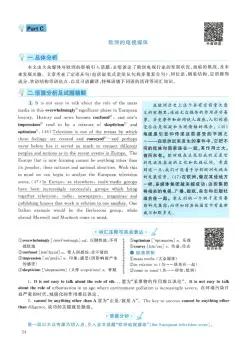
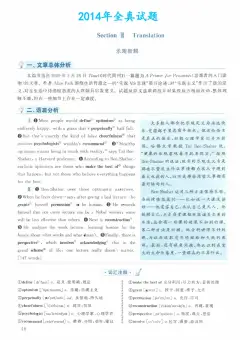
It is not easy to talk about the role of the mass media in this overwhelmingly
significant phase in European history. History and news become confused, and one's
impressions tend to be a mixture of skepticism and optimism. (46) Television is one of the
means by which these fbelings are created and conveyed - and perhaps never before has it
served so much to connect different peoples and nations as in the recent events in Europe.
The Europe that is now fonning cannot be anything other than its peoples, their cultures
and national identities. With this in mind we can begin to analyze the European television
scene. (47) In Europe, as elsewhere" multi-media groups have been increasingly successful:
groups which bring together television, radio, newspapers, magazines and publishing
houses that work in relation to one another. One Italian example would be the Berlusconi
group, while abroad Maxwell and Murdoch come to mind.
Clearly, only the biggest and most flexible television companies are going to be
able to compete in such a rich and hotly-contested market. (48) This alone demonstrates
that the television business is not an easy world to survive in, a fact underlined by
statistics that show that out of eighty European television networks, no less than 50%
took a loss in 1989.
Moreover, the integration of the European community will oblige television
companies to cooperate more closely in terms of both production and distribution.
英语一翻译真题专项 第1页 蜜团儿学姐(49) Creating a “European identity“ that respects the different cultures and
traditions which go to make up the connecting fhbric of the Old Continent is no easy
task and demands a strategic choice - that of producing programs in Europe for
Europe. This entails reducing our dependence on the North American market, whose
programs relate to experiences and cultural traditions which are different from our own.
In order to achieve these objectives, we must concentrate more on co-productions,
the exchange of news, documentary services and training. This also involves the
agreements between European countries for the creation of a European bank for
Television Production which, on the model of the European Investments Bank, will
handle the finances necessary for production costs. (50) In dealing with a challenge on
such a scale, it is no exaggeration to say, “United we stand, divided we fall” -
and if I had to choose a slogan it would be “Unity in our diversity.^^ A unity of objectives
that nonetheless respect the varied peculiarities of each country.
46.
47.
48.
49.
50.
英语一翻译真题专项 第2页 蜜团儿学姐2006年考研英语一翻译真题
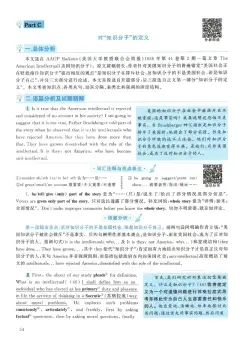
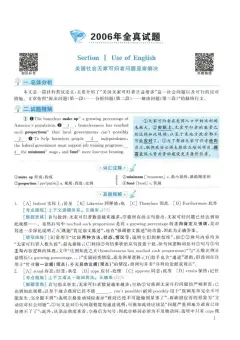
Is it true that the American intellectual is rejected and considered of no account in
his society? I am going to suggest that it is not true. Father Bruckberger told part of the
story when he observed that it is the intellectuals who have rejected America. But they
have done more than that. They have grown dissatisfied with the role of the intellectual.
It is they, not America, who have become anti-intellectual.
First, the object of our study pleads for definition. What is an intellectual? (46)
I shall define him as an individual who has elected as his primary duty and pleasure in
lifb the activity of thinking in a Socratic (苏格拉底)way about moral problems. He
explores such problems consciously, articulately, and frankly, first by asking factual
questions, then by asking moral questions, finally by suggesting action which seems
appropriate in the light of the factual and moral information which he has obtained.(47)
His function is analogous to that of a judge, who must accept the obligation of revealing
in as obvious a manner as possible the course of reasoning which led him to his decision.
This definition excludes many individuals usually referred to as intellectuals -
the average scientist, for one. (48) I have excluded him because, while his
accomplishments may contribute to the solution of moral problems, he has not been
charged with the task of approaching any but the factual aspects of those problems. Like
other human beings, he encounters moral issues even in the everyday performance of his
英语一翻译真题专项 第3页 蜜团儿学姐routine duties - he is not supposed to cook his experiments, manufacture evidence, or
doctor his reports. (49) But his primary task is not to think about the moral code which
governs his activity, any more than a businessman is expected to dedicate his energies to
an exploration of rules of conduct in business. During most of his waking life he will
take his code for granted, as the businessman takes his ethics.
The definition also excludes the metjority of teachers, despite the fact that teaching
has traditionally been the method whereby many intellectuals earn their living. (50) They
may teach very well, and more than earn their salaries, but most of them make little or
no independent reflections on human problems which involve moral judgment. This
description even fits the majority of eminent scholars. Being learned in some branch of
human knowledge is one thing; living in “public and illustrious thoughts,“ as Emerson
would say, is something else.
46.
47.
48.
49.
50.
英语一翻译真题专项 第4页 蜜团儿学姐2007年考研英语一翻译真题
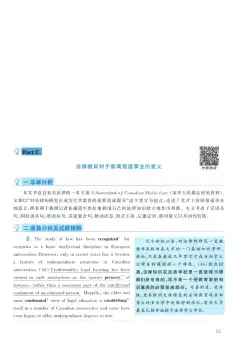
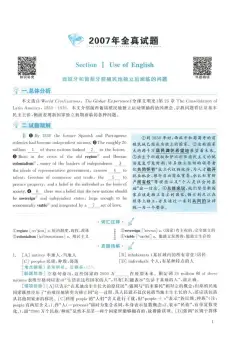
The study of law has been recognized for centuries as a basic intellectual discipline
in European universities. However, only in recent years has it become a feature of
undergraduate programs in Canadian universities. (46) Traditionally, legal learning has
been viewed in such institutions as the special preserve of lawyers, rather than a
necessary part of the intellectual equipment of an educated person. Happily, the older
and more continental view of legal education is establishing itself in a number of
Canadian universities and some have even begun to offer undergraduate degrees in law.
If the study of law is beginning to establish itself as part and parcel of a general
education, its aims and methods should appeal directly to journalism educators. Law is a
discipline which encourages responsible judgment. On the one hand, it provides
opportunities to analyze such ideas as justice, democracy and freedom. (47) On the
other, it links these concepts to everyday realities in a manner which is parallel to the
links journalists forge on a daily basis as they cover and comment on the news. For
example, notions of evidence and fact, of basic rights and public interest are at work
in the process of journalistic judgment and production just as in courts of law.
Sharpening judgment by absorbing and reflecting on law is a desirable component of
a joumalisfs intellectual preparation for his or her career.
(48) But the idea that the journalist must understand the law more profoundly
than an ordinary citizen rests on an understanding of the established conventions and
英语一翻译真题专项 第5页 蜜团儿学姐special responsibilities of the news media. Politics or, more broadly, the functioning of
the state, is a major subject for journalists. The better informed they are about the way
the state works, the better their reporting will be. (49) In fact, it is difficult to see how
journalists who do not have a clear grasp of the basic features of the Canadian
Constitution can do a competent job on political stories.
Furthermore, the legal system and the events which occur within it are primary
subjects for journalists. While the quality of legal journalism varies greatly, there is an
undue reliance amongst many journalists on interpretations supplied to them by lawyers.
(50) While comment and reaction fi~om lawyers may enhance stories, it is preferable for
journalists to rely on their own notions of significance and make their own judgments.
These can only come from a well-grounded understanding of the legal system.
46.
47.
48.
49.
50.
英语一翻译真题专项 第6页 蜜团儿学姐2008年考研英语一翻译真题
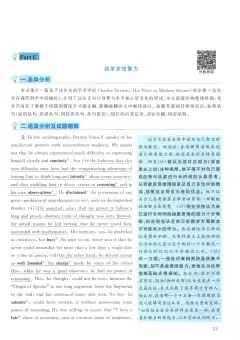
In his autobiography, Darwin himself speaks of his intellectual powers with
extraordinary modesty. He points out that he always experienced much difficulty in
expressing himself clearly and concisely, but (46) he believes that this very difficulty
may have had the compensating advantage of forcing him to think long and intently
about every sentence, and thus enabling him to detect errors in reasoning and in his own
observations. He disclaimed the possession of any great quickness of apprehension or
wit, such as distinguished Huxley. (47) He asserted, also, that his power to follow a long
and purely abstract train of thought was very limited :for which reason he fblt certain that
he never could have succeeded with mathematics. His memory, too, he described as
extensive, but hazy. So poor in one sense was it that he never could remember for more
than a few days a single date or a line of poetry.
(48) On the other hand, he did not accept as well founded the charge made by some
of his critics that, while he was a good observer, he had no power of reasoning. This, he
thought, could not be true, because the “Origin of Species^^ is one long argument from
the beginning to the end, and has convinced many able men. No one, he submits, could
have written it without possessing some power of reasoning. He was willing to assert
that “I have a fair share of invention, and of common sense or judgment, such as every
fairly successful lawyer or doctor must have, but not, I believe, in any higher degree.,,
英语一翻译真题专项 第7页 蜜团儿学姐(49) He adds humbly that perhaps he was “superior to the common run of men in
noticing things which easily escape attention, and in observing them carefully.”
Writing in the last year of his life, he expressed the opinion that in two or three
respects his mind had changed during the preceding twenty or thirty years. Up to the age
of thirty or beyond it poetry of many kinds gave him great pleasure. Formerly, too,
pictures had given him considerable, and music very great, delight. In 1881, however,
he said: "Now for many years I cannot endure to read a line of poetry. I have also
almost lost my taste for pictures or music.” (50) Darwin was convinced that the loss of
these tastes was not only a loss of happiness, but might possibly be iqjurious to the
intellect, and more probably to the moral character.
46.
47.
48.
49.
50.
英语一翻译真题专项 第8页 蜜团儿学姐2009年考研英语一翻译真题
There is a marked difference between the education which every one gets from
living with others and the deliberate educating of the young. In the former case the
education is incidental; it is natural and important, but it is not the express reason of the
association. (46) It may be said that the measure of the worth of any social institution is
its effect in enlarging and improving experience, but this effect is not a part of its
original motive. Religious associations began, for example, in the desire to secure the
favor of overruling powers and to ward off evil influences; family life in the desire to
gratify appetites and secure family perpetuity; systematic labor, for the most part,
because of enslavement to others, etc. (47) Only gradually was the by-product of the
institution noted, and only more gradually still was this effect considered as a directive
factor in the conduct of the institution. Even today, in our industrial life, apart from
certain values of industriousness and thrift, the intellectual and emotional reaction of the
forms of human association under which the world5 s work is carried on receives little
attention as compared with physical output.
But in dealing with the young, the fact of association itself as an immediate human
fact, gains in importance. (48) While it is easy to ignore in our contact with them the
effect of our acts upon their disposition, it is not so easy as in dealing with adults. The
need of training is too evident and the pressure to accomplish a change in their attitude
英语一翻译真题专项 第9页 蜜团儿学姐and habits is too urgent to leave these consequences wholly out of account. (49) Since
our chief business with them is to enable them to share in a common lifb we cannot help
considering whether or not we are forming the powers which will secure this ability. If
humanity has made some headway in realizing that the ultimate value of every institution
is its distinctively human effect we may well believe that this lesson has been learned
largely through dealings with the young.
(50) We are thus led to distinguish, within the broad educational process which we
have been so far considering, a more formal kind of education - that of direct tuition or
schooling. In undeveloped social groups, we find very little fbnnal teaching and training.
These groups mainly rely for instilling needed dispositions into the young upon the same
sort of association which keeps adults loyal to their group.
46.
47.
48.
49.
50.
英语一翻译真题专项 第10页 蜜团儿学姐2010年考研英语一翻译真题
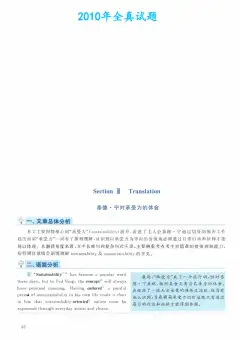
One basic weakness in a conservation system based wholly on economic motives is
that most members of the land community have no economic value. Yet these creatures
are members of the biotic community and, if its stability depends on its integrity, they
are entitled to continuance.
When one of these noneconomic categories is threatened and, if we happen to love
it, we invent excuses to give it economic importance. At the beginning of the century
songbirds were supposed to be disappearing. (46) Scientists jumped to the rescue with
some distinctly shaky evidence to the effect that insects would eat us up if birds failed to
control them. The evidence had to be economic in order to be valid.
It is painful to read these roundabout accounts today. We have no land ethic yet,
(47) but we have at least drawn nearer the point of admitting that birds should continue
as a matter of intrinsic right, regardless of the presence or absence of economic
advantage to us.
A parallel situation exists in respect of predatory mammals and fish-eating birds.
(48) Time was when biologists somewhat overworked the evidence that these creatures
preserve the health of game by killing the physically weak, or that they prey only on
“worthless“ species. Here again, the evidence had to be economic in order to be valid. It
is only in recent years that we hear the more honest argument that predators are members
of the community, and that no special interest has the right to extenninate them for the
英语一翻译真题专项 第11页 蜜团儿学姐sake of benefit, real or fancied, to itself.
Some species of trees have been “read out of the party“ by economics-minded
foresters because they grow too slowly, or have too low a sale value to pay as timber
crops. (49) In Europe, where forestry is ecologically more advanced, the noncommercial
tree species are recognized as members of the native forest community, to be preserved
as such, within reason. Moreover, some have been found to have a valuable function in
building up soil fertility. The interdependence of the forest and its constituent tree
species, ground flora, and fauna is taken for granted.
To sum up: a system of conservation based solely on economic self-interest is
hopelessly lopsided. (50) It tends to ignore, and thus eventually to eliminate, many
elements in the land community that lack commercial value, but that are essential to its
healthy functioning. It assumes, falsely, that the economic parts of the biotic clock will
function without the uneconomic parts.
46.
47.
48.
49.
50.
英语一翻译真题专项 第12页 蜜团儿学姐2011年考研英语一翻译真题
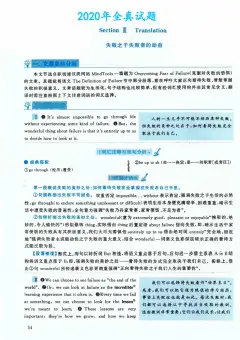
With its theme that “Mind is the master weaver/5 creating our inner character and
outer circumstances, the book As a Man Thinketh by James Allen is an in-depth
exploration of the central idea of self-help writing.
(46) Allen's contribution was to take an assumption we all share - that because we
are not robots we therefore control our thoughts - and reveal its erroneous nature.
Because most of us believe that mind is separate from matter, we think that thoughts can
be hidden and made powerless; this allows us to think one way and act another. However,
Allen believed that the unconscious mind generates as much action as the conscious
mind, and (47) while we may be able to sustain the illusion of control through the
conscious mind alone, in reality we are continually faced with a question: "Why cannot I
make myself do this or achieve that?”
Since desire and will are damaged by the presence of thoughts that do not accord
with desire, Allen concluded: "We do not attract what we want, but what we are.”
Achievement happens because you as a person embody the external achievement; you
don't "get" success but become it. There is no gap between mind and matter.
Part of the fame of Allen's book is its contention that '"Circumstances do not make a
person, they reveal him.,, (48) This seems a justification fbr neglect of those in need, and
a rationalization of exploitation, of the superiority of those at the top and the inferiority
英语一翻译真题专项 第13页 蜜团儿学姐of those at the bottom.
This, however, would be a knee-jerk reaction to a subtle argument. Each set of
circumstances, however bad, offers a unique opportunity for growth. If circumstances
always determined the life and prospects of people, then humanity would never have
progressed. In fact, (49) circumstances seem to be designed to bring out the best in us”
and if we fbel that we have been “wronged“ then we are unlikely to begin a conscious
effort to escape fi~om our situation. Nevertheless, as any biographer knows, a person's
early life and its conditions are often the greatest gift to an individual.
The sobering aspect of Allen's book is that we have no one else to blame for our
present condition except ourselves. (50) The upside is the possibilities contained in
knowing that everything is up to us: where before we were experts in the array of
limitations, now we become authorities of what is possible.
46.
47.
48.
49.
50.
英语一翻译真题专项 第14页 蜜团儿学姐2012年考研英语一翻译真题
Since the days of Aristotle, a search for universal principles has characterized the
scientific enterprise. In some ways, this quest for commonalities defines science.
Newton's laws of motion and Darwinian evolution each bind a host of different
phenomena into a single explicatory framework.
(46 ) In physics, one approach takes this impulse for unification to its extreme,
and seeks a theory of everything - a single generative equation fdr all we see. It is
becoming less clear, however, that such a theory would be a simplification, given the
dimensions and universes that it might entail. Nonetheless, unification of sorts remains a
major goal.
This tendency in the natural sciences has long been evident in the social sciences
too. (47) Here, Darwinism seems to offer justification, for if all humans share common
origins, it seems reasonable to suppose that cultural diversity could also be traced to
more constrained beginnings. Just as the bewildering variety of human courtship rituals
might all be considered forms of sexual selection, perhaps the world5 s languages, music,
social and religious customs and even history are governed by universal features. (48) To
filter out what is unique from what is shared might enable us to understand how complex
cultural behavior arose and what guides it in evolutionary or cognitive terms.
That, at least, is the hope. But a comparative study of linguistic traits published
online today supplies a reality check. Russell Gray at the University of Auckland and his
colleagues consider the evolution of grammars in the light of two previous attempts to
英语一翻译真题专项 第15页 蜜团儿学姐find universality in language.
The most famous of these efforts was initiated by Noam Chomsky, who suggested
that humans are bom with an innate language-acquisition capacity that dictates a
universal grammar. A few generative rules are then sufficient to unfold the entire
fundamental structure of a language, which is why children can learn it so quickly.
(49) The second, by Joshua Greenberg, takes a more empirical approach to
universality, identifying traits (particularly in word order) shared by many languages,
which are considered to represent biases that result fi~om cognitive constraints.
Gray and his colleagues have put them to the test by examining four family trees
that between them represent more than 2,000 languages. (50) Chomsky's grammar
should show patterns of language change that are independent of the family tree or the
pathway tracked through it, whereas Greenbergian universality predicts strong
co-dependencies between particular types of word-order relations. Neither of these
patterns is bome out by the analysis, suggesting that the structures of the languages are
lineage-specific and not governed by universals.
46.
47.
48.
49.
50.
英语一翻译真题专项 第16页 蜜团儿学姐2013年考研英语一翻译真题
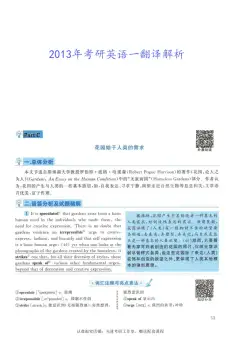
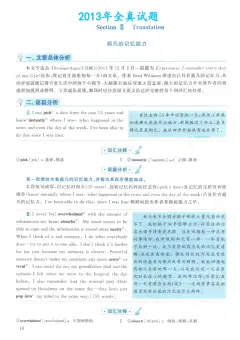
It is speculated that gardens arise from a basic human need in the individuals who
made them: the need for creative expression. There is no doubt that gardens evidence an
irrepressible urge to create, express, fashion, and beautify and that self- expression is a
basic human urge; (46) yet when one looks at the photographs of the gardens created by
the homeless, it strikes one that, fbr all their diversity of styles, these gardens speak of
various other fundamental urges, beyond that of decoration and creative expression.
One of these urges has to do with creating a state of peace in the midst of turbulence,
a “still point of the turning world,5, to borrow a phrase from T. S. Eliot. (47) A sacred
place of peace, however crude it may be, is a distinctly human need, as opposed to shelter,
which is a distinctly animal need. This distinction is so much so that where the latter is
lacking, as it is fbr these unlikely gardeners, the former becomes all the more urgent.
Composure is a state of mind made possible by the structuring of one's relation to one's
environment. (48) The gardens of the homeless, which are in effect homeless gardens,
introduce into an urban environment where it either didn't exist or was not
discernible as such. In so doing they give composure to a segment of theinarticulate
environment in which they take their stand.
Another urge or need that these gardens appear to respond to, or to arise from, is so
intrinsic that we are barely ever conscious of its abiding claims on us. When we are
deprived of green, of plants, of trees, (49) most of us give in to a demoralization of
英语一翻译真题专项 第17页 蜜团儿学姐spirit which we usually blame on some psychological conditions, until one day we
find ourselves in a garden and 色el the oppression vanish as if by magic. In most of the
homeless gardens of New York City the actual cultivation of plants is unfeasible, yet
even so the compositions often seem to represent attempts to call forth the spirit of plant
and animal life, if only symbolically, through a clumplike arrangement of materials, an
introduction of colors, small pools of water, and a frequent presence of petals or leaves
as well as of stuffed animals. On display here are various fantasy elements whose
reference, at some basic level, seems to be the natural world. (50)It is this implicit or
explicit reference to nature that fiilly justifies the use of the word garden、though in a
“liberated“ sense, to describe these synthetic constructions. In them we can see biophilia
- a yearning for contact with nonhuman life - assuming uncanny representational forms.
46.
47.
48.
49.
50.
英语一翻译真题专项 第18页 蜜团儿学姐2014年考研英语一翻译真题
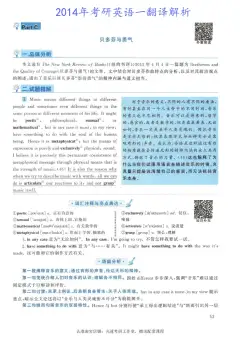
Music means different things to different people and sometimes even different
things to the same person at different moments of his life. It might be poetic,
philosophical, sensual, or mathematical, but in any case it must, in my view, have
something to do with the soul of the human being. Hence it is metaphysical; but the
means of expression is purely and exclusively physical: sound. I believe it is precisely
this permanent coexistence of metaphysical message through physical means that is
the strength of music. (46) It is also the reason why when we try to describe music with
words, all we can do is articulateour reactions to it, and not grasp music itself.
Beethoven's importance in music has been principally defined by the revolutionary
nature of his compositions. He freed music from hitherto prevailing conventions of
harmony and structure. Sometimes I feel in his late works a will tobreak all signs of
continuity. The music is abrupt and seemingly disconnected, as in the last piano sonata.
In musical expression, he did not feel restrained by the weight of convention. (47) By all
accounts he was a 々eethinking person, and a courageous one,and I find courage an
essential quality fbr the understanding, let alone the performance, of his works.
This courageous attitude in fact becomes a requirement for the performers of
Beethoven's music. His compositions demand the performer to show courage, fbr
example in the use of dynamics. (48) Beethoven's habit of increasing the volume with an
extreme intensity and then abruptly fbllowing it with a sudden soft passage was only
rarely used by composers before him.
英语一翻译真题专项 第19页 蜜团儿学姐Beethoven was a deeply political man in the broadest sense of the word. He was
not interested in daily politics, but concerned with questions of moral behavior and
the larger questions of right and wrong affecting the entire society.
(49) Especially significant was his view of fi~eedom, which, fbr him, was
associated with the rights and responsibilities of the individual: he advocated freedom of
thought and of personal expression.
Beethoven's music tends to move from chaos to order as if order were an
imperative of human existence. For him, order does not result from forgetting or
ignoring the disorders that plague our existence; order is a necessary development, an
improvement that may lead to the Greek ideal of spiritual elevation. It is not by chance
that the Funeral March is not the last movement of the Eroica Symphony, but the second,
so that suffering does not have the last word. (50) One could interpret much of the work
of Beethoven by saying that suffering is inevitable, but the courage to fight it renders
lifb worth living.
46.
47.
48.
49.
50.
英语一翻译真题专项 第20页 蜜团儿学姐2015年考研英语一翻译真题
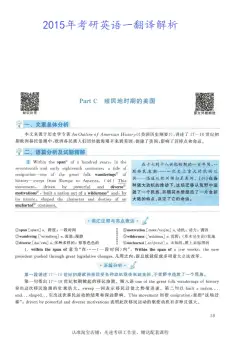
Within the span of a hundred years, in the seventeenth and early eighteenth
centuries, a tide of emigration - one of the great folk wanderings of history - swept from
Europe to America. (46) This movement, driven by powerful and diverse motivations,
built a nation out of a wilderness and, by its nature, shaped the character and destiny
of an uncharted continent.
(47) The United States is the product of two principal forces - the immigration of
European peoples with their varied ideas, customs, and national characteristics and the
impact of a new country which modified these traits. Of necessity, colonial America
was a projection of Europe. Across the Atlantic came successive groups of Englishmen,
Frenchmen, Germans, Scots, Irishmen, Dutchmen, Swedes, and many others who
attempted to transplant their habits and traditions to the new world. (48) But the fbrce
of geographic conditions peculiar to America, the interplay of the varied national groups
upon one another, and the sheer difficulty of maintaining old-world ways in a raw, new
continent caused significant changes. These changes were gradual and at first scarcely
visible. But the result was a new social pattern which, although it resembled European
society in many ways, had a character that was distinctly American.
(49) The first shiploads of immigrants bound fbr the territory which is now the
United States crossed the Atlantic more than a hundred years after the 15th-and- 16th-
century explorations of North America. In the meantime, thriving Spanish colonies had
英语一翻译真题专项 第21页 蜜团儿学姐been established in Mexico, the West Indies, and South America. These travelers to
North America came in small, unmercifully overcrowded craft. During their six- to
twelve-week voyage, they survived on barely enough food allotted to them. Many of the
ships were lost in storms, many passengers died of disease, and infants rarely survived
the journey. Sometimes storms blew the vessels far off their course, and often calm
brought unbearably long delay.
To the anxious travelers the sight of the American shore brought almost
inexpressible relief. Said one recorder of events, “The air at twelve leagues5 distance
smelt as sweet as a new-blown garden.^^ The colonists' first glimpse of the new land was
a sight of dense woods. (50) The virgin forest with its richness and variety of trees was a
real treasure-house which extended fi*om Maine all the way down to Georgia. Here was
abundant fuel and lumber. Here was the raw material of houses and furniture, ships and
potash, dyes and naval stores.
46.
47.
48.
49.
50.
英语一翻译真题专项 第22页 蜜团儿学姐2016年考研英语一翻译真题
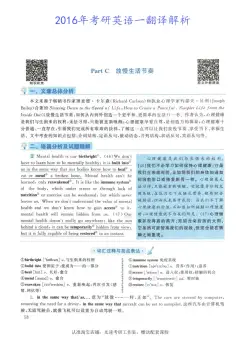
Mental health is our birthright. (46) We don't have to learn how to be mentally
healthy: it is built into us in the same way that our bodies know how to heal a cut or
mend a broken bone. Mental health can't be learned, only reawakened. It is like the
immune system of the body, which under stress or through lack of nutrition or
exercise can be weakened, but which never leaves us.When we don't understand the
value of mental health and we don5t know how to gain access to it, mental health will
remain hidden from us. (47) Our mental health doesn't really go anywhere; like the sun
behind a cloud it can be temporarily hidden fi~om view3 but it is fUlly capable of being
restored in an instant.
Mental health is the seed that contains self-esteem - confidence in ourselves and an
ability to trust in our common sense. It allows us to have perspective on our lives - the
ability to not take ourselves too seriously, to laugh at ourselves, tosee the bigger picture,
and to see that things will work out. Ifs a form of innate or unlearned optimism. (48)
Mental health allows us to view others with sympathy if they are having troubles, with
kindness if they are in pain, and with unconditional love no matter who they are. Mental
health is the source of creativity fbrsolving problems, resolving conflict, making our
surroundings more beautiful, managing our home life, or coming up with a creative
business idea or invention to make our lives easier. It gives us patience for ourselves and
英语一翻译真题专项 第23页 蜜团儿学姐toward others as well as patience while driving, catching a fish, working on our car, or
raising a child. It allows us to see the beauty that surrounds us each moment in nature, in
culture, in the flow of our daily lives.
(49) Although mental health is the cure-all for living our lives, it is perfectly
ordinary as you will see that it has been there to direct you through all your difficult
decisions. It has been available even in the most mundane of life situations to show
you right from wrong, good from bad, friend from foe. Mental health has commonly
been called conscience, instinct, wisdom, common sense, or the inner voice. We think of
it simply as a healthy and helpful flow of intelligent thought. (50) As you will come to
see, knowing that mental health is always available and knowing to trust it allow us to
slow down to the moment and live lifb happily.
46.
47.
48.
49.
50.
英语一翻译真题专项 第24页 蜜团儿学姐2017年考研英语一翻译真题
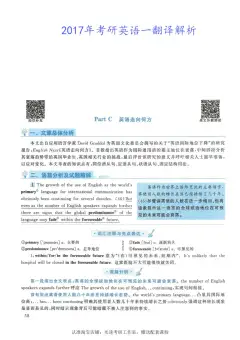
The growth of the use of English as the world5 s primary language for international
communication has obviously been continuing fbr several decades.
(46) But even as the number of English speakers expands fiirther there are signs that
the global predominance of the language may fhde within the foreseeable fiiture.
Complex international, economic, technological and cultural changes could start to
diminish the leading position of English as the language of the world market, and UK
interests which enjoy advantage from the breadth of English usage would consequently
face new pressures. Those realistic possibilities are highlighted in the study presented by
David Graddol. (47) His analysis should therefbre end any self~contentedness among
those who may believe that the global position of English is so stable that the young
generations of the United Kingdom do not need additional language capabilities.
David Graddol concludes that monoglot English graduates face a bleak economic
future as qualified multilingual youngsters from other countries are proving to have a
competitive advantage over their British counterparts in global companies and
organisations. Alongside that, (48) many countries are introducing English into the
primary-school curriculum but British schoolchildren and students do not appear to be
gaining greater encouragement to achieve fluency in other languages.
If left to themselves, such trends will dimmish the relative strength of the English
language in international education markets as the demand fbr educational resources in
英语一翻译真题专项 第25页 蜜团儿学姐languages, such as Spanish, Arabic or Mandarin grows and international business
process outsourcing in other languages such as Japanese, French and German, spreads.
(49) The changes identified by David Graddol all present clear and m^jor
challenges to the UK's providers of English language teaching to people of other
countries and to broader education business sectors. The English language teaching
sector directly earns nearly £1.3 billion for the UK in invisible exports and our other
education related exports earn up to £ 10 billion a year more. As the international
education market expands, the recent slowdown in the numbers of international
especially if there are no effective strategic policies to prevent such slippage.
The anticipation of possible shifts in demand provided by this study is significant:
(50) It gives a basis to all organisations which seek to promote the learning and use of
English, a basis for planning to meet the possibilities of what could be a verydifferent
operating environment That is a necessary and practical approach. In this as in much
else, those who wish to influence the future must prepare for it.
46.
47.
48.
49.
50.
英语一翻译真题专项 第26页 蜜团儿学姐2018年考研英语一翻译真题
Shakespeare's lifetime was coincident with a period of extraordinary activity and
achievement in the drama. (46) By the date of his birth Europe was witnessing the
passing of the religious drama, and the creation of new forms under the incentive of
classical tragedy and comedy. These new fbnns were at first mainly written by scholars
and performed by amateurs, but in England, as everywhere else in western Europe, the
growth of a class of professional actors was threatening to make the drama popular,
whether it should be new or old, classical or medieval, literary or farcical. Court, school,
organizations of amateurs, and the traveling actors were all rivals in supplying a
widespread desire for dramatic entertainment; and (47) no boy who went to a grammar
school could be ignorant that the drama was a fbrm of literature which gave glory to
Greece and Rome and might yet bring honor to England.
When Shakespeare was twelve years old the first public playhouse was built in
London. For a time literature showed no interest in this public stage. Plays aiming at
literary distinction were written for schools or court, or for the choir boys of St.PauFs
and the royal chapel, who, however, gave plays in public as well as at court.
(48) But the professional companies prospered in their permanent theaters、 and
university men with literary ambitions were quick to turn to these theaters as offering a
means of livelihood. By the time that Shakespeare was twenty-five, Lyly, Peele, and
Greene had made comedies that were at once popular and literary; Kyd had written
英语一翻译真题专项 第27页 蜜团儿学姐a tragedy that crowded the pit; and Marlowe had brought poetry and genius to triumph
on the common stage - where they had played no part since the death of Euripides.
(49) A native literary drama had been created, its alliance with the public playhouses
established, and at least some of its great traditions had been begun.
The development of the Elizabethan drama for the next twenty-five years is of
exceptional interest to students of literary history, fbr in this brief period we may trace
the beginning, growth, blossoming, and decay of many kinds of plays, and of many great
careers. We are amazed today at the mere number of plays produced, as well as by the
number of dramatists writing at the same time fbr this London of two hundred thousand
inhabitants. (50) To realize how great was the dramatic activity, we must remember
fiirther that hosts of plays have been lost, and that probably there is no author of note
whose entire work has survived.
46.
47.
48.
49.
50.
英语一翻译真题专项 第28页 蜜团儿学姐2019年考研英语一翻译真题
It was only after I started to write a weekly column about the medical journals, and
began to read scientific papers from beginning to end, that I realised just how bad much
of the medical literature frequently was. I came to recognise various signs of a bad paper:
the kind of paper that purports to show that people who eat more than one kilo of
broccoli a week were 1.17 times more likely than those who eat less to suffer late in life
from pernicious anaemia. (46) There is a great deal of this kind of nonsense in the
medical journals which, when taken up by broadcasters and the lay press, generates both
health scares and short-lived dietary enthusiasms.
Why is so much bad science published? A recent paper, titled “The Natural
Selection of Bad Science”, published on the Royal Society's open science website,
attempts to answer this intriguing and important question. It says that the problem is not
merely that people do bad science, but that our current system of career advancement
positively encourages it. What is important is not truth, but publication, which has
become almost an end in itself. There has been a kind of inflationary process at work:
(47) nowadays anyone applying fbr a research post has to have published twice the
number of papers that would have been required for the same post only 10 years ago.
Never mind the quality, then, count the number.
(48) Attempts have been made to curb this tendency, fbr example, by trying to
incorporate some measure of quality as well as quantity into the assessment of an
英语一翻译真题专项 第29页 蜜团儿学姐applicant's papers. This is the famed citation index, that is to say the number of times a
paper has been quoted elsewhere in the scientific literature, the assumption being that an
important paper will be cited more often than one of small account. (49) This would be
reasonable if it were not fbr the fact that scientists can easily arrange to cite themselves
in their fUture publications, or get associates to do so fbr them in return for similar
favours.
Boiling down an individuaFs output to simple metrics, such as number of
publications or journal impacts, entails considerable savings in time, energy and
ambiguity. Unfortunately, the long-term costs of using simple quantitative metrics to
assess researcher merit are likely to be quite great. (50) If we are serious about ensuring
that our science is both meaningful and reproducible、we must ensure that our
institutions encourage that kind of science.
46.
47.
48.
49.
50.
英语一翻译真题专项 第30页 蜜团儿学姐2020年考研英语一翻译真题
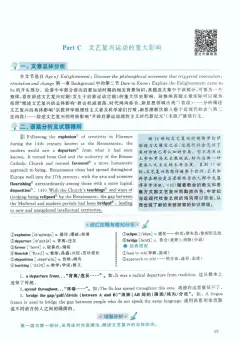
Following the explosion of creativity in Florence during the 14th century known as
the Renaissance, the modem world saw a departure from what it had once known. It
turned from God and the authority of the Roman Catholic Church and instead favoured a
more humanistic approach to being. Renaissance ideas had spread throughout Europe
well into the 17th century,with the arts and sciences flourishing extraordinarily among
those with a more logical disposition. (46) with the Church's teachings and ways of
thinking being eclipsed by the Renaissance, the gap between the Medieval and modem
periods had been bridged, leading to new and unexplored intellectual territories.
During the Renaissance, the great minds of Nicolaus Copernicus, Johannes Kepler
and Galileo Galilei demonstrated the power of scientific study and discovery. (47)
Before each of their revelations, many thinkers at the time had sustained more ancient
ways of thinking, including the geocentric view that the Earth was at the centre of our
universe. Copernicus theorised in 1543 that all of the planets that we knew of revolved
not around the Earth, but the Sun, a system that was later upheld by Galileo at his own
expense. Offering up such a theory during a time of high tension between scientific and
religious minds was branded as heresy, and any such heretics that continued to spread
these lies were to be punished by imprisonment or even death.
(48) Despite attempts by the Church to suppress this new generation of logicians
and rationalists, more explanations fbr how the universe fimctioned were being made at a
英语一翻译真题专项 第31页 蜜团儿学姐rate that the people could no longer ignore.lt was with these great revelations that a new
kind of philosophy founded in reason was bom.
The Church5 s long-standing dogma was losing the great battle for truth to
rationalists and scientists. This very fact embodied the new ways of thinking that swept
through Europe during most of the 17th century. (49) As many took on the duty of trying
to integrate reasoning and scientific philosophies into the world” the Renaissance was
over and it was time fbr a new era - the Age of Reason.
The 17th and 18th centuries were times of radical change and curiosity, Scientific
method, reductionism and the questioning of Church ideals was to be encouraged, as
were ideas of liberty, tolerance and progress. (50) Such actions to seek knowledge and
to understand what infbrmation we already knew were captured by the Latin phrase
'sapere aude' or 'dare to know', after Immanuel Kant used it in his essay An Answer to
the Question'. What is Enlightenment?. It was the purpose and responsibility of great
minds to go forth and seek out the truth, which they believed to be founded in knowledge.
46.
47.
48.
49.
50.
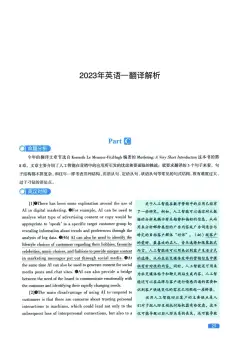
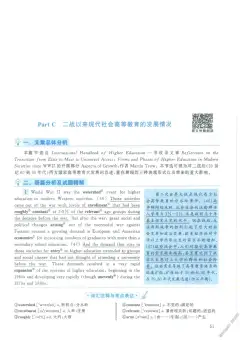
英语一翻译真题专项 第32页 蜜团儿学姐2021年考研英语一翻译真题
World War II was the watershed event for higher education in modem Western
societies. (46) Those societies came out of the war with levels of enrollment that had been
roughly constant at 3-5% of the relevant age groups during the decades before the war. But
after the war, great social and political changes arising out of the successful war against
Fascism created a growing demand in European and American economies for increasing
numbers of graduates with more than a secondary school education. (47) And the demand
that rose in those societies for entry to higher education extended to groups and social
classes that had not thought of attending a university before the war. These demands
resulted in a very rapid expansion of the systems of higher education, beginning in the
1960s and developing very rapidly (though unevenly) during the 1970s and 1980s.
The growth of higher education manifests itself in at least three quite different ways,
and these in turn have given rise to different sets of problems. There was first the rate of
growth: (48) in many countries of Western Europe, the numbers of students in higher
education doubled within five-year periods during the 1960s and doubled again in seven,
eight, or 10 years by the middle of the 1970s. Second, growth obviously affected the
absolute size both of systems and individual institutions. And third, growth was reflected
in changes in the proportion of the relevant age group enrolled in institutions of higher
education.
英语一翻译真题专项 第33页 蜜团儿学姐Each of these manifestations of growth carried its own peculiar problems in its wake.
For example, a high growth rate placed great strains on the existing structures of
governance, of administration, and above all of socialization. When a faculty or
department grows from, say, five to 20 members within three or four years, (49) and when
the new staff are predominantly young men and women fi~esh fi~om postgraduate study,
they largely define the norms of academic lifb in that faculty. And if the postgraduate
student population also grows rapidly and there is loss of a close apprenticeship
relationship between faculty members and students, the student culture becomes the chief
socializing force for new postgraduate students, with consequences fbr the intellectual and
academic life of the institution-this was seen in America as well as in France, Italy, West
Germany, and Japan. (50) High growth rates increased the chances fbr academic
innovation; they also weakened the forms and processes by which teachers and students
are admitted into a community of scholars during periods of stability or slow growth. In
the 1960s and 1970s, European universities saw marked changes in their governance
arrangements, with empowennent of junior faculty and to some degree of students as well.
46.
47.
48.
49.
50.
英语一翻译真题专项 第34页 蜜团儿学姐2022年考研英语一翻译真题
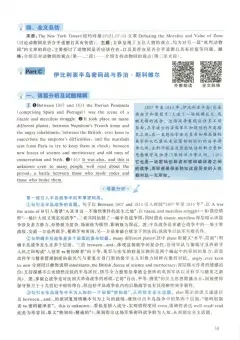
Between 1807 and 1814 the Iberian Peninsula (comprising Spain and Portugal) was
the scene of a titanic and merciless struggle. It took place on many different planes:
between Napoleon5s French army and the angry inhabitants; between the British, ever
keen to exacerbate the emperor's difficulties, and the marshals sent from Paris to try to
keep them in check; between new forces of science and meritocracy and old ones of
conservatism and birth. (46) It was also, and this is unknown even to many people well
read about the period, a battle between those who made codes and those who broke them.
I first discovered the Napoleonic cryptographic battle a few years ago when I was
reading Sir Charles Oman's epic History of the Peninsular War. In volume V he had
attached an appendix, The Scovell Ciphers. (47) It listed many documents in code that
had been captured fi~om the French army of Spain, and whose secrets had been revealed
by the work of one George Scovell , an officer in British headquarters. Oman rated
Scovell5 s significance highly, but at the same time, the general nature of his History
meant that (48) he could not analyze carefiilly what this obscure officer may or may not
have contributed to that great struggle between nations or indeed tell us anything much
about the man himself. I was keen to read more, but was surprised to find that Oman's
appendix, published in 1914, was the only considered thing that had been written about
this secret war.
I became convinced that this story was every bit as exciting and significant as that
of Enigma and the breaking of German codes in the Second World War. The question
英语一翻译真题专项 第35页 蜜团儿学姐was , could it be told?
Studying ScovelFs papers at the Public Record Office, London, I found that he had
left an extensive journal and copious notes about his work in the peninsula. What was
more, many original French dispatches had been preserved in this collection, which I
realized was priceless. (49) There may have been many spies and intelligence officers
during the Napoleonic Wars, but it is usually extremely difficult to find the material they
actually provided or worked on.
As I researched ScovelFs story I found far more of interest besides his intelligence
work. His status in Lord Wellington's headquarters and the recognition given to him for
his work were all bound up with the class politics of the army at the time. His tale of
self-improvement and hard work would make a fascinating biography in its own right,
but represents something more than that. (50) Just as the code breaking has its wider
relevance in the struggle fior Spain, so his attempts to make his way up the promotion
ladder speak volumes about British society.
46.
47.
48.
49.
50.
英语一翻译真题专项 第36页 蜜团儿学姐2023 年考研英语一翻译真题
Therehasbeen some exploration around theuseofAI in digitalmarketing. For example,
AI can be used to analyse what type of advertising content or copy would be appropriate to
'speak' to a specific target customer group by revealing information about trends and
preferences through the analysis of big data. (46) AI can also be used to identify the lifestyle
choices of customers regarding their hobbies, favourite celebrities, and fashions to provide
unique content in marketing messages put out through social media. At the same time AI can
alsobeused togenerate contentfor socialmediaposts andchat sites.
The main disadvantage of using AI to respond to customers is that there are concerns
about trusting personal interactions to machines, which could lead not only to the subsequent
loss of interpersonal connections, but also to a decrease in marketing personnel. (47) Some
believe that AI is negatively impacting on the marketer's role by reducing creativity and
removing jobs, but they are aware that it is a way of reducing costs and creating new
information. By allowing AI to develop content some brand marketers may find that they are
losing control over the brand narrative. (48) Algorithms used to simulate human interactions
are creating many of these concerns, especially as no-one is quite sure what the outcomes of
using AIto interact withcustomers willbe.
For AI to be successful, data needs to be accessible, but the use of personal data is
becoming more regulated and the automated sharing of data is becoming more difficult.
(49) If customers are not willing to share data, AI will be starved of essential information and
英语一翻译真题专项 第37页 蜜团儿学姐will not be able to function effectively or employ machine learning to improve its marketing
content and communication. Therefore, unless customers are prepared to sign release
agreements, the use of AI may become somewhat restricted in the future. Not only can AI
help to create the marketing content, but it can also provide a non-intrusive way of delivering
the content to the target customers. Data can be gathered on where the customer can be
engaged, such as location, devices used, website interactions, and sites visited, to display
marketing messages in appropriate forms, including emails, social media posts, pop-up
advertisements, and banners at an appropriate frequency. (50) The non-intrusive delivery of
the marketing messages in a way that is sensitive to the needs of the target customer is one of
thecritical challenges tothe digitalmarketer.
46:
47:
48:
49:
50
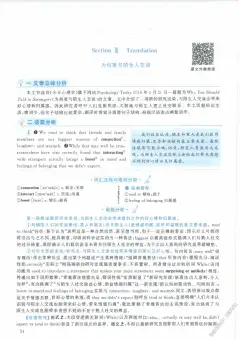
英语一翻译真题专项 第38页 蜜团儿学姐2024年考研英语一翻译真题
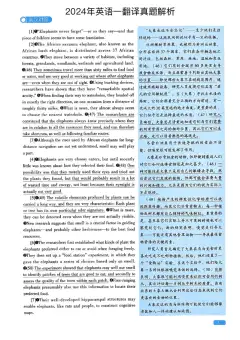
“Elephants never forget”—or so they say—and that piece of folklore seems to have
some foundation.
The African savanna elephant, also known as the African bush elephant, is distributed
across 37 African countries. They move between a variety of habitats, including forests,
grasslands, woodlands, wetlands and agricultural land. (46) They sometimes travel more
than sixty miles to find food or water, and are very good at working out where other
elephants are—even when they are out of sight. Using tracking devices, researchers have
shown that they have “remarkable spatial acuity.”When finding their way to waterholes, they
headed off in exactly the right direction, on one occasion from a distance of roughly thirty
miles. What is more, they almost always seem to choose the nearest waterhole. (47) The
researchers are convinced that the elephants always know precisely where they are in relation
to all the resources they need, and can therefore take shortcuts, as well as following familiar
routes.
Although the cues used by African elephants for long-distance navigation are not yet
understood, smell maywellplaya part.
Elephants are very choosy eaters, but until recently little was known about how they
selected their food. (48) One possibility was that they merely used their eyes and tried out the
plants they found, but that would probably result in a lot of wasted time and energy, not least
becausetheir eyesightis actuallynot verygood.
(49)The volatile chemicals produced by plants can be carried a long way, and they are
very characteristic: Each plant or tree has its own particular odor signature. What is more,
they can be detected even when they are not actually visible. New research suggests that
英语一翻译真题专项 第39页 蜜团儿学姐smell is a crucial factor in guiding elephants—and probably other herbivores—to the best
foodresources.
The researchers first established what kinds of plant the elephants preferred either to eat
or avoid when foraging freely. They then set up a “food station”experiment, in which they
gave the elephants a series of choices based only on smell. (50) The experiment showed that
elephants may well use smell to identify patches of trees that are good to eat, and secondly to
assess the quality of the trees within each patch. Free- ranging elephants presumably also use
thisinformationto locate theirpreferredfood.
Their well-developed hippocampal structures mayenable elephants,like rats and people,
toconstruct cognitivemap.
46:
47:
48:
49:
50:
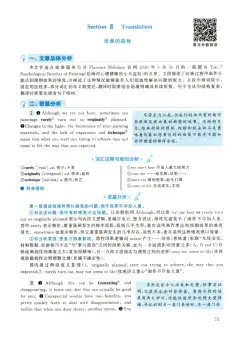
英语一翻译真题专项 第40页 蜜团儿学姐2025年考研英语一翻译真题
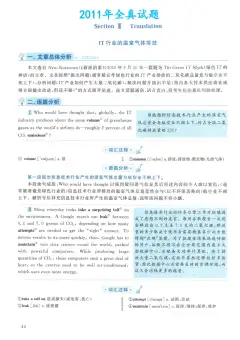
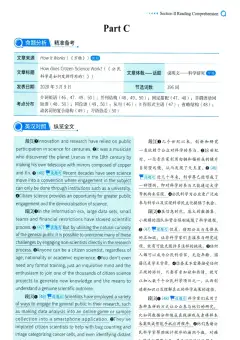
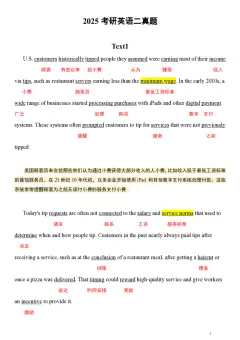
Innovation and research have relied on public participation in science for centuries. It
was a musician who discovered the planet Uranus in the 18th century by making his own
telescope with mirrors composed of copper and tin. (46) Recent decades have seen science
move into a convention where engagement in the subject can only be done through
institutions such as university. Citizen science provides an opportunity for greater public
engagementandthe democratisationofscience.
In the information era,large data sets, small teams and financial restrictions have slowed
scientific process.(47) But byutilising the natural curiosity ofthe general public it is possible
to overcome many of these challenges by engaging non-scientists directly in the research
process. Anyone can be a citizen scientist, regardless of age, nationality or academic
experience. You don't even need any formal training, just an inquisitive mind and the
enthusiasm to join one of the thousands of citizen science projects to generate new
knowledge andthemeansto understand a genuinescientific outcome.
(48) Scientists have employed a variety of ways to engage the general public in their
research, such as making data analysis into an online game or sample collection into a
smartphone application. They've implored citizen scientists to help with bug counting and
imagecategorizingcancer cells,and evenidentifying distantgalaxies.
This form of accessible science means that great minds are able to join the race to create
and develop projects with the potential to change the world. Acitizen science-based approach
can extend the field of vision and include more ideas and different brains to problem-solve
andcreate,making innovationfasterand moreeffective.The rise of citizen science has grown alongside the rise of do-it-yourself biology
laboratories around the world. (49) These groups of people are part of a rapidly expanding
biotechnological social movement of citizen scientists and professional scientists seeking to
takediscovery out ofinstitutions andput itinto thehands ofanyone withthe enthusiasm.
There are around 40 official do-it-yourself biology centres across the globe in
locations including Paris, London, Sydney, and Tel Aviv. (50) They pool resources,
collaborate, think outside the box, and find solutions and ways around obstacles to explore
science for the sake of science without the traditional boundaries of working inside a formal
setting.So is ittime to takethe Petridish out ofthelaboratory andinto thegarage?
46:
47:
48:
49:
50: