文档文本内容
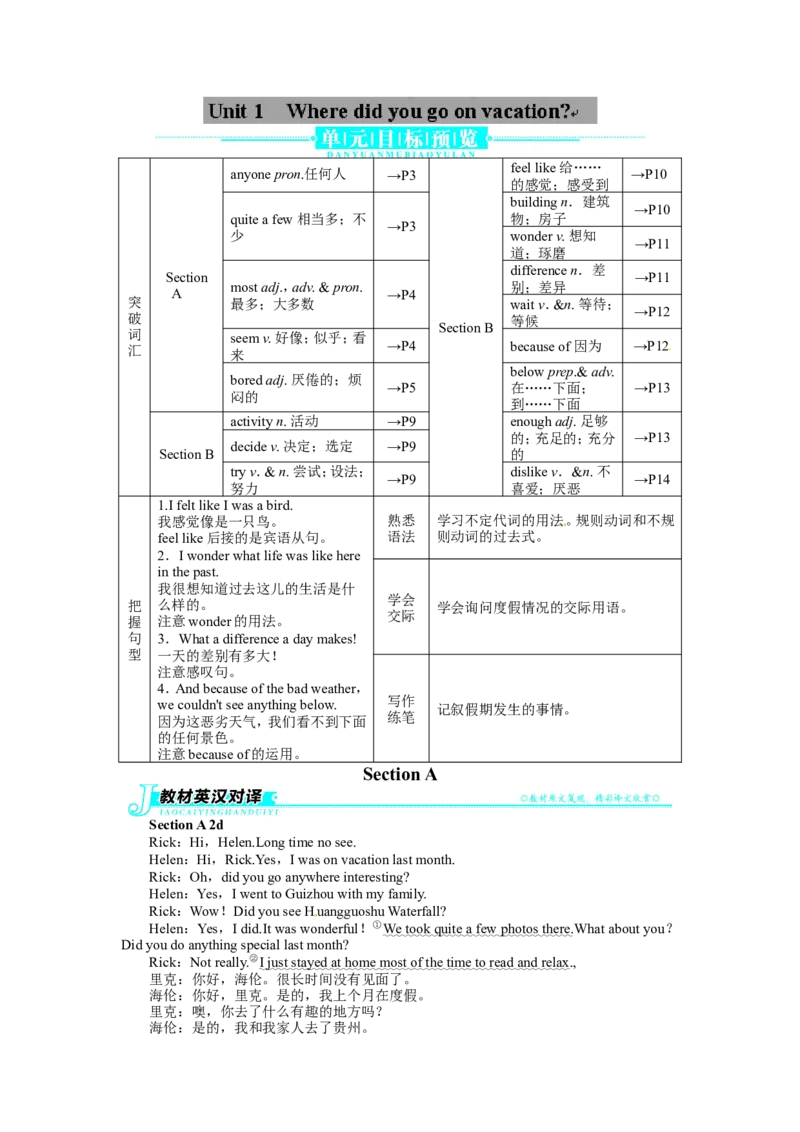
feel like 给……
anyone pron.任何人 →P3 →P10
[来源:Zxxk.Com] 的感觉;感受到 [来源:
[来源:学科网] 学_科_网Z_X_X_K]
building n.建筑
→P10
quite a few 相当多;不 物;房子
→P3
少 wonder v. 想知
→P11
道;琢磨
difference n.差
Section →P11
most adj.,adv. & pron. 别;差异
A →P4
突 [来源:学&科&网] 最多;大多数 wait v.&n. 等待;
→P12
破 等候
Section B
词 seem v. 好像;似乎;看
汇 →P4 because of 因为 →P12
来
[来源:学科网]
below prep.& adv.
bored adj. 厌倦的;烦
→P5 在……下面; →P13
闷的
到……下面
activity n. 活动 →P9 enough adj. 足够
的;充足的;充分 →P13
decide v. 决定;选定 →P9
Section B 的
try v.& n. 尝试;设法; dislike v.&n. 不
→P9 →P14
努力 喜爱;厌恶
1.I felt like I was a bird.
我感觉像是一只鸟。 熟悉 学习不定代词的用法。规则动词和不规
feel like后接的是宾语从句。 语法 则动词的过去式。
2.I wonder what life was like here
in the past.
我很想知道过去这儿的生活是什
学会
把 么样的。 学会询问度假情况的交际用语。
交际
握 注意wonder的用法。
句 3.What a difference a day makes!
型 一天的差别有多大!
注意感叹句。
4.And because of the bad weather,
we couldn't see anything below. 写作
记叙假期发生的事情。
因为这恶劣天气,我们看不到下面 练笔
的任何景色。
注意because of的运用。
Section A
Section A 2d
Rick:Hi,Helen.Long time no see.
Helen:Hi,Rick.Yes,I was on vacation last month.
Rick:Oh,did you go anywhere interesting?
Helen:Yes,I went to Guizhou with my family.
Rick:Wow!Did you see Huangguoshu Waterfall?
Helen:Yes,I did.It was wonderful!①We took quite a few photos there.What about you?
Did you do anything special last month?
Rick:Not really.②I just stayed at home most of the time to read and relax.,
里克:你好,海伦。很长时间没有见面了。
海伦:你好,里克。是的,我上个月在度假。
里克:噢,你去了什么有趣的地方吗?
海伦:是的,我和我家人去了贵州。里克:哇!你看到黄果树瀑布了吗?
海伦:是的,看到了。太壮观了!我们在那儿拍了许多照片。你呢?上个月你做了什么特
殊的事情吗?
里克:没有。大多数时间我只是待在家中读书、休息。
1.Did you go with anyone?你和别人去的吗?
anyone pron. 任何人,它是复合不定代词。可用于肯定句。
Anyone can come here to have the party.
任何人都可以来这儿参加宴会。
(1)表示“某人”,常用于否定句、疑问句及条件句。
(2)用作主语,谓语动词用单数;若需用代词代替,可用单数he,him或复数they,them均
可。
(3)被形容词修饰时,形容词应置于其后。
I can do it if anybody can.
如果有谁能干这事,我也能。
If anyone comes,ask him (them) to wait.
要是有人来,让他(他们)等着。
Did you see anyone interesting?
你见过有趣的人吗?
【例1】 Can ______ think of a way to get money?
A.someone B.any one
C.some one D.anyone
点拨:本句是一般疑问句,故排除A、C两项;any one后接of短语,故也排除。句意为
“有谁能想出一个得到钱的方法吗?”
答案:D
【例2】 I didn't meet ______ there.
A.someone important B.anyone important
C.important someone D.important anyone
点拨:浏览题干可知是否定句,故用anyone。形容词修饰anyone时,应放在后面。故选B
项。
答案:B
2.①We took quite a few photos there.我们在那儿拍了许多照片。
quite a few 相当多;不少,修饰可数名词复数,表示肯定意义。
I have quite a few friends here.
我在这儿有相当多的朋友。
There are quite a few books on the shelf.
书架上有不少书。
quite a few,quite a little,few,little
(1)quite a few同上。
(2)quite a little 相当多;不少,修饰不可数名词,表示肯定意义。
There's quite a little water in the bottle.
瓶子里有很多水。
(3)few 几乎没有,表示否定意义,修饰可数名词复数。
Few people know him in the city.
在这个城市很少有人认识他。
(4)little 几乎没有,表示否定意义,修饰不可数名词。
There's little time left.几乎没有时间了。
【例1】 There're ______ interesting places in China.
A.quite a few B.quite a little
C.few D.little
点拨:根据places是可数名词复数可知用few短语;再根据句意“在中国有有趣的地
方”表示肯定,故选A项。句意为“中国有许多有趣的地方”。答案:A
【例2】 Sorry,I can give only ______ water to you.
A.a few B.a little
C.few D.little
点拨:首先water是不可数名词,故用little 短语;根据题干中的only可知表示“有点”,
故用a little。句意为“很抱歉,我只能给你一点水”。
答案:B
3.②I just stayed at home most of the time to read and relax.大多数时间我只是待在家中
读书、休息。
most adj.,adv.&pron.最多;大多数
(1)most 可以用作代词,意为“大部分;大多数”。
Most of the students in our class like English.
我们班大多数学生喜欢英语。
(2)most可以用作副词,意为“最大;最高”。
This is the most difficult problem of the three.
这是三个问题中最难的一个。
(3)most用作形容词,意为“大多数的;大部分的”。
Most children like playing football very much.
大部分的孩子非常喜欢踢足球。
(4)most可以是many和much的最高级,表示最多的。
He has the most friends in our class.
在我们班里,他的朋友最多。
He owns the most money among my friends.
在我的朋友中,他的钱最多。
【例1】 ______ don't like their children to play computer games too much.
A.most parents B.most of the parents
C.Most parents D.Most of the parent
点拨:根据开头单词首字母要大写,排除A、B两项;D项中的parent应用复数形式,故
排除。句意为“大多数家长不喜欢他们的孩子玩电脑游戏太多”。
答案:C
【例2】 根据汉语意思完成下列句子
①我最需要她的帮助。
I need her help ______.
②我总是花大部分时间来学习英语。
I always spend ______ ______ ______ English.
答案:①most ②most time learning
4.Still no one seemed to be bored.仍然没人看上去无聊。
seem v. 好像;似乎;看来
(1)seem+adj./n.似乎是……
Lucy seems quite happy.露西似乎很高兴。
It seems a good idea.似乎是一个好主意。
(2)seem+to do sth.好像……
Group 2 seemed to win the match.
二组好像赢了比赛。
(3)It seems that...好像……,可以与seem to do sth.互相转换。
His temperature seems to be all right.=It seems that his temperature is all right.他的体温好
像很正常。
bored adj. 厌倦的;烦闷的
通常用来形容人。
I feel bored to read this kind of book.
我读这种书感到无聊。
boring 也是形容词,意为“无聊的;令人厌烦的”,通常用来形容物。
This kind of book is so boring.这类书如此无聊。
【例1】 The old man ______ to have known the good news.
A.needs B.wants
C.seems D.sounds
点拨:A项意为“需要”;B项意为“想要”;C项意为“好像”;D项意为“听起来”。
根据句意“这位老人好像知道了这个好消息。”可知应该选C项。
答案:C
【例2】 He seems to be ill.(改为同义句)
He seems ______.
It ______ that he ______ ill.
答案:ill;seems;is
【例3】 He is so______to see the______ book.
A.bored;bored B.boring;bored
C.bored;boring D.boring;boring
点拨:第一空是形容人,用bored,第二空修饰物,用boring,故选C项。
答案:C
不定代词
一、概念
不指明代替任何特定名词或形容词的代词叫不定代词。
二、常见的不定代词
some 一些
somebody 某人 all 全体;全部
someone 某人 both 两个(都)
something 某事 none 没人或物(指两个以上)
any 一些;任何 neither 没人或物(指两个当中)
anybody 任何人 either 任何一个(指两个当中)
anyone 任何人 each每个
anything任何事 other(s) 另一个(些)
no 无 another 另外一个;又一个
nobody 无人 much 很多
no one 无人 many很多
nothing 无物 few几乎没有
every 每个 a few一些;几个
everybody 每人;大家;人人 little 几乎没有
everyone 每人 a little 少数几个
everything 每件事;一切
【例1】 —Who helped you repair your bike?
—______!I repaired it all by myself.
A.Anybody B.Everybody
C.Somebody D.Nobody
点拨:根据答语“我自己修的”可知是“没人”,故D项正确。句意为“——谁帮你修
的自行车?——没人。我自己修的”。
答案:D
【例2】 Make sure you've got the tickets and guidebooks and ______before you leave.
A.something B.anything
C.everything D.nothing
点拨:句意为“确保你离开前,带好票、指南以及所有的东西”,故C项正确。
答案:C
【例3】 She has written a lot of books,but______ are good ones.
A.any B.some
C.few D.many
点拨:根据but可知前后意思表示转折,“她已经写了许多书”,但是“几乎没有好的”,故选C项。
答案:C
三、不定代词的用法要注意
1.some系列的词项是肯定词,主要用于肯定句;any系列的词项是非肯定词,主要用于
疑问句、否定句或条件状语从句中。它们都既可修饰可数名词,也可修饰不可数名词。
There is something wrong with her.
她生病了。
There isn't anyone in the classroom.
教室里没有人。
Is there any meat in the kitchen?
厨房里还有肉吗?
在Would you like sth.?之类的问句中用some,不用any。
2.由some,any,no,every构成的复合不定代词作主语时,谓语动词用第三人称单数形
式。
Everyone in China likes the Spring Festival.
在中国,人人都喜欢春节。
3.形容词修饰不定代词时,通常放在不定代词的后面。
Please do something special.
请做些特别的事情吧。
4.几组不定代词的区别:
(1)both,either,neither
这三个词都指两者,both表示“两者都”,either表示“两者中的任何一个”,neither表
示“两者都不”。
—Which do you like better,tea or coffee?
你更喜欢哪个,茶还是咖啡?
—Neither,I like water better.
两者都不,我更喜欢水。
(2)a few;few;a little;little
①a few,few用来修饰可数名词,a little,little用来修饰不可数名词。其中a few,a little
表示肯定,意为“有一些”;few,little表示否定,意为“几乎没有”。
②quite a few和quite a little意为“相当多”;very few和very little意为“很少”。
There is a little milk left in the bottle.
在瓶子里有点剩余的牛奶。
There is little milk left in the bottle.
瓶子里几乎没有牛奶了。
There are quite a few apples in the store.
在商店里有相当多的苹果。
【例4】 —What else do you want?
—______else.I think I have got everything now.
A.Something B.Everything
C.Nothing D.Anything
点拨:根据答语“我认为现在我准备好了一切”可知“没什么其他的”,故选C项。
答案:C
【例5】 —The books are so nice,which one can I take?
—Oh,you can take ______ of them.I'll keep none.
A.both B.all C.neither D.either
点拨:根据答语中的none可知表示三者或三者以上,故排除A、C、D三项。句意为
“——这些书这么好,我可以拿哪本?——哦,你可以都拿走。我一本也不要”。
答案:B
【例6】 —Do you have any water?
—Yes,I have ______in my glass.
A.little B.few C.a few D.a little
点拨:根据water是不可数名词,故排除修饰可数名词的B、C两项;答语是肯定的,故选D项。
答案:D
【例7】 My sister has two skirts.One is yellow,______is black.
A.other B.another C.others D.the other
点拨:根据题干可知“两件裙子中的另一件”用the other表示。故选D项。
答案:D
【例8】 —Would you like some bread or cookies?
—______,thanks.I don't have any food before going to bed.
A.None B.Either
C.Neither D.both
点拨:根据问句的“面包和甜饼”可知表示两者,排除A项;答语“我在上床前不吃任
何食物”,故“两者都不要”,选C项。
答案:C
(3)none,no one
①none表示对三个或三个以上的人或事物的否定,意为“没有什么人”或“没有什么
东西”,用作主语和宾语,后面可以接of短语。
—How many books are there on the desk?
桌子上有多少书?
—None.一本也没有。
②no one意为“无一人,没有人”,仅指人(=nobody),常用来回答who的提问。
—Who is in your room?
谁在你的房间里?
—No one.没人。
(4)many,much
many修饰可数名词,much修饰不可数名词。
He has collected many stamps in ten years' time.
十年间他收集了许多邮票。
This coat costs much money and I can't afford it.
这件大衣太贵了,我买不起。
【例9】 —How many people are there in the hall?
—______.They all go home.
A.No one B.None
C.Nobody D.Everybody
点拨:问句是以how many引导的特殊疑问句,答语通常用none;此处指“没有一个人”。
答案:B
【例10】 A smile costs nothing,but gives so ______.
A.little B.few
C.many D.much
点拨:but表示转折,前半句意为“一个微笑不花钱”,故后半句“但是给予那么多”,
故选D项。
答案:D