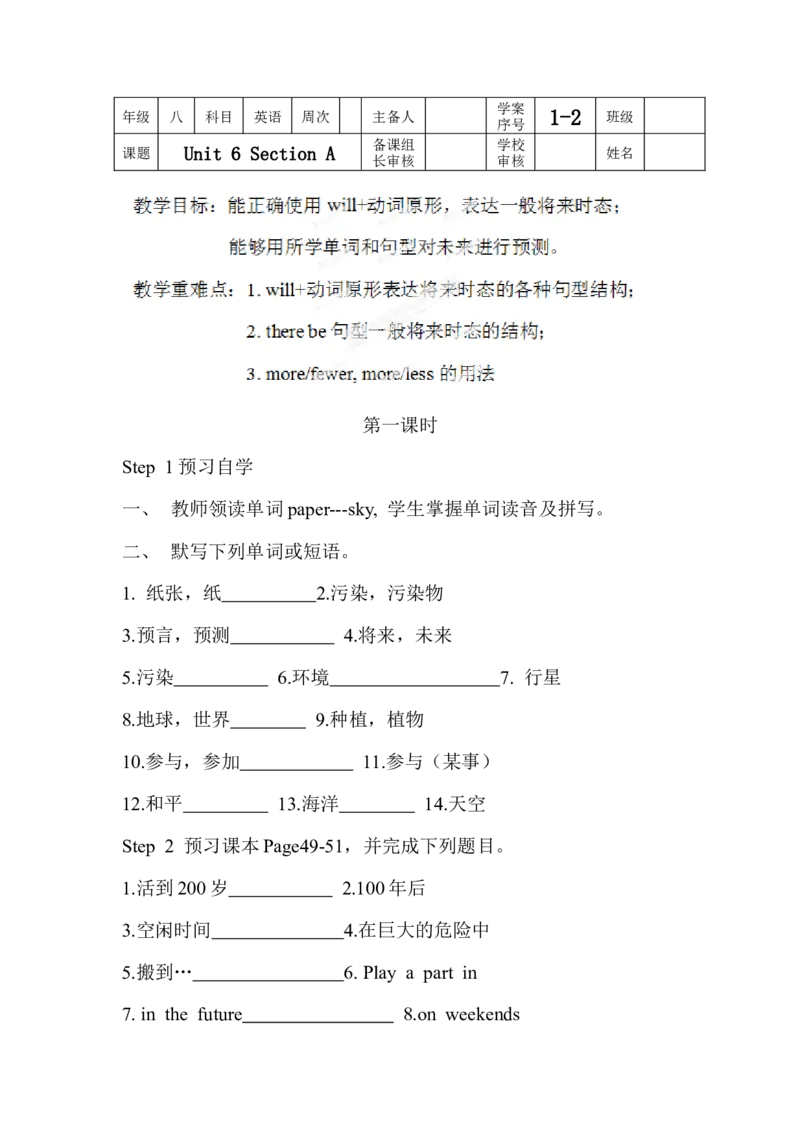
学案
年级 八 科目 英语 周次 主备人 1-2 班级
序号
备课组 学校
课题 Unit 6 Section A 姓名
长审核 审核
第一课时
Step 1预习自学
一、 教师领读单词paper---sky, 学生掌握单词读音及拼写。
二、 默写下列单词或短语。
1. 纸张,纸 2.污染,污染物
3.预言,预测 4.将来,未来
5.污染 6.环境 7. 行星
8.地球,世界 9.种植,植物
10.参与,参加 11.参与(某事)
12.和平 13.海洋 14.天空
Step 2 预习课本Page49-51,并完成下列题目。
1.活到200岁 2.100年后
3.空闲时间 4.在巨大的危险中
5.搬到… 6. Play a part in
7. in the future 8.on weekends9. the same as 10.more pollution
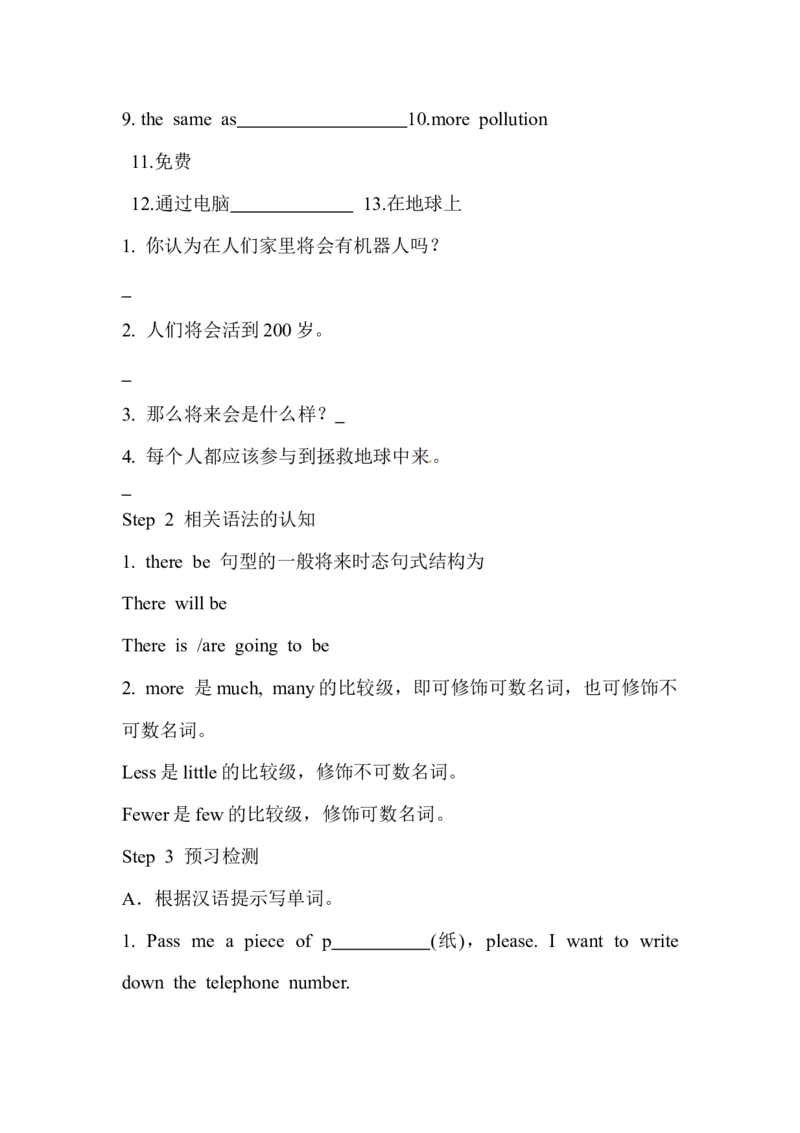
11.免费
12.通过电脑 13.在地球上
1. 你认为在人们家里将会有机器人吗?
2. 人们将会活到200岁。
3. 那么将来会是什么样?
4. 每个人都应该参与到拯救地球中来。
Step 2 相关语法的认知
1. there be 句型的一般将来时态句式结构为
There will be
There is /are going to be
2. more 是much, many的比较级,即可修饰可数名词,也可修饰不
可数名词。
Less是little的比较级,修饰不可数名词。
Fewer是few的比较级,修饰可数名词。
Step 3 预习检测
A.根据汉语提示写单词。
1. Pass me a piece of p (纸),please. I want to write
down the telephone number.2. P (污染) in big cities is getting more and more
serious.
3. You can have a cup of tea for (免费的) in that
restaurant.
4. There will be (更少的) cars in the street.
5. The bus is (拥挤的). Let’s take another one.
B. 用所给词的适当形式填空。
1. There (be) many reporters in tomorrow’s meeting.
2. Sally (leave) for Shanghai in three days.
3. I think there will be (little) pollution in the future than
now.
4. Kids (not go) to school in the future.
5. What’s your (predict) about the future.
C. 单项选择。
1. There a basketball match between Class One and Class
Three this afternoon.
A. will have B. is going to have C. will be D. is going to
play
2. Kids won’t go to school. They’ll study home
computers.
A. in, for B. at, for C. at, on D. with, by
3. We are glad to hear that the Greens to a new flat twoweeks.
A. move, in B. moved, after C. will move, in D. move,
after
4. I think people 200 years old in the future.
A. live to are B. will live to are C. live to be D. will
live to be
5. To live a green life, we should try to save energy and
produce(产生) pollution.
A. more, fewer B. less, more C. less, fewer D. more, less
第二课时
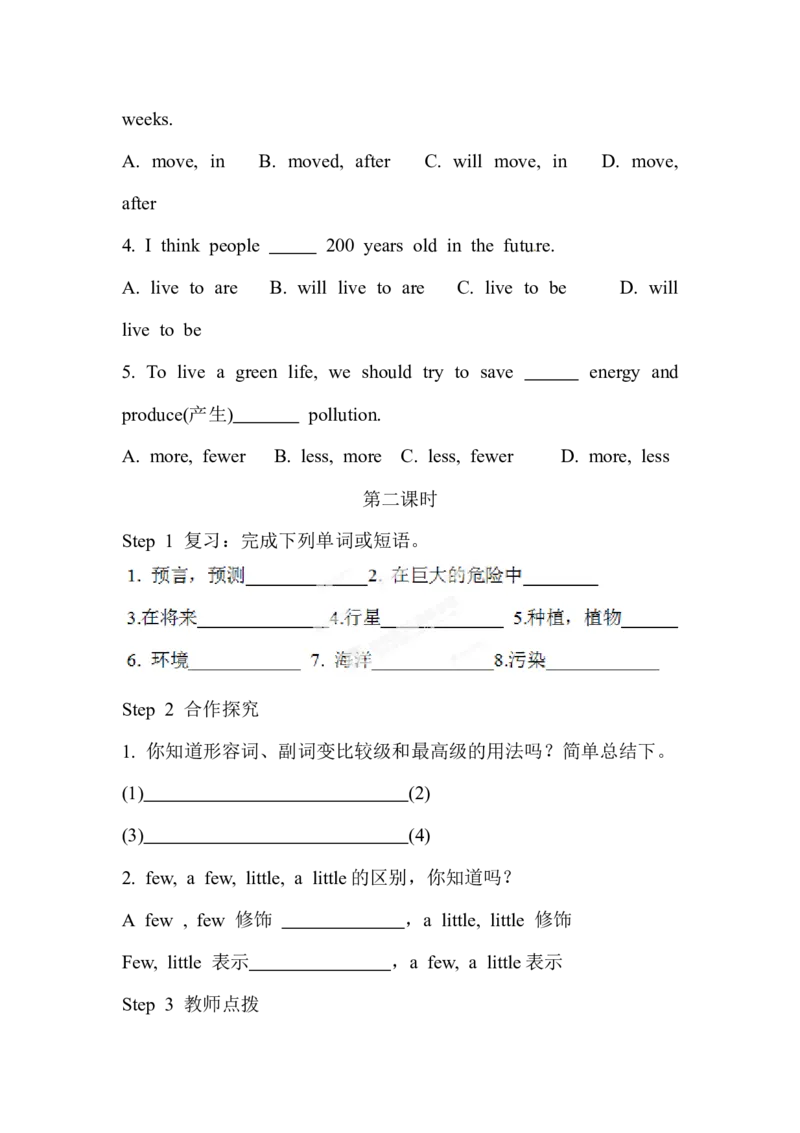
Step 1 复习:完成下列单词或短语。
Step 2 合作探究
1. 你知道形容词、副词变比较级和最高级的用法吗?简单总结下。
(1) (2)
(3) (4)
2. few, a few, little, a little的区别,你知道吗?
A few , few 修饰 ,a little, little 修饰
Few, little 表示 ,a few, a little表示
Step 3 教师点拨1. paper (1)不可数名词,纸,纸张(2)可数名词,报纸、论文、试卷
news 新闻、消息,不可数名词 newspaper 报纸,可数名词
2. “in +时间段”表示“在一段时间之后”,常用于一般将来时态,
对其提问用“how soon”
“after+时间段”表示以过去某点为起点的一段时间之后,用于过
去时态。
3. live to be +基数词+years old 活到…岁
live+a/an+adj.+life 过…的生活
e.g. He lives a hard life.他过着艰难的生活。
4. What is … like?
(1)… 什么样子 (2)人的外貌或性格
(3)将来时的结构What will …be like? 将来会怎么样
(4)What …look like? 一般表示对人的外貌提问。
活学活用:
It will be rainy the day after tomorrow. (对划线部分提问)
the weather the day after
tomorrow?
5. I hope so.希望如此
So在此为代词,代替上文出现过的一个句子或一个名词。
否定形式为I hope not.
类似结构I think so. 否定形式为I don’t think so.
6. pollute v. 污染polluted adj. 被污染的
pollution n. 污染
7. play a part in sth. 参与某事
eg. He played no part in the discussion. 他没有参与讨论。
相关用法:
take part in +活动 参加活动
join +组织/sb. 加入某个组织/加入某人行列
8. everyone 不定代词,每一个人,作主语时谓语动词用单数。
活学活用:Everyone in my class (like) going to the
movies.
9. 语法专讲:
一般将来时
一、 一般将来时的构成
1. 肯定式
(1)主语+will/shall+动词原形+其他
(2)主语+be going to+动词原形+其他
Will用于各种人称,shall仅用于第一人称,be随人称、数和时态的变
化而变化,will在名词或代词后常简略为’ll。
2. 否定式
在will/shall/be后加not
3. 一般疑问句
把will/shall/be提到主语前面二、 一般将来时的用法
一般将来时是表示在将来的某个时间将要发生的动作或存在的状态。
也可表示打算在将来要去做的动作。与之连用的时间状语有:
tomorrow{morning… }, next week{year… }, this
Sunday{Tuesday…},in+一段时间,soon等,如:People will live to be
200 years old in the future.将来人们将活到两百岁。
三、 There be 句型的一般将来时的构成及用法
1. There be 句型的一般将来时,表示“将来存在”,其肯定结构
为:There will be +主语+其他成分或 There is/are going to
be +主语+其他成分。如:(1)There will be less pollution.污染
将会少些。(2)There is going to be a meeting tomorrow.明天
将有一个会议。
2. There be 句型一般将来时的疑问句型、否定句型和简略回答:
Will there be +主语+其他成分? Yes, there will. /No, there
won’t.
There won’t be +主语+其他成分
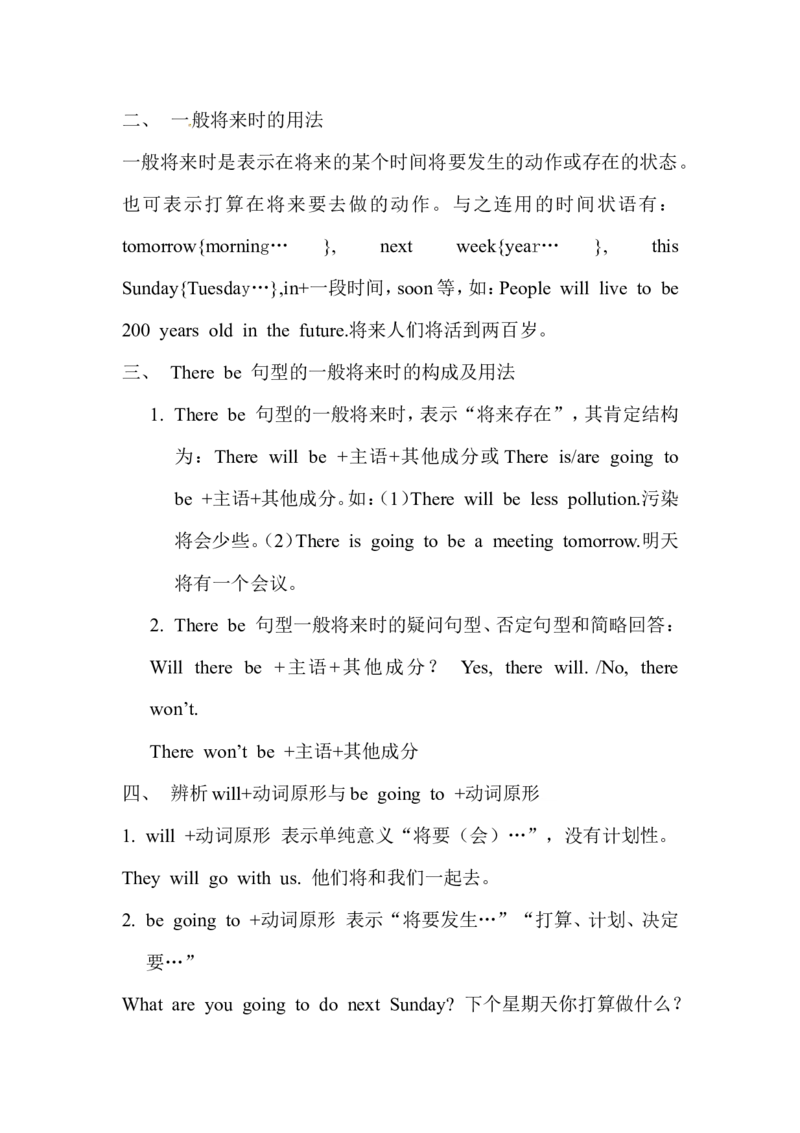
四、 辨析will+动词原形与be going to +动词原形
[来源:学科网]
1. will +动词原形 表示单纯意义“将要(会)…”,没有计划性。
They will go with us. 他们将和我们一起去。
[来源:Z*xx*k.Com]
2. be going to +动词原形 表示“将要发生…”“打算、计划、决定
要…”
What are you going to do next Sunday? 下个星期天你打算做什么?动词 come, go, leave, start, arrive, return 等可以用现在进行时表示
将来。
Step 4 训练检测
一、单项选择。
1. --- will your sister come back?
---Maybe in three days.
A. How often B. How long C. How soon D. How far
2. Please pick up the . Don’t keep it on the floor.
A. paper B. boxes C. books D. bottles
3. How long will dogs live ?
A. be B. to be C. on D. for
4. ---Will there be one country?
---Yes, .
A. there be B. there is C. there will D. there
won’t
5. We hope there will be pollution in the future.
A. more B. few C. fewer D. less
二、根据句意及首字母提示补全单词。
1)Everyone should play a part in s the earth.
2) Will we have to move to other p in 100
years?
3) There will be fewer trees and the e will bein danger.
4) We should p trees in spring.
5) What’s your p about the future?
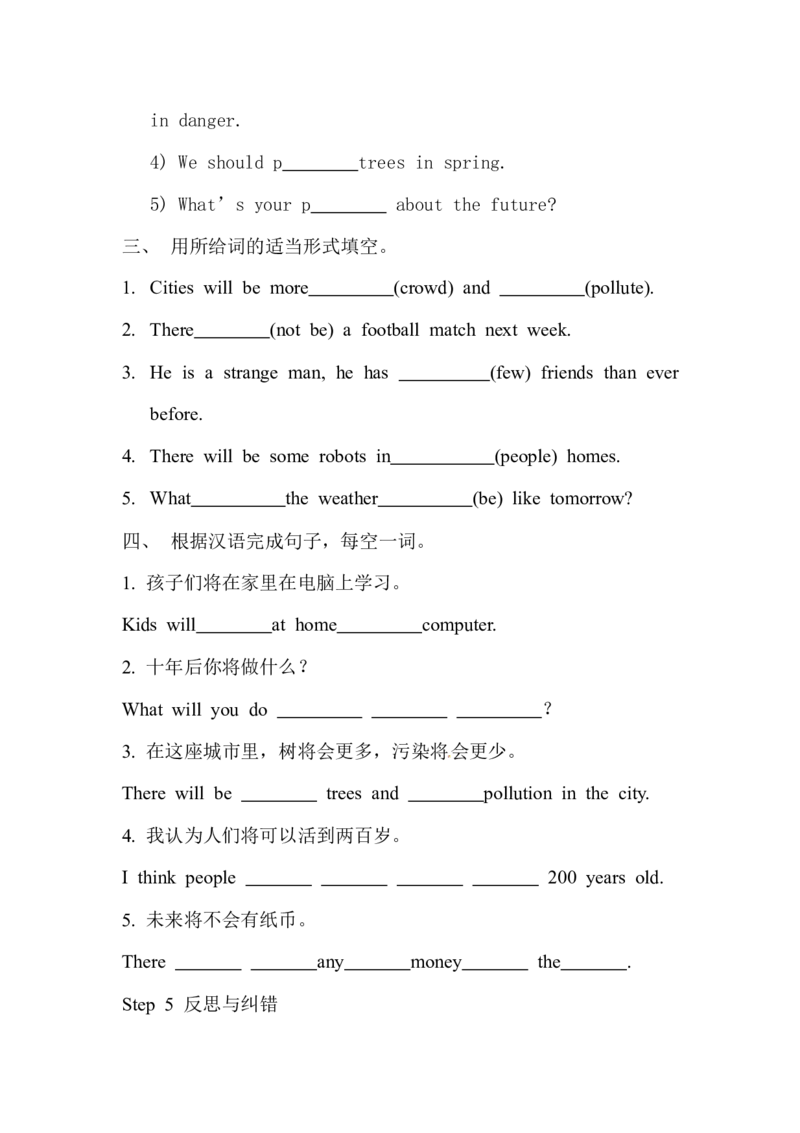
三、 用所给词的适当形式填空。
1. Cities will be more (crowd) and (pollute).
2. There (not be) a football match next week.
3. He is a strange man, he has (few) friends than ever
before.
4. There will be some robots in (people) homes.
5. What the weather (be) like tomorrow?
四、 根据汉语完成句子,每空一词。
1. 孩子们将在家里在电脑上学习。
Kids will at home computer.
2. 十年后你将做什么?
What will you do ?
3. 在这座城市里,树将会更多,污染将会更少。
There will be trees and pollution in the city.
4. 我认为人们将可以活到两百岁。
I think people 200 years old.
5. 未来将不会有纸币。
There any money the .
Step 5 反思与纠错学案
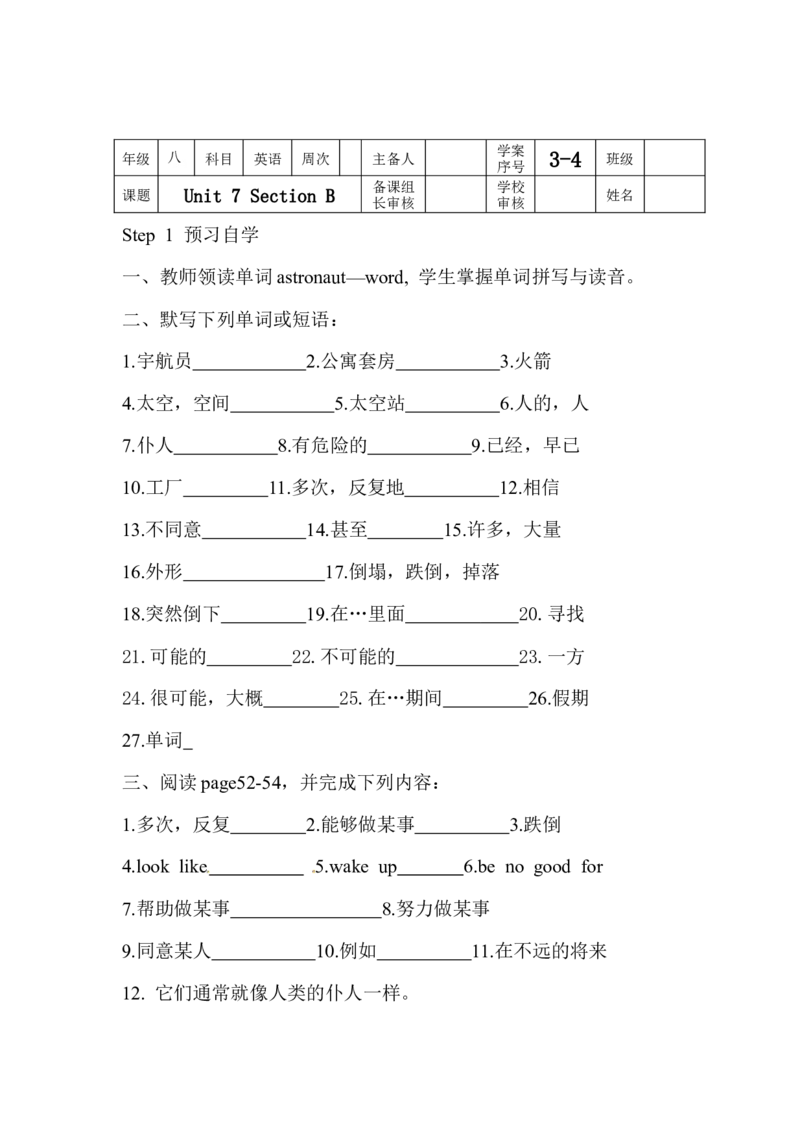
年级 八 科目 英语 周次 主备人 3-4 班级
[来 序号
源:学科网ZXXK]
备课组 学校
课题 Unit 7 Section B 姓名
长审核 审核
Step 1 预习自学
一、教师领读单词astronaut—word, 学生掌握单词拼写与读音。
二、默写下列单词或短语:
1.宇航员 2.公寓套房 3.火箭
4.太空,空间 5.太空站 6.人的,人
7.仆人 8.有危险的 9.已经,早已
10.工厂 11.多次,反复地 12.相信
13.不同意 14.甚至 15.许多,大量
16.外形 17.倒塌,跌倒,掉落
18.突然倒下 19.在…里面 20.寻找
21.可能的 22.不可能的 23.一方
24.很可能,大概 25.在…期间 26.假期
27.单词
三、阅读page52-54,并完成下列内容:
1.多次,反复 2.能够做某事 3.跌倒
4.look like 5.wake up 6.be no good for
7.帮助做某事 8.努力做某事
9.同意某人 10.例如 11.在不远的将来
12. 它们通常就像人类的仆人一样。13. 今天已经有机器人在工厂里工作。
Step 2 预习检测:
一、根据句意及首字母提示补全单词。
1)They send three r into space a year ago.
2) It is possible for people to live in the space s
.
3) We can see the sun in the day and see the m
at night.
4) Liu Yang is a woman a in China.
5) ---Where do you live? ---I live in an a .
二、用所给词的适当形式填空。
1. There are (hundred) of hens in my grandpa’s house.
2. Robots won’t be able (talk) like humans.
3. Robots can do jobs in dirty or (danger) places.
4. I want to watch TV for two hours, but my father
(agree) with me.
5. I want to be a (science) when I grow up.
三、单项选择。
1. The teacher made us the text three times.
A. read B. to read C. reading D. reads
2. There are more than two boys in our school.
A. hundreds B. hundreds of C. hundred D. hundredof
3. The astronaut who lives in apartment decide to
fly to
moon next year.
A. a, the B. an, the C. a, a D. an, an
4. There are some teachers in the office.
A. working B. to work C. worked D. works
5. Bill is my best friend. He often helps me my
homework.
A. does B. doing C. with do D. with
第四课时
Step 1 复习:完成下列单词或短语。
1.宇航员 2. 火箭 3.已经,早已
4.不同意 5.外形 6.多次,反复
7.努力做某事 8.参与… 9.例如
10.看起来像
Step 2 教师点拨
1. be able to 有能力做,会做
辨析:can与be able to
两者都意为“能够”,可互换;后都接动词原形。Can表示现在能够,
表示过去的情况时用could;can还可以表示“请求,许可”;be able
to有各种时态变化。如:Can you tell me the way to the park? 你能告诉我去公园的路吗?
He will be able to dress himself in one year. 一年后他将会自己穿
衣服。
活学活用:
(1)今天下午你能和我一起去游泳吗?
you with me this afternoon?
(2)He can swim in the lake. (同义句)
He swim in the lake.
2. disagree v. 不同意,有分歧
点拨:disagree为不及物动词,其反义词为agree, 其用法与agree一样,
后面接介词构成短语。Disagree with后面接人;disagree to后接表示
观点的名词。
活学活用:你不同意他的注意吗?
Do you his idea?
3. believe v. 相信;认为有可能
点拨:(1)believe 为动词,后面接表示否定意义的宾语从句时,通常将
否定转移到主句上。如:
I don’t believe that he will win. 我相信他不会赢。
(2)在简略答语中,一般不单独使用“believe”,而用“I believe
so”或“I believe not”如:
---Do you think he will come? 你认为他会来吗?
---No, I don’t believe so(I believe not) 我想不会。4. fall down 突然倒下;跌倒;倒塌
辨析:fall down与fall off
Fall down意为“倒塌,掉下”,不强调掉落物的来处;而fall off意
为“从…上落下或掉下”,Off为介词或副词。如:
I saw him fall off from his horse. 我看到他从马上掉了下来。
The old house fell down in the earthquake. 老房子在地震中倒塌了。
活学活用:
在去年的地震中,数以百计的房子倒塌了。
Hundreds of houses in the earthquake last
year.
句型透视:
[来源:学_科_网]
1. They are usually like human servants.它们通常就像人类的仆人
一样。
点拨:like 在此作介词,意为“像…一样”,短语 be like 意为
“像…”
活学活用:
(1)露西的帽子像一只猫。
(2)不要像那样说话。
2. Today there are already robots working in factories.
今天已经有机器人在工厂里工作了。
点拨:there is/are sb. Doing sth.意为“有某人正在做某事”
活学活用:有一群孩子正在河里游泳。
a group of children in the river.
3. Fewer people will do such jobs in the future because they are
boring…
因为它们很无聊,所以将来更少的人们将会做这样的工作…
点拨:such 是形容词,意为“这样的”,后面接名词。Such无比较级
和最高级形式。如:
She is such a good girl. 她是一个如此好的女孩。
辨析:such 与 so
(1)如果名词前有many, much, few或little等词修饰并且表示“如
此的,这样的”时,不能用such,只能用so。如:
There are so many apples on the trees. 树上有这么多的苹果。
(2)so 修饰形容词或副词;such修饰的中心词是名词。
(3)当修饰一个带有不定冠词和形容词的可数名词单数时,既可以用
such, 也可以用so,但冠词和形容词的顺序不一样。
Such+a/an+adj.+名词单数 so+adj.+a/an+名词单数
如:He is such a clever boy.=He is so clever a boy.
他是一个如此聪明的男孩。
活学活用:
(1)This is difficult problem that few students can work it
out.
A. so B. so a C. such D. such a(2)这本书是如此有趣。This book is interesting.
(3)这是一本如此有趣的书。
This is an interesting book. = This is interesting
book.
4. Scientists are now trying to make robots look like humans and
do the same things as we do. 科学家们现在正在尽力使机器人看起
来像人类一样,并且和我们做相同的事情。
点拨:(1)try to do sth. 意为“努力/尽力做某事”;try one’s best
to do sth.意为“尽某人最大努力去做某事”;try doing sh.意为“尝
试做某事”。如:We should try to learn English well. 我们应该尽
力学好英语。
(2)make sb. do sth. 意为“使某人做某事”。如:
My parents always make me do lots of homework at home.
我父母总是让我在家里做大量的作业。
活学活用:
Colors can change our moods(情绪) and make us happy or
sad.
A. feel B. to feel C. felt D.feeling
5. However, some scientists believe that although we can make
robots move like people, it will be difficult to make them really
think like a human. 然而,一些科学家认为虽然我们能使机器人像
人类一样移动,但是使他们像人一样思考将会很困难。点拨:(1)该句是一个宾语从句。其中some scientists作句子的主语,
believe作句子的谓语,that引导的句子作宾语。如:
I don’t believe (that) his answer is correct. 我认为他的答案不正确。
(2)although意为“纵然,即使”,引导让步状语从句,不能与but 用
在同一个句子里。如: 虽然他很年轻,不是很勇敢。
Although he is young, he is brave.=He is young, but he is brave.
(3)句子“it will be difficult to make them really think like a
human.”中的 it 作从句的形式主语,从句的真正主语是 to make
them really think like a human。其结构是“it is+adj.+(for sb.)+to
do sth.”,意为“做某事(对某人来说)是…的”。
活学活用:
(1)Mary isn’t in the classroom. Do you know ?
A. where she is B. where is she C. who is she D. who she
is
(2)It is polite a gift when you visit somebody for the
first time.
A. take B. taking C. to take D. to taking
Step 3 训练检测
一、单项选择
1. She is a nice girl we all want to help her.
A. such, that B. too, to C. so, that D. very, that
2. People will fly to the moon vacation.A. for B. to C. in D. at
3. Does the building have rooms?
A. three hundreds B. hundred of C. hundreds of D. three
hundred of
4. The boy animals and he can jump many
animals.
A. likes, like B. like, like C. like, likes D. likes,
likes
5. ----I think English is the most difficult subject.
--- , I think math is more difficult than English.
A. I think so B. I don’t hope so C. I agree D. I
disagree
二、用括号内所给单词的适当形式填空。
1. Our life will be much (good) than it is now.
2. There are many robots (work) in the factory.
3. I will get (bore) when I read the (bore)
book.
4. Jack wants to be a (science) when he grows up.
5. They (build) a lot of tall (build) last
year.
三、根据句意及首字母补全单词。
1. People put the rubbish into the river and there is much p.
2. Robots are usually just like human s .
3. The question isn’t difficult. It’s very s .
4. Robots will have many s in the future.
5. There are two agreements(意见). Which s do you
agree with?
Step 4 反思与纠错学案
年级 八 科目 英语 周次 主备人 5 班级
序号
备课组 学校
课题 Unit 7 Section C 姓名
长审核 审核
Step 1 完成课本P56 Self check部分
Step 2 巩固检测
一、单项选择。
1. I you as soon as I get to Beijing.
[来源:学科网]
A. call B. called C. will call D. am calling
2. No hurry. The bus will arrive ten minutes.
A. at B. for C. in D. by
3. The little girl made her friend her birthday cake for her.
A. cutting B.cut C. to cut D. cuts
4. -----How about going camping in the mountains?
----- .
A. Me, too B. Good idea C. It doesn’t matter D. Help
yourself
5. We find impossible for people to learn a new language
in a few days.
A. that B. it C. one D. what
6. many boys were caught in heavy rain.
A. So, so B. So, such C. Such, such D. Such,
so7. Please pass us .
A. two glass of milk B. two glass of milks
C. two glasses of milks D. two glasses of milk
8. He Dalian for a vacation next year.
A. will go to B. goes to C. went to D. comes to
9. Lily could read storybooks at the age of four.
A. is able to B. was able to C. should D. would
10. ----Is Jack back?
----No, but I think he in half an hour.
A. come back B. came back C. comes back D. is coming
back
11. As we all know that the earth is home to animals.
A. million B. millions C. million of D. millions of
12.We do eye exercises twice a day, so of us
glasses.
A. few, put on B. few, wear C. a few, put on D. a
few, wear
13. students are having an important exam at the moment.
A. Thousands B. Thousands of C. Thousand D.
Thousand of
14.----Which do you like , summer or winter?
-----I prefer summer.A. good B. well C. better D. best
15.You seemed than me.
A. more angrily B. much angrier C. more angry D. very
angry
二、用括号内所给单词的适当形式填空。
1. There (be) more students in our school next
year.
2. Most people (not live) on the moon in 100 years.
3. Jenny (be) a pupil three years ago. But today she
(be) a middle school student.
4. When you (get) up tomorrow?
5. Mr. Smith (take) a bus to work yesterday.
三、根据汉语意思完成下列句子。
1. 明天有雨吗?
rain tomorrow?
2. 下周我将去香港度假。
I to Hong Kong for a holiday next week.
3. 一百年后将会有更多的楼房。
There buildings in 100 years.
4. 他们这周六去钓鱼。
They this Saturday.
5. 未来将不会有纸币。There any money the .
Step 3 反思与纠错