文档文本内容
Learning Goals
1.Talk about robots in the future using“ unpleasant , scientist , in the
future, hundreds of, already, made ,such ,everywhere, human , snake ,
possible, electric ,seem, housework, the same as…it’s easy for a child to
…
(目标引领,用一句话表述了本节课的知识、能力和情感目标。)
Step1 Preview
Look at P8, put them into English orally, then write them down without
looking at the text.
Phrases: Translate the phrases.
1.最使人不愉快的工作 2.大量,许多 3.和…一样
4.未来,将来 5.看起来像 6.寻找
Sentences: Translate the sentences
1.有些科学家相信未来会有这样的机器人。
2.他觉得要让机器人像人类一样地工作很难。
3.现在已经有机器人在工厂里工作了。
4.人类将会做更少的工作。
5.我们绝不知道未来会发生什么。
(通过检查预习,让学生快速说出短语和句型,了解学生对课本知识
的掌握情况,为下一步的教学做铺垫。)
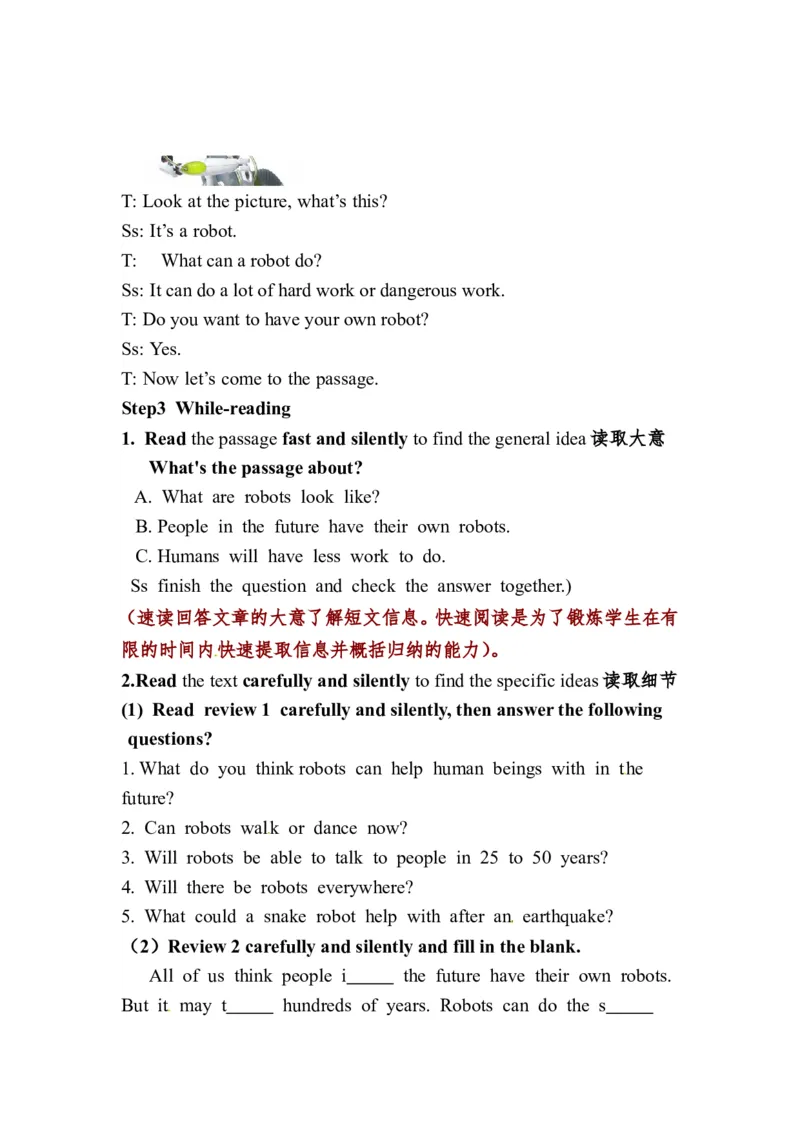
Step2 Warming up and leading in热身导入T: Look at the picture, what’s this?
Ss : It’s a robot.
T: What can a robot do?
Ss: It can do a lot of hard work or dangerous work.
T: Do you want to have your own robot?
Ss: Yes.
T: Now let’s come to the passage.
Step3 While-reading
1. Read the passage fast and silently to find the general idea读取大意
What's the passage about?
A. What are robots look like?
B. People in the future have their own robots.
C. Humans will have less work to do.
[来源:学科网]
Ss finish the question and check the answer together.)
(速读回答文章的大意了解短文信息。快速阅读是为了锻炼学生在有
限的时间内快速提取信息并概括归纳的能力)。
2.Read the text carefully and silently to find the specific ideas读取细节
(1) Read review 1 carefully and silently, then answer the following
questions?
1. What do you think robots can help human beings with in the
future?
2. Can robots walk or dance now?
3. Will robots be able to talk to people in 25 to 50 years?
4. Will there be robots everywhere?
5. What could a snake robot help with after an earthquake?
(2)Review 2 carefully and silently and fill in the blank.
All of us think people i the future have their own robots.
But it may t hundreds of years. Robots can do the sthings as us.
Many scientists are trying to m robots look like people.
There are many robots now w in factories. They do simple j
over and over again. They w never get bored. A robot could
help l
for people. That may s impossible now. But we never know
what will h in the future.
(本任务是为了让学生进一步阅读文章内容,加深印象)
Step4 Post-reading activities读后活动
A. You’ve understood the passage. Let’s listen to the tape and read
aloud after it. (Ss read after the tape one by one)
(让学生听音跟读,旨在调动眼视听众感官深刻体会文章内容,更主
要的是让学生通过跟读培养学生的语音语调,学着读出真正的地道的
英语。并对学生掌握不准的词汇的读音进行学习或纠正。)
B. Then read aloud and prepare to retell the reviews using the key
words below.
(利用关键词复述出所学内容,为语言的输出任务。学生通过速读、细
读回答完问题,又经过跟读和朗读大量的语言输入后,进行复述的。
进一步提高学生的综合运用语言的能力。)
C. Writing:
内容:你想要拥有你自己的机器人,跟科学家描述一下你都要求你的
机器人会什么技能!
(这个任务的设计一个目的是为了让学生在学会了评论的相关知识后
进行运用,在发展学生听、说、读的能力后,进一步加强写的技能的培
养,体现了英语的工具性内涵)
Step5 Inquiry into knowledge by translation(翻译探究)
一、hundreds of 意为“ ” hundreds意为“ ”。当
表示的是具体几百时,要用 ,且后面不跟 ;如果表示一
个不确定的数字时,常用 ,后跟介词 。
二、it’s + adj.+(for sd.)to do sth.为形式主语, 为句子的真正主语。
三、that may not seem possible new.
Seem要做连系动词,意为“ ”,与 同义。Seem常接 、
、 。seem的从句句型为 。
四there will de such robots…
Such和so的区别:
1.such用作形容词,意为’“ ”,用来装饰 。如果装饰单
数可数名词(名词前有形容装饰),其后需加不定冠词 或
。
2.so作为副词,意为“ ”,用来修饰 或 。
3.当many, much, few, little这些表示数量的词修饰名词时,一般用
修饰,而不用 修饰。
(设计目地:此环节重在总结重点词汇及句型,教师精讲精练,学生自
主、合作、探究学习,学生会的教师不再讲解,重在点播。学生在小组
长的带领下解答难题,统一答案,学生讨论难点,教师巡视点播。)
Step6 The end-of- class test当堂检测
一、根据汉语提示完成句子。
1. He wants to be an astronaut and his dream_____(实现) last year.
2. I need to look smart for my ____(工作面试).
[来源:学科网ZXXK]
3. Scientists are trying to make robots do_____ (和…同样的工作)
people.
4. I________ (寻找)my lost dog everywhere but I didn’t find it.
5. I don’t want to do the same things_________ (反复地).
二、Translate the sentences翻译下列句子
1有些科学家相信未来会有这样的机器人。
2他觉得要让机器人像人类一样地工作很难。
[来源:学科网][来源:Zxxk.Com]
3 现在已经有机器人在工厂里工作了。
[来源:学+科+网]
4 人类将会做更少的工作
答案:一:
1. came true 2 job interview. 3. the same work as 4. looked for
5.over and over again二 翻译句子
1.Some scientists believe that there will be such robots in the
future.
2.He thinks that it will be difficult for a robot to do the same
things as a person.
3.There are already robots working in factories
4.Humans will have less work to do.
亮点
1.本课的导入。利用图片导入既能激发学生的兴趣又能顺利的导
入。
2.本课的阅读训练。阅读课的步骤:让学生带着问题略读文章,找
出文章的大意; 然后让学生带着问题细读文章,找出文章细节。这些策
略有利于学生逐渐提高寻找大意和细节的能力。读后的听、跟读、复
述和背诵等活动有利于学生内化所读内容。
3.使用建议:本课最好结合多媒体使用。
翻译探究使用建议
“翻译探究”的主要目的是变老师讲解语言知识为学生自学语言知
识。学生使用“翻译探究”时可以和答案同时使用,帮助自学、探究、
发现和归纳,学生个人学不懂时可以以小组形式互助,若还不会,老师
再讲解,这是先学后教,以学定教。“翻译探究”的题目数量因学情而
定。学懂后,不看答案,两人一组互相讲解。