Unit9 Can you come to my
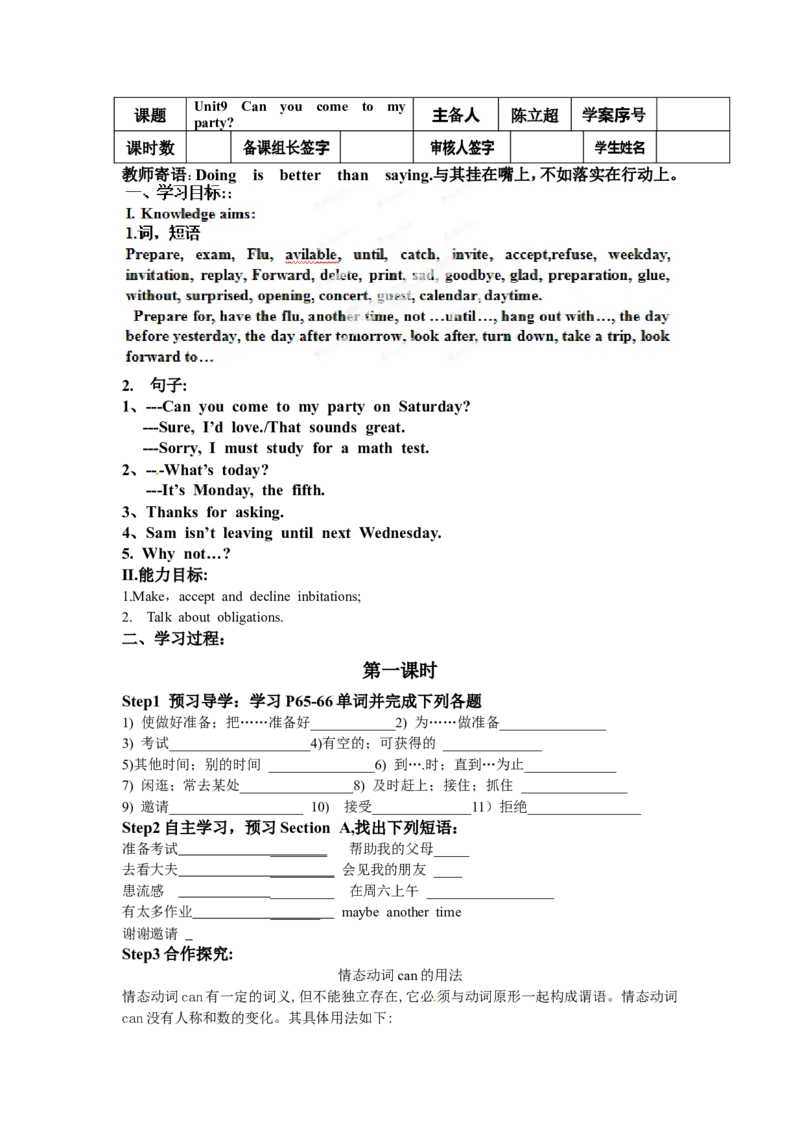
课题 主备人 陈立超 学案序号
party?
课时数 备课组长签字 审核人签字 学生姓名
教师寄语:Doing is better than saying.与其挂在嘴上,不如落实在行动上。
2. 句子:
1、---Can you come to my party on Saturday?
---Sure, I’d love./That sounds great.
---Sorry, I must study for a math test.
2、---What’s today?
---It’s Monday, the fifth.
3、Thanks for asking.
4、Sam isn’t leaving until next Wednesday.
5. Why not…?
II.能力目标:
[来源:学§科§网Z§X§X§K]
1.Make,accept and decline inbitations;
2. Talk about obligations.
二、学习过程:
第一课时
Step1 预习导学:学习P65-66单词并完成下列各题
1) 使做好准备;把……准备好____________2) 为……做准备_______________
3) 考试____________________4)有空的;可获得的 ______________
5)其他时间;别的时间 _______________6) 到….时;直到…为止_____________
7) 闲逛;常去某处________________8) 及时赶上;接住;抓住 _______________
9) 邀请___________________ 10) 接受______________11)拒绝________________
Step2自主学习,预习Section A,找出下列短语:
准备考试 _______ _ 帮助我的父母_____
去看大夫 ________ _ 会见我的朋友 ____
患流感 _________ 在周六上午 __________________
有太多作业 ______ _ maybe another time
谢谢邀请
Step3合作探究:
情态动词can的用法
情态动词can有一定的词义,但不能独立存在,它必须与动词原形一起构成谓语。情态动词
can没有人称和数的变化。其具体用法如下:1.表示"能、会",指脑力或体力方面的"能力"。例如:
I can speak English.我会讲英语。
Jim can swim but I can't.吉姆会游泳,但我不会。
2.表示"可能",常用于否定句或疑问句中,指某种可能性。例如:
Han Mei can't be in the classroom.韩梅不可能在教室里。
Can he come here today, please?请问他今天能到这里来吗?
3.表示"可以",常用于口语中,指许可或请求做某事。例如:
Can I have a cup of tea, please?请问我可以喝一杯茶吗?
You can go out.你可以出去了?
补充:
①can在口语中可以代替may,表示许可或可以。
②can't在口语中代替mustn't时,表示禁止或不准。例如:
You can't play football in the street.不准在马路上踢足球。
③情态动词can的过去式could,用于现在时,可使语气更委婉、更客气。例如:
Could you help me with my English?你能帮助我学习英语吗?
情态动词can的基本句型
1.肯定句型为:主语+can+动词原形+其它。例如:
They can play basketball.他们能打篮球。
She can dance.她会跳舞。
You can go to watch TV.你可以去看电视了。
2.否定句型为:主语+can not(can't/cannot)+动词原形+其它。表示"某人不能(不会。不可
能)做……"。其中can't是can not的缩略式,英国多写成cannot。例如:
You cannot pass the ball like this.你不能像这样传球。
I can't ride a motorbike.我不会骑摩托车。
3.疑问句句型分为:一般疑问句句型和特殊疑问句句型两种类型。
⑴一般疑问句句型为:Can+主语+动词原形+其它。表示"某人会(能。可以)做……吗?",用于
口语时,常表示请求或许可。其肯定答语用""Yes,主语+can."作答;否定答语用"No,主语
+can't."作答。注意答语中作主语的人称代词,应根据问句中的主语作相应的变化。其变化
规则为:第一人称问,则第二人称答;第二人称问,则第一人称答;第三人称问,第三人称答。
例如:
①-Can you sing an English song for us?你可以为我们大家唱一首英语歌吗?
-Yes.行。(注意在Yes后面常省略I can)
②-Can I skate?我可以滑冰吗?
-Yes, you can.可以。
③-Can she climb hills?她能爬山吗?
-No, she can't.不,她不能。
⑵特殊疑问句句型为:a. Who+can+动词原形+其它。该句型中who相当于主语。例如:
-Who can sing in English in your class?你们班上谁会用英语唱歌?
-Lily can.莉莉会。
b.特殊疑问词(作定语)+名词+can+主语+动词原形+其它。该句型中的特殊疑问词常用how
many, how much等。例如:
-How many boats can you see in the river?你能看见河中有多少只船吗?
-Only one boat.仅有一只。
c.特殊疑问词+can+主语+动词原形+其它。该句型中的特殊疑问词常用what, where, when等,一般用肯定陈述句作答。例如:
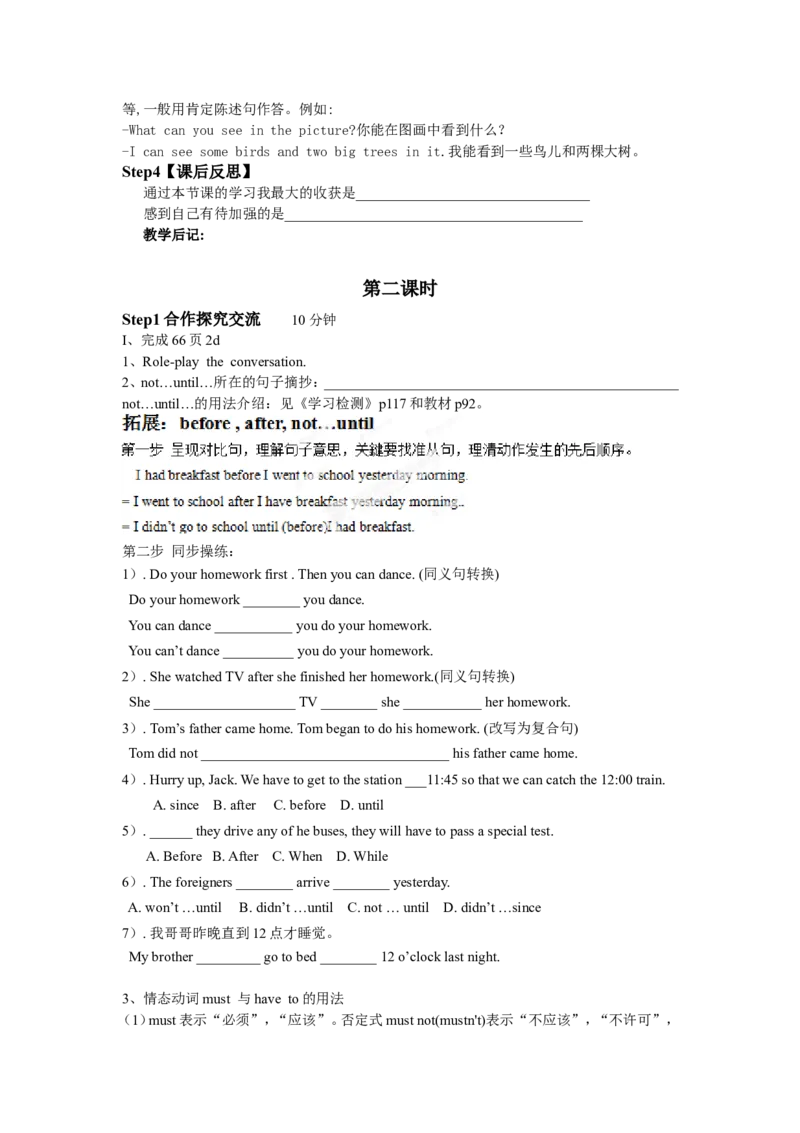
-What can you see in the picture?你能在图画中看到什么?
-I can see some birds and two big trees in it.我能看到一些鸟儿和两棵大树。
Step4【课后反思】
通过本节课的学习我最大的收获是_________________________________
感到自己有待加强的是__________________________________________
教学后记:
第二课时
Step1合作探究交流 10分钟
I、完成66页2d
1、Role-play the conversation.
2、not…until…所在的句子摘抄:__________________________________________________
not…until…的用法介绍:见《学习检测》p117和教材p92。
第二步 同步操练:
1). Do your homework first . Then you can dance. (同义句转换)
Do your homework ________ you dance.
You can dance ___________ you do your homework.
You can’t dance __________ you do your homework.
2). She watched TV after she finished her homework.(同义句转换)
She ____________________ TV ________ she ___________ her homework.
3). Tom’s father came home. Tom began to do his homework. (改写为复合句)
Tom did not ___________________________________ his father came home.
4). Hurry up, Jack. We have to get to the station ___11:45 so that we can catch the 12:00 train.
A. since B. after C. before D. until
5). ______ they drive any of he buses, they will have to pass a special test.
A. Before B. After C. When D. While
6). The foreigners ________ arrive ________ yesterday.
A. won’t …until B. didn’t …until C. not … until D. didn’t …since
7). 我哥哥昨晚直到12点才睡觉。
My brother _________ go to bed ________ 12 o’clock last night.
3、情态动词must 与have to的用法
(1)must表示“必须”,“应该”。否定式must not(mustn't)表示“不应该”,“不许可”,“不准”,“禁止”等。在回答带有must的问句时,否定式常用need not(needn't)或don't have
to 表示“不必”,而不用must not (mustn't)。
The work must be finished as soon as possible.这件工作必须尽快完成。
You mustn't speak like that.你不能那样说话。
—Must I be home before eight o'clock? 8点之前我必须回家吗?
—Yes, you must./No, you needn't./No, you don't have to. 是的,必须回家。/不,不必了。
(2)must表推测,
①一般只用于肯定句中,译成汉语“一定”,“必定”。
There must be some mistakes.肯定有一些错误。
You must be very tired.你一定很累了。
②如果表示对过去事情的推测,就用"must+完成时"。
You must have left your umbrella in the theatre.你一定把雨伞丢在剧院里了。
His car is still here. He must have gone by bus.他的车还在这里,他一定乘公共汽车走了。
③当must表推测之意时,其否定形式常用can not而不用must not。
He can't have been to your home. He doesn't know your address.他不可能到过你家,因为他不
知道你的住址。
What can he be doing at this time of night?夜晚都到这个时候了,他究竟在干什么呢?
(3)must表必然性
You must catch cold if you don't put on more clothes.如果你不多穿些衣服,必然感冒。
All men must die.人固有一死。
Truth must be out.真相总会大白。
(4)have to表示“必须”,“不得不”,在这个意义上与must很接近,但must表示的是说话
人的主观看法,而have to 表示的却是客观需要。
I have to go now.我得走了。(客观需要)
I must go now.我必须走。(主观看法)
You have to work hard to make a living.为了谋生你就得努力工作。(客观需要)
You must do what I tell you.你必须按照我告诉你的去做。(主观要求)
(5)have to 有更多的时态形式:
现在时:have to, has to
过去式:had to
将来时:will have to
4.may 与might的用法
■表示请求允许:可以
—May/Might/Can I come in? 我可以进来吗?
—Yes, please. 请。
He said I might borrow his car. 他说我可以借他的车。
注意:前例中的might不是过去式,只是更婉转;但在后例这样主句动词是过去式的句子里,
might可看作是may的过去式。
■ 表示给予允许:可以
表示现在的允许时,若是请求别人允许自己做某事,两者均可用,但用might 语气更委婉;
若是自己允许别人做某事,一般只用 may,而不用 might。如:
May [Might] I come in? 我可以进来吗?
“May [Might] I use your pen? ” “Yes, of course you may.” “我可以借用你的钢笔
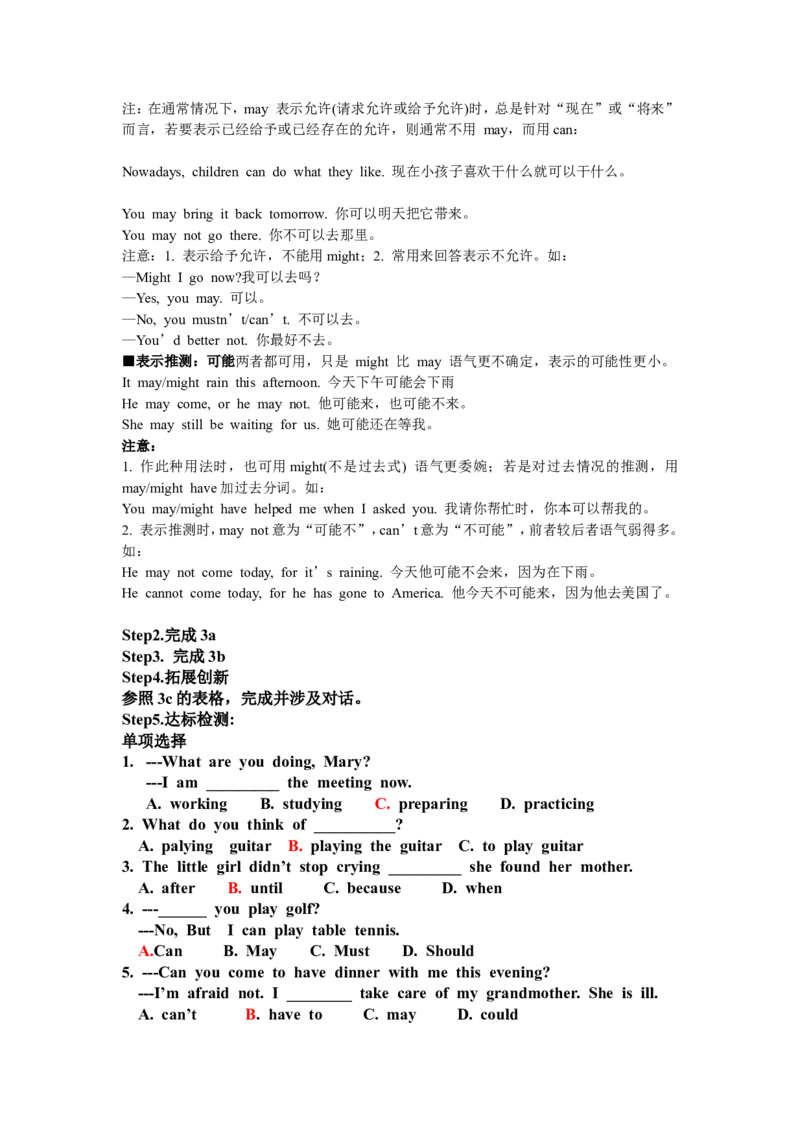
吗?”“当然可以。”(不能说Yes, you might.)注:在通常情况下,may 表示允许(请求允许或给予允许)时,总是针对“现在”或“将来”
而言,若要表示已经给予或已经存在的允许,则通常不用 may,而用can:
Nowadays, children can do what they like. 现在小孩子喜欢干什么就可以干什么。
You may bring it back tomorrow. 你可以明天把它带来。
You may not go there. 你不可以去那里。
注意:1. 表示给予允许,不能用might;2. 常用来回答表示不允许。如:
—Might I go now?我可以去吗?
—Yes, you may. 可以。
—No, you mustn’t/can’t. 不可以去。
—You’d better not. 你最好不去。
■表示推测:可能两者都可用,只是 might 比 may 语气更不确定,表示的可能性更小。
It may/might rain this afternoon. 今天下午可能会下雨
He may come, or he may not. 他可能来,也可能不来。
She may still be waiting for us. 她可能还在等我。
注意:
1. 作此种用法时,也可用might(不是过去式) 语气更委婉;若是对过去情况的推测,用
may/might have加过去分词。如:
You may/might have helped me when I asked you. 我请你帮忙时,你本可以帮我的。
2. 表示推测时,may not意为“可能不”,can’t意为“不可能”,前者较后者语气弱得多。
如:
He may not come today, for it’s raining. 今天他可能不会来,因为在下雨。
He cannot come today, for he has gone to America. 他今天不可能来,因为他去美国了。
Step2.完成3a
Step3. 完成3b
Step4.拓展创新
参照3c的表格,完成并涉及对话。
Step5.达标检测:
单项选择
1. ---What are you doing, Mary?
---I am _________ the meeting now.
A. working B. studying C. preparing D. practicing
2. What do you think of __________?
A. palying guitar B. playing the guitar C. to play guitar
3. The little girl didn’t stop crying _________ she found her mother.
A. after B. until C. because D. when
4. ---______ you play golf?
[来源:学科网]
---No, But I can play table tennis.
A.Can B. May C. Must D. Should
5. ---Can you come to have dinner with me this evening?
---I’m afraid not. I ________ take care of my grandmother. She is ill.
A. can’t B. have to C. may D. could6. ---Can you come to my birthday party?
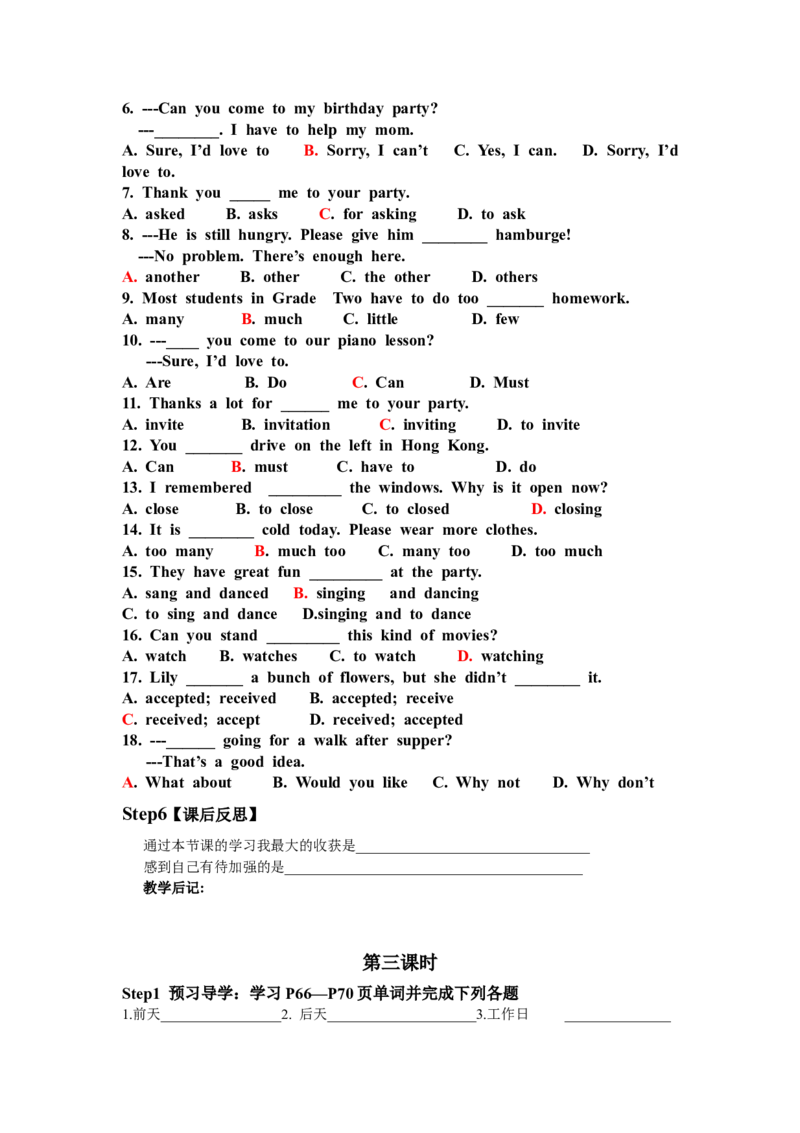
---________. I have to help my mom.
A. Sure, I’d love to B. Sorry, I can’t C. Yes, I can. D. Sorry, I’d
love to.
7. Thank you _____ me to your party.
A. asked B. asks C. for asking D. to ask
8. ---He is still hungry. Please give him ________ hamburge!
---No problem. There’s enough here.
A. another B. other C. the other D. others
9. Most students in Grade Two have to do too _______ homework.
[来源:Zxxk.Com]
A. many B. much C. little D. few
10. ---____ you come to our piano lesson?
---Sure, I’d love to.
A. Are B. Do C. Can D. Must
11. Thanks a lot for ______ me to your party.
A. invite B. invitation C. inviting D. to invite
12. You _______ drive on the left in Hong Kong.
A. Can B. must C. have to D. do
13. I remembered _________ the windows. Why is it open now?
A. close B. to close C. to closed D. closing
14. It is ________ cold today. Please wear more clothes.
A. too many B. much too C. many too D. too much
15. They have great fun _________ at the party.
A. sang and danced B. singing and dancing
C. to sing and dance D.singing and to dance
16. Can you stand _________ this kind of movies?
A. watch B. watches C. to watch D. watching
17. Lily _______ a bunch of flowers, but she didn’t ________ it.
A. accepted; received B. accepted; receive
C. received; accept D. received; accepted
18. ---______ going for a walk after supper?
---That’s a good idea.
A. What about B. Would you like C. Why not D. Why don’t
Step6【课后反思】
通过本节课的学习我最大的收获是_________________________________
感到自己有待加强的是__________________________________________
教学后记:
第三课时
Step1 预习导学:学习P66—P70页单词并完成下列各题
1.前天_________________2. 后天_____________________3.工作日 _______________4.照料,照顾________________5.邀请,请柬____________________6.拒绝_____________
7.回答,答复_______________8.转寄,发送,adv 向前;前进___________________
9.删除v ________________10. 打印,印刷 _______________11(. 令人)悲哀的;(令人)难
过的__________________ 12. 再见 _________________ 13.去旅行 ________________
14.高兴,愿意________________15.准备,准备工作______________16.胶水 __________
17. 没有;不(做某事)_____________________ 18.惊奇的;感觉意外的______________
19.盼望;期待_____________________ 20.接到(某人)的信、电话等___________________
Step2自主学习,预习Section B1a-1b, 并结合相关信息,进行1C对话。
Step 3 listening practice 1c-1d.
Step 4、2a
Mke a list of the kinds of parties people have.
Step 5、2b.
Read the message quickly.
1、Why did the people write them? Match the reason with each message.
2、从2b中找出下列短语。
一个不错的主意
提高我的英语学习水平
最好的道别方式
非常感谢计划此事
Would like to do sth
月末
举办惊喜晚会
想一下要做的游戏
为了;为的是
盼望着做某事
Step 6 About five minutes to do 2c and 2d, check the answers in groups.
Step 7. 2e. Ask and answer the questions with a partner.
Step 8. 过关训练
1、---________?
---It’s Saturday.
A. What’s the date B. What time is it
C. What day is it today D. What’s today
2、---Would you like to join us in playing basketball?
---________, but I’m afraid I have to study for my science test.
A. I wouldn’t B. I’d love to C. I’d like D. I don’t like it
3、---Could you please ________ the radio a bit? It’s too loud.
---Sorry, I’ll do it right away.
A. turn down B. turn up C. turn on D. turn to
4、We couldn’t finish our work so early _______ your help.
A. without B. with C. for D. by
5. There will be a test __________.
A. three days ago B. yesterday C. the day after tomorrow D. the
day befroe yesterday
6. ______ a student, John is looking forward ______ the summer holiday.A. Of; in B. With; for C. For; at D. As; to
7.Lin Tao saw some boys ________ basketball on the playground just
now.
[来源:Z|xx|k.Com]
A. play the B. played C. playing D. to play
8. Please write the dates ________ this week ________ the calendar.
A. for; in B. for; on C. in; on D. in; for
9. Thanks a lot for the __________.
A. invite B. invitation C. inviting D. invited
10. Can you tell me _________, please?
A. what to do B. when to do C. how to do D. what time to do
11. I called to invite Lucy to my party, but she didn’t reply ________ my
inviation.
A.on B. for C. to D. in
12. ---Where is the post office, please?
---It is _____ the Center Street.
A. in the end of B. at the end of C. by the end of D. on the end
of
13. ---____ you free tomorrow?
---Yes, I think so.
A. Do B. Are C. Will D. Can
【课后反思】
通过本节课的学习我最大的收获是_________________________________
感到自己有待加强的是__________________________________________
教学后记:
第四课时
Step1自主探究 第71-72页。( 6分钟)
一、拼读单词、记忆汉语。
1.开幕式,落成典礼 ____________________ 2. 音乐会,演奏会________________________
3.校长 _______________________________ 4.大事,公开活动;比赛项目 ______________
5. 客 人 , 宾 客 ________________________ 6. 日 历 , 日 程 表
____________________________
7. 白天;日间 ________________________
二、Read the invitation and answer the questions.
invite v 邀请 invite sb to do sth. 邀请某人做某事
invite sb to some place. 邀请某人去某地
invitation n 邀请,请柬
step 2. Give the ss about five minutes to finish off 4 in page72.
[来源:学科网ZXXK]
Step 3. Self check. Finish off Exercises 1-2.
Step 4. 训练检测。
一、首字母填空。
1.Thanks for your i________________. I am very glad to go to the party.
2. I have to write a r________ to this letter.3. Can men live w_____________ air?
4.Let’s go to the c____________ tonight and listen to some classic music.
5. I am looking f_______________ to hearing from you.
二、用所给动词的适当形式填空。
1. How about __________(play) football this afternoon?
2. He often helps his mother _______________(do) housework.
3. Can he ____________(look) after his sister?
4.They have fun ___________(swim) in the sea yesterday.
5. Thanks for _________(ask) me.
6.They’re busy ______________(study) for math test.
三、根据汉语意思完成句子。
1.他星期天不得不待在家里照看他的小妹妹。
He has to stay at home to _________ _________ his younger sister on
Sunday.
2. 后天你能和我打网球吗?
Can you play tennis with me _______ _______ ________ _________?
3. 前天我不得不去看医生。
I _______ ________ go to see the __________ ________ ________
_________.
4.周末去旅游怎么样?
What about _______ _______ _________ on weekends?
5.他的邀请使我感到很快乐。
His _______ made me feel ________.
四、句型转换。
1. She has to help her parents.
否定句: ______________________________
一般疑问句: ______________________________
2. I can come to your party.
否定句: ______________________________
一般疑问句: ______________________________
Step3【课后反思】
通过本节课的学习我最大的收获是_________________________________
感到自己有待加强的是__________________________________________
教学后记:
第五课时
一、单项选择
1.—Would you like to have a piano lesson?
—
A.Sure, I’d like B. No,I have no time C. Yes,please D.Certainly,I’d love to
2—Can you help me with my watch?
—Sorry,I can’t. I’m not .
A. Lucky B.ready C.available D.busy3.—Must I finish my homework now?
—No,you .but you finish it after supper.
A. Need’t,must B.mustn’t must C.Need’t,need D.mustn’t may
4.Who can guitar very in your school?
A. Plays,good B.play the,well C.play the,good D.play,good
5.Ted often invites Vince tennis on weekends.
A.play B.plays C.to play D.playing
6.Thank you for me the housework.
My pleasure.
A.help, to do B. helping,do C.helping,doing D. to help do
7.My father come back next Tuesday.
A.won’t,until B.isn’t,until C.won’t,before D. Doesn’t,after
8.---Helen,let’s make dumplings.
---Sorry,I’m busy now. Maybe time.
A.another B.other C.others D.the other
9.It’s raining outside,so we stay at home and watch TV.
A.must B.can C.may D.have to
10.Alice went out without a word.
A.says B.saying C.to say D.said
11.He’d like us to his party.
A. Invite,to go B.to invite, to go C.invite,go D.to invite,go
12.---Mom,I’m hungry.
---What about going to McDonald’s fried chicken?
A.eat B. to eat C. eating D.eats
13.We’re looking forward to a sports meeting.
A.have B.having C.has D. Had
14.I’m busy today. I have a letter .
A.write B.to write C.writing D.writes
15.He’d like his parents a new bike for him.
A.buy B.buying C. to buy D. Buys
16.You’ll be when you return from your vacation.
A.relaxing B.relaxed C.relax D.relaxes
17.Don’t forget my birthday party.
A.coming B. to come to C. to come D. coming to
18.Would you like cake?
A.other B. The other C.another D. Others
19.Mary is fishing with her grandpa .
A. Whole day B.whole the day C. the whole day D. The all day
20.---Would you like to go there with me?
---Yes,
A.I’d to B. I’d love C.I would D.I’d love to
二、根据句意及首字母提示完成单词
1. She isn’t a to go to the baseball game with us.
2. The students are having a music l in the classroom now.3. Thanks for your i ! I had a great time at your party.
4. I’m very s at what he said.
5. He likes music, he is having a p lesson.
三.句型转换
1.They spend more than two days planting trees every spring.(同义句转换)
It more than two days plant trees every spring.
2.My little sister is not old enough to go to school.(同义句转换)
My little sister is go to school.
3.You’d better ask Jack to go.(改为否定句)
You’d better Jack to go.
4.She does her homework in the evening.(改为一般疑问句)
She her homework in the evening?
5.He gets up at five every morning.(用 tomorrow 改为句子)
He get up at five tomorrow.
四、根据首字母提示完成短文
It was Mr Hill’s birthday. He was one h 1 years old and many people came
to his birthday party.A reporter came to the party and a 2 him a few questions.
“Many people want to know h 3 you live long,” the reporter said ,“Could
you tell us a 4 it?” “That is—I a 5 get up at six in the morning,”
said Hill.“And have three m 6 a day.Never drink.”
“B 7 .”said the reporter, “my uncle also did so,and he o 8 lived to
be eighty.W 9 do you think of that?”
“He didn’t keep i 1 0 long enough,”was the old man’s answer.
1. 2. 3 . 4. 5.
6. 7. 8. 9. 10.
【课后反思】
通过本节课的学习我最大的收获是_________________________________
感到自己有待加强的是__________________________________________
教学后记:Step two
Prepare for an exam; help my parents; go to the doctor; meet friend; have the flu:
on Saturday morning; have too much homework;或许下次有空; thanks for asking.
第二课时
同步操练
1. before; after; until
2. didn’t watch TV until
3. begin to do his homework until
4. C
5. A
6. B
7. didn’t until
Step 5 达标
1-5 CBBAB 6-10 BCABC 11-15CBDBB 16-18DCA
第三课时
Step 8
1-5 CBAAC 6-10 DCBBA 11-13BBB
第四课时(略)
第五课时